
Showing 23 items matching "staff reductions"
-
 Whitehorse Historical Society Inc.
Document, Report on staff reductions, c1930
... Report on staff reductions...Halliday proposing reductions of staff and staff adjustments....Report on staff reductions Document Document ...Letter to President of Shire of Blackburn and Mitcham from R.R. Halliday proposing reductions of staff and staff adjustments.Letter to President of Shire of Blackburn and Mitcham from R.R. Halliday proposing reductions of staff and staff adjustments.Letter to President of Shire of Blackburn and Mitcham from R.R. Halliday proposing reductions of staff and staff adjustments.shire of blackburn and mitcham, local government, council staff, halliday, robert ramsay, bishop, herbert thomas, charlesworth, albert roy, sharp -
Federation University Historical Collection
Document, Ballarat School of Mines Council President's Report, 1930-1933, 1930-1933
... ...staff reductions...In several cases of hardship students have been admitted to classes upon signing an agreement to pay fees so soon as they get back into employment. ...' ballarat school of mines a.g. hesiltine woolclassing creswick l. crouch f. ewart andre mclean royal melbourne show woolclassing prize old scholars reunion repatriation students council studentships thomas a. adams spencer day macklam kerby edward butler john eccleston walalce hughes harold dawber colin neyland milford day john kearney walter luke h. potter mary stapleton k. wightwick thomas brown thelma clendenning r. draper h. tresize david ferguson adam wilson claude creelman noreen baker donald cameron james downey allan wilson norman rowe george bowers lillian pickford g. murnowood k. wilkie lillian hi rita kewley john bell jean aldridge kath eccleston florence luke rena handy arthur amor edna findlay sheila moss w.h. steane w.h. steane retirement donald clark donald clark death m.g. cornell ballarat school of mines battery g. leviston l.g. stevens rex warwillow l.j. hillman e.n. pickering j. hulse k.c. mathes j.o. elliott j. wight b.j cculloch j.f. sullivan w.t. stevenson a. collins great depression ballarat school of mines procession model locomotive museum henry kim yuen pharmacy materia medica botany staff reductions woolclassing shield g.r. king gordon institute f.g. heseltine daniel walker daniel walker death spitzkarsten Twelve handwritten report from A.G. ....6 "...The big difficulty facing students today is the falling of in positions offering; it is to be hoped that the present state of depression will terminate. In several cases of hardship students have been admitted to classes upon signing an agreement to pay fees so soon as they get back into employment. ...'Twelve handwritten report from A.G. Heseltine.ballarat school of mines, a.g. hesiltine, woolclassing, creswick, l. crouch, f. ewart, andre mclean, royal melbourne show woolclassing prize, old scholars reunion, repatriation students, council studentships, thomas a. adams, spencer day, macklam kerby, edward butler, john eccleston, walalce hughes, harold dawber, colin neyland, milford day, john kearney, walter luke, h. potter, mary stapleton, k. wightwick, thomas brown, thelma clendenning, r. draper, h. tresize, david ferguson, adam wilson, claude creelman, noreen baker, donald cameron, james downey, allan wilson, norman rowe, george bowers, lillian pickford, g. murnowood, k. wilkie, lillian hi, rita kewley, john bell, jean aldridge, kath eccleston, florence luke, rena handy, arthur amor, edna findlay, sheila moss, w.h. steane w.h. steane retirement, donald clark, donald clark death, m.g. cornell, ballarat school of mines battery, g. leviston, l.g. stevens, rex warwillow, l.j. hillman, e.n. pickering, j. hulse, k.c. mathes, j.o. elliott, j. wight, b.j, cculloch, j.f. sullivan, w.t. stevenson, a. collins, great depression, ballarat school of mines procession, model locomotive, museum, henry kim yuen, pharmacy, materia medica, botany, staff reductions, woolclassing shield, g.r. king, gordon institute, f.g. heseltine, daniel walker, daniel walker death, spitzkarsten -
Whitehorse Historical Society Inc.
Document, List of duties performed by officers and salaries paid, 1932
... Includes report on amalgamations of positions and reductions in staff....Includes report on amalgamations of positions and reductions in staff....Includes report on amalgamations of positions and reductions in staff. List of duties performed by officers and salaries paid. ...Shire of Blackburn and Mitcham subcommittee report on duties of individual officers (1932).Shire of Blackburn and Mitcham subcommittee report on duties of individual officers (1932). Includes report on amalgamations of positions and reductions in staff.Shire of Blackburn and Mitcham subcommittee report on duties of individual officers (1932).shire of blackburn and mitcham, bishop, herbert thomas, local government, charlesworth, albert roy, council staff -
Federation University Historical Collection
Book - Ledger, Ballarat School of Mines Minute Book, 1888-1893, 1888-1893
... 1890: excise of portion of Gaol Reserve for technical education 18/05/1903 - Reduction of staff wages...ballarat gaol ballarat school of mines ballarat junior technical school cuthbert & wynne rev o'connor robert malachi serjeant, andrew robertson, richard taylor vale w.e. eyres david ham bryce ross watts & son james oddie vetinary science excise of portion of gaol reserve for technical education silver trowel - new classrooms thomas baths becker & co l.s. linehan elizabeth stayt manning, f.p. matthews, pter serjeant, robert malachi booth, john robert figgis, k.j dawson, theresa feary, bob guerin, bella guerin, bella (j.m.) smith, alfred mica evans, j haymes, david rettalack slater, g cuthbert, henry day, athol robertson, bessie bella guerin henry cuthbert g. slter athol day julia (bella) guerin clunes school of mines Clunes school of mines establishment schools of mines 1890: excise of portion of Gaol Reserve for technical education 18/05/1903 - Reduction of staff wages Ballarat School of Mines Minute Book, 1888-1893 Book Ledger ...1890: excise of portion of Gaol Reserve for technical education 18/05/1903 - Reduction of staff wagesballarat gaol, ballarat school of mines, ballarat junior technical school, cuthbert & wynne, rev o'connor, robert malachi serjeant,, andrew robertson,, richard taylor vale, w.e. eyres, david ham, bryce ross, watts & son, james oddie, vetinary science, excise of portion of gaol reserve for technical education, silver trowel - new classrooms, thomas baths, becker & co, l.s. linehan, elizabeth stayt, manning, f.p., matthews, pter, serjeant, robert malachi, booth, john robert, figgis, k.j, dawson, theresa, feary, bob, guerin, bella, guerin, bella (j.m.), smith, alfred mica, evans, j, haymes, david, rettalack, slater, g, cuthbert, henry, day, athol, robertson, bessie, bella guerin, henry cuthbert, g. slter, athol day, julia (bella) guerin, clunes school of mines, clunes school of mines establishment, schools of mines -
Melbourne Tram Museum
Document, Public Transport Corporation (PTC), "Fifth update - the privatisation of the PTC", 1998
... Document titled "Fifth update - the privatisation of the PTC", presenting the slides of a PowerPoint presentation - covers the process, plan, sale of freight, ARTC Maintenance, getting ready for the sale process, timetable, workshops, automatic ticketing, EBA, reduction in staff, head office issues, what it means, redundancies, career management programs, support programs and other information....Document titled "Fifth update - the privatisation of the PTC", presenting the slides of a PowerPoint presentation - covers the process, plan, sale of freight, ARTC Maintenance, getting ready for the sale process, timetable, workshops, automatic ticketing, EBA, reduction in staff, head office issues, what it means, redundancies, career management programs, support programs and other information. ...Document titled "Fifth update - the privatisation of the PTC", presenting the slides of a PowerPoint presentation - covers the process, plan, sale of freight, ARTC Maintenance, getting ready for the sale process, timetable, workshops, automatic ticketing, EBA, reduction in staff, head office issues, what it means, redundancies, career management programs, support programs and other information.Yields information about the 1998 Privitisation process of the PTC.Four single sided sheets, A4 sheets, stapled in top left hand corner.privatisation, ptc, workshops -
Bendigo Historical Society Inc.
Newspaper - Bendigo Advertiser Collection: Schools Searching for a Future - Mandurang South Primary School 1628, August 13 1993
... Despite demonstrating a strong curriculum and experienced leadership, the school faced severe staffing reductions: from two teachers plus specialist support to just 1.4 teachers for 32 students. ...Despite demonstrating a strong curriculum and experienced leadership, the school faced severe staffing reductions: from two teachers plus specialist support to just 1.4 teachers for 32 students. ...The document highlights the challenges faced by Mandurang South, a small rural school, in the face of government education reforms and potential closure. Mandurang South was considered an easy target for closure under new government 'quality provision' guidelines. Despite demonstrating a strong curriculum and experienced leadership, the school faced severe staffing reductions: from two teachers plus specialist support to just 1.4 teachers for 32 students. This would require one teacher to manage 31 children across seven grades in a single classroom, raising concerns about educational quality. Parents and teachers collaborated intensively to prepare a submission proving the school's quality, hoping to meet government criteria for survival. Some parents, including former students, expressed willingness to close or merge the school if educational standards could not be maintained, while others wanted to keep it open. The school community was holding a referendum to decide its stance for an upcoming taskforce meeting. Mandurang South and its neighboring school, Mandurang Primary, originated from a split in 1875 due to the distances children had to travel. The school has a rich history, with its original weatherboard building and a notable stand of century-old trees, making it a model for rural education and a point of local pride. The most likely option discussed was merging with Mandurang Primary, which would be ironic given their historical split over a century ago.Mandurang South's situation serves as a test case for the broader impact of educational 'rationalisation' policies on small rural schools. Mr. Balmer was Head Teacher in 1875. Heintervened to stop residents from cutting timber on school grounds, preserving a notable stand of eucalypts and conifers.The school grounds are recognized for their natural beauty, attracting visitors and providing students with daily exposure to native wildlife and nature-based activities. The school offers standard facilities (oval, courts, shelter) and unique curriculum elements like "bush cooking," making learning relevant to its rural setting. Mandurang South School is valued at $50,000–$70,000, but faces closure due to economic constraints and potential staff reductions.There is concern that closure could lead to further school consolidations in the Mandurang valley, as part of a broader government education reform. The possible closure is seen as a loss to the community’s heritage and educational landscape, with uncertainty about the future of other local schools.Schools searching for a Future. Series of photos and information about Mandurang Primary School No. 1628. Pictures by Lisa Honeychurch. Written by Owen Davies. This item contains the following documents: 8091.602a Part of Page 11, the Bendigo Advertiser Friday August 13 1993 8091.602b Part of Page 11, the Bendigo Advertiser Friday August 13 1993 8091.602c Black and White Photo of four kids playing cricket on the oval besides the school - Contact BHS for Details 8091.602d Black and White Photo of Grade Four student Gary Wilkins sitting under a pine tree, possibly reading - Contact BHS for Details 8091.602e Black and White Photo of Grade Four students "Bush Cooking" around a camp fire Left to Right: Travis Singe, Tristian Gillies, Gary Wilkins, Bill Riddell - Contact BHS for Details 8091.602f Black and White Photo Front of Mandurang South School - Contact the BHS for Details 8091.602g Black and White Photo Front of Mandurang South School - Contact the BHS for Details 8091.602h Black and White Photo Two men and three kids in front of the school sign. Left to Right: Brian Murdoch, Brian's daughter Ebony, John's son and daughter, Roger and Erin, and John Murdoch - Contact the BHS for Details 8091.602i Black and White Photo of Mrs Bess Coghill, the former Post Mistress at Mandurang South - Contact the BHS for Details 8091.602j Black and White Photo of the school sign - Contact the BHS for Detailsnewspaper, bendigo advertiser, mandurang south, primary school -
Ballarat Tramway Museum
Document, State Electricity Commission of Victoria (SECV), "Annual report 1957/58 - Works Section", August 1958
... Includes notes on the operation and personnel of the depot - reduction in staff, maintenance, accidents, permanent way or track maintenance, including replacement of rail at the Sebastopol terminus using lighter rail ex Geelong. ...Includes notes on the operation and personnel of the depot - reduction in staff, maintenance, accidents, permanent way or track maintenance, including replacement of rail at the Sebastopol terminus using lighter rail ex Geelong. ...Document by the SECV Ballarat Work's Superintendent looks at the activities and issues of tramways and workshops. Includes notes on the operation and personnel of the depot - reduction in staff, maintenance, accidents, permanent way or track maintenance, including replacement of rail at the Sebastopol terminus using lighter rail ex Geelong. Has an extensive report on tramcar maintenance. The report on the Workshops includes a listing of staff, power station work, labour issues, vehicles, fire control and safety. Report dated 13/8/1958.Yields information about the Ballarat tramways and workshops of the SECV during 1957/1958.Carbon copy of a 15 foolscap page report stapled in the top left hand corner."Depot Foreman" in top left hand corner in ink.tramways, tramcars, ballarat, depot, works foreman, reports -
 City of Moorabbin Historical Society (Operating the Box Cottage Museum)
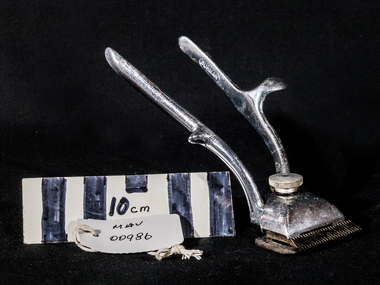
Barbers' Equipment, hair clippers 'BURMAN", c1950
... Burman, M.B.E., Managing Director, Burman and Sons, Ltd 1955 Acquired by Vono Industrial Products. 1961 Manufacturers of motor and motorcycle accessories. 1,500 employees. 1968 Supplied rack and pinion steering units to Ford 1978 Adwest Group acquired Burman and Sons, the steering gear part of Duport. 1986 Major reduction in staffing at Burman due to fall in demand for its products and delivery problems. ...Burman, M.B.E., Managing Director, Burman and Sons, Ltd 1955 Acquired by Vono Industrial Products. 1961 Manufacturers of motor and motorcycle accessories. 1,500 employees. 1968 Supplied rack and pinion steering units to Ford 1978 Adwest Group acquired Burman and Sons, the steering gear part of Duport. 1986 Major reduction in staffing at Burman due to fall in demand for its products and delivery problems. barbers, hairdressing, hair clippers, grooming, horse clippers, cars, motor cycles, gear boxes, rack and pinion , worm and ball, steering gears, steel manufacture, birmingham england, burman and sons ltd, moorabbin, bentleigh, ormond, cheltenham, market gardeners, On left arm ; BURMAN On right arm ; MADE IN ENGLAND A set of hand held barbers’ hair clippers with an adjustable screw, from Burman and Sons Ltd of Birmingham, England. ...Hair clippers are specialized implements used to cut human head hair. They work on the same principle as scissors, but are distinct from scissors and razors. :Hair clippers comprise a pair of sharpened comb-like blades in close contact one above the other which slide sideways relative to each other, a mechanism which may be manual or electrical to make the blades oscillate from side to side, and a handle. The clipper is moved so that hair is positioned between the teeth of the comb, and cut with a scissor action when one blade slides sideways relative to the other. Friction between the blades needs to be as low as possible, which is attained by choice of material and finish, and frequent lubrication. Hair clippers are operated by a pair of handles that are alternately squeezed together and released. Barbers used them to cut hair close and fast. The hair was picked up in locks and the head was rapidly depilated. Mid 20thC such haircuts became popular among boys, and young men in the military and in prisons. Burman & Sons Ltd, of Ryland Road, Birmingham, West Midlands, manufactured Burman-Douglas steering gear. Their recirculating worm and ball design of steering gear was fitted to pre-war vehicles such as the Ford Eight and the Ford Prefect, the Bedford CA, plus heavy trucks and off-road vehicles - both pre and post-war. In its day, Burman-Douglas steering-gear was regarded as.... a "quality" feature of a car chassis specification, but the worm and ball design was eventually surpassed by the cheaper rack and pinion design that dominates today. The company also manufactured motorcycle gearboxes, horse clippers and barbers’ clippers. 1871 Company founded. 1897 Private company. 1930s Gearbox for Ariel Square-four motorcycle. (Exhibit at Birmingham Thinktank museum) 1933 Burman and Sons Limited, manufacturers of horse and barbers' clippers, sheep shearers, motor cycle gear boxes and steering gears, Ryland road, Edgebaston 1953 S. F. Burman, M.B.E., Managing Director, Burman and Sons, Ltd 1955 Acquired by Vono Industrial Products. 1961 Manufacturers of motor and motorcycle accessories. 1,500 employees. 1968 Supplied rack and pinion steering units to Ford 1978 Adwest Group acquired Burman and Sons, the steering gear part of Duport. 1986 Major reduction in staffing at Burman due to fall in demand for its products and delivery problems. A set of hand held barbers’ hair clippers with an adjustable screw, from Burman and Sons Ltd of Birmingham, England. Chrome plated, in good condition, c1950. On left arm ; BURMAN On right arm ; MADE IN ENGLANDbarbers, hairdressing, hair clippers, grooming, horse clippers, cars, motor cycles, gear boxes, rack and pinion , worm and ball, steering gears, steel manufacture, birmingham england, burman and sons ltd, moorabbin, bentleigh, ormond, cheltenham, market gardeners, -
 Federation University Historical Collection
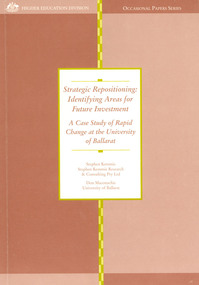
Book, Strategic Repositioning: Identifying Areas for Future Investment: A Case Study of Rapid Change at the University of Ballarat, 05/1998
... In 1996 and 1997 the University of Ballarat made a series of changes in response to the reductions in Commonwealth operating grant funding announced in the 1996 Commonwealth budget, and the university staff salary increases then being negotiated. ...In 1996 and 1997 the University of Ballarat made a series of changes in response to the reductions in Commonwealth operating grant funding announced in the 1996 Commonwealth budget, and the university staff salary increases then being negotiated. ...In 1996 and 1997 the University of Ballarat made a series of changes in response to the reductions in Commonwealth operating grant funding announced in the 1996 Commonwealth budget, and the university staff salary increases then being negotiated. The university decided that it would make its major decisions about changes as part of a continuing process of strategic repositioning. Brown soft covered book of 92 pages. Contents include the formation of the University of Ballarat, Review of the Office of the Vice-Chancellor and University administration, the process of strategic repositioning, Commonwealth budget (1996), Vice-Chancellors forums, and why the process workeduniversity of ballarat, university of ballarat act, david james, scholarships, campus plan, university plan -
Federation University Historical Collection
Document - Document - Letter, Ballarat Junior Technical School: Letters relating to equipment to establish a practice weather-observation station. 1952
... Staff member to collect as it is very fragile. The glassware for the Regnault Vapour pressure Apparatus not previously sent has been forwarded. .2: Letter from the school to The Director Weather Bureau Melbourne. Outlines establishing a weather-observing station as part of general science. Mr McLachlin in Ballarat will guide the school as to method, procedure, records, etc List of equipment on loan - Stevenson Screen, maximum and minimum thermometers, wet and dry bulb thermometers, 8" rain gauge, cloud chart, instructions for reductions of barometer readings, weather code for transmission, record book. ...Staff member to collect as it is very fragile. The glassware for the Regnault Vapour pressure Apparatus not previously sent has been forwarded. .2: Letter from the school to The Director Weather Bureau Melbourne. Outlines establishing a weather-observing station as part of general science. Mr McLachlin in Ballarat will guide the school as to method, procedure, records, etc List of equipment on loan - Stevenson Screen, maximum and minimum thermometers, wet and dry bulb thermometers, 8" rain gauge, cloud chart, instructions for reductions of barometer readings, weather code for transmission, record book. ballarat junior technical school head master l garner h b selby weather bureau weather station observations fortin barameter regnault vapour pressure apparatus stevenson screen maximum thermometer minimum thermometer bulb thermometers rain gauge instructions weather code record book .1: Letterhead for H B Selby & Co Pty Ltd - Black and red inks Signature of V T Parkinson, Manager 2 Cream pages, typed Ballarat Junior Technical School: Letters relating to equipment to establish a practice weather-observation station. 1952 Document Document - Letter ....1: Letter from H B Selby & Co Pty Ltd re the order for a Fortin Barameter. Asking for arrangement for Staff member to collect as it is very fragile. The glassware for the Regnault Vapour pressure Apparatus not previously sent has been forwarded. .2: Letter from the school to The Director Weather Bureau Melbourne. Outlines establishing a weather-observing station as part of general science. Mr McLachlin in Ballarat will guide the school as to method, procedure, records, etc List of equipment on loan - Stevenson Screen, maximum and minimum thermometers, wet and dry bulb thermometers, 8" rain gauge, cloud chart, instructions for reductions of barometer readings, weather code for transmission, record book. 2 Cream pages, typed .1: Letterhead for H B Selby & Co Pty Ltd - Black and red inks Signature of V T Parkinson, Managerballarat junior technical school, head master, l garner, h b selby, weather bureau, weather station, observations, fortin barameter, regnault vapour pressure apparatus, stevenson screen, maximum thermometer, minimum thermometer, bulb thermometers, rain gauge, instructions, weather code, record book -
 Waverley RSL Sub Branch
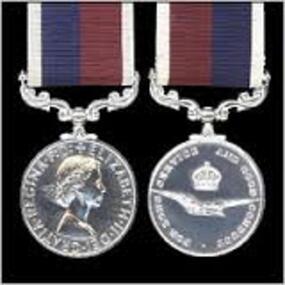
R.A.A.F. Long Service Medal
... staff in remote units. His itinerary during the war years, both in and out of Australia, shows a large number of trips in a variety of modes of transport in order to reach remote areas where units were serving. He was promoted to GPCAPT in July 1944, as the numbers of Dental Officers soon peaked at 227 towards the end of the war (1 GPCAPT, 9 WGCDRs, 60 SQNLDRs, and 157 FLTLTs). After the war, with the reduction ...Awarded to Alan Bowers (A236814) who was a R.A.A.F. dental mechanic who serverd during WWII including service in Darwin, and then continued in the R.A.A.F. for some years after the end of WWII The Royal Australian Air Force (and all Commonwealth Air Forces) Long Service and Good Conduct Medal: Awarded to NCOs and ORs of the RAAF (RAF, RCAF etc) for 15 years service. A cupro-nickel plated medal, the obverse features the sovereign's head, the reverse features the crown and eagle emblem of the RAAF (and RAF). Officers are eligible for the award provided they have served a minimum 12 years in the ranks. The riband is dark blue and maroon with white edges. This medal ceased to be awarded in Australia in 1975 when it was replaced by the National Medal (and sbsequently the DFSM and DLSM) in the Australian system of honours and awards. http://www.heritagemedals.com.au/medals-1/service-long-service/air-force-long-service-and-good-conduct-medal.html History of the RAAF Dental Branch It took six years following the formation of the RAAF in 1921 for the first Dental Clinic to be established at Point Cook, Victoria. On 10th June 1927 Flying Officer James Carl Rosenbrock commenced work as an RAAF Dental Officer for the FlyingTraining School at Point Cook. As personnel numbers were still relatively small, Rosenbrock was also responsible for the dental care of all Victorian RAAF units, which involved treating members at 1AD Laverton, as well as Air Force Headquarters at Victoria Barracks in Melbourne. As Army Dental Officers were currently caring for RAAF personnel at Richmond, NSW, the Senior Dental Officer of the 3rd Military District in Victoria (SDO 3MD) requested through the military board that a similar arrangement be established, where that the newly appointed RAAF Dentist provide part time dental services to the Army units stationed at Queenscliff. This was seen as an effective reciprocal arrangement, with both units having a Dental Officer in attendance for, in total, around 3-4 weeks a year. Rosenbrock continued to serve as the sole RAAF Dental Officer until the middle of 1933, when the Air Board asked for his service to be terminated following ‘behaviour unbecoming of a RAAF officer'. He had borrowed several sums of money, of around 40 Pounds or so, from junior ranks on base (as well as from the Regimental Sergeant Major) and had failed to pay the money back. He was replaced by a fellow Victorian, FLGOFF Norman Henry Andrews, on the 18th Sep 1933, who went on to become our first Director of Dental Services, and was instrumental in establishing the organisations and conditions of the Branch that are still present today. Through a fair amount of persistence and hard work on the part of Norman Andrews, the RAAF Dental Branch began to expand from 1937, with the introduction of 2 additional positions, at RAAF station Richmond, and at the FlyingTraining School at Point Cook. This gave the RAAF 3 uniformed Dental Officers, which was expanded to 5 in the months leading up to WW2. 4 of these Dental Officers were based in Victoria and 1 at Richmond, with the other two RAAF units being cared for by the Army (as in the case of Pearce in WA) or by civilians (as in Darwin). With the sudden increase in RAAF personnel required at the outbreak of WW2, the number of RAAF Dental Officers increased dramatically, from 5 in 1939, 28 in 1940, 64 in 1941, 147 in 1942, 193 in 1943, 219 in 1944, and peaking at 227 in 1945. RAAF Dental Officers were required to work in a variety of locations, both in and out of Australia. Between 1940 and 1942 a massive construction programme occurred, with new dental clinics being established around Australia. Priority was given to aircrew training units in order to get these personnel dentally fit for operational deployment, but Dental Officers could equally find themselves posted to recruit depots, fixed stations, medical clearance stations, mobile dental sections, and RAAF and civilian hospitals. RAAF Dental Officers were posted to the large dental centres at Ascot Vale (Vic) and Bradfield Park (NSW) when first appointed, where they received military and clinical training, before being deployed to their needed location. Mobile Dental Units When Japan entered the war in 1941, the rapid deployment of troops to northern operational areas with less than ideal dental fitness was extremely high. As a result, the RAAF deployed a range of mobile dental units, either alone or with medical sections, to support the increasing number of isolated deployed personnel within Australia and overseas. There were three types of mobile unit used: a. Mobile Dental Unit – relied on using either a semi-trailer to get around or by building a surgery directly on to the truck chassis, and installing hydraulic chairs, units, x-rays, and laboratory equipment. They were able to move around between small units, such as RAAF radar stations, where they could plug into the local power supply and work immediately. b. Transportable Dental Units – used for stops of longer duration, where field equipment was carried in panniers from one unit to another by road or rail and housed in whatever accommodation was available at the destination. They were often carried within Australia on Tiger Moths and Dakota aircraft. c. Itinerant Dental Units – in some areas, the dental equipment was installed at the RAAF unit and the Dental Officer and their staff would travel from unit to unit, using the equipment available at each location. RAAF Dental BadgeAs the war developed in Europe, it soon became obvious that the RAF Dental support was not capable of supporting the increasing numbers of RAAF aircrew that were being sent for service with the RAF, with only enough Dental Officers available to provide one to every 2000 men ( instead of the preferred 1 to 600). As a result, the RAAF provided a mobile dental unit, fitted out in a caravan and pulled by a Ford V8 Coupe, to travel around England in support of RAAF personnel at various squadrons. Some degree of tact was needed to ensure that the RAF did not take this as a comment on the treatment they were providing, but it proved successful in maintaining a satisfactory state of dental fitness in RAAF personnel, and a second mobile unit was soon dispatched. They were also set up with a laboratory on board as well as the surgery, which was a major difference between the RAF and RAAF, as the RAF did not provide dentures for their troops (the RAAF would, providing they had served for 6 years). In 1943 the RAF was no longer able to provide Dental support to Australian troops in the Middle East, which resulted in the need for a transportable dental unit to be deployed from Australia. It functioned in a similar manner to the RAF, by moving from one squadron to another. It served in the Middle East and Africa, from Cairo across North Africa, to Italy, and eventually back to England to treat returned prisoners of war. GPCAPT Norman Andrews The growth and development of the RAAF Dental Branch owes a debt to one man in particular, GPCAPT Norman Andrews. As the second RAAF Dental Officer to enlist on 18 Sep 1933, Andrews became the principal architect of the structure and organisation of the RAAF Dental Branch leading up to and during WW2. Until early 1940, the RAAF Dental Branch was administered by the Director of Medical Services (Air), which placed it under the control of the Army Medical staff. The Army would provide their Inspector of Dental Services for advice whenever needed. In April 1940, the RAAF Medical service separated from the Army, resulting in the control of the RAAF Dental Branch shifting back to the RAAF. Andrews became the first Director of Dental Services, when the position was created in 1943 as recognition of the higher profile the Dental Branch was now playing in the RAAF Medical service. Until this time, Andrews's title had been as the Dental Staff Officer to the RAAF Medical Service. Andrews was responsible for the establishment of the war-time structure of the Dental service, establishing new dental centres at all major bases, creating mobile and transportable dental units, ensuring the continual growth of the Branch, maintaining professional development of staff through the establishment of a professional journal, and by organising renowned lecturers to speak at RAAF bases. He also believed in visiting as many dental units as possible to see for himself what conditions were like and to talk first-hand to staff in remote units. His itinerary during the war years, both in and out of Australia, shows a large number of trips in a variety of modes of transport in order to reach remote areas where units were serving. He was promoted to GPCAPT in July 1944, as the numbers of Dental Officers soon peaked at 227 towards the end of the war (1 GPCAPT, 9 WGCDRs, 60 SQNLDRs, and 157 FLTLTs). After the war, with the reduction in RAAF personnel required in uniform, the Dental Branch also reduced its numbers significantly. By 1947 there were only 18 Dental Officers serving (many part-time), with 1 GPCAPT, 1 WGCDR, 10 SQNLDRs, and 6 FLTLTs, and only 13 by 1950. With the decrease in Branch personnel numbers, the ‘powers to be' saw fit to reduce the Director of Dental Service rank to WGCDR, and as a result Norman Andrews found that in order to continue serving in the RAAF he would have to wear a reduced rank. This appears to have been a contributing factor in his decision to discharge at the relatively early age of 43 and accept an administrative job as Director of the Victorian Government's School Dental Service. Norman Andrews holds the proud honour of being the founder of the RAAF Dental Branch, which during the war was instrumental in educating servicemen of the importance of dental health and maintaining the dental fitness of troops in a variety of areas. Dental Orderlies (Assistants) The dental orderly mustering was first introduced in 1937. Until that time, medical orderlies were assigned to assist the Dental officer with their duties. As early as 1931 it had been noted by both RAAF and Army Dental Officers working in Victoria and Richmond that a lot of the troubles they were having would be solved by appointing a permanent Dental Orderly. Often they would find that the medical orderly they were assigned was a different one each day, and as a result the administration and work in general was very inefficient. By 1937, with the increase in Dental Officers to 3, it was realised that a Dental Orderly mustering needed to be created. Dental Mechanics/Technicians Before WW2, dental laboratory work was provided by civilian laboratories, as most RAAF units were stationed around metropolitan areas. At this time, service personnel were still required to pay for their own dentures, unless they had served for six years or had their dentures damaged during performance of their duties. In July 1940, mainly in response to the development of more remote RAAF dental units and the increasing demand for dental prostheses, the Dental Mechanic mustering was established. Unfortunately there was a very limited pool of civilian dental mechanics to recruit from, and as a result the RAAF set up a training school at Laverton (which was later moved to Ascot Vale) in June 1941 which conducted an intensive 6 month course in Dental mechanics. Dental mechanics were quickly in demand. In all fixed and mobile dental units at least 1 Mechanic was supplied for each Dental Officer, and indeed the RAAF supplied Dental Mechanics throughout all its deployments, something the RAF were unwilling, or unable, to do. Two grades of dental mechanic existed: the Senior Mechanic (with the rank of NCO), who was competent in all phases of laboratory work; and the Junior Mechanic, who could only handle routine work and not more advanced denture work. The progression to Senior required a further trade test in techniques including setting up, clasp-forming, casting and backing teeth. During the course of the War, two special courses were held for Mechanics. The first, directed at senior mechanics so that they could instruct others, was in 1942 when Acrylic Resin was first introduced as a denture base material, as an alternative to the current option of vulcanite. Later, towards the end of the War, a ‘refresher' course was provided for those that had served for the greatest period of time in order to allow them retraining in techniques that they had not practised during their service and which were common in civilian life. This included cast base dentures, crowns and bridges, partial dentures, and retainers. Towards the end of the War, a course was held with WAAAF trainees to train them as Mechanics. However, as the War was soon to end they never had the opportunity to progress within the mustering to become Senior Mechanics. The RAAF Dental Branch has survived 75 years of turbulence, with reviews of its viability occurring regularly every few years from as early as 1937. The Branch continues to provide excellent service to the ADF community and, despite reduced manpower, will continue to play an important role in Air Force Health operations. http://www.defence.gov.au/health/about/docs/RAAFDental.pdf40cm cupro-nickel plated medal, the obverse features the sovereign's head, the reverse features the crown and eagle emblem of the RAAF (and RAF). A23814 BOWERS.A. A. F.r.a.a.f long service medal, r.a.a.f good conduct, r.a.a.f. dental service medal -
 Bendigo Military Museum
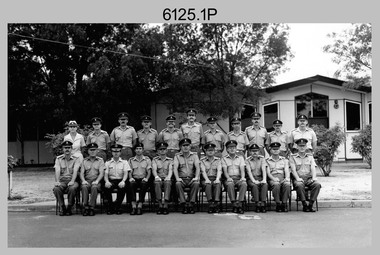
Photograph - Army Survey Regiment’s Officers, Warrant Officers and Sergeants and Squadrons, at Fortuna, Bendigo, 1982
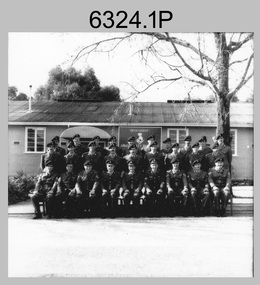
... staff at this time included the RAAF Liaison Officer, RAN Liaison Officer and several civilians employed in administration, the Q-Store and grounds maintenance. A component of the Army Svy Regt’s cartographic map production was carried out by the Detachment, a sub-unit located at Bonegilla next to the School of Military Survey. Lithographic Squadron was responsible for the reproduction of map materials and printing of military map products. The main tasks undertaken by photographic technicians were photographic enlargements, reductions...staff at this time included the RAAF Liaison Officer, RAN Liaison Officer and several civilians employed in administration, the Q-Store and grounds maintenance. A component of the Army Svy Regt’s cartographic map production was carried out by the Detachment, a sub-unit located at Bonegilla next to the School of Military Survey. Lithographic Squadron was responsible for the reproduction of map materials and printing of military map products. The main tasks undertaken by photographic technicians were photographic enlargements, reductions ...This is a set of six staff photographs of the Army Survey Regiment’s Officers, Warrant Officers and Sergeants, and each of its four Squadrons at Fortuna, Bendigo in December 1982. Note - Air Survey Squadron’s photo was probably taken in July 1982 as they appear in winter dress. Air Survey Squadron was responsible for aerotriangulation, photogrammetric feature extraction and the AUTOMAP 1 system. Typical tasks were flight planning the acquisition of aerial photography, pugging, mensuration and block adjustments, photogrammetric extraction of topographic features from aerial photography, digital feature editing, map compilation, operating the scanner/plotter, operating the AUTOMAP 1 system and computer programming by civilians. Cartographic Squadron was responsible for the production of the following military products: Joint Operation Graphics, small-scale RAAF Air Charts, large-scale topographic line maps and orthophotomaps. Cartographic technician tasks were scribing, compiling, retouching, masking, type setting, type stickup, terrain embossing, correcting and proving quality control. Headquarters Squadron was responsible for the planning and coordination of map production and contracts. It also performed administrative and support functions such as personnel administration, pay, finance, transportation, records, map Library, kitchens, messes and facility maintenance. It was staffed by Army personnel from RASvy, RACT, AACC, RAAOC and RAEME corps. Other supporting staff at this time included the RAAF Liaison Officer, RAN Liaison Officer and several civilians employed in administration, the Q-Store and grounds maintenance. A component of the Army Svy Regt’s cartographic map production was carried out by the Detachment, a sub-unit located at Bonegilla next to the School of Military Survey. Lithographic Squadron was responsible for the reproduction of map materials and printing of military map products. The main tasks undertaken by photographic technicians were photographic enlargements, reductions and duplication of map reproduction material and processing of aerial photography. Printing technician tasks included platemaking, offset printing, map stock despatching and proofing.This is a set of six staff photographs of the Army Survey Regiment’s Officers, Warrant Officers and Sergeants, and its four Squadrons, at Fortuna, Bendigo, 1982. The black and white photographs were printed on photographic paper and are part of the Army Survey Regiment’s Collection. The photograph was scanned at 300 dpi. No personnel are identified. No personnel are identified. .1P – Annotated on front “OFFICERS MESS DEC ’82” .2P – Annotated on back “SGTS MESS DEC ’82” .4P– Annotated on front “CARTO SQN DEC ’82” .5P– Annotated on front “HQ SQN DEC ’82”royal australian survey corps, rasvy, army survey regiment, army svy regt, fortuna, asr, air survey, carto, litho -
 Bendigo Military Museum
Photograph - Detachment - Army Survey Regiment, Bonegilla, Victoria, c1973
... Detachment personnel managed to produce 18 charts in the following two years, which was an impressive achievement for the staff, given major differences in format, specification and scales. Development of digital production of aeronautical charts in 1984-85 led to gradual reduction in production output and contracting out production was instigated to meet the shortfall and as a consequence the Detachment closed in September 1985. ...Detachment personnel managed to produce 18 charts in the following two years, which was an impressive achievement for the staff, given major differences in format, specification and scales. Development of digital production of aeronautical charts in 1984-85 led to gradual reduction in production output and contracting out production was instigated to meet the shortfall and as a consequence the Detachment closed in September 1985. ...This is a set of six photographs of personnel from the Detachment - Army Survey Regiment taken in front of its main map production building at Bonegilla, Victoria in c1974. This cartographic map production sub-unit of the Army Survey Regiment operated in buildings owned by the School of Military Survey from 17th of June 1970 to the 30th of September 1985. A total of 800 topographic maps ranging in scale from 1:25,000 to 1: 250,000 scale were completed. A major focus of production in the 1970s was the cartographic completion of the Papua-New Guinea 1:100,000 map series and the Flexiflow quality control system was developed as a tool to coordinate production. The Flexiflow system comprised a series of job plans and charts linked to a task allocation to resource magnetic planning board. Using critical path analysis and task prioritisation, complex job planning was efficiently scheduled, and re-prioritisations readily made. Reproduction requirements were effectively coordinated by way of weekly courier to the Army Survey Regiment at Bendigo. Supervisors and technicians fully embraced the system as they could understand their role, others around them and the positive production achievements. WO1 Bill Boyd (who does not appear in this photograph) was the technical warrant officer for 11 years at the Detachment was awarded the OAM, the Order of Australia Medal for leading the development and the implementation of the Flexiflow system. By mid-1982, production of maps at these scales was undertaken digitally on Bendigo’s AUTOMAP 2 system and the Detachment reverted to production of small-scale large format RAAF aeronautical charts. Detachment personnel managed to produce 18 charts in the following two years, which was an impressive achievement for the staff, given major differences in format, specification and scales. Development of digital production of aeronautical charts in 1984-85 led to gradual reduction in production output and contracting out production was instigated to meet the shortfall and as a consequence the Detachment closed in September 1985. See pages 177 to 180 of Valerie Lovejoy’s book 'Mapmakers of Fortuna – A history of the Army Survey Regiment’ ISBN: 0-646-42120-4. for more information on the history of the Detachment at Bonegilla.This is a set of six photographs of the Detachment - Army Survey Regiment taken in front of the main map production building at Bonegilla, Victoria in c1974. The photographs were printed on photographic paper and are part of the Army Survey Regiment’s Collection. The photographic print and proofs were scanned at 600 dpi. .1) to .3) - Photo, black & white c1973. Back Row L to R: Peter Simpson, Chris Edwards, Ted Dudzinski, Terry Genge, Colin Harden, Rowan Gillies, Bob Rowley OAM, Steve Hansen, Stu Thaxter. Centre Row L to R: Kevin Boehm, Dennis McCarthy, Peter Cross, unidentified, Brian Ryan, unidentified, Ian Marner, unidentified, Phil Smalley. Front Row L to R: Geoff Haynes, Bruce Wetzig, Dave Thompson, unidentified, OC Bob Roche, Ike Lever, John McCulloch, Dick Barwald, unidentified. .4) - Photo, black & white c1973. Back Row L to R: Peter Simpson, Chris Edwards, unidentified (x2), Colin Harden, Rowan Gillies, Bob Rowley OAM, Steve Hansen, Stu Thaxter. Centre Row L to R: Kevin Boehm, Dennis McCarthy, Peter Cross, unidentified, Brian Ryan, unidentified, Ian Marner, Phil Smalley, unidentified, Dick Barwald. Front Row L to R: Geoff Haynes, Bruce Wetzig, Dave Thompson, unidentified, OC Bob Roche, Ike Lever, John McCulloch, unidentified (x2). .5) - Photo, black & white c1973. Back Row L to R: Geoff Haynes, unidentified, John McCulloch, Bruce Wetzig. Front Row L to R: Dave Thompson, Ike Lever, unidentified. .6) - Photo, black & white c1973. L to R: OC Bob Roche, unidentified.There are no personnel annotated.royal australian survey corps, rasvy, army survey regiment, detachment - army survey regiment, army svy regt, asr -
 Federation University Art Collection
Ceramic, Stoneware by Jan Feder, c1980
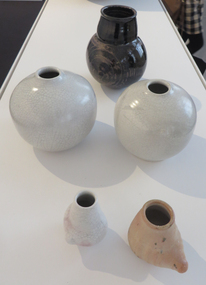
... reduction-fired stoneware with feldspar hoc crackle and tenmoku glaze. This collection of work is part of the Jan Feder Memorial Ceramics Collection. Jan Feder was an alumna of the Gippsland Campus who studied ceramics on the campus. She passed away in the mid 1980s. Her student peers raised funds to buy ceramic works in her memory. They bought works from visiting lecturers who became leading ceramic artists around the world, as well as from many of the staff...The collection is important to the Gippsland campus through its connection to staff and students (and their ongoing success in the field), their commitment to collecting for the benefit of future students, and for the collections mentoring role for study purposes. ceramics jan feder jan feder memorial ceramics collection churchill gippsland campus stoneware Wheel thrown reduction-fired stoneware with feldspar hoc crackle and tenmoku glaze. ...Wheel thrown reduction-fired stoneware with feldspar hoc crackle and tenmoku glaze. This collection of work is part of the Jan Feder Memorial Ceramics Collection. Jan Feder was an alumna of the Gippsland Campus who studied ceramics on the campus. She passed away in the mid 1980s. Her student peers raised funds to buy ceramic works in her memory. They bought works from visiting lecturers who became leading ceramic artists around the world, as well as from many of the staff who taught there. The reduction fired stoneware includes feldspathic crackle and Tenmoui glazes. ceramics, jan feder, jan feder memorial ceramics collection, churchill, gippsland campus, stoneware -
 Vision Australia
Textile - Image, 2001 Year of the Volunteer wall hanging, 2001
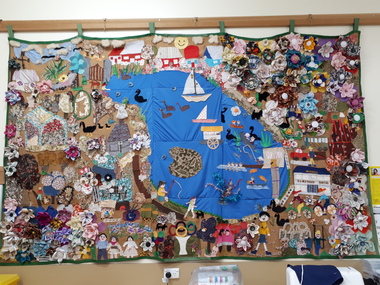
... These were proudly displayed in the various offices until refurbishments and reduction of physical office space reduced the ability to do this. Various hangings have been stored by volunteers or former staff members, however digital images were secured where possible. ...These were proudly displayed in the various offices until refurbishments and reduction of physical office space reduced the ability to do this. Various hangings have been stored by volunteers or former staff members, however digital images were secured where possible. ...To celebrate the 2001 International Year of the Volunteer, each Vision Australia Foundation site constructed a wall hanging. These were proudly displayed in the various offices until refurbishments and reduction of physical office space reduced the ability to do this. Various hangings have been stored by volunteers or former staff members, however digital images were secured where possible. Ballarat's wall hanging shows Lake Wendouree and the Ballarat area around it. Mildura's wall hanging shows paddleboats on the Murray River, with grapes, a hot air balloon and a large sun.Cloth banner made by volunteers to celebrate 2001vision australia foundation, volunteers -
 Vision Australia
Photograph - Image, John Moule, 1995
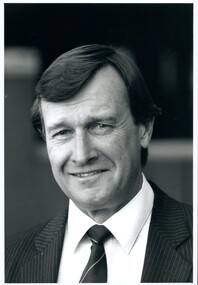
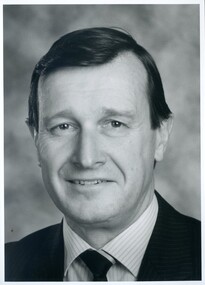
... Shortly after his commencement, political changes forced the realignment of government departments and expenditure, requiring a reduction in nursing home accommodation and staffing levels. With the demand increasing for services, and the need for a financially sustainable model, he oversaw the increasing amount of government support for the AFB as well as the successful centenary appeal. ...Shortly after his commencement, political changes forced the realignment of government departments and expenditure, requiring a reduction in nursing home accommodation and staffing levels. With the demand increasing for services, and the need for a financially sustainable model, he oversaw the increasing amount of government support for the AFB as well as the successful centenary appeal. ...John Moule was President for the Association for the Blind from 1992 until 1999. Shortly after his commencement, political changes forced the realignment of government departments and expenditure, requiring a reduction in nursing home accommodation and staffing levels. With the demand increasing for services, and the need for a financially sustainable model, he oversaw the increasing amount of government support for the AFB as well as the successful centenary appeal. In this image, John Moule Man is dressed in pinstripe suit, light coloured shirt and striped tie, and stands outside a building. A coloured version of an image taken during this photo shot appeared in the 1995 AFB Annual Report.1 B/W photograph of John Moule in pinstripe suit, light coloured shirt and striped tie standing outside a buildingassociation for the blind, john moule -
 Vision Australia
Photograph - Image, John Moule - portrait, 1994
... Shortly after his commencement, political changes forced the realignment of government departments and expenditure, requiring a reduction in nursing home accommodation and staffing levels. With the demand increasing for services, and the need for a financially sustainable model, he oversaw the increasing amount of government support for the AFB as well as the successful centenary appeal. ...Shortly after his commencement, political changes forced the realignment of government departments and expenditure, requiring a reduction in nursing home accommodation and staffing levels. With the demand increasing for services, and the need for a financially sustainable model, he oversaw the increasing amount of government support for the AFB as well as the successful centenary appeal. ...John Moule was President for the Association for the Blind from 1992 until 1999. Shortly after his commencement, political changes forced the realignment of government departments and expenditure, requiring a reduction in nursing home accommodation and staffing levels. With the demand increasing for services, and the need for a financially sustainable model, he oversaw the increasing amount of government support for the AFB as well as the successful centenary appeal. In this image, John Moule Man is dressed in striped shirt, dark jacket and striped tie.1 B/W photograph of John Moule in striped shirt, dark jacket and striped tieassociation for the blind, john moule -
 Vision Australia
Photograph - Image, Pam and John Moule with Frances Norris, May 1998
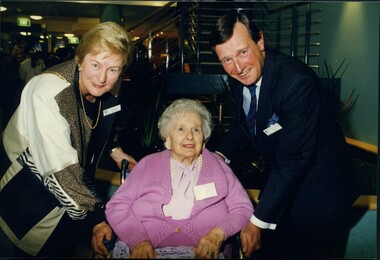
... Shortly after his commencement, political changes forced the realignment of government departments and expenditure, requiring a reduction in nursing home accommodation and staffing levels. With the demand increasing for services, and the need for a financially sustainable model, he oversaw the increasing amount of government support for the AFB as well as the successful centenary appeal. ...Shortly after his commencement, political changes forced the realignment of government departments and expenditure, requiring a reduction in nursing home accommodation and staffing levels. With the demand increasing for services, and the need for a financially sustainable model, he oversaw the increasing amount of government support for the AFB as well as the successful centenary appeal. ...John Moule was President for the Association for the Blind from 1992 until 1999. Shortly after his commencement, political changes forced the realignment of government departments and expenditure, requiring a reduction in nursing home accommodation and staffing levels. With the demand increasing for services, and the need for a financially sustainable model, he oversaw the increasing amount of government support for the AFB as well as the successful centenary appeal. John Moule and his wife Pam stand beside resident Frances Norris, at the opening of the 'Pam and John Moule Terrace' at Elanora, Brighton.1 coloured photograph of Pam and John Moule, with Frances Norrisassociation for the blind, john moule, elanora home (brighton), pam moule, frances norris -
 Melbourne Tram Museum
Document - Report, Yarra Trams, "100 years of electric trams in Melbourne", 2005 - 2006
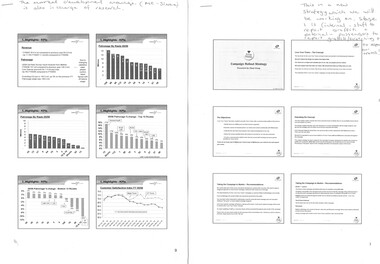
... Set of two presentations or printout of a PowerPoint presentation, 6 slides per sheet and two position descriptions. .1 - Three page report (part of a larger report - page 9 to 11) results of a survey of various routes, KPI's - surveys, customer feedback, and incidents, service delivery. .2 - four page report about the Love Your Trams campaign presented by Flash Group, the objective, concept, the message, graffiti reduction and messages from passengers and staff. .3 - Two page Yarra Tram position description for Customer Relations and Marketing Officer, Camberwell. .4 - ditto for Customer Relations Assistant Camberwell....Staff On top of each document are notes in blue ink. Set of two presentations or printout of a PowerPoint presentation, 6 slides per sheet and two position descriptions. .1 - Three page report (part of a larger report - page 9 to 11) results of a survey of various routes, KPI's - surveys, customer feedback, and incidents, service delivery. .2 - four page report about the Love Your Trams campaign presented by Flash Group, the objective, concept, the message, graffiti reduction and messages from passengers and staff. .3 - Two page Yarra Tram position description for Customer Relations and Marketing Officer, Camberwell. .4 - ditto for Customer Relations Assistant Camberwell. "100 years of electric trams in Melbourne" Document Report Yarra Trams ...Set of two presentations or printout of a PowerPoint presentation, 6 slides per sheet and two position descriptions. .1 - Three page report (part of a larger report - page 9 to 11) results of a survey of various routes, KPI's - surveys, customer feedback, and incidents, service delivery. .2 - four page report about the Love Your Trams campaign presented by Flash Group, the objective, concept, the message, graffiti reduction and messages from passengers and staff. .3 - Two page Yarra Tram position description for Customer Relations and Marketing Officer, Camberwell. .4 - ditto for Customer Relations Assistant Camberwell.On top of each document are notes in blue ink.trams, tramways, yarra trams, accidents, melbourne, depots, marketing, staff -
 Melbourne Tram Museum
Pamphlet, "Your Government Bus Service Serving you better", c1982
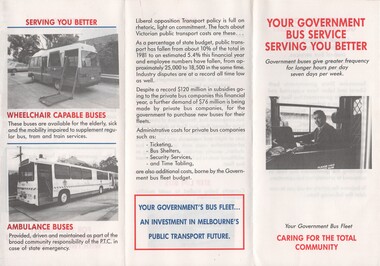
... Printed c1982, notes the reduction in funding and staffing. No details as to who printed the document. ...Printed c1982, notes the reduction in funding and staffing. No details as to who printed the document. ...Three fold DL pamphlet printed on off white paper, two colour + black - titled "Your Government Bus Service Serving you better" - discussing the pros and cons of a government bus service compared to a privately operated bus service and the subsidy provided. Notes the Liberal Coalition policy is to privatise public services. Has photos of step lift, kneeling, wheel chair and ambulance bus. Printed c1982, notes the reduction in funding and staffing. No details as to who printed the document. Second copy added 17-4-2017trams, tramways, public transport, buses, privatisation -
 Melbourne Tram Museum
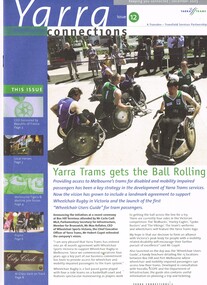
Magazine, Yarra Trams, "Yarra Connections", Dec. 2003
... staff newsletter. Trams tramways Yarra Trams W Class Disability services Vermont South Awards Metlink Route 30 Camberwell Depot Docklands Route 70 St Vincent's Plaza Line Officers Box Hill Route 109 B class Superstops Cricket Tennis TramTracker Route 75 city circle new trams C class Camberwell Junction Authorised Officers Issue 1 dated October 1999 with a forward by the CEO Steve Macdonald , Camberwell depot, Deputy CEO Hubert Guyot, new logo designs, reduction in tram stops, tennis trams, family day, Docklands route 70 extension and competition. ...Demonstrates a Yarra Trams staff newsletter.Issue 1 dated October 1999 with a forward by the CEO Steve Macdonald , Camberwell depot, Deputy CEO Hubert Guyot, new logo designs, reduction in tram stops, tennis trams, family day, Docklands route 70 extension and competition. Issue 2 – April 2000 – 12 pages – launch of the new Yarra Trams livery, ticket validation, Open Tennis event, F1 event, marketing and the 2000 New Year event. issue 4 - Jan 2001 - 4 pages - new uniforms, CEO message, park and ride, Control centre operators Ron Peach and Con Evagrou, and driving at Christmas issue 6 - August 2001 - 6 pages - low floor trams coming, Camberwell Road works, rail rubber boots, kew depot issue 7 - December 2001 - 4 pages - new trams launch, route 109, TV advert, and authorised officers. issue 8 - April 2002 - Grand Prix, Box Hill update, Citadis update, Collins and Spring superstop, Australia Open, Fare Evasion and track joints. Issue 9 - magazine - 3 fold A4 - issue 9, dated Nov. 2002, Notes the construction of Route 109, W class, St Vincent's Plaza, Gordon Atkins, Docklands tram services, explorer program, Feedback, Line Officers, Corporate Report and Melbourne Museum tram. issue 10, undated - Australian Open tennis, Eurotram comes to Melbourne, Docklands joins the City Circle, route 109, Box Hill extension and what is a substation. issue 11 - August 2003 - 8 pages - opening of Box Hill line, Harry the Wombat, trams in the press, Welcome to Dennis Cliche, B class seating trial, Metlink, Docklands, trial information at tram stops (early TramTracker) project and route 75. Issue 12 - Magazine - 8 pages, full colour, centre stapled, printed on recycled paper, titled "Yarra Connections Issue 12, December 2003", published by Yarra Trams. Notes the launch of the "Wheelchair users guide" for tram passenger, Yarra Trams support for Wheelchair Rugby, planning for Vermont South extension, French award for CEO, Hubert Guyot, photo exhibition featuring employees by Georgia Metaxas, Boroondara residents and Travelsmart, Metlink Team Tigers Basketball, Ikea store in Richmond, pram friendly trams, feedback and return of W class trams to route 30. New track maintenance vehicle -"scrubber truck". Letter on Yarra Trams letterhead, addressed to Ron Wilson of Orange Grove Bayswater, signed by Paul Matthews Marketing Manager forwarding a copy of the magazine to Ron, noting highlights. Gives address details. issue 13 - April 2004 - Australian Open tram service, Collins and Spencer Superstop, tram services, feedback, Metlink, Channel 10 - The Secret life of us, PTC Cricket Squad. trams, tramways, yarra trams, w class, disability services, vermont south, awards, metlink, route 30, camberwell depot, docklands, route 70, st vincent's plaza, line officers, box hill, route 109, b class, superstops, cricket, tennis, tramtracker, route 75, city circle, new trams, c class, camberwell junction, authorised officers -
 Melbourne Tram Museum
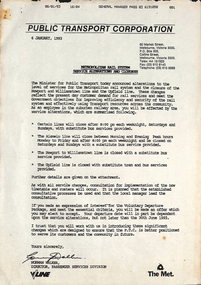
Letter, Public Transport Corporation (PTC), "Metropolitan Rail System - Service Alterations and closures", "Closure of Williamstown train service", Jan. 1993
... staff and other employment issues. A similar letter would have been prepared for the Upfield line. .2 - letter dated 6/1/1993 titled "Metropolitan Rail System - Service Alterations and closures" announcing that the Minister for Public Transport, announced the closure of the Newport to Williamstown lines and the Upfield rail line, along with reduction of services on other lines and that a voluntary departure package (termination of employment) is available. ...staff and other employment issues. A similar letter would have been prepared for the Upfield line. .2 - letter dated 6/1/1993 titled "Metropolitan Rail System - Service Alterations and closures" announcing that the Minister for Public Transport, announced the closure of the Newport to Williamstown lines and the Upfield rail line, along with reduction of services on other lines and that a voluntary departure package (termination of employment) is available. ....1 - undated letter, titled "Closure of Williamstown train service", advising of the closure of the line, pending a date and redeployment, surplus staff and other employment issues. A similar letter would have been prepared for the Upfield line. .2 - letter dated 6/1/1993 titled "Metropolitan Rail System - Service Alterations and closures" announcing that the Minister for Public Transport, announced the closure of the Newport to Williamstown lines and the Upfield rail line, along with reduction of services on other lines and that a voluntary departure package (termination of employment) is available. Has a detailed list of lines affected and bus replacement on rear. Both signed Normal Walker, Director of Passenger Services .See: https://www.theage.com.au/national/victoria/not-the-end-of-the-line-how-people-power-saved-the-upfield-rail-line-20160602-gp9web.html (accessed 23-11-2020) for background information.trams, tramways, upfield, closure, railways, minister for transport, ptc -
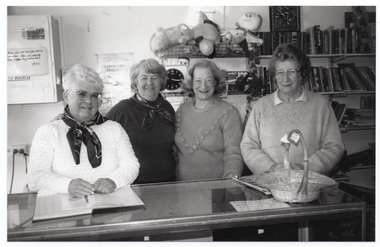 Musculoskeletal Health Australia (now held by the Glen Eira Historical Society)
Photograph - Group photo, XX/08/1992
... On a meter box affixed to the wall is a handwritten sign which says, "Please do not ask for price reduction. This is a charity shop staffed by volunteers. A.F.V." and another sign which says "NO EXCHANGE"....On a meter box affixed to the wall is a handwritten sign which says, "Please do not ask for price reduction. This is a charity shop staffed by volunteers. A.F.V." and another sign which says "NO EXCHANGE". ...Arthritis Foundation of Victoria's Malvern Op Shop volunteers Mavis Weller (Treasurer), Margot Oliver (Secretary), Phyllis King, and one unidentified other pose for a photo around the front counter of the shop. The op shop was located at 1428 High Street, Malvern.B&W photo of four women inside a shop. They are standing behind a glass display cabinet, which serves as the sales counter. They are all facing the camera and smiling. On the wall behind them are shelves of soft toys and books. On a meter box affixed to the wall is a handwritten sign which says, "Please do not ask for price reduction. This is a charity shop staffed by volunteers. A.F.V." and another sign which says "NO EXCHANGE".[Handwritten in blue ink] Aug '92 Mavis Weller, Margot Oliver, Phyllis King, ?arthritis foundation of victoria, afv, opportunity shop, op shop, charity shop, thrift store, fundraising, volunteers, mavis weller, treasurer, malvern, 1992
