
Showing 228 items matching "steam powered"
-
 Puffing Billy Railway
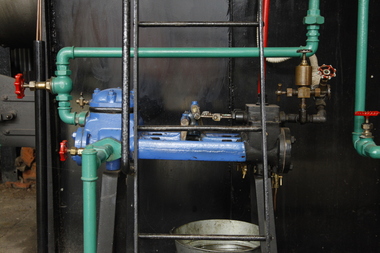
Steam Powered Water Pump, 1900s
... Steam Powered Water Pump ...Steam Powered Water Pump in active use on George & George Boiler...Steam Powered Water Pump Blue with steel rods and brass valves....Steam Powered Water Pump ...Steam Powered Water Pump in active use on George & George BoilerHistoric - Industrial Steam Powered Water Pump in active use on George & George Boiler Steam Powered Water Pump Blue with steel rods and brass valves.Snow steam Pump works Bufflalo, N.Y.,U.S.A Size 3x2x3 Number 51520puffing billy, water pump, steam, blue, snow steam pump works -
 Maldon Vintage Machinery Museum Inc
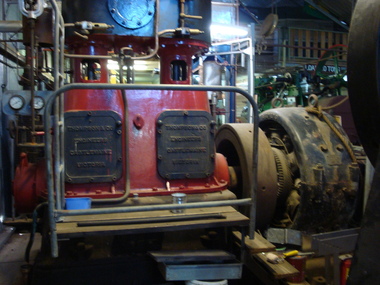
DC Generator - Steam Powered
... DC Generator - Steam Powered...DC Generator - Steam Powered ...Siemens DC generator driven by a Thompsons two cylinder steam engine. The engine has vertical cylinders and there is a flywheel between the generator and engine. Generator painted grey, engine painted red. The system is connected to low pressure steam and can be run very slowly. Brass plate on generator "Siemens Brothers / Dynamo Works Ltd. / London Stafford / Direct Current Generator", followed by specifications. Thompsons Engineering in relief on steam engine side plates. "60" on base of engine.machinery; generator; steam engine; metalwork -
 Flagstaff Hill Maritime Museum and Village
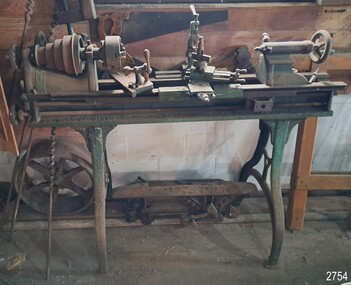
Machine - Lathe, W F & John Barnes, early 1900s
... ...steam power...Such a configuration reflects manufacturing practices from the late 1800s and early 1900s, when steam power was the predominant source for driving workshop and factory machinery. ...The lathe is a green, bench-type, steam-powered woodworking machine. Its bench is supported by decorative posts at each end, with each post dividing into arched legs. ...Flagstaff Hill Flagstaff Hill Maritime Museum and Village Warrnambool Maritime Museum Maritime Village Great Ocean Road Shipwreck Coast Lathe steam-operated lathe steam-operated pulley steam power steam engine machine steam operated machine metal work foundry work metal working trade tool pulley driven metalworking woodworking Barnes lathe Briggs Marine belt driven wordworking lathe free standing lathe bench lathe steam powered vintage lathe woodturning lathe W. ...This woodworking lathe, connected to both a pulley and a flywheel, demonstrates its historical operation with a steam engine. Such a configuration reflects manufacturing practices from the late 1800s and early 1900s, when steam power was the predominant source for driving workshop and factory machinery. Large machine shops often utilised a single power source, distributing power via roof-mounted belts and pulleys to operate several machines simultaneously. Over time, petrol-driven motors were introduced, and eventually, electricity became the standard power source. Conversion kits were made available in the late 19th and early 20th centuries to adapt older lathes to these newer, cleaner fuels. Manufacturer's History: W.F. & J. Barnes was a renowned maker of hand- and foot-powered treadle woodworking and metalworking machinery, established in 1869. The partnership between William F. Barnes and John Barnes was formalised in 1872, and the firm was incorporated in 1884. Their machines were used for both ‘farm’ applications and professional engineering. By 1881, the company began producing electrically powered machinery. By 1937, W.F. & J. Barnes expanded into manufacturing machinery for automotive assembly. The business closed in 1983, and in 1998, LeBlond Ltd. of Ohio acquired the firm. The lathe was donated by Briggs Marine, Melbourne: In Flagstaff Hill’s formative years, 1972-1975, Briggs Marine, Melbourne (Briggs Brass Foundry), donated equipment and objects used or made at their premises. The foundry was established in 1912 by Herbert Harrison Briggs. In 1965, the firm was owned by partners Cyril Briggs and Frank Lee: Cyril died in 1967, and Frank died in 1971, so the foundry was then run by his son and daughter-in-law, Les and Eva Lee. Briggs Marine’s Warrnambool Branch closed in 1972 after the death of Frank Lee in 1971. Flagstaff Hill’s founding director, John Lindsay, recalled that Briggs Marine’s family members gave personal assistance in setting up the displays in the original village shops, particularly the ‘Brass Foundry’ building, around the time the Maritime Museum opened in 1975. Briggs Marine still exists today, but the Briggs family is no longer involved. This early 1900s lathe marks a significant stage in the evolution of machinery, positioned between the era of hand-operated machines and the advent of electrically powered equipment. Its presence exemplifies the progression of industrial technology and craftsmanship during this period. The lathe is particularly notable for its association with the Briggs Brass Foundry. The foundry was known for developing a specialised brass alloy composed of non-ferrous metals, a formulation that resulted in durable products built to withstand the demanding conditions of marine environments. This focus on resilience and longevity made Briggs Brass Foundry’s goods highly sought after within the maritime sector. Briggs Maine, a long-established business, utilised the foundry’s capabilities to create cast goods tailored to the needs of the marine industry. The facility was equipped to deliver both custom-designed and mass-produced items, ensuring versatility in meeting various requirements. Many of Briggs Foundry’s products found their place on sailing and steam vessels throughout Victoria’s coastline, including in the port town of Warrnambool, where there was once a brancy of Briggs Marine. In addition to general marine fittings, Briggs Marine earned recognition for its expertise in bell-founding. The foundry’s reputation is closely linked to the restoration of the Schomberg Bell at Flagstaff Hill, a small but historically significant bell from a luxury migrant vessel dating back to the mid-19th century. The successful restoration of the Schomberg Bell demonstrates Briggs Brass Foundry’s commitment to preserving craftsmanship and maritime heritage.The lathe is a green, bench-type, steam-powered woodworking machine. Its bench is supported by decorative posts at each end, with each post dividing into arched legs. The lathe is mechanically connected to both a pulley and a flywheel, designed to be operated in conjunction with a steam engine. Included with the lathe is a range of accessories. Across the front of the machine, an inscription is cast, and a stamped, metal lathe pulley guide is attached to the drive mechanism. The lathe was manufactured by W. F. and J. Barnes, Rockford, Illinois, USA, during the 1900s.“W F and J Barnes, Rockford, USA” "1820" "1887"flagstaff hill, flagstaff hill maritime museum and village, warrnambool, maritime museum, maritime village, great ocean road, shipwreck coast, lathe, steam-operated lathe, steam-operated pulley, steam power, steam engine, machine, steam operated machine, metal work, foundry work, metal working trade, tool, pulley driven, metalworking, woodworking, barnes lathe, briggs marine, belt driven, wordworking lathe, free standing lathe, bench lathe, steam powered, vintage lathe, woodturning lathe, w. f. and j. barnes, illanois, early 20th century, briggs, briggs brass foundry, briggs marine foundry, briggs marine products, herbert harrison briggs, george edward briggs, cyril falkiner mckinnon briggs, collingwood, moorabbin, frank lee, les lee, eva lee, briggs marine warrnambool, non-ferrous founders, bell specialists, ship bell specialists, sand cast, marine equipment, marine fittings, foundry, brass foundry, founders -
 Melbourne Tram Museum
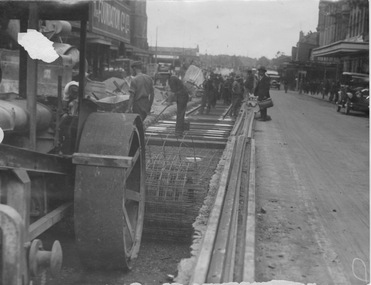
Photograph - Track laying Swanston St, 1/1926
... ...steam powered roller...Wire mesh is being laid on the road base with some wooden sleepers and rails in place. A large steam powered roller is partially shown at left carrying the name of a popular construction company, The Foundation Coy. ...Wire mesh is being laid on the road base with some wooden sleepers and rails in place. A large steam powered roller is partially shown at left carrying the name of a popular construction company, The Foundation Coy. ...The photograph shows part of the track laying process in Swanston Street between Collins Street. and Flinders Lane with pedestrians, onlookers and motor cars. Wire mesh is being laid on the road base with some wooden sleepers and rails in place. A large steam powered roller is partially shown at left carrying the name of a popular construction company, The Foundation Coy. Ltd., that was contracted for many of the cable-to-electric tram conversions in the 1920s. Note that the rails being positioned are railway rails that required a check plate to be bolted to each rail to create a flangeway in the road surface. These plates can be seen stacked at the right of the track bed with pre-drilled holes. Work commenced on the conversion of the cable tram track in Swanston Street in December 1925 and proceed in a northerly direction towards Lonsdale Street. Yields information about the cable tram conversions in 1925-26 in Swanston Street.Sepia toned photograph with note on rear. Written in ink on rear of photograph is "Red Frame 10 of 10" wire mesh, wooden sleepers, rails, steam powered roller, tramways, swanston street, cable tram conversion, railway rail, check plate, flangeway, collins street, flinders lane, tha foundation coy. ltd. -
 Flagstaff Hill Maritime Museum and Village
Drill Press, early to mid-20th century
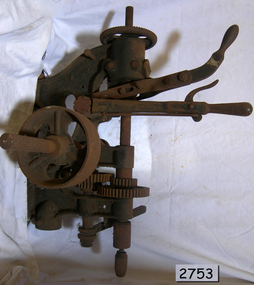
... ...steam powered drill...power supply. In the late 1800s early 1900s a drill press like this would have been driven by steam from a boiler, the main power source for manufacturer’s power at that time. ...power supply. In the late 1800s early 1900s a drill press like this would have been driven by steam from a boiler, the main power source for manufacturer’s power at that time. ...This post drill press has been made by Melbourne business, Dawn Manufacturing Company. It can be operated manually or by a pulley driven flywheel, with the aid of an engine connected to a power supply. In the late 1800s early 1900s a drill press like this would have been driven by steam from a boiler, the main power source for manufacturer’s power at that time. Dawn’s Golden Anniversary 1917-1967 Catalogue describes this model 611 drill as … “Ruggedly constructed with accurately reamed bearings. The coupling between the main spindle and feed screw engages the full circumference of the spindle, and embraces a ball-bearing thrust race. The pillar, as in all “Dawn Drilling Machines” is a solid bright steel bar, in place of the usual light tubing. Adjustable automatic feed.” And “F. & l. Pulleys extra, if required”. DAWN MANUFACTURING CO. The Dawn Manufacturing Co. was founded in Coburg, Melbourne, in 1917 by the four Blake brothers, who were all engineers. After World War I Dawn was supplying drills Australia wide and the company was growing at a healthy rate. During the depression they remained busy, with employees working 60-80 hour weeks. Dawn was contracted to supply vices and clamps to the Australian Defence Department and munitions factory during the World War II. - 1959 the company was taken over by G.N. Raymond Group. - 1967 the Dawn Manufacturing Co. had distributors in Australia and overseas, including USA, Canada, New Zealand, Asia and the Middle East. - 1973 the Siddons Ramset Limited acquired Dawn. - December 1991, Dawn became a unit of the United States owned Stanley Works Pty. Ltd. - November 1998 Dawn became 100 per cent Australian owned. The drill is a typical tool of a blacksmith, cart wright, wheelwright and garage business. It is an example of the tools of the blacksmiths’ trade in Victoria in the early to mid-20th century.Post type drill press machine with gear driven flywheel. Drill press is attached to a post and is fitted with a pulley belt and will run at a speed of maxim 200 r.p.m. The machine can also be manually operated. It has an aperture in the centre, a chuck, for the drill bit and has two metal handles at the centre, on the right hand side. Gear ratio 2:1 main drive, 6" diam, 3:1 reduction gear. Made by Dawn of Melbourne, Australia. Model No. 611, Code No. 9157"DAWN MFG COY”, “MELB. AUSTRALIA", " 611"flagstaff hill, warrnambool, shipwrecked-coast, flagstaff-hill, flagstaff-hill-maritime-museum, maritime-museum, shipwreck-coast, flagstaff-hill-maritime-village, blacksmiths, blacksmith’s drill, blacksmith tools, dawn drill model no. 611, dawn drill code no. 9157, dawn manufacturing coy melbourne, dawn manufacturing coy coburg, dawn post drill, drilling machine, drill with gear driven flywheel, forging tool, metal working tool, post drill, steam powered drill, trade tool, warrnambool district 1900s -
 Stawell Historical Society Inc
Photograph, Saw Mill near Fyans Creek -- typical mill of the era powered by Steam Traction Engine & belt driven saw c 1880
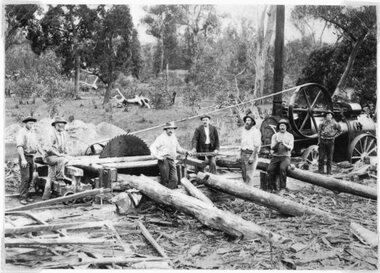
... Saw Mill near Fyans Creek -- typical mill of the era powered by Steam Traction Engine & belt driven saw c 1880...Seven males. c 1880. stawell Black and white enlargement of a scene in the bush - a large steam traction engine appears to drive a long belt which turns the saw, milling the logs. Seven males workmen working the site. Saw Mill near Fyans Creek -- typical mill of the era powered by Steam Traction Engine & belt driven saw c 1880 Photograph ...Grampians, Saw Mill near Fyans Creek. A typical mill of the era. Steam Traction Engine belt driven saw. Seven males. c 1880.Black and white enlargement of a scene in the bush - a large steam traction engine appears to drive a long belt which turns the saw, milling the logs. Seven males workmen working the site.stawell -
 Lakes Entrance Historical Society
Photograph - Tramline to North Arm. Lakes Entrance Victoria 1997, Fish Marie
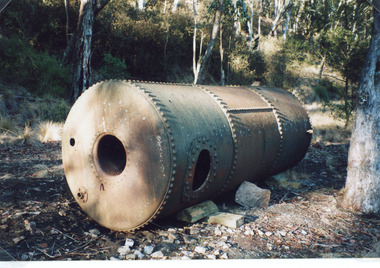
... Colour photograph of a boiler which provided steam power to drive a winch at North Arm. Rock was transported from Mississippi Creek quarry along a tramline to North Arm where rock was transferred by steam powered winch to a barge which carried rock to the entrance. ...Date made 18 January 1997 Historic Site Machinery Colour photograph of a boiler which provided steam power to drive a winch at North Arm. Rock was transported from Mississippi Creek quarry along a tramline to North Arm where rock was transferred by steam powered winch to a barge which carried rock to the entrance. ...Date made 18 January 1997Colour photograph of a boiler which provided steam power to drive a winch at North Arm. Rock was transported from Mississippi Creek quarry along a tramline to North Arm where rock was transferred by steam powered winch to a barge which carried rock to the entrance. Lakes Entrance Victoriahistoric site, machinery -
 Victorian Interpretive Projects Inc.
Photograph - Black and White, Ballarat, c1854
... The crude pans and cradles of the early “diggers’ were already giving way to steam power and the deep shafts of the “miners”. ...The crude pans and cradles of the early "diggers" were already giving way to steam power and the deep shafts of the :"miners". ...The crude pans and cradles of the early “diggers’ were already giving way to steam power and the deep shafts of the “miners”. ...The town you see had over 50,000 people. Bridge Street on the left is well established. The crude pans and cradles of the early “diggers’ were already giving way to steam power and the deep shafts of the “miners”. Money and machinery were needed to get to the deeper leads, and the smoke stacks of the great company mines can be seen across the photo.Four black and white photographs placed together to make a panorama of Ballarat looking towards Mt Warrenheip. On the left the chimney and gasometer indicate the corner of Dana Street and Albert Street. This is now the Ballarat Law Courts. The photograph is behind glass in a black frame. These four photographs were taken from the slope of the Ballarat School of Mines where the Uniting Church now stands. When joined they give a panoramic view of one of the world’s richest alluvial goldfields. The Waterloo Mine was one of the first deep shafts and was sunk at the foot of the Dana Street hill. Its tailings are seen in the second photo from left. The following was typed and placed with the framed image. Ballarat Circa 1858 This is the most significant of the photographs of early Ballarat. The photographer stood on the slope near S.M.B. where the Wesley Church now stands and took four pictures. When joined them have this panoramic view of one of the world's richest alluvial goldfields. Seven years earlier this landscape was empty. The town you see had over 50,000 people. Bridge Street on the left is well established the Ballarat gas Company stands on the same place as today. The crude pans and cradles of the early "diggers" were already giving way to steam power and the deep shafts of the :"miners". Money and machinery were needed to get to the deeper leads, and the smoke stacks of the great company mines can be seen across the photo. The Waterloo mines was one of the first deep shafts and was sunk at the foot of the Dana Street hill. Its tailings are seen in the second photo from the left. ballarat, ballarat townscape, panorama, waterloo mine -
 Sunshine and District Historical Society Incorporated
Postcard - Early Melbourne Bus Postcard
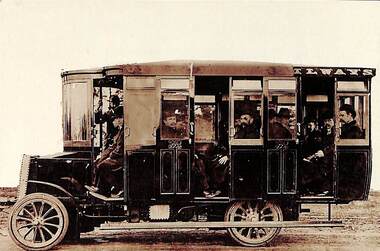
... Early Chelmsford buses, such as the pictured, were kerosene-fire and steamed-powered...Early Chelmsford buses, such as the pictured, were kerosene-fire and steamed-powered A postcard with an image of an early Melbourne bus with driver and passengers Postcard Early Melbourne Bus Postcard ...An early Melbourne Bus|The first Melbourne bus service began operations in 1905. It ran between Prahran Railway Station to Malvern Town Hall. Early Chelmsford buses, such as the pictured, were kerosene-fire and steamed-poweredbus, transport -
 Queenscliffe Maritime Museum
Functional object - Skylight
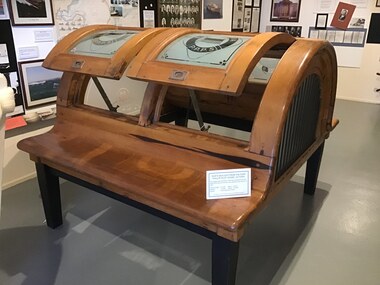
... In 1901 the pilots took delivery of their first steam powered pilot cutter, "Victoria", 46 metres in length, built at Williamstown....In 1901 the pilots took delivery of their first steam powered pilot cutter, "Victoria", 46 metres in length, built at Williamstown. ...In 1901 the pilots took delivery of their first steam powered pilot cutter, "Victoria", 46 metres in length, built at Williamstown.First steam powered cutter to serve with the Port Phillip Sea PilotsShips skylight from pilot vessel 'Victoria'pilot service, victoria -
 Flagstaff Hill Maritime Museum and Village
Photograph - Vessel, Steam Ship, after 1890
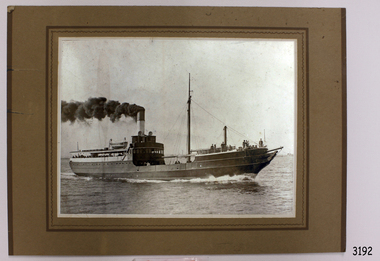
... The photograph shows the SS Edina moving under steam power, with many people on both the bow and stern and a few people in the centre of the vessel. ...The photograph shows the SS Edina moving under steam power, with many people on both the bow and stern and a few people in the centre of the vessel. ...This photograph was donated by Mrs Nancy Mason, daughter-in-law of the last owner, Arnold Mason. Andrew Mason had been given the photograph by Mr. Mac Fordham, who was the Chief Engineer of the SS Edina. Both men had been Engineers in WW I. The configuration of the SS Edina in the photograph is post 1890. ABOUT THE S S EDINA The three-masted iron screw steamer SS Edina was built in Glasgow, Scotland, in 1854 by Barclay and Curle. She was adorned with the figurehead of ‘fair maid of Judea’. The many years of service made SS Edina famous worldwide as the longest-serving screw steamer. (The term screw steamer comes from being driven by a single propeller, sometimes called a screw, driven by a steam engine.) SS Edina’s interesting history includes English Channel runs, serving in the Crimean War carrying ammunition, horses and stores to the Black Sea, and further service in the American Civil War and later, serving in the western district of Victoria as well as in Queensland and carried gold, currency and gold prospectors Australia to New Zealand. SS Edina had the privilege of being an escort vessel to H.R.H. the Duke of Edinburgh during his visit to Australia in 1867. In March 1863, SS Edina arrived in Port Phillip Bay, Melbourne and was bought by Stephen Henty, of Portland fame, to work the cargo and passenger run from Melbourne – Warrnambool – Port Fairy - Portland. After a short time of working the run from Australia to New Zealand, with passengers and cargo that included gold and currency, she returned to her Melbourne - Warrnambool – Port Fairy run, with cargo including bales of wool produced in the western district of Victoria. The Warrnambool Steam Packet Company purchased SS Edina in 1867; she was now commanded by Captain John Thompson and Chief Engineer John Davies. She survived several mishaps at sea, had a complete service and overhaul and several changes of commanders. In 1870 SS Edina was in Lady Bay, Warrnambool, when a gale sprung up and caused a collision with the iron screw steamer SS Dandenong. SS Edina’s figurehead was broken into pieces and it was not ever replaced. SS Edina was refitted in 1870 then was used as a coastal trader in Queensland for a period. She was then brought to Melbourne to carry cargo and passengers between Melbourne and Geelong and performed this service 1880-1938. During this time (1917) she was again refitted with a new mast, funnel, bridge and promenade deck, altering her appearance. In 1938, after more collisions, SS Edina was taken out of service. However, she was later renamed Dinah and used as a ‘lighter’ (a vessel without engine or superstructure) to be towed and carry wool and general cargo between Melbourne and Geelong. In 1957, after 104 years, the SS Edina was broken up at Footscray, Melbourne. Remains of SS Edina’s hull can be found in the Maribyrnong River, Port Phillip Bay. This photograph of the SS Edina is significant for its association with the screw steamer SS Edina. The SS Edina is heritage listed on the Victorian Heritage Database VHR S199. She had endeared herself to the people of Port Phillip Bay as a passenger ferry, part of their history and culture. She played a significant role in the Crimean War, the American Civil War and the gold rush in New Zealand. She also served western Victoria for many years in her cargo and passenger runs. The SS Edina is famous for being the longest serving screw steamer in the world. After spending her first nine years overseas she arrived in Melbourne and her work included running the essential service of transporting cargo and passengers between Melbourne and the western Victoria ports of Warrnambool, Port Fairy and Portland. The SS Edina was purchased in the late 1860’s by local Warrnambool business, the Warrnambool Steam Packet Co. and continued trading from there as part of the local business community. The SS Edina’s original ‘fair maid of Judea’ figurehead was broken to pieces in a collision with another vessel (the SS Dandenong) in a gale off Warrnambool, Victoria, in 1870.Black and White photograph mounted on brown card of SS Edina. Inscription on the reverse side. The photograph shows the SS Edina moving under steam power, with many people on both the bow and stern and a few people in the centre of the vessel. There are buildings on the shore in the background. The ship's configuration is dated post 1890.Inscription on the reverse: "Donated by Mrs. Nancy Mason, Bayview. Receipt 409a. Owned by Mac Fordham, Chief Engineer, 'Edina', then given to Mrs. Mason's father-in-law Arnold Mason. (both Engineers W.W 1)."warrnambool, shipwrecked coast, flagstaff hill, flagstaff hill maritime museum, maritime museum, shipwreck coast, flagstaff hill maritime village, shipwrecked artefact, barclay & curle, figurehead 'fair maid of judea', centenary maritime exhibition 1934, a brief review of steam navigation in victoria, pleasure steamer edina, trade and travel late 19th and early 20th century, trade melbourne to geelong, screw steamer edina, coastal trader edina, lighter dinah, cargo carrying for cremean war, cargo carrying for american civil war, passenger and trade in western district of victoria, export gold and currency and gold diggers to new zealand, export vessel to h r h the duke of edinburgh, melbourne - warrnambool - port fairy - portland cargo run, warrnambool steam packet company, stephen henty, captain john thompson, chief engineer john davies, lady bay warrnambool, lighter edina, shipping victoria, port phillip bay steamers, steamship great britain, edina, vhr s199 victorian heritage database, photograph of ss edina post 1890, photograph australian screw steamer, pleasure vessel victoria post 1890 -
 Lakes Entrance Historical Society
Photograph - Tramline to North Arm. Lakes Entrance Victoria 1997, Fish Marie
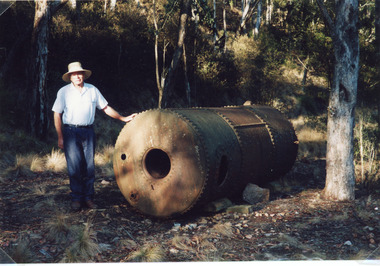
... Colour photograph of Rex Fish standing beside the boiler which provided steam power to drive the winch to transfer rock from the tram, trucks to the barge at North Arm. ...Waterways Historic Sites Public Works Machinery Colour photograph of Rex Fish standing beside the boiler which provided steam power to drive the winch to transfer rock from the tram, trucks to the barge at North Arm. ...Date made 18 January 1977.Colour photograph of Rex Fish standing beside the boiler which provided steam power to drive the winch to transfer rock from the tram, trucks to the barge at North Arm. This rock quarried at Mississippi Creek was used to stabilise the entrance piers, and build rock groynes around the lakes. Lakes Entrance Victoria waterways, historic sites, public works, machinery -
Port Melbourne Historical & Preservation Society
Photograph, "Melbourne & Hobson's Bay United Railway Co'ys Pier, Sandridge (Port Melbourne) 1865", 1865
... View looking South showing tall masted ships and in the foreground, workmen, carriages loaded with ballast and a boiler for steam powered cranes. Image attributed to Charles Nettleton ...View looking South showing tall masted ships and in the foreground, workmen, carriages loaded with ballast and a boiler for steam powered cranes. Image attributed to Charles Nettleton "Melbourne & Hobson's Bay United Railway Co'ys Pier, Sandridge (Port Melbourne) 1865" Photograph ...City of Port Phillip Collection - pm 0988 "Melbourne & Hobson's Bay United Railway Co'ys Pier, Sandridge (Port Melbourne) 1865" . View looking South showing tall masted ships and in the foreground, workmen, carriages loaded with ballast and a boiler for steam powered cranes. Image attributed to Charles Nettleton transport - shipping, piers and wharves - railway pier, maritime, railway pier, charles nettleton, hobson's bay united railway -
 Lakes Entrance Historical Society
Photograph, Brodribb/Howlett, c1900
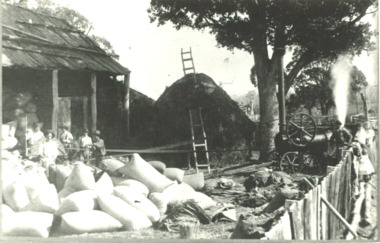
... Black and white photograph showing chaff cutting at Howlett property 'Inglewood' using steam engine power. Young Ivy Howlett watching over the fence....Identified are Andrew Brodribb and Arthur Howlett at the chaff cutter; James, Maud, Ethel and Ivy Howlett near steam engine at Punt Road Metung Victoria Genealogy Families Farm Black and white photograph showing chaff cutting at Howlett property 'Inglewood' using steam engine power. Young Ivy Howlett watching over the fence. ...Identified are Andrew Brodribb and Arthur Howlett at the chaff cutter; James, Maud, Ethel and Ivy Howlett near steam engine at Punt Road Metung VictoriaBlack and white photograph showing chaff cutting at Howlett property 'Inglewood' using steam engine power. Young Ivy Howlett watching over the fence.genealogy, families, farm -
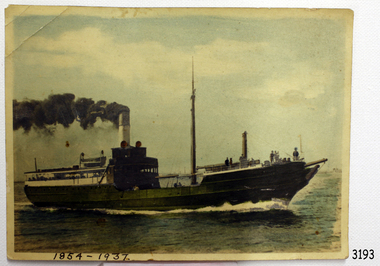 Flagstaff Hill Maritime Museum and Village
Photograph - Vessel, Steam Ship, Between 1890 - 19-12-1937
... The photograph shows the SS Edina moving under steam power, many people on both the bow and stern and a few people in the centre of the vessel. ...The photograph shows the SS Edina moving under steam power, many people on both the bow and stern and a few people in the centre of the vessel. ...This photographic postcard of the SS Edina was taken after the 1890’s due to the style and configuration of the vessel. There is a black and white photograph of the same image also in our Collection (RN 3192). It is most likely that both of the photographs were donated by the same person because the people mentioned in the inscription on the black and white photograph’s reverse side connect with two of the people mentioned in the letter on the reverse of the coloured photograph. * RN 3192; Black & White photograph - inscription: - "Donated by Mrs. Nancy Mason, Bay View. Owned by Mac Fordham, Chief Engineer, 'Edina', then given to Mrs. Mason's father-in-law Arnold Mason (both Engineers W.W. I)" The “Arnie” to whom the letter was addressed is likely to be Arnold Mason, Engineer. The author of the letter, “Mac”, is likely to be Mac Fordham, Chief Engineer of SS Edina. The transcribed letter tells of two men who know each other well and have an interest in the Edina. “Mac” mentions that he may be “too old” to be at sea again; this would also support the idea that the older writer would give his photographs to the perhaps younger “Arnie”. * RN 3193 (this photograph) - Transcription of pen and ink script handwriting = = = = = = = = = = = = 19-12-37 No. 1 Flat, “Goodwood Lodge” 196 Lennox Street, Richmond [Victoria] Dear Arnie , Been meaning to write for long time but you know, it’s just the usual routine of the seamen within Bay trades. Had a good trip back from Sydney. Took our time, spent almost a week coming back, rather monotonous in parts in the hill country, too many darn curves, still was a good trip. How are you all keeping? Suppose you’ve moved back to Drummoyne [erettris?], expect you can let the house in Manly easily enough. Noticed they had a strike at Cockatoo [Cockatoo Island NSW]. don’t suppose they pulled the boys out. How is Jack doing? Has [Willie?] commenced training yet, or no! too young, isn’t she? Been a lot of “paper” talk about the “Edina” finishing but nothing official that I’m aware of, but it’s always on the cards I suppose, then I suppose it will be to sea again if I’m not too old. Easy Winter only 3 trips per week, running every day from today until further notice. Trust [Mary?] Is well & all’s well with you too. Best wishes from us both for Xmas & New Year. Cheerio Mac = = = = = = = = = = = = ABOUT THE SS EDINA The three masted iron screw steamer SS Edina was built in Glasgow, Scotland, in 1854 by Barclay and Curle. She was adorned with the figurehead of ‘fair maid of Judea’. The many years of service made SS Edina famous world-wide as the longest serving screw steamer. (The term screw steamer comes from being driven by a single propeller, sometimes called a screw, driven by a steam engine.) SS Edina’s interesting history includes English Chanel runs, serving in the Crimean Ware carrying ammunition, horses and stores to the Black Sea, and further service in the American Civil War and later, serving in the western district of Victoria as well as in Queensland and carried gold, currency and gold prospectors Australia to New Zealand. SS Edina had the privilege of being an escort vessel to H.R.H. the Duke of Edinburgh during his visit to Australia in 1867. In March 1863 SS Edina arrived in Port Phillip Bay, Melbourne and was bought by Stephen Henty, of Portland fame, to work the cargo and passenger run from Melbourne – Warrnambool – Port Fairy - Portland. After a short time of working the run from Australia to New Zealand, with passengers and cargo that included gold and currency, she returned to her Melbourne - Warrnambool – Port Fairy run, with cargo including bales of wool produced in the western district of Victoria. The Warrnambool Steam Packet Company purchased SS Edina in 1867; she was now commanded by Captain John Thompson and Chief Engineer John Davies. She survived several mishaps at sea, had a complete service and overhaul and several changes of commanders. In 1870 SS Edina was in Lady Bay, Warrnambool, when a gale sprung up and caused a collision with the iron screw steamer SS Dandenong. SS Edina’s figurehead was broken into pieces and it was not ever replaced. SS Edina was re-fitted in 1870 then was used as a coastal trader in Queensland for a period. She was then brought to Melbourne to carry cargo and passengers between Melbourne and Geelong and performed this service 1880-1938. During this time (1917) she was again refitted with a new mast, funnel, bridge and promenade deck, altering her appearance. In 1938, after more collisions, SS Edina was taken out of service. However she was later renamed Dinah and used as a ‘lighter’ (a vessel without engine or superstructure) to be towed and carry wool and general cargo between Melbourne and Geelong. In 1957, after 104 years, the SS Edina was broken up at Footscray, Melbourne. Remains of SS Edina’s hull can be found in the Maribyrnong River, Port Phillip Bay. This photographic postcard with the letter on the revers tell about the SS Edina and are significant for its association with the screw steamer SS Edina. The SS Edina is heritage listed on the Victorian Heritage Database VHR S199. She had endeared herself to the people of Port Phillip Bay as a passenger ferry, part of their history and culture. She played a significant role in the Crimean War, the American Civil War and the gold rush in New Zealand. She also served western Victoria for many years in her cargo and passenger runs. The SS Edina is famous for being the longest serving screw steamer in the world. After spending her first nine years overseas she arrived in Melbourne and her work included running the essential service of transporting cargo and passengers between Melbourne and the western Victoria ports of Warrnambool, Port Fairy and Portland. The SS Edina was purchased in the late 1860’s by local Warrnambool business, the Warrnambool Steam Packet Co. and continued trading from there as part of the local business community. The SS Edina’s original ‘fair maid of Judea’ figurehead was broken to pieces in a collision with another vessel (the SS Dandenong) in a gale off Warrnambool, Victoria, in 1870.Coloured (hand coloured) photographic postcard of SS Edina. Letter on reverse, hand written in pen and ink, from Mac to Arnie, dated 19-12-37 [1937]. The photograph shows the SS Edina moving under steam power, many people on both the bow and stern and a few people in the centre of the vessel. There are buildings on the shore in the background. The ship's configuration is dated post 1890.Hand written in pen on base of front “1854-1957” Hand written on back in blue pen and crossed out “REC 409” Hand written on back in pen ‘EDINA,’ “3173,” “086.2” Hand written letter dated 19-12-37, from Mac to Arnie. Script writing in pen and ink letter on reverse of photograph – see “Context” section for transcription. warrnambool, shipwrecked coast, flagstaff hill, flagstaff hill maritime museum, maritime museum, shipwreck coast, flagstaff hill maritime village, shipwrecked artefact, barclay & curle, figurehead 'fair maid of judea', centenary maritime exhibition 1934, a brief review of steam navigation in victoria, pleasure steamer edina, trade and travel late 19th and early 20th century, trade melbourne to geelong, screw steamer edina, coastal trader edina, lighter dinah, cargo carrying for cremean war, cargo carrying for american civil war, passenger and trade in western district of victoria, export gold and currency and gold diggers to new zealand, export vessel to h r h the duke of edinburgh, melbourne - warrnambool - port fairy - portland cargo run, warrnambool steam packet company, stephen henty, captain john thompson, chief engineer john davies, lady bay warrnambool, lighter edina, shipping victoria, port phillip bay steamers, steamship great britain, edina, vhr s199 victorian heritage database, photographic postcard of ss edina 1854-1957, letter by mac fordham chief engineer ss edina, letter to arnold mason, engineer -
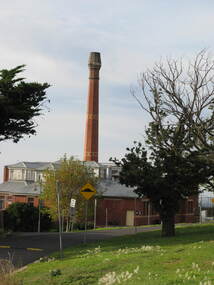 Sunbury Family History and Heritage Society Inc.
Photograph, Sarah Dunn, c2020
... It was built in 1920 and using steam power, it supplied hot water and heating throughout the complex, using coal and briquettes. ...It was built in 1920 and using steam power, it supplied hot water and heating throughout the complex, using coal and briquettes. ...The building with the tall chimney was the Boiler House at the former Sunbury Asylum. It was built in 1920 and using steam power, it supplied hot water and heating throughout the complex, using coal and briquettes. When the Asylum closed down in 1992, the Boiler House then became an arts centre for the local community.The tall chimney can be seen from many vantage points in Sunbury and is of local heritage significance because of its structure and design.A coloured photograph of an industrial building with a very tall chimney. Trees and a stretch of lawn are in the foreground of the building.sunbury asylum, boiler house -
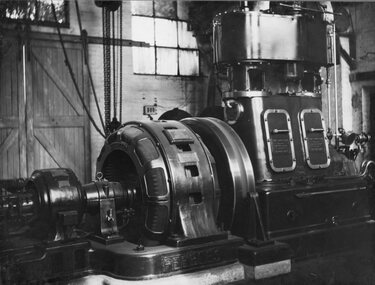 Stawell Historical Society Inc
Photograph, North Western Woollen Mills -- Steam Driven Power Generator
... North Western Woollen Mills -- Steam Driven Power Generator...North Western Woollen Mills Steam Driven Power Generator. Two copies....North Western Woollen Mills Steam Driven Power Generator. Two copies. Stawell Industry North Western Woollen Mills -- Steam Driven Power Generator Photograph ...North Western Woollen Mills Steam Driven Power Generator. Two copies.stawell industry -
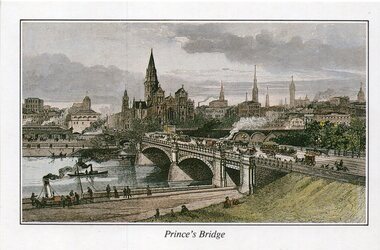 Melbourne Tram Museum
Drawing - Illustration, St Paul's Cathedral, "Engraving of Prince's Bridge and St Paul's Cathedral, Melbourne 1889", 1992
... Illustration - colour engraving printed onto white card, titled "Princes Bridge" showing the planned St Paul's Cathedral, Flinders St Station, Princes bridge with cable trams and the Yarra River with steam powered boats. On rear - "Engraving of Prince's Bridge and St Paul's Cathedral, Melbourne 1889" with a note that it was drawn before the completion of the cathedral the design shows in that intended by the Architect, William Butterfield and that it was from the collection of St Paul's Cathedral....Trams tramways Yarra River St Pauls Cathedral Melbourne Greetings Cards Illustration - colour engraving printed onto white card, titled "Princes Bridge" showing the planned St Paul's Cathedral, Flinders St Station, Princes bridge with cable trams and the Yarra River with steam powered boats. On rear - "Engraving of Prince's Bridge and St Paul's Cathedral, Melbourne 1889" with a note that it was drawn before the completion of the cathedral the design shows in that intended by the Architect, William Butterfield and that it was from the collection of St Paul's Cathedral. ...Illustration - colour engraving printed onto white card, titled "Princes Bridge" showing the planned St Paul's Cathedral, Flinders St Station, Princes bridge with cable trams and the Yarra River with steam powered boats. On rear - "Engraving of Prince's Bridge and St Paul's Cathedral, Melbourne 1889" with a note that it was drawn before the completion of the cathedral the design shows in that intended by the Architect, William Butterfield and that it was from the collection of St Paul's Cathedral.trams, tramways, yarra river, st pauls cathedral, melbourne, greetings cards -
Glenelg Shire Council Cultural Collection
Headwear - Top Hat, n.d
... It was Australia's first steam powered hat factory and exported many hats. ...It was Australia's first steam powered hat factory and exported many hats. ...Grosgrain ribbon is a type of fabric that has a ridged appearance and is made from silk or synthetic materials. It is regularly used in sewing and crafts, as well as in fashion applications such as millinery and trimming. This type of ribbon is also frequently used to make bows.Denton Hat Mills was built in stages from 1888 until the 1940s. It was Australia's first steam powered hat factory and exported many hats. It remained at hat factory until 1971. Black felt top hat, sides of brim slightly rolled, edged with grosgrain ribbon. Grosgrain ribbon around base of crown. Brown leather headband inside, maker's stamp in leather. 'HENRY' in black texta either side. Set of small pin-holes either side of crown -
 Marysville & District Historical Society
Photograph (item) - Colour photographs, Ron Nutt, The photographs were taken in November 2009
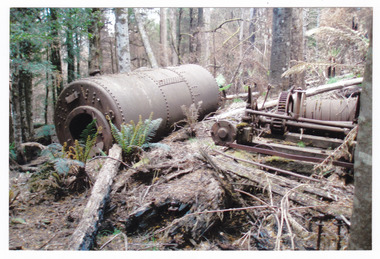
... Photos taken by Ron Nutt, November 2009. This steam powered winching point lies 30 meters south/ off the Marysville Woods Point road halfway between Lake/ Mountain and the Cumberland Reserve. ...The donkey engine and winching gear were used to haul logs from the forest. marysville victoria australia donkey engine winching gear marysville-wood's point road cumberland reserve lake mountain 2009 black saturday bushfires photograph Photos taken by Ron Nutt, November 2009. This steam powered winching point lies 30 meters south/ off the Marysville Woods Point road halfway between Lake/ Mountain and the Cumberland Reserve. ...A series of ten colour photographs showing an abandoned donkey engine and its winching gear in the forest. The donkey engine and winching gear were used to haul logs from the forest. The photographs were taken in November 2009.A series of ten colour photographs showing an abandoned donkey engine and its winching gear in the forest. The donkey engine and winching gear were used to haul logs from the forest.Photos taken by Ron Nutt, November 2009. This steam powered winching point lies 30 meters south/ off the Marysville Woods Point road halfway between Lake/ Mountain and the Cumberland Reserve. There is a log/ landing nearby with a side cut leading to the Woods Point/ road. Prior to the Black Saturday bushfire there was a tree/ with a winch block attached, through which passed a cable/ to enable the winching of logs from a great distance.marysville, victoria, australia, donkey engine, winching gear, marysville-wood's point road, cumberland reserve, lake mountain, 2009 black saturday bushfires, photograph -
 Hume City Civic Collection
Photograph, c 1974
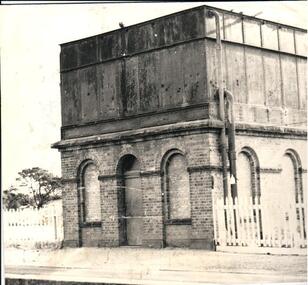
... Steam trains needed sufficient steam power to climb the steep gradients over the Great Dividing Range and the water tower at Sunbury was used to replenish the trains' water supply for the remainder of the journey....Steam trains needed sufficient steam power to climb the steep gradients over the Great Dividing Range and the water tower at Sunbury was used to replenish the trains' water supply for the remainder of the journey. sunbury railway station water towers victorian railways bett j. george evans collection A black and white photograph of the water tower at Sunbury Railway Station. ...The mounted photograph is one of a series used for display purposes. The water tower at Sunbury Station was built in 1861 by J. Bett. it is of state significance and is an indicator of the importance of the railway to Sunbury's expansion in the Nineteenth Century. Steam trains needed sufficient steam power to climb the steep gradients over the Great Dividing Range and the water tower at Sunbury was used to replenish the trains' water supply for the remainder of the journey.A black and white photograph of the water tower at Sunbury Railway Station. The base of the tower is a brick construction with an arched doorway and two bricked in arched windows at either side of the doorway and a further two bricked in arched windows on the side. Above the base is a large square iron water storage tank with two downpipes at the side. There is a picket fence either side of the building. Mounted on board.sunbury railway station, water towers, victorian railways, bett, j., george evans collection -
 Orbost & District Historical Society
knife and fork, Joseph Rodgers & Son
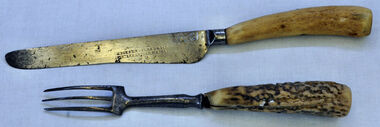
... Ox driven carts pulled the logs to the Snowy River; the logs were floated downstream to the steam powered mill. The PS Curlip steamboat, transported the timber to growing townships, for schools, houses and farms. ...Ox driven carts pulled the logs to the Snowy River; the logs were floated downstream to the steam powered mill. The PS Curlip steamboat, transported the timber to growing townships, for schools, houses and farms. ...The Tabbara Sawmill was located at Brodribb River, at the lower Snowy River estuary. In the early 1900’s bow saws and broad axes were used to selectively log the forest. Ox driven carts pulled the logs to the Snowy River; the logs were floated downstream to the steam powered mill. The PS Curlip steamboat, transported the timber to growing townships, for schools, houses and farms. The mill closed in 1903. Knife and fork with steel blades and bone handles..Knife - Joseph Rodgers & Son Cuttlers to her Majestyknife fork cutlery domestic-item rodgers-joseph -
 Flagstaff Hill Maritime Museum and Village
Equipment - Pipe Brush
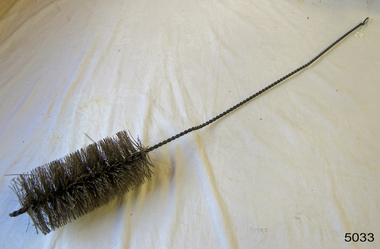
... ...steam power...Early steamships also have masts and sails, giving them the option of steam power or wind power. The first successful steamboat trial in America was in 1787 when John Finch displayed its features on the Delaware River in Philadelphia. ...Early steamships also have masts and sails, giving them the option of steam power or wind power. The first successful steamboat trial in America was in 1787 when John Finch displayed its features on the Delaware River in Philadelphia. ...This ship's boiler pipe brush would have been used to keep the steam boiler pipes in good working order. The bristles are arranged in a round shape to fit against the sides of the boiler pipe and clear away debris. The brush has a loop for storing it on a hook so the bristles won't become damaged. The ship's boilers created steam to power the ship's engines. Some larger steamships had several boilers and therefore several funnels. Early steamships also have masts and sails, giving them the option of steam power or wind power. The first successful steamboat trial in America was in 1787 when John Finch displayed its features on the Delaware River in Philadelphia. The first steamboat in Australia was the Sophia Jane, which arrived in Sydney in 1831. The ship traded cargo and passengers between Sydney and Newcastle. This ship's boiler pipe brush is unique in our collection and an essential item in the maintenance of steam boilers. It is connected to the era of steamships, which in Australia began in 1831 with the arrival of the first steamship in Sydney. Pipe brush; long twisted wire handle with stiff bristles around the base section, arranged in a cylindrical shape, and a loop at the other end. Used for cleaning pipes of a ships boiler.warrnambool, shipwreck coast, flagstaff hill, flagstaff hill maritime museum, flagstaff hill maritime village, steam boiler, steam boiler brush, boiler maintenance, boiler brush, pipe brush, steam boiler pipe, steamship, steamboat, steam power -
 Bendigo Historical Society Inc.
Newspaper - Albert Ernest Richardson, Peter Anderson's article 2020
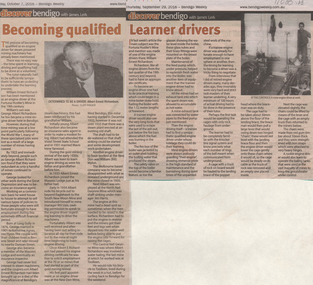
... Clippings taken from the 'Bendigo Weekly' 2016, dated September 29 'Learner Drivers' , October 7 'Becoming qualified', October 14 'Steam power in his veins' and November 11 ' Victoria Hill over the decades'. ...Clippings taken from the 'Bendigo Weekly' 2016, dated September 29 'Learner Drivers' , October 7 'Becoming qualified', October 14 'Steam power in his veins' and November 11 ' Victoria Hill over the decades'. ...Albert Richardson was born on 22nd. June, 1902 to George Albert Richardson and Catherine Agnes (nee Flynn). He married Mavis Irene Yarwood on 23rd. December, 1931. Albert Richardson's childhood activities in Duncan Street, Long Gully, were influenced strongly by the occupation of his father and grandfather, both of whom were engine drivers on the Bendigo field. Albert had his own model goldmine, complete with poppet head, baling tanks etc and was up and ready to start work with the sound of the 7 a.m. mine whistles. Albert spent a short time working as a motor mechanic and then took up0 welling insurance with T & G. However, his heart was with the mines and he worked daytimes with T. & G. and then took off to learn engine driving with night shift in one of the mines. He gained his engine drivers' ticket in 1938 and began work at the Nell Gwynne. His longest work time was at the North Nell but he also had shorter spells at other mines. His leter work years were spent at John Brown, from where he retired in 1968. Albert had a deep regard for the working man and worked for many years in the position of Secretary at the Trades Hall, Bendigo. (adapted from biography in BHS Collection, written by I. Hendry, 1972) The Bendigo Historical Society holds a wide range of Bendigo mining records researched and written by Mr. Albert Richardson. He was President of the Bendigo Branch of the Royal Historical Society of Victoria from 1969 to 1971.When he joined the Bendigo Branch in 1966 he began compiling a history of the Bendigo mines. He spent many long hours researching at the Bendigo Mines Department, summarising mine records. He gathered relevant mining material wherever it could be obtained. He devoted most of his spare time and energy to the Society, conducting tours of the goldfields, writing articles and presenting talks to various organisations. His first and foremost interest lay in Victoria Hill. He examined mining reports and early newspaper articles to document its history. He envisaged the once fabulously rich hill as becoming a tourist attraction and campaigned vigorously to achieve this. In 1971 his dream was realised, when, with the help of South Bendigo Rotary Club 'The Hill' was cleaned up and historical site4s sign-posted. In 1972 the Bendigo Trust produced a booklet on Victoria Hill. Albert Richardson is acknowledged as the person ' on whose work and writings the text of this booklet has been based' The park adjoining Victoria Hill was named the Albert Richardson Reserve in his honour. Four newspaper clippings on mining, focusing on Albert Richardson's life; his passion for mining history and more generally, the work of engine drivers on the Bendigo goldfield. Clippings taken from the 'Bendigo Weekly' 2016, dated September 29 'Learner Drivers' , October 7 'Becoming qualified', October 14 'Steam power in his veins' and November 11 ' Victoria Hill over the decades'. All articles written by James Lerk in a series titled 'Discover Bendigo'. One page biography on Albert Richardson, on yellow paper.albert richardson, engine driver, mining, bendigo, boiler, engine room, mining cage, albert richardson reserve, victoria hill, george ellis, south bendigo rotary club -
 Lakes Entrance Historical Society
Photograph - Hay Baling, Steam engine baler, East Gippsland, 1915 c
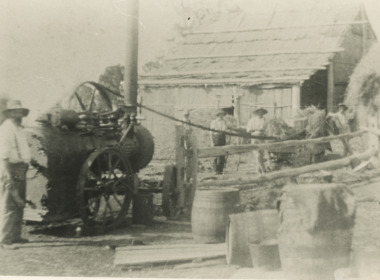
... Black and white photograph of five workers baling hay using small steam engine to power the baler on a farm in East Gippsland...The contractor with steam engine travelled around the district as requested by land owners Agriculture steam engine Black and white photograph of five workers baling hay using small steam engine to power the baler on a farm in East Gippsland Steam engine baler, East Gippsland Photograph Hay Baling ...Shed behind workers in clad and roofed with bark sheets held in place with horizontal timbers. The contractor with steam engine travelled around the district as requested by land ownersBlack and white photograph of five workers baling hay using small steam engine to power the baler on a farm in East Gippslandagriculture, steam engine -
 Port of Echuca
Postcard, Early 20th Century
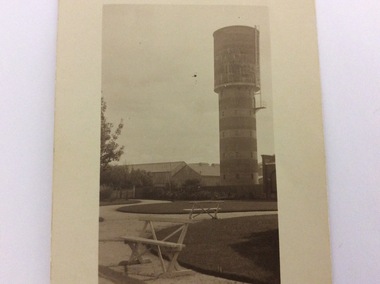
... It is 108 feet high and holds 150,000 gallons. it was originally connected to the steam powered pumping plant at Echuca East. John Monash was a war hero at Gallipoli in 1915 and also went on to be the Manager of the Victorian State Electricity Commission. ...It is 108 feet high and holds 150,000 gallons. it was originally connected to the steam powered pumping plant at Echuca East. John Monash was a war hero at Gallipoli in 1915 and also went on to be the Manager of the Victorian State Electricity Commission. ...The water tower on the corner of Pakenham St and High Street Echuca, was designed by Sir John Monash, who was an innovator in the use of reinforced concrete. The tower cost £2,973 and was completed in 1915. It is 108 feet high and holds 150,000 gallons. it was originally connected to the steam powered pumping plant at Echuca East. John Monash was a war hero at Gallipoli in 1915 and also went on to be the Manager of the Victorian State Electricity Commission. Monash University was named after him.The water tower was a revolutionary design in 1915. It also brought tapped water to people's homes. Sir John Monash made a huge contribution to engineering and social concepts, which was why he was knighted. As well as these contributions to social development, he was also a war hero.Black and white postcard featuring the water tower in Packenham Street. The photograph was taken from Alton Reserve. The background shows a conglomeration of buildings and the foreground shows shaped lawns and park benches. The postcard has a thick border in a cream colour all around it.On the reverse is printed ; POST CARD. Write here for Inland Postage only. Tha Address to be written here. In pen is hand written the words View of Water Tower Pakenham St. Taken from Alton Reserve?echuca east pumping station, echuca water tower, monash, sir john, alton reserve, engineering, reinforced concrete -
 Port of Echuca
Colour Photograph, Approx.1979
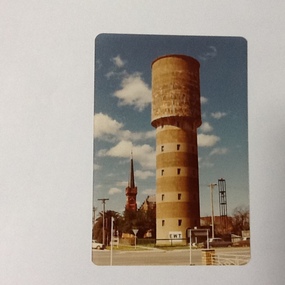
... It is 108 feet high and holds 150,000 gallons. it was originally connected to the steam powered pumping plant at Echuca East. John Monash was a war hero at Gallipoli in 1915 and also went on to be the Manager of the Victorian State Electricity Commission. ...It is 108 feet high and holds 150,000 gallons. it was originally connected to the steam powered pumping plant at Echuca East. John Monash was a war hero at Gallipoli in 1915 and also went on to be the Manager of the Victorian State Electricity Commission. ...The water tower on the corner of Pakenham St and High Street Echuca, was designed by Sir John Monash, who was an innovator in the use of reinforced concrete. The tower cost £2,973 and was completed in 1915. It is 108 feet high and holds 150,000 gallons. it was originally connected to the steam powered pumping plant at Echuca East. John Monash was a war hero at Gallipoli in 1915 and also went on to be the Manager of the Victorian State Electricity Commission. Monash University was named after him.The water tower was a revolutionary design in 1915., being constructed of reinforced concrete. It also brought tapped water to people's homes. Sir John Monash made a huge contribution to engineering and social concepts, which was why he was knighted. As well as these contributions to social development, he was also a war hero. Colour photograph of water tower on the south east corner of High and Pakenham street, Echuca. The St Andrews church tower can be seen in the background.On the front of the photograph on the bottom facade of the water tower is painted "E.W.T." (Echuca Water Trust). Printed on the reverse:" this paper manufactured by Kodak"echuca, water tower, echuca-historical buildings, monash, sir john, reinforced concrete building construction -
 Orbost & District Historical Society
book, Impact Printing, Clonmel, 1999
... The paddle steamer Clonmel was one of the first steam-powered vessels on the Australian coast. ...The paddle steamer Clonmel was one of the first steam-powered vessels on the Australian coast. ...The paddle steamer Clonmel was one of the first steam-powered vessels on the Australian coast. However, its career was short, being wrecked on its third voyage on what is now known as Clonmel Island at the Port Albert entrance. All on board reached safety, but much of the cargo was lost.The wreck of the Clonmel was instrumental in the settlement of Gippsland and the establishment of the towns of Port Albert, Tarraville and Alberton. Although the wreck of the Clonmel was a disaster at the time, it is now one of the most significant archaeological sites in Victoria. (Ref. Australian National Shipwreck Database) This item is a useful reference tool on a significant part of shipping history in Victoria.A thin 27 pp cardboard covered book titled, "Clonmel Disaster to Discovery". On the cover is a black drawing of the Clonmel with a coloured background of yellow, red and blue blocks. The book contains the history of the paddle-steamer Clonmel which was wrecked at port Albert in 1841.clonmel-paddle-steamer shipwreck-port-albert -
 Melbourne Tram Museum
Photograph - Set of 6 Black & White Photograph/s, mid 1910's?
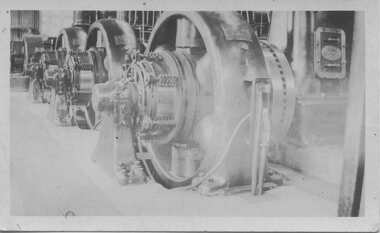
... .1 - DC power generators with engines in the background .2 - Steam power engines. .3 - Boilers - and fire boxes with two man standing in the photograph. .4 - Switchboard with three men standing alongside. .5 - Repairing generator equipment - partly dismantled. .6 - ditto with three men in the photograph. .7 - Photo of rotary converters, possibly Carlton, but no notation on rear of photograph. ....1 - DC power generators with engines in the background .2 - Steam power engines. .3 - Boilers - and fire boxes with two man standing in the photograph. .4 - Switchboard with three men standing alongside. .5 - Repairing generator equipment - partly dismantled. .6 - ditto with three men in the photograph. .7 - Photo of rotary converters, possibly Carlton, but no notation on rear of photograph. ...Set of six small black and white prints of the interior of the Ascot Vale or Essendon NMETL power house and associated control and generation equipment, mid 1910's? .1 - DC power generators with engines in the background .2 - Steam power engines. .3 - Boilers - and fire boxes with two man standing in the photograph. .4 - Switchboard with three men standing alongside. .5 - Repairing generator equipment - partly dismantled. .6 - ditto with three men in the photograph. .7 - Photo of rotary converters, possibly Carlton, but no notation on rear of photograph. From name plates on machines - Westinghouse Manchester.On rear in ink .1 - "Generators Ascot Vale" .2 - "Engines Ascot Vale" .3 - "Switchboard Ascot Vale" .4 - ditto .5 - "Ascot Vale breakdown" and in pencil " .6 - "Ascot Vale breakdown" and in pencil "trams, tramways, mmtb, substation, nmetl, essendon, ascot vale, rotary converters, switchboards, boilers, generators, carlton, westinghouse -
 Warrnambool and District Historical Society Inc.
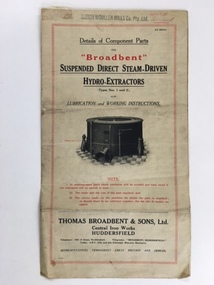
Document - Instruction manual, Details of component parts for Broadbent suspended steam driven Hydro Extractors, C 1926
... By 1893 Broadbent had progressed to steam powered engines for the textile industry. ...By 1893 Broadbent had progressed to steam powered engines for the textile industry. ...Thomas Broadbent $ sons Ltd was established in 1864 in Huddersfield England. They are an engineering firm , specialists in heavy duty engineering products. By 1893 Broadbent had progressed to steam powered engines for the textile industry. Some of these machines operated for upwards of 50 years Today Broadbent is a leading world designer in the manufacture and maintenance of advanced centrifuges. This document is a manual for a suspended direct steam driven hydro extractor. It shows the various parts , maintenance instructions and erection and working instructions. While it is stamped as Albion Woollen mills which were situated at Geelong, it is likely to have connections to the Warrnambool Woollen Mills.This document is a good example of machinery manual. It is possibly linked to the Warrnambool Woollen Mill. The fact that the company which manufactured these items is still in existence today after 150 years is testament to the quality of the items produced.Cream coloured document with mainly black text with some red text for headings contained in the document. It is printed front and back and is folded in three sections.Stamp at top "Albion Woollen mills Pty Ltd" .4H x 4 in red pencil in top RHC. Printed on front page. Thomas Broadbent & Sons Ltd Central Iron Works Huddersfield. warrnambool, warrnambool woollen mill, broadbent direct steam driven hydo extractors,, broadbent centrifuge
