
Showing 35 items matching "stencilling information"
-
 Moorabbin Air Museum
Book - Military aircraft camouflage & markings, The Modeller's Luftwaffe Painting Guide With Colour Chart
... ...Stencilling information...Military aircraft camouflage & markings Colour research Luftwaffe colour schemes Quick reference camouflage table Stencilling information Camouflage patterns Colour schemes of WW2 Luftwaffe aircraft for modellers, circa 1979 The Modeller's Luftwaffe Painting Guide With Colour Chart Book Military aircraft camouflage & markings ...Colour schemes of WW2 Luftwaffe aircraft for modellers, circa 1979non-fictionColour schemes of WW2 Luftwaffe aircraft for modellers, circa 1979colour research, luftwaffe colour schemes, quick reference camouflage table, stencilling information, camouflage patterns -
 Harcourt Valley Heritage & Tourist Centre
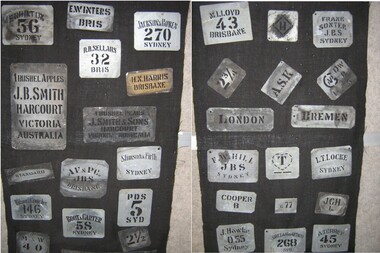
Fruit Box Stencils, 1905-1910
... Collection also includes ink block for branding the stencil information on to boxes....Collection also includes ink block for branding the stencil information on to boxes. Fruit Box Stencils ...Tin stencils were used to brand fruit cases to indicate the source and the destination of Harcourt Fruit for sale to local, interstate and overseas markets. These stencils are typical and also indicate grade/size of fruit. These stencils were used by J. B. Smith of Harcourt and N.C. Gaasch of Harcourt. Both of these growers customarily exported their fruit to England and Germany.An aid to marketing and branding Harcourt fruit, which had been sent in wooden cases for sale. Stencils, tin with delivery and sender details. Collection also includes ink block for branding the stencil information on to boxes. -
 Ballarat Tramway Museum
Document - Newsletter, Ballarat Tramway Preservation Society (BTPS), BTPS Information sheet, May. 1971
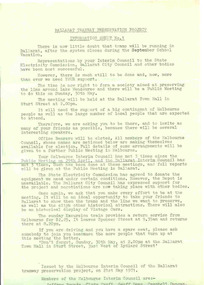
... Single page - foolscap size green coloured paper, printed using the Gestetner wax stencil process; titled "Information Sheet No. 1". gives details on the progress to operate the trams in Ballarat, a Melbourne Interim Council, SEC donation and that a public meeting to be held in Ballarat on 30th May with details of the trains. ...Trams tramways BTPS Meetings Single page - foolscap size green coloured paper, printed using the Gestetner wax stencil process; titled "Information Sheet No. 1". gives details on the progress to operate the trams in Ballarat, a Melbourne Interim Council, SEC donation and that a public meeting to be held in Ballarat on 30th May with details of the trains. ...Has a strong association with the formation of the BTPS and the involvement of Melbourne based tramway enthusiasts - notes a Melbourne interim council and its work and a forthcoming meeting in Ballarat.Single page - foolscap size green coloured paper, printed using the Gestetner wax stencil process; titled "Information Sheet No. 1". gives details on the progress to operate the trams in Ballarat, a Melbourne Interim Council, SEC donation and that a public meeting to be held in Ballarat on 30th May with details of the trains. See Reg Item 3928 for a circular advertising a tram tour prior to the meeting. Details names of the Melbourne Interim Council persons. Second copy from donation of the Tom Murray Estate added 20-11-2016.trams, tramways, btps, meetings -
 Ballarat Tramway Museum
Ephemera - Tour Booking Form, Ken Craven and Australian Electric Traction Association, AETA, Easter 1961 - Wal Jack Collection, Nov. 1960
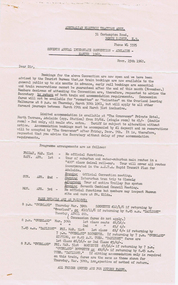
... Two page foolscap- stencil duplicated form for information, proposed programme for AETA, Easter 1961 Convention in Adelaide- was shown for the 1960 Convention as heading, but should have been 1961- Correct elsewhere. ...AETA Adelaide Booking Form Two page foolscap- stencil duplicated form for information, proposed programme for AETA, Easter 1961 Convention in Adelaide- was shown for the 1960 Convention as heading, but should have been 1961- Correct elsewhere. ...Two page foolscap- stencil duplicated form for information, proposed programme for AETA, Easter 1961 Convention in Adelaide- was shown for the 1960 Convention as heading, but should have been 1961- Correct elsewhere. Shows travel arrangements, fares, hotel costs, time. Two sheets stapled together. Printed using the stencil/duplication process. Image of document added 5/9/13. aeta, adelaide, booking form -
 Flagstaff Hill Maritime Museum and Village
Textile - Flour bag - W.C.Thomas, Warracknabeal
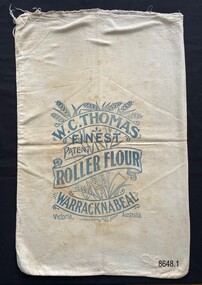
... The stencil on the front of the bag includes an image of wheat overlaid with the written information in scroll format....The stencil on the front of the bag includes an image of wheat overlaid with the written information in scroll format. ...This flour bag came from the W.C. Thomas Flour Mill at Warracknabeal, Victoria. W.C. Thomas ran a number of flour mills throughout the Victorian wheat belt, with the Warracknabeal Mill operating from 1884 to 1964. After their use for flour storage, flour bags were able to be reused for bulk storage of other dry goods or sewn into domestic objects such as tea towels, pillowcases or waggas.This is a good example of a flour bag from a prominent Victorian flourmill, operating from the late 19th century to the mid-20th century.Calico flour bag for 'Roller Flour' from the flour mill of W.C. Thomas in Warracknabeal, a large wheat growing area in Victoria. The stencil on the front of the bag includes an image of wheat overlaid with the written information in scroll format.W.C. Thomas, Finest, Patent, Roller Flour, Warracknabeal, Victoria, Australia. Wheat image.flagstaff hill maritime museum and village, great ocean road, shipwreck coast, flour bags, calico, domestic object, textile, food storage, w.c. thomas, warracknabeal, flour mill -
 Flagstaff Hill Maritime Museum and Village
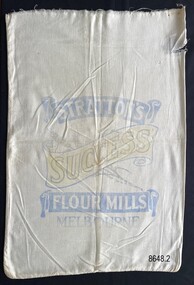
Textile - Flour bag - Stratton's, Melbourne
... The stencil on the front of the bag includes the image of a wheat stalk overlaid with the written information in scroll format....The stencil on the front of the bag includes the image of a wheat stalk overlaid with the written information in scroll format. ...Flour bags were used when purchasing flour from the late 19th century to the mid 20th century. They were able to be reused for bulk storage of dry goods or sewn into domestic objects such as tea towels, pillowcases or waggas.The flour bag provides an example of a useful domestic packaging product, from the early 20th century.Calico flour bag for 'Success Flour' from Stratton’s flour mill in Melbourne. The stencil on the front of the bag includes the image of a wheat stalk overlaid with the written information in scroll format.Stratton's, Success, Flour Mills, Melbourneflagstaff hill maritime museum and village, great ocean road, shipwreck coast, calico, domestic object, textile, food storage, stratton's, flour bag -
 Flagstaff Hill Maritime Museum and Village
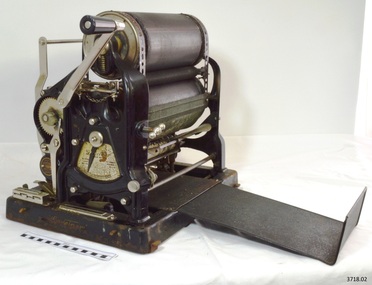
Gestetner Machine, c. 1922 - 1929
... stencil. The Gestetner machine was the first office printing machine. It was easily installed and it made exact copies of the sane document quickly, effectively and inexpensively. This changed the way offices operated, making information...stencil. The Gestetner machine was the first office printing machine. It was easily installed and it made exact copies of the sane document quickly, effectively and inexpensively. This changed the way offices operated, making information ...This Gestetner Cyclostyle duplicating machine was invented and manufactured by David Gestetner. He claimed in 1922, once he had released several models, that if a Gestetner Durotype stencil was used together with his Cyclostyle machine, then 10,000 copies could be made from the one Durotype stencil, an amazing claim for office technology of that era. David Gestetner (1854-1939), was born in Csoma, Hungary. He has been called the “founder of the worldwide office copying and duplicator industry.). He moved to London and in 1879 filed his first copying patent. In 1881 he patented the Cyclostyle stylus (or pen), which was used in conjunction with his Cyclograph device for copying text and images, He established the Gestetner Cyclograph Company in England at this time (1881) to protect his inventions and to produce his products; stencils, stylos (stylus or pen) and ink rollers. HIs inventions included nail-clipper and the ball-point pen (although the latter is more commonly associated with Laszlo Biro). Gestetner’s patented Cyclograph duplicator was used with his Cyclostyle Stylus or pen to write or draw on special thin wax-coated stencil paper (originally used for kite making paper) in the following way; 1. The Cyclostyle stencil was placed on a lower, framed metal plate of the Cyclograph 2. An upper frame was clipped over the top 3. The Cyclostyle pen, with its tip being a small metal-spiked or toothed wheel, was used to write or draw on the stencil, punched small holes into the paper and removed the wax coating in those places 4. The upper frame and stencil was then removed and a piece of blank paper was placed onto the metal plate in the lower frame and the upper frame with stencil was replaced 5. A roller was given an even distribution of Cyclostyle ink and rolled by hand over the stencil in the frame. This forced the ink through the holes in the stencil to and made a copy of the stencil on the paper 6. The upper frame was raised, the printed paper removed and another blank sheet was put into place. The whole process was repeated until enough copies were made. Gestetner’s invention developed further in 1894, with a stencil that could be placed on a screen on a revolving drum. The drum was manually rotated, the stencil then wrapped around another drum and was fed between cloth-covered rollers on which ink was evenly spread. Each revolution of the drum forced ink through the holes in the stencil and transferred the ink onto paper that had been fed between rollers and pressed against the drum. The process was repeated for each page. The paper was still fed and removed manually in this earlier invention but became more automatic in later models. In 1902 Gestetner duplicator model 6 was put onto the market. This model included the improvement of an automatic paper feed that synchronised with the rotation of the stencil. The Gestetner machine was the first office printing machine. It was easily installed and it made exact copies of the sane document quickly, effectively and inexpensively. This changed the way offices operated, making information easily available to many more users. The machines were commonly used in small businesses, schools, churches, clubs and other organisations for the wide distribution of a wide variety of information in the form of worksheets, newsletters and more. In 1906 the Gestetner Works were opened in Tottenham Hale, North London, and thousands of people were employed there up until the 1970’s. Due to the fast growing success of the Gestetner Duplicator machines many international branches for sales and service centres were established. David Gestetner was succeeded by his son Sigmund, followed by his grandson’s David and Jonathan. Further advancement was made by using a manual typewriter with specifically designed stencils. The end product was a printed, typewritten copy similar to the print from newspapers and booklets. In the next few years there were further developments of this revolutionary invention. The Gestetner Cyclostyle duplicator in our Collection is dated c.1922 - 1929 and it uses Gestetner Durotype stencils The 1922 British Industries Fair’s catalogue contained advertising for the Gestetner Rotary Cyclostyle “The World’s Premier Duplicator”, demonstrated at Stand K 86.” A Notice at the foot of the advertisement’s page boasts "Important - D Gestetner's latest invention, the "Durotype" Stencil, enables you to obtain 10,000 copies from one original if desired. It contains no wax of any description, is indestructible, can be stored indefinitely and printed from as required” In 1929 the look of the Gestetner machines changed; American designer Raymond Loewy was invited by Gestetner to improve the look of his duplicators, resulting in a very streamlined appearance. Eventually, around 1960’s, offices replaced their Gestetner with small photocopying machines and printers. Gestetner took over ownership of other office machine companies over time, including Nashua, Rex Rotary, Hanimex and Savin and eventually all came under the holding company name of NRG (Nashuatech, Rex Rotary and Gestetner). In 1996 Ricoh acquired the Gestetner Company, and it was renamed the NRG Group. REFERENCES Cyclostyle, Stencil Duplicating Machines, antique Copying Machines, Early Office Museum, http://www.officemuseum.com/copy_machines.htm Duplicating machines, Wikipedia Duplicator, Collection online, Canada Science and Technology Museums Corporation http://techno-science.ca/en/collection-research/collection-item.php?id=1989.0229.001 Gestetner duplicators, Totterham-Summerhillroad.com http://tottenham-summerhillroad.com/gestetner_duplicators_tottenham.htm Gestetner Duplicator, V&A Museum http://collections.vam.ac.uk/item/O322014/gestetner-duplicator-duplicator-loewy-raymond-fernand/ Gestetner, Grace’s Guide to British Industrial History, http://www.gracesguide.co.uk/Gestetner Duplicating machines such as this one revolutionalised access to copies of printed material, changing the way that educational bodies, offices, small businesses and community clubs and charities operated.Duplicating machine, Gestetner Cyclostyle Durotype, a stencil-method duplicating machine with two rotating drums plus rollers. Hand operated, tabletop office machine. Front has folding Bakelite handle, oil filling hole, calibrating gauge with scale, and copy counting meter. Right side has printed manufacturer’s plate that slides out as a paper output tray. Left side has metal plate with protrusions and perforations, plus another similar plate that is detached. It also has a metal frame attached [that would have been used to hold a paper input board, adjusted for various sizes of paper]. Cover, metal, with folding wooden handle on top, attaches to base with metal clips. Inscriptions printed on machine, mostly in gold-coloured paint. Round metal manufacturing plate is stamped with Serial Number 95759. Made by D. Gestetner, London, c.1922-1929Maker’s plate “MANUFACTURED / BY / D. GESTETNER LTD, / No. 95759 / CYCLOSTYLE WORKS / TOTTENHAM HALE / LONDON, N” Copy counting meter shows “1 4 6 4 8 [space]“ copies. Calibrating gauge has divisions with numbers “0 1 2“, labelled “← [left arrow] “TO PRINT LOWER” and “→ [right arrow], TO PRINT HIGHER”. “The Gestetner”, “Cyclostyle”, “Gestetner” (Trade Mark), Right side print of manufacturing details includes “The / Gestetner / TRADE MARK” And “THE FOLLOWING TRAFE MARKS / - - - OF INK, STENCILS / - - - AND GUARANTEE OF PERFECT / - - - BOTH - - - AND MACHINE” and “CYCLOSTYLE / DUROTYPE / GESTETNER” and “D. Gestetner” flagstaff hill, warrnambool, shipwrecked coast, flagstaff hill maritime museum, maritime museum, shipwreck coast, flagstaff hill maritime village, great ocean road, office machine, copying machine, gestetner machine, duplicating machine, duplicator, stencil machine, gestetner cyclograph company, cyclograph, cyclostyle, d. gestetner ltd, gestetner durotype stencils, gestetner cyclostyle, printing machine, office technology, durotype stencils, david gestetner, raymond loewy, roneo, rotary duplicatorten, mimeo, mimeograph machine, roneograph copier -
 Cheese World Museum
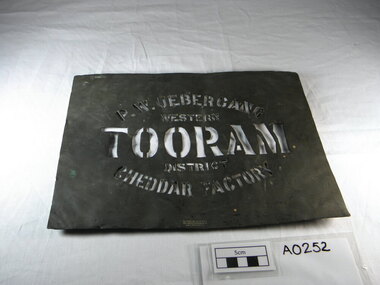
Cheese Box Stencil
... This cheese box stencil is part of a large collection of items from the Uebergang family relating to early dairying in Allansford, Victoria. The Uebergang collection as a whole is of local significance according to the following criteria: .Potential to yield information that will contribute to an understanding of Victoria's cultural history .Strong or special association with a particular community or cultural group for social, cultural or spiritual reasons. .Special association with the life or works of a person, or group of persons, if importance in Allansford's history. ...This cheese box stencil is part of a large collection of items from the Uebergang family relating to early dairying in Allansford, Victoria. The Uebergang collection as a whole is of local significance according to the following criteria: .Potential to yield information that will contribute to an understanding of Victoria's cultural history .Strong or special association with a particular community or cultural group for social, cultural or spiritual reasons. .Special association with the life or works of a person, or group of persons, if importance in Allansford's history.(Lesley Alves December 2009)Rectangular copper cheese box stencil, P.W.Uebergang- Tooram Cheddar Factory, Western District. 6mm round hole in top left corner.Imprinted Makers name - Quirk & Morton, 411-415 Lt Bourke St, Melbourne. Catalogue number yellow sticker 015, Ink 015.1 Stencil - P.W.Uebergang, Tooram Cheddar Factory, Western District.tooram, cheese factory, dairying, stencil, uebergang, allansford, cheddar factory -
 Bendigo Military Museum
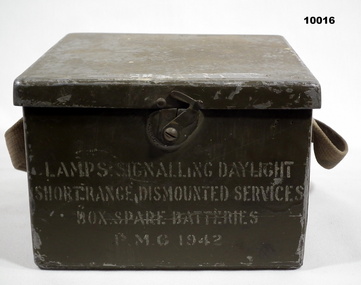
Equipment - BATTERY BOX, P.M.G, 1942
... stencilled = “lamps signalling daylight, short range dismounted services”. “Box spare batteries PMG 1942” Cast aluminium box with hinged lid. It has a short cotton webbing carry strap. There is a curved latch to hold lid shut, colour is drab alive. Inside the lid has a brass clip that used to hold information ...Part of the Alfred Boland Collection. Refer Cat No 2473.Cast aluminium box with hinged lid. It has a short cotton webbing carry strap. There is a curved latch to hold lid shut, colour is drab alive. Inside the lid has a brass clip that used to hold information sheet(s). Inside the bottom of the box has a hard cardboard panel.On front side of box is stencilled = “lamps signalling daylight, short range dismounted services”. “Box spare batteries PMG 1942”container, equipment, ww2, lamps signalling -
 Bendigo Military Museum
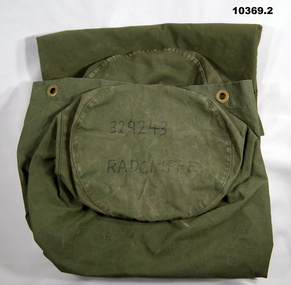
Equipment - KIT BAG, ARMY, 1975, 1986
... stencilled in black ink. 1. "RFD CO. AUST PTY LTD/ 5465-06-023-S411/ 1975/ ^ ". 2. "C.S.L. 8-165-66-023-8111/ 1986/ ^". Handwritten black ink pen - 329243 / RADCLIFFE. 1. & 2. Kit bags - dark green colour canvas fabric, long cylinder shape with closed circular bottom. Top has internal flap and eight brass grommets to allow closure by a drawstring rope. Canvas loop at bottom edge. Manufacturers information ...Equipment part of D. Hutchinson collection 1. & 2. Kit bags - dark green colour canvas fabric, long cylinder shape with closed circular bottom. Top has internal flap and eight brass grommets to allow closure by a drawstring rope. Canvas loop at bottom edge. Manufacturers information - inside bag.Manufacturers details - stencilled in black ink. 1. "RFD CO. AUST PTY LTD/ 5465-06-023-S411/ 1975/ ^ ". 2. "C.S.L. 8-165-66-023-8111/ 1986/ ^". Handwritten black ink pen - 329243 / RADCLIFFE.d. hutchinson, kit bags, army equipment -
 Kiewa Valley Historical Society
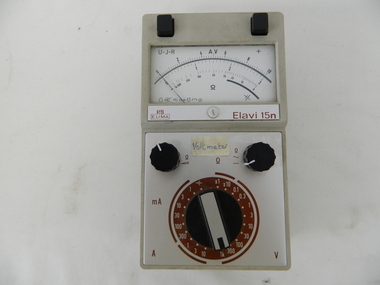
Meter Multi General Purpose, circa mid to late 1900's
... On the bottom of the base is a stenciled layout of the battery "layout" including the fuse . The information notice is presented in five languages starting with German, English,French, Italian, Spanish and Dutch...On the bottom of the base is a stenciled layout of the battery "layout" including the fuse . The information notice is presented in five languages starting with German, English,French, Italian, Spanish and Dutch This General Purpose Multimeter is an analogue meter i.e. it has a needle arm that moves across a scale of divisions. ...This general purpose Multi-meter was manufactured after 1950 and used by the SEC Vic (Kiewa Hydro Electricity Scheme) from that date until late 1900's. It was used to measure very small voltages associated with the operation of the various Hydro Generators. The readings were able to be shown by the resistor in use in the current circuit. During this time period, high quality testing instruments were either sourced from Europe or England. This particular meter was manufactured in the Netherlands. This type of "old" analogue meter was replaced by digital meters whose electronic components are a fraction of the size of the older analogue ones.This analog General Purpose multi-meter is quite a large (for handheld mobile) apparatus which permits the easy monitoring of electrical variations within the large SEC Victoria Hydro Scheme's electrical generators. These generators are powered by the hydro force of "stored" water at a higher altitude. The establishment of both the NSW and Victorian Hydro schemes was achieved from the mid 1900's to the 1960's. At this point in time the need for additional power sources to quench both an industrial and domestic demand for electricity was purely an economic and not and environmental (carbon reduction) factor. This hydro scheme was instigated by "the Government of the day" as a bold move and was the major force of the World War II refugee and "technical" workforce inclusion of skilled and unskilled migration into the Australian environment. Although this mass "invasion" of workers with families was thought of in some circles as intrusive, the expansion of population post war years and its integration into the Australian rural sector, produced the multi- lingual multi-cultural diversity of later years.This General Purpose Multimeter is an analogue meter i.e. it has a needle arm that moves across a scale of divisions. This is a large(hand held) device due to the mechanical movement system within and the large size of its electronic components of its circuitry.There are two black bake-lite push buttons operating the wire inserts Positive/negative leads at the top. The meter (protected with a glass window) has clearly marked graduations (top - volts, bottom amperes). Below this are two bake-lite dials (left "potentiometer the right one measuring range selector). Below this is a "dial" switch to input the desired resistance measuring range "V" Front "H&B ELIMA" and to the right Elavi 15n. 0n the front side is a label "STATE ELECTRICITY COMMISSION OF VICTORIA TRANSMISSION DEPT E.C.No." On the bottom of the base is a stenciled layout of the battery "layout" including the fuse . The information notice is presented in five languages starting with German, English,French, Italian, Spanish and Dutchsec vic kiewa hydro scheme, alternate energy supplies, alpine population growth -
Moorabbin Air Museum
Prowse Collection Box WP11 See details in Description section
... AAP 7213.001-4-3 Unstated Parts Breakdown Mirage III O Book 1 Plates (R) AAP 7213.002-4-3 Unstated Parts Breakdown Mirage III D Book 1 Plates (R) Bloodhound Mk 1 Weapon System Excluding Radars ASD.245 Vols 1 & 6 Book 1 (R) Bloodhound Mk 1 Weapon System Excluding Radars ASD.245 Vols 1 & 6 Book 2 Cover 1 (R) Bloodhound Mk 1 Weapon System Excluding Radars ASD.245 Vols 1 & 6 Book 2 Cover 2 (R) Bloodhound Mk 1 Weapon System Equipment & Spares Schedule ASD.245 Vol 3 Part 3 (R) Jindivik Towed Targets (C) GAF Report B6/57 (R) C of A Malkara Anti Tank Weapon (C) C of A GAF Notes on Visit to Combat Development & Test Centres, Thailand & Vietnam (C) Jindivik Mk 103A Crew Operating Notes (R) Jindivik Mk B3A AL14 Mk 1 Trolley (R) RAAF Macchi Ground Support Equipment Stencil Kit (R) Jindivik Spares Vocabulary (R) GAF Report - Design Summary - Jindivik Mk 2B (R)\ Jindivik Mk 203B - General & Technical Information GAF/B3B/1 Book 1 & Book 2 (R) ...AAP 7213.001-4-3 Unstated Parts Breakdown Mirage III O Book 1 Plates (R) AAP 7213.002-4-3 Unstated Parts Breakdown Mirage III D Book 1 Plates (R) Bloodhound Mk 1 Weapon System Excluding Radars ASD.245 Vols 1 & 6 Book 1 (R) Bloodhound Mk 1 Weapon System Excluding Radars ASD.245 Vols 1 & 6 Book 2 Cover 1 (R) Bloodhound Mk 1 Weapon System Excluding Radars ASD.245 Vols 1 & 6 Book 2 Cover 2 (R) Bloodhound Mk 1 Weapon System Equipment & Spares Schedule ASD.245 Vol 3 Part 3 (R) Jindivik Towed Targets (C) GAF Report B6/57 (R) C of A Malkara Anti Tank Weapon (C) C of A GAF Notes on Visit to Combat Development & Test Centres, Thailand & Vietnam (C) Jindivik Mk 103A Crew Operating Notes (R) Jindivik Mk B3A AL14 Mk 1 Trolley (R) RAAF Macchi Ground Support Equipment Stencil Kit (R) Jindivik Spares Vocabulary (R) GAF Report - Design Summary - Jindivik Mk 2B (R)\ Jindivik Mk 203B - General & Technical Information GAF/B3B/1 Book 1 & Book 2 (R) Prowse Collection Box WP11 See details in Description section ... -
 Ballarat Tramway Museum
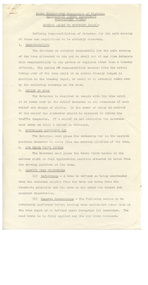
Document - Instruction, State Electricity Commission of Victoria (SECV), "Special Order to Motormen (49/1)", late 1960's?
... information about the instructions about tram operations, safety instructions and leaving trams. Trams tramways Braking Instructions SEC Emergency Driver Training Two foolscap duplicated sheets titled "Special Order to Motormen (49/1)" giving instructions regarding 1) Responsibility (for trams), 2) Relief on the road, 3) Controller key, 4) Air brake handle, 5) leaving tram unattended with definition, general precautions, special precautions - such as parking the tram at Lydiard St North, parking trams at City Loop and 6) an explanation on the braking system at either end of the tram. Undated. Printed from wax stencil ...Yields information about the instructions about tram operations, safety instructions and leaving trams.Two foolscap duplicated sheets titled "Special Order to Motormen (49/1)" giving instructions regarding 1) Responsibility (for trams), 2) Relief on the road, 3) Controller key, 4) Air brake handle, 5) leaving tram unattended with definition, general precautions, special precautions - such as parking the tram at Lydiard St North, parking trams at City Loop and 6) an explanation on the braking system at either end of the tram. Undated. Printed from wax stencil and stapled along the top edge. Signed by F. K. White Manager. See Reg Item 261 for 9-1961 issue and Reg item 3459 for a Jan. 1961 issue. trams, tramways, braking, instructions, sec, emergency, driver training -
 Ballarat Tramway Museum
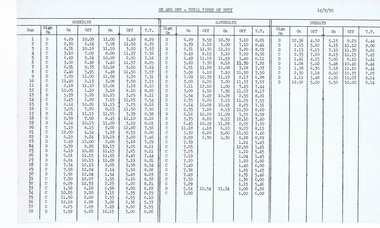
Document - Roster, State Electricity Commission of Victoria (SECV), "On and Off - Total Times of Duty", Sep. 1970
... information about the arrangements made for tram crews and the hours worked for each day of the week. Trams tramways Ballarat Rosters Crews Employees Shifts Timetables Single sheet of off white duplicating paper titled "On and Off - Total Times of Duty". Printed by wax cut stencil ...Yields information about the arrangements made for tram crews and the hours worked for each day of the week.Single sheet of off white duplicating paper titled "On and Off - Total Times of Duty". Printed by wax cut stencil or Gestetner method. Details the sign on / sign off times for each run number operated by Motormen / Conductors and where they signed on, either depot or city and the total time worked for that particular shift. Has date "14/9/70" in top right hand corner. 2nd copy added 2/1/2020trams, tramways, ballarat, rosters, crews, employees, shifts, timetables -
 Ballarat Tramway Museum
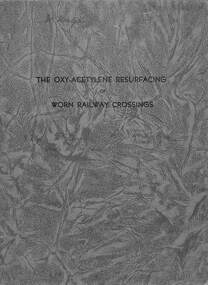
Book, Commonwealth Industrial Gases Limited (CIG), c1960
... Cover and title sheet printed in black ink, the rest printed by Gestetner process using stencils with hand drawn sketches. Gives information on the resurfacing of railway crossings using oxy acetylene rods, including equipment, preparation, flame adjustment, procedures, notes, protection and material consumption. ...Cover and title sheet printed in black ink, the rest printed by Gestetner process using stencils with hand drawn sketches. Gives information on the resurfacing of railway crossings using oxy acetylene rods, including equipment, preparation, flame adjustment, procedures, notes, protection and material consumption. ...Twenty four page book with light card covers, side stapled and green cloth bound titled "The Oxy-Acetylene Resurfacing of Railway Crossings". Cover green paper with darker green mottled finish. Cover and title sheet printed in black ink, the rest printed by Gestetner process using stencils with hand drawn sketches. Gives information on the resurfacing of railway crossings using oxy acetylene rods, including equipment, preparation, flame adjustment, procedures, notes, protection and material consumption. Includes an index. On inside of rear cover has printed "Issued by / Sales Department / The Commonwealth Industrial Gases Limited / Alexandra NSW" No date given for printing, possibly c1960. Company later known as CIG,On front cover in faded black ink are a number of names and a number - unreadable.trams, tramways, trackwork, railway crossing, repairs -
 Ballarat Tramway Museum
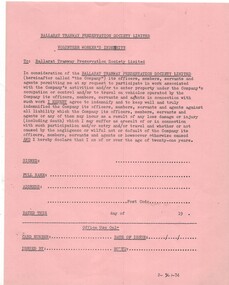
Document - Form/s, Ballarat Tramway Preservation Society (BTPS), "Ballarat Tramway Preservation Society - Volunteers Worker's Indemnity", 1974
... Stencil typed, Duplicated form on pink quarto size paper to act as BTPS Limited Volunteer Workers Indemnity. Has space for office use of the form. Was for use by people over 21 years of age. See also Reg. Item 1516 and 933.1 for other issues of this form. Has printing information...Stencil typed, Duplicated form on pink quarto size paper to act as BTPS Limited Volunteer Workers Indemnity. Has space for office use of the form. Was for use by people over 21 years of age. See also Reg. Item 1516 and 933.1 for other issues of this form. Has printing information ...Stencil typed, Duplicated form on pink quarto size paper to act as BTPS Limited Volunteer Workers Indemnity. Has space for office use of the form. Was for use by people over 21 years of age. See also Reg. Item 1516 and 933.1 for other issues of this form. Has printing information "2-500-1974" on bottom of form, assume that printed in 1974.trams, tramways, btps, volunteers, indemnity -
 Ballarat Tramway Museum
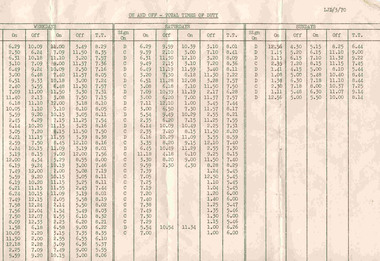
Document - Roster, State Electricity Commission of Victoria (SECV), "On and Off - Total Times of Duty", Mar. 1970
... information on operating times, lunch breaks etc. The last timetable alteration. Trams tramways Ballarat Rosters Employees Shifts Timetables Single sheet of off white duplicating paper titled "On and Off - Total Times of Duty". Printed by wax cut stencil ...Details the sign on / sign off times for each run number operated by Motormen / Conductors and where they signed on, either depot or city and the total time worked for that particular shift. Has "LJD / 3/70", showing that Les Denmead authorised the roster. Was part of D. J. Everett papers. 2296.1 - as above, but typed original in a vertical or portrait format, rather than a landscape format. From the SEC 1971. 2nd copy of 2296 added 10/1/2007. 2nd copy of 2296.1, added 2/8/2012. See item 9939 for an original typed copy.Demonstrates aspects of the Ballarat Tramways management system of operations, the way the crews were given information on operating times, lunch breaks etc. The last timetable alteration.Single sheet of off white duplicating paper titled "On and Off - Total Times of Duty". Printed by wax cut stencil or Gestetner method. trams, tramways, ballarat, rosters, employees, shifts, timetables -
 Ballarat Tramway Museum
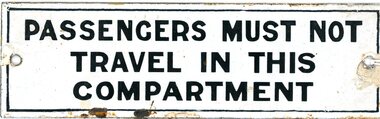
Sign - "Passengers must not travel in this compartment."
... Tramways signs Passenger information signs Enameled signs Enameled metal sign, black capital letters and border lines on an off- white background. Reverse enameled in black. Sign reads "Passengers must not travel in this compartment". The writing appears to have been stenciled ...Demonstrates how the SEC used enameled signs to convey instructions to passengers, and confirm the advice of the conductor.Enameled metal sign, black capital letters and border lines on an off- white background. Reverse enameled in black. Sign reads "Passengers must not travel in this compartment". The writing appears to have been stenciled over the white enamel base. The enameling has broken away from areas near the two screw holes formed to attach the sign to the compartment. An attempt has been made to address damage with paint. Enamel on reverse is marked where the sign appears to have been laying on a frame prior to firing. tramways signs, passenger information signs, enameled signs -
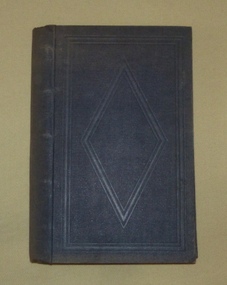 Ballarat Tramway Museum
Magazine, Australian Railway and Locomotive Historical Society, "ARLHS Bulletin", 1942
... information about the tramways of Ballarat and the North Melbourne tramways and has a strong association with well known tramway enthusiasts of the era. Ballarat ESCo NMETL Melbourne Horse Trams Electrification Set of 8 Australian Railway and Locomotive Historical Society Bulletins for the period May 1942 to December 1942. Each page has been stencil ...Yields information about the tramways of Ballarat and the North Melbourne tramways and has a strong association with well known tramway enthusiasts of the era., Yields information about the tramways of Ballarat and the North Melbourne tramways and has a strong association with well known tramway enthusiasts of the era.Set of 8 Australian Railway and Locomotive Historical Society Bulletins for the period May 1942 to December 1942. Each page has been stencil duplicated. Index sheets for the journals at the front of the documents. The sheets have been placed in a heavy brown flysheet and then placed in "The Riven" spring back binder. May 1942 - page 57 to 59 - has a article, Horse Trams of Ballarat 1887 to 1913" written by Wal Jack, including a map prepared by C. C. Singleton. June 1942 - page 82 & 83 - has an article "Electric Trams of Ballarat 1905 to 1942" written by Wal Jack. November 1942 - page 65 & 66, has an article "Flemington Bridge Tramways, The North Melbourne Electric Tramway and Lighting Company" written by Peter W Duckett.ballarat, esco, nmetl, melbourne, horse trams, electrification -
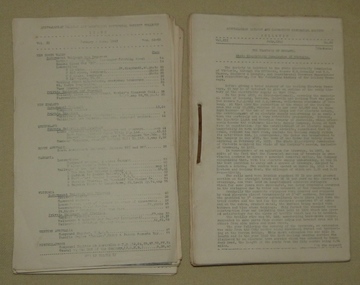 Ballarat Tramway Museum
Magazine, Australian Railway and Locomotive Historical Society, "ARLHS Bulletin", 1943
... Yields information about the tramways of Bendigo and the Geelong tramways and has a strong association with well known tramway enthusiasts of the era., Yields information about the tramways of Bendigo and the Geelong tramways and has a strong association with well known tramway enthusiasts of the era. Museums Bendigo VR Trams Geelong Set of 12 Australian Railway and Locomotive Historical Society Bulletins for the period Jan 1943 to December 1943. Each page has been stencil ...Yields information about the tramways of Bendigo and the Geelong tramways and has a strong association with well known tramway enthusiasts of the era., Yields information about the tramways of Bendigo and the Geelong tramways and has a strong association with well known tramway enthusiasts of the era.Set of 12 Australian Railway and Locomotive Historical Society Bulletins for the period Jan 1943 to December 1943. Each page has been stencil duplicated. Index sheets for the journals at the front of the documents. March 1943 - pages 29 to 32 has an article "The Tramways of Bendigo - Bendigo Tramway Company Limited" written by Wal Jack. Has a large full page map prepared by C. C. Singleton. March 1943 - page 40 - has a short item on the St Kilda Brighton Tramway - three new tramcars (VR type). Item from the Journal of Victorian Model Railway Society" July 1943 - page 1 to 4, has an article "The Tramways of Geelong" - author not given, though probably largely Wal Jack. Has a large full page map prepared by C. C. Singleton. The Jan to June issues are loose, while the July to December issues have been hole punched and held together with a metal binder.museums bendigo, vr trams, geelong -
 Ballarat Tramway Museum
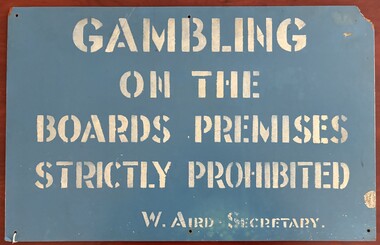
Sign - Gambling on Board's premises, Melbourne and Metropolitan Tramways Board (MMTB), c1960
... information about gambling at depots by MMTB staff. Trams tramways MMTB Depot Signs Personnel Crews Mess Rooms Rules Sign - blue paint background with white letters stencil cut painted onto a sheet of Masonite, with 3 drilled holes along each of the top and bottom edges with the words "Gambling on the Boards Premises Strictly Prohibited, signed "W. ...Gambling at Tram Depots was common and resulted in the loss of wages. See attached document with notes by Peter Bruce. The MMTB tried to restrict it, but it still took place. W Aird was the Board Secretary.Yields information about gambling at depots by MMTB staff.Sign - blue paint background with white letters stencil cut painted onto a sheet of Masonite, with 3 drilled holes along each of the top and bottom edges with the words "Gambling on the Boards Premises Strictly Prohibited, signed "W. Aird Secretary". Has the word "Masonite" stencilled on the rear.trams, tramways, mmtb, depot, signs, personnel, crews, mess rooms, rules -
 Ballarat Tramway Museum
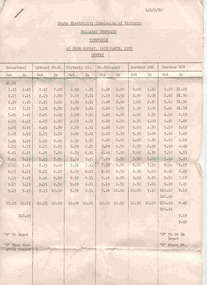
Ephemera - Timetable, State Electricity Commission of Victoria (SECV), Timetable as from Mon. 16 March 1970 - Ballarat, 1970 or 1971
... information about tram services. Ballarat SECV Timetables Tram Services 285 - Three page photo copy of the final timetable for tram services in Ballarat for the SECV issued March 1970. Page 1 - Sunday, p2 - Saturday, p3 - weekdays. Gives IN and OUT times for each route and notes if from depot etc. Understood to be SECV photocopy. 285.1 - ditto, but actual wax stencil ...Demonstrates the last timetable issued for Ballarat Tramways and yields information about tram services.285 - Three page photo copy of the final timetable for tram services in Ballarat for the SECV issued March 1970. Page 1 - Sunday, p2 - Saturday, p3 - weekdays. Gives IN and OUT times for each route and notes if from depot etc. Understood to be SECV photocopy. 285.1 - ditto, but actual wax stencil copy on duplicating paper used by Driver / Conductor J. Everett. Has been folded into 8. This copy used in image files. Item added 2/2/2003. 285.2 - ditto - three copies of SECV copies given to the BTPS at the time of closure. Staple horizontally in top left hand corner and marked in ink - see Inscriptions. Items added 9/3/2004. 285.3 - ditto wax stencil or duplicated copy - unmarked. Item added 22/08/2004. 285.4 - ditto but Saturday timetable sheet marked in red or blue ink to show run numbers? Item added 22/08/2004. Two staples in top left hand corner. 285.5 - ditto wax stencil or duplicated copy - unmarked. Item added 17/05/2006 See pdf documents for good quality scans and history of record for details of source.ballarat, secv, timetables, tram services -
 Ballarat Tramway Museum
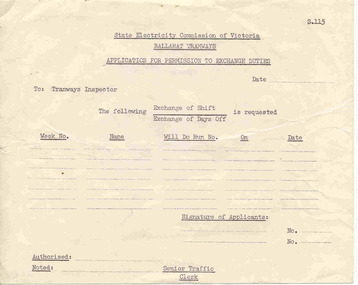
Document - Form/s, State Electricity Commission of Victoria (SECV), "Application for Permission to Exchange Duties", late 1960's
... information about the method for formalising the swapping of shifts between crews, in order for management purposes. Required signatures of both parties and approval by the Traffic Clerk. Trams tramways SEC Rosters Crews Personnel Duplicated SEC form titled "Application for Permission to Exchange Duties", form number S.115. Printed by a typed stencil ...Yields information about the method for formalising the swapping of shifts between crews, in order for management purposes. Required signatures of both parties and approval by the Traffic Clerk.Duplicated SEC form titled "Application for Permission to Exchange Duties", form number S.115. Printed by a typed stencil or Gestetner process on duplicating paper. Headed SEC, Ballarat Tramways. Used for crews to formally seek approval for an exchange of shift or an exchange of days off with another crew, for a specific change of shift of with another shift. 2nd copy added 11/1/2007.trams, tramways, sec, rosters, crews, personnel -
 National Wool Museum
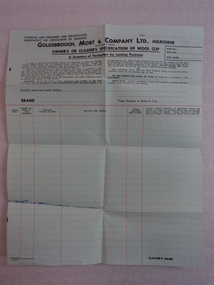
Waybill, 1940
... Fields can be filled in with information about wool lip/size/wiehgt/quality/bale stencil number/etc. ...Fields can be filled in with information about wool lip/size/wiehgt/quality/bale stencil number/etc. ...Part of a collection of items donated by Mrs Robyn Adams. Mrs Adams' father, Victor Clyde, was a wool grower who owned and used all of the items donated.Light pale blue/green lined paper page. Top part of page has typed black ink describing instructions on how to fill in lined section below, beneath headings reading -GOLSBROUGH, MORT & COMPANY LTD, MELBOUNRE- and -OWNER'S OR CLASSER'S SPECIFICATION OF WOOL CLIP-. Lower two-thirds of page is bordered with pink lines and split into six coloumns under headings. Fields can be filled in with information about wool lip/size/wiehgt/quality/bale stencil number/etc. Reverse of page is the same. Page has one vertical fold line in the centre and three horizontal fold lines. There is a dark blue line on the front and matching larger stain on the back, most likely from a carbon copy paper.elder smith goldsbrough mort limited, waybill, wool sales, wool clip, mrs robyn adams -
 National Wool Museum
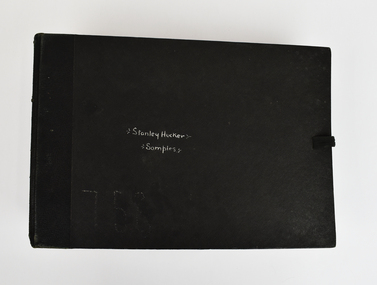
Book, Wool Sample, 1936-8
... Stencil. The collection contains many more objects, all telling the story of these 90 years, and the hard work invested by this dedicated father and son duo. 90 years wool classing between father & son Wool Classing Gordon Technical School Front Cover. Handwritten, White Ink "Stanley Hucker / Samples" Large black bound book with ribbon for fastening containing 12 double-sided blue pages. Pages have several samples of shorn wool mounted and annotated to include information ...The story of 90 years of wool classing between father & son begins in 1936, when a young boy by the name of Stanley James Hucker walked through the doors of the Gordon Technical School in Geelong. Born in 1921, Stanley was 15 years of age when he began his 3-year course in Wool Classing. 30 years later, Stanley’s second son Denis completed the same 3-year wool classing course. Beginning in 1966, Denis attended the same Gordon Technical School and walked the same halls as his father before him. Stanley finished his course in 1938. He went back to the family farm in Lake Bolac for a brief period before enrolling in the Second World War. At the completion of the war, Stanley returned home and married before gaining a soldier settler allotment, north of Willaura. This enabled Stan to use his wool classing knowledge. He ran between 1,500 and 2,000 sheep for many years, while his wool classer stencil also allowed him to go out and class at various sheds around the area. He held his stencil from 1938 until he retired at the age of 60 in 1981. On retirement, his second son Denis was working in the district, managing a local property while also leasing land himself. Upon his father’s retirement, Denis had the opportunity to lease his father’s farm, an opportunity he could not refuse. Denis had finished his wool classing course at the Gordon Technical School in 1968, graduating dux of his class. He began working with a local contractor and started classing wool in his team. Denis gained a great deal of experience working as part of this team in big sheds of up to 8 stands servicing between 10 & 20,000 sheep. It was not all smooth sailing for Denis however, and he soon learnt an important lesson. Class wool the way you’re taught, don’t listen to the owner standing over your shoulder. At a clip of Corriedales near Casterton, Denis was pushing too many fleeces into the line of fine wool. This resulted in a notice from the Australian Wool Exchange (AWEX) “mixing counts too much, submit three clips for inspection”. Denis was able to submit 3 clips with no further complaints, however, this proved a valuable lesson he would never forget over his long career classing wool. In the early 1980s, when Denis was leasing two properties including his father’s, things were going well until drought struck. February 1983 was the date of the Ash Wednesday bushfires, and saw Melbourne have three days over 40 °C for only the second time on record. This period saw Denis give away farming, turning towards contracting work instead. After the difficult times of the early 1980s, the next two decades were a good time for the sheep industry. 15 micron wool was selling for prices between 4 to 5,000 cents per kilo, double what you’d expect for the same wool in 2022. In 1995 a single bale of wool sold for a million dollars. This was a good time for Denis too. His contracting work saw him employing local shearers and shed staff. His team was involved with the shearing and classing of more than 130,000 sheep. After 20 years of contracting, it was time for Denis to transition into the next phase of his life. He gave up independent contracting, preferring instead to return to being a member of someone else’s team. In 2018, having completed 50 years of wool classing, it was time to call it a day and retire completely. At the annual Gordon Wool School Old Students Association dinner held in 2018, Denis was presented with his 50 years as a registered wool classer stencil awarded by the Australian Wool Exchange (AWEX). This is a rare honour achieved by few. As of February 2020, a total of 430 wool classers had achieved this 50-year milestone. For Denis however, his proudest achievement is achieving 90 years of wool classing with his father. The National Wool Museum is proud to share the collection of objects gained from 90 years in the wool classing industry by Stanley and Denis. This ranges from Stanley’s first stencil and Wool Sample book, started when he first attended the Gordon in 1936. The collection concludes 90 years later with Denis’ 50 years of wool classing Stencil. The collection contains many more objects, all telling the story of these 90 years, and the hard work invested by this dedicated father and son duo.Large black bound book with ribbon for fastening containing 12 double-sided blue pages. Pages have several samples of shorn wool mounted and annotated to include information such as specific breeding, shearing faults, and geographical area. The book concludes with four pages without wool samples. Two of these pages relate to plans for a shearing shed and other industry related structures. The final two-pages relate to the anatomy of a sheep. Wool sample books were constructed by Wool Classing students at the Gordon Technical School as examples of what to look for when classing wool. The students were tasked with constructing these books with samples they retrieved themselves from several different farms and animals. The book would serve as a reference point for the wool classers throughout their years in the field, it was always on hand to refresh knowledge. This book was constructed by Stanley Hucker over his schooling at the Gordon between 1936 and 1938Front Cover. Handwritten, White Ink "Stanley Hucker / Samples"90 years wool classing between father & son, wool classing, gordon technical school -
Tatura Irrigation & Wartime Camps Museum
Painting - Painting, Oil, Centaur, 1945
... (Most information copied from Tatura Bulletin article, April 2014). tatura camp 3 Cesare Vagarini Camp 3 artwork Victorian Internment camps Doctor Bruno Koenig (On back): 1945 Tatura; ... remember ..... and us, Cesare and Maria Vagarini; On back, on sticker: Va(r)garini, Tatura Internment Camp, 1945 "Choice Tea" stencilled on back, part of original box material. ...Harry Gorry bid for & purchased on internet auction site. The seller's mother was putting these & other items up for auction. Her father, the seller's grandfather was Dr. Bruno Koenig, a German surgeon detained by Allied forces while fleeing New Guinea in 1941. He was detained & sent to be interned in Camp 3, Tatura. There he met the painter Cesare Vagarini & they became friends, thus 4 years later upon the end of the war Vagarini gave the surgeon the two paintings in thanks & in memory of their friendship. Dr Koening then passed the paintings down to his daughter, where they remained in the family for 60 years. The seller's mother decided it was time to sell & was happy that the paintings went to a good home, as the family was until now unaware of the connection between Vagarini and the Tatura Museum. Harry Gorry just happened to notice a familiar name in an auction that he came across by accident & purchased them for our benefit. (Most information copied from Tatura Bulletin article, April 2014).Oil painting, depicting mythological scene. Female figure (unclothed), holding a red cloth/ garment trailing behind her. Centaur / faun? walking beside her. Outdoor scene. Trees, mountains & cloudy blue sky visible in background. Sandy coloured soil. Painted on reverse of old "Choice Tea" box.(On back): 1945 Tatura; ... remember ..... and us, Cesare and Maria Vagarini; On back, on sticker: Va(r)garini, Tatura Internment Camp, 1945 "Choice Tea" stencilled on back, part of original box material.tatura, camp 3, cesare vagarini, camp 3 artwork, victorian internment camps, doctor bruno koenig -
 Ballarat Tramway Museum
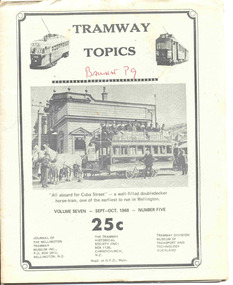
Magazine, Wellington Tramway Museum, "Tramway Topics", Oct. 1968
... information primarily about New Zealand tram and bus city systems and what the various NZ Museums were doing at the time. Has an article on Ballarat Horse trams and the conversion to electric. Trams tramways Ballarat Wellington Auckland Napier On inside of front cover in black ink "Ballarat Tramway Preservation society Catalogue No. 111". In red ink on front cover "Ballarat p9" Magazine - Tramway Topics - Vol. 7, No. 5 Sep - Oct 1968 - 28 wax cut stencil ...Yields information primarily about New Zealand tram and bus city systems and what the various NZ Museums were doing at the time. Has an article on Ballarat Horse trams and the conversion to electric.Magazine - Tramway Topics - Vol. 7, No. 5 Sep - Oct 1968 - 28 wax cut stencil duplicated pages with printed centre page of photos and printed covers, which are slightly larger in size than the internal sheets. Published by Wellington Tramway Museum, Tramway Historical Society and Tramway Division of MOTAT jointly - editor J. Wilkinson. Contains articles on Brisbane trams for Queen Elizabeth Park, Peak Tram, Auckland, Horse trams in Ballarat, Napier, Wellington and News of Museums etc.On inside of front cover in black ink "Ballarat Tramway Preservation society Catalogue No. 111". In red ink on front cover "Ballarat p9"trams, tramways, ballarat, wellington, auckland, napier -
 Ballarat Tramway Museum
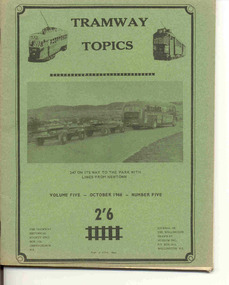
Magazine, Wellington Tramway Museum, "Tramway Topics", Oct. 1966
... information primarily about New Zealand tram and bus city systems and what the various NZ Museums were doing at the time. Trams tramways Christchurch Auckland Dunedin Tramways Invercargill On inside of front cover in black ink "Ballarat Tramway Preservation society Catalogue No. 110". Magazine - Tramway Topics - Vol. 5, No. 5, Oct 1966 - 40 wax cut stencil ...Yields information primarily about New Zealand tram and bus city systems and what the various NZ Museums were doing at the time.Magazine - Tramway Topics - Vol. 5, No. 5, Oct 1966 - 40 wax cut stencil duplicated pages with printed page of photos and printed covers. Published by Wellington Tramway Museum, Tramway Historical Society - editor J. Wilkinson. Contains articles on Christchurch, Orange Empire, Auckland, Dunedin, Invercargill and Museum News.On inside of front cover in black ink "Ballarat Tramway Preservation society Catalogue No. 110".trams, tramways, christchurch, auckland, dunedin tramways, invercargill -
 Ballarat Tramway Museum
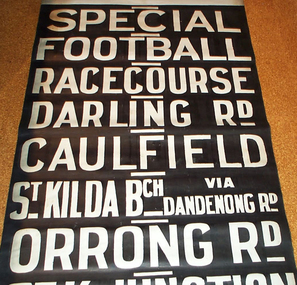
Functional object - Destination Roll, Melbourne and Metropolitan Tramways Board (MMTB), "Malvern Depot", 1950's
... stencilled miniature destination on rear to assist driver to locate the destination. Letters approx. 140 high. Roll consists of an unpainted section 535 long at top and 360 long unpainted section at base. Painted section approx. 7.2m long. Roll has oil and dirt stains in the middle portion, but the last three destinations are very worn with the black paint in a deteriorated condition. Image information...stencilled miniature destination on rear to assist driver to locate the destination. Letters approx. 140 high. Roll consists of an unpainted section 535 long at top and 360 long unpainted section at base. Painted section approx. 7.2m long. Roll has oil and dirt stains in the middle portion, but the last three destinations are very worn with the black paint in a deteriorated condition. Image information ...Destination roll that was used in Malvern Depot trams, Melbourne, until the late 1960's. Roll on linen, with white letters on black background. Has stencilled words "STOP" on top and bottom of rolls, stencilled miniature destination on rear to assist driver to locate the destination. Letters approx. 140 high. Roll consists of an unpainted section 535 long at top and 360 long unpainted section at base. Painted section approx. 7.2m long. Roll has oil and dirt stains in the middle portion, but the last three destinations are very worn with the black paint in a deteriorated condition. Image information - btm1747i1 to 1747i6 - photos of various sections of roll from top to bottom - shows level of damage and nature of the last three destinations on the roll. For listing of destinations - see images.tram, trams, melbourne, malvern depot, destination roll, mmtb -
 Ballarat Tramway Museum
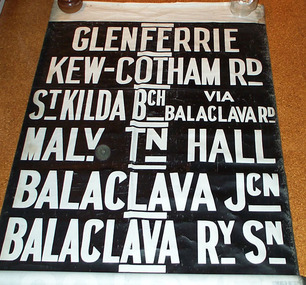
Functional object - Destination Roll, Melbourne and Metropolitan Tramways Board (MMTB), "Kew Depot", 1950's
... stencilled, though a few handwritten, miniature destination on rear to assist driver to locate the destination. Letters approx. 140 high. Roll consists of an unpainted section 140 long at top and 330 long unpainted section at base. Painted section approx. 7.6m long. Image information...stencilled, though a few handwritten, miniature destination on rear to assist driver to locate the destination. Letters approx. 140 high. Roll consists of an unpainted section 140 long at top and 330 long unpainted section at base. Painted section approx. 7.6m long. Image information ...Destination roll that was used in Kew Depot trams, Melbourne, until the late 1960's. Roll on linen, with white letters on black background. Has stencilled words "STOP KEW" on bottom of roll, generally stencilled, though a few handwritten, miniature destination on rear to assist driver to locate the destination. Letters approx. 140 high. Roll consists of an unpainted section 140 long at top and 330 long unpainted section at base. Painted section approx. 7.6m long. Image information - btm1748i1 to 1747i7 - photos of various sections of roll from top to bottom - shows level of damage. btm1748i8 shows handwritten and stencilled miniature destination and btm1748i9 - "STOP KEW" at bottom of roll. For listing of destinations - see images.tram, trams, melbourne, kew depot, destination roll, mmtb
