
Showing 38 items matching "stephenson family"
-
 Narre Warren and District Family History Group
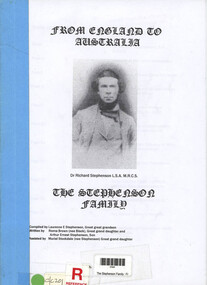
Book, From England to Australia. The Stephenson Family
... From England to Australia. The Stephenson Family...Stephenson Family...Stephenson Family Berwick (Vic.) Pakenham (Vic.) ... ...... Tells you Family History from Dr. Richard Stephenson from 1831.non-fiction... Tells you Family History from Dr. Richard Stephenson from 1831.stephenson family, berwick (vic.), pakenham (vic.) -
 Southern Sherbrooke Historical Society Inc.
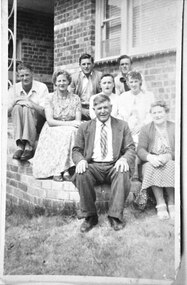
Photograph - Stephenson family, Narre Warren East
... Stephenson family, Narre Warren East....B&W photograph of the Stephenson family sitting on the porch of a brick house. ...B&W photograph of the Stephenson family sitting on the porch of a brick house. ...B&W photograph of the Stephenson family sitting on the porch of a brick house. Top: Bert Stephenson, Bob Stephenson, George Stephenson. Middle: Elsie Ford (sister), Jean Spring (sister), Esme Jones (sister). Bottom: George & Jean Stephenson. -
 Ringwood and District Historical Society
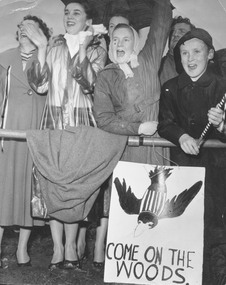
Photograph, The Stephenson family, Adelaide Street, Ringwood at Ringwood v Croydon match. 1958
... The Stephenson family, Adelaide Street, Ringwood at Ringwood v Croydon match. 1958....Black and white photograph The Stephenson family, Adelaide Street, Ringwood at Ringwood v Croydon match. 1958. ...Black and white photograph -
 Malmsbury Historical Society
Photograph (Item), Stephenson Family Grave At Malmsbury Cemetery, Malmsbury ca1998
... Stephenson Family Grave At Malmsbury Cemetery, Malmsbury ca1998...Buildings - Malmsbury Cemetery People - "Annie Amelia, Arthur Henry, Arthur James" Stephenson Family Grave At Malmsbury Cemetery, Malmsbury ca1998 Photograph Photograph ...Buildings - Malmsbury Cemetery People - "Annie Amelia, Arthur Henry, Arthur James" -
Malmsbury Historical Society
Photograph (Item), Stephenson Family Grave At Malmsbury Cemetery, Malmsbury ca1998
... Stephenson Family Grave At Malmsbury Cemetery, Malmsbury ca1998...Buildings - Malmsbury Cemetery People - "Stephenson, Isaac, Margret, Thomas" Stephenson Family Grave At Malmsbury Cemetery, Malmsbury ca1998 Photograph Photograph ...Buildings - Malmsbury Cemetery People - "Stephenson, Isaac, Margret, Thomas" -
 Flagstaff Hill Maritime Museum and Village
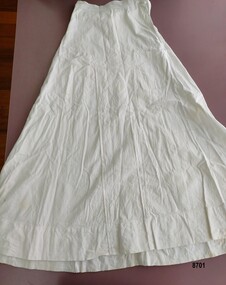
Textile - Overskirt, circa 1910
... ...Stephenson family...This item is one of a collection of clothing items that belonged to the Stephenson family who lived at 22 McCracken Street, Kensington, Melbourne. ...This item is one of a collection of clothing items that belonged to the Stephenson family who lived at 22 McCracken Street, Kensington, Melbourne. ...This item is one of a collection of clothing items that belonged to the Stephenson family who lived at 22 McCracken Street, Kensington, Melbourne. Matthew Stephenson (1861 – 1943) who had grown up on the Bendigo goldfields and shifted to Melbourne in the early 1900’s was a train driver and later, a fireman with the railways. His wife Elizabeth Jane (Betsy) Wigley (1865 – 1953) also grew up on the goldfields around Majorca and Bendigo. They married in 1885 in Bendigo. They had two daughters – Ethel Evelyn Stephenson (1886 – 1956) and Lillian or Lila (1891 – 1977) who were milliners and dressmakers and who continued to live in the family home after the death of their parents. The family are recorded as living at 22 McCracken Street, Kensington, as early as 1914. It is not known who made or owned the clothing that makes up this collection but as it appears to be from the late Victorian and early Edwardian era, the different pieces were probably made and worn by any of the three ladies of the house – Betsy, Ethel and/or Lila. During W.W.2, a local Warrnambool couple (Meryl and Tony Everard) boarded with them – Tony was in the airforce training paratroopers to jump into (and survive) enemy territory and his wife Meryl worked in the Methodist baby Home. The Everards developed a close friendship with the Stephensons and were responsible for clearing out the house (and finding this clothing collection) after Lila died in 1977. This overskirt is an outer protective garment made of durable cotton and was probably worn over a lady's skirt or dress to protect it whilst they were working. The pockets are large enough for the wearer to keep small items in and there is a loop at the back that would allow the wearer to hang it on a hook, when she finished her work. This item is an example of clothing worn by working women in the late 19th and early 20th centuryA heavy cotton ankle length overskirt made with two wide gored sections containing inset pockets joined to a middle T shaped front band. It has a waistband of grosgrain ribbon and a side opening with 3 pairs of metal snaps (one pair is missing) and a hook and eye at the top. The waistband also has a taped loop (for hanging) and an unusual double fabric overlay with unattached curved ends.flagstaff hill maritime museum and village, great ocean road, shipwreck coast, warrnambool, overskirt, needlework, sewing, protective garment, stephenson family -
 Flagstaff Hill Maritime Museum and Village
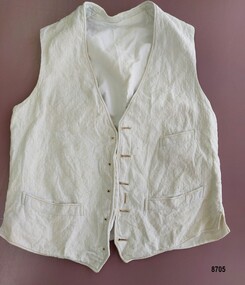
Textile - Waistcoat, circa 1910
... ...Stephenson family...This item is one of a collection of clothing items that belonged to the Stephenson family who lived at 22 McCracken Street, Kensington, Melbourne. ...This item is one of a collection of clothing items that belonged to the Stephenson family who lived at 22 McCracken Street, Kensington, Melbourne. ...This item is one of a collection of clothing items that belonged to the Stephenson family who lived at 22 McCracken Street, Kensington, Melbourne. Matthew Stephenson (1861 – 1943) who had grown up on the Bendigo goldfields and shifted to Melbourne in the early 1900’s was a train driver and later, a fireman with the railways. His wife Elizabeth Jane (Betsy) Wigley (1865 – 1953) also grew up on the goldfields around Majorca and Bendigo. They married in 1885 in Bendigo. They had two daughters – Ethel Evelyn Stephenson (1886 – 1956) and Lillian or Lila (1891 – 1977) who were milliners and dressmakers and who continued to live in the family home after the death of their parents. The family are recorded as living at 22 McCracken Street, Kensington, as early as 1914. It is not known who made or owned the clothing that makes up this collection but as it appears to be from the late Victorian and early Edwardian era however the vest was probably made by one of the three ladies of the house, for their husband and father, Matthew Stephenson. During W.W.2, a local Warrnambool couple (Meryl and Tony Everard) boarded with them – Tony was in the airforce training paratroopers to jump into (and survive) enemy territory and his wife Meryl worked in the Methodist baby Home. The Everards developed a close friendship with the Stephensons and were responsible for clearing out the house (and finding this clothing collection) after Lila died in 1977. Although by 1916, men's "ready to wear" clothing were widely available, this waistcoat was handmade (possibly by Matthew's wife or daughters). Men's suits in the early part of the twentieth century were predominantly three piece, consisting of a jacket, vest (or waistcoat) and trousers made from matching fabrics. Some men liked to wear a watch attached to their waistcoat with a fob chain. This item is an example of clothing worn by men on special occasions, in the late 19th and early 20th century.A man's waistcoat with cream cotton weave front pieces and cream cotton lining and back. The left front features five machine worked horizontal buttonholes and one vertical buttonhole (for a fob watch) and two inset pockets. The right hand side has five corresponding stud holes and one inset pocket. The studs or buttons are missing. The lining and back of the waistcoat are made from a plain cream cotton fabric. The back also features a cotton strap with a two pronged metal buckle.flagstaff hill maritime museum and village, great ocean road, shipwreck coast, warrnambool, vest, waistcoat, needlework, sewing, stephenson family, man's waistcoat -
 Flagstaff Hill Maritime Museum and Village
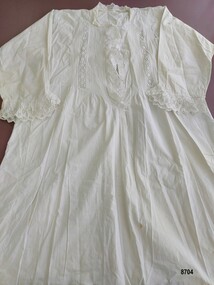
Textile - Nightgown, Circa 1900
... ...Stephenson family...This item is one of a collection of clothing items that belonged to the Stephenson family who lived at 22 McCracken Street, Kensington, Melbourne. ...This item is one of a collection of clothing items that belonged to the Stephenson family who lived at 22 McCracken Street, Kensington, Melbourne. ...This item is one of a collection of clothing items that belonged to the Stephenson family who lived at 22 McCracken Street, Kensington, Melbourne. Matthew Stephenson (1861 – 1943) who had grown up on the Bendigo goldfields and shifted to Melbourne in the early 1900’s was a train driver and later, a fireman with the railways. His wife Elizabeth Jane (Betsy) Wigley (1865 – 1953) also grew up on the goldfields around Majorca and Bendigo. They married in 1885 in Bendigo. They had two daughters – Ethel Evelyn Stephenson (1886 – 1956) and Lillian or Lila (1891 – 1977) who were milliners and dressmakers and who continued to live in the family home after the death of their parents. The family are recorded as living at 22 McCracken Street, Kensington, as early as 1914. It is not known who made or owned the clothing that makes up this collection but as it appears to be from the late Victorian and early Edwardian era, the different pieces were probably made and worn by any of the three ladies of the house – Betsy, Ethel and/or Lila. During W.W.2, a local Warrnambool couple (Meryl and Tony Everard) boarded with them – Tony was in the airforce training paratroopers to jump into (and survive) enemy territory and his wife Meryl worked in the Methodist baby Home. The Everards developed a close friendship with the Stephensons and were responsible for clearing out the house (and finding this clothing collection) after Lila died in 1977. This nightgown is machine sewn and has an added detailed design of pintucks and broderie anglaise lace to the front yoke and cuffs as a decorative element. The 1800's bought a shift in attitude towards modesty as the Victorian era progressed and by the mid to late 1800's it had become more acceptable ladies to wear simple, modest nightgowns. They tended to have a very loose fit and were usually made of linen, cotton or flannel, which had the advantage of providing warmth and also being easy to wash - a necessity for a garment worn next to the skin. Although the basic design of the nightgown was fairly simple, the wearer was free to add various types of trim e.g. lace, crochet, pintucks, embroidery etc.This item is an example of the needlework skills of women in the late 19th and early 20th century - combining machine stitching with hand embroidery to personalise and embellish a practical item of clothing. A full length lady's cotton nightgown with long sleeves finished with a diagonal pointed cuff of broderie anglaise. The bodice features a front opening placket with 3 buttons and buttonholes and a broderie anglaise cover. On either side of the placket, the bodice has been decorated with rows of vertical pintucks and a broderie anglaise panel insert. There is also a frill of broderie anglaise lace around the neck. The back of the nightgown is gathered onto a yoke.flagstaff hill maritime museum and village, great ocean road, shipwreck coast, warrnambool, nightgown, lady's nightgown, needlework, sewing, broderie anglaise, pintucks, stephenson family -
 Flagstaff Hill Maritime Museum and Village
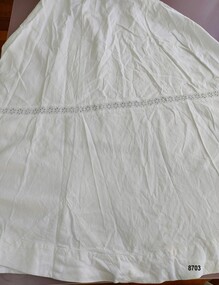
Textile - Skirt, circa 1910
... ...Stephenson family...This item is one of a collection of clothing items that belonged to the Stephenson family who lived at 22 McCracken Street, Kensington, Melbourne. ...This item is one of a collection of clothing items that belonged to the Stephenson family who lived at 22 McCracken Street, Kensington, Melbourne. ...This item is one of a collection of clothing items that belonged to the Stephenson family who lived at 22 McCracken Street, Kensington, Melbourne. Matthew Stephenson (1861 – 1943) who had grown up on the Bendigo goldfields and shifted to Melbourne in the early 1900’s was a train driver and later, a fireman with the railways. His wife Elizabeth Jane (Betsy) Wigley (1865 – 1953) also grew up on the goldfields around Majorca and Bendigo. They married in 1885 in Bendigo. They had two daughters – Ethel Evelyn Stephenson (1886 – 1956) and Lillian or Lila (1891 – 1977) who were milliners and dressmakers and who continued to live in the family home after the death of their parents. The family are recorded as living at 22 McCracken Street, Kensington, as early as 1914. It is not known who made or owned the clothing that makes up this collection but as it appears to be from the late Victorian and early Edwardian era, the different pieces were probably made and worn by any of the three ladies of the house – Betsy, Ethel and/or Lila. During W.W.2, a local Warrnambool couple (Meryl and Tony Everard) boarded with them – Tony was in the airforce training paratroopers to jump into (and survive) enemy territory and his wife Meryl worked in the Methodist baby Home. The Everards developed a close friendship with the Stephensons and were responsible for clearing out the house (and finding this clothing collection) after Lila died in 1977. This skirt features broderie anglaise trim. Although broderie anglaise was a lace that could be made by hand, it was very time consuming to make. St Gallen was a city in Switzerland that had become known for producing quality textiles. At the beginning of the 19th century, the first embroidery machines were developed in St Gallen. Factories used embroidery machines but people also had them in their homes. They were able to produce broderie anglaise for export. By the early 20th century, machine made lace, fabric, ribbons etc. were being sold in drapers shops all over England and Wales to women who were making clothes and furnishings for their families. It is highly likely that the lady who made this skirt brought the lengths of broderie anglaise already made to embellish and personalise her skirt.This item is an example of the needlework skills of women in the late 19th century - creating pintucks and adding lace to personalise and embellish a practical item of clothing. A full length lady's skirt of heavy textured ribbed twill cotton. The top of the skirt is made from five pieces of fabric, sewn together and inserted into a simple waistband. It has an opening with room for 6 hook and eyes (but only the middle three remain). The top section of the skirt is separated from the bottom section by a strip of eyelet embroidery that has been inserted in a horizontal line at the back but becomes slightly diagonal at the front causing the two ends to cross in a decorative X fashion. The bottom of the skirt is the same heavy cotton as the top and one seam features a V shaped insert or patch.flagstaff hill maritime museum and village, great ocean road, shipwreck coast, warrnambool, broderie anglaise, needlework, sewing, stephenson family, skirt, lady's skirt -
 Flagstaff Hill Maritime Museum and Village
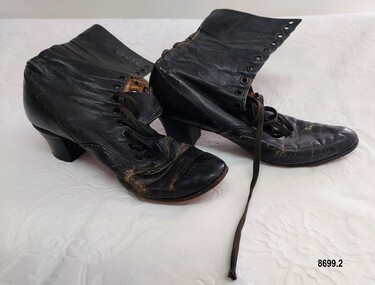
Footwear - Leather boots, Adler Boots and Shoes, circa 1920
... ...Stephenson family...This item is one of a collection of clothing items that belonged to the Stephenson family who lived at 22 McCracken Street, Kensington, Melbourne. ...This item is one of a collection of clothing items that belonged to the Stephenson family who lived at 22 McCracken Street, Kensington, Melbourne. ...This item is one of a collection of clothing items that belonged to the Stephenson family who lived at 22 McCracken Street, Kensington, Melbourne. Matthew Stephenson (1861 – 1943) who had grown up on the Bendigo goldfields and shifted to Melbourne in the early 1900’s was a train driver and later, a fireman with the railways. His wife Elizabeth Jane (Betsy) Wigley (1865 – 1953) also grew up on the goldfields around Majorca and Bendigo. They married in 1885 in Bendigo. They had two daughters – Ethel Evelyn Stephenson (1886 – 1956) and Lillian or Lila (1891 – 1977) who were milliners and dressmakers and who continued to live in the family home after the death of their parents. The family are recorded as living at 22 McCracken Street, Kensington, as early as 1914. It is not known who made or owned the clothing that makes up this collection but as it appears to be from the late Victorian and early Edwardian era, the different pieces were probably made and worn by any of the three ladies of the house – Betsy, Ethel and/or Lila. During W.W.2, a local Warrnambool couple (Meryl and Tony Everard) boarded with them – Tony was in the airforce training paratroopers to jump into (and survive) enemy territory and his wife Meryl worked in the Methodist baby Home. The Everards developed a close friendship with the Stephensons and were responsible for clearing out the house (and finding this clothing collection) after Lila died in 1977. Starting in around 1850, women began wearing boots that resembled the ones already worn by men in high society. Victorian women's boots were slightly more feminine in nature, however, than those worn by their male counterparts. The boots first worn by women extended to the middle of the calf so that her ankle would stay properly covered underneath her many skirts. These boots often featured laces or a row of buttons to keep them secure to the foot and ankle. Although usually made from durable materials like rubber and leather, boots that were worn purely for fashion were sometimes made of more elegant materials like patent leather or dyed suede. Edwardian boots were lace up or button up. The most remarkable thing about women's shoes in the 1920's was that they were visible! This led to an increase in demand for new styles every season which made ordering custom fit shoes a thing of the past. New shoes were made in standard sizes, ready to buy from local clothing stores or mail order catalogues. Working women, however, tended to wear sensible, lace up shoes and boots. These boots appear to be of a practical nature, designed for comfort, warmth, and proof against the rain and mud, rather than high fashion. They feature the brand name "adler" printed on the inner sole and have stamped letters and numbers suggesting ready-made sizes.This pair of boots are a significant example of a working woman's footwear dating around the early 20th century.Pair of lady's black leather, lace up boots featuring 3.75 cm heels, 14 pairs of lacing eyelets, a black leather tongue and black shoelaces. The leather soles have tacks on the heels and near the instep. The boots have a black leather inner sole and the inner shaft and upper part of the boots are lined with a durable cotton type fabric. Both boots have ink markings (handwritten and stamped) at the top of the shaft lining and the inner sole of the left hand boot is labelled "adler".Both boots - "0/128 /X" (handwritten) and "6MC200" (stamped). Left boot inner sole - "adler" left boot upper shaft lining - "X/8FH?" (handwritten)flagstaff hill maritime museum and village, great ocean road, shipwreck coast, warrnambool, boots, lady's boots, footwear, leather boots, lace up boots, adler, stephenson family -
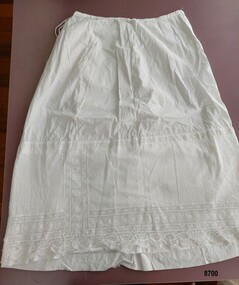 Flagstaff Hill Maritime Museum and Village
Textile - Petticoat, circa 1900
... ...Stephenson family...This item is one of a collection of clothing items that belonged to the Stephenson family who lived at 22 McCracken Street, Kensington, Melbourne. ...This item is one of a collection of clothing items that belonged to the Stephenson family who lived at 22 McCracken Street, Kensington, Melbourne. ...This item is one of a collection of clothing items that belonged to the Stephenson family who lived at 22 McCracken Street, Kensington, Melbourne. Matthew Stephenson (1861 – 1943) who had grown up on the Bendigo goldfields and shifted to Melbourne in the early 1900’s was a train driver and later, a fireman with the railways. His wife Elizabeth Jane (Betsy) Wigley (1865 – 1953) also grew up on the goldfields around Majorca and Bendigo. They married in 1885 in Bendigo. They had two daughters – Ethel Evelyn Stephenson (1886 – 1956) and Lillian or Lila (1891 – 1977) who were milliners and dressmakers and who continued to live in the family home after the death of their parents. The family are recorded as living at 22 McCracken Street, Kensington, as early as 1914. It is not known who made or owned the clothing that makes up this collection but as it appears to be from the late Victorian and early Edwardian era, the different pieces were probably made and worn by any of the three ladies of the house – Betsy, Ethel and/or Lila. During W.W.2, a local Warrnambool couple (Meryl and Tony Everard) boarded with them – Tony was in the airforce training paratroopers to jump into (and survive) enemy territory and his wife Meryl worked in the Methodist baby Home. The Everards developed a close friendship with the Stephensons and were responsible for clearing out the house (and finding this clothing collection) after Lila died in 1977. A petticoat is a lady's undergarment - worn under a skirt or dress. They provided warmth, modesty and shape to the dress. In the middle of the 19th century, petticoats were worn over hoops, bustles or in layers. Petticoats varied according to the style of the outside skirt or dress. Plain petticoats tended to be worn with everyday wear whilst better dresses (party dresses or silk gowns) were worn with petticoats that often had more trim and embellishments. Edwardian petticoats had less volume than Victorian era petticoats and they had a "dust ruffle" or lining under a lace flounce. The "dust ruffle" protected the lace flounce and gave the petticoat more flare at the bottom, greater freedom when walking as well as saving the flounce (which was often made of finer material) from everyday wear and tear. Tucks are another feature of Edwardian petticoats - when the lace at the bottom became worn, it could be cut off and the tucks released. This extended the life of the petticoat. This petticoat features an intricate trim of broderie anglaise. Although broderie anglaise was a lace that could be made by hand, it was very time consuming to make. St Gallen was a city in Switzerland that had become known for producing quality textiles. At the beginning of the 19th century, the first embroidery machines were developed in St Gallen. Factories used embroidery machines but people also had them in their homes. They were able to produce broderie anglaise for export. By the early 20th century, machine made lace, fabric, ribbons etc. were being sold in drapers shops all over England and Wales to women who were making clothes and furnishings for their families. It is highly likely that the lady who made this petticoat brought the lengths of broderie anglaise already made to embellish and personalise her petticoat.This item is an example of the needlework skills of women in the late 19th century - creating pintucks and adding lace to personalise and embellish a practical item of clothing. A lady's fine cotton and lace ankle length petticoat featuring a deep decorative hem made from sheer pinspot fabric and bands of eyelet lace. The top section of the petticoat is made from five sections of fine cotton sewn together with french seams and gathered with pleats and darts into the waistband. The waistband opening has two button holes and one button (the top button is missing) and a front section with a drawstring. The lace hem is lined with the same fine cotton as the top of the petticoat. There are three different lace bands - a narrow one featuring small flowers, a similar wider band with larger flowers and it is finished at the bottom with a broad band of lace with an intricate leaf design.flagstaff hill maritime museum and village, great ocean road, warrnambool, shipwreck coast, petticoat, lady's petticoat, broderie anglaise, decorative petticoat, draw string waist, machine sewn, dressmaker, stephenson family, pintucks, needlework -
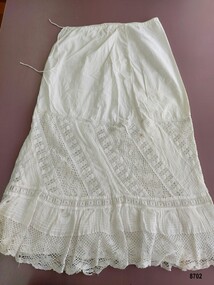 Flagstaff Hill Maritime Museum and Village
Textile - Petticoat, circa 1910
... ...Stephenson family...This item is one of a collection of clothing items that belonged to the Stephenson family who lived at 22 McCracken Street, Kensington, Melbourne. ...This item is one of a collection of clothing items that belonged to the Stephenson family who lived at 22 McCracken Street, Kensington, Melbourne. ...This item is one of a collection of clothing items that belonged to the Stephenson family who lived at 22 McCracken Street, Kensington, Melbourne. Matthew Stephenson (1861 – 1943) who had grown up on the Bendigo goldfields and shifted to Melbourne in the early 1900’s was a train driver and later, a fireman with the railways. His wife Elizabeth Jane (Betsy) Wigley (1865 – 1953) also grew up on the goldfields around Majorca and Bendigo. They married in 1885 in Bendigo. They had two daughters – Ethel Evelyn Stephenson (1886 – 1956) and Lillian or Lila (1891 – 1977) who were milliners and dressmakers and who continued to live in the family home after the death of their parents. The family are recorded as living at 22 McCracken Street, Kensington, as early as 1914. It is not known who made or owned the clothing that makes up this collection but as it appears to be from the late Victorian and early Edwardian era, the different pieces were probably made and worn by any of the three ladies of the house – Betsy, Ethel and/or Lila. During W.W.2, a local Warrnambool couple (Meryl and Tony Everard) boarded with them – Tony was in the airforce training paratroopers to jump into (and survive) enemy territory and his wife Meryl worked in the Methodist baby Home. The Everards developed a close friendship with the Stephensons and were responsible for clearing out the house (and finding this clothing collection) after Lila died in 1977. A petticoat is a lady's undergarment - worn under a skirt or dress. They provided warmth, modesty and shape to the dress. In the middle of the 19th century, petticoats were worn over hoops, bustles or in layers. Petticoats varied according to the style of the outside skirt or dress. Plain petticoats tended to be worn with everyday wear whilst better dresses (party dresses or silk gowns) were worn with petticoats that often had more trim and embellishments. Edwardian petticoats had less volume than Victorian era petticoats and they had a "dust ruffle" or lining under a lace flounce. The "dust ruffle" protected the lace flounce and gave the petticoat more flare at the bottom, greater freedom when walking as well as saving the flounce (which was often made of finer material) from everyday wear and tear. Tucks are another feature of Edwardian petticoats - when the lace at the bottom became worn, it could be cut off and the tucks released. This extended the life of the petticoat. This petticoat features an intricate trim of broderie anglaise. Although broderie anglaise was a lace that could be made by hand, it was very time consuming to make. St Gallen was a city in Switzerland that had become known for producing quality textiles. At the beginning of the 19th century, the first embroidery machines were developed in St Gallen. Factories used embroidery machines but people also had them in their homes. They were able to produce broderie anglaise for export. By the early 20th century, machine made lace, fabric, ribbons etc. were being sold in drapers shops all over England and Wales to women who were making clothes and furnishings for their families. It is highly likely that the lady who made this petticoat brought the lengths of broderie anglaise already made to embellish and personalise her petticoat.This item is an example of the needlework skills of women in the late 19th century - creating pintucks and adding lace to personalise and embellish a practical item of clothing.A lady's ankle length petticoat made in three sections. The top section is made from three rectangles of fine cotton (batiste) joined into a round with narrow french seams and inserted into a simple drawstring waistband with a small opening. The second section is made with rows of alternating strips of fine pin tucked lawn, white cotton cut work embroidery and a wider cotton lace design all joined in a diagonal pattern and lined with fine lawn. The bottom section of the petticoat has a horizontal strip of eyelet lace followed by a wider strip of fine pin tucked lawn and is finished with a deep hem of white cotton crocheted lace fabric and has the same lawn lining as the section above.flagstaff hill maritime museum and village, great ocean road, shipwreck coast, warrnambool, petticoat, lady's petticoat, needlework, sewing, broderie anglaise, stephenson family, drawstring waistband -
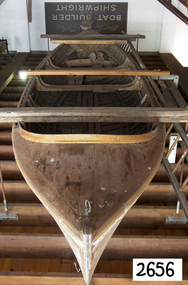 Flagstaff Hill Maritime Museum and Village
Vehicle - Vessel, Surf Boat, 1949
... After Mr. Stephenson's passing his family donated the vessel to Flagstaff Hill Maritime Museum in 1986....Warrnambool Surf Club purchased her on 30/10/1951 for £207-2/6, and she was sold to Harold Stephenson in early 1960's for 1 shilling. Donated to Flagstaff Hill by the family of Harold Stephenson around 1985-1986. ...After Mr. Stephenson's passing his family donated the vessel to Flagstaff Hill Maritime Museum in 1986. ...In 1952 the subject surf boat crewed by Geoff Scott, Ron Blackney, Wes McLaren, Jim Tibb, and Stan Stephens, won the Victorian Surf Boat Championships. When the club had finished with the boat Mr. Harold Stephenson paid one shilling and it eventually found its way into a garage where it remained for over 20 years before being donated to Flagstaff Hill. This boat is regarded as a unique example of craftsmanship, closely resembling Bay whaleboats used around the Warrnambool area in the 1800s. This timber caravel surf boat was named “Aeroplane Jelly” and was built by N & E Towns a Newcastle boat builder in 1949 Aeroplane Jellies and David Jones as sponsors of the Sydney Surf Carnival of 1950/1951 donated jointly the vessel. George Towns started his boat-building business in 1869 on Dempsey Island on the Hunter River, NSW. George's sons took over the business as N & E Towns (Norman and Eldrid) and continued until the early 1950s. The business made a variety of small craft including fishing boats, launches, and flood boats. In 1928 they built their first surf boat it took about six weeks to build with cedar planks and hardwood frames. After World War II surf boats became their main focus and they became well known for the lighter and faster designs. Many “Towns built” craft have won events at state and national surf championships. They were renowned Boat Builders producing a much lighter and faster running boat than anything previously made, with a buoyant type bow design giving it the lift necessary to get out and through heavy surf. while its sleek lines from amidships aft provided very fast running qualities. Either side of its bows, it bore the bright silver aircraft transfer of the Aeroplane Jellies Company. After a surf competition at Narrabeen NSW, the competing Warrnambool surf lifesaving team returned home to Warrnambool their club committee decided to purchase the "Aeroplane Jellies" Surf boat if and when it became available as the team had been so impressed with the boat. On 30 October 1951 a cheque for £207-2/6' was raised, £180 for the boat, balance for oars. Transport was arranged and the boat was delivered in November 1951. When the "Aeroplane Jellies" competition days were over in the early 1960's due largely to changing surf boat design, Warrnambool Club's Secretary, Mr. Harold Stephenson, sought permission from the Committee to purchase the boat for the nominal sum of one shilling thus preserving the vessel for posterity. The boat had been stored for many years at the Nullawarre Bakery where it remained until Mr. Stephenson died in 1985. After Mr. Stephenson's passing his family donated the vessel to Flagstaff Hill Maritime Museum in 1986.A very rare example of a surf lifesaving boat that for its time was a unique creation that revolutionised small vessel design in Australia. It was made by a renowned maker that today unfortunately many of his examples of boats he made, especially surf life-saving boats no longer exist making the Flagstaff Hill boat very significant to not only surf lifesaving history but to the part it played in our social life for all those who went to the beaches in 1960s Australia.Surf boat named "Aeroplane Jellies". Timber, double ender carvel, built in 1949 by N & E Towns, Newcastle, NSW. Only a few are in existence. She was a trophy prize at Sydney Surf Carnival 1950/1951, donated by Aeroplane Jellies and David Jones Dept. Store, Sydney. The boat was won by South Narrabeen Surf Club. Warrnambool Surf Club purchased her on 30/10/1951 for £207-2/6, and she was sold to Harold Stephenson in early 1960's for 1 shilling. Donated to Flagstaff Hill by the family of Harold Stephenson around 1985-1986. The name Aeroplane Jellies was lettered in gold across the boat's coaming and there is a remnant of some of the gold lettering still there.warrnambool, flagstaff hillflagstaff hill maritime museum, great ocean road, ememgency, historic boat, surf boat, n & e towns, carvel, vintage boat, double ender boat, lifesaving boat, geoff scott, south narrabeen surf club, warrnambool surf life saving club, lifeboat -
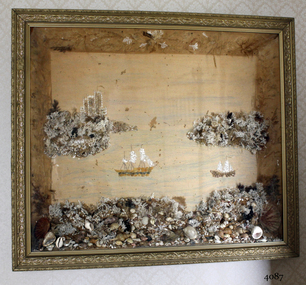 Flagstaff Hill Maritime Museum and Village
Artwork, other - Wall decoration, late 19th century
... This unusual wall decoration was created by Anna Wilson (nee Henry), daughter of pioneer John Stephenson Henry, who arrived in Australia from Ireland with his children in 1851. Family documents confirm that Anna most probably made the diorama for her sister-in-law, who married a member of the Giles family. ...This unusual wall decoration was created by Anna Wilson (nee Henry), daughter of pioneer John Stephenson Henry, who arrived in Australia from Ireland with his children in 1851. Family documents confirm that Anna most probably made the diorama for her sister-in-law, who married a member of the Giles family. ...This unusual wall decoration was created by Anna Wilson (nee Henry), daughter of pioneer John Stephenson Henry, who arrived in Australia from Ireland with his children in 1851. Family documents confirm that Anna most probably made the diorama for her sister-in-law, who married a member of the Giles family. The diorama was later given to Vera Giles who was a family friend and possibly related to Anna’s sister-in-law by marriage. The diorama is now part of the Giles Collection. Anna married William Wilson in 1860, who had arrived in Australia from County Tarrane in about 1850, aged 19. In 1869 they moved to their new property called ‘Glenlyall’ in Cooramook, north of Grassmere, Victoria, where he lived for 49 years until his death in 1918. He left behind a family of four sons and a daughter. The Giles Family There are many 19th century items of furniture, linen and crockery donated to Flagstaff Hill Maritime Village by Vera and Aurelin Giles. The items are associated with the Giles Family and are known as the “Giles Collection”. These items mostly came from the simple home of Vera’s parents-in-law, Henry Giles and his wife Mary Jane (nee Freckleton), whose photos are in the parlour. They married in 1880. Henry Giles was born at Tower Hill in 1858. He was a labourer on the construction of the Breakwater before leaving in 1895 to build bridges in N.S.W. for about seven years. Mary Jane was born in 1860 at Cooramook. She attended Mailor’s Flat State School where she was also a student teacher before, as family legend has it, she became a governess at “Injemiara” where her grandfather, Francis Freckleton, once owned land. Henry and Mary’s family of six, some of whom were born at Mailor’s Flat and later children at Wangoom, lived with their parents at Wangoom and Purnim west, where Henry died in 1933 and Mary Jane in 1940. The family of the creator Anna Wilson nee Henry and her husband William Wilson are of significance to the early history of Victoria and the South West of Victoria in particular, being pioneer families who farmed the land, built the towns and cities and contributed to their communities. The Giles family collection has social significance at a local level, because it illustrates the level of material support the Warrnambool community gave to Flagstaff Hill when the Museum was established. Wall decoration, diorama with decorative gild frame and glass front. The 3-dimensional seascape includes sailing boats, land and sea, all made from materials such as shells, coral and seaweed. The work was made by Anna Wilson. It is part of the Giles Collection.Noneflagstaff hill, warrnambool, shipwrecked-coast, flagstaff-hill, flagstaff-hill-maritime-museum, maritime-museum, shipwreck-coast, flagstaff-hill-maritime-village, giles collection, henry giles, tower hill, cooramook, warrnambool breakwater, mailor’s flat, wangoom, 19th century household goods, 19th century decor, 19th century handcraft, handcraft, wall hanging, diorama of a seascape -
 Orbost & District Historical Society
black and white photograph, Warren, Mrs H, C1900- 1910
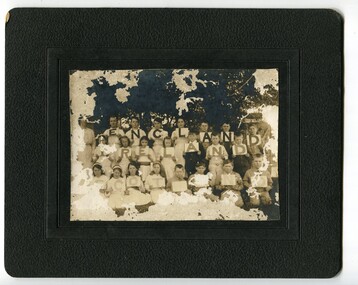
... I Daisy or Katie McLeod Front row - L -Jack Stephenson; A Lindsay Trewin ; N-Frank Richardson Helena Warren was a self-taught photographer who became both the local press correspondent and a producer of humorous trompe l'oeil postcard images. The photographer, was a thirty-two year old settler living on a small mixed farm with her husband, William, at Newmerella, near Orbost in Gippsland, Victoria, when she bought her first camera, an Austral Box quarter-plate. Her family...I Daisy or Katie McLeod Front row - L -Jack Stephenson; A Lindsay Trewin ; N-Frank Richardson Helena Warren was a self-taught photographer who became both the local press correspondent and a producer of humorous trompe l'oeil postcard images. The photographer, was a thirty-two year old settler living on a small mixed farm with her husband, William, at Newmerella, near Orbost in Gippsland, Victoria, when she bought her first camera, an Austral Box quarter-plate. Her family ...This photograph was found in the Orbost Historical Society's cupboard. School is unknown. A copy of this photograph has been donated by Gil and Heather Richardson via the Mary Gilbert Collection. It is probably of students of Jarrahmond school where Miss Cope was the head teacher C 1916. This photograph could be associated with a celebration of Empire Day. The celebration of Queen Victoria's birthday on May 24 was renamed Empire Day in 1903 after her death in 1901. It was celebrated throughout the British Empire culminating in fireworks and bonfires in the evening. Empire Day was first introduced in 1905 to promote loyalty among the dominion countries of the British Empire. (from https://dictionaryofsydney.org/event/empire_day) Celebrated on 24 May, Queen Victoria's birthday, it was directed especially at school children. Teachers were encouraged to promote special steps to develop a feeling of pride in the British Empire and the achievements of the British race. Often a morning of short addresses, recitations and patriotic songs such as 'Rule Britannia' and 'Advance Australia' was followed by a half-day holiday to mark the celebration of Australia's strong ties to the British Empire. (from MuseumsVictoria) Some identified are; Top row -E- Eva Trewin; N-Rita Mundy; G-Elva Trewin; N- Jack Mundy D-Jack Trewin Middle row - Miss Cope, teacher. I Daisy or Katie McLeod Front row - L -Jack Stephenson; A Lindsay Trewin ; N-Frank Richardson Helena Warren was a self-taught photographer who became both the local press correspondent and a producer of humorous trompe l'oeil postcard images. The photographer, was a thirty-two year old settler living on a small mixed farm with her husband, William, at Newmerella, near Orbost in Gippsland, Victoria, when she bought her first camera, an Austral Box quarter-plate. Her family says she was entirely self-taught. Although not clearly dentified the photograph has significance in its association with Helen Frances Warren, a popular Orbost identity who was well known as an accomplished photographer and needleworker, It is associated with education in Orbost.A very old and damaged photograph of students an a teacher under a tree. The students are holding up cards that read "England, Ireland, Scotland". The photo is on a black card frame. a woman is standing on the left. Children are posed into three rows. There is also a copy of this photograph.photograph-helena-warren education-jarrahmond -
 Mission to Seafarers Victoria
Film - Documentary, Wind and Sky Productions, Harbour Lights, 2019-2020
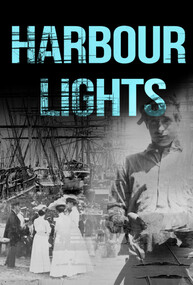
... Family Personal Archives, Mission to Seafarers Victoria, Public Record Office Victoria, State Library of Victoria and US National Archives Music Harbour Lights. Music by Richard Chew. Westering. Music by Richard Chew. Twilight (Crépuscule) by Jules Massenet. Performed by Amelita Galli-Curci. I Love You So, Waltz from The Merry Widow by Franz Lehár. Performed by Elise Stephenson...Family Personal Archives, Mission to Seafarers Victoria, Public Record Office Victoria, State Library of Victoria and US National Archives Music Harbour Lights. Music by Richard Chew. Westering. Music by Richard Chew. Twilight (Crépuscule) by Jules Massenet. Performed by Amelita Galli-Curci. I Love You So, Waltz from The Merry Widow by Franz Lehár. Performed by Elise Stephenson ...Synopsis: “In WW1 Melbourne a pioneering network of women at the Mission to Seafarers called the Ladies Harbour Lights Guild supported sailors who risked their lives at sea. The documentary “Harbour Lights” tells the remarkable story of the Ladies Harbour Lights Guild and the lives of seafarers in early 20th century Melbourne. It focuses on Melbourne’s iconic Mission to Seafarers building, its connection to the Great War and to a unique community of ships crew and volunteers. Featuring Melbourne historians, commentators, archivists and architects and rare footage and images of sailing and social life in and around the ports of Melbourne, this film will inform and connect audiences young and old.” Commissioned by Victorian Government The movie was produced in collaboration with the Mission to Seafarers Victoria. It was directed by Jary Nemo and written and produced by Lucinda Horrocks and Jary Nemo with executive producers Sue Dight and Gordon MacMillan. The film features: Jill Garner Kate Darian-Smith Chris McConville Janet Miller (curator) Gordon MacMillan (former seafarer and board committee member) Narrated by Sharon Turley. Music by Richard Chew (professor of the Arts Academy in Ballarat) The film was presented at several festival in Australia and abroad in 2020-2021. Credits: Narrator Sharon Turley Featuring (in order of appearance) Dr Chris McConville, Gordon MacMillan, Janet Miller, Professor Kate Darian-Smith and Jill Garner With Raul S Gantalao Jr, Escoto Lemuel, Ben Schroeder, Cinda Manins And Ian Fletcher, Yuan Jia, Uma Kothari, Gordon Lansley, William Reed and Cheka Samaranayake Directed by Jary Nemo Written and Produced by Lucinda Horrocks and Jary Nemo Music by Richard Chew Executive Producers Sue Dight and Gordon MacMillan Research advisors Geraldine Brault, Maria Culka, Professor Kate Darian-Smith, Ros Fletcher, Professor Uma Kothari, Dr Barbara Lemon, Catherine McLay, Dr Chris McConville, Janet Miller, Rick Mitchell, Duncan ‘John’ Perryman, Dr Annette Sheill and Peter Taylor Archival photographs, music and footage courtesy of Australian Red Cross Society, Central Highlands Libraries, Internet Archive, National Film and Sound Archive, National Library of Australia, Mackarness Family Personal Archives, Mission to Seafarers Victoria, Public Record Office Victoria, State Library of Victoria and US National Archives Music Harbour Lights. Music by Richard Chew. Westering. Music by Richard Chew. Twilight (Crépuscule) by Jules Massenet. Performed by Amelita Galli-Curci. I Love You So, Waltz from The Merry Widow by Franz Lehár. Performed by Elise Stephenson and Harry Macdonough with Orchestra. Harbour Lights 2. Music by Richard Chew. If I Could Fly by Walking Hearts featuring Jennifer Holm. Courtesy of Epidemic Sound. With thanks to Peter Barrow, Sarah Bartak, Lin Bender AM, Patty Braumueller, Csilla Csongvay, Emer Diviney, Moira Drew, Ian Fletcher, Ajith Jayasuriya, Ben Jones, Patience Jones, Cinda Manins, Madeleine Martiniello, Georgia Melville, Elisabeth Moglia, Tara Oldfield, Lyn Pasquier, Nigel Porteous, Rev’d Onofre (Inni) Punay, Dr Rosalie Triolo, Ben Schroeder, David Simpson, Cheka Samaranayake, Daria Wray, the Helen Macpherson Smith Trust and KPMG. A special thanks to The women of the Ladies Harbour Lights Guild 1906 to 1961 Produced in collaboration with The Mission to Seafarers Victoria Created with the support of The Victorian Government Licensing This film has been released under a Creative Commons BY-NC-ND 4.0 International license Acknowledgement of country Project production and development took place on the lands of the Kulin nation. We acknowledge Traditional Owners and pay our respects to Elders past, present and future. Production company A Wind & Sky Production Copyright with © Wind & Sky Productions MMXIX The film was launched on Wednesday 26th February 2020 at the Mission. Speech by Veterans Affairs. Amongst the guests were current and former volunteers (Maria Culka, Gordon MacMillan, Elisabeth Moglia), curators (Georgia Melville, Jay Miller, Geraldine Brault)18mn documentary mixed of photographs from teh collection and interviews about the Ladies Harbour Lights Guild work during WWIladies harbour lights guild, documentary, jay miller, janet miller, geraldine brault, lucinda horrocks, gordon macmillan, jary nemo, kate darian-smith, jill garner, chris mcconville, sharon turley, richard chew, footage, archive -
Eltham District Historical Society Inc
Document - Folder, Stevenson, Joseph
... family, "Bankhead", Kangaroo Ground (ref 423). Photocopy of two prints/paintings, annotated on reverse (information from R B Ness: Punt over Yarra River at Melbourne which Joseph Stevenson helped build, from "History of South Melbourne", published 1930s; First bridge over Yarra at Melbourne which Joseph Stevenson helped build. Photocopy of Death Certificate: Joseph Stevenson, 1 November 1878. Photocopy of Death Certificate: Ruth Sevenson, 1 November 1868. Photocopy of Marriage Certificate: names illegible 16 November 1868 Photocopy of extract of Marriage Certificate: Joseph Stephenson...family, "Bankhead", Kangaroo Ground (ref 423). Photocopy of two prints/paintings, annotated on reverse (information from R B Ness: Punt over Yarra River at Melbourne which Joseph Stevenson helped build, from "History of South Melbourne", published 1930s; First bridge over Yarra at Melbourne which Joseph Stevenson helped build. Photocopy of Death Certificate: Joseph Stevenson, 1 November 1878. Photocopy of Death Certificate: Ruth Sevenson, 1 November 1868. Photocopy of Marriage Certificate: names illegible 16 November 1868 Photocopy of extract of Marriage Certificate: Joseph Stephenson ...Joseph Stevenson came to Australia in 1837, eventually settling near Kangaroo Ground. He was active in local affairs.. Contents Handwritten and typed notes by Winifred Joy Ness, 1985, "Joseph Stevenson of Kangaroo Ground". Handwritten extracts from "Pioneers and Painters" by Alan Marshall, relevant to Joseph Stevenson. Handwritten extracts from "Pastoral Pioneers of Port Phillip"by R V Bills and A S Kenyon, relevant to Joseph Stevenson. Photocopy of photographs: Stevenson daughters; a stevenson daughter with baby; Joseph Stevenson. Handwritten Stevenson family tree (on 2 sheets). Photocopy of photograph: Robert Stevenson and family, "Bankhead", Kangaroo Ground (ref 423). Photocopy of two prints/paintings, annotated on reverse (information from R B Ness: Punt over Yarra River at Melbourne which Joseph Stevenson helped build, from "History of South Melbourne", published 1930s; First bridge over Yarra at Melbourne which Joseph Stevenson helped build. Photocopy of Death Certificate: Joseph Stevenson, 1 November 1878. Photocopy of Death Certificate: Ruth Sevenson, 1 November 1868. Photocopy of Marriage Certificate: names illegible 16 November 1868 Photocopy of extract of Marriage Certificate: Joseph Stephenson and Ruth Boyd, 14 June 1837. Newspaper article: "Resting in peace", Diamond Valley News, 23 March 1982. Judith Furphy and early Kangaroo Ground families buried in Kangaroo Ground Cemetery. Newspaper article: "Grounds for celebration", Diamond Valley Leader, 23 November 2005. Lynette Beale traced her ancestor Joseph Stevenson to Kangaroo Ground. Letter Diana Bassett-Smith to EDHS, 10 August 2005. Donation of a moulding plane marked Joseph Stephenson, property of descendants.Newspaper clippings, A4 photocopies, etcjoseph stevenson, ship willington 1837, ruth stevenson nee boyd, david stevenson, jane stevenson, kirk's bazaar, first punt across yarra river, princes bridge melbourne, stevenson street melbourne, saltwater creek, river plenty, christmas hills, david christmas, diamond creek, isabella stevenson, robert stevenson, five mill creek, watson's creek, "bankhead" kangaroo ground, ellen stevenson, yarra glen road, yarra glen cemetery, stevenson's corner kangaroo ground, stevenson's creek, presbyterian church kangaroo ground, eltham district road board, margaret stevenson, ruth stevenson, emma stevenson nee peers, margaret hargreaves nee stephenson, robert peers, cyrus peers, charlotte peers, jane mess nee stevenson, robert mess, pearl mess nee mills, james mess, george mess, janet mess, joseph mess, william mess, alexander mess, barbara mess, isabella mess, ruth gosling nee mess, john gosling, jessie gosling, evelyn sinclair nee gosling, william gosling, vera rowland nee gosling, florrie rawland, ethel rawland, john rawland, isobel gilson nee mess, bruce mess, joy mess nee masefield, janet crook nee mess, rodney crook, judith rodgers nee mess, ray rodgers, dean crook, jenine crooks, carolyn rodgers, merryn rodgers, beryl nansen nee mess, robert nansen, gerry oliming, roberta oliming nee nansen, bernard nansen, michele nansen nee blackie, rohan nansen, janet nansen nee britton, vera cope nee mess, cliff cope, graeme cope, louise cope nee thimpton, shannon cope, lucas cope, peter cope, marilyn cope nee turnley, oliver cope, sarah cope, kelvin cope, donald mess, joan mess, geoffrey mess, peter mess, rosemary mess, kerrie mess, isobel gibson nee mess, ellen stevenson nee armstrong, james stevenson, john stevenson, elizabeth stevenson, joanna stevenson, ellen little nee stevenson, william little, francis little, janet little nee armstrong, ruth lorimer nee little, david lorimer, ruth cameron nee lorimer, francis lorimer, val wade, elizabeth lorimer, david kelso, willaim lorimer, jean lorimer nee hewitt, nancy mitson nee lorimer, stan mitson, john hewitt, alison hewitt, john cameron, beryl ryan nee cameron, robert cameron, maryann ryan, peter ryan, margaret ryan, steven wade, andrew wade, jonathan wade, jennifer wade, ruth sadlernee stevenson, thomas sadler, alexander sadler, isabella booth nee sadler, angus sadler, heather sadler, ruth sadler, andrew sadler, nancy sadler, benjamin sadler, robert sadler, alice sadler nee smith, margaret smith, david sadler, anne mcclusky nee sadler, hope sadler, anne carson nee sadler, ruth edwards nee carson, david carson, joseph sadler, isabella bond nee sadler, ian bond, ruth bond, isabella bond, john sadler, thoas sadler, mary sadler nee stewart, stewart sadler, keith sadler, glen sadler, peter sadler, terry sadler, pamela sadler, armstrong family kangaroo ground, bell family kangaroo ground, rogerson family kangaroo ground, barr family kangaroo ground, harkness family kangaroo ground, jardin family kangaroo ground, thompson family kangaroo ground, johnson family kangaroo ground, walters family kangaroo ground, sir ewen camerson, flora margaret cameron, ewen cameron, sir ewan camerson, sir herbert gepp, "garden hill" yarra glen road, andrew moss museum kangaroo ground, lynette beale, noel beale, mick woiwod, diana bassett-smith -
 Eltham District Historical Society Inc
Document - Folder, Alan Marshall (1902-1984), Correspondence from Alan Marshall to Gwenda Sanderson, 1979-1983
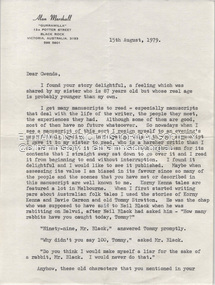
... Family...'Texas' Green...Member for Kalgoorlie...Duke of Gloucestor...The girl in pink...Prince of Wales...May Creedie (story)...Mrs Scott of Mortlake...Smouldering Fires (book)...Lindsay Russell...Mary Murray of our Valley (book)...The Fellowship of Australian Writers...Jim Hamilton...Journey to Aboriginal Victoria (book)...Mary Gilmore...Peter Mcallum Institute...May Creedie (book)...Gwen Hardisty...heart attack...Bulletin (magazine)...Stephenson...Black Shaw women Miss Laura Squatter Duke of Edinburgh Royal Family 'Texas' Green Member for Kalgoorlie Duke of Gloucestor The girl in pink Prince of Wales May Creedie (story) Mrs Scott of Mortlake Smouldering Fires (book) Lindsay Russell Mary Murray of our Valley (book) The Fellowship of Australian Writers Jim Hamilton Journey to Aboriginal Victoria (book) Mary Gilmore Peter Mcallum Institute May Creedie (book) Gwen Hardisty heart attack Bulletin (magazine) Stephenson Gloria Swanson Jennifer Marshall Daniel (grandson) Cathy (daughter) Sandringham Hospithal East Brighton nursing home Alan Marshall Writes Alone (review) Folio of correspondence of 21 letters, total of 40 typed pages PDF copy of letters Correspondence from Alan Marshall to Gwenda Sanderson Document Folder Alan Marshall (1902-1984) ...Alan Marshall AM, (2 May 1902 – 21 January 1984) was an Australian writer, story teller, humanist and social documenter. Personal correspondence between Gwenda Sanderson and Alan Marshall, dated between 1979 and 1983. There are 21 letters in all, the last 3 of which were dictated from the Hurlingham Nursing Home in Brighton. Background information for the letters (daugher Merrilyn Sanderson 10 October 2025): My mother, Gwenda Sanderson ( nee White ) grew up in the western district and knew Alan Marshall's sister. Gwenda was an aspiring author, and reached out to Alan for support and advice regarding her writing. Alan proved to be a generous and inspiring mentor and as you will see, they established a rapport. In 1966 Gwenda moved from Mortlake to Montmorency (quite a culture shock!) and around 1983 she and her husband, Stan moved to Diamond Creek. Letters: 1. Alan Marshall to Gwenda Sanderson, 15 August 1979 2. Alan Marshall to Gwenda Sanderson, 22 August 1979 3. Alan Marshall to Gwenda Sanderson, 28 August 1979 4. Alan Marshall to Gwenda Sanderson, 7 September 1979 5. Alan Marshall to Gwenda Sanderson, 19 September 1979 6. Alan Marshall to Gwenda Sanderson, 11 October 1979 7. Alan Marshall to Gwenda Sanderson, 18 October 1979 8. Alan Marshall to Gwenda Sanderson, 1 November 1979 9. Alan Marshall to Gwenda Sanderson, 10 January 1980 10. Alan Marshall to Gwenda Sanderson, 24 January 1980 11. Alan Marshall to Gwenda Sanderson, 15 February 1980 12. Gwen Hardisty on behalf of Alan Marshall to Gwenda Sanderson, 27 May 1980 13. Alan Marshall to Gwenda Sanderson, 17 June 1980 14. Alan Marshall to Gwenda Sanderson, 29 July 1980 15. Alan Marshall to Gwenda Sanderson, 4 August 1980 16. Alan Marshall to Gwenda Sanderson, 22 August 1980 17. Alan Marshall to Gwenda Sanderson, 5 February 1981 18. Alan Marshall to Gwenda Sanderson, 5 August 1981 19. Gwen Hardisty on behalf of Alan Marshall to Gwenda Sanderson, 11 May 1982 20. Alan Marshall to Gwenda Sanderson, 27 Octopber 1982 21. Alan Marshall to Gwenda Sanderson, 21 February 1983 alan marshall, gwenda sanderson, gurrawilla, elsie louise mcconnell, black rock (vic.), korny kenna, folk tales, australian folk tales, davie carson, tommy stratton, neil black, black emily, noorat, purnim encampment, pompey austin, aboriginal characters, john manifold, john hooker, collins publishers, eltham history, alan marshall (pioneers and painters), james bonwick, mount shadwell, mount noorat, john smith, blacksmith, mary turner-shaw, on mount emu creek (book), wooiwyrite, western district victoria, merrilyn sanderson, mortlake, the land (poem), collected verse (book), austin family, hammers over the anvil (book), eeyeuk, dennis family, peg dennis, noorat church, jim smith, miss dennis, mrs polly, mrs angus gillies, mental health, frank smith, country life (english paper), field (english paper), peter mcleod, bill beechey, angus gillies, mag dennis, east driscoll, camperdown, bill white, alec irvine, jack irvine, staughton's stable, cumming family, jallalabad, miss baird, private catholic school, jack peoples, shaw's, weatherley, miss ann gordon, ballangeich, writer, author, sun (newspaper), william collins (aust.) ltd, chatsworth homestead, russia, i can jump puddles (book), nat gould, race horses, ethell dell, gertrude page, geoffrey farnell, east driscoll (story), shamrock smith, the catholic ball (story), lance skuthorpe, the blood of johnny meagher (story), winter-irving, sarah midgeley, richard skilbeck, miss edith (story), sun competition, mandeville hall, hampden council, alan marshall commemorative plaque noorat, russian theatrical troupe, noorat show, eliza sturgess, sam johnson the baker, elsie johnson, crupper, martingale, a.j. black, shaw women, miss laura, squatter, duke of edinburgh, royal family, 'texas' green, member for kalgoorlie, duke of gloucestor, the girl in pink, prince of wales, may creedie (story), mrs scott of mortlake, smouldering fires (book), lindsay russell, mary murray of our valley (book), the fellowship of australian writers, jim hamilton, journey to aboriginal victoria (book), mary gilmore, peter mcallum institute, may creedie (book), gwen hardisty, heart attack, bulletin (magazine), stephenson, gloria swanson, jennifer marshall, daniel (grandson), cathy (daughter), sandringham hospithal, east brighton nursing home, alan marshall writes alone (review) -
 Eltham District Historical Society Inc
Folder, Stanley Simpson Addison M.B.E
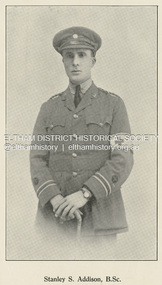
... family...vera addison (nee staley)...vera addison...w. stephenson...Additional information about Stanley Simpson Addison's Naval Service record and MBE (National Archives) a.c. ring a.s. davis adult education biography brigadier h.h. hammer centenary celebrations coronation d. dureau d. scales d.a. lyon d.s. pepper diamond creek diamond valley chamber of commerce diamond valley community hospital electricity supply eltham chamber of commerce eltham community chest eltham high school advisory committee eltham high school eltham infant welfare centre eltham pre-school eltham shire council eltham war memorial trust eulogy f.f. durham f.h. buckwell f.v. squire g.c. waring g.w. smith h. thompson h.f. thorpe j. north j.l. ryan j.r. stuber j.w. burgoyne j.w. middleton k.w. smith kangaroo ground advancement league kangaroo ground presbyterian church kangaroo ground l.r. bassett lower plenty memorial chapel miss j. humphreys montmorency girl guides montmorency tennis club montmorency mrs. b. harrington mrs. stanley addison n.h. baxter opening ceremony panton hill parade r. t. harrap r.s. leeson s.a. hick shire president smiths gully st faiths anglican church stanley s addison collection stanley simpson addison stevenson family vera addison (nee staley) vera addison w. stephenson Approx. 68 pages of varying types; photocopies, newsclippings, hand written notes, invitations, letters Stanley Simpson Addison M.B.E. ...Contents: 1. Who is this man? By Stanley Addison (M.B.E., B.A., B.Sc., J.P.) 2. Stanley Simpson Addison biography (b. 14/10/1880 d. 1/1/1972) 3. Eulogy: Stanley Simpson Addison (14 Oct 1880-1 Jan 1972) 4. Photograph: Stanley S. Addison, B.Sc., The Australasian Intercollegian, April 1, 1916 5. Letter, Eltham High School Advisory Committee re pending retirement of Cr. Addison from the Eltham Shire Council, 8 June 1956 6. Behind and Before by Stanley S. Addison, The Way, September 1956, pp 6-7 7. Newspaper clipping: Eltham Shire's President is Cr. S. Addison, Heidelberg News, Friday September 12, 1952 8. Newspaper clipping: Mr S. Addison Honored, Heidelberg News, Friday September 21st, 1956, p13 9. Opening of Lower Plenty Memorial Chapel, 30 November 1952 10. Letter from Brigadier H.H. Hammer, HQ 2 Armed Brigade to Cr. S. Addison, President, Shire of Eltham giving thanks for Coronation Celebrations parade support, June 1953 11. Newspaper clipping: Eltham President's Advance Programme 12. Newspaper clipping: Coronation Festivities; Eltham Shire President's Notes 13. Newspaper clipping: Hurstbridge: Coronation Day Ceremony 14. Draft of letter by Stanley S. Addison, President, Kangaroo Ground Advancement League regarding electricity connection for Kangaroo Ground - Panton Hill, 1954 including four small pages of notes 15. Note: Ian Potter & Co. (c.1955) regarding discount on funding for electricity supply connection 16. Copy of Memo for Electricity Supply Department (Greensborough), 5 May 1955 regarding area loan scrip – Panton Hill and Kangaroo Ground 17. Copy of Letter, State Electricity Commission of Victoria to Cr. S. Addison, 12 May 1955 regarding electricity supply for Panton Hill and Kangaroo Ground 18. Newspaper clipping: Light for Diamond Valley; Kangaroo Ground and Panton Hill, Friday 20th May, 1955 19. Letter: State Electricity Commission of Victoria to Cr. S. Addison, 26 May 1955 regarding Electricity supply to Kangaroo Ground and Panton Hill area 20. Letter: The National Mutual Life Association to S.S. Addison, 28 June 1955 regarding Electricity supply 21. Letter: The National Mutual Life Association to S.S. Addison, 1 July 1955 regarding Electricity connection, Kangaroo Ground and Panton Hill 22. Letter: Minister of Electrical Undertakings to Cr. Stanley S. Addison, 10 April 1956 regarding extension of supply to Panton Hill and Kangaroo Ground 23. Letter: State Electricity Commission of Victoria Stanley S. Addison, 13 September 1956 regarding proposed extension of supply to Panton Hill-and Kangaroo Ground 24. Letter: Minister of Electrical Undertakings to Cr. Stanley S. Addison, 1 July 1958 regarding extension of supply to 18 properties in the Panton Hill-Smiths Gully Road area 25. Letter: Acting Minister of Electrical Undertakings to Cr. Stanley S. Addison, 18 July 1958 regarding extension of supply to 18 properties in the Panton Hill-Smiths Gully Road area 26. 100th Anniversary Services, Kangaroo Ground Presbyterian Church, 17 March 1957 27. Speech by Stanley S. Addison on the history of the Kangaroo Ground Presbyterian Church (9 Feb. 1957) for the 100th Anniversary Services, Kangaroo Ground Presbyterian Church, 17 March 1957 28. Early History of Kangaroo Ground compiled by Neville Haughton in March, 1959 29. Newspaper clipping: Eltham Community Chest, Heidelberg News, 12 September 1958 30. Newspaper clipping: Proposed Eltham Community Chest by Stanley Addison, Heidelberg News, 29 January 1959 31. Newspaper clipping: Community Chest With Wider Objectives, Heidelberg News, 5 February 1959 32. Newspaper clipping: Community Chest for Eltham, 1959 33. Newspaper clipping: Council Protest on Community Chest, c.1959 34. Newspaper clipping: Community Chest Outlined at Small Meeting, c.1959 35. Newspaper clipping: Treasure in the Diamond Valley by Stanley Addison, Heidelberg News, 19 February 1959 36. Newspaper clipping: Diamond Valley Chamber of Commerce, c.1959 37. Additional information about Stanley Simpson Addison from Bill Glasson, 15 March 2014 38. Additional information about Stanley Simpson Addison's Naval Service record and MBE (National Archives)Approx. 68 pages of varying types; photocopies, newsclippings, hand written notes, invitations, lettersa.c. ring, a.s. davis, adult education, biography, brigadier h.h. hammer, centenary celebrations, coronation, d. dureau, d. scales, d.a. lyon, d.s. pepper, diamond creek, diamond valley chamber of commerce, diamond valley community hospital, electricity supply, eltham chamber of commerce, eltham community chest, eltham high school advisory committee, eltham high school, eltham infant welfare centre, eltham pre-school, eltham shire council, eltham war memorial trust, eulogy, f.f. durham, f.h. buckwell, f.v. squire, g.c. waring, g.w. smith, h. thompson, h.f. thorpe, j. north, j.l. ryan, j.r. stuber, j.w. burgoyne, j.w. middleton, k.w. smith, kangaroo ground advancement league, kangaroo ground presbyterian church, kangaroo ground, l.r. bassett, lower plenty memorial chapel, miss j. humphreys, montmorency girl guides, montmorency tennis club, montmorency, mrs. b. harrington, mrs. stanley addison, n.h. baxter, opening ceremony, panton hill, parade, r. t. harrap, r.s. leeson, s.a. hick, shire president, smiths gully, st faiths anglican church, stanley s addison collection, stanley simpson addison, stevenson family, vera addison (nee staley), vera addison, w. stephenson -
 Narre Warren and District Family History Group
Book, Narre Warren & District Family History Group Inc, Casey Cardinia Collection - Pakenham Information File - Volume 3, 2024
... The date the articles were published, and title of articles are listed below. 28 May 2008 Hounds’ Bloodline Runs Way, Way Back 18 Jul 2012 The Only Job for Her - Kerri Bolch 25 Jan 2023 Two Lives are Celebrated - Ian Thomas 19 Jan 2023 My Life in Newspapers - Ian Thomas 18 Jan 2023 An All-Round Good Sport - Ian’s Talents Lie the Other Side of the Boundary Fence - Ian Thomas 18 Jan 2023 Tributes Stream in for Ian - Ian Thomas 18 Jan 2023 Putting Family First, At Last - Ian Thomas 18 Jan 2023 The Editor's Desk - Ian Thomas 19 Jan 2023 Went the Way he Wanted - Ian Thomas 18 Jan 2023 Historic Ties to Society - Ian Thomas 18 Jan 2023 Death and Funeral Notices - Ian Thomas 18 Jan 2023 Tributes Flow - Ian Thomas 18 Jan 2023 Departed with his Boots on - Ian Thomas 7 Nov 2018 War Tragedies Bring High Flying Family Down to Earth 21 Dec 2022 Tree Treasure - David Ferrier 1 May 2019 Pakenham Remembers 24 Apr 2019 Flying the Flag 24 Apr 2019 The Combined Pakenham & District Roll of Honour 1914-1918 24 Apr 2019 Artie Stopped a Few Slugs in his Time - Artie Paternoster 24 Apr 2019 Farmer Took a Bullet - Francis Hornby 24 Apr 2019 Pakenham Butcher Shipwrecked on the Way to War - Andy Webster 24 Apr 2019 Len Serves on Home Soil - Len Cook 24 Apr 2019 A Face of Anzac From Centenary Website - Albert Nye 24 Apr 2019 Bill a Giant of Pakenham - Bill Stone 1 June 2016 Customers Came First - Margaret Pursell 1 June 2016 Ken had a Passion for Life - Kenneth Aldred 1 June 2016 Politics, Education and Industry Were Bob’s Legacy - Bob Charles 30 Oct 2024 Darby Won the Cup - Ray (Darby) Webster 10 Apr 2024 Mural Unveiled for Pakenham Girl Guides Hall 4 Sep 2024 Remembering the Generosity of Carol - Carol Clay 2 Oct 2024 Norma Deeply Loved - Norma Jackson 2 Oct 2024 The Last of her Generation - Margaret Maher 23 Oct 2024 Celebrating a Proud 95 Years - Pakenham CFA 23 Oct 2024 Class of ‘74 Marks 50 Years - Pakenham High School 23 Oct 2024 Commemorating 45 Years of Service - David W Bull Funerals 23 Oct 2024 Riding High at Pakenham 4 Sep 2024 When You Could Buy Cattle and a Car 21 Aug 2024 Honora Fields Name Choice 28 Aug 2024 A Business Pioneer - Oscar Smith 28 Aug 2024 St Pat’s Blessed with Reno 14 Aug 2024 Historic Milking Shed Gone 14 Aug 2024 Frank’s Wooden Wonders - Frank Lindsay 31 July 2024 How the Pioneers Settled on IYU Estate 20 Mar 2024 Life Memberships Awarded - Pakenham Racing Club 27 Mar 2024 Magical Day for the Lions - Lions Netball Club 20 Mar 2024 Tennis Club’s Call to Arms - Pakenham Tennis Club 20 Mar 2024 Timeline of a Tennis Club - Pakenham Tennis Club 17 Jul 2024 Honest and Committed Man - Ian Bell 17 Jul 2024 Pakenham Loses Devoted Supporter Thelma Young 22 May 2024 Our Quiet Achiever - Cheryl Trimmings 17 July 2024 A True Pakenham Pioneer - Meryl Waterhouse 10 Apr 2024 Names for Paky East - When Pakenham Used to be “Pakenham East” 15 May 2024 Stories Behind the Names 28 Aug 2024 The Work Behind the Horse - Jackson Pope 22 May 2024 Farming Pioneer Name Proposed for Pakenham East 10 July 2024 Mystery Surrounds Shield 19 Apr 2017 In Their Footsteps - Lachlan Smith 20 July 2016 24 Hours of Carnage Battle of Fromelles 12 Nov 2025 Hospital is Taking Shape 12 Nov 2025 Back to School, 50 Years On - Pakenham High School 12 Nov 2025 A Century of Loving Life - Emily Joyce Taylor 12 Nov 2025 Much-Loved Local Ngaire - Ngaire Bennett 9 Oct 2025 Spotlight on History for Book Launch 16 Jul 2025 Lyn’s Memory Lives On - Lynette Stephenson 1 Oct 2025 Robbie Was Always En Route - Robbie MacGregor 16 May 2025 Life Full of Love and Humour - Max Jeavons 21 Jan 2026 Decades of Cheese-Making - Interlandi family 21 Jan 2026 Opening a Grand Affair - Pakenham Bush Nursing Hospital 21 Jan 2026 A Century of Medical Care - Pakenham Community Hospital 21 Jan 2026 Mary Travelled Far and Wide to Provide Medical Care 21 May 2025 The Humble Veteran Hero - Matthew Moore 14 Jan 2026 Racing Towards the Future - Pakenham Racing Club 17 Dec 2025 Pakenham Farewells Lefty - Kelvin Rees 17 Dec 2025 Norm Smith, The Bus Driver Who Moved the Community 10 Sep 2025 What Will the Future Hold? ...The date the articles were published, and title of articles are listed below. 28 May 2008 Hounds’ Bloodline Runs Way, Way Back 18 Jul 2012 The Only Job for Her - Kerri Bolch 25 Jan 2023 Two Lives are Celebrated - Ian Thomas 19 Jan 2023 My Life in Newspapers - Ian Thomas 18 Jan 2023 An All-Round Good Sport - Ian’s Talents Lie the Other Side of the Boundary Fence - Ian Thomas 18 Jan 2023 Tributes Stream in for Ian - Ian Thomas 18 Jan 2023 Putting Family First, At Last - Ian Thomas 18 Jan 2023 The Editor's Desk - Ian Thomas 19 Jan 2023 Went the Way he Wanted - Ian Thomas 18 Jan 2023 Historic Ties to Society - Ian Thomas 18 Jan 2023 Death and Funeral Notices - Ian Thomas 18 Jan 2023 Tributes Flow - Ian Thomas 18 Jan 2023 Departed with his Boots on - Ian Thomas 7 Nov 2018 War Tragedies Bring High Flying Family Down to Earth 21 Dec 2022 Tree Treasure - David Ferrier 1 May 2019 Pakenham Remembers 24 Apr 2019 Flying the Flag 24 Apr 2019 The Combined Pakenham & District Roll of Honour 1914-1918 24 Apr 2019 Artie Stopped a Few Slugs in his Time - Artie Paternoster 24 Apr 2019 Farmer Took a Bullet - Francis Hornby 24 Apr 2019 Pakenham Butcher Shipwrecked on the Way to War - Andy Webster 24 Apr 2019 Len Serves on Home Soil - Len Cook 24 Apr 2019 A Face of Anzac From Centenary Website - Albert Nye 24 Apr 2019 Bill a Giant of Pakenham - Bill Stone 1 June 2016 Customers Came First - Margaret Pursell 1 June 2016 Ken had a Passion for Life - Kenneth Aldred 1 June 2016 Politics, Education and Industry Were Bob’s Legacy - Bob Charles 30 Oct 2024 Darby Won the Cup - Ray (Darby) Webster 10 Apr 2024 Mural Unveiled for Pakenham Girl Guides Hall 4 Sep 2024 Remembering the Generosity of Carol - Carol Clay 2 Oct 2024 Norma Deeply Loved - Norma Jackson 2 Oct 2024 The Last of her Generation - Margaret Maher 23 Oct 2024 Celebrating a Proud 95 Years - Pakenham CFA 23 Oct 2024 Class of ‘74 Marks 50 Years - Pakenham High School 23 Oct 2024 Commemorating 45 Years of Service - David W Bull Funerals 23 Oct 2024 Riding High at Pakenham 4 Sep 2024 When You Could Buy Cattle and a Car 21 Aug 2024 Honora Fields Name Choice 28 Aug 2024 A Business Pioneer - Oscar Smith 28 Aug 2024 St Pat’s Blessed with Reno 14 Aug 2024 Historic Milking Shed Gone 14 Aug 2024 Frank’s Wooden Wonders - Frank Lindsay 31 July 2024 How the Pioneers Settled on IYU Estate 20 Mar 2024 Life Memberships Awarded - Pakenham Racing Club 27 Mar 2024 Magical Day for the Lions - Lions Netball Club 20 Mar 2024 Tennis Club’s Call to Arms - Pakenham Tennis Club 20 Mar 2024 Timeline of a Tennis Club - Pakenham Tennis Club 17 Jul 2024 Honest and Committed Man - Ian Bell 17 Jul 2024 Pakenham Loses Devoted Supporter Thelma Young 22 May 2024 Our Quiet Achiever - Cheryl Trimmings 17 July 2024 A True Pakenham Pioneer - Meryl Waterhouse 10 Apr 2024 Names for Paky East - When Pakenham Used to be “Pakenham East” 15 May 2024 Stories Behind the Names 28 Aug 2024 The Work Behind the Horse - Jackson Pope 22 May 2024 Farming Pioneer Name Proposed for Pakenham East 10 July 2024 Mystery Surrounds Shield 19 Apr 2017 In Their Footsteps - Lachlan Smith 20 July 2016 24 Hours of Carnage Battle of Fromelles 12 Nov 2025 Hospital is Taking Shape 12 Nov 2025 Back to School, 50 Years On - Pakenham High School 12 Nov 2025 A Century of Loving Life - Emily Joyce Taylor 12 Nov 2025 Much-Loved Local Ngaire - Ngaire Bennett 9 Oct 2025 Spotlight on History for Book Launch 16 Jul 2025 Lyn’s Memory Lives On - Lynette Stephenson 1 Oct 2025 Robbie Was Always En Route - Robbie MacGregor 16 May 2025 Life Full of Love and Humour - Max Jeavons 21 Jan 2026 Decades of Cheese-Making - Interlandi family 21 Jan 2026 Opening a Grand Affair - Pakenham Bush Nursing Hospital 21 Jan 2026 A Century of Medical Care - Pakenham Community Hospital 21 Jan 2026 Mary Travelled Far and Wide to Provide Medical Care 21 May 2025 The Humble Veteran Hero - Matthew Moore 14 Jan 2026 Racing Towards the Future - Pakenham Racing Club 17 Dec 2025 Pakenham Farewells Lefty - Kelvin Rees 17 Dec 2025 Norm Smith, The Bus Driver Who Moved the Community 10 Sep 2025 What Will the Future Hold? ...Folder containing a table of contents and various newspaper clippings and other information pertaining to the Pakenham area Volume 3. The date the articles were published, and title of articles are listed below. 28 May 2008 Hounds’ Bloodline Runs Way, Way Back 18 Jul 2012 The Only Job for Her - Kerri Bolch 25 Jan 2023 Two Lives are Celebrated - Ian Thomas 19 Jan 2023 My Life in Newspapers - Ian Thomas 18 Jan 2023 An All-Round Good Sport - Ian’s Talents Lie the Other Side of the Boundary Fence - Ian Thomas 18 Jan 2023 Tributes Stream in for Ian - Ian Thomas 18 Jan 2023 Putting Family First, At Last - Ian Thomas 18 Jan 2023 The Editor's Desk - Ian Thomas 19 Jan 2023 Went the Way he Wanted - Ian Thomas 18 Jan 2023 Historic Ties to Society - Ian Thomas 18 Jan 2023 Death and Funeral Notices - Ian Thomas 18 Jan 2023 Tributes Flow - Ian Thomas 18 Jan 2023 Departed with his Boots on - Ian Thomas 7 Nov 2018 War Tragedies Bring High Flying Family Down to Earth 21 Dec 2022 Tree Treasure - David Ferrier 1 May 2019 Pakenham Remembers 24 Apr 2019 Flying the Flag 24 Apr 2019 The Combined Pakenham & District Roll of Honour 1914-1918 24 Apr 2019 Artie Stopped a Few Slugs in his Time - Artie Paternoster 24 Apr 2019 Farmer Took a Bullet - Francis Hornby 24 Apr 2019 Pakenham Butcher Shipwrecked on the Way to War - Andy Webster 24 Apr 2019 Len Serves on Home Soil - Len Cook 24 Apr 2019 A Face of Anzac From Centenary Website - Albert Nye 24 Apr 2019 Bill a Giant of Pakenham - Bill Stone 1 June 2016 Customers Came First - Margaret Pursell 1 June 2016 Ken had a Passion for Life - Kenneth Aldred 1 June 2016 Politics, Education and Industry Were Bob’s Legacy - Bob Charles 30 Oct 2024 Darby Won the Cup - Ray (Darby) Webster 10 Apr 2024 Mural Unveiled for Pakenham Girl Guides Hall 4 Sep 2024 Remembering the Generosity of Carol - Carol Clay 2 Oct 2024 Norma Deeply Loved - Norma Jackson 2 Oct 2024 The Last of her Generation - Margaret Maher 23 Oct 2024 Celebrating a Proud 95 Years - Pakenham CFA 23 Oct 2024 Class of ‘74 Marks 50 Years - Pakenham High School 23 Oct 2024 Commemorating 45 Years of Service - David W Bull Funerals 23 Oct 2024 Riding High at Pakenham 4 Sep 2024 When You Could Buy Cattle and a Car 21 Aug 2024 Honora Fields Name Choice 28 Aug 2024 A Business Pioneer - Oscar Smith 28 Aug 2024 St Pat’s Blessed with Reno 14 Aug 2024 Historic Milking Shed Gone 14 Aug 2024 Frank’s Wooden Wonders - Frank Lindsay 31 July 2024 How the Pioneers Settled on IYU Estate 20 Mar 2024 Life Memberships Awarded - Pakenham Racing Club 27 Mar 2024 Magical Day for the Lions - Lions Netball Club 20 Mar 2024 Tennis Club’s Call to Arms - Pakenham Tennis Club 20 Mar 2024 Timeline of a Tennis Club - Pakenham Tennis Club 17 Jul 2024 Honest and Committed Man - Ian Bell 17 Jul 2024 Pakenham Loses Devoted Supporter Thelma Young 22 May 2024 Our Quiet Achiever - Cheryl Trimmings 17 July 2024 A True Pakenham Pioneer - Meryl Waterhouse 10 Apr 2024 Names for Paky East - When Pakenham Used to be “Pakenham East” 15 May 2024 Stories Behind the Names 28 Aug 2024 The Work Behind the Horse - Jackson Pope 22 May 2024 Farming Pioneer Name Proposed for Pakenham East 10 July 2024 Mystery Surrounds Shield 19 Apr 2017 In Their Footsteps - Lachlan Smith 20 July 2016 24 Hours of Carnage Battle of Fromelles 12 Nov 2025 Hospital is Taking Shape 12 Nov 2025 Back to School, 50 Years On - Pakenham High School 12 Nov 2025 A Century of Loving Life - Emily Joyce Taylor 12 Nov 2025 Much-Loved Local Ngaire - Ngaire Bennett 9 Oct 2025 Spotlight on History for Book Launch 16 Jul 2025 Lyn’s Memory Lives On - Lynette Stephenson 1 Oct 2025 Robbie Was Always En Route - Robbie MacGregor 16 May 2025 Life Full of Love and Humour - Max Jeavons 21 Jan 2026 Decades of Cheese-Making - Interlandi family 21 Jan 2026 Opening a Grand Affair - Pakenham Bush Nursing Hospital 21 Jan 2026 A Century of Medical Care - Pakenham Community Hospital 21 Jan 2026 Mary Travelled Far and Wide to Provide Medical Care 21 May 2025 The Humble Veteran Hero - Matthew Moore 14 Jan 2026 Racing Towards the Future - Pakenham Racing Club 17 Dec 2025 Pakenham Farewells Lefty - Kelvin Rees 17 Dec 2025 Norm Smith, The Bus Driver Who Moved the Community 10 Sep 2025 What Will the Future Hold? - Pakenham Golf Course 17 Sep 2025 80 Years of Pottery - Robert Gordon Pottery 9 Jul 2025 Farewell to a True Pioneer - Douglas Wyatt 9 Jul 2025 New Bid Starts Swinging 9 Jul 2025 Golf Land was Hailed as a Groundbreaker 4 Feb 2026 Farewell After a Full Life - Ray Cross 7 May 2025 Local Legend Remembered - David W Bull 15 Oct 2025 Remembering a Legend - Robbie MacGregor 19 Nov 2025 On Your Mark, Tunnel Set, Go - Mark Godden 28 May 2025 Surprise Honour for Geoff - Geoff Young 11 Jun 2025 Survivor’s Amazing Journey - Colin Tidball 11 Feb 2026 Yakkerboo Toasts 50 Years 17 Sep 2025 Final Bell for Buildings 9 Apr 2025 Fourth Generation Members Keep Family History Rolling On 16 Apr 2025 End of an Era at Pakenham as Jumps Racing Comes to a Close 11 Feb 2026 Council Refuse Demolition 15 Oct 2025 Army Home People in Focus 11 Sep 2025 History Shake Upnon-fictionpakenham (vic.) -
 Narre Warren and District Family History Group
Book, Narre Warren & District Family History Group Inc, Casey Cardinia Collection - Berwick Information File - Volume 1, 2021
... That’s an Awful Lot of Beef - Peter & Chris Wenn 20 Feb 1991 A Brief History of the Show - Berwick Show 25 Feb 1993 Berwick’s Annual Show is Victoria’s Oldest UNKNOWN Berwick Post Office - illustration UNKNOWN Enthusiastic Op Shop Ladies Sold George’s Clothes 12 Jan 2000 Reserve Honors First Settler - Terence O’Connor 17 Sep 2008 From the Past - Berwick Post Office 21 Jul 2004 Simon “a Berwick Icon” - Barry Simon 20 Jul 2004 Mallaby Mourned - George Mallaby 7 Aug 2000 Olympic Torch Relay - pamphlet 22 Jul 2004 Television Favourite Farewelled - George Mallaby UNKNOWN Church Devotee Leaves Powerful Legacy - Olive Ada Meyer 28 Nov 2007 Booked in for Life - Carol Goddard 19 Dec 2007 From the Past - Berwick CFA 22 Oct 2008 Avenue of Heroes Gets a Facelift - Beaconsfield Avenue of Honour 13 Feb 2008 Wilson Park a Berwick Treasure 2 Apr 2008 Time to Restore Our Avenues of Honour 2 Apr 2008 Diggers Finally Able to March with their Medals 5 Sep 2007 Berwick Man Logs 50 Years as Mason - Bruce Luxford 14 Jan 2009 Veteran Volunteer is up for Award - Bert Ainge 25 Feb 2009 A Gem of a Team - Jim & Kay Drysdale 14 Nov 2007 History of Military Action 17 Jan 2007 Club Provides a Legacy for the Ages - Berwick Rotary 18 June 2008 Casey’s “Oldest Resident” Loves a Cup of Tea - Ella Stevens 20 Jun 2006 Council Plans Casey Tribute - Lord & Lady Casey 8 Jul 1993 The Birth of Local Government in 1862 21 Jan 2004 RSL President Hangs up his Slouch Hat - Brain Hetherton 25 Apr 2012 Anzac Spirit Award UNKNOWN Significant Stage in Village Development 23 Mar 2011 Dog’s Crash Course in Values - Doug Nicholls 7 Jan 2004 New Park Reflects the Pioneer Spirit - Pioneer Park 7 Jan 2004 Casey Chief Acquires a Good Reputation - Mike Tyler 7 Jan 2004 Facility is a Tribute to People - Pioneer Park UNKNOWN Former Township Comes of Age - Berwick 31 Mar 2004 Berwick Loses Champion - Ellis Loveridge 30 Jan 2008 Pioneer Honoured - Bruce Greenland 25 Feb 2009 Good Grounds for 90 Years - Cyril Molyneux 3 Dec 2007 Casey Mourns Stella Couple - Murray & Nancy Guille 8 Nov 2004 Tribute to a Local Tennis Ace - Abel Kay 20 Apr 2004 Preserving History 13 Feb 2008 After 40 Years, Les is Still Cutting it Fine - Les Jones 19 Oct 2011 Berwick Library’s Darling - Pam Darling 6 Apr 2011 Sign of the Times - Bank Plaque UNKNOWN Berwick Celebrates Twenty Years - photographic display UNKNOWN Homestead - Cheese Factory - illustration 28 Jan 1993 Time to Reflect - George Pritchard Wilson 14 Apr 2003 A Time to Remember - Horry Heathcote 3 Mar 2003 School is Out for Plans to Buy Site - Berwick Primary School 6 Mar 2003 Barometer Keeps Climbing - Berwick Primary School 23 Jun 2004 Courage to a Tee - Annabel Ford UNKNOWN Old Church of Christ - illustration UNKNOWN Severance Sees Two Municipalities Formed - Berwick/Pakenham 15 Sep 2004 Unit Celebrates 90 Years of History - Red Cross 30 Jan 2008 Life and Times of Akoonah Park 12 May 2010 Teaching with a Twist - John Twist 26 Apr 1969 Lord Casey - the end of an era 30 Aug 1968 78 and He’ll Never Quit - Lord Casey 8 Oct 2003 District Loses a Real Star - Esther Johnson 23 Feb 2005 Tireless Community Worker - Helen Hudson 24 Feb 2005 Helen a Loss to the Community - Helen Hudson Mar 2005 Nursing a Special Affection - RDNS 1 Mar 2005 Nurses Mark 120 Years - RDNS 14 Sep 2005 Old Courthouse Sold 23 Mar 2005 Plaque Recognises the Work of Doctor - Dr Noel Stephenson 30 Nov 2005 Mr Doveton Tells All - Syd Pargeter 28 Nov 2005 Birth of a City - Syd Pargeter 1 Oct 1992 From Cheese to Art to Preserve Our Heritage 15 Feb 2001 Cheese Factory Records Long History UNKNOWN Berwick Old Cheese Factory - pamphlet 4 Jun 2008 Between a Rock and a Hard Place - Wilson Botanic Park Casey Cardinia Collection - Berwick Information File - Volume 1 Book Narre Warren & District Family History Group Inc. ...Folder containing a table of contents and various newspaper clippings and other information pertaining to the Berwick area Volume 1. The date the articles were published, and title of articles are listed below. 12 Aug 1992 Beaumont Farm - one of Berwick’s oldest 23 Dec 1992 Berwick’s First Post Master’s Pay was 20 Pound Per Annum 26 May 2004 Roger’s Life was Full of Adventure - Roger Mason 4 Feb 2004 The Bush Man of Berwick - Marcell Fakhry 2 Feb 2005 Ern Bowls for Berwick - Ern Green 10 Nov 2004 Doctor “A Tireless Local Campaigner” - Dr Noel Stephenson 14 May 2008 RSL Paves the Way for memorial Changes 15 Sep 2004 Unit Celebrates 90 Years of History - Red Cross 8 Sep 2004 Red Cross Celebrates 90 Years 4 Aug 2004 Milestone Call from Red Cross 6 Dec 2007 Stalwart Killed in Crash - Murray Guille 13 Dec 2006 Clock Builds Head of Steam - Berwick Steam Clock 5 Aug 1998 Watchdogs of our Heritage - National Trust 6 Sep 2006 Madge’s Magic Number - Madge Dunn 101 18 Apr 2007 A Page of Berwick History - Mechanics Institute 7 Dec 2006 First Wedding in Pioneers Park 7 Dec 2006 Sale of “Kinross” 24 Jun 1993 Fond Recollections of Berwick Grammar School 8 Nov 2006 Historic Property to Join Parkland - Grasmere 20 Feb 1999 In Days of Gold - Edwin Flack 25 Jul 2012 Golden Oldie’s Legend Status - Bob Lay 20 Apr 2004 Prestige Award for Site Saviour - Old Berwick Primary School 20 Apr 2004 Saving School Site for Enterprising Resident - Bill Hudsaon 28 Jun 2000 Edwin Flack: a name on everyone’s lips 24 Mar 1998 Set For Year Ahead - Edwin Flack statue UNKNOWN Games Hero Honored - Edwin Flack 3 Nov 1998 Torch to Light Up Berwick - Olympic torch 3 Nov 1998 “Lion of Athens” Steals the Show - Edwin Flack 3 Nov 1998 Gold Rower’s Precious Metal - Michael Aikman 21 Mar 1991 Whatever Happened to the Evans Sisters? 18 Feb 2002 Darwin is Still Unforgettable - Bombing of Darwin 30 Jul 1992 Governor -General tells of exciting plans for Wilson Botanic Park 17 Nov 1998 Lizzie’s Headstone Now in Safe Hands - Lizzie McMullen 20 Oct 2010 Baby Makes Five Generations - Luke Sheean UNKNOWN Mary’s Memorial Garden - Mary Loveridge 31 jan 2001 Mod Cons Shelved at Library - Berwick Mechanics Library 10 Sep 1992 They Read for a Penny at the Berwick Library 14 Feb 2005 Generations of Generosity Pay Off - Berwick Bowling Club 30 Nov 2000 Homestead Celebrates - Edrington Park 20 Jan 2005 Rotary Gives Cemetery a Facelift - Berwick Cemetery 14 Feb 2005 Club Bowled Over by Anniversary Event - Bowling Club 23 Nov 2000 Library Ahead of the Pack 15 Jan 2001 Memorials Documented 7 Jun 2000 Grave Fears Gone - Berwick Cemetery 11 Feb 1993 Dr Percy Langmore a Dedicated Medico to the People 4 Feb 1993 Dr Langmore Used All Modes of Transport to Service Berwick 23 Dec 2003 Cheers All Round for a Special Gift - Old Berwick Primary School 29 Jul 1993 Was Inglis Road the Best Site? 20 Aug 1992 Hovell was our First Explorer 23 Sep 2003 People Power Wins - Old Berwick Primary School UNKNOWN New Building for Berwick Bush Nursing Hospital UNKNOWN Berwick Hospital Two Days After War Declared 7 Jul 1998 A Time Warp in our City - Berwick Library 4 Feb 1953 An Etching Holiday 2 Dec 2002 Literally, She’s a Late Bloomer - Joy Adams 23 Feb 2005 Cricket’s Other Don Offers High Interest - Don Moyes 5 Nov 2003 He Died At Peace - George Wilson 15 Dec 2003 Berwick’s Shelf Life - Berwick Library 29 Oct 1992 They Had a Mighty Good Time on the Gippsland Line 20 May 1993 Almost 150 Years Since the Wilson Family Came to Berwick 30 Jul 1992 Berwick was Once a Quarry Town 27 Sep 1993 The Way We Were UNKNOWN Wilson Botanic Park - pamphlet 11 Nov 2003 Trust’s Honourable Plea - avenue of Honours 15 Jul 2004 “Lions of Athens” Remembered in Print - Edwin Flack Jun 1992 Farm to Quarry to Park - Wilson Botanic Park 5 Sep 2001 Holy Cow! That’s an Awful Lot of Beef - Peter & Chris Wenn 20 Feb 1991 A Brief History of the Show - Berwick Show 25 Feb 1993 Berwick’s Annual Show is Victoria’s Oldest UNKNOWN Berwick Post Office - illustration UNKNOWN Enthusiastic Op Shop Ladies Sold George’s Clothes 12 Jan 2000 Reserve Honors First Settler - Terence O’Connor 17 Sep 2008 From the Past - Berwick Post Office 21 Jul 2004 Simon “a Berwick Icon” - Barry Simon 20 Jul 2004 Mallaby Mourned - George Mallaby 7 Aug 2000 Olympic Torch Relay - pamphlet 22 Jul 2004 Television Favourite Farewelled - George Mallaby UNKNOWN Church Devotee Leaves Powerful Legacy - Olive Ada Meyer 28 Nov 2007 Booked in for Life - Carol Goddard 19 Dec 2007 From the Past - Berwick CFA 22 Oct 2008 Avenue of Heroes Gets a Facelift - Beaconsfield Avenue of Honour 13 Feb 2008 Wilson Park a Berwick Treasure 2 Apr 2008 Time to Restore Our Avenues of Honour 2 Apr 2008 Diggers Finally Able to March with their Medals 5 Sep 2007 Berwick Man Logs 50 Years as Mason - Bruce Luxford 14 Jan 2009 Veteran Volunteer is up for Award - Bert Ainge 25 Feb 2009 A Gem of a Team - Jim & Kay Drysdale 14 Nov 2007 History of Military Action 17 Jan 2007 Club Provides a Legacy for the Ages - Berwick Rotary 18 June 2008 Casey’s “Oldest Resident” Loves a Cup of Tea - Ella Stevens 20 Jun 2006 Council Plans Casey Tribute - Lord & Lady Casey 8 Jul 1993 The Birth of Local Government in 1862 21 Jan 2004 RSL President Hangs up his Slouch Hat - Brain Hetherton 25 Apr 2012 Anzac Spirit Award UNKNOWN Significant Stage in Village Development 23 Mar 2011 Dog’s Crash Course in Values - Doug Nicholls 7 Jan 2004 New Park Reflects the Pioneer Spirit - Pioneer Park 7 Jan 2004 Casey Chief Acquires a Good Reputation - Mike Tyler 7 Jan 2004 Facility is a Tribute to People - Pioneer Park UNKNOWN Former Township Comes of Age - Berwick 31 Mar 2004 Berwick Loses Champion - Ellis Loveridge 30 Jan 2008 Pioneer Honoured - Bruce Greenland 25 Feb 2009 Good Grounds for 90 Years - Cyril Molyneux 3 Dec 2007 Casey Mourns Stella Couple - Murray & Nancy Guille 8 Nov 2004 Tribute to a Local Tennis Ace - Abel Kay 20 Apr 2004 Preserving History 13 Feb 2008 After 40 Years, Les is Still Cutting it Fine - Les Jones 19 Oct 2011 Berwick Library’s Darling - Pam Darling 6 Apr 2011 Sign of the Times - Bank Plaque UNKNOWN Berwick Celebrates Twenty Years - photographic display UNKNOWN Homestead - Cheese Factory - illustration 28 Jan 1993 Time to Reflect - George Pritchard Wilson 14 Apr 2003 A Time to Remember - Horry Heathcote 3 Mar 2003 School is Out for Plans to Buy Site - Berwick Primary School 6 Mar 2003 Barometer Keeps Climbing - Berwick Primary School 23 Jun 2004 Courage to a Tee - Annabel Ford UNKNOWN Old Church of Christ - illustration UNKNOWN Severance Sees Two Municipalities Formed - Berwick/Pakenham 15 Sep 2004 Unit Celebrates 90 Years of History - Red Cross 30 Jan 2008 Life and Times of Akoonah Park 12 May 2010 Teaching with a Twist - John Twist 26 Apr 1969 Lord Casey - the end of an era 30 Aug 1968 78 and He’ll Never Quit - Lord Casey 8 Oct 2003 District Loses a Real Star - Esther Johnson 23 Feb 2005 Tireless Community Worker - Helen Hudson 24 Feb 2005 Helen a Loss to the Community - Helen Hudson Mar 2005 Nursing a Special Affection - RDNS 1 Mar 2005 Nurses Mark 120 Years - RDNS 14 Sep 2005 Old Courthouse Sold 23 Mar 2005 Plaque Recognises the Work of Doctor - Dr Noel Stephenson 30 Nov 2005 Mr Doveton Tells All - Syd Pargeter 28 Nov 2005 Birth of a City - Syd Pargeter 1 Oct 1992 From Cheese to Art to Preserve Our Heritage 15 Feb 2001 Cheese Factory Records Long History UNKNOWN Berwick Old Cheese Factory - pamphlet 4 Jun 2008 Between a Rock and a Hard Place - Wilson Botanic Parknon-fictionberwick (vic.) -
 Narre Warren and District Family History Group
Book, Narre Warren & District Family History Group Inc, Casey Cardinia Collection - Cardinia Information File, 2021
... List of Nominees 4 Aug 2021 Last Hurrah for Dairy Farm - Avonslea Holsteins 21 Apr 2021 New Use for old Church - Cardinia Presbyterian Church 17 Jun 2009 Bould Track Trip - Harold Bould Memorial Award 1 Oct 2014 Mark of the Man - Rudy de Jong 25 Aug 2021 A Forefather of Football - Norm Smith 23 Mar 2016 Cardinia Environment Coalition 9 Dec 2009 Popular in a Pinch - Bill Pearson 14 Oct 2015 Centenary is Well Celebrated - Cardinia Presbyterian Church 26 Jan 2022 Snooksy’s Legacy Lives On - Wayne Snooks 4 Apr 2001 Mayoral Vote Split - Graeme Legge 12Nov 2025 Reunion Celebrates Clubs 18 Dec 2024 Three Decades of Cardinia 27 Nov 2024 100 Reasons to Celebrate - Cardinia Hall 20 Nov 2024 Cardinia Hall to Celebrate 27 Nov 2024 Cardinia Hall Turns 100 24 Sep 2025 Civic Band in Dire Straits 24 Sep 2025 Honouring the Late Lyn Stephenson 24 Sep 2025 Hall Built by Musos 3 Jul 2025 Blazing 60-year Celebration Casey Cardinia Collection - Cardinia Information File Book Narre Warren & District Family History Group Inc. ...Folder containing a table of contents and various newspaper clippings and other information pertaining to the Cardinia area. The date the articles were published, and title of articles are listed below. 17 Sep 2008 Soldier’s Last Relative Found - Harold Edward Bould 3 Dec 2008 Old Time Dances Out - Dance at Cardinia Hall 21 Jan 2009 Who Will Be Cardinia’s Top Citizen? List of Nominees 4 Aug 2021 Last Hurrah for Dairy Farm - Avonslea Holsteins 21 Apr 2021 New Use for old Church - Cardinia Presbyterian Church 17 Jun 2009 Bould Track Trip - Harold Bould Memorial Award 1 Oct 2014 Mark of the Man - Rudy de Jong 25 Aug 2021 A Forefather of Football - Norm Smith 23 Mar 2016 Cardinia Environment Coalition 9 Dec 2009 Popular in a Pinch - Bill Pearson 14 Oct 2015 Centenary is Well Celebrated - Cardinia Presbyterian Church 26 Jan 2022 Snooksy’s Legacy Lives On - Wayne Snooks 4 Apr 2001 Mayoral Vote Split - Graeme Legge 12Nov 2025 Reunion Celebrates Clubs 18 Dec 2024 Three Decades of Cardinia 27 Nov 2024 100 Reasons to Celebrate - Cardinia Hall 20 Nov 2024 Cardinia Hall to Celebrate 27 Nov 2024 Cardinia Hall Turns 100 24 Sep 2025 Civic Band in Dire Straits 24 Sep 2025 Honouring the Late Lyn Stephenson 24 Sep 2025 Hall Built by Musos 3 Jul 2025 Blazing 60-year Celebrationnon-fictioncardinia (vic.), harold edward bould -
Glen Eira Historical Society
Document - Lions’ Club Caulfield
... Family... Schwartz Albert... Lions’ Club Code of Ethics... Bendixsen Morgens... Knowles Alan... Braun Emil... Traine Ravie Lady... Wurzel Joseph... Wheat John... Arden Fred... Patron Eric... Knowles Alan... Wallace Ken... Vermay Fred... Donoghue Clif... Giles Gordon... Huggard Gordon... Martin Ray... Nixon Geoff... Shepes Charles... Smith Pat... Tesoriero Dom... Wilkin John (assume Johrn incorrect)... Zimmet Paul... Patience Geoff... Same Harvey... Cornhill Wal... Davis John (assume Jihn incorrect)... Fisher Bert... Hosking Alan... MacGowan Ian... Scumacher Cubby... Shepard Ken... Stephenson...John Ambulance Brigade Spurway Family Schwartz Albert Lions’ Club Code of Ethics Bendixsen Morgens Knowles Alan Braun Emil Traine Ravie Lady Wurzel Joseph Wheat John Arden Fred Patron Eric Knowles Alan Wallace Ken Vermay Fred Donoghue Clif Giles Gordon Huggard Gordon Martin Ray Nixon Geoff Shepes Charles Smith Pat Tesoriero Dom Wilkin John (assume Johrn incorrect) Zimmet Paul Patience Geoff Same Harvey Cornhill Wal Davis John (assume Jihn incorrect) Fisher Bert Hosking Alan MacGowan Ian Scumacher Cubby Shepard Ken Stephenson Lyle Document Lions’ Club Caulfield ...This file contains two items: 1/Minutes of Lions’ Club meeting (21/11/1988) district 201. Includes list of members, an overview of how the club was formed (25/04/1966 by joining Caulfield and Elsterrnwick), description of events, activities, donations and appeals, such as Westgate Bridge Appeal, Hobart Bush Fire Appeal, sponsored seeing eye dogs, hospital equipment donated, and health checks. Includes a cartoon on lions sausage sizzle and photocopy of four photographs (with handwritten notes) showing the presentation of cheques for Hobart Bush Fire (not dated), charter members (dated 1962), presentation of mobile first aid unit to St. John Ambulance Brigade (not dated) and photocopy of the interior. 2/Two pamphlets for the Lions’ Club (dated 08/1987 and on the other dated 11/1985).city of caulfield, lions’ international, lions’ club district 201, lions’ club caulfield, lions’ club elsternwick, meetings, nursing homes, spurway nursing home city of caulfield, daycare, fundraising events, charitable organisations, royal southern memorial hospital, associations organisation and societies, citizenship ceremonies, hospitals, hospital equipment, st. johns’ ambulance, city of caulfield, bethlehemn hospital, tudor court, john allison/monkhouse, lions’ youth exchange, ormond kindergarten, caulfield grammar school basketball teams, gladys machin elderly citizens, camdon court, mobile first aid unit caulfield division, rippon lea, murrumbeena, caulfield scouts, st. john ambulance brigade, spurway family, schwartz albert, lions’ club code of ethics, bendixsen morgens, knowles alan, braun emil, traine ravie lady, wurzel joseph, wheat john, arden fred, patron eric, knowles alan, wallace ken, vermay fred, donoghue clif, giles gordon, huggard gordon, martin ray, nixon geoff, shepes charles, smith pat, tesoriero dom, wilkin john (assume johrn incorrect), zimmet paul, patience geoff, same harvey, cornhill wal, davis john (assume jihn incorrect), fisher bert, hosking alan, macgowan ian, scumacher cubby, shepard ken, stephenson lyle -
Eltham District Historical Society Inc
Document - Folder, Ness family
... History of the Mess/Ness family Newspaper article: "Ness family are keepers of 140 years of historical knowledge", Diamond Valley News, 4 February 1986. History of Joseph Stephenson and descendants. ...History of the Mess/Ness family Newspaper article: "Ness family are keepers of 140 years of historical knowledge", Diamond Valley News, 4 February 1986. History of Joseph Stephenson and descendants. ...James Johnston settled at Kangaroo Ground in 1849. His nephew James Mess joined him and a descendant Robert James Mess changed his surname to Ness. The family became active in all aspects of Kangaroo Ground life. Contents Text (handwritten and transcribed): "The Ness Family, Kangaroo Ground", Joy Ness, 1989. Newspaper article: "True pioneer stock", Diamond Valley News, 2 March 1982. History of the Mess/Ness family Newspaper article: "Ness family are keepers of 140 years of historical knowledge", Diamond Valley News, 4 February 1986. History of Joseph Stephenson and descendants. Newspaper article: "Joy Ness paints native flowers for posterity". Diamond Valley News, 21 October 1986. Life and career of Joy Ness as painter. Newspaper article: "His Cup runneth of with Joy", ?Diamond Valley Leader, 6 December 2000. Bruce and Joy Ness celebrate 60th wedding anniversary. Pencil sketch by Joh Ebeli no date but pre 2004: Portrait of Joy Ness dressed for the Historical Society Parade. Order of Service: Thanksgiving service for the life of Robert Bruce Ness 22 January 1917 / 28 June 2004. Eltham District Historical Society newsletter no date: "Robert Bruce Ness 1917-2004", obituary and extract from Joy Ness's history of the family. Copy of letter from Joh Ebeli to Gwen Orford, no date but ~2004: Describes drawings he made of Robert Bruce Ness when taking part in Diamond Valley Arts Society float and enclosed 3 drawings and a photograph of drawing of the bakers (corner Main Road and York Street Eltham). Eltham District Historical Society newsletter September 2013: "Vale Joy Ness", obituary and extract from Diamond Valley News article of 6 December 2000.Newspaper clippings, A4 photocopies, etcness family kangaroo ground, james johnston, kangaroo ground, pretty hill farm, wellers hotel, betsy sadler, ingleside kangaroo ground, james mess, jane stevenson, ness lane kangaroo ground, view hill kangaroo ground, stte savings bank agency, ruth lettice gosling nee mess, kangaroo ground state school, garden hills kangaroo ground, william mess, joseph mess, isabella mess, james johnson mess, ruth ettie mess, george mess, alexander mess, janes mess, robert david mess, heidelberg agricultural show, diamond creek agricultural show, rober james ness, pearl ness nee mills, william mills, sabina mills, robert bruce ness, beryl ness, vera ness, donald ness, kangaroo ground presbyterian church, kangaroo ground cemetery trust, kangaroo ground tennis club, professor osborne, doctor osborne, joseph stevenson, joy ness, kangaroo ground fire brigade, bruce ness, country fire authority, ship wellington 1837, diamond creek, david christmas, christmas hills, andres harkness, samuel furphy, andrew ross, caledonian gold fields, queenstown now st andrews, mother coleman of kangaroo ground, diamond valley arts society, winifred joy ness, andrew ross museum, eltham art show -
Tatura Irrigation & Wartime Camps Museum
Book, Merrigum Frank, 1990
... stephenson f...pitts ll 1872-1947...mcgillivray e...nickson m...pitts family...Photographs n the book are part of the biggest family album in Australia stephenson f pitts ll 1872-1947 mcgillivray e nickson m pitts family tatura merrigum books children Hard cover white, blue, purple, blue lines, gold, dark blue writing. ...The photo essay was made by Lillian Pitts around 1915. In a string bound album with the pictures hand pasted and lettered. Photographs n the book are part of the biggest family album in AustraliaHard cover white, blue, purple, blue lines, gold, dark blue writing. Photo of boy on front and back coversstephenson f, pitts ll 1872-1947, mcgillivray e, nickson m, pitts family, tatura, merrigum, books, children -
Tatura Irrigation & Wartime Camps Museum
Booklet, From Chock and Log to Rolltop, 1985
... Compiled by former students, Pearl Craven, James Crawford, Linda Stephenson, Brian Williams toolamba families books history local school educational Soft cover booklet, cream coloured, brown writing From Chock and Log to Rolltop Booklet ...Compiled by former students, Pearl Craven, James Crawford, Linda Stephenson, Brian WilliamsSoft cover booklet, cream coloured, brown writingtoolamba families, books, history, local, school, educational -
Lakes Entrance Historical Society
Book, Stephenson Harry, Cattlemen's Huts of the High Country, 1980
... Beef Industry Settlers A record of the early development of Victorias Alpine Region by pioneer cattlemen, early settlements long since abandoned and the families who established them, and the many huts built as refuges during harsh conditions, many huts destroyed by bushfires,s Cattlemen's Huts of the High Country Book Stephenson Harry ...A record of the early development of Victorias Alpine Region by pioneer cattlemen, early settlements long since abandoned and the families who established them, and the many huts built as refuges during harsh conditions, many huts destroyed by bushfires,sbeef industry, settlers -
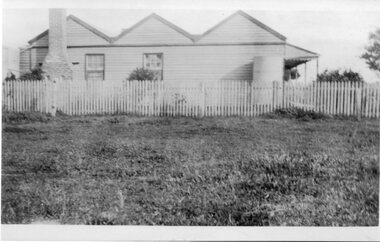 Stawell Historical Society Inc
Photograph, Apotheloz Family Home
... Stephenson Street, opposite school. West Side B/W Photo of the side of a three, gable weatherboard house with water tank, and picket fence Apotheloz Family Home Photograph ...B/W Photo of the side of a three, gable weatherboard house with water tank, and picket fenceOn Reverse: Charles & Ellen Aptholeloz Residence. Great Western, Stephenson Street, opposite school. West Side -
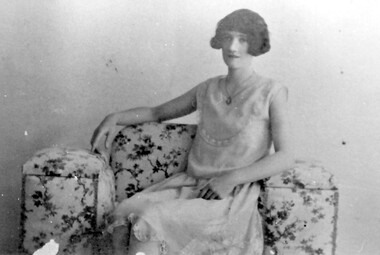 Surrey Hills Historical Society Collection
Photograph, Miss Lille Louisa (Lil) Willaton
... family lived in Lille Street, Surrey Hills. Both her parents and one sister died in Surrey Hills. In the 1920s Lil gained her A.L.C.M. (Australian London College of Music) in singing and made a career of teaching gymnastics with calisthenics, rhythmic movement etc. She arranged the music and lyrics for items and also designed the costumes, as well as conducting the physical training which culminated in annual concerts held in Box Hill and other town halls. Lil married Leslie Reginald Stephenson...family lived in Lille Street, Surrey Hills. Both her parents and one sister died in Surrey Hills. In the 1920s Lil gained her A.L.C.M. (Australian London College of Music) in singing and made a career of teaching gymnastics with calisthenics, rhythmic movement etc. She arranged the music and lyrics for items and also designed the costumes, as well as conducting the physical training which culminated in annual concerts held in Box Hill and other town halls. Lil married Leslie Reginald Stephenson ...Lil was born in Long Gully, Bendigo in 1904 daughter of Herbert Charles Leopold Willaton and Lillie Jenkins. She had 3 brothers and 3 sisters, one brother dying in infancy. The family lived in Lille Street, Surrey Hills. Both her parents and one sister died in Surrey Hills. In the 1920s Lil gained her A.L.C.M. (Australian London College of Music) in singing and made a career of teaching gymnastics with calisthenics, rhythmic movement etc. She arranged the music and lyrics for items and also designed the costumes, as well as conducting the physical training which culminated in annual concerts held in Box Hill and other town halls. Lil married Leslie Reginald Stephenson in 1934 and they lived at 36 Union Road, Surrey Hills. She died in July 1995 and is buried in Box Hill Cemetery - CE-126-0001. A black and white photograph of a young lady sitting in a lounge chair.(miss) lil willaton, (mrs) lil stephenson, entertainer, singers, teacher, gymnastics, calesthenics, (miss) lille louisa willaton, (mrs) lille louisa stephenson, box hill cemetery), lille street, union road -
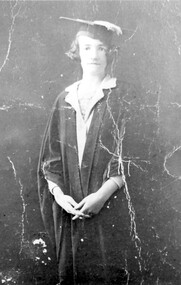 Surrey Hills Historical Society Collection
Photograph, Miss Lille Louisa (Lil) Willaton at time of graduation
... family lived in Lille Street, Surrey Hills. Both her parents and one sister died in Surrey Hills. In the 1920s Lil gained her A.L.C.M. (Australian London College of Music) in singing and made a career of teaching gymnastics with calisthenics, rhythmic movement etc. She arranged the music and lyrics for items and also designed the costumes, as well as conducting the physical training which culminated in annual concerts held in Box Hill and other town halls. Lil married Leslie Reginald Stephenson...family lived in Lille Street, Surrey Hills. Both her parents and one sister died in Surrey Hills. In the 1920s Lil gained her A.L.C.M. (Australian London College of Music) in singing and made a career of teaching gymnastics with calisthenics, rhythmic movement etc. She arranged the music and lyrics for items and also designed the costumes, as well as conducting the physical training which culminated in annual concerts held in Box Hill and other town halls. Lil married Leslie Reginald Stephenson ...Lil was born in Long Gully, Bendigo in 1904 daughter of Herbert Charles Leopold Willaton and Lillie Jenkins. She had 3 brothers and 3 sisters, one brother dying in infancy. The family lived in Lille Street, Surrey Hills. Both her parents and one sister died in Surrey Hills. In the 1920s Lil gained her A.L.C.M. (Australian London College of Music) in singing and made a career of teaching gymnastics with calisthenics, rhythmic movement etc. She arranged the music and lyrics for items and also designed the costumes, as well as conducting the physical training which culminated in annual concerts held in Box Hill and other town halls. Lil married Leslie Reginald Stephenson in 1934 and they lived at 36 Union Road, Surrey Hills. She died in July 1995 and is buried in Buried Box Hill Cemetery - CE-126-0001. A black and white photograph of a young lady dressed in a graduation gown and wearing a mortarboard on her head.(miss) lil willaton, (mrs) lil stephenson, entertainers, singers, gymnastics, calesthenics, teacher, lille street, union road, (miss) lille louisa willaton, (mrs) lille louisa stephenson, box hill cemetery
