
Showing 98 items matching "students attendance"
-
 University of Melbourne, Burnley Campus Archives
Book - Student Records, Students Attendance, Burnley School of Horticulture 1911-21, 1912-1921
... Students Attendance, Burnley School of Horticulture 1911-21...students...attendance records...Handwritten bound register of student names and addresses, attendance records and marks between 1911 and 1921. ...Student Attendance, Student addresses...Over 100 names and addresses listed over the years 1911-1919. register students attendance records w.a. rolfe Certificate of Competency Horticulture Addresses Full time Part time Class attendance Prefects women Men Influenza epidemic closure 1919 student register Student Attendance, Student addresses Handwritten bound register of student names and addresses, attendance records and marks between 1911 and 1921. ...Detailed attendence records at the Burnley School of Horticulture during the Principalships of Pescott, E.E. (1909-16) and McLennan, J.P. (1917-21). Over 100 names and addresses listed over the years 1911-1919.Handwritten bound register of student names and addresses, attendance records and marks between 1911 and 1921. Full time, male, part time and female. Insert (1) , 'W.A. Rolfe.' Register is hand inked in red ruled columns and black ink inscriptions for every day and month for the years - with varying methods of inscribing the recording. Most of the book is used, the used portion having a thumb square cut out of the lower right on each page. The year 1919 was recorded from the rear of the book going backwards.Student Attendance, Student addressesregister, students, attendance records, w.a. rolfe, certificate of competency, horticulture, addresses, full time, part time, class attendance, prefects, women, men, influenza epidemic closure 1919, student register -
University of Melbourne, Burnley Campus Archives
Book - Student Records, Education Department Victoria Technical Schools Register of Attendances, 1963-1965
... students...marks...attendance...Names of students, marks, attendance. (1) 1963. (2) 1964. (3) 1965)....students marks attendance Names of students, marks, attendance. (1) 1963. (2) 1964. (3) 1965). ...Names of students, marks, attendance. (1) 1963. (2) 1964. (3) 1965).students, marks, attendance -
University of Melbourne, Burnley Campus Archives
Document, Register of Attendances, c. 1949
... students...attendance...students attendance examinations Registers of attandances 1947; Attendance Roll & Examination Register 1948, 1949 Register of Attendances Document ...Registers of attandances 1947; Attendance Roll & Examination Register 1948, 1949students, attendance, examinations -
University of Melbourne, Burnley Campus Archives
Book - Student Records, Landscape Design Course 1977, 1977
... students...attendance...Table of student names and dates of attendance dated 07/02 1977-24/10 1977. ...students attendance 1977 landscape design course Table of student names and dates of attendance dated 07/02 1977-24/10 1977. ...Table of student names and dates of attendance dated 07/02 1977-24/10 1977. From file marked: Landscape Design Course 1977.students, attendance, 1977, landscape design course -
University of Melbourne, Burnley Campus Archives
Book - Student Records, Burnley Horticultural College Attendance Roll for Part-Time Courses, 1971-1972
... students...attendance...Names of students with ticks for weekly attendance, each subject with name of Lecturer (1) 1971. (2) 1972. ...students attendance lecturer 1971 1972 burnley horticultural college Names of students with ticks for weekly attendance, each subject with name of Lecturer (1) 1971. (2) 1972. ...Names of students with ticks for weekly attendance, each subject with name of Lecturer (1) 1971. (2) 1972. students, attendance, lecturer, 1971, 1972, burnley horticultural college -
University of Melbourne, Burnley Campus Archives
Book - Register, Timebook 1947 - student attendance, 1947-1948
... Timebook 1947 - student attendance......students attendance...Read by teacher and red ink added with more details. eg sick leave train strike Timebook 1947 - student attendance Book Register ...Departmental official printed Attendence register.Fully utilised between 3/5/1947 and 20/8/1948.Cardboard bound register with columns for Arrival and Departure times and Explanations for late arrival or early departure. Dated 3rd May 1947 to 20 - 8 - 1948. Each student had to sign in upon arrival and give an explanation about late or early. Then sign out upon departure with a signature. Read by teacher and red ink added with more details. eg sick leave train strikeFront cover TIMEBOOK 1947arrival, departure, students attendance -
University of Melbourne, Burnley Campus Archives
Book - Student Records, Commonwealth Reconstruction Training Scheme Part-time Attendance Record. School of Horticulture, 1946-1947
... ...attendance...students...register attendance students subjects c.r.t.s. Part Time study Burnley School of Horticulture COMMONWEALTH RECONSTRUCTION TRAINING SCHEME Part-Time Attendance record School of Horticulture Handwritten bound attendance register - between Sept - Nov 1946 and Terms I to III for the year 1947. ...Handwritten bound attendance register - between Sept - Nov 1946 and Terms I to III for the year 1947. Date, Name and Lecture ie Individual subjects listed. Only 9 pages of book used. Most blank pages.COMMONWEALTH RECONSTRUCTION TRAINING SCHEME Part-Time Attendance record School of Horticultureregister, attendance, students, subjects, c.r.t.s., part time study, burnley school of horticulture -
University of Melbourne, Burnley Campus Archives
Book - Student Records, Register of Attendances, 1947-1949
... students...1947...horticulture...attendance...(1) Class in Agriculture Part-time Students Terms I, II, III 1947. (2) Class in Horticulture 2nd Short Course Students 2nd Term 1947. (3) As (2) for Term I. (4) Class in Horticulture Course "C" Term II 1947. (5) Class in Horticulture Long Course "A" Term III 1947. (6) As (5) "B". (7) Attendance Roll and Examination Register A & B Group 1948. (8) As (7) for "D" Group 1949. (9) As (7) "E" Group 1949....Register of Attendances Book Student Records ...(1) Class in Agriculture Part-time Students Terms I, II, III 1947. (2) Class in Horticulture 2nd Short Course Students 2nd Term 1947. (3) As (2) for Term I. (4) Class in Horticulture Course "C" Term II 1947. (5) Class in Horticulture Long Course "A" Term III 1947. (6) As (5) "B". (7) Attendance Roll and Examination Register A & B Group 1948. (8) As (7) for "D" Group 1949. (9) As (7) "E" Group 1949.course, agriculture, students, 1947, horticulture, attendance, examination, 1948, 1949 -
 Greensborough Historical Society
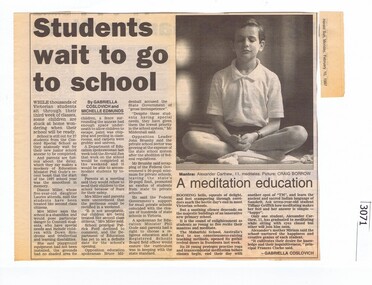
Newspaper clipping, Students wait to go to school - Concord School Bu5027, 10/02/1997
... Article by Gabriella Coslovich and Michelle Edmunds on delays to completion of the junior annexe of Concord School Bundoora, which are preventing students' attendance; and an article on the Maharishi School, also in Bundoora, where students study transcendental meditation....Article by Gabriella Coslovich and Michelle Edmunds on delays to completion of the junior annexe of Concord School Bundoora, which are preventing students' attendance; and an article on the Maharishi School, also in Bundoora, where students study transcendental meditation. concord school bundoora maharishi school bundoora transcendental meditation loyola college Two articles with text and photograph Students wait to go to school - Concord School Bu5027 Newspaper clipping Herald Sun Gabriella Coslovich Michelle Edmunds ...Article by Gabriella Coslovich and Michelle Edmunds on delays to completion of the junior annexe of Concord School Bundoora, which are preventing students' attendance; and an article on the Maharishi School, also in Bundoora, where students study transcendental meditation.Two articles with text and photographconcord school bundoora, maharishi school bundoora, transcendental meditation, loyola college -
 Lakes Entrance Historical Society
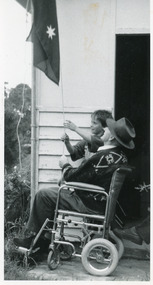
Photograph - Kalimna West Hall 1992, Lakes Post Newspaper
... Black and white photograph of local residents bringing down flag at Kalimna West School closure, oldest and youngest students in attendance. Kalimna West Victoria...Schools Ceremony School closure Black and white photograph of local residents bringing down flag at Kalimna West School closure, oldest and youngest students in attendance. Kalimna West Victoria Photograph Kalimna West Hall 1992 Lakes Post Newspaper ...Black and white photograph of local residents bringing down flag at Kalimna West School closure, oldest and youngest students in attendance. Kalimna West Victoriaschools, ceremony, school closure -
 Federation University Historical Collection
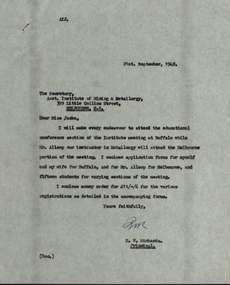
Document - Correspondence, Miss B.E. Jacka, Secretary of the Australasian Institute of Mining and Metallurgy et al, Australasian Institute of Mining and Metallurgy correspondence with the Ballarat School of Mines, 1949, 1949
... (Dick) Richards (Principal of the Ballarat School of Mines) .1) Curcular for the first ordinary meeting in 1950 .2) Dick Richards re conference at Buffalo, Melbourne, and student attendances .3) 15 students attending the first ordinary meeting in 1950 .4) Re meeting .5) Guide book and training of students in mining, metallurgy and geology. ...(Dick) Richards (Principal of the Ballarat School of Mines) .1) Curcular for the first ordinary meeting in 1950 .2) Dick Richards re conference at Buffalo, Melbourne, and student attendances .3) 15 students attending the first ordinary meeting in 1950 .4) Re meeting .5) Guide book and training of students in mining, metallurgy and geology. ...Five pages of correspondence between B.E. Jacka AUSImm Secretary) and R.W. (Dick) Richards (Principal of the Ballarat School of Mines) .1) Curcular for the first ordinary meeting in 1950 .2) Dick Richards re conference at Buffalo, Melbourne, and student attendances .3) 15 students attending the first ordinary meeting in 1950 .4) Re meeting .5) Guide book and training of students in mining, metallurgy and geology. buffalo, ausimm, australasian institute of mining and metallurgy, dick richards, r.w. richards, b.e. jacka, letterhead, mining -
 Bendigo Military Museum
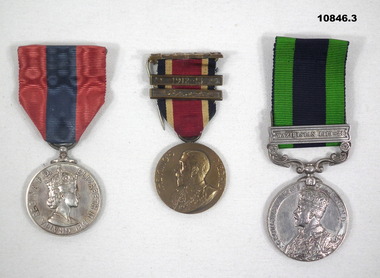
Award - MEDALS, IMPERIAL BRITISH, Unknown
... The Kings Medal is a bronze Council medal awarded for Student Attendance & Conduct, 3. Medal had to be awarded with clasp. ...The Kings Medal is a bronze Council medal awarded for Student Attendance & Conduct, 3. Medal had to be awarded with clasp. ...1. QEII Imperial Service Medal Instituted Aug 1902 by EDWARD VII to reward Long & Faithful Service by Junior grades within the Civil Service 2. The Kings Medal is a bronze Council medal awarded for Student Attendance & Conduct, 3. Medal had to be awarded with clasp. The WAZIRISTAN CLASP awarded t punitive by British & Indian Units against the TOCHI & WAWA WAZIRS & MAHSUDS between May 1919 and Jan 1921Three medals with ribbons, unmounted. 1. QEII Imperial Service Medal with ribbon and pin at back. 2. The Kings Medal with bar 1912-13 and extra bar. 3. British India Central Service Medal WAZIRISTAN 1919-21 with clasp.1. No inscription. 2. Named to "B. SONSTER" and inscribed "AWARD BY THE COVENTRY COUNCIL FOR CONDUCT & INDUSTRY DURING THE YEAR. 3. Named "29427 PR FOWLER P.A.S. HRS"ron mills collection, medals, british imperial -
 Alfred Hospital Nurses League - Nursing History Collection
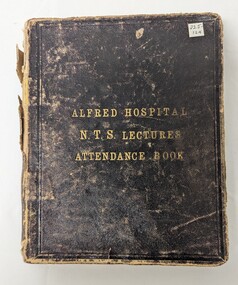
Administrative record - Attendance Book, Alfred Hospital N.T.S. Lecture Attendance Book, [ca.1910]
... Book was used to record student nurses' attendance at lectures, examination marks from 1911 to 1926 at the Alfred Hospital Nurse Training School. ...Book was used to record student nurses' attendance at lectures, examination marks from 1911 to 1926 at the Alfred Hospital Nurse Training School. ...Book was used to record student nurses' attendance at lectures, examination marks from 1911 to 1926 at the Alfred Hospital Nurse Training School. The book also contains examination papers from this period and other miscellaneous informationOf significance to the AHNL as a record of student nursesWorn black leather cover with embossed border. Title stamped in gilt on frontSmall white sticker at top right of front cover on which previous catalogue number is written. Book contains handwritten entries. There are also some typed notes that have been glued inalfred hospital, alfred hospital school of nursing, student nurse training alfred hospital, nurse training - history -
 Mont De Lancey
Book, Thomas Nelson and Sons, The Uncharted Island
... Book Prizes were given to Sunday School students for attendance and diligence. This book was gifted by the then head teacher William Chapman in 1909 Ernest Chapman in 1909 for getting the first academic prize in his class at South Wandin Baptist School....Book Prizes were given to Sunday School students for attendance and diligence. This book was gifted by the then head teacher William Chapman in 1909 Ernest Chapman in 1909 for getting the first academic prize in his class at South Wandin Baptist School. ...It was published c.1909 and is a story set on the high seas. It takes readers on an an adventure to a mysterious and unknown land.A brown homemade cloth covered adventure novel for young readers, The Uncharted Island by Skelton Kuppord. It has an inscription on the right front end paper, black and white frontispiece illustration of three sailors with a boy on the deck of a sailing ship. The title page has the title and a galleon illustration in full sail with publisher details below. A few black and white illustrations are throughout the book. Pp.350fictionIt was published c.1909 and is a story set on the high seas. It takes readers on an an adventure to a mysterious and unknown land.children's fiction, adventure fiction, fiction for boys -
Federation University Historical Collection
Booklet, Education Department Victoria Technical Schools Register of Attendances in Carpentry and Carpentry, 1985, 1985
... It includes attendances for students in Carpentry and Joinery. The instructor was Jeff White....It includes attendances for students in Carpentry and Joinery. The instructor was Jeff White. ...Blue hard covered book with greentape spine. It includes attendances for students in Carpentry and Joinery. The instructor was Jeff White.ballarat school of mines, trades, building skills, jeff white -
Federation University Historical Collection
Booklet, Education Department Victoria Technical Schools Register of Attendances in Woodwork, 1985, 1985
... It includes attendances for students in Woodwork. The instructor was B. ...It includes attendances for students in Woodwork. The instructor was B. ...Blue hard covered book with red tape spine. It includes attendances for students in Woodwork. The instructor was B. Jacobson.ballarat school of mines, trades, building skills, b. jacobson, sharon leckie -
Federation University Historical Collection
Booklet, Education Department Victoria Technical Schools Register of Attendances in Carpentry, 1985, 1985
... It includes attendances for students in Woodwork. The instructor was Jeff White....It includes attendances for students in Woodwork. The instructor was Jeff White. ...Blue hard covered book with red tape spine. It includes attendances for students in Woodwork. The instructor was Jeff White.ballarat school of mines, trades, building skills, jeff white -
Federation University Historical Collection
Booklet, Education Department Victoria Technical Schools Register of Attendances in Carpentry, 1985, 1985
... It includes attendances for students in Building Skills. The instructor was John Tobin. ...It includes attendances for students in Building Skills. The instructor was John Tobin. ...Blue hard covered book with green tape spine. It includes attendances for students in Building Skills. The instructor was John Tobin. ballarat school of mines, trades, building skills, john tobin -
 Federation University Historical Collection
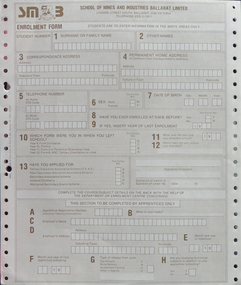
Booklet, Education Department Victoria Technical Schools Register of Attendances in the Subject of Joinery, 1986, 1986
... It includes attendances for students in Joinery. The instructor was George Pyke. ...It includes attendances for students in Joinery. The instructor was George Pyke. ...Blue hard covered book with red tape spine. It includes attendances for students in Joinery. The instructor was George Pyke. Includes a blank Ballarat School of Mines enrolment form.joinery, ballarat school of mines, george pyke, trades -
 Bendigo Historical Society Inc.
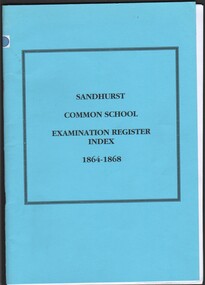
Booklet - Sandhurst Common School, Examination Register Index 1864 - 1868
... Thomas H Smith, Inspector of Schools in the Sandhurst district examined the students in attendance and twice a year, over the period of the register. ...Thomas H Smith, Inspector of Schools in the Sandhurst district examined the students in attendance and twice a year, over the period of the register. ...In 1855 the local Presbyterians were granted land in Myers Street. The first building they erected was a large church hall for use as a day school, Sunday school and temporary accommodation for church services. It was opened on 14th May 1855 as a Denominational School. New educational regulations were introduced in 1864 and were quite specific about standards. Children were required to attend at least 50 days each half year. Thomas H Smith, Inspector of Schools in the Sandhurst district examined the students in attendance and twice a year, over the period of the register. March 1864 to Match 1868. Sandhurst Common School, Examination Register Index 1864 - 1868. Published by Bendigo Area, Australian Institute of Genealogical Studies in 2002. Light blue card cover. Bound spine.education, schools -
Northern District School of Nursing. Managed by Bendigo Historical Society Inc.
Administrative record - Northern District School of Nursing List of Students in Preliminary Training Schools (3-44), 1950-59
... Northern District School of Nursing List of Students in Preliminary Training Schools (3-44) - 17 pages This item contains the following document: 3791.6a This document is a comprehensive record of students' attendance at Preliminary Training Schools from 1950 to 1959. ...Nurse Training Lister House list of students Northern District School of Nursing List of Students in Preliminary Training Schools (3-44) - 17 pages This item contains the following document: 3791.6a This document is a comprehensive record of students' attendance at Preliminary Training Schools from 1950 to 1959. ...Managed by a committee including hospital administrators, medical professionals, and nursing leaders from several regional hospitals. Associated with major hospitals in the Northern District, including Bendigo Base, Mildura Base, Castlemaine, Echuca, Swan Hill, St. Arnaud, and Kyneton District Hospitals. Provide high-quality theoretical and practical nursing training. Raise the standard of nursing education in the region. Maintain the highest principles of nursing practice. Applicants must be at least 17 years old and hold a Proficiency Certificate or higher educational qualification. Application involves submitting forms, certificates, an interview, an aptitude test, and a medical examination. A three-month probationary period follows initial acceptance. Preliminary Training School: Four-week introductory course covering basic nursing, anatomy, hygiene, and practical skills. Practical experience in various hospital departments, guided by senior staff. Study Block Plan: Includes several blocks of theoretical and practical instruction throughout the three-year program. Regular school exams and two state exams (First Professional and Final State) are required for progression and graduation. Nurses work a 40-hour week with at least one or two days off per week and three weeks of annual leave. Accommodation is provided in comfortable hostels with good facilities. Uniforms are supplied free; nurses provide their own shoes and stockings. Salaries and allowances are regulated, with deductions for board and free medical care. Additional Information Post-Graduate Opportunities. Senior positions require further experience and additional certificates (e.g., Midwifery, Infant Welfare).Diploma courses available in administration, teaching, and specialized nursing fields. Bursaries are available for advanced study.Career Prospects: Graduates can pursue roles in administration, teaching, ward and departmental leadership, district and visiting nursing, industrial and school nursing, and more. Opportunities exist both within hospitals and in community or specialized settings.FAQs and Practical Details. Minimal training costs (mainly exam fees and personal items).Living out allowances and travel expenses are covered. Four training intakes per year; waiting periods are short if qualifications are met.Northern District School of Nursing List of Students in Preliminary Training Schools (3-44) - 17 pages This item contains the following document: 3791.6a This document is a comprehensive record of students' attendance at Preliminary Training Schools from 1950 to 1959. It lists the names, addresses, and training dates for each student, organized by training session. The document serves as an attendance and registration log for students attending Preliminary Training Schools over several years. Each entry typically includes the student's full name, home address, and the location or region of their training. Training sessions are grouped by date, with each session listing all attendees. Covers training sessions from July 1950 through at least late 1959.Sessions are sequentially numbered and dated, showing the progression of training cohorts. The document is structured in tabular format, making it easy to reference individual students and their details. Students come from a wide range of towns and regions, including Bendigo, Mildura, Swan Hill, Castlemaine, Echuca, St. Arnaud, Kyneton, and others. Some addresses are listed as unknown or only partially available, indicating incomplete records for a few students. Some students have updated names (e.g., married names) or additional notes about their address or status. The document reflects the mobility and diversity of students entering training during this period.nurse training, lister house, list of students -
Ringwood and District Historical Society
Document, Ringwood Technical School, 1982 - Policies, Structures, Roles, SRC, Camp Duncan Rules etc
... The Index pdf lists the contents of each part but is repeated here: Part 1 • General Educational Policy • Procedures Adopted By The Curriculum Board In Order To Implement The Educational Policy Part 2 • School Administrative Structure o Operational Structure - Operations Committee o Curriculum Board o Org Chart • Role of the Senior Teacher • Role of Head of Department • Role of Assistant with Responsibility • Role of Year Level Coordinator • Role of Section Leader Part 3 • Role of the Welfare Officer • Bell Times 1983 • School Layout • Evacuation Procedure and Diagram • Recording of Students’ Attendance • Staff Absences • Concerning School Rules Part 4 - SRC • Students; Representative Council – Constitution and Rules Part 5 – Camp Duncan, Excursion etc • Camp Duncan Disposition of Duties 1983 • Receipts/forms pro-forma • Some Facts About Camp Duncan • Camp Duncan Date 1983 • Student Checklist and Luggage Requirements for Camps and excursions • Confidential Medical Report for School Camps • Parental Permission Form Part 6 • Education Department Victoria o Pay Advice and Allowance Table o Subject Coding o Leave o General Advice on Transfers o Excursion procedure, Approval Form • Student Assembly Points ...The Index pdf lists the contents of each part but is repeated here: Part 1 • General Educational Policy • Procedures Adopted By The Curriculum Board In Order To Implement The Educational Policy Part 2 • School Administrative Structure o Operational Structure - Operations Committee o Curriculum Board o Org Chart • Role of the Senior Teacher • Role of Head of Department • Role of Assistant with Responsibility • Role of Year Level Coordinator • Role of Section Leader Part 3 • Role of the Welfare Officer • Bell Times 1983 • School Layout • Evacuation Procedure and Diagram • Recording of Students’ Attendance • Staff Absences • Concerning School Rules Part 4 - SRC • Students; Representative Council – Constitution and Rules Part 5 – Camp Duncan, Excursion etc • Camp Duncan Disposition of Duties 1983 • Receipts/forms pro-forma • Some Facts About Camp Duncan • Camp Duncan Date 1983 • Student Checklist and Luggage Requirements for Camps and excursions • Confidential Medical Report for School Camps • Parental Permission Form Part 6 • Education Department Victoria o Pay Advice and Allowance Table o Subject Coding o Leave o General Advice on Transfers o Excursion procedure, Approval Form • Student Assembly Points Ringwood Technical School, 1982 - Policies, Structures, Roles, SRC, Camp Duncan Rules etc Document ...Set of Documents describing school policies, structure, roles, SRC, Camp Duncan, subject coding, emergency procedures etc. Scanned in 6 parts due to volume of pages. Most pages are not numbered. Donated by Joan Pickford (nee Dear) 2022. (Prefect 1970-71). The Index pdf lists the contents of each part but is repeated here: Part 1 • General Educational Policy • Procedures Adopted By The Curriculum Board In Order To Implement The Educational Policy Part 2 • School Administrative Structure o Operational Structure - Operations Committee o Curriculum Board o Org Chart • Role of the Senior Teacher • Role of Head of Department • Role of Assistant with Responsibility • Role of Year Level Coordinator • Role of Section Leader Part 3 • Role of the Welfare Officer • Bell Times 1983 • School Layout • Evacuation Procedure and Diagram • Recording of Students’ Attendance • Staff Absences • Concerning School Rules Part 4 - SRC • Students; Representative Council – Constitution and Rules Part 5 – Camp Duncan, Excursion etc • Camp Duncan Disposition of Duties 1983 • Receipts/forms pro-forma • Some Facts About Camp Duncan • Camp Duncan Date 1983 • Student Checklist and Luggage Requirements for Camps and excursions • Confidential Medical Report for School Camps • Parental Permission Form Part 6 • Education Department Victoria o Pay Advice and Allowance Table o Subject Coding o Leave o General Advice on Transfers o Excursion procedure, Approval Form • Student Assembly Points rts, ringwood tech -
 Federation University Historical Collection
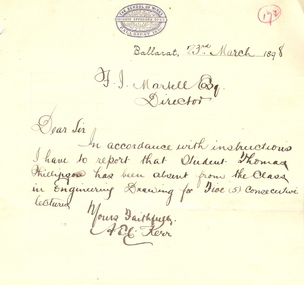
Document, Ballarat School of Mines letter concerning Thomas Philipson, 23 March 1898
... .1) One page hand written letter on Ballarat School of Mines letterhead relating to the repeated non attendance of student Thomas Phillipson in Engineering Drawing. .2) Response from Thomas Phillipson stating that he missed class as he had to look after the St Andrew's Sunday School for the United Masonic Choir Practice as his father was otherwise engaged....Martell, informing him that student Thomas Phillipson had been absent from 5 consecutive lectures. ballarat school of mines frederick martell alfred kerr fj martell alfred ec kerr aec kerr thomas phillipson united masonic choir st andrews ballarat .1) One page hand written letter on Ballarat School of Mines letterhead relating to the repeated non attendance of student Thomas Phillipson in Engineering Drawing. .2) Response from Thomas Phillipson stating that he missed class as he had to look after the St Andrew's Sunday School for the United Masonic Choir Practice as his father was otherwise engaged. ...The writer of the letter, Alfred E.C. Kerr was a lecturer in Engineering Drawing at the Ballarat School of Mines. He wrote to the registrar, Fred. J. Martell, informing him that student Thomas Phillipson had been absent from 5 consecutive lectures. .1) One page hand written letter on Ballarat School of Mines letterhead relating to the repeated non attendance of student Thomas Phillipson in Engineering Drawing. .2) Response from Thomas Phillipson stating that he missed class as he had to look after the St Andrew's Sunday School for the United Masonic Choir Practice as his father was otherwise engaged.ballarat school of mines, frederick martell, alfred kerr, fj martell, alfred ec kerr, aec kerr, thomas phillipson, united masonic choir, st andrews ballarat -
 Federation University Historical Collection
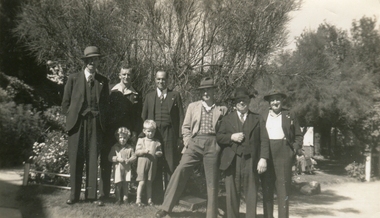
Photograph, Delegates to the ANA Conference, 1947, 21/03/1947
... The Governor of Victoria, Sir Henry Barkly, laid its foundation stone in 1857 with the Bishop of Melbourne and the Archdeacon of Geelong in attendance. The student boarder population grew rapidly to call 55 Maud Street their home. ...The Governor of Victoria, Sir Henry Barkly, laid its foundation stone in 1857 with the Bishop of Melbourne and the Archdeacon of Geelong in attendance. The student boarder population grew rapidly to call 55 Maud Street their home. ...Dysart is a Tudor Gothic building used as the original site of Geelong Grammar School. The Governor of Victoria, Sir Henry Barkly, laid its foundation stone in 1857 with the Bishop of Melbourne and the Archdeacon of Geelong in attendance. The student boarder population grew rapidly to call 55 Maud Street their home. After the school relocated to a larger site in 1914, the building was subdivided into a factory and a guesthouse called the Dysart Private Hotel. In 1961, it was again converted into the Reformed Theological College then later a private residence. In 2018 55 Maud Street had fallen into a state of disrepair, but was renovated to provide 28 premium dormitories in a peaceful and gorgeous setting.Small black and white photo.Verso "Taken oustise "Dysart" 21-3-47 Delegates ANA Conference 1947 Geelongana, australian natives association, geelong, dysart -
 Federation University Historical Collection
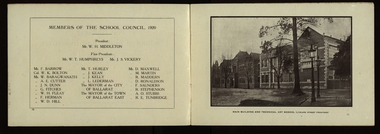
Booklet, The Ballarat School of Mines and Industries 1870-1920 Jubilee Booklet, 1920 (estimated)
... students at first were mostly adults. They were chiefly men emloyed at the mines, who had the wisdom and energy to devote their spare time to study, and, though their attendance was somewhat irregular, they made very good progress. ...students at first were mostly adults. They were chiefly men emloyed at the mines, who had the wisdom and energy to devote their spare time to study, and, though their attendance was somewhat irregular, they made very good progress. ...The first school of Mines in Australia was established at Ballarat in 1870. At the time of its jubilee (1930) the following people were members of the School Council: W.H. Middleton (President), W.T. Humphreys (VP), J.S. Vickery (VP), F. Barrow, Col. W.K. Bolton, William Baragwanath, A.E. Cutter, J.N. Dunn, G. Fitches, W.H. Fleay, F. Herman. W.D. Hill, T. Hurley, K. Kean. J. Kelly, L. Lederman, Mayor of Ballarat, Mayour of Ballarat East, D. Maxwell, M. Martin, R. Maddern, D. Ronaldson, F. Saunders, R. Stephenson, A.O. Stubbs, R.E. Tunbridge. The School Staff in 1920 comprised: Herbert H. Smith, Walter Rowbotham, Reginald L. Cutter, M.C. Young, Hilda Wardle, M. Wiliamson, P.S. Richards, L.H. Archibald, J. Woods, Ken Moss, W. Kenneth, Mrs McIlvena. B. Robinson, S. Rowe, E. Hope-Jones, Miss Abrams, L.St.G.P. Austin, Alfred Mica Smith, J.R. Pound, Herbert R. Murphy, N.H. Junner, Maurice Copland, L.H. Archibald, E.J.A. McConnon, Newton King, D.m. Hull, T.R. Gordon, John M. Sutherland, T.K. Jebb, Dick Richards, C. Tonkin, A.W. Steane, J. Paterson, H.W. Malin, R.V. Maddison, S.M. Mayo, F.A. King, W.H. Steane, T.R. Gordon, T.A. Williams, H. Waldron, G. Black, E.J. McConnon, R.V. Duncan. R. Cutter, E.G. Vawdrey, Hilda WardleWhite stapled booklet - landscape format - 20pp + soft covers with blue writing. Includes an historical sketch of the Ballarat School of Mines. Contains images of the school from around 1920. The history outlined in the booklet follows: 'Ballarat has helped to influence the life and destinies of Australia in many ways, the recital of which would perhaps prove tedious to the citizens of less favoured localities! However, it can be said, without much fear of contradiction, that only less known thought Australia than its fame as a gold field is the reputation won for it by its school of Mines, ... Ballarat was still quite a new place when the School was founded, but a very propserous and popular place all the same, with a go-ahead lot of citizens brim full of the spirit of enterprise which seemsto animate mining populations generally. Money was plentiful, and they launched out into ventures, which later, were to develop and take the place of the gold mines, while what is more to the point, they understood the value of education. the old digging days were passing away. So far as Ballarat itself was concerned the day of the cradle and tin dish had already passed into an antiquity "as dead and distant as the age of the Tubal Caon," said dir redmond Barry on declaring the School open. Mining had become a serious business, and the mining engineer, the metallurgist, and the geologist had become a power in the land. In these circumstances the suggestions to found a School of Mines met with ready acceptance. The late Mr James M. Bickett had the honor of bringing forward the proposition at a meeting of the Ballarat Mining Board in October, 1869. it was agreed to, and the Government, having been approached for assistance, granted a lease of the old Supreme Court buildings at a nominal reantal. A modest sum, including 100 pounds from the Borough Council of Ballarat West, was subscribed by a number of sympathisers, and on the 26th October, 1870, the inaugural address was delivered by Sir Redmond Barry, the first President of the School. Classes were commenced on the 23rd January, 1871. The students at first were mostly adults. They were chiefly men emloyed at the mines, who had the wisdom and energy to devote their spare time to study, and, though their attendance was somewhat irregular, they made very good progress. Old prints which have been preserved show them at work at furnaces, big bearded men of the old-fashioned type of miner. It is interesting to note that among those who gave evidence and encouragement was Sir Roderick Murchison, who many years before had advised Cornish miners to emigrate to Australia to search for gold, and who in 1848 was in possession of gold ore sent from this country. Sir Roderick sent a parcel of books for the library, and gave useful advice as to the curriculum which should be adopted. The Museum, which now contains a most valuable collection of minerals, was one of the first things attended to, and the reports presented to the Council from time to time speak of additions being made from all parts of the world. New equipment was constantly being added to the School, a good deal of assay work was done, and some specimens were sent from the East Indies for examination as far back as 1873. By this time there was a difficulty in providing accomodation for the students who wished to enrol, and the number of instructors had grown from two to four. In 1882 the first building was being erected on what was then part of the gaol reserve. A little more than ten years afterwards a buildnig formerly serving as a Methodist Church was absorbed, while later on, the demand for accomodation increasing, the attack upon the gaol was renewed. The School continued to grow in reputation and size, and became the science centre of the district, and in 1889 a learge new building was opened by Sir Alexander Peacock. Students came from over seas as well as from all the States of Australia, and after going through their courses they took with them the name and fame of the old School to all parts of the globe. School of Mines boys have played a great part in developing the mining fields of Western Australia, South Australia, and africa, while old students who have made a name in their profession are constantly dropping in to see how the old place is getting along. It was not to be expected, however, that the Ballarat School would be left without rivals, its very success inspiring competition. Mining Schools were started in other parts of Australia, and, at the same time, Victoria ceased to hold first place as a mining state. On the other hand there was a great advance in manufacturing, and the demand for technicaly trained men became a great and as insistent as ever it had been for trained mining men. The Council was quick to adapt the school to the new conditions, and the result is seen in the institution, which is one of Ballarat's proudest possession. Instruction is given in all branches of technical work, and the classes are filled with students who are building up for Ballarat a reputation as an industrial centre, which promises to equal that which it formerly held as a mining town. Owing to its bracing climate, its abundant opportunities for recreations, and its accessibilty, Ballarat as a city is an ideal place for educational purposed, and is yearly becoming more and more appreciated throughout the State. The chairman of one of Ballarat's biggests industries claims that the workman can do twice the day's work here that he can do in Melbourne. he was a little enthusiastic over it, perhaps, but it is a well-known fact that the healthy and invigourating Ballarat climate is conducive to both physical and mental activity, and the records of the School provide ample proof of it. One of the most interesting and successful branches of the School of Mines and Industries - if the name be enlarged with the enlargement of its scope - is the Technical Art School. "The City of Statues" has from its earliest days been a stronghold of art. Art schools have flourised here, and in 1905 the Education Department came to the conclusion that the best thing to do with them was to place them under the management of the School of Mines Council. A magnificent new Technical Art School was built at a cost of some 12,000 pounds on the site of the old Supreme Court building, and was formally opened on the 23rd July, 1915. The results have not only been justified but surpassed all anticipations. The most comprehensive list of subjects is taught, and this list is constantly added to. Students have flocked to the art School, which may be said to occupy a unique position in Australia, and its record of success is really astonishing. Its students supply art teachers for the newer schools that are being built, and many occupy leading positinos in important business houses. So well is its reputation known that orders are constantly being received, not only from Victoria, but from other States, for honor boards and challenge shields to be designed and made. The most recent addition to the School of Mines and Industries is the Junior Technical School, for which a new building is now being erected on a portion of the gaol site, transferred to the School of Mines Counci by the Government. At the present moment temporary quarters are being occupied. Some students after passing through the Junior School go straight to employment, continuing perhaps to attend the evening trade classes, while others move on to the senior School. In a review of the work of the School of Mines mention must be made of a series of industrial research carried out under supervision of the Principal. One in particular, regarding the suitability of the local ores for the manufacture of pigments attracted much attention, while the experiemtns on the manufacture of white potery from Victorian clayes were considered of sufficient importance by the Federal Advisory Council of Science and Industry to warrant the appointment of a special investigator. The results of these have been most encouraging, and may have far-reaching consequences. The vocational training of returned soldiers also should not be overlooked. The work was taken in hand from the first, before the Repatriation Department gave assistance, and now with the help of the department of the School has become one of the largest vocational training centres in Victoria outside of Melbourne. The soldiers, trained in a variety of occupations, have made remarkable progress, and already considerable numbers have found employment in local workshops and factories. To sum up, the School is divided into the following departments, each well staffed and equipped: - The School of Mines, science, and Engineering; the Techncial Art School, the Boys' Junior Technical School, the Girl's Preparatory Technical Classes, Trade Classes, and the Commercial School. The school of Mines, science and Engineering, comprises the following branches: - Mining, Metallurgy, Geology, Electrical Engineering, Civil Engineering, Mechanical Engineering, Applied Chemistry, and Pharmacy. Battery treatments, Cyanide Testing, Smelting, Assays, and Clay Testing from a regular part of the School's work. Students gaining qualifications obtain concession in their courses at the university, should they proceed there to continue their studies. The technical Art school curriculum includes training in all branches of pictorial and applied art, an Architectural Diploma Course, a Draughtman's Course, technical Art teachers' Course, Photography,Ticket Writing, Art Metal Work, Woodcarving, Needlework, and Leather work. The Trade Classes give instruction in Telephone Mechanics, telegraphy, Carpentry, Cabinet Making, Plumbing, Blacksmithing, Fitting, Electric Wiring, and Printing. Numerous Scholarships are offered every year, and altogether students will find few places to equal the Ballarat School of Mines and Industries as a training place for their life's work. One of the first in the continent to be established, its Jubilee finds it still in the front rank, keeping pace with the times, and offering to the youths of this country the means of taking advantage of Australia's teeming opportunities. william, battery, smith, herbert, drawing from the antique, ballarat school of mines botanical gardens, ballarat school of mines, redmond barry, alfred mica smith, james bickett, museum, dick richards, ballarat junior technical school, s m b, ballarat school of mines and industries, ballarat technical art school, model mine, james m bickett, j m bickett, roderick murchison, vocational training rooms, wesley church, methodist church, alexander peacock, lathes, repatriation, repatriatin department, war service, school council, baragwanath, gold mining, mining laboratory, plaster cast, r.w. richards, anniversary, jubilee -
 Federation University Historical Collection
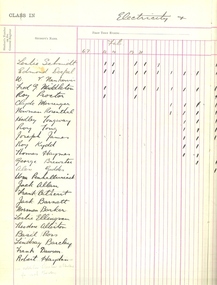
Register, Education Department Victoria, Ballarat School of Mines register of Attendance in the Subject of Electricity and Magnetism, 1912, 1912
... Sutherland, had been a student of Henry Sutton. henry sutton ballarat school of mines john m sutherland john mckenzie sutherland electricity and magnetism leslie schmidt edmond doepel u v nankervis fred middleton roy proctor clyde messenger newman rosenthal hendley tongway roy tong joseph james roy kydd thomas haymes george brewster alex geddes urn penhalluriack jack allan frank cathcart jack barnett norman barker leslie ellingsen theodore alliston basil ross lindsay barclay frank dawson robert hayden Foolscap hard covered register with handwritten class list and attendances. ...The subject 'Electricity & Magnetism; was taught at the Ballarat School of Mines. The teacher, John M. Sutherland, had been a student of Henry Sutton.Foolscap hard covered register with handwritten class list and attendances.henry sutton, ballarat school of mines, john m sutherland, john mckenzie sutherland, electricity and magnetism, leslie schmidt, edmond doepel, u v nankervis, fred middleton, roy proctor, clyde messenger, newman rosenthal, hendley tongway, roy tong, joseph james, roy kydd, thomas haymes, george brewster, alex geddes, urn penhalluriack, jack allan, frank cathcart, jack barnett, norman barker, leslie ellingsen, theodore alliston, basil ross, lindsay barclay, frank dawson, robert hayden -
 Federation University Historical Collection
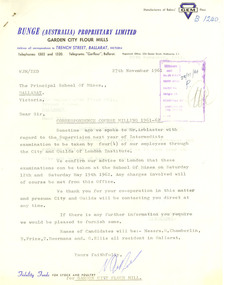
Correspondence, Bunge (Australia) Pty Ltd correspondence to the Ballarat School of Mines, 1961
... students under the supervision of the Ballarat School of Mines. (.1c) Typed letter on white paper from Principal of the Ballarat School of Mines, Harry Arblaster, stating they are awaiting further direction from London. (.2a) Typed letter on Bunge letterhead requesting an apprentice sheet rating sheet from the Ballarat School of Mines on E.D. Walker. The letter has a handwritten response prepared for typing. (.2b) Typed copy letter on white paper from Ballarat Schoolof Mines Principal Harry Arblaster concerning a report on Apprentice E.D. Walker. (.2c) Typed report on attendances...students under the supervision of the Ballarat School of Mines. (.1c) Typed letter on white paper from Principal of the Ballarat School of Mines, Harry Arblaster, stating they are awaiting further direction from London. (.2a) Typed letter on Bunge letterhead requesting an apprentice sheet rating sheet from the Ballarat School of Mines on E.D. Walker. The letter has a handwritten response prepared for typing. (.2b) Typed copy letter on white paper from Ballarat Schoolof Mines Principal Harry Arblaster concerning a report on Apprentice E.D. Walker. (.2c) Typed report on attendances ...If orgniasations required to examine Ballarat residents they often requested the Ballarat School of Mines to supervise the examination. This correspondence highlights such a case - where exams from a London organisation were conducted at the Ballarat School of Mines. A selection of correspondence from Bunge Pty Ltd (Garden City flour Mills) to the Ballarat School of Mines. (.1a) White typed letter on Bunge letterhead relating to students in course milling undertaking examinations through the City and Guilds of London. The candidates were R. Chamberlin, B. Price, T. Boermans and G. Ellis. All were resident in Ballarat. (.1b) Typed letter on blue paper from A.G. Blake, head of examinations Division 1 at the City and Guilds of London Institute re examinations of students under the supervision of the Ballarat School of Mines. (.1c) Typed letter on white paper from Principal of the Ballarat School of Mines, Harry Arblaster, stating they are awaiting further direction from London. (.2a) Typed letter on Bunge letterhead requesting an apprentice sheet rating sheet from the Ballarat School of Mines on E.D. Walker. The letter has a handwritten response prepared for typing. (.2b) Typed copy letter on white paper from Ballarat Schoolof Mines Principal Harry Arblaster concerning a report on Apprentice E.D. Walker. (.2c) Typed report on attendances and (by E.G. Quilliam) andattendance progress om E. Walker in the Carpentry Department (by J.S. Lochhead) relating to Apprentice E. Walker. bunge, garden city flour mills, flour mill, guilds, city and guilds of london institute, ag blake, ballarat school of mines, e.d. walker, carpentry, he arblaster, eg quilliam, js lochhead -
Federation University Historical Collection
Register of Attendances, Ballarat School of Mines Register of Attendances, 1983, 1983
... Light blue hard cover with red taped spine Education Department Victoria Technical Schools Register of attendances for the year 1983 in the subject of Carpentry and joinery. Students in the Subject 'Hobby Woodwork' include Pam Fisher, Mora Purcell, John Simpson, Rudy Panozza, Ann Sutherland, Pam Burke, Lucy Callaghan, Monica Maud. ...Students in the subject 'Transition Carpentry' include Victor Cvirn, Paul Martin, Jeff Males, Michael Smith Record closed. Ballarat School of Mines Register of Attendances, 1983 Register of Attendances ...The register lists names and attendances of trade classes at the Ballarat School of Mines.Light blue hard cover with red taped spine Education Department Victoria Technical Schools Register of attendances for the year 1983 in the subject of Carpentry and joinery. Students in the Subject 'Hobby Woodwork' include Pam Fisher, Mora Purcell, John Simpson, Rudy Panozza, Ann Sutherland, Pam Burke, Lucy Callaghan, Monica Maud. Students in the subject 'Building Graphics' include Joseph Antonelli, Kevin Murphy, Stephen Pollock, Paul Scholz. Students in the subject 'Transition' include Barry Angee, Paul Bailey, David Jebb, Wayne Empson, Dennis Kied Students in the subject 'Carpentry and Joinery' are Chris Murphy, Andrew Nicol, Rae Bradley, Glenn Wilcox, Darren James, Peter Jacobson. Students in the subject 'Transition Carpentry' include Victor Cvirn, Paul Martin, Jeff Males, Michael Smith Record closed.ballarat school of mines, trades, carpentry and joinery -
Federation University Historical Collection
Register of Attendances, Ballarat School of Mines Register of Attendances, 1983, 1983
... attendances for the year 1983 in the subject of Building and Construction. Names in the register include Gary Cain, Peter Corrie, Rick Atkinson, David Boadle, Don Hines, Peter O'Donnell, Annette Earles, Albert Stone, Charles Britten, Shane Brereton, Paul Harris, Annette Barby, Raymond Dalton The following students are some listed under Hobby Woodwork classes - Frank Berry, Bev Cochrane, Simon Cochrane, Margaret Copeland, Kath Dean, Margaret Knowles, Elizabeth Munt, Des Shortal, Marj Wilkenson, Val Hibberd, Pat Colquhoun. ...attendances for the year 1983 in the subject of Building and Construction. Names in the register include Gary Cain, Peter Corrie, Rick Atkinson, David Boadle, Don Hines, Peter O'Donnell, Annette Earles, Albert Stone, Charles Britten, Shane Brereton, Paul Harris, Annette Barby, Raymond Dalton The following students are some listed under Hobby Woodwork classes - Frank Berry, Bev Cochrane, Simon Cochrane, Margaret Copeland, Kath Dean, Margaret Knowles, Elizabeth Munt, Des Shortal, Marj Wilkenson, Val Hibberd, Pat Colquhoun. ...The register lists names and attendances of trade classes at the Ballarat School of Mines.Light blue hard cover with green taped spine Education Department Victoria Technical Schools Register of attendances for the year 1983 in the subject of Building and Construction. Names in the register include Gary Cain, Peter Corrie, Rick Atkinson, David Boadle, Don Hines, Peter O'Donnell, Annette Earles, Albert Stone, Charles Britten, Shane Brereton, Paul Harris, Annette Barby, Raymond Dalton The following students are some listed under Hobby Woodwork classes - Frank Berry, Bev Cochrane, Simon Cochrane, Margaret Copeland, Kath Dean, Margaret Knowles, Elizabeth Munt, Des Shortal, Marj Wilkenson, Val Hibberd, Pat Colquhoun. Record closed. -
Federation University Historical Collection
Booklet, The Ballarat School of Mines and Industries 1870-1920 Jubilee Booklet, 1920 (estimated)
... students at first were mostly adults. They were chiefly men emloyed at the mines, who had the wisdom and energy to devote their spare time to study, and, though their attendance was somewhat irregular, they made very good progress. ...students at first were mostly adults. They were chiefly men emloyed at the mines, who had the wisdom and energy to devote their spare time to study, and, though their attendance was somewhat irregular, they made very good progress. ...The first school of Mines in Australia was established at Ballarat in 1870. At the time of its jubilee (1930) the following people were members of the School Council: W.H. Middleton (President), W.T. Humphreys (VP), J.S. Vickery (VP), F. Barrow, Col. W.K. Bolton, William Baragwanath, A.E. Cutter, J.N. Dunn, G. Fitches, W.H. Fleay, F. Herman. W.D. Hill, T. Hurley, K. Kean. J. Kelly, L. Lederman, Mayor of Ballarat, Mayour of Ballarat East, D. Maxwell, M. Martin, R. Maddern, D. Ronaldson, F. Saunders, R. Stephenson, A.O. Stubbs, R.E. Tunbridge. The School Staff in 1920 comprised: Herbert H. Smith, Walter Rowbotham, Reginald L. Cutter, M.C. Young, Hilda Wardle, M. Wiliamson, P.S. Richards, L.H. Archibald, J. Woods, Ken Moss, W. Kenneth, Mrs McIlvena. B. Robinson, S. Rowe, E. Hope-Jones, Miss Abrams, L.St.G.P. Austin, Alfred Mica Smith, J.R. Pound, Herbert R. Murphy, N.H. Junner, Maurice Copland, L.H. Archibald, E.J.A. McConnon, Newton King, D.m. Hull, T.R. Gordon, John M. Sutherland, T.K. Jebb, Dick Richards, C. Tonkin, A.W. Steane, J. Paterson, H.W. Malin, R.V. Maddison, S.M. Mayo, F.A. King, W.H. Steane, T.R. Gordon, T.A. Williams, H. Waldron, G. Black, E.J. McConnon, R.V. Duncan. R. Cutter, E.G. Vawdrey, Hilda WardleWhite stapled booklet - landscape format - 20pp + soft covers with blue writing. Includes an historical sketch of the Ballarat School of Mines. Contains images of the school from around 1920. The history outlined in the booklet follows: 'Ballarat has helped to influence the life and destinies of Australia in many ways, the recital of which would perhaps prove tedious to the citizens of less favoured localities! However, it can be said, without much fear of contradiction, that only less known thought Australia than its fame as a gold field is the reputation won for it by its school of Mines, ... Ballarat was still quite a new place when the School was founded, but a very propserous and popular place all the same, with a go-ahead lot of citizens brim full of the spirit of enterprise which seemsto animate mining populations generally. Money was plentiful, and they launched out into ventures, which later, were to develop and take the place of the gold mines, while what is more to the point, they understood the value of education. the old digging days were passing away. So far as Ballarat itself was concerned the day of the cradle and tin dish had already passed into an antiquity "as dead and distant as the age of the Tubal Caon," said dir redmond Barry on declaring the School open. Mining had become a serious business, and the mining engineer, the metallurgist, and the geologist had become a power in the land. In these circumstances the suggestions to found a School of Mines met with ready acceptance. The late Mr James M. Bickett had the honor of bringing forward the proposition at a meeting of the Ballarat Mining Board in October, 1869. it was agreed to, and the Government, having been approached for assistance, granted a lease of the old Supreme Court buildings at a nominal reantal. A modest sum, including 100 pounds from the Borough Council of Ballarat West, was subscribed by a number of sympathisers, and on the 26th October, 1870, the inaugural address was delivered by Sir Redmond Barry, the first President of the School. Classes were commenced on the 23rd January, 1871. The students at first were mostly adults. They were chiefly men emloyed at the mines, who had the wisdom and energy to devote their spare time to study, and, though their attendance was somewhat irregular, they made very good progress. Old prints which have been preserved show them at work at furnaces, big bearded men of the old-fashioned type of miner. It is interesting to note that among those who gave evidence and encouragement was Sir Roderick Murchison, who many years before had advised Cornish miners to emigrate to Australia to search for gold, and who in 1848 was in possession of gold ore sent from this country. Sir Roderick sent a parcel of books for the library, and gave useful advice as to the curriculum which should be adopted. The Museum, which now contains a most valuable collection of minerals, was one of the first things attended to, and the reports presented to the Council from time to time speak of additions being made from all parts of the world. New equipment was constantly being added to the School, a good deal of assay work was done, and some specimens were sent from the East Indies for examination as far back as 1873. By this time there was a difficulty in providing accomodation for the students who wished to enrol, and the number of instructors had grown from two to four. In 1882 the first building was being erected on what was then part of the gaol reserve. A little more than ten years afterwards a buildnig formerly serving as a Methodist Church was absorbed, while later on, the demand for accomodation increasing, the attack upon the gaol was renewed. The School continued to grow in reputation and size, and became the science centre of the district, and in 1889 a learge new building was opened by Sir Alexander Peacock. Students came from over seas as well as from all the States of Australia, and after going through their courses they took with them the name and fame of the old School to all parts of the globe. School of Mines boys have played a great part in developing the mining fields of Western Australia, South Australia, and africa, while old students who have made a name in their profession are constantly dropping in to see how the old place is getting along. It was not to be expected, however, that the Ballarat School would be left without rivals, its very success inspiring competition. Mining Schools were started in other parts of Australia, and, at the same time, Victoria ceased to hold first place as a mining state. On the other hand there was a great advance in manufacturing, and the demand for technicaly trained men became a great and as insistent as ever it had been for trained mining men. The Council was quick to adapt the school to the new conditions, and the result is seen in the institution, which is one of Ballarat's proudest possession. Instruction is given in all branches of technical work, and the classes are filled with students who are building up for Ballarat a reputation as an industrial centre, which promises to equal that which it formerly held as a mining town. Owing to its bracing climate, its abundant opportunities for recreations, and its accessibilty, Ballarat as a city is an ideal place for educational purposed, and is yearly becoming more and more appreciated throughout the State. The chairman of one of Ballarat's biggests industries claims that the workman can do twice the day's work here that he can do in Melbourne. he was a little enthusiastic over it, perhaps, but it is a well-known fact that the healthy and invigourating Ballarat climate is conducive to both physical and mental activity, and the records of the School provide ample proof of it. One of the most interesting and successful branches of the School of Mines and Industries - if the name be enlarged with the enlargement of its scope - is the Technical Art School. "The City of Statues" has from its earliest days been a stronghold of art. Art schools have flourised here, and in 1905 the Education Department came to the conclusion that the best thing to do with them was to place them under the management of the School of Mines Council. A magnificent new Technical Art School was built at a cost of some 12,000 pounds on the site of the old Supreme Court building, and was formally opened on the 23rd July, 1915. The results have not only been justified but surpassed all anticipations. The most comprehensive list of subjects is taught, and this list is constantly added to. Students have flocked to the art School, which may be said to occupy a unique position in Australia, and its record of success is really astonishing. Its students supply art teachers for the newer schools that are being built, and many occupy leading positinos in important business houses. So well is its reputation known that orders are constantly being received, not only from Victoria, but from other States, for honor boards and challenge shields to be designed and made. The most recent addition to the School of Mines and Industries is the Junior Technical School, for which a new building is now being erected on a portion of the gaol site, transferred to the School of Mines Counci by the Government. At the present moment temporary quarters are being occupied. Some students after passing through the Junior School go straight to employment, continuing perhaps to attend the evening trade classes, while others move on to the senior School. In a review of the work of the School of Mines mention must be made of a series of industrial research carried out under supervision of the Principal. One in particular, regarding the suitability of the local ores for the manufacture of pigments attracted much attention, while the experiemtns on the manufacture of white potery from Victorian clayes were considered of sufficient importance by the Federal Advisory Council of Science and Industry to warrant the appointment of a special investigator. The results of these have been most encouraging, and may have far-reaching consequences. The vocational training of returned soldiers also should not be overlooked. The work was taken in hand from the first, before the Repatriation Department gave assistance, and now with the help of the department of the School has become one of the largest vocational training centres in Victoria outside of Melbourne. The soldiers, trained in a variety of occupations, have made remarkable progress, and already considerable numbers have found employment in local workshops and factories. To sum up, the School is divided into the following departments, each well staffed and equipped: - The School of Mines, science, and Engineering; the Techncial Art School, the Boys' Junior Technical School, the Girl's Preparatory Technical Classes, Trade Classes, and the Commercial School. The school of Mines, science and Engineering, comprises the following branches: - Mining, Metallurgy, Geology, Electrical Engineering, Civil Engineering, Mechanical Engineering, Applied Chemistry, and Pharmacy. Battery treatments, Cyanide Testing, Smelting, Assays, and Clay Testing from a regular part of the School's work. Students gaining qualifications obtain concession in their courses at the university, should they proceed there to continue their studies. The technical Art school curriculum includes training in all branches of pictorial and applied art, an Architectural Diploma Course, a Draughtman's Course, technical Art teachers' Course, Photography,Ticket Writing, Art Metal Work, Woodcarving, Needlework, and Leather work. The Trade Classes give instruction in Telephone Mechanics, telegraphy, Carpentry, Cabinet Making, Plumbing, Blacksmithing, Fitting, Electric Wiring, and Printing. Numerous Scholarships are offered every year, and altogether students will find few places to equal the Ballarat School of Mines and Industries as a training place for their life's work. One of the first in the continent to be established, its Jubilee finds it still in the front rank, keeping pace with the times, and offering to the youths of this country the means of taking advantage of Australia's teeming opportunities. william, battery, smith, herbert, drawing from the antique, ballarat school of mines botanical gardens, ballarat school of mines, redmond barry, alfred mica smith, james bickett, museum, dick richards, ballarat junior technical school, s m b, ballarat school of mines and industries, ballarat technical art school, model mine, james m bickett, j m bickett, roderick murchison, vocational training rooms, wesley church, methodist church, alexander peacock, lathes, repatriation, repatriatin department, war service, school council, baragwanath, gold mining, mining laboratory, plaster cast, r.w. richards, anniversary, jubilee
