
Showing 56 items matching "the global war"
-
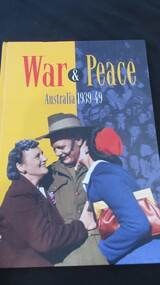 Lilydale RSL Sub Branch
Book, Australia Post Philatelic Group, War & Peace Australia 1939-49, 1995
... ...The Global War...Produced by Australia Post in 1995 War in Europe Hostilities in the Pacific The Global War Transition to Peace Australia in the World Post-War Development Back to the Future Book War & Peace Australia 1939-49 Book Australia Post Philatelic Group Printset Cambec ...Produced by Australia Post in 1995Bookwar in europe, hostilities in the pacific, the global war, transition to peace, australia in the world, post-war development, back to the future -
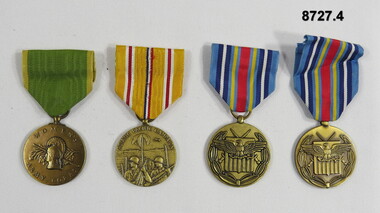 Bendigo Military Museum
Award - MEDALS, VARIOUS
... Original - USA Global War on Terrorism Expeditionary Medal....Original - USA Global War on Terrorism Expeditionary Medal. 4. ...Medal's, all original Corp mounted. 1. Original - USA Women's Army Corps Service Medal WW2. 2. Original - USA Asiatic Campaign Medal WW2. 3. Original - USA Global War on Terrorism Expeditionary Medal. 4. Original - USA Global War on Terrorism Expeditionary Medal.passchendaele barracks trust, pbt180to183, bob english collection, medals -
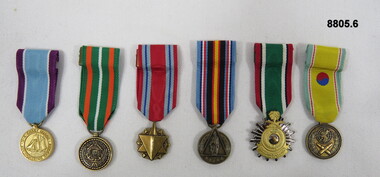 Bendigo Military Museum
Award - MEDALS, MINIATURE, Unknown
... USA - Air & Space Forces Combat Readiness Medal. 4. USA - Global War on Terrorism Civilian Medal. 5. Kuwait Liberation Medal. 6. ...USA - Air & Space Forces Combat Readiness Medal. 4. USA - Global War on Terrorism Civilian Medal. 5. Kuwait Liberation Medal. 6. ...Miniature Medals, all original, court mounted. 1. USA - US Coast Guard Distinguished Service Medal. 2. USA - US Coast Guard Achievement Medal. 3. USA - Air & Space Forces Combat Readiness Medal. 4. USA - Global War on Terrorism Civilian Medal. 5. Kuwait Liberation Medal. 6. Republic of Korea Service Medal. 591to596, bob english collection, passchendaele barracks trust -
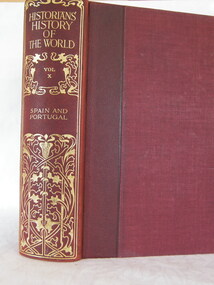 Flagstaff Hill Maritime Museum and Village
Book - Reference Book/History, Henry Smith Williams, The Historians History of the World Vol 10 set 1 - Edited by Henry Smith Williams L.L.D. Published by “The Times” 1908, 1908
... Guerilla warfare theme is highlighted during the Napoleonic Wars (The Peninsular War), where the text credits the stubborn, decentralised resistance of the common people rather than just the military for exhausting the French forces. Maritime Innovation and global...Guerilla warfare theme is highlighted during the Napoleonic Wars (The Peninsular War), where the text credits the stubborn, decentralised resistance of the common people rather than just the military for exhausting the French forces. Maritime Innovation and global ...The 1908 edition of The Historians' History of the World is a monumental work of Edwardian scholarship, representing a specific era of "universal history" where the goal was to synthesise all human knowledge into a single narrative. Volume 10 specifically focuses on the Late “Middle Ages” and the “Renaissance period”, particularly in Italy and Spain. Starting with the clash of civilisations, Islam vs. Christianity.The Book is part of a 25 volume set with red cloth bindings and gold filigree design to rib.non-fictionThe 1908 edition of The Historians' History of the World is a monumental work of Edwardian scholarship, representing a specific era of "universal history" where the goal was to synthesise all human knowledge into a single narrative. Volume 10 specifically focuses on the Late “Middle Ages” and the “Renaissance period”, particularly in Italy and Spain. Starting with the clash of civilisations, Islam vs. Christianity. flagstaff hill, warrnambool, shipwrecked-coast, flagstaff-hill, flagstaff-hill-maritime-museum, maritime-museum, shipwreck-coast, flagstaff-hill-maritime-village, the historians history of the world vol 10 set 1, book -
 Flagstaff Hill Maritime Museum and Village
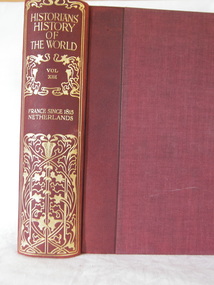
Book - Reference Book/History, Henry Smith Williams, The Historians History of the World Vol 13 set 1 - Edited by Henry Smith Williams L.L.D. Published by “The Times” 1908, 1908
... War, and the subsequent establishment of the “Third Republic” up to the early 20th century. The volume transitions into the history of the Low Countries the Netherlands, exploring their struggle for independence and their development as a global maritime and economic power. ...War, and the subsequent establishment of the “Third Republic” up to the early 20th century. The volume transitions into the history of the Low Countries the Netherlands, exploring their struggle for independence and their development as a global maritime and economic power. ...Henry Smith Williams’ “The Historians' History of the World” is a chronological and geographical "tapestry" of human events, these twenty five volumes occupy a very specific and prestigious place in historical research. Volume 13 focuses primarily on the modern history of France and the Netherlands. It specifically covers, France (1815–1904.) This section picks up immediately after the fall of Napoleon l following the 1815 Battle of Waterloo.The Book is part of a 25 volume set with red cloth bindings and gold filigree design to rib.non-fictionHenry Smith Williams’ “The Historians' History of the World” is a chronological and geographical "tapestry" of human events, these twenty five volumes occupy a very specific and prestigious place in historical research. Volume 13 focuses primarily on the modern history of France and the Netherlands. It specifically covers, France (1815–1904.) This section picks up immediately after the fall of Napoleon l following the 1815 Battle of Waterloo.flagstaff hill, warrnambool, shipwrecked-coast, flagstaff-hill, flagstaff-hill-maritime-museum, maritime-museum, shipwreck-coast, flagstaff-hill-maritime-village, book, the historians history of the world vol 13 set 1 -
 Flagstaff Hill Maritime Museum and Village
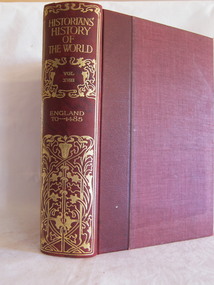
Book - Reference Book/History, Henry Smith Williams, The Historians History of the World Vol 18 set 1 - Edited by Henry Smith Williams L.L.D. Published by “The Times” 1908, 1908
... war of the Roses between the houses of Lancaster and York. Ending with the Battle of Bosworth Field in 1485, which marks the traditional end of the Reign of Richard III and the English middle ages. Volume 18 is part of a four-volume sub-series (Volumes 18–21) dedicated to the British Isles. Its significance lies in its role as the starting point for the English narrative, setting the stage for the global ...Henry Smith Williams’ “The Historians' History of the World” is a chronological and geographical "tapestry" of human events, these twenty five volumes occupy a very specific and prestigious place in historical research. Volume 18 specifically focuses on the history of England to 1485, it serves as the foundational text for British history within the series. It chronicles the evolution of the English nation from its earliest recorded beginnings through the end of the Middle Ages.The Book is part of a 25 volume set with red cloth bindings and gold filigree design to rib.non-fictionHenry Smith Williams’ “The Historians' History of the World” is a chronological and geographical "tapestry" of human events, these twenty five volumes occupy a very specific and prestigious place in historical research. Volume 18 specifically focuses on the history of England to 1485, it serves as the foundational text for British history within the series. It chronicles the evolution of the English nation from its earliest recorded beginnings through the end of the Middle Ages.flagstaff hill, warrnambool, shipwrecked-coast, flagstaff-hill, flagstaff-hill-maritime-museum, maritime-museum, shipwreck-coast, flagstaff-hill-maritime-village, book, the historians history of the world vol 18 set 1 -
 Flagstaff Hill Maritime Museum and Village
Book - Reference Book/History, Henry Smith Williams, The Historians History of the World Vol 22 set 1 - Edited by Henry Smith Williams L.L.D. Published by “The Times” 1908, 1908
... The Revolutionary war concluding with the reconstruction era and the USA emergence as a global industrial power toward the end of the 1900s. ...The Revolutionary war concluding with the reconstruction era and the USA emergence as a global industrial power toward the end of the 1900s. ...Henry Smith Williams’ “The Historians' History of the World” is a chronological and geographical "tapestry" of human events, these twenty five volumes occupy a very specific and prestigious place in historical research. Volume 22 represents a critical pivot point in the series, shifting the focus away from the concentrated histories of Europe and the British Empire toward the "New World" and the rising power of the West.The Book is part of a 25 volume set with red cloth bindings and gold filigree design to rib.non-fictionHenry Smith Williams’ “The Historians' History of the World” is a chronological and geographical "tapestry" of human events, these twenty five volumes occupy a very specific and prestigious place in historical research. Volume 22 represents a critical pivot point in the series, shifting the focus away from the concentrated histories of Europe and the British Empire toward the "New World" and the rising power of the West.flagstaff hill, warrnambool, shipwrecked-coast, flagstaff-hill, flagstaff-hill-maritime-museum, maritime-museum, shipwreck-coast, flagstaff-hill-maritime-village, book, the historians history of the world vol 22 set 1 -
 Flagstaff Hill Maritime Museum and Village
Tool - Auger, Thomas R Ellin, First half of the 20th century
... After the war Footprint continued to grow, manufacture, and expand its range of hand tools for the professional tradesman. In 2008 Footprint moved to a larger factory and invested in new forging equipment, but this process was interrupted by a global recession, and Footprint was unable to generate enough business to cover the cost of the upgrades. ...After the war Footprint continued to grow, manufacture, and expand its range of hand tools for the professional tradesman. In 2008 Footprint moved to a larger factory and invested in new forging equipment, but this process was interrupted by a global recession, and Footprint was unable to generate enough business to cover the cost of the upgrades. ...Footprint Tools is a hand tool manufacturer based in Sheffield, England. In 2014 most of their hand tools were still made in Sheffield at the Footprint factory. Footprint Tools can trace its manufacturing history as far back as the 1760s when Alfrid Ridge & Sons was established as a manufacturer of woodworking tools. Ridge was bought by the current owning family in 1932. The Footprint brand originates from 1875 when Thomas R Ellin, a member of a cutlery manufacturing family, started a tool manufacturing business under the brand "Footprint". This subsequently became known as Thomas R Ellin (Footprint Works). This company was bought by the current owning family in 1948 and began to manufacture a range of tools under the Footprint, Domino, Climax, John Bull, and Clinker brands. During World War 2 the divisions of the business were engaged in manufacturing hand tools for British and Commonwealth forces. After the war Footprint continued to grow, manufacture, and expand its range of hand tools for the professional tradesman. In 2008 Footprint moved to a larger factory and invested in new forging equipment, but this process was interrupted by a global recession, and Footprint was unable to generate enough business to cover the cost of the upgrades. In early 2009 the company was forced to liquidate and lay off its staff to pay creditors. The Jewitt family retained the brand and intellectual property, and later that year revived the company under the name Footprint Sheffield and began producing a smaller range of products at first. With the same family of owner-managers, now run by the fourth generation, in 2015 Footprint continues to manufacture most of their products in Sheffield, England, and exports worldwide.This item gives us a look into the history of the beginnings of an early company that made tools in Sheffield England and is still producing tools today.Ring Auger, Double Twist with Lead Screw, bit 1" with round shaft Imprinted 'footprint' trademarkflagstaff hill, warrnambool, shipwrecked-coast, flagstaff-hill, flagstaff-hill-maritime-museum, maritime-museum, shipwreck-coast, flagstaff-hill-maritime-village -
 Flagstaff Hill Maritime Museum and Village
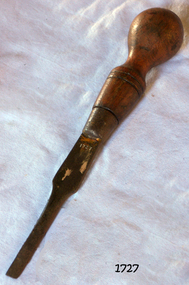
Tool - Screw Driver, A Ridge and Son, 1950s Item is in company catalogue in 1951
... war Footprint continued to grow, manufacture and expand its range hand tools for the professional tradesman. In 2004, Footprint cooperated with the University of Sheffield in a study of modern manufacturing techniques. In 2008 Footprint moved to a larger factory and invested in new forging equipment, but this process was interrupted by a global...war Footprint continued to grow, manufacture and expand its range hand tools for the professional tradesman. In 2004, Footprint cooperated with the University of Sheffield in a study of modern manufacturing techniques. In 2008 Footprint moved to a larger factory and invested in new forging equipment, but this process was interrupted by a global ...Footprint Tools is a hand tool manufacturer based in Sheffield, England. In 2014 most of their hand tools are still made in Sheffield at the Footprint factory. Footprint Tools can trace its manufacturing history as far back as the 1760s when Alfrid Ridge & Sons was established as a manufacturer of wood working tools. Ridge was bought by the current owning family in 1932. The Footprint brand originates from 1875 when Thomas R Ellin, a member of a cutlery manufacturing family, started a tool manufacturing business under the brand “Footprint”. This subsequently became known as Thomas R Ellin (Footprint Works). This company was bought by the current owning family in 1948 and began to manufacture a range of tools under the Footprint, Domino, Climax, John Bull and Clinker brands. During World War 2 the divisions of the business were engaged in manufacturing hand tools for British and Commonwealth forces. After the war Footprint continued to grow, manufacture and expand its range hand tools for the professional tradesman. In 2004, Footprint cooperated with the University of Sheffield in a study of modern manufacturing techniques. In 2008 Footprint moved to a larger factory and invested in new forging equipment, but this process was interrupted by a global recession, and Footprint was unable to generate enough business to cover the cost of the upgrades. In early 2009 the company was forced to liquidate and lay off its staff in order to pay creditors. The Jewitt family retained the brand and intellectual property, and later that year revived the company under the name Footprint Sheffield, and began producing a smaller range of products at first. With the same family of owner managers, now run by the fourth generation, in 2015 Footprint continues to manufacture most products in Sheffield, England and exports worldwide.A tool that was made by a UK company in the 1950s that has a long history of tool manufacture and after many changes in company ownership is still producing tools today in Sheffield England.Screw driver wooden handle turned and steel blade. Made in Sheffield by Alfrid Ridge and Son. London patternNoneflagstaff hill, warrnambool, shipwrecked-coast, flagstaff-hill, flagstaff-hill-maritime-museum, maritime-museum, shipwreck-coast, flagstaff-hill-maritime-village, screw driver, alfrid ridge & son, footprint tools, tools -
 Lara RSL Sub Branch
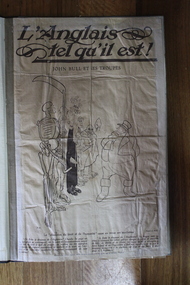
German Propaganda Magazine L"Anglais Tel qu'il est!, German Propaganda Magazine L"Anglais Tel qu'il est! 1918, circ 1918
... War 1 Newspaper of 4 double sided that was dropped by airplane in 1918. Item has been glued into a cardboard cover. Pale green in color an a black spine reinforcing. Rare German propaganda newspaper, launched by plane in France in 1918. The global ...World War 1 German Propaganda Newspaper World War 1 German propaganda Newspaper 1918Rare German propaganda newspaper, launched by plane in France in 1918. The global premiere, modern communication systems (radio - telephone - telegraph) being not yet democratised, written propaganda is most used to blacken the image of the enemy. The English are described in this newspaper as lawless imperialists, colonising areas to drain them of their wealth. 8 pages. Newspaper style,German World War 1 Newspaper of 4 double sided that was dropped by airplane in 1918. Item has been glued into a cardboard cover. Pale green in color an a black spine reinforcing.world war 1 -
 Flagstaff Hill Maritime Museum and Village
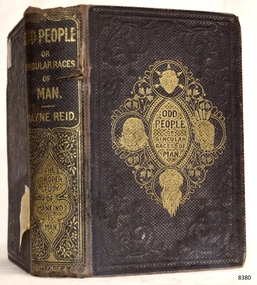
Book - Anthropological Travelogue/Fictional, Captain Mayne Reid, Odd People being A Popular Description of Singular Races of Man, 1860
... war, Reid became close friends with Edgar Allan Poe; the two were frequent drinking companions. Poe heavily admired Reid, describing him as "a colossal plagiarist" but also "a colossal genius" and "a teller of tales which cannot be told too often." In 1849, Reid returned to Europe, intending to fight in the Hungarian Revolution, but arrived too late. He settled in London and turned to writing novels to pay his debts. He struck absolute gold with his first novel, The Rifle Rangers (1850), followed by The Scalp Hunters (1851), both of which became global...war, Reid became close friends with Edgar Allan Poe; the two were frequent drinking companions. Poe heavily admired Reid, describing him as "a colossal plagiarist" but also "a colossal genius" and "a teller of tales which cannot be told too often." In 1849, Reid returned to Europe, intending to fight in the Hungarian Revolution, but arrived too late. He settled in London and turned to writing novels to pay his debts. He struck absolute gold with his first novel, The Rifle Rangers (1850), followed by The Scalp Hunters (1851), both of which became global ...Odd People: Being a Popular Description of Singular Races of Man (1860) is an interesting piece of 19th-century literature. The book was written by Captain Thomas Mayne Reid (1818–1883), a Scots-Irish American novelist and adventurer. He was immensely popular in the mid-to-late 19th century for his boys' adventure novels, tales of the American West, and travelogues. The true first edition was published in London by Routledge, Warne & Routledge in 1860. In the United States, it was published around the same time (1860/1861) by Ticknor and Fields in Boston, and later editions were retitled The Man-Eaters and Other Odd People. The book is an early work of popular ethnology and anthropology, written for a general audience and heavily marketed toward young readers and armchair travelers of the Victorian era.Book, brown covers, embossed with borders and patterns and gilt decoration and titles. The book includes illustrations. Handwritten inscription on the front paste-down page. The opposite page has a stamped and a handwritten inscription. The book was presented as a prize to a Latin student at the National School, Warrnambool in 1861. Title: Odd People being a Popular Description of Singular Races of Man. Alternate title: Odd People or Singular Races of Man Author: Captain Mayne Reid Publisher: Routledge Warne & Routledge, London Date: 1860 Further information: additional text on the spine reads 'A Proper Study of Mankind is Man'fictionOdd People: Being a Popular Description of Singular Races of Man (1860) is an interesting piece of 19th-century literature. The book was written by Captain Thomas Mayne Reid (1818–1883), a Scots-Irish American novelist and adventurer. He was immensely popular in the mid-to-late 19th century for his boys' adventure novels, tales of the American West, and travelogues. The true first edition was published in London by Routledge, Warne & Routledge in 1860. In the United States, it was published around the same time (1860/1861) by Ticknor and Fields in Boston, and later editions were retitled The Man-Eaters and Other Odd People. The book is an early work of popular ethnology and anthropology, written for a general audience and heavily marketed toward young readers and armchair travelers of the Victorian era.shipwrecked-coast, flagstaff-hill, flagstaff-hill-maritime-museum, warrnambool, maritime-museum, shipwreck-coast, flagstaff-hill-maritime-village, shipwrecked-artefact, book, odd people, captain mayne reid, national school warrnambool., daniel b sellers, classic fiction, the proper study of mankind is man, singular races of man, , routledge warne and routledge, latin student -
 Flagstaff Hill Maritime Museum and Village
Newspaper - Bound Compilation of Newspapers July to December 1888, R. Clay, Sons, & Taylor, The Graphic Illustrated Newspaper Vol 38, 1888
... It serves as a time capsule of late-Victorian global history, focusing heavily on politics, social life, arts, and conflicts. Major historical events covered in this volume include the Spanish-American War, the Mahdist War (specifically the Battle of Omdurman), and the death of former UK Prime Minister William Ewart Gladstone. ...It serves as a time capsule of late-Victorian global history, focusing heavily on politics, social life, arts, and conflicts. Major historical events covered in this volume include the Spanish-American War, the Mahdist War (specifically the Battle of Omdurman), and the death of former UK Prime Minister William Ewart Gladstone. ...To understand exactly what this item is, it helps to clear up a common misconception: it is not a book, nor is it a traditional literary novel. Instead, it is a bound volume of The Graphic, a weekly British newspaper that ran from 1869 to 1932. Because newspapers back then were flimsy, readers or libraries would collect six months' worth of weekly issues and have them custom-bound into a hardback volume for preservation.Bound Compilation, The Graphic Illustrated Newspaper Vol 38 Author: Various, Publisher: Edward Joseph Mansfield 1888 Date: 1888 Reddish hardcover with a damaged browns spine, reinforced corners to hardcover gold edging to spine. non-fictionTo understand exactly what this item is, it helps to clear up a common misconception: it is not a book, nor is it a traditional literary novel. Instead, it is a bound volume of The Graphic, a weekly British newspaper that ran from 1869 to 1932. Because newspapers back then were flimsy, readers or libraries would collect six months' worth of weekly issues and have them custom-bound into a hardback volume for preservation.flagstaff hil, warrnambool, flagstaff hill maritime museum, maritime museum, shipwreck coast, flagstaff hill maritime village, great ocean road, book, pattison collection, warrnambool library, warrnambool mechanics’ institute, ralph eric pattison, corangamite regional library service, warrnambool city librarian, mechanics’ institute library, victorian library board, warrnambool books and records, warrnambool children’s library, the graphic illustrated newspaper vol 38, edward joseph mansfield -
 Flagstaff Hill Maritime Museum and Village
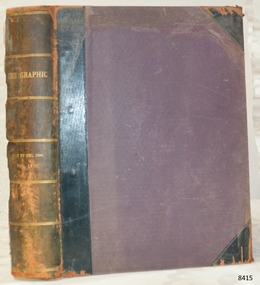
Newspaper - Bound Compilation of Newspapers July to December 1898, Edward Joseph Mansfield, Publisher, The Graphic Illustrated Newspaper Vol 58, 1898
... It serves as a time capsule of late-Victorian global history, focusing heavily on politics, social life, arts, and conflicts. Major historical events covered in this volume include the Spanish-American War, the Mahdist War (specifically the Battle of Omdurman), and the death of former UK Prime Minister William Ewart Gladstone. ...It serves as a time capsule of late-Victorian global history, focusing heavily on politics, social life, arts, and conflicts. Major historical events covered in this volume include the Spanish-American War, the Mahdist War (specifically the Battle of Omdurman), and the death of former UK Prime Minister William Ewart Gladstone. ...To understand exactly what this item is, it helps to clear up a common misconception: it is not a book, nor is it a traditional literary novel. Instead, it is a bound volume of The Graphic, a weekly British newspaper that ran from 1869 to 1932. Because newspapers back then were flimsy, readers or libraries would collect six months' worth of weekly issues and have them custom-bound into a hardback volume for preservation.Bound Compilation, The Graphic Illustrated Newspaper Vol 58 Author: Various, Publisher: Edward Joseph Mansfield 1898 Date: 1898 Reddish hardcover with a damaged browns spine, reinforced corners to hardcover gold edging to spine. non-fictionTo understand exactly what this item is, it helps to clear up a common misconception: it is not a book, nor is it a traditional literary novel. Instead, it is a bound volume of The Graphic, a weekly British newspaper that ran from 1869 to 1932. Because newspapers back then were flimsy, readers or libraries would collect six months' worth of weekly issues and have them custom-bound into a hardback volume for preservation.flagstaff hil, warrnambool, flagstaff hill maritime museum, maritime museum, shipwreck coast, flagstaff hill maritime village, great ocean road, book, pattison collection, warrnambool library, warrnambool mechanics’ institute, ralph eric pattison, corangamite regional library service, warrnambool city librarian, mechanics’ institute library, victorian library board, warrnambool books and records, warrnambool children’s library, the graphic illustrated newspaper vol 58, edward joseph mansfield -
 City of Moorabbin Historical Society (Operating the Box Cottage Museum)
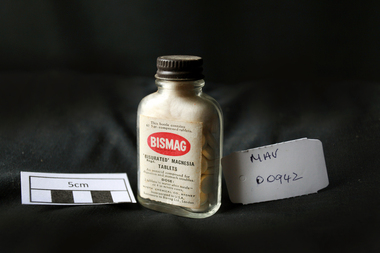
Manufactured Glass, bottle 'BISMAG' antacid tablets, mid 20thC
... Early in 1913, the Year Before the Great War, 'Bisurated' Magnesia, a Convenient and Effective Treatment for Stomach Disorders, was Perfected at Bismag Ltd London. The Wyeth Company global...Early in 1913, the Year Before the Great War, 'Bisurated' Magnesia, a Convenient and Effective Treatment for Stomach Disorders, was Perfected at Bismag Ltd London. The Wyeth Company global ...The Wyeth company was founded in Philadelphia, Pennsylvania, in 1860 as John Wyeth and Brother. Its headquarters moved to Collegeville, Pennsylvania and Madison, New Jersey, before its headquarters were consolidated with Pfizer's in New York City after the 2009 merger. Early in 1913, the Year Before the Great War, 'Bisurated' Magnesia, a Convenient and Effective Treatment for Stomach Disorders, was Perfected at Bismag Ltd London. The Wyeth Company global sales increased due to the sales of Wyeth's Kolynos brand of toothpaste. Wyeth probably purchased Bismag Ltd c 1950 A clear glass bottle with a metal screw top lid containing ‘ BISMAG’ Antacid tablets 60 x 5grain. Front: This bottle contains / 60 5gr. compressed tablets / BISMAG / ‘BISURATED’ MAGNESIA / TABLETS / An antacid compound for / digestion and stomach troubles / DOSE / ………. / WYETH CHEMICAL CO., SYDNEY / Incorporated in U.S.A. /Successors to Bismag Ltd. London. Back: Bismag neutralises hyper-acidity / …….. pharmacy, medicines, glassware, bottles, moorabbin, bentleigh, cheltenham bismag ltd london, bismag ltd america, magnesia -
 City of Moorabbin Historical Society (Operating the Box Cottage Museum)
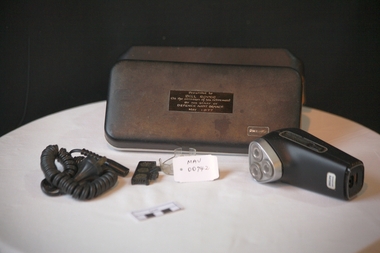
Personal Effects. 'Philips" electric Shaver, c1977
... War II. A more ergonomic egg-shaped single-head model was introduced in 1948 and was designed by US industrial designer Raymond Loewy. Global...War II. A more ergonomic egg-shaped single-head model was introduced in 1948 and was designed by US industrial designer Raymond Loewy. Global ...Established in 1891 in Eindhoven, the Netherlands, Philips & Co. was founded to meet the growing demand for light bulbs following the commercialization of electricity. Science and technology underwent tremendous development in the 1940s and 1950s, with Philips Research inventing the rotary heads that led to the development of the Philishave electric shaver, and laying down the basis for later ground-breaking work in transistors and integrated circuits.Philishave was the brand name for the electric shavers manufactured by the Philips Domestic Appliances and Personal Care unit of Philips They used the Philishave brand name for their shavers from 1939 to 2006. The Philishave shaver was invented by Philips engineer Alexandre Horowitz, who used rotating cutters instead of the reciprocating cutters that had been used in previous electric shavers. The shaver was introduced in 1939, though initial production was limited due to the outbreak of World War II. A more ergonomic egg-shaped single-head model was introduced in 1948 and was designed by US industrial designer Raymond Loewy. Global sales increased markedly after a double-head model was introduced in 1951. As a spin off from the light bulb and research is the dynamo-powered bicycle lamp. Its rotating power system inspires the Philishave triple head electric razor. A triple-head model was test marketed in Australia and New Zealand in 1956, but would not be introduced globally until 1966. The brand name Philishave was phased out in 2006 so shavers now bear only the Philips name. Mr Alfred William ( Bill ) Roper, 1913 - 1996 grew up in Ripponlea, ( East St Kilda ) Victoria. As a child he went with his father Arthur Leopold Roper to purchase vegetables from the Moorabbin Chinese market gardeners at the Hotham St. / Nepean Highway corner. c1920 . Bill served in WW2 in New Guinea and post war was Army Auditor, Victoria Barracks, St Kilda Road Melbourne. His staff presented this 'Philishave upon his retirement and he used it until his death1996. He lived in Carlton, Belgrave, Ascot Vale, South Yarra, East St Kilda and moved to Bentleigh in 1987.A ‘Philishave’ triple head electric razor , with cord, head protector and cleaning brush in a hinged plastic case The case has compartments, for Razor and cord, that are lined with a mustard coloured, soft, synthetic material .Case top PHILIPS ; inside EXCLUSIVE PHILISHAVE Razor Handle front PHILIPS / PHILISHAVE; back Type HP 1121/ 110-130V/ 220-240 V / PHILIPS Shield / ? Shield / BS 3456 / V 75255 / MADE IN HOLLAND Nameplate Presented to / BILL ROPER / On the occasion of his retirement / BY THE STAFF OF / DEFENCE AUDIT BRANCH / May 1977 philishave, royal philips electric company, razors, electric razors, bentleigh, moorabbin, market gardeners, st kilda markets, world war 2 1939-1945, department of defence melbourne, melbourne, roper alfred william, roper arthur leopold, ripponlea, chinese market gardeners -
 Kiewa Valley Historical Society
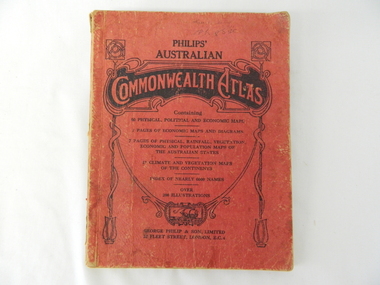
Atlas Australian Commonwealth, Philips' Australian Commonwealth Atlas, 1944
... Also there are snap shots of similar activities from other global areas. The period also covered World War II, detailed by a photo of "shell making", munitions, required by Australian soldiers. ...Also there are snap shots of similar activities from other global areas. The period also covered World War II, detailed by a photo of "shell making", munitions, required by Australian soldiers. ...This atlas, printed in 1944, details not only the geographic and political boundaries of the world as it was at that time but also the snap shot of life of the time. This snap shot in time covers the major Australian cities, the major farming, grazing, industrial and sporting/recreational activities. Also there are snap shots of similar activities from other global areas. The period also covered World War II, detailed by a photo of "shell making", munitions, required by Australian soldiers. The great political and territorial changes made as a result of World War II can be clearly identified for example , Israel (the Jewish homeland). The various prewar colonies of major European nations.This atlas was used by children of a Kiewa Valley family and shows the value and the general educational exposure that these children had at this time. The rural setting and within the backdrop of a world war did not severely alter the life style of children in this region. The "news reels" shown in cinemas of cities and larger towns were the only visual realisations of major events of global significance available to these children. The information provided by this atlas allowed students to glimpse at what the "outside world" was. The majority of these students would possibly never see these regions for themselves. The great communication facilities of the late 1900s and beyond, was still only science fiction.This atlas has a thick (350 g/m) red cardboard cover with bold black lettering and shading. The cover is set out within a shield like frame. The shield is held up by two square markings, each with a four part circular pattern and a cord entwining two pendulum structures ending with a bowl figure at the bottom. There is a semi circular form enclosing a printed book contents list. The inside cover has the atlas title and contents and the publisher details. The atlas contain 56 pages of world and Australian maps, vegetation and rainfall maps. Within this atlas there are 27 double sided pages of black and white photographs depicting life styles, buildings, landscapes and prominent and significant to Australia males from 1652 to 1944. The pages are of approximately 200 g/m and have the yellow aged appearance.On front cover "Philips' Australian COMMONWEALTH ATLAS" and underneath "Containing" underneath "60 PHYSICAL, POLITICAL AND ECONOMIC MAPS". Publisher George Philip & Son, Limited 32 Fleet Street, London E.C. 4. Inside cover are: written, in freehand and in ink the following names and dates; "J.Muller Form V 1945", "L L Muller Form IV 1946", "N.J. Muller Form I + II + III 1948 +49 + 50" and "D Muller Form I 1949". also handwritten and in pencil is "Peter Leslie". On the last page is a small freehand sketch of Australia in biro.1940s school curriculum, rural education, 1940s atlas, australian atlas -
 Kiewa Valley Historical Society
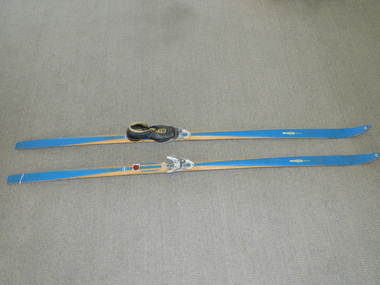
Skis Snow Competition, circa 1966
... The post World War II migration of European "snow skiiers" into Australia combined with the construction of Hydo Electricity Schemes in both the N.S.W.and Victorian Alps regions, opened up these winter snow areas to a greater influx of tourists and holiday adventurers interested in "winter" sports. The ability to project, on a global...The post World War II migration of European "snow skiiers" into Australia combined with the construction of Hydo Electricity Schemes in both the N.S.W.and Victorian Alps regions, opened up these winter snow areas to a greater influx of tourists and holiday adventurers interested in "winter" sports. The ability to project, on a global ...The post World War II migration of European "snow skiiers" into Australia combined with the construction of Hydo Electricity Schemes in both the N.S.W.and Victorian Alps regions, opened up these winter snow areas to a greater influx of tourists and holiday adventurers interested in "winter" sports. The ability to project, on a global scale, skiing facilities of international standards to those in the northern hemisphere during their summer has opened up the Australia ski resorts and their facilities to a much greater winter sport orientated population. These cross country skis were purchased by a member of the Bogong Ski Club and were part of a bulk ski stock consignment from Finland in 1966/67. They were introduced into the Victorian Alps to encourage skiers to take up cross country skiing both at Falls Creek and Mount Buller. This initiative spurred on the now annual 42 kilometre cross country "Kangaroo Hoppet" race at Falls Creek. This race is currently the biggest cross country snow skiing race in Australia. These snow skis were made in Finland. They are wooden (hickory) skis and made from four strips (glued and shaped) pieces of wood that are not laminated. There is a painted blue flash on the top of the skis that extends the full length of the skis. The face of the underside of the skis is flat and is coated in black Stockholm tar. Glider or grip wax was applied onto this base. The top body of the skis is tapered from shoe position to both front and back tips.Tapered curvatures from foot radiating to all sides provides the required aerodynamics. Metal boot bindings consisting of a toe plate with adjustable toe clip and a heel plate, both of which are screwed onto the skis. "KILPA, KARHU URHEILUTARPEITA SPORTART1KLAR, Karhu-Valtz Finland. Hickorypohjin"snow skiing, cross country skiing, falls creek winter tourism -
 Kiewa Valley Historical Society
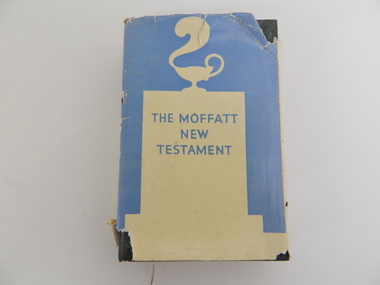
Bible, Bible Moffat, 1935
... Spiritual relief to overcome harsh rural setbacks is not just specific to the Australian rural sector but is also global. With the influx of migrant workers from the war torn European nations (after WWII) a broader coverage of Christian and other faiths developed. ...This Christian Bible by Professor James Moffatt from the United Free Church College in Glasglow Scotland was at a time when translated Christian bibles(Greek to English) were being review as to the accuracy of their translated words. This period was in the early 1900's specifically during and between the two major World Wars of 1914-18 and 1939-45 and also covering the Great Depression(1939). All these periods were ones of death, destruction and "loss of faith". Bibles which provided greater clarity of better times ahead flourished. This book offered its readers hope for the future (in terrible times). The regions that it covered were those who belonged to the Christian Faith. The significance of this bible to the Kiewa Valley is that it provides an insight of those Christians living in a semi remote rural region at the period in Australian history where forces outside of this area were placing hardships which were "foreign" to them, as a family and as a community. The major Christian religions within the Kiewa Valley were either of the Catholic or English Protestant teachings. These groups still remain the dominant ones well into the 2nd Millennium. Spiritual relief to overcome harsh rural setbacks is not just specific to the Australian rural sector but is also global. With the influx of migrant workers from the war torn European nations (after WWII) a broader coverage of Christian and other faiths developed. A "positive" saying, when crops failed and bush fires and river floods sprang up, rallied the faithful "with God's help" This hard covered bible consists of six pages of preamble including title, publishing details, printer and author's preface. The book has 388 pages of black print. Relevant reference lines are notated by numbers on the left side of the page. On the front dust cover is a cream silhouette against a light blue backdrop highlighting a smoking "Aladdin's" Arabic oil lamp on a cenotaph. The hard cover has a embossed emblem of a lantern with a plume of smoke rising from the spout. This is all encapsulated by a circle. The spine also has this emblem. On the dust jacket, front "THE MOFFATT NEW TESTAMENT", and the back cover has blue writing on a cream background. On the spine, at the top "JAMES MOFFATT" below this a white on blue silhouette of "Alalddin's lamp" below this is (in blue letters against a light blue background " THE NEW TESTAMENT A NEW TRANSLATION" On inside cover a signature "Clare Roper". The hard cover has marked in red print "THE NEW TESTAMENT ANEW TRANSLATION MOFFAT" christian bible, prayer, new testament, religion, faith. -
 Monbulk RSL Sub Branch
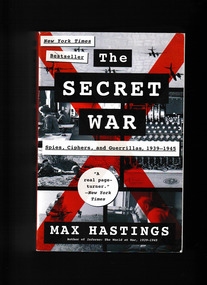
Book, Harper Collins, The secret war : spies, codes and guerillas 1939-45, 2026
... World war 1939-1945 - Espionage World War 1914-1918 - Secret service Packed with insight and terrific spy stories, this masterly book looks at the secret war on a global basis, bringing together the British, American, German, Russian and Japanese histories. ...Packed with insight and terrific spy stories, this masterly book looks at the secret war on a global basis, bringing together the British, American, German, Russian and Japanese histories. In 'The Secret War', Max Hastings examines the espionage and intelligence machines of all sides in World War II, and the impact of spies, code-breakers and partisan operations on events. Written on a global scale, the book brings together accounts from British, American, German, Russian and Japanese sources to tell the story of a secret war waged unceasingly by men and women often far from the battlefields but whose actions profoundly influenced the outcome.Index, bib, ill, p.558.Packed with insight and terrific spy stories, this masterly book looks at the secret war on a global basis, bringing together the British, American, German, Russian and Japanese histories. In 'The Secret War', Max Hastings examines the espionage and intelligence machines of all sides in World War II, and the impact of spies, code-breakers and partisan operations on events. Written on a global scale, the book brings together accounts from British, American, German, Russian and Japanese sources to tell the story of a secret war waged unceasingly by men and women often far from the battlefields but whose actions profoundly influenced the outcome. world war 1939-1945 - espionage, world war 1914-1918 - secret service -
 Monbulk RSL Sub Branch
Book, Routledge, International history of the twentieth century and beyond, 2008
... This second edition is thoroughly updated, and includes extended coverage of European integration, the rise of supra-governmental organizations, and the 'global War on Terror'. Index, bib, ill, maps, p.613. ...This major global history of the twentieth century is written by four prominent international historians for first-year undergraduate level and upward. Using their thematic and regional expertise, the authors cover events in Europe, Asia, the Middle East, Africa and the Americas from the last century and beyond. Among the areas this book covers are: the decline of European hegemony over the international order; the diffusion of power to the two superpowers; the rise of newly independent states in Asia and Africa; and, the course and consequences of the major global conflicts of the twentieth century. This second edition is thoroughly updated, and includes extended coverage of European integration, the rise of supra-governmental organizations, and the 'global War on Terror'.Index, bib, ill, maps, p.613.non-fictionThis major global history of the twentieth century is written by four prominent international historians for first-year undergraduate level and upward. Using their thematic and regional expertise, the authors cover events in Europe, Asia, the Middle East, Africa and the Americas from the last century and beyond. Among the areas this book covers are: the decline of European hegemony over the international order; the diffusion of power to the two superpowers; the rise of newly independent states in Asia and Africa; and, the course and consequences of the major global conflicts of the twentieth century. This second edition is thoroughly updated, and includes extended coverage of European integration, the rise of supra-governmental organizations, and the 'global War on Terror'.world politics - 20th century, world politics 21st century -
 Monbulk RSL Sub Branch
Book, Cambridge University Press, World war II: A new history, 2009
... World war 1939 - 1945 - History World War 1939-1945 - Causes A magisterial new global history of World war II Index, bib, ill, p.483. ...A magisterial new global history of World war IIIndex, bib, ill, p.483.non-fictionA magisterial new global history of World war IIworld war 1939 - 1945 - history, world war 1939-1945 - causes -
 Monbulk RSL Sub Branch
Book, David Kilcullen, The accidental guerrillan : Fighting small wars in the midst of a big one, 2009
... Guerrilla warfare Insurgencies n The Accidental Guerrilla, Kilcullen takes us on the ground to uncover the face of modern warfare, illuminating both the global challenge (the "War on Terrorism") and small wars across the world: Afghanistan, Iraq, Indonesia, Thailand, East Timor, and Pakistan. ...n The Accidental Guerrilla, Kilcullen takes us on the ground to uncover the face of modern warfare, illuminating both the global challenge (the "War on Terrorism") and small wars across the world: Afghanistan, Iraq, Indonesia, Thailand, East Timor, and Pakistan. He explains that today's conflicts are a complex hybrid of contrasting trends: local social networks and worldwide movements; traditional and postmodern culture; local insurgencies seeking autonomy and a broader terrorist campaign. He warns that the United States has tended to conflate these trends, blurring the distinction between local and global struggles and thereby enormously complicating our challenges. The West has continually misidentified insurgents with limited aims and legitimate grievances - "accidental guerrillas" - as members of a unified worldwide terror network. We must learn how to disentangle these strands, develop strategies that deal with global threats, avoid local conflicts where possible, and win them where necessary.Index, ill, p.346.non-fictionn The Accidental Guerrilla, Kilcullen takes us on the ground to uncover the face of modern warfare, illuminating both the global challenge (the "War on Terrorism") and small wars across the world: Afghanistan, Iraq, Indonesia, Thailand, East Timor, and Pakistan. He explains that today's conflicts are a complex hybrid of contrasting trends: local social networks and worldwide movements; traditional and postmodern culture; local insurgencies seeking autonomy and a broader terrorist campaign. He warns that the United States has tended to conflate these trends, blurring the distinction between local and global struggles and thereby enormously complicating our challenges. The West has continually misidentified insurgents with limited aims and legitimate grievances - "accidental guerrillas" - as members of a unified worldwide terror network. We must learn how to disentangle these strands, develop strategies that deal with global threats, avoid local conflicts where possible, and win them where necessary.guerrilla warfare, insurgencies -
 Monbulk RSL Sub Branch
Book, Bettina Stagneth et al, Eichmann before Jerusalem: The unexamined life of a mass murderer, 2014
... Though once widely known by nicknames such as 'Manager of the Holocaust', he was able to portray himself, from the defendant's box in Jerusalem in 1960, as an overworked bureaucrat who had been following orders - no more, he said, than 'just a small cog in Adolf Hitler's extermination machine'. war criminals - germany - biography world war ii 1939-1945 - atrocities A total re-assessment of the life of Adolf Eichmann that reveals his activities and notoriety amongst a global network of national socialists following the collapse of the third Reich, and that permanently undermines Hannah Arendt's often-cited notion of the 'banality of evil'. ...A total re-assessment of the life of Adolf Eichmann that reveals his activities and notoriety amongst a global network of national socialists following the collapse of the third Reich, and that permanently undermines Hannah Arendt's often-cited notion of the 'banality of evil'.Bibliography, index, notes, p.424.non-fictionA total re-assessment of the life of Adolf Eichmann that reveals his activities and notoriety amongst a global network of national socialists following the collapse of the third Reich, and that permanently undermines Hannah Arendt's often-cited notion of the 'banality of evil'. war criminals - germany - biography, world war ii, 1939-1945 - atrocities -
 Monbulk RSL Sub Branch
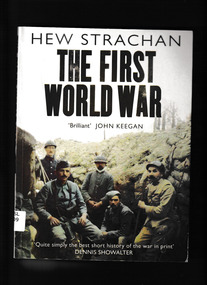
Book, Hew Strachan, The first world war, 2003
... war which has had the greatest impact on the course of the twentieth century. The first generation of its historians had access to a limited range of sources, and they focused primarily on military events. More recent approaches have embraced cultural, diplomatic, economic, and social history. In this authoritative and readable history, Hew Strachan combines these perspectives with a military and strategic narrative. The result is an account that breaks the bounds of national preoccupations to become both global ...World War I was the war which has had the greatest impact on the course of the twentieth century. The first generation of its historians had access to a limited range of sources, and they focused primarily on military events. More recent approaches have embraced cultural, diplomatic, economic, and social history. In this authoritative and readable history, Hew Strachan combines these perspectives with a military and strategic narrative. The result is an account that breaks the bounds of national preoccupations to become both global and comparative. The first of three volumes in this study, To arms examines not only the causes of the war and its opening clashes on land and sea, but also the ideas that underpinned it, and the motivations of the people who supported it. It provides pioneering accounts of the war's finances, the war in Africa, and the Central Powers' bid to widen the war outside Europe.index, notes, ill, maps, p.332.non-fictionWorld War I was the war which has had the greatest impact on the course of the twentieth century. The first generation of its historians had access to a limited range of sources, and they focused primarily on military events. More recent approaches have embraced cultural, diplomatic, economic, and social history. In this authoritative and readable history, Hew Strachan combines these perspectives with a military and strategic narrative. The result is an account that breaks the bounds of national preoccupations to become both global and comparative. The first of three volumes in this study, To arms examines not only the causes of the war and its opening clashes on land and sea, but also the ideas that underpinned it, and the motivations of the people who supported it. It provides pioneering accounts of the war's finances, the war in Africa, and the Central Powers' bid to widen the war outside Europe.world war 1914-1918 - history, europe - history - 20th century -
 Monbulk RSL Sub Branch
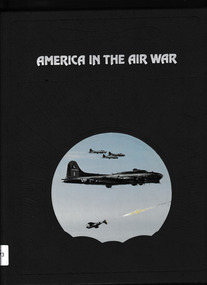
Book, Edward Jablonski, America in the air war, 1982
... War 1939-1945 - Aerial operations - United States United States Air Force - History - 1939-1945 When the Japanese attacked Pearl Harbor on December 7, 1941, the Army Air Forces had only 1,100 combat-ready planes. No one could have imagined then that within the next four years the AAF would become the mighty weapon commemorated in the paintings reproduced on the following pages, or that it would have to scope to engage in what its commander, General Henry H. "Hap" Arnold, described as a "global ...When the Japanese attacked Pearl Harbor on December 7, 1941, the Army Air Forces had only 1,100 combat-ready planes. No one could have imagined then that within the next four years the AAF would become the mighty weapon commemorated in the paintings reproduced on the following pages, or that it would have to scope to engage in what its commander, General Henry H. "Hap" Arnold, described as a "global mission." Nevertheless, by 1944 the AAF had grown into 16 separate air forces stationed around the world, and its 1,100 planes had grown to nearly 80,000.Index, bib, ill, p.171.non-fictionWhen the Japanese attacked Pearl Harbor on December 7, 1941, the Army Air Forces had only 1,100 combat-ready planes. No one could have imagined then that within the next four years the AAF would become the mighty weapon commemorated in the paintings reproduced on the following pages, or that it would have to scope to engage in what its commander, General Henry H. "Hap" Arnold, described as a "global mission." Nevertheless, by 1944 the AAF had grown into 16 separate air forces stationed around the world, and its 1,100 planes had grown to nearly 80,000. world war 1939-1945 - aerial operations - united states, united states air force - history - 1939-1945 -
 Monbulk RSL Sub Branch
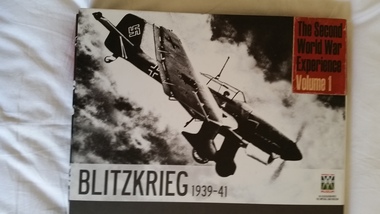
Book, Carlton, The Second World War experience v.1. Blitzkrieg 1939-1941, 2008
... A four-volume series, published in association with the Imperial War Museum, covering the whole six-year global conflagration. Each volume contains removable documents and memorabilia in pockets or pasted in, featuring personal accounts from British veterans and contemporary letters, diaries, maps and archival facsimile memoabilia from the Imperial War Museum. ...Volume one of a four volume series featuring Blitzkrieg. A four-volume series, published in association with the Imperial War Museum, covering the whole six-year global conflagration. Each volume contains removable documents and memorabilia in pockets or pasted in, featuring personal accounts from British veterans and contemporary letters, diaries, maps and archival facsimile memoabilia from the Imperial War Museum. Memorabilia includes: Order No 1 - the German order to invade Poland which led to the British declaration of war against Germany; The fake passport used by Sub-Lieutenant Heinz Kummer of the Graf Spee to flee back to Germany following the Battle of the River Plate; and, Montgomery's personal diary charting the events of the evacuation from Dunkirk; Roosevelt's handwritten notes for his 'day of infamy' speech which saw America's entry into the war; the order to McArthur to abandon the Philippines; Stalin's handwritten notes on his 'scorched earth' policy; and the letters home of a British officer in Africa telling of his harrowing involvement in the battles of Gazala and Tobruk; Montgomery's orders for El Alamein; Stalin's annotated proof of his famous 5 September 1942 order regarding partisan warfare; and diary kept by a German soldier on the North African front; Montgomery's hand-written D-Day notes; Eisenhower's draft 'in case of failure' message written before D-Day; and, diary of a sergeant in the Royal Hampshire regiment covering his involvement in the D-Day landings, battle for Normandy and Operation 'Market Garden' - the battle for Arnhem.Index, ill, maps, facsims, sound disc, p.61.Volume one of a four volume series featuring Blitzkrieg. A four-volume series, published in association with the Imperial War Museum, covering the whole six-year global conflagration. Each volume contains removable documents and memorabilia in pockets or pasted in, featuring personal accounts from British veterans and contemporary letters, diaries, maps and archival facsimile memoabilia from the Imperial War Museum. Memorabilia includes: Order No 1 - the German order to invade Poland which led to the British declaration of war against Germany; The fake passport used by Sub-Lieutenant Heinz Kummer of the Graf Spee to flee back to Germany following the Battle of the River Plate; and, Montgomery's personal diary charting the events of the evacuation from Dunkirk; Roosevelt's handwritten notes for his 'day of infamy' speech which saw America's entry into the war; the order to McArthur to abandon the Philippines; Stalin's handwritten notes on his 'scorched earth' policy; and the letters home of a British officer in Africa telling of his harrowing involvement in the battles of Gazala and Tobruk; Montgomery's orders for El Alamein; Stalin's annotated proof of his famous 5 September 1942 order regarding partisan warfare; and diary kept by a German soldier on the North African front; Montgomery's hand-written D-Day notes; Eisenhower's draft 'in case of failure' message written before D-Day; and, diary of a sergeant in the Royal Hampshire regiment covering his involvement in the D-Day landings, battle for Normandy and Operation 'Market Garden' - the battle for Arnhem.world war 1939-1945 - history, world war 1939-1945 - pictorial works -
 Monbulk RSL Sub Branch
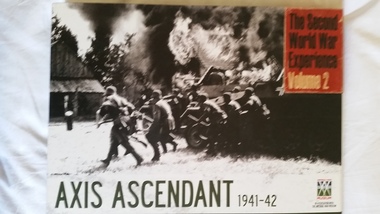
Book, Carlton, The Second World War experience v.2. Axis ascendant 1941-42, 2008
... A four-volume series, published in association with the Imperial War Museum, covering the whole six-year global conflagration. Each volume contains removable documents and memorabilia in pockets or pasted in, featuring personal accounts from British veterans and contemporary letters, diaries, maps and archival facsimile memoabilia from the Imperial War Museum. ...Volume two of a four volume series featuring Axis ascendancy. A four-volume series, published in association with the Imperial War Museum, covering the whole six-year global conflagration. Each volume contains removable documents and memorabilia in pockets or pasted in, featuring personal accounts from British veterans and contemporary letters, diaries, maps and archival facsimile memoabilia from the Imperial War Museum. Memorabilia includes: Order No 1 - the German order to invade Poland which led to the British declaration of war against Germany; The fake passport used by Sub-Lieutenant Heinz Kummer of the Graf Spee to flee back to Germany following the Battle of the River Plate; and, Montgomery's personal diary charting the events of the evacuation from Dunkirk; Roosevelt's handwritten notes for his 'day of infamy' speech which saw America's entry into the war; the order to McArthur to abandon the Philippines; Stalin's handwritten notes on his 'scorched earth' policy; and the letters home of a British officer in Africa telling of his harrowing involvement in the battles of Gazala and Tobruk; Montgomery's orders for El Alamein; Stalin's annotated proof of his famous 5 September 1942 order regarding partisan warfare; and diary kept by a German soldier on the North African front; Montgomery's hand-written D-Day notes; Eisenhower's draft 'in case of failure' message written before D-Day; and, diary of a sergeant in the Royal Hampshire regiment covering his involvement in the D-Day landings, battle for Normandy and Operation 'Market Garden' - the battle for Arnhem.Index, ill, maps, facsims, sound disc, p.61.Volume two of a four volume series featuring Axis ascendancy. A four-volume series, published in association with the Imperial War Museum, covering the whole six-year global conflagration. Each volume contains removable documents and memorabilia in pockets or pasted in, featuring personal accounts from British veterans and contemporary letters, diaries, maps and archival facsimile memoabilia from the Imperial War Museum. Memorabilia includes: Order No 1 - the German order to invade Poland which led to the British declaration of war against Germany; The fake passport used by Sub-Lieutenant Heinz Kummer of the Graf Spee to flee back to Germany following the Battle of the River Plate; and, Montgomery's personal diary charting the events of the evacuation from Dunkirk; Roosevelt's handwritten notes for his 'day of infamy' speech which saw America's entry into the war; the order to McArthur to abandon the Philippines; Stalin's handwritten notes on his 'scorched earth' policy; and the letters home of a British officer in Africa telling of his harrowing involvement in the battles of Gazala and Tobruk; Montgomery's orders for El Alamein; Stalin's annotated proof of his famous 5 September 1942 order regarding partisan warfare; and diary kept by a German soldier on the North African front; Montgomery's hand-written D-Day notes; Eisenhower's draft 'in case of failure' message written before D-Day; and, diary of a sergeant in the Royal Hampshire regiment covering his involvement in the D-Day landings, battle for Normandy and Operation 'Market Garden' - the battle for Arnhem.world war 1939-1945 - history, world war 1939-1945 - pictorial works -
 Bendigo Historical Society Inc.
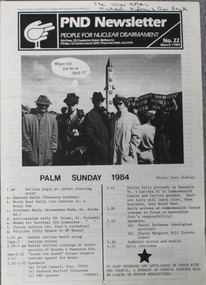
Newsletter - PND Newsletter, 1980's
... People for Nuclear Disarmament (PND) was formed in Melbourne in October 1981 and has been a significant force in the global disarmament movement. The organization aims to eliminate the threat of nuclear war and mobilize public opinion in support of disarmament and peace. ...People for Nuclear Disarmament (PND) was formed in Melbourne in October 1981 and has been a significant force in the global disarmament movement. The organization aims to eliminate the threat of nuclear war and mobilize public opinion in support of disarmament and peace. ...People for Nuclear Disarmament (PND) was formed in Melbourne in October 1981 and has been a significant force in the global disarmament movement. The organization aims to eliminate the threat of nuclear war and mobilize public opinion in support of disarmament and peace. PND advocates for social justice and environmental preservation, with the ultimate goal of achieving complete and general world disarmament, supported by international agreements.Eight copies of PND Newsletter produced by People for Nuclear Disarmament on white A4 with black print varying between six and ten pages, dates in 1983 and 1984. Also, a 20 page A4 size black print on white paper PND publication titled FLASHPOINT June 84 Vol1 No1. There are another 14 newspaper cuttings and pamphlets relating to nuclear disarmament. people for nuclear disarmament, pnd newsletter, flashpoint -
 Monbulk RSL Sub Branch
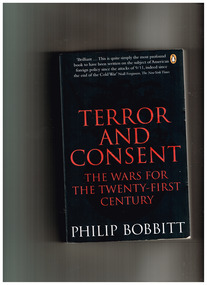
Book, Phillip Bobbitt, Terror and consent: The wars for the twenty first century, 2008
... A study of the new face of modern-day warfare integrates historical, legal, and strategic analyses to look at the concept of a "war on terror" from the perspective of governance, liberty, violence, and globalization, while examining its impact on public policy. ...This book attempts to provide a fundamental re-evaluation of the currrent threat of terrorism and the ways in which this threat can be frustrated. A study of the new face of modern-day warfare integrates historical, legal, and strategic analyses to look at the concept of a "war on terror" from the perspective of governance, liberty, violence, and globalization, while examining its impact on public policy.Bib, index, notes, p.548.This book attempts to provide a fundamental re-evaluation of the currrent threat of terrorism and the ways in which this threat can be frustrated. A study of the new face of modern-day warfare integrates historical, legal, and strategic analyses to look at the concept of a "war on terror" from the perspective of governance, liberty, violence, and globalization, while examining its impact on public policy. counter terrorism, foreign policy - united states -
 National Vietnam Veterans Museum (NVVM)
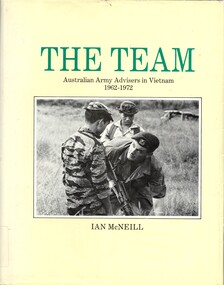
Book, McNeill, Ian, The Team: Australian Army Advisers in Vietnam 1962 - 1972 (Copy 1)
... Australian Army Training Team Vietnam War 1961-1975 - Regimental histories - Australia AATTV Saig Saigon Inerest in the vietnam War has focussed on its global significance and on the domestic political responses which the war engendered. ...Inerest in the vietnam War has focussed on its global significance and on the domestic political responses which the war engendered.Inerest in the vietnam War has focussed on its global significance and on the domestic political responses which the war engendered.australia. army. australian army training team, vietnam war, 1961-1975 - regimental histories - australia, aattv, saig, saigon
