
Showing 18 items matching "the great depression (kew)"
-
 Kew Historical Society Inc
Archive (Sub-series) - Subject File, Depression, 1930s, 1958
... great depression -- kew (vic.)...Archive file containing a anonymous, undated article (single page) on the Great Depression in Kew. It might be from Vaughan’s history (1960). ...Typically files will contain primary and secondary sources. great depression -- kew (vic.) kew -- history -- 1930s yarra boulevard Archive file containing a anonymous, undated article (single page) on the Great Depression in Kew. ...Various parties Reference, Research, Information Secondary Values (KHS Imposed Order) Subject file containing a anonymous, undated article (single page) on the Great Depression in Kew. It might be from Vaughan’s history (1960). It covers Council support and the creation of the Yarra Boulevard great depression -- kew (vic.), kew -- history -- 1930s, yarra boulevard great depression -- kew (vic.), kew -- history -- 1930s, yarra boulevard -
 Kew Historical Society Inc
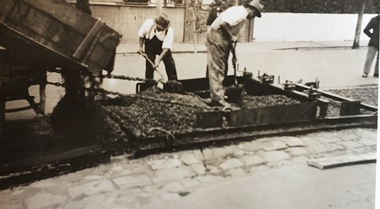
Photograph - Street Works, Studley Park Road, March 1934
... ...city of kew -- public works -- great depression -- 1930s...Studley Park Road, like most streets in Kew, was originally a dirt road. Street works during the Great Depression included bituminising major roads in the district. ...Well provenanced photograph of Council-funded public works in Kew during the Great Depression. roadworks -- kew (vic.) street works -- kew (vic.) public works kew (vic.) studley park road -- kew (vic.) city of kew -- engineers department city of kew -- public works -- great depression -- 1930s Typed reverse: "B4 / Kew C.C. / Spreading premixed material on Studley Park Road with drag spreader, March 1934" Original sepia monochrome positive of Council workers spreading bitumen in Studley Park Road, Kew. ...Studley Park Road, like most streets in Kew, was originally a dirt road. Street works during the Great Depression included bituminising major roads in the district. This photograph of Council works originated in the City of Kew Engineers Department as a record of works undertaken. It was given to the collection by a Mrs Fisher in 1998. Well provenanced photograph of Council-funded public works in Kew during the Great Depression. Original sepia monochrome positive of Council workers spreading bitumen in Studley Park Road, Kew. Typed reverse: "B4 / Kew C.C. / Spreading premixed material on Studley Park Road with drag spreader, March 1934" roadworks -- kew (vic.), street works -- kew (vic.), public works kew (vic.), studley park road -- kew (vic.), city of kew -- engineers department, city of kew -- public works -- great depression -- 1930s -
 Kew Historical Society Inc
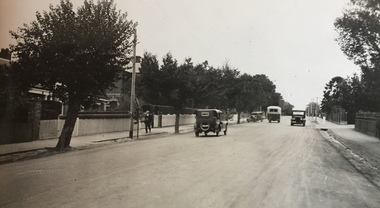
Photograph - Street Works, Studley Park Road, March 1934
... ...city of kew -- public works -- great depression -- 1930s...Studley Park Road, like most streets in Kew, was originally a dirt road. Street works during the Great Depression included bituminising major roads in the district. ...Well provenanced photograph of Council-funded public works in Kew during the Great Depression. roadworks -- kew (vic.) street works -- kew (vic.) public works kew (vic.) studley park road -- kew (vic.) city of kew -- engineers department city of kew -- public works -- great depression -- 1930s Typed reverse: "B4 / Kew C.C. / Studley Park Road after surfacing with one coat of premixed material spread with drag, March 1934" Original sepia monochrome positive of Studley Park Road, Kew. ...Studley Park Road, like most streets in Kew, was originally a dirt road. Street works during the Great Depression included bituminising major roads in the district. This photograph of Council works originated in the City of Kew Engineers Department as a record of works undertaken. It was given to the collection by a Mrs Fisher in 1998. Well provenanced photograph of Council-funded public works in Kew during the Great Depression. Original sepia monochrome positive of Studley Park Road, Kew. Typed reverse: "B4 / Kew C.C. / Studley Park Road after surfacing with one coat of premixed material spread with drag, March 1934" roadworks -- kew (vic.), street works -- kew (vic.), public works kew (vic.), studley park road -- kew (vic.), city of kew -- engineers department, city of kew -- public works -- great depression -- 1930s -
 Kew Historical Society Inc
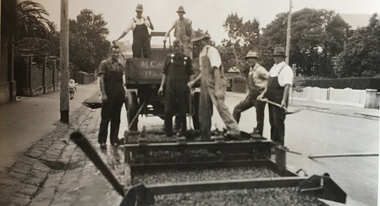
Photograph - Street Works, Studley Park Road, March 1934
... ...city of kew -- public works -- great depression -- 1930s...Studley Park Road, like most streets in Kew, was originally a dirt road. Street works during the Great Depression included bituminising major roads in the district. ...Well provenanced photograph of Council-funded public works in Kew during the Great Depression. roadworks -- kew (vic.) street works -- kew (vic.) public works kew (vic.) studley park road -- kew (vic.) city of kew -- engineers department city of kew -- public works -- great depression -- 1930s Typed reverse: "B4 / Kew C.C. / Spreading premixed material on Studley Park Road with drag spreader, view from rear of machine, March 1934" Original sepia monochrome positive of Council workers standing on and beside a dray in Studley Park Road, Kew while resurfacing of the street was taking place. ...Studley Park Road, like most streets in Kew, was originally a dirt road. Street works during the Great Depression included bituminising major roads in the district. This photograph of Council works originated in the City of Kew Engineers Department as a record of works undertaken. It was given to the collection by a Mrs Fisher in 1998. Well provenanced photograph of Council-funded public works in Kew during the Great Depression. Original sepia monochrome positive of Council workers standing on and beside a dray in Studley Park Road, Kew while resurfacing of the street was taking place. The Kew Junction is just visible behind the men. Typed reverse: "B4 / Kew C.C. / Spreading premixed material on Studley Park Road with drag spreader, view from rear of machine, March 1934" roadworks -- kew (vic.), street works -- kew (vic.), public works kew (vic.), studley park road -- kew (vic.), city of kew -- engineers department, city of kew -- public works -- great depression -- 1930s -
 Kew Historical Society Inc
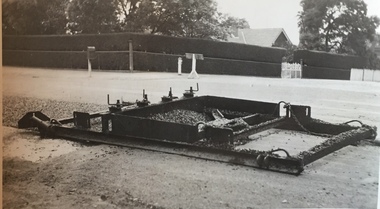
Photograph - Street Works, Studley Park Road, March 1934
... ...city of kew -- public works -- great depression -- 1930s...Studley Park Road, like most streets in Kew, was originally a dirt road. Street works during the Great Depression included bituminising major roads in the district. ...Well provenanced photograph of Council-funded public works in Kew during the Great Depression. roadworks -- kew (vic.) street works -- kew (vic.) public works kew (vic.) studley park road -- kew (vic.) city of kew -- engineers department city of kew -- public works -- great depression -- 1930s Typed reverse: "B4 / Kew C.C. / Drag spreader used for premixed material on Studley Park Road, showing end of strip just with spread, with unsurfaced work on left and completed section on right, March 1934" Original sepia photographic positive of a drag used to spread bitumen in Studley Park Road, Kew. ...Studley Park Road, like most streets in Kew, was originally a dirt road. Street works during the Great Depression included bituminising major roads in the district. This photograph of Council works originated in the City of Kew Engineers Department as a record of works undertaken. It was given to the collection by a Mrs Fisher in 1998. Well provenanced photograph of Council-funded public works in Kew during the Great Depression. Original sepia photographic positive of a drag used to spread bitumen in Studley Park Road, Kew. Typed reverse: "B4 / Kew C.C. / Drag spreader used for premixed material on Studley Park Road, showing end of strip just with spread, with unsurfaced work on left and completed section on right, March 1934" roadworks -- kew (vic.), street works -- kew (vic.), public works kew (vic.), studley park road -- kew (vic.), city of kew -- engineers department, city of kew -- public works -- great depression -- 1930s -
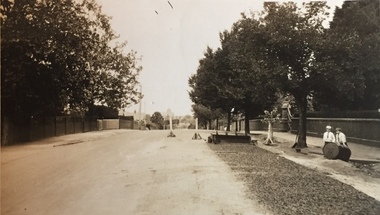 Kew Historical Society Inc
Photograph - Street Works, Studley Park Road, March 1934
... ...city of kew -- public works -- great depression -- 1930s...Studley Park Road, like most streets in Kew, was originally a dirt road. Street works during the Great Depression included bituminising major roads in the district. ...Well provenanced photograph of Council-funded public works in Kew during the Great Depression. roadworks -- kew (vic.) street works -- kew (vic.) public works kew (vic.) studley park road -- kew (vic.) city of kew -- engineers department city of kew -- public works -- great depression -- 1930s Typed reverse: "B4 / Kew C.C. / Studley Park Road showing drag spread surfacing with premixed material, unrolled material on the right, March 1934" Original sepia photographic positive of Studley Park Road, Kew while resurfacing of the street was taking place. ...Studley Park Road, like most streets in Kew, was originally a dirt road. Street works during the Great Depression included bituminising major roads in the district. This photograph of Council works originated in the City of Kew Engineers Department as a record of works undertaken. It was given to the collection by a Mrs Fisher in 1998. Well provenanced photograph of Council-funded public works in Kew during the Great Depression. Original sepia photographic positive of Studley Park Road, Kew while resurfacing of the street was taking place. The Kew Junction is just visible in the distance. Boys sitting on a drum at right. Behind them is the brick fence and front entrance to Tara Hall. Typed reverse: "B4 / Kew C.C. / Studley Park Road showing drag spread surfacing with premixed material, unrolled material on the right, March 1934" roadworks -- kew (vic.), street works -- kew (vic.), public works kew (vic.), studley park road -- kew (vic.), city of kew -- engineers department, city of kew -- public works -- great depression -- 1930s -
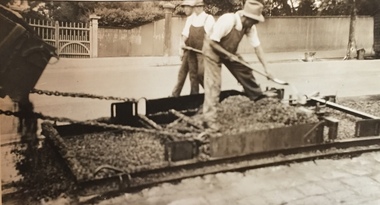 Kew Historical Society Inc
Photograph - Street Works, Studley Park Road, March 1934
... ...city of kew -- public works -- great depression -- 1930s...Studley Park Road, like most streets in Kew, was originally a dirt road. Street works during the Great Depression included bituminising major roads in the district. ...Well provenanced photograph of Council-funded public works in Kew during the Great Depression. roadworks -- kew (vic.) street works -- kew (vic.) public works kew (vic.) studley park road -- kew (vic.) city of kew -- engineers department city of kew -- public works -- great depression -- 1930s Typed reverse: "B4 / Kew C.C. / Spreading premixed material on Studley Park Road with drag spreader, March 1934" Original sepia photographic positive of Studley Park Road, Kew while resurfacing of the street was taking place. ...Studley Park Road, like most streets in Kew, was originally a dirt road. Street works during the Great Depression included bituminising major roads in the district. This photograph of Council works originated in the City of Kew Engineers Department as a record of works undertaken. It was given to the collection by a Mrs Fisher in 1998. Well provenanced photograph of Council-funded public works in Kew during the Great Depression. Original sepia photographic positive of Studley Park Road, Kew while resurfacing of the street was taking place. Typed reverse: "B4 / Kew C.C. / Spreading premixed material on Studley Park Road with drag spreader, March 1934" roadworks -- kew (vic.), street works -- kew (vic.), public works kew (vic.), studley park road -- kew (vic.), city of kew -- engineers department, city of kew -- public works -- great depression -- 1930s -
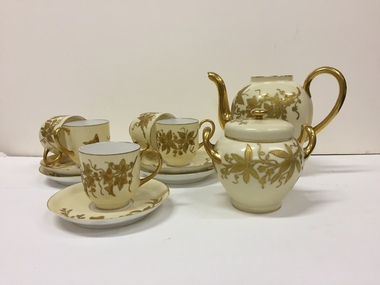 Kew Historical Society Inc
Domestic object - French Porcelain Coffee Set, 19th century
... The latter was apparently bought piece by piece during the Great Depression. ...The latter was apparently bought piece by piece during the Great Depression. An item of historical interest donated by members of the Dods family in 2006. ...Following the death of Hugh and Nell Ferguson, their families donated a number of items to the Kew Historical Society, including a French porcelain coffee set and a ceramic willow pattern dinner service. The latter was apparently bought piece by piece during the Great Depression. An item of historical interest donated by members of the Dods family in 2006. The Dods-Ferguson Collection includes a number of items once in the possession of the families related to or descended from two mayors of Kew: Cr. Hugh Ferguson and Cr. Frederick Dods. Continental porcelain coffee set of 5 cups, 6 saucers, a coffee pot, sugar bowl & lid and matching tray, once owned by the Dods family and donated in 2006. cr. frederick william dods, continental porcelain, french porcelain -
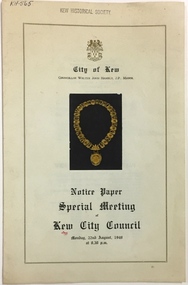 Kew Historical Society Inc
Administrative record - Document, City of Kew, Notice Paper, Special Meeting, Kew City Council, 1949, 1949
... At a Special Meeting of the Kew City Council on 22 August 1949, the Lieutenant Governor, Sir Edmund Herring presented a gold mayoral chain, worth £250 to the City of Kew. ...Notice Paper, Special Meeting, Kew City Council, 1949 Administrative record Document City of Kew ...The decade that began in national and domestic uncertainty was to end on a fancifully resolute moment, when Kew Council decided to apply for a gold mayoral chain. While most cities had previously been gifted mayoral chains by the Victorian Government, Kew had passed up an earlier opportunity in 1933. In that year, councillors had asked the Town Clerk to investigate whether previous mayors were willing to donate a gold link for the chain on which their name would be inscribed. Either the answer was negative, or else the Great Depression unnerved the decision makers. Hawthorn councillors, in contrast, accepted the offer of a gold chain, contributing the cost of the enamelled central medallion, while twenty former Hawthorn mayors agreed to each donate a link. At a Special Meeting of the Kew City Council on 22 August 1949, the Lieutenant Governor, Sir Edmund Herring presented a gold mayoral chain, worth £250 to the City of Kew. Contemporary newspaper accounts recorded that sixteen former mayors, or their families, donated a link inscribed with the name and term of its owner. The first mayor to wear the new chain of office was Cr Walter Hambly. Historically significant documentary record relating to the Insignia of Office of the City of Kew Notice paper sent to councillors of a Special Meeting of Kew City Council, attended by the Lieutenant Governor, Sir Edmund Herring to receive the presentation of a gold mayoral chain to the City. The space where the invitee's name should be written is left blank, so presumably it was a spare copy originating in the Town Clerk's files. mayoral chain - kew, council papers - kew city council, insignia of office -
 Mission to Seafarers Victoria
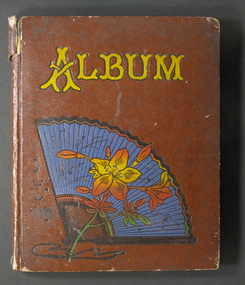
Album (item) - Photographic Album, 1928
... ...kew...Arrival on the RMS Maloja Two photographs are missing. Pre Great Depression, 1928 was a difficult year in Melbourne and also for the Mission. ...This album containing 50 photographs depicts a year at the Mission in 1928: Wedding of the Dora Walker with Harry Simpson on 14 February. Picnic at Riversdale Hawthorn, 1 January 1928 Ships in Port Melbourne in November: HMAS Australia, HMAS Brisbane, and destroyers Anzac, Success, Swordsman Wharfs, Victoria Dock, Stevedores Picnic in Finhaven, Kew, the Buchan's Property for Cup Day (6 November) Views of Port Melbourne from 1888 building Monday 29 October: return of Archbishop of Melbourne (Dr. Harrington Lees), who had spent a 10-month holiday in England with his wife. Arrival on the RMS Maloja Two photographs are missing. Pre Great Depression, 1928 was a difficult year in Melbourne and also for the Mission. Ships were rare on the wharfs meaning seamen were also rare in the missions. However they started the fundraising for the extension of the 1888 Port Melbourne building which was becoming too small. At the end of the year, Reverend Weller announced he was appointed assistant in London. He and his wife Alexina left in January 1929 after five years. They sailed on the Osterley on the 22 January 1929. Embossed yellow font on cover reads: ALBUM fan, strikes, police, reverend john reginald weller (1880-1969), alexina weller (nee caley), freda oxley, hmas australia, hmas brisbane, great depression, unemployment, port melbourne, station pier, sugar cane, queensland, dora simpson nee walker, weddings, cup day, finhaven, kew, the ducketts, mrs john buchan, flinders street extension, gasworks, wharfs, victoria dock, motorboat, southern cross, success, destroyers, football, sports, rms maloja, lhlg, fan album, anzac, swordsman, freda kathleen oxley 1882-1969, annie alexandrina caley (known as alexina) 1885-1934 -
 Kew Historical Society Inc
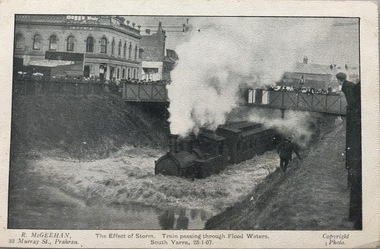
Postcard, R McGeehan, The Effect of Storm. Train Passing Through Flood Waters, South Yarra, 25-1-07, 1907
... The item forms part of the Laurie Bennett collection of thirty-six postcards and photographs of Kew and early Melbourne, donated to the Kew Historical Society in 1980. ...SHARP DOWNPOUR. ONE INCH IN 45 MINUTES. SOUTHERN SUBURBS DELUGED. TRAIN STOPPED AT SOUTH YARRA. One of the sudden downpours of rain which occasionally fall in Melbourne occurred yesterday afternoon, when nearly an inch of rain fell in the course of three quarters of an hour, and caused a flood for an hour or two in certain localities. During the early part of the day, the sky had been clouded over, but there was nothing to indicate a storm of such intensity as that which followed. At about half-past 1 o'clock residents of South Yarra, South Melbourne, Prahran, and St. Kilda noticed a few drops of rain. Still, it appeared unlikely that there would be anything exceptional, until with startling suddenness at about 10 minutes to 1 o'clock, one of the heaviest downpours within the memory of residents burst upon those suburbs. A strange feature of the storm was that it was practically confined to an area of about three miles square. The city was but little affected, though at a spot as close as the Observatory 86 points of rain were recorded in three-quarters of an hour. Thunder and lightning accompanied the downpour, which was cyclonic in character, the rain driving heavily from all points of the compass as the cyclone passed. It was in South Yarra and Prahran that the rain fell heaviest. Within a few minutes after it commenced, the low-lying portions of Toorak-road and practically the whole length of Chapel-street were under water. The depression at the intersection of Toorak-road and Darling-street speedily filled to the dimensions of a small lake. Several shops were inundated, while the water from the higher levels rushed down like a mountain torrent, and in several in-stances swept through the rear of houses and shops, carrying furniture in a floating mass against the further walls. In one case a footbridge was carried bodily away and dashed to pieces. Darling-street itself Great Davis-street, and other low-lying and flat thoroughfares in the vicinity became flooded from kerb to kerb, while on the other side of the railway-bridge the valley between Kensington-road and River-street became filled for some minutes to a depth of several feet. Meanwhile the waters from South Yarra hill, seeking a lower level, found it in the railway cutting, and the excavations from South Yarra station to Prahran on the one line, and to the Chapel-street bridge on the other, were converted into a couple of canals. At the platforms at South Yarra the water was two feet deep on the permanent way, and towards Hawksburn, at the sudden depression under Chapel-street bridge, it was at one time deep enough to cover a tall man's head. Into this swirling mass of water the 1:50 p.m. train from Oakleigh plunged on its way to Melbourne. The impact caused a mighty fountain of water to rise to a height of about 20 feet above the level of Chapel-street and send clouds of spray in all directions. Under the belief that a terrible explosion had occurred residents braved the rain and rushed to the spot, only to find that the train had been brought to a stand-still in the middle of what seemed to be a river. The water was so high that it had entered the fire-box from below, extinguishing the fires and cutting off the steam supply. In the meantime the officials at the South Yarra station had been preparing for emergencies. Inspectors were on duty at intervals along the line, and the moment the alarm was given an extra engine was backed carefully down and continued on to connect with the stranded train without losing its own power. There was a delay of about ten minutes in the service for an hour or two, but by 5 o'clock all the trains were running on time again, and the water had run off all but the spot beneath the Chapel-street bridge. Here the water remained about four feet deep until nightfall, and throughout the afternoon several hundreds of people including biograph operators and photographers, were gathered around watching each train pass through. Even with the water two feet lower, this was a work attended with considerable difficulty. Each train had to absolutely force its way through the weight of water, almost enveloped by the spray thrown up, and it was only just able to negotiate the "ford" by using every ounce of steam. ... The Argus, 26 January 1907, p19. The item forms part of the Laurie Bennett collection of thirty-six postcards and photographs of Kew and early Melbourne, donated to the Kew Historical Society in 1980. The postcards in the Bennett collection, like other images in the Society's holdings date from the 1890s to the present and comprehensively indicate points-of-view or scenes considered historically, aesthetically or socially significant in the period in which they were produced. Postcard depicting a flood at South Yarra Station in 1907. The title and photographer's name are identified on the front of the postcard. Donated by L. Bennett, 1980 flood - south yarra, trains - melbourne, postcards, r mcgeehan - prahran -
 Kew Historical Society Inc
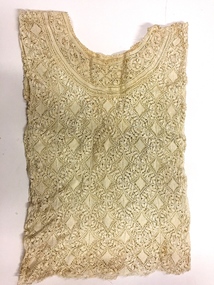
Clothing - Maltese Lace Chemisette, 1900s
... The Fashion & Design collection of Kew Historical Society includes examples of textiles dating from the 18th, 19th and 20th centuries. ...The Fashion & Design collection of Kew Historical Society includes examples of textiles dating from the 18th, 19th and 20th centuries. ...The Fashion & Design collection of Kew Historical Society includes examples of textiles dating from the 18th, 19th and 20th centuries. Some of the textiles, were used as items of clothing, others as items of household decoration, or simply as travel souvenirs. These textiles were created both domestically and internationally. Predictably with the growth of an ethnically and culturally more diverse community in Kew after the Second World War, textiles, clothing and objects in the collection inevitably reflected this diversity. This form of bobbin lace is made in Malta. It is a guipure style of lace. Maltese lace is worked as a continuous width tape lace on a tall, thin, upright lace pillow called a "Trajbu" and the Bobbins are called "Combini" . Bigger pieces are made of two or more parts sewn together. Lace made in Malta was originally needle lace, from the 16th to the 19th century, when the economic depression in the islands nearly led to the extinction of lacemaking there. But in the mid 1800s, Lady Hamilton Chichester sent lacemakers from Genoa to Malta. They used the old needle lace patterns and turned them into bobbin lace, which was quicker. It was not long after its introduction that the Maltese lace developed its own style from Genoese lace. Maltese lace was shown at The Great Exhibition of 1851 and it became popular in Britain. The style was copied by lacemakers in the English Midlands, and it was one of the sources for Bedfordshire lace. Characteristics of Maltese lace. Maltese lace usually has the following characteristics which are useful for identification. It is usually made from cream silk. There is often the 8 pointed Maltese cross as part of the pattern, worked in whole or cloth stitch.The pattern may also have closely worked leaves known as “wheat ears” or “oats”. These are plump and rounded in shape, rather than the long narrow leaves of other types of bobbin lace. Camisole, made of silk thread Maltese bobbin lace that is constructed of lengths of lace forming two rectangles with a hole for the neck. Shows the characteristic Maltese cross and wheat ears. Fabric is made of tape lace joined together camisoles, maltese lace, bodices -
 Kew Historical Society Inc
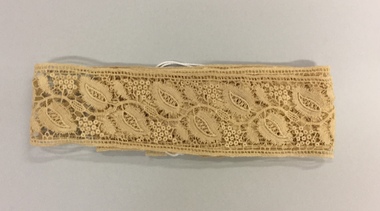
Textile - Lace Edging
... The Fashion & Design collection of Kew Historical Society includes examples of textiles dating from the 18th, 19th and 20th centuries. ...The Fashion & Design collection of Kew Historical Society includes examples of textiles dating from the 18th, 19th and 20th centuries. ...The Fashion & Design collection of Kew Historical Society includes examples of textiles dating from the 18th, 19th and 20th centuries. Some of the textiles, were used as items of clothing, others as items of household decoration, or simply as travel souvenirs. These textiles were created both domestically and internationally. Predictably with the growth of an ethnically and culturally more diverse community in Kew after the Second World War, textiles, clothing and objects in the collection inevitably reflected this diversity. This form of bobbin lace is made in Malta. It is a guipure style of lace. Maltese lace is worked as a continuous width tape lace on a tall, thin, upright lace pillow called a "Trajbu" and the Bobbins are called "Combini" . Bigger pieces are made of two or more parts sewn together. Lace made in Malta was originally needle lace, from the 16th to the 19th century, when the economic depression in the islands nearly led to the extinction of lacemaking there. But in the mid 1800s, Lady Hamilton Chichester sent lacemakers from Genoa to Malta. They used the old needle lace patterns and turned them into bobbin lace, which was quicker. It was not long after its introduction that the Maltese lace developed its own style from Genoese lace. Maltese lace was shown at The Great Exhibition of 1851 and it became popular in Britain. The style was copied by lacemakers in the English Midlands, and it was one of the sources for Bedfordshire lace. Maltese lace usually has the following characteristics which are useful for identification: It is usually made from cream silk. There is often the 8 pointed Maltese cross as part of the pattern, worked in whole or cloth stitch.The pattern may also have closely worked leaves known as “wheat ears” or “oats”. These are plump and rounded in shape, rather than the long narrow leaves of other types of bobbin lace. Maltese lace edging. It shows the Wheat ears, characteristic of Maltese lace lace, maltese lace, lace tape -
 Kew Historical Society Inc
Furniture - Toolbox constructed from recycled materials
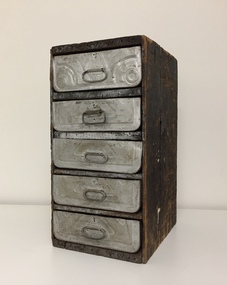
... The item was donated to the Society in 2001 by Sadie Trestrail, who had been a teacher at Kew East Primary School for many years. It is a fine example of vernacular furniture made of recycled materials . furniture - recycled - depession era - 1930s great depression - 1930s - australia warren trestrail salvation army vernacular furniture Depression-era toolbox constructed from recycled kerosene tins and parts of wooden packing boxes. ...Toolbox, made by Salvation Army Brigadier Warren Trestrail (1895-1971), during the Great Depression from recycled kerosene tins and packing boxes. It proved to be a useful piece of furniture as the family moved around Australia during various postings within the Australian States and Territories. In World War II, Warren Trestrail embarked with the first convoy of soldiers from Australia to the Middle East and served as Salvation Army welfare officer through the Libyan campaign, at Tobruk, and in Greece. In 1942, it was announced that Salvation Army war services at Darwin would be placed under his direction. He had previously been in charge of South Australian war activities. The item was donated to the Society in 2001 by Sadie Trestrail, who had been a teacher at Kew East Primary School for many years. It is a fine example of vernacular furniture made of recycled materials . Depression-era toolbox constructed from recycled kerosene tins and parts of wooden packing boxes. The five tin drawers are made of sections of kerosene tins with handles soldered to the centre of each new drawer. A number of drawers have separators constructed of tin or aluminium. The wooden planks encasing the the drawers are covered with a degraded shellac coating. An analysis of the interior indicates that the brand names of the original parts are largely extant. furniture - recycled - depession era - 1930s, great depression - 1930s - australia, warren trestrail, salvation army, vernacular furniture -
 Kew Historical Society Inc
Photograph, Herald Sun, Sustenance workers, Susso Drive [Yarra Boulevard], 1930s
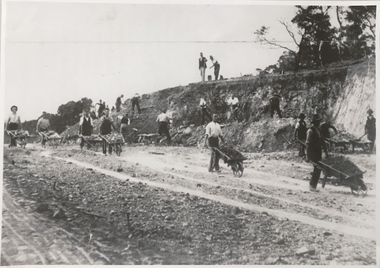
... ...the great depression (kew)...The Yarra Boulevard was a major depression era public works project. yarra boulevard susso drive road construction 1930s the great depression (kew) Attached green postit: "In Herald Sun. ...The Yarra Boulevard was a major depression era public works project. Sustenance workers, Susso Drive [Yarra Boulevard], 1930s. Attached green postit: "In Herald Sun. Richmond section not Kew. Check with Richmond Historical Society. yarra boulevard, susso drive, road construction 1930s, the great depression (kew) -
 Kew Historical Society Inc
Book, Stories They Tell : A history of Kew through objects, 2022
... Kew Where We Live / Judith Scurfield p42. ...Rockingham James Govett centenary of kew mayoresses -- kew (Vic.) Model dairy -- Kew (Vic.) ...'Stories They Tell : A history of Kew through objects' explores diverse narratives from European settlement to the first decades of the twenty-first century. These stories use as their starting point artworks, texts and artefacts from the nationally significant collection of the Kew Historical Society. Limited to 100 copies.117 pp : illustrated : Appendices Chapters: Preface / Robert Baker p4. The collection / Robert Baker p5. Cartwheel penny / Robert Baker p6. Creek and old watering stage / David White p10. John Carson: Mayor 1863–4 1 / Julie King p4. Wedding dress / Suzanne McWha p18. Back to Kew 1875 / Judith Scurfield p22. Barnard’s clock / Margaret Robinson p26. Denbigh quilt / Suzanne McWha p28. Fragments of art decoration / Robert Baker p32. Mr Richardson’s sock / Felicity Renowden p36. Kew Volunteer Fire Brigade / David White p38. Kew Where We Live / Judith Scurfield p42. [MMBW} Detail Plan No. 1580 / Judith Scurfield p46. Adeney Avenue / Suzanne McWha p50. Young Workers’ Patriotic Guild / Margaret Robinson p54. Roll of Honor [Thomas Rand] / Robert Baker p56. Alice Anderson in her tourer / Felicity Renowden p60. Kew War Memorial / David White p62. Beaded dance dress / Suzanne McWha p 66. The great flood of 1934 / Desley Reid p68. Depression-era toolbox / Robert Baker p72. War Savings Street / Julie King p74. Kew Public L.ibrary / Suzanne McWha p78. Signature supper cloth / Desley Reid p82. View from the garden of Rockingham / Desley Reid p86. Cr Marie Dalley / Felicity Renowden p90. Centenary of Kew / Robert Baker p94. Doris Dickinson’s gown / Julie King p98. [Model Dairy] Milk bottles / Robert Baker p100. Kew Civic Centre / David White p102. Bicentennial tapestries / Margaret Robinson p106. Crest of the City of Kew / Desley Reid p110. Town Crier [outfit] / Desley Reid p112. Acknowledgements p114. List of works p115. non-fiction 'Stories They Tell : A history of Kew through objects' explores diverse narratives from European settlement to the first decades of the twenty-first century. These stories use as their starting point artworks, texts and artefacts from the nationally significant collection of the Kew Historical Society. Limited to 100 copies. collection -- kew historical society, museum catalogues, henty family, cartwheel pennies, kew lunatic asylum, patchwork quilts, john carson, george bouchier richardson, gb richardson, coombs family, james dannock, back to kew 1875, francis barnard, denbigh family, cullis hill & co, ordsall, southesk, kew volunteer fire brigade, jfc farquhar, henry kellett, mmbw detail plan 1580, william nicholls anderson, young workers patriotic guild, roll of honor -- town of kew, alice anderson, kew war memorial, flapper dresses, fairfield bridge, chandler highway bridge, warren trestrail, furniture -- 1930s, war savings streets, kew library, children's libraries, voluntary aid detachments - kew (vic.), rockingham, james govett, centenary of kew, mayoresses -- kew (vic.), model dairy -- kew (vic.), doris dickinson, crests -- city of kew (vic.), town criers -- kew (vic.), joy stewart, australian bicentennial -- kew (vic.), kew civic centre, ak lines mcfarlane marshall, adeney avenue -- kew, wwi -
Kew Historical Society Inc
Journal, The Kewriosity Sheet Vol.4 No.12 : August 1983
... Kew in that other Depression (Great Depression; 1930s) / Barbara Giles p3. ...R.A.A.V. Action Program 1983 (Rheumatism and Arthritis Association of Victoria) / p1. Kew Library / p1. Council Immunisations (Rubella) / p1. Save the Children Fund / p1. Scrabble / p1. Can you spare some time for your neighbours? (Volunteering; Meals on Wheels) / p1. Meet the editor of "Gardening News" / p1. Correction (Recycling) / p2. Community Centre??? (Kew Swimming Pool; Kew Depot; North Ward Action Group) / p2. Kew Rotaract / p2. Uniting Church East Kew (calendar of events) / p2. S.C.F. fundraising morning (Save the Children Fund) / p2. Kew Recreation Program: Term III - 1983 [short courses] / p2. Kew in that other Depression (Great Depression; 1930s) / Barbara Giles p3. Kew Philharmonic Society / p3. Kew Historical Society / p3. Unique cards: feature views of Kew (Gregary Chase designer) / p3. Look out for funding! (Family and Community Services Program; F.A.C.S.) / p4. "An Asian experience" (The Asian Evangelical Fellowship) / p4. Parkinson's Disease Association / p4. Hyde Park Fellowship (Hyde Park Uniting Church) / p4. Kew drop-In Centre - holiday program (Sacred Heart Church) / p4. Back by popular demand (Kew Garden Club) / p4. Native planet Group / p4. Daytime Garden Club / p4. Camberwell Film Society / p4. Women's Discussion Group / p4.The Kewriosity Sheet (1979-83) was first published in the City of Kew (Victoria) in June 1979 as a two-sided 'community newssheet'. It aimed to: 'share news about Kew happenings and Kew people, and to exchange ideas about living in Kew'. Later issues gradually evolved into a 4-page, quarto sized publication. The Kewriosity Sheet was superseded by the Kew Council publication 'Kewriosity' (1983-1994). non-fiction R.A.A.V. Action Program 1983 (Rheumatism and Arthritis Association of Victoria) / p1. Kew Library / p1. Council Immunisations (Rubella) / p1. Save the Children Fund / p1. Scrabble / p1. Can you spare some time for your neighbours? (Volunteering; Meals on Wheels) / p1. Meet the editor of "Gardening News" / p1. Correction (Recycling) / p2. Community Centre??? (Kew Swimming Pool; Kew Depot; North Ward Action Group) / p2. Kew Rotaract / p2. Uniting Church East Kew (calendar of events) / p2. S.C.F. fundraising morning (Save the Children Fund) / p2. Kew Recreation Program: Term III - 1983 [short courses] / p2. Kew in that other Depression (Great Depression; 1930s) / Barbara Giles p3. Kew Philharmonic Society / p3. Kew Historical Society / p3. Unique cards: feature views of Kew (Gregary Chase designer) / p3. Look out for funding! (Family and Community Services Program; F.A.C.S.) / p4. "An Asian experience" (The Asian Evangelical Fellowship) / p4. Parkinson's Disease Association / p4. Hyde Park Fellowship (Hyde Park Uniting Church) / p4. Kew drop-In Centre - holiday program (Sacred Heart Church) / p4. Back by popular demand (Kew Garden Club) / p4. Native planet Group / p4. Daytime Garden Club / p4. Camberwell Film Society / p4. Women's Discussion Group / p4. community publications --- kew (vic.), the kewriosity sheet, newsletters - kew (vic.) -
 Kew Historical Society Inc
Photograph - The Boulevard at Kew, 1937
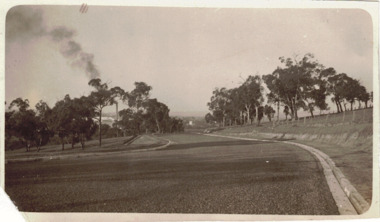
... great depression...The photograph is an important historical record of the results of 'Susso' labor in the creation of major works in Melbourne by the Victorian Government. great depression susso projects roads -- kew (vic.) yarra boulevard yarra valley "Boulevard Fairfield" Original, black and white positive print of the Boulevard at Kew in 1937. ...The Yarra Scenic Boulevard stretching from Hawthorn to the Chandler Highway was completed as a major project between 1933 and 1936 during a period of significant unemployment. Key dates in the construction this section the road include: 1933 when Kew Council supported the construction of the road from Studley Park to the Kew Asylum; and 1936 when the road from the Johnston Street Bridge to the Chandler Highway was opened. The inscription on the reverse of the photo 'Boulevard Fairfield' is misleading as there is no section of the Boulevard in Fairfield. A more likely interpretation is that it is a photograph of the Kew section of the Yarra Boulevard with the factories of Fairfield in the distance. Rare early photograph of the Yarra Boulevard, taken one year after the opening of the road. The photograph is an important historical record of the results of 'Susso' labor in the creation of major works in Melbourne by the Victorian Government. Original, black and white positive print of the Boulevard at Kew in 1937. Key aspects to note about the photograph is that the road is bituminised; that the gutters are concreted; that the kerb is constructed of concrete blocks; and that there is an unmade footpath on what appears to be the right hand side of the road. The landscape is sparsely treed, and those trees that remain are presumably remnant vegetation. At the right, the land is fenced. The land at the left falls away sharply to the river below. On the horizon, at left, there is an industrial complex including a tall chimney that is burning fuel creating smoke. "Boulevard Fairfield" great depression, susso projects, roads -- kew (vic.), yarra boulevard, yarra valley
