
Showing 437 items matching "the royal australian forces"
-
 National Vietnam Veterans Museum (NVVM)
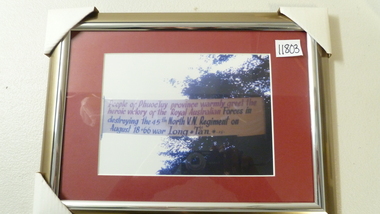
Photograph, Street sign - Long Tan
... ...The Royal Australian Forces...Photograph of a street sign in Baria Thanking the Royal Australian Forces in destroying the 45th North VN Regiment on Aug 18'66 War Long Tan...Photograph Long Tan The Royal Australian Forces On the back of the photgraph reads Vietnam 1966/67 1st APC Squadron 3 Cavalry Reg. ...Photograph of a street sign in Baria Thanking the Royal Australian Forces in destroying the 45th North VN Regiment on Aug 18'66 War Long TanOn the back of the photgraph reads Vietnam 1966/67 1st APC Squadron 3 Cavalry Reg. "This is a sign that was erected in local village Baria. Somewhat exaggerated considering Aust Task Force made across North VN Reg many more times in following years. I often wonder of the safety of those who put it up. The VC would not have been happy to see such a bold display of appreciation. John (Bilco) Trebilco."photograph, long tan, the royal australian forces -
 National Vietnam Veterans Museum (NVVM)
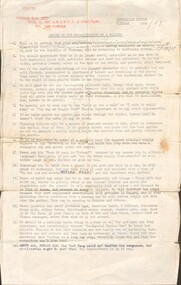
Document - Advice on the Rehabilitation of a Soldier for Pte Gregory William Reid, 1968-69
... The Royal Australian Regiment...Australian Forces...Royal Australian Infantry Corps. He was a National Service personal and he served in Vietnam with the 4th Battalion, The Royal Australian Regiment from May 1968 to March 1969. Pte Gregory William Reid 2796776 Royal Australian Infantry Corps Australian National Serviceman 4th Battalion The Royal Australian Regiment Australian Forces Vietnam Injured person Rehabilitation Nui Dat Advice on the Rehabilitation of a Soldier for Pte Gregory William Reid. ...This item was donated by Pte Gregory William Reid (2786776) who was with the Royal Australian Infantry Corps. He was a National Service personal and he served in Vietnam with the 4th Battalion, The Royal Australian Regiment from May 1968 to March 1969.Advice on the Rehabilitation of a Soldier for Pte Gregory William Reid. This is a typed list of fourteen things that families and friends may observe in the behaviour of their family/friend upon returning from fighting in Vietnam. This was put out by Australian Forces Vietnam in 1968. See media file for more information.pte gregory william reid, 2796776, royal australian infantry corps, australian national serviceman, 4th battalion, the royal australian regiment, australian forces vietnam, injured person, rehabilitation, nui dat -
 National Vietnam Veterans Museum (NVVM)
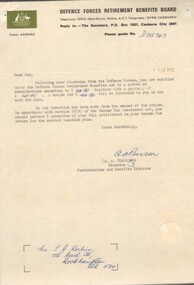
Letter - A Letter from Defence forces Retirement Benefits Board to Mr T.J, Kerlin, 1968
... The Royal Australian Regiment...Defence Forces...this item was donated by Cpl Terrence John Kerlin (1731133) who was a National Serviceman with the Royal Australian Infantry Corps and he served in Vietnam with the 3rd Battalion, The Royal Australian Regiment from December 1967 to August 1968. Cpl Terrence John Kerlin 1731133 Australian National Serviceman Royal Australian Infantry Corps 3rd Battalion The Royal Australian Regiment Defence Forces Retirement Benefits Board A Letter from Defence forces Retirement Benefits Board to Mr T.J, Kerlin dated 4 Nov 1968 advising him of money being forwarded to him. ...this item was donated by Cpl Terrence John Kerlin (1731133) who was a National Serviceman with the Royal Australian Infantry Corps and he served in Vietnam with the 3rd Battalion, The Royal Australian Regiment from December 1967 to August 1968.A Letter from Defence forces Retirement Benefits Board to Mr T.J, Kerlin dated 4 Nov 1968 advising him of money being forwarded to him. The letter has been laminated.cpl terrence john kerlin, 1731133, australian national serviceman, royal australian infantry corps, 3rd battalion, the royal australian regiment, defence forces retirement benefits board -
 Port Fairy Historical Society Museum and Archives
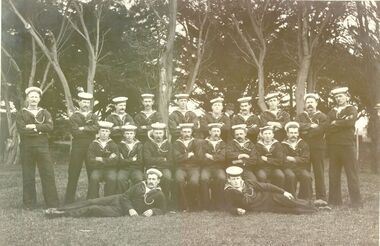
Photograph, Royal Australian Naval Forces Group
... Royal Australian Naval Forces Group, possibly including local men....Royal Australian Naval Forces Group, possibly including local men. defence royal naval forces Black and white Photograph Royal Australian Naval Forces Group Photograph Photograph ...Royal Australian Naval Forces Group, possibly including local men.Black and white Photographdefence, royal, naval, forces -
 Frankston RSL Sub Branch
Matchbox Cover, 1946; Post WW2
... He was with 8th Division, 2/10th Royal Australian Engineers, Australian Infantry Forces....He was with 8th Division, 2/10th Royal Australian Engineers, Australian Infantry Forces. Matchbox Cover ...Rectangular stainless steel matchbox cover, with matches. It is engraved on its three sides. It was presented to W.H. Dolamore, VX7638 who was a P.O.W. in Changi, Malaya. He was with 8th Division, 2/10th Royal Australian Engineers, Australian Infantry Forces.On the front is an etching of a scroll with the inscription 8th Div, 2/10F, W.H.DOLAMORE VX 27638, RAE, AIF. onthe back is the Rotary International symbol and on the side are the words P.O.W. CHANGI MALAYA.8th, aif, changi, w h, cover, matchbox, dolamore, p o w, division, 2 10th, rae -
 National Vietnam Veterans Museum (NVVM)
Document - Citation, Gallantry Cross, Republic of Vietnam
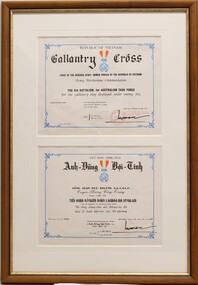
... (They also participated ) ... in the civic action programme to assist the local population ( in Military Region 3) to reconstruct their houses, roads, bridges, markets and schools etc. ... thereby bringing great credit to the Royal Australian Armed Forces."...(They also participated ) ... in the civic action programme to assist the local population ( in Military Region 3) to reconstruct their houses, roads, bridges, markets and schools etc. ... thereby bringing great credit to the Royal Australian Armed Forces." 8RAR Koo Arthur Koo Citation Gallantry Cross Gallantry Cross with palm Republic of Vietnam/ Gallantry Cross/Chief of the General Staff? ...The Republic of Vietnam Cross of Gallantry with Palm Unit Citation was conferred by General Cao Van Vien, Chief of the Joint General Staff, Armed Forces of the Republic of Vietnam on 24 October 1970, and officially presented to the 8th Battalion Royal Australian Regiment by Lieutenant General Do Cao Tri, Commander of II Corps and Military Region 3 Vietnam on 29th October 1970. The citation was awarded for "always displaying high morale while co-operating and assisting the Vietnamese people in their struggle against Communism and to defend peace and freedom .. in Military Region III ... Though fighting under the most difficult conditions, the members of the 8th Battalion, 1st Australian Task Force still fought bravely and determinedly and had many glorious victories. Their most remarkable military operations took place in the area of the Long Hai hills... (They also participated ) ... in the civic action programme to assist the local population ( in Military Region 3) to reconstruct their houses, roads, bridges, markets and schools etc. ... thereby bringing great credit to the Royal Australian Armed Forces."2 X paper documents, one in English the other in Vietnamese (mounted with white matt in timber frame). Each has been printed with a decorative blue border, main text in black, official stamp in bottom right corner is red. A blue medal with red and yellow ribbon is printed in centre top of both documents.Republic of Vietnam/ Gallantry Cross/Chief of the General Staff? Armed Forces of the Republic of Vietnam/ Army Meritorious Commendation/ The 8th Battalion, 1st Australian Task Force/ For the gallantry they displayed under enemy fire./ This Meritorious Commendation ((GALLANTRY CROSS)) is added with (a) palm (leaf)./KBC day 24 month 10 Year 19708rar, koo, arthur koo, citation, gallantry cross, gallantry cross with palm -
 Flagstaff Hill Maritime Museum and Village
Photograph - Commemorative, Royal Australian Navy (RAN), H.M.A.S. Cerberus. 4-10" M.L.R. Guns, 1986
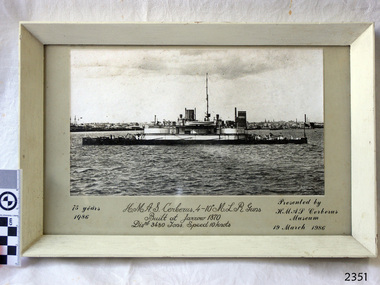
... Royal Australian Navy. The photograph was mounted by members of HMAS Cerberus at Crib Point, Western Port Bay, Victoria in 1986. It was presented to Flagstaff Hill Maritime Village by the HMAS Cerberus Museum in 1986 to commemorate the ship's 75 years of service for the Royal Australian Navy. The photograph is significant for its connection with the colony of Victoria before Federation. It is also significant for its connection with the Royal Australian Navy and its service and training of Australian defence forces ...The ship HMAS Cerberus was Built at Jarrow, Newcastle upon Tyne, England, in 1870, specifically for the colony of Victoria (Australia) and originally named HMVS Cerberus. It had a displacement of 3480 tons and could travel at the speed of 10 knots. The ship carried 4x 10 inch M.L.R. guns. The ship was renamed HMAS Cerberus in 1911 when the navy became the Royal Australian Navy. The photograph was mounted by members of HMAS Cerberus at Crib Point, Western Port Bay, Victoria in 1986. It was presented to Flagstaff Hill Maritime Village by the HMAS Cerberus Museum in 1986 to commemorate the ship's 75 years of service for the Royal Australian Navy. The photograph is significant for its connection with the colony of Victoria before Federation. It is also significant for its connection with the Royal Australian Navy and its service and training of Australian defence forces. Photograph behind glass, in timber frame. Black and white photograph of vessel HMAS Cerberus anchored , with city in the background. Frame is painted white. Photograph was taken to commemorate 75 years of the ship's service in the Royal Australian Navy. It was framed and presented to Flagstaff Hill by the HMAS Cerberus Museum on 19 March 1986. Details are hand written below the photograph.Original script writing in centre "H.M.A.S. Cerberus. 4-10 M.L.R. Guns / Built at Jarrow 1870 / Displ 3480 tons. Speed 10 knots. More recent text "75 years / 1986" "Presented by / HMAS Cerberus / Museum/ 19 March 1986"flagstaff hill, warrnambool, shipwrecked-coast, flagstaff-hill, flagstaff-hill-maritime-museum, maritime-museum, shipwreck-coast, flagstaff-hill-maritime-village, photograph, hmas cerberus, 75 year commemoration, 1876, 1911, royal australian navy, navy training base, point crib, ran, cerberus, commemorative photograph, western port bay, hmvs cerberus -
 Flagstaff Hill Maritime Museum and Village
Uniform - Sailor's Collar, Early to mid-20th century
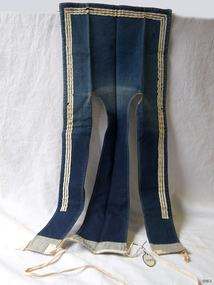
... Royal Australian Navy in the early to mid-20th century, connecting it to the maritime history of Australia and the evolution of the uniform of the navy. The collar is the only one in this museum's collection and is connected to a sailor who service in the RAN on the HMAS Warrnambool for three years. Flagstaff Hill Flagstaff Hill Maritime Museum and Village Warrnambool Maritime Museum Maritime Village Great Ocean Road Shipwreck Coast sailor’s collar sailor’s uniform uniform military Navy RAN Royal Australian Navy R S Wallace seamen's collar Australian Defence Forces Naval force sailor's rig flap collar Naval collar Robert S Wallace collar sailor's uniform World War HMAS Warrnambool sailor's suit "R.S. ...This sailor's collar is part of a naval uniform. It once belonged to R S Wallace, who served in the RAN (Royal Australian Navy) and on the HMAS Warrnambool for three years. After the war he made several ship models including the sailing ship Cutty Sark. From January 1857 the Australian Navy uniform was formally established. The uniform, referred to as a 'sailor's suit', includes a blue flap collar such as this one. Sailors in the Royal Australian Navy wore collars of this design from the early 20th century. The rating personnel of the Royal Canadian Navy were issued with a very similar collar from 1910 to the 1950s. The blue denim collars were buttoned or died inside their tops with the back and the striped portion of the front flaps showing.The square sailor's collar represents the uniform of a rating sailor in the Royal Australian Navy in the early to mid-20th century, connecting it to the maritime history of Australia and the evolution of the uniform of the navy. The collar is the only one in this museum's collection and is connected to a sailor who service in the RAN on the HMAS Warrnambool for three years.Sailor's collar. A square collar of blue cotton fabric with three flaps or strips. Three white stripes make a border on the outside edges and two flaps; the centre flap that has no stripes. There is an inscription. The underside is lined with white cotton fabric that has thin blue stripes. Tapes are attached for fastening the collar. The Royal Australian Navy collar once belonged to R S Wallace."R.S. Wallace"flagstaff hill, flagstaff hill maritime museum and village, warrnambool, maritime museum, maritime village, great ocean road, shipwreck coast, sailor’s collar, sailor’s uniform, uniform, military, navy, ran, royal australian navy, r s wallace, seamen's collar, australian defence forces, naval force, sailor's rig, flap collar, naval collar, robert s wallace, collar, sailor's uniform, world war, hmas warrnambool, sailor's suit -
 The Beechworth Burke Museum
Audio - Oral History, Jennifer Williams, Maxwell Pemberton, 23 June 2000
... Australian Navy during WWII and served at Port Moresby in Papua New Guinea. During his period of service, he received an honorary award from the Royal Humane Society of Australia for aiding and saving a drowning civilian at risk to his own life. Mr Pemberton's oral history also touches on the complex relationship between Australian forces...Australian Navy during WWII and served at Port Moresby in Papua New Guinea. During his period of service, he received an honorary award from the Royal Humane Society of Australia for aiding and saving a drowning civilian at risk to his own life. Mr Pemberton's oral history also touches on the complex relationship between Australian forces ...Mr Maxwell Pemberton was born in Goulburn, NSW in 1923 and moved to Beechworth as a child just before the Great Depression. Mr Pemberton's father was a baker who opened a grocery store in Beechworth to support his seven children. The store, which competed with eight other grocery traders in Beechworth for finite local business, delivered goods by horse and cart to customers all over the district, including the hamlet of Stanley. Mr Pemberton's oral history testifies to the sorts of economic struggles faced by the majority of Beechworth's residents during the depression years. Mr Pemberton worked in many different industries in and around Beechworth, including in his father's grocery store, which he later took over with his brother; the Zwar Tannery, where he served as a union representative; and at the Ovens and Murray Hospital for the Aged, formally the Ovens Benovolent Asylum, established in 1862 for care of the district's destitute, disabled and aged people from Euroa to the Murray, among them, homeless people Mr Pemberton referred to as 'river-bankers'. The hospital's founding in the 1860s was driven by a committee headed by the notable figure, G.B Kerford. Beechworth's institutions were a major source of local employment in the twentieth century. Mr Pemberton joined the Australian Navy during WWII and served at Port Moresby in Papua New Guinea. During his period of service, he received an honorary award from the Royal Humane Society of Australia for aiding and saving a drowning civilian at risk to his own life. Mr Pemberton's oral history also touches on the complex relationship between Australian forces and local Papuan people during the war. This oral history recording was part of a project conducted by Jennifer Williams in the year 2000 to capture the everyday life and struggles in Beechworth during the twentieth century. This project involved recording seventy oral histories on cassette tapes of local Beechworth residents which were then published in a book titled: Listen to what they say: voices of twentieth century Beechworth. These cassette tapes were digitised in July 2021 with funds made available by the Friends of the Burke.Mr Maxwell Pemberton's oral history recalls many aspects of life in Beechworth and the Oven's district during the twentieth century and enriches our understanding of the effects of the periods of socio-economic decline and renewal that unfolded as the century progressed. His singular account of his various jobs and colourful memories of life as a youth and young man in Beechworth, and abroad as a serviceman, contributes to our understanding of society's attitudes and expectations regarding ideals of masculinity and Australian national identity. This oral history account is socially and historically significant as it is a part of a broader collection of interviews conducted by Jennifer Williams which were published in the book 'Listen to what they say: voices of twentieth-century Beechworth.' While the township of Beechworth is known for its history as a gold rush town, these accounts provide a unique insight into the day-to-day life of the town's residents during the 20th century, many of which would have been lost if they had not been preserved.This is a digital copy of a recording that was originally captured on a cassette tape. The cassette tape is black with a horizontal white strip and is currently stored in a clear flat plastic rectangular container. It holds up 40 minutes of recordings on each side.Mr Max Pemberton /twentieth century beechworth, benevolent asylums, wwii, beechworth's institutions, local employment, government institutions, listen to what they say, oral history, burke museum, maxwell pemberton, ovens and murray hospital for the aged, zwar tannery, beechworth grocers, australian navy, port morseby, papua new guinea, trade unions, welfare services, homelessness, 'river bankers', aged care, g.b kerford, ovens benevolent asylum, ovens benevolent home -
 Mission to Seafarers Victoria
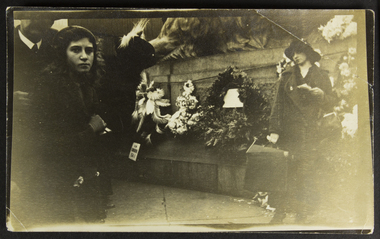
Photograph, London 1914 - Trafalgar Day, the wreaths of the Australian submarine AE1, 21 October 1914
... Royal Australian Navy and was manned by Royal Navy officers with a mixed crew of sailors drawn from the Royal Navy and the Royal Australian Navy. "Accompanied by her sister AE2, under the command of Lieutenant Commander Henry Stoker, RN, AE1 departed England in March 1914, transited the Suez Canal, and reached Sydney on 24 May 1914. Although the submarines remained surfaced for almost all of the delivery voyage it was at the time the longest transit distance ever traveled by a submarine. At the outbreak of World War I, AE1 joined the naval forces...Royal Australian Navy and was manned by Royal Navy officers with a mixed crew of sailors drawn from the Royal Navy and the Royal Australian Navy. "Accompanied by her sister AE2, under the command of Lieutenant Commander Henry Stoker, RN, AE1 departed England in March 1914, transited the Suez Canal, and reached Sydney on 24 May 1914. Although the submarines remained surfaced for almost all of the delivery voyage it was at the time the longest transit distance ever traveled by a submarine. At the outbreak of World War I, AE1 joined the naval forces ...The Australian Submarine AE1 was launched on 22 May 1913 at Barrow-in-Furness and was lost at sea on 14 September 1914 in the vicinity of Rabaul, Papua New Guinea, probably due a collision with a reef. She was the first of two E Class submarines built for the fledgling Royal Australian Navy and was manned by Royal Navy officers with a mixed crew of sailors drawn from the Royal Navy and the Royal Australian Navy. "Accompanied by her sister AE2, under the command of Lieutenant Commander Henry Stoker, RN, AE1 departed England in March 1914, transited the Suez Canal, and reached Sydney on 24 May 1914. Although the submarines remained surfaced for almost all of the delivery voyage it was at the time the longest transit distance ever traveled by a submarine. At the outbreak of World War I, AE1 joined the naval forces assigned to the capture of the German Pacific colonies. With AE2, she took part in the operations leading to the occupation of German New Guinea, including the surrender of Rabaul on 13 September 1914." (Australian Navy website)The second Australian submarine AE2 launched in February 1914 was also ill-fated as it was sunk by the Turkish army in 1915. In December 2017, a search located the wreck of AE1 in 300 metres of water off the Duke of York Island group.Sepia photograph depicting the public attending the ceremony of Trafalgar Day in London on the 21 October 1914 when wreathes were left at the bottom of Nelson's column. A sign in the centre of the photograph says: HM Submarine AE1.At the back: in pencil 20c/London 1914 In pen: Trafalgar Day, the wreaths of the Australian submarine EA1 (error was the submarine was called AE1)submarine, ae1, australian submarine -
 Federation University Historical Collection
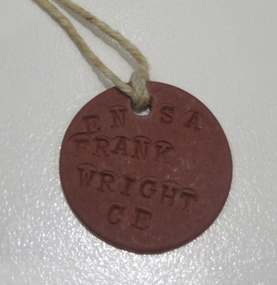
Badge - Leather disc, E.N.S.A. Frank Wright C.E, c1942
... Australia, including South Street and in New Zealand. Frank was awarded an M.B.E. in 1967 and he died in November 1970. The Frank Wright Medal at the Royal South Street competition is awarded to an individual recognized as making an outstanding contribution to brass music in Australia. frank wright armed forces entertainment musician conductor brass bands ensa entertainments national service association This red coloured 3.5 cm leather disc has been stamped with the letters ENSA Frank Wright CE. ...This disc belonged to Frank Wright. The letters ENSA refer to the Entertainments National Service Association, which was set up in 1939 to provide entertainment for the British armed forces personnel. Frank Wright was a renown resident of Smeaton, where he was born in 1901. He lived at Laura Villa, and attended Smeaton State School. His father William was a gold miner and his mother's name was Sarah. He was the youngest of eleven children. Their family won many singing and instrumental awards. Frank was tutored by Percy Code and was awarded a gold medal for the highest marks in the ALCM examinations in the British Colonies at the age of seventeen years. He became the Australian Open Cornet Champion by the age of eighteen. A year later, Frank conducted the City of Ballarat Band, and later the Ballarat Soldiers’ Memorial Band. He formed the Frank Wright Frisco Band and Frank Wright and his Coliseum Orchestra. These bands won many South Street awards, and Frank as conductor won many awards in the Australian Band Championship contest. In 1933 Frank Wright sailed to England to conduct the famous St Hilda’s Band and was appointed in 1934 as the Musical Director of the London County Council (the GLC or Greater London Council), where he organized many amazing concerts in most of the 150 parks, in and around the London district. He was also responsible for some of London’s major concerts at Kenwood, the Crystal Palace and Holland Park. He was made Professor of Brass and Military Band Scoring and Conducting and was a Fellow of the Guildhall School of Music and Drama. Frank was often invited to adjudicate Brass Band Championships around Europe, in Australia, including South Street and in New Zealand. Frank was awarded an M.B.E. in 1967 and he died in November 1970. The Frank Wright Medal at the Royal South Street competition is awarded to an individual recognized as making an outstanding contribution to brass music in Australia.This red coloured 3.5 cm leather disc has been stamped with the letters ENSA Frank Wright CE. It has a hole pinched in the top, through which a string has been threaded.frank wright, armed forces entertainment, musician conductor, brass bands, ensa, entertainments national service association -
 Frankston RSL Sub Branch
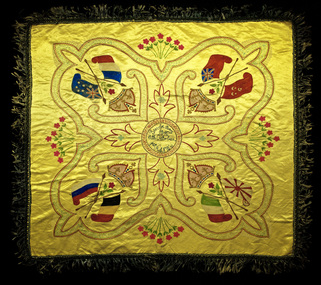
Souvenir Cloth
... of 1942 souvenir cloth ww2 embroidered silk palestine "Australian Commonwealth Military Forces Souvenir of Palestine 1942" Royal blue "Souvenir of Palestine" embroidered silk cloth with orange fringing. ...Royal blue "Souvenir of Palestine" embroidered silk cloth with orange fringing. Embroidered with birds, flowers, a crown and a shield in gold and pink threads. Dated 1942, WW2."Australian Commonwealth Military Forces Souvenir of Palestine 1942"of, 1942, souvenir, cloth, ww2, embroidered, silk, palestine -
Frankston RSL Sub Branch
Helmet, Australian M1, circa 1960's
... Forces. They were adopted after the Korean War by the Australian Defence Force. In the 1990s they were replaced by the Kevlar based Personnel Armour System-Ground Troop (PASGT) type helmet. However, as evidenced by this helmet, some M1 Steel helmets were not replaced in-service by the PASGT helmet and survived into the early 21st Century. Used by Royal ...Standard issue United States M1 pattern steel helmet, olive drab in colou, stretch cotton cargo type net, with fibreglass liner. On the inside of a strap in the liner '8415-153-6671' is printed in black ink. This number would appear to be the "Federal Stock Number (FSN)" which was used 1949 to 1975 when ti was replaced by "National Stock Number (NSN)' by additional of 00 after the first 4 numbers. this would indicate that it was made in USA. The chin strap and liner are both complete and fully operable. These helmets were first issued in 1941 to the United States Armed Forces. They were adopted after the Korean War by the Australian Defence Force. In the 1990s they were replaced by the Kevlar based Personnel Armour System-Ground Troop (PASGT) type helmet. However, as evidenced by this helmet, some M1 Steel helmets were not replaced in-service by the PASGT helmet and survived into the early 21st Century. Used by Royal Australian Army in Vietnam in areas where mines were significnat, such as Long Hai's mountains (together with US flak jackets), and also by Royal Australain Navy.An example of an Australian Army issue M1 steel battle helmet complete with fibreglass liner. This helmet type was issued to Australian defence personnel during the Vietnam conflict. The inner line has a transfer on the front " Australian Military Forces" with rising sun badge. The steel outer has an olive green elastic cover (similiar to cargo net) to hold camouflage material. The M1 is two "one-size-fits-all" helmets: an outer shell made of metal and a hard hat-type liner that is nestled inside the shell and contains the suspension system that would be adjusted to fit the wearer's head. Helmet covers and netting would be applied by covering the steel shell with the extra material tucked inside the shell and secured by inserting the liner. The helmet is 7 inches in height, width is 9.5 inches and length is 11 inches. The weight of a World War II era M1 is approximately 2.85 pounds including the liner and chinstrap. (From Wikipepedia) the inner line has a transfer on the front " Australian Military Forces" with rising sun badge.steel helmet -
 Frankston RSL Sub Branch
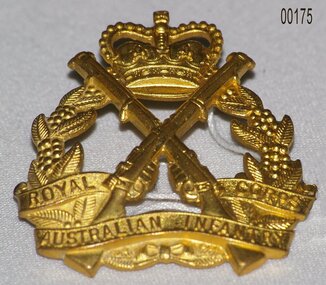
Badge
... Royal Australian Infantry Corps (RA Inf) is the parent corps for all infantry regiments of the Australian Army. It was established on 14 December 1948, with its Royal Corps status being conferred by His Majesty King George VI. At her coronation in 1953, Queen Elizabeth II became Colonel-in-Chief of the corps. Major components of the RA Inf include the various battalions of the Royal Australian Regiment and the six state-based Reserve infantry regiments, such as the Royal New South Wales Regiment. The various Regional Force Surveillance and Special Forces...Royal Australian Infantry Corps (RA Inf) is the parent corps for all infantry regiments of the Australian Army. It was established on 14 December 1948, with its Royal Corps status being conferred by His Majesty King George VI. At her coronation in 1953, Queen Elizabeth II became Colonel-in-Chief of the corps. Major components of the RA Inf include the various battalions of the Royal Australian Regiment and the six state-based Reserve infantry regiments, such as the Royal New South Wales Regiment. The various Regional Force Surveillance and Special Forces ...The Royal Australian Infantry Corps (RA Inf) is the parent corps for all infantry regiments of the Australian Army. It was established on 14 December 1948, with its Royal Corps status being conferred by His Majesty King George VI. At her coronation in 1953, Queen Elizabeth II became Colonel-in-Chief of the corps. Major components of the RA Inf include the various battalions of the Royal Australian Regiment and the six state-based Reserve infantry regiments, such as the Royal New South Wales Regiment. The various Regional Force Surveillance and Special Forces units of the Army are also part of the corps. The Infantry School is located at Singleton, New South Wales.Pressed metal cap badge for the Royal Australian Infantry Corp. This badge is brass alloy with two pins at rear for securing to the cap when worn."Royal Australian Infantry Corps" -
 Lara RSL Sub Branch
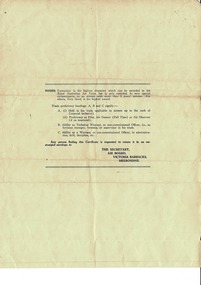
Royal Australian Air Force Certificate of Service and Discharge, 27th February, 1946
... A Royal Australian Air Force Discharge Certificate issued to Linley Walter Rogers on the 26th February1946. These Certificates were issued to all service personal on completion of their Enlistment. RAAF, Australian Defence Forces ...A Royal Australian Air Force Discharge Certificate issued to Linley Walter Rogers on the 26th February1946. These Certificates were issued to all service personal on completion of their Enlistment.Rectangular shaped Parchment Discharge Certificate.Royal Australian Air Force Certificate of Service and Discharge with a brief summary of his time in service.raaf, australian defence forces, world war 2, certificate of discharge, air force, lara r.s.l. -
 Lara RSL Sub Branch
Uniform, Australian Engineers Force Officers cap
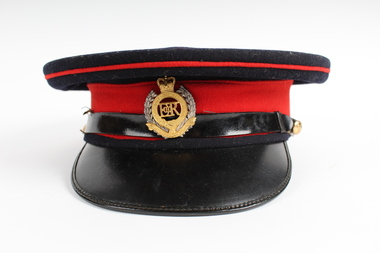
... The black band is held on by two smaller badges, which are brass in colour and have an image of the Australian map (above which is the crown) and around the edges says Australian Military Forces. At the front of the cap is a badge which says: Royal Australian Engineers. ...royal australian engineer officer On badge: Royal Australian Engineers. Moni Soit Qui Mal Y Pense Inside cap: L. Silberston and Sons Ltd London Navy blue cap with red and black trimming. The hat itself is a flat cap made out of navy blue felt. around this is a red felted band, itself encircled with a black patent band and peak. The black band is held on by two smaller badges, which are brass in colour and have an image of the Australian map (above which is the crown) and around the edges says Australian Military Forces ...Army officer's peaked cap worn on formal occasions, dark blue with red band around hat. The peak top side is finished in high gloss black leather and the hat has a similar high gloss black hat band. Worn by an officer in the Royal Australian Engineers (RAE). This hat is referred to as a 'blues' hat.Navy blue cap with red and black trimming. The hat itself is a flat cap made out of navy blue felt. around this is a red felted band, itself encircled with a black patent band and peak. The black band is held on by two smaller badges, which are brass in colour and have an image of the Australian map (above which is the crown) and around the edges says Australian Military Forces. At the front of the cap is a badge which says: Royal Australian Engineers. On badge: Royal Australian Engineers. Moni Soit Qui Mal Y Pense Inside cap: L. Silberston and Sons Ltd London hat, engineer, army, australian army, rae, royal australian engineer, officer -
 Lara RSL Sub Branch
Service Gear, Military Police Beret. Red, 1976
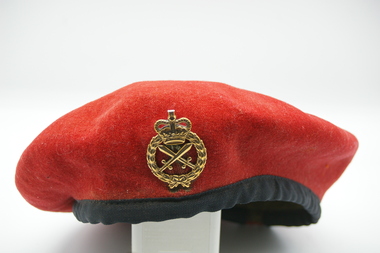
... The Australian Army Provost Corps,was formed on the 3rd April 1916.It is responsible for battle traffic control, security duties, prisoner of war handling,the investigation of service offences,maintaining discipline and the running of military prisions. The red beret is a military beret worn by many Military police,para military,commando, and police forces. military police beret,berets,hats,lara r.s.l. 29936 W02 RICH. BERET MNFRS.PTY.LTD.VICTORIA 1976 DSN 8406 66-089-5429 SIZE59. Red Beret with black grosgrain binding with the Royal ...The Australian Army Provost Corps,was formed on the 3rd April 1916.It is responsible for battle traffic control, security duties, prisoner of war handling,the investigation of service offences,maintaining discipline and the running of military prisions. The red beret is a military beret worn by many Military police,para military,commando, and police forces.Red Beret with black grosgrain binding with the Royal Australian Corps of Military Police Badge at the front.29936 W02 RICH. BERET MNFRS.PTY.LTD.VICTORIA 1976 DSN 8406 66-089-5429 SIZE59.military police beret,berets,hats,lara r.s.l. -
 Lara RSL Sub Branch
Special General Order.Battle Honours-Citation Of Units,28th June 1951, Circa 1970
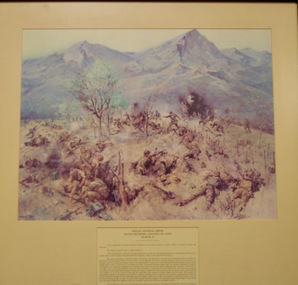
... The battles of Kapyong (23–24 April 1951) and Maryang San (2–8 October 1951) were significant confrontations with a numerically superior enemy force, and saw 3 RAR win the first honours for the newly formed Royal Australian Regiment. prints framed paintings korea lara r.s.l. korean war battle honours special general orders citation of units Detailed description of the Special General Order,Battle Honours-Citation of Units. 28th June 1951 General Mathew B Ridgeway, Supreme Commander UNITED NATIONS FORCES Framed Glass covered Print,Rectangular in Shape showing a painting of Australian soldiers fighting the enemy near Kapyong,Korea,in 1951,with a description underneath. ...During 1951, the 3rd Battalion, The Royal Australian Regiment (3 RAR), fighting as part of a British Commonwealth Brigade in Korea, was engaged in the two most significant and commemorated battles of the Australian Army’s deployment to the three-year Korean War.The battles of Kapyong (23–24 April 1951) and Maryang San (2–8 October 1951) were significant confrontations with a numerically superior enemy force, and saw 3 RAR win the first honours for the newly formed Royal Australian Regiment.Framed Glass covered Print,Rectangular in Shape showing a painting of Australian soldiers fighting the enemy near Kapyong,Korea,in 1951,with a description underneath. Detailed description of the Special General Order,Battle Honours-Citation of Units. 28th June 1951 General Mathew B Ridgeway, Supreme Commander UNITED NATIONS FORCES prints, framed paintings, korea, lara r.s.l., korean war, battle honours, special general orders, citation of units -
 Lara RSL Sub Branch
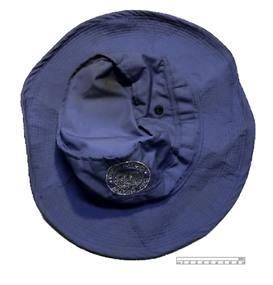
Hat, United Nations Timor Hat Blue, 2001 (estimated)
... Used by Australian United Nation forces in East Timor united nations timor hat military army blue royal australian army east timor australian army royal australian regiment rar un cotton made in china Has United Nations Badge on front of hat Blue United Nations floppy hat with United Nations Badge on front of hat. ...Used by Australian United Nation forces in East TimorBlue United Nations floppy hat with United Nations Badge on front of hat. Hat is circular and can be squashed up to fit in baggage. Made in China of cotton material.Has United Nations Badge on front of hatunited nations, timor, hat, military, army, blue, royal australian army, east timor, australian army, royal australian regiment, rar, un, cotton, made in china -
 Lara RSL Sub Branch
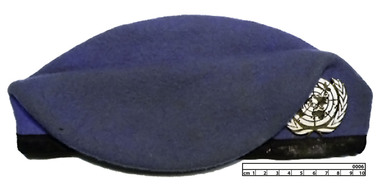
Cap, United Nations Timor (blue) Cap, 2001 (estimated)
... Used by Australian United Nation forces in East Timor. military army royal australian army timor east timor australian army royal australian regiment rar united nations un cotton made in china cap United Nations Badge in metal United Nations Blue Timor Cap with black trim at bottom and metal United Nations badge at front right hand side United Nations Timor (blue) Cap Cap United Nations ...Used by Australian United Nation forces in East Timor.United Nations Blue Timor Cap with black trim at bottom and metal United Nations badge at front right hand sideUnited Nations Badge in metalmilitary, army, royal australian army, timor, east timor, australian army, royal australian regiment, rar, united nations, un, cotton, made in china, cap -
 Lara RSL Sub Branch
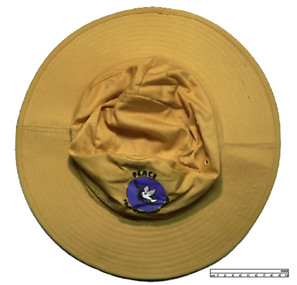
Hat, Yellow United Nations Peace Monitoring Group Bougainville, 1996 (estimated)
... Used by Peace Keeping Forces in Bougainville, Papua New Guinea in the 90's hat military army royal australian army australian army royal australian regiment rar united nations un cotton made in china bougainville papua new guinea yellow Has Peace Monitoring Group badge on front. ...Used by Peace Keeping Forces in Bougainville, Papua New Guinea in the 90'sYellow United Nations floppy hat with United Nations Peace Monitoring Group Badge on front of hat. The Peace Monitoring Group badge has PEACE in black above the badge and Peace Monitoring Group in black beneath. The badge has a white dove on a blue background with black olive branch. Underneath dove is map of Papua New Guinea. Hat is circular and can be squashed up to fit in baggage. Made in China of cotton material.Has Peace Monitoring Group badge on front. Badge has black writing with white dove on blue sky with green olive branchhat, military, army, royal australian army, australian army, royal australian regiment, rar, united nations, un, cotton, made in china, bougainville, papua new guinea, yellow -
 Lara RSL Sub Branch
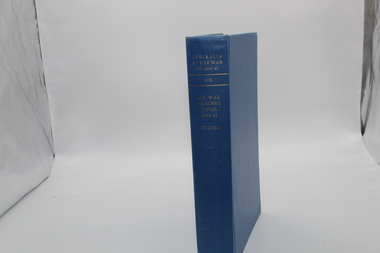
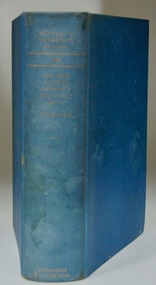
Book, Australia in the War of 1939-1945 - Air War Against Japan 1943-1945 AIR Author George Odgers, First Published in 1957
... The history of the Royal Australian Air Force in WWII beginning with the first offensive against Japan and ends with the return of the RAAF to Australia after the surrender of the Japanese Forces....The history of the Royal Australian Air Force in WWII beginning with the first offensive against Japan and ends with the return of the RAAF to Australia after the surrender of the Japanese Forces. raaf 1943-1945 japan pacific war phillipines burma minelaying mindoro catalinas anti-submarine tarakan labuan rabaul new guinea Australian War Memorial Australia in the War of 1939-1945 - Air War Against Japan 1943-1945 AIR Maps, Illustrations, Photographs, Australia in the War of 1939-1945 - Air War Against Japan 1943-1945 AIR Author George Odgers Book ...The history of the Royal Australian Air Force in WWII beginning with the first offensive against Japan and ends with the return of the RAAF to Australia after the surrender of the Japanese Forces.Australia in the War of 1939-1945 - Air War Against Japan 1943-1945 AIR Maps, Illustrations, Photographs, Australian War Memorialraaf, 1943-1945, japan, pacific war, phillipines, burma, minelaying, mindoro, catalinas, anti-submarine, tarakan, labuan, rabaul, new guinea -
 Lara RSL Sub Branch
Book, Australia in the War of 1939-1945 - Air War Against Germany and Italy 1939-1943. AIR Author John Herington, First published 1954
... Australian contribution to air fighting against Germany and Italy with Australia being a small force against the larger, stronger air forces. The smaller Australian Airmen were merged into the Royal Air Force....Australian contribution to air fighting against Germany and Italy with Australia being a small force against the larger, stronger air forces. The smaller Australian Airmen were merged into the Royal Air Force. ...Australian contribution to air fighting against Germany and Italy with Australia being a small force against the larger, stronger air forces. The smaller Australian Airmen were merged into the Royal Air Force.Historical record of the AIR effort 1939-1943Australia in the War of 1939-1945 - Air War Against Germany and Italy 1939-1943 Illustrations, Maps, Diagrams and Graphs, MapsAustralian War Memorialgermany, italy, the battle of britain, syria, western desert, fighter squadrons in 1941, bomber command 1941, radar bombing, air war, tunisia, pathfinder raids, invasion of sicily, night fighters -
 Lara RSL Sub Branch
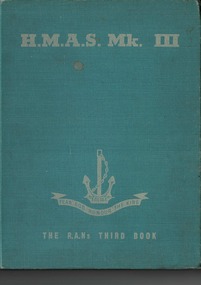
Book, HMAS MK III - The RAN's Third Book, 1951
... royal australian navy...sea power...germans...europe...japanese...communications...rear admiral v.a.c. crutchley, v.c., d.s.c...destroyers...corvettes...frigates...escort duties...motor launches...aircraft carriers...battleships...battle cruisers...cruises...armed merchant cruisers...sloops...submarine sweepers...mediterranean...warspite...valiant...pacific...american forces...dneiper bend...solomon islands...makin...tarawa...h.m.a australia...Royal Australian Navy may be proud. This volume is a further unfolding of the story of WWII which because of its nature as a world wide conflict, is so largely the story of sea power and its influence on the final outcome wwii royal australian navy sea power germans europe japanese communications rear admiral v.a.c. crutchley, v.c., d.s.c destroyers corvettes frigates escort duties motor launches aircraft carriers battleships battle cruisers cruises armed merchant cruisers sloops submarine sweepers mediterranean warspite valiant pacific american forces dneiper bend solomon islands makin tarawa h.m.a australia h.m.a shropshire h.m.a arunta h.m.a warramunga h.m.a.s westralia arctic h.m. jamaica h.m.saumarez u.s. marines h.m.a.s benalla h.m.a.s shepparton royal australian navy reserves Tribute - Grey she is and stately Young alive and shapely Lissome, yes, and graceful, With perfect lines of elegance and dignity Her noble, lovely head She nods and shakes, With confidence to face Whatever may come. ...This book tells of the mounting sea power of the Allies told by men of the RAN who with their ships have added the weight of their blows to the common effort. It tells stories of which the Royal Australian Navy may be proud.This volume is a further unfolding of the story of WWII which because of its nature as a world wide conflict, is so largely the story of sea power and its influence on the final outcome HMAS MK III - The RAN's Third Book. Green hardcover with black text and Navy insignia on front cover, text on spine. Inside front and back cover green sepia drawing of a fleet of Navy ships. Graphs, drawings, photographs, maps, poems.Tribute - Grey she is and stately Young alive and shapely Lissome, yes, and graceful, With perfect lines of elegance and dignity Her noble, lovely head She nods and shakes, With confidence to face Whatever may come. She nurses me And nourishes; Shields me, gives me courage. Alone I have been with her, when afraid. And in a crowd of friends, both hers and mine. Through conflict tense, with element or foe; through danger from above and from below. Through anguish keen Of loss, of death, of pain. Through gaiety, through joy victorious and safe She is my life, my only love, My ship.wwii, royal australian navy, sea power, germans, europe, japanese, communications, rear admiral v.a.c. crutchley, v.c., d.s.c, destroyers, corvettes, frigates, escort duties, motor launches, aircraft carriers, battleships, battle cruisers, cruises, armed merchant cruisers, sloops, submarine sweepers, mediterranean, warspite, valiant, pacific, american forces, dneiper bend, solomon islands, makin, tarawa, h.m.a australia, h.m.a shropshire, h.m.a arunta, h.m.a warramunga, h.m.a.s westralia, arctic, h.m. jamaica, h.m.saumarez, u.s. marines, h.m.a.s benalla, h.m.a.s shepparton, royal australian navy reserves -
 Lara RSL Sub Branch
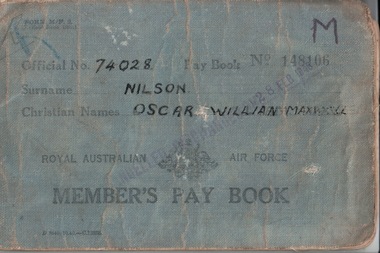
Personal Records, Members pay book Royal Australian AIr Force
... Forces . Official No.74028. Pay Book No 148106 Surname NILSON ChristianNamesOSCAR WILLIAM MAXWELL,Top right corner a large hand printed M. Top left corner M/F 2. Centre front Australian Coat of Arms.Diagonal front cover Cancelled -Discharged 28/2/1946. RAAF Pay Book - 74028 Oscar William Maxwell NILSON 1946 Members pay book Royal ...R A A F MEMBER PAY BOOK.Showing Cash payments ,Fines Forfeitures ,and other debits. Particulars of active pay and allowances .Medical records page24&25. This items significance is that it is a first hand account of financial aspects of our armed Forces .RAAF Pay Book - 74028 Oscar William Maxwell NILSON 1946Official No.74028. Pay Book No 148106 Surname NILSON ChristianNamesOSCAR WILLIAM MAXWELL,Top right corner a large hand printed M. Top left corner M/F 2. Centre front Australian Coat of Arms.Diagonal front cover Cancelled -Discharged 28/2/1946. -
 Shepparton RSL Sub Branch
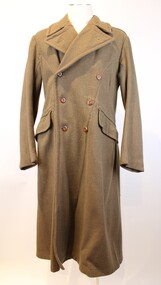
Uniform, Great Coat, C. 1951
... Buttons read “AUSTRALIAN MILITARY FORCES”. Shoulder flashes read “ROYAL AUSTRALIAN/REGIMENT”...Buttons read “AUSTRALIAN MILITARY FORCES”. Shoulder flashes read “ROYAL AUSTRALIAN/REGIMENT” Shin length long sleeved heavy woollen coat in khaki-green with double breasted fastening via three bakelite brown buttons. ...Shin length long sleeved heavy woollen coat in khaki-green with double breasted fastening via three bakelite brown buttons. Two angled hip height pockets on the left and right hips with exterior flap, lined with cotton. Two red curved shoulder flashes on each shoulder embroidered with the words “ROYAL AUSTRALIAN/REGIMENT” in a cream thread with a cream border. Collar has two small buttons either side on the exterior and a hook and eye which fastens under the chin. Fabric epaulette on either shoulder with brown button to secure. Lower back of coat is secured by two buttons and a belt which attaches to left and right seam line and fastens via three buttons. Interior shoulder area is lined with short cotton lining which sits under the arms; sleeves lined in cotton. Pockets are cotton on interior with inscriptions; two labels on interior lower right. Labels reads “REGIMENTAL NO. 3/400922/NAME ROBINSON/GREAT COAT G.S. 1966 PATT/1951/[two lines of text overwritten with “83A” stamp]/A LANDAU VIC 1951”. Interior right pocket reads “11556/ROBERTSON/203 111051”. Shoulder lining has three stamps reading “83A” and one handwritten “83A”. Buttons read “AUSTRALIAN MILITARY FORCES”. Shoulder flashes read “ROYAL AUSTRALIAN/REGIMENT”robinson, robertson, world war ii, second world war, wwii, winter, uniform, military -
 Flagstaff Hill Maritime Museum and Village
Uniform - Tunic, 1899-1903
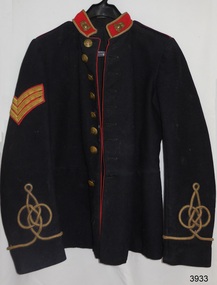
... Royal Australian Artillery (RAA). Then prior to Federation, the RAA and the Permanent Artillery of South Australia, Western Australia and Tasmania all combined, becoming the Royal Australian Artillery Regiment with two Batteries of Field Artillery; Battery A from Sydney and Battery B from Melbourne. This original uniform tunic of the pre-Federation Victorian Permanent Artillery is significant for its association with Australia's military defence and the fortifications of our district, state and country. The tunic is also significant, representing part of the history and evolution of uniforms in the Australian military forces ...This original tunic or jacket is part of the full dress uniform of the pre-Federation Victorian Permanent Artillery regiment. Its owner had the rank of Sergeant, as indicated by the three inverted chevrons. The Artillery design of the badges and buttons indicate the date of the tunic to be from 1893 to 1903. However the maker of the tunic, W. Moncton, began manufacture in Melbourne in 1899, so this the tunic can be dated between 1899 and 1903. The donor's grandfather was given this tunic but not the name of the original owner. It has since been suggested to the family that the tunic was worn by a local Western District Light Horse member. This could very well have been the case because mounted troops were officially referred to as the Light Horse in the late 19th to early 20th century. Several local men were involved in the Light Horse during the First World War. The donor's grandfather wore this tunic in the local district when riding a penny farthing bicycle. The donor's father also wore the tunic when dressed as a 'Captain' hosting a local disco dance. BRIEF MILITARY HISTORY- The Crimean War began In 1854 and many people in colonial Australia were afraid of a Russian attack. Volunteer forces were established to strengthen the British Imperial troops posted here. A battery of artillery was raised in Victoria as well as in other Australian states. In 1870 Australia became responsible for its own naval and military defence. The Volunteer Corps and Victorian Navy shared the responsibility of defending the existing forts, assisted by volunteer coastal and mobile field batteries. The Permanent Victorian Artillery force was established. It was disbanded in 1880 then re-formed in 1882 as the Victorian Garrison Artillery Corps. In 1895 the Geelong, Warrnambool, Port Fairy and Portland Batteries became part of the Western District Garrison Artillery. Many of the volunteers who served in the Artillery were from rural areas. They belonged to rifle clubs and were experience horsemen as well. Australia's defence at this time relied on these mounted troops, or Light Horse men. In 1899 the Victorian Garrison Artillery Corps amalgamated with the New South Wales and Queensland Permanent Artillery to become the Victorian Regiment of the Royal Australian Artillery (RAA). Then prior to Federation, the RAA and the Permanent Artillery of South Australia, Western Australia and Tasmania all combined, becoming the Royal Australian Artillery Regiment with two Batteries of Field Artillery; Battery A from Sydney and Battery B from Melbourne.This original uniform tunic of the pre-Federation Victorian Permanent Artillery is significant for its association with Australia's military defence and the fortifications of our district, state and country. The tunic is also significant, representing part of the history and evolution of uniforms in the Australian military forces. The tunic is also significant in its representation of Australia's independence in forming its own defences. The tunic has local significance in its connection with local social events.Tunic or jacket, part of the full dress uniform of the pre-Federation Victorian Permanent Artillery operating from 1893 to 1903. Original, single-breasted tunic of dark blue wool, red piping trim, black cotton lining in body. Sleeves lined with blue striped, white cotton. Front closure has eight brass buttons. Red band-style collar with hook-and-eye closure has gold bullion braid trim and a brass badge pinned each side at the front. Upper right sleeve has three inverted chevrons on red fabric with gold bullion braid trim (rank of Sergeant). Both sleeves have gold bullion braid 'Austrian knot' emblems stitched onto lower arm, with ends finishing on the inner sleeve. Shoulder epaulettes have red piping and smaller brass buttons. Closed back vent has vertical scalloped design with six brass buttons, in two columns of three, and red piping trim. Brass belt hook is attached to the left back waist, close to the seam (right side has a mark indicating a previous similar clip). Inside left breast is a concealed pocket. Tunic has both machine and hand stitching. All brass shank-style buttons have matching Artillery emblems with inscriptions on the back. The two brass collar badges have additional artillery emblems of exploding grenade and star as well as an inscription. Buttons were made for W. Moncton, of Melbourne and marked with his name. He traded from 1899, dating the tunic to between 1899 and 1903.Button front: Artillery emblem on front (field cannon facing left, in front of a muzzle-loading ram rod). Button back: engraved "W. MONCTON . MELBOURNE ." Collar badges: Artillery emblem (field cannon facing right | stars | exploding grenade | "AUSTRALIA")flagstaff hill, warrnambool, shipwrecked coast, flagstaff hill maritime museum, maritime museum, shipwreck coast, flagstaff hill maritime village, great ocean road, uniform jacket, uniform tunic, garrison volunteer uniform, fortifications in victoria, victorian permanent artillery, pre-federation military uniform, sergeant's uniform, jacket, militia, victoria, victorian volunteer forces, victorian regiment, royal australian artillery, raa, field gun, sergeant, w. moncton, garrison, dress uniform, tunic, scarlet collar, red collar, scarlet piping, red piping, gold bullion, artillery emblem, light horse, artillery, mounted troops, victorian garrison artillery corps -
 Flagstaff Hill Maritime Museum and Village
Booklet - Book and World Chart for Emergency Navigation, George Grady Press, The Raft Book, 1943
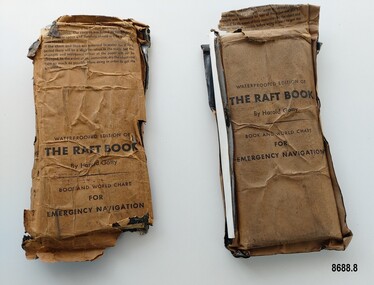
... During the Second World War Gatty was given the honorary rank of Group Captain in the Royal Australian Air Force (RAAF) and worked for the U. S. Army Air Forces (USAAF) in the South Pacific. ...During the Second World War Gatty was given the honorary rank of Group Captain in the Royal Australian Air Force (RAAF) and worked for the U. S. Army Air Forces (USAAF) in the South Pacific. ...Harold Gatty was born on January 5th, 1903 in Campbell Town, Tasmania. He was a navigator and aviation pioneer. He began his career learning navigation at the age of 14 as a midshipman at the Royal Australian Naval College but withdrew after three years and became an apprenticed ship's officer with the Patrick Steamship Company of Sydney. After W. W. 1 he joined the Australian Merchant Navy where he learned the constellations while standing night watch and became an expert in celestial navigation while serving on many ships sailing between Australia and California. In 1927 he moved to California and opened a navigation school and also a laboratory repairing navigational equipment. At this time he became very interested in air navigation and was aware of the limitations of existing methods and instruments for aerial navigation. He began researching ways of improving aerial navigation. Two early inventions of his were his air sextant and a ground speed and drift indicator which formed the basis of the automatic pilot which later came to be standard equipment on most aircraft. He worked with several record breaking pilots including Ann Morrow Lindbergh (who went on to serve as a navigator for her husband Charles Lindbergh), helped Wiley Post break the world record circumnavigating the Earth, invented a new method of "dead reckoning" that revolutionised the ability to fly safely through cloudy conditions without drifting off course and famously navigated a small plane (whilst trying to cross the Pacific) over 1900 km through fog (with no radio) and using only his dead reckoning techniques, back to their starting point in Japan after they developed fuel problems. In 1932 Gatty received the Distinguished Flying Cross from President Hoover. In 1934 Gatty formed the South Seas Commercial Company with Donald Douglas with the aim to deliver air services to the islands of the South Pacific. The Company was sold to Pan Am but he continued to work for them. In 1935 he went on a sailing expedition investigating several small islands in the South Pacific and was briefly marooned on Baker Island. He was able to use his extensive knowledge of seabird habits to save the crew. He was also very interested in the ability of the Polynesians to navigate using the stars. During the Second World War Gatty was given the honorary rank of Group Captain in the Royal Australian Air Force (RAAF) and worked for the U. S. Army Air Forces (USAAF) in the South Pacific. In 1943 he moved to Washington where he developed a survival book (The Raft Book) specifically for boat crews or air crews flying over the Pacific to help them survive and navigate their life rafts in remote areas of the ocean. The original book was 152 pages long however a condensed version was made which consisted of a 64 page booklet, combined map and star chart and calendar strip enclosed in a waterproof slipcase, to be placed in life rafts for emergency use. The booklet included navigational advice and ideas such as ocean currents, estimation of distance, using a compass, measurement of angles, recognising and steering by the stars, land indications from sea birds, migration of sea birds and insects, sounds from the land, the scent of the land and ocean currents and the colour of the sea etc. After W.W.2 Gatty moved to Fiji and formed Fiji Airways (which later became Air Pacific). Harold Gatty died in August 1957.The two copies of "The Raft Book" are significant as they are a written summary of the many methods of sea navigation (both modern and historical) that existed in the 1940's. They are also a record of Harold Gatty, who played a significant role in the development of modern day aerial navigation using his understanding of different sea navigational techniques.Two rectangular brown packets with waterproof coverings (oiled paper) titled "The Raft Book" by Harold Gatty. Each packet contains a folded 64 page paper booklet with detailed instructions for navigating a small craft in open seas, a folded chart (with a map of the world and oceans, well known constellations, latitude and longitude charts, Greenwich time and a scale for string lengths and Harp scale) and a long folded paper calendar strip.Front of package - "WATERPROOFED EDITION OF/ THE RAFT BOOK / By Harold Gatty / BOOK AND WORLD CHART / FOR / EMERGENCY NAVIGATION / To open envelope tear along above line. If the envelope is used again fold the flap to keep contents dry. 1. This envelope contains a book, chart and tape for emergency navigation. The contents are folded to take up the least possible space and therefore should not be removed until needed. 2. if the chart and tape are immersed in water for a long period, there will be a slight variation in the scale but the strength and resistence to tear of the paper will not be changed. In the event of long immersion, dry the chart and tape as much as possible before using in order to in order to get the greatest accuracy in scale. Front of booklet - THE RAFT BOOK / LORE OF THE SEA AND SKY /By Harold Gatty IMPORTANT FOR YOUR SECURITY/Upon abandoning ship you may have to be your own navigator. Take the following pre/cautions for your own safety:/ Carry a good type of pocket watch / keep it wound and have it running on Greenwich (England) / Time, which you can get from the navigating officer. / Keep track of the date at Greenwich; and on a 24-hour basis, / know whether the time is, say, 6 hours (6 A.M.) showing on / your watch, or 18 hours (6P.M.) Greenwich. / PROECT YOUR WATCH. GET A RUBBER SACK FOR IT (OBTAIN FROM PHARMACIST) AND KEEP IT DRY / KEEP A PENCIL IN YOUR POCKET/ POSITION OF SHIP WHEN ABANDONED PRINTED IN UNITED STATES OF AMERICA GEORGE GRADY PRESS, NEW YORK/COPYRIGHT, 1943, BY HAROLD AND FENNA GATTYflagstaff hill maritime museum and village, shipwreck coast, warrnambool, the raft book, harold gatty, book and world chart for emergency navigation, ww 2, ww ii, navigation, air navigation, aerial navigation, lindbergh, wiley post, dead reckoning, south seas commercial company, u.s. army airforce, usaaf, survival book, life rafts, sea navigation, emergency navigation, fiji airways, harp scale -
 Flagstaff Hill Maritime Museum and Village
Certificate - Call to Arms, Osboldstone & Co. Pty. Ltd, W.R. Angus, ca. 1945
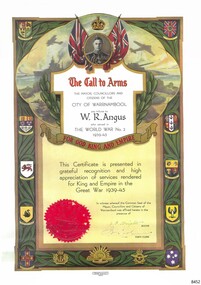
... The bottom has the badges of the Royal Australian Navy, the Australian Commonwealth Military Forces and the Royal Australian Air Force. ...The bottom has the badges of the Royal Australian Navy, the Australian Commonwealth Military Forces and the Royal Australian Air Force. ...This copy of the Certificate of Call to Arms was presented to Dr William Roy Angus at the completion of World War II by the May, Councillors and Citizens of Warrnambool in appreciation for his service. It is now part of Flagstaff Hill’s comprehensive W.R. Angus Collection, donated by the family of Dr W R Angus, 1901-1970, surgeon and oculist. During World War II between 1942-45, Dr Angus served with the Australian Department of Defence as a Surgeon Captain in Ballarat, Victoria, and in Bonegilla, N.S.W., completing his service just before the end of the war due to suffering from a heart attack. The Certificate is headed by a crown above the portrait of King George VI, the reigning British monarch at the time of WWII and afterwards. King George was King of the United Kingdom and the Dominions of the British Commonwealth, which is illustrated by the emblems of the Commonwealth countries and of the states of Australia. It also has symbols for the three Australian Military Forces; Navy, Army and Air Vorce. The Certificate also carries the Common Seal of the Mayor, Councillors and Citizens of the City of Warrnambool, and the signatures of the Mayor and Town Clerk. The W.R. Angus Collection: - The W.R. Angus Collection includes historical medical equipment, surgical instruments and material belonging to Dr Edward Ryan and Dr Thomas Francis Ryan, (both of Nhill, Victoria) and Dr Angus’ own belongings. The Collection’s history spans the medical practices of the two Doctors Ryan, from 1885-1926 plus that of Dr Angus, up until 1969. It includes historical medical and surgical equipment and instruments from the doctors Edward and Thomas Ryan of Nhill, Victoria. Dr Angus married Gladys in 1927 at Ballarat, the nearest big city to Nhill where he began as a Medical Assistant. He was also Acting House surgeon at the Nhill hospital where their two daughters were born. During World War II He served as a Military Doctor in the Australian Defence Force. Dr Angus and his family moved to Warrnambool in 1939, where Dr Angus operated his own medical practice. He later added the part-time Port Medical Officer responsibility and was the last person appointed to that position. Both Dr Angus and his wife were very involved in the local community, including the planning stages of the new Flagstaff Hill and the layout of the gardens there. Dr Angus passed away in March 1970.This is an example of objects used by or issued to Doctor Angus during and after his military service as Surgeon Captain in Australia during World War II. The W.R. Angus Collection is significant for still being located at the site it is connected with, Doctor Angus being the last Port Medical Officer in Warrnambool. The Collection includes historical medical objects that date back to the late 1800s.Call to Arms; certificate of service awarded as a tribute to W. R. Angus by the Mayor, Councillors and Citizens of the City of Warrnambool and sealed with Common Seal and the signatures of the Mayor and the Town Clerk. The top of the certificate has a portrait of King George VI below a crown emblem. The border has logos for countries of the British Commonwealth - Canada, South Africa, Inda and New Zealand - and the Australian States of Queensland, South Australia, Victoria, West Australia and Tasmania. The bottom has the badges of the Royal Australian Navy, the Australian Commonwealth Military Forces and the Royal Australian Air Force. The Certificate was printed by Osboldstone & Co. of Melbourne, with the registered serial number 55319. This copy of the original certificate is part of the W. R. Angus Collection.Printed; "The Mayor, Councillors and citizens of the City of Warrnambool pay tribute to W.R. Angus who served in The World War No. 2 1939-45, for God, King and Empire" "This Certificate is presented in grateful recognition and high appreciation of services rendered for King and Empire in the Great War 1939-45." "In witness whereof, the Common Seal of the Mayor, Councillors and Citizens of Warrnambool was affixed hereto in the presence of " (Signatures of "J.F. Knights" [Mayor] "H.J. Worland" [Town Clerk]) Printed under the certificate: "Osboldstone & Co. Pty. Ltd. Printers, Melbourne" and "55319"flagstaff hill, warrnambool, maritime village, maritime museum, shipwreck coast, great ocean road, flagstaff hill maritime museum and village, dr w r angus, dr ryan, warrnambool base hospital, nhill base hospital, mira hospital, flying doctor, w.r. angus collection, australian department of defence, australian army, world war ii, wwii, surgeon captain, ballarat, bonegilla, certificate, call to arms, warrnambool mayor, j.f. knights, warrnambool town clerk, h.j. worland", city of warrnambool, world war no. 2', 1939-45, great war 1939-45, common seal of city of warrnambool, osboldstone & co. pty ltd., 55319, king george vi, british commonwealth, canada, south aftrica, india, new zealand, australian commonwealth military forces -
 Flagstaff Hill Maritime Museum and Village
Badge - Epaulette, 1920s
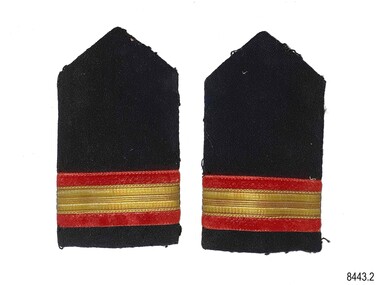
... Royal College of Surgeons), Edinburgh, Scotland. He worked his passage back to Australia as a Ship’s Surgeon on the Australian Commonwealth Line T.S.S. Largs Bay, purchased by the White Star Line in 1928. Dr W R Angus was a Surgeon Captain for the Australian Defence Forces...Royal College of Surgeons), Edinburgh, Scotland. He worked his passage back to Australia as a Ship’s Surgeon on the Australian Commonwealth Line T.S.S. Largs Bay, purchased by the White Star Line in 1928. Dr W R Angus was a Surgeon Captain for the Australian Defence Forces ...The pair of epaulettes once belonged to W.R. Angus, who possibly wore them when he worked his passage fo or from the UL in the 1920s. The epaulettes are part of Flagstaff Hill’s comprehensive W.R. Angus Collection, donated by the family of Dr W R Angus (1901-1970), surgeon and oculist. William Roy Angus (1901-1970) qualified as a doctor in 1923. He decided he further his studies overseas in the UK in 1927, sailing on the ship SS Banffshire (built in 1912, destroyed in 1937). He studied at London University College Hospital and at Edinburgh Royal Infirmary and in 1928 he was awarded FRCS (Fellow from the Royal College of Surgeons), Edinburgh, Scotland. He worked his passage back to Australia as a Ship’s Surgeon on the Australian Commonwealth Line T.S.S. Largs Bay, purchased by the White Star Line in 1928. Dr W R Angus was a Surgeon Captain for the Australian Defence Forces, Army Medical Corps, stationed in Ballarat, Victoria, and in Bonegilla, N.S.W. He completed his service just before the end of the war due to suffering from a heart attack. The W.R. Angus Collection: - The W.R. Angus Collection includes historical medical equipment, surgical instruments and material belonging to Dr Edward Ryan and Dr Thomas Francis Ryan, (both of Nhill, Victoria) and Dr Angus’ own belongings. The Collection’s history spans the medical practices of the two Doctors Ryan, from 1885-1926 plus that of Dr Angus, up until 1969. It includes historical medical and surgical equipment and instruments from the doctors Edward and Thomas Ryan of Nhill, Victoria. Dr Angus married Gladys in 1927 at Ballarat, the nearest big city to Nhill where he began as a Medical Assistant. He was also Acting House surgeon at the Nhill hospital where their two daughters were born. During World War II He served as a Military Doctor in the Australian Defence Forces. Dr Angus and his family moved to Warrnambool in 1939, where Dr Angus operated his own medical practice. He later added the part-time Port Medical Officer responsibility and was the last person appointed to that position. Dr Angus and his wife were very involved in the local community, including the planning stages of the new Flagstaff Hill and the layout of the gardens there. Dr Angus passed away in March 1970.This pair of epaulettes is connected to the badges in the W.R. Angus Collection. Dr W R Angus (1901-1970), surgeon and oculist, collected a range of badges and military objects including those he personally used during his time as Surgeon Captain in the Australian Defence Forces in World War II. The W.R. Angus Collection is significant for still being located at the site it is connected with, Doctor Angus being the last Port Medical Officer in Warrnambool. The Collection includes historical medical objects that date back to the late 1800s.Epaulette (pair of two), dark blue with red and gold horizontal stripes. A tall rectangular shape with a point at the top. Made from a card covered by hessian, the front is covered with a dark blue fabric joined at the back by crossed stitching. The epaulettes belonged to Dr W R Angus and are now part of the W. R. Angus Collection.flagstaff hill, warrnambool, maritime village, maritime museum, shipwreck coast, great ocean road, flagstaff hill maritime museum and village, dr w r angus, w.r. angus collection, badge, insignia, badge collection, epaulettes, naval epaulettes, naval insignia, shoulder boards, ss banffshire, t.s.s. largs bay, uniform
