
Showing 89 items matching "timber stack"
-
 Linton and District Historical Society Inc
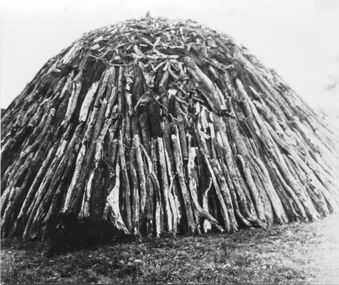
Photograph, Timber Stack for Charcoal Burning
... Timber Stack for Charcoal Burning...Timber stack...Black and white copy of original photograph which shows a more or less circular stack of timber. The stack appears to have been made from the thinner branches of trees. ...Timber Stack for Charcoal Burning Photograph ...It is not known where this photograph was taken. James(?) Scarf who lived at Madden's Flat was said to be a charcoal burner (Source - Bill Grigg Snr in interview with Max Standish - typescript in Grigg family file.)Black and white copy of original photograph which shows a more or less circular stack of timber. The stack appears to have been made from the thinner branches of trees. It is understood that the timber may have been stacked in this way prior to being burnt for charcoal, which was the main source of fuel used in blacksmith's forges.timber stack, burning pile, charcoal burning, wood -
 Phillip Island and District Historical Society Inc.
Photograph, Narrabeen ferry at Cowes jetty, 1928
... Close-up "Narrabeen" berthed at Cowes Jetty. Timber stack on Jetty near ship's beam....Local History PHOTOGRAPHY Photographs Slides Film Shipping Westernport Trading Black & White Photograph Shipping Sea Captains Phillip Island & Westernport Shipping Co Close-up "Narrabeen" berthed at Cowes Jetty. Timber stack on Jetty near ship's beam. Narrabeen ferry at Cowes jetty Photograph Photograph ...Photo by Arthur Woodley. "Narrabeen" formerly a Sydney Harbour cargo ferry, was acquired in 1928. A McFarlane Winch powered a heavy duty Derrick capable of putting an omnibus on board. It was able to be operated by one man - ship's engineer Archie McNeil - Captain Jimmy Clarke. It transported cargo, livestock, passengers and vehicles. Only one death occurred during "Narrabeen's" life to a passenger who refused to observe a warning.Close-up "Narrabeen" berthed at Cowes Jetty. Timber stack on Jetty near ship's beam.local history, photography, photographs, slides, film, shipping, westernport trading, black & white photograph, shipping, sea captains, phillip island & westernport shipping, co -
 Otway Districts Historical Society
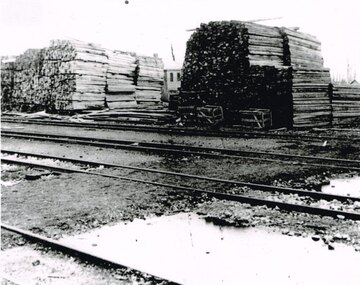
Photograph, Knox Collection, Beech Forest: timber stacks, 1906, 1906
... B/w. 190mm x 265mm. Timber stacked in the Beech Forest railway yard. ...Beech Forest: timber stacks, 1906. Photograph Knox Collection ...Beech Forest was the principal despatch centre for split timber and mining laths in 1906, most of which was carried to the railway yards by bullock wagons, or a horse-hauled wooden tramline along the Olangolah Road to the east of the town. At the yards it awaited trans-shipment by rail.B/w. 190mm x 265mm. Timber stacked in the Beech Forest railway yard. Four roads passing. A goods shed in the background. beech forest; railways; -
 Port of Echuca
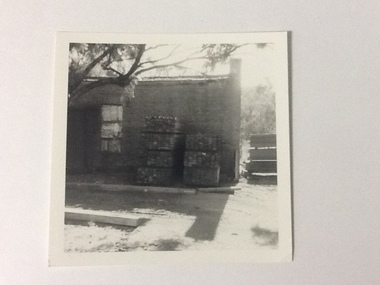
Black and white photograph, Approx. 1975
... Trees are visible behind these stacks of timber. Two stacks of timber (1x 4 blocks high, 1 X 3 blocks high) are in front of the building between the window and the chimney This relates to photographs P000106, P000105...Black and white photograph of an old Murray River Sawmill building with the chimney to the right and a door and window on the left. Two stacks of timber planks are against the wall between the window and the chimney. ...Trees are visible behind these stacks of timber. Two stacks of timber (1x 4 blocks high, 1 X 3 blocks high) are in front of the building between the window and the chimney This relates to photographs P000106, P000105 Sawmills in the Echuca area were historically and socially significant being a large employer in the area. ...The old brick Murray River Sawmill office was demolished around 1975. This appears to be part of one of the office buildings associated with the sawmill, taken in shadow, with the building well back on the block, on the bridge side. There is a dirt driveway in front of the building and stacks of timber next to the chimney side of the building. Trees are visible behind these stacks of timber. Two stacks of timber (1x 4 blocks high, 1 X 3 blocks high) are in front of the building between the window and the chimney This relates to photographs P000106, P000105 Sawmills in the Echuca area were historically and socially significant being a large employer in the area. The Murray River sawmill was one of the biggest and longest operating sawmills in the area. Black and white photograph of an old Murray River Sawmill building with the chimney to the right and a door and window on the left. Two stacks of timber planks are against the wall between the window and the chimney. A dirt driveway is in front of the building with timber planks edging the driveway.On the reverse in pencil "Old M. R. S. Building well back on the block on the bridge side. Near old offices, also demolished about 1975??" Kodak, , in blue ink "0932"murray river sawmills, echuca, echuca, victoria, pullicino, j (unconfirmed) -
 Greensborough Historical Society
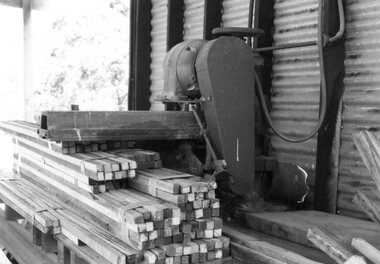
Photograph - Photograph Collection, Alison Lendoudis et al, Stacked timber at Briar Hill Timber 1996, 1996
... The stack shown is an original timber stack straight from the kiln....The stack shown is an original timber stack straight from the kiln. The Briar Hill Timber and Trading Company was active during the 1930s - 1950s during the development of the local area with many houses being built by owner-builders who used the company for their needs. briar hill timber and trading company briar hill timber alison lendoudis bob manuell sherbourne road briar hill squire family Group of 7 black and white photographs Stacked timber at Briar Hill Timber 1996 Photograph Photograph Collection Alison Lendoudis Bob Manuell ...After kiln drying the wood was stacked in open sheds. The stack shown is an original timber stack straight from the kiln.The Briar Hill Timber and Trading Company was active during the 1930s - 1950s during the development of the local area with many houses being built by owner-builders who used the company for their needs. Group of 7 black and white photographsbriar hill timber and trading company, briar hill timber, alison lendoudis, bob manuell, sherbourne road briar hill, squire family -
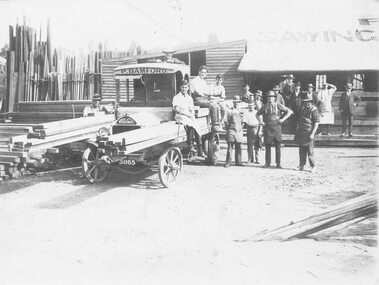 Ringwood and District Historical Society
Photograph, Maroondah Highway Central, Ringwood. Bamford's Timber Yard, c.1915
... Image shows men standing outside building. Timber stacked to left and utility vehicle with P. ...Image shows men standing outside building. Timber stacked to left and utility vehicle with P. ...Black and white photograph (3 copies- 1 large, 2 smaller) Typed below large photograph: "Bamford's Timber Yard. Cnr. Warrandyte and Main Rds. (Later to become Safeway Site). c1915". Image shows men standing outside building. Timber stacked to left and utility vehicle with P. Bamford written on cabin. -
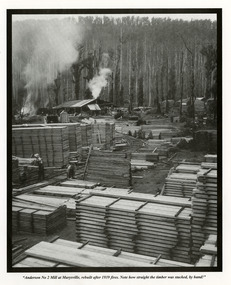 Marysville & District Historical Society
Ephemera (item) - Calendar page, Unknown
... Note how straight the timber was stacked, by hand!"...Note how straight the timber was stacked, by hand!" A page from a calendar with a black and white photograph taken at the Anderson No. 2 Mill at Marysville. ...A page from a calendar with a black and white photograph taken at the Anderson No. 2 Mill at Marysville. The mill was rebuilt after the 1939 Black Friday bushfires.A page from a calendar with a black and white photograph taken at the Anderson No. 2 Mill at Marysville."Anderson No 2 Mill at Marysville, rebuilt after 1939 fires. Note how straight the timber was stacked, by hand!"marysville, victoria, australia, 1939 black friday bushfires, calendar, photograph, andersons no. 1 mill, andersons no. 2 mill -
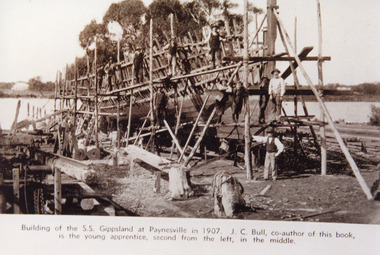 Lakes Entrance Historical Society
Photograph - SS Gippsland being built at Paynesville 1907
... Hull and framework in progress, struts supporting hull in position, timber stacked on site, eleven workmen, McMillan Strait and Raymond Island in background. ...Hull and framework in progress, struts supporting hull in position, timber stacked on site, eleven workmen, McMillan Strait and Raymond Island in background. ...Sepia photograph showing the steamer S S Gippsland being built at the shipyard at Paynesville. Hull and framework in progress, struts supporting hull in position, timber stacked on site, eleven workmen, McMillan Strait and Raymond Island in background. Paynesville VictoriaBuilding of the S S Gippsland at Paynesville in 1907. J C Bull co-author of this book is the young apprentice second from the left in the middle. ships and shipping, slipway, boat building -
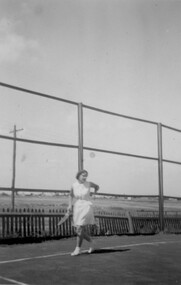 Sunshine and District Historical Society Incorporated
Photograph - Tennis players Methodist Church Tennis Court Devonshire Road Sunshine, late 1940s
... Two photos of tennis players on the Methodist Church tennis court Devonshire Road Sunshine One photo of female player shows Moons paddock looking approximately North East The other photo male player has a background of timber stacks before use by Mochries Cabinet Works This area later housed the Dept of Social Security offices...Sunshine Methodist Church Sunshine Devonshire Road Tennis Two photos of tennis players on the Methodist Church tennis court Devonshire Road Sunshine One photo of female player shows Moons paddock looking approximately North East The other photo male player has a background of timber stacks before use by Mochries Cabinet Works This area later housed the Dept of Social Security offices Tennis players Methodist Church Tennis Court Devonshire Road Sunshine Photograph Tennis players Methodist Church Tennis Court Devonshire Road Sunshine ...Two photos of tennis players on the Methodist Church tennis court Devonshire Road Sunshine One photo of female player shows Moons paddock looking approximately North East The other photo male player has a background of timber stacks before use by Mochries Cabinet Works This area later housed the Dept of Social Security officessunshine methodist church, sunshine, devonshire road, tennis -
 City of Greater Geelong
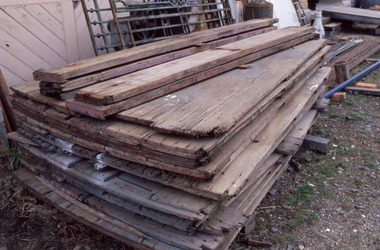
Photograph - Carousel Restoration, Elphinstone, Victoria, Stewart Strachan, 1997-1999
... Colour image showing a pile of stacked timber outdoors....As part of the revitalisation, the Steampacket Place Development Board purchased the Armitage-Herschell portable steam-driven carousel as a major feature on the revitalised waterfront. merry go-round horses carousel geelong restoration rides j. j. miller Geelong Waterfront Steam Engine Opening 35mm colour transparency steampacket place development board City of Greater Geelong revitalisation armitage-herschell Stewart Strachan Photograhy Elphinstone Rick Furlong Artists mordialloc Colour image showing a pile of stacked timber outdoors. Photograph Carousel Restoration, Elphinstone, Victoria Stewart Strachan ...This image is part of a collection of 35mm colour transparencies taken by photographer Stewart Strachan during the carousel restoration project which took place in Elphinstone between 1997-1999. The Carousel was manufactured around 1892 by the Armitage-Herschell company of New York. The Carousel operated on the Mordialloc Pier from the 1920s to the 1950s. In around 1996, the carousel was found quietly rotting away in a Victorian shed by collector and restorer Rick Furlong, who saw its beauty and potential, then gathered a team of specialist historians, craftspeople and artists to work on the project of authentic restoration. Rick Furlong – Collector, Restorer and Project Manager Lindsay Mew – Woodcarver and Foundry Artist, dismantled, sectioned and cleaned the horses. Graeme Wright – Artist, who stripped up to 40 layers of paint from the horses and completed colour research for each individual horse. Kurt Simmons - Dismantled, sectioned and cleaned the horses. Andy Bull – Carpenter and Joiner, restored the floorboards, platforms, drums and crown panels and recreated a ticket box. Colin Turton – Repaired and restored all the structural metal work. Brendan Furlong & David Ely – Artists, painted the horses in their original colours. Jenny McCracken – Artist, created the paintings on sixteen scenery panels. Denise Puller – Made the pure horsehair tails. Chuck Kaparich (from Montana, USA) – Carved the chariots and shipped them for assembly and painting in Elphinstone. Using only recycled timbers, 24 of the 36 horses were restored with many legs, heads and necks replaced, while 12 replicas were hand-carved to match the originals, believed to be rare examples hand-carved by the American master, Charles Dare. Each horse took 300 hours to restore, with intricate carving, coating, filling, sanding, smoothing, painting and varnishing. The period matched organ and steam engine were sourced from New South Wales and Tasmania respectively. The Steampacket Place Development Board, a joint team formed by the Victorian State Government and the City of Greater Geelong undertook the $30 million revitalisation of the entire Geelong Waterfront from 1995 to 2000. As part of the revitalisation, the Steampacket Place Development Board purchased the Armitage-Herschell portable steam-driven carousel as a major feature on the revitalised waterfront.Colour image showing a pile of stacked timber outdoors.merry go-round, horses, carousel, geelong, restoration, rides, j. j. miller, geelong waterfront, steam engine, opening, 35mm colour transparency, steampacket place development board, city of greater geelong, revitalisation, armitage-herschell, stewart strachan photograhy, elphinstone, rick furlong, artists, mordialloc -
 Lakes Entrance Historical Society
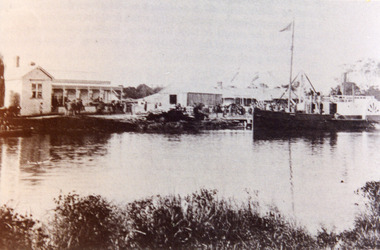
Photograph - P.S. Tanjil, Cornell F, 1880 c
... Swan Hotel on left and Victoria Hotel on right. Timber stacked on wharf. People on wharf and in small boats on river on left, taken from opposite side of Latrobe River. ...Swan Hotel on left and Victoria Hotel on right. Timber stacked on wharf. People on wharf and in small boats on river on left, taken from opposite side of Latrobe River. ...Also new sepia print 10 x 15 cm. See also Peter Synan's book 'Highways of Water'Sepia photograph showing paddle steamer Tanjil at Latrobe Wharf. Swan Hotel on left and Victoria Hotel on right. Timber stacked on wharf. People on wharf and in small boats on river on left, taken from opposite side of Latrobe River. This scene is immediately downstream of present swing bridge on Latrobe River. Sale Victoriaboats and boating, jetties, hotels -
 Otway Districts Historical Society
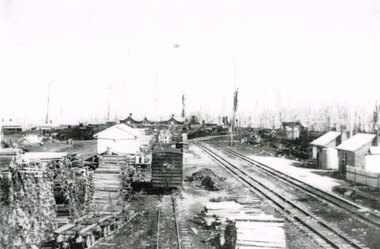
Photograph, Beech Forest Railway Station, 1910, 1910
... Note the Goods Shed, three tracks with No.3 Road having a NU louvre van and loaded NQR wagons, timber stacks to the left, and Devitt's Tramway with unloaded trolleys at the lower left. ...Note the Goods Shed, three tracks with No.3 Road having a NU louvre van and loaded NQR wagons, timber stacks to the left, and Devitt's Tramway with unloaded trolleys at the lower left. ...By 1910 revenue from the Beech Forest railway was $15,500, working expenditure $12,000, with a net loss (including interest charges) of about $4,000. This and the following year were the lowest net losses ever experienced. Passenger journeys rose steadily, outwards goods traffic rose to a record 12,959 tons (in 1911), and inwards goods traffic was a record 3,359 tons.. The railway station possessed a goods shed, stock race and yards, engine shed, coal stage, crew cabins, a refreshment room, and a four-roomed station building, with the station staff to match. Beech Forest was the principal despatch centre at this stage for split timber. Bill Devitt laid a timber tramway to the Beech Forest railway station to cart the palings for on-shipment..B/W. 177mm x 271mm. A general view from the eastern end of Beech Forest station in 1910. Note the Goods Shed, three tracks with No.3 Road having a NU louvre van and loaded NQR wagons, timber stacks to the left, and Devitt's Tramway with unloaded trolleys at the lower left. To the right, crew cabins with shops and houses in the background.beech forest; railways; timber; tramway; -
 Melbourne Tram Museum
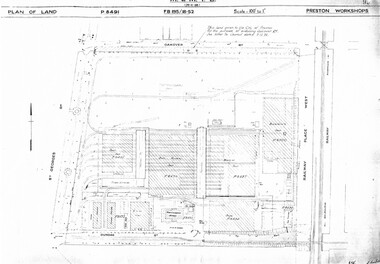
Drawing, Melbourne & Metropolitan Tramways Board (MMTB), "Preston Workshops", c1938
... Set of nine photocopied plans or drawings on A3 sheets of the "Preston Workshops" - c1939 .1 - P8491 - Plan of land showing layout and associated drawings including Reservoir railway line - 19-4-1939. .2 - P8492 - Plan of Timber stacks and Hall - 3-2-1939 .3 - P8493 - Plan of Offices and location of sub-station - 13-12-1938 .4 - P8494 - Plan of Store including Oil store - c1939. .5 - P8495 - Plan of Paint Shop and relationship to timber stack - 1-3-1939 .6 - P8496 - Plan of Car building and Repairs shop - 6-12-1938 .7 - P8497 - Plan of machine shop - 10-12-1938 .8 - P8500 - Plan of Blacksmiths shop - 1-12-1938 .9 - P8590 - Plan of Substation - 1-12-1938...Trams tramways Drawings Depots Property Preston Workshops Workshops Substation Set of nine photocopied plans or drawings on A3 sheets of the "Preston Workshops" - c1939 .1 - P8491 - Plan of land showing layout and associated drawings including Reservoir railway line - 19-4-1939. .2 - P8492 - Plan of Timber stacks and Hall - 3-2-1939 .3 - P8493 - Plan of Offices and location of sub-station - 13-12-1938 .4 - P8494 - Plan of Store including Oil store - c1939. .5 - P8495 - Plan of Paint Shop and relationship to timber stack - 1-3-1939 .6 - P8496 - Plan of Car building and Repairs shop - 6-12-1938 .7 - P8497 - Plan of machine shop - 10-12-1938 .8 - P8500 - Plan of Blacksmiths shop - 1-12-1938 .9 - P8590 - Plan of Substation - 1-12-1938 "Preston Workshops" Drawing Melbourne & Metropolitan Tramways Board (MMTB) ...Set of nine photocopied plans or drawings on A3 sheets of the "Preston Workshops" - c1939 .1 - P8491 - Plan of land showing layout and associated drawings including Reservoir railway line - 19-4-1939. .2 - P8492 - Plan of Timber stacks and Hall - 3-2-1939 .3 - P8493 - Plan of Offices and location of sub-station - 13-12-1938 .4 - P8494 - Plan of Store including Oil store - c1939. .5 - P8495 - Plan of Paint Shop and relationship to timber stack - 1-3-1939 .6 - P8496 - Plan of Car building and Repairs shop - 6-12-1938 .7 - P8497 - Plan of machine shop - 10-12-1938 .8 - P8500 - Plan of Blacksmiths shop - 1-12-1938 .9 - P8590 - Plan of Substation - 1-12-1938trams, tramways, drawings, depots, property, preston workshops, workshops, substation -
 Otway Districts Historical Society
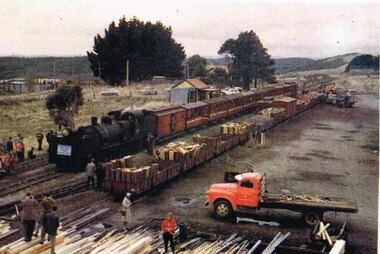
Photograph, Peter Ralph, G42 with "Bye Bye Beechie" special train, 24 March 1962
... A parked red truck in the foreground is next to a timber stack....A parked red truck in the foreground is next to a timber stack. G42 with "Bye Bye Beechie" special train. ...On 24 March 1962 the special train marking the closure of the Colac-Beech forest railway line was again put on by the Australian Railway Historical Society, this time called the "Bye-Bye Beechie". It had G42 as the locomotive, eight NBH excursion carriages with NC guard's vans at either end, pulling a crowd of keen passengers. Special excursion trains until mid-1962.Colour. G42 locomotive inscribed "Australian Railway Historical Society, Bye-Bye Beechie, 24-3-62", an NC guard's van, eight NBH excursion carriages and another NC guard's van on No.2 Road at Beech Forest Railway Station, with dismounted passengers all around. On No.4 Road a number of loaded or semi-loaded NQR wagons and an NUU louvre van, with a truck, a car, and a van at the end of the row. A parked red truck in the foreground is next to a timber stack.beech forest: railways; "bye bye beechie";, beech forest: railways; "bye bye beechie"; -
 Tatura Irrigation & Wartime Camps Museum
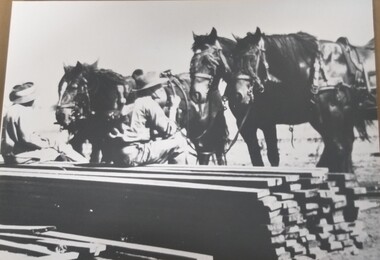
Photograph, Garrison guards and their mounts, copy 1989
... Two guards seated on stack of timber. Three horses in harness....Two guards seated on stack of timber. Three horses in harness. Garrison guards and their mounts Photograph Photograph ..."Smoko" for guards with their mountsB & W. Two guards seated on stack of timber. Three horses in harness.internment camp guards, ww2, camp 13, army personnel, garrison guards, garrison horses -
Glenelg Shire Council Cultural Collection
Photograph - Photograph - Ship Fittings, n.d
... Wheel on left, control panel, wharf, pile of woodchips, stacks of timber visible outside windows...Wheel on left, control panel, wharf, pile of woodchips, stacks of timber visible outside windows Photograph Photograph - Ship Fittings ...Port of Portland Authority Archivesport of portland archives -
 Bendigo Historical Society Inc.
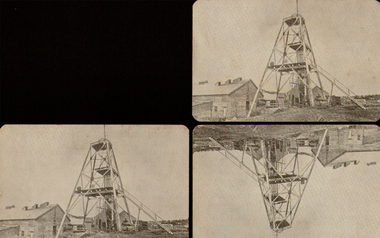
Photograph - GREAT EXTENDED HUSTLERS
... Black and white postcards showing Great Extended Hustlers poppet head in foreground. Timber buildings, stacks of timber in background. Three copies of loose postcards. ...COTTAGE Miners Black and white postcards showing Great Extended Hustlers poppet head in foreground. Timber buildings, stacks of timber in background. Three copies of loose postcards. ...Black and white postcards showing Great Extended Hustlers poppet head in foreground. Timber buildings, stacks of timber in background. Three copies of loose postcards. Inscriptions: 'Royal Historical Society of Victoria, Bendigo Branch, Great Extended Hustlers. Locality, Hustlers Hill, Nth. Bendigo. Formed 1865 - last production 1921. Depth of shaft - 3,470 feet. Poppet legs - steel, 70 feet high. Winding Engine: first motion, 8ft. Drums. Gold Very Rich, Total yield - 3000,000 ozs. Dividends L675,000.cottage, miners -
 Halls Gap & Grampians Historical Society
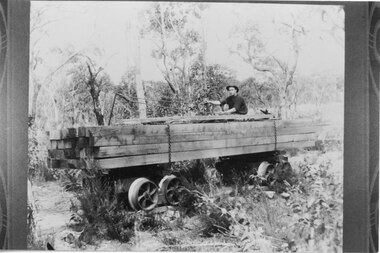
Photograph - B/W
... The photo shows a man sitting on a load of sawn timber, which is stacked on a trolley. The trolley is sitting on timber rails. ...TIMBER INDUSTRIES Logging The photo shows a man sitting on a load of sawn timber, which is stacked on a trolley. The trolley is sitting on timber rails. ...The photo shows a timber worker "riding the load".The photo shows a man sitting on a load of sawn timber, which is stacked on a trolley. The trolley is sitting on timber rails. The man is holding a rope which is attached to a large lever (brake) on the right side of the trolley (near the front).timber industries, logging -
 Sunshine and District Historical Society Incorporated
Photograph - Sunshine bus service and manufacturing industries, circa 1929
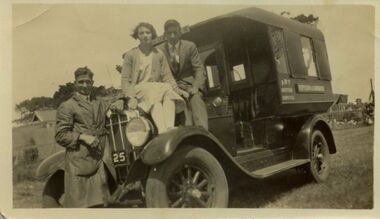
... Two photographs of the first Sunshine bus service a seven passenger vehicle operated between Sunshine and Footscray by Mr Ron Tresize 1 Ron Tresize and George Singleton 2 Ron Tresize George Singleton and Laura Thorpe One photo of three males on entrance to Albion railway station Two photos of HV McKay timber yard stacks and employees The stacks show the method of air seasoning of the timber...Transport Two photographs of the first Sunshine bus service a seven passenger vehicle operated between Sunshine and Footscray by Mr Ron Tresize 1 Ron Tresize and George Singleton 2 Ron Tresize George Singleton and Laura Thorpe One photo of three males on entrance to Albion railway station Two photos of HV McKay timber yard stacks and employees The stacks show the method of air seasoning of the timber Sunshine bus service and manufacturing industries Photograph Sunshine bus service and manufacturing industries ...Two photographs of the first Sunshine bus service a seven passenger vehicle operated between Sunshine and Footscray by Mr Ron Tresize 1 Ron Tresize and George Singleton 2 Ron Tresize George Singleton and Laura Thorpe One photo of three males on entrance to Albion railway station Two photos of HV McKay timber yard stacks and employees The stacks show the method of air seasoning of the timbertransport -
 Otway Districts Historical Society
Photograph, Beech Forest railway yards, 1907, 1907
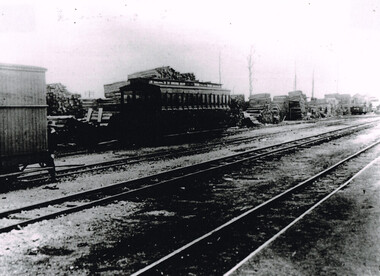
... Passenger carriage; good's van; boy (half hidden; NQ goods wagon; stacks of timber awaiting loading....Beech Forest; railway; yard; passenger car; timber; goods wagon; Beech Forest railway yards, 1907. Passenger carriage; good's van; boy (half hidden; NQ goods wagon; stacks of timber awaiting loading. ...Beech Forest railway yards, 1907. Passenger carriage; good's van; boy (half hidden; NQ goods wagon; stacks of timber awaiting loading.beech forest; railway; yard; passenger car; timber; goods wagon; -
 Bendigo Historical Society Inc.
Photograph - HUSTLER'S LINE OF REEF
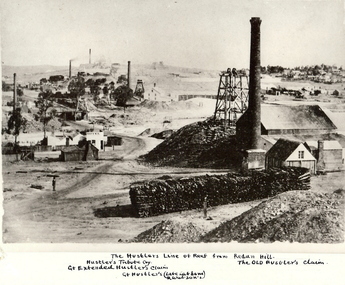
... Black and white photograph of mining landscape with poppet head, chimney and mining sheds (plus timber in stack) in foreground. Other mines in bare landscape on LHS background and housing on RHS background. ...BHS Collection MINE Gold hustlers reef mine Bendigo mines and mining mine mines mining landscape mining landscape Redan Hill poppet head Old Hustlers mining cottages Black and white photograph of mining landscape with poppet head, chimney and mining sheds (plus timber in stack) in foreground. Other mines in bare landscape on LHS background and housing on RHS background. ...BHS CollectionBlack and white photograph of mining landscape with poppet head, chimney and mining sheds (plus timber in stack) in foreground. Other mines in bare landscape on LHS background and housing on RHS background. Inscriptions: on front - 'The Hustler's Line of Reef from Redan Hill Hustler's Tribute Coy', 'Gt. Extended Hustler;s Claim', 'The Old Hustler's Claim, Gt. Hustlers (Late Latham & Watson's). On back - 'A Richardson, 29 Harrison Street, Bendigo'.mine, gold, hustlers reef mine, bendigo, mines and mining, mine, mines, mining, landscape, mining landscape, redan hill, poppet head, old hustlers, mining cottages -
 Brunswick Community History Group
Photograph - Moreland Timber Yard staff
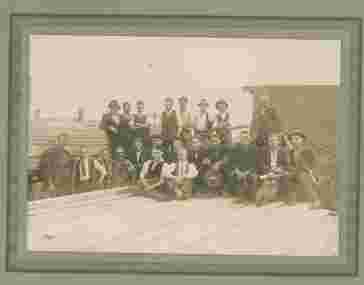
... Faded black and white mounted photograph of a group of men taken at the Moreland Timber Yard in the early years of the 20th century. Some are seated and some standing. Several are leaning against stacked timber. ...Faded black and white mounted photograph of a group of men taken at the Moreland Timber Yard in the early years of the 20th century. Some are seated and some standing. Several are leaning against stacked timber. ...Faded black and white mounted photograph of a group of men taken at the Moreland Timber Yard in the early years of the 20th century. Some are seated and some standing. Several are leaning against stacked timber. It appears to be a photograph of the Yard's employees, including office staff. There are four other photos in this. -
 Otway Districts Historical Society
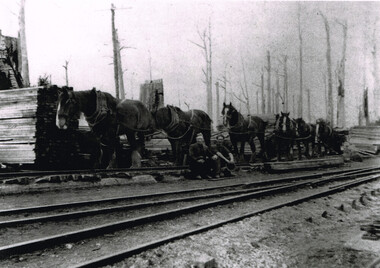
Photograph, Brucker, Pile Siding: horse-drawn timber tram, c.1920, c.1920
... Two timber workers are seated at the centre. Stacks of timber are awaiting collection. ...Two timber workers are seated at the centre. Stacks of timber are awaiting collection. ...Pile Siding was opened in December 1915 because of the Pettit Brothers sawmill and pile extraction operation. The siding was a spur with points facing Beech Forest with a timber tramway feeding the siding. During 1916/17 Pettit's sent away 5,000 tonnes of timber before moving to another site, after which loading dropped to insignificant proportions. Pettit's again occupied the site from 1924 and traffic rose to major levels again.B/W. A six horse-drawn timber tram at Pile Siding station in c.1920. Two timber workers are seated at the centre. Stacks of timber are awaiting collection. Note the bare tree trunks in the background. pile siding; weeaproinah; railways; tramways; -
 Otway Districts Historical Society
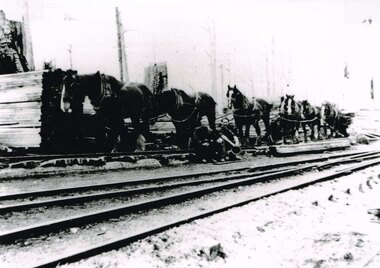
Photograph, Knox Collection, Pettit's Siding: A loader, teamster and their six-horse load, c.1920
... Sam Knox, timber loader and tallyman, and George Pritchard, a teamster, resting at Pettit's Siding after delivering a six-horse-drawn load of timber to the Siding. Stacks of wood awaiting transport by rail are in the background....Sam Knox, timber loader and tallyman, and George Pritchard, a teamster, resting at Pettit's Siding after delivering a six-horse-drawn load of timber to the Siding. Stacks of wood awaiting transport by rail are in the background. ...Originally known as Smith's Siding, in November 1914 the siding was renamed "Pettits" following the sale of a nearby mill to the north. The sawn timber was initially carted out by bullock wagon but the mud and slush caused such difficulties that Pettits caused a thirty chain incline to be built from the mill to a tramway. The tramway connected the mill to the railway until 1924. An annual average of 2,450 tonnes of timber was despatched from the siding. No provision was made for passenger traffic. After ten years Pettit Brothers had cut out the area and moved on, abandoning the siding which was put out of commission on 23 September 1924. However, local residents, not wishing to suffer the loss of railway facilities, managed to have the siding reopened in February 1925 for goods and passengers. It was lightly patronised until all traffic ceased in 1936. B/W. Sam Knox, timber loader and tallyman, and George Pritchard, a teamster, resting at Pettit's Siding after delivering a six-horse-drawn load of timber to the Siding. Stacks of wood awaiting transport by rail are in the background.pettits siding; wyelangta; railways; smith's siding; sam knox; george pritchard; -
 Otway Districts Historical Society
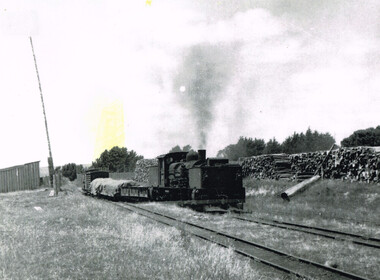
Photograph, R.L. Forster, Train leaving the balloon reversing loop at Beech Forest, 1950
... In the background are stacks of timber awaiting collection, and further in the background, the edges of the tennis courts....In the background are stacks of timber awaiting collection, and further in the background, the edges of the tennis courts. ...B/W. "G" class locomotive and goods carriages crossing from No.1 road to No.2 road after leaving the balloon reversing loop at Beech Forest station. In the background are stacks of timber awaiting collection, and further in the background, the edges of the tennis courts.beech forest; railways; reversing loop; -
 Sunshine and District Historical Society Incorporated
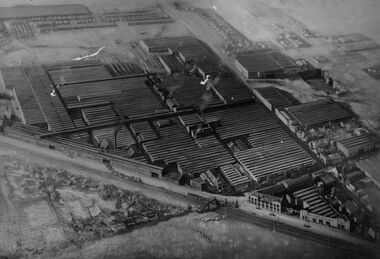
Photograph - Aerial view of HV McKay Massey Harris Factory, 1942
... Aerial view of HV McKay Massey Harris Factory building administration office and Sunshine including Sunshine Gardens and gardeners residence This photograph shows many other points of historical nature Top Left 1 Storage shed stacks of timber air drying 2 Old clock tower and new factory office block 3 Main or head office block opposite clock tower Then along Devonshire Road Adjacent to Head Office new drawing office on 1st floor over new workshop for experimental department These two later amalgamated and formed what became known as The Engineering Department Right Centre 4 on both sides of Devonshire Road 5 State Savings Bank before rebuilding 6 Blair Athol guesthouse with National Bank on ground floor opposite State Savings Bank 7 Along Hampshire away from Blair Athol some houses then McKays laboratory Duplicates department Service Street Morgue Steel Storage and Pickling Annex and Roberts Quarry and some houses in background top right Top Left to Right 8 In front of timber stacks Stony Creek winds through factory site to dam fire fighting before running under Hampshire Road in front of Annexe and Quarry across Service Street Creek was diverted through a channel and tunnel not shown Also Railway lines to Bendigo and Mildura show McKays railway engine hauling trucks from factory...McKay Massey Harris Sunshine Devonshire Road Aerial view of HV McKay Massey Harris Factory building administration office and Sunshine including Sunshine Gardens and gardeners residence This photograph shows many other points of historical nature Top Left 1 Storage shed stacks of timber air drying 2 Old clock tower and new factory office block 3 Main or head office block opposite clock tower Then along Devonshire Road Adjacent to Head Office new drawing office on 1st floor over new workshop for experimental department These two later amalgamated and formed what became known as The Engineering Department Right Centre 4 on both sides of Devonshire Road 5 State Savings Bank before rebuilding 6 Blair Athol guesthouse with National Bank on ground floor opposite State Savings Bank 7 Along Hampshire away from Blair Athol some houses then McKays laboratory Duplicates department Service Street Morgue Steel Storage and Pickling Annex and Roberts Quarry and some houses in background top right Top Left to Right 8 In front of timber stacks Stony Creek winds through factory site to dam fire fighting before running under Hampshire Road in front of Annexe and Quarry across Service Street Creek was diverted through a channel and tunnel not shown Also Railway lines to Bendigo and Mildura show McKays railway engine hauling trucks from factory Aerial view of HV McKay Massey Harris Factory Photograph Aerial view of HV McKay Massey Harris Factory ...Aerial view of HV McKay Massey Harris Factory building administration office and Sunshine including Sunshine Gardens and gardeners residence This photograph shows many other points of historical nature Top Left 1 Storage shed stacks of timber air drying 2 Old clock tower and new factory office block 3 Main or head office block opposite clock tower Then along Devonshire Road Adjacent to Head Office new drawing office on 1st floor over new workshop for experimental department These two later amalgamated and formed what became known as The Engineering Department Right Centre 4 on both sides of Devonshire Road 5 State Savings Bank before rebuilding 6 Blair Athol guesthouse with National Bank on ground floor opposite State Savings Bank 7 Along Hampshire away from Blair Athol some houses then McKays laboratory Duplicates department Service Street Morgue Steel Storage and Pickling Annex and Roberts Quarry and some houses in background top right Top Left to Right 8 In front of timber stacks Stony Creek winds through factory site to dam fire fighting before running under Hampshire Road in front of Annexe and Quarry across Service Street Creek was diverted through a channel and tunnel not shown Also Railway lines to Bendigo and Mildura show McKays railway engine hauling trucks from factoryh.v. mckay massey harris, sunshine, devonshire road -
 Bendigo Historical Society Inc.
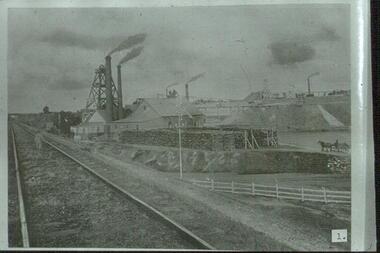
Slide - ALBERT RICHARDSON COLLECTION: NEW CHUM RAILWAY GOLD MINE
... Mine buildings on right hand side of track, chimneys, poppet head, horse and dray and large stacks of timber in foreground of image. Boy standing on rail way line....MINE Gold new chum railway poppet heads chimney stacks timber stacks 3 mine bridges horse and dray mining Bendigo gold mining railway line New Chum Mine number 1 in black Slide: railway track running alongside New Chum Mine, Breen Street, Golden Square, Bendigo. ...Slide: railway track running alongside New Chum Mine, Breen Street, Golden Square, Bendigo. Mine buildings on right hand side of track, chimneys, poppet head, horse and dray and large stacks of timber in foreground of image. Boy standing on rail way line.number 1 in blackmine, gold, new chum railway, poppet heads, chimney stacks, timber stacks, 3 mine bridges, horse and dray, mining, bendigo, gold mining, railway line, new chum mine -
 Otway Districts Historical Society
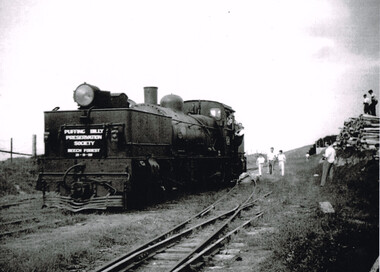
Photograph, Ray Jude, Beech Forest: engine leaving balloon loop, 1959, 21 November 1959
... A number of people are in the area, particularly two on top of a stack of timber. ...A number of people are in the area, particularly two on top of a stack of timber. Beech Forest: engine leaving balloon loop, 1959. ...B/W. Engine G41, showing the sign "Puffing Billy Preservation Society, Beech Forest, 21-11-59", leaves the balloon loop at Beech Forest Railway Station, with guard and child hanging from the engine. A number of people are in the area, particularly two on top of a stack of timber. beech forest; railways; -
 Halls Gap & Grampians Historical Society
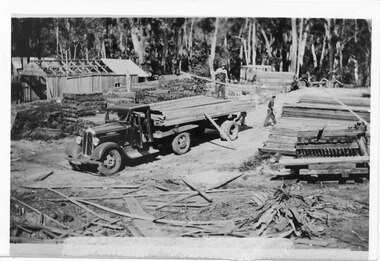
Photograph - B/W
... There is a partially roofed timber building behind the truck and stacks of sawn timber all around. ...A man is walking from the back of the truck towards a stack of timber to the right and another is standing on the timber on the tray of the truck, holding a piece of timber. ...This is a picture of timber workers loading a truck with sawn timber at Sandersons Mill.The photo shows a tray truck loaded with sawn timber. There is a partially roofed timber building behind the truck and stacks of sawn timber all around. A man is walking from the back of the truck towards a stack of timber to the right and another is standing on the timber on the tray of the truck, holding a piece of timber. There is thick bush in the background.timber industries, logging, sawmilling -
 Whitehorse Historical Society Inc.
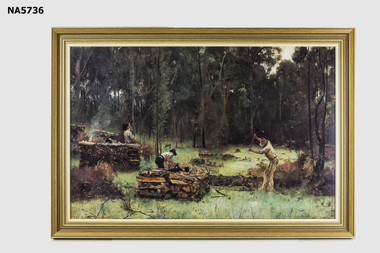
Print - Print ' The Charcoal Burners' Tom Roberts, Tom Roberts, 1886
... Picture of three men doing charcoal burning with felled timber in a wooded area. Lightish green foreground grass with stacked timber and forest tress in background. ...Picture of three men doing charcoal burning with felled timber in a wooded area. Lightish green foreground grass with stacked timber and forest tress in background. ...Charcoal burning was one of the earliest activities of the settlers in the Whitehorse area Large print in gold frame by Tom Roberts. Picture of three men doing charcoal burning with felled timber in a wooded area. Lightish green foreground grass with stacked timber and forest tress in background. Tom Roberts left side On back, Tom Roberts, the wood splitters (The charcoal burners) 1888. Ballarat Fine Art gallery, Victoria. Bequest of J. R .Hartley 1961 On back State of the Art Framing 510 Whitehorse Rd, Mitcham 3132 Ph 9873-5525 Tom Robertscharcoal burning, tom roberts, prints
