
Showing 4009 items matching "timor street"
-
 Ballarat Heritage Services
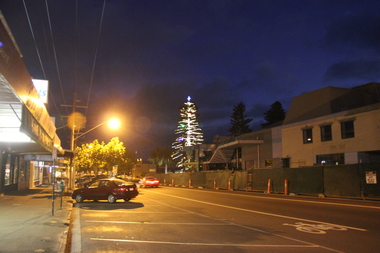
Digital photographs, L.J. Gervasoni, Timor Street Warrnambool at Christmas, c2011
... Timor Street Warrnambool at Christmas......timor street...Colour photograph of a night scene in Timor Street, Warrnambool....Timor Street, Warrnambool, Victoria, Australia...warrnambool night christmas christmas tree timor street streetscape Colour photograph of a night scene in Timor Street, Warrnambool. ...Colour photograph of a night scene in Timor Street, Warrnambool.warrnambool, night, christmas, christmas tree, timor street, streetscape -
 Flagstaff Hill Maritime Museum and Village
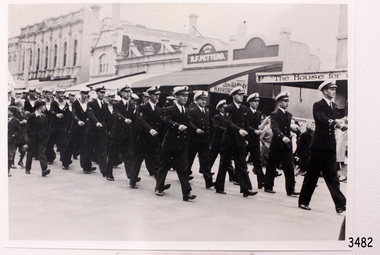
Photograph - Ship's crew, HMAS Warrnambool J202, 1941
... ...timor street warrnambool...This photograph shows the crew of the first HMAS Warrnambool (J202) marching east along Timor Street in Warrnambool, just opposite the Post Office on the corner of Gillies Street. ...This black and white image shows the crew marching east along Timor Street in Warrnambool. People are watching from the footpath and two formally dressed boys are marching alongside the sailors. ...Timor Street, Warrnambool, Great Ocean Road, Victoria, Australia...This photograph shows the crew of the first HMAS Warrnambool (J202) marching east along Timor Street in Warrnambool, just opposite the Post Office on the corner of Gillies Street. ...This photograph shows the crew of the first HMAS Warrnambool (J202) marching east along Timor Street in Warrnambool, just opposite the Post Office on the corner of Gillies Street. People are watching the parade from the footpath and two boys, dressed in their ‘best’ clothes, are marching alongside the crew. The HMAS Warrnambool was one of 60 Bathurst class corvette vessels built during World War II for the Royal Australian Navy (RAN) as armed minesweepers. The namesake of the City of Warrnambool, Victoria, was launched in Sydney in 1941. The HMAS Warrnambool began service with patrols off Bass Strait in 1941. In December the ship docked in the Warrnambool harbour at Lady Bay. The crew came ashore and performed a march for the city. The Mayor, Cr. John R Astbury presented them with a plaque of the City of Warrnambool’s Coat of Arms and the Warrnambool Patriotic Fund gave them a gift of 110 books for the crew’s library. The Warrnambool served in Darwin during the time it was bombed, it was involved in several rescues and carried troops to New Guinea, it carried out escort and patrol duties on Australia's east coast, then at Fremantle and back to Darwin. The ship was at Timor when the Japanese surrendered in 1945. It performed mine clearance work around the Solomon Islands and New Guinea after the war. In 1947 the HMAS Warrnambool was at the Great Barrier Reef, off the Queensland coast, to clear the defensive British mines previously laid to protect Australia’s boarders. The ship hit a mine near Cockburn Reef, exploded and sank shortly afterwards. One of the 70 or so men on board was killed and three died later. The rescued men were transferred by boats to the nearby HMAS Swan II, which took the survivors to Cairns. The four deceased were Victorian seamen. In May 1948 the Royal Australian Navy divers recovered a number of items from the wreck, including the ship’s bell and the City of Warrnambool plaque. In 1949 the RAN returned the plaque to the Warrnambool City Council, and donated the ship’s bell to the Australian War Memorial. Further objects were recovered in 1972-75 by Southern Cross Diving and Salvage. A memorial plaque was erected in Warrnambool on September 13, 1995 in honour of all who served on HMAS Warrnambool. NOTE: (1)- HMAS Warrnambool II (FCPB204 was built in 1980 in Cairns, with a compliment of 22 personnel. It was decommissioned in 2005. (2)- SS Warrnambool, a steam and sail ship, was built in 1892 in London and broken up in 1926. [A more detailed history can be found in our Collection Record 3477.]This photograph is significant for its association with the lifesaving rescue of the crew and the sinking Royal Australian Navy vessel, HMAS Warrnambool (J202). The HMAS Warrnambool played a nationally significant role in overturning Australia’s Immigration Restriction Act 1901 (colloquially known as the White Australia policy). The ship rescued, and brought to Australia, Samuel and Annie Jacob and their family after they evacuated Dutch East India. The family was threatened with deportation and made the first successful appeal to High Court regarding that Act. The HMAS Warrnambool has - Local significance for being the namesake of the City of Warrnambool - Local significance, having docked in Warrnambool Harbour - Local significance, the crew having paraded in Timor Street, Warrnambool - State significance for its first patrol being in Bass Strait. - National significance, being present in Timor at the Japanese surrender - National significance, shown by the significance of the ship’s bell being curated as Military Heritage and Technology at the Australian War Memorial. - National significance as part of Australia’s defence force history, being one of only four Bathurst class corvettes lost while in Australian service, the only Bathurst class corvette lost after World War II, the only RAN vessel to be sunk by a mine, and associated with the last four Navy deaths of WWIIPhotograph of the crew of HMAS Warrnambool J202. This black and white image shows the crew marching east along Timor Street in Warrnambool. People are watching from the footpath and two formally dressed boys are marching alongside the sailors. Inscription on the reverse.(PRIVATE details - See Notes)flagstaff hill, maritime village, maritime museum, warrnambool, shipwreck coast, mort's dock & engineering co ltd, h.m.a.s. warrnambool, hmas warrnambool, hmas warrnambool i, hmas warrnambool j202, hmas swan ii, j202, world war ii, bathurst class corvette, royal australian navy, ran, sydney built ship, bass strait patrol, sea mine patrol, mine sweeper, mine clearance, navy divers, great barrier reef, cockburn reef, southern cross diving and salvage, warrnambool city council, cr j r astbury, mayor j r astbury, warrnambool patriotic fund, seal, coat of arms, dedicatory plaque, hmas warrnambool 1941, shipwreck by sea mine 1947, sinking ship, sunk ship, marching, parade, timor street warrnambool, minesweeper -
 Flagstaff Hill Maritime Museum and Village
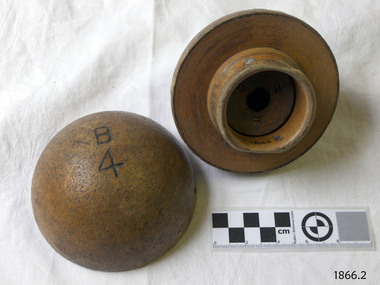
Equipment - Cash Ball, Cramond and Dickson, 1855 - 1974
... ...Timor Street...This cash ball was used by Cramond and Dickson, a large clothing store on the corner of Liebig and Timor Streets, Warrnambool. The Cash Ball system serviced the ground floor, which measured about 30 metres by 25 metres. ...Cramond and Dickson, timor Street, Warrnambool, Victoria, Australia...This cash ball was used by Cramond and Dickson, a large clothing store on the corner of Liebig and Timor Streets, Warrnambool. The Cash Ball system serviced the ground floor, which measured about 30 metres by 25 metres. ...This cash ball was used by Cramond and Dickson, a large clothing store on the corner of Liebig and Timor Streets, Warrnambool. The Cash Ball system serviced the ground floor, which measured about 30 metres by 25 metres. An overhead pipe connected each service point in the store, with the pipes connected to the upstairs office. The ball would be filled with a note of details of the sale, and the cash payment; a vacuum system would be activated that would transport the ball upstairs to the office, where details were recorded and the change assembled. Change was placed in the ball, and the vacuum system was activated to return the ball to the correct sales point. A frequent customer has reported that she never remembered the system not working efficiently, and the service was probably quicker than having a cash register at each sales location. John Glass Cramond and James Dickson migrated from Scotland to Melbourne, where they opened a Cramond and Dickson store in St Kilda. They were inspired by the growth in Warrnambool after a visit and opened a second store there in 1855. The Cramond and Dickson store, grocers – drapery – ironmongery - chemist, was located on the corner of Liebig and Timor Streets, Warrnambool (now the site of a Mexican restaurant). Both Cramond and Dickson were involved in the business and social aspects of Warrnambool’s community. Cramond and Dickson closed in 1974. An advertisement placed by Cramond and Dickson in The Camperdown Chronicle, Saturday 6th April 1895, states them “showing the latest novelties for the coming winter season” … “import directly from English and Continental manufacturers” … “representatives in London … always in touch with the Newest Continental Fashions” ... “having been established for so many years we know the requirements of the Western District”… “allow 5 percent discount on goods paid for at the time of purchase”.The cash ball represents an efficient retail system used in the late 19th to mid 20th century to securely transfer cash from one part of the store to another. It is significant for its association with Cramond and Dickson, a large retail store established in Warrnambool and operating from 1855 to 1974. Both partners were prominent figures in the community.Cash ball: a wooden, round, hollow ball in two pieces. Two half spheres that fit into each other securely. Both are marked with carved characters. "B4" and one has "Fancy" marked on it. It was used by Warrnambool's Cramond and Dickson clothing store. "B4" "Fancy"flagstaff hill, warrnambool, shipwrecked-coast, flagstaff-hill, flagstaff-hill-maritime-museum, maritime-museum, shipwreck-coast, flagstaff-hill-maritime-village, cash ball, cramond and dickson, office equipment, retail equipment, cash handling, sales, warrnambool business, department store, commerce, timor street, liebig street -
 Ballarat Heritage Services
Digital photographs, L.J. Gervasoni, Regional Arts Victoria - Tweet Exhibition at Warrnambool Art Gallery, c2011
... ...timor street...Timor Street, Warrnambool, Victoria, Australia...warrnambool timor street tweet exhibition warrnambool art gallery art exhibition regional arts victoria Colour photograph of an exhibition at Warrnambool Art Gallery. ...Colour photograph of an exhibition at Warrnambool Art Gallery.warrnambool, timor street, tweet, exhibition, warrnambool art gallery, art exhibition, regional arts victoria -
 Warrnambool and District Historical Society Inc.
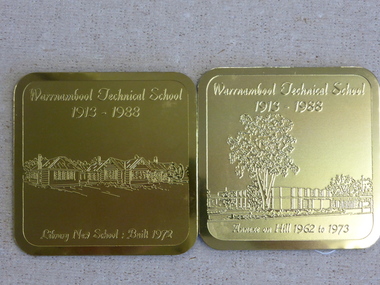
Souvenir - Warrnambool Technical School 1913-1988 souvenir coasters and placemats, 1988
... ...timor street technical school...The scenes depicted are Original Timor Street School built 1926, Timor Street with second storey 1967, New School built 1972. ...The scenes depicted are 000828.1.1 Original Timor Street School built 1926, 000828.1.2 Timor Street with second storey 1967, 000828.1.3 New School built 1972. 000828.1.4 Dunkeld Annexe commenced 1975, 000828.1.5 Library new School built 1972, 000828.1.6 Annexe on Hill 1962 to 1978. ...The scenes depicted are Original Timor Street School built 1926, Timor Street with second storey 1967, New School built 1972. ...These coasters and placemats are souvenirs of the 75th anniversary of the Warrnambool Technical School. The scenes depicted are Original Timor Street School built 1926, Timor Street with second storey 1967, New School built 1972. Dunkeld Annexe commenced 1975, Library new School built 1972, Annexe on Hill 1962 to 1978. They depict the ongoing development of the school which now operates as Brauer College in Caramut Road Warrnambool. Historical and social. A common item in the 20th century and as one of Warrnambool’s largest and longest running school would have some interest for a large number of local people. The artist John Moir was a local artist.Six White drink coasters with different black and white sketches. Rounded corners edged in black. In olive green box. Set two consists of two gilt metal coasters with engravings. Both are incorrectly labelled. Blue felt on the reverse. The scenes depicted are 000828.1.1 Original Timor Street School built 1926, 000828.1.2 Timor Street with second storey 1967, 000828.1.3 New School built 1972. 000828.1.4 Dunkeld Annexe commenced 1975, 000828.1.5 Library new School built 1972, 000828.1.6 Annexe on Hill 1962 to 1978. They depict the ongoing development of the school which now operates as Brauer College in Caramut Road Warrnambool. The two gilt metal coasters 000828.2.1 Library new School Built 1972 000828.2.2 Annexe on Hill 1962 to 1973 Placemats 000828.3.1 Original Timor Street School built 1926, 000828.3.2 Timor Street with second storey 1967, 000828.3.3 New School built 1972. 000828.3.4 Dunkeld Annexe commenced 1975, 000828.3.5 Library new School built 1972, 000828.3.6 Annexe on Hill 1962 to 1978.All have artist’s signature, John Moir, Warrnambool Technical School 1913-1988. warrnambool, warrnambool technical school, warrnambool annexe, timor street technical school, john moir, warrnambool souvenirs -
 Warrnambool and District Historical Society Inc.
Document, Prospectus (Leahy’s Electrical), 1951
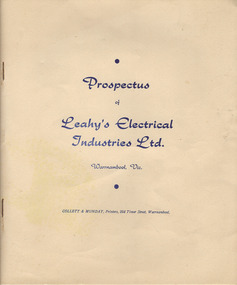
... Front Cover: ‘Prospectus of Leahy’s Electrical Industries Ltd, Warrnambool, Vic, Collett & Munday, Printers, 254 Timor Street, Warrnambool...254 Timor Street, Warrnambool, Victoria, Aust...This prospectus also has a good summary of the history of the Leahy business up to 1951 and the financial statements etc are of considerable importance to researchers and other readers. leahy’s electrical jim leahy leahy's electrical prospectus warrnambool Front Cover: ‘Prospectus of Leahy’s Electrical Industries Ltd, Warrnambool, Vic, Collett & Munday, Printers, 254 Timor Street, Warrnambool This is a typed prospectus of six pages printed back to back and with a buff-coloured cover of lightweight card. ...This is the 1951 prospectus of the new company known as Leahy’s Electrical Industries Limited and formed from the previous business of Jim Leahy, Electrical Engineer. The business was then and remains today at 82 Fairy Street, Warrnambool . The business of Jim Leahy had been operated in conjunction with Leahy’s Hire Cars and commenced in 1946. This was initially a good business with 25 employees but the building stock and plant were destroyed by fire in 1950 with the business continuing on a limited scale until the new company in 1951 was formed. Jim Leahy purchased the freehold at the corner of Liebig and Koroit Streets and the business prospered from there but today it is based back in Fairy StreetThis prospectus is of some significance as it signals the start of the important business in Warrnambool today of Leahy’s Electrical. The prospectus shows that the original directors were Leahy, Dwyer, Walter, Croft, White and Affleck and they were prominent Warrnambool and district people at that time. This prospectus also has a good summary of the history of the Leahy business up to 1951 and the financial statements etc are of considerable importance to researchers and other readers. This is a typed prospectus of six pages printed back to back and with a buff-coloured cover of lightweight card. The printing on the cover is dark blue. Front Cover: ‘Prospectus of Leahy’s Electrical Industries Ltd, Warrnambool, Vic, Collett & Munday, Printers, 254 Timor Street, Warrnamboolleahy’s electrical, jim leahy, leahy's electrical prospectus, warrnambool -
 Warrnambool and District Historical Society Inc.
Publication, Constitution Warrnambool Boomerang Club, Mid 20th Century
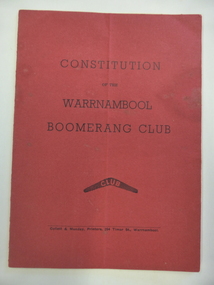
... Front cover: ‘Constitution of the Warrnambool Boomerang Club, Collett and Munday, Printers, 254 Timor Street, Warrnambool’ The Boomerang image has the word ‘Club’ in the centre ...254 Timor Street, Warrnambool, Victoria, Australia...This is a significant item as the Boomerang Club was an important social group in Warrnambool in the mid 20th century. warrnambool boomerang club Front cover: ‘Constitution of the Warrnambool Boomerang Club, Collett and Munday, Printers, 254 Timor Street, Warrnambool’ The Boomerang image has the word ‘Club’ in the centre This is a small booklet of four pages, two double-sided and two with printing on one side only. ...This is the Constitution of the Warrnambool Boomerang Club. The Boomerang Club was a social club that was formed some time in 1934 and continued until at least 1956. By the late 1930s there were nearly 200 members who took part in activities that included dinners, balls, dances, Christmas parties and picnics. Profits from the Boomerang Club functions were donated to local charitable organizations. This is a significant item as the Boomerang Club was an important social group in Warrnambool in the mid 20th century. This is a small booklet of four pages, two double-sided and two with printing on one side only. It has a red cover and contains printed material. It has an image of a boomerang on the front cover. The pages were originally stapled.Front cover: ‘Constitution of the Warrnambool Boomerang Club, Collett and Munday, Printers, 254 Timor Street, Warrnambool’ The Boomerang image has the word ‘Club’ in the centre warrnambool boomerang club -
 Flagstaff Hill Maritime Museum and Village
Photograph - Military group, Warrnambool First Volunteer Corps 1860, Taken May 24th, 1860, presented to Mayor in 1887
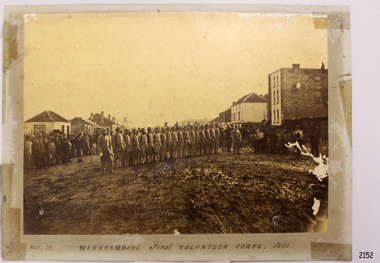
... The photograph shows the Corps lined up for inspection in Timor Street, Warrnambool. The location is outside what is now the Archie Graham Centre and the camera is looking west towards Liebig Street. ...The photograph shows the Corps lined up for inspection in Timor Street Warrnambool. The location is outside what is now the Archie Graham Centre and the camera is looking west towards Liebig Street. ...Timor Street, Warrnambool, Great Ocean Road, Victoria, Australia...The photograph shows the Corps lined up for inspection in Timor Street, Warrnambool. The location is outside what is now the Archie Graham Centre and the camera is looking west towards Liebig Street. ...This Photograph is one of a number of photographs of the Warrnambool Militia. The photograph entitled "Warrnambool First Volunteer Corps" is dated 24th May 1860. (The First Volunteer Corps began in 1855.) It was presented by James Astley Bromfield (former Mayor of Warrnambool) to Major Walter Helpmann, head of Warrnambool’s 1st Volunteer Corps in 1887. The photograph shows the Corps lined up for inspection in Timor Street, Warrnambool. The location is outside what is now the Archie Graham Centre and the camera is looking west towards Liebig Street. The town band is in the right rear corner and spectators surround the Corps. The names listed on the back of the photograph are "1. R.Bushe (Captain in command), 2. Basil Spence, 3. Thomas Mickle, 4. Alfred Davies (Sergeant), 5. Cawthray, 6. Andrew Kerr, 7. Charles Scoborio, 8. Lacy, 9. James Hider, 10. D. O’Mullane, 11. William Norman, 12. Crouthers (or Cowthers ?), 13. Francis Breckon, 14. Russ, 15. Benjamin Wycherley, 16. C. A. Cramer (Sergeant), 17. James Coulstock, 18. Robert Newton (Sergeant), 19. J.A. Bromfield, 20. Singleton (supernumery), 21. Mostyn (Drill Instructor)," On the left of the picture is Billy Adams, Barnes (road contractor) and James Mason (Bootmaker). On the right of the picture is The Band. This is one of a collection of photographs showing the development of the Warrnambool Militia from its inception as the First Volunteer Corps in 1855. The collection is of local significance as it parallels the development of the town and includes images of significant local people. A number of Warrnambool streets are named after members of the Militia. It is also historically significant because of its connection to the unrest that was taking place in Europe at this time. Photograph of Warrnambool First Volunteer Corps 1860, sepia coloured, mounted on cream card. The photograph shows the Corps lined up for inspection in Timor Street Warrnambool. The location is outside what is now the Archie Graham Centre and the camera is looking west towards Liebig Street. The town band is in the right rear corner and spectators surround the Corps. Photograph taken 24th May 1860. Has names listed on reverse side. The protograph was presented to Mayor Helpman, by Bromfield, May 1887. Title printed below base of photo on the mounting board "May. 24. WARRNAMBOOL First VOLUNTEER CORPS. 1860" On the back of the photograph is a numbered list of names, handwritten in ink. Also on the back are presentation details "Presented to Mayor Helpman, by Bromfield, May 1887". warrnambool, wolunteer corps, militia, helpmann, bromfield, flagstaff hill, shipwrecked coast, flagstaff hill maritime museum, maritime museum, shipwreck coast, flagstaff hill maritime village, great ocean road -
 Flagstaff Hill Maritime Museum and Village
Legal record - Plans and Contract, Arthur H. Cutler, Architect, Warrnambool Town Hall, 1890-1892
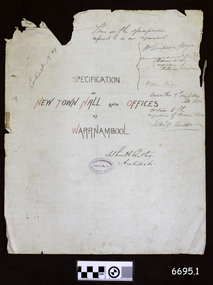
... The Town Hall and Offices were built on the corner of Liebig and Timor Streets in Warrnambool. On March 20th 1983 the new Performing Arts Centre was opened y the Mayor, Councillor R w Andreson, on the same site. ...Cutler to Mayor and Councilors, Town of Warrnambool 3) Blueprint Sheet 4, Longitudinal Section, and profiles of Liebig Street and Timor Street, Warrnambool Town Hall, 4) Blueprint Sheet 3, First Floor & Balcony Plan, and Roof Plan 5) Blueprint Sheet 2, Ground Floor Plan, Warrnambool Town Hall 6) Contract, 26 June 1890, marked (Draft Copy Tow Hall Contract), Between Mayor, Councillors and Rate Payers, and William Kellas, Contractor...Timor Street, Warrnambool, Victoria...The Town Hall and Offices were built on the corner of Liebig and Timor Streets in Warrnambool. On March 20th 1983 the new Performing Arts Centre was opened y the Mayor, Councillor R w Andreson, on the same site. ...This is a set of documents including three sheets of blueprint plans for the New Town Hall and Offices for Warrnambool, created in 1890 by the Architect Mr Arthur H. Cutler of Melbourne. The Contract was signed by the Town Mayor for Warrnambool, Mr William Simpson on May 7th 1890. Also, a Council copy of the Contract dated 26 June 1890, with the signatures and diagram where the two official stamps would be placed. The Foundation Stone was laid the following year by the next Mayor, John Hyland on February 24th 1891. The contractor for the building was granted to W. Kellas (William) of Warrnambool. The Town Hall and Offices were built on the corner of Liebig and Timor Streets in Warrnambool. On March 20th 1983 the new Performing Arts Centre was opened y the Mayor, Councillor R w Andreson, on the same site. The new building incorporates the 1890 Town Hall building. The plans, contracts, documents and various references to people on the documents are significant to the history of the City of Warrnambool and its community. The Warrnambool Town Hall building is also significant for the many community events held there over the decades after it was built. Appreciation for the significance of the almost century-old Town Hall building is demonstrated by its inclusion in the new Performing Arts Centre.Set of five documents that includes Plans for the Warrnambool Town Hall, the Contract cover page and a letter from the Architect to the Council. The Contract cover page and the Letter are hand written on cream-coloured paper with a waxy finish, with watermarks. 1) Contract Cover Page, 5th May 1890, Specification of the New Town Hall and Offices at Warrnambool. 2) Letter, 29th January 1892, from Architect Arthur H. Cutler to Mayor and Councilors, Town of Warrnambool 3) Blueprint Sheet 4, Longitudinal Section, and profiles of Liebig Street and Timor Street, Warrnambool Town Hall, 4) Blueprint Sheet 3, First Floor & Balcony Plan, and Roof Plan 5) Blueprint Sheet 2, Ground Floor Plan, Warrnambool Town Hall 6) Contract, 26 June 1890, marked (Draft Copy Tow Hall Contract), Between Mayor, Councillors and Rate Payers, and William Kellas, ContractorWatermarks on handwritten pages [horizontal lines], "36" "BUSBRIDGE'S / LOFT DRIED" Contract cover page, Oval stamp "CUTLER - 281 COLLINS ST. E. MELBOURNE - ARCHITECT " (other crossed out text) Handwritten script "This is the specifications referred to in our agreement" "Dated this 7th day of May A.D. 1890" Signed "W. Simpson Mayor" "Arthur H. Cutler Architect", [two Witnesses' signatures and others] Letter from Arthur Cutler, handwritten, has his address "472 Chancery Lane, Melbourne" CONTRACT of 26 June 1890: "The Mayor, Councillors and Rate Payers of Warrnambool" "William Kellas of Warrnambool" "Signed William Simpson, Maoyorr" "R F Kennedy, Councillor" "Wm Kellas" with diagrams where the round Common Seal and square Stamp would be applied.warrnambool, flagstaff hill, warrnambool, flagstaff hill maritime museum, maritime village, shipwreck coast, great ocean roaad, warrnamboo town hall, warrnambool council offices, mayor william simpson, arthur h cutler, architect, civic centre, town hall, performing arts centre, mayor john hyland, william kellas, mayor r w anderson, r f kennedy, contract -
 Warrnambool and District Historical Society Inc.
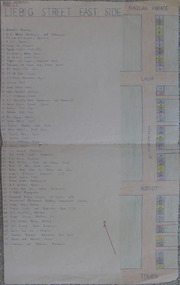
Document - Assignment: Liebig Street –East side, Circa 1951
... ...timor street...Area covered is from Raglan Parade to Timor Street....Area covered is from Raglan Parade to Timor Street. Document Assignment: Liebig Street –East side ...Provides a comprehensive list of businesses on the east side of Warrnambool’s main street in the mid 20th century. An example of school work at the time as well as contributing to local historical knowledge.A3 fawn coloured paper with numbered list of businesses handwritten in blue down left hand side and corresponding numbers positioned on coloured diagram down right hand side. Area covered is from Raglan Parade to Timor Street.Beris Henderson Form 1 Bwarrnambool, liebig street, koroit street, lava street, raglan parade, timor street -
 Warrnambool and District Historical Society Inc.
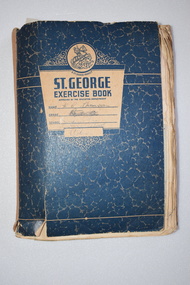
Exercise Book (Swinton), Book, 1947-1950
... Today the Swinton family still operates a furniture and bedding store in Timor Street, making it one of the oldest family businesses in Australia. ...Timor Street, Warrnambool, Victoria, Australia...Today the Swinton family still operates a furniture and bedding store in Timor Street, making it one of the oldest family businesses in Australia. ...This exercise book contains letters, mostly aerogrammes, sent by people in England during the years 1947 to 1950. They are letters of thanks for the food parcels sent to these people by the staff of George Swinton and Sons of Timor Street Warrnambool. The letters give details of the contents of the parcels, the situation with the families receiving the parcels and the effects of the food rationing and shortages in England immediately after World War Two. The name ‘H.C.Thomson’ on the front of the book refers to Helen Thomson, a staff member of George Swinton & Sons in charge of the food parcel distribution. William and Ann Swinton came to the Warrnambool area in 1854 and William opened a groceries, hardware, china and glassware store in Timor Street in 1865. After William Swinton’s death his son Robert became the first managing director of Swintons Pty Ltd. In 1934 the business split with Swintons Pty Ltd selling seeds, produce and hardware and George Swinton and Sons selling furnishings, clothing and glassware. Today the Swinton family still operates a furniture and bedding store in Timor Street, making it one of the oldest family businesses in Australia. This exercise book containing letters sent from England in response to the receipt of food parcels from the staff of George Swinton & Sons of Warrnambool is of considerable significance. The letters form a splendid social history of the situation in England after World War Two, especially for the elderly and the unemployed. They also are a reminder of the charity work undertaken by the staff of George Swinton & Sons 70 years ago. This was a prominent family business in Warrnambool (and continues in another form to this day). This is an exercise book with brown binding and a blue front cover with an image of St George, blue printing and a handwritten name and some other handwritten material which is not decipherable. The back cover has blue printing. Pasted on to the pages are handwritten letters and cards, mostly four to a page. Most of the letters are aerogrammes and some have stamps. Some pages contain addresses of families in England. There are some loose sheets.St. George Exercise Book Name… H.C.Thomson Grade.. School.. Swinton & Sons Timor St. W’bool Victoriageorge swinton & sons, history of warrnambool -
 Warrnambool and District Historical Society Inc.
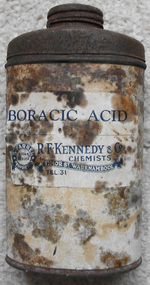
Container - Boracic Acid Tin: Kennedy Chemist, Early 20th century
... ...timor street warrnambool...Kennedy operated as a pharmacy in the late 19th and early 20th century in Timor Street Warrnambool. Mr Kennedy manufactured a large number of drugs and perfumes on a wholesale basis as well as very impressive retail business. ...Kennedy was a significant business in Warrnambool. warrnambool r. f. kennedy chemist timor street warrnambool timor street warrnambool chemist R.F Kennedy & Co Chemists Timor St Warrnambool, Tel, 31. ...R. F. Kennedy operated as a pharmacy in the late 19th and early 20th century in Timor Street Warrnambool. Mr Kennedy manufactured a large number of drugs and perfumes on a wholesale basis as well as very impressive retail business. Around the mid 1880’s they were shipping 5000 dozen bottles of Janos salts annually. Boracic acid was one such product which was commonly used product as an insecticide, herbicide and in cleaning products.A common item which was manufactured by one of the largest manufacturing chemists of the area. R. F. Kennedy was a significant business in Warrnambool.Oval shaped tin with cream paper label overlaid with blue and white label. All labels are stained brown.R.F Kennedy & Co Chemists Timor St Warrnambool, Tel, 31. B Farrer proprietor Kodak dealer. warrnambool, r. f. kennedy, chemist timor street warrnambool, timor street warrnambool, chemist -
 Warrnambool and District Historical Society Inc.
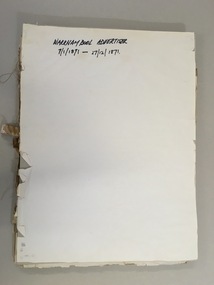
Newspaper - Warrnambool Advertiser 1871, 1871
... The Warrnambool Advertiser was printed and published by Daniel Harrison and Daniel George in Timor Street, Warrnambool, opposite the old Court House (until March 1872). ...Timor Street, Warrnambool, Victoria, Australia...The Warrnambool Advertiser was printed and published by Daniel Harrison and Daniel George in Timor Street, Warrnambool, opposite the old Court House (until March 1872). ...The Warrnambool Advertiser has the sub-heading, ‘Villiers, Heytesbury and Hampden General Reporter with which is incorporated the Warrnambool Sentinel’. (The Warrnambool Sentinel was published in Warrnambool by John Davidson Burnie from 1861 to 1868). The Warrnambool Advertiser was printed and published by Daniel Harrison and Daniel George in Timor Street, Warrnambool, opposite the old Court House (until March 1872). This paper commenced in 1868 and ceased publication in 1873. It was published twice weekly on a Wednesday and a Saturday. Daniel George was the brother of Hugh George who was at one time the general manager of the Argus and later the Sydney Morning Herald. Daniel Harrison had been the editor of the ‘Australasian’ newspaperThese newspapers are most important as they are original copies of an early Warrnambool newspaper and the only copies the Historical Society owns. They contain much important information on Warrnambool activities and events in 1871. An index to the papers is available. These are original newspapers of the Warrnambool Advertiser from 11th January 1871 to 27th December 1871. Each edition has two pages printed on each side. The cover is missing but the pages are bound with thin string to keep them together. The pages are unmarked with many torn edges with the Wednesday January 11th issue very tattered and the Saturday 14th January issue has pages 3 and 4 half torn off. There are some loose pages.warrnambool advertiser, warrnambool -
 Warrnambool and District Historical Society Inc.
Souvenir - Warrnambool Exhibition Glass, 1896-7
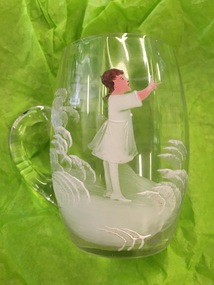
... This exhibition lasted three months and was staged at the Liebig/Timor Streets intersection at the Warrnambool Town Hall and Council buildings with some temporary buildings added for the occasion. ...Timor Street, Warrnambool, Victoria, Australia...This exhibition lasted three months and was staged at the Liebig/Timor Streets intersection at the Warrnambool Town Hall and Council buildings with some temporary buildings added for the occasion. ...This is a glass cup which has been painted and etched at the Warrnambool Industrial and Art Exhibition of 1896-7. This exhibition lasted three months and was staged at the Liebig/Timor Streets intersection at the Warrnambool Town Hall and Council buildings with some temporary buildings added for the occasion. It was reported that 70,000 people visited the displays, attended the concerts and entered the competitions. John Villiers, a Warrnambool painter and decorator with a glassware and chinaware shop in Liebig Street, had a stall at the Exhibition. He brought from Melbourne a glass etcher who etched glass souvenirs such as this one for patrons of the Exhibition. It was the first time that glass etching had been done in Warrnambool. Alice McConnell was born in 1885 in Warrnambool to Robert McConnell and Matilda Russell so she was about 11 or 12 at the time of the Exhibition. She died at the age of 17 in Warrnambool. Her father was possibly the proprietor of the R. and J. McConnell livery stables which later became a transport company in Warrnambool.This glass is most significant because it is one of the few surviving souvenirs of the important Warrnambool Industrial and Art Exhibition of 1896-7. It is also a memento of Alice McConnell, the owner of the glass, who died at the young age of 17. The item comes from the estate of Ken Wooles who was a descendant of the Wooles family prominent in Warrnambool as monumental masons. He was also related to the McConnell family on his mother’s side of the familyThis is a glass cup with a handle. It has a curved shape and has a painting of a young girl with brown hair in a white decorative setting. The glass is etched with the name of Alice McConnell and this was done in 1897 at the Warrnambool Industrial and Art Exhibition of 1896-7. There is a crack near the handle.‘Warrnambool Exhibition, Alice McConnell, 1897’warrnambool industrial and art exhibition 1896-7, alice mcconnell -
 Warrnambool and District Historical Society Inc.
Bottle, Sheldrick Pale Ale, Early 20th Century
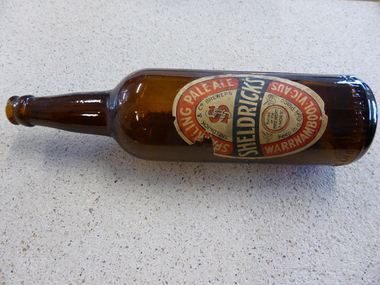
... Walter Sheldrick, a butcher and publican, established the Warrnambool New Brewery at the corner of Timor and Fairy Streets in 1868 as a company. The business was known as Sheldrick and Co. and after Walter Sheldrick’s death his son, Richard, managed the company until his death in 1893. ...Timor Street, Warrnambool, South West Victoria, Warrnambool...Walter Sheldrick, a butcher and publican, established the Warrnambool New Brewery at the corner of Timor and Fairy Streets in 1868 as a company. The business was known as Sheldrick and Co. and after Walter Sheldrick’s death his son, Richard, managed the company until his death in 1893. ...Walter Sheldrick, a butcher and publican, established the Warrnambool New Brewery at the corner of Timor and Fairy Streets in 1868 as a company. The business was known as Sheldrick and Co. and after Walter Sheldrick’s death his son, Richard, managed the company until his death in 1893. In 1894 the business was sold to John McGee and Company until this firm sold to the Ballarat, Melbourne, Co-operative and Carlton and United Breweries in 1922. This Pale Ale bottle, therefore, was bottled before 1922.This bottle is of considerable significance as it is one of the last products of a prominent brewery in Warrnambool and is now nearly 100 years oldThis is a brown-coloured glass beer bottle with a long neck and no stopperOn oval shaped paper label ‘Sparkling Pale Ale, Sheldrick and Co. Brewers, Sheldrick’s Warrnambool, Vic. Aus. Bottled at the Brewery, Timor St. Keep in a cold place’. Monogram, ‘S.C.O.’ ‘M.B.C.V’ embedded in glass in clover leaf motif and underneath ‘The Property of the Manufacturers, Bottle Company of Victoria Pty Ltd’ warrnambool, sheldrick ales, sheldrick brewery, walter sheldrick -
 Flagstaff Hill Maritime Museum and Village
Equipment - Stamp, Cramond and Dickson, Mid-19th century
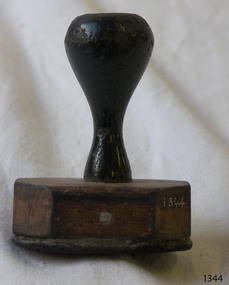
... ...Timor Street...This stamp was made for and used by Cramond and Dickson, a large clothing store on the corner of Liebig and Timor Streets, Warrnambool. They traded from 185 – 1974. ...This stamp was made for and used by Cramond and Dickson, a large clothing store on the corner of Liebig and Timor Streets, Warrnambool. They traded from 185 – 1974. ...This stamp was made for and used by Cramond and Dickson, a large clothing store on the corner of Liebig and Timor Streets, Warrnambool. They traded from 185 – 1974. John Glass Cramond and James Dickson migrated from Scotland to Melbourne where they opened a Cramond and Dickson store in St Kilda. They were inspired by the growth in Warrnambool after a visit and opened a second store there in 1855. The Cramond and Dickson store, grocers – drapery – ironmongery - chemist, was located on the corner of Liebig and Timor Streets, Warrnambool (now the site of a Mexican restaurant). Both Cramond and Dickson were involved in the business and social aspects of Warrnambool’s community. Cramond and Dickson closed in 1974. An advertisement placed by Cramond and Dickson in The Camperdown Chronicle, Saturday 6th April 1895, states them “showing the latest novelties for the coming winter season” … “import directly from English and Continental manufacturers” … “representatives in London … always in touch with the Newest Continental Fashions” ... “having been established for so many years we know the requirements of the Western District”… “allow 5 percent discount on goods paid for at the time of purchase”.The rubber stamp is significant for its association with Cramond and Dickson, a large retail store established in Warrnambool and operating from 1855 to 1974. Both partners were prominent figures in the community.Rubber stamp, octagonal-sided, with wooden handle. The stamp was owned and used by Warrnambool's department store, Cramond & Dickson."Warrnambool" "Outfitters and Drapers" "Cramond and Dickson"flagstaff hill maritime museum and village, flagstaff hill, maritime village, maritime museum, shipwreck coast, great ocean road, warrnambool, cramond and dickson, warrnambool business, department store, commerce, timor street, liebig street, sales, retail equipment, office equipment, stamp, rubber stamp, business stamp -
 Flagstaff Hill Maritime Museum and Village
Financial record - Passbook, Bank of Australasia, 1880
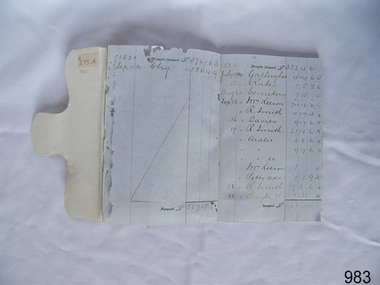
... Street. The bank next bought a stone building previously erected by drapers Cramond & Dickson on the corner of Timor and Gibson Streets. ...Timor Street, Warrnambool, Great Ocean Road, Victoria, Australia...Street. The bank next bought a stone building previously erected by drapers Cramond & Dickson on the corner of Timor and Gibson Streets. ...This bank passbook originated from the Warrnambool branch of the Bank of Australasia with handwritten entries dating from 1880. Names written in the passbook are likely to be people local to Warrnambool. The book belonged to Thomas Smith and was handed over to his Executors. Thomas Smith operated his Gas Printers Works from Koroit Street, Warrnambool, and was a member of the Odd Fellows. In 1878, his son, aged about 12 years old, was carried across a tightrope forward and backwards, on the shoulders of the "Australian Blondon" Mr. L' Estrange, at a performance in Warrnambool. Royal Charter of England incorporated the Bank of Australasia in March 1834. It had its Australian beginning on 14th December 1835, opening in Sydney. The Acting Superintendent of the bank at that time was David Charters McArthur. He was Superintendent from 1867 to 1876. The Melbourne branch opened on 28th August 1838 in a two-roomed brick cottage on the north side of Little Collins Street, where two huge mastiff dogs were used at night to guard the bank. The government also provided an armed military sentinel. Due to the bank's rapid growth, a new building for the Melbourne branch was opened in 1840 at 75 Collins Street West. By 1879, the bank had been upgraded to a magnificent two-storey building on the corners of Collins and Queens Streets, with the entry on Collins Street. In 1951, the Bank of Australasia amalgamated with the Union Bank to form the Australia and New Zealand Bank, now known as the ANZ. Then in 1970, the ANZ merged with both the ES&A and the London Bank of Australia to form the ANZ Banking Group Limited. The ANZ Banking Group Ltd kindly donated a variety of historic items from the Bank of Australasia. BANK of AUSTRALASIA, WARRNAMBOOL – In 1854, Warrnambool had two banks, the Union Bank and the Bank of Australasia. Later, completely different bank businesses opened; in 1867, the National Bank of Australasia, and then in 1875, the Colonial Bank of Australasia. The original Warrnambool branch of the Bank of Australasia was established in July 1854 and operated from a leased cottage on Merri Street, close to Liebig Street. The bank next bought a stone building previously erected by drapers Cramond & Dickson on the corner of Timor and Gibson Streets. Samuel Hannaford was a teller and then Manager at the Warrnambool branch from 1855 to 1856, and the Warrnambool Council chose that bank for its dealings during 1856-57. In 1859, Roberts & Co. was awarded the contract to build the new Bank of Australasia branch for the sum of £3,000; the firm built the Warrnambool Post Office in 1856 and purchased land in Timor Street in 1858. The land was on a sand hill on the northeast corner of Timor and Kepler Streets and had been bought in 1855 from investor James Cust. The new building opened on May 21, 1860. The bank continued to operate there until 1951, when it merged with the Union Bank to form the ANZ Bank, which continued operating from its Liebig Street building. Warrnambool City Council purchased the former Bank of Australasia building in 1971 and renovated it, then on 3rd December 1973, it was officially opened as the Art Gallery by Cr. Harold Stephenson and Gallery Director John Welsh. The Gallery transferred to the purpose-built building in Liebig Street in 1986, and the old bank building is now the Gallery club. Staff at the Bank of Australasia in Warrnambool included the following men but others were also involved: Samuel Hannaford, Teller then Manager from 1855-1856; Hawkins, Manager in 1856, W H Palmer, Manager from January 1857 until November 1869 when the Teller Basil Spence was promoted to Manager; H B Chomley, Manager from April 1873 and still there in 1886; A Butt, Manager in 1895-1904; J R McCleary Accountant and Acting Manager for 12 months, until 1900; A Kirk, Manager 1904; J Moore, staff until his transfer to Bendigo in December 1908; J S Bath was Manager until 1915; C C Cox, Manager until April 1923; Richard C Stanley, Manager 1923 to April 1928. The bank passbook has significance through its association with the Bank of Australasia. The early Australian bank was established in 1834 by Royal Charter and opened in Sydney, Australia, in Sydney in 1835. The bank had many Australian offices in November 1877, particularly on the east and south coasts. Victoria had 45 per cent of all Offices. The passbook is locally significant for its association with the Warrnambool Bank of Australasia, which was established in 1854. It was Warrnambool Council’s first bank. The bank continued to operate until the organisation's merger in 1951 when it became the ANZ Bank Group today. The Bank was an integral part of the growth of local commerce and the community. It has local significance for its association with commercial Warrnambool in 1880, belonging to Thomas Smith, a prominent businessman with a printing works whose son of about 12 years age crossed a tightrope with the 'Australian Blondin', L' Estrange. Bank passbook, Bank of Australasia, Warrnambool branch. Bound with waxed, cream-coloured cardboard cover and tab closure. Pages have blue horizontal lines and red vertical lines. Black ink handwritten entries, with Date, Name and amount. Inscription was written inside and on a sticker inside the front cover. Passbook is dated 1880 and belonged to Thomas Smith.Marked "The Executors of the late Thomas Smith" "Stamped inside "Bank of Australasia, Warrnambool" Handwritten on sticker " R. 273 A" Sample of handwritten entries include "1880" Callaghan" "Rates" A Linch" "Davies" Bottom of page, balance "529 10 21" [529 pounds 10 shillings 21 pence]flagstaff hill, warrnambool, shipwrecked coast, flagstaff hill maritime museum, maritime museum, shipwreck coast, flagstaff hill maritime village, great ocean road, bank of australasia, boa, union bank, australia & new zealand bank, anz bank, david charters mcarthur, d c mcarthur, bank book, pass book, financial record, commerce, thomas smith, thos. smith, gas printing works, australian blondin, thomas smith's son, tightrope walker, odd fellows, l' estrange, passbook, bank passbook -
 Warrnambool and District Historical Society Inc.
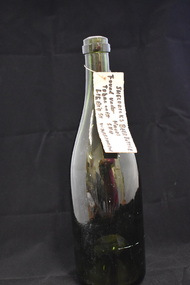
Bottle, Sheldricks Beer Bottle - Green with tag, Early 20th century
... Street, Warrnambool). It is believed to be a beer bottle from the Warrnambool brewery of Sheldrick and Co. In 1868 Walter Sheldrick formed a company and established the New Brewery at the corner of Timor and Fairy Streets, Warrnambool. ...Timor Street, Warrnambool, Victoria, Australia...Street, Warrnambool). It is believed to be a beer bottle from the Warrnambool brewery of Sheldrick and Co. In 1868 Walter Sheldrick formed a company and established the New Brewery at the corner of Timor and Fairy Streets, Warrnambool. ...This bottle was found under a building some years ago (Hand’s tobacconist shop, Liebig Street, Warrnambool). It is believed to be a beer bottle from the Warrnambool brewery of Sheldrick and Co. In 1868 Walter Sheldrick formed a company and established the New Brewery at the corner of Timor and Fairy Streets, Warrnambool. Two of the original directors, Walter Sheldrick and Thomas Price, took over the business under the title of Sheldrick and Co. When Walter Sheldrick died in 1876 Richard Sheldrick succeeded his father in the business. In the early 1890s Richard Sheldrick sold out and by 1892 a group of Warrnambool businessmen was operating the brewery. In 1894 it was sold to William McGee and Company and in 1922 the brewery closed when the Ballarat, Melbourne Co-operative and Carlton and United Breweries took over the business.This bottle is of interest as an example of a beer bottle from Sheldrick’s New Brewery. This brewery was prominent in Warrnambool for over 50 years. This is a green glass beer bottle with a rounded body and a heavily indented base producing an inverted hump inside the bottom of the bottle. The neck is rounded with a moulded glass top. There is no stopper. There are no markings on the bottle.walter and richard sheldrick, warrnambool, sheldrick’s new brewery. warrnambool, breweries in warrnambool, history of warrnambool -
 Warrnambool and District Historical Society Inc.
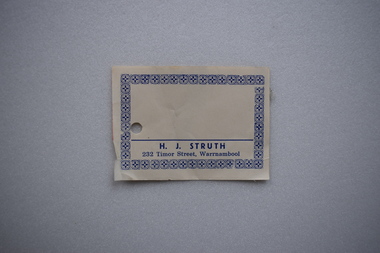
Label, Struth, Early 20th century
... Struth was a Warrnambool butcher with a business in Timor Street. The Struth family commenced a butcher's shop in WarrnamboolWarrnambool in 1914 and H.J. ...H.J. STRUTH . 232 Timor Street, Warrnambool ...Struth was a Warrnambool butcher with a business in Timor Street. The Struth family commenced a butcher's shop in WarrnamboolWarrnambool in 1914 and H.J. ...H.J. Struth was a Warrnambool butcher with a business in Timor Street. The Struth family commenced a butcher's shop in WarrnamboolWarrnambool in 1914 and H.J. Struth was the proprietor of the shop until 1956.. It is presumed he is a descendant of Alexander Struth,the Woodford miller and also of Anthony Struth who came to the district in 1843 and also related to Anthony Struth who had a chemist shop in Liebig Street in partnership with Ian Soulsby in the 1980s and the 1990s.This label is of of interest as a memento of the Struth family butchers in the early 20th century.Cream coloured paper label with dark blue text and a decorative border. There is a circular hole on one side.The reverse indicates it has been adhered to another substance.H.J. STRUTH . 232 Timor Street, Warrnambool h.j. struth, warrnambool -
 Flagstaff Hill Maritime Museum and Village
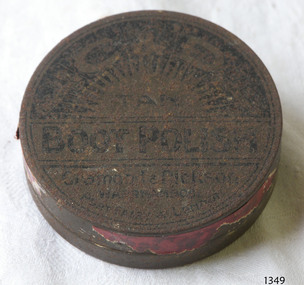
Container - Boot Polish Tin, Cramond and Dickson, 1855-1974
... ...Timor Street...The Cramond and Dickson store, grocers – drapery – ironmongery - chemist, was located on the corner of Liebig and Timor Streets, Warrnambool. Both Cramond and Dickson were involved in the business and social aspects of Warrnambool’s community. ...The Cramond and Dickson store, grocers – drapery – ironmongery - chemist, was located on the corner of Liebig and Timor Streets, Warrnambool. Both Cramond and Dickson were involved in the business and social aspects of Warrnambool’s community. ...This tin of boot polish was a product sold be Cramond and Dickson store, which traded in Warrnambool from 1855 - 1974. John Glass Cramond and James Dickson migrated from Scotland to Melbourne, where they opened a Cramond and Dickson store in St Kilda. They were inspired by the growth in Warrnambool after a visit and opened a second store there in 1855. The Cramond and Dickson store, grocers – drapery – ironmongery - chemist, was located on the corner of Liebig and Timor Streets, Warrnambool. Both Cramond and Dickson were involved in the business and social aspects of Warrnambool’s community. Cramond and Dickson closed in 1974. An advertisement placed by Cramond and Dickson in The Camperdown Chronicle, Saturday 6th April 1895, states them “showing the latest novelties for the coming winter season” … “import directly from English and Continental manufacturers” … “representatives in London … always in touch with the Newest Continental Fashions” ... “having been established for so many years we know the requirements of the Western District”… “allow 5 percent discount on goods paid for at the time of purchase”.The tin of boot polish is an example of the goods sold in Warrnambool in the 19th and early 20th century. It s significant for its association with Cramond and Dickson, a large retail store established in Warrnambool and operating from 1855 to 1974. Both partners were prominent figures in the community.Container: a tin of boot polish, with a small amount of light tan polish inside. Inscribed for the makers, Cramond and Dickson, Warrnambool, Port Fairy & Londo. Labelling is partly obscured by corrosion. Instructions for use are on the base of the tin. "C and D Tan Boot Polish" and "Cramond and Dickson, Warrnambool, Port Fairy & London" and "For best results, remove all dust and apply a little C and D Dressing, Brush Briskly" "Weight when packed 1 1/2 ozs net"flagstaff hill maritime museum and village, flagstaff hill, maritime village, maritime museum, shipwreck coast, great ocean road, warrnambool, boot polish, shoe cleaning, grooming, cramond and dickson, warrnambool business, department store, commerce, timor street, liebig street, port fairy business, metal craft, tinware -
 Flagstaff Hill Maritime Museum and Village
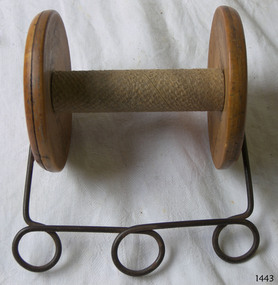
Functional object - String Dispenser, Cramond and Dickson, mid-19th century
... ...Timor Street...The Cramond and Dickson store, grocers – drapery – ironmongery - chemist, was located on the corner of Liebig and Timor Streets, Warrnambool (now the site of a Mexican restaurant). ...The Cramond and Dickson store, grocers – drapery – ironmongery - chemist, was located on the corner of Liebig and Timor Streets, Warrnambool (now the site of a Mexican restaurant). ...This dispenser was most likely used for holding and dispensing string. It was used in the Cramond and Dickson store, which operated in Warrnambool from 1855 + 1974. John Glass Cramond and James Dickson migrated from Scotland to Melbourne where they opened a Cramond and Dickson store in St Kilda. They were inspired by the growth in Warrnambool after a visit and opened a second store there in 1855. The Cramond and Dickson store, grocers – drapery – ironmongery - chemist, was located on the corner of Liebig and Timor Streets, Warrnambool (now the site of a Mexican restaurant). Both Cramond and Dickson were involved in the business and social aspects of Warrnambool’s community. Cramond and Dickson closed in 1974. An advertisement placed by Cramond and Dickson in The Camperdown Chronicle, Saturday 6th April 1895, states them “showing the latest novelties for the coming winter season” … “import directly from English and Continental manufacturers” … “representatives in London … always in touch with the Newest Continental Fashions” ... “having been established for so many years we know the requirements of the Western District”… “allow 5 percent discount on goods paid for at the time of purchase”.The string dispenser is significant for being used at the local historical Cramond and Dickson department store in Warrnambool It is also of significance as it is an example of office equipment used in many stores for the wrapping and securing of parcels.Dispenser for string; spindle, reel or spool with cylindrical axle in centre, a wooden disc at each end. A length of wire is attached to each end and bend into a 'U' shape, with three loops formed across the base of the 'U'. Item came from Cramond and Dickson store in Warrnambool and was possibly used for dispensing string, with the wire being used as a handle or for mounting.flagstaff hill maritime museum and village, flagstaff hill, maritime village, maritime museum, shipwreck coast, great ocean road, warrnambool, cramond and dickson, warrnambool business, department store, commerce, timor street, liebig street, sales, retail equipment, office equipment, string dispenser, string reel, packaging, parcelling -
 Warrnambool and District Historical Society Inc.
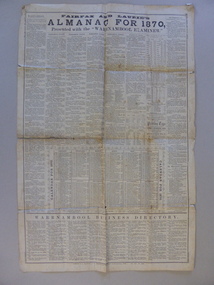
Document, News Sheet Almanac for 1870, 1870
... Timor Street , Warrnambool, Victoria, Australia ...This Almanac records the many various organisations, such as churches schools councils and law related information.It lists public holidays, members of Parliament as well as births and deaths natural events such as rainfall, sunrise/sunsets and moon charts. it records mail charges and coach timetables.A middle section presents a calendar for 1870 with a record of events which were deemed important since the time of settlement It lists such things as the first telegram from Melbourne to Sydney1858, Governor Bligh deposed 1808, Burke and Wills funeral 1863. At the bottom of the page is a Warrnambool Business Directory which includes J S Rowley Corio brewery, Royal Hotel , J H Rule Painter, plumber and glazier, J Brady , tinsmith and A Lanagan , Golden Boot The Warrnambool Examiner was founded by John Wilkinson and Richard Osburne in 1851. After a gap of a couple of years Richard Osburne resumed publication in October 1853 and continued until 1867. William Fairfax and Henry Laurie then leased the paper (1867 to 1872) before Richard Osburne again became the proprietor from October 1872 to April 1878 and from December 1879 to December 1880 when publication ceased. Fairfax and Laurie were the proprietors of the paper when this Almanac was published. William Fairfax was a member of the Fairfax family which was, and still is, associated with the publication of many Australian newspapers. Henry Laurie later became well-known as a Melbourne University Philosophy Professor.This single sheet of newspaper is an interesting and valuable record of Warrnambool and its people in 1870. There are names of many local people recorded and it also gives an insight into the variety of businesses and orhganisations which were established by 1870. It is also interesting to note that there are at least ten different styles of print on the page.Large single broadsheet of newspaper with large black heading and eight columns of print. The back of the page is blank.Fairfax and Laurie's Almanac for 1870 presented with the Warrnambool Examiner. Published as a supplement to the Warrnambool Examiner of 7th January 1870 Vol.XX No 1597.warrnambool, warrnambool almanac 1870,, examiner almanac warrnambool, fairfax and laurie, examiner warrnambool -
 Warrnambool and District Historical Society Inc.
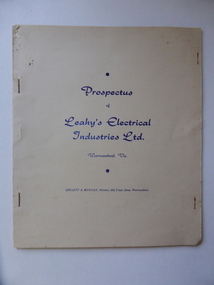
Document, Prospectus Leahy's Electrical, 1951
... 254 Timor Street, Warrnambool, Victoria, Australia ...This prospectus contains the history of Leahy's electrical . The objectives of this company were to allow expansion of the present business ( est,1946) , to take advantage of the excellent corner site and to modernise the building and carry all heavy duty electrical and mechanical lines for commercial users and farmers.Attached was a hire car services which operated as Leahy's Hire cars. The service of the the previous business commenced in 1946 at 82 Fairy Street and grew to employ up to 25 tradesmen. However the assets of the business were lost May1, 1950 when building stock and plant was destroyed by fire.In October 1950 Mr leahy purchased the freehold on the corner of Liebig and Koroit Streets Warrnambool The directors of the new company were John James Leahy, John Beynon Dwyer, William John Taggart Walter, William James Croft, Martin White and James Albert Affleck. They aimed to raise 50000 pounds with 100000 shares at ten shillings each. This document shows the beginnings of one of Warrnambool's most successful 20th century companies. It lists the people associated with it from its inception many of whom were and are well known in the district. It therefore has strong social and historical significance.Cream soft card cover with dark blue text. It is stapled together and contains 6 pages on cream paper with black text.back cover is plain.Prospectus of Leahy's Electrical Industries Ltd Warrnambool Vic, 19th April 1951.warrnambool, j j leahy, jim leahy, leahy's electrical industries, prospectus leahy's electrical industries 1951 -
 Warrnambool and District Historical Society Inc.
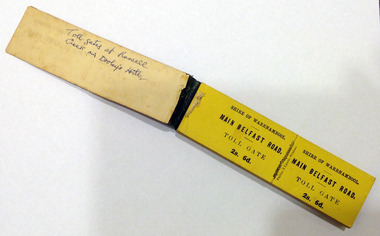
Certificate - Ticket Book, Main Belfast Road Toll, 2s 6d, 1860s
... Timor Street, Warrnambool, South West Victoria, Victoria, Australia ...The Shire of Warrnambool operated toll gates from 1866 to 1869 as a means of revenue rai sing for road construction. There were three toll gate locations – on the main Belfast (Port Fairy) Road at Dennington Bridge, on the Woodford Road at Russells Creek and on the Geelong Road at the Allansford Bridge. The toll gates were unpopular and unprofitable for the lessees as travellers were able to avoid the tax by skirting around the gates. They had toll houses besides the gates. The printers of these tickets, Fairfax and Laurie were the lessees at the time of the Warrnambool Examiner newspaper. This paper, founded by Richard Osburne and John Wilkinson, and published with some gaps from 1851 to 1880, is a key source today of Warrnambool’s history at that time. These toll gates tickets are significant because:- 1. They date back to the 1860s and were only issued from 1866 to 1869. 2. They are the only artefacts we hold of the time when toll gates were operating in our local district 3. They are the best example of how the Shire of Warrnambool in its early history raised revenue for road building and maintenance This is a book of toll gate tickets for sale at the Main Belfast (Port Fairy) Road Toll Gate. The tickets (about 50) are yellow and in duplicate with provision to detach the outer ticket for the purchaser to keep. The tickets (two shillings and sixpence) are bound with an adhesive tape and the cover is mottled in pattern (brown and blue). There are also four loose tickets in blue (3 shillings). Back Cover: ‘136’ Tickets in book: ‘Shire of Warrnambool, Main Belfast Road, Toll Gate 2s 6d., Fairfax and Laurie, Printers’ Loose tickets: ‘Shire of Warrnambool, Main Belfast Road, Toll Gate, 3s.’ shire of warrnambool, toll gates -
 Warrnambool and District Historical Society Inc.
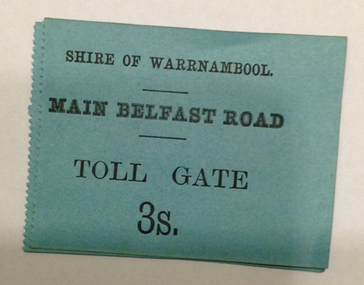
Document - Main Belfast Road Toll Gate Ticket Collection, 1860s
... Timor Street, Warrnambool, Victoria, Australia ...The Shire of Warrnambool operated toll gates from 1866 to 1869 as a means of raising revenue for road construction. There were three toll gate locations – on the main Belfast (Port Fairy) Road at Dennington Bridge, on the Woodford Road at Russells Creek and on the Geelong Road at the Allansford Bridge. The toll gates were unpopular and unprofitable for the lessees as travellers were able to avoid the tax by skirting around the gates. They had toll houses besides the tollgates. The printers of these tickets, William Fairfax and Henry Laurie, were the lessees at the time of the Warrnambool Examiner newspaper. This paper, founded by Richard Osburne and John Wilkinson, and published with some gaps from 1851 to 1880, is a key source today of Warrnambool’s history at the time. These toll gate tickets are significant because:- 1. They date back to the 1860s and were only issued from 1866 to 1869 2. They are the only artefacts we hold of the time when toll gates were operating in our local district 3. They are the best example of how the Shire of Warrnambool in its early history raised revenue for road building and maintenance. These are eleven toll gate tickets, ten for the Belfast (Port Fairy) Road toll gate and one for the Woodford Road toll gate. One is mounted on a Swintons store label (6 pence) and four are mounted on cardboard (2 shillings, sixpence, and two shillings and sixpence) and six are loose (three shillings, two shillings and sixpence and threepence). The Belfast Road tickets are yellow, green, blue and cream and the Woodford Road one is white. All have black printing. There is also an undated newspaper cutting with information on the toll gate tickets. Belfast Tickets: Shire of Warrnambool, Main Belfast Road, Toll Gate and the price Woodford Road: Shire of Warrnambool, Woodford Road, Toll Gate, 1s 6d Six of the eleven tickets also have ‘Fairfax and Laurie, Printers’ The sixpence ticket on card has the name R P Christian in ink written on the back of the card. shire of warrnambool, toll gates, r p christian, woodford road, main belfast road, swintons pty ltd -
 Warrnambool and District Historical Society Inc.
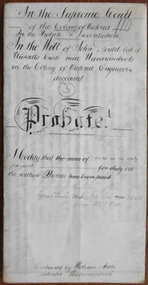
Document - John Gould Probate 1891, 1891
... Timor Street, Warrnambool, Victoria, 3280 ...This 1891 document contains the information on the Will and Probate of John Gould, an engineer from Russells Creek. No information has been found on John Gould except that he died in October 1890 at the age of 67. The solicitor, William Ardlie was a well-known Warrnambool lawyer, commencing a practice in 1865 and continuing well into the 20th century making him at the time one of the longest-serving lawyers in the British Empire. Tait collection: item 10 of 62This document is of interest in that it includes information on a resident of Russells Creek in the Warrnambool area, and also the lawyer concerned is William Ardlie, one of the best-known identities in Warrnambool in the late 19th and early 20th centuries.This is an 1891 piece of parchment folded in half to give four pages of written material. This material is handwritten in black ink. A seal of the Supreme Court of the Colony of Victoria is attached with a green ribbon. The document is somewhat discoloured. ‘In the Supreme Court of the Colony of Victoria in the probate jurisdiction in the Will of John Gould, late of Russells Creek near Warrnambool in the Colony of Victoria, Engineer, deceased, Probate. I certify that there is no duty payable. J. F. Poole, Officer under Section 96, Act 1060, June 23rd 1891. Extracted by William Ardlie, Solicitor, Warrnambool’. john gould, william ardlie, warrnambool -
 Warrnambool and District Historical Society Inc.
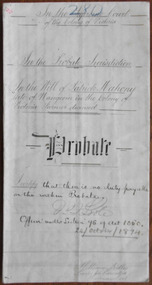
Document - Patrick Mahony Probate 1894, 1894
... Timor Street, Warrnambool, Victoria, Australia...The latter had a practice in Warrnambool for the best part of seventy years, firstly in Timor Street and then in Kepler Street. He was a prominent resident in Warrnambool. ...These are the Probate papers for Patrick Mahony, a farmer from Wangoom who died in 1894. He left an estate of £995 and personal effects worth £138. The estate was to be administered by the two sons, William and Timothy in trust for another son, Michael Mahony. The wife Margaret was granted three acres of land, £25 a year and ‘the choice of two cows out of my stock’. The daughter Johanna was to receive the same benefits after the death of her mother. Patrick Mahony, being illiterate, signed his will with a cross. Tait collection: item 12 of 62This document is of interest as it concerns a local farmer, Patrick Mahony and a local lawyer, William Ardlie. The latter had a practice in Warrnambool for the best part of seventy years, firstly in Timor Street and then in Kepler Street. He was a prominent resident in Warrnambool. The document was originally in the hands of the law clerk, Thomas Goodall and it was passed on to lawyers occupying the Kepler Street premises until it was found in the buildings once used by the law firm of Mackay Taylor. This is a piece of parchment paper, folded in two with writing in black ink on all four pages. There is a seal of the Supreme Court of the Colony of Victoria attached with a green ribbon and three red stamps of the Master in Equity in the Supreme Court. The document has ruled lines and some annotations in the margins. ‘280, In the Supreme Court of the Colony of Victoria, in the Probate Jurisdiction in the Will of Patrick Mahony, late of Wangoom, in the Colony of Victoria, Farmer deceased, Probate. I certify that there is no duty payable on the within Probate, J. Poole, Officer under Section 96 of Act 1060, 24/October/1894, William Ardlie, Proctor for Executors, Warrnambool’patrick mahony, william ardlie, warrnambool -
 Warrnambool and District Historical Society Inc.
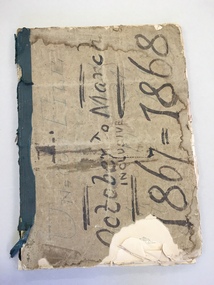
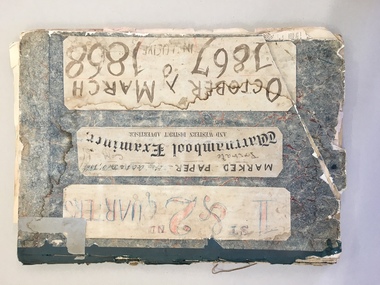
Newspaper, Warrnambool Examiner 1/10/1867-31/3/68, 1867,1868
... Timor Street, Warrnambool, Victoria, Australia ...The Warrnambool Examiner was founded by John Wilkinson and Richard Osburne in 1851. After a gap of a couple of years Richard Osburne resumed publication in October 1853 and continued until October 1867. William Fairfax and Henry Laurie then leased the paper (1867 to 1872) before Richard Osburne again became the proprietor from October 1872 to April 1878 and from December 1879 to December 1880 when publication ceased. Richard Osburne was a pioneer settler in Warrnambool, arriving in 1847. He was prominent in community activities in the town and was a most important early historian, publishing his seminal work, ‘The History of Warrnambool’ in 1887, using the Warrnambool Examiner newspapers to assist with this history. Fairfax and Laurie were the proprietors when these papers were printed. William Fairfax was a member of the Fairfax family that were, and still are, associated with the publication of many Australian newspapers and Henry Laurie later became well-known as a Melbourne University Philosophy Professor. These original newspapers are most important because they contain much information on Warrnambool’s early history and are a primary source for historians. These papers are also of importance to historians today as some parts of these newspapers were not filmed and are not currently available on microfilm. These papers were in a Warrnambool City Council storage area and it is surmised that they have come from the old Warrnambool Museum which no longer exists.These are the original Warrnambool Examiner newspapers from 1st October 1867 to 31st March 1868. They are bound with a tattered cardboard cover, dark blue binding and string. These broadsheet papers are of two pages printed back to back and were published on Tuesdays and Fridays. They are unmarked and generally in good condition but there are some torn pages. There is one loose page. warrnambool examiner, richard osburne, william fairfax, henry laurie, warrnambool -
 Warrnambool and District Historical Society Inc.
News Sheet, Warrnambool Examiner 1/10/67 - 31/12/67 : 3/1/68 - 31/3/1868, 1867-8
... Timor Street, Warrnambool, Victoria, Australia ...The Warrnambool Examiner was founded by John Wilkinson and Richard Osburne in 1851. After a gap of a couple of years Richard Osburne resumed publication In October 1853 and continued until October 1867. William Fairfax and Henry Laurie then leased the paper (1867 to 1872) before Richard Osburne again became the proprietor from October 1872 to April 1878 and from December 1870 to December 1880 when publication ceased. Richard Osburne was a pioneer settler in Warrnambool, arriving in 1847. He was prominent in community activities in the town and was a most important early historian, publishing his seminal work, ‘The History of Warrnambool’ in 1887, using the Warrnambool Examiner newspapers to assist with this history. Fairfax and Laurie were the proprietors when these papers were printed. William Fairfax was a member of the Fairfax family that were, and still are, associated with the publication of many Australian newspapers and Henry Laurie later became well-known as a Melbourne University Philosophy Professor. These original newspapers are most important because they contain much information on Warrnambool’s early history and are a primary source for historians. These papers are also of importance today as some parts of these papers were not filmed and are not currently available on microfilm. These papers were in a Warrnambool City Council storage area and it is surmised that they have come from the old Warrnambool Museum which no longer exists.These are two sets of original Warrnambool Examiner newspapers (1st October 1867 to 31st December 1867 and 3rd January 1868 to 31st March 1868), bound with cardboard, dark blue binding and string. There are six loose pages in front of the first bound set. These are broadsheets of two pages printed back and front. The papers are heavily marked with red and blue pencil and are marked, ‘private copy, F.& L.’ indicating that they are the copies the proprietors, Henry Laurie and William Fairfax, used to annotate the papers for the next edition. The pages are in good condition with some ragged edges. ‘F & L’ ‘Private copy’ warrnambool examiner, henry laurie, william fairfax, richard osburne -
 Warrnambool and District Historical Society Inc.
News Sheet, Warrnambool Examiner 12/11/1867 - 28/1/1868, 1867, 1868
... Timor Street, Warrnambool, Victoria, Australia ...The Warrnambool Examiner was founded by John Wilkinson and Richard Osburne in 1851. After a gap of a couple of years Richard Osburne resumed publication in October 1853 and continued until 1867. William Fairfax and Henry Laurie then leased the paper (1867 to 1872) before Richard Osburne again became the proprietor from October 1872 to April 1878 and from December 1879 to December 1880 when publication ceased. Richard Osburne was a pioneer settler in Warrnambool, arriving in 1847. He was prominent in community activities in the town and was a most important early historian, publishing his seminal work, ‘The History Of Warrnambool’ in 1887, using the Warrnambool Examiner newspapers to assist with this history. Fairfax and Laurie were the proprietors when the papers herein described were printed. William Fairfax was a member of the Fairfax family that was , and still are, associated with the publication of many Australian newspapers and Henry Laurie later became well-known as a Melbourne University Philosophy Professor.These original newspapers are most important because they contain much information on Warrnambool’s early history and are a primary source for historians. These papers are also of importance because some parts of these papers were not filmed and are not currently available in microfilm. These papers were in a Warrnanmbool City Council storage area and it is surmised that they have come from the old Warrnambool Museum which no longer exists. These are original copies of the Warrnambool Examiner newspapers from 12th November 1867 to 28th January 1868. They are broadsheets printed twice a week with two pages containing four pages of printing for each edition. They are unbound and contained in two pieces of plain cardboard. They are unmarked and in good condition.warrnambool examiner, richard osburne, henry laurie, william fairfax
