
Showing 56 items matching "trams – kew (vic.)"
-
 Kew Historical Society Inc
Archive (Series) - Tramways
... Kew (Vic.)...Public Transport – Kew (Vic.)...Trams – Kew (Vic.)...Kew Tram...Tramways – Kew (Vic.) Public Transport – Kew (Vic.) Trams – Kew (Vic.) Kew Tram Depot – Kew (Vic.) ...Various PartiesReference, Research, InformationArranged by Secondary Values (value of records to users)Trams have played an important role in Kew’s history, not only as a mechanism of transport but also as a cultural and architectural centrepiece. The first tram service in Kew began in 1886, with the route starting at Victoria Bridge towards the city. It would then be further extended by a horse-pulled tram to the Kew Cemetery, which would last until 1914. In 1915 the Kew Tram depot was being built, and by 1916 it was completed and would oversee the newly electrified routes that would travel further up High Street and past the cemetery as time went on. This was the origins of the 48 route, which was extended to its current length in 1938 after being re-routed over Hawthorn Bridge. The Kew Depot would see many different tram routes roll through and would serve for many going out to the Eastern suburbs. In 1993, after the closure of other depots and routes, Kew would be primarily served by the routes 48 and 109. The file includes: Copies of original route maps for services running through Kew, a history of the different classes of trams that have run in Melbourne, tickets from varying eras, photos of the old tram lines, newspaper and magazine articles regarding the trams as well as their histories, letters regarding the preservation of the tram shelter at the intersection of Cotham and Burke Roads, a copy of the Rail News Victoria (1991), multiple articles celebrating the centenary of cable trams in Melbourne, multiple booklets from the local council looking for improvements to the 109 route, a small map of the route 109 and places surrounding the line, and a brief timeline history of trams in Kew.tramways – kew (vic.), public transport – kew (vic.), trams – kew (vic.), kew tram depot – kew (vic.)tramways – kew (vic.), public transport – kew (vic.), trams – kew (vic.), kew tram depot – kew (vic.) -
 Kew Historical Society Inc
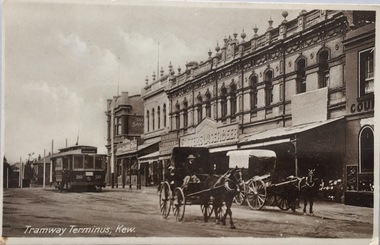
Postcard, Oastler (Leading Stationer), Tramway Terminus, Kew, c.1913
... postcards -- kew (vic.)...trams...However, other postcards produced after this date do not always conform to this print layout. postcards -- kew (vic.) trams -- kew (vic.) Cotham Road -- high street --- kew (vic.) ...The Kew Historical Society's postcard collection includes views of Kew, Melbourne and Greater Melbourne as well as those including overseas scenes sent or received from Europe or the Middle East. They date from the 1890s to the 2000s. These postcards may or may not include the name of the publisher or printer. A number of the cards were published as parts of popular series. A way of dating early postcards is to identify whether the reverse was divided by a central line which became the norm after 1902 in the United Kingdom. However, other postcards produced after this date do not always conform to this print layout.A monochrome postcard of the tram terminus beside 'The Block' in Cotham Road, KewOastler, leading stationer, Kew / Printed in Saxonypostcards -- kew (vic.), trams -- kew (vic.), cotham road -- high street --- kew (vic.), the block -- cotham road -- kew (vic.) -
 Kew Historical Society Inc
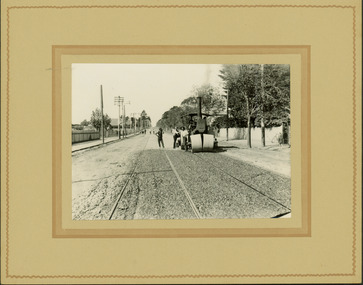
Photograph - Electric tram line construction in Cotham Road, Kew, E.J. Dower, 1913
... tram...Theme -- Connecting Victorians by transport and communications...Cotham Road -- Kew (Vic...Theme --- Travelling by tram Theme -- Connecting Victorians by transport and communications Cotham Road -- Kew (Vic.) ...One of a series of photographs, taken by Edgar James Dower in the second decade of the twentieth century. Born and raised in Olinda, his family later moved to Surrey Hills. He worked as an adult as a clerk in the city office of the Metropolitan Gas Company, and in his role as a 'collector', he was able to photograph scenes including the construction of tramlines and associated buildings in Kew, Hawthorn, Camberwell and Surrey Hills. Later he established a real estate agency with his brother - the E.J. Dower Real Estate Agency, Dandenong Office.The image is an historically significant record of the development of transport infrastructure which was used to connect Victorians in the first two decades of the twentieth century. This development resulted from increases in population and the consequent extension of Melbourne's suburbs. The photographs, both individually and collectively, richly detail the labour of workers and the tools and machinery used to create and extend Melbourne's tram network in the years preceding and during World War 1.Digital copy of an original mounted photograph depicting construction of a new electric tramline in Cotham Road, Kew. The photo shows workers with an early steamroller.Annotated verso: "Preparing for electric trams / Cotham Road Kew / Taken near Barrington Avenue / 1913"theme --- travelling by tram, theme -- connecting victorians by transport and communications, cotham road -- kew (vic.), trams -- kew (vic.) -
 Kew Historical Society Inc
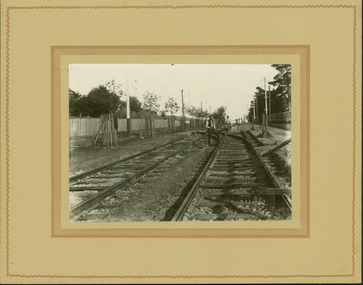
Photograph - Electric tram line construction in Cotham Road, Kew, E.J. Dower, 1913
... tram...Theme -- Connecting Victorians by transport and communications...Cotham Road -- Kew (Vic...Theme --- Travelling by tram Theme -- Connecting Victorians by transport and communications Cotham Road -- Kew (Vic.) ...One of a series of photographs, taken by Edgar James Dower in the second decade of the twentieth century. Born and raised in Olinda, his family later moved to Surrey Hills. He worked as an adult as a clerk in the city office of the Metropolitan Gas Company, and in his role as a 'collector', he was able to photograph scenes including the construction of tramlines and associated buildings in Kew, Hawthorn, Camberwell and Surrey Hills. Later he established a real estate agency with his brother - the E.J. Dower Real Estate Agency, Dandenong Office.The image is an historically significant record of the development of transport infrastructure which was used to connect Victorians in the first two decades of the twentieth century. This development resulted from increases in population and the consequent extension of Melbourne's suburbs. The photographs, both individually and collectively, richly detail the labour of workers and the tools and machinery used to create and extend Melbourne's tram network in the years preceding and during World War 1.Digital copy of an original mounted photograph depicting construction of a new electric tramline in Cotham Road, Kew. The photo shows a worker standing on the tracks at the then terminus.Annotated verso: "Preparing for electric trams / Cotham Road Kew / Taken from corner of Burke Road / 1913"theme --- travelling by tram, theme -- connecting victorians by transport and communications, cotham road -- kew (vic.), trams -- kew (vic.) -
 Kew Historical Society Inc
Photograph - Electric tram line construction in Cotham Road, Kew, E.J. Dower, 1913
... tram...Theme -- Connecting Victorians by transport and communications...Cotham Road -- Kew (Vic...Theme --- Travelling by tram Theme -- Connecting Victorians by transport and communications Cotham Road -- Kew (Vic.) ...One of a series of photographs, taken by Edgar James Dower in the second decade of the twentieth century. Born and raised in Olinda, his family later moved to Surrey Hills. He worked as an adult as a clerk in the city office of the Metropolitan Gas Company, and in his role as a 'collector', he was able to photograph scenes including the construction of tramlines and associated buildings in Kew, Hawthorn, Camberwell and Surrey Hills. Later he established a real estate agency with his brother - the E.J. Dower Real Estate Agency, Dandenong Office.The image is an historically significant record of the development of transport infrastructure which was used to connect Victorians in the first two decades of the twentieth century. This development resulted from increases in population and the consequent extension of Melbourne's suburbs. The photographs, both individually and collectively, richly detail the labour of workers and the tools and machinery used to create and extend Melbourne's tram network in the years preceding and during World War 1.Digital copy of an original mounted photograph depicting construction of a new electric tramline in Cotham Road, Kew. The photo shows workers and a steamroller. The spire of the Kew Presbyterian Church can be seen in the distance.Annotated verso: "Preparing for electric trams / Cotham Road Kew / Taken near Barrington Avenue / Taken by E.J. Dower / 1913"theme --- travelling by tram, theme -- connecting victorians by transport and communications, cotham road -- kew (vic.), trams -- kew (vic.) -
 Kew Historical Society Inc
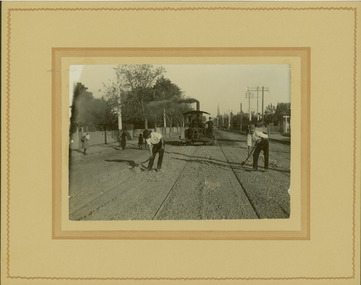
Photograph - Electric tram line construction in Cotham Road, Kew, E.J. Dower, 1913
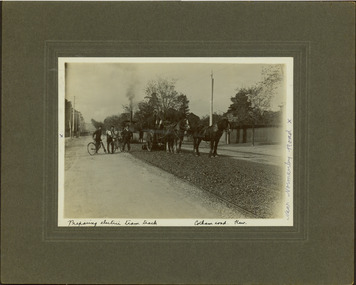
... tram...Theme -- Connecting Victorians by transport and communications...Cotham Road -- Kew (Vic...Trams -- Kew (Vic.) Annotated recto: "Preparing electric tram track / Cotham Road Kew / Near Normanby Road x. ...One of a series of photographs, taken by Edgar James Dower in the second decade of the twentieth century. Born and raised in Olinda, his family later moved to Surrey Hills. He worked as an adult as a clerk in the city office of the Metropolitan Gas Company, and in his role as a 'collector', he was able to photograph scenes including the construction of tramlines and associated buildings in Kew, Hawthorn, Camberwell and Surrey Hills. Later he established a real estate agency with his brother - the E.J. Dower Real Estate Agency, Dandenong Office.The image is an historically significant record of the development of transport infrastructure which was used to connect Victorians in the first two decades of the twentieth century. This development resulted from increases in population and the consequent extension of Melbourne's suburbs. The photographs, both individually and collectively, richly detail the labour of workers and the tools and machinery used to create and extend Melbourne's tram network in the years preceding and during World War 1.Digital copy of an original mounted photograph depicting construction of a new electric tramline in Cotham Road, Kew. The photo shows both a horse drawn and steam roller. A works supervisor and two men on bikes stand on the road to the left of the horse drawn roller. Annotated recto: "Preparing electric tram track / Cotham Road Kew / Near Normanby Road x. Annotated verso: "Preparing for electric tram / Cotham Road Kew / Taken near Normanby Road.theme --- travelling by tram, theme -- connecting victorians by transport and communications, cotham road -- kew (vic.), trams -- kew (vic.) -
 Kew Historical Society Inc
Photograph - Electric tram line construction on the corner of Cotham & Glenferrie Roads, Kew, E.J. Dower, 1913
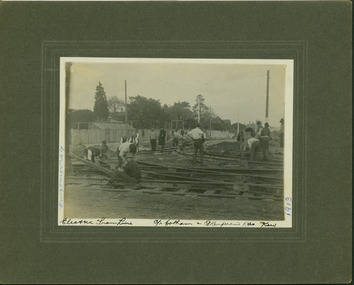
... tram...Theme -- Connecting Victorians by transport and communications...Cotham Road -- Kew (Vic...Trams -- Kew (Vic.) Glenferrie Road -- Kew (Vic.) ...One of a series of photographs, taken by Edgar James Dower in the second decade of the twentieth century. Born and raised in Olinda, his family later moved to Surrey Hills. He worked as an adult as a clerk in the city office of the Metropolitan Gas Company, and in his role as a 'collector', he was able to photograph scenes including the construction of tramlines and associated buildings in Kew, Hawthorn, Camberwell and Surrey Hills. Later he established a real estate agency with his brother - the E.J. Dower Real Estate Agency, Dandenong Office.The image is an historically significant record of the development of transport infrastructure which was used to connect Victorians in the first two decades of the twentieth century. This development resulted from increases in population and the consequent extension of Melbourne's suburbs. The photographs, both individually and collectively, richly detail the labour of workers and the tools and machinery used to create and extend Melbourne's tram network in the years preceding and during World War 1.Digital copy of an original mounted photograph depicting construction of a new electric tramline taken near the corner of Cotham and Glenferrie Roads, Kew. In 1913, trams could turn left or right into Cotham Road from Glenferrie Road. The photo shows workers constructing the tracks.Annotated recto: "Construction of Electric Tram Line / car Cotham & Glenferrie Ads Kew / 1913". . Annotated verso: "Taken by E.J. Dower 1913"theme --- travelling by tram, theme -- connecting victorians by transport and communications, cotham road -- kew (vic.), trams -- kew (vic.), glenferrie road -- kew (vic.) -
 Kew Historical Society Inc
Photograph - Electric tram line construction in Cotham Road, Kew, E.J. Dower, 1913
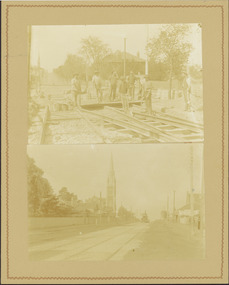
... tram...Theme -- Connecting Victorians by transport and communications...Cotham Road -- Kew (Vic...Trams -- Kew (Vic.) Annotated verso: "Cotham Road Kew / Taken by E.J. ...One of a series of photographs, taken by Edgar James Dower in the second decade of the twentieth century. Born and raised in Olinda, his family later moved to Surrey Hills. He worked as an adult as a clerk in the city office of the Metropolitan Gas Company, and in his role as a 'collector', he was able to photograph scenes including the construction of tramlines and associated buildings in Kew, Hawthorn, Camberwell and Surrey Hills. Later he established a real estate agency with his brother - the E.J. Dower Real Estate Agency, Dandenong Office.The image is an historically significant record of the development of transport infrastructure which was used to connect Victorians in the first two decades of the twentieth century. This development resulted from increases in population and the consequent extension of Melbourne's suburbs. The photographs, both individually and collectively, richly detail the labour of workers and the tools and machinery used to create and extend Melbourne's tram network in the years preceding and during World War 1.Digital copy of two original mounted photographs depicting construction of a new electric tramline in Cotham Road, Kew. The upper photo shows workers standing among the newly laid tracks. The lower photo shows the vista of Cotham Road looking east towards the Kew Presbyterian Church on the corner of Highbury Road. Annotated verso: "Cotham Road Kew / Taken by E.J. Dower 1913"theme --- travelling by tram, theme -- connecting victorians by transport and communications, cotham road -- kew (vic.), trams -- kew (vic.) -
 Kew Historical Society Inc
Photograph - Electric tram line construction in Cotham Road, Kew, E.J. Dower, 1913
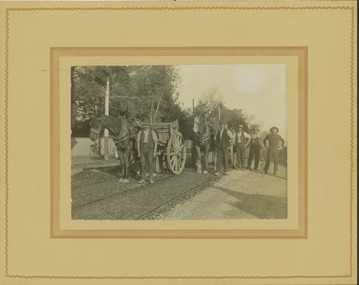
... tram...Theme -- Connecting Victorians by transport and communications...Cotham Road -- Kew (Vic...Theme --- Travelling by tram Theme -- Connecting Victorians by transport and communications Cotham Road -- Kew (Vic.) ...One of a series of photographs, taken by Edgar James Dower in the second decade of the twentieth century. Born and raised in Olinda, his family later moved to Surrey Hills. He worked as an adult as a clerk in the city office of the Metropolitan Gas Company, and in his role as a 'collector', he was able to photograph scenes including the construction of tramlines and associated buildings in Kew, Hawthorn, Camberwell and Surrey Hills. Later he established a real estate agency with his brother - the E.J. Dower Real Estate Agency, Dandenong Office.The image is an historically significant record of the development of transport infrastructure which was used to connect Victorians in the first two decades of the twentieth century. This development resulted from increases in population and the consequent extension of Melbourne's suburbs. The photographs, both individually and collectively, richly detail the labour of workers and the tools and machinery used to create and extend Melbourne's tram network in the years preceding and during World War 1.Digital copy of an original mounted photograph depicting construction of a new electric tramline in Cotham Road, Kew. The photo shows a pair of horse drawn drays with workers posed beside them. An annotation on the reverse of the photo notes that the drays were used to transport the steel tram tracks from the Hawthorn Railway Station siding. Annotated verso: "1913 / Preparing for Electric Tram Cotham Road Kew / Metal [tracks] transported by horse and dray from Hawthorn Railway siding"theme --- travelling by tram, theme -- connecting victorians by transport and communications, cotham road -- kew (vic.), trams -- kew (vic.) -
![Workers, horses and drays in Burwood Road [Hawthorn]](/media/collectors/550653872162f11fb04854aa/items/661f4c86ac7f9cfd1fd6c658/item-media/661f4d6bac7f9cfd1fd722a1/item-fit-380x285.jpg?cb=6) Kew Historical Society Inc
Kew Historical Society IncPhotograph - Workers, horses and drays in Burwood Road [Hawthorn], E.J. Dower, 1913
... tram...Theme -- Connecting Victorians by transport and communications...Cotham Road -- Kew (Vic...Theme --- Travelling by tram Theme -- Connecting Victorians by transport and communications Cotham Road -- Kew (Vic.) ...One of a series of photographs, taken by Edgar James Dower in the second decade of the twentieth century. Born and raised in Olinda, his family later moved to Surrey Hills. He worked as an adult as a clerk in the city office of the Metropolitan Gas Company, and in his role as a 'collector', he was able to photograph scenes including the construction of tramlines and associated buildings in Kew, Hawthorn, Camberwell and Surrey Hills. Later he established a real estate agency with his brother - the E.J. Dower Real Estate Agency, Dandenong Office.The image is an historically significant record of the development of transport infrastructure which was used to connect Victorians in the first two decades of the twentieth century. This development resulted from increases in population and the consequent extension of Melbourne's suburbs. The photographs, both individually and collectively, richly detail the labour of workers and the tools and machinery used to create and extend Melbourne's tram network in the years preceding and during World War 1.Digital copy of an original mounted photograph depicting construction workers, horses and drays Hawthorn. The intense activity involved collecting materials for transport to the construction site in Cotham Road, Kew. Annotated recto: "Unloading trucks of metal for Kew Electric Tram Line in Cotham Road / At Hawthorn Railway Siding" Annotated verso: "Taken by E.J.D. / 1913"theme --- travelling by tram, theme -- connecting victorians by transport and communications, cotham road -- kew (vic.), trams -- kew (vic.), hawthorn railway station -
 Kew Historical Society Inc
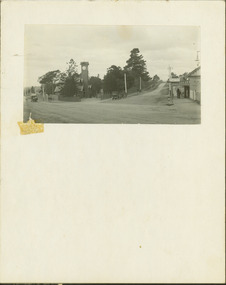
Photograph - Entrance to the Boroondara General (Kew) Cemetery, E.J. Dower, 1913
... tram...Theme -- Connecting Victorians by transport and communications...Trams -- Kew (Vic...Theme --- Travelling by tram Theme -- Connecting Victorians by transport and communications Trams -- Kew (Vic.) High Street. -- Kew (Vic.) Parkhill Road -- Kew (Vic.) ...One of a series of photographs, taken by Edgar James Dower in the second decade of the twentieth century. Born and raised in Olinda, his family later moved to Surrey Hills. He worked as an adult as a clerk in the city office of the Metropolitan Gas Company, and in his role as a 'collector', he was able to photograph scenes including the construction of tramlines and associated buildings in Kew, Hawthorn, Camberwell and Surrey Hills. Later he established a real estate agency with his brother - the E.J. Dower Real Estate Agency, Dandenong Office.The image is an historically significant record of the development of transport infrastructure which was used to connect Victorians in the first two decades of the twentieth century. This development resulted from increases in population and the consequent extension of Melbourne's suburbs. The photographs, both individually and collectively, richly detail the labour of workers and the tools and machinery used to create and extend Melbourne's tram network in the years preceding and during World War 1.Digital copy of an original mounted photograph showing the entrance to the Boroondara General (Kew) Cemetery in 1913. The entrance was/is on the corner of High Street and Parkhill Road. The horse drawn tram from Victoria Street Bridge to the Cemetery can be seen to the left of the photo in High Street. Note also the extensive bluestone gutters in Parkhill Road.Annotated verso: "Entrance to Kew Cemetery? / 1913"theme --- travelling by tram, theme -- connecting victorians by transport and communications, trams -- kew (vic.), high street. -- kew (vic.), parkhill road -- kew (vic.) -
 Kew Historical Society Inc
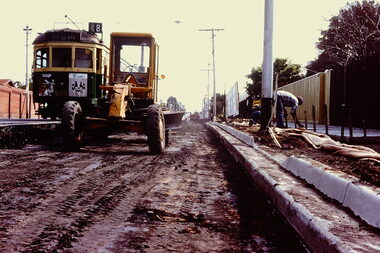
Slide - Roadworks, High Street, 1977
... trams -- kew (vic.)...The colour of some slides has degraded. trams -- kew (vic.) public works -- kew (vic.) road works -- kew (vic.) 35mm colour transparency (slide) of a tram (no 48) in High Street, Kew, in 1977 during roadworks taking place opposite the Boroondara General Cemetery. ...One of two slides of roadworks being undertaken within the City of Kew in 1997. The colour of some slides has degraded.35mm colour transparency (slide) of a tram (no 48) in High Street, Kew, in 1977 during roadworks taking place opposite the Boroondara General Cemetery.trams -- kew (vic.), public works -- kew (vic.), road works -- kew (vic.) -
 Melbourne Tram Museum
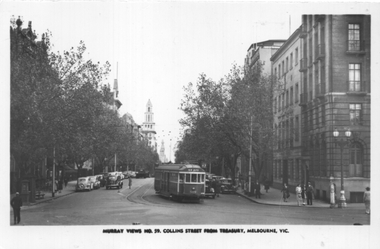
Postcard, Murray Views, "Collins Street Melbourne from Treasury, Melbourne Vic.", 1930s
... Murray Views postcard No. 59, titled "Collins Street Melbourne from Treasury, Melbourne Vic." Has W2 class tram 509 route 47, Kew Depot turning from Collins St into Macarthur St. ...Murray Views postcard No. 59, titled "Collins Street Melbourne from Treasury, Melbourne Vic." Has W2 class tram 509 route 47, Kew Depot turning from Collins St into Macarthur St. ...Murray Views postcard No. 59, titled "Collins Street Melbourne from Treasury, Melbourne Vic." Has W2 class tram 509 route 47, Kew Depot turning from Collins St into Macarthur St. Thee is a lady waiting in the safety zone on the south side of the street. In the background is the T&G building.Yields information about Collins St, during the 1930s.Postcard - printed, unused, by Murray Views of Gympie Qld.trams, tramways, w2 class, collins st, tram 509 -
Melbourne Tram Museum
Magazine, Model Traction Assoc of Vic (MTAV), "Maximum Traction", Jan. 2006
... Model Traction Association Vic (MTAV) Magazine Maximum Traction - Dec. 2005 - reporting on the AGM, the reconstruction of the depot entry at Kew Depot during Jan. 2006 and Adelaide Flexities. See also item 2748 for other information on the Kew project. Yields information about the work of the MTAV and reconstruction of Kew Depot. trams ...Model Traction Association Vic (MTAV) Magazine Maximum Traction - Dec. 2005 - reporting on the AGM, the reconstruction of the depot entry at Kew Depot during Jan. 2006 and Adelaide Flexities. See also item 2748 for other information on the Kew project.Yields information about the work of the MTAV and reconstruction of Kew Depot.Magazine - 12 pages - 3 A4 sheets folded to A5, printed.trams, tramways, kew depot, trackwork, mtav -
 Melbourne Tram Museum
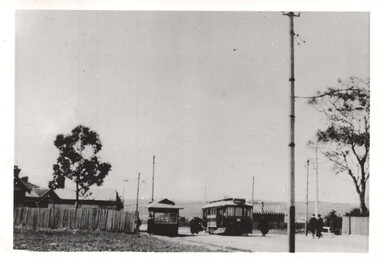
Photograph - High St Kew - Harp of Erin - PMTT, Les Poole, 1916
... tram at the High Street East Kew terminus just northeast of Strathalbyn Street and Harp Road. The Harp of Erin Hotel fence and tree are on the right. There are few other buildings in the view. The Kew Cemetery line was extended along High Street to Strathalbyn Street, Kew on 8/5/1915. There is a tramway shelter on the left-hand side of the road. This photo is not taken at Burke Road. Yields information about the High Street Kew tram line c1916. Trams tramways Kew High St Kew PMTT Shelters Harp of Erin Has the stamp of the ARHS Vic ...Photograph shows a PMTT four-wheel Californian combination tram at the High Street East Kew terminus just northeast of Strathalbyn Street and Harp Road. The Harp of Erin Hotel fence and tree are on the right. There are few other buildings in the view. The Kew Cemetery line was extended along High Street to Strathalbyn Street, Kew on 8/5/1915. There is a tramway shelter on the left-hand side of the road. This photo is not taken at Burke Road. Yields information about the High Street Kew tram line c1916.Black and white photograph with a stamp and details on the rear.Has the stamp of the ARHS Vic Div L G Poole Collection and in ink "Harp of Erin 1916 - Hotel Burke Rd."trams, tramways, kew, high st kew, pmtt, shelters, harp of erin -
 Kew Historical Society Inc
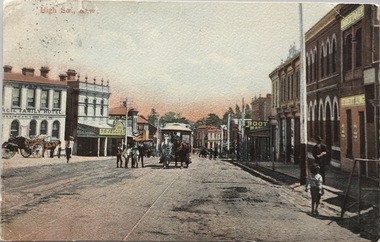
Postcard, High Str., Kew, c.1906
... Kew (vic.)...postcards -- kew (vic.)...horse tram...High Street -- Kew (vic.) postcards -- kew (vic.) horse tram -- kew (Vic.) Reverse - (to) Miss __. ...The Kew Historical Society's postcard collection includes views of Kew, Melbourne and Greater Melbourne as well as those including overseas scenes sent or received from Europe or the Middle East. They date from the 1890s to the 2000s. These postcards may or may not include the name of the publisher or printer. A number of the cards were published as parts of popular series. A way of dating early postcards is to identify whether the reverse was divided by a central line which became the norm after 1902 in the United Kingdom. However, other postcards produced after this date do not always conform to this print layout.Polychrome postcard of High Street, Kew looking west towards Kew Junction. The photograph was also printed in monochrome format by the publishers, with different names and additions.Reverse - (to) Miss __. J. Thompson, "Dry Lake", Kerang (from) Very sorry indeed to hear of your Mother's illness. Sincerely hope all quite well ere this. Still going about very tired waiting __ being away. Love to all M.B.L.high street -- kew (vic.), postcards -- kew (vic.), horse tram -- kew (vic.) -
 Kew Historical Society Inc
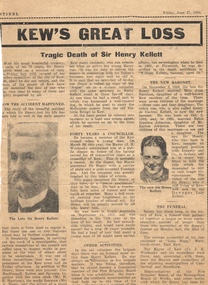
Newspaper - Newspaper Article, Kew's Great Loss, 27/06/1924
... Kew while on Council business. The vehicle, in which he was travelling with fellow councillors and the Town Clerk, collided with a tram. Sir Henry Kellett is commemorated in the naming of Kellett Reserve and Kellett Grove. Mayors of kew (vic ...Sir Henry de Castres Kellett (1851-1924) the son of a hereditary baronet, was born at Mt Gambier, South Australia in 1851. His English title had been created in Ireland in 1801, but the family was originally Norman with the later branches living in England and Ireland. Sir Henry Kellett assumed the title in 1906. Henry Kellett was a prominent Kew retailer, continuing his father’s newspaper and stationery business in Bulleen Road (now High Street). At various stages, he also acted as an insurance, postal and real estate agent. He lived in Walpole Street and later at Lota Begg (now demolished) in Westbrook Street, East Kew. In 1884, Henry Kellett was elected to the Kew Borough Council and served for 40 years; a remarkable example of public service. He was elected Mayor for a single term in 1888-9. Sir Henry de Castres Kellett died in St George’s Hospital in 1924 following a tragic car accident in Cotham Road, Kew while on Council business. The vehicle, in which he was travelling with fellow councillors and the Town Clerk, collided with a tram. Sir Henry Kellett is commemorated in the naming of Kellett Reserve and Kellett Grove.Newspaper report in The Sentinel reporting the death of Cr Sir Henry Kellett in 1924mayors of kew (vic), sir henry de castres kellett -
 Kew Historical Society Inc
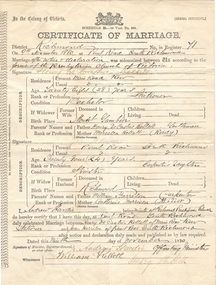
Certificate - Certificate of Marriage, Henry de Castres Kellett & Joan Harrison, 1880, 09/11/1880
... Kew while on Council business. The vehicle, in which he was travelling with fellow councillors and the Town Clerk, collided with a tram. Sir Henry Kellett is commemorated in the naming of Kellett Reserve and Kellett Grove. mayors of kew (vic) sir henry de castres kellett Original Marriage Certificate of Henry de Castres Kellet and Joan Harrosn, in Richmond on 9 November 1880 Henry de Castres Kellett & Joan Harrison, 1880 Certificate Certificate of Marriage ...Sir Henry de Castres Kellett (1851-1924) the son of a hereditary baronet, was born at Mt Gambier, South Australia in 1851. His English title had been created in Ireland in 1801, but the family was originally Norman with the later branches living in England and Ireland. Sir Henry Kellett assumed the title in 1906. Henry Kellett was a prominent Kew retailer, continuing his father’s newspaper and stationery business in Bulleen Road (now High Street). At various stages, he also acted as an insurance, postal and real estate agent. He lived in Walpole Street and later at Lota Begg (now demolished) in Westbrook Street, East Kew. In 1884, Henry Kellett was elected to the Kew Borough Council and served for 40 years; a remarkable example of public service. He was elected Mayor for a single term in 1888-9. Sir Henry de Castres Kellett died in St George’s Hospital in 1924 following a tragic car accident in Cotham Road, Kew while on Council business. The vehicle, in which he was travelling with fellow councillors and the Town Clerk, collided with a tram. Sir Henry Kellett is commemorated in the naming of Kellett Reserve and Kellett Grove.Original Marriage Certificate of Henry de Castres Kellet and Joan Harrosn, in Richmond on 9 November 1880mayors of kew (vic), sir henry de castres kellett -
 Kew Historical Society Inc
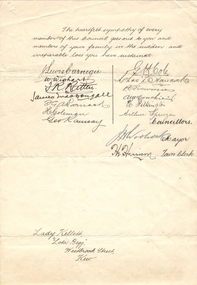
Letter - Letter of Condolence, Lady Kellett, Lota Begg, Westbrook Street, Kew, 1924
... Kew while on Council business. The vehicle, in which he was travelling with fellow councillors and the Town Clerk, collided with a tram. Sir Henry Kellett is commemorated in the naming of Kellett Reserve and Kellett Grove. Original official document from a noted event in Kew's history mayors of kew (vic ...Sir Henry de Castres Kellett (1851-1924) the son of a hereditary baronet, was born at Mt Gambier, South Australia in 1851. His English title had been created in Ireland in 1801, but the family was originally Norman with the later branches living in England and Ireland. Sir Henry Kellett assumed the title in 1906. Henry Kellett was a prominent Kew retailer, continuing his father’s newspaper and stationery business in Bulleen Road (now High Street). At various stages, he also acted as an insurance, postal and real estate agent. He lived in Walpole Street and later at Lota Begg (now demolished) in Westbrook Street, East Kew. In 1884, Henry Kellett was elected to the Kew Borough Council and served for 40 years; a remarkable example of public service. He was elected Mayor for a single term in 1888-9. Sir Henry de Castres Kellett died in St George’s Hospital in 1924 following a tragic car accident in Cotham Road, Kew while on Council business. The vehicle, in which he was travelling with fellow councillors and the Town Clerk, collided with a tram. Sir Henry Kellett is commemorated in the naming of Kellett Reserve and Kellett Grove.Original official document from a noted event in Kew's historyOne page undated, handwritten letter of condolence to Lady Kellett on her husband's accidental death in 1924 while serving as a Kew Councillor. The latter is signed by his fellow councillors, the Mayor and the Town Clerkmayors of kew (vic), sir henry de castres kellett -
 Kew Historical Society Inc
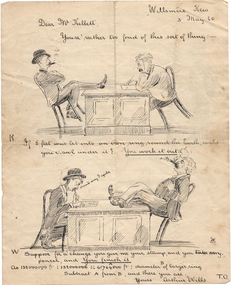
Drawing - Visual Vignettes, Sir Henry de Castres Kellett & Arthur Wills / by Arthur Wills, 1920
... Kew while on Council business. The vehicle, in which he was travelling with fellow councillors and the Town Clerk, collided with a tram. Sir Henry Kellett is commemorated in the naming of Kellett Reserve and Kellett Grove. Original artwork by Arthur Wills, descendent of a noted pioneer family, and former mayor of Kew. mayors of kew (vic ...Sir Henry de Castres Kellett (1851-1924) the son of a hereditary baronet, was born at Mt Gambier, South Australia in 1851. His English title had been created in Ireland in 1801, but the family was originally Norman with the later branches living in England and Ireland. Sir Henry Kellett assumed the title in 1906. Henry Kellett was a prominent Kew retailer, continuing his father’s newspaper and stationery business in Bulleen Road (now High Street). At various stages, he also acted as an insurance, postal and real estate agent. He lived in Walpole Street and later at Lota Begg (now demolished) in Westbrook Street, East Kew. In 1884, Henry Kellett was elected to the Kew Borough Council and served for 40 years; a remarkable example of public service. He was elected Mayor for a single term in 1888-9. Sir Henry de Castres Kellett died in St George’s Hospital in 1924 following a tragic car accident in Cotham Road, Kew while on Council business. The vehicle, in which he was travelling with fellow councillors and the Town Clerk, collided with a tram. Sir Henry Kellett is commemorated in the naming of Kellett Reserve and Kellett Grove.Original artwork by Arthur Wills, descendent of a noted pioneer family, and former mayor of Kew.Two sided illustrated humorous vignettes featuring two noted Kew citizens: Henry de Castres Kellet and Arthur Wills. The latter is the illustrator. The item was illustrated in 1920.mayors of kew (vic), sir henry de castres kellett, arthur wills, willsmere, wills family -
 Kew Historical Society Inc
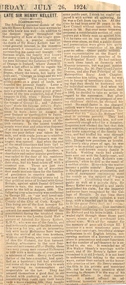
Newspaper - Newspaper Article, Late Sir Henry Kellett, 1924, 1924
... Kew while on Council business. The vehicle, in which he was travelling with fellow councillors and the Town Clerk, collided with a tram. Sir Henry Kellett is commemorated in the naming of Kellett Reserve and Kellett Grove. mayors of kew (vic) sir henry de castres kellett Newspaper report from 1924, providing an obituary of Sir Henry de Castres Kellett Late Sir Henry Kellett, 1924 Newspaper Newspaper Article ...Sir Henry de Castres Kellett (1851-1924) the son of a hereditary baronet, was born at Mt Gambier, South Australia in 1851. His English title had been created in Ireland in 1801, but the family was originally Norman with the later branches living in England and Ireland. Sir Henry Kellett assumed the title in 1906. Henry Kellett was a prominent Kew retailer, continuing his father’s newspaper and stationery business in Bulleen Road (now High Street). At various stages, he also acted as an insurance, postal and real estate agent. He lived in Walpole Street and later at Lota Begg (now demolished) in Westbrook Street, East Kew. In 1884, Henry Kellett was elected to the Kew Borough Council and served for 40 years; a remarkable example of public service. He was elected Mayor for a single term in 1888-9. Sir Henry de Castres Kellett died in St George’s Hospital in 1924 following a tragic car accident in Cotham Road, Kew while on Council business. The vehicle, in which he was travelling with fellow councillors and the Town Clerk, collided with a tram. Sir Henry Kellett is commemorated in the naming of Kellett Reserve and Kellett Grove.Newspaper report from 1924, providing an obituary of Sir Henry de Castres Kellettmayors of kew (vic), sir henry de castres kellett -
 Kew Historical Society Inc
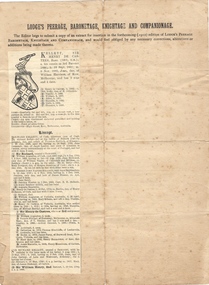
Document, Lodge's Peerage, Baronetage, Knightage and Companionage - KELLETT, Sir Henry de Castres Bart
... Kew while on Council business. The vehicle, in which he was travelling with fellow councillors and the Town Clerk, collided with a tram. Sir Henry Kellett is commemorated in the naming of Kellett Reserve and Kellett Grove. mayors of kew (vic) sir henry de castres kellett Printed extract from Lodge's Peerage, Baronetage, Knightage and Companionage listing KELLETT, Sir Henry de Castres Bart. ...Sir Henry de Castres Kellett (1851-1924) the son of a hereditary baronet, was born at Mt Gambier, South Australia in 1851. His English title had been created in Ireland in 1801, but the family was originally Norman with the later branches living in England and Ireland. Sir Henry Kellett assumed the title in 1906. Henry Kellett was a prominent Kew retailer, continuing his father’s newspaper and stationery business in Bulleen Road (now High Street). At various stages, he also acted as an insurance, postal and real estate agent. He lived in Walpole Street and later at Lota Begg (now demolished) in Westbrook Street, East Kew. In 1884, Henry Kellett was elected to the Kew Borough Council and served for 40 years; a remarkable example of public service. He was elected Mayor for a single term in 1888-9. Sir Henry de Castres Kellett died in St George’s Hospital in 1924 following a tragic car accident in Cotham Road, Kew while on Council business. The vehicle, in which he was travelling with fellow councillors and the Town Clerk, collided with a tram. Sir Henry Kellett is commemorated in the naming of Kellett Reserve and Kellett Grove.Printed extract from Lodge's Peerage, Baronetage, Knightage and Companionage listing KELLETT, Sir Henry de Castres Bart.mayors of kew (vic), sir henry de castres kellett -
 Kew Historical Society Inc
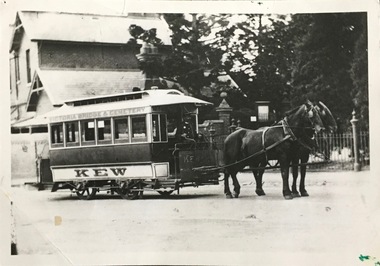
Photograph, Horse Tram, Boroondara General (Kew) Cemetery, 1910
... horse tram -- kew (vic.)...The postcards in the Bennett collection, like other images in the Society's holdings date from the 1890s to the present and comprehensively indicate points-of-view or scenes considered historically, aesthetically or socially significant in the period in which they were produced. horse tram -- kew (vic.) boroondara general (kew) cemetery public transport -- kew (vic.) ...The Kew Historical Society's postcard collection includes views of Kew, Melbourne and Greater Melbourne as well as those including overseas scenes sent or received from Europe or the Middle East. They date from the 1890s to the 2000s. These postcards may or may not include the name of the publisher or printer. A number of the cards were published as parts of popular series. A way of dating early postcards is to identify whether the reverse was divided by a central line which became the norm after 1902 in the United Kingdom. However, other postcards produced after this date do not always conform to this print layout.The item forms part of the Laurie Bennett collection of thirty-six postcards and photographs of Kew and early Melbourne, donated to the Kew Historical Society in 1980. The postcards in the Bennett collection, like other images in the Society's holdings date from the 1890s to the present and comprehensively indicate points-of-view or scenes considered historically, aesthetically or socially significant in the period in which they were produced.Black and white photograph of the horse tram in High Street, Kew, outside the Boroondara (Kew) General Cemetery. The horse tram was a form of public transport linking the Cemetery with Victoria Bridge.The reverse of the photo identifies the year as 1910. The photo is one of a series of postcards / photographs donated to the Kew Historical Society by L. Bennett in 1980.Reverse: "1910. Donated by L. Bennett 1980. Reg No. KH-402"horse tram -- kew (vic.), boroondara general (kew) cemetery, public transport -- kew (vic.) -
 Kew Historical Society Inc
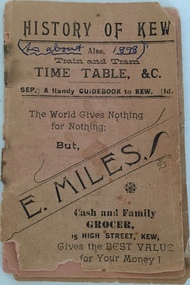
Booklet, H Sharpe Patterson, History of Kew; also Train and Tram Timetable, &c, c.1898
... kew (vic) - history...public transport - kew (vic)...train timetables...tram...Small 30-page booklet containing a train and tram timetable for public transport in Kew (Vic). The booklet also contains a brief history of Kew and advertisements for local retailers. ...) - history public transport - kew (vic) train timetables tram timetables "Gift of C.W. ...Train timetable including a history of Kew and advertisements for local retailers and merchants. Given the frequency of times mentioned, Coopers Kew Flyer may have been the distributor and producer. There is no indication that it is an official tram or railway publication. During the second half of the 19th century when the booklet was produced there was only a horse tram (1887-1914) and the Kew Railway Line (1887-1952). The Kew section of the Outer Circle Line functioned until 1893.Historically significant item documenting Kew's history in the 19th century. The item is the earliest piece in the collection documenting aspects of the Kew Railway Line.Small 30-page booklet containing a train and tram timetable for public transport in Kew (Vic). The booklet also contains a brief history of Kew and advertisements for local retailers. Pages can be viewed by scrolling through the attached images."Gift of C.W. Fairhall, Box Hill, 1990"kew (vic) - history, public transport - kew (vic), train timetables, tram timetables -
 Kew Historical Society Inc
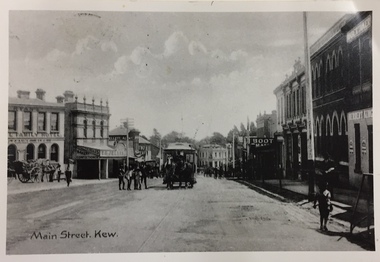
Postcard, Main Street, Kew
... tram kew...clifton hotel - kew junction...ryan's council family hotel kew...horse tram - kew (vic...Businesses identified in the photograph include the Ryan's Council Family Hotel, the Greyhound Hotel, the Clifton Hotel, the ES&A Bank and Jellis' Bakery. horse tram kew clifton hotel - kew junction ryan's council family hotel kew horse tram - kew (vic) kew junction Reverse - "High St Kew looking down from Post Office to Kew Junction" Black & white photograph of a postcard showing Main [High] Street, Kew looking south west showing horse drawn tram centre. ...Image copied from older postcard (c.1890-1900) showing horse drawn vehicles and a horse tram. Since then, the southern side of the street has been widened. Businesses identified in the photograph include the Ryan's Council Family Hotel, the Greyhound Hotel, the Clifton Hotel, the ES&A Bank and Jellis' Bakery. Black & white photograph of a postcard showing Main [High] Street, Kew looking south west showing horse drawn tram centre.Reverse - "High St Kew looking down from Post Office to Kew Junction"horse tram kew, clifton hotel - kew junction, ryan's council family hotel kew, horse tram - kew (vic), kew junction -
 Kew Historical Society Inc
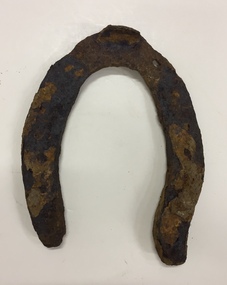
Functional object, City of Kew, Rusted Horse Shoe, Horse Tramways Shed, Kew, 1887-1950
... horse tram - kew (vic)...Kew Council depot, and before that a horse tram shed. The horse tram (1887-1914) ran from the Victoria Street Bridge to the entrance of the Boroondara General Cemetery. horse tram - kew (vic) archaeological items - kew (vic) horse shoes kew recreation centre council depots - kew (vic) tram sheds - kew (vic) Rusted horse shoe, excavated from the site of the Kew Recreation Centre on the corner of High and Disraeli Streets in Kew. ...The site on the north side of High Street, Kew, on the corner of Disraeli Street is now the location of the Kew Recreation Centre. The current (as of 2020) swimming pool was formerly situated further west on the site but was relocated closer to Disraeli Street during the 1980s. Previously, this was the site of a Kew Council depot, and before that a horse tram shed. The horse tram (1887-1914) ran from the Victoria Street Bridge to the entrance of the Boroondara General Cemetery. Rusted horse shoe, excavated from the site of the Kew Recreation Centre on the corner of High and Disraeli Streets in Kew. The shoe was donated by Mr Poulter, City Engineer, City of Kew. The shoe may have been made for one of the horses that pulled the Kew Horse Tram or one of the Council depot horses.horse tram - kew (vic), archaeological items - kew (vic), horse shoes, kew recreation centre, council depots - kew (vic), tram sheds - kew (vic) -
Kew Historical Society Inc
Journal, Kew Historical Society, Newsletter No.147, June 2024
... Kew Historical Society (Vic.) -- Periodicals. Kew Historical Society (Vic.) -- Newsletters Kew Historical Society (Vic.) -- journals Tram tracks in Boroondara [electrification of] / Robert Baker pp1-2. ...Tram tracks in Boroondara [electrification of] / Robert Baker pp1-2. History News - Conservation [Henty Family Costume Collection, Community Heritage Grant application - National Library of Australia]; New Members; Donations to the Collection / p3. The Voyage of the John Bunyan / David White pp4-5. Family records: The diary of Mrs Henry Henty of Tarring / Suzanne McWha pp6-8. Sir Rupert 'Dick' Hamer AC KCMG ED / John Torpey pp8-9. As it happened 100 years ago [H.C.A. Harrison, Empire Day, Motor accident, Widening of High Street [Kew], Death of Cr [Sir] Henry [de Castres] Kellett, Bt / David White p.9. Branching out: the Coles family of Kew / Desley Reid pp.10-11. Membership and Donations / p12.Published quarterly since 1977, the newsletters of the Kew Historical Society contain significant research by members exploring relevant aspects of the Victorian and Australian Framework of Historical Themes. Frequently, articles on people, places and artefacts are the only source of information about an aspect of Kew, and Melbourne’s history.non-fictionTram tracks in Boroondara [electrification of] / Robert Baker pp1-2. History News - Conservation [Henty Family Costume Collection, Community Heritage Grant application - National Library of Australia]; New Members; Donations to the Collection / p3. The Voyage of the John Bunyan / David White pp4-5. Family records: The diary of Mrs Henry Henty of Tarring / Suzanne McWha pp6-8. Sir Rupert 'Dick' Hamer AC KCMG ED / John Torpey pp8-9. As it happened 100 years ago [H.C.A. Harrison, Empire Day, Motor accident, Widening of High Street [Kew], Death of Cr [Sir] Henry [de Castres] Kellett, Bt / David White p.9. Branching out: the Coles family of Kew / Desley Reid pp.10-11. Membership and Donations / p12.kew historical society (vic.) -- periodicals., kew historical society (vic.) -- newsletters, kew historical society (vic.) -- journals -
Kew Historical Society Inc
Journal, Kew Historical Society, Newsletter No.85, September, 2007
... kew historical society (vic.) -- periodicals. kew historical society (vic.) -- newsletters kew historical society (vic.) -- journals ‘Court House Happenings’ / p1. A Piece from the President / Dione McIntyre, p2. Trams ...‘Court House Happenings’ / p1. A Piece from the President / Dione McIntyre, p2. Trams of Kew / p3. 50th Golden Jubilee Celebration of St Pauls / p3. Kew Court House Campaign / p4. Notice of Annual General Meeting / p5. Book Sales / p5. 2007 Calendar / p6. Recent Acquisitions / p6. Villa Alba Museum Inc. / p6.Published quarterly since 1977, the newsletters of the Kew Historical Society contain significant research by members exploring relevant aspects of the Victorian and Australian Framework of Historical Themes. Frequently, articles on people, places and artefacts are the only source of information about an aspect of Kew, and Melbourne’s history.‘Court House Happenings’ / p1. A Piece from the President / Dione McIntyre, p2. Trams of Kew / p3. 50th Golden Jubilee Celebration of St Pauls / p3. Kew Court House Campaign / p4. Notice of Annual General Meeting / p5. Book Sales / p5. 2007 Calendar / p6. Recent Acquisitions / p6. Villa Alba Museum Inc. / p6.kew historical society (vic.) -- periodicals., kew historical society (vic.) -- newsletters, kew historical society (vic.) -- journals -
 Kew Historical Society Inc
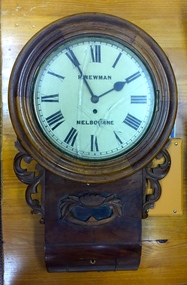
Functional object, H Newman, Boxed Wall Clock, 19th Century
... trams, without having sustained injury. A widow and grown up family of four sons and four daughters survive him. The Age Monday 27 October 1913, page 9. Roy Cronin 156 High Street Kew Jeweller and watchmaker. East side between Denmark Street and Cotham Road. roy cronin - watchmaker - jeweller - kew (vic ...DEATH OF MR. H. NEWMAN. Widespread regret will be felt at the announcement of the death of Mr Henry Newman, an old colonist and a member of firm of Newman and Sons Proprietary Limited, jewellers, which occurred at his residence, "Sadova," William street, on Saturday, at the age of 89 years. Mr Newman who was born at Riga, in Russia, went to England when a lad, became naturalised, and emigrated to Victoria 61 years ago. He tried his fortune at Ballarat but soon afterwards returned to Melbourne, and began business as a jeweller, on a site in Collins street that is now occupied by Scott's Hotel. A few years later Mr Newman went back to England, where he was married. On his return to Victoria again he resumed his jewellery business in Elizabeth street opposite the General Post-office. An interesting fact in connection with his business is that his first journeyman watchmaker was Mr. Thomas Gaunt, the founder of the firm of Messrs. T. Gaunt & Co. Five years ago Mr. Newman retired from the business, which has since been carried on by his two elder sons. Although he took no active part in public affairs, Mr Newman was held in high regard on account of his business integrity, sterling personal worth. and the unostentatious way in which he did good. His vitality, even in his later years, was wonderful. On four occasions he met with accidents, having been twice knocked down by motorcars and twice by trams, without having sustained injury. A widow and grown up family of four sons and four daughters survive him. The Age Monday 27 October 1913, page 9. Roy Cronin 156 High Street Kew Jeweller and watchmaker. East side between Denmark Street and Cotham Road. Wood, enamel, brass and glass wall clock, the movement made by H Newman of Collins Street, Melbourne. A small label on the interior records the name R. Cronin, 156 High St, Kew, 1/7/20. It is unclear whether Cronin, a watchmaker and jeweller may have repaired or sold the clock. The clock (broken) is housed in a steel box.roy cronin - watchmaker - jeweller - kew (vic), h newman - melbourne (vic) - collins street - jeweller - clockmaker -
 Kew Historical Society Inc
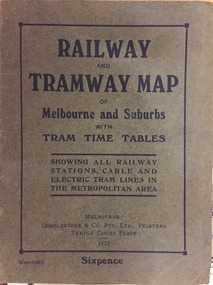
Map, Osboldstone & Co Pty Ltd, Railway and Tramway Map of Melbourne and Suburbs With Tram Timetables, 1917
... Trams. The old Outer Circle railway line is marked as ending in Deepdene, with the remainder of the line to Fairfield marked as 'Unused'. The Kew tram along High Street in 1917 ended at the Harp Junction. The Kew Spur Line is also marked on the map. The Railway and Tramway Map of Melbourne and Suburbs With Tram Timetables is historically significant as it captures at a point in time, 1917, the development of public transport infrastructure in Melbourne. As such it illustrrates the theme: Connecting Victorians by transport and communications. railway maps -- melbourne (vic ...The Railway and Tramway Map of Melbourne and Suburbs With Tram Timetables lists existing Cable Tram Services before the entire network was electrified. By 1917 the tramways system was divided into regions including: the Melbourne Cable Tram Service; Prahran - Malvern Electric Trams; Hawthorn Electric Trams; Melbourne, Brunswick and Coburg Electric Trams; and Brighton Beach Electric Trams. The old Outer Circle railway line is marked as ending in Deepdene, with the remainder of the line to Fairfield marked as 'Unused'. The Kew tram along High Street in 1917 ended at the Harp Junction. The Kew Spur Line is also marked on the map.The Railway and Tramway Map of Melbourne and Suburbs With Tram Timetables is historically significant as it captures at a point in time, 1917, the development of public transport infrastructure in Melbourne. As such it illustrrates the theme: Connecting Victorians by transport and communications.Printed card-covered pocket sized map that folds out with three horizontal and vertical folds. Colour map, with scale, of the rail and tram networks on one side and sixteen sections of black and white printed text and timetable information on the reverse.railway maps -- melbourne (vic.), tramways maps -- melbourne (vic.), public transport -- melbourne (vic.) -- 1910-1920, cartography
