
Showing 36 items matching "vance palmer"
-
 Kew Historical Society Inc
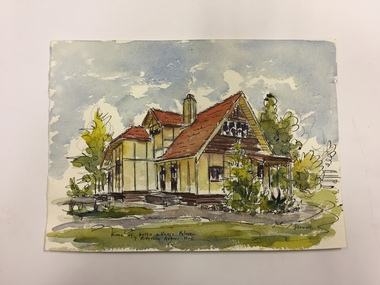
Work on paper, Joy Stewart, Home of Nettie and Vance Palmer, 7 Ridgeway Avenue, Kew, c.1978
... Home of Nettie and Vance Palmer, 7 Ridgeway Avenue, Kew......vance palmer...Watercolour, Pen & Ink on paper by the artist and local historian Joy Stewart of the home in Ridgeway Avenue of Nettie and Vance Palmer. ...Inscription: "Home of Nettie and Vance Palmer / 7 Ridgeway Avenue, Kew." Signed lower right: "JStewart"....Joy Stewart died in Cairns in 2018. joy stewart vance palmer nettie palmer ridgeway avenue (kew) Inscription: "Home of Nettie and Vance Palmer / 7 Ridgeway Avenue, Kew." ...Sydney Joy (joy) Stewart (1925-2018) was a founding member of the Kew Historical Society, and during the 1970s its secretary. During her residence in Kew, she completed numerous property illustrations on commission. These ranged from preliminary sketches, including architectural details to finished pen & ink and wash illustrations on paper. On moving to Queensland, Joy Stewart donated the remaining property illustrations in her possession to the Kew Historical Society. In 1987-88 she fulfilled a commission by the Society of designs for a series of embroideries completed by residents during the Australian Bicentennial commemorations.Sydney Joy (Joy) Stewart was born in Melbourne 1925. She studied at Swinburne Technical College Art School from 1941-1945, then the National Gallery Art School 1946-1948. Her career included employment positions as a display artist, designer/painter, gallery assistant, and art teacher. Joy relocated to Cairns in 1981. Solo exhibitions in Melbourne and Cairns, including 'Done By Me' at Cairns Regional Gallery in 1999. Group exhibitions at Cairns Regional Gallery, 'The Fish John West Regrets, 1993' and 'Facets of Life' 1994. Joy Stewart died in Cairns in 2018.Watercolour, Pen & Ink on paper by the artist and local historian Joy Stewart of the home in Ridgeway Avenue of Nettie and Vance Palmer. Inscription: "Home of Nettie and Vance Palmer / 7 Ridgeway Avenue, Kew." Signed lower right: "JStewart".joy stewart, vance palmer, nettie palmer, ridgeway avenue (kew) -
 Emerald Museum & Nobelius Heritage Park
Book - Historical fiction, Vance Palmer, Seedtime, 1957
... Vance Palmer...Vance Palmer's novels wrote between 1920 and 1959.In 1919, the couple rented Rose Charman's Cottage in Emerald from the writer, Katharine Susannah Prichard....On spine: 'Seedtime / Vance / Palmer'...Vance Palmer...Seedtime Book Historical fiction Vance Palmer ...Emerald was a gathering place for some Australian writers in the early 20th century. Vance and his wife Nettie Palmer were two such writers. In addition to their literary works, they were remembered for their great compassion and generosity. Vance Palmer's novels wrote between 1920 and 1959.In 1919, the couple rented Rose Charman's Cottage in Emerald from the writer, Katharine Susannah Prichard.Vance and Netty Palmer advocated for the recognition of Australian literature as a subject worthy of serious study and teaching.Published 1957. Hardback. Novel.On spine: 'Seedtime / Vance / Palmer'vance palmer, author, seedtime, novel, katharine susannah prichard, rose charman's cottage, emerald, victoria, australia, nettie palmer -
Emerald Museum & Nobelius Heritage Park
Book - Biography, University of Queensland, Vance Palmer, 1970
... Vance Palmer...Vance Palmer...Hardcover book, purple cover, with large drawing of Vance Palmer taking up over 1/2 front cover....By Harry Heseltine, 1970 Vance Palmer Writers of the Dandenongs Hardcover book, purple cover, with large drawing of Vance Palmer taking up over 1/2 front cover. ...By Harry Heseltine, 1970Hardcover book, purple cover, with large drawing of Vance Palmer taking up over 1/2 front cover.vance palmer, writers of the dandenongs -
Emerald Museum & Nobelius Heritage Park
Book - Novel, Palmer, Vance Stanley Paul & Co. Ltd, Daybreak, [1931 or 1932]
... ...Vance Palmer...Barnard Eldershaw - this exoperiment! Vance Palmer'...Palmer, Vance Stanley Paul & Co. Ltd....Vance Palmer' Hard cover book , 288 pages Daybreak Book Novel Palmer, Vance Stanley Paul & Co. ...A novel written about Emerald when the Palmers were living there with characters thinly disguised. The story of an orchard and the orchard workers, based on the Gembrook Nurseries, it relates the story of a strike by the workers. This copy was signed by the author and presented to Marjorie Barnard.Hard cover book , 288 pages'To M. Barnard Eldershaw - this exoperiment! Vance Palmer'emerald, victoria, australia, authors, fiction, australian literature, vance palmer -
Emerald Museum & Nobelius Heritage Park
Book - Historical fiction, Vance Palmer, Golconda, 1/05/2005 12:00:00 AM
... Vance...Palmer...Edward Vivian (Vance) Palmer (1885-1959), writer, was born on 28 August 1885 at Bundaberg, Queensland, seventh child of Australian-born Henry Burnet Palmer, schoolteacher, and his Irish wife Jessie, née Carson. ...Vance Palmer...Dust jacket taped to book Golconda Book Historical fiction Vance Palmer ...Edward Vivian (Vance) Palmer (1885-1959), writer, was born on 28 August 1885 at Bundaberg, Queensland, seventh child of Australian-born Henry Burnet Palmer, schoolteacher, and his Irish wife Jessie, née Carson. He began to write, especially for Steele Rudd's Magazine: 'Rudd' encouraged him and in 1905 published his article, 'An Australian national art', which foreshadowed his basic attitudes. He won a modest place in the English literary world, associating with Katherine Mansfield, Ezra Pound, Wyndham Lewis, Frank Harris, Herbert Read and Will Dyson. On 23 May 1914 in London Palmer married Janet Gertrude Higgins (Nettie). His first volumes of stories and sketches, The World of Men, and poetry, Forerunners, were published in London in 1915, His second volume of verse, The Camp (1920), contained his best-known poem, 'The farmer remembers the Somme'. A liberal socialist of the broad left, Palmer made his last overseas trip in 1955 to Helsinki as delegate to the World Peace Council. He had declined the offer of an O.B.E. After the war Palmer had returned to writing fiction. In 1948 Golconda appeared—the first of a trilogy broadly inspired by the life of E. G. Theodore, novels which are among his best. Moreover, in these years he wrote some of his finest stories, gathered in Let the Birds Fly (1955); and he published with Margaret Sutherland the pioneering work, Old Australian Bush Ballads (1951). He began working on his reminiscences; Intimate Portraits (1969) demonstrates again his biographical talent. The Palmers' partnership was dedicated to promotion of a national literature in a period when few were interested in Australian arts and letters. They emerged as leaders of a profession only beginning to recognize itself; for thirty years and more they (usually Nettie) wrote appreciatively and helpfully, assuring friendship and hospitality, to the author of any book of quality. They were essentially 'intellectuals, deeply concerned with the world of ideas'—their strength was in combining knowledge of world literature and international standards with passionate devotion to fostering national writing.The book is socially and artistically significant as it is written by Vance Palmer who was a significant figure in Australian art circlesRed hard cover book with buff dust jacket, illustration of two men standing near a mine winch. Dust jacket taped to bookMarion Preston, $6book, fiction, golconda, vance, palmer, lead, mining -
Emerald Museum & Nobelius Heritage Park
Book - Novel, Palmer, Vance, 1885-1959, Cronulla, 1925
... ...Vance Palmer...Vance Palmer was a resident of Emerald before and after World War One....Palmer, Vance, 1885-1959...Vance Palmer was a resident of Emerald before and after World War One. ...Vance Palmer was a resident of Emerald before and after World War One.Hard cover with dust jacket, 281p.'Stella Stone, Bunda Bunda, Nelia, North Queensland'emerald, victoria, australia, authors, fiction, australian literature, vance palmer -
Emerald Museum & Nobelius Heritage Park
Book - Novel, Palmer, Vance, 1885-1959, Legend for Sanderson, 1937
... ...Vance Palmer...The author, Vance Palmer, a well-known Australian author, lived in Emerald before and after World War 1....Palmer, Vance, 1885-1959...The author, Vance Palmer, a well-known Australian author, lived in Emerald before and after World War 1. ...The author, Vance Palmer, a well-known Australian author, lived in Emerald before and after World War 1.Hard cover, 280p.emerald victoria austraila, authors, fiction, australian literature, vance palmer -
Emerald Museum & Nobelius Heritage Park
Book - History Book, Vance Palmer, 'The Legend of the Nineties', 1980 reprint
... Vance Palmer...Vance Palmer...Vance Palmer Published by Melbourne University Press first published 1954, 1963,1966 and 1980 'The Legend of the Nineties' Book History Book Vance Palmer ...Published by Melbourne University Press first published 1954, 1963,1966 and 1980vance palmer -
Kew Historical Society Inc
Archive (Series) - Vance & Nettie Palmer
... Vance & Nettie Palmer...Vance Palmer – Kew (Vic.)...Vance Palmer – Kew (Vic.) Nettie Palmer – Kew (Vic.) ...Various PartiesReference, Research, InformationArranged by Secondary Values (value of records to users)Vance & Nettie Palmer were both prolific Australian-born writers who were well known for making Australian literature prestigious in the eyes of those who didn’t see its value. Both known left-wing socialists, they moved between countries such as China, Russia, and the United Kingdom, always returning to Kew. The file includes: A history of the two and their family, photos of their ‘Ardmore’ residence, and documents and photos related to the unveiling of their plaque at the Kew Library.vance palmer – kew (vic.), nettie palmer – kew (vic.)vance palmer – kew (vic.), nettie palmer – kew (vic.) -
Emerald Museum & Nobelius Heritage Park
Booklet - Exhibition Catalogue of Vance and Nettie Palmer, Library Council of Victoria, circa 1985
... Exhibition Catalogue of Vance and Nettie Palmer....Vance...Nettie...Janet...Palmer...Catalogue of an Exhibition to celebrate the centenary of the births of Vance and Nettie Palmer. Vance and Nettie Palmer, An Exhibition to celebrate the centenary of their births, in the Queen's Hall, State Library of Victoria, 20th August - 30th September, 1985....Catalogue of an Exhibition to celebrate the centenary of the births of Vance and Nettie Palmer. Vance and Nettie Palmer, An Exhibition to celebrate the centenary of their births, in the Queen's Hall, State Library of Victoria, 20th August - 30th September, 1985. ...Catalogue of an Exhibition to celebrate the centenary of the births of Vance and Nettie Palmer. Vance and Nettie Palmer, An Exhibition to celebrate the centenary of their births, in the Queen's Hall, State Library of Victoria, 20th August - 30th September, 1985.The object is culturally, historically and artistically significant as Vance and Janet (Nettie) Palmer, who were for a time Emerald residents, were nationally renowned in Australian literary circles during the early 20th century.Cream cardboard and paper stapled booklet printed in sepiaStamped “Monbulk Historical Society,PO Box 98, Monbulk 3793” on first pageexhibition, vance, nettie, janet, palmer, library of victoria -
Emerald Museum & Nobelius Heritage Park
Book - History book, Vance Palmer, The Legend of the Nineties, 1954
... The nineties were a dynamic period for the development of an Australian identity and a sense of community and the resultant push to federalism. This book by Vance Palmer was first published in 1954....Vance Palmer...The nineties were a dynamic period for the development of an Australian identity and a sense of community and the resultant push to federalism. This book by Vance Palmer was first published in 1954. Marion Preston Thin hardcover book, cover shows a a painting of Princess Bridge 1908 donated by Marion Preston The Legend of the Nineties Book History book Vance Palmer ...The nineties were a dynamic period for the development of an Australian identity and a sense of community and the resultant push to federalism. This book by Vance Palmer was first published in 1954.Thin hardcover book, cover shows a a painting of Princess Bridge 1908 donated by Marion Prestonmarion preston -
Emerald Museum & Nobelius Heritage Park
Book - Novel, Palmer, Vance, 1885-1959 et al, Let the Birds Fly, 1955
... ...Vance Palmer...Palmer, Vance, 1885-1959...Emerald Victoria Australia authors Fiction Australian literature Vance Palmer Hard cover book, 202p.Hard back Let the Birds Fly Book Novel Palmer, Vance, 1885-1959 Angus and Robertson Halstead Press Ltd. ...New edn.Hard cover book, 202p.Hard backemerald, victoria, australia, authors, fiction, australian literature, vance palmer -
 Robin Boyd Foundation
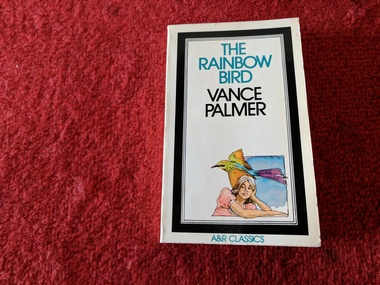
Book, Vance Palmer, The Rainbow Bird and Other Stories, 1977
... Vance Palmer...Walsh St library Softcover The Rainbow Bird and Other Stories Book Vance Palmer Angus and Robertson ...Softcoverwalsh st library -
 Robin Boyd Foundation
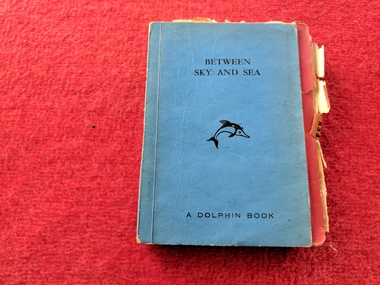
Book, Herz Bergner, Vance Palmer (Intro), Between Sky and Sea, 1946
... Herz Bergner, Vance Palmer (Intro)...Walsh St library Newspaper clipping of a review of the book from Argus Softcover w/ Ripped Dust Jacket (Placed inside book) Between Sky and Sea Book Herz Bergner, Vance Palmer (Intro) Dolphin Publications ...Softcover w/ Ripped Dust Jacket (Placed inside book)Newspaper clipping of a review of the book from Arguswalsh st library -
Emerald Museum & Nobelius Heritage Park
Book - Fiction Book, Vance Palmer, The Passage', new edition
... Vance Palmer...The Passage' Book Fiction Book Vance Palmer ... -
Emerald Museum & Nobelius Heritage Park
Book - Poetry Book, Heddle, Enid Moodie et al, The Boomerang Book of Australian Poetry, 1956
... ...Vance Palmer...Includes poetry by Emerald writers Vance Palmer and Louis Esson, and C.J. Dennis who at one time lived at Kallista....Includes poetry by Emerald writers Vance Palmer and Louis Esson, and C.J. Dennis who at one time lived at Kallista. ...Anthology of poetry edited and arranged by Enid Moodie Heddle. Includes poetry by Emerald writers Vance Palmer and Louis Esson, and C.J. Dennis who at one time lived at Kallista.Soft cover 160-page book of poetry; includes index.emerald, victoria, australia, authors, poetry, louis esson, c.j. dennis, vance palmer -
Emerald Museum & Nobelius Heritage Park
Book - Compilation of Nettie Palmer's writings, Palmer, Nettie et al, Nettie Palmer: Her Private Journal 'Fourteen Years' Poems, Reviews and Literary Essays, 1988
... ...Vance Palmer...Some of these works were written when Nettie and Vance Palmer lived in Emerald....Some of these works were written when Nettie and Vance Palmer lived in Emerald. Emerald Victoria Australia authors poetry biographies Australian literature Nettie Palmer Vance Palmer Soft cover, 548 pages Nettie Palmer: Her Private Journal 'Fourteen Years' Poems, Reviews and Literary Essays Book Compilation of Nettie Palmer's writings Palmer, Nettie Smith, Vivian University of Queensland Press ...A dompilation of Nettie Palmer's writings, published in sections including the autobiographical 'Fourteen Years', The Poet, The Literary Critic and Historian, The Literary Essayist, Home and Abroad Iincluding 'The Dandenongs'. Some of these works were written when Nettie and Vance Palmer lived in Emerald.Soft cover, 548 pagesemerald, victoria, australia, authors, poetry, biographies, australian literature, nettie palmer, vance palmer -
Emerald Museum & Nobelius Heritage Park
Book - Biography, Fitzpatrick, Peter, 1944, Pioneer players: The Lives of Louis and Hilda Esson, 1995
... ...Vance Palmer...A biography of playwright Louis Esson (1878-1943) and his wife Dr Hilda Esson, nee Bull (1866-1953), who lived in Emerald from 1910 to 1916. With Vance Palmer, also living in Emerald at the time, Louis Esson formed the Pioneer Players as an outlet for performance of plays by local writers. ...Emerald Victoria Australia biographies authors writing Louis Esson Hilda Esson Hilda Bull Peter Fitzpatrick The Pioneer Players Vance Palmer Nettie Palmer Katharine Susannah Prichard Soft cover, xi, 395 p. : ill.., ports. ...A biography of playwright Louis Esson (1878-1943) and his wife Dr Hilda Esson, nee Bull (1866-1953), who lived in Emerald from 1910 to 1916. With Vance Palmer, also living in Emerald at the time, Louis Esson formed the Pioneer Players as an outlet for performance of plays by local writers. The author is in the Department of English, Monash University. Includes photographs taken in Emerald.Soft cover, xi, 395 p. : ill.., ports. IBSN 0-521-45644-4emerald, victoria, australia, biographies, authors, writing, louis esson, hilda esson, hilda bull, peter fitzpatrick, the pioneer players, vance palmer, nettie palmer, katharine susannah prichard -
 Bendigo Historical Society Inc.
Book - ALEC H CHISHOLM COLLECTION: BOOK ''THE COLLECTED POEMS OF JOHN MASEFIELD''
... ... VANCE PALMER...Chisholm 10/11/34'' Signatures of the following authors on the second page 'Vance Palmer, Louis Esson, Katherine Susannah Prichard, Bernard Cronin, Bernard O'Dowd, Shaw Neilson, Myra Morris, Georgia Rivers, Alec H Chisholm 9-11-34'...BOOKS Collections poetry ALEC H CHISHOLM COLLECTION JOHN MASEFIELD VANCE PALMER LOUIS ESSON KATHERINE SUSANNAH PRICHARD BERNARD CRONIN BERNARD O'DOWD SHAW NEILSON MYRA MORRIS GEORGIA RIVERS POETRY John Masefield Book. ...Book. ALEC H CHISHOLM COLLECTION. 784 page blue hardcover book of poetry by Poet Laureate, John Masefield. Published in 1923 by William Heinemann, London. Printed by Morrison & Gibb Ltd, Edinburgh. Two newspaper cuttings from the Melbourne Herald inside front cover. 13 May 1967 - Reporting the death of J. Masefield aged 88. 20 May 1967 - Brief article on Masefield. Catalogue sticker '2117 MAS on spine. Signature of John Masefield written in ink on flyleaf. Also handwritten in ink inside front cover ''This book was among those present when Austn (Australian) authors entertained John Masefield at Scott's Hotel, Melbne (Melbourne) on Fri., Nov.9, 1934. Masefield signed the book on the first page & some of the local lads & lasses signed on the next page. A. H. Chisholm 10/11/34'' Signatures of the following authors on the second page 'Vance Palmer, Louis Esson, Katherine Susannah Prichard, Bernard Cronin, Bernard O'Dowd, Shaw Neilson, Myra Morris, Georgia Rivers, Alec H Chisholm 9-11-34'John Masefieldbooks, collections, poetry, alec h chisholm collection, john masefield, vance palmer, louis esson, katherine susannah prichard, bernard cronin, bernard o'dowd, shaw neilson, myra morris, georgia rivers, poetry -
Unions Ballarat
Australian roundup 1790-1950, Broderick, Colin, 1953
... ...Palmer, Vance...Australian roundup 1790-1950 Broderick, Colin Tench, Watkin Lang, John Whitworth, RP McKellor, Campbell Couvreur, Jessie ("Tasma") Astley, William ("Price Warung") Barry, John Arthur Favenc, Ernest Becke, Louis Lawson, Henry Dyson, Edward Dorrington, Albert Quinn, Roderic Baynton, Barbara Praed, Mrs Campbell Sorenson, ES Bedford, Randolph Bayldon, AAD Edmond, James Matthews, Harley O'Reilly, Dowell Riemann, HE Simpson, Mary Knowles, Vernon Prichard, Katharine Susannah O'Ferrall, Ernest Robinson, Les Palmer, Vance Lamond, Henry G Idriess, Ion L Casey, Gavin Morris, Myra Trist, Margaret Porter, Hal Edwards, Don James, Brian Porteous, RS ...A series of Australian short stories dating from 1790-1950.The editor, Colin Broderick, was known for promoting Australian literature. Fiction - of national interest. Hardcover, blue cloth paper amalgam; gold lettering on spine; 374 pages.Spine: title and author's name. Ararat Municipal Library stamp appears in several places on the inside of the book. Library loan slip and original card (2423) are located at the back. Last stamped on 20 Nov 1970.btlc, ballarat trades hall, ballarat trades and labour council, fiction - short stories, fiction - australian -
 The Adam Lindsay Gordon Commemorative Committee Inc.
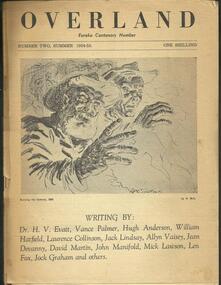
Magazine - Magazine, quarterly, Stephen Murray-Smith, Overland - Eureka Centenary Number, 1954-1955
... ...vance palmer...(from Overland website) overland dr h.v.evatt vance palmer hugh anderson laurence collinson jack lindsay Overland - Eureka Centenary Number Magazine Magazine, quarterly Stephen Murray-Smith ...Second issue of poetry magazine Overland founded by Stephen Murray-Smith in 1954. Overland – Australia’s only radical literary magazine – has been showcasing brilliant and progressive fiction, poetry, nonfiction and art since 1954. The magazine has published some of Australia’s most iconic writers, and continues to give space to underrepresented voices and brand-new literary talent every single day. In Overland’s very first edition in 1954, Stephen Murray-Smith noted that the magazine would ‘publish poetry and short stories, articles and criticism by new and by established writers. It will aim high … [but] will make a special point of developing writing talent in people of diverse backgrounds. We ask of our readers, however inexpert, that they write for us; that they share our love of living, our optimism, our belief in the traditional dream of a better Australia.’ (from Overland website) overland, dr h.v.evatt, vance palmer, hugh anderson, laurence collinson, jack lindsay -
Eltham District Historical Society Inc
Document - Folder, Wright, Alexis
... ...Vance Palmer Prize for Fiction...Alexis Wright "Carpentaria" book Australian Book Industry Award Australian Literature Society Gold Medal Waanyi people Victorian Premier's Literary Awards Vance Palmer Prize for Fiction Miles Franklin Award Danielle Clode Nettie Palmer Award "Voyages to the South Seas" book Karen Sparnon "Madonna in the Eucalypts" book Grollo Ruzzene Foundation Prize Newspaper clippings, A4 photocopies, etc Wright, Alexis Document Folder ...Writer Alexis Wright lived in Eltham. Contents Newspaper article: "Stream of wins to Eltham writer", Diamond Valley Leader, 3 August 2009. Awards for "Carpentaria" by Alexis Wright. Newspaper article: "Authors rewarded", Diamond Valley Leader, 19 September 2007. Three Diamond Valley writers won awards.Newspaper clippings, A4 photocopies, etcalexis wright, "carpentaria" book, australian book industry award, australian literature society gold medal, waanyi people, victorian premier's literary awards, vance palmer prize for fiction, miles franklin award, danielle clode, nettie palmer award, "voyages to the south seas" book, karen sparnon, "madonna in the eucalypts" book, grollo ruzzene foundation prize -
Emerald Museum & Nobelius Heritage Park
Book - Fiction book, Seed Time
... By Vance Palmer...By Vance Palmer Seed Time Book Fiction book ...By Vance Palmer -
Emerald Museum & Nobelius Heritage Park
Book - Historical fiction, Katharine Susannah Prichard, Working Bullocks, 1956
... ...Vance and Netty Palmer...She bought an Emerald cottage where she lived and also rented to fellow writers Vance and Netty Palmer. Katharine Susannah Prichard published between 1915 and 1967. ...She bought an Emerald cottage where she lived and also rented to fellow writers Vance and Netty Palmer. Katharine Susannah Prichard published between 1915 and 1967. ...Emerald was a gathering place for some Australian writers in the early 20th century. She bought an Emerald cottage where she lived and also rented to fellow writers Vance and Netty Palmer. Katharine Susannah Prichard published between 1915 and 1967. 'Working Bullocks' was one of Katharine Susannah Prichard's two major works: it dramatized the physical and emotional traumas of timber workers in the karri country of Australia's south-west.Katharine Susannah Prichard was a well-known Australian writer with an association with Emerald.Hardback. Published 1956. First published 1926.'Working Bullocks /by / Katharine Susannah Prichard' on front and back coverskatharine susannah prichard, author, working bullocks, novel, vance and netty palmer, rose charman's cottage, emerald, victoria, australia -
Emerald Museum & Nobelius Heritage Park
Letter - Letter - Nettie Palmer, 8/02/1954 12:00:00 AM
... Nettie Palmer was a well known Australian writer who lived with her writer husband, Vance Palmer, at Rose Charman's Cottage in Emerald for a period of time....Nettie Palmer was a well known Australian writer who lived with her writer husband, Vance Palmer, at Rose Charman's Cottage in Emerald for a period of time. ...Nettie Palmer was a well known Australian writer who lived with her writer husband, Vance Palmer, at Rose Charman's Cottage in Emerald for a period of time.Photocopy of handwritten letter from Nettie Palmer to Mrs Jeffery, dated 8 Feb 1954Written on Nedou & Sons' Hotel notepaper, printed details and address crossed out.emerald, victoria, australia, writing, nettie palmer -
 Emerald Museum & Nobelius Heritage Park
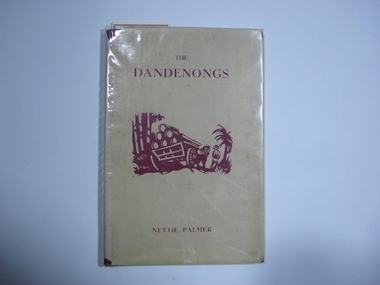
Book, Nettie Palmer, The Dandenongs, Melbourne : National Press, [1952]
... She and her husband, Vance Palmer, lived for some years in Emerald and welcomed other literary notables to visit or stay with them there. ...She and her husband, Vance Palmer, lived for some years in Emerald and welcomed other literary notables to visit or stay with them there. ...Nettie Palmer 1885-1964 was an Australian poet, essayist, literary scholar and Australia's leading literary critic of her day. She and her husband, Vance Palmer, lived for some years in Emerald and welcomed other literary notables to visit or stay with them there. This is a local history made more significant by having been written by an acclaimed Australian writer and critic who lived for some years in Emerald.Hard cover book. White background. Lino cut picture of a horse pulling a load in a cart with a man walking beside.On front cover: 'THE / DANDENONGS / NETTIE PALMER'settlers, dandenong ranges, emerald, nettie palmer -
Emerald Museum & Nobelius Heritage Park
Photograph - Photograph of Emerald Cricket Team 1920-1921, Watsons Photo, 1922
... Front of photo: Inscription on backing board below photo: 'Emerald Cricket Team Premiers, 1921-22' Writing on bottom of photo: 'Watsons Photo" Back of photo: (Affixed at a later date): Back Row: Vance Palmer, Jim Moffat, Cliff Nobelius, ? , Tom Worrall, Claude Henham, ? ...One of the priorities was construction of a cricket pitch. photography Emerald Cricket Team 1920s Front of photo: Inscription on backing board below photo: 'Emerald Cricket Team Premiers, 1921-22' Writing on bottom of photo: 'Watsons Photo" Back of photo: (Affixed at a later date): Back Row: Vance Palmer, Jim Moffat, Cliff Nobelius, ? , Tom Worrall, Claude Henham, ? ...Sport was an important part of the life of early settlers. In 1894, Emerald Reserve (now Worrell Reserve) was proclaimed. One of the priorities was construction of a cricket pitch.Photograph of Emerald Cricket Team 1921-22 - Premiers. Old black and white photograph in fair condition mounted on backing board. Also a sepia reproduction of original.Front of photo: Inscription on backing board below photo: 'Emerald Cricket Team Premiers, 1921-22' Writing on bottom of photo: 'Watsons Photo" Back of photo: (Affixed at a later date): Back Row: Vance Palmer, Jim Moffat, Cliff Nobelius, ? , Tom Worrall, Claude Henham, ? . Centre: Frank A Russell, Perc Greatorex, Alec Munroe, Arch Nobelius, Bill Pascoe, Bob Huntington, Mick Huntington Front with Bat: Edda Huntingtonphotography, emerald cricket team, 1920s -
 Warrnambool and District Historical Society Inc.
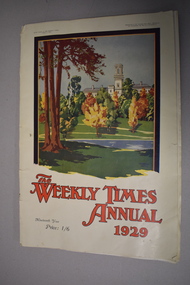
Magazine, Edgar Baillie for the Herald & Weekly Times, The weekly times annual 1929, 1929
... Notable people that have contributed to this annual include Will Dyson (sketches), C.J.Dennis (poem), Vance Palmer (short story) and Norman Lindsay (reproduction of an art work). ...Notable people that have contributed to this annual include Will Dyson (sketches), C.J.Dennis (poem), Vance Palmer (short story) and Norman Lindsay (reproduction of an art work). ...This is the Weekly Times Annual of 1929. The Weekly Times newspaper was established in 1869 and was taken over by the Herald Newspaper group in 1892. It is a paper dedicated to rural affairs and is now the oldest rural newspaper in Australia. It has long been known as the ‘Bible of the Bush’. This annual contains many advertisements and photographs and sketches of places in rural Australia. It also has many articles, short stories and illustrations. Notable people that have contributed to this annual include Will Dyson (sketches), C.J.Dennis (poem), Vance Palmer (short story) and Norman Lindsay (reproduction of an art work). It also has a short story by Gertrude Hart, a novelist and short story writer. Her parents lived in Warrnambool in the 1850s (her father was the local Wesleyan minister) and her father retired to a place near to Warrnambool – Kirkstall. This attractive booklet is retained as an excellent example of Weekly Times Annuals in the past. It is also important because it has a short story by Gertrude Hart, a writer with connections to Warrnambool. This is a newspaper annual booklet of 68 pages. The cover has a buff-coloured background with a colour illustration of a stately building on the front with red printing and five colour photographs on the back page with black printing. The booklet has many advertisements, articles, short stories and photographs. Some pages are missing and a couple of pages are torn. the weekly times, gertrude hart, history of warrnambool -
 Kew Historical Society Inc
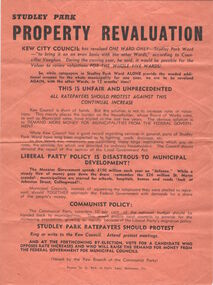
Document, Studley Park Property Revaluation
... The historian, Geoffrey Serle, in the entry on Vance Palmer (1885-1959) wrote that: ‘From 1942 he was a member of the Commonwealth Literary Fund's advisory committee and from 1947 to 1953 chairman; he suffered despicable allegations that he was a communist’ (Serle, 1988). ...The historian, Geoffrey Serle, in the entry on Vance Palmer (1885-1959) wrote that: ‘From 1942 he was a member of the Commonwealth Literary Fund's advisory committee and from 1947 to 1953 chairman; he suffered despicable allegations that he was a communist’ (Serle, 1988). ...A search of the Dictionary of Biography returned the names of thirty-two individuals with a connection to Kew, who were claimed to be supporters, members or opponents of the Communist Party of Australia. Some were only linked to communism by reputation. The historian, Geoffrey Serle, in the entry on Vance Palmer (1885-1959) wrote that: ‘From 1942 he was a member of the Commonwealth Literary Fund's advisory committee and from 1947 to 1953 chairman; he suffered despicable allegations that he was a communist’ (Serle, 1988). Serle also noted that Palmer, a liberal socialist of the broad left, was defended by R.G. Menzies. Others were linked through marriage. Gwendolyn Kent Hughes (1889-1965), the third daughter of Wilfred Kent Hughes, was married to Victor Reginald Lloyd (1895-1964) in 1930 in Holy Trinity Church. Lloyd ‘... had strong ties to the trade union movement and belonged to the Communist Party of Australia’ (Barbara Falk, 2000).Single page flyer used in a City of Kew election for Studley Ward protesting about Rate Increases in the Ward. The Society has only one item of this communist legacy in its files. It is an undated electoral tract, appropriately printed on red paper, advising electors in a local government election to vote against rate rises in Studley Ward. communist party of australia -- kew (vic.), political flyers -- kew (vic.) -
Emerald Museum & Nobelius Heritage Park
Book - Novel, Prichard, Katharine Susannah et al, The roaring nineties: A story of the goldfields of Western Australia, 1946
... The author, Katharine Susannah Pritchard, was at one time the owner of Rose Charman's Cottage, which she leased to Vance and Nettie Palmer, and which became a centre for the gathering of well-known literary figures early in the 210th century....The author, Katharine Susannah Pritchard, was at one time the owner of Rose Charman's Cottage, which she leased to Vance and Nettie Palmer, and which became a centre for the gathering of well-known literary figures early in the 210th century. ...The author, Katharine Susannah Pritchard, was at one time the owner of Rose Charman's Cottage, which she leased to Vance and Nettie Palmer, and which became a centre for the gathering of well-known literary figures early in the 210th century.411p.: First published 1946 (by the Australian Pub. Coy.)K.R.W. Davis LTFG Authorised Newsagentemerald, victoria, australia, authors, fiction, katharine susannah prichard, rose charman's cottage
