
Showing 37 items matching "volunteer militia"
-
 Flagstaff Hill Maritime Museum and Village
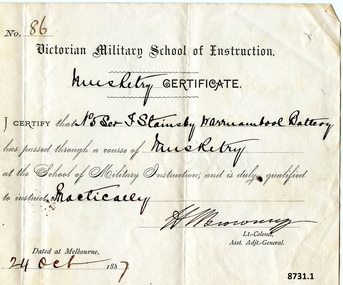
Certificate - Musketry and Sergeant Qualifications, Victorian Military School of Instruction, 1887 - 1894
... ...volunteer militia...His Obituary in the local paper said he "was very keen on cycling and pedestrianism ... and was actively associated with the old volunteer militia and held the position of Sergeant in the old Battery." ...His Obituary in the local paper said he "was very keen on cycling and pedestrianism ... and was actively associated with the old volunteer militia and held the position of Sergeant in the old Battery." ...The Crimean War began in 1854 and many people in colonial Australia were afraid of a Russian attack. In 1854 the Volunteer Act was passed to provide some military defence. In 1858 the Warrnambool Volunteer Rifle Corps was established, disbanded in 1863, then a new Warrnambool Detachment was formed in September 1866. In 1870 Australia became responsible for its own naval and military defence. The Permanent Victorian Artillery force was established. It was disbanded in 1880 then re-formed in 1882 as the Victorian Garrison Artillery Corps. Legislation was passed in 1884 that replaced the volunteers’ corps with a partly paid, permanent Militia Defence Force. Volunteer forces were established to strengthen the British Imperial troops posted here. A battery of artillery was raised in Victoria as well as in other Australian states. The Batteries manning the coastal forts of Victoria were termed Garrison Artillery Companies. When the Army was federated in 1901 there were eight Militia Companies in Victoria. Warrnambool and Port Fairy together were known as 8 Coy AGA (Australian Garrison Artillery). Changes to formation and name continued into the 20th century. In 1895 the Geelong, Warrnambool, Port Fairy and Portland Batteries became part of the Western District Garrison Artillery. Many of the volunteers who served in the Artillery were from rural areas. They belonged to rifle clubs and were experienced horsemen as well. Australia's defence at this time relied on these mounted troops, or Light Horse men. In 1899 the Victorian Garrison Artillery Corps amalgamated with the New South Wales and Queensland Permanent Artillery to become the Victorian Regiment of the Royal Australian Artillery (RAA). Then prior to Federation, the RAA and the Permanent Artillery of South Australia, Western Australia and Tasmania all combined, becoming the Royal Australian Artillery Regiment with two Batteries of Field Artillery; Battery A from Sydney and Battery B from Melbourne. These two certificates were awarded to Sergeant Thomas Stainsby who was a long-time member of the Warrnambool Garrison Artillery detachment during the 1880's and into the 1890's. He is mentioned in several newspaper reports of the era, as being an integral member of the local artillery detachments (as Sergeant-in-Charge, Gun Layer or Orderly) participating in local and statewide "Battery Competitions" that were very popular at this time. In one Annual Battery competition held in 1891 at Port Fairy, a target was moored in the bay and each detachment fired four rounds of "plugged shell" at it (at an estimated distance of 1900 yards). The local newspaper (the Warrnambool Standard) reported "the best work was reserved for the last detachment ... in charge of that old warrior Sergeant Stainsby ... who won the first prize with their four shots." Thomas Stainsby was an important member of the Warrnambool Artillery Battery in the years when it was competing for the "Sir William Clarke Trophy" The Sir William Clarke Trophy (a silver trophy) was given as a prize in 1885 to Victorian Militia Garrison Battery competition winners, for artillery firing target accuracy. A Battery needed to win the competition three times to keep the trophy and the Warrnambool Battery won it in 1887, 1889 and 1892. When the Warrnambool Militia Garrison Artillery had won the Trophy, for the third time, they became Absolute Possessors of the prize. Thomas Stainsby was born on October 25th, 1846, in Melbourne. He married Ellen Priddle in Geelong in 1869, and they moved to Camperdown and then Warrnambool in the 1870's. They had ten children. He was a bootmaker and had a shop in Fairy Street. Thomas died on September 26th, 1914, aged 67. His Obituary in the local paper said he "was very keen on cycling and pedestrianism ... and was actively associated with the old volunteer militia and held the position of Sergeant in the old Battery." Thomas Stainsby features in several photographs of the Warrnambool Battery held in the Flagstaff Hill collection. The Warrnambool Garrison has been added to the Victorian Heritage Register H1250 “for its intact battery and guns, a strong reminder of Victoria’s wealth and determination to protect itself from the perceived threat of invasion in the 1880’s.” The City of Warrnambool is one of several custodians of a collection of artillery pieces of heritage significance at a state, national and international level. These pieces are directly related to the defence of south-west Victoria in the 19th century. The care and preservation come under the Heritage Act 1995. The certificates belonging to Sergeant Thomas Stainsby are a significant example of the work and dedication of a Warrnambool Garrison volunteer.Two paper certificates awarded to Sergeant T. Stainsby. Certificate 8731 is from the "Victorian Military School of Instruction" and was awarded to Sergeant Stainsby of the Warrnambool Battery on 24th October 1887, for passing a course of "Musketry" which enabled him to become a qualified "practical" instructor. The certificate has printed and handwritten sections. Certificate 8732 is from the "Victorian Military Forces", dated 1st July 1894 and certifies that Sergeant Stainsby of the Warrnambool Battery Garrison Artillery passed through a course of Instruction and has qualified for the rank of "Sergeant in the Garrison Artillery, Victoria". The certificate has printed and handwritten sections, is yellowed with age and has some rips and tears along each edge and along its fold lines.Certificate 8731.1 - "No. 86" /Victorian Military School of Instruction/ Musketry CERTIFICATE. / I CERTIFY that No 5 Ser T Stainsby Warrnambool Battery / has passed through a course of Musketry /at the School of Military Instruction, and is duly qualified/ to instruct Practically/ [illegible signature]/Lt-Colonel/ Asst. Adjt.-General / Dated at Melbourne/ 24 Oct 1887." Certificate 8731.2 - "No 480 / Victorian Military Forces - /Re-issue / 2nd Class certificate /I certify that No 1 sergeant/ T Stainsby, Warrnambool Battery G.A. / has passed through a course of instruction / and is qualified for the rank of / Sergeant in the Garrison Artillery, Victoria/ Dated at Melbourne / 1st July 1894 [illegible signature] Lieut-Colonel /Comma? Artillery."flagstaff hill maritime museum and village, warrnambool, great ocean road, shipwreck coast, victorian garrison artillery, warrnambool battery, volunteer militia, garrison artillery, artillery detachment, battery competitions, warrnambool garrison volunteers, sergeant stainsby, thomas stainsby, sir w. clarke trophy, sir w. j. clarke trophy -
 Federation University Historical Collection
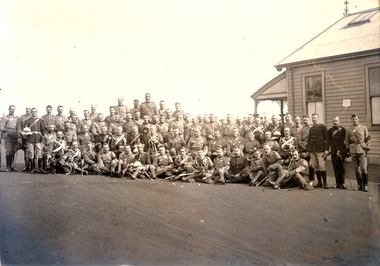
Photograph - Black and White, Officers of the Volunteer Corps in Australia, 1898
... ...volunteer corps...militia...armed services band music volunteer corps militia volunteer regiment Robertson Tom Price D.C. ...Black and white photograph of officers representing all volunteer corps in Australia. The photograph was taken during a visit to Australia by the Duke of York, later George V.armed services, band, music, volunteer corps, militia, volunteer regiment, robertson, tom price, d.c. lewis, uniform, swords, rifles -
 Flagstaff Hill Maritime Museum and Village
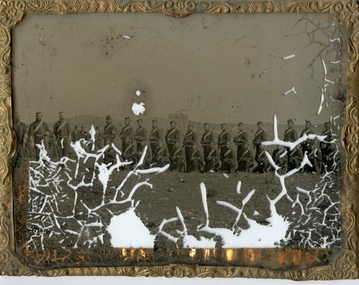
Photograph - Glass plate, circa 1866
... ...volunteer corps...militia...Legislation was passed in 1884 that replaced the volunteers’ corps with a partly paid, permanent Militia Defence Force. ...The photograph is also the only example of the early methods of glass plate photography in our collection. flagstaff hill warrnambool shipwrecked coast flagstaff hill maritime museum maritime museum shipwreck coast flagstaff hill maritime village great ocean road glass plate photography 19th century colonial forces military defence volunteer act 1854 volunteer rifle garrison artillery volunteer corps militia militia garrison band pillbox forage caps helpmann manifold and bostock 1853 lee enfield musket tintype Warrnambool Garrison 1860s Cannon Hill Manifold & Bostock flour mill 3-storey building Photograph, rectangular glass plate, positive sepia image. ...This glass plate photograph shows good detail of members of the Warrnambool Garrison posing for their photograph in front of a young township. There are other well-dressed citizens behind them. The three men with frogging on their sleeves were commanders were likely to be commanders. The men are facing north with Cannon Hill and the fortification area in the background. It dates from the 1860s. The firearms held appear to be 1853 pattern Lee Enfield muskets used by the British army in Crimea at this time and in Australia, rather than the later Martini Henry cartridge rifles. The uniforms match other photos of the Warrnambool Garrison Militia and Band in our Collection, taken up until the 1880s. The three storey building in the photograph is likely to be the Manifold & Bostock flour mill, built in 1854 near the ‘cutting’ in Merri Street, which was one of the main streets at the time; if one faced the building’s front from a vantage point and looked south to south-east, the hills around Flagstaff Hill and Cannon Hill would be behind that mill, and the Harbour behind the hills. This is the area of the Fortifications. The glass plate method of photography was widely used during the mid-19th to early-20th century. The donor and maker of the photograph are unknown. Around this time the citizens of Victoria were prospering from the gold rush but felt isolated and uneasy about their security in the colony. In 1854 the Volunteer Act was passed to provide some military defence. In 1858 the Warrnambool Volunteer Rifle Corps was established, disbanded in 1863, then a new Warrnambool Detachment was formed in September 1866. Legislation was passed in 1884 that replaced the volunteers’ corps with a partly paid, permanent Militia Defence Force. The batteries manning the coastal forts of Victoria were termed Garrison Artillery Companies. When the Army was federated in 1901 there were eight Militia Companies in Victoria. Warrnambool and Port Fairy together were known as 8 Coy AGA (Australian Garrison Artillery). Changes to formation and name continued into the 20th century.This photograph is a record of the very early local defence force, circa 1866. The photograph signifies the connection of the colony in Victoria to the growing need for security due to the unrest in Europe at that time. The photograph is also locally significant to the industry of the young township of Warrnambool, showing what is likely to be one of the first flour mills in the town. The photograph is also the only example of the early methods of glass plate photography in our collection. Photograph, rectangular glass plate, positive sepia image. Photograph has brass framed edges that fold over to the back, with mitred corners. The front edges are pressed with a decorative floral pattern. The photograph shows a group of thirty military men, standing or kneeling, in dark uniforms with pillbox forage caps, round-collared jackets with light buttons, light sashes worn from top left shoulder to bottom right side of waist belt, and long, straight-legged trousers. Three of these men have light braid around the buttons on the front of their jackets, light frogging on their sleeve cuffs and stripes on the outside seams of their trousers. The other twenty-seven men have plain uniforms and are holding firearms in their right hands, steadied with their left hands. Other figures are standing behind this group of soldiers, including three or four men wearing top hats, jackets and ties. In the background is a row of buildings. The central building is three stories high. Bare hills are in the far background. The foreground is uneven ground with patches of short grass. Photographer looking towards the south east and Cannon Hill, with the Warrnambool Garrison facing north, ca.1860s.flagstaff hill, warrnambool, shipwrecked coast, flagstaff hill maritime museum, maritime museum, shipwreck coast, flagstaff hill maritime village, great ocean road, glass plate, photography 19th century, colonial forces, military defence, volunteer act 1854, volunteer rifle, garrison artillery, volunteer corps, militia, militia garrison band, pillbox forage caps, helpmann, manifold and bostock, 1853 lee enfield musket, tintype, warrnambool garrison, 1860s, cannon hill, manifold & bostock, flour mill, 3-storey building -
 Flagstaff Hill Maritime Museum and Village
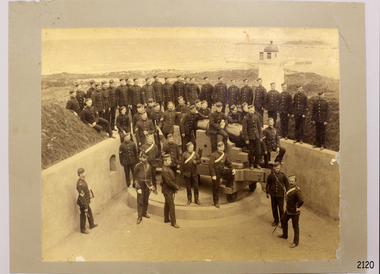
Photograph - Military, Ca. 1887
... militia...volunteer corps...volunteers prepared to defend the coast of Victoria. This photograph is historically significant to Warrnambool's military history. flagstaff hill warrnambool maritime museum maritime village great ocean road shipwreck coast militia volunteer corps defence army military cannon Handwritten text on back: "1887" Photograph, sepia, mounted on brown card, depicting Warrnambool Battery opening at Flagstaff Hill and a group of uniformed artillery men around the cannon. ...Warrnambool had an active group of military volunteers prepared to defend the coast of Victoria.This photograph is historically significant to Warrnambool's military history.Photograph, sepia, mounted on brown card, depicting Warrnambool Battery opening at Flagstaff Hill and a group of uniformed artillery men around the cannon. The background had the Lower Lighthouse. Inscription on back.Handwritten text on back: "1887"flagstaff hill, warrnambool, maritime museum, maritime village, great ocean road, shipwreck coast, militia, volunteer corps, defence, army, military, cannon -
 Flagstaff Hill Maritime Museum and Village
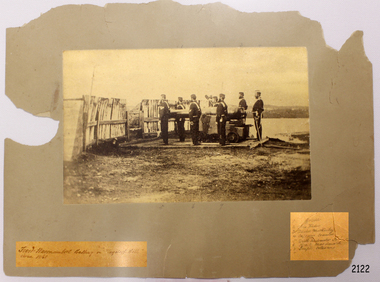
Photograph - Military, First Warrnambool Battery on Flagstaff Hill, ca. 1868
... militia...volunteer corps... played a significant role in being prepared to defend the Warrnambool district. flagstaff hill warrnambool Maritime Museum Maritime Village Shipwreck Coast Great Ocean Road militia volunteer corps cannon gun firearm first warrnambool battery Warrnambool Battery defence Gorrie Chris Hider David McKinley Captain Cramer Drill Instructor R.A.C. ...There was an active Volunteer Corps in Warrnambool in the 1800s. This photograph shows a group off military men on Flagstaff Hill ready for action. The names are listed on the card, handwritten in pencil: 1. Gorrie 2. Chris Hider 3. David McKinley 4. Captain Cramer 5. Drill Instructor (cannot read name) 6. R.A.C. Macdonald 7. Joseph GladstoneThe militia played a significant role in being prepared to defend the Warrnambool district.Photograph, sepia, mounted on brown card. Depicts the First Warrnambool Battery on Flagstaff Hill. Seven uniformed figures stand beside a cannon mounted on a wooden, waist high carriage. The cannon is aimed between a gap in a timber fence. The lower edge of the card has two labels with handwritten inscriptions; one is the photograph title, the other is a list of seven names written in pencil Photograph is dated ca. 1868. Left hand side: "First Warrnambool Battery on 'Flagstaff Hill'" Right hand side: list of names written in pencil: "1. Gorrie 2. Chris Hider 3. David McKinley 4. Captain Cramer 5. Drill Instructor (cannot read name) 6. R.A.C. Macdonald 7. Joseph Gladstone"flagstaff hill, warrnambool, maritime museum, maritime village, shipwreck coast, great ocean road, militia, volunteer corps, cannon, gun, firearm, first warrnambool battery, warrnambool battery, defence, gorrie, chris hider, david mckinley, captain cramer, drill instructor, r.a.c. macdonald, joseph gladstone -
 Hume City Civic Collection
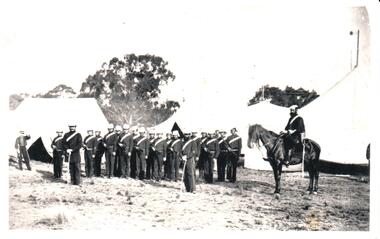
Photograph
... Military encampments took place in Canon Gully during the 1860s and the 1870s on property which was owned by the Clarke family. The Volunteer Militia was part of Victoria's defence capabilities until it was disbanded in 1883....Military encampments took place in Canon Gully during the 1860s and the 1870s on property which was owned by the Clarke family. The Volunteer Militia was part of Victoria's defence capabilities until it was disbanded in 1883. canon gully george evans collection A black and white photograph of 21 soldiers dressed in Nineteenth Century military uniforms standing in front of pitched tents with another soldier on the RHS sitting astride a horse. ...Military encampments took place in Canon Gully during the 1860s and the 1870s on property which was owned by the Clarke family. The Volunteer Militia was part of Victoria's defence capabilities until it was disbanded in 1883.A black and white photograph of 21 soldiers dressed in Nineteenth Century military uniforms standing in front of pitched tents with another soldier on the RHS sitting astride a horse.canon gully, george evans collection -
 Warrnambool and District Historical Society Inc.
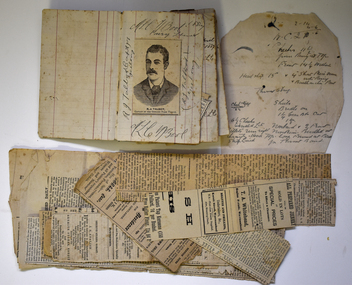
Memorabilia - Newspaper cuttings scrapbook, Martin Carter, Saddler, Warrnambool, late 19th century (1887-1894)
... Martin Carter was very active in community affairs - President of the Warrnambool Bowling Club, a member of the local Volunteer Militia, Secretary of the Progress Association, a football player and umpire and a local cricketer. ...Martin Carter was very active in community affairs - President of the Warrnambool Bowling Club, a member of the local Volunteer Militia, Secretary of the Progress Association, a football player and umpire and a local cricketer. ...This scrapbook contains newspaper cuttings, mainly about football, and other written material from the late 19th century. It belonged to Martin Carter ((1870-1943), a Warrnambool saddler who worked for many years in the saddlery business established by his father, Samuel. Martin Carter was very active in community affairs - President of the Warrnambool Bowling Club, a member of the local Volunteer Militia, Secretary of the Progress Association, a football player and umpire and a local cricketer. He was the Secretary of the Warrnambool Town (later City) Band for fifty years and a memorial plaque in his honour was erected at the Band headquarters in Warrnambool. He was also a Warrnambool Councillor (1917-1925) and Warrnambool Mayor (1922-24). His interest in football can be seen from the great number of football newspaper cuttings in this notebook.This little notebook is most interesting as it provides us with details on football in the Warrnambool district in the late 19th century and gives us an indication of the popularity of the game at that time. It is a valuable research tool.This is a small notebook with a black cover. The pages contain ruled red lines over which have been pasted newspaper cuttings. Some pages have handwritten material and some pages are blank. There are also several loose cuttings. The notebook has been stapled but the staples have been removed.M.L.Carter Warrnambool June 13th 1887 S.Carter Saddler Warrnambool (stamp)warrnambool town band, martin carter warrnambool, football in the warrnambool district, sydney giddings warrnambool saddler -
 Orbost & District Historical Society
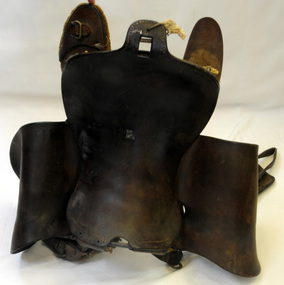
saddle, Before 1915
... By 1914, when Australia joined the war against Germany, there were 23 Light Horse regiments of militia volunteers. Many men from these units joined the Light Horse regiments of the Australian Imperial Force (AIF)....By 1914, when Australia joined the war against Germany, there were 23 Light Horse regiments of militia volunteers. Many men from these units joined the Light Horse regiments of the Australian Imperial Force (AIF). ...By 1914, when Australia joined the war against Germany, there were 23 Light Horse regiments of militia volunteers. Many men from these units joined the Light Horse regiments of the Australian Imperial Force (AIF).This WW1 item is a reminder of the roles that men from Orbost played in that conflict.Large brown leather saddle used by the Light Horse Brigade in WW1. The saddle is built on a pair of felt-padded wooden "bars" which sat on either side of the horse's spine. These are joined by steel arches with a shaped leather seat laced between them. C G H F The saddle also has a few other numbers on it which are difficult to read with accuracy. saddle military-history army transport horse -
 Lara RSL Sub Branch
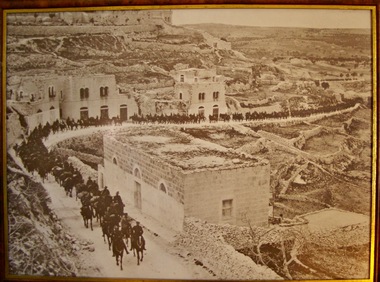
Photograph, Regiment of the Australian Light Horse on the March in Jerusalem in Palestine
... By 1914, when Australia joined the war against Germany, there were 23 Light Horse regiments of militia volunteers. Many men from these units joined the Light Horse regiments of the Australian Imperial Force (AIF). ...By 1914, when Australia joined the war against Germany, there were 23 Light Horse regiments of militia volunteers. Many men from these units joined the Light Horse regiments of the Australian Imperial Force (AIF). ...By 1914, when Australia joined the war against Germany, there were 23 Light Horse regiments of militia volunteers. Many men from these units joined the Light Horse regiments of the Australian Imperial Force (AIF). Initially Australia promised four regiments of Light Horse, 2000 men, to fight in the British cause. By the end of the war, 16 regiments would be in action.The Light Horse were seen as the “national arm of Australia’s defence” and young men, most from the country, flocked to join. Framed and glass covered photo of a Regiment of the Australian Light Horse on the March in Jerusalem in Palestine"A Regiment of the Australian Light Horse on the March in Jerusalem in Palestine."ww1, world war 1, australian light horsemen, palestine, lara r.s.l. -
 Bendigo Military Museum
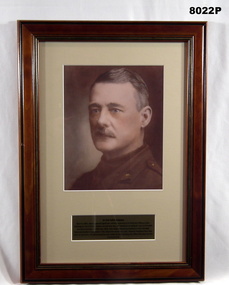
Photograph - PORTRAIT, FRAMED, 2018
... John Adams had extensive service pre WW1 with Bendigo Volunteer Rifles,4th Militia BN, Victorian Cavalry,5th Militia and the 67th Bn. ...John Adams had extensive service pre WW1 with Bendigo Volunteer Rifles,4th Militia BN, Victorian Cavalry,5th Militia and the 67th Bn. ...JOHM ADAMS was President of the Bendigo RSL from 1917 - 1921. He was one of the movers and mainstays in the formation of the Bendigo Sub Branch. It was also stated that his determination had carried into effect the plans for the "Soldiers Memorial Institute" Pall Mall Bendigo. John Adams had extensive service pre WW1 with Bendigo Volunteer Rifles,4th Militia BN, Victorian Cavalry,5th Militia and the 67th Bn. Appointed Lieutenant 25.11.1900, Capt 1.7.1907, Major 16.4.1913. He applied for a Commission in the AIF on 26.11.1914 and embarked on 22.12.1914 with the 14th BN for Gallipoli Campaign, WIA 3.5.1915, apon return to duty he took command of the 14th Bn for a period until invalided to England with chest and cardiac problems. He returned to Aust in Feb 1916 and his appointment was terminated on 22.4.1916. Post War with a change in retirement age he was invited to recommence service with the temporary rank of Lt Col to Command the 38th Bn when it returned to Aust in 1919. He retired on March 1st 1920 age 57. Framed photograph, timber brown colour with gold edging. At the top a colour enhanced portrait against a soft yellow background, under is text relating to the portrait and his service.Main point, "Lt Col John ADAMS" brsl, smirsl, portrait -
 Flagstaff Hill Maritime Museum and Village
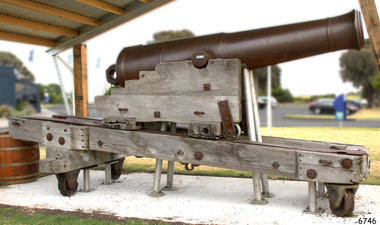
Weapon - Cannon, 1861
... It was possibly brought to Warrnambool in the late 1860s or the 1870s, to be used for training purposes by volunteers and local militia. The wrought iron runners were probably added to the slides at a later date. ...It was possibly brought to Warrnambool in the late 1860s or the 1870s, to be used for training purposes by volunteers and local militia. The wrought iron runners were probably added to the slides at a later date. ...The artillery piece of the cannon was cast at the Low Moor foundry in England in 1861. It is a 68 pound muzzle loading cannon, capable of firing a 68 pound weight projectile. The arrow on the top of the barrel is the symbol of government ownership. It is probably one of the artillery pieces purchased by the Victorian government in response to the 1863 report by Captain Scratchley, which recommended 19 such artillery pieces be bought for the defence of Hobsons Bay, (Williamstown, Melbourne) (Billets p.12). It was possibly brought to Warrnambool in the late 1860s or the 1870s, to be used for training purposes by volunteers and local militia. The wrought iron runners were probably added to the slides at a later date. This model of carriage had been manufactured since 1855, and the traversing slide since 1860. The traversing slide of the wooden carriage absorbs the recoil when the gun is then returns to the gun to its original position for loading and re-firing. The properties of the timber (regarded as being Burmese teak) have helped to preserve these carriages in Australia. This particular carriage and traversing slide would have been manufactured about the same time as the gun (in 1861) in the Royal Carriage Department of the Royal Gun Factory in Woolwich, England. The gun would then have been assembled on the traversing slide of the carriage, then despatched as a unit. The wooden slide compressor mechanism that belongs to the cannon was used to limit the recoil when the cannon was fired. It is now stored separately for purposes of preservation. It is extremely rare, as it is the only one surviving in this group of South Western Victorian cannons.This 68 pdr cannon, mounted with its original wooden carriage, is part of the South Western Victoria collection of surviving 19th Century artillery pieces, item number W/F/02. It is rated as EXTREMELY RARE on a State, National and World level. The 68 pound smooth bore cannon of this period are not particularly rare either in Australia or overseas; its significance lies in its Victorian provenance and as an element in a major collection of 19th century cannon. The number of surviving carriages with traversing slides in this group in South Western Victoria is unique in Australia and probably in the World. Out of 10 such platforms surviving in Australia, the South Western Victorian group has half. Several survive around the world but probably not in such a large group. The wooden sliding compressor mechanism belonging to this cannon is extremely rare, and the only one in this South Western Victorian group of Guns and Cannons. As a whole, this cannon has undergone very little restoration or modification, giving it a high level of integrity.Warrnambool Garrison Cannon. 68pdr smoothbore, muzzle-loading, cast-iron cannon. Manufactured in Low Moor, 1861, No. 10310. Mounted on the wooden carriage with wrought iron traversing slide and wrought iron runners and fittings. The cannon's Cascabel is cast with a loop. The wooden slide Compressor Mechanism, or Recoil Mechanism, is extremely rare. This mechanism comprises two equal-sized sections of wood, one on each side of the centre, joined by metal rods. In the centre of this wooden platform, with openings, top and bottom is a 15cm diameter metal cylinder with two cusps on the edge of the top (this wood has split over time). Two parallel sides each have two 1cm thick metal "L' plates attached 15cm long and 8.5cm wide. With the unit is ‘ L’ bracket, curved bracket and bolt head.Cannon trunnion "LOW MOOR / 10310 / 1861" Top of the barrel "7045, (symbol of an arrow pointing up), 95 – 3 – 14, 1861, 209" Cascabel "CV / N / C" The rear of left-hand slide " "OD” “JW” “No 33” Side chock – “JW” twice. flagstaff hill, warrnambool, shipwrecked-coast, flagstaff-hill, flagstaff-hill-maritime-museum, maritime-museum, shipwreck-coast, flagstaff-hill-maritime-village, muzzle loading cannon, 68 pound cannon, low moor foundry, royal gun factory, warrnambool militia, warrnambool garrison volunteers, warrnambool fortifications, wooden sliding compression mechanism, carriage and traversing slide, 19th century cannon, traversing platform, garrison sliding carriage, 68 pounder -
 Lara RSL Sub Branch
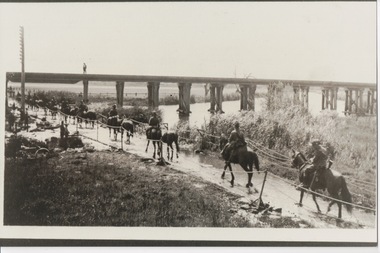
Photograph, Set 4 photographs. and others for Torquay Light Horse camp, 1940
... By 1914, when Australia joined the war against Germany, there were 23 Light Horse regiments of militia volunteers. Many men from these units joined the Light Horse regiments of the Australian Imperial Force (AIF). ...By 1914, when Australia joined the war against Germany, there were 23 Light Horse regiments of militia volunteers. Many men from these units joined the Light Horse regiments of the Australian Imperial Force (AIF). ...These images capture for all time Light Horsemen travelling through Geelong on their way to camp at Torquay for the last Group meeting in Australia . information following - details obtained from .........https://torquayhistory.com/light-horse-brigade/ On Australia Day, 1997, Sir John Young unveiled this plaque on Point Danger, Torquay. Torquay history, Light Horse Training Camp, WW2 Plaque at Pt. Danger Note----- (See images to view plaque) The plaque identifies a significant event in Torquay’s history and the sentiments of ‘change’ for the Light Horse Brigade – from horses to machines. In 1940 the four Light Horse Regiments (4th, 8th, 13th and 20th), some 5000 Light Horse and 2000 horses camped and trained at Torquay. Three other regiments, formerly mounted on horses, were also at Torquay ‘mounted’ on privately owned trucks and cars. Division troops included Artillery, Engineers, Signals, Field Ambulance and other branches of the Army necessary to enable a Division to function. It wasn’t just the sheer numbers of men coming to this little town that made the event significant, it was also the fact that the men of the Light Horse were dramatic, almost glamorous figures and it is easy to see their exploits as some splendid adventure. Horses have played a special role in the story of Australia. They were the only means of transport across this huge country, so it was necessary for everyone to have the ability to ride a horse. When war broke out in 1899 between Britain and the Boers of South Africa (“Boer” was Dutch for “farmer”) Australia sent troops to fight. At first Britain was wary of using untried, unprofessional colonial cavalrymen but soon saw that the slouch-hatted Australian “bushmen” were a match for the fast-moving and unconventional mounted commandos of the Boers. The Australians proved themselves to be expert rough-riding horsemen and good shots. Bush life had hardened them to go for long periods with little food and water. They also showed remarkable ability to find their way in a strange country and use its features for cover, in both attack and defence. By 1914, when Australia joined the war against Germany, there were 23 Light Horse regiments of militia volunteers. Many men from these units joined the Light Horse regiments of the Australian Imperial Force (AIF). Men were given remounts (if not using their own horses) – army horses bought by Commonwealth purchasing officers from graziers and breeders. These were called “walers” because they were a New South Wales stockhorse type – strong, great-hearted animals with the strains of the thoroughbred and semi-draught to give them speed, strength and stamina. On 1st November, 1914, Australia’s First Infantry Division and the first four Light Horse regiments sailed for England in a fleet of transport ships. The first of the Light Horse arrived at Gallipoli in May without their horses. Back with their horses after Gallipoli, they were formidable combatants across the Sinai and Palestine. Some British commanders observed that the light horseman moved with a “lazy, slouching gait, like that of a sleepy tiger” but described how the promise of battle “changes that careless gait, into a live athletic swing that takes him over the ground much quicker than other troops”. They had Light Horse, Torquay, training campdeveloped a reputation as formidable infantrymen. The Turks called them “the White Ghurkas” – a reference to their deadly skill with the bayonet. The Arabs called them “The Kings of the Feathers”. The plume had originally been a battle honour of the Queensland Mounted Infantry for their work in the shearer’s strike of 1891. During WW1 it was adopted by almost all the Light Horse Regiments. It was the proud badge of the light horseman. The most famous of their battles was the attack on Beersheba- the charge of the 4th Light Horse Brigade. Mounted infantrymen and their superb walers had carried out one of the most successful cavalry charges in history – against what seemed impossible odds. They surprised the Turks by charging cavalry-style, when they would normally have ridden close to an objective then dismounted to fight. The fall of Beersheba swung the battle tide against the Turks in Palestine; and changed the history of the Middle East. While 19 men from the Surf Coast Shire served with the 4th Light Horse over the course of WW1, only four were involved in the charge of Beersheba- John GAYLARD, Philip QUINN.(Winchelsea); Wallace FINDLAY (Anglesea); Harry TRIGG (Bambra). After the war, Light Horse units played a key role in the Australian Government’s compulsory military training programme. The Citizen Military Forces (C.M.F.) thrived on the glamour of the wartime Light Horse tradition, ignoring the possibility that motor vehicles would soon replace the horses. When training was no longer compulsory, the C.M.F. regiments declined and horses became more of a luxury during the 1930s depression years of poverty and unemployment. Some regiments were motorised. Then, in 1939, Australia joined Britain in another world war. Training was increased for the militia at both home bases and regional training camps. The camp at Torquay in 1940, commanded by Major General Rankin, was at Divisional strength. By the end of the camp some felt that the Division was ready for active service. Gradually, over the next four years, the Australian Light Horse units were mounted on wheels and tracks and the horses were retired. Six men enlisted at the Torquay camp and another 57 men and women enlisted at Torquay for service in WW2. Those who served in the Militia provided valuable Officers and NCOs and men for the armed services during the war. Each infantry division of the 2nd AIF had a Light Horse regiment attached to it. But the day of the Australian mounted soldier hadn’t quite passed. During World War II, Australia’s 6th Cavalry Regiment formed a mounted unit they called “The Kelly Gang” which did valuable scouting work. In New Guinea, a mounted Light Horse Troop did patrol duty and helped carry supplies. Some fully equipped walers were flown into Borneo for reconnaissance in rugged mountain country. But by the end of the war, in 1945, the horse had disappeared from the Australian Army. References: Australian Light Horse Association www.lighthorse.org.au National Australia Archives Australian War Memorial Surf Coast Shire WW1 memorials www.togethertheyserved.com The Light horse- a Cavalry under Canvas Light Horse, Training Camp, Torquay, WW2 Late in 1939 it was decided to set up a Lighthorse training camp in Torquay to train both men and horses for the battles of the Second World War. Horses, men and equipment came on special trains from all over Victoria and NSW, and as you would expect horseman came from areas such as Omeo and Sale, the Wimmera and the Western District. They arrived at the Geelong racecourse for watering in the Barwon River and then were ridden across the ford at the breakwater and began their 11 mile trek to Torquay. Light Horse, Training Camp, Torquay, WW2 Tent city By the end of January 1940 the camp at Torquay accommodated some 5000 men and 2500 horses of the Second Cavalry Division. The rows of horses, tents and huts near Blackgate Road were quite a sight. While the cavalrymen engaged in exercises on the land and on the beaches, many of the troops took over the Torquay School for special training of men and officers. Mr Bob Pettit local farmer and Councillor for the Barrabool Shire, wrote about the Light horse in the Surf Coast Community News in 1985 saying “They used to travel about the district riding four abreast in one long convoy. To my annoyance they went through my property and shut all the gates behind them. I had certain gates open to let stock in to the water holes and it would take me three -quarters of an hour to follow the horsemen up and put all the gates right again” he continued “the men from the Light Horse were here when the fire went through in March 1940. He recalled an incident when early one morning, as some one blew the bugle, a soldier putting a white sheet on the line frightened the horses. They panicked and ran off in all directions. Six went over the cliff near Bird Rock, five were never found, and the rest were gathered up after nearly a fortnight in the bush around Addiscott and Anglesea" Light Horse, Training Camp, Torquay, WW2, Geelong Parade Geelong parade The training camp culminated in a parade through the streets of Geelong on March 12th 1940. The salute was given at the Town Hall and the troops continued on a route to the You Yang’s for a training exercise. Note-----(see media section for photograph) The Camp was abandoned in mid 1940 as it was deemed unsuitable for training during winter and the cost of a permanent camp could not be justified if it could not be used all year. Historic.......Rare,,,Interpretive.Sepia photographs.set of four ....post card size ....Horses &LighthorsemenNo 1, Lighthorsemen Regiment Geelong 1940......No 2 Light Horse at Breakwater Geelong 1938 to 1940....No 3 Light Horse at Breakwater Geelong 1938 to 1940.....No 4 Light Horse crossing Breakwater camped at Geelong Showgrounds. These markings are on reverse of photographs.light horsemengeelong 1940., world war 2 -
 Flagstaff Hill Maritime Museum and Village
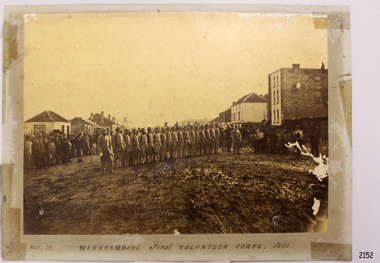
Photograph - Military group, Warrnambool First Volunteer Corps 1860, Taken May 24th, 1860, presented to Mayor in 1887
... Militia. The photograph entitled "Warrnambool First Volunteer Corps" is dated 24th May 1860. ...This is one of a collection of photographs showing the development of the Warrnambool Militia from its inception as the First Volunteer Corps in 1855. ...This Photograph is one of a number of photographs of the Warrnambool Militia. The photograph entitled "Warrnambool First Volunteer Corps" is dated 24th May 1860. (The First Volunteer Corps began in 1855.) It was presented by James Astley Bromfield (former Mayor of Warrnambool) to Major Walter Helpmann, head of Warrnambool’s 1st Volunteer Corps in 1887. The photograph shows the Corps lined up for inspection in Timor Street, Warrnambool. The location is outside what is now the Archie Graham Centre and the camera is looking west towards Liebig Street. The town band is in the right rear corner and spectators surround the Corps. The names listed on the back of the photograph are "1. R.Bushe (Captain in command), 2. Basil Spence, 3. Thomas Mickle, 4. Alfred Davies (Sergeant), 5. Cawthray, 6. Andrew Kerr, 7. Charles Scoborio, 8. Lacy, 9. James Hider, 10. D. O’Mullane, 11. William Norman, 12. Crouthers (or Cowthers ?), 13. Francis Breckon, 14. Russ, 15. Benjamin Wycherley, 16. C. A. Cramer (Sergeant), 17. James Coulstock, 18. Robert Newton (Sergeant), 19. J.A. Bromfield, 20. Singleton (supernumery), 21. Mostyn (Drill Instructor)," On the left of the picture is Billy Adams, Barnes (road contractor) and James Mason (Bootmaker). On the right of the picture is The Band. This is one of a collection of photographs showing the development of the Warrnambool Militia from its inception as the First Volunteer Corps in 1855. The collection is of local significance as it parallels the development of the town and includes images of significant local people. A number of Warrnambool streets are named after members of the Militia. It is also historically significant because of its connection to the unrest that was taking place in Europe at this time. Photograph of Warrnambool First Volunteer Corps 1860, sepia coloured, mounted on cream card. The photograph shows the Corps lined up for inspection in Timor Street Warrnambool. The location is outside what is now the Archie Graham Centre and the camera is looking west towards Liebig Street. The town band is in the right rear corner and spectators surround the Corps. Photograph taken 24th May 1860. Has names listed on reverse side. The protograph was presented to Mayor Helpman, by Bromfield, May 1887. Title printed below base of photo on the mounting board "May. 24. WARRNAMBOOL First VOLUNTEER CORPS. 1860" On the back of the photograph is a numbered list of names, handwritten in ink. Also on the back are presentation details "Presented to Mayor Helpman, by Bromfield, May 1887". warrnambool, wolunteer corps, militia, helpmann, bromfield, flagstaff hill, shipwrecked coast, flagstaff hill maritime museum, maritime museum, shipwreck coast, flagstaff hill maritime village, great ocean road -
 Flagstaff Hill Maritime Museum and Village
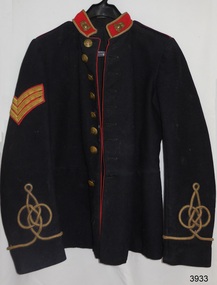
Uniform - Tunic, 1899-1903
... volunteer uniform...fortifications in victoria...victorian permanent artillery...pre-federation military uniform...sergeant's uniform...jacket...militia...The tunic has local significance in its connection with local social events. flagstaff hill warrnambool shipwrecked coast flagstaff hill maritime museum maritime museum shipwreck coast flagstaff hill maritime village great ocean road uniform jacket uniform tunic garrison volunteer uniform fortifications in victoria victorian permanent artillery pre-federation military uniform sergeant's uniform jacket militia Victoria victorian volunteer forces victorian regiment royal australian artillery raa field gun sergeant W. ...This original tunic or jacket is part of the full dress uniform of the pre-Federation Victorian Permanent Artillery regiment. Its owner had the rank of Sergeant, as indicated by the three inverted chevrons. The Artillery design of the badges and buttons indicate the date of the tunic to be from 1893 to 1903. However the maker of the tunic, W. Moncton, began manufacture in Melbourne in 1899, so this the tunic can be dated between 1899 and 1903. The donor's grandfather was given this tunic but not the name of the original owner. It has since been suggested to the family that the tunic was worn by a local Western District Light Horse member. This could very well have been the case because mounted troops were officially referred to as the Light Horse in the late 19th to early 20th century. Several local men were involved in the Light Horse during the First World War. The donor's grandfather wore this tunic in the local district when riding a penny farthing bicycle. The donor's father also wore the tunic when dressed as a 'Captain' hosting a local disco dance. BRIEF MILITARY HISTORY- The Crimean War began In 1854 and many people in colonial Australia were afraid of a Russian attack. Volunteer forces were established to strengthen the British Imperial troops posted here. A battery of artillery was raised in Victoria as well as in other Australian states. In 1870 Australia became responsible for its own naval and military defence. The Volunteer Corps and Victorian Navy shared the responsibility of defending the existing forts, assisted by volunteer coastal and mobile field batteries. The Permanent Victorian Artillery force was established. It was disbanded in 1880 then re-formed in 1882 as the Victorian Garrison Artillery Corps. In 1895 the Geelong, Warrnambool, Port Fairy and Portland Batteries became part of the Western District Garrison Artillery. Many of the volunteers who served in the Artillery were from rural areas. They belonged to rifle clubs and were experience horsemen as well. Australia's defence at this time relied on these mounted troops, or Light Horse men. In 1899 the Victorian Garrison Artillery Corps amalgamated with the New South Wales and Queensland Permanent Artillery to become the Victorian Regiment of the Royal Australian Artillery (RAA). Then prior to Federation, the RAA and the Permanent Artillery of South Australia, Western Australia and Tasmania all combined, becoming the Royal Australian Artillery Regiment with two Batteries of Field Artillery; Battery A from Sydney and Battery B from Melbourne.This original uniform tunic of the pre-Federation Victorian Permanent Artillery is significant for its association with Australia's military defence and the fortifications of our district, state and country. The tunic is also significant, representing part of the history and evolution of uniforms in the Australian military forces. The tunic is also significant in its representation of Australia's independence in forming its own defences. The tunic has local significance in its connection with local social events.Tunic or jacket, part of the full dress uniform of the pre-Federation Victorian Permanent Artillery operating from 1893 to 1903. Original, single-breasted tunic of dark blue wool, red piping trim, black cotton lining in body. Sleeves lined with blue striped, white cotton. Front closure has eight brass buttons. Red band-style collar with hook-and-eye closure has gold bullion braid trim and a brass badge pinned each side at the front. Upper right sleeve has three inverted chevrons on red fabric with gold bullion braid trim (rank of Sergeant). Both sleeves have gold bullion braid 'Austrian knot' emblems stitched onto lower arm, with ends finishing on the inner sleeve. Shoulder epaulettes have red piping and smaller brass buttons. Closed back vent has vertical scalloped design with six brass buttons, in two columns of three, and red piping trim. Brass belt hook is attached to the left back waist, close to the seam (right side has a mark indicating a previous similar clip). Inside left breast is a concealed pocket. Tunic has both machine and hand stitching. All brass shank-style buttons have matching Artillery emblems with inscriptions on the back. The two brass collar badges have additional artillery emblems of exploding grenade and star as well as an inscription. Buttons were made for W. Moncton, of Melbourne and marked with his name. He traded from 1899, dating the tunic to between 1899 and 1903.Button front: Artillery emblem on front (field cannon facing left, in front of a muzzle-loading ram rod). Button back: engraved "W. MONCTON . MELBOURNE ." Collar badges: Artillery emblem (field cannon facing right | stars | exploding grenade | "AUSTRALIA")flagstaff hill, warrnambool, shipwrecked coast, flagstaff hill maritime museum, maritime museum, shipwreck coast, flagstaff hill maritime village, great ocean road, uniform jacket, uniform tunic, garrison volunteer uniform, fortifications in victoria, victorian permanent artillery, pre-federation military uniform, sergeant's uniform, jacket, militia, victoria, victorian volunteer forces, victorian regiment, royal australian artillery, raa, field gun, sergeant, w. moncton, garrison, dress uniform, tunic, scarlet collar, red collar, scarlet piping, red piping, gold bullion, artillery emblem, light horse, artillery, mounted troops, victorian garrison artillery corps -
 Orbost & District Historical Society
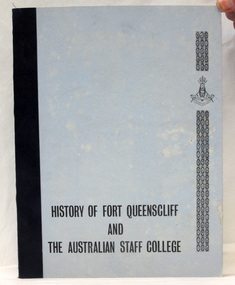
book, History of Fort Queenscliff and the Australian Staff College, December 1971
... Its garrison included volunteer artillery, engineers, infantry and naval militia, and it was manned as a coastal defence installation continuously from 1883 to 1946. ...Its garrison included volunteer artillery, engineers, infantry and naval militia, and it was manned as a coastal defence installation continuously from 1883 to 1946. ..."Fort Queenscliff, in Victoria, Australia, dates from 1860 when an open battery was constructed on Shortland's Bluff to defend the entrance to Port Phillip Bay. The Fort, which underwent major redevelopment in the late 1870s and 1880s, became the headquarters for an extensive chain of forts around Port Phillip Heads. Its garrison included volunteer artillery, engineers, infantry and naval militia, and it was manned as a coastal defence installation continuously from 1883 to 1946. The other fortifications and armaments around the Heads were completed by 1891, and together made Port Phillip one of the most heavily defended harbours in the British Empire." (from Fort Queenscliff History website)This is a useful reference tool.A light blue covered book, titled, "History of Fort Queenscliff and the Australian Staff College". It has a daker blue spine and black print.fort-queenscliff cunningham-c.a. -
 Flagstaff Hill Maritime Museum and Village
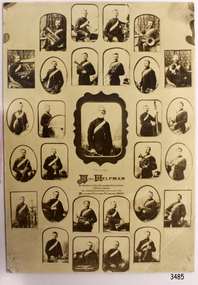
Photograph - Commemorative, The Members of the Warrnambool Garrison Militia Band, circa 1889
... volunteer corps...military band...major w.s. helpman...militia...Militia. It is also significant for the connection of the band with the various local military and community events. The site of the 1888 Warrnambool Garrison and Fortifications at Flagstaff Hill Maritime Village is Victorian State Heritage-listed is significant for its intact and operational nature and is one of the best-preserved pieces of Victoria's early colonial heritage. flagstaff hill warrnambool shipwrecked-coast flagstaff-hill flagstaff-hill-maritime-museum maritime-museum shipwreck-coast flagstaff-hill-maritime-village photograph warrnambool garrison band melbourne centennial exhibition fortifications volunteer corps military band major w.s. helpman militia great exhibition Printed " Presented / Major Helpman / The members of the Warrnambool Garrison / Military Band / In Commemoration of their visit to the / Melbourne Centennial Exhibition 1888-89" Black and white photograph collage of the members of the Warrnambool Garrison Military Band. ...This historic photograph collage displays the members of the Warrnambool Garrison Military Band at the time of the Great Exhibition in Melbourne. It commemorates the visit of the band's members to that exhibition in 1888-1889. Major W.S. Helpman was the commander of the Warrnambool Militia Garrison Artilery at that time. This photograph is significant historically for its record of the members of the Warrnambool Militia Garrison Band of 1888-1889. The photograph connects the band members to the citizens of Warrnambool and their protection by the Militia. It is also significant for the connection of the band with the various local military and community events. The site of the 1888 Warrnambool Garrison and Fortifications at Flagstaff Hill Maritime Village is Victorian State Heritage-listed is significant for its intact and operational nature and is one of the best-preserved pieces of Victoria's early colonial heritage. Black and white photograph collage of the members of the Warrnambool Garrison Military Band. The photograph shows 29 individual portraits of the band members in uniform with their instruments. The photograph was presented to Major Helpmen in commemoration of the visit of the Band to the Melbourne Centennial Exhibition of 1888-89.Printed " Presented / Major Helpman / The members of the Warrnambool Garrison / Military Band / In Commemoration of their visit to the / Melbourne Centennial Exhibition 1888-89" flagstaff hill, warrnambool, shipwrecked-coast, flagstaff-hill, flagstaff-hill-maritime-museum, maritime-museum, shipwreck-coast, flagstaff-hill-maritime-village, photograph, warrnambool garrison band, melbourne centennial exhibition, fortifications, volunteer corps, military band, major w.s. helpman, militia, great exhibition -
 Flagstaff Hill Maritime Museum and Village
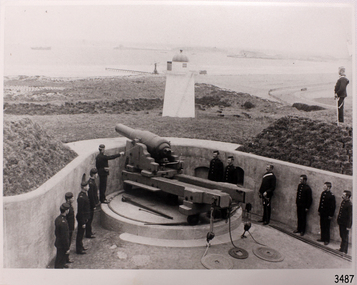
Photograph - Military, Volunteer Corp, mid-1800s
... Volunteer Corps...Maritime Museum...Maritime Village...Great Ocean Road...Shipwreck Coast...militia...It shows a point in time when local volunteers were prepared to defend the south west coast of Victoria. flagstaff hill warrnambool flagstaff-hill-maritime-museum Photograph Volunteer Corp Gun on Flagstaff Hill Fortifications Volunteer Corps. fortifications Volunteer Corps Maritime Museum Maritime Village Great Ocean Road Shipwreck Coast militia Barracks Black and white photograph of Volunteer Corp firing the gun on Flagstaff Hill. ...This photograph relates to the early group of the Volunteer Corps preparing to defend their country.The photograph is a significant record. It shows a point in time when local volunteers were prepared to defend the south west coast of Victoria.Black and white photograph of Volunteer Corp firing the gun on Flagstaff Hill. flagstaff hill, warrnambool, flagstaff-hill-maritime-museum, photograph, volunteer corp, gun on flagstaff hill, fortifications volunteer corps., fortifications, volunteer corps, maritime museum, maritime village, great ocean road, shipwreck coast, militia, barracks -
 Flagstaff Hill Maritime Museum and Village
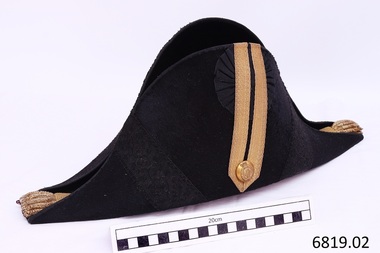
Uniform - Bicorn Hat and Hat Box, late 19th - early 20th century
... Dr Angus assisted Dr Tom Ryan, a pioneer in the use of X-rays and in ocular surgery. flagstaff hill warrnambool shipwrecked coast flagstaff hill maritime museum maritime museum shipwreck coast flagstaff hill maritime village great ocean road dr w r angus t.s.s. largs bay berry mcdade 19th century colonial military uniform artillery staff officer’s cocked had victorian volunteers victorian colonial military forces colonial militia aut pace aut bello cocked hat cockade hat bicorn hat military bullion oak leaves and acorns pattern gold bullion tassels military heraldry w.r. angus collection. ...This hat and hat box was donated to Flagstaff Hill Maritime Village by the family of Doctor William Roy Angus, Surgeon and Oculist. It is part of the “W.R. Angus Collection” which includes historical medical equipment, surgical instruments and material once belonging to Dr Edward Ryan and Dr Thomas Francis Ryan, (both of Nhill, Victoria) as well as Dr Angus’ belongings. The Collection’s history spans the medical practices of the two Doctors Ryan, from 1885-1926 plus that of Dr Angus, up until 1969. McDade is the surname of Dr Angus’ daughter Berry (Berenice) McDade nee Angus. This had belonged to her father Dr William Roy Angus, Surgeon and Oculist (1901 –1970), who wore it on the ship T.S.S. LARGS BAY when travelling from Australia to Scotland for extended studies to be a “Fellow” of the Royal College of Surgeons in Edinburgh in 1929. This bicorn, cocked hat was worn with narrow points towards the front and back. It is decorated with flat gold braid or ‘lace’ with a geometrical design. Regimental lace was worn on the uniform and headdress of regimental officers in the 19th century. Gold lace chevrons were worn on coats to signify rank. Drummers and Foot Guards also wore regimental lace to distinguish them from other military personnel. In the late 19th century the English and Welsh infantry officers’ uniforms displayed a rose-pattern lace. The gold bullion and underlying crimson ‘eyes’ have been used to signify the rank of the owner. Crimson eyes were used for military personnel, and blue eyes were used for naval personnel. Different numbers and colours of the bullion and eyes may have been used to represent different military ranks. The Regulations specify nine tassels and eleven underlying eyes but there could have been variations. We have not yet identified the rank for this particular hat but hats such as this were part of the Australian and British naval uniforms in the early 20th century. The gold button’s emblem features a cross with five stars, a crown, and the motto “AUT PACE AUT BELLO,” which translates as “either in peace or in war.” Museum Victoria has a similar button and writes that buttons with this design were used by the Victorian Volunteers in the nineteenth century. The Australian War Memorial Curator of Military Heraldry advised Museum Victoria that these buttons dated from 1880 to 1892 and were worn by regular, unranked soldiers. Tasmanian Midshipman Alan Casey, who served the British and Australian Navy from 1919 to 1933 and retired as a Lieutenant Commander, owned a similar officer's bicorn hat. His hat and epaulettes are in the Tasmanian Maritime Museum's collection. The Australian War Memorial has a hat that is very similar in design, described as an “Artillery Staff Officer’s cocked had with plume, worn by Volunteer Artillery Staff in the Victorian Colonial Military Forces”. That hat is different in that it has a plume and the braid and button are silver. Berry MdDade, the donor, has used the hat many times as a dress-up hat but doesn’t know the origin of it. The hat seems to fit the design of the Staff Officers in Victorian Volunteers in Colonial times, but the button on this hat was used for unranked volunteers. Also, military uniforms usually have very clear manufacturer’s labels, as they are made by reputable companies under contract to the Defence Department. The manufacturer’s mark is not discernible on this hat. The origin, original wearer and use of this particular hat is unclear. The military bicorn cockade hat belonged to Dr William Roy Angus and is part of the W.R. Angus Collection. It is significant for still being located at the site connected to Doctor Angus being the last Port Medical Officer in Warrnambool. The collection of medical instruments and other equipment is culturally significant, as an historical example of medicine from late 19th to mid-20th century. Dr Angus assisted Dr Tom Ryan, a pioneer in the use of X-rays and in ocular surgery. Black bicorn cocked hat and case. It appears to be part of a 19th-century Colonial full-dress naval officer's uniform. The long, narrow crescent-shaped hat is made of beaver fabric and the crown is lined with crimson silk and finished with a hand-stitched leather sweatband. On one flat side is a pleated black silk, lace cockade woven in the pattern of oak leaves and acorns. The cockade is overlaid with a double row of gold lace braiding secure with a Victorian Volunteer’s gold button. Wide diagonal bands of black lace braid trim are on each side of the gold braiding. The other side of the hat is plain. The front and back points of the hat each have seven gold bullion tassels with nine underlying twists of crimson ‘eyes’. The fitted metal carry case has a catch and a plaque on one side. The button bears a crown and cross with five stars and a motto. Inside the hat is a white name tag with clear adhesive over it, with black printed text with the name “Mc Dade”. The hat is part of the W.R. Angus Collection.The hat has no maker’s marks although there is a darker colour in the centre where there could have been a label. Inside the hat is taped a printed label; “Mc DADE 801 1032” Button’s emblem- a cross with five stars, under a crown, all within a buckled belt with the motto “AUT PACE AUT BELLO” [either in peace or in war] The plaque on the case has no legible marks.flagstaff hill, warrnambool, shipwrecked coast, flagstaff hill maritime museum, maritime museum, shipwreck coast, flagstaff hill maritime village, great ocean road, dr w r angus, t.s.s. largs bay, berry mcdade, 19th century colonial military uniform, artillery staff officer’s cocked had, victorian volunteers, victorian colonial military forces, colonial militia, aut pace aut bello, cocked hat, cockade hat, bicorn hat, military bullion, oak leaves and acorns pattern, gold bullion tassels, military heraldry, w.r. angus collection., australian navy, british navy, uniform -
 Flagstaff Hill Maritime Museum and Village
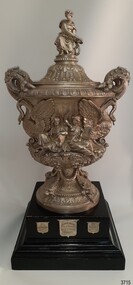
Award - Trophy, c. 1886
... In 1885, there was a return of unpaid volunteer soldiers, along with a fear of a Russian attack on Australia. As a result, the Sir W.J. Clarke's Trophy was given as a prize in 1885 to Victorian Militia Garrison Battery competition winners, for artillery firing target accuracy. ...In 1885, there was a return of unpaid volunteer soldiers, along with a fear of a Russian attack on Australia. As a result, the Sir W.J. Clarke's Trophy was given as a prize in 1885 to Victorian Militia Garrison Battery competition winners, for artillery firing target accuracy. ...This silver trophy is named "Sir W. Clarke's Trophy" after its donor. Sir William John Clarke, Baronet, who was a citizen and philanthropist, well known in Melbourne and throughout Victoria. He gave donations to many public projects, including Melbourne University and was a patron of many and varied sports. He encouraged the defence services with prizes for competitions among both military and naval forces. In colonial Australia in the 1880s, there was an increase in the size of the colonial military forces, rising from 8,000 in 1883 to 22, 000 in 1885. In 1885, there was a return of unpaid volunteer soldiers, along with a fear of a Russian attack on Australia. As a result, the Sir W.J. Clarke's Trophy was given as a prize in 1885 to Victorian Militia Garrison Battery competition winners, for artillery firing target accuracy. On 12th December 1885, the conclusion of the first artillery competition for Sir W. Clarke's Trophy was held at the Williamstown battery. The first winner of the Sir W. Clarke's Trophy was the Geelong Garrison Battery, with the prize Sir W. Clark's Trophy presented to them in 1886. In 1887, Warrnambool Garrison Artillery, under the command of Major W.S. Helpman, was the proud winner of the 'Sir W. Clarke Trophy'. The contest was held at Point Gellibrand, with the trophy formally unveiled at the Warrnambool orderly-room on 3rd August 1887. In June 1892, the annual competition was held at the Gellibrand battery in Williamstown. The canvas targets were moored at sea and fired upon from three breech-loading guns mounted on disappearing carriages. Each team was allowed 4 shots fired from each of the 3 guns. An article in the Portland Guardian stated that "the Warrnambool team is certainly looked upon as the certain winners." The same article reported that in this particular year, the Government withdrew its previous award of 10-pound cash to the men of the winning team, described in the Portland Guardian as a petty economy of the Government. As the Warrnambool Militia Garrison Artillery had won the Trophy, for the third time, they became Absolute Possessors of the prize. On 11th August 2016, during a ceremony at Flagstaff Hill, the Australian Army handed over guardianship of two very significant historical items, the 1885 W. Clarke Trophy and the 1861 Warrnambool Ladies Silver Bugle, to Warrnambool City Council for display at Flagstaff Hill Maritime Museum. Both heritage-listed items are strongly connected to the city of Warrnambool and form an integral part of the history of the Warrnambool Garrison.The Sir W. Clarke Trophy is locally significant to the community of Warrnambool for its connection to the Warrnambool Volunteer Rifle Corps - part of the original Warrnambool Garrison – which was formed to protect the Warrnambool Harbour. The site of the 1888 Warrnambool Garrison and Fortifications is Victorian State Heritage-listed. It is significant for its intact and operational nature, and is one of the best-preserved pieces of Victoria's early colonial heritage.This is the Sir W. Clarke's Trophy for the Victorian Militia Garrison Artillery, first presented in 1886. The silver trophy with a conical lid rests on a square black timber base that displays award shields on each vertical side. Inside the hollow trophy is a removable copper alloy bowl with a wide edge. The inner walls of the trophy are unpolished, and there is a metal bracing plate between the sides, and fitted metal bolts, nuts and washers near the base. The large, elaborately decorated, silver bowl has a conical pedestal, two handles on the top edge of the bowl and a matching fitted lid. Much of the decoration is three-dimensional. Fine, detailed decoration includes a semi-kneeling figure with an upturned face on top of the lid, vine-like handles resting on necks of swans with outspread wings, figures seated on a ridge, two on each side, with ends of limbs hanging over the ridge, two holding lyres, patterns of leaves, flowers and draped ribbons. The timber base is painted black on the outside. The engraved silver shields around its sides have inscriptions of trophy winners and the name of the trophy. There is a handwritten, pencil inscription of the date 1887 under the timber base. The first award was made in 1886 and the last in 1892. The Warrnambool Garrison won this trophy three times, including the last award given.Front centre large shield; “VICTORIAN MILITIA / GARRISON ARTILLERY / SIR W. CLARKE’S / TROPHY” Left side, right shield; “1886 / WON BY / GEELONG / GARRISON BATTERY / Major J PRICE / COMMANDING OFFICER” Front, right shield; ” 1887 / WON BY / WARRNAMBOOL / GARRISON ARTILLERY / Major W.S. Helpman / COMMANDING OFFICER” Left side shield: “1888 / WON BY / NORTH MELBOURNE / Garrison Battery / Major F.R.Y. Goldstein / Commanding Officer” Right side, left shield; “1889. / WON BY / WARRNAMBOOL / Garrison Battery / Major W.S. Helpman / Commanding Officer” Right side, centre shield; “1890 / WON BY / HARBOUR TRUST / BATTERY / Major J.H. Haydon / Commanding Officer” Right side, right shield; “1891 / WON BY / WILLIAMSTOWN / BATTERY /l Major W.H. Hall / Commanding Officer” Back, left shield; “1892 / WON BY / WARRNAMBOOL / Garrison Battery / Major W.S. Helpman / Commanding Officer” In pencil underneath timber base “1887”flagstaff hill, warrnambool, shipwrecked coast, flagstaff hill maritime museum, maritime museum, shipwreck coast, flagstaff hill maritime village, great ocean road, sir w. clarke's trophy, warrnambool volunteer rifle corps, statistics of warrnambool volunteer rifle corps, warrnambool volunteer rifle company, warrnambool rifle volunteers, warrnambool garrison, 1886, 1887, 1888, 1889, 1890, 1891, 1892, trophy, garrison, competition, prize, winners, sir w. clarke, w. clarke trophy, sir w. clarke trophy -
 Bendigo Military Museum
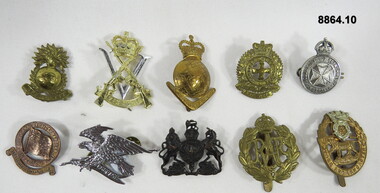
Badge - VARIOUS MILITARY BADGES, Unknown
... Militia) collar. 2. Royal Victorian Regiment Hat. 3. Royal Australian Survey Corps hat. 4. Volunteer...Militia) collar. 2. Royal Victorian Regiment Hat. 3. Royal Australian Survey Corps hat. 4. Volunteer ...Military badges either gold, silver or brass colour with or without a backing mounting plate, pins. Sizes vary. 1. Australian Field Artillery (Militia) collar. 2. Royal Victorian Regiment Hat. 3. Royal Australian Survey Corps hat. 4. Volunteer Cadet Corps Victoria hat. 5. Australian Voluntary Aid Detachment. 6. Merchant Service War Australia, For services rendered at sea, 7. 2nd Cavalry Regiment hat. 8. WW1 General Service Corps Hat. 9. Royal Air Force hat. 10. York and Lancaster Regimental hat. passchendaele barracks trust, pbt211to220, badges -
 Monbulk RSL Sub Branch
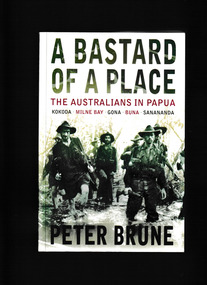
Book, Allen and Unwin, A bastard of a place : the Australians in Papua : Kokoda, Milne Bay, Gona, Buna, Sanananda, 2004
... The compelling narrative resonates with the voices of both the well-trained AIF volunteer, and the young Militia conscript who triumphed together. ...In 1942 and early 1943 Papua New Guinea was 'a bastard of a place' to fight a war. This book gives us the final, all-encompassing story of the five battles that changed Australia forever. The compelling narrative resonates with the voices of both the well-trained AIF volunteer, and the young Militia conscript who triumphed together. The author interviewed hundreds of these soldiers and himself travelled the treacherous terrain and bloody battlegrounds where so many of their mates perished, and reveals the inside story of how Generals MacArthur and Blamey sacrificed many of the senior Australian field commanders as scapegoats to protect their own positions. A Bastard of a Place restores Milne Bay, Gona, Buna and Sanananda to their rightful place beside Kokoda to what they should collectively be for all Australians - sacred ground.Index, bibliography, notes, ill, maps, p.691.non-fictionIn 1942 and early 1943 Papua New Guinea was 'a bastard of a place' to fight a war. This book gives us the final, all-encompassing story of the five battles that changed Australia forever. The compelling narrative resonates with the voices of both the well-trained AIF volunteer, and the young Militia conscript who triumphed together. The author interviewed hundreds of these soldiers and himself travelled the treacherous terrain and bloody battlegrounds where so many of their mates perished, and reveals the inside story of how Generals MacArthur and Blamey sacrificed many of the senior Australian field commanders as scapegoats to protect their own positions. A Bastard of a Place restores Milne Bay, Gona, Buna and Sanananda to their rightful place beside Kokoda to what they should collectively be for all Australians - sacred ground.world war 1939 – 1945 – campaigns – new guinea, world war 1939 – 1945 – campaigns – kokoda -
 Bendigo Historical Society Inc.
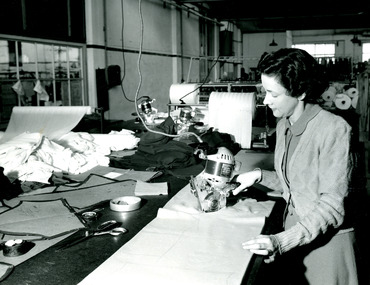
Photograph - HANRO COLLECTION: PROMOTIONAL PHOTOGRAPHS, 1940's
... militia interests endured longest. First commissioned in the 8th Australian Infantry Regiment in 1904, he was a captain in 1909. In May 1916 he was commissioned captain in Bendigo's 38th Battalion, Australian Imperial Force. Entering the front line in France on 1 December he was wounded two days later and invalided back to Australia next March for discharge in August. After the war he rose in 1923 to major commanding the 38th Battalion, Australian Military Forces. Lieutenant-Colonel in 1927, he retired as honorary colonel in 1942 after having organized the north-west Victorian group of the Volunteer...militia interests endured longest. First commissioned in the 8th Australian Infantry Regiment in 1904, he was a captain in 1909. In May 1916 he was commissioned captain in Bendigo's 38th Battalion, Australian Imperial Force. Entering the front line in France on 1 December he was wounded two days later and invalided back to Australia next March for discharge in August. After the war he rose in 1923 to major commanding the 38th Battalion, Australian Military Forces. Lieutenant-Colonel in 1927, he retired as honorary colonel in 1942 after having organized the north-west Victorian group of the Volunteer ...Sir George Victor Lansell (1883-1959), businessman, politician and philanthropist, was born on 3 October 1883 in London, elder son of George Lansell, the Bendigo 'Quartz King', and his second wife Harriet Edith, née Bassford. George was educated at St Andrew's College, Bendigo, and Melbourne Church of England Grammar School. On 20 January 1910 at All Saints Pro-Cathedral, Bendigo, he married a skiing champion, Edith Florence Gwendoline Frew; they had three daughters. As a young man Lansell excelled in revolver shooting, boxing and swimming but his militia interests endured longest. First commissioned in the 8th Australian Infantry Regiment in 1904, he was a captain in 1909. In May 1916 he was commissioned captain in Bendigo's 38th Battalion, Australian Imperial Force. Entering the front line in France on 1 December he was wounded two days later and invalided back to Australia next March for discharge in August. After the war he rose in 1923 to major commanding the 38th Battalion, Australian Military Forces. Lieutenant-Colonel in 1927, he retired as honorary colonel in 1942 after having organized the north-west Victorian group of the Volunteer Defence Corps early in World War II. Lansell's major contribution was his service to returned soldiers. He was president of the Bendigo sub-branch of the Returned Sailors' and Soldiers' Imperial League of Australia for nearly thirty years. His work extended beyond grand gesture and he is remembered affectionately for his personal generosity to ex-servicemen and their dependants. Lansell was director of the powerful Sandhurst Trustees' Co., the Bendigo Mutual Permanent Land & Building Society and many other local companies. In 1926 he brought to Bendigo the overseas-based Hanro Knitting Mills (Hanro comes from the Swiss firm Handschin and Ronus which made high quality underwear and knitwear at Liestal, Switzerland) and the Australian Swiss Watch Co. Early in his business career he acquired the Bendigo Independent and amalgamated it with the Bendigo Advertiser in 1918. He had interests in the Riverine Herald, the Rochester Irrigator, the Stock and Station Journal and Central Victorian Broadcasters Ltd, and was a delegate to Empire press conferences in Canada (1920), England (1923) and Australia (1925).Lever arch folder containing Hanro black and white promotional photographs. 53 studio photographs of women's knitwear and lingerie 20.5cm x 25.2cm. 1 studio photograph of men's knitwear 19cm x 23.5cm. 2 x photo's 19cm x 23.3cm Photographer Reg Brock. 27 black and white photo's 15cm x 21cm of men's knitwear, womenswear and lingerie, were donated by Ann Peters.Reg Brock Studios Bendigo. Labels or stamps on back of photographs.business, retail, hanro promotional photographs, george victor lansell, bendigo hanro, ralph birrell collections -
 Warrnambool and District Historical Society Inc.
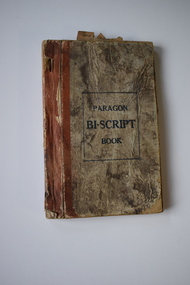
Memorabilia - Note Book with Newspaper Cuttings, 1920s
... Rifle shooting in Warrnambool dates from 1860 when it was part of the activities of the Volunteer Rifle Corps and other later local militia groups. As a separate organization the Warrnambool Rifle Club, still operating today, dates from 1886 with the North Warrnambool Rifle Club founded in 1928. ...Rifle shooting in Warrnambool dates from 1860 when it was part of the activities of the Volunteer Rifle Corps and other later local militia groups. As a separate organization the Warrnambool Rifle Club, still operating today, dates from 1886 with the North Warrnambool Rifle Club founded in 1928. ...This notebook contains cuttings from the Warrnambool Standard pasted over handwriting which appears to be orders for a business. The cuttings concern the activities of the Warrnambool Rifle Club from 1924 to 1926. Rifle shooting in Warrnambool dates from 1860 when it was part of the activities of the Volunteer Rifle Corps and other later local militia groups. As a separate organization the Warrnambool Rifle Club, still operating today, dates from 1886 with the North Warrnambool Rifle Club founded in 1928. This notebook is of minor interest as it contains a summary of the Warrnambool Rifle Club activities in the 1920s and is useful for researchThis is a note book of 100 pages with a hard board cover, red binding over staples and black printing on the front cover. The pages contain handwritten entries of items to be ordered for a business. Newspaper cuttings have been pasted over the original writing. Some cuttings are loose. The book is stained and torn at the edges.warrnambool rifle club -
 Warrnambool and District Historical Society Inc.
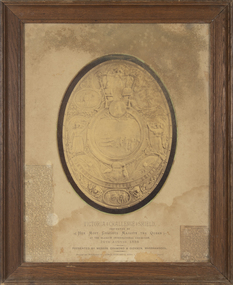
Photograph - Framed Photograph of Victoria Challenge Shield, George Edward & Sons, Glasgow, 1888
... This photograph is of considerable interest as it is a reminder of the Victoria Challenge Shield that was a competition prize for competing groups of the Victoria Garrison Artillery in the times when volunteer militia groups were strong in Victorian country towns ( from the 1860s to the beginning of the First World War). ...This framed photograph is of the Victoria Challenge Shield which was presented in 1888 by the Warrnambool firm of Cramond and Dickson for competition among the Victoria Garrison Artillery members in Victoria. There were 8 garrison groups in Victoria at that time. The shield was 22 inches wide and two feet six inches high.The quality of the shield can be gauged by that fact that it was exhibited at the Glasgow International Exhibition of 1888 and was one of the items inspected by Queen Victoria. The stipulation by the donors was that the competition had to be held in Warrnambool. The Warrnambool artillery group won the trophy in 1898 and this is noted in one of the newspaper cuttings included with the photograph of the shield. The Cramond and Dickson general store in Warrnambool was founded in 1855 by John Cramond and James Dickson and was a prominent business in Warrnambool until it closed in 1973. This photograph is of considerable interest as it is a reminder of the Victoria Challenge Shield that was a competition prize for competing groups of the Victoria Garrison Artillery in the times when volunteer militia groups were strong in Victorian country towns ( from the 1860s to the beginning of the First World War). This is a framed oval photograph of the Victoria Challenge Shield. The photograph is of poor production and fading. The shield details include images of War and Peace, Coat of Arms, militia figures and guns and a rifle match (in the centre). There are two newspaper cuttings included in the frame and a handwritten date. The photograph has a beige background and is under glass in a wooden frameVictoria Challenge Shield inspected by Her Most Gracious Majesty the Queen at the Glasgow International Exhibition 24th August 1888 presented by Messrs Cramond & Dickson Warrnambool cramond & dickson warrnambool, victoria challenge shield, garrison artillery groups in victoria -
 Hume City Civic Collection
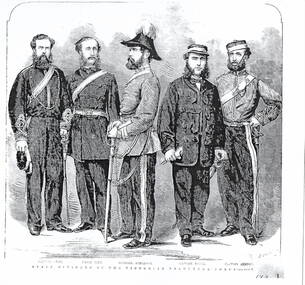
Drawing, S.Calvert, STAFF OFFICERS OF THE VICTORIAN VOLUNTEER FORCE
... Volunteer Force....Victorian Artillery...Victoria Militia...The Volunteer force was disbanded in 1884 and replaced by the Victorian Militia force. ...The Volunteer force was disbanded in 1884 and replaced by the Victorian Militia force. ...The five men who were staff officers of the Victorian Volunteer Force were Captain Snee, Major Pitt, Colonel Anderson, Captain Payne and Captain Burton. The Victorian Volunteer Force was the main defence force in Victoria after the withdrawal the Imperial Troops in 1870. IN that same year a Permanent Artillery Corps ( Victorian Artillery) was also formed. The Volunteer force was disbanded in 1884 and replaced by the Victorian Militia force. The members were paid and enrolled for a set term.A black and white photograph of an etching of 5 officers in the Victorian Volunteers Force.victorian volunteer force., victorian artillery, victoria militia, military history -
 Ballarat Heritage Services
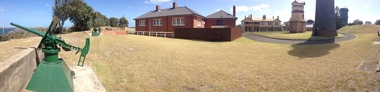
Photograph - Photograph - Colour, Fort Queenscliff, 2015, 15/03/2015
... Its garrison included volunteer artillery, engineers, infantry and naval militia, and it was manned as a coastal defence installation continuously from 1883 to 1946. ...Its garrison included volunteer artillery, engineers, infantry and naval militia, and it was manned as a coastal defence installation continuously from 1883 to 1946. ...Fort Queenscliff was established in 1860 when an open battery was constructed on Shortland's Bluff to defend the Port Phillip Bay entrance. The Fort, which underwent major redevelopment in the late 1870s and 1880s, became the headquarters for an extensive chain of forts around Port Phillip Heads. Its garrison included volunteer artillery, engineers, infantry and naval militia, and it was manned as a coastal defence installation continuously from 1883 to 1946. The other fortifications and armaments around the Heads were completed by 1891, and together made Port Phillip one of the most heavily defended harbours in the British Empire. It is claimed that the first British Empire artillery shots of World War One were fired when a gun at Fort Nepean fired across the bow of the German freighter Pfalz, as she was attempting to escape to sea. The orders to fire came from Fort Queenscliff. It is alleged that the same gun, with a different barrel, also fired the first Australian artillery shot of World War II. By 1946 coastal artillery was outmoded, and the Fort became home of Army's Staff College. After the three Service Staff Colleges were combined in Canberra, it became the base for Army's Soldier Career Management Agency in 2001.Colour panoramic photograph of Fort Queenscliffqueenscliff, fort queenscliff, army, volunteer forces -
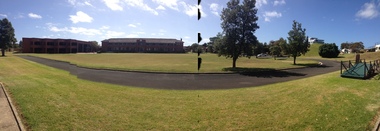 Ballarat Heritage Services
Photograph - Photograph - Colour, Clare Gervasoni, Fort Queenscliff, 2015, 15/03/2015
... Its garrison included volunteer artillery, engineers, infantry and naval militia, and it was manned as a coastal defence installation continuously from 1883 to 1946. ...Its garrison included volunteer artillery, engineers, infantry and naval militia, and it was manned as a coastal defence installation continuously from 1883 to 1946. ...Fort Queenscliff was established in 1860 when an open battery was constructed on Shortland's Bluff to defend the Port Phillip Bay entrance. The Fort, which underwent major redevelopment in the late 1870s and 1880s, became the headquarters for an extensive chain of forts around Port Phillip Heads. Its garrison included volunteer artillery, engineers, infantry and naval militia, and it was manned as a coastal defence installation continuously from 1883 to 1946. The other fortifications and armaments around the Heads were completed by 1891, and together made Port Phillip one of the most heavily defended harbours in the British Empire. It is claimed that the first British Empire artillery shots of World War One were fired when a gun at Fort Nepean fired across the bow of the German freighter Pfalz, as she was attempting to escape to sea. The orders to fire came from Fort Queenscliff. It is alleged that the same gun, with a different barrel, also fired the first Australian artillery shot of World War II. By 1946 coastal artillery was outmoded, and the Fort became home of Army's Staff College. After the three Service Staff Colleges were combined in Canberra, it became the base for Army's Soldier Career Management Agency in 2001.Colour panoramic photograph of Fort Queenscliffqueenscliff, fort queenscliff, army, volunteer forces -
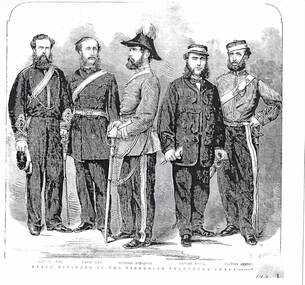 Sunbury Family History and Heritage Society Inc.
Drawing
... Volunteer Force....Victorian Artillery...Victorian Militia...The Volunteer Force was disbanded in 1884 and replaced by the Victorian Militia force. ...The Volunteer Force was disbanded in 1884 and replaced by the Victorian Militia force. ...The five men, who were staff officers of the Victorian Volunteer Force, were Captain Snee, Major Pitt, Colonel Anderson, Captain Payne and Captain Burton. The Victorian Volunteer Force was the main defence force in Victoria after the withdrawal of the Imperial Troops in 1870. In that same year a permanent artillery corps was formed, the Victorian Artillery. The Volunteer Force was disbanded in 1884 and replaced by the Victorian Militia force. The members were paid and enrolled for a set term. A photograph of a black and white sketch of five men of the Victorian Volunteer Force. The artist's name is in the bottom RH corner but it is not very clear. The names of the five men are printed across the bottom of the drawing. victorian volunteer force., victorian artillery, victorian militia force -
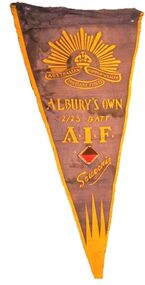 Wodonga & District Historical Society Inc
Banner - Souvenir Banner 2/23rd Battalion - Albury's Own
... volunteer Second Australian Imperial Force and assigned to the 26th Brigade. Under the command of Lieutenant Colonel Bernard Evans, a small cadre of experienced personnel drawn from Victorian Militia units were concentrated at Victoria Barracks prior to the battalion headquarters being relocated to Albury, New South Wales, where a large number of volunteers were completing their recruit training at the 4th Recruit Training Battalion. ...volunteer Second Australian Imperial Force and assigned to the 26th Brigade. Under the command of Lieutenant Colonel Bernard Evans, a small cadre of experienced personnel drawn from Victorian Militia units were concentrated at Victoria Barracks prior to the battalion headquarters being relocated to Albury, New South Wales, where a large number of volunteers were completing their recruit training at the 4th Recruit Training Battalion. ...Established at Victoria Barracks, in Melbourne, in June 1940, the 2/23rd Battalion was raised as part of the all-volunteer Second Australian Imperial Force and assigned to the 26th Brigade. Under the command of Lieutenant Colonel Bernard Evans, a small cadre of experienced personnel drawn from Victorian Militia units were concentrated at Victoria Barracks prior to the battalion headquarters being relocated to Albury, New South Wales, where a large number of volunteers were completing their recruit training at the 4th Recruit Training Battalion. Upon the conclusion of this course, the recruits were posted to the 2/23rd and the battalion – over 900 strong– moved to Bonegilla, Victoria, just across the border, where more complex collective training was completed prior to departure overseas. A large majority of the battalion's initial intake of volunteers came from the Albury–Wodonga region and as a result, the 2/23rd became known as "Albury's Own"This item is part of a collection of items owned by Arthur Lock, a member of the 2/23rd Battalion, an all-volunteer Second Australian Imperial Force which served as part of the garrison during the Siege of Tobruk, then at El Alamein, New Guinea and Borneo. It has particular local significance as the battalion was know as "Albury's Own" because a large majority of the battalion's initial intake of volunteers came from the Albury–Wodonga region.A souvenir banner representing the 2/23rd Battalion - Albury's Own. The banner incorporates the insignia of the Commonwealth of Australia Military Forces. It also includes the Unit colour patch which is a lozenge shape, divided into brown over red, with a grey trim. This patch was used from 1940 to 1942 when the patch representing service at Tobruk was introduced. world war 11, 2/23rd battalion, albury's own, arthur lock -
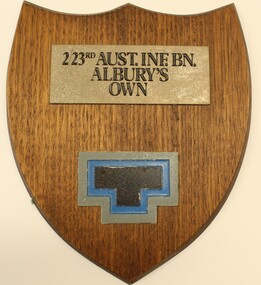 Wodonga & District Historical Society Inc
Plaque - Plaque 2/23rd Battalion - Albury's Own
... volunteer Second Australian Imperial Force and assigned to the 26th Brigade. Under the command of Lieutenant Colonel Bernard Evans, a small cadre of experienced personnel drawn from Victorian Militia units were concentrated at Victoria Barracks prior to the battalion headquarters being relocated to Albury, New South Wales, where a large number of volunteers were completing their recruit training at the 4th Recruit Training Battalion. ...volunteer Second Australian Imperial Force and assigned to the 26th Brigade. Under the command of Lieutenant Colonel Bernard Evans, a small cadre of experienced personnel drawn from Victorian Militia units were concentrated at Victoria Barracks prior to the battalion headquarters being relocated to Albury, New South Wales, where a large number of volunteers were completing their recruit training at the 4th Recruit Training Battalion. ...Established at Victoria Barracks, in Melbourne, in June 1940, the 2/23rd Battalion was raised as part of the all-volunteer Second Australian Imperial Force and assigned to the 26th Brigade. Under the command of Lieutenant Colonel Bernard Evans, a small cadre of experienced personnel drawn from Victorian Militia units were concentrated at Victoria Barracks prior to the battalion headquarters being relocated to Albury, New South Wales, where a large number of volunteers were completing their recruit training at the 4th Recruit Training Battalion. Upon the conclusion of this course, the recruits were posted to the 2/23rd and the battalion – over 900 strong– moved to Bonegilla, Victoria, just across the border, where more complex collective training was completed prior to departure overseas. A large majority of the battalion's initial intake of volunteers came from the Albury–Wodonga region and as a result, the 2/23rd became known as "Albury's Own"This item is part of a collection of items owned by Arthur Lock, a member of the 2/23rd Battalion, an all-volunteer Second Australian Imperial Force which served as part of the garrison during the Siege of Tobruk, then at El Alamein, New Guinea and Borneo. It has particular local significance as the battalion was know as "Albury's Own" because a large majority of the battalion's initial intake of volunteers came from the Albury–Wodonga region.A wooden plaque in the shape of a shield commemorating the 2/23rd Battalion known as "Abury's Own". It incorporates a representation of the 2/23rd Battalion colour patch worn after the Siege of Tobruk. At top of plaque "2/23RD AUST.IN.BN./ALBURY'S/OWN"world war 11, rats of tobruk, tobruk, arthur lock
