
Showing 91 items matching "war and literature australia"
-
 Hymettus Cottage & Garden Ballarat
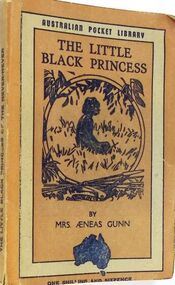
Work on paper - Book, The Little Black Princess
... An internationally renowned classic of Australian literature, the Australian Literature Board chose this story for publication by the Australian Government for distribution to the troops and POWs during the Second World War. ...An internationally renowned classic of Australian literature, the Australian Literature Board chose this story for publication by the Australian Government for distribution to the troops and POWs during the Second World War. ...This is the story of Bett-Bett, an Aboriginal girl who was the servant & companion to the author, Mrs Gunn on Elsey Station in the Northern Territory in the first decade of the twentieth century.fictionThis is the story of Bett-Bett, an Aboriginal girl who was the servant & companion to the author, Mrs Gunn on Elsey Station in the Northern Territory in the first decade of the twentieth century.first nations, jeanie gunn, novel, literature, elsie station, cattle stations, australian classics, aboriginal, juvenalia -
 Bendigo Historical Society Inc.
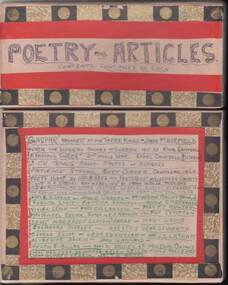
Document - LITERATURE
... ... war...Written in ink on the front is -'Cheerio ! To the last war Digger Golden Square Branch // There are four four poem cards with illustrations on the front and back - the artist appears to be Dennis Adams...AUSTRALIA Culture literature Lydia Chancellor Collection collection tennis 3CV Tennis Association Bendigo war World War II soldiers World War I 'Second Brigade Monthly Notes ' 'A Passing Cheer ' 'When the diggers touched at Durban 1915 - 1920 ' ANZACS literature poetry Australian poetry current affairs news photos entertainment writing POETRY AND ARTICLES Lydia Chancellor, collection,various Newspaper clippings tennis,/ 3CV Tennis -envelope with black and white photos regarding the of medical equipment by the 3CV Tennis Association Bendigo -Lydia Chancellor -Hon -Sec - / A paper covered booklet containing Sonnets ( printed in Durban ) titled - 'A Passing Cheer,-( Second Crop ) - For the Aussies of The Second World War -From the Long-Ago 'Durban Signaller ' ( Dated 15.3.1942 ) There is a fountain pen note on the front page as follows 'To the Members Golden Square Branch ( R.S.S. & L.T.A.?) ...Lydia Chancellor, collection,various Newspaper clippings tennis,/ 3CV Tennis -envelope with black and white photos regarding the of medical equipment by the 3CV Tennis Association Bendigo -Lydia Chancellor -Hon -Sec - / A paper covered booklet containing Sonnets ( printed in Durban ) titled - 'A Passing Cheer,-( Second Crop ) - For the Aussies of The Second World War -From the Long-Ago 'Durban Signaller ' ( Dated 15.3.1942 ) There is a fountain pen note on the front page as follows 'To the Members Golden Square Branch ( R.S.S. & L.T.A.?) - greetings & best wishes from Ethel Campbell dated 1942 ( The Durban Signaller' Writing name for: Ethel Campbell ) The back page has a Sonnet and a note to -Diggers visiting Durban giving Ethel's address . / Included is a 1942 brown coloured paper covered booklet of Sonnets titled - 'When the diggers touched at Durban 1915 - 1920,' ANZACS, this includes literature, poetry, Australian poetry,The booklet was printed in Durban . Written in ink on the front is -'Cheerio ! To the last war Digger Golden Square Branch // There are four four poem cards with illustrations on the front and back - the artist appears to be Dennis AdamsPOETRY AND ARTICLESaustralia, culture, literature, lydia chancellor collection, collection, tennis, 3cv tennis association bendigo, war, world war ii, soldiers, world war i, 'second brigade monthly notes, ' 'a passing cheer, ' 'when the diggers touched at durban 1915 - 1920, ' anzacs, literature, poetry, australian poetry, current affairs, news, photos, entertainment, writing -
 City of Moorabbin Historical Society (Operating the Box Cottage Museum)
Newsletter, City of Moorabbin Historical Society No. 7 Vol. 12 December 1973, City of Moorabbin Historical Society No. 7 Vol. 12 December 1973, 1973
... Topics ; Kyneton ; Living local history; Australian Childrens' Literature LaTrobe Library; The Aims of the CMHS are ‘to record the history of the City, and register something of the Australian Atmosphere, which the necessary speed-up in post-world-war two (WW11) immigration has caused to be lost; to produce a magazine at regular intervals, featuring the work of pioneers and the changing Australian scene; to work constantly with a long range view towards building a hall where records and exhibits can be housed’ (1961) The Original Newsletters reflect the history and heritage of the former City of Moorabbin — derived from Mooroobin, ‘a resting place’ in the Bunurrung spoken language. ...Topics ; Kyneton ; Living local history; Australian Childrens' Literature LaTrobe Library; The Aims of the CMHS are ‘to record the history of the City, and register something of the Australian Atmosphere, which the necessary speed-up in post-world-war two (WW11) immigration has caused to be lost; to produce a magazine at regular intervals, featuring the work of pioneers and the changing Australian scene; to work constantly with a long range view towards building a hall where records and exhibits can be housed’ (1961) The Original Newsletters reflect the history and heritage of the former City of Moorabbin — derived from Mooroobin, ‘a resting place’ in the Bunurrung spoken language. ...Topics ; Kyneton ; Living local history; Australian Childrens' Literature LaTrobe Library; The Aims of the CMHS are ‘to record the history of the City, and register something of the Australian Atmosphere, which the necessary speed-up in post-world-war two (WW11) immigration has caused to be lost; to produce a magazine at regular intervals, featuring the work of pioneers and the changing Australian scene; to work constantly with a long range view towards building a hall where records and exhibits can be housed’ (1961) The Original Newsletters reflect the history and heritage of the former City of Moorabbin — derived from Mooroobin, ‘a resting place’ in the Bunurrung spoken language. In 1994, the City of Moorabbin was integrated into the Cities of Bayside, Glen Eira, Kingston and Monash. This is Newsletter No. 7 Vol. 12 of the CMHS December 1973 CMHS obtained a Kingston City Council Community Grant 2016 for the digitization and preservation of these Original CMHS Newsletters commenced in 1961 3 pages x L 26cm x W 21cm printed one side CITY OF MOORABBIN HISTORICAL SOCIETY / President / Mrs C Whitehead Secretary Mrs N. Blackman / NEWSLETTER / Vol 12 No 7 December 1973 city of moorabbin historical society 1961, sheehy t.a., newsletters, kyneton victoria, -
 Flagstaff Hill Maritime Museum and Village
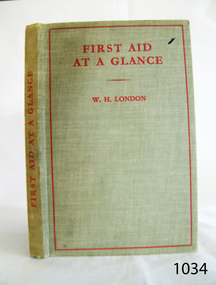
Book - Reference Medical/First Aid, William H. London, First Aid At A Glance, 1939
... With the outbreak of World War II in late 1939, they pivoted heavily into printing military handbooks, educational materials, and civil defence manuals to support the Australian war effort and home front preparedness....With the outbreak of World War II in late 1939, they pivoted heavily into printing military handbooks, educational materials, and civil defence manuals to support the Australian war effort and home front preparedness. ...Published on the eve of World War II in 1939, First Aid at a Glance is a compact, highly practical emergency manual. Designed as a concise summary for quick reference during crisis situations, it covers core civil defence and emergency medical topics such as the treatment of wounds, severe bleeding, and shock. Other subjects covered in this publication are fracture immobilisation and bandaging techniques, resuscitation and drowning intervention, and the management of casualties in public, industrial, or home settings.Hard cover book, First Aid at a Glance Author: William H. London Publisher: Angus & Robertson, Sydney, Australia Date: 1939 Further Information: Green cloth covered hardback volume with title in rednon-fictionPublished on the eve of World War II in 1939, First Aid at a Glance is a compact, highly practical emergency manual. Designed as a concise summary for quick reference during crisis situations, it covers core civil defence and emergency medical topics such as the treatment of wounds, severe bleeding, and shock. Other subjects covered in this publication are fracture immobilisation and bandaging techniques, resuscitation and drowning intervention, and the management of casualties in public, industrial, or home settings.flagstaff hill, warrnambool, shipwrecked-coast, flagstaff-hill, flagstaff-hill-maritime-museum, maritime-museum, shipwreck-coast, flagstaff-hill-maritime-village, first aid at a glance, book, william london, w.r. angus -
 Flagstaff Hill Maritime Museum and Village
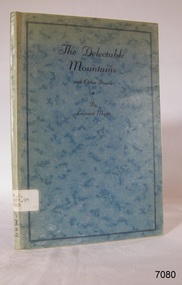
Book - Poetry Collection, Leonard Mann, The Delectable Mountains, 1944
... Mann described his writing and working lives as a 'double life' he began contributing stories to The Age under the pen-name 'Fabius' in the late 1920s, then self-published his first novel, Flesh in Armour (a World War I story), in 1932, which won the Australian Literature Society's Gold Medal. ...Mann described his writing and working lives as a 'double life' he began contributing stories to The Age under the pen-name 'Fabius' in the late 1920s, then self-published his first novel, Flesh in Armour (a World War I story), in 1932, which won the Australian Literature Society's Gold Medal. ...The subject volume is a poetry collection; its full title is The Delectable Mountains, and Other Poems, written by the Australian poet and novelist Leonard Mann, and published by Angus & Robertson (Sydney & London) in 1944. It was the third of Mann's four published volumes of poetry, following The Plumed Voice (1938) and Poems from the Mask (1941), and preceding his prize-winning Elegiac and Other Poems (1957). The collection's full bibliographic listing places it as 'The Delectable Mountains, and other poems. Sydney & London: Angus & Robertson, 1944.Hard cover book. The Delectable Mountains Author: Leonard Mann Publisher: Angus & Robertson Date: 1944 Further Information: Blue pattered cloth hardcover with lettering and patterning to front cover in black. The spine has a Library label with an inscription.fictionThe subject volume is a poetry collection; its full title is The Delectable Mountains, and Other Poems, written by the Australian poet and novelist Leonard Mann, and published by Angus & Robertson (Sydney & London) in 1944. It was the third of Mann's four published volumes of poetry, following The Plumed Voice (1938) and Poems from the Mask (1941), and preceding his prize-winning Elegiac and Other Poems (1957). The collection's full bibliographic listing places it as 'The Delectable Mountains, and other poems. Sydney & London: Angus & Robertson, 1944.shipwrecked-coast, flagstaff-hill, flagstaff-hill-maritime-museum, warrnambool, maritime-museum, shipwreck-coast, flagstaff-hill-maritime-village, shipwrecked-artefact, book, pattison collection, warrnambool library, warrnambool mechanics’ institute, ralph eric pattison, corangamite regional library service, warrnambool city librarian, mechanics’ institute library, victorian library board, warrnambool books and records, warrnambool children’s library, the delectable mountains, leonard mann -
 Chiltern Athenaeum Trust
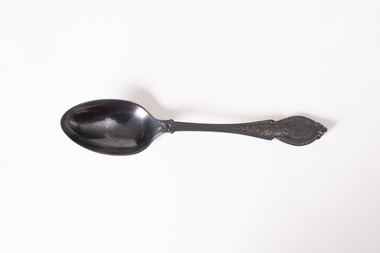
Domestic object - Spoon
... Rofe competition to advance Australian literature unanimously awarded it the Gold Medal in 1931 for the best historical novel of 1930. ...Rofe competition to advance Australian literature unanimously awarded it the Gold Medal in 1931 for the best historical novel of 1930. ...This teaspoon is believed to belong to the household of Chiltern writer and historian, W.C. Busse. The teaspoon displays a level of tarnish indicating it may be comprised of silver or silver plate. It has no evident hallmark to determine its maker or date of manufacture, but may pre-date World War Two as mass production methods and the growing popularity of stainless steel in cutlery and other tablewares saw a reduced reliance on silver in such goods after this period. Wilfred Clarence Busse was born in Chiltern in 1898. He went to school at Wesley College in Melbourne, studied law at the University of Melbourne and became a barrister. Additionally, after spending time on a Victorian station in his early twenties, he wrote two historical novels about bush life. His first novel was 'The Blue Beyond: a Romance of the Early Days in South Eastern Australia', written in 1928 and published in 1930. Busse's second novel was titled 'The Golden Plague: A Romance of the Early Fifties'. The judges of the Henry Lawson Society's T.E. Rofe competition to advance Australian literature unanimously awarded it the Gold Medal in 1931 for the best historical novel of 1930. Newspaper articles about the award mention the writer's meticulous documentary and oral history research regarding life on the Gold Fields in the 1850s. It became a best-seller. Busse also wrote a series of articles about local history for "The Federal Standard" newspaper in Chiltern. He was a member of the Chiltern Athenaeum. He died in 1960. This spoon is significant for the detail it conveys of ordinary domestic life in the household of a significant Victorian writer with special reference to Chiltern and the surrounding region. Teaspoon with decorative pattern on handle and tarnished patina. w.c. busse, chiltern, wilfred clarence busse, chiltern athenaeum, gold fields, gold rush, gold mining, mining history, historical fiction, cutlery, tableware, silverware, spoons, henry lawson society, t.e. rofe, t.e. rofe gold medal, federal standard newspaper, 1930s, 1850s, barrister, north-east victoria, indigo shire -
 Chiltern Athenaeum Trust
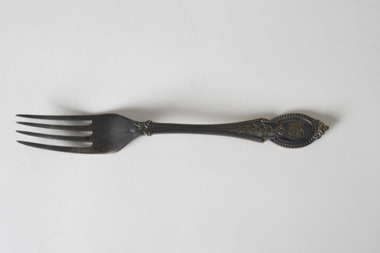
Domestic object - Fork
... Rofe competition to advance Australian literature unanimously awarded it the Gold Medal in 1931 for the best historical novel of 1930. ...Rofe competition to advance Australian literature unanimously awarded it the Gold Medal in 1931 for the best historical novel of 1930. ...This fork is believed to belong to the household of Chiltern writer and historian, W.C. Busse. It displays a level of tarnish indicating it may be comprised of silver or silver plate. It has no evident hallmark to determine its maker or date of manufacture, but may pre-date World War Two as mass production methods and the growing popularity of stainless steel in cutlery and other tablewares saw a reduced reliance on silver in such goods after this period. The handle of the fork appears to display the initials 'WB', potentially indicating it was made to order. Wilfred Clarence Busse was born in Chiltern in 1898. He went to school at Wesley College in Melbourne, studied law at the University of Melbourne and became a barrister. Additionally, after spending time on a Victorian station in his early twenties, he wrote two historical novels about bush life. His first novel was 'The Blue Beyond: a Romance of the Early Days in South Eastern Australia', written in 1928 and published in 1930. Busse's second novel was titled 'The Golden Plague: A Romance of the Early Fifties'. The judges of the Henry Lawson Society's T.E. Rofe competition to advance Australian literature unanimously awarded it the Gold Medal in 1931 for the best historical novel of 1930. Newspaper articles about the award mention the writer's meticulous documentary and oral history research regarding life on the Gold Fields in the 1850s. It became a best-seller. Busse also wrote a series of articles about local history for "The Federal Standard" newspaper in Chiltern. He was a member of the Chiltern Athenaeum. He died in 1960.This fork is significant for the detail it conveys of ordinary domestic life in the household of a significant Victorian writer with special reference to Chiltern and the surrounding region.Fork with decorative pattern on handle and tarnished patina, design may include owner's or maker's initials. WB w.c. busse, chiltern, chiltern athenaeum, gold fields, indigo shire, gold mining, gold rush, henry lawson society, fork, silverware, cutlery, tableware, 1930s, 1850s, wilfred clarence busse, historical fiction, t.e. rofe, t.e. rofe gold medal, north-east victoria, federal standard, golden plague, blue beyond -
 Flagstaff Hill Maritime Museum and Village
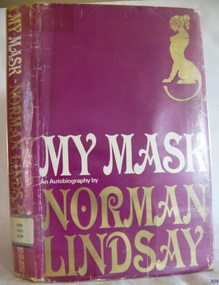
Book - Biography, Norman Lindsay (Artist), My Mask, 1975
... With the outbreak of World War II in late 1939, they pivoted heavily into printing military handbooks, educational materials, and civil defence manuals to support the Australian war effort and home front preparedness....With the outbreak of World War II in late 1939, they pivoted heavily into printing military handbooks, educational materials, and civil defence manuals to support the Australian war effort and home front preparedness. ...My Mask is Norman Lindsay's autobiography, an account written by Lindsay of himself, running to 245 pages with numerous photographic illustrations, published in boards with a dust jacket by Angus & Robertson in Sydney in 1970. Notably, it was actually written in 1957 but wasn't published until after Lindsay's death, and one source specifies it was released by his widow the year after he died. It covers ten pages of front matter plus 205 pages of text and 28 pages of illustrations, bound in blue cloth. It was the last of three autobiographical works Lindsay produced, and his final book overall. The work capped a 56-year writing career that began with his first novel in 1913. As a genre piece, it's a memoir/reflection on his own life and creative persona; the title itself, My Mask, signals that it's presented as a curated self-portrait rather than a full confessional.Hard cover book. My Mask Author: Norman Lindsay Publisher: Angus & Robertson Date: 1970 Further Information: Hardcover with dust jacket lettering and patterning to spine. The spine has a Library label with an inscription.non-fictionMy Mask is Norman Lindsay's autobiography, an account written by Lindsay of himself, running to 245 pages with numerous photographic illustrations, published in boards with a dust jacket by Angus & Robertson in Sydney in 1970. Notably, it was actually written in 1957 but wasn't published until after Lindsay's death, and one source specifies it was released by his widow the year after he died. It covers ten pages of front matter plus 205 pages of text and 28 pages of illustrations, bound in blue cloth. It was the last of three autobiographical works Lindsay produced, and his final book overall. The work capped a 56-year writing career that began with his first novel in 1913. As a genre piece, it's a memoir/reflection on his own life and creative persona; the title itself, My Mask, signals that it's presented as a curated self-portrait rather than a full confessional.shipwrecked-coast, flagstaff-hill, flagstaff-hill-maritime-museum, warrnambool, maritime-museum, shipwreck-coast, flagstaff-hill-maritime-village, shipwrecked-artefact, book, pattison collection, warrnambool library, warrnambool mechanics’ institute, ralph eric pattison, corangamite regional library service, warrnambool city librarian, mechanics’ institute library, victorian library board, warrnambool books and records, warrnambool children’s library, my mask, norman lindsay -
 Flagstaff Hill Maritime Museum and Village
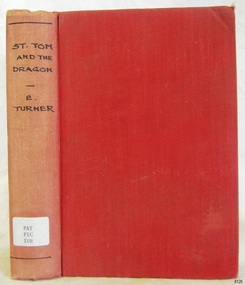
Book, St Tom and The Dragon
... She is buried at Macquarie Park Her best-known work is her first novel, Seven Little Australians (1894), which is widely considered a classic of Australian children's literature and was an instant hit both in Australia and overseas. ...She is buried at Macquarie Park Her best-known work is her first novel, Seven Little Australians (1894), which is widely considered a classic of Australian children's literature and was an instant hit both in Australia and overseas. ...This item is from the ‘Pattison Collection’, a collection of books and records that was originally owned by the Warrnambool Mechanics’ Institute, which was founded in Warrnambool in 1853. By 1886 the Warrnambool Mechanics’ Institute (WMI) had grown to have a Library, Museum and Fine Arts Gallery, with a collection of “… choice productions of art, and valuable specimens in almost every branch and many wonderful national curiosities are now to be seen there, including historic relics of the town and district.” It later included a School of Design. Although it was very well patronised, the lack of financial support led the WMI in 1911 to ask the City Council to take it over. In 1935 Ralph Pattison was appointed as City Librarian to establish and organise the Warrnambool Library as it was then called. When the WMI building was pulled down in 1963 a new civic building was erected on the site and the new Warrnambool Library, on behalf of the City Council, took over all the holdings of the WMI. At this time some of the items were separated and identified as the ‘Pattison Collection’, named after Ralph Pattison. Eventually the components of the WMI were distributed from the Warrnambool Library to various places, including the Art Gallery, Historical Society and Flagstaff Hill. Later some were even distributed to other regional branches of Corangamite Regional Library and passed to and fro. It is difficult now to trace just where all of the items have ended up. The books at Flagstaff Hill Maritime Village generally display stamps and markings from Pattison as well as a variety of other institutions including the Mechanics’ Institute itself. RALPH ERIC PATTISON Ralph Eric Pattison was born in Rockhampton, Queensland, in 1891. He married Maude Swan from Warrnambool in 1920 and they set up home in Warrnambool. In 1935 Pattison accepted a position as City Librarian for the Warrnambool City Council. His huge challenge was to make a functional library within two rooms of the Mechanics’ Institute. He tirelessly cleaned, cleared and sorted a disarrayed collection of old books, jars of preserved specimens and other items reserved for exhibition in the city’s museum. He developed and updated the library with a wide variety of books for all tastes, including reference books for students; a difficult task to fulfil during the years following the Depression. He converted all of the lower area of the building into a library, reference room and reading room for members and the public. The books were sorted and stored using a cataloguing and card index system that he had developed himself. He also prepared the upper floor of the building and established the Art Gallery and later the Museum, a place to exhibit the many old relics that had been stored for years for this purpose. One of the treasures he found was a beautiful ancient clock, which he repaired, restored and enjoyed using in his office during the years of his service there. Ralph Pattison was described as “a meticulous gentleman whose punctuality, floorless courtesy and distinctive neat dress were hallmarks of his character, and ‘his’ clock controlled his daily routine, and his opening and closing of the library’s large heavy doors to the minute.” Pattison took leave during 1942 to 1945 to serve in the Royal Australian Navy, Volunteer Reserve as Lieutenant. A few years later he converted one of the Museum’s rooms into a Children’s Library, stocking it with suitable books for the younger generation. This was an instant success. In the 1950’s he had the honour of being appointed to the Victorian Library Board and received more inspiration from the monthly conferences in Melbourne. He was sadly retired in 1959 after over 23 years of service, due to the fact that he had gone over the working age of council officers. However he continued to take a very keen interest in the continual development of the Library until his death in 1969. WARRNAMBOOL'S MECHANICS' INSTITUTE Warrnambool's Mechanics' Institute (or Institution as it was sometimes called) was one of the earliest in Victoria. On 17th October 1853 a meeting was held where it was resolved to request the Lieutenant Governor of the Colony to grant land for the erection of a Mechanics' Institutes building. A committee was formed at the meeting and Richard Osburne chaired the first meeting of this committee. The land on the North West corner of Banyan and Merri Streets was granted but there were no funds to erect the building. The Formal Rights of the Warrnambool Mechanics' Institute's encompassed its aims and these were officially adopted in1859; "This Institution has for its object the diffusion of literary, scientific, and other useful knowledge amongst its members, excluding all controversial subjects, religious or political. These objects are sought to be obtained by means of a circulating library, a reading room, the establishment of classes, debates, and the occasional delivery of lectures on natural and experimental philosophy, mechanics, astronomy, chemistry, natural history, literature, and the useful and ornamental arts, particularly those which have a more immediate reference to the colony." The Warrnambool Mechanics' Institute opened its first reading room in November1884 in the National School building at the corner of Banyan and Timor Streets. The Institute was funded by member subscription, payable on a quarterly, half yearly or yearly basis. Samuel Hannaford, the Manager of the Warrnambool Bank of Australasia, was the first Honorary Secretary of the Mechanics' Institutes, and an early President and Vice-President. He also gave several of the early lectures in the Reading Room. Another early Secretary, Librarian and lecturer was Marmaduke Fisher, the teacher at the National School. Lecture topics included The Poets and Poetry of Ireland', 'The Birth and Development of the Earth', 'The Vertebrae - with Remarks on the pleasures resulting from the study of Natural History' and 'Architecture'. In 1856 the Reading Room was moved to James Hider's shop in Timor Street, and by 1864 it was located in the bookshop of Davies and Read. In the 1860's the Mechanics' Institute struggled as membership waned but in 1866, after a series of fund raising efforts, the committee was able to purchase land in Liebig Street, on a site then called Market Square, between the weighbridge and the fire station. A Mechanics' Institute building was opened at this site in August 1871. The following year four more rooms were added to the main Reading Room and in 1873 the Artisan School of Design was incorporated into the Institute. The same year Joseph Archibald established a Museum; however it deteriorated when he was transferred to Bendigo in 1877. In 1880, with Archibald's return to Warrnambool, the Museum was re-established, and in 1885 a new building was built at the back of the Institute to accommodate the re-created School of Design, the Art Gallery and the Museum. In 1887 the Museum section was moved to the former court house in Timor Street (for some time the walls of the building formed part of the TAFE cafeteria but all is now demolished)). In 1911 the Museum was transferred back to the original building and the management of the Mechanics' Institute was handed over to the Warrnambool City Council. The Museum and Art Gallery became one and housed many fine works of art, and the Library continued to grow. The building was well patronised, with records showing that at the beginning of the 20th century there were between 500 and 800 visitors. During World War One the monthly figures were in the thousands, with 3,400 people visiting in January 1915. The Museum was a much loved Institution in Warrnambool until the contents of the Museum and Art Gallery were removed to make room for the Warrnambool City Council Engineers' Department. The contents were stored but many of the items were scattered or lost. When the original building was demolished the site became occupied by the Civic Centre, which included the new City Library. (The library was temporarily located in the old Palais building in Koroit Street.) In the process of reorganisation the Collection was distributed amongst the community groups: -The new City Library took some of the historic books and some important documents, historic photographs and newspapers. -The Art Gallery kept the 19th Century art collection and some of the artefacts from the museum. -The Historic Society has some items -The State Museum has some items -Some items were destroyed -Flagstaff Hill Maritime Village has old newspapers, Government Gazettes, most of the Mechanics' Institute Library, ledgers and documents connected to the Mechanics' Institute Library, some framed and unframed art works and some photographs. The Warrnambool Mechanics' Institute Library book collection is deemed to be of great importance because it is one of the few collections in an almost intact state, and many of the books are now very rare and of great value. Ethel Mary Turner Ethel Turner (25th January 1872 – 8th April 1958) was an English-born Australian novelist and children's literature writer. She was born Ethel Mary Burwell in Doncaster in England. Her father died when she was two, leaving her mother Sarah Jane Burwell with two daughters (Ethel and Lillian). A year later, Ethel’s mother married Henry Turner, who was 20 years older and had six children of his own. Sarah Jane and Henry had a daughter, Rose. Henry Turner died suddenly, leaving Sarah Jane with nine children and little income. In 1879 Sarah Jane moved to Australia with Ethel, Lillian, and Rose; within the next two years she married Charles Cope and gave birth to his son Rex. Ethel Turner was educated at Paddington, New South Wales Public School and Sydney Girls High School she was one of the school's original thirty-seven pupils. Ethel started her writing career at eighteen, founding the Parthenon, a journal for young people, with her sister Lillian. Writing as “Dame Durden”, she wrote children's columns for the Illustrated Sydney News and later for the Australian Town and Country Journal. In 1891 the family moved to Woodlands, a large house in Lindfield, now Killara, which was then out in the country. Woodlands still stands today in Werona Avenue and is where she wrote “Seven Little Australians”. In 1896 Ethel married Herbert Curlewis, a lawyer. After living in Mosman, they built their own house overlooking Middle Harbour. The house, Avenel, is where Ethel Turner spent the rest of her years. She survived her daughter Jean Curlewis, who died of tuberculosis, by 28 years. Jean was also a writer of children's books, although not as popular as her mother. Jean's works include “The Ship That Never Set Sail”, “Drowning Maze”, and “Beach Beyond (1923)”. Her son Adrian, was a Barrister, Captain in WW2 and a Changi and Thai-Burma Railway POW and later a Judge. Ethel Turner died at Mosman on 8 April 1958 at 85. She is buried at Macquarie Park Her best-known work is her first novel, Seven Little Australians (1894), which is widely considered a classic of Australian children's literature and was an instant hit both in Australia and overseas. It is about a family of seven children growing up in Australia. The book, together with its sequels “The Family at Misrule” (1895) and “Little Mother Meg” (1902) that deal with the lives of the Wolcott family, particularly with its seven mischievous children in 1880s Australia. A companion to "Seven Little Australians", “Judy and Punch” was published in 1928. Like her stepfather, the character of Captain Woollcott was a widower with six children. The book was made into a feature film in Australia in 1939 and a UK television series in 1953. A 10-episode television series was made in 1973 by the Australian Broadcasting Corporation. Turner published a number of other books for children, short stories and poems. “Three Little Maids” (1900) is a strongly autobiographical novel about her family's migration from England to Sydney, Australia. Turner wrote more than forty novels. Some were about the mischievous Wolcott’s. Others were serialized, like her books on "the Cub", and some were stand-alone. The children she wrote about were all adventurous and independent. They frequently got themselves into sticky situations and got themselves out of them with very little to no adult help. Turner was awarded a number of prestigious literary awards and could be considered one of Australia's best-loved authors. She is listed on The Australian Women's Register. The Ethel Turner Prize for Young People's Literature is given annually under the auspices of the New South Wales Premier's Literary Awards. Ref Ethel Mary Turner, Biography: https://en.wikipedia.org/wiki/Ethel_Turner The Pattison Collection, along with other items at Flagstaff Hill Maritime Village, was originally part of the Warrnambool Mechanics' Institute’s collection. The Warrnambool Mechanics’ Institute Collection is primarily significant in its totality, rather than for the individual objects it contains. Its contents are highly representative of the development of Mechanics' Institute libraries across Australia, particularly Victoria. A diversity of publications and themes has been amassed, and these provide clues to our understanding of the nature of and changes in the reading habits of Victorians from the 1850s to the middle of the 20th century. The collection also highlights the Warrnambool community’s commitment to the Mechanics’ Institute, reading, literacy and learning in the regions, and proves that access to knowledge was not impeded by distance. These items help to provide a more complete picture of our community’s ideals and aspirations. The Warrnambool Mechanics Institute book collection has historical and social significance for its strong association with the Mechanics Institute movement and the important role it played in the intellectual, cultural and social development of people throughout the latter part of the nineteenth century and the early twentieth century. The collection of books is a rare example of an early lending library and its significance is enhanced by the survival of an original collection of many volumes. The Warrnambool Mechanics' Institute’s publication collection is of both local and state significance. St Tom and The Dragon Author: Ethel Turner Publisher: Ward Lock & Co Date: 1918Label on spine cover with typed text PAT FIC TUR Pastedown front endpaper has sticker from Warrnambool Children’s Library covered by a sticker from Corangamite Regional Library Service Flyleaf has a stamp from Warrnambool Mechanics Institute warrnambool, shipwrecked-coast, flagstaff-hill, flagstaff-hill-maritime-museum, maritime-museum, shipwreck-coast, flagstaff-hill-maritime-village, shipwrecked-artefact, book, pattison collection, warrnambool library, warrnambool mechanics’ institute, ralph eric pattison, corangamite regional library service, warrnambool city librarian, mechanics’ institute library, victorian library board, warrnambool books and records, warrnambool children’s library, great ocean road, st tom and the dragon, ethel turner -
 Flagstaff Hill Maritime Museum and Village
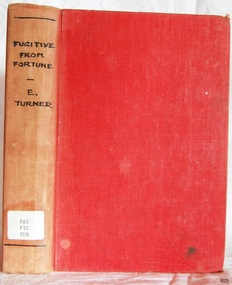
Book, Fugitives From Fortune
... She is buried at Macquarie Park Her best-known work is her first novel, Seven Little Australians (1894), which is widely considered a classic of Australian children's literature and was an instant hit both in Australia and overseas. ...She is buried at Macquarie Park Her best-known work is her first novel, Seven Little Australians (1894), which is widely considered a classic of Australian children's literature and was an instant hit both in Australia and overseas. ...This item is from the ‘Pattison Collection’, a collection of books and records that was originally owned by the Warrnambool Mechanics’ Institute, which was founded in Warrnambool in 1853. By 1886 the Warrnambool Mechanics’ Institute (WMI) had grown to have a Library, Museum and Fine Arts Gallery, with a collection of “… choice productions of art, and valuable specimens in almost every branch and many wonderful national curiosities are now to be seen there, including historic relics of the town and district.” It later included a School of Design. Although it was very well patronised, the lack of financial support led the WMI in 1911 to ask the City Council to take it over. In 1935 Ralph Pattison was appointed as City Librarian to establish and organise the Warrnambool Library as it was then called. When the WMI building was pulled down in 1963 a new civic building was erected on the site and the new Warrnambool Library, on behalf of the City Council, took over all the holdings of the WMI. At this time some of the items were separated and identified as the ‘Pattison Collection’, named after Ralph Pattison. Eventually the components of the WMI were distributed from the Warrnambool Library to various places, including the Art Gallery, Historical Society and Flagstaff Hill. Later some were even distributed to other regional branches of Corangamite Regional Library and passed to and fro. It is difficult now to trace just where all of the items have ended up. The books at Flagstaff Hill Maritime Village generally display stamps and markings from Pattison as well as a variety of other institutions including the Mechanics’ Institute itself. RALPH ERIC PATTISON Ralph Eric Pattison was born in Rockhampton, Queensland, in 1891. He married Maude Swan from Warrnambool in 1920 and they set up home in Warrnambool. In 1935 Pattison accepted a position as City Librarian for the Warrnambool City Council. His huge challenge was to make a functional library within two rooms of the Mechanics’ Institute. He tirelessly cleaned, cleared and sorted a disarrayed collection of old books, jars of preserved specimens and other items reserved for exhibition in the city’s museum. He developed and updated the library with a wide variety of books for all tastes, including reference books for students; a difficult task to fulfil during the years following the Depression. He converted all of the lower area of the building into a library, reference room and reading room for members and the public. The books were sorted and stored using a cataloguing and card index system that he had developed himself. He also prepared the upper floor of the building and established the Art Gallery and later the Museum, a place to exhibit the many old relics that had been stored for years for this purpose. One of the treasures he found was a beautiful ancient clock, which he repaired, restored and enjoyed using in his office during the years of his service there. Ralph Pattison was described as “a meticulous gentleman whose punctuality, floorless courtesy and distinctive neat dress were hallmarks of his character, and ‘his’ clock controlled his daily routine, and his opening and closing of the library’s large heavy doors to the minute.” Pattison took leave during 1942 to 1945 to serve in the Royal Australian Navy, Volunteer Reserve as Lieutenant. A few years later he converted one of the Museum’s rooms into a Children’s Library, stocking it with suitable books for the younger generation. This was an instant success. In the 1950’s he had the honour of being appointed to the Victorian Library Board and received more inspiration from the monthly conferences in Melbourne. He was sadly retired in 1959 after over 23 years of service, due to the fact that he had gone over the working age of council officers. However he continued to take a very keen interest in the continual development of the Library until his death in 1969. WARRNAMBOOL'S MECHANICS' INSTITUTE Warrnambool's Mechanics' Institute (or Institution as it was sometimes called) was one of the earliest in Victoria. On 17th October 1853 a meeting was held where it was resolved to request the Lieutenant Governor of the Colony to grant land for the erection of a Mechanics' Institutes building. A committee was formed at the meeting and Richard Osburne chaired the first meeting of this committee. The land on the North West corner of Banyan and Merri Streets was granted but there were no funds to erect the building. The Formal Rights of the Warrnambool Mechanics' Institute's encompassed its aims and these were officially adopted in1859; "This Institution has for its object the diffusion of literary, scientific, and other useful knowledge amongst its members, excluding all controversial subjects, religious or political. These objects are sought to be obtained by means of a circulating library, a reading room, the establishment of classes, debates, and the occasional delivery of lectures on natural and experimental philosophy, mechanics, astronomy, chemistry, natural history, literature, and the useful and ornamental arts, particularly those which have a more immediate reference to the colony." The Warrnambool Mechanics' Institute opened its first reading room in November1884 in the National School building at the corner of Banyan and Timor Streets. The Institute was funded by member subscription, payable on a quarterly, half yearly or yearly basis. Samuel Hannaford, the Manager of the Warrnambool Bank of Australasia, was the first Honorary Secretary of the Mechanics' Institutes, and an early President and Vice-President. He also gave several of the early lectures in the Reading Room. Another early Secretary, Librarian and lecturer was Marmaduke Fisher, the teacher at the National School. Lecture topics included The Poets and Poetry of Ireland', 'The Birth and Development of the Earth', 'The Vertebrae - with Remarks on the pleasures resulting from the study of Natural History' and 'Architecture'. In 1856 the Reading Room was moved to James Hider's shop in Timor Street, and by 1864 it was located in the bookshop of Davies and Read. In the 1860's the Mechanics' Institute struggled as membership waned but in 1866, after a series of fund raising efforts, the committee was able to purchase land in Liebig Street, on a site then called Market Square, between the weighbridge and the fire station. A Mechanics' Institute building was opened at this site in August 1871. The following year four more rooms were added to the main Reading Room and in 1873 the Artisan School of Design was incorporated into the Institute. The same year Joseph Archibald established a Museum; however it deteriorated when he was transferred to Bendigo in 1877. In 1880, with Archibald's return to Warrnambool, the Museum was re-established, and in 1885 a new building was built at the back of the Institute to accommodate the re-created School of Design, the Art Gallery and the Museum. In 1887 the Museum section was moved to the former court house in Timor Street (for some time the walls of the building formed part of the TAFE cafeteria but all is now demolished)). In 1911 the Museum was transferred back to the original building and the management of the Mechanics' Institute was handed over to the Warrnambool City Council. The Museum and Art Gallery became one and housed many fine works of art, and the Library continued to grow. The building was well patronised, with records showing that at the beginning of the 20th century there were between 500 and 800 visitors. During World War One the monthly figures were in the thousands, with 3,400 people visiting in January 1915. The Museum was a much loved Institution in Warrnambool until the contents of the Museum and Art Gallery were removed to make room for the Warrnambool City Council Engineers' Department. The contents were stored but many of the items were scattered or lost. When the original building was demolished the site became occupied by the Civic Centre, which included the new City Library. (The library was temporarily located in the old Palais building in Koroit Street.) In the process of reorganisation the Collection was distributed amongst the community groups: -The new City Library took some of the historic books and some important documents, historic photographs and newspapers. -The Art Gallery kept the 19th Century art collection and some of the artefacts from the museum. -The Historic Society has some items -The State Museum has some items -Some items were destroyed -Flagstaff Hill Maritime Village has old newspapers, Government Gazettes, most of the Mechanics' Institute Library, ledgers and documents connected to the Mechanics' Institute Library, some framed and unframed art works and some photographs. The Warrnambool Mechanics' Institute Library book collection is deemed to be of great importance because it is one of the few collections in an almost intact state, and many of the books are now very rare and of great value. Ethel Mary Turner Ethel Turner (25th January 1872 – 8th April 1958) was an English-born Australian novelist and children's literature writer. She was born Ethel Mary Burwell in Doncaster in England. Her father died when she was two, leaving her mother Sarah Jane Burwell with two daughters (Ethel and Lillian). A year later, Ethel’s mother married Henry Turner, who was 20 years older and had six children of his own. Sarah Jane and Henry had a daughter, Rose. Henry Turner died suddenly, leaving Sarah Jane with nine children and little income. In 1879 Sarah Jane moved to Australia with Ethel, Lillian, and Rose; within the next two years she married Charles Cope and gave birth to his son Rex. Ethel Turner was educated at Paddington, New South Wales Public School and Sydney Girls High School she was one of the school's original thirty-seven pupils. Ethel started her writing career at eighteen, founding the Parthenon, a journal for young people, with her sister Lillian. Writing as “Dame Durden”, she wrote children's columns for the Illustrated Sydney News and later for the Australian Town and Country Journal. In 1891 the family moved to Woodlands, a large house in Lindfield, now Killara, which was then out in the country. Woodlands still stands today in Werona Avenue and is where she wrote “Seven Little Australians”. In 1896 Ethel married Herbert Curlewis, a lawyer. After living in Mosman, they built their own house overlooking Middle Harbour. The house, Avenel, is where Ethel Turner spent the rest of her years. She survived her daughter Jean Curlewis, who died of tuberculosis, by 28 years. Jean was also a writer of children's books, although not as popular as her mother. Jean's works include “The Ship That Never Set Sail”, “Drowning Maze”, and “Beach Beyond (1923)”. Her son Adrian, was a Barrister, Captain in WW2 and a Changi and Thai-Burma Railway POW and later a Judge. Ethel Turner died at Mosman on 8 April 1958 at 85. She is buried at Macquarie Park Her best-known work is her first novel, Seven Little Australians (1894), which is widely considered a classic of Australian children's literature and was an instant hit both in Australia and overseas. It is about a family of seven children growing up in Australia. The book, together with its sequels “The Family at Misrule” (1895) and “Little Mother Meg” (1902) that deal with the lives of the Wolcott family, particularly with its seven mischievous children in 1880s Australia. A companion to "Seven Little Australians", “Judy and Punch” was published in 1928. Like her stepfather, the character of Captain Woollcott was a widower with six children. The book was made into a feature film in Australia in 1939 and a UK television series in 1953. A 10-episode television series was made in 1973 by the Australian Broadcasting Corporation. Turner published a number of other books for children, short stories and poems. “Three Little Maids” (1900) is a strongly autobiographical novel about her family's migration from England to Sydney, Australia. Turner wrote more than forty novels. Some were about the mischievous Wolcott’s. Others were serialized, like her books on "the Cub", and some were stand-alone. The children she wrote about were all adventurous and independent. They frequently got themselves into sticky situations and got themselves out of them with very little to no adult help. Turner was awarded a number of prestigious literary awards and could be considered one of Australia's best-loved authors. She is listed on The Australian Women's Register. The Ethel Turner Prize for Young People's Literature is given annually under the auspices of the New South Wales Premier's Literary Awards. Ref Ethel Mary Turner, Biography: https://en.wikipedia.org/wiki/Ethel_Turner The Pattison Collection, along with other items at Flagstaff Hill Maritime Village, was originally part of the Warrnambool Mechanics' Institute’s collection. The Warrnambool Mechanics’ Institute Collection is primarily significant in its totality, rather than for the individual objects it contains. Its contents are highly representative of the development of Mechanics' Institute libraries across Australia, particularly Victoria. A diversity of publications and themes has been amassed, and these provide clues to our understanding of the nature of and changes in the reading habits of Victorians from the 1850s to the middle of the 20th century. The collection also highlights the Warrnambool community’s commitment to the Mechanics’ Institute, reading, literacy and learning in the regions, and proves that access to knowledge was not impeded by distance. These items help to provide a more complete picture of our community’s ideals and aspirations. The Warrnambool Mechanics Institute book collection has historical and social significance for its strong association with the Mechanics Institute movement and the important role it played in the intellectual, cultural and social development of people throughout the latter part of the nineteenth century and the early twentieth century. The collection of books is a rare example of an early lending library and its significance is enhanced by the survival of an original collection of many volumes. The Warrnambool Mechanics' Institute’s publication collection is of both local and state significance. Fugitives From Fortune Author: Ethel Turner Publisher: Ward, Lock & Co Date: 1909Label on spine cover with typed text PAT FIC TUR Pastedown front endpaper has sticker from Warrnambool Children’s Library covered by a sticker from Corangamite Regional Library Service Flyleaf has a stamp from Warrnambool Mechanics Institute warrnambool, shipwrecked-coast, flagstaff-hill, flagstaff-hill-maritime-museum, maritime-museum, shipwreck-coast, flagstaff-hill-maritime-village, shipwrecked-artefact, book, pattison collection, warrnambool library, warrnambool mechanics’ institute, ralph eric pattison, corangamite regional library service, warrnambool city librarian, mechanics’ institute library, victorian library board, warrnambool books and records, warrnambool children’s library, great ocean road, fugitives from fortune, ethel turner -
 Flagstaff Hill Maritime Museum and Village
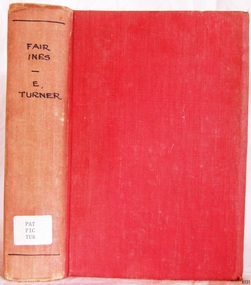
Book, Fair Ines
... She is buried at Macquarie Park Her best-known work is her first novel, Seven Little Australians (1894), which is widely considered a classic of Australian children's literature and was an instant hit both in Australia and overseas. ...She is buried at Macquarie Park Her best-known work is her first novel, Seven Little Australians (1894), which is widely considered a classic of Australian children's literature and was an instant hit both in Australia and overseas. ...This item is from the ‘Pattison Collection’, a collection of books and records that was originally owned by the Warrnambool Mechanics’ Institute, which was founded in Warrnambool in 1853. By 1886 the Warrnambool Mechanics’ Institute (WMI) had grown to have a Library, Museum and Fine Arts Gallery, with a collection of “… choice productions of art, and valuable specimens in almost every branch and many wonderful national curiosities are now to be seen there, including historic relics of the town and district.” It later included a School of Design. Although it was very well patronised, the lack of financial support led the WMI in 1911 to ask the City Council to take it over. In 1935 Ralph Pattison was appointed as City Librarian to establish and organise the Warrnambool Library as it was then called. When the WMI building was pulled down in 1963 a new civic building was erected on the site and the new Warrnambool Library, on behalf of the City Council, took over all the holdings of the WMI. At this time some of the items were separated and identified as the ‘Pattison Collection’, named after Ralph Pattison. Eventually the components of the WMI were distributed from the Warrnambool Library to various places, including the Art Gallery, Historical Society and Flagstaff Hill. Later some were even distributed to other regional branches of Corangamite Regional Library and passed to and fro. It is difficult now to trace just where all of the items have ended up. The books at Flagstaff Hill Maritime Village generally display stamps and markings from Pattison as well as a variety of other institutions including the Mechanics’ Institute itself. RALPH ERIC PATTISON Ralph Eric Pattison was born in Rockhampton, Queensland, in 1891. He married Maude Swan from Warrnambool in 1920 and they set up home in Warrnambool. In 1935 Pattison accepted a position as City Librarian for the Warrnambool City Council. His huge challenge was to make a functional library within two rooms of the Mechanics’ Institute. He tirelessly cleaned, cleared and sorted a disarrayed collection of old books, jars of preserved specimens and other items reserved for exhibition in the city’s museum. He developed and updated the library with a wide variety of books for all tastes, including reference books for students; a difficult task to fulfil during the years following the Depression. He converted all of the lower area of the building into a library, reference room and reading room for members and the public. The books were sorted and stored using a cataloguing and card index system that he had developed himself. He also prepared the upper floor of the building and established the Art Gallery and later the Museum, a place to exhibit the many old relics that had been stored for years for this purpose. One of the treasures he found was a beautiful ancient clock, which he repaired, restored and enjoyed using in his office during the years of his service there. Ralph Pattison was described as “a meticulous gentleman whose punctuality, floorless courtesy and distinctive neat dress were hallmarks of his character, and ‘his’ clock controlled his daily routine, and his opening and closing of the library’s large heavy doors to the minute.” Pattison took leave during 1942 to 1945 to serve in the Royal Australian Navy, Volunteer Reserve as Lieutenant. A few years later he converted one of the Museum’s rooms into a Children’s Library, stocking it with suitable books for the younger generation. This was an instant success. In the 1950’s he had the honour of being appointed to the Victorian Library Board and received more inspiration from the monthly conferences in Melbourne. He was sadly retired in 1959 after over 23 years of service, due to the fact that he had gone over the working age of council officers. However he continued to take a very keen interest in the continual development of the Library until his death in 1969. WARRNAMBOOL'S MECHANICS' INSTITUTE Warrnambool's Mechanics' Institute (or Institution as it was sometimes called) was one of the earliest in Victoria. On 17th October 1853 a meeting was held where it was resolved to request the Lieutenant Governor of the Colony to grant land for the erection of a Mechanics' Institutes building. A committee was formed at the meeting and Richard Osburne chaired the first meeting of this committee. The land on the North West corner of Banyan and Merri Streets was granted but there were no funds to erect the building. The Formal Rights of the Warrnambool Mechanics' Institute's encompassed its aims and these were officially adopted in1859; "This Institution has for its object the diffusion of literary, scientific, and other useful knowledge amongst its members, excluding all controversial subjects, religious or political. These objects are sought to be obtained by means of a circulating library, a reading room, the establishment of classes, debates, and the occasional delivery of lectures on natural and experimental philosophy, mechanics, astronomy, chemistry, natural history, literature, and the useful and ornamental arts, particularly those which have a more immediate reference to the colony." The Warrnambool Mechanics' Institute opened its first reading room in November1884 in the National School building at the corner of Banyan and Timor Streets. The Institute was funded by member subscription, payable on a quarterly, half yearly or yearly basis. Samuel Hannaford, the Manager of the Warrnambool Bank of Australasia, was the first Honorary Secretary of the Mechanics' Institutes, and an early President and Vice-President. He also gave several of the early lectures in the Reading Room. Another early Secretary, Librarian and lecturer was Marmaduke Fisher, the teacher at the National School. Lecture topics included The Poets and Poetry of Ireland', 'The Birth and Development of the Earth', 'The Vertebrae - with Remarks on the pleasures resulting from the study of Natural History' and 'Architecture'. In 1856 the Reading Room was moved to James Hider's shop in Timor Street, and by 1864 it was located in the bookshop of Davies and Read. In the 1860's the Mechanics' Institute struggled as membership waned but in 1866, after a series of fund raising efforts, the committee was able to purchase land in Liebig Street, on a site then called Market Square, between the weighbridge and the fire station. A Mechanics' Institute building was opened at this site in August 1871. The following year four more rooms were added to the main Reading Room and in 1873 the Artisan School of Design was incorporated into the Institute. The same year Joseph Archibald established a Museum; however it deteriorated when he was transferred to Bendigo in 1877. In 1880, with Archibald's return to Warrnambool, the Museum was re-established, and in 1885 a new building was built at the back of the Institute to accommodate the re-created School of Design, the Art Gallery and the Museum. In 1887 the Museum section was moved to the former court house in Timor Street (for some time the walls of the building formed part of the TAFE cafeteria but all is now demolished)). In 1911 the Museum was transferred back to the original building and the management of the Mechanics' Institute was handed over to the Warrnambool City Council. The Museum and Art Gallery became one and housed many fine works of art, and the Library continued to grow. The building was well patronised, with records showing that at the beginning of the 20th century there were between 500 and 800 visitors. During World War One the monthly figures were in the thousands, with 3,400 people visiting in January 1915. The Museum was a much loved Institution in Warrnambool until the contents of the Museum and Art Gallery were removed to make room for the Warrnambool City Council Engineers' Department. The contents were stored but many of the items were scattered or lost. When the original building was demolished the site became occupied by the Civic Centre, which included the new City Library. (The library was temporarily located in the old Palais building in Koroit Street.) In the process of reorganisation the Collection was distributed amongst the community groups: -The new City Library took some of the historic books and some important documents, historic photographs and newspapers. -The Art Gallery kept the 19th Century art collection and some of the artefacts from the museum. -The Historic Society has some items -The State Museum has some items -Some items were destroyed -Flagstaff Hill Maritime Village has old newspapers, Government Gazettes, most of the Mechanics' Institute Library, ledgers and documents connected to the Mechanics' Institute Library, some framed and unframed art works and some photographs. The Warrnambool Mechanics' Institute Library book collection is deemed to be of great importance because it is one of the few collections in an almost intact state, and many of the books are now very rare and of great value. Ethel Mary Turner Ethel Turner (25th January 1872 – 8th April 1958) was an English-born Australian novelist and children's literature writer. She was born Ethel Mary Burwell in Doncaster in England. Her father died when she was two, leaving her mother Sarah Jane Burwell with two daughters (Ethel and Lillian). A year later, Ethel’s mother married Henry Turner, who was 20 years older and had six children of his own. Sarah Jane and Henry had a daughter, Rose. Henry Turner died suddenly, leaving Sarah Jane with nine children and little income. In 1879 Sarah Jane moved to Australia with Ethel, Lillian, and Rose; within the next two years she married Charles Cope and gave birth to his son Rex. Ethel Turner was educated at Paddington, New South Wales Public School and Sydney Girls High School she was one of the school's original thirty-seven pupils. Ethel started her writing career at eighteen, founding the Parthenon, a journal for young people, with her sister Lillian. Writing as “Dame Durden”, she wrote children's columns for the Illustrated Sydney News and later for the Australian Town and Country Journal. In 1891 the family moved to Woodlands, a large house in Lindfield, now Killara, which was then out in the country. Woodlands still stands today in Werona Avenue and is where she wrote “Seven Little Australians”. In 1896 Ethel married Herbert Curlewis, a lawyer. After living in Mosman, they built their own house overlooking Middle Harbour. The house, Avenel, is where Ethel Turner spent the rest of her years. She survived her daughter Jean Curlewis, who died of tuberculosis, by 28 years. Jean was also a writer of children's books, although not as popular as her mother. Jean's works include “The Ship That Never Set Sail”, “Drowning Maze”, and “Beach Beyond (1923)”. Her son Adrian, was a Barrister, Captain in WW2 and a Changi and Thai-Burma Railway POW and later a Judge. Ethel Turner died at Mosman on 8 April 1958 at 85. She is buried at Macquarie Park Her best-known work is her first novel, Seven Little Australians (1894), which is widely considered a classic of Australian children's literature and was an instant hit both in Australia and overseas. It is about a family of seven children growing up in Australia. The book, together with its sequels “The Family at Misrule” (1895) and “Little Mother Meg” (1902) that deal with the lives of the Wolcott family, particularly with its seven mischievous children in 1880s Australia. A companion to "Seven Little Australians", “Judy and Punch” was published in 1928. Like her stepfather, the character of Captain Woollcott was a widower with six children. The book was made into a feature film in Australia in 1939 and a UK television series in 1953. A 10-episode television series was made in 1973 by the Australian Broadcasting Corporation. Turner published a number of other books for children, short stories and poems. “Three Little Maids” (1900) is a strongly autobiographical novel about her family's migration from England to Sydney, Australia. Turner wrote more than forty novels. Some were about the mischievous Wolcott’s. Others were serialized, like her books on "the Cub", and some were stand-alone. The children she wrote about were all adventurous and independent. They frequently got themselves into sticky situations and got themselves out of them with very little to no adult help. Turner was awarded a number of prestigious literary awards and could be considered one of Australia's best-loved authors. She is listed on The Australian Women's Register. The Ethel Turner Prize for Young People's Literature is given annually under the auspices of the New South Wales Premier's Literary Awards. Ref Ethel Mary Turner, Biography: https://en.wikipedia.org/wiki/Ethel_Turner The Pattison Collection, along with other items at Flagstaff Hill Maritime Village, was originally part of the Warrnambool Mechanics' Institute’s collection. The Warrnambool Mechanics’ Institute Collection is primarily significant in its totality, rather than for the individual objects it contains. Its contents are highly representative of the development of Mechanics' Institute libraries across Australia, particularly Victoria. A diversity of publications and themes has been amassed, and these provide clues to our understanding of the nature of and changes in the reading habits of Victorians from the 1850s to the middle of the 20th century. The collection also highlights the Warrnambool community’s commitment to the Mechanics’ Institute, reading, literacy and learning in the regions, and proves that access to knowledge was not impeded by distance. These items help to provide a more complete picture of our community’s ideals and aspirations. The Warrnambool Mechanics Institute book collection has historical and social significance for its strong association with the Mechanics Institute movement and the important role it played in the intellectual, cultural and social development of people throughout the latter part of the nineteenth century and the early twentieth century. The collection of books is a rare example of an early lending library and its significance is enhanced by the survival of an original collection of many volumes. The Warrnambool Mechanics' Institute’s publication collection is of both local and state significance. Fair Ines Author: Ethel Turner Publisher: Hodder & Stoughton Date: 1910Label on spine cover with typed text PAT FIC TUR Pastedown front endpaper has sticker from Warrnambool Children’s Library covered by a sticker from Corangamite Regional Library Service Flyleaf has a stamp from Warrnambool Mechanics Institute warrnambool, shipwrecked-coast, flagstaff-hill, flagstaff-hill-maritime-museum, maritime-museum, shipwreck-coast, flagstaff-hill-maritime-village, shipwrecked-artefact, book, pattison collection, warrnambool library, warrnambool mechanics’ institute, ralph eric pattison, corangamite regional library service, warrnambool city librarian, mechanics’ institute library, victorian library board, warrnambool books and records, warrnambool children’s library, great ocean road, ethel turner, fair ines -
 Flagstaff Hill Maritime Museum and Village
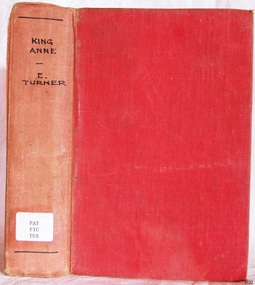
Book, King Anne
... She is buried at Macquarie Park Her best-known work is her first novel, Seven Little Australians (1894), which is widely considered a classic of Australian children's literature and was an instant hit both in Australia and overseas. ...She is buried at Macquarie Park Her best-known work is her first novel, Seven Little Australians (1894), which is widely considered a classic of Australian children's literature and was an instant hit both in Australia and overseas. ...This item is from the ‘Pattison Collection’, a collection of books and records that was originally owned by the Warrnambool Mechanics’ Institute, which was founded in Warrnambool in 1853. By 1886 the Warrnambool Mechanics’ Institute (WMI) had grown to have a Library, Museum and Fine Arts Gallery, with a collection of “… choice productions of art, and valuable specimens in almost every branch and many wonderful national curiosities are now to be seen there, including historic relics of the town and district.” It later included a School of Design. Although it was very well patronised, the lack of financial support led the WMI in 1911 to ask the City Council to take it over. In 1935 Ralph Pattison was appointed as City Librarian to establish and organise the Warrnambool Library as it was then called. When the WMI building was pulled down in 1963 a new civic building was erected on the site and the new Warrnambool Library, on behalf of the City Council, took over all the holdings of the WMI. At this time some of the items were separated and identified as the ‘Pattison Collection’, named after Ralph Pattison. Eventually the components of the WMI were distributed from the Warrnambool Library to various places, including the Art Gallery, Historical Society and Flagstaff Hill. Later some were even distributed to other regional branches of Corangamite Regional Library and passed to and fro. It is difficult now to trace just where all of the items have ended up. The books at Flagstaff Hill Maritime Village generally display stamps and markings from Pattison as well as a variety of other institutions including the Mechanics’ Institute itself. RALPH ERIC PATTISON Ralph Eric Pattison was born in Rockhampton, Queensland, in 1891. He married Maude Swan from Warrnambool in 1920 and they set up home in Warrnambool. In 1935 Pattison accepted a position as City Librarian for the Warrnambool City Council. His huge challenge was to make a functional library within two rooms of the Mechanics’ Institute. He tirelessly cleaned, cleared and sorted a disarrayed collection of old books, jars of preserved specimens and other items reserved for exhibition in the city’s museum. He developed and updated the library with a wide variety of books for all tastes, including reference books for students; a difficult task to fulfil during the years following the Depression. He converted all of the lower area of the building into a library, reference room and reading room for members and the public. The books were sorted and stored using a cataloguing and card index system that he had developed himself. He also prepared the upper floor of the building and established the Art Gallery and later the Museum, a place to exhibit the many old relics that had been stored for years for this purpose. One of the treasures he found was a beautiful ancient clock, which he repaired, restored and enjoyed using in his office during the years of his service there. Ralph Pattison was described as “a meticulous gentleman whose punctuality, floorless courtesy and distinctive neat dress were hallmarks of his character, and ‘his’ clock controlled his daily routine, and his opening and closing of the library’s large heavy doors to the minute.” Pattison took leave during 1942 to 1945 to serve in the Royal Australian Navy, Volunteer Reserve as Lieutenant. A few years later he converted one of the Museum’s rooms into a Children’s Library, stocking it with suitable books for the younger generation. This was an instant success. In the 1950’s he had the honour of being appointed to the Victorian Library Board and received more inspiration from the monthly conferences in Melbourne. He was sadly retired in 1959 after over 23 years of service, due to the fact that he had gone over the working age of council officers. However he continued to take a very keen interest in the continual development of the Library until his death in 1969. WARRNAMBOOL'S MECHANICS' INSTITUTE Warrnambool's Mechanics' Institute (or Institution as it was sometimes called) was one of the earliest in Victoria. On 17th October 1853 a meeting was held where it was resolved to request the Lieutenant Governor of the Colony to grant land for the erection of a Mechanics' Institutes building. A committee was formed at the meeting and Richard Osburne chaired the first meeting of this committee. The land on the North West corner of Banyan and Merri Streets was granted but there were no funds to erect the building. The Formal Rights of the Warrnambool Mechanics' Institute's encompassed its aims and these were officially adopted in1859; "This Institution has for its object the diffusion of literary, scientific, and other useful knowledge amongst its members, excluding all controversial subjects, religious or political. These objects are sought to be obtained by means of a circulating library, a reading room, the establishment of classes, debates, and the occasional delivery of lectures on natural and experimental philosophy, mechanics, astronomy, chemistry, natural history, literature, and the useful and ornamental arts, particularly those which have a more immediate reference to the colony." The Warrnambool Mechanics' Institute opened its first reading room in November1884 in the National School building at the corner of Banyan and Timor Streets. The Institute was funded by member subscription, payable on a quarterly, half yearly or yearly basis. Samuel Hannaford, the Manager of the Warrnambool Bank of Australasia, was the first Honorary Secretary of the Mechanics' Institutes, and an early President and Vice-President. He also gave several of the early lectures in the Reading Room. Another early Secretary, Librarian and lecturer was Marmaduke Fisher, the teacher at the National School. Lecture topics included The Poets and Poetry of Ireland', 'The Birth and Development of the Earth', 'The Vertebrae - with Remarks on the pleasures resulting from the study of Natural History' and 'Architecture'. In 1856 the Reading Room was moved to James Hider's shop in Timor Street, and by 1864 it was located in the bookshop of Davies and Read. In the 1860's the Mechanics' Institute struggled as membership waned but in 1866, after a series of fund raising efforts, the committee was able to purchase land in Liebig Street, on a site then called Market Square, between the weighbridge and the fire station. A Mechanics' Institute building was opened at this site in August 1871. The following year four more rooms were added to the main Reading Room and in 1873 the Artisan School of Design was incorporated into the Institute. The same year Joseph Archibald established a Museum; however it deteriorated when he was transferred to Bendigo in 1877. In 1880, with Archibald's return to Warrnambool, the Museum was re-established, and in 1885 a new building was built at the back of the Institute to accommodate the re-created School of Design, the Art Gallery and the Museum. In 1887 the Museum section was moved to the former court house in Timor Street (for some time the walls of the building formed part of the TAFE cafeteria but all is now demolished)). In 1911 the Museum was transferred back to the original building and the management of the Mechanics' Institute was handed over to the Warrnambool City Council. The Museum and Art Gallery became one and housed many fine works of art, and the Library continued to grow. The building was well patronised, with records showing that at the beginning of the 20th century there were between 500 and 800 visitors. During World War One the monthly figures were in the thousands, with 3,400 people visiting in January 1915. The Museum was a much loved Institution in Warrnambool until the contents of the Museum and Art Gallery were removed to make room for the Warrnambool City Council Engineers' Department. The contents were stored but many of the items were scattered or lost. When the original building was demolished the site became occupied by the Civic Centre, which included the new City Library. (The library was temporarily located in the old Palais building in Koroit Street.) In the process of reorganisation the Collection was distributed amongst the community groups: -The new City Library took some of the historic books and some important documents, historic photographs and newspapers. -The Art Gallery kept the 19th Century art collection and some of the artefacts from the museum. -The Historic Society has some items -The State Museum has some items -Some items were destroyed -Flagstaff Hill Maritime Village has old newspapers, Government Gazettes, most of the Mechanics' Institute Library, ledgers and documents connected to the Mechanics' Institute Library, some framed and unframed art works and some photographs. The Warrnambool Mechanics' Institute Library book collection is deemed to be of great importance because it is one of the few collections in an almost intact state, and many of the books are now very rare and of great value. Ethel Mary Turner Ethel Turner (25th January 1872 – 8th April 1958) was an English-born Australian novelist and children's literature writer. She was born Ethel Mary Burwell in Doncaster in England. Her father died when she was two, leaving her mother Sarah Jane Burwell with two daughters (Ethel and Lillian). A year later, Ethel’s mother married Henry Turner, who was 20 years older and had six children of his own. Sarah Jane and Henry had a daughter, Rose. Henry Turner died suddenly, leaving Sarah Jane with nine children and little income. In 1879 Sarah Jane moved to Australia with Ethel, Lillian, and Rose; within the next two years she married Charles Cope and gave birth to his son Rex. Ethel Turner was educated at Paddington, New South Wales Public School and Sydney Girls High School she was one of the school's original thirty-seven pupils. Ethel started her writing career at eighteen, founding the Parthenon, a journal for young people, with her sister Lillian. Writing as “Dame Durden”, she wrote children's columns for the Illustrated Sydney News and later for the Australian Town and Country Journal. In 1891 the family moved to Woodlands, a large house in Lindfield, now Killara, which was then out in the country. Woodlands still stands today in Werona Avenue and is where she wrote “Seven Little Australians”. In 1896 Ethel married Herbert Curlewis, a lawyer. After living in Mosman, they built their own house overlooking Middle Harbour. The house, Avenel, is where Ethel Turner spent the rest of her years. She survived her daughter Jean Curlewis, who died of tuberculosis, by 28 years. Jean was also a writer of children's books, although not as popular as her mother. Jean's works include “The Ship That Never Set Sail”, “Drowning Maze”, and “Beach Beyond (1923)”. Her son Adrian, was a Barrister, Captain in WW2 and a Changi and Thai-Burma Railway POW and later a Judge. Ethel Turner died at Mosman on 8 April 1958 at 85. She is buried at Macquarie Park Her best-known work is her first novel, Seven Little Australians (1894), which is widely considered a classic of Australian children's literature and was an instant hit both in Australia and overseas. It is about a family of seven children growing up in Australia. The book, together with its sequels “The Family at Misrule” (1895) and “Little Mother Meg” (1902) that deal with the lives of the Wolcott family, particularly with its seven mischievous children in 1880s Australia. A companion to "Seven Little Australians", “Judy and Punch” was published in 1928. Like her stepfather, the character of Captain Woollcott was a widower with six children. The book was made into a feature film in Australia in 1939 and a UK television series in 1953. A 10-episode television series was made in 1973 by the Australian Broadcasting Corporation. Turner published a number of other books for children, short stories and poems. “Three Little Maids” (1900) is a strongly autobiographical novel about her family's migration from England to Sydney, Australia. Turner wrote more than forty novels. Some were about the mischievous Wolcott’s. Others were serialized, like her books on "the Cub", and some were stand-alone. The children she wrote about were all adventurous and independent. They frequently got themselves into sticky situations and got themselves out of them with very little to no adult help. Turner was awarded a number of prestigious literary awards and could be considered one of Australia's best-loved authors. She is listed on The Australian Women's Register. The Ethel Turner Prize for Young People's Literature is given annually under the auspices of the New South Wales Premier's Literary Awards. Ref Ethel Mary Turner, Biography: https://en.wikipedia.org/wiki/Ethel_Turner The Pattison Collection, along with other items at Flagstaff Hill Maritime Village, was originally part of the Warrnambool Mechanics' Institute’s collection. The Warrnambool Mechanics’ Institute Collection is primarily significant in its totality, rather than for the individual objects it contains. Its contents are highly representative of the development of Mechanics' Institute libraries across Australia, particularly Victoria. A diversity of publications and themes has been amassed, and these provide clues to our understanding of the nature of and changes in the reading habits of Victorians from the 1850s to the middle of the 20th century. The collection also highlights the Warrnambool community’s commitment to the Mechanics’ Institute, reading, literacy and learning in the regions, and proves that access to knowledge was not impeded by distance. These items help to provide a more complete picture of our community’s ideals and aspirations. The Warrnambool Mechanics Institute book collection has historical and social significance for its strong association with the Mechanics Institute movement and the important role it played in the intellectual, cultural and social development of people throughout the latter part of the nineteenth century and the early twentieth century. The collection of books is a rare example of an early lending library and its significance is enhanced by the survival of an original collection of many volumes. The Warrnambool Mechanics' Institute’s publication collection is of both local and state significance. King Anne Author: Ethel Turner Publisher: Ward Lock & Co Date: 1921Label on spine cover with typed text PAT FIC TUR Pastedown front endpaper has sticker from Warrnambool Children’s Library covered by a sticker from Corangamite Regional Library Service Insider front loose endpaper has a stamp from Warrnambool Mechanics Institutewarrnambool, shipwrecked-coast, flagstaff-hill, flagstaff-hill-maritime-museum, maritime-museum, shipwreck-coast, flagstaff-hill-maritime-village, shipwrecked-artefact, book, pattison collection, warrnambool library, warrnambool mechanics’ institute, ralph eric pattison, corangamite regional library service, warrnambool city librarian, mechanics’ institute library, victorian library board, warrnambool books and records, warrnambool children’s library, great ocean road, king anne, ethel turner -
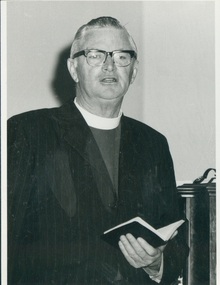 Uniting Church Archives - Synod of Victoria
BW photo, Undated
... literature at all levels. He had marked out Kevin Engel, trained him, and launched him on the international scene. Hence it was natural that in Melbourne he and Kevin Engel should found the Australian Christian Literature Society. ...literature at all levels. He had marked out Kevin Engel, trained him, and launched him on the international scene. Hence it was natural that in Melbourne he and Kevin Engel should found the Australian Christian Literature Society. ...STANWAY, ALFRED (b. 9 Sept 1908; d. Melbourne, Vic, 27 June 1989). Anglican bishop, missionary. Stanway grew up in the Wimmera district of western Victoria, and left school when 14 years old. He found work in Melbourne, trained as an accountant, and at the age of 20, held a responsible position with a publishing company. This background, allied with an uncommon flair for figures and finance, was to stand him in good stead throughout his life. But he had little knowledge and no experience of the grace of God until 29 July 1928. At the Evening Service in the parish church of Fairfield on 29 July, he heard the Rev C H Nash (q.v.) preach a sermon which led to his conversion. Within two years he made up his mind to become a missionary and began night studies in order to matriculate. He entered Ridley College in March 1932 to prepare for ordination undertaking week-end duties as a catechist at Deer Park and St Albans. He joined the CMS League of Youth, became chairman, and gathered a fine band of young people many of whom were to become missionaries. He was closely involved with the Belgrave Heights Convention (then at Upwey) and established a League of Youth camp on the site. All his energies were thrown into the task of building up its members in personal holiness and vigorous evangelism. Stanway was ordained in St Paul's Cathedral, Melbourne on St Thomas Day 1934 and was placed in charge of the Old Mission Church of St James and St John, Melbourne. The duties were light enough to allow him to enrol in the Melbourne Teachers College and to complete the Diploma in Teaching. On 26 January 1937, he sailed for Africa to become a missionary in the Anglican Diocese of Mombasa, which at that time embraced the whole of Kenya. He was sent to the hot coastal town of Kaloleni as principal of a Secondary Boys School. Before he left Melbourne, he had become engaged to Marjory Harrison: she followed him to Africa and their marriage took place in Mombasa Cathedral in June 1939. He remained at Kaloleni until 1944 when he was transferred to the inland station of Maseno where all his gifts were to be deployed as rural dean of Nyanza. His oversight of some 500 village churches as well as a widespread primary school system was so efficient that in 1948 he was appointed archdeacon of Kenya with his home and office in Nairobi. As secretary of the African Church Council and of the African Education Board, he was responsible for all African work in the diocese. His contacts with government ministers and public servants were of first class significance at the time when the cry of Uhuru and the demand for independence was travelling throughout the colonial world. On 2 Feb 1951, Alfred Stanway was consecrated in Westminster Abbey as the third Anglican Bp of Central Tanganyika. This Diocese was the special sphere of the CMS Australia, and he already knew most of the missionary personnel. He brought with him the understanding and experience of one who had fully shared the lot and problems of a district missionary, but he came to the diocese at a time when it had yet to recover from its losses in personnel and finance as a result of the war. His immediate task was to provide the impetus of fresh leadership and a long-term overall policy. His aim from-the outset was to build up a strong autonomous church with its own indigenous pastorate. With the whole-hearted confidence of the home base, he was able to enlist the service of new missionaries. He saw a great increase in the number of African clergy and he encouraged village evangelists to open new fields of work. Simple structures were built as new churches at the rate of two a week, week in and week out, year by year. He worked hard to meet the need for Christian literature, bookshops, adult literacy and theological training. He opened Bible schools for village evangelists and sent suitable clergy overseas for further studies. He encouraged initiative in others, helped them to find and use their talents, and gave them his unstinted confidence and support. Fresh finance was required for new ventures. This led him to travel widely in Germany and America, where he raised large funds for these projects. Mackay House was built in Dodoma as the central administrative base for the diocese, hospitals such as those at Mvumi and Hombolo were modernised or established, schools were built and upgraded. In keeping with his vision for ultimate leadership by African personnel, he consecrated Yohana Omari in 1955 as his assistant, he was the first national to become a bp in East Africa. Bp Stanway then set on foot the long and complicated process for the division of his sprawling diocese. In 1963, the diocese of Victoria Nyanza came into being; in 1965, that of Morogoro; in 1966, that of Western Tanganyika. Yet in 1971, his own diocese of Central Tanganyika, though greatly reduced in size, had more churches and more clergy than in its undivided state in 195 l. Stanway then played a leading part in the formation of the Province of Tanzania in 1970, with an African abp as metropolitan. A year later, after 35 years in East Africa and 20 years as bishop of Central Tanganyika, he resigned. His leadership and achievements throughout those years had placed him in the front rank as a great missionary statesman. Stanway had returned to Melbourne at the time when his resignation took effect in August 1971. His early love for Ridley College reasserted itself and he went into residence as deputy principal under the Rev Dr Leon Morris. He was put in charge of chapel worship and the pastoral oversight of the students. All his gifts and experience were called into play as he sought to guide and encourage those who were on the threshold of their ministry. The whole bent of his heart was to foster the spiritual life and missionary calling of those whose hearts the Lord had touched. It was during those years that his life-long zeal for the spread of the gospel through Christian literature had its ultimate flowering. It had begun in his Nairobi days with a small church bookstall, this had developed into a major book-shop in the heart of the city. Then in Dodoma he had established the Central Tanganyika Press in order to promote the publication and distribution of Christian literature at all levels. He had marked out Kevin Engel, trained him, and launched him on the international scene. Hence it was natural that in Melbourne he and Kevin Engel should found the Australian Christian Literature Society. But his time at Ridley College was not to last. Unknown to him, the Rev J R W Stott had put his name forward as that of a person who could head a new school of theology in the United States to provide a sound training for evangelical ordinands. Such a task would have been formidable enough for a younger man who had grown up in America. How could an Australian who had spent half his life in Africa hope to succeed in a venture of that kind in America? How could one who had been a missionary, not a theologian, found a new school to train men for ordination? Nevertheless he rose to the challenge. In Sept 1975, he and Mrs Stanway left Melbourne for Sewickly, an outer suburb of Pittsburg, with the promise of three years' service. He had to start from scratch. He found a house to live in, but there was no land for the school, no funds in hand, no staff yet appointed, no students, and no buildings. His drive, his infections enthusiasm, and his flair for practical enterprise carried the day. One by one, obstacles were overcome and support grew in volume and strength. Twelve months after his arrival, in Sept 1976, the Trinity Episcopal School for Ministry was opened with three staff members, seventeen students, and the goodwill of the whole American Episcopal Church to win. During the next two years, the school took shape and was firmly established. Bp Stanway left an indelible stamp on every aspect of its life and work, its spiritual tone and ideals, its financial and administrative principles. He had inspired widespread support among evangelical episcopalians and had imparted a strong sense of divine guidance and purpose. The council would gladly have extended his term in office beyond three years, but at 75 years of age he knew that his health had begun to fail. When he finally relinquished his office in Nov 1978, he could look back on those three years as the crown of his ministry. It is not too much to say that his name was even more highly honoured and revered in the Trinity School of Ministry than in his own dearly loved Africa. His return to Melbourne led to quiet retirement at Mount Waverley where he settled down to a long battle with the ever worsening effects of Parkinson's Disease. The slow loss of physical capacity and the ultimate failure in powers of speech were a great trial, but he never complained. His faith was summed up in his brief reply when he was asked why he had not prayed for healing: 'What God allows, I accept'. That acceptance was without reserve; his testimony was never brighter. His mental powers were undiminished and his spiritual concerns were as wide as ever. He kept in touch with CMS, he went to church, he met with missionaries, he led Bible studies in his home as long as he was able. Africa was always in his heart, news from Sewickly always gave him great pleasure. He had left a mark for God on three great continents and his death left sad but thankful hearts in them all. It was the close of a life in which he had felt that he could never do enough for God who had done so much for him. One of Bp Stanway's sayings was 'when the Holy Spirit takes hold of you, anything can happen'. So it was in his case. He was very human, with his full share of human foibles and frailties. He had a great zest for life and an endless fund of stories drawn from his own experience. He was himself the subject of many stories, some true, others legendary. His vibrant personality always seemed to fill the house where he was, his presence could not be overlooked. His own home was one in which Mrs Stanway had a paramount influence. She was a trained teacher, a skilled artist, a born hostess and a first-class linguist. They had no children of their own, but were devoted Godparents and always deeply interested in the children of missionaries. Home life allowed him to relax in a serene and contented atmosphere and to exercise his gifts for friendship and hospitality. He was always on the watch for souls, a person-to-person evangelist par excellence. He was a man of faith and prayer who dared to believe in the God of the impossible. His love for Africa, his total dedication as a missionary; his gifts as a soulwinner; his genius for finance; his shrewd practical initiatives, and his statesmanlike vision were outstanding characteristics. But great or small, all his gifts were laid out in the service of the gospel, and that service marked him out as one of the most remarkable Australian missionaries of his generation. M L Loane, Men to Remember (Sydney, 1987) Rev. Alfred Stanway is standing with open book in hand, dressed in clerical garb.Bishop Alfred Stanwaybishop alfred stanway -
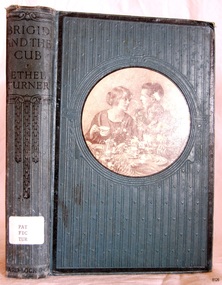 Flagstaff Hill Maritime Museum and Village
Book, Brigid and The Cub
... She is buried at Macquarie Park Her best-known work is her first novel, Seven Little Australians (1894), which is widely considered a classic of Australian children's literature and was an instant hit both in Australia and overseas. ...She is buried at Macquarie Park Her best-known work is her first novel, Seven Little Australians (1894), which is widely considered a classic of Australian children's literature and was an instant hit both in Australia and overseas. ...This item is from the ‘Pattison Collection’, a collection of books and records that was originally owned by the Warrnambool Mechanics’ Institute, which was founded in Warrnambool in 1853. By 1886 the Warrnambool Mechanics’ Institute (WMI) had grown to have a Library, Museum and Fine Arts Gallery, with a collection of “… choice productions of art, and valuable specimens in almost every branch and many wonderful national curiosities are now to be seen there, including historic relics of the town and district.” It later included a School of Design. Although it was very well patronised, the lack of financial support led the WMI in 1911 to ask the City Council to take it over. In 1935 Ralph Pattison was appointed as City Librarian to establish and organise the Warrnambool Library as it was then called. When the WMI building was pulled down in 1963 a new civic building was erected on the site and the new Warrnambool Library, on behalf of the City Council, took over all the holdings of the WMI. At this time some of the items were separated and identified as the ‘Pattison Collection’, named after Ralph Pattison. Eventually the components of the WMI were distributed from the Warrnambool Library to various places, including the Art Gallery, Historical Society and Flagstaff Hill. Later some were even distributed to other regional branches of Corangamite Regional Library and passed to and fro. It is difficult now to trace just where all of the items have ended up. The books at Flagstaff Hill Maritime Village generally display stamps and markings from Pattison as well as a variety of other institutions including the Mechanics’ Institute itself. RALPH ERIC PATTISON Ralph Eric Pattison was born in Rockhampton, Queensland, in 1891. He married Maude Swan from Warrnambool in 1920 and they set up home in Warrnambool. In 1935 Pattison accepted a position as City Librarian for the Warrnambool City Council. His huge challenge was to make a functional library within two rooms of the Mechanics’ Institute. He tirelessly cleaned, cleared and sorted a disarrayed collection of old books, jars of preserved specimens and other items reserved for exhibition in the city’s museum. He developed and updated the library with a wide variety of books for all tastes, including reference books for students; a difficult task to fulfil during the years following the Depression. He converted all of the lower area of the building into a library, reference room and reading room for members and the public. The books were sorted and stored using a cataloguing and card index system that he had developed himself. He also prepared the upper floor of the building and established the Art Gallery and later the Museum, a place to exhibit the many old relics that had been stored for years for this purpose. One of the treasures he found was a beautiful ancient clock, which he repaired, restored and enjoyed using in his office during the years of his service there. Ralph Pattison was described as “a meticulous gentleman whose punctuality, floorless courtesy and distinctive neat dress were hallmarks of his character, and ‘his’ clock controlled his daily routine, and his opening and closing of the library’s large heavy doors to the minute.” Pattison took leave during 1942 to 1945 to serve in the Royal Australian Navy, Volunteer Reserve as Lieutenant. A few years later he converted one of the Museum’s rooms into a Children’s Library, stocking it with suitable books for the younger generation. This was an instant success. In the 1950’s he had the honour of being appointed to the Victorian Library Board and received more inspiration from the monthly conferences in Melbourne. He was sadly retired in 1959 after over 23 years of service, due to the fact that he had gone over the working age of council officers. However he continued to take a very keen interest in the continual development of the Library until his death in 1969. WARRNAMBOOL'S MECHANICS' INSTITUTE Warrnambool's Mechanics' Institute (or Institution as it was sometimes called) was one of the earliest in Victoria. On 17th October 1853 a meeting was held where it was resolved to request the Lieutenant Governor of the Colony to grant land for the erection of a Mechanics' Institutes building. A committee was formed at the meeting and Richard Osburne chaired the first meeting of this committee. The land on the North West corner of Banyan and Merri Streets was granted but there were no funds to erect the building. The Formal Rights of the Warrnambool Mechanics' Institute's encompassed its aims and these were officially adopted in1859; "This Institution has for its object the diffusion of literary, scientific, and other useful knowledge amongst its members, excluding all controversial subjects, religious or political. These objects are sought to be obtained by means of a circulating library, a reading room, the establishment of classes, debates, and the occasional delivery of lectures on natural and experimental philosophy, mechanics, astronomy, chemistry, natural history, literature, and the useful and ornamental arts, particularly those which have a more immediate reference to the colony." The Warrnambool Mechanics' Institute opened its first reading room in November1884 in the National School building at the corner of Banyan and Timor Streets. The Institute was funded by member subscription, payable on a quarterly, half yearly or yearly basis. Samuel Hannaford, the Manager of the Warrnambool Bank of Australasia, was the first Honorary Secretary of the Mechanics' Institutes, and an early President and Vice-President. He also gave several of the early lectures in the Reading Room. Another early Secretary, Librarian and lecturer was Marmaduke Fisher, the teacher at the National School. Lecture topics included The Poets and Poetry of Ireland', 'The Birth and Development of the Earth', 'The Vertebrae - with Remarks on the pleasures resulting from the study of Natural History' and 'Architecture'. In 1856 the Reading Room was moved to James Hider's shop in Timor Street, and by 1864 it was located in the bookshop of Davies and Read. In the 1860's the Mechanics' Institute struggled as membership waned but in 1866, after a series of fund raising efforts, the committee was able to purchase land in Liebig Street, on a site then called Market Square, between the weighbridge and the fire station. A Mechanics' Institute building was opened at this site in August 1871. The following year four more rooms were added to the main Reading Room and in 1873 the Artisan School of Design was incorporated into the Institute. The same year Joseph Archibald established a Museum; however it deteriorated when he was transferred to Bendigo in 1877. In 1880, with Archibald's return to Warrnambool, the Museum was re-established, and in 1885 a new building was built at the back of the Institute to accommodate the re-created School of Design, the Art Gallery and the Museum. In 1887 the Museum section was moved to the former court house in Timor Street (for some time the walls of the building formed part of the TAFE cafeteria but all is now demolished)). In 1911 the Museum was transferred back to the original building and the management of the Mechanics' Institute was handed over to the Warrnambool City Council. The Museum and Art Gallery became one and housed many fine works of art, and the Library continued to grow. The building was well patronised, with records showing that at the beginning of the 20th century there were between 500 and 800 visitors. During World War One the monthly figures were in the thousands, with 3,400 people visiting in January 1915. The Museum was a much loved Institution in Warrnambool until the contents of the Museum and Art Gallery were removed to make room for the Warrnambool City Council Engineers' Department. The contents were stored but many of the items were scattered or lost. When the original building was demolished the site became occupied by the Civic Centre, which included the new City Library. (The library was temporarily located in the old Palais building in Koroit Street.) In the process of reorganisation the Collection was distributed amongst the community groups: -The new City Library took some of the historic books and some important documents, historic photographs and newspapers. -The Art Gallery kept the 19th Century art collection and some of the artefacts from the museum. -The Historic Society has some items -The State Museum has some items -Some items were destroyed -Flagstaff Hill Maritime Village has old newspapers, Government Gazettes, most of the Mechanics' Institute Library, ledgers and documents connected to the Mechanics' Institute Library, some framed and unframed art works and some photographs. The Warrnambool Mechanics' Institute Library book collection is deemed to be of great importance because it is one of the few collections in an almost intact state, and many of the books are now very rare and of great value. WARRNAMBOOL PUBLIC LIBRARY The Warrnambool Mechanics’ Institute (WMI) was formed by a voluntary community group in 1863, within six years of Warrnambool’s beginnings, and its Reading Room opened in 1854. The WMI operated until 1963, at which time it was one of the oldest Mechanics’ Institutes in Victoria. Mechanics’ Institutes offered important services to the public including libraries, reading rooms and places to display and store collections of all sorts such as curiosities and local historical relics. In 1886 a Museum and Fine Arts Gallery were added to the WMI and by the beginning of the 20th century there was also a billiards room and a School of Art. By this time all Mechanics’ Institutes in country Victoria had museums attached. Over the years the Warrnambool Mechanics’ Institute Library was also known as the Warrnambool Public Library the Warrnambool Library and the Free Library. Early funding from the government was for the “Free Library”. The inscription in a book “Science of Man” was for the “Warrnambool Public Library”, donated by Joseph Archibald in 1899. Another inscription in the book “Catalogue of Plants Under Cultivation in the Melbourne Botanic Gardens 1 & 2, 1883” was presented to the “Warrnambool Library” and signed by the author W.R. Guilfoyle. In 1903 the Warrnambool Public Library decided to add a Juvenile Department to library and stock it with hundreds of books suitable for youth. In 1905 the Public Library committee decided to update the collection of books and added 100 new novels plus arrangements for the latest novels to be included as soon as they were available in Victoria. In July 1911 the Warrnambool Council took over the management of the Public Library, Art Gallery, Museum and Mechanics’ Institute and planned to double the size of the then-current building. In 1953, when Mr. R. Pattison was Public Librarian, the Warrnambool Public Library’s senior section 10,000 of the 13,000 books were fiction. The children’s section offered an additional 3,400 books. The library had the equivalent of one book per head of population and served around 33 percent of the reading population. The collection of books was made up of around 60 percent reference and 40 percent fiction. The library was lending 400 books per day. In 1963 the Warrnambool City Council allocated the site of the Mechanics’ Institute building, which included the Public Library, Museum and Art Gallery, for the new Municipal Offices and the Collections were dispersed until 1971. The Warrnambool Library took over the Mechanics’ Institute Library’s holdings on behalf of the Warrnambool City Council. Since the closure of the Warrnambool Mechanics’ Institute the exact location and composition of the original WMI books and items has become unclear. Other materials have been added to the collection, including items from Terang MI, Warrnambool Court House and Customs House. Many of the books have been identified as the Pattison Collection, named after the Librarian who catalogued and numbered the books during his time as Warrnambool Public Librarian in the time before the Mechanics’ Institute closed. It seems that when Warrnambool became part of the Corangamite Regional Library some of the books and materials went to its head office in Colac and then back to Warrnambool where they were stored at the Art Gallery for quite some time. Some then went to the Warrnambool Historical Society, some stayed at the Art Gallery and some were moved to Flagstaff Hill Maritime Village. The various stamps and labels on the books held at Flagstaff Hill show the variety of the collection’s distribution and origin. The books in the collection at Flagstaff Hill Maritime Village date from the 1850’s to the late 1950’s and include rare and valuable volumes. Many of the books are part of the “Pattison Collection” after the Warrnambool’s Public Librarian, Mr. R. Pattison. Ethel Mary Turner Ethel Turner (25th January 1872 – 8th April 1958) was an English-born Australian novelist and children's literature writer. She was born Ethel Mary Burwell in Doncaster in England. Her father died when she was two, leaving her mother Sarah Jane Burwell with two daughters (Ethel and Lillian). A year later, Ethel’s mother married Henry Turner, who was 20 years older and had six children of his own. Sarah Jane and Henry had a daughter, Rose. Henry Turner died suddenly, leaving Sarah Jane with nine children and little income. In 1879 Sarah Jane moved to Australia with Ethel, Lillian, and Rose; within the next two years she married Charles Cope and gave birth to his son Rex. Ethel Turner was educated at Paddington, New South Wales Public School and Sydney Girls High School she was one of the school's original thirty-seven pupils. Ethel started her writing career at eighteen, founding the Parthenon, a journal for young people, with her sister Lillian. Writing as “Dame Durden”, she wrote children's columns for the Illustrated Sydney News and later for the Australian Town and Country Journal. In 1891 the family moved to Woodlands, a large house in Lindfield, now Killara, which was then out in the country. Woodlands still stands today in Werona Avenue and is where she wrote “Seven Little Australians”. In 1896 Ethel married Herbert Curlewis, a lawyer. After living in Mosman, they built their own house overlooking Middle Harbour. The house, Avenel, is where Ethel Turner spent the rest of her years. She survived her daughter Jean Curlewis, who died of tuberculosis, by 28 years. Jean was also a writer of children's books, although not as popular as her mother. Jean's works include “The Ship That Never Set Sail”, “Drowning Maze”, and “Beach Beyond (1923)”. Her son Adrian, was a Barrister, Captain in WW2 and a Changi and Thai-Burma Railway POW and later a Judge. Ethel Turner died at Mosman on 8 April 1958 at 85. She is buried at Macquarie Park Her best-known work is her first novel, Seven Little Australians (1894), which is widely considered a classic of Australian children's literature and was an instant hit both in Australia and overseas. It is about a family of seven children growing up in Australia. The book, together with its sequels “The Family at Misrule” (1895) and “Little Mother Meg” (1902) that deal with the lives of the Wolcott family, particularly with its seven mischievous children in 1880s Australia. A companion to "Seven Little Australians", “Judy and Punch” was published in 1928. Like her stepfather, the character of Captain Woollcott was a widower with six children. The book was made into a feature film in Australia in 1939 and a UK television series in 1953. A 10-episode television series was made in 1973 by the Australian Broadcasting Corporation. Turner published a number of other books for children, short stories and poems. “Three Little Maids” (1900) is a strongly autobiographical novel about her family's migration from England to Sydney, Australia. Turner wrote more than forty novels. Some were about the mischievous Wolcott’s. Others were serialized, like her books on "the Cub", and some were stand-alone. The children she wrote about were all adventurous and independent. They frequently got themselves into sticky situations and got themselves out of them with very little to no adult help. Turner was awarded a number of prestigious literary awards and could be considered one of Australia's best-loved authors. She is listed on The Australian Women's Register. The Ethel Turner Prize for Young People's Literature is given annually under the auspices of the New South Wales Premier's Literary Awards. Ref Ethel Mary Turner, Biography: https://en.wikipedia.org/wiki/Ethel_Turner The Pattison Collection, along with other items at Flagstaff Hill Maritime Village, was originally part of the Warrnambool Mechanics' Institute’s collection. The Warrnambool Mechanics’ Institute Collection is primarily significant in its totality, rather than for the individual objects it contains. Its contents are highly representative of the development of Mechanics' Institute libraries across Australia, particularly Victoria. A diversity of publications and themes has been amassed, and these provide clues to our understanding of the nature of and changes in the reading habits of Victorians from the 1850s to the middle of the 20th century. The collection also highlights the Warrnambool community’s commitment to the Mechanics’ Institute, reading, literacy and learning in the regions, and proves that access to knowledge was not impeded by distance. These items help to provide a more complete picture of our community’s ideals and aspirations. The Warrnambool Mechanics Institute book collection has historical and social significance for its strong association with the Mechanics Institute movement and the important role it played in the intellectual, cultural and social development of people throughout the latter part of the nineteenth century and the early twentieth century. The collection of books is a rare example of an early lending library and its significance is enhanced by the survival of an original collection of many volumes. The Warrnambool Mechanics' Institute’s publication collection is of both local and state significance. Brigid and The Cub Author: Ethel Turner Publisher: Ward, Lock & Co Date: 1919Label on spine cover with typed text PAT FIC TUR Pastedown front endpaper has sticker from Warrnambool Public Library covered by a sticker from Corangamite Regional Library Service Front loose endpaper has a stamp from Warrnambool Mechanics Institutewarrnambool, shipwrecked-coast, flagstaff-hill, flagstaff-hill-maritime-museum, maritime-museum, shipwreck-coast, flagstaff-hill-maritime-village, shipwrecked-artefact, book, pattison collection, warrnambool library, warrnambool mechanics’ institute, ralph eric pattison, corangamite regional library service, warrnambool city librarian, mechanics’ institute library, victorian library board, warrnambool books and records, warrnambool children’s library, great ocean road, brigid and the cub, ethel turner -
 Flagstaff Hill Maritime Museum and Village
Book - Fictional Novel, Rolf Boldrewood (Pen Name), War to The Knife, 1899
... Unlike most of Boldrewood's work, which is rooted deeply in the Australian outback, War to the Knife shifts its setting to New Zealand during the Waikato War of the 1860s, which was part of the New Zealand Land Wars. ...War to the Knife; or, Tangata Maori is a late 19th-century historical romance novel written by the prominent Australian author Rolf Boldrewood (the pen name of Thomas Alexander Browne) and published by the historic house Macmillan & Co. in 1899. Unlike most of Boldrewood's work, which is rooted deeply in the Australian outback, War to the Knife shifts its setting to New Zealand during the Waikato War of the 1860s, which was part of the New Zealand Land Wars. The story follows Sir Roland Massinger, a cultured English squire who suffers a devastating heartbreak at home when the woman he loves, Hypatia Tollemache, rejects him to pursue a life dedicated to social reform. Distraught, Sir Roland leaves his ancestral estate and emigrates to New Zealand in search of adventure and a fresh start. Upon arriving, he finds himself caught squarely in the middle of the violent clash between the Pakeha (British colonial settlers) and the indigenous Maori tribes over the ownership of the Waitara land block. Written in a late-Victorian style that heavily blends high-stakes adventure with a romanticised "frontier" view, the book attempts to explore colonial identity and the cultural friction of the era.War to The Knife Author: Pen Name Rolf Boldrewood For (Thomas Alexander Browne) Publisher: Macmillan And Co Printer: Robert Clark Date: 1899 Blue cloth hardcover and spine with spine lettering in gilt. The spine has a Library label with inscription.fictionWar to the Knife; or, Tangata Maori is a late 19th-century historical romance novel written by the prominent Australian author Rolf Boldrewood (the pen name of Thomas Alexander Browne) and published by the historic house Macmillan & Co. in 1899. Unlike most of Boldrewood's work, which is rooted deeply in the Australian outback, War to the Knife shifts its setting to New Zealand during the Waikato War of the 1860s, which was part of the New Zealand Land Wars. The story follows Sir Roland Massinger, a cultured English squire who suffers a devastating heartbreak at home when the woman he loves, Hypatia Tollemache, rejects him to pursue a life dedicated to social reform. Distraught, Sir Roland leaves his ancestral estate and emigrates to New Zealand in search of adventure and a fresh start. Upon arriving, he finds himself caught squarely in the middle of the violent clash between the Pakeha (British colonial settlers) and the indigenous Maori tribes over the ownership of the Waitara land block. Written in a late-Victorian style that heavily blends high-stakes adventure with a romanticised "frontier" view, the book attempts to explore colonial identity and the cultural friction of the era. flagstaff hill, warrnambool, shipwrecked coast, flagstaff hill maritime museum, maritime museum, shipwreck coast, flagstaff hill maritime village, great ocean road, book, pattison collection, warrnambool library, warrnambool mechanics’ institute, ralph eric pattison, corangamite regional library service, warrnambool city librarian, mechanics’ institute library, victorian library board, warrnambool books and records, warrnambool children’s library, war to the knife, rolf bolderwood -
 Orbost & District Historical Society
book, Cassell and Company Limited, The ANZAC Book, 1916
... Australian households. It cost 2/6. The illustrations, stories, cartoons and poems for this book were cCreated by soldiers under enemy fire and in extreme hardship. This book is of great historic significance as a contemporary record of The AIF in Gallipoli. World-War-1 literature ...This book was originally intended as a Christmas and New Year diversion for soldiers facing a harsh winter in the trenches on Gallipoli. In November 1915 a committee was formed to produce the publication and a notice seeking contributions was circulated at Gallipoli. Prizes were offered for various categories and 150 submissions were received, although not all were incorporated in the book. After the evacuation of Gallipoli, official war correspondent Charles Bean and his assistant, Arthur Bazely, edited the contributions. The drawing on the front cover, "Gallipoli 1915" is by David Baker. Over 100,000 copies of the book were sold. About half went to the AIF and many could also be found in Australian households. It cost 2/6. The illustrations, stories, cartoons and poems for this book were cCreated by soldiers under enemy fire and in extreme hardship. This book is of great historic significance as a contemporary record of The AIF in Gallipoli.A thick 169 pp book with paper cover, titled in black text 'The Anzac Book / Written and Illustrated in Gallipoli by the Men of Anzac.It contains pages of text, some colour illustrations and cartoons. On the cover is a drawing of a determined looking soldier carrying a bayonet in front of a tattered British flag. world-war-1 literature book-the-anzac-book gallipoli -
 Flagstaff Hill Maritime Museum and Village
Book - Fictional Story, Isabel Maude Peacocke et al, Quicksilver, 1922-1925
... Typical of Peacocke's post-World War I writing, the novel blends juvenile adventure with subtle social commentary on class differences, gender expectations, and child rearing in the early 20th century. ...Quicksilver (1922) is a children's novel written by New Zealand author Isabel Maude Peacocke and illustrated by the noted English artist Harold Copping. The story revolves around a young boy named Ronnie, who is being pampered and coddled by the women in his family. His uncle, Uncle Jimmy, decides that Ronnie needs to be toughened up and arranges for him to have a companion, a spirited, lively young girl nicknamed 'Quicksilver' (or Quixy). Typical of Peacocke's post-World War I writing, the novel blends juvenile adventure with subtle social commentary on class differences, gender expectations, and child rearing in the early 20th century.Hard cover book. Quicksilver Author: Isabel Maude Peacocke Illustrator. Harold Copping Publisher: Ward, Lock & Co Date: 1922-1925 Further Information: Light blue Cloth hardcover with lettering and patterning to spine in black. The spine has a Library label with an inscription.fictionQuicksilver (1922) is a children's novel written by New Zealand author Isabel Maude Peacocke and illustrated by the noted English artist Harold Copping. The story revolves around a young boy named Ronnie, who is being pampered and coddled by the women in his family. His uncle, Uncle Jimmy, decides that Ronnie needs to be toughened up and arranges for him to have a companion, a spirited, lively young girl nicknamed 'Quicksilver' (or Quixy). Typical of Peacocke's post-World War I writing, the novel blends juvenile adventure with subtle social commentary on class differences, gender expectations, and child rearing in the early 20th century.warrnambool, shipwrecked-coast, flagstaff-hill, flagstaff-hill-maritime-museum, maritime-museum, shipwreck-coast, flagstaff-hill-maritime-village, shipwrecked-artefact, book, quicksilver, isabel maude peacocke, warrnambool mechanics’ institute, pattison collection, warrnambool library, ralph eric pattison, corangamite regional library service, warrnambool city librarian, mechanics’ institute library, victorian library board, warrnambool books and records, warrnambool children’s library -
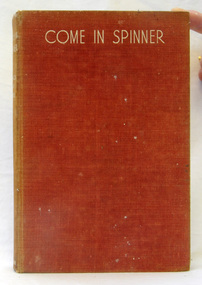 Orbost & District Historical Society
book, Come in Spinner, 1951
... This novel, set in Sydney, Australia at the end of the second World War was an outstanding best seller in its time and was an honest portrayal of society at that time. ...The title refers to a phrase used in the Australian Gambling game of two-up. "Come in spinner" is the call given by the game manager when all bets have been placed and the coins are ready to be tossed.This novel, set in Sydney, Australia at the end of the second World War was an outstanding best seller in its time and was an honest portrayal of society at that time. It is regarded as one of the best Australian novels ever written.A hardback novel with a red cloth cover. The title is printed in gold at the top of the front cover. Written by Dymphna Cusack and Florence James. Published by William Heinemann Ltd. Melbourne.literature come-in-spinner cusack-dymphna james-florence sydney-1950's -
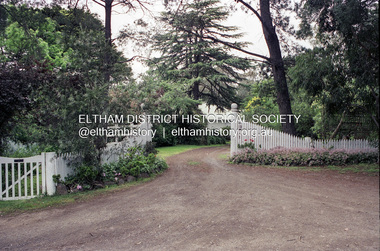 Eltham District Historical Society Inc
Negative - Photograph, Russell Yeoman, Stanhope, 10 Peter Street, Eltham, c.Sep. 2000
... The original property, comprising 15 ½ acres with a frontage on Diamond Creek, was bought in about 1900 by Will Longstaff (b. 1878, d London 1953), official war artist during World War I, who became famous for his painting 'The Ghosts of Menin Gate', France which is now in the Australian War Memorial, Canberra. ...The original property, comprising 15 ½ acres with a frontage on Diamond Creek, was bought in about 1900 by Will Longstaff (b. 1878, d London 1953), official war artist during World War I, who became famous for his painting 'The Ghosts of Menin Gate', France which is now in the Australian War Memorial, Canberra. ...Clem Christesen wrote a brief history of "Stanhope" which was reproduced in EDHS Newsletter No. 162 May 2005. STANHOPE HOUSE is situated on the crest of Stanhope Hill about ten minutes' walk westward from the Eltham railway station and is bounded by Peter, Fay and Stanhope Streets. The original property, comprising 15 ½ acres with a frontage on Diamond Creek, was bought in about 1900 by Will Longstaff (b. 1878, d London 1953), official war artist during World War I, who became famous for his painting 'The Ghosts of Menin Gate', France which is now in the Australian War Memorial, Canberra. The main residence, designed by Desbrowe Annear, was built of jarrah, with stucco walls and floors of Tasmanian hardwood The rooms were panelled with Californian redwood (sequoia). Away from house was a cottage (used as a studio), and stables, dairy and meat house. In 1919 Mr Theo. Handfield bought the property from Mrs Longstaff. On New Year 's Day 1924 most of the estate (eighty blocks) was auctioned. Bishop Reginald Stephen, Warden of Trinity College and distinguished scholar, bought the house and five acres in 1928. Dr and Mrs C.B. Christesen became the new owners in 1946 and subsequently extended the house on the north and south sides. 'Stanhope 'has had many very interesting art and literary associations. When Will Longstaff occupied it - he was a cousin of another well-known painter, Sir John Longstaff- various leading artists of the period, including Walter Withers who lived nearby, were frequent visitors. A son of Mr and Mrs Handfield, John, became a journalist and author, and now lives with his wife Esta at Homestead Road, Eltham. Bishop Stephen was related to Sir Leslie Stephen (1832-1904), one of the great representative minds of Victorian Britain, first editor of the monumental Dictionary of National Biography and father of the famous novelist and essayist Virginia Woolf. John Harcourt, novelist and music critic, rented 'Stanhope 'while he and his wife Fay were building 'Clay Nuneham' (mudbrick) at the foot of Stanhope Hill near the creek. Nina Christesen, academic and founding editor of Melbourne Slavonic Studies, was Head of the Department of Russian Language and Literature, University of Melbourne, from 1946 to 1977. Clem Christesen, poet, short story writer and painter, founded Australia's leading literary journal Meanjin Quarterly in 1940 and remained editor until 1975. Very many distinguished Australian and foreign writers, artists and academics-from Nobel prize-winning novelist Patrick White to the world's leading cellist Mstislav Rostropovich - have visited 'Stanhope ' over the years. The extensive garden is said to be one of the loveliest in Eltham. The main entrance is by way of Diamond and Peter Streets. film - kodak gc 400-6, russell yeoman collection, scan - 35mm negative, bishop stephen, clem christesen, eltham, nina mikhailovna christesen, peter street, stanhope, theo handfield, will longstaff -
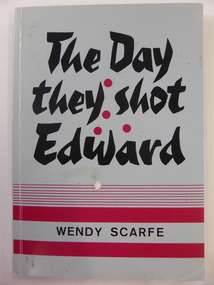 Warrnambool and District Historical Society Inc.
Book, The Day they shot Edward, 1991
... The book has a prologue and the rest of it is a novella set in World War One Australia. The Day they shot Edward Book ...This is a novella by Wendy Scarfe. She is a novelist and writer who lives in Warrnambool with her writer husband Alan Scarfe. She graduated from the University of Melbourne and Melbourne Secondary Teachers’ College and has taught in Australia, England and India. Her final teaching post was at Warrnambool High School. She has published many novels, biographies, volumes of poetry and other books dealing with social issues. This book is important because it was written by a local Warrnambool author, Wendy Scarfe. She has twice been awarded an Australian Council Literature Board Special Purpose Grant and has a fine reputation as a writer. This is a soft cover book of 120 pages. It has a light grey cover with black print and red lines on the front cover and critics’ comments in black print on the back cover. The book has a prologue and the rest of it is a novella set in World War One Australia. Signature inside first page: ‘E.Douglas 8 McKiernan Rd Warrnambool 1992’australian literature, wendy scarfe -
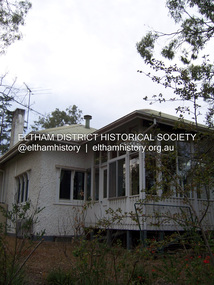 Eltham District Historical Society Inc
Photograph - Digital Photograph, Alan King, Stanhope, Peter Street, Eltham, 15 March 2008
... Australia. In 1946 she established the Department of Russian Language and Literature at The University of Melbourne, which she led until 1977. ...Australia. In 1946 she established the Department of Russian Language and Literature at The University of Melbourne, which she led until 1977. ...On the crest of Stanhope Hill at Peter Street, Eltham, stands the former home of a couple, Clem and Nina Christensen who had a major influence on the literary development of post World War 2 Australia. Covered under Heritage Overlay, Nillumbik Planning Scheme. Published: Nillumbik Now and Then / Marguerite Marshall 2008; photographs Alan King with Marguerite Marshall.; p109 On the crest of Stanhope Hill at Peter Street, Eltham, stands the former home of a couple, who had a major influence on the literary development of post World War Two Australia. In 1946, Clem and Nina Christensen bought the house, which had been designed by Harold Desbrowe Annear, considered to be one of Australia’s most innovative architects in the first quarter of the 20th century.1 That year the stucco building with a metal roof, built in 1910, was extended to the north and south. The main residence was built of jarrah, with stucco walls, floors of Tasmanian hardwood and rooms panelled with Californian redwood (sequoia). The property included a cottage, former stables, a dairy and meat-house. From its beginnings the property has attracted artists and intellectuals. Official World War One artist, Will Longstaff, bought the property – then 15½ acres (6ha) around 1900. Famous for his painting The Ghosts of Menin Gate, now in the Australian War Memorial Canberra, Longstaff was the cousin of another well-known painter, Sir John Longstaff. Several leading artists visited Longstaff at Stanhope including Walter Withers of the Heidelberg School, who lived in Brougham Street, Eltham. In 1919, Theo Handfield, father of author and journalist John Handfield, bought the property from Mrs Longstaff. Then in 1924 the land was subdivided and most of the estate (80 blocks) was auctioned. The next owner was related to novelist Virginia Woolf. Bishop Reginald Stephen, Warden of Trinity College, bought the house and five acres (2 ha) in 1928. He was related to Sir Leslie Stephen, the first editor of the Dictionary of National Biography and Woolf’s father. Novelist and music critic John Harcourt, was the next tenant, while he and his wife Fay, built their mud-brick house Clay Nuneham, at the foot of Stanhope Hill. Dr Clem and Mrs Nina Christensen, lived in the house until their deaths. Clem Christensen – who died aged 91 in 2003 – was a poet, short story writer and painter. However, he is most noted for founding Australia’s foremost literary journal2 Meanjin (originally Meanjin Papers), which he described as ‘democratic left of centre’, in Brisbane in 1940. Clem brought Meanjin to Melbourne in 1945 and remained editor until 1975. Enormously influential, Meanjin spawned and encouraged many of Australia’s best literary talents and it had an international reputation. Meanjin was the first to publish such writers as Judith Wright and David Malouf and it encouraged writers like Patrick White and Peter Carey. Nina Christensen – who died aged 89 in 2001 – was founding Editor of the Melbourne Slavonic Studies Journal and pioneered the study of Russian in Australia. In 1946 she established the Department of Russian Language and Literature at The University of Melbourne, which she led until 1977. Nina’s graduates largely staffed subsequent departments, in other Australian universities.3 However Nina’s Russian heritage and Clem’s outspoken views caused problems. They were forced to defend themselves in the Petrov inspired Royal Commission on Espionage in the 1950s, but were exonerated. The Christensens attracted and hosted many distinguished Australian and foreign writers, artists and academics, including Nobel prize-winning novelist, Patrick White and the world’s then leading cellist, Mstislav Rostropovich.4 Other writers and intellectuals who visited Stanhope were: Vance Palmer, Alan Marshall, A D Hope, Xavier Herbert, Nevil Shute, Geoffrey Dutton, Martin Boyd, Judah Waten, Bruce Grant, Dorothy Hewett and Sir Herbert Read. Painters included: Danila Vassilieff, Arthur Boyd, Albert Tucker, Justus Jörgensen, Robert Hughes and Clifton Pugh. Academics included: Manning Clark, Geoffrey Blainey, W Macmahon Ball, Richard Downing, Geoffrey Serle and scientist Tim Marshall. Politicians included: Jim Cairns, Pauline Toner, Lance Barnard, Sir Paul Hasluck, Sheryl Garbutt and performance artists included: film star Olivia Newton-John, members of the Bolshoi ballet and the Russian State Ballet of Siberia.5 Nina Christensen was honoured in 2006 at the Eltham Living and Learning Centre with the building of an amphitheatre designed by V Sverdlin.This collection of almost 130 photos about places and people within the Shire of Nillumbik, an urban and rural municipality in Melbourne's north, contributes to an understanding of the history of the Shire. Published in 2008 immediately prior to the Black Saturday bushfires of February 7, 2009, it documents sites that were impacted, and in some cases destroyed by the fires. It includes photographs taken especially for the publication, creating a unique time capsule representing the Shire in the early 21st century. It remains the most recent comprehenesive publication devoted to the Shire's history connecting local residents to the past. nillumbik now and then (marshall-king) collection, clem christesen, eltham, nina christesen, peter street, stanhope -
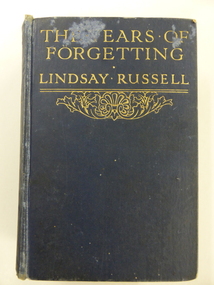 Warrnambool and District Historical Society Inc.
Book, The Years of Forgetting, 1914
... After the First World War she came to live at Mortlake and her novel writing ceased. ...This is a novel written by Ethel Patricia Stonehouse under the name of Lindsay Russell. She was born in Nhill in 1883 and was educated at Charlton State School. From 1894 on she wrote verse and short stories and worked as a journalist in Melbourne. She published her first novel in Melbourne in 1912 and lived for a time in London where she met Dr John Scott whom she married in 1914. After the First World War she came to live at Mortlake and her novel writing ceased. Most of her novels are about women rebelling –against Catholicism, Calvinism, the English class system and the restraints of marriage. Her railings against the Catholic Church and the oppression of women caused her to be a controversial figure, especially in Mortlake, but she was a popular novelist with one of her books, ‘Smouldering Fires’, selling over 100,000 copies in Australia alone. She died in 1964. No details on the inscription or the recipient of the book, ‘Isie’ have been found. The name, ‘Glasgow’ suggests that the book at some stage was connected with the Glasgow family of Wangoom. They were important local dairy farmers and cheese makers in the late 19th and early 20th centuries.This book is of great interest because it was written by an Australian woman and one who lived for many years in Mortlake, a town close to Warrnambool. The connection with the Glasgow family is also of interest. This is a hard cover book of 320 pages. The book has a dark blue cover with gold lettering on the front cover and spine and some gold scroll work on the front cover. The book has a Prologue and 22 chapters and contains advertisements at the front and the back of the book for other books published by Ward, Lock & Co. There is a black and white illustration at the front of the book with a piece of tissue paper covering it. The page at the front of the book that contains an inscription is detached. The inscription and another annotation are written in black ink. The cover is partly detached from the pages and the cover is marked and worn. ‘To Isie Wishing her many happy returns of the day From Father, 15-9-14’ ‘Glasgow’ lindsay russell, ethel stonehouse, history of mortlake, australian literature, warrnambool history, glasgow family -
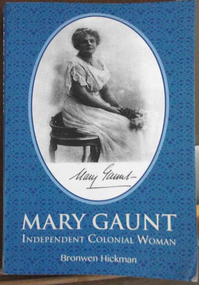 Warrnambool and District Historical Society Inc.
Book, Bronwen Hickman, Mary Gaunt: independent colonial woman, 2014
... She spent the last few years of life in the Italian Riviera and then, with the outbreak of World War Two she fled to France where she died. ...Biography of novelist and travel writer, Mary Gaunt (1862-1942)This is a soft cover book of 304 pages. It has a blue cover with a black and white photograph of Mary Gaunt in an oval shape on the front cover. There is white lettering on the front cover and black lettering in an oval shape on the back cover. The book has an introduction, 35 chapters, acknowledgements, endnotes, a list of publications and an index. It has several illustrations, sketches, maps and black and white and colour photographs,non-fictionBiography of novelist and travel writer, Mary Gaunt (1862-1942)mary gaunt, australian literature, history of warrnambool -
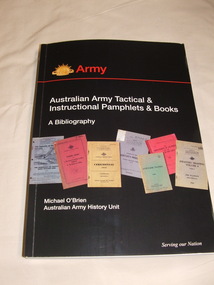 4th/19th Prince of Wales's Light Horse Regiment Unit History Room
Book, Army History Unit, Australian Army Tactical & Instructional Pamphlets & Books - A Bibliography, 2017
... This second edition charts the evolution of doctrine development in the Australian Army by detailing a list of instructional and tactical literature of the Army and its precursor pre-Federation Australian colonies. ...Bibliography Tactical & Instructional Pamphlets & Books Military Education ISBN 978-0-9946046-8-2 This second edition charts the evolution of doctrine development in the Australian Army by detailing a list of instructional and tactical literature of the Army and its precursor pre-Federation Australian colonies. ...This second edition charts the evolution of doctrine development in the Australian Army by detailing a list of instructional and tactical literature of the Army and its precursor pre-Federation Australian colonies. The bibliography demonstrates the range of subject areas that Army has addressed over its history, including such esoteric issues as censorship, the evolution of Signals training, accreditation of war correspondents & the management of enemy POW and repatriation of Australians taken POW.ISBN 978-0-9946046-8-2bibliography, tactical & instructional pamphlets & books, military education -
4th/19th Prince of Wales's Light Horse Regiment Unit History Room
Booklet, Australian Army Journal Atomic Digest No 1, Nov 1955
... nuclear war A paper covered booklet being a periodic review of military literature featuring series of articles on nuclear tactics, explosions, physical effects, effects on military operations and medical effects. 2 copies Australian Army Journal Atomic Digest No 1. ...A paper covered booklet being a periodic review of military literature featuring series of articles on nuclear tactics, explosions, physical effects, effects on military operations and medical effects. 2 copiesnuclear war -
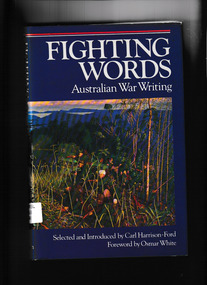 Monbulk RSL Sub Branch
Book, Carl Harrison-Ford, Fighting words: Australian war writing, 1986
... australian literature - war stories war literary collections A collection of short stories on Australian war writing from the Boer war to the Vietnam war ill, p.362. ...A collection of short stories on Australian war writing from the Boer war to the Vietnam warill, p.362.non-fictionA collection of short stories on Australian war writing from the Boer war to the Vietnam waraustralian literature - war stories, war literary collections -
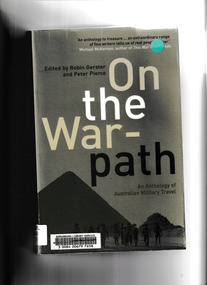 Monbulk RSL Sub Branch
Book, Robin Gerster, On the war-path, 2004
... war and literature - australia...war and literature - australia travel writing - military - australia This anthology reveals the many ways in which going to war has formed a cultural bridge between Australia and the world. ...This anthology reveals the many ways in which going to war has formed a cultural bridge between Australia and the world. From the Sudan in 1885 to Afghanistan in 2001, the connection of war to travel is illustrated in the observations of many writers.notes, 350.p.non-fictionThis anthology reveals the many ways in which going to war has formed a cultural bridge between Australia and the world. From the Sudan in 1885 to Afghanistan in 2001, the connection of war to travel is illustrated in the observations of many writers.war and literature - australia, travel writing - military - australia -
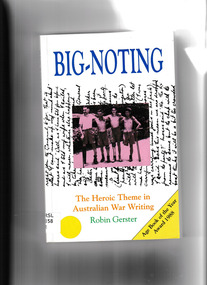 Monbulk RSL Sub Branch
Book, Robin Gerster, Big-noting: The historic theme in Australian war writing, 1992
... war and literature - australia...war and literature - australia literary criticism - australia This book explores the propagandist tendency in Australian war writing in promoting nationalist tendencies. ...This book explores the propagandist tendency in Australian war writing in promoting nationalist tendencies.Index, Notes, ill (b/w), p.258.non-fictionThis book explores the propagandist tendency in Australian war writing in promoting nationalist tendencies.war and literature - australia, literary criticism - australia -
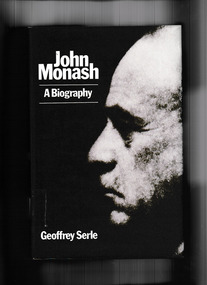 Monbulk RSL Sub Branch
Book, Geoffrey Serle, John Monash: A Biography, 1981
... World War 1914-1918 - Generals - Biography John Monash - Biography The military valor, scholarship, and entrepreneurial leadership of Sir John Monash are recounted in this biography of one of Australia's most famous public figures. ...The military valor, scholarship, and entrepreneurial leadership of Sir John Monash are recounted in this biography of one of Australia's most famous public figures. While his academic prowess in the fields of literature, music, theater, language, and Jewish scholarship distinguished him at the University of Melbourne, Monash gained national fame during World War I when he was one of the few senior allied generals to emerge from Gallipoli with his reputation unscathed. His pioneering use of reinforced concrete, leadership of the state electricity commission, and work to secure the Gippsland's huge brown coal deposits were signatures of his domestic economic leadership. This revealing portrait provides a glimpse of the intensely personal and introspective man behind the confident leader.Index, ill, maps, p.600.non-fictionThe military valor, scholarship, and entrepreneurial leadership of Sir John Monash are recounted in this biography of one of Australia's most famous public figures. While his academic prowess in the fields of literature, music, theater, language, and Jewish scholarship distinguished him at the University of Melbourne, Monash gained national fame during World War I when he was one of the few senior allied generals to emerge from Gallipoli with his reputation unscathed. His pioneering use of reinforced concrete, leadership of the state electricity commission, and work to secure the Gippsland's huge brown coal deposits were signatures of his domestic economic leadership. This revealing portrait provides a glimpse of the intensely personal and introspective man behind the confident leader. world war 1914-1918 - generals - biography, john monash - biography -
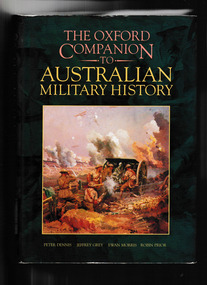 Monbulk RSL Sub Branch
Book, Oxford University Press, The Oxford companion to Australian military history, 1995
... The roles of industry, science and technology are analysed, and a series of essay-length articles discusses key aspects of our military legacy, including military humour and the impact of war on Australian film, television and literature. ...This landmark book explores the richness and diversity of Australian military history, which has had a profound impact on the development of Australia. The two world wars - destructive yet often ennobling commitments for the young nation - have been the most important experiences for several generations of Australians, but military considerations and obligations have had a pervasive influence throughout Australian history. Just as it would be impossible to form a proper understanding of that history without due consideration of Gallipoli, the Kokoda Track, and conscription, it would be difficult to exaggerate the abiding influence of the 'digger' and the Anzac legend. From the beginnings of European settlement and the violence that accompanied it, to the more recent engagement of Australian forces in the Gulf War and peace-keeping operations in Africa, military questions have been a constant theme in the story of Australia. Anzac and Gallipoli are well-known names in the consciousness, but they can only be fully appreciated if examined in a wider context. This book does just that, providing a detailed analysis of Australian military achievements and an assessment of the importance of war in Australian history. The Oxford Companion to Australian Military History covers all aspects of this complex and fascinating subject. It contains more than 800 individual entries, written by leading military historians. All the major campaigns and battles are examined, along with significant military and civilian figures, such as Thomas Blamey, John Monash, John Curtin, Albert Jacka and Charles Bean. There are articles on weapons and weapons systems and on the development of the individual services and their component parts. The roles of industry, science and technology are analysed, and a series of essay-length articles discusses key aspects of our military legacy, including military humour and the impact of war on Australian film, television and literature. Here, then, is the most comprehensive guide to Australian military history, ranging from the colonial period to the 1990s. The Companion is supplemented by 100 photographs and by more than 30 maps. It is an indispensable source for students, specialists and general readers alike. Collapse summaryBibliography, ill, maps, p.692.non-fictionThis landmark book explores the richness and diversity of Australian military history, which has had a profound impact on the development of Australia. The two world wars - destructive yet often ennobling commitments for the young nation - have been the most important experiences for several generations of Australians, but military considerations and obligations have had a pervasive influence throughout Australian history. Just as it would be impossible to form a proper understanding of that history without due consideration of Gallipoli, the Kokoda Track, and conscription, it would be difficult to exaggerate the abiding influence of the 'digger' and the Anzac legend. From the beginnings of European settlement and the violence that accompanied it, to the more recent engagement of Australian forces in the Gulf War and peace-keeping operations in Africa, military questions have been a constant theme in the story of Australia. Anzac and Gallipoli are well-known names in the consciousness, but they can only be fully appreciated if examined in a wider context. This book does just that, providing a detailed analysis of Australian military achievements and an assessment of the importance of war in Australian history. The Oxford Companion to Australian Military History covers all aspects of this complex and fascinating subject. It contains more than 800 individual entries, written by leading military historians. All the major campaigns and battles are examined, along with significant military and civilian figures, such as Thomas Blamey, John Monash, John Curtin, Albert Jacka and Charles Bean. There are articles on weapons and weapons systems and on the development of the individual services and their component parts. The roles of industry, science and technology are analysed, and a series of essay-length articles discusses key aspects of our military legacy, including military humour and the impact of war on Australian film, television and literature. Here, then, is the most comprehensive guide to Australian military history, ranging from the colonial period to the 1990s. The Companion is supplemented by 100 photographs and by more than 30 maps. It is an indispensable source for students, specialists and general readers alike. Collapse summary australia - armed forces - history, australia - armed forces - encyclopaedias
