
Showing 231 items matching "war camp 2"
-
 Tatura Irrigation & Wartime Camps Museum
Book, Die Kannen Von Nepal
... camp 2...tatura...war...Leonhard Adam studied both Anthropology and Jurisdiction as a young man die kannen von nepal adam l adam murvitz mc camp 2 tatura war camp 2 books Olive green hard card board cover, navy binding on the spine, gold printing. ...Dr. Leonhard Adam studied both Anthropology and Jurisdiction as a young manOlive green hard card board cover, navy binding on the spine, gold printing. Written in Germandie kannen von nepal, adam l, adam murvitz mc, camp 2, tatura, war camp 2, books -
Tatura Irrigation & Wartime Camps Museum
Booklet, Inheritance Law in Primitive Cultures, 1935
... war camp 2...Leonhard Adam studied both Antoropology and Jurisdiction as a young man war camp 2 books history local Soft yellow covered booklet with black printing. ...Dr. Leonhard Adam studied both Antoropology and Jurisdiction as a young manSoft yellow covered booklet with black printing.war camp 2, books, history, local -
Tatura Irrigation & Wartime Camps Museum
Booklet, Zwischen Kreuz und Monolith
... war camp 2...Dr Leonhard Adam studied both Anthropology and Jurisdiction as a young man war camp 2 books history local Green cardboard cover booklet. ...Dr Leonhard Adam studied both Anthropology and Jurisdiction as a young manGreen cardboard cover booklet. Small sticker on the front with black printing. German textwar camp 2, books, history, local -
Tatura Irrigation & Wartime Camps Museum
Document, F. H. Prager & Co, Personal recollections, June 1988
... Personal Recollections - internees and prisoners of war - World War 2 camps... - World War 2 camps a grey plastic folder, black spine and on white paper is the inscription as indicated below. ...It tells of the 3 brothers Prager, the expansion of their business and internment. 3 pages. the next 3 pages are in German. The following page Nicola & Giovanni Cua camp 2. Nicolas revisits camp 2 1991. Next page a Japanese internee told by his daughter Fujiko Kawaguchi and the remainder excerpts from archives. Also a couple of pages in German, hand written and typed.a grey plastic folder, black spine and on white paper is the inscription as indicated below.Personal Recollections - internees and prisoners of war - World War 2 campsprager brothers, fujiko kawaguchi, nicola cua -
 Tatura Irrigation & Wartime Camps Museum
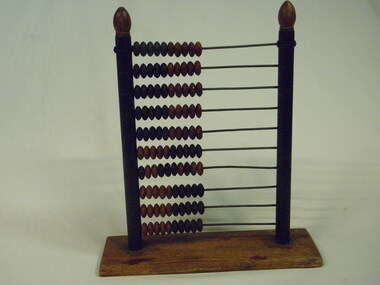
Abacus, Between 1939-1945
... Camp 3 was one of the Tatura Group of civilian & prisoner of war internment camps during World War 2. ...Camp 3 was one of the Tatura Group of civilian & prisoner of war internment camps during World War 2. ...Camp 3 was one of the Tatura Group of civilian & prisoner of war internment camps during World War 2. Camp 3 was a civilian 'family' camp. The abacus was made by a German internee, for his son in the camp. It was made from scrap materials found in and around the camp & the beads & other wooden parts of the abacus were turned on a lathe also constructed by the internees. Wood & metal abacus with wooden base, sides & beads (100), & metal rails. Wood painted red & black. camp 3, tatura, internment camps, civilian internees -
 Federation University Historical Collection
Book, Back to Bacchus Marsh, 1957, 1957
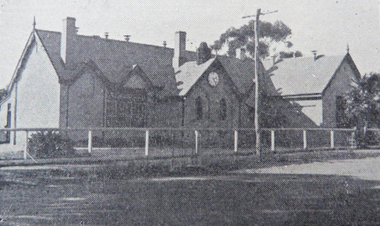
... The book includes an historical essay, Maddingley Brown Coal, World war 11, Darley Military Camp, Darley Firebrick Co., industrial changes and numerous advertisements. Images include: * Grant Street Avenue *St Bernard's new Parish Hall and Schoolrooms * Maddingley No. 2 Cut * Terracing at Maddingley - part of the beautification scheme at Maddingley * Hospital entrance with War memorial Feature * Old Woolpack Inn * Jim Pyke * Infant Welfare and pre-School Centre, Young St * Bacchus Marsh Main Street looking East, 1872 * Andrew George Scott, alias Captain Moonlight * Grant Street Avenue * Ballarat State School No 28 featuring the World War One Memorial Clock ...A back to Bacchus Marsh was held from 12 to 20 October 1957. maddingley brown coal world war 11 old woolpack inn darley military camp darley firebrick jim pyke andrew george scott captain moonlite bacchus marsh world war bacchus marsh state school no 28 grant street avenue bacchus marsh war memorial hospital bacchus marsh avenue of honour Captain Bacchus Brown covered book of 28 pages including the official programme for back to Bacchus Marsh, 1957. The book includes an historical essay, Maddingley Brown Coal, World war 11, Darley Military Camp, Darley Firebrick Co., industrial changes and numerous advertisements. Images include: * Grant Street Avenue *St Bernard's new Parish Hall and Schoolrooms * Maddingley No. 2 ...A back to Bacchus Marsh was held from 12 to 20 October 1957.Brown covered book of 28 pages including the official programme for back to Bacchus Marsh, 1957. The book includes an historical essay, Maddingley Brown Coal, World war 11, Darley Military Camp, Darley Firebrick Co., industrial changes and numerous advertisements. Images include: * Grant Street Avenue *St Bernard's new Parish Hall and Schoolrooms * Maddingley No. 2 Cut * Terracing at Maddingley - part of the beautification scheme at Maddingley * Hospital entrance with War memorial Feature * Old Woolpack Inn * Jim Pyke * Infant Welfare and pre-School Centre, Young St * Bacchus Marsh Main Street looking East, 1872 * Andrew George Scott, alias Captain Moonlight * Grant Street Avenue * Ballarat State School No 28 featuring the World War One Memorial Clock maddingley brown coal, world war 11, old woolpack inn, darley military camp, darley firebrick, jim pyke, andrew george scott, captain moonlite, bacchus marsh, world war, bacchus marsh state school no 28, grant street avenue, bacchus marsh war memorial hospital, bacchus marsh avenue of honour, captain bacchus -
 Federation University Historical Collection
Photograph - black and white, Cam Williamson, AIF Soldiers Making Afternoon Tea, c1916
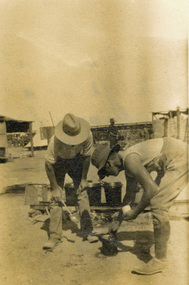
... Chatham family Archive Chatham Holmes World War World War 1 world War I World war One France Suez Ferry Post billy tea .1) Verso: Harry [Holmes] and Gordon [Spittle] make afternoon tea for Cam, who snaps them in tea-making operation. (Ferry Post, Ismailia, Egypt). .2) S.G.S. [S. Gordon Spittle] and Harry [Holmes] making coffee to entertain Cam Williamson on his first visit to our camp ...This photo was taken at Ferry Post, Suez Canal. .2) Two Australian Soldiers around a camp fire at Ferry Post boil a billy for tea..1) Verso: Harry [Holmes] and Gordon [Spittle] make afternoon tea for Cam, who snaps them in tea-making operation. (Ferry Post, Ismailia, Egypt). .2) S.G.S. [S. Gordon Spittle] and Harry [Holmes] making coffee to entertain Cam Williamson on his first visit to our camp. The hat hides Harry's face. These snaps are taken by Cam's Kodak."chatham family archive, chatham, holmes, world war, world war 1, world war i, world war one, france, suez, ferry post, billy tea -
 Federation University Historical Collection
Photograph - sepia, Australian Army Camp, 20 20/05/1916
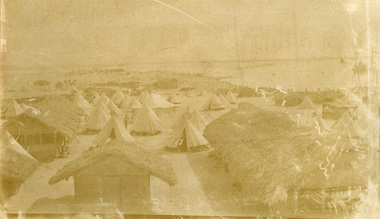
... Suez Canal Chatham family Archive Chatham Holmes World War World War 1 world War I World War One Suez Canal .2) General view of our present Camp. Suez Canal. 20-5-'16. ...Suez CanalImage of an Australian army camp site at Suez Canal during World War One..2) General view of our present Camp. Suez Canal. 20-5-'16. Harry [Holmes]chatham family archive, chatham, holmes, world war, world war 1, world war i, world war one, suez canal, -
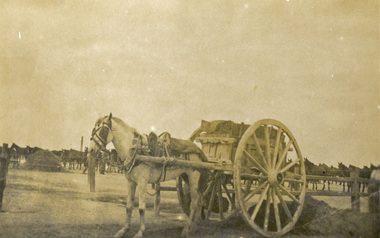 Federation University Historical Collection
Postcard - Sepia, A Horse and Cart Carry Manure at Metras Camp, c1916
... (http://www.aif.adfa.edu.au:8888/about3.html) Chatham family Archive Chatham Holmes World War World War 1 world War I World war One Egypt Ascot .1) verso - 'Taken at Metras Camp' .2) verso - 'A native horse and cart carting manure at horse lines.' ...The photograph is associated with Harry Holmes who was a member of the Australian Imperial Force based in Egypt at the time. Egypt was a major base for the AIF from December 1914. A number of campaigns were fought in this theatre. There were two campaigns involving the AIF. Note that not all the fighting was actually geographically in Egypt. (http://www.aif.adfa.edu.au:8888/about3.html)Two postcards showing Australian army camp at Metras Camp, Egypt .1) A soldier sits on a horse in front of a cart. Lines of horses are in the background behind a post and rail fence. .2 A horse is hitched to a manure cart at Metras Camp, Egypt. Lines of horses are in the background. .1) verso - 'Taken at Metras Camp' .2) verso - 'A native horse and cart carting manure at horse lines.'chatham family archive, chatham, holmes, world war, world war 1, world war i, world war one, egypt, ascot -
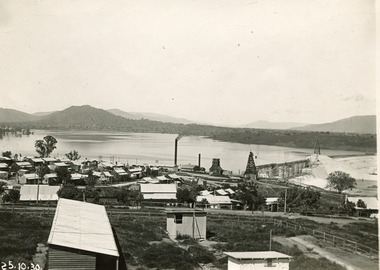 The Beechworth Burke Museum
Photograph, 25 October 1930
... The Dam was named after Hamilton Hume, who is an important historical figure for this area as he helped discover the area where resources were found. construction houses veterans Mitta Junction Village Hume Dam World War I Federation Wodonga Archaeological survey excavation Austral Archaeology Department of Land & Water Conservation Camp Ganger's Quarter's Stableman's Quarters Industrial Dump artefacts Mitta Mitta Mount Welcome Mount Misery Murray River Hamilton Hume William Hilton Hovell Hume and Hovell expedition Reverse: 1997.3145/ 84-20-2 Black and white rectangular photograph printer unmounted Photograph Photograph ...Taken on 25 October 1930, various houses with the Hume Dam under construction are depicted in the background. The construction of the Hume Dam took place from 1919 to 1936. At the time of construction, it was the second largest dam in the world. It was also one of the earliest civil projects developed after the Federation. Some of the Dam workers consisted of World War I veterans. Dam workers often settled their families in Mitta Junction Village and Wodonga. Archaeological surveys were completed by Austral Archaeology, which was done when the Department of Land & Water Conservation was doing work to improve Hume Dam. The archaeological report that came out of the survey recommended three sites of interest where archaeological excavation should be done: Camp Ganger’s Quarters, Stableman’s Quarters, and the Industrial Dump. The excavation uncovered artefacts. Mitta Mitta: Mitta Mitta is situated between Mount Welcome and Mount Misery. It is named after the river that explorers Hume and Hovell discovered in 1824. The town would eventually become a huge gold mining town. Mitta Mitta is called Midamodunga by the local Indigenous peoples Wodonga: Wodonga is situated on the Murray River and is part of North East Victoria. Hume and Hovell: Hamilton Hume (1979-1873) and William Hilton Hovell (1786-1875). W. H. Hovell was born in Norfolk England and Hume was born in Parramatta, New South Wales Hovell and Hume undertook an exploration journey in 1824 and thought they discovered a river, which turned out to be the Murray River. They returned home in 1825, but returned to the area in 1826 and discovered coal in the area. This photo is historically significant as it shows the Hume Dam under construction in 1930. The Dam was named after Hamilton Hume, who is an important historical figure for this area as he helped discover the area where resources were found. Black and white rectangular photograph printer unmountedReverse: 1997.3145/ 84-20-2construction, houses, veterans, mitta junction village, hume dam, world war i, federation, wodonga, archaeological survey, excavation, austral archaeology, department of land & water conservation, camp ganger's quarter's, stableman's quarters, industrial dump, artefacts, mitta mitta, mount welcome, mount misery, murray river, hamilton hume, william hilton hovell, hume and hovell expedition -
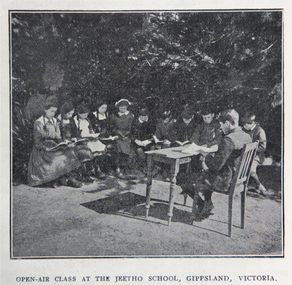 Federation University Historical Collection
Book, Victoria Education Gazette and Teachers' Aid, 1911-1919, 1910-1919
... Black hard covered book with red spine, holding Victorian Education Gazettes for one calendar year. .1) 1910 .2) 1912 .3) 1911 .4) 1914 .5) 1918 Images: Open Air Classroom Black Rock; Open Air Classroom, Jeetho, Gippsland; Open Air Nurses bedroom, Mildura; Gym at Canterbury School ; Babies and Nurses at Melbourne Foundling Hospital; Camp at Portland; Alexander Peacock Opens a Melbourne School; Unveiling Major Mitchell Memorial at Mt Arapiles; Agricultural Plot; School Interior; Swimming Drill; Graham Dux Prize Board; Bathing Place; Classroom with blackboard and pictures; Major Mitchell's Map; Melbourne, Derbyshire; Market Place Melbourne; The Blackwood; World War One Send-off at The Athenaeum; Scarsdale Old Boy's logo; Sloyd articles for the Field Hospital; World War One; Gifts for Transport to the Wharf; soldiers; ANZAC Day; ANZAC Day Medalion .5) 1915: Education Department's War Relief Fund, William Park obituary, Closer Settlement Act 1912, Agriculture, needlework, Swimming and Life Saving, explorers, Gregory Blaxland, Matthew Flinders, Composition, Geography, potatoes, onions, gardens, Needlework for Infants, Iona and Staffa, Trained Primary Teacher's Course, Electricity, Electrical Technology, hygiene, Arbour Day, Horticulture, Wattle Day, Bird Day, Technical Schools, Landing at Gaba Tepe, Evils of Alcohol, Old Boys of Scarsdale, Belgium, Teachers' College Images: The British at War, The Sonnet, History and Patriotism, Male Swimming Teachers Summer School at Geelong, Women Swimming Teachers at Port Fairy, Buln Buln State School, Burwood East State School, needlework plans, methods of Rescue and Resucitation. plan of the journey of Gregory Blaxland, Macquarie House, teachers killed (William Ross Hoggart, Stanley Robert Close, William Roy Hodgson, Campbell McDiarmid Peter, William Henry Dawkins, William Hugh Hamilton, Frederick McRae Neal, Vernon Brookes, Frank J. ...Bailey Black hard covered book with red spine, holding Victorian Education Gazettes for one calendar year. .1) 1910 .2) 1912 .3) 1911 .4) 1914 .5) 1918 Images: Open Air Classroom Black Rock; Open Air Classroom, Jeetho, Gippsland; Open Air Nurses bedroom, Mildura; Gym at Canterbury School ; Babies and Nurses at Melbourne Foundling Hospital; Camp at Portland; Alexander Peacock Opens a Melbourne School; Unveiling Major Mitchell Memorial at Mt Arapiles; Agricultural Plot; School Interior; Swimming Drill; Graham Dux Prize Board; Bathing Place; Classroom with blackboard and pictures; Major Mitchell's Map; Melbourne, Derbyshire; Market Place Melbourne; The Blackwood; World War One Send-off at The Athenaeum; Scarsdale Old Boy's logo; Sloyd articles for the Field Hospital; World War One; Gifts for Transport to the Wharf; soldiers; ANZAC Day; ANZAC Day Medalion .5) 1915: Education Department's War Relief Fund, William Park obituary, Closer Settlement Act 1912, Agriculture, needlework, Swimming and Life Saving, explorers, Gregory Blaxland, Matthew Flinders, Composition, Geography, potatoes, onions, gardens, Needlework for Infants, Iona and Staffa, Trained Primary Teacher's Course, Electricity, Electrical Technology, hygiene, Arbour Day, Horticulture, Wattle Day, Bird Day, Technical Schools, Landing at Gaba Tepe, Evils of Alcohol, Old Boys of Scarsdale, Belgium, Teachers' College Images: The British at War, The Sonnet, History and Patriotism, Male Swimming Teachers Summer School at Geelong, Women Swimming Teachers at Port Fairy, Buln Buln State School, Burwood East State School, needlework plans, methods of Rescue and Resucitation. plan of the journey of Gregory Blaxland, Macquarie House, teachers killed (William Ross Hoggart, Stanley Robert Close, William Roy Hodgson, Campbell McDiarmid Peter, William Henry Dawkins, William Hugh Hamilton, Frederick McRae Neal, Vernon Brookes, Frank J. ...Black hard covered book with red spine, holding Victorian Education Gazettes for one calendar year. .1) 1910 .2) 1912 .3) 1911 .4) 1914 .5) 1918 Images: Open Air Classroom Black Rock; Open Air Classroom, Jeetho, Gippsland; Open Air Nurses bedroom, Mildura; Gym at Canterbury School ; Babies and Nurses at Melbourne Foundling Hospital; Camp at Portland; Alexander Peacock Opens a Melbourne School; Unveiling Major Mitchell Memorial at Mt Arapiles; Agricultural Plot; School Interior; Swimming Drill; Graham Dux Prize Board; Bathing Place; Classroom with blackboard and pictures; Major Mitchell's Map; Melbourne, Derbyshire; Market Place Melbourne; The Blackwood; World War One Send-off at The Athenaeum; Scarsdale Old Boy's logo; Sloyd articles for the Field Hospital; World War One; Gifts for Transport to the Wharf; soldiers; ANZAC Day; ANZAC Day Medalion .5) 1915: Education Department's War Relief Fund, William Park obituary, Closer Settlement Act 1912, Agriculture, needlework, Swimming and Life Saving, explorers, Gregory Blaxland, Matthew Flinders, Composition, Geography, potatoes, onions, gardens, Needlework for Infants, Iona and Staffa, Trained Primary Teacher's Course, Electricity, Electrical Technology, hygiene, Arbour Day, Horticulture, Wattle Day, Bird Day, Technical Schools, Landing at Gaba Tepe, Evils of Alcohol, Old Boys of Scarsdale, Belgium, Teachers' College Images: The British at War, The Sonnet, History and Patriotism, Male Swimming Teachers Summer School at Geelong, Women Swimming Teachers at Port Fairy, Buln Buln State School, Burwood East State School, needlework plans, methods of Rescue and Resucitation. plan of the journey of Gregory Blaxland, Macquarie House, teachers killed (William Ross Hoggart, Stanley Robert Close, William Roy Hodgson, Campbell McDiarmid Peter, William Henry Dawkins, William Hugh Hamilton, Frederick McRae Neal, Vernon Brookes, Frank J. Olle, Alfred J. Collins, Ernest R. Fairlie, William J. McLaren, A.E. Smith, Thomas Patton, Francis W. Kemp, Frederick G. Hall, Rupert O. Hepburn, Woolston J. Govan), Frederick Harold Tubb VC, Botanic Gardens Red Gum, Shelter Pavillions, Head of Wheat, Australian Commonwealth Flag, Iona Cathedral, Drawing exercises, ANZAC Madallion, School Rolls of Honor .6) 1916 - Nature Study, war relief, school gardening, horticulture, singing class, geography of the war, School Rolls of Honour, Ponsonby Carew-Smyth, Astronomy, ANZAC Day, Empire Day, Arbor Day, "Some Suul of Goodness in Things Evil" by Frank Tate, War Relief Gardeners' League, ANZAC Day medallion, Solar System, Abolition of German Schools in Victoria, ANZAC Avenues, avenues of honour, Geography of the War: The West, War relief and handwork, Victorian State Schools Horticultural Society, Patrick Maloney obituary, formalin lamps, Victoria League of Victoria, Wonwondah East Roll of Honor Images - Teachers killed (John Clarke, A.C.H. Jackson, Alexander Robertson, Noel Gambetta, Ralp E. Leyland, Laurance J. Woodruff, Walter E. Cass, Percy D. Moncur, Thomas M. Carmichael, Edward G. Brain, Reginald N.F. Woods, George E. James, William Colvin, David Dobson, Stanley L. Robinson, Charles Allen, G.E. James, H.F. Curnow, Franl L. Cousins, James R. Thompson, Henry H. Campbell, George E. Read, Ernest D. Morshead, Wilfred S. Merlin, Henry R. Wright, George B. Webb, Noel Nicholas, David H. Thomas, Charles A. Levens, Thomas R. Fenner, John M. Daniell, P.J. Larkin, Ralph Smith, Philip Ormsby), school rolls of honour, Swimming Instructors at Queenscliff, The Southern Sky, Map of the North Sea and its Littorals, Easter School of Horticulture at Oakleigh, Map of the Eastern Front, Map of Mesopotamia, Map of the War Area in the Egyptian Campaign, leeches for the Melbourne Hospital .7) 1917 - Swimming and Life-Saving, Childre's FLower Day, Education Department's War Relief Fund, State War Council, Horticulture, Bird Day, Swimming, Growing Chicory at Cowes Images - Teachers killed during World War One (G.M. Nicholas, William C.W. Spencer, J.W.C. Profitt, Ivon C. Bromilow, John Colwell, Robert W. Campbell, Arthur P. Bourchier, Francid G. Houston, Claude N. Harrison, Edgar Williams, Leslie A. Stevens, Charles E. W. Chester, Stanley R. Green, Walter Baker, Arthur G. Scott, Harry L. Swinburne, Horace W. Brown, Arnold Bretherton, Edward W. Jenkins Aubrey Liddelow, Ewen A. Cameron, Edmund R. Lyall, John H. Martin, Harry Bell, Frank L. Nicholls, Melville R. Hughes, Edwin W. Hauser, Walter S. Filmer, Walter G. Barlow, Henry A. Donaldson, Edward H. Jones, Walter W. Raw, Alfred W. Dean, Wiliam Lea, Frederick G. Drury, J.T. Richards, Norman G. Pelton, Lance-Corporal Doran, Kenneth F. McKenzie, William F. Robertson, Wiliam Jarrott, Norman Graham, George G. Paul, Victor Green, Arthur William Rennie, Alfred J. Glendinning, Robert B. Liston, Eward P. Toll, George Jones, Errol E. Rodda, Christian P. Christensen, Charles F. Sydes, H.G. Clements, Norman C. Fricker, J.M. Romeo. Eric N. Lear, Thomas J. Bartley, Norval Birrell, Frederick H. Tubb. J.T. Hamilton Aram, Arthur Wilcock, William M. Conroy, Alex. H. Miller, Patrick J. Cunningham, Charles S. Mitchell, John R. Maddern, James Roadknight, Harry Arundel, Jack C. McKellar, duncan M. McKellar, George S. Manfield, Edgar C. Holmes, George A. Young, Raymond A. Gardiner, William B. Bell, William Opie, George R. Scott, Richard V.B. Vine, Herbery S. Marshall, Hugh St Omer Dentry, George B. Fullerton, Harry Oulton, Iva F. Morieson), School Honor Books, Drawing, Presentation of 30,000 pounds to the British Red Cross at Melbourne Town Hall .8) 1918 .9) 1919 - Photographs of World War One soldiers from the Education Department, Margaret Montgomery Memorial, 1918 Act relating to State School Teachers, State Scolarships, Victorian State Schools' Horticultural Society, Pneumonic Influenza, Spanish Flu, epedemic, swimming and life savinfJunior cadet training, vacancies in Fiji, School Committees, Arbor Day, Arbour Day, Henry Harding of Yinnar, Planting Trees and Shrubs, Juvenile Crime, The use of 'Get', Soldier-Teachers from Overseas in Congress London, Australia's Effort in the War, Military, Working Bees, Tree Planting, fence building, Welcoming Home a Returned Soldier, Avenue of Honour planting, Discipline, Unveiling an Honor Board, School gymnasium, school tennis court, E. E. Crogger grave at Aldershot, The School Honor Book. War Relief Fund, Commonwealth War Record, Caulfield Military Hosptial, ANZAC Day Pilgrimage, Jimmie Panikin, Donald Fraser, Arthur Mee, Card Sun Dial, Balboa Day in Honolulu, William Hamilton, Alfred Jackson, The Backward Child, Flies, Language Teaching and Learning, Spelling, The Education of the Adolescent, victorian education gazette, education gazette and teachers' aid, sloyd, william a. cavanagh, james i froebel, school, education, world war one, memorials, alfred williams, exploration and settlement, cadets, australian naval college, bernard o;dowd, birds, swimming, drawingempire league, eucalypts, paper in history, forestry, arbor day, identification of trees, forestrey museums, fiji, gravel hill school band, horticulture, hygiene, gould league of bird lovers, life saving, la perouse, bandin, j. holland, w. hamilton, charles sturt, principles of archimedes, james holland, william hamilton, scarsdale old boys' reunion, foundling home melbourne, montessori education, open air schools, james hughes, marie corelli, flinders sydney harbour, major mitchell's map, tooth brushing, r.h.s. bailey -
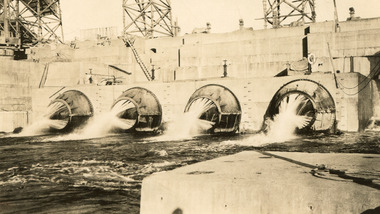 The Beechworth Burke Museum
Photograph, c1930
... The Dam was named after Hamilton Hume, who is an important historical figure for this area as he helped discover the area where resources were found. construction houses veterans Mitta Junction Village Hume Dam World War I Federation Wodonga Archaeological survey excavation Austral Archaeology Department of Land & Water Conservation Camp Ganger's Quarter's Stableman's Quarters Industrial Dump artefacts Mitta Mitta Mount Welcome Mount Misery Murray River Hamilton Hume William Hilton Hovell Hume and Hovell expedition Reverse: 84-19-2/ 1997.3188/ These are the four / release valves they are / not always open (illegible) this / when closed the water flows / over the spillway. ...Taken on 25 October 1930, various houses with the Hume Dam under construction are depicted in the background. The construction of the Hume Dam took place from 1919 to 1936. At the time of construction, it was the second largest dam in the world. It was also one of the earliest civil projects developed after the Federation. Some of the Dam workers consisted of World War I veterans. Dam workers often settled their families in Mitta Junction Village and Wodonga. Archaeological surveys were completed by Austral Archaeology, which was done when the Department of Land & Water Conservation was doing work to improve Hume Dam. The archaeological report that came out of the survey recommended three sites of interest where archaeological excavation should be done: Camp Ganger’s Quarters, Stableman’s Quarters, and the Industrial Dump. The excavation uncovered artefacts. Mitta Mitta: Mitta Mitta is situated between Mount Welcome and Mount Misery. It is named after the river that explorers Hume and Hovell discovered in 1824. The town would eventually become a huge gold mining town. Mitta Mitta is called Midamodunga by the local Indigenous peoples Wodonga: Wodonga is situated on the Murray River and is part of North East Victoria. Hume and Hovell: Hamilton Hume (1979-1873) and William Hilton Hovell (1786-1875). W. H. Hovell was born in Norfolk England and Hume was born in Parramatta, New South Wales Hovell and Hume undertook an exploration journey in 1824 and thought they discovered a river, which turned out to be the Murray River. They returned home in 1825, but returned to the area in 1826 and discovered coal in the area.This photo is historically significant as it shows the Hume Dam under construction in 1930. The Dam was named after Hamilton Hume, who is an important historical figure for this area as he helped discover the area where resources were found.Sepia rectangular photograph printed unmountedReverse: 84-19-2/ 1997.3188/ These are the four / release valves they are / not always open (illegible) this / when closed the water flows / over the spillway. [featuring trademark: kodak print] photograph number: 354construction, houses, veterans, mitta junction village, hume dam, world war i, federation, wodonga, archaeological survey, excavation, austral archaeology, department of land & water conservation, camp ganger's quarter's, stableman's quarters, industrial dump, artefacts, mitta mitta, mount welcome, mount misery, murray river, hamilton hume, william hilton hovell, hume and hovell expedition -
Federation University Historical Collection
Correspondence, R. W. (Dick) Richards, Letters from Dick Richards to John Tippett, 1971-84, 1971-1984
... War One and was shot down near at luftwafer camp. A German airman saw Irvine Gaze's white polar ribbon and invited him to a meal where the President was Hermann Goering. Tony Zaze was a Spitfire pilot during World War 2...War One and was shot down near at luftwafer camp. A German airman saw Irvine Gaze's white polar ribbon and invited him to a meal where the President was Hermann Goering. Tony Zaze was a Spitfire pilot during World War 2 ...Dick Richards was a Principal at the Ballarat School of Mines. John Tippett was the President of the Ballarat School of Mines CouncilPhotocopies of three letters written by Dick Richards to John Tippett. .1) One page typed letter dated 31 October 1971. The letter relates to the Albert Medal and George Cross. .2) One page typed letter dated 11 November 1983. The letter thanks John and Anne Tippett for their birthday wishes. It also mentions J.L. Cope and the role he played in Dick Richards recovery from severe physical collapse in August 1916. Richards writes 'he nursed by like a mother for a protracted period. ...' The letter ends with 'I ain't no bloody hero but I thought you would like to know. .3) One page typed letter dated 03 November 1984. It is a general letter which mentions Tony Gaze, Irvine Gaze. Irvine GAZE joined the RAF during World War One and was shot down near at luftwafer camp. A German airman saw Irvine Gaze's white polar ribbon and invited him to a meal where the President was Hermann Goering. Tony Zaze was a Spitfire pilot during World War 2 and was shot down about 100 miles from where his father was shot down. He escaped with the assistance of the resistance.dick richards, r.w. richards, antarctica, albert medal, george cross, john tippett, e.j.t. tippett, tony gaze, irvine gaze, luftwafer, white polar ribbon, hermann goering, lex davidson -
 Lara RSL Sub Branch
79th Fighter Squadron, Wooloomanata
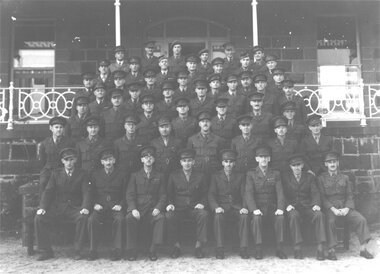
... Of national Significance as a Spitfire Squadron training camp in Lara Districts during WW2 79th fighter squadron raaf wooloomanata spitfire world war 2 ww2 peter anderson southern command training school 15 course 18th april 1943 On the back of the photo is "No:15 Course 18th April 1943 on the steps of Wooloomanata Homestead Southern Side". ...The 79th Fighter Squadron was initially formed at Laverton on the 26th April, 1943 under the command of flying ace Squadron Leader Alan Rawlinson, but within seven days moved to Wooloomanata Homestead on the Geelong-Bacchus Marsh Rd, No 1580 in Victoria. It was a Spitfire Squadron and used Wooloomanata as a training base before flying. It was disbanded 20th October, 1945.Of national Significance as a Spitfire Squadron training camp in Lara Districts during WW2Glossy photo and A4 documentOn the back of the photo is "No:15 Course 18th April 1943 on the steps of Wooloomanata Homestead Southern Side". On the bottom is a list of the names of those in the photo. Left to Right Rear Row: Maj. K. Ewen, Capt. N.F. Attree, Capt. C.N. Bucknell, Capt. J.L. McKenzie, Capt. C.D. Seabrook, Lt. W.G. Foley. Second row from rear: Maj. C. Dumble, Capt. A. Tavener, Maj. F. Langford, Maj. T.A.R. Cleave, Capt. M.D. Waller, Capt. J.B. Ainslie, Capt. G.M.Taylor. Third row from rear: Capt. E.K. Jennings, Lt. J.H. Loxton, Capt. D.J. Breheny, Lt. R.V. Stephens, Capt J.W.D. Cornell, Maj. C.A. Ricketts, Lt. A.R. Creswick. Fourth row from rear: Lt. W. Ruthven (V.C.), Capt. R.C. Tomkins, Capt. R.J.Bermingham, Maj. A.E. Arnott, Capt. L.S. Ralton, Maj. F.L. Edmunds, Capt. W.E. Paterson. Fifth row from rear: Maj. H.W. Stockwell, Capt. C.A. Ferry, Maj. A.C. Jennings, Capt. W.L. Hart, Maj. R.R. Marston, Capt. R.A. Cameron, Capt. R.W.M. Page. Sixth Row from rear: Lt. A.E. Pizzy, Capt. A.G. Yungman, Maj.T.G. Court, Maj. J.B. Chapman, Maj. H.F. Gough, Maj. P.L. Barbour, Maj. H.M. Heward, Maj. E.C. Nolte. Front Row: Lt. G.H. Rowden, Capt. C.J.F. Pollett, Maj. A.E.Bunbury, Lt-Col. E.W. Bundey, Major W.A. Cronk, Capt. B.V. Eames, Lt. N.D. Anderson, Maj. C.A. Lotherington. Absent: Lt. R.R. Webster, Lt. R.B. Blackwell The A4 is a written description of a brief history of the 79th Fighter Squadron79th fighter squadron, raaf, wooloomanata, spitfire, world war 2, ww2, peter anderson, southern command training school, 15 course 18th april 1943 -
 Lara RSL Sub Branch
Photograph, Set 4 photographs. and others for Torquay Light Horse camp, 1940
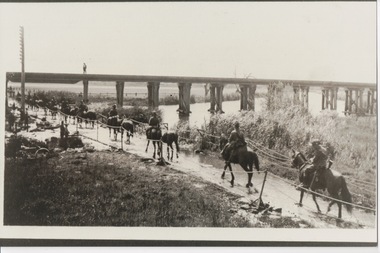
... Note-----(see media section for photograph) The Camp was abandoned in mid 1940 as it was deemed unsuitable for training during winter and the cost of a permanent camp could not be justified if it could not be used all year. Historic.......Rare,,,Interpretive. light horsemengeelong 1940. world war 2 No 1, Lighthorsemen Regiment Geelong 1940......No 2 Light Horse at Breakwater Geelong 1938 to 1940....No 3 Light Horse at Breakwater Geelong 1938 to 1940.....No 4 Light Horse crossing Breakwater camped at Geelong Showgrounds. ...These images capture for all time Light Horsemen travelling through Geelong on their way to camp at Torquay for the last Group meeting in Australia . information following - details obtained from .........https://torquayhistory.com/light-horse-brigade/ On Australia Day, 1997, Sir John Young unveiled this plaque on Point Danger, Torquay. Torquay history, Light Horse Training Camp, WW2 Plaque at Pt. Danger Note----- (See images to view plaque) The plaque identifies a significant event in Torquay’s history and the sentiments of ‘change’ for the Light Horse Brigade – from horses to machines. In 1940 the four Light Horse Regiments (4th, 8th, 13th and 20th), some 5000 Light Horse and 2000 horses camped and trained at Torquay. Three other regiments, formerly mounted on horses, were also at Torquay ‘mounted’ on privately owned trucks and cars. Division troops included Artillery, Engineers, Signals, Field Ambulance and other branches of the Army necessary to enable a Division to function. It wasn’t just the sheer numbers of men coming to this little town that made the event significant, it was also the fact that the men of the Light Horse were dramatic, almost glamorous figures and it is easy to see their exploits as some splendid adventure. Horses have played a special role in the story of Australia. They were the only means of transport across this huge country, so it was necessary for everyone to have the ability to ride a horse. When war broke out in 1899 between Britain and the Boers of South Africa (“Boer” was Dutch for “farmer”) Australia sent troops to fight. At first Britain was wary of using untried, unprofessional colonial cavalrymen but soon saw that the slouch-hatted Australian “bushmen” were a match for the fast-moving and unconventional mounted commandos of the Boers. The Australians proved themselves to be expert rough-riding horsemen and good shots. Bush life had hardened them to go for long periods with little food and water. They also showed remarkable ability to find their way in a strange country and use its features for cover, in both attack and defence. By 1914, when Australia joined the war against Germany, there were 23 Light Horse regiments of militia volunteers. Many men from these units joined the Light Horse regiments of the Australian Imperial Force (AIF). Men were given remounts (if not using their own horses) – army horses bought by Commonwealth purchasing officers from graziers and breeders. These were called “walers” because they were a New South Wales stockhorse type – strong, great-hearted animals with the strains of the thoroughbred and semi-draught to give them speed, strength and stamina. On 1st November, 1914, Australia’s First Infantry Division and the first four Light Horse regiments sailed for England in a fleet of transport ships. The first of the Light Horse arrived at Gallipoli in May without their horses. Back with their horses after Gallipoli, they were formidable combatants across the Sinai and Palestine. Some British commanders observed that the light horseman moved with a “lazy, slouching gait, like that of a sleepy tiger” but described how the promise of battle “changes that careless gait, into a live athletic swing that takes him over the ground much quicker than other troops”. They had Light Horse, Torquay, training campdeveloped a reputation as formidable infantrymen. The Turks called them “the White Ghurkas” – a reference to their deadly skill with the bayonet. The Arabs called them “The Kings of the Feathers”. The plume had originally been a battle honour of the Queensland Mounted Infantry for their work in the shearer’s strike of 1891. During WW1 it was adopted by almost all the Light Horse Regiments. It was the proud badge of the light horseman. The most famous of their battles was the attack on Beersheba- the charge of the 4th Light Horse Brigade. Mounted infantrymen and their superb walers had carried out one of the most successful cavalry charges in history – against what seemed impossible odds. They surprised the Turks by charging cavalry-style, when they would normally have ridden close to an objective then dismounted to fight. The fall of Beersheba swung the battle tide against the Turks in Palestine; and changed the history of the Middle East. While 19 men from the Surf Coast Shire served with the 4th Light Horse over the course of WW1, only four were involved in the charge of Beersheba- John GAYLARD, Philip QUINN.(Winchelsea); Wallace FINDLAY (Anglesea); Harry TRIGG (Bambra). After the war, Light Horse units played a key role in the Australian Government’s compulsory military training programme. The Citizen Military Forces (C.M.F.) thrived on the glamour of the wartime Light Horse tradition, ignoring the possibility that motor vehicles would soon replace the horses. When training was no longer compulsory, the C.M.F. regiments declined and horses became more of a luxury during the 1930s depression years of poverty and unemployment. Some regiments were motorised. Then, in 1939, Australia joined Britain in another world war. Training was increased for the militia at both home bases and regional training camps. The camp at Torquay in 1940, commanded by Major General Rankin, was at Divisional strength. By the end of the camp some felt that the Division was ready for active service. Gradually, over the next four years, the Australian Light Horse units were mounted on wheels and tracks and the horses were retired. Six men enlisted at the Torquay camp and another 57 men and women enlisted at Torquay for service in WW2. Those who served in the Militia provided valuable Officers and NCOs and men for the armed services during the war. Each infantry division of the 2nd AIF had a Light Horse regiment attached to it. But the day of the Australian mounted soldier hadn’t quite passed. During World War II, Australia’s 6th Cavalry Regiment formed a mounted unit they called “The Kelly Gang” which did valuable scouting work. In New Guinea, a mounted Light Horse Troop did patrol duty and helped carry supplies. Some fully equipped walers were flown into Borneo for reconnaissance in rugged mountain country. But by the end of the war, in 1945, the horse had disappeared from the Australian Army. References: Australian Light Horse Association www.lighthorse.org.au National Australia Archives Australian War Memorial Surf Coast Shire WW1 memorials www.togethertheyserved.com The Light horse- a Cavalry under Canvas Light Horse, Training Camp, Torquay, WW2 Late in 1939 it was decided to set up a Lighthorse training camp in Torquay to train both men and horses for the battles of the Second World War. Horses, men and equipment came on special trains from all over Victoria and NSW, and as you would expect horseman came from areas such as Omeo and Sale, the Wimmera and the Western District. They arrived at the Geelong racecourse for watering in the Barwon River and then were ridden across the ford at the breakwater and began their 11 mile trek to Torquay. Light Horse, Training Camp, Torquay, WW2 Tent city By the end of January 1940 the camp at Torquay accommodated some 5000 men and 2500 horses of the Second Cavalry Division. The rows of horses, tents and huts near Blackgate Road were quite a sight. While the cavalrymen engaged in exercises on the land and on the beaches, many of the troops took over the Torquay School for special training of men and officers. Mr Bob Pettit local farmer and Councillor for the Barrabool Shire, wrote about the Light horse in the Surf Coast Community News in 1985 saying “They used to travel about the district riding four abreast in one long convoy. To my annoyance they went through my property and shut all the gates behind them. I had certain gates open to let stock in to the water holes and it would take me three -quarters of an hour to follow the horsemen up and put all the gates right again” he continued “the men from the Light Horse were here when the fire went through in March 1940. He recalled an incident when early one morning, as some one blew the bugle, a soldier putting a white sheet on the line frightened the horses. They panicked and ran off in all directions. Six went over the cliff near Bird Rock, five were never found, and the rest were gathered up after nearly a fortnight in the bush around Addiscott and Anglesea" Light Horse, Training Camp, Torquay, WW2, Geelong Parade Geelong parade The training camp culminated in a parade through the streets of Geelong on March 12th 1940. The salute was given at the Town Hall and the troops continued on a route to the You Yang’s for a training exercise. Note-----(see media section for photograph) The Camp was abandoned in mid 1940 as it was deemed unsuitable for training during winter and the cost of a permanent camp could not be justified if it could not be used all year. Historic.......Rare,,,Interpretive.Sepia photographs.set of four ....post card size ....Horses &LighthorsemenNo 1, Lighthorsemen Regiment Geelong 1940......No 2 Light Horse at Breakwater Geelong 1938 to 1940....No 3 Light Horse at Breakwater Geelong 1938 to 1940.....No 4 Light Horse crossing Breakwater camped at Geelong Showgrounds. These markings are on reverse of photographs.light horsemengeelong 1940., world war 2 -
 Lara RSL Sub Branch
Photograph (2 off), H.B. Chesterfield, 1918
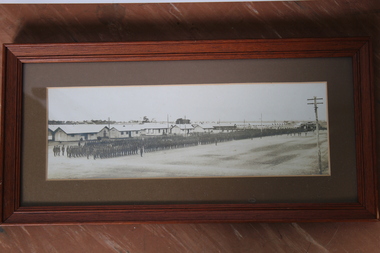
... Camp road) world war 1 troop on parade 1918, victoria Broadmedows Military Camp, Camp road 447.1 marking on reverse states H. B. Chesterfield, Lara 18/12/18 447.2 Marked by photographer front lower right hand corner "Faling & Co, Swanston Street, Melbourne" Photograph - Parade of a Battalion of Troops in Camp - Broadmedows Military Camp, Camp road - H.B. Chesterfield 18-12-1918 ( two identical prints ) (447.1 & 447.2) H.B. Chesterfield Photograph (2 ...YMCA and Salvation Army Barracks , Victoria (Broadmedows Military Camp, Camp road)Photograph - Parade of a Battalion of Troops in Camp - Broadmedows Military Camp, Camp road - H.B. Chesterfield 18-12-1918 ( two identical prints ) (447.1 & 447.2)447.1 marking on reverse states H. B. Chesterfield, Lara 18/12/18 447.2 Marked by photographer front lower right hand corner "Faling & Co, Swanston Street, Melbourne"world war 1 troop on parade 1918, victoria, broadmedows military camp, camp road -
 Federation University Historical Collection
Photograph - Photograph - Black and White, Mount Pleasant Primary School No 1436, 1874
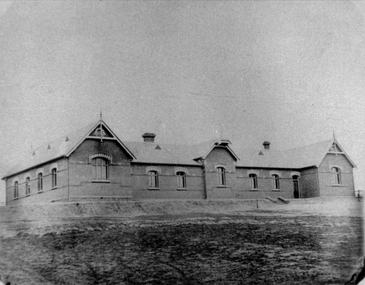
... 2, pg 653 and 767) William Henry Williams became the first classifier of teachers for the Victorian Education Department. He died aged 51 while Head Teacher at Yarra Park Primary School on 01 April 1899. Some former students of this school include: J.G. Eagleston (County Court Judge); H.E. Starke (Judge of the High Court of Australia ); Bernard O'Dowd (parliamentary draughtsman and poet); Albert Coates (Surgeon and Medical Officer in Burmese Prisoner of War Camps...2, pg 653 and 767) William Henry Williams became the first classifier of teachers for the Victorian Education Department. He died aged 51 while Head Teacher at Yarra Park Primary School on 01 April 1899. Some former students of this school include: J.G. Eagleston (County Court Judge); H.E. Starke (Judge of the High Court of Australia ); Bernard O'Dowd (parliamentary draughtsman and poet); Albert Coates (Surgeon and Medical Officer in Burmese Prisoner of War Camps ...Mount Pleasant Primary School 1435 was formerly known as Clayton's Hill, and evolved from a tent school, commenced in 1855 by William McIntosh. When changed from a Wesyleyan day school to a Common School it was given the number 424, received State funding and was conducted by William H. Nicholls. On 01 January 1873 the school became a non-vested school under control of the Education Department until 31 August 1873. The State then leased the school until 31 July 1874, with the current brick school, Mount Pleasant No.1436, opening on 01 August 1874. The Head Teacher of the new school was William H. Nicholls, remained at the school until 1887. His assistants were Thomas Gray, Jane Shaw, Jane Tratham, Catherine J. Berriman, John Blight, Herbert Berchaivaise and Annie Hicks, all who had worked at Mount Pleasant No. 424. William Nicholls and his assistant Gray established after school classes to enable students to gain Exhibitions and Scholarships to matriculate for the University of Melbourne, and courses enabling entry to teaching, pharmacy and civil service. Before the establishment of State Secondary and Technical Educaiton over 100 pupils from Mount Pleasant Primary School has matiriculated and entered the various professions. (Visions and Realisations, Vol. 2, pg 653 and 767) William Henry Williams became the first classifier of teachers for the Victorian Education Department. He died aged 51 while Head Teacher at Yarra Park Primary School on 01 April 1899. Some former students of this school include: J.G. Eagleston (County Court Judge); H.E. Starke (Judge of the High Court of Australia ); Bernard O'Dowd (parliamentary draughtsman and poet); Albert Coates (Surgeon and Medical Officer in Burmese Prisoner of War Camps). Gold was discovered at Caylton's Hill in 1853.Black and white photograph of a primary school in the Ballarat suburb of Mount Pleasant. The brick school is sat on bluestone foundations.mount pleasant primary school, mount pleasant state school, mount pleasant, mt pleasant, education, clayton's hill, bluestone, william h. nicholls, thomas gray, jane shaw, jane tratham, catherine j. berriman, john blight, herbert berchaivaise, annie hicks, albert coates, h.e. starke, j.g. eagleston -
Federation University Historical Collection
Photograph - Photograph - Sepia Postcard, Henry Smerdon Holmes, c 1915
... War 2. In 1953 Harry purchased William and Charlotte's portion of 'Sauchieburn' for his son, Bill, and daughter-in-law Margaret. (Unpublished notes by Jane Dyer) chatham chatham family collection holmes harry holmes henry holmes smerdon world war world war 1 world war i world war one. tent recruitment camp studion photograph Verso in pen "The boys say this isn't to (sic) bad so it will show you any changes. ...HENRY SMERDON (Harry) HOLMES was born in 1897 at the family property, ’Sauchieburn’, 17 km north of Ballarat, in the Ascot district. He was the youngest of four children. After finishing his education at St Patrick’s College, Ballarat, Henry joined the Holmes family farming interests. At the age of 18 he enlisted and served with AIF in Egypt, France and Belgium 1915-1918. Henry served at the famous battlegrounds of Ypes and Somme in the Australian Army 8th Battalion. He was a Driver with the 4th D.A.C. According to his Soldier's Pay Books (Cat. No. 20112) Holmes Registration number was 7983. He was Catholic and enlisted in the Third Military District on 17 September 1915, and embarked on 8 November 1915. Holmes was in the 18th AASC Unit with the rank of Driver at that time. On 15 November 1918 Holmes was promoted to Lance Corporal. He received leave on: * 3 August 1917 - London (10 days) * 19 February 1918 - Paris (10 days) * 27 August 1918 - London (14 days) In 1922 Harry married Edith Pickford of 'Yeovil', Clunes, and they lived at 'Sauchieburn' with Henry's brother Willie. In 1933 Harry and Edith built a new timber home 'Launchley' (Ascot) on the rise east of 'Sauchieburn' on the Ballarat - Maryborough Road. The home was built by Con Zilles to the designs of Clegg and morrow. In 1938 Harry and Edith purchased a property at Derrinallum, Victoria and called it 'Launchley Park' on their first son's return from World War 2. In 1953 Harry purchased William and Charlotte's portion of 'Sauchieburn' for his son, Bill, and daughter-in-law Margaret. (Unpublished notes by Jane Dyer)Black and white photograph of an Australian World War One in uniform and standing in front of a tent in a studio. The soldier is Henry S. Holmes.Verso in pen "The boys say this isn't to (sic) bad so it will show you any changes. Heaps of love to all. Harrychatham, chatham family collection, holmes, harry holmes, henry holmes, smerdon, world war, world war 1, world war i, world war one., tent, recruitment camp, studion photograph -
 Greensborough Historical Society
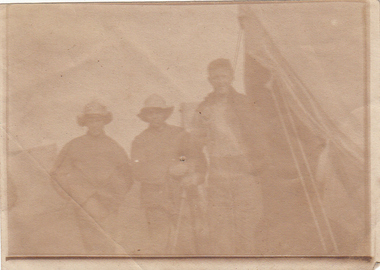
Photograph - Digital image, Charles Marshall et al, Australian troops in camp 2, 1917_
... Photograph of Australian troops in camp. charles marshall world war 1 Digital copy of black and white photograph. Australian troops in camp 2 Photograph - Digital image Charles Marshall John Gibson ...Photograph of Australian troops in camp.Digital copy of black and white photograph. charles marshall, world war 1 -
 Greensborough Historical Society
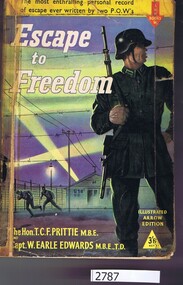
Book, T. C. F. Prittie et al, Escape to freedom, 1954_
... Account of escapes by Allied POWs from German camps during World war 2...Account of escapes by Allied POWs from German camps during World war 2 world war 2 576 p. illus. pbk Escape to freedom Book Book T. ...Account of escapes by Allied POWs from German camps during World war 2576 p. illus. pbkworld war 2 -
 Greensborough Historical Society
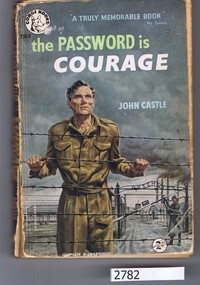
Book, John Castle, The Password is courage, 1956_
... Story of Charles Coward, a British POW who carried out sabotage and resistance activities in various camps including Auschwitz. prisoner of war camps world war 2 286 p. pbk. The Password is courage Book Book John Castle Transworld Publishers ...Story of Charles Coward, a British POW who carried out sabotage and resistance activities in various camps including Auschwitz.286 p. pbk.prisoner of war camps, world war 2 -
 Greensborough Historical Society
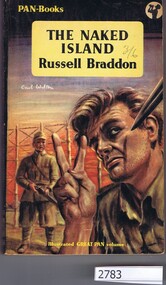
Book, Russell Braddon, The Naked island, 1955_
... Account of the author's capture by the Japanese forces in Malaya in 1941, and experiences in prisoner of war camps in Kuala Lumpur, Changi and Thailand. prisoner of war camps world war 2. malayan campaign 18 x 11 cm The Naked island Book Book Russell Braddon Pan Books ...Account of the author's capture by the Japanese forces in Malaya in 1941, and experiences in prisoner of war camps in Kuala Lumpur, Changi and Thailand.18 x 11 cmprisoner of war camps, world war 2. malayan campaign -
 Greensborough Historical Society
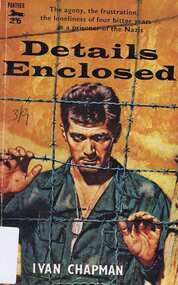
Book, Ivan Chapman, Details enclosed, 1941_
... Account of two Australians, captured in Greece in 1941 and imprisoned in prisoner of war camps in Greece, Yugoslavia, Romania and Germany during World War 2...Account of two Australians, captured in Greece in 1941 and imprisoned in prisoner of war camps in Greece, Yugoslavia, Romania and Germany during World War 2 prisoners of war 224 p. pbk Details enclosed Book Book Ivan Chapman Panther Books ...Account of two Australians, captured in Greece in 1941 and imprisoned in prisoner of war camps in Greece, Yugoslavia, Romania and Germany during World War 2224 p. pbkprisoners of war -
 Greensborough Historical Society
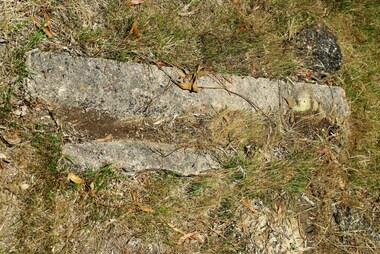
Photograph - Digital image, Marilyn Smith et al, Janefield Precinct: World War 2 era concrete and guttering, 27/11/2014
... War 2 era concrete and guttering. The remains of this site are between Greensborough and Janefield. A RAAF Hygiene Training Camp was located on the Plenty River, just south of the Janefield community. ...War 2 era concrete and guttering. The remains of this site are between Greensborough and Janefield. A RAAF Hygiene Training Camp was located on the Plenty River, just south of the Janefield community. ...Janefield Precinct: World War 2 era concrete and guttering. The remains of this site are between Greensborough and Janefield. A RAAF Hygiene Training Camp was located on the Plenty River, just south of the Janefield community. It was in use from 1944 to 1946. The Camp was constructed from salvaged materials. Instruction included building and maintenance of grease traps, latrines, elementary plumbing and carpentry.Early remains of a WW2 training camp Digital colour photograph.janefield -
 Greensborough Historical Society
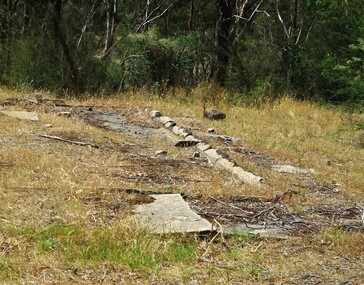
Photograph - Digital image, Marilyn Smith et al, Janefield Precinct: World War 2 era concrete admin block, 27/11/2014
... War 2 era concrete admin block. The remains of this site are between Greensborough and Janefield. A RAAF Hygiene Training Camp was located on the Plenty River, just south of the Janefield community. ...War 2 era concrete admin block. The remains of this site are between Greensborough and Janefield. A RAAF Hygiene Training Camp was located on the Plenty River, just south of the Janefield community. ...Janefield Precinct: World War 2 era concrete admin block. The remains of this site are between Greensborough and Janefield. A RAAF Hygiene Training Camp was located on the Plenty River, just south of the Janefield community. It was in use from 1944 to 1946. The Camp was constructed from salvaged materials. Instruction included building and maintenance of grease traps, latrines, elementary plumbing and carpentry.Early remains of a WW2 training camp Digital colour photograph.janefield -
 Greensborough Historical Society
Photograph - Digital image, Marilyn Smith et al, Janefield Precinct: World War 2 era admin toilet block, 27/11/2014
... War 2 era admin toilet block. The remains of this site are between Greensborough and Janefield. A RAAF Hygiene Training Camp was located on the Plenty River, just south of the Janefield community. ...War 2 era admin toilet block. The remains of this site are between Greensborough and Janefield. A RAAF Hygiene Training Camp was located on the Plenty River, just south of the Janefield community. ...Janefield Precinct: World War 2 era admin toilet block. The remains of this site are between Greensborough and Janefield. A RAAF Hygiene Training Camp was located on the Plenty River, just south of the Janefield community. It was in use from 1944 to 1946. The Camp was constructed from salvaged materials. Instruction included building and maintenance of grease traps, latrines, elementary plumbing and carpentry.Early remains of a WW2 training camp Digital colour photograph.janefield -
 Greensborough Historical Society
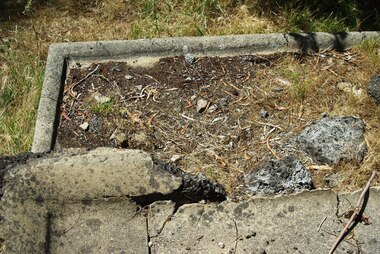
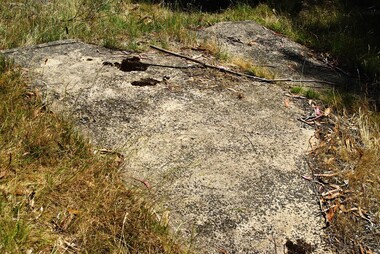
Photograph - Digital image, Marilyn Smith et al, Janefield Precinct: World War 2 era concrete shed base, sump and raised edge, 27/11/2014
... War 2 era concrete shed base, sump and raised edge. The remains of this site are between Greensborough and Janefield. A RAAF Hygiene Training Camp...War 2 era concrete shed base, sump and raised edge. The remains of this site are between Greensborough and Janefield. A RAAF Hygiene Training Camp ...Janefield Precinct: World War 2 era concrete shed base, sump and raised edge. The remains of this site are between Greensborough and Janefield. A RAAF Hygiene Training Camp was located on the Plenty River, just south of the Janefield community. It was in use from 1944 to 1946. The Camp was constructed from salvaged materials. Instruction included building and maintenance of grease traps, latrines, elementary plumbing and carpentry.Early remains of a WW2 training camp Digital colour photograph.janefield -
 City of Moorabbin Historical Society (Operating the Box Cottage Museum)
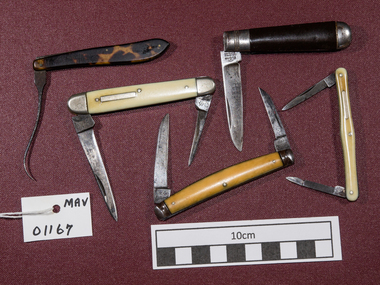
Manufactured Objects, 5 x Penknives, c1930
... It is now owned by the Dutch Amefa group A penknife is a small pocketknife consisting of a small knife with a blade which folds into the hand and often incorporates other tools such as corkscrews, tweezers These penknives c 1930 were used by George Reed who was a draftsman who lived in Bentleigh , City of Moorabbin in mid 20th C These penknives are typical of the type used by residents of City of Moorabbin c1930 penknives, cuttlery, knives, camping gear, city of moorabbin, bentleigh, highett, ormond, moorabbin, cheltenham, post world war 2 estates, reed george, reed gladys, a) MADE / RICHARDS / SHEFFIELD / ENGLAND 4 x Penknives and 1 hook Manufactured Objects, 5 x Penknives Richards Pty Ltd ...Richardson Sheffield is a major supplier of kitchen knives and scissors to the United Kingdom market. Established in 1839, the company is headquartered in Sheffield, England but the products are imported from China. It is now owned by the Dutch Amefa group A penknife is a small pocketknife consisting of a small knife with a blade which folds into the hand and often incorporates other tools such as corkscrews, tweezers These penknives c 1930 were used by George Reed who was a draftsman who lived in Bentleigh , City of Moorabbin in mid 20th C These penknives are typical of the type used by residents of City of Moorabbin c19304 x Penknives and 1 hooka) MADE / RICHARDS / SHEFFIELD / ENGLANDpenknives, cuttlery, knives, camping gear, city of moorabbin, bentleigh, highett, ormond, moorabbin, cheltenham, post world war 2 estates, reed george, reed gladys, -
 Ballarat Fire Brigade
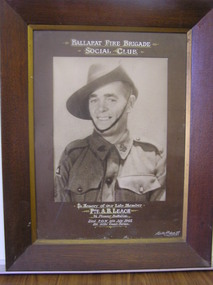
Photograph, Thornton Richards & Co
... Leach / 2/2 Pioneer Battalion / Died P.O.W. 26th July 1945 / 105 "Killo" camp, Burma / Thorton Richards & Co / Ballarat Black and white memorial photograph of Pte. A B Leach, a member of the brigade who died as a prisoner of war ...Black and white memorial photograph of Pte. A B Leach, a member of the brigade who died as a prisoner of war 26th July 1945. Photgraph is of Pte Leach in uniform and is framed in a dark brown timber frame with painted gold trim on the inner edge of the frameBallarat Fire Brigade / Social Club / In Memory of our Late Member / Pte. A.B. Leach / 2/2 Pioneer Battalion / Died P.O.W. 26th July 1945 / 105 "Killo" camp, Burma / Thorton Richards & Co / Ballaratballarat fire brigade, p o w, burma, pte a b leach, leach, leach a b, 1945, ballarat fire brigade social club, 2 2 pioneer battalion -
 Red Cliffs Military Museum
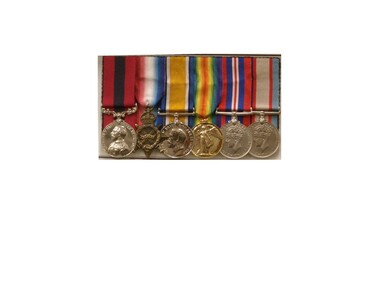
Replica Medals, WW1 & WW11 Medals Awarded to Nathaniel Barclay, (estimated); between 1914 & 1945
... War. Regimental Number V5571 Emlisted in the Australian Military Forces in Royal Park, Melbourne 22nd August 1940 and to 2nd Infantry Training Battalion, Fyansford. Staff Sergeant 24th August 1940. To 2/14th Training Battalion Wangaratta 11th October 1940. To 2/23rd Training Battalion, Wangaratta 18th October, 1940.To Southern Command Training School 26th May 1941.to Camp...War. Regimental Number V5571 Emlisted in the Australian Military Forces in Royal Park, Melbourne 22nd August 1940 and to 2nd Infantry Training Battalion, Fyansford. Staff Sergeant 24th August 1940. To 2/14th Training Battalion Wangaratta 11th October 1940. To 2/23rd Training Battalion, Wangaratta 18th October, 1940.To Southern Command Training School 26th May 1941.to Camp ...Born 5th October 1895 in Adavoyle, United Kindom Occupation Grocer and later horticulturalist Married after WW1- Wife - Daisy Florence Barclay World War One Staff Sergeant Regimental Number 2139 Enlisted AIF in Melbourne 29th December 1914, having previously served 3 months with the Ulster Volunteers and to camp Broadmeadows, to depot Battalion 29th December 1914. Embarked from Melbourne for the middle East with 3rd reinforcement group for the 5th Battalion, 2nd Brigade, 1st Division, 25th February 1915 per transport 'Runic'. Disembarked Alexandria and to camp Heliopolis, Egypt. Operation Gallipoli from 5th May 1915 with 5th Battalion. Sick with dental problems 2nd Field Ambulance 17th September 1915. To hospital Lemnos 20th December 1915. To Alexandria hospital with pluerisy 12th January 1916. Returned to Australia with enteric per 'Nestor' 9th February 1916.To duty Broadmeadows 4th April 1916. Wmbarked with 4th reinforcements group for the 58th Battalion, 15th Brigade per transport 'Themistocles' 1st August 1916 Returned to England 14th September 1916. Operations France and Flanders from 6th December 1916. To 59th Battalion 29th December 1916. To 5th Division Infantry School 18th February to 28th March 1917 as Lance Corporal. Corporal 7th April 1917. Sergeant 2nd May 1917. To 3rd Southern General Hospital Oxford 4th October 1917. Returned to Melbourne per Transport 'Persic' 12th February 1918. Discharged 14th March 1918. Second World War. Regimental Number V5571 Emlisted in the Australian Military Forces in Royal Park, Melbourne 22nd August 1940 and to 2nd Infantry Training Battalion, Fyansford. Staff Sergeant 24th August 1940. To 2/14th Training Battalion Wangaratta 11th October 1940. To 2/23rd Training Battalion, Wangaratta 18th October, 1940.To Southern Command Training School 26th May 1941.to Camp Bonegilla 15th May 1942. To Camp Caulfield 11th November 1942. Discharged to Reserve Occupation 19th November 1942. Remarks. Awarded 1915-15 Star, British War Medal, and Victory Medal 1914-1919 Awarded Distinguished Conduct Medal as Lance Corporal vide London Gazette 30111 of 31st July 1918. Citation for action on 9th July 1917 during the third Battle of Ypres reads- " For conspicous gallantry and devotion to duty. He rendered invaluable service during operation in carrying important messsages through heavy fire" Awarded War Medal and Australian Service Medal 1939-45 in 1951. Described as 71.5inches tall, medium complexion, blue eyes and brown hair. He died 11th September 1962.WW1 - Distinguished Conduct Medal 1914/15 Star 1914/18 British War Medal Victory Medal WW11 - 1939/45 British War Medal Australian Service Medal 1939/45 All medals with associated coloured ribbons. These are replica medals made in the exact metals as the originals. Also in display is a record of War Service which can be found in the narrative. Noneservice, medal, 1918, citation, ww1, military, gazette, london, ww11, medals, 30111, 31st, july, ypres, distinguished
