
Showing 1329 items matching "warrnambool 1891"
-
 Warrnambool and District Historical Society Inc.
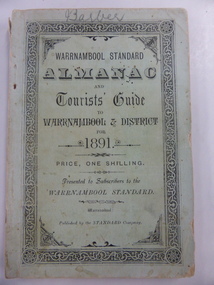
Book, Warrnambool Standard Almanac 1891, 1891
... Warrnambool Standard Almanac 1891...warrnambool...standard almanac 1891... This booklet was given to subscribers to the Warrnambool Standard newspaper as an almanac for the year 1891. These Standard Almanacs were produced from 1875 to 1930. ...The name on the front cover is handwritten in pencil. Warrnambool Standard Almanac 1891 Book ...This booklet was given to subscribers to the Warrnambool Standard newspaper as an almanac for the year 1891. These Standard Almanacs were produced from 1875 to 1930. They contain much local information on Warrnambool and district about the businesses, government officials, harbour management, churches, banks, schools, societies and organizations etc. The Warrnambool Standard was established in 1872 and continues to this day. This booklet is of high significance as it contains much information about Warrnambool and district for the year 1891. It is an important resource tool for those studying and writing the history of Warrnambool and district. The name ‘Barber’ is on the front cover of this booklet and this appears to refer to George Barber, the son of George Barber, a well-known solicitor who opened a legal practice in Warrnambool in 1855. He died in 1879 and it appears a member or members of his family went to live in the Maryborough district as this booklet came into the collection of the Warrnambool and District Historical Society via the Midlands Historical Society. This is a soft cover booklet of 135 pages, plus pages at the back containing a gardener’s almanac and advertisements. The cover is pale green with black lettering and a decorative black and white border. The cover is a little frayed at the edges and the spine cover is partly torn away. The booklet contains a fold-out sheet with a map of Victorian railway routes and many sketches and illustrations. The name on the front cover is handwritten in pencil. ‘Barber’warrnambool standard newspaper, history of warrnambool, standard almanac 1891 -
 Warrnambool and District Historical Society Inc.
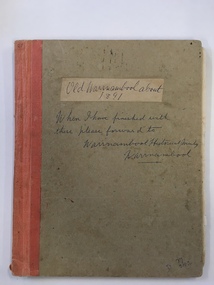
Book, Picturesque Warrnambool, C1891
... ...Warrnambool 1891,...This book presents a pictorial and written record of Warrnambool in 1891.It covers a wide range of topics. ...Old Warrnambool about 1891 hand written on label on front cover, underneath is also written “When I have finished with these please forward to Warrnambool Historical Society Warrnambool. ...This book presents a pictorial and written record of Warrnambool in 1891.It covers a wide range of topics. ...This book presents a pictorial and written record of Warrnambool in 1891.It covers a wide range of topics. It provides statistical evidence relating to public buildings and organisations of that era, as well as basic information about district points of interest. The Mechanics Institute, the Common, Albert Park, the rivers, the Museum and the Sea Baths are all mentioned. The various drawings and advertisements provide a list of businesses which were prevalent at the time.As this book is one of only two complete copies documented to be still in existence, it is of considerable significance and importance to our collection. The drawings and text are artistically very much of the era and are aesthetically pleasing.Plain grey card cover with fabric binding. Handwriting on front cover and inside front cover. It contains a number of black and white and coloured plates depicting scenes of Warrnambool and the district. Approximately 70 pages.Old Warrnambool about 1891 hand written on label on front cover, underneath is also written “When I have finished with these please forward to Warrnambool Historical Society Warrnambool. D 77, 252 in bottom RHC of cover. picturesque warrnambool,, warrnambool 1891, -
 Warrnambool and District Historical Society Inc.
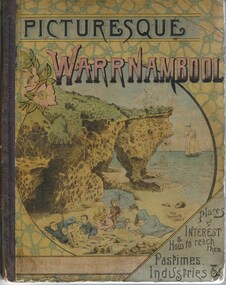
Book, Picturesque Warrnambool, 1891
... Warrnambool, Picturesque Warrnambool, Warrnambool 1891,...This book presents a pictorial and written record of Warrnambool in 1891.It covers a wide range of topics. ...Warrnambool, Picturesque Warrnambool, Warrnambool 1891, warrnambool warrnambool 1891 On front cover “The Mermaids Caves” 1896. 1891 written in pen beneath roman numerals on bottom of title page. ...This book presents a pictorial and written record of Warrnambool in 1891.It covers a wide range of topics. It provides statistical evidence relating to public buildings and organisations of that era, as well as basic information about district points of interest. The Mechanics Institute, the Common, Albert Park, the rivers, the Museum and the Sea Baths are all mentioned. The various drawings and advertisements provide a list of businesses which were prevalent at the time. As this book is one of only two complete copies documented to be still in existence, it is of considerable significance and importance to our collection. The drawings and text are artistically very much of the era and are aesthetically pleasing. Cardboard cover with picture of people on beach in tones of yellow, pink and blue sitting within a circle. Dark purple cloth spine binding. Back cover has drawing of Western Hotel. Pages are not numbered and there are a number of coloured and black and white drawings. Title is in dark purple and Warrnambool is in pink and blue tonesOn front cover “The Mermaids Caves” 1896. 1891 written in pen beneath roman numerals on bottom of title page. List of numbers written down title page in black pen.warrnambool, picturesque warrnambool, warrnambool 1891,, warrnambool, warrnambool 1891 -
 Warrnambool and District Historical Society Inc.
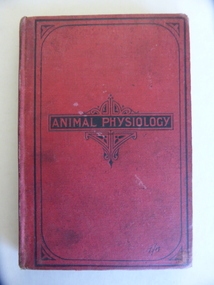
Book, Animal Physiology, Late 19th century
... Joseph’s School, Warrnambool in 1891. A Catholic School was first established in Warrnambool in Kelp Street in the 1850s and later this school became Common School Number 680 situated in Kepler Street. ...‘Minnie Beattie St Josephs School Warrnambool 1891’ ...Joseph’s School, Warrnambool in 1891. A Catholic School was first established in Warrnambool in Kelp Street in the 1850s and later this school became Common School Number 680 situated in Kepler Street. ...This book is a text book for senior students used at St. Joseph’s School, Warrnambool in 1891. A Catholic School was first established in Warrnambool in Kelp Street in the 1850s and later this school became Common School Number 680 situated in Kepler Street. This school was known as St. Joseph’s School after 1876 and was re-located to Lava Street in 1935. Today St. Joseph’s Primary School is located in Botanic Road, Warrnambool. The Kepler Street school building that would have been the one Minnie Beatie attended is still existing No confirmed information has been found on Minnie Beatie but there was a Mary Beatie who was born in Warrnambool in 1875 to Michael and Margaret Beatie and this may be Minnie who owned the text book. This book is of interest as an example of a science text book used in Warrnambool in the late 19th century. It is associated specifically with St. Joseph’s Catholic School, Warrnambool and with Minnie Beatie. This is a hard cover book of 144 pages. It has a red cover with red lettering on a black background on the front cover and black lettering on the spine. Inside the front and back covers is information on other books published by Blackie and Son. There are two pages of colour illustrations and many black and white illustrations. The cover is a little stained. The inscriptions are handwritten in blue ink. ‘Minnie Beattie St Josephs School Warrnambool 1891’ st. joseph’s catholic school, warrnambool, minnie beattie, animal physiology -
 Warrnambool and District Historical Society Inc.
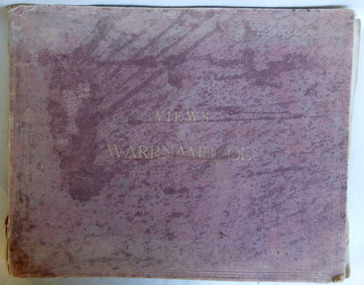
Album - Views of Warrnambool by J Jordan, C 1901
... ...views of warrnambool 1891...This album includes a number of professionally taken photographs which give a high quality view of Warrnambool and the popular spots around the district at the turn of the century. warrnambool joseph jordan views of warrnambool photograph album of warrnambool views of warrnambool 1891 2142 in grey lead inside front cover. ...Joseph Jordan was born in 1841 in Leicester England and spent over a decade in India with his regiment. In 1867 he gained first prize for his views of Indian scenery. He followed the same profession when he came to Victoria in 1884 and set up a professional photographic studio in Warrnambool He became very well known in the Western District for family photographs as well as official photographs of local councillors and groups as well as views of local scenery. This album is one which was advertised in 1901. Of the two albums in the collection they seem to consist of a core number of the same photographs with others included in the selection. The business was taken over by his son Arthur around 1917. This album includes a number of professionally taken photographs which give a high quality view of Warrnambool and the popular spots around the district at the turn of the century.Faded Maroon cloth over card cover with title in gold lettering on front cover. Advertisements for local businesses inside front and back covers. The album contains a number of black and white photographs from around Warrnambool, including the Titan crane at the Breakwater, banks of the Hopkins, Stephens Coachbuilders, Grand Annual Show, panorama of Warrnambool and Suspension Bridge on the Merri. All are mounted on card. It includes advertisements of J J O Mullane, Bay View Hotel, Hopkins Hotel, T Redford, Royal Hotel, Robinson and Morse, H D Stewart & Co, F Uren.2142 in grey lead inside front cover.warrnambool, joseph jordan, views of warrnambool, photograph album of warrnambool, views of warrnambool 1891 -
 City of Warrnambool Rowing Club
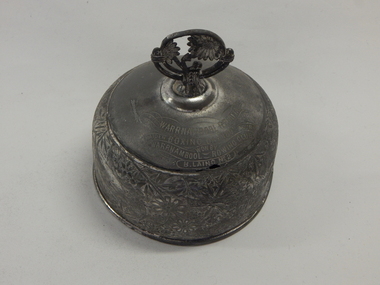
Trophy, 1891
... ...warrnambool...1891...The Warrnambool Regatta was held on the Hopkins River on Sunday 27 December 1891. B. ...Warrnambool Regatta Boxing Day 1891 Maiden Four. Warrnambool Rowing Club. ...Laing was also a steward in the St John's Lodge. trophy warrnambool 1891 rowing hopkins river Warrnambool Regatta Boxing Day 1891 Maiden Four. ...The Warrnambool Regatta was held on the Hopkins River on Sunday 27 December 1891. B. Laing rowed for the Warrnambool Rowing Club. A trophy was given to each member of the Maiden Four crew- A. Lumsden (bow), B. Laing (2), D. Rowan (3), J. Rowan (stroke), A. Geilhofer (cox). B. Laing was also a steward in the St John's Lodge.Brass bell shaped dome with a 4 cm circular hoop containing a tree motif.Warrnambool Regatta Boxing Day 1891 Maiden Four. Warrnambool Rowing Club. B. Laing No 2.trophy, warrnambool, 1891, rowing, hopkins river -
 Warrnambool and District Historical Society Inc.
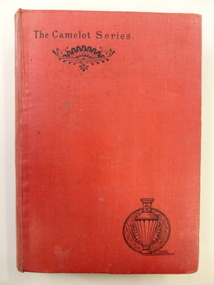
Book, 1277.1 The Natural History of Selbourne - G White; 1277.2 Democratic Vistas - W Whitman, 1887/1888
... 1277.1: ‘W.H.McMahon, June 24th 1889, Warrnambool’ 1277.2: ‘W.H.McMahon, Sept. 4th 1891, Warrnambool’ ...Warrnambool History 1277.1: ‘W.H.McMahon, June 24th 1889, Warrnambool’ 1277.2: ‘W.H.McMahon, Sept. 4th 1891, Warrnambool’ These two accompanying volumes are in the Camelot Series (1887 and 1888). ...These two important books are part of a series produced in the 1880s but they have widely-different content. One describes the natural history of the Parish of Selborne in the County of Hampshire in England. It was written by the British naturalist and ornithologist, Gilbert White and first published in 1789. Since that time it has been republished over 300 times right up to the present day. It is notable for its charm and simplicity and for its description of a pre-industrial England. The other is by the American author, Walt Whitman, first published in 1871. It is a major work of comparative politics and expounds on the influence of the Louisiana Purchase and the expansion of the American spirit and character. It also denounces the post-Civil War materialism that had spread at that time in America. These books are of interest because of their antiquarian nature but they are mostly of local Warrnambool interest because of their inscriptions. The books belonged to William Hugh McMahon (1862-1936). William McMahon commenced a legal practice in Warrnambool in 1894, firstly in Liebig Street and later in Kepler Street. He was a prominent lawyer in Warrnambool for 30 years and a staunch adherent of the Presbyterian Church. He and his family lived at ‘Glenrye’ at the corner of Ardlie Street and Botanic Road, a site where the St. John of God Hospital was later established. These two accompanying volumes are in the Camelot Series (1887 and 1888). They are hard cover books with red covers and two ornamental patterns on the front cover (stylized urn and fan shapes). The urn pattern is repeated on the spines. ‘The Natural History of Selborne’ has 366 pages (a Preface and Chapters on the Natural History of Selborne, a Naturalist’s Calendar and Observations on Various Branches of Natural History) and ‘Democratic Vistas’ has 175 pages (a Preface and 12 Chapters). The latter has the remains of a label stuck to the front cover. The handwriting on the inside first pages are in black ink.1277.1: ‘W.H.McMahon, June 24th 1889, Warrnambool’ 1277.2: ‘W.H.McMahon, Sept. 4th 1891, Warrnambool’ gilbert white, english natural history, walt whitman, american politics, william mcmahon, solicitor, warrnambool., warrnambool history -
 Warrnambool and District Historical Society Inc.
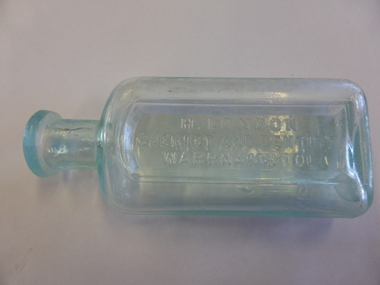
Bottle, H London Chemist
... Harry London, born in England, was a chemist and surgeon dentist who came to Warrnambool in 1891 and bought out the Liebig Street business of the late William Nettleton. ...Harry London, born in England, was a chemist and surgeon dentist who came to Warrnambool in 1891 and bought out the Liebig Street business of the late William Nettleton. ...Harry London, born in England, was a chemist and surgeon dentist who came to Warrnambool in 1891 and bought out the Liebig Street business of the late William Nettleton. In 1896 London erected a new chemist shop at the corner of Koroit and Liebig Streets. This shop was the first in Warrnambool to have an electric light installation (1905). This bottle is of considerable significance as it came from the chemist’s shop of Harry London, a prominent chemist in Warrnambool at the end of the 19th and the beginning of the 20th centuries. It also shows the type of medicine bottle prevalent at the time. Glass is a durable item and bottles such as these would have been dumped in tips or buried with other rubbish The bottle was dug up in Warrnambool so it makes it an archeological find and it also shows the possibility at any time of finding items such as this in old buildings and in garden plots and paddocks etc. This is a small glass bottle used for patent or prescription medicine and issued by a chemist. It has no stopper. Side of bottle – ‘H. London, Chemist and Dentist, Warrnambool’ Base: ‘W.T. Co’, ‘Pat. Jan 5, 1892’ harry london, warrnambool chemist -
 Warrnambool and District Historical Society Inc.
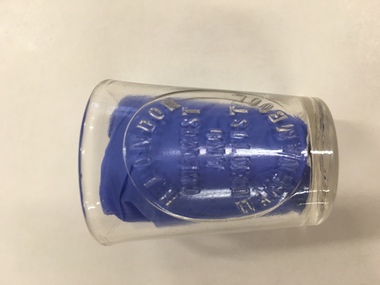
Glass, Medicine H London Chemist, Early 20th century
... Born in England, Harry London, a chemist and dentist, came to Warrnambool in 1891, occupying the Nettleton building at 95 Liebig Street. ...Born in England, Harry London, a chemist and dentist, came to Warrnambool in 1891, occupying the Nettleton building at 95 Liebig Street. ...This is a small medicine measuring glass supplied by the Warrnambool pharmacy of Harry London. Born in England, Harry London, a chemist and dentist, came to Warrnambool in 1891, occupying the Nettleton building at 95 Liebig Street. In 1896 he built new premises at the corner of Liebig and Koroit Streets and in 1905 his was the first shop in Warrnambool to have electric lighting. He was succeeded in the early 1920s by the chemists, Dougall and Easton. This glass is of considerable significance because it came from the pharmacy of Harry London, an important chemist in Warrnambool at the end of the 19th century and the beginning of the 20th century. It also shows the custom of the time of chemists supplying to customers small glasses for measuring out medicine. This is a small thick glass tumbler used for measuring medicine. It is etched with the measurements of teaspoon, dessertspoon and tablespoon and the name of the supplier, H. London, a Warrnambool chemist and dentist. It has the initials of the maker on the base. Etched on side in oval shape: ‘H. London, Chemist and Dentist, Warrnambool’ Etched on side: ……. Tea ……. Dessert ……. Table Etched on base: ‘W.T. Co., A J. U.S.A.’ harry london, warrnambool, dougall and easton, chemists -
 Warrnambool and District Historical Society Inc.
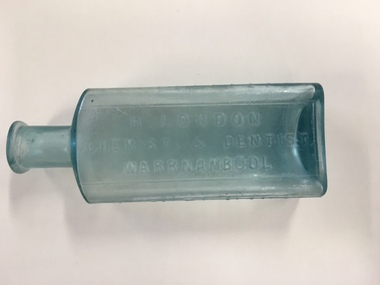
Bottle, H London Chemist & Dentist, Circa 1990's
... Harry London was a chemist and surgeon dentist who came to Warrnambool in 1891 and brought out the business of the late W.F.G Nettleton.he used the Pasteur filter for water in the making of his medicines. ...Harry London was a chemist and surgeon dentist who came to Warrnambool in 1891 and brought out the business of the late W.F.G Nettleton.he used the Pasteur filter for water in the making of his medicines. ...Harry London was a chemist and surgeon dentist who came to Warrnambool in 1891 and brought out the business of the late W.F.G Nettleton.he used the Pasteur filter for water in the making of his medicines. He held a large number of patents for his medicines and mixtures. In 1896 London erected a new chemist shop at the corner of Koroit & Liebig Streets. As well as operating as a chemist and dentist he also dealt in all types of photographic materials and cameras.A common item with links to an innovative business in Warrnambool.Rectangular shaped bottle with embossed writing of company details on front and graduated measurements in ½ tablespoons along the narrow edges. Pale blue in colour. Round lipped neck.H London chemist & Dentist Warrnambool on front. One and two tablespoons along sides.warrnambool, harry london, harry london chemist and dentist , harry london liebig street, -
 Warrnambool and District Historical Society Inc.
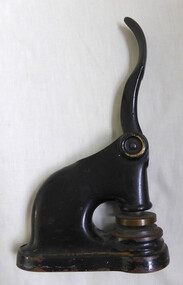
Functional object - G.S. Mackay company seal, Late 19th century
... George Sutherland Mackay came to Warrnambool in 1891 and in 1893 joined his practice with that of James Fletcher and the firm became known as Mackay and Fletcher later changed to Mackay and Taylor. ...George Sutherland Mackay came to Warrnambool in 1891 and in 1893 joined his practice with that of James Fletcher and the firm became known as Mackay and Fletcher later changed to Mackay and Taylor. ...George Sutherland Mackay came to Warrnambool in 1891 and in 1893 joined his practice with that of James Fletcher and the firm became known as Mackay and Fletcher later changed to Mackay and Taylor. G S Mackay served for a long time on the Warrnambool City Council including 4 terms as Mayor. He was also an active member of the Presbyterian Church and worked to establish the Warrnambool Agricultural High School. He built the offices which still stand at 131 Kepler Street. He died in 1926. The firm celebrated its centenary in 1993.A commonly used office item which is well linked to both a long established business in Warrnambool and G. S. Mackay who contributed greatly to the community of Warrnambool and district. Cast iron painted black with rounded rectangular base. Circular seal and shaped handle which moves down 45 degrees. Trimmed with worn gold paint. Excelsior in gold on the front. The oval seal reads G. S. Mackay Warrnambool solicitor.warrnambool, g s mackay, mackay & taylor, mackay solicitor, company seal -
 Warrnambool and District Historical Society Inc.
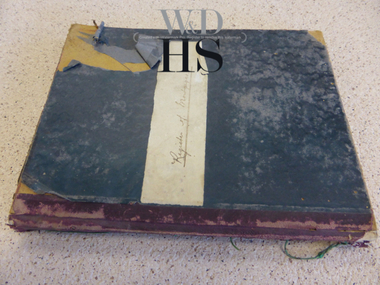
Book, Register of Mortgagees, Early 20th century
... Mackay was a prominent resident of Warrnambool from 1891 to his death in 1926. In the 1920s Mr J. ...Mackay was a prominent resident of Warrnambool from 1891 to his death in 1926. In the 1920s Mr J. ...This Register of Mortgagees comes from the Warrnambool legal firm of Fletcher and Mackay which resulted from the merger of the firms of George Sutherland Mackay and James Fletcher in 1893. G.S. Mackay was a prominent resident of Warrnambool from 1891 to his death in 1926. In the 1920s Mr J. Taylor became a partner in the firm known then as Mackay and Taylor and the firm later known as Mackay Taylor was in operation until the 1990s at 131 Kepler Street. The Register of Mortgagees with dates ranging from 1908 to 1924 comes from the old Mackay Taylor offices in the Kepler Street building.This Register of Mortgagees is of some significance as it contains information on many families living in Warrnambool in the early 20th century, including those of Burleig, Swinton, Uebergang, Turland, Bates, Wood and Paton. The entries have social significance, showing the typical loans taken out at the time and the prevailing interest rates. This is a small quarto sized ledger containing 166 pages of a register of mortgagees. The pages have been printed with ruled red lines. The cover is bound with a black cover and a red spine. There are pages with alphabetical tabs at the start of the book. The entries are in black ink. There is one loose page which is an old envelope used as scrap paper to record names and amounts owing or paid. Front cover (paper pasted on) – ‘Register of Mortgagees’mackay taylor legal firm warrnambool mortgagees, warrnambool mortgagees, swinton, uebergang -
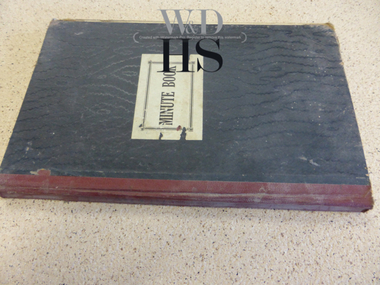 Warrnambool and District Historical Society Inc.
Book, Minute book
... George Mackay who died in 1926 set up the original legal firm in Warrnambool in 1891 and merged with James Fletcher in 1893 to form the Fletcher and Mackay business. ...George Mackay who died in 1926 set up the original legal firm in Warrnambool in 1891 and merged with James Fletcher in 1893 to form the Fletcher and Mackay business. ...This book is a diary (1926 and 1927) which appears to contain summaries of letters written to clients of the Warrnambool legal firm, Mackay and Taylor. The summaries give the name of the recipient(s) and the content of the letter. The numbers next to the summaries may refer to the number of the client or the number in the letter book. George Mackay who died in 1926 set up the original legal firm in Warrnambool in 1891 and merged with James Fletcher in 1893 to form the Fletcher and Mackay business. In the early 1920s J. Taylor joined the business then known as Mackay and Taylor. This business with other partners survived in Kepler Street until the 1990s. This book has some significance as it contains the names of many residents of Warrnambool and district during the 1920s and gives some indication of their dealings with their lawyers. It also shows the system used at the time to record the transactions of law firmsThis is a ledger with a black cover and red binding (foolscap size). There are 190 pages, each one ruled with blue lines and a red margin line. The entries are handwritten in black ink. Front cover: ‘Minute Book’ (actually a diary) Spine: ‘Diary’ (in black ink) mackay and taylor -
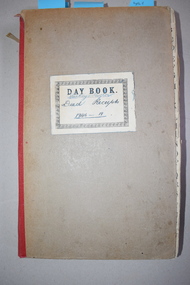 Warrnambool and District Historical Society Inc.
Ledger – Deed Receipts, 1940s/1950s
... Scottish-born George Mackay established a legal practice in Kepler Street, Warrnambool in 1891 and in 1893 bought the next-door practice of the late James Fletcher and the firm was then known as Fletcher and Mackay. ...Scottish-born George Mackay established a legal practice in Kepler Street, Warrnambool in 1891 and in 1893 bought the next-door practice of the late James Fletcher and the firm was then known as Fletcher and Mackay. ...This ledger contains information on deeds, wills and properties from many Warrnambool and district residents in the 1940s and 1950s. The ledger comes from the law firm of Mackay and Taylor of Warrnambool. Scottish-born George Mackay established a legal practice in Kepler Street, Warrnambool in 1891 and in 1893 bought the next-door practice of the late James Fletcher and the firm was then known as Fletcher and Mackay. In the 1920s George Mackay took John Taylor into partnership and the business then became Mackay and Taylor (later Mackay Taylor). In 1999 Taits Solicitors and Mackay Taylor merged to form Tait Taylor and today it is known as Taits Legal. This ledger is of some importance as it contains so much information on Warrnambool and district families and their property ownership in the 1940s and 50s and so will be of great use to researchers. This is a ledger with a grey cover with red binding on the spine. The cover has a white label pasted on, with printed and handwritten material. The pages have printed red lines but these have not been used. Instead the pages contain letters, typed sheets and receipts pasted in. Some of the letters and receipts are handwritten and some are typed. Day Book Mackay & Taylor Deed Receipts 1946-19…mackay & taylor, history of warrnambool, ledger – deed receipts -
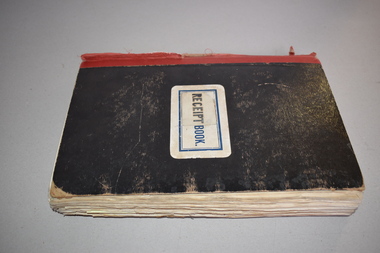 Warrnambool and District Historical Society Inc.
Document - Ledger - Receipts, Book, 1931-1946
... Scottish-born George Mackay established a legal practice in Kepler Street, Warrnambool in 1891 and in 1893 he bought the next-door practice of the late James Fletcher, with the business then known as Fletcher and Mackay. ...Scottish-born George Mackay established a legal practice in Kepler Street, Warrnambool in 1891 and in 1893 he bought the next-door practice of the late James Fletcher, with the business then known as Fletcher and Mackay. ...This ledger contains material from the legal firm of Mackay and Taylor for the period 1931 to 1946. The material includes receipts, letters and typed summaries concerning the wills and property of Warrnambool and district residents at that time. Scottish-born George Mackay established a legal practice in Kepler Street, Warrnambool in 1891 and in 1893 he bought the next-door practice of the late James Fletcher, with the business then known as Fletcher and Mackay. In the 1920s John Taylor became a partner with Mackay under the name of Mackay and Taylor (later Mackay Taylor). In 1999 Taits Solicitors of Warrnambool merged with Mackay Taylor to form Tait Taylor. Today this business is known as Taits Legal. This ledger is of some importance as it contains much historical information (wills, deeds, property ownership etc) on Warrnambool and district residents in the 1930s and 40s. It will be very useful to researchers.This is a ledger with a black cardboard cover and red binding on the spine. The binding has broken and the covers and sections of the pages are detached. The cover is much stained and rubbed. The pages have been printed with red and blue lines but these have not been used. Instead a variety of letters, receipts and typed material have been pasted onto the pages. Some of the letters and receipts have been handwritten and some have been typed.Receipt Bookwarrnambool, warrnambool history, mackay taylor, ledger warrnambool, fletcher and mackay -
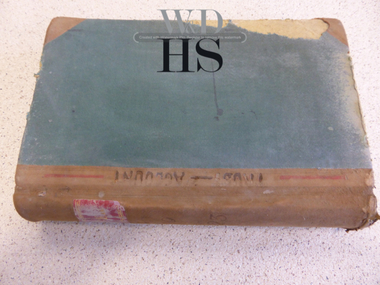 Warrnambool and District Historical Society Inc.
Book, Ledger - Trust Account, Early 20th century
... George Mackay was a prominent resident of Warrnambool from 1891 to his death in 1926. The Trust Accounts ledger lists the accounts of several organizations such as the Ancient Order of Foresters, the accounts of deceased estates and accounts of individual residents of Warrnambool and district. ...George Mackay was a prominent resident of Warrnambool from 1891 to his death in 1926. The Trust Accounts ledger lists the accounts of several organizations such as the Ancient Order of Foresters, the accounts of deceased estates and accounts of individual residents of Warrnambool and district. ...This Trust Accounts ledger belonged to the law firm of Mackay and Taylor of Kepler Street, Warrnambool. The law firms of George Mackay and James Fletcher merged in 1893 to form Fletcher and Mackay and in the early 1920s J. Taylor became the new partner with Mackay to form the legal practice of Mackay and Taylor. This firm continued in Kepler Street until the 1990s. George Mackay was a prominent resident of Warrnambool from 1891 to his death in 1926. The Trust Accounts ledger lists the accounts of several organizations such as the Ancient Order of Foresters, the accounts of deceased estates and accounts of individual residents of Warrnambool and district. The dates covered are from 1919 to 1923. The accounts appear to refer to an investment and banking society operated by Mackay and Taylor.The ledger has some significance as it contains information on the financial dealings of many well-known Warrnambool people and organizations. It has social significance as it shows the type of investment opportunities available to Warrnambool people in the first two decades of the 20th century. This is a foolscap-size bound book of 526 pages. The covers are of blue hard cardboard with buff-coloured spine and corners. The inside thick paper covers are of a blue and red mottled design. There are pages with alphabetical tabs at the start of the book. The pages are printed with red ruled lines for accounting purposes. The entries are in black ink. Spine – ‘Ledger’, ‘1919 to Dec. 1923’ Front Cover- ‘Trust Account’ mackay taylor legal firm, warrnambool -
 Warrnambool and District Historical Society Inc.
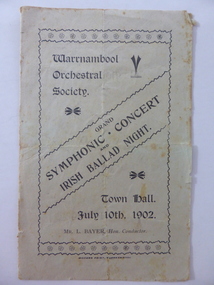
Programme, Original D Symphonic concert Town Hall July 10 1902, 1902
... Born in Germany, Bayer came to Warrnambool in 1891 and, with his wife, Eleanor, taught piano. violin, orchestration and singing and established the Warrnambool Orchestral Society. ...Born in Germany, Bayer came to Warrnambool in 1891 and, with his wife, Eleanor, taught piano. violin, orchestration and singing and established the Warrnambool Orchestral Society. ...This is a programme of a concert called ‘Grand Symphonic Concert and Irish Ballad Night’ staged by the Warrnambool Orchestral Society at the Warrnambool Town Hall on July 10th 1902. The conductor was Louis Bayer (1857-1907). Born in Germany, Bayer came to Warrnambool in 1891 and, with his wife, Eleanor, taught piano. violin, orchestration and singing and established the Warrnambool Orchestral Society. In 1896-7 Bayer was the musical director of the Warrnambool Industrial and Art exhibition, composing the Cantata for the opening ceremony and directing over 60 musical performances, including 22 operas and many concerts. Bayer was a composer and wrote several operas, including one called ‘Federation’. Bayer’s wife was an accompaniste at this symphonic concert and two of his sons played the horn and the drums. The soloists at this symphonic concert included Minnie Sloane, Lucy Meares and J. Robertson. This programme is of great significance as it features a concert conducted by Louis Bayer, one of the most important musicians in Warrnambool’s history. This is a yellow-coloured piece of paper folded in two to make four pages. The pages have details of the concert programme, a list of members of the orchestra, one advertisement and a front page with the concert headings in a fancy border. The pages are somewhat torn at the folds and there is heavy staining, especially on the back page. warrnambool orchestral society, louis bayer, history of warrnambool -
 Warrnambool and District Historical Society Inc.
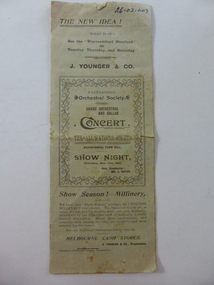
Book, Original document Concert W Town Hall show Night, 1902
... Born in Germany, Bayer came to Warrnambool in 1891 and with his wife taught piano, violin, orchestration and singing and established the Warrnambool Orchestral Society. ...Born in Germany, Bayer came to Warrnambool in 1891 and with his wife taught piano, violin, orchestration and singing and established the Warrnambool Orchestral Society. ...This is a programme of a concert called ‘The All Nations Night’ staged by the Warrnambool Orchestral Society and held in the Warrnambool Town Hall on Show Night, November 13th 1902. The conductor was Louis Bayer (1857-1907). Born in Germany, Bayer came to Warrnambool in 1891 and with his wife taught piano, violin, orchestration and singing and established the Warrnambool Orchestral Society. In 1896-7 Louis Bayer was the musical director at the Warrnambool Industrial and Art Exhibition, writing the Cantata for the opening ceremony and directing over 60 performances, including 22 operas and many concerts. Bayer was a composer and wrote several operas including one called ‘Federation’. Bayer’s wife was an accompaniste at this ‘All Nations Night’ concert and his son, Otto was the horn player. The concert featured the soloists, Nellie McClelland, Lucy Meares, W.D. Thomson and D. Williams. The concert may have been sponsored by Youngers Stores. This large department store was established in 1888 and closed in the 1980s. This programme is of great significance as it featured a 1902 concert conducted by Louis Bayer, one of the most important musical identities in Warrnambool’s history. These are two sheets of green-coloured paper folded in two to make eight pages. The printed material is in black type. The pages include the concert programme, a list of members of the orchestra and several advertisements for Youngers Stores. The front page has the concert title (‘The All Nations Night’) in a text box bordered by a floral pattern. The pages are a little torn at the edges. younger & co, warrnambool, history of warrnambool, louis bayer -
 Warrnambool and District Historical Society Inc.
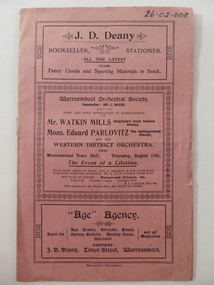
Programme, Western District Orchestra, 1904
... Louis Bayer (1857-1907) was born in Germany and came to Warrnambool in 1891. With his wife he taught piano, violin, orchestration and singing and established the Warrnambool Orchestral Society. ...Louis Bayer (1857-1907) was born in Germany and came to Warrnambool in 1891. With his wife he taught piano, violin, orchestration and singing and established the Warrnambool Orchestral Society. ...This is the programme of a concert staged by the Warrnambool Orchestral Society, probably in 1904, in the Warrnambool Town Hall. As well as the Warrnambool Orchestra conducted by Louis Bayer, the concert featured Watkin Mills, Eduard Parlovitz and the Western District Orchestra. Louis Bayer (1857-1907) was born in Germany and came to Warrnambool in 1891. With his wife he taught piano, violin, orchestration and singing and established the Warrnambool Orchestral Society. Bayer was the Musical Director of the 1896-7 Warrnambool Industrial and Art Exhibition, composing the Cantata for the opening ceremony and directing over 60 musical performances, including 22 operas and many concerts. Bayer was a composer and produced many operas, including one called ‘Federation’. Robert Watkin-Mills (1849-1930) was the leading English bass baritone concert performer of his time. He was successful in Britain, U.S.A. and Canada and moved to Canada in 1914. He toured Australia in 1904 and again in 1905. Eduard Parlovitz was a distinguished Polish pianist. This programme is of great significance as an example of a 1904 concert produced under the direction of Louis Bayer, one of the most important musicians in Warrnambool’s history. The concert also featured two internationally-known artists, demonstrating that in 1904 Warrnambool was a venue for the top musicians of the day. These are two sheets of paper folded to make one cover and four pages of printed material. The cover is pink with borders, some ornamental, forming the text boxes that separate the concert information from advertisements for two Warrnambool businesses. The programme details are printed on the white paper inside the cover and include two advertisements. The programme has been stapled but the metal staple has been removed. The programme is slightly torn on the cover edges. warrnambool orchestral society, louis bayer, robert watkin-mills, eduard parlovitz -
 Warrnambool and District Historical Society Inc.
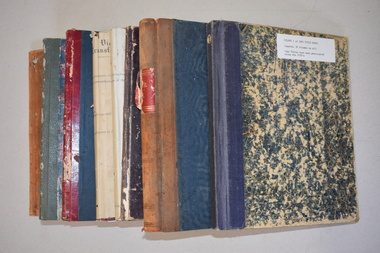
Letter Books, 1875 - 1945
... Scottish-born George Sutherland Mackay (1850-1926) opened a legal practice in Kepler Street, Warrnambool in 1891 and in 1893 bought the business of the late James Fletcher, with the business known as Fletcher and Mackay. ...Scottish-born George Sutherland Mackay (1850-1926) opened a legal practice in Kepler Street, Warrnambool in 1891 and in 1893 bought the business of the late James Fletcher, with the business known as Fletcher and Mackay. ...Eight of these letter books contain letters written by the Warrnambool lawyer George Mackay. They are mostly letters written to contacts while he was living in Scotland and letters sent from Warrnambool to Scotland to his daughter, Margueretta (Meta) who was studying medicine. Scottish-born George Sutherland Mackay (1850-1926) opened a legal practice in Kepler Street, Warrnambool in 1891 and in 1893 bought the business of the late James Fletcher, with the business known as Fletcher and Mackay. In the 1920s John Taylor became a partner and the firm of Mackay, Taylor & Co. (later Mackay Taylor) continued until 1999 when it merged with Taits Solicitors to form Tait Taylor (now Taits Legal). George Mackay was a Warrnambool Councillor and the first Mayor to hold office for four successive years. He was instrumental in getting the Warrnambool High School established and was the Chairman of the first School Council. Two of these letter books contain letters written by Ernest Powling. One letter book contains letters written by James Mack, a Warrnambool accountant These letter books are of considerable importance as they contain letters relating to legal matters in Warrnambool and district from the late 19th century to the mid 1940s. The letters also give an insight into the private life of a prominent Warrnambool lawyer, George Sutherland Mackay..1 This letter book has a dark blue cover, brown leather binding, an alphabetical index with tabs and handwritten letters. The spine is damaged. .2 This letter book has a dark red cover with red binding, an alphabetical index with tabs, a handwritten label on the front cover, information on the ledger maker and the handwriting of the letter writer inside the front cover. The spine is slightly damaged. .3 This letter book has a dark red mottled cover with white binding, an alphabetical index with tabs and a handwritten label on the front cover. .4 This letter book has a dark red cover with white paper binding and a handwritten label on the cover. .5 This letter book has a dark blue cover, red binding, and alphabetical index with tabs. The spine is slightly damaged. A loose receipt is inside the front cover. .6 This letter book has a mottled blue and pink cover, black binding, an alphabetical index with tabs and handwritten personal letters. .7 This letter book has a dark green cover, brown binding, an alphabetical index with coloured tabs and handwritten private letters. .8 This letter book has a mottled cover with black binding and an alphabetical index with tabs. Many of the letter copies are upside down. .9 This letter book has a dark green cover with red binding, an alphabetical index with tabs and handwritten personal letters. .10 This letter book has a dark green cover with buff-coloured leather binding, an alphabetical index with tabs and copies of typed letters. The leather is torn on the front cover. .11 This letter book has a green cover, a brown leather spine and a paper label pasted on the cover. This book has the spine detached and is badly waterstained .2 G Sutherland Mackay 1874 Private Letter Book james mack, warrnambool, ernest powling, port fairy, george mackay, warrnambool, history of warrnambool -
 Warrnambool and District Historical Society Inc.
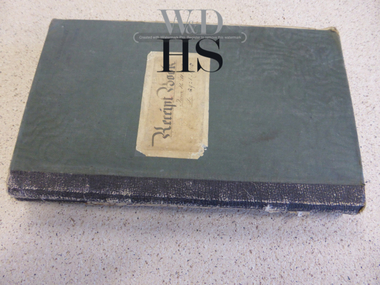
Book, Receipt book, Late 19th century
... This receipt book was used in the law business of the Warrnambool lawyer, George Mackay (1891 to 1893) and the amalgamated firm of James Fletcher and George Mackay (1893 to 1910). ...This receipt book was used in the law business of the Warrnambool lawyer, George Mackay (1891 to 1893) and the amalgamated firm of James Fletcher and George Mackay (1893 to 1910). ...This receipt book was used in the law business of the Warrnambool lawyer, George Mackay (1891 to 1893) and the amalgamated firm of James Fletcher and George Mackay (1893 to 1910). George Mackay was a prominent Warrnambool lawyer, active in the civic and community affairs of the town and the firm of Fletcher and Mackay was an important one in Warrnambool over the time covered by the entries in the receipt book. In the 1920s the firm became Mackay and Taylor when J. Taylor joined as a partner and was a well-known legal firm in Warrnambool until the 1990s. The book was found in the old Mackay Taylor offices in Kepler Street. WarrnamboolThis is a ledger with a dark green binding and black tape on the spine. There are 176 pages plus an alphabetical listing at the back. Most of the entries are receipts that have been pasted into the ledger with some additional written material. The entries are mostly written in black ink with some seals and stamps attached. The receipts are overwritten with ticks and initials in red crayon. Front cover: ‘Receipt Book, From 14.11.1891 To 29.1.1910’ Spine: ‘14-11-1891 to 29-1-10 Receipt Book’ george mackay, warrnambool fletcher and mackay -
 Warrnambool and District Historical Society Inc.
Administrative record - Warrnambool Waterworks Newspaper Cuttings, 1891 to 1917
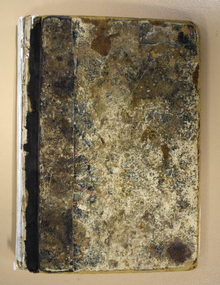
... In the early days of Warrnambool domestic water and water for fire suppression was supplied by tanks, wells and springs. In the 1870s various schemes were proposed to find a better supply of water. In 1891... Warrnambool Waterworks Trust Newspaper Reports From 19th May 1891 To --- ...In the early days of Warrnambool domestic water and water for fire suppression was supplied by tanks, wells and springs. In the 1870s various schemes were proposed to find a better supply of water. In 1891 ...This ledger contains newspaper cuttings form The Warrnambool Standard newspaper from May 1891 to October 1917. The cuttings are reports of meetings of the Warrnambool Waterworks Trust. In the early days of Warrnambool domestic water and water for fire suppression was supplied by tanks, wells and springs. In the 1870s various schemes were proposed to find a better supply of water. In 1891 the Warrnambool Waterworks Trust was formed using water from the Merri River. This system lasted until 1939 when the Warrnambool water supply came from the Otway ranges. This system is still the water supply for Warrnambool today. The cuttings in this ledger will be useful for research.This is a ledger with a brown mottled cover and a leather spine and leather corners. The spine is partly detached. The front cover has a label pasted on it. The pages originally had hand written entries (The Minutes of a Warrnambool organisation). Newspaper cuttings have been pasted over the original writing. Warrnambool Waterworks Trust Newspaper Reports From 19th May 1891 To --- warrnambool waterworks trust, warrnambool water supply -
 Flagstaff Hill Maritime Museum and Village
Certificate - Invitation, Norman Lindsay (Artist), Opening of the Parliament of the Commonwealth by His Royal Highness The Duke of Cornwall and York, ca. 1901
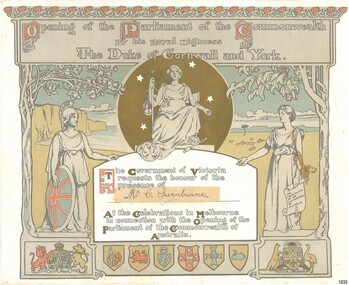
... He purchased Warrnambool’s Tattersall’s Hotel in 1911 and had a booth at the 1914 Warrnambool Show. In 1891, he married Susan Jane Granter (1867-19 June 1935), daughter of Joseph Granter (1832-1879) and Ann (born Holley). ...He purchased Warrnambool’s Tattersall’s Hotel in 1911 and had a booth at the 1914 Warrnambool Show. In 1891, he married Susan Jane Granter (1867-19 June 1935), daughter of Joseph Granter (1832-1879) and Ann (born Holley). ...Australia became a Federation on January 1st, 1901, uniting Australia's six British colonies - New South Wales, Victoria, Queensland, South Australia, Western Australia and Tasmania – into States of the Commonwealth of Australia. The Government of Victoria invited 12,000 guests to attend the official celebrations for the Opening of the Federal Parliament by His Royal Highness, the Duke of Cornwall and York (later King George V). The historic occasion was held at noon on May 9th, 1901, at Melbourne's Royal Exhibition Building, the only building large enough for that number of guests. The guests represented all six states of Australia with varied connections and interests, including politics, business and industry, the arts, religion, education, and public service. In Melbourne, the occasion was followed by two weeks of celebrations. The decorative, elaborate design of the certificate-size invitation represents Australia’s colonial history and its transition to the Federated Commonwealth of Australia. The National Gallery of Australia attributes the artwork of this invitation to Australian artists Norman Lindsay (1879–1969) and John Longstaff (1861–1941) and its printing to Sands & McDougall Limited, Melbourne. The invitation has no date or location details. This invitation has the label “Mr. C Swinburne” added over an original, handwritten name. Perhaps it was a spelling correction, or a late change, with Swinburne attending in the place of another citizen. The book “Our Invited Guests An Official Directory, Melbourne, Victoria, 1901” lists all the guests, but not one has the surname SWINBURNE. There are five Warrnambool listings, eight people in all: - - MoCOBMICK, G. D., Esq., P.M., Warrnambool. - O’DOWD, The Ven. Monsignor, Warrnambool. - OPIE, C. N. T., Esq. (and Lady), Warrnambool. - OSBORNE, Hy. Wm., Esq., Shire Secretary (and Lady), Town Hall, Warrnambool. - STEVENS, Mrs. F. P., Mia Mia, Warrnambool. CHARLES GRANT SWINBURNE (1864-1934): - Charles Grant Swinburne, known as Chas.., was a prominent Warrnambool figure: a member of Toc H., the Progress Association and several other local clubs and societies. He purchased Warrnambool’s Tattersall’s Hotel in 1911 and had a booth at the 1914 Warrnambool Show. In 1891, he married Susan Jane Granter (1867-19 June 1935), daughter of Joseph Granter (1832-1879) and Ann (born Holley). Joseph had arrived in Melbourne on the famous tall ship Marco Polo in February 1856. In 1868, he was a shareholder of the Warrnambool Steam Packet Co., trading along the coast of Victoria. His portrait is among those recognised on the historic Warrnambool Pioneers Board. The invitation is nationally significant for its connection with the first Federal Parliament in May 1901, where the first federal parliamentarians were sworn in, and where the Duke and Duchess of Cornwall and York attended, representing the continued link with Britain. The invitation also unites a local Warrnambool businessman, Mr C Swinburne, with the 12,000 guests representing their towns and states that in 1901 became the Commonwealth of Australia. Swinburn was also married to the daughter of Joseph Granter, an early pioneer recognised on Warrnambool’s Pioneer Board. Invitation: certificate size, colour lithograph on cream card with gilt highlights. The Victorian Government invited Mr C Swinburne to celebrate the Opening of Federal Parliament by HRH the Duke of Cornwall and York, held in Melbourne. The invitation has printed drawings of figures, decorations, heraldic symbols, and gilt accents behind the central figure, on the capital letters of the message, and the Advance Australia Arms. Inscribed with a handwritten label that covers handwritten text. [The event was held at Noon, 9th May 1901, Royal Exhibition Building, Melbourne.] Inscription, handwritten on a label: "Mr. C. Swinburne" Left image: [figure of Britannia holding a blue shield with three crossing red bands, standing below an oak tree] Central image, in front of a gilt circle : [symbolic female royal future with Orbe and Sceptre seated on throne, four stars around her] Right image: [young female figure representing Australia holding a scroll, standing below a flowering gum] "THE CONSTITUTION OF THE COMMONWEALTH OF AUSTRALIA" Bottom left: Combined Arms: "[Duke of Cornwall and York, Prince George Frederick Ernest Albert, Princess Alexandra, his Duchess]" Bottom centre: [six symbols representing the Coat of Arms for each state of Australia] Bottom right: Advance Australia Arms "[Shield with six symbols, between Kangaroo and Emu, and below Rising Sun'] ADVANCE AUSTRALIA"flagstaff hill maritime museum and village, flagstaff hill, maritime museum, maritime village, warrnambool, great ocean road, shipwreck coast, invitation, certificate, mr c swinburne, government of victoria, opening of federal parliament, hrh the duke of cornwall and york, c swinburne, susan jane granter, susan jane swinburne, federal parliament, 1901, australian federation, ceremonies, politics, royal exhibition building, invited guest, britannia, orb, sceptre, advance australia arms, constitution of the commonwealth of australia, norman lindsay, john longstaff, sands & mcdougall, federation, british colonies, commonwealth of australia, charles grant swinburne, chas swinburne, c g swinburne, opening of the federal parliament, duke of cornwall and york, may 9th, tattersall’s hotel, marco polo, warrnambool steam packet co, warrnambool pioneers board, joseph granter, ann granter -
 Flagstaff Hill Maritime Museum and Village
Tool - Wood Plane, David Malloch, Late 19th to early 20th Century
... 1891 but the company appears to have ceased trading in 1913. A vintage cabinet maker's tool from the mid 19th to early 20th century giving a snapshot into early cabinet and furniture making. flagstaff hill warrnambool shipwrecked-coast flagstaff-hill flagstaff-hill-maritime-museum maritime-museum shipwreck-coast flagstaff-hill-maritime-village D Malloch and Son Perth, Scotland Wood Plane with flat base curved sides single iron, 2 inch, size. ...David Malloch was born in 1818 in Dundee Scotland and died in January 1891, his father was James Malloch a weaver and his mother was Jane nee Watson. David Malloch had taken over a plane and tool-making business from John McGlashan a Perth plane maker in 1849 after McGlashan had died. David and later his son (John) ran the business at first from South Methven Street Perth, until early 1856 then the business moved to the center of town in Kirkside at 25 John's Street. He used these premises until 1870 when he moved again to 50 South Street Perth. It is believed his son John was involved at this time and the move was due to the business had outgrown the premises at John Street. It was noted in local publications that the firm by this time had nine employees and regarded as a manufacturer of edge tools of various kinds for cabinet makers, specifically wood planes. The firm continued under David Malloch's son John after David's death in 1891 but the company appears to have ceased trading in 1913.A vintage cabinet maker's tool from the mid 19th to early 20th century giving a snapshot into early cabinet and furniture making. Wood Plane with flat base curved sides single iron, 2 inch, size.D Malloch and Son Perth, Scotlandflagstaff hill, warrnambool, shipwrecked-coast, flagstaff-hill, flagstaff-hill-maritime-museum, maritime-museum, shipwreck-coast, flagstaff-hill-maritime-village -
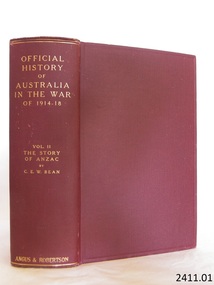 Flagstaff Hill Maritime Museum and Village
Book, Official History of Australia in the War of 1914-18 Vol 2-1
... Warrnambool Library to various places, including the Art Gallery, Historical Society and Flagstaff Hill. Later some were even distributed to other regional branches of Corangamite Regional Library and passed to and fro. It is difficult now to trace just where all of the items have ended up. The books at Flagstaff Hill Maritime Village generally display stamps and markings from Pattison as well as a variety of other institutions including the Mechanics’ Institute itself. RALPH ERIC PATTISON Ralph Eric Pattison was born in Rockhampton, Queensland, in 1891...Warrnambool Library to various places, including the Art Gallery, Historical Society and Flagstaff Hill. Later some were even distributed to other regional branches of Corangamite Regional Library and passed to and fro. It is difficult now to trace just where all of the items have ended up. The books at Flagstaff Hill Maritime Village generally display stamps and markings from Pattison as well as a variety of other institutions including the Mechanics’ Institute itself. RALPH ERIC PATTISON Ralph Eric Pattison was born in Rockhampton, Queensland, in 1891 ...This item is from the ‘Pattison Collection’, a collection of books and records that was originally owned by the Warrnambool Mechanics’ Institute, which was founded in Warrnambool in 1853. By 1886 the Warrnambool Mechanics’ Institute (WMI) had grown to have a Library, Museum and Fine Arts Gallery, with a collection of “… choice productions of art and valuable specimens in almost every branch and many wonderful national curiosities are now to be seen there, including historic relics of the town and district.” It later included a School of Design. Although it was very well patronised, the lack of financial support led the WMI in 1911 to ask the City Council to take it over. In 1935 Ralph Pattison was appointed as City Librarian to establish and organise the Warrnambool Library as it was then called. When the WMI building was pulled down in 1963 a new civic building was erected on the site and the new Warrnambool Library, on behalf of the City Council, took over all the holdings of the WMI. At this time some of the items were separated and identified as the ‘Pattison Collection’, named after Ralph Pattison. Eventually, the components of the WMI were distributed from the Warrnambool Library to various places, including the Art Gallery, Historical Society and Flagstaff Hill. Later some were even distributed to other regional branches of Corangamite Regional Library and passed to and fro. It is difficult now to trace just where all of the items have ended up. The books at Flagstaff Hill Maritime Village generally display stamps and markings from Pattison as well as a variety of other institutions including the Mechanics’ Institute itself. RALPH ERIC PATTISON Ralph Eric Pattison was born in Rockhampton, Queensland, in 1891. He married Maude Swan from Warrnambool in 1920 and they set up home in Warrnambool. In 1935 Pattison accepted a position as City Librarian for the Warrnambool City Council. His huge challenge was to make a functional library within two rooms of the Mechanics’ Institute. He tirelessly cleaned, cleared and sorted a disarrayed collection of old books, jars of preserved specimens and other items reserved for exhibition in the city’s museum. He developed and updated the library with a wide variety of books for all tastes, including reference books for students; a difficult task to fulfil during the years following the Depression. He converted all of the lower areas of the building into a library, reference room and reading room for members and the public. The books were sorted and stored using a cataloguing and card index system that he had developed himself. He also prepared the upper floor of the building and established the Art Gallery and later the Museum, a place to exhibit the many old relics that had been stored for years for this purpose. One of the treasures he found was a beautiful ancient clock, which he repaired, restored and enjoyed using in his office during the years of his service there. Ralph Pattison was described as “a meticulous gentleman whose punctuality, floorless courtesy and distinctive neat dress were hallmarks of his character, and ‘his’ clock controlled his daily routine and his opening and closing of the library’s large heavy doors to the minute.” Pattison took leave from 1942 to 1945 to serve in the Royal Australian Navy, Volunteer Reserve as Lieutenant. A few years later he converted one of the Museum’s rooms into a Children’s Library, stocking it with suitable books for the younger generation. This was an instant success. In the 1950’s he had the honour of being appointed to the Victorian Library Board and received more inspiration from the monthly conferences in Melbourne. He was sadly retired in 1959 after over 23 years of service, due to the fact that he had gone over the working age of council officers. However, he continued to take a very keen interest in the continual development of the Library until his death in 1969. The Pattison Collection, along with other items at Flagstaff Hill Maritime Village, was originally part of the Warrnambool Mechanics' Institute’s collection. The Warrnambool Mechanics’ Institute Collection is primarily significant in its totality, rather than for the individual objects it contains. Its contents are highly representative of the development of Mechanics' Institute libraries across Australia, particularly Victoria. A diversity of publications and themes has been amassed, and these provide clues to our understanding of the nature of and changes in the reading habits of Victorians from the 1850s to the middle of the 20th century. The collection also highlights the Warrnambool community’s commitment to the Mechanics’ Institute, reading, literacy and learning in the regions, and proves that access to knowledge was not impeded by distance. These items help to provide a more complete picture of our community’s ideals and aspirations. The Warrnambool Mechanics Institute book collection has historical and social significance for its strong association with the Mechanics Institute movement and the important role it played in the intellectual, cultural and social development of people throughout the latter part of the nineteenth century and the early twentieth century. The collection of books is a rare example of an early lending library and its significance is enhanced by the survival of an original collection of many volumes. The Warrnambool Mechanics' Institute’s publication collection is of both local and state significance. Official History of Australia in the War of 1914-18 Vol 2-1 Author: C E W Bean Publisher: Angus & Robertson Date: 1937 shipwrecked-coast, flagstaff-hill, warrnambool, flagstaff-hill-maritime-museum, maritime-museum, shipwreck-coast, flagstaff-hill-maritime-village, shipwrecked-artefact, book, warrnambool library, warrnambool mechanics’ institute, warrnambool city librarian, mechanics’ institute library, victorian library board, warrnambool books and records, warrnambool children’s library, great ocean road, official history of australia in the war of 1914-18 vol 2-1, official history of australia in the war of 1914-18 -
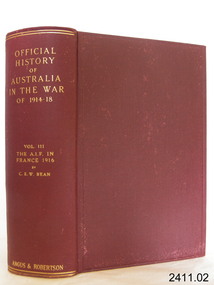 Flagstaff Hill Maritime Museum and Village
Book, Official History of Australia in the War of 1914-18 Vol 3-1
... Warrnambool Library to various places, including the Art Gallery, Historical Society and Flagstaff Hill. Later some were even distributed to other regional branches of Corangamite Regional Library and passed to and fro. It is difficult now to trace just where all of the items have ended up. The books at Flagstaff Hill Maritime Village generally display stamps and markings from Pattison as well as a variety of other institutions including the Mechanics’ Institute itself. RALPH ERIC PATTISON Ralph Eric Pattison was born in Rockhampton, Queensland, in 1891...Warrnambool Library to various places, including the Art Gallery, Historical Society and Flagstaff Hill. Later some were even distributed to other regional branches of Corangamite Regional Library and passed to and fro. It is difficult now to trace just where all of the items have ended up. The books at Flagstaff Hill Maritime Village generally display stamps and markings from Pattison as well as a variety of other institutions including the Mechanics’ Institute itself. RALPH ERIC PATTISON Ralph Eric Pattison was born in Rockhampton, Queensland, in 1891 ...This item is from the ‘Pattison Collection’, a collection of books and records that was originally owned by the Warrnambool Mechanics’ Institute, which was founded in Warrnambool in 1853. By 1886 the Warrnambool Mechanics’ Institute (WMI) had grown to have a Library, Museum and Fine Arts Gallery, with a collection of “… choice productions of art and valuable specimens in almost every branch and many wonderful national curiosities are now to be seen there, including historic relics of the town and district.” It later included a School of Design. Although it was very well patronised, the lack of financial support led the WMI in 1911 to ask the City Council to take it over. In 1935 Ralph Pattison was appointed as City Librarian to establish and organise the Warrnambool Library as it was then called. When the WMI building was pulled down in 1963 a new civic building was erected on the site and the new Warrnambool Library, on behalf of the City Council, took over all the holdings of the WMI. At this time some of the items were separated and identified as the ‘Pattison Collection’, named after Ralph Pattison. Eventually, the components of the WMI were distributed from the Warrnambool Library to various places, including the Art Gallery, Historical Society and Flagstaff Hill. Later some were even distributed to other regional branches of Corangamite Regional Library and passed to and fro. It is difficult now to trace just where all of the items have ended up. The books at Flagstaff Hill Maritime Village generally display stamps and markings from Pattison as well as a variety of other institutions including the Mechanics’ Institute itself. RALPH ERIC PATTISON Ralph Eric Pattison was born in Rockhampton, Queensland, in 1891. He married Maude Swan from Warrnambool in 1920 and they set up home in Warrnambool. In 1935 Pattison accepted a position as City Librarian for the Warrnambool City Council. His huge challenge was to make a functional library within two rooms of the Mechanics’ Institute. He tirelessly cleaned, cleared and sorted a disarrayed collection of old books, jars of preserved specimens and other items reserved for exhibition in the city’s museum. He developed and updated the library with a wide variety of books for all tastes, including reference books for students; a difficult task to fulfil during the years following the Depression. He converted all of the lower areas of the building into a library, reference room and reading room for members and the public. The books were sorted and stored using a cataloguing and card index system that he had developed himself. He also prepared the upper floor of the building and established the Art Gallery and later the Museum, a place to exhibit the many old relics that had been stored for years for this purpose. One of the treasures he found was a beautiful ancient clock, which he repaired, restored and enjoyed using in his office during the years of his service there. Ralph Pattison was described as “a meticulous gentleman whose punctuality, floorless courtesy and distinctive neat dress were hallmarks of his character, and ‘his’ clock controlled his daily routine and his opening and closing of the library’s large heavy doors to the minute.” Pattison took leave from 1942 to 1945 to serve in the Royal Australian Navy, Volunteer Reserve as Lieutenant. A few years later he converted one of the Museum’s rooms into a Children’s Library, stocking it with suitable books for the younger generation. This was an instant success. In the 1950’s he had the honour of being appointed to the Victorian Library Board and received more inspiration from the monthly conferences in Melbourne. He was sadly retired in 1959 after over 23 years of service, due to the fact that he had gone over the working age of council officers. However, he continued to take a very keen interest in the continual development of the Library until his death in 1969. The Pattison Collection, along with other items at Flagstaff Hill Maritime Village, was originally part of the Warrnambool Mechanics' Institute’s collection. The Warrnambool Mechanics’ Institute Collection is primarily significant in its totality, rather than for the individual objects it contains. Its contents are highly representative of the development of Mechanics' Institute libraries across Australia, particularly Victoria. A diversity of publications and themes has been amassed, and these provide clues to our understanding of the nature of and changes in the reading habits of Victorians from the 1850s to the middle of the 20th century. The collection also highlights the Warrnambool community’s commitment to the Mechanics’ Institute, reading, literacy and learning in the regions, and proves that access to knowledge was not impeded by distance. These items help to provide a more complete picture of our community’s ideals and aspirations. The Warrnambool Mechanics Institute book collection has historical and social significance for its strong association with the Mechanics Institute movement and the important role it played in the intellectual, cultural and social development of people throughout the latter part of the nineteenth century and the early twentieth century. The collection of books is a rare example of an early lending library and its significance is enhanced by the survival of an original collection of many volumes. The Warrnambool Mechanics' Institute’s publication collection is of both local and state significance. Official History of Australia in the War of 1914-18 Vol 3-1 Author: C E W Bean Publisher: Angus & Robertson Date: 1937 shipwrecked-coast, flagstaff-hill, warrnambool, flagstaff-hill-maritime-museum, maritime-museum, shipwreck-coast, flagstaff-hill-maritime-village, shipwrecked-artefact, book, warrnambool library, warrnambool mechanics’ institute, warrnambool city librarian, mechanics’ institute library, victorian library board, warrnambool books and records, warrnambool children’s library, great ocean road, official history of australia in the war of 1914-18 vol 3 -
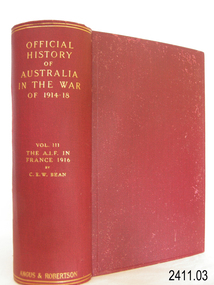 Flagstaff Hill Maritime Museum and Village
Book, Official History of Australia in the War of 1914-18 Vol 3-2
... Warrnambool Library to various places, including the Art Gallery, Historical Society and Flagstaff Hill. Later some were even distributed to other regional branches of Corangamite Regional Library and passed to and fro. It is difficult now to trace just where all of the items have ended up. The books at Flagstaff Hill Maritime Village generally display stamps and markings from Pattison as well as a variety of other institutions including the Mechanics’ Institute itself. RALPH ERIC PATTISON Ralph Eric Pattison was born in Rockhampton, Queensland, in 1891...Warrnambool Library to various places, including the Art Gallery, Historical Society and Flagstaff Hill. Later some were even distributed to other regional branches of Corangamite Regional Library and passed to and fro. It is difficult now to trace just where all of the items have ended up. The books at Flagstaff Hill Maritime Village generally display stamps and markings from Pattison as well as a variety of other institutions including the Mechanics’ Institute itself. RALPH ERIC PATTISON Ralph Eric Pattison was born in Rockhampton, Queensland, in 1891 ...This item is from the ‘Pattison Collection’, a collection of books and records that was originally owned by the Warrnambool Mechanics’ Institute, which was founded in Warrnambool in 1853. By 1886 the Warrnambool Mechanics’ Institute (WMI) had grown to have a Library, Museum and Fine Arts Gallery, with a collection of “… choice productions of art, and valuable specimens in almost every branch and many wonderful national curiosities are now to be seen there, including historic relics of the town and district.” It later included a School of Design. Although it was very well patronised, the lack of financial support led the WMI in 1911 to ask the City Council to take it over. In 1935 Ralph Pattison was appointed as City Librarian to establish and organise the Warrnambool Library as it was then called. When the WMI building was pulled down in 1963 a new civic building was erected on the site and the new Warrnambool Library, on behalf of the City Council, took over all the holdings of the WMI. At this time some of the items were separated and identified as the ‘Pattison Collection’, named after Ralph Pattison. Eventually the components of the WMI were distributed from the Warrnambool Library to various places, including the Art Gallery, Historical Society and Flagstaff Hill. Later some were even distributed to other regional branches of Corangamite Regional Library and passed to and fro. It is difficult now to trace just where all of the items have ended up. The books at Flagstaff Hill Maritime Village generally display stamps and markings from Pattison as well as a variety of other institutions including the Mechanics’ Institute itself. RALPH ERIC PATTISON Ralph Eric Pattison was born in Rockhampton, Queensland, in 1891. He married Maude Swan from Warrnambool in 1920 and they set up home in Warrnambool. In 1935 Pattison accepted a position as City Librarian for the Warrnambool City Council. His huge challenge was to make a functional library within two rooms of the Mechanics’ Institute. He tirelessly cleaned, cleared and sorted a disarrayed collection of old books, jars of preserved specimens and other items reserved for exhibition in the city’s museum. He developed and updated the library with a wide variety of books for all tastes, including reference books for students; a difficult task to fulfil during the years following the Depression. He converted all of the lower area of the building into a library, reference room and reading room for members and the public. The books were sorted and stored using a cataloguing and card index system that he had developed himself. He also prepared the upper floor of the building and established the Art Gallery and later the Museum, a place to exhibit the many old relics that had been stored for years for this purpose. One of the treasures he found was a beautiful ancient clock, which he repaired, restored and enjoyed using in his office during the years of his service there. Ralph Pattison was described as “a meticulous gentleman whose punctuality, floorless courtesy and distinctive neat dress were hallmarks of his character, and ‘his’ clock controlled his daily routine, and his opening and closing of the library’s large heavy doors to the minute.” Pattison took leave during 1942 to 1945 to serve in the Royal Australian Navy, Volunteer Reserve as Lieutenant. A few years later he converted one of the Museum’s rooms into a Children’s Library, stocking it with suitable books for the younger generation. This was an instant success. In the 1950’s he had the honour of being appointed to the Victorian Library Board and received more inspiration from the monthly conferences in Melbourne. He was sadly retired in 1959 after over 23 years of service, due to the fact that he had gone over the working age of council officers. However he continued to take a very keen interest in the continual development of the Library until his death in 1969. The Pattison Collection, along with other items at Flagstaff Hill Maritime Village, was originally part of the Warrnambool Mechanics' Institute’s collection. The Warrnambool Mechanics’ Institute Collection is primarily significant in its totality, rather than for the individual objects it contains. Its contents are highly representative of the development of Mechanics' Institute libraries across Australia, particularly Victoria. A diversity of publications and themes has been amassed, and these provide clues to our understanding of the nature of and changes in the reading habits of Victorians from the 1850s to the middle of the 20th century. The collection also highlights the Warrnambool community’s commitment to the Mechanics’ Institute, reading, literacy and learning in the regions, and proves that access to knowledge was not impeded by distance. These items help to provide a more complete picture of our community’s ideals and aspirations. The Warrnambool Mechanics Institute book collection has historical and social significance for its strong association with the Mechanics Institute movement and the important role it played in the intellectual, cultural and social development of people throughout the latter part of the nineteenth century and the early twentieth century. The collection of books is a rare example of an early lending library and its significance is enhanced by the survival of an original collection of many volumes. The Warrnambool Mechanics' Institute’s publication collection is of both local and state significance. Official History of Australia in the War of 1914-18 Vol 3-2 Author: C E W Bean Publisher: Angus & Robertson Date: 1937shipwrecked-coast, flagstaff-hill, warrnambool, flagstaff-hill-maritime-museum, maritime-museum, shipwreck-coast, flagstaff-hill-maritime-village, shipwrecked-artefact, book, warrnambool library, warrnambool mechanics’ institute, warrnambool city librarian, mechanics’ institute library, victorian library board, warrnambool books and records, warrnambool children’s library, great ocean road, official history of australia in the war of 1914-18 vol 3, c e w bean -
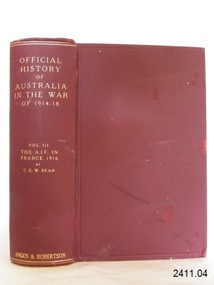 Flagstaff Hill Maritime Museum and Village
Book, Official History of Australia in the War of 1914-18 Vol 3-3
... Warrnambool Library to various places, including the Art Gallery, Historical Society and Flagstaff Hill. Later some were even distributed to other regional branches of Corangamite Regional Library and passed to and fro. It is difficult now to trace just where all of the items have ended up. The books at Flagstaff Hill Maritime Village generally display stamps and markings from Pattison as well as a variety of other institutions including the Mechanics’ Institute itself. RALPH ERIC PATTISON Ralph Eric Pattison was born in Rockhampton, Queensland, in 1891...Warrnambool Library to various places, including the Art Gallery, Historical Society and Flagstaff Hill. Later some were even distributed to other regional branches of Corangamite Regional Library and passed to and fro. It is difficult now to trace just where all of the items have ended up. The books at Flagstaff Hill Maritime Village generally display stamps and markings from Pattison as well as a variety of other institutions including the Mechanics’ Institute itself. RALPH ERIC PATTISON Ralph Eric Pattison was born in Rockhampton, Queensland, in 1891 ...This item is from the ‘Pattison Collection’, a collection of books and records that was originally owned by the Warrnambool Mechanics’ Institute, which was founded in Warrnambool in 1853. By 1886 the Warrnambool Mechanics’ Institute (WMI) had grown to have a Library, Museum and Fine Arts Gallery, with a collection of “… choice productions of art, and valuable specimens in almost every branch and many wonderful national curiosities are now to be seen there, including historic relics of the town and district.” It later included a School of Design. Although it was very well patronised, the lack of financial support led the WMI in 1911 to ask the City Council to take it over. In 1935 Ralph Pattison was appointed as City Librarian to establish and organise the Warrnambool Library as it was then called. When the WMI building was pulled down in 1963 a new civic building was erected on the site and the new Warrnambool Library, on behalf of the City Council, took over all the holdings of the WMI. At this time some of the items were separated and identified as the ‘Pattison Collection’, named after Ralph Pattison. Eventually the components of the WMI were distributed from the Warrnambool Library to various places, including the Art Gallery, Historical Society and Flagstaff Hill. Later some were even distributed to other regional branches of Corangamite Regional Library and passed to and fro. It is difficult now to trace just where all of the items have ended up. The books at Flagstaff Hill Maritime Village generally display stamps and markings from Pattison as well as a variety of other institutions including the Mechanics’ Institute itself. RALPH ERIC PATTISON Ralph Eric Pattison was born in Rockhampton, Queensland, in 1891. He married Maude Swan from Warrnambool in 1920 and they set up home in Warrnambool. In 1935 Pattison accepted a position as City Librarian for the Warrnambool City Council. His huge challenge was to make a functional library within two rooms of the Mechanics’ Institute. He tirelessly cleaned, cleared and sorted a disarrayed collection of old books, jars of preserved specimens and other items reserved for exhibition in the city’s museum. He developed and updated the library with a wide variety of books for all tastes, including reference books for students; a difficult task to fulfil during the years following the Depression. He converted all of the lower area of the building into a library, reference room and reading room for members and the public. The books were sorted and stored using a cataloguing and card index system that he had developed himself. He also prepared the upper floor of the building and established the Art Gallery and later the Museum, a place to exhibit the many old relics that had been stored for years for this purpose. One of the treasures he found was a beautiful ancient clock, which he repaired, restored and enjoyed using in his office during the years of his service there. Ralph Pattison was described as “a meticulous gentleman whose punctuality, floorless courtesy and distinctive neat dress were hallmarks of his character, and ‘his’ clock controlled his daily routine, and his opening and closing of the library’s large heavy doors to the minute.” Pattison took leave during 1942 to 1945 to serve in the Royal Australian Navy, Volunteer Reserve as Lieutenant. A few years later he converted one of the Museum’s rooms into a Children’s Library, stocking it with suitable books for the younger generation. This was an instant success. In the 1950’s he had the honour of being appointed to the Victorian Library Board and received more inspiration from the monthly conferences in Melbourne. He was sadly retired in 1959 after over 23 years of service, due to the fact that he had gone over the working age of council officers. However he continued to take a very keen interest in the continual development of the Library until his death in 1969. The Pattison Collection, along with other items at Flagstaff Hill Maritime Village, was originally part of the Warrnambool Mechanics' Institute’s collection. The Warrnambool Mechanics’ Institute Collection is primarily significant in its totality, rather than for the individual objects it contains. Its contents are highly representative of the development of Mechanics' Institute libraries across Australia, particularly Victoria. A diversity of publications and themes has been amassed, and these provide clues to our understanding of the nature of and changes in the reading habits of Victorians from the 1850s to the middle of the 20th century. The collection also highlights the Warrnambool community’s commitment to the Mechanics’ Institute, reading, literacy and learning in the regions, and proves that access to knowledge was not impeded by distance. These items help to provide a more complete picture of our community’s ideals and aspirations. The Warrnambool Mechanics Institute book collection has historical and social significance for its strong association with the Mechanics Institute movement and the important role it played in the intellectual, cultural and social development of people throughout the latter part of the nineteenth century and the early twentieth century. The collection of books is a rare example of an early lending library and its significance is enhanced by the survival of an original collection of many volumes. The Warrnambool Mechanics' Institute’s publication collection is of both local and state significance. Official History of Australia in the War of 1914-18 Vol 3-3 Author: C E W Bean Publisher: Angus & Robertson Date: 1937 shipwrecked-coast, flagstaff-hill, warrnambool, flagstaff-hill-maritime-museum, maritime-museum, shipwreck-coast, flagstaff-hill-maritime-village, shipwrecked-artefact, book, warrnambool library, warrnambool mechanics’ institute, warrnambool city librarian, mechanics’ institute library, victorian library board, warrnambool books and records, warrnambool children’s library, great ocean road, official history of australia in the war of 1914-18 vol 3 -
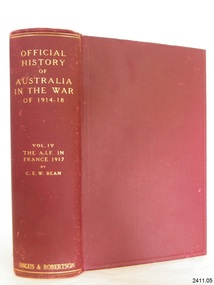 Flagstaff Hill Maritime Museum and Village
Book, Official History of Australia in the War of 1914-18 Vol 4-1
... Warrnambool Library to various places, including the Art Gallery, Historical Society and Flagstaff Hill. Later some were even distributed to other regional branches of Corangamite Regional Library and passed to and fro. It is difficult now to trace just where all of the items have ended up. The books at Flagstaff Hill Maritime Village generally display stamps and markings from Pattison as well as a variety of other institutions including the Mechanics’ Institute itself. RALPH ERIC PATTISON Ralph Eric Pattison was born in Rockhampton, Queensland, in 1891...Warrnambool Library to various places, including the Art Gallery, Historical Society and Flagstaff Hill. Later some were even distributed to other regional branches of Corangamite Regional Library and passed to and fro. It is difficult now to trace just where all of the items have ended up. The books at Flagstaff Hill Maritime Village generally display stamps and markings from Pattison as well as a variety of other institutions including the Mechanics’ Institute itself. RALPH ERIC PATTISON Ralph Eric Pattison was born in Rockhampton, Queensland, in 1891 ...This item is from the ‘Pattison Collection’, a collection of books and records that was originally owned by the Warrnambool Mechanics’ Institute, which was founded in Warrnambool in 1853. By 1886 the Warrnambool Mechanics’ Institute (WMI) had grown to have a Library, Museum and Fine Arts Gallery, with a collection of “… choice productions of art and valuable specimens in almost every branch and many wonderful national curiosities are now to be seen there, including historic relics of the town and district.” It later included a School of Design. Although it was very well patronised, the lack of financial support led the WMI in 1911 to ask the City Council to take it over. In 1935 Ralph Pattison was appointed as City Librarian to establish and organise the Warrnambool Library as it was then called. When the WMI building was pulled down in 1963 a new civic building was erected on the site and the new Warrnambool Library, on behalf of the City Council, took over all the holdings of the WMI. At this time some of the items were separated and identified as the ‘Pattison Collection’, named after Ralph Pattison. Eventually, the components of the WMI were distributed from the Warrnambool Library to various places, including the Art Gallery, Historical Society and Flagstaff Hill. Later some were even distributed to other regional branches of Corangamite Regional Library and passed to and fro. It is difficult now to trace just where all of the items have ended up. The books at Flagstaff Hill Maritime Village generally display stamps and markings from Pattison as well as a variety of other institutions including the Mechanics’ Institute itself. RALPH ERIC PATTISON Ralph Eric Pattison was born in Rockhampton, Queensland, in 1891. He married Maude Swan from Warrnambool in 1920 and they set up home in Warrnambool. In 1935 Pattison accepted a position as City Librarian for the Warrnambool City Council. His huge challenge was to make a functional library within two rooms of the Mechanics’ Institute. He tirelessly cleaned, cleared and sorted a disarrayed collection of old books, jars of preserved specimens and other items reserved for exhibition in the city’s museum. He developed and updated the library with a wide variety of books for all tastes, including reference books for students; a difficult task to fulfil during the years following the Depression. He converted all of the lower areas of the building into a library, reference room and reading room for members and the public. The books were sorted and stored using a cataloguing and card index system that he had developed himself. He also prepared the upper floor of the building and established the Art Gallery and later the Museum, a place to exhibit the many old relics that had been stored for years for this purpose. One of the treasures he found was a beautiful ancient clock, which he repaired, restored and enjoyed using in his office during the years of his service there. Ralph Pattison was described as “a meticulous gentleman whose punctuality, floorless courtesy and distinctive neat dress were hallmarks of his character, and ‘his’ clock controlled his daily routine and his opening and closing of the library’s large heavy doors to the minute.” Pattison took leave from 1942 to 1945 to serve in the Royal Australian Navy, Volunteer Reserve as Lieutenant. A few years later he converted one of the Museum’s rooms into a Children’s Library, stocking it with suitable books for the younger generation. This was an instant success. In the 1950’s he had the honour of being appointed to the Victorian Library Board and received more inspiration from the monthly conferences in Melbourne. He was sadly retired in 1959 after over 23 years of service, due to the fact that he had gone over the working age of council officers. However, he continued to take a very keen interest in the continual development of the Library until his death in 1969. The Pattison Collection, along with other items at Flagstaff Hill Maritime Village, was originally part of the Warrnambool Mechanics' Institute’s collection. The Warrnambool Mechanics’ Institute Collection is primarily significant in its totality, rather than for the individual objects it contains. Its contents are highly representative of the development of Mechanics' Institute libraries across Australia, particularly Victoria. A diversity of publications and themes has been amassed, and these provide clues to our understanding of the nature of and changes in the reading habits of Victorians from the 1850s to the middle of the 20th century. The collection also highlights the Warrnambool community’s commitment to the Mechanics’ Institute, reading, literacy and learning in the regions, and proves that access to knowledge was not impeded by distance. These items help to provide a more complete picture of our community’s ideals and aspirations. The Warrnambool Mechanics Institute book collection has historical and social significance for its strong association with the Mechanics Institute movement and the important role it played in the intellectual, cultural and social development of people throughout the latter part of the nineteenth century and the early twentieth century. The collection of books is a rare example of an early lending library and its significance is enhanced by the survival of an original collection of many volumes. The Warrnambool Mechanics' Institute’s publication collection is of both local and state significance. Official History of Australia in the War of 1914-18 Vol 4-1 Author: C E W Bean Publisher: Angus & Robertson Date: 1941shipwrecked-coast, flagstaff-hill, warrnambool, flagstaff-hill-maritime-museum, maritime-museum, shipwreck-coast, flagstaff-hill-maritime-village, shipwrecked-artefact, book, warrnambool library, warrnambool mechanics’ institute, warrnambool city librarian, mechanics’ institute library, victorian library board, warrnambool books and records, warrnambool children’s library, great ocean road, official history of australia in the war of 1914-18 vol 4 -
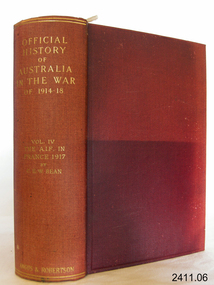 Flagstaff Hill Maritime Museum and Village
Book, Official History of Australia in the War of 1914-18 Vol 4-2
... Warrnambool Library to various places, including the Art Gallery, Historical Society and Flagstaff Hill. Later some were even distributed to other regional branches of Corangamite Regional Library and passed to and fro. It is difficult now to trace just where all of the items have ended up. The books at Flagstaff Hill Maritime Village generally display stamps and markings from Pattison as well as a variety of other institutions including the Mechanics’ Institute itself. RALPH ERIC PATTISON Ralph Eric Pattison was born in Rockhampton, Queensland, in 1891...Warrnambool Library to various places, including the Art Gallery, Historical Society and Flagstaff Hill. Later some were even distributed to other regional branches of Corangamite Regional Library and passed to and fro. It is difficult now to trace just where all of the items have ended up. The books at Flagstaff Hill Maritime Village generally display stamps and markings from Pattison as well as a variety of other institutions including the Mechanics’ Institute itself. RALPH ERIC PATTISON Ralph Eric Pattison was born in Rockhampton, Queensland, in 1891 ...This item is from the ‘Pattison Collection’, a collection of books and records that was originally owned by the Warrnambool Mechanics’ Institute, which was founded in Warrnambool in 1853. By 1886 the Warrnambool Mechanics’ Institute (WMI) had grown to have a Library, Museum and Fine Arts Gallery, with a collection of “… choice productions of art and valuable specimens in almost every branch and many wonderful national curiosities are now to be seen there, including historic relics of the town and district.” It later included a School of Design. Although it was very well patronised, the lack of financial support led the WMI in 1911 to ask the City Council to take it over. In 1935 Ralph Pattison was appointed as City Librarian to establish and organise the Warrnambool Library as it was then called. When the WMI building was pulled down in 1963 a new civic building was erected on the site and the new Warrnambool Library, on behalf of the City Council, took over all the holdings of the WMI. At this time some of the items were separated and identified as the ‘Pattison Collection’, named after Ralph Pattison. Eventually, the components of the WMI were distributed from the Warrnambool Library to various places, including the Art Gallery, Historical Society and Flagstaff Hill. Later some were even distributed to other regional branches of Corangamite Regional Library and passed to and fro. It is difficult now to trace just where all of the items have ended up. The books at Flagstaff Hill Maritime Village generally display stamps and markings from Pattison as well as a variety of other institutions including the Mechanics’ Institute itself. RALPH ERIC PATTISON Ralph Eric Pattison was born in Rockhampton, Queensland, in 1891. He married Maude Swan from Warrnambool in 1920 and they set up home in Warrnambool. In 1935 Pattison accepted a position as City Librarian for the Warrnambool City Council. His huge challenge was to make a functional library within two rooms of the Mechanics’ Institute. He tirelessly cleaned, cleared and sorted a disarrayed collection of old books, jars of preserved specimens and other items reserved for exhibition in the city’s museum. He developed and updated the library with a wide variety of books for all tastes, including reference books for students; a difficult task to fulfil during the years following the Depression. He converted all of the lower areas of the building into a library, reference room and reading room for members and the public. The books were sorted and stored using a cataloguing and card index system that he had developed himself. He also prepared the upper floor of the building and established the Art Gallery and later the Museum, a place to exhibit the many old relics that had been stored for years for this purpose. One of the treasures he found was a beautiful ancient clock, which he repaired, restored and enjoyed using in his office during the years of his service there. Ralph Pattison was described as “a meticulous gentleman whose punctuality, floorless courtesy and distinctive neat dress were hallmarks of his character, and ‘his’ clock controlled his daily routine and his opening and closing of the library’s large heavy doors to the minute.” Pattison took leave from 1942 to 1945 to serve in the Royal Australian Navy, Volunteer Reserve as Lieutenant. A few years later he converted one of the Museum’s rooms into a Children’s Library, stocking it with suitable books for the younger generation. This was an instant success. In the 1950’s he had the honour of being appointed to the Victorian Library Board and received more inspiration from the monthly conferences in Melbourne. He was sadly retired in 1959 after over 23 years of service, due to the fact that he had gone over the working age of council officers. However, he continued to take a very keen interest in the continual development of the Library until his death in 1969. The Pattison Collection, along with other items at Flagstaff Hill Maritime Village, was originally part of the Warrnambool Mechanics' Institute’s collection. The Warrnambool Mechanics’ Institute Collection is primarily significant in its totality, rather than for the individual objects it contains. Its contents are highly representative of the development of Mechanics' Institute libraries across Australia, particularly Victoria. A diversity of publications and themes has been amassed, and these provide clues to our understanding of the nature of and changes in the reading habits of Victorians from the 1850s to the middle of the 20th century. The collection also highlights the Warrnambool community’s commitment to the Mechanics’ Institute, reading, literacy and learning in the regions, and proves that access to knowledge was not impeded by distance. These items help to provide a more complete picture of our community’s ideals and aspirations. The Warrnambool Mechanics Institute book collection has historical and social significance for its strong association with the Mechanics Institute movement and the important role it played in the intellectual, cultural and social development of people throughout the latter part of the nineteenth century and the early twentieth century. The collection of books is a rare example of an early lending library and its significance is enhanced by the survival of an original collection of many volumes. The Warrnambool Mechanics' Institute’s publication collection is of both local and state significance. Official History of Australia in the War of 1914-18 Vol 4-2 Author: C E W Bean Publisher: Angus & Robertson Date:1942 shipwrecked-coast, flagstaff-hill, warrnambool, flagstaff-hill-maritime-museum, maritime-museum, shipwreck-coast, flagstaff-hill-maritime-village, shipwrecked-artefact, book, warrnambool library, warrnambool mechanics’ institute, warrnambool city librarian, mechanics’ institute library, victorian library board, warrnambool books and records, warrnambool children’s library, great ocean road, official history of australia in the war of 1914-18 vol 4-2, official history of australia in the war of 1914-18, c e w bean
