
Showing 220 items matching "warrnambool artist"
-
 Warrnambool and District Historical Society Inc.
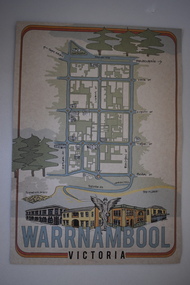
Document, Ella Webb, Warrnambool artist, Street Walks of Warrnambool, 2018
... This is a tourist guide to Warrnambool produced by a local artist, Ella Webb, in conjunction with the Warrnambool and District Historical Society. ...Ella Webb, Warrnambool artist...Street Walks of Warrnambool Document Ella Webb, Warrnambool artist ...This is a tourist guide to Warrnambool produced by a local artist, Ella Webb, in conjunction with the Warrnambool and District Historical Society. It includes a sketch map showing the location of some points of interest – buildings and sites of historical interest, places of interest that are no longer existing, some natural features (mainly along the coast) and some information about incidents and people in the past. It is an attractive broadsheet that is a useful guide for visitors to Warrnambool. This sheet is of interest as a modern-day tourist map produced in an artistic fashion by a local Warrnambool artist.This is a single sheet of thick paper printed on both sides in green, brown, yellow and beige tonings. One side of the sheet has sketches of buildings and places of interest and printing and the other side has a sketch map of some of the main streets of Warrnambool and some of its attractions. -
 Flagstaff Hill Maritime Museum and Village
Painting
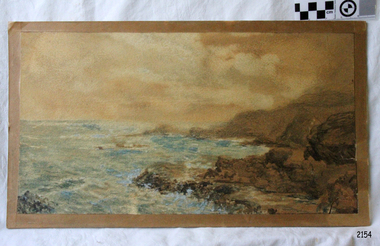
... Watercolour painting of seascape-coastline of Warrnambool. Artist unknown....flagstaff hill warrnambool shipwrecked-coast flagstaff-hill flagstaff-hill-maritime-museum maritime-museum shipwreck-coast flagstaff-hill-maritime-village Watercolour painting Watercolour painting Watercolour painting of seascape-coastline of Warrnambool. Artist unknown. Painting ...Watercolour painting of seascape-coastline of Warrnambool. Artist unknown.flagstaff hill, warrnambool, shipwrecked-coast, flagstaff-hill, flagstaff-hill-maritime-museum, maritime-museum, shipwreck-coast, flagstaff-hill-maritime-village, watercolour painting, watercolour, painting -
 Flagstaff Hill Maritime Museum and Village
Sculpture - Limestone, Lady in the Wind
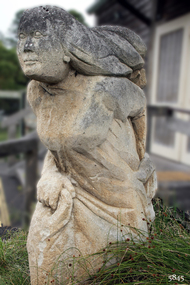
... ...warrnambool artist...The late Robert Ulmann (1927-1999) was a well-known local Warrnambool artist, creating murals, sculptures and art works. ...The late Robert Ulmann (1927-1999) was a well-known local Warrnambool artist, creating murals, sculptures and art works. ...The late Robert Ulmann (1927-1999) was a well-known local Warrnambool artist, creating murals, sculptures and art works. The sculpture 'Lady in the Wind' was presented to Flagstaff Hill Maritime Village by Dr Ivor (Ivor Philip Quentin Scott 16-08/1928 - 1/11/2016) and his wife Deirdre Scott (dec.). This sculpture is significant for being a creation of Robert Ulmann, well known local Warrnambool artist. The sculpture titled "Lady in the Wind" by Robert Ulmann. Subject is a robed woman moving forward, long hair streaming behind her, clutching fabric of skirt in each hand. Created in 1975. Made of Mount Gambier stone. Plaque describing the sculpture is on a nearby wall. The sculpture was presented to Flagstaff hill by Ivor and Deirdre Scott."Robert Ulmann / "LADY IN THE WIND " ' Sculpture, Mt Gambier Stone, 1975. / Presented by Ivor and Deirdre Scott "flagstaff hill, warrnambool, shipwrecked-coast, flagstaff-hill, flagstaff-hill-maritime-museum, maritime-museum, shipwreck-coast, flagstaff-hill-maritime-village, robert ulmann, sculpture in warrnambool, lady in the wind sculpture, warrnambool artist, flagstaff hill maritime village sculpture, ivor philip quentin scott, deirdre scott, ivor scott, lady in the wind -
 Flagstaff Hill Maritime Museum and Village
Painting - Vessel, Steamship, Mike McCrea (artist), ca 1985
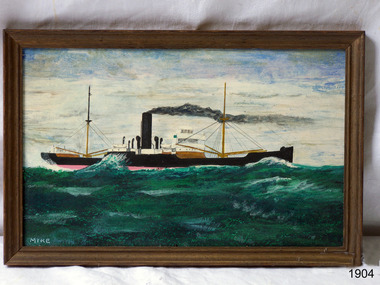
... This is one of a pair of paintings by artist Mike McCrea, created when he was in Warrnambool in 1985. The painting was framed and sold by Patana Galleries, Paton Place, Manly Vale, NSW. ...Painting; timber framed oil painting with the image of a cargo steamship off the coast of Warrnambool. Artist is Mike McCrea. Framed by Patana Galleries, Manly Vale, NSW. ...No. 390 A" Sticker "61" Painting; timber framed oil painting with the image of a cargo steamship off the coast of Warrnambool. Artist is Mike McCrea. Framed by Patana Galleries, Manly Vale, NSW. ...This is one of a pair of paintings by artist Mike McCrea, created when he was in Warrnambool in 1985. The painting was framed and sold by Patana Galleries, Paton Place, Manly Vale, NSW. It was later purchased by athe company of Master Mariners of Australia and who donated the pair to Flagstaff Hill. The pair of paintings are significant for their association with steamships and the Master Mariners of Australia group. The paintings represent a time in local history when many steamships were sailing the coast and transporting passengers and goods.Painting; timber framed oil painting with the image of a cargo steamship off the coast of Warrnambool. Artist is Mike McCrea. Framed by Patana Galleries, Manly Vale, NSW. Hand written, "Red. No. 390 A" Sticker "61"flagstaff hill, warrnambool, shipwrecked-coast, flagstaff-hill, flagstaff-hill-maritime-museum, maritime-museum, shipwreck-coast, flagstaff-hill-maritime-village, painting, mic mccrea, patana galleries, master mariners of australia, steamship -
 Glenelg Shire Council Cultural Collection
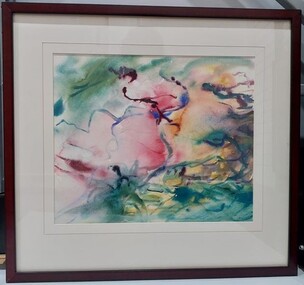
Painting, Bruce Vinall, High Tide, 2003
... ... Warrnambool artist...Portland Library Exhibition, 2005 Bruce Vinall Warrnambool artist watercolour abstract Seascape Bottom right: Vinall 03 Abstract painting with predominantly green, pink and yellow colours. ...Portland Library Exhibition, 2005Abstract painting with predominantly green, pink and yellow colours. Swirls and blotches giving the impression of movement. Mounted in cream double matt, in dark wood frame with glass glazing.Bottom right: Vinall 03bruce vinall, warrnambool artist, watercolour, abstract, seascape -
 Flagstaff Hill Maritime Museum and Village
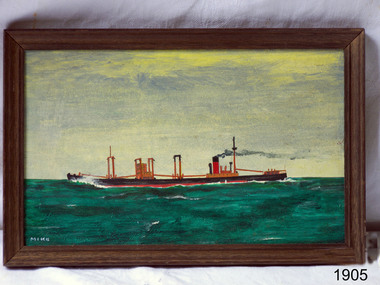
Painting - Vessel, Steamship, Mike McCrea (artist), ca 1985
... This is one of a pair of paintings by artist Mike McCrea, created when he was in Warrnambool in 1985. The painting was framed and sold by Patana Galleries, Paton Place, Manly Vale, NSW. ...Painting, framed oil on board; cargo steamship off the coast of Warrnambool by artist Mike McCrea. Framed by Patana Galleries, Manly Vale, N.S.W. ...No. 390 A" Sticker with "62" "PATANA GALLERIES / PATON PLACE, MANLY VALE / PHONE 949-1535" Painting, framed oil on board; cargo steamship off the coast of Warrnambool by artist Mike McCrea. Framed by Patana Galleries, Manly Vale, N.S.W. ...This is one of a pair of paintings by artist Mike McCrea, created when he was in Warrnambool in 1985. The painting was framed and sold by Patana Galleries, Paton Place, Manly Vale, NSW. It was later purchased by athe company of Master Mariners of Australia and who donated the pair to Flagstaff Hill. The pair of paintings are significant for their association with steamships and the Master Mariners of Australia group. The paintings represent a time in local history when many steamships were sailing the coast and transporting passengers and goods.Painting, framed oil on board; cargo steamship off the coast of Warrnambool by artist Mike McCrea. Framed by Patana Galleries, Manly Vale, N.S.W. Signed by artist.Signed; "MIKE" "J15/62 McCrea" "Red. No. 390 A" Sticker with "62" "PATANA GALLERIES / PATON PLACE, MANLY VALE / PHONE 949-1535"flagstaff hill, warrnambool, shipwrecked-coast, flagstaff-hill, flagstaff-hill-maritime-museum, maritime-museum, shipwreck-coast, flagstaff-hill-maritime-village, painting, mike mccrea, steamship, master mariners of australia, patana galleries -
 Warrnambool and District Historical Society Inc.
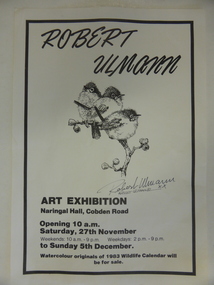
Poster, Poster for Robert Ulman exhibition, 1982
... This is a poster advertising an art exhibition by the Warrnambool artist, Robert Ulmann. The exhibition was held in the Naringal Hall in November/December 1982. ...This is a poster advertising an art exhibition by the Warrnambool artist, Robert Ulmann. The exhibition was held in the Naringal Hall in November/December 1982. ...This is a poster advertising an art exhibition by the Warrnambool artist, Robert Ulmann. The exhibition was held in the Naringal Hall in November/December 1982. Robert Ulmann (1927-1999) was born in Zurich, Switzerland where he studied sculpture and painting. After living in Canada for some time he came to Australia in 1969. From 1970 to 1972 he was employed by the Northern Territory Administration as a manual arts instructor to the aboriginal people of Docker River west of Uluru. He exhibited extensively in city and regional galleries and won numerous awards for his artistic works. His love of wildlife extended to his interest in the Southern Right Whale and he was greatly responsible for publicizing the annual appearance of the whales at Logans Beach in Warrnambool and protecting their environment. His studio in Warrnambool is still visited by many tourists. This poster is of interest as it concerns an art exhibition of the work of Robert Ulmann, a well-known Warrnambool artist of the 20th century. This is a sheet of white paper with black edging. It is an advertisement for a Robert Ulmann Art Exhibition. The page has a sketch of three birds with Robert Ulmann’s signature underneath. robert ulmann, history of warrnambool -
 Flagstaff Hill Maritime Museum and Village
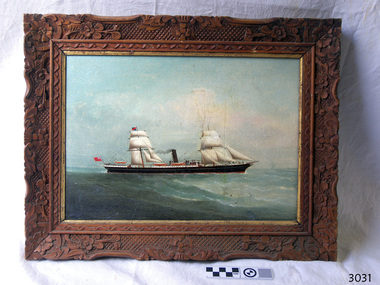
Painting - Vessel, Sail and Steam Ship, C.K.M. (Charles Keigh Miller), artist, S.S. Warrnambool, 1882
... Warrnambool underwent several modifications, upgrades and changes in its design. The painting was attributed to the ship portrait painter, the renowned C.K.M. - Charles Keith Miller. At some point, it was catalogued with the date 1883. However, the correct date is 1892. The artist's...Painting, oil on board, of the screw steamer SS Warrnambool, by artist C.K.M. dated 1892. The painting is mounted in a hand-carved wooden frame with a floral and geometric pattern, and the inner border is painted gold. ...On the backboard, written in the style used by the Warrnambool Museum and Art Gallery: - On white sticker, in pen “A-P31/1-74” - Pencil “A27/1883 / Artist CKM 1883 / Title SS Warrnambool / oil on board” Written in pen by the repairer: - “Repaired & re-drilled – cleaned etc. / David Heysen 11/66” Written by Flagstaff Hill’s Cataloguer in pencil: “3031” On a cardboard wrapper, in a marking pen: - “S.S. ...Warrnambool Painting Vessel, Sail and Steam Ship C.K.M. (Charles Keigh Miller), artist Warrnambool Museum and Art Gallery David Heysen ...This oil painting, mounted in a handmade, carved frame, was originally held in the old Warrnambool Museum and Art Gallery, which was established in the 1880s. A note from the curator of the gallery accompanied the painting: The S.S. "Warrnambool”, 2833 tons. The oil painting by C.K. Miller of Glasgow of the above steamer named after this town was presented to the Town Council of Warrnambool by Mr William Lund Of London, the owner of the “Lund Line” of steam vessels, in recognition of the ladies of Warrnambool having presented the ship with a ‘home flag’ the pattern of which is seen upon the funnel in the painting as also upon the flag at the mast-head. The flags flying at the foremast are the ship’s “number” M.R.V.B. The presentation of the flag and album both took place in Melbourne on December 1st, 1982. On the 6th December, the “Warrnambool” lay-to off this port – on the homeward passage via Adelaide for a short time – see W.S. Dec 7th. The painting depicts the sail and steam-powered ship, S.S. Warrnambool, built in 1892, during the transition period when ship designs shifted from clipper ships with their billowing sails to steam-powered ships that moved at a greater pace. The flag flown from the stern signifies the British Merchant Navy that traded around the world to transport cargo, and later passengers, from one destination to another. During its lifetime, the S.S. Warrnambool underwent several modifications, upgrades and changes in its design. The painting was attributed to the ship portrait painter, the renowned C.K.M. - Charles Keith Miller. At some point, it was catalogued with the date 1883. However, the correct date is 1892. The artist's name and date are covered by the repaired frame, but are verified on the transfer document between the Warrnambool Art Gallery and Flagstaff Hill Maritime Museum and Village. In 1966, between the closure of the old Warrnambool Museum and Art Gallery and the distribution of the painting to Flagstaff Hill, this painting was repaired by David Heysen, son of the German-born artist Hans Heysen OBE. David was born in Hahndorf (called Ambleside for a short period), South Australia, married Lyly Refshauge from Melbourne, and they raised a family on their property in Kalangadoo, near Penola, in South Australia.The painting is of importance to the Warrnambool community, reflecting the excitement of having a ship named after the town. So much so that the ladies made a unique flag in its honour and presented it to the ship's owner when it docked in Membourne. The painting is significant for its handmade, ornately carved frame, joined by a craftsman. It is an example of craft and joinery created in the late 19th century. The artist has depicted the image of a historical sail-and-steam ship of the type in which cargo was traded across the world, including to and from Australia. It is a transitional time between sail and steam, helping to interpret the evolution of power used to move ships. Vessels such as this also brought migrants to Australia.Painting, oil on board, of the screw steamer SS Warrnambool, by artist C.K.M. dated 1892. The painting is mounted in a hand-carved wooden frame with a floral and geometric pattern, and the inner border is painted gold. It depicts a two-masted sail and steam ship, sails raised, and a black funnel emitting smoke. Hull is black with a white horizontal stripe and white trim around the sides of the deck. Three lifeboats are visible. The clipper shape bow appears to have a figurehead. A red ensign flag flies at the stern, and a blue and red flag is attached to the mainmast. The frame has been assembled using Mortice and Tenon joints, one of which is exposed on the back, lower right corner. A chandelier chain has been attached for hanging. The signature, date and title are no longer visible, perhaps due to the The backboard has empty holes around the edge and is held in place by staples. The visible surface has remnants of adhesive from two rectangular attachments. There are two small white stickers attached, one with a handwritten inscription. There are pencil and pen inscriptions. The painting is protected by cardboard with inscriptions made with a marking pen. (A note from the old Warrnambool Museum and Art Gallery accompanied the painting.)On the backboard, written in the style used by the Warrnambool Museum and Art Gallery: - On white sticker, in pen “A-P31/1-74” - Pencil “A27/1883 / Artist CKM 1883 / Title SS Warrnambool / oil on board” Written in pen by the repairer: - “Repaired & re-drilled – cleaned etc. / David Heysen 11/66” Written by Flagstaff Hill’s Cataloguer in pencil: “3031” On a cardboard wrapper, in a marking pen: - “S.S. Warrnambool / by / C.K.M. 1883” * - “A-P/31/1-74” - “3031” *[NOTE: The painting is actually dated "1892" but has been marked in error as "1883"] *[Accompanying note: "The S.S. ‘Warrnambool” 2833 tons. The oil painting by C.K. Miller of Glasgow of the above steamer named after this town was presented to the Town Council of Warrnambool by Mr William Lund Of London the owner of the “Lund Line” of steam vessels in recognition of the ladies of Warrnambool having presented the ship with a ‘home flag’ the pattern of which is seen upon the funnel in the painting as also upon the flag at the mast-head. The flags flying at the foremast are the ship’s “number” M.R.V.B. The presentation of the flag and album both took place in Melbourne, December 1st 1982. See the Warrnambool Standard, December 2nd 1892 On the 6th December the “Warrnambool” lay-to off this port – on the homeward passage via Adelaide for a short time – see W.S. Dec 7th [Warrnambool Standard]. Other notices relative to the ship owner in the first volume, “W.S.” for 1893. See also July 28th 1893.")flagstaff hill, warrnambool, shipwrecked coast, maritime museum, shipwreck coast, flagstaff hill maritime village, great ocean road, s s warrnambool, charles keith miller, charles miller, steam and sail ship, british merchant navy, slipper shaped bow, 19th century sea trade, warrnambool museum and art gallery, old warrnambool art gallery, hand carved picture frame, mortice and tennon picture frame, migrants, c.k.m., william lund, lund line, c.k. miller, ladies of warrnambool, home flag, m.r.v.b., ckm -
 Warrnambool and District Historical Society Inc.
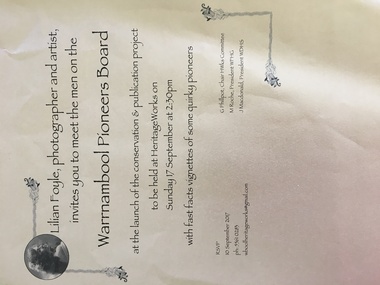
Document, HeritageWorks Personnel, Warrnambool Pioneers Board, 2017
... The invitation was sent out in the name of Lilian Foyle, the Warrnambool photographer and artist who produced the portraits and some of the sketches on the board. ...‘Lilian Foyle, photographer and artist, invites you to meet the men on the Warrnambool Pioneers Board at the launch of the conservation & publication project to be held at HeritageWorks on Sunday 17 September at 2.30 pm’...The invitation was sent out in the name of Lilian Foyle, the Warrnambool photographer and artist who produced the portraits and some of the sketches on the board. ...This is an invitation to the launch of the conservation and publication project for the Warrnambool Pioneer Honour Board. The invitation was sent out in the name of Lilian Foyle, the Warrnambool photographer and artist who produced the portraits and some of the sketches on the board. A person representing Lilian Foyle welcomed those who came to the launch. The Pioneer Honour Board, initiated by Edward Vidler, was first assembled in 1907 to mark the 60th anniversary of the founding of Warrnambool. It has the portraits of 204 pioneer men of Warrnambool and district and is one of the best examples of a pioneer honour board in Victoria. It now requires extensive conservation work and an appeal has been launched to cover the cost of this. A publication with biographies of the 204 men is also being prepared. This invitation is of great interest as it is connected to the Warrnambool Pioneer Honour Board which is one of the most important historical items in the city of Warrnambool and a work of art in its own right.This is a buff-coloured piece of paper with black printing and a black and white photograph of Lilian Foyle. There are also two ornamental patterns on two corners of the printing. ‘Lilian Foyle, photographer and artist, invites you to meet the men on the Warrnambool Pioneers Board at the launch of the conservation & publication project to be held at HeritageWorks on Sunday 17 September at 2.30 pm’warrnambool pioneer honour board, lilian foyle, edward vidler -
 Warrnambool and District Historical Society Inc.
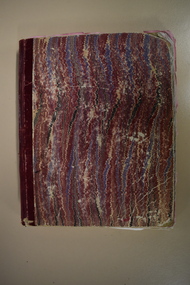
Administrative record - Lance Patent Pan Company Letter Book, late 19th century and early 20th century
... George Lance was also prominent in Warrnambool as a musician, artist (eleven of his works are in the Warrnambool Art Gallery)and local history writer. ...George Lance was also prominent in Warrnambool as a musician, artist (eleven of his works are in the Warrnambool Art Gallery)and local history writer. ...This letter book contains letters written by representatives of the Warrnambool Lance Patent Pan Company to agents in Western Australia during the period 1896 to 1913. This company was formed to market the Lance Patent Cess Pan produced by George Lance in Warrnambool. The Western Australian venture did not prove profitable for the company. George Lance was a Warrnambool plumber and gasfitter who produced the Eureka Pump and the Lance Patent Cess Pan. The latter sold widely in Victoria with the Warrnambool Council owning 1700 of these pans in 1896. George Lance was also prominent in Warrnambool as a musician, artist (eleven of his works are in the Warrnambool Art Gallery)and local history writer. He was also involved in the development of the Warrnambool Mechanics Institute and the establishment of the Warrnambool School of Art and Design and the Warrnambool Art Gallery. This letter book is of considerable interest as it gives details on one aspect of the George Lance invention of the Patent Cess Pan (its marketing) and George Lance played an important role in Warrnambool's late 19th century history.This is a letter book of 506 pages. It has a hardboard cover with a mottled red pattern and red binding on the spine. The pages contain an alphabetical index and copies of letters handwritten in black ink. There are many blank pages. The letter book cover is torn at the edges.george lance patent cess pan, george lance warrnambool, warrnambool plumbers, cess pan patents -
 Flagstaff Hill Maritime Museum and Village
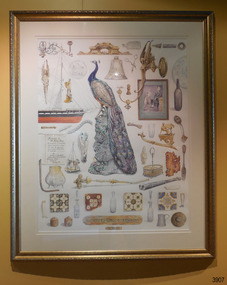
Artwork, other - Framed poster, Tim Walker, Loch Ard Shipwreck, circa 2010
... He soon became involved in the Warrnambool and District Artists’ Society, where he has served for a period as President. ...He soon became involved in the Warrnambool and District Artists’ Society, where he has served for a period as President. ...Tim Walker’s work is an eye-catching array of shipwreck artefacts and associated items. They help tell the story of the 19th century ships that travelled across the world full of people and cargo that are now part of our history. The work was commissioned especially for Flagstaff Hill and highlights the famous story of the 1878 ‘Loch Ard’ shipwreck. The images also include two small items from the 1981 ‘Fiji’ shipwreck. Local professional artist Timothy “Tim” Walker was born in Britain in 1970. He was self-taught had the desire to use his talents for full-time work. He specialised in painting local scenes, landscape and people of Warrnambool and district after he moved there in 1990. As he worked at the location of his subjects, people often told him interesting and amusing stories. He soon became involved in the Warrnambool and District Artists’ Society, where he has served for a period as President. In 2010 Warrnambool Art Gallery hosted an exhibition “Nine Lives” with works from nine local artists including Tim Walker. The ‘LOCH ARD’ 1873-1878 - brief history The clipper ship ‘Loch Ard’ was a built in Scotland in 1873. In 1978 the ship was sailing to Melbourne with 54 people on board as well as a mixed cargo of items, some of which were bound for the 1880 International Exhibition in Melbourne. On June 1st 1878 it was very close to its destination when it crashed into Mutton Bird Island, east of Port Campbell. Only two people survived. The wreck was re-discovered in 1967, almost a century later, and the site continues to provide evidence of the range of goods imported into the Colony of Victoria in the post-Gold Rush era. Flagstaff Hill divers in the 1970s reported finds of “Bottles of champagne, window panes, rolls of zinc, barrels of cement, iron rails, clocks, lead shot, corrugated iron, lead, marble, salad oil bottles, ink bottles, copper wire, gin bottles, rolls of carpet, floor tiles, copper rivets, gas light fittings, pocket knives, toys, crystal chandeliers, beer mugs, cutlery, candles sticks, wick scissors, cow bells, and sauce bottles.” The famous Loch Ard Peacock was also on board. The ‘FIJI’ 1875-1891 – brief history The barque ‘Fiji’ was built in Ireland in 1875. The sailing ship left Hamburg in May 1891, bound for Melbourne with a crew of twenty-five plus the captain. The ‘Fiji’ had almost reached her destination after a trip of 100 days at sea when, on September 5th 1891, she struck rock 300 metres from the shore at Moonlight Head, near Cape Otway. Eleven men lost their lives but with the help of locals including members of the Rocket Rescue Crew, the rest of the men were saved. In anticipation of Christmas, the cargo had included a wide variety of children’s toys, amongst which were dolls with china limbs, wooden rocking horses, miniature ships, and red and white rubber balls. There were also cases of dynamite, pig iron, steel goods, spirits, sailcloth, tobacco, fencing wire, concrete, 400 German pianos, concertinas and other musical instruments, artists’ supplies, porcelain, furniture, china and candles. This artwork has historical significance as it shows a small sample of the variety of items on board the late 19th century ships bound for Australia in the Colonial and late God Rush period. The cargo contained personal luggage, items intended as gifts, and goods ordered for domestic, commercial or industrial use. The wreck sites of both vessels, ‘Loch Ard’ and ‘Fiji’ are classified on the Victorian Heritage Register as significant and are now protected by government law. The sites are popular with divers and provide interpretive material regarding social and maritime history. Framed poster of a watercolour painting by Tim Walker, gilt frame, behind glass. Subject is a group of objects, most of which are connected with the 1878 shipwreck Loch Ard, such as items recovered from the shipwreck and the famous ‘Loch Ard Peacock’. Two items are from the wreck of the ‘Fiji’. Inscriptions on ingot, a handwritten letter, bell, clear bottle, and small plaque.On ingot: “PONTIFEX & WOOD. LONDON”. On letter: “Presented to Mr. Thomas Pearce”. On small ingot: “TIM WALKER”. On bell: “LOCH ARD”. On clear bottle “THE SINGER MANUFACTURING COMPANY“. On plaque: TIM WALKER”.warrnambool, flagstaff hill maritime museum, maritime museum, shipwreck coast, flagstaff hill maritime village, great ocean road, flagstaff hill, loch ard, fiji, watercolour, timothy walker, tim walker, warrnambool & district artists’ society, warrnambool art gallery, poster, henna street picture framers, cargo, print -
 Flagstaff Hill Maritime Museum and Village
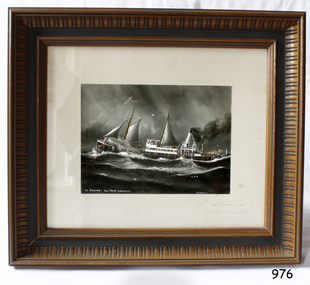
Print - Vessel, Steamship, A.V. Gregory, SS Casino off Point Lonsdale, ca. 1899-1932
... warrnambool...saltau and osburne...a v gregory...arthur victor gregory...Melbourne artist...The detailed image of the vessel depicted in this print shows one of the many sail and steam vessels painted by the renowned Victorian marine artist A V Gregory, whose original works are highly valued today by marine collectors. Flagstaff Hill Flagstaff Hill Maritime Museum and Village Warrnambool Maritime Museum Maritime Village Great Ocean Road Shipwreck Coast newcastle and hunter river steam navigation company belfast and koroit steam navigation company h. sautau and sons s.s. casino west coast trader s.s. casino victorian coastal trader captain boyd captain w. robertson captain chapman captain middleton apollo bay shipwreck s.s. casino at lady bay warrnambool saltau and osburne a v gregory arthur victor gregory Melbourne artist Signed "A V Gregory" Hand painted title "SS Casino off Point Lonsdale" Print with hand-painted watercolour highlights depicting the port side steamship SS Casinounderway in a heavy sea, merchant flag flying at the stern. ...Print of a picture of the S.S. Casino, This print is from an original painting by the Australian marine artist A V Gregory (1867-1957), also known as Arthur Victor Gregory. Gregory lived and worked in South Melbourne. He took over the Gregory Studio owned by his father, George Frederick Gregory, painting actively between 1899 and 1932. He usually signed his works as ‘A V Gregory’. Some of his original works have been sold for thousands of dollars. The S.S. Casino was a passenger and freight steamer built in Dundee, Scotland, in 1882 for the Newcastle and Hunter River Steam Navigation Company of N.S.W. She weighed 425 tons gross with a length of 160.4 feet, beam of 24.1 feet and a depth of 10.2 feet. She had saloon accommodation for 35 people, a fore cabin for 25 more people, and she carried 300 tons of cargo. While on her delivery journey on May 30th 1882 the S.S. Casino called in at the Port of Warrnambool for coal ., narrowly escaping going ashore in gale force winds due to the quick action of the pilot. At that time, still at anchor, she impressed the directors of the Belfast and Koroit Steam Navigation Company so much that they bought her immediately; she was ideal for trade along the West Coast of Victoria. (The Belfast and Koroit Steam Navigation Company was first managed by Messers. Saltau and Osburne and after the passing of Mr. Osburne, by produce merchants Messers H. Sautau and Sons, who had a hay and corn store and shipping agency on the corner of Liebig and Koroit Streets in Warrnambool. ) The S.S. Casino became “the most famous steamer to operate in Victorian waters along the West Coast” by author Jack Loney. Captain Boyd was her first Master, followed by Captain Chapman, who stayed with her from 1890 until 1924. Captain W. Robertson followed for a short term, and then Captain Middleton then took command from 1925 - 1932. The S.S. Casino had several mishaps during her life. One was on 3rd January 1898 when she collided with the S.S. Flinders in Apollo Bay with minor damage. Another was on 24th October 1924 when she grounded on a reef at Point Hawdon near Grey River and most of her cargo (of Christmas goods) had to be dumped into the sea. Then in February 1929 she was ‘holed’ when she struck a submerged object as she entered Lady Bay, Warrnambool. On the morning of 10th July 1932, after attempting to berth at Apollo Bay jetty in heavy seas, Captain Middleton decided to take her out into the bay and wait until the seas abated. It was not realised that the anchor used to steady her as she manoeuvred to her berth had pierced her hull. She put about and headed for the beach but sank. Captain Middleton and nine others lost their lives; nine people were rescued including the two female passengers. Captain Middleton had been in charge of the S.S. Casino for seven years. He was the first ship’s Master to lose his life in a shipwreck in the West Coast trade. In the years following the turn of the century, the S.S. Casino remained the only regular trader with normal passenger accommodation along the West Coast. From 1882 she had made at least 2,500 voyages on the one run. Flagstaff Hill’s collection has a photograph of a portrait of Captain Chapman, , a ship model of the S.S. Casino that shows both forms of power under which she sailed, steam and sail. The ship is painted green and flies three flags. The inscription across the case of the ship model, incorrectly dated, tells the sad story of the wreck of the ship and the loss of lives on July 10th 1932 at Apollo Bay. A print in the Collection shows S.S. Casino underway in the heavy sea off Point Lonsdale, another two photographs show her at the Port of Warrnambool, leaving from the Breakwater in Lady Bay and another identifies the S.S. Casino as a ship from the Belfast and Koroit Steam Navigation Company. (Belfast is the original name for the township of Port Fairy).This print of the S.S. Casino is of significance for its association with the coastal trader S.S. Casino. The wreck of the S.S. Casino is considered an important part of Victorian and Australian cultural heritage and as such has been declared and protected as an Historic Shipwreck under State and Commonwealth Law in the Commonwealth Historic Shipwrecks Act (1976). The detailed image of the vessel depicted in this print shows one of the many sail and steam vessels painted by the renowned Victorian marine artist A V Gregory, whose original works are highly valued today by marine collectors.Print with hand-painted watercolour highlights depicting the port side steamship SS Casinounderway in a heavy sea, merchant flag flying at the stern. Mounted in a decorative wooden frame behind glass. The original painting was by A V Gregory. The title of the picture is repeated in handwritten words on the matte below the artist's signature on the print.Signed "A V Gregory" Hand painted title "SS Casino off Point Lonsdale"flagstaff hill, flagstaff hill maritime museum and village, warrnambool, maritime museum, maritime village, great ocean road, shipwreck coast, newcastle and hunter river steam navigation company, belfast and koroit steam navigation company, h. sautau and sons, s.s. casino, west coast trader s.s. casino, victorian coastal trader, captain boyd, captain w. robertson, captain chapman, captain middleton, apollo bay shipwreck, s.s. casino at lady bay warrnambool, saltau and osburne, a v gregory, arthur victor gregory, melbourne artist -
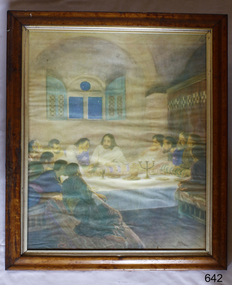 Flagstaff Hill Maritime Museum and Village
Print - Religious Print, The Last Supper, circa 1890
... Flagstaff Hill Maritime Museum and Village Flagstaff Hill Warrnambool Maritime Museum Maritime Village Shipwreck Coast Great Ocean Road Religion Religious service St Nicholas Seamen’s Church Williamstown Missions to Seamen Victoria last supper worship religious worship Ladies Lightkeepers’ Auxiliary Williamstown Lightkeepers' Auxiliary The Last Supper Mission to Seafarers St Nicholas Missions to Seamen’s Church Williamstown Missions to Seamen St Nicholas Missions to Seamen’s Church Flagstaff Hill 139 Nelson Place Williamstown Anglican church worship service church furnishings religious furnishings wall hanging framed print religious print On rear of board: "156" Print of a watercolour painting, framed in Huon pine wood behind glass.Depicts the artist's impression of the Biblical event referred to as The Last Supper. ...This framed print is one of the items once used during religious services at the St. Nicholas Seamen’s Church and was donated to the organisation by the Williamstown Lightkeepers' Auxiliary. The church was located at 139 Nelson Place, Williamstown, Victoria, and operated by the Mission to Seamen organisation. THE MISSIONS TO SEAMEN (Brief History): - The Missions to Seamen was an Anglican charity in Great Britain that has served the world's seafarers since 1856. Its symbol is a Flying Angel, inspired by a Bible verse. Today, there are centres in over 200 ports worldwide where seamen of all backgrounds are offered a warm welcome and provided with a wide range of facilities. In Victoria, the organisation began in Williamstown in 1857 as a Sailors’ Church, also known as ‘Bethel’ or the ‘Floating Church’ in an old hulk floating in Hobson’s Bay, Port of Melbourne. It soon became part of the Missions to Seamen, Victoria. In 2000, the organisation, now named Mission to Seafarers, still operated locally in Melbourne, Portland, Geelong and Hastings. The Ladies’ Harbour Lights Guild was formed in 1906 to support the Missions to Seamen in Melbourne and other centres, such as Williamstown. Two of the most significant ladies of the Guild were founder Ethel Augusta Godfrey and foundation member Alice Sibthorpe Tracy (who established a branch of the Guild in Warrnambool in 1920). The Guild continued its work until the 1960s. In 1943, a former Williamstown bank was purchased for the Missions to Seamen Club. The chapel was named St Nicholas’ Seamen’s Church and was supported by the Ladies’ Harbour Lights Guild, the Williamstown Lightkeepers’ Auxiliary and the League of Soldiers’ and Sailors’ Friends. It ceased operation in 1966. A Missions to Seamen Chapel and Recreation Room was a significant feature of ports during the late 1800s and 1900s. It seemed appropriate for Flagstaff Hill to include such a representation within the new Maritime Village, and the Melbourne Board of Management of Missions to Seamen Victoria gave its permission on 21st May 1979 for the entire furnishings of the Williamstown chapel to be transferred to Flagstaff Hill. The St Nicholas Seamen’s Church was officially opened on October 11, 1981, and resembles the Williamstown chapel.This print is significant historically for its origin in the St Nicholas Mission to Seamen's Church in Williamstown, established in 1857 to cater for the physical, social, and spiritual needs of seafarers. It originated in Bristol, England when a Seamen's Mission was formed in 1837. The item is historically significant for its connection to the Williamstown Lightkeepers’ Auxiliary, an organisation of women, formed to support seafarers. The connection of this item to the Mission to Seamen and the Ladies Lightkeepers’ Auxiliary highlights the strong community awareness of the life of people at sea, their dangers and hardships, and their need for physical, financial, spiritual and moral support. Print of a watercolour painting, framed in Huon pine wood behind glass.Depicts the artist's impression of the Biblical event referred to as The Last Supper. Inscription marked on the back. Australian, circa 1890. The print is part of the St Nicholas Seamen's Church Collection On rear of board: "156" flagstaff hill maritime museum and village, flagstaff hill, warrnambool, maritime museum, maritime village, shipwreck coast, great ocean road, religion, religious service, st nicholas seamen’s church, williamstown, missions to seamen victoria, last supper, worship, religious worship, ladies lightkeepers’ auxiliary, williamstown lightkeepers' auxiliary, the last supper, mission to seafarers, st nicholas missions to seamen’s church williamstown, missions to seamen, st nicholas missions to seamen’s church flagstaff hill, 139 nelson place williamstown, anglican church, worship service, church furnishings, religious furnishings, wall hanging, framed print, religious print -
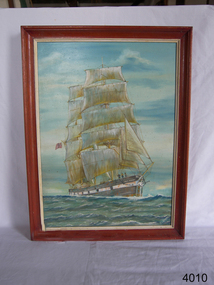 Flagstaff Hill Maritime Museum and Village
Painting - Vessel, Sailing Ship, C Smith, artist, Polly Woodside, ca. late 20th century
... warrnambool...shipwrecked-coast...flagstaff-hill...flagstaff-hill-maritime-museum...maritime-museum...shipwreck-coast...flagstaff-hill-maritime-village...oil painting...maritime oil painting...sailing ship polly woodside...Polly Woodside...tall ship...c. smith...maritime painting...marine artist...flagstaff hill warrnambool shipwrecked-coast flagstaff-hill flagstaff-hill-maritime-museum maritime-museum shipwreck-coast flagstaff-hill-maritime-village oil painting maritime oil painting sailing ship polly woodside Polly Woodside tall ship c. smith maritime painting marine artist Painting, oil on board, of the tall sailing ship 'Polly Woodside' by C Smith Polly Woodside Painting Vessel, Sailing Ship C Smith, artist ...Painting, oil on board, of the tall sailing ship 'Polly Woodside' by C Smithflagstaff hill, warrnambool, shipwrecked-coast, flagstaff-hill, flagstaff-hill-maritime-museum, maritime-museum, shipwreck-coast, flagstaff-hill-maritime-village, oil painting, maritime oil painting, sailing ship polly woodside, polly woodside, tall ship, c. smith, maritime painting, marine artist -
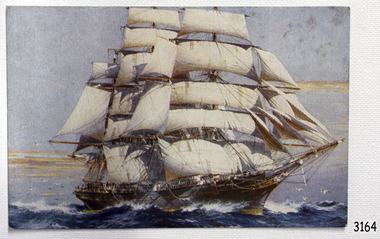 Flagstaff Hill Maritime Museum and Village
Postcard - Vessel, Sailing Ship, Jack Spurling (John Robert Charles Spurling), marine artist, circa 19th century
... Warrnambool...Flagstaff Hill Maritime Museum...Shipwreck Coast...Flagstaff Hill Maritime Village...Maritime Museum...Great Ocean Road...Cutty sark...historic sailing ship...tea clipper...sail training vessel...cadet training ship...commercial trading vessel...cargo sail vessel...clipper races...Scott and Linton of Dunbarton Scottland...race record...Ferreria...1869...tea cargo...tea trade...China tea...wool export...Australian export...Australian wool export...China tea trade...Cornwall...training ship...Greenwich...British Museum...postcard...coloured postcard...postcard of a painting...Jack Spurling...British maritime artist...The picture is a copy of a painting by renowned maritime artist Jack Spurling, who was famous for his ship portraits. Flagstaff Hill Warrnambool Flagstaff Hill Maritime Museum Shipwreck Coast Flagstaff Hill Maritime Village Maritime Museum Great Ocean Road Cutty sark historic sailing ship tea clipper sail training vessel cadet training ship commercial trading vessel cargo sail vessel clipper races Scott and Linton of Dunbarton Scottland race record Ferreria 1869 tea cargo tea trade China tea wool export Australian export Australian wool export China tea trade Cornwall training ship Greenwich British Museum postcard coloured postcard postcard of a painting Jack Spurling British maritime artist ship portraits John 'Jack' Robert Charles Spurling Coloured postcard of the Cutty Sark. ...The postcard is a copy of a painting by the renowned British maritime artist Jack Spurling (John (Jack) Robert Charles Spurling 1870-1933). Spurling's love for the sea was fulfilled as a teenager when he worked as an apprentice, eventually gaining a Second Mate certificate and going on to join the Blue Anchor Line as a junior officer. His love for the sea shows in his detailed paintings of ship portraits. THE CUTTY SARK: - The Cutty Sark was built in Britain in 1869 and was one of the last great sailing ships. At first, it carried tea from China. Later, it was used to transport wool from Australia. It became famous for its speed and held the record for the fastest voyage from Australia to Britain for ten years. Later, a Portuguese company bought the ship and renamed it Ferreira. After that, a retired sea captain purchased it to use as a training ship in Cornwall. When the captain died, the ship was given to a training college in Greenwich in 1938. In 1954, it was placed in dry dock at Greenwich, where it remains on display. The postcard depicts the clipper, Cutty Sark, which was a special ship because it carried wool from Australia to other parts of the world. Postcards like this one help us imagine what sea travel was like before steam-powered ships became common, and they show us how trade, travel, and migration evolved. The Cutty Sark is also famous for its speed. It set a record for the journey from Australia to Britain and kept that title for ten years. Today, people still recognise its importance because it has been carefully preserved and is on display at the British Maritime Museum in Greenwich. Its story has also made it a favourite subject for people who enjoy building ship models. The picture is a copy of a painting by renowned maritime artist Jack Spurling, who was famous for his ship portraits.Coloured postcard of the Cutty Sark. Photograph of a painting by J Spurling. flagstaff hill, warrnambool, flagstaff hill maritime museum, shipwreck coast, flagstaff hill maritime village, maritime museum, great ocean road, cutty sark, historic sailing ship, tea clipper, sail training vessel, cadet training ship, commercial trading vessel, cargo sail vessel, clipper races, scott and linton of dunbarton scottland, race record, ferreria, 1869, tea cargo, tea trade, china tea, wool export, australian export, australian wool export, china tea trade, cornwall, training ship, greenwich, british museum, postcard, coloured postcard, postcard of a painting, jack spurling, british maritime artist, ship portraits, john 'jack' robert charles spurling -
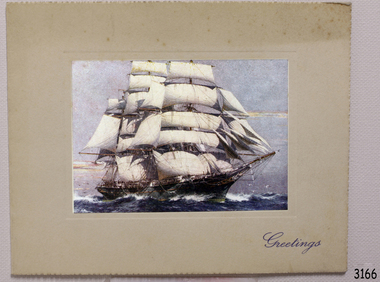 Flagstaff Hill Maritime Museum and Village
Photograph - Vessel, Sailing Ship, Jack Spurling (John Robert Charles Spurling), marine artist, circa 19th century
... Warrnambool...Flagstaff Hill Maritime Museum...Shipwreck Coast...Flagstaff Hill Maritime Village...Maritime Museum...Great Ocean Road...Cutty sark...historic sailing ship...tea clipper...sail training vessel...cadet training ship...commercial trading vessel...cargo sail vessel...clipper races...Scott and Linton of Dunbarton Scottland...race record...Ferreria...1869...tea cargo...tea trade...China tea...wool export...Australian export...Australian wool export...China tea trade...Cornwall...training ship...Greenwich...British Museum...postcard...coloured postcard...postcard of a painting...Jack Spurling...British maritime artist...The picture is a copy of a painting by renowned maritime artist Jack Spurling, who was famous for his ship portraits. Flagstaff Hill Warrnambool Flagstaff Hill Maritime Museum Shipwreck Coast Flagstaff Hill Maritime Village Maritime Museum Great Ocean Road Cutty sark historic sailing ship tea clipper sail training vessel cadet training ship commercial trading vessel cargo sail vessel clipper races Scott and Linton of Dunbarton Scottland race record Ferreria 1869 tea cargo tea trade China tea wool export Australian export Australian wool export China tea trade Cornwall training ship Greenwich British Museum postcard coloured postcard postcard of a painting Jack Spurling British maritime artist ship portraits John 'Jack' Robert Charles Spurling "Greetings" Photograph: coloured image of the sailing ship Cutty Sark by artist J Spurling. ...The card is a copy of a painting by the renowned British maritime artist Jack Spurling (John (Jack) Robert Charles Spurling 1870-1933). Spurling's love for the sea was fulfilled as a teenager when he worked as an apprentice, eventually gaining a Second Mate certificate and going on to join the Blue Anchor Line as a junior officer. His love for the sea shows in his detailed paintings of ship portraits. THE CUTTY SARK: - The Cutty Sark was built in Britain in 1869 and was one of the last great sailing ships. At first, it carried tea from China. Later, it was used to transport wool from Australia. It became famous for its speed and held the record for the fastest voyage from Australia to Britain for ten years. Later, a Portuguese company bought the ship and renamed it Ferreira. After that, a retired sea captain purchased it to use as a training ship in Cornwall. When the captain died, the ship was given to a training college in Greenwich in 1938. In 1954, it was placed in dry dock at Greenwich, where it remains on display.The card depicts the clipper, Cutty Sark, which was a special ship because it carried wool from Australia to other parts of the world. Cards like this one help us imagine what sea travel was like before steam-powered ships became common, and they show us how trade, travel, and migration evolved. The Cutty Sark is also famous for its speed. It set a record for the journey from Australia to Britain and kept that title for ten years. Today, people still recognise its importance because it has been carefully preserved and is on display at the British Maritime Museum in Greenwich. The picture is a copy of a painting by renowned maritime artist Jack Spurling, who was famous for his ship portraits.Photograph: coloured image of the sailing ship Cutty Sark by artist J Spurling. The image is mounted on a card used as a greeting card. It has a printed inscription. "Greetings"flagstaff hill, warrnambool, flagstaff hill maritime museum, shipwreck coast, flagstaff hill maritime village, maritime museum, great ocean road, cutty sark, historic sailing ship, tea clipper, sail training vessel, cadet training ship, commercial trading vessel, cargo sail vessel, clipper races, scott and linton of dunbarton scottland, race record, ferreria, 1869, tea cargo, tea trade, china tea, wool export, australian export, australian wool export, china tea trade, cornwall, training ship, greenwich, british museum, postcard, coloured postcard, postcard of a painting, jack spurling, british maritime artist, ship portraits, john 'jack' robert charles spurling -
 Flagstaff Hill Maritime Museum and Village
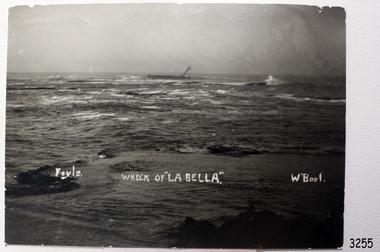
Photograph, Foyle Photographic Studio, Wreck of La Bella, about 11/11/1905
... A letter to the editor (by Mr Edward Vidler) in the Melbourne Argus, 3rd August, 1907, mentions that in that year Warrnambool would celebrate its 60th anniversary of its proclamation as a town, and that talented local artist Miss Lily Foyle would paint 200 portraits in watercolour of the pioneers who settled in the district prior to 1860. ...A letter to the editor (by Mr Edward Vidler) in the Melbourne Argus, 3rd August, 1907, mentions that in that year Warrnambool would celebrate its 60th anniversary of its proclamation as a town, and that talented local artist Miss Lily Foyle would paint 200 portraits in watercolour of the pioneers who settled in the district prior to 1860. ...The photograph shows the wreck of La Bella in Lady Bay, Warrnambool, Australia. It was probably taken on 11th November 1905, the morning after she was wrecked. “Foyle” written on the photograph is the name of Foyle’s Photographic studio. At the time of the photograph the studio was owned by both Charles and Lilian Foyle (sometimes known as Lillian or Lily), either of whom could have taken this photograph. They also worked together at a later date on the photographs, sketches and paintings of the famous and historical Pioneers’ Honour Board, which is currently on view in the Warrnambool Library. Foyles Photography was the studio of James Charles Foyle. He owned “Foyle’s Photo Card Studios” in Liebig St , Warrnambool, which operated between 1889 – 1919 . A letter to the editor (by Mr Edward Vidler) in the Melbourne Argus, 3rd August, 1907, mentions that in that year Warrnambool would celebrate its 60th anniversary of its proclamation as a town, and that talented local artist Miss Lily Foyle would paint 200 portraits in watercolour of the pioneers who settled in the district prior to 1860. The Pioneer Honour Board can still be seen on display in the Warrnambool Library. In the Warrnambool Standard, Dec. 1917, “Mr Foyle’s studio was awarded contract to decorate rail cars on newly opened Trans-Continental railway, assisted by his sister, Miss Findlay.” The subject of the painting, La Bella, has its own tragic story. Read on for further details … On November 10th, 1905, the Norwegian-built barquentine La Bella approached Warrnambool at the end of her 37 day voyage. She was carrying a cargo of timber from Lyttleton, New Zealand, in heavy seas and evening mist. (On its only other visit to Warrnambool a year earlier the master had gone to shore to find a tow. He returned to the ship to find the crew drunk and unwilling to take up their posts, even though the ship was dragging its anchors and in a dangerous position.) As Captain Mylius steered La Bella to Lady Bay Channel the ship was tossed onto its side by heavy breakers and ran aground on what is now known as La Bella Reef. The sea was so rough that it wrenched a one-and-a- half ton anchor from the vessel. Several attempts were made by parties of volunteers in lifeboats to rescue the stricken sailors, but the rough conditions made this difficult for the boats to get close enough to the ship and the parties had to return to shore. The La Bella’s crew became exhausted and sailors were being washed overboard, one by one. By sunrise only five of the twelve crew still clung to the wreck. A local fisherman, 25 year old William Ferrier, rowed his small dingy through the heavy seas and managed to rescue the captain, whilst the volunteer lifeboat crew rescued a further three sailors, returning to shore. Ferrier made a final attempt at rescue and was able to reach its stern as the conditions eased slightly, saving the last remaining, terrified sailor just before the ship broke up and sank. William Ferrier became a national hero as news of the daring rescue spread. He was awarded the Silver Medal for bravery by the Royal Humane Society and was honoured by the Prime Minister and the Governor. He was presented with several other awards for his daring rescue. Ferrier’s rescue efforts are one of the most heroic in Victoria’s shipwreck history. The wreck now lies in 13m of water and is home to an abundance of marine life. Flagstaff Hill’s La Bella Collection includes a rail holder from La Bella, a photograph of William Ferrier with four of the five men rescued, a rail holder from the ship and the letter from the Prime Minister and other Members of Parliament that was sent to William Ferrier to commend him for his bravery. La Bella has been protected under the Commonwealth Historic Shipwrecks Act (1976) as a Historic Shipwreck since 23 April 1982 (VHR S401). It is archaeologically significant as the remains of an international and inter-colonial passenger and cargo ship. Flagstaff Hill’s collection of artefacts from the La Bella is of historical and archaeological significance because of its association with the La Bella, which is on the Victorian Heritage Register, and because of the relationship between the objects. The collection represents aspects of Victorian history, and the letter to William Ferrier demonstrates how important his rescue efforts were to Victoria and Australia. Black and white photograph of the wreck of the sailing ship La Bella in the bay at Warrnambool. The photograph shows the ship lying on its side in rough sea, with mast and rope rigging hanging loosely. Several large rocks are also visible. The photograph is a rectangle shape, mounted on heavy card, with slightly ragged edges. The photographer’s name, a title for the photograph and the location are hand written in white along the bottom third of the photograph. The back of the photograph is blank. Printed in white hand writing “Foyle”, “WRECK OF “LA BELLA”, “W’Bool”foyle, la bella, william ferrier, lady bay, lifeboats, lilian foyle, lillian foyle, charles foyle, james foyle, royal humane society medal, flagstaff hill, warrnambool, shipwrecked coast, flagstaff hill, flagstaff hill maritime museum, maritime museum, shipwreck coast, flagstaff hill maritime village -
 Flagstaff Hill Maritime Museum and Village
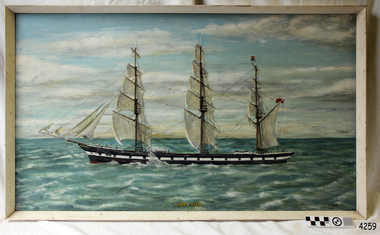
Painting - Vessel, Sailing Ship, C Smith, artist, Loch Ard, late 20th century
... The collection is also historically significant for its association with the LOCH ARD, which was one of the worst and best known shipwrecks in Victoria’s history. flagstaff hill warrnambool shipwrecked coast flagstaff hill maritime museum maritime museum shipwreck coast flagstaff hill maritime village great ocean road loch line loch ard captain gibbs eva carmichael tom pearce loch ard gorge maritime oil painting c. smith sailing vessel "Loch Ard launched 1873, sunk near Pt Campbell, with loss of 52 lives 1878" "C. Smith" "Loch Ard" Painting of 1873 sailing ship the "Loch Ard". Oil painting on board behind glass, framed in white painted timber. Artist ...HISTORY OF THE LOCH ARD The LOCH ARD belonged to the famous Loch Line which sailed many ships from England to Australia. Built in Glasgow by Barclay, Curdle and Co. in 1873, the LOCH ARD was a three-masted square rigged iron sailing ship. The ship measured 262ft 7" (79.87m) in length, 38ft (11.58m) in width, 23ft (7m) in depth and had a gross tonnage of 1693 tons. The LOCH ARD's main mast measured a massive 150ft (45.7m) in height. LOCH ARD made three trips to Australia and one trip to Calcutta before its final voyage. LOCH ARD left England on March 2, 1878, under the command of Captain Gibbs, a newly married, 29 year old. She was bound for Melbourne with a crew of 37, plus 17 passengers and a load of cargo. The general cargo reflected the affluence of Melbourne at the time. On board were straw hats, umbrella, perfumes, clay pipes, pianos, clocks, confectionary, linen and candles, as well as a heavier load of railway irons, cement, lead and copper. There were items included that intended for display in the Melbourne International Exhibition in 1880. The voyage to Port Phillip was long but uneventful. At 3am on June 1, 1878, Captain Gibbs was expecting to see land and the passengers were becoming excited as they prepared to view their new homeland in the early morning. But LOCH ARD was running into a fog which greatly reduced visibility. Captain Gibbs was becoming anxious as there was no sign of land or the Cape Otway lighthouse. At 4am the fog lifted. A man aloft announced that he could see breakers. The sheer cliffs of Victoria's west coast came into view, and Captain Gibbs realised that the ship was much closer to them than expected. He ordered as much sail to be set as time would permit and then attempted to steer the vessel out to sea. On coming head on into the wind, the ship lost momentum, the sails fell limp and LOCH ARD's bow swung back. Gibbs then ordered the anchors to be released in an attempt to hold its position. The anchors sank some 50 fathoms - but did not hold. By this time LOCH ARD was among the breakers and the tall cliffs of Mutton Bird Island rose behind the ship. Just half a mile from the coast, the ship's bow was suddenly pulled around by the anchor. The captain tried to tack out to sea, but the ship struck a reef at the base of Mutton Bird Island, near Port Campbell. Waves broke over the ship and the top deck was loosened from the hull. The masts and rigging came crashing down knocking passengers and crew overboard. When a lifeboat was finally launched, it crashed into the side of LOCH ARD and capsized. Tom Pearce, who had launched the boat, managed to cling to its overturned hull and shelter beneath it. He drifted out to sea and then on the flood tide came into what is now known as LOCH ARD Gorge. He swam to shore, bruised and dazed, and found a cave in which to shelter. Some of the crew stayed below deck to shelter from the falling rigging but drowned when the ship slipped off the reef into deeper water. Eva Carmichael had raced onto deck to find out what was happening only to be confronted by towering cliffs looming above the stricken ship. In all the chaos, Captain Gibbs grabbed Eva and said, "If you are saved Eva, let my dear wife know that I died like a sailor". That was the last Eva Carmichael saw of the captain. She was swept off the ship by a huge wave. Eva saw Tom Pearce on a small rocky beach and yelled to attract his attention. He dived in and swam to the exhausted woman and dragged her to shore. He took her to the cave and broke open case of brandy which had washed up on the beach. He opened a bottle to revive the unconscious woman. A few hours later Tom scaled a cliff in search of help. He followed hoof prints and came by chance upon two men from nearby Glenample Station three and a half miles away. In a state of exhaustion, he told the men of the tragedy. Tom returned to the gorge while the two men rode back to the station to get help. By the time they reached LOCH ARD Gorge, it was cold and dark. The two shipwreck survivors were taken to Glenample Station to recover. Eva stayed at the station for six weeks before returning to Ireland, this time by steamship. In Melbourne, Tom Pearce received a hero's welcome. He was presented with the first gold medal of the Royal Humane Society of Victoria and a £1000 cheque from the Victorian Government. Concerts were performed to honour the young man's bravery and to raise money for those who lost family in the LOCH ARD disaster. Of the 54 crew members and passengers on board, only two survived: the apprentice, Tom Pearce and the young woman passenger, Eva Carmichael, who lost all of her family in the tragedy. Ten days after the LOCH ARD tragedy, salvage rights to the wreck were sold at auction for £2,120. Cargo valued at £3,000 was salvaged and placed on the beach, but most washed back into the sea when another storm developed. The wreck of LOCH ARD still lies at the base of Mutton Bird Island. Much of the cargo has now been salvaged and some was washed up into what is now known as LOCH ARD Gorge. Cargo and artefacts have also been illegally salvaged over many years before protective legislation was introduced. One of the most unlikely pieces of cargo to have survived the shipwreck was a Minton porcelain peacock - one of only nine in the world. The peacock was destined for the Melbourne International Exhibition in 1880. It had been well packed, which gave it adequate protection during the violent storm. Today, the Minton peacock can be seen at the Flagstaff Hill Maritime Museum in Warrnambool. From Australia's most dramatic shipwreck it has now become Australia's most valuable shipwreck artefact and is one of very few 'objects' on the Victorian State Heritage Register. Flagstaff Hill’s collection of artefacts from LOCH ARD is significant for being one of the largest collections of artefacts from this shipwreck in Victoria. It is significant for its association with the shipwreck, which is on the Victorian Heritage Register (VHR S417). The collection is significant because of the relationship between the objects, as together they have a high potential to interpret the story of the LOCH ARD. The LOCH ARD collection is archaeologically significant as the remains of a large international passenger and cargo ship. The LOCH ARD collection is historically significant for representing aspects of Victoria’s shipping history and its potential to interpret sub-theme 1.5 of Victoria’s Framework of Historical Themes (living with natural processes). The collection is also historically significant for its association with the LOCH ARD, which was one of the worst and best known shipwrecks in Victoria’s history. Painting of 1873 sailing ship the "Loch Ard". Oil painting on board behind glass, framed in white painted timber. Artist is C Smith. Inscription on back. "Loch Ard launched 1873, sunk near Pt Campbell, with loss of 52 lives 1878" "C. Smith" "Loch Ard" flagstaff hill, warrnambool, shipwrecked coast, flagstaff hill maritime museum, maritime museum, shipwreck coast, flagstaff hill maritime village, great ocean road, loch line, loch ard, captain gibbs, eva carmichael, tom pearce, loch ard gorge, maritime oil painting, c. smith, sailing vessel -
 Flagstaff Hill Maritime Museum and Village
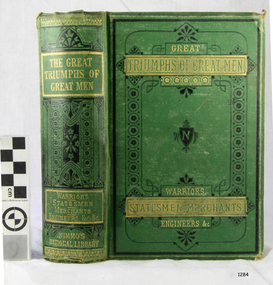
Book - Anthology of Biographical sketches, James Mason ( Compiler & Editior), The Great Triumphs of Great Men, 1879
... warrnambool shipwrecked-coast flagstaff-hill flagstaff-hill-maritime-museum maritime-museum shipwreck-coast flagstaff-hill-maritime-village The Great Triumphs of Great Men is an interesting window into the Victorian era of popular history and educational publishing. The work was compiled and edited by James Mason. Rather than a single narrative, it is an anthology of biographical sketches outlining the lives, struggles, and achievements of historic figures. The work highlights various individuals categorised as warriors and statesmen (such as Alfred the Great, King Canute, Oliver Cromwell, and the Duke of Wellington), engineers, artists ...The Great Triumphs of Great Men is an interesting window into the Victorian era of popular history and educational publishing. The work was compiled and edited by James Mason. Rather than a single narrative, it is an anthology of biographical sketches outlining the lives, struggles, and achievements of historic figures. The work highlights various individuals categorised as warriors and statesmen (such as Alfred the Great, King Canute, Oliver Cromwell, and the Duke of Wellington), engineers, artists, and inventors (like Sir Christopher Wren and Thomas Gainsborough), as well as merchants, poets, and philosophers. The overarching theme is typical of the 19th-century "self-help" movement that was popularised by Samuel Smiles, using the determination, moral character, and triumphs of great men as an inspirational road map for the reader.Hard cover book,The Great Triumphs of Great Men. Author: Editor & Compiler, James Mason. Publisher: William P Nimmo, Edinburgh, Scotland. Date: 1879 Green premium leather hardcover with lettering in gilt highly decorated spine and front cover. The spine has no Library label, flyleaf has a reference number top right hand corner .non-fictionThe Great Triumphs of Great Men is an interesting window into the Victorian era of popular history and educational publishing. The work was compiled and edited by James Mason. Rather than a single narrative, it is an anthology of biographical sketches outlining the lives, struggles, and achievements of historic figures. The work highlights various individuals categorised as warriors and statesmen (such as Alfred the Great, King Canute, Oliver Cromwell, and the Duke of Wellington), engineers, artists, and inventors (like Sir Christopher Wren and Thomas Gainsborough), as well as merchants, poets, and philosophers. The overarching theme is typical of the 19th-century "self-help" movement that was popularised by Samuel Smiles, using the determination, moral character, and triumphs of great men as an inspirational road map for the reader.flagstaff hill, warrnambool, shipwrecked-coast, flagstaff-hill, flagstaff-hill-maritime-museum, maritime-museum, shipwreck-coast, flagstaff-hill-maritime-village -
 Flagstaff Hill Maritime Museum and Village
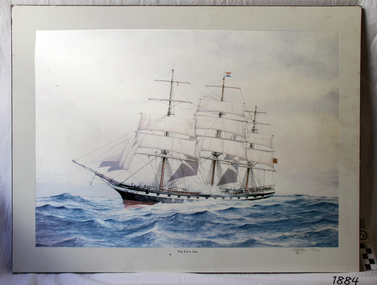
Print, The Loch Ard, 1993
... ABOUT THE ARTIST – Philip James Gray “Philip is one of Australia’s leading maritime artists and his meticulous research and social commentary paintings of ships, such as, the Loch Ard and Schomberg form an important part of Warrnambool’s Flagstaff Hill Maritime Museum.” ...artist Philip J. Gray, 1993. Depicts the Loch Ard in full sail at sea, figures on deck. Limited Edition number 54/925. Print is adhered to a piece of chipboard and is stamped by the framer, Ian's Picture Framing of Warrnambool....Gray" , "54/925" Stamped on back "IAN'S PICTURE FRAMING, 48 KEPLER STREET, WARRNAMBOOL 3280, PH: (055) 628 022, FAX: (055) 628 145" Print of the sailing ship Loch Ard by artist Philip J. ...ABOUT THE ARTIST – Philip James Gray “Philip is one of Australia’s leading maritime artists and his meticulous research and social commentary paintings of ships, such as, the Loch Ard and Schomberg form an important part of Warrnambool’s Flagstaff Hill Maritime Museum.” [ref. Dr Marion Manifold, Artist and Art Historian, 2014] Philip James Gray was born in London but has lived most of his life in Australia. He graduated from a London school of art as an illustrator, specialising in technical and scientific illustration as well as other commercial and applied art. He was also a student for a time of Fyffe Christie - British figurative artist, mural painter and humanitarian – who had a great influence on his career. Philip has always worked as a professional artist and illustrator. Many publications on maritime history have featured his work. His paintings have been released and sold all over the world as limited edition prints. The State Library of Victoria’s ‘Latrobe Collection’ holds two of his paintings. His street painting of ‘The Ashes Contest’ decorates the brick wall of Old Bakery Laneway in Sunbury and a Sunbury café owner commissioned him to paint the ‘Sunbury Pop Festival’ as a remembrance of local history. [ref. Sunbury Leader, Nov 15 2013] Philip has been an active member of the Sunbury Art Society in Victoria for several years, serving on the committee for some of that time and being involved in exhibitions. He enjoys helping new artists and sharing his skills and experience. [other references: Sunbury Art Society Inc. Oct-Nov 2012] HISTORY OF THE LOCH ARD The LOCH ARD belonged to the famous Loch Line which sailed many ships from England to Australia. Built in Glasgow by Barclay, Curdle and Co. in 1873, the LOCH ARD was a three-masted square rigged iron sailing ship. The ship measured 262ft 7" (79.87m) in length, 38ft (11.58m) in width, 23ft (7m) in depth and had a gross tonnage of 1693 tons. The LOCH ARD's main mast measured a massive 150ft (45.7m) in height. LOCH ARD made three trips to Australia and one trip to Calcutta before its final voyage. LOCH ARD left England on March 2, 1878, under the command of Captain Gibbs, a newly married, 29 year old. She was bound for Melbourne with a crew of 37, plus 17 passengers and a load of cargo. The general cargo reflected the affluence of Melbourne at the time. On board were straw hats, umbrella, perfumes, clay pipes, pianos, clocks, confectionary, linen and candles, as well as a heavier load of railway irons, cement, lead and copper. There were items included that intended for display in the Melbourne International Exhibition in 1880. The voyage to Port Phillip was long but uneventful. At 3am on June 1, 1878, Captain Gibbs was expecting to see land and the passengers were becoming excited as they prepared to view their new homeland in the early morning. But LOCH ARD was running into a fog which greatly reduced visibility. Captain Gibbs was becoming anxious as there was no sign of land or the Cape Otway lighthouse. At 4am the fog lifted. A man aloft announced that he could see breakers. The sheer cliffs of Victoria's west coast came into view, and Captain Gibbs realised that the ship was much closer to them than expected. He ordered as much sail to be set as time would permit and then attempted to steer the vessel out to sea. On coming head on into the wind, the ship lost momentum, the sails fell limp and LOCH ARD's bow swung back. Gibbs then ordered the anchors to be released in an attempt to hold its position. The anchors sank some 50 fathoms - but did not hold. By this time LOCH ARD was among the breakers and the tall cliffs of Mutton Bird Island rose behind the ship. Just half a mile from the coast, the ship's bow was suddenly pulled around by the anchor. The captain tried to tack out to sea, but the ship struck a reef at the base of Mutton Bird Island, near Port Campbell. Waves broke over the ship and the top deck was loosened from the hull. The masts and rigging came crashing down knocking passengers and crew overboard. When a lifeboat was finally launched, it crashed into the side of LOCH ARD and capsized. Tom Pearce, who had launched the boat, managed to cling to its overturned hull and shelter beneath it. He drifted out to sea and then on the flood tide came into what is now known as LOCH ARD Gorge. He swam to shore, bruised and dazed, and found a cave in which to shelter. Some of the crew stayed below deck to shelter from the falling rigging but drowned when the ship slipped off the reef into deeper water. Eva Carmichael had raced onto deck to find out what was happening only to be confronted by towering cliffs looming above the stricken ship. In all the chaos, Captain Gibbs grabbed Eva and said, "If you are saved Eva, let my dear wife know that I died like a sailor". That was the last Eva Carmichael saw of the captain. She was swept off the ship by a huge wave. Eva saw Tom Pearce on a small rocky beach and yelled to attract his attention. He dived in and swam to the exhausted woman and dragged her to shore. He took her to the cave and broke open case of brandy which had washed up on the beach. He opened a bottle to revive the unconscious woman. A few hours later Tom scaled a cliff in search of help. He followed hoof prints and came by chance upon two men from nearby Glenample Station three and a half miles away. In a state of exhaustion, he told the men of the tragedy. Tom returned to the gorge while the two men rode back to the station to get help. By the time they reached LOCH ARD Gorge, it was cold and dark. The two shipwreck survivors were taken to Glenample Station to recover. Eva stayed at the station for six weeks before returning to Ireland, this time by steamship. In Melbourne, Tom Pearce received a hero's welcome. He was presented with the first gold medal of the Royal Humane Society of Victoria and a £1000 cheque from the Victorian Government. Concerts were performed to honour the young man's bravery and to raise money for those who lost family in the LOCH ARD disaster. Of the 54 crew members and passengers on board, only two survived: the apprentice, Tom Pearce and the young woman passenger, Eva Carmichael, who lost all of her family in the tragedy. Ten days after the LOCH ARD tragedy, salvage rights to the wreck were sold at auction for £2,120. Cargo valued at £3,000 was salvaged and placed on the beach, but most washed back into the sea when another storm developed. The wreck of LOCH ARD still lies at the base of Mutton Bird Island. Much of the cargo has now been salvaged and some was washed up into what is now known as LOCH ARD Gorge. Cargo and artefacts have also been illegally salvaged over many years before protective legislation was introduced. One of the most unlikely pieces of cargo to have survived the shipwreck was a Minton porcelain peacock - one of only nine in the world. The peacock was destined for the Melbourne International Exhibition in 1880. It had been well packed, which gave it adequate protection during the violent storm. Today, the Minton peacock can be seen at the Flagstaff Hill Maritime Museum in Warrnambool. From Australia's most dramatic shipwreck it has now become Australia's most valuable shipwreck artefact and is one of very few 'objects' on the Victorian State Heritage Register. Flagstaff Hill’s collection of artefacts from LOCH ARD is significant for being one of the largest collections of artefacts from this shipwreck in Victoria. It is significant for its association with the shipwreck, which is on the Victorian Heritage Register (VHR S417). The collection is significant because of the relationship between the objects, as together they have a high potential to interpret the story of the LOCH ARD. The LOCH ARD collection is archaeologically significant as the remains of a large international passenger and cargo ship. The LOCH ARD collection is historically significant for representing aspects of Victoria’s shipping history and its potential to interpret sub-theme 1.5 of Victoria’s Framework of Historical Themes (living with natural processes). The collection is also historically significant for its association with the LOCH ARD, which was one of the worst and best known shipwrecks in Victoria’s history. Print of the sailing ship Loch Ard by artist Philip J. Gray, 1993. Depicts the Loch Ard in full sail at sea, figures on deck. Limited Edition number 54/925. Print is adhered to a piece of chipboard and is stamped by the framer, Ian's Picture Framing of Warrnambool.Signature of "Philip J. Gray" , "54/925" Stamped on back "IAN'S PICTURE FRAMING, 48 KEPLER STREET, WARRNAMBOOL 3280, PH: (055) 628 022, FAX: (055) 628 145"flagstaff hill, warrnambool, shipwrecked coast, flagstaff hill maritime museum, maritime museum, shipwreck coast, flagstaff hill maritime village, great ocean road, loch line, loch ard, captain gibbs, eva carmichael, tom pearce, glenample station, mutton bird island, loch ard gorge, print, philip j. gray -
 Flagstaff Hill Maritime Museum and Village
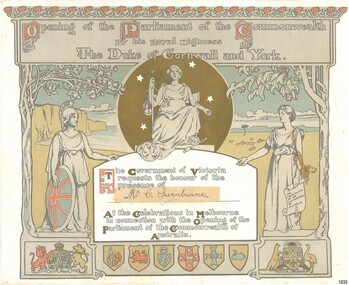
Certificate - Invitation, Norman Lindsay (Artist), Opening of the Parliament of the Commonwealth by His Royal Highness The Duke of Cornwall and York, ca. 1901
... artists Norman Lindsay (1879–1969) and John Longstaff (1861–1941) and its printing to Sands & McDougall Limited, Melbourne. The invitation has no date or location details. This invitation has the label “Mr. C Swinburne” added over an original, handwritten name. Perhaps it was a spelling correction, or a late change, with Swinburne attending in the place of another citizen. The book “Our Invited Guests An Official Directory, Melbourne, Victoria, 1901” lists all the guests, but not one has the surname SWINBURNE. There are five Warrnambool...artists Norman Lindsay (1879–1969) and John Longstaff (1861–1941) and its printing to Sands & McDougall Limited, Melbourne. The invitation has no date or location details. This invitation has the label “Mr. C Swinburne” added over an original, handwritten name. Perhaps it was a spelling correction, or a late change, with Swinburne attending in the place of another citizen. The book “Our Invited Guests An Official Directory, Melbourne, Victoria, 1901” lists all the guests, but not one has the surname SWINBURNE. There are five Warrnambool ...Australia became a Federation on January 1st, 1901, uniting Australia's six British colonies - New South Wales, Victoria, Queensland, South Australia, Western Australia and Tasmania – into States of the Commonwealth of Australia. The Government of Victoria invited 12,000 guests to attend the official celebrations for the Opening of the Federal Parliament by His Royal Highness, the Duke of Cornwall and York (later King George V). The historic occasion was held at noon on May 9th, 1901, at Melbourne's Royal Exhibition Building, the only building large enough for that number of guests. The guests represented all six states of Australia with varied connections and interests, including politics, business and industry, the arts, religion, education, and public service. In Melbourne, the occasion was followed by two weeks of celebrations. The decorative, elaborate design of the certificate-size invitation represents Australia’s colonial history and its transition to the Federated Commonwealth of Australia. The National Gallery of Australia attributes the artwork of this invitation to Australian artists Norman Lindsay (1879–1969) and John Longstaff (1861–1941) and its printing to Sands & McDougall Limited, Melbourne. The invitation has no date or location details. This invitation has the label “Mr. C Swinburne” added over an original, handwritten name. Perhaps it was a spelling correction, or a late change, with Swinburne attending in the place of another citizen. The book “Our Invited Guests An Official Directory, Melbourne, Victoria, 1901” lists all the guests, but not one has the surname SWINBURNE. There are five Warrnambool listings, eight people in all: - - MoCOBMICK, G. D., Esq., P.M., Warrnambool. - O’DOWD, The Ven. Monsignor, Warrnambool. - OPIE, C. N. T., Esq. (and Lady), Warrnambool. - OSBORNE, Hy. Wm., Esq., Shire Secretary (and Lady), Town Hall, Warrnambool. - STEVENS, Mrs. F. P., Mia Mia, Warrnambool. CHARLES GRANT SWINBURNE (1864-1934): - Charles Grant Swinburne, known as Chas.., was a prominent Warrnambool figure: a member of Toc H., the Progress Association and several other local clubs and societies. He purchased Warrnambool’s Tattersall’s Hotel in 1911 and had a booth at the 1914 Warrnambool Show. In 1891, he married Susan Jane Granter (1867-19 June 1935), daughter of Joseph Granter (1832-1879) and Ann (born Holley). Joseph had arrived in Melbourne on the famous tall ship Marco Polo in February 1856. In 1868, he was a shareholder of the Warrnambool Steam Packet Co., trading along the coast of Victoria. His portrait is among those recognised on the historic Warrnambool Pioneers Board. The invitation is nationally significant for its connection with the first Federal Parliament in May 1901, where the first federal parliamentarians were sworn in, and where the Duke and Duchess of Cornwall and York attended, representing the continued link with Britain. The invitation also unites a local Warrnambool businessman, Mr C Swinburne, with the 12,000 guests representing their towns and states that in 1901 became the Commonwealth of Australia. Swinburn was also married to the daughter of Joseph Granter, an early pioneer recognised on Warrnambool’s Pioneer Board. Invitation: certificate size, colour lithograph on cream card with gilt highlights. The Victorian Government invited Mr C Swinburne to celebrate the Opening of Federal Parliament by HRH the Duke of Cornwall and York, held in Melbourne. The invitation has printed drawings of figures, decorations, heraldic symbols, and gilt accents behind the central figure, on the capital letters of the message, and the Advance Australia Arms. Inscribed with a handwritten label that covers handwritten text. [The event was held at Noon, 9th May 1901, Royal Exhibition Building, Melbourne.] Inscription, handwritten on a label: "Mr. C. Swinburne" Left image: [figure of Britannia holding a blue shield with three crossing red bands, standing below an oak tree] Central image, in front of a gilt circle : [symbolic female royal future with Orbe and Sceptre seated on throne, four stars around her] Right image: [young female figure representing Australia holding a scroll, standing below a flowering gum] "THE CONSTITUTION OF THE COMMONWEALTH OF AUSTRALIA" Bottom left: Combined Arms: "[Duke of Cornwall and York, Prince George Frederick Ernest Albert, Princess Alexandra, his Duchess]" Bottom centre: [six symbols representing the Coat of Arms for each state of Australia] Bottom right: Advance Australia Arms "[Shield with six symbols, between Kangaroo and Emu, and below Rising Sun'] ADVANCE AUSTRALIA"flagstaff hill maritime museum and village, flagstaff hill, maritime museum, maritime village, warrnambool, great ocean road, shipwreck coast, invitation, certificate, mr c swinburne, government of victoria, opening of federal parliament, hrh the duke of cornwall and york, c swinburne, susan jane granter, susan jane swinburne, federal parliament, 1901, australian federation, ceremonies, politics, royal exhibition building, invited guest, britannia, orb, sceptre, advance australia arms, constitution of the commonwealth of australia, norman lindsay, john longstaff, sands & mcdougall, federation, british colonies, commonwealth of australia, charles grant swinburne, chas swinburne, c g swinburne, opening of the federal parliament, duke of cornwall and york, may 9th, tattersall’s hotel, marco polo, warrnambool steam packet co, warrnambool pioneers board, joseph granter, ann granter -
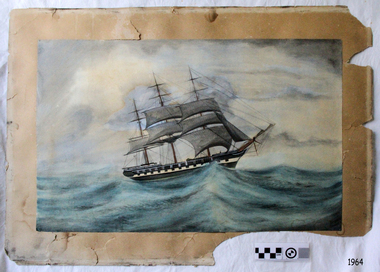 Flagstaff Hill Maritime Museum and Village
Painting - Maritime painting, ca. 19th century
... artist is unknown. The ship in this painting is unidentified. Painting is an example of 19th century artwork. Flagstaff Hill Maritime Museum & Village Maritime Museum Maritime Village Flagstaff Hill Warrnambool painting 19th century ship at sea seascape wall decoration maritime painting Painting, rectangular, watercolour mounted on card. ...This maritime painting is unsigned and the artist is unknown. The ship in this painting is unidentified.Painting is an example of 19th century artwork.Painting, rectangular, watercolour mounted on card. Maritime theme depicts a three-masted ship at sea, sails rigged, bow facing right, hull is black and white. Figures are onboard.flagstaff hill maritime museum & village, maritime museum, maritime village, flagstaff hill, warrnambool, painting, 19th century, ship at sea, seascape, wall decoration, maritime painting -
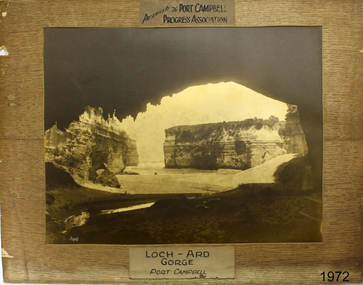 Flagstaff Hill Maritime Museum and Village
Photograph - Coastal Scene, Foyle Photographic Studio, Loch Ard Gorge Port Campbell, 1889-1919
... A letter to the editor (by Mr Edward Vidler) in the Melbourne Argus, 3rd August 1907, mentions that in that year Warrnambool would celebrate the 60th anniversary of its proclamation as a town, and that talented local artist Miss Lily Foyle would paint 200 portraits in watercolour of the pioneers who settled in the district prior to 1860. ...A letter to the editor (by Mr Edward Vidler) in the Melbourne Argus, 3rd August 1907, mentions that in that year Warrnambool would celebrate the 60th anniversary of its proclamation as a town, and that talented local artist Miss Lily Foyle would paint 200 portraits in watercolour of the pioneers who settled in the district prior to 1860. ...The photograph shows the popular tourist attraction, Loch Ard Gorge, which is located along the Great Ocean Road in Victoria, near Port Campbell. The gorge is named after the famous sailing ship, the LOCH ARD, that was wrecked there in 1878. Only two of the 54 passengers and crew survived. FOYLE “Foyle” written on the photograph is the name of Foyle’s Photographic studio. At the time of the photograph, the studio was owned by both Charles and Lilian Foyle (sometimes known as Lillian or Lily), either of whom could have taken this photograph. They also worked together at a later date on the photographs, sketches and paintings of the famous and historical Pioneers’ Honour Board, which is currently on view in the Warrnambool Library. Foyles Photography was the studio of James Charles Foyle. He owned “Foyle’s Photo Card Studios” in Liebig St, Warrnambool, which operated between 1889 – 1919. A letter to the editor (by Mr Edward Vidler) in the Melbourne Argus, 3rd August 1907, mentions that in that year Warrnambool would celebrate the 60th anniversary of its proclamation as a town, and that talented local artist Miss Lily Foyle would paint 200 portraits in watercolour of the pioneers who settled in the district prior to 1860. The Pioneer Honour Board can still be seen on display in the Warrnambool Library. In the Warrnambool Standard, Dec. 1917, “Mr Foyle’s studio was awarded the contract to decorate rail cars on newly opened Trans-Continental railway, assisted by his sister, Miss Findlay.” HISTORY OF THE LOCH ARD The LOCH ARD belonged to the famous Loch Line which sailed many ships from England to Australia. Built-in Glasgow by Barclay, Curdle and Co. in 1873, the LOCH ARD was a three-masted square-rigged iron sailing ship. The ship measured 262ft 7" (79.87m) in length, 38ft (11.58m) in width, 23ft (7m) in depth and had a gross tonnage of 1693 tons. The LOCH ARD's main mast measured a massive 150ft (45.7m) in height. LOCH ARD made three trips to Australia and one trip to Calcutta before its final voyage. LOCH ARD left England on March 2, 1878, under the command of Captain Gibbs, a newly married, 29-year-old. She was bound for Melbourne with a crew of 37, plus 17 passengers and a load of cargo. The general cargo reflected the affluence of Melbourne at the time. Onboard were straw hats, umbrella, perfumes, clay pipes, pianos, clocks, confectionary, linen and candles, as well as a heavier load of railway irons, cement, lead and copper. There were items included that intended for display in the Melbourne International Exhibition in 1880. The voyage to Port Phillip was long but uneventful. At 3 am on June 1, 1878, Captain Gibbs was expecting to see land and the passengers were becoming excited as they prepared to view their new homeland in the early morning. But LOCH ARD was running into a fog which greatly reduced visibility. Captain Gibbs was becoming anxious as there was no sign of land or the Cape Otway lighthouse. At 4 am the fog lifted. A man aloft announced that he could see breakers. The sheer cliffs of Victoria's west coast came into view, and Captain Gibbs realised that the ship was much closer to them than expected. He ordered as much sail to be set as time would permit and then attempted to steer the vessel out to sea. On coming head-on into the wind, the ship lost momentum, the sails fell limp and LOCH ARD's bow swung back. Gibbs then ordered the anchors to be released in an attempt to hold its position. The anchors sank some 50 fathoms - but did not hold. By this time LOCH ARD was among the breakers and the tall cliffs of Mutton Bird Island rose behind the ship. Just half a mile from the coast, the ship's bow was suddenly pulled around by the anchor. The captain tried to tack out to sea, but the ship struck a reef at the base of Mutton Bird Island, near Port Campbell. Waves broke over the ship and the top deck was loosened from the hull. The masts and rigging came crashing down knocking passengers and crew overboard. When a lifeboat was finally launched, it crashed into the side of LOCH ARD and capsized. Tom Pearce, who had launched the boat, managed to cling to its overturned hull and shelter beneath it. He drifted out to sea and then on the flood tide came into what is now known as LOCH ARD Gorge. He swam to shore, bruised and dazed, and found a cave in which to shelter. Some of the crew stayed below deck to shelter from the falling rigging but drowned when the ship slipped off the reef into deeper water. Eva Carmichael had raced onto the deck to find out what was happening only to be confronted by towering cliffs looming above the stricken ship. In all the chaos, Captain Gibbs grabbed Eva and said, "If you are saved Eva, let my dear wife know that I died like a sailor". That was the last Eva Carmichael saw of the captain. She was swept off the ship by a huge wave. Eva saw Tom Pearce on a small rocky beach and yelled to attract his attention. He dived in and swam to the exhausted woman and dragged her to shore. He took her to the cave and broke and opened the case of brandy, which had washed up on the beach. He opened a bottle to revive the unconscious woman. A few hours later Tom scaled a cliff in search of help. He followed hoof prints and came by chance upon two men from nearby Glenample Station three and a half miles away. In a state of exhaustion, he told the men of the tragedy. Tom returned to the gorge while the two men rode back to the station to get help. By the time they reached LOCH ARD Gorge, it was cold and dark. The two shipwreck survivors were taken to Glenample Station to recover. Eva stayed at the station for six weeks before returning to Ireland, this time by steamship. In Melbourne, Tom Pearce received a hero's welcome. He was presented with the first gold medal of the Royal Humane Society of Victoria and a £1000 cheque from the Victorian Government. Concerts were performed to honour the young man's bravery and to raise money for those who lost family in the LOCH ARD disaster. Of the 54 crew members and passengers on board, only two survived: the apprentice, Tom Pearce and the young woman passenger, Eva Carmichael, who lost all of her family in the tragedy. Ten days after the LOCH ARD tragedy, salvage rights to the wreck were sold at auction for £2,120. Cargo valued at £3,000 was salvaged and placed on the beach, but most washed back into the sea when another storm developed. The wreck of LOCH ARD still lies at the base of Mutton Bird Island. Much of the cargo has now been salvaged, and some of it was washed up into what is now known as LOCH ARD Gorge. Cargo and artefacts have also been illegally salvaged over many years before protective legislation was introduced. One of the most unlikely pieces of cargo to have survived the shipwreck was a Minton porcelain peacock - one of only nine in the world. The peacock was destined for the Melbourne International Exhibition in 1880. It had been well packed, which gave it adequate protection during the violent storm. Today, the Minton peacock can be seen at the Flagstaff Hill Maritime Museum in Warrnambool. From Australia's most dramatic shipwreck it has now become Australia's most valuable shipwreck artefact and is one of very few 'objects' on the Victorian State Heritage Register.Flagstaff Hill’s collection of artefacts from LOCH ARD is significant for being one of the largest collections of artefacts from this shipwreck in Victoria. It is significant for its association with the shipwreck, which is on the Victorian Heritage Register (VHR S417). The collection is significant because of the relationship between the objects, as together they have a high potential to interpret the story of the LOCH ARD. The LOCH ARD collection is archaeologically significant as the remains of a large international passenger and cargo ship. The LOCH ARD collection is historically significant for representing aspects of Victoria’s shipping history and its potential to interpret sub-theme 1.5 of Victoria’s Framework of Historical Themes (living with natural processes). The collection is also historically significant for its association with the LOCH ARD, which was one of the worst and best-known shipwrecks in Victoria’s history. Foyle's photographs date from the late 19th century to the early 20th century, representing a time of growth in the Warrnambool district and a time when the still relatively new technology of photography was more available to the community.Photograph of Loch Ard Gorge. This sepia coloured rectangular photograph is mounted on a brown cardboard backing that has a wood grain pattern. The photograph has an inscription above it, below it, and in the bottom left corner. It was made for the purpose of a presentation by the Port Campbell Progress Association. Printed above the photograph "PRESENTED BY THE PORT CAMPBELL / PROGRESS ASSOCIATION". Printed below the photograph "LOCH ARD GORGE / PORT CAMPBELL". Hand written on bottom left corner "Foyle". flagstaff hill, warrnambool, shipwrecked coast, flagstaff hill maritime museum, maritime museum, shipwreck coast, flagstaff hill maritime village, great ocean road, loch line, loch ard, captain gibbs, eva carmichael, tom pearce, glenample station, mutton bird island, loch ard gorge, photograph, port campbell, port campbell progress association, foyle photograph, foyle photographic studio warrnambool, warrnambool photo studio -
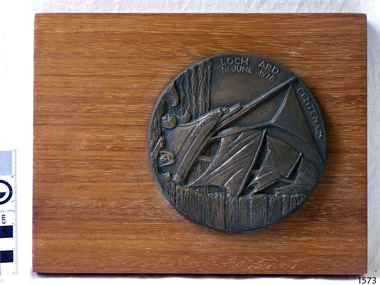 Flagstaff Hill Maritime Museum and Village
Plaque, Loch Ard
... Flagstaff Hill Warrnambool Shipwrecked coast Flagstaff Hill Maritime Museum Maritime Museum Shipwreck coast Flagstaff Hill Maritime Village Great Ocean Road Loch Line LOCH ARD Captain Gibbs Eva Carmichael Tom Pearce Glenample Station Mutton Bird Island LOCH ARD Gorge plaque loch ard michael meszaros Plaque to commemorate the centenary of the wreck of the Loch Ard. Circular piece of bronze depicting a scene of the wreck set in a rectangular piece of varnished wood. Plaque is 9/50. Artist ...HISTORY OF THE LOCH ARD The LOCH ARD belonged to the famous Loch Line which sailed many ships from England to Australia. Built in Glasgow by Barclay, Curdle and Co. in 1873, the LOCH ARD was a three-masted square rigged iron sailing ship. The ship measured 262ft 7" (79.87m) in length, 38ft (11.58m) in width, 23ft (7m) in depth and had a gross tonnage of 1693 tons. The LOCH ARD's main mast measured a massive 150ft (45.7m) in height. LOCH ARD made three trips to Australia and one trip to Calcutta before its final voyage. LOCH ARD left England on March 2, 1878, under the command of Captain Gibbs, a newly married, 29 year old. She was bound for Melbourne with a crew of 37, plus 17 passengers and a load of cargo. The general cargo reflected the affluence of Melbourne at the time. On board were straw hats, umbrella, perfumes, clay pipes, pianos, clocks, confectionary, linen and candles, as well as a heavier load of railway irons, cement, lead and copper. There were items included that intended for display in the Melbourne International Exhibition in 1880. The voyage to Port Phillip was long but uneventful. At 3am on June 1, 1878, Captain Gibbs was expecting to see land and the passengers were becoming excited as they prepared to view their new homeland in the early morning. But LOCH ARD was running into a fog which greatly reduced visibility. Captain Gibbs was becoming anxious as there was no sign of land or the Cape Otway lighthouse. At 4am the fog lifted. A man aloft announced that he could see breakers. The sheer cliffs of Victoria's west coast came into view, and Captain Gibbs realised that the ship was much closer to them than expected. He ordered as much sail to be set as time would permit and then attempted to steer the vessel out to sea. On coming head on into the wind, the ship lost momentum, the sails fell limp and LOCH ARD's bow swung back. Gibbs then ordered the anchors to be released in an attempt to hold its position. The anchors sank some 50 fathoms - but did not hold. By this time LOCH ARD was among the breakers and the tall cliffs of Mutton Bird Island rose behind the ship. Just half a mile from the coast, the ship's bow was suddenly pulled around by the anchor. The captain tried to tack out to sea, but the ship struck a reef at the base of Mutton Bird Island, near Port Campbell. Waves broke over the ship and the top deck was loosened from the hull. The masts and rigging came crashing down knocking passengers and crew overboard. When a lifeboat was finally launched, it crashed into the side of LOCH ARD and capsized. Tom Pearce, who had launched the boat, managed to cling to its overturned hull and shelter beneath it. He drifted out to sea and then on the flood tide came into what is now known as LOCH ARD Gorge. He swam to shore, bruised and dazed, and found a cave in which to shelter. Some of the crew stayed below deck to shelter from the falling rigging but drowned when the ship slipped off the reef into deeper water. Eva Carmichael had raced onto deck to find out what was happening only to be confronted by towering cliffs looming above the stricken ship. In all the chaos, Captain Gibbs grabbed Eva and said, "If you are saved Eva, let my dear wife know that I died like a sailor". That was the last Eva Carmichael saw of the captain. She was swept off the ship by a huge wave. Eva saw Tom Pearce on a small rocky beach and yelled to attract his attention. He dived in and swam to the exhausted woman and dragged her to shore. He took her to the cave and broke open case of brandy which had washed up on the beach. He opened a bottle to revive the unconscious woman. A few hours later Tom scaled a cliff in search of help. He followed hoof prints and came by chance upon two men from nearby Glenample Station three and a half miles away. In a state of exhaustion, he told the men of the tragedy. Tom returned to the gorge while the two men rode back to the station to get help. By the time they reached LOCH ARD Gorge, it was cold and dark. The two shipwreck survivors were taken to Glenample Station to recover. Eva stayed at the station for six weeks before returning to Ireland, this time by steamship. In Melbourne, Tom Pearce received a hero's welcome. He was presented with the first gold medal of the Royal Humane Society of Victoria and a £1000 cheque from the Victorian Government. Concerts were performed to honour the young man's bravery and to raise money for those who lost family in the LOCH ARD disaster. Of the 54 crew members and passengers on board, only two survived: the apprentice, Tom Pearce and the young woman passenger, Eva Carmichael, who lost all of her family in the tragedy. Ten days after the LOCH ARD tragedy, salvage rights to the wreck were sold at auction for £2,120. Cargo valued at £3,000 was salvaged and placed on the beach, but most washed back into the sea when another storm developed. The wreck of LOCH ARD still lies at the base of Mutton Bird Island. Much of the cargo has now been salvaged and some was washed up into what is now known as LOCH ARD Gorge. Cargo and artefacts have also been illegally salvaged over many years before protective legislation was introduced. One of the most unlikely pieces of cargo to have survived the shipwreck was a Minton porcelain peacock - one of only nine in the world. The peacock was destined for the Melbourne International Exhibition in 1880. It had been well packed, which gave it adequate protection during the violent storm. Today, the Minton peacock can be seen at the Flagstaff Hill Maritime Museum in Warrnambool. From Australia's most dramatic shipwreck it has now become Australia's most valuable shipwreck artefact and is one of very few 'objects' on the Victorian State Heritage Register. Flagstaff Hill’s collection of artefacts from LOCH ARD is significant for being one of the largest collections of artefacts from this shipwreck in Victoria. It is significant for its association with the shipwreck, which is on the Victorian Heritage Register (VHR S417). The collection is significant because of the relationship between the objects, as together they have a high potential to interpret the story of the LOCH ARD. The LOCH ARD collection is archaeologically significant as the remains of a large international passenger and cargo ship. The LOCH ARD collection is historically significant for representing aspects of Victoria’s shipping history and its potential to interpret sub-theme 1.5 of Victoria’s Framework of Historical Themes (living with natural processes). The collection is also historically significant for its association with the LOCH ARD, which was one of the worst and best known shipwrecks in Victoria’s history. Plaque to commemorate the centenary of the wreck of the Loch Ard. Circular piece of bronze depicting a scene of the wreck set in a rectangular piece of varnished wood. Plaque is 9/50. Artist Michael Meszarosflagstaff hill, warrnambool, shipwrecked coast, flagstaff hill maritime museum, maritime museum, shipwreck coast, flagstaff hill maritime village, great ocean road, loch line, loch ard, captain gibbs, eva carmichael, tom pearce, glenample station, mutton bird island, loch ard gorge, plaque, loch ard, michael meszaros -
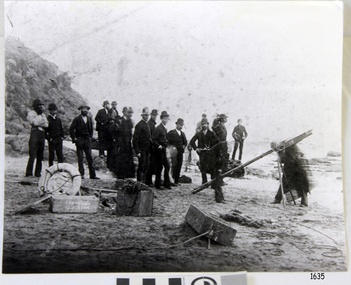 Flagstaff Hill Maritime Museum and Village
Photograph - Shipwreck rescue, c. 1890's
... Warrnambool skin divers in 1967. Captain Vickers’ pocket watch and Julius Gebauhr’s sheath knife are among the artefacts salvaged from the Fiji that are now part of the Fiji collection at Flagstaff Hill Maritime Village. The man identified in the photograph, Herbert Maxwell Morris, was the nephew of the Victorian era artist...Warrnambool skin divers in 1967. Captain Vickers’ pocket watch and Julius Gebauhr’s sheath knife are among the artefacts salvaged from the Fiji that are now part of the Fiji collection at Flagstaff Hill Maritime Village. The man identified in the photograph, Herbert Maxwell Morris, was the nephew of the Victorian era artist ...CONTEXT – UPDATED The photograph taken on Sunday, September 6, 1891, shows the Port Campbell Rocket Rescue Crew and Equipment at Wreck Beach, Moonlight Head, preparing to save the stranded men on the wreck of the barque Fiji. The man standing in the middle, front of the photograph, facing the ocean, is Herbert Maxwell Morris, a farmer at Barruppa near Princetown, who is also a member of the Rocket Rescue Crew. The Rocket Rescue lifesaving method used an explosive rocket to shoot a light line from the shore across to the distressed vessel. The line was then secured to the ship’s mast, and a heavy, continuous line was sent out with a ‘breaches buoy’ attached (a buoy similar to the seat of a pair of trousers). The stranded seafarers would sit in the seats and be pulled along the line to safety. A lot of skill was needed to set up the line to reach its target, and the crew trained regularly to keep up their skills. The FIJI and the RESCUE: - The three-masted iron barque Fiji was built at Belfast, Ireland, in 1875 by Harland and Wolfe for a Liverpool-based shipping company. The ship departed Hamburg on May 22, 1891, bound for Melbourne under the command of Captain William Vickers with a crew of 25. The Cape Otway light was sighted on September 5, 1891. However, the bearing was different from Captain Vickers’ calculations. At about 2:30 am the next morning, the land was reported only 4-5 miles away. The captain tried to redirect the ship in the rough weather without success, and the Fiji struck rock only 300 yards (274 metres) from shore. The crew burned blue lights and fired rockets to signal distress. The lifeboats either capsized or were swamped and smashed to pieces. Two younger crewmen volunteered to swim to the shore with a line. One, a Russian named Daniel Carkland, drowned after he was swept away when the line broke. The other, Julius Gebauhr, a 17-year-old German able seaman, reached shore safely on his second attempt but had cut the line loose with his sheath-knife when it tangled in kelp. He climbed the cliffs in search of help. Later that morning, a young man named William (Willie) Ward reported that he saw the wreck of the ship close to shore near Moonlight Head from the cliffs, and the alarm for help was sent to Princetown, six miles away. At around the same time, a Mott’s party of land selectors, including F. J. Stansmore and Leslie Dickson, was travelling on horseback from Princetown towards Moonlight Head. They were near Ryans Den when they found Gebauhr in the scrub, bleeding and dressed only in a singlet, socks and a belt with his sheath-knife. They thought the man might be an escaped lunatic, due to his wild and shaggy-looking state and what seemed to be gibberish speech. After Gebauhr threw his knife away, they realised that he was speaking half-English, half-German as he talked about the wreck. They gave him food, brandy and clothing, and he was taken to a nearby guest house, Rivernook, owned by John Evans, where he was cared for. Most of the party went off to the wreck site. Stanmore and Dickson rode for help from both Port Campbell, for the two Rocket Rescue Crew buggies, and from Warrnambool, for the lifeboat. The vessel S.S. Casino sailed from Portland towards the scene. Half of the Port Campbell Rocket Crew and equipment arrived after a 25-mile journey and set up the rocket tripod on the beach below the cliffs. By this time, the weary crew of the Fiji had been clinging to the jib-boom for almost 15 hours, calling frantically for help. The Office in Charge of the Rocket Crew, W. Tregear, ordered the rocket to be fired, but the light line broke and the rocket was carried away. A second line was successfully set up by Herbert Morris. It crossed the ship and was secured. The anxious sailors tried to come ashore along the line, but some were washed off as the line sagged with too many on it at one time. Other nearly exhausted crewmen made their way through masses of seaweed and were often smothered by waves. Only 14 of the 24 who had remained on the ship made it to shore. Rocket Crew members and onlookers on the beach took turns to go into the surf and drag the half-drowned seamen to safety. These rescuers included Bill (William James) Robe, Herbert Maxwell Morris, Edwin Vinge, Hugh Cameron, Fenelon Mott, Arthur Wilkinson and Peter Carmody, who was also involved in the rescue of men from the Newfield. Arthur Wilkinson, a 29-year-old land selector from Geelong, swam out to help one of the ship’s crewmen, a carpenter named John Plunken, who was trying to swim from the ship to the shore. Two or three times, both men almost reached the shore but were washed back to the wreck, where they were both hauled back on board. Wilkinson was unconscious, possibly from hitting his head on the anchor before they were brought up. Plunken survived, but Wilkinson later died, and his body washed up the next day. The 26-year-old Bill Robe hauled out the last man; it was the captain, and he’d been tangled in the kelp. Only 20 minutes later, the wreck of the Fiji was smashed apart, and it settled in about 6 metres of water. Of the 26 men on the Fiji, 11 in total lost their lives. The remains of 7 bodies were washed onto the beach. Their coffins were made from timbers from the wrecked Fiji, and they were buried on the cliff top above the wreck. The survivors were taken to Rivernook and cared for over the next few days. Funds were raised by locals soon after the wreck in aid of the sufferers of the Fiji disaster. Captain Vickers was severely reprimanded for his mishandling of the ship. His Master's Certificate was suspended for 12 months. There was public criticism of the rescue. The important canvas ‘breeches buoy’ and heavy line for the Rocket Rescue were in the half of the rocket outfit that didn’t make it in time for the rescue, as they had been delayed at the Gellibrand River ferry. The communications to Warrnambool were down, so the call for help didn’t get through on time. The boat that was notified of the wreck failed to reach it in time. Much cargo looting occurred. One looter was caught with a small load of red and white rubber balls. Essence of peppermint mysteriously turned up in many settlers' homes. Sailcloth was salvaged and used for horse rugs and tent flies. Soon after the wreck, “Fiji tobacco” was advertised around Victoria. A Customs officer, trying to prevent some of the looting, was assaulted by looters and thrown over a cliff. He managed to cling to a bush lower down until rescued. In 1894, some coiled fencing wire was salvaged from the wreck. Hundreds of coils are still strewn over the site of the wreck, encrusted and solidified. The hull is broken, but the vessel’s iron ribs can be seen along with some of the cargo of concrete and pig iron. Captain Vickers presented Bill Robe with his silver-cased pocket watch, the only possession that he still had, as a token for having saved his life and the lives of some of the crew. Years later, Bill used the pocket watch to pay a debt, and it was handed down through that family. Seaman Julius Gebauhr later gave his knife, in its handcrafted leather sheath, to F. J. Stansmore for caring for him when he came ashore. The knife handle had a personal inscription on it. A marble headstone on the cliffs overlooking Wreck Beach pays tribute to the men who lost their lives when Fiji ran aground. The scene of the wreck is marked by the anchor from the Fiji, erected by Warrnambool skin divers in 1967. Captain Vickers’ pocket watch and Julius Gebauhr’s sheath knife are among the artefacts salvaged from the Fiji that are now part of the Fiji collection at Flagstaff Hill Maritime Village. The man identified in the photograph, Herbert Maxwell Morris, was the nephew of the Victorian era artist, William Morris. Herbert had sailed from England to Australia; he was about 25 years old when he joined the Rocket Rescue Crew at Port Campbell, where he lived. His successful rocket line firing at the Fiji wreck site was noted by author Jack Loney in one of his historic shipwreck books. Later, Morris moved from his property at Baruppa to Laver’s Hill to run a more profitable enterprise. This photograph is significant as an image of a historical event, being the willingness of local volunteers to aid in the saving of lives of stranded seafarers. It gives a clear picture of the use of Rocket Rescue Equipment in shore-to-ship rescues. Flagstaff Hill’s Fiji collection is of historical significance at a State level because of its association with the wreck Fiji, which is on the Victorian Heritage Register VHR S259. The Fiji is archaeologically significant as the wreck of a typical 19th century international sailing ship with cargo. It is educationally and recreationally significant as one of Victoria's most spectacular historic shipwreck dive sites with structural features and remains of the cargo evident. It also represents aspects of Victoria’s shipping history and its potential to interpret sub-theme 1.5 of Victoria’s Framework of Historical Themes. The Fiji collection meets the following criteria for assessment; Importance to the course, or pattern, of Victoria’s cultural history, possession of uncommon, rare or endangered aspects of Victoria’s cultural history, and potential to yield information that will contribute to an understanding of Victoria’s cultural history. Black and white photograph of the Rocket Rescue Crew from Pt Campbell on Wreck Beach, Moonlight Head, at the barque 'Fiji' wreck site. September 6, 1891.warrnambool, shipwrecked coast, flagstaff hill, flagstaff hill maritime museum, maritime museum, shipwreck coast, flagstaff hill maritime village, shipwrecked artefact, pocket watch, fob watch fiji, william vickers, william robe, bill robe, gebauhr, stansmore, carmody, wreck bay, moonlight head, fiji shipwreck 1891, rocket crew, port campbell rocket crew, lifesaving crew, photograph of rocket crew, herbert morris, warrnambool, shipwreck artefact, mott, william ward, rocket rescue, breeches buoy, rivernook guest house -
 Flagstaff Hill Maritime Museum and Village
Book - Birthday Book, Raphael Tuck & Sons et al, The Dickens Birthday Book, 1901-1911
... artist, Pilford Fletcher Watson. Ownership of a rare and beautifully presented book like this indicates the value placed on keeping records of family and friends, and remembering their birthdays, in the early 1900s. The book is highly significant for the entries of local family names, some with birth dates. Flagstaff Hill Flagstaff Hill Maritime Museum and Village Warrnambool ...Birthday Books are personal record books for names and birth dates of friends and relatives. This book includes a quote from Charles Dickens for each day of the year. The books were published in many editions, with different publishers, illustrators, covers and designs. This Dickens Birthday book was presented as a gift to fifteen-year-old Clara Skirrow on January 19th 1911, by Mr and Mrs B Watson, perhaps the 'Benji Watson' in the book, whose birthday was July 1st, 1887. The entries in the book include several with the surnames Watson and Skirrow. Interestingly, names are entered in various writing styles, perhaps because each entry was written by the person of that name, similar to an autograph book. Curiously, there are two entries for Connie Watson, one in brackets on March 16th, the other on March 23rd, without brackets. The artist, Pilford Fletcher Watson (1892-1907), was born in London. He moved to Sydney, where he became a prominent and well-established artist and a founding member of the Academy of Arts, Australia, established in 1891. His works included local scenery, architecture, and the interiors of historic buildings. Many of his pieces were bequeathed to the State Library of New South Wales. The firm, Raphael Tuck & Sons Ltd, was a printer and publisher that operated in London from 1866 to 1960. Its logo was the artist's easel, palette and brush. The firm that specialised in greeting cards and produced puzzles. It also became the world’s largest postcard publisher. In 1960, the firm amalgamated with others to become the British Printing Corporation. The fly page states that Ralph Tuck & Sons, Ltd. was the publisher to Their Majesties, the King and Queen, and Their Royal Highnesses, the Prince and Princess of Wales. This would suggest that this book was published from 1901 to 1910, when King Edward VII and Queen Alexandra, and Prince George and his wife Princess Mary were permitted to use these titles. NAMES LISTED IN THE BIRTHDAY BOOK (the museum has photographs of every entry in the book, which are available on enquiry): - January 1 Mrs J (or S) Watson January 11 Wilfred Skirrow, 1904 January 16 Elsie Watson, 1897 January 17 Elsie Hartley, 23/06/2012 [error?] January 21 Frances Victoria Haieck January 29 Annie Skirrow, 1884 February 14 Willie Illingworth February 17 Bessie Watson February 19 Mrs Butterfield, 22 Apperley Rd, Idle [UK] February 27 William Ernest Futter ? March 13 Carrie Barker March 16 Connie Watson March 19 Hilda Graham March 20 Mrs W. Illingworth March 23 Connie Watson April 5 Mrs Ruth Ann Skirrow April 6 William Dickinson Goldsbrough April 11 Norman Goldsbrough April 16 May Jessen April 19 Mrs A Dixon April 20 Mrs S Watson April 23 John Fred Stansfield, 1912 April 24 Reginald Goldsbrough May 12 Bertha Ellis May 18 Gladys McInnes May 28 Mrs Arthur Watson June 3 Jack Watson, 1910 June 10 Mr James Watmough June 18 Miss Hilda Hodgson, 1895 June 26 Sarah Atkinson, 1894 June 30 Mary A Bannister, 1896 July 1 Benji Watson, 1887 July 1 Ester Watmough, 1896 July 2 Clara Skirrow, 1896 July 2 Aunt Jinni July 2 Aunt Hannah July 10 Ellen Gertrude Connolly July 11 Violet Mathieson July 23 Hady Rogers July 26 Sarah Atkinson August 2 Allan Watson August 3 George Skirrow August 6 Thomas Skirrow August 6 Gladys Patten August 8 John Waite, 1909 August 21 Lilian Pattison, 1909 August 25 Ethel Watson, 1889 August 25 Evellyn Goldsbrough September 4 Miss Frances Barker September 12 Ernest Hartley, 1888 September 14 Harry Stansfield, 1895 September 20 Harry Padgett September 25 Leslie Watson September 26 Florrie Wise, 1896 September 27 Dorothy Watson, 1909 October 1 Madge Ferrier October 3 Elizabeth Padgett, 1896 October 5 Violet Altridge, 1895 October 13 Elsie Hodgson, 1893 October 18 Arthur Watson October 21 Emily Bradshaw November 14 Mr A Dixon December 27 Laura Hartley, 1890 December 29 Arther Skirrow, 1894 December 29 Dolly GrahamThis early 20th-century Birthday Book is significant for containing quotes by the famous writer Charles Dickens. It is also connected to the popular and prolific publisher and printer, Raphael Tuck & Sons Ltd, and the renowned illustrator and artist, Pilford Fletcher Watson. Ownership of a rare and beautifully presented book like this indicates the value placed on keeping records of family and friends, and remembering their birthdays, in the early 1900s. The book is highly significant for the entries of local family names, some with birth dates. Book: small book with padded maroon leather hard cover and embossed with gold text on cover and spine; cover also has a gold motif. The pages include coloured illustrations, sketches, and lines for personal entries. The first pages are about Charles Dickens. Title: The Dickens Birthday Book, with six illustrations in Colour by P. Fletcher-Watson Publisher: Raphael Tuck & Sons Ltd, Britain Printed in England 1901-1910 Artist: P. Fletcher-Watson This padded red leather hardcover book has embossed gold text on the front cover and spine. The six colour illustrations throughout the book were by artist P. Fletcher-Watson; one is a portrait of Dickens. Each day has a quote from Charles Dickens' works and blank lines below. The drawing on the fly page depicts a stone building with side pillars and a logo in the centre of the horizontal beam. It has a gift inscription for Clara Skirrow on January 19th, 1911. There are handwritten entries under many of the dates, some include years that range from 1884 to 1912, and one includes an address in the U.K.. Embossed on cover and spine: “The DICKENS Birthday Book” Handwritten in black ink: "From Mr & Mrs B. Watson / To Clara Skirrow / With Best wishes / January 19th 1911" Illustration on fly page: Logo [artist's palette, brush and easel] Publisher information: “Raphael Tuck & Sons Ltd, London, Paris, Berlin, New York, Montreal,” “Publishers to their Majesties the King and Queen, and T.R.H. the Prince and Princess of Wales” “Printed in England” Handwritten entries with names, some dates, and one address. flagstaff hill, flagstaff hill maritime museum and village, warrnambool, maritime museum, maritime village, great ocean road, shipwreck coast, birthday book, p. fletcher-watson, raphael tuck & sons ltd, 1901-1910, illustrated, 19-01-1911, mr & mrs b. watson, clara skirrow, red cover, british printing corporation, king and queen and trh prince and princess, king edward vii and queen alexandra, antique book, rare book, atkinson, bannister, barker, bradshaw, butterfield, connolly, dixon, ellis, ferrier, futter, goldsbrough, graham, hartley, hodgson, illingworth, jessen, mathieson, mcinnes, padgett, patten, pattison, rogers, stansfield, waite, watmough, watson, wise, dickens birthday book, charles dickens, dickens quotes, skirrow -
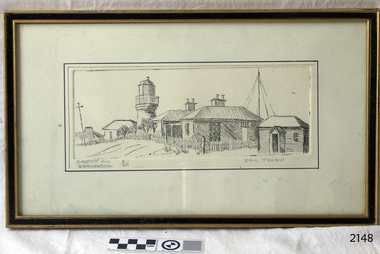 Flagstaff Hill Maritime Museum and Village
Artwork, other - Etching, Eric Tonkin, Flagstaff Hill Warrnambool, 1985
... warrnambool...etching...flagstaff hill lighthouse complex...artist...Depiction of historic buildings at Flagstaff Hill, Warrnambool, part o f the History of Warrnambool. The artist is a local citizen. flagstaff hill warrnambool etching flagstaff hill lighthouse complex artist eric tonkin historic precinct flagstaff hill lighthouse Eric Tonkin Flagstaff Hill Maritime Museum and Village lady bay lighthouse Lighthouse Keeper's quarters chart room "Rec No 389A" "FLAGSTAFF HILL" Etching by Eric Tonkin, 34 Howard St, Warrnambool, Ph 62 4707" Etching of Flagstaff Hill Lighthouse complex - artist Eric Tonkin. ...The etching depicts the Historic Precinct of Flagstaff Hill Maritime Museum and Village. It includes the building that were transferred from Middle Island to Flagstaff Hill in the early 1870s; Lighthouse, Keepers' Quarters, Chart Room.Depiction of historic buildings at Flagstaff Hill, Warrnambool, part o f the History of Warrnambool. The artist is a local citizen.Etching of Flagstaff Hill Lighthouse complex - artist Eric Tonkin. Picture shows the Chartroom, Lighthouse Keeper's Quarters, Assistant's Quarters, Privy and Flagstaff. Framed behind glass, black and gilded frame. Sticker and inscriptions on the back."Rec No 389A" "FLAGSTAFF HILL" Etching by Eric Tonkin, 34 Howard St, Warrnambool, Ph 62 4707"flagstaff hill, warrnambool, etching, flagstaff hill lighthouse complex, artist eric tonkin, historic precinct flagstaff hill lighthouse, eric tonkin, flagstaff hill maritime museum and village, lady bay lighthouse, lighthouse keeper's quarters, chart room -
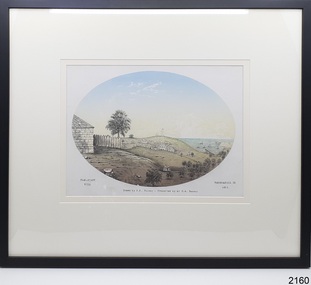 Flagstaff Hill Maritime Museum and Village
Drawing - Historical, Warrnambool, H. H. Ramsay, Flag-Staff Hill
... The drawing is an artist's impression of Flagstaff Hill, Warrnambool, in 1855. It was presented to Flagstaff Hill Maritime Village by Mr R A Ramsay....Artist's impression of Flagstaff Hill, town buildings of Warrnambool, Lady Bay with jetty, sailing ships in the bay, and Middle Island in the year 1855. ... impression of Flagstaff Hill, town buildings of Warrnambool, Lady Bay with jetty, sailing ships in the bay, and Middle Island in the year 1855. Title; "Flag-Staff Hill", Artist; H. ...The drawing is an artist's impression of Flagstaff Hill, Warrnambool, in 1855. It was presented to Flagstaff Hill Maritime Village by Mr R A Ramsay.The drawing is significant for its subject, a local maritime village and port. It is significant as a depiction of what the young town of Warrnambool could have looked like in 1855. Drawing in colour within an oval, with typed inscription below it. Mounted behind glass in a black rectangular frame with a cream matte. Artist's impression of Flagstaff Hill, town buildings of Warrnambool, Lady Bay with jetty, sailing ships in the bay, and Middle Island in the year 1855. Title; "Flag-Staff Hill", Artist; H. H. Ramsay It was presented to Flagstaff Hill by Mr R A Ramsay. Typed below the drawing; Left: "FLAG-STAFF HILL". Centre: "Drawn by Mr H. H. Ramsay - Presented by Mr R. A. Ramsay." Right: "WARRNAMBOOL IN 1855" On the back in pen "REC / 359A" (sighted before reframing)flag-staff hill, warrnambool 1855, drawing, local history, flagstaff hill maritime museum and village, great ocean road, shipwreck coast, h h ramsay, r a ramsay, flagstaff hill, warrnambool, flagstaff hill maritime museum, flagstaff hill maritime village, maritime museum, lady bay, middle island, coloured drawing, oval drawing -
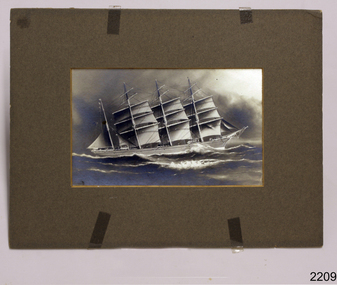 Flagstaff Hill Maritime Museum and Village
Print - Vessel, Sailing Ship, A.V. Gregory, ca. 1899-1922
... The detailed image of the vessel depicted in this print shows one of the many sail and steam vessels painted by the renowned Victorian marine artist A V Gregory, whose original works are highly valued today by marine collectors. flagstaff hill warrnambool shipwrecked-coast flagstaff-hill flagstaff-hill-maritime-museum maritime-museum shipwreck-coast flagstaff-hill-maritime-village Photograph Photograph of Rowena Gregory Cluny Castle a v gregory rowena iron baque rowena ship co. ...This photograph is a print from an original painting by the Australian marine artist A V Gregory (1867-1957), also known as Arthur Victor Gregory. Gregory lived and worked in South Melbourne. He took over the Gregory Studio owned by his father, George Frederick Gregory, painting actively between 1899 and 1932. He usually signed his works as ‘A V Gregory’. Some of his original works have been sold for thousands of dollars. The four-masted iron barque 'Rowena' was built in 1883 by Barclay, Curle & Co. of Glasgow as the 'Cluny Castle', and renamed about 1890 as 'Rowena' by owners Rowena Ship Co.. After consequent owners, the ship was converted to a hulk in 1922 at Port Adelaide. The detailed image of the vessel depicted in this print shows one of the many sail and steam vessels painted by the renowned Victorian marine artist A V Gregory, whose original works are highly valued today by marine collectors.Photograph of a print, black and white, mounted onto card. It depicts the four-masted iron barque ship 'Rowena', originally named 'Cluny Castle'. The original painting was by marine artist A V Gregory.Painted on bow "ROWENA"flagstaff hill, warrnambool, shipwrecked-coast, flagstaff-hill, flagstaff-hill-maritime-museum, maritime-museum, shipwreck-coast, flagstaff-hill-maritime-village, photograph, photograph of rowena, gregory, cluny castle, a v gregory, rowena, iron baque, rowena ship co., barclay, curle & co, glasgow -
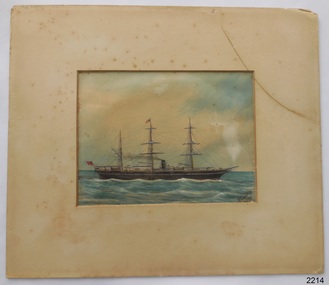 Flagstaff Hill Maritime Museum and Village
Painting - Watercolour, J C Long, 1878
... warrnambool shipwrecked-coast flagstaff-hill flagstaff-hill-maritime-museum maritime-museum shipwreck-coast flagstaff-hill-maritime-village j c long steamship marine art australian vessel "J R Long 1879". Inscriptions in pencil, front and back, some is indecipherable "3/" ", " - lack" Painting, watercolour, steamship at sea, flying an Australian Red Ensign flag from the bow. The centre of three masts has a flying flag of blue, red and yellow. Mounted on card. Artist ...Hand painted image of a steamship with three masts.The painting is significant for its connection with Australian maritime art. Painting, watercolour, steamship at sea, flying an Australian Red Ensign flag from the bow. The centre of three masts has a flying flag of blue, red and yellow. Mounted on card. Artist J C Long, 1879. Inscription on top left corner of front and centre of back, handwritten in pencil."J R Long 1879". Inscriptions in pencil, front and back, some is indecipherable "3/" ", " - lack" flagstaff hill, warrnambool, shipwrecked-coast, flagstaff-hill, flagstaff-hill-maritime-museum, maritime-museum, shipwreck-coast, flagstaff-hill-maritime-village, j c long, steamship, marine art, australian vessel
