
Showing 55 items matching "welding steel"
-
 Ballarat Tramway Museum
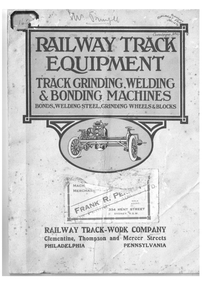
Document - Folder with papers, Railway Track-work Company and Clementine and Thompson and Mercer Sts and Philadelphia and Pennsylvania USA. and Perrot and Adams Ltd, "Railway Track Equipment - Track Grinding Machines, Welding and Bonding Machines - Bonds, Welding Steel, Grinding Wheels and Blocks", 1920's?
... "Railway Track Equipment - Track Grinding Machines, Welding and Bonding Machines - Bonds, Welding Steel, Grinding Wheels and Blocks"...Folder with 24 pages of advertising pamphlets bound into it with two metal clip binders advertising products available from the Railway Track-Work Company and titled ""Railway Track Equipment - Track Grinding Machines, Welding and Bonding Machines - Bonds, Welding Steel, Grinding Wheels and Blocks". ..."Railway Track Equipment - Track Grinding Machines, Welding and Bonding Machines - Bonds, Welding Steel, Grinding Wheels and Blocks" Document Folder with papers Railway Track-work Company and Clementine and Thompson and Mercer Sts and Philadelphia and Pennsylvania USA. and Perrot and Adams Ltd ...Yields information about the type and presentation of books or information folders that were sent to the Electric Supply Company of Victoria about tramway products available on the market and the company the produced them.Folder with 24 pages of advertising pamphlets bound into it with two metal clip binders advertising products available from the Railway Track-Work Company and titled ""Railway Track Equipment - Track Grinding Machines, Welding and Bonding Machines - Bonds, Welding Steel, Grinding Wheels and Blocks". Has brochures or pamphlets for: . The Universal Rotary Track Grinder . Reciprocating Track Grinder . The Atlas Rail Grinder . The Ajax Electric Arc welders .Vertical Rail Lifter . The Jackson Electric Tie Tamper. Generally the lead page of each pamphlet has been imaged. Provides a description of each item, along with method of operation and parts listing generally. The folder has on a number of pages and the back cover, a sticker from Frank R. Perrot (Now Perrot and Adams Ltd), Machinery Merchant of 394 Kent St Sydney. Railway Track-work Company , Clementine, Thompson and Mercer Sts, Philadelphia, Pennsylvania USA. For a full scan of the document see the hi res file.Numerous: Front cover sticky label "1620" in top left hand corner, "Mr Pringle" on front cover and stamp with words "Ballarat Tramway Preservation Society Catalogue No. 10" in ink on front cover. Inside front cover has a pencil note, behind the crease in the bottom right hand corner. On the first pamphlet "Ballarat Tramway Preservation Society Catalogue No. 10" in ink on top right hand corner. On parts page for the Reciprocating Track Grinder has the "Perrot and Adam Ltd" company stamp.trams, tramways, trackwork, equipment, rails -
 Federation University Historical Collection
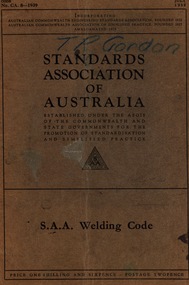
Booklet - Booklet - Standards Association, Standards Association of Australia: .1 Welding Code, .2 Structural Steel
... Standards Association of Australia: .1 Welding Code, .2 Structural Steel...welding code...structural steel code...Welding Code. It was first issued on 1933 and revised in 1939. Cost One Shilling and Sixpence. .2 is the code for Structural Steel. ...Both published by The Association, Science House, Gloucester and Essex Streets, Sydney. standards association of australia commonwealth government state governments welding code structural steel code 1933 1939 1928 1940 science house sydney .1 T R Gordon in blue pencil on cover .2 E J Barker in blue pen on cover. .1 Folded green cover, 28 pages, stapled .2 Folded light brown cover, 30 pages, stapled Standards Association of Australia: .1 Welding Code, .2 Structural Steel Booklet Booklet - Standards Association ...Two booklets produced by the Standards Association of Australia - established under the aegis of the Commonwealth and State Governments for the promotion of standardisation and simplified practice. .1 is on Welding Code. It was first issued on 1933 and revised in 1939. Cost One Shilling and Sixpence. .2 is the code for Structural Steel. It was first issued in 1928, amended in 1931 and revised in 1940. Cost Two Shillings and Sixpence. Both published by The Association, Science House, Gloucester and Essex Streets, Sydney..1 Folded green cover, 28 pages, stapled .2 Folded light brown cover, 30 pages, stapled.1 T R Gordon in blue pencil on cover .2 E J Barker in blue pen on cover.standards association of australia, commonwealth government, state governments, welding code, structural steel code, 1933, 1939, 1928, 1940, science house sydney -
 Moorabbin Air Museum
Book - Aircraft construction, Aircraft processes
... ...Welding steel...Aircraft construction Processing materials Aluminium & it alloys Magnesium & its alloys Steels used in aircraft construction Heat treatment of steels Stainless steels Welding steel Arc welding fundamentals Welding aluminium Electric spot welding Metal spraying Cadmium plating Overview of material & processes for aircraft construction, circa 1941 Aircraft processes Book Aircraft construction ...Overview of material & processes for aircraft construction, circa 1941non-fictionOverview of material & processes for aircraft construction, circa 1941processing materials, aluminium & it alloys, magnesium & its alloys, steels used in aircraft construction, heat treatment of steels, stainless steels, welding steel, arc welding fundamentals, welding aluminium, electric spot welding, metal spraying, cadmium plating -
Embroiderers Guild, Victoria
Tool - Scissors
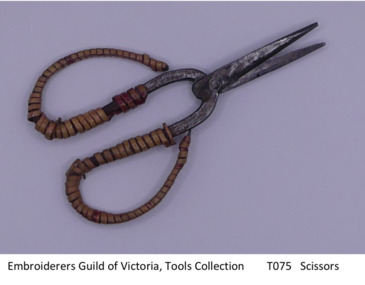
... Chinese scissors, Made of iron with welded steel cutting edges to blades. Pivot action - large rivet. ...Scissors China embroidery Birds, ducks (on blades) Chinese scissors, Made of iron with welded steel cutting edges to blades. Pivot action - large rivet. ...Traditional Chinese shaped scissors, simple and functional design creating symmetrical, hard wearing scissors which can be used but left and right handed people. Traditional Chinese shaped scissors, simple and functional design creating symmetrical, hard wearing scissors which can be used but left and right handed people. Chinese scissors, Made of iron with welded steel cutting edges to blades. Pivot action - large rivet. Handles expandableBirds, ducks (on blades)scissors, china, embroidery -
 Embroiderers Guild, Victoria
Tool - Scissors
... Made of iron with welded steel cutting edges to blades. Pivot acttion. ...Made of iron with welded steel cutting edges to blades. Pivot acttion. ...Traditional Chinese shaped scissors, simple and functional design creating symmetrical, hard wearing scissors which can be used but left and right handed people. Traditional Chinese shaped scissors, simple and functional design creating symmetrical, hard wearing scissors which can be used but left and right handed people. Chinese embroidery scissors, cane bound handles. Made of iron with welded steel cutting edges to blades. Pivot acttion. Handles expandablescissors, china, embroidery -
 Bayside Gallery - Bayside City Council Art & Heritage Collection
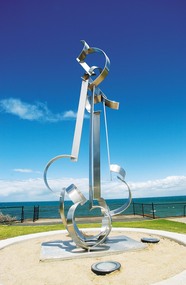
Sculpture, Lenton Parr, Windhover, 2001
... welded steel Public Art Commission located on Sandringham Foreshore Reserve, Beach Rd, near Sandringham Life Saving Club, Sandringham, Victoria....Inspired by a well-loved poem of Gerard Manley Hopkins, the abstract sculpture is reflective of the elements of Bayside's coastal environment: wind, water and waves. sculpture windhover clouds wind waves lenton parr public art sandringham foreshore bayside art coastal trail beach road welded steel Public Art Commission located on Sandringham Foreshore Reserve, Beach Rd, near Sandringham Life Saving Club, Sandringham, Victoria. ...Inspired by a well-loved poem of Gerard Manley Hopkins, the abstract sculpture is reflective of the elements of Bayside's coastal environment: wind, water and waves.welded steel Public Art Commission located on Sandringham Foreshore Reserve, Beach Rd, near Sandringham Life Saving Club, Sandringham, Victoria.sculpture, windhover, clouds, wind, waves, lenton parr, public art, sandringham, foreshore, bayside art coastal trail, beach road -
 Federation University Art Collection
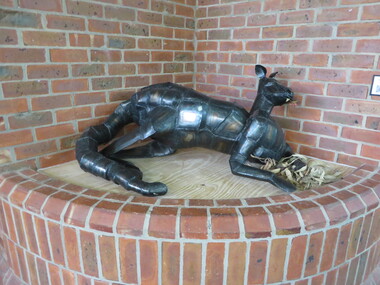
Sculpture - Sculpture - metal, Collier, Betty, [Kangaroo] by Betty Collier
... A large oxy welded sheet steel reclining kangaroo....The Art Collection features over @000 works and was listed as a 'Ballarat Treasure' in 2007. art artwork betty collier collier kangaroo sculpture A large oxy welded sheet steel reclining kangaroo. [Kangaroo] by Betty Collier Sculpture Sculpture - metal Collier, Betty ...Betty Collier (nee Thege) was a student of the Ballarat Technical Art School, and lectured in Sculpture at the University of Ballarat, both predecessor institutions of Federation University Australia. This work was requested for the collection by Brian McLennan. This item is part of the Federation University Art Collection. The Art Collection features over @000 works and was listed as a 'Ballarat Treasure' in 2007.A large oxy welded sheet steel reclining kangaroo.art, artwork, betty collier, collier, kangaroo, sculpture -
 Darebin Art Collection
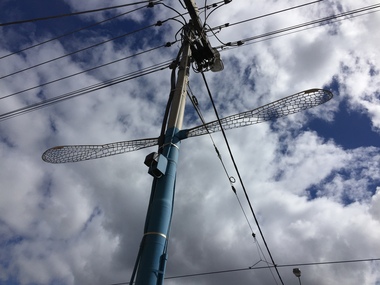
Sculpture, Helen Bodycomb, Chris Rak & Enver Camdal, 'Westgarth precinct public art', 1998
... Ten sculptures of welded steel depicting enlarged body / skeletal parts of fauna that are indigenous to the area. ...Ten sculptures of welded steel depicting enlarged body / skeletal parts of fauna that are indigenous to the area. ...Installed in the Westgarth Shopping Strip, the artworks include aerial, street level and inlaid pieces. The aerial installations consist of eight pairs of steel dragonfly wings. The street level series feature ten sculptural pieces of welded steel depicting enlarged body/skeletal parts of fauna that are indigenous to the area. The inlaid artworks are a series of stainless steel mosaic in the pavement.Five pairs of steel dragonfly wings mounted on eight painted PTC power poles. Ten sculptures of welded steel depicting enlarged body / skeletal parts of fauna that are indigenous to the area. These also function as bicycle racks. A series of stainless steel, ceramic and glass mosaic inlays. -
 Parks Victoria - Port Campbell Rocket Shed
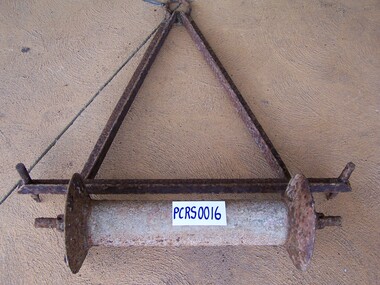
Rope roller
... Rope roller, welded, cliff anchor. Steel A frame with eye at top of the A frame. ...Rope roller, welded, cliff anchor. Steel A frame with eye at top of the A frame. ...Rocket equipment which has been used in various lifeboat and rocket stations on the Victorian Coast. It is unclear if this is the original rocket equipment from Port Campbell. This equipment, if not original has been used in rescue operations and is identical to the equipment that has been in use at Port Campbell from C.1890 onwards.Rope roller, welded, cliff anchor. Steel A frame with eye at top of the A frame. Spindle on bottom for rope to move through. -
 Orbost & District Historical Society
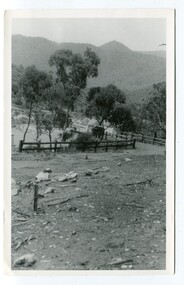
black and white photographs, 1934
... In its reconstructed form the original concrete abutments were turned into additional piers and the welded-steel trusses were cantilevered back over them to meet the new higher road approaches. ...In its reconstructed form the original concrete abutments were turned into additional piers and the welded-steel trusses were cantilevered back over them to meet the new higher road approaches. ...These photographs were taken just after the McKillop's Bridge was completed after the flood damage. The current McKillop’s Bridge was built by the Country Roads Board in two stages between 1931-36, during which its height was raised after the original bridge superstructure was washed away in record floods of January 1934, prior to its original official opening. In its reconstructed form the original concrete abutments were turned into additional piers and the welded-steel trusses were cantilevered back over them to meet the new higher road approaches. It is sited at McKillops Crossing, named after pioneer overlanding squatter George McKillop who crossed here in 1835. This was a stock crossing place for almost a century before the bridge was constructed. (info. from Victoria Heritage Register)This is a pictorial record of the history of McKillop's Bridge, in itself of historical significance for its association with Victoria's long and important pastoral history, its technicl significance and aesthetic significance.Three black / white photographs. 3133.1 shows the approach to a washed away bridge. 3133.2 is of a bridge over a river with men clearing debris. 3133.3 is a close-up showing the wreckage of the bridge.mckillop's-bridge snowy-river flood-damage-1934 -
 Nillumbik Shire Council
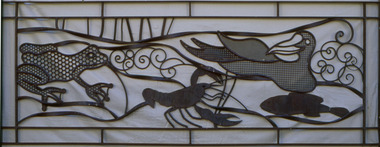
Deborah Halpern (b.1957 Melb) with Malcolm Laurence (b.1974 Melb), Malcolm Laurence, The Spirit of Nillumbik (balustrade panels x11); Location: Eltham Town Square - Main St, Eltham, 2001
... Five picture and six woven balustrades each made out of welded steel / organic wrought iron and coated with wax. ...Halpern acknowledges these contributions to our hand-made history and the influence they have on the character and identity of Eltham and Nillumbik. public art nillumbik fauna flora wrought iron balustrade halpern laurence kangaroo eltham town square spirit warrandyte christmas hills kangaroo ground hurstbridge kinglake panton hill water valley creek flats cockatoos N/A Five picture and six woven balustrades each made out of welded steel / organic wrought iron and coated with wax. ...In October 2000, Council invited three artists from the region (Deborah Halpern, Matcham Skipper, Tony Trembath) to submit designs for a sculpture / public art work for the Eltham Town Square. The commission was paid for by supermarket giant Safeway (Woolies) as part of its supermarket permit, which required them to contribute to beautification work in the Town Square.This is the first of three parts. The 'Spirit of Nillumbik' is a celebration of the artistic spirit of Eltham and surrounding communities. Each area is identified through the flora and fauna represented in the panels. The work honours the many creative artists and architects, past and present, who have built homes and shaped lives and livelihoods with their unique creative spirit. Halpern describes her work as a public expression of their individual and collective visions. Halpern acknowledges these contributions to our hand-made history and the influence they have on the character and identity of Eltham and Nillumbik. Five picture and six woven balustrades each made out of welded steel / organic wrought iron and coated with wax. Imagery (flora - plants, landscapes and fauna - animals, birds, reptiles, insects) are all based on the local environment. There is also a relevant aboriginal presence amongst each of the panels. Each panel represents the different areas that make up the Shire. 'Water' for Warrandyte, 'Kangaroos' for Christmas Hills, 'Cockatoos and 'Valley Creek Flats' for Hurstbridge, 'Wombats', 'Bluetongues' and 'Possums' for St. Andrews/Kinglake, 'Orchids' for Panton Hill, 'Cows' and 'Grapevines' for the Kangaroo Gound Hill landmark. N/Apublic art, nillumbik, fauna, flora, wrought iron, balustrade, halpern, laurence, kangaroo, eltham town square, spirit, warrandyte, christmas hills, kangaroo ground, hurstbridge, kinglake, panton hill, water, valley creek flats, cockatoos -
 Orbost & District Historical Society
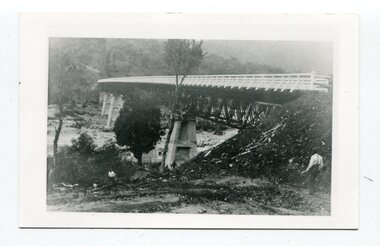
black and white photograph, mid 1930s
... In its reconstructed form the original concrete abutments were turned into additional piers and the welded-steel trusses were cantilevered back over them to meet the new higher road approaches. ...In its reconstructed form the original concrete abutments were turned into additional piers and the welded-steel trusses were cantilevered back over them to meet the new higher road approaches. ...This is a photograph of McKillop's Bridge probably taken just after its rebuilding. The current McKillop’s Bridge was built by the Country Roads Board in two stages between 1931-36, during which its height was raised after the original bridge superstructure was washed away in record floods of January 1934, prior to its original official opening. In its reconstructed form the original concrete abutments were turned into additional piers and the welded-steel trusses were cantilevered back over them to meet the new higher road approaches. "McKillops Bridge was Heritage listed due to its social and technological significance – the steel trusses' arc-welded construction technique was a pretty big deal in the 1930s. It was once an important route for cattlemen, who used the ford across the Snowy in the years preceding the bridge's existence"This is a pictorial record of McKillop's Bridge just after its construction.A black / white photograph of a wooden bridge across a river. At the bottom right is a man with his back to the camera. He is looking at flood debris on the bank. At the bottom left are two men near a pylon.on back - McKillops Bridgebridge-mckillop's snowy-river-bridge -
 Nillumbik Shire Council
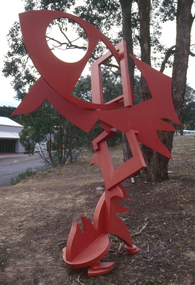
Public Art: Edward GINGER (b.1951 Kegalle, Sri Lanka - arrived 1975 Aus), Edward Ginger, The Breeze, Location: Main Road, Research - opposite Eltham Little Theatre, 1990
... The Breeze is an abstract work made out of welded steel and painted in enamel in bush fire red / sienna. ...The work has acquired the status of a major landmark from the National Trust. public art ginger red sienna elements steel abstract breeze fire sculpture N/A The Breeze is an abstract work made out of welded steel and painted in enamel in bush fire red / sienna. ...The first sculpture awarded the Shire of Eltham 'Art in Public Places' Award/Commission. The Judges were Inge King, Jenny Zimmer and Daryl Jackson. The work deals with the juxtaposition of suburban and rural surroundings. This scupture is a typical example of the artist's oevre of the period. This sculptre is site specific and refers to the nature of the environment. The colour - bushfire red / sienna - alludes to the history of fire in the urban/rural fringe and the title, as well as the sculpture's shapes, forms and material refer to the natural and local elements. Judges report noted: "The most vital and expressive work for the site...with a great sense of dynamic movement and vibrant colour. Its' abstract forms will enliven the surroundings and the urban and natural environment. This work is the most appropriate for the site and expressive of the dynamics of an evolving community in which artistic discourse and debate has always thrived." The work has acquired the status of a major landmark from the National Trust. The Breeze is an abstract work made out of welded steel and painted in enamel in bush fire red / sienna. It comprises a series of flat, cut-out shapes, interlocking at different angles, giving the impression of being hinged together rather than fixed. The work references nature and the built environment. Its geometric shapes suggest man-made structures within industry and suburban life, while rural areas can be identified by the organic flame-like shapes fanned by the wind. The circular cut-out in the eye mimics the sun, symbolising the intense heat of the Australian climate, while the colour red alludes to the history of bushfire within the urban and rural fringe. N/Apublic art, ginger, red, sienna, elements, steel, abstract, breeze, fire, sculpture -
 Federation University Art Collection
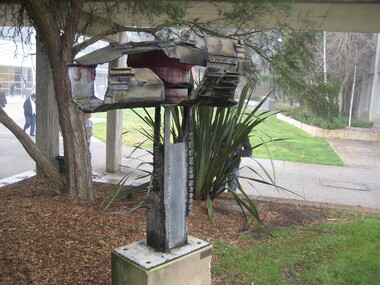
Sculpture - Sculpture - welded Metal, 'Organic Form' by Inge King, c1967
... Welded bronzed steel sculpture painted black and red. ...The Australian Women's Art Register describes Inge King as having been at the forefront of developing a non figurative vocabulary in Australian Sculpture. art artwork inge king king sculpture ballarat teachers' college collection welded metal metal sculpture Signed 'I. King' on the lower steel plate. Welded bronzed steel sculpture painted black and red. ...Inge KING (26 November 1915 – 23 April 2016) Born Berlin, Germany Arrived Australia 1951 Inge King trained as a wood carver and studied at the Berlin Academy (1937-1939), Royal Academy London (1940), and the Glascow School of Art (1941-1943) . She moved to London in 1947 and began carving organic abstract forms in wood and stone. In 1949-50 she went on a study tour to the United States of America where she was inspired to work in metal . Inge King arrived in Australia in 1951 and she completed several large scale public works. Between 1961 and 1975 Inge King lectured at the Institute of Early Childhood Development, Kew. From 1976 to 1987 she lectured in Sculpture at Royal Melbourne Institute of Technology. She was a founding member of the Ceminal Centre Five group, and she actively lobbied architects, governments and State galleries to include modernist sculptures in their plans and displays. In 1991 Inge King joined the first National Trust of Australia (Victoria) Public Art Committee, advising on public art at risk and worthy of Trust classification. The Australian Women's Art Register describes Inge King as having been at the forefront of developing a non figurative vocabulary in Australian Sculpture. Welded bronzed steel sculpture painted black and red. This sculpture by Inge King was purchased in 1967 with funds raised by staff and students of Ballarat Teachers' College, a predecessor institution of Federation University Australia. During this era a collection was made which resulted in an annual purchase or commission of an artwork of note. The Federation University Art Collection features over 1000 works and was listed as a 'Ballarat Treasure' in 2007. Signed 'I. King' on the lower steel plate. art, artwork, inge king, king, sculpture, ballarat teachers' college collection, welded metal, metal sculpture -
 Kew Historical Society Inc
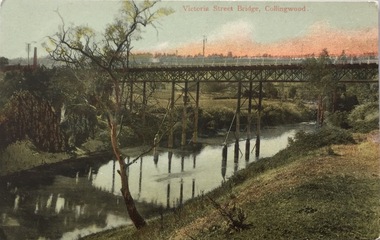
Postcard, Victoria Street Bridge, Collingwood, 1905-1913
... Victoria Bridge is a riveted and welded steel Warren truss bridge over the Yarra River completed in 1884 to a design by Fraser & Chase following a controversial design competition held in 1880. ...Victoria Bridge is a riveted and welded steel Warren truss bridge over the Yarra River completed in 1884 to a design by Fraser & Chase following a controversial design competition held in 1880. ...Victoria Bridge is a riveted and welded steel Warren truss bridge over the Yarra River completed in 1884 to a design by Fraser & Chase following a controversial design competition held in 1880. Funds for the bridge's construction were provided by the councils of Collingwood, Hawthorn, Kew and Richmond. The contract was awarded to Mr P. Platt. Charles Rowand was officially appointed Supervising Engineer in 1883. The winning design was based on the theoretical work of William Charles Kernot (1845-1909) who campaigned for economy in public works design and the application of scientific principles in engineering. ... The bridge was widened in 1890 by the addition of a third line of truss on new piers on the up stream side to carry horse trams. Work commenced in 1914 to convert the horse tramway to an electric tramway by the Prahran & Malvern Tramways Trust, part of the Trust's extension of its tramway into the eastern suburbs between 1913-18. In 1915 the bridge was further strengthened to accommodate the extra weight of electric trams and widened by the addition of two six feet cantilever footpaths. During this period the Prahran & Malvern Tramways Trust erected two ornamental gantries over the roadway to support overhead wires for the electric tramway. Further widening and reconditioning of the bridge took place in 1933, including the addition of four new welded trusses, two intermediate and two on the outside. The latter were supported on new cantilevered truss cross beams attached to the top of the piers. (Source: Heritage Victoria)Early and rare postcard of the Victoria Street Bridge linking Victoria Street and Barkers Road.Polychrome postcard of the Victoria Street Bridge which links Richmond and Abbotsford with Kew and Hawthorn.View from Harrison Cres embankment / former Xavier College boatshed on site of tree in foreground. / Chimney left corner - Wool Scoring Mils in Victoria St. / On horizon - Studley Villa, Studley House circa 1880s, Studley Hall / Chinese gardens to be seen behind three set of columns / M.J. Slatterypostcards -- yarra river, postcards -- bridges. -- greater melbourne (vic.), victoria street bridge -
 Melbourne Tram Museum
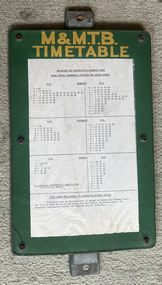
Functional object - Timetable Board, Melbourne & Metropolitan Tramways Board (MMTB), Camberwell Junction - Batman Ave, 1970s
... Board made up to display tramway timetables for attachment to a post comprising heavy galvanised steel backing sheet with two small channels either end, spot welded to the steel back, front painted in green with the letters "M&M.T.B" in yellow paint, perspex sheet at the front, secured by 6 Allen screws with nuts on rear, containing a typed timetable sheet - for Camberwell Junction for Batman Ave timetable - undated....Demonstrates a timetable board style used by the MMTB in the 1970s and early 1980s. tramways Map Batman Ave Camberwell Junction Route 70 timetable Board made up to display tramway timetables for attachment to a post comprising heavy galvanised steel backing sheet with two small channels either end, spot welded to the steel back, front painted in green with the letters "M&M.T.B" in yellow paint, perspex sheet at the front, secured by 6 Allen screws with nuts on rear, containing a typed timetable sheet - for Camberwell Junction for Batman Ave timetable - undated. ...Timetable board for Camberwell Junction Batman Ave route 70, detailing times that services were scheduled to depart the Junction. Probably used until replaced by The Met style signs in the mid-1980s.Demonstrates a timetable board style used by the MMTB in the 1970s and early 1980s.Board made up to display tramway timetables for attachment to a post comprising heavy galvanised steel backing sheet with two small channels either end, spot welded to the steel back, front painted in green with the letters "M&M.T.B" in yellow paint, perspex sheet at the front, secured by 6 Allen screws with nuts on rear, containing a typed timetable sheet - for Camberwell Junction for Batman Ave timetable - undated. tramways, map, batman ave, camberwell junction, route 70, timetable -
 Kiewa Valley Historical Society
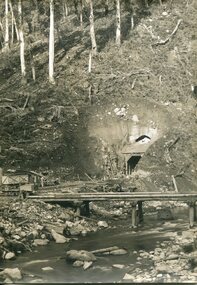
Photographs – SECV – Clover Power Station
... Set of 22 black and white photographs taken by the official SECV photographer who gave each photo a number prefixed by K (for Kiewa) K60 -no date- A bridge and entrance to tunnel K519 -no date- Welding steel lining in the tunnel K531 –no date- Construction on the Kiewa Scheme (tunnel in background K821 – no date- Bogong Village, early days K928 -15 Oct 1942- Construction Clover Power Station K947 -26 Oct 1942- Construction Clover Power Station K948 -26 Oct 1942- Construction Clover Power Station K949- 26 Oct 1942- Clover Camp in background K950 -26 Oct 1942- Construction Clover Power Station K955 -27 Oct 1942- Constructing the bridge at Clover K1102 -7 April 1943- Inlet pipe to power station K1179 –no date- Clover Power Station K1187 – no date- Clover Power Station K1189 -24 June 1943- Part of the spiral casing 1199 -7 July 1943- Clover Power Station K1201 -7 July 1943- Clover Power Station K1231 -26 July 1943- Gantry crane for Clover Power Station K1308 -6 Sept 1943- Spiral casing K1334 -6 Oct 1943- Lake Guy. ...SECV; Kiewa Hydro Electric Scheme; official photographer; Junction Dam; Clover Power Station; Bogong; On the back- each photograph has a handwritten reference number starting with K and the date stamped or written (see above) Set of 22 black and white photographs taken by the official SECV photographer who gave each photo a number prefixed by K (for Kiewa) K60 -no date- A bridge and entrance to tunnel K519 -no date- Welding steel lining in the tunnel K531 –no date- Construction on the Kiewa Scheme (tunnel in background K821 – no date- Bogong Village, early days K928 -15 Oct 1942- Construction Clover Power Station K947 -26 Oct 1942- Construction Clover Power Station K948 -26 Oct 1942- Construction Clover Power Station K949- 26 Oct 1942- Clover Camp in background K950 -26 Oct 1942- Construction Clover Power Station K955 -27 Oct 1942- Constructing the bridge at Clover K1102 -7 April 1943- Inlet pipe to power station K1179 –no date- Clover Power Station K1187 – no date- Clover Power Station K1189 -24 June 1943- Part of the spiral casing 1199 -7 July 1943- Clover Power Station K1201 -7 July 1943- Clover Power Station K1231 -26 July 1943- Gantry crane for Clover Power Station K1308 -6 Sept 1943- Spiral casing K1334 -6 Oct 1943- Lake Guy. ...The Junction Dam and Clover Dam Power Station, stages of the Kiewa Hydro-Electric Scheme, were needed to meet the increased power demands of the wartime industry in Victoria. Clover added 26 megawatts to the grid. Junction Dam was completed and ready to hold water by September 1943, but was emptied in December 1943 and not filled again until May 1944. Construction of Clover Power Station commenced in July 1941 and both turbines were in service by May 1945.Clover Power Station and Junction Dam were part of the Kiewa Hydro Electric Scheme constructed by the State Electricity Commission of Victoria.Set of 22 black and white photographs taken by the official SECV photographer who gave each photo a number prefixed by K (for Kiewa) K60 -no date- A bridge and entrance to tunnel K519 -no date- Welding steel lining in the tunnel K531 –no date- Construction on the Kiewa Scheme (tunnel in background K821 – no date- Bogong Village, early days K928 -15 Oct 1942- Construction Clover Power Station K947 -26 Oct 1942- Construction Clover Power Station K948 -26 Oct 1942- Construction Clover Power Station K949- 26 Oct 1942- Clover Camp in background K950 -26 Oct 1942- Construction Clover Power Station K955 -27 Oct 1942- Constructing the bridge at Clover K1102 -7 April 1943- Inlet pipe to power station K1179 –no date- Clover Power Station K1187 – no date- Clover Power Station K1189 -24 June 1943- Part of the spiral casing 1199 -7 July 1943- Clover Power Station K1201 -7 July 1943- Clover Power Station K1231 -26 July 1943- Gantry crane for Clover Power Station K1308 -6 Sept 1943- Spiral casing K1334 -6 Oct 1943- Lake Guy. Bogong Village in background K1342 -29 Oct 1943- Power station under construction K1365 -19 Nov 1943- Power station under construction K1366 -19 Nov 1943- Gantry crane for Clover Power Station On the back- each photograph has a handwritten reference number starting with K and the date stamped or written (see above)secv; kiewa hydro electric scheme; official photographer; junction dam; clover power station; bogong; -
 Bendigo Historical Society Inc.
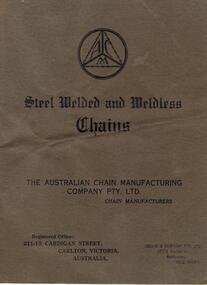
Document - ABBOTT COLLECTION: CHAIN MANUFACTURER CATALOGUE
... Catalogue for steel welded and weldless chains. The Australian Chain Manufacturing Company Pty. ...Abbott Catalogue for steel welded and weldless chains. The Australian Chain Manufacturing Company Pty. ...The Australian Chain Manufacturing Co. was formed in 1933 to acquire the business of Luigi Benini who had started his business in Cardigan Street, Carlton with William Johnson McCredie.Catalogue for steel welded and weldless chains. The Australian Chain Manufacturing Company Pty. Ltd. A light cardboard cover in a green/brown colour. Nine paper pages with lists of costs and illustrations of types of chain. It has two metal staples in the spine. There is an ink stamp on the front cover with a sole agent of Gollin &Company 561/8 Bourke st Melbourne. Printed by The Imperial Press, 678 Elizabeth Street Melbourne in B&W ink.australian chain manufacturing co., abbott -
 Darebin Art Collection
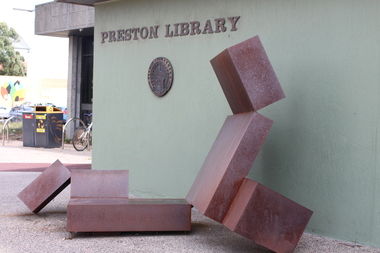
Sculpture, Reg Parker, 'Untitled 8/73', 1973
... The sculpture is of welded 3mm oxidized mild steel fabricated into six rectangular blocks of unequal size, joined along edges by welding and juxtaposition at various angles. ...The sculpture is of welded 3mm oxidized mild steel fabricated into six rectangular blocks of unequal size, joined along edges by welding and juxtaposition at various angles. ...The sculpture is of welded 3mm oxidised mild steel fabricated into six rectangular blocks of unequal size, joined along the edges by welding and juxtaposition at various angles. The work is classified by The National Trust of Australia (Victoria) and was funded by the Visual Arts Board of the Australia Council for the Arts. The sculpture is an example of a classic formalist work by one of the early practitioners of the style in Australia.The sculpture is of welded 3mm oxidized mild steel fabricated into six rectangular blocks of unequal size, joined along edges by welding and juxtaposition at various angles. It is supported by one angle bracket, and several short lengths of reinforcing steel sunk into the pavement and tack welded to the sculpture. It has an overall length of 3.25 metres, a height of 2 metres and width of 1.45 metres. -
 Ballarat Tramway Museum
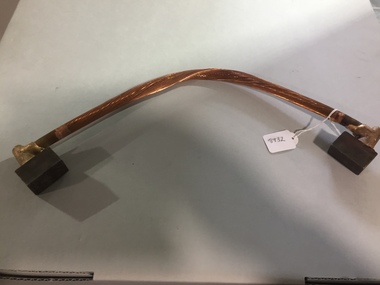
Functional object - Traction Return Current Rail Bond, c2022
... The block of steel gets welded to the outside of the rail head at or near a joint in the rails. ...The block of steel gets welded to the outside of the rail head at or near a joint in the rails. ...Showing how tramway electrical current was returned to the electrical sub-station via the rails.Demonstrates an earth return bonding piece.Traction Return Current Rail Bond, consists of a multi strand copper cable abt 19mm dia. and 530mm long, with block of steel (25x25x43mm) brazed onto each end. The block of steel gets welded to the outside of the rail head at or near a joint in the rails. The bond is to ensure a reliable return current as the fishplates and bolts are subject to dirt and rust which can inhibit the current.tramways, electrical engineering, earth return, bonds, trackworks -
 Melbourne Tram Museum
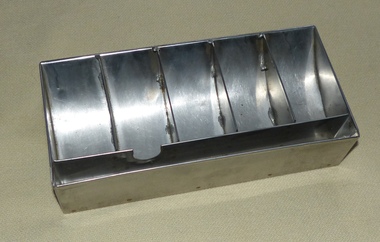
Functional object - Cash tray, Public Transport Corporation (PTC), 1990
... Metal Cash Tray for holding coins, formed from stainless steel and welded to give five compartments or areas for coins and one full length slot or opening at the rear for notes and other papers. ...Trams tramways Tickets Cash Handling Metcard Metal Cash Tray for holding coins, formed from stainless steel and welded to give five compartments or areas for coins and one full length slot or opening at the rear for notes and other papers. ...Metal Cash Tray for holding coins, formed from stainless steel and welded to give five compartments or areas for coins and one full length slot or opening at the rear for notes and other papers. Used by One Person Operator (OPO) or drivers from the time of the introduction of OPO's on the tramways until the full introduction of Metcard. Collected by Carolyn Dean/Cleak. Two copies held.trams, tramways, tickets, cash handling, metcard -
 Ballarat Tramway Museum
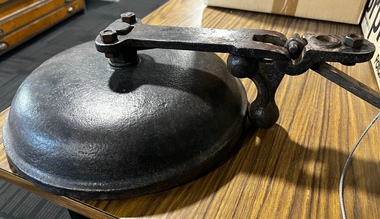
Functional object - Tramcar platform or driver's foot gong
... Cast steel and fabricated steel foot gong, consisting of cast bell, weighted striker or clapper operating mechanism and parts to enable it to be attached to the underside of the tramcar or driver's platform. The Foot gong plunger is missing. The clapper part has been extended by welding...Demonstrates a tramcar warning device used by drivers. tramcars tramcar equipment equipment gongs foot gong drivers Cast steel and fabricated steel foot gong, consisting of cast bell, weighted striker or clapper operating mechanism and parts to enable it to be attached to the underside of the tramcar or driver's platform. The Foot gong plunger is missing. The clapper part has been extended by welding ...Used by tram drivers to warn road users of their presence or starting to move. MMTB drawing R8808 shows the mounting mechanism and operation. Demonstrates a tramcar warning device used by drivers.Cast steel and fabricated steel foot gong, consisting of cast bell, weighted striker or clapper operating mechanism and parts to enable it to be attached to the underside of the tramcar or driver's platform. The Foot gong plunger is missing. The clapper part has been extended by welding a section of steel onto it and a rolled section of stainless steel wire has been attached to ring it remotely from an overhead position. The item has been cleaned and varnished.tramcars, tramcar equipment, equipment, gongs, foot gong, drivers -
 Melbourne Tram Museum
Functional object - Tramcar component, Tramcar component - possibly locking key, undated
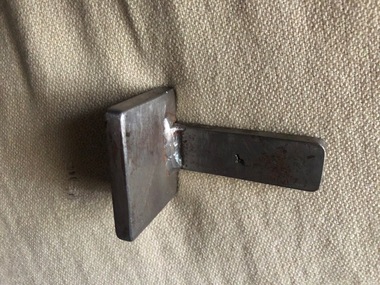
... Tramcar component - possibly locking key - made from two pieces of cut steel and welded together and finished. A known unknown! ...Trams tramways Tramcars Components Tramcar component - possibly locking key - made from two pieces of cut steel and welded together and finished. A known unknown! ...Tramcar component - possibly locking key - made from two pieces of cut steel and welded together and finished. A known unknown! Kym Smith advised - "11/6/2020 - It looks familiar, but I can’t recall exactly. I think is used as a locking pin to hold an internal panel in place, possibly the internal panels/frames that are on the interior side of the sliding doors, with the pin going through the top sill into the internal frame?" and 13/6 " I remember somewhere seeing a panel that has pins in the bottom that locate in holes in the floor, then the panel is pushed into place and the securing/locking pin used to hold it in place, with the panel having a square saddle that the pin goes through. I’m wondering if it is a kick panel under a seat? "trams, tramways, tramcars, components -
 Flagstaff Hill Maritime Museum and Village
Tool - Leg Vice, Mid 19th Century
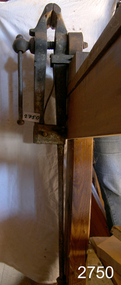
... The bodies are forged wrought iron or mild steel and they have hard steel surfaces welded into the jaws. The jaws have little or very shallow serrations which are generally worn off.Around the turn of the 20th Century during the hey-day of the blacksmith shop in North America, these tools were considered so standard a commodity that they were sold without reference to the manufacturer. ...The bodies are forged wrought iron or mild steel and they have hard steel surfaces welded into the jaws. The jaws have little or very shallow serrations which are generally worn off.Around the turn of the 20th Century during the hey-day of the blacksmith shop in North America, these tools were considered so standard a commodity that they were sold without reference to the manufacturer. ...The blacksmith leg vise is also called the "solid box vise" and is one of the most important tools in the blacksmith's shop. It firmly holds hot iron while it is hammered, chiseled, or twisted. These are the only vises that are designed to take this kind of use day in and day out. A small 30-pound blacksmith's vise can survive pounding that would wreck a much heavier cast iron bench model. Three things make a blacksmith's vice special. One is that they are forgings, not cast iron or ductile iron. The second is the leg that provides support to the floor or from a sunken post. The last is the hinge, while not a perfect way to construct a vice the pin joint is durable and can take a considerable beating. If sheared it is easy to replace. These things all combine into a tool that can take decades of heavy use and abuse. Most in use is one to two hundred years old.Some of these vises were made by specialists such as Atwood of Stourbridge England, Steel City and Columbian in the U.S. and others were made in anvil manufacturing plants such as "Mousehole Forge" and "Peter Wright" in England and "Fisher-Norris" and others in North America. The design of these vises right down to the last chamfer seems to have been perfected in the 1600s and remained more or less the same until the 20th century. The bodies are forged wrought iron or mild steel and they have hard steel surfaces welded into the jaws. The jaws have little or very shallow serrations which are generally worn off.Around the turn of the 20th Century during the hey-day of the blacksmith shop in North America, these tools were considered so standard a commodity that they were sold without reference to the manufacturer. Very few were even marked with the maker's name. Size is best defined by weight as there is some variation in jaw size from manufacturer to manufacturer. They were sold by the pound and are still best judged by the pound.A vintage tool used in a Blacksmiths shop during the early 19th century to the beginning of the 20th century. Regarded as a significant into social history of the time.Leg Vice attached with screws to bench via a block of wood. Has large metal pole which practically reaches the floor. Also has a metal device to either tighten or slacken vice.flagstaff hill, warrnambool, shipwrecked-coast, flagstaff-hill, flagstaff-hill-maritime-museum, maritime-museum, shipwreck-coast, flagstaff-hill-maritime-village -
 Flagstaff Hill Maritime Museum and Village
Tool - Wood moulding Plane, Auburn Tool Company, 1870 to 1893
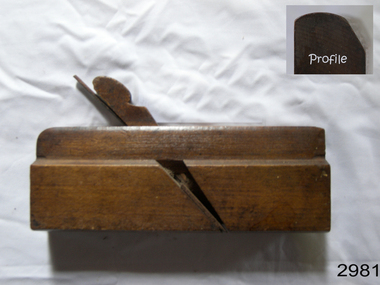
... Both skates and plane irons were made from welded wrought iron and cast steel. The Auburn Tool Company was among the five leading plane manufacturing firms existing in the mid to late 19th century USA. ...Both skates and plane irons were made from welded wrought iron and cast steel. The Auburn Tool Company was among the five leading plane manufacturing firms existing in the mid to late 19th century USA. ...Moulding Plane: A moulding plane is a specialised plane used for making the complex shapes found in wooden mouldings that are used to decorate furniture or other wooden object. Traditionally, moulding planes were blocks of wear resistant hardwood, often beech or maple, which were worked to the shape of the intended moulding. The blade, or iron was likewise formed to the intended moulding profile and secured in the body of the plane with a wooden wedge. A traditional cabinetmakers shop might have many, perhaps hundreds, of moulding planes for the full range of work to be performed. Large crown mouldings required planes of six or more inches in width, which demanded great strength to push and often had additional peg handles on the sides, allowing the craftsman's apprentice or other worker to pull the plane ahead of the master who guided it. Auburn Tool Company: The Auburn Tool Company is known to exist from 1864 to 1893. George Casey reorganized the firm of Casey, Clark and Company as a joint-stock company in 1864, under the company name of Auburn Tool Company. The 1865 New York State Census noted the firm as a manufacturer of the plane, plane irons, and skates. The production that year was listed as 30,000 pairs of skates and 35,000 planes along with 25,000 dozen plane irons. The plane irons carried the trademark "Thistle". Both skates and plane irons were made from welded wrought iron and cast steel. The Auburn Tool Company was among the five leading plane manufacturing firms existing in the mid to late 19th century USA. Others were: H. Chapin's Son; Greenfield Tool Company; and Sandusky Tool Company. Auburn Tool Company, with these others, was also a founding member of the Plane Makers Association, organized around 1858 to fix prices. Most of the companies tools were manufactured by prisoners and in 1866 the firm was outbid for prison labour by J M Easterly and Co. After losing the contract with the prison authority they constructed a new building and continued in the plane manufacturing business with private labour. The 1870 US Census reported the firm had 21 machines, driven by water power, employing 66 males, producing annual products valued at us$70, 000. After A. Howland and Company was dissolved in 1874, the Auburn Tool Company again resumed using contract labour at the State Prison until 1877. The Auburn Tool Company merged with the Ohio Tool Company of Columbus, Ohio, on Nov 14, 1893. Although plane manufacturing was continued at Auburn until after 1907, after this merger the firm went under the name of the Ohio Tool Company. A significant item from the mid to late 19th century that today is quite rare and sought after by collectors. It gives us a snapshot of how furniture was made predominately by hand and with tools that were themselves hand made shows the craftsmanship used to make such a unique item. It also gives an insight into how many manufacturing companies bid for the rights to use prison labour to make their products at this time in our history. Decorative wood Moulding, plane Round type Auburn New York. Owner A Neudt Size 14 flagstaff hill, warrnambool, shipwrecked-coast, flagstaff-hill, flagstaff-hill-maritime-museum, maritime-museum, shipwreck-coast, flagstaff-hill-maritime-village -
Federation University Historical Collection
Document - Document - Design, E J Barker: University of Melbourne: Bachelor of Mechanical Engineering; Civil Engineering 1 and 1A; Design of Welded Plate Girder, 1946
... Assessment No 2 Project was to design a welded plate girder required in a building to span between two steel columns which have to be spaced 60 feet centre to centre. ...Assessment No 2 Project was to design a welded plate girder required in a building to span between two steel columns which have to be spaced 60 feet centre to centre. ...Assessment No 2 Project was to design a welded plate girder required in a building to span between two steel columns which have to be spaced 60 feet centre to centre. It needs to carry its own weight plus specified loads. This was part of Civil Engineering 1A . Jack chose to do Engineering while still at Footscray Technical School as it gave access to Diploma Courses and tertiary studies. This enabled him to enter the University of Melbourne and do a Bachelor in Mechanical Engineering - 1945, 1946, and 1947. In 1948 he did a Diploma in Education at Melbourne University. From this path he was able to follow a career in teaching and his first appointment was at the School of Mines in Ballarat, (SMB) 1949. He became the first Vice Principal of SMB in 1960 and then Principal in 1964 to 1976. From 1976 to his retirement in 1987, he was the Foundation Director of Ballarat College of Advanced Education (BCAE). The Library building at Mount Helen Campus is named after him.Manila folder with design assessment. Written descriptions and detailed drawings.e j barker, jack barker, melbourne university, engineering, diploma of mechanical engineering, diploma of electrical engineering, school of mines ballarat, smb, diploma in education, vice principal, principal, foundation director, ballarat college of advanced education, bcae, bachelor of mechanical engineering, library, mount helen campus, engineering drawing, design, specifications, manufacture, civil engineering, welded plate girder, 60 feet, steel columns -
Glenelg Shire Council Cultural Collection
Tool - Whaling Spade, n.d
... Cast steel held a cutting edge far better than the earlier wrought iron, and was necessary for repeated cutting. The sockets of spades were forge welded closed, without an open seam, for added strength. ...Cast steel held a cutting edge far better than the earlier wrought iron, and was necessary for repeated cutting. The sockets of spades were forge welded closed, without an open seam, for added strength. ...Cast steel held a cutting edge far better than the earlier wrought iron, and was necessary for repeated cutting. The sockets of spades were forge welded closed, without an open seam, for added strength. ...Part of the collection purchased from Brendan Kurtze by the City of Portland. From the Kurtze Museum. Spades were used primarily for cutting up a whale. They were flat-bladed implements (except the gouge spade) with a chisel cutting edge and were mounted on wood poles by means of a socket at the aft end of the spade. The blades of later spades, after the 1850's, were usually made of cast steel, while the sockets and shanks were wrought iron. Cast steel held a cutting edge far better than the earlier wrought iron, and was necessary for repeated cutting. The sockets of spades were forge welded closed, without an open seam, for added strength. They were secured to the pole with a nail, screw or pinWhaling implement, iron, painted gloss black. Flat blade and handle sleeve on either end of shaft, no handle. Spades were used primarily for cutting up a whale. They were flat-bladed implements (except the gouge spade) with a chisel cutting edge and were mounted on wood poles by means of a socket at the aft end of the spade. The blades of later spades, after the 1850's, were usually made of cast steel, while the sockets and shanks were wrought iron. Cast steel held a cutting edge far better than the earlier wrought iron, and was necessary for repeated cutting. The sockets of spades were forge welded closed, without an open seam, for added strength. They were secured to the pole with a nail, screw or pinkurtze museum, whaling, tools, industry, maritime -
 City of Moorabbin Historical Society (Operating the Box Cottage Museum)
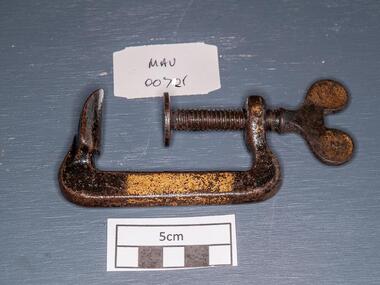
Tools, steel 'C' or 'G' clamp, c1900
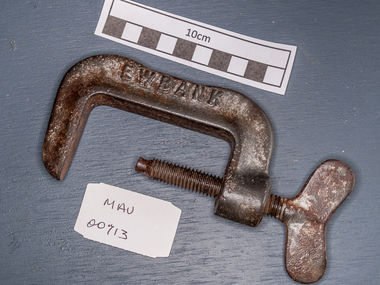
... A C-clamp or G-clamp is a type of clamp device typically used to hold a wood or metal work piece, and often used in carpentry and welding. C-clamps or G-clamps are typically made of steel or cast iron, though smaller clamps may be made of pot metal. ...A steel ‘C’ or ‘G’ Clamp used to hold a wood or metal work piece, used in carpentry and welding....Generally some other object or objects will be contained between the top and bottom flat edges. tools, woodwork, metalwork, welding, carpentry, pioneers, market gardeners, early settlers, bank w.l., moorabbin, cheltenham, bentleigh, ormond L.W.BANK A steel ‘C’ or ‘G’ Clamp used to hold a wood or metal work piece, used in carpentry and welding. ...A clamp is a fastening device to hold or secure objects tightly together to prevent movement or separation through the application of inward pressure. The tool is for temporary use for positioning components during construction and wood working. There are many types of clamps available for many different purposes. Some are temporary, as used to position components while fixing them together, others are intended to be permanent. A C-clamp or G-clamp is a type of clamp device typically used to hold a wood or metal work piece, and often used in carpentry and welding. C-clamps or G-clamps are typically made of steel or cast iron, though smaller clamps may be made of pot metal. At the top of the "C" is usually a small flat edge. At the bottom is a threaded hole through which a large threaded screw protrudes. One end of this screw contains a flat edge of similar size to the one at the top of the frame, and the other end usually a small metal bar, perpendicular to the screw itself, which is used to gain leverage when tightening the clamp. When the clamp is completely closed, the flat end of the screw is in contact with the flat end on the frame. When the clamp is actually used, it is very rare that this occurs. Generally some other object or objects will be contained between the top and bottom flat edges. A steel ‘C’ or ‘G’ Clamp used to hold a wood or metal work piece, used in carpentry and welding.L.W.BANKtools, woodwork, metalwork, welding, carpentry, pioneers, market gardeners, early settlers, bank w.l., moorabbin, cheltenham, bentleigh, ormond -
 City of Moorabbin Historical Society (Operating the Box Cottage Museum)
Tools, steel 'G' Clamp, early 20thC
... welding. These clamps are called "C" clamps because of their C shaped frame, but are otherwise often called G-clamps or G-cramps because including the screw part they are shaped like an uppercase letter G. The fixed end is not adjustable so size is not variable. G-clamps are typically made of steel...welding. These clamps are called "C" clamps because of their C shaped frame, but are otherwise often called G-clamps or G-cramps because including the screw part they are shaped like an uppercase letter G. The fixed end is not adjustable so size is not variable. G-clamps are typically made of steel ...A C-clamp or G- clamp is a type of clamp device typically used to hold a wood or metal work-piece, and often used in, but are not limited to, carpentry and welding. These clamps are called "C" clamps because of their C shaped frame, but are otherwise often called G-clamps or G-cramps because including the screw part they are shaped like an uppercase letter G. The fixed end is not adjustable so size is not variable. G-clamps are typically made of steel or cast iron, though smaller clamps may be made of pot metal. At the top of the "G" is usually a small flat edge. At the bottom is a threaded hole through which a large threaded screw protrudes. One end of this screw contains a flat edge of similar size to the one at the top of the frame, and the other end usually a small metal bar, perpendicular to the screw itself, which is used to gain leverage when tightening the clamp. When the clamp is completely closed, the flat end of the screw is in contact with the flat end on the frame When used some other object or objects will be contained between the top and bottom flat edges. A steel 'G' Clamp tools, g clamp, screws, steel, clamps, metalwork, woodwork, carpentry, early settlers, pioneers, market gardeners, moorabin, bentleigh, cheltenham -
 Montmorency–Eltham RSL Sub Branch
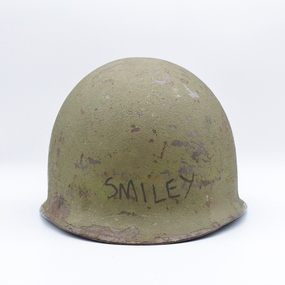
Uniform - Helmet, Steel, US M1
... Steel with green painted surface of sand & paint with welded rim. Two cotton webbing chin straps with metal buckles...M1 Steel Helmet post WWII u.s. m1 steel helmet On front of helmet reads SMILEY Steel with green painted surface of sand & paint with welded rim. Two cotton webbing chin straps with metal buckles Uniform Helmet, Steel, US M1 ...U.S. M1 Steel Helmet post WWIISteel with green painted surface of sand & paint with welded rim. Two cotton webbing chin straps with metal bucklesOn front of helmet reads SMILEYu.s. m1, steel helmet
