
Showing 192 items matching "western reserve"
-
 Warrnambool and District Historical Society Inc.
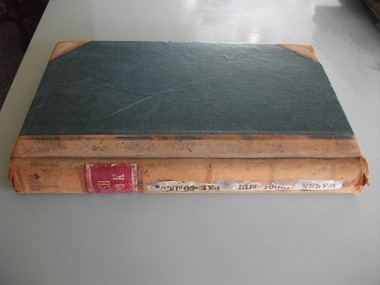
Financial record - Ledger: Cash Book Warrnambool City Council, 1894-1925. Commons, Circa 1894
... ...western reserve...The entries in this ledger relate to a period of time in Warrnambool’s history where there was a council run common areas such as the Western Reserve and common proper. warrnambool warrnambool common western reserve In grey lead on first page B/B T/- Hard green cloth cover with tan suede spine and corners Title Cash book written in gold lettering on red background on spine. ...This ledger contains entries for expenses such as wages, street trees, ploughing and repairs, and receipts for items such as common fees, sale of bulls. There are also a number of loose sheets with lists of names and receipts. Quite a number of entries seem to relate to the running of the common areas and expenses of same. The entries in this ledger relate to a period of time in Warrnambool’s history where there was a council run common areas such as the Western Reserve and common proper.Hard green cloth cover with tan suede spine and corners Title Cash book written in gold lettering on red background on spine. Inside front and back covers is red and blue mottled paper. 183 pages.In grey lead on first page B/B T/-warrnambool, warrnambool common, western reserve -
 Sunshine and District Historical Society Incorporated
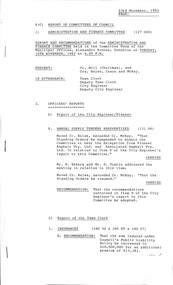
Administrative record - City of Sunshine - Commissioner Mr Alexander Alex George Gillon Collection 1976 - 1982 - Report of Administration and Finance Committee 23rd November 1982, City of Sunshine, 23rd November 1982
... ...Ralph Reserve...Western...Albans Shopping Centre Strategy Transport Depot 22 Second Avenue Progress Reports on Various Works Report of the Building Surveyor Building Control Act 1981 Road Widening Ballarat Road North West Corner Churchill Avenue and Ballarat Road Local Government Local Services The Development of the Community Sports Advisory Committee Report of the Town Clerk Report of the School Holidays Programmes August 1982 Western Suburbs Soccer Club Ralph Reserve Report of the Co-Ordinator of Welfare Services Sunshine City Council Community Bus Medway Hostel Request for Donation ...Albans Churchill Avenue Ralph Reserve Western Suburbs Soccer Club Medway Hostel Williamson Road Maribyrnong Report of Committees of Council Administration and Finance Committee Report of the City Engineer / Planner Annual Supply Tenders Readvertised Report of the Town Clerk Insurances Loan Funds Safeway Property Corner of Devonshire Road and Clarke Street Public Liability Claims Rates, Sanitary and Interest Statements for the Period Ending 30th September 1982 City of Sunshine V Nicholls Engineers and Constructions Pty Ltd Council Vehicles Land Acquisition Fairbairn Road All Day Parking Area Proposed Playgroup Facilities Epalock Crescent St. ...Report of Committees of Council Administration and Finance Committee Report of the City Engineer / Planner Annual Supply Tenders Readvertised Report of the Town Clerk Insurances Loan Funds Safeway Property Corner of Devonshire Road and Clarke Street Public Liability Claims Rates, Sanitary and Interest Statements for the Period Ending 30th September 1982 City of Sunshine V Nicholls Engineers and Constructions Pty Ltd Council Vehicles Land Acquisition Fairbairn Road All Day Parking Area Proposed Playgroup Facilities Epalock Crescent St. Albans Leroc Oil Ballarat Road Braybrook Deer Park High School Joint Use Library Proposal Braybrook Training Centre Request for Land Fixing Dates for Committee Meetings 1983 Sunshine Shopping Centre Former Sunshine Post Office Transport Modal Interchange Emergency Accommodation House 125 Durham Road Sunshine St. Albans Shopping Centre Strategy Transport Depot 22 Second Avenue Progress Reports on Various Works Report of the Building Surveyor Building Control Act 1981 Road Widening Ballarat Road North West Corner Churchill Avenue and Ballarat Road Local Government Local Services The Development of the Community Sports Advisory Committee Report of the Town Clerk Report of the School Holidays Programmes August 1982 Western Suburbs Soccer Club Ralph Reserve Report of the Co-Ordinator of Welfare Services Sunshine City Council Community Bus Medway Hostel Request for Donation city of sunshine, alexander "alex" george gillon, safeway, devonshire road, clarke street, sunshine, fairbairn road, sunshine west, epalock crescent, epalock crescent pre-school centre, leroc oil, ballarat road, braybrook, deer park high school, billingham road, deer park, braybrook training centre, duke street, sunshine north, sunshine post office, hampshire road, durham road, second avenue, st. albans, churchill avenue, ralph reserve, western suburbs soccer club, medway hostel, williamson road, maribyrnong -
 Sunshine and District Historical Society Incorporated
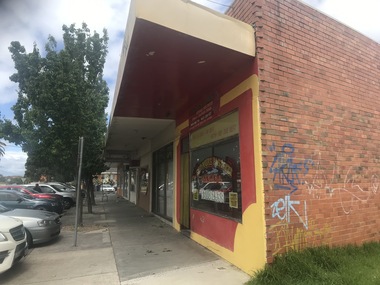
Photograph - Sunshine West Photographs 2021, John Alchin, 2021
... ...Buckingham Reserve...Western...5620.01 - Bell St 1 Sunshine West 2021 Photo 01.JPG 5620.02 - Bell St 1 Sunshine West 2021 Photo 02.JPG 5620.03 - Boreham St Kororoit Creek Former Bridge Footings On West Side 2021 Photo 01.JPG 5620.04 - Buckingham Reserve Kororoit Creek Bridge 2021 Photo 01.JPG 5620.05 - Callaway Blvd Sunshine West - Western Masonic Centre 2021 Photo 02.JPG 5620.06 - Castley Reserve Photo 03.JPG 5620.07 - Castley Reserve Photo 02.JPG 5620.08 - Castley Reserve Photo 05.JPG 5620.09 - Castley Reserve Glengala Walk Photo 07.JPG 5620.10 - Evelyn St Sunshine West - St. ...Sunshine West Bell Street Boreham Street Callaway Boulevard Evelyn Street Fitzgerald Road Glengala Road Teasdale Court Links Street Ralph Street Whitesides Avenue Kororoit Creek Buckingham Reserve Western Masonic Centre Castley Reserve Glengala Walk St. ...These photographs provide a visual record of assorted buildings, street views, and notable locations throughout Sunshine West in 2021.This collection of photographs preserves a visual record of Sunshine West 2021.5620.01 - Bell St 1 Sunshine West 2021 Photo 01.JPG 5620.02 - Bell St 1 Sunshine West 2021 Photo 02.JPG 5620.03 - Boreham St Kororoit Creek Former Bridge Footings On West Side 2021 Photo 01.JPG 5620.04 - Buckingham Reserve Kororoit Creek Bridge 2021 Photo 01.JPG 5620.05 - Callaway Blvd Sunshine West - Western Masonic Centre 2021 Photo 02.JPG 5620.06 - Castley Reserve Photo 03.JPG 5620.07 - Castley Reserve Photo 02.JPG 5620.08 - Castley Reserve Photo 05.JPG 5620.09 - Castley Reserve Glengala Walk Photo 07.JPG 5620.10 - Evelyn St Sunshine West - St. Pauls Bocci Club 2021 Photo 01.JPG 5620.11 - Fitzgerald Rd 104 - 112 Sunshine West 2021 Photo 01.JPG 5620.13 - Glengala Hotel 214 Glengala Rd Sunshine West 2021 Photo 01.JPG 5620.14 - Glengala Rd 291 - 293 Sunshine West - Sunshine College Photo 01.JPG 5620.15 - Glengala Rd 291 - 293 Sunshine West - Sunshine College Photo 03.JPG 5620.16 - Glengala Rd 291 - 293 Sunshine West - Sunshine College Photo 05.JPG 5620.17 - Glengala Rd Main shops north side 2021 Photo 01.JPG 5620.18 - Glengala Rd Main shops north side 2021 Photo 02.JPG 5620.19 - Glengala Rd Sunshine West - St. Pauls Church 2021 Photo 01.JPG 5620.20 - Glengala Rd Sunshine West - St Paul's Community Centre 2021 Photo 01.JPG 5620.21 - Glengala Rd 142 - 144 Sunshine West 2021 Photo 01.JPG 5620.22 - Glengala Rd 142 & Bell St 1 Sunshine West 2021 Photo 02.JPG 5620.23 - Greek Cypriot Parent & Youth Club Western Suburbs of Melbourne Glengala Rd Sunshine West 2021 Photo 01.JPG 5620.24 - St. Andrew Greek Orthodox Church Of St. Andrew 2021 Photo 01.JPG 5620.25 - Ainsworth Reserve Sunshine West 2021 Photo 03.JPG 5620.26 - Ainsworth Reserve Sunshine West 2021 Photo 07.JPG 5620.27 - Kororoit Creek Teasdale Court Swimming Hole Sunshine West 2021 Photo 01.JPG 5620.28 - Links St 50 Sunshine West 2021 Photo 01.JPG 5620.29 - Ralph St Sunshine West - Ralph Reserve Ralph St Sunshine West 2021 Photo 01.JPG 5620.30 - Whitesides Avenue 50 Sunshine West 2021 Photo 01.JPG 5620.31 - Fitzgerald Rd 104 - 112 Sunshine West 2021 Photo 01.JPG sunshine west, bell street, boreham street, callaway boulevard, evelyn street, fitzgerald road, glengala road, teasdale court, links street, ralph street, whitesides avenue, kororoit creek, buckingham reserve, western masonic centre, castley reserve, glengala walk, st. pauls bocci club, glengala hotel, st. pauls church, st. pauls community centre, greek cypriot parent & youth club, greek orthodox church, j.n. ainsworth reserve, ralph reserve -
 Beechworth Honey Archive
Map- Everton
... Map of rural properties bounding penal reserve on western side of Beechworth between Spring Creek and Sheep Station Creek....Map of rural properties bounding penal reserve on western side of Beechworth between Spring Creek and Sheep Station Creek. ...Map of rural properties bounding penal reserve on western side of Beechworth between Spring Creek and Sheep Station Creek.Beechworth Sheet 3. Properties of J.Warner and N.Griffin shaded blue.map, everton, warner, griffin, beechworth honey -
 Warrnambool and District Historical Society Inc.
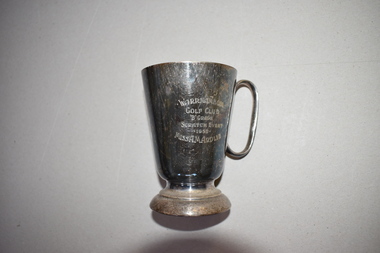
Golf Club Trophy, 1950
... The Warrnambool Golf Club was established in the late 19th century and the game was played by both men and women at Albert Park until 1929 when it shifted to its present day course in what was once part of the old Western Reserve. ...The Warrnambool Golf Club was established in the late 19th century and the game was played by both men and women at Albert Park until 1929 when it shifted to its present day course in what was once part of the old Western Reserve. This trophy is of interest as a mid 20th century memento of a member of a prominent family in Warrnambool, Miss Agnes Ardlie and of the Warrnambool Golf Club. ...This item comes from the estate of Dorothy and Agnes Ardlie of Warrnambool. Dorothy Ardlie (1910-1993) and Agnes Ardlie (1915-1993) were the daughters of Arthur and Ethel Ardlie of Warrnambool, the granddaughters of the prominent Warrnambool lawyer, William Ardlie and his wife Mary and the great granddaughters of John and Mary Ardlie, pioneer settlers in Warrnambool. The trophy was won by Agnes Ardlie in 1950. The Warrnambool Golf Club was established in the late 19th century and the game was played by both men and women at Albert Park until 1929 when it shifted to its present day course in what was once part of the old Western Reserve. This trophy is of interest as a mid 20th century memento of a member of a prominent family in Warrnambool, Miss Agnes Ardlie and of the Warrnambool Golf Club.This is an electro-plated nickel silver mug with a circular base, a tapering body and a handle. It is much stained. There is an inscription on one side of the mug and a maker’s name on the base but this is not decipherable. Warrnambool Golf Club ‘B’ Grade Scratch Event 1950 Miss A.M. Ardlieardlie family, history of warrnambool -
 Whitehorse Historical Society Inc.
Photograph, Healesville Freeway Community Day
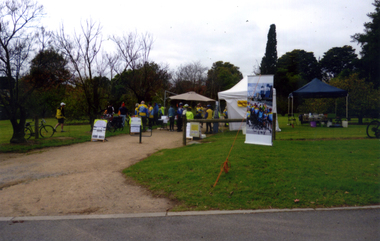
... The Whitehorse cyclist seen near the western side of the Reserve organised the bike ride that was part of the day's activities....The Whitehorse cyclist seen near the western side of the Reserve organised the bike ride that was part of the day's activities. healesville freeway community day 2013. whitehorse historical society Coloured photograph of the Whitehorse Cyclist marque at the western end of the Healesville Freeway Reservation 26.5.2013 Healesville Freeway Community Day Photograph Photograph ...Whitehorse Historical Society was invited to attend the Community Day located near Strathdon House on the land of the Healesville Freeway Reservation, Springvale Rd, Forest Hill on 26.5.2013. The Whitehorse cyclist seen near the western side of the Reserve organised the bike ride that was part of the day's activities.Coloured photograph of the Whitehorse Cyclist marque at the western end of the Healesville Freeway Reservation 26.5.2013healesville freeway community day 2013. whitehorse historical society -
 City of Moorabbin Historical Society (Operating the Box Cottage Museum)
Personal Effects,men's shirt studs, c1900
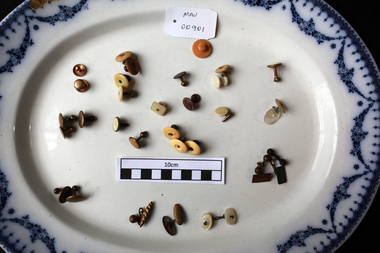
... Dress code of the modern western world reserves shirt studs for men's formal wear and some semi-formal occasions. ...Dress code of the modern western world reserves shirt studs for men's formal wear and some semi-formal occasions. ...A shirt stud is a decorative fastener that fits onto a buttonhole on the front of a pleated shirt, or onto the starched bib of a stiff-front shirt. Such shirts have special buttonholes solely for shirt studs. A shirt stud may be fashioned from alloys, precious metals, and gemstones—materials uncommon to buttons sewn on shirts. The stud may have an inlay, such as of pearl or onyx. Dress code of the modern western world reserves shirt studs for men's formal wear and some semi-formal occasions. In the western world, shirt studs were first used in the mid-19th century, when some shirt fronts were too stiff to close with buttons. So remains the case for the heavily starched, modern full dress shirts worn with white tie. A collection of men's shirt studs in black and white and in various styles,and sizesclothing, shirts, menswear, early settlers, pioneers, moorabbin, bentleigh, cheltenham, jewellery, dinner suits -
 Bendigo Historical Society Inc.
Document - TOWN HALL, RETURN BALL, 17 June, 1923
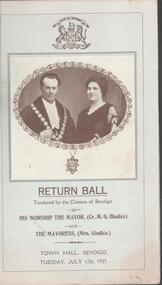
... Irvine's Great Western Champagne (Special Reserve.) Seppelt's. Penfold's. ...Irvine's Great Western Champagne (Special Reserve.) Seppelt's. Penfold's. ...Town Hall, Return Ball. Tendered by the Citizens of Bendigo to His Worship the Mayor, (Cr. M G Giudice) and The Mayoress, (Mrs. Giudice.) Town Hall, Bendigo. Tuesday, July 17th, 1923. Menu, Dindon Roti. Jambon de York. Canard Roti. Salad a la Francaise. Haricot Verts. Pommes de Terre a L;Anglaise. Trifle a L'Espangnole. Charlotte Russe. Crème aux Fraisee. Salade aux Fruits. Gelee au Madere. Meringues a'la Crème. Patrisserie. Gateau Assorties. Olive Farcies aux Anchois. Pailles au Parmeson. Amande a la Diable. Gingembre. Raisins. Café. The Oyster Soup will be served in Basement after Second Supper. Favaloros, Caterers. Wine List. Irvine's Great Western Champagne (Special Reserve.) Seppelt's. Penfold's. Max Cohn's. Port. Sherry. Claret. Burgundy. Muscat. Hock. Chablis. Planet. Old Scotch Whisky. Ales and Stout-Bendigo United and Cohn Bros. Aerated Waters and Cordials. Cigars Cigarettes. Toasts. His Majesty the King. - By the Chairman, 'Our Guests,' (The Mayor & Mayoress Cr & Mrs. M G Giudice.) by the Chairman. Where're they met a stranger; there they left a friend. Response by The Mayor. 'The Chairman Citizens Return Ball Committee,' (Cr E M Vains) By the Mayor. Response by the Chairman. The Citizen's Return Ball, Executive Committee - Cr E M Vains (Chairman), Mr. J Denton (Treasurer), A M Poole, T Pritchard, A B Wood, W Jeffrey, W H Taylor, F Monaghan, H S Marks, H W Tilley, F Cambridge, H Newman, E A Sayer, H Whitelock, W Currie, W T Patten, J. J. Caldwell, G H Dare, J H Sievers, F Ferguson, G J C Maxwell. F T Amer & T R J Brown; Hon. Secs. City of Bendigo logo is at the top on the front cover and an oval picture of the Mayor and Mayoress below it.Cambridge Press, Bendigoevent, entertainment, return ball, town hall -
 Sunshine and District Historical Society Incorporated
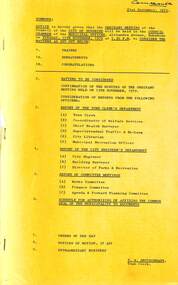
Administrative record - City of Sunshine - Commissioner Mr Alexander Alex George Gillon Collection 1976 - 1982 - Notice of ordinary meeting of the council of the City of Sunshine to be held on 21st September 1977, City of Sunshine, 14th September 1977
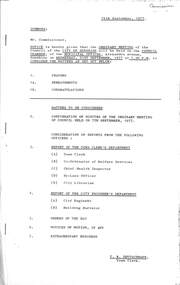
... Oval Deer Park Main Transmission Line Easement Keilor Terminal Station to Truganina Terminal Station Easement Street Construction Agreement Printing of Historical Society Book "Sunshine & District to 1901) and Secretarial Assistance Proposal for Re-Zoning of Zone 7 (Derrimut) Community School Agreements Acquisition of Lots 43 & 44 Northumberland Road Arbitration for Compensation Officers Co-Ordinating Committee Autonomy of Departments Brochure on Council Services Community Notice Boards Report of the Co-Ordinator of Welfare Services The 21st Victorian Geriatrics Conference Family and Community Services Programmes Employment and Industry Problem in the Western Region Diamond Reserve Committee of Management Diamond Reserve Kindergarten Report of the By-Laws Officer Removal of Fire Hazards Dog Act Fixing of Registration Fees Report of the City Engineer Land Use Permit Application Car Park to Serve Existing Display Home Centre lot 1171 Main Road West Land Use Permit Application Extension to Existing Shop and Storage Purposes 229 Hampshire Road Land Use Permit Application Radio Mast 552 Geelong Road Land Use Permit Application Show Room Extension to Existing Caravan and Car Sales Yard Lot 1 Geelong Road Melbourne Metropolitan Planning Scheme Amendments Land Use Permit Application Social Club Furlong Road Land Use Permit Application Extension to Existing Shop and Dwelling 82 Glengala Road Land Use Permit Application Extension to Existing Shop 67 McIntyre Road Land Use Permit Application Car Sales Yard Lots 8, 9, 10, 11, 13 & Part 12 Rosamond Road Land Use Permit Application Illuminated Sky Sign 242 Hampshire Road Land Use Permit Application Access to Main Road Geelong Road Land Use Permit Application Squash Court Centre Lots 8, 9, 10, 11, 13 & Part 12 Rosamond Road Land Use Permit Application Advertising Lots 5 & 6 Ballarat Road Land Use Permit Application Extension to Existing Shop and Addition of Caretakers Dwelling 87 Glengala Road Land Use Permit Application Bon Thomas Reserve Pre-School Centre Industrial Offensive Zoned Land Laverton North Shire of Werribee Plan of Subdivision Geelong Road & Francis Street Strata Subdivision 14 Forrest Street Outer Ring Road Study Acquisition of Road Reserve Somerville Road from Market Road to Kororoit Creek (For Future Bridge & Road Connection) Summer School of Park Management Application for Funds for 1978/79 Country Roads Board Report of Building Surveyor Flood Plain Management in Victoria Purchase of Land Adjacent Lot 63 Roussac Court Sunshine North Fencing Lot 343 Anley Place Ex G.U.D. ...Oval Deer Park Main Transmission Line Easement Keilor Terminal Station to Truganina Terminal Station Easement Street Construction Agreement Printing of Historical Society Book "Sunshine & District to 1901) and Secretarial Assistance Proposal for Re-Zoning of Zone 7 (Derrimut) Community School Agreements Acquisition of Lots 43 & 44 Northumberland Road Arbitration for Compensation Officers Co-Ordinating Committee Autonomy of Departments Brochure on Council Services Community Notice Boards Report of the Co-Ordinator of Welfare Services The 21st Victorian Geriatrics Conference Family and Community Services Programmes Employment and Industry Problem in the Western Region Diamond Reserve Committee of Management Diamond Reserve Kindergarten Report of the By-Laws Officer Removal of Fire Hazards Dog Act Fixing of Registration Fees Report of the City Engineer Land Use Permit Application Car Park to Serve Existing Display Home Centre lot 1171 Main Road West Land Use Permit Application Extension to Existing Shop and Storage Purposes 229 Hampshire Road Land Use Permit Application Radio Mast 552 Geelong Road Land Use Permit Application Show Room Extension to Existing Caravan and Car Sales Yard Lot 1 Geelong Road Melbourne Metropolitan Planning Scheme Amendments Land Use Permit Application Social Club Furlong Road Land Use Permit Application Extension to Existing Shop and Dwelling 82 Glengala Road Land Use Permit Application Extension to Existing Shop 67 McIntyre Road Land Use Permit Application Car Sales Yard Lots 8, 9, 10, 11, 13 & Part 12 Rosamond Road Land Use Permit Application Illuminated Sky Sign 242 Hampshire Road Land Use Permit Application Access to Main Road Geelong Road Land Use Permit Application Squash Court Centre Lots 8, 9, 10, 11, 13 & Part 12 Rosamond Road Land Use Permit Application Advertising Lots 5 & 6 Ballarat Road Land Use Permit Application Extension to Existing Shop and Addition of Caretakers Dwelling 87 Glengala Road Land Use Permit Application Bon Thomas Reserve Pre-School Centre Industrial Offensive Zoned Land Laverton North Shire of Werribee Plan of Subdivision Geelong Road & Francis Street Strata Subdivision 14 Forrest Street Outer Ring Road Study Acquisition of Road Reserve Somerville Road from Market Road to Kororoit Creek (For Future Bridge & Road Connection) Summer School of Park Management Application for Funds for 1978/79 Country Roads Board Report of Building Surveyor Flood Plain Management in Victoria Purchase of Land Adjacent Lot 63 Roussac Court Sunshine North Fencing Lot 343 Anley Place Ex G.U.D. ...Notice of Ordinary Meeting of the Council of the City of Sunshine to be held on 21st September 1977 Report of the Town Clerk's Department Report of the Town Clerk Estimates Schedules Proposed Agreements with Councils in Relation to New Garbage Tip Sunshine Tip City of Brunswick, City of Essendon, City of Melbourne, City of South Melbourne, City of Fitzroy, City of Richmond & City of Keilor Chaplin Reserve Proposed New Lease Additional Rent Sunshine City Soccer Club Names of Proposed Railway Station Deer Park "Crick" or "Pollard" Proposed Purchase Tip Site from Boral Resources Pty Ltd Sunshine Tip Purchase of I.C.I. Oval Deer Park Main Transmission Line Easement Keilor Terminal Station to Truganina Terminal Station Easement Street Construction Agreement Printing of Historical Society Book "Sunshine & District to 1901) and Secretarial Assistance Proposal for Re-Zoning of Zone 7 (Derrimut) Community School Agreements Acquisition of Lots 43 & 44 Northumberland Road Arbitration for Compensation Officers Co-Ordinating Committee Autonomy of Departments Brochure on Council Services Community Notice Boards Report of the Co-Ordinator of Welfare Services The 21st Victorian Geriatrics Conference Family and Community Services Programmes Employment and Industry Problem in the Western Region Diamond Reserve Committee of Management Diamond Reserve Kindergarten Report of the By-Laws Officer Removal of Fire Hazards Dog Act Fixing of Registration Fees Report of the City Engineer Land Use Permit Application Car Park to Serve Existing Display Home Centre lot 1171 Main Road West Land Use Permit Application Extension to Existing Shop and Storage Purposes 229 Hampshire Road Land Use Permit Application Radio Mast 552 Geelong Road Land Use Permit Application Show Room Extension to Existing Caravan and Car Sales Yard Lot 1 Geelong Road Melbourne Metropolitan Planning Scheme Amendments Land Use Permit Application Social Club Furlong Road Land Use Permit Application Extension to Existing Shop and Dwelling 82 Glengala Road Land Use Permit Application Extension to Existing Shop 67 McIntyre Road Land Use Permit Application Car Sales Yard Lots 8, 9, 10, 11, 13 & Part 12 Rosamond Road Land Use Permit Application Illuminated Sky Sign 242 Hampshire Road Land Use Permit Application Access to Main Road Geelong Road Land Use Permit Application Squash Court Centre Lots 8, 9, 10, 11, 13 & Part 12 Rosamond Road Land Use Permit Application Advertising Lots 5 & 6 Ballarat Road Land Use Permit Application Extension to Existing Shop and Addition of Caretakers Dwelling 87 Glengala Road Land Use Permit Application Bon Thomas Reserve Pre-School Centre Industrial Offensive Zoned Land Laverton North Shire of Werribee Plan of Subdivision Geelong Road & Francis Street Strata Subdivision 14 Forrest Street Outer Ring Road Study Acquisition of Road Reserve Somerville Road from Market Road to Kororoit Creek (For Future Bridge & Road Connection) Summer School of Park Management Application for Funds for 1978/79 Country Roads Board Report of Building Surveyor Flood Plain Management in Victoria Purchase of Land Adjacent Lot 63 Roussac Court Sunshine North Fencing Lot 343 Anley Place Ex G.U.D. Premises Burton Crescent Maribyrnong Ainsworth Reserve Child Care Centre / Pavilion Extraordinary Business Use of Sassella Park Removal of Fence Around Proposed Swimming Pool, Layout of Athletics Track & Hockey Pitch Orders of the Day Confirmation of Loan with the Australian Mutual Provident Society city of sunshine, alexander "alex" george gillon, sunshine tip, chaplin reserve, anderson road, sunshine, sunshine city soccer club, i.c.i. oval, ballarat road, deer park, keilor terminal station, truganina terminal station, northumberland road, sunshine north, diamond reserve committee of management, diamond reserve kindergarten, main road west, st. albans, hampshire road, geelong road, brooklyn, furlong road, glengala road, sunshine west, mcintyre road, rosamond road, maribyrnong, bon thomas reserve pre-school centre, bon thomas reserve, quinn street, francis street, forrest street, albion, somerville road, market road, roussac court, anley place, burton crescent, g.u.d., sassella park, station road -
 Sunshine and District Historical Society Incorporated
Administrative record - City of Sunshine - Commissioner Mr Alexander Alex George Gillon Collection 1976 - 1982 - Minutes of the ordinary meeting of council held on 21st September 1977, City of Sunshine, 21st September 1977
... Oval Deer Park Main Transmission Line Easement Keilor Terminal Station to Truganina Terminal Station Easement Street Construction Agreement Printing of Historical Society Book "Sunshine & District to 1901) and Secretarial Assistance Proposal for Re-Zoning of Zone 7 (Derrimut) Community School Agreements Acquisition of Lots 43 & 44 Northumberland Road Arbitration for Compensation Officers Co-Ordinating Committee Autonomy of Departments Brochure on Council Services Community Notice Boards Report of the Co-Ordinator of Welfare Services The 21st Victorian Geriatrics Conference Family and Community Services Programmes Employment and Industry Problem in the Western Region Diamond Reserve Committee of Management Diamond Reserve Kindergarten Report of the By-Laws Officer Removal of Fire Hazards Dog Act Fixing of Registration Fees Report of the City Engineer Land Use Permit Application Car Park to Serve Existing Display Home Centre lot 1171 Main Road West Land Use Permit Application Extension to Existing Shop and Storage Purposes 229 Hampshire Road Land Use Permit Application Radio Mast 552 Geelong Road Land Use Permit Application Show Room Extension to Existing Caravan and Car Sales Yard Lot 1 Geelong Road Melbourne Metropolitan Planning Scheme Amendments Land Use Permit Application Social Club Furlong Road Land Use Permit Application Extension to Existing Shop and Dwelling 82 Glengala Road Land Use Permit Application Extension to Existing Shop 67 McIntyre Road Land Use Permit Application Car Sales Yard Lots 8, 9, 10, 11, 13 & Part 12 Rosamond Road Land Use Permit Application Illuminated Sky Sign 242 Hampshire Road Land Use Permit Application Access to Main Road Geelong Road Land Use Permit Application Squash Court Centre Lots 8, 9, 10, 11, 13 & Part 12 Rosamond Road Land Use Permit Application Advertising Lots 5 & 6 Ballarat Road Land Use Permit Application Extension to Existing Shop and Addition of Caretakers Dwelling 87 Glengala Road Land Use Permit Application Bon Thomas Reserve Pre-School Centre Industrial Offensive Zoned Land Laverton North Shire of Werribee Plan of Subdivision Geelong Road & Francis Street Strata Subdivision 14 Forrest Street Outer Ring Road Study Acquisition of Road Reserve Somerville Road from Market Road to Kororoit Creek (For Future Bridge & Road Connection) Summer School of Park Management Application for Funds for 1978/79 Country Roads Board Report of Building Surveyor Flood Plain Management in Victoria Purchase of Land Adjacent Lot 63 Roussac Court Sunshine North Fencing Lot 343 Anley Place Ex G.U.D. ...Oval Deer Park Main Transmission Line Easement Keilor Terminal Station to Truganina Terminal Station Easement Street Construction Agreement Printing of Historical Society Book "Sunshine & District to 1901) and Secretarial Assistance Proposal for Re-Zoning of Zone 7 (Derrimut) Community School Agreements Acquisition of Lots 43 & 44 Northumberland Road Arbitration for Compensation Officers Co-Ordinating Committee Autonomy of Departments Brochure on Council Services Community Notice Boards Report of the Co-Ordinator of Welfare Services The 21st Victorian Geriatrics Conference Family and Community Services Programmes Employment and Industry Problem in the Western Region Diamond Reserve Committee of Management Diamond Reserve Kindergarten Report of the By-Laws Officer Removal of Fire Hazards Dog Act Fixing of Registration Fees Report of the City Engineer Land Use Permit Application Car Park to Serve Existing Display Home Centre lot 1171 Main Road West Land Use Permit Application Extension to Existing Shop and Storage Purposes 229 Hampshire Road Land Use Permit Application Radio Mast 552 Geelong Road Land Use Permit Application Show Room Extension to Existing Caravan and Car Sales Yard Lot 1 Geelong Road Melbourne Metropolitan Planning Scheme Amendments Land Use Permit Application Social Club Furlong Road Land Use Permit Application Extension to Existing Shop and Dwelling 82 Glengala Road Land Use Permit Application Extension to Existing Shop 67 McIntyre Road Land Use Permit Application Car Sales Yard Lots 8, 9, 10, 11, 13 & Part 12 Rosamond Road Land Use Permit Application Illuminated Sky Sign 242 Hampshire Road Land Use Permit Application Access to Main Road Geelong Road Land Use Permit Application Squash Court Centre Lots 8, 9, 10, 11, 13 & Part 12 Rosamond Road Land Use Permit Application Advertising Lots 5 & 6 Ballarat Road Land Use Permit Application Extension to Existing Shop and Addition of Caretakers Dwelling 87 Glengala Road Land Use Permit Application Bon Thomas Reserve Pre-School Centre Industrial Offensive Zoned Land Laverton North Shire of Werribee Plan of Subdivision Geelong Road & Francis Street Strata Subdivision 14 Forrest Street Outer Ring Road Study Acquisition of Road Reserve Somerville Road from Market Road to Kororoit Creek (For Future Bridge & Road Connection) Summer School of Park Management Application for Funds for 1978/79 Country Roads Board Report of Building Surveyor Flood Plain Management in Victoria Purchase of Land Adjacent Lot 63 Roussac Court Sunshine North Fencing Lot 343 Anley Place Ex G.U.D. ...Minutes of the Ordinary Meeting of Council held on 21st September 1977 Report of the Town Clerk's Department Report of the Town Clerk Estimates Schedules Proposed Agreements with Councils in Relation to New Garbage Tip Sunshine Tip City of Brunswick, City of Essendon, City of Melbourne, City of South Melbourne, City of Fitzroy, City of Richmond & City of Keilor Chaplin Reserve Proposed New Lease Additional Rent Sunshine City Soccer Club Names of Proposed Railway Station Deer Park "Crick" or "Pollard" Proposed Purchase Tip Site from Boral Resources Pty Ltd Sunshine Tip Purchase of I.C.I. Oval Deer Park Main Transmission Line Easement Keilor Terminal Station to Truganina Terminal Station Easement Street Construction Agreement Printing of Historical Society Book "Sunshine & District to 1901) and Secretarial Assistance Proposal for Re-Zoning of Zone 7 (Derrimut) Community School Agreements Acquisition of Lots 43 & 44 Northumberland Road Arbitration for Compensation Officers Co-Ordinating Committee Autonomy of Departments Brochure on Council Services Community Notice Boards Report of the Co-Ordinator of Welfare Services The 21st Victorian Geriatrics Conference Family and Community Services Programmes Employment and Industry Problem in the Western Region Diamond Reserve Committee of Management Diamond Reserve Kindergarten Report of the By-Laws Officer Removal of Fire Hazards Dog Act Fixing of Registration Fees Report of the City Engineer Land Use Permit Application Car Park to Serve Existing Display Home Centre lot 1171 Main Road West Land Use Permit Application Extension to Existing Shop and Storage Purposes 229 Hampshire Road Land Use Permit Application Radio Mast 552 Geelong Road Land Use Permit Application Show Room Extension to Existing Caravan and Car Sales Yard Lot 1 Geelong Road Melbourne Metropolitan Planning Scheme Amendments Land Use Permit Application Social Club Furlong Road Land Use Permit Application Extension to Existing Shop and Dwelling 82 Glengala Road Land Use Permit Application Extension to Existing Shop 67 McIntyre Road Land Use Permit Application Car Sales Yard Lots 8, 9, 10, 11, 13 & Part 12 Rosamond Road Land Use Permit Application Illuminated Sky Sign 242 Hampshire Road Land Use Permit Application Access to Main Road Geelong Road Land Use Permit Application Squash Court Centre Lots 8, 9, 10, 11, 13 & Part 12 Rosamond Road Land Use Permit Application Advertising Lots 5 & 6 Ballarat Road Land Use Permit Application Extension to Existing Shop and Addition of Caretakers Dwelling 87 Glengala Road Land Use Permit Application Bon Thomas Reserve Pre-School Centre Industrial Offensive Zoned Land Laverton North Shire of Werribee Plan of Subdivision Geelong Road & Francis Street Strata Subdivision 14 Forrest Street Outer Ring Road Study Acquisition of Road Reserve Somerville Road from Market Road to Kororoit Creek (For Future Bridge & Road Connection) Summer School of Park Management Application for Funds for 1978/79 Country Roads Board Report of Building Surveyor Flood Plain Management in Victoria Purchase of Land Adjacent Lot 63 Roussac Court Sunshine North Fencing Lot 343 Anley Place Ex G.U.D. Premises Burton Crescent Maribyrnong Ainsworth Reserve Child Care Centre / Pavilion Extraordinary Business Use of Sassella Park Removal of Fence Around Proposed Swimming Pool, Layout of Athletics Track & Hockey Pitch Orders of the Day Confirmation of Loan with the Australian Mutual Provident Society city of sunshine, alexander "alex" george gillon, sunshine tip, albion, chaplin reserve, anderson road, sunshine, sunshine city soccer club, boral resources, i.c.i. oval, ballarat road, deer park, keilor terminal station, truganina terminal station, northumberland road, sunshine north, diamond reserve committee of management, diamond reserve kindergarten, main road west, st. albans, hampshire road, geelong road, brooklyn, furlong road, glengala road, sunshine west, mcintyre road, rosamond road, maribyrnong, bon thomas reserve pre-school centre, bon thomas reserve, quinn street, francis street, forrest street, somerville road, market road, roussac court, g.u.d., burton crescent, ainsworth reserve child care centre, ainsworth reserve, vernon street, sassella park, station road -
 Sunshine and District Historical Society Incorporated
Administrative record - City of Sunshine - Commissioner Mr Alexander Alex George Gillon Collection 1976 - 1982 - Notice of ordinary meeting of the council 27th November 1979, City of Sunshine, 21st November 1979
... Reserve...Kermeen Street...Western...Park Deer Park, Robert Bruce Reserve, Bon Thomas Reserve, Robert Barrett Reserve, Tallintyre Reserve, Western Suburbs Soccer Club & Albanvale Report of the City Engineer & Planner Proposed Rezoning of Land Whitesides Avenue, Nancy Street and West Street Ardeer Planning Permit Application Caravan Park Sunshine Road Planning Permit Application Portable Classrooms Churchill Avenue North West corner Darnley Street Braybrook Planning Permit Application Take Away Food Premises and Amusement Parlour Lot 2 Disraeli Street St. ...Park Deer Park, Robert Bruce Reserve, Bon Thomas Reserve, Robert Barrett Reserve, Tallintyre Reserve, Western Suburbs Soccer Club & Albanvale Report of the City Engineer & Planner Proposed Rezoning of Land Whitesides Avenue, Nancy Street and West Street Ardeer Planning Permit Application Caravan Park Sunshine Road Planning Permit Application Portable Classrooms Churchill Avenue North West corner Darnley Street Braybrook Planning Permit Application Take Away Food Premises and Amusement Parlour Lot 2 Disraeli Street St. ...Notice of Ordinary Meeting of the Council 27th November 1979 Report of the Town Clerk's Department Report of the Town Clerk Deer Park Hall Committee of Management Result of Public Meeting Land Transfer Discontinued Road Murray Street and Evelyn Crescent Sunshine West Victoria Grants Commission Inspector Visit Visit to Bankstown by Chief Clerk Matters of Interest Meals on Wheels Rate Recovery Sales Western Regional Refuse Disposal Group Adoption Proposed Constitution Proposal for Procedure for Discontinued of Roads Proposal to Close Road off Stanford Street Between Benjamin Street and Chapman Street George Cross Soccer Club Proposed Ground Development Duke Street North The Hub Sports Centre Closure Christmas / New Year Period Public liability Insurance Report of the Co-Ordinator of Welfare Services Australia-Yugoslav Welfare Society Nursing Home Development Sunshine Senior Citizens Club Lions House of Sunshine Caretaker's Position Special Bus Teenage holiday Programme Funding State Relief Committee Maintenance Subsidy Elderly Citizens' Clubs Inservice Training for Children's Services Development Officer Community Directory Update International Year of the Child Children's Health Needs Submission for Continued Funding of Children's Services Development Officer Report of the Chief Health Surveyor Burns Street Infant Welfare Centre Maidstone Use by Playgroup Use of St. Albans Hall off Alfrieda Street for Immunisation Sessions Registration of Food Premises, Eating House, Camping Area and Apartment Houses Rubella Vaccination in Sunshine Municipality Report of the Medical Officer of Health Report of the Superintendent of Traffic & By-Laws Noxious Weeds Court Proceedings Sunshine Magistrates Court St. Andrews Day Celebrations Recreational Vehicles at D.F. Thompson Reserve and Surrounding Areas Maribyrnong Disposal of Derelict Vehicles Report of the City Librarian Highpoint West Library Public Hours Field Work Experience in Libraries Report of the Municipal Recreation Officer Report of the Municipal Recreation Officer's Work Experience to Date Priorities for Building Development on Reserves I.C.I. Park Deer Park, Robert Bruce Reserve, Bon Thomas Reserve, Robert Barrett Reserve, Tallintyre Reserve, Western Suburbs Soccer Club & Albanvale Report of the City Engineer & Planner Proposed Rezoning of Land Whitesides Avenue, Nancy Street and West Street Ardeer Planning Permit Application Caravan Park Sunshine Road Planning Permit Application Portable Classrooms Churchill Avenue North West corner Darnley Street Braybrook Planning Permit Application Take Away Food Premises and Amusement Parlour Lot 2 Disraeli Street St. Albans Planning Permit Application One Illuminated Sign and One Non Illuminated Sign Lot 2 Hampshire Road Sunshine Planning Permit Application Office 463 Somerville Road Tottenham Planning Permit Application Caretaker's Residence 44 Furlong Road Sunshine North Planning Permit Application Cafe Lot 5 Shop 5 Watt Street Sunshine Planning Permit Application Drive in Take Away Foods Take Away Kentucky Fried Chicken Restaurant 429A Ballarat Road Planning Permit Application 31 Townhouses Service Premises and Medical Centre and Ancillary Car Parking Neale Road South West Corner Station Road Planning Permit Application Service Premises Addition to Existing Cluster Subdivision 104 Station Road Deer Park Planning Permit and Planning Permit Application Place of Assembly (Hall for Social Functions) 44 Hampshire Road South East Corner Morris Street Sunshine Proposed Rezoning of Land Occupied by the Deer Park Shopping Centre Neale Road Deer Park Planning Permit Application Garden and Building Supplies Lots 13 & 14 Francis Street and Lots 15 & 16 Geelong Road Brooklyn Furlong Road Estate Stages 3, 4 & 6A Subdivision Consolidation of Title 3 Deakin Street Maidstone Drainage Construction Albanvale Estate Stage 6A Plans of Subdivision Westerngate North Estate Stages 2A & 2B Contract Fencing Sunshine Tip Site Contract Construction of Part of Warrs Road Maribyrnong George Street Maidstone Permission to Fence in Northern End Sewered Facilities Gillon Court Subdivision Including Furlong Road and St. Albans Road St. Albans Sewered Facilities Lots 11, 12 & 13 Francis Street Brooklyn Geelong Service Road Council Depot Management, Security and Other Matters Report of the Building Surveyor Building Over Easement 34 Woodland Drive St. Albans Building Over Easement Lot 101 Fremont Parade Sunshine West Building on Flood Prone Land Lot 1 Navigator Street Maribyrnong Sitting of Building 35 Delacey Street Maidstone Sitting of Building Lots 53 & 54 Judge Street Sunshine Installation of Underground Tanks 23 Carrington Drive Albiondeer park hall committee of management, sassella park, station road, deer park, murray street, evelyn crescent, sunshine west, stanford street, benjamin street, sunshine, george cross soccer club, duke street, sunshine north, chapman street, the hub, sun crescent, australia-yugoslav welfare society, sunshine senior citizens club, lions house of sunshine, corio street, watt street, burns street infant welfare centre, burns street, maidstone, st. albans hall, alfrieda street, d.f. thompson reserve, van ness avenue, maribyrnong, highpoint west library, rosamond road, i.c.i. reserve, john mcleod reserve, ballarat road, robert bruce reserve, bon thomas reserve, quinn street, robert barrett reserve, tallintyre reserve, kermeen street, western suburbs soccer club, whitesides avenue, nancy street, west street, ardeer, sunshine road, churchill avenue, darnley street, braybrook, disraeli street, st. albans, hampshire road, somerville road, tottenham, furlong road, kentucky fried chicken restaurant, neale road, morris street, deer park shopping centre, deakin street, sunshine tip, warrs road, george street, st. albans road, woodland drive, fremont parade, navigator street, delacey street, judge street, carrington drive, albion -
 Sunshine and District Historical Society Incorporated
Administrative record - City of Sunshine - Commissioner Mr Alexander Alex George Gillon Collection 1976 - 1982 - Minutes of the ordinary meeting of council held on 27th November 1979, City of Sunshine, 27th November 1979
... Reserve...Kermeen Street...Western...Park Deer Park, Robert Bruce Reserve, Bon Thomas Reserve, Robert Barrett Reserve, Tallintyre Reserve, Western Suburbs Soccer Club & Albanvale Report of the City Engineer & Planner Proposed Rezoning of Land Whitesides Avenue, Nancy Street and West Street Ardeer Planning Permit Application Caravan Park Sunshine Road Planning Permit Application Portable Classrooms Churchill Avenue North West corner Darnley Street Braybrook Planning Permit Application Take Away Food Premises and Amusement Parlour Lot 2 Disraeli Street St. ...Park Deer Park, Robert Bruce Reserve, Bon Thomas Reserve, Robert Barrett Reserve, Tallintyre Reserve, Western Suburbs Soccer Club & Albanvale Report of the City Engineer & Planner Proposed Rezoning of Land Whitesides Avenue, Nancy Street and West Street Ardeer Planning Permit Application Caravan Park Sunshine Road Planning Permit Application Portable Classrooms Churchill Avenue North West corner Darnley Street Braybrook Planning Permit Application Take Away Food Premises and Amusement Parlour Lot 2 Disraeli Street St. ...Minutes of the Ordinary Meeting of Council held on 27th November 1979 Report of the Town Clerk's Department Report of the Town Clerk Deer Park Hall Committee of Management Result of Public Meeting Land Transfer Discontinued Road Murray Street and Evelyn Crescent Sunshine West Victoria Grants Commission Inspector Visit Visit to Bankstown by Chief Clerk Matters of Interest Meals on Wheels Rate Recovery Sales Western Regional Refuse Disposal Group Adoption Proposed Constitution Proposal for Procedure for Discontinued of Roads Proposal to Close Road off Stanford Street Between Benjamin Street and Chapman Street George Cross Soccer Club Proposed Ground Development Duke Street North The Hub Sports Centre Closure Christmas / New Year Period Public liability Insurance Report of the Co-Ordinator of Welfare Services Australia-Yugoslav Welfare Society Nursing Home Development Sunshine Senior Citizens Club Lions House of Sunshine Caretaker's Position Special Bus Teenage holiday Programme Funding State Relief Committee Maintenance Subsidy Elderly Citizens' Clubs Inservice Training for Children's Services Development Officer Community Directory Update International Year of the Child Children's Health Needs Submission for Continued Funding of Children's Services Development Officer Report of the Chief Health Surveyor Burns Street Infant Welfare Centre Maidstone Use by Playgroup Use of St. Albans Hall off Alfrieda Street for Immunisation Sessions Registration of Food Premises, Eating House, Camping Area and Apartment Houses Rubella Vaccination in Sunshine Municipality Report of the Medical Officer of Health Report of the Superintendent of Traffic & By-Laws Noxious Weeds Court Proceedings Sunshine Magistrates Court St. Andrews Day Celebrations Recreational Vehicles at D.F. Thompson Reserve and Surrounding Areas Maribyrnong Disposal of Derelict Vehicles Report of the City Librarian Highpoint West Library Public Hours Field Work Experience in Libraries Report of the Municipal Recreation Officer Report of the Municipal Recreation Officer's Work Experience to Date Priorities for Building Development on Reserves I.C.I. Park Deer Park, Robert Bruce Reserve, Bon Thomas Reserve, Robert Barrett Reserve, Tallintyre Reserve, Western Suburbs Soccer Club & Albanvale Report of the City Engineer & Planner Proposed Rezoning of Land Whitesides Avenue, Nancy Street and West Street Ardeer Planning Permit Application Caravan Park Sunshine Road Planning Permit Application Portable Classrooms Churchill Avenue North West corner Darnley Street Braybrook Planning Permit Application Take Away Food Premises and Amusement Parlour Lot 2 Disraeli Street St. Albans Planning Permit Application One Illuminated Sign and One Non Illuminated Sign Lot 2 Hampshire Road Sunshine Planning Permit Application Office 463 Somerville Road Tottenham Planning Permit Application Caretaker's Residence 44 Furlong Road Sunshine North Planning Permit Application Cafe Lot 5 Shop 5 Watt Street Sunshine Planning Permit Application Drive in Take Away Foods Take Away Kentucky Fried Chicken Restaurant 429A Ballarat Road Planning Permit Application 31 Townhouses Service Premises and Medical Centre and Ancillary Car Parking Neale Road South West Corner Station Road Planning Permit Application Service Premises Addition to Existing Cluster Subdivision 104 Station Road Deer Park Planning Permit and Planning Permit Application Place of Assembly (Hall for Social Functions) 44 Hampshire Road South East Corner Morris Street Sunshine Proposed Rezoning of Land Occupied by the Deer Park Shopping Centre Neale Road Deer Park Planning Permit Application Garden and Building Supplies Lots 13 & 14 Francis Street and Lots 15 & 16 Geelong Road Brooklyn Furlong Road Estate Stages 3, 4 & 6A Subdivision Consolidation of Title 3 Deakin Street Maidstone Drainage Construction Albanvale Estate Stage 6A Plans of Subdivision Westerngate North Estate Stages 2A & 2B Contract Fencing Sunshine Tip Site Contract Construction of Part of Warrs Road Maribyrnong George Street Maidstone Permission to Fence in Northern End Sewered Facilities Gillon Court Subdivision Including Furlong Road and St. Albans Road St. Albans Sewered Facilities Lots 11, 12 & 13 Francis Street Brooklyn Geelong Service Road Council Depot Management, Security and Other Matters Report of the Building Surveyor Building Over Easement 34 Woodland Drive St. Albans Building Over Easement Lot 101 Fremont Parade Sunshine West Building on Flood Prone Land Lot 1 Navigator Street Maribyrnong Sitting of Building 35 Delacey Street Maidstone Sitting of Building Lots 53 & 54 Judge Street Sunshine Installation of Underground Tanks 23 Carrington Drive Albion Orders of the Day Accounts Submitted for Payment as at 15th November 1979deer park hall committee of management, deer park hall, station road, deer park, murray street, evelyn crescent, sunshine west, stanford street, benjamin street, chapman street, sunshine, george cross soccer club, duke street, sunshine north, the hub, sun crescent, australia-yugoslav welfare society, sunshine senior citizens club, lions house of sunshine, corio street, watt street, burns street infant welfare centre, burns street, maidstone, st. albans hall, alfrieda street, st. albans, d.f. thompson reserve, churchill avenue, braybrook, highpoint west library, rosamond road, maribyrnong, i.c.i. reserve, ballarat road, robert bruce reserve, bon thomas reserve, quinn street, robert barrett reserve, tallintyre reserve, kermeen street, western suburbs soccer club, whitesides avenue, nancy street, west street, ardeer, sunshine road, darnley street, disraeli street, hampshire road, somerville road, tottenham, furlong road, kentucky fried chicken, neale road, morris street, deer park shopping centre, geelong road, brooklyn, deakin street, sunshine tip, warrs road, george street, gillon court, francis street, geelong service, woodland drive, fremont parade, navigator street, delacey street, judge street, carrington drive, albion -
 The Beechworth Burke Museum
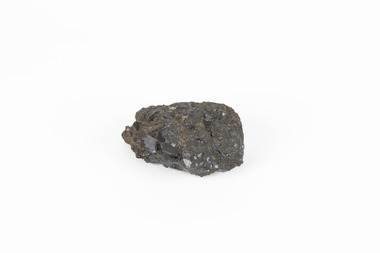
Geological specimen - Garnet crystals in galena, Unknown
... This particular specimen is from the Broken Hill mine, it is one of the largest lead mines located in Western New South Wales and still has ore reserves amounting to 20.9 million tonnes of ore grading of 7.4% lead, 9.4% zinc, and 61.5 million oz of Silver. ...This particular specimen is from the Broken Hill mine, it is one of the largest lead mines located in Western New South Wales and still has ore reserves amounting to 20.9 million tonnes of ore grading of 7.4% lead, 9.4% zinc, and 61.5 million oz of Silver. ...Majority of Galena in Australia is found in hydrothermal deposits emplaced around 1680 million years ago which have been heavily metamorphosed. Galena is the natural mineral form of lead sulfaide. It occurs generally as fine to large crystals due to syntectonic remobilization at low temperatures and moves to a suitable location. The colour is a shining lead and silvery gray with high specific gravity between 7.2 and 7.6 gms/cm3 and contains 86.6 lead sulfaide in its purest form. Its cyrstal system is cubic with perfect cleavages, and contract penetration and lamellar twinning. This particular specimen is from the Broken Hill mine, it is one of the largest lead mines located in Western New South Wales and still has ore reserves amounting to 20.9 million tonnes of ore grading of 7.4% lead, 9.4% zinc, and 61.5 million oz of Silver. Throughout its history, it has produced over 200 million tonnes of ore throughout its 127 years of mining history dating back to 1885. Galena mineral ore found in Australia is considered rare, as it is only currently found in the Broken Hill Mine of Western New South Wales. It represents heritage value through the systematic collecting of the geological surveyers in Victoria and Australia during the early to late 19th Century. The fact that it is only found in one mining area of Australia, shows that this specimen is rare for examples of Australian Galena. This mineral specimen is one part to a larger collection, aquistion, and distribution of Garnet in Galena around Australia and parts of the world and donated to the Burke Museum between 1860-1880. While this specimen was not found by the Victorian Geological Survey, it shows the historical need for mapping geological areas around the Gold Rush region to further identify areas of precious metal and gem aquisition. Additionally, collecting these specimens was an important part of mapping the scientific make up of the earth's surface. Many were sent to institutions for further contribution to research and scientific knowledge of the specimens. A solid coin-sized lead and zinc sulphaide and zinc silicate ore mineral in shades of black and red with shiny black points. GARNET CRYSTALS in / GALENA (lead sulphide), / SPALERITE (zinc sulphide), / WILLEMITE (zinc silicate) ore. / Locality: Broken Hill, NSWburke museum, #beechworth, indigo shire, beechworth museum, geological, geological specimen, mineral, galena, galena quartz, broken hill mine, broken hill, nsw -
 Federation University Historical Collection
Plan, Ballarat East, 1957, 1957
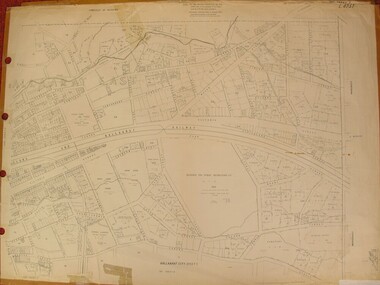
... Mount Xavier Recreation Reserve, Charlesworth Street Catholic Church Reserve. Sheet 5 - Western Highway, Mount Street, Fortune Street, Finlay Street, Jones Street, Ryan Street, Water Street, Brandbury Street, Humffray Street. ...Mount Xavier Recreation Reserve, Charlesworth Street Catholic Church Reserve. Sheet 5 - Western Highway, Mount Street, Fortune Street, Finlay Street, Jones Street, Ryan Street, Water Street, Brandbury Street, Humffray Street. ...Dr George Clendinning and others were trustees of the Church of England (St Paul's) A number of enlargements of the Ballarat East maps. .4) Bakery Hill, Humffray Street, Victoria Street, Ballarat Youth Council .5) Specimen Vale, Victoria Street, Eureka Street, Housing Commission .10) - Tomber Reserve, York Street, Spencer Street, Bennett Street, Wilson Street, Rodier Street, Richard Street, Fussell Street, Turpie Street, Stockade Street, Ballarat Rifle Range Lal La Street, Clayton Street, Eureka Street Sheet 2 - Yarrowee Creek, High Street, Dinney's Dam, Binney Street, Oliver Street, Humffray Street, Morres Street, Finch Street, Scotts Parade, Rice Street, HOrnby Street, Queen Street, Newman street, King Street, Napier Street, Sim Street. Sheet 3 - Russell Square, Victoria Street, Orphan Asylum, Ballarat Orphanage, Lofven Street, Haines Street, Yarrowee Creek, Ching Who Coey, Chinese, Stawell Street, Rice Street, Lane Street, Humffray Street, Nelson Street, Coffield Street, Morres Street, Western Highway, Rodier Street, Scott Parade, Canterbury Street Sheet 4 - Orphan Asylum, Ballarat Orphanage School, Fortune Street, Scotts Parade, Water Street, Ritchie Street, Humffray Street, Brophy Street, Thompson Street, Victoria Street,Humffray Street Church of England Reserve, Strickland Parade. Mount Xavier Recreation Reserve, Charlesworth Street Catholic Church Reserve. Sheet 5 - Western Highway, Mount Street, Fortune Street, Finlay Street, Jones Street, Ryan Street, Water Street, Brandbury Street, Humffray Street. Sheet 6 - Barkly Street, Ebden Street, Grenville Street, Cameron Street, Peel Street, Young Street, Victoria Street, Steinfeld Street, Haymes Street, Bond Street, Anderson Street, Eastwood Street, Mair Street, East Street, Haymes Crescent Sheet 7 - Murphy Street, Queen Street, Dyte Parade, Princes Street, Midland Highway, York Street, Dodds St, Wilson St Otway Street, Specimen vale, King Street, Gray Street, Little Dodds Street, Eureka Street. Sheet 9 - Richards Street, Fussell Street, Stockade Street, Orphan Asylum, Ballarat Orphanage, Elford Street, Russell Street, Ross Street, Charlesworth Street, Lalor Street, Stockade Street, Wilson Street, York Street, Eureka Street Sheet 10 - Eureka Street, York Street, Elford Street, Wilson Street, Mount Street, Turpie Street, Timber Reserve, Mount Xavier Sheet 11 - Yarrowee Creek, Humffray Street, Barkly Street, Morton Street, Cobden Street, Morton Street Wesleyan Church, Pryor Street, Albion Street, Bradshaw Street, Ballarat Woollen Mills, Tannery, Mount Pleasant. Sheet 12 - Magpie Street, Grant Street, Gladstone Street, Cobden Street, Fraser Street, Grenfell Street, Robertson Street, Bond Street, Barkly Street, Vine Street, Sovereign Hill, Ballarat Observatory, Pearce Street, Bond Street. Sheet 13 - Murphy Street, Larter Street, midland Highway, Geelong Road, gales Street, Lal Lal Street, Clayton Street, Dodds Street, Elsworth Street Sheet 14 - Eureka Street, Eureka Stockade Memorial Park, Eureka Stockade Reserve. York Street, Joseph Street, Kline Street, Charlesworth Street, Chamberlain Street, Trevor Street, Belford Street, Queen Street, Murray Street, Eureka Tiles, Orphan Asylum, Ballarat Orphanage. Sheet 18 - Scotts Parade, Stawell Street, Fortune Street, Victoria STreet, Railway Line, Haines Street, Eureka Street, Elford STreet, Brophy Street, York Street, Clayton Street, Elsworth Street, Barkly Street, Humffray Street, Midland Highway, Princes Street ballarat youth council, ballarat east, bakery hill, humffray street, victoria street, st paul's anglican church, humffray street state school -
 Flagstaff Hill Maritime Museum and Village
Clothing - Riding Habit, Jodhpurs, 1920s
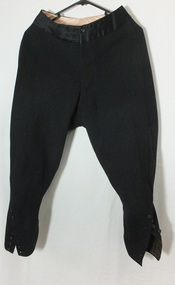
... Though an offer to build public baths to commemorate the Queen Victoria Jubilee in 1897 was not proceeded with, the town acquired a hospital, a reserve on Mount Leura, a clock tower and a cricket pavilion, as well as notable donations from the Manifolds to St Paul's Church and the grammar school. Edward was a keen polo player and racing man. He was also a successful owner of steeplechasers and a committeeman of the Victoria Racing Club for many years. He was also a member of many Western...Though an offer to build public baths to commemorate the Queen Victoria Jubilee in 1897 was not proceeded with, the town acquired a hospital, a reserve on Mount Leura, a clock tower and a cricket pavilion, as well as notable donations from the Manifolds to St Paul's Church and the grammar school. Edward was a keen polo player and racing man. He was also a successful owner of steeplechasers and a committeeman of the Victoria Racing Club for many years. He was also a member of many Western ...The Manifolds were a significant pioneering pastoral family in Western Victoria. The donated riding jodhpurs originally belonged to Mrs Edward Manifold, formally Beatrice Mary Synnot Anderson. Beatrice was Edward Manifold’s cousin once removed whom he married in 1900. Edward, the son of John Manifold, was born on 15 November 1868 and educated at Geelong and Melbourne Grammar schools and at Trinity Hall, Cambridge (B.A., 1891). He chose the Danedite portion of land at Purrumbete, and on the death of his bachelor brother Thomas Peter (1863-1895), after a hunting accident, he took over his allocation, Wiridgil. He also owned Boortkoi, near Hexham and on these properties, he ran merino sheep, a Lincoln stud which dated back to 1870, and Shorthorn cattle. 3000 acres were also leased to dairy farmers. Edward was a member of Hampden Shire Council in 1909-31 and three times president at Camperdown. The town was largely bordered by Manifold land and partly dependent upon the local pastoral dynasties, which benefited the local area from the families’ various business interests. Though an offer to build public baths to commemorate the Queen Victoria Jubilee in 1897 was not proceeded with, the town acquired a hospital, a reserve on Mount Leura, a clock tower and a cricket pavilion, as well as notable donations from the Manifolds to St Paul's Church and the grammar school. Edward was a keen polo player and racing man. He was also a successful owner of steeplechasers and a committeeman of the Victoria Racing Club for many years. He was also a member of many Western District racing clubs. On the 16 July 1900, Edward had married his sixteen-year-old cousin Beatrice Mary Synnot Anderson by whom he had three sons Thomas Peter, Andrew and Robert Edward Manifold. Edwards's estate at his death was valued for probate at nearly £500,000. Edward died following an operation on 14 February 1931 at a private hospital in Yarra Vale Melbourne. Beatrice passed away in 1954, aged 79 in Ballarat where she was born in 1874. Contextual historic Family background: The Manifold brothers Thomas (1809-1875), John (1811-1877) and Peter (1817-1885) were the fourth, fifth and sixth sons of William Manifold and Mary, nee Barnes, of Courthouse Farm, Bromborough, Cheshire, England. The family had decided to emigrate to Van Diemen's Land. Thomas was sent ahead, arriving in Hobart Town on 23rd January 1828 with £1500 and a letter of recommendation from the Colonial Office. Thomas acquired 1280 acres on the west bank of the Tamar River. John and Peter, with their parents and three sisters, arrived on 8th July 1831. Land grants by then had finished but William brought ninety acres next to his son Thomas’ land and on the combined properties the family built Kelso House. The Manifolds’ properties were comparatively poor and when news of the Port Phillip District, in Victoria reached Thomas, he lost no time in coming to see for himself in February 1836. He was impressed with what he saw and hurried back to Tasmania to buy lambs and ewes. With one of his brothers, on July 9th he landed his stores at Point Henry and proceeded to occupy both sides of the Moorabool River. Thomas, at the end of the year, returned to Tasmania and left Peter and John to run the new property. Thomas, however, returned to Victoria for several visits and on one of these visits he, along with his brothers, examined the country near Ballarat. In December 1838 they managed to penetrate the Stony Rises, and Peter and John reached Lake Purrumbete and the Mount Leura country. During this time, on 4th July 1838, Thomas married Jane Elizabeth, eldest daughter of Captain Walter Synnot, formerly of Ballinate, County Armagh, Ireland, and then of Van Diemen's Land. Thomas joined his brothers, and they occupied the Purrumbete run in January 1839. On the journey to Purrumbete they could not take their stock and drays through the Stony Rises, so went north of Lake Corangamite, to the neck of land between it and Lake Gnarpurt. By April the move from Moorabool area was complete. As yet they had no hut and were working day and night, but their delight in their new run was unbounded. John wrote to his mother: “We are at last got to the land we wished for it is a beautiful place, and cannot be surpassed by any I have ever seen”. The three brothers occupied Purrumbete together, breeding both sheep and cattle until Thomas went to Grassmere run on the Merri River near Warrnambool in 1844. John and Peter soon gave up breeding sheep but retained the well-known '3M' brand for the cattle. These were Shorthorns, derived from four bulls originally imported by the Boldon brothers and later improved by further importations, and were renowned for size and quality. By the time of the gold rush in 1851, John and Peter were breeding over 1000 head a year, as well as fattening stores. The diggings at this time had disorganised Grassmere by drawing away Thomas's men, and his wife decided to take her two sons and two daughters to Europe for their education. Thomas gave up the property next year, went to England to join his family, and eventually brought the family back to live in Melbourne. At Purrumbete things were different. The brothers, John and Peter, preferred black stockmen to white, so the discovery of gold upset them very little while providing the very market they required. John was on his second visit to England when the rush started, and Peter went in his turn soon after John returned. On 2 September 1856 John married Marion Thomson, at Cormiston, Van Diemen's Land. They had four daughters and five sons, from three of whom, William Thomson, James Chester and Edward, the later generations of the family descend. Through the years the brothers had to contend with the scab, fluke and footrot, depression, rabbits, bush fires and pleuro-pneumonia. In 1861 they appointed as manager Henry Manifold Matson, their nephew, who had already been with them for five years. Thomas died in Melbourne on 7 November 1875, John at Purrumbete on 3 January 1877 and Peter at Purrumbete on 31 July 1885. Devout members of the Church of England, John and Peter, during their lives, gave generously towards building St Paul's Church, Camperdown, and guaranteed part of the vicar's stipend. Peter was a member of the Hampden and Heytesbury Roads Board from 1859 and carried on into the Hampden Shire Council when it was formed in 1864. However, it was not for public works that they were known, but for their personal example. In a new land where speculators and adventurers were all too common, the Manifold brothers were among those who intended it to be their home and their children's home. Industrious, unpretentious and hospitable, they were respected in their community as men of the highest integrity. This riding habit is a characteristic example of the type and style of riding clothes that well-dressed ladies wore in the 1920s. It highlights the changes that were beginning in society for women. Prior to 1918 ladies still had to ride side-saddle with skirts over Jodhpurs. Society of the time regarded women riding astride as unseemly and just not done. This riding habit is particularly significant on a number of levels, it shows the beginnings of change in society's attitudes through women's fashion after the First World War. A change that was to bring a start to a more liberating societal attitude towards women after the successful establishment of the Representation of People Act 1918 that gave women the right to vote. This garments provenance is linked to one of Victoria's important pioneering families the Manifolds, one of the first families that came from Van Diemen's land to settle the Western District of Victoria in 1844. Originally the garment belonged to the wife of the great-grandson of pioneer William Manifold, Edward Manifold who married Beatrice May Synnot Anderson, Edwards Cousin in 1900. The garment was made by the Mayfair tailors J. Busvine & Co. in the early to mid-1920s (estimate) who at the turn of the century were tailors to the Courts of Europe. Their clothing is highly collectible today and examples can be found in a number of significant museum collections around the world, notably the Metropolitan Museum of Art in New York and the FIDM in Los Angeles. Jodhpurs, part of a three-piece, side saddle riding habit tailored for Mrs Edward Manifold, with four buttons to the front material black woolen twill the legs are cuffed below the knee with 8 buttons holes which are reinforced to the inside with fabric. Cream Satin waistband and removable chamois lining to the seat makers label Busvines Co. tailored for Mrs Edward Manifold.Embroidered in blue on a Satin Cream label to Jodhpurs "Busvine Ltd / 4, Brook St, London. W. No." Hand written in black ink script "523/ Mrs Edward Manifold"flagstaff hill, warrnambool, shipwrecked coast, flagstaff hill maritime museum, maritime museum, side saddle riding habit, side saddle riding outfit, breeches, mrs edward manifold, beatrice manifold, shipwreck coast, flagstaff hill maritime village, great ocean road -
 Flagstaff Hill Maritime Museum and Village
Clothing - Riding Habit, jacket, Early 20th Century
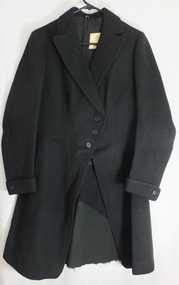
... Though an offer to build public baths to commemorate the Queen Victoria Jubilee in 1897 was not proceeded with, the town acquired a hospital, a reserve on Mount Leura, a clock tower and a cricket pavilion, as well as notable donations from the Manifolds to St Paul's Church and the grammar school. Edward was a keen polo player and racing man. He was also a successful owner of steeplechasers and a committeeman of the Victoria Racing Club for many years. He was also a member of many Western...Though an offer to build public baths to commemorate the Queen Victoria Jubilee in 1897 was not proceeded with, the town acquired a hospital, a reserve on Mount Leura, a clock tower and a cricket pavilion, as well as notable donations from the Manifolds to St Paul's Church and the grammar school. Edward was a keen polo player and racing man. He was also a successful owner of steeplechasers and a committeeman of the Victoria Racing Club for many years. He was also a member of many Western ...The Manifolds were a significant pioneering pastoral family in Western Victoria. The donated riding jacket originally belonged to Mrs Edward Manifold, formally Beatrice Mary Synnot Anderson. Beatrice was Edward Manifold’s cousin once removed whom he married in 1900. Edward, the son of John Manifold, was born on 15 November 1868 and educated at Geelong and Melbourne Grammar schools and at Trinity Hall, Cambridge (B.A., 1891). He chose the Danedite portion of land at Purrumbete, and on the death of his bachelor brother Thomas Peter (1863-1895), after a hunting accident, he took over his allocation, Wiridgil. He also owned Boortkoi, near Hexham and on these properties, he ran merino sheep, a Lincoln stud which dated back to 1870, and Shorthorn cattle. 3000 acres were also leased to dairy farmers. Edward was a member of Hampden Shire Council in 1909-31 and three times president at Camperdown. The town was largely bordered by Manifold land and partly dependent upon the local pastoral dynasties, which benefited the local area from the families’ various business interests. Though an offer to build public baths to commemorate the Queen Victoria Jubilee in 1897 was not proceeded with, the town acquired a hospital, a reserve on Mount Leura, a clock tower and a cricket pavilion, as well as notable donations from the Manifolds to St Paul's Church and the grammar school. Edward was a keen polo player and racing man. He was also a successful owner of steeplechasers and a committeeman of the Victoria Racing Club for many years. He was also a member of many Western District racing clubs. On the 16 July 1900, Edward had married his sixteen-year-old cousin Beatrice Mary Synnot Anderson by whom he had three sons Thomas Peter, Andrew and Robert Edward Manifold. Edwards's estate at his death was valued for probate at nearly £500,000. Edward died following an operation on 14 February 1931 at a private hospital in Yarra Vale Melbourne. Beatrice passed away in 1954, aged 79 in Ballarat where she was born in 1874. Contextual historic Family background: The Manifold brothers Thomas (1809-1875), John (1811-1877) and Peter (1817-1885) were the fourth, fifth and sixth sons of William Manifold and Mary, nee Barnes, of Courthouse Farm, Bromborough, Cheshire, England. The family had decided to emigrate to Van Diemen's Land. Thomas was sent ahead, arriving in Hobart Town on 23rd January 1828 with £1500 and a letter of recommendation from the Colonial Office. Thomas acquired 1280 acres on the west bank of the Tamar River. John and Peter, with their parents and three sisters, arrived on 8th July 1831. Land grants by then had finished but William brought ninety acres next to his son Thomas’ land and on the combined properties the family built Kelso House. The Manifolds’ properties were comparatively poor and when news of the Port Phillip District, in Victoria reached Thomas, he lost no time in coming to see for himself in February 1836. He was impressed with what he saw and hurried back to Tasmania to buy lambs and ewes. With one of his brothers, on July 9th he landed his stores at Point Henry and proceeded to occupy both sides of the Moorabool River. Thomas, at the end of the year, returned to Tasmania and left Peter and John to run the new property. Thomas, however, returned to Victoria for several visits and on one of these visits he, along with his brothers, examined the country near Ballarat. In December 1838 they managed to penetrate the Stony Rises, and Peter and John reached Lake Purrumbete and the Mount Leura country. During this time, on 4th July 1838, Thomas married Jane Elizabeth, eldest daughter of Captain Walter Synnot, formerly of Ballinate, County Armagh, Ireland, and then of Van Diemen's Land. Thomas joined his brothers, and they occupied the Purrumbete run in January 1839. On the journey to Purrumbete they could not take their stock and drays through the Stony Rises, so went north of Lake Corangamite, to the neck of land between it and Lake Gnarpurt. By April the move from Moorabool area was complete. As yet they had no hut and were working day and night, but their delight in their new run was unbounded. John wrote to his mother: “We are at last got to the land we wished for it is a beautiful place, and cannot be surpassed by any I have ever seen”. The three brothers occupied Purrumbete together, breeding both sheep and cattle until Thomas went to Grassmere run on the Merri River near Warrnambool in 1844. John and Peter soon gave up breeding sheep but retained the well-known '3M' brand for the cattle. These were Shorthorns, derived from four bulls originally imported by the Boldon brothers and later improved by further importations, and were renowned for size and quality. By the time of the gold rush in 1851, John and Peter were breeding over 1000 head a year, as well as fattening stores. The diggings at this time had disorganised Grassmere by drawing away Thomas's men, and his wife decided to take her two sons and two daughters to Europe for their education. Thomas gave up the property next year, went to England to join his family, and eventually brought the family back to live in Melbourne. At Purrumbete things were different. The brothers, John and Peter, preferred black stockmen to white, so the discovery of gold upset them very little while providing the very market they required. John was on his second visit to England when the rush started, and Peter went in his turn soon after John returned. On 2 September 1856 John married Marion Thomson, at Cormiston, Van Diemen's Land. They had four daughters and five sons, from three of whom, William Thomson, James Chester and Edward, the later generations of the family descend. Through the years the brothers had to contend with the scab, fluke and footrot, depression, rabbits, bush fires and pleuro-pneumonia. In 1861 they appointed as manager Henry Manifold Matson, their nephew, who had already been with them for five years. Thomas died in Melbourne on 7 November 1875, John at Purrumbete on 3 January 1877 and Peter at Purrumbete on 31 July 1885. Devout members of the Church of England, John and Peter, during their lives, gave generously towards building St Paul's Church, Camperdown, and guaranteed part of the vicar's stipend. Peter was a member of the Hampden and Heytesbury Roads Board from 1859 and carried on into the Hampden Shire Council when it was formed in 1864. However, it was not for public works that they were known, but for their personal example. In a new land where speculators and adventurers were all too common, the Manifold brothers were among those who intended it to be their home and their children's home. Industrious, unpretentious and hospitable, they were respected in their community as men of the highest integrity. This riding habit is a characteristic example of the type and style of riding clothes that well-dressed ladies wore in the 1920s. It highlights the changes that were beginning in society for women. Prior to 1918 ladies still had to ride side-saddle with skirts over Jodhpurs. Society of the time regarded women riding astride as unseemly and just not done. This riding habit is particularly significant on a number of levels, it shows the beginnings of change in society's attitudes through women's fashion after the First World War. A change that was to bring a start to a more liberating societal attitude towards women after the successful establishment of the Representation of People Act 1918 that gave women the right to vote. This garments provenance is linked to one of Victoria's important pioneering families the Manifolds, one of the first families that came from Van Diemen's land to settle the Western District of Victoria in 1844. Originally the garment belonged to the wife of the great-grandson of pioneer William Manifold, Edward Manifold who married Beatrice May Synnot Anderson, Edwards Cousin in 1900. The garment was made by the Mayfair tailors J. Busvine & Co. in the early to mid-1920s (estimate) who at the turn of the century were tailors to the Courts of Europe. Their clothing is highly collectible today and examples can be found in a number of significant museum collections around the world, notably the Metropolitan Museum of Art in New York and the FIDM in Los Angeles. A riding jacket, part of a three-piece, side saddle riding habit tailored for Mrs Edward Manifold. Knee length English woolen jacket black in colour, seamed and fitted to the female client's figure, fastening from the waist with three bone buttons to rather high lapels. The sleeves are long with closely fitted cuffs and one button and lined with cream satin. The jacket is fitted to the waist and flared to below the hips with a 35 cm vent to the back. Lower back to the jacket is reinforced with removable fabric and the jacket is lined with black twill cotton, there is a cream satin label, with makers' emblem Busvine. Circa 1920s Label to Jacket Embroidered in gold with a Royal logo on a Cream Satin label “By Special /Appointment” “To Her Majesty/The Queen”, “Busvine / Ltd / London 4 Brook St. W. / No” “hand written in purple ink 315 / Mrs Edward Manifold”flagstaff hill, warrnambool, shipwrecked coast, flagstaff hill maritime museum, maritime museum, side saddle riding habit, mrs edward manifold, edward manifold, busvines, shipwreck coast, flagstaff hill maritime village, great ocean road -
 Flagstaff Hill Maritime Museum and Village
Clothing - Riding Habit, Skirt, 1920s
... Though an offer to build public baths to commemorate the Queen Victoria Jubilee in 1897 was not proceeded with, the town acquired a hospital, a reserve on Mount Leura, a clock tower and a cricket pavilion, as well as notable donations from the Manifolds to St Paul's Church and the grammar school. Edward was a keen polo player and racing man. He was also a successful owner of steeplechasers and a committeeman of the Victoria Racing Club for many years. He was also a member of many Western...Though an offer to build public baths to commemorate the Queen Victoria Jubilee in 1897 was not proceeded with, the town acquired a hospital, a reserve on Mount Leura, a clock tower and a cricket pavilion, as well as notable donations from the Manifolds to St Paul's Church and the grammar school. Edward was a keen polo player and racing man. He was also a successful owner of steeplechasers and a committeeman of the Victoria Racing Club for many years. He was also a member of many Western ...The Manifolds were a significant pioneering pastoral family in Western Victoria. The donated riding skirt originally belonged to Mrs Edward Manifold, formally Beatrice Mary Synnot Anderson. Beatrice was Edward Manifold’s cousin once removed whom he married in 1900. Edward, the son of John Manifold, was born on 15 November 1868 and educated at Geelong and Melbourne Grammar schools and at Trinity Hall, Cambridge (B.A., 1891). He chose the Danedite portion of land at Purrumbete, and on the death of his bachelor brother Thomas Peter (1863-1895), after a hunting accident, he took over his allocation, Wiridgil. He also owned Boortkoi, near Hexham and on these properties, he ran merino sheep, a Lincoln stud which dated back to 1870, and Shorthorn cattle. 3000 acres were also leased to dairy farmers. Edward was a member of Hampden Shire Council in 1909-31 and three times president at Camperdown. The town was largely bordered by Manifold land and partly dependent upon the local pastoral dynasties, which benefited the local area from the families’ various business interests. Though an offer to build public baths to commemorate the Queen Victoria Jubilee in 1897 was not proceeded with, the town acquired a hospital, a reserve on Mount Leura, a clock tower and a cricket pavilion, as well as notable donations from the Manifolds to St Paul's Church and the grammar school. Edward was a keen polo player and racing man. He was also a successful owner of steeplechasers and a committeeman of the Victoria Racing Club for many years. He was also a member of many Western District racing clubs. On the 16 July 1900, Edward had married his sixteen-year-old cousin Beatrice Mary Synnot Anderson by whom he had three sons Thomas Peter, Andrew and Robert Edward Manifold. Edwards's estate at his death was valued for probate at nearly £500,000. Edward died following an operation on 14 February 1931 at a private hospital in Yarra Vale Melbourne. Beatrice passed away in 1954, aged 79 in Ballarat where she was born in 1874. Contextual historic Family background: The Manifold brothers Thomas (1809-1875), John (1811-1877) and Peter (1817-1885) were the fourth, fifth and sixth sons of William Manifold and Mary, nee Barnes, of Courthouse Farm, Bromborough, Cheshire, England. The family had decided to emigrate to Van Diemen's Land. Thomas was sent ahead, arriving in Hobart Town on 23rd January 1828 with £1500 and a letter of recommendation from the Colonial Office. Thomas acquired 1280 acres on the west bank of the Tamar River. John and Peter, with their parents and three sisters, arrived on 8th July 1831. Land grants by then had finished but William brought ninety acres next to his son Thomas’ land and on the combined properties the family built Kelso House. The Manifolds’ properties were comparatively poor and when news of the Port Phillip District, in Victoria reached Thomas, he lost no time in coming to see for himself in February 1836. He was impressed with what he saw and hurried back to Tasmania to buy lambs and ewes. With one of his brothers, on July 9th he landed his stores at Point Henry and proceeded to occupy both sides of the Moorabool River. Thomas, at the end of the year, returned to Tasmania and left Peter and John to run the new property. Thomas, however, returned to Victoria for several visits and on one of these visits he, along with his brothers, examined the country near Ballarat. In December 1838 they managed to penetrate the Stony Rises, and Peter and John reached Lake Purrumbete and the Mount Leura country. During this time, on 4th July 1838, Thomas married Jane Elizabeth, eldest daughter of Captain Walter Synnot, formerly of Ballinate, County Armagh, Ireland, and then of Van Diemen's Land. Thomas joined his brothers, and they occupied the Purrumbete run in January 1839. On the journey to Purrumbete they could not take their stock and drays through the Stony Rises, so went north of Lake Corangamite, to the neck of land between it and Lake Gnarpurt. By April the move from Moorabool area was complete. As yet they had no hut and were working day and night, but their delight in their new run was unbounded. John wrote to his mother: “We are at last got to the land we wished for it is a beautiful place, and cannot be surpassed by any I have ever seen”. The three brothers occupied Purrumbete together, breeding both sheep and cattle until Thomas went to Grassmere run on the Merri River near Warrnambool in 1844. John and Peter soon gave up breeding sheep but retained the well-known '3M' brand for the cattle. These were Shorthorns, derived from four bulls originally imported by the Boldon brothers and later improved by further importations, and were renowned for size and quality. By the time of the gold rush in 1851, John and Peter were breeding over 1000 head a year, as well as fattening stores. The diggings at this time had disorganised Grassmere by drawing away Thomas's men, and his wife decided to take her two sons and two daughters to Europe for their education. Thomas gave up the property next year, went to England to join his family, and eventually brought the family back to live in Melbourne. At Purrumbete things were different. The brothers, John and Peter, preferred black stockmen to white, so the discovery of gold upset them very little while providing the very market they required. John was on his second visit to England when the rush started, and Peter went in his turn soon after John returned. On 2 September 1856 John married Marion Thomson, at Cormiston, Van Diemen's Land. They had four daughters and five sons, from three of whom, William Thomson, James Chester and Edward, the later generations of the family descend. Through the years the brothers had to contend with the scab, fluke and footrot, depression, rabbits, bush fires and pleuro-pneumonia. In 1861 they appointed as manager Henry Manifold Matson, their nephew, who had already been with them for five years. Thomas died in Melbourne on 7 November 1875, John at Purrumbete on 3 January 1877 and Peter at Purrumbete on 31 July 1885. Devout members of the Church of England, John and Peter, during their lives, gave generously towards building St Paul's Church, Camperdown, and guaranteed part of the vicar's stipend. Peter was a member of the Hampden and Heytesbury Roads Board from 1859 and carried on into the Hampden Shire Council when it was formed in 1864. However, it was not for public works that they were known, but for their personal example. In a new land where speculators and adventurers were all too common, the Manifold brothers were among those who intended it to be their home and their children's home. Industrious, unpretentious and hospitable, they were respected in their community as men of the highest integrity. This riding habit is a characteristic example of the type and style of riding clothes that well-dressed ladies wore in the 1920s. It highlights the changes that were beginning in society for women. Prior to 1918 ladies still had to ride side-saddle with skirts over Jodhpurs. Society of the time regarded women riding astride as unseemly and just not done. This riding habit is particularly significant on a number of levels, it shows the beginnings of change in society's attitudes through women's fashion after the First World War. A change that was to bring a start to a more liberating societal attitude towards women after the successful establishment of the Representation of People Act 1918 that gave women the right to vote. This garments provenance is linked to one of Victoria's important pioneering families the Manifolds, one of the first families that came from Van Diemen's land to settle the Western District of Victoria in 1844. Originally the garment belonged to the wife of the great-grandson of pioneer William Manifold, Edward Manifold who married Beatrice May Synnot Anderson, Edwards Cousin in 1900. The garment was made by the Mayfair tailors J. Busvine & Co. in the early to mid-1920s (estimate) who at the turn of the century were tailors to the Courts of Europe. Their clothing is highly collectible today and examples can be found in a number of significant museum collections around the world, notably the Metropolitan Museum of Art in New York and the FIDM in Los Angeles. Safety skirt/apron, part of a three-piece, side saddle riding habit tailored for Mrs Edward Manifold. This side saddle skirt is made from black woolen material fixing at the waist with two metal hooks and three buttons to the front opening. One internal concealed pocket lining to the top part of the apron made of cotton the seat is shaped for side saddle riding and the skirt wraps around the body the longer side draped over the leg that is in the stirrup. flagstaff hill, warrnambool, shipwrecked coast, flagstaff hill maritime museum, maritime museum, side saddle riding habit, side saddle safety skirt, side saddle apron, mrs edward manifold, beatrice manifold, female riding habit 1920s, shipwreck coast, flagstaff hill maritime village, great ocean road -
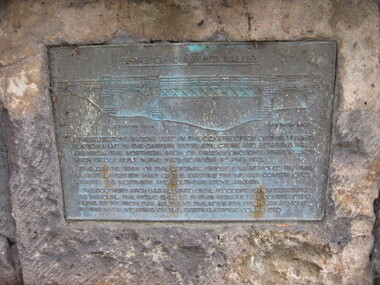 Greensborough Historical Society
Photograph - Digital image, Dennis Ward, Bridge Plaque - Pioneer Park Greensborough, 27/03/2010
... Reserve Greensborough: "Shire of Diamond Valley. The bluestones used in the construction of this viewing platform and in the carpark entry structure and retaining wall are from the northern arch of Greensborough's first Plenty River Bridge built in the 1860s adjacent to this site. The centre span of the original bridge was removed in 1865 when the western...Reserve Greensborough: "Shire of Diamond Valley. The bluestones used in the construction of this viewing platform and in the carpark entry structure and retaining wall are from the northern arch of Greensborough's first Plenty River Bridge built in the 1860s adjacent to this site. The centre span of the original bridge was removed in 1865 when the western ...Plaque at Pioneer Reserve Greensborough: "Shire of Diamond Valley. The bluestones used in the construction of this viewing platform and in the carpark entry structure and retaining wall are from the northern arch of Greensborough's first Plenty River Bridge built in the 1860s adjacent to this site. The centre span of the original bridge was removed in 1865 when the western half of the existing bridge was constructed leaving the northern and southern stone arches. The southern arch was retained until floods in 1874 necessitated its removal. The picnic shelter in this reserve was constructed using stone from this abutment. The northern arch was removed in 1983 when widening of the existing bridge commenced."Digital copy of colour photograph.plenty river, pioneer reserve greensborough -
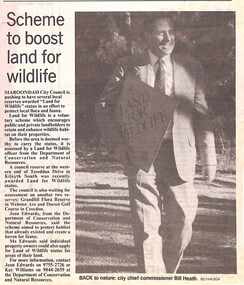 Ringwood and District Historical Society
Newspaper, Scrapbook Clipping, Library Collection, Ringwood, Victoria, `
... A council reserve at the western end of Tereddan Drive in Kilsyth South was recently awarded Land for Wildlife Status...A council reserve at the western end of Tereddan Drive in Kilsyth South was recently awarded Land for Wildlife Status Newspaper clipping from "The Mail", 4-7-95, P 6. ...``Newspaper clipping from "The Mail", 4-7-95, P 6. NEWS WATCH- Scheme to boost land for wildlife Maroondah City Council is pushing to have several local reserves awarded "Land for Wildlife" status in an effort to protect local flora and fauna. A council reserve at the western end of Tereddan Drive in Kilsyth South was recently awarded Land for Wildlife Status` -
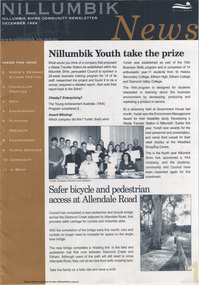 Eltham District Historical Society Inc
Journal - Newsletter, Nillumbik Shire Council, Nillumbik News, December 1999
... Planning issues with works to "underground" powerlines on the western side of Main Road in Eltham, plans for an environmental reserve in Falkiner Street, Eltham. ...Planning issues with works to "underground" powerlines on the western side of Main Road in Eltham, plans for an environmental reserve in Falkiner Street, Eltham. ...Community newsletter produced by the Shire of Nillumbik for December 1999. Includes articles on a youth project, bicycle bridge at Allendale Road, mayor's message, incuding year's report, Eltham festival, profiles of Councillors, latest acquistion for the Nillumbik Art Collection "Sensory Integration Invention A" by Cathy Smith and other art and culture news, agriculture and the new planning scheme with mention of local businesses. Planning issues with works to "underground" powerlines on the western side of Main Road in Eltham, plans for an environmental reserve in Falkiner Street, Eltham. Articles on radiant heat and new national road rules, Disability access policy, tennis, youth, Bend of Islands, VCAT order to reinstate vegetation removed illegally by an Eltham property owner, roundabout at Wattle Glen, and road sealing works.council newsletters, nillumbik news, nillumbik shire council, shire of nillumbik, youth, st helena secondary college, eltham high school, eltham college, eltham festival, vika bull, linda bull, paul french, dianne bullen, cr. phillip hughes, julie barber, nillumbik art collection, gayle knight, monty osewald, robyn harris, john harris, alec sutherland, falkiner street, jessica monk, kristian turner, gyuto monks of tibet, gyuto monks, haydie gooder, brougham street, radiant heat, road rules, disability, bend of islands, carol bonny, alan bonny, felicity faris, wattle glen, cr. bill penrose, norman golgerth, andre haemeyer, chris doherty, john munday -
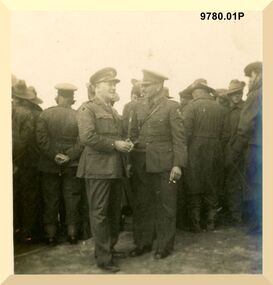 Bendigo Military Museum
Photograph - FRED CARLETON 2/23RD ALBUM, Lebanon
... Reserve list of Officers with the rank of Colonel & Honorary Brigadier. Lt Col Evans VX478119. Bernard Evans had service going back to 1924. Enlisted in the 2nd AIF on 22.7.1940. His overseas service is listed as Middle East 16.11.1940 - 30.3.1943 - New Guinea 20.7.1943 - 10.11.1943, discharged fro m the AIF on 22.10.1945 with the rank of Colonel, awarded the DSO. .02P) Believed to be Benjamin Thomas Shiels VX58180, enlisted 24.6.1941, embarked for the Middle East 3.9.1941, KIA 29.10.1942. Joe Harrison is not yet identified. 2/23rd Battalion Tobruk El Alamein Western ...Frederick Lloyd Carleton VX1555 served in the 2/23rd Battalion, 9th Division in the Middle East and in the Pacific. The images detail his day to day life at the front and on leave. He served during the siege of Tobruk and at El Alamein, and was a lifelong member of the Bendigo sub-branch of the Rats of Tobruk Association. Refer Cat No 142.7 for his full service history. .01P) Brigadier R.W. Tovell, CBE, DSO & Bar, ED - MID 5 times. He had 5.5 years pre WW1 service in the Cadets, on discharge he held the rank of Lieutenant. Enlisted in the AIF 28.4.1915 age 29 years, appointed Lt 6.7.1915 in 2nd Reinforcements 29th BN. Embark for Eygpt 29.12.1915, embark for France 4.6.1916. He rose through the Ranks in various Commands to Brigade Major by 19.2.1918. Awarded MID24.10.1918, DSO & MID on 23.5.1919, MID on 30.10.1919. Appointment terminated in the AIF on 12.12.1920. Stayed on in the full time Army to be T/Brigader on 14.10.1939 to Command the 10th INF Brigade. Transfers to the 2nd AIF 1.7.1940 No VX46983and appointed to Command the 26th Brigade. Overseas service listed as Middle East 16.11.1940 - 10.11.1942. New Guinea 17.2.19144 - 21.3.1944 & 10.3.1945 - 23.3.1945, Darwin area 8.9.1944 - 19.9.1944. Awarded Bar to the DSO 30.12.1941, MID 26.6.1942 & 15.12.1942, CBE 15.4.1943. Appointed Deputy Adjutant General 3.5.1944, appointment terminated in the 2nd AIF on 20.12.1945, placed on the Reserve list of Officers with the rank of Colonel & Honorary Brigadier. Lt Col Evans VX478119. Bernard Evans had service going back to 1924. Enlisted in the 2nd AIF on 22.7.1940. His overseas service is listed as Middle East 16.11.1940 - 30.3.1943 - New Guinea 20.7.1943 - 10.11.1943, discharged fro m the AIF on 22.10.1945 with the rank of Colonel, awarded the DSO. .02P) Believed to be Benjamin Thomas Shiels VX58180, enlisted 24.6.1941, embarked for the Middle East 3.9.1941, KIA 29.10.1942. Joe Harrison is not yet identified. Collection of 76 photographs taken during service in 2/23rd in Middle EastSome photographs have inscriptions on the verso, and this information is included in the title information displayed when the image is clicked on.2/23rd battalion, tobruk, el alamein, western desert campain, fred carleton -
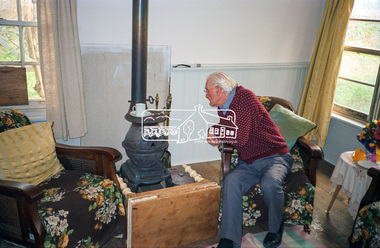 Eltham District Historical Society Inc
Photograph, Hans Gregory, Original 1860s William West house, Fabbro's Farm, Falkiner Street, Eltham, c.1990
... The land on the eastern side of Falkiner Street now forms part of a Council reserve called “Barak Bushland”, the land on the western side having been sold off for residential subdivision. ...The land on the eastern side of Falkiner Street now forms part of a Council reserve called “Barak Bushland”, the land on the western side having been sold off for residential subdivision. ...Photos taken by Hans Gregory who along with partner Pauline Steele, rented the original old 1860s William West Cottage situated behind the Fabbro family home. Hans was employed as a Youth officer with the Shire of Eltham at the time and was the last tennant on the property. The property was sold and in 1995 was developed for residential housing as the Riverview Park estate. Guido Quarto Fabbro was born 21 August 1891 at Treppo Grande in the far northeast of Italy, the son of Giacomo Fabbro and Anna Geruzzi. Regina Moretti was born 6 March 1893 at Treppo Grande, Italy, the daughter of Giovanni Battista Moretti and Maria Teresa Coletti. Guido and Regina married about 1917 and they had two sons, Giacomo (John c.1918) and Maurie (c.1920). In 1925 Guido Fabbro departed his homeland from Genoa, arriving in Fremantle, Western Australia in June, travelling 3rd class aboard the ship, Caprera. Regina and their two boys followed a year later along with other family members arriving in Fremantle from Genoa 4 July 1926 aboard the Moncalieri. The Fabbros arrived in Eltham in 1933 and purchased a block of land from William West on the western side of Falkiner Street, extending to Ely and Porter Streets which had formerly been part of the West family orchard and dairy farm. As there was no fencing dividing the two properties, West served notice on Guido in December 1934 to bear half of the cost of £6. When payment was not forthcoming, West sued Guido in the Eltham Court in January 1935. Guido failed to appear and was not represented, and costs were ordered in West’s favour. Guido and Regina built a large Italianesque house on their property. The original 1860s cottage was relocated to the back of the block and was rented out (once to Alistair and Margot Knox). Guido also purchased land extending to the Diamond Creek on the eastern side of Falkiner Street and on the eastern side of Bell Street (opposite Eltham High School). The riparian soil was suitable for market gardening: Guido grew mainly tomatoes, but also pumpkins, cauliflowers, cabbages, peas, beans, lettuce, beetroot and zucchinis. Even the land surrounding the house was used. The produce was carted to Melbourne overnight for sale at the market. Guido died in 1970 and is buried in Eltham cemetery. Regina died 1986. She and their son John Patrick (Giacomo) Fabbro who died in 1984 are also buried at Eltham Cemetery. Guido’s son Maurie continued in his father’s footsteps until 2007, principally growing artichokes in later years. He died in 2009. The land on the eastern side of Falkiner Street now forms part of a Council reserve called “Barak Bushland”, the land on the western side having been sold off for residential subdivision. The Bell Street land is now public open space managed by Nillumbik Shire Council and called “Fabbro Fields”. There have been recent proposals to develop the site for sporting purposes or as a dog park or community garden. Provides an insight into early settler's farmhouses and farming property of the Eltham district.guido quarto fabbro, regina fabbro (nee moretti), william west, maurie fabbro, fabbro's farm, hans gregory, west family orchard, west dairy farm -
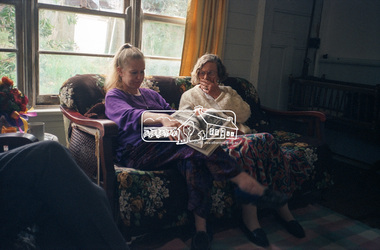 Eltham District Historical Society Inc
Photograph, Hans Gregory, Original 1860s William West house, Fabbro's Farm, Falkiner Street, Eltham, c.1990
... The land on the eastern side of Falkiner Street now forms part of a Council reserve called “Barak Bushland”, the land on the western side having been sold off for residential subdivision. ...The land on the eastern side of Falkiner Street now forms part of a Council reserve called “Barak Bushland”, the land on the western side having been sold off for residential subdivision. ...Photos taken by Hans Gregory who along with partner Pauline Steele, rented the original old 1860s William West Cottage situated behind the Fabbro family home. Hans was employed as a Youth officer with the Shire of Eltham at the time and was the last tennant on the property. The property was sold and in 1995 was developed for residential housing as the Riverview Park estate. Guido Quarto Fabbro was born 21 August 1891 at Treppo Grande in the far northeast of Italy, the son of Giacomo Fabbro and Anna Geruzzi. Regina Moretti was born 6 March 1893 at Treppo Grande, Italy, the daughter of Giovanni Battista Moretti and Maria Teresa Coletti. Guido and Regina married about 1917 and they had two sons, Giacomo (John c.1918) and Maurie (c.1920). In 1925 Guido Fabbro departed his homeland from Genoa, arriving in Fremantle, Western Australia in June, travelling 3rd class aboard the ship, Caprera. Regina and their two boys followed a year later along with other family members arriving in Fremantle from Genoa 4 July 1926 aboard the Moncalieri. The Fabbros arrived in Eltham in 1933 and purchased a block of land from William West on the western side of Falkiner Street, extending to Ely and Porter Streets which had formerly been part of the West family orchard and dairy farm. As there was no fencing dividing the two properties, West served notice on Guido in December 1934 to bear half of the cost of £6. When payment was not forthcoming, West sued Guido in the Eltham Court in January 1935. Guido failed to appear and was not represented, and costs were ordered in West’s favour. Guido and Regina built a large Italianesque house on their property. The original 1860s cottage was relocated to the back of the block and was rented out (once to Alistair and Margot Knox). Guido also purchased land extending to the Diamond Creek on the eastern side of Falkiner Street and on the eastern side of Bell Street (opposite Eltham High School). The riparian soil was suitable for market gardening: Guido grew mainly tomatoes, but also pumpkins, cauliflowers, cabbages, peas, beans, lettuce, beetroot and zucchinis. Even the land surrounding the house was used. The produce was carted to Melbourne overnight for sale at the market. Guido died in 1970 and is buried in Eltham cemetery. Regina died 1986. She and their son John Patrick (Giacomo) Fabbro who died in 1984 are also buried at Eltham Cemetery. Guido’s son Maurie continued in his father’s footsteps until 2007, principally growing artichokes in later years. He died in 2009. The land on the eastern side of Falkiner Street now forms part of a Council reserve called “Barak Bushland”, the land on the western side having been sold off for residential subdivision. The Bell Street land is now public open space managed by Nillumbik Shire Council and called “Fabbro Fields”. There have been recent proposals to develop the site for sporting purposes or as a dog park or community garden. Provides an insight into early settler's farmhouses and farming property of the Eltham district.guido quarto fabbro, regina fabbro (nee moretti), william west, maurie fabbro, fabbro's farm, hans gregory, west family orchard, west dairy farm -
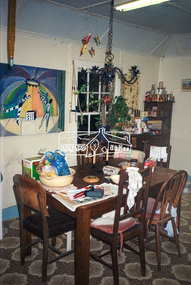 Eltham District Historical Society Inc
Photograph, Hans Gregory, Original 1860s William West house, Fabbro's Farm, Falkiner Street, Eltham, c.1990
... The land on the eastern side of Falkiner Street now forms part of a Council reserve called “Barak Bushland”, the land on the western side having been sold off for residential subdivision. ...The land on the eastern side of Falkiner Street now forms part of a Council reserve called “Barak Bushland”, the land on the western side having been sold off for residential subdivision. ...Photos taken by Hans Gregory who along with partner Pauline Steele, rented the original old 1860s William West Cottage situated behind the Fabbro family home. Hans was employed as a Youth officer with the Shire of Eltham at the time and was the last tennant on the property. The property was sold and in 1995 was developed for residential housing as the Riverview Park estate. Guido Quarto Fabbro was born 21 August 1891 at Treppo Grande in the far northeast of Italy, the son of Giacomo Fabbro and Anna Geruzzi. Regina Moretti was born 6 March 1893 at Treppo Grande, Italy, the daughter of Giovanni Battista Moretti and Maria Teresa Coletti. Guido and Regina married about 1917 and they had two sons, Giacomo (John c.1918) and Maurie (c.1920). In 1925 Guido Fabbro departed his homeland from Genoa, arriving in Fremantle, Western Australia in June, travelling 3rd class aboard the ship, Caprera. Regina and their two boys followed a year later along with other family members arriving in Fremantle from Genoa 4 July 1926 aboard the Moncalieri. The Fabbros arrived in Eltham in 1933 and purchased a block of land from William West on the western side of Falkiner Street, extending to Ely and Porter Streets which had formerly been part of the West family orchard and dairy farm. As there was no fencing dividing the two properties, West served notice on Guido in December 1934 to bear half of the cost of £6. When payment was not forthcoming, West sued Guido in the Eltham Court in January 1935. Guido failed to appear and was not represented, and costs were ordered in West’s favour. Guido and Regina built a large Italianesque house on their property. The original 1860s cottage was relocated to the back of the block and was rented out (once to Alistair and Margot Knox). Guido also purchased land extending to the Diamond Creek on the eastern side of Falkiner Street and on the eastern side of Bell Street (opposite Eltham High School). The riparian soil was suitable for market gardening: Guido grew mainly tomatoes, but also pumpkins, cauliflowers, cabbages, peas, beans, lettuce, beetroot and zucchinis. Even the land surrounding the house was used. The produce was carted to Melbourne overnight for sale at the market. Guido died in 1970 and is buried in Eltham cemetery. Regina died 1986. She and their son John Patrick (Giacomo) Fabbro who died in 1984 are also buried at Eltham Cemetery. Guido’s son Maurie continued in his father’s footsteps until 2007, principally growing artichokes in later years. He died in 2009. The land on the eastern side of Falkiner Street now forms part of a Council reserve called “Barak Bushland”, the land on the western side having been sold off for residential subdivision. The Bell Street land is now public open space managed by Nillumbik Shire Council and called “Fabbro Fields”. There have been recent proposals to develop the site for sporting purposes or as a dog park or community garden. Provides an insight into early settler's farmhouses and farming property of the Eltham district.guido quarto fabbro, regina fabbro (nee moretti), william west, maurie fabbro, fabbro's farm, hans gregory, west family orchard, west dairy farm -
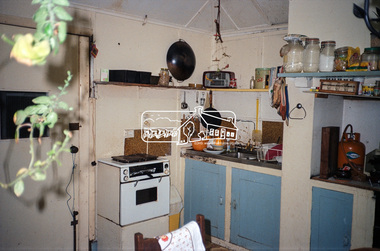 Eltham District Historical Society Inc
Photograph, Hans Gregory, Original 1860s William West house, Fabbro's Farm, Falkiner Street, Eltham, c.1990
... The land on the eastern side of Falkiner Street now forms part of a Council reserve called “Barak Bushland”, the land on the western side having been sold off for residential subdivision. ...The land on the eastern side of Falkiner Street now forms part of a Council reserve called “Barak Bushland”, the land on the western side having been sold off for residential subdivision. ...Photos taken by Hans Gregory who along with partner Pauline Steele, rented the original old 1860s William West Cottage situated behind the Fabbro family home. Hans was employed as a Youth officer with the Shire of Eltham at the time and was the last tennant on the property. The property was sold and in 1995 was developed for residential housing as the Riverview Park estate. Guido Quarto Fabbro was born 21 August 1891 at Treppo Grande in the far northeast of Italy, the son of Giacomo Fabbro and Anna Geruzzi. Regina Moretti was born 6 March 1893 at Treppo Grande, Italy, the daughter of Giovanni Battista Moretti and Maria Teresa Coletti. Guido and Regina married about 1917 and they had two sons, Giacomo (John c.1918) and Maurie (c.1920). In 1925 Guido Fabbro departed his homeland from Genoa, arriving in Fremantle, Western Australia in June, travelling 3rd class aboard the ship, Caprera. Regina and their two boys followed a year later along with other family members arriving in Fremantle from Genoa 4 July 1926 aboard the Moncalieri. The Fabbros arrived in Eltham in 1933 and purchased a block of land from William West on the western side of Falkiner Street, extending to Ely and Porter Streets which had formerly been part of the West family orchard and dairy farm. As there was no fencing dividing the two properties, West served notice on Guido in December 1934 to bear half of the cost of £6. When payment was not forthcoming, West sued Guido in the Eltham Court in January 1935. Guido failed to appear and was not represented, and costs were ordered in West’s favour. Guido and Regina built a large Italianesque house on their property. The original 1860s cottage was relocated to the back of the block and was rented out (once to Alistair and Margot Knox). Guido also purchased land extending to the Diamond Creek on the eastern side of Falkiner Street and on the eastern side of Bell Street (opposite Eltham High School). The riparian soil was suitable for market gardening: Guido grew mainly tomatoes, but also pumpkins, cauliflowers, cabbages, peas, beans, lettuce, beetroot and zucchinis. Even the land surrounding the house was used. The produce was carted to Melbourne overnight for sale at the market. Guido died in 1970 and is buried in Eltham cemetery. Regina died 1986. She and their son John Patrick (Giacomo) Fabbro who died in 1984 are also buried at Eltham Cemetery. Guido’s son Maurie continued in his father’s footsteps until 2007, principally growing artichokes in later years. He died in 2009. The land on the eastern side of Falkiner Street now forms part of a Council reserve called “Barak Bushland”, the land on the western side having been sold off for residential subdivision. The Bell Street land is now public open space managed by Nillumbik Shire Council and called “Fabbro Fields”. There have been recent proposals to develop the site for sporting purposes or as a dog park or community garden. Provides an insight into early settler's farmhouses and farming property of the Eltham district.guido quarto fabbro, regina fabbro (nee moretti), william west, maurie fabbro, fabbro's farm, hans gregory, west family orchard, west dairy farm -
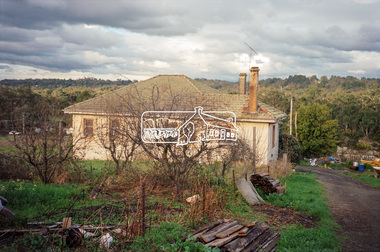 Eltham District Historical Society Inc
Photograph, Hans Gregory, Original 1860s William West house, Fabbro's Farm, Falkiner Street, Eltham, c.1990
... The land on the eastern side of Falkiner Street now forms part of a Council reserve called “Barak Bushland”, the land on the western side having been sold off for residential subdivision. ...The land on the eastern side of Falkiner Street now forms part of a Council reserve called “Barak Bushland”, the land on the western side having been sold off for residential subdivision. ...Photos taken by Hans Gregory who along with partner Pauline Steele, rented the original old 1860s William West Cottage situated behind the Fabbro family home. Hans was employed as a Youth officer with the Shire of Eltham at the time and was the last tennant on the property. The property was sold and in 1995 was developed for residential housing as the Riverview Park estate. Guido Quarto Fabbro was born 21 August 1891 at Treppo Grande in the far northeast of Italy, the son of Giacomo Fabbro and Anna Geruzzi. Regina Moretti was born 6 March 1893 at Treppo Grande, Italy, the daughter of Giovanni Battista Moretti and Maria Teresa Coletti. Guido and Regina married about 1917 and they had two sons, Giacomo (John c.1918) and Maurie (c.1920). In 1925 Guido Fabbro departed his homeland from Genoa, arriving in Fremantle, Western Australia in June, travelling 3rd class aboard the ship, Caprera. Regina and their two boys followed a year later along with other family members arriving in Fremantle from Genoa 4 July 1926 aboard the Moncalieri. The Fabbros arrived in Eltham in 1933 and purchased a block of land from William West on the western side of Falkiner Street, extending to Ely and Porter Streets which had formerly been part of the West family orchard and dairy farm. As there was no fencing dividing the two properties, West served notice on Guido in December 1934 to bear half of the cost of £6. When payment was not forthcoming, West sued Guido in the Eltham Court in January 1935. Guido failed to appear and was not represented, and costs were ordered in West’s favour. Guido and Regina built a large Italianesque house on their property. The original 1860s cottage was relocated to the back of the block and was rented out (once to Alistair and Margot Knox). Guido also purchased land extending to the Diamond Creek on the eastern side of Falkiner Street and on the eastern side of Bell Street (opposite Eltham High School). The riparian soil was suitable for market gardening: Guido grew mainly tomatoes, but also pumpkins, cauliflowers, cabbages, peas, beans, lettuce, beetroot and zucchinis. Even the land surrounding the house was used. The produce was carted to Melbourne overnight for sale at the market. Guido died in 1970 and is buried in Eltham cemetery. Regina died 1986. She and their son John Patrick (Giacomo) Fabbro who died in 1984 are also buried at Eltham Cemetery. Guido’s son Maurie continued in his father’s footsteps until 2007, principally growing artichokes in later years. He died in 2009. The land on the eastern side of Falkiner Street now forms part of a Council reserve called “Barak Bushland”, the land on the western side having been sold off for residential subdivision. The Bell Street land is now public open space managed by Nillumbik Shire Council and called “Fabbro Fields”. There have been recent proposals to develop the site for sporting purposes or as a dog park or community garden. Provides an insight into early settler's farmhouses and farming property of the Eltham district.guido quarto fabbro, regina fabbro (nee moretti), william west, maurie fabbro, fabbro's farm, hans gregory, west family orchard, west dairy farm -
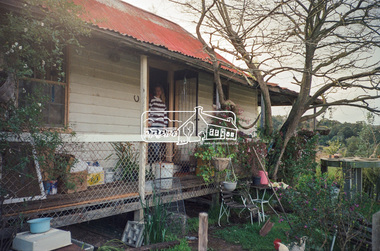 Eltham District Historical Society Inc
Photograph, Hans Gregory, Original 1860s William West house, Fabbro's Farm, Falkiner Street, Eltham, c.1990
... The land on the eastern side of Falkiner Street now forms part of a Council reserve called “Barak Bushland”, the land on the western side having been sold off for residential subdivision. ...The land on the eastern side of Falkiner Street now forms part of a Council reserve called “Barak Bushland”, the land on the western side having been sold off for residential subdivision. ...Photos taken by Hans Gregory who along with partner Pauline Steele, rented the original old 1860s William West Cottage situated behind the Fabbro family home. Hans was employed as a Youth officer with the Shire of Eltham at the time and was the last tennant on the property. The property was sold and in 1995 was developed for residential housing as the Riverview Park estate. Guido Quarto Fabbro was born 21 August 1891 at Treppo Grande in the far northeast of Italy, the son of Giacomo Fabbro and Anna Geruzzi. Regina Moretti was born 6 March 1893 at Treppo Grande, Italy, the daughter of Giovanni Battista Moretti and Maria Teresa Coletti. Guido and Regina married about 1917 and they had two sons, Giacomo (John c.1918) and Maurie (c.1920). In 1925 Guido Fabbro departed his homeland from Genoa, arriving in Fremantle, Western Australia in June, travelling 3rd class aboard the ship, Caprera. Regina and their two boys followed a year later along with other family members arriving in Fremantle from Genoa 4 July 1926 aboard the Moncalieri. The Fabbros arrived in Eltham in 1933 and purchased a block of land from William West on the western side of Falkiner Street, extending to Ely and Porter Streets which had formerly been part of the West family orchard and dairy farm. As there was no fencing dividing the two properties, West served notice on Guido in December 1934 to bear half of the cost of £6. When payment was not forthcoming, West sued Guido in the Eltham Court in January 1935. Guido failed to appear and was not represented, and costs were ordered in West’s favour. Guido and Regina built a large Italianesque house on their property. The original 1860s cottage was relocated to the back of the block and was rented out (once to Alistair and Margot Knox). Guido also purchased land extending to the Diamond Creek on the eastern side of Falkiner Street and on the eastern side of Bell Street (opposite Eltham High School). The riparian soil was suitable for market gardening: Guido grew mainly tomatoes, but also pumpkins, cauliflowers, cabbages, peas, beans, lettuce, beetroot and zucchinis. Even the land surrounding the house was used. The produce was carted to Melbourne overnight for sale at the market. Guido died in 1970 and is buried in Eltham cemetery. Regina died 1986. She and their son John Patrick (Giacomo) Fabbro who died in 1984 are also buried at Eltham Cemetery. Guido’s son Maurie continued in his father’s footsteps until 2007, principally growing artichokes in later years. He died in 2009. The land on the eastern side of Falkiner Street now forms part of a Council reserve called “Barak Bushland”, the land on the western side having been sold off for residential subdivision. The Bell Street land is now public open space managed by Nillumbik Shire Council and called “Fabbro Fields”. There have been recent proposals to develop the site for sporting purposes or as a dog park or community garden. Provides an insight into early settler's farmhouses and farming property of the Eltham district.guido quarto fabbro, regina fabbro (nee moretti), william west, maurie fabbro, fabbro's farm, hans gregory, west family orchard, west dairy farm -
 Eltham District Historical Society Inc
Photograph, Hans Gregory, Original 1860s William West house, Fabbro's Farm, Falkiner Street, Eltham, c.1990
... The land on the eastern side of Falkiner Street now forms part of a Council reserve called “Barak Bushland”, the land on the western side having been sold off for residential subdivision. ...The land on the eastern side of Falkiner Street now forms part of a Council reserve called “Barak Bushland”, the land on the western side having been sold off for residential subdivision. ...Photos taken by Hans Gregory who along with partner Pauline Steele, rented the original old 1860s William West Cottage situated behind the Fabbro family home. Hans was employed as a Youth officer with the Shire of Eltham at the time and was the last tennant on the property. The property was sold and in 1995 was developed for residential housing as the Riverview Park estate. Guido Quarto Fabbro was born 21 August 1891 at Treppo Grande in the far northeast of Italy, the son of Giacomo Fabbro and Anna Geruzzi. Regina Moretti was born 6 March 1893 at Treppo Grande, Italy, the daughter of Giovanni Battista Moretti and Maria Teresa Coletti. Guido and Regina married about 1917 and they had two sons, Giacomo (John c.1918) and Maurie (c.1920). In 1925 Guido Fabbro departed his homeland from Genoa, arriving in Fremantle, Western Australia in June, travelling 3rd class aboard the ship, Caprera. Regina and their two boys followed a year later along with other family members arriving in Fremantle from Genoa 4 July 1926 aboard the Moncalieri. The Fabbros arrived in Eltham in 1933 and purchased a block of land from William West on the western side of Falkiner Street, extending to Ely and Porter Streets which had formerly been part of the West family orchard and dairy farm. As there was no fencing dividing the two properties, West served notice on Guido in December 1934 to bear half of the cost of £6. When payment was not forthcoming, West sued Guido in the Eltham Court in January 1935. Guido failed to appear and was not represented, and costs were ordered in West’s favour. Guido and Regina built a large Italianesque house on their property. The original 1860s cottage was relocated to the back of the block and was rented out (once to Alistair and Margot Knox). Guido also purchased land extending to the Diamond Creek on the eastern side of Falkiner Street and on the eastern side of Bell Street (opposite Eltham High School). The riparian soil was suitable for market gardening: Guido grew mainly tomatoes, but also pumpkins, cauliflowers, cabbages, peas, beans, lettuce, beetroot and zucchinis. Even the land surrounding the house was used. The produce was carted to Melbourne overnight for sale at the market. Guido died in 1970 and is buried in Eltham cemetery. Regina died 1986. She and their son John Patrick (Giacomo) Fabbro who died in 1984 are also buried at Eltham Cemetery. Guido’s son Maurie continued in his father’s footsteps until 2007, principally growing artichokes in later years. He died in 2009. The land on the eastern side of Falkiner Street now forms part of a Council reserve called “Barak Bushland”, the land on the western side having been sold off for residential subdivision. The Bell Street land is now public open space managed by Nillumbik Shire Council and called “Fabbro Fields”. There have been recent proposals to develop the site for sporting purposes or as a dog park or community garden. Provides an insight into early settler's farmhouses and farming property of the Eltham district.guido quarto fabbro, regina fabbro (nee moretti), william west, maurie fabbro, fabbro's farm, hans gregory, west family orchard, west dairy farm -
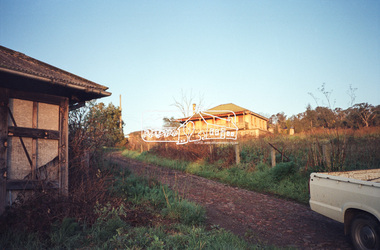 Eltham District Historical Society Inc
Photograph, Hans Gregory, Original 1860s William West house, Fabbro's Farm, Falkiner Street, Eltham, c.1990
... The land on the eastern side of Falkiner Street now forms part of a Council reserve called “Barak Bushland”, the land on the western side having been sold off for residential subdivision. ...The land on the eastern side of Falkiner Street now forms part of a Council reserve called “Barak Bushland”, the land on the western side having been sold off for residential subdivision. ...Photos taken by Hans Gregory who along with partner Pauline Steele, rented the original old 1860s William West Cottage situated behind the Fabbro family home. Hans was employed as a Youth officer with the Shire of Eltham at the time and was the last tennant on the property. The property was sold and in 1995 was developed for residential housing as the Riverview Park estate. Guido Quarto Fabbro was born 21 August 1891 at Treppo Grande in the far northeast of Italy, the son of Giacomo Fabbro and Anna Geruzzi. Regina Moretti was born 6 March 1893 at Treppo Grande, Italy, the daughter of Giovanni Battista Moretti and Maria Teresa Coletti. Guido and Regina married about 1917 and they had two sons, Giacomo (John c.1918) and Maurie (c.1920). In 1925 Guido Fabbro departed his homeland from Genoa, arriving in Fremantle, Western Australia in June, travelling 3rd class aboard the ship, Caprera. Regina and their two boys followed a year later along with other family members arriving in Fremantle from Genoa 4 July 1926 aboard the Moncalieri. The Fabbros arrived in Eltham in 1933 and purchased a block of land from William West on the western side of Falkiner Street, extending to Ely and Porter Streets which had formerly been part of the West family orchard and dairy farm. As there was no fencing dividing the two properties, West served notice on Guido in December 1934 to bear half of the cost of £6. When payment was not forthcoming, West sued Guido in the Eltham Court in January 1935. Guido failed to appear and was not represented, and costs were ordered in West’s favour. Guido and Regina built a large Italianesque house on their property. The original 1860s cottage was relocated to the back of the block and was rented out (once to Alistair and Margot Knox). Guido also purchased land extending to the Diamond Creek on the eastern side of Falkiner Street and on the eastern side of Bell Street (opposite Eltham High School). The riparian soil was suitable for market gardening: Guido grew mainly tomatoes, but also pumpkins, cauliflowers, cabbages, peas, beans, lettuce, beetroot and zucchinis. Even the land surrounding the house was used. The produce was carted to Melbourne overnight for sale at the market. Guido died in 1970 and is buried in Eltham cemetery. Regina died 1986. She and their son John Patrick (Giacomo) Fabbro who died in 1984 are also buried at Eltham Cemetery. Guido’s son Maurie continued in his father’s footsteps until 2007, principally growing artichokes in later years. He died in 2009. The land on the eastern side of Falkiner Street now forms part of a Council reserve called “Barak Bushland”, the land on the western side having been sold off for residential subdivision. The Bell Street land is now public open space managed by Nillumbik Shire Council and called “Fabbro Fields”. There have been recent proposals to develop the site for sporting purposes or as a dog park or community garden. Provides an insight into early settler's farmhouses and farming property of the Eltham district.guido quarto fabbro, regina fabbro (nee moretti), william west, maurie fabbro, fabbro's farm, hans gregory, west family orchard, west dairy farm -
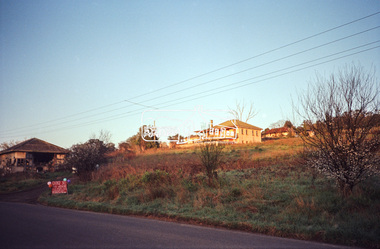 Eltham District Historical Society Inc
Photograph, Hans Gregory, Original 1860s William West house, Fabbro's Farm, Falkiner Street, Eltham, c.1990
... The land on the eastern side of Falkiner Street now forms part of a Council reserve called “Barak Bushland”, the land on the western side having been sold off for residential subdivision. ...The land on the eastern side of Falkiner Street now forms part of a Council reserve called “Barak Bushland”, the land on the western side having been sold off for residential subdivision. ...Photos taken by Hans Gregory who along with partner Pauline Steele, rented the original old 1860s William West Cottage situated behind the Fabbro family home. Hans was employed as a Youth officer with the Shire of Eltham at the time and was the last tennant on the property. The property was sold and in 1995 was developed for residential housing as the Riverview Park estate. Guido Quarto Fabbro was born 21 August 1891 at Treppo Grande in the far northeast of Italy, the son of Giacomo Fabbro and Anna Geruzzi. Regina Moretti was born 6 March 1893 at Treppo Grande, Italy, the daughter of Giovanni Battista Moretti and Maria Teresa Coletti. Guido and Regina married about 1917 and they had two sons, Giacomo (John c.1918) and Maurie (c.1920). In 1925 Guido Fabbro departed his homeland from Genoa, arriving in Fremantle, Western Australia in June, travelling 3rd class aboard the ship, Caprera. Regina and their two boys followed a year later along with other family members arriving in Fremantle from Genoa 4 July 1926 aboard the Moncalieri. The Fabbros arrived in Eltham in 1933 and purchased a block of land from William West on the western side of Falkiner Street, extending to Ely and Porter Streets which had formerly been part of the West family orchard and dairy farm. As there was no fencing dividing the two properties, West served notice on Guido in December 1934 to bear half of the cost of £6. When payment was not forthcoming, West sued Guido in the Eltham Court in January 1935. Guido failed to appear and was not represented, and costs were ordered in West’s favour. Guido and Regina built a large Italianesque house on their property. The original 1860s cottage was relocated to the back of the block and was rented out (once to Alistair and Margot Knox). Guido also purchased land extending to the Diamond Creek on the eastern side of Falkiner Street and on the eastern side of Bell Street (opposite Eltham High School). The riparian soil was suitable for market gardening: Guido grew mainly tomatoes, but also pumpkins, cauliflowers, cabbages, peas, beans, lettuce, beetroot and zucchinis. Even the land surrounding the house was used. The produce was carted to Melbourne overnight for sale at the market. Guido died in 1970 and is buried in Eltham cemetery. Regina died 1986. She and their son John Patrick (Giacomo) Fabbro who died in 1984 are also buried at Eltham Cemetery. Guido’s son Maurie continued in his father’s footsteps until 2007, principally growing artichokes in later years. He died in 2009. The land on the eastern side of Falkiner Street now forms part of a Council reserve called “Barak Bushland”, the land on the western side having been sold off for residential subdivision. The Bell Street land is now public open space managed by Nillumbik Shire Council and called “Fabbro Fields”. There have been recent proposals to develop the site for sporting purposes or as a dog park or community garden. Provides an insight into early settler's farmhouses and farming property of the Eltham district.guido quarto fabbro, regina fabbro (nee moretti), william west, maurie fabbro, fabbro's farm, hans gregory, west family orchard, west dairy farm
