
Showing 51 items matching "window furniture"
-
 Ballarat Tramway Museum
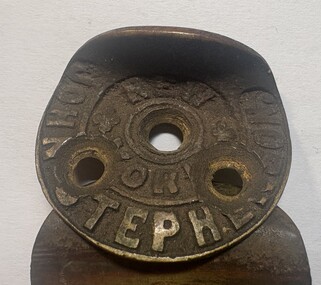
Functional object - Tramcar component, John Stephenson of New York, Window lifter - John Stephenson New York, c1885
... ...Window furniture...Demonstrates John Stephenson & Co's workshop practice of putting their name on some fittings. tramways tramcars horse trams Window furniture Tramcar Component BTM Ballarat Tramways John Stephenson Set of 3 Cast brass window lifter, with raised letters - "JOHN STEPENSON & CO" on outside & "NEW YORK" inside circle. ...Made by John Stephenson & Co. for fitting to the windows of the tramcars that they built such as horse cars or possibly cable cars. Very similar in style to that used by Duncan and Fraser for their tramcars.Demonstrates John Stephenson & Co's workshop practice of putting their name on some fittings.Set of 3 Cast brass window lifter, with raised letters - "JOHN STEPENSON & CO" on outside & "NEW YORK" inside circle. Has three mounting holes & rolled top edge to give a finger hold. Of type used on horse trams.tramways, tramcars, horse trams, window furniture, tramcar component, btm, ballarat tramways, john stephenson -
 Ballarat Tramway Museum
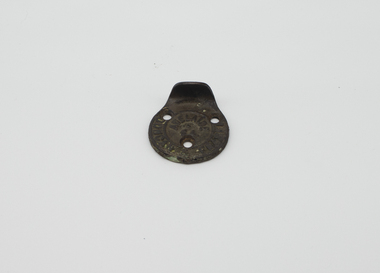
Functional object - Tramcar component, Duncan and Fraser, Window lifter - Duncan and Fraser Adelaide, c1887
... ...Window furniture...Demonstrates Duncan and Fraser's workshop practice of putting their name on some fittings. tramways tramcars horse trams Duncan & Fraser Window furniture Tramcar Component BTM Ballarat Tramways DUNCAN & FRASER ADELAIDE S.A. ...Made by Duncan and Fraser for fitting to horse-drawn tramcars and possibly other products of their Adelaide workshops. See also items 565 and 2172 for other examples.Demonstrates Duncan and Fraser's workshop practice of putting their name on some fittings.Cast brass window lifter, with raised letters - "DUNCAN & FRASER" on outside &"ADELAIDE S.A." inside circle. Has three mounting holes & rolled top edge to give a finger hold. Of type used on horse trams.DUNCAN & FRASER ADELAIDE S.A.tramways, tramcars, horse trams, duncan & fraser, window furniture, tramcar component, btm, ballarat tramways -
 Ballarat Tramway Museum
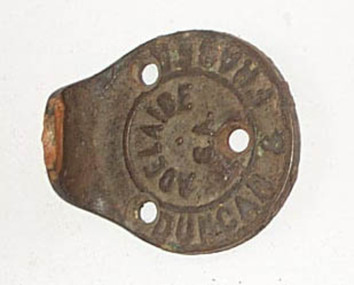
Functional Object - Tramcar component, Duncan and Fraser, Duncan and Fraser, Window lifter, 1887
... ... Window furniture...Horse Trams Duncan & Fraser Window furniture Tramcar component tramcars tramways Duncan and Fraser, Adelaide SA window lifter or bracket to enable a horse tram window to be lifted in the window frame. ...Made by Duncan and Fraser for fitting to horse-drawn tramcars and possibly other products of their Adelaide workshops. See 565 and 8744 for other examples.Demonstrates Duncan and Fraser's workshop practice of putting their name on some fittings.Duncan and Fraser, Adelaide SA window lifter or bracket to enable a horse tram window to be lifted in the window frame. Cast brass, about 40mm in diameter with a right angle lug to enable a person to lift the window. Words "Duncan & Fraser" cast around the outside of the device and the words "Adelaide S.A." cast into the centre. Has been drilled with three countersunk holes. Has brown paint on the lifting portion. On the rear, possibly the letters "5L", scratched into the metal. If this is the case, could have indicated the fifth left hand window as an identification of location. Given to the BTM 1995 by Doug Prosser, of the TMSV, said to be from Ballarat Horse Tram No. 1 horse trams, duncan & fraser, window furniture, tramcar component, tramcars, tramways -
 Ballarat Tramway Museum
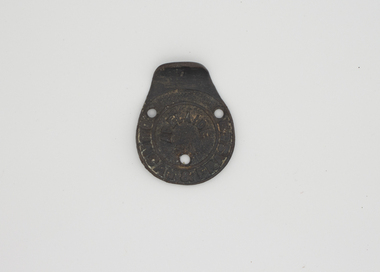
Functional Object - Tramcar component, Duncan and Fraser, Window lifter, Duncan and Fraser, About 1887?
... ...window furniture...Tramcar component, Duncan and Fraser, Window lifter Windows Duncan & Fraser Ballarat tramways tramcars horse trams window furniture Tramcar component BTM Ballarat Tramways DUNCAN & FRASER ADELAIDE S.A. ...Made by Duncan and Fraser for fitting to horse-drawn tramcars and possibly other products of their Adelaide workshops. See also items 2172 and 8744 for other examples.Tramcar component, Duncan and Fraser, Window lifter Cast brass window lifter, with raised letters - "DUNCAN & FRASER" on outside &"ADELAIDE S.A." inside circle. Has three mounting holes & rolled top edge to give a finger hold. Of type used on horse trams.DUNCAN & FRASER ADELAIDE S.A.windows, duncan & fraser, ballarat, tramways, tramcars, horse trams, window furniture, tramcar component, btm, ballarat tramways -
 Whitehorse Historical Society Inc.
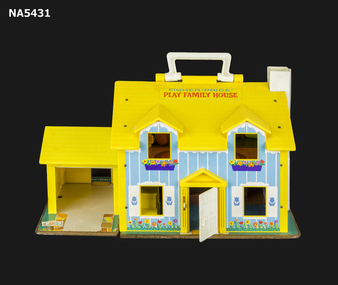
Education kit - Doll House, Fisher Price, Fisher Price Play House (1970s), c1970's
... Plastic, mostly yellow; Coloured transfer decoration; 2 storey house with garage; 4 dormer windows; Plastic furniture; Plastic people; Carry mantle. ...C1970's doll house used in a community toy library C1970's toy Doll house Toy c1970s Nunawading Toy Library Fisher Price play family House Plastic, mostly yellow; Coloured transfer decoration; 2 storey house with garage; 4 dormer windows; Plastic furniture; Plastic people; Carry mantle. ...C1970's doll house used in a community toy libraryC1970's toyPlastic, mostly yellow; Coloured transfer decoration; 2 storey house with garage; 4 dormer windows; Plastic furniture; Plastic people; Carry mantle. Fisher Price play family Housedoll house, toy, c1970s, nunawading toy library -
 National Wool Museum
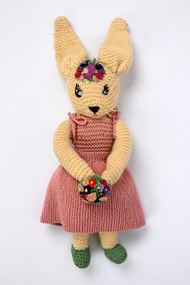
Craft - Toy Rabbit, 1959
... One and sometimes two prisoners did the heavy cleaning of floors, windows and furniture polishing. I remember one prisoner down on his hands and knees polishing the lino in the long hallway to a bright gleam, and when a prisoner was helping in the residence, ‘Aunty’ Elsie, the prisoner and I would always have morning tea together in the kitchen. ...One and sometimes two prisoners did the heavy cleaning of floors, windows and furniture polishing. I remember one prisoner down on his hands and knees polishing the lino in the long hallway to a bright gleam, and when a prisoner was helping in the residence, ‘Aunty’ Elsie, the prisoner and I would always have morning tea together in the kitchen. ...This knitted toy rabbit was given to the donor as a child, made by a prisoner at the Geelong Gaol. The donor spent Christmas holidays at the gaol, below are some of her memories of these times: Eric Stafford was the Governor of Geelong Gaol and he and Elsie Stafford lived in the Governor’s residence at the front of the gaol where I stayed during Christmas holidays from about 1959 to 1962. ‘Aunty’ Elsie had the help of prisoners with the housework. One and sometimes two prisoners did the heavy cleaning of floors, windows and furniture polishing. I remember one prisoner down on his hands and knees polishing the lino in the long hallway to a bright gleam, and when a prisoner was helping in the residence, ‘Aunty’ Elsie, the prisoner and I would always have morning tea together in the kitchen. The backyard of the Governor’s residence was divided in two. The kitchen window overlooked the front part of the yard and I was allowed to play there with the dogs as ‘Aunty’ Elsie could keep an eye on me. The back part of the yard was behind a gated wall and I was not allowed in there as prisoners worked on the back garden, the chook pen and doing general maintenance – although I sometimes sneaked in with the dogs to see the chooks and have a chat but was called back. In the back there was a large padlocked iron bound door in the large bluestone wall which ‘Uncle’ Eric could open. A couple of times he took me through this door which opened into the gaol’s large vegetable garden. I only went twice as a didn’t like going there because all the prisoners working there would stop doing what they were doing, stand and silently stare at me. Of course holidaying in Geelong there was always the great beach and carnival rides. ‘Aunty’ Elsie and I would walk to and from the beach and on the way home would stop and buy an ice cream at the nearby shop. Sometimes we would buy an ice cream for ‘Uncle’ Eric and if there weren’t any vans, prisoners or visitors in the gaol entrance courtyard I was allowed to take the ice cream to ‘Uncle’ Eric in his office after ‘Aunty’ Elsie phoned him from the residence. ‘Uncle’ Eric had a sheep farm in Meredith and sometimes he took a prisoner with him to do some work on the farm. I can remember on the way to the farm sitting in the front seat of the vehicle squeezed in between ‘Uncle’ Eric and a prisoner with the dogs and equipment in the back tray. - Donor, 2025Woollen cream knitted toy rabbit in a knitted pink dress with a knitted green petticoat, knitted green panties and a little knitted cream rabbit tail. Holding a bouquet of felt flowers and a coronet of felt jewels on the forehead. Wool embroidered eyes, nose and mouth, and whiskers of silk cord.geelong gaol, craft, prison, prisoner, governor geelong gaol, holidays, childhood, working life, eric stafford, elsie stafford, geelong, meredith, rabbit, toy, knitting, hand made -
 Flagstaff Hill Maritime Museum and Village
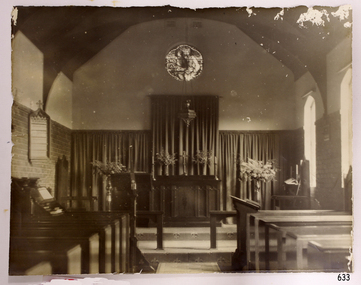
Photograph - Historical, religious, mid-20th century
... window installed in a suitable place. The church, or chapel, was designed by a local architectural draftsman in collaboration with the Flagstaff Hill Planning Board and was constructed by Mr Leon Habel. The designers hoped that the church would be used for formal worship such as weddings, funerals, and multi-denominational special services like war commemorations. The design is inspired by the ‘Missions to Seamen’ buildings in Portland and the Port of Melbourne. The furniture...The photograph shows the inside of the Chapel of Mission to Seamen, including organ, pews and other furniture and furnishings. There is a circular stained glass window high on the back wall depicting a sailor at the helm of a ship and a man standing behind him and pointing the way - "Christ Showing The Helmsman The Way". ...It is listed on the Victorian Heritage Database for having local historic and aesthetic interest. flagstaff hill warrnambool shipwrecked-coast flagstaff-hill flagstaff-hill-maritime-museum maritime-museum shipwreck-coast flagstaff-hill-maritime-village st nicholas mission to seamen's church williamstown mission to seamen williamstown mission to seamen victoria st nicholas mission to seamen chapel window christ showing the helmsman the way stained glass window st nicholas seamen's church religion religious service sailor's rest ladies harbour light guild Photograph of St Nicholas Seamen's Church, Williamstown. Sepia photograph. The photograph shows the inside of the Chapel of Mission to Seamen, including organ, pews and other furniture and furnishings. ...This photograph records the interior of St Nicholas Seamen's Church at 139 Nelson Place, Williamstown, Victoria, which was purchased and furnished around 1943. The furniture and furnishings are now part of the St. Nicholas Seamen's Church collection. HISTORY of the Missions to Seamen: - DETAILED HISTORY of the Missions to Seamen: - The Missions to Seamen is an Anglican (Church of England) charity that has served the world’s seafarers since 1856. It was inspired by the work of Rev. John Ashley, who, 20 years earlier, had pioneered a ministry to seafarers in the Bristol Channel in Great Britain. When Ashley retired, others continued the work, founding the Missions to Seamen. It adopted a Flying Angel as its symbol, inspired by a verse from the Bible in Revelation 14. Today, over 200 world ports have Missions to Seamen centres and chaplains. A Missions to Seamen’s Club warmly welcomes sailors of all colours, creeds and races and provides a wide range of facilities. The Missions to Seamen organisation changed its name to the Mission to Seafarers in 2000, continuing to include Missions to Seamen clubs in Victoria’s cities of Melbourne, Portland, Geelong and Hastings. Flagstaff Hill’s St Nicholas’ Seamen’s Church is named after its namesake from Williamstown, Victoria, which began in 1857. Bishop Perry opened the first Sailors’ Church there, known as ‘Bethel’, on an old hulk floating in Hobson’s Bay, Port of Melbourne. In 1860, a Sailors’ Rest started operating from rented premises in Williamstown. In 1878, the Sailors’ Church moved into an old Wesleyan chapel in Ann Street. By the end of that year, they managed to purchase the building, which they had already refurbished. In 1883, they affiliated with the Victorian Seamen’s Mission. A few years later, in 1906, the building had to be demolished because it was no longer safe. While they raised funds for a new building, the Sailors’ Rest temporarily moved to premises in front of Customs House in Nelson Place. Around this time, in 1906, the Ladies Harbour Lights Guild was formed in Australia to support and raise funds for the Mission to Seamen organisation in Melbourne. Two of the most significant ladies of the Guild were founding members Ethel Godfrey and Alice Sibthorpe. During the Mission's time at Siddeley Street, Melbourne, the activities of the Guild raised funds for the Mission to Seamen's Chapel at their new, and still current, premises in Flinders Street, Melbourne, opened in 1917. The Guild continued its important work until the 1960s. In 1908, the Williamstown Mission had enough money to purchase the former Mascotte skating rink on Thompson Street, Williamstown. In August of that year, they were inaugurated into the Victorian Missions to Seamen. They continued at that venue for a few decades. In 1943, the former ES&A Bank building at 139 Nelson Place, Williamstown, was purchased to become the new Mission to Seamen’s Club. On May 6th, 1944, it was officially opened, described as a ‘distinctive little building’. Funds had previously been raised for the building and furnishing of the chapel at the rear. The chapel was named St Nicholas’ Seamen’s Church, after St Nicholas, fourth-century bishop and patron saint of sailors. Services were held on Wednesdays and Sundays. The church was supported by the Williamstown Lightkeepers’ Auxiliary, newly founded by Mrs Ethel Margaret Musther in 1943, as well as the Harbour Lights Guild and the League of Soldiers’ and Sailors’ Friends. The Williamstown Mission to Seamen’s Church operated until 1966, when large international ships no longer used the Port of Williamstown. The Commonwealth Government then leased the premises. In the formative years of Flagstaff Hill Maritime Village, the Advisory Board decided to include a Missions to Seamen Chapel and Recreation Room in its village. The Missions organisation was a significant feature of ports during the late 1800s and early 1900s, the period that the Village represents. They often erected Missions to house social and worshipful activities for seamen. Flagstaff Hill’s curator, Mr Ken Marshman, approached the Melbourne Board of Management of Missions to Seamen regarding the Williamstown branch. Consequently, the Board permitted the furnishings of the Williamstown chapel to be transferred to Flagstaff Hill Maritime Village. A provision of the transfer was that the Victoria Missions to Seamen be recognised, that the items would remain as a collection, and that the chapel would be called St Nicholas Seamen’s Church and conduct Divine services. The donation was approved on 21st May 1979. Flagstaff Hill's St. Nicholas Seamen's Church: - The idea behind Flagstaff Hill’s Missions to Seamen’s Church was partly driven by the offer of Stained Glass Memorial Windows that originated from the Warrnambool and District Base Hospital, which was undergoing multi-storey expansion in the late 1960s and early 1970s. The hospital’s Manager/Secretary was eager to see the historic window installed in a suitable place. The church, or chapel, was designed by a local architectural draftsman in collaboration with the Flagstaff Hill Planning Board and was constructed by Mr Leon Habel. The designers hoped that the church would be used for formal worship such as weddings, funerals, and multi-denominational special services like war commemorations. The design is inspired by the ‘Missions to Seamen’ buildings in Portland and the Port of Melbourne. The furniture and furnishings were placed as accurately as possible according to photographs of the Williamstown St Nicholas Seamen’s Church and with assistance from local clergy. The Recreation Room was furnished and arranged on advice from experienced members of the Missions to Seamen organisation. A framed document in the building recognises the donor of the furnishings, Victoria Missions to Seamen, and includes the names of some original donors and their donated item/s. The building’s design incorporates local features such as Warrnambool sandstone, which was no longer commercially available but was procured from demolished buildings and uniformly cut to use as a veneer over the stronger Mt. Gambier stone. Also, traditional green American roofing slate was used, sourced from the 1908 local shipwreck “Falls of Halladale” by Flagstaff Hill volunteer divers. The bell tower includes a bell believed to be from a local shipwreck. Additional furnishings were acquired locally, along with several items donated by Warrnambool residents. Light fittings in both rooms were assembled to simulate 19th-century gas light fittings. The stained-glass window at the back of the church is a memorial to Dr Connell, a well-respected member of the Warrnambool community. It was originally installed in 1928 in the main building of Warrnambool Hospital. The St Nicholas’ Seamen’s Church at Flagstaff Hill was officially opened by His Worship the Mayor, Cr. John Lindsay, on Sunday, 11th October 1981. The event included a service of thanksgiving conducted by the Warrnambool Ministers Fraternal. Since then, the Chapel has been the historic venue for many weddings. This photograph is significant through its association with the St Nicholas' Mission to Seamen Church in Williamstown, Melbourne, established in 1857. The building in the photograph is the former English, Scottish and Australian Bank (ES&A bank), also known as the Mission to Seamen. It is listed on the Victorian Heritage Database for having local historic and aesthetic interest. Photograph of St Nicholas Seamen's Church, Williamstown. Sepia photograph. The photograph shows the inside of the Chapel of Mission to Seamen, including organ, pews and other furniture and furnishings. There is a circular stained glass window high on the back wall depicting a sailor at the helm of a ship and a man standing behind him and pointing the way - "Christ Showing The Helmsman The Way". A Sanctuary Light is suspended from the ceiling. The Sanctuary chars are visible. This shows the St Nicholas Seamen's Church in Williamstown, the furnishings and furniture of which is now part of the St Nicholas Seamen's Church Collection’.flagstaff hill, warrnambool, shipwrecked-coast, flagstaff-hill, flagstaff-hill-maritime-museum, maritime-museum, shipwreck-coast, flagstaff-hill-maritime-village, st nicholas mission to seamen's church williamstown, mission to seamen williamstown, mission to seamen victoria, st nicholas mission to seamen, chapel window, christ showing the helmsman the way, stained glass window, st nicholas seamen's church, religion, religious service, sailor's rest, ladies harbour light guild -
 Mission to Seafarers Victoria
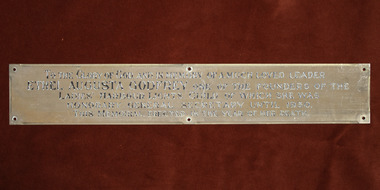
Plaque - Memorial Plaque, Ethel Augusta Godfrey
... window in the St Peter chapel in the Central Institute (See 0064.2) ) and the optus sectile plaque in the 1888 Port Melbourne Institute (See 2053) . This plaque was moved to the Nelson Place building when the Mission purchased the E,S&A Bank in 1943. In 1982, the plaque ws removed from the Williamstown mission along with 4 other plaques, objects and furniture...window in the St Peter chapel in the Central Institute (See 0064.2) ) and the optus sectile plaque in the 1888 Port Melbourne Institute (See 2053) . This plaque was moved to the Nelson Place building when the Mission purchased the E,S&A Bank in 1943. In 1982, the plaque ws removed from the Williamstown mission along with 4 other plaques, objects and furniture ...This plaque was erected in the Williamstown Sailors' Rest, the former skating ring in Thompson Street. It's one the three memorials to Ethel Godfrey with the stained glass window in the St Peter chapel in the Central Institute (See 0064.2) ) and the optus sectile plaque in the 1888 Port Melbourne Institute (See 2053) . This plaque was moved to the Nelson Place building when the Mission purchased the E,S&A Bank in 1943. In 1982, the plaque ws removed from the Williamstown mission along with 4 other plaques, objects and furniture to furnish the chapel of the new Flagstaff Maritime Museum. The transfer of the 5 plaques was requested in 2020 and they returned to the Mission's collection in 2022.The plaque along with the two other memoriels erected in the memory of Ethel Godfrey demonstrates the gratitude for the her 30 years of work.Rectangular plaque for Ethel Augusta Godfrey ethel augusta godfrey 1861-1935, williamstown, thompson street, seamen's mission, sailors' rest, flasgstaff maritime museum, lhlg -
 Flagstaff Hill Maritime Museum and Village
Ceremonial object - Ecclesiastical Linen set, 1907 to mid 20th century
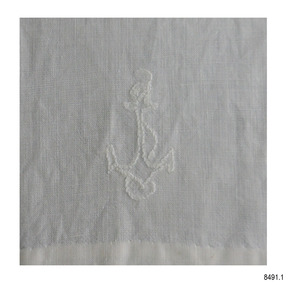
... windows, and a comfortable porch entrance, all of which gave a pleasing impression of light and space. In 1935 the average attendance for morning services was just over 22 people. In 1936 extensive repairs and replacements were carried out. In 1947 the first recorded Pastoral Festival took place and in the same year, a Ladies Guild was formed. In 1954 water services were connected to the church building. Many items of furniture...windows, and a comfortable porch entrance, all of which gave a pleasing impression of light and space. In 1935 the average attendance for morning services was just over 22 people. In 1936 extensive repairs and replacements were carried out. In 1947 the first recorded Pastoral Festival took place and in the same year, a Ladies Guild was formed. In 1954 water services were connected to the church building. Many items of furniture ...The items in this collection of Ecclesiastical Linen were used by St. Andrews Anglican Church on the corner of the Esplanade and 14 Drummond St, Dennington, Victoria. The first Anglican service was conducted on December 22nd, 1907. The church was decommissioned in January 2003. The items donated include Maniples, Chalice Covers, a Goblet Cover, Altar Cloths, Matts, Priest's scarf, armband and sashes, and a bag that is a cover for the Baptismal Towel. HISTORY OF ST ANDREWS, DENNINGTON The land on which St Andrews Church was built in Dennington was surveyed in the 1840s and reserved for church purposes in 1855. In 1889 the Farnham Dairy factory relocated to Dennington and the town began to grow as involvement in the dairy industry increased in the area. In 1896 plans for a church hall on the reserved land were considered and on 22nd December 1907, the first Anglican Service was conducted in Dennington, with 60 people attending. In August 1909 the first building was opened with a midweek evening service conducted by the Rev. J.A. Coe. The Sunday School was opened the following year. In that same year, Nestle took over the Farnham dairy plant. On December 20th, 1914, a new church was opened in memory of Andrew Peacock, who passed away in 1912. The funds had been raised by the community and 150 attended the morning service. The building was described as a simple edifice with a plain exterior and high, wide pointed windows, and a comfortable porch entrance, all of which gave a pleasing impression of light and space. In 1935 the average attendance for morning services was just over 22 people. In 1936 extensive repairs and replacements were carried out. In 1947 the first recorded Pastoral Festival took place and in the same year, a Ladies Guild was formed. In 1954 water services were connected to the church building. Many items of furniture, furnishings and books were donated over the life of the church, including handworked linen items. Further items were added due to the work of the Ladies Guild, as well as donations in memory of church and community members.These items of Ecclesiastical Linen are significant as examples of handworked embroidery and drawn-thread work from the early 20th century. They are also examples of a collection of items used for church services during this period. The Ecclesiastical Linen is also significant for its association with the early development of the local township of Dennington and the importance of setting aside land in the 1850s for the purpose of religious worship. The Ecclesiastical Linen is also significant for its connection to St Andrews Anglican Church, Dennington. The church was funded and attended by the local community in the early 1900s and is now listed on the Victorian Heritage Database (VHD 118083) as a building of historical and social significance. Set of Ecclesiastical Linen. The items were once used in St. Andrew's Anglican Church, Dennington, Victoria, between the years 1907 and 2003. All of the handmade items are in white fabric. Some also have embroidered emblems, tassels and drawn-thread work. White embroidery thread has been used for most of the decorated items, with the following exceptions, which have been embroidered with coloured thread; the communion linen, the Priest's scarf, armband and sash, the altar cloths, mats and a cover for the baptismal towel. Two items have hand written inscriptions.(See individual objects for details)flagstaff hill, warrnambool, maritime museum, shipwreck coast, great ocean road, st andrews anglican church dennington, dennington church, warrnambool church 1907, ecclesiastical linen, linen for religious service, communion linen, priest's sash, baptismal towel, maniple, eucharist, emblem of rope and cross, embroidered religious cloths, embroidered celtic cross, drawn thread, chalice covers, handmade linen, embroidered linen, stylised cross, the english church, ladies guild dennington, nestle, farnham dairy, andrew peacock, victorian heritage register vhr 118083, hand worked linen, handworked embroidery, j.a. coe -
 Flagstaff Hill Maritime Museum and Village
Textile - Seat Squabs, mid-20th century
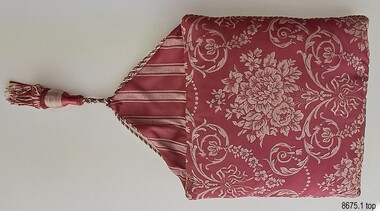
... window installed in a suitable place. The church, or chapel, was designed by a local architectural draftsman in collaboration with the Flagstaff Hill Planning Board and was constructed by Mr Leon Habel. The designers hoped the church would be used for formal worship, such as weddings, funerals, and multi-denominational special services like war commemorations. Its design was inspired by the ‘Missions to Seamen’ buildings in Portland and the Port of Melbourne. The furniture...window installed in a suitable place. The church, or chapel, was designed by a local architectural draftsman in collaboration with the Flagstaff Hill Planning Board and was constructed by Mr Leon Habel. The designers hoped the church would be used for formal worship, such as weddings, funerals, and multi-denominational special services like war commemorations. Its design was inspired by the ‘Missions to Seamen’ buildings in Portland and the Port of Melbourne. The furniture ...The term 'seat squabs' is no longer commonly used, but is sometimes referred to in the upholstery and motor vehicle industries. Squabs are padded cushions frequently added to wooden chairs or benches to add comfort to their hard forms. They have been made to an 18th-to-19th-century pattern using beautiful, richly coloured satin fabric and fancy cord tassels. The weighted flap at the rear of the squabs helps to keep them in place on the chair, and could be used on the top of the backrest instead of on the seat. These days, squabs are attached with fabric ties or hook-and-loop tabs. These seat squabs were once used in the St Nicholas Seamen's Church at 139 Nelson Place, Williamstown, Victoria, which was purchased and furnished around 1943. The furniture and furnishings are now part of the St. Nicholas Seamen's Church collection. DETAILED HISTORY of the Missions to Seamen: - The Missions to Seamen is an Anglican (Church of England) charity that has served the world’s seafarers since 1856. It was inspired by the work of Rev. John Ashley, who, 20 years earlier, had pioneered a ministry to seafarers in the Bristol Channel in Great Britain. When Ashley retired, others continued the work, founding the Missions to Seamen. It adopted a Flying Angel as its symbol, inspired by a verse from the Bible in Revelation 14. Today, over 200 world ports have Missions to Seamen centres and chaplains. A Missions to Seamen’s club warmly welcomes sailors of all colours, creeds and races and provides a wide range of facilities. The Missions to Seamen organisation changed its name to the Mission to Seafarers in 2000, continuing to include Missions to Seamen clubs in Victoria’s cities of Melbourne, Portland, Geelong and Hastings. Flagstaff Hill’s St Nicholas’ Seamen’s Church is named after its namesake from Williamstown, Victoria, which began in 1857. Bishop Perry opened the first Sailors’ Church, which was known as ‘Bethel’, on an old hulk floating in Hobson’s Bay, Port of Melbourne. In 1860, a Sailors’ Rest started operating from rented premises in Williamstown. In 1878, the Sailors’ Church moved into an old Wesleyan chapel in Ann Street. By the end of that year, they managed to purchase the building, which they had already refurbished. In 1883, they affiliated with the Victorian Seamen’s Mission. A few years later, in 1906, the building had to be demolished because it was no longer safe. While they raised funds for a new building, the Sailors’ Rest temporarily moved to premises in front of Customs House in Nelson Place. Around this time, in 1906, the Ladies Harbour Lights Guild was formed in Australia to support and raise funds for the Mission to Seamen organisation in Melbourne. Two of the most significant ladies of the Guild were founding members Ethel Godfrey and Alice Sibthorpe. During the Mission's time at Siddeley Street, Melbourne, the activities of the Guild raised funds for the Mission to Seamen's Chapel at their new, and still current, premises in Flinders Street, Melbourne, opened in 1917. The Guild continued its important work until the 1960s. In 1908, the Williamstown Mission had enough money to purchase the former Mascotte skating rink on Thompson Street, Williamstown. In August of that year, they were inaugurated into the Victorian Missions to Seamen. They continued at that venue for a few decades. In 1943, the former ES&A Bank building at 139 Nelson Place, Williamstown, was purchased for the new Mission to Seaman’s Club. The official opening was on May 6th, 1944. It was described as a ‘distinctive little building’. Funds had previously been raised for the building and furnishing of the chapel at the rear. The chapel was named St Nicholas’ Seamen’s Church, after St Nicholas, fourth-century bishop and patron saint of sailors. Services were held on Wednesdays and Sundays. The church was supported by the Williamstown Lightkeepers’ Auxiliary, newly founded by Mrs Ethel Margaret Musther in 1943, as well as the Harbour Lights Guild and the League of Soldiers’ and Sailors’ Friends. The Williamstown Mission to Seamen’s Church operated until 1966, when large international ships no longer used the Port of Williamstown. The Commonwealth Government then leased the premises. In the formative years of Flagstaff Hill Maritime Village, the Advisory Board decided to include a Missions to Seamen Chapel and Recreation Room in its village. The Missions organisation was a significant feature of ports during the late 1800s and early 1900s, the period that the Village represents. They often erected Missions to house social and worshipful activities for seamen. Flagstaff Hill’s curator, Mr Ken Marshman, approached the Melbourne Board of Management of Missions to Seamen regarding the Williamstown branch. Consequently, the Board permitted the furnishings of the Williamstown chapel to be transferred to Flagstaff Hill Maritime Village. A provision of the transfer was that the Victoria Missions to Seamen be recognised, that the items would remain as a collection, and that the chapel would be called St Nicholas Seamen’s Church and conduct Divine services. The donation was approved on 21st May 1979. Flagstaff Hill's St. Nicholas Seamen's Church: - The idea behind Flagstaff Hill’s Missions to Seamen’s Church was partly driven by the offer of Stained Glass Memorial Windows that originated from the Warrnambool and District Base Hospital, which was undergoing multi-storey expansion in the late 1960s and early 1970s. The hospital’s Manager/Secretary was eager to see the historic window installed in a suitable place. The church, or chapel, was designed by a local architectural draftsman in collaboration with the Flagstaff Hill Planning Board and was constructed by Mr Leon Habel. The designers hoped the church would be used for formal worship, such as weddings, funerals, and multi-denominational special services like war commemorations. Its design was inspired by the ‘Missions to Seamen’ buildings in Portland and the Port of Melbourne. The furniture and furnishings were placed as accurately as possible according to photographs of the Williamstown St Nicholas Seamen’s Church and with assistance from local clergy. The Recreation Room was furnished and arranged on advice from experienced members of the Missions to Seamen organisation. A framed document in the building recognises the donor of the furnishings, Victoria Missions to Seamen, and includes the names of some original donors and their donated item/s. The building’s design incorporates local features such as Warrnambool sandstone, which was no longer commercially available but was procured from demolished buildings and uniformly cut to use as a veneer over the stronger Mt. Gambier stone. Also, traditional green American roofing slate was used, sourced from the 1908 local shipwreck “Falls of Halladale” by Flagstaff Hill volunteer divers. The bell tower includes a bell believed to be from a local shipwreck. Additional furnishings were acquired locally, and several items were donated by Warrnambool residents. Light fittings in both rooms were assembled to simulate 19th-century gas light fittings. The stained-glass window at the back of the church is a memorial to Dr Connell, a well-respected member of the Warrnambool community. It was originally installed in 1928 in the main building of Warrnambool Hospital. The St Nicholas’ Seamen’s Church at Flagstaff Hill was officially opened by His Worship the Mayor, Cr. John Lindsay, on Sunday, 11th October 1981. The event included a service of thanksgiving conducted by the Warrnambool Ministers Fraternal. Since then, the Chapel has been the historic venue for many weddings. This pair of seat squabs is historically significant for its origin in the St Nicholas Mission to Seamen's Church in Williamstown, established in 1857 to cater for seafarers’ physical, social, and spiritual needs. The organisation originated in Bristol, England, when a Seamen's Mission was formed in 1837. The squabs are also significant for their use in the St Nicholas Missions to Seamen's chapel, Williamstown, as the original building is now listed on the Victorian Heritage Register. Squabs or padded seat cushions, a pair of two. These 18th to 19th-century design squabs have crimson and cream satin fabric on top and underneath, and weighted tassels are attached to their rear corners. They can be used for comfort on hard seats and benches. The squabs were furnishings from the Missions to Seamen chapel in Williamstown, and they are now part of the St Nicholas Seamen's Church Collection.flagstaff hill, warrnambool, shipwrecked-coast, flagstaff-hill, flagstaff-hill-maritime-museum, maritime-museum, shipwreck-coast, flagstaff-hill-maritime-village, st nicholas mission to seamen's church williamstown, mission to seamen williamstown, mission to seamen victoria, st nicholas mission to seamen, st nicholas seamen's church, religion, religious service, sailor's rest, ladies harbour light guild, squab, seat covers, cushions, squabs, religious furnishing, padded seats, seating, accessory -
 City of Moorabbin Historical Society (Operating the Box Cottage Museum)
Photographs, x 4 Black & White, Whitmuir Hall / Killearnan / Bentleigh Club 1930, c1930
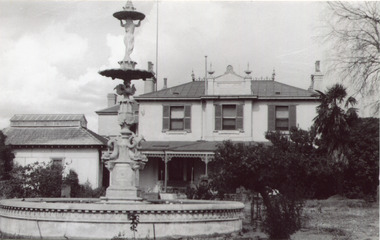
... Stained glass Windows, furniture, imported from France and Italy have been preserved by the Bentleigh Club. whitmuir hall, bentleigh club, killearnan, mansions, gold rush victoria, smith j l; smith mary ann, stanley helen, smith vic, smith harry redvers, chaff cutter, horse drawn carts, toll gates brighton, motor cars 1900, steam engines, early settlers, bentleigh, parish of moorabbin, city of moorabbin, county of bourke, moorabbin roads board, shire of moorabbin, henry dendy's special survey 1841, were j.b.; bent thomas, o'shannassy john, king richard, charman s, highett william, ormond francis, maynard 4 of 13 Black & White photographs of Whitmuir Hall now Benleigh Club, Yawla St Bentleigh c 1930 Photographs, x 4 Black & White, Whitmuir Hall / Killearnan / Bentleigh Club 1930 ...Whitmuir Hall was built 1850 using bricks hand -made from the clay of nearby Elster Creek. Early history of the 156 acre estate bounded by McKinnon, Centre, Thomas and Wheatley Roads is obscure. The gardens were laid out prior to 1850. Robert Gray Ford purchased 20 acres with mansion in 1872 for £ 1750 and it was valued at £ 25,000 in 1888 but sold after the Bank Crash 1890's for £ 5,000 in 1892. There were many owners over the years including Thomas Bent and in 1870 it was called 'Killearnan'. It is now is known as 'the Bentleigh Club and many original features have been restored and preserved . Whitmuir Hall, was a stately mansion built 1850 typical of the grandiose plans of successful early settlers. Stained glass Windows, furniture, imported from France and Italy have been preserved by the Bentleigh Club.4 of 13 Black & White photographs of Whitmuir Hall now Benleigh Club, Yawla St Bentleigh c 1930whitmuir hall, bentleigh club, killearnan, mansions, gold rush victoria, smith j l; smith mary ann, stanley helen, smith vic, smith harry redvers, chaff cutter, horse drawn carts, toll gates brighton, motor cars 1900, steam engines, early settlers, bentleigh, parish of moorabbin, city of moorabbin, county of bourke, moorabbin roads board, shire of moorabbin, henry dendy's special survey 1841, were j.b.; bent thomas, o'shannassy john, king richard, charman s, highett william, ormond francis, maynard -
 City of Moorabbin Historical Society (Operating the Box Cottage Museum)
Furniture, Wardrobe 3 piece 3 drawers c1900, c1900
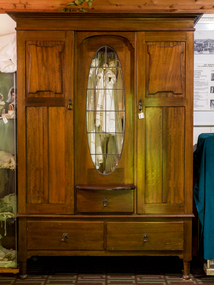
... The sections of this wardrobe can be lifted apart so that it can be transported easily and when assembled provides suitable hanging and storage space for the clothes and bed covers of an early settler family This wardrobe is of a type commonly used by early settler families in Moorabbin Shire c1900 early settlers, market gardeners, poultry farmers, mechanics institutes, furniture, kitchen equipment, clothing, drapery, haberdashery, green pederson carol, city of moorabbin, county of bourke, moorabbin roads board, parish of moorabbin, shire of moorabbin, henry dendy's special survey 1841, were j.b.; bent thomas, highett william, ormond francis, maynard dennis, Wooden Wardrobe with 3 sections- top, hanging space with a central oval glass window, a shallow central drawer and 2 doors with key locks, and drawer section with 2 deep drawers Furniture, Wardrobe 3 piece 3 drawers c1900 ...The sections of this wardrobe can be lifted apart so that it can be transported easily and when assembled provides suitable hanging and storage space for the clothes and bed covers of an early settler family This wardrobe is of a type commonly used by early settler families in Moorabbin Shire c1900Wooden Wardrobe with 3 sections- top, hanging space with a central oval glass window, a shallow central drawer and 2 doors with key locks, and drawer section with 2 deep drawers early settlers, market gardeners, poultry farmers, mechanics institutes, furniture, kitchen equipment, clothing, drapery, haberdashery, green pederson carol, city of moorabbin, county of bourke, moorabbin roads board, parish of moorabbin, shire of moorabbin, henry dendy's special survey 1841, were j.b.; bent thomas, highett william, ormond francis, maynard dennis, -
 Ringwood and District Historical Society
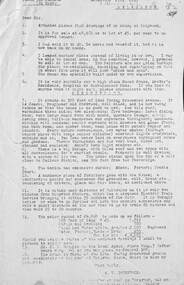
Letter, Property for sale - Ringwood Shop and Dwelling Estate, Ringwood, Victoria - circa 1925
... windows etc. 8. There is a big garage, with tiled roof and two rooms with all conveniences for a married couple. Property is well drained with a system of its own. The house stands upon the top of a hill close to Railway Station, say 500 feet from the Footbridge. 9. The garden has expansive shrubs; sheds; fernery; tennis court. 10. A handsome piece of furniture...windows etc. 8. There is a big garage, with tiled roof and two rooms with all conveniences for a married couple. Property is well drained with a system of its own. The house stands upon the top of a hill close to Railway Station, say 500 feet from the Footbridge. 9. The garden has expansive shrubs; sheds; fernery; tennis court. 10. A handsome piece of furniture ...ID 5225 note: Further information relating to allotments marked on the hand-drawn plan are included in ID 5224 - Ringwood Station Estate.Typewritten letter from A.V. Greenwood with hand drawn plan of Ringwood Shop and Dwelling Estate, detailed description of property for sale, and top and side elevation views of house. (7 pages)(Transcript of first page - to unknown recipient) Phone 988 Central, 331 Canty Greenwood Pty. Ltd. 5 Flinders Street Melbourne. Dear Sir, 1. Attached please find drawings of my house at Ringwood. 2. It is for sale at £4,865 or to let at £5 per week to an approved tenant. 3. I sold it to Mr. De Garis and vacated it, but it is now back on my hands. 4. I leased another place instead of living in my own. I may be able to cancel same; in the meantime, however, I propose to sell or let my own. The painters are now going through the place; re-varnishing, re-oiling and re-polishing so that in about five days it will look "spick and span". 5. The house was specially built under my own supervision. 6. It is very suitable for a high class Guest House, Doctor's residence, Hospital or Convalescent Home. If you know of anyone whom it might suit, please communicate with them. DESCRIPTION 7. It stands on 305 feet of land facing Greenwood Avenue. It is cement, roughcast and hardwood, well oiled, and is now being redone so that the house is as good as new; red tile roof; verandahs three sides; two sleep-outs; five bedrooms; large dining room; very large music room with nooks, upstairs lounge, study; sewing room; built-in wardrobes and cupboards throughout; handsome kitchen with handsome pantry cupboard with drawers and glass front; one bath room; one shower room; wash house with patent copper and laundry. Every modern convenience, hot water system (through copper pipes with large copper cylinder) electric lights everywhere, outside and in, Yan Yean water laid on everwhere throughout house and gardens. Floors throughout are the very best, close set, stained and polished; dainty lead light windows etc. 8. There is a big garage, with tiled roof and two rooms with all conveniences for a married couple. Property is well drained with a system of its own. The house stands upon the top of a hill close to Railway Station, say 500 feet from the Footbridge. 9. The garden has expansive shrubs; sheds; fernery; tennis court. 10. A handsome piece of furniture goes with the house; a combination pantry and storeroom for groceries, milk, bread etc., consisting of drawers, glass and wire doors, as mentioned above. 11. It is within easy distance of Melbourne as it is only two minutes from Ringwood Station, which is a frequent electric train service bringing it within 39 minutes of the City. It is thought better by some to go further out into the country atmosphere and walk a short distance at the end than to go by train 20 minutes then walk 15 to 20 minutes. 12. The price quoted of £4,865 is made up as follows - 305 feet of land @ £5 ... £1,515 Garage and dwelling ... £300 House hot water system, American cupboard ... £2,600 Water, fencing, sheds & drain ... £250 For the lot ... £4,865 Should you require copies of the enclosed drawings I shall be pleased to supply same. 13. Mr. J.B. McAlpin is the local agent, Phone Ring. 7 (after hours Ring. 44) or you may phone me Central 988. 14. The house is south of the line, facing Greenwood Avenue and immediately at the back of Ringwood House, which is also my property. Yours sincerely, A.V. Greenwood (illegible) ..... (Transcript of second page) RINGWOOD SHOP AND DWELLING ESTATE See these letters on plan attached (H.) Ringwood House and Shops on 100 by 150 feet of land fronting Bedford Road 100 feet @ £10 per foot - £1,000 House and shops - £2,400 ... £3,400 Ringwood House consists of Boarding House, (Phone 101) and two shops, mainly brick; 9 inch walls. Will carry another story. Has music room, dining room, entrance halls, 10 bedrooms, large verandahs, all conveniences, hot and cold water, and stands on what will become a most valuable business corner. (F.)(G.) Mr. Greenwood's house, garage and sheds, stands on 307 feet of land fronting Greenwood Avenue. See detailed description attached ... £4,865 (J.) Cottage on Block 81 in William Street ... £750 (K.) Cottage in Pitt Street ... £650 (Total) £9,665 ..... (Description of third page - Subdivision Plan) Drawn by Edyth Greenwood, phone 988 Central. Subdivision includes Station Street, Pitt Street, Bedford Road, Wantirna Road, James Street, William Street (later Kendall Street), Greenwood Avenue, Ellison Street, and Haig Street. Circles denote blocks for sale. Squares denote house properties for sale. Other features marked include location of businesses along Main Street (Maroondah Highway), cool store, railway station, shop and police station on Bedford Road, church on Station Street, site of schoolmaster's residence and State School, and location of proposed public baths -
 Mission to Seafarers Victoria
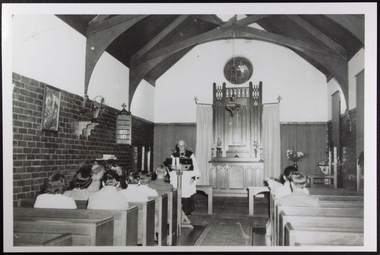
Photograph - Photograph, copy, The Age, St Nicholas' Mariners' Church, at Williamstown Mission to Seamen, with the lay reader in charge (Mr Stewart Murray) conducting a service, 14 June 1958
... The decision of the window was published in August 1947, Mrs Musther -who created the Lightkeepers' Auxiliary branch in Williamstown - ordered it from Brooks, Robinson & Co. (job books 1923-1966). The furniture ...The photograph wa published in the Age, 14th of June 1958. The picture shows the round stained glass dedicated on Sunday 14 December 1947 and the reredos with hangings donated by Maud Breaks in memory of her sister Louise Breaks and dedicated on 26 August 1954 by the Bishop of Geelong.This is a rare picture of the interior of the St Nicholas chapel which was erected behind the former E, S & A Bank building used by the Williamstown Seamen's Mission branch from 1944. Article in the Age reading: "Seamen's Window Dedicated - A window in St. Nicholas' Mariners' Church, at Williamstown, in memory of the merchant seamen who were killed on active service In the last war, was unveiled and dedicated yesterday.The ceremony was performed by the Bishop of Geelong (Rt. Rev. J. D. McKie). The window, erected by the Williamstown Lightkeepers' Auxiliary of the Victoria Missions to Seamen is placed behind the altar. It shows a quartermaster, with his hand on the wheel, and the figure of Christ pointing ahead. Bishop McKie paid a tribute to the spirit of the men who gave their lives at sea in the service of their country. He said the work of the auxiliary would still be of great value, although the war was over." The decision of the window was published in August 1947, Mrs Musther -who created the Lightkeepers' Auxiliary branch in Williamstown - ordered it from Brooks, Robinson & Co. (job books 1923-1966). The furniture and window were donated in 1979 to the Flagstaff Hill Maritime Village in Warrnanbool, and located in the chapel.Black and White Gloss print photograph - Image features a minister delivering a chapel serviceHand written in black texta; ... Mission to Seamen, Williamstown Chapel service... Circa 1957randall stewart murray, st nicholas the mariner chapel, chapel, lay reader, williamstown, victorian-seamens-mission, 139 nelson place, e,s and a bank, english, scottish and australian bank, stained-glass window, pews, lightkeepers' auxiliary, warrnambool, mrs musther, brooks, robinson & co, hymn board, david conolly -
 Greensborough Historical Society
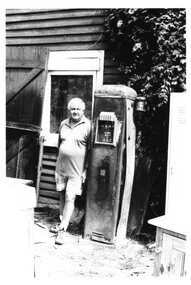
Photograph - Photograph Collection, Alison Lendoudis et al, Peter Teagle inside Purdy's Furniture 1996, 1996
... Furniture. Briar Hill Timber and Trading Company originally constructed this building for making doors and window frames for army huts in the early 1940s....Furniture. Briar Hill Timber and Trading Company originally constructed this building for making doors and window frames for army huts in the early 1940s. ...Peter Teagle inside Purdy’s Furniture. Briar Hill Timber and Trading Company originally constructed this building for making doors and window frames for army huts in the early 1940s.The Briar Hill Timber and Trading Company was active during the 1930s - 1950s during the development of the local area with many houses being built by owner-builders who used the company for their needs. A group of 8 black and white photographsbriar hill timber and trading company, briar hill timber, alison lendoudis, bob manuell, sherbourne road briar hill, squire family, purdys furniture briar hill, peter teagle -
 Orbost & District Historical Society
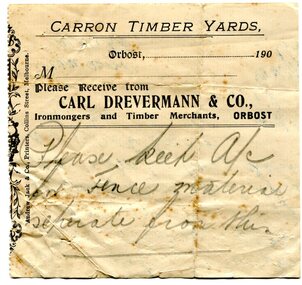
order form, Andrew Jack & Co, early 20th century
... window sill to prevent people sitting on the ledge. Carl Drevermann was a prominent Orbost identity and the Drevermann family owned the current Orbost Hardware Store for many years. Clyde [Carl] Drevermann died on 15/11/1946 aged 72. He was born in Lucknow and went into partnership with E P Reynolds on 9/8/1902 in Orbost selling furnishings, general ironmongery, furniture ...Mr Carl Otto (Clyde) Drevermann was born at Lucknow and worked in various parts of Victoria before coming to Orbost in about 1902. In July 1902 he entered into partnership with Mr Edward Fisher Reynolds and the ironmongery, hardware and tinsmithing business was carried on by the new firm as Drevermann and Reynolds. In about 1905 Mr Drevermann assumed proprietorship and the tinsmith and plumbing section of the business was sold off to Mr Edward Swan. The ironmongery, hardware and timber business was known as Carl Dreverman & Co until 1917 when it was changed to Orbost Hardware and Timber Co. This shop had a row of nails on the window sill to prevent people sitting on the ledge. Carl Drevermann was a prominent Orbost identity and the Drevermann family owned the current Orbost Hardware Store for many years. Clyde [Carl] Drevermann died on 15/11/1946 aged 72. He was born in Lucknow and went into partnership with E P Reynolds on 9/8/1902 in Orbost selling furnishings, general ironmongery, furniture and tinsmith items. This partnership did not last long as on 6/9/1902 the shop then operated as Carl Drevermann & Co. later to become the Orbost Hardware & Timber Co. Mr Reynolds relocated the tinsmith part of the business to a new address. Mr Drevermann was a keen motorist and promoter of East Gippsland during the time when motor tourism was in its infancy. ( Lindsay and Noreen Thomson)A small white paper order form. It has black print an details are hand-written.drevermann-carl order-form-book-keeping -
 Flagstaff Hill Maritime Museum and Village
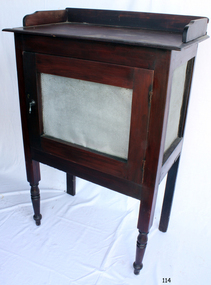
Functional object - Food Safe
... flagstaff hill warrnambool shipwrecked coast flagstaff hill maritime museum maritime museum shipwreck coast flagstaff hill maritime village great ocean road food safe kitchen safe kitchen furniture food storage food preservation Wooden Kitchen Safe for storing food, with hinged door (with key-hole) and three galvanised preformatted sheet metal windows. ...Wooden Kitchen Safe for storing food, with hinged door (with key-hole) and three galvanised preformatted sheet metal windows. Front legs machine turned wood.flagstaff hill, warrnambool, shipwrecked coast, flagstaff hill maritime museum, maritime museum, shipwreck coast, flagstaff hill maritime village, great ocean road, food safe, kitchen safe, kitchen furniture, food storage, food preservation -
 Orbost & District Historical Society
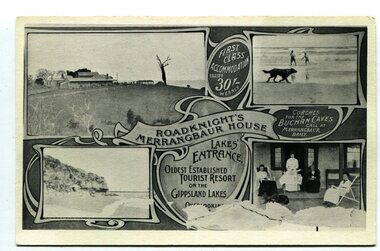
black and white postcard, C1910
... furniture was lost, although a portion of the building, consisting of the ballroom and several bedrooms, was saved Mrs. Anne McInnes, aged more than 80 years, the mother of the proprietress, Miss McInnes, was the only guest sleeping in the house when the fire began and had to be assisted from her blazing bedroom on the ground floor. She was carried through a window...furniture was lost, although a portion of the building, consisting of the ballroom and several bedrooms, was saved Mrs. Anne McInnes, aged more than 80 years, the mother of the proprietress, Miss McInnes, was the only guest sleeping in the house when the fire began and had to be assisted from her blazing bedroom on the ground floor. She was carried through a window ...This an advertisement / souvenir for Merrangbaur House in Lakes Entrance. Merrangbaur was in , Lakes Entrance and stood on the on the Prince's Highway, about a kilometre from Lakes Entrance. It was destroyed by fire on the early morning of December 15, 1935. The original residence of the Roadknight family, the first white settlers in the Lakes Entrance district, Merrangbaur House had been conducted as a guest house for many years. Much of the furniture was lost, although a portion of the building, consisting of the ballroom and several bedrooms, was saved Mrs. Anne McInnes, aged more than 80 years, the mother of the proprietress, Miss McInnes, was the only guest sleeping in the house when the fire began and had to be assisted from her blazing bedroom on the ground floor. She was carried through a window by members of the fire brigade and spent the remainder of the night at the house of a friend. Miss McInnes was in Melbourne on a business visit arranging for Christmas bookings, when she was informed of her loss. (info. from The Argus Melbourne Monday December 16 1935)This item is associated with tourism in East Gippsland in the early 20th century.A black / white photograph / postcard.There is a photograph of a Lakes Entrance scene in each corner with a banner for "ROADKNIGHT'S MERRANGBAUR HOUSE' in the middle.In a circle is "FIRST CLASS ACCOMMODATION TARIFF 30/- WEEKLY". It has a note that "Coaches for Buchan Caves call at Merrangbaur daily".merrangbaur-lakes-entrance roadknight-lakes-entrance postcard-lakes-entrance -
 Glen Eira Historical Society
Drawing - St Aloysius Church, Caulfield
... Catholic Church Churches Gothic (Revival) architecture Architectural features Architectural styles Architects Clergy residences Church furniture Religious ceremonies Nuns Communion rails Altars Fonts Pulpits Pews Stained glass Windows Organs Sculpture Cast Iron Work Drawing St Aloysius Church, Caulfield ...Two Photocopies of a pamphlet from May 1924 signed A. L Kenny about the newly built St Aloysius Catholic Church on Balaclava Road, Caulfield. The pamphlet features a detailed description of the architectural features of the interior and exterior, including Gothic spire and nuns tubrine. The pamphlet is across 6 A4 pages for both copies. Included within are several photographs, of varying sizes, of the interior and exterior of the church, a photograph of the architect Bart Moriarty and an illustration of the proposed Presbytery. Within is a list of benefactors, their gifts to the church and the value of each gift.st aloysius’ church, o’ brien fr., parish of caulfield, returned soldiers and nurses caulfield, balaclava road, altar society, moriarty bart, caulfield., kenny a. l., popular summer girls, kehoe miss, rattray mrs, power mr., power mrs., kelly mrs., gleeson t. mr., gleeson t. mrs, foley m., guilfoyle, beth mr., murphy i. l mrs., killorn mr., walsh mr, radcliffe mrs., klaer d. miss, hogan a. miss, hennessy lady, pilkington m. miss, pilkington e. miss, connolly mr., hogan brothers, o’ loughlin count, o’ loughlin mrs, levers miss, burke t. m. mr, burke t.m. mrs, confoy t. j. mr, confoy t. j. mrs., harrington mrs., eccles e. mr., eccles e. mrs., dorgan d. mr, dorgan d. mrs, wren j. mr, wren j. mrs., kisby mrs, charlton h. miss, foulshan w mr., pilington mrs, mcgrath m. mr., mcnamara mrs, cornack mrs., connolly e. a. mr., malone mrs., wharton mr., wharton mrs., donoghue d. mr, foulsham w. mrs, sweeney p. mr., sweeney p. mrs., adams h. m mr, adams h. m mrs., vaughan d. e. mr, vaughan d. e. mrs., mclennan mrs, morgan myra miss, boland catherine miss, hennessy n. mr., casey s.p. mr, casey s.p. mrs., mclntyre e. miss, mannion mr., bennett mrs., drummond mrs., lectie mrs., catholic church, churches, gothic (revival) architecture, architectural features, architectural styles, architects, clergy residences, church furniture, religious ceremonies, nuns, communion rails, altars, fonts, pulpits, pews, stained glass, windows, organs, sculpture, cast iron work -
 Eltham District Historical Society Inc
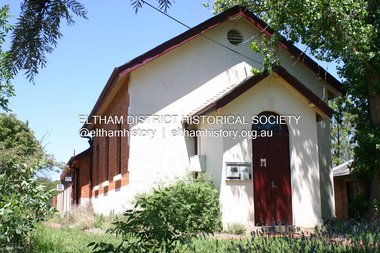
Photograph - Digital Photograph, Alan King, Eltham Court House, 730 Main Road, Eltham, 28 December 2007
... furniture enhances appreciation of this building. The Eltham Court House is one of only two intact examples in the state of this simple design with projecting entry. The building is of architectural significance because it retains intact early features. These include use of handmade bricks, simple decoration, roof trusses, timber ceiling boards, original windows...furniture enhances appreciation of this building. The Eltham Court House is one of only two intact examples in the state of this simple design with projecting entry. The building is of architectural significance because it retains intact early features. These include use of handmade bricks, simple decoration, roof trusses, timber ceiling boards, original windows ...The Eltham Court House is Eltham's oldest public building. It was classified by the National Trust in 1977. In 1857 five Eltham residents petitioned the licensing magistrates of the Heidelberg district asking for better police protection, including from itinerant gold prospectors who turned to crime when their quest was unsuccessful. In response the Eltham Courthouse was constructed in 1860. Over the years it has also been used for other activities, including for electoral polling purposes, inquests, early meetings of the Eltham Roads Board and even as an overflow classroom. This type of localised solution is characteristic of the self-reliance preserved in Eltham today. The court house is an important symbol of the spirit which makes Eltham distinctive as a community. The Eltham Courthouse is historically significant because its construction was intended to emphasise the centralised control over law and order in the Colony of Victoria in the wake of the 1852 Snodgrass committee report on the Victorian police force and the resulting Police Regulation Act (1853). The nature of the Court House planning and use of architectural devices make the building's function easily interpreted. The arrangement of rooms, with public entry and clerical rooms to the rear, and the use of raised floor levels throughout these spaces to signify relative rank is easily perceived. The distinction in entries, public, magistrate and person-in-custody, and the existing court furniture enhances appreciation of this building. The Eltham Court House is one of only two intact examples in the state of this simple design with projecting entry. The building is of architectural significance because it retains intact early features. These include use of handmade bricks, simple decoration, roof trusses, timber ceiling boards, original windows, doors and associated hardware and a collection of court furniture. Additions to the court house have been done in a manner which did not interfere with the fabric of the original building. Typical cases heard before the Court of Petty Sessions included financial debt, straying livestock, theft, assault, drunkenness, public disorder, truancy, motor vehicle offences, unregistered animals and failing to have children attend school, or be vaccinated. The courthouse operated for over 120 years before it closed in 1985. In April 2021, Nillumbik Shire Council authorised restoration of the building and furnishings. The extensive works required for the total restoration of this highly valued heritage building was undertaken by Ducon Building Solutions and other specialist contractors. Covered under Heritage Overlay, Nillumbik Planning Scheme. Victorian Heritage National Trust of Australia (Victoria) State significance Published: Nillumbik Now and Then / Marguerite Marshall 2008; photographs Alan King with Marguerite Marshall.; p65 A demand for better police protection resulted in the building of the Eltham Courthouse and the police residence beside it. In 1857 five Eltham residents petitioned the Heidelberg district licensing magistrates. They pointed out that Eltham had two hotels, a population of about 1000, and many strangers employed on the public roads. Yet the nearest police were at Heidelberg eight miles (12.8km) away, or at the Caledonia Diggings 21 miles (33.7km) away.1 Subsequently the courthouse and then the police residence, near the corner of Main Road and Brougham Street, were built in 1859/60. The courthouse is Eltham’s oldest public building and the National Trust classified it in 1977. It ceased operation in 1984 and has since been used by local groups. There are only six other known examples of similar small brick country courthouses in Victoria . For £536, a Mr Duncan built the courthouse – a neat, narrow, oblong building with handmade orange bricks. Its gabled roof and porch are covered with brown slate tiles and it has 12-paned windows. Inside, the roof is peaked and the courthouse is still ventilated by oblong slits near the ceiling. Most of the fine carved timber and upholstered furniture is original. The original prisoners’ door, now permanently closed, led from the police station to the dock. Builders, Langridge Wright and Witney built a timber police station (since demolished) and a brick residence to its north,2 for £1150/7/-. Built around the same time were the lock-up behind the residence, also later demolished, and the two-storey orange brick stables. The former police residence also has a brown slate roof and handmade bricks. The front veranda roof is made of corrugated iron, as is the roof of the back weatherboard extension. The application for police protection was approved within a few months and police operated from a cottage rented at ten shillings a week and owned by William Jarrold. This was probably the one at the corner of Main Road and Dalton Street called Jarrold or White Cloud Cottage. In 1858 a second constable was appointed to Eltham following a fight at the hotel. The timber police office a replica of which was built in the early 1990s is at the building’s side. The lock-up was demolished following the relocation of the police to a new station in about 1952. The residence has been used as the Eltham District Historical Society centre since 1997. Records show court cases were held at Eltham before the courthouse was built, but the location is unknown. Some court cases were not very different from those today. In 1891 a man was charged with being drunk while in charge of a horse and was fined ten shillings. The courthouse was used for other purposes during its long history. It was probably used as a polling place as indicated by old photographs of election-day crowds outside. The Eltham Road Board met there from the early 1860s until 1868 when the Board transferred to Kangaroo Ground. During the same period the Road Board Secretary used the courthouse as an office until 1867 when it was transferred to his home at Wingrove Cottage. The courthouse was also used as an overflow classroom for the Dalton Street school in 1875. The two buildings can further link us with Eltham’s early days through Police Department correspondence. The first constable-in-charge was George Reid. In 1860 a letter to The Argus newspaper signed ‘A Sufferer’ declared the Eltham police were not active enough in their duties. The writer suggested that the ‘very snug’ police quarters were too comfortable, and he detailed various incidents including one of an alleged break-in to the Road Board Secretary’s home. But the Board Secretary, C S Wingrove, wrote to the Police Department refuting The Argus letter saying he had received full co-operation from Sen. Constable Peter Lawler.This collection of almost 130 photos about places and people within the Shire of Nillumbik, an urban and rural municipality in Melbourne's north, contributes to an understanding of the history of the Shire. Published in 2008 immediately prior to the Black Saturday bushfires of February 7, 2009, it documents sites that were impacted, and in some cases destroyed by the fires. It includes photographs taken especially for the publication, creating a unique time capsule representing the Shire in the early 21st century. It remains the most recent comprehenesive publication devoted to the Shire's history connecting local residents to the past. nillumbik now and then (marshall-king) collection, eltham, eltham court house, main road -
 Glen Eira Historical Society
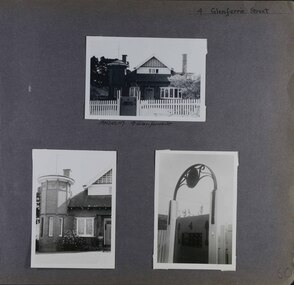
Album - Album page, Glenferrie Street, 4, Circa 1972
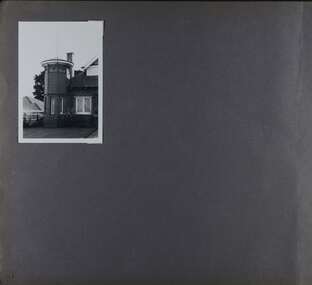
... The house is rich with hand crafted details including door and window furniture, wrought iron gutter brackets, fireplaces (one with built in wood box), and fire tools. ...This photograph is part of the Caulfield Historical Album 1972. This album was created in approximately 1972 as part of a project by the Caulfield Historical Society to assist in identifying buildings worthy of preservation. The album is related to a Survey the Caulfield Historical Society developed in collaboration with the National Trust of Australia (Victoria) and Caulfield City Council to identify historic buildings within the City of Caulfield that warranted the protection of a National Trust Classification. Principal photographer thought to be Trevor Hart, member of Caulfield Historical Society. Most photographs were taken between 1966-1972 with a small number of photographs being older and from unknown sources. All photographs are black and white except where stated, with 386 photographs over 198 pages. From Glen Eira Heritage Management Plan 1996 by Andrew Ward: In 1905, most of portion 27 was vacant land, however Glenferrie Street had been formed and the land subsequently subdivided. In 1906, Robert Joseph Haddon, architect and painter, designed and built for his private residence, a brick house on the west side. Haddon named the house "Anselm". Also built on the property were a garage and fibro cement studio. "Anselm" is architecturally important at the State level as a substantially intact, highly personalised and boldly expressed house expressive the Arts and Crafts movement and incorporating Art Nouveaux enrichment in a variety of forms, the use of ornamental terra cotta tiles to the comer tower being of special note. Its importance at the State level is strengthened by its place as the home of the noted architect and Melbourne's most influential exponent (Freeland, J.M., Architecture in Australia, p. 213) of the Art Nouveaux movement.https://vhd.heritagecouncil.vic.gov.au/places/4442 Victorian Heritage Register: What is significant? Anselm was designed by noted English born architect Robert Joseph Haddon(1866-1929) as his own house and constructed in 1906. A single storey Arts and Crafts influenced red brick house with attic, Anselm has a pyramidal slate roof with prominent chimney stacks. There is a octagonal corner tower with saucer shaped domed roof surmounted by a weather vane, and the tower has decorative terracotta panels immediately below the eaves line. The front door opens immediately into a large living or common room, screened from view by a timber and bottle glass screen. The large room was designed to function as a drawing and dining room. The house is rich with hand crafted details including door and window furniture, wrought iron gutter brackets, fireplaces (one with built in wood box), and fire tools. The interior decoration includes hand painted frieze of Port Phillip in the study, and a hand painted frieze of turbulent sea with sailing boats in the tiled bathroom. There is a small hand painted tile at the base of the tower which states ?This building was erected AD1906 from designs by Robt J Haddon FRIBA,Lond FRIVA Melb Architect?. He also designed an attic addition which was constructed in 1927. Anselm is substantially intact although the double casement window immediately to the south of the front door was originally circular....Page 60 of Photograph Album with three exterior photographs (one portrait and two landscape) of Anselm.Hand written: 4 Glenferrie Street [top right] / ANSELM 4 Glenferrie St [under top photo] / 60 [bottom right] trevor hart, anselm, art nouveaux, arts and crafts, tower, bay window, glenferrie street, robert joseph haddon, 1900's, terra cotta tiles, double storey, caulfield north, corner tower, gates, cast iron work -
 Glen Eira Historical Society
Album - Album page, Glenferrie Street, 4, Circa 1972
... The house is rich with hand crafted details including door and window furniture, wrought iron gutter brackets, fireplaces (one with built in wood box), and fire tools. ...This photograph is part of the Caulfield Historical Album 1972. This album was created in approximately 1972 as part of a project by the Caulfield Historical Society to assist in identifying buildings worthy of preservation. The album is related to a Survey the Caulfield Historical Society developed in collaboration with the National Trust of Australia (Victoria) and Caulfield City Council to identify historic buildings within the City of Caulfield that warranted the protection of a National Trust Classification. Principal photographer thought to be Trevor Hart, member of Caulfield Historical Society. Most photographs were taken between 1966-1972 with a small number of photographs being older and from unknown sources. All photographs are black and white except where stated, with 386 photographs over 198 pages. From Glen Eira Heritage Management Plan 1996 by Andrew Ward: In 1905, most of portion 27 was vacant land, however Glenferrie Street had been formed and the land subsequently subdivided. In 1906, Robert Joseph Haddon, architect and painter, designed and built for his private residence, a brick house on the west side. Haddon named the house "Anselm". Also built on the property were a garage and fibro cement studio. "Anselm" is architecturally important at the State level as a substantially intact, highly personalised and boldly expressed house expressive the Arts and Crafts movement and incorporating Art Nouveaux enrichment in a variety of forms, the use of ornamental terra cotta tiles to the comer tower being of special note. Its importance at the State level is strengthened by its place as the home of the noted architect and Melboume's most influential exponent (Freeland, J.M., Architecture in Australia, p. 213) of the Art Nouveaux movement. Victorian Heritage Register https://vhd.heritagecouncil.vic.gov.au/places/4442 What is significant? Anselm was designed by noted English born architect Robert Joseph Haddon(1866-1929) as his own house and constructed in 1906. A single storey Arts and Crafts influenced red brick house with attic, Anselm has a pyramidal slate roof with prominent chimney stacks. There is a octagonal corner tower with saucer shaped domed roof surmounted by a weather vane, and the tower has decorative terracotta panels immediately below the eaves line. The front door opens immediately into a large living or common room, screened from view by a timber and bottle glass screen. The large room was designed to function as a drawing and dining room. The house is rich with hand crafted details including door and window furniture, wrought iron gutter brackets, fireplaces (one with built in wood box), and fire tools. The interior decoration includes hand painted frieze of Port Phillip in the study, and a hand painted frieze of turbulent sea with sailing boats in the tiled bathroom. There is a small hand painted tile at the base of the tower which states ?This building was erected AD1906 from designs by Robt J Haddon FRIBA,Lond FRIVA Melb Architect?. He also designed an attic addition which was constructed in 1927. Anselm is substantially intact although the double casement window immediately to the south of the front door was originally circular....Page 61 of Photograph Album with one exterior photograph (portrait) of Anselm.Hand written: 61 [bottom left] trevor hart, anselm, art nouveaux, arts and crafts, tower, bay window, glenferrie street, robert joseph haddon, 1900's, terra cotta tiles, double storey, caulfield north, corner tower, brick house, attics -
 Eltham District Historical Society Inc
Slide - Photograph, Eltham Courthouse, 730 Main Road, Eltham, c.May 1988
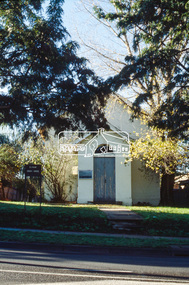
... These include use of handmade bricks, simple decoration, roof trusses, timber ceiling boards, original windows, doors and associated hardware and a collection of court furniture. Additions to the court house have been done in a manner which did not interfere with the fabric of the original building. ...These include use of handmade bricks, simple decoration, roof trusses, timber ceiling boards, original windows, doors and associated hardware and a collection of court furniture. Additions to the court house have been done in a manner which did not interfere with the fabric of the original building. ...Built in 1860, the Eltham Courthouse is the oldest public building remaining in Eltham. In its early days the building was used as the meeting place and office of the Eltham District Road Board and as an overflow classroom for the local school. The Eltham Courthouse ceased operational duties in 1984 and is now used by various community groups including Eltham District Historical Society. It was listed on the Victorian Heritage Register (Number H0784) in 1982. The building is of architectural significance because it retains intact early features. These include use of handmade bricks, simple decoration, roof trusses, timber ceiling boards, original windows, doors and associated hardware and a collection of court furniture. Additions to the court house have been done in a manner which did not interfere with the fabric of the original building. It is a fundamental asset in the Eltham Justice Precinct and is being fully restored in 2021 thanks to Nillumbik Shire Council.35mm colour positive transparency (1 of 23) Mount - Kodak EktachromeProcess Date MAY 88Meltham, eltham courthouse, main road -
 Bendigo Historical Society Inc.
Newspaper - Fortuna Article - "Fortuna Open For Inspection", July 08 1997
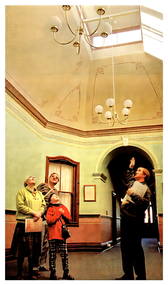
... Furniture sold in 1934 has been gradually repurchased by the Regiment and Lansell family members.The house features luxurious marble baths, stained-glass windows, grand staircases, and intricate ceiling work, reflecting George Lansell's taste. ...Furniture sold in 1934 has been gradually repurchased by the Regiment and Lansell family members.The house features luxurious marble baths, stained-glass windows, grand staircases, and intricate ceiling work, reflecting George Lansell's taste. ...Fortuna house is open to the public with weekly guided tours, contrary to the belief that it closed after the Army Survey Regiment left. Tours are led by Mal Fosters and run every Sunday from 1pm to 3pm, with group bookings and alternative times available by contacting Pat Graham. Tour attendance declined after the army's departure, impacting funding for restoration and upkeep. Funds from tours are essential for ongoing restoration projects, some of which are on hold due to limited resources. Original wood and artefacts are stored until funds allow for their proper display. Furniture sold in 1934 has been gradually repurchased by the Regiment and Lansell family members.The house features luxurious marble baths, stained-glass windows, grand staircases, and intricate ceiling work, reflecting George Lansell's taste. Every part of Fortuna contains elements of Bendigo's history.Fortuna Restoration Article - "Fortuna Open For Inspection" - Bendigo Advertiser Tues 08 July 1997- Author Susan Turpie, photographer Peter Hyett This item contains the following: 11217.5a Colour Photo of Fortuna tour guide Mal Fosters pointing out the intricate details of a ceiling in one room, before showing people into one of George Lansell's former dining rooms in the majestic mansion. 11217.5b Colour Photo of tourists scanning the stained-glass windows 11217.5c Colour Photo of one of the dining rooms 11217.5d Part of page 2 - Fortuna Open For Inspectionnon-fictionbendigo, fortuna, army tropographic support establishment -
 Bendigo Historical Society Inc.
Newspaper - History Lives Article - "New Art Has Classic Touch", Jul 24 2008
... furniture. Most outstanding examples are found in Riga (Latvia) and Brussels (Belgium), with Brussels townhouses recognized as UNESCO World Heritage sites for their architectural brilliance and historical importance. Local Examples are the Former Royal Bank Building (View Point): Built in 1908, designed by Beebe and Garin, now a restaurant. It survived the 1893 financial crash and stands out for its Art Nouveau influences. Denderah (now Cooloch House): Purchased and redecorated in 1910 by George Victor Lansell, featuring distinctive windows...furniture. Most outstanding examples are found in Riga (Latvia) and Brussels (Belgium), with Brussels townhouses recognized as UNESCO World Heritage sites for their architectural brilliance and historical importance. Local Examples are the Former Royal Bank Building (View Point): Built in 1908, designed by Beebe and Garin, now a restaurant. It survived the 1893 financial crash and stands out for its Art Nouveau influences. Denderah (now Cooloch House): Purchased and redecorated in 1910 by George Victor Lansell, featuring distinctive windows ...Art Nouveau began in the 1880s as a reaction to classical, academic art. Itfeatures organic, especially floral motifs, highly stylized forms, and flowing curves. Artists aimed to integrate art into everyday life, influencing everything from architecture to furniture. Most outstanding examples are found in Riga (Latvia) and Brussels (Belgium), with Brussels townhouses recognized as UNESCO World Heritage sites for their architectural brilliance and historical importance. Local Examples are the Former Royal Bank Building (View Point): Built in 1908, designed by Beebe and Garin, now a restaurant. It survived the 1893 financial crash and stands out for its Art Nouveau influences. Denderah (now Cooloch House): Purchased and redecorated in 1910 by George Victor Lansell, featuring distinctive windows, colored glass, carved woodwork, and plaster ceilings. 159 Forest and Verona Street (Verona): Built in 1909 for Lawrence J. Murphy, notable for its cast-iron balustrade and curved woodwork, breaking traditional architectural lines.Contrast with Other StylesBendigo is known for its 19th-century classical buildings, but also features later styles like Art Nouveau and Art Deco. An upcoming Art Deco exhibition will be held at the Bendigo Art Gallery in September.History Lives Article - "New Art Has Classic Touch" - The Bendigo Miner Thursday Jul 24 2008 - Author Jim Evans, photos Bill Conroy This item contains the following: 11217.13a Colour Photo of Cooloch House on the corner of View and Valentine Streets - was Lansell's 11217.12b Colour Photo of Verona at 159 Forest Street 11217.12c Colour Photo of the former Royal Bank building at View Point (now the Whirakee Restaurant) 11217.12d Part of page - New Art Has Classic Touchnon-fictionbendigo, fortuna, george lansell, george victor lansell, denderah, cooloch, jim evans, art noveau -
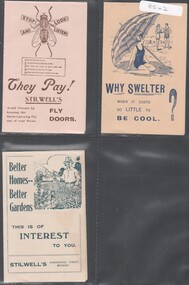 Bendigo Historical Society Inc.
Flyer - Three flyers for Stilwell's
... The shop further developed and advertised as selling furniture, home furnishings and Hardware Stilwells Window furnishings Flyers Three flyers for Stilwell's, a local Hargreaves Street Bendigo business, for Fly wire doors, internal house blinds and lawn mowers, Postcard sized flyers for aspects of home improvements. ...Business flyers for products to improve homes and gardens. Brothers Frederick and Ernest Stillwell opened a hardware and general ironmongery in Hargreaves St Bendigo in 1895. They were later joined by Roy Stillwell. The shop further developed and advertised as selling furniture, home furnishings and HardwareThree flyers for Stilwell's, a local Hargreaves Street Bendigo business, for Fly wire doors, internal house blinds and lawn mowers, Postcard sized flyers for aspects of home improvements. Flyers dated around 1950s.stilwells, window furnishings, flyers -
Glen Eira Historical Society
Book - St. Clement’s Church of England, Elsternwick
... Includes early photos of church, church members, interior of church, church furniture, nine stained glass windows and photographs of Rev. ...Includes early photos of church, church members, interior of church, church furniture, nine stained glass windows and photographs of Rev. ...2 copies of ‘Our First 100 Years Saint Clement's Elsternwick’, a 48 page book on the history of the church. Includes early photos of church, church members, interior of church, church furniture, nine stained glass windows and photographs of Rev. John Hislop, Rev. H. B. Macartney, Rev. H. W. H. Adeney, Rev. George Sproule, Rev. Hugh H. Gardner, Rev. Alfred Ernest Albert Britten, Rev. John Henry Frewin, Rev. Karl Egbert Hamilton, Rev. Colin J. Cohn, Rev. George Tooth, Rev. John Rowse. Includes photographs.st. clement’s church of england, st. clement’s anglican church, elsternwick, covey joan, moore alison, parkinson stephen, hislop john rev., allman beatrice, cohn colin, frewin nell, morris phyllis, hayman miriam e., kirke clarice, rowse john rev., tooth george rev., foundation stone, stanley st., manses, macartney h. b. rev., adeney h. w. h. rev, sproule george rev., oak avenue, gardner hugh h. rev., britten alfred ernest albert rev., frewin john henry rev., patterson nellie, moore mary elizabeth, hamilton karl egbert, hamilton mrs. karl, britten alfred mrs., cohn charlotte, cohn lottie, tooth brenda, stanley street, rowse kay, roselea street, caulfield south, anglican church, sunday schools, religious groups, clergy, davies j. h., mccombie street, caulfield grammar school, st. mary’s caulfield, carre-riddell t. w., stained glass, organs -
Glen Eira Historical Society
Article - Williams, Louis Reginald
... windows. The article includes a cartoon style drawing of Louis Williams. 2/ A handwritten list, unknown author, of some churches of which Louis Williams was the architect. St Stephens Gardenvale St Peters Church Murrumbeena Christian Science Church Elsternwick St Pauls Caulfield Williams Louis Reginald Landells Rosalind Altars Church furniture Stained glass Clinker brick Brick Presbyterian Methodist Gardenvale Murrumbeena Elsternwick Caulfield Architectural styles Churches Choirs Church of England Church of Christ Ormond St Giles Presbyterian Church Murrumbeena St Paul The Apostle Dandenong Road Christ Church Ormond Church of Christ Ormond Architects Article Williams, Louis Reginald ...This file contains 2 items. 1/ A photocopy of an article by Rosalind Landells from ‘Architect’, dated May 1976 about the ecclesiastical architect Louis Williams, who designed a number of churches in the Glen Eira area, including St Peters Church Murrumbeena and The Christian Science Church in Elsternwick. His designs allowed more space for the sanctuary area and better light from coloured and pattered glass windows. The article includes a cartoon style drawing of Louis Williams. 2/ A handwritten list, unknown author, of some churches of which Louis Williams was the architect.st stephens gardenvale, st peters church murrumbeena, christian science church elsternwick, st pauls caulfield, williams louis reginald, landells rosalind, altars, church furniture, stained glass, clinker brick, brick, presbyterian, methodist, gardenvale, murrumbeena, elsternwick, caulfield, architectural styles, churches, choirs, church of england, church of christ, ormond, st giles presbyterian church murrumbeena, st paul the apostle dandenong road, christ church ormond, church of christ ormond, architects -
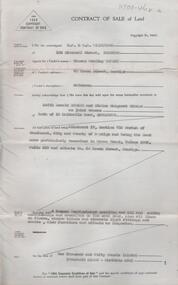 Bendigo Historical Society Inc.
Document - H. A. & S. R. WILKINSON COLLECTION: CONTRACT OF SALE
... Property: land being allotment 17 section 71C Parish of Sandhurst City of Bendigo, being land described in Crown grant volume 1962 folio 335 and situate No. 60 Breen Street, Bendigo, together with 4 roomed weatherboard dwelling, all sundry outbuildings, all linos on floors, window blinds and electric light fittings and shades, also furniture and effects as inspected. ...Property: land being allotment 17 section 71C Parish of Sandhurst City of Bendigo, being land described in Crown grant volume 1962 folio 335 and situate No. 60 Breen Street, Bendigo, together with 4 roomed weatherboard dwelling, all sundry outbuildings, all linos on floors, window blinds and electric light fittings and shades, also furniture and effects as inspected. ...Contract of sale of land dated 29th June, 1955between Mr. T. B. Bowery (vendor) and Mr. K. O. & Mrs. E. M. Stokes (purchaser). Property: land being allotment 17 section 71C Parish of Sandhurst City of Bendigo, being land described in Crown grant volume 1962 folio 335 and situate No. 60 Breen Street, Bendigo, together with 4 roomed weatherboard dwelling, all sundry outbuildings, all linos on floors, window blinds and electric light fittings and shades, also furniture and effects as inspected. Price: 1,050 pounds.organization, business, h.a. & s.r wilkinson real estate -
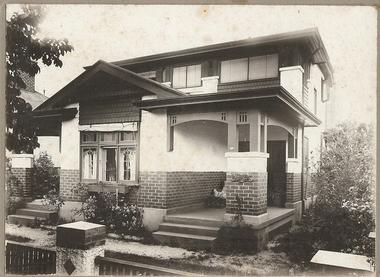 Bendigo Historical Society Inc.
Photograph - T C WATTS & SON COLLECTION: 62 CARPENTER STREET, BENDIGO, 1930
... window with six lights [5 leadlighted] On back of photo ' Phillips, Carpenter Street. £2500 sewered with all furnishing including wireless set but not including sewing machine, piano or organ and £3000 with all furniture'. 2012 photo of house attached to record....window with six lights [5 leadlighted] On back of photo ' Phillips, Carpenter Street. £2500 sewered with all furnishing including wireless set but not including sewing machine, piano or organ and £3000 with all furniture'. 2012 photo of house attached to record. ...Black and white photographs (s) mounted on rectangular brown board. House, two storey, brick, roughcast above dado height, upper storey has shingles under windows shingles below front gable. Brick verandah piers with wooden freized upperparts. Two stepped masonry approaches, two event verandahs. Roughcast to lower walls below floor level, lower window with six lights [5 leadlighted] On back of photo ' Phillips, Carpenter Street. £2500 sewered with all furnishing including wireless set but not including sewing machine, piano or organ and £3000 with all furniture'. 2012 photo of house attached to record.bendigo, business, t c watts & son
