
Showing 92 items matching "wine producing"
-
 Bendigo Historical Society Inc.
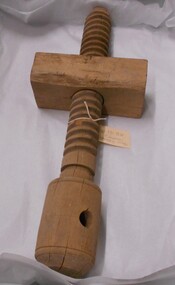
Tool - HARRIS COLLECTION: TIMBER WINE PRESS SCREW
... ...Wine producing...BHS Collection Harris Collection Wine producing Timber wine press screw. Large timber screw inserted through a rectangular block of timber. ...BHS CollectionTimber wine press screw. Large timber screw inserted through a rectangular block of timber. Top of screw is cylindrical in shape and has a hole drilled through the halfway point.harris collection, wine producing -
 Wodonga & District Historical Society Inc
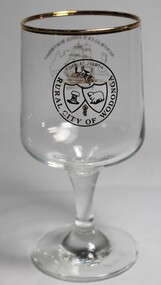
Memorabilia - Bicentennial Commemorative Wine Glass, Rural City of Wodonga, 1988
... A wine glass produced for the Rural City of Wodonga to commemorate the bicentennial of European settlement in Australia...A wide range of objects was created throughout Australia to commemorate 200th anniversary of the European settlement of Australia This glass reflects the manner in which the Bicentennial of European settlement in Australia was depicted and commemorated both on a national and local level. australia bicentennary wodonga council Emblem of the Rural City of Wodonga On the opposite side image including a sailing ship, an outline of Australia, Above the image "AUSTRALIA'S 200th BIRTHDAY" and below the image "1788-1988" A wine glass produced for the Rural City of Wodonga to commemorate the bicentennial of European settlement in Australia Bicentennial Commemorative Wine Glass, Rural City of Wodonga Memorabilia Bicentennial Commemorative Wine Glass, Rural City of Wodonga ...A wide range of objects was created throughout Australia to commemorate 200th anniversary of the European settlement of AustraliaThis glass reflects the manner in which the Bicentennial of European settlement in Australia was depicted and commemorated both on a national and local level.A wine glass produced for the Rural City of Wodonga to commemorate the bicentennial of European settlement in AustraliaEmblem of the Rural City of Wodonga On the opposite side image including a sailing ship, an outline of Australia, Above the image "AUSTRALIA'S 200th BIRTHDAY" and below the image "1788-1988"australia, bicentennary, wodonga council -
 Hume City Civic Collection
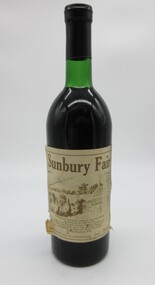
Container - Bottle, wine, 1985
... . / was bottled by Emerald Wines especially / for the Sunbury Fair / WINE PRODUCED IN AUSTRALIA F100 750ml". The hand-written label is signed by John McKerrow in 1985..... / was bottled by Emerald Wines especially / for the Sunbury Fair / WINE PRODUCED IN AUSTRALIA F100 750ml". The hand-written label is signed by John McKerrow in 1985. ...The bottle was donated to the Council by Hedley Elliott for an exhibition in the Art Gallery (George Evans Museum). Note that Goonawarra is misspelt on the label.Green glass bottle used for 1975 claret and bottled for the first Sunbury Fair. The label is printed in brown and cream and features a sketch of the Goonawarra Winery and surrounding area. There is a brief statement on the back about the winery and the background to production of the wine. On the back is a hand-written label, stuck on with clear tape giving an account of the origin of the bottle of wine, its donor and storage instructions. It has a black metal cap and miscellaneous markings on the flat bottom."Sunbury Fair / Goonawarra Vineyard (above) was established / in Sunbury in 1858 by the / Hon. J. G. Francis, former Premier of Victoria. / This 1975 Claret from the Stanley Wine Co. / was bottled by Emerald Wines especially / for the Sunbury Fair / WINE PRODUCED IN AUSTRALIA F100 750ml". The hand-written label is signed by John McKerrow in 1985.sunbury fair, wines, goonawarra vineyard, stanley wine company, emerald wines, elliott, hedley, mckerrow, john, festivals and celebrations, francis, j.g. (hon.), george evans collection, 1970s -
 Buninyong Visitor Information Centre
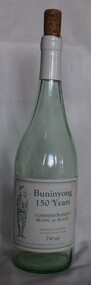
Domestic object - Bottle, Buninyong 150 Years Commemorative Blanc de Blanc, 1987
... This wine was produced as part of the celebration of the 150th Anniversary of Buninyong, held in 1987....This wine was produced as part of the celebration of the 150th Anniversary of Buninyong, held in 1987. ...This wine was produced as part of the celebration of the 150th Anniversary of Buninyong, held in 1987.A green tinged glass 750ml wine bottle with narrow neck. A '12' is pressed in glass base. White paper label printed in dark green text with a cartoon figure possibly of De Soza (?).'12' pressed into glass base. 'P15554' moulded on lower side of bottle.buninyong, 150th anniversary, wine -
 City of Kingston
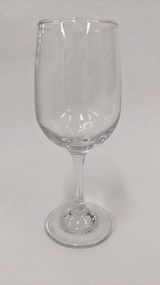
Domestic object - Kingston Arts red wine glass, City of Moorabbin, c. 1995
... Red wine glass produced for Kingston Arts, incorporating white logo on front...Red wine glass produced for Kingston Arts, incorporating white logo on front Tableware Glassware Wine glass Kingston Arts Red wine glass with Kingston Arts logo printed in white on front. ...Red wine glass produced for Kingston Arts, incorporating white logo on frontRed wine glass with Kingston Arts logo printed in white on front.tableware, glassware, wine glass, kingston arts -
 City of Kingston
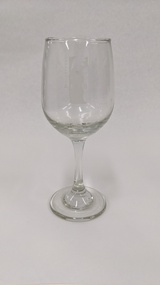
Domestic object - Kingston Arts white wine glass, City of Moorabbin, c. 1995
... White wine glass produced for Kingston Arts, incorporating white logo on front...White wine glass produced for Kingston Arts, incorporating white logo on front Tableware Glassware Wine glass Kingston Arts White wine glass with Kingston Arts logo printed in white on front. ...White wine glass produced for Kingston Arts, incorporating white logo on frontWhite wine glass with Kingston Arts logo printed in white on front.tableware, glassware, wine glass, kingston arts -
 City of Kingston
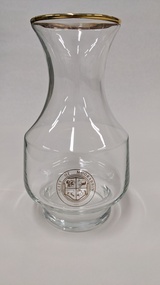
Domestic object - City of Moorabbin wine carafe, City of Moorabbin, c. 1990
... Wine glass produced for City of Moorabbin, incorporating gold edge and City of Moorabbin logo...Wine glass produced for City of Moorabbin, incorporating gold edge and City of Moorabbin logo Tableware Glassware Wine glass City of Moorabbin Wine carafe with gold edging and City of Moorabbin logo printed in gold on front. ...Wine glass produced for City of Moorabbin, incorporating gold edge and City of Moorabbin logoWine carafe with gold edging and City of Moorabbin logo printed in gold on front.tableware, glassware, wine glass, city of moorabbin -
 City of Kingston
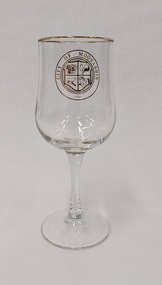
Domestic object - City of Moorabbin red wine glass, Luminarc, c. 1990
... Red wine glass produced for City of Moorabbin, incorporating gold edge and City of Moorabbin logo...Red wine glass produced for City of Moorabbin, incorporating gold edge and City of Moorabbin logo Tableware Glassware Wine glass City of Moorabbin Marked on base: France / luminarc Red wine glass with gold edging and City of Moorabbin logo printed in gold on front. ...Red wine glass produced for City of Moorabbin, incorporating gold edge and City of Moorabbin logoRed wine glass with gold edging and City of Moorabbin logo printed in gold on front.Marked on base: France / luminarctableware, glassware, wine glass, city of moorabbin -
 City of Kingston
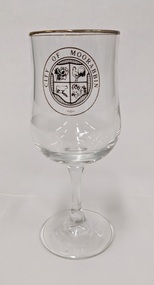
Domestic object - City of Moorabbin white wine glass, Luminarc, c. 1990
... White wine glass produced for City of Moorabbin, incorporating gold edge and City of Moorabbin logo...White wine glass produced for City of Moorabbin, incorporating gold edge and City of Moorabbin logo Tableware Glassware Wine glass City of Moorabbin Marked on base: France / luminarc White wine glass with gold edging and City of Moorabbin logo printed in gold on front. ...White wine glass produced for City of Moorabbin, incorporating gold edge and City of Moorabbin logoWhite wine glass with gold edging and City of Moorabbin logo printed in gold on front.Marked on base: France / luminarctableware, glassware, wine glass, city of moorabbin -
 Linton and District Historical Society Inc
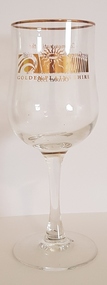
Wine Glass, Luminarc, France, Commemmorative wine glass, 1995
... Souvenir wine glass produced for visit to Golden Plains Shire of the Governor of Victoria, the Hon. ...Souvenir wine glass produced for visit to Golden Plains Shire of the Governor of Victoria, the Hon. ...Souvenir wine glass produced for visit to Golden Plains Shire of the Governor of Victoria, the Hon. Richard McGarvie, during October 1995.Gold-inscribed, long stemmed tulip-shaped 5 oz clear wine glass."Commemorating the Governor of Victoria's visit His Excellency the Hon. Richard McGarvie October 1995".hon. richard mcgarvie, golden plains shire, souvenirs, wine glasses -
 Wodonga & District Historical Society Inc
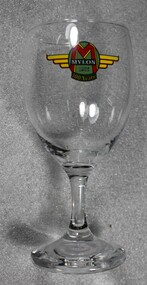
Memorabilia - Souvenir Wine Glass Mylon Centenary, C. 1906
... A wine glass produced to celebrate 100 years of operation in Wodonga. ...They were recognised for outstanding service and awards of excellence in the transport industry and tourism. mylon transport wodonga buslines In centre of logo " 1906/ 100 years" A wine glass produced to celebrate 100 years of operation in Wodonga. ...In 1906 Patrick Mylon started a passenger transport service in the Albury-Wodonga border area with horses and cabs. His son Jack went into business in the late 1920s, and his grandson Bernie joined the firm early in 1970. When Patrick started with the horses and cabs, each cab carried eight passengers and he always had two horses per cab. As the business expanded, Mylons used a range of buses and coaches including Reo, Chev and Bedford vehicles. During more than 100 years of service to the Wodonga region and beyond, Mylon Motorways received many awards for Excellence and tourism. On July 2, 2008 the company, including its 31 buses and 45 staff members were transferred to the Dyson Group.Mylon were formed in 1906 providing transport service between Wodonga and Albury via horse-drawn cabs. This expanded to a modern fleet of more than 31 buses offering a range of regular bus routes and tours throughout the area and beyond. They were recognised for outstanding service and awards of excellence in the transport industry and tourism.A wine glass produced to celebrate 100 years of operation in Wodonga. Logo includes the Mylon company logo featuring a red M and 3 gold bars. The word 100 years and 1906 have been added in gold lettering.In centre of logo " 1906/ 100 years"mylon, transport, wodonga, buslines -
 Wodonga & District Historical Society Inc
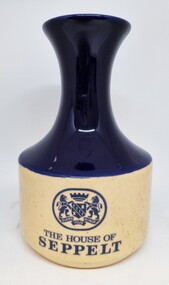
Functional object - Earthenware Bottle - House of Seppelt, Elischer Pottery, c1970
... A ceramic wine carafe produced by the House of Seppelt. It features the coat of arms of the House of Seppelt on one side and a portrait of Benno Seppelt on the opposite side. ...Seppelt & Son Australian Wine Industry Northeast Victorian wineries THE HOUSE OF / SEPPELT A ceramic wine carafe produced by the House of Seppelt. It features the coat of arms of the House of Seppelt on one side and a portrait of Benno Seppelt on the opposite side. ...The Seppelt company was founded in the Barossa Valley in 1851 by Joseph Seppelt, a German immigrant. In 1902 the family business was registered as B. Seppelt & Sons Ltd. As part of the expansion of this successful business, they acquired the Clydeside Cellars in Rutherglen from the estate of Mr. David G. Hamilton in 1914.,Due to changing conditions the vineyards were sold in the 1980s and all stock taken back to their property at Seppeltsfield in South Australia. From 1984 until the present, the Cellars in Rutherglen has had several operators including Jolimont Cellars (Doug Shears), Tony Lamb and 2 different Asian-owned conglomerates operating as Rutherglen Estates. In 2018 Rutherglen Estate was purchased by De Bortoli Family Winemakers of Griffiths, NSWThis jug is representative of leading pioneers and companies in the Australian Wine industry located in Northeast Victoria.A ceramic wine carafe produced by the House of Seppelt. It features the coat of arms of the House of Seppelt on one side and a portrait of Benno Seppelt on the opposite side. The lower section of the carafe is beige in colour and the top half, coat of arms and portrait are in blue. THE HOUSE OF / SEPPELTb. seppelt & son, australian wine industry, northeast victorian wineries -
 Orbost & District Historical Society
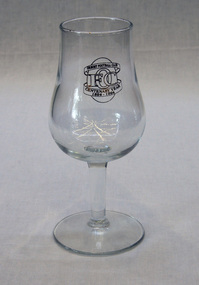
souvenir glass, 1994
... A clear wine glass produced for the centenary of the Orbost Football Club -1894-1994. ...Sport is often regarded as an important part of life in rural Australia, contributing to community identity, sense of place, social interaction and good health. souvenir wine-glass orbost-football-club On an oval (representing a football) is O F C with "ORBOST FOOTBALL CLUB" in a banner above and "CENTENARY YEAR 1894 -1994" in a banner below. all written in gold. A clear wine glass produced for the centenary of the Orbost Football Club -1894-1994. ...This souvenir wine glass was made for celebration of the centenary of the Orbost Football Club in 1994. The Orbost football club players were known as the Busters and wore green and gold guernseys. An Orbost football team has participated in the East Gippsland League since the early 20th century. In 2003 in response to a dwindling population, the Snowy Rovers and Orbost Football Clubs were driven to merge into the Orbost Snowy RoversOrbost Football Club through its many changes has always been an important social fabric of the Orbost community. Sport is often regarded as an important part of life in rural Australia, contributing to community identity, sense of place, social interaction and good health. A clear wine glass produced for the centenary of the Orbost Football Club -1894-1994. On an oval (representing a football) is O F C with "ORBOST FOOTBALL CLUB" in a banner above and "CENTENARY YEAR 1894 -1994" in a banner below. all written in gold. On an oval (representing a football) is O F C with "ORBOST FOOTBALL CLUB" in a banner above and "CENTENARY YEAR 1894 -1994" in a banner below. all written in gold.souvenir wine-glass orbost-football-club -
 Rutherglen Historical Society
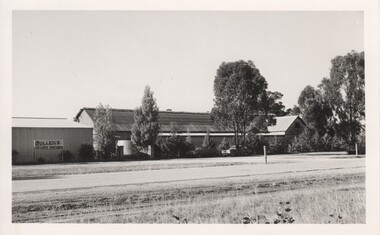
Image, 1970s
... Purchased by the Judd Family in 2013, Buller Wines has had a strong focus on the investment of cellar, storage, operations and most importantly, the vineyards which is reflective in the quality of wines produced by Winemaker Dave Whyte....Purchased by the Judd Family in 2013, Buller Wines has had a strong focus on the investment of cellar, storage, operations and most importantly, the vineyards which is reflective in the quality of wines produced by Winemaker Dave Whyte. wineries north east victoria wine industry bullers winery bullers calliope reginald buller On back of photo: "145% [upper case D in small circle] Bullers Calliope" Black and white photograph of the front of Bullers Winery Image ...Established in 1921 by Reginald Langdon Buller, the ‘Calliope Vineyard’ was named after the only surviving ship from the Great Hurricane at Samoa - 1889. A.B. (Banjo) Patterson’s Ballad Of The Calliope tells the tale in stirring fashion. Reginald’s vision of his new enterprise successfully sailing through the tempests of business and agricultural life proved prophetic. Coincidently, Calliope is also the Greek Goddess of Poetry. Today Buller Wines remains a local family business. Purchased by the Judd Family in 2013, Buller Wines has had a strong focus on the investment of cellar, storage, operations and most importantly, the vineyards which is reflective in the quality of wines produced by Winemaker Dave Whyte.Black and white photograph of the front of Bullers WineryOn back of photo: "145% [upper case D in small circle] Bullers Calliope"wineries, north east victoria, wine industry, bullers winery, bullers calliope, reginald buller -
 Wodonga & District Historical Society Inc
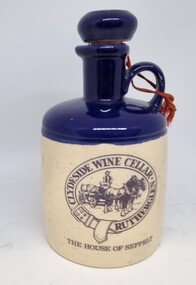
Functional object - Earthenware Bottle - Clydeside Wine Cellar Rutherglen, c1970
... An earthenware wine jug produced the House of Seppelt Clydeside Cellar at Rutherglen, VIctoria. ...An earthenware wine jug produced the House of Seppelt Clydeside Cellar at Rutherglen, VIctoria. ...Clydeside Cellar was established by David G. Hamilton, a Scotsman who migrated to the Rutherglen district in 1861. He established a large business including a general store and vineyards. The Hamilton Clydeside brick cellars were built beginning in 1886 and completed in 1892. In August 1914, Messrs B. Seppelt and Sons Ltd. purchased Clydeside Cellars from the Mr. Hamilton’s estate. Due to changing conditions the vineyards were sold in the 1980s and all stock taken back to their property at Seppeltsfield in South Australia. From 1984 until the present the former Clydeside Cellar had several operators including Jolimont Cellars (Doug Shears), Tony Lamb and the 2 different Asian owned conglomerates operating as Rutherglen Estates. In 2018 Rutherglen Estate was purchased by De Bortoli Family Winemakers of Griffiths, NSW.This jug is representative of an historic and Australian Winemaker located in Northeast Victoria.An earthenware wine jug produced the House of Seppelt Clydeside Cellar at Rutherglen, VIctoria. The jug has a tradition loop handle and cork stopper.The bottom half of the jug is a traditional beige colour with a blue section. There are images in black on both sides of the jug. Originally it would have had a wax seal over the stopper to preserve effective closure to protect the contents from any chance of seepage.On front: "THE HOUSE OF SEPPELT" beneath an image of a Clydesdale drawn beer cart and driver. The image is surrounded by a representation of a horse harness containing the text "CLYDESIDE WINE CELLAR/ RUTHERGLEN" On reverse: an image of horse-drawn beer wagons and workers in front of buildings. Across the front of the building "CLYDESIDE CELLARS RUTHERGLEN / B. SEPPELT & SONS LTD."northeast victorian wineries, clydeside cellar, b. seppelt & son -
 Mt Dandenong & District Historical Society Inc.
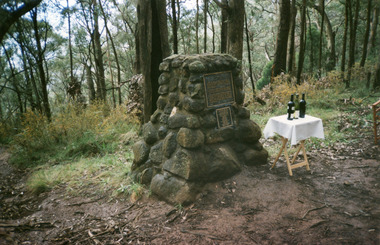
Photograph, Kyeema Cairn 2003, 2003
... Mt Dandenong & District Historical Society members observed a minute's silence and drank a toast of South Australian wine, produced by vineyards with which some of the victims were associated, in memory of all those who lost their lives. ...Mt Dandenong & District Historical Society members observed a minute's silence and drank a toast of South Australian wine, produced by vineyards with which some of the victims were associated, in memory of all those who lost their lives. ...The cairn commemorating the Kyeema aircraft disaster with the addition of a smaller plaque listing the names of those who perished in the accident. This additional plaque was suggested by relatives of the victims who had attended earlier commemorations of the accident at the site. Mt Dandenong & District Historical Society members observed a minute's silence and drank a toast of South Australian wine, produced by vineyards with which some of the victims were associated, in memory of all those who lost their lives. The plaque reads: KYEEMA VH-UYC CREW AND PASSENGERS CAPTAIN ALFRED WEBB JUNIOR CAPTAIN ALLAN STEEN AIR HOSTESS ALVA JONES CADET PILOT PHILIP PRING LEONARD ABRAHAMS K.C. ALFRED GAIN HANS GLOE STELLA GLOE GORDON GODDARD HUGO GRAMP THOMAS HARDY CHARLES HAWKER M.H.R. GEORGE LING JAMES MASSIE VAUGHAN PATE ELIZABETH SCHRADER LANCELOT SHIRLEY SIDNEY HILL SMITHkyeema, air crash, mt dandenong, cairn, plaque, captain alfred webb, allan steen, elva jones, philip pring, leonard abrahams, alfred gain, hans gloe, stella gloe, gordon goddard, hugo gramp, thomas hardy, george ling, charles hawker, james massie, vaughan pate, elizabeth schrader, lancelot shirley, sidney hill smith -
 Darebin Parklands Association
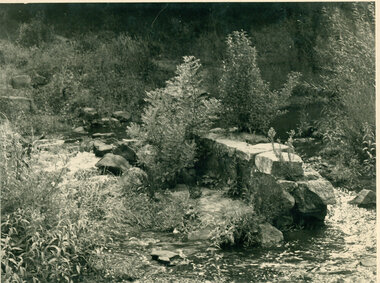
Bluestone weir, Rockbeare Park, February 1975, 1975
... A vineyard was established by Thomas Bear and produced award wining table wines in the 1860-70s. ...A vineyard was established by Thomas Bear and produced award wining table wines in the 1860-70s. ...This bluestone weir is one of two in the same section of Darebin Creek and is a remanent from early farming days. A vineyard was established by Thomas Bear and produced award wining table wines in the 1860-70s. Orange trees were later grown on the slopes below Rockbeare Grove and mixed market gardening was established in this area as the land was progressively sub-divided and leased. The weirs were used to dam the creek and pumps used to pump water to the vineyards and orange grove.B&W photograph showing remains of bluestone weir across Darebin Creek This item and all other Darebin Parklands Association archival material is now held by State Library Victoria (Accession No: YMS 13746). Please contact State Library Victoria if access is required. -
 Sunbury Family History and Heritage Society Inc.
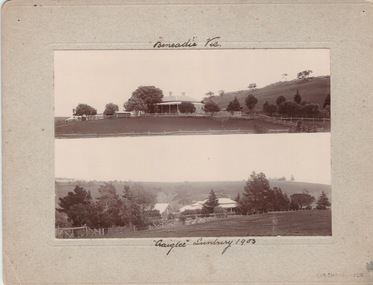
Photograph, Vineyards - Ben Eadie and Craiglee, 1903
... After his death in 1896, his son Wilfred continued to produce wines until the late 1920s, when he pulled out the vines and concentrated on raising sheep for wool and meat. ...After his death in 1896, his son Wilfred continued to produce wines until the late 1920s, when he pulled out the vines and concentrated on raising sheep for wool and meat. ...The two homesteads are Ben Eadie and Craiglee, which were two of Sunbury's earliest vineyards that were established in Sunbury. James Stewart Johnson designed and built his concrete home, Craiglee, in 1865 where the previous year he had planted out his vineyard on the surrounding 26 acres of land.The property was on the east side of Jacksons Creek on Macedon Road. He concentrated growing Riesling and Hermitage grapes. After his death in 1896, his son Wilfred continued to produce wines until the late 1920s, when he pulled out the vines and concentrated on raising sheep for wool and meat. The Carmody family purchased the property in 1961 and in 1976 decided to replant the vineyard. Ben Eadie was built some time in 1863 and settled by the Eadie family who also were millers. The winery was built into the side of a hill close to the house but the Eadie family tended to concentrate on milling and retailing.In the earliest days of European settlement many wineries were established in the Sunbury area.Two non-digital sepia photographs have been mounted on the one sheet of cardboard. They are photographs of two homesteads with bare hills in the background. They were built in Sunbury in the early days off European settlementBen Eadie Vic. Craiglee Sunbury 1903john eadie, ben eadie winery, james stewart johnson, craiglee, wineries, vineyards -
 The Beechworth Burke Museum
Audio - Oral History, Jennifer Williams, Alan French, 1st June 2000
... produced from their efforts. In this interview, Alan discusses how his great grandparents Francois (French) and Catherine (Irish) Bertrand were the first vignerons in Beechworth, even mentioned in Beechworth, a Titans Field; 'Vines were draped across 156 acres of Beechworth shire in 1880, and notable vignerons included Francois Bertrand [...]' (Woods: 162) according to Alan 'you can still see where the old vines used to be, Malakoff Rose Garden' but whether or not the wine...produced from their efforts. In this interview, Alan discusses how his great grandparents Francois (French) and Catherine (Irish) Bertrand were the first vignerons in Beechworth, even mentioned in Beechworth, a Titans Field; 'Vines were draped across 156 acres of Beechworth shire in 1880, and notable vignerons included Francois Bertrand [...]' (Woods: 162) according to Alan 'you can still see where the old vines used to be, Malakoff Rose Garden' but whether or not the wine ...Alan French was born in Beechworth in 1918 on Christmas Day, an only child descendent from French, Irish and Scottish family who had moved to and stayed in the area years before, both of his parents were born in Beechworth and were fourth generation Indigo Shire locals. Alan grew up in the depression era working the land with his dad when they could, cutting wood or helping on the local farms in and around Wooragee. Everyone able in those days bartered for goods, little coin and vegetables if there was spare to go around with labour or what little they produced from their efforts. In this interview, Alan discusses how his great grandparents Francois (French) and Catherine (Irish) Bertrand were the first vignerons in Beechworth, even mentioned in Beechworth, a Titans Field; 'Vines were draped across 156 acres of Beechworth shire in 1880, and notable vignerons included Francois Bertrand [...]' (Woods: 162) according to Alan 'you can still see where the old vines used to be, Malakoff Rose Garden' but whether or not the wine they produced was any good for drinking is open to interpretation and lost to the history of Beechworth and those who tasted it. This oral history recording was part of a project conducted by Jennifer Williams in the year 2000 to capture the everyday life and struggles in Beechworth during the twentieth century. This project involved recording seventy oral histories on cassette tapes of local Beechworth residents which were then published in a book titled: Listen to what they say: voices of twentieth century Beechworth. These cassette tapes were digitised in July 2021 with funds made available by the Friends of the Burke.This oral history account is socially and historically significant as it is a part of a broader collection of interviews conducted by Jennifer Williams which were published in the book 'Listen to what they say: voices of twentieth-century Beechworth.' While the township of Beechworth is known for its history as a gold rush town, these accounts provide a unique insight into the day-to-day life of the town's residents during the 20th century, many of which will have now been lost if they had not been preserved.This is a digital copy of a recording that was originally captured on a cassette tape. The cassette tape is black with a horizontal white strip and is currently stored in a clear flat plastic rectangular container. It holds up 40 minutes of recordings on each side.listen to what they say, beechworth, oral history, burke museum, vigneron, a titans field, beechworth a titans field, francois bertrand, wooragee, indigo shire, depression era, wood cutting, labour, farming, vines, history, malakoff rose garden -
 Flagstaff Hill Maritime Museum and Village
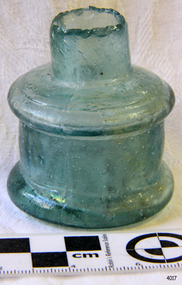
Container - Ink Bottle, Second half of 19th Century or first half of the 20th Century
... wine and beer are probably 1,600 years old, much of their use began only in the late 17th century. In the United States, large-scale production of bottles was pioneered by Caspar Wistar in 1739 at his New Jersey plant. In the 1770s the carbonation process for producing...wine and beer are probably 1,600 years old, much of their use began only in the late 17th century. In the United States, large-scale production of bottles was pioneered by Caspar Wistar in 1739 at his New Jersey plant. In the 1770s the carbonation process for producing ...Although glass containers for wine and beer are probably 1,600 years old, much of their use began only in the late 17th century. In the United States, large-scale production of bottles was pioneered by Caspar Wistar in 1739 at his New Jersey plant. In the 1770s the carbonation process for producing soft drinks was developed, and so began an entirely new bottling industry. At the Great Exhibition of 1851 in the Crystal Palace in London, one million “pop” bottles were consumed. The first beer pasteurised in glass was produced in Copenhagen in 1870. Pasteurisation of milk followed soon after. The moulding of a screw thread on a container was invented by John Mason in 1858. The principles of the “press-and-blow” process for making wide-mouth jars were shown in the United States by Philip Arbogast in 1882, and the “blow-and-blow” process for making narrow-neck containers was demonstrated by Howard Ashley in England in 1885. These processes employed manual delivery; fully automatic jar forming by a suction-and-blow process was perfected by Michael Owens over the period 1895–1917 at the Toledo (Ohio) Glass Company, which subsequently became the Owens Bottle Machine Company. The automatic single-gob feeder was developed in 1919–22 by Karl Peiler at the Hartford-Fairmont Company in Connecticut. Fully automatic machines followed, but the true rugged survivor, utilising fully automatic gob delivery to the maximum versatility, was the Individual Section, or IS, machine invented by Henry Ingle at the Hartford Empire Company in 1925. Source: https://www.britannica.com/topic/glass-properties-composition-and-industrial-production-234890/History-of-glassmakingUnlike item 4018, this is a much smaller ink bottle, and was probably used by an individual, as against the supply of ink to pupils from a much larger bottle.Cotton Reel Ink Bottle, green glass, small, chipped around the lip, bubbles in glass.None.flagstaff hill, warrnambool, shipwrecked-coast, flagstaff-hill, flagstaff-hill-maritime-museum, maritime-museum, shipwreck-coast, flagstaff-hill-maritime-village, ink, bottle, glass -
 Flagstaff Hill Maritime Museum and Village
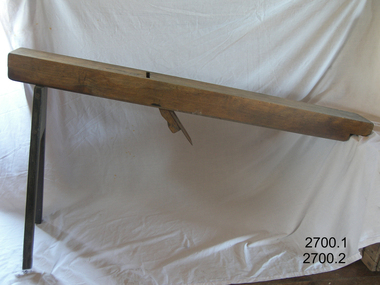
Tool - Jointing Plane, Prior to 1950
... wines etc. The subject item at this time cannot be associated with an historical event, person or place, provenance is unknown, item assessed as a collection asset as it is believed to have been produced before 1950. flagstaff hill warrnambool flagstaff-hill-maritime-museum shipwreck-coast flagstaff-hill-maritime-village plane coopers tools coopers long plane barrels None Coopers long Jointer Plane with wooden "A" frame stand, also called "Coopers' Long plane". ...A long coopers joiner plane is used to to shape the staves that form casks and kegs, with these types of plane reaching up to 180 cm in length. Unlike other planes these are used when lying stationary with the sole uppermost (base). The cooper would push the stave along the upturned sole with the sole towards the cutter. Because of the long length, Cooper’s jointer's were often mounted on legs at the rear and angled at about 60 degrees, with the toe resting on the ground or rabbeted to fit into a floor cleat or bench.A specialised tool used in the making of barrels, this type of tool has been used for many hundreds of years by coopers all around the world. It is a tool that has not changed in design during this time and is still used today by craftsmen in the making of wooden barrels for the storage of wines etc. The subject item at this time cannot be associated with an historical event, person or place, provenance is unknown, item assessed as a collection asset as it is believed to have been produced before 1950.Coopers long Jointer Plane with wooden "A" frame stand, also called "Coopers' Long plane".Noneflagstaff hill, warrnambool, flagstaff-hill-maritime-museum, shipwreck-coast, flagstaff-hill-maritime-village, plane, coopers tools, coopers long plane, barrels -
 Flagstaff Hill Maritime Museum and Village
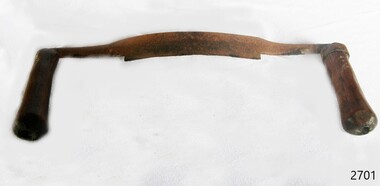
Tool - Draw Knife, Prior to 1950
... wines etc. However this item at this time cannot be associated with an historical event, person or place, provenance is unknown, item assessed as a collection asset as it is believed to have been produced before 1950. flagstaff hill warrnambool flagstaff-hill flagstaff-hill-maritime-museum shipwreck-coast flagstaff-hill-maritime-village draw knife coopers tools woodworking tools knife cooperage None Draw knife with metal blade and two wooden handles Tool Draw Knife ...A draw knife or drawing knife, draw shave, shaving knife is a traditional woodworking hand tool used to shape wood by removing shavings. It consists of a blade with a handle at each end. The blade is much longer along the cutting edge than it is deep (from cutting edge to back edge). It is pulled or "drawn" toward the user. A draw knife is commonly used to remove large slices of wood for flat faceted work, to debark trees, or to create roughly rounded or cylindrical billets for further work on a lathe, or it can shave like a spokeshave plane, where finer finishing is less of concern than a rapid result. The thin blade lends itself to create complex concave or convex curves such as in making staves for barrels.A specialised tool used in many different types of wood working and in the making of barrels, this type of tool has been used for many hundreds of years by coopers and other woodworking craftsmen all around the world. It is a tool that has not changed in design during this time and is still used today by craftsmen in the making of wooden barrels for the storage of wines etc. However this item at this time cannot be associated with an historical event, person or place, provenance is unknown, item assessed as a collection asset as it is believed to have been produced before 1950.Draw knife with metal blade and two wooden handlesNoneflagstaff hill, warrnambool, flagstaff-hill, flagstaff-hill-maritime-museum, shipwreck-coast, flagstaff-hill-maritime-village, draw knife, coopers tools, woodworking tools, knife, cooperage -
 Flagstaff Hill Maritime Museum and Village
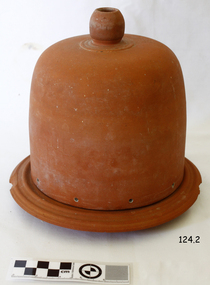
Domestic object - Terracotta Cooler Top, Ovens Pottery, c. 1890-1892
... During their short ten years of operation they produced stoneware garden urns, vases, cheese dishes, ginger beer bottles, butter coolers, water filters, wine and spirit barrels, bread plates, jugs, teapots, storage jars, pots, tiles, flower pots, spittoons, basins, bowls, demijohns, lidded crocks, pipes and bricks....During their short ten years of operation they produced stoneware garden urns, vases, cheese dishes, ginger beer bottles, butter coolers, water filters, wine and spirit barrels, bread plates, jugs, teapots, storage jars, pots, tiles, flower pots, spittoons, basins, bowls, demijohns, lidded crocks, pipes and bricks. ...The Ovens pottery operated from 1881 to1892 they had taken over H L & E pottery at Beechworth in 1888 but mounting debts forced the Ovens company to close in 1892. During their short ten years of operation they produced stoneware garden urns, vases, cheese dishes, ginger beer bottles, butter coolers, water filters, wine and spirit barrels, bread plates, jugs, teapots, storage jars, pots, tiles, flower pots, spittoons, basins, bowls, demijohns, lidded crocks, pipes and bricks.A significant item made by an early Australian pottery in Beechworth Victoria, this company made many utilitarian items for the Victorian domestic market. It gives us today a snapshot into early Australian companies that were unable to sustain manufacturing their products into the 20th century, due in part to the rising imports of cheaper items from overseas.Red terracotta butter cooler comprising, round base with ridged lip, and bell shaped, domed lid with spherical handle on topMarked "Ovens Pottery, Co Ltd, Patd 1890, Beechworth" flagstaff hill, warrnambool, shipwrecked coast, flagstaff hill maritime museum, flagstaff hill maritime village, great ocean road, cooler, terracotta cooler, utensil, kitchen ware, terracotta, food container, food preservation, butter cooler, ovens pottery -
 Flagstaff Hill Maritime Museum and Village
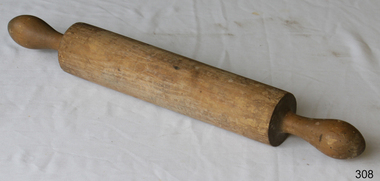
Domestic object - Wooden Rolling Pin, First half of 20th Century
... produced in hollow form, and glass and ceramic models can be filled with water and plugged with stoppers. Tapered glass rolling pins with stoppers were made for many centuries when salt imports and exports were prohibited or heavily taxed. The rolling pin containers disguised the true contents. The straight-sided cylinder is a more recent development, although tapered glass pins are still common craft projects made by cutting two wine...produced in hollow form, and glass and ceramic models can be filled with water and plugged with stoppers. Tapered glass rolling pins with stoppers were made for many centuries when salt imports and exports were prohibited or heavily taxed. The rolling pin containers disguised the true contents. The straight-sided cylinder is a more recent development, although tapered glass pins are still common craft projects made by cutting two wine ...A rolling pin is a simple tool used to flatten dough. The first civilisation known to have used the rolling pin was the Etruscans. Their advanced farming ability, along with a tendency to cultivate many plants and animals never before used as food and turn them into sophisticated recipes, were passed to invading Greeks, Romans, and Western Europeans. Thanks to the Etruscans, these cultures are associated with gourmet cooking. To prepare their inventive foods, the Etruscans also developed a wide range of cooking tools, including the rolling pin. Although written recipes did not exist until the fourth century B.C., the Etruscans documented their love of food and its preparation in murals, on vases, and on the walls of their tombs. Cooking wares are displayed with pride; rolling pins appear to have been used first to thin-roll pasta that was shaped with cutting wheels. They also used rolling pins to make bread (which they called puls) from the large number of grains they grew. Natives of the Americas used more primitive bread-making tools that are favoured and unchanged in many villages. Chefs who try to use genuine methods to preserve recipes are also interested in both materials and tools. Hands are used as "rolling pins" for flattening dough against a surface, but also for tossing soft dough between the cook's two hands until it enlarges and thins by handling and gravity. Tortillas are probably the most familiar bread made this way. Over the centuries, rolling pins have been made of many different materials, including long cylinders of baked clay, smooth branches with the bark removed, and glass bottles. As the development of breads and pastries spread from Southern to Western and Northern Europe, wood from local forests was cut and finished for use as rolling pins. The French perfected the solid hardwood pin with tapered ends to roll pastry that is thick in the middle; its weight makes rolling easier. The French also use marble rolling pins for buttery dough worked on a marble slab. Glass is still popular; in Italy, full wine bottles that have been chilled make ideal rolling pins because they are heavy and cool the dough. Countries known for their ceramics make porcelain rolling pins with beautiful decorations painted on the rolling surface; their hollow centres can be filled with cold water (the same principle as the wine bottle), and cork or plastic stoppers cap the ends. Designs for most rolling pins follow long-established practices, although some unusual styles and materials are made and used. Within the family of wooden rolling pins, long and short versions are made as well as those that are solid cylinders (one-piece rolling pins) instead of the familiar style with handles. Very short pins called mini rolling pins make use of short lengths of wood and are useful for one-handed rolling and popular with children and collectors. Mini pins ranging from 5 to 7 in (12.7-17.8 cm) in length are called texturing tools and are produced to create steam holes and decorations in pastry and pie crusts; crafters also use them to imprint clay for art projects. These mini pins are made of hardwoods (usually maple) or plastic. Wood handles are supplied for both wood and plastic tools, however. Blown glass rolling pins are made with straight walls and are solid or hollow. Ceramic rolling pins are also produced in hollow form, and glass and ceramic models can be filled with water and plugged with stoppers. Tapered glass rolling pins with stoppers were made for many centuries when salt imports and exports were prohibited or heavily taxed. The rolling pin containers disguised the true contents. The straight-sided cylinder is a more recent development, although tapered glass pins are still common craft projects made by cutting two wine bottles in half and sealing the two ends together so that the necks serve as handles at each end.Tiny rolling pins are also twisted into shape using formed wire. The pins will not flatten and smooth pastry, and the handles do not turn. The metal pins are popular as kitchen decorations and also to hang pots, pans, and potholders. https://www.encyclopedia.com/sports-and-everyday-life/food-and-drink/food-and-cooking/rolling-pinThe use of the rolling pin to make thin pastry or pasta.Wooden rolling pin with some damage on cylinder section.None.flagstaff hill, warrnambool, shipwrecked-coast, flagstaff-hill, flagstaff-hill-maritime-museum, maritime-museum, shipwreck-coast, flagstaff-hill-maritime-village, rolling pin, cooking, pastry -
 Flagstaff Hill Maritime Museum and Village
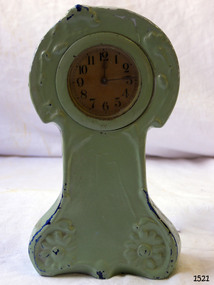
Instrument - Clock, 1920s
... Roy Arthur Wines was Born in 1897 in Mailors Flat Victoria Australia and Died in 1980 in Ballarat. Roy lived for a number of years in Warrnambool during his married life. A massed produced ...It is possible that this may have been a wedding present or gift to Roy Wines and or his family as his name is scratched on the bottom. Roy was married in 1924 in Warrnambool. Roy Arthur Wines was Born in 1897 in Mailors Flat Victoria Australia and Died in 1980 in Ballarat. Roy lived for a number of years in Warrnambool during his married life.A massed produced item that at the time was cheap to buy with no makers mark or date stamp thousands would have been produced using a mould to make the ceramic case in two half's by pouring liquid clay into the mould and then joining the half's together when cured. This item could have been produced in Holland at any number of pottery factories at this time for export in vast quantities.Ceramic clock; the mechanism is plated steel and set in a ceramic case with glass over the face. The ceramic base colour is white with royal blue ceramic colour to the front and sides only. The blue ceramic has been painted over with lime green house paint on the front and sides. An inscription of a handwritten name is on the case and a hard-to-read model or batch number is on the cast base. Handwritten "Roy Wines" Cast number "6072"flagstaff hill, flagstaff hill maritime museum and village, warrnambool, maritime museum, maritime village, great ocean road, shipwreck coast, clock, roy wines, ceramic, ceramic clock, horology, time keeper, travel clock, bedside clock, timepiece -
 The Beechworth Burke Museum
Geological specimen - Granodiorite, Unknown
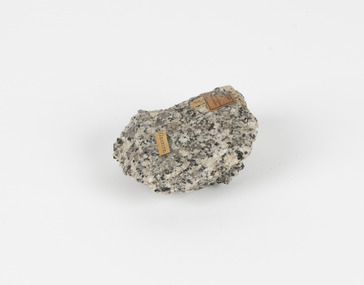
... wine. The Traditional owners of Harcourt are The Dja Dja Wurrung people. Granodiorite is a coarse-grained intrusive igneous rock similar to granite, but containing more plagioclase feldspar than orthoclase feldspar. Granodiorite has greater than 20% quartz by volume, and between 65% and 90% of the feldspar is plagioclase. This piece is of significance due to its provenance in Harcourt, Vic. Granodiorite is commonly produced ...This specimen was found in Harcourt, Victoria. Harcourt is a small historic gold rush town located in a valley at the foot of Mount Alexander (741 m) in the Central Highlands of Victoria. In recent times the goldrush origins of the town have been replaced by a district known for apples, cider and wine. The Traditional owners of Harcourt are The Dja Dja Wurrung people. Granodiorite is a coarse-grained intrusive igneous rock similar to granite, but containing more plagioclase feldspar than orthoclase feldspar. Granodiorite has greater than 20% quartz by volume, and between 65% and 90% of the feldspar is plagioclase. This piece is of significance due to its provenance in Harcourt, Vic. Granodiorite is commonly produced in volcanic arcs, and in mountain buildings where it emplaces as large batholiths in mountain roots. Granodiorite is the plutonic equivalent of dacite. This specimen is part of a larger collection of geological and mineral specimens collected from around Australia (and some parts of the world) and donated to the Burke Museum between 1868-1880. A large percentage of these specimens were collected in Victoria as part of the Geological Survey of Victoria that begun in 1852 (in response to the Gold Rush) to study and map the geology of Victoria. Collecting geological specimens was an important part of mapping and understanding the scientific makeup of the earth. Many of these specimens were sent to research and collecting organisations across Australia, including the Burke Museum, to educate and encourage further study.Granodiorite is a coarse-grained intrusive igneous rock similar to granite, but containing more plagioclase feldspar than orthoclase feldspar. According to the QAPF diagram, granodiorite has a greater than 20% quartz by volume, and between 65% and 90% of the feldspar is plagioclase.GRANDIORITE. / Locality: / Harcourt, Victoria / Other label: Geological survey / R S / Loc Harcourt quarries [?] Alexander / 1/4 Sheet. | 4 | Granite /granodiorite, granite, burke museum, harcourt, coarse-grained, igneous, plagioclase feldspar, orthoclase feldspar, quartz, mount alexander, the dja dja wurrung people, the traditional owners, central highlands of victoria, gold rush -
 Marysville & District Historical Society
Map (Item) - Tourist map, Mystic Mountains Tourism, OFFICIAL VISITORS' MAP MARYSVILLE LAKE MOUNTAIN, Unknown
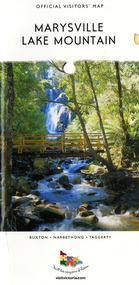
... A visitors' map of Marysville and Lake Mountain produced by Mystic Mountains Tourism for Visit Victoria. marysville lake mountain victoria australia visitor's map official visitors' map marysville lake mountain buxton narbethong taggerty visit victoria mystic mountains tourism inc graph attack p/l mystic mountains marysville triangle marysville visitor information centre marylands country house black spur steavenson falls lady talbot drive cambarville cathedral ranges wirreanda festival lake mountain summit walk summit walk loop leadbeaters loop day loop walk buxton hotel igloo roadhouse karmann waters silverstream b&b cottages buxton trout and salmon farm the niche wine bar buxton post office & general store choppers buxton roadhouse woodlands rainforest bungalows chestnut glade black spur inn wombat cottage abbey lake luxury b&b spa cottages mystic mountain ski hire & outdoors pnl 4wdriving blue views holiday units & ski hire marapana agistment park & farm stay b&b danico design things of sand & stone mantirri blueberry farm allawah country cottages amberview cottages ashlar cottage b&b black spur motel & caravan park blackwood deluxe cottages blackwood courtyard b&b dalrymples guest cottages delderfield el kanah guest house fruit salad farm kerami guest house keppels hotel lake mountain-snow gum lodge lomatia lodge lyell guest cottages magnolia house keppel waters lyrebird apartments marysville caravan park all view spa apartments riverside cottages maryton park b&b country cottages melina cottage mountain lodge mystic mountains holiday cottages nanda binya lodge rendezvous luxury cottages scenic b&b motel the cumberland south cathedral farm tower motel willowbank at taggerty woodlands rainforest retreat marysville & district country club inc mystic mountains ski hire & outdoors rubicon valley horse riding marysville trout and salmon ponds gallipoli park keppels lookout cambarville-yarra ranges national park lake mountain-yarra ranges national park lady talbot drive-yarra ranges national park cathedral range state park steavenson river taggerty river acheron river lake mountain alpine resort bruno's art and sculpture garden manical mechanicals uncle fred & aunty val's old style lolly shop carmyle farm boutique crossways historic country inn fraga's gilberts restaurant heights licensed bistro the old woolshed cafe cathedral view natural therapies crystal journey The Marysville and Lake Mountain Visitor Map and Touring Guide has been compiled and/ published by Mystic Mountains Tourism Inc. ...A visitors' map of Marysville and Lake Mountain produced by Mystic Mountains Tourism for Visit Victoria.A visitors' map of Marysville and Lake Mountain produced by Mystic Mountains Tourism for Visit Victoria.The Marysville and Lake Mountain Visitor Map and Touring Guide has been compiled and/ published by Mystic Mountains Tourism Inc. Copyright./ Production and artwork Graph Attack P/Lmarysville, lake mountain, victoria, australia, visitor's map, official visitors' map marysville lake mountain, buxton, narbethong, taggerty, visit victoria, mystic mountains tourism inc, graph attack p/l, mystic mountains, marysville triangle, marysville visitor information centre, marylands country house, black spur, steavenson falls, lady talbot drive, cambarville, cathedral ranges, wirreanda festival, lake mountain summit walk, summit walk loop, leadbeaters loop, day loop walk, buxton hotel, igloo roadhouse, karmann waters, silverstream b&b cottages, buxton trout and salmon farm, the niche wine bar, buxton post office & general store, choppers buxton roadhouse, woodlands rainforest bungalows, chestnut glade, black spur inn, wombat cottage, abbey lake luxury b&b spa cottages, mystic mountain ski hire & outdoors, pnl 4wdriving, blue views holiday units & ski hire, marapana agistment park & farm stay b&b, danico design, things of sand & stone, mantirri blueberry farm, allawah country cottages, amberview cottages, ashlar cottage b&b, black spur motel & caravan park, blackwood deluxe cottages, blackwood courtyard b&b, dalrymples guest cottages, delderfield, el kanah guest house, fruit salad farm, kerami guest house, keppels hotel, lake mountain-snow gum lodge, lomatia lodge, lyell guest cottages, magnolia house, keppel waters, lyrebird apartments, marysville caravan park, all view spa apartments, riverside cottages, maryton park b&b country cottages, melina cottage, mountain lodge, mystic mountains holiday cottages, nanda binya lodge, rendezvous luxury cottages, scenic b&b motel, the cumberland, south cathedral farm, tower motel, willowbank at taggerty, woodlands rainforest retreat, marysville & district country club inc, mystic mountains ski hire & outdoors, rubicon valley horse riding, marysville trout and salmon ponds, gallipoli park, keppels lookout, cambarville-yarra ranges national park, lake mountain-yarra ranges national park, lady talbot drive-yarra ranges national park, cathedral range state park, steavenson river, taggerty river, acheron river, lake mountain alpine resort, bruno's art and sculpture garden, manical mechanicals, uncle fred & aunty val's old style lolly shop, carmyle farm boutique, crossways historic country inn, fraga's, gilberts restaurant, heights licensed bistro, the old woolshed cafe, cathedral view natural therapies, crystal journey -
 Marysville & District Historical Society
Ephemera (Item) - Advertising brochure, Buxton Ridge, Unknown
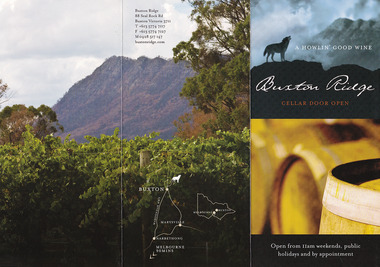
... It is located at the foothills of the Cathedral Ranges near Buxton in Victoria and is a family run business. Some of the wines produced are Michael Wolf Merlot, Lorna Grace Pinot, Katie Maree Sauvignon Blanc, Wolf Rudiger Shiraz and Molly Jean Sparkling. ...An advertising brochure for Buxton Ridge winery in Victoria.An advertising brochure for Buxton Ridge winery in Victoria. Buxton Ridge was established in 1996. It is located at the foothills of the Cathedral Ranges near Buxton in Victoria and is a family run business. Some of the wines produced are Michael Wolf Merlot, Lorna Grace Pinot, Katie Maree Sauvignon Blanc, Wolf Rudiger Shiraz and Molly Jean Sparkling. All the wines are named after family members.buxton ridge, winery, wine, victoria, cathedral ranges, michael wolf merlot, lorna grace pinot, katie maree sauvignon blanc, wolf rudiger shiraz, molly jean sparkling -
 Marysville & District Historical Society
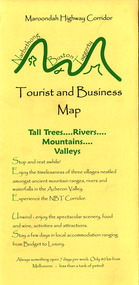
Map (Item) - Tourist and business map, Narbethong Community and Tourism Group, Narbethong Buxton Taggerty Tourist and Business Map, 04-2008
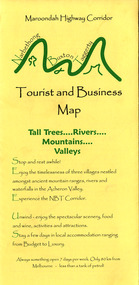
... A tourist and business map of Narbethong, Buxton and Taggerty. narbethong buxton taggerty victoria australia tourist and business map narbethong community and tourism group acheron valley yarra track wood's point black spur mystic mountains the meeting of the waters cathedral range danico design counted cross stitch things of sand & stone buxton zoo nursery & oddz & enz willowbank at taggerty safe trek 4wd services pnl 4wdriving buxton trout and salmon farm mystic mountains ski hire & outdoors narbethong ski hire highwood health centre cathedral view natural therapies narby cabinets plants by shelian gb timber executive signs rb automotive repairs buxton car care marysville towing & equipment hire martyn slade building design cathedral peak framing black spur roadhouse & ski hire tudor lodge roadhouse & ski hire buxton roadhouse & persian bazzar buxton post office general store & niche bar igloo roadhouse taggerty store narby eggs marapana agistment park mantirri blueberry farm carmyle farm hazelwood hazelnuts south cathedral lavender farm cathedral cherries black spur motel & caravan park woodlands rainforest retreat chestnut glade black spur inn wombat cottage abbey lake luxury b & b spa cottages blue views holiday cottages camp narbethong marapana farm stay b & b mantirri blueberry farm b & b little dene garden cottages silverstream b & b cottages nareen cabins moondai farm b & b south cathedral farm luxury b & b cottages yarrolyn caravan park sarsens rest lomah retreat pinjarra gardens kingbilli country estate henry viii manor house buxton hotel butters cafe of buxton wagtail wines little river wines lanterns at willowbank wirrawilla rainforest walk wilhemina falls the cascades This publication has been produced by the Narbethong Community and Tourism/ Group (NCTG) to promote the natural attractions, adventure activities and food/ trail from the Black Spur, through Narbethong, Buxton and Taggerty./ the information provided in this publication has been supplied by the individual/ members. ...A tourist and business map of Narbethong, Buxton and Taggerty. This map was produced by the Narbethong Community and Tourism Group in April 2008. It was produced to promote the natural attractions, adventure activities and food trail from the Black Spur, through Narbethong, Buxton and Taggerty.A tourist and business map of Narbethong, Buxton and Taggerty.This publication has been produced by the Narbethong Community and Tourism/ Group (NCTG) to promote the natural attractions, adventure activities and food/ trail from the Black Spur, through Narbethong, Buxton and Taggerty./ the information provided in this publication has been supplied by the individual/ members. NCTG takes no responsibility for its accuracy./ April 2008narbethong, buxton, taggerty, victoria, australia, tourist and business map, narbethong community and tourism group, acheron valley, yarra track, wood's point, black spur, mystic mountains, the meeting of the waters, cathedral range, danico design counted cross stitch, things of sand & stone, buxton zoo nursery & oddz & enz, willowbank at taggerty, safe trek 4wd services, pnl 4wdriving, buxton trout and salmon farm, mystic mountains ski hire & outdoors, narbethong ski hire, highwood health centre, cathedral view natural therapies, narby cabinets, plants by shelian, gb timber, executive signs, rb automotive repairs, buxton car care, marysville towing & equipment hire, martyn slade building design, cathedral peak framing, black spur roadhouse & ski hire, tudor lodge roadhouse & ski hire, buxton roadhouse & persian bazzar, buxton post office general store & niche bar, igloo roadhouse, taggerty store, narby eggs, marapana agistment park, mantirri blueberry farm, carmyle farm, hazelwood hazelnuts, south cathedral lavender farm, cathedral cherries, black spur motel & caravan park, woodlands rainforest retreat, chestnut glade, black spur inn, wombat cottage, abbey lake luxury b & b spa cottages, blue views holiday cottages, camp narbethong, marapana farm stay b & b, mantirri blueberry farm b & b, little dene garden cottages, silverstream b & b cottages, nareen cabins, moondai farm b & b, south cathedral farm luxury b & b cottages, yarrolyn caravan park, sarsens rest, lomah retreat, pinjarra gardens, kingbilli country estate, henry viii manor house, buxton hotel, butters cafe of buxton, wagtail wines, little river wines, lanterns at willowbank, wirrawilla rainforest walk, wilhemina falls, the cascades -
 Marysville & District Historical Society
Map (Item) - Tourist and business map, Narbethong Community and Tourism Group, Narbethong Buxton Taggerty Tourist and Business Map, 04-2008
... A tourist and business map of Narbethong, Buxton and Taggerty. narbethong buxton taggerty victoria australia tourist and business map narbethong community and tourism group acheron valley yarra track wood's point black spur mystic mountains the meeting of the waters cathedral range danico design counted cross stitch things of sand & stone buxton zoo nursery & oddz & enz willowbank at taggerty safe trek 4wd services pnl 4wdriving buxton trout and salmon farm mystic mountains ski hire & outdoors narbethong ski hire highwood health centre cathedral view natural therapies narby cabinets plants by shelian gb timber executive signs rb automotive repairs buxton car care marysville towing & equipment hire martyn slade building design cathedral peak framing black spur roadhouse & ski hire tudor lodge roadhouse & ski hire buxton roadhouse & persian bazzar buxton post office general store & niche bar igloo roadhouse taggerty store narby eggs marapana agistment park mantirri blueberry farm carmyle farm hazelwood hazelnuts south cathedral lavender farm cathedral cherries black spur motel & caravan park woodlands rainforest retreat chestnut glade black spur inn wombat cottage abbey lake luxury b & b spa cottages blue views holiday cottages camp narbethong marapana farm stay b & b mantirri blueberry farm b & b little dene garden cottages silverstream b & b cottages nareen cabins moondai farm b & b south cathedral farm luxury b & b cottages yarrolyn caravan park sarsens rest lomah retreat pinjarra gardens kingbilli country estate henry viii manor house buxton hotel butters cafe of buxton wagtail wines little river wines lanterns at willowbank wirrawilla rainforest walk wilhemina falls the cascades This publication has been produced by the Narbethong Community and Tourism/ Group (NCTG) to promote the natural attractions, adventure activities and food/ trail from the Black Spur, through Narbethong, Buxton and Taggerty./ the information provided in this publication has been supplied by the individual/ members. ...A tourist and business map of Narbethong, Buxton and Taggerty. This map was produced by the Narbethong Community and Tourism Group in April 2008. It was produced to promote the natural attractions, adventure activities and food trail from the Black Spur, through Narbethong, Buxton and Taggerty.A tourist and business map of Narbethong, Buxton and Taggerty.This publication has been produced by the Narbethong Community and Tourism/ Group (NCTG) to promote the natural attractions, adventure activities and food/ trail from the Black Spur, through Narbethong, Buxton and Taggerty./ the information provided in this publication has been supplied by the individual/ members. NCTG takes no responsibility for its accuracy./ April 2008narbethong, buxton, taggerty, victoria, australia, tourist and business map, narbethong community and tourism group, acheron valley, yarra track, wood's point, black spur, mystic mountains, the meeting of the waters, cathedral range, danico design counted cross stitch, things of sand & stone, buxton zoo nursery & oddz & enz, willowbank at taggerty, safe trek 4wd services, pnl 4wdriving, buxton trout and salmon farm, mystic mountains ski hire & outdoors, narbethong ski hire, highwood health centre, cathedral view natural therapies, narby cabinets, plants by shelian, gb timber, executive signs, rb automotive repairs, buxton car care, marysville towing & equipment hire, martyn slade building design, cathedral peak framing, black spur roadhouse & ski hire, tudor lodge roadhouse & ski hire, buxton roadhouse & persian bazzar, buxton post office general store & niche bar, igloo roadhouse, taggerty store, narby eggs, marapana agistment park, mantirri blueberry farm, carmyle farm, hazelwood hazelnuts, south cathedral lavender farm, cathedral cherries, black spur motel & caravan park, woodlands rainforest retreat, chestnut glade, black spur inn, wombat cottage, abbey lake luxury b & b spa cottages, blue views holiday cottages, camp narbethong, marapana farm stay b & b, mantirri blueberry farm b & b, little dene garden cottages, silverstream b & b cottages, nareen cabins, moondai farm b & b, south cathedral farm luxury b & b cottages, yarrolyn caravan park, sarsens rest, lomah retreat, pinjarra gardens, kingbilli country estate, henry viii manor house, buxton hotel, butters cafe of buxton, wagtail wines, little river wines, lanterns at willowbank, wirrawilla rainforest walk, wilhemina falls, the cascades
