
Showing 92 items matching "wodonga 1980s"
-
 Wodonga & District Historical Society Inc
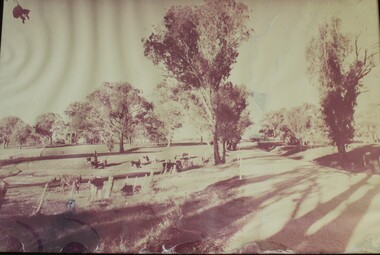
Photograph - Photo - Felltimber Creek Road, Wodonga, Neil Coles, July 1984
... ...Wodonga 1980s...It was originally covered in bushland felltimber creek Wodonga 1980s Wodonga scenes A large black and white image of cows grazing in a paddock. ...Felltimber Creek Road is on the south-eastern edge of West Wodonga. It was originally covered in bushlandA large black and white image of cows grazing in a paddock. Image is in a metal and glass frame.felltimber creek, wodonga 1980s, wodonga scenes -
 Wodonga & District Historical Society Inc
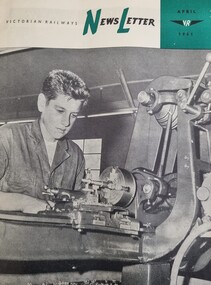
Newsletter - Victorian Railways April 1961
... Wodonga Railways Victorian Railways Victorian Railways Wodonga This booklet is one of a series featuring news items from Victorian Railways from the early 1960s until the late 1980s. ...This booklet is one of a series featuring news items from Victorian Railways from the early 1960s until the late 1980s. During this period the corporate name changed to VLine and the newsletter continued to be published as VLine Newsletter. This issue from April 1961 features an article "Wodonga Links the States" which explains the complexity of operations of the railways at Wodonga and Albury due to the break of gauge in gauge between the two railway networks. The article was written to acknowledge the work carried out by the railway at both stations prior to the opening of the standard gauge track. Until this time Victorian trains operated on 4’ 8½” tracks whilst New South Wales were 5’ 3” wide. With an overall stall of 241, Wodonga railmen prepared, serviced and manned 14 "up" and 11 "down" trains as well as specials each day. Special migrant trains to Bonegilla were often a feature at this time as well as transport of heavy equipment to the Snowy Mountain Scheme.A small booklet of 14 pages including articles and images.This booklet is one of a series featuring news items from Victorian Railways from the early 1960s until the late 1980s. During this period the corporate name changed to VLine and the newsletter continued to be published as VLine Newsletter. This issue from April 1961 features an article "Wodonga Links the States" which explains the complexity of operations of the railways at Wodonga and Albury due to the break of gauge in gauge between the two railway networks. The article was written to acknowledge the work carried out by the railway at both stations prior to the opening of the standard gauge track. Until this time Victorian trains operated on 4’ 8½” tracks whilst New South Wales were 5’ 3” wide. With an overall stall of 241, Wodonga railmen prepared, serviced and manned 14 "up" and 11 "down" trains as well as specials each day. Special migrant trains to Bonegilla were often a feature at this time as well as transport of heavy equipment to the Snowy Mountain Scheme.wodonga railways, victorian railways, victorian railways wodonga -
 Wodonga & District Historical Society Inc
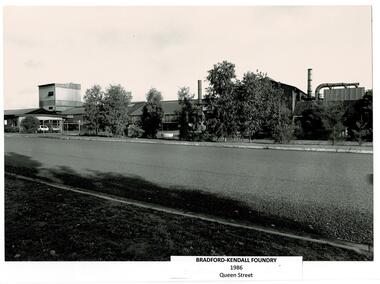
Photograph - Bradford Kendall, Wodonga
... Wodonga became one of the most profitable foundries in the Bradford Kendall group. Bill Black became the first plant Manager, a position he held for 30 years. Another long term employee was Pat Gooding who began work at a 15 year old and retired for the position of Bradken foundry Manufacturing Manager 51 years later. In the early 1980s...Wodonga became one of the most profitable foundries in the Bradford Kendall group. Bill Black became the first plant Manager, a position he held for 30 years. Another long term employee was Pat Gooding who began work at a 15 year old and retired for the position of Bradken foundry Manufacturing Manager 51 years later. In the early 1980s ...Bradford Kendall was established in 1922 by Lesley Bradford and Jim Kendall, investing their winnings on a race horse. They both previously worked at the BHP Steel Works. They gained contracts with the railways and mining industry. During World War II they also manufactured armaments. During the boom of the 1950s they established several foundries in South Australia, Western Australia, Queensland and Victoria. Bradford Kendall Ltd Wodonga foundry was established in 1954. It melted down old railway wheels, rails and redundant machinery to produce a range of low-alloy steel products, especially for earth-moving vehicles, railways, oil rigs and sugar factories. Wodonga was ideally placed as a change point between the different rail gauges of Victoria and New South Wales, close to the Hume Highway and the Snowy Mountain Scheme. The first sod for the site was turned on 2nd June 1954 and the first melt and pour of molten metal at Wodonga took place on 7th July 1954. Bradford Kendall Plant No.5 in Wodonga became one of the most profitable foundries in the Bradford Kendall group. Bill Black became the first plant Manager, a position he held for 30 years. Another long term employee was Pat Gooding who began work at a 15 year old and retired for the position of Bradken foundry Manufacturing Manager 51 years later. In the early 1980s, Australian National Industries Ltd bought Bradford Kendall and other heavy engineering companies. The Wodonga foundry with its (then) 170 or so staff became part of Bradken Consolidated along with nine other foundries in Australia and New Zealand. In 1989, Kerry Packer’s Consolidated Press Holdings Ltd took control of ANI. In January 1999, Smorgon Steel Group acquired ANI, which included the Bradken business. The company changed hands again in 2001 when Smorgon Steel Group sold Bradken to Castle Harlan Australian Mezzanine Partners (CHAMP). In 2016 negotiations began for Bradken to be taken over by Hitachi Construction for A$689 million. In April 2017 Bradken became a wholly owned subsidiary of Hitachi Construction Machinery Co. Limited.A collection of black and white images and advertising for Bradford Kendall (Bradken) Wodonga.bradford kendall, wodonga industries, wodonga businesses -
 Wodonga & District Historical Society Inc
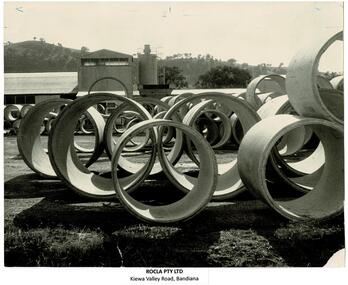
Photograph - ROCLA, Wodonga
... By 1964 ROCLA Concrete Pipes was Wodonga’s largest secondary industry. A new concrete pole manufacturing plant was established in the early 1980s. ...By 1964 ROCLA Concrete Pipes was Wodonga’s largest secondary industry. A new concrete pole manufacturing plant was established in the early 1980s. ...ROCLA was founded by two friends, Walter Robertson and Heaton Clarke, who combined the first letters of their surnames to create the brand name in 1922. The company first came to the Albury – Wodonga area in late 1927 when tenders were called for the construction of their works and office in Kiewa Street, Albury. They were a popular provider of concrete pipe culverts and reinforced concrete troughs for farm use. In 1949 ROCLA began operations at Bandiana. Initially this was to produce pipes for the Snowy Mountains Hydro-Electric Scheme which officially began construction on 17 October 1949. They also provided pipes for the Kiewa Hydro Scheme. Another early major contract for ROCLA was with the Victorian State Rivers and Water Supply Commission for the provision of pipes for the new sewerage system in the new town of Tallangatta, relocated due to the enlargement of the Hume Weir. This contract called for the supply of 21,000 six inch pipes and 7,000 nine inch pipes. At this time ROCLA employed 15 men and this job required about 80 bags of cement per day. By 1964 ROCLA Concrete Pipes was Wodonga’s largest secondary industry. A new concrete pole manufacturing plant was established in the early 1980s. ROCLA poles also dot the landscape in several Australian States. ROCLA poles also hold up many of the Hume Freeway bridge and support the Union Bridge which crosses the Murray River at Albury. After various changes in management, ROCLA was taken over by New Zealand's Fletcher Building group in 2005. In September 2021 ROCLA became part of the Civilmart Group. These images are significant because they record the history of a major manufacturing industry in Wodonga.A collection of photographs and advertisements representing the ROCLA, Wodonga company.manufacturing industries wodonga, rocla wodonga, wodonga industries -
 Wodonga & District Historical Society Inc
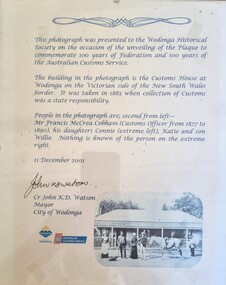
Certificate - 100 Years of Federation and the Australian Customs Service, 2001
... 1980s and is now a restaurant. This item is significant because it documents the commemoration ceremony for the Australian Custom Service held in Wodonga on 11th December 2001. ...On 11th December 2001 an event was held in Wodonga to celebrate 100 years of the Australian Customs Service. It was held at the former Customs House building in Wodonga. The ceremony was attended by several dignitaries including the sitting Members of Parliament Mr Tony Plowman and Mr Bill Baxter. Speeches were made by Cr John Watson and Mr Bob Morgan, Supervisor of Australian Customs. A commemorative plaque was also unveiled. The Australian Customs Service played an important role in the history of Wodonga and a major part in the federation of the colonies of Australia. In 1852 the colonies were given the right to collect import duties on items such as coffee, tea, tobacco, chocolate and spirits. NSW was first to impose collection of duties in 1853. At that time Wodonga was not an official port of entry and was not allowed to collect duties. This regulation made it illegal for people to transport dutiable goods across the Murray River from NSW which provided an incentive for smuggling, while at the same time strangling the legitimate trade. Merchants and settlers along the Murray River complained and petitioners approached Melbourne to establish a Customs House on the Murray River so that trade could resume. Belvoir (later to become Wodonga) was a made a port of entry with its own Customs House gazetted on 22nd December 1854. The Government set aside 500 Pounds in 1859 to build Belvoir's own Customs House J P Hanify was appointed as sub-collector at Belvoir. The Customs House was built near the end of Union Bridge over the Murray River in 1859. Tariffs or customs duties greatly angered residents and it was little wonder the customs officer of the day was always an unpopular man. Tariffs had to be paid on articles such as tobacco, many food items and new clothing that were carried across the Border. The range of items was extended over time, leading to some farmers even swimming their livestock across the river to avoid duties at the Customs House. The levying of duties ended with Federation in 1901. Francis Cobham depicted in this photograph, took up the position of Customs Officer in 1867 and remained there until his retirement in 1890. The building was originally a 2-roomed Customs House in 1856 but was extended to provide living quarters for the Cobham family while a nearby cottage became the Customs House. The building was moved to a position south of the lagoon in the mid-1980s and is now a restaurant.This item is significant because it documents the commemoration ceremony for the Australian Custom Service held in Wodonga on 11th December 2001.An A4 size certificate created to acknowledge the centenary of the Australian Customs Service officially established at the time of Federation in 1901. The certificate accompanied the donation of a photo of the Wodonga Customs House including the Customs Officer and his family. It has been mounted in a clear frame.This photograph was presented to the Wodonga Historical Society on the occasion of the unveiling of the Plaque to commemorate 100 years of Federation and 100 years of the Australian Customs Service. The building in the photograph is the Customs House at Wodonga on the Victorian side of the New South Wales border. It was taken in 1883 when collection of Customs wàs a state responsibility. People in the photograph are; second from left- Mr Francis McCrea Cobham (Customs Officer from 1877 to 1890), his daughters Connie (extreme, left), Katie and son Willie. Nothing is known of the person on the extreme right. 11 December 2001 Cr John K.D. Watson Mayor City of Wodonga Insignias of the City of Wodonga and Australian Customs Serviceaustralian customs service, customs house wodonga -
 Wodonga & District Historical Society Inc
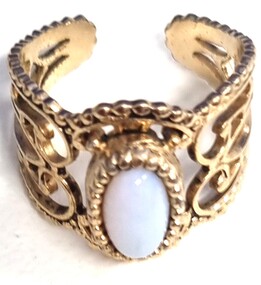
Decorative object - Sarah Coventry Ring
... Ltd. in Wodonga was bought by three Australian businessmen, including Wodonga local Jim Sawyer, and continued to sell jewellery under the name "Sargem Pty. Ltd”, for several more years in the 1980s. ...Ltd. in Wodonga was bought by three Australian businessmen, including Wodonga local Jim Sawyer, and continued to sell jewellery under the name "Sargem Pty. Ltd”, for several more years in the 1980s. ...Sarah Coventry Pty. Ltd. was a North American jewellery company that was established in 1949 by the Stuart family as part of Emmons Jewelry, Inc. It began operations in England and Australia in 1968, and in Australia it moved from Carlton in Melbourne to Wodonga in 1969. The premises were originally on High Street in Wodonga, but a new warehouse was built in Melbourne Road later in 1969. It was a direct selling jewellery business using a party-plan model similar to Tupperware and Avon. The sales reps or 'Hostesses' were provided with jewellery samples in demonstration kits, which they displayed at jewellery parties in their homes. The designs for jewellery such as brooches, necklaces, earrings, chokers and bracelets were purchased from freelance designers and jewellery manufacturers rather than in-house designers. In 1979 Sarah Coventry Pty. Ltd. in Wodonga was bought by three Australian businessmen, including Wodonga local Jim Sawyer, and continued to sell jewellery under the name "Sargem Pty. Ltd”, for several more years in the 1980s. This item was part of the Affinity Jewellery line released in 1982.As part of the Sarah Coventry collection, this item has local significance with the decentralised commercial development of regional centres such as Wodonga in NE Victoria, as well as national and international significance from the perspective of social and economic developments for women after World War II. The direct selling party-plan business model Sarah Coventry was based on is also considered the first of its kind for jewellery.A gold filigree ring with an oval opal in the centre. The ring is not fully enclosed so the size can be carefully adjusted.Inside Ring © COVENTRYsarah coventry, sarah coventry affinity, sarah coventry wodonga -
 Wodonga & District Historical Society Inc
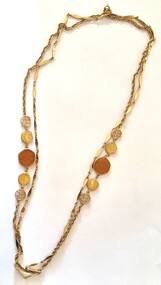
Decorative object - Sarah Coventry Necklace
... Ltd. in Wodonga was bought by three Australian businessmen, including Wodonga local Jim Sawyer, and continued to sell jewellery under the name "Sargem Pty. Ltd”, for several more years in the 1980s. ...Ltd. in Wodonga was bought by three Australian businessmen, including Wodonga local Jim Sawyer, and continued to sell jewellery under the name "Sargem Pty. Ltd”, for several more years in the 1980s. ...Sarah Coventry Pty. Ltd. was a North American jewellery company that was established in 1949 by the Stuart family as part of Emmons Jewelry, Inc. It began operations in England and Australia in 1968, and in Australia it moved from Carlton in Melbourne to Wodonga in 1969. The premises were originally on High Street in Wodonga, but a new warehouse was built in Melbourne Road later in 1969. It was a direct selling jewellery business using a party-plan model similar to Tupperware and Avon. The sales reps or 'Hostesses' were provided with jewellery samples in demonstration kits, which they displayed at jewellery parties in their homes. The designs for jewellery such as brooches, necklaces, earrings, chokers and bracelets were purchased from freelance designers and jewellery manufacturers rather than in-house designers. In 1979 Sarah Coventry Pty. Ltd. in Wodonga was bought by three Australian businessmen, including Wodonga local Jim Sawyer, and continued to sell jewellery under the name "Sargem Pty. Ltd”, for several more years in the 1980s. This item was part of the Affinity Jewellery line released in 1982.As part of the Sarah Coventry collection, this item has local significance with the decentralised commercial development of regional centres such as Wodonga in NE Victoria, as well as national and international significance from the perspective of social and economic developments for women after World War II. The direct selling party-plan business model Sarah Coventry was based on is also considered the first of its kind for jewellery. A gold necklace which consists of two chains. One is made up of twisted links and incorporates two sets of five circular sections. sarah coventry, sarah coventry affinity, sarah coventry wodonga -
 Wodonga & District Historical Society Inc
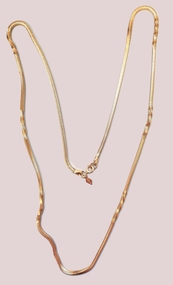
Decorative object - Sarah Coventry Necklace
... Ltd. in Wodonga was bought by three Australian businessmen, including Wodonga local Jim Sawyer, and continued to sell jewellery under the name "Sargem Pty. Ltd”, for several more years in the 1980s. ...Ltd. in Wodonga was bought by three Australian businessmen, including Wodonga local Jim Sawyer, and continued to sell jewellery under the name "Sargem Pty. Ltd”, for several more years in the 1980s. ...Sarah Coventry Pty. Ltd. was a North American jewellery company that was established in 1949 by the Stuart family as part of Emmons Jewelry, Inc. It began operations in England and Australia in 1968, and in Australia it moved from Carlton in Melbourne to Wodonga in 1969. The premises were originally on High Street in Wodonga, but a new warehouse was built in Melbourne Road later in 1969. It was a direct selling jewellery business using a party-plan model similar to Tupperware and Avon. The sales reps or 'Hostesses' were provided with jewellery samples in demonstration kits, which they displayed at jewellery parties in their homes. The designs for jewellery such as brooches, necklaces, earrings, chokers and bracelets were purchased from freelance designers and jewellery manufacturers rather than in-house designers. In 1979 Sarah Coventry Pty. Ltd. in Wodonga was bought by three Australian businessmen, including Wodonga local Jim Sawyer, and continued to sell jewellery under the name "Sargem Pty. Ltd”, for several more years in the 1980s. This item was part of the Affinity Jewellery line released in 1982.As part of the Sarah Coventry collection, this item has local significance with the decentralised commercial development of regional centres such as Wodonga in NE Victoria, as well as national and international significance from the perspective of social and economic developments for women after World War II. The direct selling party-plan business model Sarah Coventry was based on is also considered the first of its kind for jewellery. A long gold necklace with loop clasp. It features six sections of twisted chain of three centimetres set five centimetres apart. These sit so that there are three feature section on either side of the necklace.sarah coventry, sarah coventry affinity, sarah coventry wodonga -
 Wodonga & District Historical Society Inc
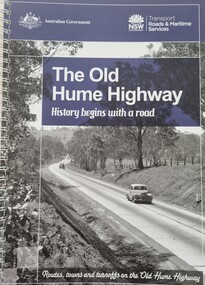
Book - The Old Hume Highway - History begins with a Road, 2014
... 1980s and 1990s. In 1994 the last section of the Hume Highway in Victoria was duplicated with the completion of the Wangaratta bypass. The Albury-Wodonga ...The Hume Highway was officially named in 1928, when both the New South Wales and Victorian governments agreed to give the unified inland route between Sydney and Melbourne the name, honouring explorer Hamilton Hume who, with William Hovell, first found the overland path in 1824. Much of the original highway followed their overland route wherever the landscape allowed. The road connected many small communities and rural properties, although in many parts was narrow and unsurfaced. Over the following years alterations and some deviations occurred with changing transport needs and heavier traffic loads. One of these deviations was completed in 1933 at Table Top north of Albury between Ettamogah and Mullengandra due to the construction of the Hume Weir which flooded the existing highway. Gradually sections of the road were converted to a dual carriageway. In 1961 the first modern freeway-standard, four-lane section was completed in Victoria at Craigieburn. The Hume Highway was also rerouted in Albury to avoid the town centre. Many major bypasses and duplications in New South Wales were completed throughout the 1980s and 1990s. In 1994 the last section of the Hume Highway in Victoria was duplicated with the completion of the Wangaratta bypass. The Albury-Wodonga bypass was opened in 2007 and in 2013 the final section, the Holbrook Bypass in NSW, was opened to traffic on August 7, completing the full Sydney-Melbourne dual carriageway link. In the course of this gigantic engineering achievement, many small, historic towns throughout Victoria and New South Wales were bypassed and often forgotten by passing commuters in a rush to reach their destination. This publication includes maps and information about the sites and landmarks in these towns. It encourages travellers to venture of the modern highway and rediscover the Old Hume Highway and the stories it holds about out past.A spiral bound volume of 122 pages including maps, photographs and illustrations prepared as a travel guide to the Old Hume Highway. It includes a Foreword by Peter FitzSimons.The Hume Highway was officially named in 1928, when both the New South Wales and Victorian governments agreed to give the unified inland route between Sydney and Melbourne the name, honouring explorer Hamilton Hume who, with William Hovell, first found the overland path in 1824. Much of the original highway followed their overland route wherever the landscape allowed. The road connected many small communities and rural properties, although in many parts was narrow and unsurfaced. Over the following years alterations and some deviations occurred with changing transport needs and heavier traffic loads. One of these deviations was completed in 1933 at Table Top north of Albury between Ettamogah and Mullengandra due to the construction of the Hume Weir which flooded the existing highway. Gradually sections of the road were converted to a dual carriageway. In 1961 the first modern freeway-standard, four-lane section was completed in Victoria at Craigieburn. The Hume Highway was also rerouted in Albury to avoid the town centre. Many major bypasses and duplications in New South Wales were completed throughout the 1980s and 1990s. In 1994 the last section of the Hume Highway in Victoria was duplicated with the completion of the Wangaratta bypass. The Albury-Wodonga bypass was opened in 2007 and in 2013 the final section, the Holbrook Bypass in NSW, was opened to traffic on August 7, completing the full Sydney-Melbourne dual carriageway link. In the course of this gigantic engineering achievement, many small, historic towns throughout Victoria and New South Wales were bypassed and often forgotten by passing commuters in a rush to reach their destination. This publication includes maps and information about the sites and landmarks in these towns. It encourages travellers to venture of the modern highway and rediscover the Old Hume Highway and the stories it holds about out past.old hume highway, hume highway, travel guide hume highway, \ -
 Wodonga & District Historical Society Inc
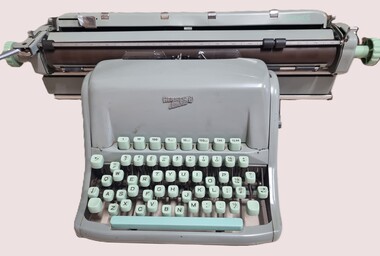
Functional object - Hermes 8 Standard Wide Carriage Typewriter, Paillard, 1964
... 1980s, typewriters gradually fell into obsolescence and came to be thought of as an outdated writing technology of the past. The company was ultimately taken over by Olivetti in 1981, and operations largely ceased by 1989. This item is significant because it was a popular and important piece of office equipment used in many Wodonga ...Hermes typewriters were manufactured by Paillard S.A. of Yverdon in Switzerland. Paillard Ltd (originally Maison Paillard) was a premier Swiss precision engineering company which operated for 175 years. It developed from a small watchmaker collective into a global leader in typewriters as well as gramophones, radio sets and, under the name of Paillard-Bolex, cameras and film cameras. Paillard began making typewriters under the Hermes name in 1923. Early typewriters were usually heavy office typewriters but over time popular portable typewriters were added to their range. The Hermes Standard 8 typewriter was produced between 1953 and 1965. It was a heavy-duty desktop model. Typewriters of this model with a wide carriage were considered to be quiet rare. They were designed for the operator to be able to produce wide ledgers. However by 1963 its successor the Hermes Standard 9 had gone into production. With the rise of personal computers in the 1980s, typewriters gradually fell into obsolescence and came to be thought of as an outdated writing technology of the past. The company was ultimately taken over by Olivetti in 1981, and operations largely ceased by 1989. This item is significant because it was a popular and important piece of office equipment used in many Wodonga business in the 1950s and 1960s.A pale green Hermes Standard 8 typewriter with wide carriage.Serial Number 8120839 Hermes Standard 8 On back - HERMES / Made in Switzerland / paillard s.a. Yverdontypewriter, hermes typewriters, functional office equipment -
 Ballarat Heritage Services
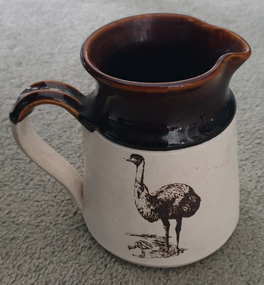
Ceramic - Jug, Emu Jug by Albury Pottery, c1980s
... 1980s, the pottery had four throwers and a further 5-6 employees, and was specialising in stoneware with distinctive ribbed forms and light blond glazes. In 1985, the pottery was sold to the NSW Government as a workers' cooperative, and Petch moved to Old Ballarat Pottery as production manager. In 1987, the Petch's bought back into the business with partners Pat and Ken Snape, moving to slip casting, doubling the operating area, opening a terracotta plant in a separate location and establishing a tourism presence in the Old Cheese factory between Albury and Wodonga. ...1980s, the pottery had four throwers and a further 5-6 employees, and was specialising in stoneware with distinctive ribbed forms and light blond glazes. In 1985, the pottery was sold to the NSW Government as a workers' cooperative, and Petch moved to Old Ballarat Pottery as production manager. In 1987, the Petch's bought back into the business with partners Pat and Ken Snape, moving to slip casting, doubling the operating area, opening a terracotta plant in a separate location and establishing a tourism presence in the Old Cheese factory between Albury and Wodonga. ...Albury Pottery was established in the late 1970s to supply pottery for the party plan company Cooperware, a spin-off from Faberware. Located in Hudson Crescent, Lavington, the pottery was managed by Rudolph Dybka until 1983, then by Ron Petch, who had previously worked as sales manager for Cooper Pottery, one of Cooperware's UK suppliers. By the mid-1980s, the pottery had four throwers and a further 5-6 employees, and was specialising in stoneware with distinctive ribbed forms and light blond glazes. In 1985, the pottery was sold to the NSW Government as a workers' cooperative, and Petch moved to Old Ballarat Pottery as production manager. In 1987, the Petch's bought back into the business with partners Pat and Ken Snape, moving to slip casting, doubling the operating area, opening a terracotta plant in a separate location and establishing a tourism presence in the Old Cheese factory between Albury and Wodonga. As the business grew it took on more partners and this proved problematic in a declining market for production pottery. The Petch's pulled out in 1991 and the pottery closed shortly afterwards. (CC BY NC SA Judith Pearce, accessed https://www.flickr.com/groups/1281707@N21/discuss/72157629392131982/, 15 October 2024.)A ceramic jug with a brown top, and an emu on a white ground.albury pottery, emu -
 Wodonga & District Historical Society Inc
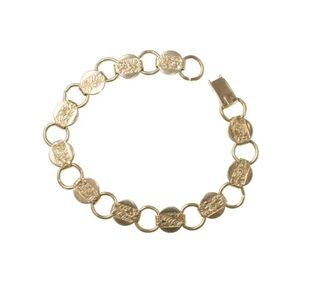
Decorative object - Cobra Bracelet, Sarah Coventry Jewellery, c1979
... Ltd. in Wodonga was bought by three Australian businessmen, including Wodonga local Jim Sawyer, and continued to sell jewellery under the name "Sargem Pty. Ltd”, for several more years in the 1980s....Ltd. in Wodonga was bought by three Australian businessmen, including Wodonga local Jim Sawyer, and continued to sell jewellery under the name "Sargem Pty. Ltd”, for several more years in the 1980s. ...Sarah Coventry Pty. Ltd. was a North American jewellery company that was established in 1949 by the Stuart family as part of Emmons Jewelry, Inc. It began operations in England and Australia in 1968, and in Australia it moved from Carlton in Melbourne to Wodonga in 1969. The premises were originally on High Street in Wodonga, but a new warehouse was built in Melbourne Road later in 1969. It was a direct selling jewellery business using a party-plan model similar to Tupperware and Avon. The sales reps or 'Hostesses' were provided with jewellery samples in demonstration kits, which they displayed at jewellery parties in their homes. The designs for jewellery such as brooches, necklaces, earrings, chokers and bracelets were purchased from freelance designers and jewellery manufacturers rather than in-house designers. In 1979 Sarah Coventry Pty. Ltd. in Wodonga was bought by three Australian businessmen, including Wodonga local Jim Sawyer, and continued to sell jewellery under the name "Sargem Pty. Ltd”, for several more years in the 1980s.As part of the Sarah Coventry collection, the necklace has local significance with the decentralised commercial development of regional centres such as Wodonga in NE Victoria, as well as national and international significance from the perspective of social and economic developments for women after World War II. The direct selling party-plan business model Sarah Coventry was based on is also considered the first of its kind for jewellery.Bracelet of interlocking circles. Alternate circles have a broad line across the centre embossed with a floral design.sarah coventry, costume jewellery, industry wodonga -
 Wodonga & District Historical Society Inc
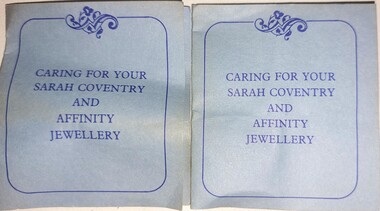
Booklet - Caring for your Sarah Coventry and Affinity Jewellery
... Ltd. in Wodonga was bought by three Australian businessmen, including Wodonga local Jim Sawyer, and continued to sell jewellery under the name "Sargem Pty. Ltd”, for several more years in the 1980s....Ltd. in Wodonga was bought by three Australian businessmen, including Wodonga local Jim Sawyer, and continued to sell jewellery under the name "Sargem Pty. Ltd”, for several more years in the 1980s. ...Sarah Coventry Pty. Ltd. was a North American jewellery company that was established in 1949 by the Stuart family as part of Emmons Jewelry, Inc. It began operations in England and Australia in 1968, and in Australia it moved from Carlton in Melbourne to Wodonga in 1969. The premises were originally on High Street in Wodonga, but a new warehouse was built in Melbourne Road later in 1969. It was a direct selling jewellery business using a party-plan model similar to Tupperware and Avon. The sales reps or 'Hostesses' were provided with jewellery samples in demonstration kits, which they displayed at jewellery parties in their homes. The designs for jewellery such as brooches, necklaces, earrings, chokers and bracelets were purchased from freelance designers and jewellery manufacturers rather than in-house designers. In 1979 Sarah Coventry Pty. Ltd. in Wodonga was bought by three Australian businessmen, including Wodonga local Jim Sawyer, and continued to sell jewellery under the name "Sargem Pty. Ltd”, for several more years in the 1980s.As part of the Sarah Coventry collection, the necklace has local significance with the decentralised commercial development of regional centres such as Wodonga in NE Victoria, as well as national and international significance from the perspective of social and economic developments for women after World War II. The direct selling party-plan business model Sarah Coventry was based on is also considered the first of its kind for jewellery.A small leaflet printed on blue paper in blue ink explaining instructions for caring for items from the Sarah Coventry rangeOn Front cover: CARING FOR YOUR SARAH COVENTRY AND AFFINITY JEWELLERY On back cover: Sargem Pty. Ltd. / Hume Highway/ WODONGA VIC, 3690 / Copyright 1979 Inside: detailed cleaning instructionsarah coventry, costume jewellery, industry wodonga -
 Wodonga & District Historical Society Inc
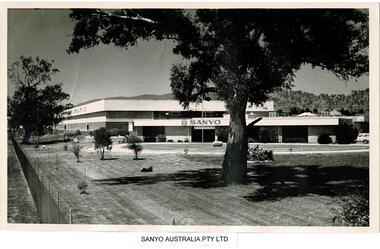
Photograph - Sanyo Wodonga
... These images are significant because they document and industry which employed many people in Wodonga in the 1970s and 1980s. Sanyo Sanyo-Guthrie Wodonga Decentralised Industry Wodonga A set of black and white photographs of the Sanyo Australia Pty Ltd premises in Wodonga. ...Sanyo was one of the international companies that set up business in Wodonga in the 1970s as part of the decentralisation of industry. The Sanyo Australia Pty. Ltd. factory in Wodonga was officially opened on 25 October 1974 with 35 staff and production peaked in 1976-1977 when it employed 360 people. In the first 10 years, 350,000 televisions were assembled from Japanese parts. The official plaque was uncovered by Victorian Premier Rupert Hamer. In October 1977 there were 79 workers retrenched, followed by 30 in November and 45 in February 1978. In 1978 workers staged a sit-in which lasted over a week, to protest multiple mass retrenchments of staff. The factory stayed open for almost another decade. In 1982 the General Manager of Sanyo was quoted as saying the productivity in the Wodonga factory was 10% higher than in Japan. However by 1984 the number of staff had reduced to 112 and the factory closed in 1987. The premises were taken over by Parker Hannifin and the administration building is now the home of 3D Lanes Bowling Alley. The street in which it is located is now called Sanyo Drive.These images are significant because they document and industry which employed many people in Wodonga in the 1970s and 1980s.A set of black and white photographs of the Sanyo Australia Pty Ltd premises in Wodonga.sanyo, sanyo-guthrie wodonga, decentralised industry wodonga -
 Wodonga & District Historical Society Inc
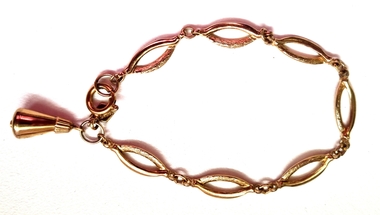
Decorative object - Sarah Coventry Bracelet
... Ltd. in Wodonga was bought by three Australian businessmen, including Wodonga local Jim Sawyer, and continued to sell jewellery under the name "Sargem Pty. Ltd”, for several more years in the 1980s....Ltd. in Wodonga was bought by three Australian businessmen, including Wodonga local Jim Sawyer, and continued to sell jewellery under the name "Sargem Pty. Ltd”, for several more years in the 1980s. ...Sarah Coventry Pty. Ltd. was a North American jewellery company that was established in 1949 by the Stuart family as part of Emmons Jewelry, Inc. It began operations in England and Australia in 1968, and in Australia it moved from Carlton in Melbourne to Wodonga in 1969. The premises were originally on High Street in Wodonga, but a new warehouse was built in Melbourne Road later in 1969. It was a direct selling jewellery business using a party-plan model similar to Tupperware and Avon. The sales reps or 'Hostesses' were provided with jewellery samples in demonstration kits, which they displayed at jewellery parties in their homes. The designs for jewellery such as brooches, necklaces, earrings, chokers and bracelets were purchased from freelance designers and jewellery manufacturers rather than in-house designers. In 1979 Sarah Coventry Pty. Ltd. in Wodonga was bought by three Australian businessmen, including Wodonga local Jim Sawyer, and continued to sell jewellery under the name "Sargem Pty. Ltd”, for several more years in the 1980s.As part of the Sarah Coventry collection, the necklace has local significance with the decentralised commercial development of regional centres such as Wodonga in NE Victoria, as well as national and international significance from the perspective of social and economic developments for women after World War II. The direct selling party-plan business model Sarah Coventry was based on is also considered the first of its kind for jewellery.A gold-plated bracelet from the Sarah Coventry range. Bracelet has a small triangular piece attached which bears the Sarah Coventry logo. The bracelet features alternating ellipses and knots with a clip fastener.On tag: ©SARAHCOV CANADAsarah coventry, sargem pty. ltd, sarah coventry wodonga, decentralised industry wodonga -
 Wodonga & District Historical Society Inc
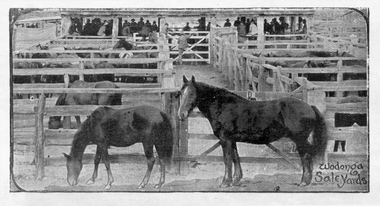
Photograph - Horse Sales at Wodonga Saleyards
... With developments in technology and the changing role of the horse in modern society, the sale of horses dwindled although horse sales at Wodonga continued until the early 1980s....With developments in technology and the changing role of the horse in modern society, the sale of horses dwindled although horse sales at Wodonga continued until the early 1980s. These items are significant because they represent an important industry in Wodonga's past as a major centre of livestock sales in Victoria. ...The sale of stock in Wodonga goes back to its earliest history with yards being operated on the site now occupied by Elgin's Hotel and the Centro Shopping Centre, located close to the railways. Horse sales were an important part of the history of the Wodonga Saleyards. Horses were bred in north-east Victoria for the Indian Market, and records show that a truck load of horses left Wodonga Station in 1875. Campbell & Sons commenced selling horses at the Elgin Street site in 1895 and they conducted regular sales in association with Younghusband Ltd. Campbell & Sons was a Melbourne-based company, which eventually merged with Wright Stephenson & Co. Wodonga and Towong Sentinel of Friday 3rd March 1899 reported “Buyers attended from Bendigo, Ballarat, Calcutta, Madras, Singapore, The Islands, Gippsland, Dandenong, and Melbourne. Indian remounts brought up to £32 10s, draughts to £25, medium draughts to £18, town hacks and harness horses to £32, buggy pairs to £65, and light weedy sorts to £5.” After World War II, large numbers of mainly Clydesdale working horse teams were driven to Wodonga for sale. The March horse sale was the biggest and most important event of the year with overall yardings of 1,000 horses sold over two or even three days. It was a very busy period. All the horses were put through the ring singly, usually by Felix Grundy and generally caught and mouthed by Harold Boon, Andy Elliot or Toy Mulqueeney. The majority of the horses sold were trucked by rail from Wodonga. With developments in technology and the changing role of the horse in modern society, the sale of horses dwindled although horse sales at Wodonga continued until the early 1980s.These items are significant because they represent an important industry in Wodonga's past as a major centre of livestock sales in Victoria.Photographic images of horses on sale at Wodonga Saleyards.wodonga saleyards, horse sales wodonga -
 Wodonga & District Historical Society Inc
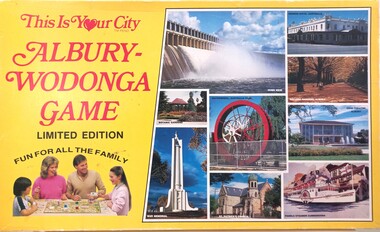
Leisure object - Albury - Wodonga Board Game, This is Your City, E-System Publications, 1986
... This item is significant because it was an alternate way to market the Albury- Wodonga region in the 1980s. Albury - Wodonga Game Leisure Activities Albury Wodonga Albury-Wodonga Marketing On the box: This is your City Albury - Wodonga Game Limited Edition FUN FOR ALL THE FAMILY A board game including a coloured board featuring locations in Albury - Wodonga. ...This was one of several games in a series which focused on Regional Cities within NSW and Victoria, Australia. Their main function was to promote regions and businesses within the cities featured in each game. The gameboard is a full colour representation of each city and the players competed with each other to race to targeted destinations on the gameboard. The first player to arrive at the targeted destination bought that property and received a destination card. The first player to purchase 10 destination cards and return home safely, won the game. Cards in the game featured local businesses and landmarks. This item is significant because it was an alternate way to market the Albury- Wodonga region in the 1980s.A board game including a coloured board featuring locations in Albury - Wodonga. The board has a green background with streets and buildings in various colours. The box is half in bright yellow and features an image of family playing the game. The rest of the box features 9 images of locations in the area.On the box: This is your City Albury - Wodonga Game Limited Edition FUN FOR ALL THE FAMILYalbury - wodonga game, leisure activities albury wodonga, albury-wodonga marketing -
 Wodonga & District Historical Society Inc
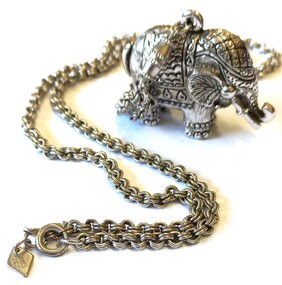
Decorative object - Sarah Coventry Elephant
... Ltd. in Wodonga was bought by three Australian businessmen, including Wodonga local Jim Sawyer, and continued to sell jewellery under the name "Sargem Pty. Ltd”, for several more years in the 1980s....Ltd. in Wodonga was bought by three Australian businessmen, including Wodonga local Jim Sawyer, and continued to sell jewellery under the name "Sargem Pty. Ltd”, for several more years in the 1980s. ...Sarah Coventry Pty. Ltd. was a North American jewellery company that was established in 1949 by the Stuart family as part of Emmons Jewelry, Inc. It began operations in England and Australia in 1968, and in Australia it moved from Carlton in Melbourne to Wodonga in 1969. The premises were originally on High Street in Wodonga, but a new warehouse was built in Melbourne Road later in 1969. It was a direct selling jewellery business using a party-plan model similar to Tupperware and Avon. The sales reps or 'Hostesses' were provided with jewellery samples in demonstration kits, which they displayed at jewellery parties in their homes. The designs for jewellery such as brooches, necklaces, earrings, chokers and bracelets were purchased from freelance designers and jewellery manufacturers rather than in-house designers. In 1979 Sarah Coventry Pty. Ltd. in Wodonga was bought by three Australian businessmen, including Wodonga local Jim Sawyer, and continued to sell jewellery under the name "Sargem Pty. Ltd”, for several more years in the 1980s.As part of the Sarah Coventry collection, this item has local significance with the decentralised commercial development of regional centres such as Wodonga in NE Victoria, as well as national and international significance from the perspective of social and economic developments for women after World War II. The direct selling party-plan business model Sarah Coventry was based on is also considered the first of its kind for jewellery.A small silver plate elephant on a double linked chain. A diamond shape at the end of the chain bears the company logo. A trademark is also imprinted underneath the bottom of the feet.Under foot: SARGEM On Diamond shaped link: SARAH COV/ CANADAsarah coventry, sarah coventry wodonga -
 Wodonga & District Historical Society Inc
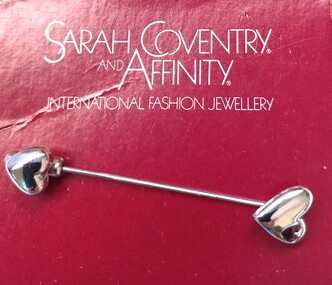
Decorative object - Sarah Coventry Open Heart Pin
... Ltd. in Wodonga was bought by three Australian businessmen, including Wodonga local Jim Sawyer, and continued to sell jewellery under the name "Sargem Pty. Ltd”, for several more years in the 1980s. ...Ltd. in Wodonga was bought by three Australian businessmen, including Wodonga local Jim Sawyer, and continued to sell jewellery under the name "Sargem Pty. Ltd”, for several more years in the 1980s. ...Sarah Coventry Pty. Ltd. was a North American jewellery company that was established in 1949 by the Stuart family as part of Emmons Jewelry, Inc. It began operations in England and Australia in 1968, and in Australia it moved from Carlton in Melbourne to Wodonga in 1969. The premises were originally on High Street in Wodonga, but a new warehouse was built in Melbourne Road later in 1969. It was a direct selling jewellery business using a party-plan model similar to Tupperware and Avon. The sales reps or 'Hostesses' were provided with jewellery samples in demonstration kits, which they displayed at jewellery parties in their homes. The designs for jewellery such as brooches, necklaces, earrings, chokers and bracelets were purchased from freelance designers and jewellery manufacturers rather than in-house designers. In 1979 Sarah Coventry Pty. Ltd. in Wodonga was bought by three Australian businessmen, including Wodonga local Jim Sawyer, and continued to sell jewellery under the name "Sargem Pty. Ltd”, for several more years in the 1980s. This item was part of the Affinity Jewellery line released in 1982.As part of the Sarah Coventry collection, this item has local significance with the decentralised commercial development of regional centres such as Wodonga in NE Victoria, as well as national and international significance from the perspective of social and economic developments for women after World War II. The direct selling party-plan business model Sarah Coventry was based on is also considered the first of its kind for jewellery.A silver plated stick pin featuring a heart at each end. It is in its original Sarah Coventry box and includes instructions for caring for Sarah Coventry Affinity range items. It is attached to a silver card.On box: SARAH COVENTRY®| AND AFFINITY ® INTERNATIONAL FASHION JEWELLERY On card: Open Heart Imitation Jewellery Sarah Coventry & Affinity International Fashion Jewellery Distributed by Sargem Pty. Ltd. WODONGA VICTORIA Made in USA sarah coventry, sarah coventry affinity, sarah coventry wodonga -
 Wodonga & District Historical Society Inc
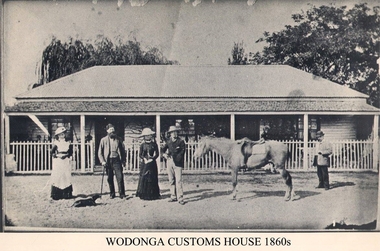
Photograph - Old Customs House, Wodonga, 1860s
... 1980s and is now a restaurant. This image represents an important stage in the development of colonial relationships and rivalries in Australia. Customs house Wodonga ...Customs duties were a means of raising revenue between the 1850s and Federation. They were first introduced by NSW in November 1854 after it was separated from the colony of Victoria three years earlier. J P Hanify was appointed as sub-collector at Belvoir, the official name present day Wodonga at that time. Wodonga Customs House was built near the end of Union Bridge over the Murray River in 1859 Tariffs or customs duties greatly angered residents and it was little wonder the customs officer of the day was always an unpopular man. Tariffs had to be paid on articles such as tobacco, many food items and new clothing that were carried across the Border. The range of items was extended over time, leading to some farmers even swimming their livestock across the river to avoid duties at the Customs house. The levying of duties ended with Federation in 1901. Francis Cobham depicted in this photograph, took up the position of Customs officer in 1867 and remained there until his retirement in 1890. The building was originally a 2 roomed custom house in 1856 but was extended to provide living quarters for the Cobham family while a nearby cottage became the Customs house. The building was moved to a position south of the lagoon in the mid 1980s and is now a restaurant.This image represents an important stage in the development of colonial relationships and rivalries in Australia.Black and white photograph of Customs officer Francis Cobham in Wodonga c 1860customs house wodonga, albury wodonga border, colonial rivalry victoria /nsw, tariffs -
 Wodonga & District Historical Society Inc
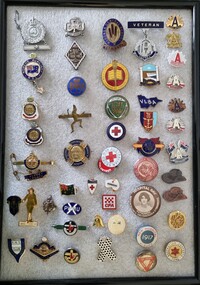
Badge - Badge Collection
... 1980s. It reflects a range of local and national organisations supported by people in the community. These include local schools such as the Wodonga Central School and Wodonga High School and local sporting clubs including the Wodonga Football Club and the Wodonga Bowling Club. ...1980s. It reflects a range of local and national organisations supported by people in the community. These include local schools such as the Wodonga Central School and Wodonga High School and local sporting clubs including the Wodonga Football Club and the Wodonga Bowling Club. ...This is a collection ranging in dates from 1917 to the 1980s. It reflects a range of local and national organisations supported by people in the community. These include local schools such as the Wodonga Central School and Wodonga High School and local sporting clubs including the Wodonga Football Club and the Wodonga Bowling Club. National organisations like Red Cross, the Returned Soldiers' League, Legacy and the CWA are also represented.This collection commemorates a range of local and national organisations supported by community members throughout the 20th century.A collection of 50 different badges to commemorate a range of organisations and events. Included are several ANZAC Day and Legacy badges. Also in the collection are badges for Girl Guides, several sports clubs, Red Cross, Red Triangle Day 1917, the CFA and some church groups.commemorative badges, memorabilia, service organisations -
 Wodonga & District Historical Society Inc
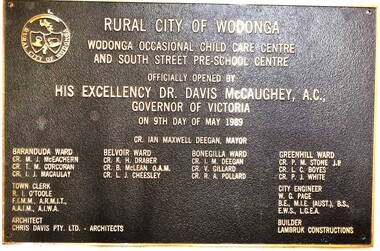
Plaque - Official Opening of the Child Care Centre & South Street Pre-School, Wodonga
... With strong population growth in Wodonga community services had expanded rapidly throughout the 1980s. The first child minding centre had opened in 1975. ...With strong population growth in Wodonga community services had expanded rapidly throughout the 1980s. The first child minding centre had opened in 1975. ...This plaque commemorates the official opening of an occasional child care centre and pre-school in South St, Wodonga in 1989 by the Governor of Victoria Dr. Davis McCaughey. With strong population growth in Wodonga community services had expanded rapidly throughout the 1980s. The first child minding centre had opened in 1975. BY 1987 Upper Murray Family Care provided full-day family day care and occasional care and there were also 2 private child care centres. By 1986 there were 350 full-time places and 75 part-time places, but pre-schools were unable to fill the demand for another 511 applicants. This new facility helped to ease a little of the problem. As well as the inscription included here, the name of the Mayor, all members of the Wodonga Council, City Engineer, Architect and Builder are listed on the plaque.This item illustrates an important development in the provision of pre-school and child care services in Wodonga.A bronze rectangular plaque with detailed inscription, designed to be attached to the wall of a building. There is a hole in each corner for bolts to be inserted. The text is raised above the surface of the plaque. It features the symbol of the shield of the Rural City of Wodonga in the top left corner.fiction"RURAL CITY OF WODONGA WODONGA OCCASIONAL CHILD CARE CENTRE AND SOUTH STREET PRE-SCHOOL CENTRE OFFICIALLY OPENED BY HIS EXCELLENCY DR. DAVIS MCCAUGHEY, A.C., GOVERNOR OF VICTORIA ON 9TH DAY OF MAY 1989child care facilities wodonga, children's services wodonga, pre-schools wodonga -
 Wodonga & District Historical Society Inc
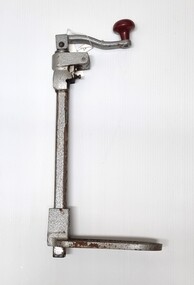
Functional object - Caterer's Can Opener, Mitchell & Cooper of England, 1950s
... Wodonga. Bonzer was a trademark of Mitchell & Cooper of England. Alfred Mitchell & Arthur Cooper started as silversmiths and engravers in 1879 in East London. The family owned business is still operated by Guy Cooper, great grandson of Arthur Cooper. Bandiana Army Golf Club 18 hole course opened in 1949. The Club reached its highest membership with 400 members in the late 1980s...Wodonga. Bonzer was a trademark of Mitchell & Cooper of England. Alfred Mitchell & Arthur Cooper started as silversmiths and engravers in 1879 in East London. The family owned business is still operated by Guy Cooper, great grandson of Arthur Cooper. Bandiana Army Golf Club 18 hole course opened in 1949. The Club reached its highest membership with 400 members in the late 1980s ...This Can opener was used at the Bandiana Golf Club near Wodonga. Bonzer was a trademark of Mitchell & Cooper of England. Alfred Mitchell & Arthur Cooper started as silversmiths and engravers in 1879 in East London. The family owned business is still operated by Guy Cooper, great grandson of Arthur Cooper. Bandiana Army Golf Club 18 hole course opened in 1949. The Club reached its highest membership with 400 members in the late 1980s. Members played their last competition at this course on 30th October 2103.This utensil was used at the Bandiana Army Golf Course near Wodonga.Cast iron commercial can opener with rotating handle including a red knob.Underneath base plate "THE BONZER /TRADEMARK/ CATERER'S/ CAN OPENER/ MADE IN ENGLAND"caterers' utensils, kitchen utensils -
 Wodonga & District Historical Society Inc
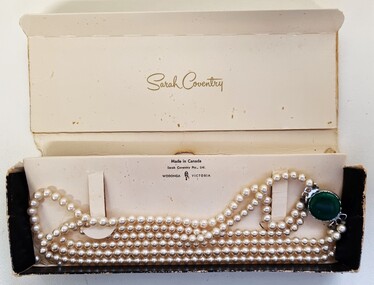
Decorative object - Sarah Coventry Pearl Necklace, c1980
... Ltd. in Wodonga was bought by three Australian businessmen, including Wodonga local Jim Sawyer, and continued to sell jewellery under the name "Sargem Pty. Ltd”, for several more years in the 1980s....Ltd. in Wodonga was bought by three Australian businessmen, including Wodonga local Jim Sawyer, and continued to sell jewellery under the name "Sargem Pty. Ltd”, for several more years in the 1980s. ...Sarah Coventry Pty. Ltd. was a North American jewellery company that was established in 1949 by the Stuart family as part of Emmons Jewelry, Inc. It began operations in England and Australia in 1968, and in Australia it moved from Carlton in Melbourne to Wodonga in 1969. The premises were originally on High Street in Wodonga, but a new warehouse was built in Melbourne Road later in 1969. It was a direct selling jewellery business using a party-plan model similar to Tupperware and Avon. The sales reps or 'Hostesses' were provided with jewellery samples in demonstration kits, which they displayed at jewellery parties in their homes. The designs for jewellery such as brooches, necklaces, earrings, chokers and bracelets were purchased from freelance designers and jewellery manufacturers rather than in-house designers. In 1979 Sarah Coventry Pty. Ltd. in Wodonga was bought by three Australian businessmen, including Wodonga local Jim Sawyer, and continued to sell jewellery under the name "Sargem Pty. Ltd”, for several more years in the 1980s.As part of the Sarah Coventry collection, the necklace has local significance with the decentralised commercial development of regional centres such as Wodonga in NE Victoria, as well as national and international significance from the perspective of social and economic developments for women after World War II. The direct selling party-plan business model Sarah Coventry was based on is also considered the first of its kind for jewellery.Necklace with three strands of faux pearls and a large faux green stone at the silver toned metal clasp on the front, and a large faux pearl at the clasp on the back. includes box featuring Sarah Coventry brandingOn outside of box : "Sarah Coventry® /PTY. LTD. /WODONGA, VICTORIA On inside of lid: "Sarah Coventry" On internal cardboard mounting: "Made in Canada / Sarah Coventry Pty., Ltd. / WODONGA (SC) VICTORIAsarah coventry, costume jewellery, industry wodonga -
 Wodonga & District Historical Society Inc
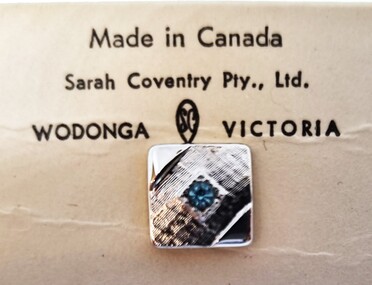
Decorative object - Sarah Coventry Tie Pin
... Ltd. in Wodonga was bought by three Australian businessmen, including Wodonga local Jim Sawyer, and continued to sell jewellery under the name "Sargem Pty. Ltd”, for several more years in the 1980s. ...Ltd. in Wodonga was bought by three Australian businessmen, including Wodonga local Jim Sawyer, and continued to sell jewellery under the name "Sargem Pty. Ltd”, for several more years in the 1980s. ...Historical information Sarah Coventry Pty. Ltd. was a North American jewellery company that was established in 1949 by the Stuart family as part of Emmons Jewelry, Inc. It began operations in England and Australia in 1968, and in Australia it moved from Carlton in Melbourne to Wodonga in 1969. The premises were originally on High Street in Wodonga, but a new warehouse was built in Melbourne Road later in 1969. It was a direct selling jewellery business using a party-plan model similar to Tupperware and Avon. The sales reps or 'Hostesses' were provided with jewellery samples in demonstration kits, which they displayed at jewellery parties in their homes. The designs for jewellery such as brooches, necklaces, earrings, chokers and bracelets were purchased from freelance designers and jewellery manufacturers rather than in-house designers. In 1979 Sarah Coventry Pty. Ltd. in Wodonga was bought by three Australian businessmen, including Wodonga local Jim Sawyer, and continued to sell jewellery under the name "Sargem Pty. Ltd”, for several more years in the 1980s. The "Aristocrat" line was first released in Canada in 1969 for several years. It was distributed from the outlet at Sarah Coventry Park, Wodonga.As part of the Sarah Coventry collection, the tie pin has local significance with the decentralised commercial development of regional centres such as Wodonga in NE Victoria, as well as national and international significance from the perspective of social and economic developments for women after World War II. The direct selling party-plan business model Sarah Coventry was based on is also considered the first of its kind for jewellery.A small square tie pin of silvertone plated metal with an ice blue rhinestone in the centre. A short chain and clip are attached. A small diamond shape has the "SarCov" brand on the back. The pin is in its original packaging of a cardboard box with clear central oval on the front. The back of the box bears the Sarah Coventry branding as does the internal card.On internal mounting card: "Made in Canada/ Sarah Coventry Pty. Ltd / WODONGA (SC) VICTORIA" On back of box: "Sarah Coventry® PTY. LTD / SARAH COVENTRY PARK/ WODONGA, VICTORIA / PTD IN AUST"sarah coventry wodonga, men's fashion accessories, costume jewellery -
 Wodonga & District Historical Society Inc
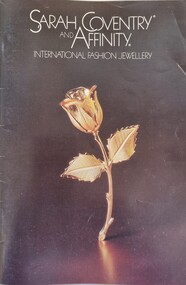
Booklet - Sarah Coventry Affinity Range Catalogue 1982
... Ltd. in Wodonga was bought by three Australian businessmen, including Wodonga local Jim Sawyer, and continued to sell jewellery under the name "Sar*gem Pty. Ltd”, for several more years in the 1980s, along with a new range of fashion jewellery, Affinity. ...Ltd. in Wodonga was bought by three Australian businessmen, including Wodonga local Jim Sawyer, and continued to sell jewellery under the name "Sar*gem Pty. Ltd”, for several more years in the 1980s, along with a new range of fashion jewellery, Affinity. ...Historical information Sarah Coventry Pty. Ltd. was a North American jewellery company that was established in 1949 by the Stuart family as part of Emmons Jewelry, Inc. It began operations in England and Australia in 1968, and in Australia it moved from Carlton in Melbourne to Wodonga in 1969. The premises were originally on High Street in Wodonga, but a new warehouse was built in Melbourne Road later in 1969. It was a direct selling jewellery business using a party-plan model similar to Tupperware and Avon. The sales reps or 'Hostesses' were provided with jewellery samples in demonstration kits, which they displayed at jewellery parties in their homes. The designs for jewellery such as brooches, necklaces, earrings, chokers and bracelets were purchased from freelance designers and jewellery manufacturers rather than in-house designers. In 1979 Sarah Coventry Pty. Ltd. in Wodonga was bought by three Australian businessmen, including Wodonga local Jim Sawyer, and continued to sell jewellery under the name "Sar*gem Pty. Ltd”, for several more years in the 1980s, along with a new range of fashion jewellery, Affinity. This catalogue was produced by Sar*gem Pty Ltd in 1982As part of the Sarah Coventry collection, the catalogue has local significance connected to the decentralised commercial development of regional centres such as Wodonga in NE Victoria, as well as national and international significance from the perspective of social and economic developments for women after World War II. The direct selling party-plan business model Sarah Coventry was based on is also considered the first of its kind for jewellery. A coloured catalogue promoting the Affinity Jewellery line released in 1982. The back cover features a fundraising campaign for the Guide Dog Association. Business contact details on the back cover use the company name "Sar*Gem Pty Ltd", Hume Highway Wodonga.sarah coventry, sarah coventry wodonga, sarah coventry affinity -
 Wodonga & District Historical Society Inc
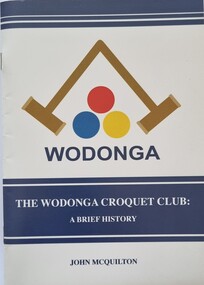
Booklet - The Wodonga Croquet Club: A brief history, John McQuilton, 2019
... Wodonga Croquet Club which was founded in 1924. It outlines key figures in the development of the club and stages in its regrowth. After experiencing a decline in numbers, the club was rejuvenated when it joined the North Eastern District Croquet Association in 1960. Little is known of the club in the 1970s and 1980s ...This publication provides a social history of the Wodonga Croquet Club which was founded in 1924. It outlines key figures in the development of the club and stages in its regrowth. After experiencing a decline in numbers, the club was rejuvenated when it joined the North Eastern District Croquet Association in 1960. Little is known of the club in the 1970s and 1980s, but it was re-established and re-joined the Victorian Croquet Association in 2000.SInce then it has successfully hosted the Victorian Regional Championships and the Australian Championships in Wodonga.A small booklet with blue and white cover and a representation of 2 croquet mallets and 3 coloured balls. Black and white photos are included.non-fictionThis publication provides a social history of the Wodonga Croquet Club which was founded in 1924. It outlines key figures in the development of the club and stages in its regrowth. After experiencing a decline in numbers, the club was rejuvenated when it joined the North Eastern District Croquet Association in 1960. Little is known of the club in the 1970s and 1980s, but it was re-established and re-joined the Victorian Croquet Association in 2000.SInce then it has successfully hosted the Victorian Regional Championships and the Australian Championships in Wodonga.wodonga croquet club, sport and leisure wodonga -
 Wodonga & District Historical Society Inc
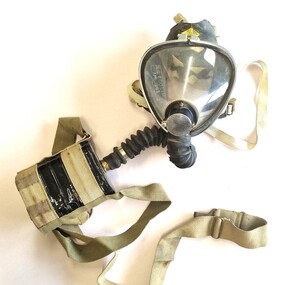
Tool - Sieba Gordon Gas Mask - North East Water Authority, Siebe Gorman & Co. Ltd, c1960
... In 1994 the Kiewa Murray Region Water Authority took over the Wodonga Council’s water and wastewater operations, and then in 1999 the Kiewa Murray Region Water Authority combined with the Ovens Region Water Authority and became the North East Region Water Authority or NERWA. NERWA then became known as North East Water. Siebe Gorman was a British manufacturer of industrial respirators that served the mining industry, the chemical industry, and the agricultural industry from 1938 until the 1980s...In 1994 the Kiewa Murray Region Water Authority took over the Wodonga Council’s water and wastewater operations, and then in 1999 the Kiewa Murray Region Water Authority combined with the Ovens Region Water Authority and became the North East Region Water Authority or NERWA. NERWA then became known as North East Water. Siebe Gorman was a British manufacturer of industrial respirators that served the mining industry, the chemical industry, and the agricultural industry from 1938 until the 1980s ...This mask set is part of the North East Region Water Authority collection in the Wodonga Historical Society. Wodonga's drinking water and wastewater operations were originally managed by the Wodonga Waterworks Trust, which was established in 1897, after Wodonga became a separate shire in 1876. In 1923 a Wodonga Waterworks Trust referendum to provide funding for new infrastructure to supply more water of better quality to Wodonga was passed. This included building the Wodonga Water Tower and it was completed in 1924. It supplied water to Wodonga until 1959, when it was drained and decommissioned after the No 1 Basin on Huon Hill was completed in 1958. In 1983 the Wodonga Waterworks Trust and the Wodonga Sewerage Authority became part of the Wodonga Council. And by 1989 a filtration plant at Huon Hill was completed, which provided filtered water of improved quality to Wodonga, in accordance with the World Health Organisation’s guidelines. In 1994 the Kiewa Murray Region Water Authority took over the Wodonga Council’s water and wastewater operations, and then in 1999 the Kiewa Murray Region Water Authority combined with the Ovens Region Water Authority and became the North East Region Water Authority or NERWA. NERWA then became known as North East Water. Siebe Gorman was a British manufacturer of industrial respirators that served the mining industry, the chemical industry, and the agricultural industry from 1938 until the 1980s. The "Puretha" line refers to the canister included, which was designed to tackle industrial hazards.Siebe Gorman "Puretha" Type C Kit with Vista Vision Facepiece. The facepiece consists of a formed plastic lens held on by a white retaining ring that stretches around the rubber facepiece and is connected by two thumbscrew lugs. The exhale assembly is covered by a steel mesh.The hose is a standard industrial hose. The canister is attached by a khaki webbing material. An instruction sheet is included. The kit is a small leather case with two front latches. Safety instructions and chemical information on canister label. On label: EVERYTHING FOR SAFETY EVERYWHERE Date filled 28 DEC 1961 NO. 675 north east region water authority, gas mask, respirator, sieba gordon -
 Wodonga & District Historical Society Inc
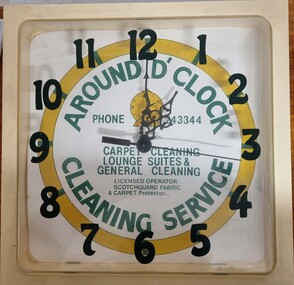
Functional object - Clock - Around 'D' Clock Cleaning Services
... Wodonga. The business employed up to 25 full and part-time workers with a turn over close to a million dollars annually. In addition to cleaning, Mr De Guara sold carpet cleaning machines and vacuum cleaners to individuals as well as businesses, hospitals and clubs. Due to changed family circumstances, the business closed in the late 1980s...Wodonga. The business employed up to 25 full and part-time workers with a turn over close to a million dollars annually. In addition to cleaning, Mr De Guara sold carpet cleaning machines and vacuum cleaners to individuals as well as businesses, hospitals and clubs. Due to changed family circumstances, the business closed in the late 1980s ...This business was the first Cleaning Service operating in Wodonga, later branching out into cleaning supplies. The business was owned by Charles De Guara who had migrated to Australia from Malta at the age of 16. After various jobs in Melbourne, marriage to Latvian migrant Maija and three children, he and his family moved to Wodonga in 1971. He initially worked at the Wodonga Meat Works and soon became the union delegate, initiating strike action related to inaccurate practices in recording slaughtered animals which affected workers’ payments. This action successfully secured back pay for the workers. Mr De Guara started his cleaning enterprise in 1981 while still at the meatworks and then became full-time with cleaning in 1983. He set up his showrooms in the former Wodonga Library building in Hugh Street, Wodonga. The business employed up to 25 full and part-time workers with a turn over close to a million dollars annually. In addition to cleaning, Mr De Guara sold carpet cleaning machines and vacuum cleaners to individuals as well as businesses, hospitals and clubs. Due to changed family circumstances, the business closed in the late 1980s. Mr. De Guara moved to the Mornington Peninsula district, where he passed away on 30 June 2022This item has a clear connection to a former Wodonga business.A square clock advertising the "Around 'D Clock Cleaning service. Battery powered with plastic frame and face.In Circle around face: AROUND 'D CLOCK CLEANING SERVICE" In Centre: CARPET CLEANING LOUNGE SUITES & GENERAL CLEANING LICENSED OPERATOR SCOTCHGUARD FABRIC & CARPET Protector PHONE 24 3344wodonga business, charles deguara, cleaning services wodonga -
 Wodonga & District Historical Society Inc
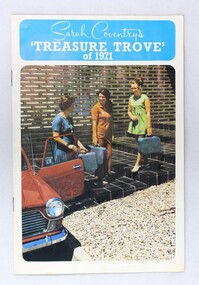
Booklet - Recruiting awards brochure for Sarah Coventry jewellery sales, "Sarah Coventry's 'Treasure Trove' of 1971"
... Ltd. in Wodonga was bought by three Australian businessmen, including Wodonga local Jim Sawyer, and continued to sell jewellery under the name "Sargem Pty. Ltd”, for several more years in the 1980s. ...Ltd. in Wodonga was bought by three Australian businessmen, including Wodonga local Jim Sawyer, and continued to sell jewellery under the name "Sargem Pty. Ltd”, for several more years in the 1980s. ...Sarah Coventry Pty. Ltd. was a North American jewellery company that was established in 1949 by the Stuart family as part of Emmons Jewelry, Inc. It began operations in England and Australia in 1968, and in Australia it moved from Carlton in Melbourne to Wodonga in 1969. The premises were originally on High Street in Wodonga, but a new warehouse was built in Melbourne Road later in 1969. It was a direct selling jewellery business using a party-plan model similar to Tupperware and Avon. The sales reps or 'Hostesses' were provided with jewellery samples in demonstration kits, which they displayed at jewellery parties in their homes. The designs for jewellery such as brooches, necklaces, earrings, chokers and bracelets were purchased from freelance designers and jewellery manufacturers rather than in-house designers. In 1979 Sarah Coventry Pty. Ltd. in Wodonga was bought by three Australian businessmen, including Wodonga local Jim Sawyer, and continued to sell jewellery under the name "Sargem Pty. Ltd”, for several more years in the 1980s. The colour booklet for Sarah Coventry Pty. Ltd. recruitment awards for jewellery sales has local significance as part of the decentralised commercial development of regional centres such as Wodonga in NE Victoria. As part of the Sarah Coventry collection, the booklet has national and international significance from the perspective of social and economic developments for women after World War II. The direct selling party-plan business model Sarah Coventry was based on is also considered the first of its kind for jewellery.Colour booklet with the awards that sales reps or "hostesses" for Sarah Coventry jewellery could earn dated to 1971. Twelve pages of colour photos of the different types of awards, with colour drawings and the text in black. The colour photo on the front cover of the booklet appears to show the front steps to the Sarah Coventry warehouse in Wodonga, built in 1969.sarah coventry, jewellery, wodonga, costume jewellery, vintage fashion jewellery
