
Showing 24 items matching "ziebell farmhouse"
-
 Friends of Westgarthtown
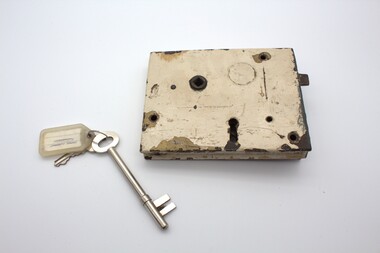
Functional object - Rim Lock and Key, c.1850
... This example formed part of the fabric of the Ziebell's Farmhouse, one of the earliest surviving German settler homes in Victoria, and provides insight into the construction methods and everyday domestic life of the Ziebell family....The lock was removed from one of the doors of Ziebell's Farmhouse and is representative of the original fittings used throughout the nineteenth-century dwelling....The lock was removed from one of the doors of Ziebell's Farmhouse and is representative of the original fittings used throughout the nineteenth-century dwelling. ...Rim locks were commonly used on domestic buildings throughout the nineteenth and early twentieth centuries. This example formed part of the fabric of the Ziebell's Farmhouse, one of the earliest surviving German settler homes in Victoria, and provides insight into the construction methods and everyday domestic life of the Ziebell family.Painted metal rim lock with associated metal key. The rectangular lock case retains traces of its original cream-coloured paint and exhibits wear consistent with long-term use. The lock was removed from one of the doors of Ziebell's Farmhouse and is representative of the original fittings used throughout the nineteenth-century dwelling. -
 Friends of Westgarthtown
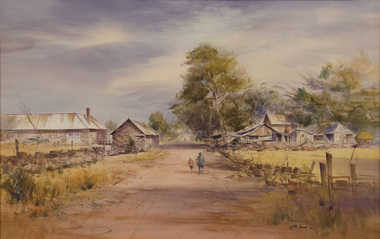
Painting, John Borrack, Ziebells, German Lane, South View, c. 1970s
... Watercolour depicting Ziebell Farmhouse from the north, Thomastown and Mernda. ...The paintings depict Ziebell’s Farmhouse and the associated outbuildings on the opposite side of Gardenia Road, capturing the rural character of the property prior to subdivision and suburban encroachment. ...Painted from Gardenia Road. The extensive farm complex on the right. (Western side of Gardenia Road). was demolished in 1972 for housing development. Buildings shown are cowshed, hay barn, engine shed and stables. Painted in the late afternoon, the lengthening shadows and lowering sky, could presage the ominous fate awaiting the farm with development. The Ziebell Farm was known as “The Pines†and sadly none of the many that proliferated there remain. Today they would be equivalent to those at the cemetery, having been planted at the same time. Provenance: John Borrack CollectionThese two paintings by acclaimed Victorian artist John Borrack, a direct descendant of the Ziebell family through his mother Augusta, hold substantial artistic, historical, and familial significance for Ziebell’s Farmhouse Museum and the broader Westgarthtown narrative. Borrack, recognised as one of Australia’s leading landscape painters, is known for his sensitive, precise and atmospheric depictions of place. His professional standing and artistic skill considerably elevate the cultural value of these works. The paintings depict Ziebell’s Farmhouse and the associated outbuildings on the opposite side of Gardenia Road, capturing the rural character of the property prior to subdivision and suburban encroachment. They function as accurate visual records of the farm’s earlier setting and the self-sufficient lifestyle. Their documentary value is amplified by Borrack’s own reflections: he explained that he made the original sketches in the 1950s and later, in the 1970s, “decided to make a positive record of what the farm looked like”, developing these paintings from those earlier drawings. One work shows the farmhouse and milking shed as seen from the cemetery: the other captures the view from the front garden toward the former vegetable garden. Their provenance deepens their significance. As works created by a Ziebell descendant who consciously sought to record his family heritage, the paintings embody intergenerational memory, personal connection, and the enduring legacy of the Ziebell family within Victoria’s cultural landscape. They enrich the museum’s interpretive capacity, offering rare artistic insight into the historic farmstead and contributing meaningfully to the preservation and understanding of Westgarthtown’s heritage. Watercolour depicting Ziebell Farmhouse from the north, Thomastown and Mernda. In gold frame with cream border.Artist signature: John Borrack; 70's Ziebells German Lane South Viewillustrations, watercolours, john borrack, ziebell, watercolour, painting -
 Eltham District Historical Society Inc
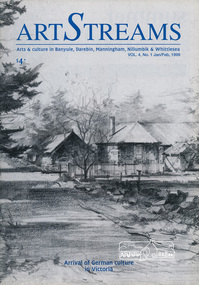
Journal, Peter Doughtery, ArtStreams: Arts & Culture in Banyule, Darebin, Manningham, Nillumbik & Whittlesea; Vol. 4, No. 1, Jan-Feb 1999, 1999
... ...ziebell farmhouse...." - Eltham District Historical Society Newsletter No. 161, March 2005 art streams john borrack ziebell farmhouse sumer in the parks william westgarth westgarthtown yarra valley country club llobex image wizards soni stecker vienna victorian artists supplies adams of north riding pool & spa care centre montsalvat eltham arts council hilary jackman st andrews hotel jordie albiston ian mcbryde city of whittlesea community festival volumes clive dickson luna park museum of modern art at heide art in public places songlines nerida kirov manningham arts centres carolyn pickett women's circus edna walling trisha dixon jennie churchill gwen ford eltham library community gallery roberta sykes soni silvan strecker dymocks booksellers wintyre recital gallery carolyn morwood anne delaney coco's lunch bulleen art & garden centre franciscus henry monty deli & catering services Colour front and back cover with feature articles and literary pieces with photographs and advertisements printed in black and white. 36 pages, 30 cm. ...Vol. 4, No. 1, Jan-Feb 1999 CONTENTS LEGACY OF WILLIAM WESTGARTH Beginnings of German culture in Victoria 3 POSTCARD FROM VIENNA Soni Stecker in the coffee capital of Europe 6 SMALL IS BEAUTIFUL Poets Christen the Montsalvat barn 9 NEW BLOOD FOR ARTS OF ELTHAM 11 HILARY JACKMAN IN PROFILE An artist examines her motives 12 POETRY 14 VOLUMES 1ST BIRTHDAY Celebrating a new chapter in the story of Nillumbik 16, 17 NEW HEIDE EXHIBITION Luna Park and the Art of Mass Delirium 18 SONGLINES A dream takes shape for Nerida Kirov 20 THEATRE WITH CAROLYN PICKETT 23 BOOK REVIEWS 24 - 28 CD REVIEWS Coco's Lunch -Wally Wombat Shuffle; Hooray! for Mr Whiskers 29, 32 "Peter Dougherty has been involved in the local art scene for many years. As publisher and editor of the arts magazine Artstreams, his comments on the various branches of the arts are widely respected. His "The Arts" column in the Diamond Valley Leader presents a brief summary for a much wider cross section of the local community. Peter also operates his own gallery and the Artstreams Cafe at the St Andrews market. Peter has a wealth of knowledge about present day and historical aspects of local art and artists." - Eltham District Historical Society Newsletter No. 161, March 2005Colour front and back cover with feature articles and literary pieces with photographs and advertisements printed in black and white. 36 pages, 30 cm. Vol. 1, no. 1 (Nov. 1996) - Vol. 10, no. 5 (summer ed. 2005/06) art streams, john borrack, ziebell farmhouse, sumer in the parks, william westgarth, westgarthtown, yarra valley country club, llobex image wizards, soni stecker, vienna, victorian artists supplies, adams of north riding, pool & spa care centre, montsalvat, eltham arts council, hilary jackman, st andrews hotel, jordie albiston, ian mcbryde, city of whittlesea community festival, volumes, clive dickson, luna park, museum of modern art at heide, art in public places, songlines, nerida kirov, manningham arts centres, carolyn pickett, women's circus, edna walling, trisha dixon, jennie churchill, gwen ford, eltham library community gallery, roberta sykes, soni silvan strecker, dymocks booksellers, wintyre recital gallery, carolyn morwood, anne delaney, coco's lunch, bulleen art & garden centre, franciscus henry, monty deli & catering services -
 Friends of Westgarthtown
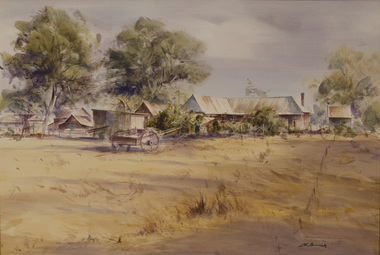
Painting, John Borrack, Last Days Ziebells "The Pines" Thomastown, c. 1970s
... Watercolour painting, depicting Ziebell's Farmhouse from the south (Thomastown and Mernda). ...The paintings depict Ziebell’s Farmhouse and the associated outbuildings on the opposite side of Gardenia Road, capturing the rural character of the property prior to subdivision and suburban encroachment. ...Painted from the home (or front) paddock which ran south to the creek. The paddock was used for the cultivation of lucerne and maize crops in the lower regions while closer to the house where Ainwick Crescent is now situated, it was a burgeoning market garden for the cultivation of all varieties of vegetables. The large pines beyond, sheltered the farmyard on the west of Gardenia Road. That complex can be partly glimpsed on the left of the painting. This is a directly painted watercolour relying on the use of white paper and transparencies to impart a feeling of morning light. The figure is the artist's mother for whom the picture was painted. Provenance: Augusta Borrack (nee Ziebell) Collection, John Borrack CollectionThese two paintings by acclaimed Victorian artist John Borrack, a direct descendant of the Ziebell family through his mother Augusta, hold substantial artistic, historical, and familial significance for Ziebell’s Farmhouse Museum and the broader Westgarthtown narrative. Borrack, recognised as one of Australia’s leading landscape painters, is known for his sensitive, precise and atmospheric depictions of place. His professional standing and artistic skill considerably elevate the cultural value of these works. The paintings depict Ziebell’s Farmhouse and the associated outbuildings on the opposite side of Gardenia Road, capturing the rural character of the property prior to subdivision and suburban encroachment. They function as accurate visual records of the farm’s earlier setting and the self-sufficient lifestyle. Their documentary value is amplified by Borrack’s own reflections: he explained that he made the original sketches in the 1950s and later, in the 1970s, “decided to make a positive record of what the farm looked like”, developing these paintings from those earlier drawings. One work shows the farmhouse and milking shed as seen from the cemetery: the other captures the view from the front garden toward the former vegetable garden. Their provenance deepens their significance. As works created by a Ziebell descendant who consciously sought to record his family heritage, the paintings embody intergenerational memory, personal connection, and the enduring legacy of the Ziebell family within Victoria’s cultural landscape. They enrich the museum’s interpretive capacity, offering rare artistic insight into the historic farmstead and contributing meaningfully to the preservation and understanding of Westgarthtown’s heritage. Watercolour painting, depicting Ziebell's Farmhouse from the south (Thomastown and Mernda). Painting is mounted in a gold frame with cream board.Artist signature: John Borrack; Last Days at Ziebells "The Pines" Thomastown, 'Pro mea matre hanc picturan feci (In Memoria)'illustrations, watercolours, john borrack, ziebell, watercolour, painting -
 Friends of Westgarthtown
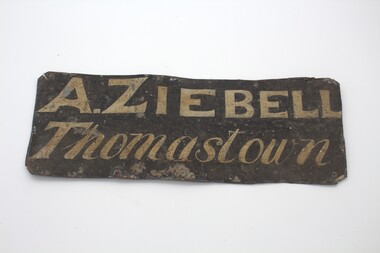
Sign - Buggy ownership plate-A Ziebell, Homemade
... ziebell...ziebell's farmhouse...Its significance relates to the buggy (0254.2), belonging to Alfred Ziebell, to which it was attached. buggy number plate alfred ziebell ziebell's farmhouse friends of westgarthtown A. Ziebell Thomastown Metal hand painted ownership plate. ...This plate was attached to the buggy (0254.2) which acted similarly to a number plate in denoting ownership. As such it is the only one of its kind. Estimated date of manufacture was late 19th or early 20th Century.This object is of primary significance. Its significance relates to the buggy (0254.2), belonging to Alfred Ziebell, to which it was attached.Metal hand painted ownership plate. Black background with yellow writingA. Ziebell Thomastownbuggy, number plate, alfred ziebell, ziebell's farmhouse, friends of westgarthtown -
 Friends of Westgarthtown
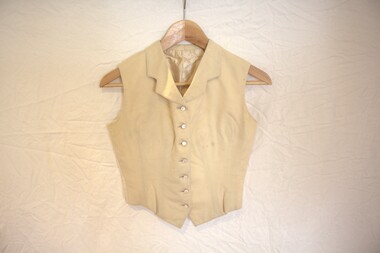
Clothing - Waistcoat, c.1900
... Originally owned by Annie Ziebell (née Robertson) and donated to Ziebell's Farmhouse Museum by her granddaughter, Janet Hubbard....Originally owned by Annie Ziebell (née Robertson) and donated to Ziebell's Farmhouse Museum by her granddaughter, Janet Hubbard. ...Cream-coloured women's horse-riding waistcoat made from felt and silk. The waistcoat formed part of a woman's equestrian outfit worn for side-saddle riding. Originally owned by Annie Ziebell (née Robertson) and donated to Ziebell's Farmhouse Museum by her granddaughter, Janet Hubbard. -
 Friends of Westgarthtown
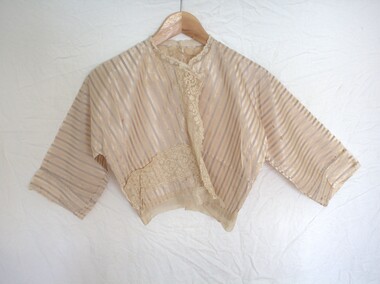
Clothing - Silk Jacket
... Passed down to Janet Hubbard by her grandmother, Annie Ziebell, and later donated to Ziebell's Farmhouse Museum...Passed down to Janet Hubbard by her grandmother, Annie Ziebell, and later donated to Ziebell's Farmhouse Museum Clothing Silk Jacket ...Women's lightweight jacket made from silk, lace and cotton with an organza lining. Designed as a decorative outer garment, the jacket features delicate textile embellishments and fine construction typical of women's dresswear. Passed down to Janet Hubbard by her grandmother, Annie Ziebell, and later donated to Ziebell's Farmhouse Museum -
 Friends of Westgarthtown
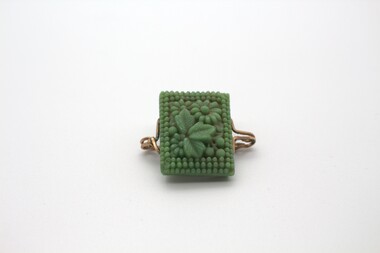
Accessory - Gold Brooch with Jade Stone
... The brooch was passed down through generations of the Ziebell family before being donated to Ziebell's Farmhouse Museum by Janet Hubbard. While the original owner and date of manufacture are unknown, the brooch is believed to have belonged to Annie Ziebell (née Robertson)...The brooch was passed down through generations of the Ziebell family before being donated to Ziebell's Farmhouse Museum by Janet Hubbard. While the original owner and date of manufacture are unknown, the brooch is believed to have belonged to Annie Ziebell (née Robertson) Accessory Gold Brooch with Jade Stone ...Gold brooch featuring a square jade stone set within a decorative gold mount. The brooch was passed down through generations of the Ziebell family before being donated to Ziebell's Farmhouse Museum by Janet Hubbard. While the original owner and date of manufacture are unknown, the brooch is believed to have belonged to Annie Ziebell (née Robertson) -
 Friends of Westgarthtown
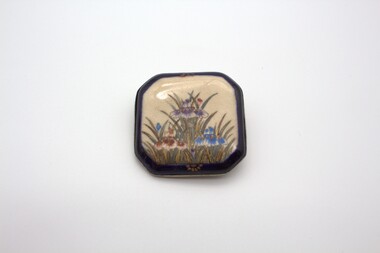
Accessory - Painted Porcelain Brooch
... The brooch was passed down through generations of the Ziebell family before being donated to Ziebell's Farmhouse Museum by Janet Hubbard. While the original owner and date of manufacture are unknown, the brooch is believed to have belonged to Annie Ziebell (née Robertson)....The brooch was passed down through generations of the Ziebell family before being donated to Ziebell's Farmhouse Museum by Janet Hubbard. While the original owner and date of manufacture are unknown, the brooch is believed to have belonged to Annie Ziebell (née Robertson). ...Painted porcelain brooch featuring a hand-painted floral design set within a decorative metal mount. The brooch was passed down through generations of the Ziebell family before being donated to Ziebell's Farmhouse Museum by Janet Hubbard. While the original owner and date of manufacture are unknown, the brooch is believed to have belonged to Annie Ziebell (née Robertson). -
 Friends of Westgarthtown
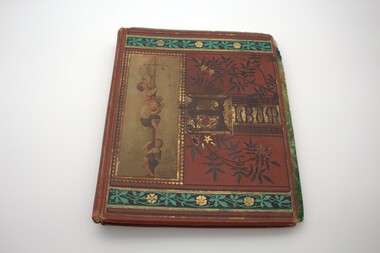
Album - Sticker Album, c.1870-1890
... Passed down to Janet Hubbard from her grandparents, Henry and Annie Ziebell, and later donated to Ziebell's Farmhouse Museum by Janet Hubbard....Passed down to Janet Hubbard from her grandparents, Henry and Annie Ziebell, and later donated to Ziebell's Farmhouse Museum by Janet Hubbard. Album Sticker Album ...Children's sticker book produced by Marcus Ward & Co., London and Belfast, likely dating from the late nineteenth century. The book contains a colourful collection of stickers depicting a variety of subjects, including insects, animals, plants and whimsical characters. Passed down to Janet Hubbard from her grandparents, Henry and Annie Ziebell, and later donated to Ziebell's Farmhouse Museum by Janet Hubbard. -
 Friends of Westgarthtown
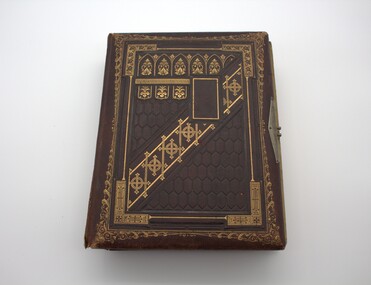
Album - Photo Album, c.1800s
... Donated to Ziebell's Farmhouse Museum by Janet Hubbard....Donated to Ziebell's Farmhouse Museum by Janet Hubbard. Album Photo Album ...Large leather-bound family photograph album with gold-foiled decoration, containing black-and-white photographs of members of the Ziebell family. Many of the images featured in the publication The House that Christian Built. The album also contains memorial bookplates commemorating family members including Henry Ziebell, Charles Ludwig Ziebell, Heinrich August Sprenger and Elisabeth Ziebell, recording details of their deaths and burial places. Donated to Ziebell's Farmhouse Museum by Janet Hubbard. -
 Friends of Westgarthtown
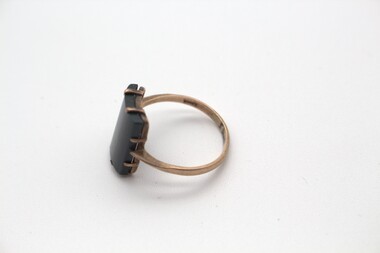
Accessory - Gold Ring with Black Stone
... The ring was passed down through generations of the Ziebell family before being donated to Ziebell's Farmhouse Museum by Janet Hubbard. While the original owner and date of manufacture are unknown, the ring is believed to have belonged to Annie Ziebell (née Robertson). ...The ring was passed down through generations of the Ziebell family before being donated to Ziebell's Farmhouse Museum by Janet Hubbard. While the original owner and date of manufacture are unknown, the ring is believed to have belonged to Annie Ziebell (née Robertson). ...Gold ring featuring a rectangular black stone set within a decorative gold band. The ring was passed down through generations of the Ziebell family before being donated to Ziebell's Farmhouse Museum by Janet Hubbard. While the original owner and date of manufacture are unknown, the ring is believed to have belonged to Annie Ziebell (née Robertson). The ring represents the types of personal jewellery that were treasured, worn and passed between family members over many years -
 Friends of Westgarthtown
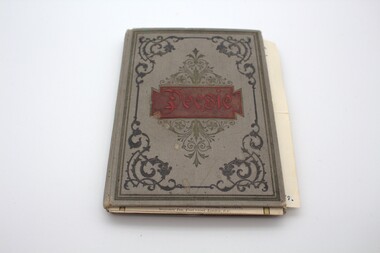
Book - Poesie Book, c1885
... The notebook formed part of a group of German-language family items inherited by Janet Hubbard from her grandfather, Henry Christian Ziebell (1911–1988), and was later donated to Ziebell's Farmhouse Museum by Janet Hubbard...The notebook formed part of a group of German-language family items inherited by Janet Hubbard from her grandfather, Henry Christian Ziebell (1911–1988), and was later donated to Ziebell's Farmhouse Museum by Janet Hubbard Bound notebook containing handwritten poems in German, likely compiled for personal use or family exchange. ...According to a handwritten note inserted in the volume and dated 22 March 1959, the notebook contains a collection of original German poems written by Charles and members of his family. The volume also contains a bookplate commemorating the confirmation of Otto Ziebell in 1887 and a loose prayer sheet titled Be Faithful Unto Death. The notebook formed part of a group of German-language family items inherited by Janet Hubbard from her grandfather, Henry Christian Ziebell (1911–1988), and was later donated to Ziebell's Farmhouse Museum by Janet HubbardBound notebook containing handwritten poems in German, likely compiled for personal use or family exchange. The volume includes a bookplate recording the confirmation of Otto Ziebell in 1887, along with two loose inserted papers: a prayer titled Be Faithful Unto Death and a handwritten note dated 22 March 1959 describing the book as a collection of original German poems written by Charles and family. -
 Friends of Westgarthtown
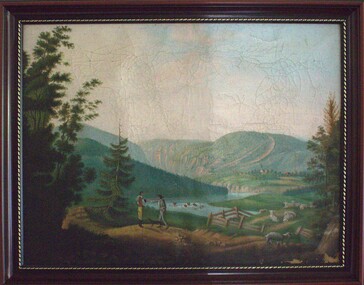
Artwork, other - Painting, c. 1830-1850
... The painting was re-framed approximately eight years ago, with the intention that they be returned to Ziebell’s Farmhouse Museum for display. Their reinstatement within the museum reflects a shared recognition among descendants of their historical and familial significance, and their role in evoking the lived experience of the house across generations....The painting was re-framed approximately eight years ago, with the intention that they be returned to Ziebell’s Farmhouse Museum for display. Their reinstatement within the museum reflects a shared recognition among descendants of their historical and familial significance, and their role in evoking the lived experience of the house across generations. ...This painting is understood to have been displayed within the Ziebell family home for much of the 20th century. According to Paul Schultz, one of the prints hung above the piano in the dining room during his childhood. His uncle, Francis Adams, who was raised in the house and born in the 1930s, recalled that the prints had been present for as long as he could remember, suggesting a long-standing association with the domestic interior of the farmhouse. The painting was re-framed approximately eight years ago, with the intention that they be returned to Ziebell’s Farmhouse Museum for display. Their reinstatement within the museum reflects a shared recognition among descendants of their historical and familial significance, and their role in evoking the lived experience of the house across generations.pastoral scene -
 Friends of Westgarthtown
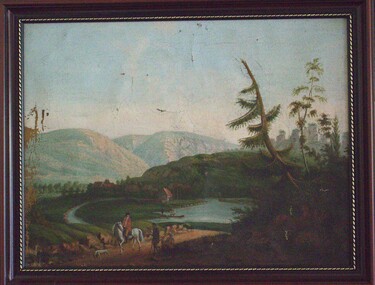
Artwork, other - Painting, c.1830-1850
... The painting was reframed approximately eight years ago, with the intention that they be returned to Ziebell’s Farmhouse Museum for display. Their reinstatement within the museum reflects a shared recognition among descendants of their historical and familial significance, and their role in evoking the lived experience of the house across generations....The painting was reframed approximately eight years ago, with the intention that they be returned to Ziebell’s Farmhouse Museum for display. Their reinstatement within the museum reflects a shared recognition among descendants of their historical and familial significance, and their role in evoking the lived experience of the house across generations. ...This painting is understood to have been displayed within the Ziebell family home for much of the 20th century. According to Paul Schultz, one of the prints hung above the piano in the dining room during his childhood. His uncle, Francis Adams, who was raised in the house and born in the 1930s, recalled that the prints had been present for as long as he could remember, suggesting a long-standing association with the domestic interior of the farmhouse. The painting was reframed approximately eight years ago, with the intention that they be returned to Ziebell’s Farmhouse Museum for display. Their reinstatement within the museum reflects a shared recognition among descendants of their historical and familial significance, and their role in evoking the lived experience of the house across generations. -
 Friends of Westgarthtown
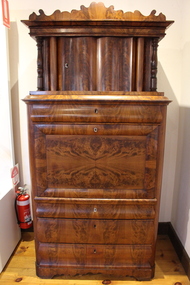
Furniture - Secretaire, c.1815-1860
... Its significance to Ziebell’s Farmhouse Museum is elevated by its direct association with Christian Ziebell, who returned to Germany in 1855 after having settled in Westgarthtown and brought the secretaire back to Melbourne by ship. ...Its significance to Ziebell’s Farmhouse Museum is elevated by its direct association with Christian Ziebell, who returned to Germany in 1855 after having settled in Westgarthtown and brought the secretaire back to Melbourne by ship. ...This 19th-century German secretaire is a refined example of the Biedermeier style, valued for its restrained elegance, high-quality craftsmanship, and practical, compartmentalised interior. Made with fine veneers, typically cherry or walnut, over a sturdy timber carcass, Biedermeier secretaires represent an important era of German domestic design that emphasised order, utility, and tasteful simplicity. Its significance to Ziebell’s Farmhouse Museum is elevated by its direct association with Christian Ziebell, who returned to Germany in 1855 after having settled in Westgarthtown and brought the secretaire back to Melbourne by ship. As a personally selected furnishing, it reflects both Christian’s continued connection to his homeland and the aspirations of a settler family building comfort, status, and familiarity in a new country. The secretaire contributes meaningfully to the interpretation of German migrant domestic life, craftsmanship, and transnational identity, offering tangible insight into what the Ziebell family valued and chose to carry across the world. -
 Friends of Westgarthtown
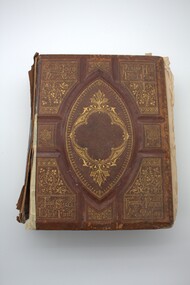
Book - Seeber Family Bible, 1871
... The Bible was retained within the Seeber family for generations and was donated to Ziebell's Farmhouse Museum by Helen Pearce, granddaughter of Agnes Seeber, the youngest child of John and Johanna Seeber....The Bible was retained within the Seeber family for generations and was donated to Ziebell's Farmhouse Museum by Helen Pearce, granddaughter of Agnes Seeber, the youngest child of John and Johanna Seeber. ...Large leather-bound illustrated family Bible published in the United States c.1871 and printed in the German language. The Bible contains a family register section recording births and deaths, as well as a dedicated section for family photographs. The volume is richly illustrated throughout and reflects the importance of religion and family record keeping within German Lutheran communities of the nineteenth century. The Bible belonged to the Seeber family of Westgarthtown. The Seeber family lived in a house on High Street, opposite the present-day Lalor Railway Station, for almost one hundred years. Family patriarch John Seeber worked as a shoemaker and operated his business from the family home. Many members of the Seeber family are buried in the Westgarthtown Lutheran Cemetery. The Bible was retained within the Seeber family for generations and was donated to Ziebell's Farmhouse Museum by Helen Pearce, granddaughter of Agnes Seeber, the youngest child of John and Johanna Seeber. -
 Friends of Westgarthtown
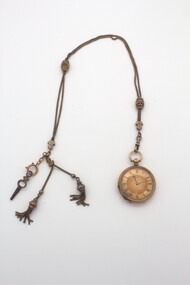
Accessory - Fobwatch, Chain and Key, c.1856-1890
... Donated to Ziebell’s Farmhouse Museum in 2025 by Kristina Colic (née Ziebell) and her father Mervyn Turner Ziebell, the watch holds strong familial and interpretive value, enriching the museum’s representation of women’s heritage, adornment and craftsmanship within the Ziebell family. ...Donated to Ziebell’s Farmhouse Museum in 2025 by Kristina Colic (née Ziebell) and her father Mervyn Turner Ziebell, the watch holds strong familial and interpretive value, enriching the museum’s representation of women’s heritage, adornment and craftsmanship within the Ziebell family. ...This finely crafted women’s gold fob watch, made by Robert Stauffer & Fils of La Chaux-de-Fonds, Switzerland, is an elegant example of mid-19th-century Swiss watchmaking. Its engraved floral motifs, protected beneath glass and repeated on the reverse, reflect the refinement and skill associated with one of Europe’s foremost horological centers. Believed to have belonged to either Elizabeth Ziebell (née Sprenger, 1836–1892) wife of Carl Chrsitian Ziebell or Amelia Alice Ziebell (née Bodycoat 1870-1948) wife of Albert Heinrich Ziebell, the watch provides a personal link to the women of the early Ziebell family and to domestic and social life within Westgarthtown’s German settler community. Women’s watches of this era were both functional and fashionable, commonly worn on a long necklace chain, suspended from a chatelaine at the waist, or attached to a decorative bodice brooch. Such pieces served as markers of refinement, femininity and social standing. The tiny winding key is central to the object’s significance. Before stem-winding mechanisms became standard in the 1870s, watches were wound and set by inserting a small key into an arbor at the back of the case. The survival of both the watch and its original key strengthens their historical integrity and deepens understanding of 19th-century personal technology. Donated to Ziebell’s Farmhouse Museum in 2025 by Kristina Colic (née Ziebell) and her father Mervyn Turner Ziebell, the watch holds strong familial and interpretive value, enriching the museum’s representation of women’s heritage, adornment and craftsmanship within the Ziebell family. Robert Stauffer & Fils of La Chaux-de-Fonds, Switzerland -
 Friends of Westgarthtown
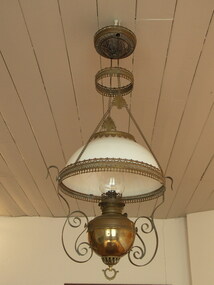
Domestic object - Lamp, Miller, Miller, c. 1890s
... Its high level of intactness, combined provenance and dual- history contribute to its importance as a culturally rich artefact within the Ziebell’s Farmhouse collection. lighting kerosene & oil oil lamp hanging lamp original. ...Purchased by Christian Ziebell on one of his two visits back to Germany.This object is of primary significance. Christian Ziebell brought it back from Germany on his return visit to Germany in 1856. It always hung where it is now and it is retractable to different heights. It hung on the lowest chain length over the table and was only raised when the family had festive events such as dances when Dorothea would accompany them on the piano. Great care had to be exercised when the lamp was raised because if it went up too high, and therefore became too close to the wooden ceiling, it could cause a fire. Francis Adams – son of Sylvia Adams (Ziebell) restored the lamp in the 1990’s. This Miller-style hanging oil lamp is a rare and culturally layered object that connects American industrial manufacture with German domestic life and early migrant history in Victoria. Produced by Bradley & Hubbard (B&H) in the United States in the 1890s, the lamp displays characteristic features of the firm’s Rayo line, including a brass body, opaque white glass shade, quality burner mechanism, and a chain-operated raising and lowering system. The inscriptions “B&H Valpirfor” and patent dates 1894-1895 confirm its authenticity as an American-made B&H Rayo lamp. This lamp was likely purchased in Mecklenburg, Germany, reflecting the export of modern lighting technologies into rural German households in the late 19th century. The lamp’s significance is further enhanced by its believed association with the Ziebell family. It is understood that a family member brought the lamp to Melbourne on a subsequent return journey to Germany after the family had established themselves at Westgarthtown. As a result, the lamp embodies themes of migration, technological adaptation, and the lived domestic environment of the Ziebell family across two continents. Its high level of intactness, combined provenance and dual- history contribute to its importance as a culturally rich artefact within the Ziebell’s Farmhouse collection. Original Miller hanging lamp, made of brass and opaque white glass. Lamp has chain-operated raising and lowering mechanism. Decorative brass trimming around widest edge of glass lampshade. Contains tubular wick.B & H Valpirfor written on lowering mechanism on top of the lamp. Rayo 24.98, PAT'D. NOV. 20.94, FEB 28.95, written on top of oil compartment.lighting, kerosene & oil, oil lamp, hanging lamp, original. -
 Friends of Westgarthtown
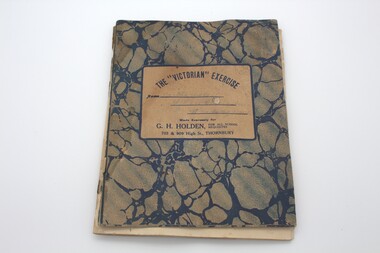
Book - Book, exercise, c.1923
... Bertha Ziebell was born at Ziebell's Farmhouse and this book is typical of writing books used by Victorian school children in the first half of the 20th century. ...This book was used by Bertha Ziebell while a student at Thomastown State School in c. 1923. A lined paper exercise book, cardboard cover, writing practice in ink, in English. Bound in cardboard. Back cover missing. Label: pencil. inside back page, bottom right corner.Bertha Ziebell was a great granddaughter of Christian Ziebell and Sophia Ziebell who migrated to Australia from Germany in 1850. Bertha Ziebell was born at Ziebell's Farmhouse and this book is typical of writing books used by Victorian school children in the first half of the 20th century. It is the only one of its kind.lined paper exercise book, cardboard cover, writing practice in ink, in English.The "Victorian" Exercise, Name 'Bertha Ziebell SS 181 Thomastown Writing Book' Made Expressly for G. H. Holden, For All School Requisites, 703& 909 High St., Thornbury'books, school/educational, exercise book, writing, ink, paper -
 Friends of Westgarthtown
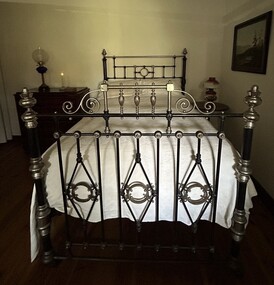
Furniture - Bed, double, Late 1800s
... As Carl Alfred and Dorothea are buried in the Lutheran Cemetery adjacent to Ziebell’s Farmhouse, the bed also strengthens the site’s tangible connection to the family’s multi-generational presence in Westgarthtown. ...This object is of primary significance. The nickel plated brass bedstead was made by Carl Alfred Ziebell for his wife Dorothea. Carl Alfred Ziebell ( 23.08.1867 - 26.10. 1940) was the third generation grandson of Christian Ziebell. Dorothea remained proud of her bed throughout her long life. (14.7.1873 - 14.12.1969) The bed linen and quilts remain traditionally dressed as they were in 1850. This ornate iron bed holds strong historical and cultural significance as a rare surviving example of craftsmanship by Carl Heinrich Alfred “Carl Alfred” Ziebell (1867–1940), grandson of Christian and Sophia Ziebell, early German-Wendish settlers of Westgarthtown. A skilled wheelwright by trade, Carl Alfred possessed deep technical knowledge of metalworking, timber precision, and traditional fabrication techniques required for constructing and repairing wagon wheels. These same skills are reflected in the bed’s carefully forged ironwork and its distinctive circular decorative motifs. Carl Alfred crafted this bed for his wife, Dorothea, who, as family accounts recall, “remained proud of her bed throughout her long life.” The linens displayed on the bed are traditional cotton fabrics with intricate lace detailing, donated to the museum by Sylvia Ziebell. These textiles closely resemble the types of linens that would originally have dressed the bed, helping to evoke its historic domestic context. The bed represents both the material resourcefulness and artisanal expertise present within the second generation of the Ziebell family. Its construction demonstrates a blending of practical skill with aesthetic ambition, illustrating how tradespeople adapted their craft to create durable and decorative domestic furnishings. As Carl Alfred and Dorothea are buried in the Lutheran Cemetery adjacent to Ziebell’s Farmhouse, the bed also strengthens the site’s tangible connection to the family’s multi-generational presence in Westgarthtown. The piece is significant for its rarity, its association with an identified maker within the Ziebell lineage, and its ability to illuminate the lived experience, creativity, and craftsmanship of the early community. Nickel plated and painted tubular steel bedstead with double bed mattress and spreads. On four castor wheels, ornate decoration on both ends. Turned sections on each corner post, four on the bottom ends, only caps on the top ends. Spring wire mattress base.furniture, domestic, double bed, bedstead, nickel-plated, steel, turned -
 Friends of Westgarthtown
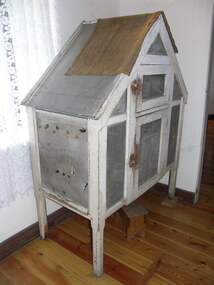
Functional object - Coolgardie Safe, Carl Ziebell, direct descendant, c. 1915
... Sylvia Schultz (nee Ziebell) remembers the Coolgardie safe at Ziebell’s Farmhouse “was always positioned in the pantry where it is today, near the window to allow the breeze in”. ...This Coolgardie safe is a significant example of late-19th-century Australian ingenuity and domestic adaptation in response to the challenges of life in remote and harsh environments. Invented in the late 1890s by Arthur Patrick McCormick at Coolgardie, then the center of a major Western Australian gold rush, the safe represents an important technological response to the need for preserving perishable foods in extreme heat before the availability of mechanical refrigeration. Using the same evaporative principles employed by explorer’s canvas water bags, the Coolgardie safe utilised a timber frame, zinc metal sheets, wire mesh panels and wet hessian cloth to create a naturally cooled storage chamber. When placed in a draught or breeze, evaporation lowered the internal temperature, allowing miners, settlers and later rural households to keep meat, dairy and vegetables safe for longer periods. Sylvia Schultz (nee Ziebell) remembers the Coolgardie safe at Ziebell’s Farmhouse “was always positioned in the pantry where it is today, near the window to allow the breeze in”. Items the Ziebell’s stored in the safe included meats, milk and cream, and home-made goods. This object embodies a pivotal moment in Australia’s social and technological history, illustrating resourcefulness, adaptation to climate, and the lived realities of those who settled and worked in remote regions. As an early form of sustainable refrigeration, it contributes valuable interpretive depth to domestic, rural and goldfields history. Handmade food safe with white painted wooden frame and perforated zinc screen panels. Galvanised sheet roof. Raised four beveled legs. Two rectangular doors, bottom door large, opens to main area with one shelf. top door small, opens to triangular roof section. Movable latches of wood on both doors.No visible markingsdomestic items, food storage and preservation, food, safe, storage, pantry, carl ziebell -
 Friends of Westgarthtown
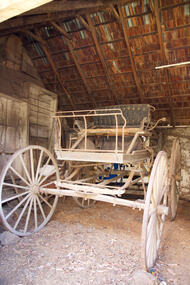
Functional object - Buggy, horse drawn, c. early 1900s
... The horse-drawn buggy, built by Carl Alfred Ziebell, is one of the most evocative surviving artefacts of everyday life at Ziebell’s Farmhouse, and a tangible link to the family’s heritage. ...The horse-drawn buggy, built by Carl Alfred Ziebell, is one of the most evocative surviving artefacts of everyday life at Ziebell’s Farmhouse, and a tangible link to the family’s heritage. As a skilled wheelwright, Carl Alfred constructed this four-wheeled vehicle on the property to serve his wife Dorothea and their ten children throughout the early 1900s. For decades, the buggy was the primary mode of transport for the Ziebell family, used for travel between their farm, central Melbourne, and surrounding districts and there was adequate rear storage for purchases. Its survival in fair, serviceable condition offers a rare example of traditional carriage construction, combining finely turned timber wheels, forged ironwork, steel-trimmed rims, and a leather-upholstered seat. As the only remaining transport relic associated with Westgarthtown’s settlers, the buggy holds deep historical, technological and social significance. It illustrates how immigrant families adapted European trades to harsh landscape conditions, tailored domestic vehicles for local needs, and maintained mobility before motorisation. Exhibiting the buggy within the museum preserves and interprets these connections, offering visitors a direct insight into the material culture and everyday lives of the Ziebell family and the broader settler community in 19th- and early 20th-century Victoria. The buggy was donated by Lyn and James Ziebell. James Ziebell is the son of Henry Christian Ziebell (1911–1988) and Anne Emily Ziebell (née Zimmer, 1912–1985), on whose property the buggy resided following the sale of the Ziebell’s Thomastown farm. Horse drawn buggy. Black leather upholstered chair with studded back. Four large timber spoked wheels the back wheels are larger than the front wheels, with steel trim on edges of wheels. Axels connects wheels and have turning mechanism. Two metal steps on each side of carriage. Small wooden seat on back of carriage facing the back. Steel barrier at front of the carriage. Wooden attachment with two wooden poles to attach to cart to horse.No visible markings.transport, animal, buggy, cart, horse, dairy, carriage, jessie. -
 Friends of Westgarthtown
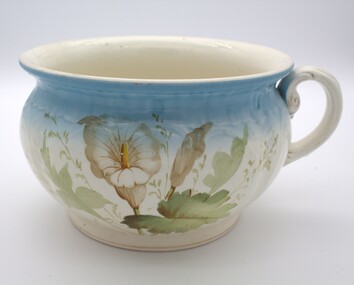
Domestic object - Chamberpot, c.1900
... The set was donated to Ziebell's Farmhouse Museum by Sylvia Schultz (née Ziebell), a descendant of the Ziebell family of Westgarthtown. ...Ceramic chamber pot with a rounded body, flared rim and single loop handle. The chamber pot is decorated with hand-painted floral motifs in white, green and brown on a pale blue ground. The vessel formed part of a matching bedroom wash set, which also included a water jug and large wash bowl. Chamber pots such as this were commonly used in domestic settings during the nineteenth and early twentieth centuries before the widespread installation of indoor plumbing.This chamber pot formed part of a matching ceramic wash set comprising a water jug, wash bowl and chamber pot. The set was donated to Ziebell's Farmhouse Museum by Sylvia Schultz (née Ziebell), a descendant of the Ziebell family of Westgarthtown.
