



Historical information
Used for laparoscopy in gynaecology as well as in general surgery.
Named for János Veres(s) (1903–1979), a Hungarian internist working with tuberculosis patients. At the time, one of the mainstays of treatment was to collapse an infected lung and allow lesions to heal. The needle was introduced as a safer technique to give patients such pneumothoraces. It was not until 1938, when he published his invention in the German literature, that the needle became more broadly known outside of Hungary. (Wikipedia)
Believed to have been used and donated by Dr Geoff Bishop.
Physical description
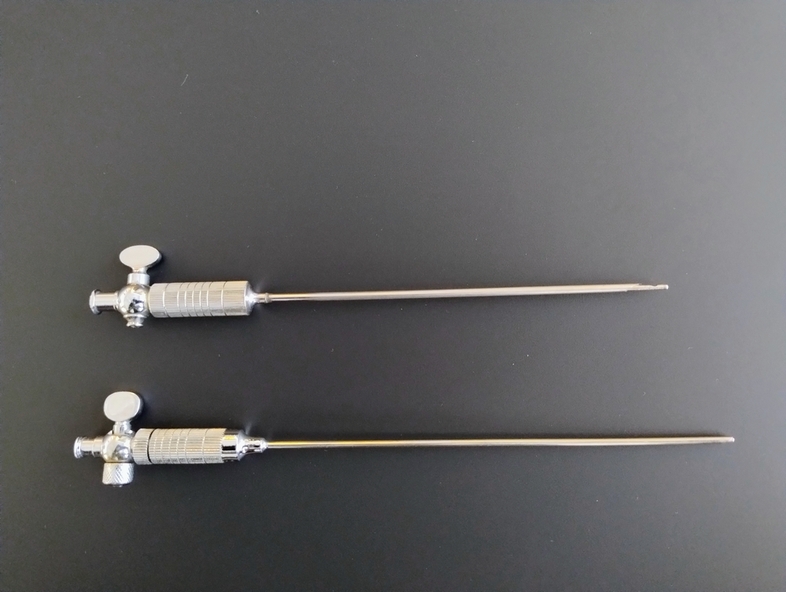
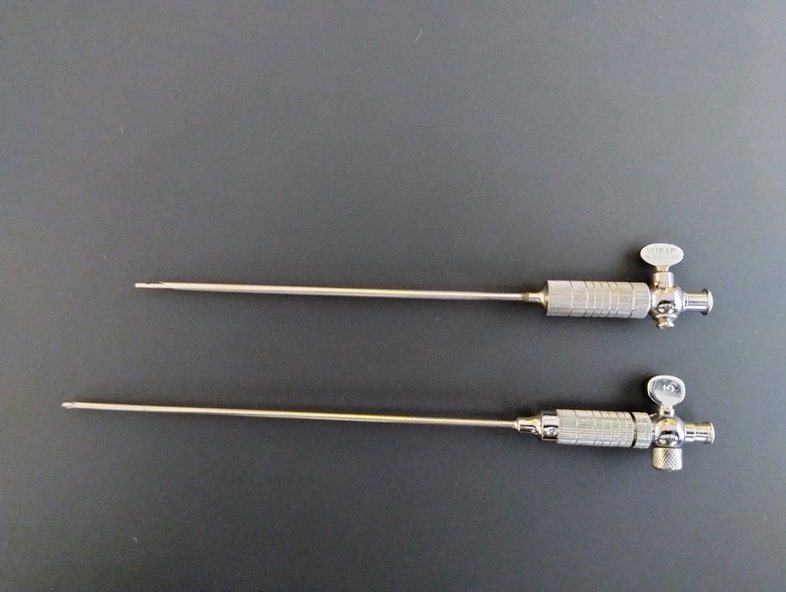
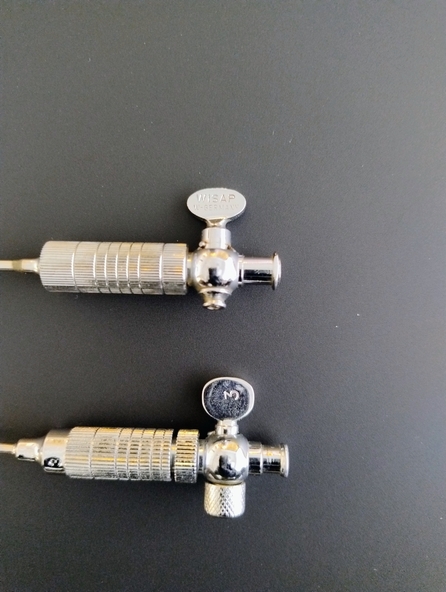
Two Veres needles of differing lengths. Metal, spring loaded needle with an outer cannula and an inner stylus. Consists of a thin, hollow shaft with a bevelled point at one end, encasing a spring loaded needle/stylus with an eyelet at the end. Opposite end of needle consists of an open valve leading to the inner needle with a bulbous connection point. There is a round protrusion at the bottom of the bulbous connection point, and a small oval shaped grip at the top of this point, running parallel to the body of the instrument. A metal barrel containing the spring sits adjacent to the connection point. The barrel can be unscrewed to access the spring inside. The oval shaped grip on the shorter needle is engraved with the text 'WISAP/W. GERMANY'. The oval shaped grip on the longer needle is engraved with the number '3'. The number '30 is also engraved at the base of the barrel on the longer needle.
Inscriptions & markings
'WISAP/W.GERMANY', '3'
