
Showing 5888 items matching "register"
-
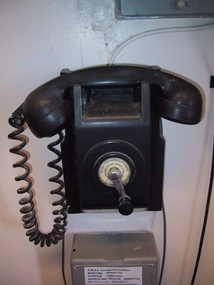 Parks Victoria - Gabo Island Lightstation... As fixtures, the telephones belong to the building fabric and are included in the existing listing of the Gabo Island Lightstation in the Victorian Heritage Register (H1773). ...As fixtures, the telephones belong to the building fabric and are included in the existing listing of the Gabo Island Lightstation in the Victorian Heritage Register (H1773). These intact items of equipment have first level contributory significance for their historic value and provenance. ...There are three, black Bakelite, wall mounted, crank handle telephones across the lightstation; one in the former assistant keeper’s quarters, and two in the former head keeper’s quarters. The phone has instructions for its use on the crank dial. Two have a coiled handset cord, which dates the phone to just after 1949 when these came into use. The third has a smooth cord and must pre date 1949. Another much older wall mounted phone remains in the lighthouse. The four telephones at Gabo Island formed an intercom system that facilitated communication between the lighthouse and lightstation buildings. They demonstrate the necessity for employing various methods of communication in a remotely located lighthouse as well as communication between the lightstation buildings. Telephones of the same wall mounted, crank dial type remain at Cape Otway, Point Hicks. As fixtures, the telephones belong to the building fabric and are included in the existing listing of the Gabo Island Lightstation in the Victorian Heritage Register (H1773). These intact items of equipment have first level contributory significance for their historic value and provenance.Black bakelite telephone, wall mounted with reciever/ handset on spiral cord attached to the body of the phone. There is a crank handle attached to the front of the telephone.On dial under crank handle. Outer perimeter of circular LABEL,"TO CALL:-TURN HANDLE & LIFT HANDSET / WHEN FINISHED PEPLACE HANDSET & TURN HANDLE"
 -
 The Beechworth Burke Museum
Photograph
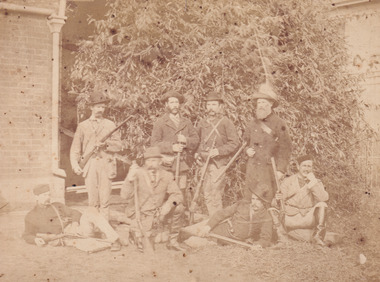
... Many of the photographs taken by William Barnes concerned with the Kelly Gang were registered with the VPOCC which has ensured their survival in the State Library of Victoria today. ...Many of the photographs taken by William Barnes concerned with the Kelly Gang were registered with the VPOCC which has ensured their survival in the State Library of Victoria today. ...According to the Victorian Patents Office Copyright Collection (VPOCC) index, Barnes' image was first published on July 3, 1880. Many of the photographs taken by William Barnes concerned with the Kelly Gang were registered with the VPOCC which has ensured their survival in the State Library of Victoria today. Thus image includes the depiction of Sergeant Arthur Loftus Maule Steele (kneeling in front row) surrounded by seven other men. These men are identified as belonging to the Wangaratta police who played a key part in the destruction of the Kelly Gang at Glenrowan. These men could include Constables Causey, Montiford, Patrick Healey, Walsh, William Moore, Dixon and James Dwyer. It is also suggested that the individual standing back right (in the dark coat) is Constable Hugh Bracken, a key figure in the Glenrowan Siege. The police in this image display their firearms in a manner which reflects photographs of hunters, an element which was typical for this period. This photograph is part of the Burke Museum "Kelly album" which includes a significant collection of photographs and artefacts connected to Ned Kelly and the Kelly Gang. Ned Kelly and his gang have become ingrained in Australian popular culture and thus many museums, art galleries and private collections house material connected to the Kelly story which allows the events and people to be researched and interpreted. Artefacts and photographs pertaining to the Kelly gang are particularly valuable for Australian museums. This particular photograph is significant for its connection to Wangaratta photographer William Barnes who is responsible for having taken and registered many images depicting members of the Kelly gang. The photograph is also of artistic significance as an example of a photograph dating to 1880. This image depicts members of the Wangaratta police shortly after the defeat of the Kelly gang at Glenrowan. This photograph has the capacity to provide important information about the police who took part in Glenrowan 1880 and depicts key figures like Sergeant Steele.Sepia photograph taken by professional photographer William Edward Barnes (1941-1916) in June of 1880. The photo depicts a contingent of Wangaratta police who were at the capture of the Kelly gang at Glenrowan on the 28th of June 1880. This group of eight men are photographed standing in front of foliage and between the sides of two brick structures. Four men stand upright behind four other men who are depicted in either a sitting, semi-lying or kneeling position.W.E.Barnes / photographer / Wangaratta / BMM8085 Police responsible / for Kelly's capture / (D.S. not there)kelly album, glenrowan, police, wangaratta police, ned kelly, ned kelly glenrowan, william barnes, photography, 1880, australian history, police photograph, sargent steele, sergeant steele -
 City of Moorabbin Historical Society (Operating the Box Cottage Museum)
Containers, matchbox 'Redhead' with matches, 20thC
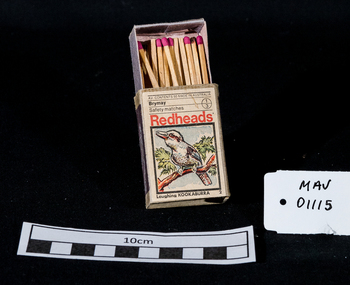
... It is listed on the Victorian Heritage Register. Bryant and May was a United Kingdom (UK) company created in the mid-nineteenth century specifically to make matches. ...It is listed on the Victorian Heritage Register. Bryant and May was a United Kingdom (UK) company created in the mid-nineteenth century specifically to make matches. ...On 15th December 1909, Bryant & May, Australia’s first match factory at Church Street, Richmond, Victoria. was opened by The Honourable Alfred Deakin, Prime Minister of Australia, and Mrs. Deakin. It was heralded by the first Commonwealth Government of newly-federated Australia because the government of the day was anxious to encourage secondary industry and pledged tariff protection of local manufacturers. The building was constructed in 1909 as the Empire Works to a design by prolific Melbourne architect William Pitt and was purchased soon after by British safety match manufacturer Bryant and May, who significantly expanded the building, adding another level and the landmark clock tower. Bryant and May were unique in that they operated as a model factory, providing workers with conditions and amenities that even today seem generous. These included a dining hall and sports facilities such as a tennis court and bowling green which were constructed in the 1920s. Bryant and May ceased Australian match manufacture in the early 1980s as a result of import competition. Their iconic Redheads matches are now imported from Sweden. The complex has since been converted for use as offices and showrooms but is extremely well preserved. It is listed on the Victorian Heritage Register. Bryant and May was a United Kingdom (UK) company created in the mid-nineteenth century specifically to make matches. Their original Bryant and May Factory was located in Bow, London. They later opened other match factories in the United Kingdom and Australia, such as the Bryant and May Factory, Melbourne; and owned match factories in other parts of the world. Bryant and May survived as an independent company for over seventy years, but went through a series of mergers with other match companies and later with consumer products companies. To protect its position Bryant and May merged with or took over its rivals. In 1971 the Northern Ireland factory, Maguire & Patterson closed down following a terrorist attack.. In the 1980s, factories in Gloucester and Glasgow closed too leaving Liverpool as the last match factory in the UK, until December 1994. . The registered trade name Bryant and May still exists and it is owned by Swedish Match, as are many of the other registered trade names of the other, formerly independent, companies within the Bryant and May group. Two French chemists, Henri Savene and Emile David Cahen, proved in 1898 that the addition of phosphorus sesquisulfide meant that the substance was not poisonous, that it could be used in a "strike-anywhere" match, and that the match heads were not explosive. British company Albright and Wilson, was the first company to produce phosphorus sesquisulfide ( Red Phosphorous) matches commercially. The company developed a safe means of making commercial quantities of phosphorus sesquisulfide in 1899 and started selling it to match manufacturers. Matches were first produced by Bryant & May in Australia in 1909. The Redhead name applies to the red striking heads of the matches which were introduced to Australia in 1946. The logo on the matchbox depicted the head and shoulder of a redheaded woman and has had four major updates since that time with a number of special issues depicting birds, animals and notable persons also produced.The Bryant & May Ltd factory in Church St Richmond is a listed building and has been converted to apartments following the closure of the Company 1980. Bryant & May's Ltd were influential in fighting against the dreadful disease known as Phossy jaw which was caused by white phosphorus used in the manufacture of the early matches. They were also the object of the 'Match Girls Strike' in London 1888, which won important improvements in working conditions and pay for the mostly female workforce working with the dangerous white phosphorus. The public were slow to purchase these safety matches because of the higher price .A box of safety matches with unused matches made by Bryant & May Pty Ltd , Richmond Victoria Australia. The tray containing the matches slides inside the open ended cover.. The striking patch is on both sides of the cover. Av. CONTENTS 50 MADE IN AUSTRALIA / Brymay / 1/3 / Safety Matches / Redheads / a colour picture of a Kookaburra / Laughing KOOKABURRAsafety matches, bryant & may pty ltd, phossy jaw disease, early settlers, moorabbin, bentleigh, cheltenham, lights, lamps, tobacco, white phosphorous, phosphorus sesquisulfide, swedish match pty ltd, pitt william, savens henri, cahen emile david , richmond victoria, -
 Eltham District Historical Society Inc
Photograph, Eltham Railway Station, c.1904
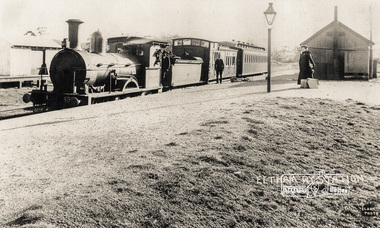
... The unrebuilt tender engines were taken off register between 1916 and 1922. The "motors" were taken off register between 1920 and 1929. ...The unrebuilt tender engines were taken off register between 1916 and 1922. The "motors" were taken off register between 1920 and 1929. ...A Victorian F-class steam locomotive and passenger train at Eltham Railway Station, c.1904 Intending passengers were able to walk down from the Main Road straight onto the railway platform as the station initially only had tracks on the far side. The rail yard and storage shed for heavy goods is across the tracks. The platform shed-like building is best seen in the 1910 and 1912 photographs. The Victorian Railways F class locomotives were built in 1874 (the pattern engine), 1876–77 and 1879–80 by Beyer, Peacock & Company and the Phoenix Foundry in Ballarat as 2-4-0 tender locomotives. They were normally used on passenger trains. In 1911 the Victorian Railways decided to convert seven of them into "motor" locomotives. These became 2-4-2 tanks. They kept their numbers 172–184 (evens only). The unrebuilt tender engines were taken off register between 1916 and 1922. The "motors" were taken off register between 1920 and 1929. Photographer: J.H. Clark John Henry Clark was the youngest of three boys born to William Henry Clark (1823-1877) and Maria White (1843-1914). He and his brothers, William Charles Clark (1872-1945), Clement Kent Clark (1874-1912) operated a photography business (Clark Bros.) from 25 Thomas Street, Windsor near Prahran during the period c.1894 to 1914. Following death of Clement in September 1912 and their mother in 1914, the Clark Bros business appears to have dissolved, the premises demolished, and a new house was under construction in 1915. John set up business independently in 1914 operating out of 29 Moor Street, Fitzroy where he is registered in the 1914 and 1915 Electoral Rolls. By 1916 John had relocated to Eltham where he continued his practice as a photographer and took many of the early images around the district of Little Eltham. Around 1930 John changed professions and opened a small cobbler's shop in 1931 near the pond opposite Dalton Street adjacent to the Jarrold family cottage. He never married and continued his profession as a bootmaker from this little shop, maintaining a close relationship with Mrs Jarrold for the rest of their lives. His bootmaker shop remains today beside the Whitecloud cottage and is one of only three remaining shops in the area from the early 20th century. There are a couple of images of Eltham taken by Clark Bros. in the Eltham District Historical Society collection, one such example being Hunniford’s Post Office with Miss Anne Hunniford out front (EDHS_00140 - marked on the back of the print, Clark Bros., 25 Thomas St. Windsor), which would date this image between c.1894 and 1914. Other early images of Eltham taken by John Henry Clark are marked on the face “J. H. Clark Photo” and it is assumed these are dated between 1914 and 1930. It is noted that the Grant of Probate for John H Clark of Eltham South dated 5 April !957 (513/387) records his occupation as "X Photographer".Reproduction print of a Clark Photo postcardeltham railway station, postcards, steam train, j.h. clark photo, f-class 2-4-0 steam locomotive, victorian railways, tait train -
 Bendigo Historical Society Inc.
Document - H. A. & S. R. WILKINSOM COLLECTION: CONTRACT OF SALE
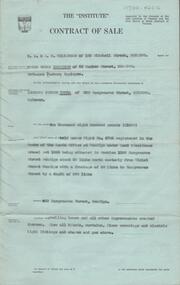
... Property: 529 Hargreaves Street, Bendigo being land held under right No. 4703 registered in the books of the lands office at Bendigo under land 9residence areas) act 1955 being situated in section 139C Hargreaves Street, Bendigo about 69 links north easterly from Violet Street Bendigo with a frontage of 50 links to Hargreaves Street by a depth of 200 links, together with dwelling house and all improvements, also all blinds, curtains, floor coverings and electric light fittings and shades and gas stove. ...Property: 529 Hargreaves Street, Bendigo being land held under right No. 4703 registered in the books of the lands office at Bendigo under land 9residence areas) act 1955 being situated in section 139C Hargreaves Street, Bendigo about 69 links north easterly from Violet Street Bendigo with a frontage of 50 links to Hargreaves Street by a depth of 200 links, together with dwelling house and all improvements, also all blinds, curtains, floor coverings and electric light fittings and shades and gas stove. ...Contract of sale dated 28th November between Mr. E. S. Harrison (vendor) and Mr. L. J. Tuena. Solicitor for vendor: E. S. Cahill & son View Street, Bendigo. Solicitor for purchaser: H. E. Every, Dispensatory Walk, Bendigo. Property: 529 Hargreaves Street, Bendigo being land held under right No. 4703 registered in the books of the lands office at Bendigo under land 9residence areas) act 1955 being situated in section 139C Hargreaves Street, Bendigo about 69 links north easterly from Violet Street Bendigo with a frontage of 50 links to Hargreaves Street by a depth of 200 links, together with dwelling house and all improvements, also all blinds, curtains, floor coverings and electric light fittings and shades and gas stove. Price: 1,600 pounds. Attached: statement pursuant to section 34 and engagement or appointment in writing pursuant to section 33 of the estate agents act, 1956.organization, business, h.a. & s.r wilkinson real estate -
 Bendigo Historical Society Inc.
Document - INDENTURE, GOLD MINING LEASE 11081 CROWN AND HERBERT JACKSON LEED OF BENDIGO, MCCOLL, RANKIN AND STANISTREET COLLECTION, 21st September, 1940
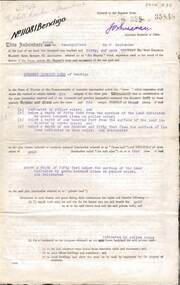
... On back of document: ; Deborah United Gold Mining Company No Liability of Charing Cross Bendigo is now the proprietor of the within described estate by transfer registered on 21st November 1940 and numbered 1795202....On back of document: ; Deborah United Gold Mining Company No Liability of Charing Cross Bendigo is now the proprietor of the within described estate by transfer registered on 21st November 1940 and numbered 1795202. ...Six page document plus map, dated 21st September 1940, between the Crown and Herbert Jackson Leed, for the land shown on the accompanying map 'indicated by yellow colour' Depths indicated on lease document. On map: Mining District of Bendigo, County of Bendigo, Parish of Sandhurst. No. 11081. Net Area 24 acres, 3 roods, 3 perches. Signed by Herbert Leed and ?Walsh, Warden Clerk, Bendigo. Map shows lease holding 11081 coloured yellow. Other leases: no's. 9882 11081, 11034, 11080. Streets: Fletcher Street, and Belle Vue Road. Gullies: Derwenters Mistake Bully and Pig Face Gully on lease 11081. Quarry Hill Recreation Reserve marked and some residential allotments. Water race indicated on map. On back of document: ; Deborah United Gold Mining Company No Liability of Charing Cross Bendigo is now the proprietor of the within described estate by transfer registered on 21st November 1940 and numbered 1795202.bendigo, mining, deborah united gold mine, herbert jackson leed, deborah united gold mining. major general sir winston joseph dugan -
 Ballarat Tramway Museum
Postcard, Sturt St looking west from Grenville St
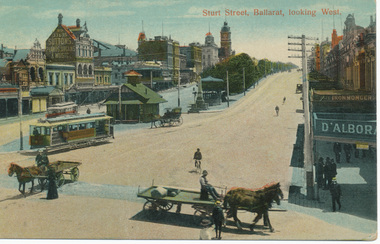
... The red printing layer is off register. The rear of the postcard has a central vertical line, with the word "Post Card" at the top, "Printed in Germany" on the left hand side and the number "B379 10" in the bottom right hand corner. ...The red printing layer is off register. The rear of the postcard has a central vertical line, with the word "Post Card" at the top, "Printed in Germany" on the left hand side and the number "B379 10" in the bottom right hand corner. ...Shows a view of Sturt St c1910, with two trams and horse drawn carts, shows the a busy foreground scene. Has a very poignant message on the rear about the impact of the Great War.Printed coloured postcard of the Sturt St looking west from Grenville St. Has the two ESCO trams in the photograph, two horse drawn carts, cycles and pedestrians. In the middle of the photograph is the ESCo tramway waiting shelter, constructed in 1907. Has the Suttons building and D'Albora? buildings lettered in the photograph. The red printing layer is off register. The rear of the postcard has a central vertical line, with the word "Post Card" at the top, "Printed in Germany" on the left hand side and the number "B379 10" in the bottom right hand corner. Titled "Sturt Street, Ballarat looking West." along top edge of the photo. On the rear of the photograph has the words in pencil "Australia" and the message "Ballarat is a city in Victoria. Mother, my two late Brothers, youngest brother and I were there in 1914, in Oct, just after the War Commenced. My second Brother and the first of the two to lose his life, enlisted when returned from Ballarat. Sturt is Ballarat's main street." No signature or date. trams, tramways, sturt st, postcards, esco, grenville st, world war 1 -
 Surrey Hills Historical Society Collection
Work on paper - Vertical File, Nurses
... Florence Christina Gray. 2 pages of correspondence between Mrs V Von Wedel and Box Hill Historical Society Inc, October 2004 and nurses register (1 page). 9. Listing of Marsh Midwives from 1948 printed in Victorian Gazette, 19 May 1949. ...Florence Christina Gray. 2 pages of correspondence between Mrs V Von Wedel and Box Hill Historical Society Inc, October 2004 and nurses register (1 page). 9. Listing of Marsh Midwives from 1948 printed in Victorian Gazette, 19 May 1949. ...Nurses 1. (Matron) Elizabeth Anderson (and others), 3 pages – various notes and dates 2. Photo and photocopy of nurses at Mosgiel Hospital 1950s 3. Mrs Joan Wicks (Née Bray) (2 pages) undated 4. Mrs Sedgeman (notes by son Frank) (1 page) undated 5. (Matron) Eliza Tank (Nethercourt Hospital). 3 pages including 2 of notes by her son Ossie, 1983. 6. Mary Freeland (1 page, 2 copies) notes by Phyllis McArthur, 11/1983. 7. ‘Lifted nursing to a new level of skills and dedication.’ Obituary of Mary Evans ‘The Age’ 14.6.2004 (1 page) 8. Florence Christina Gray. 2 pages of correspondence between Mrs V Von Wedel and Box Hill Historical Society Inc, October 2004 and nurses register (1 page). 9. Listing of Marsh Midwives from 1948 printed in Victorian Gazette, 19 May 1949. nurses, elizabeth anderson, mosgiel hospital, joan wicks, mrs sedgeman, eliza tank, mary freeland, mary evans, florence gray, marsh midwives -
 City of Moorabbin Historical Society (Operating the Box Cottage Museum)
Containers,Shaving cream, J.B.Williams Co, mid 20thC
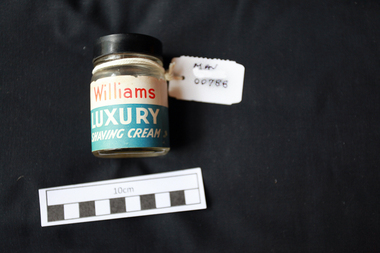
... I In 1983 it was placed on the National Register of Historic Places. 1927 - 1990 Salmond and Spraggon (Australia) Limited , Sydney , New South Wales, was registered as a company on 10 June 1927 following the liquidation of Salmond and Spraggon (Australia) Limited known as the Old Company. ...I In 1983 it was placed on the National Register of Historic Places. 1927 - 1990 Salmond and Spraggon (Australia) Limited , Sydney , New South Wales, was registered as a company on 10 June 1927 following the liquidation of Salmond and Spraggon (Australia) Limited known as the Old Company. ...Shaving cream is a cream applied to the face, or wherever else hair grows, to facilitate shaving. The use of cream achieves three effects: lubricates the cutting process; swells keratin; and de-sensitizes skin. Shaving creams commonly consist of an emulsion of oils, soaps or surfactants, and water. James Baker Williams was born in 1818 in Lebanon, Connecticut USA and, in 1834, began employment with F. and H.C. Woodbridge, a general store located in Manchester. Williams was offered half-interest in the store in 1838, after which its name was changed to Keeny and Williams. Two years later, Williams sold his interest in the store, but retained his share in the drug department. He began experimenting with various soaps to determine which were best for shaving, and eventually developed Williams' Genuine Yankee Soap, the first manufactured soap for use in shaving mugs. In 1847, Williams moved his enterprise to a rented gristmill on William Street in Glastonbury, Connecticut, and his brother, William S. Williams, joined the firm around 1848, when the firm's name was changed to the James B. Williams and Company. William's shaving soaps were sold throughout the United States and Canada and James Williams supervised many aspects of the company until shortly before his death in 1907 at the age of eighty-eight. The Williams family continued to manage the company until it was sold in 1957. By the early 1900s, the company was known throughout the world. In addition to its line of shaving creams, the firm produced talcum powder, toilet soaps, and other toilet preparations. The original 1847 factory is still standing in Glastonbury and, in 1979, was converted into a condominium complex. I In 1983 it was placed on the National Register of Historic Places. 1927 - 1990 Salmond and Spraggon (Australia) Limited , Sydney , New South Wales, was registered as a company on 10 June 1927 following the liquidation of Salmond and Spraggon (Australia) Limited known as the Old Company. The company distributed household cleaning and mineral, metal and chemical wholesaling, pharmaceutical wholesaling throughout Australia on behalf of manufacturers. In 1990 the company was taken over by Alberto Culver, a manufacturer of hair and skin products. A clear glass jar with a screw lid containing 'Williams Shaving Cream' Front Label : J.B WILLIAMS / LUXURY / SHAVING CREAM Back Label : The contents of this jar are guaranteed to be / The J.B.WILLIAMS Luxury Shaving Cream Jar has been changed to meet the Wartime conditions but / the cream is of the same high quality / made in Australia for / J.B. WILLIAMS COMPANY / Glastonbury, Conn. U.S.A. / Vendors / SALMOND & SPRAGGON (AUST.) PTY.LTD. / All Statesshaving equipment, razors, safety razors, cutthroat razors, soap, world war 11 1939-1945, moorabbin, bentleigh, cheltenham, early settlers, shaving cream, williams j.b. company ltd, connecticut usa, glastonbury connecticut usa, salmond & spraggon pty ltd, sydney, new south wales, toiletries, shaving soap, -
 Mission to Seafarers Victoria
Photograph - Photograph, Sepia, Just married, Harry and Dora, 14 February 1928
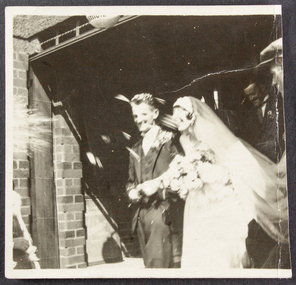
... The Marriage Register lists Harold Priestley Simpson and Amy Dora Walker as the bride and groom, and the wedding date as 14th of February 1928. ...The Marriage Register lists Harold Priestley Simpson and Amy Dora Walker as the bride and groom, and the wedding date as 14th of February 1928. ...The Marriage Register lists Harold Priestley Simpson and Amy Dora Walker as the bride and groom, and the wedding date as 14th of February 1928. The photograph uses the personal Harry and Dora, instead of the formal Harold and Amy. In the Register, Amy started signing her name as Dora. before correcting it. The photograph shows that weddings took place at the Chapel during the late 1920's, and the style of weddings at the time. This includes the type of outfits worn, such as the length of the veil and the type of bouquet carried. Dora's Bridesmaids are depicted in 2 other images in the MTSV collection also an image of the chapel decked with flowers for the occasion. The article in the Herald of the day describes the event: "WEDDING AT SEAMEN'S CHAPEL Reception at Hotel Windsor The pretty little chapel at the Sea men's Institute was packed with interested friends this afternoon, when Miss Dora Walker, one of the Mission's most enthusiastic and efficient voluntary helpers, chose it as the setting for her marriage with Mr H. P. Simpson, son of Mr and Mrs J. H. Simpson, of Mornington. A group of her fellow workers decorated the chapel with lovely pink and white gladioli, carnations and roses. The ceremony was performed by the Rev. J. R. Weller, chaplain of the Mission, and the bride was given away by her father, Mr A. W. Walker, of Manning road, East Malvern. She wore a lovely ivory georgette frock, the finely tucked skirt being fashioned with a deep transparent hem of Chantilly lace. Over it fell a beautiful Honiton lace veil mounted on tulle and arranged to give the ef fect of a train. Fragrant white roses composed her bouquet. Two attendants followed her down the aisle — her sister, Miss Molly Walker, and Miss Ella Kendall — both wearing dainty shrimp pink georgette frocks and large crinoline straw hats in the same shade with a dainty edging of tulle. They carried bouquets of pink cactus dahlias nnd delphiniums. Mr Louis Buscombe was best man, and Mr George Thompson grooms man. After the ceremony Mr and Mrs Walker entertained about 50 guests at the Hotel Windsor."The photograph shows St. Peter chapel was being used for weddings in 1928. The Anglican church has been used for weddings since being finished in 1917. The Marriage Register shows that these weddings were legal in the Commonwealth of Australia, and lists Church of England as the denomination for this wedding. Miss Amy Dora Simpson (nee Walker) had a long association with the Mission, first as a young Volunteer with the Ladies Harbour Light Guild circa WW1, and through to her wedding in early 1928 and beyond. Square sepia, glossy photograph of a bride and groom, taken as they leave a building. Guests are throwing rice at the newlywed. The groom is turned towards the camera, while the bride is looking ahead, carrying a bouquet. There is a white border around top, bottom and left edges, the photograph seems to have been cut in half along the right edge.On the reverse: handwritten in blue pen JUST MARRIED!/DORA & HARRY/28/2/28. 618 is stamped in blue ink . (date is incorrect as wedding took place on 14/2/28)bride, wedding, groom, 1928, dora simpson, dora walker, st peter chapel, harry simpson, lhlg, flinders street, harold priestley simpson, valentine's day, amy dora walker, ladies harbour lights guild, mr and mrs a.w. walker, malvern, manning road, reverend j.r weller, molly walker, ella kendall, david simpson -
 Bendigo Historical Society Inc.
Plan - New Moon Co
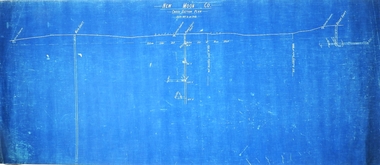
... In a short time, after only £160 had been called up, payable quartz from a depth of 173 feet enabled dividends of £2,778 ... In 1870 a registered company was formed with capital of £24,000 ... ...In a short time, after only £160 had been called up, payable quartz from a depth of 173 feet enabled dividends of £2,778 ... In 1870 a registered company was formed with capital of £24,000 ... ...This mine was in Sailors Gully; the closest intersection Growler and Crook Streets. The most successful mine of the Moon Reef was the New Moon Company. The mine commenced operations in 1867, their claim being south and adjoining the Robin Hood Co. Capital consisted of 16 shares of £75 each. In a short time, after only £160 had been called up, payable quartz from a depth of 173 feet enabled dividends of £2,778 ... In 1870 a registered company was formed with capital of £24,000 ... There were two shafts on the lease, each 280 feet in depth, while work had commenced on a new engine shaft and the erection of a winding plant. The company purchased the Robin Hood's lease and plant in 1878. The Robin Hood shaft became the New Moon main shaft and was eventually deepened to 2,400 feet. The New Moon Company was re-registered in 1886 as a No Liability Company with capital of £12,000 ... and the mine developed into one of the best-managed and most economically worked mines on the Bendigo goldfield ... This company, at the close of 1906 declared its 200th dividend ... From 1878 to 1890 had been lean years for the company when many calls were made to shareholders, while for a period of 6 years the mine was let tributors who crushed 6417 tons for 415 0zs ... dividends were paid from 1892 to 1913 ... mine closed down in 1917 Apart from public crushing, the company crushed 545,289 tons of stone during its existence, all dug from its own mine ... yielded 230,601 ozs of gold, and paid shareholders the sum of £377,400. The former great mine was taken over by the Bendigo Amalgamated Company from 1917 to 1922. It was re-opened in 1928 only to close in 1932 Later, cyaniders treated the sand, and this great dump was removed from its original position and dumped across the road into Napoloen Gully, where it buried the site of the New Moon Company's original, as it was better known, south shaft. Source: https://www.mindat.org/loc-98781.htmlDrawn on blue waxed paper, white text, plan of New Moon mine. Written on top of plan: ' New Moon Co., cross section plan' '40ft to an inch' Marked on plan 'Paddy's Gully, Centre Country. Plan forms part of the Margaret Roberts Collection.gold mining, gold, bendigo, new moon co, sailors gully, moon reef line -
 Marysville & District Historical Society
Book, Charles Kenneth Thompson, Old Bob's Birds, 1950
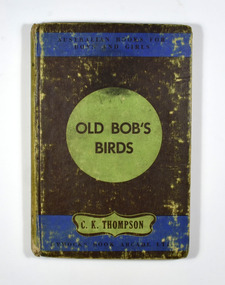
... Thomson/ (Author of "King of the Ranges," etc) Illustrated by RON MADDEN SYDNEY/ DYMOCK'S BOOK ARCADE LTD./ 1950 Registered at the G.P.O. Sydney for/ Transmission throught the Post as a Book. ...Thomson/ (Author of "King of the Ranges," etc) Illustrated by RON MADDEN SYDNEY/ DYMOCK'S BOOK ARCADE LTD./ 1950 Registered at the G.P.O. Sydney for/ Transmission throught the Post as a Book. ...This is a delightful book that will appeal to children of all ages, and especially those of the tenderer years. Old Bob the sundowner is a character who will endear himself to young readers. So will his two small friends, Roddy and Susan, to whom he imparts all the vast lore of the bush he has gained during a lifetime of wandering.There is no dust cover. Front cover shows the series name, the title of the book, the author's name and the publisher's name.fictionThis is a delightful book that will appeal to children of all ages, and especially those of the tenderer years. Old Bob the sundowner is a character who will endear himself to young readers. So will his two small friends, Roddy and Susan, to whom he imparts all the vast lore of the bush he has gained during a lifetime of wandering.australia, nature, birds, c.k. thompson, fiction, old bob -
 City of Moorabbin Historical Society (Operating the Box Cottage Museum)
Document - Document , photocopy of Steerage Passenger Ticket 1912, 1912
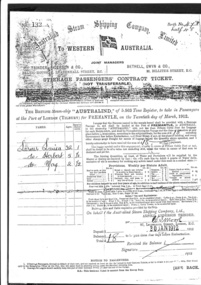
... STEERAGE PASSENGER’S CONTRACT TICKET / ( NOT TRANSFERRABLE ) / The British Steam-ship “Australind” of 5,563 Tons Register, to take in Passengers / at the Port of London ( TILBURY) for FREMANTLE, on the twentieth day of March 1912 Signed W I Moore dated 30Jan1912 paid £18 Larner Louisa age 32 adult1 / do Herbert age 5 adult ½ / do May age 2 adult ½ written on ticket b) photocopy enlargement of a section of the ticket showing names and signatures ...STEERAGE PASSENGER’S CONTRACT TICKET / ( NOT TRANSFERRABLE ) / The British Steam-ship “Australind” of 5,563 Tons Register, to take in Passengers / at the Port of London ( TILBURY) for FREMANTLE, on the twentieth day of March 1912 Signed W I Moore dated 30Jan1912 paid £18 Larner Louisa age 32 adult1 / do Herbert age 5 adult ½ / do May age 2 adult ½ written on ticket b) photocopy enlargement of a section of the ticket showing names and signatures A photocopy of a Steerage Passenger’s Contract Ticket for Louisa Larner and her children Herbert aged 5 and May aged 2 aboard the British Steam-ship ‘Australind ‘ departing Tilbury England March 20th for Fremantle, Australia. ...'Australind' steam ship built 1904 by C. Connell & Co. Ltd., Glasgow .1928 sold to France renamed Colbert, 1933 sold renamed Scandinavia, 1934 scrapped at Savona.In the 1880s Trinder, Anderson & Co. joined Charles Bethell and started operating a twice monthly service from Great Britain to Fremantle and Albany. In 1886 Trinder, Anderson & Bethell started a steamer service called the West Australian Steam Navigation Co. at London. Their first steamer was given the name AUSTRALIND. In 1904 Bethell, Gwyn & Trinder, Anderson formed the Australind Steam Shipping Co.The new company was involved in the transport of emigrants. In 1912 the company owned five ships. During World War I the company lost four of its six ships. In World War II the company lost two ships. In the 1970s the company withdrew from the liner services and started hiring ships to other companies. The last cargo ship was disposed off in 1981 / 1982.The ‘Australind’ steam ship brought migrants from England to Australia 1904 - 1926 A photocopy of a Steerage Passenger’s Contract Ticket for Louisa Larner and her children Herbert aged 5 and May aged 2 aboard the British Steam-ship ‘Australind ‘ departing Tilbury England March 20th for Fremantle, Australia. a) front of ticket b) enlargement of a section of the ticket a) No 132 Berth No, 47 & half 48 / Australind Steam Shipping Company Limited / TO WESTERN AUSTRALIA / central flying flag with a black swan on a white cross -/ JOINT MANAGERS/ TRINDER ANDERSON & CO., l BETHELL, GWWYN & CO., BALTIC HOUSE LEADENHALL STREET EC. 22 BILLITER STREET, EC. STEERAGE PASSENGER’S CONTRACT TICKET / ( NOT TRANSFERRABLE ) / The British Steam-ship “Australind” of 5,563 Tons Register, to take in Passengers / at the Port of London ( TILBURY) for FREMANTLE, on the twentieth day of March 1912 Signed W I Moore dated 30Jan1912 paid £18 Larner Louisa age 32 adult1 / do Herbert age 5 adult ½ / do May age 2 adult ½ written on ticket b) photocopy enlargement of a section of the ticket showing names and signatures london, tilbury, fremantle, steamship, ss australind, steerage, passengers, immigration, provisions, rations, trinder anderson company, larner louisa, larner herbert, larner may, bethel gwyn company -
 Kiewa Valley Historical Society
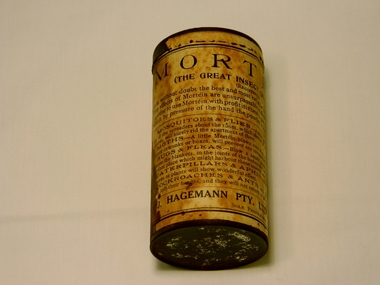
Can Mortein Powder, late 1870s to early 1920s
... 2nd line "THE GREAT INSECT DESTROYER" underneath "(Registered)" and underneath "It is without doubt the best and most reliable Insect powder in the World" underneath this line "In order to use Mortein with profit it is best to get a Mortein spreader through", next line "which by pressure of the hand the powder is ejected and well diffused." ...2nd line "THE GREAT INSECT DESTROYER" underneath "(Registered)" and underneath "It is without doubt the best and most reliable Insect powder in the World" underneath this line "In order to use Mortein with profit it is best to get a Mortein spreader through", next line "which by pressure of the hand the powder is ejected and well diffused." ...The can(product) of powdered Mortein was used throughout Australia and especially in rural regions where environmental conditions of crops, cattle and other livestock resulted in greater amount of "invasions" from insects. The eradication of unwanted invaders into the homestead required either manual extermination or a relevant poison which in low doses would not affect humans. Fly squats were still a good measure of eradication of flying pests however those lurking in cupboards or "hard to get at" locations needed a method, such as the Mortein powder to do the deed. This product and especially this can was used at the fore front of pest eradication. Powders and pellets are still in use 100 years later and the core ingredient is still environmental friendly and meets health conscious modern Australians. The basic product has survived the passage of time and was invented by a German immigrant to Australia in the late 1800s.This can and what it represents to rural households and outhouses, is in some ways immeasurable to the peace, health and tranquility within the household of all the families within the Kiewa Valley. Although small in size the relief of those within the sanctity of the home from annoying pests is enormous. The relief not only physical but also mentally to those residents, from the sometimes grueling and painful rural existence in a "sunburnt" countryside cannot be truly expressed in words. Kiewa Valley residents are part of the sometimes harsh rural environment where the introduction of helpful products such as this powder are noticed and used more prolifically. Any product, especially invented within Australia, which allows for a easier existence is of a great significance.This small cylindrical can contains powder of crushed the chrysanthemum flowers(pyrethrum extract) and has two circles of small circular perforations in the lid (to allow contents to be sprinkled onto other surfaces). It is constructed of mild steel with both ends crimped onto the main cylinder. A paper information label has been adhered to the outside of the cylinder.Printed on the outside label is: 1st line "MORTEIN!" 2nd line "THE GREAT INSECT DESTROYER" underneath "(Registered)" and underneath "It is without doubt the best and most reliable Insect powder in the World" underneath this line "In order to use Mortein with profit it is best to get a Mortein spreader through", next line "which by pressure of the hand the powder is ejected and well diffused." An inflection mark appears over the e in "Mortein" as to signify that the word "mort" is french for (dead) and the "ein" is german for "one". The word "mortein" therefore is diffused and translated into "dead one". A thin line separates the above from the list of insects which the powdered contents will kill together with the suggested application targets. T the bottom of the instructions is printed the manufacturer "J. HAGEMANN PTY. LTD., MELBOURNE," Below is "Sole Proprietors"natural insecticide products, environmentally friendly products, household pest dispensers, australian inventions -
 Ruyton Girls' School
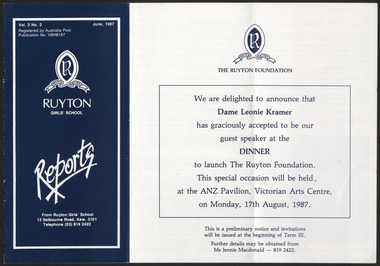
Newsletter, Ruyton Reports, 1987
... Front Page: Vol. 2 No. 2 / Vol. 2 No. 2 June, 1987 / Registered by Australia Post / Publication No. ...Ruyton Girls' School Ruyton School Students Newsletter Ruyton Reports Ruyton News Kew Victoria Melbourne Girls School Front Page: Vol. 2 No. 2 / Vol. 2 No. 2 June, 1987 / Registered by Australia Post / Publication No. ...The Ruyton Reporter (formerly known as Ruyton Reports) captures the essential Ruyton Girls' School experience for the broader school community. It has been produced since 1986.The record has strong historic significance as it pertains to the fourth oldest girls' school in Victoria, Australia. Ruyton was founded in 1878 in the Bulleen Road, Kew, home of newly widowed Mrs Charlotte Anderson (now High Street South). Thus, the record can be used as a reference example for research into Victorian school history. It also gives insight into the types of activities and events undertaken at Ruyton Girls' School during the period of its production. The record's significance is further enhanced by its exceptionally well-documented provenance, having remained the property of Ruyton Girls' School since its production.Black and white newsletter printed on paper with staple binding. 8 pages.Front Page: Vol. 2 No. 2 / Vol. 2 No. 2 June, 1987 / Registered by Australia Post / Publication No. VBH8187 / R / RECTE ET FIDE LITER / RUYTON / GIRLS' SCHOOL / Reports / From Ruyton Girls' School / 12 Selbourne Road, Kew. 3101 / Telephone (03) 819 2422 / R / RECTE ET FIDE LITER / THE RUYTON REPORTER / We are delighted to announce that / Dame Leonie Kramer / has graciously accepted to be our / guest speaker at the / DINNER / to launch The Ruyton Foundation. / This special occasion will be held / at the ANZ Pavilion, Victorian Arts Centre, / on Monday, 17th August, 1987. / This is a preliminary notice and invitations / will be issued at the beginning of Term III. / Further details may be obtained from / Ms Jennie Macdonald - 819 2422. /ruyton girls' school, ruyton, school, students, newsletter, ruyton reports, ruyton news, kew, victoria, melbourne, girls school -
 Wangaratta High School
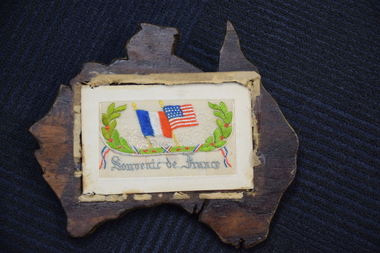
WWI Postcard, 15/16/1917
... I have received both registered letters alright. We are having great success lately but he is fighting hard in places. ...I have received both registered letters alright. We are having great success lately but he is fighting hard in places. ...William Thomas Jarrot was a former teacher at Wangaratta high School, who went missing in active service on 7th June 1917. The William family preserved this letter, unopened and unread for exactly 100 years. Written by Jarrot to his sister from the battlefront of Belgium, it was opened and read by the Wangaratta High School Prefect team on the 7th of June 2017.Wooden Australia-shaped frame around an embroidered postcard reading 'Sonoenic de France'. Embroidered flap contains a small card which says 'Thinking of you'. On the reverse side of the postcard is a handwritten letter by William Jarrot in 1917.Sonoenic de France Thinking of you My Dear Sister I received your welcome letter a couple dated June 15. I am quite alright and going up the line again pretty soon. I have received both registered letters alright. We are having great success lately but he is fighting hard in places. Robbie told me about his father having an operation. The weather is extremely mild here now. I haven't had a letter from Annie for some time now. i don't know whether I can get this posted now or not. Hoping this finds you all as well as it leaves me at present. With best love to all. From your loving brother. -
![View of the Township of Fernshawe / [by] Nicholas Caire, circa 1876](/media/collectors/550653872162f11fb04854aa/items/57775425d0cdd10a5c17a3fd/item-media/57775483d0cdd10a5c17c7c0/item-fit-380x285.jpg?cb=6) Kew Historical Society Inc
Kew Historical Society IncPhotograph, Anglo-Australasian Photographic Company, View of the Township of Fernshawe, c. 1876
... .: VIEW OF THE TOWNSHIP OF FERNSHAWE. / COPYRIGHT REGISTERED. printed in ink on support reverse c.: VIEWS OF VICTORIA. / (GENERAL SERIES.) / No. 14. / VIEW OF THE TOWNSHIP OF FERNSHAWE. / Fernshawe may be considered the most romantic town in the Colony of Victoria. ....: VIEW OF THE TOWNSHIP OF FERNSHAWE. / COPYRIGHT REGISTERED. printed in ink on support reverse c.: VIEWS OF VICTORIA. / (GENERAL SERIES.) / No. 14. / VIEW OF THE TOWNSHIP OF FERNSHAWE. / Fernshawe may be considered the most romantic town in the Colony of Victoria. ...Nicholas Caire was born on Guernsey in the Channel Islands in 1837. He arrived in Adelaide with his parents in about 1860. In 1867, following photographic journeys in Gippsland, he opened a studio in Adelaide. From 1870 to 1876 he lived and worked in Talbot in Central Victoria. In 1876 he purchased T. F. Chuck's studios in the Royal Arcade Melbourne. In 1885, following the introduction of dry plate photography, he began a series of landscape series, which were commercially successful. As a photographer, he travelled extensively through Victoria, photographing places few of his contemporaries had previously seen. He died in 1918. Reference: Jack Cato, 'Caire, Nicholas John (1837–1918)', Australian Dictionary of Biography, National Centre of Biography, Australian National UniversityAn original, rare photograph from the series 'Views of Victoria: General Series' by the photographer, Nicholas Caire (1837-1918). The series of 60 photographs that comprise the series was issued c. 1876 and reinforced a neo-Romantic view of the Australian landscape to which a growing nationalist movement would respond. Nicholas Caire was active as a photographer in Australia from 1858 until his death in 1918. His vision of the Australian bush and pioneer life had a counterpart in the works of Henry Lawson and other nationalist poets, authors and painters.Albumen silver photograph mounted on board. [Note: This is the first of two copies of this photograph in the collection]printed in ink on support l.c.: VIEW OF THE TOWNSHIP OF FERNSHAWE. / COPYRIGHT REGISTERED. printed in ink on support reverse c.: VIEWS OF VICTORIA. / (GENERAL SERIES.) / No. 14. / VIEW OF THE TOWNSHIP OF FERNSHAWE. / Fernshawe may be considered the most romantic town in the Colony of Victoria. It is situated at the foot of / the Black Spur, and is surrounded by a great many high hills, such as Mounts Riddell, Juliet, Munday, and others, / which form the crossing range into Gipps Land. It has, no doubt, derived its name from the fact that it is the / greatest Fern-growing district in the Colony. printed in ink on support reverse l.c.l.: J.W. FORBES, Agent, printed in ink on support reverse l.c.: ANGLO-AUSTRALASIAN PHOTOGRAPHIC COMPANY, MELBOURNE. printed in ink on support reverse l.c.r.: 10 Temple Court, Collins Street West.nicholas caire (1837-1918), landscape photography, fernshawe -
![View of the Township of Fernshawe / [by] Nicholas Caire, circa 1876](/media/collectors/550653872162f11fb04854aa/items/57775578d0cdd10a5c183f96/item-media/577755dfd0cdd10a5c18731c/item-fit-380x285.jpg?cb=6) Kew Historical Society Inc
Kew Historical Society IncPhotograph, Anglo-Australasian Photographic Company, View of the Township of Fernshawe, c. 1876
... .: VIEW OF THE TOWNSHIP OF FERNSHAWE. / COPYRIGHT REGISTERED. printed in ink on support reverse c.: VIEWS OF VICTORIA. / (GENERAL SERIES.) / No. 14. / VIEW OF THE TOWNSHIP OF FERNSHAWE. / Fernshawe may be considered the most romantic town in the Colony of Victoria. ....: VIEW OF THE TOWNSHIP OF FERNSHAWE. / COPYRIGHT REGISTERED. printed in ink on support reverse c.: VIEWS OF VICTORIA. / (GENERAL SERIES.) / No. 14. / VIEW OF THE TOWNSHIP OF FERNSHAWE. / Fernshawe may be considered the most romantic town in the Colony of Victoria. ...Nicholas Caire was born on Guernsey in the Channel Islands in 1837. He arrived in Adelaide with his parents in about 1860. In 1867, following photographic journeys in Gippsland, he opened a studio in Adelaide. From 1870 to 1876 he lived and worked in Talbot in Central Victoria. In 1876 he purchased T. F. Chuck's studios in the Royal Arcade Melbourne. In 1885, following the introduction of dry plate photography, he began a series of landscape series, which were commercially successful. As a photographer, he travelled extensively through Victoria, photographing places few of his contemporaries had previously seen. He died in 1918. Reference: Jack Cato, 'Caire, Nicholas John (1837–1918)', Australian Dictionary of Biography,An original, rare photograph from the series 'Views of Victoria: General Series' by the photographer, Nicholas Caire (1837-1918). The series of 60 photographs that comprise the series was issued c. 1876 and reinforced a neo-Romantic view of the Australian landscape to which a growing nationalist movement would respond. Nicholas Caire was active as a photographer in Australia from 1858 until his death in 1918. His vision of the Australian bush and pioneer life had a counterpart in the works of Henry Lawson and other nationalist poets, authors and painters.Albumen silver photograph mounted on board. [Note: This is the second of two copies of this photograph in the collection]printed in ink on support l.c.: VIEW OF THE TOWNSHIP OF FERNSHAWE. / COPYRIGHT REGISTERED. printed in ink on support reverse c.: VIEWS OF VICTORIA. / (GENERAL SERIES.) / No. 14. / VIEW OF THE TOWNSHIP OF FERNSHAWE. / Fernshawe may be considered the most romantic town in the Colony of Victoria. It is situated at the foot of / the Black Spur, and is surrounded by a great many high hills, such as Mounts Riddell, Juliet, Munday, and others, / which form the crossing range into Gipps Land. It has, no doubt, derived its name from the fact that it is the / greatest Fern-growing district in the Colony. printed in ink on support reverse l.c.l.: J.W. FORBES, Agent, printed in ink on support reverse l.c.: ANGLO-AUSTRALASIAN PHOTOGRAPHIC COMPANY, MELBOURNE. printed in ink on support reverse l.c.r.: 10 Temple Court, Collins Street West.nicholas caire (1837-1918), landscape photography, fernshawe -
![Fern Terrace, on the River Watt, near Mount Munday / [by] Nicholas Caire, circa 1876](/media/collectors/550653872162f11fb04854aa/items/57775865d0cdd10a5c19a296/item-media/57775986d0cdd10a5c1a3308/item-fit-380x285.jpg?cb=6) Kew Historical Society Inc
Kew Historical Society IncPhotograph, Anglo-Australasian Photographic Company, Fern Terrace, on the River Watt, near Mount Munday, c. 1876
... .: FERN TERRACE, ON THE RIVER WATT, NEAR MOUNT MUNDAY. / COPYRIGHT REGISTERED. printed in ink on support reverse c.: VIEWS OF VICTORIA. / (GENERAL SERIES.) / No. 17. / FERN TERRACE, ON THE RIVER WATT, NEAR MOUNT MUNDAY. / Of the various Rivers which exist in the Colony of Victoria, the River Watt (though a small one, and to some / extent unimportant) may be said to contain the most charming as well as the greatest variety of romantic scenery. / The scene of the present issue is perhaps the most unique of its character to be found in any of the Colonies. printed in ink on support reverse l.c.l.: J.W. ....: FERN TERRACE, ON THE RIVER WATT, NEAR MOUNT MUNDAY. / COPYRIGHT REGISTERED. printed in ink on support reverse c.: VIEWS OF VICTORIA. / (GENERAL SERIES.) / No. 17. / FERN TERRACE, ON THE RIVER WATT, NEAR MOUNT MUNDAY. / Of the various Rivers which exist in the Colony of Victoria, the River Watt (though a small one, and to some / extent unimportant) may be said to contain the most charming as well as the greatest variety of romantic scenery. / The scene of the present issue is perhaps the most unique of its character to be found in any of the Colonies. printed in ink on support reverse l.c.l.: J.W. ...Nicholas Caire was born on Guernsey in the Channel Islands in 1837. He arrived in Adelaide with his parents in about 1860. In 1867, following photographic journeys in Gippsland, he opened a studio in Adelaide. From 1870 to 1876 he lived and worked in Talbot in Central Victoria. In 1876 he purchased T. F. Chuck's studios in the Royal Arcade Melbourne. In 1885, following the introduction of dry plate photography, he began a series of landscape series, which were commercially successful. As a photographer, he travelled extensively through Victoria, photographing places few of his contemporaries had previously seen. He died in 1918. Reference: Jack Cato, 'Caire, Nicholas John (1837–1918)', Australian Dictionary of BiographyAn original, rare photograph from the series 'Views of Victoria: General Series' by the photographer, Nicholas Caire (1837-1918). The series of 60 photographs that comprise the series was issued c. 1876 and reinforced a neo-Romantic view of the Australian landscape to which a growing nationalist movement would respond. Nicholas Caire was active as a photographer in Australia from 1858 until his death in 1918. His vision of the Australian bush and pioneer life had a counterpart in the works of Henry Lawson and other nationalist poets, authors and painters.Albumen silver photograph mounted on boardprinted in ink on support l.c.: FERN TERRACE, ON THE RIVER WATT, NEAR MOUNT MUNDAY. / COPYRIGHT REGISTERED. printed in ink on support reverse c.: VIEWS OF VICTORIA. / (GENERAL SERIES.) / No. 17. / FERN TERRACE, ON THE RIVER WATT, NEAR MOUNT MUNDAY. / Of the various Rivers which exist in the Colony of Victoria, the River Watt (though a small one, and to some / extent unimportant) may be said to contain the most charming as well as the greatest variety of romantic scenery. / The scene of the present issue is perhaps the most unique of its character to be found in any of the Colonies. printed in ink on support reverse l.c.l.: J.W. FORBES, Agent, printed in ink on support reverse l.c.: ANGLO-AUSTRALASIAN PHOTOGRAPHIC COMPANY, MELBOURNE. printed in ink on support reverse l.c.r.: 10 Temple Court, Collins Street West.nicholas caire (1837-1918), landscape photography - victoria -
 Melbourne Athenaeum Archives
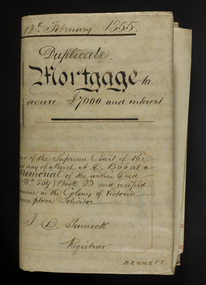
Legal record, Early copy, "Mortgage to secure 7000 pounds and interest.", 1855
... Mortgage to secure £7000 and interest Received into the Office of the Register of the Supreme Court of the / Colony of Victoria at Melbourne this Second day of March A. ...Mortgage to secure £7000 and interest Received into the Office of the Register of the Supreme Court of the / Colony of Victoria at Melbourne this Second day of March A. ...Document written on parchment paper titled "Mortgage to secure 7000 pounds and interest." Labelled as duplicate of original mortgage. Agreement signed and sealed by Thomas Black (committee member), John Greenlaw Foxton trustee and Henry Langlands trustee with William Daniel Collyer lender. Solicitor Bennett, Clerk Julius Hand. Land and building Allotment No 3 in section No 11 Collins Street identified as property mortgage taken out against. Parchment, folded. Following conservation work carried out by Guy Morel, 2009 with assistance of a Victorian Heritage grant, the document was cleaned and separately boxed.Black handwritten text, on cream coloured parchment paper, folded. The exposed page contains the following text: "Dated 12th February 1855. Messrs Thomas Black John Greenlaw Foxton & Henry Langlands to William Daniel Collyer Esq Duplicate. Mortgage to secure £7000 and interest Received into the Office of the Register of the Supreme Court of the / Colony of Victoria at Melbourne this Second day of March A. D. 1855 at a / quarter to one o'Clock in the afternoon a memorial of the within Deed / numbered Eight hundred and fifty nine (No. 859) Book 23 and verified / by Julius Hamel of Collins Street Melbourne in the Colony of Victoria / Clark to John Barter Bennett of the same place Solicitor. J. D. Pinnock Registrar." Slightly under this text, in a different hand is written "BENNETT." -
 Ringwood and District Historical Society
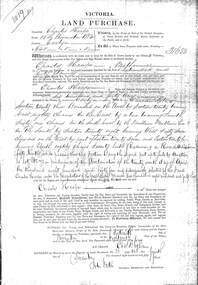
Document - Land Purchase, Sale of Crown Lands in the Colony of Victoria - Charles Heape, Ringwood Vic., County of Evelyn, Parish of Warrandyte - 1854
... Entered on Record in the Register of Land Purchases, No.33 page 148, 4th December 1854. ...Entered on Record in the Register of Land Purchases, No.33 page 148, 4th December 1854. ...Two A3 page photocopy of official document with handwritten description of 640 acres of land in Ringwood purchased as Section 23 on 16th November 1954 by Charles Heape of Melbourne for the sum of £640. Summary of Section 23 land (transcribed as written without punctuation): "Bounded on the North by Section 20 bearing East eighty chains on the East by a line bearing South sixty one chains on the South East by the Mullum Mullum Creek on the South by Section twenty eight bearing West sixty seven chains and on the West by part of Section twenty seven and Section twenty four bearing North eighty chains seventy links reserving and road one chain fifty links wide passing through this section being the land put up to sale by auction as lot no.72 in pursuance of the Proclamation of the twenty ninth day of April 1854 and subsequently selected by the said Charles Heape under the Regulation of the first day of March 1843." (Research Note, July 2026: "... Block 23 (is) bounded by present-day Oban, Warrandyte, Plymouth and Kalinda Roads. This block and the one adjoining on the west, each of 640 acres, were purchased by Charles Heape in August 1854." - Page 20, Ringwood, Place of Many Eagles - Hugh Anderson.) Signature of witness - Sir Charles Hotham, Knight Commander of the Most Honourable Military Order of the Bath, Lieutenant Governor of Our said Colony and its Dependencies, at Melbourne, Victoria, 15th November 1854. Entered on Record in the Register of Land Purchases, No.33 page 148, 4th December 1854. (Signed by Colonial Secretary and Registrar). Page 2: "Enrolled in the Office of the Registrar of the Supreme Court of the Colony of Victoria in Register No. 27 of Land Purchases, Victoria, Folio 212 this twenty second day of January 1857. (Signed by Registrar). -
 Flagstaff Hill Maritime Museum and Village
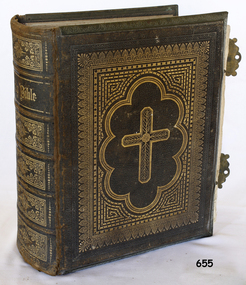
Book - Reference/ Religious Study, James Semple, The Holy Bible, Old & New Testaments, c. 1875
... He served the Victorian demand for substantial, decorative household Bibles containing chromolithographs, family register pages, and steel engravings....He served the Victorian demand for substantial, decorative household Bibles containing chromolithographs, family register pages, and steel engravings. The Haydock Bible itself is a crucial milestone in 19th-century English Catholic publishing, serving as the standard commentary for generations of Catholic families across the British Empire. ...This edition is part of what Bible bibliographers classify as the Haydock Quarto Series. It uses the Douay Rheims version (the standard English translation of the Latin Vulgate for Roman Catholics) and is heavily updated with extensive annotations. The subject volume is a large, decorative family Bible. Bibles of this style were peak Victorian subscription publishing, and publishers like Semple typically issued these in unbound parts or sold them via travelling canvassers, bound in heavy, blind stamped or gilt leather meant to serve as a visual centerpiece in a Victorian home.Hard cover book: Bible, Old & New Testaments Editor: Rev. George Leo Haydock Publisher: James Semple, 7 Stirling Road, Glasgow Date: 1875 Further Information: Brown leather bound with extensive gilt pattering to Spine and Front Board, Cross icon to front board and brass book clasps to corners.non-fictionThis edition is part of what Bible bibliographers classify as the Haydock Quarto Series. It uses the Douay Rheims version (the standard English translation of the Latin Vulgate for Roman Catholics) and is heavily updated with extensive annotations. The subject volume is a large, decorative family Bible. Bibles of this style were peak Victorian subscription publishing, and publishers like Semple typically issued these in unbound parts or sold them via travelling canvassers, bound in heavy, blind stamped or gilt leather meant to serve as a visual centerpiece in a Victorian home.flagstaff hill, warrnambool, shipwrecked-coast, flagstaff-hill, flagstaff-hill-maritime-museum, maritime-museum, shipwreck-coast, flagstaff-hill-maritime-village, the holy bible the old testament and the new testament, bible, book, religion, holy bible, rev geo leo haydock, latin vulgate, family bible -
City of Moorabbin Historical Society (Operating the Box Cottage Museum)
Newsletter, City of Moorabbin Historical Society No. 9 Vol. 3 October 1963, City of Moorabbin Historical Society Newsletter No. 9 Vol. 3 October 1963, 1963
... Sheehy CMHS for members and visitors The Aims of the CMHS are ‘to record the history of the City, and register something of the Australian Atmosphere, which the necessary speed-up in post-world-war two (WW11) immigration has caused to be lost; to produce a magazine at regular intervals, featuring the work of pioneers and the changing Australian scene; to work constantly with a long range view towards building a hall where records and exhibits can be housed’ (1961) The Original Newsletters reflect the history and heritage of the former City of Moorabbin — derived from Mooroobin, ‘a resting place’ in the Bunurrung spoken language. ...Sheehy CMHS for members and visitors The Aims of the CMHS are ‘to record the history of the City, and register something of the Australian Atmosphere, which the necessary speed-up in post-world-war two (WW11) immigration has caused to be lost; to produce a magazine at regular intervals, featuring the work of pioneers and the changing Australian scene; to work constantly with a long range view towards building a hall where records and exhibits can be housed’ (1961) The Original Newsletters reflect the history and heritage of the former City of Moorabbin — derived from Mooroobin, ‘a resting place’ in the Bunurrung spoken language. ...Topics : CMHS AGM; Mr R Ashley Pres. ; new Mayor Cr Brian Stuart-Jones; Moorabbin News - Local newspaper; East Brighton Hall 1894; St Peter's Hall 1862; removal of 'South Brighton' signs replaced with 'Moorabbin" This is Newsletter No 9 Vol . 3 produced in October 1963 by Mr T. A. Sheehy CMHS for members and visitors The Aims of the CMHS are ‘to record the history of the City, and register something of the Australian Atmosphere, which the necessary speed-up in post-world-war two (WW11) immigration has caused to be lost; to produce a magazine at regular intervals, featuring the work of pioneers and the changing Australian scene; to work constantly with a long range view towards building a hall where records and exhibits can be housed’ (1961) The Original Newsletters reflect the history and heritage of the former City of Moorabbin — derived from Mooroobin, ‘a resting place’ in the Bunurrung spoken language. In 1994, the City of Moorabbin was integrated into the Cities of Bayside, Glen Eira, Kingston and Monash. This is Newsletter No. 9 Vol. 3 of the CMHS October 1963 CMHS obtained a Kingston City Council Community Grant 2016 for the digitization and preservation of these Original CMHS Newsletters commenced in 1961 1 x Foolscap paper printed on 2 sides folded for 4 pages NEWSLETTER / City of Moorabbin Historical Society. / Vol. 3 No. 9 OCTOBER 1963city of moorabbin historical society 1961, sheehy t.a., newsletters, east brighton, south brighton, moorabbin, bentleigh, -
 Flagstaff Hill Maritime Museum and Village
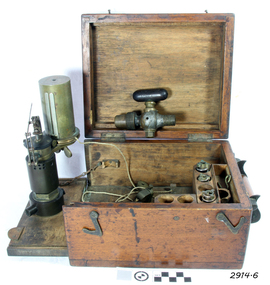
Engine Dynamometer, c.1890’s
... This force of power would be registered by a pencil, fitted to the adjustable arm, which would trace a line on paper wound around the cylinder. ...This force of power would be registered by a pencil, fitted to the adjustable arm, which would trace a line on paper wound around the cylinder. ...The steam engine indicator, or dynamometer, is an instrument used on a steam engine (such as that of a vessel or train) to measure and record the change in the pressures of the engine’s cylinders during their operating cycle. The engineer would use it to identify problems or defects such as bad valve settings or constricted steam pipes. It could indicate the difference in efficiency caused by adjustments made to the engine, being able to instantly measure the variation of pressure from the engine stroke at any given time. This force of power would be registered by a pencil, fitted to the adjustable arm, which would trace a line on paper wound around the cylinder. The recorded information could be used in conjunction with mathematical tables. This particular instrument was made by T.S. Mc Innes, one of the better manufacturers of engine indicators. Mc Innes engine indicators were still being used in the mid 1900’s. This specific instrument was used by Mark Forsythe of North Berwial, Scotland and late of Ararat, Victoria when he was chief engineer on the “SS Talawena” in 1892. The Port of Warrnambool, in Victoria, harboured steam ships that carried both passengers and cargo along the south west coast in the late 1800’s and into the 1900’s. The engineer of a steam ship was responsible for reaching and maintaining the optimum level of steam energy to serve the locomotion and efficiency of the steam ship. The engineer would use a steam engine indicator to measure and record information to achieve this purpose. Engine Dynamometer or Steam Engine Indicator in square, fitted oak case. This brass instrument is used to measure and record steam pressure for setting up and adjusting valves on a steam engine. It has an oscillating recording drum with vertical, silver clip attached for holding paper in place around the drum. The drum oscillates left to right. There is a pulley attached to a length of cord, which is attached to the drum. Beside the drum is a fine metal arm, vertically adjustable, small hole in the end to hold a pencil. Inscription stamped into bracket of the arm. The engine indicator is mounted on a hinged side of the case that swings out ready for use. Attached chains prevent the side from opening past vertical. There is storage for other accessories and an empty compartment in the base (where a scale or ruler may have been located). The case has a collapsible wooden handle, brass hinges and two brass, hook-shaped catches. There is a code stamped inside the lid. It contains a brass, ‘T’ shaped steam-cock (or stop cock) with two open ends made of metal pipe with different sized threads. (Turning the handle on top opens and closes the space in the pipe and would close off the flow of steam from one end to the other.) Also inside the case are three different spiral springs, each with a threaded nut on the end that has a threaded hole inside it. Used by Mr Mark Forsythe when chief engineer on the SS Talawena in 1892 “T.S. MC INNES PATENT” and “522 _ _” (last 2 digits are unreadable) pressed into the arm of the brass indicator. “[ ] X ’ stamped inside the lid of the case. The 3 springs all have a number stamped into them: (1) “32” and “12” (2) “12” and “16” [above] “12” (3) “64” and “150” Card that came with instrument “This instrument was used by Mark Forsythe of North Berwial Scotland and late of Ararat, Victoria when chief engineer on the SS Talawena in 1892" dynamometer, steam engine indicator, t.s. mcinnes, glasgow, dobbie mcinnes, port of warrnambool, warrnambool, flagstaff hill, flagstaff hill maritime museum, flagstaff hill maritime village, maritime museum, shipwreck coast, great ocean road -
 Eltham District Historical Society Inc
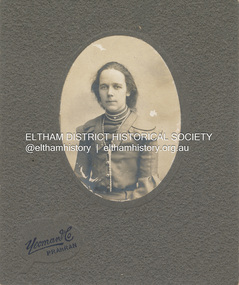
Photograph, Yeoman and Co, Mary Shillinglaw, c.1898
... She commenced school at Eltham State School No. 209 (Register No. 423) in 1885 at age 4 years. Mary did not marry and spent most of her life at Wattle Brae (Shillinglaw Cottage). ...She commenced school at Eltham State School No. 209 (Register No. 423) in 1885 at age 4 years. Mary did not marry and spent most of her life at Wattle Brae (Shillinglaw Cottage). ...Mary Shillinglaw born November 5, 1880 at Bundoora, Victoria was the sixth child of Phillip Shillinglaw and Sarah Ann (nee Kidd). She commenced school at Eltham State School No. 209 (Register No. 423) in 1885 at age 4 years. Mary did not marry and spent most of her life at Wattle Brae (Shillinglaw Cottage). In his Will, Phillip Shillinglaw provided that any of his unwed sisters would be able to live at Wattle Brae, rent free. When Eltham Shire Council aquired the property in 1963 to build new Shire Offices, both Mary and her sister Lizzie (also unmarried) were still living at the cottage. Council paid for the women to relocate. Mary moved to Elizabeth House, a nursing home in Ivanhoe but found it very hard to adapt to her new surroundings and living consdtions. She died there only a few months after departing Eltham on October 29, 1963 at age 83 years. Lizzie died June 28, 1972 at age 93 years."Mary Shillinglaw"marg ball collection, 1883-1918, 1898, mary ann shillinglaw (1880-1963), yeoman & co photographer prahran -
 Kiewa Valley Historical Society
Belt Linesman Pole, circa mid to late 1900's
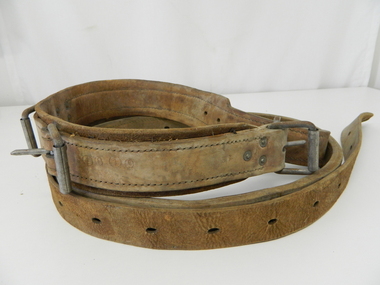
... In 2006 an additional 269 registered lineworkers were employed. Please note that the terminology of linesman has become unisex. ...In 2006 an additional 269 registered lineworkers were employed. Please note that the terminology of linesman has become unisex. ...This linesman belt was used under the 1947 Electricity Regulations and before tighter Occupation and Health regulations (late 1990's early 2000's) were introduced that mechanical lifting platforms(wherever possible) replaced the belt up the pole method.The safety concern was that it required that tools needed by the linesman had to be placed in a large canvas bag and attached to the belt (extra weight) then the linesman had to climb the ladder. Ladders had to be at the correct angle and not able to "slip" from their initial footings. A full harness and a secondary fall belt is now mandatory for pole linesmen. The safety of fellow workers could be compromised if they were required to assist or recover the first linesman if needed. In 2006 an additional 269 registered lineworkers were employed. Please note that the terminology of linesman has become unisex. The linesman's belt enabled the linesman to place his feet against the pole adjust the belt (if needed) and lean back securely allowing both hands to be free to work with. This linesman belt is very significant to the Kiewa Valley due to the numerous poles and high voltage overhead power structures that needed maintenance for the extensive "mushroom" installation of electrical power polls(wood and metal). On high poles (steel) climbing pegs were welded on, however in the Alpine areas snow in winter caused an OH&S problem which were hard to overcome. The safety of a linesman when maintenance of electricity line on poles can be highlighted by the New Zealand linesman who survived an 11,000 volt shock when carrying out maintenance. For the record 11,000 volts is four times more powerful than execution by "the electric chair". The maintenance of the linesman's belt was his responsibility (keeping it clean and in "good" condition). Labour laws change this initial responsibility, from the linesman, to the employer. Climbing pegs were installed on higher poles that extended beyond the reach of ladders.This thick leather linesman belt is made from two lengths of heavy lengths of leather straps sewn together to make up 80% of the belt. The remaining 20% is "the belt tonge" which has eleven holes for three (solid steel tang) buckle connections.kiewa hydro electricity scheme, victorian state electricity commission, relays, generators, electrical pole maintenance -
Glen Eira Historical Society
Document - Christian Family
... Handwritten information from the Public Record Office Victoria giving extract of register of Wills, Vol.W1, page 39 Christian, Thomas. ...Handwritten information from the Public Record Office Victoria giving extract of register of Wills, Vol.W1, page 39 Christian, Thomas. ...Six documents on the Christian Family. Nine typed pages by Robert Trumble dated 08/02/1974. Extracts taken from two books written by him about the Christian family in Australia. Three pages about Thomas Christian and Myoora from Caulfield Historical Society Newsletter April/June 1974. Handwritten notes on Thomas and Violet Christian from 1886-1891, possibly taken from Rate Books, unsigned and undated. Handwritten information from the Public Record Office Victoria giving extract of register of Wills, Vol.W1, page 39 Christian, Thomas. Unsigned and undated. Photocopied UK incoming passenger list dated 28/04/1899 showing Mrs. Christian, eight children and maid on the ship Wakool, from Ancestry.com.au Newspaper item dated 26/01/2013 from the Saturday Age mentioning Coolart Homestead, late Victorian mansion, owned at one stage by Tom Luxton who was married to Gertrude Christian.christian thomas, christian violet mary, christian dorothy, christian emily, barclay frank, baker blanch miss, christian florence, trumble hugh, christian arthur james, christian may, player charles dr., llaneast, house names, player janet, player alison, player dorothy, myoora, christian gertrude, christian grace, richards henry caselli, richards harry, trumble robert, trumble kathleen, christian dorothy, dandenong road, caulfield, luxton thomas j., trumble ken, christian edgar john, emery irene, the golden age of cricket, the trumble family in australia, dunstan john r., o’donnell j., caulfield historical society, alma road, hawthorn road, dandenong road, craigellachie, orrong road, p.c. day dawn, p.c. gold mining company ltd., charters towers, mines and mining, gold mining, balconies, verandahs, cast iron work, towers, stained glass, mansions, ievers william, pfeiffer frederick, newmann violet mary, lloyd john charles, architects, brooke family, servants, stairs, teacher work, cellars, flats, slate tiles, roofs, chimneys, fireplaces, land subdivision, coach houses, reed henderson and smart (architects), wills, ships, wakool, henderson anketell -
 Bendigo Military Museum
Article - NEWSPAPER CUTTING, L.CPL PARKER, Bendigo Advertiser Newspaper, 1952
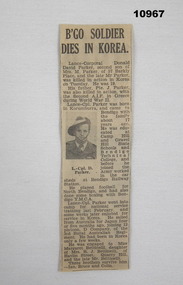
... (Persons 18 or turning 18 on 1.11.1950 had to register for National Service Training) That makes Donald 20 years 8 months when he was KIA. ...(Persons 18 or turning 18 on 1.11.1950 had to register for National Service Training) That makes Donald 20 years 8 months when he was KIA. ...Newspaper article/obituary with photograph, detailing the life of L/Cpl "Donald David Parker" who was Killed in Action in Korea in 1952. The DVA nominal roll has him as No 3400693 (born Bendigo) 20.2.1932, served with 3 RAR in Korea from 14.8.1952 - 2.9.1952, KIA 2.9.1952, rank L/Cpl. The article states he was born in Kurumburra and moved to Bendigo as a child. Began his National Service Training last February, sailed for Japan 4/5 months ago, he was in 12 Pl D Coy age 19 at death. Given he turned 18 on 20.2.1950. (Persons 18 or turning 18 on 1.11.1950 had to register for National Service Training) That makes Donald 20 years 8 months when he was KIA. The Anzac Portal states there was at least 3 National Servicemen who then enlisted in the Regular Forces and were KIA in Korea. 3 RAR served in Korea from September 1950 - 1954.Rectangular cutting from a newpaper. Black and white photograph of a soldier in uniform is included. Article heading and text in black type.donald david parker, korea, newspaper -
 Australian Gliding Museum
Machine - Glider - Sailplane, 1946
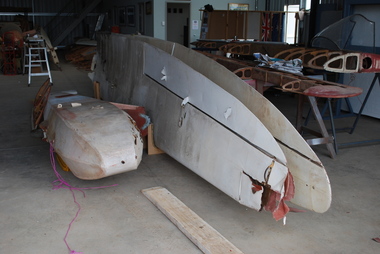
... In 1957 the Blue Grunau moved to Western Australia and was added to the Glider Register as VH-GLC. Thereafter the glider had a series of owners. ...In 1957 the Blue Grunau moved to Western Australia and was added to the Glider Register as VH-GLC. Thereafter the glider had a series of owners. ...This Grunau Baby 2B glider, often referred to as the “Blue Grunau”, was built by Australian Sailplanes in 1946 and acquired by a syndicate consisting of Norm Hyde, Rob Dowling, Leo Dowling, Dick Duckworth and Ted Desmond of the Gliding Club of Victoria. Piloted by syndicate members and other GCV members the glider performed well in soaring and cross country flights at the various sites used by the GCV in 1947, 1948 and 1949. The glider went to Sydney for a while and then returned to be operated by another syndicate at the GCV. Pat Burke and Bob McAliece bought the glider in the 1950s and then sold it to Keith, Jack and Bruce Hearn of Melbourne. In 1957 the Blue Grunau moved to Western Australia and was added to the Glider Register as VH-GLC. Thereafter the glider had a series of owners. The glider has come to the Australian Gliding Museum via the RAAFA (WA) Division. The flying record of the Blue Grunau has been logged for the period of 28 December 1957 to 17 September 1975: Time in air – 559 hours 37 minutes from 1513 flights. Single seat glider /sailplane of wooden construction with plywood and fabric covering.australian gliding, glider, sailplane, grunau, blue grunau, australian sailplanes, hyde, dowling, duckworth, desmond, burke, hearn, gliding club of victoria, gliding club of western australia, narrogin gliding club -
 Melbourne Legacy
Letter, Hospitals and Charities Acts. Registration of Institutions, 1943
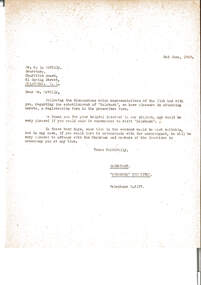
... The Holmbush committee sent a form to register Holmbush under the Charities Act with a cover letter dated 2nd June 1943. ...The Holmbush committee sent a form to register Holmbush under the Charities Act with a cover letter dated 2nd June 1943. ...The Holmbush committee sent a form to register Holmbush under the Charities Act with a cover letter dated 2nd June 1943. The reply was received from the Charities Board of Victoria confirming registration, dated 9th June 1943. Holmbush was the first hostel for children that Legacy started and operated from April 1943. It was later renamed Blamey House after another hostel called Blamey House was closed. Melbourne Legacy ran three residences: Blamey House (purchased 1947) , Stanhope (purchased 1945) and Harelands (purchased 1950), to take care of children whose fathers were servicemen, and who may have been left orphans, or whose mother may have been unable to care for them herself. Harelands accommodated boys and girls under the age of 14, Blamey House looked after boys over 14, and Stanhope looked after girls over 14. The children were cared for until they were old enough to become independent.Shows compliance with Victorian legislation when the first hostel was opened by Legacy Melbourne.00335.1 Quarto paper, black and white. 00335.2 Foolscap paper, black and white, 2 pages 00335.3 Note paper, Charities Board of Victoria letterheadresidences, holmbush
