
Showing 6451 items matching "aboriginal-grinding-stone"
-
 Koorie Heritage Trust
Book, Aboriginal Provisional Government, The APG Papers Vol. 2 / Aboriginal Provisional Government, 1992
... The APG Papers Vol. 2 / Aboriginal Provisional Government...Aboriginal Provisional Government...The APG Papers Vol. 2 / Aboriginal Provisional Government Book Aboriginal Provisional Government Hobart : Deep South Sovereign ...Extract: The Aboriginal Provisional Government Elders conference was held in Hobart in August 1992. It was different from other conferences. One of the obvious differences was the esteem shown by the organisers to the Elders and other delegates...30 p. : col. ill. ; 30 cm.Extract: The Aboriginal Provisional Government Elders conference was held in Hobart in August 1992. It was different from other conferences. One of the obvious differences was the esteem shown by the organisers to the Elders and other delegates...politics, tribal law and social control -- national and state level | aboriginal provisional government elders conference -- tasmania. -
Koorie Heritage Trust
Education Kit, Aboriginal Curriculum Unit, Board of Studies NSW, Invasion and resistance [kit] : untold stories : Aboriginal voices in Australian history, 1995
... Invasion and resistance [kit] : untold stories : Aboriginal voices in Australian history...Aboriginal Curriculum Unit, Board of Studies NSW...La Perouse- life histories | Aboriginals Australian - resistance Australia-History-Aboriginal | Aboriginal Australians -- Government relations. | Aboriginal Australians -- History. | Aboriginal Australians -- New South Wales -- La Perouse -- History. | Australia -- Colonization -- History. | Australia -- Race relations -- History. ...A study kit on many aspects of invasion and resistance from contact to date.Contents: Video Cassette; teachers handbook; 3 books. Posters in poster drawer.A study kit on many aspects of invasion and resistance from contact to date.la perouse- life histories, | aboriginals, australian - resistance, australia-history-aboriginal, | aboriginal australians -- government relations. | aboriginal australians -- history. | aboriginal australians -- new south wales -- la perouse -- history. | australia -- colonization -- history. | australia -- race relations -- history. -
Koorie Heritage Trust
Document - Report, Aboriginal and Torres Strait Islander Commission. Royal Commission Government Response Monitoring Unit, Five years on : implementation of the Commonwealth Government responses to the recommendations of the Royal Commission into Aboriginal Deaths in Custody Vol. 2, Policy and Programs : Addressing Disadvantage, 1997
... Five years on : implementation of the Commonwealth Government responses to the recommendations of the Royal Commission into Aboriginal Deaths in Custody Vol. 2, Policy and Programs : Addressing Disadvantage....Aboriginal and Torres Strait Islander Commission. ...Prisoners Aboriginal Australian -- Mortality. | Prisons and race relations -- Australia. | Aboriginal Australians -- Criminal justice system. | Police -- Complaints against -- Australia. ...Volume Two examines the role of the various Commonwealth Government Departments in addressing disadvantage in Aboriginal communities.ii-iv; 296 P.; tables; 25 cm.Volume Two examines the role of the various Commonwealth Government Departments in addressing disadvantage in Aboriginal communities.prisoners, aboriginal australian -- mortality. | prisons and race relations -- australia. | aboriginal australians -- criminal justice system. | police -- complaints against -- australia. -
Koorie Heritage Trust
Journal - Serials, Department of Pacific and Southeast Asian History, Australian National University, Aboriginal History - Volume 22. 1998, 1998
... Aboriginal History - Volume 22. 1998.......Aboriginal History Inc.; Canberra...Aboriginal History Inc.; Canberra ...A series of articles by leading writers on Aboriginal History.iiv-vii; 300 P.; footnotes; refs.; plates; maps; 25 cm.A series of articles by leading writers on Aboriginal History.aboriginal australians -- periodicals. | ethnology -- australia -- periodicals. | race relations - representation - advertising | history - biographies - indigenous | government policy - initial period and protectionism - 1788-1850 | government policy - initial period and protectionism - 1851-1900 | employment - discrimination | employment - conditions - slavery and indentured labour | employment | settlement and contacts - explorers - european | government policy - state and territory - queensland | mathew, john (1849ð1929) | -
Koorie Heritage Trust
Booklet, Broome, Richard, Aboriginal People of Victoria, 2002
... Aboriginal People of Victoria......Aboriginal and Torres Strait Islander Commission...Aboriginal People of Victoria Booklet Broome, Richard Aboriginal and Torres Strait Islander Commission ...A booklet outlining the life and times of Victorian Koories from traditional to modern times.p.24; illus col.; maps; bibliography; 30 cm.A booklet outlining the life and times of Victorian Koories from traditional to modern times.koories-traditional societies, | race relations- vctorian aboriginals |, koories-cultural heritage -
Koorie Heritage Trust
Booklet, Deputation and victorian news magazine, Aboriginal Evangelical Fellowship of Australia, 1980
... Aboriginal Evangelical Fellowship of Australia.......Aboriginal Evangelical Fellowship, Melbourne...Religion-Evangelical-Aboriginals Australian. Promotional boklet for assistance and suport for this group. ...Promotional boklet for assistance and suport for this group.Pp. (8); illus.; folded as issued.Promotional boklet for assistance and suport for this group.religion-evangelical-aboriginals, australian. -
Koorie Heritage Trust
Journal - Serials, Aboriginal Law Research Unit in association with the Legal Service Bulletin Co-operative Ltd., 1981-1997, Aboriginal Law Bulletin, 1981
... Aboriginal Law Bulletin...Aboriginal Law Research Unit in association with the Legal Service Bulletin Co-operative Ltd., 1981-1997...Aboriginal Law Bulletin Journal Serials Aboriginal Law Research Unit in association with the Legal Service Bulletin Co-operative Ltd., 1981-1997 ...Aboriginal Law Bulletin began in 1981 as one of the first projects of the Aboriginal Law Research Centre at the University of NSW. The Centre became the Aboriginal Law Centre in 1986 and the Indigenous Law Centre in 1997; journal title changed to Indigenous law bulletin from Vol. 4 no. 1 (Apr. 1997)v. ; 29cm.Aboriginal Law Bulletin began in 1981 as one of the first projects of the Aboriginal Law Research Centre at the University of NSW. The Centre became the Aboriginal Law Centre in 1986 and the Indigenous Law Centre in 1997; journal title changed to Indigenous law bulletin from Vol. 4 no. 1 (Apr. 1997)law -- australia -- periodicals | aboriginal australians -- legal status, laws, etc. -- periodicals | torres strait islanders -- legal status, laws, etc. -- periodicals | race discrimination -- law and legislation -- australia | discrimination in law enforcement -- australia -- periodicals | government policy | law - indigenous | law - international law - human rights | law - legal system | law - legal aid services | race relations - racial discrimination - legislative | politics and government - social justice -
Koorie Heritage Trust
Document - Report, Birckhead, Jim, Aboriginal involvement in parks and protected areas : papers presented to a conference organised by the Johnstone Centre of Parks, Recreation and Heritage at Charles Sturt University, Albury, New South Wales 22-24 July 1991, 1992
... Aboriginal involvement in parks and protected areas : papers presented to a conference organised by the Johnstone Centre of Parks, Recreation and Heritage at Charles Sturt University, Albury, New South Wales 22-24 July 1991...Canberra, A.C.T. : Aboriginal Studies Press.... | Land use -- Australia -- Management -- Congresses. | Aboriginal Australians -- Land tenure -- Congresses. | Aboriginal Australians -- Antiquities -- Congresses. ...Highlights significant differences in Aboriginal and non-Aboriginal notions of land and land management.xiv, 390 p. : ill., maps, ports. ; 27 cm.Highlights significant differences in Aboriginal and non-Aboriginal notions of land and land management.national parks and reserves -- australia -- management -- congresses. | land use -- australia -- management -- congresses. | aboriginal australians -- land tenure -- congresses. | aboriginal australians -- antiquities -- congresses. -
Koorie Heritage Trust
Document - Report, Aboriginal Affairs Victoria et al, Royal Commission into Aboriginal Deaths in Custody : Victorian government 1994 implementation report, 1995
... Royal Commission into Aboriginal Deaths in Custody : Victorian government 1994 implementation report....Aboriginal Affairs Victoria...Aboriginal Australians -- Victoria -- Criminal justice system. | Prisoners Aboriginal Australian -- Government policy -- Victoria.| Aboriginal Australians -- Government policy -- Victoria. | Aboriginal Australians -- Services for -- Victoria. | Law enforcement - Criminal law and procedure - Juvenile justice. | Politics and Government - Political action - Criminal justice. | Law enforcement - Prisons - Prisoners. ...The Royal Commission into Aboriginal Deaths in Custody was establishned in October 1987 in response to growing public concern that the deaths in custody of Aboriginal people were too common and that explanations failed to assure people that Aborigines were not subject to pressures beyond those normally experienced by persons held in custody. The task gi ven to the commission was to inquire into the Aboriginal custodial deaths occurring within the time frame of the Commission's investigation and to inquire into 'any subsequent action taken in respect of each of those deaths including the conduct of coronial, police and other inquiries'.The Royal Commission into Aboriginal Deaths in Custody was establishned in October 1987 in response to growing public concern that the deaths in custody of Aboriginal people were too common and that explanations failed to assure people that Aborigines were not subject to pressures beyond those normally experienced by persons held in custody. The task gi ven to the commission was to inquire into the Aboriginal custodial deaths occurring within the time frame of the Commission's investigation and to inquire into 'any subsequent action taken in respect of each of those deaths including the conduct of coronial, police and other inquiries'.aboriginal australians -- victoria -- criminal justice system. | prisoners, aboriginal australian -- government policy -- victoria.| aboriginal australians -- government policy -- victoria. | aboriginal australians -- services for -- victoria. | law enforcement - criminal law and procedure - juvenile justice. | politics and government - political action - criminal justice. | law enforcement - prisons - prisoners. -
RMIT GSBL Justice Smith Collection
Report, Council for Aboriginal Reconciliation (Australia), Going forward : social justice for the first Australians : a submission to the Commonwealth Government from the Council for Aboriginal Reconciliation, 1995
... Going forward : social justice for the first Australians : a submission to the Commonwealth Government from the Council for Aboriginal Reconciliation...Council for Aboriginal Reconciliation (Australia)...aboriginal australians -- government policy aboriginal australians -- government relations torres strait islanders -- government policy -- australia torres strait islanders -- government relations social justice -- australia ISBN: 0642226423 Going forward : social justice for the first Australians : a submission to the Commonwealth Government from the Council for Aboriginal Reconciliation Report Council for Aboriginal Reconciliation (Australia) Australian Government Publishing Service ...ISBN: 0642226423aboriginal australians -- government policy, aboriginal australians -- government relations, torres strait islanders -- government policy -- australia, torres strait islanders -- government relations, social justice -- australia -
 Donald History and Natural History Group operating the Donald Court House Museum
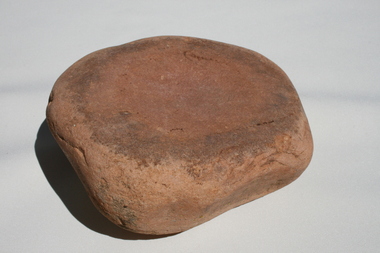
Aboriginal grinding stone (mortar)
... This grinding stone (mortar) was used by Aboriginal people to grind or crush different materials such as berries and seeds for food production. ...Stone...Stone Aboriginal grinding stone (mortar). ...This grinding stone (mortar) was used by Aboriginal people to grind or crush different materials such as berries and seeds for food production. In order to grind material, a smaller upper stone (the pestle) would have been used to grind material against this lower stone (the mortar). The stone was found by a farmer on land south of Donald in the 1950’s and was used as a door stop in the family home for many years. In the 1990's the stone was used by the farmer's grandaughter at her home at Swanwater West, to hold the lid down on an above ground swimming pool skimmer box. Stone -
 Orbost & District Historical Society
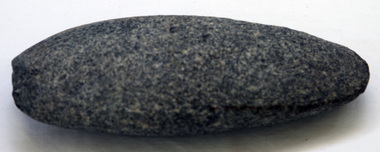
axe head
... Ground-edge tools are made from fracture-resistant stone, such as basalt which is able to withstand repeated impact, and so is suitable for use in objects such as stone axes. ...A handmade stone Aboriginal axe head....This item is an example of an early axe head used by the Indigenous people of East Gippsland. aboriginal tool stone-artefact axe-head A handmade stone Aboriginal axe head. axe head ...Inspected by Joanna Freslov, archaeologist 2.6.2008 Ground-edged axes first appeared in south-eastern Australia about 4,000 years ago and were used either with handles or hand-held. Stone tools were used for a variety of purposes, in ways similar to those of steel knives, axes, hammers and chisels. Ground-edge tools are made from fracture-resistant stone, such as basalt which is able to withstand repeated impact, and so is suitable for use in objects such as stone axes. The stone was quarried, and then roughly shaped into a tool blank with blows from a hammerstone. The edges were then sharpened and refined by grinding the tool against a coarse, gritty rockThe necessary tools and equipment for hunting, fishing and warfare were one of the very few items that Aboriginals carried with them from place to place. Most were used for a multiplicity of purposes. Because many were made from raw natural materials, such as wood, generally only partial remains are found today. This item is an example of an early axe head used by the Indigenous people of East Gippsland.A handmade stone Aboriginal axe head.aboriginal tool stone-artefact axe-head -
 Melbourne Tram Museum
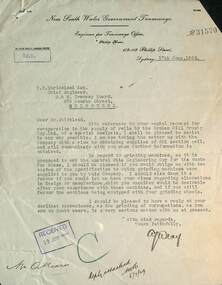
Document - Specification, Melbourne & Metropolitan Tramways Board (MMTB), "Austral Otis Rail Grinding Machine", July 1929
... "Austral Otis Rail Grinding Machine"...Document - letters and comments and suggestions for a tender specification for the Austral Otis grinding machine from Chief Engineer MMTB to A G Wray Engineer for Tramways, NSW Govt Tramways. ..."Austral Otis Rail Grinding Machine" Document Specification - Melbourne & Metropolitan Tramways Board (MMTB) ...Document - letters and comments and suggestions for a tender specification for the Austral Otis grinding machine from Chief Engineer MMTB to A G Wray Engineer for Tramways, NSW Govt Tramways. The grinder was used to remove corrugations from the rail head. Includes comments about the performance of a similar machine in Melbourne. Dated July 1929.Yields information the performance of the Melbourne rail grinders - 1929 Document or memo - 6 typed foolscap sheets and 3 quarto typed letters.tramways, mmtb, track work, track maintenance, rail grinding, specifications, sydney -
 Orbost & District Historical Society
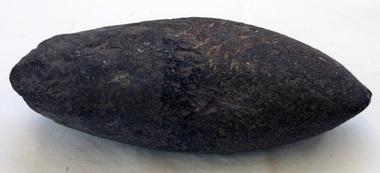
axe head
... Ground-edge tools are made from fracture-resistant stone, such as basalt. This axe would able to withstand repeated impact. ...A handmade stone Aboriginal axe head....Because many were made from raw natural materials, such as wood, generally only partial remains are found today. This stone axe head is an example of a ground-edge tool used by the early Indigenous people in Eastern Australia. aboriginal tool aboriginal stone-artefact A handmade stone Aboriginal axe head. axe head ...Inspected by Joanna Freslov, archaeologist 2.6.2008. -unusual axe head. Ground-edge tools are made from fracture-resistant stone, such as basalt. This axe would able to withstand repeated impact. The stone would have been dug or found and then roughly shaped into a tool blank with blows from a hammerstone. The edges were then sharpened and refined by grinding the tool against a coarse, gritty rock. Ground-edge tools could be held in the hand, or fashioned to be fixed onto a haft or handle.The necessary tools and equipment for hunting, fishing and warfare were one of the very few items that Aboriginals carried with them from place to place. Most were used for a multiplicity of purposes. Because many were made from raw natural materials, such as wood, generally only partial remains are found today. This stone axe head is an example of a ground-edge tool used by the early Indigenous people in Eastern Australia.A handmade stone Aboriginal axe head.aboriginal tool aboriginal stone-artefact -
 Federation University Historical Collection
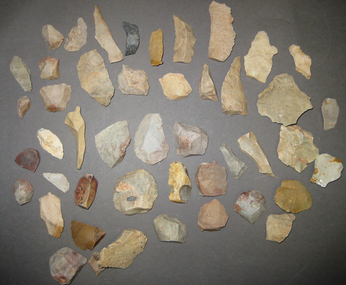
Ethnographic, Partly Worked Aboriginal Tool Blanks
... Partly Worked Aboriginal Tool Blanks...aboriginal...Silcrete and chert can create sharp flakes and have been important materials for stone tool making in Australia. Silcrete was commonly used and widespread. ...Partly worked, incomplete Aboriginal rock blanks. The collection includes rocks of silcrete, quartz, and chert. 8969.26 is quartz chert. 8969.37 is a flint stone with a vein of quartz. ...Heat treatment of silcrete made the rock easier to fashion into flakes. aboriginal tool blank rock scraper aborigines quartz silcrete chert stone tools quartzite flaking flake tools archaeology Partly worked, incomplete Aboriginal rock blanks. ...Silcrete and chert can create sharp flakes and have been important materials for stone tool making in Australia. Silcrete was commonly used and widespread. Heat treatment of silcrete made the rock easier to fashion into flakes.Partly worked, incomplete Aboriginal rock blanks. The collection includes rocks of silcrete, quartz, and chert. 8969.26 is quartz chert. 8969.37 is a flint stone with a vein of quartz. The dark brown rock is silcrete with more iron than others (possibly 8969.41). 8969.45 is Quartz. aboriginal, tool, blank, rock, scraper, aborigines, quartz, silcrete, chert, stone tools, quartzite, flaking, flake tools, archaeology -
 Victorian Aboriginal Corporation for Languages
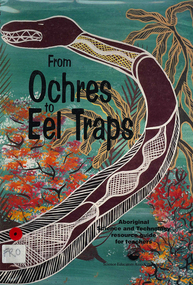
Book, Helen Halling, From ochres to eel traps : Aboriginal science and technology resource guide for teachers, 1999
... From ochres to eel traps : Aboriginal science and technology resource guide for teachers...Art pigments Boomerangs Woomera Natural resins and gums Separation of poisons from edible plants Aboriginal bush foods Stone tool technology Aboriginal inventors Aboriginal bush medicine Specific uses of technology by a community Seasonal calendars Games and toys Firesticks...art seasonal calendars Aboriginal social life and customs stone tool technology games and toys colour photographs, b&w illustrations, diagrams Art pigments Boomerangs Woomera Natural resins and gums Separation of poisons from edible plants Aboriginal bush foods Stone tool technology Aboriginal inventors Aboriginal bush medicine Specific uses of technology by a community Seasonal calendars Games and toys Firesticks From ochres to eel traps : Aboriginal science and technology resource guide for teachers Book Helen Halling ...Art pigments Boomerangs Woomera Natural resins and gums Separation of poisons from edible plants Aboriginal bush foods Stone tool technology Aboriginal inventors Aboriginal bush medicine Specific uses of technology by a community Seasonal calendars Games and toys Firestickscolour photographs, b&w illustrations, diagramsart, seasonal calendars, aboriginal social life and customs, stone tool technology, games and toys -
 Sunshine and District Historical Society Incorporated
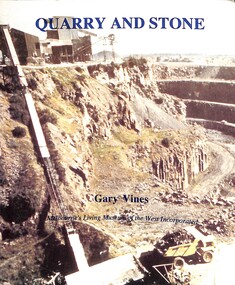
Book - Quarry and Stone, Melbourne's Living Museum of the West, 1993
... Quarry and Stone...Sunshine and surrounding suburbs are located on the world's third largest flows of basaltic lava "Blue Stone". Settlers turned the quarrying industry into one of the largest in the area. ...Quarry and Stone - Bluestone quarrying, stonemasonry and building in Melbourne's west....Slim A 5 book, well-illustrated, and a picture of Market Street Quarry on the front cover Quarry and Stone Book Quarry and Stone Melbourne's Living Museum of the West. ...The history of quarrying bluestone in the 19th century in Melbourne's westSlim A 5 book, well-illustrated, and a picture of Market Street Quarry on the front covernon-fictionThe history of quarrying bluestone in the 19th century in Melbourne's westbluestone, quarry -
 Orbost & District Historical Society
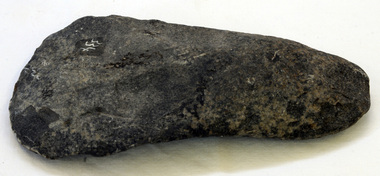
axe head
... Ground-edge tools are made from fracture-resistant stone, such as basalt which is able to withstand repeated impact, and is suitable for use in objects such as stone axes. ...A handmade stone Aboriginal axe head. Finger grips are clear....This axe head is an example of an early stone tool used by the Indigenous people of Eastern Australia. axehead aboriginal tool stone-artefact A handmade stone Aboriginal axe head. ...Inspected by Joonna Freslov, archaeologist 2.6.2008. Stone tools were used for a variety of purposes, in ways similar to those of steel knives, axes, hammers and chisels. Ground-edge tools are made from fracture-resistant stone, such as basalt which is able to withstand repeated impact, and is suitable for use in objects such as stone axes. The stone was quarried, and then roughly shaped into a tool blank with blows from a hammerstone. The edges were then sharpened and refined by grinding the tool against a coarse, gritty rock.The necessary tools and equipment for hunting, fishing and warfare were one of the very few items that Aboriginals carried with them from place to place. Most were used for a multiplicity of purposes. Because many were made from raw natural materials, such as wood, generally only partial remains are found today. This axe head is an example of an early stone tool used by the Indigenous people of Eastern Australia.A handmade stone Aboriginal axe head. Finger grips are clear.axehead aboriginal tool stone-artefact -
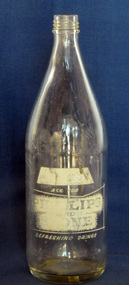 Orbost & District Historical Society
bottle, Pre 1970's
... Dross Drossou sold his cordial manufacturing business to Phillips and Stone, a Bairnsdale company, in 1948. Phillips and Stone continued to manufacture soft drinks at Orbost until the early 1970's when the factory became a distribution centre. ...Front- Refreshing Drinks Back-Manufactured by Phillips & Stone Base-1121 P&S Bairnsdale and Orbost Ask for Phillips and Stone Artificially Coloured & Flavoured Net Contents 30 fld ozs...Phillips and Stone...Dross Drossou sold his cordial manufacturing business to Phillips and Stone, a Bairnsdale company, in 1948. Phillips and Stone continued to manufacture soft drinks at Orbost until the early 1970's when the factory became a distribution centre. ...Dross Drossou sold his cordial manufacturing business to Phillips and Stone, a Bairnsdale company, in 1948. Phillips and Stone continued to manufacture soft drinks at Orbost until the early 1970's when the factory became a distribution centre. It closed as a distribution centre in 1978 and later served as the headquarters of the Orbost State Emergency Service. The site of the Cordial Factory now forms part of a carpark. A deposit on the bottles was added to all sales as they left the factory. The returned bottles were washed and the old label removed. The inside was cleaned by pushing the bottle onto a revolving brush. The reusing of the bottles went on until the bottle was broken or the top became chipped.This bottle is an example of a product manufacture by a local industry no longer existing.A clear glass bottle with a screw thread top. The label and print ( in upper case) are white.Front- Refreshing Drinks Back-Manufactured by Phillips & Stone Base-1121 P&S Bairnsdale and Orbost Ask for Phillips and Stone Artificially Coloured & Flavoured Net Contents 30 fld ozscontainer beverage bottle phillips-and-stone -
Victorian Aboriginal Corporation for Languages
Book, Australian Aboriginal words : Aboriginal-English, English-Aboriginal, 1955
... Australian Aboriginal words : Aboriginal-English, English-Aboriginal...Aboriginal-English and English-Aboriginal sections....Aboriginal-English and English-Aboriginal sections. ...A short book of definitions of Aboriginal words drawn from across Australia - includes state of origin of words and sometimes region within a state. Aboriginal-English and English-Aboriginal sections.word listsdictionaries, glossaries -
Victorian Aboriginal Corporation for Languages
Book, Australian Aboriginal words : Aboriginal-English, English-Aboriginal, 1955
... Australian Aboriginal words : Aboriginal-English, English-Aboriginal...Aboriginal-English and English-Aboriginal sections....Aboriginal-English and English-Aboriginal sections. ...A short book of definitions of Aboriginal words drawn from across Australia - includes state of origin of words and sometimes region within a state. Aboriginal-English and English-Aboriginal sections.word listsdictionaries, glossaries -
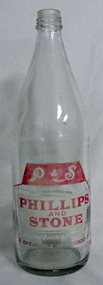 Orbost & District Historical Society
bottle, C 1970's -1990's
... Dross Drossou sold his cordial manufacturing business to Phillips and Stone, a Bairnsdale company, in 1948. Phillips & Stone continued to manufacture soft drinks at Orbost until the early 1970s when the factory became a distribution centre. ...Manufactured by Phillips & Stone Bairnsdale & Orbost E2361. Preservative added. ...Phillips & Stone...Dross Drossou sold his cordial manufacturing business to Phillips and Stone, a Bairnsdale company, in 1948. Phillips & Stone continued to manufacture soft drinks at Orbost until the early 1970s when the factory became a distribution centre. ...Dross Drossou sold his cordial manufacturing business to Phillips and Stone, a Bairnsdale company, in 1948. Phillips & Stone continued to manufacture soft drinks at Orbost until the early 1970s when the factory became a distribution centre. It closed as a distribution centre in 1978 and later served as the headquarters of the Orbost State Emergency Service. The site of the Cordial Factory now forms part of the carpark at the rear of the Orbost Newsagency. (John Phillips) This bottle is an example of a product manufactured/distributed by a local industry no longer existing.A narrow-shouldered, clear glass bottle with white and red lettering. The neck is threaded (cap is missing). It is labelled "P & S 850ml; Phillips and stone; refreshing drinks. BAIRNSDALE AND ORBOST. Manufactured by Phillips & Stone Bairnsdale & Orbost E2361. Preservative added. Artificially coloured and flavoured."glass-bottle container phillips-and-stone -
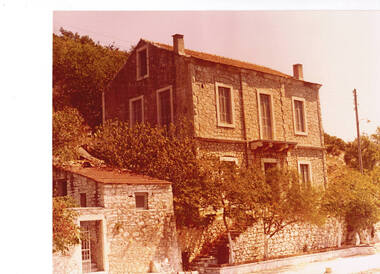 Ithacan Historical Society
Photograph, Stone house on Ithaca, c 1970s
... Stone house on Ithaca...The house pictured is typical of many of the dwellings found on Ithaca built of stone which is sourced locally. Stone buildings are ideal for the climate of the island, retaining the heat in winter and cooler in summer. ...A coloured photograph of a double storey stone house with a tiled roof. A flight of stairs leads from the road to the elevated front door. ...Stone house on Ithaca Photograph ...The architecture of Ithaca has been influenced by various cultures in particular by the Venetian and British periods of rule. The house pictured is typical of many of the dwellings found on Ithaca built of stone which is sourced locally. Stone buildings are ideal for the climate of the island, retaining the heat in winter and cooler in summer. Sadly the catastrophic earthquakes of 1953 resulted in the widespread destruction on the many of the island's old buildings. Being one of the smaller and less accessible islands of Greece Ithaca fortunately has been spared inappropriate development and thus able to retain its authenticity and beautiful character. A coloured photograph of a double storey stone house with a tiled roof. A flight of stairs leads from the road to the elevated front door. At the bottom of the stairway there is a single storey stone building. Three trees are growing at the street level across the front of the house. architecture, houses -
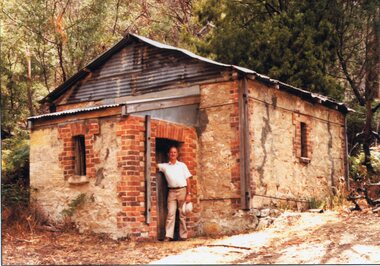 Stawell Historical Society Inc
Photograph, Heatherlie Quarry with Geoff Sudholz standing in doorway of the stone building -- Coloured
... Heatherlie Quarry with Geoff Sudholz standing in doorway of the stone building -- Coloured....Heatherlie Quarry colour photo of stone building. Geoff Sudholz standing in doorway....Coloured Photograph of GeoffSudholtz standing in a doorway of a stone building with an iron roof in a bushland setting. ...Heatherlie Quarry colour photo of stone building. Geoff Sudholz standing in doorway. ...Heatherlie Quarry colour photo of stone building. Geoff Sudholz standing in doorway.Coloured Photograph of GeoffSudholtz standing in a doorway of a stone building with an iron roof in a bushland setting. Building is at Heatherlie Quarrystawell grampians industry -
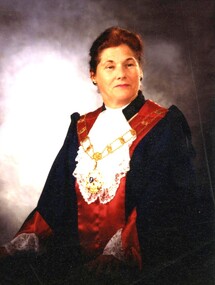 Wodonga & District Historical Society Inc
Photograph - Pam Stone - Wodonga's first female Councillor and Mayor
... Pam Stone - Wodonga's first female Councillor and Mayor...Pam Stone was the first woman elected to the Wodonga City Council and first woman elected Deputy Mayor and later Mayor of the Rural City of Wodonga. ...A set of black and white and colour images of Pamela Mary Stone....Pam Stone - Wodonga's first female Councillor and Mayor Photograph Pam Stone - Wodonga's first female Councillor and Mayor ...Pam Stone was the first woman elected to the Wodonga City Council and first woman elected Deputy Mayor and later Mayor of the Rural City of Wodonga. She was born in Swan Hill on 22nd January 1929. Her early years were spent in Mildura, Melbourne and Swan Hill but she lived most of her adult life in Albury Wodonga. Pam attended school in Melbourne and was also a member of the Catholic Club where she met her future husband, Les Stone. They married on 18th April 1949 at St. Patrick’s Cathedral Melbourne. On graduating from Melbourne Teachers College, Les was posted to several small country schools before being transferred to Wodonga in 1956. After a period teaching in Gippsland, the Stone Family returned to Wodonga. Les taught at several schools in the district before being promoted to Principal of Wodonga West Primary. Following involvement in many community organisations Les was elected as Councillor for the West Ward, Wodonga in 1967. He was re-elected unopposed in 1970 and 1971, becoming Mayor in 1973. He passed away in office in December 1974 Les Stone’s service was only possible with the support of Pam who also took a major role in public life and serving the Wodonga community. Four years after his death, Pam stood for and won the Council Ward of Wodonga West Riding, previously held by Les. Pam held the West Riding unopposed for her 15 years on Council from February 1977 to August 1992. This included a term as Deputy Mayor from August 1979 to August 1980. In August 1985 Pam was elected as Wodonga’s 6th Mayor and served in that role until August 1986. In 1978 Pam was made a Justice of the Peace and regularly sat in the Court of Petty Sessions Magistrates Court Wodonga. Pam’s commitment to education from preschool to post-secondary education was also a lifelong passion. Her strong advocacy made a defining difference to education available in Albury Wodonga from pre-school to tertiary education. On 27th October 1994, she was named by Wodonga Technical and Further Education College as a Friend of the College. Pam was conferred with the Order of Australia Medal on Australia Day 26th January 1994. Her citation read: “For service to local government and the community”. In 2010 Wodonga City Council dedicated parkland to mark her contribution. The signage reads: ‘Pam Stone OAM Wodonga’s first female Councillor (1977) and Mayor (1985), is recognised among the most important centenary pioneers of Wodonga. Pam was married to Les Stone, also a Mayor of Wodonga. Pam gave compassionate and effective support to the underprivileged people of Wodonga. She had a profound input in establishing Post-school education in Wodonga and Albury’. Pam Stone passed away in Albury on 6th August 2022. These photos are significant because they depict a female pioneer of local government and education in Wodonga.A set of black and white and colour images of Pamela Mary Stone.pamela stone, wodonga councillors, wodonga local government, wodonga mayors -
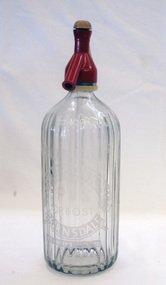 Orbost & District Historical Society
soda syphon, first half 20th century
... The reusing of the bottles went on until the bottle was broken or the top became chipped. Phillips & Stone operated in Orbost and Bairnsdale. ..."Soda Water Phillips & Stone Bairnsdale P S ORBOST (trademark) 30 Fl OZ"...Phillips & Stone...The reusing of the bottles went on until the bottle was broken or the top became chipped. Phillips & Stone operated in Orbost and Bairnsdale. This bottle is an example of a product manufacture by a local industry no longer existing Phillips&Stone syphon bottle "Soda Water Phillips & Stone Bairnsdale P S ORBOST (trademark) 30 Fl OZ" A clear glass soda syphon bottle with a red pump on the top. soda syphon Phillips & Stone ...Dross Drossou established a cordial factory in Orbost in the 1930s. He sold his cordial manufacturing business to Phillips and Stone, a Bairnsdale company, in 1948. Glass bottles were refillable until the 1960s, creating a demand for their collection and onsale back to beverage manufacturers via ‘bottle merchants’. A deposit on the bottles was added to all sales as they left the factory. The returned bottles were washed and the old label removed. The inside was cleaned by pushing the bottle onto a revolving brush. The reusing of the bottles went on until the bottle was broken or the top became chipped. Phillips & Stone operated in Orbost and Bairnsdale. This bottle is an example of a product manufacture by a local industry no longer existingA clear glass soda syphon bottle with a red pump on the top."Soda Water Phillips & Stone Bairnsdale P S ORBOST (trademark) 30 Fl OZ"phillips&stone syphon bottle -
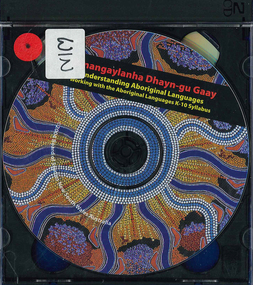 Victorian Aboriginal Corporation for Languages
CD-ROM, Board of Studies New South Wales, Winangaylanha Dhayn-gu Gaay : understanding Aboriginal languages : working with the Aboriginal languages K-10 syllabus : a guide for Aboriginal community collaboration for school based languages programs, 2004
... Winangaylanha Dhayn-gu Gaay : understanding Aboriginal languages : working with the Aboriginal languages K-10 syllabus : a guide for Aboriginal community collaboration for school based languages programs...Supporting the Aboriginal languages K-10 syllabus, this resource assists Aboriginal community participation in the teaching of Aboriginal languages in schools. ...Supporting the Aboriginal languages K-10 syllabus, this resource assists Aboriginal community participation in the teaching of Aboriginal languages in schools. ...A guide for Aboriginal community collaboration for school-based programs. Supporting the Aboriginal languages K-10 syllabus, this resource assists Aboriginal community participation in the teaching of Aboriginal languages in schools. Technical Details System requirements (PC): 64 Mb RAM; Windows 98; 800x600 screen; thousands of colours.CD-ROMmulticultural education, multilingualism -
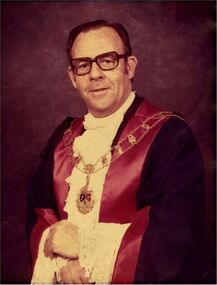 Wodonga & District Historical Society Inc
Photograph - Les Stone, Last Shire President and first Mayor of the Rural City of Wodonga
... Les Stone, Last Shire President and first Mayor of the Rural City of Wodonga...Les Stone was the last Shire President of Wodonga and first Mayor of the Rural City of Wodonga. ...A collection of coloured images related to Les Stone, Mayor of Wodonga...Les Stone was the last Shire President of Wodonga and first Mayor of the Rural City of Wodonga. ...Les Stone was the last Shire President of Wodonga and first Mayor of the Rural City of Wodonga. Born in Collingwood, Victoria on 24th August 1919, he was the first of his family to obtain a post-secondary education. He became a Christian Brother but left the ministry after 10 years and became a trained primary school teacher. Les held various teaching appointments in and around country Victoria and Wodonga, the last as Principal of Wodonga West Primary School. It was in Wodonga that Les and his wife Pam settled with their family. Their contribution to the Wodonga community and local government was outstanding. Les established a strong network in the local migrant community, helping many new arrivals at Bonegilla Migrant Reception Centre with language issues and settling them into their new environment. He worked in support of all underprivileged people in the community. In 1967 Les was elected as a Councillor for the West Riding of Wodonga Council. The following year he was elected Deputy Shire President. He was the last Shire President of Wodonga and in 1971 became the inaugural Mayor of the Rural City of Wodonga. The City of Wodonga was proclaimed on 14th March 1973 and Les was re-elected as Mayor. He chose to serve one full term as Mayor having previously served two terms as Shire President. Les Stone passed away at the Mercy Hospital Albury on 28th December 1974 at 54 years of age. He left behind an enduring legacy which included the proactive encouragement of industry to Wodonga. He also championed the selection of Wodonga as a Growth Centre. A champion and defender of local government, Les served as Chairman of the North East Region of Municipalities which comprised 13 Councils including Wodonga and Wangaratta. He also played a critical role on the Albury Wodonga Development Corporation for five years in the early period of the Whitlam decentralization scheme. Les Stone’s life of giving wasn’t just about local government and teaching. He was an old-fashioned community activist who gave far more than he took from the community. Les worked tirelessly for numerous organizations including the Royal Children’s Hospital, Royal Melbourne Hospital (he was made a Life Governor of both), the Wodonga Good Neighbour Council, and Knights of the Southern Cross, Rotary, the St. Vincent de Paul Society and St. Augustine’s Parish Council. However it is in local government that he remains best remembered. He was an active and vocal councillor and gave over 16 years of service to the people of Wodonga - his election and re-election was never once opposed. Les Stone was interned in the Lawn Cemetery in Wodonga. He was aged 54 years. The naming and dedication of the Les Stone Park in West Wodonga is an important acknowledgement of Les Stone’s life. The inscription reads: '’Leslie Edwin Stone JP was the first Mayor of Wodonga from 1972 to 1974 and a former Shire President (1972). A school teacher and principal by profession Les had a long history of involvement with the migrant community and Catholic Church. He was an acknowledged champion of decentralisation’’. These photos are significant because they document the service of an important civic leader in Wodonga.A collection of coloured images related to Les Stone, Mayor of Wodongales stone, wodonga civic leaders, wodonga council -
Lakes Entrance Historical Society
Photograph, young Aboriginal Volunteer Defence Corps. Lake Tyers Victoria. c1940, 1940c
... young Aboriginal Volunteer Defence Corps. Lake Tyers Victoria. c1940...Photograpg showing 10 Aboriginal...Black and white photograph showing ten young Aboriginal men of Lake Tyers, wearing uniforms of either Army Cadets or Volunteer Defence Corps. ...Photograpg showing 10 Aboriginal Aboriginals Uniforms Armed Forces Black and white photograph showing ten young Aboriginal men of Lake Tyers, wearing uniforms of either Army Cadets or Volunteer Defence Corps. ...Photograpg showing 10 AboriginalBlack and white photograph showing ten young Aboriginal men of Lake Tyers, wearing uniforms of either Army Cadets or Volunteer Defence Corps. Lake Tyers Victoria.aboriginals, uniforms, armed forces -
 Melton City Libraries
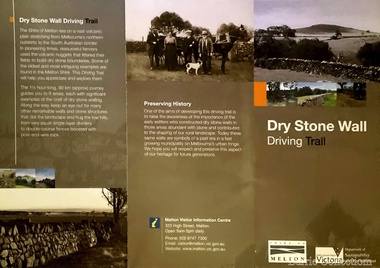
Pamphlet, Dry Stone Wall Driving Trail, Unknown
... Dry Stone Wall Driving Trail...The bulk of dry stone wall construction in Victoria occurred between the 1850s and 1880s. ... Dry Stone Wall trail brochure/pamphlet for visitors provided by Melton Visitor Information Centre...The bulk of dry stone wall construction in Victoria occurred between the 1850s and 1880s. ..."The dry stone walls provide a tangible link to the area’s white settlement, and they remain a symbol of the profound change in land usage from the original Kulin custodians to the European arrivals of the nineteenth century. The bulk of dry stone wall construction in Victoria occurred between the 1850s and 1880s. The gold rush of the early 1850s in particular inspired a flurry of construction. At this time, labour previously available for shepherding livestock dried up, as men gravitated to the goldfields to seek their fortunes. This necessitated the building of fencing to contain the district’s growing number of sheep, cattle and horses. An explosion in surveying, subdivision and the sale of Crown lands also contributed to a boost in construction. Government regulations that punished pastoralists for allowing their livestock to stray provided further incentive to fence-off previously open expanses of land. The major benefit of this type of fencing was that it utilised the materials at hand; the plentiful grey basalt that scattered the landscape. In the case of the dry stone walls built around Melton, the characteristic round or oval shape of the volcanic fieldstones on the western plains inspired some distinctive designs.54 Another advantage of dry stone walls was their ability to withstand the ravages of flood, fire and drought often experienced in the district. This durability accounts for the fact that many of these fences still exist today". Dry Stone Wall trail brochure/pamphlet for visitors provided by Melton Visitor Information Centrecouncil, landscapes of significance
