
Showing 1595 items matching "diggers "
-
 Bendigo Historical Society Inc.
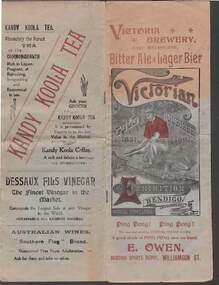
Document - OFFICIAL PROGRAMME VICTORIAN 1851-1901 GOLDEN JUBILEE
... Cover depicts a lithograph scene of a kneeling 'digger' panning for gold in the centre of a scrolled heading reading 'Victorian Gold Jubilee 1851-1901 Exhibition Official Programme Bendigo. ...Cover depicts a lithograph scene of a kneeling 'digger' panning for gold in the centre of a scrolled heading reading 'Victorian Gold Jubilee 1851-1901 Exhibition Official Programme Bendigo. ...Six page Official Victorian Golden Jubilee Program dated April 24th 1902. Cover depicts a lithograph scene of a kneeling 'digger' panning for gold in the centre of a scrolled heading reading 'Victorian Gold Jubilee 1851-1901 Exhibition Official Programme Bendigo. Advertisements for 23 Bendigo business houses enclosed. Victoria Brewery, E Owen, Wertheims Depot, Stapleton's Arcade, Bartlett's Bros, Bosito's, W Sanderson, Morley Johnston & Co, D'Arc's Marionettes, Waxwork & Cyclorama, 'The Favourite Shop', Henderson & Goodisson, T R Jones, Mr J H Knight, Bush's Stores, George H Bush & Co, Faul's Acetylene Apparatus, X L Gas Engines, G Sallaway, J Carr's Hopetoun Hotel, Hartley Cycles, Kandy Koola Tea, Dessaux Fils Vinegar. Covering letter to Jim Evans from Winsome Menadue via John Messer.bendigo, business, gold jubliee 18561 -
 Bendigo Historical Society Inc.
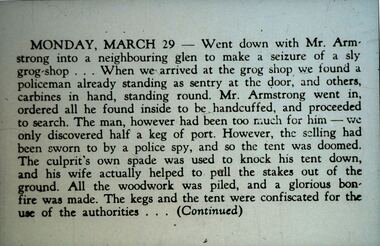
Slide - DIGGERS & MINING. STORES AT THE DIGGINGS, c1850s
... Diggers & Mining. Stores at the diggings. MONDAY, MARCH 29 - Went down with Mr. ...Used as a teaching aid. Slide DIGGERS & MINING. STORES AT THE DIGGINGS ...Diggers & Mining. Stores at the diggings. MONDAY, MARCH 29 - Went down with Mr. Armstrong into a neighbouring glen to make a seizure of a sly grog-shop . . . When we arrived at the grog shop we found a policeman already standing as sentry at the door and others, carbines in hand, standing round. Mr. Armstrong went in, ordered all he found inside to be handcuffed, and proceeded to search. The man, however had been too much for him - we only discovered half a keg of port. However the selling had been sworn to by a police spy, and so the tent was doomed. The culprit's own spade was used to knock his tent down, and his wife actually helped to pull the stakes out of the ground. All the woodwork was piled, and a glorious bonfire was made. The kegs and the tent were confiscated for the use of the authorities . . . (Continued) Markings: 33 994.LIF. 5. Used as a teaching aid.hanimounteducation, tertiary, goldfields -
 City of Moorabbin Historical Society (Operating the Box Cottage Museum)
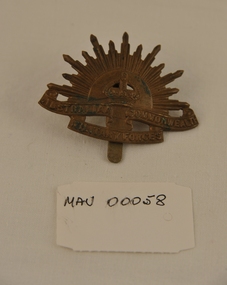
Uniform - World War 1 1914-1918, Hat Badge Rising Sun, c1914
... Proudly worn by soldiers of the 1st and 2nd Australian Imperial Force in both World Wars, the 'Rising Sun' badge has become an integral part of the digger tradition. The distinctive shape of the badge, worn on the upturned side of a slouch hat, is commonly identified with the spirit of ANZAC formed at the Gallipoli landings 1915 There are seven patterns of the Rising Sun. 1902 - 1991. ...Proudly worn by soldiers of the 1st and 2nd Australian Imperial Force in both World Wars, the 'Rising Sun' badge has become an integral part of the digger tradition. The distinctive shape of the badge, worn on the upturned side of a slouch hat, is commonly identified with the spirit of ANZAC formed at the Gallipoli landings 1915 There are seven patterns of the Rising Sun. 1902 - 1991. ...Proudly worn by soldiers of the 1st and 2nd Australian Imperial Force in both World Wars, the 'Rising Sun' badge has become an integral part of the digger tradition. The distinctive shape of the badge, worn on the upturned side of a slouch hat, is commonly identified with the spirit of ANZAC formed at the Gallipoli landings 1915 There are seven patterns of the Rising Sun. 1902 - 1991. The Rising Sun has evolved over time and today Australian Army soldiers wear the seventh pattern Rising Sun. The Third Pattern Rising Sun Badge. May 1904 The third pattern Rising Sun badge carried a scroll inscribed with the words ‘Australian Commonwealth Military Forces’ and was worn throughout both World Wars. There were, however, a number of variations of the badge; a special version was struck for the coronation of King Edward VII in 1902 and there were badges of the Commonwealth Horse and the Australian Instructional Corps, each with its respective title on the scrolls. This pattern badge formed the template for all subsequent General Service badges. The most widely accepted version of the origin of this badge is the one that attributes the selection of its design, c1902, to a British Officer, Major General Sir Edward Hutton, the newly appointed Commander-in-Chief of the Australian Forces. Hutton had earlier received as a gift from Brigadier General Joseph Gordon, a military acquaintance of long standing, a ‘Trophy-of-Arms’ composed of mounted cut and thrust swords and triangular Martini-Henry bayonets that were arranged in a semi-circle around the Crown. To General Hutton, the shield was symbolic of the cooperation between the naval and military forces of the Empire. This Third Pattern Rising Sun Badge.- May 1904 - was worn on the Slouch hats of soldiers serving in the Australian Commonwealth Military Forces during World War 1 1914-1918World War1 1914-1918, soldier’s, rising sun hat badge, made of oxidised copperRising Sun with central Crown AUSTRALIAN COMMONWEALTH / MILITARY FORCES australian military uniforms, military insignia, badges, city of moorabbin, bentleigh, cheltenham, major general sir edward hutton, anzac, gallipoli, australian imperial forces, ww1 1914-1918 -
 Bendigo Historical Society Inc.
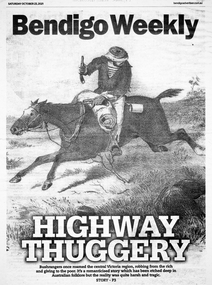
Newspaper - Bendigo Advertiser story Sat Oct 23 2021 entitled "Cop-killer caught out", Sat Oct 23 2021
... He was known for his bravado, often displaying weapons openly among gold diggers. Smith was eventually recognized and arrested in Maryborough after the murder, narrowly avoiding a murder conviction due to a technicality with his arrest warrant. ...He was known for his bravado, often displaying weapons openly among gold diggers. Smith was eventually recognized and arrested in Maryborough after the murder, narrowly avoiding a murder conviction due to a technicality with his arrest warrant. ...This document recounts the story of Gipsy Smith (real name William Turner), a notorious bushranger in 19th-century Australia, focusing on his involvement in violent crimes and his eventual capture. Gipsy Smith was involved in a shootout in central Victoria in 1856 that resulted in the death of Sergeant John McNally and the wounding of Constable John Moore. Smith and his accomplice escaped after the incident, which caused public outrage due to McNally's popularity. Smith was part of a group of bushrangers who terrorized travelers, merchants, and goldfields communities with armed robberies and audacious hold-ups. Notable incidents included tying up and robbing multiple victims, and high-speed horse chases with police. Bushrangers like Smith were sometimes romanticized as rebellious figures, but the document emphasizes the real violence and fear they caused. Smith, originally William Turner, was a former convict from Tasmania who became a bushranger after escaping to Victoria during the gold rush. He was known for his bravado, often displaying weapons openly among gold diggers. Smith was eventually recognized and arrested in Maryborough after the murder, narrowly avoiding a murder conviction due to a technicality with his arrest warrant. He was sentenced to 15 years of hard labor for manslaughter. After serving his sentence, Smith was trusted with responsible work, such as driving cattle and managing a farm, suggesting a degree of rehabilitation. The story is part of a historical series highlighting notable events in the region’s past.Bendigo Advertiser story Sat Oct 23 2021 entitled "Cop-killer caught out" This item contains the following documents 3486.51a Bendigo Advertiser Page 1 Title Page - "Highway Thuggery" 3486.51b Bendigo Advertiser Page 3 article "Cop-killer caught out" the story of Gypsy Smith Bushrangerbendigo, gipsy smith bushranger -
 Bendigo Historical Society Inc.
Legal record - George Lansell's Fortuna Renovations, 1875
... For a while he built gold-washing cradles for the alluvial diggers and then started his Australian architectural career which lasted nearly 50 years. ...For a while he built gold-washing cradles for the alluvial diggers and then started his Australian architectural career which lasted nearly 50 years. ...Emil Mauermann, from Hainewalde in the south-east of Saxony, worked in Bendigo from 1886 to 1894, initially working for Vahland before establishing his own architecture office in 1887. Later he and his German wife moved to Western Australia, where he worked for many years. It is thought likely that he had a significant influence on Vahland’s design for the Colonial Bank in View Street. Many German immigrant architects worked in Bendigo in the 19th century, e.g. Mauermann, Nicolai, Bosselmann and Lehmann, but the two biggest names are Carl Wilhelm Vahland and Robert Getzschmann, who had a considerable effect on the appearance of Bendigo. Vahland was trained as an architect at the Baugewerkschule (School of Building) at Holzminden on the River Weser, not far from his hometown of Nienburg, also on the Weser. Vahland came from a family of builders. At 27, not long after completing his studies, he emigrated to Australia, arriving in Melbourne in September 1854 on the San Francisco. He went to the Bendigo goldfields but had no luck finding gold. For a while he built gold-washing cradles for the alluvial diggers and then started his Australian architectural career which lasted nearly 50 years. Robert Getzschmann, another German, had arrived in Victoria in 1849 and moved to Bendigo in 1857. In 1858 Vahland and Getzschmann established a partnership and opened an architectural office in Pall Mall, Bendigo. This partnership of Vahland and Getzschmann designed many churches, banks, schools, hotels, theatres and private homes in Bendigo, and designed buildings in a wide surrounding area, reaching up into southern NSWLegal Records of George Lansell's Fortuna This item contains the following documents: 11217.83a Legal Records of George Lansell's Fortuna - Contract with L. Mauermann, Architect for Alterations and additions of a mansard story to the private residence of George Lansell's esq, Sandhurst. A mansard roof is a distinctive, multi-sided roof with two distinct slopes on each side. Icludes notes and plans of the additions to the building 11217.83b General Terms and Condition form W. Beebe, Architect, Mitchell Street , Bendigo. For carpenters work in Mrs Lansell's Billiard Room 11217.83c Plans from Vahland and Getzschmann for doors, windows and the staircase 11217.83d General Terms and Condition form W. Beebe, Architect, Mitchell Street , Bendigo. For excavations, brick, stone and concrete work in Mrs Lansell's Billiard Room 11217.83e General Terms and Condition form W. Beebe, Architect, Mitchell Street , Bendigo. For concrete work in Mrs Lansell's Billiard Room 11217.83f General Terms and Condition form W. Beebe, Architect, Mitchell Street , Bendigo. For eplumbing work in Mrs Lansell's Billiard Room 1893 11217.83g plans and notes on the additions and alterations Nov 1890 11217.83h Plans from Vahland and Getzschmann for front elevation of the buiding 1875 11217.83i Tender 03 July 1871 by R.A. Love to erect a tower at Fortuna, includes plansnon-fictionbendigo, fortuna, george lansell, fortuna alterations -
 Bendigo Military Museum
Photograph - BENDIGO RSL MEMBERS, March 1988
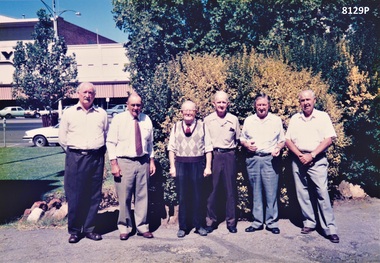
... Served on Committee 1965 to 1971, 1974 to 1975, 1977 to 1982, 1984 to 1992, President for the years 1969 to 1971, 1974 to 1975, 1980 to 1982, Delegate to the 27 District Board of the RSL, Honorary Organiser of the Bendigo RSL Diggers Day Bowls for 4 years, made a Life Member 1974. ...Served on Committee 1965 to 1971, 1974 to 1975, 1977 to 1982, 1984 to 1992, President for the years 1969 to 1971, 1974 to 1975, 1980 to 1982, Delegate to the 27 District Board of the RSL, Honorary Organiser of the Bendigo RSL Diggers Day Bowls for 4 years, made a Life Member 1974. ...Members of the Bendigo RSL Sub Branch 1988. From left to right. John Edward Widdison - Fay (Jack) Served on Committee 1958 to 1960, 1963 to 1996, 1998 too 2000, Treasurer for the year 1963. Museum Sub Committee member 1997 to 2015/16 and Museum guide, conducted RSL funerals for many years, served on the Servicemen’s Co - Operative Society for many years until 2000, involved in fund raising, made Life Member in 2015. He was also heavily involved n the RAAF Association with terms as President and Secretary. Culmer John Plant (Jack). Served on Committee 1965 to 1971, 1974 to 1975, 1977 to 1982, 1984 to 1992, President for the years 1969 to 1971, 1974 to 1975, 1980 to 1982, Delegate to the 27 District Board of the RSL, Honorary Organiser of the Bendigo RSL Diggers Day Bowls for 4 years, made a Life Member 1974. Ronald Barton. Served on Committee 1983 to 1992. Refer Cat No 8130P. William James Norman Smart (Norm). Refer Cat No 8131.2P John Kerr Barnes (Jack). Refer Cat No 8040 Henry Maxwell Frances O’Haloran (Max), Served on Committee for the years 1961, 1963, 1971, 1982 to 1992, President for the years 1961, 1963, 1983 to 1992, served as RSL Country Vice President, made Life Member 1990, Served as President of the Bendigo District Servicemen’s Club 1981 to 1992, awarded an MBE in 1982 for his Community involvement. Photograph colour showing 6 members of the Bendigo RSL standing out the front of the Soldiers Memorial Institute Pall Mall Bendigo, gardens behind and in the background is the Myers Building.Stamped on the back, “17 MAR 1988”smirsl, brsl -
 Puffing Billy Railway
Sign - Advertising - Griffiths Tea Sign - 30 Miles, between 1879 - 1930's
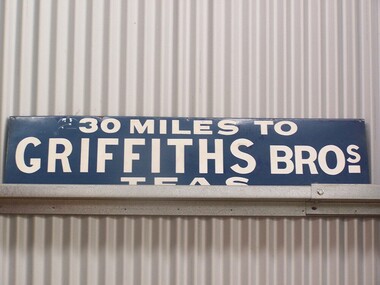
... Photographs have been published of a sign erected by a Digger in France during the First World War with the words “1100 miles to Griffiths Bros”. ...Photographs have been published of a sign erected by a Digger in France during the First World War with the words “1100 miles to Griffiths Bros”. ...In 1879, James Griffiths established one of Australia’s first tea and coffee distribution companies at 30 Flinders St, Melbourne, which is now, occupied by the boutique Lindrum Hotel. Established with his brother John, recent immigrants from England, Griffiths occupied the highest position in the commercial world during their many years as distributors of tea, coffee, cocoa and other products throughout Victoria and Australia. The Griffiths brand was a guarantee for quality of product and service as it still is today. This extensive service was provided to customers via horse drawn carts serviced by rail from Melbourne. As a spirited entrepreneur, Griffiths made his company a household name through his pioneering use of outdoor advertising by installing the infamous blue and white enamel “Griffiths Tea” promotional signs affixed to the railway boundary fences highlighting to travellers the distance to or from Melbourne, indicating so many “— miles to Griffiths Tea”. These signs, much sought after today, were well known through out the eastern states. Photographs have been published of a sign erected by a Digger in France during the First World War with the words “1100 miles to Griffiths Bros”. Tragically, James and his wife Emily with friends died in a level rail crossing accident at Bayswater in 1925. Despite this unfortunate accident, Griffiths and its culture of innovation has survived as one of the few 100% Australian owned coffee roasters, with only three owners in 128 years. http://www.griffithscoffee.com.au/about-us/back-to-1879/ Sign - Advertising - Griffiths Tea Sign - 30 MilesHistoric - Sign - Advertising - Griffiths Tea Sign - used along side of Victorian Railway lines and at StationsSign - Advertising - Griffiths Tea Sign - 30 Miles Griffiths Tea sign made of Enamel paint on metal sign30 Miles to Griffiths Tea Sign puffing billy, sign - advertising - griffiths tea sign - 30 miles -
 Robin Boyd Foundation
Document - Manuscript, Robin Boyd, Looking at Australia’s Future, c. 1967
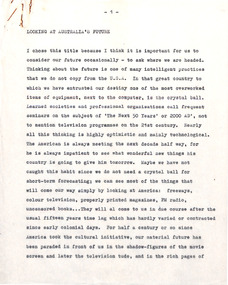
... ... Diggers...Discusses tourism, the Australian accent, imagining 2000AD, Archigram's Plug-In City, anti-city, integrate bush into the city - the gumtree aesthetic. future America Henry Ford automobiles road development destruction of old buildings destruction of nature tourism Great Barrier Reef Australian accent globalisation isolationism Canada New Zealand Archigram Athens Los Angeles suburbia Heidelberg School Diggers Robin Boyd manuscript Incomplete one contains pencil edits Typewritten (c copy), quarto, 29 pages. ...Discusses American technological advancement and American tendency to look forward; Australia is 15 years behind and should be more forward looking; Australian private affluence and public poverty, motor cars, expressways and roads. America is described as looking to a future beyond cars; Boyd proposes that Australia skips expressway building. Discusses tourism, the Australian accent, imagining 2000AD, Archigram's Plug-In City, anti-city, integrate bush into the city - the gumtree aesthetic.Typewritten (c copy), quarto, 29 pages. (Two copies plus one incomplete version with 13p)Incomplete one contains pencil editsfuture, america, henry ford, automobiles, road development, destruction of old buildings, destruction of nature, tourism, great barrier reef, australian accent, globalisation, isolationism, canada, new zealand, archigram, athens, los angeles, suburbia, heidelberg school, diggers, robin boyd, manuscript -
 Bendigo Historical Society Inc.
Booklet - The Goldfields Landscape, David Bannear, 2001
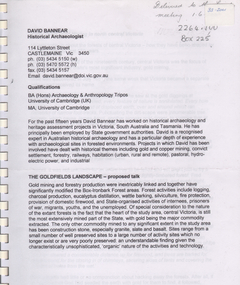
... Subjects covered in the presentation include: Early 1850's Gold Mining in north central Victoria Botanising diggers Quartz mining Deep lead mining, The state of the forests at the end of the nineteenth century State of the Central Victoria forests Settlement Charcoal production Wattle bark industry The railways Eucalyptus production State nurseries and plantations Thinning of forests Royalty system Creswick School of Forestry and Forestry Commission 1919: Pines and unemployed schemes 1931 - 1940: The Great Depression 1939: Black Friday 1939-45: Alien or interment forestry camps 1939- 45: Second World War charcoal production 1944-45 Prisoner of War Camps 1949-51: Migrant or refugee camps ...Early 1850's Gold Mining in north central Victoria Botanising diggers Quartz mining Deep lead mining The state of the forests at the end of the nineteenth century State of the Central Victoria forests Settlement Charcoal production Wattle bark industry The railways Eucalyptus production State nurseries and plantations Thinning of forests Royalty system Creswick School of Forestry and Forestry Commission 1919: Pines and unemployed schemes 1931 - 1940: The Great Depression 1939: Black Friday 1939-45: Alien or interment forestry camps 1939- 45: Second World War charcoal production 1944-45 Prisoner of War Camps 1949-51: Migrant or refugee camps David Bannear Eleven page typed booklet with clear plastic cover and white plastic ring binding. ...Eleven page typed booklet with clear plastic cover and white plastic ring binding. Booklet contains a presentation delivered to the Bendigo Historical Society on 1st June 2001, by David Bannear, BA, MA (University of Cambridge) Historical Archaeologist. Subjects covered in the presentation include: Early 1850's Gold Mining in north central Victoria Botanising diggers Quartz mining Deep lead mining, The state of the forests at the end of the nineteenth century State of the Central Victoria forests Settlement Charcoal production Wattle bark industry The railways Eucalyptus production State nurseries and plantations Thinning of forests Royalty system Creswick School of Forestry and Forestry Commission 1919: Pines and unemployed schemes 1931 - 1940: The Great Depression 1939: Black Friday 1939-45: Alien or interment forestry camps 1939- 45: Second World War charcoal production 1944-45 Prisoner of War Camps 1949-51: Migrant or refugee camps early 1850's gold mining in north central victoria, botanising diggers, quartz mining, deep lead mining, the state of the forests at the end of the nineteenth century, state of the central victoria forests, settlement, charcoal production, wattle bark industry, the railways, eucalyptus production, state nurseries and plantations, thinning of forests, royalty system, creswick school of forestry and forestry commission, 1919: pines and unemployed schemes, 1931 - 1940: the great depression, 1939: black friday, 1939-45: alien or interment forestry camps, 1939- 45: second world war charcoal production, 1944-45 prisoner of war camps, 1949-51: migrant or refugee camps, david bannear -
 Bendigo Military Museum
Photograph - THE GRINTON COLLECTION, FRAMED, 2008 - 2009
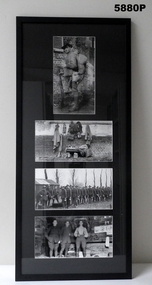
... It is believed he took this photo to show what a fully kitted out digger looked like. 2. Full kit lid out, right down to a tooth brush. ...It is believed he took this photo to show what a fully kitted out digger looked like. 2. Full kit lid out, right down to a tooth brush. ...This Cat No 5880P and the following ten Cat No's to 5890P were part of the original GRINTON PHOTOGRAPHS exhibition in 2008. Each frame follows a story from the 'War to Home' at Tragowel near Kerang, Victoria. The Grinton Collection was a large negative collection found in a tin at Myers Flat and developed from there. Frame 1. 1. Jack Grinton in full marching order. This appears to have been taken after Jack came back from being wounded the 2nd time on 31/9/1918 in the push into the Hindenburgh Line. He was away 3 months with his wounds and rejoined his unit at Visme-au-Val on 11/1/1919, a small village near Abbeville, France. he is wearing his two "Empire Wounded Stripes" on his arm. It is believed he took this photo to show what a fully kitted out digger looked like. 2. Full kit lid out, right down to a tooth brush. It is also believed this was taken to go with the above photo. Note the protective cover on the rifle trigger and magazine area. 3. Mess parade line up. From notes of Jack this could be at "Gamaches", France where the last group of 111 men of the 38th Batt in the 45th quota left to come home. They went from Gamaches to Havre then to England. 4. In "Billets" behind the lines. Note the straw on the floor. When a unit came out of the line they were billeted in farm houses, barns, sheds, homes and at times anything that would give the men shelter from the elements. Refer Cat No. 1280 for Jack GRINTONS Service Records. Photographs - black and white on paper. Four photographs top to bottom, Soldier in uniform, Full kit laid out, Mess parade line up, Billets behind lines. Frame - timber, black colour paint with glass. Mount - black cardboard. Backing cardboard with handwritten notation.On backing cardboard - handwritten in black felt tip pen "1."framed photographs, grinton collection, ww1, 38th -
 Bendigo Historical Society Inc.
Slide - DIGGERS & MINING. STORES AT THE DIGGINGS, c1850s
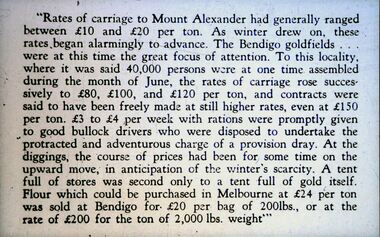
... Diggers & Mining. Stores at the diggings. ''Rates of carriage to Mount Alexander had generally ranged between £10 and 20 per ton. ...Used as a teaching aid. Slide DIGGERS & MINING. STORES AT THE DIGGINGS ...Diggers & Mining. Stores at the diggings. ''Rates of carriage to Mount Alexander had generally ranged between £10 and 20 per ton. As winter drew on, these rates, began alarmingly to advance. The Bendigo goldfields . . . Were at this time the great focus of attention. To this locality, where it was said 40,000 persons were at one time assembled during the month of June, the rates of carriage rose successively to £80, £100, and £120 per ton, and contracts were said to have been freely made at still higher rates, even at £150 per ton. £3 to £4 per week with rations were promptly given to good bullock drivers who were disposed to undertake the protracted and adventurous charge of a provision dray. At the diggings, the course of prices had been for some time on the upward move, in anticipation of the winter's scarcity. A tent full of stores was second only to a tent full of gold itself. Flour which could be purchased in Melbourne at £24 per ton was sold at Bendigo for £20 per bag of 200lbs., or at the rate of £200 for the ton of 2,000lbs., weight'' Markings: 40 994.LIF. 5. Used as a teaching aid.hanimount -
 Lara RSL Sub Branch
Postcards Booklet, Souvenir Letter Card of Weymouth
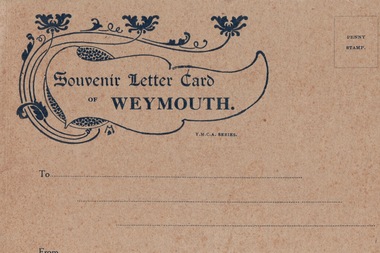
... Weymouth then became the Australian Imperial Forces (AIF) Command Depot No.2 which accommodated those men not expected to be fit for duty within six months, therefore, most of the Diggers repatriated as a result of wounds or sickness passed through Weymouth. ...Weymouth then became the Australian Imperial Forces (AIF) Command Depot No.2 which accommodated those men not expected to be fit for duty within six months, therefore, most of the Diggers repatriated as a result of wounds or sickness passed through Weymouth. ...Following the landing of Australian & New Zealand troops, the Anzacs, at Gallipoli on 25th April 1915, casualties mounted rapidly and were initially transported to their base in Egypt, which was soon unable to cope, with wounded being sent to England. Here the troops found that there was no Australian base to which they could report once they had been discharged from hospital; what was needed urgently was a base in England where troops could be sent to convalesce. So on 31st May 1915 a command depot was set up at Monte Video House in Chickerell, some two miles from Weymouth. Weymouth then became the Australian Imperial Forces (AIF) Command Depot No.2 which accommodated those men not expected to be fit for duty within six months, therefore, most of the Diggers repatriated as a result of wounds or sickness passed through Weymouth. During the years 1915-1919 over 120,000 Australian and New Zealand troops passed through Weymouth. In Spring & Summer, Weymouth Esplanade would be full of Anzac soldiers in wheelchairs, being wheeled along by their more able mates. The first contingent of 200 wounded men arrived in the first week of June 1915, and two weeks later a group of local ladies organised a cream tea for the newcomers, followed by a concert party 'The Frolics' at the camp. So began the close connection that was to grow between the soldiers and the villagers of Chickerell. The ANZAC Memorial on Weymouth seafront commemorates the Australian and New Zealand troops who were accommodated in three camps in the town during WW1: Monte Video, Westham and Littlemoor. In Weymouth and Melcombe Regis Cemetery there are about eighty-six graves of those Anzacs who were never to return to their homelands. Also in memory of these troops, there a number of roads close to the camps named after Australian cities and states.A World War 1 Letter Card sent home by Australian troops repatriated in Weymouth, UK containing images of Weymouth and a picture of the Australian Base Camp.Front cover (see image) Souvenir Letter Card of Weymouth Inside are eight pictures of the Weymouth area including the YMCA Hut - Australian Base Campymca, uk, australian base camp, world war 1, ww1, aif, army, australian army, westham, littemoor, weymouth, melcombe regis cemetery, anzac -
 Bendigo Historical Society Inc.
Photograph - The Ruschmeyers - Publicans of the Town and Country Hotel, Diamond Hill Bendigo
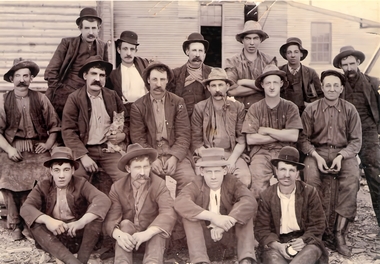
... He became one of many thousands of German diggers on the Central Victorian Goldfields. ...He became one of many thousands of German diggers on the Central Victorian Goldfields. ...John Christopher Ruschmeyer arrived in Melbourne aged 26 aboard the 'Essex' from Hanover, Germany via London in 1864. Shortly after his arrival in Australia he travelled to the Bendigo diggings. He became one of many thousands of German diggers on the Central Victorian Goldfields. He married Elizabeth Little Shepherd (Morrison) in 1874, a widow who had travelled down from Brisbane after the death of her first husband (John Shepherd). He became a naturalized citizen in 1893. Shortly after his marriage and having mined Golden Gully for some years he turned to hotel keeping and was the licensee of the Town and Country Hotel in Woodward Road, Golden Gully up until his death in 1911. The family of 4 daughters and 3 sons survived him. The family of Ernest, Maude, Christopher, Ethel and Edith (twins), Charles and Dolly Ruschmeyer all lived in the Bendigo area. His sons continued working in the mining tradition. He is buried with his wife in the Bendigo Cemetery. After his death Elizabeth moved to Thistle St until her death in 1922. Christopher Ruschmeyer and his family lived in a small house (now part of a poultry farm) in Woodwood road opposite the TOWN AND COUNTRY HOTEL. A brother Ernest Walter Ruschmeyer lived in a house next to the hotel. Ernest built the house. After Ernest's death in 1927 another brother Charles Hex Ruschmeyer married Ernest's wife Gertrude. The hotel was first licensed in 1898 and closed in 1916. John Ruschmeyer was the licensee until his death in 1911. Elizabeth took over the license until 1912 when it was sold to a Catherine E Hoffaer. This information is provided by Neil Graham of Strathfieldsaye whose Grandfather on his Mother's side was John Ruschmeyer and John Christopher Ruschmeyer was his Great Grandfather.Digital image: image shows Town and Country Hotel, Diamond Hill. Ruschmeyer's were the publicans. Standing outside hotel, were from left, Ethel, Dolly, Maude, Edith, Elizabeth.person, family, ruschmeyer, john christopher ruschmeyer, town and country hotel, ruschmeyer, diamond hill bendigo -
 Melton City Libraries
Archive, Fire Brigade invitations, 1972, 1973, 1975, 1979, 1981
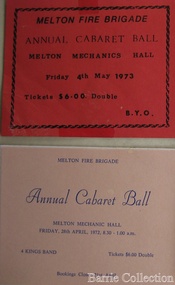
... Yours sincerely A.J.Morris Group Secretary Copied June 2013 Note MOUNT COTTRELL FIRE BRIDAGES’ GROUP Incorporating the Brigades of Diggers Rest, Melton Rural, Melton Urban Rockbank, Sydenham, Toolern Vale, Truganina, Werribee Rural, Werribee Urban....Yours sincerely A.J.Morris Group Secretary Copied June 2013 Note MOUNT COTTRELL FIRE BRIDAGES’ GROUP Incorporating the Brigades of Diggers Rest, Melton Rural, Melton Urban Rockbank, Sydenham, Toolern Vale, Truganina, Werribee Rural, Werribee Urban. ...Gratitude for contribution letters Dear Bon and Edna, The members of the Mount Cottrell Group wish to extend to you both their sincere gratitude for the dedicated service you have both provided to the Group Brigades whilst you operated the radio and phone from your home. It is thanks to people such as yourselves who, with foresight, pioneered the Group system and the communications that went with it, that has made the Country Fire Authority what it is today. Words can never express the sacrifices we know you have both made over the years to keep the radio and phone manned. We did try to leave your remote but the Authority would only allow one to Wayne’s residence. Once again many, many thanks to you Bon and Edna for your contribution to the Group, but know we can still look forward to your support in the future, Bon is still a deputy communications officer. Incidently our next meeting is on Wednesday 17th December at the Melton Fire Station, you are both most welcome to attend, our guest that evening will be Ken Coghill M. L. A. Yours Sincerely Darryl Wells Typed letter dated 17th September 1976, Group Secretary Melton South Dear Mrs. Barrie, The members of the Group wish to extend to you their sincere appreciation for the magnificent job carried out by you in the diligent task of radio operations. It gives confidence and morale to all firemen to know that an any time the pressure’s on, and effective back-up force is readily available via Group Base, and your role in this respect is acknowledged with the highest the highest esteem. Yours sincerely A.J.Morris Group Secretary Copied June 2013 Note MOUNT COTTRELL FIRE BRIDAGES’ GROUP Incorporating the Brigades of Diggers Rest, Melton Rural, Melton Urban Rockbank, Sydenham, Toolern Vale, Truganina, Werribee Rural, Werribee Urban.Edna and Bon Barrie's collection of invitations to fire brigade's eventsemergency services, local identities -
 Melton City Libraries
Photograph, Tom Barrie, Unknown
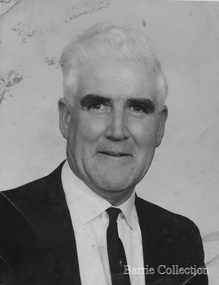
... Cart and Mounts Creamy, Digger, Popsy ...Cart and Mounts Creamy, Digger, Popsy Local Identities Black and white photographs of Tom Barrie Tom Barrie Photograph Barrie Collection ...Son of Jessie and Charles Ernest Barrie of Darlingsford Melton Married Marion Ferris at Christ Church Melton on 11th May 1939. They lived on the family farm at Ferris Road Melton. They had one son, Ian who has continued in farming in Melton. He served the community in the following – Shire of Melton Councillor Member for 32 years 1941 – 1970 Elected as Councillor for Melton South 1970 – 1973 Councillor for Rockbank 1943 – 1944 Shire President for three terms 1958 – 1959 ditto 1964 – 1965 ditto Council Representative: Bacchus Marsh High School and Western Suburbs Municipalities. Representative on delegation to prevent Melton post primary students being sent to Deer Park prior to the establishment of Melton High School. Melton Bush Fire Brigade 1941 Member Melton Bush Fire Brigade Registered No. 425 1942 1942 2nd Lieutenant 1943 – 1944 4th Lieutenant Country Fire Authority Rural Services Award 1963 20 Years Long Service Badge Scots Presbyterian Church Melton Member of the Board of Management 1947 – 1969 information from Annual Reports Tom farmed the family property with his father and brothers, and later the Ferris Road property which continued with his son Ian. His childhood interest in horses began with the draft horses kept at the bluestone stable and barn at Darlingsford. When the stables were empty in the late 1980s visit, he vividly recalled the names of the horses he had handled in his youth. When the draft horse became obsolete with the introduction of tractors and trucks this interest continued with the breeding and training of harness racers. Darlingsford Drafts and Ponies. Order of Stalls Clydesdales – Dick, Dolly, Flower, Nugget, Blossom, Lofty, Prince. Roger, Rose, Violet, Don, Beauty, Baldy, Diamond. Cart and Mounts Creamy, Digger, Popsy Black and white photographs of Tom Barrielocal identities -
 Australian Army Museum of Western Australia
Poem
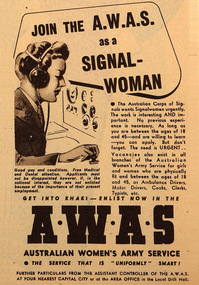
... We wish you luck, and God-speed you on your way, And wherever war may scatter us, we’ll look forward to the day, When the final battle’s over and you’ve sent your last G.B., And the DIGGERS and the A.W.A.S. march in the parade of VICTORY. ...We wish you luck, and God-speed you on your way, And wherever war may scatter us, we’ll look forward to the day, When the final battle’s over and you’ve sent your last G.B., And the DIGGERS and the A.W.A.S. march in the parade of VICTORY. ...SIGNALWOMEN An appreciation by an instructor (Sgt J.F. Larkins). Presented to Signalwoman Ruth Franklin after training in Melbourne 1942. After training, Ruth served on Rottnest Island as a communicator in the Plotting Room, Oliver Hill “Join the Corps of Signals”, the clarion call went forth, “Volunteer for the A.W.A.S. and let another man go north.” So you came into the Signals, in Australia’s hour of need, And let a thousand men go up the line, to meet the yellow breed. Where the lazy Yarra flows, through the green Victorian glade, They formed a school of Signals, to teach you in our trade, And the Old Ones, they were cynical, their tones were full of Jeers, “Women in the Signals! What rot!” But their moans have turned to cheers. You were tossed into the melting pot, that is an Australian Army camp. There weren’t many comforts, there were no electric lamps, There weren’t many blankets, it was cold in those tin huts, But the A.W.A.S. came up smiling; you had good Australian GUTS. The hours were long and wearisome, you were given lots of work, But we didn’t find a loafer, we knew not one to shirk. We made the pace a hard one, sometimes there were tears, But you lasses learned as much in months, as we men absorbed in years. You’re in the ARMY now; you all wear the Rising Sun, Sometimes you’ll be unhappy, but stick till the job is done. Time there will be, when the nerves are frayed, and all you do is bungle, Just feel the badge on your tunic, and remember your mates in the jungle. We wish you luck, and God-speed you on your way, And wherever war may scatter us, we’ll look forward to the day, When the final battle’s over and you’ve sent your last G.B., And the DIGGERS and the A.W.A.S. march in the parade of VICTORY. GB (Golf Bravo) is the sign off God Bless [G] DAH DAH DIT [B] DAH DI DI DIT Transcription of poem by Signals instructor Sgt JF Larkins presented to Signal Woman Ruth Franklin during Training in 1943. Read during 75th anniversary commemoration of proofing of Oliver Hill Battery, Rottnest Island. Computer printed on A4 bond paper. -
 Unions Ballarat
Ballarat Trades Hall Eureka Flag, 1942
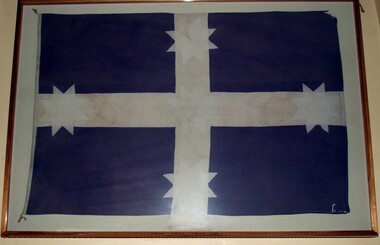
... The Trades Hall gratefully acknowledges the assistance of Dean Mighell, then Victorian State Secretary of the CEPU/ETU - who was a passionate supporter of the diggers' stand at Eureka - and instrumental in making funds available to assist in Trades Hall's Eureka flag being mounted in the Main Hall of the Ballarat Trades Hall. ...The Trades Hall gratefully acknowledges the assistance of Dean Mighell, then Victorian State Secretary of the CEPU/ETU - who was a passionate supporter of the diggers' stand at Eureka - and instrumental in making funds available to assist in Trades Hall's Eureka flag being mounted in the Main Hall of the Ballarat Trades Hall. ...This flag originally flew from the flagstaff on the Trades Hall Building in Camp Street Ballarat on December 3rd 1942. The flag prompted many enquiries to the Ballarat's Courier newspaper. The Courier in reporting that the flag was, in fact, a replica of the original Eureka Stockade flag went on to say that: "… it (seemed) very strange that the town in which Eureka made a name for Australia and its efforts to get freedom from control for the ordinary man, did not recognise the flag that flew while the first move for freedom was fought out against big odds." The Trades Hall Eureka flag, made of cotton material, was used in union marches during the 1940s. In later years it had been all but forgotten, until in 1981 it was brought to the office of the then MHR for Ballarat, John Mildren by members of the family that the flag maker had boarded with in Ballarat. David Miller, who had a keen interest in the Eureka story and was electorate officer for John Mildren, became custodian of the flag for many years and presented it to Ballarat Trades Hall for display. In 1994 The Ballarat Trades Hall Eureka flag travelled Australia as part of a touring Eureka collection. At that time, the Secretary of the Ballarat Regional Trades and Labour Council, Graeme Shearer said “…The Eureka flag then, as it does now, symbolises the struggle for basic rights and democracy”. On Wednesday 11th July 2001, following a ceremony to mark the refurbishment of the Galloway Monument, the Ballarat Trades Hall Eureka flag was unveiled at a function in the Ballarat Trades Hall by President of the Ballarat Trades & Labour Council, Rhonda Young, and Premier of Victoria, Steve Bracks. The Trades Hall gratefully acknowledges the assistance of Dean Mighell, then Victorian State Secretary of the CEPU/ETU - who was a passionate supporter of the diggers' stand at Eureka - and instrumental in making funds available to assist in Trades Hall's Eureka flag being mounted in the Main Hall of the Ballarat Trades Hall. As far as we know, this is the second oldest Eureka flag in the world. Union (especially Ballarat Trades and Labour Council) history and Eureka Stockade - Ballarat.Flag; blue background; white embellishments - cross and stars; framed.btlc, ballarat trades hall, ballarat trades and labour council, mildren, john, miller, david, southern cross flag - btlc, eureka rebellion, trade unions - history, gold mining - ballarat, gold miners, eureka flag - btlc -
 Lara RSL Sub Branch
Wallet, Y.M.C.A. Wallet Mr Sid Ellis carried by hm during WW1
... From Commander in the field. .25 Memo "the Diggers" by Capt. William Denny - an order form for copies of the book....To the Officers & men of Australian Imperial Force dated 14th November 1918, .25 A paper pamphlet "The Diggers" by Capt. William Denny...From Commander in the field. .25 Memo "the Diggers" by Capt. William Denny - an order form for copies of the book. ...WW1. Y.M.C.A. London, French scenesWW1 Wallet . YMCA LondonYMCA Wallet containing personal papers and letters - Sid Ellis- -472.01 Black leather Wallet - Y.M.C.A. Australian Logo on front. On the rear of the wallet is a Motto "Talk Clean, Live Clean, Fight Clean. Play the Game." .02 Paper slip containing details of acquaintances service numbers name and regiment details. .03 Paper Sovenior of France - written in French. .04 Paper folded to contain 10 photographic shots of French scenes countryside, sailing cutters. .05 Receipt from Returned Sailors & Soldiers Imperial League of Australia(Victoria). Issued to S. W. Ellis Brunswick Sub-branch dated 31/12/1936 Badge Number 48697. .06 Envelope Service of Campaign - printed on the front the envelope is written in Portuguese. "Servicio De Campanha" .07 Small brown paper representation of a boomerang with Cooee in gold lettering embossed on the front. .08 Small white business card for "Cafe - Debit" written in French "Albert Succr" Le Havre. .09 Cut-out from a magazine "View of the Seven Bridges" .10 Cut-out From a magazine "The New Louvre. .11 Cut-out from a magazine "Vendome Place" .12 Cut-out from a magazine "The Madeleine" .13 Cut-out from a magazine "The Arch De Triomphe - it is 150 feet high and cost 362,000 Pounds" .14 Cut-out from a magazine "The Grand Opera House - its cost was about 1,190,500 pounds and it seats over 2,000 people" .15 Cut-out from a magazine "The Cathedral of Notre Dame - A splendid example of the gothic architecture of the 13th century. .16 Cut-out from a magazine "The Trocadero Place erected from the Universal Exhibition of 1878 . with a Hall Capable of holding 5,000 people. .17 Envelope sent to Private S.W. Ellis from Lara took a well-traveled route to reach him. .18 Postcard of Park & Bandstand, Melton, Mowbray to Pte S.W Ellis. .19 Y.M.C.A. Newspaper "The Rising Sun" Vol 1, No. 14 Dated 28/1/1919 London, England. .20 Small note from Y.M.C.A. with pencil note on the rear "423 Pte. Schofield E.J." .21 Small Calander for 1918 from Y.M.C.A. London. .22 Cut out from a newspaper of a Funeral notice of Mrs. Thompson. .23 Paper note a pencil written recipe for an ointment measured amounts of the ingredients. .24 Two copies of Australian Imperial Force, Message to the "Officers, Non-Commissioned Officers, and Men of the Australian Imperial Force." From Commander in the field. .25 Memo "the Diggers" by Capt. William Denny - an order form for copies of the book.472.01 Black leather with Y.M.C.A. Australian Armed Forces Logo embossed on the front and on the Back a motto "Talk Clean, Live Clean, Fight Clean, Play The Game." .02 White pocket notebook paper. .03 Small thin cardboard white with Blue and Red chevrons on each corner. On the reverse side is a word "Souscrivez!" .04 Thin paper folder in a cascade that contains 10 small photos of French scenery. .05 Tissue paper receipt No. 31996 dated 15/01/1916 from Returned Sailors & Soldiers Imperial League of Australia (Victoria). .06 Brown Envelope with Green printing of the front. Army Form Number W 3078 (P) .07 Small Brown paper, shaped as a boomerang with a saying printed on the front "Cooee" .08 Cardboard white Business card for Cafe-Debit, Le Havre, .09 Paper cut out from a magazine with a view of the Seven Bridges. The reverse is printed with magazine writings. .10 Paper cut out from a magazine with a view of the New Louvre. The reverse is printed with magazine writings. .11 Paper cut out from a magazine with a view of Vendome Place. The reverse is printed with magazine writings. .12 Paper cut out from a magazine with a view of The Madeleine. The reverse is printed with magazine writings. .13 Paper cut out from a magazine with a view of The Arc De Triomphe. The reverse is printed with magazine writings. .14 Paper cut out from a magazine with a view of The Grand Opera House. The reverse is printed with magazine writings. .15 Paper cut out from a magazine with a view of The Cathedral Of Notre Dame. The reverse is printed with magazine writings. .16 Paper cut out from a magazine with a view of The Trocadero Palace. The reverse is printed with magazine writings. .17 Paper envelope Addressed to Pte. S. W. Ellis No. 640 sent from Lara and redirected to the recipient by Army Base Post Office. .18 Cardboard Postcard with a photographic picture of The Park & Bandstand, Melton Mowbray. Addressed to Pte. S. W. Ellis No. 640. .19 Y.M.C.A. Newspaper "The Rising Sun" Vol. 1 No. 14. .20 Thin paper from Y.M.C.A. addressed to 423 Pte. Schofield E.J. .21 Cardboard folded in two, a calendar for 1918, and small Map of Aldwych, reverse side is Y.M.C.A. in London details. Printed in red and black. .22 Cut out from a newspaper of a Funeral notice of Mrs. Thompson. .23 Thin Brown Paper with a note in pencil containing a written recipe for an ointment measured amounts of the ingredients. .24 Two copies of paper pamphlets. To the Officers & men of Australian Imperial Force dated 14th November 1918, .25 A paper pamphlet "The Diggers" by Capt. William Denny -
Federation University Historical Collection
Magazine - Booklet, Ballarat School of Mines Students' Magazine, 1943, 1943
... Artworks Mr Ferguson - By Beryl Grinter Miss Will - By Beryl Grinter Mr Tern - By Ruth Mole Editor - By Margaret Dark Digger - By Joan Walter Kangaroos - By Margaret Dark Lake Wendouree (Fairyland) - By Marion Beckwith Trees at Lake Wendouree - By John Lannen SMB - So much better - By Max Coward Miss Grigg - By Joan Walter Margaret By Joy Martin Head Study from Life - By Ruth Mole Joan - By Margaret Dark Study from Nature - By Beryl Grinter Muriel - By Ruth Mole Carrol - By Ruth Mole Murrell - By Beryl Grinter Betty - By Ruth Mole Kath - By Ruth Mole Pat - By Margaret Dark Betty - By Joan Walter Dorothy - By Joan Walter Margaret - By Margaret Dark Jeanie - By Joan Walter Lois - By Margaret Dark Peanut - By Beryl Grinter Curly - By Ruth Mole Joan - By Patricia Allan Alison - By Ruth Mole June - By Ruth Mole Ice Cream - By Margaret Dark Wright - By Beryl Grinter Willian - By Margaret Dark Duke - By Margaret Dark Redfern - By Beryl Grinter Tilgner - By Beryl Grinter Walla - By Joan Walter Fumbrey - By Joan Walter Coad - By Margaret Dark Fletcher - By Ruth Mole Legs - By Joan Walter ...Artworks Mr Ferguson - By Beryl Grinter Miss Will - By Beryl Grinter Mr Tern - By Ruth Mole Editor - By Margaret Dark Digger - By Joan Walter Kangaroos - By Margaret Dark Lake Wendouree (Fairyland) - By Marion Beckwith Trees at Lake Wendouree - By John Lannen SMB - So much better - By Max Coward Miss Grigg - By Joan Walter Margaret By Joy Martin Head Study from Life - By Ruth Mole Joan - By Margaret Dark Study from Nature - By Beryl Grinter Muriel - By Ruth Mole Carrol - By Ruth Mole Murrell - By Beryl Grinter Betty - By Ruth Mole Kath - By Ruth Mole Pat - By Margaret Dark Betty - By Joan Walter Dorothy - By Joan Walter Margaret - By Margaret Dark Jeanie - By Joan Walter Lois - By Margaret Dark Peanut - By Beryl Grinter Curly - By Ruth Mole Joan - By Patricia Allan Alison - By Ruth Mole June - By Ruth Mole Ice Cream - By Margaret Dark Wright - By Beryl Grinter Willian - By Margaret Dark Duke - By Margaret Dark Redfern - By Beryl Grinter Tilgner - By Beryl Grinter Walla - By Joan Walter Fumbrey - By Joan Walter Coad - By Margaret Dark Fletcher - By Ruth Mole Legs - By Joan Walter Ballarat School of Mines Students' Magazine, 1943 Magazine Booklet J.A. ...List of Full Course Students' 1943, Editorial, News, Obituary, News and Notes, The Literary Society, Fumes from the Lab, Arts & Crafts Gossip, Sport, Commercial Notes, The Junior Techs Black, green and gold soft covered magazine of 62 pages including advertisements. Artworks Mr Ferguson - By Beryl Grinter Miss Will - By Beryl Grinter Mr Tern - By Ruth Mole Editor - By Margaret Dark Digger - By Joan Walter Kangaroos - By Margaret Dark Lake Wendouree (Fairyland) - By Marion Beckwith Trees at Lake Wendouree - By John Lannen SMB - So much better - By Max Coward Miss Grigg - By Joan Walter Margaret By Joy Martin Head Study from Life - By Ruth Mole Joan - By Margaret Dark Study from Nature - By Beryl Grinter Muriel - By Ruth Mole Carrol - By Ruth Mole Murrell - By Beryl Grinter Betty - By Ruth Mole Kath - By Ruth Mole Pat - By Margaret Dark Betty - By Joan Walter Dorothy - By Joan Walter Margaret - By Margaret Dark Jeanie - By Joan Walter Lois - By Margaret Dark Peanut - By Beryl Grinter Curly - By Ruth Mole Joan - By Patricia Allan Alison - By Ruth Mole June - By Ruth Mole Ice Cream - By Margaret Dark Wright - By Beryl Grinter Willian - By Margaret Dark Duke - By Margaret Dark Redfern - By Beryl Grinter Tilgner - By Beryl Grinter Walla - By Joan Walter Fumbrey - By Joan Walter Coad - By Margaret Dark Fletcher - By Ruth Mole Legs - By Joan Walter Signed on front cover by "H. Yates".ballarat school of mines, magazine, alan w. wilson, wallace whiteside, jean ballinger, john r. elliott, bill f. carroll, maxwell richards, margaret dark, maxwell lawrence, l. strick, marion beckwith, geoffrey biddington, frances duffy, ian d. mclachlan, joy martin, ian cooper, valma falla, percival d. fisher, alma reid, f. day, n. pierce, john procter, dr pound, mr mein, a. mckenzie,, ruth mole, beryl grinter, h. b. murphy, margaret c. young, w. c. watts, john brittain, winsome hender, shirley dolan, adeline helm, j. f. lannen, max coward, alan e. daff, b. scott, lloyd o. lehmann, ernest j. poppins, b. egelton, john h. prout, roy e. mawby, robert j. mckenzie, phillip p. coulson, j. lawry, james owen, john w. jolly, norman k. clark, barbara curwen-walker, beryl hawkins, betty d. willian, beryl bedford, glenis dow, betty law, norma eltringham, jean lewis, dorothy ritchie, gwenda harrison, eileen dawkins, margaret lenaghan, olga m. lawrence, miss king, mrs mcilvena, h. packham, b. refurn, s. lang, d. hart, e. adams, f. savage, p. humphrey, e. skilbeck, a. carland, b. doull, r. ingleton, f. reeve, k. gowan, b. holloway, f. smith, t. bennett, mr bergin, s. wallis, d. struthberry, k. saunders, john lannen, patricia allan, joan walter -
 Eltham District Historical Society Inc
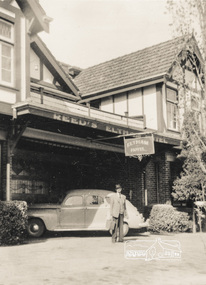
Photograph, Jim at "The Pub" Eltham; Reed's Eltham Hotel, c.1948
... The hotel was a well-known resting place for gold diggers during the gold rush at Woods’ Point and Warren would buy the gold from the diggers. ...The hotel was a well-known resting place for gold diggers during the gold rush at Woods’ Point and Warren would buy the gold from the diggers. ...Olive Elsie May Reed was licensee of the Eltham Hotel from April 1948 to January 1950. The Eltham Hotel is the oldest continually operating hotel in the Eltham district. Initially referred to as the Little Eltham Hotel, it has been known as the Eltham Hotel since the 1850s through to present time with a very brief period as the Eltham Tavern in the late 1980s. Benjamin Oliver Wallis was a prominent Eltham resident, publican and Councillor during the second half of the nineteenth century. He owned the house that is now the Nillumbik Living and Learning Centre at 739 Main Road Eltham and one stage the Eltham Hotel. Wallis migrated to Melbourne in 1853 but his wife and children remained in Cornwall for a further 10 years. Later in 1853 Richard Warren engaged Wallis to build the Eltham Hotel and it opened in 1854. The hotel was constructed of hard basaltic blue stone quarried in the Eltham district and cemented together with mud, and partly of bricks made at Eltham. The Fountain of Friendship Hotel on the opposite side of Maria Street (Main Road) opened shortly after. The hotel was a well-known resting place for gold diggers during the gold rush at Woods’ Point and Warren would buy the gold from the diggers. In 1858 Warren fell into financial difficulties and had to sell the hotel. Wallis bought the hotel and obtained a publican’s licence in 1861. In the 1850s the Fountain had been the more popular hotel but after that the Eltham Hotel became more popular. It is understood that in about 1857 Wallis probably built the “Living and Learning house” for tanner John Pearson. In 1868 Pearson became bankrupt and Wallis acquired the house and he lived there until his death in 1896. For some of this time the house was in the name of Benjamin’s son Richard but he died in 1888 and ownership reverted to his father. Wallis was a member of the Eltham Jockey Club and in 1867 his wife Anna rode her horse Charlotte in the Annual Races. Anna was also an angler and is reported to have caught a large perch in the Yarra River. She died in 1887. On 16th September 1886 Wallis sold the hotel to Christopher Watson (Snr). Watson died in 1887 and the hotel passed to his son Christopher Watson (Jr) who owned it until his death in 1909 at which time his wife Emily took over the license. Upon her death, their son Herbert applied for the license in January 1915. In July 1925, Herbert Watson demolished the original building and, in its place, erected a modern hotel which remains the foundation of the present Eltham Hotel. The contractors at the time commented on how well the original building had been constructed. A description of the new building was detailed in the Advertiser newspaper of January 8, 1926: “The new building consists of. two stories. designed in English tavern style, and contains-all told, 24 rooms. On the second floor, in front uninviting the two gables is a deep balcony, which will be much appreciated by visitors. The lower story is wholly of brick, and the upper one of wood and fibrous cement plaster. The rooms are spacious and lofty, and the windows are large and of latest style, and light the rooms splendidly. The entrance hall is 8 feet wide. The bar is a very commodious room and is furnished in the most up-to-date and convenient manner. The dining room, a very attractive apartment, is 30 feet by 15 feet 6 inches, and the bar parlor is also a large and well furnished room. A large cellar, an indispensable adjunct to an hotel, has been excavated beneath the bar. On the upper story are 12 bedrooms, and among other conveniences are two bath rooms in which hot and cold water can be used. All the rooms have been supplied with the necessary appliances for electric lighting, which will be one of the progressive evidences which Eltham will shortly enjoy.” “In the yard a brick garage to accommodate three cars at once, has been erected. This, as well as the hotel, is roofed with tiles.” “From the front of the hotel (especially the balcony) a lovely view of the country west and, north may be obtained.” “It may be added that it Is intended to have an ornamental garden, a tennis court. and a kiosk in connection with the hotel, and the property will have a rustic fence round it.” The hotel has since undergone several modifications and extensions Pages from a scrapbook belonging to Heather Jenkins (nee Cone) who lived as a child in the Police Residence at 728 Main Road, Eltham in the 1920s.Heather Jenkins was the daughter of Constable John Thomas Cone, Badge #3935 served at Eltham Police Station 1 May 1911 to 9 July 1922.Glued on a brown paper scrapbook page (torn from scrapbook) with 8 black and white/sepia photos of varying sizes, 1 newspaper clipping and one greeting card with printed sketch and handwritten captions in ink. On back of page is 1 black and white photo and a large newspaper clipping.eltham, eltham hotel, jim jenkins, reed's eltham hotel, olive elsie may reed -
 Eltham District Historical Society Inc
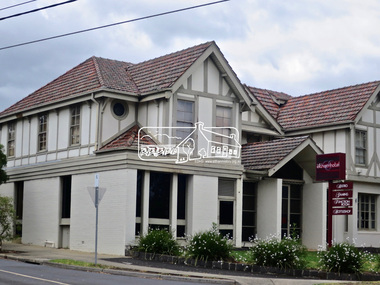
Photograph, Jim Connor, Main Road, Eltham, 14 Jan 2017
... The hotel was a well-known resting place for gold diggers during the gold rush at Woods’ Point and Warren would buy the gold from the diggers. ...The hotel was a well-known resting place for gold diggers during the gold rush at Woods’ Point and Warren would buy the gold from the diggers. ...The Eltham Hotel is the oldest continually operating hotel in the Eltham district. Initially referred to as the Little Eltham Hotel, it has been known as the Eltham Hotel since the 1850s through to present time with a very brief period as the Eltham Tavern in the late 1980s. Benjamin Oliver Wallis was a prominent Eltham resident, publican and Councillor during the second half of the nineteenth century. He owned the house that is now the Nillumbik Living and Learning Centre at 739 Main Road Eltham and one stage the Eltham Hotel. Wallis migrated to Melbourne in 1853 but his wife and children remained in Cornwall for a further 10 years. Later in 1853 Richard Warren engaged Wallis to build the Eltham Hotel and it opened in 1854. The hotel was constructed of hard basaltic blue stone quarried in the Eltham district and cemented together with mud, and partly of bricks made at Eltham. The Fountain of Friendship Hotel on the opposite side of Maria Street (Main Road) opened shortly after. The hotel was a well-known resting place for gold diggers during the gold rush at Woods’ Point and Warren would buy the gold from the diggers. In 1858 Warren fell into financial difficulties and had to sell the hotel. Wallis bought the hotel and obtained a publican’s licence in 1861. In the 1850s the Fountain had been the more popular hotel but after that the Eltham Hotel became more popular. It is understood that in about 1857 Wallis probably built the “Living and Learning house” for tanner John Pearson. In 1868 Pearson became bankrupt and Wallis acquired the house and he lived there until his death in 1896. For some of this time the house was in the name of Benjamin’s son Richard but he died in 1888 and ownership reverted to his father. Wallis was a member of the Eltham Jockey Club and in 1867 his wife Anna rode her horse Charlotte in the Annual Races. Anna was also an angler and is reported to have caught a large perch in the Yarra River. She died in 1887. On 16th September 1886 Wallis sold the hotel to Christopher Watson (Snr). Watson died in 1887 and the hotel passed to his son Christopher Watson (Jr) who owned it until his death in 1909 at which time his wife Emily took over the license. Upon her death, their son Herbert applied for the license in January 1915. In July 1925, Herbert Watson demolished the original building and, in its place, erected a modern hotel which remains the foundation of the present Eltham Hotel. The contractors at the time commented on how well the original building had been constructed. A description of the new building was detailed in the Advertiser newspaper of January 8, 1926: “The new building consists of. two stories. designed in English tavern style, and contains-all told, 24 rooms. On the second floor, in front uninviting the two gables is a deep balcony, which will be much appreciated by visitors. The lower story is wholly of brick, and the upper one of wood and fibrous cement plaster. The rooms are spacious and lofty, and the windows are large and of latest style, and light the rooms splendidly. The entrance hall is 8 feet wide. The bar is a very commodious room and is furnished in the most up-to-date and convenient manner. The dining room, a very attractive apartment, is 30 feet by 15 feet 6 inches, and the bar parlor is also a large and well furnished room. A large cellar, an indispensable adjunct to an hotel, has been excavated beneath the bar. On the upper story are 12 bedrooms, and among other conveniences are two bath rooms in which hot and cold water can be used. All the rooms have been supplied with the necessary appliances for electric lighting, which will be one of the progressive evidences which Eltham will shortly enjoy.” “In the yard a brick garage to accommodate three cars at once, has been erected. This, as well as the hotel, is roofed with tiles.” “From the front of the hotel (especially the balcony) a lovely view of the country west and, north may be obtained.” “It may be added that it Is intended to have an ornamental garden, a tennis court. and a kiosk in connection with the hotel, and the property will have a rustic fence round it.” The hotel has since undergone several modifications and extensionsTomorrow's history documented todayeltham, jim connor collection, main road, eltham gateway, eltham hotel, pitt street -
 Melton City Libraries
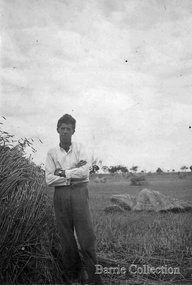
Photograph, Bon Barrie, c.1940, Unknown
... As Group Communications Officer he operated the VL3 LY base radio station from home on a 24 hour basis for fire brigades of Melton, Rockbank, Sydenham, Diggers Rest, Toolern Vale, Truganina and Werribee. ...As Group Communications Officer he operated the VL3 LY base radio station from home on a 24 hour basis for fire brigades of Melton, Rockbank, Sydenham, Diggers Rest, Toolern Vale, Truganina and Werribee. ...SUMMARY - Ernest W (Bon) Barrie, 1909 – 1985 Profile Melton Mechanics Institute Member 1935 - 1982i Trustee 1952 - 1982 Life Member 1968 Years of service – 47 years He constructed and provided a public address system which was used at Melton and district halls and sports grounds for a wide variety of community events including school sports, gymkhanas, theatrical productions and processions. Fire Brigade Melton Fire Brigade (and predecessor Bush Fire Brigade) Apparatus Officer, 1945 - 1953 Captain, 1951 - 1965 Mt Cotterill Fire Brigades’ Group Elected Group Officer, on the formation of the Group, 1967. As Group Communications Officer he operated the VL3 LY base radio station from home on a 24 hour basis for fire brigades of Melton, Rockbank, Sydenham, Diggers Rest, Toolern Vale, Truganina and Werribee. With his brother Edgar, he built the first Melton Fire Truck. It was housed on the family property until a fire station was constructed in the Melton township. Recipient of the Queens Medal, 1979 Recognised for 44 years of service on the Melton Fire Brigade Memorial Wall Plaque, dedicated May 2013 Melton State School, no 430 Committee – School Correspondent (secretarial and financial role) 34 years of Service Provided his Amplifier Equipment for events and the annual district School Sports from 1939-1973. Donated the House Athletic Shield Melton and District Historical Society 1968 – 1985 President and foundation member Willows Historical Park – supported the establishment of the park and contributed many volunteers hours in the construction and landscaping of the precinct Member, Western Metropolitan Groups of Historical Societies, 1980s Shire of Melton Councillor South Riding, 1969-1971 Member of the Water Trust Melton Uniting Church Melton Uniting Church (and its predecessors the Methodist, Methodist-Presbyterian churches). A lifetime association which extended from childhood when he attended Sunday school until his death in 1985. Member of the Presbyterian Board of Management for more than 25 years in which he held positions of Honorary Secretary and Treasurer, Board member of the Parish Council and Member of the Committee of Management. He was a Sunday school teacher 1933. Community development With Mr RC Butler met with Shire Council in 1937 to canvass residents to ascertain prospective Electric consumers in the district. Electricity was subsequently turned on at dusk on 20th December 1939. Melton Progress Association, including Melton Musical, Elocutionary and Vocal Competitions, Vice President 1939 1940 Melton Development Association, 1960s Volunteer Air Observers Corps (VAOC)ii Carried out plane spotting at Shire Office and spotting tower in Melton and later from home until 1944/45. Agriculture and farming Progress and Better Farming Association, Melton. Honorary Secretary, 1935 Member, Agricultural Engineering Society Australia c1960-1985 A successful grower of wheat, oats and barley, he planted experiment plots and held Field Days on the “Darlingsford” property. He later diversified into other grains and sheep (wool and meat). He took a enthusiastic interest in agricultural engineering and was keen to introduce innovative ideas that improved the productivity of farms and farming practices. In the mid 1950 he conducted trials during harvest on the family property of the original mechanical hay fork built on a British Bedford truck by Bill Gillespie. This design was further refined in collaboration with the Gillespie brothers and resulted in the construction the hydraulically operated tractor mounted hay fork. The innovative design of the hay fork created interest from far and wide and was quickly taken up by farmers because it significantly reduced hand labouring of loading sheaves of hay with a pitch fork. His father established chaff mills in Melton, Rockbank, Parwan, Diggers Rest in the first decade of 1900 and in 1915 went into partnership with JR Schutt to establish the Schutt & Barrie Pty. Ltd. Chaff Cutting and Flour Mill in West Footscray. When it ceased trading in 1968 the directors were: Ernest W Barrie and Thomas L Barrie, R, A, and M Schutt. Awards Queens Medal, 1979 Rotary Award for Community Service, 1980 Victoria 150th Anniversary Celebrations contributions, 1985 Photographs of Bon Barrielocal identities, pioneer families -
 Melton City Libraries
Pamphlet, Thoroughbred Country, c.1985
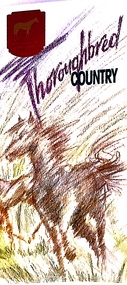
... Ken Cox purchased the Stockwell Stud in Diggers Rest in 1957 and developed it into one of the largest and most renowned thoroughbred breeders in Australia. ...Ken Cox purchased the Stockwell Stud in Diggers Rest in 1957 and developed it into one of the largest and most renowned thoroughbred breeders in Australia. ..."Melton has a long and celebrated history of horse breeding and racing. Draught horses were a crucial aspect of life in the early days of European settlement, and were heavily depended upon for both transport and agricultural labour. Peppercorn trees at the corner of Station and Brooklyn roads have been associated with a horse trough installed there to provide a drink to workhorses carting produce to the chaff mills and railway station south of Melton.20 Breeders, trainers and harness drivers in the area later became such an influential force in the equine industry that this came to be a defining aspect of the district’s identity and reputation.Pioneer of the Victorian horse racing industry and early Rockbank squatter William Cross Yuille was one of the earliest importers of stud racehorses in the district in the 1850s. A leading sports editor and writer, Yuille established bloodstock auctioning agency W. C. Yuille & Co. and was involved in the compilation of the first Australian Stud Book, which ensures the integrity of thoroughbred breeding in Australia. According to early Melton chronicler Alexander Cameron, horse races were first organised in the area by Rockbank farmer William Keating. Keating owned racehorses of his own, and many brought horses from Melbourne for the events, which ‘drew large gatherings’.22 Melton Racing Club meetings were held on the Exford Estate with the permission of H. W. Staughton, who built a small wooden grandstand in 1882. Other early races and sports meetings are said to have been held in the vicinity of the current-day Melton golf course.23 An 1884 article reported that Melton’s ‘race programme … equals any put forth by country towns of far greater size’. Ernest Clarke was another important figure in the early horse racing industry in Melton. He established the Melton Stud in 1902, which bred numerous successful racehorses. Perhaps most notably The Welkin, one of the most famous stallions in Australian horse racing in the early twentieth century. The Welkin sired Gloaming, bred by Clarke at the Melton stud in 1915 and one of Australia’s greatest champion racehorses. During a long and prestigious career in both Australia and New Zealand, Gloaming achieved a triumphant 57 wins out of 67 starts and won a record amount of prize money. Ken Cox purchased the Stockwell Stud in Diggers Rest in 1957 and developed it into one of the largest and most renowned thoroughbred breeders in Australia. With its top-class facilities, international design standards and scientific methods, Stockwell became ‘the flagship of the Victorian breeding industry’.26 As well as racing studs, numerous trotting tracks were established on the flat plains around Melton in the 1960s.27 Other studs to play a leading role in the development of Melton as thoroughbred country were Cornwall Park and Merrywood at Toolern Vale, St John’s Lane Stud at Diggers Rest and Birchwood, Teppo Park and Dreelburn in the far north-east of the shire, near Sunbury. By 1985, thoroughbred horse breeding was such big business in Melton that the shire council adopted the slogan ‘The Heart of Thoroughbred Country’, which was used throughout its promotional material.29 But the slogan contained deeper meaning and was not just about Melton’s great equine industry and thoroughbred champions, the council explained: ‘“Thoroughbred Country” should be seen as a new concept of Melton, as a place where people can achieve the “Thoroughbred” ideal, excellence in all aspects of life’. The aim of the council in promoting ‘The Heart of Thoroughbred Country’, was ‘to instil in present and future residents the feeling that this is a place that is better than others. A place to be proud of’. In 1988, Melton’s champion reinsman Gavin Lang won his 176th race of the season, claiming the national harness racing record for the most wins in a single season.The following year, the first Melton Plate was held at Moonee Valley Racecourse, cementing the district’s importance in the harness racing industry. The inaugural winner was Victorys Phil, owned by local Danny Mullan. By the 1990s, Melton had earned the title of the ‘Home of Harness Racing in Victoria’. State-of-the-art, world-class harness racing facility and entertainment complex Tabcorp Park opened in Melton in 2009. In 2011, the Shire of Melton was home to over 140 registered trainers and over 1,200 horses. The municipality’s continuing leadership and influence in the industry today is a testament to the skills, talents and leadership of the local community over its history".Shire of Melton pamphlet of a map and information of the equine industry in Meltoncouncil -
 Melton City Libraries
Document, Service of Celebration and Thanksgiving for the life of Ernest Wesley Barrie (Bon) 1909-1985, 1985
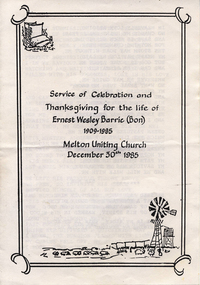
... As Group Communications Officer he operated the VL3 LY base radio station from home on a 24 hour basis for fire brigades of Melton, Rockbank, Sydenham, Diggers Rest, Toolern Vale, Truganina and Werribee. ...As Group Communications Officer he operated the VL3 LY base radio station from home on a 24 hour basis for fire brigades of Melton, Rockbank, Sydenham, Diggers Rest, Toolern Vale, Truganina and Werribee. ...SUMMARY - Ernest W (Bon) Barrie, 1909 – 1985 Profile Melton Mechanics Institute Member 1935 - 1982i Trustee 1952 - 1982 Life Member 1968 Years of service – 47 years He constructed and provided a public address system which was used at Melton and district halls and sports grounds for a wide variety of community events including school sports, gymkhanas, theatrical productions and processions. Fire Brigade Melton Fire Brigade (and predecessor Bush Fire Brigade) Apparatus Officer, 1945 - 1953 Captain, 1951 - 1965 Mt Cotterill Fire Brigades’ Group Elected Group Officer, on the formation of the Group, 1967. As Group Communications Officer he operated the VL3 LY base radio station from home on a 24 hour basis for fire brigades of Melton, Rockbank, Sydenham, Diggers Rest, Toolern Vale, Truganina and Werribee. With his brother Edgar, he built the first Melton Fire Truck. It was housed on the family property until a fire station was constructed in the Melton township. Recipient of the Queens Medal, 1979 Recognised for 44 years of service on the Melton Fire Brigade Memorial Wall Plaque, dedicated May 2013 Melton State School, no 430 Committee – School Correspondent (secretarial and financial role) 34 years of Service Provided his Amplifier Equipment for events and the annual district School Sports from 1939-1973. Donated the House Athletic Shield Melton and District Historical Society 1968 – 1985 President and foundation member Willows Historical Park – supported the establishment of the park and contributed many volunteers hours in the construction and landscaping of the precinct Member, Western Metropolitan Groups of Historical Societies, 1980s Shire of Melton Councillor South Riding, 1969-1971 Member of the Water Trust Melton Uniting Church Melton Uniting Church (and its predecessors the Methodist, Methodist-Presbyterian churches). A lifetime association which extended from childhood when he attended Sunday school until his death in 1985. Member of the Presbyterian Board of Management for more than 25 years in which he held positions of Honorary Secretary and Treasurer, Board member of the Parish Council and Member of the Committee of Management. He was a Sunday school teacher 1933. Community development With Mr RC Butler met with Shire Council in 1937 to canvass residents to ascertain prospective Electric consumers in the district. Electricity was subsequently turned on at dusk on 20th December 1939. Melton Progress Association, including Melton Musical, Elocutionary and Vocal Competitions, Vice President 1939 1940 Melton Development Association, 1960s Volunteer Air Observers Corps (VAOC)ii Carried out plane spotting at Shire Office and spotting tower in Melton and later from home until 1944/45. Agriculture and farming Progress and Better Farming Association, Melton. Honorary Secretary, 1935 Member, Agricultural Engineering Society Australia c1960-1985 A successful grower of wheat, oats and barley, he planted experiment plots and held Field Days on the “Darlingsford” property. He later diversified into other grains and sheep (wool and meat). He took a enthusiastic interest in agricultural engineering and was keen to introduce innovative ideas that improved the productivity of farms and farming practices. In the mid 1950 he conducted trials during harvest on the family property of the original mechanical hay fork built on a British Bedford truck by Bill Gillespie. This design was further refined in collaboration with the Gillespie brothers and resulted in the construction the hydraulically operated tractor mounted hay fork. The innovative design of the hay fork created interest from far and wide and was quickly taken up by farmers because it significantly reduced hand labouring of loading sheaves of hay with a pitch fork. His father established chaff mills in Melton, Rockbank, Parwan, Diggers Rest in the first decade of 1900 and in 1915 went into partnership with JR Schutt to establish the Schutt & Barrie Pty. Ltd. Chaff Cutting and Flour Mill in West Footscray. When it ceased trading in 1968 the directors were: Ernest W Barrie and Thomas L Barrie, R, A, and M Schutt. Awards Queens Medal, 1979 Rotary Award for Community Service, 1980 Victoria 150th Anniversary Celebrations contributions, 1985 Service held at Melton Uniting Church local identities -
 Melton City Libraries
Photograph, Opening of the Shire Hall, c.1964
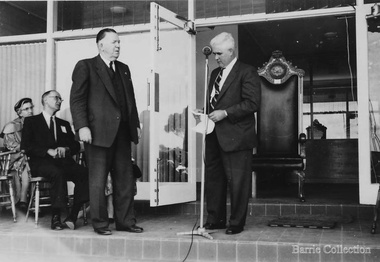
... Cart and Mounts Creamy, Digger, Popsy Compiled by Wendy Barrie 2013 ...Cart and Mounts Creamy, Digger, Popsy Compiled by Wendy Barrie 2013 Council Local Identities Councillor Tom Barrie, Shire President and a group of children at the opening of the building. ...Summary of Thomas Lindsay Barrie (1914 – 1990) A life long resident of Melton Son of Jessie and Charles Ernest Barrie of Darlingsford Melton Married Marion Ferris at Christ Church Melton on 11th May 1939. They lived on the family farm at Ferris Road Melton. They had one son, Ian who has continued in farming in Melton. He served the community in the following – Shire of Melton Councillor Member for 32 years 1941 – 1970 Elected as Councillor for Melton South 1970 – 1973 Councillor for Rockbank 1943 – 1944 Shire President for three terms 1958 – 1959 ditto 1964 – 1965 ditto Council Representative: Bacchus Marsh High School and Western Suburbs Municipalities. Representative on delegation to prevent Melton post primary students being sent to Deer Park prior to the establishment of Melton High School. Melton Bush Fire Brigade 1941 Member Melton Bush Fire Brigade Registered No. 425 1942 1942 2nd Lieutenant 1943 – 1944 4th Lieutenant Country Fire Authority Rural Services Award 1963 20 Years Long Service Badge Scots Presbyterian Church Melton Member of the Board of Management 1947 – 1969 information from Annual Reports note more research needed at Uniting Church Archives to determine the earliest and last date. Tom farmed the family property with his father and brothers, and later the Ferris Road property which continued with his son Ian. His childhood interest in horses began with the draft horses kept at the bluestone stable and barn at Darlingsford. When the stables were empty in the late 1980s visit, he vividly recalled the names of the horses he had handled in his youth. When the draft horse became obsolete with the introduction of tractors and trucks this interest continued with the breeding and training of harness racers. Darlingsford Drafts and Ponies. Order of Stalls Clydesdales – Dick, Dolly, Flower, Nugget, Blossom, Lofty, Prince. Roger, Rose, Violet, Don, Beauty, Baldy, Diamond. Cart and Mounts Creamy, Digger, Popsy Compiled by Wendy Barrie 2013 Councillor Tom Barrie, Shire President and a group of children at the opening of the building.council, local identities -
Bendigo Historical Society Inc.
Document - Fortuna - Research on the Lansell Family History, 1999
... Fortuna - Research on the Lansell Family History This item contains the following documents: 11217.56a Research on the former German town of Schmiedeberg - request for information from the Bendigo Library for Rodney Ruff 11217.56b Extracts from the "Digger - Pioneer Index, Victoria 1836-1888. ...The valuable experience he had gained and the glowing colors in which he pictured Australia Felix, had its influence on his brothers George and William, and they made up their minds to join Wootton In 1853 bendigo fortuna george lansell Schmiedeberg Cyril Vane Lansell Ballerstadt bidelia jarvis lansell Rodney Ruff Fortuna - Research on the Lansell Family History This item contains the following documents: 11217.56a Research on the former German town of Schmiedeberg - request for information from the Bendigo Library for Rodney Ruff 11217.56b Extracts from the "Digger - Pioneer Index, Victoria 1836-1888. ...From TROVE - the Bendigo Independent Newspaper 19 Mar 1906 - Page 3 George Lansell was born in the old-fashioned Kentish village of Margate, England, in 1823. He was the eldest son of Mr. Thomas Lansell, a grocer and tab-low chandler, a sensible, sound businessman, a characteristic Kent man. When14 years of age young George Lansell lefschool and assisted his father in the grocery business. He grew into manhood, and gained a thorough acquaintance with the soap and candle factory work. When he was 29 years of age his younger brother, Wootton Lansell, who was an old and respected resident of Bendigo, and who as a boy had taken to a sea-faring Life, but had left it and settled in Australia, wrote home to Margate and advised some of his brothers to follow him. The valuable experience he had gained and the glowing colors in which he pictured Australia Felix, had its influence on his brothers George and William, and they made up their minds to join Wootton In 1853Fortuna - Research on the Lansell Family History This item contains the following documents: 11217.56a Research on the former German town of Schmiedeberg - request for information from the Bendigo Library for Rodney Ruff 11217.56b Extracts from the "Digger - Pioneer Index, Victoria 1836-1888. This document is a genealogical index summarizing records for individuals with the surname Ballerstedt (and similar spellings) in Victoria, Australia, from 1836 to 1888. (e.g., "balerstt").Records Found:Only 2 matching records for the surname group. 11217.56c Sixteen handwritten detailed pages of notes on research into the Lansell Family 11217.56d Death Certificate for Cyril Vane Lansell, grazier of Corowa NSW, 39 years 1932 11217.56e Marriage Certificate of George Lansell and Bidellia Jarvis at All Saints Church in St Kilda Feb 27 1872 11217.56f Death Certificate in the South Yarra District - Possibly Bidellia Lansell, 20 Sept 1880 11217.56g Map of Cemetery with a grave hi-lighted as G. Lansell. Handwritten note on the back says it is for Bidellia Lansell, and no one else is buried there. 11217.56h Death Certificate for the Sandhurst District for Gottried Tobias Ballerstadt 1869 11217.56i Death Certificate for the Sandhurst District for Conrad Adolpheus (?), farmer and miner 11217.56j Location map of the Melbourne General Cemetery with No W 329 grave hi-lighted in the Church of England section. Belongs to Bedelia Lansellnon-fictionbendigo, fortuna, george lansell, schmiedeberg, cyril vane lansell, ballerstadt, bidelia jarvis lansell, rodney ruff -
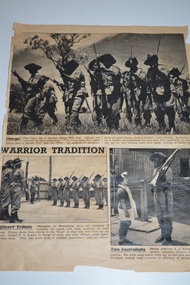 Wangaratta RSL Sub Branch
Newspaper - Newspaper Articles, 1940
... - image of members of the aboriginal group carrying out a baton charge Article Two - Officer's Tribute - image of aborigines at Wangaratta carry out ceremony of changing of the guard Article Three - Two Australians - image of Shirley Anderson, 8, of Wangaratta frequently entertains Diggers, singing and dancing. She visits camp nearly every day to chat with guard on duty. ...- image of members of the aboriginal group carrying out a baton charge Article Two - Officer's Tribute - image of aborigines at Wangaratta carry out ceremony of changing of the guard Article Three - Two Australians - image of Shirley Anderson, 8, of Wangaratta frequently entertains Diggers, singing and dancing. She visits camp nearly every day to chat with guard on duty. ...Article One - Charge! - image of members of the aboriginal group carrying out a baton charge Article Two - Officer's Tribute - image of aborigines at Wangaratta carry out ceremony of changing of the guard Article Three - Two Australians - image of Shirley Anderson, 8, of Wangaratta frequently entertains Diggers, singing and dancing. She visits camp nearly every day to chat with guard on duty. Aboriginal soldiers formed a special all volunteer platoon at No 9 Camp Wangaratta in Victoria from late 1940 until February 1941. No 9 Camp was set up at the Wangaratta Showgrounds to allow the formation of the 2/24th Australian Infantry Battalion prior to leaving for Egypt. Major Joseph Albert Wright a WW1 Light Horse veteran was in charge of this platoon the only Aboriginal squad in the Australian Military Forces at that time. The soldiers from Lake Tyers enlisted at Caulfield between June and July 1940 include Harold Cornelius HAYES VX 48217 DOB 2/4/1916 Enlisted 25/7/40 Discharged 22/3/1941 Edward FOSTER VX48218 DOB 25/5/1921 Enlisted 25/7/1940 Discharged 22/3/1941 Noel Ernest HOOD VX48194 DOB 3/1/1919 Enlisted 25/7/1940 Discharged 22/3/1941 Edward Leslie MULLETT VX48199 DOB 30/6/1910 Enlisted 25/7/1940 Discharged 22/3/1941 Samuel Richard RANKIN VX48201 DOB 23/7/1910 Enlisted 25/7/1940 Discharged 22/3/1941 Stewart HOOD VX47351 DOB 23/1/1903 Enlisted 18/7/1940 Discharged 22/3/1941 William GORRIE VX48208 DOB 22/11/1921 Enlisted 25/7/1940 Discharged 22/3/1941 David John MULLETT VX48195 DOB 10/6/1919 Enlisted 25/7/1940 Discharged 22/3/1941 Arthur Alexander (Tom?) MULLETT VX48198 DOB 25/11/1914 Enlisted 25/7/1940 Discharged 22/3/1941 Images relates to the "special platoon" based at No 9 Camp Wangaratta as being the Australian Army's first all Aboriginal Unit formed in 1940. The soldiers were all volunteers mainly from Lake Tyers in Victoria. In addition to normal army training they performed guard duty at the Army Hospital and Camp. They formed the Gum Leaf Band and led the troops at community singing and assisted in Methodist Church services. Three black and white newspaper articles adhered to cream paperWarrior Tradition Written in blue ink 28/12/1940no 9 camp wangaratta, aboriginal platoon -
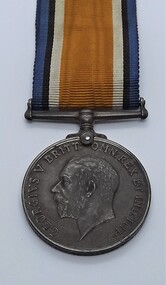 Yackandandah & District Historical Society
Medal - British War Medal, Ben Boyd's British War Medal
... There is an anecdotal recollection of Boyd sitting up on what was the bank counter making garments and watching the world pass by on High Street, and also reference to him replying to the toast for The Diggers, at a smoke social convened by the Returned Services League to honour Sir Kenneth Beatty, at Martin's Hotel, 8 September 1927. ...There is an anecdotal recollection of Boyd sitting up on what was the bank counter making garments and watching the world pass by on High Street, and also reference to him replying to the toast for The Diggers, at a smoke social convened by the Returned Services League to honour Sir Kenneth Beatty, at Martin's Hotel, 8 September 1927. ...Ben Boyd enlisted in the AIF in Melbourne, 13 December 1915, giving his age as 42 years and 11 months. At that time he gave Bathurst as parish of birth, and attested that his wife Emma, next of kin, resided in Fitzroy. He gave his occupation as 'cutter'. Boyd reported to Royal Park on 6 January 1916, attached to the 22nd Battalion 11th reinforcements. He embarked for the Middle East on 29 March, and it appears that he spent the rest of his service in Egypt, apart from some four months in Palestine from September 1917 to January 1918. During this time it appears that he was attached to the 11th Light Horse Regiment Provost Corps. There were various promotions to 'temporary Corporal' and 'Acting Sergeant'. Boyd disembarked in Australia on 25 August 1919. The first reference to Yackandandah in Boyd's war record came in his application for the British War Medal and Victory Medal, in a letter dated 10 February 1924. He received those medals on or about 3 March 1924. By that time he had been working in Yackandandah for several years, having been engaged as an 'up-tp-date cutter and tailor' by Mrs Haig in 1921. He continued working as a tailor until his passing in 1957. There is an anecdotal recollection of Boyd sitting up on what was the bank counter making garments and watching the world pass by on High Street, and also reference to him replying to the toast for The Diggers, at a smoke social convened by the Returned Services League to honour Sir Kenneth Beatty, at Martin's Hotel, 8 September 1927. The Yackandandah Museum is housed in what had been the Bank of Victoria and had become the business premises and residence of Haig Tailor. The building bore the title B. Boyd Tailor as late as the 1960's. Isabella Haig sold the building and residence to Yackandandah Historical Society in 1969. Instituted by King George V in 1919 to mark the end of World War I and record the service given, the British War Medal 1914-20, was also variously known as Squeak, or Mutt. Boyd was eligible for having entered a theatre of war during specified periods and having left places of residence and rendered approved service overseas. The medal is cupro-nickel (silver?) with the effigy of George V on the obverse. The reverse has an image of St George on horseback trampling underfoot the eagle shield of the Central Powers, and a skull and cross-bones, the emblems of death. Above this is the risen sun of victory. The years 1914 and 1918 are shown on the outside edge of the reverse surface. A ribbon is attached per a top bar. The ribbon has a wide central watered stripe of orange, flanked by two narrow white stripes, which are in turn flanked by two black pin-stripes, further flanked by two outer stripes of blue. (Refer Notes.) On the obverse, "GEORGIVS V BRITT. OMN: REX ET: IND: IMP" On the reverse "1914 1918" On the edge, stamped, "4378 A-SGT. B. BOYD. PROV. CPS. A.I.F."world war 1, great war 1914 - 1918, medals, british empire -
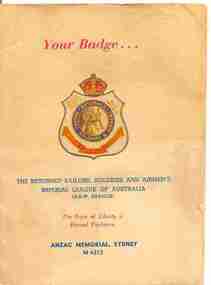 Red Cliffs Military Museum
Booklet, Eric Stephenson, Your Badge, 1945 (estimated)
... .// Page 1: A Welcome home/ From your Reception Committee/ The Old and New Diggers.// Page 2& 3: A Message from the State President.// Page 4: Policy of the RSS&AILA.// Pages 5,6,7: R.S.L. ....// Page 1: A Welcome home/ From your Reception Committee/ The Old and New Diggers.// Page 2& 3: A Message from the State President.// Page 4: Policy of the RSS&AILA.// Pages 5,6,7: R.S.L. ...A booklet of the Returned Sailors, Soldiers and Airmen's Imperial League of Australia NSW Branch. Front cover has the original RSL badge printed above the Price of Liberty is Eternal Vigilance. ANZAC Memorial Sydney M4313Front Cover: YOUR BADGE/ colour picture of original RSL Badge./ THE RETURNED SAILORS, SOLDIERS & AIRMEN'S IMPERIAL LEAGUE OF AUSTRALIA/ (NSW BRANCH)/ THE PRICE OF LIBERTY IS/ ETERNAL VIGILANCE/ ANZAC MEMORIAL SYDNEY/ M4313// Inside Cover: THE LEAGUES PLEDGE/ November 1939./ "That this Federal congress - the first to be held since the declaration of war/ publicly states that the whole body of the/ RSS&AILA is heart and sole behind/ the new Australian Expiditionary Force, and/ gladly accepts the new obligations to protect/ the interests of all who shall serve the Empire/ in the present war.// Page 1: A Welcome home/ From your Reception Committee/ The Old and New Diggers.// Page 2& 3: A Message from the State President.// Page 4: Policy of the RSS&AILA.// Pages 5,6,7: R.S.L. Policy.// Pages 8,9,10 & 11: Record of Service (outlines the services the RSL provides and the Principles on which it was established.// Pages 12, 13, 14, 15, 16 & 17: List of Sub-Branches NSW. Women's Services/ Merchant Navy// Centre Page: Nomination for Membership // Pages 18,19,20,& 21: War Pensions.// Page 22: Did you know.//Page 23: Eligiblity for Membership.// Page 24: If there were no League. // Pages 25, 26: ANZAC Centre. // Page 27: Memorandum (clear page)// Page 28 Personal memoranda (to be filled in) Conclusion.book, anzac, imperial, sailors, soldiers, league, badge, your, returned, airmen, memorial, hand -
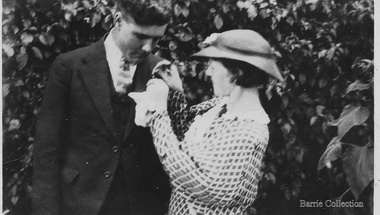 Melton City Libraries
Photograph, Tom and May Barrie, 1935
... Cart and Mounts Creamy, Digger, Popsy ...Cart and Mounts Creamy, Digger, Popsy Local Identities Couple at Francis McGregor Barrie and Linda Willaton's wedding at Sunshine Methodist Church 20th April 1935? ...Ferris Road–Ferris Lane family farm of John and Elizabeth Ferris until 1939, until daughter Marion married Thomas Linsday Barrie. Marion Elizabeth nee Ferris born 29th of August 1914 -died 5th of June 1990 SUMMARY - Thomas Lindsay Barrie 1914 – 1990 A life long resident of Melton Son of Jessie and Charles Ernest Barrie of Darlingsford Melton Married Marion Ferris at Christ Church Melton on 11th May 1939. They lived on the family farm at Ferris Road Melton. They had one son, Ian who has continued in farming in Melton. He served the community in the following – Shire of Melton Councillor Member for 32 years 1941 – 1970 Elected as Councillor for Melton South 1970 – 1973 Councillor for Rockbank 1943 – 1944 Shire President for three terms 1958 – 1959 ditto 1964 – 1965 ditto Council Representative: Bacchus Marsh High School and Western Suburbs Municipalities. Representative on delegation to prevent Melton post primary students being sent to Deer Park prior to the establishment of Melton High School. Melton Bush Fire Brigade 1941 Member Melton Bush Fire Brigade Registered No. 425 1942 1942 2nd Lieutenant 1943 – 1944 4th Lieutenant Country Fire Authority Rural Services Award 1963 20 Years Long Service Badge Scots Presbyterian Church Melton Member of the Board of Management 1947 – 1969 information from Annual Reports note more research needed at Uniting Church Archives Tom farmed the family property with his father and brothers, and later the Ferris Road property which continued with his son Ian. His childhood interest in horses began with the draft horses kept at the bluestone stable and barn at Darlingsford. When the stables were empty in the late 1980s visit, he vividly recalled the names of the horses he had handled in his youth. When the draft horse became obsolete with the introduction of tractors and trucks this interest continued with the breeding and training of harness racers. Darlingsford Drafts and Ponies. Order of Stalls Clydesdales – Dick, Dolly, Flower, Nugget, Blossom, Lofty, Prince. Roger, Rose, Violet, Don, Beauty, Baldy, Diamond. Cart and Mounts Creamy, Digger, Popsy Couple at Francis McGregor Barrie and Linda Willaton's wedding at Sunshine Methodist Church 20th April 1935?local identities
