
Showing 278 items matching "sleep"
-
 Eltham District Historical Society Inc
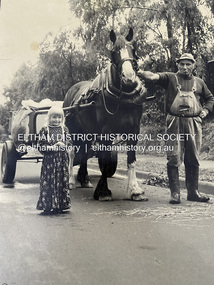
Photograph - Digital copy of photograph, Gordon Allingham, Danielle Hardiman with Eltham Shire Council garbage collector, Joe Buhagiar with his horse drawn cart, Rattray Road, Montmorency, c.1965
... Large street sweeper trucks clean the streets, often while we sleep, whereas in the past it was indeed very different. ...Large street sweeper trucks clean the streets, often while we sleep, whereas in the past it was indeed very different. ...Lots of Rubbish by Jim Connor (EDHS Newsletter No. 252, June 2020 History is often about change and we experience this all around us, even with such basic services about how our rubbish is collected and even how our streets are cleaned. Many people will remember putting out the sometimes battered steel or plastic rubbish bin to be collected by the ‘garbos’ as they rushed down the street and at times precariously hung off the back of a Council truck. They often seemed to be in a hurry as they grabbed a bin, tossed the contents into the truck and then went off on their merry way. Now, we need to decide which large coloured plastic ‘wheely’ bin to put out to be picked up by a mechanical arm extending from the truck, while the driver is ensconced in his cabin. Today they rarely handle the bins. Large street sweeper trucks clean the streets, often while we sleep, whereas in the past it was indeed very different. When Montmorency was part of the Shire of Eltham, prior to the municipal restructure in 1994, there was one Council employee who was particularly well known in the area. This was Joe Buhagier, a unique and interesting sight, who with his trusty horse walked and cleaned the local streets. Lyn and Graeme Hardiman remember him as a private person and Lyn would often talk with him each time he came along Rattray Road. One day he reluctantly agreed to have his photograph taken with their daughter Danielle, who was about 5 years old at the time, though he was a little embarrassed about all the fuss. Joe features in the Were Street footpath mosaics showing some of the well-known local Montmorency characters.council staff, danielle hardiman, eltham shire council, garbage collection, graeme hardiman collection, joe buhagiar, montmorency, horse, horse drawn vehicles, lyn dodkins, mosaics, were street, rattray road -
 Surrey Hills Historical Society Collection
Work on paper - Vertical file, Arkley family
... Postcard promoting The City Wakes, The City Sleeps Tarrawarra Museum of Art in the Yarra Valley 29 Nov 2025 – 1 March 2026. ...Postcard promoting The City Wakes, The City Sleeps Tarrawarra Museum of Art in the Yarra Valley 29 Nov 2025 – 1 March 2026. ...Howard Arkley was born 5 May 1951 in Surrey Hills. His family lived at 72 Essex Road; the house has been demolished and replaced by units. He is widely recognised as the foremost painter of Australian suburbia.A vertical file of information relating to the Arkely family: 1.1. Handout from Ruth Arkley at her talk to Surrey Hills Historical Society, (undated) including 8 copies of photos (1 page) and Milestones in life (3 pages). 2. Timeline from National Gallery of Victoria website, 1951-1999 (6 pages). 3. Information from NGV website (4 pages). 4. Australia Post brochure ‘postjournal’ with article re Howard Arkley stamp and his brother Rob, June/July 2003 (20 pages). 5. ‘A perverse delight in gilding the silly’, re ‘Howard Arkley and friends’ exhibition at TarraWarra Museum of Art, The Age, 15.1.2016 (1 page). 6. ‘The art of suburbia’ re exhibition at TarraWarra, The Age, 22.11.2016, compiled by Gabriella Coslovich. (Friends and collaborators recalled the influence he had on them. These include Callum Morton, Kathy Temin, Elizabeth Gower and John Nixon). (3 pages). 7. ‘Exhibition: Howard Arkley found inspiration close to home’, Jo Davy, The Weekly Review, 2013 (3 pages). 8. “An Open Door to Arkley’s Final Work.” By Elizabeth Flux 8.2.2024 9. Postcard promoting The City Wakes, The City Sleeps Tarrawarra Museum of Art in the Yarra Valley 29 Nov 2025 – 1 March 2026. Postcard shows painting by Howard Arkley titled “The Bay Window” 1988. howard arkley, tarrawarra museum of art, robert arkley -
 Sunshine and District Historical Society Incorporated
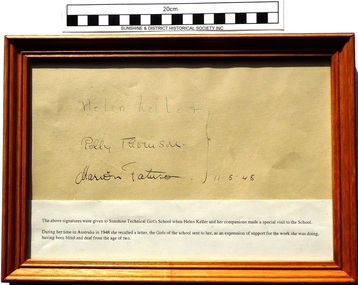
Memorabilia - Signature of Hellen Keller, Helen Keller, Polly Thomson, Marion Fatuson, 1948
... On June 1, 1968 Helen died in her sleep, and her ashes have been interred with those of Anne and Polly at the National Cathedral. ...On June 1, 1968 Helen died in her sleep, and her ashes have been interred with those of Anne and Polly at the National Cathedral. ...In 1948 during her Australian tour Helen Keller visited the west suburban SUNSHINE GIRLS TECHNICAL SCHOOL, to express her thanks for a letter written by the students in support of her work with deaf and blind people. She and her travelling companions presented the school with their signatures. Helen Keller was born on June 27, 1880 and due to an illness at the age of 20 months lost both her sight and hearing. Helen was taught to communicate by Anne Sullivan who wrote words into her hand, and she also learned to speak by touching the throat and lips of people as they spoke. In June 28, 1904 Helen Keller graduated from Radcliffe College with a Bachelor of Arts degree, being the first deaf and blind person to do so. In October 1914 Polly Thomson joined up with Helen and Anne. Helen published an account of her religious beliefs and an autobiography, and in 1930 the three women travelled to Scotland, England and Ireland. In 1931 they participated in the first World Council for the Blind. After Anne Sullivan Macy died in 1936 Helen and Polly continued to travel to several countries. In 1943 Helen visited blind, deaf, and disabled soldiers in a USA military hospital, which she described as "the crowning experience of my life". In 1946 Helen and Polly made their first world tour for the American Foundation for the Overseas Blind and over the next 11 years visited 35 countries. In 1955 Helen became the first woman to be honoured with an honorary degree from Harvard University. In 1960 Polly Thomson died, and in 1961 Helen suffered her first stroke and so retired from public life. In 1964 President Johnson conferred the Presidential Medal of Freedom however she was unable to attend the ceremony. On June 1, 1968 Helen died in her sleep, and her ashes have been interred with those of Anne and Polly at the National Cathedral. Over 1200 mourners attended the funeral.It is significant that Helen Keller actually took the time and effort to visit the Sunshine Girls Technical School to thank the students for their supporting letter. Helen Keller's many achievements show that a severely handicapped deaf and blind person can make significant contributions to society, if they apply themselves and receive assistance from dedicated friends. Helen Keller, Polly Thomson, Marion Fatuson, 11.5.48deaf, blind, signatures, helen keller, polly thomson, marion fatuson, anne sullivan macy, radcliffe college, sunshine girls technical school -
 Melbourne Legacy
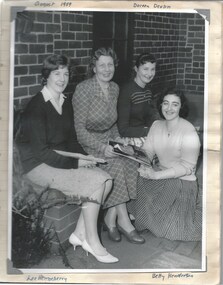
Photograph, Legacy 'Mother' to Twenty Three, 1959
... Mention of the routine of the house include that the girls sleep in large airy bedrooms which they look after themselves. ...Mention of the routine of the house include that the girls sleep in large airy bedrooms which they look after themselves. ...A photo from a book compiled about the Legacy children's residence called Stanhope. This photo shows Matron Dorrie Vines with three residents. Names around the photo L to R: Lee Henneberry, Doreen Devlin, and Betty Henderson. The newspaper article from The Age was published on 28 August 1959 and mentions Miss Vines has worked at Stanhope since 1946 when she returned from war service. She had been a trained nurse and served in Middle East and New Guinea with the RAANC. She had been awarded the medal of an Associate of the Royal Red Cross and was mentioned in despatches. Mention of the routine of the house include that the girls sleep in large airy bedrooms which they look after themselves. They generally do their own washing and ironing. There is a well equipped sewing room where they can make their own clothes. There is a radio and television and piano though between 7 and 9pm is quiet study time. A legacy member joins them for dinner most evenings and the girls do their own washing up. They can cook in the kitchen if they wish. There is staff of an assistant matron, a cook and two housemaids. Girls have picnics and outings arranged and three or four times a year and they have informal dances at Stanhope. Stanhope was supervised by Matron Dorothy (Dorrie) Vines from the time it opened in 1946 until she retired in December 1966. It is likely she compiled this notebook as she is referred to as 'self' in one photo. Individual pages of photos or newspaper clippings have been added separately. Items 01817 to 01834. Stanhope was a residence run by Melbourne Legacy to take care of children whose fathers were deceased servicemen, and who may have been left orphans, or whose mother may have been unable to care for them herself, or they needed to stay in Melbourne for further education. Generally Stanhope looked after girls over 14. The children were cared for until they were old enough to become independent. A record of life at Stanhope as reported in the Age Newspaper.Black and white photo of Matron and girls in 1959 along with a newspaper clipping about her.residences, dorothy vines, stanhope -
 Eltham District Historical Society Inc
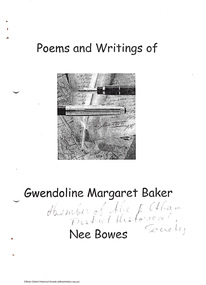
Document - Folder, Poems and writings of Gwendoline Margaret Baker, nee Bowes, 1997
... It is typical of her humour that after visiting the site she wrote: "I have seen the Cemetery, so if I wake in sleep it has a nice view" Gwen was a foundation member of our Society. ...It is typical of her humour that after visiting the site she wrote: "I have seen the Cemetery, so if I wake in sleep it has a nice view" Gwen was a foundation member of our Society. ...Various short pieces of writing, some dated, earliest 1971, latest in 1997. Gwen Baker (1928-2005) was a foundation member of EDHS. See Also Newsleter 162, May 2005 GWENDOLINE MARGARET BAKER NEE BOWES 1928- 2005 Gwen Baker as we knew her, often used her full name in her writings and even acknowledged her maiden family name as a means of reinforcing her own personal identity. Gwen died on 28 Februrary 2005 and has been buried at Arthurs Creek Cemetery in accordance with her wishes. It is typical of her humour that after visiting the site she wrote: "I have seen the Cemetery, so if I wake in sleep it has a nice view" Gwen was a foundation member of our Society. We remember her mainly for her contribution to our meetings, her witty comments or questions to our speakers and, of course, her collection of plants that she contributed to help the finances of our Society. Her friends in the Society also remember her cards and brief letters on a wide range of subjects. Gwen's wide range of interests included pottery, poetry and of course her gardening. She was an active member of many organizations including the Red Cross, Catholic Church, Nillumbik Garden Club and the former Eltham Arts Council. Her small self- published booklet of poems and writings starts with tins item written at 2am on Easter Sunday 1975. THOUGHT The seeming steady stillness of this quiet night has varied sound to one who sits and thinks of life. Of times of your of pleasant things and if the future has in store a place to be - a reason to exist. One hears a bird upon the roof scratching at his mate while in the distance a car goes by returning home quite late. A neighbours dog goes forth and bark! then stillness once again, like sunshine after rain. and so the thinker having heard and thought, carefully turns out the light and goes to bed. 41 pages (20 A4 pages cut in half). Folder 76 from Harry Gilham Collectionpoetry, creative writing, gwen baker -
 National Wool Museum
Textile - Quilt, Mrs Eileen Pattle, Old Harry's Wagga, 1942-50
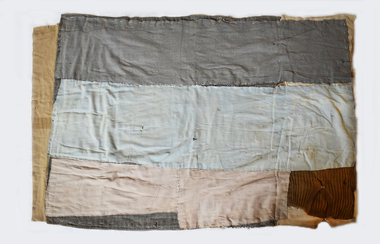
... The wagga saw many more camping trips until the arrival of Bev’s “lovely new lightweight and down filled sleeping bag”. The wagga was made with a “make do, waste not, want not” attitude. ...The wagga saw many more camping trips until the arrival of Bev’s “lovely new lightweight and down filled sleeping bag”. The wagga was made with a “make do, waste not, want not” attitude. ...This traditional wagga blanket was made by Mrs Eileen Pattle between 1942 and 1950. The wagga was used as everyday bedding, as Eileen and her husband had very few possessions. They boarded with a man who they called “Old Harry” in Footscray. Old Harry had recently lost his wife and looked after the young couple well. They could stay with him and use his house as their own, and all that Old Harry asked for in return was for Eileen to cook him one good meal a day. The blanket was given to Mrs Beverley (Bev) Maguire, the daughter of Eileen, when she and her husband went camping one winter. Her husband was a “mad” fisherman and on one trip on which Bev joined him, her father offered the couple his old tent, that had a wall missing, and the wagga. The wagga was much appreciated as when the couple woke in the countryside, it was freezing, and they could see snow through the missing tent wall. From then on, the tent and the wagga were theirs. The wagga saw many more camping trips until the arrival of Bev’s “lovely new lightweight and down filled sleeping bag”. The wagga was made with a “make do, waste not, want not” attitude. The wagga started as an army issued blanket. The front layer has clothing and panels of mismatched material which has been added to over time. This includes an overcoat, two knitted garments, a panel from a skirt, and a panel from Old Harry’s Trousers. It also includes a man’s sleeveless knitted vest, and a knitted pram blanket. This is all stitched together with string, and the odd button. Bev said she would love to unpick the quilt to see what else is hiding inside but has resisted the urge to do so. All these layers have made the blanket incredibly warm, and heavy. The wagga has been within Bev’s family since creation and comes into the National Wool Museum Collection after serving the family well. It was used to keep everyone warm when not camping over many a winter’s night. Beverley is now getting on in years and donated the Wagga to the National Wool Museum in 2021. Her family referred to the wagga as a “collection of rags”, indicating to her that they did not wish to inherit the blanket. The wagga started as an army issue blanket. It has been made by stitching the khaki army blanket onto a hessian rear. The front layer has clothing and panels of mismatched material. This includes an overcoat, two knitted garments, a panel from a skirt, and a panel from Old Harry’s Trousers. It also includes a man’s sleeveless knitted vest, and a knitted pram blanket. This is all stitched together with string, and the odd button. It is thought that other materials are hiding within the layers of this wagga, however, uncovering these layers would involve unpicking the quilt. The wagga is 1360 x 1880mm, sized to suit a double bed. It is a heavy blanket, originating from all its panels of mismatched reused clothing. The wagga is well worn but has lasted almost 80 years. It has holes that have been lovingly re-stitched.wagga, quilt, upcycle -
 City of Greater Geelong
Acrylic on Canvas, Big Day Out, 2010-2011
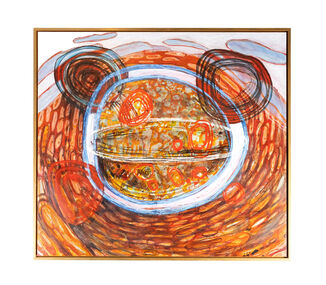
... During his time it was common for all the community members to go out hunting and having a visit to important areas, where members would get some tucker of rabbits and lizards and honey ants and perhaps some “meow meow” and have a nice sleep in the shade on the warm sand. Robinson would often take his painting gear along and do some work on unstretched linen on the desert ground, he would paint for a while and then perhaps lie around with the elders or follow one of the expert hunters and observe from a distance [several meters] the skills of elderly women casually walking through some recently burned spinifex knocking cowering bunnies on the head with a steel rod. ...During his time it was common for all the community members to go out hunting and having a visit to important areas, where members would get some tucker of rabbits and lizards and honey ants and perhaps some “meow meow” and have a nice sleep in the shade on the warm sand. Robinson would often take his painting gear along and do some work on unstretched linen on the desert ground, he would paint for a while and then perhaps lie around with the elders or follow one of the expert hunters and observe from a distance [several meters] the skills of elderly women casually walking through some recently burned spinifex knocking cowering bunnies on the head with a steel rod. ...Rohan Robinson is an artist born in Geelong, and attended “the Mill” part of Deakin University in 1980-82, studying Fine Art. In 2010-11, he was the manager of Kayili Artists Aboriginal Corporation, at Patjarr in the Gibson Desert W.A., where he oversaw the development and marketing of artworks of the corporation’s members. The community is the remotest in Australia and averaged 25 people, mostly consisting of elderly people and part of the Ngaanyatjarra region, with some members not having any consistent contact with white fellas up to the mid 1960’s. During his time it was common for all the community members to go out hunting and having a visit to important areas, where members would get some tucker of rabbits and lizards and honey ants and perhaps some “meow meow” and have a nice sleep in the shade on the warm sand. Robinson would often take his painting gear along and do some work on unstretched linen on the desert ground, he would paint for a while and then perhaps lie around with the elders or follow one of the expert hunters and observe from a distance [several meters] the skills of elderly women casually walking through some recently burned spinifex knocking cowering bunnies on the head with a steel rod. It was on one of these occasions, when this particular painting was being conceived, that after returning from the hunting mission, he was informed by some of the mob, that an elder had been spending time looking at this work in it’s infantile stage...”You know the old fella over there, he been looking at that painting of yours” It was later in the day, when returning to Patjarr, that the elder Arthur Robertson approached Robinson, and demanded/asked that Robinson paint his stories for him. Mr Robertson was suffering from Parkinson’s disease, and was having trouble painting, but had been doing some brilliant work with Posca markers. It was with a certain reluctance that Robinson agreed, as he felt this to be a “political hot potato in some quarters” but also respected a relationship between artists beyond the cultural divide. Mr Robertson demanded that they start immediately and armed with pencil and paper they created the notes for several paintings under Mr Robertson’s direction. The painting that you are viewing is signifcant in that it was the catalyst for this relationship between the two artists. Mr Arthur Robertson died later that year 2011.Gold framed blue and earth tone painting. Painting depicting four circles with mountain and sky in the background. -
 Melbourne Legacy
Photograph, From Stanhope News, 1962
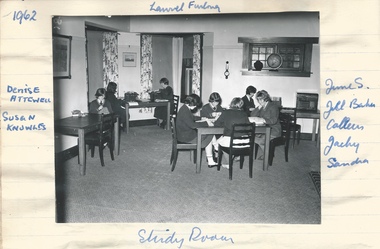
... A newspaper clipping at 01823 mentions the routine of the house including that the girls sleep in large airy bedrooms which they look after themselves. ...A newspaper clipping at 01823 mentions the routine of the house including that the girls sleep in large airy bedrooms which they look after themselves. ...Photos from a book compiled about the Legacy children's residence called Stanhope. The photos shows three rooms of Stanhope, the study room and two bedrooms. They may be copies printed from slides (see 02520-02522). The photo of the study room is surrounded by the names: Denise Attewell, Susan Knowles, June S., Jill Baker, Colleen, Jacky and Sandra. One bedroom photo is captioned 'Packing for the holidays' and has the names: Lynn Hall, Jacky Mooney? and Jane Reed. The other photo has the names: June S, Glenyce Ring and Jennifer Biggs. Stanhope was supervised by Matron Dorothy (Dorrie) Vines from the time it opened in 1946 until she retired in December 1966. It is likely she compiled this notebook as she is referred to as 'self' in one photo. Individual pages of photos or newspaper clippings have been added separately. Items 01817 to 01836. Stanhope was a residence run by Melbourne Legacy to take care of children whose fathers were servicemen, and who may have been left orphans, or whose mother may have been unable to care for them herself, or they needed to stay in Melbourne for further education. Generally Stanhope looked after girls over 14. The children were cared for until they were old enough to become independent. A newspaper clipping at 01823 mentions the routine of the house including that the girls sleep in large airy bedrooms which they look after themselves. They generally do their own washing and ironing. There is a well equipped sewing room where they can make their own clothes. There is a radio and television and piano though between 7 and 9pm is quiet study time. A legacy member attended for dinner most evenings and the girls do their own washing up. They can cook in the kitchen if they wish. There is staff of an assistant matron, a cook and two housemaids. Girls have picnics and outings arranged and three or four times a year they have informal dances at Stanhope. Harelands accommodated boys and girls under the age of 14, Blamey House looked after boys over 14, and Stanhope looked after girls over 14. The children were cared for until they were old enough to become independent. An example of the interior of Stanhope residence and a glimpse into the life of the girls that lived there.Black and white photo x 3 of the interior rooms of Stanhope in 1962.Handwritten caption in blue fountain pen of the girls' names.residences, stanhope, study -
 Bendigo Historical Society Inc.
Document - PETER ELLIS COLLECTION: PETER ELLIS OBITUARY
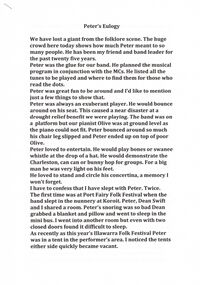
... Peter's snoring was so bad Dean grabbed a blanket and a pillow and went to sleep in the mini bus. I went into another room but even with two closed doors found it difficult to sleep. ...Peter's snoring was so bad Dean grabbed a blanket and a pillow and went to sleep in the mini bus. I went into another room but even with two closed doors found it difficult to sleep. ...3 A4 pages stapled together. Peter's Eulogy. We have lost a giant from the folklore scene. The huge crowd here today shows how much Peter meant to so many people. He has been my friend and band leader for the past twenty five years. Peter was the glue for our band. He planned the musical program in conjunction with the MCs. He listed all the tunes to be played and where to find them for those who read the dots. Peter was great fun to be around and I'd like to mention just a few things to show that. Peter was always an exuberant player. He would bounce around on his seat. This caused a near disaster at a drought relief benefit we were playing. The band was on a platform but our pianist Olive was at ground level as the piano could not fit. Peter bounced around so much his chair leg slipped and Peter ended up on top of poor Olive. Peter loved to entertain. He would play bones or swanee whistle at the drop of a hat. He would demonstrate the Charleston, can can or bunny hop for groups. For a big man he was very light on his feet. He loved to stand and circle his concertina, a memory I won't forget. I have to confess I have slept with Peter. Twice. The first time was at Port Fairy Folk Festival when the band slept in the nunnery at Koroit. Peter, Dean Swift and I shared a room. Peter's snoring was so bad Dean grabbed a blanket and a pillow and went to sleep in the mini bus. I went into another room but even with two closed doors found it difficult to sleep. As recently as this year's Illawarra Folk Festival Peter was in a tent in the performer's area. I noticed the tents either side quickly became vacant. The next time was in Canberra when Peter and I were at one end of a caravan and Mary Smith was at the other. I don't think poor Mary got much sleep that night. On another occasion in Canberra Peter was Half asleep in his van when another well known female performer (not from the band) came in and stripped off. She realised she was in the wrong van and grabbed her stuff and took off. She returned very red faced the next morning to collect her shoes. Peter maintained he saw nothing. One freezing cold night in Canberra Peter ad I had been at a terrific session in the bar. We had to support each other across the oval towards our caravan. Peter tried to straddle the fence and got stuck. There was a real Canberra frost on the fence and a sensitive part of Peter's anatomy was in grave danger of frost bite. Peter took an eternity to extricate himself. I couldn’t help him as I was laughing so much. We'll never forget making Harry McQueen's bull boar sausages at Nariel. Peter had already organised the meat and intestine casings from the butcher in Corryong. He was such an organiser and the sausages were brilliant. Peter was quirky. He always made a morning cuppa complete with tea cosy. It even left Martin Pearson speechless in the breakfast tent at Illawarra this year. Another example was when he sold his beloved FJ which is parked out the front today. As the new buyer drove off down the road Peter stood there playing 'Now is the hour' and 'wish me luck as you wave me goodbye' on his concertina. Peter loved a joke. He knew Shirley Andrews loathed the tune Danny boy so he played it in her hearing any chance he go. He even gave her a cd with a dozen different performers doing their versions of the song. We once played at the Rifle Brigade Oktoberfest and Peter was just a bit under the weather after being there for two days (the band got free drinks). The late night crowd was getting restless so Peter tried to shut them up by holding his finger up. They got more restless. Peter couldn’t understand it. 'it worked for Grummy Ross,' he wailed. It was the only time we ever over rode him and started playing without him. He wasn’t happy but disaster was averted. The dance club once had a reverse deb ball. Peter shave his beard, got his sister Robyn to make up his face and came to the ball in a lovely gown. It took ages for people to realise who it was.Margaret Hogan said the other night 'Peter let me see and do things I never would have done otherwise.' I think that is true of all of us in the band. We performed in major festivals regularly, travelled widely and had experiences such as playing at the opening of Melbourne Museum or State Parliament. Experience we'd never have had without Peter. I'm glad Peter didn’t suffer. He told me last Monday morning on my last visit he was in no pain. For that I am grateful. He passed away that night. He was taken far too young and has left a huge hole in all our lives. Personally I have lost a great mate, but then we can all say that. We'll miss you Dirty Pierre. John Williams.person, individual, peter ellis oam -
 Sunshine and District Historical Society Incorporated
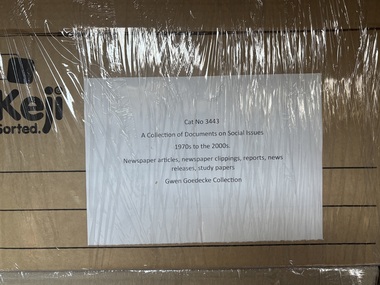
Archive - Gwen Goedecke Collection - A Collection of documents on Social Issues
... FOLDERS: |Employment|Education|Violence|Childcare Services|Divorce/Old Age/Victorian Caregiver's Association|Families/ The Institute of Family Studies (including newsletters, discussion and study papers)|Socialism|Social Welfare|Poverty |PUBLICATIONS: |Royal Commission on Human Relationships, Final Report Vol 5 - Commonwealth of Australia 1977|Possibilities for Social Welfare in Australia - Commonwealth of Australia 1975|Social Welfare Research Centre Newsletter - Number 8 - 1983|Social Justice Consultative Council Department of the Premier and Cabinet, Melbourne 1992|Voluntary Associations and Funding Issues Working Party - Lost Sleep Over Government Funding - 5 Case Studies - Victoria 1979|Government of Victoria - Submission to the Senate Standing Committee on Social Welfare concerning Homeless Youth Melbourne 1981|Victorian Council of Social Service - Passing the Buck - A Victorian Perspective on Federal Responsibility 2 copies - 1982|Social Welfare Research Bulletin No 1 - Australian Government Social Welfare Commission - 1975|FACS - The Victorian Family & Community Service Programme What is it about? ...Gwyneth 'Gwen Goedecke' collection FOLDERS: |Employment|Education|Violence|Childcare Services|Divorce/Old Age/Victorian Caregiver's Association|Families/ The Institute of Family Studies (including newsletters, discussion and study papers)|Socialism|Social Welfare|Poverty |PUBLICATIONS: |Royal Commission on Human Relationships, Final Report Vol 5 - Commonwealth of Australia 1977|Possibilities for Social Welfare in Australia - Commonwealth of Australia 1975|Social Welfare Research Centre Newsletter - Number 8 - 1983|Social Justice Consultative Council Department of the Premier and Cabinet, Melbourne 1992|Voluntary Associations and Funding Issues Working Party - Lost Sleep Over Government Funding - 5 Case Studies - Victoria 1979|Government of Victoria - Submission to the Senate Standing Committee on Social Welfare concerning Homeless Youth Melbourne 1981|Victorian Council of Social Service - Passing the Buck - A Victorian Perspective on Federal Responsibility 2 copies - 1982|Social Welfare Research Bulletin No 1 - Australian Government Social Welfare Commission - 1975|FACS - The Victorian Family & Community Service Programme What is it about? ...Gwyneth 'Gwen Goedecke' collectionFOLDERS: |Employment|Education|Violence|Childcare Services|Divorce/Old Age/Victorian Caregiver's Association|Families/ The Institute of Family Studies (including newsletters, discussion and study papers)|Socialism|Social Welfare|Poverty |PUBLICATIONS: |Royal Commission on Human Relationships, Final Report Vol 5 - Commonwealth of Australia 1977|Possibilities for Social Welfare in Australia - Commonwealth of Australia 1975|Social Welfare Research Centre Newsletter - Number 8 - 1983|Social Justice Consultative Council Department of the Premier and Cabinet, Melbourne 1992|Voluntary Associations and Funding Issues Working Party - Lost Sleep Over Government Funding - 5 Case Studies - Victoria 1979|Government of Victoria - Submission to the Senate Standing Committee on Social Welfare concerning Homeless Youth Melbourne 1981|Victorian Council of Social Service - Passing the Buck - A Victorian Perspective on Federal Responsibility 2 copies - 1982|Social Welfare Research Bulletin No 1 - Australian Government Social Welfare Commission - 1975|FACS - The Victorian Family & Community Service Programme What is it about? - Department of Community Welfare Services, Victoria - 1979| FACS - The Victorian Family & Community Service Programme What is it about? - Department of Community Welfare Services, Victoria (Second Draft) - 1979| Australian Government Social Welfare Commission Annual Report - 1973|Australian Government Commission of Inquiry into Poverty - Study of the Heidelberg Community - 1976|Victorian Emergency Relief Committee findings/report- March 1982|Monday on a Shoestring - a resource guide for low-income people in the West - 1997 -
 Flagstaff Hill Maritime Museum and Village
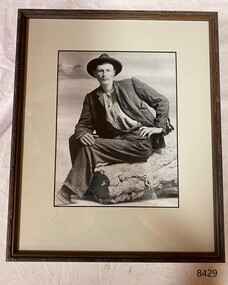
Photograph - William Ferrier, Henna Street Picture Framers, 2005
... The survivors were taken to the nearby Bay View Hotel and gratefully received warm food and clothing, medical attention and a place to sleep. William Ferrier became a national hero as news of the daring rescue spread. ...The survivors were taken to the nearby Bay View Hotel and gratefully received warm food and clothing, medical attention and a place to sleep. William Ferrier became a national hero as news of the daring rescue spread. ...The photograph of William Ferrier was given to Avis Quarrell by Lewis Ferrier, 3rd youngest son of William during the centenary of the wreck of the La Bella. The photograph was framed by the Henna Street Picture Framers, Warrnambool in 2005. The photograph is of William Ferrier, the 25-year-old fisherman from South Warrnambool, whose rescue of two sailors from the wrecked La Bella made him an overnight national hero. The La Bella was wrecked on 10th November 1905,and the remains of the vessel now lie on her port side in 13 metres of sheltered water inside the reef she struck. The bow section is relatively intact and part of the stern has drifted north-easterly towards the mouth of the Hopkins River. The reef the La Bella struck now bears its name. Several attempts were made by the Warrnambool lifeboat crew to rescue the stricken sailors on the La Bella, but the rough conditions made this difficult for the boat to get close enough to the ship and the lifeboat had to return to shore. A another rescue attempt was made by Ferrier who rowed a small dingy through the heavy seas and managed to rescue the Captain George Mylius, whom he landed on the breakwater. Ferrier then returned to the ship to attempt a final rescue, losing his oars and rowlocks into the high sea. Using just a spare paddle he swam towards the La Bella, reaching her stern in time to cut loose the lone surviving sailor, Payne, from the ropes and debris that held him to the ship; the terrified sailor dropped from the ship and into the dingy. Shortly after the last man was rescued, the La Bella was lifted by a huge wave and crashed back down on the reef; she broke up and sank. The survivors were taken to the nearby Bay View Hotel and gratefully received warm food and clothing, medical attention and a place to sleep. William Ferrier became a national hero as news of the daring rescue spread. In recognition of his bravery in the two daring rescues, he was awarded the Silver Medal for Bravery by the Royal Humane Society and was honoured in the letter from the Prime Minister and the Parliament of the Commonwealth, telegrams and a cheque for £20 from the Governor-General, over £150 subscribed by the public, including Warrnambool and district and readers of The Argus, and a gold medal from the Glenelg Dinghy Club of South Australia. Ferrier’s rescue efforts are one of the most heroic in Victoria’s shipwreck history.This photograph is significant at both a local and state level. Its connection to the La Bella shipwreck and the rescue of survivors highlights the dangers of Victoria’s Shipwreck Coast and demonstrates the bravery of ordinary Australians like William Ferrier who risked their lives to save victims of shipwrecks along the coast. Moreover, the photograph has an association with the sailing ship ‘La Bella’, as it is one of the only two shipwrecks discovered in Lady Bay, Warrnambool, out of the 15-17 shipwrecks known to have been wrecked in the bay.Framed sepia photograph, mounted behind glass. Portrait of a man seated on a log. He is wearing a brimmed hat, dark coloured jacket and trousers, and a light coloured collarless shirt with buttons. The figure in the photograph is William Ferrier.flagstaff hill, warrnambool, maritime museum, shipwreck coast, la bella, william ferrier, rescue, hero william ferrier -
 Flagstaff Hill Maritime Museum and Village
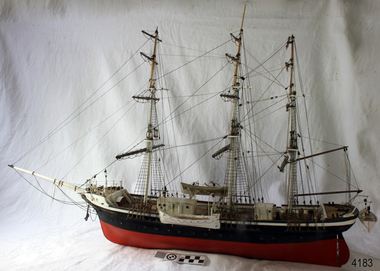
Craft - Ship Model, Joseph Conrad
... In 1905, while docked in Copenhagen, the ship was rammed by a larger ship, and 22 boys were killed while sleeping in the hull. The ship was later raised and put on guard during World War I. ...In 1905, while docked in Copenhagen, the ship was rammed by a larger ship, and 22 boys were killed while sleeping in the hull. The ship was later raised and put on guard during World War I. ...The ship model of Joseph Conrad represents the craft of ship model-making, which many people have enjoyed over the years. Although the model is made from modern materials, it shows the elements of a sailing ship of a bygone era. About the sailing ship JOSEPH CONRAD: - The vessel Joseph Conrad began as the Danish iron-hulled, wooden sailing ship Georg Stage, launched in 1882. It was used as a training ship for Danish sailors. In 1905, while docked in Copenhagen, the ship was rammed by a larger ship, and 22 boys were killed while sleeping in the hull. The ship was later raised and put on guard during World War I. Alan Villiers was an Australian author of seafaring books as well as a sailor. He bought the George Stage and renamed it Joseph Conrad in honour of the renowned Polish-born maritime fiction author, who briefly captained the barque Otago; it was the only time he was in charge of a ship. In 1934, Villers sailed the ship on a two-year voyage around the world. In 1936, it was sold to an American, who later donated it for use again as a training ship. After World War II, the ship was no longer in use, and in 1947, it was transferred to the Mystic Seaport Museum for training and exhibition purposes. JOSEPH CONRAD (1857-1927): - Joseph Conrad was Polish-born. He became a British subject in 1886. He was known for his marine fiction writing and, for a short time, was a mariner and Captain. As a boy of 13 years old, Joseph Conrad wanted to be a sailor. At 19, he joined the British merchant marines, working in several roles. He eventually qualified as a captain but only served in this role once, from 1888-89, when he commanded the barque Otago, sailing from Sydney to Mauritius. In 1889, he also began writing his first novel, Almayer’s Folly. He retired from life as a mariner in 1894, aged 36. Conrad’s visits to Australia from 1878 to 1982, and his affection for Australia, were later commemorated by a plaque in Circular Quay, Sydney. Conrad continued as an author. It is said that many of the characters in his books were inspired by his maritime experiences and the people he had met. By the end of his life, he had completed many stories and essays, 19 novels, plus one incomplete novel titled ‘Suspense’ that was finished and published posthumously. In 1924, shortly before he died, Conrad was offered a Knighthood by Prime Minister Ramsay MacDonald for his work but declined the offer. The ship model represents the design of sailing ships built in the 1880s and can be used as a reference in understanding the construction of the ships of the Victorian era. The model is important for its connection to the vessel Joseph Conrad which was used as a training ship for seafarers, and even now is used to teach maritime skills, as well as an exhibit, in the maritime museum, Mystic Seaport. The model's name is significant for its association of its name with the famed early 20th-century maritime author, Joseph Conrad.Ship model; three-masted sailing ship named the Joseph Conrad, with cabins on deck, lifeboats, a ladder on the side and a figurehead on the bow. The hull is black at the top and red below. The ship's name is painted on both sides of the bow. JOSEPH CONRADflagstaff hill, flagstaff hill maritime museum and village, warrnambool, maritime museum, maritime village, great ocean road, shipwreck coast, joseph conrad, captain joseph conrad, maritime author, marine author, nautical author, sailor, seafarer, ship model, two-masted ship, iron hull, sailing ship, georg stage, 1882 ship, danish ship, training ship, boys killed, alan villiers, ship joseph conrad, mystic seaport, museum ship, otago -
 Bendigo Military Museum
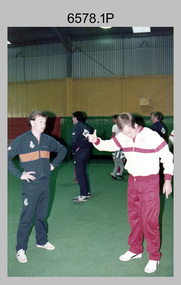
Photograph - Continuous Indoor Cricket World Record Attempt, Seymour, Victoria, 1986
... "The rules allowed a five-minute rest break every hour which could be accrued, so we played for 64 hours straight then had a five hour sleep. "When everybody got up and went straight back into the game with no grumbling, I knew we had the record," Capt Alsford said. ..."The rules allowed a five-minute rest break every hour which could be accrued, so we played for 64 hours straight then had a five hour sleep. "When everybody got up and went straight back into the game with no grumbling, I knew we had the record," Capt Alsford said. ...This is a set of 12 photographs of Army teams from the Army Survey Regiment, Bendigo and the Army School of Transport, Puckapunyal attempting a world record playing indoor cricket, at Seymour Victoria from the 31st of January to the 5th of February 1986. The following article appeared on the back page of the ARMY Newspaper on Thursday 6th of March 1986. 'INDOOR CRICKET RECORD SMASHED. ARMY TEAMS from Puckapunyal and Bendigo recently played indoor cricket for 124 hours to set a new world record. The two eight-man teams, from Army School of Transport and Army Survey Regiment, broke the 120 hour record set by Corrimal High School, NSW earlier this year. Organiser of the event, Capt Marty Alsford of AST told ARMY the teams had played 107 games, scoring 15,000 runs in their chase for the record. "The rules allowed a five-minute rest break every hour which could be accrued, so we played for 64 hours straight then had a five hour sleep. "When everybody got up and went straight back into the game with no grumbling, I knew we had the record," Capt Alsford said. The event was held at the Seymour Indoor Cricket Centre, an iron-roofed building with no air-conditioning, and all players had to battle the effect of the stifling heat in addition to fatigue. One player dropped out through exhaustion, but this did not prejudice the record attempt as the rules permitted each team to lose a player who cannot return to the game nor be replaced. The Army teams' effort are now awaiting recognition by the Guinness Book of Records. During the marathon event, the soldiers raised money for Legacy, through sponsorships and a raffle. At the time ARMY went to press, the final figure was not available.’ Army Survey Regiment Routine Orders Part 1 Issue No 16/86 Notices on Page 7 stated: ‘World Record Indoor Cricket. 1. Congratulations to the following members for their successful attempt on the Guinness Book of Records, Record for continuous playing of indoor cricket: John Whaling, Peter Ball, Brenton McDonald, Per Andersen, John Anderson, Brian Fauth, Brett McAllister and Daryl South. 2. Our team, playing a team from Army School of Transport at Seymour played continuous Indoor Cricket for 124 hours, beating the existing record by 4 hours. During that time the two teams amassed a total in excess of 16,000 runs. 3. Congratulations also to Peter Ball for picking up the Trophy for the most outstanding player during the record attempt.’This is a set of 12 photographs of Army teams from Bendigo and Puckapunyal attempting a world record playing indoor cricket, at Seymour Victoria in February 1986. The photographs were printed on photographic paper and are part of the Army Survey Regiment’s Collection. The colour photographs were scanned at 300 dpi. .1) - Photo, colour, 1986, L to R: John ‘Junior’ Whaling, Marty Alsford. Background L to R: Peter Ball, unidentified, John ‘Flash’ Anderson. .2) - Photo, colour, 1986, L to R: John ‘Junior’ Whaling, unidentified, Peter Ball. .3) to .7) - Photo, colour, 1986, unidentified participants. .8) - Photo, colour, 1986, L to R: unidentified, Peter Ball, Brett McAllister, John ‘Junior’ Whaling. .9) - Photo, colour, 1986, L to R: unidentified, John ‘Flash’ Anderson, Brian Fauth, unidentified, Peter Ball, unidentified (x2). .10) - Photo, colour, 1986, Army School of Transport (red & white uniform) - back row L to R: unidentified (x4), front row L to R: unidentified (x3), Marty Alsford. Army Survey Regiment (dark green uniform) - back row L to R: Brett McAllister, John ‘Flash’ Anderson, Brian Fauth, Per Andersen, front row L to R: John ‘Junior’ Whaling, Daryl South, Brenton McDonald, Peter Ball. .11) & .12) - Photo, colour, 1986, Army Survey Regiment (dark green uniform) - back row L to R: Peter Ball, Per Andersen, Brett McAllister, Brian Fauth, front row L to R: Brenton McDonald, John ‘Flash’ Anderson, Daryl South, John ‘Junior’ Whaling..1P to .12P –No personnel are identified. ‘Attempt at World Record for Indoor Cricket 31 Jan - 5 Feb 1986’ annotated on cover sleeve.royal australian survey corps, rasvy, army survey regiment, army svy regt, fortuna -
 Kyneton RSL Sub Branch
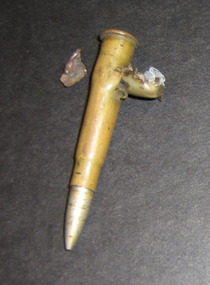
WWI CARTRIDGE, WWI 1914-18
... The brothers were side by side, and it was suggested to their sergeant that he should take a short rest; they had been 36 hours without sleep. The sergeant said “Oh no, I won’t leave you fellows.” ...The brothers were side by side, and it was suggested to their sergeant that he should take a short rest; they had been 36 hours without sleep. The sergeant said “Oh no, I won’t leave you fellows.” ...Pte Evan Edward Jones (No 276) and his younger brother Pte Edward Jones (No 1731) were both members of the 29 Infantry Battalion during World War 1. They enlisted in 1915 in Kyneton where they grew up. Edward enlisted after approval was given by his mother as he was not quite 21. He did not survive the war as he was killed by a sniper in France in 1916. It was Private Edward Jones’ love of adventure that cost him his life. In the trenches in France on 16 August 1916, beside his brother, Private Evan Edward, he raised his head and was caught by a German sniper. The brothers were side by side, and it was suggested to their sergeant that he should take a short rest; they had been 36 hours without sleep. The sergeant said “Oh no, I won’t leave you fellows.” Private Jones said “If I got a chance of a shut eye I’d take it.” He raised his head over the parapet and a German sniper caught him in the forehead, and shut his eyes forever. With difficulty his brother was restrained from rushing over the top for revenge. Evan survived the war, serving in France and Belgium. Some of his letters, together with other memorabilia, have been donated to the RSL by family members. One letter to his wife describes how a bullet hit a cartridge in his pouch but missed his body. Cartridges, the bullet and the piece of shrapnel are also included with the donated items. Part of one of Evan’s letters to his wife is re-printed here. “This bullet is the nearest thing as ever … since I have been in France. I wondered what struck me when it hit me, or rather hit the cartridge that was in my pouch. If it had been an inch or two higher it would have come through my body…the wish bone is from the fowl we had for supper last night, one of the boys bowled the fowl over with a stone so we got to work and cleaned and cooked it and it was just the thing. I got the wishbone so I thought it would be a good souvenir to send home…don’t forget to wish something nice with the wishbone.” Both boys had a strong sense of adventure and it was only natural that they fought and died for King and country. Original letters, photographs and documents have been copied for preservation. *Items donated by John and Phyllis Adams will form part of the World War One commemorative display at the Sub-Branch for Anzac Day 2015. The Jones boys grew up in the Kyneton area and enlisted in the AIF in Kyneton in 1915World War I cartridge damaged by another bullet. K15 VII on base of cartridge casingww1, pte evan jones, pte edward jones,, letters from the front -
 Ballarat and District Irish Association
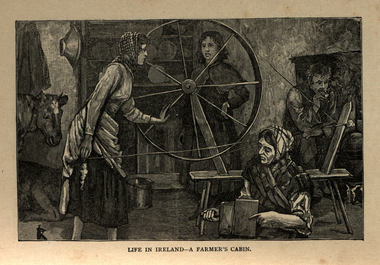
Image, Life in Ireland - A Farmer's Cabin, c1864
... As well as mother, father and children, there could well be grandparents all living in the same cramped conditions. The family would sleep on rushes or straw lain on the floor. ...As well as mother, father and children, there could well be grandparents all living in the same cramped conditions. The family would sleep on rushes or straw lain on the floor. ...The tenant lived at the mercy of the resident landlord. Home was a one-roomed house, a chimney of wicker work plastered over with mud or just a hole in the roof. The walls might consist of mud too, or sods of grass. Any windows, were rarely glazed and would be open to the elements all year round. The Pig, if any, was kept in the house, the most valuable possession. Sold for cash at local market. The main items in the house were a potato pot and water bucket. As well as mother, father and children, there could well be grandparents all living in the same cramped conditions. The family would sleep on rushes or straw lain on the floor. Most tenants were tenants 'at will ', which meant they could be evicted at the 'will' of the landlord. Some had a lease for the life of the father and the eldest son, and this meant they were relatively safe from eviction as long as they could pay their rent. There was a tradition of passing on a portion of your land from father to each of the sons, who would build a small dwelling, and in turn pass a portion onto their own sons. This cycle of subdivision meant that many families were surviving on a tiny plot of land from which to derive a crop of potatoes for the year. Women worked hard in this environment, rearing children, cooking, cleaning, tending to any animals such a pigs or chicken and when needed, helping in the potato field. Life was dictated by the annual rent due to the landlord. Other typical expenses could be the Hearth Tax (actually charged by the number of fire places in a house) Turf, Hay (for any farm animals) and tithes. A tax known as the tithes were calculated at one tenth the value of everything saleable. Tithes were a bitter issue. They were for the support of the Church of Ireland, Protestant Bishops and Ministers, and a cess tax for the construction and maintenance of Protestant Church buildings. The problem being that the vast majority of those paying the Tax were Catholic and paying to support something that was contrary to their beliefs. Potatoes were the staple diet from September through to the end of Spring of the following year. But the summer months were months of hunger and hardship as they waited for the following harvest to come in Autumn. During these months people had to resort to eating anything they could find; turnips, cabbage, even wild grass, nettles, wild berries and dandelions. Those who lived close to the sea would collect seaweed and use it spread on their land as a form of manure. The dependency of so much of the population on the Potato as their sole source of food was to prove disastrous during the Famine years. [http://www.youririshroots.com/irishhistory/tenant.php, accessed 14 December 2013]A woman spins wools, while another cards fleece in preparation for spinning. I man smokes a pipe by an open fireplace, while a cow takes shelter in the cabin for warmth. ballarat irish, cabin, spinning, wool, cow -
 The 5th/6th Battalion Royal Victoria Regiment Historical Collection
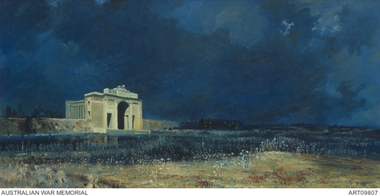
Print - Reproduction, framed, The Menin Gate at Midnight
... Longstaff was profoundly moved by what he witnessed and that night, unable to sleep, Longstaff returned to Menin Road and later claimed to have had a vision of spirits of the dead rising out of the soil around him. ...Longstaff was profoundly moved by what he witnessed and that night, unable to sleep, Longstaff returned to Menin Road and later claimed to have had a vision of spirits of the dead rising out of the soil around him. ...'Menin Gate at midnight' was painted by Will Longstaff to commemorate those soldiers with no marked graves on the Western Front during the First World War; also known as 'Ghosts of Menin Gate'. Longstaff attended a ceremony dedicating the Menin Gate memorial to the soldiers of the British empire forces, just outside the town of Ypres, Belgium, on 24 July 1927. The memorial was dedicated to the 350,000 men of the British and Empire forces who had died in battles around Ypres, and bears the names of 55,000 men with no known grave, over 6,000 of whom were Australians. Longstaff was profoundly moved by what he witnessed and that night, unable to sleep, Longstaff returned to Menin Road and later claimed to have had a vision of spirits of the dead rising out of the soil around him. On returning to his studio in London he painted 'Menin Gate at midnight' in a single session. Today 'Menin Gate at midnight' has achieved the status of a national icon. The painting retains its ability to provoke an emotional response and to communicate the scale of the loss of life and the devastation of war. However as people now have a very different understanding of war, the painting serves a slightly different function. Whereas in the past people responded to the painting as it related to the loss of a loved one and their own personal grief, now the painting communicates the loss experienced by a whole generation. The vast number of those who were killed, and the immensity of the damage wrought during the First World War, requires that those who sacrificed their lives should not be forgotten. Longstaff used well-known motifs to trigger emotion. His scarlet poppies are flowers that could be found in the Flanders fields, but they also carry the traditional connotations of shed blood and remembrance; they represent a floral blanket covering the bloodied bodies of unknown soldiers; at the same time, like the paper poppies worn on Remembrance Day, they are a tribute from the living to the dead. The portrayal of the steel-helmeted soldiers rising from the cornfields extends the range of visual emblems used by Longstaff: the plentiful harvest; the harvest of men; the steel-helmeted crosses covering the graves of many soldiers; and the helmeted bayonets raised in cheer and victory.ww1, menin gate, wark vc club -
 Flagstaff Hill Maritime Museum and Village
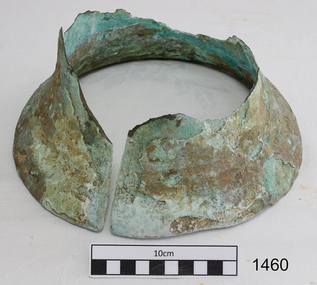
Functional object - Ship's Bell, Before 1837
... By the evening of 14 January, Captain Browne had been continuously on duty for four days and needed sleep. His First Mate T. Gay was incapacitated with seasickness, and the task of command was given to the Second Mate W. ...By the evening of 14 January, Captain Browne had been continuously on duty for four days and needed sleep. His First Mate T. Gay was incapacitated with seasickness, and the task of command was given to the Second Mate W. ...This remnant of a ship's bell was recovered from the wreck site of the CHILDREN by Flagstaff Hill Divers on 1 October 1973. The artefact had lain in the ocean off Childers Cove since the vessel’s disastrous sinking there on 14 January 1839. Other similarly high-value metallic objects raised from the site, and now in the Flagstaff Hill collection, are the ship’s signal cannon (1963) and the ship’s anchor (1974). A ship’s bell was normally struck by the lookout at the forward part of a vessel, following orders “Strike the bell” from the officer of the watch at the helm, or as a warning signal of danger ahead. Its main function was to keep the crew aware of time. Each 24 hours was divided into 4 hour work-shifts, or watches, and each of these was divided into 8 half hours, or glasses, each half hour being determined by the time it took between each turn of the ship’s hourglass. The six watches were the first watch from 8 pm to midnight, the second or middle watch from midnight to 4 am, the third or morning watch from 4 to 8 am, the fourth or forenoon watch from 8 am to midday, the fifth or noon watch from midday to 4 pm, and the sixth or dog watch from 4 to 8 pm. Within each watch, the first half hour would end with one bell, the second with two bells, the third with three bells, and so on until their work shift ended with the ringing of eight bells. The CHILDREN left Launceston on 11 January 1839 and immediately struck heavy weather. By the evening of 14 January, Captain Browne had been continuously on duty for four days and needed sleep. His First Mate T. Gay was incapacitated with seasickness, and the task of command was given to the Second Mate W. Wentworth. At two bells into the first watch, or 9 o’clock that night, the captain went below. Two hours later, at six bells into the first watch, or 11 o’clock that night, the lookout cried “Breakers close ahead”. Within a minute, the ship struck the rocks at the entrance of Childers Cove. Within twenty minutes, the huge seas had taken her stern, three masts and much of her weatherside, leaving survivors clinging to the forecastle. Within two hours, the wreck had completely disappeared. If anyone could have rung the bell by then, it would have been to strike two bells into the middle-watch, or one o’clock on the morning of 15 January. An 1859 Victorian Register of Wrecks from 1835 to 1858 remarks the CHILDREN “Ran ashore through an error in the reckoning and a bad lookout [and] Became a total wreck”. 22 passengers and crew survived the tragedy, but 16 lives were lost, including the captain and second mate, and 9 children. The shipwreck of the CHILDREN is of State significance ― Victorian Heritage Register S116A part of a brass ship’s bell, recovered from the wreck of the CHILDREN. The upper part, or dome of the bell, has corroded away, leaving the lower portion, or mouth of the bell, largely intact. However, this lower surviving portion has been severed vertically with a clear cut similar to a saw cut, leaving a regular 1cm gap down one side of the bell. It is an evocative relic, attractively aged on the seafloor, bearing layers of aqua-marine verdigris and white limestone accretion on a dull bronze surface. There is no visible ship’s name on the bell. flagstaff hill, warrnambool, shipwrecked coast, flagstaff hill maritime museum, maritime museum, shipwreck coast, flagstaff hill maritime village, great ocean road, the children, bell, ships bell, childers cove, henty brothers, james henty & co, sea-watches, nautical time, james henty & co, bell from the children -
 Old Colonists' Association of Ballarat Inc.
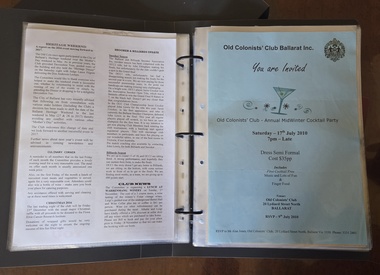
Ephemera, Ephemera and newsletters relating to the Old Colonists' Club 1995-2014
... Ticket (Gerald Jenzen) and Menu * 10/09/ Trivia Night * Devonshire Tea * 30/10/2008 Annual Dinner for the Council of the Assocition and Club Committee * Old Colonists' Associaiton invitation to the opening of the Old Colonists' Retirement Village Community Centre, and announcing the successful construction of 15 additional cottages. Jamie Sleep - President. Andrew Robson President) * Old Colonists' Association 117th Annual Councillors Banquet Menu and list of attendees * 2021 Old Colonists' Associaiton Newsletter (during Covid19 lockdowns). ...Ticket (Gerald Jenzen) and Menu * 10/09/ Trivia Night * Devonshire Tea * 30/10/2008 Annual Dinner for the Council of the Assocition and Club Committee * Old Colonists' Associaiton invitation to the opening of the Old Colonists' Retirement Village Community Centre, and announcing the successful construction of 15 additional cottages. Jamie Sleep - President. Andrew Robson President) * Old Colonists' Association 117th Annual Councillors Banquet Menu and list of attendees * 2021 Old Colonists' Associaiton Newsletter (during Covid19 lockdowns). ...An A4 grey Albox folder containing ephmera and newsleters relating to the Ballarat Old Colonists' Club and Old Colonists' Association of Ballarat. Contents include * Ballarat Commercial Club * 2/10/1995 0 Australia Remembers 1945-95 Ballaarat Club Ball invitation. Club President Peter Mangan, music by The Biggish Band * 06/02/2995 - Correspondence seeking informatoin on Edward Joseph Webb, William Jeffery, and David Douglas Martin. * Club Badge dies and production * Invitation to Annual Heritage Dinner and Don Anderson Lecture. Speaker Kate Darian-Smith * Ballaarat Club Newsletter June 1995 (Winter cocktail party, Club Ball,Annual Members' Dinner, Friday Night Football on the Big Screen, Carering, Bar Facilites, Club ties, Peter Mangan - President * Ballaarat Club Newsletter Sepetember 1995 (Ballarat Cup Calcutta, New Members Cocktail Party, Club Ball, Gentlemen's Luncheon, Grand Final Weekend) * 19/05/2011 - Club badges and dies * Invitation to the Annual Heritage Dinner and Don Anderson Lecture, 12 May . Speaker - Professor Kate Darioan-Smith * 08/05/2010 - Inaugural Heritage Dinner. President Ivan Crowley. Ticket (Gerald Jenzen) and Menu * 10/09/ Trivia Night * Devonshire Tea * 30/10/2008 Annual Dinner for the Council of the Assocition and Club Committee * Old Colonists' Associaiton invitation to the opening of the Old Colonists' Retirement Village Community Centre, and announcing the successful construction of 15 additional cottages. Jamie Sleep - President. Andrew Robson President) * Old Colonists' Association 117th Annual Councillors Banquet Menu and list of attendees * 2021 Old Colonists' Associaiton Newsletter (during Covid19 lockdowns). Breaze Solar Project, Stage 3 constuction at the Retirement Village commenced, Old Colinusts' Hall Conservation Management Plan prepared by David Rowe (Authentic Heritage Services) and Wendy Jacobs Architect and Heritage Consultant, Restoration of the Williams Cottage (President Jo Barber) * 09/07/2015 Planning Permit Application Referral Comments for the Old Colonists' Retirement Village at Charles Anderson Grove. * ballarat old colonists' club, club ball -
 Flagstaff Hill Maritime Museum and Village
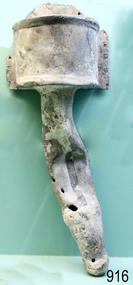
Functional object - Urinal, circa 1825
... The urinal was probably situated in the forward part of the ship rather than the stern, being one of two placed on either side of the deck and housed immediately adjacent to the doors into the forward castle, or crew sleeping quarters. The toilets on maritime vessels were (and still are) called the ‘heads’, after the sanitation arrangements common until the end of the eighteenth century. ...The urinal was probably situated in the forward part of the ship rather than the stern, being one of two placed on either side of the deck and housed immediately adjacent to the doors into the forward castle, or crew sleeping quarters. The toilets on maritime vessels were (and still are) called the ‘heads’, after the sanitation arrangements common until the end of the eighteenth century. ...The urinal was probably situated in the forward part of the ship rather than the stern, being one of two placed on either side of the deck and housed immediately adjacent to the doors into the forward castle, or crew sleeping quarters. The toilets on maritime vessels were (and still are) called the ‘heads’, after the sanitation arrangements common until the end of the eighteenth century. The name was given to the ‘head’ of the ship, forward of the forecastle and around the beak or bowsprit. These first lavatories were floored with grating or nets so the force of the sea could wash them clean, and they were always used on the lee or non-weather side so the effluent fell directly into the water rather than back on board. The Children's wrecking: The barque Children was one of the first vessels to be lost in the Western District. The vessel was wrecked to the east of Warrnambool on 14th January 1838. When it ran ashore in hurricane-force winds, 22 passengers and crew were fortunate to escape being battered to death on the rocks. The Children broke up within 20 minutes, sweeping sixteen of those on board to their deaths. After eleven days, the rescued survivors, all of whom were injured, had been taken to Portland. According to Lloyd's Shipping Register 1837-1839, the Children was built in 1825 at Liverpool and operated by owners Gordon & Co, of London. Registration number 123/1837, James Henty then bought her in 1837 as a three-masted barque of 254 tons, with a hull of “part pitch pine, felt sheathed” and “coppered in 1837” at Launceston, registered number 6/1837. In 1838, the Children, under her master Captain H. Browne, completed a successful round trip from Launceston to London (carrying wool and whale oil loaded in Portland), returning in late November of that year carrying a general cargo including house bricks used for ballast. On the 11th of January 1839, the Children sailed from Launceston for Adelaide, with 24 passengers, 14 crew, and an awkward mixed cargo, including 1500 sheep, 8 bullocks, 7 horses, farming implements, and six whaleboats with associated whaling gear. One account states that when the Children was “put out from port, she was light and badly ballasted”. The vessel immediately encountered four days of hurricane-force storms, eventually clearing on the early morning of the 14th. However, it was too late to take accurate measurements of the sun or stars to establish their position relative to the coast. The Children collided with a limestone stack at the entrance of what is now Childers Cove, and the seas smashed the vessel into pieces within half an hour. All the cargo and 16 lives were lost, including 9 children. The Henty brothers contributed £150 towards a fund for the 22 survivors at a memorial service held in Launceston later that year. It was a major financial setback for James Henty and his brothers, but one from which they recovered. In a submission to the Governor of New South Wales dated 24 March 1840, the Henrys summarised their work over the previous six years of establishing the Portland settlement, stating “Six stations have been occupied, one at Portland Bay three at the open country about 60 miles inland called ‘Merino Downs’ They have erected two houses at Portland Bay and two others at Merino Downs”.The urinal recovered from the Children's wreck is significant as part of the original fittings of the early 19th-century barque. The 1839 wreck and recovered artefacts are examples of the construction methods and materials used in that era and can be used to study the evolution of shipbuilding methods and principles. The wreck of the Children is of state significance as one of colonial Victoria’s earliest and most significant maritime disasters, and one of the first vessels lost in the Western District. This is recognised by its inclusion on the Victorian Heritage Register, VHR No. S116. Little is left on the seabed to mark the tragedy, apart from some of the house bricks intended for the Henty settlement. A lead urinal with a rounded back at the top splash plate with an attached semi-circular receptacle or basin (20cm deep and projecting forward 30cm). At the sides are flanges with bolt holes connecting to a ship's wall. The urinal is drained by a funnel-shaped outlet also made of lead, reducing from a 10cm radius to a joined 5 cm pipe. The urinal was recovered from the wreck of the CHILDREN.flagstaff hill, warrnambool, flagstaff-hill, flagstaff-hill-maritime-museum, shipwreck-coast, shipwreck artefact, the children, lead ship’s plumbing, crew urinal, the ‘heads’, ship plumbing, james henty, portland bay, urinal, ship's urinal, ship’s fitting, ship’s lead plumbing, ship’s toilet, ship’s urinal, children, childer’s cove, port campbell, 1839 shipwreck, james henty and co, henty brothers, captain h. browne, portland -
 Eltham District Historical Society Inc
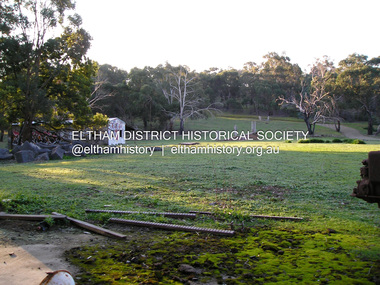
Photograph, Fay Bridge, Former Glynn's Dairy Farm, Glynns Road, North Warrandyte, 31 August 2018
... Upstairs 2 bedrooms and sleep out. Outbuildings compromising of brick and weatherboard wash house, stables, workshop, feed room, cow bails, large G.I. ...Upstairs 2 bedrooms and sleep out. Outbuildings compromising of brick and weatherboard wash house, stables, workshop, feed room, cow bails, large G.I. ...Glynn’s farm Originally Section 7, Parish of Nillumbik marked Aborigine Reserve in 1866 Crown Allotment 8, Section 7, Parish of Nillumbik, County of Evelyn, Certificate of Title Volume 4095, Folio 818.835, approx. 93 acres purchased by Joseph Panton in 1881 for £1/acre and known as Panton’s Point. By 1924 owned by S.S. Sergeant and called Riverswood. Sergeant commissioned Edna Walling to design the garden. In September 1929 the property was sold at auction by Mortgagee’s sale. Described as well built, brick, tile roof, Attic Villa containing downstairs 7 good rooms, bath, scullery, inside lavatory, etc. Upstairs 2 bedrooms and sleep out. Outbuildings compromising of brick and weatherboard wash house, stables, workshop, feed room, cow bails, large G.I. Hay shed, etc In January 1931 Riverswood property was proclaimed a sanctuary for native game for the entire year. A private swing bridge crossed the river at Pound Bend was known as Pearson’s bridge after C.W.K. Pearson who bought Riverswood in the early 1930s. The bridge was swept away in the December 1934 floods. Riverswood was sold by C.W.K. Pearson at auction on 25 November 1936. Described as a beautiful farm home of 93 acres and over one mile of River Yarra frontage, modern brick residence, lovely garden, rich river flat pastures, model poultry farm. The fine brick home was destroyed on Black Friday (13 Jan.) 1939. It was still a ruin when the Evelyn Evans purchased Waikowhane above Riverswood in 1940. The Glynn family purchased the Riverswood property in 1941 from Robert and Emily Hannon. Their son Kenneth Patrick Glynn inherited the property and he set about clearing the land during WW2 selling wood. Prior to marriage, Kenneth was living alone on the farm in a house he had built from whatever was available. He used the bluestone foundations from the original fine brick home. He met and married Honora Elizabeth Drew in early 1945 and their daughter Anna grew up on the farm. It was compulsorily acquired by the Board of Works in 1976 who then rented the house out in the 1980s. The property was transferred to Melbourne Parks and Waterways in 1996. Waikowhane was a pretty timber house built on top of the hill on 50 acres above Riverswood by retired nurse Jessie MacBeth. (This would be at the intersection of Glynns Road and Overbank Road where the big water tank is now situated on what was once James Orford’s property.) It was also destroyed Black Friday and she rebuilt it from the plans living in a caravan on site supervising the build. It was almost complete when she died May 1939. The property was bought by Evelyn Evans (a city girl) and her estranged husband in 1940. She had two sons, one only 9 months old at the time. It was a timber house with no power or water connected. The Ewen Cameron family bought Waikowhane in 1957. They had to evacuate when the 1961 bushfires swept through. The house was saved by Matcham Skipper. It was demolished by Melbourne Water in the 1990s when they acquired it.fay bridge collection, 2018-08-31, glynn's, glynn's dairy farm, glynns road, north warrandyte, parks victoria, ruins, riverswood, kenneth patrick glynn -
 Waverley RSL Sub Branch
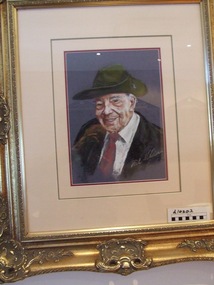
Painting Roy Longmore, RoyLongmore
... Before, he had hunted rabbits; but he later explained that when he returned home, he no longer had an appetite for firing at anything alive.[3] Longmore married and had one son, Eric.[1] The one-time LSgt Longmore died peacefully in his sleep at a Burwood Nursing Home aged 107 on 21 June 2001. ...Before, he had hunted rabbits; but he later explained that when he returned home, he no longer had an appetite for firing at anything alive.[3] Longmore married and had one son, Eric.[1] The one-time LSgt Longmore died peacefully in his sleep at a Burwood Nursing Home aged 107 on 21 June 2001. ...Longmore set aside his life as a farm-hand in Geelong, Victoria, when he enlisted in the Australian Imperial Force at age 21. Private (Pte) Roy Longmore, 3rd Reinforcements, 21st Battalion, of Bannockburn, Victoria enlisted on 13 July 1915; and he embarked from Melbourne aboard HMAT Anchises on 26 August 1915.[2] After training in Egypt, was sent to the Battle of Gallipoli where he was a tunnel digger with the 2nd Division, burrowing underneath the Turkish positions and laying mines. After evacuation from Turkey, he fought at Pozières, Armentières, and Villers-Bretonneux.[1] He was wounded three times in France and was momentarily given up for dead when he was shot as the Armistice in November 1918, approached. He later recalled, "We were patrolling in a gully when suddenly half a dozen Germans appeared over a hill armed with machine guns and opened fire. Jerry riddled me, knocking me flat on my back, and the last I heard was 'Longy's had it, they got him.'" Fortunately, his fellow soldiers saw him move and rescued him.[3] Lance Sergeant (LSgt) and returned to Australia on 16 March 1919 as a member of the 2nd Pioneer Battalion.[2] Civilian life[edit] After returning to Australia in 1919, his injuries made returning to farm work impossible, so he drove a taxi in Melbourne. Another change caused by the war was more telling. Before, he had hunted rabbits; but he later explained that when he returned home, he no longer had an appetite for firing at anything alive.[3] Longmore married and had one son, Eric.[1] The one-time LSgt Longmore died peacefully in his sleep at a Burwood Nursing Home aged 107 on 21 June 2001. He was the second last Anzac to die.[2] At his death, Australia honored him one final time with a state funeral.[3] Australian "legend"[edit] In 2000, Longmore was recognized as one of the "Australian Legends." His name and photograph were honored as part of an annual series of commemorative postage stamps issued by Australia Post since 1997. The stamps commemorate living Australians "who have made lifetime contributions to the development of Australia's national identity and character".[4] Longmore lived to fully enjoy this honor.[3] Longmore's 45-cent Legend stamp displays the soldier's portrait as a young man, photographed just prior to his departure for Gallipoli. Formal photographs of the other two ANZAC centenarians complete this stamp set. In addition, a fourth stamp features the 1914-15 star medal which was presented to all those who fought in campaigns during those war years.[5] These stamps, designed by Cathleen Cram of the Australia Post Design Studio, commemorate the story of events and people shaping contemporary Australia.[6] The Longmore stamp honors him as an individual and as a representative of all 68,000 soldiers at Gallipoli whose actions affected Australia's evolving self-image.[7] http://en.wikipedia.org/wiki/Roy_LongmoreFramed painting of Roy Longmore wooden frame glass fronted -
 Coal Creek Community Park & Museum
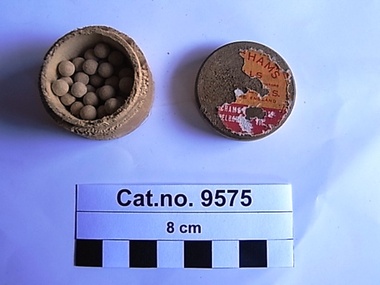
Box, pill, 1930-1940 ref: Museum of Applied Arts and Sciences
... . : 1848 - 1957), Friday 19 December 1884, page 7 'A WONDERFUL MEDICINE BEECHAMS PILLS Are admitted by thousands to be worth above a guinea a box for bilious and nervous disorders such as wind and pain in tho stomach, sick headache, giddiness, fulness and swelling after meals dizziness and drowsiness, cold chills, flushings of heat, loss of appetite, shortness of breath costiveness, scurvy, blotches on the skin, disturbed sleep, frightful dreams, and all nervous and trembling sensations, &c The first dose will give relief in 20 minutes This is no fiction, for they have done it in thousands of cases. .... : 1848 - 1957), Friday 19 December 1884, page 7 'A WONDERFUL MEDICINE BEECHAMS PILLS Are admitted by thousands to be worth above a guinea a box for bilious and nervous disorders such as wind and pain in tho stomach, sick headache, giddiness, fulness and swelling after meals dizziness and drowsiness, cold chills, flushings of heat, loss of appetite, shortness of breath costiveness, scurvy, blotches on the skin, disturbed sleep, frightful dreams, and all nervous and trembling sensations, &c The first dose will give relief in 20 minutes This is no fiction, for they have done it in thousands of cases. ...As per another example in better condition displayed on shelf above Drawers 1+2 in Chemist ' Beechams Pills as sold by the proprietors St.Helens, Lancashire England. Beechams Pills Ltd. Melbourne VIC'. Earliest mention in Victorian Newspapers TROVE : Argus (Melbourne, Vic. : 1848 - 1957), Friday 19 December 1884, page 7 'A WONDERFUL MEDICINE BEECHAMS PILLS Are admitted by thousands to be worth above a guinea a box for bilious and nervous disorders such as wind and pain in tho stomach, sick headache, giddiness, fulness and swelling after meals dizziness and drowsiness, cold chills, flushings of heat, loss of appetite, shortness of breath costiveness, scurvy, blotches on the skin, disturbed sleep, frightful dreams, and all nervous and trembling sensations, &c The first dose will give relief in 20 minutes This is no fiction, for they have done it in thousands of cases. Every sufferer Is earnestly invited to try one box of these pills, and they will be acknowledged to be WORTH A GUINEA A BOX. For females of all ages these pills are invaluable as a few doses of them carry off all humours and bring about all that is required No female should be with-out them There is no medicine to be found to equal Beecham's Pills for removing any obstruction or Irregularity of the system. If taken according to the directions given with each box they will soon restore females of all ages to sound and robust health For a weak stomach, impaired digestion, and all disorders of the liver they act like "Magic, and a few doses will be found to work wonders upon the most important organs of the human machine They strengthen tho whole muscular system, restore the long lost complexion bring back the keen edge of appetite, and arouse into action with the rosebud of health, the whole physical energy of the human frame These are ' facts ' admitted by thousands embracing all classes of society, and one of the best guarantees to the nervous and debilitated Is Beechams Pills have the largest sale of any patent medicine in the world Full directions are given with each box Sold by all druggists and patent medicine dealers throughout the colonies'. Most recent article in Victorian newspapers : TROVE : Wodonga and Towong Sentinel (Vic. : 1885 - 1954), Friday 24 December 1954, page 1. 'MUM KNOWS BEST SHE KEEPS THE FAMILY FIT WITH BEECHAM'S PILLS SAFE because Beecham's Pills contain no harmful habit-forming drugs-they are a purely vegetable laxative. Pills balanced formula gives natural laxative action without harsh purgative effects banishes constipation. MOTHERS know how to keep growing children in their teens fit and happy-with Beecham' s Pill, the family laxative. TAKE Beecham's Pills WORTH A GUINEA A BOX'. Relevant local newspaper article reference : TROVE : Gippsland Times (Vic. : 1861 - 1954), Thursday 29 October 1942, page 1 'ln times like these old friends are best You will not have to go far before finding a friend who can tell you by personal experience how gentle and reliable Beecham's Pills are--and how effectively they banish head aches. digestive upsets and liverish ness. Purely vegetable....1/-....2/...per box Worth a guinea a box' Cylindrical wooden box with the remains of an orange, red and white printed label on top, containing small orb shaped pills.Label on lid : Beecham's pills...............Beecham's Pills Ltd., Melbourne, Vic.laxitive, pills -
 Melbourne Tram Museum
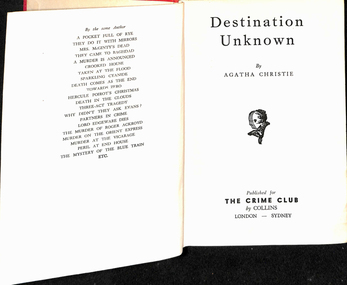
Book, Agatha Christie, "Destination unknown", 1954
... From Wikipedia - accessed 26/12/2019: Plot summary Hilary Craven, a deserted wife and bereaved mother, is planning suicide in a Moroccan hotel, when she is asked by British secret agent Jessop to undertake a dangerous mission as an alternative to taking an overdose of sleeping pills. The task, which she accepts, is to impersonate the wife of Thomas Betterton, a nuclear scientist who has disappeared and may have defected to the Soviet Union. ...From Wikipedia - accessed 26/12/2019: Plot summary Hilary Craven, a deserted wife and bereaved mother, is planning suicide in a Moroccan hotel, when she is asked by British secret agent Jessop to undertake a dangerous mission as an alternative to taking an overdose of sleeping pills. The task, which she accepts, is to impersonate the wife of Thomas Betterton, a nuclear scientist who has disappeared and may have defected to the Soviet Union. ...Book, hard cover, 12 sections, sewn with end papers, 210 pages, titled "Destination unknown", written by Agatha Christie, published by The Crime Club, 1954. Has the stamp of the Footscray Tramway Library, asking it to be returned within 14 days inside the front cover and in many places throughout the book, along with Number "606" on the inside front cover and on the spine of the book. The book was part of a library run by the depot staff to provide materials during broken shifts and to take home. From Wikipedia - accessed 26/12/2019: Plot summary Hilary Craven, a deserted wife and bereaved mother, is planning suicide in a Moroccan hotel, when she is asked by British secret agent Jessop to undertake a dangerous mission as an alternative to taking an overdose of sleeping pills. The task, which she accepts, is to impersonate the wife of Thomas Betterton, a nuclear scientist who has disappeared and may have defected to the Soviet Union. Soon she finds herself in a group of oddly-assorted travellers being transported to the unknown destination of the title. The destination turns out to be a secret scientific research facility disguised as a modern leper colony and medical research center at a remote location in the Atlas Mountains. The scientists are well-treated, but they are not allowed to leave the facility, and they are locked in secret areas deep inside the mountain whenever government officials and other outsiders visit. Hilary Craven successfully passes herself as Betterton's wife Olive, because he is miserable and wants desperately to escape. Hilary discovers that the facility was built by the fabulously wealthy and somewhat villainous Mr Aristides, for financial rather than political ends. He has lured the world's best young scientists to it with various deceptions so that he can later sell their services back to the world's governments and corporations for a huge profit. She falls in love with Andrew Peters, a handsome young American who was in the group with her on their journey to the facility. With the help of clues she has left along the way, Jessop eventually locates and rescues her and the others held there. Peters turns out also to be on a mission, intent on bringing Betterton to justice for the murder of his first wife. Betterton, revealed to also be a scientific fraud who plagiarized his work, is arrested. Hilary no longer wants to die, and she and Peters are free to begin their life together.On the top of the first page "13/3" indicating the price, "m/arz"? on the bottom left hand corner and inside the front cover the label of "Robertson & Mullens Ltd" booksellers.trams, tramways, footscray depot, libraries, novels, personnel, crews, shifts -
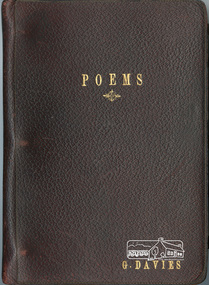 Eltham District Historical Society Inc
Book, Gwendoline G. W. Davies, Poems - G. Davies, 1933-1934
... There are some who’ll sleep forever, On a hill that’s called Lone Pine, And the twenty-fifth of April, Is famous for all time. ...There are some who’ll sleep forever, On a hill that’s called Lone Pine, And the twenty-fifth of April, Is famous for all time. ...Gwendoline (Gwenda) Grace Watson Davies, only daughter of Mr. William Watson Davies and Mrs. Grace Davies (nee Hayes) of Arthur Street, Eltham was born in Newport, 18 February 1908. Gwenda grew up in Arthur Street and when she left school she was employed as an officer at the State Bank of Victoria, Chief Accountants Department, Head Office, Elizabeth Street, Melbourne. During 1933-1934 in her early to mid-twenties, Gwenda wrote a series of poems which were captured in three books: one a leather bound three-ring binder with personalised gold embossing on the cover and two paper booklets held together by pink ribbon. These poems are a reflection of her childhood days, home, her mother, her environment, pioneering days and other miscellaneous subjects including one example titled “EIGHTEEN YEARS TO-DAY”, an homage to the brave men of Gallipoli. On October 20, 1937 after ten years of service, Gwenda submitted her letter of resignation effective November 26th as she was to be married in the near future to Fred Jones. Frederick Geoffrey Jones, born 7 January 1911, third son of Mr. and Mrs. W. Jones of Napoleon Street, Eltham, married Gwenda at the Eltham Methodist Church on 27 November 1937. They made their home at ‘Llangollen’, Arthur Street, Eltham, a new house Fred had constructed earlier that year opposite the Shire Offices. Their residence was recorded in the Electoral Rolls from 1963-1980 as 6 Arthur Street, Eltham which was situated on the corner of Arthur Street and present-day Commercial Place. In the 1970s their home was sold and demolished to make way for the new shops. They built a new home at the top of the hill in Bible Street. In the Electoral Rolls for 1943-1980, Frederick’s occupation was recorded as a Plumber’s Assistant. Fred was also a long-standing member of the Eltham Cemetery Trust. He was first appointed 26 April 1944 and resigned 17 July 1957 to be appointed to the Warringal and Eltham Joint Trust where he served till February 1980. He then re-joined the Eltham Cemetery Trust and served a further 14 years till his resignation on 24 August 1994. In total, Fred represented the interests of Eltham Cemetery for 50 years (1944-1994). Gwenda and Fred were blessed with a son, Frederick William Jones in March 1942. Sadly, Frederick only lived two days and was buried at Eltham Cemetery on March 11. It is not known whether his grave is marked. A second son, Geoffrey Morris Jones arrived 25 November 1944 but he sadly contracted polio as a child. A fall down the front steps of Fred and Gwenda’s new home in Bible Street culminated in Geoff’s death from a heart attack whilst in transit to the Austin Hospital on February 6, 1979, at age 34. He was also interred in the Eltham Cemetery. Geoff was posthumously awarded the British Empire Medal for his services to fire safety at the CFA. A small man, handicapped from his childhood polio, he had figured prominently in the area as an active Apex member and as group officer for the 13 local brigades in the CFA Lower Yarra Group. His work for the CFA, all voluntary, included writing a fire-fighting manual and the innovation of aerial fire spotting and weekly fire reports. Gwendoline and Fred were presented with Geoff’s B.EM. award at Government House. Four years later on the anniversary of Geoff’s death, Gwenda could not sleep and collapsed in the hallway at home from a heart attack, 6 February 1983 at age 74. She was interred with her son Geoff, at Eltham Cemetery on February 9th. Fred died 31 July 1997 at age 86 and was also interred at Eltham Cemetery. A memorial plaque to Gwenda, Fred and Geoff lies within the lawn cemetery at Eltham Cemetery. In February 2022 Gwenda’s book of Poems along with a copy of her letter of resignation from the State Bank of Victoria and a news clipping about the Autumn Show held in the Public Hall at Eltham (opposite her home with Fred) in which Gwenda is listed as having entered Cream Puffs and a Swiss Roll into the Cooking section, were donated to the St Vincent’s de Paul Society in Bega, N.S.W.. A dedicated volunteer there researched their origins and desirous for these items to return ‘home’, posted them to the Eltham District Historical Society for which we are most appreciative. EIGHTEEN YEARS TO-DAY “Tell me why you’re dreaming, Daddy” Said my little son to me, So, I told him all about it, As he sat upon my knee. I told him of that Sunday morn, ‘Twas eighteen years to-day, When the men of Australasia, Joined the mighty fray. How they landed on that foreign shore, And fought the gallant fight, Of how they nobly won the day, And put the Turks to flight. We saw the cliffs before us, To be scaled ‘mid shot and shell, And our comrades fell around us - - - - I remember it - - - so well. There are some who’ll sleep forever, On a hill that’s called Lone Pine, And the twenty-fifth of April, Is famous for all time. And so to keep their memory green, We march each Anzac Day, To pay tribute to those Heroes, Who gave their lives that day. - Anzac Day 1933 And in reflections to Gwenda’s childhood home in Arthur Street: HOME Where do my thoughts ever wander? Where do my thoughts always roam? To a little old house, on the top of a hill, To the place, that I call “Home Sweet Home.” No matter where-ever I travel, On land, or away on the foam. My thoughts will return, and my heart ever yearn, To the place, that I call “Home Sweet Home”. - 2/7/1933 Sources: Book of Poems, G. Davies Letter of Resignation, 1937, Oct. 20, G.G.W. Davies Births Deaths and Marriages Victoria New House at Eltham (1937, September 10). Advertiser (Hurstbridge, Vic. : 1922 – 1939), p. 6. Retrieved May 12, 2022, from http://nla.gov.au/nla.news-article56845735 Family Notices (1937, December 17). Advertiser (Hurstbridge, Vic. : 1922 – 1939), p. 3. Retrieved May 12, 2022, from http://nla.gov.au/nla.news-article56846386 Geoff Jones, Proud Memory, unknown newspaper clipping, 1979 1979 Birthday Honours, Wikipedia, https://en.wikipedia.org/wiki/1979_Birthday_Honours Australian Electoral Rolls, Ancestry.com Family Trees, Ancestry.com Eltham Cemetery, Deceased Search findagrave.com Personal recollections, Joan Castledine The poetry by Gwendoline Davies provides an insight into life growing up in Eltham and the early 1930s. A long time resident, Gwendoline, her husband Fred Jones and son Geoff Jones were fully dedicated to the Eltham community for over 50 years.1. Brown leather bound three-ring binder with personalised gold embossing on the cover 20.5 x 14.5 cm, Walkers Loose Leaf Book, pages typed with some pasted in colour illustrations, alphabeticised dividers (some tabs missing), 21 leafs (some blank) 2. Two paper booklets held together by pink ribbon 15.5 x 12 cm, typed, some with colour illustrations, pages numbered (rh only) 12 pages and 25 pages and paper cover 3. Newspaper clipping 4. Letter sized hand written page in ink folded in three and damaged by foxing and insectsanzac day, arthur street, napoleon street, cfa, eltham cemetery, eltham cemetery trust, frederick geoffrey jones, geoffrey morris jones b.e.m., grace davies (nee hayes), gwendoline grace watson jones (nee davies), llangollen, lower yarra group, poems, william watson davies -
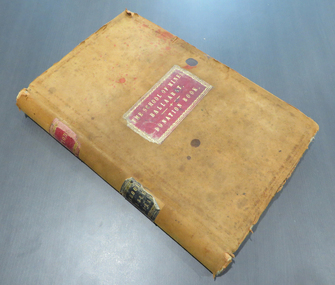 Federation University Historical Collection
Book - Book - Ledger, Ballarat School of Mines Donation Book, 1878-1896, 01/01/1878 - 01/08/1896
... Lime and Magnesia. 465. 06 September 1881 - J.J. Sleep (Chairman of the Board) per favor of E.W. ...Lime and Magnesia. 465. 06 September 1881 - J.J. Sleep (Chairman of the Board) per favor of E.W. ...Leather bound ledger with hand written details on donations to the Ballarat School of Mines Museum or the Ballarat School of Mines Library. The Ledger was made by J. McHutchison, Bookbinder, paper ruler and Account Book Manufacturer. 267. 07 July 1880 - John Lynch Junior - Smythesdale - Cast of "Golden Age" nugget found at Browns by Co-operative Party - 12 men. Weight 75 oz 12 dwts 12 grs 294. 24 June 1880 - W.H. Shaw - Ballarat - 94 numbers of 'The Engineer'. 295. 28 June 1880 - Rivett Henry Bland - Clunes - Specimen of water pipe from the Port Phillip Consols Mine encrusted with Carbonates of lime and magnesia and sulphate of lime with earthy matter. 418. 17 June 1881 - F. Ratte - Sydney - Catalogue of Rocks, minerals, etc of New Caledonia. 462. 28 September 1881 - Dr Bunce - Ballarat - Concretionary Basalt with Car. Lime and Magnesia. 465. 06 September 1881 - J.J. Sleep (Chairman of the Board) per favor of E.W. Spain, Esq, Manr - Ballarat - Diamond drill core from "Carisbrook Freehold Estate" - cut at a depth of 150 feet. Dedrites from Munster Gully ... 517. 20 January 1882 - William Lester - Ballarat - The Agricultural Teacher 549. 24 March 1882 - C.E. Grainger Manager Ballarat Woollen Mills - Ballarat - Samples of dyed and raw wool and dye material. 600. 04 July 1882 - Henry Sutton - Ballarat - 13th Annual Report of the Aeronautical Society of Great Britain. 1222. 31 October 1884 - Trooper Dowling - Miner's Rest - Owl 1223. 04 November 1884 - W. McKeenan - 3, Adair St, Ballarat - Flying Squirrel. 1259. 16 January 1885 - A.A. Buley - Ballarat - Prospective of Grenville College 1885 1428. 06 October 1885 - Ballarat - Collection of mineral specimens from Silverton (Collected by Mr James Murray). 1442. 20 October 1885 - Ballarat - Specimen of fossil fruits collected by Haddon by Charles Brown. 1682. 28 February 1887 - James Lamb - Ballarat - Copy of the Ballarat Times Newspaper of 3rd December 1854, framed and protected on both sides with glass. 1730. 23 May 1887 - Bella Guerin - Ballarat - Copy of the Victorian Review No 74 December 1885 4786. 27 March 1894 - James Oddie - Ballarat - 3 mineral specimens 4835. 01 August 1896 - P.V> Barnard - Ballarat - {ortion of Mining truck wheel altered to oxide of iron found in the old workings of the Golden Gate Mine at a depth of 200 feet. (4235 is last entry)ballarat school of mines, ballarat school of mines museum, donations, henry sutton, bella guerin -
Coal Creek Community Park & Museum
Music Sheets
... / Poor Little Me 12 - My Dear / Why / You're as Pretty as a Picture / My Own (2 Copies) 13 - Cinderella Sweetheart / Hi-Ho Silver 14 - That Week In Paris / Two Sleep People 16 - Rock it for me / Say THat You Care For Me 17 - On The Bumpy Road to Love / There's Honey On The Moon Tonight 18 - The Same Sweet You / On Parade 21 - Cinderella / The Chestnut Tree 22 - Skating Down The Old Mill Stream / What Have You Got That Gets Me 26 - All Ashore / Sixty Seconds Got Together 32 - I Go For That / Junior 33 - The Great Waltz / Don't Wake Up My Heart 34 - Strike Up The Band / Kinda Lonesome 35 - Peace Of Mind / minute For Modern Miss 37 - The Night / Honolulu 38 - Hang Your Heart On A Rickory Limb / That Sly Old Gentleman 40 - Grandma Said / Something to Sing about 41 - Loving You / Killy-Ka-lee / I'll Still Be Loving You 91 - Waltzes From Vienna 96 - To You Sweetheart Aloha / Did I Remember 102 - At The Close Of A Long, Long Day / I Have Lost Me Heart In Budapest 111 - Man Of My Dreams / Life Is Empty Without Love 120 - Have You Ever Been Lonely / Sitting In The Dark 121 - And So I Married The Girl / Someone to Care For 122 - Thank Heaven For You / All Over Italy 123 - There's a Bridle Hanging On The Wall / You'll Never Go To Heaven 125 - There's a Lull in my Life / A Nic Cup Of Tea 138 - On Wings of a Song / Harmony Lane 149 - Swing it Here to Sway / The One Rose 150 - What Harlem is Tome 156 - Fifty Million Robins Can't Be Wrong / Nice Work If You Can Get It 162 - Sail Along, Silvery Moon / I Love To Whistle 164 - I Double Dare You / The Snake Charmer 168 - Sweet As A Song / Toodle Do 177 - I've Got A Pocketful of Dreams / When The Organ Played Promise Me 182 - This May Be The Night / I've Got A Date With A Dream 179 - At A Perfume Counter / On Linger Longer Island 183 - I Married An Angel / Spring is Here.../ Poor Little Me 12 - My Dear / Why / You're as Pretty as a Picture / My Own (2 Copies) 13 - Cinderella Sweetheart / Hi-Ho Silver 14 - That Week In Paris / Two Sleep People 16 - Rock it for me / Say THat You Care For Me 17 - On The Bumpy Road to Love / There's Honey On The Moon Tonight 18 - The Same Sweet You / On Parade 21 - Cinderella / The Chestnut Tree 22 - Skating Down The Old Mill Stream / What Have You Got That Gets Me 26 - All Ashore / Sixty Seconds Got Together 32 - I Go For That / Junior 33 - The Great Waltz / Don't Wake Up My Heart 34 - Strike Up The Band / Kinda Lonesome 35 - Peace Of Mind / minute For Modern Miss 37 - The Night / Honolulu 38 - Hang Your Heart On A Rickory Limb / That Sly Old Gentleman 40 - Grandma Said / Something to Sing about 41 - Loving You / Killy-Ka-lee / I'll Still Be Loving You 91 - Waltzes From Vienna 96 - To You Sweetheart Aloha / Did I Remember 102 - At The Close Of A Long, Long Day / I Have Lost Me Heart In Budapest 111 - Man Of My Dreams / Life Is Empty Without Love 120 - Have You Ever Been Lonely / Sitting In The Dark 121 - And So I Married The Girl / Someone to Care For 122 - Thank Heaven For You / All Over Italy 123 - There's a Bridle Hanging On The Wall / You'll Never Go To Heaven 125 - There's a Lull in my Life / A Nic Cup Of Tea 138 - On Wings of a Song / Harmony Lane 149 - Swing it Here to Sway / The One Rose 150 - What Harlem is Tome 156 - Fifty Million Robins Can't Be Wrong / Nice Work If You Can Get It 162 - Sail Along, Silvery Moon / I Love To Whistle 164 - I Double Dare You / The Snake Charmer 168 - Sweet As A Song / Toodle Do 177 - I've Got A Pocketful of Dreams / When The Organ Played Promise Me 182 - This May Be The Night / I've Got A Date With A Dream 179 - At A Perfume Counter / On Linger Longer Island 183 - I Married An Angel / Spring is Here Music Sheets ...A collection of 41 music sheets. 5 - The Blackpool Walk / Angels of the Mons 6 - Love is Where you Find It / A Little Love, A Little Kiss 9 - Brown Eyes, Why are You Blue? / Poor Little Me 12 - My Dear / Why / You're as Pretty as a Picture / My Own (2 Copies) 13 - Cinderella Sweetheart / Hi-Ho Silver 14 - That Week In Paris / Two Sleep People 16 - Rock it for me / Say THat You Care For Me 17 - On The Bumpy Road to Love / There's Honey On The Moon Tonight 18 - The Same Sweet You / On Parade 21 - Cinderella / The Chestnut Tree 22 - Skating Down The Old Mill Stream / What Have You Got That Gets Me 26 - All Ashore / Sixty Seconds Got Together 32 - I Go For That / Junior 33 - The Great Waltz / Don't Wake Up My Heart 34 - Strike Up The Band / Kinda Lonesome 35 - Peace Of Mind / minute For Modern Miss 37 - The Night / Honolulu 38 - Hang Your Heart On A Rickory Limb / That Sly Old Gentleman 40 - Grandma Said / Something to Sing about 41 - Loving You / Killy-Ka-lee / I'll Still Be Loving You 91 - Waltzes From Vienna 96 - To You Sweetheart Aloha / Did I Remember 102 - At The Close Of A Long, Long Day / I Have Lost Me Heart In Budapest 111 - Man Of My Dreams / Life Is Empty Without Love 120 - Have You Ever Been Lonely / Sitting In The Dark 121 - And So I Married The Girl / Someone to Care For 122 - Thank Heaven For You / All Over Italy 123 - There's a Bridle Hanging On The Wall / You'll Never Go To Heaven 125 - There's a Lull in my Life / A Nic Cup Of Tea 138 - On Wings of a Song / Harmony Lane 149 - Swing it Here to Sway / The One Rose 150 - What Harlem is Tome 156 - Fifty Million Robins Can't Be Wrong / Nice Work If You Can Get It 162 - Sail Along, Silvery Moon / I Love To Whistle 164 - I Double Dare You / The Snake Charmer 168 - Sweet As A Song / Toodle Do 177 - I've Got A Pocketful of Dreams / When The Organ Played Promise Me 182 - This May Be The Night / I've Got A Date With A Dream 179 - At A Perfume Counter / On Linger Longer Island 183 - I Married An Angel / Spring is Here -
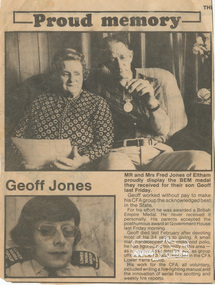 Eltham District Historical Society Inc
Document - Folder, Jones, 1979
... Four years later on the anniversary of Geoff’s death, Gwenda could not sleep and collapsed in the hallway at home from a heart attack, 6 February 1983 at age 74. ...Four years later on the anniversary of Geoff’s death, Gwenda could not sleep and collapsed in the hallway at home from a heart attack, 6 February 1983 at age 74. ...Fred, Gwenda and Geoff Jones Contents 1. Proud memory; Geoff Jones, Diamond Valley News, 21 Nov 1979 2. Sudden death of 'much loved man', Diamond Valley News, 13 Feb 1979 3. Honor for a community friend, Diamond Valley News, 8 March 1995 (On reverse, 'Diverse program to entice riders' about St Andrews Saddle Club and fgeatures a photo of Debbie Jones) Gwendoline (Gwenda) Grace Watson Davies, only daughter of Mr. William Watson Davies and Mrs. Grace Davies (nee Hayes) of Arthur Street, Eltham was born in Newport, 18 February 1908. Gwenda grew up in Arthur Street and when she left school she was employed as an officer at the State Bank of Victoria, Chief Accountants Department, Head Office, Elizabeth Street, Melbourne. On October 20, 1937 after ten years of service, Gwenda submitted her letter of resignation effective November 26th as she was to be married in the near future to Fred Jones. Frederick Geoffrey Jones, born 7 January 1911, third son of Mr. and Mrs. W. Jones of Napoleon Street, Eltham, married Gwenda at the Eltham Methodist Church on 27 November 1937. They made their home at ‘Llangollen’, Arthur Street, Eltham, a new house Fred had constructed earlier that year opposite the Shire Offices. Their residence was recorded in the Electoral Rolls from 1963-1980 as 6 Arthur Street, Eltham which was situated on the corner of Arthur Street and present-day Commercial Place. In the 1970s their home was sold and demolished to make way for the new shops. They built a new home at the top of the hill in Bible Street. In the Electoral Rolls for 1943-1980, Frederick’s occupation was recorded as a Plumber’s Assistant. Fred was also a long-standing member of the Eltham Cemetery Trust. He was first appointed 26 April 1944 and resigned 17 July 1957 to be appointed to the Warringal and Eltham Joint Trust where he served till February 1980. He then re-joined the Eltham Cemetery Trust and served a further 14 years till his resignation on 24 August 1994. In total, Fred represented the interests of Eltham Cemetery for 50 years (1944-1994). Gwenda and Fred were blessed with a son, Frederick William Jones in March 1942. Sadly, Frederick only lived two days and was buried at Eltham Cemetery on March 11. It is not known whether his grave is marked. A second son, Geoffrey Morris Jones arrived 25 November 1944 but he sadly contracted polio as a child. A fall down the front steps of Fred and Gwenda’s new home in Bible Street culminated in Geoff’s death from a heart attack whilst in transit to the Austin Hospital on February 6, 1979, at age 34. He was also interred in the Eltham Cemetery. Geoff was posthumously awarded the British Empire Medal for his services to fire safety at the CFA. A small man, handicapped from his childhood polio, he had figured prominently in the area as an active Apex member and as group officer for the 13 local brigades in the CFA Lower Yarra Group. His work for the CFA, all voluntary, included writing a fire-fighting manual and the innovation of aerial fire spotting and weekly fire reports. Gwendoline and Fred were presented with Geoff’s B.EM. award at Government House. Four years later on the anniversary of Geoff’s death, Gwenda could not sleep and collapsed in the hallway at home from a heart attack, 6 February 1983 at age 74. She was interred with her son Geoff, at Eltham Cemetery on February 9th. Fred died 31 July 1997 at age 86 and was also interred at Eltham Cemetery. A memorial plaque to Gwenda, Fred and Geoff lies within the lawn cemetery at Eltham Cemetery.Newsprint clippingscfa, eltham cemetery, eltham cemetery trust, frederick geoffrey jones, geoffrey morris jones b.e.m., gwendoline grace watson jones (nee davies), lower yarra group, debbie jones, st andrews saddle club -
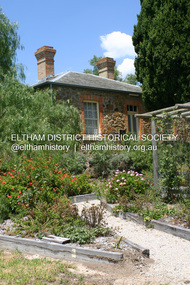 Eltham District Historical Society Inc
Photograph - Digital Photograph, Alan King, Ellis Cottage, Diamond Creek, 23 January 2008
... To maximise the small space the ceiling cavity was designed large enough to provide sleeping accommodation accessed via a ladder. ...To maximise the small space the ceiling cavity was designed large enough to provide sleeping accommodation accessed via a ladder. ...Built by William Ellis in 1865 of local uncut stone about 30cm thick, the cottage is now a museum and home to the Nillumbik Historical Society. Ellis Cottage is historically significant for its association with the Ellis family, who were pioneers of the Diamond Creek district and the benefactors of the notable Nillumbik Cemetery gateway. It illustrates the development of farming in the area. Ellis Cottage is historically and technically significant for its rare use of uncut local stone for building purposes. Covered under Heritage Overlay, Nillumbik Planning Scheme. National Estate Published: Nillumbik Now and Then / Marguerite Marshall 2008; photographs Alan King with Marguerite Marshall.; p79 Ellis Cottage, built by William Ellis, is a memorial to the courage of pioneers in the Diamond Valley area.1 Now a museum and home to the Nillumbik Historical Society, it is a fine example of an early settler’s house in Diamond Creek – and one of the few original buildings standing from the middle of the 19th century. It is a poor man’s cottage – typical of the dwellings of those who had to work hard to wrest a living in this district, because most of the land was not fertile enough for major forms of farming. The pretty stone cottage at 10 Nillumbik Square, built in 1865, is made of local uncut stone about one foot (30 cm) thick. It once stood near the centre of the 147 acres (59.4ha) Ellis bought in 1850. The property extended from Diamond Creek to Reynolds Road and from Perversi Avenue to the Wattle Glen School. It stood in the electoral parish of Nillumbik. The Nillumbik township (later called Diamond Creek) was not created until 1867. In 1912 the property was cut in half by the new railway to Hurstbridge. Ellis paid £147/10/- for the land - about three times what a Victorian farmer would usually earn in a year. Despite the poor quality soil Ellis became a very successful farmer with an orchard, vegetables and a dairy herd. Five years later, in 1855, Ellis bought 70 acres (28.3ha) from neighbour, Hugh Larimour. In 1857 Ellis bought 208 acres (84ha) at Yarra Glen. In 1877 he bought 122 acres (49.3ha) at Diamond Creek and later bought land at Greensborough and Woodstock. Ellis was born in 1815 at Blackawton, a small Devonshire village, and became a tenant farmer. It is not known why Ellis came out to Australia or settled in Diamond Creek. In 1847 he married Margaret Child at the Melbourne Presbyterian Church. Ellis and Child had no children and 18 years after the wedding, while probably living in Kangaroo Ground, Ellis built this small cottage. The simple cottage has a central hall and two rooms on each side. To maximise the small space the ceiling cavity was designed large enough to provide sleeping accommodation accessed via a ladder. Each room was heated by an open fireplace and the one in the kitchen was large enough to roast a sheep. A large cellar under the front room probably stored farm produce. Water came from a well as reticulated water did not arrive at Diamond Creek until 1914. In 1870 Ellis’ 22 year-old nephew Nathaniel joined him from England.2 Until 1890 they developed Ellis Park, praised in The Evelyn Observer, May 30,1890 as a model farm. Ellis had become wealthy, and on his death in 1896 his estate was valued at £9000. In his will he left £100 to construct memorial gates at the Nillumbik Cemetery where he was buried.3 Ellis left the farm to his second wife Louisa. As he had no children, upon her death the farm passed to Nathaniel, but he did not take it up. The farm was sold and leased several times until 1967, when engineer Phillip Lovitt bought the property and carried out major structural works. The Shire of Diamond Valley bought it in the 1980s and in 1989 restored it with the Nillumbik Historical Society. The stone walls of the cottage had been plastered with mud and straw mortar, which were removed as they were riddled with vermin. Doors, windows and a floor were replaced and the original roof of timber shingles had been replaced with slate. The well was too deeply cracked to be restored, so was used for a flower bed. Two mature Italian Cypresses at the entry are also heritage protected as they relate to similar trees planted at Shillinglaw Cottage and other early buildings in Nillumbik Shire.This collection of almost 130 photos about places and people within the Shire of Nillumbik, an urban and rural municipality in Melbourne's north, contributes to an understanding of the history of the Shire. Published in 2008 immediately prior to the Black Saturday bushfires of February 7, 2009, it documents sites that were impacted, and in some cases destroyed by the fires. It includes photographs taken especially for the publication, creating a unique time capsule representing the Shire in the early 21st century. It remains the most recent comprehenesive publication devoted to the Shire's history connecting local residents to the past. nillumbik now and then (marshall-king) collection, ellis cottage, diamond creek, nillumbik historical society, william ellis -
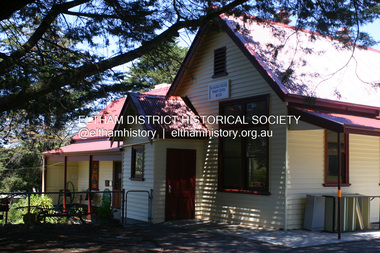 Eltham District Historical Society Inc
Photograph - Digital Photograph, Alan King, Original Kangaroo Ground Primary School No. 2105 building, Eltham-Yarra Glen Road, Kangaroo Ground, 28 December 2007
... At one stage, a corner of the room was curtained off for the schoolmaster’s living space, and the platform, which was used for sleeping, was also the pulpit during church services. ...At one stage, a corner of the room was curtained off for the schoolmaster’s living space, and the platform, which was used for sleeping, was also the pulpit during church services. ...Kangaroo Ground's first school began in 1851 with 22 pupils from the district's ten families. It was a single room school located further south on the site, which also served as a Presbyterian church. The first teacher was Andrew Ross. The school building was used as a Post Office between 1854 and 1858 and during 1857 also served as a Court of Petty Sessions. With a growing farming community, a new building was warranted and the original Sate School No. 352 was closed and a new building, State School No. 2105 was oipened October 1, 1878. A residence for Head Teacher Henry Wallace School was erected in 1879 attached to the left of the school building. That residence is now home to the Andrew Ross Museum, which opened in 1993. Covered under Heritage Overlay, Nillumbik Planning Scheme. Published: Nillumbik Now and Then / Marguerite Marshall 2008; photographs Alan King with Marguerite Marshall.; p35 In a corner of the Kangaroo Ground Primary School playground stands an old weatherboard building. This structure, attached to the former teacher’s weatherboard residence facing Main Road, first served as a school in 1878. The former residence, built in 1879, houses the Andrew Ross Museum, which opened in 1993. It is named after the school’s first teacher,1 who also founded The Evelyn Observer newspaper, which began on the site in 1873. Later the printing presses were moved to brick newspaper offices by the Kangaroo Ground Hotel, which became the Shire of Eltham offices. However Kangaroo Ground’s first school began in 1851 for 22 pupils from the district’s ten families, in a slab building further south on this site. Andrew Harkness and other settlers campaigned for the building, which was built on half an acre (0.2ha) donated by local farmer, James Donaldson. Builder was Samuel Furphy, father of the novelist Joseph.2 The single room measuring 30 feet x 18 feet (9m x 5.5m), was unlined and the green slabs shrank, allowing the wind and rain entry through cracks except when they were stuffed with paper.3 The building served as a Presbyterian church as well as a school, where fees were 18 pence a week for education. Young men also attended evening classes there in winter. At one stage, a corner of the room was curtained off for the schoolmaster’s living space, and the platform, which was used for sleeping, was also the pulpit during church services. Teacher Andrew Ross also took church services when the minister was unable to attend, which happened frequently as he had long distances to travel on the bad roads. In 1857 the school building was also used as the Court of Petty Sessions, and from 1854 until 1858, it served as a post office. During the gold rush fossickers on their way to the Caledonia Diggings at Queenstown (now St Andrews) prospected the district, but did not remain long, as the fields were not rich in gold. But the farming community grew, until by 1878 the population warranted the building of State School No 2105 – the present one-roomed tongue-and-groove lined building measuring 49 feet x 18 feet (15m x 5.5m), to accommodate 60 children. The old school, No 352, was closed, and the new one opened on October 1, with Henry Wallace as head teacher, assisted by work mistress Annie Johnston. Early teachers included Messrs Smith, Hamilton and Prosser, with sewing teachers Misses Sweeney, Limerock and Oliver. In the early 1920s a small room was built on the front veranda of the teacher’s residence, and used as a State Savings Bank agency until about 1934. In 1928 the schoolroom’s three-tiered floor was replaced by a flat floor and teacher’s platform (which has since been removed). A half-glassed partition wall then divided the large room into two rooms in which the old style form-type desks were replaced with dual desks. The small playground, surrounded by pine trees and a picket fence, was extended in 1931 with an additional acre or so (0.4 ha) of land. During World War Two the school faced closure because of a fall to seven in the enrolment, but by 1946 it had increased again to 45. Mr Eric Morgan was head teacher and Mrs Margaret Banks was assistant head teacher, a position she held for ten years. In 1955, under the head teacher Mr V Gardiner, who taught there for 13 years, the school won a prize for the best-kept garden and school ground in the inspectorate. A district subdivision increased the enrolment in 1968 to 65 and a bus service was established. After the hall which had been used for lessons was demolished late that year, the pupils met in the original fire brigade meeting room (now the tennis club, diagonally opposite the general store). The new school building with a storeroom and staffroom was built in 1974.This collection of almost 130 photos about places and people within the Shire of Nillumbik, an urban and rural municipality in Melbourne's north, contributes to an understanding of the history of the Shire. Published in 2008 immediately prior to the Black Saturday bushfires of February 7, 2009, it documents sites that were impacted, and in some cases destroyed by the fires. It includes photographs taken especially for the publication, creating a unique time capsule representing the Shire in the early 21st century. It remains the most recent comprehenesive publication devoted to the Shire's history connecting local residents to the past. nillumbik now and then (marshall-king) collection, kangaroo ground, andrew ross museum, eltham-yarra glen road, kangaroo ground primary school no. 2105, kangaroo ground state school, state school no. 2105 -
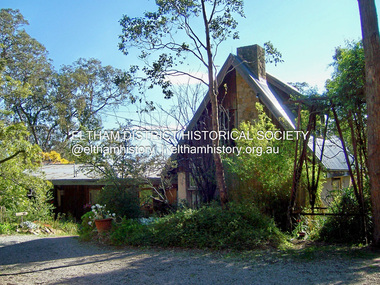 Eltham District Historical Society Inc
Photograph - Digital Photograph, Marguerite Marshall, Former home of Professor William MacMahon Ball, York Street, Eltham, 24 May 2007
... Jenny Ellis, Mac’s daughter, remembers being awakened from sleep by a thundering shudder. The wall of her room had fallen down – fortunately away from her! ...Jenny Ellis, Mac’s daughter, remembers being awakened from sleep by a thundering shudder. The wall of her room had fallen down – fortunately away from her! ...Situated at the eastern end of York Street, Eltham, 'Shinrone', the former home of Professor William (Mac) MacMahon Ball was one of the first in the Shire of Eltham to incorporate mud-brick. Professor MacMahon Ball, a political scientist, writer, broadcaster and diplomat and family moved to York Street, Eltham in 1945 into a timber cottage built around the 1890s and in poor repair. Mac asked Alistair Knox to renovate the home and he expanded the living area and added verandahs. In 1948 Montsalvat artist and sculptor Sonia Skipper supervised the building of most of the mud-brick studio. Neighbour Gordon Ford made the mud-bricks. Mac also asked John Harcourt, who had worked with him as a journalist in shortwave broadcasting, to build a pise (rammed earth) and stone addition to the largely timber house. Harcourt built two bedrooms - including an attic bedroom - a balcony with a shower and toilet, a nd a fireplace and chimney of local stone. Published: Nillumbik Now and Then / Marguerite Marshall 2008; photographs Alan King with Marguerite Marshall.; p141 At the eastern tip of York Street, Eltham, stands Shinrone, the former home of one of Australia’s intellectual leaders. Professor William Macmahon Ball, was one of the first to bring Asia as a foreign policy issue to the Australian public.1 He was a political scientist, writer, broadcaster and diplomat. The house was one of the first in Eltham Shire to incorporate mud-brick,2 because of the acute shortage of building materials after World War Two. Its novice builders later become leaders in Eltham’s built and garden design. Mac (as he was usually called), who was the son of a Church of England minister, was born in Casterton, Victoria in 1901 and died in 1986. In 1945 he helped establish the United Nations, as political consultant to the Australian Delegation at the San Francisco Conference.3 Then in 1946 Mac was appointed British Commonwealth Representative on the Allied Council for Japan, which is recorded in detail in his diary.4 In 1948 Mac led an Australian Government Goodwill Mission to South East Asia. However, Mac was perhaps most successful as an academic and public speaker.5 He was a commentator on the Australian Broadcasting Commission, from the early 1930s to the early 1960s. He was also Controller of the Short-Wave Broadcasting Unit during World War Two, which later became Radio Australia. From 1923 he taught at The University of Melbourne, then became foundation Professor of Political Science in 1949 and was Chair until his retirement in 1968.6 In 1942, as the government expected a Japanese invasion, Mac’s wife Katrine and their only child Jenny, moved from Kew to Eltham as temporary evacuees. However Mac and Katrine lived in Eltham for almost the rest of their lives. After staying with friends, they rented a house in Reynolds Road, where, as it was wartime, they needed to keep horses for transport and a cow and poultry for milk and eggs. In 1945 the family moved to the house at York Street, which was then a timber cottage, built around the 1890s and in poor repair. The underground well, cellar and part of the garden are all that remain of what stood on the original 18 acre (7.3ha) allotment. Thanks largely to Katrine’s hard work, the house was gradually renovated and extended. The long rambling house was partially built by several young neighbours, who were inspired by the cheap mud-brick and stone building style of Montsalvat, the Eltham artists’ colony. Mac asked Alistair Knox to renovate Shinrone, named after an Irish village near Katrine’s family home. Knox later popularised the mud-brick style of house construction, for which Eltham became known. He expanded the living area and added verandas. In 1948 Montsalvat artist and sculptor Sonia Skipper supervised the building of most of the mud-brick studio. Another neighbour, Gordon Ford, who was to have a major influence on the Australian garden style, made the mud-bricks. Mac also asked John Harcourt, who had worked with him as a journalist in short-wave broadcasting, to build a pisé (rammed earth) and stone addition to the largely timber house. Harcourt built two bedrooms – including an attic bedroom – a balcony with a shower and toilet, and a fireplace and chimney of local sandstone. With pioneering work naturally came mistakes, including one particularly dramatic incident when Harcourt was building walls with unsupported sections. Jenny Ellis, Mac’s daughter, remembers being awakened from sleep by a thundering shudder. The wall of her room had fallen down – fortunately away from her! In 1950 artist Peter Glass – another neighbour and later landscape designer – built Katrine a mud-brick pottery. As a result, the house features at one end Harcourt’s characteristic steep gable roof, while at the other the flatter construction characteristic of Knox. Mac referred to the home as the Eltham ‘experimental building site’.7 Surprisingly, the combination works, perhaps partly because it has the warm inviting feel of timber, mud-brick and stone.This collection of almost 130 photos about places and people within the Shire of Nillumbik, an urban and rural municipality in Melbourne's north, contributes to an understanding of the history of the Shire. Published in 2008 immediately prior to the Black Saturday bushfires of February 7, 2009, it documents sites that were impacted, and in some cases destroyed by the fires. It includes photographs taken especially for the publication, creating a unique time capsule representing the Shire in the early 21st century. It remains the most recent comprehenesive publication devoted to the Shire's history connecting local residents to the past. nillumbik now and then (marshall-king) collection, eltham, alistair knox, gordon ford, john harcourt, mudbrick construction, pise construction, professor macmahon ball, shinrone, sonia skipper, york street
