
Showing 402 items matching "delays"
-
 Department of Energy, Environment and Climate Action
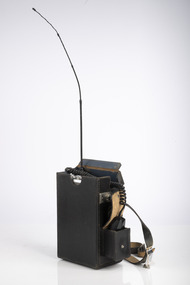
Tait portable mini phone
... After suffering some inevitable delays due to the war, radio VL3AA switched into full operation in October 1945 proudly beaming out 200 watts across the State. ...After suffering some inevitable delays due to the war, radio VL3AA switched into full operation in October 1945 proudly beaming out 200 watts across the State. ...After the 1939 bushfires, the Forests Commission Victoria invested heavily in a radically new communications network. After suffering some inevitable delays due to the war, radio VL3AA switched into full operation in October 1945 proudly beaming out 200 watts across the State. But by today’s standards, the technology was primitive and the reception poor unless the user was on a high point somewhere. The radio signal was "line-of-sight" and bounced between fire towers and relay transmitters across the mountains back to the District offices. The advent of solid-state electronics in the 1960s replaced the more delicate valve sets which enabled greater use of vehicle mounted radios. The Commission continued to research, develop and build new radios at its many workshops around Victoria. The network was supported by a large team of skilled radio technicians. The more secure and versatile State Mobile Radio (SMR) digital trunk system came into operation in about 1995. Upgraded Tait Radios were purchased in 2014 after recommendations of the 2009 Bushfires Royal Commission. But it was the convergence of separate technologies such as 5G mobile phones, high-capacity and light-weight lithium batteries, Wi-Fi, the ever-expanding internet, cloud data storage, digital cameras, GPS, personal organisers and hundreds of supporting Apps into powerful smartphones and tablets which revolutionised bushfire communications from the mid-2000s. Portable mini phone in leather casebushfire, radios, forests commission victoria (fcv) -
 Department of Energy, Environment and Climate Action
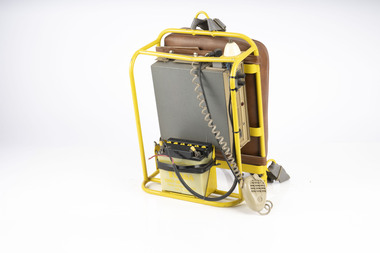
Portable STC Radiophone - c 1970s
... After suffering some inevitable delays due to the war, radio VL3AA switched into full operation in October 1945 proudly beaming out 200 watts across the State. ...After suffering some inevitable delays due to the war, radio VL3AA switched into full operation in October 1945 proudly beaming out 200 watts across the State. ...After the 1939 bushfires, the Forests Commission Victoria invested heavily in a radically new communications network. After suffering some inevitable delays due to the war, radio VL3AA switched into full operation in October 1945 proudly beaming out 200 watts across the State. But by today’s standards, the technology was primitive and the reception poor unless the user was on a high point somewhere. The radio signal was "line-of-sight" and bounced between fire towers and relay transmitters across the mountains back to the District offices. The advent of solid-state electronics in the 1960s replaced the more delicate valve sets which enabled greater use of vehicle mounted radios. The Commission continued to research, develop and build new radios at its many workshops around Victoria. The network was supported by a large team of skilled radio technicians. The more secure and versatile State Mobile Radio (SMR) digital trunk system came into operation in about 1995. Upgraded Tait Radios were purchased in 2014 after recommendations of the 2009 Bushfires Royal Commission. But it was the convergence of separate technologies such as 5G mobile phones, high-capacity and light-weight lithium batteries, Wi-Fi, the ever-expanding internet, cloud data storage, digital cameras, GPS, personal organisers and hundreds of supporting Apps into powerful smartphones and tablets which revolutionised bushfire communications from the mid-2000s. This contraption is thought to have been developed in the FCV radio workshops at Surrey Hills. It's basically a STC vehicle radio which has been mounted on a backpack frame and powered by a heavy lead-acid battery. The backpack frame was manufactured at the Altona fire equipment development centre. A considerable number of these radio units were made and distributed to the field.bushfire, radios, forests commission victoria (fcv) -
 Department of Energy, Environment and Climate Action
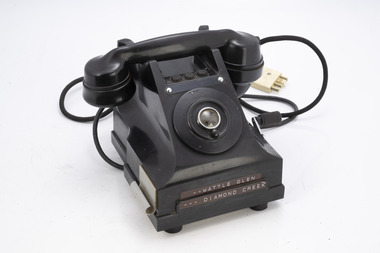
Remote telephone - Fire Tower
... After suffering some inevitable delays due to the war, radio VL3AA switched into full operation in October 1945 proudly beaming out 200 watts across the State. ...After suffering some inevitable delays due to the war, radio VL3AA switched into full operation in October 1945 proudly beaming out 200 watts across the State. ...After the 1939 bushfires, the Forests Commission Victoria invested heavily in a radically new communications network. After suffering some inevitable delays due to the war, radio VL3AA switched into full operation in October 1945 proudly beaming out 200 watts across the State. But by today’s standards, the technology was primitive and the reception poor unless the user was on a high point somewhere. The radio signal was "line-of-sight" and bounced between fire towers and relay transmitters across the mountains back to the District offices. The advent of solid-state electronics in the 1960s replaced the more delicate valve sets which enabled greater use of vehicle mounted radios. The Commission continued to research, develop and build new radios at its many workshops around Victoria. The network was supported by a large team of skilled radio technicians. The more secure and versatile State Mobile Radio (SMR) digital trunk system came into operation in about 1995. Upgraded Tait Radios were purchased in 2014 after recommendations of the 2009 Bushfires Royal Commission. But it was the convergence of separate technologies such as 5G mobile phones, high-capacity and light-weight lithium batteries, Wi-Fi, the ever-expanding internet, cloud data storage, digital cameras, GPS, personal organisers and hundreds of supporting Apps into powerful smartphones and tablets which revolutionised bushfire communications from the mid-2000s. Used to communicate to remote fire towers Single wire often run through the bush from FCV district officesFire tower telephone with winderWattle Glen Diamond Creekbushfire, radios, forests commission victoria (fcv) -
 Whitehorse Historical Society Inc.
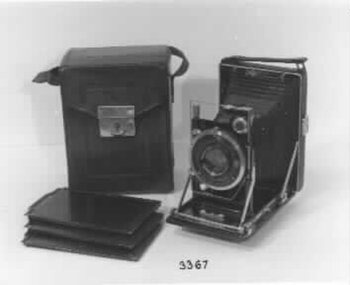
Functional object - Camera & Accessories, c1920
... Shutter is a 'Compur' with speeds of 1 to 1/250th of a second with Bulb and Time. It also has a delayed action feature. It also has a double extension for close up studies....Shutter is a 'Compur' with speeds of 1 to 1/250th of a second with Bulb and Time. It also has a delayed action feature. It also has a double extension for close up studies. ...History prior to 1946 unknown. Camera etc was purchased by the donor in 1946 from Herbert Small Camera Supply then in Elizabeth Street Melbourne. Donor used camera regularly until recent years.'Etue' folding camera with accessories (camera, case, 3 negative containers in a imitation leather & cardboard container) and an additional slide tray. Camera can be used with glass plates, cut negative film and film packs. When camera is opened the lens, bellows etc slide into position. The whole lot slides on a rail system and can be locked in the position required. Item to be photographed can be viewed in a viewfinder which can be turned to a horizontal or vertical plane. In the viewfinder has a small bubble level. It includes an oblong chrome wire which is used to set the minimum distance from lens to object.|Camera is of steel covered and is covered with leather with a carrying handle. provision is made in the back to carry a film slide in a small envelope style pocket|Camera is made by Kamera Werkstatten of Dresden c1920.|It has a 'Zeiss Tessar' 1:4.5 lens of 10.5 cm focal length. Shutter is a 'Compur' with speeds of 1 to 1/250th of a second with Bulb and Time. It also has a delayed action feature. It also has a double extension for close up studies.|When folder it is a mere 4.5 cm from front to back, which cause it to be advertised as the slimmest camera made.|Camera case is made of brown tooled leather with a chrome clip and adjustable carrying handle - lid open upwards for the camera .Case is lined with a purple type of velvet material. 10 Items in total.photography, cameras, camera accessories -
 Kiewa Valley Historical Society
Tin Coffee Cylindrical, circa mid to late 1900's
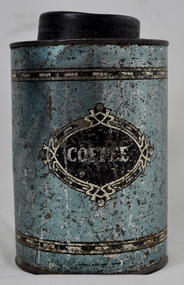
... This "bulk" buying and storage "syndrome" was a lingering result of many years of "drought" periods when road transports met delays from flooded roadways in supplying population centres in the Kiewa Valley. ...This "bulk" buying and storage "syndrome" was a lingering result of many years of "drought" periods when road transports met delays from flooded roadways in supplying population centres in the Kiewa Valley. ...This "coffee" tin has by the "art deco" appearance its origins in the late 1950's to 1960's. This time period was one of accelerated growth both in the physical (housing) sense and the mental (new ideas and inventions) changes in "attitudes". These occurred more rapidly in cities but had its effects on the rural environment. The drinking of coffee was spurred on by easier distribution of imported food and drinks. Advertising by stronger radio links and then by television brought the variety of foods and drinks to semi isolated rural regions. The accessibility through greater information channels becoming available brought with it unbelievable ranges of goods and foodstuffs. Rural regions still relied on bulk supplies and relatively larger storage containers than those in cities. This "bulk" buying and storage "syndrome" was a lingering result of many years of "drought" periods when road transports met delays from flooded roadways in supplying population centres in the Kiewa Valley. The construction phases in building the SEC Vic Hydro electricity Scheme in the eastern sections of the Victorian Alps brought many changes to the quiet rural regions in the Kiewa Valley. Changes in population and social mores. The influx of a varied , mostly temporary, and "European flavoured cuisine" changes the "cuppa tea only" flavour to the have a "coffee break". The subliminal influence of the "American" films changed those children growing up in the post 1950s from the "English tea" to the "American coffee". This "Americanisation process has influenced not only rural Australia but also other areas throughout the world.This "insignificant" coffee tin is very significant as it demonstrates that the Kiewa Valley was becoming more accessible to reliable coffee supplies and general food items.The container was part of a "set" of containers that included tea, sugar,biscuits,flour, rice and other family condiments. This type of kitchen storage containers was brought about through changing patterns in tea and coffee useage and overall consumption. Household demands for faster "self help" cooking especially beveridges and the greater choice of kitchen "utensils" was brought on by easier access to products due to a lessening of the area's "isolation" by having a reliable (all weather) road system and an ever increasing population growth. The need for travelling goods/merchant supply caravans to service the area became a diminishing factor, as a result of the establishment of grocery stores in Tawonga and Mount Beauty in the supply of previously "hard to get" groceries. This transition was precipitated by the SEC Vic Hydro Scheme of the 1940's to 1960's which increased the valley's population level three fold.This cylindrical tin has a pull/push lid(for easy access to the contents). The container is labelled for "coffee" however it has no commercial manufacturer's label to establish that it was bought with coffee ingredients in it. The majority of the container's external surface has a "metallic" light blue colour with two sets of silver rings confining black (horizontal spotted) rectangles. "COFFEE" within an elongated spherical "art deco" four pointed banner of silver and black colouringkitchen containers, domestic food storage, bulk stocks of dried condiments -
 Sunshine and District Historical Society Incorporated
Administrative record - City of Sunshine - Commissioner Mr Alexander Alex George Gillon Collection 1976 - 1982 - Report of Committee Meetings 28th November 1978, City of Sunshine, 28th November 1978
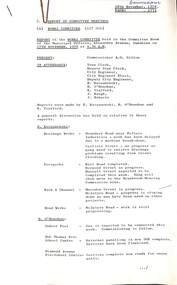
... Second list nor started Hulett Street Private Street Scheme East Side progressing but delayed due to bad weather and stortage of supply of bitument Report of the Finance Committee Report of the City Engineer Western Highway Service Road at Robinson Road Report of the Agenda and Forward Planning Committee Report of the City Librarian Library Hours over the Christmas and New Year Period Report of the Municipal Recreation Officer Swimming Pool Club Use of the New Heated Pool Report of the City Engineer Planning Permit Application Amusement Parlour & Cafe 54A Station Place Additon to Existing Retail Plant Nursery and Live Poutry Sales Lot 1 Emu Road South East Side of Hampstead Road Planning Permit Application Subdivision & Detached Houses Lot 1001 Neale Road North Side Planning Permit Application Subdivision & Detached Houses Lot 1000 Fairfax Circuit & Antioch Court North of Neale Road Preference to Unionist Federated Municipal and Shire Council Employee's Union of Australia Victoria Division Albion Tennis Club Selwyn Park...Second list nor started Hulett Street Private Street Scheme East Side progressing but delayed due to bad weather and stortage of supply of bitument Report of the Finance Committee Report of the City Engineer Western Highway Service Road at Robinson Road Report of the Agenda and Forward Planning Committee Report of the City Librarian Library Hours over the Christmas and New Year Period Report of the Municipal Recreation Officer Swimming Pool Club Use of the New Heated Pool Report of the City Engineer Planning Permit Application Amusement Parlour & Cafe 54A Station Place Additon to Existing Retail Plant Nursery and Live Poutry Sales Lot 1 Emu Road South East Side of Hampstead Road Planning Permit Application Subdivision & Detached Houses Lot 1001 Neale Road North Side Planning Permit Application Subdivision & Detached Houses Lot 1000 Fairfax Circuit & Antioch Court North of Neale Road Preference to Unionist Federated Municipal and Shire Council Employee's Union of Australia Victoria Division Albion Tennis Club Selwyn Park Foolscap sized document. ...Report of Committee Meetings 28th November 1978 Report of the Works Committee Drainage Works Boundary Road Near Potters Industries Delayed Due to Machine Breakdown Drainage Works Carlisle Street No Progress Due to Recent Flooding Footpath Works West Road Completed Footpath Works Norwood Street in progress Footpath Works Burnett Avenue expected to be completed this week Footpath Works Gangs to move to the Braybrook Housing Commission Area soon Kerb & Channel Works Macedon Street in progress Kerb & Channel Works McIntyre Road in progress but slow due to men being used on other projects Road Works McIntyre Road work in progress Indoor Pool Gas is expected to be connected this week Bon Thomas Pre-School Centre External panelling now 90% complete Diamond Avenue Pre-School Centre Services completed now for outer walls Orama Street Child Care Centre Concrete slab poured Highpoint West Child Care Centre No start at present Toilets on Reserves Sewer points now available Diamond Avenue Reserve Mound has been reshaped Sasella Park Mound has been removed Bon Tomas Reserve Work has commence on levelling the site Dempster Park Fence around oval expected to be completed this week Tree Pruning First list from S.E.C. is completed. Second list nor started Hulett Street Private Street Scheme East Side progressing but delayed due to bad weather and stortage of supply of bitument Report of the Finance Committee Report of the City Engineer Western Highway Service Road at Robinson Road Report of the Agenda and Forward Planning Committee Report of the City Librarian Library Hours over the Christmas and New Year Period Report of the Municipal Recreation Officer Swimming Pool Club Use of the New Heated Pool Report of the City Engineer Planning Permit Application Amusement Parlour & Cafe 54A Station Place Additon to Existing Retail Plant Nursery and Live Poutry Sales Lot 1 Emu Road South East Side of Hampstead Road Planning Permit Application Subdivision & Detached Houses Lot 1001 Neale Road North Side Planning Permit Application Subdivision & Detached Houses Lot 1000 Fairfax Circuit & Antioch Court North of Neale Road Preference to Unionist Federated Municipal and Shire Council Employee's Union of Australia Victoria Division Albion Tennis Club Selwyn Park city of sunshine, alexander "alex" george gillon, boundary road, deer park, carlisle street, maidstone, west road, maribyrnong, norwood street, albion, burnett avenue, sunshine, macedon street, mcintyre road, sunshine north, bon thomas pre-school centre, bon thomas reserve, quinn street, diamond avenue pre-school centre, diamond avenue, albanvale, orama street child care centre, orama street, highpoint west child care centre, rosamond road, sasella park, station road, dempster park, phoenix street, hulett street, western highway, station place, emu road, hampstead road, neale road, fairfax circuit, antioch court, albion tennis club, selwyn park, selwyn street -
 Eltham District Historical Society Inc
Negative - Photograph, Harry Gilham, Grave of Richard George, Emily Ann (nee Davis) and Edith Jane Kaylock, Eltham Cemetery, Victoria, Sep 2009
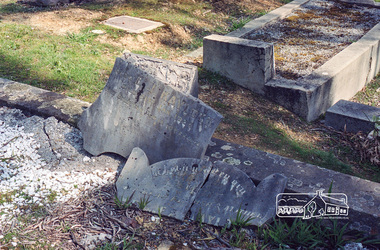
... When a lack of finances delayed repairs to the Bridge Street bridge in 1931, traffic had to detour via Brougham Street for some time. ...When a lack of finances delayed repairs to the Bridge Street bridge in 1931, traffic had to detour via Brougham Street for some time. ...In his early adult life, Richard Kaylock worked as a whaler (visiting California and New Zealand) and later as a drover on a large cattle station in New South Wales. In 1848 he came to Melbourne, working as a slaughterman, then settled in Eltham in 1854, his occupation thereafter being variously recorded as butcher or orchardist. He also had some experiences at Ballarat during the Eureka Rebellion. He died in 1910 at the age of 84. His obituary described him as a "striking personality" who was "brusque to a fault" and "strictly upright, expecting others to be the same". It seems from his will that he was illiterate. He is buried in Eltham Cemetery with his wife Emily. His property was in Wellington Street (now Brougham Street) and apparently extended across the Diamond Creek. The land on the western side of the creek was farmed, the house being on the eastern side. For many years the Brougham Street bridge was generally known as "Kaylock's Bridge". It formed part of the original coach road to Eltham and in 1922 was described as an "old rustic bridge". Its low level and insubstantial construction made it susceptible to flood damage, necessitating frequent closures until repairs could be carried out. The original bridge was demolished in 1923 and replaced by a "new up-to-date" one. When a lack of finances delayed repairs to the Bridge Street bridge in 1931, traffic had to detour via Brougham Street for some time. Local residents feared that the Bridge Street bridge might never reopen. In Loving Memory Of Our Dear Father & Mother R.G. and E.A. Kaylock Also E.J. Kaylock Died 21st Jan. 1927 The Eternal God Is My PledgeRoll of 35mm colour negative film, 6 stripsKodak GC 400-9eltham cemetery, gravestones, edith jane kaylock, emily ann kaylock (nee davis), richard george kaylock, brougham street bridge, kaylocks bridge -
 Eltham District Historical Society Inc
Photograph, Peter Pidgeon, Grave of Richard George, Emily Ann (nee Davis) and Edith Jane Kaylock, Eltham Cemetery, Victoria, 5 April 2021
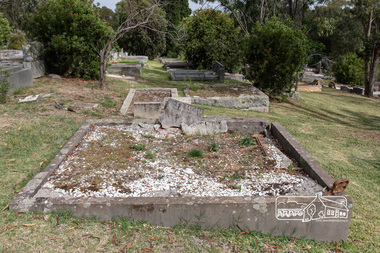
... When a lack of finances delayed repairs to the Bridge Street bridge in 1931, traffic had to detour via Brougham Street for some time. ...When a lack of finances delayed repairs to the Bridge Street bridge in 1931, traffic had to detour via Brougham Street for some time. ...In his early adult life, Richard Kaylock worked as a whaler (visiting California and New Zealand) and later as a drover on a large cattle station in New South Wales. In 1848 he came to Melbourne, working as a slaughterman, then settled in Eltham in 1854, his occupation thereafter being variously recorded as butcher or orchardist. He also had some experiences at Ballarat during the Eureka Rebellion. He died in 1910 at the age of 84. His obituary described him as a "striking personality" who was "brusque to a fault" and "strictly upright, expecting others to be the same". It seems from his will that he was illiterate. He is buried in Eltham Cemetery with his wife Emily. His property was in Wellington Street (now Brougham Street) and apparently extended across the Diamond Creek. The land on the western side of the creek was farmed, the house being on the eastern side. For many years the Brougham Street bridge was generally known as "Kaylock's Bridge". It formed part of the original coach road to Eltham and in 1922 was described as an "old rustic bridge". Its low level and insubstantial construction made it susceptible to flood damage, necessitating frequent closures until repairs could be carried out. The original bridge was demolished in 1923 and replaced by a "new up-to-date" one. When a lack of finances delayed repairs to the Bridge Street bridge in 1931, traffic had to detour via Brougham Street for some time. Local residents feared that the Bridge Street bridge might never reopen. In Loving Memory Of Our Dear Father & Mother R.G. and E.A. Kaylock Also E.J. Kaylock Died 21st Jan. 1927 The Eternal God Is My PledgeBorn Digitaleltham cemetery, gravestones, brougham street bridge, edith jane kaylock, emily ann kaylock (nee davis), kaylocks bridge, richard george kaylock -
 Eltham District Historical Society Inc
Negative - Photograph, J.H. Clark, Eltham Tennis Court. Lady Premiers 1909-1910, 1910
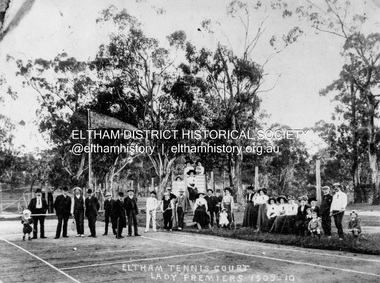
... Officers and a committee were duly elected, and the Treasurer was instructed to purchase the necessary requisites without delay. By the end of the first week in November all the requisites were to hand, two courts were marked out, and practice begun. ...Officers and a committee were duly elected, and the Treasurer was instructed to purchase the necessary requisites without delay. By the end of the first week in November all the requisites were to hand, two courts were marked out, and practice begun. ...A large group of men and women pose for a photograph on Eltham tennis court. Although the photo is marked ”Lady Premiers”, this is not a typical formal sports group pose, with only two women identified as holding racquets. 33 individuals, including men and children and one dog pose for the camera, the majority of whom are not dressed to play tennis. The court shows clear markings for tennis and a flag is flying in the background. The photograph is taken from inside the wire enclosure. There are mature gum trees in the background. The tennis court was situated in Eltham South at Bremner’s Flats (near present day Wingrove Park). Cross Ref SEPP_0720 which is at an earlier level of development. The Eltham Lawn Tennis Club was formed on a Saturday evening, the 29th of October, 1898 at a meeting held at the Eltham State school. The meeting was large and representative. Twenty members were enrolled, and eight more have since been added. Officers and a committee were duly elected, and the Treasurer was instructed to purchase the necessary requisites without delay. By the end of the first week in November all the requisites were to hand, two courts were marked out, and practice begun. The formal opening of the Courts of this Club took place on Saturday, November 12, 1898, when 26 members and their friends assembled. After several sets had been contested an adjournment was made for tea provided by the members and nicely laid out under the shade of the trees. Afterwards, sets were again formed and the game was proceeded with in a lively spirit till nearly dark, when all dispersed having thoroughly enjoyed themselves during the afternoon. (Evelyn Observer, and South and East Bourke Record (Vic. : 1882 - 1902), Friday 18 November 1898, page 2)This photo forms part of a collection of photographs gathered by the Shire of Eltham for their centenary project book,"Pioneers and Painters: 100 years of the Shire of Eltham" by Alan Marshall (1971). The collection of over 500 images is held in partnership between Eltham District Historical Society and Yarra Plenty Regional Library (Eltham Library) and is now formally known as 'The Shire of Eltham Pioneers Photograph Collection.' It is significant in being the first community sourced collection representing the places and people of the Shire's first one hundred years.Digital image 4 x 5 inch B&W Negshire of eltham pioneers photograph collection, 1910, bremner's flat, eltham, eltham lawn tennis club, eltham tennis court, tennis court, wingrove park, laura williams, williams, j.h. clark photo -
 Vision Australia
Letter - Text, Letter to The Trustees, Clubhouse, Recreation grounds for the Blind, 16/5/1957
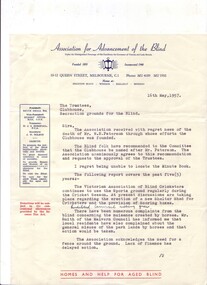
... A fence is required but a lack of finance has delayed this action. The Clubhouse is being used for more activities including a dance class, indoor bowling club, pottery and craft work, therefore a new switchboard and rewiring were completed. ...A fence is required but a lack of finance has delayed this action. The Clubhouse is being used for more activities including a dance class, indoor bowling club, pottery and craft work, therefore a new switchboard and rewiring were completed. ...Letter to the Trustees outlining the outcomes of a recent meeting, as the minute book was unable to be located. Below is a summary of the letter. The death of W.H. Paterson is mentioned and the recommendation to the Committee that the clubhouse by named in his honour was unanimously accepted, however requires the agreement of the Trustees. The remainder of the letter covers the past five years. The Victorian Association of Blind Cricketers are requesting the erection of a shelter shed and scoring boxes. Complaints have been received about horses using the park, which have been passed to Malvern Council who advise they have also received similar complaints from the general public. A fence is required but a lack of finance has delayed this action. The Clubhouse is being used for more activities including a dance class, indoor bowling club, pottery and craft work, therefore a new switchboard and rewiring were completed. In October 1955, the State Government offered funding through local councils, however despite a representation to the Minister, the Malvern Council were not willing to expend funds to the Association as they had committed to build an Elderly Citizens Club. A large signboard was repainted and a new signboard erected at the front entrance, along with a light controlled by a clock. The Clubhouse has also been used one night per month by the local branch of the RSL and occasional use by the Teachers College for inter College sports. There has been cooperation with the L.T.A.V. (Lawn Tennis Association of Victoria) during tennis championships, and although the Committee recognise the need to do more with the area, the impending homes been built at Ballarat and Bendigo have been a limited factor. Signed by J.W. Wilson3 pages of type letter on letterheadAssociation for the Advancement of the Blind, Under the Distinguished Patronage of His Excellency the Governor of Victoria and Lady Brooks Founded 1895 (image of shining lantern) Incorporated 1944 10-12 Queen Street, Melbourne, C.1. Phone: MU 4189 MU 1955 Homes at: Brighton Beach Windsor Ballarat Bendigo On the left hand side of the page: President: Bruce Small, Esq. Vice President: Hubert Opperman, O.B.E. Treasurer: W.J.S. Horsfall, F.C.A. Secretary: J.W. Wilson Objects: To promote the welfare of the Blind intellectually, physically and socially. To grant financial assistance in cases of necessity. To provide Homes and Hostels of an undenominational character for the Blind. To visit the Blind. To care for the adult Blind, especially the aged and infirm. Donations will be subject to the concessional allowances provided by the Income Tax Act. At the base of the page: Homes and help for aged blindassociation for the advancement of the blind, john wilson, kooyong club house -
 Melbourne Tram Museum
Newspaper, The Age, "Police will investigate export of old trams", "Protected trams went to US without permits", "Police probe export of trams to the US', 2/1992 to 7/1992
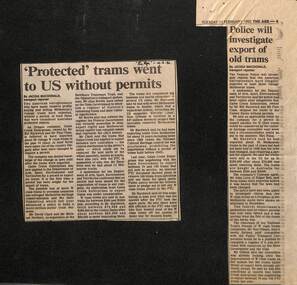
... Law changed in 1988. .3 - 21/7/1992 - "Police probe export of trams to the US'- quotes PTC spokesman Pat Wilson, does not believe it has broken the Law, gives details on the number of trams sold over years, quotes Alan Brown. .4 - 25/7/1992 - two items in the same cutting: (a) - "Delay will spoil tram sales says US buyer" written by Christopher Reed Los Angeles - quotes Paul Class, Alan Brown, details some of the cities the trams have been sold too. ...Law changed in 1988. .3 - 21/7/1992 - "Police probe export of trams to the US'- quotes PTC spokesman Pat Wilson, does not believe it has broken the Law, gives details on the number of trams sold over years, quotes Alan Brown. .4 - 25/7/1992 - two items in the same cutting: (a) - "Delay will spoil tram sales says US buyer" written by Christopher Reed Los Angeles - quotes Paul Class, Alan Brown, details some of the cities the trams have been sold too. ...Set of four Newspaper clippings from The Age about the sale of tram to the USA and police investigations. Written mainly by Jacqui Macdonald Transport Reporter .1 - 11/2/1992 - "Police will investigate export of old trams" - details the export of trams to the US and whether the necessary permits were issued. Notes Gales Creek Enterprises, Paul class, Bill Hardwick, National Trust Chairman Don Gibson. .2 - 10/2/1992 - "Protected trams went to US without permits" - details the situation, also quotes David Clark and Michael Norbury (Hawthorn Tramways Trust), Alan Brown Opposition Transport Spokesman. Application had been made. Law changed in 1988. .3 - 21/7/1992 - "Police probe export of trams to the US'- quotes PTC spokesman Pat Wilson, does not believe it has broken the Law, gives details on the number of trams sold over years, quotes Alan Brown. .4 - 25/7/1992 - two items in the same cutting: (a) - "Delay will spoil tram sales says US buyer" written by Christopher Reed Los Angeles - quotes Paul Class, Alan Brown, details some of the cities the trams have been sold too. Also notes the trams in Werribee owned by Pat Keogh. (b) - :Historic trams rot as committees ponder their export" - with a photo of many trams and Pat Keogh - seems that they inadvertently owned them when the formal owner went bankrupt and owed them money. Notes the Federal Heritage Committee yet to make a decision. Includes tram W5 756.trams, tramways, sale of trams, w class, national trust, police, scrapped trams, tram 756 -
 Department of Energy, Environment and Climate Action
Instrument - Field telephone - Fire Tower, 400 series 'Bakelite' magneto table telephone
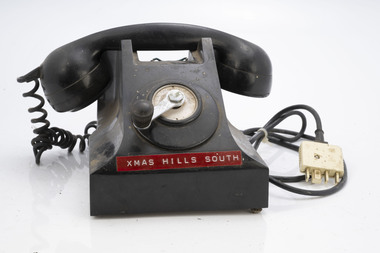
... After suffering some inevitable delays due to the war, radio VL3AA switched into full operation in October 1945 proudly beaming out 200 watts across the State. ...After suffering some inevitable delays due to the war, radio VL3AA switched into full operation in October 1945 proudly beaming out 200 watts across the State. ...After the 1939 bushfires, the Forests Commission Victoria invested heavily in a radically new communications network. After suffering some inevitable delays due to the war, radio VL3AA switched into full operation in October 1945 proudly beaming out 200 watts across the State. But by today’s standards, the technology was primitive and the reception poor unless the user was on a high point somewhere. The radio signal was "line-of-sight" and bounced between fire towers and relay transmitters across the mountains back to the District offices. The advent of solid-state electronics in the 1960s replaced the more delicate valve sets which enabled greater use of vehicle mounted radios. The Commission continued to research, develop and build new radios at its many workshops around Victoria. The network was supported by a large team of skilled radio technicians. The more secure and versatile State Mobile Radio (SMR) digital trunk system came into operation in about 1995. Upgraded Tait Radios were purchased in 2014 after recommendations of the 2009 Bushfires Royal Commission. But it was the convergence of separate technologies such as 5G mobile phones, high-capacity and light-weight lithium batteries, Wi-Fi, the ever-expanding internet, cloud data storage, digital cameras, GPS, personal organisers and hundreds of supporting Apps into powerful smartphones and tablets which revolutionised bushfire communications from the mid-2000s. Manufactured in both UK and Australia, the 400 series telephone was developed for the PMG in 1957 based on the British, prototype, no.700, Bakelite phone. They became obsolescent by the early 1960s but because some magneto exchanges persisted in Australia for another quarter of a century and alternatives were not cost effective, PMG/Telecom regularly repaired or refurbished these obsolete phones until they were superseded by automatic exchanges. Used to communicate to remote fire towers Single wire (with earth return) often run through the bush from FCV district officesMagneto table telephone Christmas Hills South Instructions for use around winderbushfire, radios, forests commission victoria (fcv) -
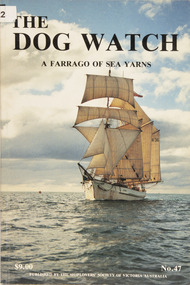 Mission to Seafarers Victoria
Journal (item) - Periodicals-Annual, Shiplovers' Society of Victoria, The Annual Dog Watch
... Binham - 77 The Hypnotist - Ron Wayling - 83 Museum on Course, Stemming a Slight Set; E.T.A. Delayed - - 93 Book Reviews - - 99 Paddle Wheelers Memories of a Bygone Fleet - Late H.R. ...Binham - 77 The Hypnotist - Ron Wayling - 83 Museum on Course, Stemming a Slight Set; E.T.A. Delayed - - 93 Book Reviews - - 99 Paddle Wheelers Memories of a Bygone Fleet - Late H.R. ...This journal provides the reader with glimpses of the adventures and hardships of a seaman's life. Many of the stories are of sailing ships.Contributes to our knowledge of the importance of shipping and places on record those stories of the sea which would otherwise be lost.Contents Foreword - - 5 Editorial - - 7 Sail Training in Australia - - 9 The Original Lady Nelson, Her Story - - 13 The Marine Superintendent - R.N. Thiele - 21 Pictures - Captain W.T. Howell - 23 Memories of a Master under Sail - Late Captain William Philip - 27 Sail Training in New Zealand - - 29 Living Our Dreams - Valerie K. Watts - 31 Sketch of a Sea Voyage — New York to Melbourne 1859 - Morgan Hayden - 35 Glasgow to Melbourne in the S.V. Wacousta - Harriet Louise King - 39 The Padre - A. Roland Jones - 43 The Quirks of Fate - W.S. McCutchen - 51 A Good Day’s Sailing - W.P. Shemmeld - 55 Salvage of the Zeung San - Richard J. Jolly - 61 H.M.S. Tartar — My First Destroyer - Rear Admiral Sir Brian Murray K.C.M.G., A.O., K.ST.J. - 65 They take you out to Sea and Train you for Life - R. Johnson - 71 The Rescue of the 1902 Swedish Antarctic Expedition by A.R.A. Uraguay - - 75 The Voyage of the Jane Richardson — Part 1 - Late E. Binham - 77 The Hypnotist - Ron Wayling - 83 Museum on Course, Stemming a Slight Set; E.T.A. Delayed - - 93 Book Reviews - - 99 Paddle Wheelers Memories of a Bygone Fleet - Late H.R. Watson - 101 Murphy and the Bosun - L.P. McArthur - 105 Ten Days Before the Mast - Author Name to come - 107sailing ships, steamships, shipping, seafaring life, shiplovers' society of victoria, dog watch -
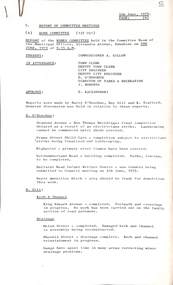 Sunshine and District Historical Society Incorporated
Administrative record - City of Sunshine - Commissioner Mr Alexander Alex George Gillon Collection 1976 - 1982 - Report of committee meetings 5th June 1979, City of Sunshine, 5th June 1979
... Report of Committee Meetings 5th June 1979 Report of Works Committee Meeting Diamond Avenue Building final completion delayed due to electrician's strike, landscaping cannot commence until sheds erected Bon Thomas Reserve Building final completion delayed due to electrician's strike, landscaping cannot commence until sheds erected Orama Street Child Care Centre completion subject to electrician's strike Highpoint West primary steel frames have been erected Northumberland Road building complete Deer Park Ballarat Road Infant Welfare Centre new tenders being submitted Depot Amenities Block area should be ready for demolition this week Kerb & Channel King Edward Avenue completed, footpath and crossing in progress Drainage Melon Street completed, damaged kerb & channel being reconstructed Drainage Phoenix Street completed, kerb & channel reinstatement in progress Gangs have spent time in many areas correcting minor drainage problems Footpath Hall Street completed Footpath Esmond Street bridge approaches completed Footpath Millers Road commenced Area south of Churchill Avenue progressing Some men were used to make safe the fire damaged building at the Corner of City Place and Sun Crescent (Deneys) C.R.B. ...Albans Pridhams Laverton North Evergreen Avenue Wintersun Drive Hampshire Road Devonshire Road Merino Street Report of Committee Meetings 5th June 1979 Report of Works Committee Meeting Diamond Avenue Building final completion delayed due to electrician's strike, landscaping cannot commence until sheds erected Bon Thomas Reserve Building final completion delayed due to electrician's strike, landscaping cannot commence until sheds erected Orama Street Child Care Centre completion subject to electrician's strike Highpoint West primary steel frames have been erected Northumberland Road building complete Deer Park Ballarat Road Infant Welfare Centre new tenders being submitted Depot Amenities Block area should be ready for demolition this week Kerb & Channel King Edward Avenue completed, footpath and crossing in progress Drainage Melon Street completed, damaged kerb & channel being reconstructed Drainage Phoenix Street completed, kerb & channel reinstatement in progress Gangs have spent time in many areas correcting minor drainage problems Footpath Hall Street completed Footpath Esmond Street bridge approaches completed Footpath Millers Road commenced Area south of Churchill Avenue progressing Some men were used to make safe the fire damaged building at the Corner of City Place and Sun Crescent (Deneys) C.R.B. ...Report of Committee Meetings 5th June 1979 Report of Works Committee Meeting Diamond Avenue Building final completion delayed due to electrician's strike, landscaping cannot commence until sheds erected Bon Thomas Reserve Building final completion delayed due to electrician's strike, landscaping cannot commence until sheds erected Orama Street Child Care Centre completion subject to electrician's strike Highpoint West primary steel frames have been erected Northumberland Road building complete Deer Park Ballarat Road Infant Welfare Centre new tenders being submitted Depot Amenities Block area should be ready for demolition this week Kerb & Channel King Edward Avenue completed, footpath and crossing in progress Drainage Melon Street completed, damaged kerb & channel being reconstructed Drainage Phoenix Street completed, kerb & channel reinstatement in progress Gangs have spent time in many areas correcting minor drainage problems Footpath Hall Street completed Footpath Esmond Street bridge approaches completed Footpath Millers Road commenced Area south of Churchill Avenue progressing Some men were used to make safe the fire damaged building at the Corner of City Place and Sun Crescent (Deneys) C.R.B. Works Martket Road C.R.B. Works Duke Street East Side between McGrath Quarry and Surrey Street C.R.B. Works South Road C.R.B. Works Hot Mix Cranbourne Avenue, Gerald Street, Boundary Road, Fitzgerald Road and Hulett Street Street Tree Planting 1500 trees have been planted Street Tree Pruning work progressing Bon Thomas Reserve Development levels to be provided to allow spreading of soil Report of the Finance Committee Meeting Report of the Town Clerk Fees The Hub Sports Centre Swimming Pool Instruction Sunshine North Technical School Oval Agreement Traffic Offences Court Fines Estimates Review 1978/79 Report of the Agenda & Forward Planning Committee Meeting Report of the Town Clerk Finalisation of Gooding Street Part Private Street Scheme Report of the Chief Helath Surveyor Environment Protection Authority Draft Noise Control Policy W. Pridhams (Aust) Pty Ltd Lots 12 to 16 Merino Street Laverton North Site Objection Report of the Chief By-Laws Officer By-Laws Officers Course Report of the City Engineer Policy of Service Premises in Residential and Industrial Zone Planning Permit Application Subdivision for Shop Purposes Corner Evergreen Avenue and Wintersun Drive Albanvale Planning Permit Application National Bank of Australasia Ltd Bank Extensions Hampshire Road Proposed Signals Deferred Payment of Cost Scheme Report of the Building Surveyor Building on Flood Prone Land Lot 4 Devonshire Road (Nursing Home Site)diamond avenue reserve, diamond avenue, albanvale, bon thomas reserve, quinn street, deer park, orama street child care centre, orama street, highpoint west, northumberland road, sunshine north, deer park ballarat road infant welfare centre, ballarat road, king edward avenue, albion, melon street, braybrook, phoenix street, hall street, sunshine west, esmond street, ardeer, millers road, brooklyn, churchill avenue, sun crescent, city place, deneys, martket road, sunshine, duke street, mcgrath quarry, surrey street, cranbourne avenue, gerald street, boundary road, fitzgerald road, hulett street, the hub, sunshine north technical school, gooding street, st. albans, pridhams, laverton north, evergreen avenue, wintersun drive, hampshire road, devonshire road, merino street -
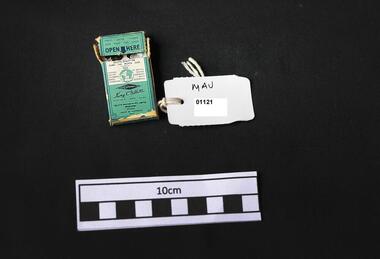 City of Moorabbin Historical Society (Operating the Box Cottage Museum)
Personal Effects, safety razor blade 'King Gillette'', 20thc
... This accounts for the delay between the initial idea and the product's introduction. ...This accounts for the delay between the initial idea and the product's introduction. ...King Camp Gillette observed in 1902 that as existing, relatively expensive, razor blades dulled quickly and needed continuous sharpening, a razor whose blade could be thrown away when it dulled would meet a real need and likely be profitable. Safety razors had been developed in the mid-19th century, but still used a forged blade that dulled and rusted. In the 1870s, the Kampfe Brothers ( Germany) introduced a type of safety razor Gillette improved these earlier safety-razor designs, and introduced the high-profit-margin stamped razor blade steel blade. Gillette's innovation was the thin, inexpensive, disposable blade of stamped steel. Gillette's safety razor retailed for a substantial $5 half the average working man's weekly pay — yet sold by the millions. The most difficult part of development was engineering the blades, as thin, cheap steel was difficult to work and sharpen. This accounts for the delay between the initial idea and the product's introduction. To sell the product, Gillette founded the American Safety Razor Company on September 28, 1901 (changing the company's name to Gillette Safety Razor Company in July 1902). Gillette obtained a trademark registration (0056921) for his portrait and signature on the packaging. Production began in 1903, when he sold a total of 51 razors and 168 blades. The following year, he sold 90,884 razors and 123,648 blades, thanks in part to Gillette's low prices, automated manufacturing techniques and good advertising. By 1908, the corporation had established manufacturing facilities in the United States, Canada, England, France and Germany. Razor sales reached 450,000 units and blade sales exceeded 70 million units in 1915. In 1918, when the U.S. entered World War I, the company provided all American soldiers with a field razor set, paid for by the government, and as they were allowed to take them at discharge they continued their use of this product thus ensuring future sales. The company continues in the present day as the Gillette brand of Procter & Gamble, USA. Throughout the 20thC most men used this type of safety razor with disposable stainless steel razor blades to shave their beards prior to the introduction of affordable electric razors in 1960'sA blue packet of unused 'King Gillette' safety razor blades.on top of packet; Press with thumb / and snap end open / GILLETTE QUALITY THE / SAME THE WORLD OVER / FACTORIES IN / USA / CANADA , GREAT BRITAIN / MEXICO , FRANCE / COLUMBIA, GERMANY / BRAZIL, SPAIN / ARGENTINA, AUSTRALIA / GILLETTE TRADE MARK / KING C GILLETTE / RED. TRADE MARKS / GILLETTE (AUST.) PTY. LIMITED / MELBOURNE / DE 2023 / MADE IN AUSTRALIA / shaving equipment, safety razors, gillette king, proctor & gamble, moorabbin, bentleigh, cheltenham, -
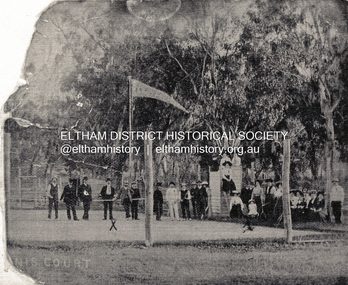 Eltham District Historical Society Inc
Photograph, Eltham Tennis Court. Lady Premiers 1909-1910, 1910
... Officers and a committee were duly elected, and the Treasurer was instructed to purchase the necessary requisites without delay. By the end of the first week in November all the requisites were to hand, two courts were marked out, and practice begun. ...Officers and a committee were duly elected, and the Treasurer was instructed to purchase the necessary requisites without delay. By the end of the first week in November all the requisites were to hand, two courts were marked out, and practice begun. ...Photocopy of damaged photograph of a large group of men and women posing for a photograph on the first Eltham tennis court. Group includes people identified with an 'X' as Maisie with Laura Williams and Pop. The photo is the same group of people taken at the same time as SEPP_0721 (Lady Premiers 1909-1910). This is not a typical formal sports group pose, with only two women identified as holding racquets. 33 individuals, including men and children and one dog pose for the camera, the majority of whom are not dressed to play tennis. The court shows clear markings for tennis and a flag is flying in the background. The photograph is taken from inside the wire enclosure. There are mature gum trees in the background. The tennis court was situated in Eltham South at Bremner’s Flats (near present day Wingrove Park). The information included with the photocopy suggested this was the opening of the first Eltham Tennis Court however this is inaccurate. The Eltham Lawn Tennis Club was formed on a Saturday evening, the 29th of October, 1898 at a meeting held at the Eltham State school. The meeting was large and representative. Twenty members were enrolled, and eight more have since been added. Officers and a committee were duly elected, and the Treasurer was instructed to purchase the necessary requisites without delay. By the end of the first week in November all the requisites were to hand, two courts were marked out, and practice begun. The formal opening of the Courts of this Club took place on Saturday, November 12, 1898, when 26 members and their friends assembled. After several sets had been contested an adjournment was made for tea provided by the members and nicely laid out under the shade of the trees. Afterwards, sets were again formed and the game was proceeded with in a lively spirit till nearly dark, when all dispersed having thoroughly enjoyed themselves during the afternoon. (Evelyn Observer, and South and East Bourke Record (Vic. : 1882 - 1902), Friday 18 November 1898, page 2)Photocopy of damaged photographwilliams, 1910, bremner's flat, eltham, eltham lawn tennis club, eltham tennis court, shire of eltham pioneers photograph collection, tennis court, wingrove park, laura williams, j.h. clark photo -
 Sunshine and District Historical Society Incorporated
Administrative record - City of Sunshine - Commissioner Mr Alexander Alex George Gillon Collection 1976 - 1982 - Report of committee meetings 21st July 1980, City of Sunshine, 22nd July 1980
... Report of Committee Meetings 21st July 1980 Report of Works Committee Meeting Millbank Drive has been tidied up after planting of advanced trees Chifley Drive Maribyrnong River Embankment cleaned and sown Passive Recreation Areas some areas are being planted with trees Aycliffe Avenue Infant Welfare Centre problem reported at last meeting has been overcome and building now progressing satisfactorily Tennis Pavilion Selwyn Park request from Albion Tennis Club for toughened glass has delayed progress Ralph Street Pavilion consideration was given to relocating pavilion. ...Millbank Drive Deer Park Chifley Drive Maribyrnong River Maribyrnong Aycliffe Avenue Infant Welfare Centre Aycliffe Avenue Albion Tennis Club Selwyn Park Selwyn Street Albion Ralph Street Reserve Ralph Street Sunshine West Lions Club of Sunshine Skinner Reserve Churchill Avenue Braybrook Sunshine Football Club Scovell Reserve Scovell Crescent Maidstone Deer Park Hall Station Road The Hub Sun Crescent Sunshine Report of Committee Meetings 21st July 1980 Report of Works Committee Meeting Millbank Drive has been tidied up after planting of advanced trees Chifley Drive Maribyrnong River Embankment cleaned and sown Passive Recreation Areas some areas are being planted with trees Aycliffe Avenue Infant Welfare Centre problem reported at last meeting has been overcome and building now progressing satisfactorily Tennis Pavilion Selwyn Park request from Albion Tennis Club for toughened glass has delayed progress Ralph Street Pavilion consideration was given to relocating pavilion. ...Report of Committee Meetings 21st July 1980 Report of Works Committee Meeting Millbank Drive has been tidied up after planting of advanced trees Chifley Drive Maribyrnong River Embankment cleaned and sown Passive Recreation Areas some areas are being planted with trees Aycliffe Avenue Infant Welfare Centre problem reported at last meeting has been overcome and building now progressing satisfactorily Tennis Pavilion Selwyn Park request from Albion Tennis Club for toughened glass has delayed progress Ralph Street Pavilion consideration was given to relocating pavilion. This will add costs to connecting the sewer House of Sunshine plans for extension of this building has been prepared by Council and have been submitted to the Lions Club of Sunshine for consideration Skinner Reserve Accounts for works carried out by the Sunshine Football Club approval for payment stopped until some aspects of the works are attended to Scovell Reserve on site meeting has been arranged to discuss the finalisation of the building Deer Park Hall report being prepared on the need to re-roof and carry out other major renovations to the building Report of the Finance Committee Meeting Report of the Town Clerk Arrears of Fire Hazards Charges Abandonments Rates, Sanitary & Interest Adjustments / Abandonments The Hub Sport Centre Debtor Accounts Abandonments Estimates 1980/81 Statements of Rates, Sanitary & Interest Charges as at 30th June 1980 Report of the City Engineer & Planner Alterations and Additions to Municipal Officesmillbank drive, deer park, chifley drive, maribyrnong river, maribyrnong, aycliffe avenue infant welfare centre, aycliffe avenue, albion tennis club, selwyn park, selwyn street, albion, ralph street reserve, ralph street, sunshine west, lions club of sunshine, skinner reserve, churchill avenue, braybrook, sunshine football club, scovell reserve, scovell crescent, maidstone, deer park hall, station road, the hub, sun crescent, sunshine -
 Sunshine and District Historical Society Incorporated
Administrative record - City of Sunshine - Commissioner Mr Alexander Alex George Gillon Collection 1976 - 1982 - Report of committee meetings 29th May 1978, City of Sunshine, 30th May 1978
... Report of Committee Meetings 29th May 1978 Report of the Works Committee Recent Bad Weather has Permitted Approximately Of Week's Work in the Past Three Weeks Work Is Commencing on 29th May 1978 on the Extension of McIntyre Road The Intersection of Fitzgerald Road and Boundary Road Which Is to be Financed by the C.R.B. is progressing Skinner Reserve Pavilion is expected to be completed in two weeks Fairbairn Pre-School Centre is ready for final inspection Willis Street Pre-School Centre Side Fences Installed and Front Fence and Landscaping yet to be Finalised Heated Pool is now expected to be completed 26th October 1978 Construction of the Toilet Block and Tennis Pavilion Delayed Due to Receipt of an Objection Tree Planting and pruning Programme commenced and will operate for three to four months The Cricket Pitch at Castley Reserve was removed on 29th May 1978 Turf Squares are to be used to provide instant lawn at Fairbairn Pre-School Centre & Willis Street Pre-School Centre Report of the Finance Committee Report of the Town Clerk Deputy Town Clerk Introduced and Explained the New Form of Reporting to the Committee City of Sunshine Financial Reports for the Period Ended 8th May 1978 City of Sunshine General Account The Hub Statement of Receipts and Payment for the Period Ended 8th May 1978 The Municipal Sunshine Tip Statement of Receipts and Payment for the Period Ended 8th May 1978 Report of the City Engineer Park Rangers Security Inspections Engineering Depot and Sunshine Tip...City of Sunshine Alexander "Alex" George Gillon Report of Committee Meetings 29th May 1978 Report of the Works Committee Recent Bad Weather has Permitted Approximately Of Week's Work in the Past Three Weeks Work Is Commencing on 29th May 1978 on the Extension of McIntyre Road The Intersection of Fitzgerald Road and Boundary Road Which Is to be Financed by the C.R.B. is progressing Skinner Reserve Pavilion is expected to be completed in two weeks Fairbairn Pre-School Centre is ready for final inspection Willis Street Pre-School Centre Side Fences Installed and Front Fence and Landscaping yet to be Finalised Heated Pool is now expected to be completed 26th October 1978 Construction of the Toilet Block and Tennis Pavilion Delayed Due to Receipt of an Objection Tree Planting and pruning Programme commenced and will operate for three to four months The Cricket Pitch at Castley Reserve was removed on 29th May 1978 Turf Squares are to be used to provide instant lawn at Fairbairn Pre-School Centre & Willis Street Pre-School Centre Report of the Finance Committee Report of the Town Clerk Deputy Town Clerk Introduced and Explained the New Form of Reporting to the Committee City of Sunshine Financial Reports for the Period Ended 8th May 1978 City of Sunshine General Account The Hub Statement of Receipts and Payment for the Period Ended 8th May 1978 The Municipal Sunshine Tip Statement of Receipts and Payment for the Period Ended 8th May 1978 Report of the City Engineer Park Rangers Security Inspections Engineering Depot and Sunshine Tip Foolscap sized document. ...Report of Committee Meetings 29th May 1978 Report of the Works Committee Recent Bad Weather has Permitted Approximately Of Week's Work in the Past Three Weeks Work Is Commencing on 29th May 1978 on the Extension of McIntyre Road The Intersection of Fitzgerald Road and Boundary Road Which Is to be Financed by the C.R.B. is progressing Skinner Reserve Pavilion is expected to be completed in two weeks Fairbairn Pre-School Centre is ready for final inspection Willis Street Pre-School Centre Side Fences Installed and Front Fence and Landscaping yet to be Finalised Heated Pool is now expected to be completed 26th October 1978 Construction of the Toilet Block and Tennis Pavilion Delayed Due to Receipt of an Objection Tree Planting and pruning Programme commenced and will operate for three to four months The Cricket Pitch at Castley Reserve was removed on 29th May 1978 Turf Squares are to be used to provide instant lawn at Fairbairn Pre-School Centre & Willis Street Pre-School Centre Report of the Finance Committee Report of the Town Clerk Deputy Town Clerk Introduced and Explained the New Form of Reporting to the Committee City of Sunshine Financial Reports for the Period Ended 8th May 1978 City of Sunshine General Account The Hub Statement of Receipts and Payment for the Period Ended 8th May 1978 The Municipal Sunshine Tip Statement of Receipts and Payment for the Period Ended 8th May 1978 Report of the City Engineer Park Rangers Security Inspections Engineering Depot and Sunshine Tip city of sunshine, alexander "alex" george gillon -
 Melbourne Tram Museum
Slide - MMTB and MTA tramway operations and Moomba Cable tram - set of 12, Hugh Ballment, 1950s to 1987
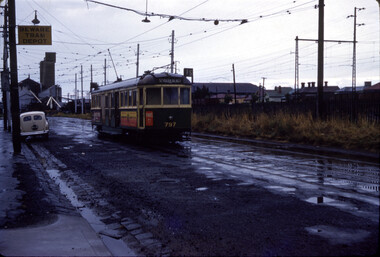
... Note there is West Preston W2 delayed by the passing parade. The number "45" on the front of the dummy is the float number in the parade. ...Note there is West Preston W2 delayed by the passing parade. The number "45" on the front of the dummy is the float number in the parade. ...Set of 12 photos by Hugh Ballment, unless noted otherwise of MTA, MMTB trams, Moomba or works: HBM058 - MMTB W5 797, on Route 15, 1950s, Cameron Street Brunswick, Note the tram depot warning sign. HBM059 - MMTB, Former Sydney Tram 138s, 15/08/1959, Preston Workshops, Conversion to MMTB scrubber No 10, photo Keith Kings. Note the step boards and life guards loose under the tram. HBM060 - MMTB, 9/03/1959, Albert Street, East Melbourne. A Cable tram set on Myer Moomba float. Photo Keith Kings HBM061 - MTA, W6 982, Route 55, March 1987, Royal Park, ComEng train in the background. HBM062 - MTA, W6 982, Route 55, March 1987, Royal Park, ComEng train in the background HBM063 - MTA, W6 982, Route 55, March 1987, Royal Park, ComEng train in the background HBM064 - MTA, W2 510 on Route 7, March 1987, Swanston Street at Flinders Street. Young and Jacksons Hotel, along with many adverts HBM065 - MT&O /MMTB body of bogie cable tram trailer No 478, 7/02/1959, in an Elsternwick backyard. Photo Keith Kings HBM066 - MMTB, W5 739 and SW6 935, late 1950s, Elizabeth Street at Lonsdale Street, with Michaels Chemist in the background. in the foreground are the former cable tram tracks rounding into Lonsdale Street. HBM067 - MMTB, Tram 54 (unlikely to be its correct number. Myer was fifty-four years old in 1959 since it had opened its first store in Bendigo in 1905), 9/03/1959, Albert Street, East Melbourne, Cable tram set on Myer Moomba float 1959. Photo Keith Kings HBM068 - MMTB, W2 379, 1960s, Coldblo Road, Malvern Depot, Portable substation in the street. HBM069 - MMTB, Tram 54, (See note on image HBM067) 9/03/1959, Albert Street crossing Gisborne Street, East Melbourne, Cable car set on Myer Moomba float. Note there is West Preston W2 delayed by the passing parade. The number "45" on the front of the dummy is the float number in the parade. Yields information about Melbourne tram operations, from the 1950s to the 1980s photos of Melbourne tramways.Kodachrome plastic and cardboard mounts, with notes - set of 12tramways, bourke st, brunswick depot, cable trams, tram 797, tram 138s, scrubber 10, moomba, royal park, tram 982, tram 510, tram 739, malvern depot, substation, tram 478, tram 54, tram 379, trams, cameron st, route 15, w5 class, albert st, scrubber tram, mmtb, preston workshops, sw6 class, route 55, mta, w6 class, w2 class, route 7, swanston st, flinders st, coldblo road, tram 935, gisborne st, east melbourne, elizabeth st, lonsdale st -
 Monash University Museum of Computing History
Ferranti Sirius mainframe computer, 1961
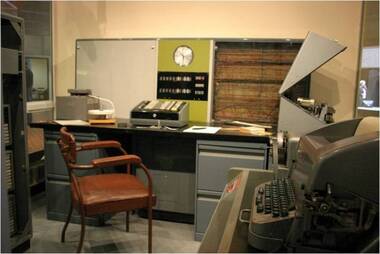
... The Sirius base unit uses acoustic delay line memory with 1000 word store. An additional 3000 word memory cabinet is set adjacent to the CPU and can be connected to increase the memory. ...The Sirius base unit uses acoustic delay line memory with 1000 word store. An additional 3000 word memory cabinet is set adjacent to the CPU and can be connected to increase the memory. ...The Ferranti Sirius is an electronic second-generation transistor computer and is one of three remaining examples of this machine left in the world. It was an important addition to the computing facilities at Monash University in the early 1960s and provided access for computer programming and research for many early computer professionals, academics and teachers. The Ferranti Sirius computer was built in a period of rapid growth in computing technology. The first stored program computers appeared in the late 1940s and used individual designs with valve technology. By the mid-1950s valve technology was replaced by transistors and the first mass produced commercial computers became available. The Ferranti Sirius was announced in 1959 and offered a “small” academic computer. It was designed and built by the English company Ferranti Ltd and sold through a local office of the company in Melbourne. The Sirius was manufactured at the Ferranti Ltd.’s West Gorton, England factory from 1959 to 1963 and, in all, the company produced probably 22 installations although only 16 were actually recorded as sold; this included one at Ferranti’s Bureau in London and one at Ferranti’s Melbourne Bureau. Only 7 were exported and 4 of these 7 were located in Melbourne, Australia. All four were associated with computing at Monash University – the Sirius in the MMoCH collection was purchased by Monash University in 1962, a smaller Ferranti Sirius was used on the Caulfield campus (prior to amalgamation with Monash University) from 1963, the Ferranti company had its own Ferranti Sirius initially temporarily installed at Clayton campus in 1962 and then placed in their office in Queens Road, Melbourne. A fourth computer was purchased by ICIANZ (now Orica) in 1962 and was transferred to Clayton campus in 1967. Only two of these Melbourne examples have survived; one in the MMoCH collection and one at Museums Victoria. There is an example of the Ferranti Sirius in the Science Museum Group collection in the UK as well. The Ferranti Sirius in the MMoCH collection was the first computer purchased by Monash University and it was shipped to Australia to be installed by November 1962. The University had a similar model computer on loan from Ferranti Ltd during the first part of the year and it was returned to the office of the company in Queens Road, Melbourne once the University’s own machine was installed. The computer was placed on site at Clayton campus, Monash University. The computer operated from 1962 until 1972 when it was officially decommissioned. The Ferranti Sirius was sold to Mr Paul Stewart in late 1974 and removed from Monash University. Mr Stewart later donated the computer back to the University in 1988 and it was transferred to the collection of the Monash Museum of Computing History after 2001. The Ferranti Sirius is an electronic second-generation transistor computer and is one of three remaining examples of this machine left in the world. It was an important addition to the computing facilities at Monash University in the early 1960s and provided access for computer programming and research for many early computer professionals, academics and teachers. The Ferranti Sirius is of scientific (technological) significance as one of the early transistor digital computers that transitioned computing from first-generation valve computers to second generation commercial installations. This example of the Sirius is of historical significance in its role as a part of the Computer Centre, Clayton campus, Monash University which provided computing facilities in Melbourne in the early 1960s when there were few installations available for academic, administrative and commercial users. Staff and students were able to undertake investigative research and learn programming techniques. The Computer Centre encouraged the use of the computer across all disciplines and this provided the base to establish computer science as a subject offering and, later, a new department in the University. This growth in computer education eventually culminated in the establishment of the Faculty of Information Technology, Monash University. The Ferranti Sirius in the collection at Monash Museum of Computing History has a main unit with a CPU and memory combined with input/output equipment and one extra cabinet of memory. The Central Processing Unit is a floor-standing unit which contains the computer circuits, power supplies and has a decimal digit display panel and a normal clock. A moveable control panel is placed in front of the Unit (Currently set on a recreated desk/filing cabinet support in the display). The Sirius base unit uses acoustic delay line memory with 1000 word store. An additional 3000 word memory cabinet is set adjacent to the CPU and can be connected to increase the memory. The computer is supported by a range of input/output devices. There is a Ferranti Paper tape reader, located on desk in front of CPU. Red label on front “Ferranti tape reader. Type TR 5. Serial No. 477”. Adjacent to the CPU is a set of Simplified tape editing equipment in three pieces which includes a (1) Table unit with switches on front face. Metal tag on reverse reads “Creed & Co. Model No. S4060. Serial No. 1457. Original Customers Marking GRP7 V706”. The table has a numbered internal tag “Table Serial No. 198579. (2)Creed teletype set on table unit. Metal tag on reverse “Creed & Co. Model No. 75RPR K4M4. Serial No. 5897 Made in England”. (3)Creed paper tape reader set on table unit. This set of equipment could read paper tape and print it, or copy paper tape while allowing it to be edited, or allow a programmer or data preparation person to type and punch a new program or data. It has no electrical connection to the computer. Paper tapes were usually torn off and carried across to the computer. There is also another table unit with switches on front face and changeable setting switch on front right side which holds a Ferranti Westrex paper tape punch set. Label on reverse “Teletype Code BRPE11” This was the Computer’s only output device. BRPE-11 is a teletype model number. -
 Sunshine and District Historical Society Incorporated
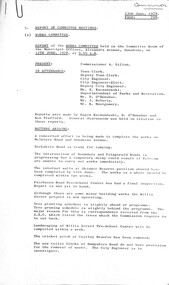
Administrative record - City of Sunshine - Commissioner Mr Alexander Alex George Gillon Collection 1976 - 1982 - Report of Committee Meetings 12th June 1978, City of Sunshine, 13th June 1978
... Report of Committee Meetings 12th June 1978 Works Committee Concerted Effort to Complete Works McIntyre Road and Sunshine Avenue Berkshire Road Ready for Tamping Boundary Road and Fitzgerald Road by Possible Temporary Delay Skinner Reserve Internal Walls Soon to be Completed Fairbairn Road Pre-School Centre Final Inspection Willis Street Pre-School Centre Operating Tree Planting Schedule Slightly Ahead of Programm Willis Street Pre-School Centre Landscaping to be Completed Within a Week Cricket Pitch at Castley Reserve has been Removed New Toilet Blocks at Hampshire Road do not have provision for the removal of waste. ...Albans Road Main Road East East Esplanade Errington Reserve Robert Bruce Reserve Station Road Deer Park Scovell Reserve Scovell Crescent Maidstone Junior Sporting Club Van Ness Avenue Maribyrnong Bon Thomas Reserve Quinn Street Diamond Reserve Diamond Avenue Albanvale Orama Street Highpoint West Rosamond Road Report of Committee Meetings 12th June 1978 Works Committee Concerted Effort to Complete Works McIntyre Road and Sunshine Avenue Berkshire Road Ready for Tamping Boundary Road and Fitzgerald Road by Possible Temporary Delay Skinner Reserve Internal Walls Soon to be Completed Fairbairn Road Pre-School Centre Final Inspection Willis Street Pre-School Centre Operating Tree Planting Schedule Slightly Ahead of Programm Willis Street Pre-School Centre Landscaping to be Completed Within a Week Cricket Pitch at Castley Reserve has been Removed New Toilet Blocks at Hampshire Road do not have provision for the removal of waste. ...Report of Committee Meetings 12th June 1978 Works Committee Concerted Effort to Complete Works McIntyre Road and Sunshine Avenue Berkshire Road Ready for Tamping Boundary Road and Fitzgerald Road by Possible Temporary Delay Skinner Reserve Internal Walls Soon to be Completed Fairbairn Road Pre-School Centre Final Inspection Willis Street Pre-School Centre Operating Tree Planting Schedule Slightly Ahead of Programm Willis Street Pre-School Centre Landscaping to be Completed Within a Week Cricket Pitch at Castley Reserve has been Removed New Toilet Blocks at Hampshire Road do not have provision for the removal of waste. Withers Street Playground Equipment Needs Attention and Alternative Location to be Investigated Dempster Park Toilets Complaints Kororoit Creek Tree Planting Hole Dug at Jones Creek by M.M.B.W. Losses of Warning Lights Report of the City Librarian Second Bookmobile Report of the City Engineer Somerville Road Outfall Drain Proposed Intersection Signals St. Albans Road / Main Road East / East Esplanade Relocation of Steel Framed Steel Clad Sheds to Errington Reserve and Robert Bruce Reserve Toilet Blocks Various Reserves Scovell Reserve Proposal by Maidstone Junior Sporting Club to Construct a Recreation Hall Report of the Acting Building Surveyor Dangerous and Ruinous Building Van Ness Avenue (Former Rock Crushing Plant) Report of the Director Parks & Recreation House McKay Gardens Demolition Extraordinary Business Child Care Buildings Bon Thomas Reserve, Diamond Reserve, Orama Street & Highpoint West city of sunshine, alexander "alex" george gillon, mcintyre road, sunshine avenue, sunshine north, berkshire road, sunshine, boundary road, fitzgerald road, brooklyn, skinner reserve, churchill avenue, braybrook, fairbairn road pre-school centre, willis street pre-school centre, willis street, castley reserve, simmie street, sunshine west, hampshire road, withers street, dempster park, phoenix street, kororoit creek, jones creek, somerville road, st. albans road, main road east, east esplanade, errington reserve, robert bruce reserve, station road, deer park, scovell reserve, scovell crescent, maidstone junior sporting club, van ness avenue, maribyrnong, bon thomas reserve, quinn street, diamond reserve, diamond avenue, albanvale, orama street, highpoint west, rosamond road -
 Sunshine and District Historical Society Incorporated
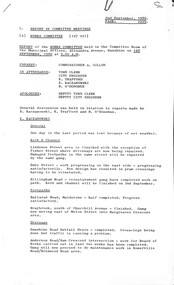
Administrative record - City of Sunshine - Commissioner Mr Alexander Alex George Gillon Collection 1976 - 1982 - Report of committee meetings 1st September 1980, City of Sunshine, 2nd September 1980
... A few minor matters to be cleaned up by 1st September 1980 Albion Tennis Club basically completed. Delay of a couple of weeks in supply of floor tiles Deport Workshop portion of slab has been poured Municipal Offices Extension no delays Scovell Reserve Building worked required to the extent of $3,000, can be organised Skinner Reserve some work has to be redone but accounts and payments can now be finalised Attempts are being made to get a bulk price for three slabs at Pennell Reserve & Ralph Street Reserve and Toilet Block Report of the Finance Committee Meeting Report of the Town Clerk Council Properties Lease to be endorsed and return to Victorian Railways The Hub Sun Crescent Sunshine Office Equipment Typewriter Replacement Project Cost Analysis Period Ended 28th July 1980 Report of the City Engineer & Planner Wright Street Bridge Additional Funds for Completion Fitment of Reversing Alarms to Trucks City Engineer & Deputy City Engineer Submission by the Association of Professional Engineers Australia Building Maintenance and Capital Improvement 1980/81 Alterations and Extension to Municipal Offices Sunshine Indoor Swimming Pool Report of the Forward Planning Committee Site for Proposed Units for Elderly Citizens Deer Park Garbage Employees' Strike...A few minor matters to be cleaned up by 1st September 1980 Albion Tennis Club basically completed. Delay of a couple of weeks in supply of floor tiles Deport Workshop portion of slab has been poured Municipal Offices Extension no delays Scovell Reserve Building worked required to the extent of $3,000, can be organised Skinner Reserve some work has to be redone but accounts and payments can now be finalised Attempts are being made to get a bulk price for three slabs at Pennell Reserve & Ralph Street Reserve and Toilet Block Report of the Finance Committee Meeting Report of the Town Clerk Council Properties Lease to be endorsed and return to Victorian Railways The Hub Sun Crescent Sunshine Office Equipment Typewriter Replacement Project Cost Analysis Period Ended 28th July 1980 Report of the City Engineer & Planner Wright Street Bridge Additional Funds for Completion Fitment of Reversing Alarms to Trucks City Engineer & Deputy City Engineer Submission by the Association of Professional Engineers Australia Building Maintenance and Capital Improvement 1980/81 Alterations and Extension to Municipal Offices Sunshine Indoor Swimming Pool Report of the Forward Planning Committee Site for Proposed Units for Elderly Citizens Deer Park Garbage Employees' Strike Foolscap sized document. ...Report of Committee Meetings 1st September 1980 Report of the Works Committee Meeting One Day Lost in Last Period Due to Wet Weather Kerb & Channel Lindenow Street Area finished except Fisher Street driveways Kerb & Channel Duke Street Sunshine work progressing on east side. New design has resulted in pram crossings having been reinstated Kerb & Channel Billingham Road Deer Park reinstatement completed. Kerb & Channel will be finished 2nd September 1980 Footpath Ballarat Road Maidstone 50% complete Footpath Braybrook South of Churchill Avenue completed. Gang moving to East side of Melon Street Drainage Sunshine Road outfall Drain completed. Cross-legs being done but traffic is causing a problem Drainage Anderson Road / Sun Crescent Intersection completed. Gang to proceed with maintenance work Somerville Road / Holmwood Road Tottenham Area Road Work Forrest Street Ardeer Kororoit Creek to Tower Street excavated Road Work Duke Street Sunshine 15% excavated Road Work Easement Drain Maintenance is being carried out Norge Street / Newman Street Sunshine Tree Pruning 95% complete Tree planting extensive tree planting in Centre Sunshine / Braybrook has been completed Dempster Park concrete wickets require replacement before synthetic surface can be relaid A start on I.C.I. Oval practice 2nd September 1980 Beachley Reserve the practice wickets are in the same condition as Dempster Park Robert Barrett Reserve concrete on this reserve will have to be replaced A contractor has been employed to remove tree stumps Ralph Street Reserve top dressing and reseeding has been completed Kinder Smith Reserve Marching Girls are to be commenced now. Minor worked carried on the oval Wheelahan Gardens a start on landscaping has been made. Work in surrounding areas will be a piece-meal but is progressing Sassella Park germination of seed is satisfactory, but rain is needed. There is a minor problem with a wet spot, but only major reconstruction can cure it Aycliffe Avenue Building inspected last week. A few minor matters to be cleaned up by 1st September 1980 Albion Tennis Club basically completed. Delay of a couple of weeks in supply of floor tiles Deport Workshop portion of slab has been poured Municipal Offices Extension no delays Scovell Reserve Building worked required to the extent of $3,000, can be organised Skinner Reserve some work has to be redone but accounts and payments can now be finalised Attempts are being made to get a bulk price for three slabs at Pennell Reserve & Ralph Street Reserve and Toilet Block Report of the Finance Committee Meeting Report of the Town Clerk Council Properties Lease to be endorsed and return to Victorian Railways The Hub Sun Crescent Sunshine Office Equipment Typewriter Replacement Project Cost Analysis Period Ended 28th July 1980 Report of the City Engineer & Planner Wright Street Bridge Additional Funds for Completion Fitment of Reversing Alarms to Trucks City Engineer & Deputy City Engineer Submission by the Association of Professional Engineers Australia Building Maintenance and Capital Improvement 1980/81 Alterations and Extension to Municipal Offices Sunshine Indoor Swimming Pool Report of the Forward Planning Committee Site for Proposed Units for Elderly Citizens Deer Park Garbage Employees' Strikelindenow street, maidstone, fisher street, duke street, billingham road, deer park, sunshine, ballarat road, churchill avenue, melon street, braybrook, sunshine road, tottenham, anderson road, sun crescent, somerville road, holmwood road, forrest street, kororoit creek, tower street, ardeer, norge street, newman street, dempster park, phoenix street, sunshine north, i.c.i. oval, beachley reserve, ardoyne street, robert barrett reserve, rosamond road, maribyrnong, ralph street reserve, ralph street, sunshine west, kinder smith reserve, lily street, sunshine marching girls club, wheelahan gardens, devonshire road, sassella park, station road, aycliffe avenue, albion tennis club, selwyn park, selwyn street, albion, scovell reserve, scovell crescent, skinner reserve, pennell reserve, burke street, the hub, wright street bridge, wright street, sunshine indoor swimming pool, service street -
 Seaworks Maritime Museum
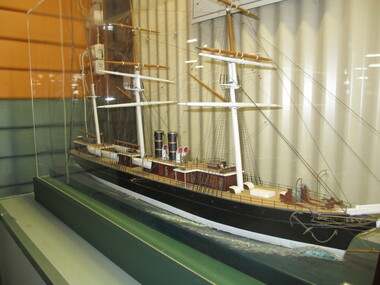
Model ship, SS Iberia, 1873
... However, due to strike delays, her maiden voyage was not until 21 October 1874. ...However, due to strike delays, her maiden voyage was not until 21 October 1874. ...SS Iberia (1873-1903) was built by John Elder & Co. (Govan yard no.162 Glasgow) and launched 6 December 1873 at a cost £151,600. However, due to strike delays, her maiden voyage was not until 21 October 1874. The Iberia was one of the last of the barque-rigged, clipper-bow type of steamer built for the Pacific Steam Navigation Company. At the time, she was also the second largest ship in world, after the Great Eastern. In 1877, a joint Orient Line and Pacific Steam Navigation Co. venture began a fortnightly mail service, first sailing between England and Australia on 12 May 1880, via Gibraltar, Naples, Port Said, Ismalia, Suez, Colombo, Albany, Adelaide, Melbourne, Sydney. Details: - Tonnage: 4,671 g, 2,982 n. - Dimensions: 433ft 6in (132.13m) x 45ft (13.72m) x 35ft 1in (10.69m). - Powered by a single screw, compound inverted 2 cylinder; 750 NHP; 4,000 IHP engine with steam pressure of 70 lbs, 4 cylindrical boilers, 2 to each funnel. - Speed 14 knots - 1873 Passengers: 100 1st, 150 2nd, 340 3rd Class. - 1893 Passengers: 140 first, 50 second, 800 third Some significant dates in her history include: - 1881: Replaced "Aconcagua" as standby vessel on the London - Suez- Melbourne - Sydney route - 1882: Government transport during the Egyptian Arabi Pasha Campaigns - 1883 Jan 25: Placed on regular service to Australia - 1890 Jun 11: Reverted to the Liverpool - Valparaiso route - 1893: Iberia sailed to Australia to replace a disabled ship. The journey via the Cape was non-stop at 14 knots in 32 days - 1893- Fitted with triple expansion engine; 3 cylinders, 600 NHP; 4 cylindrical boilers; 13 knots; fitted by J.Rollo & Sons, Liverpool - 1903: Broken up at Genoa. 1873 single screw, compound inverted, 2 cylinder; 750 NHP, 4000 IHP, Steam pressure 70 lbs, 4 cylindrical boilers, 2 to each funnel, 14 knots. Second largest ship in the world in 1874 (after the Great Eastern). Cost 151, 600 pounds. 1893 Triple expansion engine fitted. 3 cylinders 600 NHP, 4 cylindrical boilers, 15 knots, fitted by D Rollo and Sons, LiverpoolThe body of the model is carved and molded wood painted in black and white, the planked deck with detailed fittings and rigging, raised on a wooden base with simulated waves. At this time yards removed. "Iberia" -
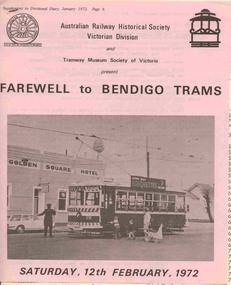 Ballarat Tramway Museum
Ephemera - Tour Notes, Victorian Railways et al, "Farewell to Bendigo Trams", Jan. 1972
... Set of 5 documents for the "Farewell to Bendigo Trams" tour conducted by the ARHS Vic Div and the TMSV, first scheduled for Sat. 12/2/1972, but delayed to Sat. 4/3/1972 due to SECV Power restrictions on the day. 3277.1 - documents 1 to 3 stapled in top left hand corner. 1. ...ARHS Special Trains Bendigo TMSV Timetables Set of 5 documents for the "Farewell to Bendigo Trams" tour conducted by the ARHS Vic Div and the TMSV, first scheduled for Sat. 12/2/1972, but delayed to Sat. 4/3/1972 due to SECV Power restrictions on the day. 3277.1 - documents 1 to 3 stapled in top left hand corner. 1. ...Set of 5 documents for the "Farewell to Bendigo Trams" tour conducted by the ARHS Vic Div and the TMSV, first scheduled for Sat. 12/2/1972, but delayed to Sat. 4/3/1972 due to SECV Power restrictions on the day. 3277.1 - documents 1 to 3 stapled in top left hand corner. 1. Tour circular, printed on pink paper with a photo of No. 28 at Golden Square terminus. Has logos of ARHS Vic Div and TMSV, part missing - used for booking. Gives details of the purpose of the tour, approx. times, refreshments, a booklet and fares. Organiser Victor Isaacs and Neil Morrow Booking Officer. Printed on foolscap paper in landscape format 2. Victorian Railways S Circular, or special train notice, S.224/72, single page giving train schedules, loads, motive power, carriage numbers and tickets. Signed by J.C. Crute as Chief Traffic Manager. Dated 19/1/1972. Printed on foolscap paper. 3. Ticket circular printed on quarto paper giving times of departure and arrival back, noting its express run to Melbourne. 3277.2 - documents 4 to 5, stapled in top left hand corner. 4. Set of two sheets, one printed on foolscap card paper, the other on foolscap paper, giving a graph of the tram workings, showing the special trams (tours A and B) overlain with the Saturday timetable. Dated 4/3/1972. 5. Victorian Railways S Circular, or special train notice, S.435/72, single page giving train schedules, loads, motive power, carriage numbers and tickets. Signed by J.C. Crute as Chief Traffic Manager. Dated 11/2/1972. Printed on foolscap paper. Noted that the special train of 12/2/1972 is cancelled "Due to SECV Restrictions". Has return train timetabled for 2 hours and five minutes. (Additional copies of item 4 - graph on one sheet only and item 5 - added 3/10/2007 - ex Graeme Breydon materials) 3277.3 - Welcome Aboard Circular - red foolscap paper, giving train time summary, photostops, arrangements in Bendigo, Bendigo line history and tram tours. Images of document added 27-08-12.arhs, special trains, bendigo, tmsv, timetables -
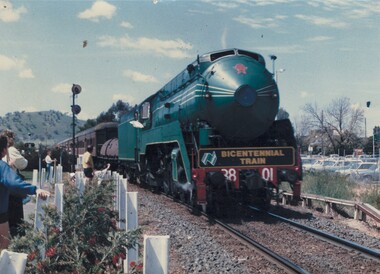 Wodonga & District Historical Society Inc
Photograph - Fred Rochow Railways Collection - Bicentennial Train Locomotive 3801, 29 October 1988
... The delivery of 3801 was much delayed due to wartime labour & material shortages, together with competing wartime construction priorities. ...The delivery of 3801 was much delayed due to wartime labour & material shortages, together with competing wartime construction priorities. ...The Fred Rochow Railways Collection incorporates photos related to the operation of the Wodonga Railway Station including different types of trains and railways staff C. 1930 – 1990. It was donated to the Wodonga Historical Society by Fred Rochow, a railwayman who spent many years based in Wodonga. He joined the Victorian Railways on 17th June l947 and retired in 1988. For some time, he was a member of the Australian Federated Union of Locomotive Enginemen and served a term as a member of the Trades Hall Council. He had an extensive knowledge of the struggles that took place to achieve better conditions for railway workers. Fred worked for many years as a fireman and then worked his way up the ranks to driver, experiencing many changes from the days of steam locomotives through to diesel trains, locomotives and even the modern XPT train. He worked throughout Victoria at different stages of his career, with his final working years focused on the northeast of Victoria and the Albury to Melbourne line. After his retirement, Fred continued to share his love of steam miniature trains with the community.This collection has local and statewide significance as it captures images of trains, locomotives and personnel who operated the railway services in Wodonga and throughout Northeast Victoria. The railways played a critical role in opening up Victoria and connecting Australia for trade, business, social communication and transport.Bicentennial Train hauled by Locomotive 3801 passing through Wodonga. Locomotive 3801 was built by Sydney company The Clyde Engineering Co. Ltd., Granville in 1943 as the first of five streamlined (C) 38-class locomotives for the New South Wales Government Railways’ top-link express passenger duties. The delivery of 3801 was much delayed due to wartime labour & material shortages, together with competing wartime construction priorities. After many years of service, 3801 had been scheduled for withdrawal in 1962 due to deteriorating mechanical condition, but rail enthusiasts raised sufficient funds to cover the cost of its overhaul. 3801 joined the collection of the New South Wales Rail Transport Museum (NSWRTM), Enfield on withdrawal from NSWGR service and continued in operation as a tour locomotive. It hauled the “Western Endeavour” on the first crossing of the Australian continent by a standard gauge train from Sydney to Perth and return in August – September 1970. 3801 also stars in the railway film ‘A Steam Train Passes’ made by Film Australia in 1974 By 1976 had been withdrawn from service due to poor boiler condition and placed on static display by the Rail Transport Museum in Thirlmere, NSW. The Locomotive remained in Thirlmere until 1983 when it was decided it should be restored for the Australian Bicentenary in 1988. A new organisation was created specifically for the purpose of operating 3801, and thus 3801 Limited was incorporated on 5th June 1985. Work on the locomotive was completed after three years, with 3801 making its debut at a special Railway Ball hosted in its honour on 29th November 1986. During the Australian Bicentenary celebrations in 1988, it operated an extensive program across Australia visiting every mainland capital accessible by rail including an appearance at AusSteam ’88 in Melbourne in October 1988, stopping over in Wodonga on the way. After the company’s 20-year lease on the locomotive expired in 2006 Railcorp chose not to extend the agreement, and the locomotive returned to the Rail Transport Museum at Thirlmere (now the NSW Rail Museum). 3801 was withdrawn from service in 2007 for major boiler repairs. Locomotive 3801 was officially relaunched at Sydney's Central Station on Friday 12 March 2021 by Her Excellency, the Honourable Margaret Beazley AC QC, Governor of New South Wales.On front of locomotive Australia Bicentennial logo and sign "BICENTENNIAL TRAIN/3801" railways wodonga, fred rochow, locomotive r761, bicentennial train, locomotive 3801 -
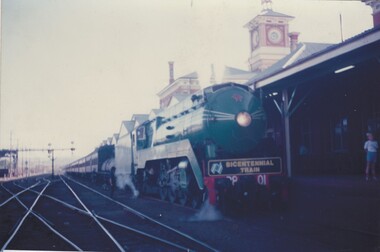 Wodonga & District Historical Society Inc
Photograph - Fred Rochow Railways Collection - Bicentennial Train Locomotive 3801 arriving in Albury, 29 October 1988
... The delivery of 3801 was much delayed due to wartime labour & material shortages, together with competing wartime construction priorities. ...The delivery of 3801 was much delayed due to wartime labour & material shortages, together with competing wartime construction priorities. ...The Fred Rochow Railways Collection incorporates photos related to the operation of the Wodonga Railway Station including different types of trains and railways staff C. 1930 – 1990. It was donated to the Wodonga Historical Society by Fred Rochow, a railwayman who spent many years based in Wodonga. He joined the Victorian Railways on 17th June l947 and retired in 1988. For some time, he was a member of the Australian Federated Union of Locomotive Enginemen and served a term as a member of the Trades Hall Council. He had an extensive knowledge of the struggles that took place to achieve better conditions for railway workers. Fred worked for many years as a fireman and then worked his way up the ranks to driver, experiencing many changes from the days of steam locomotives through to diesel trains, locomotives and even the modern XPT train. He worked throughout Victoria at different stages of his career, with his final working years focused on the northeast of Victoria and the Albury to Melbourne line. After his retirement, Fred continued to share his love of steam miniature trains with the community.This collection has local and statewide significance as it captures images of trains, locomotives and personnel who operated the railway services in Wodonga and throughout Northeast Victoria. The railways played a critical role in opening up Victoria and connecting Australia for trade, business, social communication and transport.Bicentennial Train hauled by Locomotive 3801 arriving at Albury Station, Locomotive 3801 was built by Sydney company The Clyde Engineering Co. Ltd., Granville in 1943 as the first of five streamlined (C) 38-class locomotives for the New South Wales Government Railways’ top-link express passenger duties. The delivery of 3801 was much delayed due to wartime labour & material shortages, together with competing wartime construction priorities. After many years of service, 3801 had been scheduled for withdrawal in 1962 due to deteriorating mechanical condition, but rail enthusiasts raised sufficient funds to cover the cost of its overhaul. 3801 joined the collection of the New South Wales Rail Transport Museum (NSWRTM), Enfield on withdrawal from NSWGR service and continued in operation as a tour locomotive. It hauled the “Western Endeavour” on the first crossing of the Australian continent by a standard gauge train from Sydney to Perth and return in August – September 1970. 3801 also stars in the railway film ‘A Steam Train Passes’ made by Film Australia in 1974 By 1976 had been withdrawn from service due to poor boiler condition and placed on static display by the Rail Transport Museum in Thirlmere, NSW. The Locomotive remained in Thirlmere until 1983 when it was decided it should be restored for the Australian Bicentenary in 1988. A new organisation was created specifically for the purpose of operating 3801, and thus 3801 Limited was incorporated on 5th June 1985. Work on the locomotive was completed after three years, with 3801 making its debut at a special Railway Ball hosted in its honour on 29th November 1986. During the Australian Bicentenary celebrations in 1988, it operated an extensive program across Australia visiting every mainland capital accessible by rail including an appearance at AusSteam ’88 in Melbourne in October 1988, stopping over in Wodonga on the way. After the company’s 20-year lease on the locomotive expired in 2006 Railcorp chose not to extend the agreement, and the locomotive returned to the Rail Transport Museum at Thirlmere (now the NSW Rail Museum). 3801 was withdrawn from service in 2007 for major boiler repairs. Locomotive 3801 was officially relaunched at Sydney's Central Station on Friday 12 March 2021 by Her Excellency, the Honourable Margaret Beazley AC QC, Governor of New South Wales.On front of locomotive Australia Bicentennial logo and sign "BICENTENNIAL TRAIN/3801" railways wodonga, fred rochow, locomotive r761, bicentennial train, locomotive 3801 -
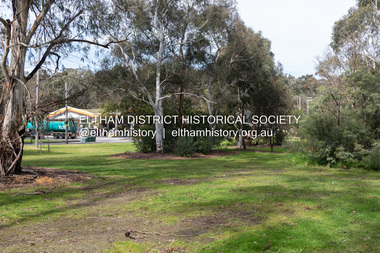 Eltham District Historical Society Inc
Photograph, Peter Pidgeon, Site of former Eltham Tennis Court, Wingrove Park, 2 Aug. 2022
... Officers and a committee were duly elected, and the Treasurer was instructed to purchase the necessary requisites without delay. By the end of the first week in November all the requisites were to hand, two courts were marked out, and practice begun. ...Officers and a committee were duly elected, and the Treasurer was instructed to purchase the necessary requisites without delay. By the end of the first week in November all the requisites were to hand, two courts were marked out, and practice begun. ...View looking through Wingrove Park from near the Diamond Creek Trail towards the Coles Express Service Station and Mount Pleasant Road intersection. Comparison photo: SEPP_0720 Eltham Tennis Court, c.1909 and SEPP_0721 - Eltham Tennis Court, Lady Premiers 1909-1910 The tennis courts were located in Bremner’s Flats, present day Wingrove Park. The Eltham Lawn Tennis Club was formed on a Saturday evening, the 29th of October, 1898 at a meeting held at the Eltham State school. Twenty members were enrolled, and eight more shortly afterwards. Officers and a committee were duly elected, and the Treasurer was instructed to purchase the necessary requisites without delay. By the end of the first week in November all the requisites were to hand, two courts were marked out, and practice begun. The formal opening of the Courts of this Club took place on Saturday, November 12, 1898, when 26 members and their friends assembled. Part of a presentation by Peter Pidgeon to the Society, 13 August 2022 showcasing a series of photographs taken by John Henry Clark over the period 1895 to 1930. John Henry Clark was the youngest of three boys born to William Henry Clark (1823-1877) and Maria White (1843-1914). He and his brothers, William Charles Clark (1872-1945), Clement Kent Clark (1874-1912) operated a photography business (Clark Bros.) from 25 Thomas Street, Windsor near Prahran during the period c.1894 to 1914. Following death of Clement in September 1912 and their mother in 1914, the Clark Bros business appears to have dissolved, the premises demolished, and a new house was under construction in 1915. John set up business independently in 1914 operating out of 29 Moor Street, Fitzroy where he is registered in the 1914 and 1915 Electoral Rolls. By 1916 John had relocated to Eltham where he continued his practice as a photographer and took many of the early images around the district of Little Eltham. Around 1930 John changed professions and opened a small cobbler's shop in 1931 near the pond opposite Dalton Street adjacent to the Jarrold family cottage. He never married and continued his profession as a bootmaker from this little shop, maintaining a close relationship with Mrs Jarrold for the rest of their lives. His bootmaker shop remains today beside the Whitecloud cottage and is one of only three remaining shops in the area from the early 20th century.Comparative photo taken 2022 with one taken from same location over 100 years earlier by noted local photographer J.H. ClarkBorn Digitalbible street, eltham, j.h. clark photo (2022), bremner's flat, eltham lawn tennis club, eltham tennis court, main road, mount pleasant road, tennis court, wingrove park -
 Eltham District Historical Society Inc
Document - Folder, Marshall, Robert
... Newspaper article: "Coroner slams delay", unknown newspaper, no date (May 1997). ...Newspaper article: "Coroner slams delay", unknown newspaper, no date (May 1997). ...Robert Marshall grew up on a small farm in Panton Hills in the 1950s and became an architect, designing in an Australian style, sometimes working with Alistair Knox. Marshall first stood for local council in 1974, having to overcome a childhood stutter by relaxation techniques. He was active in the formation of Nillumbik shire; after 20 years as councillor, he was elected president for 1978 and 1979. In February 1997, his adopted son Stewart Anthony Marshall died as the result of a drug mix-up. He lived in St Andrews and his business was in Hurstbridge. Contents Newspaper article: "Rob Marshall: fist of steel in a glove of green", The Valley Voice, 24 January 1979, describing Robert Marshall's childhood and his thoughts about house design and conservation. Newspaper article: "Councillor marshals energy for next round", Diamond Valley News, no date, Robert Marshall plans to stand again for council after the amalgamation of council, describing. his vision for the district citing Alistair Knox and Don Maling as pioneers. Newspaper article: "...and your new shire president", Diamond Valley News, March 1997, Former Eltham councillor Robert Marshall elected Nillumbik Shire president. Newspaper article: "Drug mix-up led to death: court told", unknown newspaper, 28 May 1997, Report of Coroners Court hearing into death of Stewart Anthony Marshall, Robert Marshall's son. Newspaper article: "Coroner slams delay", unknown newspaper, no date (May 1997). Report of Coroners Court hearing into death of Stewart Anthony Marshall, Robert Marshall's son. Newspaper article: "Shire chief set to pay outstanding rate bill", Diamond Valley News, 30 July 1997, Robert Marshall had not paid rates in protest during government-appointed commissioners were in power but was paying off the debt. Newspaper article: "An architect for a better way of life", Diamond Valley News, 11 August 1981, Describing Robert Marshall's travels after qualifying as an architect, his early life and his philosophy on conservation. Newspaper article: "He presides over the city's last green belt. But was does Robert Marshall make the State Government see red?" The Age, 10 January 1998, Describing dispute between Nillumbik Shire president Robert Marshall and CEO Barry Rochford, and Rochford's termination package and Marshall's environmental campaigns including the old Eltham Shire Office site. Newspaper letter: "For good governance", letter from Robert Marshall, following his defeat at recent council election after 25 years in local government, comments on his actions as president and wishes new councillors well. Newspaper clippings, A4 photocopies, etcrobert marshall, panton hills victoria, alistair knox, stewart anthony marshall, ross ray qc, vauclause hospital, benny monheit, adam bernhaut, geoff pittaway, metropolitan ambulance service, ambulance service victoria, eltham gateway action group, barry rochford, eltham shire offices site, frank lynch, eltham chamber of commerce, barry miller, rob maclellan planning minister, green wedge, don maling, ian west -
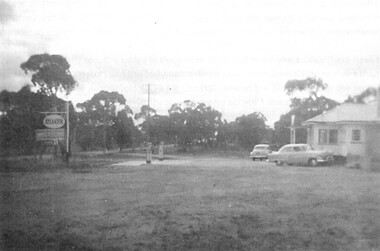 Stawell Historical Society Inc
Photograph, Winston Lodge 1950 and 1952
... Winston Lodge finally opened for business on Saturday March 1st 1952 after many delays due to building material shortages and was an immediate success with local farmers and interstate truckies. ...Winston Lodge finally opened for business on Saturday March 1st 1952 after many delays due to building material shortages and was an immediate success with local farmers and interstate truckies. ...For around the last 70 years, a familiar sight on the Western Highway at Stawell West has been the Roadhouse/Service Station known as ‘Winston Lodge.’ The building was constructed on Crown Land over the years 1950-1952 by local builders, Mr. Bobby Briggs and Mr. Clem Faulkner for Mrs. Winifred Jenkins. Briggs and Faulkner also handled the construction of the new E.S. and A. Bank building in Main Street. Mrs. Jenkins realised that a stopover was needed in Stawell for both truckies and travellers alike. The family believe that the daughter of Mrs. Jenkins, Lyla drew up the plans for Winston Lodge in an exercise book and the construction was erected from these primitive sketches. Winston Lodge finally opened for business on Saturday March 1st 1952 after many delays due to building material shortages and was an immediate success with local farmers and interstate truckies. The conditions were basic, but the food was excellent in the style of the period – soups, roast dinners and hot apple pies with fresh cream from a dairy on Halls Gap Road. All the cooking was done on a wood fired double oven stove with water pipes running through the firebox to provide the hot water for the Lodge. The name Winston Lodge is quite a story. The family of Mrs. Jenkins believe that a financial backer of the construction was a family by the name of Johnston. So, a combination of WINifred and JohnSTON became Winston Lodge. It was not named after the English Prime Minister of the day Sir Winston Churchill but maybe Winifred Jenkins was a supporter of the PM. Winifred eventually sold the Lodge in December 1957 and in the years since there have been many owners/proprietors and the building has been saved from demolition on more than one occasion. One of the proprietors was a Mr Len Hall, who at the time, was also the proprietor of the Café at the Stawell Drive- In Theatre where he served T-Bone steaks, hamburgers, hot dogs and fish & chips to the theatre goers. It was reported in the Stawell Times and Pleasant Creek Chronicle on Saturday March 5th 1960 that a sign had been erected at Winston Lodge to mark the opening of Stawell’s first Motel. Some small Motel units had been constructed on the Eastern side of Winston Lodge to cater for the travelling public and also for the truckies who had stopped for a meal and a comfortable bed. Even though the name ‘Winston Lodge’ disappeared from the front of the building in 2020 when renovations took place, it will always be referred to locally as ‘Winston Lodge.’ Two Black and White Photographs One building Lodge. One with Atlantic Petrol Pumps Outside. -
 Melbourne Legacy
Document, Australian Imperial Force, 1918
... You will have to realise, however. that there is a great shortage of shipping, and that there must be a considerable inevitable delay. Play the game, boys, during this time, as you have always done, and add still more to the deep debt of gratitude which will always be acknowledged to you by the Empire and remembered by me as your comrade and commander. ...You will have to realise, however. that there is a great shortage of shipping, and that there must be a considerable inevitable delay. Play the game, boys, during this time, as you have always done, and add still more to the deep debt of gratitude which will always be acknowledged to you by the Empire and remembered by me as your comrade and commander. ...A leaflet issued by General William Birdwood to the AIF troops just after the Armistice on 11 November 1918 to end the first world war. 'To the officers, Non-Commissioned Officers and Men of the Australian Imperial Force. It is now just four that we have been serving together, often through days of hardship and peril, and often through times of well-deserved success. During this time I hope and think we have come to know each other well and I trust we realised how rightly we have confidence in each other. No words of mine can possibly express all I feel for the magnificent work which has been done by the Australian soldier during these long four years. It is well known and recognised, not only throughout the British Empire, but throughout the world - and now we have peace in sight, and peace after a victory in which the Australian soldier has taken so large a share. Even then, with peace there are still difficult times before us. Faith in our recent foe cannot quickly be established, and it may be that some little time yet we shall be able to relax no precautions, until we are assured of the complete and honest fulfilment of our terms. Then will come the difficult time of demobilisation, and it is regarding this that I wish to make a personal appeal to every single member of the AIF in the full confidence that it will be met as every other appeal to face and tackle the strongest positions has ever been met by the Australian solider. Never has the name of Australia stood higher than it does now throughout the world, thanks to the bravery of her soldiers, and it sup to everyone one of us to see that this is maintained, and that no reproach can be cast on the Australian Flag owing to any behaviour of ours. The time of demobilisation will undoubtedly be difficult and irksome - I fully realise what great personal self-restraint will certainly be required - but if each individual of us makes up his mind to do his best during these times, realising the good name we bear, I feel confident that all will go well. I want you to remember that everything possible will be done to look after and help the troops during this period, while every energy will be strained to get men back to their homes as soon as this possibly can be done. You will have to realise, however. that there is a great shortage of shipping, and that there must be a considerable inevitable delay. Play the game, boys, during this time, as you have always done, and add still more to the deep debt of gratitude which will always be acknowledged to you by the Empire and remembered by me as your comrade and commander. In the field, 14 November 1918.' (Signed) 'W Birdwood'.A rare example of a notice to troops about the Armistice.A leaflet issued by General Birdwood to AIF troops to commemorate the end of World War 1.world war one, soldier
