
Showing 145 items matching " bed cover"
-
 Embroiderers Guild, Victoria
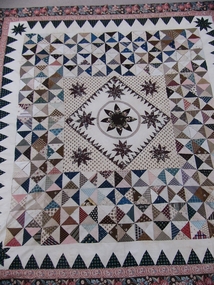
Textile - Bed cover, Quilt Bed Cover, 1840-60
... Bed cover...Quilt Bed Cover...... Bed cover...Patchwork Bed cover Partly patchwork, partly applique with 1840-60 design. ...Partly patchwork, partly applique with 1840-60 design. The central area and sides are in colourful triangles of printed cottons. The only border is made of floral cretonne and back is of plain calico.patchwork, bed cover -
 Embroiderers Guild, Victoria
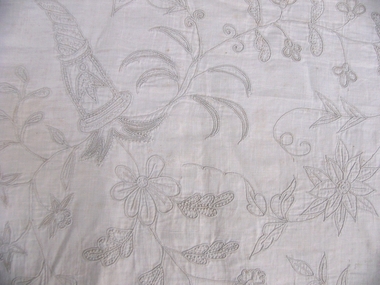
Domestic Object - Irish Knotted Work Bed Cover, 18th Century
... Irish Knotted Work Bed Cover...Knotted linen thread couched onto white linen bed cover. ...Embroidery Whitework Bedcover 18th Century Ireland Knotted linen thread couched onto white linen bed cover. Domestic Object Irish Knotted Work Bed Cover ...Donor's mother brought this from the west of Ireland in 1950. Said to have been embroidered by her grandmother and her ladies in 1780-1800. (This may be a later rather than actual date). Knotting was a genteel pastime for leisured ladies requiring little concentration, so conversation could be carried out. Favoured at Court and practised in England in the late 17th C in William and Mary's reign and Queen Anne's reign in the early 18th C. Addit: Old article written by Lady Geraldine Amies states "the cover was designed and embroidered by the donor's great grandmother, with the help of her attendants, in Westport, County Mayo, Ireland about 1830 and completed during the long voyage to Australia in 1850".Knotting was a genteel pastime for leisured ladies requiring little concentration, so conversation could be carried out. Favoured at Court and practised in England in the late 17th C in William and Mary's reign and Queen Anne's reign in the early 18th C. A knotting shuttle, larger than a tatting shuttle, made knots at every quarter inch or 6 mm intervals in string, linen, silk or wool. Mrs Mary Delaney enjoyed knotting and preferred linen thread which was stronger. The Ulster Museum in Belfast holds an embroidered bedcover by Delany, one of the few complete pieces of embroidery made by her. The threads between the knots was dependent on the thickness of the thread. This fashionable occupation was often mocked by men, Sir Charles Sedley, a wit and libertine wrote a verse mocking Queen Mary, the dull Protestant wife of William 111: "Blest we, who from such queens are freed/ Who, buy vain superstition led,/ Are always telling beads;/But here's a queen now, thanks to God/ Who, when she rides in Coach abroad/ Is always knotting threads. In the Spectator of 1712 it was suggested that men might take up knotting. Dr Johnson attempted to learn the skill but told Boswell "I once tried knotting: Dempster's sister undertook to teach me, but I could not learn it." Knotted linen thread couched onto white linen bed cover. embroidery, whitework, bedcover, 18th century, ireland -
 Robin Boyd Foundation
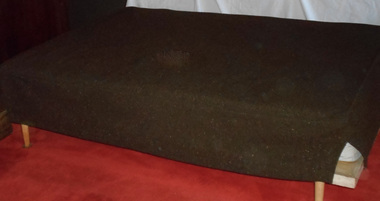
Functional object - Bed cover
... Bed cover...Functional object Bed cover ...Slipcover to fit the bed. Woven wool, chocolate brown with lighter fleck.walsh st furnishings, robin boyd -
 Robin Boyd Foundation
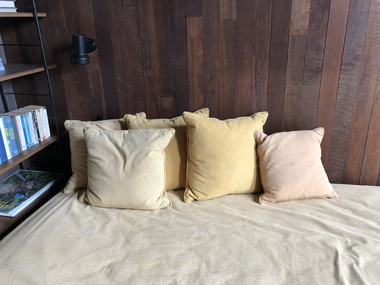
Functional object - Bed cover
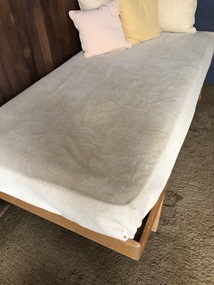
... Bed cover...The daybed cover here is same fabric as some of the cushions (items F088-F092 and F099-F103) located on the Penleigh's bed....Functional object Bed cover ...The daybed cover here is same fabric as some of the cushions (items F088-F092 and F099-F103) located on the Penleigh's bed.Mustard and white stripe cotton made to fit single bed (item F086), with calico lining. Has a curved edge.walsh st furnishings, robin boyd -
 Robin Boyd Foundation
Functional object - Bed cover
... Bed cover...The daybed cover here is same fabric as the curtains (item F111) and some of the cushions (items F088-F092 and F099-F103) located on the Suzy's bed....Functional object Bed cover ...The daybed cover here is same fabric as the curtains (item F111) and some of the cushions (items F088-F092 and F099-F103) located on the Suzy's bed.Mustard and white stripe cotton made to fit single bed (item 105), with calico lining. Has a curved edge.walsh st furnishings, robin boyd -
 Whitehorse Historical Society Inc.
Functional object - Bed Cover
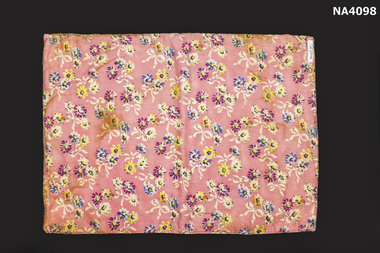
... Bed Cover...White bows Functional object Bed Cover ...Margaret Scarlett CollectionPink, with blue and yellow flowers. White bowstoys, doll's furniture -
 Embroiderers Guild, Victoria
Textile - Bed Quilt, Quilt, 1900-20
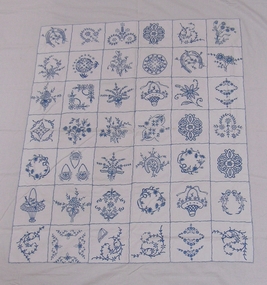
... ... Bed cover...Large white cotton twill bed cover with a central panel divided into 42 squares (7 x 6 cms) outlined in herringbone stitch with each square containing a different pattern in bright blue thread....Embroidery Surface stitchery Bed cover 1900-20 E. Avery 4 (laundry mark) Large white cotton twill bed cover with a central panel divided into 42 squares (7 x 6 cms) outlined in herringbone stitch with each square containing a different pattern in bright blue thread. ...Large white cotton twill bed cover with a central panel divided into 42 squares (7 x 6 cms) outlined in herringbone stitch with each square containing a different pattern in bright blue thread.E. Avery 4 (laundry mark)embroidery, surface stitchery, bed cover, 1900-20 -
 Whitehorse Historical Society Inc.
Article, Cubs quilt, 1991
... The quilt will be used as a bed-cover or as a highly individual wall hanging....The quilt will be used as a bed-cover or as a highly individual wall hanging....The quilt will be used as a bed-cover or as a highly individual wall hanging. ...2nd Vermont Cub Scouts have for their latest community service project made a quilt for Ronald McDonald House.2nd Vermont Cub Scouts have for their latest community service project made a quilt for Ronald McDonald House. The quilt will be used as a bed-cover or as a highly individual wall hanging.2nd Vermont Cub Scouts have for their latest community service project made a quilt for Ronald McDonald House. scout groups, vermont cub scouts, 2nd, ronald mcdonald house, mcintosh, craig, hainsworth, lucas, bishop, peter -
 Bendigo Historical Society Inc.
Textile - WAGGA RUG
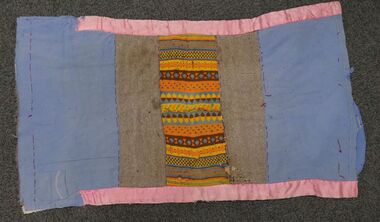
... ...patchwork bed cover - wagga...TEXTILES Domestic patchwork bed cover - wagga Wagga Patchwork Wagga Rug Item donated to Carol Holsworth at Specimen Cottage 2014 - 2018. ...Patchwork Wagga Rug Item donated to Carol Holsworth at Specimen Cottage 2014 - 2018. No details taken of donor or ownership of the item. Item made of fabric remnants handstitched together. Includes hessian, cotton fabric and knitted woollen fabric.textiles, domestic, patchwork bed cover - wagga, wagga -
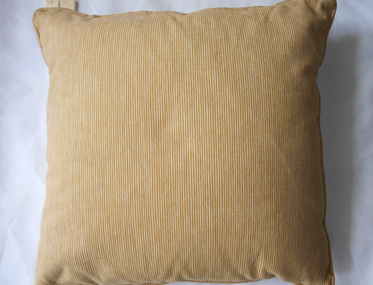 Robin Boyd Foundation
Functional object - Cushion
... Mustard and white stripe cotton with a concealed zip and piping. Matches bed cover (item F087)....Walsh St furnishings robin boyd Mustard and white stripe cotton with a concealed zip and piping. Matches bed cover (item F087). Functional object Cushion ...This set of mustard and honeycomb coloured cushions (items F088-F092 and F099-F103) are located on Penleigh and Suzy's beds in the east facing back rooms of the Children's Pavilion.Mustard and white stripe cotton with a concealed zip and piping. Matches bed cover (item F087).walsh st furnishings, robin boyd -
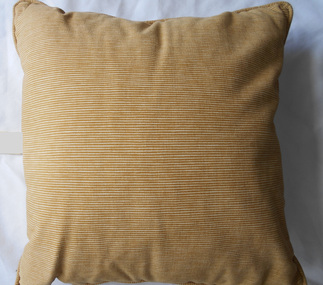 Robin Boyd Foundation
Functional object - Cushion
... Mustard and white stripe cotton with a concealed zip and piping. Matches bed cover (item F087)....Walsh St furnishings robin boyd Mustard and white stripe cotton with a concealed zip and piping. Matches bed cover (item F087). Functional object Cushion ...This set of mustard and honeycomb coloured cushions (items F088-F092 and F099-F103) are located on Penleigh and Suzy's beds in the east facing back rooms of the Children's Pavilion.Mustard and white stripe cotton with a concealed zip and piping. Matches bed cover (item F087).walsh st furnishings, robin boyd -
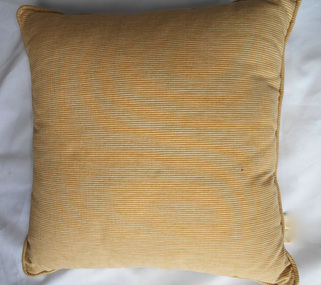 Robin Boyd Foundation
Functional object - Cushion
... Mustard and white stripe cotton with a concealed zip and piping. Matches bed cover (item F104)....Walsh St furnishings robin boyd Mustard and white stripe cotton with a concealed zip and piping. Matches bed cover (item F104). Functional object Cushion ...This set of mustard and honeycomb coloured cushions (items F088-F092 and F099-F103) are located on Penleigh and Suzy's beds in the back east facing rooms of the Children's Pavilion.Mustard and white stripe cotton with a concealed zip and piping. Matches bed cover (item F104).walsh st furnishings, robin boyd -
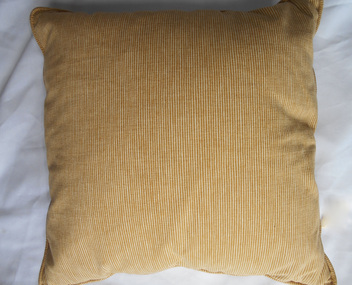 Robin Boyd Foundation
Functional object - Cushion
... Mustard and white stripe cotton with a concealed zip and piping. Matches bed cover (item F104)....Walsh St furnishings robin boyd Mustard and white stripe cotton with a concealed zip and piping. Matches bed cover (item F104). Functional object Cushion ...This set of mustard and honeycomb coloured cushions (items F088-F092 and F099-F103) are located on Penleigh and Suzy's beds in the back east facing rooms of the Children's Pavilion.Mustard and white stripe cotton with a concealed zip and piping. Matches bed cover (item F104).walsh st furnishings, robin boyd -
 Whitehorse Historical Society Inc.
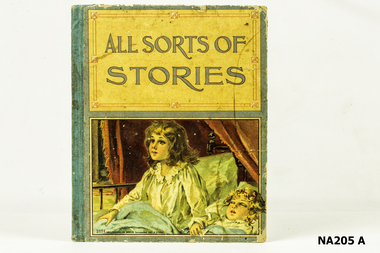
Book, 'All Sorts of Stories', 1919
... Hardcover book with two girls in bed on cover....books children's This book presented to Ray Champion/Methodist Sunday School/Blackburn/April 1919 Hardcover book with two girls in bed on cover. 'All Sorts of Stories' Book Book ...Hardcover book with two girls in bed on cover.This book presented to Ray Champion/Methodist Sunday School/Blackburn/April 1919books, children's -
Glenelg Shire Council Cultural Collection
Artwork, other - Tapa Cloth, n.d
... Wall hanging, floor covering or bed cover - traditional offering as a wedding gift. ...Wall hanging, floor covering or bed cover - traditional offering as a wedding gift. ...Tapa cloth was given to Mr Mel Bartlett by the King of Tonga, for drilling wells for water in and aid program.Wall hanging, floor covering or bed cover - traditional offering as a wedding gift. Highly prized by Tongan villagers. Symbols depict trees, flowers, moons, stars. Images repetitive. Made of Tapa bark, hand . -
 City of Moorabbin Historical Society (Operating the Box Cottage Museum)
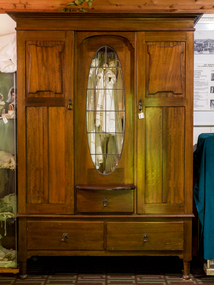
Furniture, Wardrobe 3 piece 3 drawers c1900, c1900
... The sections of this wardrobe can be lifted apart so that it can be transported easily and when assembled provides suitable hanging and storage space for the clothes and bed covers of an early settler family ...The sections of this wardrobe can be lifted apart so that it can be transported easily and when assembled provides suitable hanging and storage space for the clothes and bed covers of an early settler family This wardrobe is of a type commonly used by early settler families in Moorabbin Shire c1900 early settlers, market gardeners, poultry farmers, mechanics institutes, furniture, kitchen equipment, clothing, drapery, haberdashery, green pederson carol, city of moorabbin, county of bourke, moorabbin roads board, parish of moorabbin, shire of moorabbin, henry dendy's special survey 1841, were j.b.; bent thomas, highett william, ormond francis, maynard dennis, Wooden Wardrobe with 3 sections- top, hanging space with a central oval glass window, a shallow central drawer and 2 doors with key locks, and drawer section with 2 deep drawers Furniture, Wardrobe 3 piece 3 drawers c1900 ...The sections of this wardrobe can be lifted apart so that it can be transported easily and when assembled provides suitable hanging and storage space for the clothes and bed covers of an early settler family This wardrobe is of a type commonly used by early settler families in Moorabbin Shire c1900Wooden Wardrobe with 3 sections- top, hanging space with a central oval glass window, a shallow central drawer and 2 doors with key locks, and drawer section with 2 deep drawers early settlers, market gardeners, poultry farmers, mechanics institutes, furniture, kitchen equipment, clothing, drapery, haberdashery, green pederson carol, city of moorabbin, county of bourke, moorabbin roads board, parish of moorabbin, shire of moorabbin, henry dendy's special survey 1841, were j.b.; bent thomas, highett william, ormond francis, maynard dennis, -
 Alfred Hospital Nurses League - Nursing History Collection
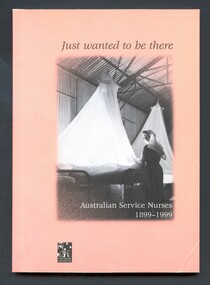
Booklet - Illustrated booklet, Richard Reid, Just wanted to be there: Australian Service Nurses 1899-1999, 1999
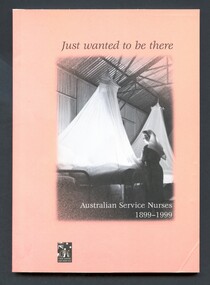
... Front cover has a black and white photograph of a nurse with two hospital beds covered with mosquito tents (No 74 Camp Hospital, Katherine, NT, 1945) Below this is a small rectangular illustration and words: their service our heritage....Front cover has a black and white photograph of a nurse with two hospital beds covered with mosquito tents (No 74 Camp Hospital, Katherine, NT, 1945) Below this is a small rectangular illustration and words: their service our heritage. ...A history of the Royal Australian Army Nursing Service 1899-1999Illustrated book with dust pink cover. Front cover has a black and white photograph of a nurse with two hospital beds covered with mosquito tents (No 74 Camp Hospital, Katherine, NT, 1945) Below this is a small rectangular illustration and words: their service our heritage.non-fictionA history of the Royal Australian Army Nursing Service 1899-1999military nursing-australia, australia army-nurses, nurses -
 Alfred Hospital Nurses League - Nursing History Collection
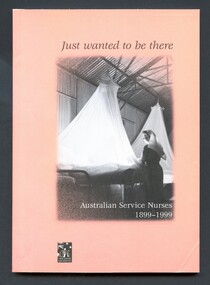
Book - Illustrated Book, Richard Reid (1944-) et al, Just wanted to be there: Australian Service Nurses 1899-1999, 1999
... Illustrated book with dust pink cover. front cover has a black and white photograph of s nurse with two hospital beds covered with mosquito tents (No 74 Camp Hospital, Katherine, NT, 1945). ...Illustrated book with dust pink cover. front cover has a black and white photograph of s nurse with two hospital beds covered with mosquito tents (No 74 Camp Hospital, Katherine, NT, 1945). ...A history of the Royal Australian Army Nursing Service 1899-1999Illustrated book with dust pink cover. front cover has a black and white photograph of s nurse with two hospital beds covered with mosquito tents (No 74 Camp Hospital, Katherine, NT, 1945). Part of title printed in black ink above this photo, remainder of title overprinted in white ink at the bottom of this photo. Below this is a small rectangular illustration and words: their service our heritage. Title is also printed in black ink on spine along with publishers logonon-fictionA history of the Royal Australian Army Nursing Service 1899-1999military nursing-australia-history, nurses-australia-history, australian army nurses -
 Alfred Hospital Nurses League - Nursing History Collection
Book - Illustrated Book, Richard Reid (1944-) et al, Just wanted to be there: Australian Service Nurses 1899-1999- Duplicate Copy, 1999
... Illustrated book with dust pink cover. front cover has a black and white photograph of s nurse with two hospital beds covered with mosquito tents (No 74 Camp Hospital, Katherine, NT, 1945). ...Illustrated book with dust pink cover. front cover has a black and white photograph of s nurse with two hospital beds covered with mosquito tents (No 74 Camp Hospital, Katherine, NT, 1945). ...A history of the Royal Australian Army Nursing Service 1899-1999Illustrated book with dust pink cover. front cover has a black and white photograph of s nurse with two hospital beds covered with mosquito tents (No 74 Camp Hospital, Katherine, NT, 1945). Part of title printed in black ink above this photo, remainder of title overprinted in white ink at the bottom of this photo. Below this is a small rectangular illustration and words: their service our heritage. Title is also printed in black ink on spine along with publishers logo.non-fictionA history of the Royal Australian Army Nursing Service 1899-1999military nursing-australia-history, nuses-australia-history, australia army-nurses -
 Embroiderers Guild, Victoria
Textile - Hawaiian Applique Patchwork Quilt, Mrs Brent Clark, Patchwork Quilt, Mid 20th century
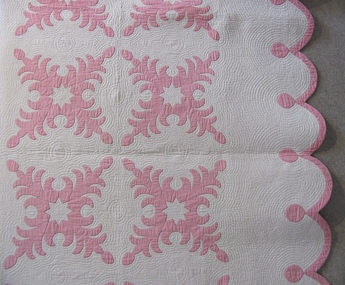
... Hawaiian quilting derives from the kapa moe, an indigenous bed cover textile. Kapa was constructed from the inner bark of local trees. ...Hawaiian quilting derives from the kapa moe, an indigenous bed cover textile. Kapa was constructed from the inner bark of local trees. ...An Hawaiian quilt is a distinctive quilting style of the Hawaiian Islands that uses large radially symmetric applique patterns. Motifs often work stylized botanical designs in bold colours on a white background. Hawaiian quilt appliqué is made from a single cut on folded fabric. Quilting stitches normally follow the contours of the appliqué design. Hawaiian quilting derives from the kapa moe, an indigenous bed cover textile. Kapa was constructed from the inner bark of local trees. Traditional kapa was beaten and felted, then dyed in geometric patterns. Quilting may have begun in the Hawaiian islands with the arrival of missionaries and Western fabrics in the 1820s. The climate of Hawaii is unsuitable for cotton cultivation and kapa is unsuitable for quilting so all Hawaiian quilts are constructed from imported material. The earliest written reference comes from Isabella Bird who visited Hawaii in 1870 and wrote a travelogue Six Months in the Sandwich Islands.Worked by Mrs Brent Clark and daughter. An American design of the 19th century, worked and adapted from a photograph by the donor. Mrs Brent Clark was an early pupil of the Victorian Institute for the Advancement of Plain Needlework (Melbourne) and Foundation member of the EGV.Background of fine white cotton, quilted in running stitch. Appliqued design known as 'Friendship Plume" is in pink cotton, with a 3 cms scalloped border, also in pink.embroidery, applique, quilts, mid 20th century, australia, hawaiian -
 Whitehorse Historical Society Inc.
Functional object - Bed Warmer, 1930s - 1940s
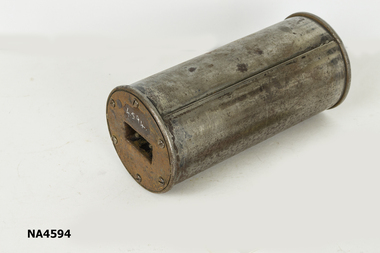
... To keep bed warmer, it was covered with fabric. Cylindrical shape, with electric plug at one end....To keep bed warmer, it was covered with fabric. Cylindrical shape, with electric plug at one end. ...Collected by Donor.Bed Warmer (with hot water). Bed Warmer was filled with water. To keep bed warmer, it was covered with fabric. Cylindrical shape, with electric plug at one end.domestic items, heating -
 National Wool Museum
Sydney 2000 Olympic Games Quilt, c.2000
... Quilt, wool, single bed size. Quilted cotton cover in various shades of blue, filled with wool. ...Woolmark Company Wooltara (Australia) Pty Ltd sport Sydney 2000 Olympic Games quilt wooltara athletes Wording: SYDNEY 2000 / WOOLMARK; Method: Printed; Location: Front Quilt, wool, single bed size. Quilted cotton cover in various shades of blue, filled with wool. ...This quilt was produced by Wooltara (Australia) Pty Ltd for the Sydney Olympic and Paralympic Games in 2000. Over 24,000 similar quilts were distributed throughout the athletes village and given away to athletes, international media and officials.Quilt, wool, single bed size. Quilted cotton cover in various shades of blue, filled with wool. Housed in a white cotton drawstring satchel printed with logos.Wording: SYDNEY 2000 / WOOLMARK; Method: Printed; Location: Frontwoolmark company wooltara (australia) pty ltd, sport, sydney 2000 olympic games, quilt, wooltara, athletes -
 Whitehorse Historical Society Inc.
Leisure object - Dolls Bed and Bedding
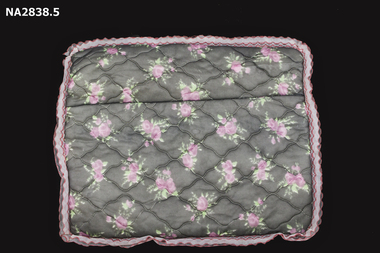
... Metal doll's bed with knitted cover, cotton mattress, white polyester pillow with cotton pillow case embroidered with blue rabbit. ...Metal doll's bed with knitted cover, cotton mattress, white polyester pillow with cotton pillow case embroidered with blue rabbit. ...Doll's bed belonged to Bruce Reynolds daughter.Metal doll's bed with knitted cover, cotton mattress, white polyester pillow with cotton pillow case embroidered with blue rabbit. Nylon quilted cover, grey with pink rose lined with yellow floral cotton. Rug is nine knitted oblongs joined together.Quality Tontine Products. David Galt Industries, Melbourne.toys, doll's furniture, toys, dolls' accessories -
 Royal District Nursing Service (now known as Bolton Clarke)
Photograph - Photograph, black and white, c.1958
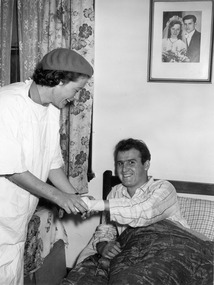
... by a patterned bed cover. Part of a pillow with check pillow case sits flat behind him and part of a wooden horizontal slat bedhead is seen. ... by a patterned bed cover. Part of a pillow with check pillow case sits flat behind him and part of a wooden horizontal slat bedhead is seen. ...This photograph depicts a MDNS Sister visiting a male patient to give him nursing care. He is lying in bed in his home and the Sister is applying a bandage to his left wrist. Under her white gown the Sister is wearing the MDNS winter uniform of a grey dress with peaked collars and grey wool beret which has a central red Maltese cross attached. The Trained nurses (Nurses) of the Melbourne District Nursing Society (MDNS), from its inception in 1885, provided wound care to their patients who ranged in age from the very young to the elderly. The patients required their wounds to be dressed following various types of surgery, accidents, burns, cancer, leg ulcers etc. As research developed better products and dressing materials, the methods and medication applied to wounds changed. MDNS received Royal patronage in 1966 and as Royal District Nursing Service (RDNS), the Education department developed wound care programs, such as the Leg Ulcer Management Program to provide their Trained nurses (Sister) with methods of best quality care. They ran a program for Wound Care Specialists who made assessments and provided advice and support to the District Sisters working in the field as needed. The Sisters liaised with the patient’s Doctors and hospitals to provide information on the progress of patient’s wounds and to receive any change of wound care from the Doctors. Standing on the left of this photograph is a Melbourne District Nursing Service (MDNS) Sister who is wearing a white gown over her grey uniform, the collar of which can be seen. She is wearing her uniform grey wool beret over her short dark curly hair and is smiling as, with her outstretched left hand, she supports the partly bandaged extended left arm of a gentleman who is sitting up in bed to her right; his right arm is resting on the bed and supporting him as he is partly turned towards the Sister. She has part of a rolled bandage in her right hand. The male patient, who has short dark hair, is looking at the camera and smiling. He is wearing a white and striped pyjama top and his lower body is covered by a patterned bed cover. Part of a pillow with check pillow case sits flat behind him and part of a wooden horizontal slat bedhead is seen. On the wall behind the bed hangs a framed photograph of a couple on their wedding day. Patterned curtains cover the window in the left rear of the photograph.John Gallagher photography. 4 Benares Street, Mitcham Victoria WU 2568 No. 4-4melbourne district nursing service, mdns, mdns wound care, royal district nursing service, rdns -
 Royal District Nursing Service (now known as Bolton Clarke)
Photograph - Photograph, black and white, c.1980
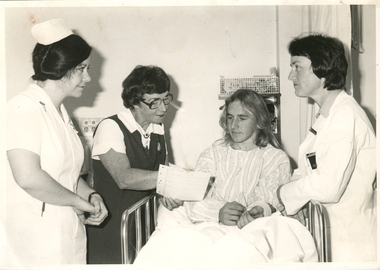
... His hands are resting on the white bed covers and his left wrist is bandaged. The bed has bed rails attached on each side. ...His hands are resting on the white bed covers and his left wrist is bandaged. The bed has bed rails attached on each side. ...This photograph is taken in a Hospital. RDNS Liaison Officer, Sister Pat Holdsworth is giving the hospital patient, who was to be seen by RDNS District staff on his discharge, a leaflet explaining what to expect at the time of the first RDNS visit. Sr. Hodsworth is wearing the RDNS summer uniform of that era, which was a white blouse worn under a royal blue V neck tunic style frock with the RDNS insignia emblazoned on the upper left.Liaison had occurred between doctors and the nurses of the Melbourne District Nursing Society (MDNS), from its inception in 1885. This increased when Midwifery was introduced in 1893 with close liaising with the Women’s Hospital. As District nursing grew it was recognized that closer liaising between many Public Hospitals would be beneficial, for not only the MDNS, later called Royal District Nursing Service,(RDNS), nursing staff, but also for the patients and the hospitals. In August 1964 a Liaison Officer commenced at the Alfred Hospital. This soon increased to Liaison Officers working full time at several Public Hospitals. At the time of a patient’s discharge, the Liaison Sister forwarded information on their diagnosis and instructions regarding the care required at home to the appropriate RDNS Centre, and in turn the attending District sister wrote a report of progress and any queries to the hospital doctor, via the Liaison sister, at the time the patient was attending outpatients. Any new instructions were then sent back to the District sister. Liaising also occurred between District field staff and Doctors when patients were referred by General Practitioners and did not attend a hospital.Standing on the left of the black and white photograph is a Hospital Sister, with her dark hair drawn up, and wearing her white uniform and white cap, To her right is Royal District Nursing Service (RDNS), Sister Pat Holdsworth, who has short wavy hair; is wearing glasses, and wearing a V neck tunic style frock over a short sleeve white blouse.. She is holding a paper in her left hand which is extended over the side rail on a patient's bed. Her right arm is also extended over the bed rail and she is pointing out information on the paper to the gentleman patient who is sitting up in bed. The man has blonde shoulder length hair and is wearing a light coloured long sleeve striped gown.. His hands are resting on the white bed covers and his left wrist is bandaged. The bed has bed rails attached on each side. Another hospital staff member, a lady with dark hair who is wearing a white hospital style coat, is on the right hand side of the bed with her arms resting on the right hand bed rail..melbourne district nursing society, mdns, royal district nursing service, rdns, rdns liaison, melbourne district nursing service, sister pat holdsworth -
 Royal District Nursing Service (now known as Bolton Clarke)
Photograph - Photograph, black and white, c.1956
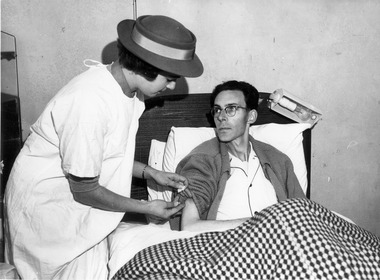
... He is wearing a thick grey cardigan over a pale colour pyjama top which has dark piping; the lower part of his body is covered by a dark and light coloured check bed cover. The bed has a solid wooden headrest with a bed lamp attached to its upper right. ...He is wearing a thick grey cardigan over a pale colour pyjama top which has dark piping; the lower part of his body is covered by a dark and light coloured check bed cover. The bed has a solid wooden headrest with a bed lamp attached to its upper right. ...This photograph is taken in the bedroom of the man's home in the suburbs of Melbourne. It depicts one of the types of nursing care given by Melbourne District Nursing Society (MDNS) Sisters in the community. The Sister is visiting the man's home and is administering an injection which has been ordered by a doctor. Glass syringes were used by the Society until the mid 1960s and were re sterilized for future use. After this time plastic disposable syringes were used.The Trained nurses of the Melbourne District Nursing Society (MDNS), later known as Royal District Nursing Service (RDNS), visited patients in their home and gave best practice care in many fields of nursing and to people of many cultures throughout its 130 years of expansion. Initial visits not only assessed the specific nursing situation but the situation as a whole. Their patients ranged in age from babes, children, adults to the elderly and referrals were taken from Hospitals, General Practitioners and allied Health facilities. Some of the care provided was: – Post-Natal care given to mother and babe, Wound Care following various types of surgery, accidents, burns, cancer, leg ulcers etc. Supervising and teaching Diabetic Care, including teaching and supervising people with Diabetes to administer their own Insulin, and administering Insulin to those unable to give their own injections. Administering other injections and setting up weekly medication boxes. The Sisters performed Catheterizations on adults suffering from conditions such as Quadriplegia, Paraplegia, Multiple Sclerosis (MS), Motor Neurone Disease (MND) and Guillan-Barre Syndrome, and when required at school on children for e.g. those with Spina Bifida. The Sisters visited those requiring Cystic Fibrosis support and care; those requiring Haemo-Oncology care, including visiting children at school; those requiring Home Enteral Feeding care, and those requiring IV therapy at home and home Dialysis. Palliative Care was given including pain relief with the use of syringe drivers, personal care as needed, and advice and support to both patient and family. RDNS provided Stoma management to those needing Urostomy, Ileostomy and Colostomy care and those requiring Continence care. HIV/AIDS nursing care was provided; visits to Homeless Persons were made. Personal care was given to patients ranging in age and with varying mobility problems, such as those with MS, MND, Guillan-Barre Syndrome, Quadriplegia, Paraplegia, Acquired Brain Injury, following a Cerebrovascular Accident (Stroke), those with severe Arthritis and those with a form of Dementia. When necessary the elderly were assisted with personal care and advice given on safety factors with the use of hand rails, bath or shower seats, and hand showers. Rehabilitation with an aim towards independence remained at the forefront of the Sister’s minds and when possible using aids and instruction on safe techniques enabled the person to become fully independent. All care included giving advice and support to the patient and their Carers. The Sisters liaised with the persons Doctor, Hospital and allied Health personal when necessary.On the left of this black and white photograph, is a Melbourne District Nursing Society Sister who is standing side-on and leaning slightly forward as she administers an injection into the right upper arm of a gentleman to her right who is sitting up in bed resting against two white covered pillows. The male patient has short dark hair; is wearing glasses, and is looking up at the Sister. He is wearing a thick grey cardigan over a pale colour pyjama top which has dark piping; the lower part of his body is covered by a dark and light coloured check bed cover. The bed has a solid wooden headrest with a bed lamp attached to its upper right. The Sister who is wearing her uniform grey brimmed hat over her dark short hair, is wearing a white gown over her grey uniform, the collar of which is seen. Three fingers of her left hand are holding back the pushed up sleeve of the man's cardigan and she is holding a white swab between her thumb and first finger. She has a glass syringe resting in her right hand with her thumb and forefinger resting against the lower glass and metal section of the syringe; part of the metal needle is seen, the rest is inserted in the mans upper arm. On the far left of the photograph part of a dressing table mirror can be seen.' Rough Proof' Latrobe Studios Ref No. 59134-8melbourne district nursing service, mdns, royal district nursing service, rdns, rdns - injection -
 Royal District Nursing Service (now known as Bolton Clarke)
Photograph - Photograph, black and white, c.1967
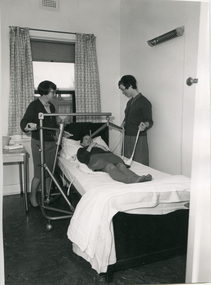
... Black and white photograph of Royal District Nursing Service (RDNS), Sister Pat (Paddy) Rowley on left hand side, and Sister Joanne Wilkinson on right hand side, demonstrating the use of a hoist which has transferred Sister Liz Thomson onto a bed in the centre of the photograph. The bed is covered with white sheets and Sr. Thomson is lying on the bed with the sling of the hoist under her. ...Quote No GW 90 Black and white photograph of Royal District Nursing Service (RDNS), Sister Pat (Paddy) Rowley on left hand side, and Sister Joanne Wilkinson on right hand side, demonstrating the use of a hoist which has transferred Sister Liz Thomson onto a bed in the centre of the photograph. The bed is covered with white sheets and Sr. Thomson is lying on the bed with the sling of the hoist under her. ...The photograph is taken during an Education session at Royal District Nursing Service (RDNS). The Sisters are wearing their grey uniform cotton frocks and red cardigans of that era.Education was an integral part of Melbourne District Nursing Society (MDNS), later called Royal District Nursing Service, (RDNS), from its inception in 1885. Only Trained nurses (Nurses) were employed by the Society, and on visits to patients they taught the necessity of hygiene and cleanliness, as well as the need for a good diet, to bring about good health. Doctor’s lectures were later given at the MDNS home to instruct patients and their families on prevention of disease. Education to patients continued throughout the years regarding health care and the use of equipment in the home. RDNS Trained nurses (Sisters) received In-service education and by the end of the 1960s there was an increased focus on rehabilitation and independence. Patients were offered rehabilitation and new lifting techniques were introduced to reduce physical strain on staff and family members. Royal District Nursing Service ran its own rehabilitation program requiring staff to be trained in techniques by RDNS Physiotherapists.Black and white photograph of Royal District Nursing Service (RDNS), Sister Pat (Paddy) Rowley on left hand side, and Sister Joanne Wilkinson on right hand side, demonstrating the use of a hoist which has transferred Sister Liz Thomson onto a bed in the centre of the photograph. The bed is covered with white sheets and Sr. Thomson is lying on the bed with the sling of the hoist under her. The lowest metal bars and wheels of the hoist are under the bed and the top bars across the bed. Sr. Wilkinson's right hand is undoing the sling from the top bar of the hoist, and her left hand is holding the strap of the sling which is under Sr. Thomson. The Sisters are wearing their grey uniform frocks and dark cardigans. A window with two long floral opened curtains are behind the bed, and a strip heater is seen high on the adjoining wall.Photographers stamp. Quote No GW 90royal district nursing service, rdns, rdns education, equipment, sister pat (paddy) rowley, sister liz thomson, sister joanne wilkinson -
 National Wool Museum
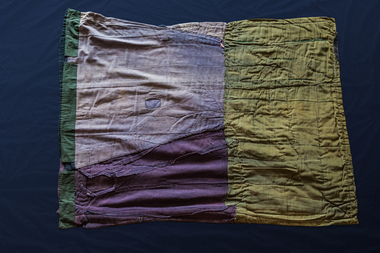
Textile - Quilt, Mrs Adolphina Noll, Wilmington Wagga, 1934
... (It was used on a bed in a plain heavy woven calico cover which was secured with safety pins. ...Double bed sized quilt cover insert made from several items of clothing: men's frock coat (possibly from the 1900's), another men's coat (date unknown), a woman's coat with a fur trim on the pockets (possibly from the 1930's) and a woman's dress or skirt (circa 1920-30's). ...cover is not in existence.) It was given to Lois Densham in Adeleide from Ike, who was a close friend of Lois' sister, Doreen Saunders. handicrafts quilting running stitch group running stitch collection highlights of the national wool museum: from waggas to the wool quilt prize - exhibition (22/09/2001 - 02/12/2001) noll mrs adolphina fulwood mrs e. g. Double bed ...Made by Adolphina Noll in 1934 in Wilmington, South Australia as a wedding gift for Mr Joe and Mrs Ida (aka 'Ike') Fulwood. Mrs Noll was Ike's maternal grandmother and was 69 when she made the quilt. (It was used on a bed in a plain heavy woven calico cover which was secured with safety pins. The cover is not in existence.) It was given to Lois Densham in Adeleide from Ike, who was a close friend of Lois' sister, Doreen Saunders.Double bed sized quilt cover insert made from several items of clothing: men's frock coat (possibly from the 1900's), another men's coat (date unknown), a woman's coat with a fur trim on the pockets (possibly from the 1930's) and a woman's dress or skirt (circa 1920-30's). The clothing pieces have been arranged in an apparent haphazard way to create a shape with straight edges and corners to fit neatly into a cover onto a bed. Lining materials are apparent on the back of the woman's skirt/dress pieces which may also show that this item of clothing was either taken apart or never finished. Orange cotton lining material is also evident on some pieces of the men's coat.handicrafts, quilting, running stitch group, running stitch collection, highlights of the national wool museum: from waggas to the wool quilt prize - exhibition (22/09/2001 - 02/12/2001), noll, mrs adolphina fulwood, mrs e. g. -
 Royal District Nursing Service (now known as Bolton Clarke)
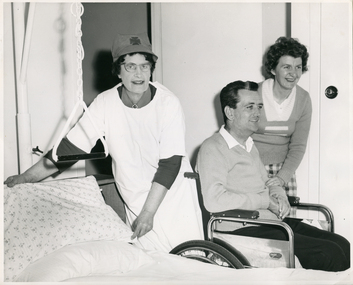
Photograph - Photograph, black and white, 30 06 1965
... On the right hand side of the wheelchair a lady, wearing a light blouse, grey jumper and tartan skirt, is standing with her left hand resting on the left arm of the man.They are both smiling and looking slightly towards the right in the photograph A 'monkey bar hand grip' is attached to the bed by a pole and hangs on a white chair over the bed. A window covered by a blind is behind the Sister, with a light curtain to the left.....On the right hand side of the wheelchair a lady, wearing a light blouse, grey jumper and tartan skirt, is standing with her left hand resting on the left arm of the man.They are both smiling and looking slightly towards the right in the photograph A 'monkey bar hand grip' is attached to the bed by a pole and hangs on a white chair over the bed. A window covered by a blind is behind the Sister, with a light curtain to the left.. ...The MDNS Sister has given nursing care to the gentleman and has transferred him safely into the wheelchair. Whilst doing this the Sister demonstrated the transfer technique to the lady in the photograph who is probably his wife. The Sister is wearing the MDNS uniform of the day, a grey cotton dress and red cardigan, under her white gown. She has a red Maltese cross applied to the centre of her grey peaked hat.From its founding in 1885 the Hospital Trained nurses of the then named Melbourne District Nursing Society (MDNS), later named Royal District Nursing Service (RDNS) gave high quality nursing care to patients in their own homes. They nursed patients referred by Hospitals and General Practitioners giving treatments, such as injections, wound care and doing many other procedures, as well as assisting them with 'general care' when required. The Sisters needed to transfer the patients when required and also taught family members safe transferring techniques to enable them to care for their loved ones. RDNS employed a Physiotherapist who taught staff the correct techniques, not only for safety of the patient, but to reduce physical strain on patient’s family members and the RDNS nursing staff . Where possible the Sisters worked towards independence, using equipment such as shower seats, rails and hand showers. The Sisters liaised with the patient's Doctor and supported and advised the patient and Carer of any further help to assist them.On the left of the black and white photograph is a Melbourne District Nursing Service, (MDNS) Sister, who is wearing glasses and is looking at the camera. She is wearing a white gown over her uniform, with the grey collar and the dark sleeves of her cardigan in view and her grey peaked hat, with an emblazoned Maltese cross in the centre front, sits over her short dark curly hair. Both of her arms are extended and resting on either side of a pillow she is straightening. The Sister is standing next to wheelchair bound man who has short dark hair and is wearing dark trousers and a light coloured jumper. On the right hand side of the wheelchair a lady, wearing a light blouse, grey jumper and tartan skirt, is standing with her left hand resting on the left arm of the man.They are both smiling and looking slightly towards the right in the photograph A 'monkey bar hand grip' is attached to the bed by a pole and hangs on a white chair over the bed. A window covered by a blind is behind the Sister, with a light curtain to the left..Photographers stamp. Quote No. DW 84mdns, melbourne district nursing service, patient care, rdns, royal district nursing service -
 Royal District Nursing Service (now known as Bolton Clarke)
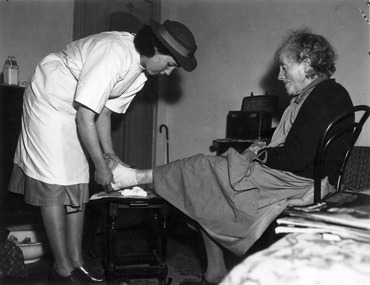
Photograph - Photograph, black and white:, 1952
... To the right of the photograph a partial white covered bed can be seen with a table over it with papers and a magnifying glass. ...To the right of the photograph a partial white covered bed can be seen with a table over it with papers and a magnifying glass. ...Sister J. Faust has dressed a wound on the ladies ankle and is applying a blue-line bandage. The photograph is taken in the lady's home. The MDNS uniform at that time was a grey frock, and stiffened brimmed grey felt hat with a light grey band and a red Maltese cross in the centre of the band. The Trained nurses (Nurses) of the Melbourne District Nursing Society (MDNS), from its inception in 1885, provided wound care to their patients, who ranged in age from the very young to the elderly. As research developed better products and dressing materials the methods and medication applied to wounds changed. MDNS received Royal patronage in 1966 and as Royal District Nursing Service (RDNS), the Education department developed programs, such as the Leg Ulcer Management Program, to provide their Trained nurses (Sisters) with methods of best quality care. The Sisters liaised with the patient’s Doctors and hospitals to provide information on the progress of patient’s wounds and to receive any change of wound care from the Doctors. RDNS introduced a Wound Care Specialist program and these Sisters did assessments and provided advice and support to the District Sisters working in the field. Black and white photograph of Melbourne District Nursing Society (MDNS) visiting Sister J. Faust, who is wearing a white gown and a grey brimmed hat over her dark curled hair. Part of her grey uniform frock is seen below the gown. She is applying a light coloured bandage to the right ankle of an elderly female patient. The lady, who has dark curled hair, and is wearing a grey frock, apron, and black cardigan is seen seated side on, on a wooden chair to the right of the Sister. She has her right leg extended and resting on a small low table, her left leg is bent to the floor.. The Sisters open case is seen on a small table to the rear of the lady and a walking stick is to the left against the door frame. A dark curtain hangs in the doorway. A large white wash bowl is seen in the lower left of the photograph. A glass jar with scissor blades into a liquid can be seen on a cabinet to the left of.Sister Faust. To the right of the photograph a partial white covered bed can be seen with a table over it with papers and a magnifying glass. Name of Sister on rear of photograph.wound care, melbourne district nursing society, royal district nursing service, rdns, mdns, sister j. faust
