
Showing 31 items matching " civil servants"
-
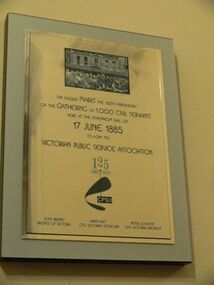 Melbourne Athenaeum Archives
Newspaper Article, Gathering of 1000 Civil Servants at the Athenaeum Hall on 17 June 1885 - Argus, Saturday 18 June 1885
... Gathering of 1000 Civil Servants at the Athenaeum Hall on 17 June 1885 - Argus, Saturday 18 June 1885...Gathering of 1000 Civil Servants at the Athenaeum Hall on 17 June 1885 - Argus, Saturday 18 June 1885 Newspaper Article ... -
 Glen Eira Historical Society
Document - BRIGHTON GENERAL CEMETERY
... ... Civil Servants...Cemeteries Brighton Authors Journalists Occupations People Documents Pamphlets Tourist Leaflets Migrants Widowers Knowles Marion Cambridge Ada Buckley Herbert Browne Thomas Alexander Walstab George Alexander Cunningham Edward Sheldon Dow John Lament Dexter Caroline Lynch Caroline Brighton General Cemetery People Associated With Culture Brighton Cemetorians East Brighton North Road People By Circumstance Knowles Joseph Cross George Frederick Ribbledon Herbert Horseracing Equestrian Events Pioneers Squatters Civil Servants Police Boldrewood Rolf Robbery Under Arms The Miner’s Right Babes In The Bush Communication Activities The Age The Herald The Argus Edward Wilson Estate Burketown The Leader Walstab Mary Anne Nolan Anne Jackson Maval Mary Sir Graham Barry Ministry Dow Marion Jane Orr Marion Jane McKenzie David Dexter William Ladies Almanack: The Southern Cross Or Australian Album And New Years Gift Institute Of Hygiene Lynch William Mayors Bombala Cheltenham Pioneer Cemetery Cheltenham Memorial Park Bunurong Memorial Park Cheltenham And Regional Cemeteries Trust Springvale Cemetery Southern Metropolitan Cemeteries Trust Manson Johanna Religious Groups Groups (People) Funerals Cremation Joynt William Donovan Boyd Arthur Peeler Walter Soldiers Armed Forces McCubbin Frederick Casey James Joseph Buckley Maurice Vincent Ogg Charles Catani Carlo Sutton Henry Newland James Ernest Laver Frank Joseph Furphy John Boyd Guy Ballantyre George Frederick Gordon Adam Lindsay McCoy Frderick Higin Batham George Monash John Bent Thomas Miller Septimus Cohen Godfrey Abraham Creswell William Rooke Guilfoyle William Boyd Theodore Penleigh Heinze Bernard Taylor Joseph Leslie Theodore Taylor Squizzy Tritschke Alma Elder James Alexander MacKenzie Breen Marie Boyd William Merrie Boyd Doris Maps East Brighton Hawthorn Road East Brighton Sheffield Road East Brighton Sussex Road Presbyterian Religion Baptist Religion Jewish Religion Roman Catholic Religion Methodist Religion Church of England Anglican Religion Document BRIGHTON GENERAL CEMETERY ...This file contains two brochures from the Brighton General Cemetery, one black and white dated 2013, the other in colour and undated. The first provides eight short biographies of notable writers and journalists interned at the cemetery, the other containing a map with the location of thirty-four notable internments unrelated to literature. Both provide a brief history of the cemetery with the first also including images of some of the people discussed and what appears to be the cemetery emblem. The second brochure displays a colour photograph of a structure in the cemetery.cemeteries, brighton, authors, journalists, occupations, people, documents, pamphlets, tourist leaflets, migrants, widowers, knowles marion, cambridge ada, buckley herbert, browne thomas alexander, walstab george alexander, cunningham edward sheldon, dow john lament, dexter caroline, lynch caroline, brighton general cemetery, people associated with culture, brighton cemetorians, east brighton north road, people by circumstance, knowles joseph, cross george frederick, ribbledon herbert, horseracing, equestrian events, pioneers, squatters, civil servants, police, boldrewood rolf, robbery under arms, the miner’s right, babes in the bush, communication activities, the age, the herald, the argus, edward wilson estate, burketown, the leader, walstab mary anne, nolan anne, jackson maval mary, sir graham barry ministry, dow marion jane, orr marion jane, mckenzie david, dexter william, ladies almanack: the southern cross or australian album and new years gift, institute of hygiene, lynch william, mayors, bombala, cheltenham pioneer cemetery, cheltenham memorial park, bunurong memorial park, cheltenham and regional cemeteries trust, springvale cemetery, southern metropolitan cemeteries trust, manson johanna, religious groups, groups (people), funerals, cremation, joynt william donovan, boyd arthur, peeler walter, soldiers, armed forces, mccubbin frederick, casey james joseph, buckley maurice vincent, ogg charles, catani carlo, sutton henry, newland james ernest, laver frank joseph, furphy john, boyd guy, ballantyre george frederick, gordon adam lindsay, mccoy frderick, higin batham george, monash john, bent thomas, miller septimus, cohen godfrey abraham, creswell william rooke, guilfoyle william, boyd theodore penleigh, heinze bernard, taylor joseph leslie theodore, taylor squizzy, tritschke alma, elder james alexander mackenzie, breen marie, boyd william merrie, boyd doris, maps, east brighton hawthorn road, east brighton sheffield road, east brighton sussex road, presbyterian religion, baptist religion, jewish religion, roman catholic religion, methodist religion, church of england, anglican religion -
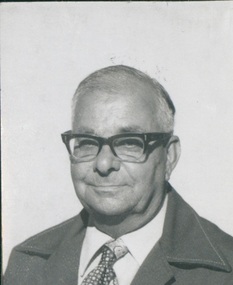 Uniting Church Archives - Synod of Victoria
c. 1977
... Was A civil servant, Ordained 1977 at Serrell St, Minister at Yarram Died 1991...Was A civil servant, Ordained 1977 at Serrell St, Minister at Yarram Died 1991 rev. c. francis bennett; yarram B&W photo of Rev. ...Was A civil servant, Ordained 1977 at Serrell St, Minister at Yarram Died 1991B&W photo of Rev. C. Francis Bennett, upper body, seated and facing the camera. Wearing glasses and coat and tie.rev. c. francis bennett; yarram -
 Kew Historical Society Inc
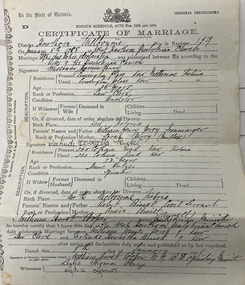
Legal record - Marriage Certificate: William James Perry and Gertrude Henrietta Bisset, 1908
... [Birth place] North Melbourne [Wife's father] Robert Bisset, Civil Servant / [Wife's mother] Annis [sic] Bisset Location: West Hawthorn Presbyterian Church [now 10-12 Power Street] Date: January 8th 1908 ...[Birth place] North Melbourne [Wife's father] Robert Bisset, Civil Servant / [Wife's mother] Annis [sic] Bisset Location: West Hawthorn Presbyterian Church [now 10-12 Power Street] Date: January 8th 1908 Legal record Marriage Certificate: William James Perry and Gertrude Henrietta Bisset ...The Martin Family records include photographs and documents pertaining to three families - the Bissetts, Perrys, and Martins - connected across five generations by marriage. The collection records life events such as marriage, images of members of the families, as well as snapshots of daily life Marriage Certificate: William James Perry and Gertrude Henrietta Bisset. Recorded information includes: Husband: William James Perry, Ermington Place, Kew, 26 years, Law Clerk, Bachelor. [Birth place] Kew [Husband's] Father: William Henry Perry, Ironmonger / [Husband's] Mother: Sarah Perry Wife: Gertrude Henrietta Bisset, 260 Cotham Road, Kew, 23 years, Home Duties, Spinster. [Birth place] North Melbourne [Wife's father] Robert Bisset, Civil Servant / [Wife's mother] Annis [sic] Bisset Location: West Hawthorn Presbyterian Church [now 10-12 Power Street] Date: January 8th 1908 marriage certificates, martin family collection, william james perry, gertrude henrietta bisset, william henry perry, sarah perry, ermington place -- kew (vic.), robert bisset, annis bisset, west hawthorn presbyterian church -
 Surrey Hills Historical Society Collection
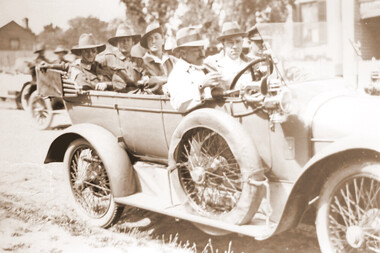
Work on paper - Photograph, Invalid returned servicemen arrive at Mr & Mrs Dixon's home, 42 Essex Road, Surrey Hills, 1919
... Herbert William Dixon was a civil servant. The family frequently hosted World War 1 veterans. ...Herbert William Dixon was a civil servant. The family frequently hosted World War 1 veterans. ...The Dixon family lived at 42 Essex Road for decades from 1890s to 1940s. Herbert William Dixon was a civil servant. The family frequently hosted World War 1 veterans. Nursing care and hospitality were also offered in a number of other Surrey Hills homes. His son Hugh Banks Dixon embarked from Adelaide on board HMAT A7 Medic on 12 January 1916. He was an motor mechanic / engineer and was assigned to the 4th Motor Transport Section as a transport driver. Herbert died in 1936.Black and white photo of 2 vehicles transporting invalid soldiers to the home of Mr and Mrs H W Dixon of 42 Essex Road, Surrey Hills. One is parked; the other appears to be moving. Both vehicles have their hoods down. In the first, the driver and one man beside him are in civilian dress; the other four are in army uniform with the 3rd man in the front seat being an officer.1914-1918, essex road, world war 1, returned service people, herbert william dixon -
 Kew Historical Society Inc
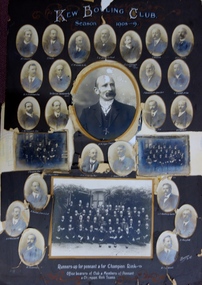
Photograph, Kew Bowling Club, Runners up for Pennant and for Championship Rink; Office Bearers of Club and Members of Pennant and Champion Rink Teams, 1908-9
... The background of these men has been identified by John Torpey as follows: BRADSHAW William Henry, grocer, 6 Cotham Road, Kew & 33 Prospect Hill Road, Camberwell - CARNEGIE J Lewis, merchant, Studley Avenue, Kew [Carnegie & Sons, piano & organ importers 106 Elizabeth Street, Melbourne] - CLARKE Charles, warehouseman, 35 Queen Street, Kew - EDGAR Robert McCutcheon, 215 High Street, Kew - FINLAYSON John Marshall, solicitor, 178 Cotham Road, Kew - GREEN Charles Henry, clerk, 81 Wellington Street, Kew - GREENHILL F snr [not found] - GREENHILL Thomas jnr, traveller, High Street south, Kew - HAMBLETON Lincoln, civil servant, 32 Coleridge Street, Kew - HANDBURY John, manufacturer, 55 Walpole street, Kew - JELLIS Thomas G, baker, Princess Street, Kew - LILBURN William Hugh solicitor, Denmark Street, Kew - MANSFIELD Allan, plumber, 150 Cotham Road, Kew [S&McD] or 21 Belmont Avenue, Kew [Electoral Roll 1909] - NATHAN Simeon, warehouseman, 59 Sackville Street, Kew - NIVEN Henry N, 192 Barkers Road, Kew [FW Niven & Co 40-42 Flinders Street, Melbourne, printers & lithographers] - SIMONTON Alan Thompson, dairyman, Belmont Avenue, Kew - SINUCH WC [not known – bottom right of frame] - SWINBURNE George [see Australian Dictionary of Biography] - TREDENNICK William, civil servant 285 Tennyson Street, Kew - WENTWORTH William Dalton, painter, 5 Derrick Street, Kew - WOOLLARD Thomas, civil servant, Hildebrand Crescent, Hawthorn - WOOLLARD Walter Herbert, builder, 35 Disraeli Street, Kew [Sources: Sands & McDougall directories, Electoral Roll 1909]...The background of these men has been identified by John Torpey as follows: BRADSHAW William Henry, grocer, 6 Cotham Road, Kew & 33 Prospect Hill Road, Camberwell - CARNEGIE J Lewis, merchant, Studley Avenue, Kew [Carnegie & Sons, piano & organ importers 106 Elizabeth Street, Melbourne] - CLARKE Charles, warehouseman, 35 Queen Street, Kew - EDGAR Robert McCutcheon, 215 High Street, Kew - FINLAYSON John Marshall, solicitor, 178 Cotham Road, Kew - GREEN Charles Henry, clerk, 81 Wellington Street, Kew - GREENHILL F snr [not found] - GREENHILL Thomas jnr, traveller, High Street south, Kew - HAMBLETON Lincoln, civil servant, 32 Coleridge Street, Kew - HANDBURY John, manufacturer, 55 Walpole street, Kew - JELLIS Thomas G, baker, Princess Street, Kew - LILBURN William Hugh solicitor, Denmark Street, Kew - MANSFIELD Allan, plumber, 150 Cotham Road, Kew [S&McD] or 21 Belmont Avenue, Kew [Electoral Roll 1909] - NATHAN Simeon, warehouseman, 59 Sackville Street, Kew - NIVEN Henry N, 192 Barkers Road, Kew [FW Niven & Co 40-42 Flinders Street, Melbourne, printers & lithographers] - SIMONTON Alan Thompson, dairyman, Belmont Avenue, Kew - SINUCH WC [not known – bottom right of frame] - SWINBURNE George [see Australian Dictionary of Biography] - TREDENNICK William, civil servant 285 Tennyson Street, Kew - WENTWORTH William Dalton, painter, 5 Derrick Street, Kew - WOOLLARD Thomas, civil servant, Hildebrand Crescent, Hawthorn - WOOLLARD Walter Herbert, builder, 35 Disraeli Street, Kew [Sources: Sands & McDougall directories, Electoral Roll 1909] The photographic collage is historically important as it includes rare photographs of local identities, many of whom were significant civic actors statewide. kew bowling club "Kew Bowling Club / Season 1908-9 / Runners up for pennant and for Championship Rink / Office bearers of Club and Members of Pennant and Champion Rink Teams". ...The Kew Bowling Club was formed in 1880 and merged with Auburn Heights Recreation Club in 1998. In addition to the unnamed members of the teams, the following individuals are profiled on the item. The background of these men has been identified by John Torpey as follows: BRADSHAW William Henry, grocer, 6 Cotham Road, Kew & 33 Prospect Hill Road, Camberwell - CARNEGIE J Lewis, merchant, Studley Avenue, Kew [Carnegie & Sons, piano & organ importers 106 Elizabeth Street, Melbourne] - CLARKE Charles, warehouseman, 35 Queen Street, Kew - EDGAR Robert McCutcheon, 215 High Street, Kew - FINLAYSON John Marshall, solicitor, 178 Cotham Road, Kew - GREEN Charles Henry, clerk, 81 Wellington Street, Kew - GREENHILL F snr [not found] - GREENHILL Thomas jnr, traveller, High Street south, Kew - HAMBLETON Lincoln, civil servant, 32 Coleridge Street, Kew - HANDBURY John, manufacturer, 55 Walpole street, Kew - JELLIS Thomas G, baker, Princess Street, Kew - LILBURN William Hugh solicitor, Denmark Street, Kew - MANSFIELD Allan, plumber, 150 Cotham Road, Kew [S&McD] or 21 Belmont Avenue, Kew [Electoral Roll 1909] - NATHAN Simeon, warehouseman, 59 Sackville Street, Kew - NIVEN Henry N, 192 Barkers Road, Kew [FW Niven & Co 40-42 Flinders Street, Melbourne, printers & lithographers] - SIMONTON Alan Thompson, dairyman, Belmont Avenue, Kew - SINUCH WC [not known – bottom right of frame] - SWINBURNE George [see Australian Dictionary of Biography] - TREDENNICK William, civil servant 285 Tennyson Street, Kew - WENTWORTH William Dalton, painter, 5 Derrick Street, Kew - WOOLLARD Thomas, civil servant, Hildebrand Crescent, Hawthorn - WOOLLARD Walter Herbert, builder, 35 Disraeli Street, Kew [Sources: Sands & McDougall directories, Electoral Roll 1909]The photographic collage is historically important as it includes rare photographs of local identities, many of whom were significant civic actors statewide.Large photo collage created by Barroni & Co (Melb) of team, player and official portraits of members of the Kew Bowling Club. At one stage the item was in a drawer in a map cupboard, fractured into multiple pieces. The items were later assembled some years ago Graham Lindsay and framed in 2021 for exhibition by John Torpey. "Kew Bowling Club / Season 1908-9 / Runners up for pennant and for Championship Rink / Office bearers of Club and Members of Pennant and Champion Rink Teams".kew bowling club -
 Ballarat Tramway Museum
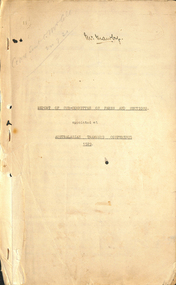
Document - Report, COTMA, "Report of Sub-Committee on Fares and Sections appointed at Australasian Tramways Conference 1929", 1929
... Looks at the Section and their average length, Overlapping sections, fares, children fares, Sunday and holiday rates, workmen's concession tickets, scholars', swimming tickets, blind passes, police officers, civil servants, municipal bodies, concessions to charitable institutions, defence force, boy scouts, state members and officials, employee's passes, periodical or prepaid tickets, specials charges, passenger luggage. ...Looks at the Section and their average length, Overlapping sections, fares, children fares, Sunday and holiday rates, workmen's concession tickets, scholars', swimming tickets, blind passes, police officers, civil servants, municipal bodies, concessions to charitable institutions, defence force, boy scouts, state members and officials, employee's passes, periodical or prepaid tickets, specials charges, passenger luggage. ...Demonstrates a report into tram fares and tickets around Australasia.Report - 13 foolscap duplicated pages, stapled along the left hand edge, titled "Report of Sub-Committee on Fares and Sections appointed at Australasian Tramways Conference 1929" Reports on a questionnaire to 14 different systems - Bendigo considered the same as Ballarat for the purposes of the report. Looks at the Section and their average length, Overlapping sections, fares, children fares, Sunday and holiday rates, workmen's concession tickets, scholars', swimming tickets, blind passes, police officers, civil servants, municipal bodies, concessions to charitable institutions, defence force, boy scouts, state members and officials, employee's passes, periodical or prepaid tickets, specials charges, passenger luggage. Compares to the USA, flat fares, one man trams.Has "Mr Mawby" in ink on front cover and "Copy sent to Mr Old 22.7.30"trams, tramways, tickets, fares, sections, australasian tramway conference, ballarat -
 Kew Historical Society Inc
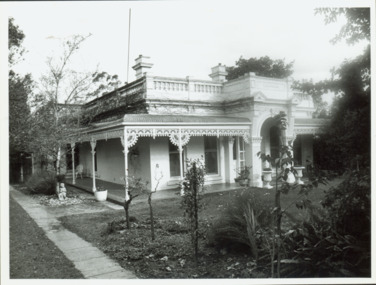
Photograph - Lalla Rookh : 41 Fellows Street, Progress Press, 1978
... The first Kew Urban Conservation Study established that the house was built in 1897 for John Duncan, civil servant. By 1910 William Robert Frayne, chemist, had purchased the property. ...The first Kew Urban Conservation Study established that the house was built in 1897 for John Duncan, civil servant. By 1910 William Robert Frayne, chemist, had purchased the property. ...The National Trust (Victoria) citation on the Heritage Victoria Database describes Lalla Rookh as charming and rare example of a substantial domestic building from the depths of the depression of the 1890s. It was Classified by the Trust on 22/04/1971. The first Kew Urban Conservation Study established that the house was built in 1897 for John Duncan, civil servant. By 1910 William Robert Frayne, chemist, had purchased the property. When the building was listed by the National Estate the building was described as: '... Single-storied, the symmetrical, stuccoed house features a central porch with an arched opening and pedimented consoles and a bull-nose verandah which returns down both sides and is constructed with cast iron columns and friezes. A balustraded parapet crowns the main walls of the house. The encaustic tiled verandah is distinctive.'"Lalla Rookh", 41 Fellows Street, Kew, is of architectural interest as a representative example of a villa house of the period and also forms pan of the townscape of Kew. In a late version of Boom Style Classicism, the basically modest and conventionally planned house is proportioned to emphasise the porch and heavy balustrade, contrasting with the verandah and plain wall surfaces. The parapet may have had urns originally. The encaustic tiled verandah is of note. ... Of local significance.'Photographic print positive of the facade of Lalla Rookh at 41 Fellows Street, Kew.lalla rookh, houses -- fellows street -- kew (vic.), boom style architecture, architecture -- melbourne -- 1890s -
 Myrtleford and District Historical Society
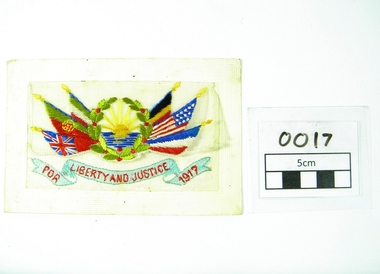
Postcard, 'Liberty and Justice' WW 1 postcard from France, 1917 - written by Leo Pallamountagne
... Address in 1931 was Pier Street, Dromana. Occupation, Civil Servant Address in 1936 was Tresco, Victoria, Occupation, Orchardist...Address in 1931 was Pier Street, Dromana. Occupation, Civil Servant Address in 1936 was Tresco, Victoria, Occupation, Orchardist Memorabilia of Leo Pallamountagne War Service on Western Front, France, 1917. ...Leo Charles Roy Pallamountagne was born at Moyhu, Vic, Aus. and at the time of WW 1 was employed as a farm hand on the property of Mrs Ellen McCormack (nee Power) at Ovens Vale, Victoria, Australia. Ellen's husband, John McCormack, had deceased 1916. Leo was born at Moyhu, Vic. 1899. He enlisted for service abroad on 30/8/1916 and was posted to the 21st Battalion, Serial No. 6829. Leo's next of kin was nominated as Clara Pallamountagne of Benalla, Victoria. Leo's father was listed as "whereabouts unknown" at the time of Leo's enlistment. Leo was wounded in action in France, Oct 1917. Leo returned to Australia on 10th March 1919 and was discharged on 17th April the same year. Leo (or Leon) married Evelyn Mary Paxman in 1922, they had seven children. Leo died on 23rd April, 1941 at the Military Hospital, Caulfield. Address in 1931 was Pier Street, Dromana. Occupation, Civil Servant Address in 1936 was Tresco, Victoria, Occupation, OrchardistMemorabilia of Leo Pallamountagne War Service on Western Front, France, 1917. Postcard of card and light gauze cloth upon which is embroided six flags in national colours flanking a rising sun plus wording in red on a blue ribbon flourish "For Liberty and Justice 1917"Hand written in pencil Addressed to Mrs J McCormack, Ovens Vale, Victoria, Australia. "France Sept 1917 To the Company just a few lines hoping you are all well as it leaves me at present There is not news here at present but will write again, Your true Friend Leo, Pallamountagnepallamountagne. western front. postcard. -
 Waverley RSL Sub Branch
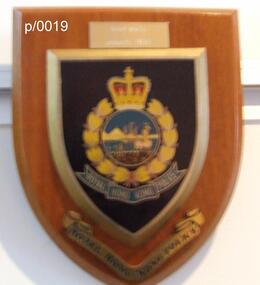
Plaque Royal Hong Kong Police, Royal Hong Kong Police
... Following the transfer of sovereignty, the Force is once again named the Hong Kong Police Force.[1] The current Commissioner of Police is Andy Tsang Wai-hung.[2] Including the Hong Kong Auxiliary Police Force and civil servants, the force consists of about 40,000 personnel; which gives Hong Kong the second largest citizen–police officer ratio in the world. ...Following the transfer of sovereignty, the Force is once again named the Hong Kong Police Force.[1] The current Commissioner of Police is Andy Tsang Wai-hung.[2] Including the Hong Kong Auxiliary Police Force and civil servants, the force consists of about 40,000 personnel; which gives Hong Kong the second largest citizen–police officer ratio in the world. ...The Hong Kong Police Force (香港警務處, HKPF; HKP), also known as the Hong Kong Police, is the largest disciplined service under the Security Bureau of Hong Kong. It is the world's second, and Asia's first, police agency to operate with a modern policing system. It was formed on 1 May 1844, with a strength of 32 officers. Queen Elizabeth II granted the Royal Charter to the Hong Kong Police Force in 1969 for their handling of the Hong Kong 1967 riots—renaming them: the Royal Hong Kong Police Force. Following the transfer of sovereignty, the Force is once again named the Hong Kong Police Force.[1] The current Commissioner of Police is Andy Tsang Wai-hung.[2] Including the Hong Kong Auxiliary Police Force and civil servants, the force consists of about 40,000 personnel; which gives Hong Kong the second largest citizen–police officer ratio in the world. In addition, the Marine Region with about 3,000 officers and a fleet of 143 vessels, is the largest of any civil police force.Wooden Plaque 15cm x x13cmRoyal Hong Kong Police -
 Flagstaff Hill Maritime Museum and Village
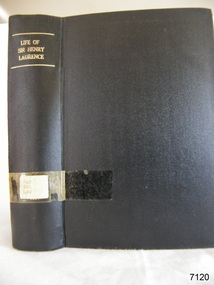
Book - Biographical/Military History, Smith, Elder & Co. et al, Life of Sir Henry Lawrence, 1873
... Merivale was an English civil servant and historian, educated at Harrow and Oxford. ...Merivale was an English civil servant and historian, educated at Harrow and Oxford. ...The subject book is not by Merivale alone. It was begun by Sir Herbert Edwardes, who died in 1868, and finished by Herman Merivale. The work is a biography of Sir Henry Lawrence (1806–1857), a Bengal Army officer and administrator. Lawrence was born in Ceylon (now Sri Lanka). There he led the group of officials in the Punjab known as his 'Young Men', he also founded the Lawrence Military Asylums, and died at the siege of Lucknow in 1857. The book follows his career through the Sikh wars, the Punjab Board of Administration, his clash with Lord Dalhousie, his time in Rajputana and his final posting in Oudh.Hard cover book. Life of Sir Henry Lawrence Author: Sir Herbert Edwardes & Herman Merivale Publisher: Smith, Elder & Co Date: 1873 Further Information: Black Cloth hardcover with lettering and patterning to spine in Gilt. The spine has a Library label with an inscription.non-fictionThe subject book is not by Merivale alone. It was begun by Sir Herbert Edwardes, who died in 1868, and finished by Herman Merivale. The work is a biography of Sir Henry Lawrence (1806–1857), a Bengal Army officer and administrator. Lawrence was born in Ceylon (now Sri Lanka). There he led the group of officials in the Punjab known as his 'Young Men', he also founded the Lawrence Military Asylums, and died at the siege of Lucknow in 1857. The book follows his career through the Sikh wars, the Punjab Board of Administration, his clash with Lord Dalhousie, his time in Rajputana and his final posting in Oudh.book, life of sir henry lawrence, h merivale, herman merivale, shipwrecked-coast, flagstaff-hill, flagstaff-hill-maritime-museum, warrnambool, maritime-museum, shipwreck-coast, flagstaff-hill-maritime-village, shipwrecked-artefact, pattison collection, warrnambool library, warrnambool mechanics’ institute, ralph eric pattison, corangamite regional library service, warrnambool city librarian, mechanics’ institute library, victorian library board, warrnambool books and records, warrnambool children’s library, great ocean road -
 Kew Historical Society Inc
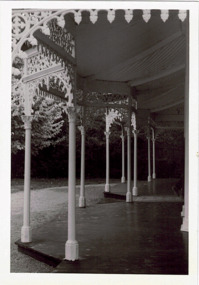
Photograph - Verandah of 'Wimba', 235 Cotham Road, John T Collins, 1979
... Although probably built some time earlier, the first mention in the Rate Books of the property later known as 'Wimba Lodge' appears in the entry for 1870 when the property, owned by John Sharpe Denbigh, a civil servant, was given an N.A.V. of £72. Denbigh did however occupy a house in Cotham Road in 1863, and it is possible that was the same premises'. ...Although probably built some time earlier, the first mention in the Rate Books of the property later known as 'Wimba Lodge' appears in the entry for 1870 when the property, owned by John Sharpe Denbigh, a civil servant, was given an N.A.V. of £72. Denbigh did however occupy a house in Cotham Road in 1863, and it is possible that was the same premises'. ...Although probably built some time earlier, the first mention in the Rate Books of the property later known as 'Wimba Lodge' appears in the entry for 1870 when the property, owned by John Sharpe Denbigh, a civil servant, was given an N.A.V. of £72. Denbigh did however occupy a house in Cotham Road in 1863, and it is possible that was the same premises'. The house was occupied by Sharp until at least May 1876 when the 'family residence ... was auctioned' to Carlington George Edmund Marston, a chemist of Smith Street, Collingwood. At the time of the auction the house was described thus: The residence and grounds of the late J.S. Dendigh, situate in the most elevated part of Cotham Road Kew. The grounds comprise an area of 4a Or 29p or thereabouts, and have a frontage to Cotham-road of 4 chains. The house has two large rooms in front, with 6ft hall built of brick, bay and side windows (plate glass), four rooms of wood behind with slate roofs, bathroom and closets, detached kitchen and servant's room, large shed with washing boiler, pantry and cellar under, brick and cement tank, and the Yan Yean laid onto house and grounds, cowshed, pigstye, &c, the whole securely fenced. First class orchard and flower garden. The paddocks laid with English grasses and drained... .' (Sanderson P. Kew Conservation Study Vol 2)'Wimba' is a single storeyed rendered house. The front entrance is flanked by two polygonal bay windows, and a verandah with a concave corrugated iron roof returns around three facades, and accentuates the projections of the windows. The solid render parapet is very ornate and tall for the date of construction. It has panels of decoration along it and is surmounted by a number of render urns. (Sanderson P. Kew Conservation Study Vol 2)Reverse: "JOHN COLLINS / 11 Anderson Road / Hawthorn East, 3123 / Film 395 Exposure 15A / Kew / Wimba / Front verandah from east / 7-4-79wimba lodge, 235 cotham road -- kew (vic.), john s denbigh, carlington george edmund marston -
 Flagstaff Hill Maritime Museum and Village
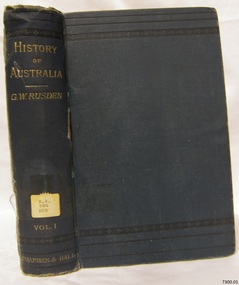
Book - Reference Book/History/Social History, George William Rusden, History of Australia Vol 1, 1883
... George William Rusden (1819–1903) was an English-born Australian historian, civil servant, and educationist. Born on 9th July 1819 in Surrey, England, he migrated to New South Wales in 1834 with his family. ...George William Rusden (1819–1903) was an English-born Australian historian, civil servant, and educationist. Born on 9th July 1819 in Surrey, England, he migrated to New South Wales in 1834 with his family. ...Volume 1 covers Australia's history from prehistoric times through early European exploration to the founding of New South Wales in 1788. It details early rumours of a great southern land. Also voyages by explorers like Dirk Hartog, Tasman, Dampier, and Cook, along with the establishment of the first colony under Governor Arthur Phillip, including challenges like famine and initial settlements.History of Australia Vol 1 Author: George William Rusden Publisher: Chapman & Hall Ltd Date: 1883non-fictionVolume 1 covers Australia's history from prehistoric times through early European exploration to the founding of New South Wales in 1788. It details early rumours of a great southern land. Also voyages by explorers like Dirk Hartog, Tasman, Dampier, and Cook, along with the establishment of the first colony under Governor Arthur Phillip, including challenges like famine and initial settlements. warrnambool, shipwrecked-coast, flagstaff-hill, flagstaff-hill-maritime-museum, maritime-museum, shipwreck-coast, flagstaff-hill-maritime-village, shipwrecked-artefact, great ocean road, book, warrnambool library, warrnambool mechanics’ institute, mechanics’ institute library, victorian library board, warrnambool books and records, warrnambool children’s library, warrnambool public library, history of australia vol 1, g w rusden -
 Flagstaff Hill Maritime Museum and Village
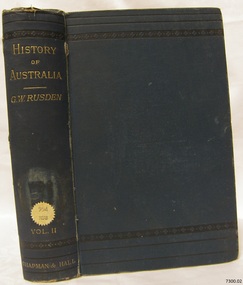
Book - Reference Book/History/Social History, George William Rusden, History of Australia Vol 2, 1883
... George William Rusden (1819–1903) was an English-born Australian historian, civil servant, and educationist. Born on 9th July 1819 in Surrey, England, he migrated to New South Wales in 1834 with his family. ...George William Rusden (1819–1903) was an English-born Australian historian, civil servant, and educationist. Born on 9th July 1819 in Surrey, England, he migrated to New South Wales in 1834 with his family. ...Volume 2 of G.W. Rusden's History of Australia continues the narrative from early colonial governance, examining governors after Arthur Phillip up through the mid 19th century. It covers expansions in New South Wales, the establishment of Van Diemen's Land (Tasmania), and Moreton Bay (Queensland), including key events like the Macarthur wool industry rise, convict management under governors like Lachlan Macquarie, and inter colonial tensions.Hard cover book History of Australia in three Volumes Author: George William Rusden Publisher: Chapman & Hall Ltd London, Melbourne and Sydney Date: 1883 Dark blue hardcover with a blue matching spine, the spine has a label with an inscription. (These volumes are first editions)non-fictionVolume 2 of G.W. Rusden's History of Australia continues the narrative from early colonial governance, examining governors after Arthur Phillip up through the mid 19th century. It covers expansions in New South Wales, the establishment of Van Diemen's Land (Tasmania), and Moreton Bay (Queensland), including key events like the Macarthur wool industry rise, convict management under governors like Lachlan Macquarie, and inter colonial tensions.warrnambool, shipwrecked-coast, flagstaff-hill, flagstaff-hill-maritime-museum, maritime-museum, shipwreck-coast, flagstaff-hill-maritime-village, shipwrecked-artefact, great ocean road, book, warrnambool library, warrnambool mechanics’ institute, mechanics’ institute library, victorian library board, warrnambool books and records, warrnambool children’s library, warrnambool public library, history of australia vol 2, g w rusden -
 Flagstaff Hill Maritime Museum and Village
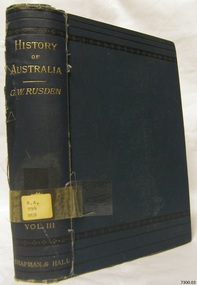
Book - Reference Book/History/Social History, George William Rusden, History of Australia Vol 3, 1883
... George William Rusden (1819–1903) was an English-born Australian historian, civil servant, and educationist. Born on 9th July 1819 in Surrey, England, he migrated to New South Wales in 1834 with his family. ...George William Rusden (1819–1903) was an English-born Australian historian, civil servant, and educationist. Born on 9th July 1819 in Surrey, England, he migrated to New South Wales in 1834 with his family. ...Volume 3 shifts to political developments, focusing on the 1856 Constitution Act and Victoria's road to self-government. It details federation debates, relationships with Britain, sketches later governors, and addresses gold rush impacts, land reforms, and emerging parliamentary systems across colonies. Together, the volumes form Rusden's comprehensive, if biased, chronicle to the 1850s.Hard cover book History of Australia in three Volumes Author: George William Rusden Publisher: Chapman & Hall Ltd London, Melbourne and Sydney Date: 1883 Dark blue hardcover with a blue matching spine, the spine has a label with an inscription. (These volumes are first editions)non-fictionVolume 3 shifts to political developments, focusing on the 1856 Constitution Act and Victoria's road to self-government. It details federation debates, relationships with Britain, sketches later governors, and addresses gold rush impacts, land reforms, and emerging parliamentary systems across colonies. Together, the volumes form Rusden's comprehensive, if biased, chronicle to the 1850s.warrnambool, shipwrecked-coast, flagstaff-hill, flagstaff-hill-maritime-museum, maritime-museum, shipwreck-coast, flagstaff-hill-maritime-village, book, warrnambool library, warrnambool mechanics’ institute, mechanics’ institute library, victorian library board, warrnambool books and records, warrnambool children’s library, warrnambool public library, history of australia vol 3, g w rusden -
 Kew Historical Society Inc
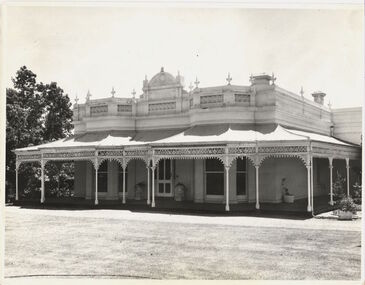
Photograph - 'Wimba', Cotham Road, J E & B L Rogers, c.1965
... Although probably built some time earlier, the first mention in the Rate Books of the property later known as 'Wimba Lodge' appears in the entry for 1870 when the property, owned by John Sharpe Denbigh, a civil servant, was given an N.A.V. of £72 2. Denbigh did however occupy a house in Cotham Road in 1863, and it is possible that was the same premises'. ...Although probably built some time earlier, the first mention in the Rate Books of the property later known as 'Wimba Lodge' appears in the entry for 1870 when the property, owned by John Sharpe Denbigh, a civil servant, was given an N.A.V. of £72 2. Denbigh did however occupy a house in Cotham Road in 1863, and it is possible that was the same premises'. ...'Wimba' is of significance as one of the key nineteenth century houses of Kew and for remaining in a substantially intact state. Although probably built some time earlier, the first mention in the Rate Books of the property later known as 'Wimba Lodge' appears in the entry for 1870 when the property, owned by John Sharpe Denbigh, a civil servant, was given an N.A.V. of £72 2. Denbigh did however occupy a house in Cotham Road in 1863, and it is possible that was the same premises'. The house was occupied by Denbigh until at least May 1876 when the 'family residence...' \ 'as auctioned to Carlington George Edmund Marston 5, a chemist of Smith Street, Collingwood. At the time of the auction the house was described thus: The residence and grounds of the late J.S. Dendigh, situate in the most elevated part of Cotham Road Kew. The grounds comprise an area of 4a Or29p or thereabouts, and have a frontage to Cotham-road of 4 chains. The house has two large rooms in front, with 6ft hall built of brick, bay and side windows (plate glass), four rooms of wood behind with slate roofs, bathroom and closets, detached kitchen and servant's room, large shed with washing boiler, pantry and cellar under, brick and cement tank, and the Yan Yean laid onto house and grounds, cowshed, pigstye, &c, the whole securely fenced. First class orchard and flower garden. The paddocks laid with English grasses and drained... .' (Sanderson P, City of Kew Urban Conservation Study, Volume 2, 1988)This work forms part of the collection assembled by the historian Dorothy Rogers, that was donated to the Kew Historical Society by her son John Rogers in 2015. The manuscripts, photographs, maps, and documents were sourced by her from both family and local collections or produced as references for her print publications. Many were directly used by Rogers in writing ‘Lovely Old Homes of Kew’ (1961) and 'A History of Kew' (1973), or the numerous articles on local history that she produced for suburban newspapers. Most of the photographs in the collection include detailed annotations in her hand. The Rogers Collection provides a comprehensive insight into the working habits of a historian in the 1960s and 1970s. Together it forms the largest privately-donated collection within the archives of the Kew Historical Society.The front entrance of Wimba in Cotham Road, Kew. The entrance is flanked by two polygonal bay windows, and a verandah with a concave corrugated iron roof returns around three facades, and accentuates the projections of the windows. The solid render parapet is very ornate and tall for the date of construction. It has panels of decoration along it and is surmounted by a number of render urns. The image was used by Dorothy Rogers in 'A History of Kew' (1973), facing page 144.Wimba ca. 1860 built by J.S. Denbigh (has been altered).wimba, kew, dorothy rogers -
 Flagstaff Hill Maritime Museum and Village
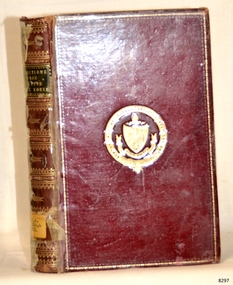
Book - Literary Work, John Milton, Selections from the Prose Works of John Milton, 1870
... The author John Milton (1608–1674) was an English poet, polemicist, and civil servant. Writing during a period of massive political and religious upheaval in England—namely the English Civil War and the execution of King Charles I—Milton was a passionate defender of the Commonwealth. ...The author John Milton (1608–1674) was an English poet, polemicist, and civil servant. Writing during a period of massive political and religious upheaval in England—namely the English Civil War and the execution of King Charles I—Milton was a passionate defender of the Commonwealth. ...Selections from the Prose Works of John Milton (1870) is a curated compilation of the non-poetic writings of John Milton. While Milton is globally famous for epic poems like Paradise Lost, he spent a significant portion of his adult life writing fiery political and religious tracts. This specific volume, compiled and annotated by the Rev. James J.G. Graham, extracts the most powerful segments of Milton’s prose. The book organizes his writings to give readers a cohesive look at Milton's philosophy, including his arguments for the freedom of the press known as Areopagitica. This was a famous 1644 prose pamphlet by Milton, written to protest Parliament's Licensing Order of 1643, which mandated government pre-approval for all published books. It remains one of the most historically significant defences of freedom of speech and the press. This work also encompasses his thoughts on the right to overthrow tyrannical rulers, his views on church reform, and various autobiographical passages.Selections from the Prose Works of John Milton Author: John Milton Edited by the Rev.James J G Graham Publisher: Hurst and Blackett Date: 1870 Further Information: Red embossed hardcover with a red spine and lettering in gold. The spine has a Library label with an inscription.fictionSelections from the Prose Works of John Milton (1870) is a curated compilation of the non-poetic writings of John Milton. While Milton is globally famous for epic poems like Paradise Lost, he spent a significant portion of his adult life writing fiery political and religious tracts. This specific volume, compiled and annotated by the Rev. James J.G. Graham, extracts the most powerful segments of Milton’s prose. The book organizes his writings to give readers a cohesive look at Milton's philosophy, including his arguments for the freedom of the press known as Areopagitica. This was a famous 1644 prose pamphlet by Milton, written to protest Parliament's Licensing Order of 1643, which mandated government pre-approval for all published books. It remains one of the most historically significant defences of freedom of speech and the press. This work also encompasses his thoughts on the right to overthrow tyrannical rulers, his views on church reform, and various autobiographical passages.flagstaff hill, warrnambool, shipwrecked coast, flagstaff hill maritime museum, maritime museum, shipwreck coast, flagstaff hill maritime village, great ocean road, selections from the prose works of john milton, colac municipal library, rev.james j ggraham -
 Surrey Hills Historical Society Collection
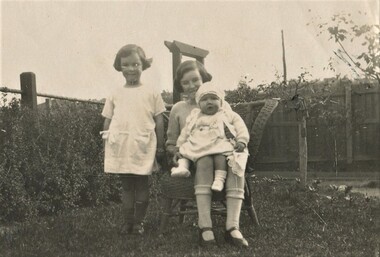
Photograph, Isabel and Beryl Mair with cousin Margaret Williamson, 1916
... Lily's sister Alice married Hector Williamson (1892-1981) in 1921. Hector was a civil servant and worked at the Melbourne Museum, where accommodation was provided. ...Lily's sister Alice married Hector Williamson (1892-1981) in 1921. Hector was a civil servant and worked at the Melbourne Museum, where accommodation was provided. ...David Miller (Dave) Mair (1879-1938) married Lily Vipond Deakin (1890-1945) in 1910. They had 5 children: Geoffrey David (1913-1970), Beryl (1916-1976), Gwynneth (1917-1997), Isabel Lillian (1921-1997) and Shirley Inez (1928-1968). Personal communication from Laurie Newton, Beryl's daughter: Dave and Beryl initially lived in East Melbourne after they married. Geoffrey, Beryl and Gwynneth were born in East Melbourne. They subsequently moved to Louise Avenue, Mont Albert and Isabel may have been born while they were there. Later they purchased 20 Barton Street, Mont Albert. Shirley was born after they moved to Barton Street. The children attended Mont Albert Central School. Lily's sister Alice married Hector Williamson (1892-1981) in 1921. Hector was a civil servant and worked at the Melbourne Museum, where accommodation was provided. They had one daughter Margaret. Another sister Minnie (Min) married Hector's brother Charles (Charlie) Prosser Williamson (1893-1961). Charlie was an engineer and ran a hardware business in Whitehorse Road (near the tram terminus). They lived at 12 Barloa Road and had one son, Donald Williamson, born 1924. Donald (Service number VX146389) entered RMC on 28 February 1942 and graduated on 14 December 1943. He enlisted the following day as a Lieutenant with the 2/32 Infantry Battalion. He was mentioned in Despatches "for exceptional service in the field S.W.P. area". Promulgated in the Commonwealth of Australia Gazette 6 March 1947; was killed in action in Brunei on 3 July 1945. Williamson was buried in grave B.C.10 in Labuan War Cemetery, Borneo, Malaysia.This is part of a large donation related to the Deakin, Mair and Young families with connections to the Surrey Hills / Mont Albert area.A sepia coloured photo with a cream border of 2 girls in either a front or back garden. One is sitting on a cane chair and holding a young baby; the other is standing close by. The fence behind appears to be of constructed of posts with a metal horizontal support and wire mesh. REAR: In blue biro "Isabel Beryl / Margaret Williamson / (cousin) / Auntie Alice & Uncle Hec / her mother & father" The handwriting is believed to be that of Beryl Mair. margaret williamson, beryl mair, isabel mair, children -
 Surrey Hills Historical Society Collection
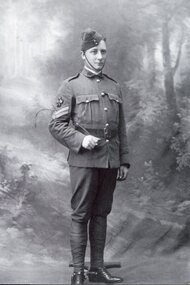
Photograph, Joseph W Cairnduff, 1914, 1914
... He was 5'5", 38 years old and employed as a civil servant. He had served for 5 years in the Senior Cadets and 3 years in the Australian Signallers. ...He was 5'5", 38 years old and employed as a civil servant. He had served for 5 years in the Senior Cadets and 3 years in the Australian Signallers. ...Joseph William Cairnduff (1876-1929) was born in Hobart, Tasmania. He married Ann Walker in 1900. When he enlisted on 19 August 1914 he was given SERN 4. At the time he was living at 'Tyne', 96 Guildford Road, Surrey Hills. He was 5'5", 38 years old and employed as a civil servant. He had served for 5 years in the Senior Cadets and 3 years in the Australian Signallers. He was given the rank of sergeant in the Divisional Signal Company 1 and embarked for Egypt from Melbourne on board HMAT A10 Karroo on 20 October 1914. Surviving service on Gallipoli and the Western Front, he returned to Melbourne leaving on board HT 'Wiltshire', 12 November 1916. He was discharged medically unfit. Joseph and Ann had a large family before he left for WW1: Ann Mary b.1901; James William Cotter b. 1903; Mathew Norman Banks b. 1904; Doris Jean b.1906; Claude James b, 1908; Elsie Edna b. 1910; Clive Bruce b. 1912 and Gladys Janet b. 1914. After his return he and Ann had more 2 daughters - Sylvia McLaren b. 1917 and Mavis Morley b. 1918, who commenced at Chatham Primary School in 1927 and 1928 respectively. Joseph and Ann are buried in Box Hill Cemetery (M-NS-0492). Joseph's twin brother, James Banks Cairnduff (SERN 571) also served in the AIF and is also buried in Box Hill Cemetery (M-NS-0003). A studio portrait of a soldier in AIF uniform and a peaked cap. He is short and is standing with one arm straight and the other bend. He is holding what looks like a whip in the hand of the bent arm.In the hand of the donor: "1914" in ink in top RH corner. The centre: "Joseph W. Cairnduff / Before leaving for overseas / in 1914, firstly to Egypt / then Gallipoli, then Western / Front."joseph william cairnduff, first world war, signals company, guildford road, 'tyne', (miss) ann walker, (mrs) ann cairnduff, (mrs) mavis good -
 Surrey Hills Historical Society Collection
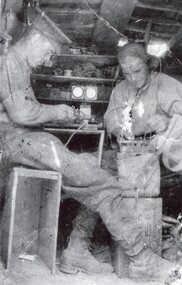
Photograph, Joseph W Cairnduff in trenches on Gallipoli, 1915, 1915
... He was 5'5", 38 years old and employed as a civil servant. He had served for 5 years in the Senior Cadets and 3 years in the Australian Signallers. ...He was 5'5", 38 years old and employed as a civil servant. He had served for 5 years in the Senior Cadets and 3 years in the Australian Signallers. ...Joseph William Cairnduff (1876-1929) was born in Hobart, Tasmania. He married Ann Walker in 1900. When he enlisted on 19 August 1914 he was given SERN 4. At the time he was living at 'Tyne', 96 Guildford Road, Surrey Hills. He was 5'5", 38 years old and employed as a civil servant. He had served for 5 years in the Senior Cadets and 3 years in the Australian Signallers. He was given the rank of sergeant in the Divisional Signal Company 1 and embarked for Egypt from Melbourne on board HMAT A10 Karroo on 20 October 1914. Joseph was on Gallipoli from 5/4/1915; he proceeded from there to Alexandria on 24/10/1915. Surviving service on Gallipoli and the Western Front, he returned to Melbourne leaving on board HT 'Wiltshire', 12 November 1916. He was discharged medically unfit. Joseph and Ann had a large family before he left for WW1: Ann Mary b.1901; James William Cotter b. 1903; Mathew Norman Banks b. 1904; Doris Jean b.1906; Claude James b, 1908; Elsie Edna b. 1910; Clive Bruce b. 1912 and Gladys Janet b. 1914. After his return he and Ann had more 2 daughters - Sylvia McLaren b. 1917 and Mavis Morley b. 1918, who commenced at Chatham Primary School in 1927 and 1928 respectively. Joseph and Ann are buried in Box Hill Cemetery (M-NS-0492). Joseph's twin brother, James Banks Cairnduff (SERN 571) also served in the AIF and is also buried in Box Hill Cemetery (M-NS-0003). A black and white photo of a group of 2 Australian soldiers sitting on wooden boxes under a slatted wooden low roof. They are at work on equipment of some kind. In the background are shelves with stores including a roll of cording and other materials in tins and boxes.On the rear in the hand of the donor: ""Repairing telephones / in Gallipoli" (in trench) / Dad on the left"joseph william cairnduff, first world war, signals company, guildford road, 'tyne', (miss) ann walker,, (mrs) ann walker, (mrs) mavis good, gallipoli, trenches -
 Surrey Hills Historical Society Collection
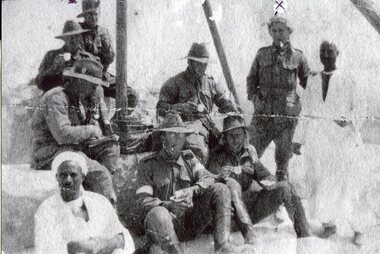
Photograph, Joseph W Cairnduff in Egypt, 1916, 1916
... He was 5'5", 38 years old and employed as a civil servant. He had served for 5 years in the Senior Cadets and 3 years in the Australian Signallers. ...He was 5'5", 38 years old and employed as a civil servant. He had served for 5 years in the Senior Cadets and 3 years in the Australian Signallers. ...Joseph William Cairnduff (1876-1929) was born in Hobart, Tasmania. He married Ann Walker in 1900. When he enlisted on 19 August 1914 he was given SERN 4. At the time he was living at 'Tyne', 96 Guildford Road, Surrey Hills. He was 5'5", 38 years old and employed as a civil servant. He had served for 5 years in the Senior Cadets and 3 years in the Australian Signallers. He was given the rank of sergeant in the Divisional Signal Company 1 and embarked for Egypt from Melbourne on board HMAT A10 Karroo on 20 October 1914. Joseph was in Egypt from 24/10/1915 to 17/6/1916, but only in Giza from 21/02/1916 to 6/03/1916. Surviving service on Gallipoli and the Western Front, he returned to Melbourne leaving on board HT 'Wiltshire', 12 November 1916. He was discharged medically unfit. Joseph and Ann had a large family before he left for WW1: Ann Mary b.1901; James William Cotter b. 1903; Mathew Norman Banks b. 1904; Doris Jean b.1906; Claude James b, 1908; Elsie Edna b. 1910; Clive Bruce b. 1912 and Gladys Janet b. 1914. After his return he and Ann had more 2 daughters - Sylvia McLaren b. 1917 and Mavis Morley b. 1918, who commenced at Chatham Primary School in 1927 and 1928 respectively. Joseph and Ann are buried in Box Hill Cemetery (M-NS-0492). Joseph's twin brother, James Banks Cairnduff (SERN 571) also served in the AIF and is also buried in Box Hill Cemetery (M-NS-0003). A black and white photo of a group of 7 Australian soldiers and 2 Egyptians gathered around a pole. The context is not able to be discerned. One of the soldiers is marked with an 'X' and is smoking a pipe. He has a cap-like object on his head. The other soldiers are wearing slouch hats. The Egyptians are dressed in long white garments and are wearing turbans.On the rear in the hand of the donor: "Dad had written on the original (photo) / "The 1st and only Telegraph ffice / erected on the top of the Pyramids, / it was erected by me during our / sojourn in Egypt"joseph william cairnduff, first world war, egypt, signals company, telegraph office, pyramids -
 Ringwood and District Historical Society
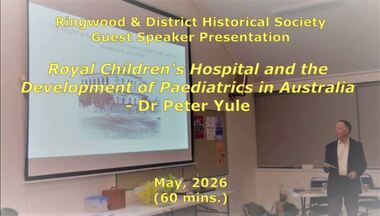
Mixed media - Video, RDHS Guest Speaker Presentation - Royal Children's Hospital and the Development of Paediatrics in Australia - Dr Peter Yule
... Peter is also grandson of Ringwood’s own:- Sir Lewis Ronald East (1899–1994), engineer and water commissioner, was born on 17 June 1899 at Auburn, Melbourne, second of three children of Lewis Findlay East, civil servant and later secretary of the Commonwealth Marine Branch, and his wife Annie Eleanor, née Burchett, both Victorian born. ...Peter is also grandson of Ringwood’s own:- Sir Lewis Ronald East (1899–1994), engineer and water commissioner, was born on 17 June 1899 at Auburn, Melbourne, second of three children of Lewis Findlay East, civil servant and later secretary of the Commonwealth Marine Branch, and his wife Annie Eleanor, née Burchett, both Victorian born. ...Digitised video (3.66GB) Duration: 60 minutes. Recorded May, 2026 (Video is available for viewing at Ringwood & District Historical Society Archives by appointment)Dr Peter Yule is a freelance historian and a fellow of the School of History at the University of Melbourne. He has written a wide range of histories, including The Royal Children's Hospital: A History of Faith, Science and Love (1999), In the Public Interest: 150 Years of the Victorian Auditor-General's Office (2002), Carlton: A History (ed., 2004), and Steel Spies and Spin: The Collins Class Submarine Story (2008). He has also written VIC BAR: A history of the Victorian Bar. More recently he has written biographies of two prominent Melbourne-based financiers: W. L. Baillieu (1859-1936), who founded the prominent family dynasty; and Sir Ian Potter (1902-1994), a major figure in Australia's post-war industrial expansion. Peter will speak about his research on these two remarkable figures, and on the challenges of biography more generally. Peter is also grandson of Ringwood’s own:- Sir Lewis Ronald East (1899–1994), engineer and water commissioner, was born on 17 June 1899 at Auburn, Melbourne, second of three children of Lewis Findlay East, civil servant and later secretary of the Commonwealth Marine Branch, and his wife Annie Eleanor, née Burchett, both Victorian born. Ronald was educated at Ringwood State School. -
 Bendigo Historical Society Inc.
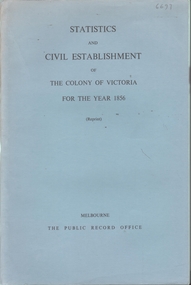
Booklet - Statistics and Civil Establishment of the Colony of Victoria for 1856
... The civil list includes public servants, listed alphabetically, their role, place of situation and reference to a later page that describes the actual role....The civil list includes public servants, listed alphabetically, their role, place of situation and reference to a later page that describes the actual role. ...Victoria became its own colony in 1851, after being the Port Phillip district of NSW from 1803. These books that were produced regularly to provide statistical information of the Civil, Judicial, Police, Penal, Medical, Ecclesiastical and educational establishments. The civil list includes public servants, listed alphabetically, their role, place of situation and reference to a later page that describes the actual role.113-page blue soft cover booklet. Civil Establishment of the Colony of Victoria for 1856 (Reprint) in the front section. Statistics of the Colony of Victoria for 1856 in the back section. Compiled from Official Records in the Registrar General's Office. First published in 1858, Reprinted in 1975 by C.H. Rixon, Government Printer for the Public Records Office, Melbournestatistics, port phillip district -
 Flagstaff Hill Maritime Museum and Village
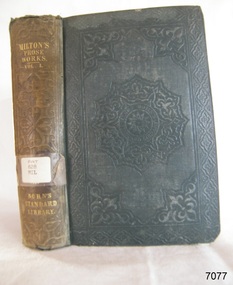
Book - Commentary Essays, John Milton, The Prose Works of John Milton Vol 1, 1848
... The author John Milton (1608–1674) was an English poet, polemicist, and civil servant, most famous for the 1667 epic Paradise Lost, written in blank verse. ...The author John Milton (1608–1674) was an English poet, polemicist, and civil servant, most famous for the 1667 epic Paradise Lost, written in blank verse. ...The Prose Works of John Milton, Volume 1 is part of a five-volume set issued by London publisher Henry G. Bohn beginning in 1848, as part of his well-known "Bohn's Standard Library" series of affordable classics. This particular volume gathers Milton's major political prose defending the execution of Charles I and the English republic: A Defence of the People of England, The Second Defence of the People of England, and Eikonoklastes (Milton's rebuttal to the royalist Eikon Basilike). It includes a portrait frontispiece of Milton and runs to 496 pages. The set as a whole was edited with a preface, preliminary remarks, and notes by James Augustus St. John, and volumes 4–5, covering a treatise on Christian doctrine, were separately translated by Charles R. Sumner.Hard cover book: The Prose Works of John Milton Vol 1 Author: John Milton Editor: James Augustus St. John Publisher: Henry G Bohn Date: 1848 Further Information: Blue leather hardcover with brown spine covers and spine embossed lettering to spine in gilt, portrait frontispiece. The spine has a Library label with an inscription.non-fictionThe Prose Works of John Milton, Volume 1 is part of a five-volume set issued by London publisher Henry G. Bohn beginning in 1848, as part of his well-known "Bohn's Standard Library" series of affordable classics. This particular volume gathers Milton's major political prose defending the execution of Charles I and the English republic: A Defence of the People of England, The Second Defence of the People of England, and Eikonoklastes (Milton's rebuttal to the royalist Eikon Basilike). It includes a portrait frontispiece of Milton and runs to 496 pages. The set as a whole was edited with a preface, preliminary remarks, and notes by James Augustus St. John, and volumes 4–5, covering a treatise on Christian doctrine, were separately translated by Charles R. Sumner.shipwrecked-coast, flagstaff-hill, flagstaff-hill-maritime-museum, warrnambool, maritime-museum, shipwreck-coast, flagstaff-hill-maritime-village, shipwrecked-artefact, book, pattison collection, warrnambool library, warrnambool mechanics’ institute, ralph eric pattison, corangamite regional library service, warrnambool city librarian, mechanics’ institute library, victorian library board, warrnambool books and records, warrnambool children’s library, the prose works of john milton vol 1, john milton -
 Flagstaff Hill Maritime Museum and Village
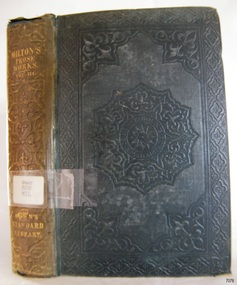
Book - Commentary Essays, John Milton, The Prose Works of John Milton Vol 3, 1848
... The author John Milton (1608–1674) was an English poet, polemicist, and civil servant, most famous for the 1667 epic Paradise Lost, written in blank verse. ...The author John Milton (1608–1674) was an English poet, polemicist, and civil servant, most famous for the 1667 epic Paradise Lost, written in blank verse. ...The Prose Works of John Milton, Volume 3 is part of a five-volume set issued by London publisher Henry G. Bohn beginning in 1848, as part of his well-known "Bohn's Standard Library" series of affordable classics. Volume 3 is the volume centred on Milton's ecclesiastical, educational, and domestic-life tracts, quite distinct from Volume 1 and its regicide/republic defences and Volume 2's church-government and press-freedom writings. The contents include The Likeliest Means to Remove Hirelings out of the Church; Animadversions upon the Remonstrants' Defence against Smectymnuus; and Apology for Smectymnuus, Milton's final anti-prelatical tract (1642), defending the Puritan pamphleteers writing under the collective pen-name "Smectymnuus" against Bishop Joseph Hall, and defending his own personal integrity as a polemicist. Also included is The Doctrine and Discipline of Divorce, Milton's controversial 1643 tract arguing, on scriptural grounds, for the lawfulness of divorce on grounds of incompatibility, written not long after his own troubled first marriage. There are further divorce tracts within this volume, as it continues the argument of the Doctrine and Discipline. The volume also includes a Tractate on Education, Milton's short treatise on his ideas for educational reform, and A Declaration for the Election of John III, King of Poland. Therefore, Volume 3 collects Milton's writings on church reform, personal and religious controversy, divorce law, and education — the more personal and doctrinal side of his prose output, as opposed to the state-political defences in VolumeHard cover book: The Prose Works of John Milton Vol 3 Author: John Milton Editor: James Augustus St. John Publisher: Henry G Bohn Date: 1848 Further Information: Blue leather hardcover with brown spine covers and spine embossed lettering to spine in gilt, portrait frontispiece. The spine has a Library label with an inscription.non-fictionThe Prose Works of John Milton, Volume 3 is part of a five-volume set issued by London publisher Henry G. Bohn beginning in 1848, as part of his well-known "Bohn's Standard Library" series of affordable classics. Volume 3 is the volume centred on Milton's ecclesiastical, educational, and domestic-life tracts, quite distinct from Volume 1 and its regicide/republic defences and Volume 2's church-government and press-freedom writings. The contents include The Likeliest Means to Remove Hirelings out of the Church; Animadversions upon the Remonstrants' Defence against Smectymnuus; and Apology for Smectymnuus, Milton's final anti-prelatical tract (1642), defending the Puritan pamphleteers writing under the collective pen-name "Smectymnuus" against Bishop Joseph Hall, and defending his own personal integrity as a polemicist. Also included is The Doctrine and Discipline of Divorce, Milton's controversial 1643 tract arguing, on scriptural grounds, for the lawfulness of divorce on grounds of incompatibility, written not long after his own troubled first marriage. There are further divorce tracts within this volume, as it continues the argument of the Doctrine and Discipline. The volume also includes a Tractate on Education, Milton's short treatise on his ideas for educational reform, and A Declaration for the Election of John III, King of Poland. Therefore, Volume 3 collects Milton's writings on church reform, personal and religious controversy, divorce law, and education — the more personal and doctrinal side of his prose output, as opposed to the state-political defences in Volumeshipwrecked-coast, flagstaff-hill, flagstaff-hill-maritime-museum, warrnambool, maritime-museum, shipwreck-coast, flagstaff-hill-maritime-village, shipwrecked-artefact, book, pattison collection, warrnambool library, warrnambool mechanics’ institute, ralph eric pattison, corangamite regional library service, warrnambool city librarian, mechanics’ institute library, victorian library board, warrnambool books and records, warrnambool children’s library, the prose works of john milton vol 1, john milton -
 Bendigo Historical Society Inc.
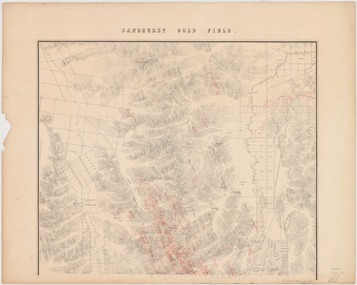
Map - Sandhurst Goldfield 1873, 1873
... Robert Brough Smyth (1830-1889), civil servant and mining engineer, was born on 18 February 1830 near Wallsend, Northumberland, England, son of Edward Smith, mining engineer, and his wife Elizabeth, née Brough. ...Robert Brough Smyth (1830-1889), civil servant and mining engineer, was born on 18 February 1830 near Wallsend, Northumberland, England, son of Edward Smith, mining engineer, and his wife Elizabeth, née Brough. ...Robert Brough Smyth (1830-1889), civil servant and mining engineer, was born on 18 February 1830 near Wallsend, Northumberland, England, son of Edward Smith, mining engineer, and his wife Elizabeth, née Brough. On 14 November 1852 Smyth arrived in Melbourne and went to the gold diggings, where he worked as a carter on the construction of roads at Sawpit Gully. Back in Melbourne, on 7 November 1853 he became a draftsman under the surveyor-general, Andrew Clarke, and soon was acting chief draftsman. Smyth compiled numerous reports and wrote catalogues for exhibitions of minerals and fossils. In November 1869 he superintended the establishment of a museum of economic geology, mineralogy and mining and published in Melbourne The Gold Fields and Mineral Districts of Victoria … Covertly involved in the controversy that led to the disbanding of the Geological Survey in 1869, he became its director on its reinstatement in 1871; he increased its part in the search for and proving of economic mineral and coal deposits. In 1875 he became chief inspector of mines and published the geological reports on John Forrest's Western Australian exploration. On 19 June 1860 Smyth had become honorary secretary to the Board for the Protection of Aborigines and in 1863 became a voting member. Zealous and determined, he assumed the role of chairman, which belonged ex officio to the chief secretary, and wielded great power, including the dubious dismissal of John Green, general inspector of Aborigines in 1861-75 with whom he had earlier collaborated. Smyth's compilation, The Aborigines of Victoria … (1878), arose from his efforts to gather information and artefacts of Victorian Aboriginal cultures at a time when their vestiges were fast disappearing. The work, still valuable though long since superseded, relied heavily upon others such as L. Fison, G. B. Halford, A. Howitt and J. Milligan. Press reports and a petition from officers in the Mining Department accused Smyth of 'tyrannical and overbearing conduct', and in February 1876 a board of inquiry was constituted and heard evidence until April. McCoy defended 'one of the best heads of department he had ever known' but the board found the charges of 'excessive severity … in the main substantiated', and reported that Smyth had been irritable, lacking self-control and over-fastidious, but acknowledged his 'unremitting energy and zealous labours in the public service'. On 4 May Smyth resigned all public offices except his membership of the Aborigines' board. Source: Australian Dictionary of Biography. https://adb.anu.edu.au/biography/smyth-robert-brough-4621Original map printed on paper on canvas; copy of map with original. Title: Sandhurst gold field [cartographic material] / surveyed and compiled under the direction of R. Brough Smyth and Thos. Couchman, Angus Mackay ; additions made to the survey under the same direction by Regd. A.F. Murray, April 1873. "Lithd. by R. Shepherd" Topographic map of Sandhurst gold field, with relief shown by hachures. Shows roads, railways and public buildings. "Note - blocks held under leasing regulations are outlined and numbered in red" Map is also available on State Library Victoria: https://find.slv.vic.gov.au/discovery/fulldisplay?vid=61SLV_INST:SLV&search_scope=slv_local&tab=searchProfile&context=L&docid=alma994975393607636 sandhurst, goldfield, lease holdings, gullies, brough smyth, state library of victoria -
Surrey Hills Historical Society Collection
Programme - Ephemera, Chatham Primary School Fathers' Club 'Trial by Jury' programme, 16/11/1929
... Victor Harold Theodore Clow (civil servant) lived at 4 Talbot Avenue, Balwyn; listed as T. ...Victor Harold Theodore Clow (civil servant) lived at 4 Talbot Avenue, Balwyn; listed as T. ...The program describes the performance as 'original burlesque' and was written, composed and produced by A E Woffinden and A W Sutton, members of the Chatham Fathers' Club, to raise money for the school. There were 250 programs printed at a cost of one pound fifteen shillings. This performance starred 21 of the fathers with Mr W Crellin as the only female character, Miss Eileen Flapper. The Chatham Fathers' Club became renowned locally for the quality of its performances, repeats being given to other community organisations. In the publication 'Chatham Past & Present: A Patchwork of People' there is also a photo of the cast taken in the quadrangle of the school. The original program and photo were lent to the school at the time of the 70 year reunion in 1997 by Mrs Jean Lacy (nee Walker), whose father took part as a member of the jury. Many of the performers were also in the formal photo of the Father's Club, taken in February 1928 on the front steps of the school. The original hangs in the school entry foyer and is reproduced in 'A Patchwork of People: Chatham Past and Present'. In relation to names, these are better identified and the following identifications have been reached by referencing this and the 1931 electoral roll. The geographic spread of addresses reflects that when Chatham opened in August 1927, surrounding schools were overcrowded and some families chose to relocate their children. Albert Ernest Woffinden (manufacturer) lived at 14 Banool Road, Surrey Hills. Alfred William Sutton (clerk) lived at 528 Whitehorse Road, Surrey Hills. Mr A Davidson - not found in electoral roll. Walter Dallas Kinross (mechanic) lived at 72 Empress Road, Surrey Hills. Gilbert Leslie (Bert) Rae (sales) lived at 63 Empress Road, Surrey Hills. Mr Joseph P Braddick (mechanic) lived at 1 Northcote Avenue, Canterbury; now Balwyn (NB/ Name is miss-spelt Braddock in the program). Norman Patrick Smart (bt opr) lived at 61 Sir Garnet Road, Surrey Hills. Henry Albert Wysham (show card writer) lived at 9 Northcote Avenue, Canterbury. Mr Sidney Bessant (labourer) lived at 191 Mont Albert Road, Canterbury. William Morrison (teacher) lived at 37 Chatham Road, Canterbury. William Charles Crellin (breadcarter) lived at 59 Empress Road, Surrey Hills. Mr F Parsons - taken as Fred Parsons (bricklayer) lived at 2 Kaarumba Grove, Balwyn. Mr MacDougal (incorrectly spelt in program) is Dougall MacDougall (gas collector) lived at 5 Wells Street, Surrey Hills. Mr A V Webb - not found. Mr McKie - not found. Victor Harold Theodore Clow (civil servant) lived at 4 Talbot Avenue, Balwyn; listed as T. Clow. Mr M Walker (donor's father) not found in electoral roll for 1931; thought to have lived in Sir Garnet Road. Mr McLeod - a number listed in the 1931 electoral roll. Richard Frost (carriage builder) lived at 341 Mont Albert Road, Surrey Hills. Mr Allen - a number listed in the 1931 electoral roll. Mr J Tulloch - not found in the 1931 electoral roll. This is an example of 'home-spun' entertainment and creativity of the era when the sense of community was very real. It is an example of the fundraising efforts undertaken by school communities to provide 'extras' that would later be regarded as 'basics'. For many years the sense of community in this part of Surrey Hills revolved around Chatham school, the Benson Street Methodist Church and the football club, located at the Canterbury Recreation Ground.A photocopy of the programme for the Chatham Primary School Fathers' Club "Trial by Jury" performance on 16 November 1929. It includes the words of the song 'Carry me back to dear old Chatham'. It lists the performers by character and some details regarding the Chatham Primary School Fathers' Club.chatham primary school, chatham primary school fathers' club, theatrical productions, entertainment, albert ernest woffinden, fundraising, alfred william sutton, walter dallas kinross, gilbert leslie (bert) rae, joseph p braddick, norman patrick smart, henry albert wysham, sidney bessant, william morrison, william charles crellin, fred parsons, dougall macdougall, mr a v webb, mr mckie, victor harold theodore clow, mr m walker, mr mcleod, richard frost, mr allen, mr j tulloch -
 Bendigo Historical Society Inc.
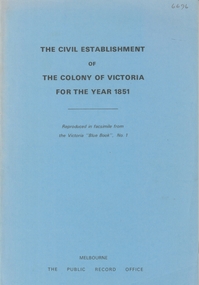
Booklet - The Civil Establishment of the Colony of Victoria for 1851
... This statistical book lists public servants for the colony alphabetically, their role, place of employment, and a page reference to a description of the role can be found. Included positions in the fields of Government officers, Police , penal, judicial medical, ecclesiastical and education. Includes salaries for the various positions. Civil ...Port Phillip was first settled in 1803 and became a part of NSW in 1836. It became it's own governing colony in 1851. This statistical book lists public servants for the colony alphabetically, their role, place of employment, and a page reference to a description of the role can be found. Included positions in the fields of Government officers, Police , penal, judicial medical, ecclesiastical and education. Includes salaries for the various positions.Blue soft cover booklet of 76 pages. Titled 'The Civil Establishment of The Colony of Victoria for the Year 1851' Reproduced in facsimile from the Victoria 'Blue Book, No,1 First published in 1976 by the Public Record Office, Melbourne. Printed by C.H.Rixon, Government Printer, Melbourne civil establishment, victoria 1851 -
 Narre Warren and District Family History Group
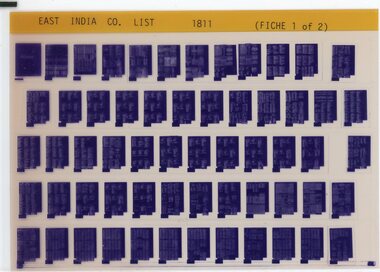
Film, Michael McEvoy, East India Co. List 1811, May 1995
... East-India Company India--Registers Contains complete lists of the Company's servants, civil, military, and marine, at the different presidencies in the East-Indies ; with indexes to the same, and lists of casualties during the last year. ...Contains complete lists of the Company's servants, civil, military, and marine, at the different presidencies in the East-Indies ; with indexes to the same, and lists of casualties during the last year. Also, lists of the Europeans, mariners, &c. not in the service of the East-India Company.Set of 2 microfiche non-fictionContains complete lists of the Company's servants, civil, military, and marine, at the different presidencies in the East-Indies ; with indexes to the same, and lists of casualties during the last year. Also, lists of the Europeans, mariners, &c. not in the service of the East-India Company.east-india company, india--registers -
 Narre Warren and District Family History Group
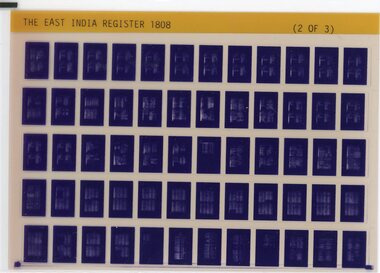
Film, East India Company, East India Register 1808, 1808
... East India Company Great Britain Contains complete lists of the Company's servants, civil, military, and marine, at the different presidencies in the East-Indies ; with indexes to the same, and lists of casualties during the last year. ...Contains complete lists of the Company's servants, civil, military, and marine, at the different presidencies in the East-Indies ; with indexes to the same, and lists of casualties during the last year. Also, lists of the Europeans, mariners, &c. not in the service of the East-India Company. 1808.Set of 3 microfiche non-fictionContains complete lists of the Company's servants, civil, military, and marine, at the different presidencies in the East-Indies ; with indexes to the same, and lists of casualties during the last year. Also, lists of the Europeans, mariners, &c. not in the service of the East-India Company. 1808.east india company, great britain
