
Showing 86 items matching " grant king"
-
 Bendigo Historical Society Inc.
Document - PETER ELLIS COLLECTION: KALIANNA SCHOOL DEBUTANTE BALL, 3rd August, 2007
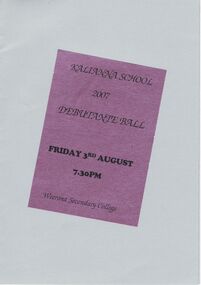
... ... Grant King...Names are: Cr Kevin Gibbons, Debbie Gibbons, Lindy & William Lupo, Alison & Geoff Byron, Leon Scott, Debbie Price, Peter Burch, Cherryl Fyffe, Leon Scott, Emu Creek Band, Rebecca Nelson, Caleb Richardson, Charmaine Scown, Alicia Owen, Jessica Brereton, Nikita Riordan, Laura Semmens, Rebecca Apps, Chloe Gruber, Lauren Hawken, Amanda Anderson, Victoria Jelbart, Rachell Sutherland, Amy Roberts, Sally McMurtrie, Chevonne Strauch, Ben Holmes, Dean Snelson, Zac Flint, Tamati Poindestre, Brandon Kelly, Paul Drinkell, Adrian Brown, Chris Oojges, David Boyce, Josh Rosewall, Michael Semmens, John Wiktorek, Kane Wojcicki, Matthew Mitchell, Hairem Scarem, Grant Rule Menswear, Sean Walsh Photography, Mary Smith (Plant Exhibits), Anne Hastings (Deb Ball Seamstress), Debbie Price, Tracey Wojcicki, Glenys Jelbart, Pam Holmes, Rae Hall, Samantha Wearne, Kylie Salter, Cathy Brew, Judy Richards, Aileen Gilbee, Marie Loch, Noel & Lorna Thomas, Ron & Janette Moss, Tracey & Peter Wojcicki, Val & Neil Cartledge, Warwick Strauch, Kevin Salter, Grant King, Kay Tamblyn and Christine Smith....ENTERTAINMENT Dance ball Peter Ellis Collection Kalianna School Weerona Secondary College Cr Kevin Gibbons Debbie Gibbons Lindy & William Lupo Alison & Geoff Byron Leon Scott Debbie Price Peter Burch Cherryl Fyffe Leon Scott Emu Creek Band Rebecca Nelson Caleb Richardson Charmaine Scown Alicia Owen Jessica Brereton Nikita Riordan Laura Semmens Rebecca Apps Chloe Gruber Lauren Hawken Amanda Anderson Victoria Jelbart Rachell Sutherland Amy Roberts Sally McMurtrie Chevonne Strauch Ben Holmes Dean Snelson Zac Flint Tamati Poindestre Brandon Kelly Paul Drinkell Adrian Brown Chris Oojges David Boyce Josh Rosewall Michael Semmens John Wiktorek Kane Wojcicki Matthew Mitchell Hairem Scarem Grant Rule Menswear Sean Walsh Photography Mary Smith (Plant Exhibits) Anne Hastings (Deb Ball Seamstress) Debbie Price Tracey Wojcicki Glenys Jelbart Pam Holmes Rae Hall Samantha Wearne Kylie Salter Cathy Brew Judy Richards Aileen Gilbee Marie Loch Noel & Lorna Thomas Ron & Janette Moss Tracey & Peter Wojcicki Val & Neil Cartledge Warwick Strauch Kevin Salter Grant King Kay Tamblyn Christine Smith Weerona Secondary College Program for the Kalianna School Debutante Ball held on Friday 3rd August 2007 at the Weerona Secondary College. ...Program for the Kalianna School Debutante Ball held on Friday 3rd August 2007 at the Weerona Secondary College. Program is light grey with a purple sticker on an angle with the name on it. On white paper on the inside is the names of the debutantes and their partners and who they were presented to, Master of Ceremonies & Deb Set Co-ordinator, Chaperones, Compares, Music by Emu Creek Band, Flower Girl and Page Boy. Pasted on the back is a matching grey card thanking businesses and people who helped. Names are: Cr Kevin Gibbons, Debbie Gibbons, Lindy & William Lupo, Alison & Geoff Byron, Leon Scott, Debbie Price, Peter Burch, Cherryl Fyffe, Leon Scott, Emu Creek Band, Rebecca Nelson, Caleb Richardson, Charmaine Scown, Alicia Owen, Jessica Brereton, Nikita Riordan, Laura Semmens, Rebecca Apps, Chloe Gruber, Lauren Hawken, Amanda Anderson, Victoria Jelbart, Rachell Sutherland, Amy Roberts, Sally McMurtrie, Chevonne Strauch, Ben Holmes, Dean Snelson, Zac Flint, Tamati Poindestre, Brandon Kelly, Paul Drinkell, Adrian Brown, Chris Oojges, David Boyce, Josh Rosewall, Michael Semmens, John Wiktorek, Kane Wojcicki, Matthew Mitchell, Hairem Scarem, Grant Rule Menswear, Sean Walsh Photography, Mary Smith (Plant Exhibits), Anne Hastings (Deb Ball Seamstress), Debbie Price, Tracey Wojcicki, Glenys Jelbart, Pam Holmes, Rae Hall, Samantha Wearne, Kylie Salter, Cathy Brew, Judy Richards, Aileen Gilbee, Marie Loch, Noel & Lorna Thomas, Ron & Janette Moss, Tracey & Peter Wojcicki, Val & Neil Cartledge, Warwick Strauch, Kevin Salter, Grant King, Kay Tamblyn and Christine Smith.Weerona Secondary Collegeentertainment, dance, ball, peter ellis collection, kalianna school, weerona secondary college, cr kevin gibbons, debbie gibbons, lindy & william lupo, alison & geoff byron, leon scott, debbie price, peter burch, cherryl fyffe, leon scott, emu creek band, rebecca nelson, caleb richardson, charmaine scown, alicia owen, jessica brereton, nikita riordan, laura semmens, rebecca apps, chloe gruber, lauren hawken, amanda anderson, victoria jelbart, rachell sutherland, amy roberts, sally mcmurtrie, chevonne strauch, ben holmes, dean snelson, zac flint, tamati poindestre, brandon kelly, paul drinkell, adrian brown, chris oojges, david boyce, josh rosewall, michael semmens, john wiktorek, kane wojcicki, matthew mitchell, hairem scarem, grant rule menswear, sean walsh photography, mary smith (plant exhibits), anne hastings (deb ball seamstress), debbie price, tracey wojcicki, glenys jelbart, pam holmes, rae hall, samantha wearne, kylie salter, cathy brew, judy richards, aileen gilbee, marie loch, noel & lorna thomas, ron & janette moss, tracey & peter wojcicki, val & neil cartledge, warwick strauch, kevin salter, grant king, kay tamblyn, christine smith -
 Whitehorse Historical Society Inc.
Letter - Correspondence, Letter regarding Silver Jubilee medal, 29/04/1935
... Letter from Government House to Herbert Thomas Bishop informing him that the King has granted him a medal in commemoration of the 25th anniversary of his accession to the throne....Bishop Herbert Thomas Governors Medals Letter from Government House to Herbert Thomas Bishop informing him that the King has granted him a medal in commemoration of the 25th anniversary of his accession to the throne. ...Letter from Government House to Herbert Thomas Bishop informing him that the King has granted him a medal in commemoration of the 25th anniversary of his accession to the throne.bishop, herbert thomas, governors, medals -
 Vision Australia
Badge - Object, 1934 Melbourne University examination badge, 1934
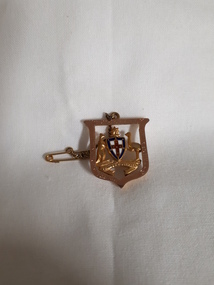
... Inset into the shield is an Australian coat-of-arms granted by King George V, with a white and blue torse supported by a kangaroo and emu on a grassy field. ...Inset into the shield is an Australian coat-of-arms granted by King George V, with a white and blue torse supported by a kangaroo and emu on a grassy field. ...Hugh Jeffrey attended the Melbourne Conservatorium of Music at Melbourne University, graduating in 1940. This examination pin was given to him in September 1934. It is a copper badge with its frame shaped like a shield. Inset into the shield is an Australian coat-of-arms granted by King George V, with a white and blue torse supported by a kangaroo and emu on a grassy field. It features the Commonwealth Star on top, and the motto "Advance Australia" underneath. It is engraved with "Hugh Jeffrey" acoss the top, with "University Exam" on the left of the outlying shield, and "Sept. 1934" on the right. It features a loop on the top with a short fine chain and safety pin. Shield with Australian coat of arms and engraved writingAdvance Australia Hugh Jeffrey University Exam Sept. 1934hugh jeffrey, badges -
 Vision Australia
Badge - Object, 1933 Melbourne University examination badge, 1933
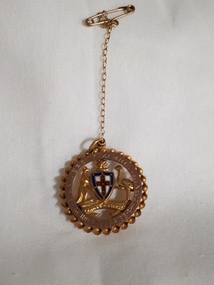
... Inset into the shield is an Australian coat-of-arms granted by King George V, with a white and blue torse supported by a kangaroo and emu on a grassy field. ...Inset into the shield is an Australian coat-of-arms granted by King George V, with a white and blue torse supported by a kangaroo and emu on a grassy field. ...Hugh Jeffrey attended the Melbourne Conservatorium of Music at Melbourne University, graduating in 1940. This examination pin was given to him in September 1933. It is a round copper badge with gold coloured filigree running around the outer edge. Inset into the shield is an Australian coat-of-arms granted by King George V, with a white and blue torse supported by a kangaroo and emu on a grassy field. It features the Commonwealth Star on top, and the motto "Advance Australia" underneath. It is engraved with "University Examination" acoss the top, with "won by Hugh Jeffries sic Sept. 1933" acoss the bottom. It features a loop on the top with a short fine chain and safety pin. Australia coat of arms inside circle with engraving around edgeAdvance Australia University Exam won by Hugh Jeffries (sic) Sept. 1933hugh jeffrey, badges -
Bendigo Historical Society Inc.
Document - ANZAC MEMORIAL SERVICE, 25 April, 1922
... God who rulest over Thy people in love, we beseech Thee to bless Thy Servant, our King, that under him this nation may be wisely governed, and Thy Church may serve Thee in all godly quietness, Grant that the King, the Prince, and the people, being devoted to these with all their hearts, and preserving in good works to the end, may, by Thy guidance, come to Thine everlasting Kingdom, through Jesus Christ our Lord. ...God who rulest over Thy people in love, we beseech Thee to bless Thy Servant, our King, that under him this nation may be wisely governed, and Thy Church may serve Thee in all godly quietness, Grant that the King, the Prince, and the people, being devoted to these with all their hearts, and preserving in good works to the end, may, by Thy guidance, come to Thine everlasting Kingdom, through Jesus Christ our Lord. ...Anzac Memorial Service. Lest We Forget. Upper Reserve, Bendigo. Tuesday, April, 25, 1922.At 3 o'clock. Order of Service April 25, 1922. His Worship the Mayor (Cr. J E Holland) presiding. 1. Invocation and Lord's Prayer, Rev W Bennett. (President of Ministers Association) 2. National Anthem 3. Prayer for the King, Queen, and the Royal Family Rev. L W Lee. O! God who rulest over Thy people in love, we beseech Thee to bless Thy Servant, our King, that under him this nation may be wisely governed, and Thy Church may serve Thee in all godly quietness, Grant that the King, the Prince, and the people, being devoted to these with all their hearts, and preserving in good works to the end, may, by Thy guidance, come to Thine everlasting Kingdom, through Jesus Christ our Lord. Amen. 4. Hymn- 'All people that on Earth do Dwell' All people that on earth do dwell, Sing to the Lord with cheerful voice. Him serve with mirth, His praise forth tell, Come ye before Him and rejoice. Know that the Lord is God indeed; Without ou aid He did us make; We are His flock; He doth us feed. And for His sheep He doth us take. O enter then His gates with praise, Approach with joy His courts unto; Praise, laud and bless His name always, For it is seemly so to do. For why! The Lord our God is good, His mercy is for ever sure; His truth at all times firmly stood, And shall from age to age endure. 5. Prayers Rev W J Holt. Almighty God, who hast tought us in Thy Holy Word to perpetuate the memory of brave men and great deliverance, give to this nation grace not to forget the men who died for their fellow men; keep, we beseech thee, their memory fresh and green in the hearts of Thy people, and make us more worthy of the sacrafices they offered for us, through Jesus Christ our Lord. Amen. O! Merciful and Loving Father Who dost not willinglu afflict the children of men, but chasten tem for their profit, have mercy upon Thy bereaved and sorrowing servants who mourn for those they have lost in battle (especially those for whom our [rayers are asled). And as Thou dost sanctity muman love and felloship here upon earth, so grant them and us a happy re-union with those whom we love in Thy eternal peace and joy; throught Jesus Christ our Lord. Amen 6. Scripture Lesson- Rev. S E Doman 7. 1st Address- The Very Rev. The Dean of Bendigo 8. Presentation of Medals 9. Hymn- Kipling's Recessional. God of our fathers, known of old, Lord of the far-flung battle line, Beneath whose awful hand we hold Dominion over palm and pine- Lord God of hosts, be with us yet, Lest we forget-lest we forget! Far-called, our navies melt away, On dune and headland sinks the fire; Lo, all our pomp of yesterday. Is one with Nineveh and Tyre Judge of the nations, spare us yet, Lest we forget- - lest we forget. If, drunk with sight of power, we loose Wild tongues, that have not Thee in awe Still boasting, as the Gentiles use, Or lesser breeds, without the Law- Lord God of hosts, lest we forget! For heathen heart that puts her trust In reeking tube and iron shard, All valiant dust that builds on dust, And guarding, calls not Thee to to guard, For frantic boast and foolish word, Thy mercy on Thy people, Lord! 10. Address Rev. B W Heath. 11. General Thanksgiving Ven. Archdeacon Haynes. Almighty God, Father of all mercies! We, Thine unworthy servants, do give Thee most humble and hearty thanks for all Thy goodness and loving kindness to us, and to all men. We bless Thee for out creation, preservation, and all the blessings of this life; but, above all, for Thine inestimale love in the redemption of the world by our Lord Jesus Christ; for the means of grace, and for the hope and the glory. And, we beseech Thee, give us that due sense of all Thy mercies, that our hearts may be unfeignedly thankful, and that we show forth Thy praise, not onlu with our lips, but with our lives; by giving up purselves to Thy sevice, and by walking before Thee in holiness and righteousness all our days; thriough Jesus Christ our Lord; to Whom with Thee and the Holy Spirit ba all honour and glory, world without end. Amen. 12. Nearer My God to Thee. Mearer my God to Thee, Mearer to Thee; E'en though it be a cross That raiseth me; Still all my song shall be. Nearer, my God, to Thee, Nearer to Thee. Though like the wanderer, The sun gone down, Darkness comes over me, My rest a stone, Yet in my dreams I'd be Nearer my God to Thee, Nearer to Thee. There let my may way appear Steps unto Heav'n, All that thou sendest me In mercy given. Angels to beckon me Nearer, my God, to Thee, Nearer to Thee. Then, with my waking thoughts, Bright with Thy Praise, Out of my stony griefs Berhel I'll raise; So by my woes to be Nearer to Thee. Amen. 13. Last Post. Everybody is requested to rise and stand revernt in memory of our illustrious dead. 14. Benediction. The singing will be led by the Children from the State Schools.Cambridge Pres, Print, Bendigoevent, official, anzac memorial service, anzac memorial service. lest we forget. upper reserve, bendigo. tuesday, april, 25, 1922.at 3 o'clock. order of service april 25, 1922. his worship the mayor (cr. j e holland) presiding. 1. invocation and lord's prayer, rev w bennett. (president of ministers association) 2. national anthem 3. prayer for the king, queen, and the royal family rev. l w lee. 4. hymn- 'all people that on earth do dwell' 5. prayers rev w j holt. 6. scripture lesson- rev. s e doman 7. 1st address- the very rev. the dean of bendigo 8. presentation of medals 9. hymn- kipling's recessional. 10. address rev. b w heath. 11. general thanksgiving ven. archdeacon haynes. 12. nearer my god to thee. 13. last post. everybody is requested to rise and stand revernt in memory of our illustrious dead. 14. benediction. the singing will be led by the children from the state schools. -
 Federation University Historical Collection
Photograph - Poster, University of Ballarat Manufacturing Technology Training Centre poster signed by Prime Minister Julia Gillard, 07/10/2011 (approx 11.15am)
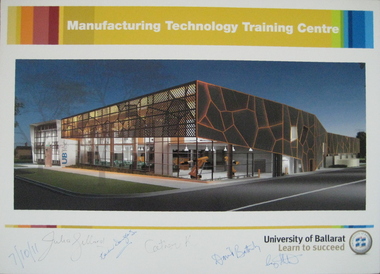
... king...ubtec...karen douglas...manufacturing technology training centre...grant...The poster was signed on Friday 7 October 2011 at about 11:15 am at the Building Construction Training Centre (BCTC), Grant Street, Ballarat by: Hon. Julia Gillard MP Hon. Catherine King MP (Ballarat ) Prof. ...Funding for the UBTec component of the building is provided by Maintaining the Advantage: Skilled Victorians from the Victorian State Government. university of ballarat david battersby julia gillard prime minister catherine king ubtec karen douglas manufacturing technology training centre grant street architecural feature The poster is signed by the Prime Minister of Australia, the Hon. ...The new Manufacturing Technology Training Centre (MTTC), a part of the proposed Building Construction Training Centre (BCTC), will be a purpose-built, stand-alone, fully fitted-out industry-standard facility. This new space will accommodate current course provision along with specialist training spaces for developing skill requirements in manufacturing technology such as robotics, mechatronics, engineering and industrial automation. Project funding was provided by the Education Investment Fund from the Australian Government Department of Education, Employment and Workplace Relations. The project budget is $18.09m, and the resulting building will have a floor space of 4,755m2. The Manufacturing Technology Training Centre is being built in conjunction with the Technical Education Centre (UBTec). While the buildings will have separate street identities the buildings will be joined with shared amenities areas. UBTec will provide a facility including individual learning spaces, learning studios, administration/office space, circulation, open plan learning space, staff common areas, computer rooms, meeting rooms, staff work areas and kitchen areas as well as car parking and site-wide amenities. While the buildings will have separate street identities the buildings will be joined with shared amenities areas. Funding for the UBTec component of the building is provided by Maintaining the Advantage: Skilled Victorians from the Victorian State Government. A colour poster prepared for the 'turning of the sod' at the site of the proposed University of Ballarat Manufacturing Technology Training Centre (MTTC), Grant Street, Ballarat. The poster was signed on Friday 7 October 2011 at about 11:15 am at the Building Construction Training Centre (BCTC), Grant Street, Ballarat by: Hon. Julia Gillard MP Hon. Catherine King MP (Ballarat ) Prof. David Battersby, Vice Chancellor, University of Ballarat Mayor, Cr Craig Fletcher, Mayor of the City of Ballarat appointed in December 2010 Mrs. Karen Douglas, Chair University of Ballarat Building & Infrastructure Committee The poster is signed by the Prime Minister of Australia, the Hon. Julia Gillard MP; Karen Douglas; the Hon. Catherine King MP (Ballarat ); Prof. David Battersby (Vice Chancellor); Craig Fletcher (Mayor, City of Ballarat)university of ballarat, david battersby, julia gillard, prime minister, catherine king, ubtec, karen douglas, manufacturing technology training centre, grant street, architecural feature -
 Federation University Historical Collection
Booklet - Magazines, Ballarat School of Mines Magazine, 1924-1930, 1924-1930
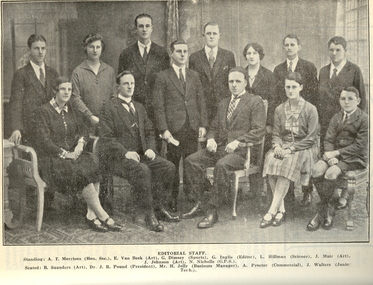
... king...c. marks and co....wilson's tailors and mercers...george s. grant...King, C. Marks and Co., Wilson's Tailors and Mercers, George S. Grant, Miss A. ...King, C. Marks and Co., Wilson's Tailors and Mercers, George S. Grant, Miss A. ...The Ballarat School of Mines is a predecessor institution of Federation University Australia. Bound copies of the Ballarat School or Mines Students' Magazine. 1924 * Dr J.R. Pound * Noel Hay Obituary * The History of Chemistry * Literary Society * Herald B. Herbert * Chemistry in Modern Life by Val G. Anderson * Chemistry in Literature by J.R. Pound * School Literary Society * Ladies in Pharmacy * Musings on Modern Literature - Mainly Drama (W.G. C.) * Trip to Newcastle * Appreciation of the Masterpieces of Art * The Antique Room * Dressmaking * Pottery * Sloyd * The Mystery of the Atom *Inorganic Evolution by R.S. Russell * Photography * First Aid Club 1926 * The Trip to Morwell * Chemical Excursions (Yallourn) * Eastern Life and Customs by Rex Warrillow * Organic Evolution by Edwin A. Brophy * Chemistry in the Kitchen * Obituary for Professor Alfred Mica Smith * The Historical Development of Patterns i Silk Fabrics * Pottery * Literary Society * Early Evidence of Metallurgy in Britain * Brief Description of the Magnet Silver Mine, Tasmania * The manufacture of Leather Photographs * SMB Athletics Team, winners of the Herald Shield (M. Timmings, L. Evans, F. Sheahan, R. Collins, A. Murfett, W. Hughes, L. Hillman * SMB Football Team * Ballarat Technical Art School Tennis Four * SMB Girls' Basketball Team * SMB GIrls Hockey Team * Ballarat Junior Technical School Scholarship and Studentship Winners * On Punctuation Advertisements: Sunshine Biscuits, Harris Powell and Sandford, W. Gribble & Co., Gilbert Motors, T.J. Haymes The Wallpaper King, C. Marks and Co., Wilson's Tailors and Mercers, George S. Grant, Miss A. Corin Art Worker, Tunbridges, Felton, Grimwade & Co., Hasten and Ewins, Ballarat Wireless Stores, Fred A. Reed, Suttons, E. Hall-Jones, Stansfield and Smith, Ballarat Gas Company, Richards and Co Studio, F.H. Drew, Adam Scott, R.A. Hudson, Huttons, J.A. Holland, A.E. White, F. Barrow Monumental Sculptor, R. Young, H.A. Evans, Alexandria Tea Rooms, W. Cornell Chemist, Black Cat Tea Rooms, J.A. Reynolds, A.M. Palmer, Morris Cars and Trucks, Mrs Stones, Millers The Clothiers, T.G. Skewes, Wattle TEa Rooms, H.B. Selby, Middleton and Morris, C.P.A. Taylor, Thornton Studios, Fred Irwin, Isaac Abraham, Ballarat Radio Listening-In, Baxter and Stubbs 1927 * Chemists Trip to Melbourne (Mount Lyell Chemical Works, Footscray, Yarraville * Literary Society * Mr J.N. Rowell 1928 * Prohibition in U.S.A. by Ed A. Brophy * Dr. J.W. Mellor and His Work at Stoke, England by Reginald C. Callister * The Science of Chemistry by C.A. Schache * Trip to Yallourn (Brown Coal Deposits, Steam Plant at Yallourn, Switchgear and Transformers, Briquette Factory * Walhalla Past and Present by G.E.B. * The Hand Loom * Precious Stones 1929 * The Old Brewery * The History of Chemistry by J.R. Pound * Occurrence of Mineral Oil in Gippsland * Experiences with Malayan Chinese by R. Warrillow * Organise Colors (Dyestuff Pigments) in Rubber Goods 1930 * News from Chine by Henry Kum Yuen * L'Art Moderne * The Story of Clay by T.H. Trengrove * A Glimpse of England * The Beginnings of Arithmeticballarat school of mines, pottery, ceramics, reginald callister, metallurgy, chemistry, j. pound, alfred mica smith, herald shield, harold herbert, lindsay hillman, john rowell, j.r. pound, noel hay, drawing from antique, yallourn excusion, walhalla, sunshine biscuits, harris powell and sandford, w. gribble & co., gilbert motors, t.j. haymes, the wallpaper king, c. marks and co., wilson's tailors and mercers, george s. grant, miss a. corin art worker, tunbridges, felton, grimwade & co., hasten and ewins, ballarat wireless stores, fred a. reed, suttons, e. hall-jones, stansfield and smith, ballarat gas company, richards and co studio, r.a. hudson, huttons, j.a. holland, a.e. white, f. barrow monumental sculptor, r. young, h.a. evans, alexandria tea rooms, w. cornell chemist, black cat tea rooms, j.a. reynolds, a.m. palmer, morris cars and trucks, mrs stones, millers the clothiers, t.g. skewes, wattle tea rooms, h.b. selby, middleton and morris, c.p.a. taylor, thornton studios, fred irwin, isaac abraham, ballarat radio listening-in, baxter and stubbs, mount lyell chemical works, footscray, c.a. schache, yallourn briquette factory, t.h. trengrove, history of chemistry, excursions, morwell, morwell excursion, women in pharmacy, mt lyall, excursion, slloyd, drawing from the antique, james pound, yallourn, yallourn excursion, ballarat arch of victory, mt macedon, f.h. drew, adam scott, university women -
 Gippsland Vehicle Collection
Vehicle Tail Light, 1940 (estimated)
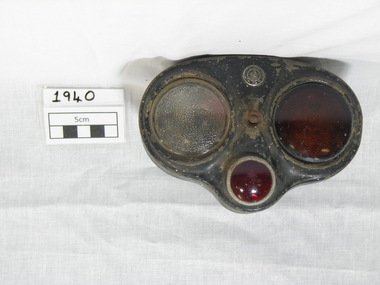
... Lucas granted Richards Body Builders of Adelaide, Australia, permission to use the phrase 'King of the Road' as their trade nick name. tail light stop light light tail king of the road light number plate light King of the Road maker's mark Kidney shaped metal & glass, four lens number-plate & tail light combination Vehicle Tail Light Lucas Electrical ...Lucas Electrical manufactured light and electrical components for many vehicle manufacturers in England and many manufacturers used them as accessories or added extras.Lucas granted Richards Body Builders of Adelaide, Australia, permission to use the phrase 'King of the Road' as their trade nick name.Kidney shaped metal & glass, four lens number-plate & tail light combinationKing of the Road maker's marktail light, stop light, light tail, king of the road light, number plate light -
Federation University Historical Collection
Booklet, Ballarat School of Mines Student's Magazine, First Term, 1903, 1903
... grant...oliver jager...j. e. o'dwyer...h. j. saw...j. l. vetter...t. lennon...c. king...Dirge, Students' Association annual meeting, News and notes, New students, Past students, The annual sports, Cricket, Football, Answers to correspondents, Editorial notes. ballarat school of mines students' magazine bill cairncross lew westcott kerr grant oliver jager j. e. o'dwyer h. j. saw j. l. vetter t. lennon c. king a. c. officer j. glasgow p. davies w. figgis j. f. anderson r. e. cowles d. l. thomas s. g. turrell w. hicks c. j. reid w mccready n. s. stuckey l. mitchell d. t. thomas e. h. best h. owen h. eklund j. judd alex fraser w. brokenshire syd adamson arthur coyte h. couturier archie hay w. brinsden w. herman d. deane h. leggo w. white w. meldrum f. dalton j. hill p. e. marmion w. parramore d. ryan a. l. n. walters t. uthwatt v. a. nicol a. f. gillespie f. c. futter h. alston j. philbin d. t. elder r. c. mccracken Pale brown booklet of 20 pages Ballarat School of Mines Student's Magazine, First Term, 1903 Booklet Berry Anderson & Co. ...Table of contents: Editorial, The analysis of Portland cement, Copper smelting in Western America, Notes of travel in Central Africa, Aboriginal research, The conservation of matter, A bit of Australian history, Trip to Ascot, S.M.B. Dirge, Students' Association annual meeting, News and notes, New students, Past students, The annual sports, Cricket, Football, Answers to correspondents, Editorial notes.Pale brown booklet of 20 pagesballarat school of mines, students' magazine, bill cairncross, lew westcott, kerr grant, oliver jager, j. e. o'dwyer, h. j. saw, j. l. vetter, t. lennon, c. king, a. c. officer, j. glasgow, p. davies, w. figgis, j. f. anderson, r. e. cowles, d. l. thomas, s. g. turrell, w. hicks, c. j. reid, w mccready, n. s. stuckey, l. mitchell, d. t. thomas, e. h. best, h. owen, h. eklund, j. judd, alex fraser, w. brokenshire, syd adamson, arthur coyte, h. couturier, archie hay, w. brinsden, w. herman, d. deane, h. leggo, w. white, w. meldrum, f. dalton, j. hill, p. e. marmion, w. parramore, d. ryan, a. l. n. walters, t. uthwatt, v. a. nicol, a. f. gillespie, f. c. futter, h. alston, j. philbin, d. t. elder, r. c. mccracken -
 Federation University Historical Collection
Plan, Ballarat East, 1957, 1957
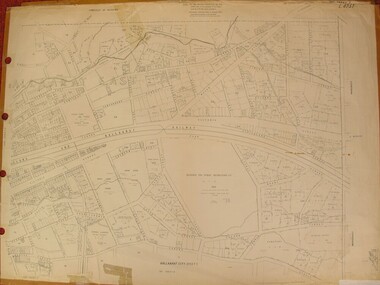
... King Street, Gray Street, Little Dodds Street, Eureka Street. Sheet 9 - Richards Street, Fussell Street, Stockade Street, Orphan Asylum, Ballarat Orphanage, Elford Street, Russell Street, Ross Street, Charlesworth Street, Lalor Street, Stockade Street, Wilson Street, York Street, Eureka Street Sheet 10 - Eureka Street, York Street, Elford Street, Wilson Street, Mount Street, Turpie Street, Timber Reserve, Mount Xavier Sheet 11 - Yarrowee Creek, Humffray Street, Barkly Street, Morton Street, Cobden Street, Morton Street Wesleyan Church, Pryor Street, Albion Street, Bradshaw Street, Ballarat Woollen Mills, Tannery, Mount Pleasant. Sheet 12 - Magpie Street, Grant...King Street, Gray Street, Little Dodds Street, Eureka Street. Sheet 9 - Richards Street, Fussell Street, Stockade Street, Orphan Asylum, Ballarat Orphanage, Elford Street, Russell Street, Ross Street, Charlesworth Street, Lalor Street, Stockade Street, Wilson Street, York Street, Eureka Street Sheet 10 - Eureka Street, York Street, Elford Street, Wilson Street, Mount Street, Turpie Street, Timber Reserve, Mount Xavier Sheet 11 - Yarrowee Creek, Humffray Street, Barkly Street, Morton Street, Cobden Street, Morton Street Wesleyan Church, Pryor Street, Albion Street, Bradshaw Street, Ballarat Woollen Mills, Tannery, Mount Pleasant. Sheet 12 - Magpie Street, Grant ...Dr George Clendinning and others were trustees of the Church of England (St Paul's) A number of enlargements of the Ballarat East maps. .4) Bakery Hill, Humffray Street, Victoria Street, Ballarat Youth Council .5) Specimen Vale, Victoria Street, Eureka Street, Housing Commission .10) - Tomber Reserve, York Street, Spencer Street, Bennett Street, Wilson Street, Rodier Street, Richard Street, Fussell Street, Turpie Street, Stockade Street, Ballarat Rifle Range Lal La Street, Clayton Street, Eureka Street Sheet 2 - Yarrowee Creek, High Street, Dinney's Dam, Binney Street, Oliver Street, Humffray Street, Morres Street, Finch Street, Scotts Parade, Rice Street, HOrnby Street, Queen Street, Newman street, King Street, Napier Street, Sim Street. Sheet 3 - Russell Square, Victoria Street, Orphan Asylum, Ballarat Orphanage, Lofven Street, Haines Street, Yarrowee Creek, Ching Who Coey, Chinese, Stawell Street, Rice Street, Lane Street, Humffray Street, Nelson Street, Coffield Street, Morres Street, Western Highway, Rodier Street, Scott Parade, Canterbury Street Sheet 4 - Orphan Asylum, Ballarat Orphanage School, Fortune Street, Scotts Parade, Water Street, Ritchie Street, Humffray Street, Brophy Street, Thompson Street, Victoria Street,Humffray Street Church of England Reserve, Strickland Parade. Mount Xavier Recreation Reserve, Charlesworth Street Catholic Church Reserve. Sheet 5 - Western Highway, Mount Street, Fortune Street, Finlay Street, Jones Street, Ryan Street, Water Street, Brandbury Street, Humffray Street. Sheet 6 - Barkly Street, Ebden Street, Grenville Street, Cameron Street, Peel Street, Young Street, Victoria Street, Steinfeld Street, Haymes Street, Bond Street, Anderson Street, Eastwood Street, Mair Street, East Street, Haymes Crescent Sheet 7 - Murphy Street, Queen Street, Dyte Parade, Princes Street, Midland Highway, York Street, Dodds St, Wilson St Otway Street, Specimen vale, King Street, Gray Street, Little Dodds Street, Eureka Street. Sheet 9 - Richards Street, Fussell Street, Stockade Street, Orphan Asylum, Ballarat Orphanage, Elford Street, Russell Street, Ross Street, Charlesworth Street, Lalor Street, Stockade Street, Wilson Street, York Street, Eureka Street Sheet 10 - Eureka Street, York Street, Elford Street, Wilson Street, Mount Street, Turpie Street, Timber Reserve, Mount Xavier Sheet 11 - Yarrowee Creek, Humffray Street, Barkly Street, Morton Street, Cobden Street, Morton Street Wesleyan Church, Pryor Street, Albion Street, Bradshaw Street, Ballarat Woollen Mills, Tannery, Mount Pleasant. Sheet 12 - Magpie Street, Grant Street, Gladstone Street, Cobden Street, Fraser Street, Grenfell Street, Robertson Street, Bond Street, Barkly Street, Vine Street, Sovereign Hill, Ballarat Observatory, Pearce Street, Bond Street. Sheet 13 - Murphy Street, Larter Street, midland Highway, Geelong Road, gales Street, Lal Lal Street, Clayton Street, Dodds Street, Elsworth Street Sheet 14 - Eureka Street, Eureka Stockade Memorial Park, Eureka Stockade Reserve. York Street, Joseph Street, Kline Street, Charlesworth Street, Chamberlain Street, Trevor Street, Belford Street, Queen Street, Murray Street, Eureka Tiles, Orphan Asylum, Ballarat Orphanage. Sheet 18 - Scotts Parade, Stawell Street, Fortune Street, Victoria STreet, Railway Line, Haines Street, Eureka Street, Elford STreet, Brophy Street, York Street, Clayton Street, Elsworth Street, Barkly Street, Humffray Street, Midland Highway, Princes Street ballarat youth council, ballarat east, bakery hill, humffray street, victoria street, st paul's anglican church, humffray street state school -
 Federation University Historical Collection
Book, Ballarat School of Mines Council Minute Book, 1949-1956, 16/11/1949 - 04/10/1956
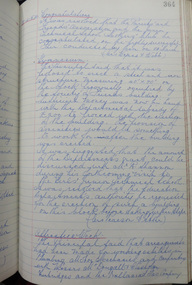
... king...w. murton...f. ritchie...j. turnbull...j.r. allsop...david morris...w.j. paterson...john peyton...william sadler...mrs connors...corbould...a. causland...w.w. leggatt...b.d. ngip...l.k. o'down...r. rowlands...j.a. strange...l. wilson...harry brew...h.l. coburn...i.r. gordon...b.m. hearn...john miles...h.a. patterson...ballarat school of mines gymnasium...corbould recreation hall...polio...poliomyelitis...a.j. andrewartha...pandemic...a.w. lynch...123 grant...The Ballarat School of Mines was the first technical school in Australasia. ballarat school of mines ballarat school of mines council minutes ballarat school of mines finance committee ballarat school of mines christian education chaplaincy dr james stewart g. baragwanath g.w. barrell v. belikov g.w. cornell r.m. cutter h. edwards arthur gouday j.e. hewitt d. kellock h.h. kerr l. lederman d. mullins a.m. praetz kevin white s.e. williams c.m. chisholm n.f. dewsnap f.a. farr r.p. flower l. garner douglas r. mills f.g. proctor a.j. andreartha b. bryan d. cotton d. duggan hans fumberger v.c. jones j.r. lyall e.g. savage geoffrey f. stevens albert watts k.c. webb william baragwanath ronald g. barylyn c.m. king w. murton f. ritchie j. turnbull j.r. allsop david morris w.j. paterson john peyton william sadler mrs connors corbould a. causland w.w. leggatt b.d. ngip l.k. o'down r. rowlands j.a. strange l. wilson harry brew h.l. coburn i.r. gordon b.m. hearn john miles h.a. patterson ballarat school of mines gymnasium corbould recreation hall polio poliomyelitis a.j. andrewartha pandemic a.w. lynch 123 grant Street Ballarat .1) Hard green covered book with part leather binding. ...The Ballarat School of Mines was the first technical school in Australasia..1) Hard green covered book with part leather binding. Finance Committee, Council and one Christian Education (or chaplaincy) on sub-committee minutes Dr James Stewart, 1950, pp. 64, 138, 160 G. Baragwanath, carpenter, 1950 G.W. Barrell, 1950, p. 24 V. Belikov, 1950, p. 35 G.W. Cornell, 1950, pp. 37, 44, 78 R.M. Cutter, 1950 H. Edwards, 1950, pp. 14, 15 Arthur Gouday, 1950, p. 29 J.E. Hewitt, 1950, p. 119 D. Kellock, 1950, p. 117 H.H. Kerr, 1950, p. 74 L. Lederman, 1950, obituary, pp. 19, 28 A,W, Lynch, 1950, p. 24 D. Mullins (plumbing), 1950, pp 44, 78 A.M. Praetz, 1950, p. 95 Kevin White, 1950, p. 75 S.E. Williams, 1950 C.M. Chisholm, 1951 N.F. Dewsnap, 1951 F.A. Farr, 1951 R.P. Flower, 1951, p173 L. Garner, 1951, p128 Douglas R. Mills, 1951, p182 F.G. Proctor, 1951 A.J. Andreartha, 1952 B. Bryan, 1952 D. Cotton, 1952 D. Duggan, 1952 Hans Fumberger, 1952, p260, 287 V.C. Jones, 1952, p248 J.R. Lyall, 1952, p206 E.G. Savage, 1952, p228 Geoffrey F. Stevens, 1952 Albert Watts, 1952, p260 K.C. Webb, 1952, p248 Neon Signs, 1953, p310 William Baragwanath, 1953, p324 Ronald G. Barlyn, 1953, p314 C.M. King, 1953, p272 W. Murton, 1953, p340 F. Ritchie, 1953, p303 J. Turnbull, 1953, p274 J.R. Allsop, 1954 David Morris, 1954, p350 W.J. Paterson, 1954, p424 John Peyton, 1954, p348 William Sadler, 1954, p352 Mrs Connors, 1955 Corbould, 1955, p497, 503, 514, 521, 550 A. Causland, 1955, p507 W.W. Leggatt, 1955, p504 B.D. Ngip, 1955, p462 L.K. O'Down, 1955, p460 R. Rowlands, 1955, p508 J.A. Strange, 1955, p501 L. Wilson, 1955, p459 Harry Brew, 1956, p516 H.L. Coburn, 1956, p571 I.R. Gordon, 1956, p541 B.M. Hearn, 1956, p 550 John Miles, 1956, p571 H.A. Patterson, 1956, p553 Ballarat School of Mines Proposed Gymnasium (Corbould Recreation Hall) 364, 403, 445, 452, 458, 523, 531, 540 Ballarat School of Mines Museum, 1950, p38, 105, 112; Aboriginal Relics, P566 poliomyelitis, 1952 Ballarat School of Mines Agrostology, 1952, p242, 312, 360, 362, 370 Ballarat School of Mines Neon Sign, 1953 Ballarat School of Mines Basketball site, 1953 Hickman Street, Ballarat, Deviation near White Flat, 1954 Ballarat School of Mines Bicycle sheds, 1954 Ballarat Technical School, Norman Street, Ballarat, 1954 Ballarat North Technical School, 1956, p521 Ballarat School of Mines Christian Education, 1956, p569 Blacksmithing, 1956, p523 Ballarat School of Mines Museum Future, 1956, p526, 535, 536, 542, 561, 568 Ballarat School of Mines War Museum, 1956, p516, 542 Fossils, 1955, p462 123 grant Street purchase, 1956, p546 model Farm Smith gift, 1956, p561 Shearing, 1955, p504 Repatriation Students, 1856, p 555 .2) Typed and handwritten documents in plastic envelope at back of book on sundry topics.ballarat school of mines, ballarat school of mines council minutes, ballarat school of mines finance committee, ballarat school of mines christian education, chaplaincy, dr james stewart, g. baragwanath, g.w. barrell, v. belikov, g.w. cornell, r.m. cutter, h. edwards, arthur gouday, j.e. hewitt, d. kellock, h.h. kerr, l. lederman, d. mullins, a.m. praetz, kevin white, s.e. williams, c.m. chisholm, n.f. dewsnap, f.a. farr, r.p. flower, l. garner, douglas r. mills, f.g. proctor, a.j. andreartha, b. bryan, d. cotton, d. duggan, hans fumberger, v.c. jones, j.r. lyall, e.g. savage, geoffrey f. stevens, albert watts, k.c. webb, william baragwanath, ronald g. barylyn, c.m. king, w. murton, f. ritchie, j. turnbull, j.r. allsop, david morris, w.j. paterson, john peyton, william sadler, mrs connors, corbould, a. causland, w.w. leggatt, b.d. ngip, l.k. o'down, r. rowlands, j.a. strange, l. wilson, harry brew, h.l. coburn, i.r. gordon, b.m. hearn, john miles, h.a. patterson, ballarat school of mines gymnasium, corbould recreation hall, polio, poliomyelitis, a.j. andrewartha, pandemic, a.w. lynch, 123 grant street ballarat -
 Federation University Historical Collection
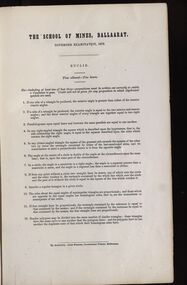
Document - Exams, Certificates Granted by the Council of the Ballarat School of Mines, Ballarat (and examination papers), 1872, 1873
... The Ballarat School of Mines was established in 1870 and was the first site of technical education in Australasia. john ditchburn john o'malley john thomson mckenna george samuel gawler wiliam henry keast george james donald mcgregor george kidd jachin gordon illingworth john king josiah curnow john james patterson john bailey bullen john trevan thomas james patrick mcloughlin patrick murray john hore henry ferdinand conrad donald mcgregor snr mathematics captain of shift engineer engine-driver g.j. russell john lynch e. bull j. robinson j.m. troup j.m. bickett nicholas kent andrew martin henry rosales W.H. Keast Foolscap book of 1872 and 1873 examinations. The cover indicated certificates granted ...The Ballarat School of Mines was established in 1870 and was the first site of technical education in Australasia. Foolscap book of 1872 and 1873 examinations. The cover indicated certificates granted in those years.john ditchburn, john o'malley, john thomson mckenna, george samuel gawler, wiliam henry keast, george james, donald mcgregor, george kidd, jachin gordon illingworth, john king, josiah curnow, john james patterson, john bailey bullen, john trevan, thomas james, patrick mcloughlin, patrick murray, john hore, henry ferdinand conrad, donald mcgregor snr, mathematics, captain of shift, engineer, engine-driver, g.j. russell, john lynch, e. bull, j. robinson, j.m. troup, j.m. bickett, nicholas kent, andrew martin, henry rosales, w.h. keast -
 Federation University Historical Collection
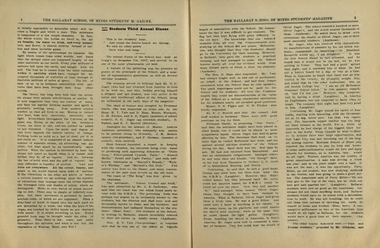
Booklet, Ballarat School of Mines, Student Magazine, First Term, 1908, 1908
... king...w. e. eyres...g.h davenport...a. d. r. galloway...j. e. b. crossley...j. smart...h. hylton...j. blayney...t. lennon...h. s. sheppard...p. c. osbourne...c.w. nash...les smith...w. b. tucker...c. w. white...a. j. robin...h. f. owen...l. a. westcott...e. m. boyer...ernie strick...isadore wittowski...m. tyler...h. m. conran...h. g. conran...h. g. cornell...l. j. middleton...j. d. orr...j. r. blight...w. g. taylor...l. hall...c. bult...g. o. ramsay...o. w. williams...stanley r. heron...john a. grant...Images. pegging a tramway route transmission of power by rope driving briseis main and new brothers home diabolo snake valley obituary analytical chemistry students' library john brittain a. e. c. kerr w. smith l. seward leslie coulter t. williams f. treloar whitington hart murphy o. w. williams l. knight w. kingston g. w. sides w. gelard w. t. sayer s. r. white a. c. hesselmann r. j. moore r. g. walker j. a. peart newton g. king w. e. eyres g.h davenport a. d. r. galloway j. e. b. crossley j. smart h. hylton j. blayney t. lennon h. s. sheppard p. c. osbourne c.w. nash les smith w. b. tucker c. w. white a. j. robin h. f. owen l. a. westcott e. m. boyer ernie strick isadore wittowski m. tyler h. m. conran h. g. conran h. g. cornell l. j. middleton j. d. orr j. r. blight w. g. taylor l. hall c. bult g. o. ramsay o. w. williams stanley r. heron john a. grant william t. sayer frederick l. treloar patrick s. anderson robert mitchell frederick j. martell Booklet of 26 pages. ...Table of Contents: The location and pegging of a tramway route, The unity of things, Students' third annual dinner, The transmission of power by rope driving, Visit to the Briseis main and new brothers home, School of Mines' sports committee, School of Mines' magazine committee, Diabolo, Limericks sluiced at Snake Valley, Obituary, Hints to the inexperienced, Fossilistic love, Past students, Some bunsen memories, Quaint and curious coincidences, Notes on analytical chemistry, New students, News and notes, Students' library, Sports and pastimes, School of Mines' annual dinner, Correspondence, Answers to correspondents, Editorial notes. Images.Booklet of 26 pages.pegging a tramway route, transmission of power by rope driving, briseis main and new brothers home, diabolo, snake valley, obituary, analytical chemistry, students' library, john brittain, a. e. c. kerr, w. smith, l. seward, leslie coulter, t. williams, f. treloar, whitington, hart, murphy, o. w. williams, l. knight, w. kingston, g. w. sides, w. gelard, w. t. sayer, s. r. white, a. c. hesselmann, r. j. moore, r. g. walker, j. a. peart, newton g. king, w. e. eyres, g.h davenport, a. d. r. galloway, j. e. b. crossley, j. smart, h. hylton, j. blayney, t. lennon, h. s. sheppard, p. c. osbourne, c.w. nash, les smith, w. b. tucker, c. w. white, a. j. robin, h. f. owen, l. a. westcott, e. m. boyer, ernie strick, isadore wittowski, m. tyler, h. m. conran, h. g. conran, h. g. cornell, l. j. middleton, j. d. orr, j. r. blight, w. g. taylor, l. hall, c. bult, g. o. ramsay, o. w. williams, stanley r. heron, john a. grant, william t. sayer, frederick l. treloar, patrick s. anderson, robert mitchell, frederick j. martell -
 Flagstaff Hill Maritime Museum and Village
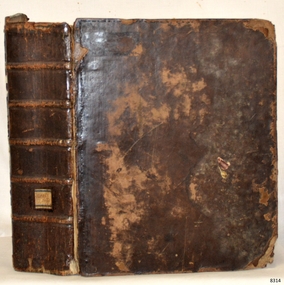
Book - Reference Bible, Mark & Charles Kerr, The Holy Bible 1789 (King James Version), 1789
... The information on the book's title page refers to King George III, as Mark and Charles Kerr were prominent Scottish printers and stationers based in Edinburgh. In the 18th century, printing the Holy Bible wasn't something just anyone could do; it required a royal patent granted by the Crown to ensure textual accuracy and high-quality production. ...The subject Bible is an incredible piece of history in the Pattison Collection. A Bible printed in 1789 with a personal handwritten inscription from 1792 is a true artefact of the late 18th century. The information on the book's title page refers to King George III, as Mark and Charles Kerr were prominent Scottish printers and stationers based in Edinburgh. In the 18th century, printing the Holy Bible wasn't something just anyone could do; it required a royal patent granted by the Crown to ensure textual accuracy and high-quality production. The Kerr family held the coveted title of "King's Printers for Scotland" during the late 1700s. Bibles from their press were highly regarded for their clear typography, sturdy leather bindings, and standard-setting quality. Owning an Edinburgh-printed royal edition like the subject publication was a point of pride for families across the English-speaking world.The Holy Bible 1789 Publisher: Mark & Charles Kerr His Majesty's Printers Date: 1789 Further Information : non-fictionThe subject Bible is an incredible piece of history in the Pattison Collection. A Bible printed in 1789 with a personal handwritten inscription from 1792 is a true artefact of the late 18th century. The information on the book's title page refers to King George III, as Mark and Charles Kerr were prominent Scottish printers and stationers based in Edinburgh. In the 18th century, printing the Holy Bible wasn't something just anyone could do; it required a royal patent granted by the Crown to ensure textual accuracy and high-quality production. The Kerr family held the coveted title of "King's Printers for Scotland" during the late 1700s. Bibles from their press were highly regarded for their clear typography, sturdy leather bindings, and standard-setting quality. Owning an Edinburgh-printed royal edition like the subject publication was a point of pride for families across the English-speaking world.flagstaff hill, warrnambool, shipwrecked coast, flagstaff hill maritime museum, maritime museum, shipwreck coast, flagstaff hill maritime village, great ocean road, book, pattison collection, warrnambool library, warrnambool mechanics’ institute, ralph eric pattison, corangamite regional library service, warrnambool city librarian, mechanics’ institute library, victorian library board, warrnambool books and records, warrnambool children’s library, the holy bible 1789, the holy bible -
 City of Moorabbin Historical Society (Operating the Box Cottage Museum)
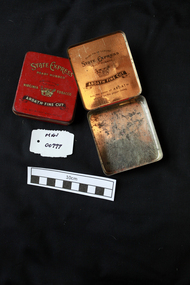
Containers, Tobacco, ‘State Express x2 tins, 20th C
... In the United Kingdom, Ardath's brands endured, to the point where they were granted a Royal Warrant by King George VI in 1946 and again later by H.M Queen Elizabeth II. ...In the United Kingdom, Ardath's brands endured, to the point where they were granted a Royal Warrant by King George VI in 1946 and again later by H.M Queen Elizabeth II. ...State Express 555, simply known as 555, is a brand of cigarette originally manufactured in the United Kingdom by the Ardath Tobacco Company. The overseas rights to the brand, excluding the United Kingdom, were acquired by British American Tobacco (B.A.T.) in 1925. It was sold widely throughout the world. Sir Albert Levy (1864 – 1937), born in England became a successful tobacco trader, cigarette manufacturer and exporter. On 31 July 1895 Sir Albert Levy registered the trademark ARDATH in the Republic of Ireland.. He visited the United States and while in New York State, he was a passenger on the Empire State Express train. . The word trademark was first registered in Ireland on 10 March 1896. In the United Kingdom, Ardath's brands endured, to the point where they were granted a Royal Warrant by King George VI in 1946 and again later by H.M Queen Elizabeth II. In 1961, British American Tobacco bought out Imperial Tobacco's share of Ardath, thus gaining full control of Ardath's trademarks2x Tins with hinged lids to contain State Express Ready Rubbed Virginia Tobacco . Outside: STATE EXPRESS / READY RUBBED / Absolutely Unique in its quality / VIRGINIA TOBACCO / ARDATH FINE CUT Inside lid : EVERY TIN OF GENUINE / STATE EXPRESS / READY RUBBED / ARDATH FINE CUT / has the name of ARDATH / printed on the paper liningtobacco, cigarettes, moorabbin, bentleigh, cheltenham, early settlers, ardath tobacco company ltd, levy sir albert, state express cigarettes, lucky strike, cigarettes, british american tobacco company ltd, imperial tobacco company ltd, -
 Ringwood and District Historical Society
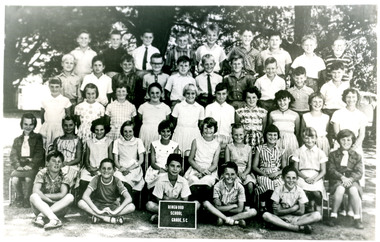
Photograph, Ringwood State School - Grade 5C, 1963
... Grant Nichol, Howard Archer. 2nd Row- L to R: Bruce Barber, David Kimberley, ?, Mark Wells, Tony Martin, Makus Dash, Wayne Walton, ?, ?, ?. 3rd Row- L to R: Ann Downey, Christie Schrum, Meg Flowers, Robyn Westthorpe, ?, Whilema Coenders, Grace King...Grant Nichol, Howard Archer. 2nd Row- L to R: Bruce Barber, David Kimberley, ?, Mark Wells, Tony Martin, Makus Dash, Wayne Walton, ?, ?, ?. 3rd Row- L to R: Ann Downey, Christie Schrum, Meg Flowers, Robyn Westthorpe, ?, Whilema Coenders, Grace King ...Black and white photograph - Grade 5C, 1963."Attached to photograph" Back Row- L to R: Ron Saines, ?, ?, Ian Carrington, Ian McCall, Roger Harris, ?, Grant Nichol, Howard Archer. 2nd Row- L to R: Bruce Barber, David Kimberley, ?, Mark Wells, Tony Martin, Makus Dash, Wayne Walton, ?, ?, ?. 3rd Row- L to R: Ann Downey, Christie Schrum, Meg Flowers, Robyn Westthorpe, ?, Whilema Coenders, Grace King, Rosemary Weaver, Ann Hagar. Front Row- L to R: Lynda Wilis, Linda (?), Debbie Sylvie, Elvena Crawford, Christine Smith, ?, Jenny Buchanan, ?, Annette Smeaton, Ann Logan. On Ground: Terry Bacon, ?, John Grayling, Dale Ryan. Teacher: Miss Enterkin. -
 Ringwood and District Historical Society
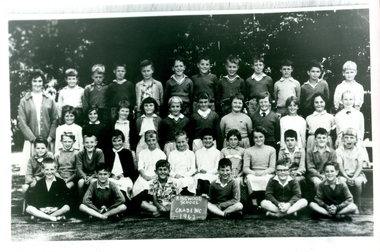
Photograph, Ringwood State School - Grade 4C, 1962
... , Meg Flowers, Julie Hogarth, Robyn Westhorp, Robyn Morris. 3rd Row- L to R: Dale Ryan, Grant Nichol, Tony Martin, Linda Willis, ?, Christine (?), Jenny Buchanan, Elvina Crawford, Grace King, Allan McLaine, Terry Bacon. ..., Meg Flowers, Julie Hogarth, Robyn Westhorp, Robyn Morris. 3rd Row- L to R: Dale Ryan, Grant Nichol, Tony Martin, Linda Willis, ?, Christine (?), Jenny Buchanan, Elvina Crawford, Grace King, Allan McLaine, Terry Bacon. ...Black and white photograph - Grade 4C, 1962"Attached to photograph" Back Row- L to R: ?, Mark Dash, ?, ?, Roger Harris, ?, Ian McCall, Graeme Haglan, ?, John Grayling, Bruce Barber. 2nd Row- L to R: Ann Logan, Debbie Sylvie, Christine Smith, Linda Chegwielan, Leanne Thorpe, Ann Downey, ?, Meg Flowers, Julie Hogarth, Robyn Westhorp, Robyn Morris. 3rd Row- L to R: Dale Ryan, Grant Nichol, Tony Martin, Linda Willis, ?, Christine (?), Jenny Buchanan, Elvina Crawford, Grace King, Allan McLaine, Terry Bacon. Front Row- L to R: ?, Chris McDonald, Ron Saines, Howard Archer, ?. Teacher: -
 Flagstaff Hill Maritime Museum and Village
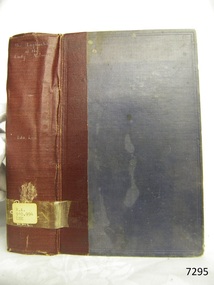
Book, The Logbooks of The Lady Nelson, 1915
... grant...bass strait discovery...surveying king...Grant, in the Lady Nelson, then left Port Jackson and began survey work. He discovered Port Phillip on Victoria’s coast and explored King Island, he helped establish the first European settlement in Tasmania on the Derwent River, and Port Dalrymple, Newcastle and Port Macquarie. ...Grant, in the Lady Nelson, then left Port Jackson and began survey work. He discovered Port Phillip on Victoria’s coast and explored King Island, he helped establish the first European settlement in Tasmania on the Derwent River, and Port Dalrymple, Newcastle and Port Macquarie. ...This hardcover book, The logbooks of the 'Lady Nelson' : with the journal of her first commander, Lieutenant James Grant, R.N., by Ida Lee (Mrs Charles Bruce Marriott) was published over 100 years after the Lady Nelson arrived in Australia to navigate and survey this ‘new colony’. Included in the book are sixteen charts and illustrations from the originals in the Admiralty Library, showing the surveyed land and water. The transcribed Contents, below, summarise the trips of the Lady Nelson during this time. Book’s Content PLUS text of the Chart of ‘Part of Bass Strait’ - Chapter 1: The Lady Nelson built with centreboards. Her voyage to Sydney under James Grant. The first ship to pass through Bass Strait. - Chapter 2: Returns to explore the Strait. Her visits to Jervis Bay and to Western Port in 1801 - Chapter 3: Colonel Paterson and Lieutenant Grant survey Hunter River - Chapter 4: Murray appointed commander of the Lady Nelson. His voyage to Norfolk Island. - Chapter 5: Murray’s exploration of Bass Strait. - Chapter 6: Discovery of Port Phillip. - Chapter 7: The Lady Nelson in company with HMS Investigator examines the North-Eastern shores of Australia. - Chapter 8: The French ships in Bass Strait. The founding of Hobart. - Chapter 9: Symons succeeds Curtoys as commander of the Lady Nelson. His voyages to Tasmania, Port Phillip and New Zealand. - Chapter 10: The Lady Nelson in Tasmania. The founding of Port Dalrymple. - Chapter 11: The Estramina is brought to Sydney. The Lady Nelson visits Norfolk Island and Port Dalrymple. - Chapter 12: Tippahee and his four sons are conveyed to New Zealand in the Lady Nelson. - Chapter 13: The Lady Nelson accompanies HMS Tamar to Melville Island. - Chapter 14: The loss of the Lady Nelson Text included with the ‘Chart of Bass Strait’ … “Part of Bass Strait, including the discoveries made by Acting Lieut. J. Murray, commander of His Majesty’s armed surveying vessel Lady Nelson, between November 1801 and March 1802. By command of His Excellency Governor King.” “This chart, which bears Murray’s autograph, shows his explorations of Western Port, Port Phillip and King Island. It should be noted that Flinders Island is named Grand Capuchin. This is one of the charts referred to as "unfortunately missing” in the Historical Records of N.S. Wales, vol. iv. P. 764” The story of the Lady Nelson In 1798 the British Admiralty ordered a cutter of 60 tons to be built along the design of the armed cutter Trial that was developed by Captain John Schanck, with three sliding keels or centreboards that could be individually raised and lowered, for use on the River Thames. The new cutter was to be named Lady Nelson. Philip Gidley King, prior to taking up his appointment as third Governor of the colony of New South Wales, was in England at the time of the Lady Nelson’s fit-out and was aware of the need for such a ship for survey work in the colony in New South Wales. He convinced Captain Schanck, the Commissioner of Transport in England, to construct and rig the Lady Nelson as a brig rather than a cutter, keeping the feature of the three sliding keels, which would be very useful for mapping in shallow waters. The new Lady Nelson was launched at Deptford, England on the River Thames in November 1798, with the official commission to discover and survey the unknown parts of the coast of New Holland (Australia) and establish British sovereignty over the continent. The Lady Nelson sailed from Portsmouth, England on March 1800 under the command of Lieutenant James Grant. She carried an armament of two original and four extra brass carronade carriage guns and set sail as part of a convoy heading to Port Jackson, in New South Wales, New Holland. After a while she continued to sail on her own. Her journey was troubled with problems at times; damaged and broken keels, troublesome crew and leaking topsides between the waterline and the deck due to poor seals. She arrived at the Cape of Good Hope in July and waited for the winter to pass to avoid the strong winds of the ‘Roaring Forties’. While at the Cape, Grant received a despatch to travel to Port Jackson via the newly discovered Bass Strait, rather than the usual route via the tip of Van Diemen’s Land (Tasmania). This also gave him the opportunity to survey the strait on the way. He departed the Cape in October and in December he made his first sighting of New Holland near Mount Gambier in what is now South Australia. A report by Ecclestone in 2012, ‘The Early Charting of Victoria’s Coastline’, mentions that Grant charted and named Capes Banks and Northumberland, and sighted inland hills that he named Mt Gambier and Mt Schanck, the latter after the designer of his ship. Grant then reached the south-western shores of what is now Victoria on 3-4 December 1800, and from Cape Bridgewater he examined the coast eastward to Cape Patton. Although he had not continuously sighted the coast in the vicinity of Port Fairy and Warrnambool, the western part of Victoria became known as Grant’s Land. The Lady Nelson continued eastward and passed through Bass Strait, becoming the first vessel to reach the east coast of New Holland from the west, and arrived at her destination of Port Jackson later in December 1800. Grant, in the Lady Nelson, then left Port Jackson and began survey work. He discovered Port Phillip on Victoria’s coast and explored King Island, he helped establish the first European settlement in Tasmania on the Derwent River, and Port Dalrymple, Newcastle and Port Macquarie. He made several trips from Norfolk Island to Hobart Town. Governor Macquarie sailed on with him to Van Diemen’s Land for a tour of inspection in 1811. Grant helped establish the first settlement on Melville Island in Northern Australia. The Lady Nelson was used to transport cargo, civilians and convicts and to source pigs from Timor. In February 1825 the Lady Nelson sailed again for Timor and never returned. One report said that “Every soul on board, we regret to state, was cruelly massacred, and the hull of the vessel was seen some time after with the name painted on her stern.” The hull was sighted on the island of Babar, which is almost 200 kilometres east of Timor. This particular copy of the book ... This item is from the ‘Pattison Collection’, a collection of books and records that was originally owned by the Warrnambool Mechanics’ Institute, which was founded in Warrnambool in 1853. By 1886 the Warrnambool Mechanics’ Institute (WMI) had grown to have a Library, Museum and Fine Arts Gallery, with a collection of “… choice productions of art, and valuable specimens in almost every branch and many wonderful national curiosities are now to be seen there, including historic relics of the town and district.” It later included a School of Design. Although it was very well patronised, the lack of financial support led the WMI in 1911 to ask the City Council to take it over. In 1935 Ralph Pattison was appointed as City Librarian to establish and organise the Warrnambool Library as it was then called. When the WMI building was pulled down in 1963 a new civic building was erected on the site and the new Warrnambool Library, on behalf of the City Council, took over all the holdings of the WMI. At this time some of the items were separated and identified as the ‘Pattison Collection’, named after Ralph Pattison. Eventually the components of the WMI were distributed from the Warrnambool Library to various places, including the Art Gallery, Historical Society and Flagstaff Hill. Later some were even distributed to other regional branches of Corangamite Regional Library and passed to and fro. It is difficult now to trace just where all of the items have ended up. The books at Flagstaff Hill Maritime Village generally display stamps and markings from Pattison as well as a variety of other institutions including the Mechanics’ Institute itself. RALPH ERIC PATTISON Ralph Eric Pattison was born in Rockhampton, Queensland, in 1891. He married Maude Swan from Warrnambool in 1920 and they set up home in Warrnambool. In 1935 Pattison accepted a position as City Librarian for the Warrnambool City Council. His huge challenge was to make a functional library within two rooms of the Mechanics’ Institute. He tirelessly cleaned, cleared and sorted a disarrayed collection of old books, jars of preserved specimens and other items reserved for exhibition in the city’s museum. He developed and updated the library with a wide variety of books for all tastes, including reference books for students; a difficult task to fulfil during the years following the Depression. He converted all of the lower area of the building into a library, reference room and reading room for members and the public. The books were sorted and stored using a cataloguing and card index system that he had developed himself. He also prepared the upper floor of the building and established the Art Gallery and later the Museum, a place to exhibit the many old relics that had been stored for years for this purpose. One of the treasures he found was a beautiful ancient clock, which he repaired, restored and enjoyed using in his office during the years of his service there. Ralph Pattison was described as “a meticulous gentleman whose punctuality, floorless courtesy and distinctive neat dress were hallmarks of his character, and ‘his’ clock controlled his daily routine, and his opening and closing of the library’s large heavy doors to the minute.” Pattison took leave during 1942 to 1945 to serve in the Royal Australian Navy, Volunteer Reserve as Lieutenant. A few years later he converted one of the Museum’s rooms into a Children’s Library, stocking it with suitable books for the younger generation. This was an instant success. In the 1950’s he had the honour of being appointed to the Victorian Library Board and received more inspiration from the monthly conferences in Melbourne. He was sadly retired in 1959 after over 23 years of service, due to the fact that he had gone over the working age of council officers. However he continued to take a very keen interest in the continual development of the Library until his death in 1969 This book about the logbooks of the Lady Nelson is locally significant for its association with the brig Lady Nelson, in which Lt. James Grant made the first documented European discovery of the area later known as Warrnambool in December 1800. This book is also nationally significant for its association with Grant in the Lady Nelson being the first to sail from west to east through Bass Strait, opening up a shorter, faster route to the colony of Port Jackson rather than going all the way south around Van Diemen’s Land. The book is nationally significant for its contents of the logbooks of the journeys of the Lady Nelson under various commanders and the copies of the charts created from the surveyed information and the new land of Australia was discovered. This book is also significant for its association with the full-size non-sailing replica of the Lady Nelson from Mount Gambier’s visitor centre, which was restored by Flagstaff Hill’s Master Boat Builder in Warrnambool in 2012, and with a ship mode of the Lady Nelson in our Collection The Pattison Collection, along with other items at Flagstaff Hill Maritime Village, was originally part of the Warrnambool Mechanics' Institute’s collection. The Warrnambool Mechanics’ Institute Collection is primarily significant in its totality, rather than for the individual objects it contains. Its contents are highly representative of the development of Mechanics' Institute libraries across Australia, particularly Victoria. A diversity of publications and themes has been amassed, and these provide clues to our understanding of the nature of and changes in the reading habits of Victorians from the 1850s to the middle of the 20th century. The collection also highlights the Warrnambool community’s commitment to the Mechanics’ Institute, reading, literacy and learning in the regions, and proves that access to knowledge was not impeded by distance. These items help to provide a more complete picture of our community’s ideals and aspirations. The Warrnambool Mechanics Institute book collection has historical and social significance for its strong association with the Mechanics Institute movement and the important role it played in the intellectual, cultural and social development of people throughout the latter part of the nineteenth century and the early twentieth century. The collection of books is a rare example of an early lending library and its significance is enhanced by the survival of an original collection of many volumes. The Warrnambool Mechanics' Institute’s publication collection is of both local and state significance. The Logbooks of The Lady Nelson Author: Ida Lee ( Mrs Charles Bruce Marriott) Publisher: Grafton & Co Date: 1915Label on spine with typed text RA 910.994 LEE Inside front cover has a sticker that reads Warrnambool Mechanics Institute and Free Library shipwrecked-coast, flagstaff-hill, warrnambool, flagstaff-hill-maritime-museum, maritime-museum, shipwreck-coast, flagstaff-hill-maritime-village, shipwrecked-artefact, book, warrnambool library, warrnambool mechanics’ institute, warrnambool city librarian, mechanics’ institute library, victorian library board, warrnambool books and records, warrnambool children’s library, great ocean road, the logbooks of the lady nelson, ida lee, mrs charles bruce marriott, captain john schanck, sliding keels or centreboards, lady nelson, british brig hms lady nelson, lieutennant james grant, bass strait discovery, surveying king island and port phillip bay, philip gidley king, survey map -
 Flagstaff Hill Maritime Museum and Village
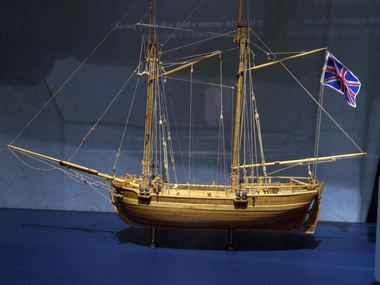
Craft - Ship Model, H.M.S. Lady Nelson, 1988
... grant...bass strait discovery...surveying king...This model acts as an important legacy of the full-scale ship which no longer survives. flagstaff hill warrnambool shipwrecked coast flagstaff hill maritime museum maritime museum shipwreck coast flagstaff hill maritime village great ocean road by captain john schanck sliding keels or centreboards lady nelson british brig hms lady nelson david lumsden ship model builder lieutennant james grant bass strait discovery surveying king island and port phillip bay philip gidley king HMS Lady Nelson Ship model of the 60 ton British brig HMS Lady Nelson. ...This model of the ship H.M.S. Lady Nelson was researched and built as the vessel Lady Nelson by David Lumsden, a professional ship model builder. His Majesty's Armed Survey Vessel Lady Nelson was commissioned in 1799 to survey the coast of Australia. This vessel was purpose-built before the British Admiralty requested plans for a Schooner for Port Jackson. At the time large parts of the Australian coast were unmapped and Britain had claimed only part of the continent. The British Government were concerned that, in the event of settlers of another European power becoming established in Australia, any future conflict in Europe would lead to a widening of the conflict into the southern hemisphere to the detriment of the trade that Britain sought to develop. Against this background, Lady Nelson was chosen to survey and establish sovereignty over strategic parts of the continent. Lady Nelson left Portsmouth on 18 March 1800 and arrived at Sydney on 16th December 1800 after having been the first vessel to reach the east coast of Australia via the Bass Strait. Before that date, all vessels had sailed around the southern tip of Tasmania to reach their destination. Lady Nelson's survey work commenced shortly after she arrived in Sydney, initially in the Bass Strait area. She was involved in the discovery of Port Phillip, on the coast of Victoria, in establishing settlements on the River Derwent and at Port Dalrymple in Tasmania. She also successfully chartered much of the Victorian coastline and was heavily involved with the exploration of the Queensland coast with Matthew Flinders; investigated the Hunter River; made numerous visits to New Zealand and Norfolk Island and was involved in the founding of numerous settlements. In comparison to most colonial vessels, the Lady Nelson was technically unique she was fitted with sliding keels, or centreboards, and water-tight trunks reaching to the deck. Captain Schank invented these sliding keels that, when raised, reduced her draught to less than six feet. Her life as an exploration vessel ended while accompanying HMS 'Tamar' to Melville Island in 1825, the 'Lady Nelson' was captured and later abandoned by pirates off the island of Babar (Indonesia). This brought the vessel's 25 years of coastal exploration and navigation to a close.The Lady Nelson made was the first British ship to survey of the southern or south-western coast of Australia and traverse the Bass Strait. The vessel holds a special place in Australia's history of exploration as the first to explore and establish settlements in the then-new British colony of Van Diemans Land. The model gives an insight into what life must have been like onboard sailing vessels of the time and Australia's early history of establishment and exploration. This model acts as an important legacy of the full-scale ship which no longer survives. Ship model of the 60 ton British brig HMS Lady Nelson. Timber model of a two-masted brig with rigging but no sails, displaying the British Union Jack flag. The ship is in a glass exhibition display case on metal stand. HMS Lady Nelsonflagstaff hill, warrnambool, shipwrecked coast, flagstaff hill maritime museum, maritime museum, shipwreck coast, flagstaff hill maritime village, great ocean road, by captain john schanck, sliding keels or centreboards, lady nelson, british brig hms lady nelson, david lumsden ship model builder, lieutennant james grant, bass strait discovery, surveying king island and port phillip bay, philip gidley king -
 Orbost & District Historical Society
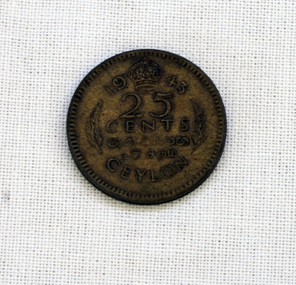
coin, 1943
... granted independence as Ceylon. In 1972, the country became a republic its name was changed to Sri Lanka. This coin was minted in the period before Ceylon's name was changed to Sri Lanka. coin 25-cent-ceylon A small nickel-brass round coin. On the obverse side is a crowned head facing left. The lettering is: GEORGE VI KING ...This coin with frozen year 1943 was restruck in 1951 three years after Ceylon's independence in 1948.Between 1948 and 1972, Ceylon was an independent country in the Commonwealth of Nations that shared a monarch with the United Kingdom. In 1948, the British Colony of Ceylon was granted independence as Ceylon. In 1972, the country became a republic its name was changed to Sri Lanka. This coin was minted in the period before Ceylon's name was changed to Sri Lanka.A small nickel-brass round coin. On the obverse side is a crowned head facing left. The lettering is: GEORGE VI KING AND EMPEROR OF INDIA. On the reverse there is a crown at top dividing the 1943 date with the denomination below: 25 CENTS CEYLON. Reverse Crown at top divides date, denomination below coin 25-cent-ceylon -
 Ringwood and District Historical Society
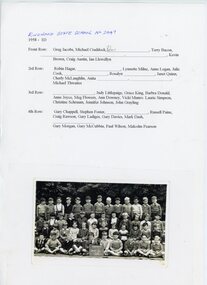
Photograph, Ringwood State School Class photograph. 1958-1D
... , Judy Littlepage, Grace King, Barbara McDonald, Anne Joyce, Meg Flowers, Anne Downey, Vicki Munro, Laura Simpson, Christine Schruum, Jennifer Johnson, John Grayling. 3rd Row- L to R: Robin Hagar, Grant (?)..., Judy Littlepage, Grace King, Barbara McDonald, Anne Joyce, Meg Flowers, Anne Downey, Vicki Munro, Laura Simpson, Christine Schruum, Jennifer Johnson, John Grayling. 3rd Row- L to R: Robin Hagar, Grant (?) ...Black and white photograph with student names"Attached to photograph" Back Row- L to R: Gary Chappell, Stephen Foster, ?, Russell Paine, Craig Rawson, Gary Ladiges, Gary Davies, Mark Dash. 2nd Row- L to R: ?, Judy Littlepage, Grace King, Barbara McDonald, Anne Joyce, Meg Flowers, Anne Downey, Vicki Munro, Laura Simpson, Christine Schruum, Jennifer Johnson, John Grayling. 3rd Row- L to R: Robin Hagar, Grant (?), Lynette Milne, Anne Dowling, Julie Cook, ?, Rosilyn Scully, Janet Quinn, Cheryl McLaughlin, ?, ?, Michael Thwaites. Front Row- L to R: Greg Jacobs, Michael Craddock, Gary McCubbin, Terry Bacon, ?, ?, ?, Kevin Brown, Craig Austin, Ian Llewelyn. Teacher: Miss Robinson -
 Flagstaff Hill Maritime Museum and Village
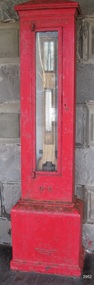
Instrument - Barometer, 1867
... King and Spencer streets. Their sole machine tool, when they commenced as a business, was a small slide rest lathe turned by foot. In about 1865 they moved to the south side of the Yarra River, to the Yarra bank near the Spencer Street Bridge and then in about 1886 they moved to Grant Street, South Melbourne. ...King and Spencer streets. Their sole machine tool, when they commenced as a business, was a small slide rest lathe turned by foot. In about 1865 they moved to the south side of the Yarra River, to the Yarra bank near the Spencer Street Bridge and then in about 1886 they moved to Grant Street, South Melbourne. ...Langlands Company History: Langlands foundry was Melbourne's first foundry and iron shipbuilder established in 1842, only 8 years after the founding of the Victorian colony by two Scottish immigrants, Robert Langlands and Thomas Fulton, who had formed a partnership before emigrating (1813–1859). The business was known as the 'Langlands Foundry Co'. Henry Langlands (1794-1863), left Scotland in 1846 with his wife Christian, née Thoms, and five surviving children to join his brother Robert. By the time he arrived in early January of 1847 the partnership of Robert Langlands and Fulton had dissolved as Fulton had gone off to establish his own works. It was at this time that the two brothers took over ownership of Langlands foundry. Several years later Robert retired and Henry became sole the proprietor. The foundry was originally located on Flinders Lane between King and Spencer streets. Their sole machine tool, when they commenced as a business, was a small slide rest lathe turned by foot. In about 1865 they moved to the south side of the Yarra River, to the Yarra bank near the Spencer Street Bridge and then in about 1886 they moved to Grant Street, South Melbourne. The works employed as many as 350 workers manufacturing a wide range of marine, mining, civil engineering, railway and general manufacturing components including engines and boilers. The foundry prospered despite high wages and the lack of raw materials. It became known for high-quality products that competed successfully with any imported articles. By the time Henry retired, the foundry was one of the largest employers in Victoria and was responsible for casting the first bell and lamp-posts in the colony. The business was carried on by his sons after Henry's death. The company was responsible for fabricating the boiler for the first railway locomotive to operate in Australia, built-in 1854 by Robertson, Martin & Smith for the Melbourne and Hobson's Bay Railway Company. Also in the 1860s, they commenced manufacture of cast iron pipes for the Board of Works, which was then laying the first reticulated water supply system in Melbourne. Langlands was well known for its gold mining equipment, being the first company in Victoria to take up the manufacture of mining machinery, and it played an important role in equipping Victoria's and Australia's first mineral boom in the 1850s and 1860s. Langlands Foundry was an incubator for several engineers including Herbert Austin (1866–1941) who worked as a fitter at Langlands and went on to work on the Wolesely Shearing machine. He also founded the Austin Motor Company in 1905. Around the 1890s Langlands Foundry Co. declined and was bought up by the Austral Otis Co. in about 1893. History for Grimoldi: John Baptist Grimoldi was born in London UK. His Father was Domeneck Grimoldi, who was born in Amsterdam with an Italian Father and Dutch mother. Domeneck was also a scientific instrument maker. John B Grimoldi had served his apprenticeship to his older brother Henry Grimoldi in Brooke Street, Holburn, London and had emigrated from England to Australia to start his own meteorological and scientific instrument makers business at 81 Queens St Melbourne. He operated his business in 1862 until 1883 when it was brought by William Samuel and Charles Frederick, also well known scientific instrument makers who had emigrated to Melbourne in 1875. John Grimoldi became successful and made a number of high quality measuring instruments for the Meteorological Observatory in Melbourne. The barometer was installed at Warrnambool's old jetty and then the Breakwater as part of the Victorian Government's insistence that barometers be placed at all major Victorian ports. This coastal barometer is representative of barometers that were installed through this government scheme that began in 1866. The collecting of meteorological data was an important aspect of the Melbourne Observatory's work from its inception. Just as astronomy had an important practical role to play in navigation, timekeeping and surveying, so the meteorological service provided up to date weather information and forecasts that were essential for shipping and agriculture. As a result, instruments made by the early instrument makers of Australia was of significant importance to the development and safe trading of companies operating during the Victorian colonies early days. The provenance of this artefact is well documented and demonstrates, in particular, the importance of the barometer to the local fishermen and mariners of Warrnambool. This barometer is historically significant for its association with Langlands’ Foundry which pioneered technology in the developing colony by establishing the first ironworks in Melbourne founded in 1842. Also, it is significant for its connection to John B Grimoldi who made the barometer and thermometer housed in the cast iron case. Grimoldi, a successful meteorological and scientific instrument maker, arrived in the colony from England and established his business in 1862 becoming an instrument maker to the Melbourne Observatory. Additional significance is its completeness and for its rarity, as it is believed to be one of only two extant barometers of this type and in 1986 it was moved to Flagstaff Hill Maritime Village as part of its museum collection. Coast Barometer No. 8 is a tall, red painted cast iron pillar containing a vertical combined barometer and thermometer. Half way down in the cast iron framed glass door is a keyhole. Inside is a wooden case containing a mercury barometer at the top with a thermometer attached underneath, each with a separate glass window and a silver coloured metal backing plate. Just below the barometer, on the right-hand side, is a brass disc with a hole for a gauge key in the centre. The barometer has a silvered tin backing plate with a scale, in inches, of "27 to 31" on the right side and includes a Vernier with finer markings, which is set by turning the gauge key. The thermometer has a silvered tin backing plate with a scale on the left side of "30 to 140". Each of the scales has markings showing the units between the numbers.Inscription at the top front of the pillar reads "COAST BAROMETER" Inscribed on the bottom of the pillar is "No 8". and "LANGLANDS BROS & CO ENGINEERS MELBOURNE " The barometer backing plate is inscribed "COAST BAROMETER NO. 8, VICTORIA" and printed on the left of the scale, has "J GRIMOLDI" on the top and left of the scale, inscribed "Maker, MELBOURNE". There is an inscription on the bottom right-hand side of the thermometer scale, just above the 30 mark "FREEZING" Etched into the timber inside the case are the Roman numerals "VIII" (the number 8)flagstaff hill, warrnambool, maritime village, maritime museum, flagstaff hill maritime museum & village, shipwreck coast, great ocean road, warrnambool breakwater, coast barometer, coastal barometer, barometer, weather warning, ports and harbours, fishery barometer, sea coast barometer, austral otis co, coast barometer no. 8, henry grimoldi, henry langlands, john baptist grimoldi, langlands foundry co, meteorological instrument maker, robert langlands, scientific instrument maker, thermometer, thomas fulton -
Glen Eira Historical Society
Book - Christ Church, Ormond (Anglican)
... Grant Warwick... Martin Jon... Ingamells Phillip... Ingamells Hope... Hewton D. R.... Phillips W.A.... Brewer C. A.... Martin W. Perry... Robinson E. E.... Thorp H. J.... Harvey E. A. C.... Coish C. J.... Huggett B. D.... Simpson M. J.... Holt Wilfred... Poole Tony... Wardrop George... Stone Ron... North Road... Wheatley Road... Katandra Road... Manson Vi... Religious Groups... Morrison Bill... Christian Bob... Drumond Jack... Downham Elise... King...Grant Warwick Martin Jon Ingamells Phillip Ingamells Hope Hewton D. R. Phillips W.A. Brewer C. A. Martin W. Perry Robinson E. E. Thorp H. J. Harvey E. A. C. Coish C. J. Huggett B. D. Simpson M. J. Holt Wilfred Poole Tony Wardrop George Stone Ron North Road Wheatley Road Katandra Road Manson Vi Religious Groups Morrison Bill Christian Bob Drumond Jack Downham Elise King Rita Mollinson Ada Baxter Edna Baxter Ted Bebbington Arthur Collinson Ed. ...The Christ Church Chronicles; 1901 – 2001: A presentation of Christ Church, Ormonds history for its centennial celebration, By Vi Manson. A detailed history of Christ Church Ormond, including the church building, vicars, the church community, furniture, organ and bells, societies and fellowships, social groups and youth groups, music, choir, sporting groups, social history, (e.g. fashion, transportation) role of church in the community, missionary work. Includes a list of vicars and long - serving parishioners. Includes black and white photos (36mm x 43mm – 165mm x 116mm).haste victor rev, laidlay w. w. rev., hamilton karl rev., connelly jim rev., cheong geoff rev., cooling w. r. rev., tunstall denise, mitchell e. (ted) rev., raymond c. h., zammit catherine, brown stan rev., williams r. h. b., durance ronald rev., backhouse walter rev., fullard leonard, dunlop julie, hewton mrs., dryden albert, laby beth, n’diaye maree, parker lorraine, seymour gary, sayce val, jackson nell, winn alan, mollison don, anderson bruce, savage jennie, clay cynthia, grant warwick, martin jon, ingamells phillip, ingamells hope, hewton d. r., phillips w.a., brewer c. a., martin w. perry, robinson e. e., thorp h. j., harvey e. a. c., coish c. j., huggett b. d., simpson m. j., holt wilfred, poole tony, wardrop george, stone ron, north road, wheatley road, katandra road, manson vi, religious groups, morrison bill, christian bob, drumond jack, downham elise, king rita, mollinson ada, baxter edna, baxter ted, bebbington arthur, collinson ed., grant gladys, grant alec, holt betty (geer), holt kath, ingamells fred, rivers pam, thompson merle, choirs, organs, anglican church, sunday schools, tennis clubs, depression 1929 – 1939, world war 1914 – 1918, clergy residences, bells, cemeteries, youth clubs, sport, libraries, camping, newspapers, ormond, christchurch ormond, anglican christ church ormond -
Eltham District Historical Society Inc
Document - Folder, Marshall, Marguerite
... Grant...Russell Yeoman...Eltham District Historical Society...Eartha Waters greenie tragic...Nillumbik Climate Action Now...Alan King...King and covered the Wurundjeri people, the Batman Tree legend, farmers, bushranger, gold mining, soldiers, artists, environmentalists and sportspeople. She was an environmental activist who created a comic character to show there can be a humorous side to the environmental challenge (Eartha Waters, a green tragic) for Nillumbik Climate Action Now event at Eltham Library. Contents Newspaper article: "New book on shire's past", Diamond Valley Leader, 6 February 2002, announcing publication of "Nillumbik Now and Then" by Marguerite Marshall, photographed with photographer Ron Grant...Marguerite Marshall Nillumbik - Now and Then Eltham Shire Historic Buildings People and Places Ron Grant Russell Yeoman Eltham District Historical Society Eartha Waters greenie tragic Nillumbik Climate Action Now Alan King Montmorency Probus Club Nillumbik Probus Club Newspaper clippings, A4 photocopies, etc Marshall, Marguerite Document Folder ...Marguerite Marshall, Eltham resident, worked as a journalist in the Diamond Valley from around 1980. In 2002, she published "Nillumbik Now and Then", about the shire's landmarks and characters (an update of "Eltham Shire, Historic Buildings, People and Places" 1983). It had photographs b Alan King and covered the Wurundjeri people, the Batman Tree legend, farmers, bushranger, gold mining, soldiers, artists, environmentalists and sportspeople. She was an environmental activist who created a comic character to show there can be a humorous side to the environmental challenge (Eartha Waters, a green tragic) for Nillumbik Climate Action Now event at Eltham Library. Contents Newspaper article: "New book on shire's past", Diamond Valley Leader, 6 February 2002, announcing publication of "Nillumbik Now and Then" by Marguerite Marshall, photographed with photographer Ron Grant and Eltham District Historical Society secretary Russell Yeoman. Newspaper article: "Humorous side on warming", Diamond Valley Leader, 4 June 2008, listing events for Nillumbik Climate Action Now marking World Environment Day, including Marguerite Marshall's character Eartha Waters. Newspaper article: "Green wedge a goldmine of history", Heidelberg and Diamond Valley Weekly, 25 November 2008, Announcing publication of Marguerite Marshall's book "Nillumbik Now and Then". Newspaper letter: "Worst, so we should lead", Diamond Valley Leader, 13 January 2010, Marguerite Marshall argued for climate action. Newspaper article: "Truths to be revealed in talk", Diamond Valley Leader, 23 July 2014, announcing talk by Marguerite Marshall on climate change at Montmorency Probus Club on 21 August and on renewable energy at Nillumbik Probus Club on 10 September 2014. Newspaper article: "Turning back the pages", Diamond Valley Leader, 19 November 2008, Announcing publication of Marguerite Marshall's book "Nillumbik Now and Then". Newspaper clippings, A4 photocopies, etcmarguerite marshall, nillumbik - now and then, eltham shire historic buildings people and places, ron grant, russell yeoman, eltham district historical society, eartha waters greenie tragic, nillumbik climate action now, alan king, montmorency probus club, nillumbik probus club -
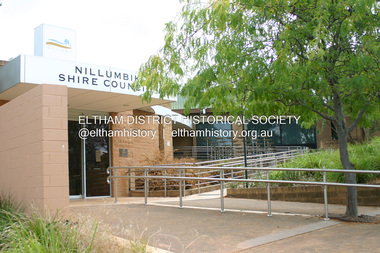 Eltham District Historical Society Inc
Photograph - Digital Photograph, Alan King, Nillumbik Shire Offices, Greensborough, 30 March 2008
... King with Marguerite Marshall.; p43 It was the need for roads that led to this district’s first council. In 1853 a committee was formed to improve the rough roads, some in Kangaroo Ground being almost impassable in winter.1 The committee fundraised by voluntary levies and grants to improve in particular, the main road between Kangaroo Ground and the Plenty River. ...King with Marguerite Marshall.; p43 It was the need for roads that led to this district’s first council. In 1853 a committee was formed to improve the rough roads, some in Kangaroo Ground being almost impassable in winter.1 The committee fundraised by voluntary levies and grants to improve in particular, the main road between Kangaroo Ground and the Plenty River. ...Nillumbik Shire Council transferred to the former Diamond Valley Shire Offices in Greensborough after municipal restructuing. The offices became the official Nillumbik Shire Council Offices on 16 October 1995. The former Shire of Diamond Valley Civic Centre or Shire Office building was officially opened on 26th February 1972. Archtiects were A.K. Lines, McFarlane & Marshall and it was built by L.U. Simon Pty Ltd, The Diamond Valley Shire had been created in 1964 from part of the City of Heidelberg. On December 15, 1994 the Shire of Nillumbik was established. Under the Council amalgamations imposed by the Kennett government, the Shire of Eltham, Shire of Diamond Valley and City of Heidelberg ceased to exist with the establishment of Nillumbik Shire Council and the City of Banyule.The new Nillumbik shire surrended the west riding from Eltham to Banyule but in place gained parts of the former Diamond Valley Shire which itself had been created in 1964 from parts of the City of Heidelberg. Three unelected and non-local Commissioners were put in place by the government bringing democracy into question by many members of the local community. The Commissioners determined to abandon the former Shire of Eltham offices located in Main Road, Eltham and in turn occupy the former Shire of Diamond Valley offices located at the boundary of the new shire with Banyule, in Civic Drive, Greensborough. In July 1996 the Commissioners sold the former Eltham Shire Offices and had them bulldozed leading to many years of communiity protest over the process and future development applications. The site has remained vacant ever since. Published: Nillumbik Now and Then / Marguerite Marshall 2008; photographs Alan King with Marguerite Marshall.; p43 It was the need for roads that led to this district’s first council. In 1853 a committee was formed to improve the rough roads, some in Kangaroo Ground being almost impassable in winter.1 The committee fundraised by voluntary levies and grants to improve in particular, the main road between Kangaroo Ground and the Plenty River. From this committee arose the Eltham District Road Board, in 1856, which was the precursor to the Eltham Shire Council. The Board’s first chairman was Kangaroo Ground farmer, John Barr. Secretary was the former committee’s secretary, Andrew Ross, Kangaroo Ground’s first school teacher, and founder of the district newspaper, The Evelyn Observer.2 Most of the board’s income came from a toll-house north of the Lower Plenty Bridge, which funded such projects as a road from Kangaroo Ground to the Caledonia Diggings. In 1871 the Shire of Eltham was proclaimed, with its boundaries the same as those of the Road Board, and Councillor A Donaldson of Kangaroo Ground was the first president. Eltham was at the southern tip of the shire, which extended north to Kinglake and east beyond Yarra Glen. In 1878, part of Kinglake was added to the shire, while the area east of Watts River, near Healesville was removed. In 1912, then again in 1958, the shire was further reduced. Yarra Glen, Steels Creek, Tarrawarra, parts of Healesville and Christmas Hills, were transferred to the Shire of Healesville. In 1972 a smaller area, at Kinglake, was transferred to the Shire of Yea, leaving 277 square kilometres in the Eltham Shire. Perhaps no other Victorian municipality has had so many meeting places. Although from 1858 to 1904, the council convened at the office in the home of Secretary Charles Wingrove, the board, and later the council, also met at other more central locations.3 The board moved from the Fountain of Friendship Hotel to the Eltham Courthouse, to the Kangaroo Ground schoolhouse. It then met at the Kangaroo Ground Hotel, which some considered put it in danger of interruptions by people ‘the worse for liquor’.4 In 1885 the council met at the hall on Mr J Donaldson’s land at Kangaroo Ground. After Wingrove’s retirement, the council rented space at the Kangaroo Ground General Store and Post Office. Then, in 1917, the council bought the former office of The Evelyn Observer, after its printing works transferred to Hurstbridge. In 1934, fire destroyed the shire office, which was temporarily relocated to the Kangaroo Ground home of Shire Secretary, Mr P J McMahon. In 1941, the shire office moved to a new building (which included a public hall) in Eltham, at the corner of Arthur Street and Main Road, where the Eltham Village Shopping Centre was eventually built. Growth required new offices, which opened in 1965, on the former Shillinglaw property in Main Road.5 In 1994, as part of municipal restructuring under the Jeff Kennett Liberal Government, most of the Eltham Shire formed part of the new Shire of Nillumbik. It joined with the north section of the Diamond Valley Shire and parts of the Healesville and Whittlesea municipalities. The Diamond Valley Shire had been created in 1964, from part of the City of Heidelberg. Turbulence followed Nillumbik Shire’s formation. Under the Commissioners the council transferred to the former Diamond Valley Shire offices in Greensborough, and the Eltham council offices were demolished. In March 1997 the first five-member Nillumbik Council was elected. But, in October 1998, the government suspended the council and appointed an administrator . Early in 1999, shire residents voted to increase councillors to nine: comprising five ward councillors and four shire-wide councillors. Elections were held in March 1999. Then, before the March 2002 elections, nine new wards were created.6 In 2008 these were reduced to seven. Today [2008] the council governs a varied population of more than 60,000 people living in townships and on bush properties in the green wedge.This collection of almost 130 photos about places and people within the Shire of Nillumbik, an urban and rural municipality in Melbourne's north, contributes to an understanding of the history of the Shire. Published in 2008 immediately prior to the Black Saturday bushfires of February 7, 2009, it documents sites that were impacted, and in some cases destroyed by the fires. It includes photographs taken especially for the publication, creating a unique time capsule representing the Shire in the early 21st century. It remains the most recent comprehenesive publication devoted to the Shire's history connecting local residents to the past. nillumbik now and then (marshall-king) collection, greensborough, nillumbik shire council offices, civic drive -
 Eltham District Historical Society Inc
Photograph - Digital Photograph, Alan King, Eltham Living and Learning Centre, 26 January 2008
... Grant was received by the Shire Council to acquire the Fitzpatrick property as part of the planning to establish an extended communities’ activities program. The Fitzpatricks moved next door and Claire taught at the new Living and Learning Centre, which began in 1975, one of the first community education centres in Victoria. Covered under Heritage Overlay, Nillumbik Planning Scheme. Published: Nillumbik Now and Then / Marguerite Marshall 2008; photographs Alan King...Grant was received by the Shire Council to acquire the Fitzpatrick property as part of the planning to establish an extended communities’ activities program. The Fitzpatricks moved next door and Claire taught at the new Living and Learning Centre, which began in 1975, one of the first community education centres in Victoria. Covered under Heritage Overlay, Nillumbik Planning Scheme. Published: Nillumbik Now and Then / Marguerite Marshall 2008; photographs Alan King ...In 1857, tanner John Pearson purchased three and a half acres of land in Little Eltham, at the western end of Pitt Street, with a 70-foot frontage to Maria Street (Main Road) and stretching down to the Diamond Creek for £100. He contracted Benjamin Oliver Wallis to build house for him. Wallis, a mason by trade who originated from the Cornish village of Newlyn, migrated to Melbourne in 1853 and was shortly engaged by Richard Warren to build the Eltham Hotel, which opened in 1854. When Warren fell into financial difficulty in 1858, Wallis purchased the hotel. That same year, Pearson constructed a tannery below the house with access to the water in the Diamond Creek. When Pearson became bankrupt in 1867, Wallis similarly acquired the house from Pearson’s creditors in 1868 and lived there until his death in 1896. For some of this time the house was in the name of Wallis’s son Richard but following his death in 1888, ownership reverted to his father. It was purchased by retired teacher Richard Gilsenen in 1899. Gilsenen was made acting head teacher at the Eltham State School in 1906 following the sudden death of head teacher John Brown. In the 1950s the house was bought by retired engineer Dr Alfred Fitzpatrick and his wife Claire who made various modifications to house goats and poultry as well as structural modifications to the house. In the early 1970s, Eltham Shire Councillors Frank Maas and Don Maling proposed an extended communities’ activities program be set up and the Commonwealth Grants Commission was approached for financial assistance. In 1974 a $50,000 Commonwealth Grant was received by the Shire Council to acquire the Fitzpatrick property as part of the planning to establish an extended communities’ activities program. The Fitzpatricks moved next door and Claire taught at the new Living and Learning Centre, which began in 1975, one of the first community education centres in Victoria. Covered under Heritage Overlay, Nillumbik Planning Scheme. Published: Nillumbik Now and Then / Marguerite Marshall 2008; photographs Alan King with Marguerite Marshall.; p59 It’s a centre for sharing knowledge and friendship and it stands on the former hub of Eltham’s original township near Pitt Street. The Eltham Living and Learning Centre, with around 2000 participants a year, began in 1975 as one of the first Community Education Centres in Victoria. Classes ranging from macramé to wine making to environmental living have enriched the lives of thousands of people through the generosity of tutors sharing their skills free of charge. The centre’s heart is the brick cottage, built in 1858 by tanner John Pearson. He bought the three and a half acre (1.4ha) allotment fronting Maria Street (now Main Road) and stretching down to the Diamond Creek. The allotment formed part of a 316 acre (127.8ha) subdivision, owned by Josiah Holloway, called Little Eltham, north of the original Eltham Reserve.1 The allotment then passed through the hands of several speculators before it was sold to Pearson for £100 in 1857. Mr Pearson’s children attended the Eltham Primary School from 1864 to 1867. But creditors took possession of the property when his tannery folded in 1867. It was then sold to publican Benjamin Wallis, who owned the Eltham Hotel at the corner of Pitt Street and Main Road. In 1899 the property was bought by Richard Gilsenan, who became acting head teacher of the Eltham Primary State School in 1906. In the 1950s, retired engineer Dr Alfred Fitzpatrick and his wife Claire bought the property, and made structural changes. Claire, a journalist and community campaigner, modified and built pens for goats and poultry, a stable, a garage and planted fruit trees and a vegetable garden. In the early 1970s a young woman called Carina Hack approached Gwen Wesson at the Diamond Valley Learning Centre (Victoria’s first Community Education Centre) about starting a community centre. Following Wesson’s suggestion, Hack spoke to Shire President Alistair Knox ‘one bleak rainy afternoon, sipping hot drinks and discussing life’.2 Eltham Shire Councillors Frank Maas and Don Maling proposed a community activities program and the council received a $50,000 Commonwealth Government Grant for this venture.3 The Fitzpatricks sold their property to the council and moved next door and Claire taught at the new centre, which Hack named. Eltham obviously wanted such a centre as Hack recalls. ‘During the next two months we had about 50 volunteers working day, night and weekends, scrubbing down, plastering and painting walls, replacing floors, repairing fences, recycling furniture, sewing curtains and cushions, donating furniture, toys, equipment, clean-ing and gardening…’4 The first enrolment day saw a queue stretching up the driveway nearly to the gate and the first sessions attracted 270 people a week. Soon the outbuildings were converted into pottery studios and a large workshop. From 1979 the Eltham Art and Craft Market was held in the centre’s grounds and the Friends of the Centre ran it from 1980. A former program coordinator, Margaret Johnson, remembers enrolment day in the late 1970s and 1980s, when hundreds of people would queue – and some even camped overnight! Overnighters were greeted in the morning with fresh tea and toast. Another tradition was The Enrolment Day Cake with Recipe, given to volunteers. ‘One happy Enrolment Day fell on February 14 and let’s just say that St Valentine found some willing participants, paying $2 for a kiss.’5 Meanwhile the participants’ children could play at the Council Eltham Lower Park house in Hohnes Road, later in Susan Street. But the centre has had difficulties too. In 1990 a fire destroyed the stable and the police suspected arson. However the pavilion was built in its place.This collection of almost 130 photos about places and people within the Shire of Nillumbik, an urban and rural municipality in Melbourne's north, contributes to an understanding of the history of the Shire. Published in 2008 immediately prior to the Black Saturday bushfires of February 7, 2009, it documents sites that were impacted, and in some cases destroyed by the fires. It includes photographs taken especially for the publication, creating a unique time capsule representing the Shire in the early 21st century. It remains the most recent comprehenesive publication devoted to the Shire's history connecting local residents to the past. nillumbik now and then (marshall-king) collection, benjamin oliver wallis, claire fitzpatrick, don maling, dr alfred fitzpatrick, eltham living and learning centre, frank maas, john pearson, richard gilsenen, tannery -
 Eltham District Historical Society Inc
Film - Video (VHS), VideoCAM, Eltham Woods Children's Resource Centre Opening (Series 69, Item 5), 5 Mar 1988
... king...clark hopkins and clark...councillors...cr. alan baker...ed latanzio...eltham...eltham woods childcare co-operative...federal government...federal office of childcare...frank street...gary bartlett...george apted...george takola...grant...He also thanked Bev Vern, Council's preschool advisor who assisted in developing the programs; Grant Roberts from Federal Office of Childcare for assisting the Cooperative in setting up the funding program; the builders George Takola and George Apted; Michelle Matello who undertook the needs analysis that identified another preschool was required; Cathy King who assisted in the development of the childcare program; Pat Grundy and Susan Forbes, Council officers who assisted with the development of the services and the members of the preschool committee. ...He also thanked Bev Vern, Council's preschool advisor who assisted in developing the programs; Grant Roberts from Federal Office of Childcare for assisting the Cooperative in setting up the funding program; the builders George Takola and George Apted; Michelle Matello who undertook the needs analysis that identified another preschool was required; Cathy King who assisted in the development of the childcare program; Pat Grundy and Susan Forbes, Council officers who assisted with the development of the services and the members of the preschool committee. ...Shire of Eltham Archives: Series 69, Item 5 Video opens with panning view of completed kinder from Frank Street followed by images of the centre under construction then opening day speeches. Introduction and welcome by Mandy Press (Executive Officer, Shire of Eltham) with speeches by the Hon. Pauline Toner, Member for Eltham and Shire president, Cr. Alan Baker. The Hon. Pauline Toner acknowledged Shire President Alan Baker and her parliamentary colleagues Vin Heffernan, Neil Brown and Bob Halderson and Councillors; three levels of Government which led to the achievement of the kinder, and gave special thanks to the Council and parents for the forward planning to accommodate children from babyhood to school with childcare, kinder and baby health facilities all combined in one facility in the middle of parkland in a residential area. Shire President Cr Alan Baker then followed to formally open the centre. The site had been identified in early 1985 at that stage only as a pre-school but with an opportunity to develop, the additional services were driven by Cr Baker. Though a very long name, its simple message is "Care for Kids." Designed by architect Neil Biggins of Clark, Hopkins and Clark. Cr Baker stated that the theme of "people living in the environment" was very much encapsulated by the facility. Cr Baker informed that the construction of the facility had led to some concerns with a reduction in open space and potential traffic generated to the facility and those users of the facility were asked to ensure their use is sensitive to the local residents. Cr Baker talked about the financial costs and how the Federal grant funding was no longer as plentiful as previous and that the Victorian Government had come to the assistance thanks to Pauline Toner covering some other costs as well as the ongoing running costs of around $40,000. The Federal Government contributed $233,000 out of a childcare component rather than preschool. Cr Baker thanked Mandy Press again as well as Shire Engineer, John Stanton. Cr Baker also acknowledged Ed Latanzio who was in charge of the project, along with his colleague Alan Lansdowne; Gary Bartlett and his team for the exterior surroundings to the facility. He mentioned that Neil Biggins the architect had said not many Shire Councils show the same commitment to the exterior surroundings as the interior which was a credit to the Council and Gary Bartlett. He also thanked Bev Vern, Council's preschool advisor who assisted in developing the programs; Grant Roberts from Federal Office of Childcare for assisting the Cooperative in setting up the funding program; the builders George Takola and George Apted; Michelle Matello who undertook the needs analysis that identified another preschool was required; Cathy King who assisted in the development of the childcare program; Pat Grundy and Susan Forbes, Council officers who assisted with the development of the services and the members of the preschool committee. In addition, local residents and in particular Helen, Peter and Chris who advised Council of their concerns and worked with Council to overcome these issues; members of the Interim Steering Committee and the Directors of the Childcare Co-op. Cr Baker stated that the Co-op nature of the facility and the location of the three services under one roof was unique and the task of the programs was to be led by Annie, Dianne and Lynn Afternoon tea and activities followed the unveiling of the plaque. The video shows some of the children's entertainment and their engagement as well as interior and exterior views.VHS Video cassette Converted to MP4 file format 00:26:02; 302MBshire of eltham, video recording, shire of eltham archives, eltham shire council, alan lansdowne, bev vern, bob halderson, cathy king, clark hopkins and clark, councillors, cr. alan baker, ed latanzio, eltham, eltham woods childcare co-operative, federal government, federal office of childcare, frank street, gary bartlett, george apted, george takola, grant roberts, john stanton, mandy press, michelle matello, neil biggins, neil brown, pat grundy, pauline toner, people living in the environment, susan forbes, victorian government, vin heffernan -
4th/19th Prince of Wales's Light Horse Regiment Unit History Room
Medal, War Medal 1939-45
... Emblem The single bronze oak leaf Emblem signifying either a Mention in Despatches, King's Commendation for brave conduct, or a King's Commendation for valuable service in the air, will, if granted for service during World War II, be worn on the ribbon of the War Medal 1939-45....Emblem The single bronze oak leaf Emblem signifying either a Mention in Despatches, King's Commendation for brave conduct, or a King's Commendation for valuable service in the air, will, if granted for service during World War II, be worn on the ribbon of the War Medal 1939-45. ...The War Medal 1939-45 was awarded for full-time service in the Armed Forces, wherever that service may have been rendered during the war. Operational and non-operational service may be counted, providing that it was of 28 days or more duration. Eligibility The War Medal 1939-45 is awarded for 28 days full-time service between 3 September 1939 and 2 September 1945. In the Merchant Navy there is a requirement that the 28 days should have been served at sea. A member qualifies for the award where service was brought to an end by death, wounds or other disabilities due to service or by cessation of hostilities on 2 September 1945. The War Medal 1939-45 is awarded to Australian Civilian Personnel who served afloat with the United States Army Small Ships Section between 8 December 1941 and 2 September 1945. Eligibility is the same as that for Merchant Navy personnel. See required evidence to support a claim. The Medal The War Medal 1939-45 is cupro-nickel with the crowned effigy of King George VI on the obverse. The reverse has a lion standing on a fallen dragon. The top of the reverse shows the dates 1939 and 1945. The Ribbon The War Medal 1939-45 ribbon colours of red, white and blue represent the colours of the Union Flag. Emblem The single bronze oak leaf Emblem signifying either a Mention in Despatches, King's Commendation for brave conduct, or a King's Commendation for valuable service in the air, will, if granted for service during World War II, be worn on the ribbon of the War Medal 1939-45.Full size and miniature medals with ribbons. Miniature has MID claspnilwar medal 1939-45 -
4th/19th Prince of Wales's Light Horse Regiment Unit History Room
Badge
... granted to those who had served since 4 August 1914. In the case of officers the badge was issued to those who had retired or relinquished their commissions. The badge was issued to other ranks who had been discharged on account of age, wounds or sickness, such as would render them permanently unfit for further service. During WW1, men not in uniform tended to be given white feathers by ladies who wanted them to enlist. The badge provided some protection against this. Since then, the Empire for which they were fighting has ceased to exist. Badge King ...The Silver War Badge was a First World War badge authorised for issue to members of the armed forces of the British empire. It was granted to those who had served since 4 August 1914. In the case of officers the badge was issued to those who had retired or relinquished their commissions. The badge was issued to other ranks who had been discharged on account of age, wounds or sickness, such as would render them permanently unfit for further service. During WW1, men not in uniform tended to be given white feathers by ladies who wanted them to enlist. The badge provided some protection against this. Since then, the Empire for which they were fighting has ceased to exist.The badge is circular in shape with the words "For King and empire" and "Services rendered" around the rim, and a voided cipher and crown of King George V in the centre. The reverse has a hinged vertical pinbadge, king and empire -
 Victorian Interpretive Projects Inc.
Photograph - Colour, Clare Gervasoni, Corenderrk Cemetery, 31/08/2011
... granted. When Wonga died in 1875 his nephew William Barak, known by settlers as ‘King William, last chief of the Yarra Yarra tribe’, became the leader, the Ngurungaeta. ...granted. When Wonga died in 1875 his nephew William Barak, known by settlers as ‘King William, last chief of the Yarra Yarra tribe’, became the leader, the Ngurungaeta. ...In 1860 the Wurundjeri Elder, Wonga, petitioned the Victorian Parliament for a piece of land in his people’s own country where he could establish a settlement. The land later named Coranderrk was granted. When Wonga died in 1875 his nephew William Barak, known by settlers as ‘King William, last chief of the Yarra Yarra tribe’, became the leader, the Ngurungaeta. William Barak believed strongly in justice for his people, and time and again made the arduous walk to Melbourne to petition to Parliament and to Queen Victoria for his people. ‘Freedom for our lifetime’, he said. The community at Coranderrk welcomed Aboriginal people displaced from other parts of Victoria; they established an economically self-sufficient settlement by growing and marketing hops. Barak negotiated with the Victorian Government officials as they made promises and broke promises. They finally promised to export the whole of a hop harvest of one year. The people worked around the clock to fill the contract; the Government pocketed the proceeds. The community never recovered. Barak died in 1903— a broken-hearted man. (from http://www.sosj.org.au/_uploads/_cknw/files/Corenderrk.pdf) Artist William Barak is buried in this cemetery.Photographs of graves in grass and bushland. It is the Corenderrk Cemetery, and is associated with the former Corenderrk Aboriginal Reserve.corenderrk, wurundjeri, barak, aborigines, aboriginal, cemetery, grave, barak, jemima dunolly
