
Showing 57 items matching " one treasurer and one secretary."
-
 Bendigo Historical Society Inc.
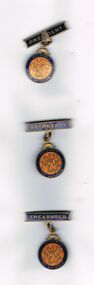
Accessory - GOLDEN SQUARE P.S. LAUREL ST. 1189 COLLECTION: BADGES
... ... one Treasurer and one Secretary....Three blue and orange badges with gold printing. One each for the President, Treasurer and Secretary. The badges are navy blue with orange centre and We Serve The Children printed around the edge in gold. ...K G Luke Melb one President one Treasurer and one Secretary. K.G. Luke, Melbourne Three blue and orange badges with gold printing. ...Three blue and orange badges with gold printing. One each for the President, Treasurer and Secretary. The badges are navy blue with orange centre and We Serve The Children printed around the edge in gold. President, Secretary and Treasurer is printed in gold on a bar at the top of each badge.K.G. Luke, Melbourneeducation, primary, golden square laurel st p.s., golden square primary school 1189 collection - badges, myfc?, k g luke melb, one president, one treasurer and one secretary. -
 Mission to Seafarers Victoria
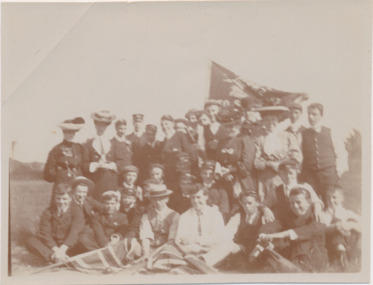
Photograph - Photograph, Sepia, First picnic of the Mission, Graylings, St Kilda, King's Birthday 1905, 13 November 1905
... Treasurer on 4 December 1906. See item 1642 This was the official first picnic of the Amalgamated Victorian Seamen's Mission and the first picnic organised by Miss Ethel Godfrey. A year later she was nominated Honorary Secretary of the newly Ladies Harbour Light Guild. The Melbourne Guild was the first one ...Gathering of seafarers and LHLG members carrying the Mission flag, at Graylings, property of Frederic Race Godfrey, in St Kilda, on 13 November 1905. Sixty-three men and boys were invited to the picnic. Miss Ethel Godfrey is standing on the right hand side next to another lady, wearing a dark dress and hat. In the article published in the Church and the Sailor in July 1930 after she resigned from her position of Honorary Secretary, this was the first picnic organised by her after Reverend Gurney Goldsmith pleaded for women's help during a sermon at All Saints church in St Kilda the same month. The Ladies Harbour Lights' Guild was formed on 1st October 1906 and she was nominated Honorary Secretary and Treasurer on 4 December 1906. See item 1642This was the official first picnic of the Amalgamated Victorian Seamen's Mission and the first picnic organised by Miss Ethel Godfrey. A year later she was nominated Honorary Secretary of the newly Ladies Harbour Light Guild. The Melbourne Guild was the first one of its kind and was so successful that the scheme was spread around the world.Small monochrome photograph, quite blurred, depicting a group of sailors and ladies in a park. The Flying Angel Mission to Seamen flag behind them.In the centre wearing dark dress and hat is Ethel Godfrey.Handwritten in pencil on verso: 12 Handwritten in white ink on the album page: First picnic of the Mission, Graylings, St Kilda, King's Birthday 19051905, graylings, st kilda, reverend a. gurney-goldsmith, lhlg, ethel augusta godfrey, king's birthday, picnic -
 City of Moorabbin Historical Society (Operating the Box Cottage Museum)
Newsletter - CMHS February 2014 pdf, February 2014
... 5 x A4 paper pages printed on one side with colour photograph, Jim Dale, President, welcomes members to the February 23rd Meeting at Box Cottage and acknowledges Anne Caprackas as Secretary and Dr Bill Richardson is now Treasurer. ...Jim Dale continued to produce the Newsletter in 2013 after Helen resigned. ity of moorabbin historical society stanley helen dale jim melbourne moorabbin brighton cheltenham ormond bentleigh market gardeners pioneers early settlers east bentleigh city of kingston vladimir mickalovick petrov evodika petrov michael thwaites maria allynson sven allynson kgb mvd asio ‘petrov affair’ darwin airport mascot airport col. charles spry cold war 1950 City of Moorabbin Historical Society Newsletter February 2014 5 x A4 paper pages printed on one side with colour photograph, Jim Dale, President, welcomes members to the February 23rd Meeting at Box Cottage and acknowledges Anne Caprackas as Secretary and Dr Bill Richardson is now Treasurer. ...The City of Moorabbin Historical Society was formed c 1960 by a group of Moorabbin area residents who were concerned that the history of the area should be preserved. A good response to a call for items related to the historical area of Moorabbin Shire brought donations of a wide variety of artefacts that are now preserved by the current members of CMHS at Box Cottage Museum. Helen Stanley, Secretary of CMHS, began producing a Newsletter for members in April 2007 to provide current information and well researched items of historical interest. Jim Dale continued to produce the Newsletter in 2013 after Helen resigned.5 x A4 paper pages printed on one side with colour photograph, Jim Dale, President, welcomes members to the February 23rd Meeting at Box Cottage and acknowledges Anne Caprackas as Secretary and Dr Bill Richardson is now Treasurer. Jim will have a Stall at the Moorabbin Primary School Fete in March. Jim went to a meeting to discus plans for 2015 Commemoration of the Great War in Glen Eira. Members Bill, David, Daryl Carol, Joan collected and installed a large Display Cabinet in the Dairy on December 19th and Dennis fitted castors to it in January. Jim was present on February 3rd when members of the Harry Hawker family presented a memento to the Victorian Governor, His Excellency Alex Churnov The next Meeting will be March 30th Jim Dale attached the Final Part of his report 'The Allynson's of East Bentleigh' about 'The Petrov Affair 1954'City of Moorabbin Historical Society Newsletter February 2014ity of moorabbin historical society, stanley helen, dale jim, melbourne, moorabbin, brighton, cheltenham, ormond, bentleigh, market gardeners, pioneers, early settlers, east bentleigh, city of kingston, vladimir mickalovick petrov, evodika petrov, michael thwaites, maria allynson, sven allynson, kgb, mvd, asio, ‘petrov affair’, darwin airport, mascot airport, col. charles spry, cold war 1950 -
 Learmonth and District Historical Society Inc.
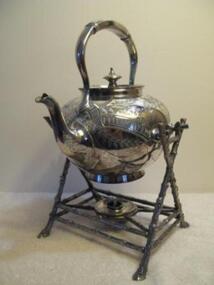
Silver Teapot with stand, unknown
... William Rain was the first Treasurer/founding member, of the Learmonth Bowling Club in 1863.He was Treasurer for the first 5 years President for 3 years and Secretary and Treasurer for 17 years.This Trophy was won by William Rain and presented by T.Robinson,during the Learmonth Bowling Club season 1895. Trophy presented by Learmonth Bowling Club to William Rain in 1895. william rain learmonth bowling club 1895 silver teapot with stand PRESENTED BY T. ROBINSON WON BY Wm. RAIN on one ...William Rain was the first Treasurer/founding member, of the Learmonth Bowling Club in 1863.He was Treasurer for the first 5 years President for 3 years and Secretary and Treasurer for 17 years.This Trophy was won by William Rain and presented by T.Robinson,during the Learmonth Bowling Club season 1895.Trophy presented by Learmonth Bowling Club to William Rain in 1895.Silver Teapot,with a hinged lid, on a stand in which is set a wick burner.The Teapot is engraved with leaf and patterned design and inscriptions on either side-PRESENTED BY T.ROBINSON, WON BY Wm RAIN and LEARMONTH BOWLING CLUB SEASON 1895. On the base is a hallmark and the numbers 551 and a 6 below this mumber.The stand is moulded in the form of twigs-two crossed at the side with a cross bar to hold the pot.and the base has two rows of "twigs"with diagional "twigs" forming a ring to hold the burner which would possibly have burned kerosene.On the base of one leg is the mumber 8.PRESENTED BY T. ROBINSON WON BY Wm. RAIN on one side and LEARMONTH BOWLING CLUB SEASON 1895, on other.william rain, learmonth bowling club 1895, silver teapot with stand -
Ringwood and District Historical Society
Programme, Ringwood and District Horticultural and Garden Club, Ringwood and District Horticultural and Garden Club Schedule for the Annual Autumn Show, 1971, 1971
... TREASURER: Mr.D.Puckey Summit Crescent Ringwood North SECRETARY: Mrs.V.H.Wilson 38 William Street Ringwood, Telephone: 870-7458 ENTRIES CLOSE ON THRUSDAY MARCH 4TH 1971 AT 9 P.M. NO LATE ENTRIES WILL BE ACCEPTED AT THIS SHOW. PROGRAMME Staging of Exhibits 8.30 a.m. till 12 Noon Judging Commences 12.30 p.m. Show Opens 2.30 p.m. Removal of Exhibits 9.00 p.m. Admission: Adults: 30 centsChildren: 5 cents Page One...TREASURER: Mr.D.Puckey Summit Crescent Ringwood North SECRETARY: Mrs.V.H.Wilson 38 William Street Ringwood, Telephone: 870-7458 ENTRIES CLOSE ON THRUSDAY MARCH 4TH 1971 AT 9 P.M. NO LATE ENTRIES WILL BE ACCEPTED AT THIS SHOW. PROGRAMME Staging of Exhibits 8.30 a.m. till 12 Noon Judging Commences 12.30 p.m. Show Opens 2.30 p.m. Removal of Exhibits 9.00 p.m. Admission: Adults: 30 centsChildren: 5 cents Page One ...Ringwood and District Horticultural and Garden Club Schedule for the Annual Autumn Show, 1971.12 page booklet- typed Schedule.Front Page Ringwood and District Horticultural and Garden Club Schedule for the Annual Autumn Show To be held in the Assembly Hall, Ringwood High School, Bedford Road, Ringwood Saturday, March 6, 1971. (Doors Open at 2 p.m.) Entries close: 9 p.m. Thursday March 4th, 1971. Admission: Adults: 30 centsChildren: 5 cents Next Page OFFICE BEARERS LIFE MEMBERS: Mrs.Lord, Mrs.W.McDowell, Mr.B.J.Hubbard, Messrs.W.Gillespie, E.Bennett, G.W.Burns, E.T.Kearsley, Les.Ingram, W.McDowell. PRESIDENT:Mr.J.Roberts 39 Warrandyte Road Ringwood, Telephone: 870-1483 VICE-PRESIDENTS: Mrs.D.Hutchinson Mr.V.H.Wilson MENS' COMMITTEE: Mr.G.W.Burns, Mr.W.McDowell, Mr.E.Frame, Mr.V.H.Wilson, MR.J.Percival LADIES COMMITTEE: Mesdames: W.McDowell, D.Hutchinson, A.Mabu, D.Wilson, Miss Isbester TREASURER: Mr.D.Puckey Summit Crescent Ringwood North SECRETARY: Mrs.V.H.Wilson 38 William Street Ringwood, Telephone: 870-7458 ENTRIES CLOSE ON THRUSDAY MARCH 4TH 1971 AT 9 P.M. NO LATE ENTRIES WILL BE ACCEPTED AT THIS SHOW. PROGRAMME Staging of Exhibits 8.30 a.m. till 12 Noon Judging Commences 12.30 p.m. Show Opens 2.30 p.m. Removal of Exhibits 9.00 p.m. Admission: Adults: 30 centsChildren: 5 cents Page One EXHIBITORS MAY MAIL OR TELEPHONE ENTRIES TO THE UNDERMENTIONED:- MRS.V.H.WILSON,38 William Street, Ringwood870-7458 MRS.D.HUTCHINSON, 48 Caroline Street, RINGWOOD 870-8577 ENTRIES CLOSE THURSDAY MARCH 4TH AT 9 P.M. RULES FOR COMPETITORS All Exhibits must be stages by 12 Noon and must not be removed before 9 p.m. Exhibitors must apply on moring of Show to the Secretary for Cards which must be placed in front of Exhibit in the allotted space. All Exhibits, except Floral Art, must be grown by the Exhibitor. Awards will be made by the Judges whose decision is final. Prize Money available at 8 p.m. and if not claimed within one month will revert to the Society. Exhibits should be names. In a close finish this counts. No Exhibitor allowed in Hall whilst Judging is in progress. Any Protest shall be in writing accompanied with a 50 cent deposit lodged with the Secretary before 7 p.m. on day of Show. Protest must be limited to non-accordance of an Exhibit within the Schedule. The Committee is empowered to determine and protest to be forfeited if it deems such to be frivolous. BOWL:- The width of the vessel must be greater than its height. VASE:- The height of the vessel must be greater than its width. Page Two Continuation of: RULES FOR COMPETITORS... The Rules of the Royal Horticultural Society of Victoria will apply. Dahlias will be judged under the Rules and Standards laid down by the National and Royal Dahlias Society of Victoria. A VASE consists of 3 to 6 stems (in Cut Flowers) unless otherwise stated. AWARDS: Bronze Medal of the National Dahlia Society for Best Dahlia Exhibit. BLUE RIBBONS MAY BE AWARDD FOR:- BEST VASE OF CUT FLOWERS BEST DAHLIA OVER 6 INCHES BEST VASE DAHLIAS UNDER 6 INCHESBST FLORAL ART EXHIBIT BEST SEEDLING DAHLIA CERTIFICATES OF MERIT:- GIANT DAHLIA OVER 8 INCHESBEST SHRUB MINIATURE CACTUS DAHLIA BETWEEN 4 1/2" TO 6" BEST POT PLANT CHARM DECORATIVE BETWEEN 6' AND 8' BEST VEGETABLE BEST SINGLE ROSE UNLESS OTHERWISE STATED ENTRY FEE PER SCHEDULE CLA CLASS - 5 CENTS PER ENTRY. PLEASE NOTE THAT ENTRY FEE FOR ITEMS NO. 1 AND 2 IS 25 CENTS IN EACH SECTION ENTRIES CLOSE: THURSDAY MARCH 4TH, 1971 AT 9 P.M. Page Three VICTORIANCHAMPIONSHIPSECTION 1 SCH.NO: FIRST 1DAHLIAS UNDER 8 INCHES 12 Vases (3 of each) Distinct Varieties TROPHY VALUED AT $5.00 29 Giant Dahlias, Distinct Varieties (SPONSORED BY AMETCO TRAVEL AGENCY, RINGWOOD) To be won Three Times - Trophy valued at $20-00 DAHLIAS OPEN SECTION 2 39 Dahlias 3 Medium Cactus, 3 Miniature Cactus, 3 Charm Cactus, Distinct Varieties, Shown separately $2-00 44 Giant Decorative, Distinct Varieties 50c. 51 Giant Decorative 30c. 63 Giant Cactus, Distinct Varieties 50c. 71 Giant Cactus 30c. 86 Medium Garden Cactus N.N.D. 50c. 93 Medium Garden Cactus, Distinct Varieties 50c. 10 3 Medium Decorative Distinct Varieties 50c. 11 1 Medium Decorative 30c. 12 6 Vases Miniature Cactus, Distinct Varieties - 3 of each - 75c 13 3 Vases Miniature Cactus, Distinct Varieties - 3 of each - 50c 14 3 Vases Miniature Decorative, Distinct Varieties - 3 of each 50c 15 1 Vase Miniature Dahlias - 3 Blooms Distinct Variety 30c 16 3 Vases Charm Cactus, Distinct Varieties - 3 of each - 50c 17 3 Vases Charm Decorative - Distinct Varieties - 3 of each 50c Page Four Continuation of: SECTION 2 - DAHLIAS OPEN. SCH.NO. FIRST 18 1 Vase Charm, 3 Blooms, Distinct Variety30c 19 Seedling Dahlia Over Six Inches30c 20 Seedling Dahlia Under Six Inches 30c 21 3 Vases Pompones, Distinct Varieties, 3 of each50c 22 1 Vase Pompones, N.N.D, 50c 23 3 Exhibition Cactus Distinct Varieties 50c 24 1 Exhibition Cactus30c 25 1 Miniature Dahlia20c 26 1 Charm Dahlia 20c 27 1 Vase Dahlias Under 8 Inches, 10 Stalks, N.N.D. 75c SECTION 3: RINGWOOD AND DISTRICT AMATEUR CHAMPIONSHIP DAHLIAS - AMATEUR 28 6 Giant Dahlias, Distinct Varieties $1.00 29 9 Dahlias Distinct Varieties (Shown Separately) 3 Medium Cactus; 3 Miniature Cactus, 3 Charm Cactus $2.00 30 3 Giant Decorative Distinct Varieties 50c 31 1 Giant Decorative30c 32 3 Giant Cactus, Distinct Varieties 30c 34 3 Medium Decoratve Distinct Varieties 50c 35 1 Medium Decorative 30c 36 3 Medium Cactus Distinct Varieties50c 37 1 Medium Cactus 30c 38 3 Vases Miniature Cactus Distinct Varieties (3 of each) 50c 39 1 Vase Miniature Cactus 3 Blooms N.N.D. 50c 40 1 Vase Miniature Decorative 3 Blooms N.N.D.50c Page Five Continuation of: SECTION 3 - AMATEUR DAHLEA CLASS SCH.NO: FIRST 413 Vases Charm Cactus, Distinct Varieties - 3 of each -50c. 421 Vase Charm Cactus, Distinct Variety - 3 Blooms - 30c 433 Vases Charm Decorative, Distinct Varieties, 3 of each50c 441 Vase Charm Decorative 5 Blooms N.N.D. 30c 451 Vase Miniature, 3 Blooms, N.N.D.20c 461 Charm 471 Vase Pompones 5 Blooms N.N.D.50c 481 Vase Show or Ball Dahlias 3 Blooms N.N.D. 50c. SECTION 4: DAHLIAS - NOVICE 491 Giant Dahlia 30c 501 Medium Dahlia 30c 511 Vase Miniature Dahlias, 3 Blooms, N.N.D.30c 521 Vase Charm Dahlias, 3 Blooms, N.N.D. 30c 531 Miniature Dahlia20c 541 Charm Dahlia 20c SECTION 5:R O S E S-O P E N 55Roses, 3 Blooms in Separate Containers, (Distinct Varieties)40c 56Roses, 3 Blooms, 1 colour shown separately 30c 57Roses, 3 Blooms, Bud to Full Bloom 30 c 58Roses, 3 Vases, Distinct Varieties 75c 59Roses, 1 Vase Full Bloom showing stamens 30c 60Roses, 1 Vase C.V.A. 20c Page Six Continuation of: SECTION 5 - R O S E S-O P E N SCH.NO:FIRST 611 Rose in Bloom20c 62Rose, 1 Vase of Floribunda or Grandiflora 30c SECTION 6 - R O S E S - A M A T E U R 63Rose, 1 Bloom20c 64Rose, 1 Vase, C.V.A. 30c 65Roses, 3 Blooms, Distinct Varieties35c 66Roses, 3 Blooms, Bud to Full Bloom 35c 67Roses, 1 Vase Floribunda or Grandiflora30c SECTION 7C U T F L O W E R S -O P E N 683 Vases Cut Flowers, Distinct Kinds, C.V.A. 50c 691 Vase Cut Flowers, Distinct Variety, C.V.A. 25c 701 Vase Cut Flowers, Red Shades, Distinct Kind 25c 711 Vase Cut Flowers, Pink Shades, Distinct Kind25c 721 Vase Cut Flowers, White Shades, Distinct Kind 25c 731 Vase Cut Flowers, Cream or Yellow Shades25c 741 Vase Cut Flowers, Blue Shades 25c 751 Head Hydrangeas25c 763 Vases Geranium or Pelargonium, N.N.D. 25c 771 Vase Asters, C.V.A.25c 781 Vase Zinnias, Distinct Variety, Dahlia Flowered25c 793 Vases Zinnias, Distinct Colours, Dahlia Flowered 25c 801 Vase Lilliput Zinnias, C.V.A. 25c 811 Vase Marigolds. C.V.A. 25c 821 Vase Cut Flowers, not shown in this Schedule 25c 831 Vase Decorative Chrysanthemum, C.V.A., A.N.S.25c Page Seven Continuation of: SECTION 7:CUT FLOWERS - OPEN - SCH.NO: FIRST: 841 Container phlox, C.V.A.25c SECTION 8C U TF L O W E R S - AMATEUR 853 Vases Cut Flowers, Distinct Kinds, C.V.A. 40c 861 Vase Cut Flowers, Distinct Variety, C.V.A. 25c 871 Vase Cut Flowers, Red Shades, Distinct Kinds25c 881 Vase Cut Flowers, Red Shades, Distinct Kinds 25c 891 Vase Cut Flowers, Blue Shades, Distinct Kinds 25c 901 Vase Cut Flowers, White Shades, Distinct Kinds 25c 913 Vases Fuchsias, C.V.A.25c 923 Vases Geraniums or Pelargoniums (N.N.D.) 25c 931 Vase Aster, C.V.A.25c. 941 Vase African Marigolds, Distinct Variety 25c 951 Vase Zinnias, Dahlia Flowered, C.V.A. 25c. 961 Vase Cut Flowers not stated in Schedule 25c 971 Flower not stated in Schedule 25c 981 Vase Geranium, Distinct Variety25c 991 Container Phlox25c Page Eight SECTION 9 - C U T F L O W E R S - N O V I C E SCH.NO:FIRST: 1001 Vase Asters 25c 1011 Vase Snap Dragons C.V.A.25c 1021 Vase Marigold C.V.A.25c 1031 Vase Zemias, Dahlia Flowered, C.V.A. 25c 1041 Vase Zemias, Lilliput, C.V.A. 25c 1051 Container Phlox 25c SECTION 10 F L O R A L A R T O P E N FIRST SECOND 106Arrangement of Flowers for the Home50c 20c 107Table Centre Piece of Mixed Flowers 50c 20c 108Bowl of Dahlias 50c 20c 109Arrangement of Autumn Tones (Any Foliage Allowed)50c 20c 110 Arrangement of Flowers (Dahlias to predominate - May include any plant material and accessories)$1-00 50c 111Dry Arrangement 50c 20c 112Church Arrangement 50c 20c 113A Basket of Fruit 50c 20c 114Line Arrangement (May include any Plant Material) 50c 20c 115"AS I LIKE IT" (May include any Plant Material and Accessories) 50c 20c 116Arrangement, Tall and Stately 50c 20c 117Bowl of Floating Flowers (FLOWERS MUST FLOAT)35c 15c Page Nine SECTION 11 F L O R A L A R T - A M A T E U R SCH.NO: FIRST:SECOND: 118Arrangement of Dahlias35c 15c 119Miniature Arrangement 50c 15c 120Harvest Arrangement of Flowers and/or Vegetables 40c20c 121Arrangement of Gladioli 35c 15c 122One Flower Spray30c 15c 123Arrangement of Five Dahlias 35c 15c 124Presentation Basket50c 20c 125Arrangement in Pink and Gray on Silver 40c 20c S P E C I A L N O T I C E PLEASE NOTE THAT SCHEDULE NUMBERS 106, 118 AND 120, TO BE EXHIBITED IN 2FT.6IN. NICHE.. SECTION 12 F L O R A L A R T - INTERMEDIATE SCH.NO: FIRST: SECOND: 126A Dry Arrangement 30c15c 127Presentation Basket40c20c 128Tall Arrangement 30c15c 129Line Arrangement Five Flowers40c20c ENTRIES CLOSE THURSDAY MARCH 4TH, 1971 AT 9 P.M. Page Ten SECTION 13 F L O R A L A R T - N O V I C E SCH.NO:FIRST: SECOND: 130"My Choice" 30c 15c 131Dry Arrangement 30c 15c 132One Flower Spray 30c 15c 133Presentation Basket 40c 20c 134Arrangement, "AS I LIKE IT"30c 15c SECTION 14V E G E T A B L E S SCH.NO:FIRST: 135Collection of not more than 8 Vegetables $1.50 136Brace (2) of Apple Cuccumbers25c. 137Brace (2) of Long Cuccumbers 25c 138Plate of 4 Tomatoes, smooth, (eith Stalks) 25c. 139Plate of 4 Onions25c 140One Vegetable Marrow25c 141One Pumpkin 25c 142One Lettuce25c 143Plate of Peas - 12 Pods - 25c 144Plate of Climbing Beans - 12 Beans25c. 145Plate of Dwarf Beans - 12 Beans - 25c 146Bunch of Three Carrots with Tops25c 147Bunch of Three Parsnips 25c 148One Head Silver Beet25c 149Plate of 4 Potatoes25c 150Bunch of 3 Red Beet with Tops 25c 1513 Sticks of Rhubarb with Leaves25c 152Vegetable not otherwise specified 25c 1533 Cobs Sweet Corn25c. Page Eleven SECTION 14 - F R U I T SCH.NO: FIRST: SECOND: 154A Dish of 4 Culinary Apples 25c 155A Dish of 4 Dessert Apples 25c 156A Dish of 4 Lemons 25c 157A Dish of 6 Passion Fruit 25c 158A Fruit not otherwise stated 25c SECTION 15 - FLORAL ART - CHILDREN 11 TO 14 YEARS 159Floral Mat 12 inches by 9 inches 75c25c 160Arrangement of 3 Flowers (Any Foliage) 20c10c 161Decorated Saucer of Flowers20c 10c 162Flower Arrangement in Egg Cup 20c10c 163Novelty of any Horticultural Material20c 10c 164Boquet of Flowers 20c 10c 165Miniature Arrangement not to Exceed Three Inches 20c 10c. 166Arranged Vase of Flowers 20c 10c 167Arranged Vase of 6 Dahlias20c 10c. SECTION 16SPECIAL FUCHSIAS SECTION 168Single, 3 Distinct Variety 169Single, 6 Distinct Variety 170Single, 3 C.V.A. 171Single, 6 C.V.A. 172Double, 3 Distinct Variety 173Double, 6 Distinct Variety 174Double, 3 Distinct Variety 175Double, 6 C.V.A. Page Twelve Fuchsias Florets to be displayed on collar in a container (Small). Containers and Collars will be supplied by the Club, PRIZE-CARDS - FIRST, SECOND, WILL BE AWARDED ALSO MERIT CARD. A TROPHY WILL BE AWARDED TO THE BEST EXHIBIT IN SPECIAL FUCHSIAS SECTION SPECIAL OPEN CLASS - POT PLANTS.... SCH.NO:FIRST: 1761 Pot Plant, Foliage30c 1771 Pot Plant, Orchid In Bloom 30c 1781 Pot Succulents 30c 1791 Pot Geranium in Bloom 30c 1801 Pot Geranium Foliage 30c 1813 Indoor Plants - Different Varieties 30c 1825 Pots, at least 3 in Bloom 30c 183Container of Mixed Plants 30c 1841 Pot Plant in Bloom 30c Back Page G A R D E N C O M P E T I T I O N G A R D E N C O M P E T I T I O N sponsored by RINGWOOD CITY COUNCIL (Entries close Thursday February18th) (JUDGING SATURDAY FEBRUARY 27TH, 1971) ENTRIES MAY BE LEFT WITH: MRS.D.HUTCHINSON MRS.V.H.WILSON 43 Caroline Streetor38 William Street RINGWOOD RINGWOOD 870-8577870-7458 JOIN THESOCIETY Our MONTHLY MEETINGS are held on the THIRD MONDAY at 8 p.m. on each month in the PUBLIC LIBRARY, Warrandyte Road, RINGWOOD. YEARLY SUBSCRIPTION: ONE DOLLAR ($1-00) C H R Y S A N T H E M U M S H O W SATURDAY, MAY 8TH, 1971 WATCH FOR FURTHER DETAILS Sunrise Secretarial Service, 12 Grey Street, Ringwood East Telephone: 870-6871 -
 Ringwood and District Historical Society
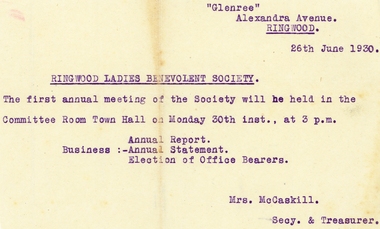
Document, Ringwood Ladies Benevolent Society 1929-1939
... Treasurer and Secretary shall be Honorary. Mrs. McCaskill , whose husband was a Councillor at that time was the first President, a position she held for many years. There were 32 Ladies Benevolent Societies in the metropolitan area at this time. By the early 2000s there only a few left and Ringwood was one...Treasurer and Secretary shall be Honorary. Mrs. McCaskill , whose husband was a Councillor at that time was the first President, a position she held for many years. There were 32 Ladies Benevolent Societies in the metropolitan area at this time. By the early 2000s there only a few left and Ringwood was one ...The constitution states that the object of the Society is to relieve the wants of the poor -especially women and children- by suppyling them with clothing ,boots, food, fuel and other necessaries. The members of the Society to be councillors wives and representatives of Religious organisations.The President shall be the Mayoress. the positions of Treasurer and Secretary shall be Honorary. Mrs. McCaskill , whose husband was a Councillor at that time was the first President, a position she held for many years. There were 32 Ladies Benevolent Societies in the metropolitan area at this time. By the early 2000s there only a few left and Ringwood was one of the last to close about 2008 when it was absorbed into the Citizen's Advice Bureau. Various typed and hand written documents relating to the Ringwood Ladies Benevolent Society formed in 1929. 1- Constitution and Rules. 2- First Annual Report dated 1930. 3- Financial report submitted to The Charities Board of Victoria. 4- Receipts and expenditure for year ending 30th June 1930. 5- List of Societies affiliated with the Central Council of Victorian Ladies' Benevolent Societies. 6- Notification of first Annual Meeting of the Society in 1930. 7- Miscellaneous documents and newspaper clipping relating to the Ringwood Ladies Benevolent Society. -
 Ringwood and District Historical Society
Literary work, Alice Milner's memories of CWA Ringwood Branch in 1995
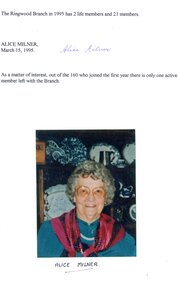
... Secretary) • Mrs. Roberts (Treasurer) At the inaugural meeting, 93 ladies joined, and the first general meeting of the Ringwood Branch was held March 7, 1946, and by the end of August the membership grew to 160. In 1946 the joining fee was 4/- and you never attended a meeting unless you wore hat and gloves. The first year, meetings were held in the main Town Hall, then they were transferred to the small hall, which had a creche next door, at the baby health centre, where mothers could leave their little ones...Secretary) • Mrs. Roberts (Treasurer) At the inaugural meeting, 93 ladies joined, and the first general meeting of the Ringwood Branch was held March 7, 1946, and by the end of August the membership grew to 160. In 1946 the joining fee was 4/- and you never attended a meeting unless you wore hat and gloves. The first year, meetings were held in the main Town Hall, then they were transferred to the small hall, which had a creche next door, at the baby health centre, where mothers could leave their little ones ...Kindly scanned from Ringwood Branch archival collectionTranscript (kindly completed by Ken Briscoe using ChatGPT) RINGWOOD BRANCH COUNTRY WOMEN'S ASSOCIATION INC. February 13, 1946 in the Ringwood Town Hall, the Mayoress, Mrs. H.E. Parker, called the meeting and Ringwood Branch Country Women's Association was formed, and would be in the Yarra Valley Group. Speaker for the day was Mrs. Wray, Group President, Yarra Valley Group. Office bearers elected were: • Mrs. Greenshields (President) • Mrs. Shields (Secretary) • Mrs. Roberts (Treasurer) At the inaugural meeting, 93 ladies joined, and the first general meeting of the Ringwood Branch was held March 7, 1946, and by the end of August the membership grew to 160. In 1946 the joining fee was 4/- and you never attended a meeting unless you wore hat and gloves. The first year, meetings were held in the main Town Hall, then they were transferred to the small hall, which had a creche next door, at the baby health centre, where mothers could leave their little ones, while mum enjoyed the meetings, demonstrations or entertainment. The Branch had a very good Choir, conducted by Mrs. Dorrie Davidson, also a very talented theatrical group. Each birthday they put on excellent stage shows, some beautiful costumes being hired from well-known Melbourne theatrical company. The 1956 Olympic stage show had some well-trained, but out of form, athletes. Highlight of the year was the Annual Ball and two Debutante Balls. New branches were formed in the district, Everard, East Ringwood, Heathmont, South Warrandyte. There was also, Ringwood Younger set, a night branch (later years was renamed Marana). It was then that our membership dropped. As more and more branches were started in the district, Ringwood was then allocated to the newly formed Maroondah Highway Group. Craft classes and demonstrations were of a high standard, with some interesting things being made such as millinery, dressmaking, pottery, etc. In 1960 when Ringwood was made a City, a C.W.A. float was entered in the procession, this was a mammoth task, as hundreds of flowers were made and wired to the float, which was in green and gold C.W.A. colours. The time came when the Town Hall was to be demolished, and we moved to the Church of England Hall, Civic Place, but after a short time, this hall was also demolished. Meetings were then held at Ringwood Library until the library was no longer available. Our last move was to our present meeting room at Lionswood. Today you dress as you wish and membership is $12.00. The Ringwood Branch in 1995 has 2 life members and 21 members. Alice Milner March 15, 1995 As a matter of interest, of those 160 members who joined in the first year, only one active member is left with the Branch -
 Mission to Seafarers Victoria
Book - Family history, William Gordon Volum, The Volum Family, 1992
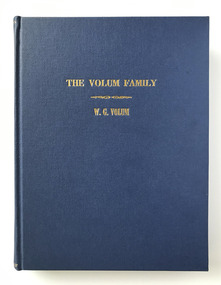
... In 1967, he was a co-founder of the Nautical Association of Australia Inc, serving as Honorary Secretary-Treasurer until 1977, when he became Editor of the Assocaition's quarterly magazine "The Log". volum collection geelong peterhead scotland captain seafaring whaling brewery paper mill mission to seafarers An account of the Volum family, largely Peterhead in Scotland, where they were involved with whaling, but also in Geelong Australia, Ceylon, England and Peru. It has fourteen appendices on a variety of topics plus forty-one ...An account of the Volum family, largely Peterhead in Scotland, where they were involved with whaling, but also in Geelong Australia, Ceylon, England and Peru. It has fourteen appendices on a variety of topics plus forty-one illustrations.Navy blue cover with gilded title. viii, 216 p., [30] p. of plates : ill., 2 maps, ports. Bibliography: p. 208-210.non-fictionAn account of the Volum family, largely Peterhead in Scotland, where they were involved with whaling, but also in Geelong Australia, Ceylon, England and Peru. It has fourteen appendices on a variety of topics plus forty-one illustrations.volum collection, geelong, peterhead, scotland, captain, seafaring, whaling, brewery, paper mill, mission to seafarers -
 Eltham District Historical Society Inc
Photograph - Digital Photograph, Marguerite Marshall, Avenue of Honour, Main Road, Eltham, 20 April 2008
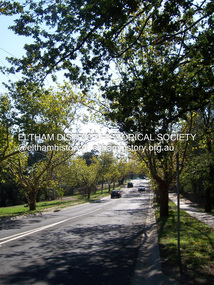
... secretary; Mr R. E. Gilsenan, treasurer; with a very strong committee of local residents. Lady Irvine then suggested that it would be nice to plant an Avenue of Honor, which was carried out in a very cheerful and spirited manner on Saturday afternoon. Cr Taylor and Mr R. E. Gilsenan occupied themselves during the fore-forenoon in getting the lining-out and other preliminaries ready, but shortly after one...secretary; Mr R. E. Gilsenan, treasurer; with a very strong committee of local residents. Lady Irvine then suggested that it would be nice to plant an Avenue of Honor, which was carried out in a very cheerful and spirited manner on Saturday afternoon. Cr Taylor and Mr R. E. Gilsenan occupied themselves during the fore-forenoon in getting the lining-out and other preliminaries ready, but shortly after one ...The suggestion of an Avenue of Honour may have been originally put forward by Lady Irvine who was a member of the Welcome Home Committee. The Avenue of Honour was established to memorialise all those from Eltham who enlisted (some of whom were still fighting overseas at the time), similarly as the Shire of Eltham (Soldiers) Memorial Park was in tribute to all from the Shire who enlisted. The twenty-seven names of those killed from Eltham were engraved on the Eltham War Memorial Obelisk unveiled in 1919 at the corner of Main Road and Bridge Street. From an article in the Heidelberg News and Greensborough, Eltham and Diamond Creek Chronicle, September 22, 1917, p. 2, it was reported: Some few weeks ago a public meeting was held in the Eltham Rechabite Hall for the purpose of forming a committee to make necessary arrangements for the return of our brave lads from the front, with the result that the following officers were elected, viz., Sir William Irvine. president; Cr. R. D. Taylor, vice-president; Rev. T. W. Sapsford, secretary; Mr R. E. Gilsenan, treasurer; with a very strong committee of local residents. Lady Irvine then suggested that it would be nice to plant an Avenue of Honor, which was carried out in a very cheerful and spirited manner on Saturday afternoon. Cr Taylor and Mr R. E. Gilsenan occupied themselves during the fore-forenoon in getting the lining-out and other preliminaries ready, but shortly after one o'clock the willing workers could be seen wending their way towards the township, with picks, shovels. &c., on their shoulders, and in a very short time the gang at work was in appearance a very lively and pretty sight, the only thing that was missing was the camera, to have had a few snapshots taken. A little after 3 o'clock Sir William and Lady Irvine, and Mr W. Gray and family, arrived by motor. Cr Taylor then explained that their object in gathering together so hurriedly to plant the avenue was on account of the lateness of the season, and being offered 100 trees, free of charge, by Cr. Wm. G. Gray; of Allwood Nursery, Hurst's Bridge (for which the committee are deeply grateful to him and the public highly appreciate his generous offer). Sir Wm. Irvine then spoke at some length on the ravages of this cruel war, and the good that must result therefrom in bringing all closer together; he also referred to our brave lads who were fighting for us, and thought it was for those at home to show their appreciation by planting the Avenue of Honor. Lady Irvine thou proceeded to plant the first tree, which was an English oak: Sir William following by planting a Spanish chestnut; and Mrs W. G. Gray a sycamore. After that the gathering refired to the entrance of Mr R. E. Gilsenan's green paddock to partake of refreshments, which the ladies had kindly provided for the willing band of workers. Work was again taken to in earnest, and the planting finished, all being satisfied that they had done good work. At the Eltham Shire Council’s monthly meeting held May 6, 1918, Cr. Gray promised to give Council £20 to £25 worth of trees if the Council would plant and guard them. His desire was that a tree be planted in the name of every soldier lad who has gone to the front. Each tree was later adorned with a brass plaque with the name of a soldier and a wooden tree guard placed around them. Over the years many trees died, and following roadworks were replanted on a new alignment. Nillumbik Shire Council is continuing this process of replanting trees in a new alignment to move them away from overhead power lines and to clear the VicRoads reserve. Covered under Heritage Overlay, Nillumbik Planning Scheme. Published: Nillumbik Now and Then / Marguerite Marshall 2008; photographs Alan King with Marguerite Marshall.; p119This collection of almost 130 photos about places and people within the Shire of Nillumbik, an urban and rural municipality in Melbourne's north, contributes to an understanding of the history of the Shire. Published in 2008 immediately prior to the Black Saturday bushfires of February 7, 2009, it documents sites that were impacted, and in some cases destroyed by the fires. It includes photographs taken especially for the publication, creating a unique time capsule representing the Shire in the early 21st century. It remains the most recent comprehenesive publication devoted to the Shire's history connecting local residents to the past. nillumbik now and then (marshall-king) collection, avenue of honour, main road, eltham -
 Kiewa Valley Historical Society
Trophy - Tawonga South Tennis, 1950
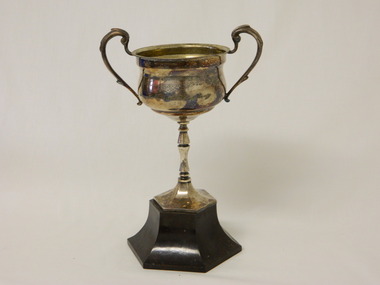
... one room to two in 1955 to avoid congestion. This would indicate that the population would have been sufficient for a tennis club as well. In the SEC Magazine 1946 Page 45:- "South Tawonga Tennis Club has arranged social functions to raise funds, and working bees are busy on the erection of a tennis court. The president is Mr. N. Piera, the secretary ...The Tawonga South Tennis Club commenced in 1946 and was situated on the last property on the riverside before the Tawonga South bridge where there was also a kiosk. Tennis was very popular in the Kiewa Valley with the influx of players available from the Kiewa Hydro Electric Scheme. In the Bogong-Tawonga Tennis Association there were three Bogong teams - Cope, McKay and Beauty with the other teams from Tawonga called Wanderers, Rovers, Pines and South Tawonga. Reported in the SEC magazine, Oct--Nov. 1946 Page 45:- "The membership now totals eighty, and both Bogong courts are in continuous use during week-ends and in the evenings and early mornings." There were clubs & teams in Bogong, Mt Beauty and Tawonga. This trophy indicates that there was a tennis association at Tawonga South in 1950. In 1945 the Tawonga South school was set up to serve the children of the State Electricity Commission of Victoria employees. The school was extended from one room to two in 1955 to avoid congestion. This would indicate that the population would have been sufficient for a tennis club as well. In the SEC Magazine 1946 Page 45:- "South Tawonga Tennis Club has arranged social functions to raise funds, and working bees are busy on the erection of a tennis court. The president is Mr. N. Piera, the secretary Mr. H. Wilson and the treasurer Mrs. W. Griffiths.Tarnished metal trophy with cup and two, extending above the cup, handles either side. The cup is raised by a decorated stem which is attached to a brown plastic hexagonal base. Tawonga South Tennis / Association 1950 / Donated by G.T.Kennedytennis. tawonga south. g.t. kennedy. kiewa valley. sport. club -
 Eltham District Historical Society Inc
Photograph, Austin Hospital Appeal for Stage 2 Building Appeal, 4 Jul 1973
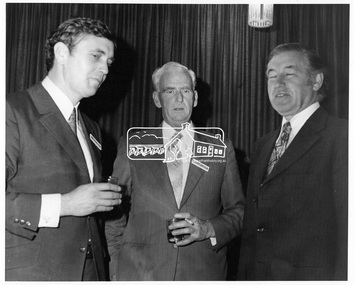
... secretary/Chief Administrative Officer, Cr. J.O. White J.P., Shire President, The Hon. R.J. Hamer, E.D., M.P., Premier of Victoria, and treasurer and Minister of the Arts. The July 1973 appeal's target was $500,000, which with government subsidies aimed to pay for a nine-story building alongside stage one - a combined ten-storey teaching, research and medical centre. ...secretary/Chief Administrative Officer, Cr. J.O. White J.P., Shire President, The Hon. R.J. Hamer, E.D., M.P., Premier of Victoria, and treasurer and Minister of the Arts. The July 1973 appeal's target was $500,000, which with government subsidies aimed to pay for a nine-story building alongside stage one - a combined ten-storey teaching, research and medical centre. ...Luncheon reception held at Austin Hospital, Heidelberg to open appeal for the Stage 2 Building Appeal. L-R: Mr. Colin J. Bock, Shire secretary/Chief Administrative Officer, Cr. J.O. White J.P., Shire President, The Hon. R.J. Hamer, E.D., M.P., Premier of Victoria, and treasurer and Minister of the Arts. The July 1973 appeal's target was $500,000, which with government subsidies aimed to pay for a nine-story building alongside stage one - a combined ten-storey teaching, research and medical centre. The new block was planned to provide the Austin Hospital with 218 additional beds, eight extra operating theartres and a comprehensive range of medical, diagnostic, therapeutic and anciliary services. The hospital conducted a door knock appeal in the Heidelberg and Eltham districts on Sunday July 22.This photo forms part of a collection of photographs gathered by the Shire of Eltham for their centenary project book, "Pioneers and Painters: 100 years of the Shire of Eltham" by Alan Marshall (1971). The collection of over 500 images is held in partnership between Eltham District Historical Society and Yarra Plenty Regional Library (Eltham Library) and is now formally known as 'The Shire of Eltham Pioneers Photograph Collection.' It is significant in being the first community sourced collection representing the places and people of the Shire's first one hundred years.Digital image 120 format B&W negative EDHS_01922 (4 strips, 12 frames - Frame 8)austin hospital, austin hospital appeal, austin hospital appeals committee, colin j. bock, cr. j.o. white, fundraising, heidelberg, hon. r.j. hamer, other areas, p.j. catchlove, premier of victoria, rupert hamer, sepp, shire of eltham pioneers photograph collection, shire president, victorian premier -
 Warrnambool and District Historical Society Inc.
Ephemera - Raffle Tickets, 1978
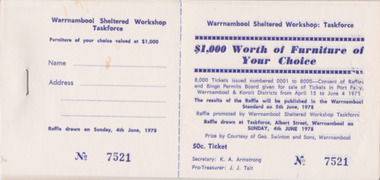
... Secretary K. A. Armstrong, Pro-Treasurer J. J. Tait in 1978 showing support from Geo Swinton & Sons with $1,000 worth of furniture of choice. Taskforce Warrnambool Sheltered Workshop. Results published in the Warrnambool Standard 5 June 1978. Life community involvement of K. A. Armstrong. warrnambool sheltered work shop raffle tickets swinton & sons Book of blank unused Ticket no's 7521 to 7535. White paper with dark blue print and imprinted serration for ease of tear off portion. Bound with one ...These tickets were raising money for the local Warrnambool Sheltered Workshop. The local sheltered workshop provided opportunities for disabled people to work together doing varied tasks. The tickets were sold in the Port Fairy, Portland, Warrnambool & Koroit Districts. Warrnambool Sheltered Workshop Secretary K. A. Armstrong, Pro-Treasurer J. J. Tait in 1978 showing support from Geo Swinton & Sons with $1,000 worth of furniture of choice. Taskforce Warrnambool Sheltered Workshop. Results published in the Warrnambool Standard 5 June 1978. Life community involvement of K. A. Armstrong.White paper with dark blue print and imprinted serration for ease of tear off portion. Bound with one staple.Book of blank unused Ticket no's 7521 to 7535. warrnambool sheltered work shop, raffle tickets, swinton & sons -
 Conservation Volunteers
Photograph: Prime Minister John Howard visits ATCV head office in Ballarat in 1997 after ATCV wins Green Corps contract, Prime Minister John Howard visits ATCV head office in Ballarat in 1997 after ATCV wins Green Corps contract, 1997
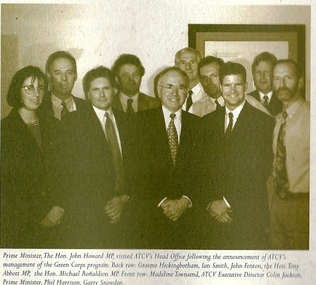
... One hundred and one participants representing 71 past and current teams from around Australia, Treasurer Peter Costello, three other Commonwealth Ministers, and several “captains of industry” were on hand. ...Colin Jackson, Phil Harrison and Garry Snowden were in Parliament House, Canberra, on the evening of 20 August 1996, to hear the Budget Speech by the new Federal Treasurer, Peter Costello MP, who announced: “…the Government will provide $42 million over the next three years to establish the Green Corps. The Green Corps will be open to young Australians aged 17 to 20 to demonstrate their commitment to the environment by working on projects to preserve and restore Australia's natural environment and cultural heritage. The projects will also contribute to their career and employment prospects through training, skills development, work experience and personal development.” Soon after, the Commonwealth advertised a tender for a manger for the new program. Phil Harrison orchestrated a flurry of faxes between Brisbane and Ballarat, as Colin Jackson, Madeline Townsend, Garry Snowden and John Fenton fine-tuned the document. National reach and credible record won ATCV the job to administer and manage Green Corps for the whole of Australia for five years (1997-2002) was won in November and the contract was signed on the eve of Christmas, 1996. At the national launch of Green Corps – Youth for the Environment held in sweltering Adelaide on 12 January 1997, Colin Jackson assure the responsible Minister, Senator Amanda Vanstone, that thirty six projects were already in place and that recruiting was going well. Those who were there recall with awe the remarkable celebration that was the National Green Corps Conference on 21-24 February 1998 in Canberra. One hundred and one participants representing 71 past and current teams from around Australia, Treasurer Peter Costello, three other Commonwealth Ministers, and several “captains of industry” were on hand. Board member Sue Campbell remembers feeling “deeply moved” when Travis Schicchitano explained to the audience how much joining Green Corps had meant to him. Travis said: “Green Corps was an amazing hands-on practical experience, which has enabled me to learn and to fulfil my passion, the Australian environment.” Black and white group portrait photograph.“It’s not every day that you get the Prime Minister walking in off the street, and one of my favourite moments was in 1997 when the Hon. John Howard made his visit to Head Office in Ballarat” – Colin Jackson atcv cva green corps young australians for the environment commonwealth government prime minister john howard tony abbott mp michael ronaldson mhr senator amanda vanstone -
 Bendigo Historical Society Inc.
Photograph - Golden Square Methodist Church Trustees
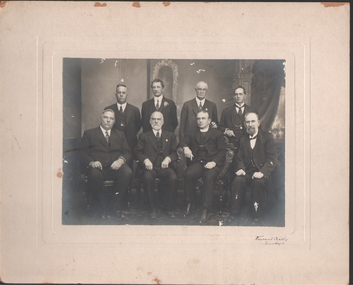
... one with clerical collar. Back row RHS William Henderson (Father of Edith Henderson - mother of the donor). Joan McDonald Collection. handwritten on the back of the mounted card - "Trustees of Golden Square Methodist Church Rear; Left to right. Charles Enticknap, James H Crump, Robert Saunders, William Henderson (Secretary...one with clerical collar. Back row RHS William Henderson (Father of Edith Henderson - mother of the donor). Joan McDonald Collection. handwritten on the back of the mounted card - "Trustees of Golden Square Methodist Church Rear; Left to right. Charles Enticknap, James H Crump, Robert Saunders, William Henderson (Secretary ...Black and white photograph of eight men - four standing, four seated. Seven men in suits and ties, one with clerical collar. Back row RHS William Henderson (Father of Edith Henderson - mother of the donor). Joan McDonald Collection. handwritten on the back of the mounted card - "Trustees of Golden Square Methodist Church Rear; Left to right. Charles Enticknap, James H Crump, Robert Saunders, William Henderson (Secretary). Front Ralph Jones, George Pethard Senr. (Treasurer) Rev. J C Lawton, M. Harvey.Handwritten on lower RH corner - "Vincent Kelly Bendigo".golden square methodist church, trustees -
 Bendigo Historical Society Inc.
Memorabilia - Doctor Lilian Cleeve Collection, 1915 - 1996
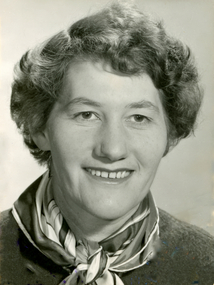
... George was the secretary/treasurer of the Bendigo Branch of the Liberal Party. They lived at 96 Moore Street ('Silver Birches'), close to the hospital. George and Lilian had one...George was the secretary/treasurer of the Bendigo Branch of the Liberal Party. They lived at 96 Moore Street ('Silver Birches'), close to the hospital. George and Lilian had one ...Doctor Lilian Marjorie Cleeve was born in 1915 and died in February 1996. She grew up in Moonee Ponds and graduated as a Doctor from the University of Melbourne School of Medicine in 1941. She completed her training at the Women's Hospital in Melbourne between December 1940 and January 1941 where she delivered her first baby, Beverley Margaret Manley. In 1942 at the beginning of the war with Japan, Doctor Cleeve travelled to Bendigo. The train was full of soldiers travelling to camp at the Bendigo Showgrounds next to the hospital (now the Tom Flood Centre). Because of the war, the streets were in darkness. Some soldiers carried her suitcase to her new home. Doctor Cleeve immediately began work as the hospital Registrar. Later on she specialized in the delivery of babies, who always seemed to be born on her days off. After leaving the hospital Doctor Cleeve joined the medical practice of Doctors Gorman and Grant (husband and wife). Their rooms were on the corner of View and Mckenzie Streets in the Atkinson building (named after Doctor Harry Atkinson). Doctor Cleeve then established a medical practice in Garsed Street where the Dan Murphy Car Park is now located. Later Doctor Cleeve ran an eye clinic with Doctor Gorman's son, on the other side of Garsed Street. She also used to visit Puckapunyal Army Base to screen both the regular army recruits and the conscripts who were sent to Vietnam. Doctor Cleeve last worked as part of the associate medical staff at the Bendigo Teachers' College in Osborne Street from 1979 to 1980. In 1944 Lilian married Sargent George Cathcart (Fortuna Army Survey Regiment). George was the secretary/treasurer of the Bendigo Branch of the Liberal Party. They lived at 96 Moore Street ('Silver Birches'), close to the hospital. George and Lilian had one son, Andrew. George passed away from a heart attack in 1957. Lilian married Roy Lockart Chisholm in 1960. Roy was the manager of the Charing Cross Branch of the CBA Bank. Not long after their marriage, Lilian (now Mrs Chisholm), Roy, and Lilian's young son Andrew, took a honeymoon voyage on the cargo vessel "Milos" to Hong Kong, Japan, New Guinea and Borneo, where they visited the Sandakan War Memorial. In 1960 Lilian sold 96 Moore Street, and following Roy's retirement, they purchased a house which they named 'Roslyn' at 28 Reginald Street, Quarry Hill. Roy died in 1963 after suffering a stroke. Respected and well-liked, Mrs Chisholm continued to raise Andrew in Reginald Street with the assistance of her faithful housekeeper Coral Suurpaa, known to all as “Hickey". Coral lived in a house in Breen Street, beside the Myrtle Street railway bridge. Prior to this, "Hickey" had lived-in at Moore Street when Dr Cleeve was widowed after the death of her first husband. Photos, Passport, Letter and Nameplate 11138a Doctor Lilian Marjorie Cleeve passport photo May 1961 11138b British Australian Passport 11138c The Premier Visits 'Silver Birches' 96 Moore St., Bendigo on April 8th 1957 Photo. From Left to Right are: Former Bendigo Organiser, Mr T.J. Langdon (now at Ballarat), Mrs Langdon, Mrs John Stanistreet, The Premier, Hon. H.E. Bolte, Mr John Stanistreet, M.L.A., Mrs G. Cathcart (Dr Cleeve) and Mr G.W.S. Cathcart. 11138d Doctor Cleeve and George Cathcart Photo 11138e Dr Cleeve front row 3rd from the right with her first baby delivered at the Women's Hospital Melbourne 1940 Photo. Back Row: B J Bernstein, B Chromow, S I D Preston, H J Hoffman, P Zerman, D G Sisely. Middle Row: L B Satchell, J B Buchanan, O B Pearce, J C Trinea, M R Millikan, I J Selikoff, R E Dwork. Front Row: J Kremer, R B Lewis, Miss B Marshall, Dr M A Mackie, Prof. Marshall Allan, Miss L Cleeve, Miss J grant, H Berinshaw. 11138f Dr Cleeve, Coral Suurpaa, Andrew Cathcart Photo in the backyard at 28 Reginald St. Quarry Hill, 1195-1997. 11138g Letter from Andrew Cathcart to the Sisely family in dec 2009 re the photo taken at the Women's Hospital Melbourne in 1940-41 11138h Dr L M Cleeve Nameplate Front View 11138i Dr L M Cleeve Nameplate Rear View 11138j The University of Melbourne Conferring of degrees Wilson Hall Monday 1st June 1942bendigo, doctor lorna sisely, women's hospital melbourne, roy lockart chisholm, reginald street, quarry hill, coral suurpaa, dr lilian cleeve, george cathcart -
 Bendigo Historical Society Inc.
Document - PETER ELLIS COLLECTION: NEWSLETTER
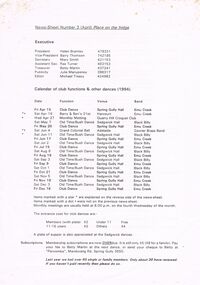
... Secretary - Mary Smith; Assistant Sec. - Rae Turner; Treasurer - Betty Martin; Publicity - Julie Manypeney, and the Editor - Michael Treacy. Calendar of club functions & other dances (1994) are listed. Dances are held at Spring Gully, Harcourt, Quarry Hill, Sedgwick and one...Secretary - Mary Smith; Assistant Sec. - Rae Turner; Treasurer - Betty Martin; Publicity - Julie Manypeney, and the Editor - Michael Treacy. Calendar of club functions & other dances (1994) are listed. Dances are held at Spring Gully, Harcourt, Quarry Hill, Sedgwick and one ...News-Sheet Number 3. Listed are the President - Helen Bramley; Vice-President - Barry Thomson; Secretary - Mary Smith; Assistant Sec. - Rae Turner; Treasurer - Betty Martin; Publicity - Julie Manypeney, and the Editor - Michael Treacy. Calendar of club functions & other dances (1994) are listed. Dances are held at Spring Gully, Harcourt, Quarry Hill, Sedgwick and one in Adelaide. Bands are Emu Creek, Black Billy and in Adelaide the Gawler Brass Band. Some items marked with a star are explained on the reverse side of the news-sheet and the ones marked with a dot were not on the previous news-sheet. Entrance costs are listed. There is also a reminder for Membership subscriptions.clubs, social, dances, peter ellis collection, helen bramley, barry thomson, mary smith, rae turner, betty martin, julie manypeney, michael treacy, peroomba, don manypeney, emu creek band, ben thomson, margaret howie, sue foster, barb johnson, jim dobbyn, tom & margaret dean, edna miller -
 Bendigo Historical Society Inc.
Document - ANCIENT ORDER OF FORESTERS NO 3770 COLLECTION: TO PAY
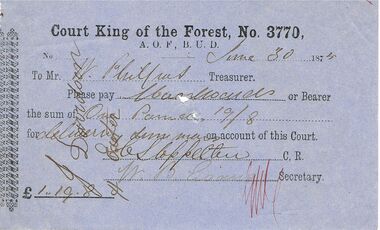
... Blue coupon dated June 30 1875 asking the Treasurer, Mr. W. Philpot to pay ? The sum of One Pound 19/8 for delivery ? ...J Davidson H Exeter Blue coupon dated June 30 1875 asking the Treasurer, Mr. W. Philpot to pay ? The sum of One Pound 19/8 for delivery ? ...Blue coupon dated June 30 1875 asking the Treasurer, Mr. W. Philpot to pay ? The sum of One Pound 19/8 for delivery ? ? On account of theis Court. Signed C. Sloppellein?, C.R. and W. B. Evans?, Secretary. Also signed across by J. Davidson and H. Exeter.societies, aof, correspondence, ancient order of foresters no 3770 collection - to pay, court king of the forest, w philpot, c. sloppellein?, w b evans?, j davidson, h exeter -
 Bendigo Historical Society Inc.
Document - ANCIENT ORDER OF FORESTERS NO 3770 COLLECTION: TO PAY
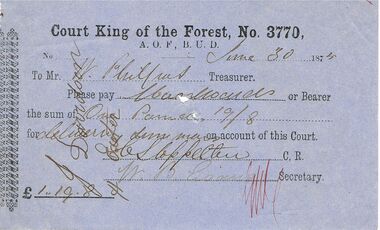
... Blue coupon dated June 30 1875 asking the Treasurer, Mr. W. Philpot to pay ?ub Secretary the sum of One Pound for se? ...Blue coupon dated June 30 1875 asking the Treasurer, Mr. W. Philpot to pay ?ub Secretary the sum of One Pound for se? ...Blue coupon dated June 30 1875 asking the Treasurer, Mr. W. Philpot to pay ?ub Secretary the sum of One Pound for se? on account of theis Court. Signed C. Sloppellein?, C.R. and W. B. Evans?, Secretary.societies, aof, correspondence, ancient order of foresters no 3770 collection - to pay, court king of the forest, w philpot, c. sloppellein?, w b evans? -
 Essendon Football Club
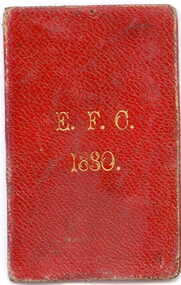
Essendon Football Club membership ticket
... It is signed by Alex McCracken, one of the club's founding fathers and the secretary and treasurer of the club in 1880. ...It is signed by Alex McCracken, one of the club's founding fathers and the secretary and treasurer of the club in 1880. ...This 1880 membership ticket is the earliest membership ticket held by the club. It is signed by Alex McCracken, one of the club's founding fathers and the secretary and treasurer of the club in 1880. The inside includes fixtures of both the 'first 20' and 'second 20'.It is the earliest membership ticket held by the club.Inside paper is damaged but remains of Alex McCracken's signature are still visible. -
 Narre Warren and District Family History Group
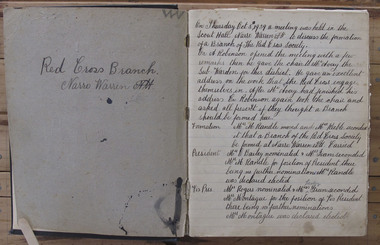
Book - Narre Warren North Red Cross Minute Books 1939 to 1964, Narre Warren North Red Cross, 1939-1964
... secretary and Mrs Ewart, treasurer. All financial members were deemed to constitute the committee. By 1953, just 14 years after their formation they had raised over two thousand pounds, of which one thousand, eight hundred and eighty-two pounds had been sent to headquarters....secretary and Mrs Ewart, treasurer. All financial members were deemed to constitute the committee. By 1953, just 14 years after their formation they had raised over two thousand pounds, of which one thousand, eight hundred and eighty-two pounds had been sent to headquarters. ...Narre Warren North had a population of 200 in 1933. Just a month after World War 2 began in September 1939, a meeting was held in the Narre Warren Scout Hall to discuss the formation of a branch of the Red Cross Society. Mrs Harry Randle was elected president, Mrs Montague, vice president; Mrs Brundrett, secretary and Mrs Ewart, treasurer. All financial members were deemed to constitute the committee. By 1953, just 14 years after their formation they had raised over two thousand pounds, of which one thousand, eight hundred and eighty-two pounds had been sent to headquarters.The minutes bring together the ladies of all walks of life in a small rural community. The early minutes reflect the difficulties of the war years when many of the women may have had husbands, sons and daughters in the services. Despite rationing and shortages of materials these ladies always seemed to have most of what they needed to make goods to sell at stalls, provide suppers at concerts and social afternoons and hold an annual fair. In their spare time they knitted socks and helmets and sewed pyjamas that were sent to those serving overseas. The minutes highlight the work of our local women and give us an insight into the often unrecorded contributions women made within their communities in a time when local histories were dominated by male achievements.Six exercise books bound with hard cover binding. Navy blue debossed cover.narre warren north (vic.), narre warren north (vic.) -- red cross, red cross society -
 Narre Warren and District Family History Group
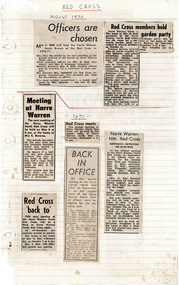
Book - Narre Warren North Red Cross newspaper cuttings, Narre Warren North Red Cross
... secretary and Mrs Ewart, treasurer. All financial members were deemed to constitute the committee. By 1953, just 14 years after their formation they had raised over two thousand pounds, of which one thousand, eight hundred and eighty-two pounds had been sent to headquarters. ...secretary and Mrs Ewart, treasurer. All financial members were deemed to constitute the committee. By 1953, just 14 years after their formation they had raised over two thousand pounds, of which one thousand, eight hundred and eighty-two pounds had been sent to headquarters. ...Narre Warren North had a population of 200 in 1933. Just a month after World War 2 began in September 1939, a meeting was held in the Narre Warren Scout Hall to discuss the formation of a branch of the Red Cross Society. Mrs Harry Randle was elected president, Mrs Montague, vice president; Mrs Brundrett, secretary and Mrs Ewart, treasurer. All financial members were deemed to constitute the committee. By 1953, just 14 years after their formation they had raised over two thousand pounds, of which one thousand, eight hundred and eighty-two pounds had been sent to headquarters. 3 ring dark grey foolscap binder with newspaper clippings featuring the Unit, meeting and agenda notes, Red Cross pattern books. Small black dymo label with white text reads Narre Warren North Red Cross on spine.narre warren north (vic.), narre warren north (vic.) -- red cross, red cross society -
Glen Eira Historical Society
Document - Ormond Amateur Football Club
... one item: 1/A 42 page printed Ormond Junior Football Club 2010 Annual Report. The report covers Life Members, Premierships, committee, coaches and team managers, reports from the President and treasurer, property, social, medical and Auskick and Fair Go Footy. ...This file contains one item: 1/A 42 page printed Ormond Junior Football Club 2010 Annual Report. The report covers Life Members, Premierships, committee, coaches and team managers, reports from the President and treasurer, property, social, medical and Auskick and Fair Go Footy. Also a report on every team.ormond junior football club, rolfe kerri, president, harkin tim, vice president, naylor alan, secretary, treasurer, scanlan greg, committees of management, barton claire, bisognim livio, harty scott, harms hans w., houghton bruce, macri christine, murray gary, raymond david, sherman andrew, johnson belinda, robinson jenny, harms fran, adlington sue, clubs and association, sporting clubs, sports officials, australian rules football, annual reports -
 Glen Eira Historical Society
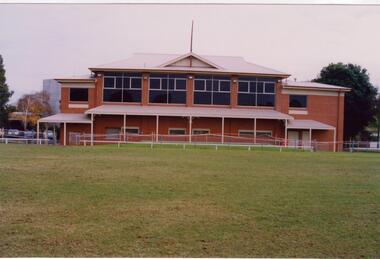
Article - Glen Huntly Park
... It includes 2 black and white photos: one of Cr Nicholas Gold and one of Mr Victor Townsend (Secretary/Treasurer for Glen Huntly Park Committee of Management) in front of the new pavilion. 2/ Two of the same original colour photographs of the pavilion at Glen Huntly Park, date unknown....It includes 2 black and white photos: one of Cr Nicholas Gold and one of Mr Victor Townsend (Secretary/Treasurer for Glen Huntly Park Committee of Management) in front of the new pavilion. 2/ Two of the same original colour photographs of the pavilion at Glen Huntly Park, date unknown. ...This file contains two items. 1/ An article from the CAULFIELD CONTACT on the history of Glen Huntly Park and its facilities, dated Jan/ Feb 1992. It includes 2 black and white photos: one of Cr Nicholas Gold and one of Mr Victor Townsend (Secretary/Treasurer for Glen Huntly Park Committee of Management) in front of the new pavilion. 2/ Two of the same original colour photographs of the pavilion at Glen Huntly Park, date unknown.glen huntly park, e. e. gunn park, city of caulfield, caulfield, glen huntly, football clubs, cricket clubs, caulfield north ward, caulfield racecourse, neerim road caulfield, booran road caulfield, parks, reserves, glen huntly sports ground, gold nicholas cr, townsend victor, clyde holding mp, pavilions, barbecues, picnic spots, playgrounds, tennis courts, north caulfield/ glen huntly cricket club, glen huntly amateur football club, the bloods football club, australian rules football, sports establishments, recreations establishments, sports grounds, sports, recreations, sporting clubs, clubs, associations, football clubs, tennis clubs, cricket clubs, leisure, cultural events, cultural activities, ovals, playing fields -
 Warrnambool and District Historical Society Inc.
Document, Boomerang Club Membership ticket
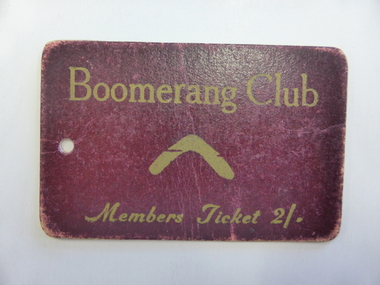
... One side has gold-coloured printing with a gold boomerang and the other side has the Secretary’s and Treasurer’s name and the name of the member signed in blue ink. ...One side: Boomerang Club, Members Ticket, 2/- Other side: J.W.Greening, Secretary & Treasurer, Name…. ...One side has gold-coloured printing with a gold boomerang and the other side has the Secretary’s and Treasurer’s name and the name of the member signed in blue ink. ...This is a member’s card for the Warrnambool Boomerang Club. This club was a social club that was formed some time in 1934 and continued until at least 1956. By the late 1930s there were nearly 200 members who took part in activities that included balls, dances, Christmas parties, picnics and dinners. Profits from the Boomerang Club functions were donated to local charitable organizations. The member, Mr S. Aberneathy, was a local Warrnambool resident. This is a significant item as an example of a member’s ticket from the Boomerang Club, an important social group in Warrnambool in the mid 20th century.This is a member’s ticket for the Boomerang Club, a card of thick paper, dark red on one side and white (buff-coloured) on the other. One side has gold-coloured printing with a gold boomerang and the other side has the Secretary’s and Treasurer’s name and the name of the member signed in blue ink. There is a small hole on one side to attach the card to a chain. The card is somewhat worn with age. One side: Boomerang Club, Members Ticket, 2/- Other side: J.W.Greening, Secretary & Treasurer, Name…. Mr S. Aberneathy warrnambool boomerang club, mr s aberneathy, boomerang club -
 Bendigo Military Museum
Mixed media - SCRAPBOOK BENDIGO RSL, 1967 - 1972
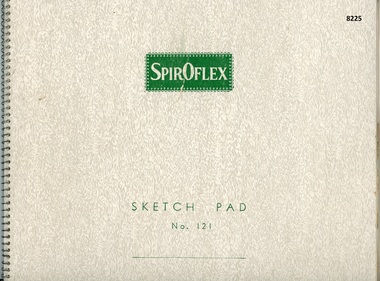
... Secretary, S.J. Ryan Immediate Past President, C.J. Plant, The Mayor Cr R.W. Cambridge, D.J. Osborn Jnr Vice President. Back Row, J. King Treasurer, John Osborne & D. Mattiske representing the State President and Mr T.M. Stephens Deputy Commissioner Repatriation Department. brsl smirsl scrap book On Page 6 top article in blue pen, "67", on bottom article in red pen, "6.7.68" Spiroflex sketch book with blank white pages used as a scrapbook with newspaper cuttings and photos relating to the Bendigo RSL, all are pasted in except one with stick tape, all photos are B & W, newspaper cuttings have turned a brownish colour. ...This scrap book has been divided into 4 parts with different Cat No's to give better coverage of the articles & photos. There are 3 photos in the book that were loose in other material as well and are covered in Cat No's 8094, 8148.2P, 8149P. some pages have been cropped to give a better view. Page 1. The article covers the award of a Life Membership to Samuel John Ryan for his years and work in Committee, Executive, Welfare and State Council. Sam as known served on the Committee of the Bendigo RSL from 1963 - 1968, 1970 - 1973, President 1964 - 1967, Snr Vice President 1973. He was made a Life member in 1968, awarded the BEM (British Empire medal) in 1973 for his untiring RSL Volunteer work. Page 2a. Shows people in attendance at a Remembrance Day Service 11th hour, 11th day, 11th month in Bendigo, year unknown. The man on own with the Cross is Sam Ryan President Bendigo RSL Page 2b. Shows two unknown men with and ANZAC Appeal poster. Page 3a. The Winston Churchill Memorial Appeal from the Bendigo angle, from the left Sam Ryan Bendigo RSL President, The Mayor Cr N.J. Oliver and Mr R.. Shelmerdine National Deputy President and Victorian Chairman of the Appeal. Page 3b. On the left is Mrs H. Morey President of the Bendigo RSL Ladies Auxiliary, centre is Mrs W. Waters being presented with a Life Membership of the Auxiliary by the President of the Bendigo RSL Jack Plant. the year was 1969. Page 4a. Poppy Appeal shows Mr H. McDougall Committee Bendigo RSL selling Poppies pre Remembrance Day to Mrs S. Reilly and Mrs J. Johnson. Mr Ernie Jackman Appeals Officer states he is very happy with the results. Mr McDougall served on Committee Bendigo RSL from 1964 - 1969. For Ernie Jackman refer Cat No 8133.2P. Page 4b. A brief service "Battle of Britain" service held at the Soldiers memorial Institute, Mr Ray Rood (Foreground) read a message from Lord Tedder Marshall of the RAF. The men left to right are: Mr R.R. Anderson, Mr F Wright, Mr R.V. Brock, Mr A. Ramage and Mr G. Baker. Page 5a. Article re Bendigo RSL Appeals re nearly 500 collectors set to start tomorrow morning. On the right Mr Sam Ryan President Bendigo RSL handing out Authorisation sheets and Receipts to area captains. From the left, Messrs E.J. Bass (Air Force Association), R Patterson (Bendigo Jaycees) Aenior Constable A Booth (Police)and Mr J. Hall (YM Vikings) Page 5b. Presentation of two "Easy Chairs" to the Repatriation Centre Bendigo Base Hospital, From the left E. Jackman (Appeals Officer) J.T. Sullivan Snr Vice President, A.l. Nelson (Welfare Officer) J.K. Barnes (Secretary) S.J. Ryan (President) and Cr Alec Craig (President of the Hospital Management Committee). Patients trying out the new Easy Chairs are Mr V. Steinhauser and Mr R. Pearson. Page 6a. Presentation of Life Membership to H.A.W. Morey (Bert) by the State President of the RSL Brigadier W.H. Hall at the Bendigo RSL Annual Dinner in 1967, to the left of Bert Morey is Sam Ryan President of Bendigo RSL. Bert Morey joined the RSL back in 1921, became a member of Bendigo RSL in 1923, served on the Committee from 1938 - 1960, Snr Vice President 1958 - 1960. Page 6b. Bendigo RSL Annual Dinner 6.7.1968. The New President Mr W.B. Nicholls was unable to attend, the Snr Vice President C.J. Plant deputised for him. From the left front row, J.K. Barnes Secretary, S.J. Ryan Immediate Past President, C.J. Plant, The Mayor Cr R.W. Cambridge, D.J. Osborn Jnr Vice President. Back Row, J. King Treasurer, John Osborne & D. Mattiske representing the State President and Mr T.M. Stephens Deputy Commissioner Repatriation Department.Spiroflex sketch book with blank white pages used as a scrapbook with newspaper cuttings and photos relating to the Bendigo RSL, all are pasted in except one with stick tape, all photos are B & W, newspaper cuttings have turned a brownish colour. Page 1 inside cover, article re the award of a Life membership. Page 2. Article with two pictures and text re Remembrance Day, picture re poster for the Anzac Appeal. Page 3. Two articles with pictures re the Churchill Appeal and a Life Membership. Page 4. Articles with pictures re Anzac Appeal and Battle of Britain. Page 5. Two articles with pictures re Appeals and Welfare. Page 6. Two articles with pictures re Life Membership and RSL Annual Dinner.On Page 6 top article in blue pen, "67", on bottom article in red pen, "6.7.68"brsl, smirsl, scrap book -
 Bendigo Military Museum
Book - MINUTE BOOK 1917 - 1930, Kangaroo Flat & District Soldiers Memorial Fund Minute Book
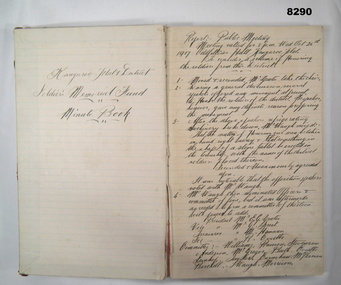
... Yeates, Vice President G Frost, Secretary R Coutts, Treasurer M Hannan, 14 other Committee members were elected. The first full meeting of the Committee was held on 5.11.1917. One...Yeates, Vice President G Frost, Secretary R Coutts, Treasurer M Hannan, 14 other Committee members were elected. The first full meeting of the Committee was held on 5.11.1917. One ...This book records the first public meeting on 24.10.1917 to build a Soldiers memorial in Kangaroo Flat held in the Odd Fellows Hall. On the night a Committee is formed with the following: President E.G. Yeates, Vice President G Frost, Secretary R Coutts, Treasurer M Hannan, 14 other Committee members were elected. The first full meeting of the Committee was held on 5.11.1917. One of the main items was to chose a boundary for inclusion on the Memorial. The entries continue till 18.6.1919. A last entry is dated 19.2.1930 relates to a new Committee and handing over the minutes and funds. At the rear of the book are 3 pages in ink re addresses of former residents. the last page in pencil is a list of entries re names & fund amount ranging from 2/- to 1 pound, 1/- (shillings) Refer Cat No 8291.7 for plans, details, quotes, correspondance.Minute book dark hard covers with red cloth binding tape, white paper, ruled blue lines, entries in black pen, a small few in pencil. a small newspaper notice re a meeting in 1930 is stapled at the top of one page.brsl, smirsl, minute, memorial, kfsmf -
 Warrnambool and District Historical Society Inc.
Financial record - Warrnambool Mechanics' Institute Accounts Ledger, Warrnambool Mechanics' Institute Secretary/Treasurer, Cash Book, 1907-1911
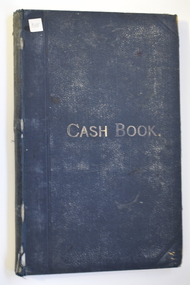
... one of Warrnambool's most influential organizations. The names listed in this ledger are of historical interest and provide much material for local history researchers. Warrnambool Mechanics' Institute Warrnambool School of Art and Design Ethel Mitchell Warrnambool School of Art and Design This is a ledger with a black cover with gold printing on the front. The pages have ruled red and blue lines and handwritten entries in black ink and blue crayon. The spine of the cover is somewhat tattered on the edges. Cash Book Financial record Warrnambool Mechanics' Institute Accounts Ledger Warrnambool Mechanics' Institute Secretary ...Although the organization name is not in the book, this ledger appears to have been used as a financial record for the Warrnambool Mechanics' Institute from 1904 to 1911. Most of the entries are the names of those subscribing to the Mechanics' Institute Library, the finances connected to the School of Art and Design and moneys received in connection with the Mechanics' Institute billiards room. The Warrnambool Mechanics' Institute was one of the earliest established in Victoria, being founded in 1854. The School of Art and Design, the second of its kind in Warrnambool, was established in 1883 and continued to be administered by the Mechanics' Institute until 1908. It eventually became part of the Warrnambool Technical School, opened in 1913. A local Museum was a feature of the Warrnambool Mechanics' Institute for many years. A billiards room was a recreational feature of many Mechanics' Institutes. The Warrnambool Mechanics' Institute closed in the 1960s with the library section continuing and the building was demolished in 1975 to make way for new Warrnambool Council buildings (including a new library)This ledger is of considerable interest as it is an early record of the Warrnambool Mechanics' Institute, one of Warrnambool's most influential organizations. The names listed in this ledger are of historical interest and provide much material for local history researchers.This is a ledger with a black cover with gold printing on the front. The pages have ruled red and blue lines and handwritten entries in black ink and blue crayon. The spine of the cover is somewhat tattered on the edges.warrnambool mechanics' institute, warrnambool school of art and design, ethel mitchell warrnambool school of art and design -
 Warrnambool and District Historical Society Inc.
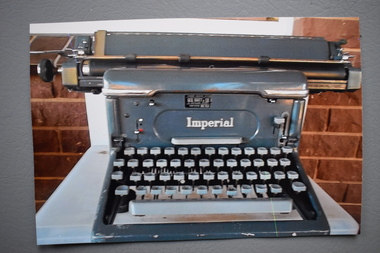
Typewriter & ribbon, Imperial, Mid 20th century
... He was also a life member of the Hampden Football League as a long-term Secretary and Treasurer and a secretary of the Warrnambool Football Club. This typewriter is of interest as one belonging to Gordon Toleman, a Warrnambool 20th century resident and a person well-known for his involvement in community activities. ...This typewriter belonged to Gordon William Toleman (1910-1975). The first known Toleman born in the Western District was born at Mortlake in 1845 and Gordon Toleman was also born in Mortlake. He lived with his family in Warrnambool for many years. He was an accountant the Nestles Factory at Dennington for over 25 years. He was actively involved in community affairs, including the Warrnambool Urban Fire Brigade (life member), the Florado Festival, the Warrnambool Olympic Pool committee and the Merrivale and Terang Football Clubs (player and captain). He was also a life member of the Hampden Football League as a long-term Secretary and Treasurer and a secretary of the Warrnambool Football Club.This typewriter is of interest as one belonging to Gordon Toleman, a Warrnambool 20th century resident and a person well-known for his involvement in community activities..1 This is a metal typewriter with black and grey keys and a red and black typewriting ribbon. It has three gauges or scales. .2 These are two typewriter ribbons in red and black with circular metal covers. ‘Imperial’ ‘Geo Wraitt & Co 15 McKillop Street Repairs MU 7051’ gordon toleman, history of warrnambool -
 Uniting Church Archives - Synod of Victoria
Certificate - Warrant, 1933
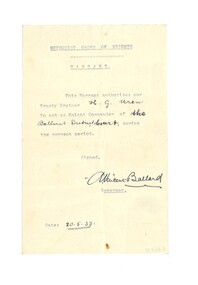
... one of the founders of the Sunday School Union, holding office as Vice President and President. He was actively associated with the Neil Street Christian Endeavour Movement from 1906. Also with the Ballarat and District Christian Endeavour Union for 25 years, holding the offices of Vice President, Assistant Secretary and Secretary. ...one of the founders of the Sunday School Union, holding office as Vice President and President. He was actively associated with the Neil Street Christian Endeavour Movement from 1906. Also with the Ballarat and District Christian Endeavour Union for 25 years, holding the offices of Vice President, Assistant Secretary and Secretary. ...Herbert G Uren joined Neil Street Methodist Church in 1906. In 1909 he was Superintendent of Warranheip Sunday School and in 1913 became the Superintendent of the Neil Street Junior School. In 1923 he was appointed the Senior Superintendent of Neil Street Junior School. H G Uren was one of the founders of the Sunday School Union, holding office as Vice President and President. He was actively associated with the Neil Street Christian Endeavour Movement from 1906. Also with the Ballarat and District Christian Endeavour Union for 25 years, holding the offices of Vice President, Assistant Secretary and Secretary. H G Uren was a Neil Street Church Steward and a Trustee for many years. He was a member of the Council of Churches for 30 years with the offices of Treasurer, Convener of Committees and minute Secretary. He organized the choir for Charles M Alxander in November 1912. H G Uren was Knight Commander of the Neil Street Methodist Order of Knights from 1933 and was awarded the Gold Star of the Order. Paper Methodist Order of Knights warrant. "H.G.Uren" "the Ballarat District Court" "20.5.33"methodist order of knights, herbert g uren, methodist order of knights ballarat district court, neil street ballarat methodist church, charles m alexander, christian endeavour -
 Uniting Church Archives - Synod of Victoria
BW photo, December 1987
... When I was appointed as a member of the Trusts Corporation, I was very glad to see that Alec was the secretary – most members were nearly twice my age and it waas comforting to be with an old friend of somewhat similar age. The meetings were reasonably formal as one ...Eulogy by John McArthur t seems trite to say that it is a privilege to be able to speak about Alex’s work in the Church, but having known Alex for over 50 years and our various activities having been inextricably intertwined it is indeed an honour as well as a privelge. I first met Alex in the late 1950s when we were members of the PFA State Council – they were halcyon days for the young people in the church with very strong youth groups in most congregations. Alex was the state Treasurer. John Anderson was the President with Maureen Hancock, the secretary, Maureen, who with many others from that Council are here today. Alex was also very active in his local church at Canterbury in all aspects of its life and witness as we have heard from his children, Barrie and Jo, earlier in this service Alex who had trained as an accountant, applied for and been appointed to a position with the PCV and upon the retirement of his mentor, S. K. Williams, was appointed the Financial Secretary of the Church. When I was appointed as a member of the Trusts Corporation, I was very glad to see that Alec was the secretary – most members were nearly twice my age and it waas comforting to be with an old friend of somewhat similar age. The meetings were reasonably formal as one would expect from a gathering of some of the very senior business men in our State. Alex’s records were immaculate – not only did his agendas have the business arising from the previous meeting but there on the side were a list of matters that in Alex’s opinion had not been satisfactorily finalised over the past year. But one matter has stuck in my memory - only the correspondence that required action was considered, many other letters were left to be formally minuted. This time there was a letter from the Government advising that a building on the south side of Collins Street originally owned by the Free Presbyterian Church in the 1800s was to be placed on the Historic Register and this was our first intimation of the matter. One trustee, a knight of the realm, whose chin was always down on his chest, ( I wondered whether he was asleep or something) raised his head and said “If one just stood still in Collins Street for five minutes they would slap a historic citation on you” and back down went his head. I was not sure what would happen next when I looked at Alex and slowly, that recognisable smile appeared on his face – not really a smile , more like a grin as Barrie and Jo said earlier, one that would appear time and time again over the years at meetings which were meant to be quite formal. Alex had an encyclopaedic memory – for example, ask him about bequest funds, say, the W. S. Godfrey Perpetual Bequest, his answer would be, “Ah yes, donated by the man who founded the Grocery business in Carlton, the capital now would be about 53, 250 dollars, been no call on it for 2 ½ years”. If a new project was thought appropriate and needed funding, he would be able to find a fund or a bequest that, with a little tweaking, could be used to seed the programme. His financial presentations at meetings contained all the information one could want – he would choose his words carefully, and one would sometimes think – get on with it Alex - but his purpose was to make it quite clear what funds were available and what was their correct use. He took this financial acumen into other committees of the church, the Stipend Committee dealing with Ministers’ salaries, the Beneficiary Committee, the superannuation fund for both ministers and lay workers. There are many in the church who have had cause to be grateful for his financial input which added to their well being. But his work was not all with financial matters – as the Financial Secretary for the State, Alex was ex-offficio a member of the Presbytery of Maroondah where he was not the Treasurer and although as an ex officio member he was not expected to take that much part in the Presbytery’s activities – but Alex did, he took part in the strategy and pastoral care committees which showed his depth of concern for others in his church life. But I believe it was around this time that Alex produced some of his greatest work for the church – Church Union, not all Presbyterians wanted to be part of the Uniting Church – so a Statutory Commision was established on a national level, to divide the assets of the Church between those desiring to form part of the Uniting Church and those wanting to remain Presbyterian. Each State produced detailed records and submissions for the Commission – and Victoria was always the first to have its documents to the Commission – although Alex had made it quite clear that he would be with the Uniting Church, his work was meticulous, impartial and assisted greatly the work of the Commission relating to Victoria. And this in addition to his normal day to day work which continued over a period of some four or five years. The inauguration of the Uniting Church did present Alex, and indeed the rest of us, with some challenges. There were the financial records of three churches to be merged, properties to be considered, new community programmes required, new administrative structures to be put in place. Alex took these all in his stride – although after the initial planning, his role was to concentrate on financial matters only, the other activities had to be financed. As the chairperson of the Finance Division and the Resources Commission for a large portion of the early years of the Uniting Church, I was more than pleased to have Alex again by my side, reports were prepared, queries answered, it was just like old times. The Rev. Allan Stuart, now retired and living closer to his family in NSW was one on those young people from the Canterbury congregation – emailed me recently “Alex has been a faithful servant of the Church, at all levels from the National Assembly to the local congregation. But times are changing, and Alex had rightly passed the torch onto others” Allan was right but I also think that words of that great Scottish poet, Robert Louis Stevenson, sum up Alex’s life: “A man is a success when he has lived well, laughed often and loved much. One who has gained the respect of intelligent men and the love of children; who has filled his niche and accomplished his task; who leaves the world better than he found it, whether by work, relationships, one who looked for the best in others and gave the best he had.” To me, that is our friend who we remember today - Alexander Robert Gillespie. BW photo of Alex Gillespie dressed in shirt sleaves and tie, upper body.C&N 11/2/1987, p. 33alex gillespie (29/2/1928–1/9/2009) worked for the presbyterian church as its managing treasurer for many years before then moving to the uniting church as the synod treasurer.
