
Showing 142 items matching " pioneer store"
-
 Merbein District Historical Society
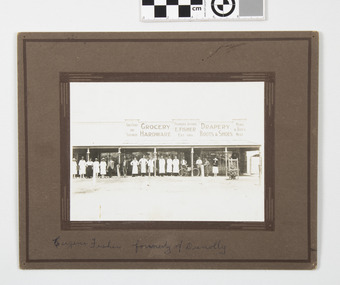
Photograph - Fisher's staff outside Fisher's Store in Commercial Street Merbein, Fisher's Pioneer Store late 1920's
... Fisher's Pioneer Store late 1920's...shops businesses Fisher's staff Merbein Pioneer Store Commercial Street 1920...shops businesses Fisher's staff Merbein Pioneer Store Commercial Street 1920 names supplied L-R -------- Miss Ahearne Miss Bessie Fisher ------ ------- Mr E. ...sepia photograph mounted on boardnames supplied L-R -------- Miss Ahearne Miss Bessie Fisher ------ ------- Mr E. Clay Mr Eugene Fisher C. Norman Bill Summerfield K. Drury E. Hibberd J. Hatch Bob Spence Bill Tierney (cartman) Harry Fisher Mrs Elizabeth Fisher Miss May(drapery)shops businesses fisher's staff merbein pioneer store commercial street 1920 -
 Canterbury History Group
Photograph - L Kugelmann's Pioneer Store, c1910
... L Kugelmann's Pioneer Store...Kugelmann's Pioneer Store with two people (children?) standing outside....Kugelmann's Pioneer Store with two people (children?) standing outside. ...Kugelmann's Pioneer Store with two people (children?) standing outside.Sepia photographcanterbury, canterbury road, grocers, general stores, kugelmann> l, kugelmann store -
Merbein District Historical Society
Document, The Pioneer Store Merbein, 1909-1959
... The Pioneer Store Merbein...The Pioneer Store Merbein Document ... -
Canterbury History Group
Document - Canterbury Tales, Demaine, Josephine, 1988
... ... Pioneer Store...A series of reminiscences written by Miss Josephine Demaine for the Canterbury Senior Citizens Newsletter Canterbury Monomeath Rennick Family Demaine Family Snowden Family Wentworth Avenue Tara Hall Monomeath Avenue Canterbury Grammar School Latimer Whinbush Coghill> George Pioneer Store Camm Family Shenley> James Elgar's Special Survey Balwyn Recipes Reminiscences 8 A4 pages Document Canterbury Tales Demaine, Josephine ...A series of reminiscences written by Miss Josephine Demaine for the Canterbury Senior Citizens Newsletter8 A4 pagescanterbury, monomeath, rennick family, demaine family, snowden family, wentworth avenue, tara hall, monomeath avenue, canterbury grammar school, latimer, whinbush, coghill> george, pioneer store, camm family, shenley> james, elgar's special survey, balwyn, recipes, reminiscences -
Merbein District Historical Society
Document, Merbein 1909-1999 Celebration Program, 5 Sep.1999
... ... Pioneer Store...Kenny Park Eugene & Elizabeth Fisher - Merbein Pioneers Elizabeth Hanson Bessie Fisher Harry Fisher Alan Fisher Doris Fisher Amie Fisher Rita Fisher Frank Fisher David Fisher Pioneer Store Celebrations Anniversary Merbein 1909-1999 Celebration Program Document ...kenny park, eugene & elizabeth fisher - merbein pioneers, elizabeth hanson, bessie fisher, harry fisher, alan fisher, doris fisher, amie fisher, rita fisher, frank fisher, david fisher, pioneer store, celebrations, anniversary -
Merbein District Historical Society
Book, Back to Merbein Golden Jubilee Celebrations (2 copies), Aug.1959
... ... Pioneer Store Merbein...Aurora Packing Co. Pty Ltd Pioneer Store Merbein Back to Merbein Golden Jubilee Celebrations (2 copies) Book ...mildura shire council, birdwoodton, mildara, mildura co-operative fruit co. ltd, e.j. kenny, commonwealth research station - merbein, irymple packing pty. ltd., aurora packing co. pty ltd, pioneer store merbein -
Merbein District Historical Society
Book, Back to Merbein Golden Jubilee Celebrations, Aug.1959
... ... Pioneer Store Merbein...Aurora Packing Co. Pty Ltd Pioneer Store Merbein Back to Merbein Golden Jubilee Celebrations Book ...mildura shire council, birdwoodton, mildara, mildura co-operative fruit co. ltd, e.j. kenny, commonwealth research station - merbein, irymple packing pty. ltd., aurora packing co. pty ltd, pioneer store merbein -
Tatura Irrigation & Wartime Camps Museum
Leather folder, Francis Williams, July 13 1891
... Inside left: Francis Williams (Senior), early pioneer and store owner, Hogan Street....Inside left: Francis Williams (Senior), early pioneer and store owner, Hogan Street. Red Leather folder with gold pattern on back and front. ...A retirement certificate from the office of the President of Tatura Mechanics Institute and Free Library.Red Leather folder with gold pattern on back and front. Inside left border of red with gold pattern and fawn coloured padded section on which is stuck and photograph of Francis Williams and a tag (see below) The right side has same red and gold border with a fawn coloured cardboard frame with flowers on it. An oval shape has been cut out and a certificate of retirement from Tatura Mechanics Institute placed inside. The certificate is very ornately printed in gold, red and blue. The oval shape is coloured gold.Front: To Francis Williams Esq. JP. Inside left: Francis Williams (Senior), early pioneer and store owner, Hogan Street.tatura mechanics institute, retirement certificate, frances williams -
 Bendigo Historical Society Inc.
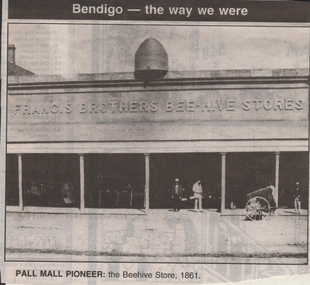
Newspaper - JENNY FOLEY COLLECTION: PALL MALL PIONEER
... Pall Mall pioneer: the Beehive store, 1861....Pall Mall pioneer: the Beehive store, 1861. Newspaper JENNY FOLEY COLLECTION: PALL MALL PIONEER ...Bendigo Advertiser ''The way we were'' from 1999. Pall Mall pioneer: the Beehive store, 1861.newspaper, bendigo advertiser, the way we were -
 Flagstaff Hill Maritime Museum and Village
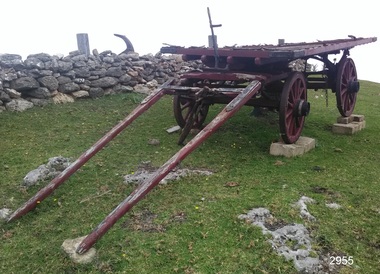
Wagon, circa 1850s
... pioneering families in the Western District of Victoria almost from the time of settlement. The wagon is significant for its historical and economic association with the local Warrnambool business of Manifold & Bostock. These men had leased and owned vast tracts of land and operated businesses around the district together at various times often associated with the farming industry. One example is the Manifold & Bostock store ...Bostock & Manifold were all from pioneering families in the Western District of Victoria almost from the time of settlement. Family history: The Bostock family were prominent in Warrnambool from the 1850s to the 1880s. Patriarch Robert Bostock had in 1813 been transported to Sydney from Sierra Leone for having 'felonious traded in slaves' and sentenced to 14 years transportation. He moved to Tasmania in 1821 where he died in 1847. A number of his children came to Port Phillip. Edward Robert Bostock held the Jellabad run from 1849 to 1853. George Bostock (1826-1858) was a Warrnambool Shire Councillor in 1856. Thomas Edward Bostock (1828-1874) was a Shire Councillor in the late 1860s. Augustus Bostock (1833-1920) lived in Warrnambool. Augustus Bostock was the 9th child of Robert and Rachael Bostock of Vaucluse Epping Forest, Van Diemen's Land. He was only 4 years old when his mother died. He was inspired by his father to seek his fortune in the Western District of Victoria. He arrived around 1850. He married Margaret Aitkin in July 1865. Augustus owned several properties in the district and leased others. He sat on the court of Warrnambool, Mortlake or Hexham as required. He resided at Marramook in Hawkesdale and later moved to Vaucluse in Hopetoun Road Warrnambool, where he died in 1920 at the age of 87. The Wagon is significant locally and state wide for its association with Augustus Bostock who was involved in many aspects of life in the Western District of Victoria, racing, cricket, and social activities to name a few. Bostock & Manifold were all from pioneering families in the Western District of Victoria almost from the time of settlement. The wagon is significant for its historical and economic association with the local Warrnambool business of Manifold & Bostock. These men had leased and owned vast tracts of land and operated businesses around the district together at various times often associated with the farming industry. One example is the Manifold & Bostock store and flour mill from which the wagon dray is believed to have been associated with for the delivery of goods. Their flour mill began operation in 1850 in 7-17 Stanley St South Warrnambool and was known as “Jetty Mills” Manifold and Bostock in 1858 purchased the Mill from John and G Elliot (brothers) with half an acre of ground and a cottage for £1600. It appears addresses of the company changed over the years as the town grew. These are listed in “Jones, Lewis & Peggy flour mills of Victoria” showing the company operating from, Fairy Street and later at the Merri River near the cutting, known as Banyan and Merri Streets. The company ceased trading in 1870. The Wagon Dray is also an example of agricultural freight and general transportation during the 1800 and 1900 century.A four-wheeled wooden horse-drawn wagon with flat top described as a Wagon Dray in historical writings. Painted brown and black. The wagon has rear brakes, wooden, operated from a metal handle at the front of the Wagon. Front wheels are attached to a turnstile to allow easy turning of the wagon. This flat-topped, horse driven, four-wheeled Wagon was used for cartage by the business of Manifold & Bostock, Warrnambool. The original sign writing of the wagon is obscured or painted over. There is a feint mark of lettering to the sides and back edges of the cart Manifold & Bostock. "Manifold and Bostock" very feintflagstaff hill, warrnambool, shipwrecked-coast, flagstaff-hill, flagstaff-hill-maritime-museum, maritime-museum, flagstaff-hill-maritime-village, cartage, manifold and bostock of warrnambool, manifold family of western victoria, bostock family of western victoria, four wheeled wagon, wagon, horse drawn wagon, farm wagon, aitkin, aitkin bostock manifold, dray, aitkin family, cart, aitken, flour mill -
 Ringwood and District Historical Society
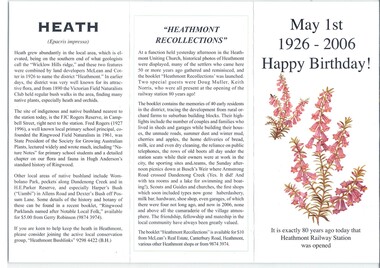
Document - Information Brochure, Heathmont Railway Station 80 Years 1926-2006
... 110 years since pioneer Herman Pump settled in Heathmont 1896 80 years since the opening of the Heathmont railway station 1926 80 years since the formation of Heathmont Tennis Club 1926 60 years since the opening of Cutting's general store 1946 50 years since the opening of Heathmont Anglican Church 1956 50 years since the formation of Heathmont Football Club 50 years since Heathmont's Ron Clarke lit the Olympic flame 1956 40 years since Washushens sold the last Heathmont orchard 1966...Original opening on 1-May-1926 110 years since pioneer Herman Pump settled in Heathmont 1896 80 years since the opening of the Heathmont railway station 1926 80 years since the formation of Heathmont Tennis Club 1926 60 years since the opening of Cutting's general store 1946 50 years since the opening of Heathmont Anglican Church 1956 50 years since the formation of Heathmont Football Club 50 years since Heathmont's Ron Clarke lit the Olympic flame 1956 40 years since Washushens sold the last Heathmont orchard 1966 Multi-fold brochure marking Heathmont Railway Station's 80th year on 1st May 2006. ...Original opening on 1-May-1926Multi-fold brochure marking Heathmont Railway Station's 80th year on 1st May 2006. Brochure includes details of associated launch of "Heathmont Recollections" booklet, and outline of Heathmont's history over 80 years.110 years since pioneer Herman Pump settled in Heathmont 1896 80 years since the opening of the Heathmont railway station 1926 80 years since the formation of Heathmont Tennis Club 1926 60 years since the opening of Cutting's general store 1946 50 years since the opening of Heathmont Anglican Church 1956 50 years since the formation of Heathmont Football Club 50 years since Heathmont's Ron Clarke lit the Olympic flame 1956 40 years since Washushens sold the last Heathmont orchard 1966 -
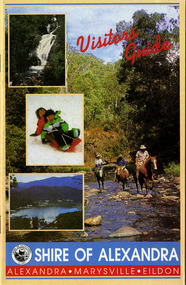 Marysville & District Historical Society
Ephemera (Item) - Visitors Guide, Shire of Alexandra, Visitors Guide ALEXANDRA-MARYSVILLE-EILDON, Unknown
... A tourist guide for Alexandra, Marysville and Eildon produced by the Shire of Alexandra. alexandra marysville eildon victoria australia shire of alexandra visitor guide danish coffee garden maryton park marysville hotel motel beauty spot gardens geoffrey pope & associates australian bush pioneer's farm marysville recreation and fun park blackwood lodges marysville newsagency & general store the cumberland marysville gallery marysville gallery restaurant mount cathedral lodge cross country ski hire menzes garage marysville craft & gifts esa camping & conference centre el kanah black spur motel and caravan park marysville caravan park buxton trout farm the camel farm buxton marysville golf and bowls club taggerty general store cathedral restaurant marylyn guest house beauty spot walk tree fern gully walk michaeldene track keppel track woods lookout track A tourist guide for Alexandra, Marysville and Eildon produced by the Shire of Alexandra. ...A tourist guide for Alexandra, Marysville and Eildon produced by the Shire of Alexandra.A tourist guide for Alexandra, Marysville and Eildon produced by the Shire of Alexandra.alexandra, marysville, eildon, victoria, australia, shire of alexandra, visitor guide, danish coffee garden, maryton park, marysville hotel motel, beauty spot gardens, geoffrey pope & associates, australian bush pioneer's farm, marysville recreation and fun park, blackwood lodges, marysville newsagency & general store, the cumberland, marysville gallery, marysville gallery restaurant, mount cathedral lodge, cross country ski hire, menzes garage, marysville craft & gifts, esa camping & conference centre, el kanah, black spur motel and caravan park, marysville caravan park, buxton trout farm, the camel farm buxton, marysville golf and bowls club, taggerty general store, cathedral restaurant, marylyn guest house, beauty spot walk, tree fern gully walk, michaeldene track, keppel track, woods lookout track -
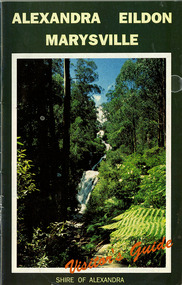 Marysville & District Historical Society
Ephemera (Item) - Visitor's Guide, Shire of Alexandra, ALEXANDRA EILDON MARYSVILLE Visitor's Guide, Unknown
... A tourist guide for Alexandra, Eildon and Marysville produced by the Shire of Alexandra. alexandra eildon marysville victoria australia tourist guide steavenson falls blackwood lodges marysville hotel motel the cumberland gallery restaurant marysville marysville gallery cross country ski hire marylyn guest house marylands guest house marysville crafts & gifts hearts of oak antiques geoffrey pope & associates cedron house marysville amber view holiday lodges marysville marysville ski hire lake mountain ski school fruit salad farm taggerty general store arbor green galleries marysville black spur roadhouse black spur motel & caravan park marysville caravan park the hermitage narbethong danish coffee garden maryton park buxton trout farm lake mountain outdoor centre marysville australian bush pioneer's farm the camel farm and zoo buxton marysville mountain view horse hire marysville golf and bowls club yarrolyn holiday park taggerty riverland lodge taggerty beauty spot walk tree fern gully walk michaeldene track keppel track woods lookout track A tourist guide for Alexandra, Eildon and Marysville produced by the Shire of Alexandra. ...A tourist guide for Alexandra, Eildon and Marysville produced by the Shire of Alexandra.A tourist guide for Alexandra, Eildon and Marysville produced by the Shire of Alexandra.alexandra, eildon, marysville, victoria, australia, tourist guide, steavenson falls, blackwood lodges, marysville hotel motel, the cumberland, gallery restaurant marysville, marysville gallery, cross country ski hire, marylyn guest house, marylands guest house, marysville crafts & gifts, hearts of oak antiques, geoffrey pope & associates, cedron house marysville, amber view holiday lodges marysville, marysville ski hire, lake mountain ski school, fruit salad farm, taggerty general store, arbor green galleries marysville, black spur roadhouse, black spur motel & caravan park, marysville caravan park, the hermitage narbethong, danish coffee garden, maryton park, buxton trout farm, lake mountain outdoor centre marysville, australian bush pioneer's farm, the camel farm and zoo buxton, marysville mountain view horse hire, marysville golf and bowls club, yarrolyn holiday park taggerty, riverland lodge taggerty, beauty spot walk, tree fern gully walk, michaeldene track, keppel track, woods lookout track -
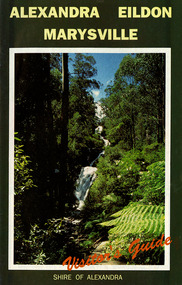 Marysville & District Historical Society
Ephemera (Item) - Visitor's Guide, Shire of Alexandra, ALEXANDRA EILDON MARYSVILLE Visitor's Guide, Unknown
... A tourist guide for Alexandra, Eildon and Marysville produced by the Shire of Alexandra. alexandra eildon marysville victoria australia tourist guide steavenson falls blackwood lodges marysville hotel motel the cumberland gallery restaurant marysville marysville gallery cross country ski hire marylyn guest house marylands guest house marysville crafts & gifts hearts of oak antiques geoffrey pope & associates cedron house marysville amber view holiday lodges marysville marysville ski hire lake mountain ski school fruit salad farm taggerty general store arbor green galleries marysville black spur roadhouse black spur motel & caravan park marysville caravan park the hermitage narbethong danish coffee garden maryton park buxton trout farm lake mountain outdoor centre marysville australian bush pioneer's farm the camel farm and zoo buxton marysville mountain view horse hire marysville golf and bowls club yarrolyn holiday park taggerty riverland lodge taggerty beauty spot walk tree fern gully walk michaeldene track keppel track woods lookout track A tourist guide for Alexandra, Eildon and Marysville produced by the Shire of Alexandra. ...A tourist guide for Alexandra, Eildon and Marysville produced by the Shire of Alexandra.A tourist guide for Alexandra, Eildon and Marysville produced by the Shire of Alexandra.alexandra, eildon, marysville, victoria, australia, tourist guide, steavenson falls, blackwood lodges, marysville hotel motel, the cumberland, gallery restaurant marysville, marysville gallery, cross country ski hire, marylyn guest house, marylands guest house, marysville crafts & gifts, hearts of oak antiques, geoffrey pope & associates, cedron house marysville, amber view holiday lodges marysville, marysville ski hire, lake mountain ski school, fruit salad farm, taggerty general store, arbor green galleries marysville, black spur roadhouse, black spur motel & caravan park, marysville caravan park, the hermitage narbethong, danish coffee garden, maryton park, buxton trout farm, lake mountain outdoor centre marysville, australian bush pioneer's farm, the camel farm and zoo buxton, marysville mountain view horse hire, marysville golf and bowls club, yarrolyn holiday park taggerty, riverland lodge taggerty, beauty spot walk, tree fern gully walk, michaeldene track, keppel track, woods lookout track -
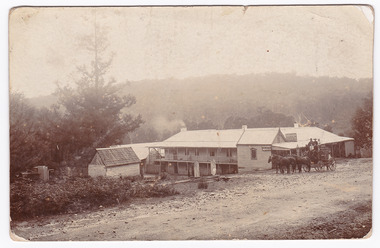 Marysville & District Historical Society
Postcard (item) - Black and white postcard, Unknown
... pioneering families. An early black and white postcard of Keppel's Hotel in Marysville. marysville victoria australia keppel hotel keppel's australian hotel australian hotel keppel family maurice john keppel accommodation postcard Post Card The Address to be written on this side AFFIX STAMP/ HERE Keppels Hotel is the largest +/ best Hotel in Marysville. It/ can accomodate about sixty/ people. At one time Mr Keppel/ kept a store ...An early black and white postcard of Keppel's Hotel in Marysville. The hotel was originally built and opened by the Keppel Family in 1865. The Keppel's Australian Hotel was the first hotel to be opened in Marysville. The Keppel Family were among Marysville's earliest pioneering families. An early black and white postcard of Keppel's Hotel in Marysville.Post Card The Address to be written on this side AFFIX STAMP/ HERE Keppels Hotel is the largest +/ best Hotel in Marysville. It/ can accomodate about sixty/ people. At one time Mr Keppel/ kept a store. It has also/ a post + telegraph officemarysville, victoria, australia, keppel hotel, keppel's australian hotel, australian hotel, keppel family, maurice john keppel, accommodation, postcard -
 Flagstaff Hill Maritime Museum and Village
Instrument - Surgical Instrument Roll, C early 1900's
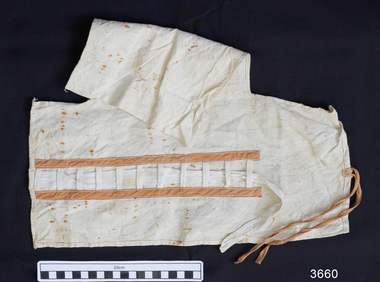
... Dr Angus assisted Dr Tom Ryan, a pioneer in the use of X-rays and in ocular surgery. flagstaff hill warrnambool shipwrecked coast flagstaff hill maritime museum maritime museum shipwreck coast flagstaff hill maritime village great ocean road dr w r angus dr ryan surgical instrument t.s.s. largs bay warrnambool base hospital nhill base hospital mira hospital flying doctor medical treatment medical history surgical instrument roll fabric case for holding surgical instruments portable surgical instrument container Surgical instrument roll, part of the W.R. Angus Collection. Cloth fabric, custom made with loops and ties for organising and storing ...This surgical instrument roll has loops into which various surgical instruments would be placed. The flaps of the fabric would then be folded inwards over the instruments, then rolled up, then the long ties would be tied up to create a secure kit. The 'roll' would be very portable and could also keep the instruments together whilst being sterilised. it is most probable that it belonged to Dr. Tom Ryan and was later handed on to Dr. Angus, dating the roll then to the late 1800's. This instrument roll was donated to Flagstaff Hill Maritime Village by the family of Doctor William Roy Angus, Surgeon and Oculist. It is part of the “W.R. Angus Collection” that includes historical medical equipment, surgical instruments and material once belonging to Dr Edward Ryan and Dr Thomas Francis Ryan, (both of Nhill, Victoria) as well as Dr Angus’ own belongings. The Collection’s history spans the medical practices of the two Doctors Ryan, from 1885-1926 plus that of Dr Angus, up until 1969. ABOUT THE “W.R.ANGUS COLLECTION” Doctor William Roy Angus M.B., B.S., Adel., 1923, F.R.C.S. Edin.,1928 (also known as Dr Roy Angus) was born in Murrumbeena, Victoria in 1901 and lived until 1970. He qualified as a doctor in 1923 at University of Adelaide, was Resident Medical Officer at the Royal Adelaide Hospital in 1924 and for a period was house surgeon to Sir (then Mr.) Henry Simpson Newland. Dr Angus was briefly an Assistant to Dr Riddell of Kapunda, then commenced private practice at Curramulka, Yorke Peninsula, SA, where he was physician, surgeon and chemist. In 1926, he was appointed as new Medical Assistant to Dr Thomas Francis Ryan (T.F. Ryan, or Tom), in Nhill, Victoria, where his experiences included radiology and pharmacy. In 1927 he was Acting House Surgeon in Dr Tom Ryan’s absence. Dr Angus had become engaged to Gladys Forsyth and they decided he would take time to further his studies overseas in the UK in 1927. He studied at London University College Hospital and at Edinburgh Royal Infirmary and in 1928, was awarded FRCS (Fellow from the Royal College of Surgeons), Edinburgh. He worked his passage back to Australia as a Ship’s Surgeon on the on the Australian Commonwealth Line’s T.S.S. Largs Bay. Dr Angus married Gladys in 1929, in Ballarat. (They went on to have one son (Graham 1932, born in SA) and two daughters (Helen (died 12/07/1996) and Berenice (Berry), both born at Mira, Nhill ) Dr Angus was a ‘flying doctor’ for the A.I.M. (Australian Inland Ministry) Aerial Medical Service in 1928 . The organisation began in South Australia through the Presbyterian Church in that year, with its first station being in the remote town of Oodnadatta, where Dr Angus was stationed. He was locum tenens there on North-South Railway at 21 Mile Camp. He took up this ‘flying doctor’ position in response to a call from Dr John Flynn; the organisation was later known as the Flying Doctor Service, then the Royal Flying Doctor Service. A lot of his work during this time involved dental surgery also. Between 1928-1932 he was surgeon at the Curramulka Hospital, Yorke Peninsula, South Australia. In 1933 Dr Angus returned to Nhill where he’d previously worked as Medical Assistant and purchased a share of the Nelson Street practice and Mira hospital from Dr Les Middleton one of the Middleton Brothers, the current owners of what was once Dr Tom Ryan’s practice. Dr L Middleton was House Surgeon to the Nhill Hospital 1926-1933, when he resigned. [Dr Tom Ryan’s practice had originally belonged to his older brother Dr Edward Ryan, who came to Nhill in 1885. Dr Edward saw patients at his rooms, firstly in Victoria Street and in 1886 in Nelson Street, until 1901. The Nelson Street practice also had a 2 bed ward, called Mira Private Hospital ). Dr Edward Ryan was House Surgeon at the Nhill Hospital 1884-1902 . He also had occasions where he successfully performed veterinary surgery for the local farmers too. Dr Tom Ryan then purchased the practice from his brother in 1901. Both Dr Edward and Dr Tom Ryan work as surgeons included eye surgery. Dr Tom Ryan performed many of his operations in the Mira private hospital on his premises. He too was House Surgeon at the Nhill Hospital 1902-1926. Dr Tom Ryan had one of the only two pieces of radiology equipment in Victoria during his practicing years – The Royal Melbourne Hospital had the other one. Over the years Dr Tom Ryan gradually set up what was effectively a training school for country general-practitioner-surgeons. Each patient was carefully examined, including using the X-ray machine, and any surgery was discussed and planned with Dr Ryan’s assistants several days in advance. Dr Angus gained experience in using the X-ray machine there during his time as assistant to Dr Ryan. Dr Tom Ryan moved from Nhill in 1926. He became a Fellow of the Royal Australasian College of Surgeons in 1927, soon after its formation, a rare accolade for a doctor outside any of the major cities. He remained a bachelor and died suddenly on 7th Dec 1955, aged 91, at his home in Ararat. Scholarships and prizes are still awarded to medical students in the honour of Dr T.F. Ryan and his father, Dr Michael Ryan, and brother, John Patrick Ryan. ] When Dr Angus bought into the Nelson Street premises in Nhill he was also appointed as the Nhill Hospital’s Honorary House Surgeon 1933-1938. His practitioner’s plate from his Nhill surgery states “HOURS Daily, except Tuesdays, Fridays and Saturday afternoons, 9-10am, 2-4pm, 7-8pm. Sundays by appointment”. This plate is now mounted on the doorway to the Port Medical Office at Flagstaff Hill Maritime Village, Warrnambool. Dr Edward Ryan and Dr Tom Ryan had an extensive collection of historical medical equipment and materials spanning 1884-1926 and when Dr Angus took up practice in their old premises he obtained this collection, a large part of which is now on display at the Port Medical Office at Flagstaff Hill Maritime Village in Warrnambool. During his time in Nhill Dr Angus was involved in the merging of the Mira Hospital and Nhill Public Hospital into one public hospital and the property titles passed on to Nhill Hospital in 1939. In 1939 Dr Angus and his family moved to Warrnambool where he purchased “Birchwood,” the 1852 home and medical practice of Dr John Hunter Henderson, at 214 Koroit Street. (This property was sold in1965 to the State Government and is now the site of the Warrnambool Police Station. ). The Angus family was able to afford gardeners, cooks and maids; their home was a popular place for visiting dignitaries to stay whilst visiting Warrnambool. Dr Angus had his own silk worm farm at home in a Mulberry tree. His young daughter used his centrifuge for spinning the silk. Dr Angus was appointed on a part-time basis as Port Medical Officer (Health Officer) in Warrnambool and held this position until the 1940’s when the government no longer required the service of a Port Medical Officer in Warrnambool; he was thus Warrnambool’s last serving Port Medical Officer. (The duties of a Port Medical Officer were outlined by the Colonial Secretary on 21st June, 1839 under the terms of the Quarantine Act. Masters of immigrant ships arriving in port reported incidents of diseases, illness and death and the Port Medical Officer made a decision on whether the ship required Quarantine and for how long, in this way preventing contagious illness from spreading from new immigrants to the residents already in the colony.) Dr Angus was a member of the Australian Medical Association, for 35 years and surgeon at the Warrnambool Base Hospital 1939-1942, He served as a Surgeon Captain during WWII 1941-45, in Ballarat, Victoria, and in Bonegilla, N.S.W., completing his service just before the end of the war due to suffering from a heart attack. During his convalescence he carved an intricate and ‘most artistic’ chess set from the material that dentures were made from. He then studied ophthalmology at the Royal Melbourne Eye and Ear Hospital and created cosmetically superior artificial eyes by pioneering using the intrascleral cartilage. Angus received accolades from the Ophthalmological Society of Australasia for this work. He returned to Warrnambool to commence practice as an ophthalmologist, pioneering in artificial eye improvements. He was Honorary Consultant Ophthalmologist to Warrnambool Base Hospital for 31 years. He made monthly visits to Portland as a visiting surgeon, to perform eye surgery. He represented the Victorian South-West subdivision of the Australian Medical Association as its secretary between 1949 and 1956 and as chairman from 1956 to 1958. In 1968 Dr Angus was elected member of Spain’s Barraquer Institute of Barcelona after his research work in Intrasclearal cartilage grafting, becoming one of the few Australian ophthalmologists to receive this honour, and in the following year presented his final paper on Living Intrasclearal Cartilage Implants at the Inaugural Meeting of the Australian College of Ophthalmologists in Melbourne In his personal life Dr Angus was a Presbyterian and treated Sunday as a Sabbath, a day of rest. He would visit 3 or 4 country patients on a Sunday, taking his children along ‘for the ride’ and to visit with him. Sunday evenings he would play the pianola and sing Scottish songs to his family. One of Dr Angus’ patients was Margaret MacKenzie, author of a book on local shipwrecks that she’d seen as an eye witness from the late 1880’s in Peterborough, Victoria. In the early 1950’s Dr Angus, painted a picture of a shipwreck for the cover jacket of Margaret’s book, Shipwrecks and More Shipwrecks. She was blind in later life and her daughter wrote the actual book for her. Dr Angus and his wife Gladys were very involved in Warrnambool’s society with a strong interest in civic affairs. Their interests included organisations such as Red Cross, Rostrum, Warrnambool and District Historical Society (founding members), Wine and Food Society, Steering Committee for Tertiary Education in Warrnambool, Local National Trust, Good Neighbour Council, Housing Commission Advisory Board, United Services Institute, Legion of Ex-Servicemen, Olympic Pool Committee, Food for Britain Organisation, Warrnambool Hospital, Anti-Cancer Council, Boys’ Club, Charitable Council, National Fitness Council and Air Raid Precautions Group. He was also a member of the Steam Preservation Society and derived much pleasure from a steam traction engine on his farm. He had an interest in people and the community He and his wife Gladys were both involved in the creation of Flagstaff Hill, including the layout of the gardens. After his death (28th March 1970) his family requested his practitioner’s plate, medical instruments and some personal belongings be displayed in the Port Medical Office surgery at Flagstaff Hill Maritime Village, and be called the “W. R. Angus Collection”. The W.R. Angus Collection is significant for still being located at the site it is connected with, Doctor Angus being the last Port Medical Officer in Warrnambool. The collection of medical instruments and other equipment is culturally significant, being an historical example of medicine from late 19th to mid-20th century. Dr Angus assisted Dr Tom Ryan, a pioneer in the use of X-rays and in ocular surgery. Surgical instrument roll, part of the W.R. Angus Collection. Cloth fabric, custom made with loops and ties for organising and storing surgical instruments, making them easily carried and accessed.flagstaff hill, warrnambool, shipwrecked coast, flagstaff hill maritime museum, maritime museum, shipwreck coast, flagstaff hill maritime village, great ocean road, dr w r angus, dr ryan, surgical instrument, t.s.s. largs bay, warrnambool base hospital, nhill base hospital, mira hospital, flying doctor, medical treatment, medical history, surgical instrument roll, fabric case for holding surgical instruments, portable surgical instrument container -
 Flagstaff Hill Maritime Museum and Village
Functional object - Fishing Rods, 20th century
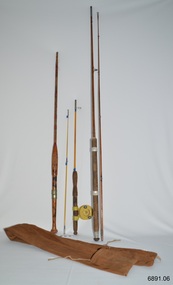
... Dr Angus assisted Dr Tom Ryan, a pioneer in the use of X-rays and in ocular surgery. flagstaff hill warrnambool shipwrecked coast flagstaff hill maritime museum maritime museum shipwreck coast flagstaff hill maritime village great ocean road dr w r angus dr ryan surgical instrument t.s.s. largs bay warrnambool base hospital nhill base hospital mira hospital flying doctor fishing rod kit fishing equipment recreational fishing fishing rod and reel Reel is imprinted “JUNIOR / CAPSTAN / 14 / MADE IN AUSTRALIA”. Fishing rod kit with three rod handles and two ends, stored ...This fishing rod kit was donated to Flagstaff Hill Maritime Village by the family of Doctor William Roy Angus, Surgeon and Oculist. It is part of the “W.R. Angus Collection” that includes historical medical equipment, surgical instruments and material once belonging to Dr Edward Ryan and Dr Thomas Francis Ryan, (both of Nhill, Victoria) as well as Dr Angus’ own belongings. The Collection’s history spans the medical practices of the two Doctors Ryan, from 1885-1926 plus that of Dr Angus, up until 1969. ABOUT THE “W.R.ANGUS COLLECTION” Doctor William Roy Angus M.B., B.S., Adel., 1923, F.R.C.S. Edin.,1928 (also known as Dr Roy Angus) was born in Murrumbeena, Victoria in 1901 and lived until 1970. He qualified as a doctor in 1923 at University of Adelaide, was Resident Medical Officer at the Royal Adelaide Hospital in 1924 and for a period was house surgeon to Sir (then Mr.) Henry Simpson Newland. Dr Angus was briefly an Assistant to Dr Riddell of Kapunda, then commenced private practice at Curramulka, Yorke Peninsula, SA, where he was physician, surgeon and chemist. In 1926, he was appointed as new Medical Assistant to Dr Thomas Francis Ryan (T.F. Ryan, or Tom), in Nhill, Victoria, where his experiences included radiology and pharmacy. In 1927 he was Acting House Surgeon in Dr Tom Ryan’s absence. Dr Angus had become engaged to Gladys Forsyth and they decided he further his studies overseas in the UK in 1927. He studied at London University College Hospital and at Edinburgh Royal Infirmary and in 1928, was awarded FRCS (Fellow from the Royal College of Surgeons), Edinburgh. He worked his passage back to Australia as a Ship’s Surgeon on the Australian Commonwealth Line’s T.S.S. Largs Bay. Dr Angus married Gladys in 1929, in Ballarat. (They went on to have one son (Graham 1932, born in SA) and two daughters (Helen (died 12/07/1996) and Berenice (Berry), both born at Mira, Nhill ) According to Berry, her mother Gladys made a lot of their clothes. She was very talented and did some lovely embroidery including lingerie for her trousseau and beautifully handmade baby clothes. Dr Angus was a ‘flying doctor’ for the A.I.M. (Australian Inland Ministry) Aerial Medical Service in 1928 . Its first station was in the remote town of Oodnadatta, where Dr Angus was stationed. He was locum tenens there on North-South Railway at 21 Mile Camp. He took up this ‘flying doctor’ position in response to a call from Dr John Flynn; the organisation was later known as the Flying Doctor Service, then the Royal Flying Doctor Service. A lot of his work during this time involved dental surgery also. Between 1928-1932 he was surgeon at the Curramulka Hospital, Yorke Peninsula, South Australia. In 1933 Dr Angus returned to Nhill and purchased a share of the Nelson Street practice and Mira hospital (a 2 bed ward at the Nelson Street Practice) from Dr Les Middleton one of the Middleton Brothers, the current owners of what previously once Dr Tom Ryan’s practice. Dr Tom and his brother had worked as surgeons included eye surgery. Dr Tom Ryan performed many of his operations in the Mira private hospital on his premises. He had been House Surgeon at the Nhill Hospital 1902-1926. Dr Tom Ryan had one of the only two pieces of radiology equipment in Victoria during his practicing years – The Royal Melbourne Hospital had the other one. Over the years Dr Tom Ryan had gradually set up what was effectively a training school for country general-practitioner-surgeons. Each patient was carefully examined, including using the X-ray machine, and any surgery was discussed and planned with Dr Ryan’s assistants several days in advance. Dr Angus gained experience in using the X-ray machine there during his time as assistant to Dr Ryan. When Dr Angus bought into the Nelson Street premises in Nhill he was also appointed as the Nhill Hospital’s Honorary House Surgeon 1933-1938. His practitioner’s plate from his Nhill surgery is now mounted on the doorway to the Port Medical Office at Flagstaff Hill Maritime Village, Warrnambool. When Dr Angus took up practice in the Dr Edward and Dr Tom Ryan’s old premises he obtained their extensive collection of historical medical equipment and materials spanning 1884-1926. A large part of this collection is now on display at the Port Medical Office at Flagstaff Hill Maritime Village in Warrnambool. In 1939 Dr Angus and his family moved to Warrnambool where he purchased “Birchwood,” the 1852 home and medical practice of Dr John Hunter Henderson, at 214 Koroit Street. (This property was sold in1965 to the State Government and is now the site of the Warrnambool Police Station. and an ALDI store is on the land that was once their tennis court). The Angus family was able to afford gardeners, cooks and maids; their home was a popular place for visiting dignitaries to stay whilst visiting Warrnambool. Dr Angus had his own silk worm farm at home in a Mulberry tree. His young daughter used his centrifuge for spinning the silk. Dr Angus was appointed on a part-time basis as Port Medical Officer (Health Officer) in Warrnambool and held this position until the 1940’s when the government no longer required the service of a Port Medical Officer in Warrnambool; he was thus Warrnambool’s last serving Port Medical Officer. (Masters of immigrant ships arriving in port reported incidents of diseases, illness and death and the Port Medical Officer made a decision on whether the ship required Quarantine and for how long, in this way preventing contagious illness from spreading from new immigrants to the residents already in the colony.) Dr Angus was a member of the Australian Medical Association, for 35 years and surgeon at the Warrnambool Base Hospital 1939-1942, He served with the Australian Department of Defence as a Surgeon Captain during WWII 1942-45, in Ballarat, Victoria, and in Bonegilla, N.S.W., completing his service just before the end of the war due to suffering from a heart attack. During his convalescence he carved an intricate and ‘most artistic’ chess set from the material that dentures were made from. He then studied ophthalmology at the Royal Melbourne Eye and Ear Hospital and created cosmetically superior artificial eyes by pioneering using the intrascleral cartilage. Angus received accolades from the Ophthalmological Society of Australasia for this work. He returned to Warrnambool to commence practice as an ophthalmologist, pioneering in artificial eye improvements. He was Honorary Consultant Ophthalmologist to Warrnambool Base Hospital for 31 years. He made monthly visits to Portland as a visiting surgeon, to perform eye surgery. He represented the Victorian South-West subdivision of the Australian Medical Association as its secretary between 1949 and 1956 and as chairman from 1956 to 1958. In 1968 Dr Angus was elected member of Spain’s Barraquer Institute of Barcelona after his research work in Intrasclearal cartilage grafting, becoming one of the few Australian ophthalmologists to receive this honour, and in the following year presented his final paper on Living Intrasclearal Cartilage Implants at the Inaugural Meeting of the Australian College of Ophthalmologists in Melbourne In his personal life Dr Angus was a Presbyterian and treated Sunday as a Sabbath, a day of rest. He would visit 3 or 4 country patients on a Sunday, taking his children along ‘for the ride’ and to visit with him. Sunday evenings he would play the pianola and sing Scottish songs to his family. One of Dr Angus’ patients was Margaret MacKenzie, author of a book on local shipwrecks that she’d seen as an eye witness from the late 1880’s in Peterborough, Victoria. In the early 1950’s Dr Angus, painted a picture of a shipwreck for the cover jacket of Margaret’s book, Shipwrecks and More Shipwrecks. She was blind in later life and her daughter wrote the actual book for her. Dr Angus and his wife Gladys were very involved in Warrnambool’s society with a strong interest in civic affairs. He had an interest in people and the community They were both involved in the creation of Flagstaff Hill, including the layout of the gardens. After his death (28th March 1970) his family requested his practitioner’s plate, medical instruments and some personal belongings be displayed in the Port Medical Office surgery at Flagstaff Hill Maritime Village, and be called the “W. R. Angus Collection”. The W.R. Angus Collection is significant for still being located at the site it is connected with, Doctor Angus being the last Port Medical Officer in Warrnambool. The collection of medical instruments and other equipment is culturally significant, being an historical example of medicine from late 19th to mid-20th century. Dr Angus assisted Dr Tom Ryan, a pioneer in the use of X-rays and in ocular surgery. Fishing rod kit with three rod handles and two ends, stored in brown fabric bag (2 compartments and tape fastening). Part of the W.R. Angus Collection. (1) Cork rod handle with wooden rod, plus wooden rod end. (2) wooden rod handle with 'crocodile skin' pattern carved into handle. (3) wooden handle with yellow plastic rod and reel, and yellow plastic rod end. Reel is Junior Capstan 14, Made in Australia. Reel is imprinted “JUNIOR / CAPSTAN / 14 / MADE IN AUSTRALIA”. flagstaff hill, warrnambool, shipwrecked coast, flagstaff hill maritime museum, maritime museum, shipwreck coast, flagstaff hill maritime village, great ocean road, dr w r angus, dr ryan, surgical instrument, t.s.s. largs bay, warrnambool base hospital, nhill base hospital, mira hospital, flying doctor, fishing rod kit, fishing equipment, recreational fishing, fishing rod and reel -
 City of Moorabbin Historical Society (Operating the Box Cottage Museum)
Photograph - Photograph Hay & Corn Store, Before 1910, Smith's Hay & Corn Store, Cnr. Centre and Jasper Roads, Bentleigh, Late 19th to early 20th Century
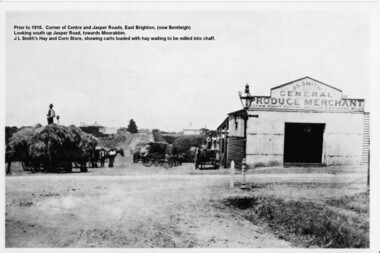
... The Smith's story is representative of the many early pioneering traders, who elected to "set up shop", who suffered the adversity of the 1890s depression, but who survived and made their living in the largely undeveloped area of East Brighton ( now Bentleigh) district. hitching post methodist church smith minnie moorabbin shire president gas lamp east brighton district 1890s depression wattle and daub cottage centre road jasper road box henry smith john l On the back of the photo "Hay and Corn Store -/ not later than 1910." ...The first photograph was taken prior to 1910. The location is at the corner of Centre and Jasper Roads, East Brighton, (now known as Bentleigh). It is an early view of John L. and "Minnie" Smith's Hay and Corn Store, situated on the South West corner of those two roads. The first photo was taken prior to the introduction of electricity in the area. A gas lamp and horse "hitching post" can be seen "in shot". There are several loaded wagons waiting in line to have their hay milled to chaff. Farmers came from places as distant as Carrum to have their loads of hay milled into chaff. John Smith was born in 1860 in Point Nepean Road, Brighton, and Minnie was born in Patterson Road, Moorabbin, in a wattle and daub cottage with earthen floor and butter muslin over the windows. The couple married in 1884, Minnie was a devout Methodist and the family became very involved in the development of the local Methodist church. The couple had four children and during the 1890s Depression their first child died, they lost all their possessions, and John's family struggled to survive. Finally in the late 1890s JL Smith was able to rent a shed from Mr Henry Box on the corner of Centre and Jasper Roads, and he later purchased that property. With the gradual improvement in the economy, and the development of the successful market gardening industry in the Shire of Moorabbin, JL Smith's produce store became quite prosperous. Over some years the little "shed" developed into a thriving Hay and Corn Store. JL Smith went on to become Moorabbin Shire President in 1914. He and his wife were active in assisting soldiers returning injured from the 1st WW, in the local Methodist Church and other early community projects. Smith was a typical example of the majority of the early settlers in the Shire of Moorabbin, being god-fearing and devoted to the idea of service to the community. The photographs demonstrate the primitive conditions and early development of what is now a bustling and well-recognised area of Bentleigh, (known as east Brighton before 1907). The photo shows a gas lamp in use before the introduction of electricity in 1916. The Smith's story is representative of the many early pioneering traders, who elected to "set up shop", who suffered the adversity of the 1890s depression, but who survived and made their living in the largely undeveloped area of East Brighton ( now Bentleigh) district. Two black and white early photographs both of the same location. The photos are of the corner of Centre and Jasper Roads, Bentleigh. (Prior to 1907 this area was known as East Brighton.) Both photos show J.L Smith's General Merchant Produce store. "Steam Chaff Cutting and Corn Crushing Mills" and the surrounding area at differing stages. In the first photo taken prior to 1910, we can see there are several horse-drawn carts loaded with hay waiting to be milled, a gas lamp and a horse "hitching post". The store is just a single unadorned, shed. The later, second photo of the same area, shows improvements and the further development of that site. On the back of the photo "Hay and Corn Store -/ not later than 1910."/"Photographer /Victor C Smith,/ Phone Number XL1472"/hitching post, methodist church, smith minnie, moorabbin shire president, gas lamp, east brighton district, 1890s depression, wattle and daub cottage, centre road, jasper road, box henry, smith john l -
 City of Moorabbin Historical Society (Operating the Box Cottage Museum)
Kitchen Equipment, tin mesh, meat safe, c1900
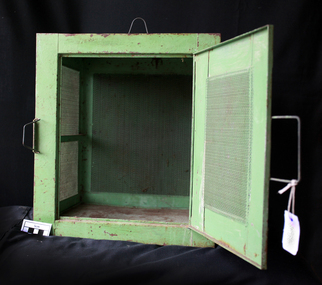
... stored for a short time in this safe. It would be suspended from the ceiling / roof in a cool place - Dairy - and the mesh sides allowed air circulation while providing protection from insects and vermin. early settlers pioneers food preservation meat safe kalgoolie safe moorabbin bentleigh cheltenham ormond dairy products diseases vermin A green, tin meat safe with mesh sides and a hinged door with a latch lock. ...This is a common small 'meat safe' used in most homes prior to the arrival of Refrigerators. Food, such as milk, butter, cooked meat would be stored for a short time in this safe. It would be suspended from the ceiling / roof in a cool place - Dairy - and the mesh sides allowed air circulation while providing protection from insects and vermin.A green, tin meat safe with mesh sides and a hinged door with a latch lock. early settlers, pioneers, food preservation, meat safe, kalgoolie safe, moorabbin, bentleigh, cheltenham, ormond, dairy products, diseases, vermin -
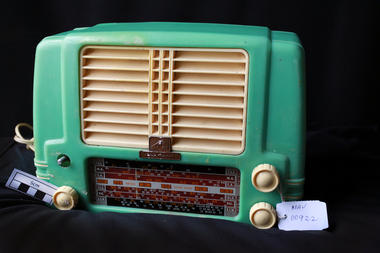 City of Moorabbin Historical Society (Operating the Box Cottage Museum)
Communication Devices, Radio, 'HMV', c1930
... store was opened by the Gramophone Company on Oxford Street in 1921, and the HMV name was also used for television and radio sets manufactured from the 1930s onwards. HMV stands for His Master's Voice, the title of a painting by Francis Barraud of the dog Nipper listening to a cylinder phonograph, which was bought by the Gramophone Company in 1899. For advertising purposes this was changed to a wind-up gramophone, and eventually used simply as a silhouette. hmv his master's voice radio gramaphones radio broadcasts early settlers pioneers ...The first HMV branded store was opened by the Gramophone Company on Oxford Street in 1921, and the HMV name was also used for television and radio sets manufactured from the 1930s onwards. HMV stands for His Master's Voice, the title of a painting by Francis Barraud of the dog Nipper listening to a cylinder phonograph, which was bought by the Gramophone Company in 1899. For advertising purposes this was changed to a wind-up gramophone, and eventually used simply as a silhouette.A green mantel Radio set, 'HMV' , 'Little Nipper' c1930. The 4 tuning knobs are white, - one is missing - , the grill is white and the flex and plug are complete. Front ; HMV 'trade mark' ( dog with a cylinder phonograph' ) / " Little Nipper" hmv, his master's voice radio, gramaphones, radio broadcasts, early settlers, pioneers, market gardeners, moorabbin, cheltenham, bentleigh, london england, little nipper painting, mr biehl, barraud francis -
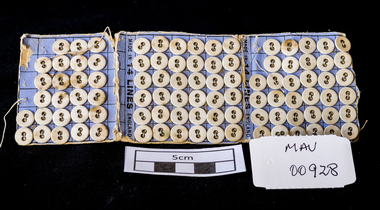 City of Moorabbin Historical Society (Operating the Box Cottage Museum)
Manufactured Objects, card of buttons, c1900
... store in the world . It also operated one of the largest mail order businesses in Australia. One of their advertising slogans was that they sold "anything from a needle to an anchor". horden anthony senior horden and son pty ltd sydney new south wales moorabbin department stores market gardeners pioneers dressmaking craftwork sewing needles clothing buttons on backing of card a picture of an 'Anchor and Rope , Needle and Thread' / FROM A NEEDLE / TO AN ANCHOR / TRADE MARK / MADE IN ENGLAND. ...Anthony Hordern sen. (1788–1869) came from Staffordshire, as a free immigrant in 1823, and the business was originally established as a drapery store in Pitt Street by his wife Ann. The family moved to Melbourne and remained there but a son Anthony junior purchased land in George Street Sydney in 1842 and set up business with his brother Lebbeus. They broke their partnership in1855 and Anthony took his sons Anthony and Samuel into partnership as they became old enough. Anthony Hordern & Sons was the largest department store in Sydney, New South Wales, Australia. with 52 acres (21 hectares) of retail space, and was once the largest department store in the world . It also operated one of the largest mail order businesses in Australia. One of their advertising slogans was that they sold "anything from a needle to an anchor". A strip of blue cardboard with 95 small, white 2 hole buttons . The cardboard folds into 3 for easy storage with each section holding 36 buttons. 7 buttons are missing - used. The buttons are sewn onto the card with a running thread that is covered by backing paper.on backing of card a picture of an 'Anchor and Rope , Needle and Thread' / FROM A NEEDLE / TO AN ANCHOR / TRADE MARK / MADE IN ENGLAND. inside ' MADE IN 14 LINES ENGLAND 'horden anthony senior, horden and son pty ltd, sydney, new south wales, moorabbin, department stores, market gardeners, pioneers, dressmaking, craftwork, sewing needles, clothing, buttons -
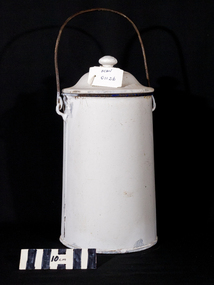 City of Moorabbin Historical Society (Operating the Box Cottage Museum)
Dairy Equipment, enamel jug with lid, c1900
... This white enamel jug was used to store milk, by early settlers families in Moorabbin Shire A typical enamel milk jug used by early settler families in Moorabbin Shire c1900 dairy dairy farmers milk early settlers pioneers moorabbin brighton bentleigh cheltenham containers milk A white enamel jug with a lid and wire loop carrying handle Dairy Equipment, enamel jug with lid Unrecorded Manufacturer ...This white enamel jug was used to store milk, by early settlers families in Moorabbin Shire A typical enamel milk jug used by early settler families in Moorabbin Shire c1900A white enamel jug with a lid and wire loop carrying handledairy, dairy farmers, milk, early settlers, pioneers, moorabbin, brighton, bentleigh, cheltenham, containers milk -
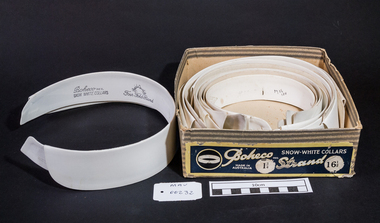 City of Moorabbin Historical Society (Operating the Box Cottage Museum)
Clothing - Clothing, menswear 12 x stiffly stached collars in box, 20thC
... pioneers Base of Box : Boheco REG. SNOW-WHITE COLLARS / 1 3/4 / Strand / 16 1/2 / MADE IN / AUSTRALIA ( there is no lid ) under box in pencil ; 16 1/2 x 1 3/4 / 1/- each / c/o = Doz. 1 / 3 each 12 detachable, stiffly starched, white collars, from various manufacturers, for a man's shirt. Each Collar has 3 buttonholes for attaching to the shirt - 2 at the neck and 1 centre back. They have been stored ...In the 19thC and early 20thC men often wore their shirts for a week or more. However the collars were detachable so that they could be changed when they became dirty or for special occasions eg Church on Sundays Collar studs were used to attach the collar to the shirt. The cardboard box was used for storage and when travelling. The collars were very stiffly starched so as to maintain their shape. Some have Laundry instructions printed on the inside of the collar.The Maggs family were pioneer settlers in Moorabbin Shire.12 detachable, stiffly starched, white collars, from various manufacturers, for a man's shirt. Each Collar has 3 buttonholes for attaching to the shirt - 2 at the neck and 1 centre back. They have been stored in a cardboard box marked 'Boheco regd. ' The box has no lid.Base of Box : Boheco REG. SNOW-WHITE COLLARS / 1 3/4 / Strand / 16 1/2 / MADE IN / AUSTRALIA ( there is no lid ) under box in pencil ; 16 1/2 x 1 3/4 / 1/- each / c/o = Doz. 1 / 3 eachmenswear, clothing, shirts, collars, early settlers, fashion, cheltenham, moorabbin, dairy farmers, market gardeners, maggs family, pioneers -
 City of Moorabbin Historical Society (Operating the Box Cottage Museum)
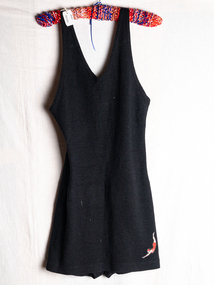
Clothing - Clothing, men's swim costume wool, 'Jantzen', 1930
... store. Little did founders Carl Jantzen, Roy and John Zehntbauer know that they would achieve both fame and controversy as swimwear pioneers. ...store. Little did founders Carl Jantzen, Roy and John Zehntbauer know that they would achieve both fame and controversy as swimwear pioneers. ...In 1910, Portland Knitting Company began in downtown Portland, Oregon, with a few hand-knitting machines above a tiny retail store. Little did founders Carl Jantzen, Roy and John Zehntbauer know that they would achieve both fame and controversy as swimwear pioneers. Producing a wool suit for a rowing team they began offering "bathing suits" in their catalog. Knit on sweater cuff machines, the suits became popular with swimmers. The demand increased for those "Jantzens" and the company name was changed in 1918 to Jantzen Knitting Mills. The suits were made of 100% pure virgin wool. Matching stockings and stocking cap completed the costume of the day. Early advertisements guaranteed the famous rib-stitch "gives that wonderful fit". c1930 Jantzen catalogs featured upcoming movie stars, including Loretta Young, Joan Blondell, Ginger Rogers, and Dick Powell. National magazines such as Esquire, the Saturday Evening Post, Life, and Colliers published advertisements illustrated by George Petty. 2010 Jantzen has achieved new levels of success this decade through social media, attracting thousands of fans around the world who share their own memories about their favorite Jantzen suits throughout the decades Early settlers and market gardeners established their families in Moorabbin Shire c1900 and after World War 1 soldiers were assisted to purchase land near the railway line. By 1930 the population had grown with new families who had other occupations - office workers in Melbourne, tradesmen, teachers, etc - and they raised their families in Bentleigh, McKinnon, Ormond, Moorabbin and Cheltenham.Early settlers and market gardeners established their families in Moorabbin Shire c1900 and after World War 1 soldiers were assisted to purchase land near the railway line. By 1930 the population had grown with new families who had other occupations - office workers in Melbourne, tradesmen, teachers, etc - and they raised their families in Bentleigh, McKinnon, Ormond, Moorabbin and Cheltenham. Clothing, men's swim costume wool, 'Jantzen' c1930 clothing, brighton, moorabbin, pioneers, market gardeners, early settlers, moorabbin shire, bentleigh, mckinnon, dairy farms, fruit orchards, swimwear -
 Glenelg Shire Council Cultural Collection
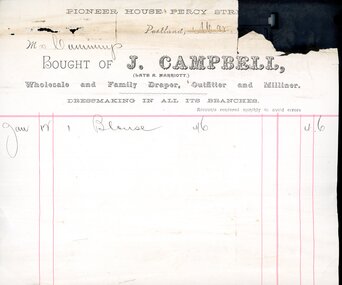
Financial record - Account - J. Campbell Family Draper to Mrs Cummings, n.d
... J.Campbell started a Draper , Outfitter and Milliner store in the Pioneer house on Percy Street in Portland Victoria in 1896. ...J.Campbell started a Draper , Outfitter and Milliner store in the Pioneer house on Percy Street in Portland Victoria in 1896. ...J.Campbell started a Draper , Outfitter and Milliner store in the Pioneer house on Percy Street in Portland Victoria in 1896. Advertisements found on Trove from November 20 1899 shows the store selling Spring goods, Millinery, Dress goods, prints, piques and muslins. Another advertisement on Trove from September 27 1907 shows the store showing their Spring and Summer Goods, including Choice Millinery, Latest Dress Fabrics, Laces and Silks, Blouses and Skirts.Paper account from J. Campbell, wholesaler and family draper to Mrs Cummings, in the sum of 4/6 for a blouse. Printed form, details handwritten in black ink top right hand corner is missing, and top left hand corner has two holes in the paper. Paper is cream and has darker brownish patches at the top. PIONEER HOUSE PERCY STR / Portland, Mar / Mrs Cummings / BOUGHT OF J. CAMPBELL, / (LATE A. MARRIOTT.) / Wholesale and Family Draper, Outfitter and Milliner. / DRESSMAKING IN ALL ITS BRANCHES. / Accounts rendered monthly to avoid errors / Jan ** 1 Blouse 4/6 4.6draper, portland trade, accounts, womens clothing, city of portland, betty vivian, betty vivian collection -
 City of Moorabbin Historical Society (Operating the Box Cottage Museum)
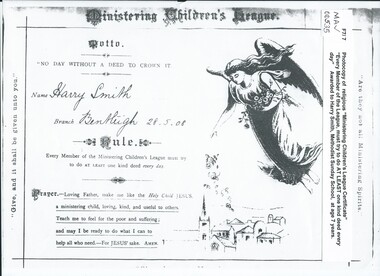
Certificate - Document, Photocopy Certificate Harry Smith 1908, 1908
... The family of Harry Smith were early settlers in Bentleigh and managed a Grain and Chaff cutting store. city of moorabbin county of bourke moorabbin roads board parish of moorabbin shire of moorabbin henry dendy's special survey 1841 were j.b. bent thomas o'shannassy john king richard charman s highett william ormond francis maynard dennis smith harry stanley helen early settlers pioneers chaff cuters bentleigh 'Ministering Children's League' Certificate awarded to Harry Smith, aged 7 years, by the Bentleigh Methodist Church 1908 Certificate Document, Photocopy Certificate Harry Smith 1908 Methodist Church Bentleigh ...Harry Smith, aged 7 years, received this Certificate from the Bentleigh Methodist Church Sunday School 1908. The Smith family managed the Grain and Chaff cutting store on the corner of Centre Road and Jasper Road Bentleigh.The family of Harry Smith were early settlers in Bentleigh and managed a Grain and Chaff cutting store. Certificate awarded to Harry Smith, aged 7 years, by the Bentleigh Methodist Church 1908'Ministering Children's League'city of moorabbin, county of bourke, moorabbin roads board, parish of moorabbin, shire of moorabbin, henry dendy's special survey 1841, were j.b., bent thomas, o'shannassy john, king richard, charman s, highett william, ormond francis, maynard dennis, smith harry, stanley helen, early settlers, pioneers, chaff cuters, bentleigh -
 City of Moorabbin Historical Society (Operating the Box Cottage Museum)
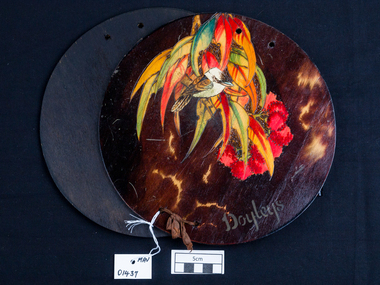
Personal Effects, Doiley Holder Wood painted, c1900
... This painted wood Doiley Holder was used to store and protect the linen, cotton and net doilies, hand sewn with needlework, crochet and beads that were used by households c1900 This Doiley holder is an examples of the craftwork skills of the women of the early settler families in Moorabbin Shire c1900 clothing, haberdashery, crochet brighton, moorabbin, pioneers, dressmaking, market gardeners, early settlers, craftwork , bentleigh, lacework, moorabbin shire , dairy farms, fruit orchards "DOYLEYS' Two circular varnished wooden discs each with 2 holes through which ribbon was threaded to hold them together. ...This painted wood Doiley Holder was used to store and protect the linen, cotton and net doilies, hand sewn with needlework, crochet and beads that were used by households c1900 This Doiley holder is an examples of the craftwork skills of the women of the early settler families in Moorabbin Shire c1900Two circular varnished wooden discs each with 2 holes through which ribbon was threaded to hold them together. The top disc is painted with flowers, kookaburra and the word Doyleys ."DOYLEYS' clothing, haberdashery, crochet brighton, moorabbin, pioneers, dressmaking, market gardeners, early settlers, craftwork , bentleigh, lacework, moorabbin shire , dairy farms, fruit orchards -
 City of Moorabbin Historical Society (Operating the Box Cottage Museum)
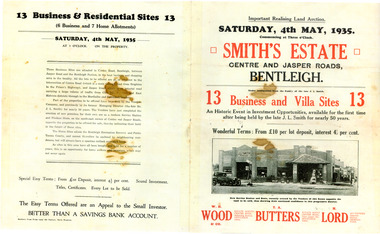
Flyer - Smith Estate, Bentleigh, 1935
... This Land was owned by one the pioneers of Bentleigh Mr John Logan Smith (1860-1932), who owned J. L. Smith Hay & Grain Store, on the corner of Jasper and Centre Road, Bentleigh. ...This Land was owned by one the pioneers of Bentleigh Mr John Logan Smith (1860-1932), who owned J. L. Smith Hay & Grain Store, on the corner of Jasper and Centre Road, Bentleigh. ...This Land was owned by one the pioneers of Bentleigh Mr John Logan Smith (1860-1932), who owned J. L. Smith Hay & Grain Store, on the corner of Jasper and Centre Road, Bentleigh. The family sold the property after Mr Smith passed away.Example of the progress of the Municipality of MoorabbinAdvertising flyer for auction of real estate sales - plan of building blocks for sale - PhotocopySmith's Estate, Bentleigh 13 Home Sites and 13 Business Sites Auction Saturday 4 may 1935 - W. H.Wood, T. A. Butters, H. Lordjohn logan smith, centre road, jasper road, bentleigh, aution, real estate -
Glenelg Shire Council Cultural Collection
Souvenir - Demi-John, 1984
... store wine. demijohn ceramic pottery celebration 150th Front: Gold Pass '88. Whale in Triangle. Impressed into Pottery. Brown glazed pottery Demi-John made for the celebration of Portland 150th anniversary. 1984 Cork stopper. Commemorative. Souvenir Demi-John Pioneer ...Made to celebrate the 150th anniversary of Portland. The word demijohn is French and is used to describe any large, narrow-necked bottle used to hold liquid. Antique or vintage demijohns are from Europe and were most often used to transport or store wine.Brown glazed pottery Demi-John made for the celebration of Portland 150th anniversary. 1984 Cork stopper. Commemorative.Front: Gold Pass '88. Whale in Triangle. Impressed into Pottery.demijohn, ceramic, pottery, celebration, 150th -
 Orbost & District Historical Society
black and white photograph, early 20th century
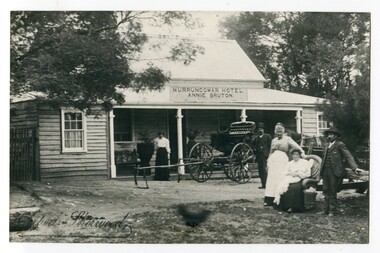
... Mr Bruton had not been in very good health for the last 4 or 5 years of his life, and about a fortnight prior to his death he got wet at his brick kiln, and contracted pneumonia which led to hi This is a pictorial record of the the Murrungowar Township which was once a thriving settlement with a hotel, store, post office and school. In the 1890s pioneers were attracted to the area with the promise of a railway from Orbost. ...This photograph shows Pike's buggy with Joe Pike, Mrs George Pike, Annie Bruton and Maggie Middleditch on the verandah. Annie Bruton was the wife of Jack Bruton who came to Orbost about 1891. When land was made available for selection at Murrungowar. they took up a selection and embarked in dairying, sheep-farming and pig-raising. They transformed a veritable wilderness into a productive farm by sheer hard work and liberal expenditure. By 1892 he had secured a licence for an hotel and accommodation house, store and the first post office at Murrungowar. For a time she was licensee of the Murrungowar Hotel. In December 1897 he was living at Murrungowar when he made application for a Roadside Victualler’s License for a house situated at Boulder Creek, East Gippsland, containing four rooms in course of erection, exclusive of those required for family. He was a butcher at Orbost in 1902-03 and also had a farm on the Bendoc Road. He was a member of the first Golf committee. After leasing the hotel to Jonson's he moved to Orbost and started brick-making near the Orbost water service basin on the Bendoc Road. He had the order for the bricks required for the Masonic Hall. Mr and Mrs Bruton resided at Murrungowar for 29 years. They let their property to Messrs McDONALD and sons and retired to Orbost in December 1920. Mr Bruton had not been in very good health for the last 4 or 5 years of his life, and about a fortnight prior to his death he got wet at his brick kiln, and contracted pneumonia which led to hiThis is a pictorial record of the the Murrungowar Township which was once a thriving settlement with a hotel, store, post office and school. In the 1890s pioneers were attracted to the area with the promise of a railway from Orbost. However, when the promised railway did not eventuate most of the farms were abandoned. Much of the previously cleared areas have reverted to Forest. Most of the remaining farms are now privately owned eucalypt plantations.A large black / white photograph of five people standing outside a one - storey wooden building. There is an empty buggy behind them with a horse behind it. The building has a sign above the verandah - "MURRUNGOWAR HOTEL ANNIE BRUTON".on front - "Pikes Buggy - Mrs Bruton, Mrs Geo & Mr Joe Pike" ; Herbert Sherwood photographer murrungowar-hotel bruton-annie pike-joe
