
Showing 77 items matching " retails stores"
-
 Musculoskeletal Health Australia (now held by the Glen Eira Historical Society)
Photograph - Objects, 2003
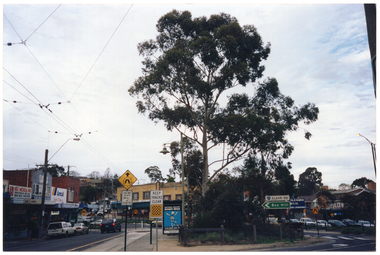
... ... retails stores...Around and behind the bus shelter, there are various retail stores....Around and behind the bus shelter, there are various retail stores. Photograph Objects ...This photo depicts a 'National Healthy Bones Week' promotional billboard in situ on a bus shelter. The bus shelter is located at the Elgar and Riversdale Rds intersection, in Burwood.COL photo of a large advertisement on the side of a bus shelter. In the foreground, there are several road traffic signs. Around and behind the bus shelter, there are various retail stores.arthritis foundation of victoria, afv, osteoporosis victoria, ov, national healthy bones week, nhbw, advertisement, promotion, billboard, poster, bus shelter, bus stop, shops, retails stores, road traffic signs, street signs, 2003 -
 Lakes Entrance Historical Society
Photograph - Esplanade Lakes Entrance 1997, Holding M, Shops
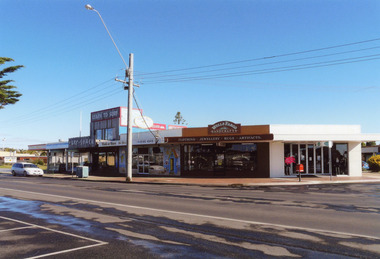
... Colour photograph showing Chinese takeaway, Lakes printing, Surf Shack, Fish O Fare, Wells Fargo retail stores on the corner of Carpenter Street and the Esplanade. ...Retail Trade Construction Historic Sites Colour photograph showing Chinese takeaway, Lakes printing, Surf Shack, Fish O Fare, Wells Fargo retail stores on the corner of Carpenter Street and the Esplanade. ...Colour photograph showing Chinese takeaway, Lakes printing, Surf Shack, Fish O Fare, Wells Fargo retail stores on the corner of Carpenter Street and the Esplanade. This was the site of Harbeck store. Lakes Entrance Victoria.retail trade, construction, historic sites -
 Lakes Entrance Historical Society
Photograph - Myer Street Lakes Entrance Victoria 2008
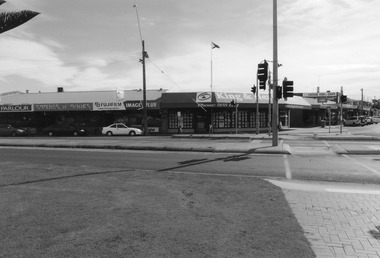
... Colour photograph of the retail stores - Icecream Parlour, Stitches & Things, Lakes Photographics and King & Heath Real Estate - on the corner of Myer Street and Esplanade. ...Date made August 2008 Guesthouses Retail Trade Room display Colour photograph of the retail stores - Icecream Parlour, Stitches & Things, Lakes Photographics and King & Heath Real Estate - on the corner of Myer Street and Esplanade. ...Date made August 2008Colour photograph of the retail stores - Icecream Parlour, Stitches & Things, Lakes Photographics and King & Heath Real Estate - on the corner of Myer Street and Esplanade. The only traffic lights in the town also shown. The original site of St Rosieres Guesthouse. Lakes Entrance Victoriaguesthouses, retail trade, room display -
 National Wool Museum
Book, With a Passport and Two Eyes
... An account of the authors travels around the world, including an extensive chapter on Australia, with references to the Western District, farming, country life, city life, retail stores and wool....An account of the authors travels around the world, including an extensive chapter on Australia, with references to the Western District, farming, country life, city life, retail stores and wool. Farming Sheep stations Farming Sheep stations With a Passport and Two Eyes Book ..."With a Passport and Two Eyes" by V.C. Buckley, c.1930. An account of the authors travels around the world, including an extensive chapter on Australia, with references to the Western District, farming, country life, city life, retail stores and wool.farming sheep stations, farming, sheep stations -
 Warrnambool and District Historical Society Inc.
Artefact, Wood-Necktie shaper, Mid 20th century
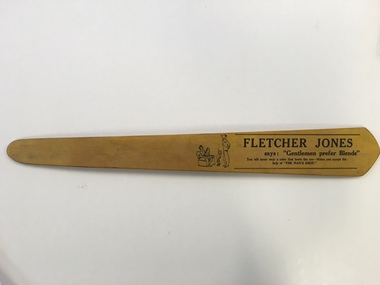
... As well as manufacturing he had a number of retail stores across Australia. This item is likely to be a prop from one such store. ...As well as manufacturing he had a number of retail stores across Australia. This item is likely to be a prop from one such store. ...David Fletcher Jones was born in Bendigo in 1895. He served in World War 1 and returned in 1917 and with a war repatriation loan bought a hawkers wagon and commenced working a circuit around the Western District. In 1924 he bought a business in Warrnambool and after an initial shaky start he started to build his business. He was well regarded and involved in the town and the 1960-70’s saw the Fletcher Jones brand and factory expand to become one of the largest employers in the town. Ownership was based on a co-operative model with employees owning shares in the company. As well as manufacturing he had a number of retail stores across Australia. This item is likely to be a prop from one such store. A minor item which is linked to an important part of Warrnambool’s past.Piece of wood shaped like a necktie with advertising slogan and small diagram in black text.Fletcher Jones says “Gentlemen prefer Blends” You will never wear a colour that hurts your eyes_ When you accept the help of “The Man’s Shop”sir fletcher jones, david fletcher jones, fletcher jones warrnambool -
 Musculoskeletal Health Australia (now held by the Glen Eira Historical Society)
Photograph - Group photo, Circa 1990s
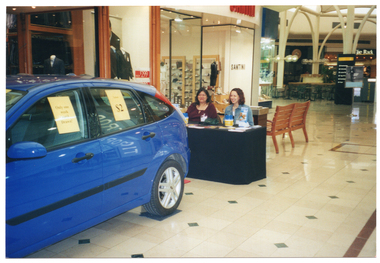
... In the background, there are a variety of retail stores, including an unidentified a menswear store, a 'Santini' shoes, clothing and accessories store, a cafe, and a tie store called "Tie Rack"....In the background, there are a variety of retail stores, including an unidentified a menswear store, a 'Santini' shoes, clothing and accessories store, a cafe, and a tie store called "Tie Rack". ...Members of the Arthritis Foundation of Victoria often supported our fundraising efforts by selling raffle tickets to the general public. In this photo, two unidentified women staff a stall at a major shopping centre to sell raffle tickets to a brand new car.COL photo of two women at a major shopping centre. They are sitting at a small table covered in a dark blue or black table cloth, behind a new blue car. There are various items on the table, including printed leaflets and some plastic coin collection containers. Behind them, there is a large rubbish bin and a wooden bench. There is a small (A4 size) yellow sign on each of the car's two side windows. The first sign contains the text, "Only one week until Drawn!". The second sign contains the text, "Tickets $2". In the background, there are a variety of retail stores, including an unidentified a menswear store, a 'Santini' shoes, clothing and accessories store, a cafe, and a tie store called "Tie Rack".arthritis foundation of victoria, afv, fundraising, car raffle, new car, blue car, raffle tickets, stall, stallholders, volunteers, shopping centre, wooden bench, santini stores, tie rack, c1990s -
 Musculoskeletal Health Australia (now held by the Glen Eira Historical Society)
Photograph - Solo photo, Circa 1990s
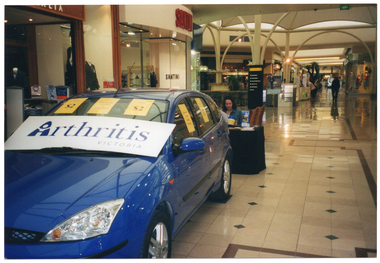
... In the background, there are a variety of retail stores, including a 'Santini' shoes, clothing and accessories store and a cafe....In the background, there are a variety of retail stores, including a 'Santini' shoes, clothing and accessories store and a cafe. ...Members of the Arthritis Foundation of Victoria often supported our fundraising efforts by selling raffle tickets to the general public. In this photo, two unidentified women staff a stall at a major shopping centre to sell raffle tickets to a brand new car.COL photo of a woman at a major shopping centre. She is in the background, sitting at a small table covered in a dark blue or black table cloth, behind a new blue car. There are various items on the table, including some printed leaflets. There is a wooden bench behind her. On the car's windscreen, there are three small (A4 size) yellow signs above one large white sign with 'Arthritis Victoria' in blue text. The letter 'A' in arthritis is a logo. Of the three A4 sized signs, two contain the text, "Tickets $2" - one placed on either side of the windscreen. The sign in the middle contains the text, "This Raffle is staffed by Volunteers". In the background, there are a variety of retail stores, including a 'Santini' shoes, clothing and accessories store and a cafe.arthritis foundation of victoria, afv, fundraising, car raffle, new car, blue car, raffle tickets, stall, stallholders, volunteers, shopping centre, santini stores, c1990s -
 Musculoskeletal Health Australia (now held by the Glen Eira Historical Society)
Photograph - Group photo, 1991
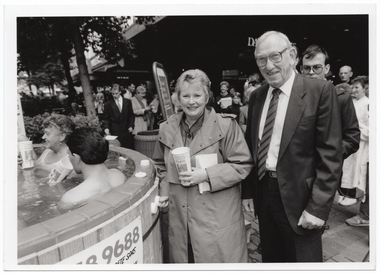
... There is a large crowd of people standing and watching in the background, with the signs of retail department stores, Myer and David Jones, hanging from the plasterboard ceiling above....There is a large crowd of people standing and watching in the background, with the signs of retail department stores, Myer and David Jones, hanging from the plasterboard ceiling above. ...The launch of National Arthritis Week 1991 was held with an event in Bourke Street Mall in Melbourne. This photo, taken at the event, depicts (from left to right): Kay Setches, Minister for Community Services, and Cliff Semmler, AFV Vice President, posing for a photo beside a hot tub/spa. A cropped version of this photo appears on page 4 of the Vol 4 No 2, Winter 1991 issue of the Arthritis Foundation of Victoria's quarterly magazine, Arthritis Update. The photo accompanies an article titled, "Arthritis Week Launch - highly successful recipe". It is captioned, "Left: Kay Setches, Minister for Community Services starts the water jets in the spa, expecially [sic] set up for the launch of Arthritis Week, assisted by AFV vice president Cliff Semmler." A similar photo (with a profile view of the people mentioned) appears on page 6 of the 1991 Annual Report.B&W photo of a man and a woman standing beside a hot tub/spa in an outdoor area. There are a few people in the spa, and the woman is pressing the start button on the edge of the spa. She is holding a PhysiCal milkshake cup in her other hand. There is a large crowd of people standing and watching in the background, with the signs of retail department stores, Myer and David Jones, hanging from the plasterboard ceiling above.arthritis foundation of victoria, afv, national arthritis week, naw, launch, kay setches, community services minister, cliff semmler, vice president, hot tub, spa, spa jets, water jets, warm water therapy, warm water exercise, move it or lose it, bourke st mall, physical, bananas, healthy food, healthy diet, healthy eating, arthritis update, annual report, 1991 -
 City of Moorabbin Historical Society (Operating the Box Cottage Museum)
Scales, Shop,Imperial, ‘Dayton Scale’, c1900
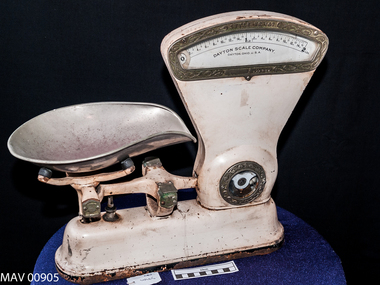
... The Dayton Scale Division was eventually sold to the Hobart Manufacturing Company when IBM decided to stop marketing scales to retail stores. The Computing Scale Company of Dayton was operated from 1891-1914 by two businessmen from Dayton, Ohio who purchased patents on the recently invented computing scale. ...The Dayton Scale Division was eventually sold to the Hobart Manufacturing Company when IBM decided to stop marketing scales to retail stores. The Computing Scale Company of Dayton was operated from 1891-1914 by two businessmen from Dayton, Ohio who purchased patents on the recently invented computing scale. ...This 'Dayton Scale' was used in a grocery shop in Moorabbin Shire in 20thC to measure grain, sugar, fruit, vegetables, lollies, etc as required by the shopkeeper for the purchase by customers. The Dayton Scale Company, originally known as the Computing Scale Company, built and marketed the first computing scale in 1891. It was part of the Computing-Tabulating-Recording Company formed in 1911, and became an IBM division in 1933. The Dayton Scale Division was eventually sold to the Hobart Manufacturing Company when IBM decided to stop marketing scales to retail stores. The Computing Scale Company of Dayton was operated from 1891-1914 by two businessmen from Dayton, Ohio who purchased patents on the recently invented computing scale. It was merged with other companies to become the forerunner company for IBM. On July 20 1897 Mr CC Hobart & Herbert L. Johnson formed the Hobart Electrical Manufacturing Company in Troy, Ohio USA. 1915 Hobart continues its growth into the World market, opening a sales office in Australia. Dayton grocery scales, capacity 2 pounds, Imperial Measure. It is made from white painted steel with a large metal scoop that sits on 2 steel rods attached to a balance beam connected to a recording mechanism that displays the ‘weight’ in a glass framed gauge. In window of glass framed gauge ; DAYTON SCALE CO. / OHIO USA ; Computed from 0 – 2LB in 1oz sections weights, measures, shops, scales. balances, grocery stores, early settlers, moorabbin, bentleigh, cheltenham, dayton scales company, ibm pty ltd., hobarrt electrical manufacturing company, hobart c.c., johnson herbert l, computing scale company ohio -
Glenelg Shire Council Cultural Collection
Functional object - Foot Warmer, Hecla Electrics Pty Ltd, c. 1920
... In 1927, the company shifted from small premises in the city to a bigger, electric-powered factory in South Yarra. Hecla had no retail stores of its own - instead it sold products through wholesalers and retailers, including the State Electricity Commission (SEC). ...In 1927, the company shifted from small premises in the city to a bigger, electric-powered factory in South Yarra. Hecla had no retail stores of its own - instead it sold products through wholesalers and retailers, including the State Electricity Commission (SEC). ...From Museum Victoria: Made in about 1927 by Hecla Electrics Pty Ltd and sold under the model name 'Foot Warma'. The foot warmer was made from the late 1920s until the 1950s and did not change substantially in design during this time. The Hecla brand name and logo was registered in 1918 by Clarence Marriott. It was inspired by the recent eruption of Iceland's volcano Mt Heckla. Clarence and his father James were metal workers who had made Australia's first carbon filament electric radiators in 1899, and also built an early steam car. As electricity use exploded in the 1920s and 1930s, 'Hecla' became a household name in Melbourne. They made a wide range of appliances for the home, and supplied commercial appliances to cafés, hospitals and offices. In 1927, the company shifted from small premises in the city to a bigger, electric-powered factory in South Yarra. Hecla had no retail stores of its own - instead it sold products through wholesalers and retailers, including the State Electricity Commission (SEC). The company promoted its goods through advertisements in home magazines and displays in shop windows, home shows and the 1935 All-Electricity Exhibition. A popular advertising slogan in the 1930s was 'Hecla household helps make happy healthy housewives!'. Hecla ceased manufacturing in Melbourne in the 1980s.Documentation of how people lived and is an example of early domestic electrical appliances. From Museum Victoria: Hecla Electrics Pty Ltd were a significant Melbourne manufacturing company, who became a household name in the 1920s making small electric appliances such as heaters and kettles. They also made a variety of other electrical appliances for domestic, commercial and military use. The company manufactured electric appliances in Melbourne from about 1922 until the 1980s, although Clarence Marriott, who formed the company, had begun making radiators with his father James in 1899. The company had a reputation for quality products. The company also played an important role within the Australian domestic and commercial appliance industry, both as a leading innovator and through its role in training skilled staff, many of whom went on to work for competitors such as Kambrook, Electrolux and Sunbeam. This electric coffee percolator represents the typical small domestic appliance that the Hecla company was famous for. Along with other items in the Hecla Collection, it highlights the diversity of electric appliances that the company made. This object also highlights the legacy of high quality design and metal construction work that Clarence and James established for the company, stemming from their early work as talented art metal workers. It also represents the first major period of the take-up of electricity use in the home. This take-up began in the 1920s and 1930s with the use of small appliances, and by the 1950s electricity had become commonplace in the home, and large appliances such as refrigerators and stoves became standard.Square metal object. The top surface is heavy cast iron and patterned with floral motifs. In the centre is a circle with the words ' Hecla Foot Warma' inside. Under the top is a black metal base with two feet at either end which extend the length of the base. The back foot is higher than the front foot. There is a circular disk from which extends the electrical cord. The cord is brown and white checks. At the end of the cord is a plug on which is printed 250V AMP S.2 EARTH 5. The plug is brown and made from Bakelite. On the base is a rectangular label which has words printed - HECLA Australia.Top: HECLA/-FOOT-/WARMA Base: Volts / 230/250 / WATTS / 80 / HECLA / Australia / CAT. NO. F26domestic, city of portland, glenelg shire council, electrical, foot warmer, heating, hecla, manufacture -
 Flagstaff Hill Maritime Museum and Village
Furniture - Desk, Foy & Gibson, Circa 1880s
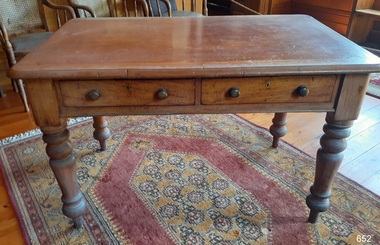
... He set up branches of his stores in Perth, Brisbane and Adelaide and two more branches in Melbourne. Foy & Gibson (usually referred to as Foys) became one of Australia’s largest retail department stores. ...He set up branches of his stores in Perth, Brisbane and Adelaide and two more branches in Melbourne. Foy & Gibson (usually referred to as Foys) became one of Australia’s largest retail department stores. ...The design of this small disc is from the Australian Colonial period. The cedar wood desk was made in Australian by Foy & Gibson in the 1880s, most probably in the business’s works in Collingwood, Victoria. The heavy brass locks fitted into the desk drawers were made by the famous Hobbs & Co of London, mid-late 19th century. In 1860 the business changed hands but the locks were still branded Hobbs & Co. The desk is branded with the symbol of Victoria’s Public Works Department. There is currently no information on when, where and by whom this desk was used. However, a very similar desk with Hobbs & Co. locks is on site at the Point Hicks Lightstation in Victoria and was formerly used by the Point Hicks head light keeper there. Other light stations also have similar desks from the P.W.D. (see also ‘Desk, Parks Victoria – Point Hicks Lightstation, Victorian Collections’.) HOBBS & CO., LONDON Alfred Charles Hobbs, 1812-1891, was American born. He became an executive salesman in 1840 for renowned lock manufacturer Day & Newell. His technique of exposing the weaknesses of people’s current locks was very successful in generating sales. He represented Day & Newell at London’s Great Exhibition of 1851, competing with other lock makers. Through the Exhibition he became famous for picking the best trusted Bramah and Chubb locks. Hobbs’ fame led him to found his own company in 1851 then register it in 1852 as Hobbs & Co., London. Hobbs was awarded the Telford Medal by the British Institution of Civil Engineers in 1854 for his paper 'On the Principles and Construction of Locks'. In 1855 the very successful company added partners and became Hobbs, Ashley and Co. In 1860, it traded under the name of Hobbs, Hart & Co. and was based in Cheapside London, where the business remained. Hobbs then returned to America, having sold the complete company to John Mathias Hart. He briefly returned to attend the 21st anniversary celebrations of the successful business in 1872. Hobbs kept himself busy in America, inventing and manufacturing firearm ammunition, for which he held several patents. He passed away there in 1891, a month after his 70th birthday. FOY & GIBSON Mark Foy wan an Irish draper who migrated to Bendigo, Victoria in 1858, attracted by the gold rush. He lived and worked in the area, establishing a drapery business. In the 1870s he moved to Melbourne where there were better prospects for expansion. He chose a place in Smith Street, Collingwood, a suburb of Melbourne, and started his business at the rear. In 1883 Foy retired, bringing in William Gibson as a partner, and then transferred his own share of the company to his son Francis Foy. Not long afterwards Francis sold his half share to Gibson, and the business continued under the name of Foy & Gibson. Francis Foy and he and his brother Mark Foy (junior) moved to Sydney. They established a business there in 1885, named after their father, Mark Foy. Gibson added to his business by starting his own manufacturing works from 1887, producing clothing, millinery, furniture, bedding and hardware for his stores. The factories, warehouses and stores complex became one of Victoria’s largest employers. He set up branches of his stores in Perth, Brisbane and Adelaide and two more branches in Melbourne. Foy & Gibson (usually referred to as Foys) became one of Australia’s largest retail department stores. In 1931 Foy’s little house in Collingwood was still part of the entrance to Foy & Gibson Emporium. In 1955 the company was bought out by Cox Brothers. Later on the stores were sold to various businesses such as David Jones, Woolworths and Harris Scarfe. In 1968 Cox Brothers went into receivership, ending almost 100 years of the business known as Foy’s. The former Foy & Gibson Complex is registered by Heritage Council Victoria. “Designed by William Pitt, this magnificent 19th and early 20th century complex of factories, warehouses and showrooms saw the production of a remarkable range of goods for Foy & Gibson, Melbourne’s earliest department store chain”. (Quoted from the Plaque erected by the Collingwood Historical Society 2007) P.W.D. – Public Works Department, Victoria The desk is stamped “P.W.D,” signifying that it is from the Public Works Department in Victoria, which operated from 1855-1987. The department was responsible for, among other things, the design and supply of office furniture and equipment for public buildings and organisations. This desk is significant historically as it originated from Foy & Gibson, a colonial Australian company that had a positive and strong impact on employment, manufacturing and retailing in Melbourne, Victoria and Australia. The significance of Foy & Gibson to Victoria’s and Australia’s history is marked by the Collingwood Complex being registered in both Heritage Victoria Register (H0755, H0897 and H0896) and National Trust Register (B2668). This locks on this desk are significant for their connection with their manufacturer, Hobbs & Co, who invented a lock that surpassed the security of any other locks produced in the mid-19th century. Desk; Australian Colonial cedar desk, honey coloured. Desktop has a wooden border with a rolled edge and a fitted timber centrepiece. The four tapered legs are tulip turned. Two half-width drawers fit side by side and extend the full depth of the desk. The drawers have dovetail joints. Each drawer has two round wooden knob handles, a keyhole and a fitted, heavy brass lever lock. Inscriptions are on the desktop, drawers, desk leg and lock. Made in Australia circa 1880 by Foy & Gibson, lock made by Hobbs & Co, London.Impressed into timber frame of one drawer “FOY & GIBSON” Impressed into lock “HOBBS & CO / LONDON”, “MACHINE MADE”, “LEVER” Impressed along the front edge of the desktop [indecipherable] text. Impressed into the timber of right front leg “P. W. D.” below a ‘crown’ symbol Handwritten in white chalk under a drawer “206” flagstaff hill, warrnambool, shipwrecked coast, flagstaff hill maritime museum, maritime museum, shipwreck coast, flagstaff hill maritime village, great ocean road, desk, cedar desk, colonial desk, 1880s desk, australian colonial furniture, furniture, office furniture, office equipment, australian made furniture, colonial furniture, colonial hardware, foy & gibson, alfred charles hobbs, hobbs & co london, hobs & co lever lock, cabinetry lock, machine made lever lock, p.w.d., public works department victoria, day & newell, great exhibition of 1851, bramah lock, chubb lock, telford medal 1854, cheapside london, mark foy, mark foy – bendigo draper, smith street collingwood, william gibson, foy & gibson emporium, foy & gibson complex, cox brothers -
 Flagstaff Hill Maritime Museum and Village
Functional object - String Dispenser, Cramond and Dickson, mid-19th century
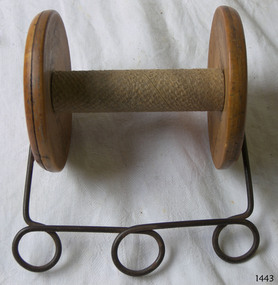
... stores for the wrapping and securing of parcels. Flagstaff Hill Maritime Museum and Village Flagstaff Hill Maritime Village Maritime Museum Shipwreck Coast Great Ocean Road Warrnambool Cramond and Dickson Warrnambool business department store commerce Timor Street Liebig Street sales retail equipment office equipment string dispenser string reel packaging parcelling Dispenser for string; spindle, reel or spool with cylindrical axle in centre, a wooden disc at each end. ...This dispenser was most likely used for holding and dispensing string. It was used in the Cramond and Dickson store, which operated in Warrnambool from 1855 + 1974. John Glass Cramond and James Dickson migrated from Scotland to Melbourne where they opened a Cramond and Dickson store in St Kilda. They were inspired by the growth in Warrnambool after a visit and opened a second store there in 1855. The Cramond and Dickson store, grocers – drapery – ironmongery - chemist, was located on the corner of Liebig and Timor Streets, Warrnambool (now the site of a Mexican restaurant). Both Cramond and Dickson were involved in the business and social aspects of Warrnambool’s community. Cramond and Dickson closed in 1974. An advertisement placed by Cramond and Dickson in The Camperdown Chronicle, Saturday 6th April 1895, states them “showing the latest novelties for the coming winter season” … “import directly from English and Continental manufacturers” … “representatives in London … always in touch with the Newest Continental Fashions” ... “having been established for so many years we know the requirements of the Western District”… “allow 5 percent discount on goods paid for at the time of purchase”.The string dispenser is significant for being used at the local historical Cramond and Dickson department store in Warrnambool It is also of significance as it is an example of office equipment used in many stores for the wrapping and securing of parcels.Dispenser for string; spindle, reel or spool with cylindrical axle in centre, a wooden disc at each end. A length of wire is attached to each end and bend into a 'U' shape, with three loops formed across the base of the 'U'. Item came from Cramond and Dickson store in Warrnambool and was possibly used for dispensing string, with the wire being used as a handle or for mounting.flagstaff hill maritime museum and village, flagstaff hill, maritime village, maritime museum, shipwreck coast, great ocean road, warrnambool, cramond and dickson, warrnambool business, department store, commerce, timor street, liebig street, sales, retail equipment, office equipment, string dispenser, string reel, packaging, parcelling -
 Flagstaff Hill Maritime Museum and Village
Accessory - Grooming Set, T R Cadman, ca. 1924
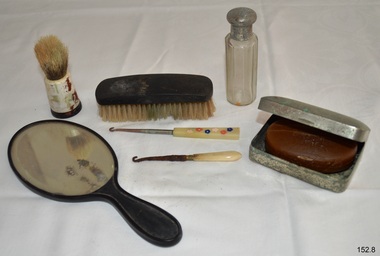
... These items are examples of personal objects sold in Victoria in the 1920s as gifts for men, cased or packaged for special occasions and sold in retail stores. The items are associated with the historic coastal trading ketch 'Reginald M', listed on the Australian Register of Historic Vessels; and active from 1922 until 1975. ...This men's grooming set of personal care equipment and toiletries is an example of items packaged in attractive cases and sold as gifts in Australian chemist outlets and department stores in the 1920s to 1940s. This set was originally packaged in a leather-covered, lined and fitted case, with a comb, hair brush, and razor included as well. as the items shown here. The razor, once included with the set, had the inscription "T.R. Cadman and Sons, Sheffield England". The family business began with Luke Cadman in 1748. Thomas Radley Cadmen (1833 - 1917) took over the business in 1871, by which time it was operating in Sheffield. The business became incorporated as T.R. Cadman & Sons in 1924 but shortly afterwards the straight razors manufactured by them were stamped T.R. Cadman & Sons Ltd. The company specialised in pocket knives and razors from 1933 and supplied the British Royal Navy with razors in WWII. Over 80 per cent of sales were for the overseas market including Australia. Some of their razors were sold in stores in Victoria. The business traded in 1965. This grooming set was donated for exhibit in Flagstaff Hill Maritime Museum and Village's exhibit of the vessel 'Reginald M', a two-masted coastal trading ketch built in Port Adelaide in 1922. These items are examples of personal objects sold in Victoria in the 1920s as gifts for men, cased or packaged for special occasions and sold in retail stores. The items are associated with the historic coastal trading ketch 'Reginald M', listed on the Australian Register of Historic Vessels; and active from 1922 until 1975. The items were displayed in the Master's Quarters of the Reginald M exhibit at Flagstaff Hill Maritime Museum and Village until 2016 when the ship was decommissioned from Flagstaff Hill's fleet.Men's grooming set; metal soap container with star decoration, oval soap cake, oval hand mirror in a black frame ten-sided clear glass cologne bottle with silver metal lid, yellow bristle clothes brush with brown wooden hand grip, yellow bristle shaving brush with black base and white body, and two button hooks with white handles; the larger one has floral motifs. Inscriptions were on the razor originally included in the grooming set.Soap container once had star motifs.flagstaff hill, warrnambool, shipwrecked coast, flagstaff hill maritime museum, maritime museum, shipwreck coast, flagstaff hill maritime village, great ocean road, grooming set, men's grooming set, personal grooming, toiletry set, personal care, soap box, soap container, cologne bottle, clothes brush, shaving brush, button hook, hand mirror, personal efects, toiletries, t.r. cadman & sons, reginald m, soap dish -
 Flagstaff Hill Maritime Museum and Village
Container - Pyott's Paper Shopping Bag, c. early 20th-century
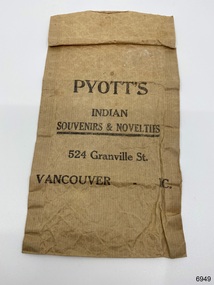
... stores and retailers began to realise that paper shopping bags could be used to help market their brands, and as such custom shopping bags with printed logos became common place. Carrying a shopping bag from certain shops became a type of status symbol for consumers, providing evidence that one was well-off, had good taste, or both. The paper shopping bag is a rare survival of ephemera related to a retail ...Pyott's Ltd., was an merchant and novelty shop in Vancouver, Canada during the early-20th century. An advertisement for the shop was published on February 9, 1922 in the Ubyssey News (issued Weekly by the Publications Board of the University of British Columbia. It reads: 'We carry one of the largest lines of Indian Burnt Leather Goods, Moccasins and Baskets in the city; also Beads, Purses and Hand Bags; View Books, Post Cards and Novelties of all kinds. Your inspection invited, 524 Granville St. Vancouver B.C'. History of shopping bags: Before the late 1800s, shopping bags didn’t exist. Shoppers would either carry their goods home in baskets, or have the merchant deliver them to people's homes, until 1852 when Francis Wolle, a schoolteacher in Pennsylvania, invented a machine to produce paper shopping bags. This invention would allow customers to carry items home in disposable paper bags. Soon after, owners of department stores and retailers began to realise that paper shopping bags could be used to help market their brands, and as such custom shopping bags with printed logos became common place. Carrying a shopping bag from certain shops became a type of status symbol for consumers, providing evidence that one was well-off, had good taste, or both. The paper shopping bag is a rare survival of ephemera related to a retail store that existed in Vancouver, Canada during the early-20th century. The arrival of waves of more than ten million migrants by boat is one of the major themes in Australia’s history. The paper shopping bag is representative of personal items purchased for migrant journeys as markers of domesticity, warmth and making oneself at home in a new land that speaks of the transnational lives embedded in threads of migration. A brown paper shopping bag with a printed logo and store information in black inkPyott's, Indian Souvenirs & Novelies. 524 Granville St, Vancouver- B.C. On the reverse side in handwriting: 'Red + dark red beadsshopping bag, marketing, ephemera, pyott's, vancouver, canada, migration, flagstaff hill, merchant -
 Flagstaff Hill Maritime Museum and Village
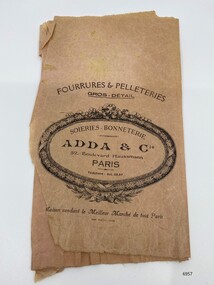
Container - Brown paper shopping bag from Adda & Co. Paris, c. early 20th century
... stores and retailers began to realise that paper shopping bags could be used to help market their brands, and as such custom shopping bags with printed logos became common place. Carrying a shopping bag from certain shops became a type of status symbol for consumers, providing evidence that one was well-off, had good taste, or both. The paper shopping bag is a rare survival of ephemera related to a retail ...Adda & Co operated a business at 52 Boulevard Haussmann, Paris.The store sold crocheted silks, furs and hides. History of shopping bags: Before the late 1800s, shopping bags didn’t exist. Shoppers would either carry their goods home in baskets, or have the merchant deliver them to people's homes, until 1852 when Francis Wolle, a schoolteacher in Pennsylvania, invented a machine to produce paper shopping bags. This invention would allow customers to carry items home in disposable paper bags. Soon after, owners of department stores and retailers began to realise that paper shopping bags could be used to help market their brands, and as such custom shopping bags with printed logos became common place. Carrying a shopping bag from certain shops became a type of status symbol for consumers, providing evidence that one was well-off, had good taste, or both.The paper shopping bag is a rare survival of ephemera related to a retail store called Adda &Co that operated at 52 Boulevard Haussmann, Paris. The arrival of waves of more than ten million migrants by boat is one of the major themes in Australia’s history. The paper shopping bag is representative of personal items purchased for migrant journeys as markers of domesticity, warmth and making oneself at home in a new land that speaks of the transnational lives embedded in threads of migration.A brown paper shopping bag with a printed logo and store information in black inkparis, department store, shopping, adda & co, flagstaff hill, maritime museum -
 City of Moorabbin Historical Society (Operating the Box Cottage Museum)
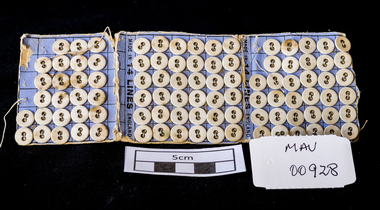
Manufactured Objects, card of buttons, c1900
... retail space, and was once the largest department store in the world . It also operated one of the largest mail order businesses in Australia. One of their advertising slogans was that they sold "anything from a needle to an anchor". horden anthony senior horden and son pty ltd sydney new south wales moorabbin department stores market gardeners pioneers dressmaking craftwork sewing needles clothing buttons on backing of card a picture of an 'Anchor and Rope , Needle and Thread' / FROM A NEEDLE / TO AN ANCHOR / TRADE MARK / MADE IN ENGLAND. ...Anthony Hordern sen. (1788–1869) came from Staffordshire, as a free immigrant in 1823, and the business was originally established as a drapery store in Pitt Street by his wife Ann. The family moved to Melbourne and remained there but a son Anthony junior purchased land in George Street Sydney in 1842 and set up business with his brother Lebbeus. They broke their partnership in1855 and Anthony took his sons Anthony and Samuel into partnership as they became old enough. Anthony Hordern & Sons was the largest department store in Sydney, New South Wales, Australia. with 52 acres (21 hectares) of retail space, and was once the largest department store in the world . It also operated one of the largest mail order businesses in Australia. One of their advertising slogans was that they sold "anything from a needle to an anchor". A strip of blue cardboard with 95 small, white 2 hole buttons . The cardboard folds into 3 for easy storage with each section holding 36 buttons. 7 buttons are missing - used. The buttons are sewn onto the card with a running thread that is covered by backing paper.on backing of card a picture of an 'Anchor and Rope , Needle and Thread' / FROM A NEEDLE / TO AN ANCHOR / TRADE MARK / MADE IN ENGLAND. inside ' MADE IN 14 LINES ENGLAND 'horden anthony senior, horden and son pty ltd, sydney, new south wales, moorabbin, department stores, market gardeners, pioneers, dressmaking, craftwork, sewing needles, clothing, buttons -
 City of Moorabbin Historical Society (Operating the Box Cottage Museum)
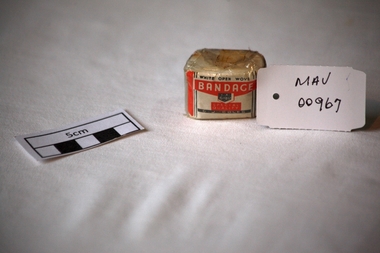
Bandage, cotton, mid 20thC
... Further expansion occurred and Coles' interest in food retailing was spurred in 1958 when it acquired 54 John Connell Dickins grocery stores. ...In 1991, the stores were re-branded Coles Supermarkets and from 1998, simply as Coles. George James (G. J.) Coles learned the retail trade working for his father's 'Coles Store' business from 1910 to 1913. ...A bandage is a piece of material used either to support a medical device such as a dressing or splint, or on its own to provide support to the body; it can also be used to restrict a part of the body. G. J. Coles opened the 'Coles Variety Store' on 9 April 1914 on Smith Street in the Melbourne, Victoria suburb of Collingwood. Further expansion occurred and Coles' interest in food retailing was spurred in 1958 when it acquired 54 John Connell Dickins grocery stores. It then acquired the Beilby's chain in South Australia in 1959 and 265 Matthews Thompson grocery stores in New South Wales in 1960 .In 1960, the first supermarket was opened in the Melbourne suburb Balwyn North, at the corner of Burke and Doncaster Roads where a modernised version continues to operate. By 1973, Coles had established stores in all Australian capital cities. From 1962, its supermarkets were branded Coles New World with accompanying rocket imagery. In 1991, the stores were re-branded Coles Supermarkets and from 1998, simply as Coles. George James (G. J.) Coles learned the retail trade working for his father's 'Coles Store' business from 1910 to 1913. The store continued operating as "The Original Coles" at Wilmot, Tasmania until it was destroyed by a fire on 24 January 2014. An unused, 1 inch ( 2.5cm ) x 6 yards ( 2metres) cotton, ‘open wove’ bandage in a cellophane wrapper sold by G.J. Coles Pty Ltd Variety StoresCellophane wrapper top: WHITE OPEN WOVE / BANDAGE / 1 X 6 YDS. / SPECIAL QUALITY / G.J.COLES * pharmacy, medicines, bandages, wounds, early settlers, market gardeners, moorabbin, bentleigh, cheltenham, cotton, gauze, coles g j pty ltd., variety stores, supermarkets, smith street collingwood, retailers, shops -
 Mission to Seafarers Victoria
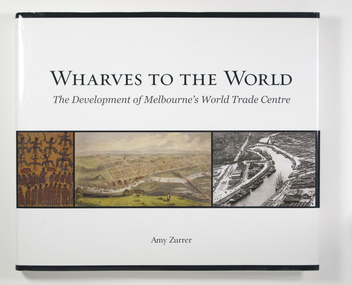
Book - Reference book, Melbourne Books, Wharves To The World: The Development Of Melbourne's World Trade Centre, 2011
... Stores were demolished to make way to the new buildings. This book provides a well illustrated history of Melbourne's waterfront: photographs from PROV, RHSV, SLV from the Aboriginal past, John Batman, John Pascoe Fawkner, Sir John Coode and the cutting of the Yarra river. WTC was acquired by Riverlee in 2005 and has undergone major refurbishment of the commercial areas. Construction of the retail ...Wharves to the World: The Development of Melbourne's World Trade Centre is a photographic chronicle of the history of the World Trade Centre and its surrounds. The book traces the journey of land and the buildings that occupied it - from its beginnings with the Wurundjeri people to its role as a trading hub in early Melbourne, then as the site of the modern-day World Trade Centre, and now as part of a flourishing residential and commercial Precinct. As with any major project The World Trade Centre has face its share of fêlures, but despite thèse it has become an integral part of the City. So it goes that was once home to swampland and the City morgue has been transformer into a Diamond of the Yarra River.A 128-page book of printed matter, photographs, engravings and drawings. The hard cover is white with the title in gold lettering on the front. The dust-cover is also white with black lettering. Along the lower half of the cover, front and back, is a strip of six photos, three coloured and three black and white. 128 p. : ill. (some col.), ports. non-fictionWharves to the World: The Development of Melbourne's World Trade Centre is a photographic chronicle of the history of the World Trade Centre and its surrounds. The book traces the journey of land and the buildings that occupied it - from its beginnings with the Wurundjeri people to its role as a trading hub in early Melbourne, then as the site of the modern-day World Trade Centre, and now as part of a flourishing residential and commercial Precinct. As with any major project The World Trade Centre has face its share of fêlures, but despite thèse it has become an integral part of the City. So it goes that was once home to swampland and the City morgue has been transformer into a Diamond of the Yarra River.yarra yarra tribe, early melbourne, world trade centre, melbourne, southbank, northbank, australian wharf, siddeley street, waterfront, amy zurrer, wurundjeri, spencer street bridge, north wharf, riverlee, wtc, wharf, harbor trust, sir john coode, harbour trust, little dock, polly woodside, wharfies, divers -
 Orbost & District Historical Society
book / souvenir, Lancelot Herbert, Snowy River Stores and Bakery and at Cann River, c. 1910-20
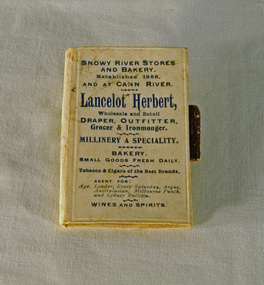
... STORES AND BAKERY. Established 1886, AND CANN RIVER. Lancelot Herbert, Wholesale and Retail DRAPER, OUTFITTER, Grocer & Ironmonger, MILLINERY A SPECIALTY. ...STORES AND BAKERY. Established 1886, AND CANN RIVER. Lancelot Herbert, Wholesale and Retail DRAPER, OUTFITTER, Grocer & Ironmonger, MILLINERY A SPECIALTY. ...This is a small souvenir or promotional book for Herbert Stores in Orbost and Cann River. Lancelot Herbert came to Orbost in 1886, taking up a partnership with local store-owner Massey Coote. After Mr Coote's death in 1891, Lancelot took over the store and progressively developed Herbert's Snowy River Stores which grew into a department store of several shops along Nicholson St. He also had small shops at Cann River, Noorinbee and Genoa which were run by members of his family, as well as a carrying business and fuel outlets. Lancelot died on 2/6/1911 and his wife Martha [died 1945] are buried in a joint grave in Orbost Cemetery. (info. Noreen and Lindsay Thomson. More from "In Times Gone By' by Deborah Hall)Associated with a well-known Orbost business which started in 1888 and finally closed in c.1970. A small book with a white/cream cover and black printing. It has three cardboard pages inside which are blank. A pencil holder is attached to the back cover. On front cover: SNOWY RIVER STORES AND BAKERY. Established 1886, AND CANN RIVER. Lancelot Herbert, Wholesale and Retail DRAPER, OUTFITTER, Grocer & Ironmonger, MILLINERY A SPECIALTY. BAKERY, SMALLGOODS FRESH DAILY. Tobacco & Cigars of the Best Brands. AGENT FOR: Age, Leader, Every Saturday, Argus, Australasian, Melbourne Punch, and Sydney Morning Bulletin. WINES AND SPIRITS.souvenir, book, herberts stores, orbost -
 Orbost & District Historical Society
black and white photograph, C1880s -1890s
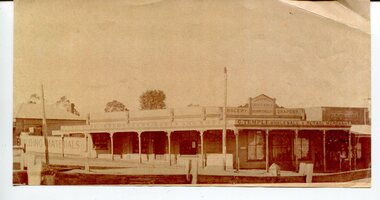
... Orbost-19th-century Temple-George retail-stores...Orbost-19th-century Temple-George retail-stores A black / white photograph of low set wooden buildings . ...This photograph shows George Temple's store which began operating C.1888 opposite the post office in the main street of Orbost. The store stocked other stores in Bendoc supplying the gold fields. The men with their pack horses are on their way to the survey camp. George Temple, born in Yorkshire on 26/2/1832 was of the earliest Orbost storekeepers. Temple's Store was on the corner of Ruskin and Nicholson Streets opposite the post office. He packed stores to the Bendoc area goldfields. The store building eventually became part of Herbert's store when he died in 1918. This item is associated with the very early history of Orbost. George and Mary Temple were early shopkeepers who operated a store opposite the Post Office for many years. Their daughters were very talented women.A black / white photograph of low set wooden buildings . In the foreground is a fence on the opposite side of the street. There are signs on the top part of the building which occupies the whole corner - "G. TEMPLE Wholesale & Retail Merchant, Building materials, furniture, ironmomgery, boots and shoes, grocery, drapery, Croajingalong General Store, The Orbost Equitable Grocery"orbost-19th-century temple-george retail-stores -
Glen Eira Historical Society
Document - Glenhuntly Road, Elsternwick
... Stores Pty Ltd... E J Buckeridge’s Buildings 1911... Kelly Walter... Staniland Grove... Buckeridge Edward... Hannon John... Kellett Frances... Beck Miss... Armstrong Miss... Tuck Mary... Milliners... Doherty John... Adams Herbert... Bakeries... Perry Robert... Picture framers... Adams Clifford... Arches... Windows... Shops... Land subdivision... Retail...Glen Huntly Road Moore’s Buildings 1891 Italianate style Architectural styles Architectural features Verandahs Elsternwick Moore Hugh Selwyn Street St Georges Road Glenmoore Glenmoore Estate Corkill French and Pugh Jamieson W W Thompson A G Eddy Henrietta Valey Frank Allen Thomas Saddlers Dairy products Green W I Undertakers Delany Edward Drapers Herbenstreit Huldreich Butcher shops Sincock John Plumbers Allen T Greengrocers Coppel George Painters Dickinson F H Dickinson V Johnson Thomas Cole Constance Hairdressers Ortner Frank Drycleaners Gaffney Elodie Ward Andrew Long MR Robinson Mr Le Page Mr Byers Robert Carter Mary Millar C Smythe F C Crook Thomas Stancy H Crook’s National Stores Pty Ltd E J Buckeridge’s Buildings 1911 Kelly Walter Staniland Grove Buckeridge Edward Hannon John Kellett Frances Beck Miss Armstrong Miss Tuck Mary Milliners Doherty John Adams Herbert Bakeries Perry Robert Picture framers Adams Clifford Arches Windows Shops Land subdivision Retail trade Property developers Advertising signs Document Glenhuntly Road, Elsternwick ...Three three page extracts from Andrew Ward’s 1994 Caulfield Conservation Study on commercial buildings in Glen Huntly Road, Elsternwick. The three studies concern Moore’s Buildings 1891 shops at 305-313 Glen Huntly Road, shops at 323-329 Glen Huntly Road and E J Buckeridge’s Buildings 1911 shops at 357-371 Glen Huntly Road. The studies describe the buildings’ architectural features, provide a historical overview and statements of the buildings’ significance, especially in relation to the Land Boom and commercial development between 1890 to the 19020s. All three studies include a black and white photograph (109mm x 152mm; 114mm x 150mm; 110mm x 151mm) of the shop fronts.glen huntly road, moore’s buildings 1891, italianate style, architectural styles, architectural features, verandahs, elsternwick, moore hugh, selwyn street, st georges road, glenmoore, glenmoore estate, corkill french and pugh, jamieson w w, thompson a g, eddy henrietta, valey frank, allen thomas, saddlers, dairy products, green w i, undertakers, delany edward, drapers, herbenstreit huldreich, butcher shops, sincock john, plumbers, allen t, greengrocers, coppel george, painters, dickinson f h, dickinson v, johnson thomas, cole constance, hairdressers, ortner frank, drycleaners, gaffney elodie, ward andrew, long mr, robinson mr, le page mr, byers robert, carter mary, millar c, smythe f c, crook thomas, stancy h, crook’s national stores pty ltd, e j buckeridge’s buildings 1911, kelly walter, staniland grove, buckeridge edward, hannon john, kellett frances, beck miss, armstrong miss, tuck mary, milliners, doherty john, adams herbert, bakeries, perry robert, picture framers, adams clifford, arches, windows, shops, land subdivision, retail trade, property developers, advertising signs -
 Warrnambool and District Historical Society Inc.
Pants, Fletcher Jones, Mid 20th century
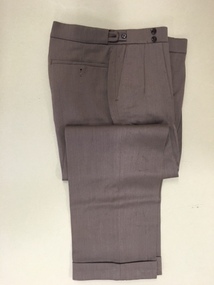
... retailing area near the Liebig Street/Koroit Street intersection. In 1931 a shop built to Fletcher Jones’ requirements was erected and by 1938 he had a staff of 40. By 1945 FJ trousers were sold in 123 stores...retailing area near the Liebig Street/Koroit Street intersection. In 1931 a shop built to Fletcher Jones’ requirements was erected and by 1938 he had a staff of 40. By 1945 FJ trousers were sold in 123 stores ...These trousers have been made by Fletcher Jones and Staff. This business was established by David Fletcher Jones (1895-1977) in 1924 when he leased three shops in Liebig Street, Warrnambool. In 1928 he moved his business to the main retailing area near the Liebig Street/Koroit Street intersection. In 1931 a shop built to Fletcher Jones’ requirements was erected and by 1938 he had a staff of 40. By 1945 FJ trousers were sold in 123 stores in Victoria and in 1948 the Fletcher Jones factory was established in Flaxman Street Warrnambool, officially named Pleasant Hill. In 1951 the company became Fletcher Jones and Staff and by the mid 1970s the staff had 75% ownership. By this time FJ and Staff had become one of the largest clothing manufacturers in Australia with 55 shops and almost 3000 employees. The range of clothing was enlarged to include both men’s and women’s wear. In the 1980s, after the death of Fletcher Jones, the abolition of import tariffs and the availability of cheap imported clothing caused the Fletcher Jones Company to decline and to be sold to a Geelong company. By 2011 all Fletcher Jones shops had closed. These trousers are of great interest as they are a product of a Warrnambool business that was nationally and internationally known in the 20th century for its quality men’s wear, especially the Coverdine brand trousers. The Fletcher Jones business remains one of the most important businesses, (if not the most important), that ever existed in Warrnambool. It employed a great number of local people in the second half of the 20th century, and is remembered with great fondness by many people in the city and surrounds today. The Fletcher Jones Gardens at the Factory site are still maintained today and are a tourist attraction in the city. These are a pair of brown Fletcher Jones trousers made of Coverdine material (87.5% wool with nylon). There is some lining around the waist area and the legs are turned up at the end with some leather binding inside the bottom legs. The waist band is stiffened and is fastened with a metal clip and two buttons. The waist band has two adjustable areas using tabs and two buttons each side. The back pockets also have buttons.fletcher jones and staff, coverdine fletcher jones trousers, history of warrnambool, david fletcher jones -
Glen Eira Historical Society
Letter - G. J. Coles and Coy. Ltd
... stores... Ballantyne R.... Caulfield South... Retail...Barber Stella Caulfield Historical Society Elsternwick Caulfield Coles stores Ballantyne R. Caulfield South Retail trade Shops General stores Coles variety stores Letter G. ...This file contains three items. 1. Typed letter, dated 10/06/1987, from the Coles Myer corporate archivist, Stella Barber, to Caulfield Historical Society accompanying photographs of Coles stores donated to the society. 2. Typed brief history of the Coles Myer company up to September 1986, author unknown. 3. Printed newsletter dated February 1986 of the city of Richmond and Burnley Historical Society containing a brief history of G. J. Coles and Co. Ltd by Stella Barber.g. j. coles and co. ltd., barber stella, caulfield historical society, elsternwick, caulfield, coles stores, ballantyne r., caulfield south, retail trade, shops, general stores, coles variety stores -
 Glen Eira Historical Society
Photograph - G. J. Coles and Coy. Ltd
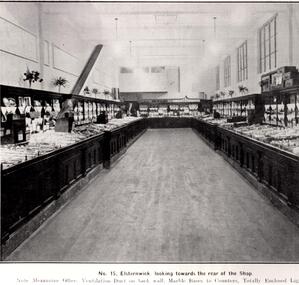
... stores... Retail trade...Coles and Co. Ltd. Coles stores Retail trade Shops Merchandise supermarkets Photograph G. ...This file contains two items. 1. Eight black and white photographs of interior and exterior of Elsternwick Coles store at various times, two dated 1947 and one dated 1958, others undated, photographer unknown. 2. One black and white photograph of interior, undated and photographer unknown, of Coles Elsternwick Supermarket, Probably 1970’s.elsternwick, g. j. coles and co. ltd., coles stores, retail trade, shops, merchandise, supermarkets -
 Glen Eira Historical Society
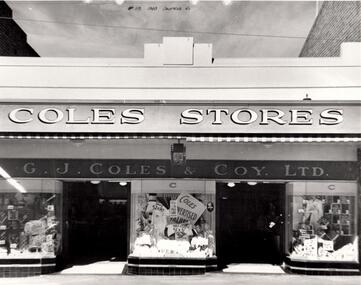
Photograph - G. J. Coles and Coy. Ltd
... stores... Caulfield... Retail...Ltd. Coles stores Caulfield Retail trade Shops Photograph G. J. ...This file contains one item. 1. Two black and white photographs, one exterior and one interior, of Coles store at Caulfield, taken in 1949, photographer unknown.g. j. coles and co. ltd., coles stores, caulfield, retail trade, shops -
 Warrnambool and District Historical Society Inc.
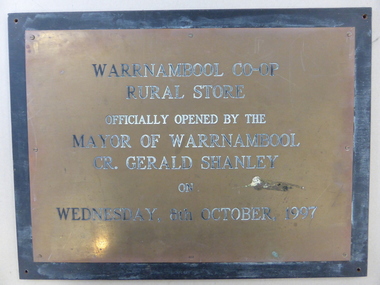
Plaque, Warrnambool Co-op Rural Store, 1997
... retail store in Timor Street which had a strong rural and farming base which gradually expanded to become the largest trading department store in the district. By the late 1990's they had 8000 members and employed 84 full time and 120 casual staff. It met a sorry end in the 2000's.This plaque commemorates the opening of the Rural store which consolidated the large rural aspect of the business. It opened up the site from Merri Street at the back of the Timor Street building trading in all agricultural products, , chemicals and fuels. A link to one of Warrnambool's largest stores ...The Warrnambool Co-operative had its beginnings as the Allansford Artificial Breeders Co-operative in the 1960's. In the 1970s they opened a retail store in Timor Street which had a strong rural and farming base which gradually expanded to become the largest trading department store in the district. By the late 1990's they had 8000 members and employed 84 full time and 120 casual staff. It met a sorry end in the 2000's.This plaque commemorates the opening of the Rural store which consolidated the large rural aspect of the business. It opened up the site from Merri Street at the back of the Timor Street building trading in all agricultural products, , chemicals and fuels.A link to one of Warrnambool's largest stores of the latter part of the 20th century and as such it has historical and social significance. Rectangular brass plaque with stamped black text with eight screws around the edge attaching it to a piece of heavy particle board , painted black.Warrnambool Co-Op rural Store officially opened by the Mayor of Warrnambool Cr. Gerald Shanley on Wednesday, 8th October 1997.warrnambool co-operative society limited, warrnambool co-operative rural store, warrnambool -
 Bendigo Historical Society Inc.
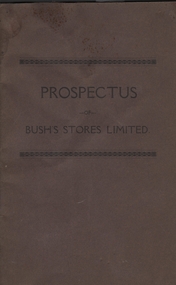
Book - BUSH COLLECTION: PROSPECTUS OF BUSH'S STORES LIMITED
... BUSINESS Retail Bush Brown cover - Prospectus of Bush's Stores Limited. Sixteen pages booklet. ...Brown cover - Prospectus of Bush's Stores Limited. Sixteen pages booklet. Nominal capital 250,000 pounds divided into 250,000 shares. Directors: Donald Ferguson Blyth, Frederick William Bush, Clifford Albert Bush, Robert John Eagle, Frederick William Grabau, William Findlay McKindlay, William Thomas Keely Stokes.business, retail, bush -
 Bendigo Historical Society Inc.
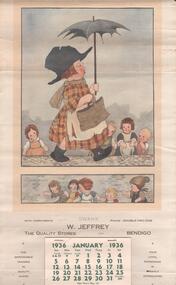
Document - CALENDAR COLLECTION: W. JEFFREY
... Retail w. jeffrey Wall calendar from 1936. Drawing of a child on a catwalk few other children around looking on. With compliments W. Jeffrey, Phone 221. The quality stores ...Wall calendar from 1936. Drawing of a child on a catwalk few other children around looking on. With compliments W. Jeffrey, Phone 221. The quality stores, Bendigo.business, retail, w. jeffrey -
 Bendigo Historical Society Inc.
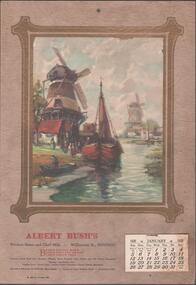
Document - CALENDAR COLLECTION: ALBERT BUSH'S
... BUSINESS Retail albert bush's Wall calendar from 1930. Drawing of two boats on a canal and two wind mills. Albert Bush's produce stores and chaff mills, Williamson Street, Bendigo. ...Wall calendar from 1930. Drawing of two boats on a canal and two wind mills. Albert Bush's produce stores and chaff mills, Williamson Street, Bendigo. Bush's laying mash, Bush's poultry grains, Bush's chicken feed.business, retail, albert bush's -
 Bendigo Historical Society Inc.
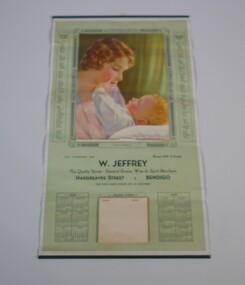
Document - CALENDAR COLLECTION: W. JEFFREY 1940
... Retail w jeffrey Wall calendar from 1940. Picture of a mother and baby titled love caresses. With compliments from W. Jeffrey phone 220 (2 lines). The quality stores ...Wall calendar from 1940. Picture of a mother and baby titled love caresses. With compliments from W. Jeffrey phone 220 (2 lines). The quality stores - General grocer, wine and spirit merchant. Hargreaves Street Bendigo. For your use peruse list of groceries.business, retail, w jeffrey
