
Showing 93 items matching " styles of lettering."
-
 Bendigo Historical Society Inc.
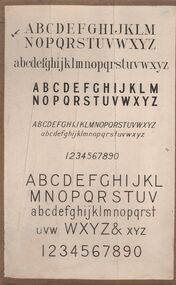
Document - NORMAN PENROSE COLLECTION: LETTERING EXAMPLES
... ... styles of lettering....Norman Penrose collection: various styles of lettering. Some on cardboard and some pasted onto cardboard....DRAWING Print Norman Penrose Collection styles of lettering. Artwork. Norman Penrose collection: various styles of lettering. ...Artwork. Norman Penrose collection: various styles of lettering. Some on cardboard and some pasted onto cardboard.drawing, print, norman penrose collection, styles of lettering. -
 Lilydale RSL Sub Branch
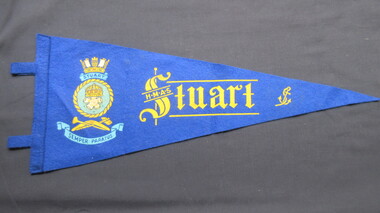
Souvenir, Allwood Arts, Pennant - HMAS Stuart
... HMAS and STUART in Gothic -style lettering. The crest features a Tudor Crown above a central emblem which is a traditional heraldic design for RAN vesels...HMAS and STUART in Gothic -style lettering. The crest features a Tudor Crown above a central emblem which is a traditional heraldic design for RAN vesels Triangular blue felt with text and emblem printed on one face. ...Triangular blue felt with text and emblem printed on one face.HMAS and STUART in Gothic -style lettering. The crest features a Tudor Crown above a central emblem which is a traditional heraldic design for RAN vesels -
 Warrnambool and District Historical Society Inc.
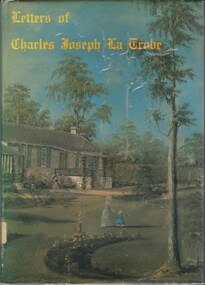
Book, Letters of Charles Joseph La Trobe, 1975
... Title is in old style yellow lettering. The book contains a number of colour plates and black and white illustrations....Title is in old style yellow lettering. The book contains a number of colour plates and black and white illustrations. ...Correspondence from Charles Joseph La Trobe written between 1840 and 1870.Blue and green toned coloured dust cover over blue hard cover. Picture depicts house with woman and child and large tree in foreground. Covered in clear plastic. 96 pages. Title is in old style yellow lettering. The book contains a number of colour plates and black and white illustrations.Correspondence from Charles Joseph La Trobe written between 1840 and 1870.charles la trobe, letters of charles joseph la trobe, early victoria -
 Emerald Museum & Nobelius Heritage Park
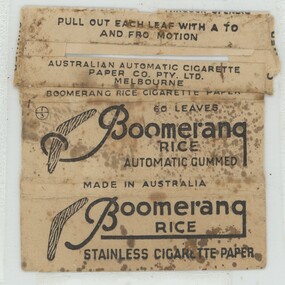
Functional object - Cigarette Paper Packet, Australian Automatic Cigarette Paper Company, 1940s
... Brown Art Deco style lettering with boomerang motif. No papers....Brown Art Deco style lettering with boomerang motif. No papers. ...This Boomerang packet originally contained 60 leaves of pre-cut paper made from rice straw to be used for rolling cigarettes by hand or machine. It was manufactured by the Australian Automatic Cigarette Paper Company, Richmond, Victoria until 1948.Rolling one's own cigarettes was a practice of many smokers over many decades. Boomerang Cigarette Papers packet flattened out. White but discolored. Brown Art Deco style lettering with boomerang motif. No papers.'60 LEAVES / Boomerang / RICE / AUTOMATIC GUMMED / MADE IN AUSTRALIA'boomerang brand, australian automatic cigarette paper company, richmond, 1948, cigarette papers -
 Mont De Lancey
Book, G. Augustus Holmes, The Academic Manual of the Rudiments of Music, 1923
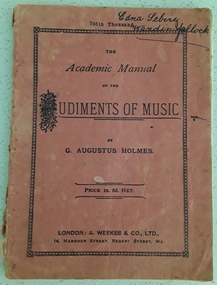
... The letter R for Rudiments of Music is decorative in the illumination style of lettering. It was prepared for candidates for the various Musical Examinations, and contains, amongst other things, specimen papers which have been issued by the various examining bodies.It is damaged and has tanning and foxing throughout. 59p. ...The letter R for Rudiments of Music is decorative in the illumination style of lettering. It was prepared for candidates for the various Musical Examinations, and contains, amongst other things, specimen papers which have been issued by the various examining bodies.It is damaged and has tanning and foxing throughout. 59p. ...A manual of rudiments of music prepared for conditions for the various musical examinations, and contains, amongst other things, specimen papers which have been issued by the various examining bodies.A small tan coloured paperback book titled, The Academic Manual of the Rudiments of Music by G.Augustus Holmes. The letter R for Rudiments of Music is decorative in the illumination style of lettering. It was prepared for candidates for the various Musical Examinations, and contains, amongst other things, specimen papers which have been issued by the various examining bodies.It is damaged and has tanning and foxing throughout. 59p. Price 1s 6d. NET. The publisher and address is written at the bottom.non-fictionA manual of rudiments of music prepared for conditions for the various musical examinations, and contains, amongst other things, specimen papers which have been issued by the various examining bodies. music books, music documents, music examinations, textbooks -
 Bendigo Military Museum
Pamphlet - Australian Survey Corps - Freehand Lettering Pamphlet 1947, Australian Survey Corps, Balcombe, 1947
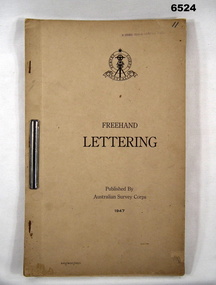
... Example practice lettering style work sheets are included at the rear of the document....17 x foolscap sized pages with light buff coloured cardboard covers held together with an ARNOS fastener. Example lettering style work sheets at the rear of the document. ...Example practice lettering style work sheets are included at the rear of the document. ...All members of the Australian Survey Corps, that was later renamed the Royal Australian Survey Corps were expected to be proficient at freehand lettering and figuring. Initially all text on military maps was hand lettered in ink and an extremely high level of proficiency was required. Later technology changes meant that there was less reliance on hand lettering. This 17 x foolscap sized page booklet with light buff coloured cardboard covers held together with an ARNOS fastener was used to teach members of the Australian Survey Corps how to Hand Letter in 1947. Example practice lettering style work sheets are included at the rear of the document.17 x foolscap sized pages with light buff coloured cardboard covers held together with an ARNOS fastener. Example lettering style work sheets at the rear of the document. Cover has Australian Survey Corps Theodolite Badge in black and white above the Title "Freehand Lettering Published By Australian Survey Corps 1947.Hand-written No"11" in top RH corner. Has a stamp " E COMD FIELD SURVEY Unit"royal australian survey corps, rasvy, fortuna, army survey regiment, army svy regt, asr, school of military survey, sms, balcombe -
 Bendigo Historical Society Inc.
Book - 1859 Almanac
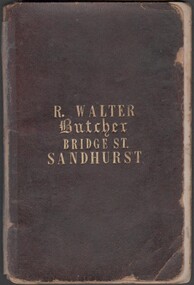
... Ledger style notebook with gold lettering on cover "R. Walter, Butcher, Bridge Stret, Sandhurst"...Ledger style notebook with gold lettering on cover "R. Walter, Butcher, Bridge Stret, Sandhurst" Book 1859 Almanac ...Richard Walter, butcher, operated a butchery in Bridge St., Bendigo. The shop was part of the Australian Hotel. It was operating in 1857 when Walter advertised for a sausage maker. In 1863 the business was sold to Ceber and Robertson. At this time he sold five lots including, land at California Gully, 32 acres at Ellesmere, the Australia Hotel including a coopers, chemist and stables all leased to reliable tenants. In 1865 he was granted 50 square miles south of Charleville, near Murweh on the Warrego River. It was here that he died 24/8/1869 when he accidentally fell into the river and drowned.Small notebook (initial pages have been removed) with 1859 Almanac on internal covers. Ledger style notebook with gold lettering on cover "R. Walter, Butcher, Bridge Stret, Sandhurst"butcher, bridge stret, sandhurst", walter -
 Sunshine and District Historical Society Incorporated
Memorabilia - Sunshine High School Pennant, Circa 1959
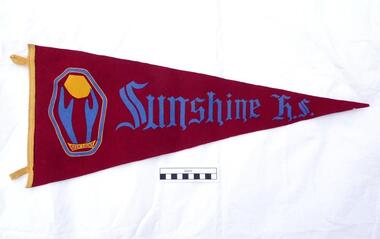
... Blue and yellow coloured inks are used to print the Sunshine High School 'SEEK LIGHT' logo and 'Sunshine hs' in antique style lettering....Blue and yellow coloured inks are used to print the Sunshine High School 'SEEK LIGHT' logo and 'Sunshine hs' in antique style lettering. Memorabilia Sunshine High School Pennant ...These pennants were introduced by Sunshine High School around 1959 in an attempt to instil among the students, a greater pride for the school. This particular pennant was hung for many years on the bedroom wall of the original student who bought it. It was later in the possession of a younger sibling who commenced going to Sunshine High School 19 years after the original student.Sunshine High School existed in its own right for a relatively short time from 1955 to 1991. The school buildings now form part of the Sunshine Campus of Victoria University. This pennant is one of the few items in our possession which serve as a reminder that Sunshine High School was once part of the secondary education system in the Western suburbs of Melbourne.Triangular shaped pennant made mainly from maroon coloured felt material, with yellow felt material used to make an edging stripe and two suspension loops along the short side of the triangle. Blue and yellow coloured inks are used to print the Sunshine High School 'SEEK LIGHT' logo and 'Sunshine hs' in antique style lettering."Sunshine hs"sunshine high school, pennant, seek light, felt, maroon. -
 Mont De Lancey
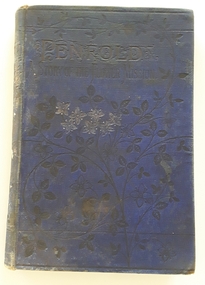
Book, Ruth Lynn et al, Penfold. A Story of the Flower Mission, C 1880
... Black and white decorative illuminated style lettering is at the beginning of each chapter. ...Black and white decorative illuminated style lettering is at the beginning of each chapter. ...A Children's religious fiction book about a father whose daughter ran away with a young man and the troubles fraught by this as she bears a child and leaves it at a workhouse door.Blue hardcover book, Penfold. A Story of the Flower Mission, by Ruth Lynn. Has black floral design all over covers and spine, with gold lettering for title on front and spine. Black and white illustrations throughout. Black and white decorative illuminated style lettering is at the beginning of each chapter. Gold lettering for title on caver and spine.fictionA Children's religious fiction book about a father whose daughter ran away with a young man and the troubles fraught by this as she bears a child and leaves it at a workhouse door.children's fiction, religious fiction, family fiction -
 Mont De Lancey
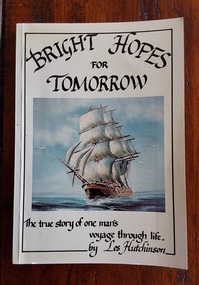
Book, Leslie John Hutchinson, Bright Hopes for Tomorrow - The True Story of One Man's Voyage Through Life, 1988
... This is a white covered biography of Joseph Wilson, with the title and author printed in Roman style black lettering on the front cover, and a coloured painting of a clipper tall ship in the middle. ...This is a white covered biography of Joseph Wilson, with the title and author printed in Roman style black lettering on the front cover, and a coloured painting of a clipper tall ship in the middle. ...This is a 1988 local history biography written by Australian local historian Les Hutchinson, the great, great grandson of Joseph Wilson. This is the story of one of Australia's quiet achievers, Joseph Wilson (1810-1897) an early pioneer in Victoria and the early Baptist Church in Victoria.This is a white covered biography of Joseph Wilson, with the title and author printed in Roman style black lettering on the front cover, and a coloured painting of a clipper tall ship in the middle. Inside the front left end paper is a Log Book entry written by Joseph Wilson Sept 1 - 1841. There is Acknowledgements; Table of Contents and Preface followed by 21 Chapters and a Postscript. The book is very detailed of Joseph's life with black and white photographs, log entries, tables, illustrations, poems and lists. The back end paper has details and a black and white photograph of the author, Les Hutchinson, (Joseph Wilson's great-great grandson) and his family. The back cover has a blurb explaining the contents as well as a coloured painting of a view of Lilydayle in 1897. Pp.167.non-fiction This is a 1988 local history biography written by Australian local historian Les Hutchinson, the great, great grandson of Joseph Wilson. This is the story of one of Australia's quiet achievers, Joseph Wilson (1810-1897) an early pioneer in Victoria and the early Baptist Church in Victoria. australia - history, biography, early settlers - australia, eatly settlers - lilydale -
 Mont De Lancey
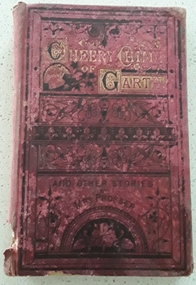
Book, Mrs Sophie Amelia Prosser et al, The Cheery Chime of Garth and Other Stories, C 1874
... Ornate Illumination style lettering for the first letter of each new chapter with some black and white illustrations throughout....Ornate Illumination style lettering for the first letter of each new chapter with some black and white illustrations throughout. ...Three Short Stories with strong religious themes, the Cheery Chimes of Garth set in a small village in England where a new vicar has been appointed. Mrs S. A. Prosser was known for her sentimental morality tales and fables.Red fabric hardcover book of three short stories, The Cheery Chime of Garth and Other Stories by Mrs Sophie Amelia Prosser, with a floral design in black on front cover with gold lettering for title. And Other Stories and author printed in black. Ornate Illumination style lettering for the first letter of each new chapter with some black and white illustrations throughout.fictionThree Short Stories with strong religious themes, the Cheery Chimes of Garth set in a small village in England where a new vicar has been appointed. Mrs S. A. Prosser was known for her sentimental morality tales and fables.religion fiction, morals fiction, young people's fiction -
 Bendigo Historical Society Inc.
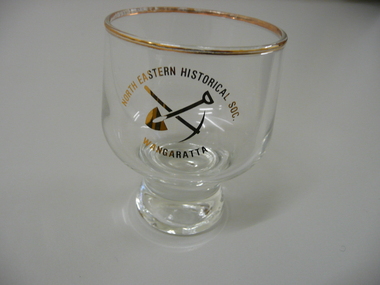
Souvenir - SOUVENIR GLASS NORTH EASTERB HISTORICAL SOC WANGARATTA
... Souvenir glass for North Eastern Historical Soc Wangaratta, squat tumbler style with gold rim, gold lettering and crossed pick & shovel in gold....ORGANIZATION Society wangaratta historical Souvenir glass for North Eastern Historical Soc Wangaratta, squat tumbler style with gold rim, gold lettering and crossed pick & shovel in gold. ...Souvenir glass for North Eastern Historical Soc Wangaratta, squat tumbler style with gold rim, gold lettering and crossed pick & shovel in gold.organization, society, wangaratta historical -
 Bendigo Historical Society Inc.
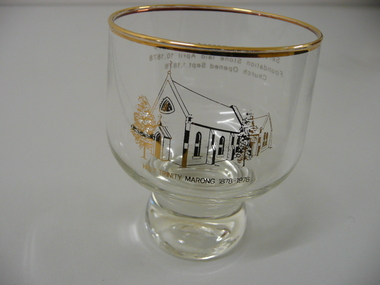
Souvenir - SOUVENIR GLASS HOLY TRINITY MARONG
... Souvenir glass commemorating the centenary of Holy Trinity Church Marong 1878 - 1978, squat tumbler style with gold rim, gold lettering and a depiction of Church....CHURCH Centenary holy trinity marong Souvenir glass commemorating the centenary of Holy Trinity Church Marong 1878 - 1978, squat tumbler style with gold rim, gold lettering and a depiction of Church. ...Souvenir glass commemorating the centenary of Holy Trinity Church Marong 1878 - 1978, squat tumbler style with gold rim, gold lettering and a depiction of Church.church, centenary, holy trinity marong -
 Mont De Lancey
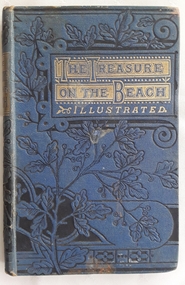
Book, M.A.P, The Treasure on the Beach and What it did for Gilbert West, c late 1800's
... Black and white illumination style lettering is used for the first word of each new chapter. ...Black and white illumination style lettering is used for the first word of each new chapter. ...A young boy finds what he thinks is treasure when he walks along the beach near his home. The story has religious themes and depicts family life in England in the late 1800'sSmall blue hardcover children's book - The Treasure on the Beach and what it did for Gilbert West by M.A.P. The front cover has a black floral design which continues onto the spine and the back, with the title surrounded in gold boxes and the word, Illustrated, in gold lettering underneath. On the back is a symbol for the publisher Sunday School Union. Black and white illustrations throughout with one on the frontispiece of Gilbert West on the beach. Black and white illumination style lettering is used for the first word of each new chapter. Tissue paper covers the title page. 107p.fictionA young boy finds what he thinks is treasure when he walks along the beach near his home. The story has religious themes and depicts family life in England in the late 1800'schildren's fiction, family life fiction, adventure stories -
 Mont De Lancey
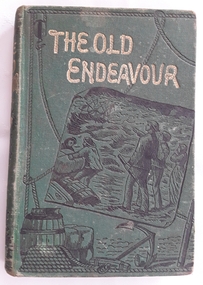
Book, Crona Temple, The Old Endeavour, a Book for Boys, c. late 1800's
... The title, The Old Endeavour is imprinted with a gold coloured rope style lettering. The frontispiece illustration opposite the title page depicts rescue boats, a man saving a child in the sea with his mother close by. ...The title, The Old Endeavour is imprinted with a gold coloured rope style lettering. The frontispiece illustration opposite the title page depicts rescue boats, a man saving a child in the sea with his mother close by. ...An adventure story of a shipwreck and rescue.small dark green hardcover book with an illustration imprinted on the front in black ink of men and a woman standing on the shore retrieving items from a shipwreck. A barrel, ropes and anchor are shown on a wharf at the bottom left. The back cover has the initials of the publisher RTS ( Religious Tract Society) ornately written in black on a lifebuoy with the ocean bed below. The title, The Old Endeavour is imprinted with a gold coloured rope style lettering. The frontispiece illustration opposite the title page depicts rescue boats, a man saving a child in the sea with his mother close by. Some black and white illustrations throughout and ornate floral strips of decoration at the top of each new chapter. 158p.fictionAn adventure story of a shipwreck and rescue. ships fiction, adventure stories, stories for boys -
 Mont De Lancey
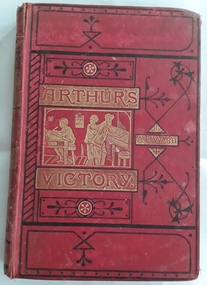
Book, Sunday School Union, Arthur's Victory, 1873
... Full page black and white illustrations are throughout as well as floral decorations at the top of each we chapter. Illuminated style lettering is used for the first word of each chapter. ...style - Awarded to Thomas Sebire for good attendance. Wandin Sabbath School 1882 Small red cloth covered hardcover book for children with gold imprint picture of boys at school sitting at a desk in a classroom. The title and author are in red with a gold background. There are black lined patterns of fleur de lis on the front cover as well. Full page black and white illustrations are throughout as well as floral decorations at the top of each we chapter. Illuminated style lettering ...A story depicting life in the C19th and schools. Arthur is a kid thoughtful pupil who goes through many trials and tribulations as he manages life each school day. Strong religious themes throughout to help with character development of boys who read this story.Small red cloth covered hardcover book for children with gold imprint picture of boys at school sitting at a desk in a classroom. The title and author are in red with a gold background. There are black lined patterns of fleur de lis on the front cover as well. Full page black and white illustrations are throughout as well as floral decorations at the top of each we chapter. Illuminated style lettering is used for the first word of each chapter. Gold edging to the pages and a printed coloured Presented To, page is at the front of the book. The back cover has a fleur de lis symbol in the middle. This is a fine book depicting the world of the C19th. It is believed to be published in 1873. 174p.fictionA story depicting life in the C19th and schools. Arthur is a kid thoughtful pupil who goes through many trials and tribulations as he manages life each school day. Strong religious themes throughout to help with character development of boys who read this story. religious stories, school stories, stories for boys -
 Flagstaff Hill Maritime Museum and Village
Container - Bottle, 1840s to 1910
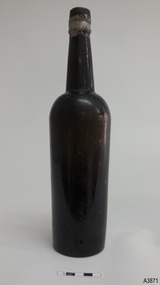
... style base, sometimes with embossing in the base as well. Improvements allowed the moulds to also have embossed and patterned sides, and straight sided shapes such as hexagons. Bottles made in full moulds usually displayed seam seams or lines. These process took skill and time, making the bottles valuable, so they were often recycled. By the early 20th century bottles were increasingly machine made, which greatly reduced the production time and cost. This bottle is a rare find, in that the base has been over-embossed with the same lettering ...This handmade ‘gallon’ style of bottle was generally used for storing and transporting wine and ale. Many bottles similar to this one have their bases embossed with “6 TO THE GALLON”. However, this bottle is rare, in that the base has been embossed then over-embossed with the same text, letters overlapping. It is one of many artefacts recovered from unidentified shipwrecks along Victoria’s coast between the late 1960s and the early 1970s. It is now part of the John Chance Collection. The capacity of this is one-sixth of a gallon (imperial measure), which is equal to 758 ml. (American bottles were often inscribed “5 TO THE GALLON”, which is one-fifth of an American gallon, equal to 757 ml.) Contemporary home brewers can purchase new ‘6 to gallon’ bottles that hold 750 ml. and are sold in cases of 36 bottles, which is equal to 6 gallons of wine. Glass was made thousands of years ago by heating together quartz-sand (Silica), lime and potash. Potash was obtained from burnt wood, but these days potash is mined. The natural sand had imperfections such as different forms of iron, resulting in ‘black’ glass, which was really dark green or dark amber colour. The ‘black’ glass was enhanced by residual carbon in the potash. Black glass is rarely used nowadays but most beer, wine, and liquors are still sold in dark coloured glass. Glass vessels were core-formed from around 1500 BC. An inner core with the vessel’s shape was formed around a rod using a porous material such as clay or dung. Molten glass was then modelled around the core and decorated. When the glass had cooled the vessel was immersed in water and the inner core became liquid and was washed out. Much more recently, bottlers were crafted by a glassblower using molten glass and a blow pipe together with other hand tools. Another method was using simple moulds, called dip moulds, that allowed the glass to be blown into the mould to form the base, then the glassblower would continue blowing free-form to shape the shoulders and neck. The bottle was then finished by applying a lip. These moulded bottles were more uniform in shape compared to the free-form bottles originally produced. English glassblowers in the mid-1800s were making some bottles with 2-piece and 3-piece moulds, some with a push-up style base, sometimes with embossing in the base as well. Improvements allowed the moulds to also have embossed and patterned sides, and straight sided shapes such as hexagons. Bottles made in full moulds usually displayed seam seams or lines. These process took skill and time, making the bottles valuable, so they were often recycled. By the early 20th century bottles were increasingly machine made, which greatly reduced the production time and cost. This bottle is a rare find, in that the base has been over-embossed with the same lettering, letters overlapping one another. This bottle is historically significant as an example of a handmade, blown inscribed glass bottle manufactured in the mid-to-late 1800s for specific use as a liquor bottle with a set measurement of one-sixth of gallon. It is also historically significant as an example of liquor bottles imported into Colonial Victoria in the mid-to-late 1800s, giving a snapshot into history and social life that occurred during the early days of Victoria’s development, and the sea trade that visited the ports in those days. The bottle is also significant as one of a group of bottles recovered by John Chance, a diver in Victoria’s coastal waters in the late 1960s to early 1970s. Items that come from several wrecks have since been donated to the Flagstaff Hill Maritime Village’s museum collection of shipwreck artefacts by his family, illustrating this item’s level of historical value. Bottle, over embossed, brown glass, handmade, rare. Tall slim Gallon style liquor bottle. Applied double collar lip; square upper and flared lower. Mouth has sealing tape remnants around top. Mould seam around shoulder. Body tapers inwards to push-up base. Top edge of lip has application faults. There is also a rectangular indent in the upper edge of lip. Base is embossed and over embossed, with the letters overlapping each other. Embossed on base "6 TO THE GALLON", then over-embossed with the same "6 TO THE GALLON"flagstaff hill, warrnambool, flagstaff hill maritime museum, maritime museum, shipwreck coast, flagstaff hill maritime village, great ocean road, shipwreck artefact, john chance, glass bottle, antique bottle, gallon bottle, 6 to the gallon bottle, handmade, dip mould, mouth blown, pontil mark, blown bottle, liquor bottle, ale bottle, double collar, 19th century bottle, collectable, over embossed, rare -
 Flagstaff Hill Maritime Museum and Village
Book - Reference Book Dictionary, William Smith et al, Latin-English Dictionary, 1871
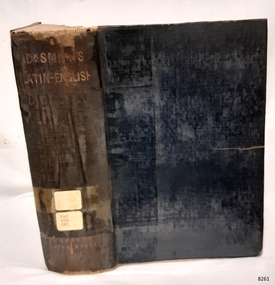
... style. It is not a narrative book; it is a scholarly language tool designed for students, teachers and translators. The label on spine cover with typed text PAT 470 SMI Paste down front end paper has a sticker from Corangamite Regional Library Service Front loose end paper has a stamp from Corangamite Regional Library Service Latin-English Dictionary Author: William Smith Publisher: John Murray Date: 1871 Further Information: Black front cover and brown Spine with gilt lettering and library reference label. ...This 1871 English-Latin dictionary by William Smith and Theophilus D. Hall is a reference work for translating English words and phrases into Latin, with definitions, usage notes and classical examples to guide correct classical Latin style. It is not a narrative book; it is a scholarly language tool designed for students, teachers and translators.Latin-English Dictionary Author: William Smith Publisher: John Murray Date: 1871 Further Information: Black front cover and brown Spine with gilt lettering and library reference label. non-fictionThis 1871 English-Latin dictionary by William Smith and Theophilus D. Hall is a reference work for translating English words and phrases into Latin, with definitions, usage notes and classical examples to guide correct classical Latin style. It is not a narrative book; it is a scholarly language tool designed for students, teachers and translators.flagstaff hill, warrnambool, shipwrecked coast, flagstaff hill maritime museum, maritime museum, shipwreck coast, flagstaff hill maritime village, great ocean road, book, pattison collection, warrnambool library, warrnambool mechanics’ institute, ralph eric pattison, corangamite regional library service, warrnambool city librarian, mechanics’ institute library, victorian library board, warrnambool books and records, warrnambool children’s library, latin-english dictionary, william smith -
 Flagstaff Hill Maritime Museum and Village
Book - Fictional Novel, Rolf Boldrewood (Pen Name), War to The Knife, 1899
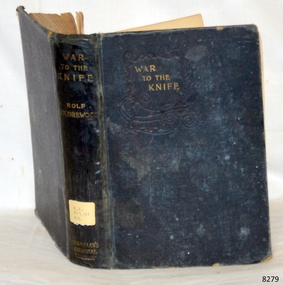
... style that heavily blends high-stakes adventure with a romanticised "frontier" view, the book attempts to explore colonial identity and the cultural friction of the era. The label on the spine cover with typed text R.A. 823.912 BOL Inside the front loose paper has pencil handwriting that is unreadable War to The Knife Author: Pen Name Rolf Boldrewood For (Thomas Alexander Browne) Publisher: Macmillan And Co Printer: Robert Clark Date: 1899 Blue cloth hardcover and spine with spine lettering in gilt. ...War to the Knife; or, Tangata Maori is a late 19th-century historical romance novel written by the prominent Australian author Rolf Boldrewood (the pen name of Thomas Alexander Browne) and published by the historic house Macmillan & Co. in 1899. Unlike most of Boldrewood's work, which is rooted deeply in the Australian outback, War to the Knife shifts its setting to New Zealand during the Waikato War of the 1860s, which was part of the New Zealand Land Wars. The story follows Sir Roland Massinger, a cultured English squire who suffers a devastating heartbreak at home when the woman he loves, Hypatia Tollemache, rejects him to pursue a life dedicated to social reform. Distraught, Sir Roland leaves his ancestral estate and emigrates to New Zealand in search of adventure and a fresh start. Upon arriving, he finds himself caught squarely in the middle of the violent clash between the Pakeha (British colonial settlers) and the indigenous Maori tribes over the ownership of the Waitara land block. Written in a late-Victorian style that heavily blends high-stakes adventure with a romanticised "frontier" view, the book attempts to explore colonial identity and the cultural friction of the era.War to The Knife Author: Pen Name Rolf Boldrewood For (Thomas Alexander Browne) Publisher: Macmillan And Co Printer: Robert Clark Date: 1899 Blue cloth hardcover and spine with spine lettering in gilt. The spine has a Library label with inscription.fictionWar to the Knife; or, Tangata Maori is a late 19th-century historical romance novel written by the prominent Australian author Rolf Boldrewood (the pen name of Thomas Alexander Browne) and published by the historic house Macmillan & Co. in 1899. Unlike most of Boldrewood's work, which is rooted deeply in the Australian outback, War to the Knife shifts its setting to New Zealand during the Waikato War of the 1860s, which was part of the New Zealand Land Wars. The story follows Sir Roland Massinger, a cultured English squire who suffers a devastating heartbreak at home when the woman he loves, Hypatia Tollemache, rejects him to pursue a life dedicated to social reform. Distraught, Sir Roland leaves his ancestral estate and emigrates to New Zealand in search of adventure and a fresh start. Upon arriving, he finds himself caught squarely in the middle of the violent clash between the Pakeha (British colonial settlers) and the indigenous Maori tribes over the ownership of the Waitara land block. Written in a late-Victorian style that heavily blends high-stakes adventure with a romanticised "frontier" view, the book attempts to explore colonial identity and the cultural friction of the era. flagstaff hill, warrnambool, shipwrecked coast, flagstaff hill maritime museum, maritime museum, shipwreck coast, flagstaff hill maritime village, great ocean road, book, pattison collection, warrnambool library, warrnambool mechanics’ institute, ralph eric pattison, corangamite regional library service, warrnambool city librarian, mechanics’ institute library, victorian library board, warrnambool books and records, warrnambool children’s library, war to the knife, rolf bolderwood -
 Flagstaff Hill Maritime Museum and Village
Container - Ceramic Bottle (Chinese Style), Minton Potteries, Late 19th century
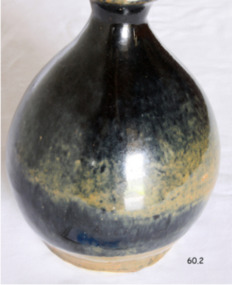
... style stoneware liquor bottle used to store "Tiger Whiskey" (rice wine). These Chinese liquor bottles are made of glazed pottery known as brown stoneware and have been made throughout the centuries by many makers until well after American Prohibition. Later varieties from the mid 20th century are commonly found in the USA with the raised lettering...style stoneware liquor bottle used to store "Tiger Whiskey" (rice wine). These Chinese liquor bottles are made of glazed pottery known as brown stoneware and have been made throughout the centuries by many makers until well after American Prohibition. Later varieties from the mid 20th century are commonly found in the USA with the raised lettering ...The subject item is believed to be a "Chinese style stoneware liquor bottle used to store "Tiger Whiskey" (rice wine). These Chinese liquor bottles are made of glazed pottery known as brown stoneware and have been made throughout the centuries by many makers until well after American Prohibition. Later varieties from the mid 20th century are commonly found in the USA with the raised lettering "Federal Law Forbids Sale Or Re-use of this bottle" a sure sign of post-1934 manufacture. This example is interesting as it has a British Minton mark of two triangles on the base indicating a date of 1879 and was likely exported to Australia by Minton. These ceramic bottles virtually always have irregularities and flaws which indicate a product has been hastily manufactured, in any event, this is a fine example of a relatively common item that may have been copied by Minton and sold as a decorative domestic item for display or mass produced for storing liquor. Giles Family: The pair of ceramic bottles were given to Vera Giles by Jim Thompson and are just many 19th century items of furniture, linen and crockery donated to Flagstaff Hill Maritime Village by, Vera and Aurelin Giles. The items are associated with Warrnambool and the Giles Family history. Items donated by the family have come to be known as the “Giles Collection”. Many items in the Lighthouse Keeper’s Cottage were donated by Vera and Aurelin Giles and mostly came from the home of Vera’s parents-in-law, Henry Giles and his wife Mary Jane (nee Freckleton) who married in 1880 and whose photos are on display in the parlour. Henry was born at Tower Hill in 1858, and was a labourer on the construction of the Warrnambool Breakwater before leaving in 1895 for around seven years to build bridges in NSW. Mary Jane was born in 1860 at Cooramook and she attended Mailor’s Flat State School and where she eventually was to become a student teacher. After which she became a governess at “Injemiara” where her grandfather, Francis Freckleton, had once owned land. Henry and Mary’s family consisted of six, some of the children were born at Mailor’s Flat and later some children at Wangoom. They lived with their parents at Wangoom and Purnim west, and this is where Henry died in 1933 and Mary Jane in 1940. A significant item of lead-glazed ceramic with the possibility it was made by the Minton potteries in England who were renowned for making quality pottery. The item style is in all probability a copy of a Chinese liquor bottle that was in common use throughout the British colonies and America up until the mid 20th Century. The Giles family collection has social significance at a local level, because it illustrates the level of material support the Warrnambool community gave to Flagstaff Hill when the Museum was established.Chinese liquor bottle one of a pair, lead glazed ceramic, dark brown and blue/black. Part of the Giles Collection.Mark of a double triangle, apex touching, on base, (Minton mark for 1879).flagstaff hill, warrnambool, shipwrecked coast, flagstaff hill maritime museum, shipwreck coast, flagstaff hill maritime village, great ocean road, vase, pottery, ceramic ornament, domestic ware, late 19th - early 20th centuy ornament, giles collection, henry giles, tower hill, cooramook, warrnambool breakwater, mailor’s flat, wangoom, 19th century household goods, light keeper -
 Flagstaff Hill Maritime Museum and Village
Book - A Fictional Story, Charles Dickens, A Childs History of England, 1900
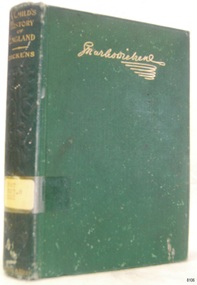
... style rather than detached academic prose. The label on the spine with typed text PAT 823.8 DIC Front fly cover has the word “With Frontispiece” Paste down front end paper has a sticker from Warrnambool Public Library covered by a sticker from Corangamite Regional Library Service Front loose end paper has a stamp from Corangamite Regional Library Service. A Childs History of England. Author: Charles Dickens. Publisher: Chapman & Hall Ltd, London. Date: 1900. (See note section this document for more information on Edition). Green leather hardcover with title on spine in gold lettering ...Charles Dickens (1812–1870) was one of the great English novelists of the Victorian era, famous for vivid characters, social criticism, and stories that were first published in serial form. He began as a journalist, rose to enormous popularity during his lifetime, and wrote major works such as Oliver Twist, David Copperfield, and Great Expectations. “A Child’s History of England” is Dickens’s three volume, child directed history of England, originally serialised in Household Words from 1851 to 1853 and later issued in book form in 1853. It covers English history from ancient times through the fall of James II, with a brief closing summary up to Queen Victoria’s accession to the crown. Dickens wrote it as a readable, lively alternative to dry school history, aiming to interest his own children and young readers. The work is outspoken, often anti monarchical and anti aristocratic in tone, and it uses Dickens’s usual vivid style rather than detached academic prose.A Childs History of England. Author: Charles Dickens. Publisher: Chapman & Hall Ltd, London. Date: 1900. (See note section this document for more information on Edition). Green leather hardcover with title on spine in gold lettering, Charles Dickens signature on front cover written in gold lettering. The spine has a Library label and no Volume information.fictionCharles Dickens (1812–1870) was one of the great English novelists of the Victorian era, famous for vivid characters, social criticism, and stories that were first published in serial form. He began as a journalist, rose to enormous popularity during his lifetime, and wrote major works such as Oliver Twist, David Copperfield, and Great Expectations. “A Child’s History of England” is Dickens’s three volume, child directed history of England, originally serialised in Household Words from 1851 to 1853 and later issued in book form in 1853. It covers English history from ancient times through the fall of James II, with a brief closing summary up to Queen Victoria’s accession to the crown. Dickens wrote it as a readable, lively alternative to dry school history, aiming to interest his own children and young readers. The work is outspoken, often anti monarchical and anti aristocratic in tone, and it uses Dickens’s usual vivid style rather than detached academic prose.book, the old curiosity shop, charles dickens, shipwrecked-coast, flagstaff-hill, flagstaff-hill-maritime-museum, warrnambool, maritime-museum, flagstaff-hill-maritime-village, pattison collection, warrnambool library, warrnambool mechanics’ institute, ralph eric pattison, corangamite regional library service, warrnambool city librarian, mechanics’ institute library, victorian library board, warrnambool books and records, warrnambool children’s library, great ocean road -
 Flagstaff Hill Maritime Museum and Village
Book - A Fictional Story, Charles Dickens et al, A Childs History of England, 1910
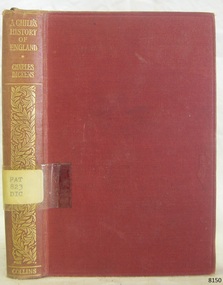
... style rather than detached academic prose. The label on the spine with typed text PAT 823.8 DIC Front fly cover has an illustration and the illustrators name “Harry Furniss”. Paste down front end paper has a sticker from Warrnambool Public Library covered by a sticker from Corangamite Regional Library Service Front loose end paper has a stamp from Corangamite Regional Library Service. A Childs History of England. Author: Charles Dickens. Illustrator. Harry Furniss. Publisher: Collins Clear Type Press, London. Date: 1910. (See note section this document for more information on Edition). red cloth hardcover with title on spine in gold lettering ...Charles Dickens (1812–1870) was one of the great English novelists of the Victorian era, famous for vivid characters, social criticism, and stories that were first published in serial form. He began as a journalist, rose to enormous popularity during his lifetime, and wrote major works such as Oliver Twist, David Copperfield, and Great Expectations. “A Child’s History of England” is Dickens’s three volume, child directed history of England, originally serialised in Household Words from 1851 to 1853 and later issued in book form in 1853. It covers English history from ancient times through the fall of James II, with a brief closing summary up to Queen Victoria’s accession to the crown. Dickens wrote it as a readable, lively alternative to dry school history, aiming to interest his own children and young readers. The work is outspoken, often anti monarchical and anti aristocratic in tone, and it uses Dickens’s usual vivid style rather than detached academic prose.A Childs History of England. Author: Charles Dickens. Illustrator. Harry Furniss. Publisher: Collins Clear Type Press, London. Date: 1910. (See note section this document for more information on Edition). red cloth hardcover with title on spine in gold lettering and pattern. The spine has a Library label and no Volume information only title and author.fictionCharles Dickens (1812–1870) was one of the great English novelists of the Victorian era, famous for vivid characters, social criticism, and stories that were first published in serial form. He began as a journalist, rose to enormous popularity during his lifetime, and wrote major works such as Oliver Twist, David Copperfield, and Great Expectations. “A Child’s History of England” is Dickens’s three volume, child directed history of England, originally serialised in Household Words from 1851 to 1853 and later issued in book form in 1853. It covers English history from ancient times through the fall of James II, with a brief closing summary up to Queen Victoria’s accession to the crown. Dickens wrote it as a readable, lively alternative to dry school history, aiming to interest his own children and young readers. The work is outspoken, often anti monarchical and anti aristocratic in tone, and it uses Dickens’s usual vivid style rather than detached academic prose.book, the old curiosity shop, charles dickens, shipwrecked-coast, flagstaff-hill, flagstaff-hill-maritime-museum, warrnambool, maritime-museum, flagstaff-hill-maritime-village, pattison collection, warrnambool library, warrnambool mechanics’ institute, ralph eric pattison, corangamite regional library service, warrnambool city librarian, mechanics’ institute library, victorian library board, warrnambool books and records, warrnambool children’s library, great ocean road -
 Orbost & District Historical Society
spectacles and spectacle cases, late 19th early 20th century
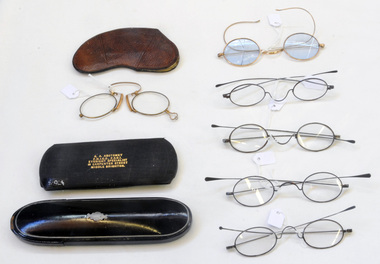
... These items demonstrate how glasses' styles have changed over time. spectacles spectacles-cases pinz-nez A A Abotomey 14 Carpenter Street, Middle Brighton One pair of pince-nez glasses and its brown leather case shaped to fit. One solid black wooden case with a small hinged door at one end. One blue/black case with the words A A Abotomey 14 Carpenter Street Middle Brighton in gold lettering ...This collection of glasses and cases was donated by Miss Connie Cruickshank. She was part of the family of Orbost's first doctor, Dr James Kerr. As the 19th Century came to a close, more and more people wore their eyeglasses everyday. A popular style of inexpensive, everyday spectacles was the pince-nez. French for "pinch nose," the pince-nez was first developed in France circa 1840 and began to be imported after the 1850s. Pince-nez have no temples, but are fit snugly on the bridge of the nose. Pince- nez could be uncomfortable to wear and broke often from falling off the nose. These items demonstrate how glasses' styles have changed over time. One pair of pince-nez glasses and its brown leather case shaped to fit. One solid black wooden case with a small hinged door at one end. One blue/black case with the words A A Abotomey 14 Carpenter Street Middle Brighton in gold lettering. Five pairs of spectacles, one with blue coloured glass with crack in one lens.A A Abotomey 14 Carpenter Street, Middle Brightonspectacles spectacles-cases pinz-nez -
 Flagstaff Hill Maritime Museum and Village
Book - A Fictional story, Jack London, The Faith of Men, 1904
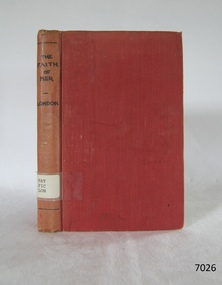
... style he became known for. The label on the spine with typed text PAT FIC LON Paste down front end paper has a sticker from Warrnambool Public Library covered by a sticker from Corangamite Regional Library Service Front loose end paper has a stamp from Corangamite Regional Library Service Hard cover book. The Faith of Men Author: Jack London Publisher: William Heinemann Ltd Date: 1904 Further Information: Brick-red cloth boards, gilt/black spine lettering ...The Faith of Men, and Other Stories (1904) is Jack London's fourth short story collection, gathering eight tales largely set against the backdrop of the Klondike Gold Rush and the far north the milieu that made London famous. The collection includes the title story "The Faith of Men," along with others such as "Too Much Gold," "The Marriage of Lit-lit," "The Story of Jees Uck," and "The One Thousand Dozen." As with much of London's northern fiction, the stories explore themes of survival, endurance, greed, loyalty, and the clash between "civilised" and Indigenous or frontier codes of conduct hallmarks of the naturalist style he became known for.Hard cover book. The Faith of Men Author: Jack London Publisher: William Heinemann Ltd Date: 1904 Further Information: Brick-red cloth boards, gilt/black spine lettering. Small 8vo format, roughly 246 pages. William Heinemann publisher's device on the title page, and referenced in bibliographies as BAL 11878 / Woodbridge 27fictionThe Faith of Men, and Other Stories (1904) is Jack London's fourth short story collection, gathering eight tales largely set against the backdrop of the Klondike Gold Rush and the far north the milieu that made London famous. The collection includes the title story "The Faith of Men," along with others such as "Too Much Gold," "The Marriage of Lit-lit," "The Story of Jees Uck," and "The One Thousand Dozen." As with much of London's northern fiction, the stories explore themes of survival, endurance, greed, loyalty, and the clash between "civilised" and Indigenous or frontier codes of conduct hallmarks of the naturalist style he became known for.warrnambool, shipwrecked-coast, flagstaff-hill, flagstaff-hill-maritime-museum, maritime-museum, shipwreck-coast, flagstaff-hill-maritime-village, shipwrecked-artefact, book, the faith of men, jack london, warrnambool mechanics’ institute, pattison collection, warrnambool library, ralph eric pattison, corangamite regional library service, warrnambool city librarian, mechanics’ institute library, victorian library board, warrnambool books and records, warrnambool children’s library -
 Flagstaff Hill Maritime Museum and Village
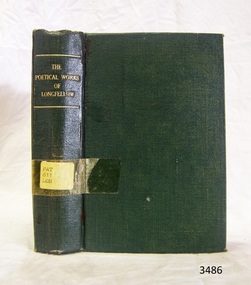
Book, William P. Nimmo, The Poetical Works of Henry Wadsworth Longfellow, (short title on cover is ‘The Poetical Works of Longfellow’), n.d.!
... As also noted in the Description, the internal pages have intricate lettering, with black page borders, double column printing, and nineteenth-century styled black and white illustrations (etchings). ...The internal pages contain intricate lettering, black page borders, double column printing, and nineteenth-century styled black and white illustrations. ...As also noted in the Description, the internal pages have intricate lettering, with black page borders, double column printing, and nineteenth-century styled black and white illustrations (etchings). ...As mentioned in the Description, the cover of The Poetical Works of Henry Wadsworth Longfellow is plain and in good condition. The internal pages are in similarly good condition, straight cut, and secured to the book binding with no signs of heavy use or wear. However the paper of the internal pages appears yellowed with age, unlike the cover pages that join the boards to the content pages. As also noted in the Description, the internal pages have intricate lettering, with black page borders, double column printing, and nineteenth-century styled black and white illustrations (etchings). This suggests that the bound pages represent an earlier print run and the cover was added, or replaced, at a later date. The book cover’s plain green design with minimal gold lettering seems more recent publishing practice than the pages within. This book bears no publishing date, which supports the speculation that the content pages were purchased as a remaindered lot and bound and distributed by another party, possibly in Australia rather than Britain, and at a much later date than the old fashioned page formatting suggest. The good condition of the cover and the bound pages indicate the book was seldom borrowed or read and the book may therefore have been acquired after the height of the poet Longfellow’s popularity (in the mid to late nineteenth century). The stamps and labels attached to the cover and title pages testify to the book’s provenance, from its initial ownership by the Warrnambool Mechanics Institute Library, to custody in the Warrnambool Municipal Library (where it, along with other WMIL texts, was catalogued by a librarian called Pattison), and finally to the Flagstaff Hill Historical Book Collection. The book was part of a collection of books, now known as the Pattison Collection, which originally belonged to the Warrnambool Mechanics Institute Library. In this context it is an example of the range of titles carried by Victorian rural libraries in the colonial and federation periods (Significance Assessment 2009).The book is bound in plain green cloth covered board with gold lettering on the top of the spine, which reads “THE POETICAL WORKS OF LONGFELLOW”. The cover is plain otherwise and in good condition. Clear Tape secures a typed paper sticker on the lower middle of the spine, which reads “PAT 811 LON”. The internal pages are in similarly good condition, straight cut, and secured to the book binding with no signs of heavy use or wear. However the paper of the internal pages appears yellowed with age, unlike the cover pages that join the boards to the content pages. The internal pages contain intricate lettering, black page borders, double column printing, and nineteenth-century styled black and white illustrations. Name: The Poetical Works of Henry Wadsworth Longfellow Author: H W Longfellow Publisher: William P Nimmo The cover page bears a printed label stuck over an earlier one, which reads “Corangamite Regional Library Service • Warrnambool City Library • Pattison Collection”. The title page bears a flat oval shaped black ink stamp containing the words “MECHANICS WARRNAMBOOL INSTITUTE”. On this page there is also the notations “P/W 4885” written in pencil, and “821” written in blue ‘biro’.flagstaff hill, warrnambool, shipwrecked coast, flagstaff hill maritime museum, maritime museum, shipwreck coast, flagstaff hill maritime village, great ocean road, poetry, henry wadsworth longfellow, classic book, 19th century, literature, leisure, warrnambool mechanics institute library, pattison collection, henry wadsworth longfellow’s poetical works, edinburgh publisher william p. nimmo, h w longfellow, the poetical works of henry wadsworth longfellow, warrnambool public library -
 Flagstaff Hill Maritime Museum and Village
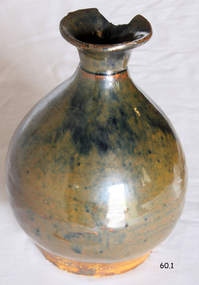
Container - Ceramic Bottle (Chinese Style), Minton Potteries, Late 19th century
... style stoneware liquor bottle used to store "Tiger Whiskey" (rice wine). These Chinese liquor jugs are made of glazed pottery known as brown stoneware and have been made throughout the centuries by many makers until well after American Prohibition. Later varieties from the mid 20th century are commonly found in the USA with the raised lettering...style stoneware liquor bottle used to store "Tiger Whiskey" (rice wine). These Chinese liquor jugs are made of glazed pottery known as brown stoneware and have been made throughout the centuries by many makers until well after American Prohibition. Later varieties from the mid 20th century are commonly found in the USA with the raised lettering ...The subject item is believed to be a "Chinese style stoneware liquor bottle used to store "Tiger Whiskey" (rice wine). These Chinese liquor jugs are made of glazed pottery known as brown stoneware and have been made throughout the centuries by many makers until well after American Prohibition. Later varieties from the mid 20th century are commonly found in the USA with the raised lettering "Federal Law Forbids Sale Or Re-use of this bottle" a sure sign of post-1934 manufacture. This example is interesting as it has a British Minton mark of two triangles on the base indicating a date of 1879 and was likely exported to Australia by Minton. These ceramic bottles virtually always have irregularities and flaws which indicate a product has been hastily manufactured, in any event, this is a fine example of a relatively common item that may have been copied by Minton and sold as a decorative domestic item for display or mass produced for storing liquor. Giles Family: The pair of ceramic bottles were given to Vera Giles by Jim Thompson and are just many 19th century items of furniture, linen and crockery donated to Flagstaff Hill Maritime Village by, Vera and Aurelin Giles. The items are associated with Warrnambool and the Giles Family history. Items donated by the family have come to be known as the “Giles Collection”. Many items in the Lighthouse Keeper’s Cottage were donated by Vera and Aurelin Giles and mostly came from the home of Vera’s parents-in-law, Henry Giles and his wife Mary Jane (nee Freckleton) who married in 1880 and whose photos are on display in the parlour. Henry was born at Tower Hill in 1858, and was a labourer on the construction of the Warrnambool Breakwater before leaving in 1895 for around seven years to build bridges in NSW. Mary Jane was born in 1860 at Cooramook and she attended Mailor’s Flat State School and where she eventually was to become a student teacher. After which she became a governess at “Injemiara” where her grandfather, Francis Freckleton, had once owned land. Henry and Mary’s family consisted of six, some of the children were born at Mailor’s Flat and later some children at Wangoom. They lived with their parents at Wangoom and Purnim west, and this is where Henry died in 1933 and Mary Jane in 1940. A significant item of lead-glazed ceramic with the possibility it was made by the Minton potteries in England who were renowned for making quality pottery. The item style is in all probability a copy of a Chinese liquor bottle that was in common use throughout the British colonies and America up until the mid 20th Century. The Giles family collection has social significance at a local level, because it illustrates the level of material support the Warrnambool community gave to Flagstaff Hill when the Museum was established.Chinese liquor bottle one of a pair, lead glazed ceramic, dark brown and blue/black. Part of the Giles Collection.Mark of a double triangle, apex touching, on base, (Minton mark for 1879).flagstaff hill, warrnambool, shipwrecked coast, flagstaff hill maritime museum, maritime museum, shipwreck coast, flagstaff hill maritime village, great ocean road, vase, pottery, ceramic ornament, domestic ware, late 19th - early 20th centuy ornament, giles collection, henry giles, tower hill, cooramook, warrnambool breakwater, mailor’s flat, wangoom, 19th century household goods, light keeper -
 Bendigo Military Museum
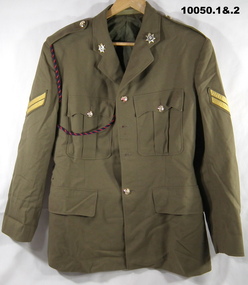
Uniform - JACKET & BERET, SERVICE DRESS, ARMY, Australian Defence Industries, 1967, 1992
... style. Buttons missing. Collar, shoulder epaulettes, four front pockets, top with button down flap with 2 concealed metal press studs. Gold colour plastic buttons with shank. Buttons have raised emblem - Queens Crown, circle and lettering...style. Buttons missing. Collar, shoulder epaulettes, four front pockets, top with button down flap with 2 concealed metal press studs. Gold colour plastic buttons with shank. Buttons have raised emblem - Queens Crown, circle and lettering ...1. Jacket - khaki colour wool/polyester fabric, service dress style. Buttons missing. Collar, shoulder epaulettes, four front pockets, top with button down flap with 2 concealed metal press studs. Gold colour plastic buttons with shank. Buttons have raised emblem - Queens Crown, circle and lettering "ER" - Royal Australian Corps of Transport. Rank Insignia patch on sleeve. Two stripes - gold colour braid - Corporal. Lining - green colour polyester fabric. Manufacturers label - white cotton fabric - left side lining. Two lapel badges, gold, silver and dark blue colour plastic. Queen's Crown star, laurel wreath and lettering "ROYAL AUSTRALIAN CORPS OF TRANSPORT". 2. LANYARD - NAVY AND RED COTTON/POLYESTER CORD. 3. Beret - dark blue colour wool/felt fabric with black colour cotton lining. Manufacturer's label - white cotton fabric. Badge on front - gold, silver and dark blue colour plastic. Queen's Crown Star, Laurel wreath and lettering "ROYAL AUSTRALIAN CORPS OF TRANSPORT".Manufacturer's information - black ink print. 1. "E.W.P/Ltd/ SOUTH AUSTRALIA/ 1967/ ^/ SIZE (41 reg)/ CLASS 8405/ 66-019-8466/ ARMY NO/ NAME/ DRY CLEAN ONLY/ REPRESS USING IRON AND DAMP/ CLOTH OR MEDIUM TO HOT/ STEAM IRON/ CREASE UPPER HALF OF LAPELS ONLY". 2. HILLS HATS LTD/ NEW ZEALAND 1992/ DEF. AUST 5047/ SIZE: MEDIUM/ NAME/ N.S.N. 8405-66-136-2951.uniform, army, service dress, jacket, beret -
 Bendigo Military Museum
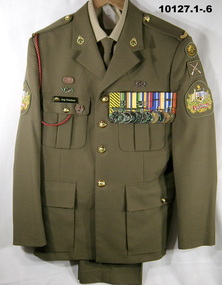
Uniform - SERVICE DRESS, ARMY, Australian Defence Industries, 2016
... style, shoulder epaulettes, four front patch pockets with button down flap. Gold colour plastic buttons with raised emblem - Rising Sun Badge. Army shoulder epaulettes - gold colour 'AUSTRALIA' badge. Cloth shoulder patches - eft sleeve top - gold, black and red. Rising Sun with Queen's Crown and lettering...style, shoulder epaulettes, four front patch pockets with button down flap. Gold colour plastic buttons with raised emblem - Rising Sun Badge. Army shoulder epaulettes - gold colour 'AUSTRALIA' badge. Cloth shoulder patches - eft sleeve top - gold, black and red. Rising Sun with Queen's Crown and lettering ...Left side - Campaign and service medals = Left to Right. 1. Conspicuous Service Medal. 2. Australian Active Service Medal - 2 clasps - 1 RAQ 2003 - ICAT Afghanistan 2001. 3. Afghanistan Campaign Medal. 4. Iraq Campaign Medal. 5. Australian Service Medal - 2 clasps - Balkans 1997 - 2004, - Sinai - Egypt. 6. Defence Force Service Medal - 3 clasps (25 Years). 7. Australian Defence Medal. 8. North Atlantic Treaty Organisation medal (NATO) 9. British IRAQ Medal. 10. North Atlantic Treaty Organisation and clasp ISAF> 11. Multi National Force and Observers Medal - Sinai - Egypt (These are replica medals). Award badge - Crossed swords with Laurel wreath dark bronze colour = ARMY COMBAT BADGE. Right side - Top to Bottom. Award Badge = COMMANDER 2nd DIVISION COMMENDATION BRONZE 1998-99 Badge = STEYR INDIVIDUAL READINESS Badge Name Badge = Rising Sun Emblem with "GREG WESTHEAD"' Badge = RECENT INSTRUCTOR BADGE. Uniform Jacket, trousers, shirt, necktie, lanyard, medals, beret. 1. 2. & 4. Fabric outer - khaki colour wool and polyester. Lining - dark khaki polyester. 1. Jacket - Service dress style, shoulder epaulettes, four front patch pockets with button down flap. Gold colour plastic buttons with raised emblem - Rising Sun Badge. Army shoulder epaulettes - gold colour 'AUSTRALIA' badge. Cloth shoulder patches - eft sleeve top - gold, black and red. Rising Sun with Queen's Crown and lettering "THE AUSTRALIAN ARMY". Middle - silver and brown crossed rifles = Marksmanship Proficiency. Lower and right sleeves Rank Insignia Patch in colour. Australian Coat of Arms = Regimental Sergeant Major. Lapel Badges - gold colour plastic - Queens Crown above laurel wreath with centre crossed swords = Royal Australian Corps of Military Police. Front left side - Campaign and Service medals Mounted and Award badge. Right side - one award badge and three badges.(Fabric, metal and plastic). 2. Trousers - waistband, belt loops, fob pocket, two side pockets and one back pocket with button down flap. Bottom green plastic metal and nylon zipper fly. Fabric and lining as above. 3. Shirt - light khaki colour polyester/cotton fabric. Short sleeves, collar, shoulder epaulettes, two front patch pockets with button down flap. Buttons - beige plastic. Left and right shoulder and rank cloth patches as per jacket. 4. Necktie - fabric and lining as above. 'V' shape on ends. Two makers labels. 5. Lanyard - braided red and black colour cotton cord with knots. 6. Medals - mounted medals with ribbons. Metal pin on back. 7. Beret - red colour wool felt fabric with black colour polyester and plastic lining. Oval shape. Black colour vinyl trim with ribbon for size adjustment. Front - badge = Royal Australian Corps of Military Police - Queens Crown, Laurel wreath and crossed swords - gold colour plastic and metal.1. & 2. Manufacturers information on lining in black print on white colour fabric. "ADA/MADE IN CHINA/ AUG 2016/CC30BK or CC3087/ ^/ NSN 8405 66 162 6301 or 607?/ SIZE: 110R OR 85R/ NAME:/ PM KEYS NO:/ OUTER: 60% WOOL/40% POLYESTER/LINING: 100% POLYESTER/DRY CLEAN ONLY/ DO NOT WASH/ IRON UNDER DAMP CLOTH/ WARM IRON". 2. Handwritten black ink 'WESTHEAD/ 317595". 4. Tie - top label "ADAY" Lower label "ADAY"/ MADE IN CHINA/ MAY 2016/ 60% WOOL/ 40% POLYESTER/ DRY CLEAN ONLYuniform, army, military police, westhead -
 Bendigo Military Museum
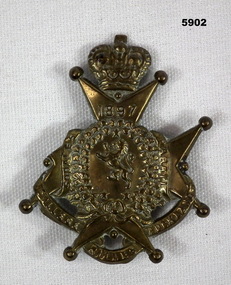
Badge - BADGE, NZ CADETS, C. 1897 onwards
... Badge pressed brass, top has a crown with date under over star style shape with central motiff, scroll at bottom with raised lettering, rear has three lugs....Item in the collection re John D Gardiner No 2832, refer Cat No 5892.2 for his service details. badges Aucland NZ cadets On face, "1897, College Rifles Auckland" Badge pressed brass, top has a crown with date under over star style shape with central motiff, scroll at bottom with raised lettering, rear has three lugs. ...The New Zealand College Rifles was formed in 1897 from three Colleges in Auckland as a Cadet Military Unit, members served in South Africa, WW1 & 2. Item in the collection re John D Gardiner No 2832, refer Cat No 5892.2 for his service details.Badge pressed brass, top has a crown with date under over star style shape with central motiff, scroll at bottom with raised lettering, rear has three lugs.On face, "1897, College Rifles Auckland"badges, aucland, nz, cadets -
 Bendigo Military Museum
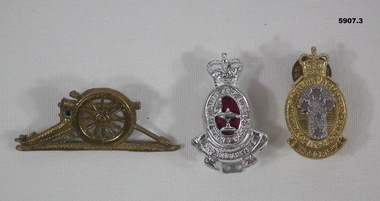
Badge - BADGES, VARIOUS, Possible WW1 through to Post WW2
... .1) Badge pressed brass, shape is of an old style Artillery piece on large wheels, rear has two lugs on. .2) Badge, metals crown at top, centre has 5 stars in silver, outside is oval shape with lettering, scroll under, rear has two pins. .3) Badge silver colour metal, crown at top, oval shape, raised lettering, scroll under with same, pin on rear....Items in collection re John D Gardiner No 2832, refer Cat No 5892.2 for his service details. badges artillery nursing pay .2) "Royal Australian Army Pay Corps, Integrity" .3) Royal Australian Army Nursing Corps, Pro Humanitate" .1) Badge pressed brass, shape is of an old style Artillery piece on large wheels, rear has two lugs on. .2) Badge, metals crown at top, centre has 5 stars in silver, outside is oval shape with lettering, scroll under, rear has two pins. .3) Badge silver colour metal, crown at top, oval shape, raised lettering, scroll under with same, pin on rear. ...Items in collection re John D Gardiner No 2832, refer Cat No 5892.2 for his service details..1) Badge pressed brass, shape is of an old style Artillery piece on large wheels, rear has two lugs on. .2) Badge, metals crown at top, centre has 5 stars in silver, outside is oval shape with lettering, scroll under, rear has two pins. .3) Badge silver colour metal, crown at top, oval shape, raised lettering, scroll under with same, pin on rear..2) "Royal Australian Army Pay Corps, Integrity" .3) Royal Australian Army Nursing Corps, Pro Humanitate"badges, artillery, nursing, pay
