
Showing 239 items matching " textile factories"
-
 Glen Eira Historical Society
Document - Classic Retirement Village, Brighton
... ... Textile Factories...Swan Ian Korman Stanley Mills Wool Industry Weaving Mills Textile Factories Textile Manufacturing Manufacturing Industry Document Classic Retirement Village, Brighton ...Four documents about the history of this site pre Classic Retirement Village: 1/A copy of a description of the sale process of the Gascor site, cnr Nepean Highway and Thomas Street, to Becton Corporation in 1997 And 1998. Printed on 31/07/2010 from the Victorian Auditor General’s Department website with aerial photograph 2/A copy of page one of the Gleneira Planning Scheme dated 19/01/2006 which mentions the Gascor site. 3/Research note by Andrew Frederick dated August 2010 listing occupiers of the site in the 1960 and the 1970 Sands and Mc Dougall Directories. 4/Research note by Claire Barton dated May 2010 containing Ian Swan’s recollections of working at Daylesford Worsted Woollen, occupier of the site, in the 1960s.thomas street, brewer road, bentleigh, gascor, becton corporation pty ltd, virginia park, gas and fuel, hughesdale dairy, east boundary road, moorabin, east bentleigh, hooblerstone, clairmont avenue, glen eira, daylesford centenary woollen and worsted mills pty ltd., nepean highway, f and j industries australia plastic and rubber division., swan ian, korman stanley, mills, wool industry, weaving mills, textile factories, textile manufacturing, manufacturing industry -
Whitehorse Historical Society Inc.
Newspaper - Article, Belgians here to settle, 13/03/1952
... Photocopy of article on the arrival of the de Stoop family joining Roger de Stoop, proprietor of a textile factory in North Blackburn....de Stoop Roger Belgians in Australia Weaving Mills Photocopy of article on the arrival of the de Stoop family joining Roger de Stoop, proprietor of a textile factory in North Blackburn. Belgians here to settle Newspaper Article ...Photocopy of article on the arrival of the de Stoop family joining Roger de Stoop, proprietor of a textile factory in North Blackburn.de stoop, roger, belgians in australia, weaving mills -
 Whitehorse Historical Society Inc.
Photograph, Roger de Stoop, 1956
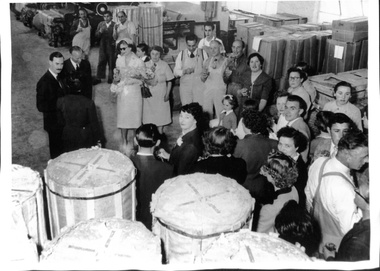
... ...de Stoop Textile Factory...Black and white photograph of Roger de Stoop showing the Prince and Princess of Luxembourg around his Blackburn North textile factory which was established in 1950. Bales of ticking in foreground. ...He sold the business in the 1960's to Smith and Nephew but continued to manage the manage the business until 1966 de Stoop Roger de Stoop Textile Factory Blackburn North Textiles Prince of Luxembourg Princess of Luxembourg Black and white photograph of Roger de Stoop showing the Prince and Princess of Luxembourg around his Blackburn North textile factory which was established in 1950. ...Roger de Stoop was born in 1912 in Flanders, Belguim. He migrated to Australia and set up a mattress ticking factory in Blackburn North in 1950.The company produced damask ticking. de Stoop sponsored Belgian migrants to work in his factory and built housing for them close to the factory. He sold the business in the 1960's to Smith and Nephew but continued to manage the manage the business until 1966Black and white photograph of Roger de Stoop showing the Prince and Princess of Luxembourg around his Blackburn North textile factory which was established in 1950. Bales of ticking in foreground. Staff standing, guests seated.de stoop, roger, de stoop textile factory, blackburn north, textiles, prince of luxembourg, princess of luxembourg -
Whitehorse Historical Society Inc.
Document, Arrivals of Belgian families
... List by Roger de Stoop of Belgian immigrants 1950 - 1955 sponsored by him to work in his Blackburn North textile factory; with photocopy of photos of houses built for de Stoop employees, factory site and original buildings....Belgians in Australia de Stoop Roger Weaving Mills List by Roger de Stoop of Belgian immigrants 1950 - 1955 sponsored by him to work in his Blackburn North textile factory; with photocopy of photos of houses built for de Stoop employees, factory site and original buildings. ...List by Roger de Stoop of Belgian immigrants 1950 - 1955 sponsored by him to work in his Blackburn North textile factory; with photocopy of photos of houses built for de Stoop employees, factory site and original buildings.belgians in australia, de stoop, roger, weaving mills -
 National Wool Museum
Sign - Notice, Victorian Enamelling Works
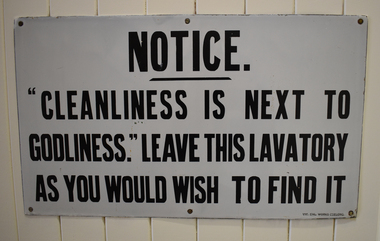
... ...Factories...Textile...Valley Worsted Mill Foster Valley Mill Pty Ltd Sign Toilets Notice Manufacturing Factories Textile Industry Workplace NOTICE. / "CLEANLINESS IS NEXT TO / GODLINESS." ...Sign used at Foster Valley Mill.Metal enamel toilet sign with black lettering on a white background.NOTICE. / "CLEANLINESS IS NEXT TO / GODLINESS." LEAVE / THIS LAVATORY / AS YOU WOULD WISH TO FIND IT / VIC. ENL. WORKS GEELONG.valley worsted mill, foster valley mill pty ltd, sign, toilets, notice, manufacturing, factories, textile industry, workplace -
 National Wool Museum
Photograph - Carding Machines
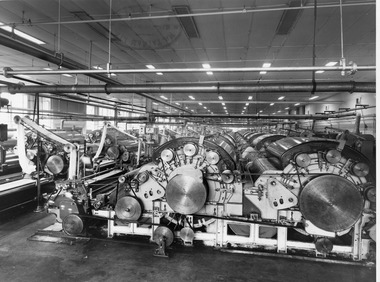
... Sales photograph for William Tatham Ltd. of Rochdale, to showcase new Carding Machines in a newly developed textile factory. The photograph was taken in Glasgow, Scotland....Sales photograph for William Tatham Ltd. of Rochdale, to showcase new Carding Machines in a newly developed textile factory. The photograph was taken in Glasgow, Scotland. textile machinery wool manufacture carding wool Glasgow On rear - top margin - Showing Card Sets in new Card Room. ...Sales photograph for William Tatham Ltd. of Rochdale, to showcase new Carding Machines in a newly developed textile factory. The photograph was taken in Glasgow, Scotland.A black and white photo of a room filled with working Carding Machines in a portrait format. A man is working at the end of the closest machine.On rear - top margin - Showing Card Sets in new Card Room. Bottom right corner - Commercial Artists photographers and blockmakers Scottish Studios and Engravers LTD. 196 Clyde st. Glasgow. C C.P.D 6893 Dtextile machinery, wool manufacture, carding, wool, glasgow -
National Wool Museum
Book, Australasian Sheep and Wool
... "Australasian Sheep and Wool: a practical and theoretical treatise from paddock to loom; from shearing shed to textile factory" - Alfred Hawkesworth, 6th ed. 1930...."Australasian Sheep and Wool: a practical and theoretical treatise from paddock to loom; from shearing shed to textile factory" - Alfred Hawkesworth, 6th ed. 1930. ..."Australasian Sheep and Wool: a practical and theoretical treatise from paddock to loom; from shearing shed to textile factory" - Alfred Hawkesworth, 6th ed. 1930.wool - history wool growing wool processing, wool - history, wool growing, wool processing -
National Wool Museum
Book, Australasian Sheep and Wool
... "Australasian Sheep and Wool: a practical and theoretical treatise from paddock to loom; from shearing shed to textile factory" - Alfred Hawkesworth, 6th ed. 1930...."Australasian Sheep and Wool: a practical and theoretical treatise from paddock to loom; from shearing shed to textile factory" - Alfred Hawkesworth, 6th ed. 1930. ..."Australasian Sheep and Wool: a practical and theoretical treatise from paddock to loom; from shearing shed to textile factory" - Alfred Hawkesworth, 6th ed. 1930.Sturgeonwool - history wool growing wool processing, wool - history, wool growing, wool processing -
National Wool Museum
Book, Australasian Sheep and Wool
... "Australasian Sheep and Wool: a practical and theoretical treatise from paddock to loom; from shearing shed to textile factory" - Alfred Hawkesworth, 6th ed. 1930...."Australasian Sheep and Wool: a practical and theoretical treatise from paddock to loom; from shearing shed to textile factory" - Alfred Hawkesworth, 6th ed. 1930. ..."Australasian Sheep and Wool: a practical and theoretical treatise from paddock to loom; from shearing shed to textile factory" - Alfred Hawkesworth, 6th ed. 1930.PORT PHILLIP MILLS PTY. LTD. / Morland Street / Footscraywool - history wool growing wool processing, port phillip mills pty ltd, wool - history, wool growing, wool processing -
 National Wool Museum
Photograph - Textile Machinery, Fred Murgatroyd, c.1920s
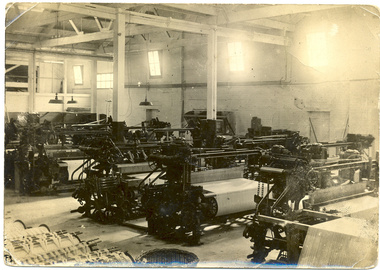
... Black and white photograph showing interior view of factory with textile machinery....Textile Machinery Textile Mills Weaving Mills Textile Mills Collins Bros Mill Pty Ltd Tweedside Woollen Mills Yarra Falls Mill Murgatroyd Mr Fred Murgatroyd Mr James Textile Machinery Textile Mills Weaving Mills Back: [printed] F Murgatroyd Back: [handwritten] Tweedside Black and white photograph showing interior view of factory with textile machinery. ...Fred Murgatroyd worked as a loom tuner at Yarra Falls, Tweedside and Collins mills in Victoria as well as in Sydney, and studied at Leeds University.Black and white photograph showing interior view of factory with textile machinery.Back: [printed] F Murgatroyd Back: [handwritten] Tweedsidetextile machinery textile mills weaving mills textile mills, collins bros mill pty ltd tweedside woollen mills yarra falls mill, murgatroyd, mr fred murgatroyd, mr james, textile machinery, textile mills, weaving mills -
 Whitehorse Historical Society Inc.
Photograph, Roger de Stoop and Belgian workers, C 1950
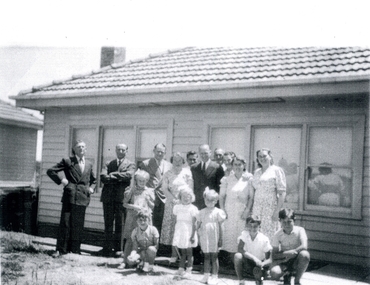
... roger. de stoop aust pty ltd. de stoop and best textile factory. weaving mills. belgians in australia...He had previously met Dick Best, an Australian who wanted to establish a textile factory in Australia and in 1950 they built a factory at Blackburn North importing the weaving looms and many of their skilled workers from Belgium. ...He had previously met Dick Best, an Australian who wanted to establish a textile factory in Australia and in 1950 they built a factory at Blackburn North importing the weaving looms and many of their skilled workers from Belgium. ...Roger de Stoop came to Australia during the Second World War when the de Stoop spinning & weaving factory in Belgium was closed during the German occupation. He had previously met Dick Best, an Australian who wanted to establish a textile factory in Australia and in 1950 they built a factory at Blackburn North importing the weaving looms and many of their skilled workers from Belgium. Housing for the workers was built near the factory.Black and white photograph of Belgian family groups in front of one of the houses erected for the de Stoop workers. Roger de Stoop is in the centre of the photograph in a dark suit and tie.de stoop, roger. de stoop aust pty ltd. de stoop and best textile factory. weaving mills. belgians in australia -
 Sunbury Family History and Heritage Society Inc.
Photograph
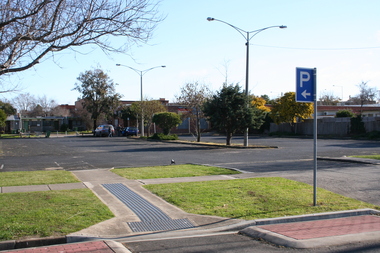
... In the 1940s-1950s, a former textile factory occupied the site. The factory was housed in an ex-army hut and many of Sunbury's women were employed there. ...In the 1940s-1950s, a former textile factory occupied the site. The factory was housed in an ex-army hut and many of Sunbury's women were employed there. ...The carpark is in Barkly Street, behind the O'Shanassy Shopping strip. In the 1940s-1950s, a former textile factory occupied the site. The factory was housed in an ex-army hut and many of Sunbury's women were employed there. From 1946 - 48, the business was known as Angee Clothing, which produced gloves, slippers and dressing gowns. In 1949, the site was taken over by Yakka, where work clothes were made. As the business expanded it moved to Broadmeadows in a large modern factory.While the factory was in Sunbury, it provided employment for a lot of the local women.A coloured photograph of an off-street carpark behind a shopping complex. Two cars are parked in the area and a nature strip with a parking sign in the foreground.yakka factory, barkly street, angee clothing, sunbury -
 Whitehorse Historical Society Inc.
Photograph, Dick Best
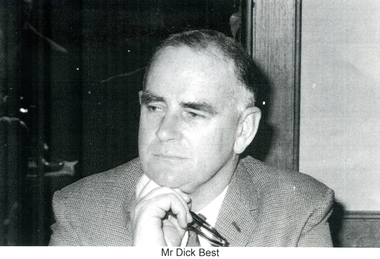
... They took up Dick Best's offer to relocate and join with him to set up a textile factory in Australia. Land was purchased in Blackburn North and when the de Stoop and Best Aust P/L traded, Dick best was in charge of marketing their products....They took up Dick Best's offer to relocate and join with him to set up a textile factory in Australia. Land was purchased in Blackburn North and when the de Stoop and Best Aust P/L traded, Dick best was in charge of marketing their products. best richard weaving mills de stoop and best aust p/l (on smaller photocopy) Mr Dick Best 2 Black and white photograph of the head and shoulders of Richard Best. ...Richard Best was an Australian Textile industry agent and Businessman. While travelling in Belgium he contacted the de Stoop family, textile manufacturers, whose business had been closed down by German occupation after the 2nd World War. They took up Dick Best's offer to relocate and join with him to set up a textile factory in Australia. Land was purchased in Blackburn North and when the de Stoop and Best Aust P/L traded, Dick best was in charge of marketing their products.2 Black and white photograph of the head and shoulders of Richard Best. He has a pair of glasses in his right hand(on smaller photocopy) Mr Dick Bestbest, richard, weaving mills, de stoop and best aust, p/l -
 Whitehorse Historical Society Inc.
Photograph, Roger de Stoop
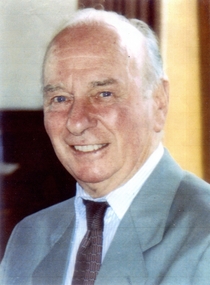
... roger. de stoop and best textile factory. belgians in australia...The de Stoop textile factory was closed due to German occupation and when Roger de Stoop received an offer from Australian Dick Best to begin a a partnership in similar venture in Australia, he agreed, bringing looms and skilled workers with him. ...The firm was sold to the British firm, Smith and Nephew in 1960. de stoop roger. de stoop and best textile factory. belgians in australia One coloured and one black and white head shot of Roger de Stoop wearing a suit and tie. ...Roger de Stoop was born in Flanders, Belgium in 1912 and died in Australia on 18th April 1999. The de Stoop textile factory was closed due to German occupation and when Roger de Stoop received an offer from Australian Dick Best to begin a a partnership in similar venture in Australia, he agreed, bringing looms and skilled workers with him. The company was the first to produce Belgian damask ticking in Australia. The firm was sold to the British firm, Smith and Nephew in 1960.One coloured and one black and white head shot of Roger de Stoop wearing a suit and tie.de stoop, roger. de stoop and best textile factory. belgians in australia -
 Warrnambool and District Historical Society Inc.
Packaging, Blanket Box, 1990s
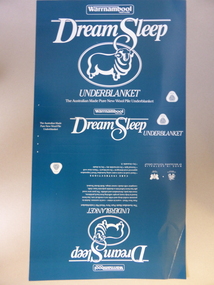
... This item was produced by the Warrnambool Textiles factory in the 1990s. In 1910 the Warrnambool Woollen Mill was established and it produced blankets, rugs etc with a staff of over 700 in the 1940s. ...This item was produced by the Warrnambool Textiles factory in the 1990s. In 1910 the Warrnambool Woollen Mill was established and it produced blankets, rugs etc with a staff of over 700 in the 1940s. ...This item has been made to package a ‘Dream Sleep’ underblanket. This item was produced by the Warrnambool Textiles factory in the 1990s. In 1910 the Warrnambool Woollen Mill was established and it produced blankets, rugs etc with a staff of over 700 in the 1940s. In 1958 the Mill became the first in Australia to manufacture electric blankets. In 1968 the business was sold to Dunlop and in 1982 Dunlop sold the Mill to Onkaparinga Woollen Company. In 1983 Onkaparinga was taken over by Macquarie Worsteds and the Warrnambool Woollen Mill then traded as Warrnambool Textiles. In 2000 the Mill closed. This packaging is of some interest as a memento of the old Warrnambool Woollen Mill which operated in Warrnambool for 90 years and was a major industry in the town/city and a major employer of local residents. It is still remembered fondly by many local people today. This is a cardboard sheet for packaging an underblanket for Warrnambool Textiles. It has white printing on a dark blue background on one side and is white and unmarked on the other. It has an image of a sheep, three symbols for ‘Pure New Wool’, a symbol for ‘Naturally Flame Resistant’ and one for ‘Moth-Resist Treated’. The sheet is designed to be folded in four places to cover an underblanket. This is a cardboard sheet for packaging an underblanket for Warrnambool Textiles. It has white printing on a dark blue background on one side and is white and unmarked on the other. It has an image of a sheep, three symbols for ‘Pure New Wool’, a symbol for ‘Naturally Flame Resistant’ and one for ‘Moth-Resist Treated’. The sheet is designed to be folded in four places to cover an underblanket. warrnambool woollen mill, warrnambool textiles, onkaparinga woollen company -
 National Wool Museum
Trunk
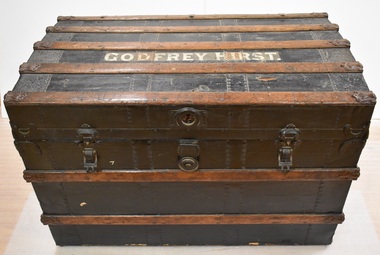
... Godfrey Hirst set up a successful woollen textile factory in Geelong in 1888. The factory stayed in operation until 1966. ...Godfrey Hirst set up a successful woollen textile factory in Geelong in 1888. The factory stayed in operation until 1966. ...Trunk belonged to Godfrey Hirst and was used in his travels between Australian and England. Godfrey Hirst's first trip to Australia was in 1885 and his last trip was in 1916. In this time Hirst was known to travel between Australia and England regularly on the lookout for the latest updates from England that he could bring to his factory in Geelong. The trunk was donated by Susan Wiffen (née Betts), the great granddaughter of Godfrey Hirst. Godfrey Hirst set up a successful woollen textile factory in Geelong in 1888. The factory stayed in operation until 1966. The company still bearing his name has since been purchased by various investment companies but continues to be the largest carpet manufacturer in Australia. Predominately black trunk with two wooden bands around the sides of the trunk and five across the top (lid). The lid is slightly curved and contains white printed lettering GODFREY HIRST. The trunk also contains small wheel underneath locked for pushing the trunk sideways only. The trunk contains two leather handles on either side. Internally, the trunk contains three levels of storage with baskets stackable on top of one another. The baskets are finished in a white and brown striped fabric which has red taped edging for additional strength. The top layer of baskets also has brown leather latches in order to keep the basket lids shut. The layered levels of storage are synonymous of Saratoga style trunk.Printed. Letters: Godfrey Hirstgodfrey hirst -
 Whitehorse Historical Society Inc.
Clothing - Suit, Shirt and Bowtie, 1973
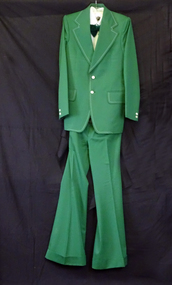
... In 1973 when Brian Schultz was working as a dye chemist at Yarra Falls (a Textile Factory making fabrics for school uniforms, suits etc.) in Abbotsford, he was invited by his friend to be his best man. ...In 1973 when Brian Schultz was working as a dye chemist at Yarra Falls (a Textile Factory making fabrics for school uniforms, suits etc.) in Abbotsford, he was invited by his friend to be his best man. ...In 1973 when Brian Schultz was working as a dye chemist at Yarra Falls (a Textile Factory making fabrics for school uniforms, suits etc.) in Abbotsford, he was invited by his friend to be his best man. He chose the colour green, dyed the fabric himself, and took the fabric to a tailor in Smith Street, Collingwood to have the suits made up for the December wedding. The green shirt which Brian wore with the green suit at the wedding in 1973 came in handy when he wore it 37 years later at his son's 30th birthday Halloween dress up party, when he dressed up as The Hulk. He cut up the sleeves of the shirt and painted himself green. For the December wedding, the groom wore a white suit, lemon shirt and emerald green velvet bow tie.Green two piece suit with shirt and bow tie. 1. Single breasted jacket with two pearl buttons centre and smaller buttons on sleeves. White stitching around collar edge and down the front on pockets. 2. Trousers with wide belt carrier, zip fly, cuffs wide with 6cm turnback. 3. Shirt is a polyester fine knit, pale green with dark green buttons and collar stitched with dark green edge-stitching. 4. Dark green velvet and ready-tied bow tie..MENS SLACKS BY TRAVELLERS APPAREL - For the man who goes placescostume, male -
 National Wool Museum
Photograph - Staff Portrait, Valley Worsted Mills, Geelong, 1930's
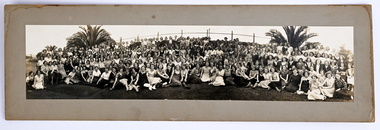
... During the Great Depression of the 1930s, the female workforce at Valley Worsted Mills and other local Geelong textile factories became more vital than ever. Because women were historically paid significantly lower wage rates than men for equivalent labor, local mills increasingly relied on them to keep operating costs low during severe economic strain. ...During the Great Depression of the 1930s, the female workforce at Valley Worsted Mills and other local Geelong textile factories became more vital than ever. Because women were historically paid significantly lower wage rates than men for equivalent labor, local mills increasingly relied on them to keep operating costs low during severe economic strain. ...The Valley Worsted Mills were established in 1924 on Swanston Street in South Geelong and quickly grew to become the largest and most modern textile mill in Australia, employing roughly 500 workers at its peak. Built out of distinctive red Geelong brick with iconic Art Deco white trimmings and a sawtooth roofline, the massive 11-acre complex served as a major manufacturing cornerstone during the height of the region's historic wool boom. The mill operated at high production for nearly 50 years before merging with John Foster & Son in December 1973, subsequently closing down entirely in the mid-1970s. During the Great Depression of the 1930s, the female workforce at Valley Worsted Mills and other local Geelong textile factories became more vital than ever. Because women were historically paid significantly lower wage rates than men for equivalent labor, local mills increasingly relied on them to keep operating costs low during severe economic strain. These young women, often referred to affectionately as "mill girls," typically started working as young as 14 to 16 years old. They filled specialized, highly skilled roles as menders, warpers, and weavers. For many families in the Geelong region, the steady industrial employment of these women provided a crucial financial lifeline when male breadwinners faced widespread unemployment. Beyond their grueling factory shifts, the mill women maintained a vibrant social culture, even forming organized recreation groups like the Valley Worsted Mills Women’s Basketball team during this era. The donor's father Stan Hoyle, and grandfather Cliff Hoyle, both worked there at the time.Black and white panoramic photograph attached to backing board. Photograph shows a group portrait of female factory workers outdoors.back: [handwritten] Valley / Worsted Mills Geelong / 34 - 40 / Ada? Stan?valley worsted mills, swanston street geelong, geelong, woollen mills, depression, 1930s, working life, panoramic, employees, staff, portrait, textile industry, great depression, female workers, mill girls, social culture, stan hoyle, cliff hoyle -
 National Wool Museum
Textile - Rug, Returned Soldiers and Sailors Mill, 1963
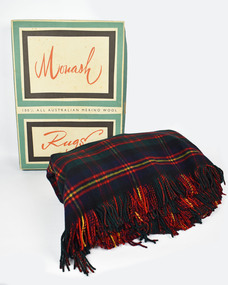
... Compared to modern textile production which can spin a fine yarn out of synthetic fibre or imported cotton easily, spinning fine yarn from medium quality wool at a textile factory was cumbersome and no longer financially viable to suit new consumer demands. ...Compared to modern textile production which can spin a fine yarn out of synthetic fibre or imported cotton easily, spinning fine yarn from medium quality wool at a textile factory was cumbersome and no longer financially viable to suit new consumer demands. ...The Returned Soldiers and Sailors Mills was located near the Barwon river on Pakington Street, Geelong, where its building still stands. The mill was established in October 1922 with capital acquired from War Gratuity Bonds. The mill produced fine grade woollen products with its speciality being ‘Retsol’ travelling rugs. The mill first began to run into financial troubles with the ‘Credit Squeeze’ or the ‘Holt Jolt’ of the early 1960s. This saw import restrictions lifted which triggered the start of a minor recession and a rise in unemployment. Included in these troubles was the RS&S Mill which saw the number of employees gradually decrease and business declining with cheaper imports beginning to grab an expanding part of the market share. The mill was eventually purchased by Godfrey Hirst in 1973 who tried to continue operations without success and in June 1975 textile production at the site ceased. Outside of financial considerations contributing to the closure of Woollen Mills in this period was the declining need for heavier fabrics as in-home heating and insulation improved. This need had been replaced for a demand for ever softer, finer and lighter worsted fabrics for more casual clothing. Modern day textile production requires fewer steps in the processing of materials for this use. This meant large factory complexes such as early woollen mills like the RS&S mills were no longer required. Compared to modern textile production which can spin a fine yarn out of synthetic fibre or imported cotton easily, spinning fine yarn from medium quality wool at a textile factory was cumbersome and no longer financially viable to suit new consumer demands. This rug provides context to this statement. It was gifted to Shirley and Gordon Green as a wedding present in November 1963 by one of Gordon's colleagues in the wool industry. Living in areas such as Neutral Bay, the Hornsby area and later in life retiring to the Central Coast, the blanket was too heavy for use in these weather conditions and hence it stayed in its original box for nearly 60 years. Top and bottom of rug has frilled edges. Pattern is titled the 'Clan Cameron' and is repeated in a 7x7 grid. Front of rug has a red background with 4 vertical and horizontal lines. All is surrounded by a yellow boarder. Label is stitched into the bottom right corner. Reverse of rug also has a repeating 7x7 grid. Blue background with thick green horizontal stripe. Yellow and red boarder to the grid with 4 red vertical and horizontal lines making up the interior. Rug measure 1550 x 2040mm, approximately the same size as a queen size mattress.Wording, Bottom right corner. THE GEELONG R.S&S. WOOLEN MILLS/ PURE/ WOOL/ AUSTRALIA/ The John Monash Rug (cursive)/ The Clan Cameron (cursive)rs&s mills, textile manufacture, rug, clan cameron, sydney greasy wool exchange -
 Wangaratta RSL Sub Branch
Booklet - Special Clothing Ration Book, A H Tucker, C1945
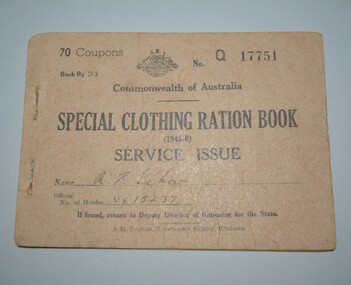
... These supplemented the standard annual coupon allowance for citizens needing extra garments World War II civilian "Service Issue" clothing ration books were special coupon booklets introduced in Australia in June 1942 to manage extreme shortages of textiles and factory labor diverted to military uniforms. ...These supplemented the standard annual coupon allowance for citizens needing extra garments World War II civilian "Service Issue" clothing ration books were special coupon booklets introduced in Australia in June 1942 to manage extreme shortages of textiles and factory labor diverted to military uniforms. ...A special clothing ration book (or supplementary clothing card) refers to extra coupon booklets issued during WWII. These supplemented the standard annual coupon allowance for citizens needing extra garments World War II civilian "Service Issue" clothing ration books were special coupon booklets introduced in Australia in June 1942 to manage extreme shortages of textiles and factory labor diverted to military uniforms. Citizens received an annual quota of coupons to ensure equitable sharing of clothes. Item belonged to Robert Francis ISKOV VX15237 served with the 59th Battalion/Hume Regiment CMF before joining the 2/14th Battalion at Caulfield in September 1940. He disembarked for the Middle East in November, 1940 and fought in the Syrian campaign in 1941. In 1942 the 2/14th Battalion returned to Australia and sent to Papua where he fought at the Battle of Isurava before the battalion was sent to Gona. On 1943 Bob returned to Australia to undertake officer training and in 1945 with the 2/23rd Battalion sailed to Morotai and served with the battalion on Tarakan. He returned to Australia in November, 1945 and discharged a month later Brown cardboard booklet with lettering in black ink on front cover containing 2 half pagesQ17751 70 coupons R F ISKOV VX15237ww2, bob iskov, special clothing ration book, service issue -
 Wangaratta RSL Sub Branch
Card - Member's Personal Equipment Card, C1944
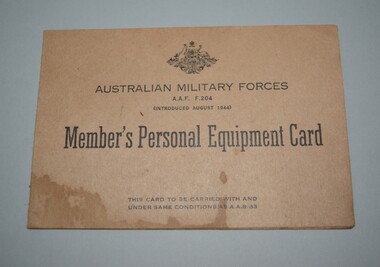
... These supplemented the standard annual coupon allowance for citizens needing extra garments World War II civilian "Service Issue" clothing ration books were special coupon booklets introduced in Australia in June 1942 to manage extreme shortages of textiles and factory labor diverted to military uniforms. ...These supplemented the standard annual coupon allowance for citizens needing extra garments World War II civilian "Service Issue" clothing ration books were special coupon booklets introduced in Australia in June 1942 to manage extreme shortages of textiles and factory labor diverted to military uniforms. ...A special clothing ration book (or supplementary clothing card) refers to extra coupon booklets issued during WWII. These supplemented the standard annual coupon allowance for citizens needing extra garments World War II civilian "Service Issue" clothing ration books were special coupon booklets introduced in Australia in June 1942 to manage extreme shortages of textiles and factory labor diverted to military uniforms. Citizens received an annual quota of coupons to ensure equitable sharing of clothes. Item belonged to Robert Francis ISKOV VX15237 served with the 59th Battalion/Hume Regiment CMF before joining the 2/14th Battalion at Caulfield in September 1940. He disembarked for the Middle East in November, 1940 and fought in the Syrian campaign in 1941. In 1942 the 2/14th Battalion returned to Australia and sent to Papua where he fought at the Battle of Isurava before the battalion was sent to Gona. On 1943 Bob returned to Australia to undertake officer training and in 1945 with the 2/23rd Battalion sailed to Morotai and served with the battalion on Tarakan. He returned to Australia in November, 1945 and discharged a month laterCream cardboard card fold in half with crest and lettering in black ink on front cover AAF F204 Introduced August 1944 ww2, bob iskov, member's personal equipment card, amf -
 National Wool Museum
Film - Promotional Films, Australian Wool Corporation, 26 April 1991
... ...Factory...Textile...Film includes colour footage and audio. 00:01 - titles 00:21 - scenes herding sheep 01:18 - titles 'Wool Testing' 01:34 - Hugh Beggs, Chairman of Australian Wool Corporation, speaking about history of wool marketing and measuring of wool in Australia 02:29 - wool bales on truck 02:35 - interior of factory showing process of wool sampling, measuring and testing 04:04 - AWTA Ltd building exterior, and interior scenes of workers testing and measuring wool samples 11:41 - scenes at wool auction 12:14 - factory interior showing wool processing 13:05 - Beggs speaking about wool industry 13:13 - fashion runways 13:52 - end titles 14:17 - end 14:22 - titles 'Contaminants in Wool Processing' 14:42 - fashion runway 14:52 - man speaking on location at a sheep farm 15:04 - Mark Kent, Vice-President Kent Manufacturing, speaking about contamination of wool and Australia's reputation 15:25 - interior scenes of G H Michell & Sons wool mill in South Australia 16:22 - Judy Turk, in office at G H Michell & Sons speaking about problems of contamination 16:36 - interior factory scenes 17:46 - John McIntosh, Aweave Textile Corporation, talking about contaminants 20:02 - scenes in shearing shed 20:42 - Chip Sawers, President Wool Council, talking about contamination 28:46 - end credits 29:04 - end 29:13 - Bill Peach exits car on sheep property, introduces a story about wool 29:46 - titles 'Working for Wool' 30:04 - farm scenes 32:12 - shearing shed scenes, interior 34:28 - Wool Testing Authority labratory, interior scenes 36:44 - wool store interior 38:20 - Australian Wool Corporation office interior and exterior, Parkville, Melbourne 43:26 - end credits 44:00 - end 44:05 - wool advertisement featuring man and woman in car 44:34 - end 44:41 - titles 'Fleece Clean' 44:42 - various scenes, fashion, factories 45:14 - titles 45:15 - fashion runways 45:43 - farm scenes 51:02 - titles 51:10 - scenes of China, including Great Wall 53:44 - textile factories in China, interior scenes 57:46 - fashion runways, Shanghai China 01:00:31 - rural scenes of China 01:02:03 - end 01:02:13 - titles 'Wool Top Making' 01:02:19 - scenes of Williamstown, Victoria 01:02:27 - Port Phillip Mills, interior scenes 01:06:33 - end credits 01:07:08 - end 01:07:11 - titles 'Shearer Fitness' 01:07:21 - shearing shed, interior 01:09:54 - shearers talking about health and fitness 01:19:28 - end credits 01:19:48 - end 01:19:50 - titles 'Shearing Training' 01:19:51 - shearing scenes 01:26:24 - end credits 01:26:45 - end 01:26:50 - titles 'Wool Press Duties' 01:26:58 - wool pressing scenes 01:34:29 - end credits 01:34:51 - end 01:34:54 - woollen carpet advertisement, including carpet scenes and farm scenes 01:35:38 end...Victoria Film Working Life Factory Textile Industry Farming Sheep Australian Wool Corporation Hugh Beggs Wool Testing Wool Measuring AWTA G H Michell & Sons Fashion Runway Contaminants Mark Kent Wool Mills Judy Turk John McIntosh Aweave Textile Corporation Chip Sawers Bill Peach Advertisements China Top Making Shearing Sheds Shearing Health Training Wool Pressers Carpet Label on tape: Australian Wool Corporation / TITLE AWC VIDEOS TAPE 2 / PLAYING TIME / TAPING DATE 26/4/91 / PRODUCTION DATE / SYSTEM / WOOL HOUSE 369 Royal Parade, PARKVILLE, VIC, 3052 Black VHS tape with white and orange stickers and printed text. ...Tape contains ten separate short films created by the Australian Wool Corporation, including promotional videos, advertisements and industry news.Black VHS tape with white and orange stickers and printed text. Tape is housed in a black plastic case. Film includes colour footage and audio. 00:01 - titles 00:21 - scenes herding sheep 01:18 - titles 'Wool Testing' 01:34 - Hugh Beggs, Chairman of Australian Wool Corporation, speaking about history of wool marketing and measuring of wool in Australia 02:29 - wool bales on truck 02:35 - interior of factory showing process of wool sampling, measuring and testing 04:04 - AWTA Ltd building exterior, and interior scenes of workers testing and measuring wool samples 11:41 - scenes at wool auction 12:14 - factory interior showing wool processing 13:05 - Beggs speaking about wool industry 13:13 - fashion runways 13:52 - end titles 14:17 - end 14:22 - titles 'Contaminants in Wool Processing' 14:42 - fashion runway 14:52 - man speaking on location at a sheep farm 15:04 - Mark Kent, Vice-President Kent Manufacturing, speaking about contamination of wool and Australia's reputation 15:25 - interior scenes of G H Michell & Sons wool mill in South Australia 16:22 - Judy Turk, in office at G H Michell & Sons speaking about problems of contamination 16:36 - interior factory scenes 17:46 - John McIntosh, Aweave Textile Corporation, talking about contaminants 20:02 - scenes in shearing shed 20:42 - Chip Sawers, President Wool Council, talking about contamination 28:46 - end credits 29:04 - end 29:13 - Bill Peach exits car on sheep property, introduces a story about wool 29:46 - titles 'Working for Wool' 30:04 - farm scenes 32:12 - shearing shed scenes, interior 34:28 - Wool Testing Authority labratory, interior scenes 36:44 - wool store interior 38:20 - Australian Wool Corporation office interior and exterior, Parkville, Melbourne 43:26 - end credits 44:00 - end 44:05 - wool advertisement featuring man and woman in car 44:34 - end 44:41 - titles 'Fleece Clean' 44:42 - various scenes, fashion, factories 45:14 - titles 45:15 - fashion runways 45:43 - farm scenes 51:02 - titles 51:10 - scenes of China, including Great Wall 53:44 - textile factories in China, interior scenes 57:46 - fashion runways, Shanghai China 01:00:31 - rural scenes of China 01:02:03 - end 01:02:13 - titles 'Wool Top Making' 01:02:19 - scenes of Williamstown, Victoria 01:02:27 - Port Phillip Mills, interior scenes 01:06:33 - end credits 01:07:08 - end 01:07:11 - titles 'Shearer Fitness' 01:07:21 - shearing shed, interior 01:09:54 - shearers talking about health and fitness 01:19:28 - end credits 01:19:48 - end 01:19:50 - titles 'Shearing Training' 01:19:51 - shearing scenes 01:26:24 - end credits 01:26:45 - end 01:26:50 - titles 'Wool Press Duties' 01:26:58 - wool pressing scenes 01:34:29 - end credits 01:34:51 - end 01:34:54 - woollen carpet advertisement, including carpet scenes and farm scenes 01:35:38 endLabel on tape: Australian Wool Corporation / TITLE AWC VIDEOS TAPE 2 / PLAYING TIME / TAPING DATE 26/4/91 / PRODUCTION DATE / SYSTEM / WOOL HOUSE 369 Royal Parade, PARKVILLE, VIC, 3052victoria, film, working life, factory, textile industry, farming, sheep, australian wool corporation, hugh beggs, wool testing, wool measuring, awta, g h michell & sons, fashion, runway, contaminants, mark kent, wool mills, judy turk, john mcintosh, aweave textile corporation, chip sawers, bill peach, advertisements, china, top making, shearing sheds, shearing, health, training, wool pressers, carpet -
 Flagstaff Hill Maritime Museum and Village
Domestic object - Sewing Machine, Singer Sewing Machine Company, 1922
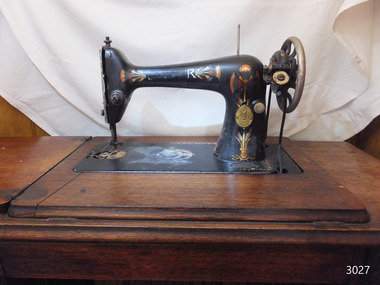
... factories. Industrial sewing machines, in combination with the cotton gin, the spinning jenny, and the steam engine, made clothing production much easier and much cheaper. flagstaff hill warrnambool shipwrecked-coast flagstaff-hill-maritime-museum maritime-museum shipwreck-coast flagstaff-hill-maritime-village sewing machine hand operated dressmaking textile machinery portable premier sewing machine premier Singer Treadle Sewing Machine "Branded Premier" 5-7-9-2-0-0-" Serial Number Y6243048 (denotes 1922 year of manufacture) Sewing machine, treadle operated, Domestic object Sewing Machine Singer Sewing Machine Company ...In 1867 the Singer Company decided that the demand for their sewing machines in the UK was sufficiently high to open a local factory. Glasgow was selected for its iron-making industries, cheap labour, and possibly because at the time the General Manager of the US Singer Sewing Machine Company was George McKenzie, who was of Scottish descent. The company obtained a lease on land near Queen Street Station and machinery and machine parts were shipped over from the US. Demand for sewing machines outstripped production at the new plant and by 1873 a new larger factory was completed near Bridgeton Cross. By now Singer employed over 2,000 people in Scotland but still, they could not produce enough machines. In 1882 George McKenzie, the soon to become President of the Singer Sewing Machine Company undertook the ground breaking ceremony on 46 acres of farmland at Kilbowie, Clydebank and the largest Singer factory in the world started to be built. Originally two main buildings were constructed. Built above the middle wing of the factory was a huge clock tower with the 'Singer' name displayed for all to see from miles around. Many miles of railway lines were laid throughout the factory to connect the different departments and to aid in the shipping of their goods. Railway lines from the factory connected Glasgow, Dumbarton, and Helensburgh stations. The factory was regarded as the most modern facility in Europe at that time. As different departments in the factory were completed, the workers moved from the old sites to the new one at Kilbowie and the factory was finally finished in 1885. With nearly a million square feet of space and almost 7,000 employees producing on average 13,000 machines a week, making it the largest sewing machine factory in the world. The Clydebank factory was so productive that in 1905 the US Singer Company set up the Singer Manufacturing Company Ltd. as a UK registered company. The invention of the sewing machine had several very significant impacts on the lives of many people. It changed the domestic life of many women as more households began to own sewing machines, women as the ones who traditionally stayed home to do chores including making and repairing clothing, found themselves with more free time. Previously several days a week would be dedicated to sewing clothing for herself and her family, a housewife could now complete her sewing in merely several hours, allowing for more free time to pursue hobbies and attain new skills. Sewing and clothing production, in general, became more industrialized activities, taking place less in the home and more in large factories. Industrial sewing machines, in combination with the cotton gin, the spinning jenny, and the steam engine, made clothing production much easier and much cheaper. Sewing machine, treadle operated, "Branded Premier" 5-7-9-2-0-0-" Serial Number Y6243048 (denotes 1922 year of manufacture) flagstaff hill, warrnambool, shipwrecked-coast, flagstaff-hill-maritime-museum, maritime-museum, shipwreck-coast, flagstaff-hill-maritime-village, sewing machine, hand operated, dressmaking, textile machinery, portable, premier sewing machine, premier, singer treadle sewing machine -
 Flagstaff Hill Maritime Museum and Village
Functional object - Luggage Trolley, Harry Crowther Slingsby, 1930 - 1950
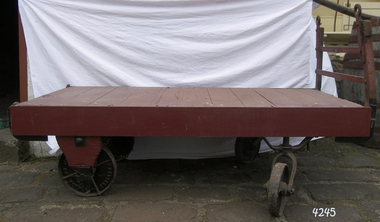
... factories relied heavily on manual hauling and gravity for the movement of raw materials and products from floor to floor. However, this did not solve the problem of moving items horizontally around large buildings. Slingsby then set about creating robust trucks and trolleys to move heavy loads with relative ease. Different designs were created for different purposes sack trolleys for moving large sacks of flour, sugar and dried fruit around grocery stores; high wheeled flat carts towed by one or two people; trucks fitted with wicker baskets carried fibers around textile mills and railway platform trolley to move luggage. ...factories relied heavily on manual hauling and gravity for the movement of raw materials and products from floor to floor. However, this did not solve the problem of moving items horizontally around large buildings. Slingsby then set about creating robust trucks and trolleys to move heavy loads with relative ease. Different designs were created for different purposes sack trolleys for moving large sacks of flour, sugar and dried fruit around grocery stores; high wheeled flat carts towed by one or two people; trucks fitted with wicker baskets carried fibers around textile mills and railway platform trolley to move luggage. ...In 1893 Harry Crowther Slingsby founded the company the family firm was at first wholesale bottlers and had established themselves in Bradford, England, later they had a branch in London. Harry Crowther Slingsby began to look into the invention of labor-saving devices for the company. He had recognised that working practices in the local factories relied heavily on manual hauling and gravity for the movement of raw materials and products from floor to floor. However, this did not solve the problem of moving items horizontally around large buildings. Slingsby then set about creating robust trucks and trolleys to move heavy loads with relative ease. Different designs were created for different purposes sack trolleys for moving large sacks of flour, sugar and dried fruit around grocery stores; high wheeled flat carts towed by one or two people; trucks fitted with wicker baskets carried fibers around textile mills and railway platform trolley to move luggage. The company is still in existence today manufacturing many different types of products.An item from the early to mid 20th century connected with railway memorabilia and a company that had humble beginnings to become today a leading UK manufacture. Railway platform luggage trolley large metal frame & wood top with 4 black metal cast iron wheels & metal structure at front with holes to put rope/harness through. Front 2 wheels swivel. Trolley painted red. Wheels are marked Bradford & Londonflagstaff hill, warrnambool, shipwrecked-coast, flagstaff-hill, flagstaff-hill-maritime-museum, maritime-museum, shipwreck-coast, flagstaff-hill-maritime-village -
 Federation University Historical Collection
Book, Charles Auguste Albert Racinet, Polychromatic Ornament, 1877 (exact)
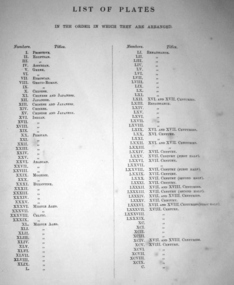
... factory studio manager. He helped in spreading the most significant design of the decorative arts of the time. Racinet learned his trade from his father. He was trained by neo-classical artists in the ambit of Percier and Fontaine. August Racinet was influenced by the Schinkel tendency and supported by architects such as Hittorf and Voillet-le-Duc. art paintings textile ...Monsieur Charles Auguste Albert Racinet was born in Paris on July 20th, 1825. His job was representative of a group of 19th-century industrial draughtsmen, teachers of technical drawing and factory studio manager. He helped in spreading the most significant design of the decorative arts of the time. Racinet learned his trade from his father. He was trained by neo-classical artists in the ambit of Percier and Fontaine. August Racinet was influenced by the Schinkel tendency and supported by architects such as Hittorf and Voillet-le-Duc.Book. Large red leather cover. Title written in gold on spine. Illustrations (black & white), 100 of chromolithographic plates in gold, silver and colours. Various styles of ancient, oriental and medieval art including the Renaissance, the 17th, and the 18th centuries. Subjects are arranged in historical order. Text translated from the original French. The book includes a table of contents, a list of plates, a classified index and an introduction.A book plate inside front cover with a heading "Ballarat School of Art Library No. R/171. Stamped with "Reference","Education Department" and "Ballarat School of Art Library"art, paintings, textile, designs, decoration and craft, ornaments, ballarat technical art school library, bookplate -
Federation University Historical Collection
Book, Sydney Ure Smith, Art and Design 1, 1949, 1949
... factory...t.a.a. aerodrome essendon...marion best...douglass glass...harry seidler...felton bequest...margaret preston monotyps...adrian feint...justin o'brien...lloyd rees...sali herman...anne wienholt...keith murdoch collection...russell drysdale...elaine haxton...s.t. gill letterheads...muriel medworth...textile...art design ballarat technical art school library sydney ure smith joseph burke royal melbourne hospital architecture wormald's factory t.a.a. aerodrome essendon marion best douglass glass harry seidler felton bequest margaret preston monotyps adrian feint justin o'brien lloyd rees sali herman anne wienholt keith murdoch collection russell drysdale elaine haxton s.t. gill letterheads muriel medworth textile design by australian artists gordon andrews hal missingham hyde park barracks ure Smith stamped "School of Mines Library Ballarat" Eighty page book with yellow, greem and white hard cover. ...Eighty page book with yellow, greem and white hard cover. stamped "School of Mines Library Ballarat"art, design, ballarat technical art school library, sydney ure smith, joseph burke, royal melbourne hospital, architecture, wormald's factory, t.a.a. aerodrome essendon, marion best, douglass glass, harry seidler, felton bequest, margaret preston monotyps, adrian feint, justin o'brien, lloyd rees, sali herman, anne wienholt, keith murdoch collection, russell drysdale, elaine haxton, s.t. gill letterheads, muriel medworth, textile design by australian artists, gordon andrews, hal missingham, hyde park barracks, ure smith -
 Flagstaff Hill Maritime Museum and Village
Clothing - Petticoat, late 19th century to early 20th century
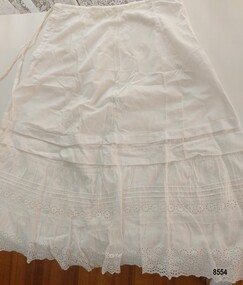
... textiles. At the beginning of the 19th century, the first embroidery machines were developed in St Gallen. Factories...textiles. At the beginning of the 19th century, the first embroidery machines were developed in St Gallen. Factories ...This petticoat was one of several items donated from the estate of Susan Henry OAM nee Vedmore (1944 - 2021). It is in very good condition and appears to be from the Edwardian era - early 20th century. A petticoat is a lady's undergarment - worn under a skirt or dress. They provided warmth, modesty and shape to the dress. In the middle of the 19th century, petticoats were worn over hoops, bustles or in layers. Petticoats varied according to the style of the outside skirt or dress. Plain petticoats tended to be worn with everyday wear whilst better dresses (party dresses or silk gowns) were worn with petticoats that often had more trim and embellishments. Edwardian petticoats had less volume than Victorian era petticoats and they had a "dust ruffle" or lining under a lace flounce. The "dust ruffle" protected the lace flounce and gave the petticoat more flare at the bottom, greater freedom when walking as well as saving the flounce (which was often made of finer material) from everyday wear and tear. Tucks are another feature of Edwardian petticoats - when the lace at the bottom became worn, it could be cut off and the tucks released. This extended the life of the petticoat. This petticoat features an intricate trim of broderie anglaise. Although broderie anglaise was a lace that could be made by hand, it was very time consuming to make. St Gallen was a city in Switzerland that had become known for producing quality textiles. At the beginning of the 19th century, the first embroidery machines were developed in St Gallen. Factories used embroidery machines but people also had them in their homes. They were able to produce broderie anglaise for export. By the early 20th century, machine made lace, fabric, ribbons etc. were being sold in drapers shops all over England and Wales to women who were making clothes and furnishings for their families. It is highly likely that the lady who made this petticoat brought the lengths of broderie anglaise already made to embellish and personalise her petticoat. Susan's family (Harold and Gladys Vedmore) immigrated to Australia from Wales in 1955 and settled in Warrnambool. Susan was well known in the Warrnambool community for her work supporting children and families across the district - particular those with disabilities, or those who were homeless, unemployed or isolated. Susan was the founding trustee of the "Vedmore Foundation" - a Warrnambool philanthropic trust set up in 2010 to support a range of charitable and not-for-profit causes by providing grant assistance. In 2021, she was awarded a Medal of the Order of Australia for services to the community.This item is an example of the needlework skills of women in the late 19th century - creating pintucks and adding lace to personalise and embellish a practical item of clothing. It is also significant as an example of a practical solution to the difficulties that women of this era faced with regard to the washing of clothes and household linens.A white lawn petticoat with a 22.5 cm opening that fastens with 2 small buttons and a drawstring tie. It is decorated with two wide pintucks followed by two gathered frills (or flounces) - one decorated with three rows of narrow pintucks and a single row of broderie anglaise and the bottom frilled hem finished with 3 rows of broderie anglaise in a flower design. The two bottom frills are lined with plain white cotton fabric.flagstaff hill maritime museum and village, great ocean road, petticoat, lady's petticoat, undergarment, lady's undergarment, lingerie, edwardian petticoat, broderie anglaise, lace, machine made lace, hand sewn, machine sewn, draper's shop, susan henry oam, vedmore foundation -
 Flagstaff Hill Maritime Museum and Village
Textile - Petticoat, circa 1900
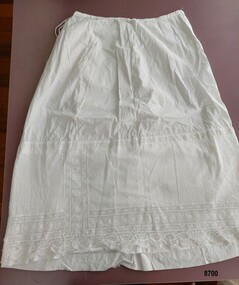
... textiles. At the beginning of the 19th century, the first embroidery machines were developed in St Gallen. Factories...textiles. At the beginning of the 19th century, the first embroidery machines were developed in St Gallen. Factories ...This item is one of a collection of clothing items that belonged to the Stephenson family who lived at 22 McCracken Street, Kensington, Melbourne. Matthew Stephenson (1861 – 1943) who had grown up on the Bendigo goldfields and shifted to Melbourne in the early 1900’s was a train driver and later, a fireman with the railways. His wife Elizabeth Jane (Betsy) Wigley (1865 – 1953) also grew up on the goldfields around Majorca and Bendigo. They married in 1885 in Bendigo. They had two daughters – Ethel Evelyn Stephenson (1886 – 1956) and Lillian or Lila (1891 – 1977) who were milliners and dressmakers and who continued to live in the family home after the death of their parents. The family are recorded as living at 22 McCracken Street, Kensington, as early as 1914. It is not known who made or owned the clothing that makes up this collection but as it appears to be from the late Victorian and early Edwardian era, the different pieces were probably made and worn by any of the three ladies of the house – Betsy, Ethel and/or Lila. During W.W.2, a local Warrnambool couple (Meryl and Tony Everard) boarded with them – Tony was in the airforce training paratroopers to jump into (and survive) enemy territory and his wife Meryl worked in the Methodist baby Home. The Everards developed a close friendship with the Stephensons and were responsible for clearing out the house (and finding this clothing collection) after Lila died in 1977. A petticoat is a lady's undergarment - worn under a skirt or dress. They provided warmth, modesty and shape to the dress. In the middle of the 19th century, petticoats were worn over hoops, bustles or in layers. Petticoats varied according to the style of the outside skirt or dress. Plain petticoats tended to be worn with everyday wear whilst better dresses (party dresses or silk gowns) were worn with petticoats that often had more trim and embellishments. Edwardian petticoats had less volume than Victorian era petticoats and they had a "dust ruffle" or lining under a lace flounce. The "dust ruffle" protected the lace flounce and gave the petticoat more flare at the bottom, greater freedom when walking as well as saving the flounce (which was often made of finer material) from everyday wear and tear. Tucks are another feature of Edwardian petticoats - when the lace at the bottom became worn, it could be cut off and the tucks released. This extended the life of the petticoat. This petticoat features an intricate trim of broderie anglaise. Although broderie anglaise was a lace that could be made by hand, it was very time consuming to make. St Gallen was a city in Switzerland that had become known for producing quality textiles. At the beginning of the 19th century, the first embroidery machines were developed in St Gallen. Factories used embroidery machines but people also had them in their homes. They were able to produce broderie anglaise for export. By the early 20th century, machine made lace, fabric, ribbons etc. were being sold in drapers shops all over England and Wales to women who were making clothes and furnishings for their families. It is highly likely that the lady who made this petticoat brought the lengths of broderie anglaise already made to embellish and personalise her petticoat.This item is an example of the needlework skills of women in the late 19th century - creating pintucks and adding lace to personalise and embellish a practical item of clothing. A lady's fine cotton and lace ankle length petticoat featuring a deep decorative hem made from sheer pinspot fabric and bands of eyelet lace. The top section of the petticoat is made from five sections of fine cotton sewn together with french seams and gathered with pleats and darts into the waistband. The waistband opening has two button holes and one button (the top button is missing) and a front section with a drawstring. The lace hem is lined with the same fine cotton as the top of the petticoat. There are three different lace bands - a narrow one featuring small flowers, a similar wider band with larger flowers and it is finished at the bottom with a broad band of lace with an intricate leaf design.flagstaff hill maritime museum and village, great ocean road, warrnambool, shipwreck coast, petticoat, lady's petticoat, broderie anglaise, decorative petticoat, draw string waist, machine sewn, dressmaker, stephenson family, pintucks, needlework -
 Flagstaff Hill Maritime Museum and Village
Textile - Petticoat, circa 1910
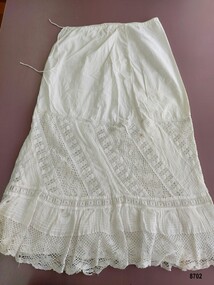
... textiles. At the beginning of the 19th century, the first embroidery machines were developed in St Gallen. Factories...textiles. At the beginning of the 19th century, the first embroidery machines were developed in St Gallen. Factories ...This item is one of a collection of clothing items that belonged to the Stephenson family who lived at 22 McCracken Street, Kensington, Melbourne. Matthew Stephenson (1861 – 1943) who had grown up on the Bendigo goldfields and shifted to Melbourne in the early 1900’s was a train driver and later, a fireman with the railways. His wife Elizabeth Jane (Betsy) Wigley (1865 – 1953) also grew up on the goldfields around Majorca and Bendigo. They married in 1885 in Bendigo. They had two daughters – Ethel Evelyn Stephenson (1886 – 1956) and Lillian or Lila (1891 – 1977) who were milliners and dressmakers and who continued to live in the family home after the death of their parents. The family are recorded as living at 22 McCracken Street, Kensington, as early as 1914. It is not known who made or owned the clothing that makes up this collection but as it appears to be from the late Victorian and early Edwardian era, the different pieces were probably made and worn by any of the three ladies of the house – Betsy, Ethel and/or Lila. During W.W.2, a local Warrnambool couple (Meryl and Tony Everard) boarded with them – Tony was in the airforce training paratroopers to jump into (and survive) enemy territory and his wife Meryl worked in the Methodist baby Home. The Everards developed a close friendship with the Stephensons and were responsible for clearing out the house (and finding this clothing collection) after Lila died in 1977. A petticoat is a lady's undergarment - worn under a skirt or dress. They provided warmth, modesty and shape to the dress. In the middle of the 19th century, petticoats were worn over hoops, bustles or in layers. Petticoats varied according to the style of the outside skirt or dress. Plain petticoats tended to be worn with everyday wear whilst better dresses (party dresses or silk gowns) were worn with petticoats that often had more trim and embellishments. Edwardian petticoats had less volume than Victorian era petticoats and they had a "dust ruffle" or lining under a lace flounce. The "dust ruffle" protected the lace flounce and gave the petticoat more flare at the bottom, greater freedom when walking as well as saving the flounce (which was often made of finer material) from everyday wear and tear. Tucks are another feature of Edwardian petticoats - when the lace at the bottom became worn, it could be cut off and the tucks released. This extended the life of the petticoat. This petticoat features an intricate trim of broderie anglaise. Although broderie anglaise was a lace that could be made by hand, it was very time consuming to make. St Gallen was a city in Switzerland that had become known for producing quality textiles. At the beginning of the 19th century, the first embroidery machines were developed in St Gallen. Factories used embroidery machines but people also had them in their homes. They were able to produce broderie anglaise for export. By the early 20th century, machine made lace, fabric, ribbons etc. were being sold in drapers shops all over England and Wales to women who were making clothes and furnishings for their families. It is highly likely that the lady who made this petticoat brought the lengths of broderie anglaise already made to embellish and personalise her petticoat.This item is an example of the needlework skills of women in the late 19th century - creating pintucks and adding lace to personalise and embellish a practical item of clothing.A lady's ankle length petticoat made in three sections. The top section is made from three rectangles of fine cotton (batiste) joined into a round with narrow french seams and inserted into a simple drawstring waistband with a small opening. The second section is made with rows of alternating strips of fine pin tucked lawn, white cotton cut work embroidery and a wider cotton lace design all joined in a diagonal pattern and lined with fine lawn. The bottom section of the petticoat has a horizontal strip of eyelet lace followed by a wider strip of fine pin tucked lawn and is finished with a deep hem of white cotton crocheted lace fabric and has the same lawn lining as the section above.flagstaff hill maritime museum and village, great ocean road, shipwreck coast, warrnambool, petticoat, lady's petticoat, needlework, sewing, broderie anglaise, stephenson family, drawstring waistband -
 Flagstaff Hill Maritime Museum and Village
Textile - Skirt, circa 1910
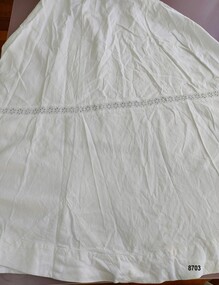
... textiles. At the beginning of the 19th century, the first embroidery machines were developed in St Gallen. Factories...textiles. At the beginning of the 19th century, the first embroidery machines were developed in St Gallen. Factories ...This item is one of a collection of clothing items that belonged to the Stephenson family who lived at 22 McCracken Street, Kensington, Melbourne. Matthew Stephenson (1861 – 1943) who had grown up on the Bendigo goldfields and shifted to Melbourne in the early 1900’s was a train driver and later, a fireman with the railways. His wife Elizabeth Jane (Betsy) Wigley (1865 – 1953) also grew up on the goldfields around Majorca and Bendigo. They married in 1885 in Bendigo. They had two daughters – Ethel Evelyn Stephenson (1886 – 1956) and Lillian or Lila (1891 – 1977) who were milliners and dressmakers and who continued to live in the family home after the death of their parents. The family are recorded as living at 22 McCracken Street, Kensington, as early as 1914. It is not known who made or owned the clothing that makes up this collection but as it appears to be from the late Victorian and early Edwardian era, the different pieces were probably made and worn by any of the three ladies of the house – Betsy, Ethel and/or Lila. During W.W.2, a local Warrnambool couple (Meryl and Tony Everard) boarded with them – Tony was in the airforce training paratroopers to jump into (and survive) enemy territory and his wife Meryl worked in the Methodist baby Home. The Everards developed a close friendship with the Stephensons and were responsible for clearing out the house (and finding this clothing collection) after Lila died in 1977. This skirt features broderie anglaise trim. Although broderie anglaise was a lace that could be made by hand, it was very time consuming to make. St Gallen was a city in Switzerland that had become known for producing quality textiles. At the beginning of the 19th century, the first embroidery machines were developed in St Gallen. Factories used embroidery machines but people also had them in their homes. They were able to produce broderie anglaise for export. By the early 20th century, machine made lace, fabric, ribbons etc. were being sold in drapers shops all over England and Wales to women who were making clothes and furnishings for their families. It is highly likely that the lady who made this skirt brought the lengths of broderie anglaise already made to embellish and personalise her skirt.This item is an example of the needlework skills of women in the late 19th century - creating pintucks and adding lace to personalise and embellish a practical item of clothing. A full length lady's skirt of heavy textured ribbed twill cotton. The top of the skirt is made from five pieces of fabric, sewn together and inserted into a simple waistband. It has an opening with room for 6 hook and eyes (but only the middle three remain). The top section of the skirt is separated from the bottom section by a strip of eyelet embroidery that has been inserted in a horizontal line at the back but becomes slightly diagonal at the front causing the two ends to cross in a decorative X fashion. The bottom of the skirt is the same heavy cotton as the top and one seam features a V shaped insert or patch.flagstaff hill maritime museum and village, great ocean road, shipwreck coast, warrnambool, broderie anglaise, needlework, sewing, stephenson family, skirt, lady's skirt
