
Showing 667 items matching " victorian era"
-
 Wodonga & District Historical Society Inc
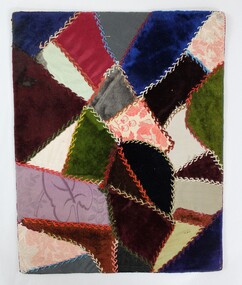
Textile - Hamilton-Smith Collection Victorian-era Crazy Quilt Sampler
... Hamilton-Smith Collection Victorian-era Crazy Quilt Sampler...Hamilton-Smith Collection Victorian-era Crazy Quilt Sampler...Crazy quilts were fashionable in the late Victorian era. The rise of the trend is attributed to the display of Japanese art and ceramics at the 1876 Philadelphia Centennial Exposition (U.S.A.) that featured asymmetrical designs. ...Hamilton-Smith Collection Victorian-era Crazy Quilt Sampler Textile Hamilton-Smith Collection Victorian-era Crazy Quilt Sampler ...The Hamilton-Smith collection was donated by the children of Grace Mary Hamilton-Smith nee Ellwood (1911-2004) and John Hamilton-Smith (1909-1984) who settled in Wodonga in the 1940s. The Ellwood family had lived in north-east Victoria since the late 1800s. Grace’s mother, Rosina Ellwood nee Smale, was the first teacher at Baranduda in 1888, and a foundation member of the C.W.A. Rosina and her husband Mark retired to Wodonga in 1934. Grace and John married at St. David’s Church, Albury in 1941. John was a grazier, and actively involved in Agricultural Societies. The collection contains significant items which reflect the local history of Wodonga, including handmade needlework, books, photographs, a wedding dress, maps, and material relating to the world wars. This quilt sampler was made before 1900 by Rosina Ellwood. Crazy quilts were fashionable in the late Victorian era. The rise of the trend is attributed to the display of Japanese art and ceramics at the 1876 Philadelphia Centennial Exposition (U.S.A.) that featured asymmetrical designs. Inspired, quilters began sewing pieces of fabric of different sizes and textures together into abstract, asymmetrical patterns. The craze spread from America around the world. Embroidery, ribbon and silk embellishments, and hand stitched applique birds and flowers were popular additions. One magazine estimated that a detailed crazy quilt could take over 1,500 hours to complete. Crazy quilts remained in fashion in metropolitan cities until about 1910, though the style endured for longer in rural areas. This item is unique, handmade and has a known owner. It forms part of a significant and representative historical collection which reflects the local history of Wodonga. It contributes to our understanding of domestic and family life in early twentieth century Wodonga, as well as providing interpretative capacity for themes including local history, social history and women’s history.A colourful patchwork quilt sampler using mixed fabric types including velvet, cotton, brocade and satin, backed on cardboard.hamilton-smith collection, hamilton-smith, stiching, needlework, sewing, handmade, domestic, quilt, quilts, crazy quilt, crazy quilts, women's history -
 Whitehorse Historical Society Inc.
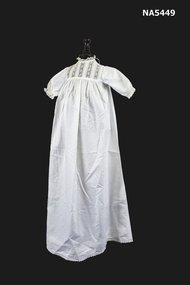
Clothing - Child's Nightgown, Victorian era Child's Nightgown, c 1900's
... Victorian era Child's Nightgown......Victorian era...Victorian era child's nightgown collected in Europe by Nan Wagner in the 1970's....Victorian era child's nightgown is made of white cotton with a lace yolk and pin tucks at the hem. ...Victorian era child's nightgown collected in Europe by Nan Wagner in the 1970's. ...Victorian era child's nightgown collected in Europe by Nan Wagner in the 1970's.Victorian era child's nightgown collected in Europe.Victorian era child's nightgown is made of white cotton with a lace yolk and pin tucks at the hem. There is feather stitching at the lower edge of the yolk. The back placket has handmade buttonholes and pearl shell buttons completed with a rouleau drawstring at the neckline. childs clothing, victorian era, handmade, cotton -
 Bendigo Historical Society Inc.
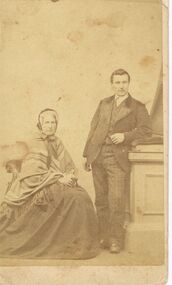
Photograph - BLACK AND WHITE PHOTOGRAPH OF MAN AND WOMAN WEARING VICTORIAN ERA CLOTHING
... BLACK AND WHITE PHOTOGRAPH OF MAN AND WOMAN WEARING VICTORIAN ERA CLOTHING...black and white photograph of man and woman wearing Victorian era clothing / old and stained / rear shows Logo - Wm Murray Photographer ...black and white photograph of man and woman wearing Victorian era clothing / old and stained / rear shows Logo - Wm Murray Photographer , 74 Broomielaw St Glasgow...PHOTOGRAPH Person male / female black and white photograph of man and woman wearing Victorian era clothing / old and stained / rear shows Logo - Wm Murray Photographer 74 Broomielaw St Glasgow black and white photograph of man and woman wearing Victorian era clothing / old and stained / rear shows Logo - Wm Murray Photographer , 74 Broomielaw St Glasgow Photograph BLACK AND WHITE PHOTOGRAPH OF MAN AND WOMAN WEARING VICTORIAN ERA CLOTHING ...black and white photograph of man and woman wearing Victorian era clothing / old and stained / rear shows Logo - Wm Murray Photographer , 74 Broomielaw St Glasgowphotograph, person, male / female, black and white photograph of man and woman wearing victorian era clothing / old and stained / rear shows logo - wm murray photographer , 74 broomielaw st glasgow -
 Bendigo Historical Society Inc.
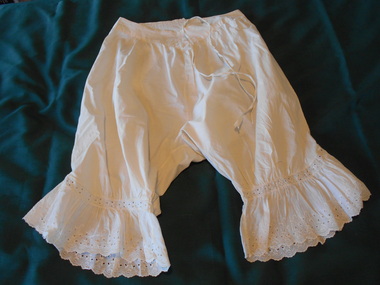
Clothing - MAGGIE BARBER COLLECTION: LADIES VICTORIAN ERA KNICKERS WITH DROP SEAT, 1870's
... MAGGIE BARBER COLLECTION: LADIES VICTORIAN ERA KNICKERS WITH DROP SEAT......Victorian Era Knickers...COSTUME Female underwear Victorian Era Knickers Printed in fine black ink on back opening; D.S.R.F. ...Clothing. White fine linen fabric, trimmed at lower leg with a 2 cms wide cotton , brooierie insertion and a 12 cm wide frill of textured (?) fine linen or cotton lawn broiderie. The front waistband dips to a central 8 cm deep peak. Waistband at side seams, is 4.5 cm deep and back waistband is 10 cm deep at side seams, and the 11 cm deep at centre back. Two 1.4 cm covered buttons close the back waistband. The knickers have a gathered opening panel, called at the time a ''drop-seat'' or ''access hatch'' at the centre back. This panel has a 5 cm deep waistband, fastened at either side by a covered button, and a third button at the centre. These buttons are sewn to the back waistband, and the button holes are sewn, correspondingly on the gathered back. A drawstring tape is also threaded through the back waistband. A 6 cm wide gussett sewn from the crotch extends 23 cms long.Printed in fine black ink on back opening; D.S.R.F. No 11.costume, female underwear, victorian era knickers -
![Victorian era cottage, Derby Street [Kew]](/media/collectors/550653872162f11fb04854aa/items/658f5772101c4283c6ae47ff/item-media/658f57e4101c4283c6ae493a/item-fit-380x285.jpg?cb=6) Kew Historical Society Inc
Kew Historical Society IncPhotograph - Victorian era cottage, Derby Street [Kew], c. 1965
... Victorian era cottage, Derby Street [Kew]...In nearby Derby Street, a number of original Victorian era buildings were gradually replaced due to development of the Baths precinct and commercial development....In nearby Derby Street, a number of original Victorian era buildings were gradually replaced due to development of the Baths precinct and commercial development. ...The current site of the Kew Recreation Centre in High Street Kew previously housed the Kew Depot on the corner of Disraeli Street. In nearby Derby Street, a number of original Victorian era buildings were gradually replaced due to development of the Baths precinct and commercial development.This work forms part of the collection assembled by the historian Dorothy Rogers (1905-1973), donated to the Kew Historical Society by her son in 2015. The manuscripts, photographs, maps, and documents were sourced by her from both family and local collections or produced as references for her print publications. Many were directly used by Rogers in writing ‘Lovely Old Homes of Kew’ (1961) and 'A History of Kew' (1973), or the numerous articles on local history that she produced for suburban newspapers. Most of the photographs in the collection include detailed annotations in her hand. The Rogers Collection provides a comprehensive insight into the working habits of a historian from the 1960s to the 1970s. Small single fronted cottage in Derby Street, Kew. The weatherboard cottage has a block fronted facade, and a Victorian verandah with cast iron lace.Annotation verso: "House in Derby St., next to Kew Baths (Demolished?)"dorothy rogers, derby street (kew), victorian houses -- kew (vic.) -
![Victorian era cottage, Derby Street [Kew]](/media/collectors/550653872162f11fb04854aa/items/658f7ef19239cf6fd436d1fd/item-media/658f7f019239cf6fd436d25f/item-fit-380x285.jpg?cb=6) Kew Historical Society Inc
Kew Historical Society IncPhotograph - Victorian era cottage, Derby Street [Kew], c. 1965
... Victorian era cottage, Derby Street [Kew]...In nearby Derby Street, a number of original Victorian era buildings were gradually replaced due to development of the Baths precinct and commercial development....In nearby Derby Street, a number of original Victorian era buildings were gradually replaced due to development of the Baths precinct and commercial development. ...The current site of the Kew Recreation Centre in High Street Kew previously housed the Kew Depot on the corner of Disraeli Street. In nearby Derby Street, a number of original Victorian era buildings were gradually replaced due to development of the Baths precinct and commercial development.This work forms part of the collection assembled by the historian Dorothy Rogers (1905-1973), donated to the Kew Historical Society by her son in 2015. The manuscripts, photographs, maps, and documents were sourced by her from both family and local collections or produced as references for her print publications. Many were directly used by Rogers in writing ‘Lovely Old Homes of Kew’ (1961) and 'A History of Kew' (1973), or the numerous articles on local history that she produced for suburban newspapers. Most of the photographs in the collection include detailed annotations in her hand. The Rogers Collection provides a comprehensive insight into the working habits of a historian from the 1960s to the 1970s. Small single fronted cottage in Derby Street, Kew. The weatherboard cottage has a block fronted facade, and a Victorian verandah with cast iron lace.dorothy rogers, derby street (kew), victorian houses -- kew (vic.) -
![Victorian era cottage, Gladstone Street [Kew]](/media/collectors/550653872162f11fb04854aa/items/658f6b449239cf6fd4368ae2/item-media/658f6b719239cf6fd4368bda/item-fit-380x285.jpg?cb=6) Kew Historical Society Inc
Kew Historical Society IncPhotograph - Victorian era cottage, Gladstone Street [Kew], c. 1965
... Victorian era cottage, Gladstone Street [Kew]...The weatherboard cottage has a block fronted facade, and a Victorian verandah with cast iron lace. Photograph Victorian era cottage, Gladstone Street [Kew] ...This work forms part of the collection assembled by the historian Dorothy Rogers (1905-1973), donated to the Kew Historical Society by her son in 2015. The manuscripts, photographs, maps, and documents were sourced by her from both family and local collections or produced as references for her print publications. Many were directly used by Rogers in writing ‘Lovely Old Homes of Kew’ (1961) and 'A History of Kew' (1973), or the numerous articles on local history that she produced for suburban newspapers. Most of the photographs in the collection include detailed annotations in her hand. The Rogers Collection provides a comprehensive insight into the working habits of a historian from the 1960s to the 1970s. Small single fronted cottage in Gladstone Street, Kew. The weatherboard cottage has a block fronted facade, and a Victorian verandah with cast iron lace.Annotation verso: "Mr Williams cottage in Gladstone St, Kew. He was Miss Louisa Henty's coachman. Hailed from West Indies. Built about 1900."dorothy rogers, victorian houses -- kew (vic.), houses -- gladstone street (kew), louisa henty, gardeners -- kew (vic.) -
 Warrnambool and District Historical Society Inc.
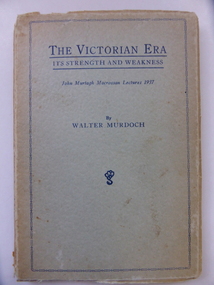
Book, The Victorian Era It's strengths & weaknesses, 1938
... The Victorian Era It's strengths & weaknesses...The pages of the book are stained and the binding on the spine has broken away. The Victorian Era It's strengths & weaknesses Book ...This book has been written by Walter Murdoch and it is the publication of two lectures given by Murdoch in 1937 (the John Murtagh Macrossan Memorial Lectures). John Murtagh Macrossan (1833-1891) was a Queensland politician who for some time held the seat of Townsville in the Queensland Parliament. He was born in Ireland and came to Australia in 1853, spending some time in the mining regions of Queensland. With Samuel Griffith he attended the first National Convention on Federation in 1891. Walter Murdoch (1874-1970) had a distinguished academic career and became Australia’s best-known essayist. He was a household name to two generations of Australians through his radio broadcasts and syndicated literary columns in several Australian newspapers. In 1901 Walter Murdoch came to Warrnambool and went into partnership with James Scott as proprietors of a private school, Warrnambool College. They bought out Stanley’s Warrnambool Grammar School and when Scott retired Murdoch became the sole proprietor and Head Master of Warrnambool College. While in Warrnambool in 1903 Murdoch wrote a school history book called ‘The Struggle for Freedom’, a book which sold 10,000 copies in its first year. Murdoch later became an English lecturer at Melbourne University and then the foundation Professor of English at the University of Western Australia. Murdoch University in Western Australia is named after him. He published over 40 books and he was knighted in 1964. This book is of interest as it was written by Walter Murdoch. He not only has a national reputation as an academic and writer but also he spent some time in Warrnambool and played his part in our history. This is a soft cover book of 66 pages. The cover was originally blue but is much faded, especially on the spine. The print on the cover and spine is dark blue and there is an ornamental edging on the front cover. The back of the cover has an advertisement for other Walter Murdoch books. The pages of the book are stained and the binding on the spine has broken away. walter murdoch, john murtagh macrossan, history of warrnambool, warrnambool college (early 20th century) -
 Kew Historical Society Inc
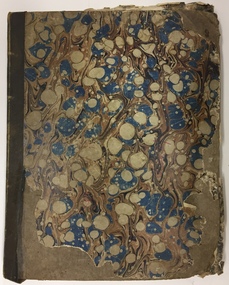
Album, Louisa G Thomas, Victorian Era Sketchbook, 1862
... Victorian Era Sketchbook...Some items may be published separately on Victorian Collections, but will acknowledge their origins in the sketchbook. Victorian Era Sketchbook Album Album Louisa G Thomas ...Louisa Thomas married Henry Gipps (1837-91)in 1863. They had six sons and two daughters. While Louisa and Henry Gipps were to die in Sussex, two of their sons, Frederick George De Visme Gipps (1867-1953) and Richard Brook Woodthorpe Gipps (c.1872-1946) migrated to Queensland, possibly bringing with them their mother’s sketchbook.The collection of artworks that are included in the sketchbook are often of outstanding aesthetic and artistic significance. In the variety of subject matter and the geographical places represented, it is historically significant as a document recording the postings of Colonel Henry Gipps, 9th Norfolk Regiment, and his wife Louisa to locations in the Mediterranean and West Asia. The large bound sketchbook has a marbled cover with blue binding. The name Louisa Goulburn Thomas and the date 1862 are faintly inscribed in pencil on the front page. However the book contains pen and ink and pencil drawings, watercolours, and photographs, which both predate and postdate 1862. The approximately 75 works are loose-leafed items and [currently] do not form a chronological, geographical or thematic sequence. Creators identified on some drawings and watercolours include Mary Julia Wilder Thomas, JFV Wright, ELG (Edward Louis de Bondell Gipps?), L Nicholson, Bertha Isadore Thomas, and HG (Henry Gipps?). Many of the works are signed and dated, and include rural landscapes and seascapes, archaeological sites, animal studies, and portraits. While most of the works were created in the British Isles, others are scenes of Venice, the Ionian Islands, Cape Town, Hong Kong and Japan. [A number of the ‘oriental’ paintings on silk were probably purchased from local artists.] The art works in the book are at various stages of completion and represent a diverse range of artistic skills. What may be the earliest work in the sketchbook is a drawing of three uniformed soldiers. An annotation on the reverse records that the drawing is of a Group of Soldiers after [Philipp Jakob] de Southerbourg 1830. The birth of Louisa Thomas' oldest son, William Henry Houston Meyrick Gipps (1864-1903) in Corfu perhaps explains why a number of scenes and items in the album are of the Ionian Islands. Louisa is probably the creator of a number of still life and botanical studies in the album. These range from floral studies to a bird’s nest. The painting of objects was to remain a socially ‘approved’ specialty of amateur and professional women artists into the 20th century. The complete contents of the album will be uploaded to accompany this record. Some items may be published separately on Victorian Collections, but will acknowledge their origins in the sketchbook."Louisa Goulburn Thomas / 1862"victorian sketchbooks, manuscripts - kew historical society, 9th norfolk regiment, rosemary (gipps) vaughan smith, vaughan-smith collection -
 Flagstaff Hill Maritime Museum and Village
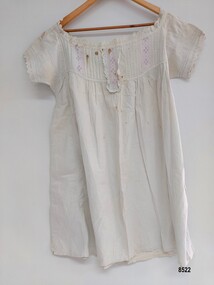
Clothing - Chemise, Eliza Towns, Late Victorian era
... ...victorian era...Late Victorian era...It is also significant as an example of a practical solution to the difficulties of needing to regularly hand wash a bulky outer garment or gown in the Victorian era. Flagstaff Hill Flagstaff Hill Maritime Museum and Village Warrnambool Great Ocean Road south west victoria victorian era Victorian era undergarments chemise victorian era chemise undergarments pintucks Victorian chemise Eliza Towns Nhill Wimmera home sewing machine sewn hand made A white cotton, short sleeved, knee length chemise. ...This chemise is one of several linen and clothing items that were made and belonged to Mrs. Eliza Towns and donated to Flagstaff Hill Maritime Museum and Village. Eliza was born Eliza Gould in 1857 in South Melbourne (Emerald Hill) and in 1879 married Charles Towns. In the early 1880's they moved to Nhill in western Victoria and remained there for the rest of their married life. Charles was a jeweller and later became an accountant and for many years was involved with the Shire Council, the local show committee (A & P Society), the Hospital Committee and the Board of the local newspaper (the Nhill Free Press). They had three children and lived a life that would be regarded as comfortably "middle class". Eliza probably had a treadle sewing machine and would have made many of her own clothes as well as clothes for her children - adding her own handmade embroidered or crocheted decorative trim. This chemise is machine sewn by Eliza Towns and she has added pintucks and broderie anglaise lace as a decorative element. A chemise was usually a sleeveless garment made of linen or cotton (so they could be easily washed) and its shape was much like a modern day nightgown. The name comes from the French word for "shirt" or "shift". Women wore chemises next to the skin (under the corset) to keep stains and odors away from the less washable corset and gown.This item is an example of the needlework skills of women in the mid to late 19th century - combining machine stitching with hand embroidery to personlise and embellish an item of clothing. It is also significant as an example of a practical solution to the difficulties of needing to regularly hand wash a bulky outer garment or gown in the Victorian era.A white cotton, short sleeved, knee length chemise. The fabric at the front is gathered on a yoke which is decorated with bands of five pintucks alternating with broderie anglaise lace and embroidered strips lined with pink ribbon. A different broderie anglaise design decorates the sleeve edges, neckline and center broderie anglaise strip. The back of the chemise is gathered on to the neckline. There are two bands of pintucks on each sleeve. The fabric around each armhole has been strengthened with another layer of cotton and a length of cotton has been added (from the left shoulder to the hem) to increase the width of chemise.flagstaff hill, flagstaff hill maritime museum and village, warrnambool, great ocean road, south west victoria, victorian era, victorian era undergarments, chemise, victorian era chemise, undergarments, pintucks, victorian chemise, eliza towns, nhill, wimmera, home sewing, machine sewn, hand made -
 Bendigo Historical Society Inc.
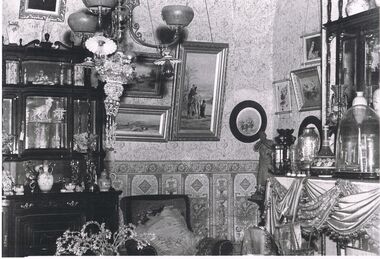
Photograph - ALBERT RICHARDSON COLLECTION: INTERNAL ROOM FORTUNA
... ...Victorian era...Black and white photograph of a room at Fortuna Villa. Victorian era furniture, paintings, statuettes, hanging light with small chandelier, jars/urns, chair with decorative pillow show the opulent furnishings of an internal room at Fortuna....George Lansell Victorian era Black and white photograph of a room at Fortuna Villa. ...Black and white photograph of a room at Fortuna Villa. Victorian era furniture, paintings, statuettes, hanging light with small chandelier, jars/urns, chair with decorative pillow show the opulent furnishings of an internal room at Fortuna.fortuna villa, internal room at fortuna., george lansell, victorian era -
 Flagstaff Hill Maritime Museum and Village
Accessory - Brooch, late-19th to early 20th century
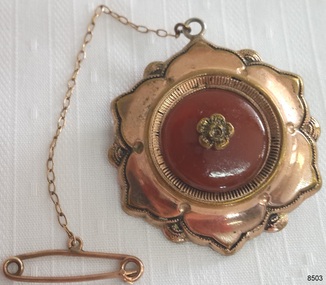
... ...Victorian era...This brooch with its floral design is typical of the jewellery worn during the Romantic Period of the Victorian Era, when Queen Victoria's husband, Prince Albert, was alive 1837-1861. ...This brooch with its floral design is typical of the jewellery worn during the Romantic Period of the Victorian Era, when Queen Victoria's husband, Prince Albert, was alive 1837-1861. ...This brooch with its floral design is typical of the jewellery worn during the Romantic Period of the Victorian Era, when Queen Victoria's husband, Prince Albert, was alive 1837-1861. During this period flower motifs and brooches and pins were popular.This brooch is representative of jewellery worn during the Romantic Period of Queen Victoria's rule, 1837-1861.Brooch, light weight, rose coloured gold metal with red- brown onyx stone. Flower shaped brooch with six petals, stone attached, with rose design stem which is flanged on back. Backing plate is also rose coloured metal. A small ring is attached to the top of the brooch where the safety chain is attached. There are two small holes on back of brooch. A chain is attached to the horizontal pin on the back, and has a pin on its end. There is an Inscription engraved on the back. Engraved in script, "Coco" [Italian word for gold]flagstaff hill, warrnambool, shipwrecked coast, flagstaff hill maritime museum, maritime museum, shipwreck coast, flagstaff hill maritime village, great ocean road, ladies jewellery, victorian era jewellery, jewellery inscribed 'coco', brooch, jewellery, ladies' jewellery, victorian era, romantic period -
 Bendigo Historical Society Inc.
Photograph - BLACK AND WHITE PHOTOGRAPH: MAN WOMAN AND DOG
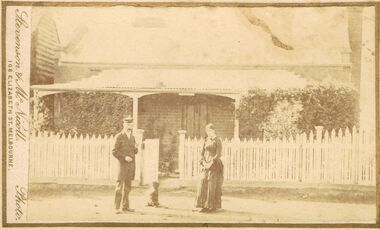
... Man woman and dog black wearing Victorian era clothing / / -Stevenson & McNicoll late Benson & Stevenson Photographers 108 Elizabeth Street Melbourne / / Mrs Goggin & husband...black and white photograph - Man woman and dog black wearing Victorian era clothing / old and stained / bottom and rear shows Logo -Stevenson & McNicoll late Benson & Stevenson Photographers 108 Elizabeth Street Melbourne / 'Light & Truth -Copies of this portrait can be had at any time by sending the name and Post Office Money Order or stamps for the amount of order' / Mrs Goggin & husband...PHOTOGRAPH Person male / female Man woman and dog black wearing Victorian era clothing / / -Stevenson & McNicoll late Benson & Stevenson Photographers 108 Elizabeth Street Melbourne / / Mrs Goggin & husband black and white photograph - Man woman and dog black wearing Victorian era clothing / old and stained / bottom and rear shows Logo -Stevenson & McNicoll late Benson & Stevenson Photographers 108 Elizabeth Street Melbourne / 'Light & Truth -Copies of this portrait can be had at any time by sending the name and Post Office Money Order or stamps for the amount of order' / Mrs Goggin & husband Photograph BLACK AND WHITE PHOTOGRAPH: MAN WOMAN AND DOG ...black and white photograph - Man woman and dog black wearing Victorian era clothing / old and stained / bottom and rear shows Logo -Stevenson & McNicoll late Benson & Stevenson Photographers 108 Elizabeth Street Melbourne / 'Light & Truth -Copies of this portrait can be had at any time by sending the name and Post Office Money Order or stamps for the amount of order' / Mrs Goggin & husbandphotograph, person, male / female, man woman and dog black wearing victorian era clothing / / -stevenson & mcnicoll late benson & stevenson photographers 108 elizabeth street melbourne / / mrs goggin & husband -
 Embroiderers Guild, Victoria
Textile - Jane Moore Sampler 1854, Jane Moore, 1854
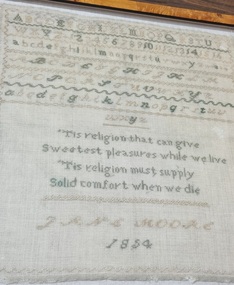
... Victorian era cross stitch sampler...Framed Victorian era sampler in cream and green silk threads on hand woven linen. ...Victorian era cross stitch sampler Alphabets numbers " 'Tis religion that can give sweetest pleasures whilst we live 'Tis religion must supply solid comfort when we die" Jane Moore 1854 Framed Victorian era sampler in cream and green silk threads on hand woven linen. ...Victorian era cross stitch samplerFramed Victorian era sampler in cream and green silk threads on hand woven linen. Upper and lower case alphabets in two fonts and numbers 1-16 with religious inscription. " 'Tis religion that can give sweetest pleasures whilst we live 'Tis religion must supply solid comfort when we die" Jane Moore 1854alphabets, numbers -
 Flagstaff Hill Maritime Museum and Village
Accessory - Gold Cross, Bef. 01-06-1878
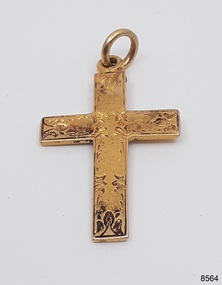
... ...Victorian era...The top edge has remnants of red-black colour. Victorian era cross, ca. 1878. The cross was recovered from the wreck of the ship Loch Ard....The top edge has remnants of red-black colour. Victorian era cross, ca. 1878. The cross was recovered from the wreck of the ship Loch Ard. ...The gold cross was discovered by Victorian scuba diver Julie Wilkins, who had already experienced more than 500 dives in Australia and overseas. She was holidaying in Peterborough, Victoria, and looking forward to discovering more about the famous Loch Ard ship, wrecked in June 1878 at Mutton Bird Island. The fast Glasgow-built clipper ship was only five years old when the tragedy occurred. There were 54 people on board the vessel and only two survived Julie's holiday photograph of Boat Bay reminds her of her most memorable dive. Submerged in the calm, flat sea, she was carefully scanning around the remains of the old wreck when, to her amazement, a gold coin and a small gold cross suddenly came up towards her. She excitedly cupped them in her hands, then stowed the treasures safely in her wetsuit and continued her dive. She soon discovered a group of brass carriage clock parts and some bottles of champagne. It was a day full of surprises. The items were easily recognisable, without any build-up of encrustations or concretion. Julie secretly enjoyed her treasures for twenty-four years then packed them up for the early morning train trip to Warrnambool. After a short walk to Flagstaff Hill Maritime Museum and Village, her photograph was taken as she handed over her precious find. She told her story to a local newspaper reporter, lunched a café in town then took the late afternoon train home. Her generous donation is now part of a vast collection of Loch Ard shipwreck artefacts, including the gold watch and the Minton Majolica model peacock. The small decorative cross dates back to on or before 1878, when the Loch Ard had set sail. The loop and ring have been added, perhaps as a pendant, pocket watch accessory or similar purpose. It may have been worn for ‘good luck’ or a ‘blessing’ on the long journey to Australia, where ships had to carefully navigate the treacherous Bass’s Strait before arriving at their destination of Melbourne. Sadly, many met their fate on that short stretch of ocean aptly named the Shipwreck Coast. The cross is very recognisable even though it was exposed to the wrecking of the ship, its consequent movement, and the sea's turbulence. Its scratched, pitted and worn condition, and the damage near the loop, is part of its story. The red-brown-black discolouration is similar to that found on other gold coins, sometimes called the ‘corrosion phenomena’. Studies suggest the possible cause is contaminants in the minting process reacting to the coins’ environment. Three edges of the cross have slightly raised narrow ridges of gold which could have been cause by the gold being cast liquid gold into a mould.This gold cross pendant is significant as a symbol of Christianity, a sign of hope and safety, and a sample of the religious following on board the Loch Ard, although not everyone wears a cross for this reason. This cross is a sample of jewellery owned by people migrating to Australia in the late 19th century. The cross and the guinea recovered together from the wreck of the Loch Ard are made of gold and help interpret the financial status of some of those on board.Gold cross; yellow gold with decorative hand engraved foliage design on the front, fitted loop and ring on top. The simple Latin or Roman variation of the cross, with an elongated vertical arm, has no figure on it and the reverse has no decoration. The right, left and base edges have sections of narrow, long slightly raised ridges. The top edge has remnants of red-black colour. Victorian era cross, ca. 1878. The cross was recovered from the wreck of the ship Loch Ard.Engraved foliage design. Slightly raised long ridges on sides and base edges. flagstaff hill maritime museum and village, warrnambool, great ocean road, shipwreck coast, gold cross, religious cross, religious trinket, religious jewellery, engraved cross, cross pendant, cross with ring, victorian era, 1878, antique cross, crucifix, religious symbol, christian symbol, christian jewellery, contamination phenomena, gold corrosion, good luck, lucky charm, blessing, pendant, loch ard, wreck of the loch ard, mutton bird island, peterborough, scuba diver, 1980s, shipwreck artefact, relic, latin cross, roman cross, pectoral cross, julie wilkins -
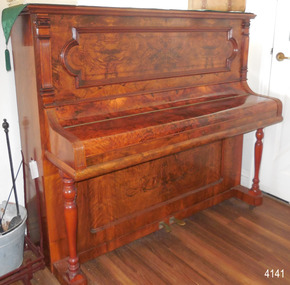 Flagstaff Hill Maritime Museum and Village
Instrument - Musical, Piano, Renardi, c. 1900
... ...victorian era...This solid, late Victorian era piano is branded Renardi, which is a German name. ...This solid, late Victorian era piano is branded Renardi, which is a German name. ...This solid, late Victorian era piano is branded Renardi, which is a German name. In the late 19th century thousands of pianos were exported from Germany to Australia. Some, unfortunately, were amongst the cargo of shipwrecks. It seems that the Renardi pianos were not made by a Renardi company but made to order by any of a number of German piano manufacturer and branded for distribution by Australian music stores.This Renardi piano represents an era where musical gatherings were part of domestic entertainment. Pianos were ialso installed in clubs, public halls and hospitality businesses for song nights and concerts were encouraged for community unity.Piano, upright, walnut veneer with floral design on panels. Turned columns, hinged lid and two metal pedals. Branded Renardi, a German name, made c. 1900. "RENARDI"flagstaff hill, warrnambool, shipwrecked-coast, flagstaff-hill, flagstaff-hill-maritime-museum, maritime-museum, shipwreck-coast, flagstaff-hill-maritime-village, musical instrument, upright piano, german, renardi, victorian era, late 19th century, entertainment -
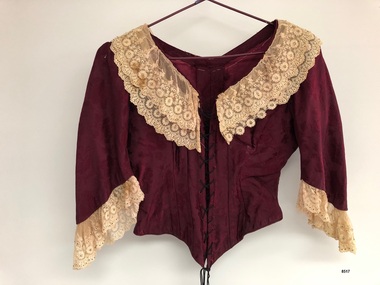 Flagstaff Hill Maritime Museum and Village
Costume - Satin Bodice
... ...Victorian era...The bodice is of a style from the Victorian Era and so provides a good example of women's clothing from that time. ...The bodice is of a style from the Victorian Era and so provides a good example of women's clothing from that time. ...The bodice is of a style from the Victorian Era and so provides a good example of women's clothing from that time. Although it appears to have been made at a later time the lace possibly came from an earlier time period. It is of historic interest as it was amongst the belongings of the donor's Great Aunts who were both dressmakers at the original Terang & District Co-Op which was established in 1908.The item is of significance socially as an example of women's clothing in the Victorian era.A short, waist-length bodice most likely made as a performance costume. It is representative of a Victorian bodice style though the lacing used indicates that it would not have been worn in those times due to its revealing design. Flexible metal stays provide shape to the bodice at the front and back. Sleeves are elbow length and lined with cream fabric. The bodice has a lace collar and the sleeves are trimmed with the same lace. Small gold coloured beads are stitched to the flower centres of the lace pattern. The burgundy coloured satin has an embossed floral pattern. The lace is of interest as it is from an older time period and being beaded would be especially sought after. Machine and hand stitched.flagstaff hill, warrnambool, maritime village, maritime museum, flagstaff hill maritime museum & village, shipwreck coast, great ocean road, satin bodice, beaded lace, victorian era, metal stays, terang & district co-op -
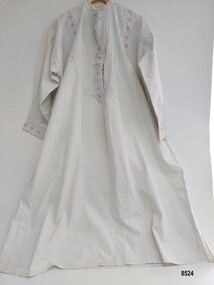 Flagstaff Hill Maritime Museum and Village
Clothing - Nightgown, Eliza Towns, circa 1890's
... ...Victorian era clothing...The 1800's bought a shift in attitude towards modesty as the Victorian era progressed and by the mid to late 1800's it had become more acceptable ladies to wear simple, modest nightgowns. ...The 1800's bought a shift in attitude towards modesty as the Victorian era progressed and by the mid to late 1800's it had become more acceptable ladies to wear simple, modest nightgowns. ...This nightgown is one of several linen and clothing items that were made and belonged to Mrs. Eliza Towns and donated to Flagstaff Hill Maritime Museum and Village. Eliza was born Eliza Gould in 1857 in South Melbourne (Emerald Hill) and in 1879 married Charles Towns. In the early 1880's they moved to Nhill in western Victoria and remained there for the rest of their married life. Charles was a jeweller and later became an accountant and for many years was involved with the Shire Council, the local show committee (A & P Society), the Hospital Committee and the Board of the local newspaper (the Nhill Free Press). They had three children and lived a life that would be regarded as comfortably "middle class". Eliza probably had a treadle sewing machine and would have made many of her own clothes as well as clothes for her children - adding her own handmade embroidered or crocheted decorative trim. This nightgown is machine sewn by Eliza Towns and she has added a detailed design of pintucks and broderie anglaise lace to the front yoke and cuffs as a decorative element. The 1800's bought a shift in attitude towards modesty as the Victorian era progressed and by the mid to late 1800's it had become more acceptable ladies to wear simple, modest nightgowns. They tended to have a very loose fit and were usually made of linen, cotton or flannel, which had the advantage of providing warmth and also being easy to wash - a necessity for a garment worn next to the skin. Although the basic design of the nightgown was fairly simple, the wearer was free to add various types of trim e.g. lace, crochet, pintucks, embroidery etc.This item is an example of the needlework skills of women in the late 19th century - combining machine stitching with hand embroidery to personalise and embellish a practical item of clothing. It is also significant as an example of a practical solution to the difficulties that women of this era faced with regard to the washing of clothes and household linens.Lady's long, white, cotton nightgown with a V shaped bodice decorated with bands of nine pintucks alternating with strips of broderie anglaise lined with pink ribbon. The opening front placket and neckline are bordered with a simpler broderie anglaise lace. The long sleeves are gathered into cuffs with a matching V shape, pintuck and broderie anglaise design. The front placket fastens with three cream buttons although one is missing. The back of the nightgown has gathered fabric on a plain, narrow V shape yoke. A narrow gusset has been added to the both sides at the bottom of the nightgown.Noneflagstaff hill, flagstaff hill maritime museum and village, warrnambool, great ocean road, shipwreck coast, victorian era clothing, victorian era nightgown, nightgown, nightdress, eliza towns, nhill, wimmera, textiles, clothing, machine sewing, hand sewing, pintucks, broderie anglaise, sewing -
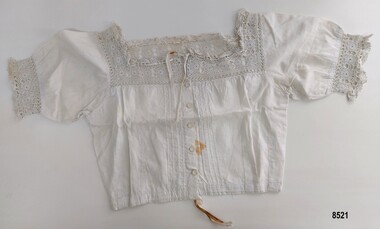 Flagstaff Hill Maritime Museum and Village
Clothing - Corset cover, Eliza Towns, Mid to late 19th century
... ...victorian era underclothing...This corset cover is an excellent example of an everyday clothing item with the decorative trim favoured by women in the late Victorian era. Eliza Towns has added pintucks, embroidered feather stitch and a highly decorative hand crocheted lace trim to the neckline, sleeves and front of the bodice. ...It is also significant as an example of a practical solution to the difficulty of hand washing a corset in the Victorian era. Flagstaff Hill Flagstaff Hill Maritime Museum & Village Warrnambool Great Ocean Road Shipwreck coast Nhill Wimmera Eliza Towns underclothing corset cover camisole machine sewing hand sewing crocheted lace pintucks feather stitch embroidery underwear victorian era underclothing victorian era corset cover A short (waist length) corset cover of fine cotton. ...This corset cover is one of several linen and clothing items that were made and belonged to Mrs. Eliza Towns and donated to Flagstaff Hill Maritime Museum and Village. Eliza was born Eliza Gould in 1857 in South Melbourne (Emerald Hill) and in 1879 married Charles Towns. In the early 1880's they moved to Nhill in western Victoria and remained there for the rest of their married life. Charles was a jeweller and later became an accountant and for many years was involved with the Shire Council, the local show committee (A & P Society), the Hospital Committee and the Board of the local newspaper (the Nhill Free Press). They had three children and lived a life that would be regarded as comfortably "middle class". Eliza probably had a treadle sewing machine and would have made many of her own clothes as well as clothes for her children - adding her own handmade embroidered or crocheted decorative trim. This corset cover is an excellent example of an everyday clothing item with the decorative trim favoured by women in the late Victorian era. Eliza Towns has added pintucks, embroidered feather stitch and a highly decorative hand crocheted lace trim to the neckline, sleeves and front of the bodice. Corset covers (sometimes called camisoles) began to appear in women's fashion around 1840 and continued through the late Victorian decades into the Edwardian era. The long chemise was considered too bulky to cover the corset and so the corset cover was developed to be short and light and was worn over the corset and under the bodice of the outer garment. A woman would dress into her chemise and drawers first, followed by her corset and finally her corset cover as a final layer under her dress. Corset covers served several purposes. They provided protection against sweat (and the need to regularly wash the corset), helped smooth the lines of the corset and increased a woman's modesty.This item is an example of the needlework skills of women in the late 19th century - combining machine stitching with hand embroidery and crochet to embellish an item of personal underclothing. It is also significant as an example of a practical solution to the difficulty of hand washing a corset in the Victorian era.A short (waist length) corset cover of fine cotton. Short sleeves fall from a square neckline and are gathered into a wide crocheted lace trim with a band of embroidered feather stitch. The same crocheted lace design and feather stitching are also on the square neckline which is finished with a drawstring ribbon. The bodice has a front opening with five buttons and is bordered on each side with four pintucks. It has a drawstring ribbon at the waist and an extra layer of fine cotton lining has been added to strengthen the corset cover under the arms. The back has two bands of three pintucks running vertically from the neckline to the waist.flagstaff hill, flagstaff hill maritime museum & village, warrnambool, great ocean road, shipwreck coast, nhill, wimmera, eliza towns, underclothing, corset cover, camisole, machine sewing, hand sewing, crocheted lace, pintucks, feather stitch, embroidery, underwear, victorian era underclothing, victorian era corset cover -
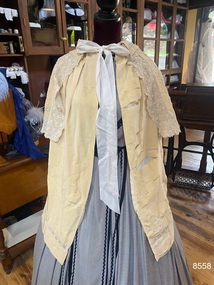 Flagstaff Hill Maritime Museum and Village
Clothing - Double Cape with Collar
... ...Victorian era...The cape is of a style from the Victorian or the Edwardian Era and so provides a good example of women's clothing from that time. ...The item is of significance historically and socially as an example of women's clothing in the Victorian and Edwardian eras. Flagstaff Hill Warrnambool Maritime Village Maritime Museum Flagstaff Hill Maritime Museum and Village Shipwreck coast Great Ocean Road Ladies Cape Double cape Silk cape Layered cape Cape with lace collar decorative lace edging Victorian era Edwardian era Ladies cape consisting of two circular tiers and a collar. ...The cape is of a style from the Victorian or the Edwardian Era and so provides a good example of women's clothing from that time. The light colour, silk material and lace suggest a cape used for special occasions with the possibility of initially being a wedding cape.The item is of significance historically and socially as an example of women's clothing in the Victorian and Edwardian eras.Ladies cape consisting of two circular tiers and a collar. The inner tier is knee length with a thin lace insert around the hem. The outer tier is elbow length with a wide lace edge and the thin lace insert inside this. The collar has lace edging and a lace insert of the same width. The lace used is of a repeat flower pattern most likely made of a combination of silk and cotton. The cape material appears to be a cream ribbed silk with the lining being of a polished cotton or silk variety. Both materials have a silken sheen in the right light. A silk ribbon ties the cape at the neck. The lining and lace have been sewn with fine hand stitching.flagstaff hill, warrnambool, maritime village, maritime museum, flagstaff hill maritime museum and village, shipwreck coast, great ocean road, ladies cape, double cape, silk cape, layered cape, cape with lace collar, decorative lace edging, victorian era, edwardian era -
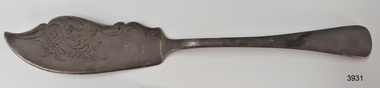 Flagstaff Hill Maritime Museum and Village
Domestic object - Butter Knife, Barker Brothers, Ca. 1885-1895
... ...Victorian era...The use of pseudo hallmarks by electroplaters of the Victorian era was common practice but it was illegal. ...The use of pseudo hallmarks by electroplaters of the Victorian era was common practice but it was illegal. ...This butter or cheese knife is a decorative example of electroplated cutlery that had become an affordable alternative to more expensive silver cutlery in the late 1800s to early 1900s. The knife has stamp marks in the back of its handle that are a combination of letters and symbols used by British silversmiths to identify their workmanship. The design and type of this knife was not normally used by everyday people but rather those of a higher social class with time and money to have a particular decorative knife to serve butter or cheese. The marks on the handle tell that it was made of nickel silver, and electroplated with superior quality Stirling silver. The Barker Brothers of Birmingham made the knife between 1885 and 1907, but most likely before 1895. It was made for the British, or British colonial, people, connected with a government department such as the navy or defence. This story may be slightly inaccurate, as some silversmiths added extra ‘pseudo marks’ to their wares to disguise the quality. THE MARKS and their meaning – - ‘A1’ The silver used in electroplating this knife was the highest level, ‘superior quality’, measured in grams of silver per table spoon or table fork, with ‘A1’ being 2 2/3 grams, and ‘D’ being 0 1/2 grams of silver. - ‘BB’ The Baker Brothers used these initials from 1885 to 1907. - ‘[crown symbol]’ – This symbol is used for Sterling silver but this knife is a metal alloy. The crown is also the town mark of Sheffield (appointed by the Sheffield Assay Office) but this knife was made in Birmingham, which has the town mark of an anchor. The Barker Brothers may have added the crown mark to this electroplated silverware as a ‘pseudo hallmark’, leading the buyer to think that it was actual Sterling silver. The use of pseudo hallmarks by electroplaters of the Victorian era was common practice but it was illegal. In 1895 the unlawful practice was seen as imitating the Sheffield Silver Mark and the law was firmly applied to eradicate the deception, so items with this mark probably date before 1895. - [EPNS] Electro Plated Nickel Silver, called nickel silver or German silver, is a metal alloy that usually combines copper, nickel and zinc (60 percent copper, 20 percent nickel, 20 percent zinc). It has a silver-white appearance and is sometimes referred to as ‘white ware’. It does not contain any silver but is often used as a base for electroplating, when the item is covered with a thin layer of silver to give it the polished appearance of pure silver. It became popular in the late 19th and early 20th century as an affordable substitute for sterling silver. - Broad Arrow - an official stamp that indicates it was once the property of Britain government, either in Britain or one of its colonies, and used in the defence force. In Great Britain, from an 1875 government act, it was, and still, is a crime to forge or wrongfully use, the broad arrow symbol. The BARKER BROTHERS of Birmingham - Barker Brothers were one of the earlies firms of Birmingham silversmiths, established in 1801 by Mary Barker. They became Barker & Creed, then William and Matthias Barker, then from 1885 they were the Barker Brothers. They were operating in Paradise Street in 1871 until in 1903 they moved to Unity Works, Constitution Hill, in Birmingham. The firm also had a showroom at 292 High Holborn, London, from the early 1900s to the 1980s. In 1907 the firm became Barker Brothers Silversmiths Ltd, then in the 1960s they merged with Ellis & Co, becoming Barker Ellis Silver Co. Ltd. In 1979 they were registered in USA as Ellis & Co., Barker Ellis, and Ellis Barker. The business went into administration in 1992, after almost 200 years of production. The firm advertised as specialists in electroplating, and used the trademarks BRITANOID, UNITY PLATE and THE HYGENIA.This knife is historically significant, dated from 1885 to 1907 but most likely pre-1895, and made by the longstanding Birmingham silversmiths, the Barker Brothers, established in 1801. The knife is an example of decorative flatware used by people of ’class’. It also has the broad arrow stamp, connecting it to the British government, in particular the ordinance department. The stamp also connects it to other items in our collection with that stamp. It may have been connected to pre-Federation government organisations and officials such as the army Garrison, government naval vessel, police, lighthouse keepers, harbour masters. The knife is the only example of its kind in our collection, being a decorative silver butter or cheese knife, made by the Barker Brothers of Birmingham. Butter knife, or cheese knife, electroplated nickel silver (EPNS). Upper blade edge has decorative shape and engraved motifs, lower blade edge is bevelled to a cutting edge, and narrow plain handle flares out to a wide, rounded end. Maker’s marks are stamped on the reverse. Made by Barker Brothers of Birmingham in the late-19th century. Stamps: “flagstaff hill, warrnambool, maritime village, maritime museum, flagstaff hill maritime museum & village, shipwreck coast, great ocean road, butter knife, cheese knife, electroplate, electro plate, nickel silver, nickel alloy, alloy composition, copper nickel zinc, german silver, epns, barker brothers, birmingham, london, silversmiths, victorian era, 19th century, a1, bb, crown inside square, broad arrow, flatware, tableware, cutlery, cutler, dining utensils, eating utensils, superior quality, pseudo hallmark, stirling silver, silver-white metal, mary barker, barker & creed, william barker, matthias barker, barker brothers silversmiths, barker ellis silver co, ellis & co, barker ellis, ellis barker, britanoid, unity plate, the hygenia, british, colonial, government use, defence department use, naval use, knife, serving knife -
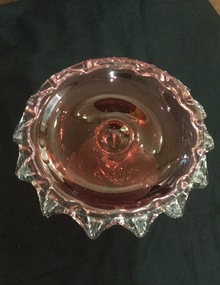 Mont De Lancey
Cake stand
... Ruby glass footed cake stand with clear fluted edge. Victorian era....cake stands tableware Ruby glass footed cake stand with clear fluted edge. Victorian era. Cake stand ...Ruby glass footed cake stand with clear fluted edge. Victorian era.cake stands, tableware -
 Whitehorse Historical Society Inc.
Leisure object - Hoop and Skimmer
... Victorian era metal hoop with skimmer. Skipper has curved hook at one end....toys games Victorian era metal hoop with skimmer. Skipper has curved hook at one end. ...Victorian era metal hoop with skimmer. Skipper has curved hook at one end.toys, games -
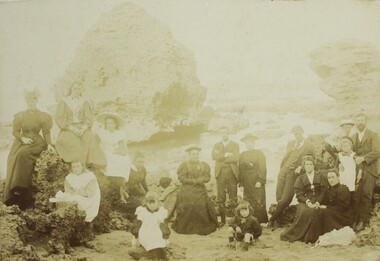 Wodonga & District Historical Society Inc
Photograph - Haeusler Collection Photograph Group Portrait by Seaside late 1800s
... A sepia toned group portrait photograph of people wearing Victorian era clothing at the seaside. ...It contributes to our understanding of domestic and family life in early twentieth century Wodonga, as well as providing interpretative capacity for themes including local history and social history. photograph photography family photograph portrait photographic portrait seaside ocean beach victorian wodonga haeusler collection A sepia toned group portrait photograph of people wearing Victorian era clothing at the seaside. Haeusler Collection Photograph Group Portrait by Seaside late 1800s Photograph Haeusler Collection Photograph Group Portrait by Seaside late 1800s ...The Wodonga Historical Society Haeusler Collection provides invaluable insight into life in late nineteenth and early twentieth century north east Victoria. The collection comprises manuscripts, personal artefacts used by the Haeusler family on their farm in Wodonga, and a set of glass negatives which offer a unique visual snapshot of the domestic and social lives of the Haeusler family and local Wodonga community. The Haeusler family migrated from Prussia (Germany) to South Australia in the 1840s and 1850s, before purchasing 100 acres of Crown Land made available under the Victorian Lands Act 1862 (also known as ‘Duffy’s Land Act’) in 1866 in what is now Wodonga West. The Haeusler family were one of several German families to migrate from South Australia to Wodonga in the 1860s. The photographer and subjects of this photograph are unidentified. It belongs to a collection of Haeusler family personal belongings, and is possibly a family photograph. This item is unique and has well documented provenance and a known owner. It forms part of a significant and representative historical collection which reflects the local history of Wodonga. It contributes to our understanding of domestic and family life in early twentieth century Wodonga, as well as providing interpretative capacity for themes including local history and social history.A sepia toned group portrait photograph of people wearing Victorian era clothing at the seaside. photograph, photography, family photograph, portrait, photographic portrait, seaside, ocean, beach, victorian, wodonga, haeusler collection -
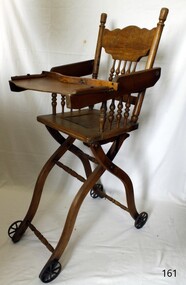 Flagstaff Hill Maritime Museum and Village
Furniture - Childs high chair, 1890 - 1900
... Convertible pressed back Victorian era high chair with convertible frame, cast iron wheels, ...A significant item giving a snapshot into the evolution of children's furniture and domestic life during the late Victorian era. flagstaff hill warrnambool shipwrecked coast flagstaff hill maritime museum shipwreck coast flagstaff hill maritime village great ocean road high chair potty chair baby furniture kitchen furniture Carved picture of a child to back of seat Convertible pressed back Victorian era high chair with convertible frame, cast iron wheels, Furniture Childs high chair ...It appears that the earliest form of child's high chair is attributed to Jonathan Jacobs (1845-1919) a cabinet maker of Browningsville, Pennsylvania USA around the mid to late 19th century. However, children’s chairs from the 18th century and earlier were being used and are in many museum collections around the world that show woodworkers were adapting chair designs for younger users in Europe and America at this time.An early children's wooden high chair probably made in America around 1890-1900. Many American manufactures made this type of wooden high chair called an “Eastlake” style and many did not mark their work so it is difficult to determine the subject items exact provenance. A significant item giving a snapshot into the evolution of children's furniture and domestic life during the late Victorian era.Convertible pressed back Victorian era high chair with convertible frame, cast iron wheels, Carved picture of a child to back of seatflagstaff hill, warrnambool, shipwrecked coast, flagstaff hill maritime museum, shipwreck coast, flagstaff hill maritime village, great ocean road, high chair, potty chair, baby furniture, kitchen furniture -
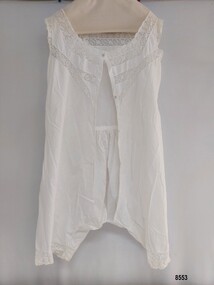 Flagstaff Hill Maritime Museum and Village
Clothing - Combination Undergarment, late 19th or early 20th century
... ...Victorian era undergarments...Flagstaff Hill Maritime Museum and Village Great Ocean Road combinations lady's combinations undergarment lingerie handsewn underwear clothing Victorian era undergarments lady's garment Susan Henry OAM Vedmore Foundation Lady’s white lawn and lace all-In-one combination undergarment. ...This item of underclothing, called a "combination" is one of several linen and clothing items belonging to the deceased estate of Susan Henry OAM (nee Vedmore 1944 - 2021) that was donated to Flagstaff Hill Maritime Museum and Village. Susan's family (Harold and Gladys Vedmore) immigrated to Australia from Wales in 1955 and settled in Warrnambool. Susan was well known in the Warrnambool community for her work supporting children and families across the district - particular those with disabilities, or those who were homeless, unemployed or isolated. Susan was the founding trustee of the "Vedmore Foundation" - a Warrnambool philanthropic trust set up in 2010 to support a range of charitable and not-for-profit causes by providing grant assistance. In 2021, she was awarded a Medal of the Order of Australia for services to the community. Combination undergarments combined the chemise and drawers into one garment. The combination is divided, or bifurcated, from the waist to the crotch for easier urinating. This one-piece type of underwear was worn by females from the 1860s and into the early 1900s. The 19th Century garments had front button closures like this one, and those made in the 1900s more often had back closures. Combination underwear was popular because the all-in-one design had far fewer gathers and bulk, making the other clothing look much smoother. Their primary use was to protect clothing from perspiration and because they were made with cotton or linen, were easy to wash. This particular item is made with lawn (a very lightweight fabric) and is sleeveless, making it suitable for hot weather. Although they were worn under the corset next to the skin (and therefore not meant to be seen), they were often decorated with lace or embroidery. This item is an example of the needlework skills of women in the late 19th century - using machine stitching and lace to personalise and embellish a practical item of clothing. It is also significant as an example of a practical solution to the difficulties that women of this era faced with regard to the washing of clothes and household linens.Lady’s white lawn and lace all-In-one combination undergarment. The handmade underwear is a combined chemise and bloomers. It has four buttons in the front and is trimmed with lace on the neckline, armholes, bodice (in a diagonal design) and legs. The left and right sides are divided from the waist to the crutch. The back of the garment is plain with a gathered section at the lower back.flagstaff hill maritime museum and village, great ocean road, combinations, lady's combinations, undergarment, lingerie, handsewn, underwear, clothing, victorian era undergarments, lady's garment, susan henry oam, vedmore foundation -
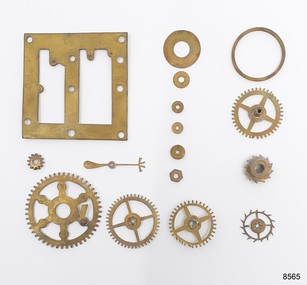 Flagstaff Hill Maritime Museum and Village
Instrument - Clock Parts, Bef. 01-06-1878
... ...Victorian era...This feature was uncommon in portable Victorian-era clocks. The clock parts are also significant for their association with the ill-fated sailing ship Loch Ard, wrecked in 1878. ...The clock parts were discovered in 1980 by Julie Wilkins, a Victorian scuba diver who had already experienced more than 500 dives in Australia and overseas. She was holidaying in Peterborough, Victoria, and looking forward to discovering more about the famous Loch Ard ship, wrecked in June 1878 at Mutton Bird Island. The fast Glasgow-built clipper ship was only five years old when the tragedy occurred. There were 54 people on board the vessel and only two survived Julie's holiday photograph of Boat Bay reminds her of her most memorable dive. Submerged in the calm, flat sea, she was carefully scanning around the remains of the old wreck when, to her amazement, a gold coin and a small gold cross suddenly came up towards her. She excitedly cupped them in her hands and then stowed the treasures safely in her wetsuit and continued her dive. She soon discovered a group of brass carriage clock parts and some bottles of champagne. It was a day full of surprises. The items were easily recognisable, without any build-up of encrustations or concretion. Julie secretly enjoyed her treasures for twenty-four years then packed them up for the early morning train trip to Warrnambool. After a short walk to Flagstaff Hill Maritime Museum and Village, her photograph was taken as she handed over her precious find. She told her story to a local newspaper reporter, lunched a café in town then took the late afternoon train home. Her generous donation is now part of a vast collection of Loch Ard shipwreck artefacts, including the gold watch and the Minton Majolica model peacock. This group of brass clockwork parts is incomplete. The pieces were in the ocean for over 100 years before Julie recovered them from the Loch Ard wreck. Their size would suit the works of a carriage clock, with a mainspring and weight to power the clock movement, a pendulum to measure the clock's speed, arbours, posts, pillars and at least one other plate. They would have been mounted inside a protective case with a small door to easily access the clock face for setting the time and accessing the key's winding hole. The clock cases were usually made from decorative gilt brass with a glass front and a carrying handle. The parts include a weighted second hand with a decorative four-pronged finish at one end, a rounded weight at the other, and a hole for attaching it to the clock face. The gear teeth profiles are ‘cycloidal’, an arch shape with vertical sides, which is common for antique clocks. Modern clockworks have ‘involute’ teeth with sloping sides and a squared-off top. The brass carriage clock parts are an example of a mechanical clock produced in the 1870s. The clock's design is a part of the chain of technological improvements in methods for timekeeping. Its cycloidal gear teeth were the forerunner of the more modern involute gears. The group of clock parts includes a weighted hand or arm for signifying the seconds. This feature was uncommon in portable Victorian-era clocks. The clock parts are also significant for their association with the ill-fated sailing ship Loch Ard, wrecked in 1878. The travelling clock or officer’s clock may have been part of the cargo destined for the 1880 Melbourne Exhibition, or the personal possession of one of the people on board the vessel. Brass clockwork parts from a mechanical clock, sixteen pieces. Parts comprise a plate, large gears or wheels, small pinions or wheels with fine teeth, wheels with cogs, and a weighted second hand. The parts were from a carriage clock ca. 1878. They were recovered from the wreck of the sailing ship Loch Ard.flagstaff hill maritime museum and village, warrnambool, great ocean road, shipwreck coast, loch ard, wreck of the loch ard, 1878, mutton bird island, peterborough, scuba diver, 1980s, shipwreck artefact, relic, clock, mechanical, clock parts, time, timekeeper, horology, chronometry, cogs, time keeping device, scientific instrument, chronometer, john harrison, longitude, carriage clock, coach clock, portable clock, travelling clock, travel clock, traveller’s clock, officer’s clock, weighted second hand, victorian era, cycloidal gear teeth, brass clock, julie wilkins -
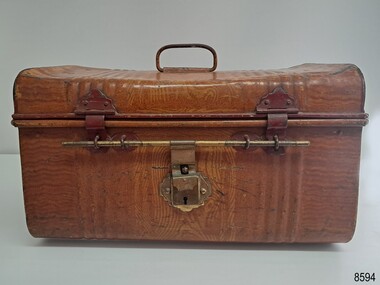 Flagstaff Hill Maritime Museum and Village
Functional object - Trunk
... ...Victorian era...Flagstaff Hill Maritime Museum and Village Great Ocean Road Shipwreck Coast Schomberg sailing ship 1855 David and Alice Ellis Schomberg passengers B B Brand American made traveller's trunk hand luggage metal trunk Schomberg ship 1855 shipwreck Peterborough shipwreck SS Queen David Ellis Alice Ellis Allambah Terang Dublin emigrants Terang Presbyterian Church Western District Victoria antique trunk vintage trunk travel goods travelling trunk steel trunk tin trunk Schomberg trunk newlyweds B B & B Boyd Boyd & Boyd Pittsburgh rare shape luggage vintage luggage Victorian era travel trunk three locks steamer trunk Printed on the label: "B B BRAND./ These Goods are manufactured of the best / steel sheets, and are guaranteed to give every / satisfaction, and will last for years." ...This metal travelling trunk belonged to David and Alice Ellis, a young couple married in Dublin in 1855. They left for Australia on the Schomberg clipper ship on October 6 that same year, joining the other passengers for the luxury sailing ship’s first voyage, bound for Melbourne, Australia. The Schomberg was grounded on a sand spit near Peterborough. All passengers and crew were safely rescued. They had been allowed to take something small with them when leaving the sinking vessel, and as such, Alice took a small cane basket and coin purse. The metal trunk was also amongst the couple’s possessions, along with a pair of candlesticks and a Bible. Their trunk was later retrieved from the ship’s deck by the crew of a steamer sent from Melbourne. At that time, David was 23 years old (born in Wales, in 1832) and Alice was 26 (born in Ireland, 1829). The couple lived in Tasmania for a short period before settling in the Western Districts of Victoria. David worked as a gardener and, when land in the area was available to purchase, David and Alice claimed a selection on Noorat Road near Terang. They settled there for the remainder of their lives, expanding the property that they named, ‘Allambah’, and had six children. David died in 1911, aged 79, and Alice passed away the following year, aged 83. B, B & B. Brand: - The company was renowned for its strongly constructed and high-quality travel goods. In 1906 the company was sold and renamed Buffalo Trunk Manufacturing Co. Interestingly, the trunk maker’s promise on its printed label is certainly fulfilled: - "B B BRAND. These Goods are manufactured of the best steel sheets, and are guaranteed to give every satisfaction, and will last for years."David and Alice Ellis’s donated possessions have great significance as a group of personal belongings saved from the sinking luxury clipper ship, the Schomberg, in 1855. The strong, well-crafted metal trunk is an example of high-quality travel luggage owned by newlyweds on their journey to a new life across the world. The well-made trunk is a rare shape. It joins Flagstaff Hill’s collection of artefacts from the Schomberg shipwreck, which is listed on the Victorian Heritage Register (VHR S612). The ship has historical significance as a rare example of a large, fast clipper ship on the England to Australia run, built to carry emigrants at the time of the Victorian gold rush. The ship’s design included the technical advances needed to break sailing records between Europe and Australia. The relationship of the objects in Flagstaff Hill’s Schomberg collection allows has potential interpretation of the story of the Schomberg. The collection of objects is archaeologically significant as the remains of an international passenger ship, as it represents aspects of Victoria’s shipping history, in addition to its association with the shipwreck and the ship.Traveller's metal trunk; small brown woodgrain patterned trunk with dark red features and brass lock. This well-made strong and sturdy piece of secure hand luggage has rounded corners and sides, with the ends of the lid slightly bulbous. The lid is reinforced inside across the centre. The lid and sides have dark red metal D-shaped handles that fold down. The two hinges on the lid have their fittings inside the trunk which is hinged across the back. Two dark red painted latches secure the front along with a brass rod and lockable latch in the centre front. The metal is shaped with a group of corrugated ribs on each side of the centre, around the trunk. A white printed and lacquered label is inside the lid and has additional handwritten text. The truck was the luggage of David and Alice Ellis on the sailing ship SCHOMBERG in 1855. Printed on the label: "B B BRAND./ These Goods are manufactured of the best / steel sheets, and are guaranteed to give every / satisfaction, and will last for years." Handwritten on the label: "8/3- 7/-" (possibly meaning Eight shillings and three pence, Seven shillings)flagstaff hill maritime museum and village, great ocean road, shipwreck coast, schomberg, sailing ship, 1855, david and alice ellis, schomberg passengers, b b brand, american made, traveller's trunk, hand luggage, metal trunk, schomberg ship, 1855 shipwreck, peterborough shipwreck, ss queen, david ellis, alice ellis, allambah terang, dublin emigrants, terang presbyterian church, western district victoria, antique trunk, vintage trunk, travel goods, travelling trunk, steel trunk, tin trunk, schomberg trunk, newlyweds, b b & b, boyd boyd & boyd, pittsburgh, rare shape, luggage, vintage luggage, victorian era, travel trunk, three locks, steamer trunk -
 Flagstaff Hill Maritime Museum and Village
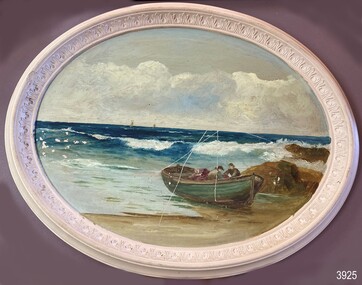
Painting - Maritime, 19th century
... ...Victorian era...era suffer from damage such as chips and cracks. This simple handmade painting on cast composite frame is typical of 19th century art work found in middle and upper class Victorian homes of that era. ...This handmade picture has been painted on a cast plaster or composition frame. Plaster frames were popular in the e19th century. The material is quite fragile and many pictures from this era suffer from damage such as chips and cracks.This simple handmade painting on cast composite frame is typical of 19th century art work found in middle and upper class Victorian homes of that era. It cannot be attributed to a particular artist due to lack of inscriptons.Painting, oil on composite material, handmade Pink coloured cast composite oval frame with decorative border. Painting depicts two figures in a small green boat on the shore, sandy beach, rocks nearby, small surf waves, mild sea, two sailing vessels in background. No inscription on front of painting. flagstaff hill, warrnambool, maritime village, maritime museum, flagstaff hill maritime museum & village, shipwreck coast, great ocean road, victorian art work, maritime scen, composite material, plaster, cast frame, oval frame, victorian era -
 Flagstaff Hill Maritime Museum and Village
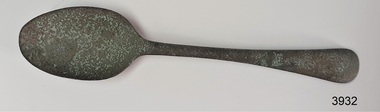
Domestic object - Teaspoon, Viners Limited, Ca. 1920s
... ...Victorian era...Flagstaff Hill Warrnambool Maritime Village Maritime Museum Flagstaff Hill Maritime Museum & Village Shipwreck coast Great Ocean Road electroplate electro plate nickel silver nickel alloy alloy composition copper nickel zinc German silver EPNS silversmiths Victorian era 19th century flatware tableware cutlery cutler dining utensils eating utensils silver-white metal WEARS-WITE STAINLESS NICKEL SILVER SHEFFIELD teaspoon sheffield wear-wite silver nickel stainless rustless “WEARS-WITE STAINLESS / NICKEL SILVER SHEFFIELD” Teaspoon, small, thin, nickel silver plated. ...This teaspoon is an example of electroplated cutlery that was affordable alternative to more expensive silver cutlery, popular in the late 19th and early 20th century. The teaspoon has been stamped with text on the back of its handle that describes the nickel silver alloy that it was made of, and that it was made in Sheffield, but does not mention the maker's name. The plain design and light weight of this teaspoon could mean that it was used as a common, everyday utensil. The text on the back includes the words 'wears wite', assuring the buyer that even if the silverplate wears or flakes off the surface, the metal beneath it will show the white colour typical of nickel silver, or German silver. This alloy of copper, nickel and zinc is often used as a base for electroplating and named Electro Plated Nickel Silver (EPNS). An exact match of this teaspoon's inscription "WEARS-WITE STAINLESS NICKEL SILVER SHEFFIELD" has been found on cutlery made by Viners Ltd., and has not yet been found on flatware made by other manufacturers. Other cutlers have used very similar text but have used 'rustless' instead of 'stainless' and 'white throughout' instead of 'wears-wite'. Viners Limited was established in Sheffield in 1901 by Adolphe Viner and his sons. By 1908 they had a manufacturing plant in Bath Street, Sheffield, and went on to be the leading cutlers in the United Kingdom. They expanded to Hong Kong and Japan, and from 1925 they used the trademarks 'Alpha', 'Resilco' and 'Wear-wite stainless silver nickel'. They were appointed as Royal Cutlers to King George V in 1930, at which time their trademark was still 'Wear-wite' followed by the words 'Rustless Nickle Silver'. They continued to expand and prosper over the years. The Viners name is still being used by the current owners, the Rayware Group. In 2018 the Viners name celebrated 110 years as specialists in flatware. This teaspoon is historically significant, dating from the mid-1920s and made by a leading Sheffield silversmiths, Viners Limited, established in 1901 and continuing on with cutlery still branded with the Viner’s name today. Viners who were appointed as Royal Cutlers in 1930 by King George V. The teaspoon is an example of silver plated cutlery in common everyday use in the earlier half of the 20th century. This Viners teaspoon is unique in our collection as an item produced by Viners Ltd. and bearing the stamp ‘Wear-wite”.Teaspoon, small, thin, nickel silver plated. Narrow plain handle flares out to a wide, rounded end. Maker’s marks are stamped on the reverse. Made in Sheffield, England.“WEARS-WITE STAINLESS / NICKEL SILVER SHEFFIELD”flagstaff hill, warrnambool, maritime village, maritime museum, flagstaff hill maritime museum & village, shipwreck coast, great ocean road, electroplate, electro plate, nickel silver, nickel alloy, alloy composition, copper nickel zinc, german silver, epns, silversmiths, victorian era, 19th century, flatware, tableware, cutlery, cutler, dining utensils, eating utensils, silver-white metal, wears-wite stainless nickel silver sheffield, teaspoon, sheffield, wear-wite, silver nickel, stainless, rustless
