
Showing 256 items matching " wall hanging"
-
 Montmorency–Eltham RSL Sub Branch
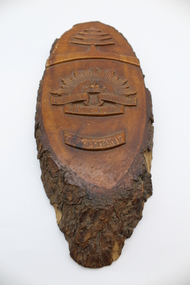
Plaque - Wooden wall-hanging, Cedar Wooden Wall Hanging, 1941
... Wooden wall-hanging...Cedar Wooden Wall Hanging...Original bark of tree all the way around the edge. Cedar Wooden Wall Hanging Plaque Wooden wall-hanging ...Owned by William Albert HARRISON (Service Number VX41478; above Link ["WW2 Record"] Sent home to his mother from Liban on 25-10-41 Soldier's name known. Items donated (date unknown) by brother-in-law who was living in Montmorency and was a committee member of MERSL when item donated.Oval shaped slice of wood from the cedar tree in Lebanon. Carving of a cedar tree across top and emblem of Australian Commonwealth Military Services half way down and Cedar of Lebanon across the bottom half. Stained with light brown varnish. Original bark of tree all the way around the edge.Two stamps in French possibly where it was made, Artiols bois des cedres. Becharry Liban. Salim Kabalan. Hand written message;- Mother with all the best to you Bill. Dated 25-10-41 -
 Embroiderers Guild, Victoria
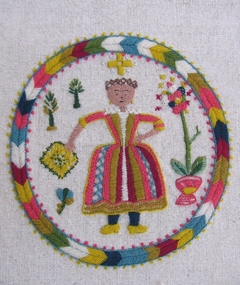
Textile - Wall Hanging, "The Wife" Wall Hanging, Mid 20th century
... Wall Hanging..."The Wife" Wall Hanging...Fringed border and rod through top. "The Wife" Wall Hanging Textile Wall Hanging ...Bought for Guild by Lady Amies, and worked by her on her trip 1965-66.Hand woven linen, design of a circle with a lady inside, plus trees and plants. Lady embroidered in colours - pink, red, blue, gold and brown. Face stitched in circular stem stitch. Fringed border and rod through top.embroidery, surface stitchery, norway, 1960-80, flowers, lady, figure -
 Doncaster Templestowe Historical Society
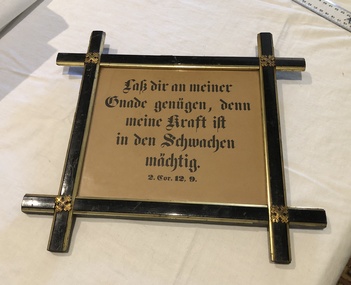
Sign, DJ0218 Wall Hanging, decorative, board, bible quotations in on both sides in German, 23/10/2025
... DJ0218 Wall Hanging, decorative, board, bible quotations in on both sides in German...Wall hanging important bible quotes. Able to be turned to alternate the displayed quotes....Wall Hanging Board...Wall hanging important bible quotes. Able to be turned to alternate the displayed quotes. ...Wall hanging important bible quotes. Able to be turned to alternate the displayed quotes.Used by German settlers in Doncaster areaWall Hanging BoardLaß dir an meiner Onnoe genigen, Dem meine fraft ift in Den Sicwnden micitig. 2. Cor. 12, 9. Google Translate: Let my uncle be content with my uncle, for my uncle is in my sight. 2 Corinthians 12:9 Alle 2.1113 ي.0210د wetfet anf ailn, Dcum Er forget für cuc. 1. Wett. 5, 8. bible, german, wall -
 Bendigo Historical Society Inc.
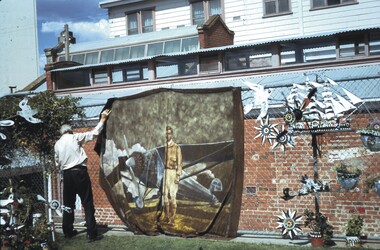
Slide - WALL HANGING, 1971
... WALL HANGING......wall hanging...Slide. Wall Hanging. Pilot and Aircraft,the Spirit of St.Louis,& Charles Lindbergh depicted on material.Various metal objects on the wall. ...SLIDE Bendigo wall hanging Wall Hangimg Slide. Wall Hanging. ...Slide. Wall Hanging. Pilot and Aircraft,the Spirit of St.Louis,& Charles Lindbergh depicted on material.Various metal objects on the wall. March 1971slide, bendigo, wall hanging, wall hangimg -
 Flagstaff Hill Maritime Museum and Village
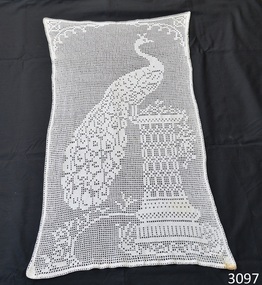
Textile - Wall Hanging, cloth, early 20th century
... Wall Hanging, cloth......crocheted wall hanging...This hand crafted, crocheted cloth with a peacock motif may have been worked for the purpose of a wall hanging. ...Textile Wall Hanging, cloth ...This hand crafted, crocheted cloth with a peacock motif may have been worked for the purpose of a wall hanging. Cloth, hand crocheted cloth with image of a peacock worked into it.flagstaff hill, warrnambool, shipwrecked coast, flagstaff hill maritime museum, maritime museum, shipwreck coast, flagstaff hill maritime village, great ocean road, crocheted cloth, crocheted wall hanging, domestic linen, handcrafted crochet -
 Embroiderers Guild, Victoria
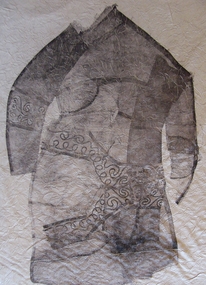
Textile - Printed and Embroidered Wall Hanging, Sophie Xeros-Constantinides, Fabricate #1, 2006
... Printed and Embroidered Wall Hanging...Wall Hanging...This wall hanging was acquired from the Fabricate Exhibition held at the Guild in 2006, by the Textile Art Group (TAG)....This wall hanging was acquired from the Fabricate Exhibition held at the Guild in 2006, by the Textile Art Group (TAG). ...This wall hanging was acquired from the Fabricate Exhibition held at the Guild in 2006, by the Textile Art Group (TAG).Soft ground etching printed on crushed silk with hand embroidery.wall hanging, surface stitchery, printing/painting -
 Flagstaff Hill Maritime Museum and Village
Textile - Wall Hanging, curtain, 1854-1855
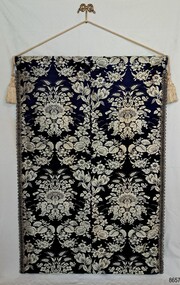
... Wall Hanging, curtain......wall hanging...The striking fabric of this wall hanging was recovered from the sinking Schomberg. ...This wall hanging, also known as the Schomberg Curtain, was created from a curtain recovered from the stranded luxury ship Schomberg in December 1855. ...The striking fabric of this wall hanging was recovered from the sinking Schomberg. ...The striking fabric of this wall hanging was recovered from the sinking Schomberg. It was originally one of the many curtains adorning the captain’s cabin and ladies’ saloons that attracted first-class passengers to this luxury vessel, built for comfort and speed. The clipper ship was on its maiden voyage, full of passengers emigrating to Australia in 1855. Its commander was Captain James Nicol Forbes, who had been selected by James Baine & Co for his navigation skills, experience, and reputation for breaking sailing records. However, on December 26th, 1855, the vessel became stranded and sank west of Cape Otway, not quite reaching its destination of Melbourne. A reporter explored the Schomberg before its journey; the following detailed description is an excerpt of his article published in a newspaper after the disastrous voyage was announced. “ … descending by a flight of stairs, covered with carpet of a very rich pattern, we came to the saloon passengers’ cabin. This is a noble place, and all that refined taste would suggest has been done to make each berth a miniature palace. The bedding is of the very best material, and the fittings are replete with every convenience. The carpets are of various coloured velvet pile, and the curtains are of satin damask, lined with white satin … The fronts of the berths are highly decorated, and festoons of flowers are painted on the panels … No two berths are furnished with the same-coloured material … the visitor is, therefore, much pleased with the variety which he has to inspect….” (Trove: Shipping Gazette and Sydney General Trade, 31 Dec 1955, p. 283) The curtain material, ‘folded into a single piece and parcelled for protection’, has been passed down through generations of Captain Forbes’ relatives, starting with his half-sister Isabella Jeffrey Nicol. The curtain has remained with the family, although some transition details are incomplete. About a century later, Isabella and Blakiston Robinson’s great-grandson and his wife had the fabric professionally mounted as a wall hanging to showcase the beauty of the woven brocade. Eventually, the custodianship of the curtain was transferred to the donor, who is also a great-grandson of Isabella and Blakiston. He and his wife hung the curtain on the wall of a high-ceilinged room in their home, away from direct light, making it visible for all to appreciate its beauty and significance. In 2024, they donated the curtain for inclusion among the collection of artefacts that help tell the story of the Schomberg and those who sailed on its first and last voyage. The donor’s aunt was highly involved in the family’s history. She had collected and recorded information that dates back to pre-1341. A footnote included in a handwritten letter dated April 20, 1959, from the late Arthur William Rudd, OBE, MA, LLB, husband of another of the donor’s aunts, states, “The curtains you mentioned came from the Schomberg. AWR.” CAPTAIN JAMES NICOL FORBES (1821-1874) and the donor’s family: - Captain Forbes was born in Aberdeen. In his late teens, he moved to Liverpool, a hub for international trade and an emigration port. By the age of 25, he was master of the Prince of Waterloo and later, the Wakefield. He then commanded the Cleopatra for the James Baines Co., which, two years later, transferred him to command the Maria, providing fast and lucrative passage to the gold fields in Ballarat, Australia. James Baines Co. and shipbuilder Thomas Mackay formed the Black Ball Line of clipper ships in 1852. Forbes was appointed master of the largest ship in the fleet, the marvellous Marco Polo. He broke the record time for the passage to Australia, taking only 68 days at sea, and the return journey in only 76 days, a total of 5 months and 21 days. On his second voyage to Melbourne in the Marco Polo the following year, he took 75 days, and 95 days on the return trip. His accomplishment made him famous. James Baines reported that the Marco Polo was the only ship, sail or steam, to do the round trip within 6 months, and it had done it twice. Captain Forbes then took command of the American-built clipper Lightning, one of four built for the Black Ball line. His 19-year-old half-sister, Isabella Jaffray Nicol, was also onboard when he sailed for Melbourne in 1854. During the 77-day voyage, Isabella met Blakiston Robinson, and not long after the ship arrived in Melbourne on July 31, the couple married, with James Nicol Forbes as a witness, on August 16. When Forbes returned to Liverpool, he took a record-breaking 63 days, which has never been bettered. James Baines Co. ordered a new luxury emigrant ship from Alexander Hall of Aberdeen; the Schomberg was the largest sailing ship ever built in Britain. On October 6, 1855, the vessel departed Liverpool commanded by Captain Forbes, with 430 passengers on board, 54 of whom were First Class. It had almost completed its voyage to Melbourne when, on the night of December 26, it ran aground west of Cape Otway. Captain Doran, master of the steamer Queen, responded to the distress signal while on its way to Portland and, with the agreement of his passengers, rescued as many as possible from the Schomberg and returned to Melbourne with them. Captain Helpman, master of the steamer Champion, rescued most of the remaining Schomberg passengers on December 27. On Friday, 28th, Captain James Lawrence was on his way to Adelaide in the steamer Burra Burra, and called past the Schomberg. He reported that the remaining crew were all doing their duties, but the Schomberg was deteriorating on a sand spit and had about 16 feet of water in its hold. That same day, the schooner Jane Elizabeth collected 220 packages of passengers’ luggage to deliver to Melbourne on the 29th. Two steamers also arrived on the 29th with 20 men to collect passengers’ luggage and valuable ship’s cargo items. They were accompanied by water police, customs agents, company representatives and a Lloyds agent. The decision was made to abandon ship on the 30th due to rough and unsafe conditions. The officials and Captain Forbes voyaged to Melbourne, while the seamen remained behind awaiting rescue. Evacuation by sea became too risky, so on January 2, 1856, while the first Mate and Steward remained at the wreck site, the rest of the crew began the 70-mile march to Warrnambool, led by the band. They arrived on January 5th and left for Melbourne on the steamer Champion on January 10th. Parts of the Schomberg wreck ended up in New Zealand. The curtain is important for its connection to the Schomberg, which was unique for being designed and built in Aberdeen, and commanded by an Aberdonian who was the most celebrated clipper captain of the age. The ship was the largest sailing ship ever built in Britain, and reported as the largest vessel that sailed to Australia. The curtain is an example of the rich decorative furnishings available in 1855. The preservation and respect the donor and his family have shown towards the curtain over many decades reflect its important role in telling the family’s history; the journey, the romantic attachment, the family connection to the sea, and travel in gold rush times. The curtain is significant for its connection to James Nocol Forbes, a famous sailing ship commander who broke several sailing records, one of which has never been bettered. This wall hanging, also known as the Schomberg Curtain, was created from a curtain recovered from the stranded luxury ship Schomberg in December 1855. The woven satin damask fabric in blue and cream has been meticulously joined to blend the intricate pattern. The reverse features a soft cream lining. The hems at the top and bottom of the fabric hold wooden rods. The side edges feature decorative braid that has been hand-stitched in place. On the reverse, the bottom hem includes the same braid, which remains unseen from the front, and the centre of the top hem has a hand-worked, unused buttonhole. Each of the hems varies in depth. The curtain was tastefully mounted later to highlight the beauty of the original saloon curtain. A decorative twisted cord of cream silk threads, accented with gold highlights and decorative tassels, was coiled and attached to the ends of the top rod. The elegant display was completed with an ornate gold hook, chosen to complement the wall hanging.flagstaff hill maritime museum and village, great ocean road, shipwreck coast, shipwreck artefact, memorabilia, curtain, saloon curtain, schomberg, wall hanging, decorative object, domestic item, warrnambool, flagstaff hill, maritime museum, maritime village, maritime history, shipwreck, stranding, schomberg curtain, schomberg wall hanging, luxury ship, 1855, damask, silk damask, blue and cream, captain’s cabin, ladies’ saloon, clipper ship, migrant, emigrant, liverpool to australia, captain james nicol forbes, james forbes, captain forbes, bully forbes, james baines & co, james baines, cape otway, aberdeen, prince of waterloo, wakefield, cleopatra, maria, thomas mackay, black ball line, marco polo, sailing record, lightning, isabella jaffray nocol, blakiston robinson, alexander hall, steamer queen, captain helpman, james lawrence, steamer burra burra, steamer jane elizabeth, water police, customs agents, lloyds agent, ship’s band, walk to warrnambool, march to warrnambool, steamer champion, agnes nicol robinson, arthur william rudd obe ma llb -
 Vision Australia
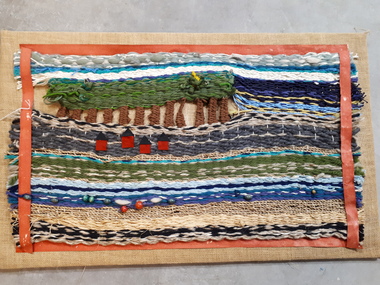
Photograph (Item), Woven wall hanging from Kooyong Day Centre
... Woven wall hanging from Kooyong Day Centre...In this example, a rectangular shaped woven wall hanging attached to a brown hessian backing and stuck onto a piece of chipboard. ...Digital image of woven wall hanging...Middle section has four felt black and red houses. association for the blind art works Digital image of woven wall hanging Woven wall hanging from Kooyong Day Centre Photograph ...Created by members of the day centre at Kooyong in the 1990's, weaving was an activity that provided an opportunity to create tactile artwork. In this example, a rectangular shaped woven wall hanging attached to a brown hessian backing and stuck onto a piece of chipboard. Woven piece depicts a series of horizontal stripes in browns, blues, and greens, and grays. Middle section has four felt black and red houses.association for the blind, art works -
 Sunshine and District Historical Society Incorporated
Textile - Latvia Wall Hanging Rug, 31321
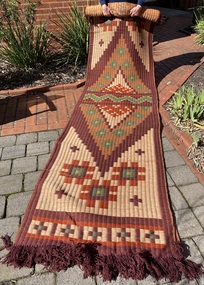
... Latvia Wall Hanging Rug...2 woven wool wall hanging rugs...The Wall hanging is designed and woven by Lilija Duks-Stepe. ...October 1985 Signed Lilija Duks-Stepe 2 woven wool wall hanging rugs Textile Latvia Wall Hanging Rug ...Liliga Eline Duks-stepe was a Sunshine resident. Her husband was Nickolas Duks-Stepe, born in Latvia. They lived at 16 Hoad Street Sunshine North circa. 1965-1974.2 woven wool wall hanging rugsThe Wall hanging is designed and woven by Lilija Duks-Stepe. The design is based on Latvian traditional design elements and rules. The main element is "The Sun" symbol, the bearer of life. The other element "Austra Tres", the tree of light, or of the dawn-Austra-free which the sun rises in the morning. The wall hanging is woven in "Weft-faced, Patterned weave with tie down technique ona draw loom, 20 shafts, double harness setup. The warp is linen, the weft is wool. October 1985 Signed Lilija Duks-Stepelatvia, rug , lilija duke-stepe -
 Bendigo Historical Society Inc.
Textile - WALL HANGING: BENDIGO NORTH PRIMARY SCHOOL
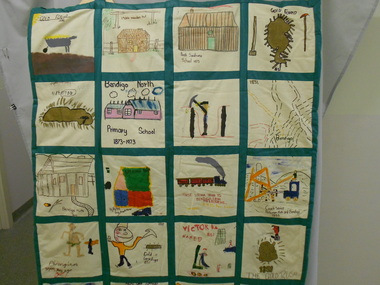
... WALL HANGING: BENDIGO NORTH PRIMARY SCHOOL......wall hanging...Cotton wall hanging made by Grade 3 & 4 students from Bendigo North Primary School. ...HANDCRAFTS Tapestry wall hanging Cotton wall hanging made by Grade 3 & 4 students from Bendigo North Primary School. ...Cotton wall hanging made by Grade 3 & 4 students from Bendigo North Primary School. Quilt made of 28 panels (21 cm X 21 cm) each bordered with dark green strips (3 cms) bordering each panel. Backed with wadding. Across the top of the wall hanging are five hanging loops of dark green fabric (3.5 cm X 3.5 cm ). Hand stitched in place.Machine stitched except for top edged that has been hand sewn after padding inserted. Panels are decorated with textas and fabric paint. Children have drawn pictures and written dates of scenes and icons illustrating different icons and times in the history of Bendigo.handcrafts, tapestry, wall hanging -
 National Wool Museum
Wall Hanging, Children of the World Longest Hand Knitted Scarf project
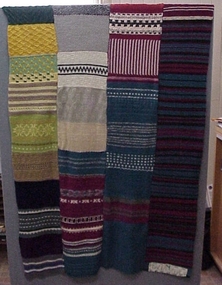
... Wall Hanging...Wall hanging is made of woollen scarves from schools in Latvia, Romania, Argentina, the Shetland Isles, Japan, Lithuania and Australia. ...Wall hanging made from scarves from Australian and European school children, participants of the Children of the World Longest Hand Knitted Scarf project, coordinated by Lara Primary School....Wall hanging is made of woollen scarves from schools in Latvia, Romania, Argentina, the Shetland Isles, Japan, Lithuania and Australia. ...Wall hanging is made of woollen scarves from schools in Latvia, Romania, Argentina, the Shetland Isles, Japan, Lithuania and Australia. It was made by participants of the Children of the World Longest Hand Knitted Scarf project.Wall hanging made from scarves from Australian and European school children, participants of the Children of the World Longest Hand Knitted Scarf project, coordinated by Lara Primary School.Dace Latvia Romaniaknitting -
 National Vietnam Veterans Museum (NVVM)
Banner, Wall Hanging
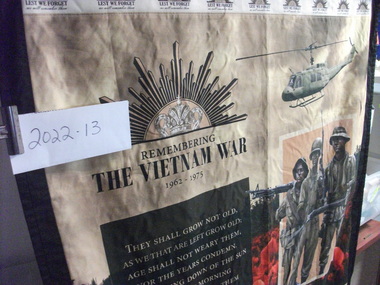
... Wall Hanging...Wall Hanging...Wall Hanging banner commemoration A handmade quilted Commemorative Banner by Artist Jan Townsend. ...A handmade quilted Commemorative Banner by Artist Jan Townsend. It has a black with ANZAC badge emblems. Lest we Forget. The Anzac emblem is at the top, to the left are three armed soldiers. Above them is an image a helicopter in flight. Centre bottom is the words to the "Ode to Soldiers". wall hanging, banner, commemoration -
 Bendigo Historical Society Inc.
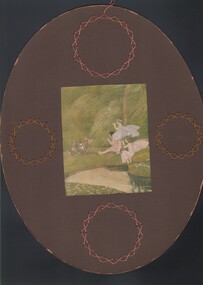
Textile - FOSTER AND WILSON COLLECTION: WALL-HANGING
... FOSTER AND WILSON COLLECTION: WALL-HANGING......wall-hanging...COTTAGE Miners wall-hanging Foster & Wilson Collection Wall-hanging Brown oval cardboard with a picture of fairies, rabbits and an elf. ...Brown oval cardboard with a picture of fairies, rabbits and an elf. The 3 rabbits and the elf are holding hands and dancing. Two of the fairies are sitting on the grass and clapping hands. The third on is standing against a tree playing a flute. They are in the forest with a stream, white flowers and some toadstools. The picture is in greens, pinks, browns and white. At each side of the picture is a 16 point star worked in yellow/green crochet thread. At the top and bottom is a pink 16 point star worked in pink. Holes have been punched in the card for the thread to go through. At the top is a loop for hanging. Written on the back: Eileen Wilson.cottage, miners, wall-hanging, foster & wilson collection, wall-hanging -
 City of Greater Bendigo - Civic Collection
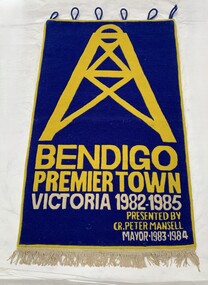
Textile - Wall hanging, Design a Rug, Bendigo Premier Town, 1985
... Wall hanging...Councilor Peter Mansell was the Mayor during this period (1983- 84) and commissioned this wall hanging to commemorate this achievement....Wall hanging featuring the blue and yellow poppet head logo with text. ...Bendigo Premier Town Textile Wall hanging Design a Rug ...Premier Town Awards are awarded by the Victorian State Government to regional communities that best protect and enhance their environment through innovative initiatives. The award recognizes success in litter prevention, waste management and environmental projects and is designed to encourage tourism. In 1982 - 1985 Bendigo was named Victoria's Premier Town and an official dinner was held at the Town Hall, Bendigo on October 5, 1985. Councilor Peter Mansell was the Mayor during this period (1983- 84) and commissioned this wall hanging to commemorate this achievement.Wall hanging featuring the blue and yellow poppet head logo with text. Fringing on lower edge. Loops and dowl on top edge for hanging.Label on reverse: This genuine hand woven Tibetan rug / was custom designed and fully imported. For ... Peter Mansell / Rug No ... 1715 / By M/s Design a Rug city of bendigo, city of greater bendigo tourism, city of greater bendigo awards, city of greater bendigo commerce, city of bendigo premier town 1982-85, mayor peter mansell -
 National Wool Museum
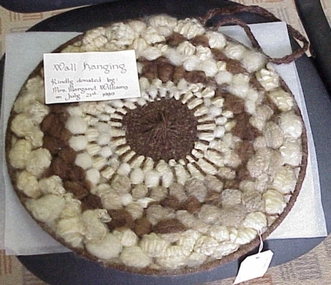
Wall Hanging
... Wall Hanging...Wall hanging Kindly donated by Margaret Williams on July 21st. 1989...Weaving Williams Mrs Margaret Mary Wall hanging Kindly donated by Margaret Williams on July 21st. 1989 Wall Hanging ...10-12 years old (at 1989). Brother of the donor made this item.Wall hanging Kindly donated by Margaret Williams on July 21st. 1989weaving, williams, mrs margaret mary -
 Embroiderers Guild, Victoria
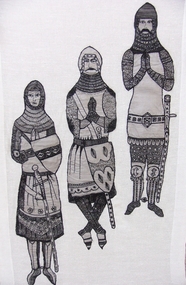
Textile - Machine Embroidery Wall Hanging, Three Knights, Mid 20th century
... Machine Embroidery Wall Hanging...... Wall Hanging...Three Knights Textile Machine Embroidery Wall Hanging ...Grey open weave fabric with black machine stitchery over organdie. Design is of 3 knights. Hanging from a black rod with knots and tassels.embroidery, wall hanging, machine embroidery, 1940-60, australia -
 Embroiderers Guild, Victoria
Textile - Wall Hanging, circa 1960
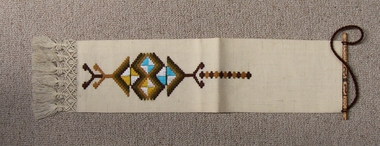
... Wall Hanging...... Wall Hanging...Fringe across bottom. Textile Wall Hanging ...Donor's note - made in an orphanage at Samsun Anatolia, Turkey.Even weave linen embroidered with wool in brown, blue, green, yellow and white. Geometric design in counted thread work. Rod across top with brown wool loop to hang. Fringe across bottom.on paper label: " tutunum tuter". Fabric label "samsun olgunlasma Made in Turkey"embroidery, wall hanging, 1960-80, turkey, counted thread, macrame fringe -
 Embroiderers Guild, Victoria
Textile - Triptych Patchwork Wall Hanging, Susan Denton, "Into the Shallows", 1986
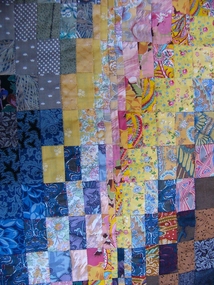
... Triptych Patchwork Wall Hanging...... Wall Hanging..."Into the Shallows" Textile Triptych Patchwork Wall Hanging Susan Denton ...Acquired by the Patchwork Group after the 1987 Patchwork exhibition. Susan Denton started making quilts in 1979, after finding a book on patchwork in a local library. Susan was born in England and arrived in Australia in 1973 after travelling overland through Asia. she and her husband returned to England in 1988. "Colour foremost and pattern secondly are the tow aspects which have continually preoccupied me. Quilt making is the way I express what I feel"This triptych is the final piece in the "Reef Series". It is a celebration of colours, complexity and fragility of the Great Barrier Reef. Each piece is tapering from the top left to bottom right in predominantly blues.Susan Denton 1987patchwork, wall hanging, 1980-2000, australia, patchwork -
 Running Rabbits Military Museum operated by the Upwey Belgrave RSL Sub Branch
Wall Hanging
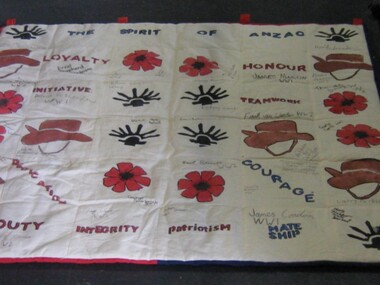
... Wall Hanging...Quilted Wall Hanging by School Children...Ephemera General Quilted Wall Hanging by School Children Wall Hanging ...Quilted Wall Hanging by School Childrenephemera, general -
 Vision Australia
Textile - Image, 2001 Year of the Volunteer wall hanging, 2001
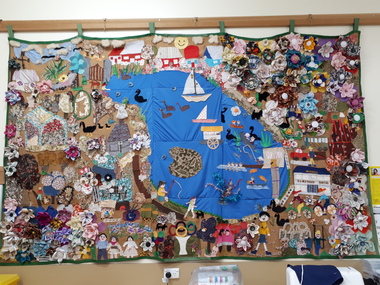
... 2001 Year of the Volunteer wall hanging...Mildura's wall hanging shows paddleboats on the Murray River, with grapes, a hot air balloon and a large sun....Mildura's wall hanging shows paddleboats on the Murray River, with grapes, a hot air balloon and a large sun. vision australia foundation Volunteers Cloth banner made by volunteers to celebrate 2001 2001 Year of the Volunteer wall hanging Textile Image ...To celebrate the 2001 International Year of the Volunteer, each Vision Australia Foundation site constructed a wall hanging. These were proudly displayed in the various offices until refurbishments and reduction of physical office space reduced the ability to do this. Various hangings have been stored by volunteers or former staff members, however digital images were secured where possible. Ballarat's wall hanging shows Lake Wendouree and the Ballarat area around it. Mildura's wall hanging shows paddleboats on the Murray River, with grapes, a hot air balloon and a large sun.Cloth banner made by volunteers to celebrate 2001vision australia foundation, volunteers -
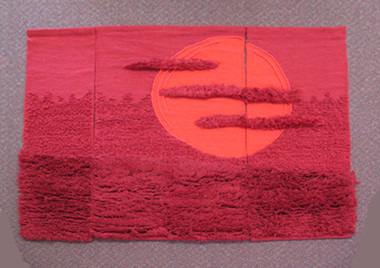 South Gippsland Shire Council
Textile - Wall hanging, Mythic Sun
... Wall hanging...Wall Hanging; 3 parts looped red fabric. Featuring a sun....Mythic Sun Textile Wall hanging ...Wall Hanging; 3 parts looped red fabric. Featuring a sun. -
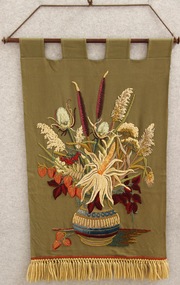 Embroiderers Guild, Victoria
Textile - Floral Autumn Foliage Wall Hanging
... Floral Autumn Foliage Wall Hanging...Wool embroidery in autumnal tones of various foliage in vase. A banner or wall hanging. Woollen fringe at base....Wool Embroidery Banner Wool embroidery in autumnal tones of various foliage in vase. A banner or wall hanging. Woollen fringe at base. Textile Floral Autumn Foliage Wall Hanging ...Wool embroidery in autumnal tones of various foliage in vase. A banner or wall hanging. Woollen fringe at base.wool embroidery, banner -
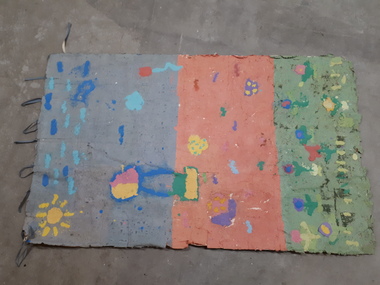 Vision Australia
Photograph - Image, Woven wall hanging
... Woven wall hanging...A yarn wall hanging depicting sky, trees and river. Felt houses, a wooden bird and animals or fishes made from beads. ...A yarn wall hanging depicting sky, trees and river. Felt houses, a wooden bird and animals or fishes made from beads. ...A yarn wall hanging depicting sky, trees and river. Felt houses, a wooden bird and animals or fishes made from beads. Red ribbed paper outlines the picture, which is glued to a hessian covered board. This artwork was created by participants at the Day Centre in Kooyong.Striped artwork attached to brown hessian backingassociation for the blind, day centre -
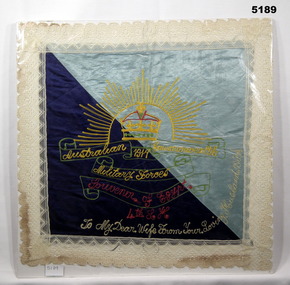 Bendigo Military Museum
Souvenir - WALL HANGING, EMBROIDED SILK, 1919
... WALL HANGING, EMBROIDED SILK...Square silk embroidered wall hanging with light and dark blue triangles. ...In multi colours with cream cotton lace borders on all sides. Souvenir WALL HANGING, EMBROIDED SILK ...Square silk embroidered wall hanging with light and dark blue triangles. In multi colours with cream cotton lace borders on all sides."Australian Commonwealth 1919 Military Forces, Souvenir of Egypt, 4th L.H. " To my Dear Wife From Your Loving Husband Dick" souvenir, textile, silk, lace -
 Embroiderers Guild, Victoria
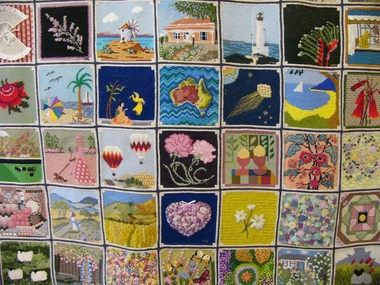
Textile - Wall Hanging, Win. Saunders, 1986
... Wall Hanging...Canvas wall hanging made up of 63 panels commemorating Victoria's 150th anniversary in 1985. ...Textile Wall Hanging Win. Saunders ...Embroidered for the 150th anniversary of Victoria. Presented to the Collection by the participants in February 1987. Makers listed on reverse of hanging.Canvas wall hanging made up of 63 panels commemorating Victoria's 150th anniversary in 1985. Included are the symbols for this anniversary, the Guild and the Guild house. Lower right corner has the initials W.S. (Win. Saunders) who co-ordinated the project, having members (listed on the reverse of wall hanging). Work 15 cms. squares. Lined with purple cotton, 10 loops across top through which a brass rod is passed.1986 in pen on reverse, and list of names of embroiderers.embroidery, wall hangings, 1980-2000, australia, canvas work -
 Kew Historical Society Inc
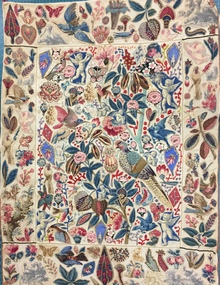
Decorative object - Cotton chintz applique on linen wall hanging [Broderie Perse], 19th Century
... Cotton chintz applique on linen wall hanging [Broderie Perse]...This broderie perse' wall hanging was donated to the Kew Historical Society in 1980 by Mrs Joy Ivory. ...Small wall hanging, comprised of five panels that are each appliquéd by hand in herringbone stitch using a range of decorative figurative motifs including flora and fauna. ...This broderie perse' wall hanging was donated to the Kew Historical Society in 1980 by Mrs Joy Ivory. ...This broderie perse' wall hanging was donated to the Kew Historical Society in 1980 by Mrs Joy Ivory. The hanging had belonged to her mother - Amy Grigg - and was used by the latter to demonstrate skills in darning (the red stitching). Provenance includes a certificate dating from 1889 which records an award to Amy Grigg of Pakington Street (Kew) for skills in needlework, issued by the Kew Floral Industrial & Art Society. Amy Grigg later married Albert Watson, the son of John Watson. The latter was an early pastor of the Kew Methodist Church in Highbury Grove, Kew. Both the Watson and Grigg families were early pioneers of Kew. While the hanging was modified by Amy Grigg in 1889, the original textile dates from an earlier period when 'Broderie Perse' (Persian embroidery) was used to create quilts and wall hangings. It is estimated that the hanging dates from the first half of the 19th century. An exact dating will require a detailed examination of the cotton chintz fabrics used to embroider the hanging. This appliquéd wall hanging is one of the earliest textiles in the Kew Historical Society's fashion & textiles collection. Similar examples are held in major international collections such as the Victoria & Albert Museum. This example of broderie perse is significant for the cross-cultural influence of Indian textiles on European taste, not unusual given the English foothold in India during this period. Additional interest is due to the mixing of Indian and European textiles in the design, while staying true to the derivation of the design. The textile is both well-provenanced and rare. While it is unlikely to be Australian-made, it is probably an example of a textile brought to Australia during the colonial period that indicates a desire to decorate interiors using items created in and for the English home. On another level, the wall hanging is a fine example of 'women's work' in the first half of the nineteenth century.Small wall hanging, comprised of five panels that are each appliquéd by hand in herringbone stitch using a range of decorative figurative motifs including flora and fauna. The design is based on an Indian palimpore representing a tree of life design. The base textile is a cream linen while the appliquéd figures or shapes are cut from cotton chintz. These additions are probably a mix of Indian and European designs. The quality of the herringbone stitching is very fine. Later stitching in red wool was added in the 1890s to demonstrate skill in darning. The main panel is bordered by a narrow green and ecru braid. It has a narrow tan braid at the top and bottom of the two side panels. A surrounding tan braid around the entire textile is missing in some places. textiles, applique, broderie perse, amy grigg, wall hangings, migration -
 Flagstaff Hill Maritime Museum and Village
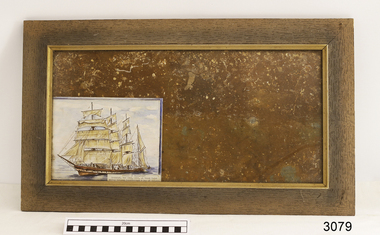
Decorative object - Wall Hanging, c. 1908
... Wall Hanging...The unusual beautiful green American slate roofing tile used in this wall hanging was recovered from the shipwrecked Falls of Halladale. ...Wall hanging, framed slate salvaged from the wreck of Falls of Halladale. ...The unusual beautiful green American slate roofing tile used in this wall hanging was recovered from the shipwrecked Falls of Halladale. ...The unusual beautiful green American slate roofing tile used in this wall hanging was recovered from the shipwrecked Falls of Halladale. The iron-hulled, four-masted barque, the Falls of Halladale, was a bulk carrier of general cargo. She left New York in August 1908 on her way to Melbourne and Sydney. In her hold, along with 56,763 tiles of unusual beautiful green American slates (roofing tiles), 5,673 coils of barbed wire, 600 stoves, 500 sewing machines, 6500 gallons of oil, 14400 gallons of benzene, and many other manufactured items, were 117 cases of crockery and glassware. Three months later and close to her destination, a navigational error caused the Falls of Halladale to be wrecked on a reef off the Peterborough headland at 3 am on the morning of the 15th of November, 1908. The captain and 29 crew members all survived, but her valuable cargo was largely lost, despite two salvage attempts in 1908-09 and 1910. ABOUT THE ‘FALLS OF HALLADALE’ (1886 - 1908) Built: in1886 by Russell & Co., Greenock shipyards, River Clyde, Scotland, UK. The company was founded in 1870 (or 1873) as a partnership between Joseph Russell (1834-1917), Anderson Rodger and William Todd Lithgow. During the period 1882-92 Russell & Co., they standardised designs, which sped up their building process so much that they were able to build 271 ships over that time. In 1886 they introduced a 3000 ton class of sailing vessel with auxiliary engines and brace halyard winches. In 1890 they broke the world output record. Owner: Falls Line, Wright, Breakenridge & Co, 111 Union Street, Glasgow, Scotland. Configuration: Four masted sailing ship; iron-hulled barque; iron masts, wire rigging, fore & aft lifting bridges. Size: Length 83.87m x Breadth 12.6m x Depth 7.23m, Gross tonnage 2085 ton Wrecked: the night of 14th November 1908, Curdies Inlet, Peterborough south west Victoria Crew: 29 The Falls of Halladale was a four-masted sailing ship built-in 1886 in Glasgow, Scotland, for the long-distance cargo trade and was mostly used for Pacific grain trade. She was owned by Wright, Breakenridge & Co of Glasgow and was one of several Falls Line ships, all of which were named after waterfalls in Scotland. The lines flag was of red, blue and white vertical stripes. The Falls of Halladale had a sturdy construction built to carry maximum cargo and able to maintain full sail in heavy gales, one of the last of the ‘windjammers’ that sailed the Trade Route. She and her sister ship, the Falls of Garry, were the first ships in the world to include fore and aft lifting bridges. Previous to this, heavily loaded vessels could have heavy seas break along the full length of the deck, causing serious injury or even death to those on deck. The new, raised catwalk-type decking allowed the crew to move above the deck stormy conditions. This idea is still used today on the most modern tankers and cargo vessels and has proved to be an important step forward in the safety of men at sea. On 4th August 1908, with new sails, 29 crew, and 2800 tons of cargo, the Falls of Halladale left New York, bound for Melbourne and Sydney via the Cape of Good Hope. The cargo on board was valued at £35,000 and included 56,763 tiles of American slate roofing tiles (roof slates), 5,673 coils of barbed wire, 600 stoves, 500 sewing machines, 6,500 gallons of oil, 14,400 gallons of benzene, plumbing iron, 117 cases of crockery and glassware and many other manufactured items. The Falls of Halladale had been at sail for 102 days when, at 3 am on the night of 14th November 1908, under full sail in calm seas with a six knots breeze behind and misleading fog along the coast, the great vessel rose upon an ocean swell and settled on top of a submerged reef near Peterborough on south-west Victoria’s coast. The ship was jammed on the rocks and began filling with water. The crew launched the two lifeboats and all 29 crew landed safely on the beach over 4 miles away at the Bay of Islands. The postmistress at Peterborough, who kept a watch for vessels in distress, saw the stranding and sent out an alert to the local people. A rescue party went to the aid of the sailors and the Port Campbell rocket crew was dispatched, but the crew had all managed to reach shore safely by the time help arrived. The ship stayed in full sail on the rocky shelf for nearly two months, attracting hundreds of sightseers who watched her slowly disintegrate until the pounding seas and dynamiting by salvagers finally broke her back, and her remains disappeared back into deeper water. The valuable cargo was largely lost, despite two salvage attempts in 1908-09 and 1910. Further salvage operations were made from 1974-1986, during which time 22,000 slate tiles were recovered with the help of 14 oil drums to float them, plus personal artefacts, ship fittings, reams of paper and other items. The Court of Marine Inquiry in Melbourne ruled that the foundering of the ship was entirely due to Captain David Wood Thomson’s navigational error, not too technical failure of the Clyde-built ship. The shipwreck is a popular site for divers, about 300m offshore and in 3 – 15m of water. Some of the original cargo can be seen at the site, including pieces of roof slate and coils of barbed wire.The Falls of Halladale shipwreck is listed on the Victorian Heritage Register (No. S255). She was one of the last ships to sail the Trade Routes. She is one of the first vessels to have fore and aft lifting bridges. The Falls of Halladale is an example of the remains of an International Cargo Ship and also represents aspects of Victoria’s shipping industry. The wreck is protected as a Historic Shipwreck under the Commonwealth Historic Shipwrecks Act (1976).Wall hanging, framed slate salvaged from the wreck of Falls of Halladale. Slate is visible from both sides of TIMBER frame through glass. Coloured drawing of Falls of Halladale is inserted under glass. Typed inscription " "FALLS OF HALLADALE" "Grounded, Nov 14th, at Wreck Point, Midway between Peterborough & Bay of Islands" Typed inscription " "FALLS OF HALLADALE" "Grounded, Nov 14th, at Wreck Point, Midway between Peterborough & Bay of Islands" falls of halladale, cargo, flagstaff hill, warrnambool, shipwrecked coast, flagstaff hill maritime museum, maritime museum, shipwreck coast, flagstaff hill maritime village, great ocean road, slate, slate tile, green american slates, building material, wreck point, peterborough, bay of islands, russell & co. -
 Bendigo Historical Society Inc.
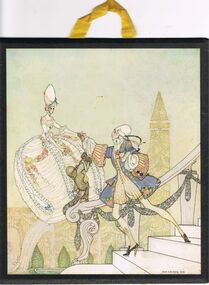
Card - LYDIA CHANCELLOR COLLECTION: WALL HANGING
... LYDIA CHANCELLOR COLLECTION: WALL HANGING...(i) Wall hanging on card. An illustration of a couple in their Regency clothes. ...Card LYDIA CHANCELLOR COLLECTION: WALL HANGING ...(i) Wall hanging on card. An illustration of a couple in their Regency clothes. No. 24 KAY NIELSEN. A description of the scene is in the quote, '' Ah, Princess! Surely you are not running away from me?'' . Hodder & Stoughton Ltd., London. (ii) A small picture of the nativity scene.artwork, print, print, lydia chancellor, collection, handcrafts, ephemera, art, artwork, drawing -
 Port Melbourne Historical & Preservation Society
Decorative object - Wall Hanging, Noah's Ark, Nott Street State School, Year 3 children at Nott St Primary School, 1960s
... Wall Hanging, Noah's Ark, Nott Street State School...Mustard coloured hessian wall hanging of Noah's Ark animals. Very colourful appligue work using wool, feathers, buttons, various fabrics. ...Decorative object Wall Hanging, Noah's Ark, Nott Street State School Year 3 children at Nott St Primary School ...Posted to the Society anonymously. Richmond postmark, explanatory note included. The Society investigated the origin with no success.Mustard coloured hessian wall hanging of Noah's Ark animals. Very colourful appligue work using wool, feathers, buttons, various fabrics. Made by Year 3 children at Nott Street State School in the early 1960s. Also 3.5 metre blue cord.education - primary schools, arts and entertainment - community arts, nott street state school -
 National Wool Museum
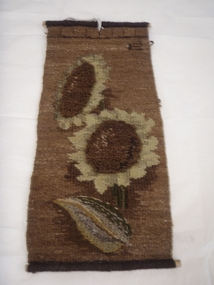
Wall Hanging
... Wall Hanging...The wall hanging was handwoven by Lilian Joyce Mann from hand spun fleece, natural coloured wool and vegetable dyed wool. ...The wall hanging was handwoven by Lilian Joyce Mann from hand spun fleece, natural coloured wool and vegetable dyed wool. ...The wall hanging was handwoven by Lilian Joyce Mann from hand spun fleece, natural coloured wool and vegetable dyed wool. Ms Mann owned a shop in Jacob Street which sold handmade soft toys and hand woven items. She was a founding and life member of the Geelong Handweavers and Spinners Guild. She died on the 17th July 2007 in her 92nd year.W7220 W7220 handwritten labelL.J.Mann Hand spun fleece Natural coloured wool + Vegetable Dyed wool L.J.Mannhandicrafts, geelong handweavers and spinners guild inc., weaving, mann, ms lilian joyce, geelong, victoria
