
Showing 31 items matching "advertising and decoration"
-
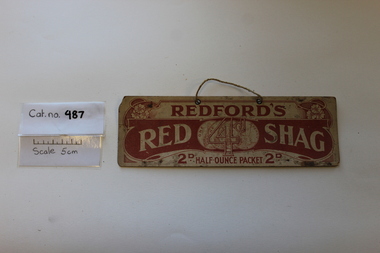 Coal Creek Community Park & Museum
Sign - Advertising Sign
... Rectangular cardboard sign advertising tobacco. Red printing with some floral decoration....Marked: REDFORD'S RED 4d SHAG 2D HALF-OUNCE PACKET 2D Rectangular cardboard sign advertising tobacco. Red printing with some floral decoration. ...Rectangular cardboard sign advertising tobacco. Red printing with some floral decoration.Marked: REDFORD'S RED 4d SHAG 2D HALF-OUNCE PACKET 2D -
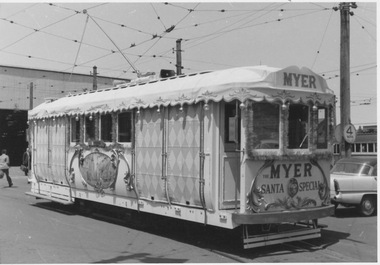 Melbourne Tram Museum
Photograph - The Myer Santa Special tram, unknown
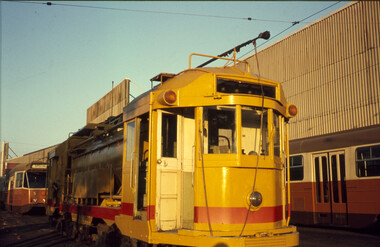
... Photograph shows a straight sill single truck car with extensive advertising and decoration including exterior light globes and loud speakers fixed to the roof. ...Photograph shows a straight sill single truck car with extensive advertising and decoration including exterior light globes and loud speakers fixed to the roof. ...Photograph shows a straight sill single truck car with extensive advertising and decoration including exterior light globes and loud speakers fixed to the roof. The un-numbered tram has its trolley pole raised and is located on a depot fan, perhaps at South Melbourne. Yields information about use of advertising on Melbourne trams Black and white photograph with no note on rear. advertising and decoration, loud speakers, trolley pole, depot fan, south melbourne depot -
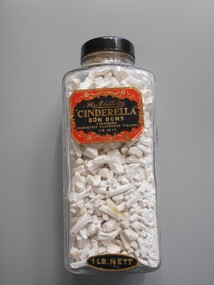 Bendigo Historical Society Inc.
Container - PHARMACY COLLECTION: MAC ROBERTSON'S CINDERELLA 'BON BONS' JAR, 1950's
... Beautiful label in black with red border and gold stamped decoration. Full of starch? Chalk?....Clear rectangular glass jar with black bakelite lid, label on front advertising original contents which was Mac Robertson's Cinderella Bon Bon's 1 lb (pound) in weight. ...Object. Clear rectangular glass jar with black bakelite lid, label on front advertising original contents which was Mac Robertson's Cinderella Bon Bon's 1 lb (pound) in weight. Beautiful label in black with red border and gold stamped decoration. Full of starch? Chalk?.249 G919 Mac Robertsons.domestic equipment, containers, mac robertson's cinderella bon bons -
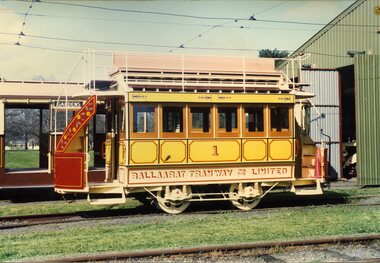 Ballarat Tramway Museum
Photograph - Colour Photograph/s, 19/09/1992 12:00:00 AM
... Colour photograph of the almost completed horse tram, missing off side gates and advertising boards. Handrails and lettering and stairway decoration completed. ...Horse Tram No. 1 Tramcars BTPS Reconstruction tram 1 661 Colour photograph of the almost completed horse tram, missing off side gates and advertising boards. Handrails and lettering and stairway decoration completed. ...Colour photograph of the almost completed horse tram, missing off side gates and advertising boards. Handrails and lettering and stairway decoration completed. Photographed on the BTM depot fan, on the occasion of the 21st anniversary of the closure of the Ballarat tramway system - 19/9/1992. Tram 661 in the background. Print on Kodak paper.horse tram no. 1, tramcars, btps, reconstruction, tram 1, 661 -
 Ballarat Tramway Museum
Photograph - Colour Photograph/s, Tramway Museum Society of Victoria (TMSV), 1964
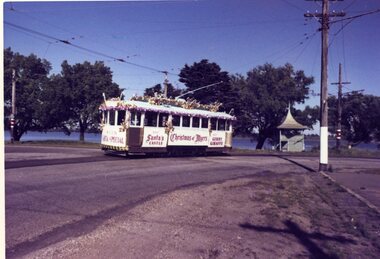
... Tram partially painted white - windows and roof, but not possibly the sides or the front dash - and decorated with Christmas decorations and advertising boards on ends and sides of the tram, advertising Christmas at Myers, Santa's Castle and Gerry Giraffe. ...Tram partially painted white - windows and roof, but not possibly the sides or the front dash - and decorated with Christmas decorations and advertising boards on ends and sides of the tram, advertising Christmas at Myers, Santa's Castle and Gerry Giraffe. ...Colour photograph of Ballarat SEC No. 18 decorated for the 1964 Myers Christmas Tram. Photographed at the corner of Macarthur St and Wendouree Parade. Date and tram number advised by Alan Bradley 15/3/03. Tram partially painted white - windows and roof, but not possibly the sides or the front dash - and decorated with Christmas decorations and advertising boards on ends and sides of the tram, advertising Christmas at Myers, Santa's Castle and Gerry Giraffe. Photographed with tram turning from Wendouree Parade into Macarthur St. with the View Point terminus shelter in the background.On rear stamped in purple ink "Copyright by the Tramway Museum Society of Victoria Ltd."myers, decorated trams, macarthur st, view point, christmas trams -
 Ballarat Tramway Museum
Photograph - Black & White Photograph/s, B. Prentice, 12/12/1970 12:00:00 AM
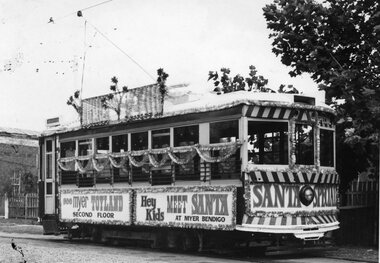
... The roof advertising panel has additional decorations. ...The roof advertising panel has additional decorations. ...Black and white photograph of Bendigo Birney SEC No. ? decorated for the 1970 Myer's Christmas Tram. Photographed on the depot entry track by Bob Prentice, Sat. 12 December 1970. Tram decorated with standard Christmas decorations, two large boards on the sides "see Myer Toyland Second Floor" and "hey kids Meet Santa at Myer Bendigo" and on the front of the tram, the front panel has been painted with the words "Santa Special". The roof advertising panel has additional decorations. Photographed with the depot building in the background. See Reg Item 1895 for 1969 version.On rear in black ink " Bendigo / Saturday 12 December / 1970 / Bob Prentice Photo "trams, tramways, myers, decorated trams, santa tram, christmas trams -
 Bendigo Military Museum
Souvenir - ADVERTISING CARD, A.G.S, c. WW2
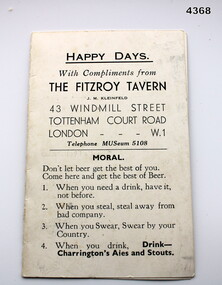
... Folded four page advertising card with black printing on each page, front page features the business name, address and phone number in addition to moral advice. ...Souvenir ADVERTISING CARD A.G.S. ...Part of the Frederick Gardner Davey DFC RAAF collection. Refer Cat No 3536P for his service record.Folded four page advertising card with black printing on each page, front page features the business name, address and phone number in addition to moral advice. The inside two pages feature quotes and further moral advice regarding appropriate behaviour, the back page features to fan shaped decorations between “God save the King” and “God bless everybody is my earnest wish”, printed in Gothic type.souvenirs, advertising, taverns -
 Ballarat Tramway Museum
Photograph - Colour Photograph/s set of 2, 19/09/1992 12:00:00 AM
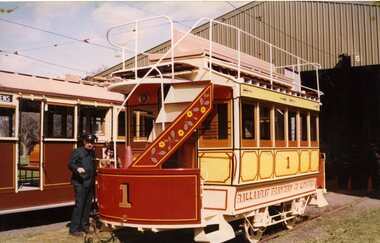
... Colour photograph of the almost completed horse tram, missing off side gates and advertising boards. Handrails and lettering and stairway decoration completed. ...Horse Tram No. 1 Tramcars BTPS Reconstruction tram 1 661 On rear is a label "Photo page 5, Same Size" Colour photograph of the almost completed horse tram, missing off side gates and advertising boards. Handrails and lettering and stairway decoration completed. ...Colour photograph of the almost completed horse tram, missing off side gates and advertising boards. Handrails and lettering and stairway decoration completed. Photographed on the BTM depot fan, on the occasion of the 21st anniversary of the closure of the Ballarat tramway system - 19/9/1992 with Frank Puls standing between the tramcars. Tram 661 in the background. Print on Kodak paper. Used in a Trolley Wire publication?? 799.1 - similar photograph - added 25/1/2008On rear is a label "Photo page 5, Same Size"horse tram no. 1, tramcars, btps, reconstruction, tram 1, 661 -
 Warrnambool and District Historical Society Inc.
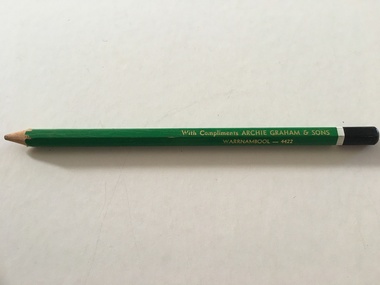
Artefact, Archie Graham & Son Warrnambool - 4423, Mid 20th century
... This pencil was used as an advertising medium for the Warrnambool firm of Archie Graham and Sons. ...This pencil was used as an advertising medium for the Warrnambool firm of Archie Graham and Sons. ...This pencil was used as an advertising medium for the Warrnambool firm of Archie Graham and Sons. It was given to customers of the firm. Archie Graham (1906-1992) commenced a building business in Warrnambool in the 1930s and was well-known for his many building projects in the city and his innovation in the industry. Archie Graham was a prominent member of the Uniting Church and a tireless worker in community affairs in Warrnambool for sixty years. He planned and organized the street decorations for the Warrnambool Centenary in 1947, was chairman of the committee that developed Albert Park and the Reid Oval and was active in Rotary Club and Cricket Club affairs. He was also a member of the Warrnambool Technical School Council. Today the building in Timor Street for senior citizens and other community use is named after Archie Graham. This pencil is of interest as a memento of the type of complimentary article given to customers of businesses in Warrnambool in the mid 20th century. It is also a memento of Archie Graham, an important businessman and community worker in Warrnambool in the 20th century. This is a large six-sided wooden pencil sharpened at one end. The pencil is painted green with a white band near the top and a black-colored end rounded at the top. The paint on the pencil is slightly chipped. The inside of the pencil contains graphite for writing or drawing. The business name on the side of the pencil is inscribed in gold lettering. ‘With Compliments ARCHIE GRAHAM & SONS WARRNAMBOOL – 4422’ archie graham, warrnambool, history of warrnambool -
 Melbourne Legacy
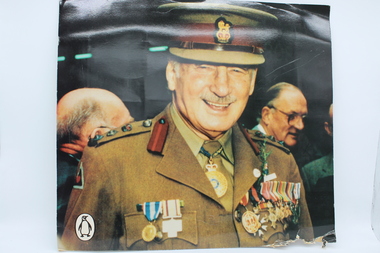
Photograph, Sir Edward Dunlop, 1986
... (Note; Anzac Day badge on left lapel of battle dress jacket and sprig of rosemary rising above decorations pinned on right chest of battle dress jacket.). ...(Note; Anzac Day badge on left lapel of battle dress jacket and sprig of rosemary rising above decorations pinned on right chest of battle dress jacket.). ...A large poster of Sir Ernest Edward "Weary" Dunlop, AC, CMG, OBE (12 July 1907 – 2 July 1993). He was an Australian surgeon who was renowned for his leadership while being held prisoner by the Japanese during World War II. He was involved with Legacy on numerous occasions - including a dinner with Clive James in 1993.When he passed away in 1993 there was a tribute in the Answer. Unknown when the photo was taken - perhaps the 1940s (Note; the colour patch on the upper arm.) Photo has possibly been taken on Anzac Day. (Note; Anzac Day badge on left lapel of battle dress jacket and sprig of rosemary rising above decorations pinned on right chest of battle dress jacket.). The Technical Bookshop were tenants in the shopfront premises of Legacy House for many years. This could have been advertising material for Weary Dunlops War Diaries which were published by Penguin in 1986, presumably the poster was given to Legacy in December 1990 when no longer required in store.This shows the Technical Bookshop had a good relationship with Legacy and understood the connection between Weary Dunlop and Legacy.Coloured photo of Sir (Ernest) Edward "Weary" Dunlop that was used to promote a book about him. Reverse side, a Christmas message to Legacy, written in blue texta. Penguin publishing company logo appears in the bottom left hand corner.Reverse side, handwritten in blue texta "To Legacy. Merry Christmas love Technical Bookshop xxx. 1990"dunlop, portrait -
 Southern Sherbrooke Historical Society Inc.
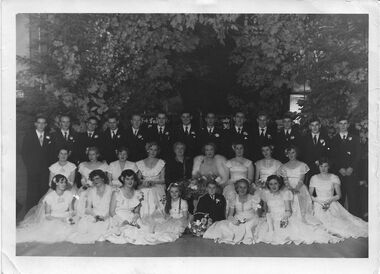
Photograph - Debutantes, Belgrave, early 1950s
... They are seated and standing in front of decorations of foliage. Behind the back row, part of a sign can be seen, advertising Art Franklin's Band and the phone number Belgrave 36. ...They are seated and standing in front of decorations of foliage. Behind the back row, part of a sign can be seen, advertising Art Franklin's Band and the phone number Belgrave 36. ...Photograph of debutantes at Belgrave ball in 1951 or 1952. (FRONT ROW L to R) 1.?, 2.?, 3.?, 4.?, 5.?, 6. Isabel Haines (who later married Mr Connell who worked for the SEC). (MIDDLE ROW L to R) 1.?, 2.?, 3.?, 4.?, 5.?, 6. Ferntree Gully Shire councillor Violet Lambert, 7.?, 8.Glenda Reid, 9.?, 10. Barbara Haig. (BACK ROW, L to R) 1.?, 2.?, 3.?, 4.?, 5.?, 6. Geoff Beasley, 7. Royce Beasley, 8.?, 9. Eric Taylor, 10.?, 11.?, 12.?, 13.?. They are seated and standing in front of decorations of foliage. Behind the back row, part of a sign can be seen, advertising Art Franklin's Band and the phone number Belgrave 36. Also reverse of photo showing photographer's stamp, 'D. R. Pearce/Belgrave Studio/Phone 64'. -
 Melbourne Tram Museum
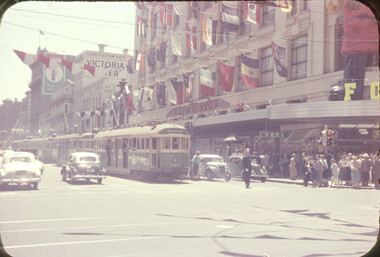
Slide - MMTB, and MTA tramway operations set of 11, Hugh Ballment, 1950s to 1980s
... Set of 11 photos by Hugh Ballment, unless noted, of MMTB, and MTA: HBM185 - MMTB Tram 377, c1954, Swanston St, At Bourke St, with Royal visit decorations along the street. In the background is Foy Gibson, ANZ Bank, Cosmopolitan Hotel and a policeman directing traffic. ...Set of 11 photos by Hugh Ballment, unless noted, of MMTB, and MTA: HBM185 - MMTB Tram 377, c1954, Swanston St, At Bourke St, with Royal visit decorations along the street. In the background is Foy Gibson, ANZ Bank, Cosmopolitan Hotel and a policeman directing traffic. ...Set of 11 photos by Hugh Ballment, unless noted, of MMTB, and MTA: HBM185 - MMTB Tram 377, c1954, Swanston St, At Bourke St, with Royal visit decorations along the street. In the background is Foy Gibson, ANZ Bank, Cosmopolitan Hotel and a policeman directing traffic. HBM186 - MMTB Tram 677, late 1950s, Elsternwick, Has the Tram stop sign about tram services, adverts for Dandy Ham and BP Energy fuel and a Cartage Contractor's offices in the background. HBM187 - MMTB Tram 518, cMay 1983, Seattle, Tourist Tram HBM188 - MTA Tram 2, 1987, Bourke St, Spencer St junction construction. Has the MTOCo offices and Spencer St station in the background. HBM189 - MTA Tram 244, cNov1997, Flinders St, At Spencer St, with a ComEng Train on the viaduct. HBM190 - MMTB Trams 722, 917, c1986, Swanston St, Art Tram David Larwill - at Flinders St with Young and Jackson in the background with adverts for Peter Stuyvesant, four X, Classic Restaurant and a large advert for Coca Cola. HBM191 - MTA Tram 24, Aug 1988, Bourke St, Cable track removal at Spencer St HBM192 - MMTB Tram 857, 24/05/1954, St Kilda Rd, At Sturt St corner, with the Trocadero building in the background HBM193 - MMTB Tram 651, cMay1968, St Kilda junction, Queensway construction, with a passenger at the tram stop. HBM194 - MMTB, Z class tram no. 29, cMay 1976, Bourke St, shows the Palladium Entertainment Centre in the background advertising "Barry Lyndon". Photo taken from the Southern Cross Hotel. HBM195 - MMTB, T class No. 180, 9/09/1967, Royal Parade, TMSV Tour - tours data base gives the date of 10/9/1967, confirmed by TMSV tours listing. Yields information about Melbourne tram operations, with 1950s to 1980s photos of Melbourne tramways.Kodachrome cardboard and plastic mounts, with notes - set of 11new tramway, bourke st, spencer st, swanston st, elizabeth st, flinders st, tram 377, tram 677, elsternwick, seattle, tram 518, tram 244, tram 722, tram 24, tram 857, st kilda road, tram 917, z class, x2 class, t class, royal parade, tram 180 -
 Melbourne Tram Museum
Slide - MMTB and MTA, tramway operations set of 11, Hugh Ballment, 1950s to 1980s
... Tram has the destination of Richmond Punt Road and is in an all-over advertising livery for Thai Airlines - which gives a date of May 1996. ...Tram has the destination of Richmond Punt Road and is in an all-over advertising livery for Thai Airlines - which gives a date of May 1996. ...Set of 11 photos by Hugh Ballment, unless noted, of MTA and MMTB trams: HBM116 - MMTB Tram 7, 10/06/1982, Preston Workshops, Flusher, with Z5 behind and another Z class tram alongside. HBM117 - MMTB Tram 1041, c1976, Mt Alexander Rd, North Essendon. Only has one trolley retriever fitted. Running a Special. HBM118 - MMTB Tram 1041, c1976, Elizabeth St, City terminus, running a route 19, North Coburg. An inspector is talking to the driver. IN the background is a W2 class tram in Flinders St and the Flinders St station building with a Sitmar Cruises sign. HBM119 - MMTB Tram 94, March 1987, Peel St siding, with Vic Market building in the background. HBM120 - MMTB Tram 1041, October 1973, Flinders St, with a Harris train on the viaduct, the large signal gantry, Rodney Mark's, and Holyman in the background. HBM121 - MMTB, July 1981, Elizabeth St terminus, from Flinders St station, showing the terminal arrangements and two trams. In the foreground is a sign for Hosies Hotel. Photo about July 1981, following the installation of a scissors crossover and before an inspector's cabin was installed along with a shelter. HBM122 - MTA, c1996, Swanston St, From Princes Bridge. With two Z-class trams. In the background is Flinders St Station, adverts for Optus, Samsung, and Crown Casino, along with decorations for Christmas. Photo HBM123 - MTA Tram 2077, c1996, Bourke St, at Spring St. In the background is Rydges Hotel and the Imperial Hotel. HBM124 - MTA Tram 809, c1996, High St, Kew, Near back road Kew depot. The tram has a destination of Kew Depot. HBM125 - MTA Tram 175, May 1996, LaTrobe St, At Spencer St. Tram has the destination of Richmond Punt Road and is in an all-over advertising livery for Thai Airlines - which gives a date of May 1996. HBM126 - MTA Tram 136, c1996, Collins St, near William St. The tram has the destination of West Preston. Yields information about Melbourne tram operations, with 1950s to 1980s photos of Melbourne tramways.Kodachrome cardboard and plastic mounts, with notes - set of 11tramways, new tramway, tram 7, mt alexander road, tram 1041, tram 94, peel st, elizabeth st, north essendon, flinders st, tram 2077, tram 175, tram 136, collins st, la trobe st, tram 809, high st, kew depot, bourke st -
 Flagstaff Hill Maritime Museum and Village
Book - "Sovereign of the Seas" book or manual for the ship model hobby enthusiast, Harold T. Bodkin, 1933, "Sovereign of the Seas", Popular Mechanics Press
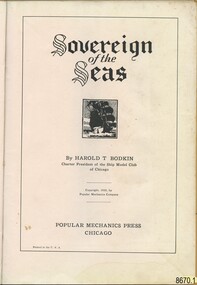
... And numerous pages of advertising. Some adverts include aids for completing the “Sovereign of the Seas” model. ...And numerous pages of advertising. Some adverts include aids for completing the “Sovereign of the Seas” model. ...Jim (James Bernard) Williams, who was the owner of this manual, was a long-time resident of Warrnambool having the opportunity to work at two notable historical businesses of the town. The first, Cramond & Dickson a drapier store established around 1852-1855 and which remained a store that traded under the same name for the longest in Victoria, before it closed its doors in 1974. The second business was Fletcher Jones a highly successful textile and clothing Australian business. Some of Jim’s spare time was devoted to the model ship making which would conjure up many fascinating stories of maritime history. In addition to Jim witnessing the tail end of ships at port in Warrnambool, his "father was as sea captain and operated his vessel in Bass Strait coastal trade between Tasmania and Victoria". The intricately detailed model made by Jim is full of precise detail. The manual and the blueprints held by Flagstaff Hill Maritime Village also reflect the intricate process and devotion to the task completed by Jim. The history of the shipwreck and maritime stories of the Victorian Southwest coast surrounding Warrnambool would have continued to inspire his passion. Three photos of the model and Jim, like the photo of Harold T. Bodkin in the manual, attest to the enthusiasm and enjoyment that was gained by him through this hobby. The manual opens to a photo of “Mr. Harold T. Bodkin adding finishing touches to model of the “Sovereign of the Seas”. The “Forward to Reader” which is on the next page is written by “E. R. HAAN, Technical Editor, Popular Mechanics Magazine. The forward explains the methodology used to achieve the fine detail that is part of the body of the model, by “applying imitation carvings”, and is cited as “a museum type of model”. The following page “Blueprints and Craftmats on the ‘Sovereign of the Seas’” discusses the availability of a set of blueprints to purchase separately. Followed by a description of the moulding process for the “miniature carvings”. “Historical Notes of Interest on the “Sovereign of the Seas (1637)” follow on the next page. The manual is divided into the following parts from pages 8 to 71: “Part I – Shaping the Hull/Part II – The Rudder, Quarter Galleries and Gunports/Part III Wales, Gunport Covers and Initial Ornamentation/Part V – Beakhead Decoration, Bulkhead and Rails, Etc./Part VI Carvings, Lanterns, Knights, Bitts and Painting/Part VII – Details of Mast Construction/Part VIII – Standing Rigging/Part IX – Running Rigging and Final Details. All of these instructions include photographs and detailed graphs. Then instructions on “How to Read and Use Ship-Model Drawings”, “The Shop-Model Maker’s Tools”, and “Simplified Ship-in-a-Bottle”. This is finished off with “Helpful Hints….” And numerous pages of advertising. Some adverts include aids for completing the “Sovereign of the Seas” model. Part I uses blue and black ink to illustrate a dramatic picture of the “Sovereign”, otherwise all print is in black ink on buff paper. This book in significant to the collection as it was donated along with other tools and blueprints which have been used by the donor of the "Sovereign of the Seas" model ship. It also connects with the wider community in that it is related to historical maritime interest and the donor, Jim Williams is also connected to other significant retail and manufacturing businesses of the past in Warrnambool. This manual has been covered with brown paper, including an extra strip for the spine. The front has a watermark at the top middle, some pencilled compass circles segmented into eight parts across the area and a small amount of script writing. The back also has the same type of compass circles and some other small shapes. There are also grease marks. The cover has a patina adding to variations of colour to the paper indicative of the book being handled often. The title page reads “Sovereign of the Seas” in an Old English font. This is followed by a lithograph print around 1 inch square of a ship at full sale. By HAROLD T. BODKIN/Charter President of the Ship Model Club of Chicago/Copyright, 1933, By Popular Mechanics Company/POPULAR MECHANICS PRESS/CHICAGO/Printed in the U.S.A. By HAROLD T. BODKIN/Charter President of the Ship Model Club of Chicago/Copyright, 1933, By Popular Mechanics Company/POPULAR MECHANICS PRESS/CHICAGO/Printed in the U.S.A.flagstaff hill, warrnambool, shipwrecked coast, flagstaff hill maritime museum, maritime museum, shipwreck coast, flagstaff hill maritime village, great ocean road, model ship, vessel sovereign of the seas, jim williams, james bernard williams, the forth tasmania, freda williams, heather williams, phyllis bowditch, fletcher jones staff 1936, 17th century sailing ship, cramond and dickson, sovereign of the seas, royal sovereign, sovereign, charles 1, fletcher jones, warrnambool breakwater -
 Flagstaff Hill Maritime Museum and Village
Vehicle - Wagon, H.H. Smith & Co. Baker, Circa 1930s - 1940s
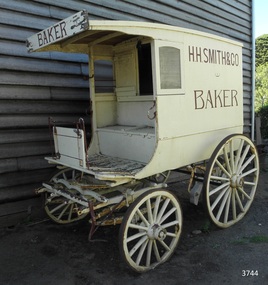
... It currently has advertising for H.H. Smith & Co. Henry Huntington Smith (1857-1941) owned and operated his Warrnambool bakery in the late 19th and early 20th century. ...It currently has advertising for H.H. Smith & Co. Henry Huntington Smith (1857-1941) owned and operated his Warrnambool bakery in the late 19th and early 20th century. ...This baker’s wagon or cart transported and delivered bread and other baked goods in the Warrnambool area. It currently has advertising for H.H. Smith & Co. Henry Huntington Smith (1857-1941) owned and operated his Warrnambool bakery in the late 19th and early 20th century. However, the design of the wagon is similar to those used by local bakers in the 1930s and 1940s and probably originated from Stephenson’s Bakery in Warrnambool, which operated around that time. The wagon’s original internal shelves were removed in the early days of Flagstaff Hill so that children could have rides around the village in a horse-driven cart. BAKERS’ HISTORY There were many bakeries in Warrnambool in the 19th to mid-20th century. Each bread bakery made horse and cart deliveries in its allocated zone. SMITH’S BAKERY; – as shown on the wagon’s signage. Henry Huntington Smith (1857-1941) was born and educated in Warrnambool. He worked at Davis’ steam biscuit factory in Timor Street before he began his own bakery business in 1885 near the corner of Fairy and Koroit Streets. A few years later Smith built a new bakery on the corner of Fairy and Lava Street where it still stands today (2025) as Monaghan’s Pharmacy. The building was designed by James McLeod in 1892 as a bakehouse, shop and residence for Smith The address was known locally as Smith’s Corner. Next door to the bakery, at 136 Fairy Street, were stables built by Jobbins and McLeod in 1886 for William Cust. A photograph in the archives of the Warrnambool and District Historical Society shows the 1892 building with four fancy horse-drawn wagons on the street with white-clad drivers and a promotional stand erected with 5 bakers in uniform and the signage “H H Smith & Co, Pastry Cooks and Confectioners”. One of the wagons appears to have “H H Smith” painted on the side. H.H. Smith & Co. placed an Advertisement in the Weekly Times in December 1896 promoting its business as bakers, confectioners and pastry cooks, praising their shop as an ‘ornament to the town’ with ‘neat appointments’ and ‘dainty decorations’. It also boasted of supplying a large number of customers within a twelve-mile radius of Warrnambool. In November 1919 The Warrnambool Standard announced the marriage of Henry H Smith, Mayor of Warrnambool, to Jeannie Samson-Goodman in East Adelaide. In the same newspaper was a notice that Frank Crossley was to open as baker and pastry cook in H.H. Smith’s premises. As well as being the proprietor of the H.H. Smith Bakery, Henry Huntington Smith was a Councillor for the Warrnambool Municipality from 1913 to 1937 and Mayer for two terms. In December 1919 during his first term as Mayor, he was honoured for the work he had done with returning soldiers after World War I, receiving a document in recognition of this work, presented by the Mothers, Wives and Sisters of returned soldiers. Smith was very interested and involved in the community in many roles, including being the Vice President of the first Warrnambool and District Historical Society. STEPHENSON’S BAKERY: – believed to be the past owner of the wagon. The last owner of the bakery was Harold Stephenson. Stephenson was enlisted in the A.I.F. and was invalided home in 1943 before the end of the Second World War. He also served as a Councillor from 1958 to 1976, during which time he served six terms as Mayor for the City of Warrnambool (1966-1973) while he had the bakery. He was very involved in many local organisations including the Warrnambool Surf Life Saving Club and the Road Race Committee. He died in 1985, lauded as being one of Warrnambool’s “most distinguished civic leaders”. It has been said that the baker injured in World War II invented a special contraption to enable him to get up into the wagon and that he alerted his customers that he was in their vicinity by blowing a whistle. The customers would come out and choose their bread from the back of his wagon then pay him for it. However, another account is given by a man who once earned pocket money by helping the baker on his rounds. He says that it was Stephenson, the owner and manager of the bakery, and not the delivery baker who received a significant injury during the war, making him unable to climb the stairs of his upstairs accommodation at the bakery, therefore causing him to sleep downstairs. At this time in the early to late 1940 Stephenson’s bakery had three wagons, one for each of the delivery rounds. The wagons were painted black and yellow. Two of the drivers were Stan Lake and Ali (Alec) Dean who both had wagons with the covered cabin design. The third driver was Bill Lake who had a flat wagon. Stan Lake delivered in the area around Lava and Koroit Streets, Ali Dean had another round and Bill Lake had the Dennington area. Bread continued to be delivered into the 1960s but by this time the delivery vehicles were motorised. The goods produced at Stephenson’s bakery included bread baked in different shaped tins such as High Tin, Sandwich and Vienna. Some shapes were easily divided into half by breaking them apart, therefore the baker could make two-quarter loaves from a half loaf, satisfying different needs. There was the option of white or brown bread, sweet buns, fruit buns and Boston buns. The baker’s assistant was known to take great delight in ‘trimming’ the broken halves of excess bread and crust, enjoying his treat. THE BAKERY PREMISES: – Southeast corner of Fairy and Lava Streets, Warrnambool. The building retains the original cast iron veranda. Above the veranda, a motif of a wheat sheaf in ornamental plaster can be seen. Inside the building, there are still some of the original fittings. The building was classified by the National Trust in August 1979. After the Second World War, an official system of zoning was introduced as a fair way for the baking industry to operate. In 1949 different pricing was introduced by the Government for either delivered or retail purchased bread. Many of the small local bakeries went out of business after the Government banned zoning. The way was made open for the larger bread manufacturers to enter the local market with cheaper prices. Some of those companies were Mc Queens, Tip Top, Twisties, and Sunicrust, (Mc Queens ‘new’ bakery building was where the current Toyworld shop now stands, is, in the Ozone carpark.) O’Grady’s Bakery, later changing hands and known as Burkes Bakery, was on Fairy Street near the Timor Street intersection, on the North West side. There was also a bakery named Almay. The baker’s wagon is significant because of its association with H.H. Smith’s Bakery in Warrnambool.. The H.H. Smith’s Bakery building on the corner of Fairy and Lava Streets, built in 1892, is classified by the National Trust, August 1979. Smith Street Warrnambool was named after Henry Huntington Smith, who was a Warrnambool Councillor 1913 – 1937 and Mayor 1919 – 1921. Baker’s wagon, often referred to as a baker’s cart. Four wheeled horse-drawn delivery wagon, front wheels smaller than rear wheels. Wagon is clad with metal sheets and lined with varnished timber panels. Wheels have metal rims, wooden spokes and rear wheels have wooden brake pads. Horse shaft is timber with metal fittings. Front has a metal lamp holder, brake lever, metal hand grips and decorative metal foot plates. The wagon has suspension leaves on back and sides and double suspension leaves on the front. Driver’s area at front has a roof, glass side windows and wooden box seat with hinged compartment accessing wagon storage area. Door above back of seat has buckled leather handgrip strap attached, door slides open for access to wagon area. Back of wagon has a wooden step and a split door; top door has ventilation louvers, both doors have metal latches. Wagon is painted cream with brown trim and signage and green step. Remnants of red and green paint are visible; underside of seat panel is painted grey. Wagon advertises H.H. Smith & Co. Baker, a Warrnambool business established in 1885, but is of a more modern design seen around 1930’s and 1940’s and most likely belonging to Stephenson's bakery. Brown signwriting on sides of wagon “H.R. SMITH & CO. / BAKER” Brown signwriting across front of wagon “BAKER” warrnambool, shipwrecked-coast, flagstaff-hill, flagstaff-hill-maritime-museum, maritime-museum, shipwreck-coast, flagstaff-hill-maritime-village, shipwrecked-artefact, great ocean road, baker’s wagon, h.h. smith baker, warrnambool, henry h smith, jeannie samson-goodman, frank crossley, mayor of city of warrnambool, vice president of warrnambool and district historical society, stephenson’s bakery warrnambool, harold stephenson, warrnambool surf life saving club, road race committee, national trust building, stan lake, bill lake, ali dean, 19th and 20th century bakers, davies steam biscuit factory warrnambool, james mcleod building designer, jobbins and mcleod, william cust, h h smith & co, pastry cooks and confectioners, bakery trade, bread delivery wagon -
 Melbourne Tram Museum
Album - Photo Album, John Etkins, Ray Marsh, 1990's
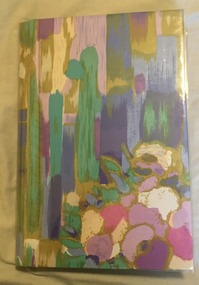
... 6 856 City Circle – with gas and fuel building – 31-7-1994 6 925 City Circle - with gas and fuel building – 31-7-1994 6 728 City Circle – 10-8-1994 7 246 Navy tram x three pics – July 1992 8 ? Gold tram advertising Georges 8 990 Advertising Telstra– 29-4-1993 8 749 Art tram? ...6 856 City Circle – with gas and fuel building – 31-7-1994 6 925 City Circle - with gas and fuel building – 31-7-1994 6 728 City Circle – 10-8-1994 7 246 Navy tram x three pics – July 1992 8 ? Gold tram advertising Georges 8 990 Advertising Telstra– 29-4-1993 8 749 Art tram? ...Photo Album - 48 sheets bound with a white circular metal/plastic spiral bound within a heavy duty cardboard cover, with glued cover pages, plastic covered with an index sheet. Allows for three photographs per page. Not known whether the plastic envelope for each photograph is of archival quality. No Manufacture detail, though has a bar code on the bottom left hand corner of the rear cover. Cover is a reproduction from a painted art piece. Listing of photographs given on htd1800-RayMarshalbum.pdf Dates given when written on the rear of the photograph. Compiled by John Etkins from photographs given to him by Ray Marsh. 1990's to 1993 generally. Page Tram/s Notes – dates given when on rear of photograph. 1 226 Loading passengers – ex MMTB Annual Report? 1 957 City Circle 1 “hands off our trams” protest march 2 2100, 231 South Melbourne Depot – 10-4-1993 2 676 And many others – Hawthorn Depot 2 217 Princes Bridges 3 380, 104 St Kilda Road 3 106, 104 Essendon Depot 3 431 As a W1 4 1011 Fresh fruit tram, Preston Depot 6-12-1992, 4 824 Day in Day out, Brunswick and Victoria Parade 29-4-1993 4 722 Art tram 5 ? Advert tram – Imperial China 5 237 Stubbsy tram – TrippleM? 6 856 City Circle – with gas and fuel building – 31-7-1994 6 925 City Circle - with gas and fuel building – 31-7-1994 6 728 City Circle – 10-8-1994 7 246 Navy tram x three pics – July 1992 8 ? Gold tram advertising Georges 8 990 Advertising Telstra– 29-4-1993 8 749 Art tram? 9 990 NRMA - 1-3-1994 9 727, 215 Public Transport 9 920 Advert tram with a picket fence 10 Bendigo 21 Preston Workshops 11-3-1993 10 774? W5 being rebuilt at Preston – 21-10-1991 11 ? Bogie cable trailer at Preston – 29-4-1993 11 922 Interior view of a tram – being modernised – 11-3-1993 11 922 Preston Workshops 29-4-1993 12 1018 Workcare tram at Preston 1994 – 11-8-1994 12 774 Preston Workshops – 20-12-1993 12 8 Preston Workshops – 1-10-1992 13 380 Preston Workshops 13 8 Preston Workshops 13 20, 8 Preston Workshops 14 721 Preston Workshops 20-12-1993 14 ? Tramways painted artist tram featuring a driver and workshop 14 Traverser Preston Workshops 15 2110, 2106 Preston Workshops 15 ? Preston Workshops 15 2130 Interior Preston Workshops 20-12-1993 16 Set of three pics Elizabeth St floods – 17-2-1972 17 Set of three pics Elizabeth St floods – 17-2-1972 18 676 Turning into Swanston St from Batman Ave 18 676 Kew Depot – 10-11-1991 18 237, 676, 611 Kew Depot – 10-11-1991 19 214, 676 South Melbourne Depot – Kingsway 19 217 Spencer St 19 214 Advertising Kew Depot Open Day -8-12-1991 20 231, 676 Advertising Kew Depot Open Day -8-12-1991 20 Zoo tram, 256 Outside Kew Depot 20 214 Hawthorn Open Day with band 21 Zoo tram x 3 pics And horses, Kew Open day 22 231, 431 Kew Depot 22 892, 214 Kew Depot 75 years, Postcard – 1991 22 282 Kew Depot – with the name Monique on the tram and a lady standing alongside 23 238, 233 Kew Depot 23 236, 892, 282 Kew Depot – 25-4-1992 23 232, 236, 282 Kew Depot 24 2112 Port Melbourne line – with long grass – 11-4-1993 24 469, 2037, ? 2015 South Melbourne Depot 24 1018 or 976? Advertising a PTC Open Day – 20-10-1991 – In Swanston St - see Reg Item 1845 25 250 Bourke St 25 2100 Running into Preston Workshops 25 282, 1003 Collins St in the rain 26 Logo PMTT 26 Point cover With P&MTT cast into the cover 26 Foundation Stone Person reblocking in gold, a PMTT Foundation Stone 27 Logo Tramway Board 27 Logo MMTB logo 27 Logo Footscray Tramways Trust 28 217 And 2’gauge W2 – South Melbourne Depot – 20-10-1991 28 164 Somewhere? 28 1018 Advert tram – “Moro”, Preston flyover 29 V214 x 3 pics Kew Depot 30 611 Whitehorse Road, Balwyn 5-10-1991 30 976 x 2 pics Advert tram – have a red instead 31 610 Malvern Depot 31 138 (max tract) Flinders St 31 138 (max tract) Bourke into Spencer 32 844 Victoria Parade with R10 behind 32 264 With a TV interview being undertaken 32 2066 Elizabeth St – 29-4-1993 33 255 x 2 pics Derailed at Kew Depot 33 253 Derailed outside the Beehive Hotel 34 214, 892, 611 Re-enactment of Victoria Bridge to Esplanade service – 10-11-91 34 726 Art tram? – Swanston St with overhead trucks in background 34 10W Reblocking scrubber car at Brunswick Depot 1999 35 2085 At Preston workshops over an inspection track section 35 731 St Georges Road, road being rebuilt – Nov. 1991 35 Preston Jtn Junction at Workshops being relaid 36 1003 St Georges Road, Nov. 1991 trackworks 36 St Georges Rd Track being rebuilt – Nov. 1991 has temp track cross over 36 Victoria St Victoria St being reconstructed 6-9-1992 37 East Burwood Extension works – 18-2-1993 37 East Burwood Re-building crossover – 18-2-1993 37 Victoria St Victoria St being reconstructed 6-9-1992 38 19W, 16W Bylands – 5-12-1993 38 R10 Kew Depot 38 Workers Kew Depot pushing on a post 39 R10 R10 towing a B class tram- Royal Parade? 39 11W, 10W? South Melbourne Depot 39 Overhead Overhead truck at Kew Depot 40 Kew Depot Demolition works opposite depot 40 613? Malvern Depot on special tram 40 256 zoo tram Royal Park tram at Kew Depot 41 B class Bundoora line 1993 41 231, 611 Kew depot 75th anniversary tram 41 469, 287 Kew depot 42 510 Spring St into Bourke St – 28-4-1993. “42nd street promotion. 42 153 High St Northcote, Bundoora 42 611 Kew Depot, Nov. 1991 43 195? Simpson St siding – 25-4-1993 – 7 trams in all 43 646 Route 12, with fire station in background – Gisborne and Victoria 43 961 Burke Road, Camberwell, 10-8-1994 44 760 Art tram 44 938 Sam the tram, Flinders St 44 1014 Gilbert Road, West Preston, June 1994, advert for AGC 45 965 Daimaru advert tram, Swanston St 45 1018 Express post advert tram, Swanston St. 45 1024 Advert – lego exhibition – Swanston St 46 104 Camberwell depot 46 611 Looking towards driver’s controls from interior. 46 W1 Interior photo showing tip over seats 47 Cable car Interior photo – could be zoo tram 47 510 Interior, 28-4-1993 47 214 Kew Depot, night shot, Oct. 1991 48 246, 237 Kew depot, 13-9-1993 – Stubbsy and Energy Victoria advert 48 246, 231, 237 Kew depot, Navy, 75th anniversary of Kew and Fox Fm advert 48 2014, 2072 South Melbourne – tt line? Advert tram 49 59 And six other trams in front of Preston Workshops 49 1024 MMTB Christmas Tram, 1970 49 2001 Camberwell Depot 50 725 Preston depot area – tram has a red upper half 50 725 South Melbourne depot – now has Xmas decorations 50 1026 Bourke St, Christmas 6-12-1993 51 933 Victoria Parade shunt and other A class tram – Autumn 51 829 Art tram 51 39 Advert tram – Crime prevention 52 Connie Connie at night = has jeans on 52 1?? Has a MET inspector standing in front of number – Latrobe uni tram 52 611 Kew Depot 53 237 Fox FM Black Thunder tram at Kew Depot, August 1992 53 237, 611, 892 Victoria Bridge re-enactment – 10-11-1991 53 237 At Kew depot with 4 people, including Hugh Waldron 53 442, 10W South Melbourne Restaurant tram and works car 53 W2 At Wattle Park 53 School art Photo of students holding artwork on the zoo tram 256 at Kew 54 138 And many others 54 469 Launch of the Melbourne Tram by the PTC 54 School art Photo of students holding artwork on the zoo tram 256 at Kew 55 B2 Elizabeth St terminus, Christmas 1994 55 8 Z8 Swanston St, April 1993 55 504 Clifton Pugh – Preston Workshops 56 138, 180, 214 Hawthorn Depot display 56 650, 510 Hawthorn Depot 56 469 Camberwell 57 568 Bridge Road Richmond by cable tram depot 57 ? Advert tram – Falls Creek 57 995 Malvern Road, 18-5-1992 58 457, 217 etc Swanston St display 58 231, 611 Kew 75th Anniversary 58 682 Artist tram at Malvern Depot – 18-5-1992 59 1018 Country Road advert tram 59 8 Z class – decorated tram – Essendon Depot 59 947 Metland Safety Express – safety tram – Kew depot 60 101 x 2pics Decorated for RAAF 70th Anniversary 60 2082 Near East Preston Depot, with destination “Next Stop Mill Park” 61 475 After sale and disposal 61 585 After sale and disposal 61 651 After sale and disposal – Diamond Creek – 9-8-1994 62 386 After sale and disposal – Sunbury 62 590 After sale and disposal – Hall ACT 62 476 After sale and disposal – Kinglake 63 11W Bundoora Extension – track being opened 63 947 Metland Safety Express – safety tram – Kew depot 63 Model 2,3 2’ gauge model trams 64 Model 2 Ditto 64 250 After sale and disposal 64 293 After sale and disposal – Diamond Ck – 9-8-1994 65 246, 231, 237 Kew depot, Navy, 75th anniversary of Kew and Fox Fm advert 65 1002 Advert tram – Salvation Army 65 231, 29 Kew Depot 66 246, 231, 237 Kew depot, Navy, 75th anniversary of Kew and Fox Fm advert 66 646, 935, 1002 Kew depot 66 220, 60 Preston Workshops? 67 851, 814 Malvern Depot 3-9-1992 67 726 Malvern Rd at Glenferrie Road – 18-5-1992 67 237, 133 Victoria Parade 1996 68 814 and others Interior Malvern Depot – 18-5-1992 68 231 75th Kew depot anniversary at depot 68 231 75th Kew depot anniversary at depot 69 1024 Malvern Depot 10-11-1991 69 1011 Advert tram Melbourne City Toyota 69 106, 180 Swanston St 70 190, 568 Camberwell Depot 70 431 Flinders St – tram event 70 20, 138 Camberwell Depot 71 431 Flinders St – tram event 71 237 Fox FM Thunder Tram 71 2057, 2014 Elizabeth St, Vic Market 29-4-1993 72 676, 611, 892 Victoria Bridge re-enactment – 10-11-1991 72 Ceremony Victoria Bridge – mayor and others event 72 214 214 on the bridge 73 164 Lygon St – former outer circle line level crossing in view 73 841 Swanston Walk 29-4-1993 74 821 St Georges Road, April 1993 74 431, 231 Victoria Parade 74 217, 676 Passing Camberwell Depot 75 Oporto 018 Clarendon St 6-3-2003 75 3007 Albert Park – 7-3-2003 75 3001, 018, 3502 Docklands – 10-3-2003 76 Oporto 018 Docklands – 16-1-2003 76 Oporto 018 Flinders St 7-3-2003 76 3502 Swanston St at Flinders St -8-3-2003 77 16 Kew Depot, Jan 1991 77 112, 110 Bundoora 4-9-1992 77 738 Camberwell Feb 1991 78 1011 Thornbury Jan 1991 advert for City Toyota 78 101 Bundoora – RAAF tram 4-9-1992 78 814 Art tram – Swanston St August 1992 79 1024, 469, Z3 Preston Workshops – 469 as the Melbourne Tram – 9-9-1992 79 961 Malvern Depot 3-9-1992 79 242 Single line working in Victoria St 6-9-1992 80 781 Thornbury, the hump, Preston Workshops Jan 1991 80 2104 Preston Workshops 9-9-1992 80 2100 Launch, Preston Workshops 9-9-1992 81 5W + 1A 5 x W at Kew Depot 3-2-1991 81 676 Kew Depot 21-2-1991 81 873, 2016 Brunswick depot 2-3-1991 82 231 Kew Depot Yard – 21-1-1991 82 157, 158 Brunswick Depot – 2-3-1991 82 2057, 873, 158 Brunswick Depot – 2-3-1991 83 802 Art Tram - Franklin St from the signal box 2-3-1991 83 990 990 Evian advert tram, Franklin St signal box 2-3-1991 83 920 GIO Advert Tram with Bushels tea and Yellow Pages? Adverts 84 721 Art Tram, Franklin St signal box 84 976 St Georges Road, Jan 1991 – advert tram Capital society 84 731 St Georges Road, Jan. 1991 Art tram 85 10W Victoria Parade, Brunswick St, 1/3/1991 85 10W, 9 or 11W South Melbourne depot 85 10W Bundoora Terminus 4-2-1991 86 11W City Baths 86 10, 16 Camberwell Depot 6-12-1990 86 944 Glenhuntly Depot 18-2-1991 87 2011 Spring St – Princess Theatre, March 1990 87 294, 239, 277, 243, 259, 280 Kew Depot 87 296 Kew Depot 88 1015, 16 Batman Ave 19-1-1991 88 963, 948, 935, 996, 892 Kew Depot 3-2-1991 88 Victoria St Victoria St Richmond Reconstruction 6-2-1992 89 1014, 990 Batman Ave 19-1-1991 (Image added i5 and rear view added 23-12-2018, scanned for Dale Budd. 89 920 920 – GIO advert tram, 760 art Tram Collins at Spencer 17-10-1990 89 610, 611 Kooyong Station level crossing 30-12-1990 90 95 Royal Park, 15-2-1991 90 2057, 873, 158 Brunswick Depot – 2-3-1991 90 10 Camberwell Depot 6-12-1990 91 Bendigo 44 In Prahran and Malvern Tramways Trust Colours 1986 –Black and white photo. Listed 5-11-2016See note page 1 and on image 3trams, tramways, album, photo album, tramcars, the met, yarra trams, kew depot, brunswick depot, advertising trams, transporting art, preston depot, hawthorn, bundoora, st georges rd, victoria st, camberwell depot, tram r10, 8, 10w, 10, 11w, 16, 16w, oporto 018, 19w, 20, bendigo 21, 29, 39, bendigo 44, 59, 60, 95, 101, 104, 106, 110, 112, 133, 138, 153, 157, 158, 164, 180, 190, 195?, 214, 215, 217, 220, 226, 231, 232, 233, 236, 237, 238, 239, 242, 243, 246, 250, 253, 255, 256, 259, 264, 277, 280, 282, 287, 293, 294, 296, 380, 386, 431, 442, 457, 469, 475, 476, 504, 510, 568, 585, 590, 610, 611, 613?, 646, 651, 676, 682, 721, 722, 725, 726, 727, 728, 731, 738, 749, 760, 774, 781, 802, 814, 821, 824, 829, 841, 844, 851, 856, 873, 892, 920, 922, 925, 933, 935, 938, 944, 947, 948, 957, 961, 963, 965, 976, 990, 995, 996, 1002, 1003, 1011, 1014, 1015, 1018, 1024, 1026, 2001, 2011, 2014, 2015, 2016, 2037, 2057, 2057, 2066, 2072, 2082, 2085, 2100, 2104, 2106, 2112, 2130, 3001, 3007, 3502 -
 Bendigo Military Museum
Administrative record - COMPENDIUM WW1 - WW2, 4) A H Pettifer, Government Printer et al, 2) 14.2.1946; .3) 1.3.1919; .4) 30.11.1954 .5) 24.11.19? - WWI; .6) 31.10.1917; .7) 12.6.1917; .8) Page 1: 20.12.1915, Page 2: 10.12.1915, Page 6: 19.1915; .9) 10.9.1918; .10) 18.4.1919; .11) c.2.3.19?; .12) 18.9.1920; .14) post WWI; .15) 24.4.1920; .17) 18.4.1942; .18) 19.6.1943; .19) 18.3.1947; .20) 1944; .21) 1944; .23) 22.10.1941; .26) 13.9.1944; .27) 1.1944; .30) 7.3.1950; .31) 31.7.1944; .32) 16.4.1942; .33) 13.6.1946; .34) 6.5.1946; .36) a) & b) 3.11.1947; .37) 24.10.1951; .38) 24.9.1957; .39) 9.10.1957; .40) 19.2.1958; .41) 26.2.1958; .42) 1.3.1958; .43) & .44) 7.3.1958; .45) 25.2.1958; .46) 3.1.1948; .47) 26.2.1948; .48) 22.4.1958; .49) 24.2.1958; .50) 12.3.1958; .51) 6.1958; .52) c.Mar/Apr 1958; .53) 5.4.1958; .54) c.end WWII; .55) a.b. 13.6.1967; .56) 26.5.1967; .57) 18.2.1954
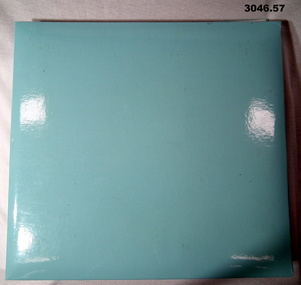
... Large page features a black & white captioned photo of a group listening to a uniformed Officer deliver a speech. Also features advertising front & back. .52) Newspaper article: Official Opening of Native Ex Servicemen's Club. ...Includes military service from 1912 - 1944, schools & courses attended, decorations, promotions & overseas service. .16) Form issued to H T ALLAN on 15.12.1939 granting permission to leave New Guinea for Australia & return within a period of 12 months. ...Herbert Trangmar Allan, refer 2755.4 for his extensive service history and wards. .2) Details gifting of a pair of Japanese binoculars to Col H T ALLAN by Pacific Island Regiment. .3) Certificate issued by Winston Churchill, Secretary of State for War (The War of 1914-1918), awarded to Capt H T ALLAN MC. .4) Herbert Trangman ALLAN born 5.1.1895 at Woolwich, NSW. Middle name misspelled, should be Trangmar not Trangman. .6) Congratulating H T ALLAN on receiving the Military Cross award for leading 2 companies which had lost officers during action on Passchendaele Ridge on 9.10.1917. .7) Describes life behind the lines whilst H T ALLAN's battalion has been resting for a month. Daily life consisted of training drills, sport & entertainment. Writer takes time to describe the countryside & weather. .8) Relate to H T ALLAN's military exam results & his promotion to 2nd Lieutenant in 1915. .9) To Herbert Allan's father, Mr P Allan detailing the citation for awarding of the Military Cross to Herbert ALLAN. Original citation appeared in the London Gazette,5.4.1918. .10) Form addressed to Capt H ALLAN MC, 17th Battalion stating his period of enlistment in the 1st AIF was to expire 26.5.1919. .11) Letter from Lord BIRDWOOD (General) to Herbert ALLAN in response to a letter received 19.11.19?. General BIRDWOOD expresses his opinions on difficulties the allied troops face in their fight against the Japanese. .12) Letter to Capt H T ALLAN advising of MID oak leaves sent to him. Details guidelines for attaching oak leaves to both the larger Victory Medal & the small service dress medal. .13) Form details H T ALLAN's WWII Army No, Rank, Unit & Decorations & Medals held. The form has not been signed & dated. .14) Details service record of Lt Col H T ALLAN NX12229. Includes military service from 1912 - 1944, schools & courses attended, decorations, promotions & overseas service. .16) Form issued to H T ALLAN on 15.12.1939 granting permission to leave New Guinea for Australia & return within a period of 12 months. Issued by Customs Office in Salamaua. Lists H T ALLAN's age as 44, height 5' 10" & occupation. .17) Letter from Major General MORSHEAD GOC, AIF (ME) to Major H T ALLAN, OBE, MC congratulating him on being awarded the OBE for outstanding service at Tobruch. .18) Letter from Major General MORSHEAD to Major H T ALLAN, OBE, MC replying to ALLAN's letter of 15.6.1943. MORSHEAD is congratulating ALLAN on his appointment to New Guinea Force, also acknowledges his excellent service record. .19) Letter acknowledges H T ALLAN's resignation from the Office of Production Member of the Australian New Guinea Production Control Board, effective from 28.8.1946. .20) Major General WINDEYER commanded the 20th Brigade from 1942-1946. .22) Card sent from the CO of the 3rd Australian Anti-Tank Regiment. .23) Menu for Farewell Dinner held in the Officer's Mess of the 20th Infantry Brigade, Tobruch on 22.10.1941. .24) Menu & Toast list for Farewell Dinner to Brigadier J J MURRAY DSO MC VD. Attended by H T ALLAN & held in the Officers Mess, 2/17 Australian Infantry Battalion on 22.12.1941. .25) Invitation to Col H T ALLAN by Lady Gowrie (wife of Governor General Baron Gowrie) to attend a Luncheon at Government House, Canberra, ACT. .26) Letter to Major (T/Lt Col) H T ALLAN from Major W A JENNER advising him of his secondment to 2/17 Australian Infantry Battalion & appointment to command 5 Aust Base Sub Area. .27) Application for Africa Star with Eighth Army Clasp signed by H T ALLAN & approved by Lt Colonel of 2/17 Australian Infantry Battalion. H T ALLAN held the rank of Major (substantive) at the time of qualification, 1.3.1942 - 11.1942. He held the rank of Lt Colonel at the time of application in 2.1944. .28) Detailing changes in command & promotions including that of Lt Col H T ALLAN, dated 1.4.19? .29) For Lt Col H T ALLAN detailing movements required by First Australian Army command. .30) Acknowledgement & confirmation of Col H T ALLAN's application for campaign awards for WWII. .31) Letter addressed to Lt Col H T ALLAN from Lt Gen Stanley Sauige requesting information on New Britain for a forthcoming visit. .32) Certificate was presented to H T ALLAN on 16.4.1942 when he was awarded an OBE by King George VI. .33) Document details H T ALLAN's relinguishing of Command of the HQ of Pacific Islands Regiment. ALLAN also relinguished the rank of temporary Colonel & was transferred to the Reserve of Officers with rank of substantive Lt Colonel. .35) Official letter to Colonel H T ALLAN from Joseph Francis, Minister for the Army. The letter acknowledges Col ALLAN's long & distinguished career during both peace & wartime. .36) a) & b) From H T ALLAN (assumed) to Prime Minister J B CHIFFLEY referring to the production of copra in New Guinea, the actions of the Commonwealth Bank in relation to planters & the collaboration of New Guinea natives with the Japanese. Assumed to be a copy of original. .37) Letter to H T ALLAN indicating he had been placed on the Retired List with the rank of Honorary Colonel. .38) Letter invites H T ALLAN to officially open the State Conference in Lae in late March or early April 1958. Invitation was extended due to H T ALLAN for distinguished service in PNG. .39) Letter to H T ALLAN thanking him for accepting the invitation to open the Papua & New Guinea State Conference in late March or early April 1958. .40) Letter from H T ALLAN to Lt Gen Sir Henry WELLS, Chief of the General Staff, Victoria Barracks, Melbourne. ALLAN requests permission to wear his uniform for official engagements during his upcoming visit to New Guinea. ALLAN also offers advice on how to deal with native troops including serving time with them, learning their language & studying their customs. He suggests that this would help quell & dissent & revolt. .41) Reply from Major General DALY to HT ALLAN thanking him for his offer to spend time with the CO of the Pacific Island Regiment to address concerns with that unit. This meeting would coincide with ALLAN's upcoming visit to PNG. .42) HT ALLAN's reply to Major General T J DALY's letter of 26.2.1958. ALLAN requests an opportunity to discuss PIR issues with Major General DALY prior to his visit to PNG. .43) Major General T J DALY's reply to HT ALLAN's request for a meeting to discuss ongoing issues with the Pacific Island Regiment. .44) Letter from HT ALLAN to Brigadier D M CLELAND notifying him that he will be staying in Port Moresby on his way to the RSS&AILA Congress in Lae. .45) Lieutenant Colonel MCGUINN writes to invite Colonel ALLAN to visit the PIR during his visit to New Guinea at the end of March of the beginning of April 1959. .46) Letter of appreciation to H T ALLAN thanking him for his efforts in presenting the case for the Territory of New Guinea during the post WWII transition period. .47) Letter to H T ALLAN from New Guinea Citizens Association, Lae Branch, thanking him for his service on behalf of the people of the Territory of New Guinea. The association offered to send ALLAN a suitable present in recognition of his service. .48) Major General T J DALY's reply to HT ALLAN's suggestions for handling disquiet amongst the native troops in the Pacific Island Regiment. .49) Reply from Lieutenant General WELLS to H T ALLAN granting him permission to wear his uniform on his forthcoming visit to New Guinea. WELLS also notes that he has passed other requests made by ALLAN to Major General DALY. .50) Copy of H T ALLAN's reply to Lieutenant General WELL's letter of 24.2.1958 [.49)]. .51) A written account of Colonel H T Blue ALLAN's visit to New Guinea in 3.1958. Article appeared on p.65 & 67 of the 6.1958 edition of Pacific Islands Monthly. .52) Newspaper account of Colonel H T Blue ALLAN's opening of the Rabaul Branch of the Native Ex Servicemen's Association. Colonel ALLAN spoke of the involvement of the Pacific Islands Regiment during WWII. .53) The Rabaul Times account of Colonel H T Blue ALLAN's opening of the Rabaul Branch of Native Ex Servicemen's Club. Featured on p1, concluded p3. .54) Biographical account of Colonel H T ALLAN's service in WWI & WWII. In addition an account of his success in New Guinea between the wars is included. .55) a.b. Biography of Colonel H T ALLAN written by R W Robson who was the founder of the Pacific Islands Monthly. Article was written following ALLAN's death on 23.5.1967 aged 72. This item is a pre publication copy of Robson's article which appeared in the Pacific Islands Monthly. .56) Text of a valedictory given at the funeral of Colonel Herbert Trangmar ALLAN OBE, MC, ED, NX12229 held 26.5.1967 following his death on 23.5.1967. The speech summarized his life in both wars & civilian life. 57) Invitation issued to Colonel H T & Mrs ALLAN to attend a Garden Party at Government House on 18.2.1954. At this function Colonel H T & Mrs ALLAN were to be presented to her Majesty Queen Elizabeth II.Herbert T ALLAN Collection. The contents are all of various size, the Album is the size documented. .1) Large teal green album containing 16 plastic pockets each with white card insert. Various documents & photos contained in each pocket. .2) Typed letter, black type on cream paper. .3) Certificate mounted on fawn card backed with dark brown veneer. Presented to Capt H T ALLAN MC for being mentioned in despatches on 7.11.1917. .4) New South Wales Birth Certificate extract, printed on pink paper with watermark. .5) Telegram on tissue paper to a sheet of cream paper. Pin located top L corner. Requests the attendance of Lt Herbert ALLAN, Russell Hotel, Russell Square. .6) Typed letter mounted on grey cardboard. .7) 2 page letter on foolscap paper, secured by pin top L corner. Written from France by Herbert (Bert) ALLAN & addressed to his father. .8) 11 pages secured with a clip top L corner. 1st document typed, 2nd handwritten, remainder printed. Relate to H T ALLAN's military exam results. .9) Typed letter from Department of Defence Base Records Office to P ALLAN. .10) Document, printed form to inform the recipient that their period of enlistment in the 1st AIF had expired. .11) 4 page handwritten letter on 2 sheets of paper. 1st page has a printed letterhead. .12) BR Form No 20. Typed formal letter from AIF Base Records Office to accompany Mentioned in Despatches oak leaves sent to the recipient. .13) Form AAFA36 used for recommending the awarding of an Efficiency Decoration. Form details service record & details of a serving soldier. .14) 1 large / 1 small page, numbered, detailing the service record of Lt Col H T ALLAN. Black type on cream paper. 2 pages are loose but evidence of attachment visible. .15) Bachelor of Arts Degree Certificate (testamur) granted by the University of Sydney, awarded to Herbert Trangmar ALLAN. Printed on cream parchment. .16) Proforma document issued by the Territory of New Guinea permitting leave & return to the Territory. Printed 2 sides, black type on cream paper. .17) Letter on Australian Imperial Force letterhead from Major General MORSHEAD to Major H T ALLAN. .18 Letter on HQ2 Aust Corps letterhead from Major General MORSHEAD to Major H T ALLAN. .19) Typed letter on External Territories letterhead from J R Halligan to H T ALLAN. .20) Cream Christmas card folded in 2, sent to H T ALLAN. On front in black lettering is HQ 20th Australian Infantry Brigade below black Rising Sun emblem. Inside in black lettering is With Best Wishes for Christmas and New Year. Christmas 1944. .21) Cream card folded in 2. Front illustration depicts a devil figure riding a platypus & carrying a pennant with 2/13 on it. The devil is depicted attacking a German & Japanese soldier. Below the devil is a boomerang with Greetings Xmas 1944 printed on it. Illustration is in green & black. Inside on LHS is a message from 2/13 Battalion. On RHS is a list of 2/13 battle honours from 1940-1943. On back in black print is 1944-1945 New Guinea Australia. .22) Cream Christmas card folded in 2. Front illustration in brown with word Greetings in green. RHS inside printing in green & brown letters. Artillery badge on back in brown. .23) Cream card folded in 2. Typed menu on cream paper attached inside. Front cover illustrated with 20th Infantry Brigade colour patch & a rat over a scroll with words - So What? .24) Cream card folded in 2. On front black printing accompanied by 2/17 Battalion colour patch that is black over green diamond shape. Inside a list of Toasts & Dinner Menu printed in black. Back page for autographs. .25) Cream invitation card. Black cursive script printing below gold crown on front. .26) Typed letter on cream paper. .27) Typed foolscap application form to claim the Africa Star. .28) & .29) Message form filled with typed orders. .30) Typed letter acknowledging an application for campaign medals & listing eligible awards. .31) Typed letter on bond paper. .32) Certificate on cream parchment. Black print in cursive script. Text details the awarding of an OBE to the recipient. .33) Typed text on Australian Military Forces letterhead. Cream paper. .34) Typed text. Temporary note for H T ALLAN's discharge from AMF. .35) Typed letter on Commonwealth of Australia, Minister for the Army letterhead. .36) a) & b) 2 page letter in black type on cream paper. Pages are loose, letter unsigned. .37) 1 page typed letter on Australian Military Forces letterhead. .38) & .39) 1 page typed letter on Return Sailors, Soldiers & Airmen's Imperial League of Australia, Papua & New Guinea Branch letterhead. .40) 1 page typed letter, unsigned. .41) Single sided typed letter on Australian Military Forces letterhead on cream paper. .42) 1 page typed letter, unsigned on cream paper. .43) Single sided typed letter on Australian Military Forces, Northern Command, Victoria Barracks, Brisbane letterhead on cream paper. .44) Single sided typed letter on cream paper. .45) 2 page typed letter on folded cream paper bearing the letterhead of the Pacific Islands Regiment. .46) 1 page typed letter on cream, lined paper. .47) 1 page typed letter on cream paper. .48) 1 page typed letter on Australian Military Forces, Northern Command Headquarters, Victoria Barracks, Brisbane letterhead on cream paper. .49) 1 page typed letter on Chief of General Staff, Australian Military Forces, Army Headquarters, Victoria Barracks, Melbourne letterhead on cream paper. .50) 1 page copy of an unsigned letter on cream paper. .51) Magazine article: Building a New Nation in New Guinea : Some advice from Colonel Blue ALLAN. Black & white article with a 2nd small section stapled to the main page. Large page features a black & white captioned photo of a group listening to a uniformed Officer deliver a speech. Also features advertising front & back. .52) Newspaper article: Official Opening of Native Ex Servicemen's Club. Black & white typed newspaper article featuring a captioned black & white photo of a uniformed Australian Officer & a group of New Guinea Ex Servicemen. .53) a. b. c. Newspaper article: Master Blue Came Back to the Islands: 4000 Attend Club Opening. 3 Section article cut from a newspaper. One part is the banner of the newspaper with date published. Other sections contain the text of the article. The larger section features a black & white photo of an Australian Army Officer in uniform. .54) Newspaper article, untitled. Black & white typed newspaper article with black & white caricature of an Australian Army Officer featured. .55) a. b. Magazine article: The Story of a Big Man who Loved Soldiering. 2 page black & white typed article with sub headings. .56) Text of a Speech. 2 page typed text written for a valedictory given at a funeral. Pages connected with a staple in the top L corner. .57) Printed, cream card invitation to a Garden Party for the recipient to meet Queen Elizabeth II & The Duke of Edinburgh. Text is in cursive script under the Coat of Arms of Her Majesty. .2) Signature ? Capt S C PIR. .4) Date of issue typed: 30.11.1954 Name of recipient: Herbert Trangman Allan Stamped: T Wells, Registrar General NSW .5) Handwritten: To Lt Herbert Allan, Russell Hotel, Russell Square. Typed: Buckingham Palace OHS. Your attendance is required at Buckingham Palace on Wednesday next the Twentyeighth inst (28.11.19?) at ten o'clock am service dress please telegraph acknowledgement Lord Chamberlain London. Stamped: Central District 24 NO 19. .6) Signed in pencil: W Birdwood. In pencil on back: 15 x 12. .8) p1: Handwritten signature. Copy dated 29.12.1915. p2 Handwritten in ink: P Allan Esq, Mount Hunter Hill. Military Examination. Copy dated 29.12.1915. Handwritten in pencil: Results: H T Allan. Tactics - Distinction 92% HE Barff p3 Underlined in ink: 38th Infantry Herbert Trangmar Allan to be 2nd Lieutenant (provisionally). Dated 16 June 1914. p5 Handwritten: Total 139. Lieut Allan tied with 15 others for 20 place. p7, 9, 10 & 11underlined in ink: H T Allan. p8 Underlined in ink: Allan HT. .9) & .10) Signature in black ink. .12) Handwritten signature in black ink: On back handwritten signature in black ink: Clive Wilkinson, Buddong, Robinson St, Chatswood. Also ? Rd, Cremorne Pt. .13) Handwritten in black ink: Details of HT Allan's Commission Service from 16.6.1914 - 18.2.1946. .15) Handwritten signature of the University Chancellor, Dean of Faculty of Arts & Registrar. Handwritten name of recipient. Seal of the University of Sydney imprinted bottom LHS. .16) Handwritten in black ink: Details of recipient. Stamped in red ink: New Guinea Customs. Stamped in blue ink: H M Customs, Cooktown, dated 17.12.1939. Handwritten on reverse: Signature. Stamped on reverse in red ink: New Guinea Customs, dated 15.12.1939. .17) & .18) Handwritten signature: Major General Morshead. .19) Handwritten signature in black ink: J R Halligan. .20) Handwritten inside in blue ink: Lt Col Allan. Good wishes from your many friends here. Signed by Major General Windeyer. .21) Inside LHS handwritten in blue ink: Lt Col Allan & an indecipherable signature. .22) Inside RHS handwritten: To Major (Blue) Allan OBE MC from Lt Col? .23) On front handwritten in blue ink: H T Allan?. Inside in black ink & pencil are 19 signatures. .24) On front: 3 signatures in black ink & pencil. On back: 36 signatures in black & blue ink & pencil. .25) On back handwritten in black ink: Colonel H T Allan OBE MC, with 3 ink lines below name. .26) Handwritten in blue/black ink: Signature. Handwritten in blue pencil top R corner: A32/3477. Handwritten in black ink bottom L corner: Cond (?) 15/9A. Handwritten in black ink: Signature. .27) Stamped top R corner: 2/17 Bn Received 9.2.1944. Signature in black ink: H T Allan. Signature in black ink: ? Lt Col 2/17 Aust Inf Bn 10.2.1944 Page bottom in pencil: Blue will keep 1 1/4 for you? .30) Handwritten: Details of eligible medals. Handwritten signature: J C K Miller Capt 7.3.50. Handwritten bottom L corner: Col H T Allan Bottom R corner: OBE, MC, 1914-19, Victory, ED, MID 1914-18, MID 1939-45 On back: Steak & Kidney Morris ) Clark ) Vowood ) 10/- 70215 Maughan ) Allan ) .31) Top of page: Imprinted Coat of Arms Top LHS in black ink: TOP SECRET AND PERSONAL Handwritten signature: Stanley Sauige .32) Embossed top L corner: Seal of the Most Excellent Order of the British Empire. Handwritten: Mary R. .32) Signed: Queen Mary, mother of George VI. .33) Handwritten signature. .34) Handwritten in blue ink: HERBERT TRANGMAR ALLAN 6 MAY 46 Handwritten signature. .35) Handwritten signature in blue ink: Joseph Francis, Minister for the Army. .37) Handwritten signature. .38) & .39) Handwritten signature: J W Knight. .41), .43) & .45) Handwritten signature in blue ink. .46) & .47) Handwritten signature in black ink: Henry G Eckhoff. .48) Handwritten signature in blue ink: With best wishes Yours sincerely T J Daly. .49) Handwritten signature in black ink: Yours sincerely H Wells. .57) Handwritten in black ink: Colonel & Mrs H T Allan.certificates, records, awards, administrative, compendium -
 Flagstaff Hill Maritime Museum and Village
Domestic object - Sewing Machine, 1903
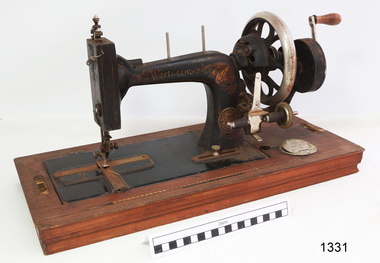
... Hugo reached Melbourne in October 1875. He soon began advertising, from premises at 39 Flinders Lane East, as agent for his father's cousin Joseph Wertheim, a well-established manufacturer of sewing machines. ...Hugo Wertheim (1854-1919), was a merchant and manufacturer and was born on the 12th July 1854 at Lispenhausen, in the German electorate of Hesse-Kassel, son of Meyer Wertheim and his wife Minna, née Heinemann. Hugo reached Melbourne in October 1875. He soon began advertising, from premises at 39 Flinders Lane East, as agent for his father's cousin Joseph Wertheim, a well-established manufacturer of sewing machines. Hugo returned to Germany where he married Joseph Wertheim's daughter Sophie Emilie (1864-1953) on 30 August 1885 at Frankfurt. the couple then came to Melbourne. In a short time, with extensive advertising, Hugo established a substantial business, selling sewing machines, bicycles, pianos and other mechanical devices, under brands such as Wertheim, Electra, Planet, Griffin and Hapsburg. He also mounted elaborate displays at agricultural shows and in 1901 at the Pan American Exposition, Buffalo, United States of America. O. C. Beale worked with him before setting up his own piano business in New South Wales. Hugo continued to own 25 per cent of one of Beale's companies, which became Wertheim's Queensland business. In 1908 Wertheim opened a large, innovative piano factory at Richmond, Melbourne, intending to produce 2000 pianos and player pianos annually, predominantly using Australian materials. In laying the foundation stone, Prime Minister Alfred Deakin observed that “few men with such opportunities for a life of ease would have embarked on such an enterprise” Hugo died of chronic hepatitis on 11 July 1919 at his home at South Yarra, his wife, two daughters and three sons survived him; Herbert Joseph (1886-1972), the eldest, continued the business. Rupert became a share broker and went on to represent Victoria in inter-State tennis in 1913-27 and Australia in Davis Cup matches against Czechoslovakia in 1922. The piano factory closed in 1935, becoming a Heinz food processing plant and in 1955, GTV Channel 9 studios and offices.Early Australians had to be self-reliant in regards to making and mending their clothes and utensils. This sewing machine was one of many items used that exhibit the skill and craftsmanship of the women in these early families. A sewing machine was a necessary part of each home and this item demonstrates how women of the time managed had to become self-reliant in the repair and making of their families clothes to make their household budgets go further.Wertheim sewing machine in carry case, hand operated with two spindles, handle with locking pin, which turns lever between spokes of main handle, hand brake. The machine is table-mounted with a Turkish walnut base. The base can be attached to a cast iron table with a foot treadle as an optional extra. The walnut base has marquetry to the front set out as a measure for material. There is also an accessory box inside the carry case containing 20 additional items for use with the machine. Wertheim brass trademark badge riveted to the body of the machine of a crouching dwarf with a hammer with the name of the company Wertheim and Frankfurt. Gold filigree decoration in gold paint adorns the main body of the machine. flagstaff hill, warrnambool, shipwrecked-coast, flagstaff-hill, flagstaff-hill-maritime-museum, maritime-museum, shipwreck-coast, flagstaff-hill-maritime-village, sewing machine, hand operated sewing machine, crank handle sewing machine, wertheim, dressmaking, taylor, domestic, clothing, hugo wertheim, joseph wertheim -
 Flagstaff Hill Maritime Museum and Village
Domestic object - Sewing Machine and case, Joseph Wertheim, late 19th century
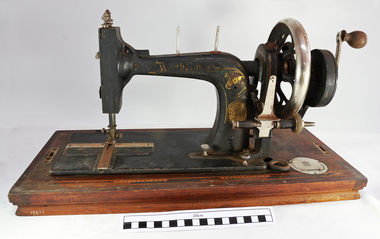
... Hugo reached Melbourne in October 1875. He soon began advertising, from premises at 39 Flinders Lane East, as agent for his father's cousin Joseph Wertheim, a well-established manufacturer of sewing machines. ...Hugo Wertheim (1854-1919), was a merchant and manufacturer and was born on the 12th July 1854 at Lispenhausen, in the German electorate of Hesse-Kassel, son of Meyer Wertheim and his wife Minna, née Heinemann. Hugo reached Melbourne in October 1875. He soon began advertising, from premises at 39 Flinders Lane East, as agent for his father's cousin Joseph Wertheim, a well-established manufacturer of sewing machines. Hugo returned to Germany where he married Joseph Wertheim's daughter Sophie Emilie (1864-1953) on 30 August 1885 at Frankfurt. the couple then came to Melbourne. In a short time, with extensive advertising, Hugo established a substantial business, selling sewing machines, bicycles, pianos and other mechanical devices, under brands such as Wertheim, Electra, Planet, Griffin and Hapsburg. He also mounted elaborate displays at agricultural shows and in 1901 at the Pan American Exposition, Buffalo, United States of America. O. C. Beale worked with him before setting up his own piano business in New South Wales. Hugo continued to own 25 per cent of one of Beale's companies, which became Wertheim's Queensland business. In 1908 Wertheim opened a large, innovative piano factory at Richmond, Melbourne, intending to produce 2000 pianos and player pianos annually, predominantly using Australian materials. In laying the foundation stone, Prime Minister Alfred Deakin observed that “few men with such opportunities for a life of ease would have embarked on such an enterprise” Hugo died of chronic hepatitis on 11 July 1919 at his home at South Yarra, his wife, two daughters and three sons survived him; Herbert Joseph (1886-1972), the eldest, continued the business. Rupert became a share broker and went on to represent Victoria in inter-State tennis in 1913-27 and Australia in Davis Cup matches against Czechoslovakia in 1922. The piano factory closed in 1935, becoming a Heinz food processing plant and in 1955, GTV Channel 9 studios and offices.Early Australians had to be self-reliant in regards to making and mending their clothes and utensils. This sewing machine was one of many items used that exhibit the skill and craftsmanship of the women in these early families. A sewing machine was a necessary part of each home and this item demonstrates how women of the time managed had to become self-reliant in the repair and making of their families clothes to make their household budgets go further.Sewing machine, Wertheim brand “ Syst 182” hand crank operated machine with folding handle, timber case and carry handle. Metal machine is painted black, with remnants of gold, red and green scrolls and floral decoration. Machine has base with inlaid measuring rule across front and 2 holes drilled through the base (perhaps for mounting machine to a bench). Machine tilts open, hinged on one side, after thumb screw is unwound, revealing machine’s workings and serial number. Base has a fitted round, concave, silver metal pin holder with lid that hinges open, and symbol pressed into lid; several pins are inside. Body of machine has brand name transfer across front and oval metal trademark disc on front. Metal sliding covers over footplates have stamped lettering. Timber machine case or cover includes an accessory box with sliding cover and metal hook and eye latch, and inside the box are 23 metal sewing attachments, a disc and a stick of black crayon with maker’s trademark on it paper cover. Workings of machine have seized up. The crayon wrapper has printed on it “For the wonderful Wertheim new family machine made in Germany ‘Syst. 182’”, and the maker’s symbol with “Trademark” beside it. Made for Hugo Wertheim.“WERTHEIM” transfer across front and back of machine body. Cover of pin holder has symbol ‘Wings above a shield’. Maker’s trademark on gold oval disc, “WERTHEIM / FRANCFURT” and picture of a dwarf with a hammer. Left footplate has script “Syst 182”, right footplate has stamp in oval shape “MANUFACTURED IN - - /SPECIALLY FOR / HUGO WERTHEIM” Serial Number “7501”flagstaff hill, warrnambool, shipwrecked-coast, flagstaff-hill, flagstaff-hill-maritime-museum, maritime-museum, shipwreck-coast, flagstaff-hill-maritime-village, sewing machine, hand crank sewing machine, hugo wertheim, wertheim, clothing manufacturer, sewing, syst 182 -
 Bendigo Historical Society Inc.
Domestic object - Morley Johnsons advertising tray
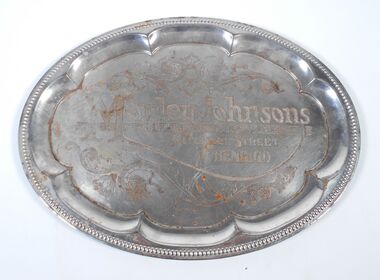
... Domestic object Morley Johnsons advertising tray ...Oval metal tray. Dots all along the edge of the raised tray. Flowery decoration at top and bottom with the words "Morley Johnsons, everything for the home, Mitchell Street Bendigo" in the middle.bendigo businesses, morley johnsons, mitchell street -
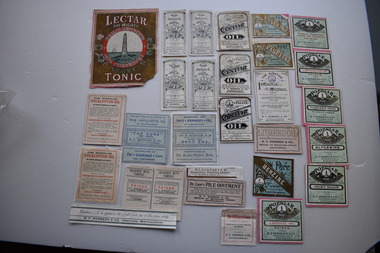 Warrnambool and District Historical Society Inc.
Multiple Labels, Kennedy, Early 20th century
... It features a lighthouse, decorations of leaves and a variety of styles and fonts of the print. ...Richard Kennedy (1826-1903), a wholesale , retail and manufacturing chemist in Timor Street, came to Warrnambool in 1880 and had what was described in "Cyclopedia of Victoria' as the "largest and best appointed pharmacy in Victoria'. Kennedy was Vice President of the Pharmaceutical Society of Victoria, on the Pharmacy Board and was prominent in community affairs in Warrnambool. He was for some time President of the Mechanics Institute and the Warrnambool Hospital and a foundation member of the Warrnambool Bowls Club. He also made locally perfumes with many varieties named after people or events of the time-Federation, Nellie Melba etc.. His pharmacy building in Timor Street and his house 55 Canterbury Road "Ivanhoe" still stands (2019) The use of a lighthouse in his advertising and on his bottles is of particular interest. W.D.H.S. has Kennedy bottles in its collectionThese labels are of great significance as they were produced for a pharmacist of note in Victoria and Warrnambool. .1 Rectangular paper label adhered to a piece of pink card. It features a lighthouse and small sailing ship in the centre of a red circle with black and white text, Surrounding the circle is text and decorations of flowers on an olive green background. The label is torn on the bottom right hand corner. It is adhered to a piece of pink card. .2 Light green label featuring a lighthouse in a circle underneath which is a scroll with text, There are finely drawn curly decorations and further text. It is adhered to a piece of pink card. .3 Similar to .2 with different text .4 Similar to .2 and .3 with different text .5 Similar to .2,.3,.4 with different text .6 Similar to .2,.3,.4,.5 with different text 6.1Similar to .2,.3,.4,.5,.6 with different text 6.2 Turquoise label with a gold diagonal wide band with text. The label features a lighthouse in a circle , there are decorations of leaves, and curls. The white and black text is stylised, especially the name of the manufacturer. .7 Buff coloured rectangular card adhered to a piece of pink card. The dark green text is surrounded by a decorative border. .8 White rectangular featuring a blue coloured lighthouse and detailed black text .9 White rectangular label with black detailed text surrounded by a border. .10 Similar to 6.2 with different text, adhered to white paper. .11 identical to .10 but adhered to pink card. .12 White rectangular card with black and red text .13 identical to .12 .14 Three joined pale blue labels with dark blue text. The central label is larger than the other two which are equal in size. One of the smaller labels in upside down. All have borders. .15 Identical to .14 excepting it is adhered to white card .16 White rectangular label with black text. It features a lighthouse, decorations of leaves and a variety of styles and fonts of the print. It is adhered to a piece of pink card. .17 Identical to .16 excepting it is adhered to white card. .18 Identical to .17 .19 Rectangular white label with red and black detailed text adhered to a piece of white paper .20 Identical to .19 excepting it is adhered to a piece of pink card. .21 Rectangular white label with grey text , a decorative border and further decorations adhered to a piece of white card. .22 Identical to .21 but not adhered, .23 Identical to .21 , adhered to white card .24 Identical to .22 .25 Square white label with red and black text. and a red border. .26 White rectangular label with dark green text and border. .27 Small white rectangular label with gold text adhered to a piece of white paper .1 LECTAR THE MIGHTY HEALTH RESTORING LIFE PRESERVER NERVE TONIC .2 POPULAR FAMILY MEDICINES CARBOLIC OIL POISON FROM R. F. KENNEDY& CO PHARMAISTS WARRNAMBOOL .3 As for .2 FRIAR'S BALSAM in lieu of CARBOLIC OIL .4 As for .2, .3 GLYCERINE in lieu OF FRIAR'S BALSAM .5 As for .2,.3,.4 Paregoric, Peppermint, Aniseed and Laudanum. POISON in lieu of GLYCERINE .6 As for .2,.3,.4,.5 CAMPHORATED OIL in lieu of Paregoric,Peppermint, Aniseed and Laudanum .6.1 As for .2,.3,.4,.5,.6 PARRISH'S FOOD . in lieu of CAMPHORATED OIL Dose- Adults 1/2 to 1 teaspoonful 6.2 Pure BENZINE FROM R. F. KENNEDY AND CO. Pharmaceutical Works WARRRNAMBOOL .7 LINSEED OILR.F KENNEDY & CO. Wholesale and Manufacturing Chemists WARRNAMBOOL .8 the primary text is : THE ALSATIAN INFLUENZA MIXTURE A section of the ensuing text is ; "For EXHAUSTION, LOSS OF APPETITE , NEURITIS and GENERAL RUN DOWN it will be found a Powerful Tonic." .9 Dr Law's PILE OINTMENT Directions ............... R.F KENNEDY & CO Wholesale and Manufacturing Chemists WARRNAMBOOOL 10. As for .2,.3,.4,.5,.6.6.1 VASELINE in lieu of BENZINE .11 Identical to .10 .12 COLOURED WITH TUMERIC. Labelled in accordance with the "SALE AND USE OF POISONS ACT" POISON R.F. KENNEDY & CO. Chemists WARRNAMBOOL APPROXIMATELY 7 GRAMS .13 Identical to .12. .14 Central label "THE CURE" FOR CORNS R.F. KENNEDY &CO manufacturing Chemists WARRNAMBOOL .Small label PROPRIETORS OF THE. CELEBRATED . CURE FOR TOOTHACHE . Small label PROPRIETORS OF The Sulpho- Thymol Soap, For Eruptions and Irritations of the Skin. .15 Identical to .14 .16TASTELESS ITALIAN CASTOR OIL OF THE PUREST QUALITY. Adults Dose one to two tablespoonfuls . Children half to one tablespoonful. IMPORTED BY R.F. KENNEDY&CO. Manufacturing Chemists Timor ST. Warrnambool .17 Identical to .16 .18 Identical to .16 .19 PURE REDISTILLED EUCALYPTUS OIL OF EXTRA STRENGTH & PURITY DEODORANT & DISINFECTANT FROM R.F. KENNEDY & CO'S Pharmaceutical Works Warrnambool ( Much more detail) .20 Identical to .19 .21,.22,.23,.24 PURE Refined SALAD OIL FROM R.F. KENNEDY & CO.MANUFACTURING CHEMISTS WARRNAMBOOL .25 Brilliantine AN ELEGANT AND FRAGRANT PREPARATION FOR THE HAIR, MOUSTACHE, OR WHISKERS. PROPRIETORS R.F. KENNEDY & CO. WARRNAMBOOL .26 Directions.--- To be applied to the irritable parts two or three times daily R.F. KENNEDY & CO., Chemists, Warrnambool .27 R.F. KENNEDY & CO. Manufacturing and Dispensing Chemists WARRNAMBOOL chemists, pharmaceutical society of victoria, mechanics institute, warrnambool, warrnambool hospital, warrnambool bowls club -
 Villa Alba Museum
Document - Auction Catalogue, Catalogue of Superb & Costly High Art Furniture, Gemmell Tuckett & Co., 1897, 1897
... Built between 1882 and 1884 for the banker William Greenlaw and with interior decoration by the Paterson Brothers, a number of elements of the the interior design scheme reference Greenlaw’s Scottish origins. ...Built between 1882 and 1884 for the banker William Greenlaw and with interior decoration by the Paterson Brothers, a number of elements of the the interior design scheme reference Greenlaw’s Scottish origins. Following his death in 1895, from 1897 the house was leased and owned by a succession of owners including the Fripp family, the Royal Women’s Hospital and the Mount Royal Hospital before being sold to the Society of Jesus for Xavier College. In 2004 the title was transferred to Villa Alba Museum Inc., and the western section of the garden leased to Xavier College for 99 years.68 page catalogue, published in 1897 by Gemmell Tuckett & Co., advertising the contents of Villa Alba, Walmer Street Kew for sale on 22 and 23 March 1897. [The catalogue is in Adobe PDF format and 16.6 MB in size]. villa alba -- 44 walmer street -- kew (vic.), auction catalogues -- kew -- melbourne -- 1890s -
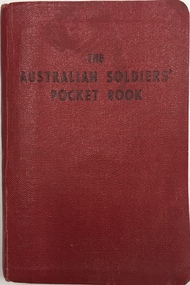 Kew Historical Society Inc
Book, Brown, Prior, Anderson Pty Ltd, The Australian Soldiers' Pocket Book : Containing useful information for Australian soldiers, 1940
... He also worked in Advertising as an account manager, and was campaign director for Arthur Rylah in Victorian politics. ...Booklet produced in 1940 for members of the 2nd AIF by the Australian Comforts Fund Victorian Division. The 128-page pocket-sized book could be carried everywhere and provided Australian soldiers with a wide range of useful information about the requirements of war service and many other important details such as: The Laws and Customs of War - including Geneva Convention guidelines, notes on spies and insignia of rank; Things a Soldier should Know - including over 60 points; Signaling - including flags, morse code, shipboard bell times and time zone; Decorations Awarded to Australians in the Great War; Arabic and Japanese words; First Aid for gas injuries etc.; Australian Historical Events, facts and figures etc.; and Conduct Overseas - including expectations of behaviour when representing Australia. non-fictionaustralian comforts fund (victoria), second world war 1939-1945, hugh george ferguson -
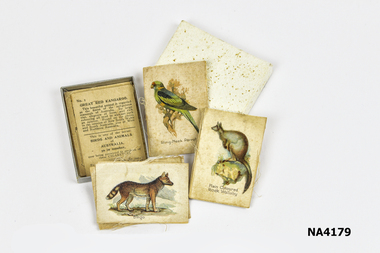 Whitehorse Historical Society Inc.
Memorabilia - Box - Cigarette silks, 1911 - 1917
... It did not take long for an enterprising entrepreneur to recognise the advertising potential of the cigarette card, and, very soon, the cards began displaying popular images, often in sets. ...These type of cigarette silks were included in WD & HO Wills cigarette packets to induce women in particular to take up smoking.|The Word 'Cartophilic?|It is believed that this unusual word was coined in the 1920s by Col. Bagnall, an Englishman, who was the father of the hobby of cigarette card and trade card collecting. It is thought to be a combination of a Latin word, 'carto' meaning 'card and the Greek word 'philic', meaning 'love'.- lover of cards. The term originally related to the collection of the two types mentioned, however, our Society has included postcards in the range of items collected by our members.|The Cigarette Card|The cigarette card began its evolution in the United States of America, in the early 1880s as a plain piece of cardboard used by tobacconists to protect the cigarettes which were sold in that era, not in packets, but loosely. A purchaser would buy his cigarettes then wrap them in paper around the small piece of cardboard, which acted as a stiffener. In fact, for many decades, cigarette cards were known as 'stiffeners' in the USA.|The card depicting 'The Marquis of Lome' is reputed to be the first known cigarette card issued. This is thought to have been in 1879. It did not take long for an enterprising entrepreneur to recognise the advertising potential of the cigarette card, and, very soon, the cards began displaying popular images, often in sets. This had the effect of youngsters, wishing to complete their sets, harassing their fathers to buy a specific brand of cigarettes. The kids who collected cards in the days when they were being issued in the cigarette packets, would hang around outside the local tobacconist's shop, pestering the men who had just bought a packet of cigarette, with the cry: 'can I have the cig can mister?'|It is a proven fact that, here in Australia during the 1930s, at least one set had one card deliberately withheld and issued very sparingly. This card is No. 86 (Mrs Jack Crawford) in the Carreras 'Turf Personality Series'. Thus, in a set of reasonably easy cards to get, this one card is a constant source of frustration for the collector, and as such, commands a premium when it comes to price. It is not hard to imagine the young collector nagging his to Dad to keep buying 'Turf' cigarettes to enable him to finish the set.|From small beginnings the cigarette card soon gave rise to a booming industry in itself. Artists and writers were|employed to produce the cards, which were miniature works of art and served as little encyclopaedia's for the children of the day. By the 1930s cards were being issued in the countless millions. It has been stated, in one book on the history of cards; that 450 million sets of a series produced and issued by the prolific issuer of cards in the United Kingdom, WD & HO Wills. As each set contained 50 cards you would need a calculator with a very long result window to see the answer to how many cards of that series were in circulation.|Australia's involvement would appear to have its beginnings with the English and American firms who shipped their tobacco products here and the cards of American Tobacco Company (ATC) are found in great numbers in early Australian collections; many featuring Australian subjects, e.g. 'Australian Parliament a 1901 issue. Earlier U.S. sets depicting Australians included Goodwin & Co's, so called. 'Australian Series' with cricketers and Australian Rules footballers who were on the sporting scene during the 1880s. The caption of one of theses cards reads:|'W.Hannysee. Captain Port Melbourne Football Club' which enables us to pinpoint the year of issue to either 1889 or 1890.|On the Australian scene the first local manufacturer who issued cards seems to have been The National Cigarette Company of Australia Proprietary Limited, whose 'Tally Ho' packets contained cards from a series of thirteen featuring the touring 'English Cricket Team 1897-8' Of the few Australian manufacturers who issued cards, only two companies issued more the two sets.|Undoubtedly the cards issued by the Melbourne firm Sniders & Abrahams (later Sniders & Abrahams Pty Ltd) are the 'jewels in the crown' of Australian card issues. They issued some thirty-three series, with numerous sub-series and allied issues such as metal badges, metal football shields, celluloid flags etc., which ensured that the hobbyist had a vast range from which to collect. Sporting themes – football, cricket, horse racing – dominate, indicating the Australians' love of sport and the outdoors was as strong in those earlier times as it is today. Military, animals and birds themes were also to the fore, with a touch of culture being provided by 'Shakespeare', 'Dickens', actresses and even classical 'Statuary'. Humour was not forgotten with 'Cartoons and Caricatures', 'Naval and Cricket (double meaning) Terms' and the 'Jokes' series. Art and history were covered by the artist, S.T. Gill's 'Views of Victoria in 1857' while the stereoscopic 'Views of the World' expanded the collectors' knowledge of the world as a whole.|The Sniders & Abrahams series began in 1904 and by 1919 the company was in decline and was eventually taken over by G.G. Goode & Co. Ltd. This company produced one set only, the highly collectable 'Prominent Cricketer Series' issued in 1924. During the early to mid-1920s, J.J. Schuh Tobacco Pty Ltd issued eight series, again containing the popular subjects of sport and war. At least two provincial tobacconists, Lentens of Bendigo and Baillies of Warrnambool, issued private football series. The last series of cards issued by a truly Australian firm was Dudgeon & Arnell's '1934 Australian Cricket Team'.|The Australian market was not neglected by the English companies with WD & HO Wills, Godfrey Phillips and Ogdens all making their contributions. By far the most active issuer was the long-established company Wills, whose 'Cricketers' of 1901 heralded the flood of Australian series, which continued into the mid-thirties.|The onset of the 1939-45 World War sounded the death knell of the cigarette card and very few post-war issues were made, certainly not here in Australia.|The Trade Card|The Trade Card is a non-tobacco item used by manufacturers to promote and advertise their products, in the same way that cigarette cards were. It is uncertain exactly when they were first produced, but in the USA, non-collectable cards were issued by firms in the early 1800s. These were more akin to a latter day 'business card'. It was not until the 1850s, when coloured and pictorial cards were issued to advertise and promote products that the Trade Card|became a collectable item. Many beautiful lithographic cards were produced in this early era and they are very mu sought after by collectors. By the 1870s the issues of Trade Cards became more prolific and it is from this era that more cards are seen.|Again, it is difficult to pinpoint the exact date of the first Australian Trade Card and it may be that the highly collectable and extremely rare 'American Candy Co's' - 'Pure Caramels' Australian Rules football card, issued i 1891, is the earliest series. This confectionery firm was located in Fitzroy, a Melbourne suburb. To date only two subjects have been seen.|Another early set was 'Flags', issued by F.H.Fauldings & Co. It featured testimonials of seven English cricketers who toured Australia with the 1894/5 Test team. Fauldings was an Adelaide based firm which manufactured medicinal toiletries, soaps and oils, using the distinctly Australian eucalyptus oil. During the 20th century a multitude of Australian businesses issued trade cards, with confectionery manufacturers such as Hoadleys, Allens, Sweetacres and Australian Licorice producing the majority of them. Again sporting themes dominated with the ever popular Aussie Rules football cards being the most numerous. Cricket issues ran a close second.|Apart from sporting cards, almost every subject imaginable was covered by the Trade Card, making it the most diverse and interesting branch of cartophilly. In contrast to the Cigarette Card, which had its demise prior to the Second World War, the Trade Card is still alive and well.|We all are aware of the long running 'Birds of Australasia' series put out by Tuck-fields Tea and 1 doubt if there is a kitchen drawer in Australia that has not got one or two of these informative and attractive cards floating about in it. These cards were first produced in the early 1960s and are still being inserted in that company's packets of tea. Such is also the case with Sanitarium Health Foods, manufacturers of the well known Weetbix, who began issuing cards, with a wide range of subjects, in the early 1940s and continue to do so.|The 1940s and 1950s saw the two breakfast food giants, Kornies and Weeties dominating the card scene. Kornies footballers were in production fora decade from 1948 to 1959. Four years later in 1963, we saw the start of four decades of Scanlens bubble-gum card issues, both football and cricket. In the mid 1990s, with the end of the Scanlens/Stimorol cards, the Trading Card came on the scene. These cards do not fit under the umbrella of the Trade Card, having been produced and marketed purely as a 'collectable' with no connection whatsoever to any product, which of course is necessary for an item to be classified as a Trade Card.|The earliest British postcard was issued in 1870 and was designed to send short messages; the stamp was printed on the card, therefore it did not require an envelope. It was considered by many to be lowering the postal standards because the texts were no longer private. However the cards were a great success as on the first day of issue in 1870, half a million passed through the London postal centre.|The first illustrated postcards are said to be those introduced by a French stationer in 1870. He realized that French troops fighting in the Franco-Prussian War needed to be able to send short messages to their families and designed a 'postcard' to suit the purpose. As many of the soldiers were illiterate they decorated their cards with sketches of their many activities at the front rather than writing; thus creating a picture postcard. Private enterprise soon saw the great financial possibilities of this new easy and attractive way of communication by post; also sending a postcard cost less than postage for letters. It was correctly assumed that postcards were likely to overtake letter writing in many instances.|Between 1875 and 1882 every state in Australia introduced official postcards, N.S.W. first and Tasmania last. Each state produced a simple type of postcard with a pre printed stamp allied to that state. The stamp side stated 'The Address Only To Be Written On This Side'; the reverse side sometimes carried a simple illustration or decoration with space fora short message, each state extolling their own state's virtues. In 1901, with the advent of Federation, the new Government became responsible for all postal services in Australia and produced postcards for sale in every state. With several mail deliveries each day in most towns, postcards were used for many purposes. One 1906 postcard, with an illustration of fruit, was sent from Mrs X in the morning to her greengrocer ordering her fruit and vegetables to be delivered that afternoon. Another lady asks her charlady to 'come this afternoon'.|Australian private enterprise also began selling pictorial postcards, most companies using the very experienced German printing works who were the worlds best in the field of lithography and fine detailed colour-printing. Many of these beautiful German cards still exist today, 100 years later. Australia did have a few fine printers but they were in the minority. Black and white postcards printed in Australia in the early 1900s were often of good quality e.g. postcards printed by 'The Bulletin', illustrating the works of 'The Bulletins' top artists.|Between c1903-09 The Melbourne company Osboldstone and Atkins etc. printed coloured reproductions of 46 J.A. Turner bush/rural life paintings, which were generally of good quality and became hugely popular and still sought after today. Like thousands of homes in Europe, Britain and U.S.A., many Australia homes had albums of cherished postcards, which were given pride of place for visitors to see and enjoy.|Postcard collecting remained popular but was changing with the times. About 1912 the Australian photographer George Rose of Melbourne began to produce topographical B/W real photographic postcards covering most of Australia and other photographers began to do likewise. These cards soon found their way into collections as well.|WWI and the horrors of war suddenly changed the world; postcards were still in great demand but the subject matter was far more serious. Thousands of postcards from the trenches in European war zones arrived in Australia to be included in family albums. Propaganda and recruitment messages were produced to encourage enlistment. Australian postcard producers began to create cards decorated with gum leaves, boomerangs, wattle etc., which were designed for sending to Australian troops serving overseas. Very few 'pretty' cards were available, as access to the Gentian printing works was no longer possible and exporting of postcards from Britain was very limited. By the end of WWI people had other more serious problems to contend with and the avid postcard collecting hobby declined, fold greetings took over and topographical photographic postcards became a small but steady income for the producers and newsagents etc. in every town.|Fortunately many of these old postcards still exist and are avidly collected by a new generation or postcard collectors. The Australian Cartophilic Society Inc. is one of four postcard/cigarette card organizations in Australia. They are, N.S.W. Post Card Collectors Society; Queensland Card Collectors' Society Inc. and West Australian Card Collectors|Society, and across the Tasman there is a New Zealand Postcard Society.|References:|Picture Postcards of the Golden Age A Collector's Guide by Toni & Valmai Holt. Picture Postcards in Australia 1898 - 1920 by David CookBox of Cigarette Silks ( 10 ) depicting animal motifs, which were placed in cigarette packets as an incentive for women in particular to smoke.|WD & HO Wills|Produced 1911 - 1917personal effects, smoking accessories, recreations, collections -
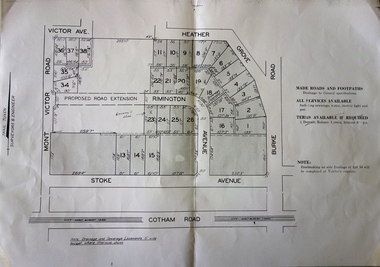 Kew Historical Society Inc
Plan, F R Simms & Son, Land for Private Sale: Cnr Victor Avenue and Mont Victor Road, Kew, 1950-1960
... Subdivision plan advertising five superb home sites among lots in Burke Road, Stoke Avenue, Victor Avenue, Mont Victor Road and Heather Grove. ...George Rimington established The Parkhill Nursery in 1877. By 1910, it was more commonly known as Rimington’s Nurseries and well known for its sale of violets. After World War II, Rimington’s Nurseries were gradually subdivided and sold. The 38 allotments were released in sections, including lots 34 to 36 on the corner of Mont Victor Road and Victor Avenue. Previous lots in the subdivision had bordered Burke Road, Rimington Avenue, Heather Grove, and Stoke Avenue. The selling point as it had been in comparable estates for a century were the proximity to transport, schools and churches, as well as the high location and excellent views. The subdivision plan shows most of the lots in the entire subdivision: 1-11, 13-26, and 34-38. Presumably, lot 12 and lots 27-33 were still to be released.Subdivision plans are historically important documents used as evidence of the growth of suburbs in Australia. They frequently provide information about when the land was sold on which a built structure was subsequently constructed as well as evidence relating to surveyors and real estate and financial agents. The numerous subdivision plans in the Kew Historical Society's collection represent working documents, ranging from the initial sketches made in planning a subdivision to printed plans on which auctioneers or agents listed the prices for which individual lots were sold. In a number of cases, the reverse of a subdivision plan in the collection includes a photograph of a house that was also for sale by the agent. These photographs provide significant heritage information relating house design and decoration, fencing and household gardens.Subdivision plan advertising five superb home sites among lots in Burke Road, Stoke Avenue, Victor Avenue, Mont Victor Road and Heather Grove.subdivision plans - kew, rimington avenue -- kew (vic.), heather grove -- kew (vic), stoke avenue -- kew (vic.), burke road -- kew (vic.), mont victor road -- kew (vic.) -
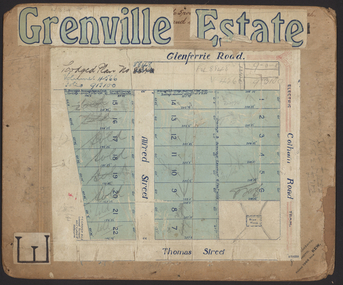 Kew Historical Society Inc
Map - Subdivision Plan, Grenville Estate, 1922
... These photographs provide significant heritage information relating house design and decoration, fencing and household gardens. subdivision plans - kew grenville estate glenferrie road, alfred street, thomas street, cotham road In advertising the twenty-two sites of the Grenville Estate in Cotham Road and Alfred Street, Kew, the auctioneers emphasised the proximity of the development to shops, schools, and churches. ...Pru Sanderson, in her groundbreaking ‘City of Kew Urban Conservation Study : Volume 2 - Development History’ (1988), summarised the periods of urban development and subdivisions of land in Kew. The periods that she identified included 1845-1880, 1880-1893, 1893-1921, 1921-1933, 1933-1943, and Post-War Development. These periods were selected as they represented periods of rapid growth or decline in urban development. An obvious starting point for Sanderson’s groupings involved population growth and the associated economic cycles. These cycles also highlighted urban expansion onto land that was predominantly rural, although in other cases it represented the decline and breakup of large estates. A number of the plans in the Kew Historical Society’s collection can also be found in other collections, such as those of the State Library of Victoria and the Boroondara Library Service. A number are however unique to the collection.Subdivision plans are historically important documents used as evidence of the growth of suburbs in Australia. They frequently provide information about when the land was sold on which a built structure was subsequently constructed as well as evidence relating to surveyors and real estate and financial agents. The numerous subdivision plans in the Kew Historical Society's collection represent working documents, ranging from the initial sketches made in planning a subdivision to printed plans on which auctioneers or agents listed the prices for which individual lots were sold. In a number of cases, the reverse of a subdivision plan in the collection includes a photograph of a house that was also for sale by the agent. These photographs provide significant heritage information relating house design and decoration, fencing and household gardens.In advertising the twenty-two sites of the Grenville Estate in Cotham Road and Alfred Street, Kew, the auctioneers emphasised the proximity of the development to shops, schools, and churches. That mansions surrounded the Estate was publicised as an added attraction. The plan shows how at this stage A regrettable aspect of this plan is that it is pasted over, and obscures a real estate photograph by the Kew photographer Josiah Earl Barnes.subdivision plans - kew, grenville estate, glenferrie road, alfred street, thomas street, cotham road -
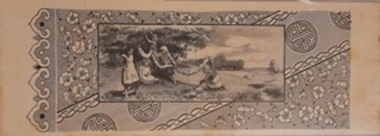 Hymettus Cottage & Garden Ballarat
Functional object - Bookmark, Scottish Widows Assurance Fund
... It started issuing bookmarks advertising its services in the early 19th century. ...The Scottish Widows' Fund was a Mutual Life Assurance Society established in 1815. It started issuing bookmarks advertising its services in the early 19th century. Many of these bookmarks may be found in Australia as not only were many Fund investors/insured in the Australian colonies but A & C Black books also contained these bookmarks and were sold in the colonies with them.Issued c. 1900 and printed in black on a thin card with aesthetic movement decoration surrounding an English country scene the reverse has a medallion designed by Walter Crane. walter crane, bookmark, a & c. black, australian colonies, scottish widows' fund, insurance company, australia, art -
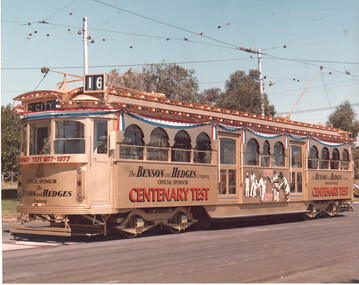 Melbourne Tram Museum
Photograph - Centenary test tram - W7 1024, March 1977
... Colour print of W7 class tram 1024 (City Route 16) in an all-over advertising livery for the Centenary Test 1977 sponsored by Benson & Hedges as the official sponsor. ...Colour print of W7 class tram 1024 (City Route 16) in an all-over advertising livery for the Centenary Test 1977 sponsored by Benson & Hedges as the official sponsor. The reference gives the month of March 1977 as the operation of the tram in the livery. Done before cigarette sponsoring of major sports events was banned,Yields information decoration of tram 1024 for the 1977 Centenary test.Colour print with a number on the rear.In ink "4"tramways, w7 class, tram 1024, cricket, decorated trams -
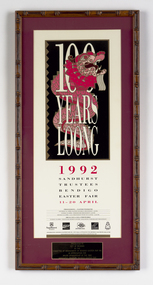 City of Greater Bendigo - Civic Collection
Poster - Advertising, 100 Years Loong / 1992 / Sandhurst Trustees Bendigo Easter Fair / 11 - 20 April, 1992
... The details of the dragon's decoration and regalia are almost identical to the existing Loong. ...Chinese participation in the Bendigo Easter Fair is a rare surviving cultural practice of Chinese involvement in similar events, which also took place in Melbourne, Beechworth, Ararat, Ballarat and other gold mining towns in the nineteenth century. According to Chinese tradition the dragon is a mythical creature with the attributes of a number of animals. The dragon has associated regalia in the form of a pearl (or teaser) and a flame. In procession, dancers carrying Loong's pearl and flame preceded the dragon. The pearl was intended to entice the dragon to join the procession and encourage him to play while the flame symbolised the power of the dragon. The pearl and flame were imported from China, possibly in the nineteenth century. The Easter Fair has since 1871 raised money for the Bendigo Benevolent Home and Asylum and the Bendigo Hospital. The Chinese took part in the annual Easter Fair celebrations from 1879, providing traditionally dressed actors and dancers for the procession in the streets of Bendigo. From 1892, a dragon provided a focus for the Chinese contribution to the festivities and was extremely popular with the whole community. Two large dragons and one small dragon participated in the Federation celebrations held in Melbourne in May 1901. It appears that one of the large dragons was Loong and the other large dragon may be the one now held at the See Yup temple in South Melbourne. There is slight doubt as to the date the present Loong was made and imported from China as there were a number of dragons in use in Bendigo and Melbourne at the time, and there are contemporary newspaper reports from Bendigo and Melbourne of dragons and regalia being imported in 1892, 1901 and 1906. Ceremonial dragons are fragile items made of organic materials and some of the dragons described in contemporary sources no longer exist. However the State Library of Victoria holds a photograph of a dragon in front of Parliament House at the Federation celebrations. This photo is securely dated to May 1901 and was definitely taken during the Federation celebration. The details of the dragon's decoration and regalia are almost identical to the existing Loong. The only minor differences seem to be loss of ornament on the chin and sides of the face which are likely the result of later restorations. Therefore Loong almost definitely dates from 1901 at least and may be earlier. Whether Loong dates from 1892 or 1901 does not diminish his significance as a rare surviving artefact relating to the Chinese in Victoria.(source Victorian Heritage Listing)Commercially printed poster mounted on foam core and framed. Engraved plaque lower centre. Poster includes an image of Loong, believed to be the oldest complete imperial dragon in the world. This poster plays on a pun of Loong being 100 years old. Bamboo look molded frame. Engraved plaque centre lower edge of glass: Presented to / City of Bendigo / By the / Committee of Management of Bendigo Easter Fair Inc / In appreciation for / Mayor sponsorship of the 1992 / Sandhurst Trustees Bendigo Easter Fairbendigo easter fair, bendigo golden dragon museum, sun loong -
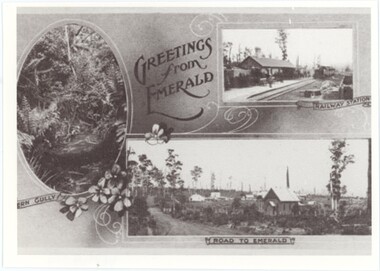 Emerald Museum & Nobelius Heritage Park
Postcard, Greetings from Emerald, 1913-1920
... There is another copy of this postcard in our collection: VEMUP1014.1 This postcard is an example of tourist advertising in early Emerald, highlighting what was seen as valuable or attractive about the town in the 1910s. ...We were unable to find any other copies of this postcard, or any information about it, with our surface-level search. The presence of the Church of Christ in 'Road to Emerald' dates this postcard to after 1913, but otherwise sparse Main Street mean it's unlikely to be much later; specifically, the absence of a post office next to the church means this photograph was almost certainly taken in the 1910s. There is another copy of this postcard in our collection: VEMUP1014.1This postcard is an example of tourist advertising in early Emerald, highlighting what was seen as valuable or attractive about the town in the 1910s.This black and white postcard copy centres on a greeting, surrounded by three images framed by decorations including a number of flowers. Each image includes a a caption in a scroll text display. One image (o the left) depicts ferns and other plants around a waterway. The image in the bottom-right shows a road with several buildings along its right side and trees in the background. The image in the top-right depicts a railway station with a steam train arriving.Obverse: Centre: "GREETINGS from EMERALD" Left, cut-off: "ERN GULLY" Top-Right: "RAILWAY STATION" Bottom-Right: "ROAD TO EMERALD"emerald, 1910s
