
Showing 71 items matching "anglican vicar"
-
 Uniting Church Archives - Synod of Victoria
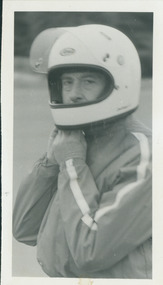
Photograph, Rev. Geoff Glass, 1984
... ...anglican vicar...The article was a reprint from the Anglican "See". glass, geoff anglican vicar motorcycle lessons C&N & person identification. (1) Geoff Glass, head & shoulders, wearing motor cycle helmet; (2) Geoff Glass, cornering on his motocycle. ...Glass was an Anglican clergyman resident in Lancefield where he taught motorcycle riding skills to others. The article was headed "I'd rather be teaching than burying." The article was a reprint from the Anglican "See".(1) Geoff Glass, head & shoulders, wearing motor cycle helmet; (2) Geoff Glass, cornering on his motocycle.C&N & person identification.glass, geoff, anglican vicar, motorcycle lessons -
 Tatura Irrigation & Wartime Camps Museum
Audio Tape, Talk given by Canon Cliff Page
... Talk given by Canon Cliff Page, former Anglican Vicar at Tatura....Talk given by Canon Cliff Page, former Anglican Vicar at Tatura. audio visual technology accessory Talk given by Canon Cliff Page Audio Tape ...Talk given by Canon Cliff Page, former Anglican Vicar at Tatura.audio, visual, technology, accessory -
 Glenelg Shire Council Cultural Collection
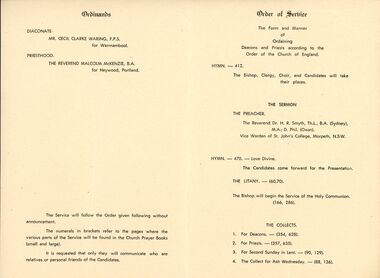
Programme - Programme - St Stephen's Church ordination, Mar-58
... Anglican... cofe... vicar...place of worship Anglican cofe vicar event celebration Front: a. 'Vivian' - handwritten, blue biro, top right corner b. ...Two copies of programme for the ordination of vicars at St. Stephen's Church Portland, Sunday March 2nd 1958. Cream, light card, A4, folded, black printFront: a. 'Vivian' - handwritten, blue biro, top right corner b. 'B. Vivian' - hand written, blue biro, top right cornerplace of worship, anglican, cofe, vicar, event, celebration -
 Uniting Church Archives - Synod of Victoria
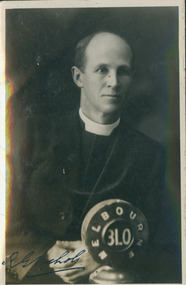
Photograph, Undated c.1920s
... Rev R G Nichols (Brother Bill) was the Anglican vicar of St. Marks, Fitzroy. He broadcast a regular talk on 3AR and 3LO, and his talks were published in 1930....Rev R G Nichols (Brother Bill) was the Anglican vicar of St. Marks, Fitzroy. He broadcast a regular talk on 3AR and 3LO, and his talks were published in 1930. rev r.g. nichols, brother bill, st. marks fitzroy, radio, 3lo, 3ar With my sincere regards, Brother Bill. ...Rev R G Nichols (Brother Bill) was the Anglican vicar of St. Marks, Fitzroy. He broadcast a regular talk on 3AR and 3LO, and his talks were published in 1930.B & W waist length studio photograph of Rev. R.G. Nichols sitting before a 3LO Melbourne microphone. The photograph is signed "R.G.Nichols" across the lower left hand corner.With my sincere regards, Brother Bill.rev r.g. nichols, brother bill, st. marks fitzroy, radio, 3lo, 3ar -
 Federation University Historical Collection
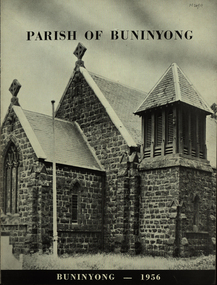
Booklet, A H Massina & Co. Pty, Parish of Buninyong - Anglican Church, 1956
... vicar...anglican church...Buninyong was Victoria's first inland town, and is close proximity to Ballarat. vicar anglican church parish of buninyong union church, scotsburn st james', morrison st george's, yendon st alban's, elaine st matthews's lal lal Black and white cover with image of bluestone church. ...Buninyong was Victoria's first inland town, and is close proximity to Ballarat.Black and white cover with image of bluestone church. Photographs and details of the Parish insidevicar, anglican church, parish of buninyong, union church, scotsburn, st james', morrison, st george's, yendon, st alban's, elaine, st matthews's lal lal -
 Buninyong & District Historical Society
Photograph - Original Photograph, Portrait of Rev. Barrett Russell, c1870
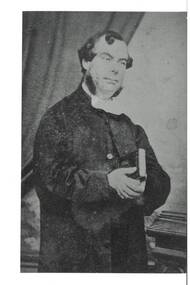
... vicar...Holy Trinity Anglican Church...Barrett Russell, pastor, vicar at Anglican Church, Buninyong 1857-1877...Barrett Russell, pastor, vicar at Anglican Church, Buninyong 1857-1877 Portrait of Rev. ...historic, people, Copy of original portrait of Rev. Barrett Russell, pastor, vicar at Anglican Church, Buninyong 1857-1877church of england, barrett russell, vicar, holy trinity anglican church -
 Warrnambool and District Historical Society Inc.
Bottle, F W Bloore, Early 20th century
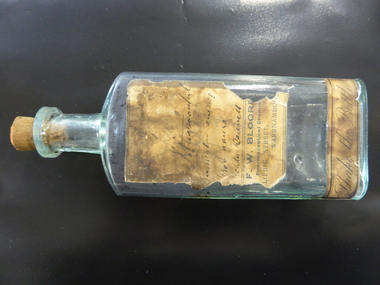
... It contained a mixture made up for Archdeacon Thomas Bennett who was the Anglican Vicar of Christ Church, Warrnambool from 1912 to 1915. ...It contained a mixture made up for Archdeacon Thomas Bennett who was the Anglican Vicar of Christ Church, Warrnambool from 1912 to 1915. ...This bottle was used in the pharmacy of the Warrnambool chemist Francis Bloore. It contained a mixture made up for Archdeacon Thomas Bennett who was the Anglican Vicar of Christ Church, Warrnambool from 1912 to 1915. As Captain Bennett he was the chaplain of the 22nd Battalion in World War One from 1915 to 1917. He became Archdeacon of Warrnambool in 1917 and held this position until 1937. He spent much time on his return assisting returned World War One soldiers and their kin in the Warrnambool area. He was the first President of the Warrnambool Returned Soldiers League. Francis Bloore, born in Ballarat in 1874, came to Warrnambool about 1912. In 1914 he leased a newly-built shop at the corner of Liebig Street and Raglan Parade and continued on the business until the late 1930s. This bottle is of great interest as it is one of the few items we have in our collection associated with the pharmacy business of Francis Bloore. The bottle is also associated with an important Warrnambool Anglican Church identity, Archdeacon Bennett. This is a glass bottle with a rectangular-shaped body with rounded edges, a circular-shaped neck and a circular moulded top with an opening. It has a cork stopper. The top of the bottle is chipped. The label on the front of the bottle is partly torn away and very stained with most of the handwriting and some of the printing indecipherable. The inside of the bottle is discoloured. ‘The Mixture …. tablespoonful with water every three hours - Archdn Bennett’ ‘Shake the Bottle’ ‘F.W. Bloore Pharmaceutical Chemist Liebig Street Warrnambool’ ‘RT & Co’ francis bloore,, warrnambool chemist, archdeacon bennett,, warrnambool anglican minister, history of warrnambool -
 Ringwood and District Historical Society
Document, Obituary of Devon George Astle 1922-2010 St Paul's Anglican Church , Ringwood
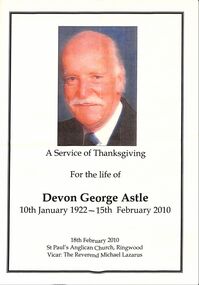
... Paul's Anglican Church Ringwood. Vicar The Rev. Michael Lazarus ."...Paul's Anglican Church Ringwood. Vicar The Rev. Michael Lazarus ." ...Four page order of service for the funeral of Devon George Astle 10th. January 1922 - 15th. February 2010 at St. Paul's Anglican Church Ringwood. Vicar The Rev. Michael Lazarus ."Also" Sincere Thanks" card from the family to Richard Carter -
 City of Moorabbin Historical Society (Operating the Box Cottage Museum)
Document - Wedding Certificate, Elizabeth Jones, c1917
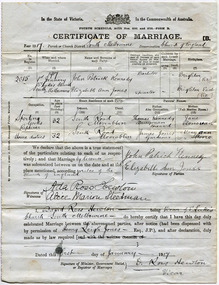
... Their daughter Elizabeth Ann Jones , born 1885, married John Patrick Kennedy, born 1885, the son of Thomas Kennedy, a dairyman and Jane Donovan also early settlers in Brighton area at St Luke’s Anglican Church in South Melbourne in January 1917 anglican church st luke's south melbourne jones elizabeth ann kennedy john patrick kennedy thomas donovan jane dairyman dairy farms brighton general cemetery vaccination pioneers early settlers typhoid brighton moorabbin bentleigh market gardeners jones james jones mary ann jones martha dendy henry dendys special survey 1841 infectious diseases water supply elster creek melbourne jones ethel may reverend hewton david ross In the State of Victoria/ crest/ In the Commonwealth of Australia/FOURTH SCHEDULE ACTSNOS. 2691 and 2720 -FORM B/ CERTIFICATE OF MARRIAGE B/ Year 1917Parish or Church District South Melbourne Denomination Church of England/ signed by Patrick Kennedy and Elizabeth Jones, witnesses Ada Hewton and Alice Steedman and Vicar David Ross Hewton dated this first day of January 1917 Original Certificate of Marriage of Elizabeth Ann Jones, the daughter of James and Mary Ann Jones, to John Patrick Kennedy at St Luke's Anglican Church in South Melbourne on January 1st 1917 Document Wedding Certificate, Elizabeth Jones Albert J. ...James Jones was the son of Philip Jones, a Chairmaker, and Ann Jones who settled in East Brighton after the sale of land c1852 in the area of the Henry Dendy Special Survey of 1841. Mary Ann Moore was the daughter of Thomas Moore, a Gardener, and Sarah Harris who also settled in Brighton c1852. James and Mary Ann Jones settled and raised their family in East Brighton now Bentleigh. They sadly lost Martha Jones born 1888 died in 1890 ,and. Baby Ethel May died 1893 and a stillborn baby was buried in 1900. However, their daughter Elizabeth Ann Jones born 1885 married John Patrick Kennedy born 1885, a the son of Thomas Kennedy , Dairyman deceased, and Jane Donovan early settlers in the Brighton area, at South Melbourne in January 1917 . James Jones and Mary Ann Moore were born in Brighton c1857 and c 1859 into pioneer market gardener families in the area of the Dendy Special Survey of 1841. They married in 1883 and raised their family in East Brighton, now Bentleigh. Sadly infectious diseases took the lives of many infants throughout the Colony of Victoria due to the poor state of water supply and sewerage disposal and locally the swamps of the Elster Creek were a constant breeding ground. Martha Jones born 1888 died 1890 and was interred in the Brighton General Cemetery. In 1893 another daughter Ethel May died and stillborn baby in May1900. Mary Ann Jones died, at age 43years, in January 1903 and in November 1940 Mr James Jones was buried in the family grave. Their daughter Elizabeth Ann Jones , born 1885, married John Patrick Kennedy, born 1885, the son of Thomas Kennedy, a dairyman and Jane Donovan also early settlers in Brighton area at St Luke’s Anglican Church in South Melbourne in January 1917 Original Certificate of Marriage of Elizabeth Ann Jones, the daughter of James and Mary Ann Jones, to John Patrick Kennedy at St Luke's Anglican Church in South Melbourne on January 1st 1917In the State of Victoria/ crest/ In the Commonwealth of Australia/FOURTH SCHEDULE ACTSNOS. 2691 and 2720 -FORM B/ CERTIFICATE OF MARRIAGE B/ Year 1917Parish or Church District South Melbourne Denomination Church of England/ signed by Patrick Kennedy and Elizabeth Jones, witnesses Ada Hewton and Alice Steedman and Vicar David Ross Hewton dated this first day of January 1917anglican church, st luke's south melbourne, jones elizabeth ann, kennedy john patrick, kennedy thomas, donovan jane, dairyman, dairy farms, brighton general cemetery, vaccination, pioneers, early settlers, typhoid, brighton, moorabbin, bentleigh, market gardeners, jones james, jones mary ann, jones martha, dendy henry, dendys special survey 1841, infectious diseases, water supply, elster creek, melbourne, jones ethel may, reverend hewton david ross -
 Greensborough Historical Society
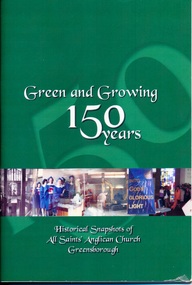
Book, Green and growing 150 years: Historical snapshots of All Saints' Anglican Church Greensborough, 2005_
... Anglican services have been held in the Greensborough area since 1839 (at St Katherine's St Helena) with services at All Saints' beginning in 1855. This volume celebrates the 150th anniversary of those first services. It outlines the history of the church and lists the Vicars...Anglican services have been held in the Greensborough area since 1839 (at St Katherine's St Helena) with services at All Saints' beginning in 1855. This volume celebrates the 150th anniversary of those first services. It outlines the history of the church and lists the Vicars ...Anglican services have been held in the Greensborough area since 1839 (at St Katherine's St Helena) with services at All Saints' beginning in 1855. This volume celebrates the 150th anniversary of those first services. It outlines the history of the church and lists the Vicars and organisations associated with All Saints' Greensborough.An anniversary book with general information about the Greensborough area.56 pages, colour and black and white photographs. all saints anglican church greensborough, st katherines church st helena -
 Phillip Island and District Historical Society Inc.
Photographs, Valentine's et al, Circa 1930
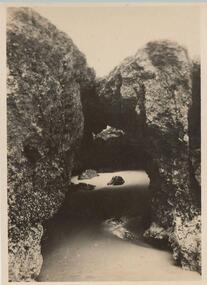
... Garthshore Stirling Home, was the vicar at the Anglican Church in Cowes - possibly in the early 1930's....Garthshore Stirling Home, was the vicar at the Anglican Church in Cowes - possibly in the early 1930's. forrest caves, phillip island wildlife - koalas the nobbies phillip island seal rocks phillip island granite quarries cape woolamai granite quarry cowes cenotaph, phillip island cowes pier phillip island cowes beach phillip island the isle of wight hotel cowes phillip island cowes anglican church vicarage,phillip island rev garthshore stirling home dorothy hurst 235-01 Forrest Cave, Phillip Island 235-02 & 03 Native Bear (Koala) 235-04 The Road to the Back Beach, Cowes. 235-05 A Glimpse Thro' the Ti-Tree, Cowes. 235-06 The Quarries, Cape Wollomai, Phillip Island 235-07 The Beach near the Nobbies, Phillip Island. 235-10 The Beach at Cowes, Phillip Island. ...A collection of photographs/postcards donated by Dorothy Hurst. Her grandfather, Rev. Garthshore Stirling Home, was the vicar at the Anglican Church in Cowes - possibly in the early 1930's.235-01. Black & White photograph of Forrest Caves, Phillip Island. 235-02 & 03. Black & White photographs (identical) of two koalas up a tree. 235-04. Black & White photograph of the road to the Back Beach, Phillip Island. 235-05. Black & White photograph of a view of Cowes Pier taken through the trees on the foreshore. 235-06. Black & White photograph of Cape Woolamai Granite quarrie with people on the granite and in a boat. 235-07. Black & White photograph of waves breaking over the rock possibly near the Nobbies, Phillip Island. 235-08. Black & White photograph of The Vicarage at Cowes, Phillip Island - 1930's 235-09. Black & White photograph of a coastal scene at Phillip Island. 235-10. Black & White photograph of a coastal scene of the beach at Cowes. 235-11. Black & White photograph of waves breaking over the rocks near The Nobbies. 235-12. Black & White photograph of The Nobbies with Seal Rocks faintly in the distance. 235-13. Black & White photograph of The Nobbies with Seal Rocks in the background. 235-14. Black & White photograph of The Isle of Wight Hotel in the background. Cenotaph in foreground with a crowd of people, portable organ/piano plus music stands, people standing, children and others sitting on grass for Anzac Day or Remembrance Day. Possibly 1920s from fashions.235-01 Forrest Cave, Phillip Island 235-02 & 03 Native Bear (Koala) 235-04 The Road to the Back Beach, Cowes. 235-05 A Glimpse Thro' the Ti-Tree, Cowes. 235-06 The Quarries, Cape Wollomai, Phillip Island 235-07 The Beach near the Nobbies, Phillip Island. 235-10 The Beach at Cowes, Phillip Island. Valentine's Series M4847forrest caves, phillip island, wildlife - koalas, the nobbies phillip island, seal rocks phillip island, granite quarries, cape woolamai granite quarry, cowes cenotaph, phillip island, cowes pier phillip island, cowes beach phillip island, the isle of wight hotel cowes phillip island, cowes anglican church vicarage,phillip island, rev garthshore stirling home, dorothy hurst -
 Mission to Seafarers Victoria
Photograph - Photograph, Black and white, Australian Chaplains' Conference, Melbourne, 1952, 1952
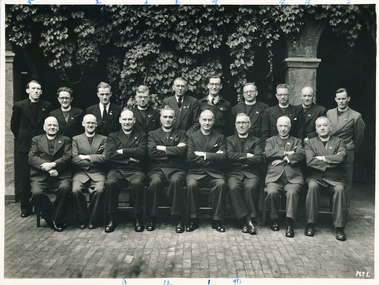
... vicar...h-trinity...port-melbourne...wellington...alex crigan...missio to seafarers...seamen's mission...mission to seamen...conference...flinders street...padre oliver...frank leslie oliver...anglican...Anglican Church towards the end of Oliver's chaplaincy in the 1950s. Standing in back row on the left is Rev Alex Crigan, Assistant Chaplain. melbourne ties men williams nichols reverend hobart pillars suits courtyard brickwork chair creeper cyril-brown peter-smith roberts palmer townsville williamson vicar h-trinity port-melbourne wellington alex crigan missio to seafarers seamen's mission mission to seamen conference flinders street padre oliver frank leslie oliver anglican church alec crigan bob clarke reverend c.j. brown cyril j. brown max cowle john beaverstock joe forster chaplain conferences chaplains group In blue ink (written by Padre Oliver): On the top section of the white border in blue pen reads: "5", "3", "4". "6":, "7", "8", "9", "2". ...This photograph is representative of the relationship between the Mission to Seafarers Victoria and the Anglican Church. The image also historically depicts the courtyard at the Mission to Seafarers Victoria from approximately the early 1950s.Reverend Frank Oliver served as Chaplain at the Mission to Seafarers Victoria for almost thirty years. The photograph shows the historical ties between the Mission and the Anglican Church towards the end of Oliver's chaplaincy in the 1950s. Standing in back row on the left is Rev Alex Crigan, Assistant Chaplain. Black and white photograph with a white border. Pictured are 18 men, 15 of which are wearing white collars of the church. They are positioned in two rows; the back row consists of ten men, the front row has eight men. All the men in the front row have their arms crossed, and many in the back row appear to have their arms behind their backs. The men are situated in the courtyard of the Mission to Seafarers Victoria, in front of the pillars with hanging vine leaves.In blue ink (written by Padre Oliver): On the top section of the white border in blue pen reads: "5", "3", "4". "6":, "7", "8", "9", "2". Whilst the lower line of the white border reads; "11", "12", "!", "!0". These number correspond to the names and numbers on the reverse side of the photograph. This reads: "1.Cyril Brown (Gen. / 2. Peter Smith (L/R - Melb.) / 3. Roberts (T.ville) / 4. Palmer (? Hobart) / 5. Alex Crigan (Melb) / 6. Bob Clarke (L/R . W'town) / 7. John Beaverstock (L/R Melb) / 8. Joe Forstes (Melb) / 9. Nichols, Vicar. H Trinity, Port Melb. (Late Chap, T'ville) / 10. Williams (Wellington) / 11. Max (Cowle), (Port Melbourne) / 12. F.L. Oliver (Melb.). Below this is a hand-drawn line that leads to the name "COWLE" melbourne, ties, men, williams, nichols, reverend, hobart, pillars, suits, courtyard, brickwork, chair, creeper, cyril-brown, peter-smith, roberts, palmer, townsville, williamson, vicar, h-trinity, port-melbourne, wellington, alex crigan, missio to seafarers, seamen's mission, mission to seamen, conference, flinders street, padre oliver, frank leslie oliver, anglican church, alec crigan, bob clarke, reverend c.j. brown, cyril j. brown, max cowle, john beaverstock, joe forster, chaplain conferences, chaplains group -
 Greensborough Historical Society
Pamphlet - Leaflet, St Katherine's Anglican Church St Helena 1858, 1990s
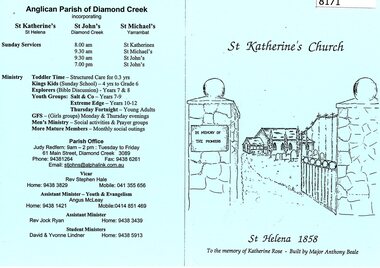
... [Rev Stephen Hale become vicar of St John's parish in Diamond Creek in the 1990s] Background to this well known pioneer church. st katherines church st helena anthony beale rose chapel One A4 page, folded in 2. Printed on blue coloured paper. St Katherine's Anglican ...Contains a history of St Katherine's Church St Helena, Major Anthony Beale and his wife Katherine Rose after whom the church and chapel are named. Includes current parish information and contacts. [Rev Stephen Hale become vicar of St John's parish in Diamond Creek in the 1990s]Background to this well known pioneer church.One A4 page, folded in 2. Printed on blue coloured paper.st katherines church, st helena, anthony beale, rose chapel -
 Ringwood and District Historical Society
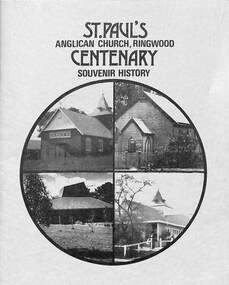
Booklet, St Paul's Anglican Church Ringwood Centenary Souvenir History, 1979
... Historic summary concentrating on four moves of St Paul's Anglican Church in Ringwood from 1879 to 1979 including photographs of each location - Mount Dandenong Road, Pratt Street, Ringwood Street, and Warrandyte Road. Includes list of vicars...Vicar. Compiled by Stella Badger Design, Charles Miller Historic summary concentrating on four moves of St Paul's Anglican Church in Ringwood from 1879 to 1979 including photographs of each location - Mount Dandenong Road, Pratt Street, Ringwood Street, and Warrandyte Road. ...Historic summary concentrating on four moves of St Paul's Anglican Church in Ringwood from 1879 to 1979 including photographs of each location - Mount Dandenong Road, Pratt Street, Ringwood Street, and Warrandyte Road. Includes list of vicars from 1905 to 1979.Introduction by Rev. Bill Potter, Vicar. Compiled by Stella Badger Design, Charles Miller -
 Eltham District Historical Society Inc
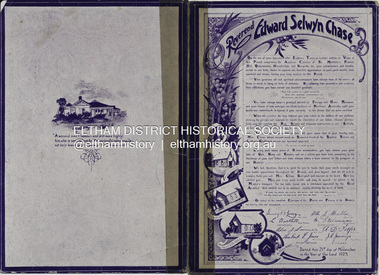
Document - Booklet, Valedictory Address to Reverend Edward Selwyn Chase, 21 Nov. 1925
... He then transferred to Yarraville Anglican Church 1902-1904.. In 1907 he became Vicar for the parish comprising the Anglican churches St Matthew, Panton Hill, Queenstown, Hurstbridge and Kinglake where he serrved for 18 years. ...He then transferred to Yarraville Anglican Church 1902-1904.. In 1907 he became Vicar for the parish comprising the Anglican churches St Matthew, Panton Hill, Queenstown, Hurstbridge and Kinglake where he serrved for 18 years. ...Rev. Edward Selwyn Chase (1864-1950), son of Canon Chase was Curate at St John's Anglican Church, Healesville 1895-1902. He then transferred to Yarraville Anglican Church 1902-1904.. In 1907 he became Vicar for the parish comprising the Anglican churches St Matthew, Panton Hill, Queenstown, Hurstbridge and Kinglake where he serrved for 18 years. This is a copy of the valedictory address given on the eve of his departure from the parish, 21 November 1925 and was signed on behalf of the parishioners by the secretaries and treasurers of each district. A copy of the address was reproduced in the Advertiser, Friday, December 4, 1925, p4 THE ADDRESS. (1925, December 4). Advertiser (Hurstbridge, Vic. : 1922 - 1939), p. 4 (AFTERNOON). Retrieved November 23, 2024, from http://nla.gov.au/nla.news-article56659141Advertiser (Hurstbridge, Vic. : 1922 - 1939), Friday 4 December 1925, page 4 ________________________________________ THE ADDRESS. The following is a copy of the address : REV. EDWARD SELWYN CHASE. On the eve of your departure after 18 years of faithful service as Vicar of this parish, comprising the Anglican churches St. Matthew, Panton Hill, Queenstown Hurstbridge, and Kinglake, we, your parishioners and friends, united in one body, desire to express our heartfelt appreciation of your good works, both spiritual and social, during your long sojourn in this parish. Your generous aid and spiritual ad-i ministration have always been at the service of those in want or lying on beds of sickness. By relieving their necessities and soothing their afflictions you have earned our heartfelt gratitude. "That best portion of a good man's life, that little, nameless unremembered act of kindness and of love." --Wordsworth. You have always taken a practical interest in foreign and home missions, and your labor of love amongst our black brethren in Northern Australia, until your health was undermined, is typical of your sincerity in things that are "more excellent." "When we consider the deep interest you have taken in the welfare bf. our children, striving by precept and example to mould the characters of our future citizens, particularly may we mention the boy scouts, and religious instruction in our schools, we feel that we are greatly indebted to you. May we also be permitted to link with your name that of your worthy wife, Mrs Chase, whose earnest work as superintendent of the Sunday school and Ladies' Guild has learned our warmest approval. "As ye sow so shall ye reap." During your many years of Divine ministration you have shown your great love of God, King, and Empire, and as a citizen you have been exemplary in the discharge of your civil duties, and have always taken a keen interest in the progress of our district. We feel, therefore, that it is good for you to. know that your work among us has found appreciation throughout the parish, and even beyond, and we all join in wishing both you and Mrs Chase God speed and success in the work God has allotted you. May you enjoy good health and long be spared to labor in the Master's vineyard, for we have found you a workman approved by the Great Architect, that needeth not to be ashamed, rightly dividing the Word of truth. "I know thy works and charity and service and faith, and thy patience and thy works, and the last be more than the first." On behalf of the combined churches of -the parish, and friends of the district, .we hereto affix our signatures. The address was signed on behalf of the parishioners by the secretaries and treasurers of each district.hurstbridge, kinglake, panton hil, queenstown, reverend edward selwyn chase, st andrews, st matthew's church -
 Eltham District Historical Society Inc
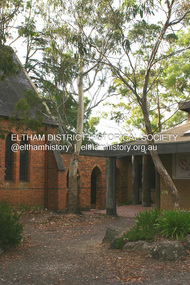
Photograph - Digital Photograph, Alan King, St Margaret's Anglican Church, Pitt Street, Eltham, 30 January 2008
... vicar was appointed to a parish and then a permanent church was constructed. But then, the nearest church was at Heidelberg, which was a tedious and time-consuming journey. St Margaret’s builder was a local, George Stebbing, who also constructed the former Methodist, later Uniting, Church at John Street and the Shillinglaw Cottage near Eltham’s Central Park. It is believed the first Anglican...vicar was appointed to a parish and then a permanent church was constructed. But then, the nearest church was at Heidelberg, which was a tedious and time-consuming journey. St Margaret’s builder was a local, George Stebbing, who also constructed the former Methodist, later Uniting, Church at John Street and the Shillinglaw Cottage near Eltham’s Central Park. It is believed the first Anglican ...St Margaret’s Church of England was officially opened on December 12, 1861. It is the oldest intact church building in Eltham. At the time it was known as Christ Church until its consecration in 1871, when it was completely free of debt (£1,700 for the church and parsonage) despite the district’s poverty. This was largely due to the free labour and materials, including locally made bricks donated by local artisans and others. The church is historically significant because it is the oldest church in the former Shire of Eltham and has associations with the philanthropist and founder of Brighton, Henry Dendy (who donated the land on which the church is built), the architect Nathaniel Billing and the prominent local builder, George Stebbing. The church is architecturally and aesthetically significant because it is constructed in the Gothic Revival style with several stained-glass windows of various dates and is also a very early use of polychromatic brickwork in Victoria. Billing was one of the first Melbourne architects to employ polychromatic brickwork and an important early architect. The rear wall was intended to be temporary. A major feature of the design is the large buttresses with long, steeply graded upper faces. The overall design is well proportioned with the surface brick patterns relieving an otherwise austere design. The church is spiritually and socially significant because it has been an important place of worship for the people of Eltham for almost 150 years. The land on which the buildings stand was donated by Henry Dendy. Dendy arrived in Melbourne in 1841 after purchasing in England eight square miles at Brighton under the system of "special surveys". After this land passed out of his hands, Dendy moved about Victoria, visited England, then returned to settle in Eltham where he purchased a flour mill. Dendy chaired the meeting held in 1860 “for the purpose of devising such means as may be expedient for the establishment of a Church of England in the township of Eltham”. He became chairman and treasurer of the church committee. Unlike the establishment of many early churches in Victoria where a vicar was appointed to a parish and later a permanent church was constructed, the population at Eltham initiated action to build a church. The nearest church at that time was at Heidelberg and the Eltham settlement was part of the parish of St Johns Heidelberg. Isolation and the tedious, time consuming journey between Heidelberg and Eltham resulted in the Eltham community taking its own action. The original vicarage (Dendy House) at the rear of the church is also an important part of the cultural significance of this place because it is connected to the church and the development of the Eltham area. Together, the church and the vicarage are aesthetically significant because they form a significant streetscape feature. The mud-brick community hall designed by Robert Marshall was added in 1978. In 2014 the original temporary rear wall was removed as part of a modern extension designed by Architects Atelier Wagner and constructed by Conrad Construction and Management. Covered under Heritage Overlay, Nillumbik Planning Scheme. National Trust of Australia (Victoria) State significance Victorian Heritage Published: Nillumbik Now and Then / Marguerite Marshall 2008; photographs Alan King with Marguerite Marshall.; p67 St Margaret’s Anglican Church in Pitt Street, Eltham, which officially opened on December 12, 1861, is the oldest intact church building in Eltham.1 With the nearby courthouse and police station, it was one of the first permanent community buildings in the district. The church and vicarage are on the Register of the Heritage Council of Victoria and the National Trust of Australia – Victoria. The church is important as an early example of polychrome brickwork by the notable architect Nathaniel Billings. It is also notable for its historic associations with the early settlement of the Shire of Eltham and its connection with Henry Dendy, Brighton’s founder.2 Henry Dendy, who lived in Eltham much longer than at Brighton, chaired the original meeting which planned the church, and he donated the half-acre (0.2ha) site. Dendy had arrived in Melbourne in 1841 after buying eight square miles (20.7sq km) at Brighton while in England. After this land passed out of his hands, he eventually settled in Eltham where he bought a flour mill, west from the corner of Main Road and Pitt Street (then called Brewery Lane). The vicarage was named Dendy House after him. The Eltham settlers were unusual in initiating the establishment of a church. Usually in Victoria a vicar was appointed to a parish and then a permanent church was constructed. But then, the nearest church was at Heidelberg, which was a tedious and time-consuming journey. St Margaret’s builder was a local, George Stebbing, who also constructed the former Methodist, later Uniting, Church at John Street and the Shillinglaw Cottage near Eltham’s Central Park. It is believed the first Anglican Bishop of Melbourne, Bishop Perry, dedicated the church. After the ceremony he joined in the festivities at the nearby pub and a bill was sent to the parish for teas taken there by the bishop with other participants. The first vicar was the Reverend Robert Mackie from 1864 to1866. St Margaret’s Church was originally called Christ Church until its consecration in 1871, when it was completely free of debt (£1700 pounds for the church and parsonage) despite the district’s poverty. This was largely due to the free labour and materials, including local bricks, donated by local artisans and others. St Margaret’s Church is in the Gothic Revival tradition with a buttressed nave, paired lancet windows, porch and bell-cote. It was the first polychromatic brick church in Australia, using softly contrasting coloured brickwork.3 Billing was one of the first architects to introduce polychrome brickwork into Melbourne. His original drawings for St Margaret’s survive in a folio of his architectural work. However the church’s brickwork is more subdued than in his drawings. About half the windows – those in clear glass with gold borders – are original. The stained glass windows were made much later, but the one behind the altar is thought to be the oldest in the Diamond Valley. It was to be temporary until the congregation could afford to extend the church. In the early 1960s the original cedar pews were replaced by blonde timber pews and the originals were sold to restaurants and to private individuals. Eminent local sculptor Matcham Skipper created a crucifix for the church. A major addition was made in 1978, when the weatherboard hall was replaced by a mud-brick hall. Made of local material, it was designed by local architect and a former shire president Robert Marshall. The mud-brick hall reflects the style of building in Eltham of the late 1970s and for which Eltham is well-known. Perhaps because its earthy tones blend with the surrounding environment, the hall sits well with the church building. St Margaret’s membership has included economist and ABC chairman, Richard Downing; political commentator, diplomat and academic, William Macmahon Ball; Eltham civic leader, Charles Wingrove; artist, Peter Glass; and Eltham’s first postmaster, Frederick Falkiner.This collection of almost 130 photos about places and people within the Shire of Nillumbik, an urban and rural municipality in Melbourne's north, contributes to an understanding of the history of the Shire. Published in 2008 immediately prior to the Black Saturday bushfires of February 7, 2009, it documents sites that were impacted, and in some cases destroyed by the fires. It includes photographs taken especially for the publication, creating a unique time capsule representing the Shire in the early 21st century. It remains the most recent comprehenesive publication devoted to the Shire's history connecting local residents to the past. nillumbik now and then (marshall-king) collection, eltham, st margaret's anglican church, st margaret's church, st margarets church hall, christ church -
 Eltham District Historical Society Inc
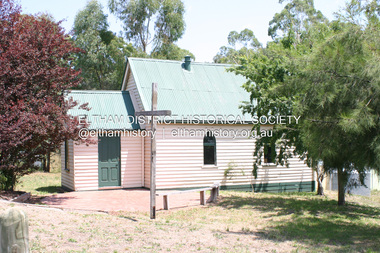
Photograph - Digital Photograph, Alan King, St Andrews Anglican Church, St Andrews, 30 January 2008
... St Andrew’s Anglican Church, built in 1868, is the Shire’s oldest timber church and possibly gave its name to the township.3 The small timber church was opened on November 1, 1869, by the Dean of Melbourne. Anniversary tea meetings helped raise funds, and in 1889, a three-bedroom parsonage was built alongside. In 1910, the vicar...St Andrew’s Anglican Church, built in 1868, is the Shire’s oldest timber church and possibly gave its name to the township.3 The small timber church was opened on November 1, 1869, by the Dean of Melbourne. Anniversary tea meetings helped raise funds, and in 1889, a three-bedroom parsonage was built alongside. In 1910, the vicar ...Built c.1868, St Andrew’s Anglican Church is Nillumbik Shire’s oldest timber church and is historically, socially, and spiritually significant to the Shire of Nillumbik. The church is historically significant because it may have given its name 'St Andrews' to the town (another suggestion is that the name came from the local hotel), it is also historically significant as one of only four buildings that remain from the Caledonian goldfields era of Queenstown (now St Andrews) and one of only a handful of buildings that survived the 1960s bushfires. The church is historically, socially, and spiritually significant because it has played an important part in community life for more than 150 years; a proposal to move the church in 1984 met with strenuous opposition. Much of the fires on Black Saturday 2009 were the north of the town. The town itself remained intact - as did this heritage building. Covered under Heritage Overlay, Nillumbik Planning Scheme. National Trust of Australia (Victoria) Local significance Published: Nillumbik Now and Then / Marguerite Marshall 2008; photographs Alan King with Marguerite Marshall.; p69 The St Andrews Anglican Church and former St Andrews Primary School, are two reminders of the district’s early days, when it was founded on gold. St Andrews, then called Queenstown, was the earliest goldfield in the Caledonia Diggings.1 It was the Upper Diamond Gold Mining and Administrative Centre, with 3000 miners. Queenstown was also the seat of the Court of Petty Sessions. The church and school then stood close to European and Chinese stores, three hotels, a brewery and a quartz mill.2 In 1861, Queenstown was officially proclaimed a township. From 1865, the name Queenstown was interchangeable with St Andrews, until 1952, when the town was officially named St Andrews. As gold declined from the early 1880s, Queenstown changed dramatically into a settlement of small farms. St Andrew’s Anglican Church, built in 1868, is the Shire’s oldest timber church and possibly gave its name to the township.3 The small timber church was opened on November 1, 1869, by the Dean of Melbourne. Anniversary tea meetings helped raise funds, and in 1889, a three-bedroom parsonage was built alongside. In 1910, the vicar, the Rev Selwyn Chase (and friend of the Scouting Movement’s founder, Baden Powell), established the 1st Queenstown Scout Troop, only two years after Scouting began in Australia. The church was important to the lives of many local residents who were baptised, married and had funeral services there. But by the 1950s the population had decreased and so did the weekly attendances. Around the mid-1960s the church closed, then fell into disrepair. So in the mid 1980s it was sold to the Education Department and was under threat of relocation or demolition. However this caused such opposition from locals,4 that instead, the Anglican church leased it as part of the Panton Hill parish5 and it was reconsecrated in 1987. Queenstown’s first school was held in a tent after transferring from Andersons Creek, Warrandyte.6 From 1858 a church school, Caledonia Diggings, stood west of the main road, a quarter of a mile (0.4km) before Buttermans Track. In 1882 the school was moved from a leased building, owned by headmaster Robert Harris, into a larger building on the corner of the School and the Heidelberg-Kinglake Roads. It had been moved from Smiths Gully and included a teacher’s three-roomed residence.7 In 1887 the school was replaced by the Queenstown State School No 128, although it was also called Caledonia Diggings until 1891. In 1956 it was renamed St Andrews. Still standing, this building is now used as the St Andrews Community Centre and the residence is leased for private use. The original timber-lined room remains alongside the extensions, and is distinctive with its high ceiling and tall small-paned windows. In 1984 a new school was built 500 metres west of the old school. Many residents have contributed much to St Andrews but one family that has done so for several generations is the Harris family. Robert Harris was an active member of the St Andrew’s Anglican Church, and worked hard at improving the town’s amenities until his death in 1887. He was a signatory to the successful 1863 petition to the Chief Commissioner of Police, against the proposed removal of the Court of Petty Sessions and police station at the Caledonia Diggings. The police station stayed in the town until 1917. Harris was Head Teacher of Queenstown State School from 1864 to 1874, then of the Smiths Gully school until it closed in 1882, and he continued teaching at Panton Hill until his death. His son, Robert Charles Harris, was editor and printer of the local newspaper, The Evelyn Observer, from 1873 until 1915. Robert’s son, William Shelley Harris, served in the Boer War and in World War One. In 1928 he became Kinglake National Park’s first park ranger. Robert’s daughter Elizabeth, taught needlework at Queenstown State School, and later ran the post office in Kinglake.This collection of almost 130 photos about places and people within the Shire of Nillumbik, an urban and rural municipality in Melbourne's north, contributes to an understanding of the history of the Shire. Published in 2008 immediately prior to the Black Saturday bushfires of February 7, 2009, it documents sites that were impacted, and in some cases destroyed by the fires. It includes photographs taken especially for the publication, creating a unique time capsule representing the Shire in the early 21st century. It remains the most recent comprehenesive publication devoted to the Shire's history connecting local residents to the past. nillumbik now and then (marshall-king) collection, st andrews, st andrews anglican church -
 Eltham District Historical Society Inc
Folder, St Margaret's Anglican Church, Eltham, 1999
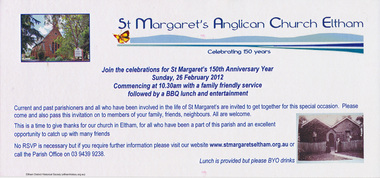
... vicars to 1960. Other documents harry gilham collection st margaret's anglican church norm williams peter bassett-smith doney organ HG Booklet 39 and 190 St Margaret's Anglican Church, Eltham Folder Tarcoola Press ...Photocopy of page headed "order of programme" with historical information Photocopy of article "St Margaret's C of E, 95 years" from "The News" 14th December 1956 Photocopy of article "The oldest shire church" from" and "Eltham in old days" by Sarah Dawson both from 100 years of News Special edition August 27, 1997 page 30 Typed recollections from Peter Bassett-Smith, 2001 Invitation, flyer and booklet: Celebration of 150 years for gathered community of St Margaret's 1861-2011 (26 February 2012). Service booklet 10 pages from an unsourced book about the early history of the Church of England in Eltham, including references to the denominational school, naming of the district, church, Henry Dendy, site, W.B. Andrew, building committee, laying of foundation stone, building, opening and dedication, list of vicars to 1960. Other documentsHG Booklet 39 and 190harry gilham collection, st margaret's anglican church, norm williams, peter bassett-smith, doney, organ -
 Eltham District Historical Society Inc
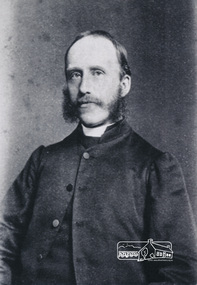
Photograph, Reverend William Heber Green, Vicar, St Margaret's Anglican Church, Eltham, c.1870s
... Reverend William Heber Green, Vicar, St Margaret's Anglican Church, Eltham, c.1870s...Reverend William Heber Green, Vicar, St Margaret's Anglican Church, Eltham, c.1870s Photograph ...Digital scan of photograph - Original Source Copy: St Margaret's Parish Archives. church of england, churches, eltham, st margarets church, william heber green -
 Eltham District Historical Society Inc
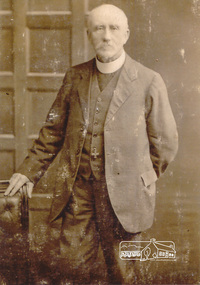
Photograph, Reverend William Heber Green, Vicar, St Margaret's Anglican Church, Eltham, c.1915
... Reverend William Heber Green, Vicar, St Margaret's Anglican Church, Eltham, c.1915...Reverend William Heber Green, Vicar, St Margaret's Anglican Church, Eltham, c.1915 Photograph ...Digital scan of photograph - Original Source Copy: St Margaret's Parish Archives. church of england, churches, eltham, st margarets church, william heber green -
 Warrnambool and District Historical Society Inc.
Book, The Holy Communion, Early 20th century
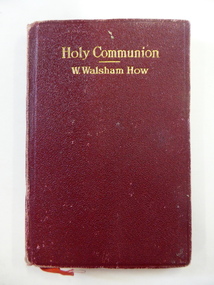
... Anglican Archbishop of Melbourne in 1939 was Frederick Head. No information has been found on the Rev. Crossley. This book is of interest because it belonged to a 20th century Warrnambool resident, Lorna Steller. It is also of interest as an example of religious texts given at confirmation in 1939. lorna steller history of warrnambool ‘Lorna Otelia Steller Confirmed by the Archbishop of Melbourne Aug. 21st 1939 C.L. Crossley (Vicar ...This book was given to Lorna Steller on the occasion of her Confirmation in 1939. Lorna Otelia Steller was born in Warrnambool in 1923, the daughter of Max and Felie Steller. Max Steller was a Warrnambool hairdresser who hailed originally from Germany. Lorna married Arthur George (Bill) Rogers and they lived in MacDonald Street in South Warrnambool. The Anglican Archbishop of Melbourne in 1939 was Frederick Head. No information has been found on the Rev. Crossley. This book is of interest because it belonged to a 20th century Warrnambool resident, Lorna Steller. It is also of interest as an example of religious texts given at confirmation in 1939.This is a hard cover book of 96 pages. The cover is red with gold lettering on the front cover. A red ribbon for marking a place in the pages is attached to the binding. The inscription is handwritten in black ink.‘Lorna Otelia Steller Confirmed by the Archbishop of Melbourne Aug. 21st 1939 C.L. Crossley (Vicar)’ lorna steller, history of warrnambool -
 Warrnambool and District Historical Society Inc.
Book, Ernest Nister, The Puzzle Picture Book, 1900
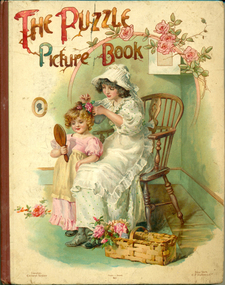
... [source: The Little Book Store] children's picture books ethel henderson children's picture books puzzle books christ church anglican church sunday school prizes ernest nister london warrnambool ethel henderson e f dutton & co new york Book plate: Christ Church. Sunday School, Warrnambool. 1st Prize Girls Class II. Awarded to Ethel Henderson. S M George Vicar ...The book, awarded to Ethel Henderson in 1903, from Christ Church, Warrnambool is an example of a Sunday School prize given to children attending Sunday School at the time. Christ Church Anglican Church was one of the early churches in Warrnambool.The Puzzle Picture Book is a rare 'movable' children's book from 1900. It contains 6 chromolithic dissolving scenes (also called slats/transformations). It is unusual due to its educational content. It was published by Ernest Nister in London, E F Dutton & Co in USA and is also thought to have been published in German under the title 'Ueberraschungen Aller Art'. [source: The Little Book Store]Child's picture book with full colour cover depicting a mother dressed in long white spotted dress, white apron, white bonnett and black button-up shoes, sitting on a wooden armchair while dressing a young girl's hair with pink flowers. The girl is dressed in a pink frock with puffed sleeves and frill around the hem, and cream apron. She is looking in a brown wooden-backed hand mirror. A woven straw basket with pink roses sits on the floor. A framed silhouette picture is on the wall. The title is in a display typeface mimicking rose stems; a swag of pink roses decorates the top right hand corner. The publishers' names are printed on the bottom left and right hand corners at the bottom, and the printer in the centre. The inside cover has a book plate. The title page shows two boys arguing over the book. The verses are by Clifton Bingham, the pen and ink illustrations by Hilda K. Robinson. The story has a monochrome page with rhymes opposite a colour page with cut-out boxes showing four small pictures, each with a question. By pulling the tab at the bottom of the page the answer to the questions is revealed. There are six chromolithic 'dissolving scenes'.Book plate: Christ Church. Sunday School, Warrnambool. 1st Prize Girls Class II. Awarded to Ethel Henderson. S M George Vicar. Warrnambool, May 1903children's picture books, ethel henderson, children's picture books, puzzle books, christ church anglican church, sunday school prizes, ernest nister london, warrnambool, ethel henderson, e f dutton & co new york -
 Warrnambool and District Historical Society Inc.
Book, Angel's Brother Eleanora H Stooke, Early 1900s
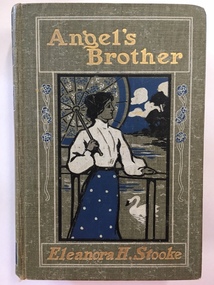
... Anglican Church to attend a Sunday School. In 1906 there were about 30 teachers taking 45 pupils in the morning session and 177 pupils in the afternoon session. The highlights of the year were the Sunday School picnic held at various venues and the annual prizegiving day. In 1909 a cantata, ‘The Fairy Chain’ was performed by Sunday School students in the Oddfellows Hall. The Vicar...Anglican Church to attend a Sunday School. In 1906 there were about 30 teachers taking 45 pupils in the morning session and 177 pupils in the afternoon session. The highlights of the year were the Sunday School picnic held at various venues and the annual prizegiving day. In 1909 a cantata, ‘The Fairy Chain’ was performed by Sunday School students in the Oddfellows Hall. The Vicar ...This book, ‘Angel’s Brother’ by Eleanora H. Stooke was a prize given to a pupil (name unknown) by the Christ Church Sunday School, Warrnambool in 1909. The Sunday School of the Anglican Church in Warrnambool dates from the 1850s and by 1909 it was an established tradition for most children whose parents belonged to the Anglican Church to attend a Sunday School. In 1906 there were about 30 teachers taking 45 pupils in the morning session and 177 pupils in the afternoon session. The highlights of the year were the Sunday School picnic held at various venues and the annual prizegiving day. In 1909 a cantata, ‘The Fairy Chain’ was performed by Sunday School students in the Oddfellows Hall. The Vicar in 1909 was Archdeacon Peacock (1906-1912) and in 1908 he introduced a Church Stamp System at the Sunday School whereby children were given stamps and pictures for an album to record their attendance and instruction. This book is significant because it is an example of the type of prize given to the prizewinners at the Christ Church Sunday School in Warrnambool in 1909. The prize, a book, has a story that has heavy Christian religious and moral overtones and the English Religious Tract Society produced books especially for the Sunday School prizegiving market. This is a hard cover book of 314 pages pus several pages detailing other books recently published. The book is a children’s book given as a prize by Christ Church Sunday School, Warrnambool in 1909. It has a brown cover with an inset of a sketch of a young woman holding an umbrella and a sea or a lake setting in the background. The colours of the sketch are blue, white and black and the sketch is set in a decorative border. A similar decorative pattern is on the spine of the book. There are several black and white plates in the book relating to the story. The inscription plate inside has both printed material in blue print and handwritten material in black ink. Front Cover: ‘Angel’s Brother, Eleanora H. Stooke’ Book Plate inside: ‘Christ Church Sunday School, Warrnambool, presented to Ethel … (name scratched out), Class VI, Teacher, Miss Ware, A.E.Peacock, Vicar, J.Ward, S.Smith, Superintendents, Advent, 1909.’ christ church warrnambool sunday school, archdeacon peacock, warrnambool -
 Warrnambool and District Historical Society Inc.
Book, Hymns Ancient & Modern, 1906
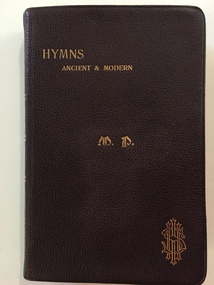
... Vicar of Christ Church, Warrnambool. Their brother was Sir Alexander Peacock, at one time Premier of Victoria. Margaret Peacock kept house for her brother at the vicarage and assisted him in his pastoral work. Her brother died in Warrnambool in 1912 and Margaret left the town. She died in 1947. This book is of considerable importance as it belonged to a Warrnambool resident in the early 1900s. She worked as a housekeeper for her brother, Archdeacon Peacock and assisted him in his pastoral duties in the Anglican ...This Hymn Book was given to Margaret (Peggie) Peacock by the Christ Church Choir, Warrnambool when she left Warrnambool in 1912. She was the sister of Archdeacon Andrew Peacock, the fourth Vicar of Christ Church, Warrnambool. Their brother was Sir Alexander Peacock, at one time Premier of Victoria. Margaret Peacock kept house for her brother at the vicarage and assisted him in his pastoral work. Her brother died in Warrnambool in 1912 and Margaret left the town. She died in 1947.This book is of considerable importance as it belonged to a Warrnambool resident in the early 1900s. She worked as a housekeeper for her brother, Archdeacon Peacock and assisted him in his pastoral duties in the Anglican Church. The sketch in the book shows that Margaret Peacock was interested in art work and the caption, ‘Where Memory Lingers’ shows that she had fond memories of her time in Warrnambool. The book was in the possession of her sister, Mrs Uglow, the wife of a Colac physician and this lady was a friend of Gladys Angus, the wife of a well-known Warrnambool doctor, Roy Angus. Mrs Uglow gave the book to Mrs Angus’ daughter, Berry McDade and she has handed it over to the Warrnambool and District Historical Society for safe-keeping. This is a maroon-coloured leather-bound book of 514 pages of hymns (music and words) and 31 pages of additional material at the end of the book. The inside of the cover has an ornamental gilt pattern on the edges and the page ends have red gilt shading. There are four loose pages, three of them relating to the ownership and donation of the book and one is a prayer for members of the Girls’ Friendly Society. The front cover has been personalised with gold lettering with the initials of the owner and there is an inscription inside relating to the original presentation of the book to the owner, Margaret Peacock. This is in silver and black script. There is also a sketch of Christ Church, Warrnambool by Margaret (Peggie) Peacock inserted into the third page. There is some small damage to the first page.Front Cover: ‘Hymns Ancient and Modern, M.P., HIS’ Inscription: ‘To Miss Peacock, A parting gift from the Choir, Christ Church Warrnambool, October 1912’ Sketch: ‘Where Memory Lingers’ christ church warrnambool, archdeacon peacock, margaret peacock, warrnambool, miss peacock, andrew peacock -
 Buninyong & District Historical Society
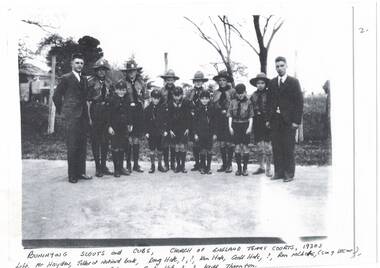
Photograph - Copy of B&W photo, Buninyong Scouts and Cubs, standing on Holy Trinity Church tennis courts, 1930's, Buninyong Scouts and Cubs, standing on Holy Trinity Church tennis courts, 1930's
... historic, social, people Buninyong Holy Trinity Anglican Church tennis court Boy Scouts Cubs Hale Hayden Nichols Thornton "Buninyong Scouts & Cubs, Church of England tennis courts, 1930's Left, Mr Hayden, Teller at National Bank, Doug Hale, ?, ?, Ken HAle, ?, Ron Nichols (son of Vicar ...historic, social, peopleBuninyong Scouts and Cubs, standing on Holy Trinity Church tennis courts, 1930's"Buninyong Scouts & Cubs, Church of England tennis courts, 1930's Left, Mr Hayden, Teller at National Bank, Doug Hale, ?, ?, Ken HAle, ?, Ron Nichols (son of Vicar), Norm Thornton, Cubs - Gordon Hale, ?, ?, Keith Thornton."buninyong, holy trinity anglican church, tennis court, boy scouts, cubs, hale, hayden, nichols, thornton -
 Buninyong & District Historical Society
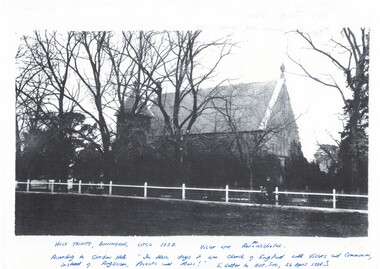
Photograph - Copy of B&W photo, from Scott St. north side of Holy Trinity Church, Warrenheip St, Holy Trinity Church, Warrenheip St, north side, 1937
... According to Gordon Hale " In those days it was Church of England with Vicars and Communion, instead of Anglican, Priests and Mass! ...historic, social, Buninyong Hale Holy Trinity Anglican Church "Holy Trinity, Buninyong, circa 1937. Vicar was Rev. Mr. ...historic, social, Copy of B&W photo, Holy Trinity Church, Warrenheip St, north side, from Scott St. 1937"Holy Trinity, Buninyong, circa 1937. Vicar was Rev. Mr. Nicholas. According to Gordon Hale " In those days it was Church of England with Vicars and Communion, instead of Anglican, Priests and Mass! (Letter to Hist. Soc. 24 April 1995.)"buninyong, hale, holy trinity anglican church -
 Port Melbourne Historical & Preservation Society
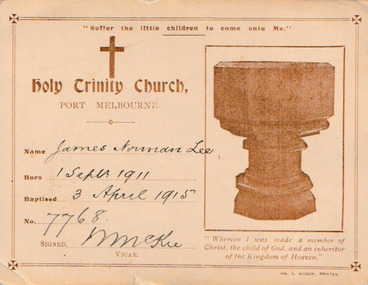
Certificate - Baptismal Certificate 1910, 1915
... James Norman LEE Religion - Anglican (Holy Trinity) Celebrations Fetes and Exhibitions William McKIE James Norman LEE, Born: 1 Sept 1911, Baptised: 3 April 1915, No: 7768, Signed: ? McKIE - Vicar ...Baptism Certificate for James Norman LEE born 1 Sep 1911 and baptised on 3 Apr 1915.Pale yellow oblong card with a sepia photograph of the font from Holy Trinity Church, Port Melbourne. James Norman LEE, Born: 1 Sept 1911, Baptised: 3 April 1915, No: 7768, Signed: ? McKIE - Vicarjames norman lee, religion - anglican (holy trinity), celebrations fetes and exhibitions, william mckie -
 Port Melbourne Historical & Preservation Society
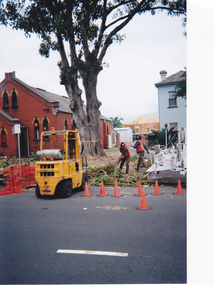
Photograph - Destruction of Port Jackson fig tree, Holy Triniy Anglican Church, Port Melbourne, Pat Grainger, 7 Dec 1999
... It took several days, for as contrary to the claims of the vicar, the tree was extremely healthy. Demolitions Religion - Anglican (Holy Trinity) One of 21 colour photographs showing the destruction of the Port Jackson fig tree which stood in the grounds of the Holy Trinity church until December 1999. ...Removal of the tree was surreptitiously begun and so was partially done before the community realised. It took several days, for as contrary to the claims of the vicar, the tree was extremely healthy. One of 21 colour photographs showing the destruction of the Port Jackson fig tree which stood in the grounds of the Holy Trinity church until December 1999. (Ref item 1637)demolitions, religion - anglican (holy trinity) -
Port Melbourne Historical & Preservation Society
Document - Folder, Donations to rebuild Holy Trinity Anglican Church, Port Melbourne, 1908 - 1909
... Religion - Anglican (Holy Trinity) Built Environment Mrs READ Herbert Stanley HOLLOW Fred BRAMMALL Inside front cover a note written between 1926 and 1930 by Vicar F Bramall regarding the death of Mrs Read, whose collection sheet this was "We have lost our church by a cyclone" - Small cardboard folder containing 4 inner pages glued in and containing images and a hand entered list of donors, sheet number 38, to the new church, 1909. ...(Holy Trinity) issued as a collectors folder after the church was destroyed. In the late 1920s a note was added by Rev BRAMMALL, when the collector of sheet 38, Mrs READ, died."We have lost our church by a cyclone" - Small cardboard folder containing 4 inner pages glued in and containing images and a hand entered list of donors, sheet number 38, to the new church, 1909. Holy Trinity.Inside front cover a note written between 1926 and 1930 by Vicar F Bramall regarding the death of Mrs Read, whose collection sheet this wasreligion - anglican (holy trinity), built environment, mrs read, herbert stanley hollow, fred brammall -
 Port Melbourne Historical & Preservation Society
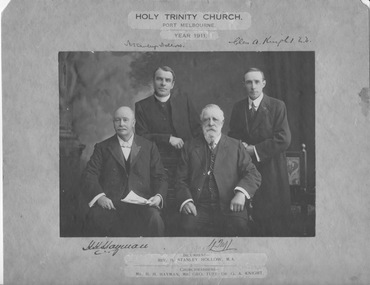
Photograph - Stanley Hollow, Vicar, with church wardens, Holy Trinity Anglican Church, Port Melbourne, Holy Trinity Church, Port Melbourne 1911, 1911
... Stanley Hollow, Vicar, with church wardens, Holy Trinity Anglican Church, Port Melbourne...Religion - Anglican (Holy Trinity) Herbert Stanley HOLLOW H H HARMAN George TUFF Glen Auburn KNIGHT Sepia photo on cardboard backing showing the Incumbent Minister Stanley Hollow with church wardens of Holy Trinity Anglican in 1911 Holy Trinity Church, Port Melbourne 1911 Photograph Stanley Hollow, Vicar, with church wardens, Holy Trinity Anglican Church, Port Melbourne ...Sepia photo on cardboard backing showing the Incumbent Minister Stanley Hollow with church wardens of Holy Trinity Anglican in 1911religion - anglican (holy trinity), herbert stanley hollow, h h harman, george tuff, glen auburn knight
