
Showing 13336 items matching "art subjects"
-
 Federation University Historical Collection
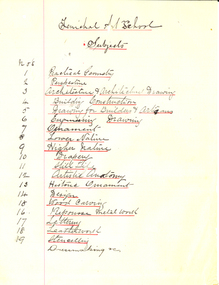
Document, Ballarat Technical Art School Subject Legend, c1910, c1910
... Ballarat Technical Art School Subject Legend, c1910......Art Subjects...Handwritten list of Ballarat Technical Art School subjects. This are most probably a legend for enrolments. ...Ballarat Technical Art School Subject Legend, c1910 Document ...The Ballarat Technical Art School was a division of the Ballarat School of MinesHandwritten list of Ballarat Technical Art School subjects. This are most probably a legend for enrolments. ballarat technical art school, ballarat school of mines, art subjects, repousse, wood carving, historic ornament, lettering, dressmakingstill life, ornament, drawing for builders and artisans, archiecture and architectural drawing -
 Bendigo Historical Society Inc.
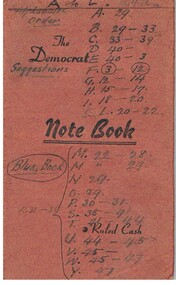
Document - NORMAN PENROSE COLLECTION: COLOUR IN ART
... Norman Penrose collection: 5 notebooks - 3 blue, 1 light red and 1 with no cover containing notes on using colour in art. Subjects include Painting ?, Reproduction Processes, Outdoor Sketching, A to L and M to Y....Norman Penrose collection: 5 notebooks - 3 blue, 1 light red and 1 with no cover containing notes on using colour in art. Subjects include Painting ?, Reproduction Processes, Outdoor Sketching, A to L and M to Y. ...Document. Norman Penrose collection: 5 notebooks - 3 blue, 1 light red and 1 with no cover containing notes on using colour in art. Subjects include Painting ?, Reproduction Processes, Outdoor Sketching, A to L and M to Y.person, bendigo, norman william penrose, norman penrose collection, colour in art, outdoor sketching, reproduction processes, painting -
 Federation University Historical Collection
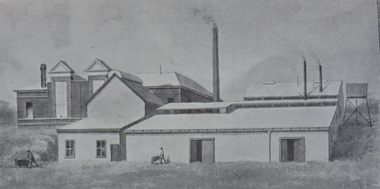
Booklet - Booklet - Prospectus, Bairnsdale District School of Mines, Prospectus, 1904, 1904
... It also includes a scale of fees, information on the Metallurgical Plant, Chemistry, Assaying and Metallurgy, Geology, Mining Geology, Mining, Petrology, Dynamics and Heat, Magnetism & Electricity, Mechanics Applied to Mining, Land Surveying, Mine Surveying, Algebra, Euclid, Trigonometry, Mechanical Drawing, Practical Plane Geometry, Practical Solid Geometry, Engineering Drawing, Art Subjects, and a list of certificates issued by the school since 1892....It also includes a scale of fees, information on the Metallurgical Plant and its chares, Chemistry, Assaying and Metallurgy, Geology, Mining Geology, Mining, Petrology, Dynamics and Heat, Magnetism & Electricity, Mechanics Applied to Mining, Land Surveying, Mine Surveying, Algebra, Euclid, Trigonometry, Mechanical Drawing, Practical Plane Geometry, Practical Solid Geometry, Engineering Drawing, Art Subjects, and a list of certificates issued by the school since 1892....It also includes a scale of fees, information on the Metallurgical Plant, Chemistry, Assaying and Metallurgy, Geology, Mining Geology, Mining, Petrology, Dynamics and Heat, Magnetism & Electricity, Mechanics Applied to Mining, Land Surveying, Mine Surveying, Algebra, Euclid, Trigonometry, Mechanical Drawing, Practical Plane Geometry, Practical Solid Geometry, Engineering Drawing, Art Subjects, and a list of certificates issued by the school since 1892. bairnsdale district school of mines bairnsdale school of mines Donald Clark Francis W. ...Higher education in east Gippsland dates back to 1890, and the opening of the Bairnsdale District School of Mines, In 1986 the Bairnsdale School of Mines and the Sale and Bairnsdale Technical schools amalgamated to form the East Gippsland Community College of TAFE. In 1995 it became the East Gippsland Institute of Technology, and in 2011 changed its name to Advance TAFE. The Bairnsdale District School of Mines Prospectus includes the members of council, a photographic image of the school, teaching staff, rules relating to students and instructors, Constitution, and a prospectus of subjects including Mining and Science Subjects, Diploma Courses, Preliminary Training, Metallurgy Course, Mining Engineering Course, Battery Manager's Certificate, Assayer's Certificate. It also includes a scale of fees, information on the Metallurgical Plant, Chemistry, Assaying and Metallurgy, Geology, Mining Geology, Mining, Petrology, Dynamics and Heat, Magnetism & Electricity, Mechanics Applied to Mining, Land Surveying, Mine Surveying, Algebra, Euclid, Trigonometry, Mechanical Drawing, Practical Plane Geometry, Practical Solid Geometry, Engineering Drawing, Art Subjects, and a list of certificates issued by the school since 1892.Grey soft covered book of 68 pages. The Bairsndale District School of Mines Prospectus includes the members of council, an photographic image of the school, teaching staff, rules relating to students and instructors, Constitution, and a prospectus of subjects including Mining and Science Subjects, Diploma Courses, Preliminary Training, Metallurgy Course, Mining Engineering Course, Battery Manager's Certificate, Assayer's Certificate. It also includes a scale of fees, information on the Metallurgical Plant and its chares, Chemistry, Assaying and Metallurgy, Geology, Mining Geology, Mining, Petrology, Dynamics and Heat, Magnetism & Electricity, Mechanics Applied to Mining, Land Surveying, Mine Surveying, Algebra, Euclid, Trigonometry, Mechanical Drawing, Practical Plane Geometry, Practical Solid Geometry, Engineering Drawing, Art Subjects, and a list of certificates issued by the school since 1892.bairnsdale district school of mines, bairnsdale, school of mines, donald clark, francis w. sewell, j.v.r. anderson, a.d. pleydell, walter seehusen, director, mining engineering, metallurgy, academy of arts, municipal surveyor, 1914 -
 Warrnambool and District Historical Society Inc.
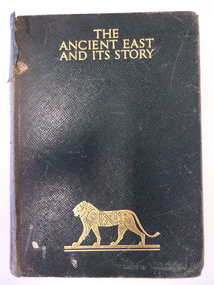
Book, The Ancient East and it's story, 1943
... ‘Warrnambool Technical School, Labor to Efficiency, 8th December 1943, for Outstanding Efficiency in Art Subjects, Donated by Miss Lake, Awarded to Joyce Goodall, John King Principal’ (the name ‘John King’ has been crossed out) ‘Joyce Goodall 198 Timor Street Warrnambool’ ...Joyce Goodall Florence Lake Warrnambool Technical School History of Warrnambool ‘Warrnambool Technical School, Labor to Efficiency, 8th December 1943, for Outstanding Efficiency in Art Subjects, Donated by Miss Lake, Awarded to Joyce Goodall, John King Principal’ (the name ‘John King’ has been crossed out) ‘Joyce Goodall 198 Timor Street Warrnambool’ This is a hard cover book of 472 pages. ...This book was given in 1943 by the Warrnambool Technical School to Joyce Goodall. Considering that World War Two was in progress at the time, the book was an expensive one to be given as a school prize. But the donor was Miss Florence Lake, the daughter of John and Annie Lake and the step-daughter of George Rolfe of Lyndoch, near the Hopkins River mouth. Miss Lake inherited the property and built the residence known as Lyndoch that is today part of the Lyndoch Aged Care Facility. Miss Lake was known for her philanthropy and community work in Warrnambool. John King’s name has been crossed out in the book as he was no longer Principal in 1943. He was the founding principal of Warrnambool Technical School in 1911 and remained there for 29 years. The Goodall family established Wanstead Farm in East Warrnambool in the 19th century and Joyce Goodall was descended from the Mortlake branch of that family.This book is of interest because of its association in 1943 with Joyce Goodall, Florence Lake and Warrnambool Technical School. This is a hard cover book of 472 pages. The cover is brown with gold lettering and the image of a lion on the front cover and a scroll pattern on the spine. The book has a preface, 41 chapters and an index. There are eight colour plates scattered throughout the text. The book plate on the first page is printed and pasted in and it has typed material added to it. Another inscription has been handwritten in pencil. There are also several notes and quotations handwritten in pencil on the back page. The cover is stained and torn in some places and many of the pages are stained. ‘Warrnambool Technical School, Labor to Efficiency, 8th December 1943, for Outstanding Efficiency in Art Subjects, Donated by Miss Lake, Awarded to Joyce Goodall, John King Principal’ (the name ‘John King’ has been crossed out) ‘Joyce Goodall 198 Timor Street Warrnambool’ joyce goodall, florence lake, warrnambool technical school, history of warrnambool -
 Federation University Historical Collection
Booklet, Berry Anderson & Co, The School of Mines and Industries, Calendar, 1914, 1913
... Contents of the Booklet: Associateship, Calendar, Certificate Courses - Science, Certificate Courses - Art, Draughtsman's Courses, Discipline, Discipline Board, Examination Results, Fees, Full Certificates Issued, General Regulations, Introduction, Junior Technical School, Railway Fares, Teaching Staff, Technical Art and Craft School, Subjects of Instruction - Department of Chemistry and Metallurgy, Geological Department, Engineering Department, Electrical and Electrical Engineering Department, Department of Mathematics, Department of Physics, Electrical Wiring, Electrical Engineering for Post Office Mechanics, Turning, Fitting and Blacksmithing, Telegraphy, Art and Applied Art Subjects, Architecture and Building Construction, Engineering Drawing, Carpentry and Manual Training, Dressmaking and Dresscutting, House Decoration and Signwriting, Photography, Plumbing, Sheet Metal Working ...Contents of the Booklet: Associateship, Calendar, Certificate Courses - Science, Certificate Courses - Art, Draughtsman's Courses, Discipline, Discipline Board, Examination Results, Fees, Full Certificates Issued, General Regulations, Introduction, Junior Technical School, Railway Fares, Teaching Staff, Technical Art and Craft School, Subjects of Instruction - Department of Chemistry and Metallurgy, Geological Department, Engineering Department, Electrical and Electrical Engineering Department, Department of Mathematics, Department of Physics, Electrical Wiring, Electrical Engineering for Post Office Mechanics, Turning, Fitting and Blacksmithing, Telegraphy, Art and Applied Art Subjects, Architecture and Building Construction, Engineering Drawing, Carpentry and Manual Training, Dressmaking and Dresscutting, House Decoration and Signwriting, Photography, Plumbing, Sheet Metal Working School of Mines and Industries William Poole Professor A. ...Contents of the Booklet: Associateship, Calendar, Certificate Courses - Science, Certificate Courses - Art, Draughtsman's Courses, Discipline, Discipline Board, Examination Results, Fees, Full Certificates Issued, General Regulations, Introduction, Junior Technical School, Railway Fares, Teaching Staff, Technical Art and Craft School, Subjects of Instruction - Department of Chemistry and Metallurgy, Geological Department, Engineering Department, Electrical and Electrical Engineering Department, Department of Mathematics, Department of Physics, Electrical Wiring, Electrical Engineering for Post Office Mechanics, Turning, Fitting and Blacksmithing, Telegraphy, Art and Applied Art Subjects, Architecture and Building Construction, Engineering Drawing, Carpentry and Manual Training, Dressmaking and Dresscutting, House Decoration and Signwriting, Photography, Plumbing, Sheet Metal Working Blue covered 176 page booklet relating to the School of Mines and Industries in the year 1914. school of mines and industries, william poole, professor a. mica smith, daniel walker, hubert r. murphy, a. e. c. kerr, e. j. a. mcconnon, john m. sutherland, ralph williams, e. gutheil, t. wlliams, herbert h. smith, a. m. lilburne, m. c. young, h. j. hall, d. t. johnson, e. j. cannon, g. clegg, c. e. campbell, w. j. hall, w. h. steane, j. wright, s. h. hodder, w. j. patterson, h. w. malin, r. v. maddison, science department, associate courses, certificate courses, technical art and craft department, associated trade classes, sir redmond barry, judge rogers, r m. serjeant, thomas bath, e. ballhausen, dr stewart, james oddie, associateship and final certificates, mining engineering course, metallurgy course, applied chemistry course, irrigation engineering course, certificate courses, geology course, electrical engineering course, municipal and hydraulic engineering course, chemistry, agricultural chemistry, technical chemistry, engineering chemistry, physical chemistry, metallurgy, assaying, minerology, petrology, engineering and mining department, turning and fitting, mining, electricity, electrical technology, graphical algebra and analytical geometry, physics, mechanics and heat, sound and light, technical, art, craft and trade schools, teachers' certificates, drawing, modelling, ballarat junior technical school, full certificates issued, examination results - 1910, 1911, 1912 -
 Federation University Historical Collection
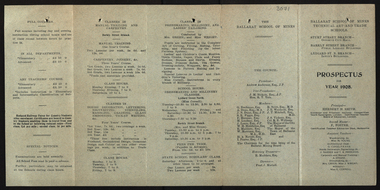
Pamphlet - Brochure, Ballarat School of Mines Technical Art and Trade Schools Prospectus for Year , 1908, 1908
... Four fold prospectus for the Ballarat School of Mines Technical Art and Trade Schools. Includes subjects, staff, art teachers' course, fees per term, scholarships, reduced railway fares....The Ballarat Technical Art School was established as a division of the Ballarat School of Mines in 1907. ballarat technical art school ballarat school of mines trade herbert h. smith h.h. smith f. foster m. young george clegg j. barber thomas pridgeon a. steane mrs green jessie wright edith cornell lending and reference art library state school teachers classes Four fold prospectus for the Ballarat School of Mines Technical Art and Trade Schools. Includes subjects, staff, art teachers' course, fees per term, scholarships, reduced railway fares. ...The Ballarat Technical Art School was established as a division of the Ballarat School of Mines in 1907.Four fold prospectus for the Ballarat School of Mines Technical Art and Trade Schools. Includes subjects, staff, art teachers' course, fees per term, scholarships, reduced railway fares.ballarat technical art school, ballarat school of mines, trade, herbert h. smith, h.h. smith, f. foster, m. young, george clegg, j. barber, thomas pridgeon, a. steane, mrs green, jessie wright, edith cornell, lending and reference art library, state school teachers classes -
 Federation University Art Collection
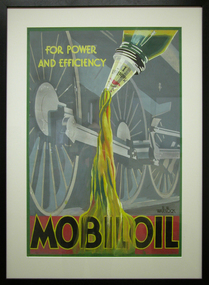
Painting - poster, R.W. Warnock, 'Mobil Oil', c1935
... On completion, he worked as a designer at Paton’s Advertising Service, Melbourne. Commercial art subjects between 1915 and 1939 reflected changing practises and industry requirements, with Ballarat graduates in demand. ...On completion, he worked as a designer at Paton’s Advertising Service, Melbourne. Commercial art subjects between 1915 and 1939 reflected changing practises and industry requirements, with Ballarat graduates in demand. ...Reginald (Reg) WARNOCK (1915-1991) Reginald William Warnock undertook the Commercial Art course during the 1930s. On completion, he worked as a designer at Paton’s Advertising Service, Melbourne. Commercial art subjects between 1915 and 1939 reflected changing practises and industry requirements, with Ballarat graduates in demand. In the 1936 Ballarat School of Mines Annual Report it was stated: "It is my pleasure to report a most successful year in the Technical Art School. I the Annual Poster Competition for Technical Schools, organised by Wiltshires Pty Limited, 16 prized valued at 33 pounds 8 shillings - out of 23 prizes valued at 56 pounds - were won by our students. R.W. Warnock moved from Ballarat to Moonee Ponds towards the end of March, 1937. This item is part of the Federation University Art Collection. The Art Collection features over 1000 works and was listed as a 'Ballarat Treasure' in 2007.Commercial art Framed original poster completed at the Ballarat Technical Art School by R.W. Warnock. It shows Oil pouring from a bottle in front of a steam engine. Please use the comment link below if you can assist with information about R.W. Warnock."For power and efficiency" "Mobil Oil"art, artwork, warnock, mobil, oil, poster, r.w. warnock, available, alumni, locomotive, steam engine, motor oil, advertisement, reginald warnock -
 Flagstaff Hill Maritime Museum and Village
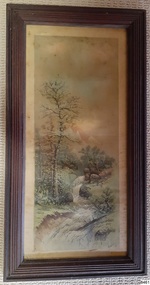
Painting - Landscape, H M Ward (Harold Morse Ward), Early to mid-20th century
... He wrote and illustrated the book ‘The Thing Called Art’. His subjects were often taken from the Sacramento area....He wrote and illustrated the book ‘The Thing Called Art’. His subjects were often taken from the Sacramento area. ...This framed watercolour was created by 20th-century landscape painter Harold Morse Ward. He was born in Brooklyn New York in 1889 and died in Sacramento, California, in 1973. Ward graduated from the Pratt Institute in Brooklyn and furthered his studies in Paris. He was a high school art teacher for many years, later establishing the art department at the Sacramento Junior College in 1923. In 1949 he won a Carnegie Grant for further research in fine arts. He wrote and illustrated the book ‘The Thing Called Art’. His subjects were often taken from the Sacramento area.This is the only example of artwork by early-to-mid 20th-century recognised artist H M Ward in our collection. It is representative of the artwork displayed in homes during that era. Harold Morse Ward received a Carnegie Grant for research in art. He was a descendant of the inventor of the telegraph, Samuel Morse.Painting; the timber framed watercolour painting behind glass depicts a cottage on a hill beside a winding creek with trees and bushes. Artist is H M Ward. Signed "H M Ward"flagstaff hill, flagstaff hill maritime museum and village, warrnambool, maritime museum, maritime village, great ocean road, shipwreck coast, watercolour, landscape, h m ward, harold morse ward, 20th century art, sacramento artist, the things called art -
 Federation University Historical Collection
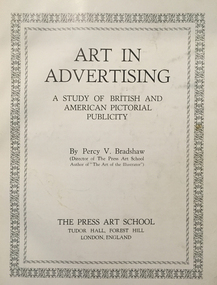
Book, Percy V. Bradshaw, 'Art in Advertising' by Percy V. Bradshaw, 1925
... A lengthy survey of 1920s graphic advertising in both the USA and England, with the aim of educating the public on what exactly made good advertising. Subjects include “Art & the Public,” “Art & the Business Man,” “The Art of the Printer,” “Commercial Studios & Their Work,” “The Art Agent & His Work,” “Retail Store Advertising,” “Notable Advertising Campaigns,” and much more. ...art school library Large, brown, cloth covered book. A lengthy survey of 1920s graphic advertising in both the USA and England, with the aim of educating the public on what exactly made good advertising. Subjects ...Large, brown, cloth covered book. A lengthy survey of 1920s graphic advertising in both the USA and England, with the aim of educating the public on what exactly made good advertising. Subjects include “Art & the Public,” “Art & the Business Man,” “The Art of the Printer,” “Commercial Studios & Their Work,” “The Art Agent & His Work,” “Retail Store Advertising,” “Notable Advertising Campaigns,” and much more. Many black and white images, with some in colour. press art school, percy v. bradshaw, ballarat technical art school, posters, advertising, graphics, lettering, press, bookplates, ballarat technical art school library -
 Federation University Historical Collection
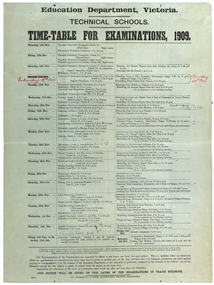
poster, J. Kemp, Education Department Victoria Technical School Timetable for Examinations, 1910, 1910
... Subjects included Chemistry, Geology, Asssaying, Hydraulics, Agriculture, Engineering , Mine Surveying, Algebra, Mineralogy, petrology, Botany, Trigonometry, Euclid, Land Surveying, Steam and gas Engines, Applied Mechanics, Drawing, painting, engineering drawing, building construction, architecture, drapery, modelled design, casting clay models, composition of form and colour, Lettering, Wood Carving, historic ornament, Wood Carving. .1) Trade Subjects .2) Other subjects, including art...examinations technical schools trades art technical art school timetable clay modelling ceramics Large printed timetable for Technical School examinations in 1901. Subjects ...Large printed timetable for Technical School examinations in 1901. Subjects included Chemistry, Geology, Asssaying, Hydraulics, Agriculture, Engineering , Mine Surveying, Algebra, Mineralogy, petrology, Botany, Trigonometry, Euclid, Land Surveying, Steam and gas Engines, Applied Mechanics, Drawing, painting, engineering drawing, building construction, architecture, drapery, modelled design, casting clay models, composition of form and colour, Lettering, Wood Carving, historic ornament, Wood Carving. .1) Trade Subjects .2) Other subjects, including artexaminations, technical schools, trades, art, technical art school, timetable, clay modelling, ceramics -
 Flagstaff Hill Maritime Museum and Village
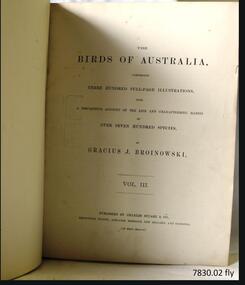
Book - Reference Book, Gracius J Broinowski, The Birds of Australia Vol 3-4, 1890-1891
... He was educated privately and at Munich University where he studied classics, languages and art subjects. Later, to avoid being conscripted into the Russian army, he went to Germany and there was robbed of all his possessions. ...He was educated privately and at Munich University where he studied classics, languages and art subjects. Later, to avoid being conscripted into the Russian army, he went to Germany and there was robbed of all his possessions. ...Gracius Joseph Broinowski was a Polish-born artist and ornithologist who became a key figure in documenting Australian wildlife. Born on 7 March 1837 near Wielun, Poland, he studied languages, classics, and art at Munich University before emigrating to Australia around 1857 to avoid conscription. Broinowski faced hardships in Europe and London before sailing to Australia. He initially worked rural jobs in Victoria, then joined a Melbourne publishing firm, traveling across Victoria, New South Wales, and Queensland to paint landscapes and sell art via "art unions."The Birds of Australia Vol 3-4 Author and Illustrator: Gracius J Broinowski Publisher: Charles Stuart & Co Date: 1890 - 1891non-fictionGracius Joseph Broinowski was a Polish-born artist and ornithologist who became a key figure in documenting Australian wildlife. Born on 7 March 1837 near Wielun, Poland, he studied languages, classics, and art at Munich University before emigrating to Australia around 1857 to avoid conscription. Broinowski faced hardships in Europe and London before sailing to Australia. He initially worked rural jobs in Victoria, then joined a Melbourne publishing firm, traveling across Victoria, New South Wales, and Queensland to paint landscapes and sell art via "art unions." the birds of australia vol 1-2, flagstaff hill, warrnambool, shipwrecked coast, flagstaff hill maritime museum, maritime museum, shipwreck coast, flagstaff hill maritime village, great ocean road, the birds of australia, gracius joseph broinowski, charles stuart & co, joseph archibald, warrnambool public museum, warrnambool museum, warrnambool library, warrnambool art gallery, warrnambool city librarian, pattison collection, ralph eric pattison, samuel hannaford, warrnambool mechanics’ institute and free library, mechanics’ institute library, victorian library board, warrnambool books and records, rare books, australian bird illustrations, australian bird text, australian natural history -
 Flagstaff Hill Maritime Museum and Village
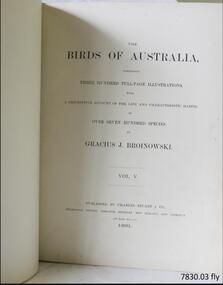
Book - Reference Book, Gracius J Broinowski, The Birds of Australia Vol 5-6, 1890-1891
... He was educated privately and at Munich University where he studied classics, languages and art subjects. Later, to avoid being conscripted into the Russian army, he went to Germany and there was robbed of all his possessions. ...He was educated privately and at Munich University where he studied classics, languages and art subjects. Later, to avoid being conscripted into the Russian army, he went to Germany and there was robbed of all his possessions. ...Gracius Joseph Broinowski was a Polish-born artist and ornithologist who became a key figure in documenting Australian wildlife. Born on 7 March 1837 near Wielun, Poland, he studied languages, classics, and art at Munich University before emigrating to Australia around 1857 to avoid conscription. Broinowski faced hardships in Europe and London before sailing to Australia. He initially worked rural jobs in Victoria, then joined a Melbourne publishing firm, traveling across Victoria, New South Wales, and Queensland to paint landscapes and sell art via "art unions."The Birds of Australia Vol 5-6 Author and Illustrator: Gracius J Broinowski Publisher: Charles Stuart & Co Date: 1890 - 1891non-fictionGracius Joseph Broinowski was a Polish-born artist and ornithologist who became a key figure in documenting Australian wildlife. Born on 7 March 1837 near Wielun, Poland, he studied languages, classics, and art at Munich University before emigrating to Australia around 1857 to avoid conscription. Broinowski faced hardships in Europe and London before sailing to Australia. He initially worked rural jobs in Victoria, then joined a Melbourne publishing firm, traveling across Victoria, New South Wales, and Queensland to paint landscapes and sell art via "art unions." the birds of australia vol 1-2, flagstaff hill, warrnambool, shipwrecked coast, flagstaff hill maritime museum, maritime museum, shipwreck coast, flagstaff hill maritime village, great ocean road, the birds of australia, gracius joseph broinowski, charles stuart & co, joseph archibald, warrnambool public museum, warrnambool museum, warrnambool library, warrnambool art gallery, warrnambool city librarian, pattison collection, ralph eric pattison, samuel hannaford, warrnambool mechanics’ institute and free library, mechanics’ institute library, victorian library board, warrnambool books and records, rare books, australian bird illustrations, australian bird text, australian natural history -
 Flagstaff Hill Maritime Museum and Village
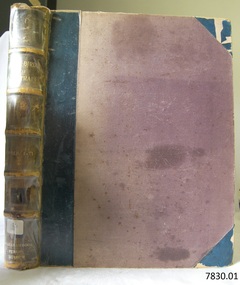
Book - Reference Book, Gracius J Broinowski, The Birds of Australia Vol 1-2, 1890-1891
... He was educated privately and at Munich University where he studied classics, languages and art subjects. Later, to avoid being conscripted into the Russian army, he went to Germany and there was robbed of all his possessions. ...He was educated privately and at Munich University where he studied classics, languages and art subjects. Later, to avoid being conscripted into the Russian army, he went to Germany and there was robbed of all his possessions. ...Gracius Joseph Broinowski was a Polish-born artist and ornithologist who became a key figure in documenting Australian wildlife. Born on 7 March 1837 near Wielun, Poland, he studied languages, classics, and art at Munich University before emigrating to Australia around 1857 to avoid conscription. Broinowski faced hardships in Europe and London before sailing to Australia. He initially worked rural jobs in Victoria, then joined a Melbourne publishing firm, traveling across Victoria, New South Wales, and Queensland to paint landscapes and sell art via "art unions."The Birds of Australia Vol 1-2 Author and Illustrator: Gracius J Broinowski Publisher: Charles Stuart & Co Date: 1890 - 1891non-fictionGracius Joseph Broinowski was a Polish-born artist and ornithologist who became a key figure in documenting Australian wildlife. Born on 7 March 1837 near Wielun, Poland, he studied languages, classics, and art at Munich University before emigrating to Australia around 1857 to avoid conscription. Broinowski faced hardships in Europe and London before sailing to Australia. He initially worked rural jobs in Victoria, then joined a Melbourne publishing firm, traveling across Victoria, New South Wales, and Queensland to paint landscapes and sell art via "art unions." the birds of australia vol 1-2, flagstaff hill, warrnambool, shipwrecked coast, flagstaff hill maritime museum, maritime museum, shipwreck coast, flagstaff hill maritime village, great ocean road, the birds of australia, gracius joseph broinowski, charles stuart & co, joseph archibald, warrnambool public museum, warrnambool museum, warrnambool library, warrnambool art gallery, warrnambool city librarian, pattison collection, ralph eric pattison, samuel hannaford, warrnambool mechanics’ institute and free library, mechanics’ institute library, victorian library board, warrnambool books and records, rare books, australian bird illustrations, australian bird text, australian natural history -
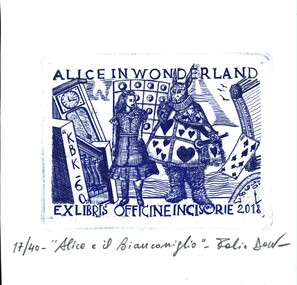 Federation University Bookplate Collection
Work on paper - Bookplate, Alice in Wonderland
... Art movements Artist’s statement Subjects Bookplate, Australian Bookplate Design awards, Kieth Wingrove Trust Entered in the International Bookplate Design section of the the Australian Bookplate Society's 'Australian Bookplate Design competition for 2020....Art movements Artist’s statement Subjects Bookplate, Australian Bookplate Design awards, Kieth Wingrove Trust Entered in the International Bookplate Design section of the the Australian Bookplate Society's 'Australian Bookplate Design competition for 2020. ...After a quiet period, interest in bookplates in Australia began to increase in the early 1970s, Entrepreneurial art and book collectors such as Edwin Jewell and others commissioned multiple Bookplate designs from a range of well known fine artists. At a 1997 meeting in Melbourne of the Ephemera Society of Australia Edwin Jewell and others announced the formation of the Australian Bookplate Society. The society was instrumental in promoting the art of the bookplate through establishment of the Australian Bookplate Design competition. The competition includes a design award for International bookplate designers and graphic artists. as well as Australian secondary school students. Art movements Artist’s statement Subjects Bookplate, Australian Bookplate Design awards, Kieth Wingrove Trust Entered in the International Bookplate Design section of the the Australian Bookplate Society's 'Australian Bookplate Design competition for 2020.Pencilled beneath image: 17/40- "Alice e il Bianconiglio" - signature of artist. -
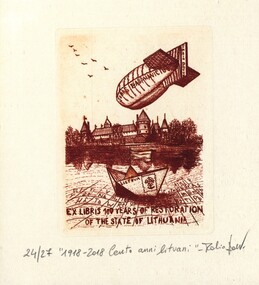 Federation University Bookplate Collection
Work on paper - Bookplate, Centenary of Lithuania
... Art movements Artist’s statement Subjects Bookplate, Australian Bookplate Design awards, Kieth Wingrove Trust Entered in the International Bookplate Design section of the the Australian Bookplate Society's 'Australian Bookplate Design competition for 2020....Art movements Artist’s statement Subjects Bookplate, Australian Bookplate Design awards, Kieth Wingrove Trust Entered in the International Bookplate Design section of the the Australian Bookplate Society's 'Australian Bookplate Design competition for 2020. ...After a quiet period, interest in bookplates in Australia began to increase in the early 1970s, Entrepreneurial art and book collectors such as Edwin Jewell and others commissioned multiple Bookplate designs from a range of well known fine artists. At a 1997 meeting in Melbourne of the Ephemera Society of Australia Edwin Jewell and others announced the formation of the Australian Bookplate Society. The society was instrumental in promoting the art of the bookplate through establishment of the Australian Bookplate Design competition. The competition includes a design award for International bookplate designers and graphic artists. as well as Australian secondary school students. Art movements Artist’s statement Subjects Bookplate, Australian Bookplate Design awards, Kieth Wingrove Trust Entered in the International Bookplate Design section of the the Australian Bookplate Society's 'Australian Bookplate Design competition for 2020. -
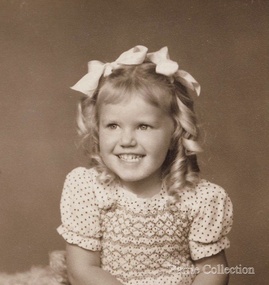 Melton City Libraries
Photograph, Wendy Barrie, Unknown
... I attended Melbourne University lectures, studying a Fine Art subject. Bernard Smith was the most notable of the lecturers. he replaced Professor Joseph Bourke who had taken leave for the years. ...I attended Melbourne University lectures, studying a Fine Art subject. Bernard Smith was the most notable of the lecturers. he replaced Professor Joseph Bourke who had taken leave for the years. ...Eldest daughter of Edna and Bon Barrie, born on 03 November 1943 in Melbourne, Victoria, Memoirs of Wendy Barrie, recalling the early formative years of life in Melton: In 1949 I started school at Melton State School no 430 and was driven the 2½ miles to there by my parents at first. Later we walked home in the afternoons or were picked up by car as we made our way home along the Western Highway. In 1956 I went to Bacchus Marsh High School. There were 4 students in grade 6 and 3 of us went to the High School. The students from Melton, Melton South and Toolern Vale State Schools went by bus to Bacchus Marsh High School as far a fifth form. My parents drove me to the pick up point and during the five years of travel to High School. The bus travelled via Toolern Vale and later went through Exford and through Parwan. On the return journey in the afternoon the bus went in the reverse direction. The bridge at Exford was an old narrow wooden one, and the students had to get off the bus and walk across, with the driver crossing in the empty bus for safety reasons. There was a travelling allowance paid to parents and it was estimated from the distance the crow flies, a straight line. We lived a Ferris Lane, just where the Harness Racing entrance is now situated about 2 ½ miles by road to school too close to qualify for the subsidy. While at State School Melton we would walk home in a group with the Nixon and Gillespie children, along the main road over the bridge near the Shire Offices and down a hill. I was being dinked on Joyce Gillespie’s bike while holding onto the seat, toppled off the bike striking my chin and teeth on the bitumen and cracking my jaw. I was about 9 years old and stayed a couple of days in the Quamby Hospital in Bacchus Marsh, it seemed like and eternity at the time and quite traumatic being separated from my family. I can remember contemplating how I could get out of the window and run away but realised it was too far to walk home. Often we would cut across the Common on our way home from school picking up stray golf balls and collecting them from the creek when it dried out. We were warned about not accepting lifts from strangers passing along the Melbourne/ Ballarat Road. The only danger we faced was being swooped by the magpies particularly on the open ground on the Common. We were also fairly cautious when the Gypsies camped on the Common in the area just about opposite the small reservoir. “Mum” grandma Myers loved to have us call in on our way home, and usually would cut a slice of Jongebloed’s bread and spread it with home made butter. Sometimes we waited there until we were collected by car, usually driven by our mother. Margaret Nixon and Joyce Gillespie were a few grades ahead of me and Barbara Nixon was born just two months earlier than me. Our mothers were great friends for over 6o years, born in the same month three years apart. They lived within a few days of the same age as each other at the time their deaths. Dad and George Nixon attended Melton school at the same time. Sarah nee Hornbuckle Nixon and my grandfather Frederick Myers Snr were at school together at the same in the 1880s. The Nixon family lived in Keilor Road just past the Toolern Creek near the turnoff. Tom and Ann Collins lived on the southern side of the Western highway and Keilor road intersection. Jim and Ruby Gillespie’s house was further long Keilor road on the right. They backed onto the Myers who lived on the north side of Western Highway east of Myers Gully (Ryans Creek). The Bridge over the Toolern Creek as very narrow and as truck traffic increased there were accidents. One truck took out the side railing and plunged upside down into the bank and into the shallow water. Another fatal accident happened between a car and a truck right in front of the Myers house. Grandfather Fred had been a bike rider all his life, as far as the Riverina in his younger years, wryly made the comment about the drivers the speeding along the Ballarat Road were setting out to kill themselves. The road was busy particularly after the Races at Ballarat when the crowds were hurrying home to Melbourne. Train travel had changed very little from the time my mothers generation to mine. The timetable meant the usual rush to Melton South by bike in her case and if she was running late the train pulled up on the crossing. I was driven to the Station from home past Keith and Mary Gillespie’s house near the Ferris Road rail crossing to Bridge road to Melton South for the 7.32 train. While attending Sunshine High School in 1961 I would meet up with three other students, two of whom I knew from Bacchus Marsh High School days. We usually got into the same compartment on the train, it was a typical country train with a corridor along the side and compartments with a door, roof racks and sometimes heated metal containers for the feet in the winter. Some of the trains came through from Horsham and Ballarat, and the Overland from Adelaide passed through in the evening, we could hear it in the distance from the Ferris Lane home. The carriages had 1st and economy class compartments showing photographs of county scenes and holiday destinations. The engine was the large A class diesel. They are still running to Bacchus Marsh 50 years later, due to the need for the greatly increased number of commuters travelling to work in the city. Sometimes the carriages were pull by a Steam engine, these were a problem in the summer time because the sparks caused fires along the train lines and then quickly spread into the dry grass, crops and stubble. The Motor Train left Spencer Street at 4.23 pm and was the best train for me to catch. Ferris Road was a designated stop and train pulled up on the road crossing. It had steps at the door and rungs to hold while alighting to the ground. The ballast along the tracks was rough and uneven and awkward to land on. The train was painted blue and yellow with the letters VR pained on the front. This saved may parents the afternoon trip to collect me from the Station. On the walk home on the gravel road I would pass Uncle Tom and Aunty May’s house before reaching home. Melva Gillespie was studying at Sunshine Technical School and we sometimes both got off the train at the same time. On other occasions the Motor Train was replaced with a diesel engine with carriages, it was also required to stop and the driver had to be notified in advance. This meant getting into the guards van a Rockbank. It was more difficult alighting from the carriage as the gap was greater and more precarious to swing out and land on the ground. A few times in my last year of study at Melbourne Teachers College in Grattan Street Carlton. I managed to catch the 2.30 pm train to Serviceton, it was express to Melton and was very quick trip. The last train, was the 5.25 pm diesel to Ballarat and I usually caught this train to Melton South Station. On one occasion after being held up on the tram in Bourke street I had to make a mad dash to the platform chasing the train as it was just moving off and yelling to the guard, fortunately I was noticed and the train ground to halt. I scrambled into the end door and took most of the journey home to recover. After the last year at High School I continued to travel on the train, 2 years to Prahran Technical School changing at North Melbourne. There were a lot school children travelling to private schools and some at the primary level and mainly from Bacchus Marsh. Rockbank children also travelled by train from the beginning of their high school years, quite a few went to Sunshine High School. During my third year of teacher training I travelled to Flinders Street to RMIT for ceramics classes and Grattan St Teachers College located in the grounds of Melbourne University. There were many teachers being trained at the Secondary Teachers College due to the baby bulge creating a great shortage of teachers. Sunshine High School was very well represented amongst the different courses in Primary, Secondary and Art and Crafts. I attended Melbourne University lectures, studying a Fine Art subject. Bernard Smith was the most notable of the lecturers. he replaced Professor Joseph Bourke who had taken leave for the years. In 1962 he published the art book “Australian Painting”. The secondary art and craft student teachers from the College were in the majority, taking this subject and were well regarded due to their practical art and craft methods and their teaching round experience. In December 1964 I graduated as a Trained Secondary Teacher – Art and Crafts. The graduating ceremony was held at Wilson Hall. I received my appointment to work at Maryborough High School. Uncle Max and Aunty Rosemary Myers arranged my accommodation. Uncle Max was a teacher at the Maryborough Technical School fat the time. The appointment was suddenly changed when just before the school year was about to start when I received notification that I was now required to move to Warracknabeal High School. I was subject to a bond for the three years of training and three years of teaching and was under an obligation to comply with the directive of the Education Department. My father stood as guarantor when I was accepted as student at the Melbourne Teachers’ College, thus enabling me to receive my teacher training, and a 5 pounds a week allowance for expenses. After teaching for two years at Warracknabeal High School I was fortunate enough the gain a transfer to Sunshine West High School, returning to live at home in Melton and travelling by car to work with a fellow colleague, Jock Smith who lived at Station road Melton. I completed bond obligation and resigned at the end of the year. The employment regulations at that time did not allow the option of leave of absence for, indefinite overseas travel. I returned to Australia in October 1969. Visiting Arthur Hart the Principal of Sunshine High School he arranged with the Education Department for my re-employment at Sunshine High School until the end of the year. In 1970 I was transferred, and returned to Sunshine West High School where I worked for the next three years. In January 1968 I sailed on the “Oriana” to South Hampton with two teaching friends from Warracknabeal High School on a travelling and working holiday. Doreen Kiely, a former Bacchus Marsh High student and fellow train traveller from Bacchus Marsh, was already working in London, had arranged our accommodation at the London Travellers Club Hotel, Braham Gardens, Earls Court SW5. We based our stay at this address in London and travelled around Scotland, Ireland and England. In the summer we took a four month trip around the Continent and the Mediterranean. I registered with The Royal Borough Of Kingston Upon Thames as a Supply teacher, and worked at Chessington School form autumn to spring the following year and living with Mrs Rose Gillies at Kinross Avenue, Worcester Park, Surrey. In the spring of 1969 visiting Norway, Sweden and Finland joining an organised camping group to the Artic Circle, entered Russia at Leningrad (St Petersburg) Moscow, Minsk, to Poland and Czechoslovakia. In August returning to Worcester Park for the flight to Montreal to stay with cousin Lynette and husband Jurgen. A side trip was taken to Toronto, Niagara Falls and New York. The flight home from Montreal to Melbourne took 52 hours. A ½ day break in Vancouver before boarding the Qantas boeing 707 via San Francisco, Honolulu, Fiji, Sydney to Melbourne. Around the world in 21 months. Photographs of Wendy local identities -
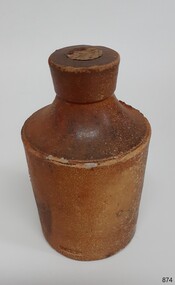 Flagstaff Hill Maritime Museum and Village
Container - Ink Bottle, Royal Doulton, 1853-1878
... art objects. Of additional significance is that it was recovered from the wreck of the Loch Ard. A shipwreck that is of additional significance as it is registered on the Victorian Heritage Register ( S 417). Flagstaff Hill has a varied collection of artefacts from Loch Ard and its collection is significant for being one of the largest accumulations of artefacts from this notable Victorian shipwreck of which the subject items are a small part. ...The ink bottle was made by the Royal Doulton company which began as a partnership between John Doulton, Martha Jones, and John Wattis an English ceramic and home accessories manufacturer founded in 1815. Operating initially in Vauxhall, London, it later moved to Lambeth, In1882 it opened a factory in Burslem, Stoke on Trent, in the centre of English pottery. The business specialised in making salt-glazed stoneware articles, including utilitarian or decorative bottles, jugs and jars, much of it intended for inns and pubs. The backbone of the business was a wide range of utilitarian wares, mostly stoneware's, including storage jars, tankards and the like, and later extending to pipes for drains, lavatories and other bathroom ceramics. From 1853 to 1902 its wares were marked Doulton & Co., then from 1902, when a royal warrant was given, wares were marked Royal Doulton. The company always made some more decorative items, initially still mostly stoneware, and from the 1860s the firm made considerable efforts to get a reputation for design, in which it was largely successful, as one of the first British makers of art pottery. Initially, this was done through artistic stoneware made in Lambeth, but in 1882 the firm bought a Burslem factory, which was mainly intended for making bone china table wares and decorative items. History of the Loch Ard: The Loch Ard got its name from ”Loch Ard” a loch that lies to the west of Aberfoyle, and the east of Loch Lomond. It means "high lake" in Scottish Gaelic. The vessel belonged to the famous Loch Line which sailed many vessels from England to Australia. The Loch Ard was built in Glasgow by Barclay, Curdle and Co. in 1873, the vessel was a three-masted square-rigged iron sailing ship that measured 79.87 meters in length, 11.58 m in width, and 7 m in depth with a gross tonnage of 1693 tons with a mainmast that measured a massive 45.7 m in height. Loch Ard made three trips to Australia and one trip to Calcutta before its fateful voyage. Loch Ard left England on March 2, 1878, under the command of 29-year-old Captain Gibbs, who was newly married. The ship was bound for Melbourne with a crew of 37, plus 17 passengers. The general cargo reflected the affluence of Melbourne at the time. Onboard were straw hats, umbrellas, perfumes, clay pipes, pianos, clocks, confectionery, linen and candles, as well as a heavier load of railway irons, cement, lead and copper. There were other items included that were intended for display in the Melbourne International Exhibition of 1880. The voyage to Port Phillip was long but uneventful. Then at 3 am on June 1, 1878, Captain Gibbs was expecting to see land. But the Loch Ard was running into a fog which greatly reduced visibility. Captain Gibbs was becoming anxious as there was no sign of land or the Cape Otway lighthouse. At 4 am the fog lifted and a lookout aloft announced that he could see breakers. The sheer cliffs of Victoria's west coast came into view, and Captain Gibbs realised that the ship was much closer to them than expected. He ordered as much sail to be set as time would permit and then attempted to steer the vessel out to sea. On coming head-on into the wind, the ship lost momentum, the sails fell limp and Loch Ard's bow swung back towards land. Gibbs then ordered the anchors to be released in an attempt to hold their position. The anchors sank some 50 fathoms - but did not hold. By this time the ship was among the breakers and the tall cliffs of Mutton Bird Island rose behind. Just half a mile from the coast, the ship's bow was suddenly pulled around by the anchor. The captain tried to tack out to sea, but the ship struck a reef at the base of Mutton Bird Island, near Port Campbell. Waves subsequently broke over the ship and the top deck became loosened from the hull. The masts and rigging came crashing down knocking passengers and crew overboard. When a lifeboat was finally launched, it crashed into the side of Loch Ard and capsized. Tom Pearce, who had launched the boat, managed to cling to its overturned hull and shelter beneath it. He drifted out to sea and then on the flood tide came into what is now known as Lochard Gorge. He swam to shore, bruised and dazed, and found a cave in which to shelter. Some of the crew stayed below deck to shelter from the falling rigging but drowned when the ship slipped off the reef into deeper water. Eva Carmichael a passenger had raced onto the deck to find out what was happening only to be confronted by towering cliffs looming above the stricken ship. In all the chaos, Captain Gibbs grabbed Eva and said, "If you are saved Eva, let my dear wife know that I died like a sailor". That was the last Eva Carmichael saw of the captain. She was swept off the ship by a huge wave. Eva saw Tom Pearce on a small rocky beach and yelled to attract his attention. He dived in and swam to the exhausted woman and dragged her to shore. He took her to the cave and broke the open case of brandy which had washed up on the beach. He opened a bottle to revive the unconscious woman. A few hours later Tom scaled a cliff in search of help. He followed hoof prints and came by chance upon two men from nearby Glenample Station three and a half miles away. In a complete state of exhaustion, he told the men of the tragedy. Tom then returned to the gorge while the two men rode back to the station to get help. By the time they reached Loch Ard Gorge, it was cold and dark. The two shipwreck survivors were taken to Glenample Station to recover. Eva stayed at the station for six weeks before returning to Ireland by steamship. In Melbourne, Tom Pearce received a hero's welcome. He was presented with the first gold medal of the Royal Humane Society of Victoria and a £1000 cheque from the Victorian Government. Concerts were performed to honour the young man's bravery and to raise money for those who lost family in the disaster. Of the 54 crew members and passengers on board, only two survived: the apprentice, Tom Pearce and the young woman passenger, Eva Carmichael, who lost her family in the tragedy. Ten days after the Lochard tragedy, salvage rights to the wreck were sold at auction for £2,120. Cargo valued at £3,000 was salvaged and placed on the beach, but most washed back into the sea when another storm developed. The wreck of Lochard still lies at the base of Mutton Bird Island. Much of the cargo has now been salvaged and some items were washed up into Lochard Gorge. Cargo and artefacts have also been illegally salvaged over many years before protective legislation was introduced in March 1982. One of the most unlikely pieces of cargo to have survived the shipwreck was a Minton majolica peacock- one of only nine in the world. The peacock was destined for the Melbourne 1880 International Exhibition. It had been well packed, which gave it adequate protection during the violent storm. Today the Minton peacock can be seen at the Flagstaff Hill Maritime Museum in Warrnambool. From Australia's most dramatic shipwreck, it has now become Australia's most valuable shipwreck artifact and is one of very few 'objects' on the Victorian State Heritage Register.An early utilitarian stoneware item made by a well-known company that specialised in making salt-glazed items that later earned a reputation for making stoneware art objects. Of additional significance is that it was recovered from the wreck of the Loch Ard. A shipwreck that is of additional significance as it is registered on the Victorian Heritage Register ( S 417). Flagstaff Hill has a varied collection of artefacts from Loch Ard and its collection is significant for being one of the largest accumulations of artefacts from this notable Victorian shipwreck of which the subject items are a small part. The collections objects give us a snapshot of how we can interpret the story of this tragic event. The collection is also archaeologically significant as it represents aspects of Victoria's shipping history that allows us to interpret Victoria's social and historical themes of the time. Through is associated with the worst and best-known shipwreck in Victoria's history. Salt glazed stoneware ink bottle, large capacity, tapered lip and body, two-tone brown with some encrustation on surface, still sealed with cork. Inscription in clay. Recovered from the wreck of the LOCH ARD.Stamped into clay "DOULTON LAMBETH"flagstaff hill, warrnambool, flagstaff hill maritime museum, shipwreck coast, flagstaff hill maritime village, great ocean road, loch line, loch ard, captain gibbs, eva carmichael, tom pearce, glenample station, mutton bird island, loch ard gorge, ink bottle, bulk ink bottle, writing accessory, stationery, stoneware, doulton lambeth, royal doulton, writing equipment -
 Federation University Historical Collection
Book, Charles Auguste Albert Racinet, Polychromatic Ornament, 1877 (exact)
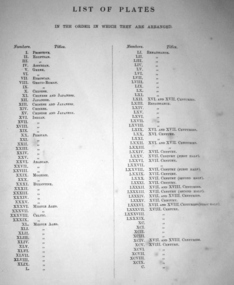
... Various styles of ancient, oriental and medieval art including the Renaissance, the 17th, and the 18th centuries. Subjects are arranged in historical order. ...Various styles of ancient, oriental and medieval art including the Renaissance, the 17th, and the 18th centuries. Subjects are arranged in historical order. ...Monsieur Charles Auguste Albert Racinet was born in Paris on July 20th, 1825. His job was representative of a group of 19th-century industrial draughtsmen, teachers of technical drawing and factory studio manager. He helped in spreading the most significant design of the decorative arts of the time. Racinet learned his trade from his father. He was trained by neo-classical artists in the ambit of Percier and Fontaine. August Racinet was influenced by the Schinkel tendency and supported by architects such as Hittorf and Voillet-le-Duc.Book. Large red leather cover. Title written in gold on spine. Illustrations (black & white), 100 of chromolithographic plates in gold, silver and colours. Various styles of ancient, oriental and medieval art including the Renaissance, the 17th, and the 18th centuries. Subjects are arranged in historical order. Text translated from the original French. The book includes a table of contents, a list of plates, a classified index and an introduction.A book plate inside front cover with a heading "Ballarat School of Art Library No. R/171. Stamped with "Reference","Education Department" and "Ballarat School of Art Library"art, paintings, textile, designs, decoration and craft, ornaments, ballarat technical art school library, bookplate -
 Federation University Historical Collection
Book - Books, Spiers, R. Phene, The Order Of Architecture: Greek, Roman, and Italian, 1902 (exact)
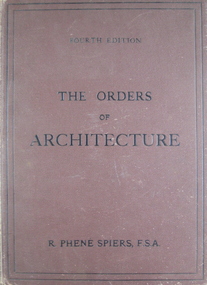
... subjects in architecture such as, History of Architecture, Architectural Drawing; The Architecture of Greece and Rome, The Mosque at Damascus; and the articles on Persian and Roman Architecture in Dr. Russell Sturgis's Dictionary of Architecture. r phene spiers greek roman italian architecture the doric order the ionic order the corinthian order the composite order the temple of theseus athens the theatre of marcellus rome temple of vespasian rome library plate book plate Stamped with "Ballarat School of Art" A large brown hardcover book. ...A large brown hardcover book. Title and author's name are written in black on front cover and in gold on spine. This is the 4th ed., containing twenty-seven plates. It includes a preface to 4th and 1st ed., a list of plates, 20 p. of text and a list of references. This book contains a selection of architectural designs of the Orders as employed in ancient buildings.r phene spiers, greek roman italian architecture, the doric order, the ionic order, the corinthian order, the composite order, the temple of theseus athens, the theatre of marcellus rome, temple of vespasian rome, library plate, book plate -
 Federation University Historical Collection
Booklet, The Ballarat School of Mines and Industries 1870-1920 Jubilee Booklet, 1920 (estimated)
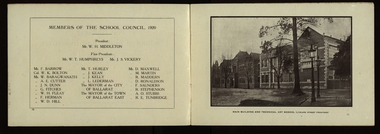
... A magnificent new Technical Art School was built at a cost of some 12,000 pounds on the site of the old Supreme Court building, and was formally opened on the 23rd July, 1915. The results have not only been justified but surpassed all anticipations. The most comprehensive list of subjects...A magnificent new Technical Art School was built at a cost of some 12,000 pounds on the site of the old Supreme Court building, and was formally opened on the 23rd July, 1915. The results have not only been justified but surpassed all anticipations. The most comprehensive list of subjects ...The first school of Mines in Australia was established at Ballarat in 1870. At the time of its jubilee (1930) the following people were members of the School Council: W.H. Middleton (President), W.T. Humphreys (VP), J.S. Vickery (VP), F. Barrow, Col. W.K. Bolton, William Baragwanath, A.E. Cutter, J.N. Dunn, G. Fitches, W.H. Fleay, F. Herman. W.D. Hill, T. Hurley, K. Kean. J. Kelly, L. Lederman, Mayor of Ballarat, Mayour of Ballarat East, D. Maxwell, M. Martin, R. Maddern, D. Ronaldson, F. Saunders, R. Stephenson, A.O. Stubbs, R.E. Tunbridge. The School Staff in 1920 comprised: Herbert H. Smith, Walter Rowbotham, Reginald L. Cutter, M.C. Young, Hilda Wardle, M. Wiliamson, P.S. Richards, L.H. Archibald, J. Woods, Ken Moss, W. Kenneth, Mrs McIlvena. B. Robinson, S. Rowe, E. Hope-Jones, Miss Abrams, L.St.G.P. Austin, Alfred Mica Smith, J.R. Pound, Herbert R. Murphy, N.H. Junner, Maurice Copland, L.H. Archibald, E.J.A. McConnon, Newton King, D.m. Hull, T.R. Gordon, John M. Sutherland, T.K. Jebb, Dick Richards, C. Tonkin, A.W. Steane, J. Paterson, H.W. Malin, R.V. Maddison, S.M. Mayo, F.A. King, W.H. Steane, T.R. Gordon, T.A. Williams, H. Waldron, G. Black, E.J. McConnon, R.V. Duncan. R. Cutter, E.G. Vawdrey, Hilda WardleWhite stapled booklet - landscape format - 20pp + soft covers with blue writing. Includes an historical sketch of the Ballarat School of Mines. Contains images of the school from around 1920. The history outlined in the booklet follows: 'Ballarat has helped to influence the life and destinies of Australia in many ways, the recital of which would perhaps prove tedious to the citizens of less favoured localities! However, it can be said, without much fear of contradiction, that only less known thought Australia than its fame as a gold field is the reputation won for it by its school of Mines, ... Ballarat was still quite a new place when the School was founded, but a very propserous and popular place all the same, with a go-ahead lot of citizens brim full of the spirit of enterprise which seemsto animate mining populations generally. Money was plentiful, and they launched out into ventures, which later, were to develop and take the place of the gold mines, while what is more to the point, they understood the value of education. the old digging days were passing away. So far as Ballarat itself was concerned the day of the cradle and tin dish had already passed into an antiquity "as dead and distant as the age of the Tubal Caon," said dir redmond Barry on declaring the School open. Mining had become a serious business, and the mining engineer, the metallurgist, and the geologist had become a power in the land. In these circumstances the suggestions to found a School of Mines met with ready acceptance. The late Mr James M. Bickett had the honor of bringing forward the proposition at a meeting of the Ballarat Mining Board in October, 1869. it was agreed to, and the Government, having been approached for assistance, granted a lease of the old Supreme Court buildings at a nominal reantal. A modest sum, including 100 pounds from the Borough Council of Ballarat West, was subscribed by a number of sympathisers, and on the 26th October, 1870, the inaugural address was delivered by Sir Redmond Barry, the first President of the School. Classes were commenced on the 23rd January, 1871. The students at first were mostly adults. They were chiefly men emloyed at the mines, who had the wisdom and energy to devote their spare time to study, and, though their attendance was somewhat irregular, they made very good progress. Old prints which have been preserved show them at work at furnaces, big bearded men of the old-fashioned type of miner. It is interesting to note that among those who gave evidence and encouragement was Sir Roderick Murchison, who many years before had advised Cornish miners to emigrate to Australia to search for gold, and who in 1848 was in possession of gold ore sent from this country. Sir Roderick sent a parcel of books for the library, and gave useful advice as to the curriculum which should be adopted. The Museum, which now contains a most valuable collection of minerals, was one of the first things attended to, and the reports presented to the Council from time to time speak of additions being made from all parts of the world. New equipment was constantly being added to the School, a good deal of assay work was done, and some specimens were sent from the East Indies for examination as far back as 1873. By this time there was a difficulty in providing accomodation for the students who wished to enrol, and the number of instructors had grown from two to four. In 1882 the first building was being erected on what was then part of the gaol reserve. A little more than ten years afterwards a buildnig formerly serving as a Methodist Church was absorbed, while later on, the demand for accomodation increasing, the attack upon the gaol was renewed. The School continued to grow in reputation and size, and became the science centre of the district, and in 1889 a learge new building was opened by Sir Alexander Peacock. Students came from over seas as well as from all the States of Australia, and after going through their courses they took with them the name and fame of the old School to all parts of the globe. School of Mines boys have played a great part in developing the mining fields of Western Australia, South Australia, and africa, while old students who have made a name in their profession are constantly dropping in to see how the old place is getting along. It was not to be expected, however, that the Ballarat School would be left without rivals, its very success inspiring competition. Mining Schools were started in other parts of Australia, and, at the same time, Victoria ceased to hold first place as a mining state. On the other hand there was a great advance in manufacturing, and the demand for technicaly trained men became a great and as insistent as ever it had been for trained mining men. The Council was quick to adapt the school to the new conditions, and the result is seen in the institution, which is one of Ballarat's proudest possession. Instruction is given in all branches of technical work, and the classes are filled with students who are building up for Ballarat a reputation as an industrial centre, which promises to equal that which it formerly held as a mining town. Owing to its bracing climate, its abundant opportunities for recreations, and its accessibilty, Ballarat as a city is an ideal place for educational purposed, and is yearly becoming more and more appreciated throughout the State. The chairman of one of Ballarat's biggests industries claims that the workman can do twice the day's work here that he can do in Melbourne. he was a little enthusiastic over it, perhaps, but it is a well-known fact that the healthy and invigourating Ballarat climate is conducive to both physical and mental activity, and the records of the School provide ample proof of it. One of the most interesting and successful branches of the School of Mines and Industries - if the name be enlarged with the enlargement of its scope - is the Technical Art School. "The City of Statues" has from its earliest days been a stronghold of art. Art schools have flourised here, and in 1905 the Education Department came to the conclusion that the best thing to do with them was to place them under the management of the School of Mines Council. A magnificent new Technical Art School was built at a cost of some 12,000 pounds on the site of the old Supreme Court building, and was formally opened on the 23rd July, 1915. The results have not only been justified but surpassed all anticipations. The most comprehensive list of subjects is taught, and this list is constantly added to. Students have flocked to the art School, which may be said to occupy a unique position in Australia, and its record of success is really astonishing. Its students supply art teachers for the newer schools that are being built, and many occupy leading positinos in important business houses. So well is its reputation known that orders are constantly being received, not only from Victoria, but from other States, for honor boards and challenge shields to be designed and made. The most recent addition to the School of Mines and Industries is the Junior Technical School, for which a new building is now being erected on a portion of the gaol site, transferred to the School of Mines Counci by the Government. At the present moment temporary quarters are being occupied. Some students after passing through the Junior School go straight to employment, continuing perhaps to attend the evening trade classes, while others move on to the senior School. In a review of the work of the School of Mines mention must be made of a series of industrial research carried out under supervision of the Principal. One in particular, regarding the suitability of the local ores for the manufacture of pigments attracted much attention, while the experiemtns on the manufacture of white potery from Victorian clayes were considered of sufficient importance by the Federal Advisory Council of Science and Industry to warrant the appointment of a special investigator. The results of these have been most encouraging, and may have far-reaching consequences. The vocational training of returned soldiers also should not be overlooked. The work was taken in hand from the first, before the Repatriation Department gave assistance, and now with the help of the department of the School has become one of the largest vocational training centres in Victoria outside of Melbourne. The soldiers, trained in a variety of occupations, have made remarkable progress, and already considerable numbers have found employment in local workshops and factories. To sum up, the School is divided into the following departments, each well staffed and equipped: - The School of Mines, science, and Engineering; the Techncial Art School, the Boys' Junior Technical School, the Girl's Preparatory Technical Classes, Trade Classes, and the Commercial School. The school of Mines, science and Engineering, comprises the following branches: - Mining, Metallurgy, Geology, Electrical Engineering, Civil Engineering, Mechanical Engineering, Applied Chemistry, and Pharmacy. Battery treatments, Cyanide Testing, Smelting, Assays, and Clay Testing from a regular part of the School's work. Students gaining qualifications obtain concession in their courses at the university, should they proceed there to continue their studies. The technical Art school curriculum includes training in all branches of pictorial and applied art, an Architectural Diploma Course, a Draughtman's Course, technical Art teachers' Course, Photography,Ticket Writing, Art Metal Work, Woodcarving, Needlework, and Leather work. The Trade Classes give instruction in Telephone Mechanics, telegraphy, Carpentry, Cabinet Making, Plumbing, Blacksmithing, Fitting, Electric Wiring, and Printing. Numerous Scholarships are offered every year, and altogether students will find few places to equal the Ballarat School of Mines and Industries as a training place for their life's work. One of the first in the continent to be established, its Jubilee finds it still in the front rank, keeping pace with the times, and offering to the youths of this country the means of taking advantage of Australia's teeming opportunities. william, battery, smith, herbert, drawing from the antique, ballarat school of mines botanical gardens, ballarat school of mines, redmond barry, alfred mica smith, james bickett, museum, dick richards, ballarat junior technical school, s m b, ballarat school of mines and industries, ballarat technical art school, model mine, james m bickett, j m bickett, roderick murchison, vocational training rooms, wesley church, methodist church, alexander peacock, lathes, repatriation, repatriatin department, war service, school council, baragwanath, gold mining, mining laboratory, plaster cast, r.w. richards, anniversary, jubilee -
 Federation University Historical Collection
Photograph - Photograph (Black & White), Victa Studios, Presentation to Professor Alfred Mica Smith of the Ballarat School of Mines at Craig's Royal Hotel, c1924, c1924
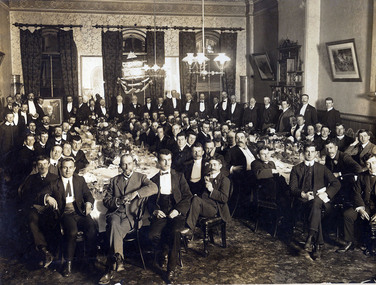
... Professor Alfred Mica Smith of the Ballarat School of Mines is standing 15 from the left, and is the subject of the painting on an easel to the left. The painting was presented to the Ballarat Fine Art Gallery...See http://guerin.ballarat.edu.au/curator/honour-roll/honourroll_Smith,%20Alfred%20Mica.shtml ballarat school of mines craig's hotel craig's royal hotel alfred mica smith art gallery of ballarat ballarat fine art gallery portrait Frederick Martell Daniel Walker Lower right of mount 'Victa Studios Ballarat' Verso (typed and glued on): Presentation to professor Mica Smith, Craig's Hotel Black and white mounted photograph showing a number of men sitting around two dining tables at Craig's Royal Hotel in Ballarat. Professor Alfred Mica Smith of the Ballarat School of Mines is standing 15 from the left, and is the subject ...This photo is thought to have been taken at the time of Alfred Mica Smith's retirement from the Ballarat School of Mines. It is most probably also the unveiling of the Max Meldrum portrait of Smith. Alfred Mica Smith retired from the Ballarat School of Mines in 1922 after an association of 41 years and aged 78 years. At the August meeting of the Ballarat School of Mines Council in 1881 it was resolved that 'Alfred Mica Smith Esq., B.Sc., be appointed Professor in Chemistry and Metallurgy and be Superintendent of the Laboratories, for the period of twelve months at a stipend of five hundred pounds per annum, and to commence duty as soon as possible'. (signed: James Oddie, Vice-President) Smith played a major role in the years of 1887-1893 when SMB was affiliated with Melbourne University. In 1912 he became Professor of Metallurgy and received an annual salary of 250 pounds. Alfred Mica Smith presented many scholarly papers, gave evidence at government enquiries into the safety of mines and became an authority on mine safety and ventilation. He was on the Mines Ventilation Board. Professor Smith was the public analyst for the City of Ballarat and Town of Ballarat East, as well as to a number of other boroughs and shires. He was also Chief juror to the Adelaide International Exhibition, chemical section. He provided information to the Royal Commission on gold mining (1889, 1891), and was President to the chemistry section of Australian Association for the Advancement of Science, Associate of American and Australasian Institute of Mining Engineering, Member of the Science Faculty Melbourne University, and Hon. Life Member of the Miner Managers' Association of Australia. He also was involved in many educational and community affairs such as President of the SMB Students' Association, President of the Ballarat Science Society, first President of the Ballarat Camera Club, Vice President of the Field Naturalists' Club, and he presented Ballaarat Fine Art Gallery with his collection of paintings and porcelain ware. His legacies include the mutual regard between him and his students, the many tributes by former students, the Mica Smith scholarship (established in 1923) and now known as the Corbould-Mica Smith Travelling Scholarship, his portrait in oils by noted artist Max Meldrum, and the marble bust of Smith sculptured by Paul Montford. Money for a scholarship in sanitary science at the University of Manchester in the name of his uncle R. A. Smith was left being set up in 1928. Smith died of cancer on 14 May 1926 and his remains, cremated at Springvale, were interred in the Ballaarat New Cemetery. See http://guerin.ballarat.edu.au/curator/honour-roll/honourroll_Smith,%20Alfred%20Mica.shtml Black and white mounted photograph showing a number of men sitting around two dining tables at Craig's Royal Hotel in Ballarat. Professor Alfred Mica Smith of the Ballarat School of Mines is standing 15 from the left, and is the subject of the painting on an easel to the left. The painting was presented to the Ballarat Fine Art GalleryLower right of mount 'Victa Studios Ballarat' Verso (typed and glued on): Presentation to professor Mica Smith, Craig's Hotelballarat school of mines, craig's hotel, craig's royal hotel, alfred mica smith, art gallery of ballarat, ballarat fine art gallery, portrait, frederick martell, daniel walker -
 Federation University Historical Collection
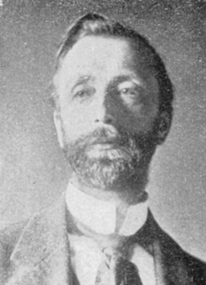
Photograph - Black and White, Ponsonby May Carew Smyth, 1906
... art as 'craftmanship'. By his emphasis on teacher-training, by his role in the Teachers' Training College, and by his constant travels, writing and lecturing, he upgraded both the standard and importance of drawing early in the century. His meticulous mind formulated the Austral Drawing Books which provided the basis of instruction in the subject...art as 'craftmanship'. By his emphasis on teacher-training, by his role in the Teachers' Training College, and by his constant travels, writing and lecturing, he upgraded both the standard and importance of drawing early in the century. His meticulous mind formulated the Austral Drawing Books which provided the basis of instruction in the subject ...Ponsonby Carew Smyth, A.R.C.A. London, was Victorian Art Inspector of Technical Schools. "Ponsonby May Carew-Smyth (1860-1939), educationist, was born on 7 August 1860 at Cork, Ireland, son of Emmanuel Uniacke Smyth, gentleman, and his wife Catherine Giles, née Carew. Carew-Smyth's initial art training and teaching was at the Belfast Government School of Art and Design. In 1885 he entered the National Art Training School at South Kensington, London, where he remained as student and teacher for five years. He also taught at Rugby School, studied at the Royal School of Wood Carving and the Guild School of Handicrafts, London, and was sent by the Department of Science and Art to study art, art education and museum procedures in Paris. Testimonials to his career in England affirm his ability and dedication as an educationist and his integrity as a man. On 23 December 1890 Carew-Smyth married Marie Reynolds of Brixton; they migrated to Australia next January. In September Carew-Smyth applied from Melbourne for the position of master of the school of art and design, established under the auspices of the Ballarat Fine Art Gallery. Opening in November, the school offered day classes and a broad curriculum, and under Carew-Smyth's guidance, established a sound reputation. In November 1899 he was appointed inspector of drawing in the Department of Education. Carew-Smyth saw drawing as a crucial link between primary and technical education, insisting on it as a 'mental process quite as much as a manual'; he believed strongly in the utilitarian value of drawing to the artisan class and of art as 'craftmanship'. By his emphasis on teacher-training, by his role in the Teachers' Training College, and by his constant travels, writing and lecturing, he upgraded both the standard and importance of drawing early in the century. His meticulous mind formulated the Austral Drawing Books which provided the basis of instruction in the subject in Victoria until 1927. Although he gave his occupation as 'artist', Carew-Smyth was primarily an educationist. He was actively involved in the early years of Prahran and Swinburne Technical colleges, and especially the Working Men's College which held his interest even after his retirement. In 1906 he was appointed chairman of the Victorian State Schools' Equipment and Decoration Society, and he was important in the organization of the state schools' exhibition that year. He designed the commemorative wall plaques installed in state schools after World War I, and the art teachers' certificate. He was prominent in bringing about the 1922 Jubilee Exhibition, and the 1926 showing of work of overseas schools, and especially the 1934 Melbourne centenary 'Early Victorian Art' exhibition. In the 1930s he wrote wide-ranging, informative and sometimes humorous articles for the Argus on various aspects of the decorative arts. In mid-1936 he was acting director of the National Gallery of Victoria. To students his single-mindedness sometimes suggested sternness, but Carew-Smyth was always held in the highest regard both professionally and personally. His colleagues recalled a man of kindness, unstinting devotion to work, and humour; he was considered quite a raconteur. Survived by his wife, a son and a daughter, he died in his home at South Yarra on 9 October 1939, and was cremated." (Margot Lethlean, 'Carew-Smyth, Ponsonby May (1860–1939)', Australian Dictionary of Biography, National Centre of Biography, Australian National University, http://adb.anu.edu.au/biography/carew-smyth-ponsonby-may-5501/text9359, accessed 4 June 2013.)Image of the face and shoulders of a bearded man - Ponsonby Carew Smyth. The image was originally published from the State Schools Exhibition Catalogue, 1906. (Cat. No. 401)carew smyth, inspector, technical schools, art. -
 Federation University Historical Collection
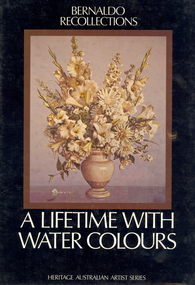
Book, Allan Bernaldo, A Lifetime With Water Colours, 1976
... In 1917 he was presented a medal 'for the most meritorious Art student'. He was known for his watercolours, and subjects such as horses and flowers. ...In 1917 he was presented a medal 'for the most meritorious Art student'. He was known for his watercolours, and subjects such as horses and flowers. ...The book was presented to the Ballarat School of Mines by Allan Bernaldo. Allan Thomas Bernaldo (b. 1900, Creswick. d. 1988, Melbourne) was a former student at the Ballarat School of Mines Technical Art School. In 1917 he was presented a medal 'for the most meritorious Art student'. He was known for his watercolours, and subjects such as horses and flowers. Bernaldo's popularity was at its height during the 1930s and 1940s. Brown hard covered book of 59 pages, with a black dustjacket that includes a painting of a vase of white flowers. The book is the recollections of Alan Bernaldo. Written on title page "memento of many happy years at the School of Mines, Allan T. Bernaldo. 1981allan bernaldo, bernaldo, ballarat school of mines, ballarat technical art school. watercolour, art, alumni -
 Federation University Historical Collection
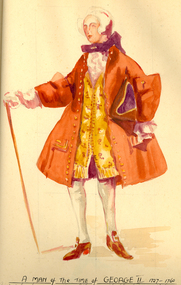
Book, Historic Ornament Parts I and II. Ballarat Technical Art School Art History Books, 1931, 1931
... Art School as Edith Lawn. She retired in 1972 at which time she was the Lecturer in Charge of Craft Edith Lawn was a member of inaugural Ballarat School of Mines Old Girls Association, and served as first Press Correspondent. Her daughter, Valda Lawn (later D'Angri) also attended and taught at the School. One of the subjects...Art School as Edith Lawn. She retired in 1972 at which time she was the Lecturer in Charge of Craft Edith Lawn was a member of inaugural Ballarat School of Mines Old Girls Association, and served as first Press Correspondent. Her daughter, Valda Lawn (later D'Angri) also attended and taught at the School. One of the subjects ...Edith CURNOW (1913–2003) Ballarat | Australia Edith Gertrude Curnow undertook Industrial Art teacher training at the Ballarat Technical Art School, with a five-year Senior Technical Scholarship, between 1926 and 1931. She taught for a time before marrying compositor James Lawn in 1937. She reportedly continued to teach at the Ballarat Technical Art School as Edith Lawn. She retired in 1972 at which time she was the Lecturer in Charge of Craft Edith Lawn was a member of inaugural Ballarat School of Mines Old Girls Association, and served as first Press Correspondent. Her daughter, Valda Lawn (later D'Angri) also attended and taught at the School. One of the subjects Curnow studied was Historic Ornament. This subject spanned time and space to inform and inspire designers. Students studied the influences of history, geography, culture and climate on ornamental aesthetics, including the tools, materials and methods applied to decorative objects, interior design and architecture.Two books containing student notes and drawing relating to courses at the Ballarat techncial Art School in 1931. The work was undertaken by Edith Curnow. .1) - Foolscap red covered book on Historic Ornament. Includes History of Ornament, Egyptian Ornament, Assyrian Ornament; Greek Ornament, Roman Ornament, Pompeian Ornament, Byzantine, Romanesque Ornament, Norman, Decorated Gothic, Perpendicular Gothic, Renaissance. .2) Green quarto book on Historic Ornament Part 2: Costume. The work includes Egyptian Costume, Greek Costume, Roman Costume, Richard I, Crusades, Edward III, Charles I, Charles II, George II.ballarat school of mines, ballarat technical art school, art history, edith lawn, edith curnow, val lawn, val d'angri, curnow, lawn, ornament, costume., ballarat technical art school library, artists workbook, journal, historic ornament, university women, ballarat school of mines old girls association -
Federation University Historical Collection
Booklet, Ballarat School of Mines Prospectus A and B, 1916-7, c1917
... .1) Ballarat School of Mines Prospectus A .2) Ballarat School of Mines Prospectus B Contents includes teaching staff, school hours, curriculum, fee list, Travelling concessions, school library, classification of subjects. scholarships, Full art and Craft Courses (Industrial Design; Figure, Modelling, Painting and Design; Figure Drawing, Modelling, Painting and Design; Fashion Plate Drawing; Black and White Illustration; Modelling; Wood Carving and Lettering; Art Metal Work; Retouching, colouring, &c; Architectural Diploma; Draughtsmen's Courses; Art Teachers' Courses; Outdoor Sketching Classes; Photography; Building Construction and Architectural Drawing; Ticketwriting; Signwriting and Decorating COurse; Dressmaking, Needlework, etc; Preparatory Technical Classes for Girls; Day Commercial Classes; Other Branches of the School's Activities, examination results; Art Teachers' Certificate. ...The Ballarat Technical Art School was part of the Ballarat School of Mines ballarat school of mines ballarat technical art school design modelling figure drawing fashion plate drawing black and white illustration wood carving lettering art metal work retouching architecture architectural diploma draughtsmen's courses art teachers' courses outdoor sketching classes photography building construction architectural drawing ticketwriting signwriting and decorating dressmaking needlework art teachers' certificate. .1) Ballarat School of Mines Prospectus A .2) Ballarat School of Mines Prospectus B Contents includes teaching staff, school hours, curriculum, fee list, Travelling concessions, school library, classification of subjects. scholarships, Full art and Craft Courses (Industrial Design; Figure, Modelling, Painting and Design; Figure Drawing, Modelling, Painting and Design; Fashion Plate Drawing; Black and White Illustration; Modelling; Wood Carving and Lettering; Art Metal Work; Retouching, colouring, &c; Architectural Diploma; Draughtsmen's Courses; Art Teachers' Courses; Outdoor Sketching Classes; Photography; Building Construction and Architectural Drawing; Ticketwriting; Signwriting and Decorating COurse; Dressmaking, Needlework, etc; Preparatory Technical Classes for Girls; Day Commercial Classes; Other Branches of the School's Activities, examination results; Art Teachers' Certificate. ...The Ballarat Technical Art School was part of the Ballarat School of Mines.1) Ballarat School of Mines Prospectus A .2) Ballarat School of Mines Prospectus B Contents includes teaching staff, school hours, curriculum, fee list, Travelling concessions, school library, classification of subjects. scholarships, Full art and Craft Courses (Industrial Design; Figure, Modelling, Painting and Design; Figure Drawing, Modelling, Painting and Design; Fashion Plate Drawing; Black and White Illustration; Modelling; Wood Carving and Lettering; Art Metal Work; Retouching, colouring, &c; Architectural Diploma; Draughtsmen's Courses; Art Teachers' Courses; Outdoor Sketching Classes; Photography; Building Construction and Architectural Drawing; Ticketwriting; Signwriting and Decorating COurse; Dressmaking, Needlework, etc; Preparatory Technical Classes for Girls; Day Commercial Classes; Other Branches of the School's Activities, examination results; Art Teachers' Certificate. Includes an image of W.H. Middleton, President of the Ballarat School of Mines; Staff of the Ballarat School of Minesballarat school of mines, ballarat technical art school, design, modelling, figure drawing, fashion plate drawing, black and white illustration, wood carving, lettering, art metal work, retouching, architecture, architectural diploma, draughtsmen's courses, art teachers' courses, outdoor sketching classes, photography, building construction, architectural drawing, ticketwriting, signwriting and decorating, dressmaking, needlework, art teachers' certificate. -
Federation University Historical Collection
Book - Handbooks, Monash University Handbooks, 1993-4
... 20 handbooks relating to subjects offered by Monash University in 1993-4. .1) Monash University Arts Handbook 1993 (red cover) .2) Monash University Arts Graduate Handbook 1994 (red cover) .3) Monash University Art & Design Handbook 1994 (red cover) .4) Monash University Engineering Handbook 1993 (brown cover) .5) Monash University Engineering Handbook 1994 (brown cover) .6) Monash University Education Handbook 1993 (yellow cover) .7) Monash University Education Handbook 1994 (yellow cover) .8) Monash University Economics Commerce & Management Handbook Handbook 1993 (blue cover) .9) Monash University Computing & Information Technology Handbook 1995 (green cover) .10) Monash University Business Handbook 1993 (red cover) .11) Monash University Business 7 Economics Handbook 1994 (mid blue) .12) Monash University Professional Studies Handbook 1993 (purple cover) .13) Monash University Science Handbook 1993 (green cover) .14) Monash University Science Handbook 1994 (green cover)...With campuses from Horsham in the west of the state, to Churchill in the east, the name Federation University Australia was chosen to convey the scope and capacity of an expanded regional university with a federated network of campuses contributing to a new and different Australian university. monash university gippsland campus medicine law pharmacy nursing education handbook 20 handbooks relating to subjects offered by Monash University in 1993-4. .1) Monash University Arts Handbook 1993 (red cover) .2) Monash University Arts Graduate Handbook 1994 (red cover) .3) Monash University Art & Design Handbook 1994 (red cover) .4) Monash University Engineering Handbook 1993 (brown cover) .5) Monash University Engineering Handbook 1994 (brown cover) .6) Monash University Education Handbook 1993 (yellow cover) .7) Monash University Education Handbook 1994 (yellow cover) .8) Monash University Economics Commerce & Management Handbook Handbook 1993 (blue cover) .9) Monash University Computing & Information Technology Handbook 1995 (green cover) .10) Monash University Business Handbook 1993 (red cover) .11) Monash University Business 7 Economics Handbook 1994 (mid blue) .12) Monash University Professional Studies Handbook 1993 (purple cover) .13) Monash University Science Handbook 1993 (green cover) .14) Monash University Science Handbook 1994 (green cover) Monash University Handbooks Book Handbooks ...Federation University Australia was established on 1 January 2014. Formerly known as the University of Ballarat, its enabling legislation was the University of Ballarat Amendment (Federation University Australia) Act 2013. Although formally created as a University in 1994, the University of Ballarat had a lineage back to 1870 with the establishment of the School of Mines Ballarat, making it the third institution of higher learning to be established in Australia and the first to be established in regional Australia. On 1 January 1994, Ballarat University College became the University of Ballarat and in 1998 the University merged with three TAFE Institutes to become a dual sector institution with multiple campuses. On 1 January 2014, the University of Ballarat amalgamated with the Monash University Gippsland Campus to form Federation University Australia. The Gippsland Campus also had a long lineage dating back to 1928 with the establishment of the Yallourn Technical School which became a predecessor institution to the Gippsland College of Advanced Education formed in 1968. In 1990, it was renamed the Monash University College and in 1993 became the Gippsland Campus of Monash University. Federation University Australia, or FedUni, is Australia’s newest public University. Headquartered in Ballarat, Victoria, the University offers programs in Higher Education and Vocational Education and Training to regional Victoria and beyond. The University’s commitment to educational and social equity, teaching excellence, research distinction, environmental sustainability and regional capacity building has enabled it to develop in a way that draws on its proud heritage to inform its future. Its regional character sets a framework for the University’s priorities but does not constrain it from serving wider community interests, nationally and internationally. With campuses from Horsham in the west of the state, to Churchill in the east, the name Federation University Australia was chosen to convey the scope and capacity of an expanded regional university with a federated network of campuses contributing to a new and different Australian university.20 handbooks relating to subjects offered by Monash University in 1993-4. .1) Monash University Arts Handbook 1993 (red cover) .2) Monash University Arts Graduate Handbook 1994 (red cover) .3) Monash University Art & Design Handbook 1994 (red cover) .4) Monash University Engineering Handbook 1993 (brown cover) .5) Monash University Engineering Handbook 1994 (brown cover) .6) Monash University Education Handbook 1993 (yellow cover) .7) Monash University Education Handbook 1994 (yellow cover) .8) Monash University Economics Commerce & Management Handbook Handbook 1993 (blue cover) .9) Monash University Computing & Information Technology Handbook 1995 (green cover) .10) Monash University Business Handbook 1993 (red cover) .11) Monash University Business 7 Economics Handbook 1994 (mid blue) .12) Monash University Professional Studies Handbook 1993 (purple cover) .13) Monash University Science Handbook 1993 (green cover) .14) Monash University Science Handbook 1994 (green cover)monash university, gippsland campus, medicine, law, pharmacy, nursing, education, handbook -
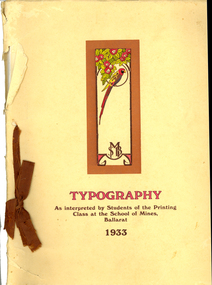 Federation University Historical Collection
Book, Typography: As interpreted by students of the Printing Class at the School of Mines, Ballarat, 1933, 1933
... The objectives of Typographical Instruction at the Ballarat Technical Art School was to develop an appreciation of art in printing; to create and foster a wholesome respect for books; to develop a justifiable pride in persona achievement; to broaden the educational and social outlook; to broaden the field of vocational choice; to prepare for effective entrance into the printing trade; to give mastery of many of the principles of design; to help in forming habits of accuracy, thoroughness, neatness and industry; to give opportunity to turn out a product of use, beauty and value; to cultivate appreciation of the value of co-operation and service; to aid in mastery of other school subjects,particularly English; to provide an appropriate instructional medium for pupils whose constructive instincts desire this method of expression; to provide experience which will show the practical application and value of academic subjects....The objectives of Typographical Instruction at the Ballarat Technical Art School was to develop an appreciation of art in printing; to create and foster a wholesome respect for books; to develop a justifiable pride in persona achievement; to broaden the educational and social outlook; to broaden the field of vocational choice; to prepare for effective entrance into the printing trade; to give mastery of many of the principles of design; to help in forming habits of accuracy, thoroughness, neatness and industry; to give opportunity to turn out a product of use, beauty and value; to cultivate appreciation of the value of co-operation and service; to aid in mastery of other school subjects,particularly English; to provide an appropriate instructional medium for pupils whose constructive instincts desire this method of expression; to provide experience which will show the practical application and value of academic subjects. typography, printing, ballarat school of mines, ballarat technical art school, bickart's diamond shop, lydiard street methodist choir, south street competitions, allambee guest house, buninyong lodge, ballarat journalists' association, thornton studios, harry davies, harry brown & co., nautilus corsets, toti dal monte, symmons flower shop, ritz club, ballarat symphony orchestra, ladies' art association typography ballarat school of mines ballarat technical art school printing albert dorling Coloured soft covered book bound with a brown ribbon. ...Albert E. Dorling was the Instructor in Printing at the Ballarat Technical Art School in 1933. The art school was a division of the Ballarat School of Mines. The objectives of Typographical Instruction at the Ballarat Technical Art School was to develop an appreciation of art in printing; to create and foster a wholesome respect for books; to develop a justifiable pride in persona achievement; to broaden the educational and social outlook; to broaden the field of vocational choice; to prepare for effective entrance into the printing trade; to give mastery of many of the principles of design; to help in forming habits of accuracy, thoroughness, neatness and industry; to give opportunity to turn out a product of use, beauty and value; to cultivate appreciation of the value of co-operation and service; to aid in mastery of other school subjects,particularly English; to provide an appropriate instructional medium for pupils whose constructive instincts desire this method of expression; to provide experience which will show the practical application and value of academic subjects.Coloured soft covered book bound with a brown ribbon. It is a book of specimens of work by the students attending the Typography Classes at the Ballarat Technical Art School under the instruction of Albert Dorling. Illustrations include: Ariel [sic] View from Art School by Fred Longhurst, 1932 Other work includes Bickart's Diamond Shop, Lydiard Street Methodist Choir, South Street Competitions, Allambee Guest House, Buninyong Lodge, Ballarat Journalists' Association, Thornton Studios, Harry Davies, Harry Brown & Co., Nautilus Corsets, Toti dal Monte, Symmons Flower Shop, Ritz Club, Ballarat Symphony Orchestra, Ladies' Art Associationtypography, printing, ballarat school of mines, ballarat technical art school, bickart's diamond shop, lydiard street methodist choir, south street competitions, allambee guest house, buninyong lodge, ballarat journalists' association, thornton studios, harry davies, harry brown & co., nautilus corsets, toti dal monte, symmons flower shop, ritz club, ballarat symphony orchestra, ladies' art association, typography, ballarat school of mines, ballarat technical art school, printing, albert dorling -
 Flagstaff Hill Maritime Museum and Village
Book - Reference Medical/ Gynaecology, Howard Kelly et al, Operative Gynaecology Vol 1, 1906
... art tradition. For collectors, the book is more significant as a scarce and historically interesting medical volume than as a universally rare treasure. (For more information on the Pattison Collection see item 3678 Flagstaff Hill collections) https://victoriancollections.net.au/items/5580c7e72162f114d8b758db flagstaff hill warrnambool shipwrecked-coast flagstaff-hill flagstaff-hill-maritime-museum maritime-museum shipwreck-coast flagstaff-hill-maritime-village operative gynecology vol 1 book howard kelly This subject text, Operative Gynaecology, Volume I, is a surgical textbook on diseases and operations involving the female reproductive system, written by Howard A. ...This subject text, Operative Gynaecology, Volume I, is a surgical textbook on diseases and operations involving the female reproductive system, written by Howard A. Kelly and illustrated in part by Max Brödel. The book is a technical, richly illustrated manual for gynaecological surgery rather than a general medicine text. Its subject is operative treatment, anatomy, instruments, procedures, and surgical technique in women’s diseases, reflecting the early 20th-century development of gynaecology as a specialised surgical field.Operative Gynecology Vol 1 Author: Howard Kelly Illustrator: Max Brodel Publisher: D. Appleton & Co. Date: 1906 Further Information: Red Cloth Cover and Spine Lettering to Spine in Gilt.non-fictionThis subject text, Operative Gynaecology, Volume I, is a surgical textbook on diseases and operations involving the female reproductive system, written by Howard A. Kelly and illustrated in part by Max Brödel. The book is a technical, richly illustrated manual for gynaecological surgery rather than a general medicine text. Its subject is operative treatment, anatomy, instruments, procedures, and surgical technique in women’s diseases, reflecting the early 20th-century development of gynaecology as a specialised surgical field.flagstaff hill, warrnambool, shipwrecked-coast, flagstaff-hill, flagstaff-hill-maritime-museum, maritime-museum, shipwreck-coast, flagstaff-hill-maritime-village, operative gynecology vol 1, book, howard kelly -
 Flagstaff Hill Maritime Museum and Village
Domestic object - Basket, 1890-1920s
... art. Artistic freedom allows basket makers with a wide choice of colours, materials, sizes, patterns, and details. Before the advent of plastics (1907), the is now used for many different types and styles of storage container rattan, wicker or cane was used to make containers with a lid for the storage of linens etc. The subject ...Before the invention of woven baskets, people used tree bark to make simple containers. These containers could be used to transport gathered food and other items but crumbled after only a few uses. Weaving strips of bark or other plant material to support the bark containers would be the next step, followed by entirely woven baskets. The last innovation appears to be baskets so tightly woven that they could hold water. Depending on soil conditions, baskets may or may not be preserved in the archaeological record. Sites in the Middle East show that weaving techniques were used to make mats and possibly also baskets, circa 8000 BCE. Twined baskets date back to 7000 in Oasisamerica. Baskets made with interwoven techniques were common at 3000 BCE. Baskets were originally designed as multi-purpose vessels to carry and store materials and to keep stray items about the home. The plant life available in a region affects the choice of material, which in turn influences the weaving technique. Rattan and other members of the Arecaceae or palm tree family, the thin grasses of temperate regions, and broad-leaved tropical bromeliads each require a different method of twisting and braiding to be made into a basket. The practice of basket making has evolved into an art. Artistic freedom allows basket makers with a wide choice of colours, materials, sizes, patterns, and details.Before the advent of plastics (1907), the is now used for many different types and styles of storage container rattan, wicker or cane was used to make containers with a lid for the storage of linens etc. The subject item was probability used at the end of the Victorian era and into the Edwardian period around the 1900s as a household storage facility. These types of wicker or cane containers started to go out of fashion due to their fragility around the 1920s into the 1940s due as well to the introduction of synthetic materials. Wicker cane rectangular shaped domestic storage container with reinforced leather pads on 4 corner sides. lid fits inside the other. Black cane piece around top edge.Noneflagstaff hill, warrnambool, shipwrecked-coast, flagstaff-hill, flagstaff-hill-maritime-museum, maritime-museum, shipwreck-coast, flagstaff-hill-maritime-village -
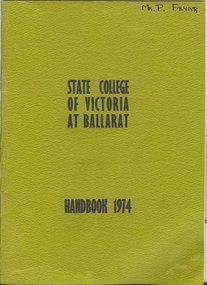 Federation University Historical Collection
Booklet, State College of Victoria, Ballarat Handbook, 1974, 1974
... Th book includes course, regulations, assessments, subject details, general information, art collection overview and student organisations. ...art collection handbook gillies street 'Mr P. Fryar' on front cover. Signed 'Peter Fryar' on inside front page. Small, green, soft covered booklet. Th book includes course, regulations, assessments, subject ...In 1958 the Ballarat Teachers' College moved from Dana Street Primary School to a custom built college in Gillies Street. Accommodation again became a problem in 1968 with the introduction of the three year Diploma of Teaching (Primary) course. On 19 December 1972 the State College of Victoria Act received Royal Assent. The Act restructured the teacher training policies of Victoria. Ballarat was one of the State Teachers' Colleges which until 30th June 1973, was under Education Department control. Ballarat Teachers' College was renames the State College of Victoria at Ballarat and had its own governing council. In 1975 State College of Victoria at Ballarat moved to the Ballarat Institute of Advanced Education campus at Mount Helen, and the name was changed to Ballarat College of Advanced Education. Small, green, soft covered booklet. Th book includes course, regulations, assessments, subject details, general information, art collection overview and student organisations. A good history of the evolution of the Ballarat Teachers' College and State College Victoria at Ballarat (SCVB) is given. 'Mr P. Fryar' on front cover. Signed 'Peter Fryar' on inside front page. ballarat teachers' college, state college of victoria at ballarat, state college of victoria, ballarat, art collection, handbook, gillies street
