
Showing 1164 items matching "australian football"
-
 Otway Districts Historical Society
Booklet, Victorian Football League, Australian National Football Council. Laws of the Australian National Game of Football, 1956
... Australian National Football Council. Laws of the Australian National Game of Football....australian national football council; football; laws; playing field; definitions; affiliated bodies;...The 1956 laws of the national game of Australian football are reasonably brief covering only 33 rules with a maximum of eight subdivisions of each. ...Laws of the Australian National Game of Football. Australian National Football Council. ...Soft cover. Australian National Football Council. Laws of the Australian National Game of Football. ...The 1956 laws of the national game of Australian football are reasonably brief covering only 33 rules with a maximum of eight subdivisions of each. As well as the Australian National Football Council and its affiliated bodies, it spells out the rules of the game, definitions of the laws, and an outline of the positions and plan of the playing field.Laws of the Australian National Game of Football. Australian National Football Council. Victorian Football League; Melbourne (Vic); 1956. i, 40 p.; map. Soft cover.australian national football council; football; laws; playing field; definitions; affiliated bodies; -
 City of Moorabbin Historical Society (Operating the Box Cottage Museum)
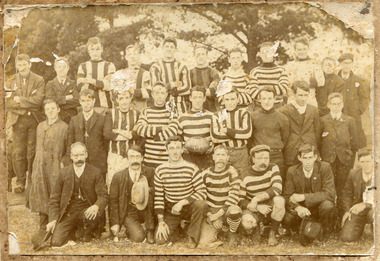
Photograph, 1909 Moorabbin Australian Rules Football Team, 1909 Moorabbin Australian Rules Football Team, 1909
... Photograph, 1909 Moorabbin Australian Rules Football Team ...1909 Moorabbin Australian Rules Football Team...Australian Rules Football history see MAV 00517 1909: Football Team. ...Australian Rules Football history see MAV 00517 1909: Football Team. ...Australian Rules Football history see MAV 00517 1909: Football Team. Only player named is Paddy Green. Since the player guernseys are almost the same and the photographer is the same we presume this is the same team as shown in MAV 00517 named as the Moorabbin Football Team Moorabbin Football Club, nicknamed the Kangaroos, was the name of two distinct Australian rules football clubs which played in the Victorian Football Association (VFA). The first club, founded in the early 20th century, joined the VFA in 1951 and played there until 1963 with great success; they played home matches at Moorabbin Oval and wore royal blue and white hooped jerseys. The second club played in the VFA from 1983 to 1987. Moorabbin played initially in the Federal Football League, making their debut in 1909 and competing until 1950. During this time the club won 12 premierships, including winning all six premierships staged over the nine years between 1940 and 1948 (the competition was in recess from 1942 until 1944). The club entered the VFA in 1951. Its Federal League home ground, the Dane Road Reserve, was not up to VFA standards; so, in 1951 the club played at Cheltenham, and in 1952 moved into the Moorabbin Oval, which the Moorabbin Council had developed during 1951. The Kangaroos made the 1954 and 1955 finals series without success but in 1957 they helped eliminate premiership favourite Williamstown after defeating them by two points in the Semi Final. Moorabbin, who were coached by Bill Faul, took on Port Melbourne in the Grand Final, whom they had not once beaten since joining the league. In another upset, Moorabbin won comfortably to claim their maiden VFA premiership. In the early 1960s, the Moorabbin Council was very keen to bring a Victorian Football League team to Moorabbin Oval. 1964, the Moorabbin City Council secured a deal with St Kilda, who moved to Moorabbin Oval starting in 1965. The club originally intended to seek readmission for the 1965 season, but in July the club committee decided to withdraw permanently from the Association,and disbanded. Photograph is Black and White. Three row of football boys. Some are wearing striped jumpers, either the stripes are going horizontal or parallel. There are twelve men wearing a suits, four in the third row, four in the second row and four in the first row. One of the boys wearing a suit in the front row, has a hat in his hand. The boys in the front row are kneeling, the second row are standing on the ground and the third row are standing on benches. Only player named is Paddy Green. Phillip Jones may also be in the photo Row 2 4th from left Front of Mount : 1909 Back of Mount : written Paddy Green , stamp HEWITT 92 Regent Street North Richmondfootball team, 1909, paddy green, moorabbin, moorabbin football club, 1903, 1908, 1909, philip jones, james jones, paddy green, early settlers, market gardeners, pioneers, herron john, australian rules foorball, victorian footbal league, victorian football association, moorabbin city council, moorabbin shire, city of moorabbin, st kilda football club, -
 Port Melbourne Historical & Preservation Society
Audio - Australian Rules Football, Robin GROW, 28 Sep 2009
... Australian Rules Football, Robin GROW...Sport - Australian Rules Football...Robin GROW talking about Australian Rules Football in Melbourne...Sport - Australian Rules Football Robin GROW Duration 00:53:13 Robin GROW talking about Australian Rules Football in Melbourne Audio Australian Rules Football, Robin GROW ...Robin GROW talking about Australian Rules Football in MelbourneDuration 00:53:13sport - australian rules football, robin grow -
 Trafalgar Holden Museum
Leisure object - Australian rules football, Ca 1910
... Australian rules football...Football as used for Australian rules football, sport and recreation...Brown leather Australian rules football...Football as used for Australian rules football, sport and recreation As manufactured by Holden and Frost Leather Football Brown leather Australian rules football Leisure object Australian rules football ...Football as used for Australian rules football, sport and recreationAs manufactured by Holden and FrostBrown leather Australian rules footballleather, football -
 Bendigo Historical Society Inc.
Document - LAWS OF THE AUSTRALIAN GAME OF FOOTBALL, 1972
... LAWS OF THE AUSTRALIAN GAME OF FOOTBALL...Football... Australian Rules Football...Four booklets: 44-page different coloured cover booklets issued by the Australian Football Council and distributed by the Victorian Football League, 31 Spring St, Melbourne....ORGANIZATION Club/society Football Australian Rules Football Laws Victorian Football League Printed by J. ...Four booklets: 44-page different coloured cover booklets issued by the Australian Football Council and distributed by the Victorian Football League, 31 Spring St, Melbourne.Printed by J. Roy Stevens Pty Ltd, Melbourneorganization, club/society, football, australian rules football, laws, victorian football league -
 Victorian Interpretive Projects Inc.
Image, Australian Rules Football, 1934
... Australian Rules Football, 1934...Australian Rules Football...Six Australian Rules (formerly Victorian Football League) footballers ruck the ball towards their team members. ...Australian Rules Football, 1934 Image ...During the era of the Victorian Football League (VFL) the home team wore white shorts, and the away team wore black shorts. The team in the white shorts are probably South Melbourne Football Club, and the team in the black shorts are probably Melbourne Football Club. Six Australian Rules (formerly Victorian Football League) footballers ruck the ball towards their team members. australian rules football, football, victorian football league, vfl, afl -
 Bendigo Military Museum
Photograph - AUSTRALIAN RULES FOOTBALL TEAM, 1ST AIF, WW1, Graystone Bird Studio, c.1918
... AUSTRALIAN RULES FOOTBALL TEAM, 1ST AIF, WW1......Australian Rules Football...Unidentified group of WW1 Australian Army Australian Rules footballers. The team was based at the No1 Command Depot at Sutton Veny, Wiltshire, UK. ...Sepia toned photograph of a team of 1st AIF Australian Rules foorballers in three rows. Eighteen are in football kit. ...Photograph AUSTRALIAN RULES FOOTBALL TEAM, 1ST AIF, WW1 Graystone Bird Studio ...Part of the Meade Collection. See Cat No. 10785P for details of service for "Ernest James Meade" (No.2112). Unidentified group of WW1 Australian Army Australian Rules footballers. The team was based at the No1 Command Depot at Sutton Veny, Wiltshire, UK. The officer seated is Lieutenant Colonel William Owen ('Old Bill') Mansbridge who was OC of No1 Command Depot. Compare this photograph to one of the depot's Soccer Football team taken on the same day and in the same location, which is held in the Australian War Memorial's photographic collection (AWM A 03388) The photographs were both taken by photographer Graystone Bird, whose studio was in Bath, U.K. Sepia toned photograph of a team of 1st AIF Australian Rules foorballers in three rows. Eighteen are in football kit. Two Officers are in the middle of the group. Australian soldiers in uniform at either end of the group. Footballer on left of seated officer is holding a football with, writing on it. Writing “No 1?12, 19 COMMAND DEPOT”. In white lettering on bottom LH corner: - “Graystone Bird, Bath.” Postcard format on back.Illegible handwriting in pencil on back.meade collection, australian rules football, ww1, 1st aif, photograph, graystone bird, ernest james meade -
 Trafalgar Holden Museum
Functional object - Australian rules football, Ca1910
... Australian rules football...Oval shaped Australian rules football...Used for sport and recreation in the late 1800's and 1900's manufactured by Holden and Frost Object holds social significance and sporting heritage Leather football Oval shaped Australian rules football Functional object Australian rules football ...Used for sport and recreation in the late 1800's and 1900's manufactured by Holden and FrostObject holds social significance and sporting heritageOval shaped Australian rules footballleather, football -
Trafalgar Holden Museum
Leisure object - Australian rules football, Ca1910
... Australian rules football...Football as used in Australian rules football, for sport and recreation...Football as used in Australian rules football, for sport and recreation As manufactured by Holden and Frost leather laced Football Brown leather Oval shaped football, laced on top Leisure object Australian rules football ...Football as used in Australian rules football, for sport and recreationAs manufactured by Holden and FrostBrown leather Oval shaped football, laced on topleather, laced, football -
Whitehorse Historical Society Inc.
Document, Football champions, 1996
... Australian Rules Football...Champions of Australian football in the 1930s. Photo of Bob Pratt....Australian Rules Football Pratt Bob Snr. Champions of Australian football in the 1930s. ...Champions of Australian football in the 1930s. Photo of Bob Pratt.Champions of Australian football in the 1930s. Photo of Bob Pratt.Champions of Australian football in the 1930s. Photo of Bob Pratt.australian rules football, pratt, bob snr. -
Emerald Museum & Nobelius Heritage Park
Photograph - Emerald Football Club, 1980, 1980
... ...Australian Rules Football...The club has also been known variously as the 'Emites', the 'Redlegs' and the current 'Bombers.' A joint Australian Football League (AFL) and La Trobe University Centre for Sport and Social Impact study discusses the importance of local football teams for fostering community cohesion and relationships and distributing information and health and social issues to local people. ...Depicted are a group of men with coaches comprising the 1980 Emerald Football Club Australian Rules Football team....Depicted are a group of men with coaches comprising the 1980 Emerald Football Club Australian Rules Football team. Photograph Emerald Football Club, 1980 ...Emerald Football Club was formed in 1905, one of the first teams in the Mountain District Football Association (renamed the Yarra Valley Mountain District Football League in 1967). The club has changed its official colours three times, playing firstly under blue and white colours, then green and gold before adopting the red and black colours shown in the photograph and still used today. The club has also been known variously as the 'Emites', the 'Redlegs' and the current 'Bombers.' A joint Australian Football League (AFL) and La Trobe University Centre for Sport and Social Impact study discusses the importance of local football teams for fostering community cohesion and relationships and distributing information and health and social issues to local people. Local football and other sporting teams are integral to the economic and social development of an area and are therefore significant far beyond the immediate players or families associated with the club.The photograph is significant for its insights into the history of sports and recreation in the Emerald region. Australian Rules Football has a long history in the region and played a fundamental role in community life.Rectangular colour photograph printed on photographic paper. Depicted are a group of men with coaches comprising the 1980 Emerald Football Club Australian Rules Football team.Reserve: 19801980s, australian rules football, emerald football club -
 Stawell Historical Society Inc
Photograph, Mr Thomas Wills' Centenary of AFL Monument -- 2 Photo
... Two photographs of Australian Rules Football Memorial at Moyston...2 Photos of the Memorial to commemorate a Centenary of Australian Rules Football... This Monument commemorates the Memory to Thomas William Wills (1835 - 1880) Picture of a man kicking a football black top white Shorts in oval frame Thomas Wills was the Founding father of Australian Rules football co-founder and Captain of the Melbourne Football Club (1859) He Was Involved in forming the Geelong Football club (1859) And Was Captain (1860) Playing As Estimated 172 games. ...Two photographs of Australian Rules Football Memorial at Moyston Thomas Wiils AFL VFL Sport This Monument commemorates the Memory to Thomas William Wills (1835 - 1880) Picture of a man kicking a football black top white Shorts in oval frame Thomas Wills was the Founding father of Australian Rules football co-founder and Captain of the Melbourne Football Club (1859) He Was Involved in forming the Geelong Football club (1859) And Was Captain (1860) Playing As Estimated 172 games. ...Two photographs of Australian Rules Football Memorial at Moyston2 Photos of the Memorial to commemorate a Centenary of Australian Rules Football This Monument commemorates the Memory to Thomas William Wills (1835 - 1880) Picture of a man kicking a football black top white Shorts in oval frame Thomas Wills was the Founding father of Australian Rules football co-founder and Captain of the Melbourne Football Club (1859) He Was Involved in forming the Geelong Football club (1859) And Was Captain (1860) Playing As Estimated 172 games. He was captain of an early team from Richmond. He Lived at Lexington Station Moyston While playing as a child with Aboriginal Children in this Area He developed a game which he later utIlised in the Formation of Austrian Football. This Monument was unvieled by the Australian Football League Historian Colin N. Hutchinson on September 17 1988, And this tribute to the memory of Thomas Wills was made Possible by The generosity of Wsetpac Banking Corporation and Staff This Monument Commemorates the Memory of Thomas Wentworth Wils (1835 -1880) a Picture of a Man kicking a football, black long sleeve thomas wiils, afl, vfl, sport -
Essendon Football Club
VFL premiership cup, 1999
... cup on dark brown wooden stand, red and black ribbons tied to each handle, gilt interior; inscribed: "Australian Football League Reserve Grade Premiers 1999 won by Essendon Football Club"; small metal plaque with AFL logo on base. ...Cup is inscribed "Australian Football League Reserve Grade Premiers 1999 won by Essendon Football Club"...cup on dark brown wooden stand, red and black ribbons tied to each handle, gilt interior; inscribed: "Australian Football League Reserve Grade Premiers 1999 won by Essendon Football Club"; small metal plaque with AFL logo on base. ...Cup was awarded to Essendon for winning the 1999 Reserve Grade premiershipTwo handled metal (silver plate?) cup on dark brown wooden stand, red and black ribbons tied to each handle, gilt interior; inscribed: "Australian Football League Reserve Grade Premiers 1999 won by Essendon Football Club"; small metal plaque with AFL logo on base. No manufacturer's mark.Cup is inscribed "Australian Football League Reserve Grade Premiers 1999 won by Essendon Football Club"essendon football club, reserve grade, premierships, premiership cups -
 Dandenong/Cranbourne RSL Sub Branch
Memorabilia - Football, AIF, Australian Rules Football, Circa 1915-1919
... Australian Rules Football...McMullen made footballs for the Australian Imperial Force, all of which were hand stitched. ...football, deflated. Stitched together. Four leather threads at top of ball. Has stencil painted markings on both top sections. Australian ...This ball was possibly made by Corporal C. McMullen during WWI. McMullen made footballs for the Australian Imperial Force, all of which were hand stitched. He made the original ball for the 1916 Australian Rules exhibition match held in London and watched by 3000 spectators. McMullen's balls were called "The AIF Ball", indicating that this might be one of them. The inscription "Match .II." suggests it was used for a later match.The provenance of this object is unknown, but it was potentially made by Corporal C. McMullen for use in an AIF exhibition match. If so, it is a highly significant piece of sporting memorabilia, and holds national significance as an object that tells the early evolution of Australian Rules Football and the importance of sport to the armed forces.Brown leather football, deflated. Stitched together. Four leather threads at top of ball. Has stencil painted markings on both top sections.THE AIF BALL / MATCH .II.football, aif, afl, australian rules, sport, leather, wwi -
 Port Melbourne Historical & Preservation Society
Photograph - PMFC coach, Gary BRICE addressing players, 1980s
... ...Sport - Australian Rules Football...PMFC's Gary BRICE giving 3/4 time instructions. Australian Rules Football...Gary BRICE Sport - Australian Rules Football Port Melbourne Football Club PMFC Colour photo. ...Colour photo. PMFC's Gary BRICE giving 3/4 time instructions. Australian Rules Footballgary brice, sport - australian rules football, port melbourne football club, pmfc -
Port Melbourne Historical & Preservation Society
Document, AFL Victoria 'Record' Sunday 25 Sep 2011, 2011
... ...Sport - Australian Rules Football...The Australian Football League 'Record' for VFL & TAC Cup, Grand Final Sunday 25 Sep 2011. ...From the collection of Terry KEENAN Port Melbourne Football Club PMFC Sport - Australian Rules Football Victorian Football Association AFL The Australian Football League 'Record' for VFL & TAC Cup, Grand Final Sunday 25 Sep 2011. ...From the collection of Terry KEENANThe Australian Football League 'Record' for VFL & TAC Cup, Grand Final Sunday 25 Sep 2011. Booklet of 64pp inc. coloured cover with photographs Port Melbourne and Williamstown coaches holding VFL Cup and Sandringham Dragons and Oakleigh Chargers coaches holding theTAC Cup.port melbourne football club, pmfc, sport - australian rules football, victorian football association, afl -
 Federation University Historical Collection
Photograph - Photograph - Black and White, Ballarat Junior Technical School - Graham Wise, 1959
... ...australian football league...From 1963-1966 he played for Melbourne within the Victorian Football League - VFL, (now the Australian Football League). During his time with Melbourne he played 40 games, ruck position and wore guernsey number 23. ...Graham returned to Ballarat and was the playng coach of Golden Point in the Ballarat Football League. wise ballarat junior technical school victorian football league australian football league melbourne football club golden point ballarat football league vfl afl australian rules football open athletics champion Inscription in pen on back - Graham Wise Open Aths Champ 1959. ...Graham Wise was born on 13 October 1942. He attended Ballarat Junior Technical School and became the 1959 Ballarat Junior Technical School Open Athletics Champion. He was often listed as best afield for the Ballarat Junior Technical School Football Team. From 1963-1966 he played for Melbourne within the Victorian Football League - VFL, (now the Australian Football League). During his time with Melbourne he played 40 games, ruck position and wore guernsey number 23. He was part of the Premiership team in 1964. Graham returned to Ballarat and was the playng coach of Golden Point in the Ballarat Football League.Photograph of Graham Wise taken in outdoor setting, possibly White Flat OvalInscription in pen on back - Graham Wise Open Aths Champ 1959. In pencil - S/S 10 cms wide, 12 cms deep. Number 18 in circle.wise, ballarat junior technical school, victorian football league, australian football league, melbourne football club, golden point, ballarat football league, vfl, afl, australian rules football, open athletics champion -
 Federation University Historical Collection
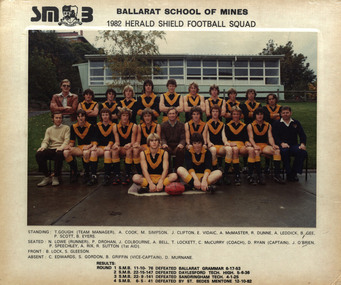
Photograph - Photograph - Colour, Ballarat School of Mines Herald Shield Football Squad, 1982, 1982
... football...australian rules footballl...He is a four-time Coleman Medallist, kicked more than 100 goals in a season on six occasions (an AFL record), and is a member of the Australian Football Hall of Fame. (Wikipedia) In 2015 Tony Lockett was elevated to the state of Legend in the Australian Football League Hall of Fame....Photograph of the Ballarat School of Mines Australian Rules Football team taken at the Ballarat School of Mines. ...He is a four-time Coleman Medallist, kicked more than 100 goals in a season on six occasions (an AFL record), and is a member of the Australian Football Hall of Fame. (Wikipedia) In 2015 Tony Lockett was elevated to the state of Legend in the Australian Football League Hall of Fame. ballarat school of mines football australian rules footballl herald shield mccurry lockett tony lockett T. ...The Ballarat School of Mines traditionally had a strong Australian Rules Football team. The 1982 team included Tony Lockett who went on to play at the highest level becoming the highest goal scorer in the history of the VFL/AFL with 1,360 goals in a career of 281 games, that commenced in 1983 with the St Kilda Football Club, and finished in 2002 with the Sydney Swans. Lockett is the only full-forward ever to win the coveted Brownlow Medal, in 1987, a season in which he was decorated with several honours. He is a four-time Coleman Medallist, kicked more than 100 goals in a season on six occasions (an AFL record), and is a member of the Australian Football Hall of Fame. (Wikipedia) In 2015 Tony Lockett was elevated to the state of Legend in the Australian Football League Hall of Fame.Photograph of the Ballarat School of Mines Australian Rules Football team taken at the Ballarat School of Mines. The football team wears the gold and green colours of the school team. Standing left to right: T. Gough (Team Manager), Anthony Cook, Mark Simpson, John Clifton, E. Vidaic, Andrew McMaster, R. Dunne, A. Leddick, Bruce Gee, P. Scott, B. Eyers. Sitting left to right: N. Rowe (Runner), Paul Drohan, Jeff Colbourne, A. Bell, Tony Lockett, Colin McCurry (Coach), Damian Ryan (Captain), J. O'Brien. Front left to right: Barrie Lock, S. Gleeson. Absent: C. Edwards, S. Gordon, B. Griffin (Vice-Captain), Damien Murnane. ballarat school of mines, football, australian rules footballl, herald shield, mccurry, lockett, tony lockett, t. gough, anthony cook, mark simpson, john clifton, e. vidaic, andrew mcmaster, r. dunne, a. leddick, bruce gee, p. scott, b. eyers., n. rowe, paul drohan, jeff colbourne, a. bell, colin mccurry, damian ryan, j. o'brien., barrie lock, s. gleeson., c. edwards, s. gordon, b. griffin, damien murnane., afl, vfl -
 Federation University Historical Collection
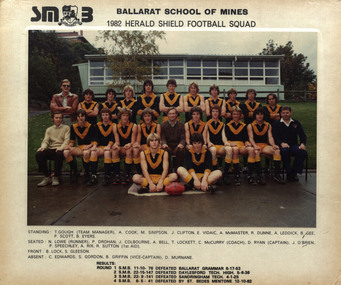
Photograph - Photograph - Colour, Ballarat School of Mines Herald Shield Football Squad, 1982, 1982
... football...australian rules footballl...He is a four-time Coleman Medallist, kicked more than 100 goals in a season on six occasions (an AFL record), and is a member of the Australian Football Hall of Fame. (Wikipedia) In 2015 Tony Lockett was elevated to the state of Legend in the Australian Football League Hall of Fame....Photograph of the Ballarat School of Mines Australian Rules Football team taken at the Ballarat School of Mines. ...He is a four-time Coleman Medallist, kicked more than 100 goals in a season on six occasions (an AFL record), and is a member of the Australian Football Hall of Fame. (Wikipedia) In 2015 Tony Lockett was elevated to the state of Legend in the Australian Football League Hall of Fame. ballarat school of mines football australian rules footballl herald shield mccurry lockett. tony lockett vfl afl Photograph of the Ballarat School of Mines Australian Rules Football team taken at the Ballarat School of Mines. ...The Ballarat School of Mines traditionally had a strong Australian Rules Football team. The 1982 team included Tony Lockett who went on to play at the highest level becoming the highest goal scorer in the history of the VFL/AFL with 1,360 goals in a career of 281 games, that commenced in 1983 with the St Kilda Football Club, and finished in 2002 with the Sydney Swans. Lockett is the only full-forward ever to win the coveted Brownlow Medal, in 1987, a season in which he was decorated with several honours. He is a four-time Coleman Medallist, kicked more than 100 goals in a season on six occasions (an AFL record), and is a member of the Australian Football Hall of Fame. (Wikipedia) In 2015 Tony Lockett was elevated to the state of Legend in the Australian Football League Hall of Fame.Photograph of the Ballarat School of Mines Australian Rules Football team taken at the Ballarat School of Mines. The football team wears the gold and green colours of the school team. Standing left to right: T. Gough (Team Manager), Anthony Cook, Mark Simpson, John Clifton, E. Vidaic, Andrew McMaster, R. Dunne, A. Leddick, Bruce Gee, P. Scott, B. Eyers. Sitting left to right: N. Rowe (Runner), Paul Drohan, Jeff Colbourne, A. Bell, Tony Lockett, Colin McCurry (Coach), Damian Ryan (Captain), J. O'Brien. Front left to right: Barrie Lock, S. Gleeson. Absent: C. Edwards, S. Gordon, B. Griffin (Vice-Captain), Damien Murnane. ballarat school of mines, football, australian rules footballl, herald shield, mccurry, lockett. tony lockett, vfl, afl -
 City of Moorabbin Historical Society (Operating the Box Cottage Museum)
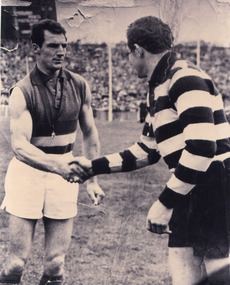
Photograph, B&W, Peter Box, AFL Footballer c 1950, c1950
... box peter, australian rules football, brownlow medal, brownlow charles, footscray football club, fitzroy football club, geelong football club, davis bob, city of moorabbin, brighton, dendy henry, box william, box elizabeth, rietman august, rietman frieda, box cottage museum ormond, box alonzo, glen eira city council, city of moorabbin historical society, ormond, bentleigh, cheltenham...Peter Box , played Australian Rules Football for Cheltenham and Australian Football League team Footscray . ...Peter Box , played Australian Rules Football for Cheltenham and Australian Football League team Footscray . ...Peter Box , played Australian Rules Football for Cheltenham and Australian Football League team Footscray . He won the Brownlow Medal in 1956. This medal, named after Fitzroy footballer Charles Brownlow, is awarded each year to the Fairest and Best Player in the AFL as voted by the umpires of the AFLPeter Box was a champion Australian Rules Footballer in the 1950's and won the prestigious Bownlow medal in 1956A Black and white photograph of Peter Box, Captain Footscray AFL Club, with Bob Davis , Captain Geelong AFL Club c 1950Handwritten - Peter Box / Brownlow Medalist 1956 / Footscray / Cheltenham Captain 1950box peter, australian rules football, brownlow medal, brownlow charles, footscray football club, fitzroy football club, geelong football club, davis bob, city of moorabbin, brighton, dendy henry, box william, box elizabeth, rietman august, rietman frieda, box cottage museum ormond, box alonzo, glen eira city council, city of moorabbin historical society, ormond, bentleigh, cheltenham -
Emerald Museum & Nobelius Heritage Park
Photograph - Emerald Football Club, 1977, Unknown maker, 1977
... ...Australian Rules Football...The club has also been known variously as the 'Emites', the 'Redlegs' and the current 'Bombers.' A joint Australian Football League (AFL) and La Trobe University Centre for Sport and Social Impact study discusses the importance of local football teams for fostering community cohesion and relationships and distributing information and health and social issues to local people. ...The photograph depicts men playing Australian Rules Football at a suburban football oval; spectators with flags and banners are visible in the background of the photograph. ...It depicts a key moment between the Emerald Football Club (the 'Bombers') and South Belgrave Football Club (the 'Wolves'); both clubs are still active in the area. Australian Rules Football has a long history in the region and played a fundamental role in community life. 1970s clubs associations societies sports Australian Rules Football emerald football club bombers south belgrave football club ian craig Obverse:ERALD /Reverse:1977 /5. ...Emerald Football Club was formed in 1905, one of the first teams in the Mountain District Football Association (renamed the Yarra Valley Mountain District Football League in 1967). The club has changed its official colours three times, playing firstly under blue and white colours, then green and gold before adopting the red and black colours shown in the photograph and still used today. The club has also been known variously as the 'Emites', the 'Redlegs' and the current 'Bombers.' A joint Australian Football League (AFL) and La Trobe University Centre for Sport and Social Impact study discusses the importance of local football teams for fostering community cohesion and relationships and distributing information and health and social issues to local people. Local football and other sporting teams are integral to the economic and social development of an area and are therefore significant far beyond the immediate players or families associated with the club.The photograph is significant for its insights into the history of sports and recreation in the Emerald region in the 1970s. It depicts a key moment between the Emerald Football Club (the 'Bombers') and South Belgrave Football Club (the 'Wolves'); both clubs are still active in the area. Australian Rules Football has a long history in the region and played a fundamental role in community life.Colour rectangular photograph printed on photographic paper. The photograph depicts men playing Australian Rules Football at a suburban football oval; spectators with flags and banners are visible in the background of the photograph. Cars and buildings can also be seen. Notations on the reverse of the photograph indicate that the match shown is the second semi-final of the 1977 season, held in Marysville, between the Emerald Football Club (wearing red and black) and South Belgrave.Obverse:ERALD /Reverse:1977 /5. /Second semi final v SOUTH BELGRAVE /Marysville /IAN CRAIG WITH BALL /1970s, clubs, associations, societies, sports, australian rules football, emerald football club, bombers, south belgrave football club, ian craig -
Whitehorse Historical Society Inc.
Article, Footy championship to boost local businesses, 1994
... australian rules football...Nunawading can expect a $100,000 boost to its economy from next month's 1994 Australian University Football championships. One of the organizers and players is Andrew Abbott, son of Nunawading Mayor, Kevin Abbott. ...australian rules football swinburne university sports association australian university football championships tingate andrew abbott kevin Nunawading can expect a $100,000 boost to its economy from next month's 1994 Australian University Football championships. ...Nunawading can expect a $100,000 boost to its economy from next month's 1994 Australian University Football championships.Nunawading can expect a $100,000 boost to its economy from next month's 1994 Australian University Football championships. One of the organizers and players is Andrew Abbott, son of Nunawading Mayor, Kevin Abbott. The event will be staged at East Burwood, Forest Hill and Mahoney's Reserves.Nunawading can expect a $100,000 boost to its economy from next month's 1994 Australian University Football championships.australian rules football, swinburne university sports association, australian university football championships, tingate, andrew, abbott, kevin -
 Flagstaff Hill Maritime Museum and Village
Book - Ledger Book, Warrnambool Harbour Board, Ships' Report Inward, ca. 1877 plus scrapbook entries to ca. 1953
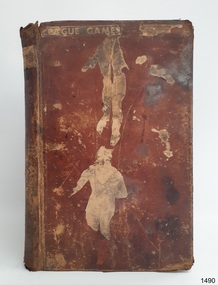
... ...Australian Football League...The book has also been used as football scrapbook for both the Australian and Victorian Leagues, with articles and photographs from the early 20th century events and photos of players in 1953. ...The book has also been used for a football scrapbook and contains newspaper cuttings of early 20th century AFL (Australian Football League) and VFL (Victorian Football League) events and photographs. ...The book has also been used for a football scrapbook and contains newspaper cuttings of early 20th century AFL (Australian Football League) and VFL (Victorian Football League) events and photographs. ...The Ship's Report Inward contains entries from 1877 to 1917. It is a record of vessels that visited the Port of Warrnambool during that time and was filled in by the Harbour Master on behalf of the Warrnambool Harbour Board. The book has also been used as football scrapbook for both the Australian and Victorian Leagues, with articles and photographs from the early 20th century events and photos of players in 1953. A child has also used the book for drawing and writing.It appears that this historic ledger was once regarded as insignificant and used for other purposes such as a scrapbook and spare paper for drawing. However, the ledger is now considered to be of important locall significant for its accurate reports of all vessels inward bound to the Port of Warrnambool, giving a summary of activities during the forty year period from 1877 to 1917. It is also a reference to early Australian and Victorian football media.Ledger of the Warrnambool Harbour Board, containing the handwritten Ships Report Inwards for the Port of Warrnambool. First entry 1877. Last entry 1917. The book has also been used for a football scrapbook and contains newspaper cuttings of early 20th century AFL (Australian Football League) and VFL (Victorian Football League) events and photographs. There are several lose clippings between the pages throughout the book. The cover's spine has a gold embossed title and a pasted title, and the pasted front cover has figures relate to the scrapbook. There are also child's writing and drawings in pencil on some pages. A white label inside the back cover has a blue pen inscription. Embossed title "SHIPS' / REPORT / INWARDS" Pasted title "LEAGUE / GAMES" Label inside back cover: "R 759"flagstaff hill, warrnambool, shipwrecked-coast, flagstaff-hill, flagstaff-hill-maritime-museum, maritime-museum, shipwreck-coast, flagstaff-hill-maritime-village, book, warrnambool harbour board, ships' report inward, port of warrnambool, warrnambool harbour, harbour master, afl, vfl, australian football league, victorian football league, early 20th century, newspaper cuttings, maritime record, maritime history, 1877-1917, 1953 -
Unions Ballarat
The Jack Dyer story: The legend of captain blood (Don Woodward Collection), Hansen, Brian, 1996
... sports - australian rules football...He was inducted into the Australian Football Hall of Fame and later became a coach and then a media commentator. ...Sports - Australian Rules Football. Biographical interest. btlc ballarat trades and labour council ballarat trades hall sports - australian rules football dyer, jack captain blood media biography Book; 342 pages. ...Jack Dyer played for Richmond Football Club (VFL) between for 21 years. He was inducted into the Australian Football Hall of Fame and later became a coach and then a media commentator. A biography, as told to Brian Hansen.Sports - Australian Rules Football. Biographical interest.Book; 342 pages. Cover: artistic impression of Richmond and Essendon players; red and white lettering; author's name and title.btlc, ballarat trades and labour council, ballarat trades hall, sports - australian rules football, dyer, jack, captain blood, media, biography -
 Federation University Historical Collection
Card, Berry, Anderson & Co, Ballarat Football League Fixtures, 1925, 1925
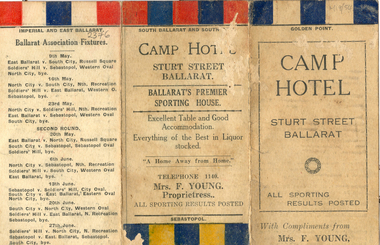
... football...ballarat...australian...The Football Fixture relates to the Ballarat Association of Australian Rules Football....The Football Fixture relates to the Ballarat Association of Australian Rules Football. football ballarat australian rules football young camp hotel football fixture vfl bfl afl Double sided card with black and white printing and coloured borders. ...The Football Fixture relates to the Ballarat Association of Australian Rules Football.Double sided card with black and white printing and coloured borders. It is a Ballarat Football League fixture from Mrs F. Young of Camp Hotel, Sturt Street, Ballarat. The colours relate to the following football teams: Golden Point, South Ballarat, Imperial and East Ballarat, Ararat, Maryborough and North City, Ballarat and Soldiers' Hillfootball, ballarat, australian rules football, young, camp hotel, football fixture, vfl, bfl, afl -
Emerald Museum & Nobelius Heritage Park
Photograph - Emerald Football Club, 1977, Unknown maker, 1977
... ...Australian Rules Football...The club has also been known variously as the 'Emites', the 'Redlegs' and the current 'Bombers.' A joint Australian Football League (AFL) and La Trobe University Centre for Sport and Social Impact study discusses the importance of local football teams for fostering community cohesion and relationships and distributing information and health and social issues to local people. ...The photograph depicts seven men playing Australian Rules Football at a suburban football oval; fifteen spectators including a junior player in uniform are visible in the background of the photograph. ...The photograph depicts seven men playing Australian Rules Football at a suburban football oval; fifteen spectators including a junior player in uniform are visible in the background of the photograph. ...Emerald Football Club was formed in 1905, one of the first teams in the Mountain District Football Association (renamed the Yarra Valley Mountain District Football League in 1967). The club has changed its official colours three times, playing firstly under blue and white colours, then green and gold before adopting the red and black colours shown in the photograph and still used today. The club has also been known variously as the 'Emites', the 'Redlegs' and the current 'Bombers.' A joint Australian Football League (AFL) and La Trobe University Centre for Sport and Social Impact study discusses the importance of local football teams for fostering community cohesion and relationships and distributing information and health and social issues to local people. Local football and other sporting teams are integral to the economic and social development of an area and are therefore significant far beyond the immediate players or families associated with the club.The photograph is significant for its insights into the history of sports and recreation in the Emerald region in the 1970s. It depicts a key moment between the Emerald Football Club (the 'Bombers') and South Belgrave Football Club (the 'Wolves'); both clubs are still active in the area. Australian Rules Football has a long history in the region and played a fundamental role in community life.Colour rectangular photograph printed on photographic paper. The photograph depicts seven men playing Australian Rules Football at a suburban football oval; fifteen spectators including a junior player in uniform are visible in the background of the photograph. Cars and sports field netting can also be seen. Notations on the reverse of the photograph indicate that the match shown is the second semi-final of the 1977 season, held in Marysville, between the Emerald Football Club (wearing red and black) and South Belgrave. Three names are written on the reverse in different hand-writing, these are Geoff 'Digger' Dolan, Tony Greenwell and Dave Sands.Reverse: 1977 / 7. / Second Semi Final / V SOUTH BELGRAVE / Marysville / GEOFF 'DIGGER' DOLAN / TONY GREENWELL / DAVE SANDS / VEMUP 417 /1970s, clubs, associations, societies, sports, australian rules football, emerald football club, bombers, south belgrave football club, geoff 'digger' dolan, tony greenwell, dave sands, marysville, wolves, redlegs, emites -
Emerald Museum & Nobelius Heritage Park
Photograph - Emerald Football Club, 1977, Unknown maker, 1977
... ...Australian Rules Football...The club has also been known variously as the 'Emites', the 'Redlegs' and the current 'Bombers.' A joint Australian Football League (AFL) and La Trobe University Centre for Sport and Social Impact study discusses the importance of local football teams for fostering community cohesion and relationships and distributing information and health and social issues to local people. ...The photograph depicts four men playing Australian Rules Football at a suburban football oval, watched by seven spectators including a junior player in uniform. ...The photograph depicts four men playing Australian Rules Football at a suburban football oval, watched by seven spectators including a junior player in uniform. ...Emerald Football Club was formed in 1905, one of the first teams in the Mountain District Football Association (renamed the Yarra Valley Mountain District Football League in 1967). The club has changed its official colours three times, playing firstly under blue and white colours, then green and gold before adopting the red and black colours shown in the photograph and still used today. The club has also been known variously as the 'Emites', the 'Redlegs' and the current 'Bombers.' A joint Australian Football League (AFL) and La Trobe University Centre for Sport and Social Impact study discusses the importance of local football teams for fostering community cohesion and relationships and distributing information and health and social issues to local people. Local football and other sporting teams are integral to the economic and social development of an area and are therefore significant far beyond the immediate players or families associated with the club.The photograph is significant for its insights into the history of sports and recreation in the Emerald region in the 1970s. It depicts a key moment between the Emerald Football Club (the 'Bombers') and Wandin Football Club (the 'Bulldogs'). The Emerald Football Club is still active in the area; the Wandin Football Club appears to have been active until at least 2019. Australian Rules Football has a long history in the region and played a fundamental role in community life.Colour rectangular photograph printed on photographic paper. The photograph depicts four men playing Australian Rules Football at a suburban football oval, watched by seven spectators including a junior player in uniform. Three umpires are also featured in the image as the moment of play pictured involves a high tackle. Cars, trees and facilities such as spectator stands and club buildings are visible in the background. Notes on the reverse of the image indicate this photograph depicts the 1977 Preliminary Grand Final between the Emerald and Wandin teams. The reverse of the image lists players Kevin Spence and Syd Jinnette and umpires Ted Meyer and Stan Morris.Reverse: in / 8 / 8 / 1977 Preliminary Final Yea / Emerald V Wandin / Kevin Spence / Syd Jinnette / Umpires / Ted Meyer / Stan Morris /1970s, clubs, associations, societies, sports, australian rules football, bombers, wandin football club, bulldogs, umpiring, kevin spence, syd jinnette, ted meyer, stan morris -
Emerald Museum & Nobelius Heritage Park
Photograph - Emerald Football Club, 1983, Unknown photographer, 1983
... powelltown football club...Australian...The club has also been known variously as the 'Emites', the 'Redlegs' and the current 'Bombers.' A joint Australian Football League (AFL) and La Trobe University Centre for Sport and Social Impact study discusses the importance of local football teams for fostering community cohesion and relationships and distributing information and health and social issues to local people. ...Black and white rectangular photograph printed on photographic paper. 1983 Grand Final, in which the Emerald Football Club defeated Powelltown. The photograph depicts six men playing Australian Rules Football at a suburban football oval with approximately fifteen male spectators (including two policemen) visible in the background. ...It depicts a key moment between the Emerald Football Club (the 'Bombers') and Powelltown Football Club. Australian Rules Football has a long history in the region and played a fundamental role in community life. emerald football club powelltown football club Australian Rules Football Premiership 1980s 1983 bombers Redlegs sports Obverse: GENERA, PLANT & TO / FOR THE BUILDER & HO / 64. 6245 % 64. 7130 7.4 / COMPLETE FU SERVICE. ...Emerald Football Club was formed in 1905, one of the first teams in the Mountain District Football Association (renamed the Yarra Valley Mountain District Football League in 1967). The club has changed its official colours three times, playing firstly under blue and white colours, then green and gold before adopting the red and black colours shown in the photograph and still used today. The club has also been known variously as the 'Emites', the 'Redlegs' and the current 'Bombers.' A joint Australian Football League (AFL) and La Trobe University Centre for Sport and Social Impact study discusses the importance of local football teams for fostering community cohesion and relationships and distributing information and health and social issues to local people. Local football and other sporting teams are integral to the economic and social development of an area and are therefore significant far beyond the immediate players or families associated with the club.The photograph is significant for its insights into the history of sports and recreation in the Emerald region in the 1980s. It depicts a key moment between the Emerald Football Club (the 'Bombers') and Powelltown Football Club. Australian Rules Football has a long history in the region and played a fundamental role in community life.Black and white rectangular photograph printed on photographic paper. 1983 Grand Final, in which the Emerald Football Club defeated Powelltown. The photograph depicts six men playing Australian Rules Football at a suburban football oval with approximately fifteen male spectators (including two policemen) visible in the background. Hoardings with advertisements for local businesses line the field, with the carpark visible behind the spectators. Notations on the reverse of the photograph indicate that the match shown is the 1983 Grand Final, in which the Emerald Football Club defeated Powelltown. A player on the front left of the image is named as Peter Rush.Obverse: GENERA, PLANT & TO / FOR THE BUILDER & HO / 64. 6245 % 64. 7130 7.4 / COMPLETE FU SERVICE. RINGWOOD / 8 / ONCASTER T / B Hours (03) 848.4132 % Owen / Reverse: Peter Rush - No. 18 front left / 1983 / Emerald Football Club / playing Powelltown / Grand Final - Emerald won / VEMUP 415 /emerald football club, powelltown football club, australian rules football, premiership, 1980s, 1983, bombers, redlegs, sports -
 Bacchus Marsh & District Historical Society
Photograph, Balliang Football Team 1912
... Balliang Football Team...Australian...Australian Rules football was played in this area as early as the 1870s. ...Balliang Football Team Australian Rules Football Above the photo in red ink:"Balliang Football Team 1912." ...This photo is probably the oldest known photographic record of the Balliang Football Club, an Australian Rules football team in the Bacchus Marsh area. Australian Rules football was played in this area as early as the 1870s. An organized competition to play regular matches was formed in the early years of the twentieth century. This item has historic and social significance as an image of one of the early sporting teams of Bacchus Marsh and district. It is a typical example of team photographs of this era. It is evidence of the transition of football from a social informal setting to an organised activity and signals the growth of importance of sport, in this case Australian Rules football, as a cultural and social activity central to the Australian ethos.A sepia photograph print mounted on mounting board, showing a group of 20 men arranged in two rows with two men reclining in front. Fifteen men are wearing horizontally striped football guernseys, one wearing a guernsey which is vertically striped. Two men wear white guernseys with a diagonal sash, one man in the back row is dressed formally in suit, collar and tie. One man, identified as the umpire, is in a white polo-necked sweater and is holding a football. The photo is taken in a clearing in an outdoor setting. It is possible to see the figures of three women in the background, two looking on from under a tree, one walking along a footpath.Above the photo in red ink:"Balliang Football Team 1912." Beneath the photo in red ink with one alteration in blue ink the names: "J.Davie, C. Bissell, F. Dodemaide (these two names showing a reversal of position), J.Turnbull, G.Dodemaide, A. Phalp, A. Bissell, A. Cashmore, J.Sharkey. R.McArthur, J.Cashmore., W. Loats, C. Smith. Elliott (ump), B.Phalp. W.Cashmore, L. Beggs. Because the number of names given does not tally with the number of men in the photo, it is not possible to accurately ascribe a name to any individual player. Underneath the hand-written names, there is a circular professional stamp of the photographer, reading: PHOTO ARTIST BACCHUS MARSH. A.BESELERballiang football team, australian rules football -
Port Melbourne Historical & Preservation Society
Photograph - CD-ROM, prominent Port Melbourne figures
... ...Sport - Australian Rules Football...A visual history of Australian Rules football teams and political figures in Port Melbourne...A visual history of Australian Rules football teams and political figures in Port Melbourne Local Government Recreation Sport - Cricket Sport - Australian Rules Football Societies Clubs Unions and other Organisations James Peter CRICHTON William HOWE A MURDOCH William Henry PROHASKY Phillip Melville SALMON George SANGSTER Thomas SWALLOW George Samuel WALTER Alexander ROGERS George Alexander ROGERS Herbert Charles EDWARDS Charles Edward SMITH A photographic collection of prominent Port Melbourne figures. ...A visual history of Australian Rules football teams and political figures in Port MelbourneA photographic collection of prominent Port Melbourne figures. Port Melbourne Football Club and also political figures.local government, recreation, sport - cricket, sport - australian rules football, societies clubs unions and other organisations, james peter crichton, william howe, a murdoch, william henry prohasky, phillip melville salmon, george sangster, thomas swallow, george samuel walter, alexander rogers, george alexander rogers, herbert charles edwards, charles edward smith
