
Showing 107 items matching "australian token"
-
 Flagstaff Hill Maritime Museum and Village
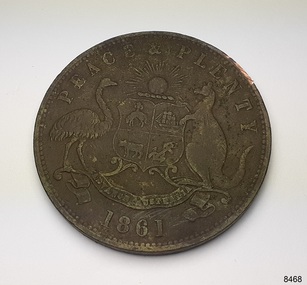
Currency - Coin, Robert Hyde & Co. Shipping Merchants, 1861
... ...Australian token...The first token was introduced in Melbourne in 1848 and were used until 1868, when they became illegal in New South Wales. They were minted in Australia...Penny token coin bearing the Australian Coat of Arms and motto. ...The first token was introduced in Melbourne in 1848 and were used until 1868, when they became illegal in New South Wales. They were minted in Australia ...The donor (a local resident.) of this coin found this penny token coin in the sand dunes of Lady Bay, Warrnambool, in 2023. The coin could have come from a local shipwreck, passengers, or members of the community. Trade was carried out along the southwest coast of Victoria between Melbourne and Portland, with the Port of Warrnambool receiving passengers and goods by coastal traders, the steamboat that set off from ports every few days. One such vessel was the steamship SS Edina that made her first voyage from Melbourne to Portland in 1863. For around a decade or so in the Gold Rush period in Australia there was a shortage of official government currency. It was acceptable during this time to use token coins minted by local businesses to be used within their store, much like the loyalty and rewards cards that businesses give their customers in modern times. The tokens were also a good way to advertise their wares and details. The first token was introduced in Melbourne in 1848 and were used until 1868, when they became illegal in New South Wales. They were minted in Australia and overseas. The token was issued by Robert Hyde & Co. who traded in second-hand goods such as old clothes, sheets, metal items and glass, which they resold to be re-manufactured, or "recycled".A token such as this one identifies businesses existing in the post-Gold Rush period in Australia. Round copper coin. Penny token coin bearing the Australian Coat of Arms and motto. The coin also has the company's name, location, nature of business and motto. The coin has grooves around the edge. It was made in 1861.OBVERSE: Logo: (Australian Coat of Arms), Motto: "PEACE & PLENTY", Date: 1861 REVERSE: "ROBERT HYDE & CO MELBOURNE", "GENERAL MARINE STORE, SHIPPERS OF RAGS GLASS METALS &.C"flagstaff hill maritime museum and village, warrnambool, great ocean road, shipwreck coast, merchant token, melbourne, token, australian token, trade token, coins, merchants, medal, colonisation, gold rush, robert hyde & co., general marine store, shippers of rags glass metals etc., numismatics, second-hand scrap, scrap goods -
 Bendigo Historical Society Inc.
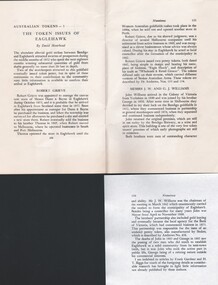
Magazine - HARRY BIGGS COLLECTION: NUMISMA: AN OCCASIONAL NUMISMATIC MAGAZINE, March 1964
... Also included is article on Australian tokens including Eaglehawk & Bendigo in general....Also included is article on Australian tokens including Eaglehawk & Bendigo in general. ...Magazine. Harry Biggs Collection. No 8, March 1964. A small white booklet published under the name of Numismatic Publications by The Hawthorn Press. Accounts pertaining to the history of coins & notes in Australia & Ireland. Also included is article on Australian tokens including Eaglehawk & Bendigo in general.cottage, miners, commerce, harry biggs collection, numisma -
 Flagstaff Hill Maritime Museum and Village
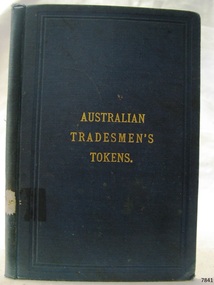
Book, Descriptive Catalogue of Australian Tradesmens Tokens
... Descriptive Catalogue of Australian Tradesmens Tokens Author: C W Stainsfield Publisher: C W Stainsfield Date: 1883 ...warrnambool shipwrecked-coast flagstaff-hill flagstaff-hill-maritime-museum maritime-museum shipwreck-coast flagstaff-hill-maritime-village shipwrecked-artefact great ocean road book warrnambool library warrnambool mechanics’ institute mechanics’ institute library victorian library board warrnambool books and records warrnambool children’s library warrnambool public library Descriptive Catalogue of Australian Tradesmens Tokens C W Stainsfield Label on spine cover is white paper circle with the number 30 Pastedown front endpaper has sticker from Warrnambool Mechanics Institute and Free Library Descriptive Catalogue of Australian Tradesmens Tokens Author: C W Stainsfield Publisher: C W Stainsfield Date: 1883 Descriptive Catalogue of Australian Tradesmens Tokens Book ...Descriptive Catalogue of Australian Tradesmens Tokens Author: C W Stainsfield Publisher: C W Stainsfield Date: 1883 Label on spine cover is white paper circle with the number 30 Pastedown front endpaper has sticker from Warrnambool Mechanics Institute and Free Library warrnambool, shipwrecked-coast, flagstaff-hill, flagstaff-hill-maritime-museum, maritime-museum, shipwreck-coast, flagstaff-hill-maritime-village, shipwrecked-artefact, great ocean road, book, warrnambool library, warrnambool mechanics’ institute, mechanics’ institute library, victorian library board, warrnambool books and records, warrnambool children’s library, warrnambool public library, descriptive catalogue of australian tradesmens tokens, c w stainsfield -
 Federation University Art Collection
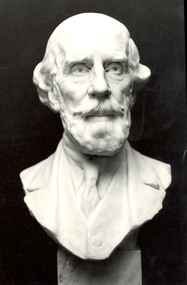
Sculpture - Marble sculpture, 'Professor Alfred Mica Smith' by Paul Montford, 1924
... Mica Smith, 1924, Presented by His Old Students Associated with Western Australia as a Token of Affectionate Esteem...Mica Smith, 1924, Presented by His Old Students Associated with Western Australia as a Token of Affectionate Esteem Marble bust of Ballarat School of Mines Professor Alfred Mica Smith by Paul Montford. ...Paul Raphael MONTFORD (1868 - 1938) Paul Montford moved to Australia to carve four buttress groups in granite for the Melbourne Shrine of Remembrance. In 1924 he was teaching at Geelong Technical College. Professor Alfred Mica Smith was a long term lecturer at the Ballarat School of Mines. The sculpture was commissioned by former Students of the Ballarat School of Mines working in Western Australia. One of those former students, William Corbould, remembered his first encounter with the professor fondly:- 'From the Registrar's Office I was led to be introduced to the Professor of Chemistry, one Mica Smith. The initial encounter gave me little encouragement - his large laboratory was filled with hundreds of bottles bearing strange labels with queer symbols on them. My heart sank. At the first opportunity I grabbed my hat and made for the door, but the good professor called me back. I pointed out that I was never any good at school ... so it was no use pretending to be clever enough to understand all those weird symbols! The Professor told me not to worry about that and took me to one of the benches where he found a blowpipe and a charcoal block. Mixing together two powders from bottles on the shelf he transferred a sample to the charcoal and directed the bunsen flame onto it. Soon it began to melt and a white bead appeared in front of my eyes. He then took a test tube and added a little colourless liquid from each of two bottles. A beautiful dark blue colour appeared. My interest was won.' Alfred Mica Smith was the well-loved Professor of Chemistry and Metallurgy at the Ballarat School of Mines between 1881 and 1922. Upon reaching the age of 78 Mica Smith retired having influenced generations of miners. At the time of his death Ballarat School of Mines Students’ Magazine reported: "In the annals of the School, the year 1922 will be noted chiefly as the last year in which Professor Mica Smith taught here. With his retirement, a memorable epoch closed. The Professor has served the School for 42 years with a service, the length and thoroughness of which are unique. … It is not quite realised in this city how famous the School became throughout the world, nor to what extent the Professor was responsible for its high position in the mining and metallurgical world. … This item is part of the Federation University Art Collection. The Art Collection features over 2000 works and was listed as a 'Ballarat Treasure' in 2007.Marble bust of Ballarat School of Mines Professor Alfred Mica Smith by Paul Montford. The bust is mounted on a jarrah pedestal made from timber donated by the Millar Timber and Trading Company. The bust was formally presented to the Ballarat School of Mines on Saturday 13 December1924 in front of Alfred Mica Smith and a large gathering. It is signed 'Paul R. Montford, Sc, 1924' at the back.Professor A. Mica Smith, 1924, Presented by His Old Students Associated with Western Australia as a Token of Affectionate Esteemart, artwork, ballarat school of mines, montford, paul montford, alfred mica smith, mica smith, marble, bust, sculpture -
 Warrnambool and District Historical Society Inc.
Coin - Token, Bateman token, 1855
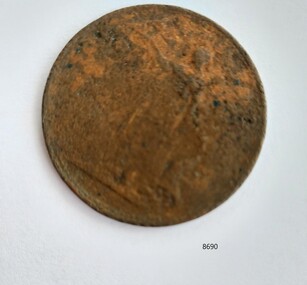
... It is an example of an Australian token – a coin that had the value of a penny and was produced by businessmen in the 1850s to be used only in the business of the person named on the coin. ...It is an example of an 1850s Australian token, demonstrating an early business practice in our history. 2. ...This coin is a Warrnambool Bateman penny. It is an example of an Australian token – a coin that had the value of a penny and was produced by businessmen in the 1850s to be used only in the business of the person named on the coin. There were two firms in Warrnambool that produced tokens in the 1850s – William Jamieson, a general storekeeper and William Bateman. The latter had a general store in Banyan Street and became in the early 1850s one of the largest merchant firms in the Warrnambool district. But the firm’s liabilities were financed by overdrafts and insolvency resulted. A disastrous and suspicious fire in 1856 destroyed the Bateman store and caused a great number of insolvencies in the district as so many businessmen and farmers were financed by Bateman who eventually left the district. This token is of supreme importance. It is significant for three reasons: 1. It is an example of an 1850s Australian token, demonstrating an early business practice in our history. 2. It is an example of a Warrnambool token produced by an important Warrnambool business (only two firms in Warrnambool produced tokens) 3. It is a Bateman token and these are comparatively rare because many Bateman tokens were destroyed in the 1856 fire. This is an 1855 metal token with, on one side, an image of a woman holding scales in one hand and a cornucopia in the other (Dea Pecunia?). The obverse side has the name of William Bateman Junior of Warrnambool. It is a business token which could be used only in the Bateman store in Warrnambool in place of a penny.One side: Woman image and the word ‘Australia’ Obverse side: ‘William Bateman Junr. & Co., Importers and General Merchants, Warnambool (sic), Victoria, 1855’ william bateman junior, warrnambool tokens, bateman token, coin tokens -
 Flagstaff Hill Maritime Museum and Village
Currency - Token, 1850's
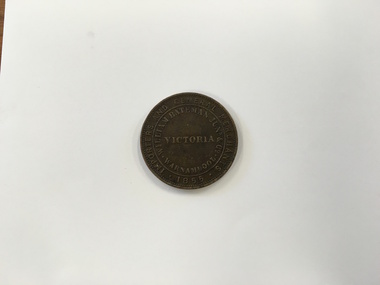
... It is an example of an Australian token – a coin that had the value of a penny and was produced by businessmen in the 1850s to be used only in the business of the person named on the coin. ...It is an example of an Australian token – a coin that had the value of a penny and was produced by businessmen in the 1850s to be used only in the business of the person named on the coin. ...For around a decade or so in the Gold Rush period in Australia there was a shortage of official government currency. It was acceptable during this time to use token coins minted by local businesses to be used within their store, much like the loyalty and rewards cards that businesses give their customers in modern times. The tokens were also a good way to advertise their wares and details. The first token was introduced in Melbourne in 1848 and were used until 1868, when they became illegal in New South Wales. They were minted in Australia and overseas. This is a Warrnambool Bateman penny token. It is an example of an Australian token – a coin that had the value of a penny and was produced by businessmen in the 1850s to be used only in the business of the person named on the coin. There were two firms in Warrnambool that produced tokens in the 1850s – William Jamieson, a general storekeeper and William Bateman. The latter had a general store in Banyan Street in the early 1850's and became one of the largest merchant firms in the Warrnambool district. In November 1856 the store belonging to William Bateman Jnr & Co. was destroyed by fire and caused a great number of insolvencies in the district as many businessmen and farmers were financed by Bateman.This token is a significant example of the business practices of merchants in the early days of the colony and is connected to a well-known member of Warrnambool's early town history. It is comparatively rare because many Bateman tokens were destroyed in the 1856 fire.A round metal coin token associated with the Warrnambool business owned by William Bateman in the 1850's. It has a weathered figure on one side and writing (also quite weathered) on the other side.Around edge - IMPORTERS AND GENERAL MERCHANTS 185? Inside circle - WILLIAM BATEMAN JUNR & CO WARRNAMBOOL Across center - VICTORIAflagstaff hill maritime museum and village, warrnambool, great ocean road, shipwreck coast, penny token, william bateman, william bateman jnr &co, bateman general store, bateman token, bateman penny token, token coin, token -
 Warrnambool and District Historical Society Inc.
Booklet, Kessinger Publishing, Descriptive catalogue of Australian Tradesmen's tokens, 2010
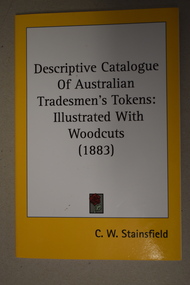
... This book is a reprint of a rare 19th catalogue of Australian tradesmen’s tokens. A token was a coin to the value of one penny produced in the mid 19th century to benefit businesses at a time when there was a shortage of English pennies. ...Tradesmen’s Tokens in Australia This is a reprint of an 1883 catalogue of Australian tradesmen's tokens. ...This is a reprint of an 1883 catalogue of Australian tradesmen's tokens.This is a soft cover book of 80 pages. It has a yellow cover with black print within a white background frame. The text contains many black and white images of tokens.non-fictionThis is a reprint of an 1883 catalogue of Australian tradesmen's tokens.tradesmen’s tokens in australia -
 Flagstaff Hill Maritime Museum and Village
Medal - Token, Richard Parker, ironmonger, Mid-to-late 19th century
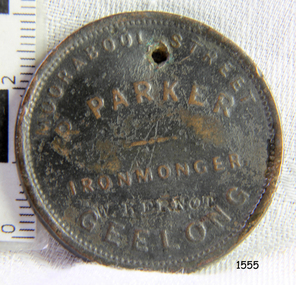
... KERNOT" Embossed on reverse: "AUSTRALIA" Token coin; a round copper one penny token. ...This copper penny token was issued in Geelong by ironmonger R. Parker. Richard Parker was an early settler in Victoria. He had a general store in Elizabeth Street, then Collins Street, Melbourne for five years before moving to Geelong in 1844. He soon established several branches of his ironmonger business in towns around Victoria. He encouraged trade by providing customers with the small change of penny tokens in exchange for their more valuable and less convenient silver coins. The token carried a surcharge and was overstamped with the mane of W. Kernot. William Charles Kernot was a chemist at Chillwell, Geelong. The token is of historical significance, representing a form of currency used in Australia's colonial era before Australia had official currency.Token coin; a round copper one penny token. Obverse had promotional text and a sketch and was overstamped with a name. Reverse had the image of a woman holding up a set of balance scales in one hand and a cornucopia in the other, standing beside the sea, with a three-masted sailing ship in the background, There is a formed hole in the metal; on the obverse, it is on the top of the design, on the reverse it is on the bottom of the design. It advertises R. Parker, Ironmonger, Moorabool Street, Geelong, overstamped with the name W. Kernot.Embossed on the obverse: "R. PARKER / IRONMONGER. / MOORABOOL STREET / GEELONG" "W. KERNOT" Embossed on reverse: "AUSTRALIA"warrnambool, shipwreck coast, flagstaff hill, flagstaff hill maritime museum, flagstaff hill maritime village, medallion, coin, token, promotional medallion, one penny, r parker, ironmonger, moorabool street geelong, w. kernot, richard parker, currency, australian currency -
 The Beechworth Burke Museum
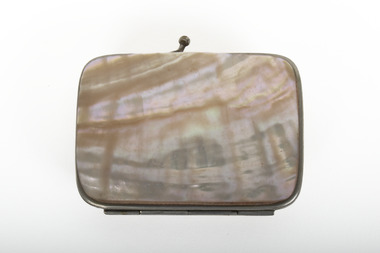
Functional object - Ladies Coin Purse
... The Australian War Memorial notes on their website that many tokens made from mother of pearl were sent home to loved ones throughout World Wars One and Two from the Middle East, England, the South West Pacific, Australia and elsewhere, but that unfortunately provenance such as the manufacture and sale of many of these items is not recorded....The Australian War Memorial notes on their website that many tokens made from mother of pearl were sent home to loved ones throughout World Wars One and Two from the Middle East, England, the South West Pacific, Australia and elsewhere, but that unfortunately provenance such as the manufacture and sale of many of these items is not recorded. ...Specific historical and contextual information pertaining to this object is unknown. There are no hallmarks or documentation to indicate provenance or historical significance. This coin purse appears to have a covering made of mother of pearl. Evidence of interest from over 20,000 years ago mark Aboriginal groups in Australia as some of the first people to value the power and beauty of pearlshell, while evidence of Australian pearlshell being taken across the sea to other countries dates back as early as the 1500s. The 1850s-60s saw the beginnings of the Australian pearling industry. Following the popularisation of plastic for items such as buttons the pearlshell market waned in the mid-twentieth century but was soon after began to re-forge in Australia with a new industry of cultured pearl farms. Most of Australian's pearling industry was initially located in Western Australia and off the Torres Strait Islands. The Australian War Memorial notes on their website that many tokens made from mother of pearl were sent home to loved ones throughout World Wars One and Two from the Middle East, England, the South West Pacific, Australia and elsewhere, but that unfortunately provenance such as the manufacture and sale of many of these items is not recorded.The social history objects held in the Burke Museum's collection help to tell the stories of Beechworth's past by showing the social, cultural, and economic aspects of the town's history.A small rectangular purse with silver edging and half clasp, covered in white and cream coloured shell (mother of pearl?)A01154burke museum, social history, accessories, mother of pearl, nacre, australian industry -
 Mission to Seafarers Victoria
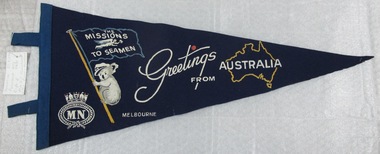
Flag - Pennant, The Missions to Seamen - Greetings From Australia, 1940-1949
... tokens. One of them gave her this felt pennant. In 1949, the family moved back to Wonthaggi and June started year 5 over there. A number of souvenir gifts and small boxes were apparently available through the Mission To Seamen in the 1940s. This acquisition adds to the small collection of items from the period which could be used to form the core of an informative exhibition. Similar flags were made in other countries depicting an animal (kiwi bird in New Zealand, springbox in South Africa) and other Australian ...This pennant was donated to the Mission by June Muirhead (nee Richardson) who visited the Mission on two occasions: on the 13 November 2014 and then in 2016. She lived from age 3 to 8, with her parents, Cuthbert (Bert) Richardson and Jane (Jenny) Richardson, and her sister, Edna, in the Cottage at 717 Flinders Street. Her father, was the caretaker of the Flinders Street building between 1943-1949. . In 1943 her father was hired to work at the Mission as a caretaker. The family moved from Wonthaggi. When she lived in the Mission, she would sometimes sneak into the club to look at books and pictures. Some seafarers would give her badges, tokens. One of them gave her this felt pennant. In 1949, the family moved back to Wonthaggi and June started year 5 over there.A number of souvenir gifts and small boxes were apparently available through the Mission To Seamen in the 1940s. This acquisition adds to the small collection of items from the period which could be used to form the core of an informative exhibition. Similar flags were made in other countries depicting an animal (kiwi bird in New Zealand, springbox in South Africa) and other Australian towns.A triangular felted, dark blue pennant with printed cursive inscription and motifs including: the Mission to Seamen Flying Angel flag, an outline of Australia; a Koala wearing a captain's hat; an insignia emblem for the Merchant Navy. A looped cotton binding along left edge of the triangle to thread the flag on a stick or cord support. The printed inscription reads: Greetings from Australia.pennant, flags, koala, flying angel club, merchant navy, d. june muirhead, marketing, caretaker, cottage, bert richardson, june muirhead nee richardson, edna richardson, ww2 -
 Frankston RSL Sub Branch
Pocketbook, National Bible Press, New Testament & Psalms, US Armed Forces, 25/1/1941 (estimated); Date from introductory letter from "The White House, Washington"
... Token" gives name of Private A.(Arthur) D.(Dean) Campbell. He was born at Melbourne on 31 March, 1917. it also provides his unit, being 2/55 Aust L.A.D. (Light Aid Detachment), AIF Australia...Token" gives name of Private A.(Arthur) D.(Dean) Campbell. He was born at Melbourne on 31 March, 1917. it also provides his unit, being 2/55 Aust L.A.D. (Light Aid Detachment), AIF Australia ...Pocket size book of New Testament & Psalms issued to U S Armed Forces from "The Gideons" International. With introduction page from The White House, Washington & Franklin D Roosevelt dated January 25, 1941. A title page headed "A Sacred Token" gives name of Private A.(Arthur) D.(Dean) Campbell. He was born at Melbourne on 31 March, 1917. it also provides his unit, being 2/55 Aust L.A.D. (Light Aid Detachment), AIF Australia and dated 3/6/1945A title page headed "A Sacred Token" gives name of Private A.(Arthur) D.(Dean) Campbell. He was born at melbourne on 31 March, 1917. it also provides his unit, being 2/55 Aust L.A.D. (Light Aid Detachment), army, ww2, new, testament, us, issue -
Federation University Historical Collection
Award, Stokes, Peter Alexander's Junior Techncial School Athletics Medallion, 1958, 1958
... Disappointment in the fields led him to Melbourne where he setup business as a diesinker producing medals, tokens, buttons and silverware, a skill he acquired over five dedicated years of apprenticeship which he had completed in Birmingham, England. A merger with G.F Martin in 1867 saw the firm introduce electroplated nickel silver to Australia. ...Disappointment in the fields led him to Melbourne where he setup business as a diesinker producing medals, tokens, buttons and silverware, a skill he acquired over five dedicated years of apprenticeship which he had completed in Birmingham, England. A merger with G.F Martin in 1867 saw the firm introduce electroplated nickel silver to Australia. ...Stokes was established in 1856 by a young English die-sinker named Thomas Stokes, who had arrived from England duringthe gold rush of that era. Disappointment in the fields led him to Melbourne where he setup business as a diesinker producing medals, tokens, buttons and silverware, a skill he acquired over five dedicated years of apprenticeship which he had completed in Birmingham, England. A merger with G.F Martin in 1867 saw the firm introduce electroplated nickel silver to Australia. The banking crisis of the 1890’s saw a split with Martin and the gradual joining of Thomas Stokes’ three sons, and by 1911 the company was called Thomas Stokes and Sons. A double sided medallion featuring a runner on one side and engraved information on verso.Engraved into the medallion J.T.S. Under 15 Athletics P. Alexander 1958ballarat junior technical school, athletics, numismatics -
Federation University Historical Collection
Award, Stokes, Peter Alexander's Junior Techncial School Basketball Medallion, 1960, 1958
... Disappointment in the fields led him to Melbourne where he setup business as a diesinker producing medals, tokens, buttons and silverware, a skill he acquired over five dedicated years of apprenticeship which he had completed in Birmingham, England. A merger with G.F Martin in 1867 saw the firm introduce electroplated nickel silver to Australia. ...Disappointment in the fields led him to Melbourne where he setup business as a diesinker producing medals, tokens, buttons and silverware, a skill he acquired over five dedicated years of apprenticeship which he had completed in Birmingham, England. A merger with G.F Martin in 1867 saw the firm introduce electroplated nickel silver to Australia. ...Stokes was established in 1856 by a young English die-sinker named Thomas Stokes, who had arrived from England duringthe gold rush of that era. Disappointment in the fields led him to Melbourne where he setup business as a diesinker producing medals, tokens, buttons and silverware, a skill he acquired over five dedicated years of apprenticeship which he had completed in Birmingham, England. A merger with G.F Martin in 1867 saw the firm introduce electroplated nickel silver to Australia. The banking crisis of the 1890’s saw a split with Martin and the gradual joining of Thomas Stokes’ three sons, and by 1911 the company was called Thomas Stokes and Sons. A double sided medallion featuring a basketballer and the word 'basketball' on one side and engraved information on verso.Engraved into the medallion Ballarat Junior Technical School 1960 Basketball P. Alexander 1958ballarat junior technical school, athletics, numismatics -
Lara RSL Sub Branch
Booklet, A Passing Cheer for the Aussies of the Second World War, 1942
... War song lyrics that were written at various times, during 1941 and printed as separate leaflets which were given by the writer, as a token of welcome, to visiting Australian on Active Service...War song lyrics that were written at various times, during 1941 and printed as separate leaflets which were given by the writer, as a token of welcome, to visiting Australian on Active Service A Passing Cheer for the Aussies of the Second World War paper booklet of war tune lyrics A Passing Cheer for the Aussies of the Second World War Booklet . ...War song lyrics that were written at various times, during 1941 and printed as separate leaflets which were given by the writer, as a token of welcome, to visiting Australian on Active ServiceA Passing Cheer for the Aussies of the Second World War paper booklet of war tune lyrics -
 Lara RSL Sub Branch
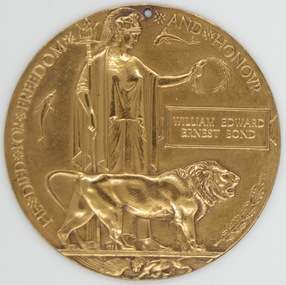
Memorial Plaque and Scroll, Dead Man's Penny, World war One
... token of gratitude should be given to the fallen service men and women's bereaved next of kin. Production of the plaques and scrolls, which was supposed to be financed by the German reparation money began in 1919 with approximately 1,150,00 issued. There were some relatives who returned the pennies to the Australian...token of gratitude should be given to the fallen service men and women's bereaved next of kin. Production of the plaques and scrolls, which was supposed to be financed by the German reparation money began in 1919 with approximately 1,150,00 issued. There were some relatives who returned the pennies to the Australian ...Bronze Memorial plaque and Memorial Scroll issued to families whose relative was killed in action during word war 1. The history of the dead man's penny began in 1916 with the realisation by the British Government hat some form of an official token of gratitude should be given to the fallen service men and women's bereaved next of kin. Production of the plaques and scrolls, which was supposed to be financed by the German reparation money began in 1919 with approximately 1,150,00 issued. There were some relatives who returned the pennies to the Australian Government in protest as b they felt it was insulting and it did not replace their loved one's life.Killed in Action William Edward Ernest Bond joined the 58th Bn on the 24th November 1915 as a labourer from Geelong. As a private (4296), he was sent to France and the Western Front. He initially went missing in action in the Fleurbaix area on 19th of July 1917. It took a court of Inquiry in the field in September,1917 to determine he was killed in action, although his body was never recovered. He died aged 18. His name can be found on Panel 14, VC Corner Australian Cemetery and Memorial, Fromelles, Lille, Nord Pas de Calais, FranceMemorial Bronze Plaque and Scroll. The Memorial Plaque was also known as the WW1 'Death Penny' in memory of William Edward Ernest BONDBrass Plaque " He died for Freedom and Honour William Edward Ernest Bond" Scroll Commemoration to Pte Edward Ernest Bond 58th Bn AIFbrass memorial plaque and scroll dead man's penny bond william lara geelong killed in action world war one kia -
 Flagstaff Hill Maritime Museum and Village
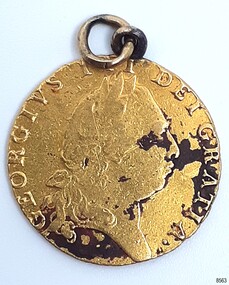
Currency - Guinea Coin, The Royal Mint, 1793 George III Spade Guinea, 1793
... Australian Colony. The historic and decorative George III Spade Guinea has been reproduced for special collections of coins. However, replicas and imitations have also been made as souvenirs for tourists, as gaming tokens and chips for gamblers, and as ‘fake’ coins for profit. ...Australian Colony. The historic and decorative George III Spade Guinea has been reproduced for special collections of coins. However, replicas and imitations have also been made as souvenirs for tourists, as gaming tokens and chips for gamblers, and as ‘fake’ coins for profit. ...The coin was discovered by Julie Wilkins, a Victorian scuba diver who had already experienced more than 500 dives in Australia and overseas. She was holidaying in Peterborough, Victoria, and looking forward to discovering more about the famous Loch Ard ship, wrecked in June 1878 at Mutton Bird Island. The fast Glasgow-built clipper ship was only five years old when the tragedy occurred. There were 54 people on board the vessel and only two survived Julie's holiday photograph of Boat Bay reminds her of her most memorable dive. Submerged in the calm, flat sea, she was carefully scanning around the remains of the old wreck when, to her amazement, a gold coin and a small gold cross suddenly came up towards her. She excitedly cupped them in her hands, then stowed the treasures safely in her wetsuit and continued her dive. She soon discovered a group of brass carriage clock parts and some bottles of champagne. It was a day full of surprises. The items were easily recognisable, without any build-up of encrustations or concretion. Julie secretly enjoyed her treasures for twenty-four years then packed them up for the early morning train trip to Warrnambool. After a short walk to Flagstaff Hill Maritime Museum and Village, her photograph was taken as she handed over her precious find. She told her story to a local newspaper reporter, lunched a café in town then took the late afternoon train home. Her generous donation is now part of a vast collection of Loch Ard shipwreck artefacts, including the gold watch and the Minton Majolica model peacock. The coin is a British 1793 George III Gold Spade Guinea. It was already 83 years old when the Loch Ard had set sail. The loop and ring have been added, perhaps as a pendant, pocket watch accessory or similar purpose. It may have been worn for ‘good luck’ on the long journey to Australia, where ships had to carefully navigate the treacherous Bass’s Strait before arriving at their destination of Melbourne. Sadly, many met their fate on that short stretch of ocean aptly named the Shipwreck Coast. The coin is very recognisable even though it was exposed to the wrecking of the ship, its consequent movement, and the sea's turbulence. Its bent, scratched, buckled, split, dinted and worn condition is part of its story. The red-brown-black discolouration is similar to that found on other gold coins, sometimes called the ‘corrosion phenomena’. Studies suggest the possible cause is contaminants in the minting process reacting to the coins’ environment. The GEORGE III GOLD SPADE GUINEA: - The British Guinea was introduced in 1663 and was circulated until 1814. It was made of 22 carat gold, was 25 to 26 cm in diameter and weighed 8.35 grams. It had a value of 21 British shillings. The guinea coin ceased circulation after 1816 and was replaced by the one-pound note. However, the term ‘guinea’ continued to represent 21 shillings. King George (1738-1820) had six gold guinea designs minted during his reign from 1760 and 1820. Each of the six had different obverse portraits, all facing the right. There were three different reverse sides. The Spade Guinea was the fifth issue of the coin, introduced in 1787 and produced until 1799. The reverse shows a royal crown over a flat-topped shield with the Royal Arms of Great Britain, used in Scotland between 1714 and 1800. The shield images are, from left to right, top to bottom, the Arms of England and Scotland, the Arms of France, the Arms of Ireland, and the Arms of the House of Hanover. The Gold Guinea is also part of Australia’s history. It was the first coin mentioned in the announcement of Governor King of New South Wales his Australian Proclamation of a limited variety and denomination of coins accepted for use in the Australian Colony. The historic and decorative George III Spade Guinea has been reproduced for special collections of coins. However, replicas and imitations have also been made as souvenirs for tourists, as gaming tokens and chips for gamblers, and as ‘fake’ coins for profit. These coins differ in many ways; they may be only half the weight of the genuine coin. Often have a small stamp on the obverse with “COPY” or the manufacturer’s name or initials. Some have scalloped edges, some have dates that are different to the original dates of issue, and some even have text in Latin that translates as something very different to the original coin.The King George III Guinea was only produced from 1663 to 1814 and was the first English coin to be mechanically minted. The coin is the fifth edition of the King George III Guinea, the Spade Guinea, was only produced between 1787 and 1799. It is the only edition with this portrait of King George and the only one with the Royal Coat of Arms of Great Britain in Scotland on the reverse side. This edition was also the last guinea in circulation, because the sixth edition was reserved as the Military guinea. This edition of the Guinea is unique; This coin is the only guinea in our collection. It was minted in 1793, so it is now over 230 years old. The Gold Guinea is part of Australia’s history; it was the first coin in the list of coins for use in the Australian Colonies, mentioned by Governor King of New South Wales in his Australian Proclamation speech of 1800. The George III Spade Guinea was included in the Limited Edition Sherwood 12 Coin Collection of Notable Coinage of Australia. This coin is the only known guinea coin recovered from the wreck of the Loch Ard. It was already 85 years old when the ship was wrecked.Gold coin; British. 1793, King George III of the United Kingdom of Great Britain and Ireland (1760-1820), Spade Guinea. Yellow gold coin with gold metal loop mount and a gold ring through the loop. The design is the fifth issue of the George III Gold Guinea. The obverse relief is a portrait of George III facing right. Reverse relief is a crown above the Coats of Arms (1801-1816) of flat top spade-shaped shield divided into four quadrants that depict crowned lions, fleur de lies, a harp. These images are identified as, from left to right, top to bottom, England and Scotland, France, Ireland and Hanover. Inscriptions are minted around the rims of each side. The coin is dated 1793. Its surface has dark areas on both sides and the reed edge and surfaces are well worn. The loop mount is bent and the ring is buckled. The coin was recovered from the wreck of the ship Loch Ard.Obverse text; 'GEORGIVS III DEI GRATIA' (translates to George the Third, by the Grace of God) Obverse relief; (King George III bust, facing right, laurel wreath on head) Reverse text; 'M.B.E.ET.H.REX.F. D.B.ET.L.D. S.R.I.A.T.ET.E' '1793' (translates to: King of Great Britain, France and Ireland, Defender of the Faith, Duke of Brunswick and Lüneburg, Arch-Treasurer and Elector of the Holy Roman Empire) Reverse relief; a spade-shaped image i.e. (Crown with fleer de lies, above Shield with crowned lions in different postures, a harp, and other details)flagstaff hill maritime museum and village, warrnambool, great ocean road, shipwreck coast, royal mint, british coin, currency, guinea, military guinea, australian currency, british guinea, gold coin, spade guinea, king george iii, george iii, fifth portrait, arms of england and scotland, arms of france, arms of ireland, arms of the house of hanover, coins, gold coins, gold medallion, georgian era, 1793, numismatics, contamination phenomena, gold corrosion, good luck, lucky charm, pendant, lucky coin, trade, loch ard, wreck of the loch ard, 1878, mutton bird island, peterborough, scuba diver, 1980s, guinea coin, gold guinea, shipwreck artefact, relic, julie wilkins -
 Flagstaff Hill Maritime Museum and Village
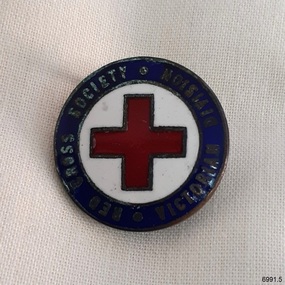
badge - Red Cross Society badge, Australian Red Cross Society, Victorian Division, 1914-1940s
... Australian Red Cross Society, which was formed on 21st August 1914 at the outbreak of the First World War. Stokes & Sons of Melbourne made the button. It was made by Stokes & Sons Pty. Ltd. in Melbourne. The maker, Thomas Stokes, migrated to Melbourne from Birmingham in 1854 and set up business in Mincer Lane as a die-sinker, producing medals, tokens, buttons and silverware, and offered an engraving service. ...Australian Red Cross Society, which was formed on 21st August 1914 at the outbreak of the First World War. Stokes & Sons of Melbourne made the button. It was made by Stokes & Sons Pty. Ltd. in Melbourne. The maker, Thomas Stokes, migrated to Melbourne from Birmingham in 1854 and set up business in Mincer Lane as a die-sinker, producing medals, tokens, buttons and silverware, and offered an engraving service. ...The badge represents the Victoria Division of the Australian Red Cross Society, which was formed on 21st August 1914 at the outbreak of the First World War. Stokes & Sons of Melbourne made the button. It was made by Stokes & Sons Pty. Ltd. in Melbourne. The maker, Thomas Stokes, migrated to Melbourne from Birmingham in 1854 and set up business in Mincer Lane as a die-sinker, producing medals, tokens, buttons and silverware, and offered an engraving service. He moved to Flinders Lane in 1856. After a time, in 1894, the business became Stokes & Sons Pty. Ltd, electroplates and badge makers at Post Office Place in Melbourne. The maker's mark 'Stokes & Sons' continued to be made on badges up until 1962. This badge is one of a set of badges collected by Dr W R Angus from the organisations in which he was involved. The set of badges is now part of Flagstaff Hill’s comprehensive W.R. Angus Collection, donated by the family of Dr W R Angus, surgeon and oculist. The W.R. Angus Collection: - The W.R. Angus Collection includes historical medical equipment, surgical instruments and material belonging to Dr Edward Ryan and Dr Thomas Francis Ryan, (both of Nhill, Victoria) and Dr Angus’ own belongings. The Collection’s history spans the medical practices of the two Doctors Ryan, from 1885-1926 plus that of Dr Angus, up until 1969. It includes historical medical and surgical equipment and instruments from the doctors Edward and Thomas Ryan of Nhill, Victoria. Dr Angus married Gladys in 1927 at Ballarat, the nearest big city to Nhill where he began as a Medical Assistant. He was also Acting House surgeon at the Nhill hospital where their two daughters were born. During World War II He served as a Military Doctor in the Australian Defence Forces. Dr Angus and his family moved to Warrnambool in 1939, where Dr Angus operated his own medical practice. He later added the part-time Port Medical Officer responsibility and was the last person appointed to that position. Both Dr Angus and his wife were very involved in the local community, including the planning stages of the new Flagstaff Hill and the layout of the gardens there. Dr Angus passed away in March 1970.This badge is significant for connecting Doctor Angus with organisations that he supported. The W.R. Angus Collection is significant for still being located at the site it is connected with, Doctor Angus being the last Port Medical Officer in Warrnambool. The Collection includes historical medical objects that date back to the late 1800s.Badge; a round metal and enamel badge with a blue band around the perimeter and a silver-edged red cross on a white background in the centre. The badge has a vertical pin on the back. It is the badge of the Victorian Division of the Red Cross Society. the maker was Stokes & Sons of Melbourne. This badge is part of a set of badges collected by Dr W R Angus. the set represents organisations that he was involved in, and is part of the W.R. Angus Collection.Printed within the blue band; “RED CROSS SOCIETY” “VICTORIAN DIVISION” Embossed on the reverse; “STOKES & SONS / MELB” flagstaff hill, warrnambool, maritime village, maritime museum, shipwreck coast, great ocean road, w.r. angus, badge, organisation badge, flagstaff hill maritime museum and village, australian red cross, victorian division, charity, volunteer organisation, w.r. angus collection -
 Greensborough Historical Society
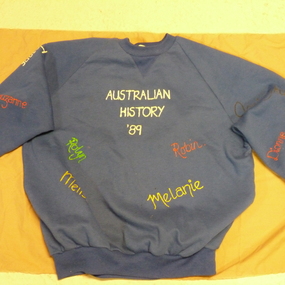
Clothing and photograph, Windcheater and photograph, Watsonia High 1989, 1989_
... Australian History class. Students have painted their names on the garment and included an unofficial 'class photo' with the windcheater. Rosie was a mature age student in this class. A token ...Windcheater presented to Rosie Bray by classmates at Watsonia High, 1989 Australian History class. Students have painted their names on the garment and included an unofficial 'class photo' with the windcheater. Rosie was a mature age student in this class.A token of friendship from Rosie's classmates at Watsonia High.Blue windcheater, size M, accompanied by photograph of students.Painted in white letters on front of windcheater 'Australian History '89'. Scattered on garment are the names of class members.rosalie bray, watsonia high school -
 Orbost & District Historical Society
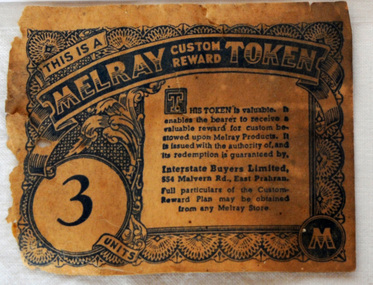
token, mid 20th century
... tokens for redemption in-store. It is most likely that Melray jam was produced by Henry Jones’ Australasian Jam Company, or at least labelled at the iconic Jam Factory in South Yarra, Melbourne – a site of jam production in Australia for almost 100 years. ...tokens for redemption in-store. It is most likely that Melray jam was produced by Henry Jones’ Australasian Jam Company, or at least labelled at the iconic Jam Factory in South Yarra, Melbourne – a site of jam production in Australia for almost 100 years. ..." As well as preserving companies, various grocery chains, buying groups and wholesale co-operatives sold jam under their own brand names. One such company was Melray. Melray, founded in East Prahran, Melbourne, in 1932, was the forerunner of the Foodland chain (1958). It had branches across the country. Their jam labels included special reward tokens for redemption in-store. It is most likely that Melray jam was produced by Henry Jones’ Australasian Jam Company, or at least labelled at the iconic Jam Factory in South Yarra, Melbourne – a site of jam production in Australia for almost 100 years. Many Melray labels were discovered there, when the site was converted to a shopping centre in the 1970s, a period of industry-wide decline." (Information from australiapostcollectables web-site) The Melray Association of Independent Grocers consisted of the leading storekeepers throughout the State of Victoria, with a central headquarters and bulk store in Melbourne.These tokens were issued by Melray Stores as a reward for custom. This item is associated with the period when Australia produced and exported much more of its agricultural produce - including tinned jam.A paper token - Melray Custom Reward Token. This is a reward token issued by Melray for regular custom - 3 units.melray grocery-store custom commerce -
 Orbost & District Historical Society
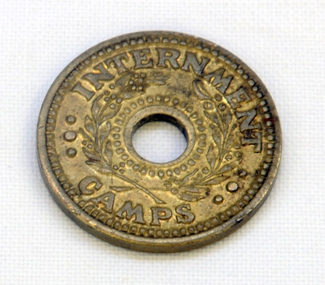
coin, Arendsen & Sons, WW11
... For security reasons, tokens were used in Australian WW11 Internment Camps. They were introduced in 19433 to replace the paper canteen coupons. ...For security reasons, tokens were used in Australian WW11 Internment Camps. They were introduced in 19433 to replace the paper canteen coupons. ...For security reasons, tokens were used in Australian WW11 Internment Camps. They were introduced in 19433 to replace the paper canteen coupons. This token was used at the internment camp at Bete Bolong just outside Orbost during WW11. This camp was established in 1943 and was there until 1946. The internees had been transferred from the camp at Murchison East to provide farm labour. The coin was given to Lindsay Thomson when he was a student.This token was used at the Bete Bolong POW camp from 1943-1945. This camp housed Italian POWs, some of whom remained/returned after the war to settle in Orbost.An internment camp coin. This is a one penny coin token with a hole in the centre. It is made of brass.ONE PENNY INTERNMENT CAMPStoken ww11 bete-bolong internment-camp -
 Red Cliffs Military Museum
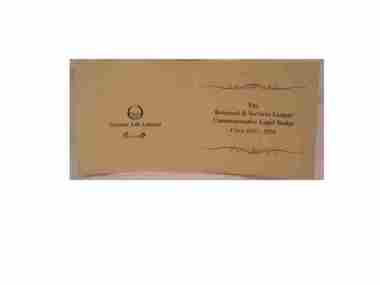
Badge Replica, Commemorative Badge R.S.L, (estimated); 1980-1990
... Australia./ Right side of paper: Oceanic Life is proud to present this commemorative Badge to you, as a small/ token of our continuing commitment to/ the Men and Women who have served/ their country. ...Australia./ Right side of paper: Oceanic Life is proud to present this commemorative Badge to you, as a small/ token of our continuing commitment to/ the Men and Women who have served/ their country. ...This reproduction of the first R.S.L. Badge is a Limited Edition released as a commemorative badge cira 1980-1990The First R.S.L. Badge/ This specially crafted lapel badge is a/limited edition replica of the very first/ R.S.L. badge which decorated our soldiers/ and sailors returning from WW1/ This badge was worn with Pride from/ 1919-1926 by the founding members of/ the R.S.L., as they Returned Home to a Victorious Australia./ Right side of paper: Oceanic Life is proud to present this commemorative Badge to you, as a small/ token of our continuing commitment to/ the Men and Women who have served/ their country. Reverse Sise left: Symbol of Oceanic Life Ltd./ Right side: The Returned & Services League/ Commemorative Lapel Badge/ Circ 1919-1926badge, r s l, commemorative, circa, 1980 1990 -
 Flagstaff Hill Maritime Museum and Village
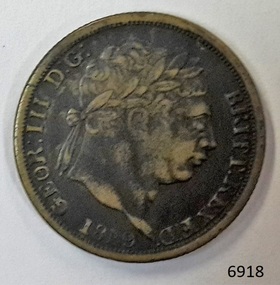
Currency - Coin, 1819
... Australia entered the Gold Rush period when many made their fortunes. Gold was used for trading, often shaped into ingots, stamped with their weight and purity, and one pound tokens. ...Australia entered the Gold Rush period when many made their fortunes. Gold was used for trading, often shaped into ingots, stamped with their weight and purity, and one pound tokens. ...This Great Britain shilling is dated 1819, the year before King George III died. There were over 7 million of these coins minted. King George III succeeded his grandfather, King George II, on the throne in 1760. He reigned until his death on 29th January 1820. The shield in the centre of the reverse of the coin is the Hanoverian Shield, showing that the House of Hanover was elected to the crown rather than taking the crown as a victory. This coin’s denomination is not inscribed on the coin but it has been identified as a shilling from information about the King George III currency 1816-1820. - The 6 pence coin is 19mm - This Shilling is 24mm (the same size as this coin) - The Half Crown is 32mm British coins such as this one shilling were in circulation in the colony of Australia until 1910, when the Commonwealth of Australia began producing its own coinage. This coin was minted by the Royal Mint at Royal Mint Court, in Little Tower Hill, London, England. Coins for circulation in the Kingdom of England, Great Britain and most of the British Empire were produced here until the 1960’s when the Royal Mint shifted location to Wales. The obverse side of the coin’s inscription translation is “George III by the Grace of God, King of the British territories, Defender of the Faith”. The engraver of the obverse image was Benedetto Pistrucci. The reverse side’s inscription on the coin is translated "Evil to him who evil thinks” The engraver of the reverse image was Thomas Wyon. AUSTRALIAN CURRENCY The early settlers of Australia brought their own currency with them so a wide variety of coins, tokens and even ‘promissory’ notes (often called IOU’s) were used in the exchange of goods and services. In 1813 40,000 silver Spanish dollars, purchased by the English government, were delivered to Sydney to help resolve the currency problem reported by Governor Macquarie. The coins were converted for use by punching a hole in the centre of the coin. Both the outer ring, called the holey dollar, and the punched out ‘hole’, called the dump, were then used as the official currency. The holey dollars hold the place of being the first distinctively Australian coins. In 1825 the British Government passed the Sterling Silver Currency Act, making the British Pound the only legal form of currency in the Australian colonies. Not enough British currency was imported into the colony so other forms of currency were still used. In the mid 1800’s Australia entered the Gold Rush period when many made their fortunes. Gold was used for trading, often shaped into ingots, stamped with their weight and purity, and one pound tokens. In 1852 the Adelaide Assay Office, without British approval, made Australia’s first gold coin to meet the need for currency in South Australia after the Gold Rush began. In 1855 the official Australian Mint opened in Sydney, operating as a branch of the Royal Mint in London, and the gold was turned into coins called ‘sovereigns’. Other branches also opened in Melbourne and Perth. Up to the time Australia became a federation in 1901 its currency included British copper and silver coins, Australian gold sovereigns, locally minted copper trade tokens, private banknotes, New South Wales and Queensland government treasury notes and Queensland government banknotes. After Federation, the Australian government began to overwrite privately issued notes and prepared for the introduction of its own currency. In 1910 a National Australian Currency was formed, based on the British currency of ‘pounds, shillings and pence’ and the first Commonwealth coining was produced. In 1966, on February 14th, Australia changed over to the decimal currency system of dollars and cents. Australia did not have its own currency in the colonial times. Settlers brought money from other countries and they also traded goods such as grain when currency was scarce. For a long time there was no standardised value for the different currencies. In 1825 British currency became the only official currency in the colony of Australia and coins such as this silver shilling were imported into Australia to replace the mixture of foreign currency. Australia became a Federated nation on 1st January 1901. In 1910 National Australian Currency was formed and Australia produced its own currency, based on the British ‘pounds, shillings and pence’. The British currency was no longer valid. This silver shilling is of national significance as it represents the British currency used in Australia from 1825-1910. Coin, Great Britain shilling, 1819. Silver coin, round. Obverse; King George III head, looking right. Reverse; crown on top of quartered shield, 2 diagonally opposite quarters both show 3 lions, another quarter has a rampant lion, another quarter has a harp; in the centre of the shield is a small crowned shield with 3 symbols that appear to be lions. Inscriptions on both sides of coin (denomination not inscribed).Obverse “GEOR . III D . G . BRITT . REX F . D .” and “1819” Reverse “HONI . SOIT . Q [UI obscured] . MAL . Y . PENSE” flagstaff hill, warrnambool, shipwrecked coast, flagstaff hill maritime museum, maritime museum, shipwreck coast, flagstaff hill maritime village, great ocean road, coin, currency, money, legal tender, australian currency history, royal mint, great britain shilling 1819, king george iii currency, colonial australia currency, benedetto pistrucci, thomas wyon, numismatics -
 Flagstaff Hill Maritime Museum and Village
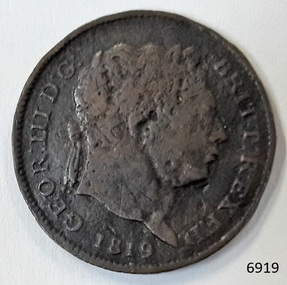
Currency - Coin, 1819
... Australia entered the Gold Rush period when many made their fortunes. Gold was used for trading, often shaped into ingots, stamped with their weight and purity, and one pound tokens. ...Australia entered the Gold Rush period when many made their fortunes. Gold was used for trading, often shaped into ingots, stamped with their weight and purity, and one pound tokens. ...This Great Britain shilling is dated 1819, the year before King George III died. There were over 7 million of these coins minted. King George III succeeded his grandfather, King George II, on the throne in 1760. He reigned until his death on 29th January 1820. The shield in the centre of the reverse of the coin is the Hanoverian Shield, showing that the House of Hanover was elected to the crown rather than taking the crown as a victory. This coin’s denomination is not inscribed on the coin but it has been identified as a shilling from information about the King George III currency 1816-1820. - The 6 pence coin is 19mm - This Shilling is 24mm (the same size as this coin) - The Half Crown is 32mm British coins such as this one shilling were in circulation in the colony of Australia until 1910, when the Commonwealth of Australia began producing its own coinage. This coin was minted by the Royal Mint at Royal Mint Court, in Little Tower Hill, London, England. Coins for circulation in the Kingdom of England, Great Britain and most of the British Empire were produced here until the 1960’s when the Royal Mint shifted location to Wales. The obverse side of the coin’s inscription translation is “George III by the Grace of God, King of the British territories, Defender of the Faith”. The engraver of the obverse image was Benedetto Pistrucci. The reverse side’s inscription on the coin is translated "Evil to him who evil thinks” The engraver of the reverse image was Thomas Wyon. AUSTRALIAN CURRENCY The early settlers of Australia brought their own currency with them so a wide variety of coins, tokens and even ‘promissory’ notes (often called IOU’s) were used in the exchange of goods and services. In 1813 40,000 silver Spanish dollars, purchased by the English government, were delivered to Sydney to help resolve the currency problem reported by Governor Macquarie. The coins were converted for use by punching a hole in the centre of the coin. Both the outer ring, called the holey dollar, and the punched out ‘hole’, called the dump, were then used as the official currency. The holey dollars hold the place of being the first distinctively Australian coins. In 1825 the British Government passed the Sterling Silver Currency Act, making the British Pound the only legal form of currency in the Australian colonies. Not enough British currency was imported into the colony so other forms of currency were still used. In the mid 1800’s Australia entered the Gold Rush period when many made their fortunes. Gold was used for trading, often shaped into ingots, stamped with their weight and purity, and one pound tokens. In 1852 the Adelaide Assay Office, without British approval, made Australia’s first gold coin to meet the need for currency in South Australia after the Gold Rush began. In 1855 the official Australian Mint opened in Sydney, operating as a branch of the Royal Mint in London, and the gold was turned into coins called ‘sovereigns’. Other branches also opened in Melbourne and Perth. Up to the time of Australia becoming a federation in 1901 its currency included British copper and silver coins, Australian gold sovereigns, locally minted copper trade tokens, private banknotes, New South Wales and Queensland government treasury notes and Queensland government banknotes. After Federation the Australian government began to overwrite privately issued notes and prepared for the introduction of its own currency. In 1910 a National Australian Currency was formed, based on the British currency of ‘pounds, shillings and pence’ and the first Commonwealth coining was produced. In 1966, on February 14th, Australia changed over to the decimal currency system of dollars and cents. Australia did not have its own currency in the colonial times. Settlers brought money from other countries and they also traded goods such as grain when currency was scarce. For a long time there was no standardised value for the different currencies. In 1825 British currency became the only official currency in the colony of Australia and coins such as this silver shilling were imported into Australia to replace the mixture of foreign currency. Australia became a Federated nation on 1st January 1901. In 1910 National Australian Currency was formed and Australia produced its own currency, based on the British ‘pounds, shillings and pence’. The British currency was no longer valid. This silver shilling is of national significance as it represents the British currency used in Australia from 1825-1910. Coin, Great Britain shilling, 1819. Silver coin, round. Obverse; King George III head, looking right. Reverse; crown on top of quartered shield, 2 diagonally opposite quarters each show 3 lions, another quarter has a rampant lion, another quarter has a harp; in the centre of the shield is a small crowned shield with 3 symbols that appear to be lions. Inscriptions on both sides of coin (denomination not inscribed).Obverse “GEOR . III D . G . BRITT . REX F . D .” and “1819” Reverse “HONI . SOIT . Q [UI obscured] . MAL . Y . PENSE” flagstaff hill, warrnambool, shipwrecked coast, flagstaff hill maritime museum, maritime museum, shipwreck coast, flagstaff hill maritime village, great ocean road, coin, currency, money, legal tender, australian currency history, royal mint, great britain shilling 1819, king george iii currency, colonial australia currency, benedetto pistrucci, thomas wyon, numismatics -
 Flagstaff Hill Maritime Museum and Village
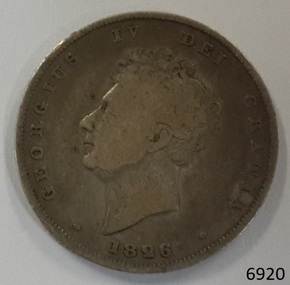
Currency - Coin, 1826
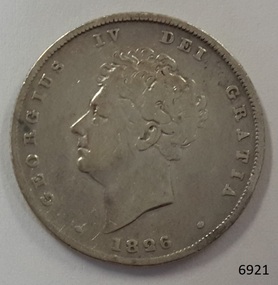
... Australia entered the Gold Rush period when many made their fortunes. Gold was used for trading, often shaped into ingots, stamped with their weight and purity, and one pound tokens. ...Australia entered the Gold Rush period when many made their fortunes. Gold was used for trading, often shaped into ingots, stamped with their weight and purity, and one pound tokens. ...This Great Britain shilling is dated 1826. There were over 6 million of these coins minted during the reign of King George IV, 1820-1830 This coin’s denomination is not inscribed on the coin but it has been identified as a shilling from information about the King George III currency 1816-1820. - This Shilling is 24mm (the same size as this coin) British coins such as this one shilling were in circulation in the colony of Australia until 1910, when the Commonwealth of Australia began producing its own coinage. This coin was minted by the Royal Mint at Royal Mint Court, in Little Tower Hill, London, England. Coins for circulation in the Kingdom of England, Great Britain and most of the British Empire were produced here until the 1960’s when the Royal Mint shifted location to Wales. The obverse side of the coin’s inscription translation is “George IV by the Grace of God”. The engraver of the obverse image was William Wyon. The reverse side’s inscription on the coin is translated " King of The British territories, Defender of the Faith” The engraver of the reverse image was William Wyon. AUSTRALIAN CURRENCY The early settlers of Australia brought their own currency with them so a wide variety of coins, tokens and even ‘promissory’ notes (often called IOU’s) were used in the exchange of goods and services. In 1813 40,000 silver Spanish dollars, purchased by the English government, were delivered to Sydney to help resolve the currency problem reported by Governor Macquarie. The coins were converted for use by punching a hole in the centre of the coin. Both the outer ring, called the holey dollar, and the punched out ‘hole’, called the dump, were then used as the official currency. The holey dollars hold the place of being the first distinctively Australian coins. In 1825 the British Government passed the Sterling Silver Currency Act, making the British Pound the only legal form of currency in the Australian colonies. Not enough British currency was imported into the colony so other forms of currency were still used. In the mid 1800’s Australia entered the Gold Rush period when many made their fortunes. Gold was used for trading, often shaped into ingots, stamped with their weight and purity, and one pound tokens. In 1852 the Adelaide Assay Office, without British approval, made Australia’s first gold coin to meet the need for currency in South Australia after the Gold Rush began. In 1855 the official Australian Mint opened in Sydney, operating as a branch of the Royal Mint in London, and the gold was turned into coins called ‘sovereigns’. Other branches also opened in Melbourne and Perth. Up to the time of Australia becoming a federation in 1901 its currency included British copper and silver coins, Australian gold sovereigns, locally minted copper trade tokens, private banknotes, New South Wales and Queensland government treasury notes and Queensland government banknotes. After Federation the Australian government began to overwrite privately issued notes and prepared for the introduction of its own currency. In 1910 a National Australian Currency was formed, based on the British currency of ‘pounds, shillings and pence’ and the first Commonwealth coining was produced. In 1966, on February 14th, Australia changed over to the decimal currency system of dollars and cents. Australia did not have its own currency in the colonial times. Settlers brought money from other countries and they also traded goods such as grain when currency was scarce. For a long time there was no standardised value for the different currencies. In 1825 British currency became the only official currency in the colony of Australia and coins such as this silver shilling were imported into Australia to replace the mixture of foreign currency. Australia became a Federated nation on 1st January 1901. In 1910 National Australian Currency was formed and Australia produced its own currency, based on the British ‘pounds, shillings and pence’. The British currency was no longer valid. This silver shilling is of national significance as it represents the British currency used in Australia from 1825-1910. Coin, Great Britain shilling. 1826. Silver coin, round. Obverse; King George IV bare head, looking left. Reverse; crowned lion; below, a large crown; below are a shamrock, rose and thistle united. Inscriptions on both sides of coin (denomination not inscribed).Obverse “GEORGIUS IV DEI GRATIA” and “1826” Reverse “BRITANNIARUM REX FIDEI DEFENSOR” flagstaff hill, warrnambool, shipwrecked coast, flagstaff hill maritime museum, maritime museum, shipwreck coast, flagstaff hill maritime village, great ocean road, coin, currency, money, legal tender, australian currency history, royal mint, great britain shilling 1826, king george iv currency, colonial australia currency, william wyon, numismatics -
 Flagstaff Hill Maritime Museum and Village
Currency - Coin, 1826
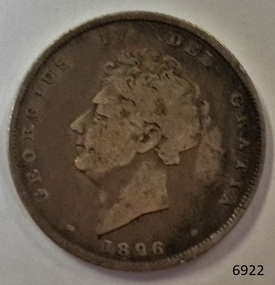
... Australia entered the Gold Rush period when many made their fortunes. Gold was used for trading, often shaped into ingots, stamped with their weight and purity, and one pound tokens. ...Australia entered the Gold Rush period when many made their fortunes. Gold was used for trading, often shaped into ingots, stamped with their weight and purity, and one pound tokens. ...This Great Britain shilling is dated 1826. There were over 6 million of these coins minted during the reign of King George IV, 1820-1830 This coin’s denomination is not inscribed on the coin but it has been identified as a shilling from information about the King George III currency 1816-1820. - This Shilling is 24mm (the same size as this coin) British coins such as this one shilling were in circulation in the colony of Australia until 1910, when the Commonwealth of Australia began producing its own coinage. This coin was minted by the Royal Mint at Royal Mint Court, in Little Tower Hill, London, England. Coins for circulation in the Kingdom of England, Great Britain and most of the British Empire were produced here until the 1960’s when the Royal Mint shifted location to Wales. The obverse side of the coin’s inscription translation is “George IV by the Grace of God”. The engraver of the obverse image was William Wyon. The reverse side’s inscription on the coin is translated " King of The British territories, Defender of the Faith” The engraver of the reverse image was William Wyon. AUSTRALIAN CURRENCY The early settlers of Australia brought their own currency with them so a wide variety of coins, tokens and even ‘promissory’ notes (often called IOU’s) were used in the exchange of goods and services. In 1813 40,000 silver Spanish dollars, purchased by the English government, were delivered to Sydney to help resolve the currency problem reported by Governor Macquarie. The coins were converted for use by punching a hole in the centre of the coin. Both the outer ring, called the holey dollar, and the punched out ‘hole’, called the dump, were then used as the official currency. The holey dollars hold the place of being the first distinctively Australian coins. In 1825 the British Government passed the Sterling Silver Currency Act, making the British Pound the only legal form of currency in the Australian colonies. Not enough British currency was imported into the colony so other forms of currency were still used. In the mid 1800’s Australia entered the Gold Rush period when many made their fortunes. Gold was used for trading, often shaped into ingots, stamped with their weight and purity, and one pound tokens. In 1852 the Adelaide Assay Office, without British approval, made Australia’s first gold coin to meet the need for currency in South Australia after the Gold Rush began. In 1855 the official Australian Mint opened in Sydney, operating as a branch of the Royal Mint in London, and the gold was turned into coins called ‘sovereigns’. Other branches also opened in Melbourne and Perth. Up to the time of Australia becoming a federation in 1901 its currency included British copper and silver coins, Australian gold sovereigns, locally minted copper trade tokens, private banknotes, New South Wales and Queensland government treasury notes and Queensland government banknotes. After Federation the Australian government began to overwrite privately issued notes and prepared for the introduction of its own currency. In 1910 a National Australian Currency was formed, based on the British currency of ‘pounds, shillings and pence’ and the first Commonwealth coining was produced. In 1966, on February 14th, Australia changed over to the decimal currency system of dollars and cents. Australia did not have its own currency in the colonial times. Settlers brought money from other countries and they also traded goods such as grain when currency was scarce. For a long time there was no standardised value for the different currencies. In 1825 British currency became the only official currency in the colony of Australia and coins such as this silver shilling were imported into Australia to replace the mixture of foreign currency. Australia became a Federated nation on 1st January 1901. In 1910 National Australian Currency was formed and Australia produced its own currency, based on the British ‘pounds, shillings and pence’. The British currency was no longer valid. This silver shilling is of national significance as it represents the British currency used in Australia from 1825-1910. Coin, Great Britain shilling. 1826. Silver coin, round. Obverse; King George IV bare head, looking left. Reverse; crowned lion; below, a large crown; below are a shamrock, rose and thistle united. Inscriptions on both sides of coin (denomination not inscribed).Obverse “GEORGIUS IV DEI GRATIA” and “1826” Reverse “BRITANNIARUM REX FIDEI DEFENSOR” flagstaff hill, warrnambool, shipwrecked coast, flagstaff hill maritime museum, maritime museum, shipwreck coast, flagstaff hill maritime village, great ocean road, coin, currency, money, legal tender, australian currency history, royal mint, great britain shilling 1826, king george iv currency, colonial australia currency, william wyon, numismatics -
 Flagstaff Hill Maritime Museum and Village
Currency - Coin, 1826
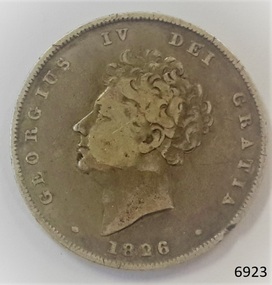
... Australia entered the Gold Rush period when many made their fortunes. Gold was used for trading, often shaped into ingots, stamped with their weight and purity, and one pound tokens. ...Australia entered the Gold Rush period when many made their fortunes. Gold was used for trading, often shaped into ingots, stamped with their weight and purity, and one pound tokens. ...This Great Britain shilling is dated 1826. There were over 6 million of these coins minted during the reign of King George IV, 1820-1830 This coin’s denomination is not inscribed on the coin but it has been identified as a shilling from information about the King George III currency 1816-1820. - This Shilling is 24mm (the same size as this coin) British coins such as this one shilling were in circulation in the colony of Australia until 1910, when the Commonwealth of Australia began producing its own coinage. This coin was minted by the Royal Mint at Royal Mint Court, in Little Tower Hill, London, England. Coins for circulation in the Kingdom of England, Great Britain and most of the British Empire were produced here until the 1960’s when the Royal Mint shifted location to Wales. The obverse side of the coin’s inscription translation is “George IV by the Grace of God”. The engraver of the obverse image was William Wyon. The reverse side’s inscription on the coin is translated " King of The British territories, Defender of the Faith” The engraver of the reverse image was William Wyon. AUSTRALIAN CURRENCY The early settlers of Australia brought their own currency with them so a wide variety of coins, tokens and even ‘promissory’ notes (often called IOU’s) were used in the exchange of goods and services. In 1813 40,000 silver Spanish dollars, purchased by the English government, were delivered to Sydney to help resolve the currency problem reported by Governor Macquarie. The coins were converted for use by punching a hole in the centre of the coin. Both the outer ring, called the holey dollar, and the punched out ‘hole’, called the dump, were then used as the official currency. The holey dollars hold the place of being the first distinctively Australian coins. In 1825 the British Government passed the Sterling Silver Currency Act, making the British Pound the only legal form of currency in the Australian colonies. Not enough British currency was imported into the colony so other forms of currency were still used. In the mid 1800’s Australia entered the Gold Rush period when many made their fortunes. Gold was used for trading, often shaped into ingots, stamped with their weight and purity, and one pound tokens. In 1852 the Adelaide Assay Office, without British approval, made Australia’s first gold coin to meet the need for currency in South Australia after the Gold Rush began. In 1855 the official Australian Mint opened in Sydney, operating as a branch of the Royal Mint in London, and the gold was turned into coins called ‘sovereigns’. Other branches also opened in Melbourne and Perth. Up to the time of Australia becoming a federation in 1901 its currency included British copper and silver coins, Australian gold sovereigns, locally minted copper trade tokens, private banknotes, New South Wales and Queensland government treasury notes and Queensland government banknotes. After Federation the Australian government began to overwrite privately issued notes and prepared for the introduction of its own currency. In 1910 a National Australian Currency was formed, based on the British currency of ‘pounds, shillings and pence’ and the first Commonwealth coining was produced. In 1966, on February 14th, Australia changed over to the decimal currency system of dollars and cents. Australia did not have its own currency in the colonial times. Settlers brought money from other countries and they also traded goods such as grain when currency was scarce. For a long time there was no standardised value for the different currencies. In 1825 British currency became the only official currency in the colony of Australia and coins such as this silver shilling were imported into Australia to replace the mixture of foreign currency. Australia became a Federated nation on 1st January 1901. In 1910 National Australian Currency was formed and Australia produced its own currency, based on the British ‘pounds, shillings and pence’. The British currency was no longer valid. This silver shilling is of national significance as it represents the British currency used in Australia from 1825-1910. Coin, Great Britain shilling. 1826. Silver coin, round. Obverse; King George IV bare head, looking left. Reverse; crowned lion; below, a large crown; below are a shamrock, rose and thistle united. Inscriptions on both sides of coin (denomination not inscribed).Obverse “GEORGIUS IV DEI GRATIA” and “1826” Reverse “BRITANNIARUM REX FIDEI DEFENSOR” flagstaff hill, warrnambool, shipwrecked coast, flagstaff hill maritime museum, maritime museum, shipwreck coast, flagstaff hill maritime village, great ocean road, coin, currency, money, legal tender, australian currency history, royal mint, great britain shilling 1826, king george iv currency, colonial australia currency, william wyon, numismatics -
 Flagstaff Hill Maritime Museum and Village
Currency - Coin, 1826
... Australia entered the Gold Rush period when many made their fortunes. Gold was used for trading, often shaped into ingots, stamped with their weight and purity, and one pound tokens. ...Australia entered the Gold Rush period when many made their fortunes. Gold was used for trading, often shaped into ingots, stamped with their weight and purity, and one pound tokens. ...This Great Britain shilling is dated 1826. There were over 6 million of these coins minted during the reign of King George IV, 1820-1830 This coin’s denomination is not inscribed on the coin but it has been identified as a shilling from information about the King George III currency 1816-1820. - This Shilling is 24mm (the same size as this coin) British coins such as this one shilling were in circulation in the colony of Australia until 1910, when the Commonwealth of Australia began producing its own coinage. This coin was minted by the Royal Mint at Royal Mint Court, in Little Tower Hill, London, England. Coins for circulation in the Kingdom of England, Great Britain and most of the British Empire were produced here until the 1960’s when the Royal Mint shifted location to Wales. The obverse side of the coin’s inscription translation is “George IV by the Grace of God”. The engraver of the obverse image was William Wyon. The reverse side’s inscription on the coin is translated " King of The British territories, Defender of the Faith” The engraver of the reverse image was William Wyon. AUSTRALIAN CURRENCY The early settlers of Australia brought their own currency with them so a wide variety of coins, tokens and even ‘promissory’ notes (often called IOU’s) were used in the exchange of goods and services. In 1813 40,000 silver Spanish dollars, purchased by the English government, were delivered to Sydney to help resolve the currency problem reported by Governor Macquarie. The coins were converted for use by punching a hole in the centre of the coin. Both the outer ring, called the holey dollar, and the punched out ‘hole’, called the dump, were then used as the official currency. The holey dollars hold the place of being the first distinctively Australian coins. In 1825 the British Government passed the Sterling Silver Currency Act, making the British Pound the only legal form of currency in the Australian colonies. Not enough British currency was imported into the colony so other forms of currency were still used. In the mid 1800’s Australia entered the Gold Rush period when many made their fortunes. Gold was used for trading, often shaped into ingots, stamped with their weight and purity, and one pound tokens. In 1852 the Adelaide Assay Office, without British approval, made Australia’s first gold coin to meet the need for currency in South Australia after the Gold Rush began. In 1855 the official Australian Mint opened in Sydney, operating as a branch of the Royal Mint in London, and the gold was turned into coins called ‘sovereigns’. Other branches also opened in Melbourne and Perth. Up to the time of Australia becoming a federation in 1901 its currency included British copper and silver coins, Australian gold sovereigns, locally minted copper trade tokens, private banknotes, New South Wales and Queensland government treasury notes and Queensland government banknotes. After Federation the Australian government began to overwrite privately issued notes and prepared for the introduction of its own currency. In 1910 a National Australian Currency was formed, based on the British currency of ‘pounds, shillings and pence’ and the first Commonwealth coining was produced. In 1966, on February 14th, Australia changed over to the decimal currency system of dollars and cents. Australia did not have its own currency in the colonial times. Settlers brought money from other countries and they also traded goods such as grain when currency was scarce. For a long time there was no standardised value for the different currencies. In 1825 British currency became the only official currency in the colony of Australia and coins such as this silver shilling were imported into Australia to replace the mixture of foreign currency. Australia became a Federated nation on 1st January 1901. In 1910 National Australian Currency was formed and Australia produced its own currency, based on the British ‘pounds, shillings and pence’. The British currency was no longer valid. This silver shilling is of national significance as it represents the British currency used in Australia from 1825-1910. Coin, Great Britain shilling. 1826. Silver coin, round. Obverse; King George IV bare head, looking left. Reverse; crowned lion; below, a large crown; below are a shamrock, rose and thistle united. Inscriptions on both sides of coin (denomination not inscribed).Obverse “GEORGIUS IV DEI GRATIA” and “1826” Reverse “BRITANNIARUM REX FIDEI DEFENSOR” flagstaff hill, warrnambool, shipwrecked coast, flagstaff hill maritime museum, maritime museum, shipwreck coast, flagstaff hill maritime village, great ocean road, coin, currency, money, legal tender, australian currency history, royal mint, great britain shilling 1826, king george iv currency, colonial australia currency, william wyon, numismatics -
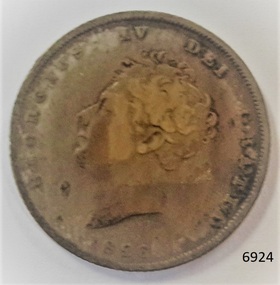 Flagstaff Hill Maritime Museum and Village
Currency - Coin, 1826
... Australia entered the Gold Rush period when many made their fortunes. Gold was used for trading, often shaped into ingots, stamped with their weight and purity, and one pound tokens. ...Australia entered the Gold Rush period when many made their fortunes. Gold was used for trading, often shaped into ingots, stamped with their weight and purity, and one pound tokens. ...This Great Britain shilling is dated 1826. There were over 6 million of these coins minted during the reign of King George IV, 1820-1830 This coin’s denomination is not inscribed on the coin but it has been identified as a shilling from information about the King George III currency 1816-1820. - This Shilling is 24mm (the same size as this coin) British coins such as this one shilling were in circulation in the colony of Australia until 1910, when the Commonwealth of Australia began producing its own coinage. This coin was minted by the Royal Mint at Royal Mint Court, in Little Tower Hill, London, England. Coins for circulation in the Kingdom of England, Great Britain and most of the British Empire were produced here until the 1960’s when the Royal Mint shifted location to Wales. The obverse side of the coin’s inscription translation is “George IV by the Grace of God”. The engraver of the obverse image was William Wyon. The reverse side’s inscription on the coin is translated " King of The British territories, Defender of the Faith” The engraver of the reverse image was William Wyon. AUSTRALIAN CURRENCY The early settlers of Australia brought their own currency with them so a wide variety of coins, tokens and even ‘promissory’ notes (often called IOU’s) were used in the exchange of goods and services. In 1813 40,000 silver Spanish dollars, purchased by the English government, were delivered to Sydney to help resolve the currency problem reported by Governor Macquarie. The coins were converted for use by punching a hole in the centre of the coin. Both the outer ring, called the holey dollar, and the punched out ‘hole’, called the dump, were then used as the official currency. The holey dollars hold the place of being the first distinctively Australian coins. In 1825 the British Government passed the Sterling Silver Currency Act, making the British Pound the only legal form of currency in the Australian colonies. Not enough British currency was imported into the colony so other forms of currency were still used. In the mid 1800’s Australia entered the Gold Rush period when many made their fortunes. Gold was used for trading, often shaped into ingots, stamped with their weight and purity, and one pound tokens. In 1852 the Adelaide Assay Office, without British approval, made Australia’s first gold coin to meet the need for currency in South Australia after the Gold Rush began. In 1855 the official Australian Mint opened in Sydney, operating as a branch of the Royal Mint in London, and the gold was turned into coins called ‘sovereigns’. Other branches also opened in Melbourne and Perth. Up to the time of Australia becoming a federation in 1901 its currency included British copper and silver coins, Australian gold sovereigns, locally minted copper trade tokens, private banknotes, New South Wales and Queensland government treasury notes and Queensland government banknotes. After Federation the Australian government began to overwrite privately issued notes and prepared for the introduction of its own currency. In 1910 a National Australian Currency was formed, based on the British currency of ‘pounds, shillings and pence’ and the first Commonwealth coining was produced. In 1966, on February 14th, Australia changed over to the decimal currency system of dollars and cents. Australia did not have its own currency in the colonial times. Settlers brought money from other countries and they also traded goods such as grain when currency was scarce. For a long time there was no standardised value for the different currencies. In 1825 British currency became the only official currency in the colony of Australia and coins such as this silver shilling were imported into Australia to replace the mixture of foreign currency. Australia became a Federated nation on 1st January 1901. In 1910 National Australian Currency was formed and Australia produced its own currency, based on the British ‘pounds, shillings and pence’. The British currency was no longer valid. This silver shilling is of national significance as it represents the British currency used in Australia from 1825-1910. Coin, Great Britain shilling. 1826. Silver coin, round. Obverse; King George IV bare head, looking left. Reverse; crowned lion; below, a large crown; below are a shamrock, rose and thistle united. Inscriptions on both sides of coin (denomination not inscribed).Obverse “GEORGIUS IV DEI GRATIA” and “1826” Reverse “BRITANNIARUM REX FIDEI DEFENSOR” flagstaff hill, warrnambool, shipwrecked coast, flagstaff hill maritime museum, maritime museum, shipwreck coast, flagstaff hill maritime village, great ocean road, coin, currency, money, legal tender, australian currency history, royal mint, great britain shilling 1826, king george iv currency, colonial australia currency, william wyon, numismatics -
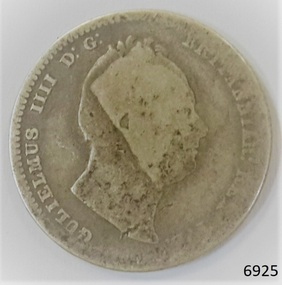 Flagstaff Hill Maritime Museum and Village
Currency - Coin, 1835
... Australia entered the Gold Rush period when many made their fortunes. Gold was used for trading, often shaped into ingots, stamped with their weight and purity, and one pound tokens. ...Australia entered the Gold Rush period when many made their fortunes. Gold was used for trading, often shaped into ingots, stamped with their weight and purity, and one pound tokens. ...This Great Britain shilling is dated 1835. There were over 3 million of these coins minted during the reign of King William IV, 1830-1837. British coins such as this one shilling were in circulation in the colony of Australia until 1910, when the Commonwealth of Australia began producing its own coinage. This coin was minted by the Royal Mint at Royal Mint Court, in Little Tower Hill, London, England. Coins for circulation in the Kingdom of England, Great Britain and most of the British Empire were produced here until the 1960’s when the Royal Mint shifted location to Wales. The obverse side of the coin’s inscription translation is “William IV by the Grace of God, King of the British territories, Defender of the Faith”. The engraver of the obverse image was William Wyon. The reverse side’s inscription on the coin is translated " King of The British territories, Defender of the Faith” The engraver of the reverse image was Jean Baptiste Merlen. AUSTRALIAN CURRENCY The early settlers of Australia brought their own currency with them so a wide variety of coins, tokens and even ‘promissory’ notes (often called IOU’s) were used in the exchange of goods and services. In 1813 40,000 silver Spanish dollars, purchased by the English government, were delivered to Sydney to help resolve the currency problem reported by Governor Macquarie. The coins were converted for use by punching a hole in the centre of the coin. Both the outer ring, called the holey dollar, and the punched out ‘hole’, called the dump, were then used as the official currency. The holey dollars hold the place of being the first distinctively Australian coins. In 1825 the British Government passed the Sterling Silver Currency Act, making the British Pound the only legal form of currency in the Australian colonies. Not enough British currency was imported into the colony so other forms of currency were still used. In the mid 1800’s Australia entered the Gold Rush period when many made their fortunes. Gold was used for trading, often shaped into ingots, stamped with their weight and purity, and one pound tokens. In 1852 the Adelaide Assay Office, without British approval, made Australia’s first gold coin to meet the need for currency in South Australia after the Gold Rush began. In 1855 the official Australian Mint opened in Sydney, operating as a branch of the Royal Mint in London, and the gold was turned into coins called ‘sovereigns’. Other branches also opened in Melbourne and Perth. Up to the time of Australia becoming a federation in 1901 its currency included British copper and silver coins, Australian gold sovereigns, locally minted copper trade tokens, private banknotes, New South Wales and Queensland government treasury notes and Queensland government banknotes. After Federation the Australian government began to overwrite privately issued notes and prepared for the introduction of its own currency. In 1910 a National Australian Currency was formed, based on the British currency of ‘pounds, shillings and pence’ and the first Commonwealth coining was produced. In 1966, on February 14th, Australia changed over to the decimal currency system of dollars and cents. Australia did not have its own currency in the colonial times. Settlers brought money from other countries and they also traded goods such as grain when currency was scarce. For a long time there was no standardised value for the different currencies. In 1825 British currency became the only official currency in the colony of Australia and coins such as this silver shilling were imported into Australia to replace the mixture of foreign currency. Australia became a Federated nation on 1st January 1901. In 1910 National Australian Currency was formed and Australia produced its own currency, based on the British ‘pounds, shillings and pence’. The British currency was no longer valid. This silver shilling is of national significance as it represents the British currency used in Australia from 1825-1910. Coin, Great Britain shilling. 1835. Silver coin, round. Obverse; King William IV bare head, looking right. Reverse; crown above denomination, surrounded by wreath, year below wreath. Inscription on both sides.Obverse “GULIELMUS IIII D : G : BRITANNIAR : REX F : D :” Reverse “ONE SHILLING” and “1835” flagstaff hill, warrnambool, shipwrecked coast, flagstaff hill maritime museum, maritime museum, shipwreck coast, flagstaff hill maritime village, great ocean road, coin, currency, money, legal tender, australian currency history, royal mint, great britain shilling 1835, king william iv currency, colonial australia currency, william wyon, jean baptiste merlen, numismatics -
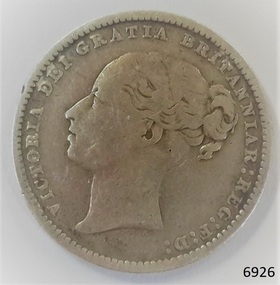 Flagstaff Hill Maritime Museum and Village
Currency - Coin, 1883
... Australia entered the Gold Rush period when many made their fortunes. Gold was used for trading, often shaped into ingots, stamped with their weight and purity, and one pound tokens. ...Australia entered the Gold Rush period when many made their fortunes. Gold was used for trading, often shaped into ingots, stamped with their weight and purity, and one pound tokens. ...This Great Britain one shilling coin is dated 1883, which is during the reign of Queen Victoria. There were over 7 million of these coins minted. Queen Victoria succeeded King William IV to the British Throne in 1837 – she was only 18 years old at the time – and she ruled until 1901. British coins such as this one shilling were in circulation in the colony of Australia until 1910, when the Commonwealth of Australia began producing its own coinage. This one shilling coin was minted by the Royal Mint at Royal Mint Court, in Little Tower Hill, London, England. Coins for circulation in the Kingdom of England, Great Britain and most of the British Empire were produced here until the 1960’s when the Royal Mint shifted location to Wales. There are three main groups of shillings produced during Queen Victoria’s reign:- - The Young Head; 1837-1887, in 8 different versions, on the obverse showing the Queen’s maturing face over 50 years. - The Junior Head; 1887-1892, minted when Queen Victoria had been reigning for 50 years. Her head was smaller on the coins minted 1887-1889 than on those shillings minted 1889-1892. - The Old Head; 1893-1901, shows the veiled head of Queen Victoria. The obverse side of the coin’s inscription translation is “Victoria by the Grace of God, Queen of the British territories, Defender of the Faith”. The engraver of the obverse image was William Wyon. The reverse side of the coin is inscribed "ONE SHILLING. The engraver of the reverse image was Jean Baptiste Merlen. AUSTRALIAN CURRENCY The early settlers of Australia brought their own currency with them so a wide variety of coins, tokens and even ‘promissory’ notes (often called IOU’s) were used in the exchange of goods and services. In 1813 40,000 silver Spanish dollars, purchased by the English government, were delivered to Sydney to help resolve the currency problem reported by Governor Macquarie. The coins were converted for use by punching a hole in the centre of the coin. Both the outer ring, called the holey dollar, and the punched out ‘hole’, called the dump, were then used as the official currency. The holey dollars hold the place of being the first distinctively Australian coins. In 1825 the British Government passed the Sterling Silver Currency Act, making the British Pound the only legal form of currency in the Australian colonies. Not enough British currency was imported into the colony so other forms of currency were still used. In the mid 1800’s Australia entered the Gold Rush period when many made their fortunes. Gold was used for trading, often shaped into ingots, stamped with their weight and purity, and one pound tokens. In 1852 the Adelaide Assay Office, without British approval, made Australia’s first gold coin to meet the need for currency in South Australia after the Gold Rush began. In 1855 the official Australian Mint opened in Sydney, operating as a branch of the Royal Mint in London, and the gold was turned into coins called ‘sovereigns’. Other branches also opened in Melbourne and Perth. Up to the time of Australia becoming a federation in 1901 its currency included British copper and silver coins, Australian gold sovereigns, locally minted copper trade tokens, private banknotes, New South Wales and Queensland government treasury notes and Queensland government banknotes. After Federation the Australian government began to overwrite privately issued notes and prepared for the introduction of its own currency. In 1910 a National Australian Currency was formed, based on the British currency of ‘pounds, shillings and pence’ and the first Commonwealth coining was produced. In 1966, on February 14th, Australia changed over to the decimal currency system of dollars and cents. Australia did not have its own currency in the colonial times. Settlers brought money from other countries and they also traded goods such as grain when currency was scarce. For a long time there was no standardised value for the different currencies. In 1825 British currency became the only official currency in the colony of Australia and coins such as this silver shilling were imported into Australia to replace the mixture of foreign currency. Australia became a Federated nation on 1st January 1901. In 1910 National Australian Currency was formed and Australia produced its own currency, based on the British ‘pounds, shillings and pence’. The British currency was no longer valid. This silver shilling is of national significance as it represents the British currency used in Australia from 1825-1910. Coin, Great Britain Shilling, 1883. Silver coin, round. Obverse; Queen Victoria head, ‘Young Head’, looking left. Reverse; crown on top of wreath. Inscriptions on both sides of coin.Obverse “VICTORIA DEI GRATIA BRITANNIAR: REG: F: D :” Reverse “ONE SHILLING, 1883” flagstaff hill, warrnambool, shipwrecked coast, flagstaff hill maritime museum, maritime museum, shipwreck coast, flagstaff hill maritime village, great ocean road, coin, currency, money, legal tender, australian currency history, royal mint, great britain shilling 1883, queen victoria currency, colonial australia currency, wlliam wyon, jean baptiste merlen, numismatics
