
Showing 213 items matching "border post"
-
 Wodonga & District Historical Society Inc
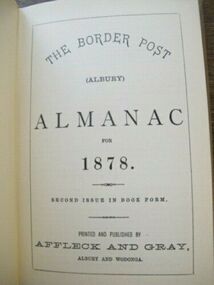
Book - The Border Post Almanac (Albury) for 1878, Library of Australian History, 1979
... The Border Post Almanac (Albury) for 1878...The Border Post Almanac (Albury) for 1878...This facsimile edition was printed in 1979. The Border Post Almanac (Albury) for 1878 Book The Border Post Almanac (Albury) for 1878 Library of Australian History Affleck and Gray ...Almanac printed as a directory of key businesses in the area of Albury Wodonga in 1848. Originally published by Affleck and Gray of Albury and Wodonga in 1848 as the second book form of this directory. This facsimile edition was printed in 1979.non-fictionAlmanac printed as a directory of key businesses in the area of Albury Wodonga in 1848. Originally published by Affleck and Gray of Albury and Wodonga in 1848 as the second book form of this directory. This facsimile edition was printed in 1979.business directory albury, business directory wodonga, historical business 1848 -
 Kiewa Valley Historical Society
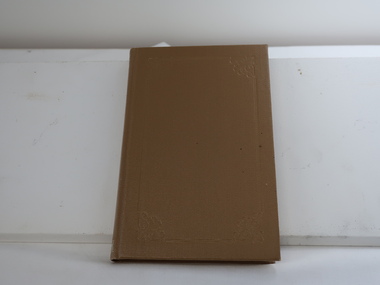
Book - Albury Almanac 1878, The Border Post published by Affleck and Gray
... The Border Post published by Affleck and Gray......Border Post...Each page has 'Border Post Almanac' in fancy print at the top, centre in a 'box'. ...Each page has 'Border Post Almanac' in fancy print at the top, centre in a 'box'. ...Published as a summary of 1878 newspaper's contentHistorical with samples for 1878 advertising, articles etc. in the Albury newspaper.Small light brown hard cover book 122 pages. Black print on cream colored pages. Each page has 'Border Post Almanac' in fancy print at the top, centre in a 'box'. Cover is embossed around the perimeter and in the corners.First page in ink "2-8-1979 / $11.75" and a stamp: "Kiewa Valley / Historical Society"albury almanac, border post, 1878 newspapers -
 Orbost & District Historical Society
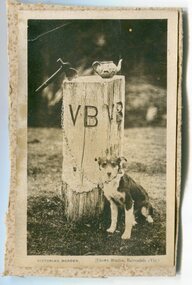
Photograph - V B post - Victorian Border, Crown Studios ( W Stanley Vogt), c.1920s-1950s
... V B post - Victorian Border...Border...Marker post...The Victorian/New South Wales border is near Genoa in Far East Gippsland. This post marked this border and was positioned beside the Highway. ...Victorian Border NSW Border Marker post Princes Highway Victorian Border. ...The Victorian/New South Wales border is near Genoa in Far East Gippsland. This post marked this border and was positioned beside the Highway. For many years, the border was an important stopping point because it also had a Fruit Fly inspection point for traffic coming into Victoria from N S Wales.This photograph is significant because it is a rare image of a marker post which was once very important. A b/w photograph/postcard of a square post, painted white with the letters W B stencilled into it. The post has a Tea Pot on top, and a small axe. A b/w dog is sitting nearby and appears to be attached to the post by a chain. Victorian Border. Crown Studios, Bairnsdale, Vic.victorian border, nsw border, marker post, princes highway -
 Glenelg Shire Council Cultural Collection
Negative - Negative - South Australia / Victorian border fence sign post, c. 1936
... Negative - South Australia / Victorian border fence sign post...Transparency for black and white photo. SA/Vic border fence. Sign post reading '22 miles to Mt Gambier, 2 1/2 miles to Nelson'. ...Transparency for black and white photo. SA/Vic border fence. Sign post reading '22 miles to Mt Gambier, 2 1/2 miles to Nelson'. ...Transparency for black and white photo. SA/Vic border fence. Sign post reading '22 miles to Mt Gambier, 2 1/2 miles to Nelson'. Nelson - Mt Gambier mail truck, with two men standing beside it -
Glenelg Shire Council Cultural Collection
Postcard - Postcard - Casterton, Victoria, n.d
... Front and left hand side view of Casterton Post Office, white border. 'Post Office' 'Casterton', printed either end of lower border...Front and left hand side view of Casterton Post Office, white border. 'Post Office' 'Casterton', printed either end of lower border Postcard Postcard - Casterton, Victoria ...Black and white photo postcard. Front and left hand side view of Casterton Post Office, white border. 'Post Office' 'Casterton', printed either end of lower borderpostcard, casterton, casterton post office -
 Ithacan Historical Society
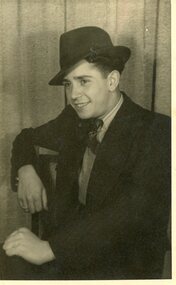
Photograph, c1940s
... A studio photograph with a white crinkled border in post card format of a man dressed in a suit and wearing a hat. ...A studio photograph with a white crinkled border in post card format of a man dressed in a suit and wearing a hat. ...The name Flocas has been written on the back in Greek but there is no Christian name included.A studio photograph with a white crinkled border in post card format of a man dressed in a suit and wearing a hat. He is seated in front of a curtain. -
 Ithacan Historical Society
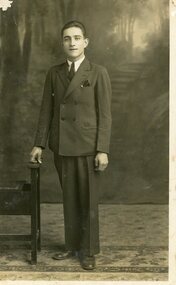
Photograph, Stathi Vlassopoulos, c1930s
... A studio sepia photograph with a cream border in post card format of a smartly dressed man,who is wearing a double breasted suit and standing beside a chair. ...A studio sepia photograph with a cream border in post card format of a smartly dressed man,who is wearing a double breasted suit and standing beside a chair. ...Photographed is Stathi (Efstathios) Vlassopoulos (Vlass) (Kopela) arrived in Melbourne in 1932 and headed to Mildura where his father Dimitrios Vlassopoulos, was established. From there he moved to Hopetoun and operated his own cafe business. He later returned to Melbourne where operated the Metro Cafe in Swanston Street, Melbourne. He sent the photograph to his Aunt Anastasia (Tasia Raftopoulos-Florence) who was living in the village of Platrithia on the island of Ithaca in Greece.Stathi Vlass was very active in Greek community affairs and was secretary of Melbourne's Greek Community and president of the Ithacan Philanthropic Society from 1957 to 1959, during which time he lead the building of Ithaca House in Elizabeth Street. He also published the first daily Greek newspaper 'Ta Nea' in Melbourne. A studio sepia photograph with a cream border in post card format of a smartly dressed man,who is wearing a double breasted suit and standing beside a chair. A message is written in Greek on the back of the photograph.Translated from the Greek: To my dearest Thea Anastasia/ A memento of love/rom your nephew/ E.D./ Vlassopoulos.vlass -
 Sunbury Family History and Heritage Society Inc.
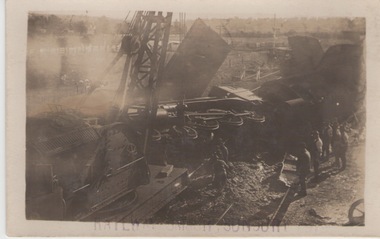
Photograph, Railway smash, 1919
... A non-digital black and white photograph with a white border in post card format of a steam train and its carriages on its side. ...This one of a number of train fatalities that have occurred on the Sunbury - Bendigo line. railways Train smashes Sunbury A non-digital black and white photograph with a white border in post card format of a steam train and its carriages on its side. ...The rail crash featured in the image occurred at Sunbury station in January 1919 as was the result of signal failure along the tracks, which in turn caused a collision between two trains travelling in the op[posite direction along the same tracks.This one of a number of train fatalities that have occurred on the Sunbury - Bendigo line.A non-digital black and white photograph with a white border in post card format of a steam train and its carriages on its side. Workmen are working to prepare the engine to be lifted back onto the tracks.railways, train smashes, sunbury -
 Sunbury Family History and Heritage Society Inc.
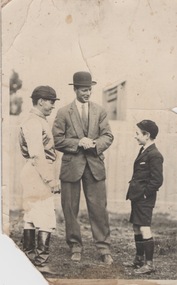
Photograph, C1930s
... A non-digital black and white photograph with a narrow cream border in post card format of a jockey and a young boy in school uniform talking to a well-dressed man who is wearing a bowler hat. ...Written on the back in pencil- D BARKIE/WITH KINDEST REGARDS/NORMAN A non-digital black and white photograph with a narrow cream border in post card format of a jockey and a young boy in school uniform talking to a well-dressed man who is wearing a bowler hat. ...The following greeting has been written on the back of the card in pencil : To Darkie, with regards from Norman.A non-digital black and white photograph with a narrow cream border in post card format of a jockey and a young boy in school uniform talking to a well-dressed man who is wearing a bowler hat. The group are standing in front of a fence. Written on the back in pencil- D BARKIE/WITH KINDEST REGARDS/NORMAN -
 Sunbury Family History and Heritage Society Inc.
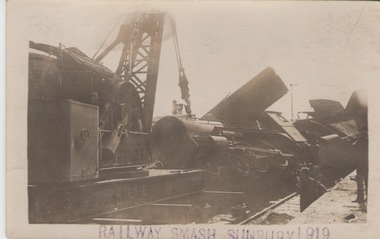
Photograph, Rail smash, 1919
... A non-digital sepia photograph with a white border and in post card format of a steam engine on its aside with a crane attached to it in an effort to lift the large engine....See information about the crash in entry P0767. sunbury rail accidents RAILWAY SMASH SUNBURY 1919 A non-digital sepia photograph with a white border and in post card format of a steam engine on its aside with a crane attached to it in an effort to lift the large engine. ...See information about the crash in entry P0767. A non-digital sepia photograph with a white border and in post card format of a steam engine on its aside with a crane attached to it in an effort to lift the large engine.RAILWAY SMASH SUNBURY 1919sunbury, rail accidents -
 Vision Australia
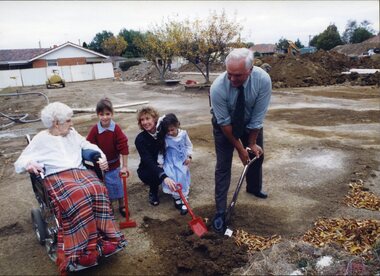
Photograph - Image, Turning the sod for the redevelopment of Kelaston, April 1, 1998
... A workman pulls down a fence post bordering the site for the redevelopment....A workman pulls down a fence post bordering the site for the redevelopment. Kelaston home (Ballarat) Association for the Blind Rex Hollioake Mary Tiernan Mary Tiernan - resident with daughter + 2 granddaughters Sara (6) and Olivia (4) Rex Hollioake - Appeal Chairman turing the sod. 7 x colour photographs of the first sod turning Turning the sod for the redevelopment of Kelaston Photograph Image ...Rex Hollioake, Appeal Chairman, turns the sod for the redevelopment of Kelaston, whilst long-term resident Mary Tiernan and her family look on. A workman pulls down a fence post bordering the site for the redevelopment.7 x colour photographs of the first sod turningMary Tiernan - resident with daughter + 2 granddaughters Sara (6) and Olivia (4) Rex Hollioake - Appeal Chairman turing the sod.kelaston home (ballarat), association for the blind, rex hollioake, mary tiernan -
 Rutherglen Historical Society
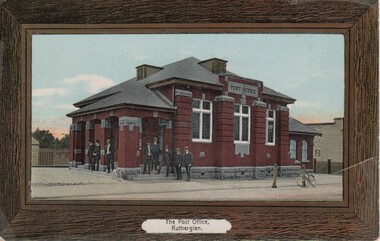
Image, The Post Office, Rutherglen, 1910 to 1912
... Coloured photograph on a post card, with brown border, showing the Rutherglen Post Office with a group of men near the steps....With best wishes, xmas 1911" Coloured photograph on a post card, with brown border, showing the Rutherglen Post Office with a group of men near the steps. ...Coloured photograph on a post card, with brown border, showing the Rutherglen Post Office with a group of men near the steps.On back of card: "From Sam & Wife to Charlie. With best wishes, xmas 1911"rutherglen post office, main street -
 Rutherglen Historical Society
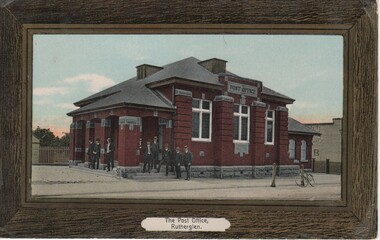
Image, W. Hine Bookseller, The Post Office, Rutherglen, c1890
... Coloured photograph on a post card, with brown border, showing the Rutherglen Post Office with a group of men near the steps....Hine, Bookseller, Rutherglen" | "Printed in Germany" Coloured photograph on a post card, with brown border, showing the Rutherglen Post Office with a group of men near the steps. ...Coloured photograph on a post card, with brown border, showing the Rutherglen Post Office with a group of men near the steps.On back of card: "W. Hine, Bookseller, Rutherglen" | "Printed in Germany"rutherglen post office, post offices, main street -
 Lakes Entrance Historical Society
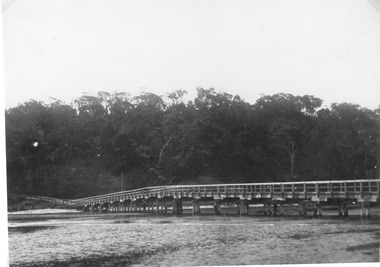
Photograph - North Arm bridge Lakes Entrance Victoria c1900
... Black and white photograph of the wooden bridge across the North Arm, showing the original width of the North Arm, the start of the road up to Kalimna bordered by a post and rail fence, the heights of Kalimna concealed by dense vegetation. ...Jemmies Point Bridge Bridges Vegetation Fences Black and white photograph of the wooden bridge across the North Arm, showing the original width of the North Arm, the start of the road up to Kalimna bordered by a post and rail fence, the heights of Kalimna concealed by dense vegetation. ...Jemmies Point BridgeBlack and white photograph of the wooden bridge across the North Arm, showing the original width of the North Arm, the start of the road up to Kalimna bordered by a post and rail fence, the heights of Kalimna concealed by dense vegetation. Lakes Entrance Victoriabridges, vegetation, fences -
 Kew Historical Society Inc
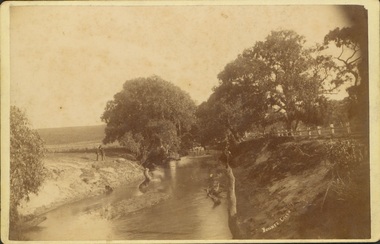
Photograph - Bryants Creek, Coleraine, 1892-3
... The creek is bordered by a white post and rail fence on one bank. ...The creek is bordered by a white post and rail fence on one bank. ...This item is part of a larger collection donated to the Kew Historical Society by Anna French. The collection includes personal items from the donor's family, as well as items given to the donor and her mother by a family friend, Lucy Merritt (Jean) Hornby. The item is from that part of the collection inherited or assembled by Jean Hornby. The collection is significant given Jean Hornby's mother's descent from Robert Hornby (1854-1935) and Eva Merritt (1865-1959); her mother the chid of a family who settled in Kew in the 1850s, thus providing a chain of provenance for items dating to the mid-nineteenth century, when her maternal forebears arrived in Melbourne. Other items represent Jean Hornby's contribution to her local and wider community.Sepia photograph, labelled 'BRYANTS CREEK' at lower left. The creek is bordered by a white post and rail fence on one bank. On the other side of the creek are two men. The creek is bordered with remnant vegetation [ie Eucalypts]. Coleraine, in Western Victoria, was initially settled by Europeans in the 1840s. The developing township was aligned with Bryant's Creek with a north-south orientation. Reverse - Inscribed in ink: "Taken by H Bower with Student camera" / Printed: "C.G. Greenham Photographer, Hawthorn / The Herodotus Studio"bryants creek -- coleraine (vic.) -
 Flagstaff Hill Maritime Museum and Village
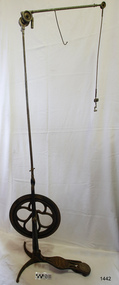
Equipment - Dentist Drill, Late 19th century
... border around the name. The paint under the lettering is peeling off. The drill has a Y-shaped, three footed cast iron base, one foot being longer than the other two. A vertical frame is joined into the centre of the base, holding an axle that has a driving-wheel (or flywheel) and connecting to a crank. A slender, shoulder height post...border around the name. The paint under the lettering is peeling off. The drill has a Y-shaped, three footed cast iron base, one foot being longer than the other two. A vertical frame is joined into the centre of the base, holding an axle that has a driving-wheel (or flywheel) and connecting to a crank. A slender, shoulder height post ...The design of this and other similar treadle powered dental engine (or dentist drill) was in common use by dentists from the 1870’s into the 1920's. When electricity became accessible to most communities the electrically powered dental engines began to take over from the treadle power. Over the ages teeth were extracted using picks and scissors and other gouging instruments. Bow drills, hand drills and even a "bur thimble" drill were later used to prepare cavities for filling. Some drills were made bendable by attaching flexible shanks between the metal bur and the handle, giving access to the teeth at the back of the mouth. Other mechanical devices were introduced along the way, such as clockwork drills, but they were hard to handle and inefficient. Over the centuries “dentistry has been performed by priests, monks and other healers. This was followed by barbers; the barber’s chair may well have been the precursor to the dental chair. “(SA Medical Heritage Society Inc.) In 1871 James Morrison patented the first commercially manufactured 'foot treadle dental engine', the first practica dental engine although others had been introduced as early as 1790 (by John Greenwood). Handmade steel burs or drills were introduced for dental handpieces, taking advantage of the significant increase in the speed of the drill. In 1891 the first machine-made steel burs were in use. The treadle drill reduced the time to prepare a cavity from hours to less than ten minutes. In 1876 the Samuel S. White Catalogue of Dentist Instruments listed a 12 ½ inch wheel diameter dental engine, with 14 bright steel parts, for sale at US $55 In today’s market, this is the equivalent to US $1200 approx. The specifications of that dental engine are very similar to the this one in our Flagstaff Hill Maritime Village’s collection. It is interesting to note that workings of a similar treadle dentist drill were used and modified to power a treadle spinning wheel of one of the volunteer spinners at Flagstaff Hill Maritime Village. The foot treadle dental engine was a milestone in dental history. “Historic importance of treadle powered machines; they made use of human power in an optimal way” (Lowtech Magazine “Short history of early pedal powered machines”) The invention of a machine to speed up the process of excavation of a tooth lead to the invention of new burs and drills for the handpieces, improving speed and the surgical process of dentistry. They were the fore-runner of today’s electrically powered dental engines. This treadle-powered dentist drill, or dentist engine, is made of iron and steel and provides power for a mechanical dental handpiece that would be fitted with a dental tool. On the foot is painted lettering naming it "The Brentfield" and there is a fine line of light coloured paint creating a border around the name. The paint under the lettering is peeling off. The drill has a Y-shaped, three footed cast iron base, one foot being longer than the other two. A vertical frame is joined into the centre of the base, holding an axle that has a driving-wheel (or flywheel) and connecting to a crank. A slender, shoulder height post, made from adjustable telescoping pipes, joins into the top of this frame. On the post just above the frame is a short metal, horizontal bar (to hold the hand-piece when it is not in use). A narrow tubular arm is attached to the top of the stand at a right angle and can move up, down and around. There is a pulley each side of the joint of the arm and a short way along the arm is fitted a short metal pipe. A little further along the arm a frayed-ended cord hangs down from a hole. At the end of the arm is another pulley and a joint from which hangs a long, thin metal pipe with two pulleys and a fitting on the end. A treadle, or foot pedal, is joined to the long foot of the base, and joined at the toe to the crank that turns the driving-wheel. The metal driving-wheel has a wide rim. Touching the inside of the rim are four tubular rings that bulge towards the outside of the driving-wheel, away from the pole, and all meet at the hub of the axle. The axle fits between the inside of the driving-wheel and the frame then passes through the frame and is attached on the other side. The driving-wheel has a groove around which a belt would sit. The belt would also fit around a pulley on the arm, at the top of the post. The pulley is joined to a rod inside the arm and this spins the drill's hand-piece and dental tool holder. The foot pedal has a cross-hatch pattern on the heel and the ball of the foot has tread lines across it. The end of the toe and the instep areas have cut-out pattern in them. "The ____/ Brentfield / __ DE IN L___" (Made in London) painted on the long foot of the base. Marked on the drill connection is “Richter De Trey, Germany”flagstaff hill, warrnambool, shipwrecked coast, flagstaff hill maritime museum, maritime museum, shipwreck coast, flagstaff hill maritime village, great ocean road, dentist, teeth, dental drill, dental engine, treadle drill, foot powered drill, treadle engine, orthodontics, dental surgery, james morrison, the brentfield, richter de trey, german dental fitting, london dental drill -
 Federation University Historical Collection
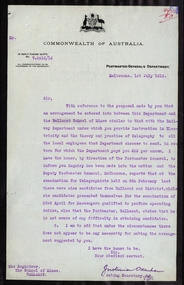
Document, Letter from Thr Registrar, The School of Mines Ballarat to Post Master General's Department
... Letter from Thr Registrar, The School of Mines Ballarat to Post Master General's Department with black border for mourning the death of King Edward VII...School of Mines Ballarat is a predecessor of Federation University School of Mines Ballarat Post Master General's Department Mourning Justinian Oxenham Letter from Thr Registrar, The School of Mines Ballarat to Post Master General's Department with black border for mourning the death of King Edward VII Letter from Thr Registrar, The School of Mines Ballarat to Post Master General's Department Document ...School of Mines Ballarat is a predecessor of Federation University Letter from Thr Registrar, The School of Mines Ballarat to Post Master General's Department with black border for mourning the death of King Edward VIIschool of mines ballarat, post master general's department, mourning, justinian oxenham -
 Lara RSL Sub Branch
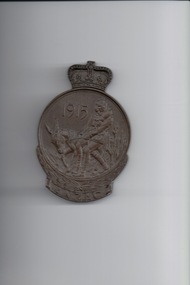
Medallion, W.H.Mathews, 1967
... post and comes in a presentation case with a moulded velvet base to receive the medallion, with a silk lined hinged lid. Medallion presented to all army personnel serving at Gallipoli medallion army anzacs australian army world war 1 ww1 gallipoli The obverse of the medallion depicts Simpson and his donkey carrying a wounded soldier to safety. It is bordered ...Every Anzac soldier who served on the Gallipoli Peninsula, or in direct support of operations there - or his family if he did not survive until into the late 1960s - was entitled to be issued with the Anzac Commemorative Medallion. The Medallion was issued in 1967. The medallion was sent by registered post and comes in a presentation case with a moulded velvet base to receive the medallion, with a silk lined hinged lid.Medallion presented to all army personnel serving at GallipoliANZAC Medallion Badge issued in memory of W.H. MathewsThe obverse of the medallion depicts Simpson and his donkey carrying a wounded soldier to safety. It is bordered on the lower half by a laurel wreath above the word ANZAC and the date 1915 above the donkey. The reverse shows a map in relief of Australia and New Zealand superimposed by the Southern Cross. The lower half is bordered by New Zealand fern leaves and the name W.M. Mathewsmedallion, army, anzacs, australian army, world war 1, ww1, gallipoli -
 Federation University Historical Collection
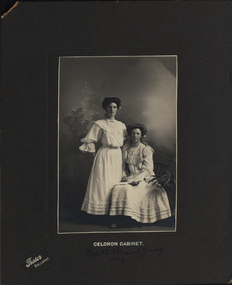
Photograph - Photograph - Black and White, Jas. Brown et al, Edith and Maud Yung and Yung Family, 1 1909
... Pink postage stamp showing RAT 08 (Alice Watson, Murtoa) .7 Verso: Elite Photos 278 Flinders Lane Melbourne C.5540 Beryl Yung - bride Margaret Middleton - maid, 9th Feb 1946 POST Correspondence 4213 .1 Black and white photograph of two women, one standing and the one seated, on a grey background 1909 .2 Black and white photograph of a reverend and seven altar boys, on and dark cream background, within folder c1897 .3. First Confirmation Certificate, with prayer,1902 .4 Sepia photograph on cream background of young boy,1917 .5 Small black and white photograph with black border ....7 Richard Henry Watson was Edith Emma Watson's (nee Yung) son. Edith Emma was also the mother of Alice Watson, artist and dressmaker, who trained at the Ballarat School of Mines in the 1930's. .1 Black and white photograph of two women, one standing and the one seated, on a grey background 1909 .2 Black and white photograph of a reverend and seven altar boys, on and dark cream background, within folder c1897 .3. First Confirmation Certificate, with prayer,1902 .4 Sepia photograph on cream background of young boy,1917 .5 Small black and white photograph with black border of young male .6 Black and white circular photograph of a woman and girl, on cream background postcard,1908 .7 Black and white photograph with white border of bride and bridesmaid,1946.1 Front: Celoron Cabinet, Edith and Maud Yung 1910. Versa: Nanna and Aunty Maud .2 Front: Rev Greenham + choir boys.Versa: 2nd from left is William John Yung (John) died at age 8 1897. Nhill, William Yung. John (second from left, died young aged 8 in Allendale. Parents John Yung and Mary Ann Sudweeks .3 Baptised Ethel Emma Yung; Confirmed 14th December 1902; First Communion 25th December 1902; Signed by C Allanby; A Daily Prayer (eight lines); Confirmed by Arthur(?) V Bishop of Ballarat. S.P.C.K. Riddle & Couchman Lith, London .4 Front bottom: Copies may be obtained. Melbourne Photographic company, *Bridge Street Ballarat*. Verso: G.A. Yung died at Ypres, Belguim 1917 .5 Front bottom:Willetts Elite Studio. RHS H. Yung. Verso: Elite Photographic Studio. Patronised by the Royal Princes and Suite. Special photographer to His Excellency the Govenor. Willetts Bridge Street Ballarat. Paper note with photo: Henry( Harrie) Yung ( George Edgar's brother) was born at Loch in Gippsland and became a railway worker. Richard Henry (Harry) Watson Edie Watson's (nee Yung) son was named after him. .6 Front: Lena and Ethel Yung Verso:Postcard: a note to her sister Miss E Yung Yendon from Lena Yung - "Dear Edie, Received PC(?) I don't know whether you know anyone here. This is Mother's cousin with me. She was up on holiday. Hoping you are all well. Love to all. I remain yours Lena." 1908. Pink postage stamp showing RAT 08 (Alice Watson, Murtoa) .7 Verso: Elite Photos 278 Flinders Lane Melbourne C.5540 Beryl Yung - bride Margaret Middleton - maid, 9th Feb 1946 POST Correspondence 4213 celeron cabinet, edith yung, reverend greenham, choir boys, john yung, william yung, mary sudweeks, nhill, allandale, ethol emma yung, c allanby, arthur b, h.yung, beryl yung, margaret middleton, elite photos, g a yung, willetts studio, elite photographic studio ballarat, confirmation certificate 1902, millinery, bride, bridesmaid -
 Flagstaff Hill Maritime Museum and Village
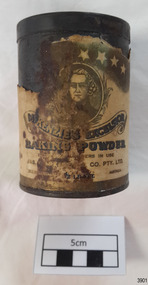
Container - Tin, McKenzies Foods, circa 1930s
... It gives a snapshot into domestic life and social norms of the pre and post war period in Melbourne The tin is significant for its association with a local family in the 1930s for the preparation of family meals. flagstaff hill asset baking powder tin container flagstaff hill museum kitchen item cookery baking grocery mckenzie rising agent food container flagstaff hill warrnambool shipwrecked coast flagstaff hill maritime museum maritime museum shipwreck coast flagstaff hill maritime village great ocean road tin cooking ingredient baking powder mckenqie Text includes “JAS. F. McKENZIE & CO. PTY. LTD. / AUSTRALIA“ “McKENZIE’S EXCELSIOR / BAKING POWDER”. Motif: man’s portrait within oval frame with wheat sheaf border ...This tin once contained McKenzie’s baking powder, a cooking ingredient. It was donated with other similar tins that were used by the donor’s mother who was married in 1932. It those times in Australia all manner of household items, including food and drink, were sold by hawkers (salesmen) who travelled from door to door in both suburban and rural areas. The donor remembered the bicarb soda tin on her mother’s pantry shelf. The McKenzie’s Baking Powder label adds the information that the ingredients were “Prepared with Aerophos, Regd. Trade Mark, the finest raising ingredient. A product of Albright & Wilson, Australia Pty. Ltd.” It also says that it “Excels all others in use”. The Australian family business, McKenzie’s Foods, began in Melbourne in 1852 and continues today, now run be the fifth generation of descendants from the original owners. Its baking and cookery products are well recognised by Australians. This tin originates in the early 1900s from an Australian company that is now managed by fifth generation descendants of the original family after its inception in 1852. The tin increases in significance for its use as a recognised object found in many Australian kitchens since early days. It gives a snapshot into domestic life and social norms of the pre and post war period in Melbourne The tin is significant for its association with a local family in the 1930s for the preparation of family meals. Tin container, cylindrical, with cream paper label with gold highlights, motif and text. Used for selling McKenzie’s Excelsior baking powder. Container has push-on lid. Quantity of 1/2 LB. NETT. Made in Australia by Jas. F. McKenzie & Co. Pty Ltd. Text includes “JAS. F. McKENZIE & CO. PTY. LTD. / AUSTRALIA“ “McKENZIE’S EXCELSIOR / BAKING POWDER”. Motif: man’s portrait within oval frame with wheat sheaf border, placed below figures of sun, moon and stars. Information and instructions. flagstaff hill asset, baking powder tin, container, flagstaff hill museum, kitchen item, cookery, baking, grocery, mckenzie, rising agent, food container, flagstaff hill, warrnambool, shipwrecked coast, flagstaff hill maritime museum, maritime museum, shipwreck coast, flagstaff hill maritime village, great ocean road, tin, cooking ingredient, baking powder, mckenqie -
 Flagstaff Hill Maritime Museum and Village
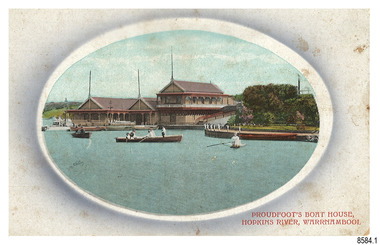
Postcard - Historical, Warrnambool, Proudfoot’s Boat House, Hopkins River, Warrnambool, Early 20th century
... (Statement of Significance is from the Victorian Heritage Register) Flagstaff Hill Maritime Museum Flagstaff Hill Maritime Village Flagstaff Hill Maritime Museum and Village Maritime Museum Warrnambool Great Ocean Road Warrnambool and District Warrnambool Scenes local scenes Views of Warrnambool Joseph Jordan Jordan Series Jordan Photography postcard souvenir correspondence cameo postcard landscape Proudfoots boat house boat house Proudfoots Hopkins River boats for hire row boats recreation Front, in red: “PROUDFOOT’S BOAT HOUSE / HOPKINS RIVER, WARRNAMBOOL” Reverse in black: “Jordan Series Warrnambool” “POST CARD” “Printed in Great Britain” “This space may be used for Communication” “The Address to be written here” Within the stamp outline: “3 / BRITISH / MANUFACTURE" Postcard, one of nine, landscape orientation. Coloured photograph print within an oval border ...The nine postcards in this set were donated together and date to the early 1900s. All but one postcard in this set shows images of Warrnambool, in the Western District of Victoria; the other has a London image. The postcards were all printed in Great Britain according to that country’s postal regulations. All cards have titles on the front printed in red. The majority of the images on the cards are attributed to photographer Joseph Jordan and belong to the Jordan Series. The back of these cards has an outline for a postage stamp, a vertical dividing line and a heading on each side of the line to separate the Correspondence from the Address. Postcards or ‘correspondence cards’ appeared in Britain in 1894. They were plain cards with a space for the message on one side and an address on the other; regulations didn’t allow anything but the address to be written on the ‘address’ side. In 1902 the British regulations then allowed a picture to be printed on the front and the address on the back, so messages had to be written on the picture side. Soon, the regulations changed and the back was divided for a message and the address. Proudfoots Boat House – Proudfoot’s Boathouse is at 2 Simpson Street Warrnambool, on the banks of the Hopkins River. In the 1880s it was a venue for hiring boats for rowing, fishing, sailing and picnics. It was a popular destination for tourists coming from Melbourne for a day or weekend outing. The beautiful historic Victorian period building was designed, built and established by Thomas Proudfoot. He applied to build a boat jetty in 1885. He died in 1900 and his wife Catherine took over, running it for many years. Later her son Bruce and after that her granddaughter Ena Hunt and her husband took over; it remained in the family until 1979. The buildings, including the ‘U’ shaped jetty and tearooms, were restored and modified in the 1990s by the Warrnambool Sports Club, under the control of the Warrnambool City Council. Joseph Jordan - Joseph Jordan was born in 1841 in Leicester England. When he was 16 he joined the 7th Queen's Own Hussars and was sent to India at the outbreak of the mutiny. He took part in the relief of Lucknow and remained in India for eleven years. It was during this time, he became interested in photography. He was posted to New Zealand and later came to Victoria, becoming a sergeant major of the Mounted Rifles. In the mid-1880s he came to the Western district where he was responsible for establishing units of the Mounted Rifles in various country towns such as Dunkeld, Mortlake, Panmure, Bushfield, Koroit etc. He resigned from the army in 1889 and set up a professional photography studio in Liebig Street, Warrnambool. He became very well known in the Western District for family photographs, official photographs of local councillors and groups as well as views of local scenery. In 1891 he photographed the wrecked barque ‘Fiji’ at ‘Wrecks Beach’ near Princetown. His business was taken over by his son Arthur around 1917. Joseph was a keen rifle shot and in 1924 he donated the "Jordan Shield" as a prize to the Victorian Rifle Association. He was made a "Life Honorary Member" of the Warrnambool Returned Soldiers League and in 1933 he was recognised as being the oldest living soldier in Victoria. Joseph died in 1935 aged 95.This card is the only one of the nine cards with the location of Warrnambool added to the name 'Joseph Series'. It is also the only one that has text within the outline for the postage stamp. The font used for the test of the headings is slightly different to the other cards. Joseph Jordan is a significant figure in Warrnambool history as he helped to establish early units of the Mounted Rifles (G Company) in local towns during the late 1880's and later, photographed local scenes, groups and citizens of early Warrnambool. This postcard of Proudfoot's Boathouse is of historical significance for is connection with Proudfood’s Boathouse. Proudfoot’s Boathouse is an example of late-Victorian recreational and tourist facilities. Boathouses were popular 19th-century tourist and recreational attractions, providing refined and healthy activity. This boathouse shows the early realisation of the tourism and leisure potential of seaside towns such as Warrnambool, a potential that has become increasingly important as port uses have ceased and other industries have been subjected to financial pressure. Proudfoot's Boathouse is of social significance because it illustrates the continuity of the attraction of this kind of leisure facility. Although the glory days of boathouses were in the 19th century, those that survive continue to be well patronised. Proudfoot's Boathouse has been an important recreational facility and attraction for tourists flocking to the Hopkins River, one of the State's most popular boating and fishing resorts, since 1885.” (Statement of Significance is from the Victorian Heritage Register)Postcard, one of nine, landscape orientation. Coloured photograph print within an oval border and mauve-toned shading. Cameo Image of figures in three rowing boats on still water beside a building with three gable roofs and decorative verandas. Other boats are moored at the landing in front of the building. The roofs each have a tall pole at the front. There is a park right of the building that also has a landing. In the background is a grassed slope and the sea. Reverse has printed inscriptions and an outline for a postage stamp. There is no correspondence written on the card. The card is one of the Jordan Series by Joseph Jordan, printed in Great Britain in the early 1900s. Front, in red: “PROUDFOOT’S BOAT HOUSE / HOPKINS RIVER, WARRNAMBOOL” Reverse in black: “Jordan Series Warrnambool” “POST CARD” “Printed in Great Britain” “This space may be used for Communication” “The Address to be written here” Within the stamp outline: “3 / BRITISH / MANUFACTURE"flagstaff hill maritime museum, flagstaff hill maritime village, flagstaff hill maritime museum and village, maritime museum, warrnambool, great ocean road, warrnambool and district, warrnambool scenes, local scenes, views of warrnambool, joseph jordan, jordan series, jordan photography, postcard, souvenir, correspondence, cameo postcard, landscape, proudfoots boat house, boat house, proudfoots, hopkins river, boats for hire, row boats, recreation -
 Flagstaff Hill Maritime Museum and Village
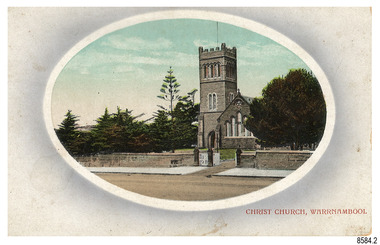
Postcard - Historical, Warrnambool, Christ Church, Warrnambool, Early 20th century
... The church is part of Warrnambool's life events and the historical significance of the building, Flagstaff Hill Maritime Museum Flagstaff Hill Maritime Village Flagstaff Hill Maritime Museum and Village Maritime Museum Warrnambool Great Ocean Road Warrnambool and District Warrnambool Scenes local scenes Views of Warrnambool Joseph Jordan Jordan Series Jordan Photography postcard souvenir correspondence cameo postcard landscape Christ Church bell tower German bells Warrnambool Church religious building stone building Anglican Church Parish of Warrnambool Front, in red: “CHRIST CHURCH, WARRNAMBOOL” Back in black: “Jordan Series” “POST CARD” “PRINTED IN GREAT BRITAIN” “For correspondence” “The Address only to be written here” Postcard, one of nine, landscape orientation, coloured print within an oval border and mauve-toned shading. ...The nine postcards in this set were donated together and date to the early 1900s. All but one postcard in this set shows images of Warrnambool, in the Western District of Victoria; the other has a London image. The postcards were all printed in Great Britain according to that country’s postal regulations. The fronts of all cards have titles printed in red. Most of the images on the cards are attributed to photographer Joseph Jordan and belong to the Jordan Series. The back of these cards has an outline for a postage stamp, a vertical dividing line and a heading on each side of the line to separate the Correspondence from the Address. Postcards or ‘correspondence cards’ appeared in Britain in 1894. They were plain cards with a space for the message on one side and an address on the other; regulations didn’t allow anything but the address to be written on the ‘address’ side. In 1902 the British regulations then allowed a picture to be printed on the front and the address on the back, so messages had to be written on the picture side. Soon, the regulations changed and the back was divided for a message and the address. Christ Church Warrnambool – The image on this card shows Christ Church, a stone building built in 1856. The Anglican church is in Henna Street, Warrnambool. The church, outer buildings and grounds are heritage-listed. Its bell tower harbours German bells. Joseph Jordan - Joseph Jordan was born in 1841 in Leicester England. When he was 16 he joined the 7th Queen's Own Hussars and was sent to India at the outbreak of the mutiny. He took part in the relief of Lucknow and remained in India for eleven years. It was during this time, he became interested in photography. He was posted to New Zealand and later came to Victoria, becoming a sergeant major of the Mounted Rifles. In the mid-1880s he came to the Western district where he was responsible for establishing units of the Mounted Rifles in various country towns such as Dunkeld, Mortlake, Panmure, Bushfield, Koroit etc. He resigned from the army in 1889 and set up a professional photography studio in Liebig Street, Warrnambool. He became very well known in the Western District for family photographs, official photographs of local councillors and groups as well as views of local scenery. In 1891 he photographed the wrecked barque ‘Fiji’ at ‘Wrecks Beach’ near Princetown. His business was taken over by his son Arthur around 1917. Joseph was a keen rifle shot and in 1924 he donated the "Jordan Shield" as a prize to the Victorian Rifle Association. He was made a "Life Honorary Member" of the Warrnambool Returned Soldiers League and in 1933 he was recognised as being the oldest living soldier in Victoria. Joseph died in 1935 aged 95.This card is the only one of the nine cards with the location of Warrnambool added to the name 'Joseph Series'. It is also the only one that has text within the outline for the postage stamp. The font used for the test of the headings is slightly different to the other cards. Joseph Jordan is a significant figure in Warrnambool history as he helped to establish early units of the Mounted Rifles (G Company) in local towns during the late 1880's and later, photographed local scenes, groups and citizens of early Warrnambool. This postcard of Christ Church Warrnambool is significant for its connection to the church. The early building of the church in 1856, within the first decade of Warrnambool being proclaimed a town, shows the strong religious desire of the community. The church is part of Warrnambool's life events and the historical significance of the building,Postcard, one of nine, landscape orientation, coloured print within an oval border and mauve-toned shading. The cameo image is a stone castle-top bell tower beside a church building flanked by trees. A stone fence is across the front, with pedestrian and vehicle white picket gates. The title is in red print on the front of the card. There is no correspondence written on the card. The reverse has inscriptions and outlines for a postage stamp. Jordan Series, printed in Great Britain.Front, in red: “CHRIST CHURCH, WARRNAMBOOL” Back in black: “Jordan Series” “POST CARD” “PRINTED IN GREAT BRITAIN” “For correspondence” “The Address only to be written here”flagstaff hill maritime museum, flagstaff hill maritime village, flagstaff hill maritime museum and village, maritime museum, warrnambool, great ocean road, warrnambool and district, warrnambool scenes, local scenes, views of warrnambool, joseph jordan, jordan series, jordan photography, postcard, souvenir, correspondence, cameo postcard, landscape, christ church, bell tower, german bells, warrnambool church, religious building, stone building, anglican church, parish of warrnambool -
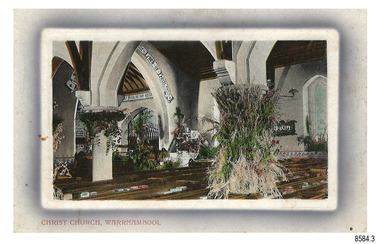 Flagstaff Hill Maritime Museum and Village
Postcard - Historical, Flagstaff Hill, Christ Church, Warrnambool, Early 20th century
... The church is part of Warrnambool's life events and the historical significance of the building, Flagstaff Hill Maritime Museum Flagstaff Hill Maritime Village Flagstaff Hill Maritime Museum and Village Maritime Museum Warrnambool Great Ocean Road Warrnambool and District Warrnambool Scenes local scenes Views of Warrnambool Joseph Jordan Jordan Series Jordan Photography postcard souvenir correspondence cameo postcard landscape Christ Church bell tower German bells Warrnambool Church religious building stone building Anglican Church Parish of Warrnambool arch pillars Front, in red: “CHRIST CHURCH, WARRNAMBOOL” Back in black: “Jordan Series” “POST CARD” “PRINTED IN GREAT BRITAIN” “For correspondence” “The Address only to be written here” Text on the arch: "THE LORD OF HOSTS" Postcard, one of nine, landscape orientation, coloured print within an oval border and mauve-toned shading. ...The nine postcards in this set were donated together and date to the early 1900s. All but one postcard in this set shows images of Warrnambool, in the Western District of Victoria; the other has a London image. The postcards were all printed in Great Britain according to that country’s postal regulations. The fronts of all cards have titles printed in red. Most of the images on the cards are attributed to photographer Joseph Jordan and belong to the Jordan Series. The back of these cards has an outline for a postage stamp, a vertical dividing line and a heading on each side of the line to separate the Correspondence from the Address. Postcards or ‘correspondence cards’ appeared in Britain in 1894. They were plain cards with a space for the message on one side and an address on the other; regulations didn’t allow anything but the address to be written on the ‘address’ side. In 1902 the British regulations then allowed a picture to be printed on the front and the address on the back, so messages had to be written on the picture side. Soon, the regulations changed and the back was divided for a message and the address. Christ Church Warrnambool – The image on this card shows Christ Church, a stone building built in 1856. The Anglican church is in Henna Street, Warrnambool. The church, outer buildings and grounds are heritage-listed. Its bell tower harbours German bells. Joseph Jordan - Joseph Jordan was born in 1841 in Leicester England. When he was 16 he joined the 7th Queen's Own Hussars and was sent to India at the outbreak of the mutiny. He took part in the relief of Lucknow and remained in India for eleven years. It was during this time, he became interested in photography. He was posted to New Zealand and later came to Victoria, becoming a sergeant major of the Mounted Rifles. In the mid-1880s he came to the Western district where he was responsible for establishing units of the Mounted Rifles in various country towns such as Dunkeld, Mortlake, Panmure, Bushfield, Koroit etc. He resigned from the army in 1889 and set up a professional photography studio in Liebig Street, Warrnambool. He became very well known in the Western District for family photographs, official photographs of local councillors and groups as well as views of local scenery. In 1891 he photographed the wrecked barque ‘Fiji’ at ‘Wrecks Beach’ near Princetown. His business was taken over by his son Arthur around 1917. Joseph was a keen rifle shot and in 1924 he donated the "Jordan Shield" as a prize to the Victorian Rifle Association. He was made a "Life Honorary Member" of the Warrnambool Returned Soldiers League and in 1933 he was recognised as being the oldest living soldier in Victoria. Joseph died in 1935 aged 95.This card is the only one of the nine cards with the location of Warrnambool added to the name 'Joseph Series'. It is also the only one that has text within the outline for the postage stamp. The font used for the test of the headings is slightly different to the other cards. Joseph Jordan is a significant figure in Warrnambool history as he helped to establish early units of the Mounted Rifles (G Company) in local towns during the late 1880's and later, photographed local scenes, groups and citizens of early Warrnambool. This postcard of Christ Church Warrnambool is significant for its connection to the church. The early building of the church in 1856, within the first decade of Warrnambool being proclaimed a town, shows the strong religious desire of the community. The church is part of Warrnambool's life events and the historical significance of the building,Postcard, one of nine, landscape orientation, coloured print within an oval border and mauve-toned shading. The cameo image is of the Interior of the church chapel, with exposed timber beams, white arches decorated with flowers, pews with books on shelves, and organ pipes. There is text on the image. The title is in red print on the front of the card. The back has inscriptions and outlines for a postage stamp. There is no correspondence written on the card. Jordan Series, printed in Great Britain.Front, in red: “CHRIST CHURCH, WARRNAMBOOL” Back in black: “Jordan Series” “POST CARD” “PRINTED IN GREAT BRITAIN” “For correspondence” “The Address only to be written here” Text on the arch: "THE LORD OF HOSTS"flagstaff hill maritime museum, flagstaff hill maritime village, flagstaff hill maritime museum and village, maritime museum, warrnambool, great ocean road, warrnambool and district, warrnambool scenes, local scenes, views of warrnambool, joseph jordan, jordan series, jordan photography, postcard, souvenir, correspondence, cameo postcard, landscape, christ church, bell tower, german bells, warrnambool church, religious building, stone building, anglican church, parish of warrnambool, arch pillars -
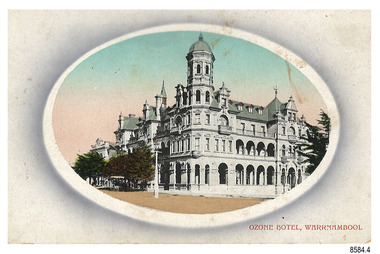 Flagstaff Hill Maritime Museum and Village
Postcard - Historical, Warrnambool, Ozone hotel, Warrnambool, 1902-1929
... Flagstaff Hill Maritime Museum Flagstaff Hill Maritime Village Flagstaff Hill Maritime Museum and Village Maritime Museum Warrnambool Great Ocean Road Warrnambool and District Warrnambool Scenes local scenes Views of Warrnambool Joseph Jordan Jordan Series Jordan Photography postcard souvenir correspondence cameo postcard landscape Ozone Hotel and Coffee Palace Ozone Hotel Warrnambool hotel destroyed by fire Coffee Palace Front, in red: “Ozone hotel, Warrnambool” Back in black: “Jordan Series” “POST CARD” “PRINTED IN GREAT BRITAIN” “For correspondence” “The Address only to be written here” Postcard, one of nine, landscape orientation, coloured print within an oval border and mauve-toned shading. ...The nine postcards in this set were donated together and date to the early 1900s. All but one postcard in this set shows images of Warrnambool, in the Western District of Victoria; the other has a London image. The postcards were all printed in Great Britain according to that country’s postal regulations. The fronts of all cards have titles printed in red. Most of the images on the cards are attributed to photographer Joseph Jordan and belong to the Jordan Series. The back of these cards has an outline for a postage stamp, a vertical dividing line and a heading on each side of the line to separate the Correspondence from the Address. Postcards or ‘correspondence cards’ appeared in Britain in 1894. They were plain cards with a space for the message on one side and an address on the other; regulations didn’t allow anything but the address to be written on the ‘address’ side. In 1902 the British regulations then allowed a picture to be printed on the front and the address on the back, so messages had to be written on the picture side. Soon, the regulations changed and the back was divided for a message and the address. Ozone Hotel, Warrnambool – Construction of Warrnambool’s Ozone Hotel and Coffee Palace on the corner of Koroit and Kepler streets began in 1890. The luxury venue included ballrooms, dining rooms, a theatre and a tower. In 1929 it burnt to the ground in a spectacular fire. Joseph Jordan - Joseph Jordan was born in 1841 in Leicester England. When he was 16 he joined the 7th Queen's Own Hussars and was sent to India at the outbreak of the mutiny. He took part in the relief of Lucknow and remained in India for eleven years. It was during this time that he became interested in photography. He was posted to New Zealand and later came to Victoria, becoming a sergeant major of the Mounted Rifles. In the mid-1880s he came to the Western district where he was responsible for establishing units of the Mounted Rifles in various country towns such as Dunkeld, Mortlake, Panmure, Bushfield, Koroit etc. He resigned from the army in 1889 and set up a professional photography studio in Liebig Street, Warrnambool. He became very well known in the Western District for family photographs, official photographs of local councillors and groups as well as views of local scenery. In 1891 he photographed the wrecked barque ‘Fiji’ at ‘Wrecks Beach’ near Princetown. His business was taken over by his son Arthur around 1917. Joseph was a keen rifle shot and in 1924 he donated the "Jordan Shield" as a prize to the Victorian Rifle Association. He was made a "Life Honorary Member" of the Warrnambool Returned Soldiers League and in 1933 he was recognised as being the oldest living soldier in Victoria. Joseph died in 1935 aged 95.This postcard of the Ozone Hotel and Coffee Palace is significant for its connection to the Victorian-era hotel. The hotel was a luxury facility that attracted visitors to the town by sea, rail and road. The postcard also represents the short period in which the hotel operated and the notable, unforgettable event of its burning to the ground. Out of the set of nine postcards in this donation, this card is the only one that includes the location of Warrnambool on the back. It is also the only one with text within the outline for the postage stamp and with headings in this font. Joseph Jordan is a significant figure in Warrnambool history as he helped to establish early units of the Mounted Rifles (G Company) in local towns during the late 1880's and later, photographed local scenes, groups and citizens of early Warrnambool.Postcard, one of nine, landscape orientation, coloured print within an oval border and mauve-toned shading. The cameo image is of a grand three-storey building on a street corner with a tall turret, shorter turrets, and arches on the verandas. The back has inscriptions and outlines for a postage stamp. There is no correspondence written on the card. Jordan Series, printed in Great Britain.Front, in red: “Ozone hotel, Warrnambool” Back in black: “Jordan Series” “POST CARD” “PRINTED IN GREAT BRITAIN” “For correspondence” “The Address only to be written here”flagstaff hill maritime museum, flagstaff hill maritime village, flagstaff hill maritime museum and village, maritime museum, warrnambool, great ocean road, warrnambool and district, warrnambool scenes, local scenes, views of warrnambool, joseph jordan, jordan series, jordan photography, postcard, souvenir, correspondence, cameo postcard, landscape, ozone hotel and coffee palace, ozone hotel, warrnambool hotel, destroyed by fire, coffee palace -
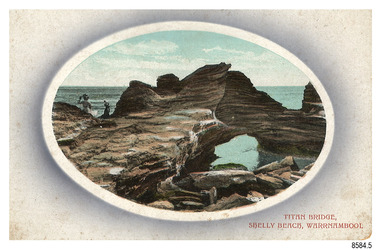 Flagstaff Hill Maritime Museum and Village
Postcard - Scenic, Warrnambool, Titan Bridge, Shelly Beach, Warrnambool, 1902-1929
... Flagstaff Hill Maritime Museum Flagstaff Hill Maritime Village Flagstaff Hill Maritime Museum and Village Maritime Museum Warrnambool Great Ocean Road Warrnambool and District Warrnambool Scenes local scenes Views of Warrnambool Joseph Jordan Jordan Series Jordan Photography postcard souvenir correspondence cameo postcard landscape Shelly Beach Titan Bridge Titan rock formation Front, in red: “TITAN BRIDGE / SHELLY BEACH, NEAR WARRNAMBOOL” Back in black: “Jordan Series” “POST CARD” “PRINTED IN GREAT BRITAIN” “For correspondence” “The Address only to be written here” Postcard, one of nine, landscape orientation, coloured print within an oval border and mauve-toned shading. ...The nine postcards in this set were donated together and date to the early 1900s. All but one postcard in this set shows images of Warrnambool, in the Western District of Victoria; the other has a London image. The postcards were all printed in Great Britain according to that country’s postal regulations. The fronts of all cards have titles printed in red. Most of the images on the cards are attributed to photographer Joseph Jordan and belong to the Jordan Series. The back of these cards has an outline for a postage stamp, a vertical dividing line and a heading on each side of the line to separate the Correspondence from the Address. Postcards or ‘correspondence cards’ appeared in Britain in 1894. They were plain cards with a space for the message on one side and an address on the other; regulations didn’t allow anything but the address to be written on the ‘address’ side. In 1902 the British regulations then allowed a picture to be printed on the front and the address on the back, so messages had to be written on the picture side. Soon, the regulations changed and the back was divided for a message and the address. Titan Bridge, Warrnambool – The name Titan Bridge is likely to be a reference to the huge Titan crane that was used in the construction of the Breakwater in the late 19th century. Shelly Beach is a popular swimming area with the added attraction of rock pools to investigate and rock formations to climb. Joseph Jordan - Joseph Jordan was born in 1841 in Leicester England. When he was 16 he joined the 7th Queen's Own Hussars and was sent to India at the outbreak of the mutiny. He took part in the relief of Lucknow and remained in India for eleven years. It was during this time that he became interested in photography. He was posted to New Zealand and later came to Victoria, becoming a sergeant major of the Mounted Rifles. In the mid-1880s he came to the Western district where he was responsible for establishing units of the Mounted Rifles in various country towns such as Dunkeld, Mortlake, Panmure, Bushfield, Koroit etc. He resigned from the army in 1889 and set up a professional photography studio in Liebig Street, Warrnambool. He became very well known in the Western District for family photographs, official photographs of local councillors and groups as well as views of local scenery. In 1891 he photographed the wrecked barque ‘Fiji’ at ‘Wrecks Beach’ near Princetown. His business was taken over by his son Arthur around 1917. Joseph was a keen rifle shot and in 1924 he donated the "Jordan Shield" as a prize to the Victorian Rifle Association. He was made a "Life Honorary Member" of the Warrnambool Returned Soldiers League and in 1933 he was recognised as being the oldest living soldier in Victoria. Joseph died in 1935 aged 95.The image of the Titan Bridge rock formation with figures on it suggests that the location was a popular place to visit. It captures a time when the rock formation was publically accessible. The choice of subject for this postcard indicates the popularity of Warrnambool's natural environment as a tourist attraction at a time when ships called coastal traders brought passengers and cargo to the Port of Warrnambool from ports along Victoria's southwest coast. Joseph Jordan is a significant figure in Warrnambool history as he helped to establish early units of the Mounted Rifles (G Company) in local towns during the late 1880's and later, photographed local scenes, groups and citizens of early Warrnambool.Postcard, one of nine, landscape orientation, coloured print within an oval border and mauve-toned shading. The cameo image shows two figures, one seated and one standing, beside the sea on a rough rock beside a rock formation resembling a bridge. There is no correspondence written on the card. The back has inscriptions and outlines for a postage stamp. Jordan Series, printed in Great Britain.Front, in red: “TITAN BRIDGE / SHELLY BEACH, NEAR WARRNAMBOOL” Back in black: “Jordan Series” “POST CARD” “PRINTED IN GREAT BRITAIN” “For correspondence” “The Address only to be written here”flagstaff hill maritime museum, flagstaff hill maritime village, flagstaff hill maritime museum and village, maritime museum, warrnambool, great ocean road, warrnambool and district, warrnambool scenes, local scenes, views of warrnambool, joseph jordan, jordan series, jordan photography, postcard, souvenir, correspondence, cameo postcard, landscape, shelly beach, titan bridge, titan, rock formation -
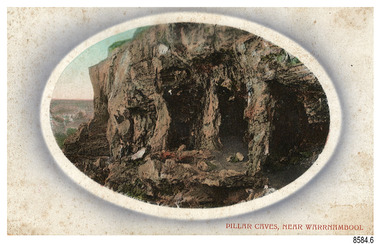 Flagstaff Hill Maritime Museum and Village
Postcard - Scenic, Warrnambool, Pillar Caves, near Warrnambool, 1902-1929
... Flagstaff Hill Maritime Museum Flagstaff Hill Maritime Village Flagstaff Hill Maritime Museum and Village Maritime Museum Warrnambool Great Ocean Road Warrnambool and District Warrnambool Scenes local scenes Views of Warrnambool Joseph Jordan Jordan Series Jordan Photography postcard souvenir correspondence cameo postcard landscape rock formation Pillar Caves Pillars Cave Lake Gillear rebbiting bats guano Nitro Trade fertilizers Front, in red: “PILLAR CAVES, NEAR WARRNAMBOOL” Back in black: “Jordan Series” “POST CARD” “PRINTED IN GREAT BRITAIN” “For correspondence” “The Address only to be written here” Postcard, one of nine, landscape orientation, coloured print within an oval border and mauve-toned shading. ...The nine postcards in this set were donated together and date to the early 1900s. All but one postcard in this set shows images of Warrnambool, in the Western District of Victoria; the other has a London image. The postcards were all printed in Great Britain according to that country’s postal regulations. The fronts of all cards have titles printed in red. Most of the images on the cards are attributed to photographer Joseph Jordan and belong to the Jordan Series. The back of these cards has an outline for a postage stamp, a vertical dividing line and a heading on each side of the line to separate the Correspondence from the Address. Postcards or ‘correspondence cards’ appeared in Britain in 1894. They were plain cards with a space for the message on one side and an address on the other; regulations didn’t allow anything but the address to be written on the ‘address’ side. In 1902 the British regulations then allowed a picture to be printed on the front and the address on the back, so messages had to be written on the picture side. Soon, the regulations changed and the back was divided for a message and the address. Pliiar Caves, near Warrnambool – The formation at the front of the cave resembles the pillars of a porch, giving the cave its name. Local social media discussion locates the caves near Lake Gillear, east of Warrnambool. The area was popular with young lads as a place to explore and to go rabbiting. The caves in this area are home to colonies of bats and have been a source of bat feces or bat guano, which is an enriching additive to soil. The 19th century sailing ships in the Nitrogen or Guano trade collected large quantities of guano from caves and popular bird nesting locations to sell as a rich fertiliser, due to its high nitrogen and phosphorus properties. Joseph Jordan - Joseph Jordan was born in 1841 in Leicester England. When he was 16 he joined the 7th Queen's Own Hussars and was sent to India at the outbreak of the mutiny. He took part in the relief of Lucknow and remained in India for eleven years. It was during this time that he became interested in photography. He was posted to New Zealand and later came to Victoria, becoming a sergeant major of the Mounted Rifles. In the mid-1880s he came to the Western district where he was responsible for establishing units of the Mounted Rifles in various country towns such as Dunkeld, Mortlake, Panmure, Bushfield, Koroit etc. He resigned from the army in 1889 and set up a professional photography studio in Liebig Street, Warrnambool. He became very well known in the Western District for family photographs, official photographs of local councillors and groups as well as views of local scenery. In 1891 he photographed the wrecked barque ‘Fiji’ at ‘Wrecks Beach’ near Princetown. His business was taken over by his son Arthur around 1917. Joseph was a keen rifle shot and in 1924 he donated the "Jordan Shield" as a prize to the Victorian Rifle Association. He was made a "Life Honorary Member" of the Warrnambool Returned Soldiers League and in 1933 he was recognised as being the oldest living soldier in Victoria. Joseph died in 1935 aged 95.The image of the Pillar Caves rock formation with figures on it suggests that the location was a popular place to visit. The choice of subject for this postcard indicates the popularity of Warrnambool's natural environment as a tourist attraction at a time when ships called coastal traders brought passengers and cargo to the Port of Warrnambool from ports along Victoria's southwest coast. The presence of bats in local caves also connects the postcard to the 19th century Nitro Trade and Guano Trade, when bat guano was collected and sold for plant fertiliser around the world. Joseph Jordan is a significant figure in Warrnambool history as he helped to establish early units of the Mounted Rifles (G Company) in local towns during the late 1880's and later, photographed local scenes, groups and citizens of early Warrnambool.Postcard, one of nine, landscape orientation, coloured print within an oval border and mauve-toned shading. The cameo image shows figures on the high, grass-topped cliff, one between the likeness of pillars in the cave entry, and others walking on the rocks nearby. The background below is rough ground. There is no correspondence written on the card. The back has inscriptions and outlines for a postage stamp. Jordan Series, printed in Great Britain.Front, in red: “PILLAR CAVES, NEAR WARRNAMBOOL” Back in black: “Jordan Series” “POST CARD” “PRINTED IN GREAT BRITAIN” “For correspondence” “The Address only to be written here”flagstaff hill maritime museum, flagstaff hill maritime village, flagstaff hill maritime museum and village, maritime museum, warrnambool, great ocean road, warrnambool and district, warrnambool scenes, local scenes, views of warrnambool, joseph jordan, jordan series, jordan photography, postcard, souvenir, correspondence, cameo postcard, landscape, rock formation, pillar caves, pillars cave, lake gillear, rebbiting, bats, guano, nitro trade, fertilizers -
 Flagstaff Hill Maritime Museum and Village
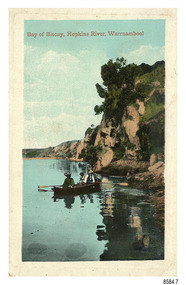
Postcard - Scenic - Warrnambool, Bay of Biscay, Hopkins River, Warrnambool, 1902-1910
... Flagstaff Hill Maritime Museum Flagstaff Hill Maritime Village Flagstaff Hill Maritime Museum and Village Maritime Museum Warrnambool Great Ocean Road Warrnambool and District Warrnambool Scenes local scenes Views of Warrnambool Joseph Jordan Jordan Series Jordan Photography postcard souvenir correspondence cameo postcard Bay of Biscay fishing boating Front, in red: “Bay of Biscay, Hopkins River, Warrnambool” Back in green: “Jordan Series” “POST CARD” “PRINTED IN GREAT BRITAIN” “For correspondence” “The Address only to be written here” Postcard, one of nine, portrait orientation, coloured print within a rectangle border with an impressed line around the image and a title in red. ...The nine postcards in this set were donated together and date to the early 1900s. All but one postcard in this set shows images of Warrnambool, in the Western District of Victoria; the other has a London image. The postcards were all printed in Great Britain according to that country’s postal regulations. The fronts of all cards have titles printed in red. Most of the images on the cards are attributed to photographer Joseph Jordan and belong to the Jordan Series. The back of these cards has an outline for a postage stamp, a vertical dividing line and a heading on each side of the line to separate the Correspondence from the Address. Postcards or ‘correspondence cards’ appeared in Britain in 1894. They were plain cards with a space for the message on one side and an address on the other; regulations didn’t allow anything but the address to be written on the ‘address’ side. In 1902 the British regulations then allowed a picture to be printed on the front and the address on the back, so messages had to be written on the picture side. Soon, the regulations changed and the back was divided for a message and the address. Bay of Biscay, Hopkins River, Warrnambool – This same image was published in Table Talk on January 6th, 1910 and in The Age, on December 18, 1929, referred to a revival of fishing at the Bay of Biscay on the Hopkins River. These and similar articles showcased the Bay of Biscay as a popular boating and fishing location and well worth promoting to places outside of Warrnambool. Joseph Jordan - Joseph Jordan was born in 1841 in Leicester England. When he was 16 he joined the 7th Queen's Own Hussars and was sent to India at the outbreak of the mutiny. He took part in the relief of Lucknow and remained in India for eleven years. It was during this time that he became interested in photography. He was posted to New Zealand and later came to Victoria, becoming a sergeant major of the Mounted Rifles. In the mid-1880s he came to the Western district where he was responsible for establishing units of the Mounted Rifles in various country towns such as Dunkeld, Mortlake, Panmure, Bushfield, Koroit etc. He resigned from the army in 1889 and set up a professional photography studio in Liebig Street, Warrnambool. He became very well known in the Western District for family photographs, official photographs of local councillors and groups as well as views of local scenery. In 1891 he photographed the wrecked barque ‘Fiji’ at ‘Wrecks Beach’ near Princetown. His business was taken over by his son Arthur around 1917. Joseph was a keen rifle shot and in 1924 he donated the "Jordan Shield" as a prize to the Victorian Rifle Association. He was made a "Life Honorary Member" of the Warrnambool Returned Soldiers League and in 1933 he was recognised as being the oldest living soldier in Victoria. Joseph died in 1935 aged 95.The image of the figures in a row boat on the river suggests that the location was a popular place to visit. The choice of subject for this postcard indicates the popularity of Warrnambool's natural environment as a tourist attraction at a time when ships called coastal traders brought passengers and cargo to the Port of Warrnambool from ports along Victoria's southwest coast. Joseph Jordan is a significant figure in Warrnambool history as he helped to establish early units of the Mounted Rifles (G Company) in local towns during the late 1880's and later, photographed local scenes, groups and citizens of early Warrnambool.Postcard, one of nine, portrait orientation, coloured print within a rectangle border with an impressed line around the image and a title in red. The picture shows three figures wearing hats in a rowboat on the bank of a river beside cliffs. There is no correspondence written on the card. The back has inscriptions and outlines for a postage stamp. Jordan Series, printed in Great Britain.Front, in red: “Bay of Biscay, Hopkins River, Warrnambool” Back in green: “Jordan Series” “POST CARD” “PRINTED IN GREAT BRITAIN” “For correspondence” “The Address only to be written here”flagstaff hill maritime museum, flagstaff hill maritime village, flagstaff hill maritime museum and village, maritime museum, warrnambool, great ocean road, warrnambool and district, warrnambool scenes, local scenes, views of warrnambool, joseph jordan, jordan series, jordan photography, postcard, souvenir, correspondence, cameo postcard, bay of biscay, fishing, boating -
 Flagstaff Hill Maritime Museum and Village
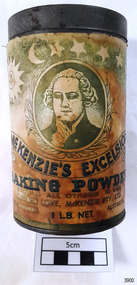
Container - Tin, McKenzies Foods, circa 1930s
... It gives a snapshot into domestic life and social norms of the pre and post war period in Melbourne The tin is significant for its association with a local family in the 1930s for the preparation of family meals. flagstaff hill asset baking powder tin container flagstaff hill museum kitchen item cooking ingredients flagstaff hill warrnambool shipwrecked coast flagstaff hill maritime museum maritime museum shipwreck coast flagstaff hill maritime village great ocean road tin cooking ingredient food container grocery cookery rising agent baking powder mckenzie mckenzie foods Text includes “CLIFFORD LOVE, McKENZIE PTY. LTD.” “McKENZIE’S EXCELSIOR / BAKING POWDER”. Motif: man’s portrait within oval frame with wheat sheaf border ...This tin once contained McKenzie’s baking powder, a cooking ingredient. It was donated with other similar tins that were used by the donor’s mother who was married in 1932. It those times in Australia all manner of household items, including food and drink, were sold by hawkers (salesmen) who travelled from door to door in both suburban and rural areas. The donor remembered the bicarb soda tin on her mother’s pantry shelf. The McKenzie’s Baking Powder label adds the information that the ingredients were “Prepared with Aerophos, Regd. Trade Mark, the finest raising ingredient. A product of Albright & Wilson, Australia Pty. Ltd.” It also says that it “Excels all others in use”. The company began in Melbourne in 1852 and continues today, now run be the fifth generation of descendants from the original owners. This tin originates in the early 1900s from an Australian company that is now managed by fifth generation descendants of the original family after its inception in 1852. The tin increases in significance for its use as a recognised object found in many Australian kitchens since early days. It gives a snapshot into domestic life and social norms of the pre and post war period in Melbourne The tin is significant for its association with a local family in the 1930s for the preparation of family meals. Tin container, cylindrical, with cream and green paper label with gold highlights, motif and text. Used for selling McKenzie’s Excelsior baking powder. Container has push-on lid. Quantity of 1LB. NET. Made in Australia by McKenzie Ltd.Text includes “CLIFFORD LOVE, McKENZIE PTY. LTD.” “McKENZIE’S EXCELSIOR / BAKING POWDER”. Motif: man’s portrait within oval frame with wheat sheaf border, placed below figures of sun, moon and stars. Information and instructions. flagstaff hill asset, baking powder tin, container, flagstaff hill museum, kitchen item, cooking ingredients, flagstaff hill, warrnambool, shipwrecked coast, flagstaff hill maritime museum, maritime museum, shipwreck coast, flagstaff hill maritime village, great ocean road, tin, cooking ingredient, food container, grocery, cookery, rising agent, baking powder, mckenzie, mckenzie foods -
 Flagstaff Hill Maritime Museum and Village
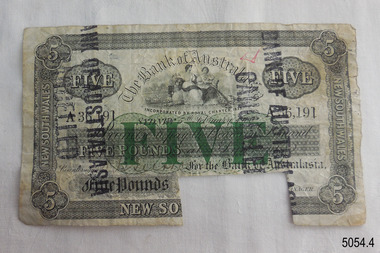
Currency - Banknote, Five-pound
... The banknotes also have a significant place in Australia’s history as two notes are just prior to Federation and two notes just after Federation. flagstaff hill warrnambool one pound note Bank of Australasia legal tender £1 banknote banknotes Flagstaff Hill Maritime Museum & Village Shipwreck Coast five poind note Australian currency Shipwrecked coast Flagstaff Hill Maritime Museum Maritime Museum Flagstaff Hill Maritime Village Great Ocean Road Union Bank Australia & New Zealand Bank ANZ Bank David Charters McArthur D C McArthur One-pound note Five-pound note £5 Sydney New South Wales Pre-Federation Post-Federation Currency banknote set Printed: (Serial Number) "A36,191" "FIVE POUND" "NEW SOUTH WALES" "5th February 1900" Stamp "BANK OF AUSTRALASIA / CANCELLED" Image: (around border) "BANK OF AUSTRALASIA INCORPORATED BY ROYAL CHARTER" and (image on shield) [suspended sheep] in diagonal corners, and [sailing ships] in other diagonal corners, and four stars (or open flowers)" Handwritten in red pen: "undecipherable [initials]" Text in pencil "L24" Five-pound banknote, one of a set of four banknotes published by The Bank of Australasia, Sydney, New South Wales. ...This five-pound banknote is one of a set of four banknotes issued by the Bank of Australasia's Head Office in Sydney, New South Wales. Two banknotes are dated before the Federation of Australia on 1st January 1901 and two are dated just two years after Federation. Each of the banknotes in this set has a rectangular piece cut from it. This indicates that the banknote was cancelled when the note was exchanged for Australian dollars after Decimal Currency was introduced on 14th February 1966. The Bank of Australasia was established under the Royal Charter of England. It first came to Australia in 1835, opening in Sydney. The Bank of Australasia was the first bank in Warrnambool. It was established in 1854 and operated from leased buildings in Merri Street then Timor Street. The bank opened its own building on May 21, 1860, on the north-east corner of Timor and Kepler Streets. In that year, the Acting Superintendent of the Bank of Australasia in Sydney was David Charters McArthur. He went on to become the Superintendent 1867-1876. In 1951 the Bank of Australasia amalgamated with the Union Bank to form the Australia and New Zealand Bank, now known as the ANZ. Then in 1970 the ANZ merged with both the ES&A and the London Bank of Australia to form the ANZ Banking Group Limited. The ANZ Banking Group Ltd kindly donated a variety of historic items from the Bank of Australasia. This set of banknotes has historical significance as it was used by the Bank of Australasia, the first bank in Warrnambool. The bank was established in 1854 and continued until its merger, when it became the ANZ Bank in 1951 and is still in operation today. The bank was an integral part of the establishment and growth of commerce in Colonial Warrnambool, Victoria, and Australia. The banknotes also have a significant place in Australia’s history as two notes are just prior to Federation and two notes just after Federation.Five-pound banknote, one of a set of four banknotes published by The Bank of Australasia, Sydney, New South Wales. The obverse of the note is printed in black ink with the denomination and its round pound-coin symbols printed in green ink. The reverse has a decorative border and image with an inscription and shield. A black ink stamp was impressed twice on each side, stating that the note is cancelled. Handwritten red ink text is on the note's obverse and pencil text on the reverse. A unique Serial number is printed twice on the obverse. The banknote has a rectangular cut-out notch on the lower edge. Printed: (Serial Number) "A36,191" "FIVE POUND" "NEW SOUTH WALES" "5th February 1900" Stamp "BANK OF AUSTRALASIA / CANCELLED" Image: (around border) "BANK OF AUSTRALASIA INCORPORATED BY ROYAL CHARTER" and (image on shield) [suspended sheep] in diagonal corners, and [sailing ships] in other diagonal corners, and four stars (or open flowers)" Handwritten in red pen: "undecipherable [initials]" Text in pencil "L24"flagstaff hill, warrnambool, one pound note, bank of australasia, legal tender, £1, banknote, banknotes, flagstaff hill maritime museum & village, shipwreck coast, five poind note, australian currency, shipwrecked coast, flagstaff hill maritime museum, maritime museum, flagstaff hill maritime village, great ocean road, union bank, australia & new zealand bank, anz bank, david charters mcarthur, d c mcarthur, one-pound note, five-pound note, £5, sydney, new south wales, pre-federation, post-federation, currency, banknote set -
 Flagstaff Hill Maritime Museum and Village
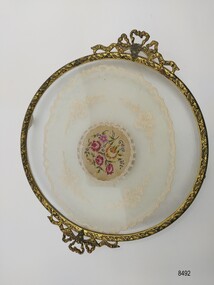
Domestic object - Dressing table tray, Mid 20th century
... A paper (written by the Warwickshire Industrial Archeology Society) notes that the products items produced by "Regent of London" in the 1940's "satisfied a demand for previously unattainable items, offered to the general public aching for change after wartime privations, post war austerity and years of having to 'make do and mend'." This tray is composed of several decorative elements and materials. The metal border...A paper (written by the Warwickshire Industrial Archeology Society) notes that the products items produced by "Regent of London" in the 1940's "satisfied a demand for previously unattainable items, offered to the general public aching for change after wartime privations, post war austerity and years of having to 'make do and mend'." This tray is composed of several decorative elements and materials. The metal border ...Dressing tables (also known as Vanity Tables in the U.S.A.) have been around since the beginning of the seventeenth century, however it wasn't until the early to mid 20th century that they began to be found in the homes of the middle class and they were often a matching part of a bedroom suite. Dressing tables often featured a variety of objects such as combs, brushes, hand mirrors, perfume bottles, cosmetics, nail buffers, ring holders, jewellery and trinket boxes and trays. The origins of this tray are unknown however its design is reminiscent of trays (and Dressing Table Sets) produced by two English firms in the mid 20th century - "Delina" and "Regent of London". A paper (written by the Warwickshire Industrial Archeology Society) notes that the products items produced by "Regent of London" in the 1940's "satisfied a demand for previously unattainable items, offered to the general public aching for change after wartime privations, post war austerity and years of having to 'make do and mend'." This tray is composed of several decorative elements and materials. The metal border is gilt brass with two filigree bow handles, the main part of the tray is two pieces of circular glass and the encased doily is a mix of embroidered net and petit point. It was suggested in the paper written by the Warwickshire Industrial Archeological Society that the different pieces would have probably been produced elsewhere and brought to the factory to be assembled into the finished product. This vanity or dressing table tray is significant as it is a rare example of an accessory available to and used by women in the mid 20th century. It is also significant as an example of an everyday household item which would have been a valued possession and was made in a style that reflected the importance placed on it to be decorative as well as functional.Round footed dressing table tray with a gilt brass border, filigree bow handles and an embroidered net and petit point doily encased in glass. The gilt border is decorated with a stylized leaf design on the side and a floral design on the top. The petit point embroidery in the center is of five flowers in pink, mauve and yellow surrounded by buds and leaves.vanity tray, dressing table tray, glass tray, gilt brass, petit point, embroidery, net embroidery, doily, filigree, brass tray, flagstaff hill maritime village, shipwreck coast, flagstaff hill, warrnambool, flagstaff hill museum and village, domestic object, dressing table
