
Showing 62 items matching "builder's plate"
-
 Australian Railway Historical Society Victorian Division
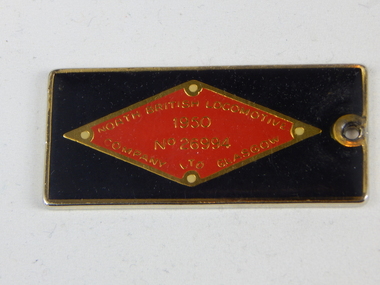
Replica Builder's Plate Key Tag, 1980s
... Replica Builder's Plate Key Tag...Builder's Plate...Replica Builder's Plate for Steam Locomotive R700 Key Tag...Glasgow 1950 No. 26994 Replica Builder's Plate for Steam Locomotive R700 Key Tag Replica Builder's Plate Key Tag ...Class Leader of the R Class Steam Locomotive, designed by the Victorian Railways and manufactured in Glasgow, Scotland by the North British Locomotive Company. One of 70 Locomotives constructed from 1951 to 1954, becoming the last steam mainline express passenger locomotive on the Victorian Railways. The first 4-6-4 wheel arrangement used by the V.R. Replica Builder's Plate for Steam Locomotive R700 Key TagLocomotive R700 North British Locomotive Company Ltd. Glasgow 1950 No. 26994builder's plate, victorian railways, steam locomotive, r class, north british locomotive company -
 Ballarat Tramway Museum
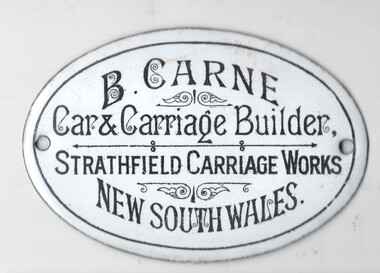
Functional object - Builder's plate - Benjamin Carne, Benjamin Carne, c1890
... Builder's plate - Benjamin Carne...Oval enameled metal plaque or plate with black text on a white background, reading "B. CARNE, Car & Carriage Builder, STRATHFIELD CARRIAGE WORKS, NEW SOUTH WALES." ...Functional object Builder's plate - Benjamin Carne Benjamin Carne ...Fitted to carriages and tramcar bodies built by Benjamin Carne in Strathfield NSW. The central saloon section of ESCo No. 12 was built by this builder in 1892 as a North Sydney cable tram - see Conservation Plan for ESCo 12. Understood that he went bankrupt and moved to South Africa. Located by descendents and donated to the Museum August 2026. Has not been used.Demonstrates a builders plate or plaque used by a carriage builder to mark their products.Oval enameled metal plaque or plate with black text on a white background, reading "B. CARNE, Car & Carriage Builder, STRATHFIELD CARRIAGE WORKS, NEW SOUTH WALES." Has two 4mm holes, one at each end.cable trams, north sydney, benjamin carne, carriages, esco, tram 12 -
 Puffing Billy Railway
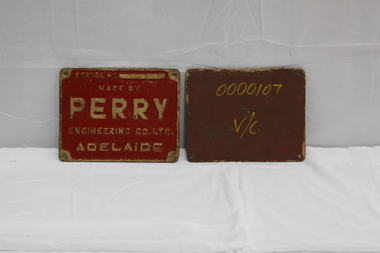
Perry Engineering Co. - Builders Plate, 1950
... ...builder plate...Builders plate from locomotive "Delta" No. 1....Perry Engineering Co. Builders Plate Made from cast Iron...Builders Plate Made from cast Iron Perry Engineering Co. - Builders Plate Perry Engineering, ...Builders plate from locomotive "Delta" No. 1.Historic - Perry Engineering Locomotive Builders plate used on Steam Locomotive "Delta" No. 1.Perry Engineering Co. Builders Plate Made from cast IronMade by Perry Engineering Co. 7967.50.4steam engine, perry engineering, puffing billy, builder plate, delta -
 Puffing Billy Railway
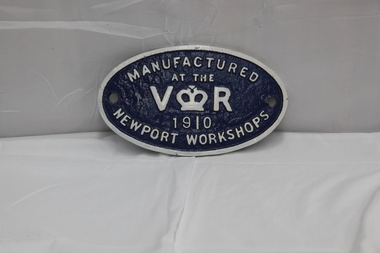
Builders Plate - Replica Victorian Railways Locomotive, 2010
... Historic - Puffing Billy Railway - Replica Victorian Railways Builders Plate...Replica Victorian Railways Builders Plate Made from cast aluminium with blue and white paint....Historic - Puffing Billy Railway - Replica Victorian Railways Builders Plate Historic - Puffing Billy Railway - Replica Victorian Railways Builders Plate puffing billy builders plate moe walhalla 7a 9a Manufactured at the V R Newport workshops 1910 Replica Victorian Railways Builders Plate Made from cast aluminium with blue and white paint. ...Produced for the running of locomotive 7A, dressed as 9A on the Thomson to Walhalla portion of the Moe to Walhalla narrow gauge railway for the Moe to Walhalla railway centenary in 2010. Historic - Puffing Billy Railway - Replica Victorian Railways Builders PlateHistoric - Puffing Billy Railway - Replica Victorian Railways Builders PlateReplica Victorian Railways Builders Plate Made from cast aluminium with blue and white paint.Manufactured at the V R Newport workshops 1910puffing billy, builders plate, moe, walhalla, 7a, 9a -
 Puffing Billy Railway
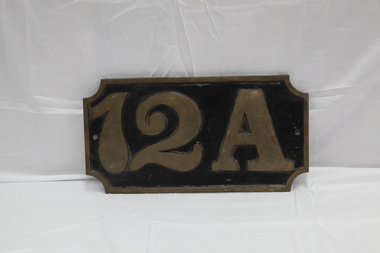
12A Number Plate
... Number Plate 12A Brass builders plate with black background ...Historic - Victorian Railways Locomotive Number Plate used on Steam Locomotive 12A puffing billy 12a number plate 12A Number Plate 12A Brass builders plate with black background 12A Number Plate Victorian Railways - Newport Workshop ...Number Plate 12A Loco: 12A In service Monday, 23rd December 1912 Livery Black with Red Owner Puffing Billy Gauge 762 Status Under Overhaul 12A Built in 1912 and painted Canadian red & dark brown, this locomotive was issued to the Colac to Crowes line, but over the years saw service on all four lines. It was withdrawn from service in 1954 at Moe and sent to Newport Workshops for storage where it remained until 1972. After overhaul at Ballarat North Workshops, it was brought to Belgrave in 1973 where it saw continuous service until withdrawn in 1982 for a complete rebuild. It was returned to service in 1992 in close to its early 1940s condition with all-over Black livery. It will be returned to its post WWI condition with low bunker, narrow ash chute, steel cowcatcher and Canadian red livery.Historic - Victorian Railways Locomotive Number Plate used on Steam Locomotive 12A Number Plate 12A Brass builders plate with black background 12Apuffing billy, 12a, number plate -
 Puffing Billy Railway
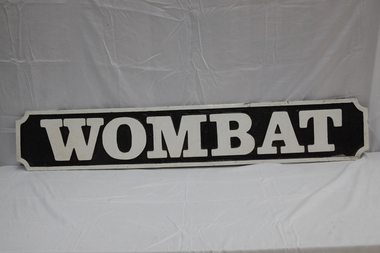
Name Plate - Wombat, 1982
... Name Plate - Wombat Thin rectangular black and white builders plate....Historic - Name Plate 'Wombat" - From the 1982 Australian Children's TV Series Come Midnight Monday where 12A stars as "Wombat". puffing billy wombat come midnight monday name plate 12a Wombat Name Plate - Wombat Thin rectangular black and white builders plate. Name Plate - Wombat Puffing Billy Railway ...From the 1982 Australian Children's TV Series Come Midnight Monday where 12A stars as "Wombat".Historic - Name Plate 'Wombat" - From the 1982 Australian Children's TV Series Come Midnight Monday where 12A stars as "Wombat".Name Plate - Wombat Thin rectangular black and white builders plate.Wombatpuffing billy, wombat, come midnight monday, name plate, 12a -
 Melbourne Tram Museum
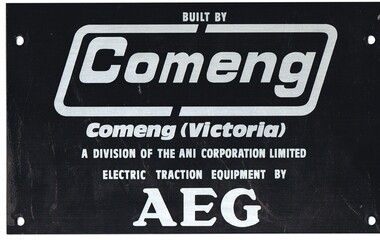
Sign - Builders' plate, Commonwealth Engineering - Comeng, C1980
... Metal plate - aluminium - printed with black metal ink, Comeng Dandenong builders plate used on A or B class trams with AEG traction equipment....Sign Builders' plate Commonwealth Engineering - Comeng ...Metal plate - aluminium - printed with black metal ink, Comeng Dandenong builders plate used on A or B class trams with AEG traction equipment.trams, tramways, builders plate, comeng, a class, b class, aeg -
 Melbourne Tram Museum
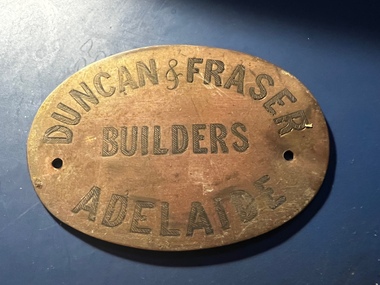
Functional object - Sign, Duncan & Fraser, Builders Plate, c1910
... Oval shaped engraved Builders plate with the words "DUNCAN & FRASER BUILDERS ADELAIDE" . ...Demonstrates the method of recording who built the tramcar body. Builders plate Duncan & Fraser Adelaide tramcar Oval shaped engraved Builders plate with the words "DUNCAN & FRASER BUILDERS ADELAIDE" . ...Manufactured by the Adelaide tramcar body builder, Duncan and Fraser to indicate or advise passengers who built the tram. Were generally located above a doorway of the tramcars. Demonstrates the method of recording who built the tramcar body.Oval shaped engraved Builders plate with the words "DUNCAN & FRASER BUILDERS ADELAIDE" . Has two 2mm diameter holes on either end of the plate.builders plate, duncan & fraser, adelaide, tramcar -
 Ballarat Tramway Museum
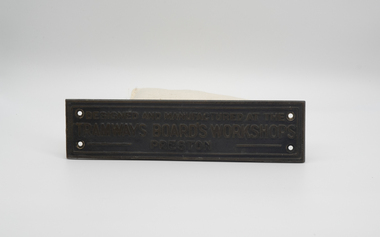
Functional Object - Builders' plate - Tramway Board's Workshop Preston, Melbourne and Metropolitan Tramways Board (MMTB), "Designed and Manufactured at the Tramway Board's Workshop Preston", about 1926
... Rectangular cast brass Builders' Plate with raised edge, inner lined letters in capitals "DESIGNED AND MANUFACTURED AT THE TRAMWAY'S BOARD WORKSHOP PRESTON" Four mounting - countersunk in corners - matt dark grey background - paint?...Tramways trams Builders' Plate Melbourne MMTB On rear in faint purple crayon "460" Rectangular cast brass Builders' Plate with raised edge, inner lined letters in capitals "DESIGNED AND MANUFACTURED AT THE TRAMWAY'S BOARD WORKSHOP PRESTON" Four mounting - countersunk in corners - matt dark grey background - paint? ...Demonstrates the method of recording who built the tramcar body.Rectangular cast brass Builders' Plate with raised edge, inner lined letters in capitals "DESIGNED AND MANUFACTURED AT THE TRAMWAY'S BOARD WORKSHOP PRESTON" Four mounting - countersunk in corners - matt dark grey background - paint?On rear in faint purple crayon "460"tramways, trams, builders' plate, melbourne, mmtb -
 Melbourne Tram Museum
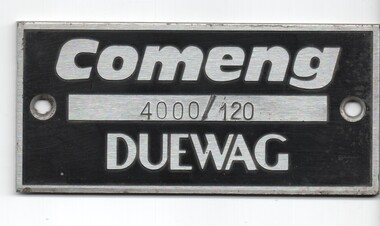
Sign, Commonwealth Engineering - Comeng, "Comeng / Duewag", 1980's
... Builders Plate, sign - cast aluminium with raised letters within raised border and two screw holes on each side. ...Trams tramways Signs Tramcars Tramcar Bodies New Trams B class Duewag Comeng Commonwealth Engineering Builders Plate, sign - cast aluminium with raised letters within raised border and two screw holes on each side. ...Builders Plate, sign - cast aluminium with raised letters within raised border and two screw holes on each side. Black painted background. "Comeng / Duewag" with "4000/120" stamped for a B class tram or contract 4000.trams, tramways, signs, tramcars, tramcar bodies, new trams, b class, duewag, comeng, commonwealth engineering -
 Melbourne Tram Museum
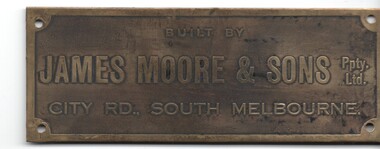
Sign, James Moore & Sons, "Built by JAMES MOORE & SONS Ppty Ltd, 1920's
... Builders Plate, sign - pressed brass sheet with burnished background around the raised letters - "Built by JAMES MOORE & SONS Ppty Ltd. ...Trams tramways Signs Tramcars Tramcar Bodies James Moore New Trams W2 class tram 268 tram 265 Has on the rear in black text pen "265" Builders Plate, sign - pressed brass sheet with burnished background around the raised letters - "Built by JAMES MOORE & SONS Ppty Ltd. ...Used by the company on the tramcar bodies it built for the MMTB in the 1920's. Second copy marked on rear "Ex W2 268"Yields information about the construction of W class trams.Builders Plate, sign - pressed brass sheet with burnished background around the raised letters - "Built by JAMES MOORE & SONS Ppty Ltd. City Rd. South Melbourne". Has screws holes in each corner. Two copies held.Has on the rear in black text pen "265"trams, tramways, signs, tramcars, tramcar bodies, james moore, new trams, w2 class, tram 268, tram 265 -
 Melbourne Tram Museum
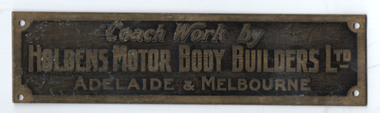
Functional object - Sign, Holden Motor Body Builder's Ltd, Builders Plate, mid 1920s
... Builders Plate, sign - pressed brass sheet with burnished black background around the raised letters - "Coach Work by Holdens Motor Body Builders Ltd Adelaide & Melbourne". ...Two copies held. Builders Plate Functional object Sign Holden Motor Body Builder's Ltd ...Used by the company on the W class tramcar bodies it built for the MMTB in the 1920's. Second copy ex W2 322. See item 2430 for another example. Demonstrates the method of recording who built the tramcar body.Builders Plate, sign - pressed brass sheet with burnished black background around the raised letters - "Coach Work by Holdens Motor Body Builders Ltd Adelaide & Melbourne". Has screws holes in each corner. Two copies held.builders plate, adelaide, tramcar, signs, tramcars, holdens, new trams, w class, tram 322 -
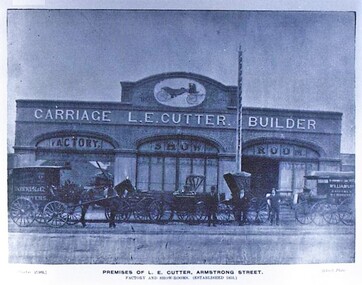 City of Ballarat Libraries
Postcard - Card Box Photographs, Premises of L.E. Cutter, Armstrong Street
... Established 1853? Carriage Builders. Plate 236 Chuck Photo Series....Established 1853? Carriage Builders. Plate 236 Chuck Photo Series. L.E. Cutter Armstrong Street Building Manufacturing Ballarat Premises of L.E. ...Factory Show-Rooms. Established 1853? Carriage Builders. Plate 236 Chuck Photo Series.l.e. cutter, armstrong street, building, manufacturing, ballarat -
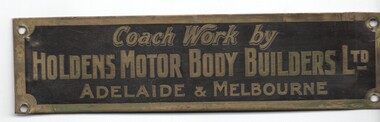 Melbourne Tram Museum
Sign, Holdens Motor Body Builders Ltd, "Coach Work by Holdens Motor Body Builders Ltd Adelaide & Melbourne", 1920's
... Builders Plate, sign - pressed brass sheet with burnished black background around the raised letters - "Coach Work by Holdens Motor Body Builders Ltd Adelaide & Melbourne". ...Trams tramways Signs Tramcars Tramcar Bodies Holdens New Trams W2 class Has on the rear in black text pen "339" Builders Plate, sign - pressed brass sheet with burnished black background around the raised letters - "Coach Work by Holdens Motor Body Builders Ltd Adelaide & Melbourne". ...Builders Plate, sign - pressed brass sheet with burnished black background around the raised letters - "Coach Work by Holdens Motor Body Builders Ltd Adelaide & Melbourne". Has screws holes in each corner. Used by the company on the tramcar bodies it built for the MMTB in the 1920'sHas on the rear in black text pen "339"trams, tramways, signs, tramcars, tramcar bodies, holdens, new trams, w2 class -
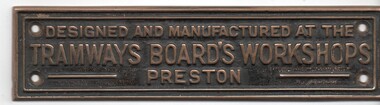 Melbourne Tram Museum
Sign, Melbourne & Metropolitan Tramways Board (MMTB), "Designed and Manufactured at the Tramways Board Workshops Preston", 1920's
... Builders Plate, sign - cast brass with raised letters within two raised lines and four screw holes in each corner. ...Plate fitted to W class trams built at Preston Workshops by the MMTB Demonstrates a MMTB Preston Workshops builders plate that were fitted to Trams built at the Workshops. ...Plate fitted to W class trams built at Preston Workshops by the MMTBDemonstrates a MMTB Preston Workshops builders plate that were fitted to Trams built at the Workshops.Builders Plate, sign - cast brass with raised letters within two raised lines and four screw holes in each corner. Black painted background. "Designed and Manufactured at the Tramways Board Workshops Preston" Three copies held. See Reg Item 5041 for replica plate.Has on the rear in black text pen "239". Copy 2 has chalk marked "417" on rear and Copy 3 has with a label on the rear "Off W2 549 Burnt" trams, tramways, signs, tramcars, tramcar bodies, mmtb, new trams, w2 class, tram 459, tram 417 -
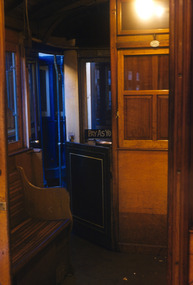 Ballarat Tramway Museum
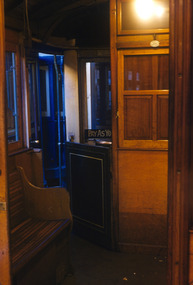
Photograph - Digital Image, Keith Kings, Geelong Pengelley interior, 1955
... Shows the door arrangements and the location of a builders plate....Shows the door arrangements and the location of a builders plate. Yields information about Geelong tramcars that were built by Pengelley of Adelaide. trams tramways Geelong Pengelley Digital image of a colour slide - Keith Kings K(f)(83) Geelong Pengelley interior Photograph Digital Image Keith Kings ...Digital image of a Photograph of the interior of one of Pengelley-built trramcars that operated in Geelong. Photo by Keith Kings. Shows the door arrangements and the location of a builders plate.Yields information about Geelong tramcars that were built by Pengelley of Adelaide.Digital image of a colour slide - Keith Kings K(f)(83)trams, tramways, geelong, pengelley -
 Ballarat Tramway Museum
Photograph - Interior photo of a Geelong Pengelley tram, Keith Kings, 1955
... Digital image scan of a Keith Kings slide showing the interior of a Geelong Pengelley tram in particular the detail of the end seat arrangement, doors, pay as you enter sign and the location of the builders plate....Geelong Pengelley trams tramways builders plate Digital image - Keith Kings number K(f)(83), Photograph Interior photo of a Geelong Pengelley tram Keith Kings ...Digital image scan of a Keith Kings slide showing the interior of a Geelong Pengelley tram in particular the detail of the end seat arrangement, doors, pay as you enter sign and the location of the builders plate.Yields information about the interior of a Geelong Pengelley tram.Digital image - Keith Kings number K(f)(83),geelong, pengelley, trams, tramways, builders plate -
 Ballarat Tramway Museum
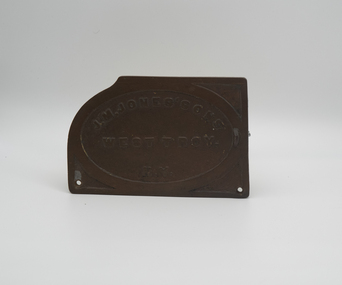
Functional Object - Builders' plate, J.M. Jones & Sons and Troy and N.Y, J.M. Jones & Sons, about 1890
... Brass cast Builders' plate with raised letters on both sides - " J.M. ...Tramways trams Builders' plate J.M. Jones Ballarat?? In pencil on non countersunk side "TRAM No. 15" Brass cast Builders' plate with raised letters on both sides - " J.M. ...Demonstrates the method of recording who built the tramcar body.Brass cast Builders' plate with raised letters on both sides - " J.M. JONES' SONS WEST TROY N.Y." Rounded on one corner. Has small lug on both sides on square end - window pull?? On lower edge, has two holes, countersunk on one side, See Tramways of North Sydney. - I. MacCowan 1990In pencil on non countersunk side "TRAM No. 15"tramways, trams, builders' plate, j.m. jones, ballarat?? -
 Melbourne Tram Museum
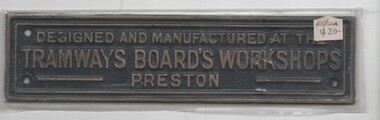
Sign, Hasco Foundry Ballarat, "Designed and Manufactured at the Tramways Board Workshops Preston", c2010
... Replica Builders Plate, sign - cast brass with raised letters within two raised lines and four screw holes in each corner. ...Trams tramways Signs Tramcars Tramcar Bodies MMTB New Trams Replica Builders Plate, sign - cast brass with raised letters within two raised lines and four screw holes in each corner. ...Replica Builders Plate, sign - cast brass with raised letters within two raised lines and four screw holes in each corner. Black painted background. "Designed and Manufactured at the Tramways Board Workshops Preston" Two copies held, both within plastic heat sealed envelopes with small label "Replica $20-" Produced by Tony Smith of the MTPA, c2010, cast by Hasco Foundry, Ballarat.trams, tramways, signs, tramcars, tramcar bodies, mmtb, new trams -
 Ballarat Tramway Museum
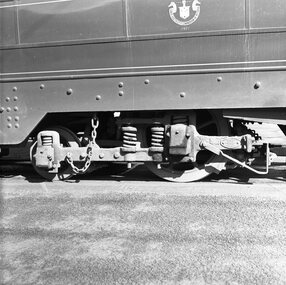
Photograph - B&W print of donated negative, John Webster, 21/08/1955 12:00:00 AM
... Assumed photo taken on the same day as the others - 21-8-1955, shows the Builders Plate and the SEC logo. Black and White prints made from scan of negative. ...Assumed photo taken on the same day as the others - 21-8-1955, shows the Builders Plate and the SEC logo. Black and White prints made from scan of negative. ...Yields information about the appearance of a 22E maximum traction truck on a Geelong Bogie TramBlack and white digital print from scan of a donated negative showing the Maximum Traction 22E truck of a bogie tram, parked in the depot area. Assumed photo taken on the same day as the others - 21-8-1955, shows the Builders Plate and the SEC logo. Black and White prints made from scan of negative. Original Negative stored with Negatives. Negative scanned at hi res 4/6/2020 and image updated.On left hand side of the negatives in ink is "EH 34"tramways, trams, geelong, depot, tramcar bodies, 22e trucks, sec -
 Ballarat Tramway Museum
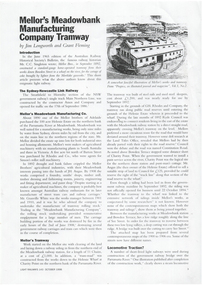
Document - Photocopy, Jim Longworth and Grant Fleming, 'Mellor's Meadowbank Manufacturing Company Tramway', Oct. 1998
... Included in article is a stylised illustration of the factory and its location, photographs of two surviving Meadowbank Manufacturing Builders plates from NSWGT tramcars (J class and P 1667). ...Included in article is a stylised illustration of the factory and its location, photographs of two surviving Meadowbank Manufacturing Builders plates from NSWGT tramcars (J class and P 1667). ...Photocopy of a three page article relating to the light railway that ran from Parramatta River Sydney to Mellor's Meadowbank factory, that appeared in 'Light Railways' magazine No. 143 of Oct. 1998, pages 3 to 5. Included in article is a stylised illustration of the factory and its location, photographs of two surviving Meadowbank Manufacturing Builders plates from NSWGT tramcars (J class and P 1667). Site now part of Meadowbank TAFE college.trams, tramways, meadowbank, tramcar manufacture, light railways, railway vehicle manufacture -
 Ballarat Tramway Museum
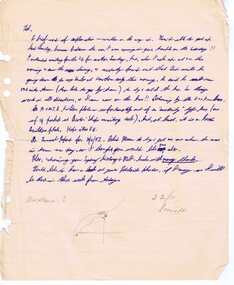
Document - Letter/s, early 1950's
... , a MMTB annual report of 1952. Notes builders plates at Preston workshops and austerity buses. ..., a MMTB annual report of 1952. Notes builders plates at Preston workshops and austerity buses. ...Handwritten letter on lined or ruled quarto paper with punch holes on the left hand side. Year of letter not known or who wrote it. Has in pencil "Maritaina?" and "22/11 - Roomette" under the letter which has been written in ink. Has notes regarding a visit to Melbourne?, a MMTB annual report of 1952. Notes builders plates at Preston workshops and austerity buses. Has a small sketch of a rail or tram lines in lower part of the letter. trams, tramways, melbourne, letters -
 Clunes Museum
Document - INVOICE, JULY 1880
... TIMBER MERCHANT, BUILDER IRONMONGER, PLATED GOODS, CUTLERY, UPHOLSTERERS, AND UNDERTAKER, AGRICULTURAL IMPLEMENTS, MINING TOOLS, ECT....TIMBER MERCHANT, BUILDER IRONMONGER, PLATED GOODS, CUTLERY, UPHOLSTERERS, AND UNDERTAKER, AGRICULTURAL IMPLEMENTS, MINING TOOLS, ECT. local history commerce book keeping mining GEORGE CHAPMAN DETAILED INVOICE TO MEF WILKINSON & PARTY. ...PORTION OF INVOICE - GEORGE CHAPMAN, CLUNES. TIMBER MERCHANT, BUILDER IRONMONGER, PLATED GOODS, CUTLERY, UPHOLSTERERS, AND UNDERTAKER, AGRICULTURAL IMPLEMENTS, MINING TOOLS, ECT.DETAILED INVOICE TO MEF WILKINSON & PARTY. PURCHASED FROM GEORGE CHAPMAN & CO.CLUNES. MINING SUPPLIES EG CANDLES, PICK HANDLES, FUSE, ROPE, DYNAMITE, HANDSAW ECT.local history, commerce, book keeping, mining, george chapman -
 Flagstaff Hill Maritime Museum and Village
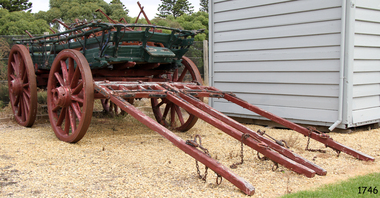
Vehicle - Wagon, Early 20th Century
... Original inscription, now obscured, was painted “Kelly and Preston Builders Ballarat”. Metal plate inscribed "Jas", and "S J Bell Wangoom". ...The wagon has a good provenance linking it to Mr Stanley James Bell and is also a good example of how goods were transported using horse-drawn vehicles at the beginning of the 20th century. flagstaff hill warrnambool shipwrecked-coast flagstaff-hill flagstaff-hill-maritime-museum maritime-museum shipwreck-coast flagstaff-hill-maritime-village wagon sj bell stanley james bell wangoom park warrumyea first reader john bell 1830-1920 stanley james bell 1904-1968 warrnambool pioneers f tozer western district kelly and preston of ballarat Original inscription, now obscured, was painted “Kelly and Preston Builders Ballarat”. Metal plate inscribed "Jas", and "S J Bell Wangoom". ...This wagon is linked to Mr Stanley James Bell via his father Mr John Bell, who owned "Warrumyea" at Wangoom. It is believed that Stanley grew up and worked for his father at this property, eventuality inheriting his father's death in 1920. This wagon was likely used at Mr Stanley Bell's property “Warrumyea” at Wangoom around 1920-1940. The wagon was donated in 1984, at which time it was noted as having a brass plate inscribed "Jas", which name Stanley was known by. Also, a painted on the wage was “S J Bell Wangoom”. Remnants of the original paint colours of blue and yellow show on the photograph, which was taken at the time of cataloguing. Mr John Bell Snr from Plymouth, England, arrived in Portland, Victoria, around 1860. He had served in the British navy as a lad for a number of years. On arriving in Australia he travelled to the Wangoom district where he lived for many years. Mr J Bell worked for 20 years as herd manager at “Wangoom Park”., for Mr F Tozer (1843-1954), one of the original pioneers of the western district. He went on to pursue dairying and general farming at his property “Warrumyea” Wangoom. Bell’s son Stanley James Bell went to the Wangoom School. His first reader from this school, published in 1909, has his name inscribed in the flyleaf “Stanley J. Bell, Warrumyea, Wangoom” and is now in the collection of the Warrnambool & District Historical Society. Stanley went on working the property “Warrumyea” and eventually purchased “Wangoom Park” in 1956, where his father had been employed years before. Mr S J Bell died in 1968.The wagon is significant for its association with the farming history of Wangoom and the Warrnambool area in general. Also, the wage is significant for its association with one of the early families that settled in the Warrnambool area and their contribution to the dairying and general farming industries that sprang from their efforts. The wagon has a good provenance linking it to Mr Stanley James Bell and is also a good example of how goods were transported using horse-drawn vehicles at the beginning of the 20th century.Four-wheeled wagon or cart,12 spokes in each wheel, wooden axle with rear hub brake. Hinged and chained tailboard. Wheels have metal rims. Metal frame and wooden superstructure. Wagon has two pairs of staves. Wooden shelves, one missing with turntable. Small toolbox in front. Made by Kelly and Preston of Ballarat. Metal nameplate of the owner attached, "Jas" (S J Bell of Wangoom).. Original inscription, now obscured, was painted “Kelly and Preston Builders Ballarat”. Metal plate inscribed "Jas", and "S J Bell Wangoom". flagstaff hill, warrnambool, shipwrecked-coast, flagstaff-hill, flagstaff-hill-maritime-museum, maritime-museum, shipwreck-coast, flagstaff-hill-maritime-village, wagon, sj bell, stanley james bell, wangoom park, warrumyea, first reader, john bell 1830-1920, stanley james bell 1904-1968, warrnambool pioneers, f tozer, western district, kelly and preston of ballarat -
 City of Ballarat Libraries
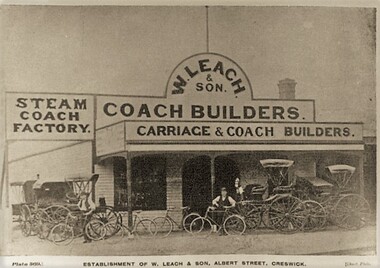
Postcard - Card Box Photographs, Establishment of W. Leach & Son, Albert Street, Creswick
... Carriage & Coach Builders. Steam Coach Factory. Plate 369 Chuck Photo Series....Carriage & Coach Builders. Steam Coach Factory. Plate 369 Chuck Photo Series. ...Carriage & Coach Builders. Steam Coach Factory. Plate 369 Chuck Photo Series.w. leach & son, albert street, creswick, building, persons, vehicles, manufacturing -
 Melbourne Tram Museum
Photograph - Set of 5 Black and White photograph/s - mounted, Darge Photos, early to mid 1920's?
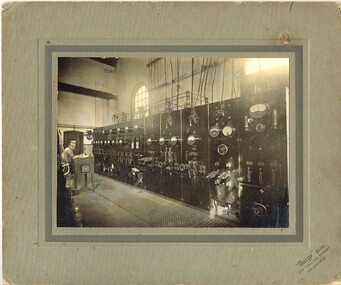
... (images i2 and i3 - close up of builders plate) 4 & 5 - View showing the generator ends of the engines (images i4 and i5 - close up of the buildings plate) - Browett and Lindley of Manchester, main engines. ...(images i2 and i3 - close up of builders plate) 4 & 5 - View showing the generator ends of the engines (images i4 and i5 - close up of the buildings plate) - Browett and Lindley of Manchester, main engines. ...Photographs of equipment at the Essendon or Ascot Vale Power House operated by The North Melbourne and Electric Tramways and Lighting Company. Photo by "Darge" Photos, 175 Collins St Melbourne, printed on the bottom right hand corner. 1 - Switchboard and wiring at the one end of the power station with attendant. 2 & 3 - View showing the engines and steam control equipment. (images i2 and i3 - close up of builders plate) 4 & 5 - View showing the generator ends of the engines (images i4 and i5 - close up of the buildings plate) - Browett and Lindley of Manchester, main engines. Two copies of image 4 held Reference photo on page 12 of "A short history of The North Melbourne Electric Tramways and Lighting Company Limited" - K.S. Kings, edited by Dean Filgate Dec. 2016. See item 9509 for a photo of the boilers and firing arrangements, thought to be at Essendon.Yields information about the interior of the NMETL Ascot Vale power house at the Essendon tram depot. Photos possibly taken at the time of the handover to the MMTB /SECV or when the plant was shut down during the 1920s.Set of five Black and White photograph, mounted onto grey impressed and lined, brown rear, card.trams, tramways, power station, equipment, essendon, nmetl -
 Flagstaff Hill Maritime Museum and Village
Functional object - Bell, Schomberg 1855, Before 1855
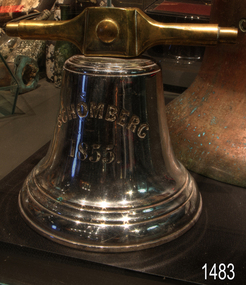
... The silver-plated metal bell bears the ship’s name and year of construction on one side and the name and address of the ship’s builders on the other. ...The silver-plated metal bell bears the ship’s name and year of construction on one side and the name and address of the ship’s builders on the other. ...The Rescue and Journey of the Schomberg Bells: This bell was the smaller of two rescued by the crew of the Schomberg following the ship’s wreck in 1855. While the specific purpose of the smaller bell is unknown, it may have served to assemble the crew or signal mealtimes on board. After surviving the shipwreck, the crew carried both bells as they made their way along the coastline. Their journey eventually led them to the home of settler John Manning, located at Hopkins Point near Warrnambool. Manning took possession of the bells and subsequently presented them to two churches in Warrnambool. The smaller bell went to St Joseph’s Catholic Church, while the larger bell went to St John’s Presbyterian Church. After around a year, the small bell at St Joseph’s developed a crack and became unusable. Thomas Manifold imported a replacement bell for the church, and the damaged bell was stored at his farm. Years later, when the property was sold to John Logan, the discarded bell was donated to the old Warrnambool Museum upon its opening in 1886. The Curator, Joseph Archibald, placed the bell on display in the entry. In 1975, it was transferred from the Warrnambool Art Gallery to Flagstaff Hill. The ’Mystery’ of the small bell solved: Despite numerous attempts by the staff at Flagstaff Hill to restore the bell’s lustre, the bell remained dull and tarnished. In October 1986, Director Peter Ronald decided to send the bell for professional advice. The bell was entrusted to Briggs Marine Products, a renowned brass founder established in 1912. Upon examination, the specialists at Briggs discovered the reason behind the bell’s persistent lack of shine: it had originally been silver-plated, but most of the plating had worn away over time. The experts at Briggs then undertook the task of restoring the bell, successfully returning it to a gleaming silver surface. The Sailing Ship Schomberg: Launched in 1855, the Schomberg was regarded as the “Noblest” ship afloat at the time. Owned by the Black Ball Line, it was built for their passenger fleet by Alexander Hall of Aberdeen at a cost of £43,103. The construction featured three skins: one planked fore and aft and two diagonally planked, all fastened with screw-threaded trunnels (wooden rails). The ship’s First Class accommodation was luxurious, boasting velvet pile carpets, large mirrors, rosewood, birds-eye maple and mahogany timbers, satin damask soft furnishings, and an oak-lined library with a piano. Schomberg had a capacity for 1,000 passengers. The ship’s master, Captain James Nicol Forbes—also known as ‘Bully’ Forbes—was only 34 years old at the launch. He had a reputation for setting and breaking speed records on the Black Ball Line’s Marco Polo and Lightning. In 1852, Forbes completed the London to Melbourne journey on the Marco Polo in 68 days, a record at the time, though 53 passengers died during the voyage. In 1854, he sailed the Lightning to Melbourne in 76 days and returned in only 63 days—a record that stood among sailing ships. Forbes was known for driving his ship and crew to their limits, often prioritising speed over passenger comfort. Determined to set new records, he promised to reach Melbourne in sixty days, declaring he would do so “with or without the help of God.” The Maiden Voyage and the Wreck: Schomberg departed Liverpool on 6th October 1855, flying a banner that read “Sixty Days to Melbourne”. The vessel carried 430 passengers and 3,000 tons of cargo, including materials to build the Melbourne to Geelong Railway and a bridge over the Yarra River. Among the cargo were a cow for fresh milk, pens for fowls and pigs, and 90,000 gallons of water for drinking and washing. Additionally, it transported 17,000 letters and 31,800 newspapers. The ship and cargo were insured for $300,000, a considerable sum for the era. Poor winds while crossing the equator delayed Schomberg’s progress. Land was first sighted on Christmas Day at Cape Bridgewater near Portland. Captain Forbes followed the coastline towards Melbourne, but was reportedly playing cards when the third mate, Henry Keen, reported land only three miles away. The ship ran aground on a sand spit near Curdie’s Inlet (approximately 56 km west of Cape Otway) on 26th December 1855, after 78 days at sea. The sand spit and nearby currents were not marked on Forbes’s map. During the night, the crew launched a lifeboat to search for a safe landing spot for the passengers. The scouting party advised Forbes to wait until morning, as rough seas posed a danger to the lifeboats. At dawn, the ship’s Chief Officer spotted the SS Queen and signalled for help. The master of the Queen brought his vessel alongside, and all passengers and crew disembarked safely. The Black Ball Line’s Melbourne agent sent another steamer to collect the passengers’ baggage, and other steamers assisted with cargo salvage until worsening weather forced operations to cease. Notably, a plunderer later recovered a case of Wellington boots, but all were for the left foot. The wreck and its cargo were sold to local merchants Manifold & Bostock, who did not attempt further salvage. They later sold their interest to a Melbourne businessman and two seafarers. In 1864, after two men drowned in their attempt to reach the Schomberg, salvage efforts were abandoned. By 1870, parts of the ship had washed ashore on New Zealand’s South Island. Today, the wreck is about nine metres below the surface. Although most woodwork has disintegrated, the vessel’s shape remains discernible due to the railway irons, girders, and framework. Various goods and materials from the ship are scattered nearby. The bell is particularly significant in that along with other items from the wreck helped in part to having the legislation changed to protect shipwrecks, with far tighter controls being employed to oversee the salvaging of wreck sites. This bell forms part of the Schomberg collection at Flagstaff Hill maritime museum. The collection as a whole is of historical and archaeological significance at a State level. Flagstaff Hill’s collection of artefacts from the Schomberg is also significant for its association with the Victorian Heritage Registered Schomberg shipwreck (VHR S 612). The collection is of additional significance because of the relationship between the objects salvaged, as together they help us to interpret the story of the Schomberg. The collection as a whole is historically significant for representing aspects of Victoria's maritime history and its potential to interpret social and historical themes from society at the time of the wreck. A small ship’s bell. The silver-plated metal bell bears the ship’s name and year of construction on one side and the name and address of the ship’s builders on the other. These details are deeply engraved into the metal and formed in bold, upper-case lettering. The bell has two bell stands: the left and the right. Both stands have an Iron pipe bent into an inverted ‘Y’ shape, with a hole along its length and feet attached to a rectangular metal plate at the other two ends. Feet are bolted to a timber base that has a hole drilled through the centre for mounting. Bell's front; “SCHOMBERG” with “1855” below. Bell's back “HALL & SONS (crack splits letter “N”) / BUILDERS (in italics) / ABERDEEN” (crack splits letter “B”).flagstaff hill, flagstaff hill maritime museum and village, warrnambool, maritime museum, maritime village, great ocean road, shipwreck coast, schomberg, silver plated bell, mess bell, bell stands, captain ‘bully’ forbes, alexander hall and son, james baines and company, liverpool’s black ball line, bell, schomberg bell, ship's bell, small bell, st joseph's church, briggs marine, john manning, john logan, warrnambool museum, briggs foundry, silver bell -
 Flagstaff Hill Maritime Museum and Village
Plaque - Nameplate, Morts Dock & Engineering Co. Ltd, Matthew Flinders I, 1917
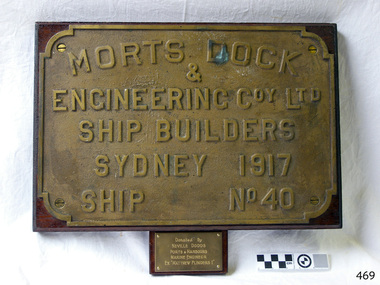
... . / SHIP BUILDERS / SYDNEY 1917 / SHIP NO 40" On small plaque: "Donated by / NEVILLE DODDS / PORTS & HARBOURS / MARINE ENGINEER / EX "MATTHEW FLINDERS I" Brass nameplate, rectangular with cut-away corners and moulded text, mounted with screws on timber. The plate ...This nameplate was attached to the steel steamer Matthew Flinders I, a Suction Hopper Dredge used for pumping up sit and sanding from seabeds. It was donated by the Marine Engineer, Neville Dodds, from Ports and Harbours, from the Matthew Flinders I. The Matthew Flinders was constructed by Morts Dock & Engineering Coy. Ltd in Sydney, New South Wales. Identified as Ship No. 40, the dredge had twin screw engines that were made in Sydney. Its gross tonnage was 1180. It was launched on July 15th, 1916, and registered in 1917 at the Port of Melbourne by the owner, the Department of Public Works in Victoria. Unlike bucket dredges, the Matthew Flinders did not use permanent moorings but instead had bow and stern anchors. It travelled forward on the bow anchor, taking up a strip of even-depth wilt from the bed below. A local newspaper noted that the Matthew Flinders has many advantages that were especially useful for its work at Warrnambool. Warrnambool Harbour had been experiencing silting and sanding for many years. The problem continued even after the construction of the Breakwater in 1890, which was overseen by New Zealand engineer Arthur Dudley Dobson. Melbourne’s Department of Ports and Harbours sent the new Matthew Flinders to dredge the heavy silting in the Warrnambool Harbour in May 1919. This work was previously done by the smaller dredge, the Pioneer. However, after a month of work, the Matthew Flinders was returned to Melbourne for alterations to make it suitable for work in the heavy seas it experienced at Warrnambool. Both dredges were sent up from Melbourne when required over the years to periodically attend to the silting in the Harbour, but the Matthew Flinders was preferred because of its efficiency. It was still dredging the Harbour even in July 1938. The ship’s original master was J G Rosney. In February 1922 Percy Taylor from Ports and Harbours joined the Matthew Flinders as a Mate. 1923 the master in charge was Captain Dunbar. In August 1926 Percy Taylor was appointed as her Master and was later transferred to the Pioneer as Master in 1933. 1930 the dredges were no longer required as the Harbour was no longer suitable as a port. However, one source notes that the Matthew Flinders was still dredging the Harbour in 1938.This nameplate is significant for its association with the suction hopper dredge Matthew Flinders I, which was used to remove the build-up of silt and sand from the Warrnambool Harbour, allowing shipping activities to continue to operate in the Port of Warrnambool. The nameplate identifies the vessel and shows that it was built in Australia in the early 20th century for use within Australia. The need for dredging in the Warrnambool Harbour was a serious and ongoing problem, as silting continued to happen after a series of measures were taken to try and resolve the issue. Eventually, the Harbour could no longer function successfully as a port.Brass nameplate, rectangular with cut-away corners and moulded text, mounted with screws on timber. The plate is from a vessel, the dredge Matthew Flinders I, ship no. 40, built by Morts Dock & Engineering Coy Ltd in Sydney, and registered in 1917. A small rectangular engraved plaque below the nameplate gives further details of the ship and the donor.On nameplate: "MORTS DOCK / & / ENGINEERING COY. LTD. / SHIP BUILDERS / SYDNEY 1917 / SHIP NO 40" On small plaque: "Donated by / NEVILLE DODDS / PORTS & HARBOURS / MARINE ENGINEER / EX "MATTHEW FLINDERS I"flagstaff hill, warrnambool, maritime village, maritime museum, flagstaff hill maritime museum & village, shipwreck coast, great ocean road, dredge, mathew flinders i, steel steam ship, twin screw engines, nsw, state of victoria, suction hopper, public works melbourne, warrnambool harbour, lady bay, sanding, silting, breakwater, morts dock & engineering co ltd, captain dunbar, ship no. 40, niville dodds, ports & harbours, marine engineer, marine technology, ship relic, percy taylor, matthew flinders, pioneer -
 Gippsland Vehicle Collection
Vehicle Tail Light, 1940 (estimated)
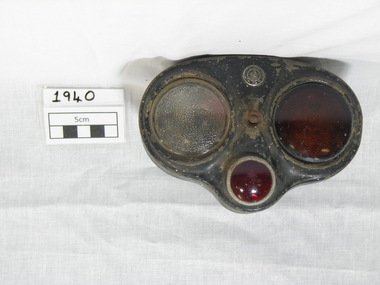
... Lucas granted Richards Body Builders of Adelaide, Australia, permission to use the phrase 'King of the Road' as their trade nick name. tail light stop light light tail king of the road light number plate light King of the Road maker's mark Kidney shaped metal & glass, four lens number-plate & tail light combination Vehicle Tail Light Lucas Electrical ...Lucas Electrical manufactured light and electrical components for many vehicle manufacturers in England and many manufacturers used them as accessories or added extras.Lucas granted Richards Body Builders of Adelaide, Australia, permission to use the phrase 'King of the Road' as their trade nick name.Kidney shaped metal & glass, four lens number-plate & tail light combinationKing of the Road maker's marktail light, stop light, light tail, king of the road light, number plate light -
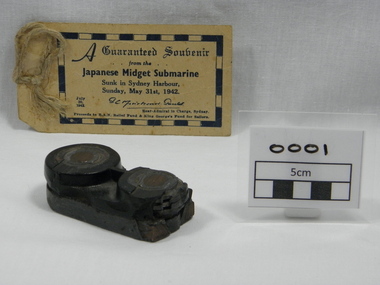 Werribee RSL Sub Branch
Termial - battery, World War Two
... Back of Tag - "27th November 1942 on show in the Gardens in Melbourne" Metal plate - two round black metal lugs on top of a flat grey lead plate with four Japanese characters stamped on the base off the top of a battery from a Midget Submarine, with a cardboard souvenir card. Termial - battery Japanese Submarine Builders ...This battery treminal was removed from one of the Japanese Midget Submarines sunk in Sydney Harbour during the night attack on Sunday 31st May 1942 and sold publicly as a souvenir to raise money for the RAN relief funds for sailors. Metal plate - two round black metal lugs on top of a flat grey lead plate with four Japanese characters stamped on the base off the top of a battery from a Midget Submarine, with a cardboard souvenir card.Metal Plate - four Japanese characters. Cardboard tag - "A Guaranteed Souvenir / from the / Japanese Midget Submarine / Sunk in Sydney Harbour,/ Sunday May 31st, 1942" / sign by "Rear-Admiral in Charge, Sydney /July 30, 1942 Proceeds to RAN Relief Fund & King George's Fund for Sailors". Back of Tag - "27th November 1942 on show in the Gardens in Melbourne"souvenenir, japanese midget submarine
