
Showing 25 items matching "carving craft"
-
 Flagstaff Hill Maritime Museum and Village
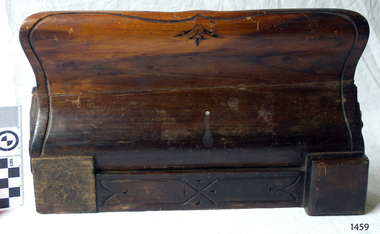
Decorative object - Pen Tray, David Hay, circa 1847
... ...carving craft...The pen tray is an example of the use of timbers salvaged from shipwrecks along the coast. flagstaff hill warrnambool shipwrecked-coast flagstaff-hill flagstaff-hill-maritime-museum maritime-museum shipwreck-coast flagstaff-hill-maritime-village wood carving carving carving craft 1850 wreck john watson james gardiner caught tramway jetty lady bay rescue line ian mckiggan vhr s238 relic buckawall schooner enterprise coastal trader new zealand indigenous rescue indigenous hero pen holder pen tray wood souvenir Enterprise s ouvenir "Swinburne", "from the vessel Enterprise" Writing on the back of the pen tray: "Made from / wreck of / "Enterprise" first boat / up river Yarra with / Fawkner later wrecked / at Warrnambool Vic" Decorative pen tray; handmade and carved from timber from the vessel "Enterprise", 1847-1850. ...This pen tray is handmade from some of the timbers from the wreck of the schooner Enterprise. It was originally donated to the former Warrnambool Museum and Art Gallery and transferred to Flagstaff Hill Maritime Museum and Village when it was first established. The paper tag with the pen tray was inscribed "SWINBURNE". It is likely to be a reference to Charles Grant Swinburen, Mr Chas (Charles) Grant Swinburne (1864-1934), married Susan Jane Granter (1867-19 June 1935) in 1891. They were both Warrnambool residents. Swinburne was a prominent member of the Toc H. Progress Association and several other local clubs and societies. He died after a painful illness. Swinburne's wife, Susan, was the daughter of Joseph (1832-1879) and Ann Granter (nee Holley). Her father had arrived in Melbourne on the ship Marco Polo in February 1856. In 1868, he was a shareholder of the Warrnambool Steam Packet Co., His portrait is among those recognised on the historic Warrnambool Pioneers Board. The inscription on the rear of the pen holder was added at a later date. It incorrectly states that the vessel "was the first boat up the river Yarra with Fawkner", confusing this Warrnambool wreck "Enterprise" with Fawkner's vessel "Enterprize" (sometimes written "Enterprise"). THE “ENTERPRISE” 1847-1850 The wooden, two-masted schooner Enterprise was built in New Zealand in 1847 and registered in Melbourne, Australia. The Enterprise carried cargoes of agricultural produce and other commodities for trade between the ports of the Colony. On September 14, 1850, the Enterprise was at anchor in Lady Bay under its Master, James Gardiner Caughtt, loaded with a cargo of wheat and potatoes. A strong south-easterly wind caused the vessel to drag on its only anchor, and the rudder was lost. The gale-force wind blew it sideways, and it became grounded. A local indigenous man, Buckawall, braved the rough sea to take a line from the shore to the Enterprise. All five members of the crew were able to make it safely to land. The Enterprise was wrecked. The Enterprise wreck was in an area called Tramway Jetty in Lady Bay. Since then, the area became the location of the Lady Bay Hotel, and now, in 2019, it is in the grounds of the Deep Blue Apartments. In fact, with the constantly changing coastline through built-up sand, the wreck site is now apparently under the No. 2 Caravan Park on Pertobe Road, perhaps 150 metres from the high tide. Its location was found by Ian McKiggan (leader of the various searches in the 1980s for the legendary Mahogany Ship). DIFFERENTIATING the New Zealand Schooner “Enterprise” from John Fawkner’s “Enterprize“ Dr Murray Johns, Melbourne, says in his article The Mahogany Ship Story “… As I documented in 1985, the Warrnambool wreck was of an entirely different ship, also called Enterprize [with the spelling ‘Enterprise’], but built in New Zealand in 1847. Fawkner’s ship had already been sold to Captain Sullivan in 1845 and was wrecked on the Richmond Pier in northern New South Wales early in 1847. “ The pen tray is significant for its association with the wreck of the Enterprise, which is listed on the Victorian Heritage Database, VHR S238. The Enterprise is of significance as a New Zealand-built but Australian-owned coastal trader. The wreck was also significant for its association with the indigenous hero Buckawall, who saved the lives of the five crew on board. The pen tray is an example of the use of timbers salvaged from shipwrecks along the coast.Decorative pen tray; handmade and carved from timber from the vessel "Enterprise", 1847-1850. The tray is made from several pieces of wood and has a concave surface. The engraving includes a border, motifs, and decorative scrolls on the sides. The inscription on the rear was written in script. A paper tag marked 'Swinburne' was with the board."Swinburne", "from the vessel Enterprise" Writing on the back of the pen tray: "Made from / wreck of / "Enterprise" first boat / up river Yarra with / Fawkner later wrecked / at Warrnambool Vic"flagstaff hill, warrnambool, shipwrecked-coast, flagstaff-hill, flagstaff-hill-maritime-museum, maritime-museum, shipwreck-coast, flagstaff-hill-maritime-village, wood carving, carving, carving craft, 1850 wreck, john watson, james gardiner caught, tramway jetty, lady bay, rescue line, ian mckiggan, vhr s238, relic, buckawall, schooner, enterprise, coastal trader, new zealand, indigenous rescue, indigenous hero, pen holder, pen tray, wood souvenir, enterprise s ouvenir -
 Flagstaff Hill Maritime Museum and Village
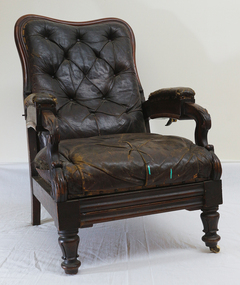
Furniture - Chair, Haberfield Chair, Michael Bradshaw, Circa 1860s-1890s
... The chair’s padded leather armrests have attractive, crafted carvings at each end. A lever located below the armrest operates the recliner’s ratchet mechanism, which also causes a footrest to slide forward for greater comfort. ...The chair’s padded leather armrests have attractive, crafted carvings at each end. A lever located below the armrest operates the recliner’s ratchet mechanism, which also causes a footrest to slide forward for greater comfort. ...This elegant reclining armchair is generously on loan from the local Haberfield family. Mrs Haberfield is a member of the Anderson family from the Tower Hill region, and the chair was handed down to her from them. When it arrived at Flagstaff Hill in 2009, it was at least 100 years old. The maker, Michael Bradshaw, is currently unknown. The origin of the chair's timber has been lost through the generations, but some have named the armchair the 'Mahogany Chair' after the legendary Mahogany Ship. In August 2009, the wood was expertly examined. The structure of the wood specimens was found to be consistent with: • Pale coloured carcass timber - Fagus sylvatica – Beech (European) • Pale coloured frame timber - Agathis sp – NZ Kauri • Dark coloured timber chair legs (solid) - Swietenia sp. – True Mahogany • Dark coloured timber veneer - Swietenia sp. – True Mahogany • Repair fill-in piece – Quercus sp. – White Oak ( Northern hemisphere) • Repair fill-in piece (fine textured) – Populus sp. – Poplar • Runner wood - Eucalyptus sp – Pale coloured ash group, or messmate The chair is significant for its local origin and history, being connected to generations of the Anderson and Haberfield families. It is also significant for its elaborate and unusual design, the quality of its workmanship and materials. It is a fine example of good quality furniture of the late 19th century.The Haberfield Chair is a reclining armchair that includes a footrest and a detachable book rest. The chair features a dark timber frame and dark burgundy (now dark brown), Morocco goat skin leather upholstery. The backrest is finished with button detailing, and its frame is distinguished by gracefully curved corners, lending the chair an elegant appearance. The chair’s padded leather armrests have attractive, crafted carvings at each end. A lever located below the armrest operates the recliner’s ratchet mechanism, which also causes a footrest to slide forward for greater comfort. The turned and carved front legs are equipped with wheels, allowing for easy movement. The removable book rest is mounted on a brass pedestal. Its angle can be conveniently adjusted using a screw to move the ball and socket joint, ensuring personalised reading comfort. There is a handwritten inscription on the underside of the back rail. The chair is kindly on loan from the local Haberfield family. In pen and ink: “Made from Mahogany Ship wrecked near Tower Hill, July 3, 1835: made by Michael Bradshaw 18-2-“ [originally thought to read 1842]flagstaff hill maritime museum and village, great ocean road, shipwreck coast, armchair, reclining armchair, reading board, mahogany chair, haberfield chair, furniture, living room furniture, domestic furniture, 19th century, luxury, morroco leather, book stand, book rest, side table, music stand, reading stand, reading rest, foot rest, reading table -
 Flagstaff Hill Maritime Museum and Village
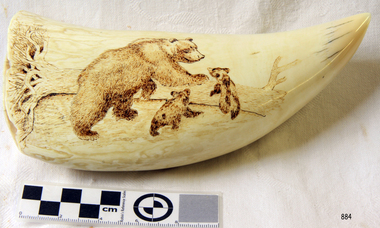
Craft - Scrimshaw
... ...Craft Work...Carving...It has been created as a decorative piece and is currently displayed as a representation of the craft of scrimshaw. warrnambool flagstaff-hill flagstaff-hill-maritime-museum maritime-museum shipwreck-coast flagstaff-hill-maritime-village Craft Work Carving on Bones Whale Bone Carving Engraving scrimshaw carving reproduction scrimshaw None Scrimshaw carved on a non-natural material in the shape of a whale tooth. ...When scrimshaw is mentioned, most people think of carving on sperm whale teeth only. But scrimshaw also includes engravings on skeletal whale bone–such as the jaw bone, called panbone–and ivory from other marine mammals such as walrus. Although scrimshaw is widely associated with nautical themes and designs of the 19th century whaling industry, vintage scrimshaw was also produced as tribal art in many cultures. Today, scrimshaw is recognized as a unique medium in which present-day artists have developed their own modern themes. Scrimshaw reproductions may take several forms. There are - New carvings on genuine ivory or bone with the deliberate intent to create an "antique” - New carvings on genuine ivory or bone sold as signed and dated contemporary art - Clearly marked synthetic museum reproductions and mass marketed - Unmarked synthetic replicas Painstakingly carved deliberate replicas are directed towards the scrimshaw collector and seldom appear in the general market. Pieces of contemporary art and museum copies are usually clearly marked and openly sold for what they are. The biggest problems in the general antiques market are the mass produced synthetic reproduction pieces, such as this item, that can be mistaken for the genuine item. The scrimshaw is a modern reproduction of a typical scrimshaw scene and engraved onto a synthetic substance. It has been created as a decorative piece and is currently displayed as a representation of the craft of scrimshaw.Scrimshaw carved on a non-natural material in the shape of a whale tooth. Engraving depicts a grizzly bear with two cubs next to a fallen tree. Nonewarrnambool, flagstaff-hill, flagstaff-hill-maritime-museum, maritime-museum, shipwreck-coast, flagstaff-hill-maritime-village, craft work, carving on bones, whale bone carving, engraving, scrimshaw, carving, reproduction scrimshaw -
 Federation University Historical Collection
Booklet, Ballarat School of Mines Prospectus A and B, 1916-7, c1917
... .1) Ballarat School of Mines Prospectus A .2) Ballarat School of Mines Prospectus B Contents includes teaching staff, school hours, curriculum, fee list, Travelling concessions, school library, classification of subjects. scholarships, Full art and Craft Courses (Industrial Design; Figure, Modelling, Painting and Design; Figure Drawing, Modelling, Painting and Design; Fashion Plate Drawing; Black and White Illustration; Modelling; Wood Carving and Lettering; Art Metal Work; Retouching, colouring, &c; Architectural Diploma; Draughtsmen's Courses; Art Teachers' Courses; Outdoor Sketching Classes; Photography; Building Construction and Architectural Drawing; Ticketwriting; Signwriting and Decorating COurse; Dressmaking, Needlework, etc; Preparatory Technical Classes for Girls; Day Commercial Classes; Other Branches of the School's Activities, examination results; Art Teachers' Certificate. ...The Ballarat Technical Art School was part of the Ballarat School of Mines ballarat school of mines ballarat technical art school design modelling figure drawing fashion plate drawing black and white illustration wood carving lettering art metal work retouching architecture architectural diploma draughtsmen's courses art teachers' courses outdoor sketching classes photography building construction architectural drawing ticketwriting signwriting and decorating dressmaking needlework art teachers' certificate. .1) Ballarat School of Mines Prospectus A .2) Ballarat School of Mines Prospectus B Contents includes teaching staff, school hours, curriculum, fee list, Travelling concessions, school library, classification of subjects. scholarships, Full art and Craft Courses (Industrial Design; Figure, Modelling, Painting and Design; Figure Drawing, Modelling, Painting and Design; Fashion Plate Drawing; Black and White Illustration; Modelling; Wood Carving and Lettering; Art Metal Work; Retouching, colouring, &c; Architectural Diploma; Draughtsmen's Courses; Art Teachers' Courses; Outdoor Sketching Classes; Photography; Building Construction and Architectural Drawing; Ticketwriting; Signwriting and Decorating COurse; Dressmaking, Needlework, etc; Preparatory Technical Classes for Girls; Day Commercial Classes; Other Branches of the School's Activities, examination results; Art Teachers' Certificate. ...The Ballarat Technical Art School was part of the Ballarat School of Mines.1) Ballarat School of Mines Prospectus A .2) Ballarat School of Mines Prospectus B Contents includes teaching staff, school hours, curriculum, fee list, Travelling concessions, school library, classification of subjects. scholarships, Full art and Craft Courses (Industrial Design; Figure, Modelling, Painting and Design; Figure Drawing, Modelling, Painting and Design; Fashion Plate Drawing; Black and White Illustration; Modelling; Wood Carving and Lettering; Art Metal Work; Retouching, colouring, &c; Architectural Diploma; Draughtsmen's Courses; Art Teachers' Courses; Outdoor Sketching Classes; Photography; Building Construction and Architectural Drawing; Ticketwriting; Signwriting and Decorating COurse; Dressmaking, Needlework, etc; Preparatory Technical Classes for Girls; Day Commercial Classes; Other Branches of the School's Activities, examination results; Art Teachers' Certificate. Includes an image of W.H. Middleton, President of the Ballarat School of Mines; Staff of the Ballarat School of Minesballarat school of mines, ballarat technical art school, design, modelling, figure drawing, fashion plate drawing, black and white illustration, wood carving, lettering, art metal work, retouching, architecture, architectural diploma, draughtsmen's courses, art teachers' courses, outdoor sketching classes, photography, building construction, architectural drawing, ticketwriting, signwriting and decorating, dressmaking, needlework, art teachers' certificate. -
 The Beechworth Burke Museum
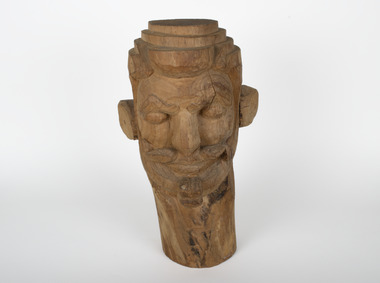
Sculpture - Carving, c1977
... Carving of a large male head made by a patient of Mayday Hills Asylum. The sculpture has been roughly hewn from a single piece of wood. Mayday Hills Asylum was one of the three largest psychiatric hospitals in Victoria, and played an important role in the treatment of mental health illnesses from its establishment in 1867 to its closure in 1995. As part of prescribed treatment, many patients participated in craft ...Carving of a large male head made by a patient of Mayday Hills Asylum. The sculpture has been roughly hewn from a single piece of wood.Mayday Hills Asylum was one of the three largest psychiatric hospitals in Victoria, and played an important role in the treatment of mental health illnesses from its establishment in 1867 to its closure in 1995. As part of prescribed treatment, many patients participated in craft activities were they were able to create an array of objects. A limb of a tree roughly carved into the shape of the man's face featuring heavy eyebrows, moustache and beard.beechworth, burke museum, mayday hills asylum, carving, wooden sculpture -
 The Beechworth Burke Museum
Sculpture - Carving, c1977
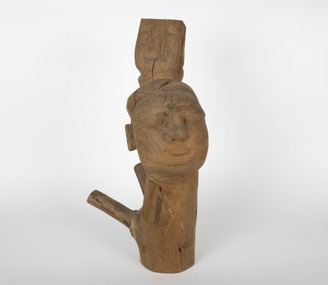
... Carving of a small female head made by a patient of Mayday Hills Asylum. The sculpture as been roughly hewn from a tree limb with multiple branches. Mayday Hills Asylum was one of the three largest psychiatric hospitals in Victoria, and played an important role in the treatment of mental health illnesses from its establishment in 1867 to its closure in 1995. As part of prescribed treatment, many patients participated in craft ...Carving of a small female head made by a patient of Mayday Hills Asylum. The sculpture as been roughly hewn from a tree limb with multiple branches.Mayday Hills Asylum was one of the three largest psychiatric hospitals in Victoria, and played an important role in the treatment of mental health illnesses from its establishment in 1867 to its closure in 1995. As part of prescribed treatment, many patients participated in craft activities were they were able to create an array of objects. A limb of a tree roughly carved into the shape of a face, featuring a wide nose, protruding eyes, and flat mouth. On a limb section that extends above the head is a carving of a small totem-like face. Two small limb sections protruding from the back. Pen lines and figures on nose and ears.beechworth, burke museum, mayday hills asylum, sculpture, wood carving -
 The Beechworth Burke Museum
Sculpture - Carving, c1977
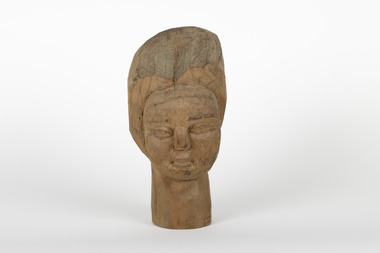
... Carving of a small female head made by a patient of Mayday Hills Asylum. A grid has been drawn across the top with Romanian letters written within the cells. Mayday Hills Asylum was one of the three largest psychiatric hospitals in Victoria, and played an important role in the treatment of mental health illnesses from its establishment in 1867 to its closure in 1995. As part of prescribed treatment, many patients participated in craft ...Carving of a small female head made by a patient of Mayday Hills Asylum. A grid has been drawn across the top with Romanian letters written within the cells.Mayday Hills Asylum was one of the three largest psychiatric hospitals in Victoria, and played an important role in the treatment of mental health illnesses from its establishment in 1867 to its closure in 1995. As part of prescribed treatment, many patients participated in craft activities were they were able to create an array of objects. A limb of a tree roughly carved into the shape of a woman's face, featuring a thick hair style, slanted eyes, delicate mouth, and long neck. Pen notations on top of sculpture.beechworth, burke museum, mayday hills asylum, sculpture, wood carving -
 Mission to Seafarers Victoria
Furniture - Dining Chairs, 6, 1920-1930
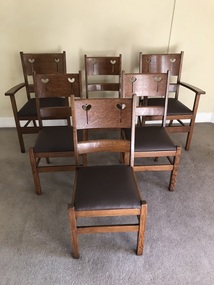
... Reverend Weller photographed the dining suite during his stay betwenn 1926-1929 (see item 1568). chair dining manse heritage listed dining suite arts and crafts Wooden oakwood dining chairs with two heart-shaped carvings on the backrest. ...This set of six original chairs (2 armchairs + 4 chairs) along with the dining table was originally used in the dining room of the Manse, the chaplains' residence. Upon completion of the Institute building in 1917, the Goldsmiths moved in after living for many uncomplaining years in a flat on Australia Wharf, which had “many disadvantages and discomforts”. It was photographed in the Manse dining room by the reverend or Mrs Weller c. 1926.It is not known when they were purchased or gifted. But they are likely originating from Europe. Reverend Weller photographed the dining suite during his stay betwenn 1926-1929 (see item 1568).Wooden oakwood dining chairs with two heart-shaped carvings on the backrest. Two of the chairs have armrests. Eucalyptus green leather cushion seats. Canvas webbing underneath. Set of 6 original chairs used in the Manse. chair, dining, manse, heritage listed, dining suite, arts and crafts -
 Federation University Historical Collection
Booklet - Ephemera, Preparatory Technical School of Girls, c1919
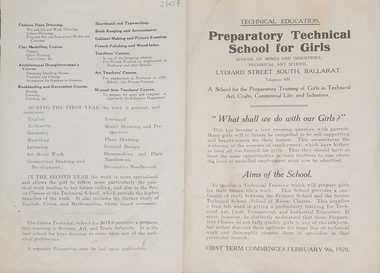
... Craft, Commercial, and Industrial Education. It must, however, be distinctly understood that these Preparatory Classes do not fully qualify girls in any of the subjects, but rather discover their aptitude for some line of technical work and thoroughly prepare the to specialise in that particular branch. Girls education Ballarat Technical Girls' school Ballarat School of mines ballarat technical art school commercial leatherwork photography ticket witing wood carving ...The aims of the School was "To provide a Technical Training which will prepare girls for their future life's work. This school provides a continuity of study between the Primary and Senior Technical School (School of Mines) classes. This supplies a long felt want in giving a preliminary training for Technical Art, Craft, Commercial, and Industrial Education. It must, however, be distinctly understood that these Preparatory Classes do not fully qualify girls in any of the subjects, but rather discover their aptitude for some line of technical work and thoroughly prepare the to specialise in that particular branch.Prospectus for girls technical education at the Ballarat School of Mines and the Ballarat Technical Art Schoolgirls education, ballarat technical girls' school, ballarat school of mines, ballarat technical art school, commercial, leatherwork, photography, ticket witing, wood carving, drawing, metal work, lithography, dressmaking, millinery, industrial design, scholarships, shorthand, typewriting, ceramics, bookbinding, french polishing, wood inlay -
 Flagstaff Hill Maritime Museum and Village
Craft - Scrimshaw, Late 20th century
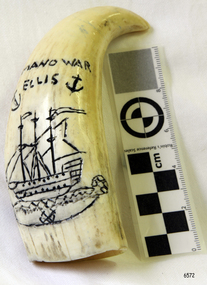
... craft...engraving...carving...The subject scrimshaw is a modern reproduction crudely done of a historic vessel and the scene is believed to be engraved onto a synthetic substance. warrnambool flagstaff-hill flagstaff-hill-maritime-museum maritime-museum shipwreck-coast flagstaff-hill-maritime-village scrimshaw ellis esperance clementina elise hms ship man of war leter of marque privateer slave ship slavery ellis bent american war of inderpendance marine art marine artifact whale tooth ivory tooth resin plastic craft engraving carving Engraved "Man o War Ellis" Scrimshaw art crudely carved into non-natural material in the shape of a tooth. ...The ship “Ellis” started life as the Clementina, launched in America in 1781. The vessel was first listed in Lloyd's Register in 1784 and under this name began serving as a slave ship sailing out of Liverpool. A Lloyd’s database records of slave-trading voyages by vessels from Liverpool makes it clear that Clementina was a slave trader. The next year Captain J. Elworthy sailed her to West Central Africa and St Helena. He transported his slaves to South Carolina. Then in 1785 Elworthy gathered slaves in the Bight of Biafra and the Gulf of Guinea Islands for delivery to Jamaica. In 1786 Bent & Co. purchased the Clementina and renamed her Ellis, presumably after the then owner Ellis Bent. She remained in the slave trade and In 1788 Captain John Ford sailed the now renamed Ellis to the Bight of Biafra and the Gulf of Guinea to gather slaves. He delivered this batch of slaves to the island of Grenada. The next year, 1789 the Ellis was almost completely rebuilt, and from the change in subsequent reports of her cargo loading or (burthen), she was enlarged. In 1791, Captain Joseph Matthews became master and sailed the Ellis to the Gold Coast then delivering his consignment of slaves to the island of St Vincent. During this voyage, some misfortune may have befallen Matthews because records show the Ellis command was transferred to Thomas Given. In 1792, Given sailed to the Bight of Biafra and the Islands in the Gulf of Guinea, again collecting slaves for delivery to Jamaica. There is a parallel record, also for 1793, that the Ellis under the command of Thomas Heart, undertook the same journey and with the same itinerary and cargo. In 1793, Bent & Co. decided to use the Ellis as a privateer with John Levingston as the master. After receiving a letter of "marque” on the 3rd of June 1793, that allowed any armed vessel to commit acts on the high seas which would otherwise have constituted piracy. Thus the Ellis began to operate as a combat ship under the endorsement of the British navy. The Ellis was three times captured first by the French frigate Gracieuse, under the command of Captain Chevillard on 22 July 1793. The French took her into service and renamed her as ”Elise”. Later that summer the Spanish captured her and in November ownership returned to the French who then renamed her the “Esperance”. On the 8th of June 1794, Esperance arrived in Jacmel, Saint-Domingue (present-day Haiti), from France with the official proclamation of the abolition of slavery. Leger-Felicite Sonthonax was one of the Civil Commissioners of Saint-Domingue and he had already unilaterally proclaimed the island for the French colony the year before amid a slave rebellion and attacks from British and Spanish forces. Ironically, Esperance also brought the news to the Civil Commissioners that the National Convention of France had impeached them on 16th July 1793 and ordered them to return promptly to France. On 8 January 1795, HMS Argonaut, under the command of Captain Alexander John Ball, captured Esperance while she was on the North America station. At this time the Esperance was armed with 22 guns (4 and 6-pounders) and had a crew of 130 men. She was under the command of Lieutenant de vaisseau De St. Laurent and had been out at sea for 56 days from Rochfort, bound for the American Chesapeake Bay area. The French ambassador to the United States registered a complaint with the President of the United States that Argonaut, by stating that by entering Lynnhaven bay, either before she captured Esperance or shortly thereafter, had violated a treaty between France and the United States. The French also accused the British of having brought the Esperance into Lynnhaven for refitting for a cruise. The British Consul replied that the capture had taken place some 10 leagues offshore as the bad weather had forced Argonaut and her prize to shelter within the Chesapeake area for some days, but that they had left as soon as practicable. Furthermore, Argonaut had paroled her French prisoners on arrival at Lynnhaven, and if she had entered American territorial waters solely to parole her French prisoners no one would have thought that objectionable. Royal Navy Service: Because the Esperance was captured in good order and sailed well, Rear Admiral George Murray, the British commander in chief of the North American station, put a British crew aboard and sent the Esperance out on patrol with HMS Lynx, under the command of John Poo Beresford, on 31st January. On 1st March the two vessels captured the Cocarde Nationale (or National Cockade), a privateer from Charleston, South Carolina, of 14 guns, six swivel cannons and a crew of 80 men. Esperance and the lynx went on to recaptured the ship Norfolk, of Belfast, and the brig George, of Workington. On 20 July, Esperance, in company with frigates Thetis and Hussar, intercepted the American vessel Cincinnatus, of Wilmington, sailing from Ireland to Wilmington. They pressed many men on board into service, narrowly missing the Irish revolutionary Wolfe Tone, who was on his way to Philadelphia. Esperance was formally commissioned in 1795 into the Royal Navy in August under the Command of Jonas Rose. On 4 May 1796 Esperance was sailing in company with HMS Spencer and Bonetta when they sighted a suspicious vessel. Spencer set off in chase while shortly thereafter Esperance saw two vessels, a schooner and a sloop, and she and Bonetta set off after them. Spencer sailed south by south-east and the other two British vessels sailed south-west by west, with the result that they lost sight of each other. Spencer captured the French gun-brig Volcan, while Bonetta and Esperance captured the French schooner Poisson Volant. The Esperance eventually arrived at Portsmouth on the 3rd of November 1797, the crew was paid off and on 31st May 1798 the Admiralty listed the Esperance for sale and she was sold in June 1798 for £600.The subject scrimshaw is a modern reproduction crudely done of a historic vessel and the scene is believed to be engraved onto a synthetic substance. Scrimshaw art crudely carved into non-natural material in the shape of a tooth. The line artwork is an image of a three-masted sailing ship with a poop deck, and anchors, are coloured black. Inscription is engraved into tooth.Engraved "Man o War Ellis" warrnambool, flagstaff-hill, flagstaff-hill-maritime-museum, maritime-museum, shipwreck-coast, flagstaff-hill-maritime-village, scrimshaw, ellis, esperance, clementina, elise, hms ship, man of war, leter of marque, privateer, slave ship, slavery, ellis bent, american war of inderpendance, marine art, marine artifact, whale tooth, ivory tooth, resin, plastic, craft, engraving, carving -
 Flagstaff Hill Maritime Museum and Village
Craft - Scrimshaw, Hero 1870, Late 20th Century
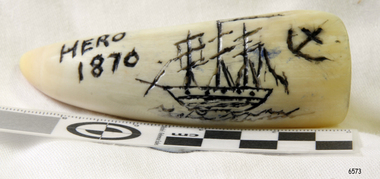
... The scrimshaw is believed to be a modern reproduction of a typical scrimshaw scene and engraved very crudely onto a synthetic substance. warrnambool flagstaff-hill flagstaff-hill-maritime-museum maritime-museum shipwreck-coast flagstaff-hill-maritime-village scrimshaw plastic resin replica prince of wales british navy vessel whaling HMS Hero reproduction carving engraving Engraved "Hero 1870" Scrimshaw art carved into non-natural material in the shape of a whale tooth. The line artwork images of a three-masted, fully rigged ship and an anchor are coloured black. Inscription is engraved into tooth. Hero 1870 Craft ...Scrimshaw is regarded as early folk art and is associated primarily with whaling that was opened up in the Pacific at the end of the eighteenth century by sailors mainly from American, English and French vessels. As a result, some of the best scrimshaw from Pacific whales can be found in collections in these countries. Even though sailors must have had plenty of spare time between periods of whaling scrimshaw on whale teeth seems a rarity before the 1830s. One reason may have been the high price paid for whale teeth ivory in this period making scrimshaw on teeth popular only after the market was saturated and the price dropped. The earliest identified engraver of whale teeth is the English whaling master Captain J. S. King who was active between 1817 and 1823. There have been six ships called the Hero in the Royal Navy and this ship was the fourth named Hero, it was a screw-propelled 91-gun and second-rate. In the rating system of the British Royal Navy, this term is used to categorise sailing warships, a second-rate was a ship of the line which by the start of the 18th century mounted 90 to 98 guns on three gun decks. Earlier 17th-century second rates had fewer guns and were originally two-deckers or had only partially armed third gun decks. The Hero was launched in 1858 and sold in 1971. On July 1860 the Prince of Wales embarked onboard HMS Hero, Albert Edward Prince of Wales, was the eldest son of Queen Victoria, and the future King Edward VII, at the time he was then nineteen years of age, and on route to Newfoundland, Canada and the United States on his first state tour. He was the first member of the British royal family to visit North America. In 1860 the Queen had intended to pay a visit to Canada however stress prevented her from travelling. The then Prime Minister Lord Palmerston suggested that “Bertie” the prince of Wales could represent the Queen and on July 10th 1860, Bertie boarded HMS Hero for a tour of Canada and the USA. On July 23rd the ship arrived at Terranova. By the second week of August, the HMS Hero had sailed up the St. Lawrence River and anchored at Quebec. The Prince was successful with Canadian society visiting Quebec and Montreal during his stay. He went on to visit the United States following an invitation by President James Buchanan. His American journey was regarded as a great success. President Buchanan wrote to Queen Victoria: "He “Bertie” has faced a very difficult task for a person his age and his behaviour in all this has been that of his age and position. He has shown himself honourable, Frank and affable and he won the respect of the sensible and wise people". The scrimshaw is believed to be a modern reproduction of a typical scrimshaw scene and engraved very crudely onto a synthetic substance. Scrimshaw art carved into non-natural material in the shape of a whale tooth. The line artwork images of a three-masted, fully rigged ship and an anchor are coloured black. Inscription is engraved into tooth.Engraved "Hero 1870"warrnambool, flagstaff-hill, flagstaff-hill-maritime-museum, maritime-museum, shipwreck-coast, flagstaff-hill-maritime-village, scrimshaw, plastic, resin, replica, prince of wales, british navy vessel, whaling, hms hero, reproduction, carving, engraving -
 Mission to Seafarers Victoria
Furniture - Sanctuary chairs, pair, Gladys Hawkey (1886-1974), c. 1917
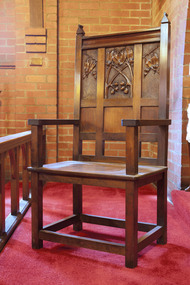
... Crafts style. Like many women from the early 1900s, she was likely to have been inspired by the Australian exhibition of women's work and other female woodworkers of the time. gladys amy hawkey (1886-1974) william scott purves godfrey (1872-1953) lhlg ladies Harbour lights guild chapel flinders street mission to seafarers seamen's mission wood carving godfrey and spowers heritage listed arts and crafts gifts-1917 Handcarved Furniture Sanctuary chairs, pair Gladys Hawkey (1886-1974) William Scott Purves Godfrey (1872-1953) ...William Scott Purves Godfrey (1872-1953) designed the chairs and Miss Gladys Hawkey (1886-1974) carved them. W.S.P Godfrey was born in Toorak on 6 April 1872. He was was the cousin of Ethel Godfrey. Educated in Brussels and at Melbourne Grammar, he studied Architecture at the University of Melbourne. He and Henry Howard Spowers established the architectural firm Godfrey & Spowers, known for the design of the Argus building, around 1901. W S P Godfrey retired from practice in 1944. He died in August 1953, aged 81. He's buired in the St Kilda Cemetery with the Godfrey family. Gladys Hawkey was a member of the Guild. (photographed during the Norla Fete). She was born in Sandhurst, Bendigo and is buired in the Bendigo Cemetery. Little is known about Gladys Hawkey. She may have been a student of Robert Prenzel. Another mention of her work is made in an article in 1915 where her escritoire is offered in a raffle to raise funds for the Australian sick and Wounded. The chairs were donated in 1919 when the Flinders Street mission was open. In a style of Robert Prenzel with Australian Flora, the chairs are in the typical Arts and Crafts style. Like many women from the early 1900s, she was likely to have been inspired by the Australian exhibition of women's work and other female woodworkers of the time.Handcarvedgladys amy hawkey (1886-1974), william scott purves godfrey (1872-1953), lhlg, ladies harbour lights guild, chapel, flinders street, mission to seafarers, seamen's mission, wood carving, godfrey and spowers, heritage listed, arts and crafts, gifts-1917 -
 Mission to Seafarers Victoria
Furniture - Butler’s table, 1920-1930
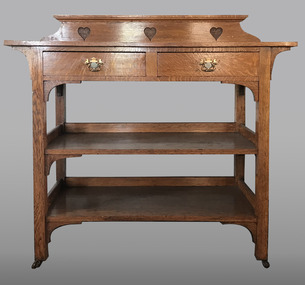
... Reverend Weller photographed the dining suite during his stay betwenn 1926-1929 (see item 1568). manse dining suit sideboard arts and crafts english h.f. fischer Wooden oakwood dining chairs with two heart-shaped carvings on the backrest. ...The console was originally used in the dining room of the Manse, the chaplains' residence. Upon completion of the Institute building in 1917, the Goldsmiths moved in after living for many uncomplaining years in a flat on Australia Wharf, which had “many disadvantages and discomforts”. It was photographed in the Manse dining room by the reverend or Mrs Weller c. 1926. In the same style as the other oak sideboard, we can assume it was made by the same maker, H.F. Fischer around the same time.It is not known when they were purchased or gifted. But they are likely originating from Europe. Reverend Weller photographed the dining suite during his stay betwenn 1926-1929 (see item 1568).Wooden oakwood dining chairs with two heart-shaped carvings on the backrest. Two of the chairs have armrests. Eucalyptus green leather cushion seats. Canvas webbing underneath. Set of 6 original chairs used in the Manse. manse, dining suit, sideboard, arts and crafts, english, h.f. fischer -
 Eltham District Historical Society Inc
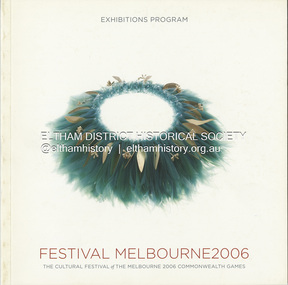
Programme - Book, Global Art Projects, Festival Melbourne2006: the Cultural festival of the Melbourne 2006 Commonwealth Games, Exhibtions Program, 2006
... carving from each of these countries. Throughout the period of the Commonwealth Games each artist participated in demonstrations open to the public. Wayne Alfred from Canada, together with his son Marcus participated 18-25 March. The pole was carved alongside other carvers at Melbourne Museum. It was later donated to the Shire of Nillumbik. Contents: Threading the commonwealth: textile tradition, culture, trade and politics, Canopy of the commonwealth: community textile project, Spirit of the games: the opening ceremony revealed, Common goods: cultures meet through craft ...Content includes text and photos of a totem pole under construction for Festival Melbourne2006, the cultural festival of the Melbourne 2006 Commonwealth Games. CARVE brought together artists from the Commonwealth nations of Canada, New Zealand and Australia, to examine the contemporary practice of traditional indigenous carving from each of these countries. Throughout the period of the Commonwealth Games each artist participated in demonstrations open to the public. Wayne Alfred from Canada, together with his son Marcus participated 18-25 March. The pole was carved alongside other carvers at Melbourne Museum. It was later donated to the Shire of Nillumbik. Contents: Threading the commonwealth: textile tradition, culture, trade and politics, Canopy of the commonwealth: community textile project, Spirit of the games: the opening ceremony revealed, Common goods: cultures meet through craft, New06 and +plus factors: contemporary Australian art Single currency: Australian and New Zealand art Flash: Australian athletes in focus, Game on! Sport and contemporary art, Best of the best: Commonwealth Photographic Awards.46 pagesnon-fictionContent includes text and photos of a totem pole under construction for Festival Melbourne2006, the cultural festival of the Melbourne 2006 Commonwealth Games. CARVE brought together artists from the Commonwealth nations of Canada, New Zealand and Australia, to examine the contemporary practice of traditional indigenous carving from each of these countries. Throughout the period of the Commonwealth Games each artist participated in demonstrations open to the public. Wayne Alfred from Canada, together with his son Marcus participated 18-25 March. The pole was carved alongside other carvers at Melbourne Museum. It was later donated to the Shire of Nillumbik. Contents: Threading the commonwealth: textile tradition, culture, trade and politics, Canopy of the commonwealth: community textile project, Spirit of the games: the opening ceremony revealed, Common goods: cultures meet through craft, New06 and +plus factors: contemporary Australian art Single currency: Australian and New Zealand art Flash: Australian athletes in focus, Game on! Sport and contemporary art, Best of the best: Commonwealth Photographic Awards.commonwealth games, art festivals, totem poles -
 Kiewa Valley Historical Society
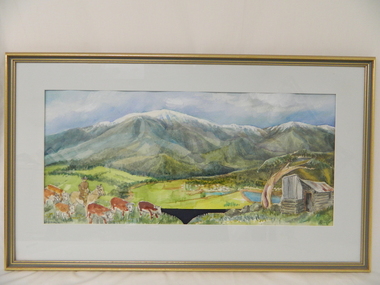
Painting, Cattlemen of the Bogong High Plains, c1995
... This involved crafting of missing pieces on period frames, conservation/restoration of gilded surfaces, crafting of period frames, and lecturing at galleries and institutions on gilding, wood carving, Australian frame history and crafting of period frames. cattlemen; bogong high plains; s.k.pearce; mt beauty supermarket; leo wimmer; Circular watermark (illegible) on bottom right corner. ...Leo Wimmer who lived locally was commissioned to do the painting for the Mt Beauty, S. K. Pearce Pty. Ltd., Supermarket as a display was wanted to fit against the blank walls opposite the cash registers (where the liquor store is now). His idea was to break up the parts in the painting and use these as large replicas painted on wood for the display. An official opening was held and Leo used the money earned to visit his homeland, Austria. Leo trained as a restorer of church art in Austria.This painting was commissioned for a Cattlemen's display behind the cash registers at the Mt Beauty S. K. Pearce Supermarket. Each part of the foreground was painted separately onto stand alone boards -the cattle, the hut, the grass and the Mt Beauty township. Leo Wimmer lived locally and was a professional frame conservator. Leo Wimmer specialised in gilding and worked at the National Gallery of Victoria and later the National Gallery of Australia (NGA Nov. 1981 - 1990) where he was responsible for conservation of gilded frames in the national collection. This involved crafting of missing pieces on period frames, conservation/restoration of gilded surfaces, crafting of period frames, and lecturing at galleries and institutions on gilding, wood carving, Australian frame history and crafting of period frames. Framed painting of Mt Bogong with cattle, Mt Beauty township and cattleman's hut in foreground.Circular watermark (illegible) on bottom right corner. "Wimmer / 1" is underneath the watermark.cattlemen; bogong high plains; s.k.pearce; mt beauty supermarket; leo wimmer; -
 J. Ward Museum Complex
Craft - Bird Carving
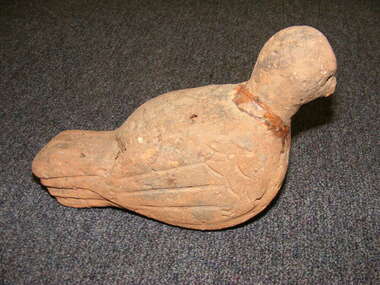
... carving brick bird Previously broken and repaired at neckline A red house-brick carved into the shape of a bird by a J Ward patient. Bird Carving Craft Bird Carving ...A red house-brick carved into the shape of a bird by a J Ward patient.Previously broken and repaired at necklinecarving brick bird -
 Bendigo Historical Society Inc.
Document - Y.M.C.A., Y'S WORKBOX, DISPLAY & DEMONSTRATION OF HAND CRAFTS, 27 October 1985
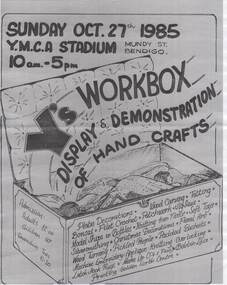
... Crafts include: Plate Decorations, Wood Carving, Tatting, Bonsai, Filet Crochet, Patchwork, Jigsaws, Model Ships in Bottles, Knitting from Fleece, Soft Toys, Silversmithing, Christmas Decorations, Floral Art, Wood Turning, Pickled People, Padded Baskets, Machine Embroidery, Applique, Knitting, Overlocking, Latchhook Rugs, Make-Up (TV & Films), Bobbin Lace, Printing, Golden North Centre....Crafts include: Plate Decorations, Wood Carving, Tatting, Bonsai, Filet Crochet, Patchwork, Jigsaws, Model Ships in Bottles, Knitting from Fleece, Soft Toys, Silversmithing, Christmas Decorations, Floral Art, Wood Turning, Pickled People, Padded Baskets, Machine Embroidery, Applique, Knitting, Overlocking, Latchhook Rugs, Make-Up (TV & Films), Bobbin Lace, Printing, Golden North Centre. ...Event, Bendigo Y.M.C.A., Y's Workbox, Display & Demonstration of Hand Crafts, at The Y.M.C.A. Stadium, Mundy Street, Bendigo, Sunday October 27, 1985, 10am - 5pm. Admission: Adults $2.00 , Children 50c, Devonshire Teas $1.20. Crafts include: Plate Decorations, Wood Carving, Tatting, Bonsai, Filet Crochet, Patchwork, Jigsaws, Model Ships in Bottles, Knitting from Fleece, Soft Toys, Silversmithing, Christmas Decorations, Floral Art, Wood Turning, Pickled People, Padded Baskets, Machine Embroidery, Applique, Knitting, Overlocking, Latchhook Rugs, Make-Up (TV & Films), Bobbin Lace, Printing, Golden North Centre.event, exhibition, bendigo y.m.c.a. -
 Bendigo Historical Society Inc.
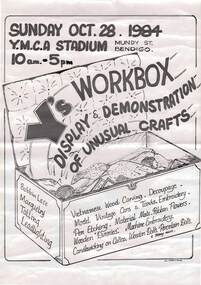
Document - Y.M.C.A. Y'S WORKBOX, DISPLAY & DEMONSTRATION OF UNUSUAL CRAFTS, 28 October 1984
... Events, Y.M.C.A., Y's Workbox, Display & Demonstration of Unusual Crafts, Sunday October 28. 1984, at the YMCA Stadium, Mundy Street, Bendigo, 10am-5pm.Crafts including; Bobbin Lace, Marquetry,Tatting, Leadlighting,Vietnamese Wood Carving, Decoupage,Model Vintage Cars,& Tanks,Embroidery,Pen Etching,Material Mats, Ribbon Flowers,Wooden ''Dummies'',Machine Embroidery, Candlewicking on Calico,Wooden Dolls, Porcelain Dolls, & many more. ...C.Marrone Events, Y.M.C.A., Y's Workbox, Display & Demonstration of Unusual Crafts, Sunday October 28. 1984, at the YMCA Stadium, Mundy Street, Bendigo, 10am-5pm.Crafts including; Bobbin Lace, Marquetry,Tatting, Leadlighting,Vietnamese Wood Carving, Decoupage,Model Vintage Cars,& Tanks,Embroidery,Pen Etching,Material Mats, Ribbon Flowers,Wooden ''Dummies'',Machine Embroidery, Candlewicking on Calico,Wooden Dolls, Porcelain Dolls, & many more. ...Events, Y.M.C.A., Y's Workbox, Display & Demonstration of Unusual Crafts, Sunday October 28. 1984, at the YMCA Stadium, Mundy Street, Bendigo, 10am-5pm.Crafts including; Bobbin Lace, Marquetry,Tatting, Leadlighting,Vietnamese Wood Carving, Decoupage,Model Vintage Cars,& Tanks,Embroidery,Pen Etching,Material Mats, Ribbon Flowers,Wooden ''Dummies'',Machine Embroidery, Candlewicking on Calico,Wooden Dolls, Porcelain Dolls, & many more. C.Marrone.C.Marroneevent, exhibition, bendigo y.m.c.a. -
 Bendigo Historical Society Inc.
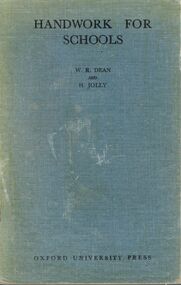
Book - GOLDEN SQUARE LAUREL STREET P.S. COLLECTION: HANDWORK FOR SCHOOLS
... Subjects covered are: Modelling and Carving; Pattern and Decoration; paper and Cardboard Handwork; Printed Decorations; Weaving; Handwork in Wood; Other Crafts; Decorative Needlework and Puppetry...Subjects covered are: Modelling and Carving; Pattern and Decoration; paper and Cardboard Handwork; Printed Decorations; Weaving; Handwork in Wood; Other Crafts; Decorative Needlework and Puppetry Book GOLDEN SQUARE LAUREL STREET P.S. ...Handwork for Schools by W.R.Dean and H. Jolly. 1953 Reprint. Book has light blue cloth cover with black printing. Back cover has part of the jacket which is light brown with dark red and blue printing and decoration pasted on it. Subjects covered are: Modelling and Carving; Pattern and Decoration; paper and Cardboard Handwork; Printed Decorations; Weaving; Handwork in Wood; Other Crafts; Decorative Needlework and PuppetryGeoffrey Cumberlege, Oxford University Press, Melbourne. Wellington. Brown, Prior, Anderson Pty Ltd., 430 Little Bourke Street., Melbourne, C.1.education, primary, golden square laurel st p.s., golden square laurel street p.s. collection - handwork for schools, w r dean, h jolly, geoffrey cumberlege, oxford university press, j mcrae, g s browne, a h ramsay -
 Tatura Irrigation & Wartime Camps Museum
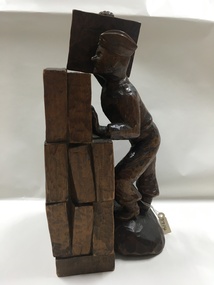
Sculpture - Wood Carving, Kurt Lewinski, The Stacker, 1940's
... Transported to Australia in 1940. wood sculpture internee hand craft dunera boy kurt lewinski K. Lewinski 1944 Huon Pine (stained) Wood carving or sculpture of a man stacking boxes at a railway station. ...Depicts a member of the AMF 8th Employment Co. Made by former camp 2 Tatura internee after his release in January 1942. At the 8th employment company at Tocumwal. Kurt Lewinski was a Dunera boy. Formerly a refugee of England 1938, originally from Berlin. Transported to Australia in 1940.Wood carving or sculpture of a man stacking boxes at a railway station.K. Lewinski 1944 Huon Pine (stained)wood sculpture, internee hand craft, dunera boy, kurt lewinski -
Tatura Irrigation & Wartime Camps Museum
Photograph, 1942
... Colour photograph of a superb hand crafted wooden tray with beautiful carving. A flash light reflection is an indication of its highly polished finish....Handcrafts of Camp 3 internees camp 3 templer society Colour photograph of a superb hand crafted wooden tray with beautiful carving. A flash light reflection is an indication of its highly polished finish. ...Handcrafts of Camp 3 interneesColour photograph of a superb hand crafted wooden tray with beautiful carving. A flash light reflection is an indication of its highly polished finish.camp 3, templer society -
 Buda Historic Home & Garden Castlemaine
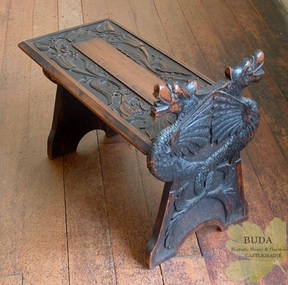
Domestic furniture, Timber hand-carved boot stool, c1900
... This is a rare example of a unique hand-carved boot stool made in Australia by Gertrude Leviny in the British Arts and Crafts Movement style at the turn of the twentieth century. gertrude leviny wood carving arts and crafts movement buda castlemaine dragon's heads c1900 domestic furniture castlemaine school of mines 'K/40' (Old Registration Number) Timber boot stool, hand-carved by Gertrude Leviny. ...The British Arts and Crafts Movement was a major influence on handcrafts made by the Leviny women at Buda. This Movement spread knowledge of craft techniques in the decorative arts and encouraged women to partake in fields that had traditionally been the domain of men, such as metalcraft and woodwork. The Leviny women studied art, design and craft techniques at the Castlemaine School of Mines from the 1890s to the early 1900s and this boot stool, hand-carved by Gertrude, is an example of the influence of the Arts and Crafts Movement on her decorative art. See: Zilles, Lauretta (2010), Buda and the Leviny Family, Castlemaine: Buda Historic Home & Garden Inc.This is a rare example of a unique hand-carved boot stool made in Australia by Gertrude Leviny in the British Arts and Crafts Movement style at the turn of the twentieth century.Timber boot stool, hand-carved by Gertrude Leviny. Made using the 'chip carving' technique, with dragon heads on upright at one end, and plant design in relief on the seat. Timber finish has a blackened effect.'K/40' (Old Registration Number)gertrude leviny, wood carving, arts and crafts movement, buda, castlemaine, dragon's heads, c1900, domestic furniture, castlemaine school of mines -
 Wangaratta RSL Sub Branch
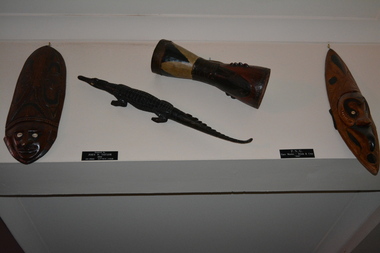
Souvenir - Wooden artefacts
... Different tribes living along the river produce magnificent wood carvings, clay pottery and other art and craft. Kundu is the Papuan general name used for drum. ...Different tribes living along the river produce magnificent wood carvings, clay pottery and other art and craft. Kundu is the Papuan general name used for drum. ...Wooden artefacts from the Sepik River region in Papua New Guinea. Different tribes living along the river produce magnificent wood carvings, clay pottery and other art and craft. Kundu is the Papuan general name used for drum. It is an hour glass shaped drum made of wood with a snake's skin as membrane. A handle is placed on the narrowest part of the drum. Often, the kundu is decorated with animal figures on its edges. - donated by John Nelson TAYLOR QX25010,2900269,3108420 who served in the AIF 19/1/1941 to 7/12/1945 - Regular Army Special Reserve 30/1/1952 to 29/1/1955 and the CMF 1/8/1959 to 2/1/1960. Rank on final discharge - Trooper 8/13 Victorian Mounted Rifles. John was deployed overseas to New Guinea from 17/10/1943 to 23/2/1945 and 5/5/1945 to 26/10/1945 and served in Korea and Japan from 5/3/1953 to 6/4/1954. A member of the Wangaratta RSL he passed away in January, 2021.Wooden artefacts from the Sepik River region in Papua New Guinea. The Sepik area is well known for its sculpture masks shields and other artifacts. Many tribes use drums in rituals. Two decorative wooden face masks, one wooden Drum and one wooden Crocodilepapua new guinea, artefacts, wood, ww2 -
 Federation University Art Collection
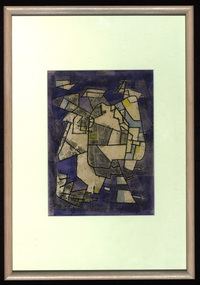
Work on paper - Artwork - Printmaking, 'Untitled', by Ludwig Hirshfeld-Mack, 1959
... He promoted his pupils' self-knowledge, introduced them to avant-garde painting techniques, and encouraged wood-carving, weaving, musical instrument-making, leatherwork and other crafts. (http://adb.anu.edu.au/biography/hirschfeld-mack-ludwig-10510, accessed 29 June 2016) He died on 7 January 1965 at Allambie Heights, Sydney...He promoted his pupils' self-knowledge, introduced them to avant-garde painting techniques, and encouraged wood-carving, weaving, musical instrument-making, leatherwork and other crafts. (http://adb.anu.edu.au/biography/hirschfeld-mack-ludwig-10510, accessed 29 June 2016) He died on 7 January 1965 at Allambie Heights, Sydney art artists mack hirschfeld-mack ludwig hirschfeld-mack ludwig hirshfeld-mack printmaking monoprint bauhaus Signed in pencil lower left hand side 'L.H.Mack 1959' Framed abstract painting 'Untitled', by Ludwig Hirshfeld-Mack Work on paper Artwork - Printmaking L. ...Ludwig HIRSCHFELD-MACK (1893-1965) Born 11 July 1893, Frankfurt am Main, Germany In 1940 Hirschfeld-Mack was deported to Australia from England as an enemy alien in the Dunera. He was interned at Hay and Orange, New South Wales, and at Tatura, Victoria. There he made a number of woodcuts that illustrated life under detention. Released in 1942 through the sponsorship of (Sir) James Darling, headmaster of Geelong Church of England Grammar School, Hirschfeld-Mack was appointed its art master. He promoted his pupils' self-knowledge, introduced them to avant-garde painting techniques, and encouraged wood-carving, weaving, musical instrument-making, leatherwork and other crafts. (http://adb.anu.edu.au/biography/hirschfeld-mack-ludwig-10510, accessed 29 June 2016) He died on 7 January 1965 at Allambie Heights, Sydney Framed abstract paintingSigned in pencil lower left hand side 'L.H.Mack 1959'art, artists, mack, hirschfeld-mack, ludwig hirschfeld-mack, ludwig hirshfeld-mack, printmaking, monoprint, bauhaus -
 Hymettus Cottage & Garden Ballarat
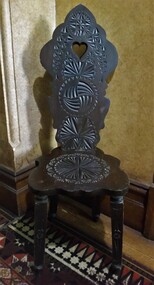
Furniture - Chair, Chip carved chair
... Chip carving was a popular hobby/pastime from the arts and crafts movement of the 1890s and remained a popular folk art until the 1920s....Chip carving was a popular hobby/pastime from the arts and crafts movement of the 1890s and remained a popular folk art until the 1920s. ...Chip carving was a popular hobby/pastime from the arts and crafts movement of the 1890s and remained a popular folk art until the 1920s.This is an example of a popular folk art hand-carved chair made in Australia in the early twentieth century.Hand-carved timber chair, by an unknown enthusiast in the Warrnambool area. Made using the 'chip carving' technique, with whorls and star design in relief on the seat. The timber finish has been given an ebonised tone. Chip carvingschair, craft, hobbies
