
Showing 74 items matching "ceremonial ribbon"
-
 Emerald Museum & Nobelius Heritage Park
Textile - Ceremonial ribbon, Unknown maker, ANZAC Day 1921
... Ceremonial ribbon...Avenue of Honour emerald ANZAC Remnant of Ribbon Shown in Photograph shwon on left 1921 ANZAC Day Remnant of the ribbon which was used in opening the Emerald Avenue of Honour - Several sections of purple ribbon mounted on a piece of heavy cardboard, ribbon appears to originally glued to the board a repair has been made with whaat appears to be “invisible”tape. Textile Ceremonial ribbon Unknown maker ...The Emerald Avenue of Honour Was officially opened on ANZAC Day, 1921. The ribbon used in the ceremony was cut by Mrs Mahony, wife of Cr J. Mahony. This Avenue of Honour was later removed to facilitate the widening of the road, the trees were much later replaced. The original metal plaques are now housed at the Emerald RSL.the object is historically and socially significant as it is the only known remnant of the ribbon used in the opening ceremony of the Avenue of Honour in Emerald.Remnant of the ribbon which was used in opening the Emerald Avenue of Honour - Several sections of purple ribbon mounted on a piece of heavy cardboard, ribbon appears to originally glued to the board a repair has been made with whaat appears to be “invisible”tape.Remnant of Ribbon Shown in Photograph shwon on left 1921 ANZAC Dayavenue of honour, emerald, anzac -
 Melbourne Tram Museum
Photograph - Official opening of Malvern to Kew PMTT line, 30 May 1913
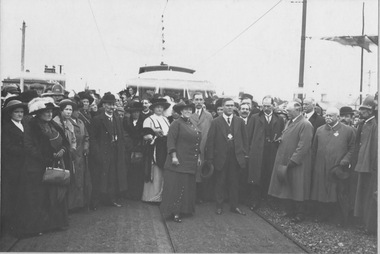
... ...ceremonial ribbon...One photograph shows a line of many decorated north-bound single truck tramcars with drivers at controls stopped behind a ceremonial ribbon as a woman reaches upward to cut it. ...One photograph shows a line of many decorated north-bound single truck tramcars with drivers at controls stopped behind a ceremonial ribbon as a woman reaches upward to cut it. ...One photograph shows a line of many decorated north-bound single truck tramcars with drivers at controls stopped behind a ceremonial ribbon as a woman reaches upward to cut it. Crowds of adults and children dressed in heavy coats and hats stand behind and in front of barriers. To the right in a lighter coloured overcoat is the chairman of the Prahran and Malvern Tramways Trust (PMTT), Mr Alexander Cameron. The Malvern Town Hall is shown at left with its clock showing 2.30pm on Friday 30 May 1913, the day before the federal election in which the Labor government was defeated by the Liberal Party by one seat. Federal Parliament sat in Melbourne until 1927. This ceremony officially opened the new double track electric line along Glenferrie Road from the Town Hall at High Street, Malvern to Cotham Road, Kew. Negotiations between the three municipalities had taken much effort to reach an agreement. At Cotham Road, the track branched west to the Kew Post Office at High Street and east to Burke Road. Services were then provided from both these termini to St Kilda Beach via Glenferrie Road, Hawthorn Road and Balaclava Road. Two further ceremonies occurred at Gardeners Creek and Barkers Road, the boundaries between three municipalities. A second photograph shows the same convoy of tram cars stationary for an additional event at Burwood Road adjacent to the Hawthorn Town Hall (out of shot to the left). A large crowd is gathered as a photographer captures a Lady Mayoress at the driver's controls. A third photograph shows a larger crowd at the corner of Glenferrie Road and Cotham Road, Kew in front of and hanging from an electric tramcar stationary on double track. The 400 guests in fine attire included state government ministers, spouses, local municipal mayors and councillors. Also present were the Prahran and Malvern Tramways Trust (PMTT) Board, including Chairman Alexander Cameron, at right in a lighter coloured overcoat. The well dressed woman out front may be Councillor Mrs Wood, the Mayoress of Hawthorn. Yields information about early Glenferrie Road electric line to Kew and PMTT.Three black and white photographs, some mounted on cardboard with no notes attachedglenferrie road, electric trams, ceremonial ribbon, heavy coats, chairman, pmtt, malvern town hall, 30 may 1913, cotham road, kew, kew post office, burke road, st kilda beach, balaclava road, federal election, hawthorn road, alexander cameron, mayoress of hawthorn, gardeners creek, barkers road, prahran and malvern tramways trust, burwood road, hawthorn town hall -
 Orbost & District Historical Society
black and white photograph, July 1922
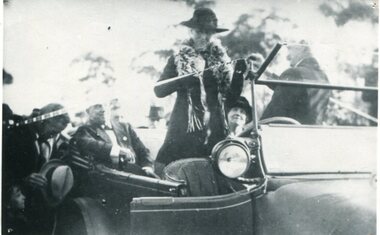
... A black / white photograph of a lady standing up in a motor vehicle cutting a ceremonial ribbon...This item is a pictorial record of a significant event in Orbost's history. snowy-river-bridge-orbost cameron-mrs ceremonies A black / white photograph of a lady standing up in a motor vehicle cutting a ceremonial ribbon black and white photograph ...The photograph shows Mrs James Cameron cutting the ribbon at the opening of the Orbost Pile Bridge in 1922. The first bridge was officially opened in August, 1893 (ref. S.R.M. 12.8.1893) by Mrs W. Watt, the mother of Councillor Watt, who presided over the opening of the 1922 bridge. This bridge was extensively damaged when a herd of cattle allegedly stampeded over it causing the cable to snap. Even after repairs it became obvious that a new bridge was needed. This second bridge, was built by the Victorian Railways and the Country Roads Board. Constructed at a cost of 35,000 pounds and used second-hand girders from the Flinders Street- Spencer Street viaduct. On July 4 1922 it was officially opened by Mrs James Cameron. Unfortunately, her husband, who had long championed the building of the bridge so that it would be ready for the railway to continue to the border, was too ill to attend the ceremony. In fact, James Cameron died on July 13 after a long and severe illness (ref. S.R.M. 20.7.1922). There is a section of this ribbon in the collection - Registration No. 366.This item is a pictorial record of a significant event in Orbost's history.A black / white photograph of a lady standing up in a motor vehicle cutting a ceremonial ribbonsnowy-river-bridge-orbost cameron-mrs ceremonies -
 Frankston RSL Sub Branch
Photograph
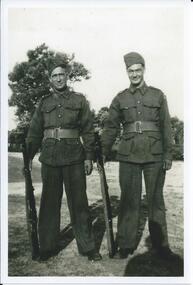
... Captured in Crete they were P.O.W.s. 2/ Ceremonial ribbon with the details WX 508 Pte L W Jones Sydney March 1940...Captured in Crete they were P.O.W.s. 2/ Ceremonial ribbon with the details WX 508 Pte L W Jones Sydney March 1940 Photograph ...1/ Photograph of two Australian soldiers who served in the Australian Army during World War 2. These are brothers?? Captured in Crete they were P.O.W.s. 2/ Ceremonial ribbon with the details WX 508 Pte L W Jones Sydney March 1940 -
 Bendigo Historical Society Inc.
Badge - Ribbon with badge
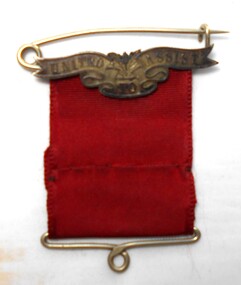
... Ceremonial badge with ribbon...Their motto was "United to Serve". Ceremonial badge with ribbon United Order of Druids "United To Assist" A red grosgrain ribbon hanging from brass bar behind badge with inscribed mott "United To Assist" folded over a metallic holder and self-attached Badge Ribbon with badge ...The United Order of Druids split from the Ancient Order and was more democratic and socially conscientious. Their motto was "United to Serve".A red grosgrain ribbon hanging from brass bar behind badge with inscribed mott "United To Assist" folded over a metallic holder and self-attached"United To Assist"ceremonial badge with ribbon, united order of druids -
 City of Whittlesea
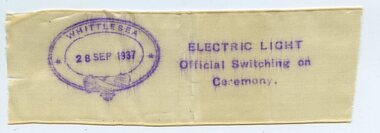
Memorabilia - Commemorative Ribbons, Electric Light Official Switching On Ceremony ribbon, 1937
... On Tuesday 28th September 1937, to the applause and cheering of a crowd of more than 300 people, a ceremonial ribbon was cut with a ‘beautiful pair of silver scissors’ by Mrs W H Everard, wife of local MP William Everard. ...On Tuesday 28th September 1937, to the applause and cheering of a crowd of more than 300 people, a ceremonial ribbon was cut with a ‘beautiful pair of silver scissors’ by Mrs W H Everard, wife of local MP William Everard. ...On Tuesday 28th September 1937, to the applause and cheering of a crowd of more than 300 people, a ceremonial ribbon was cut with a ‘beautiful pair of silver scissors’ by Mrs W H Everard, wife of local MP William Everard. The ribbon cutting ceremony was to officially turn on the mains electricity supply to Whittlesea and district. The moment the ribbon was cut there was a ‘blaze of light’. There were initially 78 customers, including the Shire of Whittlesea which had contracted the SEC to supply street lighting in Whittlesea, Yan Yean, Mernda and South Morang (Advertiser, Friday 1st October 1937, page 1). This ribbon is possibly a fragment of the official opening ribbon that was stamped with the date and details of the switching on of electricity in Whittlesea and given to patrons. Commemorative Ribbons. Silk ribbon, white, stamped with details commemorating the switching on of electricity in Whittlesea on 28 September 1937.Whittlesea / 28 Sep 1937 / Electric Light / Official Switching on / Ceremony electricy supply, w h everard, whittlesea district -
Emerald Museum & Nobelius Heritage Park
Photograph - Portrait - David Clarke and Peter Emberton, Unknown photographer, 1980s-1990s
... The man on the left of the image appears to be displaying the ceremonial ribbon with a Rotary International medallion that the man on the right is wearing. ...The man on the left of the image appears to be displaying the ceremonial ribbon with a Rotary International medallion that the man on the right is wearing. ...Rotary began in 1905 in Chicago as an organisation to build connections between professional people through service to the community community. The name Rotary was chosen to reflect that positions of power within the organisation would be rotated to avoid any one person or group having too much influence on the organisation's decisions. The organisation was renamed the International Association of Rotary Clubs in 1912 after groups were formed in Canada, Ireland and the United Kingdom. Groups in non-English speaking countries such as Cuba and the Phillipines were formed later that decade. Only men could become members until 1989. The first Rotary group in Australia was formed in Melbourne in 1921. The name Rotary International was adopted at the first Australian convention in 1922. Rotary Melbourne is associated with the formation of some key Victorian and national services, such as the crisis counselling service LifeLine, heart disease services at Baker Medical Research Institute at the Alfred Hospital and Very Special Kids. The Rotary Club of Emerald and District was formed in March 1980. Museum records indicate that the two men pictured in the photograph are Peter Emberton and David Clarke.The item is significant as it captures a moment in the early history of a community association that has contributed to the development and social infrastructure in the Emerald area.Black and white rectangular photograph printed on photographic paper. The item shows two men aged approximately fifty years old wearing suits and ties in a wood panelled room with a decorative light fitting visible in the background. The man on the left of the image appears to be displaying the ceremonial ribbon with a Rotary International medallion that the man on the right is wearing. The man on the right is wearing a name badge which may contain the Rotary International symbol, in addition to the word 'Emerald' and the man's name, David Clarke. Museum records indicate the other man is named Peter Emberton.Obverse: EMERALD / DAVID / CLARKE /1980s, 1990s, rotary club, rotary international, rotary club of emerald and district, social groups, community groups, peter emberton, david clarke -
 Wangaratta RSL Sub Branch
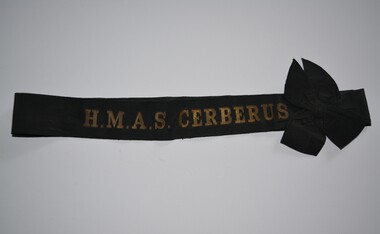
Headwear - Tally Band
... This HMAS Cerberus tally band, or ceremonial cap ribbon with bow worn on left side, belonged to Lance Corporal Alfred GREGORY born 26/12/1932 3/711040 who was conscripted into the Army on 7/8/1951 to 13/11/1951. ...This HMAS Cerberus tally band, or ceremonial cap ribbon with bow worn on left side, belonged to Lance Corporal Alfred GREGORY born 26/12/1932 3/711040 who was conscripted into the Army on 7/8/1951 to 13/11/1951. ...This HMAS Cerberus tally band, or ceremonial cap ribbon with bow worn on left side, belonged to Lance Corporal Alfred GREGORY born 26/12/1932 3/711040 who was conscripted into the Army on 7/8/1951 to 13/11/1951. Served in the CMF between 14/11/51 and 15/8/1956 with the 8/13 VMR and PWLH.A tally band is a black silk or cotton ribbon worn on sailor caps featuring gold or yellow lettering the identifies the ship or navy name. Black cotton ribbon and bow woven with gold colour lettering HMAS Cerberus8/13vmr, pwlh, cmf, australian army, hmas cerberus, nasho, ran -
Emerald Museum & Nobelius Heritage Park
Photograph - Portrait - Ron Bevan, Unknown photographer, 1980s-1990s
... The man on the left of the image seems to be listening to the remarks; he is wearing what may be a Rotary International medallion on a ceremonial ribbon around his neck and therefore may be receiving an award or other form of recognition on the occasion the photograph was taken. ...The man on the left of the image seems to be listening to the remarks; he is wearing what may be a Rotary International medallion on a ceremonial ribbon around his neck and therefore may be receiving an award or other form of recognition on the occasion the photograph was taken. ...Rotary began in 1905 in Chicago as an organisation to build connections between professional people through service to the community community. The name Rotary was chosen to reflect that positions of power within the organisation would be rotated to avoid any one person or group having too much influence on the organisation's decisions. The organisation was renamed the International Association of Rotary Clubs in 1912 after groups were formed in Canada, Ireland and the United Kingdom. Groups in non-English speaking countries such as Cuba and the Phillipines were formed later that decade. Only men could become members until 1989. The first Rotary group in Australia was formed in Melbourne in 1921. The name Rotary International was adopted at the first Australian convention in 1922. Rotary Melbourne is associated with the formation of some key Victorian and national services, such as the crisis counselling service LifeLine, heart disease services at Baker Medical Research Institute at the Alfred Hospital and Very Special Kids. The Rotary Club of Emerald and District was formed in March 1980. Museum records indicate that one of the two men pictured in the photograph is named Ron Bevan.The item is significant as it captures a moment in the early history of a community association that has contributed to the development and social infrastructure in the Emerald area.Black and white rectangular photograph printed on photographic paper. The item is a black and white portrait-orientation photograph depicting two men aged approximately sixty years old wearing suits and ties at a podium in a wood-panelled room. The podium has been draped with a cloth bearing the Rotary International symbol and three other logos. The man on the right of the image appears to be reading from a paper held in his hands. The man on the left of the image seems to be listening to the remarks; he is wearing what may be a Rotary International medallion on a ceremonial ribbon around his neck and therefore may be receiving an award or other form of recognition on the occasion the photograph was taken. Museum records indicate that one of the men pictured is named Ron Bevan.Obverse: ROTARY / INTERNATIONAL /1980s, 1990s, ron bevan, rotary club, rotary international, rotary club of emerald and district, community groups, social groups -
 Flagstaff Hill Maritime Museum and Village
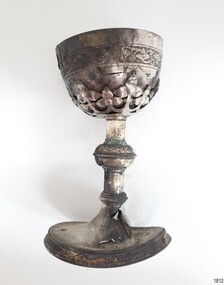
Ceremonial object - Chalice, 1855 or earlier
... Flagstaff Hill Flagstaff Hill Maritime Museum and Village Warrnambool Maritime Museum Maritime Village Great Ocean Road Shipwreck Coast Schomberg 1855 clipper ship James Baines & Co Black Ball line luxury ship emigrant ship Captain Forbes Bully Forbes SS Queen Peterborough shipwreck Communion Set religious service communion service ceremonial service Mass chalice White sticker attached to the base of the chalice Chalice; electroplated silver metal over metal, possibly nickle. The chalice has a wide bowl with an outer layer of intricately cut metal on the underside and a ribbon-like border of grapes and grapevine leaves is etched around it. ...In 1975, divers from Flagstaff Hill, found an ornate communion set used to celebrate the Eucharist or holy communion by a number of different Christian faiths was recovered from the wreck of the Schomberg. The set comprised a jug, two chalices, a plate and a lid. The lid did not fit any of the other objects and in 1978 a piece of the lid broke off, revealing a glint of gold. As museum staff carefully examined the lid and removed marine growth, they found a diamond ring, which is currently on display in the Great Circle Gallery at Flagstaff Hill. The collection of artefacts from the Schomberg also contains ship fittings and equipment, personal effects, a lithograph, tickets and a photograph from the Schomberg. Most of the artefacts were salvaged from the wreck by Peter Ronald a former director of Flagstaff Hill maritime museum. The Schomberg was a large three-masted full-ship rigged wooden ship built in 1855 by Alexander Hall and Co in Aberdeen, Scotland for James Baines' famous Black Ball Line at £43,103. The vessel was 288 feet (88 meters) in length, with a beam of 45 feet (14 meters), a depth of 29.5 feet (8.99 meters) of 2,284 tons. The mainmast was 210 feet (64 meters) high and she carried 3.3 acres of sail. The vessel was constructed with three skins. One planked fore and aft, and two diagonally planked, fastened together with screw-threaded trunnels (wooden rails). The Schomberg is one of only three clipper wrecks in Victorian waters that operated the England to Australia run. While the other two, Empress of the Sea and Lightning, were built by the famous American shipbuilder, Donald Mac Kay. Schomberg was an attempt to build a faster ship than Mac Kay and a vessel fast enough to break the sailing record to Australia. The Schomberg sailed on her maiden voyage from Liverpool on 6 October 1855, under the command of Captain James Forbes, on its maiden voyage to Australia with a general cargo, jewellery, spirits, machinery, and 2,000 tons of iron rails and equipment intended to build the Melbourne to Geelong Railway and a bridge over the Yarra from Melbourne to Hawthorn. She also carried a cow for fresh milk, pens for fowls and pigs, plus 90,000 gallons of water for washing and drinking. She also carried 17,000 letters and 31,800 newspapers. There were approximately 473 passengers and a crew of 105. It was hoped that Schomberg would make Melbourne in sixty days, setting a record for the voyage, but light winds at the equator dashed those expectations. The ship sighted Moonlight Head in south west Victoria on Christmas Day but through a deadly combination of wind, currents and unmarked sand spits, the vessel gently ran aground on 26 December 1855 on a spit that juts into Newfield Bay, just east of Curdies Inlet, and the present town of Peterborough. Fortunately, the SS Queen was nearby and managed to save all passengers and crew. The steamers Keera and Maitland were dispatched to salvage the passenger's baggage and the more valuable cargo. Other salvage attempts were made, but deteriorating weather made the work impossible, and within two weeks the Schomberg's hull was broken up and the vessel abandoned. The wrecking of the Schomberg caused quite the public stir particularly in light of the fact the vessel was supposed to be, the most perfect clipper ship ever built. Captain Forbes was charged in the Supreme Court under suspicion that he was playing cards with two female passengers below decks when his ship ran aground. Despite a protest meeting, two inquiries and the court proceedings, he was found not guilty and cleared of all charges. In 1975, divers from Flagstaff Hill, including Peter Ronald, found an ornate communion set at the wreck. The set comprised a jug, two chalices, a plate and a lid. The lid did not fit any of the other objects and in 1978 a piece of the lid broke off, revealing a glint of gold. As museum staff carefully examined the lid and removed marine growth, they found a diamond ring, which is currently on display in the Great Circle Gallery at the Flagstaff Hill Maritime museum that also displays ship fittings and equipment, personal effects. Most of the artefacts were salvaged from the wreck by Peter Ronald, former director of Flagstaff Hill.This chalice is significant as an example of an item in common use in the mid-19th century that is still in use today. The Schomberg has historical significance as one of the first luxurious ships built to bring emigrants to Australia to cash in on the gold rush era. And is included on the Victorian Heritage Register (VHR S612). The collection of Schomberg artefacts held at Flagstaff Hill Museum is primarily significant because of the relationship between these recovered items having a high potential to interpret the story of the Schomberg and its foundering during a storm. The shipwreck is of additional historical significance for representing aspects of Victoria’s shipping history and for its association with the first passenger ship, which was designed not only to be the fastest and most luxurious of its day but foundered on its maiden voyage to Australia.Chalice; electroplated silver metal over metal, possibly nickle. The chalice has a wide bowl with an outer layer of intricately cut metal on the underside and a ribbon-like border of grapes and grapevine leaves is etched around it. It is supported by a tall stem with a circular knob partway down its length, and the stem is attached to a round base that is hollow underneath. The decorative pattern around the perimeter of the base is repeated on the knob on the stem. The base also has a pattern of lines around the vertical edge. There is a white sticker attached to the underside of the base. Its inscription is undecipherable. The chalice is part of a Communion set that was recovered from the wreck of the Schomberg. White sticker attached to the base of the chaliceflagstaff hill, flagstaff hill maritime museum and village, warrnambool, maritime museum, maritime village, great ocean road, shipwreck coast, schomberg, 1855, clipper ship, james baines & co, black ball line, luxury ship, emigrant ship, captain forbes, bully forbes, ss queen, peterborough shipwreck, communion set, religious service, communion service, ceremonial service, mass, chalice -
 Flagstaff Hill Maritime Museum and Village
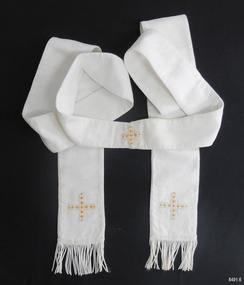
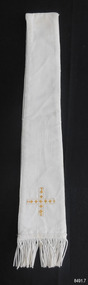
Ceremonial object - Priest's scarf, 1907 to mid 20th century
... Three cross symbols, one at each end and one in the centre, have been handworked in white ribbon with gold-coloured edging and gold embroidery in the form of rows of small crosse.. Ceremonial ...This item is part of the collection of Ecclesiastical Linen once used by St. Andrews Anglican Church on the corner of the Esplanade and 14 Drummond St, Dennington, Victoria. The first Anglican service was conducted on December 22nd, 1907. The church was decommissioned in January 2003. This item is part of the Ecclesiastical Linen collection, which is significant for its examples of handworked embroidery and drawn-thread work from the early 20th century. The items are also examples of a collection used for religious services during this period. The Ecclesiastical Linen is also significant for its association with the early development of the local township of Dennington and the importance the the community of setting aside land in the 1850's for the purpose of religious worship. The Ecclesiastical Linen is also significant for its connection to St Andrews Anglican Church, Dennington. The church was funded and attended by the local community in the early 1900's and is now listed on the Victorian Heritage Database (VHD 118083) as a building of historical and social significance. Priest's scarf, also called a stole: part of a set of Ecclesiastical Linen once used in St. Andrew's Anglican Church, Dennington, Victoria, between the years 1907 and 2003. The rectangle of lined coarse white fabric is slightly flared at the ends, which are finished with a white twisted cotton fringe. Three cross symbols, one at each end and one in the centre, have been handworked in white ribbon with gold-coloured edging and gold embroidery in the form of rows of small crosse.. Three embroidered symbols [ribbon cross with gold-coloured borders and small gold coloured crosses along the arms]flagstaff hill, warrnambool, maritime museum, shipwreck coast, great ocean road, st andrews anglican church dennington, dennington church, warrnambool church 1907, ecclesiastical linen, communion linen, hand worked linen, religious service, religious ceremony, ceremonial linen, needlework, embroidered, applique, cross symbol, priest's scarf, stole, priest's stole -
 Flagstaff Hill Maritime Museum and Village
Ceremonial object - Priest's armband, 1907 to mid 20th century
... A cross symbol has been handworked on the end above the fringe, using white ribbon with gold-coloured edging and gold embroidery in the form of rows of small crosses. Ceremonial ...This item is part of the collection of Ecclesiastical Linen once used by St. Andrews Anglican Church on the corner of the Esplanade and 14 Drummond St, Dennington, Victoria. The first Anglican service was conducted on December 22nd, 1907. The church was decommissioned in January 2003. This item is part of the Ecclesiastical Linen collection, which is significant for its examples of handworked embroidery and drawn-thread work from the early 20th century. The items are also examples of a collection used for religious services during this period. The Ecclesiastical Linen is also significant for its association with the early development of the local township of Dennington and the importance the the community of setting aside land in the 1850's for the purpose of religious worship. The Ecclesiastical Linen is also significant for its connection to St Andrews Anglican Church, Dennington. The church was funded and attended by the local community in the early 1900's and is now listed on the Victorian Heritage Database (VHD 118083) as a building of historical and social significance. Priest's armband, part of a set of Ecclesiastical Linen once used in St. Andrew's Anglican Church, Dennington, Victoria, between the years 1907 and 2003. The rectangle of lined coarse white fabric is slightly flared at the ends. The length has been folded in half, then stitched across its width about halfway along to form a loop on the folded half. One side has been finished with a white twisted cotton fringe. A cross symbol has been handworked on the end above the fringe, using white ribbon with gold-coloured edging and gold embroidery in the form of rows of small crosses. Embroidered symbol [ribbon cross with gold-coloured borders and small gold-coloured crosses along the arms]flagstaff hill, warrnambool, maritime museum, shipwreck coast, great ocean road, st andrews anglican church dennington, dennington church, warrnambool church 1907, ecclesiastical linen, communion linen, hand worked linen, religious service, religious ceremony, ceremonial linen, needlework, embroidered, applique, cross symbol, priest's armband -
Glenelg Shire Council Cultural Collection
Ceremonial object - Sash - Ancient Order of Foresters, n.d
... Plain green sash, cloth, hemmed, a narrow piece of lighter green ribbon attached to one of the long sides, about a quarter of the way along. Ceremonial object Sash - Ancient Order of Foresters ...The Ancient Order of Foresters, which originated in England in the mid 1700s, established its first branch (Court) in Victoria in 1849. Foresters was set up as a non-profit organisation, the founding principles of the Society being to provide financial and social benefits as well as support to members and their families in times of unemployment, sickness, death, disability and old age. The Society is now known as the Foresters Friendly Society and in July 1999 was incorporated as a public company limited by shares and guarantee.Plain green sash, cloth, hemmed, a narrow piece of lighter green ribbon attached to one of the long sides, about a quarter of the way along. -
Glenelg Shire Council Cultural Collection
Ceremonial object - Sash - Ancient Order of Foresters, n.d
... Remains of red ribbon attached to one, about 1/4 of the way along it. Ceremonial object Sash - Ancient Order of Foresters ...The Ancient Order of Foresters, which originated in England in the mid 1700s, established its first branch (Court) in Victoria in 1849. Foresters was set up as a non-profit organisation, the founding principles of the Society being to provide financial and social benefits as well as support to members and their families in times of unemployment, sickness, death, disability and old age. The Society is now known as the Foresters Friendly Society and in July 1999 was incorporated as a public company limited by shares and guarantee.Plain green sash, red fringe at either end. *S embroidered in yellow. Remains of red ribbon attached to one, about 1/4 of the way along it. -
Glenelg Shire Council Cultural Collection
Ceremonial object - Lodge Jewell - The Royal Antediluvian Order of Buffaloes, Casterton, c. 1952
... ribbon, gold edging, 'PRIMO' in gold. Bottom section - medallion shape, gold metal acanthus leaves around edge, red crown at top, blue enamel badge in centre; red P, white C entwined 'JUSTICE, TRUTH, PHILANTHROPY' around edge. Two sections joined together with hook and loop Ceremonial ...The Royal Antediluvian Order of Buffaloes (RAOB) is one of the largest fraternal movements in the United Kingdom,[1] The order started in 1822 and has since spread throughout the former British Empire and elsewhere in the world. It is known as the "Buffs" to members.Lodge jewel - Royal Antediluvian Order of Buffaloes, Casterton. Top section - dark blue grosgrain ribbon, rectangular piece. Gold coloured metal buffalo horns attached to top, long pin on back. RAOB badge in centre of ribbon; red, white and blue lettering, gold base; curved black badge lower edge of ribbon, gold edging, 'PRIMO' in gold. Bottom section - medallion shape, gold metal acanthus leaves around edge, red crown at top, blue enamel badge in centre; red P, white C entwined 'JUSTICE, TRUTH, PHILANTHROPY' around edge. Two sections joined together with hook and loopBack: 'No. 105 presented to Bro. JOHN DANIEL FOSTER C.P raised 31'10.52' - engraved -
Glenelg Shire Council Cultural Collection
Clothing - Town Crier's Coat - Syd Cuffe, 1888-1995
... Syd Cuffe Portland Town Crier ceremonial regalia coat Syd Cuffe's Town Crier's coat. Navy blue, pure wool, trimmed with gold ribbon and braid on collar, cuffs and lower front pockets, gold diagonal stripes on front, gold buttons (Australian Military Force) Clothing Town Crier's Coat - Syd Cuffe ...Syd Cuffe was the Portland Town Crier from 1983 to 2013. The role of Town Crier was created for Syd Cuffe in 1983 in the lead up to Portland’s 150th anniversary celebrations held in 1984-85. 200 items from Mr. Cuffe’s estate were donated to the Glenelg Shire Cultural Collection. The items relate to his town crying activities and community work across the Shire and further afield.Syd Cuffe's Town Crier's coat. Navy blue, pure wool, trimmed with gold ribbon and braid on collar, cuffs and lower front pockets, gold diagonal stripes on front, gold buttons (Australian Military Force)syd cuffe, portland town crier, ceremonial regalia, coat -
 Ringwood and District Historical Society
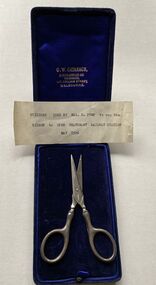
Memorabilia, G.W. Catanach, Scissors used by Mrs Herman Pump to open Heathmont Railway Station in May 1926, 1926
... Herman Pump (Louise) to cut the ribbon to open Heathmont Railway Station May 1926. G.W. Catanach Diamond Jeweller and Watchmaker Lit Collins Street Melbourne. Ceremonial ...Scissors were used by Mrs. Herman Pump (Louise) to cut the ribbon to open Heathmont Railway Station May 1926.Ceremonial scissors in small case 13cm x 8cm hinged on short side, metal clip on closing. Scissors 10cm long x 5.2cm wide handles. Case is black felt exterior and black felt interior one side and blue padded side with inscription. Opening of Heathmont Railway Station +Additional Keywords: Pump, Herman (Grandfather of donor) / Pump, Wilfred (Father of donor) / Pump, Louise (Grandmother of donor)G.W. Catanach Diamond Jeweller and Watchmaker Lit Collins Street Melbourne. -
 Greensborough Historical Society
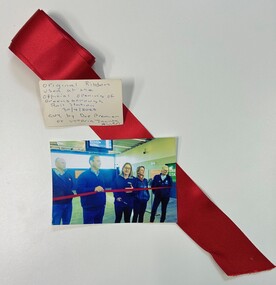
Ceremonial object - Photograph, Photograph and ribbon used at Official Opening of Greensborough Railway Station, 30/04/2023
... Original ribbon cut by Deputy Premier Jacinta Allen at the Official Opening of Greensborough Railway Station 30th April 2023, photo of cutting the ribbon. greensborough railway station Jacinta Allen Colin Brooks Vicki Ward Red Ribbon and Coloured photo Photograph and ribbon used at Official Opening of Greensborough Railway Station. Ceremonial object Photograph ...Original ribbon cut by Deputy Premier Jacinta Allen at the Official Opening of Greensborough Railway Station 30th April 2023, photo of cutting the ribbon.Red Ribbon and Coloured photogreensborough railway station, jacinta allen, colin brooks, vicki ward -
 Bendigo Military Museum
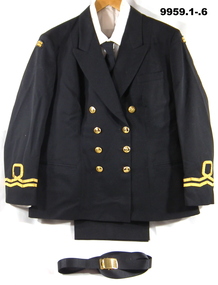
Uniform - WINTER CEREMONIAL - NAVY CADETS, Australian Defence Industries, 1992, 2002
... ribbon on black fabric with gold plastic embossed buttons. 6. Belt - black with gold buckle. 7. Hat - Tricorne for female officer - black and white colour fabric. Black brim, white crown with black polyester lining. On front is a cloth Officers badge featuring gold laurel wreath surrounding a silver anchor. On top of that is a gold crown with padded insert of red velvet. Around the base is embroidered dots of red, blue and green representing gems. Manufacturers label - black in print - illegible. Handwritten owner's, blue ink pen "IBBOTSON". Uniform WINTER CEREMONIAL ...Uniform issued to Lieutenant ANC (Australian Navy Cadets) "Patricia Ibbotson", No. 1005777. Commanding Officer of Training Ship Bendigo. Enlisted 26/2/2004 - Admin Officer, 2IC. Acting CO June 2012 Commanding Officer 16/10/2012. Retired 26/02/2016.1. Jacket - Black winter ceremonial, wool/polyester fabric, double breasted with 8 gold plastic buttons embossed with an anchor. Two wavy gold stripes just above sleeve hems, denotes rank of Lieutenant. One stripe has a loop. There are black shoulder flashes with the words "Australian Navy Cadets" embroidered in gold. 2. Trousers - Black wool/polyester fabric with side pockets. Fob pocket, back pocket and belt loops. Nylon and metal zipper fly, Black polyester pocket lining. 3. Shirt - long sleeved with cuff, white cotton/polyester fabric, collar, front breast pockets with button down flap. Shoulder epaulettes, plastic buttons. 4. Shirt - white, short sleeved with shoulder boards. Cotton/polyester fabric, collar shoulder epaulettes, two front pockets, white plastic buttons. Shoulder boards gold ribbon on black fabric with gold plastic embossed buttons. 6. Belt - black with gold buckle. 7. Hat - Tricorne for female officer - black and white colour fabric. Black brim, white crown with black polyester lining. On front is a cloth Officers badge featuring gold laurel wreath surrounding a silver anchor. On top of that is a gold crown with padded insert of red velvet. Around the base is embroidered dots of red, blue and green representing gems. Manufacturers label - black in print - illegible. Handwritten owner's, blue ink pen "IBBOTSON". Manufacturer's label - black ink print on white cotton fabric. 1. "ADI/ 1992/ SIZE 115s/ Bust - 115cm/ Waist 90 cm/ 8410-66-134-3810/ Wool/polyester/ Service No/ Name/DRY CLEAN ONLY." 2. ADA/ 2002/ ^/ NSN 8405 66 137 9251/ Wool/Polyester/ Size: 104L/ Waist:104/ Seat: 125/ NO/ NAME/ DRY CLEAN ONLY. 5. White print on black fabric "AUSTRALIAN TIE CO/ MADE IN AUSTRALIA/ 65% POLYESTER/ 35% VISCOSE/ MADE IN AUSTRALIA/ DRY CLEAN ONLY".uniform, anc, ts bendigo, patricia ibbotson -
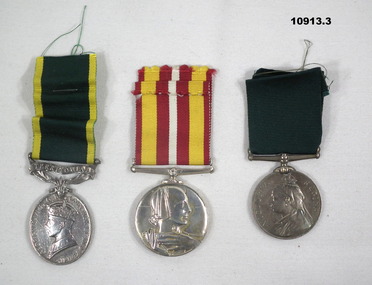 Bendigo Military Museum
Award - MEDALS, BRITISH, Unnown
... ceremonial occasions. 3. Volunteer Long Service and Good Conduct usually for services in the rank. Instituted in 1894 for 20 years Service and superceded in 1908 by Territorial Forces Efficiency Medal. Ron Mills Collection Medals British 1. Named to "879759 Gunner R. Roll, Royal Artillery" 2. Named to "Mrs Roma Harris". 3. Un-named. Three medals with ribbons ...1. Territorial Forces Efficiency Medal awarded to WO, NCO's and enlisted personnel in Citizens Military Force of Australia and Territorial Armies of NZ & UK for 12 Years Service. 2. Awarded to members who complete 15 years service in British Red Cross Society on St Andrews Ambulance Corps to be worn only on ceremonial occasions. 3. Volunteer Long Service and Good Conduct usually for services in the rank. Instituted in 1894 for 20 years Service and superceded in 1908 by Territorial Forces Efficiency Medal.Three medals with ribbons - unmounted. 1.Territorial Forces Efficiency Medal - oval shaped. 2. British Voluntary Medical Services Medal. 3. Volunteer Reserve Long Service Medal - Queen Victoria.1. Named to "879759 Gunner R. Roll, Royal Artillery" 2. Named to "Mrs Roma Harris". 3. Un-named.ron mills collection, medals, british -
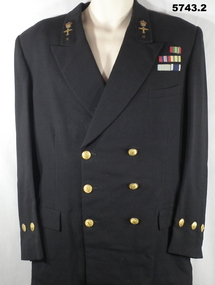 Bendigo Military Museum
Uniform - UNIFORM, WINTER CEREMONIAL, RAN, WW2 and Korea
... Ribbons for WW2, Korea, Long Service. On lapels embroidered crown, aeroplane and letter "H". On sleeves - 3 gold buttons - denotes senior sailor ranks NCO. Buttons with Crown, Anchor and Australia". 2. Trousers - black colour wool twill, five button fly. Handwritten name on back pocket calico lining. Uniform UNIFORM, WINTER CEREMONIAL ..."James Locke BLUNDEN" R/33905 A33905. Enlisted 6/2/45. Discharged 21/1/64. Rank Chief Airman AHI, HMAS SYDNEY. Korea = rank Leading Airman on HMAS SYDNEY 31/8/1951 - 22/02/1952.1. Jacket - black colour wool twill with cotton sateen lining, double breasted with gold painted metal buttons with shank. Service Ribbons for WW2, Korea, Long Service. On lapels embroidered crown, aeroplane and letter "H". On sleeves - 3 gold buttons - denotes senior sailor ranks NCO. Buttons with Crown, Anchor and Australia". 2. Trousers - black colour wool twill, five button fly. Handwritten name on back pocket calico lining. 2. Back pocket lining - handwritten, black ink "J. BLUNDEN"uniform, ran, ww2, korea -
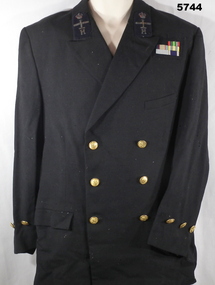 Bendigo Military Museum
Uniform - JACKET, WINTER CEREMONIAL, RAN, cWW2 - Korea
... Ribbons for WW2, Korea, Long Service. On lapels - embroidered crown, aeroplane and Letter "H". On sleeves - 3 gold buttons - denotes Senior Sailor rank NCO. Buttons - with Crown, Anchor and "AUSTRALIA". Uniform JACKET, WINTER CEREMONIAL ...Service history - Cat No.5743.2.Jacket - black colour wool twill with cotton sateen lining. Double breasted with gold painted metal buttons with shank. Service Ribbons for WW2, Korea, Long Service. On lapels - embroidered crown, aeroplane and Letter "H". On sleeves - 3 gold buttons - denotes Senior Sailor rank NCO. Buttons - with Crown, Anchor and "AUSTRALIA".TWO DRY CLEANING LABELS PINNED INSIDE LEFT SLEEVE - paper, illegible writing.uniforms, ran, ww2, korea -
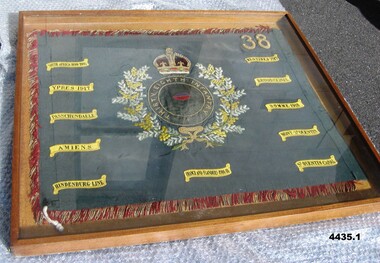 Bendigo Military Museum
Ceremonial object - 38th BATTALION COLOURS, c. 1916
... ceremonially placed by 8/7 RVR members and dedicated by Bishop Peter Curnow on 31st July 2015. Custodians of the colours were representatives of the Bendigo and District RSL, the 38th Battalion Association and the Passchendaele Barracks Military Historical Society. Refer Cat No 7512 for the plaque that was with the Colours in the Church. Battalion colours 38th Battalion Colour patches .1) Rectangular banner representing the battalion colours with battle honours of the 38th Battalion on a green background. The battalion's battle honours are featured on eleven yellow ribbons ...In 2015 due to All Saints Cathedral being sold, the Bendigo Soldiers Memorial Institute Military Museum expressed interest in having the 38th Battalion Colours relocated to the museum. Under the direction of RSM Ceremonial, the colours were ceremonially placed by 8/7 RVR members and dedicated by Bishop Peter Curnow on 31st July 2015. Custodians of the colours were representatives of the Bendigo and District RSL, the 38th Battalion Association and the Passchendaele Barracks Military Historical Society. Refer Cat No 7512 for the plaque that was with the Colours in the Church..1) Rectangular banner representing the battalion colours with battle honours of the 38th Battalion on a green background. The battalion's battle honours are featured on eleven yellow ribbons with green embroidered lettering. Each ribbon is individually sewn onto the banner. In the centre are two concentric embroidered yellow circles. Inside the inner circle is the colour patch of the 38th Battalion. Between the inner and outer circles “THIRTY EIGHTH INFANTRY” has been embroidered. The centre piece is surrounded by a wreath featuring the flowers and leaves of the Golden Wattle. An embroidered King's crown is above the wreath. Red and Gold fringes feature on three edges of the banner. A sewn sleeve for a pike is on the right hand side. .2) Union flag in King's colours configuration. Red and gold fringes feature on three sides. A sewn sleeve for a pike is on the left hand side. In the centre are two embroidered circles. The inner circle contains an embroidered '38'. Between the inner and outer circles the words 'THIRTY EIGHTH INFANTRY' are embroidered. An embroidered King's crown appears above the circles.battalion colours, 38th battalion, colour patches -
 Bendigo Military Museum
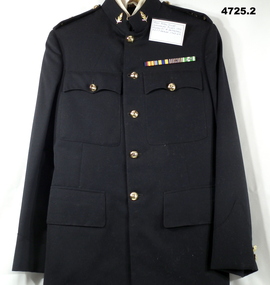
Uniform - UNIFORM, ARMY, CEREMONIAL BLUES, Commonwealth Govt Clothing Factory, 1) 1970
... Uniform ceremonial Blues .1) Jacket blue colour, Patrol Blues, gold metal buttons, service ribbons Vietnam and long service, shoulder rank insignia. .2) Trousers, khaki. ...Uniform re Lt Col Murray Metherall, refer Cat No 590.2 for service history..1) Jacket blue colour, Patrol Blues, gold metal buttons, service ribbons Vietnam and long service, shoulder rank insignia. .2) Trousers, khaki. (Not part of Patrol Blues jacket.uniform, ceremonial, blues -
 Bendigo Military Museum
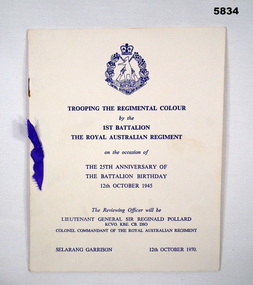
Programme - PROGRAMME, 25th ANNIVERSARY OF BATTALION OPENING, 1970
... "TROOPING THE REGIMENTAL COLOUR/ by the/ 1ST BATTALION/ THE ROYAL AUSTRALIAN REGIMENT/ on the occasion of / THE 25th ANNIVERSARY OF THE BATTALION BIRTHDY/ 12th OCTOBER 1945" Souvenir Programme Military History Ceremonial Regimental Colour Programme - cover - cardboard, off white colour, dark blue print on front cover with Royal Australian Regiment Coat of Arms at top. 10 pages - cut, plain, glossy white paper. Illustrated in colour - two flags in centrefold. Stapled - metal, small purple ribbon ..."TROOPING THE REGIMENTAL COLOUR/ by the/ 1ST BATTALION/ THE ROYAL AUSTRALIAN REGIMENT/ on the occasion of / THE 25th ANNIVERSARY OF THE BATTALION BIRTHDY/ 12th OCTOBER 1945"Programme - cover - cardboard, off white colour, dark blue print on front cover with Royal Australian Regiment Coat of Arms at top. 10 pages - cut, plain, glossy white paper. Illustrated in colour - two flags in centrefold. Stapled - metal, small purple ribbon decoration on front cover.souvenir, programme, military history, ceremonial, regimental colour -
 Burrinja Cultural Centre
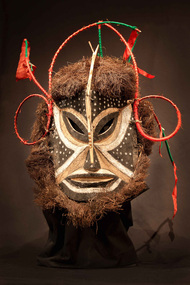
La Sisi Ceremonial Mask
... Thin cane pieces extend out and are wrapped in green or red wool and hung with faded ribbons. La Sisi Ceremonial Mask Ben Sisia ...Head mask with wood face and plant fibres surrounding the mask as a head and beard. Thin cane pieces extend out and are wrapped in green or red wool and hung with faded ribbons. -
 Geoffrey Kaye Museum of Anaesthetic History
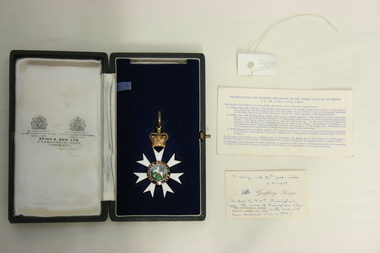
Ceremonial object - Medal, Companion of the Third Class of the Order of St Michael and St George, Circa 1966
... ribbon are set and stored in its custom made black case with the badge acronym in gold lettering on the top of the case [C.M.G.]. There is a card with instructions for wearing the medal under the velour holder along with a note from Geoffrey Kaye to Harry Daley. Companion of the Third Class of the Order of St Michael and St George Ceremonial ...In 1966 Harry Daly was admitted to the Order of St Michael and St George in recognition of over 35 years of service to medicine and anaesthesia.Large white enamelled seven armed Maltese Cross set around a dark blue ring bearing the Latin motto 'Auspicium Melioris Aevi'. The obverse depicting St Michael standing on the devil and the reverse St George on horseback killing a dragon. The medal comes with its blue-crimson-blue ribbon folded and stored under the velour badge holder. Medal and ribbon are set and stored in its custom made black case with the badge acronym in gold lettering on the top of the case [C.M.G.]. There is a card with instructions for wearing the medal under the velour holder along with a note from Geoffrey Kaye to Harry Daley.Printed on internal satin lining: BY APPOINTMENT / TO HER MAJESTY THE QUEEN / MEDALLISTS / BY APPOINTMENT / H.R.H. THE DUKE OF EDINBURGH / MEDALLISTS. / SPINK & SON, LTD. / 5 - 7, KING STREET, ST. JAMES'S, / LONDON, S.W.1.medal, st michael, st george, anaesthesia, harry daly -
 Bendigo Historical Society Inc.
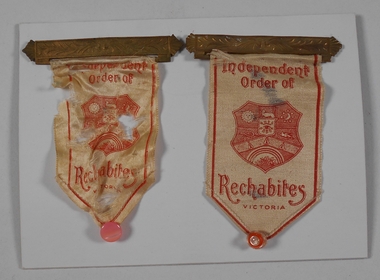
Textile - Rechabite Ceremonial Badges
... ceremonial badges. A Stylized brass button with pin back, decorated with stamped design of maple leaf and palm fronds, cream satin ribbon with crest of Independent Order of Rechabites. ...ceremonial badges. A Stylized brass button with pin back, decorated with stamped design of maple leaf and palm fronds, cream satin ribbon with crest of Independent Order of Rechabites. ...The Rechabite movement began in Salford England. In 1861 the first independent order of Rechabites Friendly Society, Salford Unity, was opened in Bendigo to be called “Star of Bendigo” Tent. It was registered as Number 5 making it one of the first in Victoria. They worked with the Total Abstinence Society to organize lectures and social events designed to prove that entertainment and fun could be had without alcohol. They met in the new Temperance Hall in View Street.Independent Order of Rechabites, Salford Unity. Male ceremonial badges. A Stylized brass button with pin back, decorated with stamped design of maple leaf and palm fronds, cream satin ribbon with crest of Independent Order of Rechabites. Small pink (faded red) button at base B as per "A" above but button is clear with an orange circle.Some collars have stamped on reverse "Star of Bendigo Tent No 5"i.o.r. (rechabites), badge -
 Yarra Ranges Regional Museum
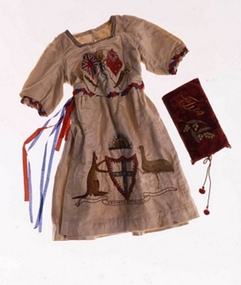
Empire Day Dress, Miss Mary Ryan, 1902
... ceremonial lilydale 'Advance Australia' in gold metalic thread, bottom of dress. Empire Day Dress; Cream silk, cotton lined, embroidered with kangaroos and emu holding shield, with Southern Cross stars above rising sun emblem. Banner below reads 'Advance Australia', embriodered with silk and cotton thread; also gold metalic braiding. Bodice of dress decorated with embroidered Australian and British flags, wattle branches and eucalyptus leaves, cotton, leather leaves(?); centre of dress and sleeve cuffs decorated with red, blue and white ribbons ...The dress was made by Miss Mary Ryan, a pupil at Lilydale Convent (now Mt Lilydale College) in 1902. It was worn to the Annual Empire Day Celebrations in Lilydale. Accompanying photo shows dress worn by Monica Ryan (no. 5089). The outfit also includes two hand made pockets for handkerchiefs and ties (nos. 735 & 736) Empire Day Dress; Cream silk, cotton lined, embroidered with kangaroos and emu holding shield, with Southern Cross stars above rising sun emblem. Banner below reads 'Advance Australia', embriodered with silk and cotton thread; also gold metalic braiding. Bodice of dress decorated with embroidered Australian and British flags, wattle branches and eucalyptus leaves, cotton, leather leaves(?); centre of dress and sleeve cuffs decorated with red, blue and white ribbons. Thin gold braiding around neckline. back of dress closes with hook and eye fasteners. 'Advance Australia' in gold metalic thread, bottom of dress. costume - childrens, costume - female ceremonial, lilydale -
Port Melbourne Historical & Preservation Society
Ceremonial object - Ornaments from cake for WFE Liardet's 200th birthday, Marilyn Allport, Jul 1999
... celebrations fetes and exhibitions marilyn allport wilbraham frederick evelyn liardet wfe liardet Ornaments from cake from PMH&PS celebration of WFE Liardet's 200th birthday July 1999, baked and decorated by Marilyn Allport for the Society's July meeting: sugar and ribbon decorations including oval with image from PMH&PS logo Ceremonial object Ornaments from cake for WFE Liardet's 200th birthday Marilyn Allport ...Ornaments from cake from PMH&PS celebration of WFE Liardet's 200th birthday July 1999, baked and decorated by Marilyn Allport for the Society's July meeting: sugar and ribbon decorations including oval with image from PMH&PS logocelebrations fetes and exhibitions, marilyn allport, wilbraham frederick evelyn liardet, wfe liardet
