
Showing 111 items matching "children's plaque"
-
 Department of Health and Human Services
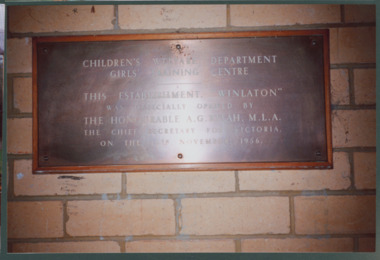
Photograph, Photo of "Winlaton" Official Opening Plaque - Children's Welfare Department Girls' Training Centre Opened by The Honourable A G Rylah MLA Chief Secretary for Victoria in November 1956
... Photo of "Winlaton" Official Opening Plaque - Children's Welfare Department Girls' Training Centre Opened by The Honourable A G Rylah MLA Chief Secretary for Victoria in November 1956...Photo of "Winlaton" Official Opening Plaque - Children's Welfare Department Girls' Training Centre Opened by The Honourable A G Rylah MLA Chief Secretary for Victoria in November 1956 Photograph ... -
 Greensborough Historical Society
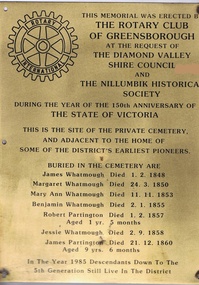
Plaque, Rotary Club of Greensborough, Rotary Club of Greensborough Memorial Plaque: Pioneer Children's Cemetery, 1848-1860
... Rotary Club of Greensborough Memorial Plaque: Pioneer Children's Cemetery...Bronze plaque with Rotary logo, inscription and names of children buried engraved in black...A new plaque, with updated details, replaced it in 2015. Commemorates the deceased children of some early pioneering families (Whatmough and Partington) in the Greensborough district. pioneer childrens cemetery rotary club of greensborough nillumbik historical society inc. whatmough family robert partington Bronze plaque with Rotary logo, inscription and names of children buried engraved in black Rotary Club of Greensborough Memorial Plaque: Pioneer Children's Cemetery Plaque Rotary Club of Greensborough ...Memorial plaque erected by Rotary Club of Greensborough at the request of the Diamond Valley Shire Council and the Nillumbik Historical Society. A new plaque, with updated details, replaced it in 2015.Commemorates the deceased children of some early pioneering families (Whatmough and Partington) in the Greensborough district.Bronze plaque with Rotary logo, inscription and names of children buried engraved in blackpioneer childrens cemetery, rotary club of greensborough, nillumbik historical society inc., whatmough family, robert partington -
 Sunbury Family History and Heritage Society Inc.
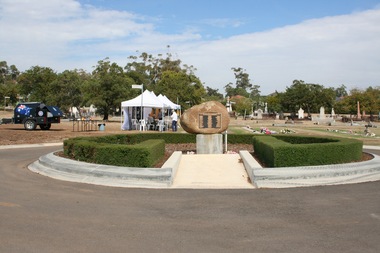
Photograph, Rosa McCall, Children's Memorial, April 2014
... ...Children's plaque...In 2005 a memorial was erected in the Sunbury Cemetery in memory of the children who had lived and died and buried in unmarked graves, while being inmates at the Industrial School, which was located within the former Asylum grounds. The Sunbury Family History Society raised some funds, which went towards a monument and plaque listing the names of all those children and set in a garden bed at the start of the Children's walk....The memorial listing the children's names gives recognition to those children who were buried in unmarked graves within the Sunbury Cemetery. Memorials Children's plaque Sunbury Cemetery Sunbury Asylum A coloured photograph of a plaque set in a large rock in a hedged garden bed, Children's Memorial Photograph Rosa McCall ...In 2005 a memorial was erected in the Sunbury Cemetery in memory of the children who had lived and died and buried in unmarked graves, while being inmates at the Industrial School, which was located within the former Asylum grounds. The Sunbury Family History Society raised some funds, which went towards a monument and plaque listing the names of all those children and set in a garden bed at the start of the Children's walk.The memorial listing the children's names gives recognition to those children who were buried in unmarked graves within the Sunbury Cemetery.A coloured photograph of a plaque set in a large rock in a hedged garden bed,memorials, children's plaque, sunbury cemetery, sunbury asylum -
 Bendigo Historical Society Inc.
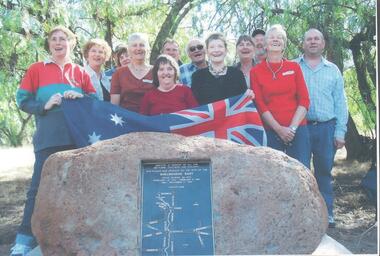
Photograph - SHELBOURNE EAST SS 1012 COLLECTION: REUNION SHELBOURNE EAST SCHOOL 1012
... The plaque reads: erected in memory of all the settlers, teachers and children. This plaque was unveiled on the site of the Shelbourne East State School No. 1012. ...The plaque reads: erected in memory of all the settlers, teachers and children. This plaque was unveiled on the site of the Shelbourne East State School No. 1012. ...Coloured photograph of a group of people standing in front of a rock with a plaque. The plaque reads: erected in memory of all the settlers, teachers and children. This plaque was unveiled on the site of the Shelbourne East State School No. 1012. February 12, 1872 - February 6, 1941 - December 17. 1970. Easter 2006. On the back: former pupils od SS 1012, Shelbourne East. April 2006. 1950's, 1960's and 1970's.education, bendigo, shelbourne east -
 Greensborough Historical Society
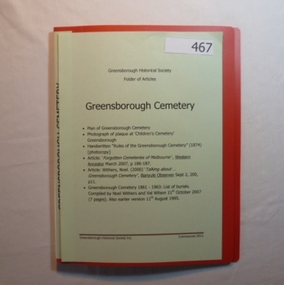
Document - Folder, Greensborough Cemetery, 1861o
... Contents: Plan of Greensborough Cemetery; photograph of plaque at 'Children's Cemetery'; photocopy of 'Rules of the Greensborough cemetery 1874'; Article 'Forgotten cemeteries of Melbourne'; article 'Talking about Greensborough Cemetery, Noel Withers 2000; List of burials compiled by Noel Withers and Val Wilson 2007....Contents: Plan of Greensborough Cemetery; photograph of plaque at 'Children's Cemetery'; photocopy of 'Rules of the Greensborough cemetery 1874'; Article 'Forgotten cemeteries of Melbourne'; article 'Talking about Greensborough Cemetery, Noel Withers 2000; List of burials compiled by Noel Withers and Val Wilson 2007. ...Contents: Plan of Greensborough Cemetery; photograph of plaque at 'Children's Cemetery'; photocopy of 'Rules of the Greensborough cemetery 1874'; Article 'Forgotten cemeteries of Melbourne'; article 'Talking about Greensborough Cemetery, Noel Withers 2000; List of burials compiled by Noel Withers and Val Wilson 2007.Information regarding the pioneer cemetery,20-page plastic binder, red cover. Contains documents relating to the Greensborough Cemetery..greensborough cemetery, noel withers, val wilson -
 Flagstaff Hill Maritime Museum and Village
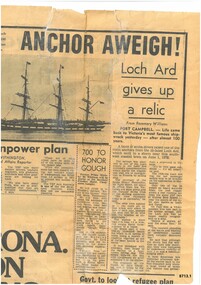
Newspaper - Newspaper Article, March 1978
... A booklet called "Settlers Under Sail" by Don Charlwood was commissioned to be made available to all school children, a memorial plaque (erected by The National Park) was unveiled at Loch Ard Gorge, a special "Loch Ard Shipwreck Centennial Port Campbell" postmark was issued by the Post Office and a model ship competition was held. ...A booklet called "Settlers Under Sail" by Don Charlwood was commissioned to be made available to all school children, a memorial plaque (erected by The National Park) was unveiled at Loch Ard Gorge, a special "Loch Ard Shipwreck Centennial Port Campbell" postmark was issued by the Post Office and a model ship competition was held. ...The Loch Ard was the last sailing ship to lose emigrants' lives when negotiating the entrance to Bass Strait. The ship Loch Ard was built on the River Clyde in Scotland in 1873 for the prestigious Loch Line of colonial clipper ships, designed for the Australian run. It sailed from England on 1 March 1878 carrying 37 crew, 17 passengers and a diverse general cargo ranging from luxury items to bulk railway iron. On 1 June 1878, emerging from fog and hearing too late the sound of breakers against the tall limestone cliffs, the vessel struck the southern foot of Mutton Bird Island and sank in 23 metres of water. Of the fifty-four people on board only two survived, one young male crewman, Tom Pearce, and one young female passenger, Eva Carmichael. This newspaper advertisement was donated by the family of George Shields - a member of the Shields family who had had a long association with the wreck of the Loch Ard and Eva Carmichael. In 1878, following the wreck of the Loch Ard and the subsequent rescue of Eva Carmichael, Eva was taken to Glenample station (near Princetown) to recuperate. It was during this period that Eva became great friends with Jane Shields (an Aunt of George Shields) - a friendship that continued throughout their lives. At that time, Jane was a young woman living in Princetown with her parents and siblings. Many of the Shields family continued to have a great interest in the Loch Ard and several generations of the family are buried in the Loch Ard cemetery. One of the most unlikely pieces of cargo to have survived the shipwreck was a Minton porcelain peacock - one of only nine in the world. The peacock was destined for the Melbourne International Exhibition in 1880. It had been well packed, which gave it adequate protection during the violent storm. Today, the Minton peacock can be seen at the Flagstaff Hill Maritime Museum in Warrnambool. From Australia's most dramatic shipwreck it has now become Australia's most valuable shipwreck artefact and is one of very few 'objects' on the Victorian State Heritage Register. The Victorian History Advisory Council decided 1978 was an appropriate year to mark, not only the centenary of the sinking of the Loch Ard in 1878, but also commemorate the large part played by sailing ships in immigration, and through this, the development of Australia. The Victorian Government authorised the commemoration and a "Loch Ard Centenary Committee" was formed. It was established to create public interest and awareness for the 100th anniversary of the tragic Loch Ard shipwreck. Activities and events included student essays, exhibitions, videos, publications, competitions and historical information. A booklet called "Settlers Under Sail" by Don Charlwood was commissioned to be made available to all school children, a memorial plaque (erected by The National Park) was unveiled at Loch Ard Gorge, a special "Loch Ard Shipwreck Centennial Port Campbell" postmark was issued by the Post Office and a model ship competition was held. Flagstaff Hill Maritime Museum and Village, together with other local towns and shires along the south-west coast participated in many of these commemorative activities. The Chair of the Loch Ard Century Committee (Sir John Holland) approached the "Scuba Divers Federation of Victoria" to "seek and recover a significant relic from the Loch Ard" with the idea of having it available for public display at Port Campbell. The SDFV enlisted the help of the VSAG (Victorian Sub Aqua Group) with a contingent of nineteen divers participating in the salvage which took place over the weekend of 11th and 12th March 1978. The anchor was placed in the custody of the expert conservators at Flagstaff Hill Maritime Museum and Village to be cleaned, and eighteen months later was returned to Port Campbell. This newspaper article was one of many reports and descriptions of events that took place during the Centennial Commemoration of the sinking of the Loch Ard. This newspaper article is a significant reminder (and recognition) of the importance the Loch Ard (and other immigrant ships) played in the settling of Victoria and the dangers faced by the settlers who came to Australia in these ships. Flagstaff Hill’s collection of artefacts from LOCH ARD is significant for being one of the largest collections of artefacts from this shipwreck in Victoria. It is significant for its association with the shipwreck, which is on the Victorian Heritage Register (VHR S417). The collection is significant because of the relationship between the objects, as together they have a high potential to interpret the story of the LOCH ARD. The LOCH ARD collection is archaeologically significant as the remains of a large international passenger and cargo ship. The LOCH ARD collection is historically significant for representing aspects of Victoria’s shipping history and its potential to interpret sub-theme 1.5 of Victoria’s Framework of Historical Themes (living with natural processes). The collection is also historically significant for its association with the LOCH ARD, which was one of the worst and best-known shipwrecks in Victoria’s history.A newspaper cutting taken from a Victorian newspaper (possibly the Herald) printed in March 1978, describing the salvaging of the anchor from the wreck of the Loch Ard near Port Campbell. The cutting has two tears (that have sticky tape on them) and the paper is yellowed with age. The article (written by Rosemary Williams) has an old black and white photograph of the Loch Ard, two large print headings and two colomns of text. The article has been cut out of a larger page and also contains parts of other articles and an advertisement."ANCHOR AWEIGH!" "Loch Ard /gives up/ a relic" Plus two colomns of text describing the raising of the anchor by a team of divers.flagstaff hill maritime museum and village, warrnambool, great ocean road, shipwreck coast, loch ard, loch ard centennial, loch ard anchor, port campbell, loch ard salvage, scuba divers, scuba divers federation of victoria, victorian sub aqua group -
 Flagstaff Hill Maritime Museum and Village
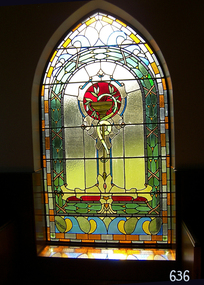
Artwork, other - Window, circa 1928
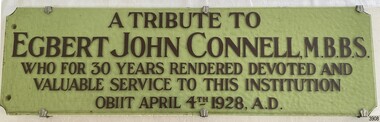
... Children’s Wards of Warrnambool Hospital. Honorary Doctors had played a significant role in the operation of the hospital between the years 1900 to 1939. One of these doctors was Dr. Connell, who passed away in 1928. The green glass plaque...Children’s Wards of Warrnambool Hospital. Honorary Doctors had played a significant role in the operation of the hospital between the years 1900 to 1939. One of these doctors was Dr. Connell, who passed away in 1928. The green glass plaque ...This religiously themed window is situated in the western (weather) wall of the St. Nicholas Mission to Seamen’s Church building in the Flagstaff Hill Maritime Village. It was crafted circa 1928. ABOUT THE WINDOW This window, once known as the Dr Connell Memorial Window, was a feature of an external wall adjacent to the Women’s Children’s Wards of Warrnambool Hospital. Honorary Doctors had played a significant role in the operation of the hospital between the years 1900 to 1939. One of these doctors was Dr. Connell, who passed away in 1928. The green glass plaque is also a registered object in Flagstaff Hill's Collection. Its inscription dedicates the window to Dr. Connell. The inscription reads: “A tribute to Egbert John Connell M.B.B.S. who for 30 years rendered devoted and valuable service to this institution. Obiit April 4th 1928 A.D." A paragraph in the book ‘A History of the Warrnambool Base Hospital’ by Forth and Yule describes the role of the Honorary Doctors - “At the start of the period the senior-part time medical officer was replaced by the junior resident medical officer and control of beds and the right to operate were given to the honorary medical officers...and these men dominated the Warrnambool medical world in the years before the Second World War.” Dr. Connell leased ‘Ambleside’, 192 Koroit Street, in the early 20th century, following Dr Teed who had previously run his medical practice there. In 1914 Dr Connell purchased the property and continued his private practice there until his death in 1928. He also took a prominent part in hospital work, both as physician and surgeon, and often acted as spokesmen for the Honorary Doctors. According to colleague Dr. Horace Holmes’ subsequent notes, it was after the close of the First World War, and the following years of the world-wide pneumonic influenza epidemic, that Dr. Connell himself contracted pneumonia and died. His family and friends then recognised his work by gifting the memorial window in his honour to the Hospital. By the mid-1970s the old wards at the hospital had been replaced and there was no obvious place for the window. Discussions between the previous and past Hospital managers, the Anglican Diocese, and Flagstaff Hill Planning Board, led to its installation in its present position in St Nicholas Seamen’s Church and the memorial plaque was later installed beside the window. St NICHOLAS SEAMEN’S CHURCH, Anglican Church Flagstaff Hill’s Mission to Seamen was opened in 1981. Its conception was partly motivated by the offer of Stained Glass Memorial Windows from the local Warrnambool and District Base Hospital, which was undergoing multi-storey development in the late 1960’s and early 1970’s. The Manager/Secretary at the time was keen to see the historical windows installed in an appropriate location. The chapel was designed by a local architectural draftsman in conjunction with members of the Planning Board of Flagstaff Hill, and built by Mr Leon Habel. The vision of the designers included the hope that the church be used for formal worship such as weddings and funeral, and for multi-denominational special services such as War commemorations. The design is based on the ‘Mission to Seamen’ buildings in both Portland and Port Melbourne. These types of buildings were often erected to house social and worshipful activities for seamen. The materials used in the building include sandstone recycled from nineteenth-century buildings demolished in Warrnambool and American slate tiles retrieved from the 1908 wreck of the FALLS OF HALLADALE. Most of the chapel furnishings came from the Williamstown Missions to Seamen, which was consecrated in 1946 but later decommissioned. These artefacts range from the altar cloth to the hymn board and include a visually stunning round stained glass widow called ‘Christ Guiding the Helmsman’. However the provenance of this particular artefact, large western window, is local. This stained glass memorial window is of local, historical and social significance, linking local history and heritage with one of Warrnambool's doctors, Dr. Egbert John Connell (d. 1928), who gave 30 years of dedicated, medical service to the local citizens.Stained glass leadlight window in Gothic arched metal frame with six horizontal reinforcing rods. Image depicts a golden flat-bowled baptismal font on a slender stand with foliage proceeding from it. The image is internally framed by a Roman arch of coloured glass and surrounding rectangular and breaking-wave shapes. (The window was previously known locally as the Dr. Connell Memorial Window and a plaque dedicated to Dr. Connell is catalogued separately. See Context notes for details.)flagstaff hill, warrnambool, shipwrecked coast, flagstaff hill maritime museum, maritime museum, shipwreck coast, flagstaff hill maritime village, great ocean road, chapel window, stained glass window, warrnambool and district base hospital, st nicholas mission to seamen’s church, williamstown mission to seamen, dr egbert connell, ambleside warrnambool, leon habel builder, falls of halladale slate, memorial window, commemorative window, dr connell -
 Mission to Seafarers Victoria
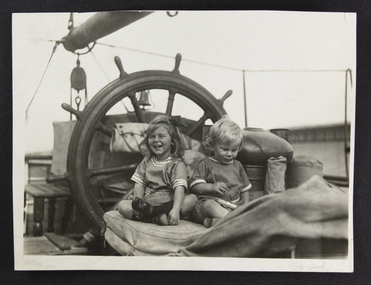
Photograph - Photograph, Black and white, 1918
... children in March 1919 on passenger ship, accompanied by a nurse. Martin Frampton and his wife were in New York at the time, but they probably learnt about Catherine's death in the local newspaper. A memorial plaque...children in March 1919 on passenger ship, accompanied by a nurse. Martin Frampton and his wife were in New York at the time, but they probably learnt about Catherine's death in the local newspaper. A memorial plaque ...The LHLG newsletter of 1918 features this image and notes that they accompanied their shipmaster father Captain Aviss, of the Barque Inverneill who with his wife Catherine Florence Aviss, travelling through dangerous European waters, brought the family of three children to visit Melbourne. The two children featured are Margaret and Ronald, born at sea in 1915. Their young sister, Ruth Neil, was also born at sea on the 27 August 1918. The family re-united with a first meeting for the children and grandparents, Captain and Mrs Frampton, who "had lost two ships to enemy submarines and were now on their third". The family participated in "a happy Communion service in our chapel , in which the parents and grandparents joined this formed the keystone of their visit to Melbourne". Unfortunately the young Mrs Aviss contracted the Spanish influenza on their arrival in St John, New Brunswick, Canada, she succumbed in November 1918 after spending a week in the Parks Hospital. Herbert Aviss was left with 2 toddlers and a 3 month old baby. He went back to England with his children in March 1919 on passenger ship, accompanied by a nurse. Martin Frampton and his wife were in New York at the time, but they probably learnt about Catherine's death in the local newspaper. A memorial plaque in her name unveiled in the chapel at the Mission in April 1919. The parents and grandparents left their names and signatures in the visitor book (0149) on the 28 April 1918.One of the rare stories of seafarer visits illustrated with a photograph of the children of a family accustomed to life aboard ship. The impact of influenza also affected this family and others are recorded amongst the supporters of the Mission and reflects the widespread impact that the epidemic of the post WW1 period had on people, Mission activities and restrictions affecting public events. Both Framptons and Aviss are noted in the annals of the Cape Horne society.Small monochrome photograph of two small children, a girl and a boy posed in front of the ship's wheel of a sailing vesselshipboard life, seafarer families, martin frampton, elizabeth frampton, herbert aviss, children, catherine florence aviss nee frampton, wwi, world war one, great war, first world war, german, submarine, u boat, torpedo, spanish influenza, flu, pandemic, st john, new brunswick, sea mites, wheel, boy, girl, margaret aviss, ronald aviss, ruth aviss, ruth neill aviss, ruth neill paterson nee aviss (1918-2017), ronald aviss (1915-1996) -
 Federation University Historical Collection
Photograph, Opening of the Ballarat School of Mines Childcare Creche
... Staff and children at the Ballarat School of Mines Childcare Creche .4) Kerry Cross unveiling a plaque .5) Rpn Wild unveils a mural...Ballarat School of Mines Creche childcare kerry cross ron wild Staff and children at the Ballarat School of Mines Childcare Creche .4) Kerry Cross unveiling a plaque .5) Rpn Wild unveils a mural Opening of the Ballarat School of Mines Childcare Creche Photograph ...Staff and children at the Ballarat School of Mines Childcare Creche .4) Kerry Cross unveiling a plaque .5) Rpn Wild unveils a muralballarat school of mines creche, childcare, kerry cross, ron wild -
 Flagstaff Hill Maritime Museum and Village
Plaque - Commemorative, circa 1928
... ABOUT THE WINDOW The window, to which this plaque belongs was once known as the Dr Connell Memorial Window, which was a feature of an external wall adjacent to the Women’s Children’s Wards of Warrnambool Hospital. ...ABOUT THE WINDOW The window, to which this plaque belongs was once known as the Dr Connell Memorial Window, which was a feature of an external wall adjacent to the Women’s Children’s Wards of Warrnambool Hospital. ...This commemorative plaque refers to the religiously themed window situated in the western (weather) wall of the St. Nicholas Mission to Seamen’s Church building in the Flagstaff Hill Maritime Village. It was crafted circa 1928. ABOUT THE WINDOW The window, to which this plaque belongs was once known as the Dr Connell Memorial Window, which was a feature of an external wall adjacent to the Women’s Children’s Wards of Warrnambool Hospital. Honorary Doctors had played a significant role in the operation of the hospital between the years 1900 to 1939. One of these doctors was Dr. Connell, who passed away in 1928. A paragraph in the book ‘A History of the Warrnambool Base Hospital’ by Forth and Yule describes the role of the Honorary Doctors - “At the start of the period the senior-part time medical officer was replaced by the junior resident medical officer and control of beds and the right to operate were given to the honorary medical officers...and these men dominated the Warrnambool medical world in the years before the Second World War.” Dr. Connell leased ‘Ambleside’, 192 Koroit Street, in the early 20th century, following Dr Teed who had previously run his medical practice there. In 1914 Dr Connell purchased the property and continued his private practice there until his death in 1928. He also took a prominent part in hospital work, both as physician and surgeon, and often acted as spokesmen for the Honorary Doctors. According to colleague Dr. Horace Holmes’ subsequent notes, it was after the close of the First World War, and the following years of the world-wide pneumonic influenza epidemic, that Dr. Connell himself contracted pneumonia and died. His family and friends then recognised his work by gifting the memorial window in his honour to the Hospital. By the mid-1970s the old wards at the hospital had been replaced and there was no obvious place for the window. Discussions between the previous and past Hospital managers, the Anglican Diocese, and Flagstaff Hill Planning Board, led to its installation in its present position in St Nicholas Seamen’s Church. It was installed without the bottom section of stained glass, which was inscribed as a memorial to Dr. Connell. St NICHOLAS SEAMEN’S CHURCH, Anglican Church Flagstaff Hill’s Mission to Seamen was opened in 1981. Its conception was partly motivated by the offer of Stained Glass Memorial Windows from the local Warrnambool and District Base Hospital, which was undergoing multi-storey development in the late 1960’s and early 1970’s. The Manager/Secretary at the time was keen to see the historical windows installed in an appropriate location. The chapel was designed by a local architectural draftsman in conjunction with members of the Planning Board of Flagstaff Hill, and built by Mr Leon Habel. The vision of the designers included the hope that the church be used for formal worship such as weddings and funeral, and for multi-denominational special services such as War commemorations. The design is based on the ‘Mission to Seamen’ buildings in both Portland and Port Melbourne. These types of buildings were often erected to house social and worshipful activities for seamen. The materials used in the building include sandstone recycled from nineteenth-century buildings demolished in Warrnambool and American slate tiles retrieved from the 1908 wreck of the FALLS OF HALLADALE. Most of the chapel furnishings came from the Williamstown Missions to Seamen, which was consecrated in 1946 but later decommissioned. These artefacts range from the altar cloth to the hymn board and include a visually stunning round stained glass widow called ‘Christ Guiding the Helmsman’. However the provenance of this particular artefact, large western window, is local.This plaque is significant because of its association with stained glass memorial window is of local, historical and social significance, linking local history and heritage with one of Warrnambool's doctors, Dr. Egbert John Connell (d. 1928), who gave 30 years of dedicated, medical service to the local citizens.Plaque, opaque, pale green glass rectangle mounted on white timber board and held in place with six decorative silver coloured clasps. Five rows of printed, capitalised text are fixed on the top surface. The plaque is companion to the commemorative, stained glass window installed in the St. Nicholas Mission to Seamen's Church at Flagstaff Hill. (The window was previously known locally as the Dr. Connell Memorial Window.)"A TRIBUTE TO / EGBERT JOHN CONNELL, M.B.B.S. / WHO FOR 30 YEARS RENDERED DEVOTED AND / VALUABLE SERVICE TO THIS INSTITUTION / OBIIT APRIL 4th 1928, A.D."flagstaff hill, warrnambool, shipwrecked coast, flagstaff hill maritime museum, maritime museum, shipwreck coast, flagstaff hill maritime village, great ocean road, chapel window, stained glass window, warrnambool and district base hospital, st nicholas mission to seamen’s church, williamstown mission to seamen, dr egbert connell, ambleside warrnambool, leon habel builder, falls of halladale slate, memorial window, commemorative window, dr connell, commemorative plaque, plaque, edgar mcconnell -
 Flagstaff Hill Maritime Museum and Village
Letter - Loch Ard Centenary Letter, Koroit Council, March 1978
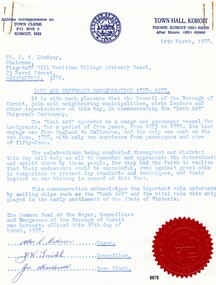
... children. The anchor of the Loch Ard was raised from the wreck and displayed at Port Campbell, a memorial plaque (erected by The National Park) was unveiled at Loch Ard Gorge, a special "Loch Ard Shipwreck Centennial Port Campbell" postmark was issued by the Post Office and a model ship competition was held. ...children. The anchor of the Loch Ard was raised from the wreck and displayed at Port Campbell, a memorial plaque (erected by The National Park) was unveiled at Loch Ard Gorge, a special "Loch Ard Shipwreck Centennial Port Campbell" postmark was issued by the Post Office and a model ship competition was held. ...The Loch Ard was an iron hulled clipper, built in Scotland in 1873 and wrecked on the southwest coast of Victoria in 1878 at what is now known as Loch Ard Gorge, near Port Campbell. Fifty two crew and passengers died and only Tom Pierce and Eva Carmichael survived. The Loch Ard was the last sailing ship to lose emigrants' lives when negotiating the entrance to Bass Strait. One of the most unlikely pieces of cargo to have survived the shipwreck was a Minton porcelain peacock - one of only nine in the world. The peacock was destined for the Melbourne International Exhibition in 1880. It had been well packed, which gave it adequate protection during the violent storm. Today, the Minton peacock can be seen at the Flagstaff Hill Maritime Museum in Warrnambool. From Australia's most dramatic shipwreck it has now become Australia's most valuable shipwreck artefact and is one of very few 'objects' on the Victorian State Heritage Register. The Victorian History Advisory Council decided 1978 was an appropriate year to mark, not only the centenary of the sinking of the Loch Ard in 1878, but also commemorate the large part played by sailing ships in immigration, and through this, the development of Australia. The Victorian Government authorised the commemoration and a "Loch Ard Centenary Committee" was formed. It was established to create public interest and awareness for the 100th anniversary of the tragic Loch Ard shipwreck. Activities and events included student essays, exhibitions, videos, publications, competitions and historical information. A booklet called "Settlers Under Sail" by Don Charlwood was commissioned to be made available to all school children. The anchor of the Loch Ard was raised from the wreck and displayed at Port Campbell, a memorial plaque (erected by The National Park) was unveiled at Loch Ard Gorge, a special "Loch Ard Shipwreck Centennial Port Campbell" postmark was issued by the Post Office and a model ship competition was held. Flagstaff Hill Maritime Museum and Village, together with other local towns and shires along the south-west coast participated in many of these commemorative activities. This letter is a significant reminder (and recognition) of the importance the Loch Ard (and other immigrant ships) played in the settling of Victoria and the dangers faced by the settlers who came to Australia in these ships. Flagstaff Hill’s collection of artefacts from LOCH ARD is significant for being one of the largest collections of artefacts from this shipwreck in Victoria. It is significant for its association with the shipwreck, which is on the Victorian Heritage Register (VHR S417). The collection is significant because of the relationship between the objects, as together they have a high potential to interpret the story of the LOCH ARD. The LOCH ARD collection is archaeologically significant as the remains of a large international passenger and cargo ship. The LOCH ARD collection is historically significant for representing aspects of Victoria’s shipping history and its potential to interpret sub-theme 1.5 of Victoria’s Framework of Historical Themes (living with natural processes). The collection is also historically significant for its association with the LOCH ARD, which was one of the worst and best-known shipwrecks in Victoria’s history.Single page letter typed in blue ink, on behalf of Koroit Council, written on 14th March 1978 and addressed to the Chairman, Flagstaff Hill Maritime Village Advisory Board, in recognition of the "Loch Ard Centenary Commemoration 1878 - 1978". It has the "Borough of Koroit" stamp at the top of the page and a red "Borough of Koroit" seal on the bottom right-hand corner of the page. It is signed by the Mayor (Allan R. Waterson), a councillor (J. W. Smith) and the Town Clerk (Jim Macdonald). The letter is in a plain buff manilla folder labelled in blue type.Top left corner - "Address correspondence to:/TOWN CLERK / P.O. BOX 5/KOROIT, 3282" Top Centre - blue circular ink stamp of "BOROUGH OF KOROIT 1870" with coat of arms in the center Top right - "TOWN HALL,KOROIT/ PHONE KOROIT (055) 658230/After Hours (055) 658490" The letter is addressed to - "CR. J. S. Lindsay, /Chairman,/ Flagstaff Hill Maritime Village Advisory Board,/ WARRNAMBOOL. 3280" "LOCH ARD CENTENARY COMMEMORATION 1878 - 1978" (underlined) The letter begins - "It is with much pleasure that the Council of the Borough of Koroit, join with neighbouring municipalities, civic leaders and other organisations on this day, in commemorating the "Loch Ard" Shipwreck centenary. The "Loch Ard" operated as a cargo and passenger vessel for immigrants, for a period of five years, from 1873 to 1878. Its last voyage was from England to Melbourne, and the ship was sunk on the 1st June 1878, with only two survivors from passengers and crew of fifty-four. The celebrations being conducted throughout our district this day will help us all to remember and appreciate the determination and spirit shown by these people, for they had the faith to realise that their endeavours would be successful, even against great odds in comparison to present day standards and techniques, and their imprint on our history is record of this fact. This commemoration acknowledges the important role undertaken by sailing ships such as the "Loch Ard" and the vital role this ship played in the early settlement of the State of Victoria." The letter ends with -" the Common Seal of the Mayor, Councillors and Burgesses of the Borough of Koroit was hereunto affixed this 18th day of March, 1978." The letter is signed "Allan J. Waterson Mayor/J. W. Smith Councillor/ Jim Macdonald Town Clerk and a large red seal of the Borough of Koroit (with their coat of arms) is in the bottom right-hand corner. Front of manilla folder - "BOROUGH OF KOROIT / LOCH ARD CENTENARY COMMEMORATION/ 1878 - 1978" "4050" written in black ink top right-hand corner next to a scribbled out numberflagstaff hill maritime museum and village, warrnambool, great ocean road, shipwreck coast, loch ard, port cambell, shipwreck, commemorative committee, loch ard centenary, koroit council, commemorative letter, loch ard commemorative committee -
 Greensborough Historical Society
Photograph Collection, Tom Vickers - Rotarian, 1990s
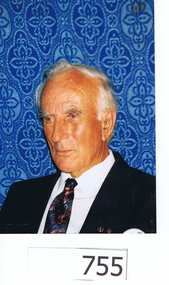
... One photograph depicts Tom Vickers and Graeme Trotter with the commemorative plaque at the pioneer children's cemetery near the Plenty River Greensborough. ...One photograph depicts Tom Vickers and Graeme Trotter with the commemorative plaque at the pioneer children's cemetery near the Plenty River Greensborough. ...Portraits of Tom Vickers, wife Beryl and photographs of Rotary activities. Tom Vickers was the Greensborough pharmacist and a well known identity in the area. One photograph depicts Tom Vickers and Graeme Trotter with the commemorative plaque at the pioneer children's cemetery near the Plenty River Greensborough. Te plaque was donated by Greensborough Rotary.Local identity and Rotary activities.4 photographs in orange folder.Captions on back of each photograph.greensborough rotary, tom vickers, beryl vickers, graeme trotter. -
![Photograph - Digital image, Pioneer Children's Cemetery [Cairn], 1985_](/media/collectors/4f729f5697f83e03086015b8/items/54bb53c42162f10ca8d771ed/item-media/54bb55282162f10ca8d78724/item-fit-380x285.jpg?cb=6) Greensborough Historical Society
Greensborough Historical SocietyPhotograph - Digital image, Pioneer Children's Cemetery [Cairn], 1985_
... The unmarked graves of the children of two Greensborough pioneer families lie in a private cemetery on the Plenty River. Burials occurred between 1848 and 1860. This photograph shows the close proximity to housing and the Cairn for the plaque....The unmarked graves of the children of two Greensborough pioneer families lie in a private cemetery on the Plenty River. Burials occurred between 1848 and 1860. This photograph shows the close proximity to housing and the Cairn for the plaque. ...The unmarked graves of the children of two Greensborough pioneer families lie in a private cemetery on the Plenty River. Burials occurred between 1848 and 1860. This photograph shows the close proximity to housing and the Cairn for the plaque.A significant historical site in Greensborough.Digital copy of colour photograph.pioneer childrens cemetery, whatmough, partington -
![Photograph - Digital image, Pioneer Children's Graves [jonquils], 1985_](/media/collectors/4f729f5697f83e03086015b8/items/54bb58372162f10ca8d7aabd/item-media/54bb587a2162f10ca8d7ae17/item-fit-380x285.jpg?cb=6) Greensborough Historical Society
Greensborough Historical SocietyPhotograph - Digital image, Pioneer Children's Graves [jonquils], 1985_
... children of two Greensborough pioneer families lie in a private cemetery on the Plenty River. Burials occurred between 1848 and 1860. This photograph is a close up of the jonquils in bloom on the cemetery site when the original plaque was installed in 1985....children of two Greensborough pioneer families lie in a private cemetery on the Plenty River. Burials occurred between 1848 and 1860. This photograph is a close up of the jonquils in bloom on the cemetery site when the original plaque was installed in 1985. ...The unmarked graves of the children of two Greensborough pioneer families lie in a private cemetery on the Plenty River. Burials occurred between 1848 and 1860. This photograph is a close up of the jonquils in bloom on the cemetery site when the original plaque was installed in 1985.An important historical site in Greensborough.Digital copy of colour photograph.pioneer childrens cemetery, whatmough, partington -
 Greensborough Historical Society
Photograph - Digital image, Plaque - Poulter Avenue Reserve Greensborough, 18/04/1988
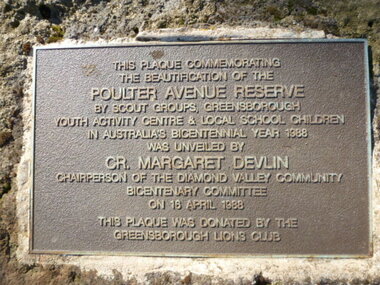
... The inscription reads: "This plaque commemorating the beautification of the Poulter Avenue Reserve by scout groups, Greensborough Youth Activity Centre & local school children in Australia's Bicentennial year 1988 was unveiled by Cr. ...The inscription reads: "This plaque commemorating the beautification of the Poulter Avenue Reserve by scout groups, Greensborough Youth Activity Centre & local school children in Australia's Bicentennial year 1988 was unveiled by Cr. ...Photograph of Plaque located in Greensborough's Poulter Avenue Reserve. The inscription reads: "This plaque commemorating the beautification of the Poulter Avenue Reserve by scout groups, Greensborough Youth Activity Centre & local school children in Australia's Bicentennial year 1988 was unveiled by Cr. Margaret Devlin chairperson of the Diamond Valley Community Bicentenary Committee on 18 April 1988. This plaque was donated by the Greensborough Lions Club" Digital copy of colour photograph.poulter avenue reserve greensborough -
 Greensborough Historical Society
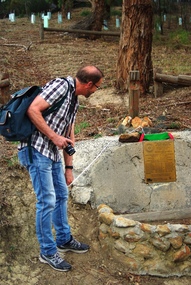
Photograph - Digital image, Marilyn Smith, Unveiling of new plaque at the Pioneer Children's Cemetery, April 2016, 02/04/2016
... On 02/04/2016, Greensborough Rotary and Greensborough Hstorical Society members gathered to unveil an updated plaque at the Pioneer Children's Cemetery on the Plenty River. ...On 02/04/2016, Greensborough Rotary and Greensborough Hstorical Society members gathered to unveil an updated plaque at the Pioneer Children's Cemetery on the Plenty River. ...On 02/04/2016, Greensborough Rotary and Greensborough Hstorical Society members gathered to unveil an updated plaque at the Pioneer Children's Cemetery on the Plenty River. These photos show the new plaque and Steve Whatmough viewing the plaque. Steve is a descendant of the Whatmough family whose children, with their cousins the Partingtons, were buried in this place. More photos of this event can be found at the GHS Resource Centre. Digital copy of colour photograph.greensborough historical society, pioneer childrens cemetery, steve whatmough, rotary club of greensborough -
 Learmonth and District Historical Society Inc.
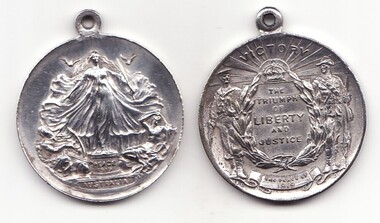
Peace 1919 Medal, Medal Peace 1919, 1919
... children received their medals on Friday 18 July and on 'Peace Day' on Saturday 19 July. To commemorate the end of World War 1. world war 1 peace victory medal australia Peace with two flying doves on pedestal inscribed, PEACE / 1919 below AUSTRALIA; figure in chains on left and another entangled in bush to right (obverse) Australian sailor and soldier support wreath; above, VICTORY; within, THE / TRIUMPH / OF / LIBERTY / AND / JUSTICE; below on plaque, THE PEACE OF 1919(reverse) Round white metal medals issued to mark the end of WW1. ...Awarded to: School Children of the Commonwealth of Australia Other Details: Of the commemorative medals issued to mark the end of the First World War, the most common was the so-called 'Peace' or 'Victory' medal issued to every child in Australia aged 0-14 years (and aged up to 16 if parents were in the armed forces). The medal was designed by Charles Douglas Richardson, better known for his work as a sculptor. Time constraints as well as pressure from the production of other victory medals meant that no single manufacturer could make the 1,670,000 medals. Six were therefore selected: Amor, Stokes, Schlank, Parkes, Angus & Coote (who later withdrew) and Platers. The medals were silvered bronze, with silver issues for special presentations. The Defence Department supplied a red, white and blue striped ribbon and pin. Distribution began in March 1919. Victorian school children received their medals on Friday 18 July and on 'Peace Day' on Saturday 19 July.To commemorate the end of World War 1.Round white metal medals issued to mark the end of WW1. On the front "PEACE 1919", and on the reverse, "VICTORY", middle of the medal "THE TRIUMPH OF LIBERTY AND JUSTICE". on the bottom "THE PEACE OF 1919". With a plain edge.Peace with two flying doves on pedestal inscribed, PEACE / 1919 below AUSTRALIA; figure in chains on left and another entangled in bush to right (obverse) Australian sailor and soldier support wreath; above, VICTORY; within, THE / TRIUMPH / OF / LIBERTY / AND / JUSTICE; below on plaque, THE PEACE OF 1919(reverse)world war 1, peace, victory medal australia -
 Orbost & District Historical Society
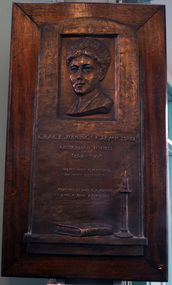
memorial plaque, early 20th Century
... The children were placed in private homes and took on their mother's single name of Carmichael. In the late 1930s, plaques were unveiled in Orbost & Ballarat in honor of Grace Jennings Carmichael. ...The children were placed in private homes and took on their mother's single name of Carmichael. In the late 1930s, plaques were unveiled in Orbost & Ballarat in honor of Grace Jennings Carmichael. ...Grace Elizabeth Jennings Carmichael (1867-1904), poet and nurse, was born on 24 February 1867 at Ballarat, Victoria, daughter of Archibald Carmichael, a miner from Perthshire, Scotland, and his wife Margaret Jennings, née Clark, from Cornwall, England. . She was educated at Melbourne and while still a child went to live on a station at Orbost, and grew up close to the bush she came to love so much. In 1888 she went to Melbourne to be trained as a nurse at the Royal Children's Hospital, Melbourne, and in 1891 published a small volume of prose sketches, Hospital Children. Having qualified she obtained a position on a station near Geelong, and subsequently married Francis Mullis. She contributed verse to the Australasian, and in 1895 Poems by Jennings Carmichael was published. She lived for a time in South Australia and then went to London, where she died in poor circumstances in 1904. Her husband, Henry Mullis, was last recorded in the workhouse in Woolrich, but then disappeared leaving the three children- Geoffrey 7 yrs, (Thomas) Clive 5 yrs & 4 year old (Archibald) Keith and one year old (Rupert) Wyatt, destitute & were sent to the Northampton workhouse, (Thomas ) Clive dying in 1906. In 1910, a group of Carmichael's admirers, discovered the whereabouts of her children, where a public fund was established to bring the children to Australia, the Victorian Government giving them free passage, arriving in Victoria in October of 1910. The children were placed in private homes and took on their mother's single name of Carmichael. In the late 1930s, plaques were unveiled in Orbost & Ballarat in honor of Grace Jennings Carmichael. The one in Orbost was part of the "Back To' celebrations. It hung in Mechanics' Institute in Orbost.This is significant to the Orbost region in that it is associated with a woman who is certainly our foremost female poet. A bronze cast memorial plaque set onto a wooden backing board. The plaque has an image of a woman, a candle and a book, and also some text (see below).Grace Jennings Carmichael, Australian poetess, 1868-1904, spent her childhood in this district, erected by Mrs G A Hunter & a few admirers.memorial-plaque grace-jennings-carmichael orbost-poet -
 Orbost & District Historical Society
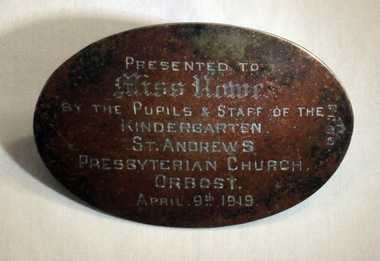
plaque, 1918
... children, in particular, were socially and spiritually involved. This item is reminiscent of that time. st-andrew's-church-presbyterian-orbost In block letters: Presented to Miss Rowe by the Pupils and Staff of the St Andrew's Presbyterian Church Orbost April 9 1918 An oval shaped badge made of copper metal. It has a square washer and screw on the back. plaque ...Jessie Irene ROWE, daughter of John ROWE and Annie (nee PATERSON), married Joseph McKay ABERDEEN (a Technical School teacher) at Orbost in 1918. Her father was one of the first vestrymen of St James Church of England and her mother was a prominent church worker. It would seem an appropriate time of her marriage for Jessie to receive such a badge at the time of her marriage. John Rowe died 28-9-1920 and it is noted that Annie left Orbost in 1922. (ref. John Phillips) This badge was presented to Miss Rowe by pupils and staff of St Andrew's Church Kindergarten on April 9 1918. Miss Rowe was a Sunday school Teacher and pianist / organist? at the church. The Presbyterian Church in Orbost was officially opened in 1898. For many years the Presbyterian people of Orbost enjoyed the fellowship of the church and the children, in particular, were socially and spiritually involved. This item is reminiscent of that time.An oval shaped badge made of copper metal. It has a square washer and screw on the back.In block letters: Presented to Miss Rowe by the Pupils and Staff of the St Andrew's Presbyterian Church Orbost April 9 1918st-andrew's-church-presbyterian-orbost -
Ringwood and District Historical Society
Biography, Ringwood and District Historical Society, Interview notes - short biography on Miss Daisy Paddock, teacher at Ringwood State School, circa 1970s, c.1970s
... children. Miss Paddock was a member of the Soroptomist Club in RW (equivalent to Rotary), active in the church and local community. At our archives, we have a plaque...children. Miss Paddock was a member of the Soroptomist Club in RW (equivalent to Rotary), active in the church and local community. At our archives, we have a plaque ...Single page of notes/interview record of Miss Daisy Paddock, teacher at the Ringwood State School in Greenwood Avenue (now Federation Estate) - Interview write-up by Ringwood History Group.Transcript: "Miss Janet Daisy Paddock She was an extremely well-liked and well-regarded teacher at the old RW State School in Greenwood Ave (Now Federation Estate). She taught between the years of 1927 until 1941, then again after the war from 1951 until final retirement in 1961. In fact she was so liked that her former pupils formed "The 2997 Club" , which met in her honour every year for a meal (and, of course, their guest of honour). 2997 was the RW SS number. In some of her letters about early life in RW, she recalls the RW Mail being produced and printed in a small wooden building in Adelaide St. [Adelaide St is officially no longer on the RW map but it went from the highway nearly to Mullum Creek, between Melbourne St and Warrandyte Road.^ In fact there is an unmarked 100 metres of road that is on the west side of Officeworks that ends in a roundabout at the bottom of Eastland carpark. I don't believe it is exactly in the same position as the old Adelaide Street but it pretty close. That would put the old Mail office in the vicinity of the Maroondah Council service centre in Eastland.] She also recalls that there were nearly a dam on every corner. In fact, I recall in my 1950s/60s childhood that there were still many dams around. As I previously mentioned, with the RW-Mitcham claybelt, there wasn't much top soil and the orange clay is very fine, so when the banks of the dam get wet, it wass very slippery. I often remember playing around in those dams, as most boys did in those days. A friend and I spied an old bath used to water some horses so after some trial and errors we made it waterproof and fashioned a couple of paddles out of wooden fence pailings. The first launch in the local dam was fine and we managed to manouver through the bullrushes into the middle. The only thing that I forgot about was that I had a d<^ that went everywhere with me and, rather than bark from the bank, he swam over to us and tried to get aboard. Bath tubs are not known for their seaworthness and he tipped us all in the drink. Of course the bath sank like a rock. We scrambled on the bank and he added insult to injury when, as all dogs do, gave the usual shake and sprayed us with water. My mind often comes back to one dam right next to the Croydon pub - that provided water to the Magg's orchard - dug in the usual fashion on about 3 metres deep scraped in the local clay, it was at this dam in the early sixties that a young boy drowned. After that we were pretty careful around dams. Going back to Daisy's memories, she recalls that the kids often started late on Monday mornings as Monday was Market Day at RW. They used to watch the stock being herded into the yards and people getting off the steam trains. Her family home was at Gruyere and her father used to drive to RW market and stop midway at the Burnt Bridge hotel and rest the horses. [I suspect that he may have watered other things besides the horses.] They eventually moved to RW in Thanet St. Miss Paddock still remembers the old RW school at the corner of RW St and Whitehorse Road, it was very small so they built the new school in Greenwood Ave. RW had a population of around 2,(K)0 when Daisy became an Assistant Class Five. She used to walk through the open paddocks, surrounded by bush and orchards. She goes on to say that the bush was alive with wildlife and a natural playground for the children. Miss Paddock was a member of the Soroptomist Club in RW (equivalent to Rotary), active in the church and local community. At our archives, we have a plaque that grac^ the entrance to the school, naming it the Miss Daisy Paddock library, in honour of a great woman in our city." -
 Ringwood and District Historical Society
Photograph - Photographs, Ringwood Methodist Church, Station Street - Laying of Commemorative Plaques. 1963
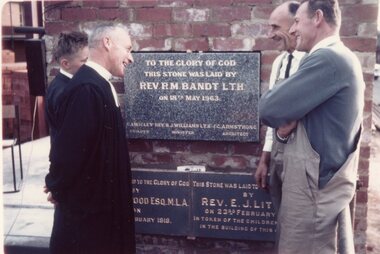
... M.L.A. on 23rd February 1918 1918 Plaque on Right: This Stone was laid to the glory of God By Rev. E.J.Little on 23rd February 1918 In Token of the Children's part in the Building of this Church. ...M.L.A. on 23rd February 1918 1918 Plaque on Right: This Stone was laid to the glory of God By Rev. E.J.Little on 23rd February 1918 In Token of the Children's part in the Building of this Church. ...B&W and Colour photos of the mounting of the old and new Commemorative Plaques on the Methodist Church 1963. Present are ministers and workman (unidentified in the photos). These photographs are in the presentation album given to Vera Wigley in memory of her husband, builder Evan Wigley. See Registration Numbers 11002-00 to 11002-10 for the full set of photographs. New Plaque: To the Glory of God. This stone was laid by Rev B.M. Bandt LTH on 18th May 1963. E.A.Wigley Builder; Rev H.J. Williams LTH, Minister. F.C.Armstrong Architect 1918 Plaque on Left: This Stone was laid to the glory of God By E.W. Greenwood Esq. M.L.A. on 23rd February 1918 1918 Plaque on Right: This Stone was laid to the glory of God By Rev. E.J.Little on 23rd February 1918 In Token of the Children's part in the Building of this Church. -
 Orbost & District Historical Society
letters, 1910
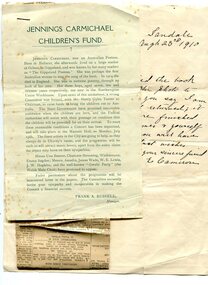
... The children were placed in private homes and took on their mother's single name of Carmichael. In 1910 a small selection of her poems was published, in 1937 a plaque to her memory was unveiled at Orbost in the Mechanics Institute ( reg. 554), and a year later a replica was placed in the public library at Ballarat. ...The children were placed in private homes and took on their mother's single name of Carmichael. In 1910 a small selection of her poems was published, in 1937 a plaque to her memory was unveiled at Orbost in the Mechanics Institute ( reg. 554), and a year later a replica was placed in the public library at Ballarat. ...These letters were received by Henry James of Orbost. Henry James (1860-1932) was a well-known identity in the Orbost district. He was a stock agent and auctioneer who helped to establish the seed bean industry in Orbost. He was the second secretary of the Snowy River Shipping Co. as well as a shire councillor and prominent member of MUIOOF. They concern a fund established to raise money to bring the three sons of Jennings Carmichael to Australia. A committee established by Henry Gyles Turner, a a notable Australian banker and historian, was formed to raise funds to bring the boys to Australia. Grace Elizabeth Jennings Carmichael (1867-1904), poet and nurse, was born on 24 February 1867 at Ballarat, Victoria, daughter of Archibald Carmichael, a miner from Perthshire, Scotland, and his wife Margaret Jennings, née Clark, from Cornwall, England. . She was educated at Melbourne and while still a child went to live on a station at Orbost, and grew up close to the bush she came to love so much. In 1888 she went to Melbourne to be trained as a nurse at the Royal Children's Hospital, Melbourne, and in 1891 published a small volume of prose sketches, Hospital Children. Having qualified she obtained a position on a station near Geelong, and subsequently married Francis Mullis. She contributed verse to the Australasian, and in 1895 Poems by Jennings Carmichael was published. She lived for a time in South Australia and then went to London, where she died in poor circumstances in 1904. Her husband, Henry Mullis, was last recorded in the workhouse in Woolrich, but then disappeared leaving the three children- Geoffrey 7 yrs, (Thomas) Clive 5 yrs & 4 year old (Archibald) Keith and one year old (Rupert) Wyatt, destitute & were sent to the Northampton workhouse, (Thomas ) Clive dying in 1906. In 1910, a group of Carmichael's admirers, discovered the whereabouts of her children, where a public fund was established to bring the children to Australia, the Victorian Government giving them free passage, arriving in Victoria in October of 1910. The children were placed in private homes and took on their mother's single name of Carmichael. In 1910 a small selection of her poems was published, in 1937 a plaque to her memory was unveiled at Orbost in the Mechanics Institute ( reg. 554), and a year later a replica was placed in the public library at Ballarat. Two of Jennings Carmichael's sons were present at the ceremony.Jennings Carmichael, a leading Australian poet spent much of her childhood in Orbost.Several letter written to H. James concerning the Jennings Carmichael Children's Fund. Stapled to one letter is a typed article about the Jennings Carmichael Children's Fund written by Frank a. Russell. The other letter is a three page stapled handwritten letter from St Oswald's, Ormond College, seeking information about Jennings Carmichael.james-henry jennings-carmichael correspondence -
 Flagstaff Hill Maritime Museum and Village
Photograph - Vessel, Steam Ship, H.M.A.S. Warrnambool J202, Between 1941-1947
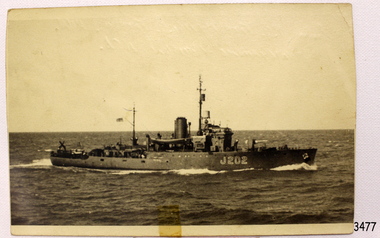
... plaque of the City of Warrnambool’s Coat of Arms presented by the Mayor, Cr. John R Astbury. In September 1942 a Dutch East Indies family, Samuel and Annie Jacob and seven of their eight children, was rescued by the HMAS Warrnambool and evacuated to Darwin. ...plaque of the City of Warrnambool’s Coat of Arms presented by the Mayor, Cr. John R Astbury. In September 1942 a Dutch East Indies family, Samuel and Annie Jacob and seven of their eight children, was rescued by the HMAS Warrnambool and evacuated to Darwin. ...This photograph is connected to the first HMAS Warrnambool (J202), which was one of 60 Bathurst class corvette vessels built during World War II by Mort's Dock & Engineering Co Ltd of Sydney under the commission of the Royal Australian Navy (RAN). It was the namesake of the City of Warrnambool in Victoria. The armed minesweeper was 57 metres long and could had a complement of 85 personnel. Its armament included 1 × 4 inch Mk XIX gun, 1 × 40 mm Bofors AA gun (installed later), 3 × 20 mm Oerlikon guns (1 later removed), machine guns and depth charge chutes and throwers. It was launched in Sydney in May, 1941. The HMAS Warrnambool began service with patrols off Bass Strait in 1941. In December the ship docked in Warrnambool Harbour and the crew marched in a parade along Timor Street. The ship’s crew received a donation of 110 books from the Warrnambool Patriotic Fund, and a plaque of the City of Warrnambool’s Coat of Arms presented by the Mayor, Cr. John R Astbury. In September 1942 a Dutch East Indies family, Samuel and Annie Jacob and seven of their eight children, was rescued by the HMAS Warrnambool and evacuated to Darwin. The family settled in Melbourne, then in 1944 Samuel tragically died. After the war ended the family was threatened with deportation under Australia’s Immigration Restriction Act 1901 (known also as the White Australia policy). Annie married her landlord, John O’Keefe but was still issued a deportation order in 1949. The family appealed to the High Court and the case became famous for being the first successful legal challenge to the Act. The HMAS Warrnambool was in Darwin during the time it was bombed, attacked by the Japanese while rescuing 73 crew from a merchant vessel that had also been attacked. The ship was involved in several other rescues and carried troops to New Guinea. Other events included escort and patrol duties on Australia's east coast, then at Fremantle and back to Darwin. When the Japanese surrendered on September 11, 1945, at the end of World War II, the ship was at Timor. It performed mine clearance work around the Solomon Islands and New Guinea after the war. On 13th September 1947 the ship was sent to lead a flotilla at the Great Barrier Reef, off the Queensland coast. The mission was to clear the defensive British mines that were laid during1941-43 to protect Australia’s boarders. The HMAS Warrnambool hit a mine near Cockburn Reef, exploded and sank shortly afterwards. One of the 70 or so men on board was killed at the time and thirty-two men were badly injured; three of these also lost their lives. The four deceased were Victorian seamen. The wounded men were transferred by boats to the nearby HMAS Swan II, where the Swan’s and the Warrnambool’s doctors cared for them. The HMAS Swan II took the survivors to Cairns, and from there the men were flown by RAAF to either Brisbane or Sydney hospitals. The HMAS Warrnambool was the only RAN ship to be sunk by a mine, and the four who lost their livers were the last naval casualties from World War II. The ship’s wartime service was recognised by three honours. In May 1948 a number of items were recovered by Navy divers from the wreck of HMAS Warrnambool. The items included the ship’s bell (inscribed HMAS Warrnambool 1941) and the round plaque with the Seal of the Warrnambool City Council. In 1949 the plaque was returned to the Council, and the bell was donated to the Australian War Memorial. Further objects were recovered by the new owners of the wreck, Southern Cross Diving and Salvage, in 1972-75. A memorial plaque, honouring the memories of all those who served on the HMAS Warrnambool until is sunk on September 13 1947, was erected in Warrnambool on September 13, 1995. NOTE: (1)- The second HMAS Warrnambool (FCPB204), also the namesake of the City of Warrnambool, was built in 1980 in Cairns, one of fifteen Fremantle Class Patrol Boats ordered by the RAN. It was just over 41 metres long with a compliment of 22 personnel. It patrolled Australia’s northern waters for illegal fishing vessels. This vessel was decommissioned in 2005. (2)- There was also a steam and sail ship named the S.S. Warrnambool, built in 1892 in London and broken up in 1926.This photograph is significant for its association with Royal Australian Navy and its vessel, HMAS Warrnambool (j202). The HMAS Warrnambool played a nationally significant role in overturning Australia’s Immigration Restriction Act 1901 (colloquially known as the White Australia policy). The ship rescued, and brought to Australia, Samuel and Annie Jacob and their family after they evacuated Dutch East India. The family was threatened with deportation and made the first successful appeal to High Court regarding that Act. The HMAS Warrnambool has - Local significance for being the namesake of the City of Warrnambool - Local significance, having docked in Warrnambool Harbour - Local significance, the crew having paraded in Timor Street, Warrnambool - State significance for its first patrol being in Bass Strait. - National significance, being present in Timor at the Japanese surrender - National significance as part of Australia’s defence force history, being one of only four Bathurst class corvettes lost while in Australian service, the only Bathurst class corvette lost after World War II, the only RAN vessel to be sunk by a mine, and associated with the last four Navy deaths of WWIIBlack and white photograph of vessel H.M.A.S. Warrnambool J202 on an open sea. The identifying number is painted on the hull. The ship is flying a white ensign. A lifeboat is suspended near the centre of the ship. Figures can be seen on deck. Hand written inscription on the reverse side. On ship's hull "J202" On reverse of photo "From P.O. FRED MATTHEWS. 23378. R.A.N." "MARIBYRNONG MAIDSTON RSL" "H.M.A.S. WARRNAMBOOL"flagstaff hill, warrnambool, shipwrecked-coast, flagstaff-hill, flagstaff-hill-maritime-museum, maritime-museum, shipwreck-coast, flagstaff-hill-maritime-village, photograph, h.m.a.s. warrnambool, maritime village, maritime museum, shipwreck coast, mort's dock & engineering co ltd, hmas warrnambool, hmas warrnambool i, hmas warrnambool j202, hmas swan ii, j202, world war ii, bathurst class corvette, royal australian navy, ran, sydney built ship, bass strait patrol, sea mine patrol, mine sweeper, mine clearance, navy divers, great barrier reef, cockburn reef, southern cross diving and salvage, warrnambool city council, cr j r astbury, mayor j r astbury, warrnambool patriotic fund, seal, coat of arms, ship’s bell, hmas warrnambool 1941, shipwreck by sea mine 1947, sea rescue, life saving, lifesaving, sinking ship, sunk ship, immigration restrictions act 1901, white australia policy, samuel and annie jacob, john o'keere, minesweeper -
 Mission to Seafarers Victoria
Book, Alfred George Course, Windjammers of the Horn: the story of the last British fleet of square-rigged sailing ships, 1969
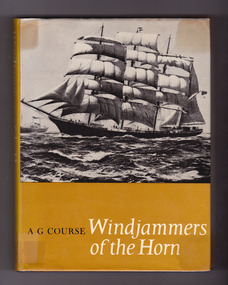
... A plaque was erected on the baptistry fount in memory two young apprentices killed during the sinking of the Galgorm Castle in 1917 by a a U-boat. Captain Frampton and his second wife met his daughter and her to children photographed on the Inverneill in 1918, a few month before the young mother, Catherine Aviss, died in St John, New Brunswick, succumbing to Spanish influenza. ...From dust jacket: This is the unique story of the sailing ships owned by Sir William Garthwaite between 1915 and 1929, which formed in fact the last sailing merchant fleet to trade under the British flag. Captain A.G. Course, a Cape Horner himself, tells the story of this fleet whose vessels sailed so often past the awesome tip of South America, with a wealth of detail, happily marrying factual information and anecdote to produce a valuable historical record. Here are some of the last great characters of the age of sail, both men and ships, brought to life. The author's own close contact with the vessels and their crews allows him to capture the atmosphere most realistically. The Garthwaite ships, for all the effort put into their operation, were fighting a last-ditch stand against the inevitable supremacy of steam. It is with a certain nostalgia that the author records the passing of a fine fleet and documents an important chapter in maritime history.Navy blue cloth cover with embossed golden lettering on the spine, and mustard dust jacket illustrated by original painting by Commander DGM Gardner. xvi, 176 p. : 16 plates, illus., maps, ports. ; 22 cm. Includes index.non-fictionFrom dust jacket: This is the unique story of the sailing ships owned by Sir William Garthwaite between 1915 and 1929, which formed in fact the last sailing merchant fleet to trade under the British flag. Captain A.G. Course, a Cape Horner himself, tells the story of this fleet whose vessels sailed so often past the awesome tip of South America, with a wealth of detail, happily marrying factual information and anecdote to produce a valuable historical record. Here are some of the last great characters of the age of sail, both men and ships, brought to life. The author's own close contact with the vessels and their crews allows him to capture the atmosphere most realistically. The Garthwaite ships, for all the effort put into their operation, were fighting a last-ditch stand against the inevitable supremacy of steam. It is with a certain nostalgia that the author records the passing of a fine fleet and documents an important chapter in maritime history. windjammers, captains, martin frampton, catherine aviss (nee frampton), herbert aviss, elisabeth frampton, inverneill, garthneil, wray castle, garthwray, alfred george course, invercauld, invermay, carnmoney, garthforce, garthsnaid, garthgarry, garthpool, juteopolis, captain roberts, crew, cape horn, cape leeuwin, captain thomas atkinson, spanish flu, wwi -
 Mission to Seafarers Victoria
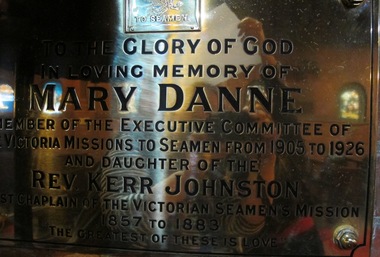
Plaque - Memorial plaque, Mary Danne, 1927
... children. One of their son Noel also became a reverend. She continued her father's work by becoming part of the Mission's committee in 1905. On 9 November 1906, for King's Birthday, she hosted a sailors' picnic at the property she rented, Glenfern on Inkerman Road (see item 1637), where she was running a school, Newington. She died on the 30th of July 1926 at her residence, Seymour Grove in Camberwell. The plaque...children. One of their son Noel also became a reverend. She continued her father's work by becoming part of the Mission's committee in 1905. On 9 November 1906, for King's Birthday, she hosted a sailors' picnic at the property she rented, Glenfern on Inkerman Road (see item 1637), where she was running a school, Newington. She died on the 30th of July 1926 at her residence, Seymour Grove in Camberwell. The plaque ...Mary was the fifth daughter of Reverend Kerr Johnston and his wife Elizabeth. Mary married Reverend Richard Vallencey Danne (1846-1904), they had 8 children. One of their son Noel also became a reverend. She continued her father's work by becoming part of the Mission's committee in 1905. On 9 November 1906, for King's Birthday, she hosted a sailors' picnic at the property she rented, Glenfern on Inkerman Road (see item 1637), where she was running a school, Newington. She died on the 30th of July 1926 at her residence, Seymour Grove in Camberwell. The plaque was erected on the 9 October 1927 (AR 1927).The Kerr Johnston Family migrated to Tasmania in 1854. The Reverend took up his appointment with the Victorian Bethel Union for Seamen in 1857 and moved all his family in the "floating church", the ex water police hulk Emily, first Chaplain serving the seamen in Hobsons' Bay.Large rectangular brass plaque with smaller plaque mounted onto it of Mission to Seamen insignia. The Larger plaque is mounted to a brick wall.Mission to Seamen. To the glory of God In loving memory of Mary Danne member of the executive committee of the Victoria Missions to Seamen from 1905 to 1920 and daughter of the REv. Kerr -Johnston chaplain of the Victorian Seamen's Mission 1857 to 1883 "The greatest of these is love"mary alice isabelle danne nee johnston, 1851-1926, reverend kerr johnston, reverend richard vallencey danne, 1846-1904, bethel, hulk emily, hobson's bay, glenfern, flinders street, st peter chapel -
 Halls Gap & Grampians Historical Society
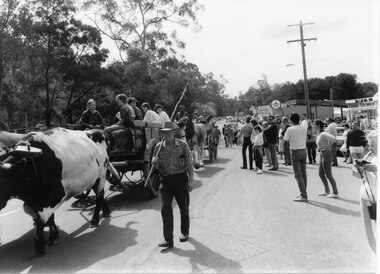
Photograph - B/W, Oct-86
... There was also a plaque unveiled in commemoration of the Wildflower Show and its many volunteers. EVENTS Parades The photo shows a crowd watching a bullock team hauling a dray with five children sitting in it down a road. ...The bullock team was part of a parade held on the main street of Halls Gap in conjunction with the 150th anniversary of Major Mitchell's visit to the area. There was also a plaque unveiled in commemoration of the Wildflower Show and its many volunteers.The photo shows a crowd watching a bullock team hauling a dray with five children sitting in it down a road. The bullock driver is walking alongside holding a long handled whip over his shoulder. A wagon pulled by draught horses can be seen behind the bullock dray. Buildings can be seen to the right rear of the photo and trees line the left side of the street.events, parades -
 Halls Gap & Grampians Historical Society
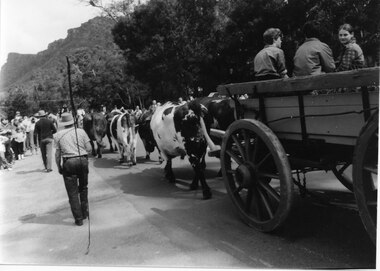
Photograph - B/W, Oct-86
... There was also a plaque unveiled in commemoration of the Wildflower Show and its many volunteers. EVENTS Parades The photo is taken from the rear of a bullock team pulling a dray down a road. Three children ...The bullock team was part of a parade held on the main street of Halls Gap in conjunction with the 150th anniversary of Major Mitchell's visit to the area. There was also a plaque unveiled in commemoration of the Wildflower Show and its many volunteers.The photo is taken from the rear of a bullock team pulling a dray down a road. Three children can be seen sitting in the dray and its back is out of shot. Two men are walking to the left of the team, the closest to the camera holding a long whip over his shoulder. To the far left people can be seen lining the street and in the right background a range of peaks can be seen.events, parades -
 Orbost & District Historical Society
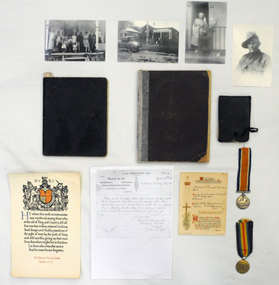
death notice/scroll, after 1919
... Plaque. This was presented to Edward Lawless' mother, Elizabeth Lawless. This certificate is part of the Lawless Collection. The Lawless family lived in Orbost from 1907 - c 1920. John Francis Lawless had a saddlery shop. He died at an early age - 47 years - June 7 1912, leaving his wife, Elizabeth and seven children...Plaque. This was presented to Edward Lawless' mother, Elizabeth Lawless. This certificate is part of the Lawless Collection. The Lawless family lived in Orbost from 1907 - c 1920. John Francis Lawless had a saddlery shop. He died at an early age - 47 years - June 7 1912, leaving his wife, Elizabeth and seven children ...In 1922 a Memorial Scroll was presented to the next of kin of those soldiers, sailors, and nurses who died while serving in the Australian Imperial Force or Royal Australian Navy during the First World War. Later they were presented with a Next of Kin Memorial Plaque. This was presented to Edward Lawless' mother, Elizabeth Lawless. This certificate is part of the Lawless Collection. The Lawless family lived in Orbost from 1907 - c 1920. John Francis Lawless had a saddlery shop. He died at an early age - 47 years - June 7 1912, leaving his wife, Elizabeth and seven children. The eldest son, Victor Rowland lawless volunteered for serv ice in WW1 but did not leave Australia because of illness. The second son, Edward Vincent Lawless (b 1895 d 1917) worked for McCoy & Co. in Orbost, coachbuilding, undertakers, general blacksmiths and farriers, prior to enlisting in WW!. He was trained as a signaller and was sent to France where he was killed in action on 9.10.1917. Elizabeth Lawless worked as a ladies' nurse (midwife) in Orbost prior to leaving the district in 1920. She lived to 6.6.1975 aged 104 years. On October 9, he was first recorded as missing in action and then confirmed killed in action. He was initially buried at Tyne Cot British Cemetry and then exhumed and buried at Passchendaele New British Cemetry, Plot 14, Row 2, Grave 2. Correspondence in his file dated April 7, 1925 providing the grave details show that his mother was still seeking that information. It was possibly due to the fact that his body was exhumed and reburied. While there is no correspondence to his mother about this move on file, the correspondence that is there indicates she had not received the specific information on his grave until 1925.These personal documents, medals, photographs and books give an insight into the human element of World War 1 ensuring that those who were part of the Orbost community and died while playing a vital role during this time are remembered.A death notice or memorial scroll which has the British Coat of Arms at the top and a message paying tribute to the soldiers who gave up "their own lives that others might live in freedom". The text is printed in calligraphic script beneath the Royal Crest followed by the name of the commemorated serviceman giving his rank, name and regiment. The scroll was sent on December 20, 1921. At the bottom - Pte. Edward Vincent Lawless 21st Ba. A.I.F.lawless-family certificate death-scroll ww1 -
 Ringwood and District Historical Society
Plaque - Certificate of Appreciation, Southwood Primary School - World Vision 40 Hour Fammine 1996
... Together, we are saving children's lives! Signed by Cheif Executive Philip Hunt. Plaque Southwood Primary School - World Vision 40 Hour Fammine 1996 Plaque Certificate of Appreciation ...PlaqueThank you for your generous support of the 1996 World Vision 40 Hour Fammine. Together, we are saving children's lives! Signed by Cheif Executive Philip Hunt. -
 Eltham District Historical Society Inc
Document - Folder, Lyon, 2014
... plaque (the sundial) was unveiled in her memory. Ada Lyon was interned at Eltham Cemetery on the 28 September 1962. She was survived by her husband David (who passed away on the 25 November 1975) and their two children Betty and Ian. ...plaque (the sundial) was unveiled in her memory. Ada Lyon was interned at Eltham Cemetery on the 28 September 1962. She was survived by her husband David (who passed away on the 25 November 1975) and their two children Betty and Ian. ...ADA LAURA LYON Ada Laura Apted was born in 1898 at Queenstown, Victoria the daughter of William Ernest Apted and Sarah Ann Watts On the 2 July 1923 she married David Andrew Lyon at Panton Hill Vic. The Lyon family are well known for the fleet of small buses they ran out of their Eltham Garage. In the interim years between becoming married and moving to Eltham (census records indicate they were there in 1931) they lived in several other suburbs including Doncaster and Ivanhoe At the conclusion of World War 2 the citizens of Eltham decided that a memorial should be made to those of the district who had given their lives during the war. Whilst there had been earlier discussions in 1943 by a body of Eltham Women under the title of "the Women's Auxiliary of the (proposed) Eltham War Memorial Trust'' the first official steps were made on the 27 March 1945 in a meeting by the citizens of Eltham under the title of the Eltham District Progress Association. At this meeting one of the first agenda was the appointment of a committee called "The Eltham War Memorial Trust''. Another was to decision that the Memorial should include: A Baby Health Centre, A Children's Library, And a Pre-School Centre From the inception of the project Mrs Ada Laura Lyon worked tirelessly as a member of the Women's Auxiliary to raise money for the memorial. At the election of the officers of the Trust Council in 1961 she was elected as one of the three Vice Presidents. On the 27 September 1962 Ada suddenly passed away. The news of her death was reported at the following Trust meeting. The President Mrs Morrison voiced the feelings of all present that Ada had done so much for the Trust since its inception and had received the satisfaction of seeing the completion of the three units of the War Memorial Trust which had been her goal. On Tuesday 31 August 1965 the Diamond Valley Mirror reported that on the 28 August 1965 the Eltham War Memorial was transferred from the Eltham Memorial Trust to the Shire of Eltham. A special tribute was paid to the late Mrs Ada Lyon a foundation member who made the Trust her life. A memorial plaque (the sundial) was unveiled in her memory. Ada Lyon was interned at Eltham Cemetery on the 28 September 1962. She was survived by her husband David (who passed away on the 25 November 1975) and their two children Betty and Ian. Eltham Methodist Memorial Section Grave 204. [Author: Jim Allen c.2014] Folder of information on Lyon family. Contents: 1. Ada Laura Lyon (nee Apted) - biography written by Jim Allen (1 A4 page)biography, ada laura lyon (nee apted), david andrew lyon, eltham war memorial trust, sarah ann watts, william ernest apted
