
Showing 563 items matching "clothing patterns"
-
 Ringwood and District Historical Society
Newspaper Clippings, Folder of 1920s-1950s newspaper clippings and magazine features relating to clothing patterns collected by Mrs. Jessie Hill, Ringwood district resident, 1927 - 1951
... Folder of 1920s-1950s newspaper clippings and magazine features relating to clothing patterns collected by Mrs. Jessie Hill, Ringwood district resident....+Additional Keywords: Hill, Mrs Jessie Folder of 1920s-1950s newspaper clippings and magazine features relating to clothing patterns collected by Mrs. Jessie Hill, Ringwood district resident. ...Mrs Jessie Hill's collection of cuttings from the 'Leader' from 1927 with photos of special events. Part of copies of the 'Women's Weekly' from 1951 (mostly covers).Mrs Jessie Hill's collection of cuttings in burgundy coloured cardboard covers with navy blue cloth spine and corners.; On Front: 'New Summer Patterns, Suitings, Trouserings, Vestings, etc.' +Additional Keywords: Hill, Mrs JessieOn Front: 'New Summer Patterns, Suitings, Trouserings, Vestings, etc.' -
 Whitehorse Historical Society Inc.
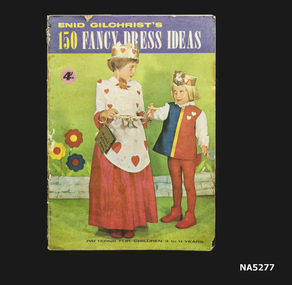
Booklet - Book, Enid Gilchrist's 150 Fancy Dress Ideas
... ...clothing...patterns...Fancy dress Enid Gilchrist clothing patterns children Enid Gilchrist's 150 Fancy Dress Ideas. ...Enid Gilchrist's 150 Fancy Dress Ideas. Patterns for children 3-11 years. Green booklet with girl in Queen of Hearts outfit, child in tunic pattern. Patterns enclosed. Price 4/- (shilling)fancy dress, enid gilchrist, clothing, patterns, children -
 Whitehorse Historical Society Inc.
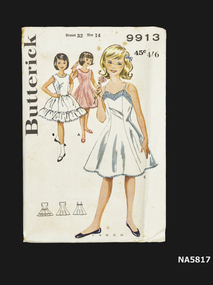
Domestic object - Butterick Paper Pattern No. 9913, The Butterick Publishing Pty Ltd
... ...clothing patterns...Dress pattern for making dresses Dressmaking Butterick Children's wear clothing patterns as above Butterick Paper Pattern No. 9913 Brest 32 size 14 45c 4/6 Sewing pattern in off-white sleeve with 3 models of young girls, each wearing slips Domestic object Butterick Paper Pattern No. 9913 The Butterick Publishing Pty Ltd ...Dress pattern for making dressesButterick Paper Pattern No. 9913 Brest 32 size 14 45c 4/6 Sewing pattern in off-white sleeve with 3 models of young girls, each wearing slips as abovedressmaking, butterick, children's wear, clothing patterns -
 Whitehorse Historical Society Inc.
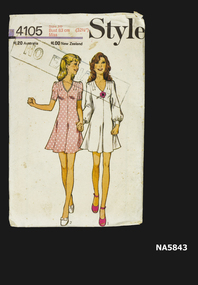
Domestic object - Style Paper Pattern No 4105, Style Patterns (N.Z.) Ltd, C 1970's
... clothing...Paper patterns...Dressmaking Women's clothing Paper patterns Style Patterns C1970's As above Style Paper Pattern No 4105 Dress pattern in off white paper sleeve with pictures of two models: one in white with long sleeves and the other model with pink and white spotted dress. ...Domestic dressmaking for women.Style Paper Pattern No 4105 Dress pattern in off white paper sleeve with pictures of two models: one in white with long sleeves and the other model with pink and white spotted dress. Both dresses are in mini style length - 1970's Size 10 - Bust 83cm (32.5 inches) Miss $1-20 Suatralia $1.00 New Zealand. No exchange.As abovedressmaking, women's clothing, paper patterns, style patterns, c1970's -
 Greensborough Historical Society
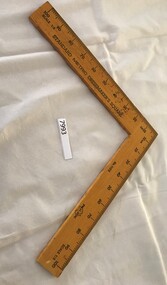
Functional object - Dressmaking Equipment, Rulex, Standard Metric Dressmaker's Square, 1960s
... Metric dressmaker's square used for designing and adjusting clothing patterns....Metric dressmaker's square used for designing and adjusting clothing patterns. dressmaking tools dressmakers square sewing Rulex; Scale 1:5 Right angle square, each arm 3 x 21 cm, measurements printed in black on laquered finished wood Standard Metric Dressmaker's Square Functional object Dressmaking Equipment Rulex ...Metric dressmaker's square used for designing and adjusting clothing patterns.Right angle square, each arm 3 x 21 cm, measurements printed in black on laquered finished woodRulex; Scale 1:5dressmaking tools, dressmakers square, sewing -
 Rutherglen Historical Society
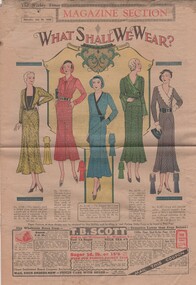
Magazine, Weekly Times, 30/07/1932
... with illustrations of women's clothing, advertising paper patterns available for purchase....with illustrations of women's clothing, advertising paper patterns available for purchase. ...Original paper issue of 8 pages from The Weekly Times, Magazine Section, for Saturday, July 30, 1932. Front cover features "What Shall We Wear?" with illustrations of women's clothing, advertising paper patterns available for purchase.newspapers, clothing, women's clothing, fashion -
 Rutherglen Historical Society
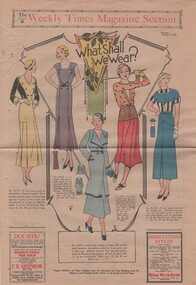
Magazine, Weekly Times, 01/10/1932
... with illustrations of women's clothing, advertising paper patterns available for purchase....with illustrations of women's clothing, advertising paper patterns available for purchase. ...Original paper issue of 4 pages from The Weekly Times, Magazine Section, for Saturday, October 1, 1932. Front cover features "What Shall We Wear?" with illustrations of women's clothing, advertising paper patterns available for purchase.newspaper, clothing, women's clothing, fashion -
![[1] Three Bears Porridge Flaked Oatmeal Bag (Front)](/media/collectors/510b3f7f023fd725b4cd51fe/items/683baf6c69688f11138d56ba/item-media/683bf711460ecdfee7105b40/item-fit-380x285.jpg?cb=6) Arapiles Historical Society
Arapiles Historical SocietyContainer - Roy SCHMIDT Collection - Cotton Flour Bags (3)
... The practice of printing toys, games, or clothing patterns on flour or oat sacks was a common marketing strategy, encouraging reuse and appealing to families during times when thrift and creativity were essential, especially during the Depression and wartime years. ...The practice of printing toys, games, or clothing patterns on flour or oat sacks was a common marketing strategy, encouraging reuse and appealing to families during times when thrift and creativity were essential, especially during the Depression and wartime years. ...[1] Three Bears Porridge Flaked Oatmeal Bag: This textile bag originates from Canadian Cereal Mills Ltd., which marketed "Three Bears" flaked oatmeal. Popular in the early 1900s to mid-century, this product combined functional packaging with a child-friendly incentive — a cut-out cloth doll. The practice of printing toys, games, or clothing patterns on flour or oat sacks was a common marketing strategy, encouraging reuse and appealing to families during times when thrift and creativity were essential, especially during the Depression and wartime years. The Three Bears brand played off the enduring popularity of children’s nursery tales, while the doll encouraged children (and parents) to reuse packaging creatively. This object captures a unique intersection of food marketing, household resourcefulness, and early 20th-century domestic life. [2] Mammy Self-Raising Flour Bag: This item is a mid-20th-century Australian flour bag, branded “Mammy Oven Puff”, produced by A. Mammy Products Pty Ltd in West Footscray, Victoria. The use of the name "Mammy" and the caricatured illustration draws on a now widely recognised and offensive racial stereotype originating from American minstrel culture, commonly used in product branding in the early-to-mid 20th century. While the bag reflects a specific period in Australian domestic and commercial packaging history, it also exemplifies racially insensitive advertising that would be considered inappropriate and harmful by today’s standards. Such items are preserved today in museum collections to help document past social attitudes, consumer culture, and the evolution of racial representation in advertising. [3] Bandung Blue Triangle Brand Flour Bag: This bag represents a mid-20th-century Australian flour export product, particularly aimed at international markets such as Indonesia (as indicated by "Bandung"). The “Blue Triangle Brand” was likely a registered trademark used by a Melbourne-based flour mill engaged in both local and overseas trade. The use of durable cloth bags for bulk flour was common prior to the widespread adoption of paper and plastic packaging. These bags were often reused domestically for household textiles, clothing patterns, or storage. The export reference (Bandung) underscores Australia's historical agricultural trade ties with Southeast Asia, especially in wheat and flour exports. – Roy SCHMIDT resided with his siblings Mabel and Jack at ‘Parklands’ 85 Lake Avenue Natimuk home of Heinrich Friederick ‘Heiny’ & Minna Christina SUDHOLZ nee LANGE and their children Louis, Sophie, Alma, Lena (Roy's Mother), Florence 'Florrie' and Edward ‘Ted’.[1] Three Bears Porridge Flaked Oatmeal Bag: A vintage cloth oatmeal bag printed with black ink on both sides. One side is branded with "Three Bears Porridge – Flaked Oatmeal", showing an image of three bears behind a gate, referencing the well-known “Goldilocks and the Three Bears” fairytale. The opposite side features a printed cut-out doll design, showing a young girl with curly hair holding a bouquet of flowers, intended to be sewn into a stuffed toy. Instructions note that the reverse side (the doll’s back) could be obtained from a second bag. The design combines product branding with a promotional activity for children, typical of early- to mid-20th-century grocery packaging aimed at reuse. [2] Mammy Self-Raising Flour Bag: A small vintage cloth flour bag with printed branding in faded red, blue, and black inks. The front of the bag features a central image of a caricatured smiling African American woman wearing a headscarf. The text is unevenly faded but legible in parts. The bag has a rectangular shape with an open top edge and signs of previous use, including creasing and some fraying at the corners. [3] Bandung Blue Triangle Brand Flour Bag: A large, rectangular vintage cloth flour bag made of cream-coloured calico or cotton. The front of the bag is printed in bold blue ink with branding and export information. It prominently features a large triangular logo reading “Blue Triangle Brand” and numerous lines of text in block and stylised fonts. The bag is open at the top with frayed edges, suggesting it was once machine-stitched shut and later opened.[1] Three Bears Porridge Flaked Oatmeal Bag: Front side (branding side): "THREE BEARS Porridge – FLAKED OATMEAL" "7 Lbs. Net." “Packed and guaranteed by Canadian Cereal Mills Ltd., Toronto” Reverse side (doll pattern): "This is the Front for Three Bears Cut-out Doll" "In order to complete this Doll it will be necessary to obtain the Back Design from another Bag of Three Bears Rolled Oats or Oatmeal." [2] Mammy Self-Raising Flour Bag: Main product name: “MAMMY OVEN PUFF SELF-RAISING FLOUR” Additional text: “The Only Creamed Flour” “Prepared with phosphate aerator” “A. MAMMY PRODUCTS PTY. LTD., Sunshine Rd., West Footscray. Phone: FW 7321” “7 LBS. NET” (near top edge, very faded) [3] Bandung Blue Triangle Brand Flour Bag: The bag is printed with the following: “10270” “G.W.C | H.L” “BANDUNG” “BEST AUSTRALIAN” “BLUE TRIANGLE BRAND” (inside the triangle logo) “GROWER & GRINDERS” (curved around the logo) “Patent Roller” “MELBOURNE” “FLOUR” “50 LBS. GROSS WHEN PACKED” These inscriptions indicate that this flour bag was manufactured in Melbourne, Australia, and was likely exported to Bandung, Indonesia.farm equipment, flour, milling, oats, mammy, bandung blue, schmidt, sudholz, parklands -
 Orbost & District Historical Society
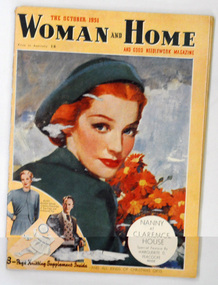
magazine, Woman and Home, October 1951
... At the bottom left are knitted baby clothes - pattern inside - as well as a man and woman wearing fashionable clothing - suggesting patterns are inside the magazine. ... inside - as well as a man and woman wearing fashionable clothing - suggesting patterns are inside the magazine. ...Women’s magazines just after WWII played a “reflecting role,” meaning they cooperated with government agendas while still including topics of readers’ interests Women’s employment rate had skyrocketed during WWII. However, even though the number of women working outside the home grew rapidly most of them were still engaged entirely in homemaking. Therefore women’s magazines centered mostly on the stresses and shortages of wartime. Articles as well as advertisements presented information on “product rationing, tips on keeping the family healthy, guidelines for thrifty shopping and advice on how to look good through it all.This is an example of an English women's magazine published post WW11.It gives practical advice on needlework / knitting and evidences the widespread interest in contemporary fashion. In doing so it shows what were the fashionable, but broadly affordable, women's and children's clothing styles of their day. These magazines also reflect women's interests.A 64 pp magazine, titled Woman and Home and Good Needlework Magazine. On the front cover is a coloured drawing of a fashionably dressed and made-up woman with red hair and holding a bunch of similarly coloured flowers (gerberas?) At the bottom left are knitted baby clothes - pattern inside - as well as a man and woman wearing fashionable clothing - suggesting patterns are inside the magazine. The magazine cost 1/6 and is dated October 1951.magazine-woman-and-home -
 Mont De Lancey
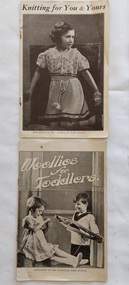
Booklet - Knitting Patterns, Australian Home Journal, 1. Knitting for You and Yours 2. Woollies for Toddlers, c.1940's and 1950's
... Inside are various patterns for clothing for children and a mother. ...Inside are various patterns for clothing for children and a mother. 1. ...Two free knitting pattern booklets for home knitters, c.1940's or 50's. These booklets were a supplement to the Home Journal magazines of the time.Two small Supplements to the 'Australian Home Journal' knitting pattern booklets, c.1940's. 1. The front cover of 'Knitting for You and Yours' depicts a young girl sitting on a chair wearing a knitted dress. 2. 'Woollies for Toddlers' shows two young children winding wool into balls. Inside are various patterns for clothing for children and a mother. non-fictionTwo free knitting pattern booklets for home knitters, c.1940's or 50's. These booklets were a supplement to the Home Journal magazines of the time.knitting, knitting patterns, knitting equipment -
Mont De Lancey
Booklet - Knitting Patterns, Australian Home Journal, 1. Knitting for You and Yours 2. Woolies for Toddlers, c.1940's and 1950's
... Inside are various patterns for clothing for children and a mother. ...Inside are various patterns for clothing for children and a mother. 1. ...Two free knitting pattern booklets for home knitters, c.1940's or 50's. These booklets were a supplement to the Home Journal magazines of the time.Two small Supplements to the 'Australian Home Journal' knitting pattern booklets, c.1940's. 1. The front cover of 'Knitting for You and Yours' depicts a young girl sitting on a chair wearing a knitted dress. 2. 'Woollies for Toddlers' shows two young children winding wool into balls. Inside are various patterns for clothing for children and a mother. non-fictionTwo free knitting pattern booklets for home knitters, c.1940's or 50's. These booklets were a supplement to the Home Journal magazines of the time.knitting, knitting patterns, knitting equipment -
 Mont De Lancey
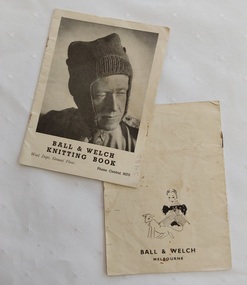
Booklet - Knitting Patterns, Ball & Welch, Ball & Welch Knitting Book, c.1940's
... Inside are various patterns for clothing - caps, sleeveless pullover, waistcoat muffler, armlets, man's socks and mittens, kneecaps and scarves. ...Inside are various patterns for clothing - caps, sleeveless pullover, waistcoat muffler, armlets, man's socks and mittens, kneecaps and scarves. ...Two knitting pattern booklets for home knitters, c.1940's. The Wool Department on the Ground Floor at Ball and Welch in Melbourne offered free advice for knitting problems. These booklets were collected over 15 years and were used for exhibition at Memo, Gallery Healesville Friday 23rdOct to 18th November 2015.Two copies of the same small Ball & Welch knitting pattern booklets, c.1940's. The front cover depicts a man wearing a knitted balaclava. Inside are various patterns for clothing - caps, sleeveless pullover, waistcoat muffler, armlets, man's socks and mittens, kneecaps and scarves. The Wool Department at Ball and Welch in Melbourne offered free advice for knitting problems.non-fictionTwo knitting pattern booklets for home knitters, c.1940's. The Wool Department on the Ground Floor at Ball and Welch in Melbourne offered free advice for knitting problems. These booklets were collected over 15 years and were used for exhibition at Memo, Gallery Healesville Friday 23rdOct to 18th November 2015.knitting, knitting patterns, knitting equipment -
 Embroiderers Guild, Victoria
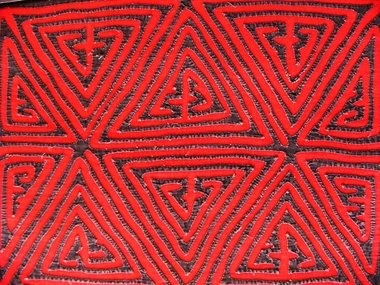
Textile - Panel, Mola Panel
... Their clothing includes a patterned wrapped skirt (saburet), a red and yellow headscarf (musue), arm and leg beads (wini), a gold nose ring (olasu) and earrings in addition to the mola blouse (dulemor). ...Their clothing includes a patterned wrapped skirt (saburet), a red and yellow headscarf (musue), arm and leg beads (wini), a gold nose ring (olasu) and earrings in addition to the mola blouse (dulemor). ...The Mola or Molas is a hand-made textile that forms part of the traditional women's clothing of the indigenous Guna people from Panama. Their clothing includes a patterned wrapped skirt (saburet), a red and yellow headscarf (musue), arm and leg beads (wini), a gold nose ring (olasu) and earrings in addition to the mola blouse (dulemor). Two groups, Choco and Guna lived side by side without intermarriage and without adopting a similar culture.In Dulegaya, the Guna's native language, "mola" means "shirt" or "clothing". The mola originated with the tradition of Guna women painting their bodies with geometric designs, using available natural colors; at a certain point, after the arrival of the Spanish, these same designs were woven in cotton, and later still, sewn using cloth "acquired by trade from the ships that came to barter for coconuts during the 19th century". Red cotton background with black reverse applique mounted on grey cotton. Design includes the serpent symbol.applique, mola - reverse applique, south america, panels -
 Mont De Lancey
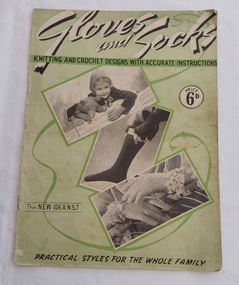
Book - Knitting Patterns, Ball & Welch, Glove and Socks: knitting and crochet designs with accurate instructions, c.1940's
... Inside are various patterns for clothing - caps, sleeveless pullover, waistcoat muffler, armlets, man's socks and mittens, kneecaps and scarves. ...Inside are various patterns for clothing - caps, sleeveless pullover, waistcoat muffler, armlets, man's socks and mittens, kneecaps and scarves. ...Two knitting pattern booklets for home knitters, c.1940's. The Wool Department on the Ground Floor at Ball and Welch in Melbourne offered free advice for knitting problems. These booklets were collected over 15 years and were used for exhibition at Memo, Gallery Healesville Friday 23rdOct to 18th November 2015.A green covered paperback knitting book with the title printed in white letting at the top c.1940's. The front cover depicts three photographs - a child wearing a knitted jumper and cap holding a teddy bear, a person wearing knitted mittens putting on a knitted sock, and a pair of white cotton crocheted ladies prettily decorated gloves. Inside are various patterns for clothing - caps, sleeveless pullover, waistcoat muffler, armlets, man's socks and mittens, kneecaps and scarves. non-fictionTwo knitting pattern booklets for home knitters, c.1940's. The Wool Department on the Ground Floor at Ball and Welch in Melbourne offered free advice for knitting problems. These booklets were collected over 15 years and were used for exhibition at Memo, Gallery Healesville Friday 23rdOct to 18th November 2015.knitting, knitting patterns, knitting equipment -
 Mont De Lancey
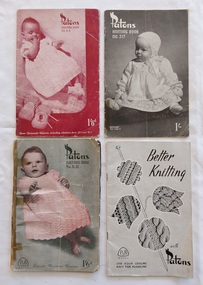
Booklet - Knitting Patterns, Patons & Baldwins ( Australia Limited), 1. Patons Knitting Books, c.1940's and 1950's
... Inside are various patterns for clothing. Two covers are pink coloured and have the price 1/6d. and one is black and white coloured with the price of 1/-.No. ...Inside are various patterns for clothing. Two covers are pink coloured and have the price 1/6d. and one is black and white coloured with the price of 1/-.No. ...Four small knitting pattern books for home knitters, c.1940's or 50's.Four small Patons knitting booklets, c.1940's or 1950's. 1. The front cover of three of the booklets show babies lying down or sitting, wearing hand knitted clothes. Inside are various patterns for clothing. Two covers are pink coloured and have the price 1/6d. and one is black and white coloured with the price of 1/-.No. R6 has p.67, R.11 has p.51, No.317 has p.23. 'Better Knitting with Patons - Use your Leisure Knit for Pleasure' is printed in black print on the grey cover of the fourth book. No price.It has general knitting instructions, diagrams, photographs, tables and some patterns, along with information about various Patons wool. p.51.non-fictionFour small knitting pattern books for home knitters, c.1940's or 50's. knitting, knitting patterns, knitting equipment -
 Mont De Lancey
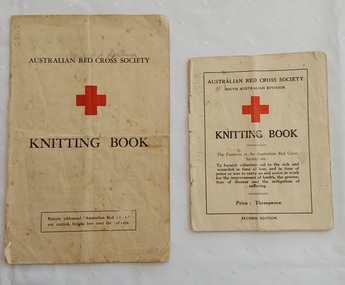
Booklet - Knitting Patterns, Australian Red Cross, Australian Red Cross Society Knitting Book, c.1940's
... Inside are various patterns for clothing - caps, sleeveless pullover, waistcoat muffler, armlets, man's socks and mittens, kneecaps, hot water bottle covers and scarves. ...Inside are various patterns for clothing - caps, sleeveless pullover, waistcoat muffler, armlets, man's socks and mittens, kneecaps, hot water bottle covers and scarves. ...Two Australian Red Cross knitting pattern booklets for home knitters, c.1940's. They were used by Ms Dorothy Hunter. These booklets were collected over 15 years and were used for exhibition at Memo, Gallery Healesville Friday 23rdOct to 18th November 2015.Two copies of Australian Red Cross Society Knitting Book, one small and one larger. The front cover shows the name of the society, a large red cross with the title Knitting Book underneath. The smaller book has information about the purpose of the Australian Red Cross Society in war times, Price: Threepence. Second Edition. The back cover has information regarding free carriage on S.A Railways and by Adelaide Steamship Company. It also has a 5 inches ruler on the left edge of the back cover.The larger book has the same title with the addition of Parcels addressed "Australian Red Cross" are carried free over the railways. On the back cover is printed Copies of this knitting book may be obtained upon application to any Red Cross Emergency Service Company in Victoria. Inside are various patterns for clothing - caps, sleeveless pullover, waistcoat muffler, armlets, man's socks and mittens, kneecaps, hot water bottle covers and scarves. non-fictionTwo Australian Red Cross knitting pattern booklets for home knitters, c.1940's. They were used by Ms Dorothy Hunter. These booklets were collected over 15 years and were used for exhibition at Memo, Gallery Healesville Friday 23rdOct to 18th November 2015.knitting, knitting patterns, knitting equipment -
 Mont De Lancey
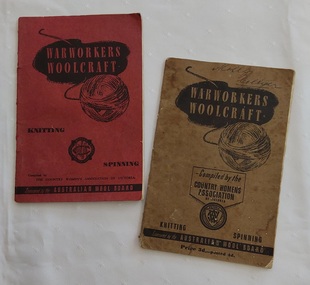
Booklet - Knitting Patterns, The Country Womens Associaotion of Victoria, War Workers' Woolcraft, c.1940's
... The book has knitting hints, patterns useful for war service members in the navy, army and air force patterns for clothing - caps, sleeveless pullover, waistcoat muffler, armlets, man's socks and mittens, kneecaps, hot water bottle covers and scarves. ...The book has knitting hints, patterns useful for war service members in the navy, army and air force patterns for clothing - caps, sleeveless pullover, waistcoat muffler, armlets, man's socks and mittens, kneecaps, hot water bottle covers and scarves. ...The red covered book is compiled by The Country Women's Association of Victoria and sponsored by the Australian Wool Board. On the back of the front cover is an Introduction by the Chairman of the Australian Wool Board, Sir Dalziel Kelly, K.B., L.L.B. explaining the reason for these books encouraging the use of Australian wool to support the Empire Forces. The Foreward promotes the CWA in a similar vein. The book has knitting hints, patterns useful for war service members in the navy, army and air force patterns for clothing.The khaki covered book is similar, but is compiled by the Country Women's Association of Victoria. It is a Third Edition.Two small copies of War Workers' Woolcraft - Knitting and Spinning books: one with a red paper cover and the other with a faded khaki coloured paper cover. 1. The red front cover book shows the title printed inside a black cloud shape with a black lined illustration of a ball of wool underneath. The Country Women's Assoc. South Aust. is printed on the cover inside a round shaped black crest. It is compiled by The Country Women's Association of Victoria and sponsored by the Australian Wool Board. Inside on the back of the front cover is an Introduction by the Chairman of the Australian Wool Board, Sir Dalziel Kelly, K.B., L.L.B. explaining the reason for these books encouraging the use of Australian wool to support the Empire Forces. The Foreward promotes the CWA in a similar vein. The book has knitting hints, patterns useful for war service members in the navy, army and air force patterns for clothing - caps, sleeveless pullover, waistcoat muffler, armlets, man's socks and mittens, kneecaps, hot water bottle covers and scarves. Inside the back cover is advice on checking your tape measure against the 6 Inch one printed on the page. 2. The khaki covered book is similar, but is compiled by the Country Women's Association of Victoria with Price 3d.- posted 4d. at the bottom of the cover. It is a Third Edition. Both have advertising on the last few pages.non-fictionThe red covered book is compiled by The Country Women's Association of Victoria and sponsored by the Australian Wool Board. On the back of the front cover is an Introduction by the Chairman of the Australian Wool Board, Sir Dalziel Kelly, K.B., L.L.B. explaining the reason for these books encouraging the use of Australian wool to support the Empire Forces. The Foreward promotes the CWA in a similar vein. The book has knitting hints, patterns useful for war service members in the navy, army and air force patterns for clothing.The khaki covered book is similar, but is compiled by the Country Women's Association of Victoria. It is a Third Edition. knitting, knitting patterns, knitting equipment -
 Flagstaff Hill Maritime Museum and Village
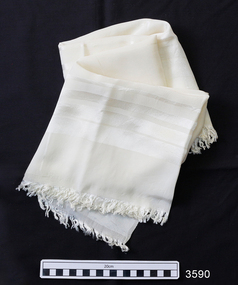
Scarf, 20th century
... Dr Angus assisted Dr Tom Ryan, a pioneer in the use of X-rays and in ocular surgery. flagstaff hill warrnambool shipwrecked-coast flagstaff-hill flagstaff-hill-maritime-museum maritime-museum shipwreck-coast flagstaff-hill-maritime-village great ocean road dr w r angus dr ryan surgical instrument t.s.s. largs bay warrnambool base hospital nhill base hospital mira hospital flying doctor silk scarf formal suit formal attire 20th century men's clothing Silk scarf, off white colour, embossed self patterned, fringed on 2 sides. ...This scarf was worn by Dr. W.R. Angus on formal occasions, together with his formal suit. Suit and scarf were donated to Flagstaff Hill Maritime Village by the family of Doctor William Roy Angus, Surgeon and Oculist. It is part of the “W.R. Angus Collection” that includes historical medical equipment, surgical instruments and material once belonging to Dr Edward Ryan and Dr Thomas Francis Ryan, (both of Nhill, Victoria) as well as Dr Angus’ own belongings. The Collection’s history spans the medical practices of the two Doctors Ryan, from 1885-1926 plus that of Dr Angus, up until 1969. ABOUT THE “W.R.ANGUS COLLECTION” Doctor William Roy Angus M.B., B.S., Adel., 1923, F.R.C.S. Edin.,1928 (also known as Dr Roy Angus) was born in Murrumbeena, Victoria in 1901 and lived until 1970. He qualified as a doctor in 1923 at University of Adelaide, was Resident Medical Officer at the Royal Adelaide Hospital in 1924 and for a period was house surgeon to Sir (then Mr.) Henry Simpson Newland. Dr Angus was briefly an Assistant to Dr Riddell of Kapunda, then commenced private practice at Curramulka, Yorke Peninsula, SA, where he was physician, surgeon and chemist. In 1926, he was appointed as new Medical Assistant to Dr Thomas Francis Ryan (T.F. Ryan, or Tom), in Nhill, Victoria, where his experiences included radiology and pharmacy. In 1927 he was Acting House Surgeon in Dr Tom Ryan’s absence. Dr Angus had become engaged to Gladys Forsyth and they decided he would take time to further his studies overseas in the UK in 1927. He studied at London University College Hospital and at Edinburgh Royal Infirmary and in 1928, was awarded FRCS (Fellow from the Royal College of Surgeons), Edinburgh. He worked his passage back to Australia as a Ship’s Surgeon on the on the Australian Commonwealth Line’s T.S.S. Largs Bay. Dr Angus married Gladys in 1929, in Ballarat. (They went on to have one son (Graham 1932, born in SA) and two daughters (Helen (died 12/07/1996) and Berenice (Berry), both born at Mira, Nhill ) Dr Angus was a ‘flying doctor’ for the A.I.M. (Australian Inland Ministry) Aerial Medical Service in 1928 . The organisation began in South Australia through the Presbyterian Church in that year, with its first station being in the remote town of Oodnadatta, where Dr Angus was stationed. He was locum tenens there on North-South Railway at 21 Mile Camp. He took up this ‘flying doctor’ position in response to a call from Dr John Flynn; the organisation was later known as the Flying Doctor Service, then the Royal Flying Doctor Service. A lot of his work during this time involved dental surgery also. Between 1928-1932 he was surgeon at the Curramulka Hospital, Yorke Peninsula, South Australia. In 1933 Dr Angus returned to Nhill where he’d previously worked as Medical Assistant and purchased a share of the Nelson Street practice and Mira hospital from Dr Les Middleton one of the Middleton Brothers, the current owners of what was once Dr Tom Ryan’s practice. Dr L Middleton was House Surgeon to the Nhill Hospital 1926-1933, when he resigned. [Dr Tom Ryan’s practice had originally belonged to his older brother Dr Edward Ryan, who came to Nhill in 1885. Dr Edward saw patients at his rooms, firstly in Victoria Street and in 1886 in Nelson Street, until 1901. The Nelson Street practice also had a 2 bed ward, called Mira Private Hospital ). Dr Edward Ryan was House Surgeon at the Nhill Hospital 1884-1902 . He also had occasions where he successfully performed veterinary surgery for the local farmers too. Dr Tom Ryan then purchased the practice from his brother in 1901. Both Dr Edward and Dr Tom Ryan work as surgeons included eye surgery. Dr Tom Ryan performed many of his operations in the Mira private hospital on his premises. He too was House Surgeon at the Nhill Hospital 1902-1926. Dr Tom Ryan had one of the only two pieces of radiology equipment in Victoria during his practicing years – The Royal Melbourne Hospital had the other one. Over the years Dr Tom Ryan gradually set up what was effectively a training school for country general-practitioner-surgeons. Each patient was carefully examined, including using the X-ray machine, and any surgery was discussed and planned with Dr Ryan’s assistants several days in advance. Dr Angus gained experience in using the X-ray machine there during his time as assistant to Dr Ryan. Dr Tom Ryan moved from Nhill in 1926. He became a Fellow of the Royal Australasian College of Surgeons in 1927, soon after its formation, a rare accolade for a doctor outside any of the major cities. He remained a bachelor and died suddenly on 7th Dec 1955, aged 91, at his home in Ararat. Scholarships and prizes are still awarded to medical students in the honour of Dr T.F. Ryan and his father, Dr Michael Ryan, and brother, John Patrick Ryan. ] When Dr Angus bought into the Nelson Street premises in Nhill he was also appointed as the Nhill Hospital’s Honorary House Surgeon 1933-1938. His practitioner’s plate from his Nhill surgery states “HOURS Daily, except Tuesdays, Fridays and Saturday afternoons, 9-10am, 2-4pm, 7-8pm. Sundays by appointment”. This plate is now mounted on the doorway to the Port Medical Office at Flagstaff Hill Maritime Village, Warrnambool. Dr Edward Ryan and Dr Tom Ryan had an extensive collection of historical medical equipment and materials spanning 1884-1926 and when Dr Angus took up practice in their old premises he obtained this collection, a large part of which is now on display at the Port Medical Office at Flagstaff Hill Maritime Village in Warrnambool. During his time in Nhill Dr Angus was involved in the merging of the Mira Hospital and Nhill Public Hospital into one public hospital and the property titles passed on to Nhill Hospital in 1939. In 1939 Dr Angus and his family moved to Warrnambool where he purchased “Birchwood,” the 1852 home and medical practice of Dr John Hunter Henderson, at 214 Koroit Street. (This property was sold in1965 to the State Government and is now the site of the Warrnambool Police Station. ). The Angus family was able to afford gardeners, cooks and maids; their home was a popular place for visiting dignitaries to stay whilst visiting Warrnambool. Dr Angus had his own silk worm farm at home in a Mulberry tree. His young daughter used his centrifuge for spinning the silk. Dr Angus was appointed on a part-time basis as Port Medical Officer (Health Officer) in Warrnambool and held this position until the 1940’s when the government no longer required the service of a Port Medical Officer in Warrnambool; he was thus Warrnambool’s last serving Port Medical Officer. (The duties of a Port Medical Officer were outlined by the Colonial Secretary on 21st June, 1839 under the terms of the Quarantine Act. Masters of immigrant ships arriving in port reported incidents of diseases, illness and death and the Port Medical Officer made a decision on whether the ship required Quarantine and for how long, in this way preventing contagious illness from spreading from new immigrants to the residents already in the colony.) Dr Angus was a member of the Australian Medical Association, for 35 years and surgeon at the Warrnambool Base Hospital 1939-1942, He served as a Surgeon Captain during WWII 1941-45, in Ballarat, Victoria, and in Bonegilla, N.S.W., completing his service just before the end of the war due to suffering from a heart attack. During his convalescence he carved an intricate and ‘most artistic’ chess set from the material that dentures were made from. He then studied ophthalmology at the Royal Melbourne Eye and Ear Hospital and created cosmetically superior artificial eyes by pioneering using the intrascleral cartilage. Angus received accolades from the Ophthalmological Society of Australasia for this work. He returned to Warrnambool to commence practice as an ophthalmologist, pioneering in artificial eye improvements. He was Honorary Consultant Ophthalmologist to Warrnambool Base Hospital for 31 years. He made monthly visits to Portland as a visiting surgeon, to perform eye surgery. He represented the Victorian South-West subdivision of the Australian Medical Association as its secretary between 1949 and 1956 and as chairman from 1956 to 1958. In 1968 Dr Angus was elected member of Spain’s Barraquer Institute of Barcelona after his research work in Intrasclearal cartilage grafting, becoming one of the few Australian ophthalmologists to receive this honour, and in the following year presented his final paper on Living Intrasclearal Cartilage Implants at the Inaugural Meeting of the Australian College of Ophthalmologists in Melbourne In his personal life Dr Angus was a Presbyterian and treated Sunday as a Sabbath, a day of rest. He would visit 3 or 4 country patients on a Sunday, taking his children along ‘for the ride’ and to visit with him. Sunday evenings he would play the pianola and sing Scottish songs to his family. One of Dr Angus’ patients was Margaret MacKenzie, author of a book on local shipwrecks that she’d seen as an eye witness from the late 1880’s in Peterborough, Victoria. In the early 1950’s Dr Angus, painted a picture of a shipwreck for the cover jacket of Margaret’s book, Shipwrecks and More Shipwrecks. She was blind in later life and her daughter wrote the actual book for her. Dr Angus and his wife Gladys were very involved in Warrnambool’s society with a strong interest in civic affairs. Their interests included organisations such as Red Cross, Rostrum, Warrnambool and District Historical Society (founding members), Wine and Food Society, Steering Committee for Tertiary Education in Warrnambool, Local National Trust, Good Neighbour Council, Housing Commission Advisory Board, United Services Institute, Legion of Ex-Servicemen, Olympic Pool Committee, Food for Britain Organisation, Warrnambool Hospital, Anti-Cancer Council, Boys’ Club, Charitable Council, National Fitness Council and Air Raid Precautions Group. He was also a member of the Steam Preservation Society and derived much pleasure from a steam traction engine on his farm. He had an interest in people and the community He and his wife Gladys were both involved in the creation of Flagstaff Hill, including the layout of the gardens. After his death (28th March 1970) his family requested his practitioner’s plate, medical instruments and some personal belongings be displayed in the Port Medical Office surgery at Flagstaff Hill Maritime Village, and be called the “W. R. Angus Collection”. The W.R. Angus Collection is significant for still being located at the site it is connected with, Doctor Angus being the last Port Medical Officer in Warrnambool. The collection of medical instruments and other equipment is culturally significant, being an historical example of medicine from late 19th to mid-20th century. Dr Angus assisted Dr Tom Ryan, a pioneer in the use of X-rays and in ocular surgery. Silk scarf, off white colour, embossed self patterned, fringed on 2 sides. This scarf was worn by Dr. W.R.Angus, together with his evening suit, on cold evenings in Warrnambool. flagstaff hill, warrnambool, shipwrecked-coast, flagstaff-hill, flagstaff-hill-maritime-museum, maritime-museum, shipwreck-coast, flagstaff-hill-maritime-village, great ocean road, dr w r angus, dr ryan, surgical instrument, t.s.s. largs bay, warrnambool base hospital, nhill base hospital, mira hospital, flying doctor, silk scarf, formal suit, formal attire 20th century, men's clothing -
 Greensborough Historical Society
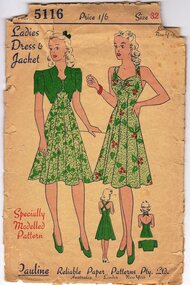
Functional object - Dressmaking Pattern - Digital Image, Pauline Paper Patterns, Pauline paper patterns number 5116, 1939_
... patterns...dresses...clothing...This pattern is for a ladies' dress and 'bolero' jacket, drawing on front and instructions on back cover. An example of early 20th century clothing and sewing patterns dressmaking patterns patterns dresses clothing Digital copy of front and back covers of dressmaking pattern. ...Front and back covers of "Pauline paper patterns number 5116". This pattern is for a ladies' dress and 'bolero' jacket, drawing on front and instructions on back cover.An example of early 20th century clothing and sewing patternsDigital copy of front and back covers of dressmaking pattern.dressmaking patterns, patterns, dresses, clothing -
Alexandra Timber Tramway & Museum
Baby's Mittens, Children's Clothing
... patterned mittens. Cord draw string in wrist of same material. Thumb separate to fingers. Frill to wrist. Children's Clothing ...Pair of pink woollen machine knitted patterned mittens. Cord draw string in wrist of same material. Thumb separate to fingers. Frill to wrist.mittens, woollen, machine, knitted, pink, cord, in, wrist -
 Flagstaff Hill Maritime Museum and Village
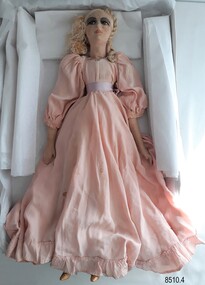
Leisure object - Boudoir Doll, c. early 1900s
... clothing, trims, accessories and hairstyles. A doll such as this may have been found in a Victorian dressmaker's premises for use as a pattern and technique template and for a display to customers. ...The donor was given this doll about 50 years ago by her grandfather (in the late 1960s). He used to be a handyman at a high rise building in St Kilda, Melbourne. He had been doing some work for one of the old ladies and she gave him the doll to give to his granddaughter, who collected dolls. The doll has spent a few years at the Nagambie museum until it closed down and returned to the donor The origins or age of the doll are unknown. Originally it was thought to be a Fashion Doll dating from around the 1880s but the painted face together with the bisque legs and gold painted shoes are similar to those found on Boudoir Dolls (also known as Bed Dolls, Sofa Dolls, Flapper Dolls and French Dolls) of the early 20th century. Fashion dolls were sent from fashion houses to advertise the latest styles, fabrics, trims, hairstyles and accessories. Dressmakers would show these dolls to their customers. Ladies would then place their order and the dressmakers would make the dress to their size. The dressmakers would learn the construction techniques from examining the dolls. Boudoir Dolls dolls usually had no maker's marks and were primarily used as bedroom decorations for ladies rather than as children's toys. This doll appears to date at about the early part of the 20th century, but the petticoats are much older - possibly from a child's christening gown. At the time that the donor received the doll, it had a coloured lace over-gown that was badly torn so her mother removed it to replace with more lace but this never eventuated. The pink silk dress also appears to have been remodelled into a 19th century style with gathered sleeves and a gathered skirt. This fashion or boudoir doll is significant for being a rare example of a doll made in the late 19th or early 20th centuries. The doll is wearing clothing representing the fashion for young girls in that era. The doll is also significant as an item possibly used by fashion houses and dressmakers to advertise the latest fashions in clothing, trims, accessories and hairstyles. A doll such as this may have been found in a Victorian dressmaker's premises for use as a pattern and technique template and for a display to customers. It may also have been used as a decorative item in a lady's bedroom.Female boudoir doll with silk face and body, and porcelain lower arms and legs. She has plaited blonde silk hair. Her painted face has brown eyes and her shoes are painted gold. The doll is dressed in a long pink puffed-sleeve dress with a gathered waist and a ruffle at the hem. A pink ribbon around her waist is tied at the back. There are small silver balls hand-stitched around the neckline. She has a white, hand-embroidered lace petticoat and bloomers.warrnambool, flagstaff hill maritime museum, shipwreck coast, flagstaff hill maritime village, great ocean road, doll, boudoir doll, female doll, dressmaker's doll, display doll, late 1800s doll, fashion doll, antique doll, 19th century doll, children's fashion, girl's fashion, late 1800s children's fashion, early 20th century doll, composite doll, french doll -
 Flagstaff Hill Maritime Museum and Village
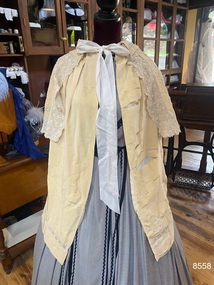
Clothing - Double Cape with Collar
... pattern most likely made of a combination of silk and cotton. The cape material appears to be a cream ribbed silk with the lining being of a polished cotton or silk variety. Both materials have a silken sheen in the right light. A silk ribbon ties the cape at the neck. The lining and lace have been sewn with fine hand stitching. Clothing ...The cape is of a style from the Victorian or the Edwardian Era and so provides a good example of women's clothing from that time. The light colour, silk material and lace suggest a cape used for special occasions with the possibility of initially being a wedding cape.The item is of significance historically and socially as an example of women's clothing in the Victorian and Edwardian eras.Ladies cape consisting of two circular tiers and a collar. The inner tier is knee length with a thin lace insert around the hem. The outer tier is elbow length with a wide lace edge and the thin lace insert inside this. The collar has lace edging and a lace insert of the same width. The lace used is of a repeat flower pattern most likely made of a combination of silk and cotton. The cape material appears to be a cream ribbed silk with the lining being of a polished cotton or silk variety. Both materials have a silken sheen in the right light. A silk ribbon ties the cape at the neck. The lining and lace have been sewn with fine hand stitching.flagstaff hill, warrnambool, maritime village, maritime museum, flagstaff hill maritime museum and village, shipwreck coast, great ocean road, ladies cape, double cape, silk cape, layered cape, cape with lace collar, decorative lace edging, victorian era, edwardian era -
 Flagstaff Hill Maritime Museum and Village
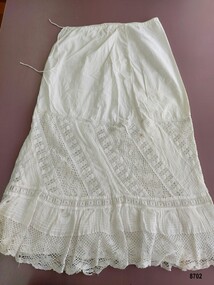
Textile - Petticoat, circa 1910
... clothing. Flagstaff Hill Maritime Museum and Village Great Ocean Road Shipwreck Coast Warrnambool petticoat lady's petticoat needlework sewing broderie anglaise Stephenson family drawstring waistband A lady's ankle length petticoat made in three sections. The top section is made from three rectangles of fine cotton (batiste) joined into a round with narrow french seams and inserted into a simple drawstring waistband with a small opening. The second section is made with rows of alternating strips of fine pin tucked lawn, white cotton cut work embroidery and a wider cotton lace design all joined in a diagonal pattern ...This item is one of a collection of clothing items that belonged to the Stephenson family who lived at 22 McCracken Street, Kensington, Melbourne. Matthew Stephenson (1861 – 1943) who had grown up on the Bendigo goldfields and shifted to Melbourne in the early 1900’s was a train driver and later, a fireman with the railways. His wife Elizabeth Jane (Betsy) Wigley (1865 – 1953) also grew up on the goldfields around Majorca and Bendigo. They married in 1885 in Bendigo. They had two daughters – Ethel Evelyn Stephenson (1886 – 1956) and Lillian or Lila (1891 – 1977) who were milliners and dressmakers and who continued to live in the family home after the death of their parents. The family are recorded as living at 22 McCracken Street, Kensington, as early as 1914. It is not known who made or owned the clothing that makes up this collection but as it appears to be from the late Victorian and early Edwardian era, the different pieces were probably made and worn by any of the three ladies of the house – Betsy, Ethel and/or Lila. During W.W.2, a local Warrnambool couple (Meryl and Tony Everard) boarded with them – Tony was in the airforce training paratroopers to jump into (and survive) enemy territory and his wife Meryl worked in the Methodist baby Home. The Everards developed a close friendship with the Stephensons and were responsible for clearing out the house (and finding this clothing collection) after Lila died in 1977. A petticoat is a lady's undergarment - worn under a skirt or dress. They provided warmth, modesty and shape to the dress. In the middle of the 19th century, petticoats were worn over hoops, bustles or in layers. Petticoats varied according to the style of the outside skirt or dress. Plain petticoats tended to be worn with everyday wear whilst better dresses (party dresses or silk gowns) were worn with petticoats that often had more trim and embellishments. Edwardian petticoats had less volume than Victorian era petticoats and they had a "dust ruffle" or lining under a lace flounce. The "dust ruffle" protected the lace flounce and gave the petticoat more flare at the bottom, greater freedom when walking as well as saving the flounce (which was often made of finer material) from everyday wear and tear. Tucks are another feature of Edwardian petticoats - when the lace at the bottom became worn, it could be cut off and the tucks released. This extended the life of the petticoat. This petticoat features an intricate trim of broderie anglaise. Although broderie anglaise was a lace that could be made by hand, it was very time consuming to make. St Gallen was a city in Switzerland that had become known for producing quality textiles. At the beginning of the 19th century, the first embroidery machines were developed in St Gallen. Factories used embroidery machines but people also had them in their homes. They were able to produce broderie anglaise for export. By the early 20th century, machine made lace, fabric, ribbons etc. were being sold in drapers shops all over England and Wales to women who were making clothes and furnishings for their families. It is highly likely that the lady who made this petticoat brought the lengths of broderie anglaise already made to embellish and personalise her petticoat.This item is an example of the needlework skills of women in the late 19th century - creating pintucks and adding lace to personalise and embellish a practical item of clothing.A lady's ankle length petticoat made in three sections. The top section is made from three rectangles of fine cotton (batiste) joined into a round with narrow french seams and inserted into a simple drawstring waistband with a small opening. The second section is made with rows of alternating strips of fine pin tucked lawn, white cotton cut work embroidery and a wider cotton lace design all joined in a diagonal pattern and lined with fine lawn. The bottom section of the petticoat has a horizontal strip of eyelet lace followed by a wider strip of fine pin tucked lawn and is finished with a deep hem of white cotton crocheted lace fabric and has the same lawn lining as the section above.flagstaff hill maritime museum and village, great ocean road, shipwreck coast, warrnambool, petticoat, lady's petticoat, needlework, sewing, broderie anglaise, stephenson family, drawstring waistband -
 Flagstaff Hill Maritime Museum and Village
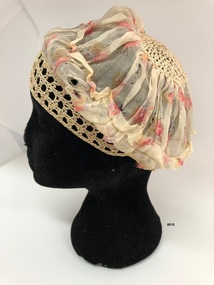
Headwear - Lady's boudoir cap, Early 1900s
... Flagstaff Hill Warrnambool Maritime Village Maritime Museum Flagstaff Hill Maritime Museum & Village Shipwreck Coast Great Ocean Road Boudoir Cap Nightcap female headwear sleepwear Vintage women's clothing Terang & District Co-Op The boudoir cap is constructed of cream silk with a pale floral pattern. ...Simple night caps had been worn by women in the 1800s for practical purposes such as to keep warm at night. In the early 1900s silk boudoir caps became popular to protect hairstyles while sleeping. It was also thought to maintain or even improve the condition of the hair. This boudoir cap was amongst the belongings of the donor's Great Aunts who were both dressmakers at the original Terang & District Co-Op which was established in 1908.Socially this item is significant as an example of women's headwear from the early 1900s. Historically this item holds significance as a possession of the donor’s Great Aunts who worked as dressmakers at the original Terang & District Co-Op established in 1908.The boudoir cap is constructed of cream silk with a pale floral pattern. A cream crocheted border and top insert are attached using hand stitching. The small ruffle is machine stitched. The silk fabric is fragile and has perished in some places.flagstaff hill, warrnambool, maritime village, maritime museum, flagstaff hill maritime museum & village, shipwreck coast, great ocean road, boudoir cap, nightcap, female headwear, sleepwear, vintage women's clothing, terang & district co-op -
 Flagstaff Hill Maritime Museum and Village
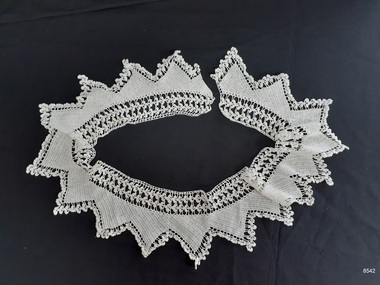
Textile - Lace Sample, Late 1800s to 1940s
... clothing. Flagstaff Hill Warrnambool Maritime Village Maritime Museum Flagstaff Hill Maritime Museum & Village Shipwreck coast Great Ocean Road lace handmade lace crocheted lace decorative edging decorative lace edging domestic object crocheted trim ladies collar crocheted collar A wide length of handmade crochet lace with an open pattern at the top and a pointed edged pattern underneath. ...The sample of crochet lace is an example of a handmade item that would have been used to decorative purpose around the home. It may have been used to edge curtains, a table runner or a mantlepiece. Smaller pieces were used to edge towels. The shape of this piece suggests a possible use as a ladies collar however no tie or buttons have been attached at the ends.The item is significant socially to show the use of textile crafts, such as handmade crocheted lace, to decorate regular domestic objects or create pieces of clothing.A wide length of handmade crochet lace with an open pattern at the top and a pointed edged pattern underneath. For the open pattern mercerised white crochet thread has been used to crochet a double row of a repeat pattern of 'three circles and stems'. Underneath double crochet (US) / treble crochet (UK) is used to create the points which have been edged with the 'three circles and stems' pattern from above.flagstaff hill, warrnambool, maritime village, maritime museum, flagstaff hill maritime museum & village, shipwreck coast, great ocean road, lace, handmade lace, crocheted lace, decorative edging, decorative lace edging, domestic object, crocheted trim, ladies collar, crocheted collar -
 Flagstaff Hill Maritime Museum and Village
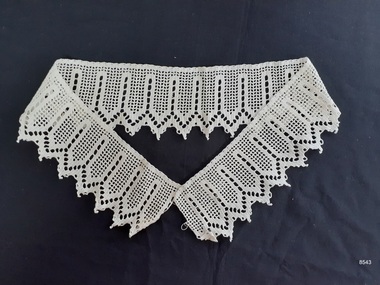
Textile - Lace Sample, Late 1800s to 1940s
... clothing. Flagstaff Hill Warrnambool Maritime Village Maritime Museum Flagstaff Hill Maritime Museum & Village Shipwreck coast Great Ocean Road lace handmade lace crocheted lace decorative edging decorative lace edging domestic object crocheted trim ladies collar crocheted collar A strip of handmade crochet lace with a pointed edge. Mercerised white crochet thread has been used to crochet a lace pattern ...The sample of crochet lace is an example of a handmade item that would have been used to decorative purpose around the home. Being a shorter length it may have edged towels or found use as a collar however no tie or buttons have been attached at the ends.The item is significant socially to show the use of textile crafts, such as handmade crocheted lace, to decorate regular domestic objects or create pieces of clothing.A strip of handmade crochet lace with a pointed edge. Mercerised white crochet thread has been used to crochet a lace pattern consisting of small open weave areas reflecting the pointed shape of the lace and a larger, open, zig zag and line pattern. flagstaff hill, warrnambool, maritime village, maritime museum, flagstaff hill maritime museum & village, shipwreck coast, great ocean road, lace, handmade lace, crocheted lace, decorative edging, decorative lace edging, domestic object, crocheted trim, ladies collar, crocheted collar -
 City of Moorabbin Historical Society (Operating the Box Cottage Museum)
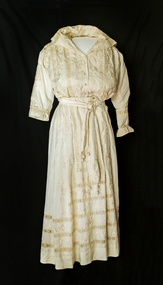
Clothing - Wedding Dress, Mary Box (nee Closter), circa 1918
... pattern. The back of the skirt is plain with 3 bands of lacework rising from the hem, which is sewn with spoke work stitch. The long waist sash/belt is plain silk with embroidered ends and 3 silk balls with crocheted caps suspended on 3 crocheted silk chains. It has a rose knot with 2 metal press stud fasteners. There are a variety of floral designs embroidered on the material including ‘corner motifs’ on the 2nd inner front panel of skirt. Mary Box (nee Closter) Clothing ...Alonzo Box, of Oakleigh ,a nephew of William and Elizabeth Box who resided in 'Box Cottage' 1865 - 1914, married Mary Closter (Kloster), of Oakleigh, on June 12th 1918. Alozo's elder sister, Rebecca, sent a bolt of Chinese hand-embroidered silk from which this wedding dress was made. Rebecca Viloudakia, nee Box, was a missionary in China, and married to a Greek Silk Merchant. Alonzo Box, the 9th child of John and Martha Sheldrake Box , enlisted in the Army and landed at Gallipoli 25/4/1918. He was evacuated to Egypt and then sent to the battlefields of France and Flanders before returning home to Melbourne in February 1918. Rebecca Box, the eldest child of John and Martha Sheldrake Box, was in the first party of Methodist Missionaries to leave Australia for the China Inland Mission in 1890. During the Boxer Uprising 1900-1901 her Mission outpost was attacked but she escaped and was taken to Shanghai. She later married one of the rescue party Nicholas Viloudakia a Greek silk merchant .Australian Dress Register ID 573 12/5/2015 Following Henry Dendy's Special Survey 1841 pioneer settlers bought allotments of land in the area of Moorabbin Parish. Alonzo Box was the nephew of William and Elizabeth Box who bought the cottage on the 30acre allotment from an unknown pioneer settler in 1868 and resided there until Elizabeth's death in 1914. Alonzo Box served in the Army World War 1 1914- 1918 at Gallipoli, France and Flanders. Rebecca Box -Viloudakia was in the first party of Methodist Missionaries to leave Australia for the China Inland Mission in 1890 and was rescued during the Boxer Rebellion 1900-1901 and taken to Shanghai by her future husband.A cream two piece wedding dress made from a bolt of hand embroidered Chinese silk for the marriage of Mary Closter and Alonzo Box on June 12th, 1918. The bolt of Chinese silk was sent by Alonzo’s older sister, Mrs Rebecca Viloudakia, a missionary in China, who was married to a Greek silk merchant. The machine sewn dress was made by a dressmaker in Dandenong, Victoria. The jacket is blouson, with a front opening and is gathered at the waist by a band enclosing a drawstring. The collar is a sailor style that forms a slight / high V-shape front neckline. Four vertical roses are separated by three bands of lacework. The back of the jacket is plain silk. The right front of the jacket has a panel of embroidered roses, band of lacework and a facing fold that encloses 4 fastening presses. There are crocheted bobbles on the front representing buttons. The left jacket front also has the panel of embroidered roses, lacework and matching fold for the 4 fastening studs. The full length inset sleeves are gathered to a cuff that fastens with silk covered buttons. The sleeves have floral embroidery down the outside centre line. The left sleeve has an extra detachable cuff with embroidery on the flounce that matches the bottom panel of the skirt. It is held in position around the wrist by 4 white metal press studs. The skirt sits above the ankle. It consists of 5 panels slightly gathered at the back waistline with a left side placket 21cm with hooks and eyes and press studs. The waistband is lined with petersham and has 6 whalebone inserts. The front of the skirt has small pleats to fit the 3 decorated panels to the waistline. The front has 3 bands of lacework around the lower part. 3 panels form the centre front each embroidered with a different floral pattern. The back of the skirt is plain with 3 bands of lacework rising from the hem, which is sewn with spoke work stitch. The long waist sash/belt is plain silk with embroidered ends and 3 silk balls with crocheted caps suspended on 3 crocheted silk chains. It has a rose knot with 2 metal press stud fasteners. There are a variety of floral designs embroidered on the material including ‘corner motifs’ on the 2nd inner front panel of skirt. brighton, moorabbin, silk, box william, box elizabeth, box alonzo, box mary, kloster mary, closter mary, oakleigh, dandenong, chinese silk merchant, boxer rebellion 1900-1901, box rebecca, methodist china inland mission, viloudakia nichols, anzac landings, world war 1, gallipoli -
 City of Moorabbin Historical Society (Operating the Box Cottage Museum)
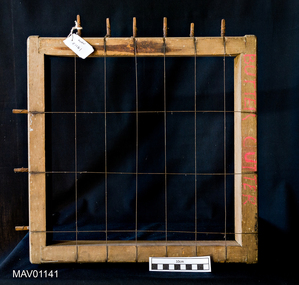
Equipment - Dairy Equipment, cheese cutter
... clothing while they established market gardens, dairy farms , poultry farms, orchards and flower nurseries. Each family had a 'house cow ' to provide dairy products of milk, cheese, cream and butter. cheese cutter equipment box cottage dairy A wooden frame with wire cross pattern for cutting cheese Equipment Dairy Equipment, cheese cutter Unrecorded early settler family ...This cheese cutter was made and used by an early settler family in Moorabbin Shire c 1900Early settler families in Moorabbin Shire were self sufficient making their own tools , kitchen equipment, and clothing while they established market gardens, dairy farms , poultry farms, orchards and flower nurseries. Each family had a 'house cow ' to provide dairy products of milk, cheese, cream and butter.A wooden frame with wire cross pattern for cutting cheesecheese cutter, equipment, box cottage, dairy -
 City of Moorabbin Historical Society (Operating the Box Cottage Museum)
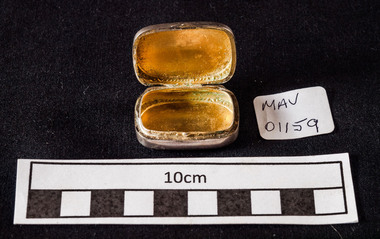
Manufactured Object, white metal pill box, 20thC
... This 'pill box' was used by a lady in the family of Ailsa Hunt in Moorabbin S Small decorative silver pill boxes were a common accessory for early settler women in Moorabbin Shire c1900 clothing, pill boxes, silver, pewter, brass, evening bags, victorian fashion, edwardian fashion, market gardeners, early settlers, moorabbin shire, bentleigh, mckinnon, moorabbin, cheltenham, wedding dresses, evening wear, machined pattern on lid with beading on edge A small rectangular white metal pill box with gold lining, a hinged lid and snap lock Manufactured Object, white metal pill box Unrecorded metal worker ...c1900 Decorative silver 'pill boxes' were popular accessories carried in a small purse by women for evening and special occasions . This 'pill box' was used by a lady in the family of Ailsa Hunt in Moorabbin SSmall decorative silver pill boxes were a common accessory for early settler women in Moorabbin Shire c1900A small rectangular white metal pill box with gold lining, a hinged lid and snap lock machined pattern on lid with beading on edgeclothing, pill boxes, silver, pewter, brass, evening bags, victorian fashion, edwardian fashion, market gardeners, early settlers, moorabbin shire, bentleigh, mckinnon, moorabbin, cheltenham, wedding dresses, evening wear, -
 Glenelg Shire Council Cultural Collection
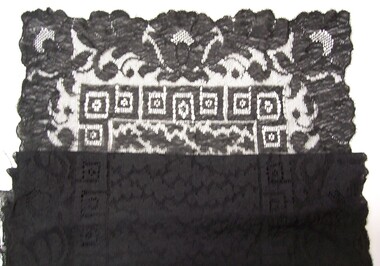
Clothing - Stole, n.d
... Central leaf pattern is surrounded by border of squares and flowers. Outside border is leaf and flower motif. Clothing ...Black cotton lace stole. Central leaf pattern is surrounded by border of squares and flowers. Outside border is leaf and flower motif.
